JP2004232103A - Method for making pattern for dress - Google Patents
Method for making pattern for dress Download PDFInfo
- Publication number
- JP2004232103A JP2004232103A JP2003019397A JP2003019397A JP2004232103A JP 2004232103 A JP2004232103 A JP 2004232103A JP 2003019397 A JP2003019397 A JP 2003019397A JP 2003019397 A JP2003019397 A JP 2003019397A JP 2004232103 A JP2004232103 A JP 2004232103A
- Authority
- JP
- Japan
- Prior art keywords
- pattern
- line
- point
- bust
- elements
- Prior art date
- Legal status (The legal status is an assumption and is not a legal conclusion. Google has not performed a legal analysis and makes no representation as to the accuracy of the status listed.)
- Pending
Links
- 238000000034 method Methods 0.000 title claims abstract description 53
- 210000001624 hip Anatomy 0.000 description 35
- 210000001991 scapula Anatomy 0.000 description 16
- 238000012937 correction Methods 0.000 description 12
- 238000012986 modification Methods 0.000 description 9
- 230000004048 modification Effects 0.000 description 9
- 238000010586 diagram Methods 0.000 description 8
- 230000008707 rearrangement Effects 0.000 description 7
- 238000013461 design Methods 0.000 description 6
- 238000005259 measurement Methods 0.000 description 5
- 230000000694 effects Effects 0.000 description 4
- 230000037237 body shape Effects 0.000 description 3
- 210000003205 muscle Anatomy 0.000 description 3
- 239000004744 fabric Substances 0.000 description 2
- 239000008267 milk Substances 0.000 description 2
- 210000004080 milk Anatomy 0.000 description 2
- 235000013336 milk Nutrition 0.000 description 2
- 230000008961 swelling Effects 0.000 description 2
- 238000005520 cutting process Methods 0.000 description 1
- 210000000245 forearm Anatomy 0.000 description 1
- 238000004519 manufacturing process Methods 0.000 description 1
- 210000000062 pectoralis major Anatomy 0.000 description 1
- 230000002093 peripheral effect Effects 0.000 description 1
- 238000012545 processing Methods 0.000 description 1
- 238000003860 storage Methods 0.000 description 1
Images



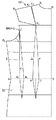
Landscapes
- Corsets Or Brassieres (AREA)
Abstract
Description
【0001】
【発明の属する技術分野】
この発明は、衣服用型紙を作成するための体型パターン(原型)を作成する技術に関し、具体的には、上半身の横寸法(胸囲、トップバスト、アンダーバスト)等と縦寸法とを用いてパターンを作成する技術、このパターンに基づいて衣服用型紙を作成する技術、さらには、この衣服用型紙に基づいて衣服を作製する技術に関する。また、このようなパターン及び衣服用型紙を作成する方法を実施するプログラムに関する。
【0002】
【従来の技術】
衣服を製作するには、布地を、身ごろ、袖、襟などの各種のパーツに裁断し、これらのパーツを縫い合わせることによって人体の三次元形状に適合させるようになっている。これらのパーツは、通常、それぞれのパーツの型紙に基づいて布地を裁断することによって得られている。
各バーツの型紙のうち、上身ごろ、特に前身ごろはバストの存在などにより凹凸が多い。このため、上衣用の型紙を作成するのは比較的困難である。
【0003】
型紙を作成する手法の一つとして、平面製図法がある。この方法では、一般に、(1)採寸対象者(つまり着用者)のバスト・背丈・袖丈等の採寸寸法とJIS規格の標準寸法とを基にした計算により、デザイン分やゆとり分を含まず着用者の実際の寸法体型を平面上に展開した「原型」を作成し、(2)この原型にデザイン分やゆとり分を紙面上でおおまかに書き加えていく。したがって、全ての製図作業を紙面上でおこなうことができるので簡単であり、短時間で原型及び型紙を作成することができる。しかし、この方法により作成した型紙を使用した場合、得られた各パーツを一旦仮縫いし、組立てた状態をチェックして、サイズのずれを補正するという面倒な作業を要する一方で、得られた衣服が結局は立体感に欠けるものであったりした。
【0004】
ここに、型紙の作成法として、JIS規格における各種横寸法に加え、トップバストのバストポイントを中心として着用者の体格の指標となりうる「ワンバスト(1B)寸法」(あるいは「上胸囲寸法」)という新たな寸法概念を利用して、まず平面的な原型を作成する方法があるものである(特許文献1〜3)。なお、この1B寸法とは、着用者のバストポイントより約5cm〜約6cm上方に位置する点と両脇下とを結ぶ直線の上をメジャーが通過するようにして測定した胸部周りの寸法であることが特開2001−11721公報に記載されている。平面原型を作成後、この原型において新たに設定したバストポイントを中心にして原型を4個に切開し、分割する。分割により得られたユニットを回転させたり、移動させたりすることにより、最終的にパターンを得るものである。
【0005】
【特許文献1】
実公昭58−12808号公報
【特許文献2】
特公平2−29763号公報
【特許文献3】
特開2001−11721号公報
【0006】
この方法によれば、この1B寸法は、上記2B寸法とは異なり、バストの膨らみ部分(および肩胛骨)を避けるように測定されるため、着用者のバストの膨らみの大小に左右されず、その体幹部の骨格の大きさを把握するのに利用できる。また、いわゆるアンダーバストとは異なり、大胸筋上を通るように測定されるので、着用者の筋肉量も大まかに把握することができることも記載されている。
【0007】
【発明が解決しようとする課題】
しかしながら、このパターンによれば、上半身の上部、すなわち、バストポイントより上部を主体とした三次元形状感を反映させることができるものの、特に、バストの立体感に大きく影響する要素、すなわち、バスト間の凹部やトップバストとアンダーバストとの高低差に由来する身体表面側の凹凸をパターンに反映させることができなかった。結果として、このパターンに基づいて作成された型紙による衣服では、所望のデザインやフィット感を得るには、依然として、従前どおりの、カンなどに頼る補正を必要としていた。
そこで、本発明では、バストからウエストラインにかけての三次元形状を反映したパターンの作成技術を提供すること、及びこれにより、最終的に得られる衣服において、所望のデザインやフィット感を容易に付与することを目的とする。
【0008】
【課題を解決するための手段】
本発明者は、上半身の立体感をパターンに内包させるべく検討を重ねた結果、新たな寸法値概念を導入することによって、これを達成できることを見出し、本発明を完成した。
すなわち、本発明者は、第1に、いわゆるアンダーバスト寸法を平面原型(第1のパターン)を作成するための基準寸法として採用する。第2に、この第1のパターンにおいて、トップバストラインに加えて、アンダーバストラインを設定し、このアンダーバストラインをエレメントの修飾や配置に利用する。第3に、第1のパターンをアンダーバストラインを利用してエレメントの再配置を行うのに際して、ネックポイント〜バストポイント〜ウエストラインを結ぶ直線的な寸法(前丈というものとする。)の他、ネックポイント〜バストポイント〜ウエストラインに至る体表面に沿った寸法(前フィット丈というものとする。)と、ネックポイント〜ウエストライン前中心とを結ぶ体表面に沿った寸法(前センターフィット丈というものとする。)との計3種類の寸法値を利用する。
したがって、本発明によれば以下の手段が提供される。
【0009】
(1)衣服用パターンの作成方法であって、
(a)着用者のアンダーバスト寸法値を基準値として利用して、少なくとも、第1の中心線と第1のネックラインと、第1の肩線と、第1のアームホールと、第1の脇線と、第1のウエストラインとを備え、着用者のバストを主体とする身体表面の凹凸に対応した三次元形状相当分を実質的に含まない第1のパターンを作成する工程と、
(b)(a)工程で得られた第1のパターンに対して、トップバストラインを付与する工程と、
(c)前記第1のパターンのうち前身頃分を、前記トップバストラインで縦方向に少なくとも2分割し、身幅方向に2分割して得られる、前中心線側上方エレメントと、前中心線側下方エレメント、脇線側上方エレメントと、脇線側下方エレメントとを含む少なくとも4個のエレメントを作成する工程、
と、
(d)前記三次元形状相当分を内包するように、これらの少なくとも4個のエレメントを再配置して第2のパターンを作成する工程、
とを備え、
前記少なくとも4個のエレメントのうちトップバストライン以下のエレメントにおいて、前記トップバストラインより所定距離下方位置にトップバストラインに平行なアンダーバストラインを付与し、このアンダーバストライン近傍において前記三次元形状相当分を内包させるように修飾する工程を備える、方法。
(2)衣服用パターンの作成方法であって、
(a)着用者のアンダーバスト寸法値を基準値として利用して、少なくとも、第1の中心線と第1のネックラインと、第1の肩線と、第1のアームホールと、第1の脇線と、第1のウエストラインとを備え、着用者のバストを主体とする身体表面の凹凸に対応した三次元形状相当分を実質的に含まない第1のパターンを作成する工程と、
(b)(a)工程で得られた第1のパターンに対して、トップバストラインを付与する工程と、
(c)前記第1のパターンのうち前身頃分を、前記トップバストラインで縦方向に少なくとも2分割し、身幅方向に2分割して得られる、前中心線側上方エレメントと、前中心線側下方エレメント、脇線側上方エレメントと、脇線側下方エレメントとを含む少なくとも4個のエレメントを作成する工程、
と、
(d)前記三次元形状相当分を内包するように、これらの少なくとも4個のエレメントを再配置して第2のパターンを作成する工程、
とを備え、
前記第1のパターンの前身頃を構成する前記少なくとも4個のエレメントのうちトップバストライン以下のエレメントにおいて、前記トップバストラインより所定距離下方位置にトップバストラインに平行なアンダーバストラインを付与し、このアンダーバストラインで分割され追加される2個のエレメントを前記少なくとも4個のエレメントともに再配置して第2のパターンを得る工程を備える、方法。
(3)前記追加される2個のパターンは、(前フィット丈−前丈)寸法値に基づいて再配置される、(2)記載の方法。
(4)衣服用パターンの作成方法であって、
(a)着用者のアンダーバスト寸法値を基準値として利用して、少なくとも、第1の中心線と第1のネックラインと、第1の肩線と、第1のアームホールと、第1の脇線と、第1のウエストラインとを備え、着用者のバストを主体とする身体表面の凹凸に対応した三次元形状相当分を実質的に含まない第1の上身ごろパターンを作成する工程と、
(b)(a)工程で得られた第1のパターンに対して、トップバストラインを付与する工程と、
(c)前記第1のパターンの前身頃を、前記トップバストラインで縦方向に少なくとも2分割し、身幅方向に2分割して得られる少なくとも4個のエレメントを作成する工程、
と、
(d)前記三次元形状相当分を内包するように、これらの少なくとも4個のエレメントを修飾及び/又は再配置する工程、
とを備え、
ネックポイントを中心とし着用者のネックポイント〜ウエストライン前中心点とを結ぶ寸法値を利用して、前記少なくとも4個のエレメントを再配置する工程、
とを備える、方法。
(5)(1)〜(4)のいずれかに記載のパターン作成方法を実行するプログラム。
(6)(5)に記載のプログラムを実行可能に備えるCAD装置。
(7)(1)〜(4)のいずれかに記載のパターン作成方法によって得られる第2のパターンに、ヒップを主体とする下半身パターンを結合して、第3のパターンを作成する工程、
を備える、衣服用パターンの作成方法。
(8)(7)に記載のパターン作成方法を実行するプログラム。
(9)(8)に記載のプログラムを実行可能に備えるCAD装置。
(10)(1)〜(4)のいずれかに記載のパターン作成方法によって得られる第2のパターンに、ヒップを主体とする下半身パターンを結合して、第3のパターンを作成する工程と、
第3のパターンを用いて型紙を作成する工程、
とを備える、型紙作成方法。
(11)(10)に記載の方法を実行するプログラム。
(12)(11)に記載のプログラムを実行可能に備えるCAD装置。
【0010】
着用者のアンダーバスト寸法を基準寸法とすることにより、バスト下方の胴体骨格を基礎とし、かつバストなどの身体の凹凸などを備える着用者の上半身、特に前身の三次元形状を、適切に平面に展開させることができる。
また、アンダーバストラインを設定することにより、バストを主体とする身体前面の三次元形状を内包するエレメントの修飾を適切に行うことができるようになる。また、アンダーバストラインでパターンを分割して新たにエレメントを創出し、これらのエレメントを再配置することにより、身体前面の三次元形状を内包するよう再配置することができるようになる。すなわち、アンダーバスト部位のみならず、バストの脇側、バスト間などの三次元形状の特徴を反映させることができる修飾や再配置が可能となる。
さらに、エレメントの再配置に際して、ネックポイント〜ウエストライン前中心とを結ぶ体表面に沿った寸法(前センターフィット丈というものとする。)を利用することにより、身体前面の中心よりの凹部(典型的にはバスト間凹部)の三次元形状をパターンに内包できるようになる。また、ネックポイント〜バストポイント〜ウエストラインに至る体表面に沿った寸法(前フィット丈というものとする。)を新たに採用し、この前フィット丈から前丈を差し引いた寸法値を採用することにより、トップバストからアンダーバストにかけての三次元形状をパターンに内包させることができるようになる。
【0011】
【発明の実施の形態】
以下、本発明の実施の形態について説明する。
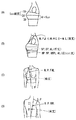
まず、本発明のパターン作成方法において、必要とする寸法実測値について説明する。なお、図1には、本発明において特徴的な寸法実測値の採寸場所について記載している。
(1)「ワンバスト(1B)」は、上述したように、着用者のバストポイントより約5cm〜約6cm上方に位置する点と、着用者の両脇下とを結ぶ直線の上を測定用器具(メジャー等)が通過する胴体回りのラインをいう。この周径が1B寸法である。
(2)「ツウバスト(2B)」は、バストポイントを通る水平面で測定した胸部周径の寸法値である。
(3)「スリーバスト」(3B)は、着用者のバストポイント下方のアンダーバストポイントを通る水平面で測定した胸部周径の寸法値である。図1(a)に示すように、通常、ツウバストより約4〜約5cm下方に位置し、ツウバストにほぼ平行である。3Bは、いわゆるアンダーバスト寸法である。
(4)「ウエスト」は胴部の最も細い部分を通る水平面で測定した寸法値である。
(5)「中ヒップ(ミドルヒップ)」は、ウエストとヒップとの中間点を通る水平面で測定した寸法値である。
(6)「ヒップ」は腰部の最も太い部分を通る水平面で測定した寸法値である。
(7)「ヒップ丈」はウエストからヒップまでの距離を身体の脇で測定した寸法値である。
(8)「前丈」は、サイドネックポイント(ネックラインと僧坊筋上部線前縁との交点(JIS規格))からバストポイントを通過してウエストラインまでの距離を測定した寸法値である。
(9)「バスト下がり」は、サイドネックポイントからバストポイントまでの距離を測定した寸法値である。
(10)「バストポイント幅」は、両バストポイント間の距離を測定した寸法値である。
(11)「胸幅」は左右の腕の付け根の間の距離を直線的に測定した寸法値である。
(12)「背幅」は左右の腕の付け根間の距離を背面で直線的に測定した寸法値である。
(13)「肩幅」は、両肩のショルダーポイント(側面から見て上腕上部の幅を2等分する垂線とアームサイラインとの交点(JIS規格))の間の距離を測定した寸法値である。
(14)「背丈」は、背面の中心線上において、バックネックポイント(第7頚椎の突起の先端(JIS規格))からウエストラインまでの距離を測定した寸法値である。
(15)「前フィット丈」は、サイドネックポイントから、バストポイント、アンダーバストポイントを通過してウエストラインまでの体表に沿って測定した寸法値である。図1(b)のNP−BP−UBP−WL線に相当する。
(16)「前センター丈」は、サイドネックポイントから、ウエストライン中心までの距離を測定した寸法値である。図1(c)のNP−FWL線に相当する。
(17)「後ろセンター丈」は、サイドネックポイントから、ウエストライン後ろ中心までの距離を測定した寸法値である。図1の(d)のNP−BWL線に相当する。
【0012】
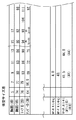
これらの寸法値は、着用者を対象として実測することもできるが、たとえば、着用者の1B、2Bあるいは3Bのみを測定して、この測定値に基づいて、各種の体型サイズ表から適切なサイズ表を選択し、そこに記載された標準寸法を寸法値として採用することもできる。図2には、このようなサイズ表を例示している。なお、前フィット丈、前センター丈、後ろセンター丈などの寸法値については、新たな寸法概念であるので、実測可能な場合には実測することが好ましい。
【0013】
以下、第1のパターンの作成、エレメントの再配置、第2のパターンの作成の順に、図に例示する本発明の一実施形態に基づいて説明する。以下の実施形態で用いる寸法はいずれも単位はcmである。なお、図示される式、寸法及び移動量、パターン並びにパターン工程は、本発明の好ましい実施形態であるが、あくまで例示であって、本発明はこれらの式及び寸法、パターン及びパターン工程に限定されるものではない。特に、式、寸法及び移動量、なかでも寸法及び移動量は、作製しようとするパターンのフィット性や衣服の種類によって異ならせることができる。
(第1のパターンの作成)
第1のパターンとは、着用者のアンダーバスト寸法測定値を基準値として利用して、少なくとも、第1の前中心線と第1のネックラインと、第1の肩線と、第1のアームホールと、第1の脇線と、第1のウエストラインとを第1の輪郭として備える。このパターンは、バスト・肩胛骨などの身体の凹凸部分の三次元形状分を実質的に含まないパターンである。なお、第1のパターンは、ウエストラインからバストポイントあるいは肩甲骨頂点に向かって切開される第1のダーツ(ウエストダーツ)を備えることもできる。
なお、本発明において第1のパターンの作成〜第2のパターンの作成〜第3のパターンの作成は、前身頃のみについて実施することもできるが、以下の説明においては、前身頃と後身頃との双方について説明する。
【0014】
まず、必要な寸法値を決定する。本形態では、着用者の3B寸法に基づいて、図2に示す体型サイズ表の9号の寸法値を用いたパターンを作成することとする。
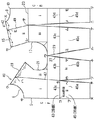
〔基本線設定〕
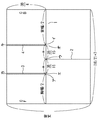
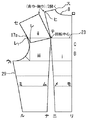
図3に示すように、高さ(左右辺)が「背丈」寸法に相当し、幅(上下辺)が{(「1B」寸法÷2)+3}となるような長方形を描く。そして、この長方形の上辺から(「3B」寸法÷4)の位置に、上下辺に対して平行な直線1を描く。図3中、長方形の左辺が前中心線(C・F)、右辺が後中心線(C・B)となる。
【0015】
〔脇線の設定〕
図3に示すように、直線1のC・F側から(「胸幅」寸法÷2)の位置に点アを設定する。次に、C・B側から(「背幅」寸法÷2)の位置、に点イを設定する。次いで、点アと点イとの中点(点ウ)から下辺に向かって垂直線2を描く。この垂直線2が脇線となる。
また、点ウの両側(「3B」寸法÷15)の位置に、点エおよび点オを設定する。点アと点エの中点、及び点イと点オの中点をとり、これらの中点からそれぞれ、長方形の上辺に向かって垂直線3および4を描く。この垂直線3および4と上辺とが交わった点をそれぞれ点カおよび点キとする。
【0016】
〔ネックラインの設定〕
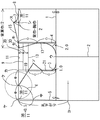
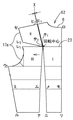
図4に示すように、長方形の左辺(C・F側)と点カとの中点を点クとする。この点ク(前ネックポイント)から、C・F側に向かって(「3B」寸法÷11)の位置に点ケを、また、長方形の左上端から「乳下がり(バスト下がり)」寸法分の位置に点コを設定する。そして点ケと点コとを結んで直線5とする。直線5は、新たな前中心線(CF)の一部となる。
次に、直線5上に、点ケから([「3B」寸法÷11]+0.5)の位置に点サを設定する。そして、点クと点サとを図示したようなカーブで結び、これを曲線6とする。
一方、長方形の右辺(C・B)から(「3B」寸法÷11)の位置に点シを設定する。この点シから上方に向かって垂直線7を描き、この垂直線7上の、点シから{(「背幅」寸法−「胸幅」寸法)÷2}上方の位置に点スを設定する。そして点ス(後ろネックポイント)と長方形の右上端とを図示したようなカーブで結び、これを曲線8とする。曲線6は前ネックライン、曲線8は後ネックラインとなる。
【0017】
〔肩線の設定〕
図4に示すように、長方形の上辺から[(「背幅」寸法−「胸幅」寸法)÷2]分、平行に下がる直線9を描き、この直線9から上方に、(「3B」寸法÷30)離間した平行な直線11と、下方にも(「3B」寸法÷30)離間した平行な直線13とを描く。
後ろネックポイントである、点スから、直線4と直線11の交点キとを結び、(「背肩幅」寸法÷2)の長さを有する後ろ肩線15を描く。この肩線15の先端点セから直線4の中点とを結ぶ直線とこの直線の先から点ウとを結ぶ曲線を描き、全体として後アームホール(AH)線17を描く。後AH線17は、全体としてカーブを描くようにしてもよい。なお、AH線17のうち、直線4の中点から点ウをとおるカーブ部位は、直線4と直線1との交点から、左上45°方向に2.0cmの位置をとおるようにすることが好ましい。
一方、前ネックポイントである点クから、直線3と直線13との交点を通り、後ろ身ごろ肩線と同寸の長さを有する前肩線19を描く。この先端点ソから、直線13との交点以下の直線部分の中点を通る直線を引き、さらにこの直線の先から点ウを通る曲線を引き、全体として前アームホール(AH)線21を描く。前AH線は、全体としてカーブを描くようにしてもよい。なお、AH線21のうちカーブ部位は、直線3と直線1との交点から、右45°方向に1.0cmの位置をとおるようにすることが好ましい。
【0018】
〔ウエストダーツの設定〕
図5に示すように、長方形の上下辺に平行で、点コを通る直線14を描き、(「乳幅(バストポイント幅)」寸法÷2)に点タを設定して、これをバストポイント(B・P)とする。この点タから長方形の下辺に向けて垂直線をひき、下辺との交点から、左右1.0cmの位置に点チおよび点ツを設定する。そして点タと、点チおよび点ツとを結んで図示したような二等辺三角形を描き、この部分を前ダーツFDとする。
また、直線4の中点から長方形の右辺(CB)に垂直に直線23を描く。直線23の中点を点テ(肩甲骨頂点)とする。直線23から、直線1上の、右辺CBと直線4との中点である点トを通り、長方形の下辺に向けて垂直線25をひく。この垂直線25と下辺との交点から左右1.5cmの位置に点ナおよび点ニを設定する。そして点テと、点ナおよび点ニとを結んで図示したような二等辺三角形を描き、この部分を後ダーツBDとする。
【0019】
〔脇線の設定〕
次に、長方形の下辺上の、左辺(CF)に一致する点ヌから{(「ウエスト」寸法÷4)+2.0}の位置に点ネを設定し、この点ネと点ウとを結んだ直線27を前脇線とする。また、長方形の下辺上の、右辺(CB)に一致する点リから{(「ウエスト」寸法÷4)+3.0}cmの位置に点ルを設定し、この点ルと点ウとを結んだ直線29を後脇線とする。脇線が設定されることより、前ウエストライン31と後ろウエストライン33とが設定されることになる。
【0020】
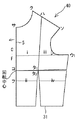
以上のようにして、前中心線と前ネックライン6と、前肩線19と、前AH線21と、前脇線27と、前ウエストライン31とを輪郭として有する第1の前パターン40を得ることができる。同様に、後中心線(CB)と後ネックライン6と、後肩線15と、後AH線17と、後脇線29と、前ウエストライン33とを輪郭として有する第1の後ろパターン42を得ることができる。なお、本形態においては、いずれの第1のパターン40、42も、ダーツFD、BDを有している。ダーツFD、BDは、後段の工程で付与することもできる。
【0021】
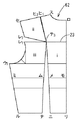
(トップバストラインとアンダーバストラインの2種類のバストラインの付与)次いで、図6に示すように、点ウを共有し、前後ウエストラインが同一直線上に位置するように配置された第1のパターン40、42に対して、「トップバストラインと、この線から所定距離下方であって当該バストラインに対して平行な「アンダーバストライン」線とを付与する。「トップバストライン」を以下、「2B」線(2BL)といい、「アンダーバストライン」を、「3B」線(3BL)という。
「2B」線は、点コ及び点タを通り、前脇線27、後ろ脇線29と交差し、CB線に到達する直線43(43a〜43d)として描く。
さらに、「3B」線は、直線43から4cm下がった平行線45(45a〜45d)として描く。
なお、「3B」線が「2B」線から離間する距離は、本形態では4cmとしたが、一般的には、約3.5cm〜約4.5cm程度である。「2B」線43の第1のパターン40、42内における各部位43a〜43dと「3B」線45a〜45dとは、それぞれ第1のパターン40、42を縦方向に分割する分割線を構成することができる。また、身体の三次元形状を内包させる際の修飾及び/又は再配置のために用いることができる。
【0022】
さらに、前後肩線19、15の3等分点をとり、それぞれネックポイント寄りの3等分点を点ハおよび点ヒとする。第1のパターン40にあっては、点ハとバストポイントである点タとを結んで直線47とし、第1のパターン42にあっては、点ヒと点テとを結んで直線49とする。直線47と直線49とは、それぞれ前ダーツFDと後ダーツBDとともに、それぞれの第1のパターンを左右に分割する分割線を構成することができる。
【0023】
この結果、2B線43a〜43bにより、第1のパターン40を上下に分割し、直線47と前ダーツにより、第1のパターン40を左右に分割することにより、第1のパターン40を4つのエレメントに分割することができる。すなわち、第1のパターン40を、前中心線側上方エレメントi、前中心線側下方エレメントii、前脇線側上方エレメントiii、前脇線側下方エレメントivとに分割することができる。
さらに、直線45a〜45bにより、下方エレメントii、ivをそれぞれさらに縦に2分割することができる。これにより、第1のパターン40を6個のパターンに分割できるようになる。
なお、第2のパターン42にあっては、直線49と後ダーツ線とによって左右に分割し、さらに、脇線側部分を直線23で縦に分割して3つのエレメントに分割することができる。すなわち、後中心線側エレメントi、後脇線側上方エレメントii、後脇線側下方エレメントiiiとに分割することができる。図6の第1のパターン42において、点セ、点レ、点テ(肩甲骨点)、点ヒで囲まれた部分が、エレメントiiとなる。なお、点レは、直線4の中点である。
【0024】
なお、第1のパターン40、42における3B線である直線45a〜45dの総和と着用者の(「3B」寸法値+4)÷2との差を算出し、この(差÷6)寸法を各パターン40、42のダーツの内側と脇線27、29の計6箇所においてそれぞれ削っておくことが好ましい。このような補正により、着用者の3B寸法を第2のパターンに反映させることができる。当該補正により、脇線27、29と3B線との交点マ、ミは若干内側に移動され、移動後の点マ、ミにおいて、脇線27,29は、内側に若干屈曲することになる。前後ダーツFD,BDを構成する線と3B線との交点へ、ホ、ム、メにおいて、それぞれの内側に若干内側に移動され、移動後の点ホ、ム、メにおいてダーツ線がそれぞれ内側に屈曲することになる。
【0025】
(第1のパターンのエレメントの再配置)
次に、少なくとも4個のエレメントの再配置工程について説明する。
〔CF線の調整工程〕
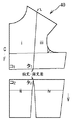
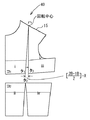
まず、第1のパターン40について説明する。図7に示すように、エレメントiとエレメントiiiとを一体として、点コを回転中心として回転移動させて、直線5が下辺(ウエストライン)31に対して垂直になるようにする。この結果、エレメントi、iiiとエレメントii、ivとの間に隙間が生じる。また、この時、点タは2分されるため、便宜上、エレメントi及びiii側を点タ1とし、エレメントii及びivを点タ2とする。
【0026】
〔バストの膨らみの内包工程その1〕
次いで、図8に示すように、点タ1と点タ2との間が、(「前丈」寸法−「背丈」寸法)開くように、エレメントii及びivを下方に移動させる。この移動は、バストの膨らみを、再配置されるエレメント群に内包させる工程の一部を構成している。この時、点コは2分されるため、便宜上、エレメントi側を点コ1とし、エレメントii側を点コ2とする。
次いで、{(「2B」寸法−「1B」寸法)÷2}の寸法に基いて、エレメントiiiを、肩線15上の点ハを回転中心として外方へ移動させる。ここで、{(「2B」寸法−「1B」寸法)÷2}の寸法は、バストの膨らみの他、肩甲骨の膨らみを包含している。したがって、この寸法に基いて回転移動させれば、このエレメント移動によっては、バストの膨らみと肩甲骨の膨らみが、4個のエレメント領域内に包含されることになる。好ましくは、図9に示すように、エレメントiiiを、肩線15上の点ハを回転中心として、その下辺が[{(「2B」寸法−「1B」寸法)÷2}−X]分を外方へ移動するように回転させる。なお、ここに、Xは、肩甲骨の膨らみ分に相当する。この回転は、肩甲骨相当分を差し引いているためよりバストの膨らみに忠実な移動となる。この回転により、エレメントiとエレメントiiiとの間に隙間が生じる。かかる回転移動により、点タ1は二分される。便宜的に、エレメントi側の点を点タ1とし、エレメントiii側の点を点タ3とする。結果として、点タ1と点タ3との距離が[{(「2B」寸法−「1B」寸法)÷2}の寸法−X]となる。
なお、図9における肩甲骨の膨らみ(X寸法)は、本形態(9号サイズ)では、0.2cmとすることができる。また、例えば、7号であれば、0.3cmとすることができる。後述するように、この肩甲骨の膨らみ分は、後身頃である第1のパターン42において内包させることが好ましい(図18参照)。
【0027】
〔下方エレメントの回転移動工程〕
次に、図10に示すように、ネックポイント点クを回転中心として、前センター丈寸法を半径とする円弧を描く。さらに、図11に示すように、点タ1を回転中心として、エレメントii及びivとを前段での配置状態を維持して回転移動させ、エレメントiiにおけるCF線の下端である点ヌが円弧上に来るように、すなわち、点ヌがこの円弧と点接触する位置に回転移動させる。かかる回転移動により、最終的に得られるパターンにおける前センター丈、すなわち、身体前面の中央寄りの領域の外形形態(たとえば、女性の場合には、バスト間の凹状形態)に起因する寸法を内包させることができる。
【0028】
次いで、図12に示すように、点タ2から、エレメントiiiの右下端である点ラまで直線51を描く。この直線51に沿って、エレメントivを移動させ、エレメントivの上辺がこの直線47に一致し、かつエレメントivの右上端が点ラに一致するようにする。なお、この移動により、点タ2が2分されるため、便宜的に、エレメントiv側を点タ4とする。これにより、バストポイントである点タ1を中心として、バストの膨らみと肩甲骨の膨らみとが適切に内包された再配置状態を得ることができる。
【0029】
このようにして、少なくとも4個のエレメントの再配置状態を得ることができる。図13に示すように、この配置において、点ク、点コ1、点コ2、点フ、点ヌ、点チ、点タ2、点タ1、点タ4、点ツ、点ネ、点マ、点ラ、点ウ1、点ソ、点ハの座標によって実質的に規定することができ、ネックラインと、アームホールと、CF線と、脇線とを備えるパターンを構成することができる。このパターンが、本発明の第2のパターン60である。このパターン60によれば、3B寸法に基づいて各種寸法を設定し、また、前センター丈に基づいて調整されているため、着用者の身体前面の3次元形状、特に、バストの膨らみの大きさとバスト周辺の三次元形状とをより忠実に内包させることができる。
【0030】
この第2のパターン60にさらに修飾を加えることともできる。すなわち、既に説明したように、エレメントii及びivにおける3B線との交点である、点ヘ、点ホ及び点マにおいて、所要の3B補正(3B寸法値に基づく補正)がなされている場合には、これらの補正後の当該3点を加えることにより、特にアンダーバストにフィットするパターン60を得ることができる。なお、図13に示す第2のパターン60においては、既に、かかる修飾が施されている。
【0031】
さらに、次の修飾ないし再配置も可能である。すなわち、図14に示すように、点フを回転中心として、エレメントiiの3B線以下の部分(以下、エレメントiiの3B線以上の部分をエレメントiiaとし、3B線以下の部分をエレメントiibとする。)を下方に回転移動させることができる。同時に、点マを回転中心としてエレメントivの3B線以下の部分(以下、エレメントivの3B線以上の部分をエレメントivaとし、3B線以下の部分をエレメントivbとする。)を下方に回転移動させることができる。
これらの回転移動によって、バストバストポイントからウエストラインにかけて着用者の身体表面の隆起状態を第2のパターンに内包させることができるようになる。移動距離は、好ましくは、いずれも、(前フィット丈寸法−前丈寸法)とする。これにより、第2のパターンにおいて、ネックポイントからバストポイントを通る身体前面の三次元形態が第2のパターンに導入されることになる。なお、このような回転移動を導入することにより、第2のパターン60は、エレメントi、iia、iib、iii、iva、ivbとから構成されることになる。
【0032】
第3の修飾によれば、第2のパターン60において発生しうる脇線側の若干の凹みを、バストポイントを通る縦線に集約させることができる。特に、3B線に沿う実際の身体の三次元形状を内包させることができる。図15に示すように、先ず、点ウ1と点ネとを結ぶ直線53を描くことができる。そして、点マからエレメントiva側の3B線を延長して直線53と交差する点マ1を得る。約((点マ〜点マ1間距離)÷2)寸法分を点ヘ2からエレメントiib内側に移動させて点ヘ3を得るとともに、同寸法分を点ホ2からエレメントivb内側に移動させて点ホ3を得る。この結果、第2のパターンを、点ク、点サ、点コ1、点コ2、点フ、点ヌ、点チ、点ヘ3、点タ1、点ホ3、点ツ、点テ、点ネ、点ウ1、点ソ、点ハの座標によって実質的に規定される第2のパターン60を得ることができる。なお、かかる修飾に伴ない、点ラは点ラ1に移動することになる。この増加分である、点ラ〜点ラ1間の距離は、後段の第3のパターンの作成時や型紙作成時において削ることができる。特に、タイトフィットなパターンあるいは型紙を得ようとする場合には、点ラ〜点ラ1間の距離を後段にて削ることが好ましい。
【0033】
(後身頃のエレメントの再配置)
次に、第1のパターン42から得られるエレメントの再配置工程について説明する。
〔肩甲骨の膨らみの内包工程〕
図16に示すように、図6の第1のパターン42におけるエレメントiiを、肩甲骨頂点である点テを回転中心に、直線15上の点ヒにおいて、幅が{(「背幅」寸法−「胸幅」寸法)÷2}の切欠部ができるように回転させる。その際、アームホール側で前記回転部分がエレメントiiiとが重なる部分ができるので、もとのAH線17の重複部分を内包するような新たなAH線17aを描く。新たなAH線17aと直線23との交点を点レ1とする。
さらに、図17に示すように、点テを回転中心として、点セ、点レ1、点テ、点ヒで囲まれる部分を、前記切開部分を埋めるようにもとにもどす。これにより、第2のパターン62を得ることができる。すなわち、第2のパターンは、点ス、点ロ、点リ、点ニ、点メ、点テ、点ム、点ナ、点ル、点ミ、点ウ2、点レ1、点レ2、点セの座標で実質的に規定することができ、ネックラインと、アームホールと、CB線と、脇線とを備えるパターンを構成することができる。
なお、このパターン62においては、前記切開部分を埋めないでそのまま維持することもできる。この場合、肩線15の点ヒから点テに向かう切開部分に、肩甲骨の膨らみ分が内包されることになる。
【0034】
このパターン62においては以下の修飾を施すことができる。すなわち、肩甲骨の膨らみ分をさらに追加することができる。これにより、前身頃側のパターン60に過大に内包される可能性のある肩甲骨の膨らみ分を適切に後身頃側に分配させることができる。具体的には、前身頃側のエレメントの再配置工程において、エレメントiとiiiとを開いた寸法、すなわち、[(2B−1B)÷2]寸法から肩甲骨の膨らみ分として後身頃側に分配可能である寸法分(X)をパターン62に内包させることができる。
具体的には、図18に示すように、エレメントii、iiiとをこの一体関係を保ったまま、脇線側に平行移動させる。移動させる距離は、前記分配可能な寸法分である。ここでは、図9に関連して既に説明したように、9号サイズの場合、たとえば0.2cmとすることができ、7号サイズの場合には0.3cmとすることができる。これにより、点テは2分されるため、便宜的にエレメントi側を点テ1とし、エレメントii側を点テ2とする。また、点ヒも2分されるため、便宜的にエレメントii側を点ヒ1とし、エレメントiii側を点ヒ2とする。
次に、図19に示すように、点テ1を点テ2側に、前記分配分/2寸法を延長した点テ3に対して、点ヒ1、点ヒ2、点レ1、点レ2、点ナ、点ニから直線を引いて、新たな切開分を設定する。これにより、点ス、点ロ、点リ、点ニ、点メ、点テ3、点ム、点ナ、点ル、点ミ、点ウ2、点レ1、点レ2、点セ、点ヒ2、点テ3、ヒ2の座標で実質的に規定することができる第2のパターン62を得ることができる。
【0035】
なお、この第2のパターン62には、エレメントi及びiiiにおける3B線との交点である、点メ、点ム及び点ミにおいて、所要の3B補正(3B寸法値に基づく補正)がなされている場合には、これらの補正後の当該3点を加えることにより、特にアンダーバストにフィットするパターン62を得ることができる。なお、図19に示す第2のパターン62においては、既に、かかる修飾が施されている。
また、この第2のパターン62については、エレメントiを直線3で分割切開して、この切開部分にて背中の丸みを内包させることができる。すなわち、この場合、第2のパターン62は4分割されることになる。背中が前側に湾曲している場合には、当該部分を切開することにより、背中側の三次元形状を第2のパターン62に内包させることができる。
以上のような各種修飾は、肩線15から点テに向かう切開部分を有する第2のパターン62においても、アームホール線から点テに向かう切開部分を有するパターン62におけるのと同様に導入可能である。
【0036】
このようにして上前身頃の第2のパターンと上後身頃の第2のパターンを得ることができる。これらのパターンは、それぞれウエストラインより上方の身体の三次元形状を忠実に内包し、特に、バストからウエストラインにかけての立体感を反映させることができるものとなっている。
【0037】
次に、これらの上半身パターンを、ヒップ部位を主体とする下半身パターンと結合させた第3のパターンの作成について説明する。
(下半身パターンの作成)
まず、図20に示すように、上下辺が(ヒップ寸法÷2)であり、左右辺がヒップ丈寸法の長方形を描く。この長方形の左辺が前中心線(C・F)であり、右辺が後中心線(C・B)である。また、長方形の上辺がウエストライン(WL)、下辺がヒップライン(HL)に、それぞれ相当する。左右辺の中点を結ぶ直線71を描く。この直線が、中ヒップライン(MHL)に相当する。
次に、下辺の左端から[(ヒップ寸法÷4)−0.5]であり、下辺の右端から[(ヒップ寸法÷4)+0.5]となる点ワから上辺に向かって垂直線73を脇線案内線として描く。
【0038】
上辺の左端から[(ウエスト寸法(W)÷4)+ダーツ量]のところに点Aを設定する。ここで、本形態では、ダーツ量は2cmとしている。なお、このダーツ量は、第1のパターン40で予め設定した前ダーツの量と一致していることが好ましい。
WL上の点Aと脇線案内線73との間の3分割点のうち、最も点A寄りの分割点A1と点ワとを結び、前脇線75を描く。前脇線75は、MHLと交わる部位で外側に膨らませること(約0.3cm)が好ましい。一方、上辺の左端から、所定寸法、好ましくは、第2のパターン60のエレメントiiの下辺の長さに一致する寸法をとり、点B1を設定する。この点B1から脇線側に2cmのところに点B2をとり、B1とB2との中点から垂線を直線71に下ろして交点をB3とする。点B1〜B2〜B3を結ぶことにより、これらの点で構成される第1のダーツ77を得る。
次いで、点B2から点A1との中点から左右に等距離の位置に、点C1と点C2とを設定する。点C1〜C2間距離は、点A〜A1間距離に一致させる。一方、MHL71と前脇線75と交点と点B3との中点をC3とする。点C1〜C2〜C3を結ぶことにより、これらの点で構成される第2のダーツ79を得る。
【0039】
次に、上辺の右端から[(ウエスト寸法÷4)+ダーツ量]のところに点Dを設定する。このダーツ量は、第1のパターン42において予め設定したダーツ量であることが好ましい。したがって、本形態では3cmとなっている。
WL上の点Dと脇線案内線73との間の3分割点のうち、最も点D寄りの分割点D1と点ワとを結び、前脇線85を描く。前脇線85は、MHLと交わる部位で膨らませる(約0.3cm)ことが好ましい。一方、上辺の右端から、所定寸法、好ましくは、第2のパターン62のエレメントi下辺の長さに一致する寸法をとり、点E1を設定する。この点E1から脇線側に(ダーツ量)寸法のところに点E2をとり、E1とE2との中点から、MHLより2cm平行に下がった線80に対して垂線を下ろして交点をE3とする。点E1〜E2〜E3を結ぶことにより、これらの点で構成される第1のダーツ87を得る。後脇線85は、MHLと交わる部位で外側に膨らませること(約0.3cm)が好ましい。
次いで、点E2から点D1との中点から左右に等距離の位置に、点F1と点F2とを設定する。点F1〜F2間距離は、点D〜D1間距離に一致させる。一方、線80と前脇線85と交点と点E3との中点をF3とする。点F1〜F2〜F3を結ぶことにより、これらの点で構成される第2のダーツ89を得る。
これにより、下半身パターン90、92を得ることができる。なお、これらのパターン90、92においては、必要に応じて変更を加えることができる。たとえば、第1のダーツ、75,85、及び第2のダーツ79、89については、それぞれの位置及び切開幅を適宜変更することができる。
【0040】
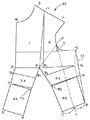
次に、上半身パターン60,62とを、ヒップ部位を主体とする下半身パターン90,92と結合させる。
〔前身頃パターンの結合〕
図21及び22に示すように、パターン60のバストポイントである点タ1からアームホール線21とアームホール線作成時に用いた補助線(対面変化線ともいう。)3との交点Xとを結ぶ直線91を描く。また、点Xから、パターン60の点ツと点ネとの中点Yとを結ぶ直線93を描く。
次いで、点タ1を回転中心として、点コ1〜点タ1〜点ヘ3〜点チ〜点ヌ〜点フ〜点コ2を結んで得られる部分を、点コ2〜点フとを結ぶ線が垂直に起きるように回転させる。さらに、点ヘ3を回転中心として、点フ〜点ヘ3〜点チ〜点ヌを結ぶ部分を、点フ〜点ヌとを結ぶ線が垂直に起きるように回転させる。
【0041】
次に、前中心線をそろえた第2のパターン60に下半身パターン90を合わせる。第1のダーツ77の開口幅に点チ〜点ツとがおおよそ一致するように、点タ1を回転中心に、点タ1〜点X〜点ウ1〜点ネ〜点ツ〜点ホ3を結ぶ部分を回転移動させる。
次に、回転により点Xが2分して生成した点X2を回転中心として、点X2〜点ウ1〜点ネ〜点Yで規定される部分を第2のダーツ79の開口幅に切開幅(点Y1〜点Y2)がおおよそ一致するように回転させる。最終的に得られるパターンを図22に示す。これにより、第3のパターン100を得ることができる。
【0042】
次に、図23に示すように、第2のパターン62において、対面変化線4とアームホール線17aとの交点Zから点ル〜点ナとを結ぶ線の中点Wにまで到達する直線95を描く。
このパターン62に下半身パターン92を合わせる。なお、第2のパターン62における点ナ〜点ニ間の距離は、第1のダーツ87の開口幅に予め一致させてある。そして、点Zを回転中心として、点Z〜点W〜点ル〜点ウで規定される部分を、下半身パターン92の第2のダーツ89の開口幅に切開幅(点W1〜点W2)がほぼ一致するように回転させる。これにより、第3のパターン102を得ることができる。
【0043】
このようにして得られた第3のパターン100,102は、本発明の第2のパターン60、62における特徴をそのまま有し、かつヒップ部分のパターンも同時に備えるものとなっている。したがって、第3のパターン100、102は、着用者の胴体部分の三次元的特徴を忠実に表現したものとなっている。この第3のパターン100、102に対して、たとえば、襟ぐりのゆとり、身幅のゆとり、肩パッとのゆとり、アームホールのゆとり、クビ傾斜分の追加、袖底の移動などのゆとり量を加え、衣服の輪郭を付与することにより、型紙を得ることができる。第3のパターン100、102がそれぞれ着用者の胴体部分の三次元的特徴を忠実に反映しているため、この第3のパターンに対して、各種ゆとり量や衣服の輪郭を付与することにより、着用者の体型に対応し、かつ所望のデザインやゆとり量が適切に付与された型紙を容易に得ることができる。また、補正を低減することができる。なお、ゆとり量や補正量は、作製しようとする衣服の種類や着用者の体型によって適宜選択される。体型を表したパターンに対して、追加するゆとり量や補正量は、パターンから型紙を作製する技術分野において当業者において周知の事項である。
【0044】
なお、上記した各パターンにおけるダーツをいれる箇所は、本発明の趣旨の範囲内にある限り限定するものではない。また、ダーツの数も同様である。
なお、上記した工程において、その順序について特に限定しない。最終的に第1のパターン、第2のパターン、第3のパターン、型紙という4種の異なるステージでのパターンを得ることができれば、それに至る工程の順序は特に問わない。特に、後述するようにコンピュータを用いてこれらの工程を実施する場合には、コンピュータ内の処理によって複雑さを回避できる場合もあるからである。さらに、各工程内における移動の順序についても同様である。
また、各工程において使用する寸法や移動量を一義的に記載しているが、いずれも、特定寸法に限定する趣旨ではなく、最も好ましい採用寸法値や採用移動量として記載している。
【0045】
本発明における第1のパターン、第2のパターン、及び第3のパターンの作製は、いずれも、手作業によって紙面などのシート状体上において実施することもできるが、好ましくは、これらの工程を実行できるプログラムを用いてコンピュータ等で実施する。したがって、本発明は、これらの工程(少なくとも第1のパターンの作成から第2のパターンの作成工程を含み、さらに、第3のパターンの作成工程や型紙作成工程まで包含することができる)を実行できるプログラム自体、当該プログラムを記憶させた記憶媒体、当該プログラムを実行可能に備えるコンピュータ、当該コンピュータとモニターとを備えるCAD装置を提供する。プログラム化することにより、使用する寸法等を入力することによって、自動的に第1のパターン、第2のパターン、第3のパターン、型紙までのいずれの段階にまでも自動的にパターンや型紙を作成することができる。
【0046】
【発明の効果】
本発明によれば、バストからウエストラインにかけての三次元形状を反映したパターンの作成技術を提供することができる。これにより、最終的に得られる衣服において、所望のデザインやフィット感を容易に付与することができる。
【図面の簡単な説明】
【図1】本発明において使用する寸法実測値の採寸位置を示す図(A)〜(D)である。
【図2】体型サイズ表の一例を示す図である。
【図3】本発明の一実施形態における衣服用パターンの作成工程のうち第1のパターンの作成工程の一部を示す図である。
【図4】本発明の一実施形態における衣服用パターンの作成工程のうち第1のパターンの作成工程の一部を示す図である。
【図5】本発明の一実施形態における衣服用パターンの作成工程のうち第1のパターンの作成工程の一部を示す図である。
【図6】本発明の一実施形態における衣服用パターンの作成工程のうち第1のパターン作成工程の一部を示す図である。
【図7】本発明の一実施形態における衣服用パターンの作成工程のうち第2のパターン作成工程の一部を示す図である。
【図8】本発明の一実施形態における衣服用パターンの作成工程のうち第2のパターン作成工程の一部を示す図である。
【図9】本発明の一実施形態における衣服用パターンの作成工程のうち第2のパターン作成工程の一部を示す図である。
【図10】本発明の一実施形態における衣服用パターンの作成工程のうち第2のパターン作成工程の一部を示す図である。
【図11】本発明の一実施形態における衣服用パターンの作成工程のうち第2のパターン作成工程の一部を示す図である。
【図12】本発明の一実施形態における衣服用パターンの作成工程のうち第2のパターン作成工程の一部を示す図である。
【図13】本発明の一実施形態における衣服用パターンの作成工程のうち第2のパターン作成工程の一部を示す図である。
【図14】本発明の一実施形態における衣服用パターンの作成工程のうち第2のパターン作成工程の一部を示す図である。
【図15】本発明の一実施形態における衣服用パターンの作成工程のうち第2のパターン作成工程の一部を示す図である。
【図16】本発明の一実施形態における衣服用パターンの作成工程のうち第2のパターン作成工程の一部を示す図である。
【図17】本発明の一実施形態における衣服用パターンの作成工程のうち第2のパターン作成工程の一部を示す図である。
【図18】本発明の一実施形態における衣服用パターンの作成工程のうち第2のパターン作成工程の一部を示す図である。
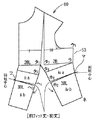
【図19】本発明の一実施形態における衣服用パターンの作成工程のうち第2のパターン作成工程の一部を示す図である。
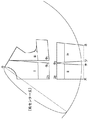
【図20】本発明の一実施形態における衣服用パターン作成工程のうち、第3のパターン作成工程の一部を示す図である。
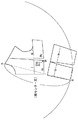
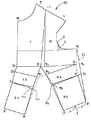
【図21】本発明の一実施形態における衣服用パターン作成工程のうち、第3のパターン作成工程の一部を示す図である。
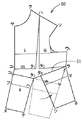
【図22】本発明の一実施形態における衣服用パターン作成工程のうち、第3のパターン作成工程の一部を示す図である。
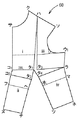
【図23】本発明の一実施形態における衣服用パターン作成工程のうち、第3のパターン作成工程の一部を示す図である。
【図24】本発明の一実施形態における衣服用パターン作成工程のうち、第3のパターン作成工程の一部を示す図である。
【符号の説明】
40、42 第1のパターン
60、62 第2のパターン
90、92 下半身パターン
100,102 第3のパターン[0001]
TECHNICAL FIELD OF THE INVENTION
The present invention relates to a technique for creating a body pattern (original pattern) for creating a clothing pattern, and specifically, a pattern using a horizontal dimension (chest circumference, top bust, under bust) and the like and a vertical dimension. The present invention relates to a technique for producing a garment based on this pattern, and a technique for producing a garment based on the garment. Further, the present invention relates to a program for implementing a method for creating such a pattern and a clothing pattern.
[0002]
[Prior art]
To make clothes, the cloth is cut into various parts such as body, sleeves and collars, and these parts are sewn together to conform to the three-dimensional shape of the human body. These parts are usually obtained by cutting the fabric based on the pattern of each part.
Of the patterns of each baht, the upper body, especially the front body, has many irregularities due to the presence of the bust. For this reason, it is relatively difficult to create a pattern for the upper garment.
[0003]
One of the techniques for creating a pattern is a planar drafting method. In this method, in general, (1) the wearer does not include the design portion or the spare portion by calculating based on the measurement size such as the bust, height and sleeve length of the measurement target person (that is, the wearer) and the standard size of the JIS standard. A “prototype” is created by developing the actual dimensions and dimensions of the user on a plane, and (2) the design portion and the spare portion are roughly added to this prototype on paper. Therefore, since all drafting operations can be performed on paper, it is simple, and a prototype and a pattern can be created in a short time. However, when using the pattern created by this method, it is necessary to temporarily sew the obtained parts, check the assembled state, and correct the size deviation, while the troublesome work of correcting the size deviation is required. But in the end, it lacked a three-dimensional effect.
[0004]
Here, as a method of preparing a pattern, in addition to various lateral dimensions in the JIS standard, a "one bust (1B) dimension" (or "upper chest measurement") that can be an index of a wearer's physique centering on the bust point of the top bust is called. There is a method of first creating a planar prototype using a new dimensional concept (
[0005]
[Patent Document 1]
Japanese Utility Model Publication No. 58-12808
[Patent Document 2]
Japanese Patent Publication No. 2-29763
[Patent Document 3]
JP 2001-11721 A
[0006]
According to this method, since the 1B dimension is different from the 2B dimension and is measured so as to avoid the bulge portion (and the scapula) of the bust, the body size is not affected by the size of the bust bulge of the wearer. Can be used to determine the size of the skeleton of the executive. It is also described that, unlike so-called under bust, the measurement is made to pass over the pectoralis major muscle, so that the muscle mass of the wearer can be roughly grasped.
[0007]
[Problems to be solved by the invention]
However, according to this pattern, although it is possible to reflect the three-dimensional shape of the upper part of the upper body, that is, the upper part of the bust point, in particular, elements that greatly affect the three-dimensional appearance of the bust, And the irregularities on the body surface side due to the height difference between the top bust and the under bust could not be reflected in the pattern. As a result, in a garment made of a pattern made on the basis of this pattern, it is still necessary to perform conventional correction relying on a can to obtain a desired design and fit.
In view of the above, the present invention provides a technique for creating a pattern that reflects a three-dimensional shape from the bust to the waistline, and thereby easily imparts a desired design and fit to the finally obtained clothes. The purpose is to:
[0008]
[Means for Solving the Problems]
The present inventor has repeatedly studied to include the three-dimensional effect of the upper body in the pattern, and as a result, has found that this can be achieved by introducing a new concept of dimension value, and completed the present invention.
That is, the present inventor first employs a so-called underbust size as a reference size for creating a planar prototype (first pattern). Second, in the first pattern, an under bust line is set in addition to the top bust line, and the under bust line is used for modifying or arranging the element. Third, when rearranging the elements using the under bust line in the first pattern, other than the linear dimension (referred to as front length) connecting the neck point-bust point-waist line. , The dimension along the body surface from the neck point to the bust point to the waistline (referred to as the front fit length) and the dimension along the body surface connecting the neck point to the waistline front center (the front center fit length) ) Are used.
Therefore, according to the present invention, the following means are provided.
[0009]
(1) a method for creating a pattern for clothes,
(A) At least a first center line, a first neckline, a first shoulder line, a first armhole, and a first side using the underbust size of the wearer as a reference value. A line and a first waistline, a step of creating a first pattern substantially not including a three-dimensional shape equivalent corresponding to unevenness of a body surface mainly composed of a bust of a wearer;
(B) a step of providing a top bust line to the first pattern obtained in the step (a);
(C) a front center line-side upper element, and a front center line side obtained by dividing the front body portion of the first pattern into at least two in the vertical direction by the top bust line and by dividing into two in the body width direction. Creating at least four elements including a lower element, a side line side upper element, and a side line side lower element,
When,
(D) producing a second pattern by rearranging at least these four elements so as to include the three-dimensional shape equivalent;
With
An under bust line parallel to the top bust line is provided at a position below the top bust line by a predetermined distance below the top bust line among the at least four elements, and an element corresponding to the three-dimensional shape is provided near the under bust line. A method comprising the step of modifying to include a minute.
(2) a method for creating a pattern for clothes,
(A) At least a first center line, a first neckline, a first shoulder line, a first armhole, and a first side using the underbust size of the wearer as a reference value. A line and a first waistline, a step of creating a first pattern substantially not including a three-dimensional shape equivalent corresponding to unevenness of a body surface mainly composed of a bust of a wearer;
(B) a step of providing a top bust line to the first pattern obtained in the step (a);
(C) a front center line-side upper element, and a front center line side obtained by dividing the front body portion of the first pattern into at least two in the vertical direction by the top bust line and by dividing into two in the body width direction. Creating at least four elements including a lower element, a side line side upper element, and a side line side lower element,
When,
(D) producing a second pattern by rearranging at least these four elements so as to include the three-dimensional shape equivalent;
With
Of the at least four elements constituting the front body of the first pattern, in the elements below the top bust line, an under bust line parallel to the top bust line is provided at a position below the top bust line by a predetermined distance, Re-arranging the two elements divided and added by the underbust line together with the at least four elements to obtain a second pattern.
(3) The method according to (2), wherein the two added patterns are rearranged based on a (pre-fit length-front length) dimension value.
(4) a method of creating a pattern for clothes,
(A) At least a first center line, a first neckline, a first shoulder line, a first armhole, and a first side using the underbust size of the wearer as a reference value. A line and a first waistline, a step of creating a first upper body pattern substantially not including a three-dimensional shape equivalent corresponding to unevenness of the body surface mainly composed of the bust of the wearer;
(B) a step of providing a top bust line to the first pattern obtained in the step (a);
(C) forming at least four elements obtained by dividing the front body of the first pattern at least into two in the vertical direction by the top bust line and dividing into two in the body width direction;
When,
(D) modifying and / or rearranging at least these four elements to include the three-dimensional shape equivalent;
With
Rearranging the at least four elements using a dimension value centering on the neck point and connecting the wearer's neck point to the waistline front center point,
A method comprising:
(5) A program for executing the pattern creation method according to any one of (1) to (4).
(6) A CAD apparatus that is capable of executing the program according to (5).
(7) a step of combining the second pattern obtained by the pattern creation method according to any one of (1) to (4) with a lower body pattern mainly composed of hips to create a third pattern;
A method for creating a pattern for clothes, comprising:
(8) A program for executing the pattern creation method according to (7).
(9) A CAD apparatus that is capable of executing the program according to (8).
(10) a step of combining the second pattern obtained by the pattern creation method according to any one of (1) to (4) with a lower body pattern mainly composed of a hip to create a third pattern;
Creating a pattern using the third pattern;
And a pattern making method.
(11) A program for executing the method according to (10).
(12) A CAD apparatus which is capable of executing the program according to (11).
[0010]
By using the under bust dimensions of the wearer as the reference dimensions, the upper body of the wearer, especially the three-dimensional shape of the front body, based on the torso skeleton below the bust and having unevenness of the body such as the bust, is appropriately flat. Can be expanded.
Further, by setting the under bust line, it becomes possible to appropriately modify the element including the three-dimensional shape of the front surface of the body mainly composed of the bust. Also, by creating new elements by dividing the pattern with the underbust line and rearranging these elements, it becomes possible to rearrange the three-dimensional shape of the body front so as to include the three-dimensional shape. That is, modification and rearrangement that can reflect not only the underbust portion but also the three-dimensional shape characteristics such as the side of the bust and the space between the bust can be performed.
Further, when rearranging the elements, a recess along the body surface (referred to as a front center fitting length) connecting the neck point and the center in front of the waistline is used, so that the concave portion (typically the center of the front of the body) Specifically, the three-dimensional shape of the recess between the bustes can be included in the pattern. In addition, a new dimension along the body surface from the neck point to the bust point to the waist line (referred to as the front fit length) shall be newly adopted, and the dimension value obtained by subtracting the front length from this front fit length shall be adopted. Thereby, the three-dimensional shape from the top bust to the under bust can be included in the pattern.
[0011]
BEST MODE FOR CARRYING OUT THE INVENTION
Hereinafter, embodiments of the present invention will be described.
First, the actual measured dimension values required in the pattern forming method of the present invention will be described. Note that FIG. 1 shows the measurement locations of the actual measured dimensions that are characteristic of the present invention.
(1) As described above, the “one bust (1B)” is a measuring instrument on a straight line connecting a point located about 5 cm to about 6 cm above the bust point of the wearer and both lower sides of the wearer. (Measure etc.) means the line around the body. This peripheral diameter is the 1B dimension.
(2) “Two bust (2B)” is a dimensional value of the chest circumference measured on a horizontal plane passing through the bust point.
(3) "Three bust" (3B) is the dimensional value of the chest circumference measured on a horizontal plane passing through the under bust point below the bust point of the wearer. As shown in FIG. 1 (a), it is usually located about 4 to about 5 cm below the tubast and is substantially parallel to the tubast. 3B is a so-called underbust size.
(4) "Waist" is a dimension value measured on a horizontal plane passing through the thinnest part of the trunk.
(5) “Middle hip (middle hip)” is a dimension value measured on a horizontal plane passing through the midpoint between the waist and the hip.
(6) “Hip” is a dimension value measured on a horizontal plane passing through the thickest part of the waist.
(7) "Hip length" is a dimension value obtained by measuring the distance from the waist to the hip at the side of the body.
(8) The “front length” is a dimension value obtained by measuring a distance from a side neck point (an intersection of a neckline and a front edge of a ridge muscle upper line (JIS standard)) to a waistline through a bust point.
(9) “Bust drop” is a dimension value obtained by measuring the distance from the side neck point to the bust point.
(10) “Bust point width” is a dimension value obtained by measuring a distance between both bust points.
(11) “Chest width” is a dimension value obtained by linearly measuring the distance between the bases of the left and right arms.
(12) The “back width” is a dimension value obtained by linearly measuring the distance between the bases of the left and right arms on the back surface.
(13) The “shoulder width” is a dimension value obtained by measuring a distance between shoulder points of both shoulders (an intersection (a JIS standard) between a vertical line that divides the width of the upper part of the upper arm into two equal parts as viewed from the side and an arm cyline). is there.
(14) The “height” is a dimension value obtained by measuring the distance from the back neck point (the tip of the projection of the seventh cervical vertebra (JIS standard)) to the waistline on the back center line.
(15) “Front fit length” is a dimension value measured along the body surface from the side neck point to the waistline through the bust point and the underbust point. This corresponds to the NP-BP-UBP-WL line in FIG.
(16) “Front center length” is a dimension value obtained by measuring a distance from the side neck point to the center of the waistline. This corresponds to the NP-FWL line in FIG.
(17) “Back center length” is a dimension value measured from the side neck point to the center behind the waistline. This corresponds to the NP-BWL line in FIG.
[0012]
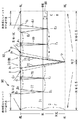
These dimensional values can be actually measured for the wearer. For example, only 1B, 2B or 3B of the wearer is measured, and based on the measured values, appropriate sizes are obtained from various body size tables. It is also possible to select a table and adopt the standard dimensions described therein as dimension values. FIG. 2 illustrates such a size table. Note that the dimension values such as the front fit length, the front center length, and the rear center length are new dimension concepts, and therefore, it is preferable to actually measure when it can be measured.
[0013]
Hereinafter, the creation of the first pattern, the rearrangement of the elements, and the creation of the second pattern will be described in this order based on an embodiment of the present invention illustrated in the drawings. All dimensions used in the following embodiments are in cm. Although the formulas, dimensions, movement amounts, patterns, and pattern steps shown in the drawings are preferred embodiments of the present invention, they are merely examples, and the present invention is limited to these formulas, dimensions, patterns, and pattern steps. Not something. In particular, the formula, the dimensions and the amount of movement, and especially the dimensions and the amount of movement, can differ depending on the fit of the pattern to be produced and the type of clothing.
(Creation of the first pattern)
The first pattern includes at least a first front centerline, a first neckline, a first shoulder line, and a first armhole, using a measured value of a wearer's underbust size as a reference value. , A first side line, and a first waist line as a first contour. This pattern is a pattern that does not substantially include the three-dimensional shape of the uneven portion of the body such as the bust and the scapula. Note that the first pattern may include a first dart (waist dart) that is incised from the waistline toward the bust point or the scapula apex.
In the present invention, the creation of the first pattern, the creation of the second pattern, and the creation of the third pattern can be performed only for the front body, but in the following description, the front body and the back body are used. Will be described.
[0014]
First, necessary dimension values are determined. In the present embodiment, a pattern is created based on the 3B dimension of the wearer using the dimension value of No. 9 in the body size table shown in FIG.
(Basic line setting)
As shown in FIG. 3, a rectangle whose height (left and right sides) corresponds to the “height” dimension and whose width (upper and lower sides) is {(“1B” dimension {2) +3} ”is drawn. Then, a
[0015]
[Setting of side line]
As shown in FIG. 3, a point A is set at a position (“chest width” dimension ÷ 2) from the CF side of the
Further, points d and e are set at positions on both sides of the point c ("3B" dimension # 15). The midpoints of points A and D and the midpoints of points A and E are taken, and
[0016]
[Setting neckline]
As shown in FIG. 4, the middle point between the left side (C and F sides) of the rectangle and the point F is defined as a point H. From this point (front neck point), a dot is placed at a position (“3B” dimension # 11) toward the C / F side, and a part corresponding to the “milk drop (bust drop)” dimension from the upper left corner of the rectangle. Set a point at the position. Then, a
Next, a point is set on the
On the other hand, a point is set at a position (“3B” dimension # 11) from the right side (CB) of the rectangle. A
[0017]
(Shoulder line setting)
As shown in FIG. 4, a
A
On the other hand, a
[0018]
[Waist dart setting]
As shown in FIG. 5, draw a
In addition, a
[0019]
[Setting of side line]
Next, on the lower side of the rectangle, a point is set at {(“waist” dimension {4) +2.0}} from the point corresponding to the left side (CF), and this point is connected to point c. The
[0020]
As described above, the first
[0021]
(Applying two types of bust lines, a top bust line and an under bust line) Next, as shown in FIG. For the
The "2B" line is drawn as a straight line 43 (43a to 43d) that passes through the points U and T, intersects the
Further, the “3B” line is drawn as a parallel line 45 (45a to 45d) that is 4 cm lower than the
Note that the distance between the “3B” line and the “2B” line is 4 cm in the present embodiment, but is generally about 3.5 cm to about 4.5 cm. The
[0022]
Further, three equal points of the front and
[0023]
As a result, the
Further, the lower elements ii and iv can each be further vertically divided into two by the
The
[0024]
The difference between the sum of the
[0025]
(Relocation of elements of first pattern)
Next, a rearrangement step of at least four elements will be described.
[CF wire adjustment process]
First, the
[0026]
[Inclusion process of bust bulge 1]
Next, as shown in FIG. 1 And point 2 The elements ii and iv are moved downward so that the space between (i) and (i.e., the "front length" -the "back height") opens. This movement constitutes a part of the process of including the bulge of the bust in the group of elements to be rearranged. At this time, since the point is divided into two, the element i is 1 And the element ii side is 2 And
Next, based on the dimension of {(“2B” dimension− “1B” dimension) {2}, the element iii is moved outward with the point c on the
In addition, the swelling (X dimension) of the scapula in FIG. 9 can be set to 0.2 cm in the present embodiment (No. 9 size). For example, in the case of No. 7, it can be 0.3 cm. As will be described later, it is preferable that the scapula bulge be included in the
[0027]
[Rotary movement process of lower element]
Next, as shown in FIG. 10, an arc having a radius of the front center length dimension is drawn with the rotation point around the neck point point ク. Further, as shown in FIG. 1 Is rotated around the center of rotation of the element ii and iv while maintaining the arrangement state of the previous stage, so that the point nu, which is the lower end of the CF line in the element ii, comes on an arc, that is, the point nu is Rotate to a position where it makes point contact with By such a rotational movement, the front center length in the finally obtained pattern, that is, the dimension due to the external form of the region near the center of the front of the body (for example, the concave form between the bust in the case of a woman) is included. be able to.
[0028]
Next, as shown in FIG. 2 , A
[0029]
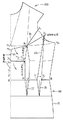
In this way, a rearranged state of at least four elements can be obtained. As shown in FIG. 13, in this arrangement, 1 , Point 2 , Dot, dot, dot, dot 2 , Dot 1 , Dot 4 , Dots, dots, dots, dots, dots 1 , The points S and C, and a pattern including a neckline, an armhole, a CF line, and a side line can be formed. This pattern is the
[0030]
The
[0031]
In addition, the following modifications or rearrangements are possible. That is, as shown in FIG. 14, with the point F as the rotation center, a portion of the element ii below the 3B line (hereinafter, a portion of the element ii above the 3B line is an element ia, and a portion below the 3B line is an element iib. ) Can be rotated downward. At the same time, the portion below the 3B line of the element iv (hereinafter, the portion above the 3B line of the element iv is referred to as the element iva, and the portion below the 3B line is referred to as the element ivb) is rotated downward with the dot as the center of rotation. be able to.
By these rotational movements, the raised state of the body surface of the wearer can be included in the second pattern from the bust bust point to the waistline. Preferably, the moving distance is (pre-fit length dimension-front length dimension). Thereby, in the second pattern, the three-dimensional form of the front of the body passing from the neck point to the bust point is introduced into the second pattern. By introducing such a rotational movement, the
[0032]
According to the third modification, a slight depression on the side of the side line that may occur in the
[0033]
(Rearrangement of rear body elements)
Next, a process of rearranging elements obtained from the
[Inclusion process of scapula bulge]
As shown in FIG. 16, the width of the element ii in the
Further, as shown in FIG. 1 The portion surrounded by the dots テ and ヒ is returned to fill the incision. Thereby, the
In this
[0034]
In the
Specifically, as shown in FIG. 18, the elements ii and iii are moved in parallel to the side lines while maintaining this integral relationship. The moving distance is the distributable dimension. Here, as already described in connection with FIG. 9, in the case of No. 9 size, it can be, for example, 0.2 cm, and in the case of No. 7, it can be 0.3 cm. As a result, the point te is divided into two parts. 1 And the element ii side is 2 And Further, since the dot is also divided into two parts, the element ii side is conveniently set to the dot. 1 And the element iii side is 2 And
Next, as shown in FIG. 1 The point te 2 On the side, a point t 3 Against 1 , Dot 2 , Point 1 , Point 2 A new incision is set by drawing a straight line from, point n and point d. As a result, point S, point B, point D, point D, point 3 ,,,,,, 2 , Point 1 , Point 2 , Dot, dot 2 , Dot te 3 , Hi 2 The
[0035]
In the
Further, with respect to the
The various modifications as described above can be introduced in the
[0036]
Thus, the second pattern of the upper front body and the second pattern of the upper rear body can be obtained. These patterns faithfully include the three-dimensional shape of the body above the waist line, and can reflect the three-dimensional effect from the bust to the waist line.
[0037]
Next, creation of a third pattern in which these upper body patterns are combined with a lower body pattern mainly composed of a hip region will be described.
(Create lower body pattern)
First, as shown in FIG. 20, a rectangle whose upper and lower sides are (hip size ÷ 2) and whose right and left sides are hip length dimensions is drawn. The left side of this rectangle is the front center line (CF), and the right side is the rear center line (CB). The upper side of the rectangle corresponds to the waist line (WL), and the lower side corresponds to the hip line (HL). A
Next, a
[0038]
A point A is set at [(waist size (W) / 4) + dart amount] from the left end of the upper side. Here, in the present embodiment, the dart amount is 2 cm. In addition, it is preferable that this dart amount matches the amount of the previous dart set in the
Of the three division points between the point A on the WL and the side
Then point B 2 From point A 1 At a position equidistant left and right from the midpoint of 1 And point C 2 And. Point C 1 ~ C 2 The distance between points A to A 1 Match the distance between them. On the other hand, MHL71,
[0039]
Next, a point D is set at [(waist size ÷ 4) + dart amount] from the right end of the upper side. This dart amount is preferably a dart amount set in advance in the
Of the three division points between the point D on the WL and the side
Then point E 2 From point D 1 A point F at a position equidistant left and right from the midpoint of 1 And point F 2 And. Point F 1 ~ F 2 The distance between points D to D 1 Match the distance between them. On the other hand,
Thereby,
[0040]
Next, the
[Combining front body patterns]
As shown in FIG. 21 and FIG. 1 , A straight line 91 connecting the intersection X between the
Next, 1 To the point 1 ~ Dot 1 To point 3 ~ Dot j ~ dot n ~ dot f ~ dot co 2 The part obtained by connecting 2 Rotate so that the line connecting to the point F occurs vertically. In addition, 3 To the point 3 The portion connecting the points チ to ヌ is rotated so that the line connecting the points フ to 起 き is generated vertically.
[0041]
Next, the
Next, the point X generated by dividing the point X into two by rotation 2 With the point of rotation as the point X 2 ~ Dot c 1 The point defined by the point Y to the point Y is defined by the opening width of the second dart 79 (point Y). 1 ~ Point Y 2 ) So that they roughly match. FIG. 22 shows the finally obtained pattern. Thereby, the
[0042]
Next, as shown in FIG. 23, in the
The
[0043]
The
[0044]
In addition, the place where a dart is put in each pattern described above is not limited as long as it is within the scope of the gist of the present invention. The same applies to the number of darts.
In the above-described steps, the order is not particularly limited. As long as patterns can be finally obtained at four different stages, that is, the first pattern, the second pattern, the third pattern, and the pattern, the order of the steps leading to that is not particularly limited. In particular, when these steps are performed using a computer as described later, complexity may be avoided by processing in the computer in some cases. Further, the same applies to the order of movement in each step.
In addition, the dimensions and the amount of movement used in each step are described unambiguously, but are not intended to be limited to specific dimensions, but are described as the most preferred adopted dimension values and adopted movement amounts.
[0045]
The production of the first pattern, the second pattern, and the third pattern in the present invention can be performed manually on a sheet-like body such as a paper surface, but preferably, these steps are performed. The program is executed by a computer or the like using an executable program. Therefore, the present invention executes these steps (including at least a step of creating a first pattern to a step of creating a second pattern, and can further include a step of creating a third pattern and a step of creating a pattern). The present invention provides a program itself, a storage medium storing the program, a computer capable of executing the program, and a CAD apparatus including the computer and a monitor. By programming, by inputting the dimensions to be used, etc., the pattern or pattern is automatically created in any stage up to the first pattern, the second pattern, the third pattern, and the pattern. Can be created.
[0046]
【The invention's effect】
According to the present invention, it is possible to provide a technique for creating a pattern that reflects a three-dimensional shape from the bust to the waistline. This makes it possible to easily impart a desired design and fit to the finally obtained clothes.
[Brief description of the drawings]
FIG. 1 is a diagram (A) to (D) showing measuring positions of actual measured values used in the present invention.
FIG. 2 is a diagram showing an example of a body size table.
FIG. 3 is a diagram showing a part of a first pattern forming step in a clothes pattern forming step according to an embodiment of the present invention.
FIG. 4 is a view showing a part of a first pattern forming step in a clothes pattern forming step according to an embodiment of the present invention.
FIG. 5 is a view showing a part of a first pattern forming step in a clothes pattern forming step according to an embodiment of the present invention.
FIG. 6 is a view showing a part of a first pattern forming step in a clothes pattern forming step in one embodiment of the present invention.
FIG. 7 is a view showing a part of a second pattern forming step of the clothes pattern forming step in one embodiment of the present invention.
FIG. 8 is a view showing a part of a second pattern forming step of the clothes pattern forming step in one embodiment of the present invention.
FIG. 9 is a view showing a part of a second pattern forming step in the clothes pattern forming step according to the embodiment of the present invention.
FIG. 10 is a view showing a part of a second pattern forming step of the clothes pattern forming step in one embodiment of the present invention.
FIG. 11 is a view showing a part of a second pattern forming step in the clothes pattern forming step in one embodiment of the present invention.
FIG. 12 is a diagram showing a part of a second pattern forming step in the clothes pattern forming step in one embodiment of the present invention.
FIG. 13 is a view showing a part of a second pattern creation step in the clothes pattern creation step in one embodiment of the present invention.
FIG. 14 is a diagram showing a part of a second pattern forming step in the clothes pattern forming step in one embodiment of the present invention.
FIG. 15 is a view showing a part of a second pattern forming step in the clothes pattern forming step in one embodiment of the present invention.
FIG. 16 is a view showing a part of a second pattern forming step in the clothes pattern forming step in one embodiment of the present invention.
FIG. 17 is a view showing a part of a second pattern forming step of the clothes pattern forming step in one embodiment of the present invention.
FIG. 18 is a view showing a part of a second pattern forming step of the clothes pattern forming step in one embodiment of the present invention.
FIG. 19 is a view showing a part of a second pattern forming step of the clothes pattern forming step in one embodiment of the present invention.
FIG. 20 is a diagram showing a part of a third pattern creation step in the clothing pattern creation step in one embodiment of the present invention.
FIG. 21 is a view showing a part of a third pattern forming step in the clothes pattern forming step in one embodiment of the present invention.
FIG. 22 is a view showing a part of a third pattern forming step in the clothes pattern forming step in one embodiment of the present invention.
FIG. 23 is a diagram showing a part of a third pattern forming step in the clothes pattern forming step in one embodiment of the present invention.
FIG. 24 is a diagram showing a part of a third pattern forming step in the clothes pattern forming step in one embodiment of the present invention.
[Explanation of symbols]
40, 42 First pattern
60, 62 second pattern
90, 92 Lower body pattern
100,102 Third pattern
Claims (12)
(a)着用者のアンダーバスト寸法値を基準値として利用して、少なくとも、第1の中心線と第1のネックラインと、第1の肩線と、第1のアームホールと、第1の脇線と、第1のダーツと、第1のウエストラインとを備え、着用者のバストを主体とする身体表面の凹凸に対応した三次元形状相当分を実質的に含まない第1の上身ごろパターンを作成する工程と、
(b)(a)工程で得られた第1のパターンに対して、トップバストラインを付与する工程と、
(c)前記第1のパターンの前身頃を、前記トップバストラインで縦方向に少なくとも2分割し、身幅方向に2分割して得られる、前中心線側上方エレメントと、前中心線側下方エレメント、脇線側上方エレメントと、脇線側下方エレメントとを含む少なくとも4個のエレメントを作成する工程、
と、
(d)前記三次元形状相当分を内包するように、これらの少なくとも4個のエレメントを再配置して第2のパターンを作成する工程、
とを備え、
前記少なくとも4個のエレメントのうちトップバストライン以下のエレメントにおいて、前記トップバストラインより所定距離下方位置にトップバストラインに平行なアンダーバストラインを付与し、このアンダーバストライン近傍において前記三次元形状相当分を内包させるように修飾する工程を備える、方法。A method for creating a pattern for clothing,
(A) At least a first center line, a first neckline, a first shoulder line, a first armhole, and a first side using the underbust size of the wearer as a reference value. A first upper body pattern that includes a line, a first dart, and a first waistline, and that does not substantially include a three-dimensional shape equivalent to an unevenness of a body surface mainly including a bust of a wearer. The process of creating
(B) a step of providing a top bust line to the first pattern obtained in the step (a);
(C) a front centerline-side upper element and a front centerline-side lower element obtained by dividing the front body of the first pattern at least into two in the vertical direction by the top bust line and into two in the body width direction; Creating at least four elements including a side line side upper element and a side line side lower element,
When,
(D) producing a second pattern by rearranging at least these four elements so as to include the three-dimensional shape equivalent;
With
An under bust line parallel to the top bust line is provided at a position below the top bust line by a predetermined distance below the top bust line among the at least four elements, and an element corresponding to the three-dimensional shape is provided near the under bust line. A method comprising the step of modifying to include a minute.
(a)着用者のアンダーバスト寸法値を基準値として利用して、少なくとも、第1の中心線と第1のネックラインと、第1の肩線と、第1のアームホールと、第1の脇線と、第1のダーツと、第1のウエストラインとを備え、着用者のバストを主体とする身体表面の凹凸に対応した三次元形状相当分を実質的に含まない第1のパターンを作成する工程と、
(b)(a)工程で得られた第1のパターンに対して、トップバストラインを付与する工程と、
(c)前記第1のパターンの前身頃を、前記トップバストラインで縦方向に少なくとも2分割し、身幅方向に2分割して得られる、前中心線側上方エレメントと、前中心線側下方エレメント、脇線側上方エレメントと、脇線側下方エレメントとを含む少なくとも4個のエレメントを作成する工程、
と、
(d)前記三次元形状相当分を内包するように、これらの少なくとも4個のエレメントを再配置して第2のパターンを作成する工程、
とを備え、
前記少なくとも4個のエレメントのうちトップバストライン以下のエレメントにおいて、前記トップバストラインより所定距離下方位置にトップバストラインに平行なアンダーバストラインを付与し、このアンダーバストラインで分割され追加される2個のエレメントを前記少なくとも4個のエレメントともに再配置して第2のパターンを得る工程を備える、方法。A method for creating a pattern for clothing,
(A) At least a first center line, a first neckline, a first shoulder line, a first armhole, and a first side using the underbust size of the wearer as a reference value. A first pattern including a line, a first dart, and a first waist line, and substantially not including a three-dimensional shape equivalent to an unevenness of a body surface mainly composed of a bust of a wearer; The process of
(B) a step of providing a top bust line to the first pattern obtained in the step (a);
(C) a front centerline-side upper element and a front centerline-side lower element obtained by dividing the front body of the first pattern at least into two in the vertical direction by the top bust line and into two in the body width direction; Creating at least four elements including a side line side upper element and a side line side lower element,
When,
(D) producing a second pattern by rearranging at least these four elements so as to include the three-dimensional shape equivalent;
With
Of the at least four elements, an underbust line parallel to the top bust line is provided at a position below the top bust line by a predetermined distance below the top bust line, and is divided and added by the underbust line. Repositioning the at least four elements with said at least four elements to obtain a second pattern.
(a)着用者のアンダーバスト寸法値を基準値として利用して、少なくとも、第1の前中心線と第1のネックラインと、第1の肩線と、第1のアームホールと、第1の脇線と、第1のダーツと、第1のウエストラインとを備え、着用者のバストを主体とする身体表面の凹凸に対応した三次元形状相当分を実質的に含まない第1のパターンを作成する工程と、
(b)(a)工程で得られた第1のパターンに対して、トップバストラインを付与する工程と、
(c)前記第1のパターンのうち前身頃側を、前記トップバストラインで縦方向に少なくとも2分割し、身幅方向に2分割して得られる少なくとも4個のエレメントを作成する工程、
と、
(d)前記三次元形状相当分を内包するように、これらの少なくとも4個のエレメントを修飾及び/又は再配置する工程、
とを備え、
ネックポイントを中心とし着用者のネックポイント〜ウエストライン前中心点とを結ぶ寸法値を利用して、前記少なくとも4個のエレメントを再配置する工程、
とを備える、方法。A method for creating a pattern for clothing,
(A) At least a first front center line, a first neckline, a first shoulder line, a first armhole, and a first A first pattern that includes a side line, a first dart, and a first waist line, and substantially does not include a three-dimensional shape equivalent to unevenness of a body surface mainly including a bust of a wearer. The process of creating,
(B) a step of providing a top bust line to the first pattern obtained in the step (a);
(C) forming at least four elements obtained by dividing the front body side of the first pattern by at least two in the vertical direction by the top bust line and by dividing in the body width direction by two;
When,
(D) modifying and / or rearranging at least these four elements to include the three-dimensional shape equivalent;
With
Rearranging the at least four elements using a dimension value centering on the neck point and connecting the wearer's neck point to the waistline front center point,
A method comprising:
を備える、衣服用パターンの作成方法。A step of creating a third pattern by combining a lower body pattern mainly composed of a hip with the second pattern obtained by the pattern creation method according to any one of claims 1 to 4,
A method for creating a pattern for clothes, comprising:
第3のパターンを用いて型紙を作成する工程、
とを備える、型紙作成方法。A step of combining the second pattern obtained by the pattern creation method according to any one of claims 1 to 4 with a lower body pattern mainly composed of hips to create a third pattern;
Creating a pattern using the third pattern;
And a pattern making method.
Priority Applications (1)
| Application Number | Priority Date | Filing Date | Title |
|---|---|---|---|
| JP2003019397A JP2004232103A (en) | 2003-01-28 | 2003-01-28 | Method for making pattern for dress |
Applications Claiming Priority (1)
| Application Number | Priority Date | Filing Date | Title |
|---|---|---|---|
| JP2003019397A JP2004232103A (en) | 2003-01-28 | 2003-01-28 | Method for making pattern for dress |
Publications (1)
| Publication Number | Publication Date |
|---|---|
| JP2004232103A true JP2004232103A (en) | 2004-08-19 |
Family
ID=32949267
Family Applications (1)
| Application Number | Title | Priority Date | Filing Date |
|---|---|---|---|
| JP2003019397A Pending JP2004232103A (en) | 2003-01-28 | 2003-01-28 | Method for making pattern for dress |
Country Status (1)
| Country | Link |
|---|---|
| JP (1) | JP2004232103A (en) |
Cited By (5)
| Publication number | Priority date | Publication date | Assignee | Title |
|---|---|---|---|---|
| JP2008544094A (en) * | 2005-06-10 | 2008-12-04 | トリオフィット, インコーポレイテッド | How to optimally adjust clothing dimensions |
| JP5403724B1 (en) * | 2013-08-06 | 2014-01-29 | 渥子 柏原 | Correction method for the prototype for upper garment |
| CN104585943A (en) * | 2014-12-12 | 2015-05-06 | 胡亨有 | Original number clipping method for clothing equivalent transfer waisting |
| CN107581690A (en) * | 2017-11-06 | 2018-01-16 | 桐乡市大唐皮草有限公司 | Rimless Western-style clothes plate-making method |
| CN112137212A (en) * | 2020-08-25 | 2020-12-29 | 山东科技职业学院 | Collar separating method for two-piece lapel |
-
2003
- 2003-01-28 JP JP2003019397A patent/JP2004232103A/en active Pending
Cited By (7)
| Publication number | Priority date | Publication date | Assignee | Title |
|---|---|---|---|---|
| JP2008544094A (en) * | 2005-06-10 | 2008-12-04 | トリオフィット, インコーポレイテッド | How to optimally adjust clothing dimensions |
| JP5403724B1 (en) * | 2013-08-06 | 2014-01-29 | 渥子 柏原 | Correction method for the prototype for upper garment |
| CN104585943A (en) * | 2014-12-12 | 2015-05-06 | 胡亨有 | Original number clipping method for clothing equivalent transfer waisting |
| CN104585943B (en) * | 2014-12-12 | 2015-11-25 | 胡亨有 | The former figure tailoring method of clothes equivalent transfer closing waist |
| CN107581690A (en) * | 2017-11-06 | 2018-01-16 | 桐乡市大唐皮草有限公司 | Rimless Western-style clothes plate-making method |
| CN112137212A (en) * | 2020-08-25 | 2020-12-29 | 山东科技职业学院 | Collar separating method for two-piece lapel |
| CN112137212B (en) * | 2020-08-25 | 2022-09-23 | 山东科技职业学院 | Collar separating method for two-piece lapel |
Similar Documents
| Publication | Publication Date | Title |
|---|---|---|
| US8116896B2 (en) | Method for creating panels for a garment | |
| US20190008226A1 (en) | Method and System for Interactive Creation of Garments | |
| US20090215359A1 (en) | System and method of constructing and sizing brassieres | |
| US20090099683A1 (en) | Device and Method for Designing a Garment | |
| CN105455277B (en) | VU primitive number design tailoring method for lapels of clothing | |
| EP0939157B1 (en) | Method for creating knitted garments and patterns therefor | |
| JP2003511576A (en) | Method and apparatus for simulating and representing dressing of a tailor's dummy | |
| CN104146423B (en) | Shirt pattern automatic creation system and method | |
| CN112914183A (en) | Method for making European style suit body piece of man's suit | |
| JP3025013B2 (en) | How to design a three-dimensional pattern of a piece of clothing with sleeves | |
| Lo | Pattern cutting | |
| CN110623353A (en) | Golden ratio three-opening women's dress clothes type sample plate, three-opening women's dress and plate making method | |
| JP3363428B2 (en) | 3D drawing of paper pattern | |
| CN108338439A (en) | Version method is beaten in a kind of sleeve linkage of clothes body | |
| JP2703173B2 (en) | Pattern making system | |
| CN1703988B (en) | Paper folding costume fent method | |
| JP3062622B1 (en) | Dart processing drawing method using clothing prototype | |
| JP7130295B1 (en) | Pattern correction method for outerwear | |
| KR100727630B1 (en) | Method of manufacturing a wet suit using three-dimensional scan human body data and a wet suit manufactured using the same | |
| CN112107061B (en) | A method for designing a clothing sample grading system for personalized customization | |
| TW201439800A (en) | Three-dimensional electronic mannequin | |
| JPWO2003024261A1 (en) | Virtual pattern display device, virtual pattern display method, virtual pattern display program, and computer-readable recording medium recording the program | |
| JP3966386B2 (en) | How to design clothing basic patterns | |
| CN112237311A (en) | Pattern making method for suit sleeves | |
| KR100322974B1 (en) | How to make underwear |
Legal Events
| Date | Code | Title | Description |
|---|---|---|---|
| A621 | Written request for application examination |
Free format text: JAPANESE INTERMEDIATE CODE: A621 Effective date: 20040622 |
|
| A977 | Report on retrieval |
Free format text: JAPANESE INTERMEDIATE CODE: A971007 Effective date: 20060221 |
|
| A521 | Written amendment |
Effective date: 20060322 Free format text: JAPANESE INTERMEDIATE CODE: A821 |
|
| A711 | Notification of change in applicant |
Free format text: JAPANESE INTERMEDIATE CODE: A711 Effective date: 20060322 |
|
| A521 | Written amendment |
Effective date: 20060322 Free format text: JAPANESE INTERMEDIATE CODE: A821 |
|
| A131 | Notification of reasons for refusal |
Effective date: 20070515 Free format text: JAPANESE INTERMEDIATE CODE: A131 |
|
| A02 | Decision of refusal |
Effective date: 20070925 Free format text: JAPANESE INTERMEDIATE CODE: A02 |