EP4582388A2 - Positivelektrodenaktivmaterial und wiederaufladbare lithiumbatterie damit - Google Patents
Positivelektrodenaktivmaterial und wiederaufladbare lithiumbatterie damit Download PDFInfo
- Publication number
- EP4582388A2 EP4582388A2 EP24218109.7A EP24218109A EP4582388A2 EP 4582388 A2 EP4582388 A2 EP 4582388A2 EP 24218109 A EP24218109 A EP 24218109A EP 4582388 A2 EP4582388 A2 EP 4582388A2
- Authority
- EP
- European Patent Office
- Prior art keywords
- positive electrode
- electrode active
- active material
- particles
- coating process
- Prior art date
- Legal status (The legal status is an assumption and is not a legal conclusion. Google has not performed a legal analysis and makes no representation as to the accuracy of the status listed.)
- Pending
Links
Images



Classifications
-
- H—ELECTRICITY
- H01—ELECTRIC ELEMENTS
- H01M—PROCESSES OR MEANS, e.g. BATTERIES, FOR THE DIRECT CONVERSION OF CHEMICAL ENERGY INTO ELECTRICAL ENERGY
- H01M4/00—Electrodes
- H01M4/02—Electrodes composed of, or comprising, active material
- H01M4/36—Selection of substances as active materials, active masses, active liquids
- H01M4/48—Selection of substances as active materials, active masses, active liquids of inorganic oxides or hydroxides
- H01M4/52—Selection of substances as active materials, active masses, active liquids of inorganic oxides or hydroxides of nickel, cobalt or iron
- H01M4/525—Selection of substances as active materials, active masses, active liquids of inorganic oxides or hydroxides of nickel, cobalt or iron of mixed oxides or hydroxides containing iron, cobalt or nickel for inserting or intercalating light metals, e.g. LiNiO2, LiCoO2 or LiCoOxFy
-
- C—CHEMISTRY; METALLURGY
- C01—INORGANIC CHEMISTRY
- C01G—COMPOUNDS CONTAINING METALS NOT COVERED BY SUBCLASSES C01D OR C01F
- C01G53/00—Compounds of nickel
- C01G53/04—Oxides
-
- C—CHEMISTRY; METALLURGY
- C01—INORGANIC CHEMISTRY
- C01G—COMPOUNDS CONTAINING METALS NOT COVERED BY SUBCLASSES C01D OR C01F
- C01G53/00—Compounds of nickel
- C01G53/40—Complex oxides containing nickel and at least one other metal element
-
- C—CHEMISTRY; METALLURGY
- C01—INORGANIC CHEMISTRY
- C01G—COMPOUNDS CONTAINING METALS NOT COVERED BY SUBCLASSES C01D OR C01F
- C01G53/00—Compounds of nickel
- C01G53/40—Complex oxides containing nickel and at least one other metal element
- C01G53/42—Complex oxides containing nickel and at least one other metal element containing alkali metals, e.g. LiNiO2
-
- H—ELECTRICITY
- H01—ELECTRIC ELEMENTS
- H01M—PROCESSES OR MEANS, e.g. BATTERIES, FOR THE DIRECT CONVERSION OF CHEMICAL ENERGY INTO ELECTRICAL ENERGY
- H01M10/00—Secondary cells; Manufacture thereof
- H01M10/05—Accumulators with non-aqueous electrolyte
- H01M10/052—Li-accumulators
-
- H—ELECTRICITY
- H01—ELECTRIC ELEMENTS
- H01M—PROCESSES OR MEANS, e.g. BATTERIES, FOR THE DIRECT CONVERSION OF CHEMICAL ENERGY INTO ELECTRICAL ENERGY
- H01M10/00—Secondary cells; Manufacture thereof
- H01M10/05—Accumulators with non-aqueous electrolyte
- H01M10/052—Li-accumulators
- H01M10/0525—Rocking-chair batteries, i.e. batteries with lithium insertion or intercalation in both electrodes; Lithium-ion batteries
-
- H—ELECTRICITY
- H01—ELECTRIC ELEMENTS
- H01M—PROCESSES OR MEANS, e.g. BATTERIES, FOR THE DIRECT CONVERSION OF CHEMICAL ENERGY INTO ELECTRICAL ENERGY
- H01M4/00—Electrodes
- H01M4/02—Electrodes composed of, or comprising, active material
- H01M4/13—Electrodes for accumulators with non-aqueous electrolyte, e.g. for lithium-accumulators; Processes of manufacture thereof
- H01M4/131—Electrodes based on mixed oxides or hydroxides, or on mixtures of oxides or hydroxides, e.g. LiCoOx
-
- H—ELECTRICITY
- H01—ELECTRIC ELEMENTS
- H01M—PROCESSES OR MEANS, e.g. BATTERIES, FOR THE DIRECT CONVERSION OF CHEMICAL ENERGY INTO ELECTRICAL ENERGY
- H01M4/00—Electrodes
- H01M4/02—Electrodes composed of, or comprising, active material
- H01M4/13—Electrodes for accumulators with non-aqueous electrolyte, e.g. for lithium-accumulators; Processes of manufacture thereof
- H01M4/139—Processes of manufacture
- H01M4/1391—Processes of manufacture of electrodes based on mixed oxides or hydroxides, or on mixtures of oxides or hydroxides, e.g. LiCoOx
-
- H—ELECTRICITY
- H01—ELECTRIC ELEMENTS
- H01M—PROCESSES OR MEANS, e.g. BATTERIES, FOR THE DIRECT CONVERSION OF CHEMICAL ENERGY INTO ELECTRICAL ENERGY
- H01M4/00—Electrodes
- H01M4/02—Electrodes composed of, or comprising, active material
- H01M4/36—Selection of substances as active materials, active masses, active liquids
- H01M4/362—Composites
- H01M4/366—Composites as layered products
-
- H—ELECTRICITY
- H01—ELECTRIC ELEMENTS
- H01M—PROCESSES OR MEANS, e.g. BATTERIES, FOR THE DIRECT CONVERSION OF CHEMICAL ENERGY INTO ELECTRICAL ENERGY
- H01M4/00—Electrodes
- H01M4/02—Electrodes composed of, or comprising, active material
- H01M4/36—Selection of substances as active materials, active masses, active liquids
- H01M4/48—Selection of substances as active materials, active masses, active liquids of inorganic oxides or hydroxides
- H01M4/485—Selection of substances as active materials, active masses, active liquids of inorganic oxides or hydroxides of mixed oxides or hydroxides for inserting or intercalating light metals, e.g. LiTi2O4 or LiTi2OxFy
-
- H—ELECTRICITY
- H01—ELECTRIC ELEMENTS
- H01M—PROCESSES OR MEANS, e.g. BATTERIES, FOR THE DIRECT CONVERSION OF CHEMICAL ENERGY INTO ELECTRICAL ENERGY
- H01M4/00—Electrodes
- H01M4/02—Electrodes composed of, or comprising, active material
- H01M4/36—Selection of substances as active materials, active masses, active liquids
- H01M4/48—Selection of substances as active materials, active masses, active liquids of inorganic oxides or hydroxides
- H01M4/50—Selection of substances as active materials, active masses, active liquids of inorganic oxides or hydroxides of manganese
- H01M4/505—Selection of substances as active materials, active masses, active liquids of inorganic oxides or hydroxides of manganese of mixed oxides or hydroxides containing manganese for inserting or intercalating light metals, e.g. LiMn2O4 or LiMn2OxFy
-
- H—ELECTRICITY
- H01—ELECTRIC ELEMENTS
- H01M—PROCESSES OR MEANS, e.g. BATTERIES, FOR THE DIRECT CONVERSION OF CHEMICAL ENERGY INTO ELECTRICAL ENERGY
- H01M4/00—Electrodes
- H01M4/02—Electrodes composed of, or comprising, active material
- H01M4/62—Selection of inactive substances as ingredients for active masses, e.g. binders, fillers
-
- C—CHEMISTRY; METALLURGY
- C01—INORGANIC CHEMISTRY
- C01P—INDEXING SCHEME RELATING TO STRUCTURAL AND PHYSICAL ASPECTS OF SOLID INORGANIC COMPOUNDS
- C01P2002/00—Crystal-structural characteristics
- C01P2002/50—Solid solutions
- C01P2002/52—Solid solutions containing elements as dopants
-
- C—CHEMISTRY; METALLURGY
- C01—INORGANIC CHEMISTRY
- C01P—INDEXING SCHEME RELATING TO STRUCTURAL AND PHYSICAL ASPECTS OF SOLID INORGANIC COMPOUNDS
- C01P2002/00—Crystal-structural characteristics
- C01P2002/50—Solid solutions
- C01P2002/52—Solid solutions containing elements as dopants
- C01P2002/54—Solid solutions containing elements as dopants one element only
-
- C—CHEMISTRY; METALLURGY
- C01—INORGANIC CHEMISTRY
- C01P—INDEXING SCHEME RELATING TO STRUCTURAL AND PHYSICAL ASPECTS OF SOLID INORGANIC COMPOUNDS
- C01P2004/00—Particle morphology
- C01P2004/30—Particle morphology extending in three dimensions
- C01P2004/45—Aggregated particles or particles with an intergrown morphology
-
- C—CHEMISTRY; METALLURGY
- C01—INORGANIC CHEMISTRY
- C01P—INDEXING SCHEME RELATING TO STRUCTURAL AND PHYSICAL ASPECTS OF SOLID INORGANIC COMPOUNDS
- C01P2004/00—Particle morphology
- C01P2004/50—Agglomerated particles
-
- C—CHEMISTRY; METALLURGY
- C01—INORGANIC CHEMISTRY
- C01P—INDEXING SCHEME RELATING TO STRUCTURAL AND PHYSICAL ASPECTS OF SOLID INORGANIC COMPOUNDS
- C01P2004/00—Particle morphology
- C01P2004/51—Particles with a specific particle size distribution
-
- C—CHEMISTRY; METALLURGY
- C01—INORGANIC CHEMISTRY
- C01P—INDEXING SCHEME RELATING TO STRUCTURAL AND PHYSICAL ASPECTS OF SOLID INORGANIC COMPOUNDS
- C01P2004/00—Particle morphology
- C01P2004/60—Particles characterised by their size
- C01P2004/61—Micrometer sized, i.e. from 1-100 micrometer
-
- C—CHEMISTRY; METALLURGY
- C01—INORGANIC CHEMISTRY
- C01P—INDEXING SCHEME RELATING TO STRUCTURAL AND PHYSICAL ASPECTS OF SOLID INORGANIC COMPOUNDS
- C01P2004/00—Particle morphology
- C01P2004/80—Particles consisting of a mixture of two or more inorganic phases
- C01P2004/82—Particles consisting of a mixture of two or more inorganic phases two phases having the same anion, e.g. both oxidic phases
- C01P2004/84—Particles consisting of a mixture of two or more inorganic phases two phases having the same anion, e.g. both oxidic phases one phase coated with the other
-
- C—CHEMISTRY; METALLURGY
- C01—INORGANIC CHEMISTRY
- C01P—INDEXING SCHEME RELATING TO STRUCTURAL AND PHYSICAL ASPECTS OF SOLID INORGANIC COMPOUNDS
- C01P2006/00—Physical properties of inorganic compounds
- C01P2006/12—Surface area
-
- C—CHEMISTRY; METALLURGY
- C01—INORGANIC CHEMISTRY
- C01P—INDEXING SCHEME RELATING TO STRUCTURAL AND PHYSICAL ASPECTS OF SOLID INORGANIC COMPOUNDS
- C01P2006/00—Physical properties of inorganic compounds
- C01P2006/40—Electric properties
-
- C—CHEMISTRY; METALLURGY
- C01—INORGANIC CHEMISTRY
- C01P—INDEXING SCHEME RELATING TO STRUCTURAL AND PHYSICAL ASPECTS OF SOLID INORGANIC COMPOUNDS
- C01P2006/00—Physical properties of inorganic compounds
- C01P2006/80—Compositional purity
-
- H—ELECTRICITY
- H01—ELECTRIC ELEMENTS
- H01M—PROCESSES OR MEANS, e.g. BATTERIES, FOR THE DIRECT CONVERSION OF CHEMICAL ENERGY INTO ELECTRICAL ENERGY
- H01M4/00—Electrodes
- H01M4/02—Electrodes composed of, or comprising, active material
- H01M2004/021—Physical characteristics, e.g. porosity, surface area
-
- H—ELECTRICITY
- H01—ELECTRIC ELEMENTS
- H01M—PROCESSES OR MEANS, e.g. BATTERIES, FOR THE DIRECT CONVERSION OF CHEMICAL ENERGY INTO ELECTRICAL ENERGY
- H01M4/00—Electrodes
- H01M4/02—Electrodes composed of, or comprising, active material
- H01M2004/026—Electrodes composed of, or comprising, active material characterised by the polarity
- H01M2004/028—Positive electrodes
-
- Y—GENERAL TAGGING OF NEW TECHNOLOGICAL DEVELOPMENTS; GENERAL TAGGING OF CROSS-SECTIONAL TECHNOLOGIES SPANNING OVER SEVERAL SECTIONS OF THE IPC; TECHNICAL SUBJECTS COVERED BY FORMER USPC CROSS-REFERENCE ART COLLECTIONS [XRACs] AND DIGESTS
- Y02—TECHNOLOGIES OR APPLICATIONS FOR MITIGATION OR ADAPTATION AGAINST CLIMATE CHANGE
- Y02E—REDUCTION OF GREENHOUSE GAS [GHG] EMISSIONS, RELATED TO ENERGY GENERATION, TRANSMISSION OR DISTRIBUTION
- Y02E60/00—Enabling technologies; Technologies with a potential or indirect contribution to GHG emissions mitigation
- Y02E60/10—Energy storage using batteries
Definitions
- a battery which generates an electric energy through physical or chemical reactions to supply the generated electric energy to the outside (e.g., energy out of the battery), is utilized when no alternating current (AC) power is available to supply to buildings or when direct current (DC) power is desired or required in accordance with the living environment surrounded by one or more suitable electric and/or electronic devices.
- AC alternating current
- DC direct current
- the primary (or non-rechargeable) battery is a consumable battery collectively referred to as a dry battery.
- the secondary battery is a rechargeable battery in which oxidation and reduction reactions are repeated at positive and negative electrodes of the rechargeable battery.
- the secondary battery is charged if (e.g., when) a current causes the reduction reaction at the positive electrode and is discharged if (e.g., when) the oxidation reaction is performed at the positive electrode.
- the secondary battery undergoes the repeated charging/discharging.
- Lithium composite oxide containing high amount of nickel has attracted considerable attention as a positive electrode active material of rechargeable lithium batteries.
- the positive electrode active material has a relatively high energy density, but the high amount of nickel induces (or may cause) a problem of a significant reduction in lifespan and stability of such rechargeable lithium batteries.
- One or more aspects of embodiments of the present disclosure are directed toward a positive electrode active material with a reduced amount of impurities for a rechargeable lithium battery.
- One or more aspects of embodiments of the present disclosure are directed toward a rechargeable lithium battery with increased charging/discharging capacity and increased efficiency properties.
- a positive electrode active material includes a particle (e.g., a plurality of particles each) including a lithium composite oxide represented by Chemical Formula 1.
- Chemical Formula 1 Li a Ni x M 1-x O b
- the particle (e.g., each of the particles) includes sodium (Na) (e.g., sodium element) and sulfur (S) (e.g., sulfur element).
- Na sodium
- S sulfur
- a mass fraction (Na/S) of the sodium (Na) to the sulfur (S) is about 0.03 to about 0.2.
- a positive electrode for a rechargeable lithium battery includes the positive electrode active material.
- a rechargeable lithium battery includes the positive electrode.
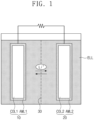
- FIG. 1 illustrates a simplified conceptual diagram showing a rechargeable lithium battery according to one or more embodiments of the present disclosure.
- a rechargeable lithium battery may include a positive electrode 10, a negative electrode 20, an electrolyte ELL, and a separator 30.
- the positive electrode 10 and the negative electrode 20 may be spaced and/or apart (e.g., spaced apart or separated) from each other across the separator 30.
- the separator 30 may be arranged between the positive electrode 10 and the negative electrode 20.
- the positive electrode 10, the negative electrode 20, and the separator 30 may be in contact with the electrolyte ELL.
- the positive electrode 10, the negative electrode 20, and the separator 30 may be impregnated in the electrolyte ELL.
- the electrolyte ELL may be a medium through which lithium ions are transmitted between the positive electrode 10 and the negative electrode 20.
- the lithium ions in the electrolyte ELL may pass through the separator 30 to move toward the positive electrode 10 or the negative electrode 20.
- the positive electrode 10 may include a first current collector COL1 and a positive electrode active material layer AML1 on the first current collector COL1.
- the first current collector COL1 may include metal, such as one or more of (e.g., selected from among) aluminium, copper, copper plated with nickel, stainless steels, nickel, titanium, palladium, and aluminium-cadmium alloys.
- the first current collector COL1 may be shaped like a film, a sheet, a foil, a mesh, a net, a porous substance, a foam, and/or non-woven fabric.
- the positive electrode active material layer AML1 may include a binder, a conductive material, and a positive electrode active material.
- the positive electrode active material may have an amount of about 80 wt% to about 99 wt%, for example, about 85 wt% to about 98 wt%, based on a total weight of the positive electrode active material layer AML1.
- the positive electrode active material may be a source of lithium ions.
- the positive electrode active material may be a lithium transition metal oxide including not only lithium but also at least one transition metal. The following will describe in more detail the positive electrode active material according to one or more embodiments of the present disclosure.
- the conductive material may provide the positive electrode active material layer AML1 with electrical conductivity.
- the conductive material may include at least one selected from among carbon-based materials (e.g., graphite, carbon black, acetylene black, Ketjen black, furnace black, lamp black, thermal black, and/or carbon fiber), metal powders, metal fibers, conductive whiskers, conductive metal oxides, conductive polymers, and a (e.g., any suitable) combination thereof.
- the conductive material may have an amount of about 1 wt% to about 30 wt% based on the total weight of the positive electrode active material layer AML1.
- the binder may increase a bonding force between the positive electrode active material and the first current collector COL1 and between the positive electrode active material particles.
- the binder may include at least one selected from among polyvinylidene fluoride (PVDF), polyvinylidene fluoride-hexafluoropropylene copolymer (PVDF-co-HFP), polyvinyl alcohol, polyacrylonitrile, carboxymethyl cellulose (CMC), starch, hydroxypropyl cellulose, regenerated cellulose, polyvinylpyrrolidone, tetrafluoroethylene, polyethylene, polypropylene, ethylenepropylene-diene monomer (EPDM), a sulfonated EPDM, styrene-butadiene rubber (SBR), fluorine rubber, and a (e.g., any suitable) combination thereof.
- the binder may have an amount of about 1 wt% to about 30 wt% based on the total weight of
- the negative electrode 20 may include a second current collector COL2 and a negative electrode active material layer AML2 on the second current collector COL2.
- a description of the second current collector COL2 may be the same as or similar to that of the first current collector COL1.
- the second current collector COL2 may include a metal the same as or different from that of the first current collector COL1.
- the second current collector COL2 may have a shape the same as or different from that of the first current collector COL1.
- the negative electrode active material layer AML2 may include a binder, conductive material, and a negative electrode active material.
- the binder and the conductive material may each be the same as those discussed above in the positive electrode active material layer AML1.
- the negative electrode active material may have an amount of about 80 wt% to about 99 wt%, for example, about 85 wt% to about 98 wt%, based on a total weight of the negative electrode active material layer AML2.
- the negative electrode active material may include at least one selected from among (e.g., at least one of) carbonaceous materials, lithium metal, lithium metal compounds, silicon, silicon compounds, tin, and/or tin compounds.
- a metal oxide such as TiO 2 or SnO 2 , whose electrical potential is less than about 2 V may also be utilized as the negative electrode active material.
- the carbonaceous material may include one or more of (e.g., selected from among) low-crystalline carbon and/or high-crystalline carbon.
- the separator 30 may include a porous polymer film formed of a polyolefin-based polymer, such as an ethylene homopolymer, a propylene homopolymer, an ethylene-butene copolymer, an ethylene-hexene copolymer, and/or an ethylene-methacrylate copolymer.
- the separator 30 may include a single layer of a porous polymer film or a stack layer of a plurality of porous polymer films.
- the separator 30 may include a porous non-woven fabric, such as a high-melting-point glass fiber or a polyethylene terephthalate fiber.
- the electrolyte ELL may include a salt having a structure of A + B - .
- the A + may include at least one alkali metal cation selected from among Li + , Na + , and K + .
- the B - may include at least one anion selected from among F - , Cl - , Br - , I - , NO 3 - , N(CN) 2 - , BF 4 - , ClO 4 - , AlO 4 - , AlCl 4 - , PF 6 - , SbF 6 - , AsF 6 - , BF 2 C 2 O 4 - , BC 4 O 8 - , (CF 3 ) 2 PF 4 - , (CF 3 ) 3 PF 3 - , (CF 3 ) 4 PF 2 - , (CF 3 ) 5 PF - , (CF 3 ) 6 P - , CF 3 SO 3 - , C 4 F 9 SO
- the electrolyte EEL may be utilized by dissolving a salt in an organic solvent.
- the organic solvent may include propylene carbonate (PC), ethylene carbonate (EC), diethyl carbonate (DEC), dimethyl carbonate (DMC), dipropyl carbonate (DPC), dimethyl sulfoxide, acetonitrile, dimethoxyethane, diethoxyethane, tetrahydrofuran, N-methyl-2-pyrrolidone (NMP), ethyl methyl carbonate (EMC), ⁇ -butyrolactone, or a (e.g., any suitable) mixture (or combination) thereof.
- PC propylene carbonate
- EC ethylene carbonate
- DEC diethyl carbonate
- DMC dimethyl carbonate
- DPC dipropyl carbonate
- dimethyl sulfoxide acetonitrile, dimethoxyethane, diethoxyethane, tetrahydrofuran
- NMP N
- a casing commonly utilized in the art may be adopted as a casing of a rechargeable lithium battery according to one or more embodiments of the present disclosure, and there may be no limitation on external appearance in accordance with the utilization of batteries.
- the casing of rechargeable lithium batteries may have a cylindrical shape, a prismatic shape, a pouch shape, or a coin shape.
- the positive electrode active material includes a lithium composite oxide represented by Chemical Formula 1, for example, in a form of particles.
- Chemical Formula 1 Li a Ni x M 1-x O b
- a rechargeable lithium battery including the positive electrode active material may improve in capacity and efficiency properties.
- the Na/S is less than about 0.03, an amount of Na may be low to induce a difficulty in maintaining pH desired or required for wet coating.
- the Na/S is greater than about 0.2, Na may serve as an impurity to reduce capacity and efficiency.
- the rechargeable battery was fabricated by substantially the same method as that of Experimental Example 1, except that the positive electrode active material of Comparative Example 6 was utilized.
- the same method as that of Experimental Example 1 was employed to measure charging/discharging capacity and efficiency properties of the rechargeable battery, and the measured properties were listed in Table 2.
- the rechargeable battery has relatively large charging/discharging capacity and relatively high efficiency properties.
- the rechargeable lithium battery including the positive electrode active material of the present disclosure may improve in capacity and efficiency properties.
- “at least one of a, b or c”, “at least one selected from a, b, and c", “at least one selected from among a to c", etc. may indicate only a, only b, only c, both (e.g., simultaneously) a and b, both (e.g., simultaneously) a and c, both (e.g., simultaneously) b and c, all of a, b, and c, or variations thereof.
- D50 refers to the average diameter of particles whose cumulative volume corresponds to 50 vol% in the particle size distribution (e.g., cumulative distribution), and refers to the value of the particle size corresponding to 50% from the smallest particle when the total number of particles is 100% in the distribution curve accumulated in the order of the smallest particle size to the largest particle size.
- the terms “substantially,” “about,” and similar terms are used as terms of approximation and not as terms of degree, and are intended to account for the inherent deviations in measured or calculated values that would be recognized by those of ordinary skill in the art.
- “About” or “approximately,” as used herein, is also inclusive of the stated value and means within an acceptable range of deviation for the particular value as determined by one of ordinary skill in the art, considering the measurement in question and the error associated with measurement of the particular quantity (i.e., the limitations of the measurement system). For example, “about” may mean within one or more standard deviations, or within ⁇ 30%, 20%, 10%, 5% of the stated value.
- any numerical range recited herein is intended to include all sub-ranges of the same numerical precision subsumed within the recited range.
- a range of "1.0 to 10.0" is intended to include all subranges between (and including) the recited minimum value of 1.0 and the recited maximum value of 10.0, that is, having a minimum value equal to or greater than 1.0 and a maximum value equal to or less than 10.0, such as, for example, 2.4 to 7.6.
- Any maximum numerical limitation recited herein is intended to include all lower numerical limitations subsumed therein and any minimum numerical limitation recited in this specification is intended to include all higher numerical limitations subsumed therein.
- a battery management system (BMS) device and/or any other relevant devices or components according to embodiments of the present invention described herein may be implemented utilizing any suitable hardware, firmware (e.g., an application-specific integrated circuit), software, or a combination of software, firmware, and hardware.
- the various components of the device may be formed on one integrated circuit (IC) chip or on separate IC chips.
- the various components of the device may be implemented on a flexible printed circuit film, a tape carrier package (TCP), a printed circuit board (PCB), or formed on one substrate.
- the various components of the device may be a process or thread, running on one or more processors, in one or more computing devices, executing computer program instructions and interacting with other system components for performing the various functionalities described herein.
- the computer program instructions are stored in a memory which may be implemented in a computing device using a standard memory device, such as, for example, a random access memory (RAM).
- the computer program instructions may also be stored in other non-transitory computer readable media such as, for example, a CD-ROM, flash drive, or the like.
- a person of skill in the art should recognize that the functionality of various computing devices may be combined or integrated into a single computing device, or the functionality of a particular computing device may be distributed across one or more other computing devices without departing from the scope of the present disclosure.
Landscapes
- Chemical & Material Sciences (AREA)
- Chemical Kinetics & Catalysis (AREA)
- Electrochemistry (AREA)
- General Chemical & Material Sciences (AREA)
- Inorganic Chemistry (AREA)
- Composite Materials (AREA)
- Organic Chemistry (AREA)
- Engineering & Computer Science (AREA)
- Materials Engineering (AREA)
- Manufacturing & Machinery (AREA)
- Battery Electrode And Active Subsutance (AREA)
- Inorganic Compounds Of Heavy Metals (AREA)
Applications Claiming Priority (1)
| Application Number | Priority Date | Filing Date | Title |
|---|---|---|---|
| KR1020230179478A KR20250089797A (ko) | 2023-12-12 | 2023-12-12 | 리튬 이차전지용 양극 활물질 및 이를 포함하는 리튬 이차전지 |
Publications (2)
| Publication Number | Publication Date |
|---|---|
| EP4582388A2 true EP4582388A2 (de) | 2025-07-09 |
| EP4582388A3 EP4582388A3 (de) | 2025-07-30 |
Family
ID=93842007
Family Applications (1)
| Application Number | Title | Priority Date | Filing Date |
|---|---|---|---|
| EP24218109.7A Pending EP4582388A3 (de) | 2023-12-12 | 2024-12-06 | Positivelektrodenaktivmaterial und wiederaufladbare lithiumbatterie damit |
Country Status (6)
| Country | Link |
|---|---|
| US (1) | US20250192171A1 (de) |
| EP (1) | EP4582388A3 (de) |
| JP (1) | JP2025093902A (de) |
| KR (1) | KR20250089797A (de) |
| CN (1) | CN120149389A (de) |
| CA (1) | CA3259134A1 (de) |
Family Cites Families (5)
| Publication number | Priority date | Publication date | Assignee | Title |
|---|---|---|---|---|
| KR102853967B1 (ko) * | 2021-05-28 | 2025-09-01 | 삼성에스디아이 주식회사 | 리튬 이차 전지용 양극 활물질, 이의 제조 방법 및 이를 포함하는 리튬 이차 전지 |
| KR102397756B1 (ko) * | 2020-09-02 | 2022-05-13 | 주식회사 에코프로비엠 | 양극 활물질 및 이를 포함하는 리튬 이차전지 |
| EP4135067A1 (de) * | 2021-08-13 | 2023-02-15 | Samsung SDI Co., Ltd. | Positives aktivmaterial für wiederaufladbare lithiumbatterie, verfahren zur herstellung davon und wiederaufladbare lithiumbatterie damit |
| CN116438685A (zh) * | 2021-10-15 | 2023-07-14 | 艾可普罗 Bm 有限公司 | 正极活性物质及包括其的锂二次电池 |
| EP4382489A1 (de) * | 2022-12-07 | 2024-06-12 | Samsung SDI Co., Ltd. | Positives aktivmaterial für wiederaufladbare lithiumbatterien, herstellungsverfahren dafür und wiederaufladbare lithiumbatterien damit |
-
2023
- 2023-12-12 KR KR1020230179478A patent/KR20250089797A/ko active Pending
-
2024
- 2024-06-21 US US18/751,091 patent/US20250192171A1/en active Pending
- 2024-12-06 EP EP24218109.7A patent/EP4582388A3/de active Pending
- 2024-12-10 CA CA3259134A patent/CA3259134A1/en active Pending
- 2024-12-12 CN CN202411828813.XA patent/CN120149389A/zh active Pending
- 2024-12-12 JP JP2024217397A patent/JP2025093902A/ja active Pending
Also Published As
| Publication number | Publication date |
|---|---|
| JP2025093902A (ja) | 2025-06-24 |
| US20250192171A1 (en) | 2025-06-12 |
| EP4582388A3 (de) | 2025-07-30 |
| CA3259134A1 (en) | 2026-03-01 |
| KR20250089797A (ko) | 2025-06-19 |
| CN120149389A (zh) | 2025-06-13 |
Similar Documents
| Publication | Publication Date | Title |
|---|---|---|
| EP3595060B1 (de) | Positivelektrodenaktivmaterial, lithiumsekundärbatterie und herstellungsverfahren dafür | |
| EP3609003B1 (de) | Positivelektrodenmaterial mit lithiummangan, positivelektrodenaktivmaterial mit spinellstruktur, positivelektrode und lithiumsekundärbatterie | |
| KR101948321B1 (ko) | 정극 활성 물질 전구체 입자 분말 및 정극 활성 물질 입자 분말, 및 비수전해질 이차 전지 | |
| EP3663265A2 (de) | Positivelektrodenaktivmaterial für eine lithiumsekundärbatterie und damit versehene lithiumsekundärbatterie | |
| EP3840089A1 (de) | Positivelektrodenaktivmaterial für lithiumsekundärbatterie, verfahren zur herstellung davon und lithiumsekundärbatterie damit | |
| EP3550641A1 (de) | Nickelaktivmaterialvorläufer für lithiumsekundärbatterie, verfahren zur herstellung eines nickelaktivmaterialvorläufers, durch das verfahren hergestellter nickelaktivmaterialvorläufer für lithiumsekundärbatterie sowie lithiumsekundärbatterie mit kathode mit nickelaktivmaterial | |
| EP3550642A1 (de) | Nickelaktivmaterialvorläufer für lithiumsekundärbatterie, verfahren zur herstellung eines nickelaktivmaterialvorläufers, durch das verfahren hergestellter nickelaktivmaterialvorläufer für lithiumsekundärbatterie sowie lithiumsekundärbatterie mit kathode mit nickelaktivmaterial | |
| CN112005409B (zh) | 正极活性物质及具备该正极活性物质的电池 | |
| CN110048087A (zh) | 正极活性物质和电池 | |
| KR102781582B1 (ko) | 리튬 이차 전지용 양극 활물질 및 이의 제조방법 | |
| JP7157219B1 (ja) | リチウム二次電池用正極活物質、リチウム二次電池用正極及びリチウム二次電池 | |
| KR20230159139A (ko) | 리튬 이차전지용 양극 활물질 및 그 제조 방법 | |
| CN117043990A (zh) | 非水电解质二次电池用正极活性物质和非水电解质二次电池 | |
| EP4654280A2 (de) | Positivelektrodenaktivmaterial für eine wiederaufladbare lithiumbatterie und wiederaufladbare lithiumbatterie mit dem positivelektrodenaktivmaterial | |
| EP4585566A1 (de) | Positivelektrodenaktivmaterial für wiederaufladbare lithiumbatterien, verfahren zur herstellung davon und wiederaufladbare lithiumbatterie damit | |
| KR20220128923A (ko) | 리튬 이차 전지용 양극 활물질 및 이의 제조 방법 | |
| EP4582388A2 (de) | Positivelektrodenaktivmaterial und wiederaufladbare lithiumbatterie damit | |
| US20250140835A1 (en) | Cathode active material powder for lithium secondary battery, electrode, and solid lithium secondary battery | |
| EP4411888A1 (de) | Positivelektrodenaktivmaterial für sekundärbatterien mit wasserfreiem elektrolyt und sekundärbatterie mit wasserfreiem elektrolyt | |
| EP4567924A1 (de) | Positivelektrodenaktivmaterial und wiederaufladbare lithiumbatterie damit | |
| EP4606775A1 (de) | Positivelektrodenaktivmaterial für eine wiederaufladbare lithiumbatterie, verfahren zur herstellung davon und wiederaufladbare lithiumbatterie damit | |
| EP4549403A1 (de) | Positivelektrodenaktivmaterial für natriumsekundärbatterie, verfahren zur herstellung davon und natriumsekundärbatterie damit | |
| US20250201836A1 (en) | Positive electrode active material, lithium ion secondary battery, and method of producing positive electrode active material |
Legal Events
| Date | Code | Title | Description |
|---|---|---|---|
| PUAI | Public reference made under article 153(3) epc to a published international application that has entered the european phase |
Free format text: ORIGINAL CODE: 0009012 |
|
| STAA | Information on the status of an ep patent application or granted ep patent |
Free format text: STATUS: REQUEST FOR EXAMINATION WAS MADE |
|
| PUAL | Search report despatched |
Free format text: ORIGINAL CODE: 0009013 |
|
| 17P | Request for examination filed |
Effective date: 20241206 |
|
| AK | Designated contracting states |
Kind code of ref document: A2 Designated state(s): AL AT BE BG CH CY CZ DE DK EE ES FI FR GB GR HR HU IE IS IT LI LT LU LV MC ME MK MT NL NO PL PT RO RS SE SI SK SM TR |
|
| AK | Designated contracting states |
Kind code of ref document: A3 Designated state(s): AL AT BE BG CH CY CZ DE DK EE ES FI FR GB GR HR HU IE IS IT LI LT LU LV MC ME MK MT NL NO PL PT RO RS SE SI SK SM TR |
|
| RIC1 | Information provided on ipc code assigned before grant |
Ipc: C01G 53/42 20250101AFI20250624BHEP Ipc: H01M 4/36 20060101ALI20250624BHEP Ipc: H01M 4/525 20100101ALI20250624BHEP |