EP4549403A1 - Positivelektrodenaktivmaterial für natriumsekundärbatterie, verfahren zur herstellung davon und natriumsekundärbatterie damit - Google Patents
Positivelektrodenaktivmaterial für natriumsekundärbatterie, verfahren zur herstellung davon und natriumsekundärbatterie damit Download PDFInfo
- Publication number
- EP4549403A1 EP4549403A1 EP24197846.9A EP24197846A EP4549403A1 EP 4549403 A1 EP4549403 A1 EP 4549403A1 EP 24197846 A EP24197846 A EP 24197846A EP 4549403 A1 EP4549403 A1 EP 4549403A1
- Authority
- EP
- European Patent Office
- Prior art keywords
- sodium
- cobalt
- transition metal
- metal oxide
- composite transition
- Prior art date
- Legal status (The legal status is an assumption and is not a legal conclusion. Google has not performed a legal analysis and makes no representation as to the accuracy of the status listed.)
- Pending
Links
Images

Classifications
-
- C—CHEMISTRY; METALLURGY
- C01—INORGANIC CHEMISTRY
- C01G—COMPOUNDS CONTAINING METALS NOT COVERED BY SUBCLASSES C01D OR C01F
- C01G53/00—Compounds of nickel
- C01G53/40—Complex oxides containing nickel and at least one other metal element
- C01G53/42—Complex oxides containing nickel and at least one other metal element containing alkali metals, e.g. LiNiO2
- C01G53/44—Complex oxides containing nickel and at least one other metal element containing alkali metals, e.g. LiNiO2 containing manganese
- C01G53/50—Complex oxides containing nickel and at least one other metal element containing alkali metals, e.g. LiNiO2 containing manganese of the type (MnO2)n-, e.g. Li(NixMn1-x)O2 or Li(MyNixMn1-x-y)O2
-
- C—CHEMISTRY; METALLURGY
- C01—INORGANIC CHEMISTRY
- C01G—COMPOUNDS CONTAINING METALS NOT COVERED BY SUBCLASSES C01D OR C01F
- C01G53/00—Compounds of nickel
- C01G53/80—Compounds containing nickel, with or without oxygen or hydrogen, and containing one or more other elements
- C01G53/82—Compounds containing nickel, with or without oxygen or hydrogen, and containing two or more other elements
-
- H—ELECTRICITY
- H01—ELECTRIC ELEMENTS
- H01M—PROCESSES OR MEANS, e.g. BATTERIES, FOR THE DIRECT CONVERSION OF CHEMICAL ENERGY INTO ELECTRICAL ENERGY
- H01M10/00—Secondary cells; Manufacture thereof
- H01M10/05—Accumulators with non-aqueous electrolyte
- H01M10/054—Accumulators with insertion or intercalation of metals other than lithium, e.g. with magnesium or aluminium
-
- H—ELECTRICITY
- H01—ELECTRIC ELEMENTS
- H01M—PROCESSES OR MEANS, e.g. BATTERIES, FOR THE DIRECT CONVERSION OF CHEMICAL ENERGY INTO ELECTRICAL ENERGY
- H01M4/00—Electrodes
- H01M4/02—Electrodes composed of, or comprising, active material
- H01M4/13—Electrodes for accumulators with non-aqueous electrolyte, e.g. for lithium-accumulators; Processes of manufacture thereof
- H01M4/131—Electrodes based on mixed oxides or hydroxides, or on mixtures of oxides or hydroxides, e.g. LiCoOx
-
- H—ELECTRICITY
- H01—ELECTRIC ELEMENTS
- H01M—PROCESSES OR MEANS, e.g. BATTERIES, FOR THE DIRECT CONVERSION OF CHEMICAL ENERGY INTO ELECTRICAL ENERGY
- H01M4/00—Electrodes
- H01M4/02—Electrodes composed of, or comprising, active material
- H01M4/36—Selection of substances as active materials, active masses, active liquids
- H01M4/362—Composites
- H01M4/366—Composites as layered products
-
- H—ELECTRICITY
- H01—ELECTRIC ELEMENTS
- H01M—PROCESSES OR MEANS, e.g. BATTERIES, FOR THE DIRECT CONVERSION OF CHEMICAL ENERGY INTO ELECTRICAL ENERGY
- H01M4/00—Electrodes
- H01M4/02—Electrodes composed of, or comprising, active material
- H01M4/36—Selection of substances as active materials, active masses, active liquids
- H01M4/48—Selection of substances as active materials, active masses, active liquids of inorganic oxides or hydroxides
- H01M4/50—Selection of substances as active materials, active masses, active liquids of inorganic oxides or hydroxides of manganese
- H01M4/505—Selection of substances as active materials, active masses, active liquids of inorganic oxides or hydroxides of manganese of mixed oxides or hydroxides containing manganese for inserting or intercalating light metals, e.g. LiMn2O4 or LiMn2OxFy
-
- H—ELECTRICITY
- H01—ELECTRIC ELEMENTS
- H01M—PROCESSES OR MEANS, e.g. BATTERIES, FOR THE DIRECT CONVERSION OF CHEMICAL ENERGY INTO ELECTRICAL ENERGY
- H01M4/00—Electrodes
- H01M4/02—Electrodes composed of, or comprising, active material
- H01M4/36—Selection of substances as active materials, active masses, active liquids
- H01M4/48—Selection of substances as active materials, active masses, active liquids of inorganic oxides or hydroxides
- H01M4/52—Selection of substances as active materials, active masses, active liquids of inorganic oxides or hydroxides of nickel, cobalt or iron
- H01M4/525—Selection of substances as active materials, active masses, active liquids of inorganic oxides or hydroxides of nickel, cobalt or iron of mixed oxides or hydroxides containing iron, cobalt or nickel for inserting or intercalating light metals, e.g. LiNiO2, LiCoO2 or LiCoOxFy
-
- C—CHEMISTRY; METALLURGY
- C01—INORGANIC CHEMISTRY
- C01P—INDEXING SCHEME RELATING TO STRUCTURAL AND PHYSICAL ASPECTS OF SOLID INORGANIC COMPOUNDS
- C01P2004/00—Particle morphology
- C01P2004/01—Particle morphology depicted by an image
- C01P2004/02—Particle morphology depicted by an image obtained by optical microscopy
-
- C—CHEMISTRY; METALLURGY
- C01—INORGANIC CHEMISTRY
- C01P—INDEXING SCHEME RELATING TO STRUCTURAL AND PHYSICAL ASPECTS OF SOLID INORGANIC COMPOUNDS
- C01P2004/00—Particle morphology
- C01P2004/80—Particles consisting of a mixture of two or more inorganic phases
- C01P2004/82—Particles consisting of a mixture of two or more inorganic phases two phases having the same anion, e.g. both oxidic phases
- C01P2004/84—Particles consisting of a mixture of two or more inorganic phases two phases having the same anion, e.g. both oxidic phases one phase coated with the other
-
- C—CHEMISTRY; METALLURGY
- C01—INORGANIC CHEMISTRY
- C01P—INDEXING SCHEME RELATING TO STRUCTURAL AND PHYSICAL ASPECTS OF SOLID INORGANIC COMPOUNDS
- C01P2006/00—Physical properties of inorganic compounds
- C01P2006/40—Electric properties
-
- C—CHEMISTRY; METALLURGY
- C01—INORGANIC CHEMISTRY
- C01P—INDEXING SCHEME RELATING TO STRUCTURAL AND PHYSICAL ASPECTS OF SOLID INORGANIC COMPOUNDS
- C01P2006/00—Physical properties of inorganic compounds
- C01P2006/80—Compositional purity
-
- H—ELECTRICITY
- H01—ELECTRIC ELEMENTS
- H01M—PROCESSES OR MEANS, e.g. BATTERIES, FOR THE DIRECT CONVERSION OF CHEMICAL ENERGY INTO ELECTRICAL ENERGY
- H01M4/00—Electrodes
- H01M4/02—Electrodes composed of, or comprising, active material
- H01M2004/026—Electrodes composed of, or comprising, active material characterised by the polarity
- H01M2004/028—Positive electrodes
-
- Y—GENERAL TAGGING OF NEW TECHNOLOGICAL DEVELOPMENTS; GENERAL TAGGING OF CROSS-SECTIONAL TECHNOLOGIES SPANNING OVER SEVERAL SECTIONS OF THE IPC; TECHNICAL SUBJECTS COVERED BY FORMER USPC CROSS-REFERENCE ART COLLECTIONS [XRACs] AND DIGESTS
- Y02—TECHNOLOGIES OR APPLICATIONS FOR MITIGATION OR ADAPTATION AGAINST CLIMATE CHANGE
- Y02E—REDUCTION OF GREENHOUSE GAS [GHG] EMISSIONS, RELATED TO ENERGY GENERATION, TRANSMISSION OR DISTRIBUTION
- Y02E60/00—Enabling technologies; Technologies with a potential or indirect contribution to GHG emissions mitigation
- Y02E60/10—Energy storage using batteries
Definitions
- the present invention relates to a positive electrode active material for a sodium secondary battery, a method of preparing the same, and a sodium secondary battery including the same.
- Lithium-ion secondary batteries have been widely used as energy storage devices in various electronic technology fields. Recently, as the demand for lithium-ion secondary batteries has rapidly increased, sodium-ion secondary batteries are attracting attention to replace lithium, an expensive metal. Sodium-ion secondary batteries are one of the next-generation materials with high potential for application to secondary batteries because they have a similar intercalating/deintercalating reaction operating principle as lithium-ion secondary batteries.
- the positive electrode active material for sodium-ion secondary batteries is typically a layered transition metal oxide that has a simple structure, excellent electrochemical performance, and is easy to synthesize.
- the residual amount of sodium by-products present in the form of Na 2 CO 3 and NaOH on the particle surface increases, which causes gas generation due to electrolyte side reactions during battery operation, a decrease in the capacity and output of the positive electrode material, and a decrease in the lifespan and stability of the battery.
- a water washing process is essential to remove sodium by-products remaining on the surface of the positive electrode active material.
- a water washing process to remove sodium by-products is performed, there is a problem that the lifespan characteristics are rapidly reduced due to surface defects of the positive electrode active material, so a particle surface coating of the positive electrode active material is applied after water washing.
- the coating was formed in an island shape on the surface of the positive electrode active material particle, and it was difficult to form a uniform coating layer over the entire particle surface. Meanwhile, a non-uniform coating layer acts as a resistance layer, which does not improve capacity before/after coating and deteriorates the electrochemical properties of the cell.
- a method is required to improve the performance of the positive electrode active material of sodium-ion batteries and to improve the deterioration of lifespan characteristics due to the water washing process.
- the present invention is directed to providing a manufacturing method that improves cell performance such as surface stability, capacity, and lifetime characteristics by performing the water washing process and coating process simultaneously and further, by forming a uniform and capacitive coating layer on the entire surface of the positive electrode active material particles in the preparation of positive electrode active material for sodium secondary batteries.
- the present invention is directed to simplifying the process and improving process costs by reducing the input amount of basic material (NaOH) used in the coating layer formation process by using residual sodium on the surface of the sodium composite transition metal oxide.
- the total amount of residual sodium and the ratio of residual sodium compounds (NaOH/Na 2 CO 3 ) on the surface of the sodium transition metal oxide are controlled to specific ranges, and thus the additional input amount of basic material (NaOH) used in the coating layer formation process may be optimized.
- the present invention is directed to providing a method for coating a positive electrode active material for a sodium secondary battery, which applies a process differently depending on the coating amount of the positive electrode active material, so that the coating layer may be uniformly formed regardless of the change in coating amount.
- the present invention is directed to providing a positive electrode active material for a sodium secondary battery prepared by the above preparation method, in which a uniform and capacitive coating layer is formed on the entire surface of the positive electrode active material particle.
- One embodiment of the present invention provides a method of preparing a positive electrode active material for a sodium secondary battery, including a) inputting a sodium composite transition metal oxide and a water washing solution into a reactor and stirring the reactants to dissolve residual sodium on the surface of the sodium composite transition metal oxide in the water washing solution; b) inputting a cobalt salt into the reactor and performing stirring to co-precipitate cobalt hydroxide onto the sodium composite transition metal oxide particles; and c) heat-treating the sodium composite transition metal oxide particles on which the cobalt hydroxide is formed to form a cobalt coating layer on the particles.
- the sodium composite transition metal oxide may include a combination of sodium hydroxide (NaOH) and sodium carbonate (Na 2 CO 3 ) as sodium by-products remaining on the surface of the oxide particles, and the sodium composite transition metal oxide may include residual sodium in a weight ratio of sodium hydroxide to sodium carbonate (NaOH/Na 2 CO 3 ) of 50 to 110.
- the pH of the reactants may be increased from pH 6 to 8 to pH 10 to 12 while stirring proceeds in the reactor.
- the sodium composite transition metal oxide may have a residual sodium content (TTS: total sodium, ppm) of 3,000 to 20,000 ppm.
- Operation b) may include b1) when a content of cobalt element included in the cobalt oxide coating layer is 2 mol% or less based on the total metals (M) excluding sodium of the sodium composite transition metal oxide, inputting the cobalt salt and stirring without inputting a sodium-containing basic material; and b2) when a content of cobalt element included in the cobalt oxide coating layer is more than 2 mol% based on the total metals (M) excluding sodium of the sodium composite transition metal oxide, inputting a cobalt salt (CS1) and stirring without inputting the sodium-containing basic material when a cumulative cobalt element content (Co'/M) input into the reactor is 0 to 2 mol%, and inputting and stirring a cobalt salt (CS2) and the sodium-containing basic material together from the point in time when the cumulative cobalt element content (Co'/M) input into the reactor exceeds 2 mol%.
- CS1 cobalt salt
- CS2 cumulative cobalt element content
- the cobalt hydroxide co-precipitation of operation b) further may include b3) stopping the input of the cobalt salt or the cobalt salt and sodium-containing basic material, and stirring the material input into the reactor for 1 to 10 min after operation b1) or operation b2).
- the residual sodium in operation a) and the sodium-containing basic material in operation b2) may be materials that are partially or fully ionized in the water washing solution and exhibit basicity
- the cobalt salt in operation b) may be a material that is partially or fully ionized in the water washing solution and exhibits acidity.
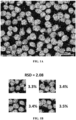
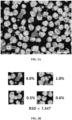
- a positive electrode active material for a sodium secondary battery including a plurality of sodium composite transition metal oxide particles including a cobalt oxide coating layer formed on the surface and/or inside the particles, wherein the plurality of sodium composite transition metal oxide particles have a relative standard deviation (RSD) of less than 30 of the atomic molar ratio (Co/M) of cobalt to total metals (M) excluding sodium at 4 random points selected through EDS (energy-dispersive X-ray spectroscopy) mapping analysis .
- RSD relative standard deviation
- Co/M atomic molar ratio
- M total metals
- the plurality of sodium composite transition metal oxide particles may have an RSD of 2 to 20 of the atomic molar ratio (Co/M) of cobalt to total metals (M) excluding sodium at 4 random points selected through EDS mapping analysis.
- the sodium composite transition metal oxide may be a sodium manganese-based oxide including at least sodium, nickel, and manganese.
- the sodium composite transition metal oxide may be represented by the following Chemical Formula 1. [Chemical Formula 1] Na a Ni x M1 y M2 z Mn 1-x-y-z O 2
- the cobalt oxide coating layer may include sodium cobalt oxide (NaCoO 2 ), cobalt oxide (Co 2 O 3 ), or a combination thereof.
- the content of cobalt element (Co) included in the cobalt oxide coating layer may be 0.1 to 10 mol% based on the total metals (M) excluding sodium of the sodium composite transition metal oxide,
- the plurality of sodium composite transition metal oxide particles including a cobalt oxide coating layer formed on the surface and/or inside the particles may include a residual sodium content of 10,000 ppm or less.
- Still another embodiment of the present invention provides a positive electrode for a sodium secondary battery including the positive electrode active material, and a sodium secondary battery including the positive electrode; a negative electrode; and an electrolyte.
- the present invention provides a method of preparing a positive electrode active material for a sodium secondary battery, in which a water washing process and a coating process are performed simultaneously, and furthermore, a coating layer is uniformly formed over the entire surface of the positive electrode active material particles and has capacity, the method including a) inputting a sodium composite transition metal oxide and a water washing solution into a reactor and stirring the reactants to dissolve residual sodium on the surface of the sodium composite transition metal oxide in the water washing solution; b) inputting a cobalt salt into the reactor and performing stirring to co-precipitate cobalt hydroxide onto the sodium composite transition metal oxide particles; and c) heat-treating the sodium composite transition metal oxide particles on which the cobalt hydroxide is formed to form a cobalt coating layer on the particles. Accordingly, the surface stability of the positive electrode active material may be enhanced and electrochemical performance such as capacity and lifespan characteristics may be improved.
- Operation a) preferentially uses the sodium by-products remaining on the surface of the positive electrode active material without inputting an additional basic material in order to apply the optimal pH for cobalt hydroxide co-precipitation, and is an operation in which the sodium composite transition metal oxide and the water washing solution are input into the reactor and the reactants are stirred to dissolve the sodium by-products (residual sodium) remaining on the surface of the sodium composite transition metal oxide in the water washing solution.
- the pH 11-12 optimized for cobalt hydroxide co-precipitation may be controlled, and as there is no additional input of a basic solution or ammonium solution, process simplification and process costs may be reduced.
- the stirring of the reactants may be performed at 100 to 300 rpm for 1 to 10 min, specifically at 200 to 400 rpm for 3 to 7 min, or at 300 to 500 rpm 4 to 6 min. Accordingly, the pH of the reactants increases from pH 6 to 8 to pH 10 to 12 while stirring proceeds in the reactor, and the optimal pH for co-precipitation may be achieved using only residual sodium without inputting additional basic materials in the co-precipitation process, which is the next operation.
- the prepared sodium composite transition metal oxide may be a high-Mn sodium nickel manganese oxide (NNMO) represented by the following Chemical Formula 1.
- NMO high-Mn sodium nickel manganese oxide
- the proportion of Mn in the high-Mn transition metal composition increases, the residual sodium content on the surface of the oxide particle tends to increase after preparing the sodium composite transition metal oxide, and in the present invention, the amount of basic materials used in Co co-precipitation coating can be reduced by maximally utilizing the sodium by-products remaining on the surface.
- the sodium composite transition metal oxide may include a combination of sodium hydroxide (NaOH) and sodium carbonate (Na 2 CO 3 ) as sodium by-products remaining on the surface of the oxide particles.
- NaOH in the residual sodium is strongly basic and may be used to replace the basic material (NaOH) input additionally to satisfy the optimal pH of 11 to 12 during co-precipitation coating, and this process has the effect of removing residual sodium, but Na 2 CO 3 in the residual sodium is weakly basic, so a large amount of residual sodium is required to satisfy the optimal pH of 11 to 12 for co-precipitation, and accordingly, when the total amount of residual sodium increases, it becomes difficult to achieve uniform coating during the co-precipitation coating.
- the present invention is directed to preparing/using the sodium composite transition metal oxide so as to have i) an appropriate total residual sodium amount, and ii) a specific (NaOH/Na 2 CO 3 ) weight ratio.
- reaction scheme (1) NaOH is a strong base, so it is present as Na + and OH - ions in the water washing solution
- Na 2 CO 3 is a salt of a strong base and a weak acid, so it dissolves in the water washing solution and is weakly basic
- HCO 3 - is a weak base that reacts with water again to generate OH - .
- the sodium composite transition metal oxide may include residual sodium in a weight ratio of sodium hydroxide to sodium carbonate (NaOH/Na 2 CO 3 ) of 50 to 110, for example 65 to 110, 65 to 105, 70 to 110, or 70 to 105.
- the sodium composite transition metal oxide may have a residual sodium content (TTS: total sodium, ppm) of 3,000 to 20,000 ppm, for example, 5,000 to 20,000 ppm, 8,000 to 20,000 ppm, 10,000 to 20,000 ppm, 12,000 to 20,000 ppm, 13,000 to 18,000 ppm, or 14,000 to 17,000 ppm. Accordingly, in order to perform the co-precipitation using NaOH, which may be used as a basic material in the co-precipitation, in the residual sodium, it is possible to prepare the sodium composite transition metal oxide so as to have i) an appropriate total residual sodium amount, and ii) a specific (NaOH/Na 2 CO 3 ) weight ratio.
- TTS total sodium, ppm
- the water washing solution may be a water washing solution commonly used for washing the sodium composite transition metal oxide with water, and may be, for example, ethanol, distilled water, or deionized water.
- the reactor may be used without limitation as long as it is a co-precipitation reaction reactor that is generally used in the preparation of positive electrode active materials, and for example, a batch type reactor, Couette-Taylor reactor, and the like may be used.
- a batch type reactor Couette-Taylor reactor, and the like may be used.
- co-precipitation of cobalt hydroxide may be performed faster than with general reactors such as a batch reactor, which has the advantage of saving process time.
- Operation b) is for uniformly co-precipitating cobalt hydroxide on the surface of the sodium composite transition metal oxide particles and is an operation of inputting cobalt salt into the reactor and performing stirring to co-precipitate the cobalt hydroxide onto the sodium composite transition metal oxide particles, and accordingly, the co-precipitation may be applied differently depending on the cumulative co-precipitation amount (coating amount) of cobalt hydroxide.
- CS1 cobalt salt
- CS2 cobalt salt
- the total metals (M) excluding sodium of the sodium composite transition metal oxide may include transition metals included in the cobalt oxide coating layer.
- the cobalt salt is a cobalt-containing raw material
- the cobalt-containing raw material may be a cobalt-containing acetate, nitrate, sulfate, halide, sulfide, hydroxide, oxide, or oxyhydroxide, and specifically, Co(OH) 2 , CoOOH, Co(OCOCH 3 ) 2 • 4H 2 O, Co(NO 3 ) 2 • 6H 2 O, CoSO 4 , CoSO 4 • 7H 2 O, or a combination thereof, but is not limited thereto.
- the basic solution may be hydroxide of an alkali metal or alkaline earth metal, such as NaOH, KOH, or Ca(OH) 2 , a hydrate thereof, or a combination thereof.
- the basic compound may also be used in the form of an aqueous solution, and in this case, the solvent may be water or a mixture of water and an organic solvent (specifically, alcohol, and the like) that is homogeneously miscible with water.
- the basic solution is added to adjust the pH of the reaction solution in the reactor, and may be added in an amount such that the pH of the reaction solution in the reactor is 11 to 12 during co-precipitation of the cobalt hydroxide.
- the co-precipitation reaction may be performed at a temperature of 40 °C to 70 °C in an inert atmosphere such as nitrogen or argon, and the co-precipitation time for co-precipitating the cobalt hydroxide may range from 1 min to 1 h, more preferably from 5 min to 1 h, more preferably from 10 min to 50 min.
- the co-precipitation time of the cobalt hydroxide within the above range, it is possible to effectively form a coating layer on the particle surface of the sodium composite transition metal oxide to improve surface defects and enhance battery performance, while minimizing film resistance due to the formation of the coating layer, and in addition, the existing long co-precipitation process time of about 2 h may be shortened, making it possible to simplify the process, reduce process costs, and form a uniform coating layer.
- the water washing process for removing sodium by-products remaining on the particle surface and the coating process for improving surface defects and enhancing performance may be performed simultaneously to simplify the process, reduce production time and process costs, and form a uniform coating layer over the entire particle surface.
- a coating source may be further mixed and heat treated.
- the coating source may be a coating source used for coating the surface of sodium composite transition metal oxide particles, and may include, for example, at least one selected from the group consisting of B, Al, F, W, Mo, Ti, and Nb, but is not limited thereto.
- the positive electrode active material includes a plurality of sodium composite transition metal oxide particles including a cobalt oxide coating layer formed on the surface and/or inside the particles, and the plurality of sodium composite transition metal oxide particles may have an RSD of less than 30, specifically, 2 to 20, 2 to 15, 2 to 10, 2 to 5, or 2 to 4 of the atomic molar ratio (Co/M) of cobalt to total metals (M) excluding sodium at 4 random points selected through EDS mapping analysis.
- a uniform and capacitive coating layer can be formed on the entire surface of the positive electrode active material particle.
- the non-uniform coating layer acts as a resistance layer, so there is no effect of improving capacity before and after coating, and further, battery characteristics may deteriorate.
- the RSD also called the coefficient of variation
- the RSD represents the relative size of the standard deviation to the average value and may be calculated by dividing the standard deviation by the arithmetic mean (standard deviation / average x 100).
- the standard deviation and average of the atomic molar ratio (Co/M) of cobalt to the total metals (M) calculated at 4 random points including the plurality of oxide particles may be calculated to obtain the relative standard deviation (standard deviation) / average ⁇ 100).
- the sodium composite transition metal oxide may be an NNMO-based sodium manganese-based oxide including at least sodium, nickel, and manganese.
- the sodium manganese-based oxide is a high-manganese-based (high-Mn) oxide containing 55 mol% or more of manganese among total metals excluding sodium, and the content of manganese among the metals excluding sodium may be 55 mol% or more, 60 mol% or more, or 65 mol% or more, and the upper limit is not particularly limited, but for example, it may be 85 mol% or less, 80 mol% or less, or 75 mol% or less.
- As the content of manganese among metals excluding sodium increases, it has the advantage of being able to exhibit high capacity in a high-voltage operating environment, and may increase price competitiveness by reducing both nickel and cobalt concentrations.
- the sodium composite transition metal oxide may be present in the form of secondary particles in which at least one primary particle is aggregated, and the oxide particles may have an average particle diameter (D50) of 2 to 15 ⁇ m, for example, 4 to 10 ⁇ m, but is not limited thereto.
- the electrode density may be increased to enhance the energy density per unit volume of the electrode.
- the sodium composite transition metal oxide may be represented by the following Chemical Formula 1. [Chemical Formula 1] Na a Ni x M1 y M2 z Mn 1-x-y-z O 2
- the sodium composite transition metal oxide of Chemical Formula 1 may have a molar ratio (Na/M) of sodium (Na) to total metals (M) excluding sodium of 0.5 to 0.8.
- Na molar ratio
- M total metals
- Na may satisfy 0.60 ⁇ a ⁇ 0.80, 0.60 ⁇ a ⁇ 0.75, or 0.65 ⁇ a ⁇ 0.75.
- the cobalt oxide coating layer may be formed by surface Co coating and internal Co diffusion of the plurality of sodium composite transition metal oxide particles. Accordingly, by forming a uniform and capacitive coating layer on the entire surface of a positive electrode active material for a sodium secondary battery, surface stability may be enhanced, and battery performance such as capacity and lifespan characteristics may be improved.
- the content of cobalt element (Co) included in the cobalt oxide coating layer may be 0.1 to 10 mol%, for example 0.5 to 7 mol%, 0.5 to 5 mol%, 0.5 to 4.5 mol%, or 0.5 to 4 mol%, based on the total metals (M) excluding sodium of the sodium composite transition metal oxide.
- a plurality of sodium composite transition metal oxide particles including a cobalt oxide coating layer formed on the surface and/or inside the particles may include a residual sodium content (TTS: total sodium, ppm) of 10,000 ppm or less, for example 2,000 to 10,000 ppm, 2,000 to 7,000 ppm, or 2,000 to 5,000 ppm.
- TTS residual sodium content
- the plurality of sodium composite transition metal oxide particles may include a residual sodium content (TTS: total sodium, ppm) of 20,000 ppm or less, for example 8,000 to 20,000 ppm, 8,000 to 15,000 ppm, or 8,000 to 10,000 ppm before forming (including) the cobalt oxide coating layer.
- TTS residual sodium content
- the residual sodium content of the plurality of sodium composite transition metal oxide particles before forming (including) the coating layer may be generally measured without performing a water washing process.
- Still another embodiment of the present invention provides a positive electrode for a sodium secondary battery including the positive electrode active material, and a sodium secondary battery.
- the positive electrode includes a positive electrode current collector and a positive electrode active material layer located on the positive electrode current collector, and the positive electrode active material according to one aspect of the present invention is present in the positive electrode active material layer.
- the positive electrode current collector is not particularly limited as long as it does not cause a chemical change in a battery and has conductivity, and for example, stainless steel, aluminum, nickel, titanium, calcined carbon, or aluminum or stainless steel whose surface is treated with carbon, nickel, titanium or silver may be used.
- the positive electrode current collector may conventionally have a thickness of 3 to 500 ⁇ m, and fine irregularities may be formed on the surface of the current collector, thereby increasing the adhesive strength of a positive electrode active material.
- the positive electrode current collector may be provided in various forms such as a film, a sheet, a foil, a net, a porous body, a foam, a nonwoven body, etc.
- the positive electrode active material layer may be a layer including the above-described positive electrode active material along with a conductive material and a binder.
- the conductive material is used to provide conductivity to the electrode, and may be used without particular limitation as long as it has conductivity without causing chemical changes in the positive electrode active material.
- Non-limiting examples of the conductive material may be graphite such as natural graphite or artificial graphite; a carbon-based material such as carbon black, acetylene black, Ketjen black, channel black, furnace black, lamp black, thermal black or a carbon fiber; a metal powder or metal fiber consisting of copper, nickel, aluminum, or silver; a conductive whisker consisting of zinc oxide or potassium titanate; a conductive metal oxide such as titanium oxide; or a conductive polymer such as a polyphenylene derivative.
- the conductive material may typically be included in an amount of 1% to 30 wt% based on the total weight of the positive electrode active material layer.
- the binder is a material that serves to enhance the adhesion between positive electrode active material particles and the adhesion between the positive electrode active material and the current collector.
- the binder may be polyvinylidene fluoride (PVDF), a vinylidene fluoride-hexafluoropropylene copolymer (PVDF-co-HFP), polyvinyl alcohol, polyacrylonitrile, carboxymethylcellulose (CMC), starch, hydroxypropylcellulose, regenerated cellulose, polyvinylpyrrolidone, tetrafluoroethylene, polyethylene, polypropylene, an ethylene-propylene-diene polymer (EPDM), a sulfonated EPDM, styrene butadiene rubber (SBR), fluorine rubber, or various copolymers thereof.
- the binder may typically be included in an amount of 1% to 30 wt% based on the total weight of the positive electrode active material layer.
- the positive electrode according to one embodiment of the present invention may be manufactured according to a conventional method of manufacturing a positive electrode for a sodium secondary battery, except for using the positive electrode active material described above.
- a positive electrode may be manufactured by applying a slurry for forming a positive electrode active material layer including a positive electrode active material and, optionally, a binder and a conductive material on a positive electrode current collector, and then drying and rolling it.
- the positive electrode may be manufactured by casting the slurry for forming the positive electrode active material layer onto a separate support and then laminating the film obtained by peeling the positive electrode active material layer from the support on the positive electrode current collector.
- the electrochemical device may be, specifically, a battery, a capacitor, and more specifically, a sodium secondary battery.
- a sodium secondary battery includes a positive electrode, a negative electrode located opposite the positive electrode, a separator interposed between the positive electrode and the negative electrode, and an electrolyte.
- a sodium secondary battery may include a battery container (case) that accommodates an electrode assembly including the positive electrode, the negative electrode, and the separator, and a sealing member that seals the battery container.
- the sodium secondary battery may be classified as a can-type sodium secondary battery in which the electrode assembly is built into a metal can and a pouch-type sodium secondary battery in which the electrode assembly is built into a pouch made of a sheet such as an aluminum laminate.
- DIW and Na 0.67 Ni 0.35 Mn 0.65 O 2 were input into a 5 L batch reactor and stirred at 300 rpm for 5 min.
- the dried particle powder was put into an alumina crucible and heat treated at 800 °C for 12 h in an air atmosphere to prepare a sodium composite transition metal oxide positive electrode active material with a cobalt oxide coating layer formed on the surface of the particles.
- a sodium composite transition metal oxide positive electrode active material with a cobalt oxide coating layer was prepared in the same manner as in Example 1, except that operation b) was performed as follows.
- DIW was input into a 5L batch reactor, 23.9 g of 1 M NaOH solution was input, and then the mixture was stirred at a temperature of 25 °C and a stirring speed of 300 rpm for 15 min to reach a pH of 11 to 12. Subsequently, Na 0.67 Ni 0.35 Mn 0.65 O 2 was input and stirred at 300 rpm.
- the reactor was further stirred at 300 rpm for 15 min, and the obtained particles were separated and dried in a vacuum oven at 110 °C for 24 h.
- Example 1 Na 0.67 Ni 0.35 Mn 0.65 O 2 powder prepared in operation a) of Example 1 was used as a positive electrode active material.
- a sodium secondary battery (coin cell) was manufactured using a sodium metal plate as a counter electrode to the positive electrode, a porous polyethylene membrane (Celgard 2300, thickness: 25 ⁇ m) as a separator, and an electrolyte in which NaPF 6 was present at a concentration of 1.15 M in a solvent in which ethylene carbonate and ethyl methyl carbonate were mixed in a volume ratio of 3:7.
- the total amount of residual Na is appropriate, ii) the weight ratio (NaOH/Na 2 CO 3 ) of sodium hydroxide to sodium carbonate in residual sodium is 67 to 104, and since NaOH, which can be used to replace the basic material (NaOH) input additionally to satisfy the optimal pH of 11 to 12 for co-precipitation, can be self-applied on the residual sodium, i') a uniform coating is possible, and ii') the residual sodium can be maximally utilized, which has the effect of simplifying the process and improving process costs.
- the (NaOH/Na 2 CO 3 ) weight ratio is 51 and 61, and the proportion of Na 2 CO 3 , which is a relatively weak base, increases, and thus as the pH of the water washing solution in washing operation a) decreases, the additional amount of basic material (NaOH) input to the co-precipitation coating increases, so it was analyzed that there is a problem that it makes it difficult to use residual sodium, and the process complexity and process costs increase.
- TTS total sodium
- TTS (total Na) NaOH analysis value (%) x Na/NaOH + Na 2 CO 3 analysis value (%) x 2Na/Na 2 CO 3
- the 1st charge/discharge capacity was measured after charging/discharging once under conditions of 25 °C, an operating voltage range of 2.0 V to 4.6 V, and 0.1 C/0.5 C, and the results are shown in FIG. 3 .
- the Co-coated positive electrode active material to which the manufacturing method of the present invention was applied had a uniform and capacitive coating layer formed over the entire particle surface and enhanced surface stability, resulting in improved capacity and lifespan (capacity retention rate) characteristics compared to the reference.
Landscapes
- Chemical & Material Sciences (AREA)
- Electrochemistry (AREA)
- General Chemical & Material Sciences (AREA)
- Chemical Kinetics & Catalysis (AREA)
- Engineering & Computer Science (AREA)
- Organic Chemistry (AREA)
- Inorganic Chemistry (AREA)
- Materials Engineering (AREA)
- Composite Materials (AREA)
- Manufacturing & Machinery (AREA)
- Battery Electrode And Active Subsutance (AREA)
- Inorganic Compounds Of Heavy Metals (AREA)
- Secondary Cells (AREA)
Applications Claiming Priority (1)
| Application Number | Priority Date | Filing Date | Title |
|---|---|---|---|
| KR1020230147292A KR20250063984A (ko) | 2023-10-30 | 2023-10-30 | 소듐 이차전지용 양극 활물질, 이의 제조방법 및 이를 포함하는 소듐 이차전지 |
Publications (1)
| Publication Number | Publication Date |
|---|---|
| EP4549403A1 true EP4549403A1 (de) | 2025-05-07 |
Family
ID=92633824
Family Applications (1)
| Application Number | Title | Priority Date | Filing Date |
|---|---|---|---|
| EP24197846.9A Pending EP4549403A1 (de) | 2023-10-30 | 2024-09-02 | Positivelektrodenaktivmaterial für natriumsekundärbatterie, verfahren zur herstellung davon und natriumsekundärbatterie damit |
Country Status (5)
| Country | Link |
|---|---|
| US (1) | US20250136467A1 (de) |
| EP (1) | EP4549403A1 (de) |
| JP (1) | JP7767535B2 (de) |
| KR (1) | KR20250063984A (de) |
| CN (1) | CN119929906A (de) |
Citations (4)
| Publication number | Priority date | Publication date | Assignee | Title |
|---|---|---|---|---|
| CN115028215A (zh) * | 2022-07-08 | 2022-09-09 | 浙江帕瓦新能源股份有限公司 | 一种钠离子电池前驱体材料、正极材料以及制备方法 |
| CN115432745A (zh) * | 2022-08-29 | 2022-12-06 | 攀钢集团攀枝花钢铁研究院有限公司 | 一种表面富Mn的钠离子电池正极材料的制备方法 |
| CN114843498B (zh) * | 2022-03-30 | 2023-06-02 | 北京当升材料科技股份有限公司 | 含钠氧化物正极材料及其制备方法与应用、正极片及其应用 |
| CN116314704A (zh) * | 2023-03-29 | 2023-06-23 | 安徽得壹能源科技有限公司 | 一种包覆改性钠离子层状正极材料及其制备方法 |
Family Cites Families (2)
| Publication number | Priority date | Publication date | Assignee | Title |
|---|---|---|---|---|
| KR102178781B1 (ko) * | 2019-12-24 | 2020-11-13 | 주식회사 에스엠랩 | 양극활물질, 이의 제조방법 및 이를 포함하는 양극을 포함한 리튬이차전지 |
| KR102903844B1 (ko) * | 2020-03-18 | 2025-12-23 | 삼성에스디아이 주식회사 | 전고체 이차전지용 양극 및 이를 포함하는 전고체 이차전지 |
-
2023
- 2023-10-30 KR KR1020230147292A patent/KR20250063984A/ko active Pending
-
2024
- 2024-08-30 US US18/820,331 patent/US20250136467A1/en active Pending
- 2024-08-30 CN CN202411209250.6A patent/CN119929906A/zh active Pending
- 2024-08-30 JP JP2024149925A patent/JP7767535B2/ja active Active
- 2024-09-02 EP EP24197846.9A patent/EP4549403A1/de active Pending
Patent Citations (4)
| Publication number | Priority date | Publication date | Assignee | Title |
|---|---|---|---|---|
| CN114843498B (zh) * | 2022-03-30 | 2023-06-02 | 北京当升材料科技股份有限公司 | 含钠氧化物正极材料及其制备方法与应用、正极片及其应用 |
| CN115028215A (zh) * | 2022-07-08 | 2022-09-09 | 浙江帕瓦新能源股份有限公司 | 一种钠离子电池前驱体材料、正极材料以及制备方法 |
| CN115432745A (zh) * | 2022-08-29 | 2022-12-06 | 攀钢集团攀枝花钢铁研究院有限公司 | 一种表面富Mn的钠离子电池正极材料的制备方法 |
| CN116314704A (zh) * | 2023-03-29 | 2023-06-23 | 安徽得壹能源科技有限公司 | 一种包覆改性钠离子层状正极材料及其制备方法 |
Also Published As
| Publication number | Publication date |
|---|---|
| JP7767535B2 (ja) | 2025-11-11 |
| US20250136467A1 (en) | 2025-05-01 |
| KR20250063984A (ko) | 2025-05-09 |
| JP2025074938A (ja) | 2025-05-14 |
| CN119929906A (zh) | 2025-05-06 |
Similar Documents
| Publication | Publication Date | Title |
|---|---|---|
| EP3331066B1 (de) | Nickelbasiertes aktivmaterial für lithiumsekundärbatterie, verfahren zu deren herstellung und lithiumsekundärbatterie mit positivelektrode mit dem nickelbasierten aktivmaterial | |
| EP3875434A1 (de) | Positivelektrodenaktivmaterialverbundstoff für lithiumsekundärbatterie, herstellungsverfahren dafür und lithiumsekundärbatterie mit positivelektrode damit | |
| JP7793649B2 (ja) | リチウムイオン電池用正極材料およびその製造方法 | |
| EP3550640A1 (de) | Nickelaktivmaterialvorläufer für lithiumsekundärbatterie, verfahren zur herstellung eines nickelaktivmaterialvorläufers für lithiumsekundärbatterie, mit dem verfahren hergestellter nickelaktivmaterialvorläufer für lithiumsekundärbatterie und lithiumsekundärbatterie mit einer kathode mit nickelaktivmaterial | |
| EP3550641A1 (de) | Nickelaktivmaterialvorläufer für lithiumsekundärbatterie, verfahren zur herstellung eines nickelaktivmaterialvorläufers, durch das verfahren hergestellter nickelaktivmaterialvorläufer für lithiumsekundärbatterie sowie lithiumsekundärbatterie mit kathode mit nickelaktivmaterial | |
| EP3550642A1 (de) | Nickelaktivmaterialvorläufer für lithiumsekundärbatterie, verfahren zur herstellung eines nickelaktivmaterialvorläufers, durch das verfahren hergestellter nickelaktivmaterialvorläufer für lithiumsekundärbatterie sowie lithiumsekundärbatterie mit kathode mit nickelaktivmaterial | |
| KR101630209B1 (ko) | 양극 활물질, 그를 갖는 리튬이차전지 및 그의 제조 방법 | |
| EP3082183A1 (de) | Positivelektrodenaktivmaterialpulver, positivelektroden mit positivelektrodenaktivmaterialpulver und sekundärbatterie | |
| EP4550460A1 (de) | Sekundärbatterie mit nichtwässrigem elektrolyten | |
| EP4696656A1 (de) | Positivelektrodenaktivmaterial, sekundärbatterie und elektrische vorrichtung | |
| EP4549403A1 (de) | Positivelektrodenaktivmaterial für natriumsekundärbatterie, verfahren zur herstellung davon und natriumsekundärbatterie damit | |
| EP4614604A1 (de) | Positivelektrodenaktivmaterial für natriumsekundärbatterie, verfahren zur herstellung davon und natriumsekundärbatterie damit | |
| EP4550447A1 (de) | Positivelektrodenaktivmaterial für natriumsekundärbatterie, verfahren zur herstellung davon und natriumsekundärbatterie damit | |
| EP4549402A1 (de) | Positivelektrodenaktivmaterial für natriumsekundärbatterie, verfahren zur herstellung davon und natriumsekundärbatterie damit | |
| EP4549397A1 (de) | Positivelektrodenaktivmaterial für natriumsekundärbatterie, verfahren zur herstellung davon und natriumsekundärbatterie damit | |
| EP4614605A1 (de) | Kathodenaktivmaterial für natriumsekundärbatterie, verfahren zur herstellung davon und natriumsekundärbatterie damit | |
| KR102946408B1 (ko) | 소듐 이차전지용 양극 활물질, 이의 제조방법 및 이를 포함하는 소듐 이차전지 | |
| EP4567924A1 (de) | Positivelektrodenaktivmaterial und wiederaufladbare lithiumbatterie damit | |
| KR102801227B1 (ko) | 소듐 이차전지용 양극 활물질, 이의 제조방법 및 이를 포함하는 소듐 이차전지 | |
| KR102953585B1 (ko) | 리튬 이차전지용 양극 활물질의 제조방법, 이로부터 형성된 리튬 이차전지용 양극 활물질, 이를 포함하는 리튬 이차전지용 양극 및 리튬 이차전지 | |
| EP4640635A1 (de) | Lithium-metall-komplexoxid, positivelektrodenaktivmaterial für lithiumsekundärbatterie, positivelektrode für lithiumsekundärbatterie und lithiumsekundärbatterie | |
| EP4582388A2 (de) | Positivelektrodenaktivmaterial und wiederaufladbare lithiumbatterie damit | |
| EP4636855A1 (de) | Kathodenaktivmaterial für eine lithiumsekundärbatterie und verfahren zur herstellung eines kathodenaktivmaterials | |
| CN121331814A (zh) | 一种正极活性材料及其制备方法 | |
| EP4700864A1 (de) | Lithiummetallverbundoxidpulver, positivelektrodenaktivmaterial für eine feststoffsekundärbatterie, positivelektrode für eine feststoffsekundärbatterie und feststoffsekundärbatterie |
Legal Events
| Date | Code | Title | Description |
|---|---|---|---|
| PUAI | Public reference made under article 153(3) epc to a published international application that has entered the european phase |
Free format text: ORIGINAL CODE: 0009012 |
|
| STAA | Information on the status of an ep patent application or granted ep patent |
Free format text: STATUS: THE APPLICATION HAS BEEN PUBLISHED |
|
| AK | Designated contracting states |
Kind code of ref document: A1 Designated state(s): AL AT BE BG CH CY CZ DE DK EE ES FI FR GB GR HR HU IE IS IT LI LT LU LV MC ME MK MT NL NO PL PT RO RS SE SI SK SM TR |
|
| STAA | Information on the status of an ep patent application or granted ep patent |
Free format text: STATUS: REQUEST FOR EXAMINATION WAS MADE |
|
| 17P | Request for examination filed |
Effective date: 20251107 |