EP4579291A1 - Wire grid type polarizing element and manufacturing method thereof - Google Patents
Wire grid type polarizing element and manufacturing method thereof Download PDFInfo
- Publication number
- EP4579291A1 EP4579291A1 EP23857057.6A EP23857057A EP4579291A1 EP 4579291 A1 EP4579291 A1 EP 4579291A1 EP 23857057 A EP23857057 A EP 23857057A EP 4579291 A1 EP4579291 A1 EP 4579291A1
- Authority
- EP
- European Patent Office
- Prior art keywords
- conductor
- uneven pattern
- polarizing element
- tip
- shape
- Prior art date
- Legal status (The legal status is an assumption and is not a legal conclusion. Google has not performed a legal analysis and makes no representation as to the accuracy of the status listed.)
- Pending
Links
Images



Classifications
-
- G—PHYSICS
- G02—OPTICS
- G02B—OPTICAL ELEMENTS, SYSTEMS OR APPARATUS
- G02B5/00—Optical elements other than lenses
- G02B5/30—Polarising elements
- G02B5/3025—Polarisers, i.e. arrangements capable of producing a definite output polarisation state from an unpolarised input state
- G02B5/3058—Polarisers, i.e. arrangements capable of producing a definite output polarisation state from an unpolarised input state comprising electrically conductive elements, e.g. wire grids, conductive particles
Definitions
- the conductor layer 25 that is provided to cover the substrate surface excluding the convex portion tip portion 22 of the uneven pattern is basically formed with a substantially uniform thickness.
- the conductor layer 25 may be formed such that the thickness on the convex portion tip portion 22 side is more than the thickness on the concave portion 23 side, the conductor layer 25 may be formed such that the thickness on the convex portion tip portion 22 side is less than the thickness on the concave portion 23 side, or the conductor layer 25 may be formed such that the film thickness varies to some extent.
- the wire grid polarizing element according to the present invention is characterized in that the conductor layer 25 and the conductor protrusion portion 26 are provided on the substrate that is molded to have a continuous corrugated shape in a cross-section taken along the arrangement direction of the uneven pattern, the conductor layer 25 covering a substrate surface portion 24 excluding the convex portion tip portion in the uneven pattern, and the conductor protrusion portion 26 protruding from the convex portion tip portion 22 of the uneven pattern in the tip direction continuous to a direction perpendicular to the arrangement direction.
- the average thickness (h) in the tip direction of the conductor protrusion portion 26 provided in the convex portion tip portion 22 of the uneven pattern of the substrate 21 is 1.5 times or more and preferably 1.5 to 5.0 times the average width (d) in the arrangement direction of the conductor layer 25.
- the average width (e) of the conductor protrusion portion 26 is preferably 0.005 times to 0.4 times the period (a).
- the material of the conductor used in the present invention may be any material that functions as a conductor in the wavelength range to be used, and specific examples thereof include one or two or more kinds selected from aluminum, gold, silver, copper, platinum, molybdenum, nickel, chromium, titanium, tungsten, tantalum, zirconium, iron, niobium, hafnium, cobalt, palladium, bismuth, and neodymium, or an alloy made of two or more kinds of these metals. Not only the metal but also a semiconductor can be used.
- an underlayer 27 made of a metal oxide such as silicon oxide, titanium oxide, hafnium oxide, or aluminum oxide can be formed in advance.
- a coating layer 28 made of a transparent member of an organic material or an inorganic material can be formed. In this case, the concave portion of the uneven pattern may be or may not be embedded with the coating layer 28.
- Examples of the production method include a method including: a step (first step: Figure 7(1) of preparing a mold 31 having a corrugated shape in cross-section that includes a convex portion 32 of the mold and a concave portion 33 of the mold to form the substrate 21; a step (second step: Figure 7(2) ) of performing thermal nanoimprinting (hot embossing) or photo nanoimprinting on a transparent sheet using the mold 31; a step (third step: Figure 7(3) ) of forming the substrate 21 where a cross-section including the convex portion tip portion 22 and the concave portion 23 has a corrugated shape; and a step (fourth step: Figure 7(4) ) of forming the conductor layer 25 and the conductor protrusion portion 26 on the surface of the substrate 21 having a corrugated shape in cross-section that includes the convex portion tip portion 22 and the concave portion 23.
- the wire grid polarizing element according to the present invention having a corrugated shape in cross-section can be obtained in the third step and the fourth step, and means for forming the substrate 21 having a corrugated shape in cross-section in the first step and the second step is not particularly limited.
- Figure 7 representations including a period (a') and an average depth (b') of the corrugated structure of the mold 31 are commonly used in other embodiments.
- the mold 31 illustrated in Figure 7(1) that includes the concave portion 33 of the mold and the convex portion 32 of the mold corresponding to the convex portion tip portion 22 and the concave portion 23 of the substrate 21, respectively, and has the period (a') and the depth (b') from a tip of the convex portion 32 of the mold to a valley portion of the concave portion 33 of the mold in the first step, for example, an exposure technology such as electron beam lithography, a focused ion beam, or interference exposure, a self-organization technology using nanoparticles, or dry etching or wet etching is preferably used, and the mold 31 may be prepared by transfer from a master mold prepared using this means.
- an exposure technology such as electron beam lithography, a focused ion beam, or interference exposure, a self-organization technology using nanoparticles, or dry etching or wet etching is preferably used, and the mold 31 may be prepared by transfer from a master mold prepared using this means.
- the mold 31 is not limited to the mold where the structure having an uneven shape or the like in cross-section is formed on a plane, and a structure having a corrugated shape in cross-section may be formed on a curved-shaped surface.
- the material of the mold 31 is preferably silicon, but may be glass such as quartz, a ceramic such as alumina and silicon carbide, or a metal such as nickel and stainless steel, or may be a multilayer material in which a metal, a semiconductor, or a dielectric is deposited on the above-described material.
- a fluorine-based mold releasing agent or a low friction inorganic film is formed on the surface of the mold 31.
- a silicon-based mold releasing agent can also be used.
- the transfer is performed by thermal nanoimprinting (hot embossing) or photo nanoimprinting.
- a molding method such as injection molding or cast molding can also be adopted, and it is more preferable to adopt injection molding in consideration of operability, quality stability, and economic efficiency.
- the substrate 21 illustrated in Figure 7(3) having a corrugated shape in cross-section that includes the convex portion tip portion 22 and the concave portion 23 is prepared through the first step and the second step.
- an exposure technology such as electron beam lithography, a focused ion beam, or interference exposure, a self-organization technology using nanoparticles, an etching technology, or the like can also be used.
- the substrate 21 is not limited to a single-layer structure and may have a multilayer structure, and the corrugated structure portion can also be made of a material different from the material of the substrate 21.
- a physical deposition method such as vacuum deposition, an electron beam deposition method, or sputtering, a chemical deposition method, an atomic layer deposition method, or a method including a combination of the methods, or an electroless plating method can be used.
- the physical deposition method front deposition method of introducing the deposition material from above in the direction perpendicular to the substrate surface is preferably adopted.
- the electroless plating method it is preferable that (i) degreasing and cleaning using a surfactant and an alkaline aqueous solution are performed to remove contamination of the surface, (ii) after etching with an aqueous solution of an inorganic acid such as chromic acid, sulfuric acid, or hydrochloric acid to improve adhesiveness, a neutralization treatment is performed in this order, and (iii) subsequently, the substrate surface is dipped in a liquid containing tin ions (Sn 2+ ) and a liquid containing palladium ions (Pd 2+ ) as a pretreatment for performing activation of a chemical plating reaction.
- a sensitizer-activator process in which an operation of dipping the substrate surface to be chemically plated in the liquid containing tin ions (Sn 2+ ) and then dipping the substrate surface in the liquid of containing palladium ions (Pd 2+ ) is performed once or twice, or a catalyser-accelerator process in which a palladium colloid liquid is prepared by mixing the liquid containing tin ions (Sn 2+ ) and the liquid containing palladium ions (Pd 2+ ), the substrate surface is dipped in the palladium colloid liquid, and the substrate surface is dipped in a hydrochloric acid solution to accelerate the chemical plating reaction can be used.
- electroless plating is performed using an electroless plating liquid.
- the conductor layer 25 and the conductor protrusion portion 26 are formed on the surface of the substrate 21 that is molded to have a continuous corrugated shape in a cross-section taken along the arrangement direction of the uneven pattern, the conductor layer 25 covering the surface portion 24 excluding the convex portion tip portion 22 in the uneven pattern, and the conductor protrusion portion 26 protruding from the convex portion tip portion 22 of the uneven pattern in the tip direction (the direction perpendicular to the arrangement direction).
- the average width (d) in the arrangement direction of the conductor layers and the thickness (h) in the tip direction of the conductor protrusion portion 26 can be controlled based on an irradiation time, a voltage, a vacuum degree, a distance between a target and the substrate surface, and the like.
- the average width (d) and the thickness (h) can be controlled based on a plating treatment time, a plating liquid temperature, a component concentration in the plating liquid, a stirring control of the plating liquid, and the like.
- the shape of the conductor can also be controlled by dry etching or wet etching with an Ar ion beam or the like.
- an underlayer 27 made of a metal oxide such as silicon oxide, titanium oxide, hafnium oxide, or aluminum oxide can be formed in advance.
- the coating layer 28 can also be formed.
- the coating material is not limited to a colorless transparent material, and a transparent material having a tint, for example, a dye containing a pigment or the like can also be used.
- the concave portion of the uneven pattern may be or may not be embedded with the coating layer 28.
- a period (a) of the uneven pattern of the corrugated shape is 100 to 400 nm, and an average depth (b) from the convex portion tip portion to a valley portion of a concave portion in the uneven pattern of the substrate surface is 200 to 600 nm" in the step of molding the substrate, and the description "an average occupancy ([2d/a] ⁇ 100) of the conductor layers represented by a ratio of an average width (d) in the arrangement direction of two conductor layers present in one period to the period (a) is 18 to 40%, and an average thickness (h) in the tip direction of the conductor protrusion portion protruding from the convex portion tip portion of the uneven pattern in the tip direction is 1.5 times or more the average width (d) in the arrangement direction of the conductor layers" in the step of forming the conductor on the substrate are as described above regarding the wire grid polarizing element, and thus the description thereof will not be repeated herein.
- a polarization degree and a light transmittance of a prepared test piece were measured using the following device.
- a spectrophotometer (model: SolidSpec-3700) manufactured by Shimadzu Corporation was used.
- polarizing elements that were prepared in Examples and the like and had a corrugated shape in a cross-section taken along an arrangement direction of an uneven pattern, incident light of an electric field component vibrating in directions parallel or perpendicular to a depth direction when seen from the cross-section was a target to be measured.
- Polarization characteristics were evaluated based on the polarization degree.
- Tp a luminous transmittance with respect to polarized light in the direction parallel to the arrangement direction of the uneven pattern
- Tv a luminous transmittance (single transmittance) with respect to polarized light in the direction perpendicular to the arrangement direction of the uneven pattern
- V % Tv ⁇ Tp / Tv + Tp 1 / 2 ⁇ 100
- the luminous transmittance with respect to each of the polarization components can be obtained from a transmittance (transmittance spectrum) for each of wavelengths 380 to 780 nm (every 1 nm) and a visibility curve.
- a transmittance with respect to polarized light in the parallel direction is represented by Tp0
- a transmittance with respect to polarized light in the perpendicular direction is represented by Tv0
- a polarization degree V0 at one wavelength is as follows.
- V 0 Tv 0 ⁇ Tp 0 / Tv 0 + Tp 0 1 / 2 ⁇ 100
- Example 1-1 and 2 and Comparative Example 1 the uneven pattern of the corrugated shape was transferred to a transparent sheet surface made of a thermoplastic resin with a thermal nanoimprinting method using a mold to prepare a substrate. Next, an aluminum layer was formed on the substrate surface having the uneven pattern with a vacuum deposition method to prepare a polarizing element test piece. Regarding the prepared test piece, polarization characteristics were evaluated.
- a polycarbonate sheet manufactured by Mitsubishi Gas Chemical Co., Inc., trade name: FE-2000, thickness: 300 ⁇ m
- the used mold was prepared by performing microfabrication on a 4-inch silicon wafer.
- the uneven cross-sectional shape of the corrugated shape of the fine structure of the used mold had a triangular-wave shape made of a substantially isosceles triangle where a period (a') as a wavelength of the wave was 140 nm, an average depth (b') of the wave was 426 nm, and the corrugated shape portion was continuous.
- An image (SEM image) obtained by imaging a substantial cross-section of the prepared mold with a scanning electron microscope (SEM) is illustrated in Figure 8 .
- SEM image scanning electron microscope
- the same sheet as the sheet used in Example 1 was used.
- the used mold was obtained by performing microfabrication on a 4-inch silicon wafer.
- the average width was 54 nm
- the average width of the space was 86 nm (period: 140 nm)
- the average depth was 586 nm
- a bullet-shaped tip portion that was gradually tapered toward the tip was provided.
- the bottom surface of the concave portion was flat.
- the fine concave structure was transferred to the sheet surface using a thermal nanoimprinting method.
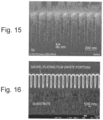
- An SEM image obtained by observing a cross-section of the mold used in Comparative Example 4 from substantially the front is illustrated in Figure 15 .
- Example 3 Using the same plating liquid as the liquid used in Example 3, electroless plating was performed on the sheet where the fine concave structure was formed.
- a polarizing element test piece was prepared.
- the shape and the like of the prepared substrate and the polarizing element test piece are collectively illustrated in Table 2.
- An SEM image of a cross-section of the prepared polarizing element test piece is illustrated in Figure 16 .
- the displacement (s) of the shape of the conductor is set as a parameter
- the cross-section illustrated in Figure 12(1) is a rectangular shape as the uneven shape
- the displacement (s) is 0 nm
- the cross-section illustrated in Figure 12(2) has a trapezoidal shape as the uneven shape
- the cross-section illustrated in Figure 12(3) has a triangular-wave shape as the uneven shape
- the displacement (s) was 70 nm.
- the polarization degree was 99% and the single transmittance was 6%.
- the displacement (s) was 70 nm, the polarization degree was 99% and the single transmittance was improved to 19%.
- the period (a) of the uneven structure was 140 nm
- the width (w) of the concave portion was 70 nm when and the displacement (s) was 0 nm
- the average thickness (c) in the direction perpendicular to the surface of the conductor layer 25 was 10 nm
- the polarization degrees and the single transmittances when the depths (b) were 200 nm, 300 nm, 400 nm, 600 nm, and 1000 nm were calculated.
- the polarization degree and the single transmittance were calculated from the calculated value. These results are collectively illustrated in Table 4. When the depth (b) was 200 nm, the polarization degree was 96.6%, when the depth (b) was 300 nm, the polarization degree reached 99.4%, and the single transmittance at this time was high at 28%. Based on these results, it was verified from the numerical calculation that, as the depth (b) from the convex portion tip portion to the valley portion of the concave portion in the uneven shape increases, a higher polarization degree can be obtained.
- the polarization degree and the single transmittance were calculated when the average width (d) of the conductor layers was 5 nm or 10 nm, and in the case of aluminum, the polarization degree and the single transmittance were calculated when the average width (d) of the conductor layers was 5 nm.
- the rigorous coupled-wave analysis was calculated by applying a refractive index distribution to each of the layers of the calculation model. In the inclined structure illustrated in Figure 14(1) to 14(3) , layers to which the refractive index distribution was approximately applied were calculated at a certain interval. The interval in this calculation was 1/10 the depth (b) of the corrugated uneven structure.
- the wire grid polarizing element according to the present invention can be applied to the field of optical products such as a display, a camera, sunglasses, or an optical measuring instrument using an electromagnetic wave such as visible light or near infrared light.
Landscapes
- Physics & Mathematics (AREA)
- General Physics & Mathematics (AREA)
- Optics & Photonics (AREA)
- Polarising Elements (AREA)
Applications Claiming Priority (2)
| Application Number | Priority Date | Filing Date | Title |
|---|---|---|---|
| JP2022135199 | 2022-08-26 | ||
| PCT/JP2023/026757 WO2024042941A1 (ja) | 2022-08-26 | 2023-07-21 | ワイヤグリッド型偏光素子、及びその製造方法 |
Publications (1)
| Publication Number | Publication Date |
|---|---|
| EP4579291A1 true EP4579291A1 (en) | 2025-07-02 |
Family
ID=90013208
Family Applications (1)
| Application Number | Title | Priority Date | Filing Date |
|---|---|---|---|
| EP23857057.6A Pending EP4579291A1 (en) | 2022-08-26 | 2023-07-21 | Wire grid type polarizing element and manufacturing method thereof |
Country Status (6)
| Country | Link |
|---|---|
| US (1) | US20250237797A1 (https=) |
| EP (1) | EP4579291A1 (https=) |
| JP (1) | JPWO2024042941A1 (https=) |
| CN (1) | CN120077304A (https=) |
| TW (1) | TW202426982A (https=) |
| WO (1) | WO2024042941A1 (https=) |
Family Cites Families (12)
| Publication number | Priority date | Publication date | Assignee | Title |
|---|---|---|---|---|
| JP2001323383A (ja) * | 2000-05-12 | 2001-11-22 | Okuno Chem Ind Co Ltd | 無電解めっき用触媒付与方法 |
| JP4650931B2 (ja) | 2004-12-14 | 2011-03-16 | 大日本印刷株式会社 | 偏光分離素子 |
| CN101080656B (zh) * | 2004-12-16 | 2011-04-20 | 东丽株式会社 | 偏振光片、其制造方法和使用该偏振光片的液晶显示装置 |
| JP4275691B2 (ja) * | 2005-10-17 | 2009-06-10 | 旭化成株式会社 | ワイヤグリッド偏光板の製造方法 |
| JP5303928B2 (ja) * | 2006-12-26 | 2013-10-02 | 東レ株式会社 | 反射型偏光板及びその製造方法、それを用いた液晶表示装置 |
| JP2009204894A (ja) | 2008-02-28 | 2009-09-10 | Sony Corp | ワイヤグリッド偏光素子及びその製造方法、液晶ディスプレイ |
| JP5459210B2 (ja) | 2008-07-10 | 2014-04-02 | 旭硝子株式会社 | ワイヤグリッド型偏光子およびその製造方法 |
| KR20120085252A (ko) * | 2009-10-08 | 2012-07-31 | 아사히 가라스 가부시키가이샤 | 와이어 그리드형 편광자 및 그 제조 방법 |
| JP6042642B2 (ja) | 2012-06-15 | 2016-12-14 | 旭化成株式会社 | 光学機能体及び、ワイヤグリッド偏光板 |
| KR102295624B1 (ko) * | 2014-10-29 | 2021-08-31 | 삼성디스플레이 주식회사 | 편광자, 편광자의 제조 방법 및 표시 패널 |
| JP2018055004A (ja) * | 2016-09-30 | 2018-04-05 | 大日本印刷株式会社 | 偏光子 |
| JP7452469B2 (ja) | 2021-03-04 | 2024-03-19 | トヨタ自動車株式会社 | 車両の制御装置 |
-
2023
- 2023-07-21 JP JP2024542661A patent/JPWO2024042941A1/ja active Pending
- 2023-07-21 WO PCT/JP2023/026757 patent/WO2024042941A1/ja not_active Ceased
- 2023-07-21 EP EP23857057.6A patent/EP4579291A1/en active Pending
- 2023-07-21 CN CN202380062329.8A patent/CN120077304A/zh active Pending
- 2023-07-25 TW TW112127720A patent/TW202426982A/zh unknown
-
2025
- 2025-02-25 US US19/062,724 patent/US20250237797A1/en active Pending
Also Published As
| Publication number | Publication date |
|---|---|
| CN120077304A (zh) | 2025-05-30 |
| WO2024042941A1 (ja) | 2024-02-29 |
| US20250237797A1 (en) | 2025-07-24 |
| JPWO2024042941A1 (https=) | 2024-02-29 |
| TW202426982A (zh) | 2024-07-01 |
Similar Documents
| Publication | Publication Date | Title |
|---|---|---|
| KR100898470B1 (ko) | 반사 방지재, 광학 소자, 및 표시 장치 및 스탬퍼의 제조 방법 및 스탬퍼를 이용한 반사 방지재의 제조 방법 | |
| Voronin et al. | Cu–Ag and Ni–Ag meshes based on cracked template as efficient transparent electromagnetic shielding coating with excellent mechanical performance | |
| EP2090909B1 (en) | Wire grid polarizer and manufacturing method of the same | |
| US8927056B2 (en) | Method of manufacturing a wire grid polarizer | |
| KR101355898B1 (ko) | 라만 분광용 디바이스 및 라만 분광 장치 | |
| KR20140006840A (ko) | 미세 구조 성형체 및 그 미세 구조 성형체를 구비한 액정 표시 장치 | |
| CN113470890A (zh) | 一种透明导电薄膜结构及其制作方法 | |
| JP6183697B2 (ja) | 積層材、タッチパネルセンサ、電磁波遮蔽材、及び、画像表示装置 | |
| EP4579291A1 (en) | Wire grid type polarizing element and manufacturing method thereof | |
| Chandrakar et al. | Oxidized copper seed layer for ultrathin and semi-transparent silver films | |
| KR101393200B1 (ko) | 금속 나노 입자가 적용된 고감도 표면 플라즈몬 공명 센서 및 그 제조 방법 | |
| EP4579290A1 (en) | Wire grid polarizing element and method for producing same | |
| Smith et al. | Optical response in nanostructured thin metal films with dielectric over-layers | |
| JP4617329B2 (ja) | ワイヤグリッド偏光板の製造方法 | |
| Hokari et al. | Development and analysis of a nano-triangular wave-shaped polarizer | |
| JP5476142B2 (ja) | ワイヤグリッド偏光板 | |
| JP2020076996A (ja) | モスアイ転写型及びモスアイ転写型の製造方法 | |
| KR20190141689A (ko) | 모스아이 전사형, 모스아이 전사형의 제조방법 및 모스아이 구조의 전사방법 | |
| JP2016043586A (ja) | 積層材及び積層材の製造方法 | |
| Liang et al. | Measurement and analysis of the surface roughness of Ag film used in plasmonic lithography | |
| JP3968433B2 (ja) | 低反射材料とその作製方法 | |
| US12189162B2 (en) | Wire-grid polarizer and process for producing the same | |
| JP2010182791A (ja) | 金属線を有する基板及びその製造方法 | |
| CN112526644B (zh) | 一种极紫外波段宽带隙高反射率光子晶体薄膜 | |
| Lamberti et al. | The Performance of Graphene-Enhanced THz Grating: Impact of the Gold Layer Imperfectness. Materials 2022, 15, 786 |
Legal Events
| Date | Code | Title | Description |
|---|---|---|---|
| STAA | Information on the status of an ep patent application or granted ep patent |
Free format text: STATUS: THE INTERNATIONAL PUBLICATION HAS BEEN MADE |
|
| PUAI | Public reference made under article 153(3) epc to a published international application that has entered the european phase |
Free format text: ORIGINAL CODE: 0009012 |
|
| STAA | Information on the status of an ep patent application or granted ep patent |
Free format text: STATUS: REQUEST FOR EXAMINATION WAS MADE |
|
| 17P | Request for examination filed |
Effective date: 20250304 |
|
| AK | Designated contracting states |
Kind code of ref document: A1 Designated state(s): AL AT BE BG CH CY CZ DE DK EE ES FI FR GB GR HR HU IE IS IT LI LT LU LV MC ME MK MT NL NO PL PT RO RS SE SI SK SM TR |
|
| DAV | Request for validation of the european patent (deleted) | ||
| DAX | Request for extension of the european patent (deleted) |