EP4579177A2 - Bestimmung des standorts unter verwendung von geolokalisierungsdaten aus mehreren quellen - Google Patents
Bestimmung des standorts unter verwendung von geolokalisierungsdaten aus mehreren quellen Download PDFInfo
- Publication number
- EP4579177A2 EP4579177A2 EP25175986.6A EP25175986A EP4579177A2 EP 4579177 A2 EP4579177 A2 EP 4579177A2 EP 25175986 A EP25175986 A EP 25175986A EP 4579177 A2 EP4579177 A2 EP 4579177A2
- Authority
- EP
- European Patent Office
- Prior art keywords
- location
- value
- location data
- new
- current position
- Prior art date
- Legal status (The legal status is an assumption and is not a legal conclusion. Google has not performed a legal analysis and makes no representation as to the accuracy of the status listed.)
- Pending
Links
Images








Classifications
-
- H—ELECTRICITY
- H04—ELECTRIC COMMUNICATION TECHNIQUE
- H04W—WIRELESS COMMUNICATION NETWORKS
- H04W52/00—Power management, e.g. Transmission Power Control [TPC] or power classes
- H04W52/02—Power saving arrangements
- H04W52/0209—Power saving arrangements in terminal devices
- H04W52/0261—Power saving arrangements in terminal devices managing power supply demand, e.g. depending on battery level
-
- G—PHYSICS
- G01—MEASURING; TESTING
- G01C—MEASURING DISTANCES, LEVELS OR BEARINGS; SURVEYING; NAVIGATION; GYROSCOPIC INSTRUMENTS; PHOTOGRAMMETRY OR VIDEOGRAMMETRY
- G01C21/00—Navigation; Navigational instruments not provided for in groups G01C1/00 - G01C19/00
- G01C21/005—Navigation; Navigational instruments not provided for in groups G01C1/00 - G01C19/00 with correlation of navigation data from several sources, e.g. map or contour matching
-
- G—PHYSICS
- G01—MEASURING; TESTING
- G01C—MEASURING DISTANCES, LEVELS OR BEARINGS; SURVEYING; NAVIGATION; GYROSCOPIC INSTRUMENTS; PHOTOGRAMMETRY OR VIDEOGRAMMETRY
- G01C21/00—Navigation; Navigational instruments not provided for in groups G01C1/00 - G01C19/00
- G01C21/20—Instruments for performing navigational calculations
-
- G—PHYSICS
- G01—MEASURING; TESTING
- G01C—MEASURING DISTANCES, LEVELS OR BEARINGS; SURVEYING; NAVIGATION; GYROSCOPIC INSTRUMENTS; PHOTOGRAMMETRY OR VIDEOGRAMMETRY
- G01C5/00—Measuring height; Measuring distances transverse to line of sight; Levelling between separated points; Surveyors' levels
-
- G—PHYSICS
- G01—MEASURING; TESTING
- G01S—RADIO DIRECTION-FINDING; RADIO NAVIGATION; DETERMINING DISTANCE OR VELOCITY BY USE OF RADIO WAVES; LOCATING OR PRESENCE-DETECTING BY USE OF THE REFLECTION OR RERADIATION OF RADIO WAVES; ANALOGOUS ARRANGEMENTS USING OTHER WAVES
- G01S19/00—Satellite radio beacon positioning systems; Determining position, velocity or attitude using signals transmitted by such systems
-
- G—PHYSICS
- G01—MEASURING; TESTING
- G01S—RADIO DIRECTION-FINDING; RADIO NAVIGATION; DETERMINING DISTANCE OR VELOCITY BY USE OF RADIO WAVES; LOCATING OR PRESENCE-DETECTING BY USE OF THE REFLECTION OR RERADIATION OF RADIO WAVES; ANALOGOUS ARRANGEMENTS USING OTHER WAVES
- G01S19/00—Satellite radio beacon positioning systems; Determining position, velocity or attitude using signals transmitted by such systems
- G01S19/38—Determining a navigation solution using signals transmitted by a satellite radio beacon positioning system
- G01S19/39—Determining a navigation solution using signals transmitted by a satellite radio beacon positioning system the satellite radio beacon positioning system transmitting time-stamped messages, e.g. GPS [Global Positioning System], GLONASS [Global Orbiting Navigation Satellite System] or GALILEO
- G01S19/396—Determining accuracy or reliability of position or pseudorange measurements
-
- G—PHYSICS
- G01—MEASURING; TESTING
- G01S—RADIO DIRECTION-FINDING; RADIO NAVIGATION; DETERMINING DISTANCE OR VELOCITY BY USE OF RADIO WAVES; LOCATING OR PRESENCE-DETECTING BY USE OF THE REFLECTION OR RERADIATION OF RADIO WAVES; ANALOGOUS ARRANGEMENTS USING OTHER WAVES
- G01S5/00—Position-fixing by co-ordinating two or more direction or position line determinations; Position-fixing by co-ordinating two or more distance determinations
- G01S5/0009—Transmission of position information to remote stations
-
- G—PHYSICS
- G01—MEASURING; TESTING
- G01S—RADIO DIRECTION-FINDING; RADIO NAVIGATION; DETERMINING DISTANCE OR VELOCITY BY USE OF RADIO WAVES; LOCATING OR PRESENCE-DETECTING BY USE OF THE REFLECTION OR RERADIATION OF RADIO WAVES; ANALOGOUS ARRANGEMENTS USING OTHER WAVES
- G01S5/00—Position-fixing by co-ordinating two or more direction or position line determinations; Position-fixing by co-ordinating two or more distance determinations
- G01S5/0009—Transmission of position information to remote stations
- G01S5/0045—Transmission from base station to mobile station
- G01S5/0063—Transmission from base station to mobile station of measured values, i.e. measurement on base station and position calculation on mobile
-
- G—PHYSICS
- G01—MEASURING; TESTING
- G01S—RADIO DIRECTION-FINDING; RADIO NAVIGATION; DETERMINING DISTANCE OR VELOCITY BY USE OF RADIO WAVES; LOCATING OR PRESENCE-DETECTING BY USE OF THE REFLECTION OR RERADIATION OF RADIO WAVES; ANALOGOUS ARRANGEMENTS USING OTHER WAVES
- G01S5/00—Position-fixing by co-ordinating two or more direction or position line determinations; Position-fixing by co-ordinating two or more distance determinations
- G01S5/02—Position-fixing by co-ordinating two or more direction or position line determinations; Position-fixing by co-ordinating two or more distance determinations using radio waves
-
- G—PHYSICS
- G01—MEASURING; TESTING
- G01S—RADIO DIRECTION-FINDING; RADIO NAVIGATION; DETERMINING DISTANCE OR VELOCITY BY USE OF RADIO WAVES; LOCATING OR PRESENCE-DETECTING BY USE OF THE REFLECTION OR RERADIATION OF RADIO WAVES; ANALOGOUS ARRANGEMENTS USING OTHER WAVES
- G01S5/00—Position-fixing by co-ordinating two or more direction or position line determinations; Position-fixing by co-ordinating two or more distance determinations
- G01S5/02—Position-fixing by co-ordinating two or more direction or position line determinations; Position-fixing by co-ordinating two or more distance determinations using radio waves
- G01S5/0205—Details
- G01S5/0244—Accuracy or reliability of position solution or of measurements contributing thereto
-
- G—PHYSICS
- G01—MEASURING; TESTING
- G01S—RADIO DIRECTION-FINDING; RADIO NAVIGATION; DETERMINING DISTANCE OR VELOCITY BY USE OF RADIO WAVES; LOCATING OR PRESENCE-DETECTING BY USE OF THE REFLECTION OR RERADIATION OF RADIO WAVES; ANALOGOUS ARRANGEMENTS USING OTHER WAVES
- G01S5/00—Position-fixing by co-ordinating two or more direction or position line determinations; Position-fixing by co-ordinating two or more distance determinations
- G01S5/02—Position-fixing by co-ordinating two or more direction or position line determinations; Position-fixing by co-ordinating two or more distance determinations using radio waves
- G01S5/0252—Radio frequency fingerprinting
-
- G—PHYSICS
- G01—MEASURING; TESTING
- G01S—RADIO DIRECTION-FINDING; RADIO NAVIGATION; DETERMINING DISTANCE OR VELOCITY BY USE OF RADIO WAVES; LOCATING OR PRESENCE-DETECTING BY USE OF THE REFLECTION OR RERADIATION OF RADIO WAVES; ANALOGOUS ARRANGEMENTS USING OTHER WAVES
- G01S5/00—Position-fixing by co-ordinating two or more direction or position line determinations; Position-fixing by co-ordinating two or more distance determinations
- G01S5/02—Position-fixing by co-ordinating two or more direction or position line determinations; Position-fixing by co-ordinating two or more distance determinations using radio waves
- G01S5/0257—Hybrid positioning
- G01S5/0263—Hybrid positioning by combining or switching between positions derived from two or more separate positioning systems
-
- G—PHYSICS
- G01—MEASURING; TESTING
- G01S—RADIO DIRECTION-FINDING; RADIO NAVIGATION; DETERMINING DISTANCE OR VELOCITY BY USE OF RADIO WAVES; LOCATING OR PRESENCE-DETECTING BY USE OF THE REFLECTION OR RERADIATION OF RADIO WAVES; ANALOGOUS ARRANGEMENTS USING OTHER WAVES
- G01S5/00—Position-fixing by co-ordinating two or more direction or position line determinations; Position-fixing by co-ordinating two or more distance determinations
- G01S5/02—Position-fixing by co-ordinating two or more direction or position line determinations; Position-fixing by co-ordinating two or more distance determinations using radio waves
- G01S5/0257—Hybrid positioning
- G01S5/0268—Hybrid positioning by deriving positions from different combinations of signals or of estimated positions in a single positioning system
- G01S5/02685—Hybrid positioning by deriving positions from different combinations of signals or of estimated positions in a single positioning system involving dead reckoning based on radio wave measurements
-
- G—PHYSICS
- G06—COMPUTING OR CALCULATING; COUNTING
- G06T—IMAGE DATA PROCESSING OR GENERATION, IN GENERAL
- G06T11/00—Two-dimensional [2D] image generation
-
- G—PHYSICS
- G06—COMPUTING OR CALCULATING; COUNTING
- G06T—IMAGE DATA PROCESSING OR GENERATION, IN GENERAL
- G06T13/00—Animation
-
- H—ELECTRICITY
- H04—ELECTRIC COMMUNICATION TECHNIQUE
- H04W—WIRELESS COMMUNICATION NETWORKS
- H04W64/00—Locating users or terminals or network equipment for network management purposes, e.g. mobility management
-
- H—ELECTRICITY
- H04—ELECTRIC COMMUNICATION TECHNIQUE
- H04W—WIRELESS COMMUNICATION NETWORKS
- H04W64/00—Locating users or terminals or network equipment for network management purposes, e.g. mobility management
- H04W64/003—Locating users or terminals or network equipment for network management purposes, e.g. mobility management locating network equipment
-
- G—PHYSICS
- G01—MEASURING; TESTING
- G01S—RADIO DIRECTION-FINDING; RADIO NAVIGATION; DETERMINING DISTANCE OR VELOCITY BY USE OF RADIO WAVES; LOCATING OR PRESENCE-DETECTING BY USE OF THE REFLECTION OR RERADIATION OF RADIO WAVES; ANALOGOUS ARRANGEMENTS USING OTHER WAVES
- G01S19/00—Satellite radio beacon positioning systems; Determining position, velocity or attitude using signals transmitted by such systems
- G01S19/38—Determining a navigation solution using signals transmitted by a satellite radio beacon positioning system
- G01S19/39—Determining a navigation solution using signals transmitted by a satellite radio beacon positioning system the satellite radio beacon positioning system transmitting time-stamped messages, e.g. GPS [Global Positioning System], GLONASS [Global Orbiting Navigation Satellite System] or GALILEO
- G01S19/42—Determining position
- G01S19/48—Determining position by combining or switching between position solutions derived from the satellite radio beacon positioning system and position solutions derived from a further system
-
- Y—GENERAL TAGGING OF NEW TECHNOLOGICAL DEVELOPMENTS; GENERAL TAGGING OF CROSS-SECTIONAL TECHNOLOGIES SPANNING OVER SEVERAL SECTIONS OF THE IPC; TECHNICAL SUBJECTS COVERED BY FORMER USPC CROSS-REFERENCE ART COLLECTIONS [XRACs] AND DIGESTS
- Y02—TECHNOLOGIES OR APPLICATIONS FOR MITIGATION OR ADAPTATION AGAINST CLIMATE CHANGE
- Y02D—CLIMATE CHANGE MITIGATION TECHNOLOGIES IN INFORMATION AND COMMUNICATION TECHNOLOGIES [ICT], I.E. INFORMATION AND COMMUNICATION TECHNOLOGIES AIMING AT THE REDUCTION OF THEIR OWN ENERGY USE
- Y02D30/00—Reducing energy consumption in communication networks
- Y02D30/70—Reducing energy consumption in communication networks in wireless communication networks
Definitions
- Examples of the present disclosure relate generally to determining geographic locations for a mobile device using multi-source geolocation data. More particularly, but not by way of limitation, examples of the present disclosure relate to fusing multiple-source geographic locations together to determine a geographic location.
- Geographic location is often used by many application programs to enhance a user's experience with a mobile device. However, determining a geographic location of the mobile device consumes power and mobile devices are often limited by batteries. Additionally, application programs may request frequent updates to the geographic location of the mobile device.
- a geographic location aware application on an augmented reality (AR) headset can provide information regarding monuments that the user of the AR headset is near such as the Eiffel Tower or Empire State Building.
- Many other applications on a mobile device may be enhanced if the current location of the mobile device is known.
- Examples disclosed herein are directed to providing a current location to applications of a mobile device while lessening the amount of power that is used and fusing location data to provide a current location.
- Some examples disclosed herein are directed to providing location data to applications while doing one or more of the following: lessening a latency of providing the location data, increasing an accuracy of the location data, and lessening the amount of power that is used to determine the location data.
- a technical problem is how to provide current location information to an application on a mobile device while decreasing the amount of power used to provide the current location.
- the technical problem is addressed by fusing together two or more locations to determine a current location of the mobile device.
- Each of the locations includes data that indicates an accuracy of the location. Often location data that is less accurate requires less power for the mobile device to acquire or determine.
- a current location with an associated accuracy is fused together with a new location with an associated accuracy to determine an updated current location with an updated accuracy.
- the current location and the new location are fused together based on the geographic location data, associated optional data, and associated accuracies. Fusing together the location data provides a more accurate estimation of the location of the mobile device, in accordance with some examples.
- the technical problem is addressed by scheduling requests for updated location data from location sources.
- the scheduling waits to send requests to location sources based on whether conditions are met. For example, a request for a location from a satellite receiver is not made until a display of the mobile device is powered down and/or the mobile device is outdoors. In this way there is not a spike in the power demand that may drain the batteries more than is needed to retrieve a location from a satellite. Additionally, the scheduling bases decisions on a needed accuracy of the location indicated by the application.
- FIG. 1 is a block diagram showing an example messaging system 100 for exchanging data (e.g., messages and associated content) over a network.
- the messaging system 100 includes multiple instances of a client device 102, each of which hosts a number of applications, including a messaging client 104.
- Each messaging client 104 is communicatively coupled to other instances of the messaging client 104 and a messaging server system 108 via a network 106 (e.g., the Internet).
- a network 106 e.g., the Internet
- a messaging client 104 is able to communicate and exchange data with another messaging client 104 and with the messaging server system 108 via the network 106.
- the messaging server system 108 provides server-side functionality via the network 106 to a particular messaging client 104. While certain functions of the messaging system 100 are described herein as being performed by either a messaging client 104 or by the messaging server system 108, the location of certain functionality either within the messaging client 104 or the messaging server system 108 may be a design choice. For example, it may be technically preferable to initially deploy certain technology and functionality within the messaging server system 108 but to later migrate this technology and functionality to the messaging client 104 where a client device 102 has sufficient processing capacity.
- the messaging server system 108 supports various services and operations that are provided to the messaging client 104. Such operations include transmitting data to, receiving data from, and processing data generated by the messaging client 104. This data may include message content, client device information, geolocation information, media augmentation and overlays, message content persistence conditions, social network information, and live event information, as examples. Data exchanges within the messaging system 100 are invoked and controlled through functions available via user interfaces (UIs) of the messaging client 104.
- UIs user interfaces
- an Application Program Interface (API) server 110 is coupled to, and provides a programmatic interface to, application servers 112.
- the application servers 112 are communicatively coupled to a database server 118, which facilitates access to a database 120 that stores data associated with messages processed by the application servers 112.
- a web server 124 is coupled to the application servers 112 and provides web-based interfaces to the application servers 112. To this end, the web server 124 processes incoming network requests over the Hypertext Transfer Protocol (HTTP) and several other related protocols.
- HTTP Hypertext Transfer Protocol
- the Application Program Interface (API) server 110 receives and transmits message data (e.g., commands and message payloads) between the client device 102 and the application servers 112. Specifically, the Application Program Interface (API) server 110 provides a set of interfaces (e.g., routines and protocols) that can be called or queried by the messaging client 104 in order to invoke functionality of the application servers 112.
- message data e.g., commands and message payloads
- API server 110 provides a set of interfaces (e.g., routines and protocols) that can be called or queried by the messaging client 104 in order to invoke functionality of the application servers 112.
- the Application Program Interface (API) server 110 exposes various functions supported by the application servers 112, including account registration, login functionality, the sending of messages, via the application servers 112, from a particular messaging client 104 to another messaging client 104, the sending of media files (e.g., images or video) from a messaging client 104 to a messaging server 114, and for possible access by another messaging client 104, the settings of a collection of media data (e.g., story), the retrieval of a list of friends of a user of a client device 102, the retrieval of such collections, the retrieval of messages and content, the addition and deletion of entities (e.g., friends) to an entity graph (e.g., a social graph), the location of friends within a social graph, and opening an application event (e.g., relating to the messaging client 104).
- entity graph e.g., a social graph
- an application event e.g., relating to the messaging client 104.
- the application servers 112 host a number of server applications and subsystems, including for example a messaging server 114, an image processing server 116, and a social network server 122.
- the messaging server 114 implements a number of message processing technologies and functions, particularly related to the aggregation and other processing of content (e.g., textual and multimedia content) included in messages received from multiple instances of the messaging client 104.
- content e.g., textual and multimedia content
- the text and media content from multiple sources may be aggregated into collections of content (e.g., called stories or galleries). These collections are then made available to the messaging client 104.
- Other processor and memory intensive processing of data may also be performed server-side by the messaging server 114, in view of the hardware requirements for such processing.
- the application servers 112 also include an image processing server 116 that is dedicated to performing various image processing operations, typically with respect to images or video within the payload of a message sent from or received at the messaging server 114.
- the social network server 122 supports various social networking functions and services and makes these functions and services available to the messaging server 114. To this end, the social network server 122 maintains and accesses an entity graph 306 (as shown in FIG. 3 ) within the database 120. Examples of functions and services supported by the social network server 122 include the identification of other users of the messaging system 100 with which a particular user has relationships or is "following," and also the identification of other entities and interests of a particular user.
- the ephemeral timer system 202 is responsible for enforcing the temporary or time-limited access to content by the messaging client 104 and the messaging server 114.
- the ephemeral timer system 202 incorporates a number of timers that, based on duration and display parameters associated with a message, or collection of messages (e.g., a story), selectively enable access (e.g., for presentation and display) to messages and associated content via the messaging client 104. Further details regarding the operation of the ephemeral timer system 202 are provided below.
- the collection management system 204 is responsible for managing sets or collections of media (e.g., collections of text, image video, and audio data).
- a collection of content e.g., messages, including images, video, text, and audio
- Such a collection may be made available for a specified time period, such as the duration of an event to which the content relates. For example, content relating to a music concert may be made available as a "story” for the duration of that music concert.
- the collection management system 204 may also be responsible for publishing an icon that provides notification of the existence of a particular collection to the user interface of the messaging client 104.
- the collection management system 204 furthermore includes a curation interface 212 that allows a collection manager to manage and curate a particular collection of content.
- the curation interface 212 enables an event organizer to curate a collection of content relating to a specific event (e.g., delete inappropriate content or redundant messages).
- the collection management system 204 employs machine vision (or image recognition technology) and content rules to automatically curate a content collection. In certain examples, compensation may be paid to a user for the inclusion of user-generated content into a collection. In such cases, the collection management system 204 operates to automatically make payments to such users for the use of their content.
- the augmentation system 206 provides various functions that enable a user to augment (e.g., annotate or otherwise modify or edit) media content associated with a message.
- the augmentation system 206 provides functions related to the generation and publishing of media overlays for messages processed by the messaging system 100.
- the augmentation system 206 operatively supplies a media overlay or augmentation (e.g., an image filter) to the messaging client 104 based on a geolocation of the client device 102.
- the augmentation system 206 operatively supplies a media overlay to the messaging client 104 based on other information, such as social network information of the user of the client device 102.
- a media overlay may include audio and visual content and visual effects.
- the augmentation system 206 uses the geolocation of the client device 102 to identify a media overlay that includes the name of a merchant at the geolocation of the client device 102.
- the media overlay may include other indicia associated with the merchant.
- the media overlays may be stored in the database 120 and accessed through the database server 118.
- the augmentation system 206 provides a merchant-based publication platform that enables merchants to select a particular media overlay associated with a geolocation via a bidding process. For example, the augmentation system 206 associates the media overlay of the highest bidding merchant with a corresponding geolocation for a predefined amount of time.
- the map system 208 provides various geographic location functions and supports the presentation of map-based media content and messages by the messaging client 104.
- the map system 208 enables the display of user icons or avatars (e.g., stored in profile data 308) on a map to indicate a current or past location of "friends" of a user, as well as media content (e.g., collections of messages including photographs and videos) generated by such friends, within the context of a map.
- a message posted by a user to the messaging system 100 from a specific geographic location may be displayed within the context of a map at that particular location to "friends" of a specific user on a map interface of the messaging client 104.
- a user can furthermore share his or her location and status information (e.g., using an appropriate status avatar) with other users of the messaging system 100 via the messaging client 104, with this location and status information being similarly displayed within the context of a map interface of the messaging client 104 to selected users.
- location and status information e.g., using an appropriate status avatar
- the game system 210 provides various gaming functions within the context of the messaging client 104.
- the messaging client 104 provides a game interface providing a list of available games that can be launched by a user within the context of the messaging client 104 and played with other users of the messaging system 100.
- the messaging system 100 further enables a particular user to invite other users to participate in the play of a specific game, by issuing invitations to such other users from the messaging client 104.
- the messaging client 104 also supports both the voice and text messaging (e.g., chats) within the context of gameplay, provides a leaderboard for the games, and also supports the provision of in-game rewards (e.g., coins and items).
- the geographic location system 214 provides various functions to determine a current location 708 (see FIG. 7 ) of the mobile device 602 (see FIG. 6 .) In some examples, the geographic location system 214 interfaces with external devices to determine a current location 708 of the mobile device 602. In some examples, the geographic location system 214 responds to requests for geographic location information from a mobile device 602. In some examples, the geographic location system 214 provides information to assist a mobile device 602 in determining a geographic location such as almanac data for a GNSS system or information regarding other wireless devices with which the mobile device 602 may interact with to determine a geographic location of the mobile device 602.
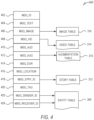
- FIG. 3 is a schematic diagram illustrating data structures 300, which may be stored in the database 120 of the messaging server system 108, according to certain examples. While the content of the database 120 is shown to comprise a number of tables, it will be appreciated that the data could be stored in other types of data structures (e.g., as an object-oriented database).
- the database 120 includes message data stored within a message table 302.
- This message data includes, for any particular one message, at least message sender data, message recipient (or receiver) data, and a payload. Further details regarding information that may be included in a message and included within the message data stored in the message table 302 is described below with reference to FIG. 4 .
- An entity table 304 stores entity data, and is linked (e.g., referentially) to an entity graph 306 and profile data 308. Entities for which records are maintained within the entity table 304 may include individuals, corporate entities, organizations, objects, places, events, and so forth. Regardless of entity type, any entity regarding which the messaging server system 108 stores data may be a recognized entity. Each entity is provided with a unique identifier, as well as an entity type identifier (not shown).
- the entity graph 306 stores information regarding relationships and associations between entities. Such relationships may be social, professional (e.g., work at a common corporation or organization) interest-based or activity-based, merely for example.
- the profile data 308 stores multiple types of profile data about a particular entity.
- the profile data 308 may be selectively used and presented to other users of the messaging system 100, based on privacy settings specified by a particular entity.
- the profile data 308 includes, for example, a user name, telephone number, address, settings (e.g., notification and privacy settings), as well as a user-selected avatar representation (or collection of such avatar representations).
- a particular user may then selectively include one or more of these avatar representations within the content of messages communicated via the messaging system 100, and on map interfaces displayed by messaging clients 104 to other users.
- the collection of avatar representations may include "status avatars," which present a graphical representation of a status or activity that the user may select to communicate at a particular time.
- the profile data 308 for the group may similarly include one or more avatar representations associated with the group, in addition to the group name, members, and various settings (e.g., notifications) for the relevant group.
- the database 120 also stores augmentation data, such as overlays or filters, in an augmentation table 310.
- augmentation data is associated with and applied to videos (for which data is stored in a video table 314) and images (for which data is stored in an image table 316).
- Filters are overlays that are displayed as overlaid on an image or video during presentation to a recipient user. Filters may be of various types, including user-selected filters from a set of filters presented to a sending user by the messaging client 104 when the sending user is composing a message. Other types of filters include geolocation filters (also known as geo-filters), which may be presented to a sending user based on geographic location. For example, geolocation filters specific to a neighborhood or special location may be presented within a user interface by the messaging client 104, based on geolocation information determined by a Global Positioning System (GPS) unit of the client device 102.
- GPS Global Positioning System
- Another type of filter is a data filter, which may be selectively presented to a sending user by the messaging client 104, based on other inputs or information gathered by the client device 102 during the message creation process.
- data filters include current temperature at a specific location, a current speed at which a sending user is traveling, battery life for a client device 102, or the current time.
- augmentation data that may be stored within the image table 316 includes augmented reality content items (e.g., corresponding to applying Lenses or augmented reality experiences).
- An augmented reality content item may be a real-time special effect and sound that may be added to an image or a video.
- augmentation data includes augmented reality content items, overlays, image transformations, AR images, and similar terms refer to modifications that may be applied to image data (e.g., videos or images).
- image data e.g., videos or images.
- This also includes modifications to stored content, such as video clips in a gallery that may be modified. For example, in a client device 102 with access to multiple augmented reality content items, a user can use a single video clip with multiple augmented reality content items to see how the different augmented reality content items will modify the stored clip.
- multiple augmented reality content items that apply different pseudorandom movement models can be applied to the same content by selecting different augmented reality content items for the content.
- real-time video capture may be used with an illustrated modification to show how video images currently being captured by sensors of a client device 102 would modify the captured data. Such data may simply be displayed on the screen and not stored in memory, or the content captured by the device sensors may be recorded and stored in memory with or without the modifications (or both).
- a preview feature can show how different augmented reality content items will look within different windows in a display at the same time. This can, for example, enable multiple windows with different pseudorandom animations to be viewed on a display at the same time.
- Data and various systems using augmented reality content items or other such transform systems to modify content using this data can thus involve detection of objects (e.g., faces, hands, bodies, cats, dogs, surfaces, objects, etc.), tracking of such objects as they leave, enter, and move around the field of view in video frames, and the modification or transformation of such objects as they are tracked.
- objects e.g., faces, hands, bodies, cats, dogs, surfaces, objects, etc.
- tracking of points on an object may be used to place an image or texture (which may be two dimensional or three dimensional) at the tracked position.
- neural network analysis of video frames may be used to place images, models, or textures in content (e.g., images or frames of video).
- Augmented reality content items thus refer both to the images, models, and textures used to create transformations in content, as well as to additional modeling and analysis information needed to achieve such transformations with object detection, tracking, and placement.
- Real-time video processing can be performed with any kind of video data (e.g., video streams, video files, etc.) saved in the memory of a computerized system of any kind.
- video data e.g., video streams, video files, etc.
- a user can load video files and save them in a memory of a device, or can generate a video stream using sensors of the device.
- any objects can be processed using a computer animation model, such as a human's face and parts of a human body, animals, or non-living things such as chairs, cars, or other objects.
- elements to be transformed are identified by the computing device, and then detected and tracked if they are present in the frames of the video.
- the elements of the object are modified according to the request for modification, thus transforming the frames of the video stream. Transformation of frames of a video stream can be performed by different methods for different kinds of transformation. For example, for transformations of frames mostly referring to changing forms of object's elements characteristic points for each element of an object are calculated (e.g., using an Active Shape Model (ASM) or other known methods). Then, a mesh based on the characteristic points is generated for each of at least one element of the object. This mesh is used in the following stage of tracking the elements of the object in the video stream.
- ASM Active Shape Model
- the mentioned mesh for each element is aligned with a position of each element. Then, additional points are generated on the mesh.
- a first set of first points is generated for each element based on a request for modification, and a set of second points is generated for each element based on the set of first points and the request for modification.
- the frames of the video stream can be transformed by modifying the elements of the object on the basis of the sets of first and second points and the mesh.
- a background of the modified object can be changed or distorted as well by tracking and modifying the background.
- transformations changing some areas of an object using its elements can be performed by calculating characteristic points for each element of an object and generating a mesh based on the calculated characteristic points. Points are generated on the mesh, and then various areas based on the points are generated. The elements of the object are then tracked by aligning the area for each element with a position for each of the at least one element, and properties of the areas can be modified based on the request for modification, thus transforming the frames of the video stream. Depending on the specific request for modification properties of the mentioned areas can be transformed in different ways.
- a computer animation model to transform image data using face detection the face is detected on an image with use of a specific face detection algorithm (e.g., Viola-Jones). Then, an Active Shape Model (ASM) algorithm is applied to the face region of an image to detect facial feature reference points.
- ASM Active Shape Model
- features are located using a landmark, which represents a distinguishable point present in most of the images under consideration.
- a landmark which represents a distinguishable point present in most of the images under consideration.
- For facial landmarks for example, the location of the left eye pupil may be used. If an initial landmark is not identifiable (e.g., if a person has an eyepatch), secondary landmarks may be used. Such landmark identification procedures may be used for any such objects.
- a set of landmarks forms a shape. Shapes can be represented as vectors using the coordinates of the points in the shape. One shape is aligned to another with a similarity transform (allowing translation, scaling, and rotation) that minimizes the average Euclidean distance between shape points. The mean shape is the mean of the aligned training shapes.
- a search forlandmarks from the mean shape aligned to the position and size of the face determined by a global face detector is started. Such a search then repeats the steps of suggesting a tentative shape by adjusting the locations of shape points by template matching of the image texture around each point and then conforming the tentative shape to a global shape model until convergence occurs.
- individual template matches are unreliable, and the shape model pools the results of the weak template matches to form a stronger overall classifier. The entire search is repeated at each level in an image pyramid, from coarse to fine resolution.
- a transformation system can capture an image or video stream on a client device (e.g., the client device 102) and perform complex image manipulations locally on the client device 102 while maintaining a suitable user experience, computation time, and power consumption.
- the complex image manipulations may include size and shape changes, emotion transfers (e.g., changing a face from a frown to a smile), state transfers (e.g., aging a subject, reducing apparent age, changing gender), style transfers, graphical element application, and any other suitable image or video manipulation implemented by a convolutional neural network that has been configured to execute efficiently on the client device 102.
- a computer animation model to transform image data can be used by a system where a user may capture an image or video stream of the user (e.g., a selfie) using a client device 102 having a neural network operating as part of a messaging client application operating on the client device 102.
- the transformation system operating within the messaging client 104 determines the presence of a face within the image or video stream and provides modification icons associated with a computer animation model to transform image data, or the computer animation model can be present as associated with an interface described herein.
- the modification icons include changes that may be the basis for modifying the user's face within the image or video stream as part of the modification operation.
- the transform system initiates a process to convert the image of the user to reflect the selected modification icon (e.g., generate a smiling face on the user).
- a modified image or video stream may be presented in a graphical user interface displayed on the client device 102 as soon as the image or video stream is captured, and a specified modification is selected.
- the transformation system may implement a complex convolutional neural network on a portion of the image or video stream to generate and apply the selected modification. That is, the user may capture the image or video stream and be presented with a modified result in real-time or near real-time once a modification icon has been selected. Further, the modification may be persistent while the video stream is being captured, and the selected modification icon remains toggled. Machine taught neural networks may be used to enable such modifications.
- the graphical user interface may supply the user with additional interaction options. Such options may be based on the interface used to initiate the content capture and selection of a particular computer animation model (e.g., initiation from a content creator user interface).
- a modification may be persistent after an initial selection of a modification icon.
- the user may toggle the modification on or off by tapping or otherwise selecting the face being modified by the transformation system and store it for later viewing or browse to other areas of the imaging application.
- the user may toggle the modification on or off globally by tapping or selecting a single face modified and displayed within a graphical user interface.
- individual faces, among a group of multiple faces may be individually modified, or such modifications may be individually toggled by tapping or selecting the individual face or a series of individual faces displayed within the graphical user interface.
- a story table 312 stores data regarding collections of messages and associated image, video, or audio data, which are compiled into a collection (e.g., a story or a gallery).
- the creation of a particular collection may be initiated by a particular user (e.g., each user for which a record is maintained in the entity table 304).
- a user may create a "personal story" in the form of a collection of content that has been created and sent/broadcast by that user.
- the user interface of the messaging client 104 may include an icon that is user-selectable to enable a sending user to add specific content to his or her personal story.
- a collection may also constitute a "live story,” which is a collection of content from multiple users that is created manually, automatically, or using a combination of manual and automatic techniques.
- a "live story” may constitute a curated stream of user-submitted content from various locations and events. Users whose client devices have location services enabled and are at a common location event at a particular time may, for example, be presented with an option, via a user interface of the messaging client 104, to contribute content to a particular live story. The live story may be identified to the user by the messaging client 104, based on his or her location. The end result is a "live story” told from a community perspective.
- a further type of content collection is known as a "location story," which enables a user whose client device 102 is located within a specific geographic location (e.g., on a college or university campus) to contribute to a particular collection.
- a contribution to a location story may require a second degree of authentication to verify that the end user belongs to a specific organization or other entity (e.g., is a student on the university campus).
- the video table 314 stores video data that, in one example, is associated with messages for which records are maintained within the message table 302.
- the image table 316 stores image data associated with messages for which message data is stored in the entity table 304.
- the entity table 304 may associate various augmentations from the augmentation table 310 with various images and videos stored in the image table 316 and the video table 314.
- the database 120 can also store information for assisting mobile device 602 in determining its location.
- database 120 may store information regarding access points (APs) that may be used by mobile device 602 for determining its geographic location.
- the database 120 can also store additional information such as data that may be used to interpret signals from a satellite to determine location.
- APs access points
- FIG. 4 is a schematic diagram illustrating a structure of a message 400, according to some examples, generated by a messaging client 104 for communication to a further messaging client 104 or the messaging server 114.
- the content of a particular message 400 is used to populate the message table 302 stored within the database 120, accessible by the messaging server 114.
- the content of a message 400 is stored in memory as "in-transit” or "in-flight" data of the client device 102 or the application server 112.
- a message 400 is shown to include the following example components:
- Message identifier 402 (MSG_ID 402): a unique identifier that identifies the message 400.
- Message text payload 404 (MSG_TEXT 404): text, to be generated by a user via a user interface of the client device 102, and that is included in the message 400.
- Message image payload 406 (MSG_IMAGE 406): image data, captured by a camera component of a client device 102 or retrieved from a memory component of a client device 102, and that is included in the message 400.
- Image data for a sent or received message 400 may be stored in the image table 316.
- Message video payload 408 video data, captured by a camera component or retrieved from a memory component of the client device 102, and that is included in the message 400.
- Video data for a sent or received message 400 may be stored in the video table 314.
- Message audio payload 410 audio data, captured by a microphone or retrieved from a memory component of the client device 102, and that is included in the message 400.
- Message augmentation data 412 augmentation data (e.g., filters, stickers, or other annotations or enhancements) that represents augmentations to be applied to message image payload 406, message video payload 408, or message audio payload 410 of the message 400.
- Augmentation data for a sent or received message 400 may be stored in the augmentation table 310.
- Message duration parameter 414 (MSG_DUR 414): parameter value indicating, in seconds, the amount of time for which content of the message (e.g., the message image payload 406, message video payload 408, message audio payload 410) is to be presented or made accessible to a user via the messaging client 104.
- Message geolocation parameter 416 geolocation data (e.g., latitudinal and longitudinal coordinates) associated with the content payload of the message. Multiple message geolocation parameter 416 values may be included in the payload, each of these parameter values being associated with respect to content items included in the content (e.g., a specific image into within the message image payload 406, or a specific video in the message video payload 408).
- content items included in the content e.g., a specific image into within the message image payload 406, or a specific video in the message video payload 408.
- Message story identifier 418 identifier values identifying one or more content collections (e.g., "stories” identified in the story table 312) with which a particular content item in the message image payload 406 of the message 400 is associated. For example, multiple images within the message image payload 406 may each be associated with multiple content collections using identifier values.
- content collections e.g., "stories” identified in the story table 312
- each message 400 may be tagged with multiple tags, each of which is indicative of the subject matter of content included in the message payload. For example, where a particular image included in the message image payload 406 depicts an animal (e.g., a lion), a tag value may be included within the message tag 420 that is indicative of the relevant animal. Tag values may be generated manually, based on user input, or may be automatically generated using, for example, image recognition.
- Message sender identifier 422 an identifier (e.g., a messaging system identifier, email address, or device identifier) indicative of a user of the Client device 102 on which the message 400 was generated and from which the message 400 was sent.
- an identifier e.g., a messaging system identifier, email address, or device identifier
- Message receiver identifier 424 an identifier (e.g., a messaging system identifier, email address, or device identifier) indicative of a user of the client device 102 to which the message 400 is addressed.
- an identifier e.g., a messaging system identifier, email address, or device identifier
- the contents (e.g., values) of the various components of message 400 may be pointers to locations in tables within which content data values are stored.
- an image value in the message image payload 406 may be a pointer to (or address of) a location within an image table 316.
- values within the message video payload 408 may point to data stored within a video table 3114
- values stored within the message augmentations 412 may point to data stored in an augmentation table 310
- values stored within the message story identifier 418 may point to data stored in a story table 312
- values stored within the message sender identifier 422 and the message receiver identifier 424 may point to user records stored within an entity table 304.
- a process is terminated when its operations are completed.
- a process may correspond to a method, a procedure, an algorithm, etc.
- the operations of methods may be performed in whole or in part, may be performed in conjunction with some or all of the operations in other methods, and may be performed by any number of different systems, such as the systems described herein, or any portion thereof, such as a processor included in any of the systems.
- FIG. 5 is a schematic diagram illustrating an access-limiting process 500, in terms of which access to content (e.g., an ephemeral message 502, and associated multimedia payload of data) or a content collection (e.g., an ephemeral message group 504) may be time-limited (e.g., made ephemeral).
- content e.g., an ephemeral message 502, and associated multimedia payload of data
- a content collection e.g., an ephemeral message group 504
- time-limited e.g., made ephemeral
- An ephemeral message 502 is shown to be associated with a message duration parameter 506, the value of which determines an amount of time that the ephemeral message 502 will be displayed to a receiving user of the ephemeral message 502 by the messaging client 104.
- an ephemeral message 502 is viewable by a receiving user for up to a maximum of 10 seconds, depending on the amount of time that the sending user specifies using the message duration parameter 506.
- the message duration parameter 506 and the message receiver identifier 424 are shown to be inputs to a message timer 512, which is responsible for determining the amount of time that the ephemeral message 502 is shown to a particular receiving user identified by the message receiver identifier 424. In particular, the ephemeral message 502 will only be shown to the relevant receiving user for a time period determined by the value of the message duration parameter 506.
- the message timer 512 is shown to provide output to a more generalized ephemeral timer system 202, which is responsible for the overall timing of display of content (e.g., an ephemeral message 502) to a receiving user.
- the ephemeral message 502 is shown in FIG. 5 to be included within an ephemeral message group 504 (e.g., a collection of messages in a personal story, or an event story).
- the ephemeral message group 504 has an associated group duration parameter 508, a value of which determines a time duration for which the ephemeral message group 504 is presented and accessible to users of the messaging system 100.
- the group duration parameter 508, for example, may be the duration of a music concert, where the ephemeral message group 504 is a collection of content pertaining to that concert.
- a user may specify the value for the group duration parameter 508 when performing the setup and creation of the ephemeral message group 504.
- each ephemeral message 502 within the ephemeral message group 504 has an associated group participation parameter 510, a value of which determines the duration of time for which the ephemeral message 502 will be accessible within the context of the ephemeral message group 504. Accordingly, a particular ephemeral message group 504 may "expire” and become inaccessible within the context of the ephemeral message group 504, prior to the ephemeral message group 504 itself expiring in terms of the group duration parameter 508.
- the group duration parameter 508, group participation parameter 510, and message receiver identifier 424 each provide input to a group timer 514, which operationally determines, firstly, whether a particular ephemeral message 502 of the ephemeral message group 504 will be displayed to a particular receiving user and, if so, for how long. Note that the ephemeral message group 504 is also aware of the identity of the particular receiving user as a result of the message receiver identifier 424.
- the group timer 514 operationally controls the overall lifespan of an associated ephemeral message group 504, as well as an individual ephemeral message 502 included in the ephemeral message group 504.
- each and every ephemeral message 502 within the ephemeral message group 504 remains viewable and accessible for a time period specified by the group duration parameter 508.
- a certain ephemeral message 502 may expire, within the context of ephemeral message group 504, based on a group participation parameter 510.
- a message duration parameter 506 may still determine the duration of time for which a particular ephemeral message 502 is displayed to a receiving user, even within the context of the ephemeral message group 504. Accordingly, the message duration parameter 506 determines the duration of time that a particular ephemeral message 502 is displayed to a receiving user, regardless of whether the receiving user is viewing that ephemeral message 502 inside or outside the context of an ephemeral message group 504.
- the ephemeral timer system 202 may furthermore operationally remove a particular ephemeral message 502 from the ephemeral message group 504 based on a determination that it has exceeded an associated group participation parameter 510. For example, when a sending user has established a group participation parameter 510 of 24 hours from posting, the ephemeral timer system 202 will remove the relevant ephemeral message 502 from the ephemeral message group 504 after the specified twenty-four hours.
- the ephemeral timer system 202 also operates to remove an ephemeral message group 504 when either the group participation parameter 510 for each and every ephemeral message 502 within the ephemeral message group 504 has expired, or when the ephemeral message group 504 itself has expired in terms of the group duration parameter 508.
- a creator of a particular ephemeral message group 504 may specify an indefinite group duration parameter 508.
- the expiration of the group participation parameter 510 for the last remaining ephemeral message 502 within the ephemeral message group 504 will determine when the ephemeral message group 504 itself expires.
- a new ephemeral message 502, added to the ephemeral message group 504, with a new group participation parameter 510 effectively extends the life of an ephemeral message group 504 to equal the value of the group participation parameter 510.
- the ephemeral timer system 202 Responsive to the ephemeral timer system 202 determining that an ephemeral message group 504 has expired (e.g., is no longer accessible), the ephemeral timer system 202 communicates with the messaging system 100 (and, for example, specifically the messaging client 104) to cause an indicium (e.g., an icon) associated with the relevant ephemeral message group 504 to no longer be displayed within a user interface of the messaging client 104.
- an indicium e.g., an icon
- the ephemeral timer system 202 determines that the message duration parameter 506 for a particular ephemeral message 502 has expired, the ephemeral timer system 202 causes the messaging client 104 to no longer display an indicium (e.g., an icon or textual identification) associated with the ephemeral message 502.
- an indicium e.g., an icon or textual identification
- FIG. 6 illustrates sources of location data 600 for a mobile device 602, in accordance with some examples.
- the mobile device 602 is a client device 102 of FIG. 1 , in accordance with some examples.
- the mobile device 602 is a wearable electronic device in the form of glasses 1100 of FIG. 11 , which may be augmented reality (AR) glasses, in accordance with some examples.
- the mobile device 602 communicates with positioning systems, which include Global Navigation Satellite System (GNSS) satellite 604, host device 605, wireless device 608, and pedestrian dead reckoning (PDR) sensor 610.
- the positioning systems provide location data 612, 614, 616, 618 or enable the mobile device 602 to determine location data 612, 614, 616, 618.
- GNSS Global Navigation Satellite System
- PDR pedestrian dead reckoning
- the location data 614 from the host device 605 may be assisted GNSS (AGNSS) data, an internet protocol (IP) location, a location of the host device 605, a location of the host device 605 with an estimate of a distance the mobile device 602 is from the host device 605, and so forth.
- AGNSS assisted GNSS
- IP internet protocol
- Location data 612, 614, 616, 618 is discussed further below in conjunction with Table 2.
- the GNSS satellite 604 is one or more satellites that the mobile device 602 communicates with to determine location data 612.
- the mobile device 602 uses differences in reception times from different GNSS satellites 604 and known positions of the GNSS satellites 604 to determine the location data 612.
- the AGNSS data is the known positions of the GNSS satellites 604, in some examples.
- the host device 605 is configured to determine location data 612 of the host device 605 from GNSS satellites 604, in accordance with some examples.
- the host device 605 is a paired smartphone device or companion device that provides services to the mobile device 602, in accordance with some examples.
- the host device 605 scans and collects data of nearby wireless devices such as access points (APs) of Institute of Electrical and Electronic Engineers (IEEE) wireless networks or base stations (BSs) of 3rd Generation Partnership Project (3GPP) wireless networks or a later generation and determines a location of the APs or BSs and provides one or more of the locations of the APs or BSs to the mobile device 602 as location data 614.
- APs access points
- IEEE Institute of Electrical and Electronic Engineers
- BSs base stations
- 3GPP 3rd Generation Partnership Project
- the host device 605 determines the locations of the APs or BSs by performing a lookup of the location of the APs or BSs in a database 120, requesting their locations from a server device, or determining their locations based on a known location of the host device 605.
- the wireless device 608 may be a wireless device that is configured to operate in accordance with one or more communication standards such as IEEE 802, 3GPP, LTE, LTE-Advanced, 5G communications, Bluetooth ® , low-energy Bluetooth ® , and so forth.
- the wireless device 608 is a 3GPP BS, 5G BS, an IEEE AP, or an IEEE non-AP station.
- the wireless device 608 and mobile device 602 are configured to operate in accordance with one or more communication protocols to determine a location of the mobile device 602.
- the communication protocol may be IEEE 802.11az, WiFi positioning service (WFPS), a proprietary protocol, or another communication protocol for determining location.
- the wireless device 608 may be multiple devices.
- the wireless device 608 may be two IEEE 802.11az APs that perform a triangulation method with the mobile device 602 to determine a location of the mobile device 602.
- the PDR sensor 610 is part of the mobile device 602 and generates location data 618 based on motion of the mobile device 602.
- the PDR sensor 610 includes sensors such as a gyroscope and generates location data 618 to estimate the distance and direction that mobile device 602 moves.
- the mobile device 602 sends a request 620 to a positioning system such as GNSS satellite 604, host device 605, wireless device 608, or PDR sensor 610 over communications 622, 624, 626, 628, respectively.
- the positioning system such as GNSS satellite 604, host device 605, wireless device 608, or PDR sensor 610 sends communications 622, 624, 626, 628, respectively, that includes location data 612, 614, 616, 618, respectively, in response to the request 620.
- the location data 612, 614, 616, and 618 is sent without a request 620.
- the mobile device 602 makes a request 620 for location data 612, 614, 616, 618 either to the positioning system or to a module within the mobile device 602.
- Table 1 provides characteristics of positioning systems. In Table 1 the characteristics include accuracy, latency, power, indoor/outdoor, and conditions for use. The characteristics are for the indicated location data for the positioning system. The characteristics may be different for different types of location data.
- the mobile device 602 refrains from using the GNSS satellite 604 unless an antenna used to receive the GNSS satellite 604 signals indicates that there is a high signal-to-noise ratio. In some examples, the mobile device 602 refrains from using the GNSS satellite 604 signals unless the mobile device 602 is outside to increase the changes that GNSS satellite 604 signals will have a high signal-to-noise ratio.
- the mobile device 602 is a low-power device that relies on batteries, in accordance with some examples.
- Table 1 Characteristics of Location Sources Positioning System Location Data Characteristic Accuracy Latency Power Indoor/ Outdoor Conditions for Use GNSS satellite 604 GNSS data Higher Higher Higher Outdoor Antenna with higher signal/noise ratio host device 605 AGNSS data Higher Medium Lower Both Bluetooth/Wireless connection Host device 605 Other location data Variable Variable Variable Both Wireless connection Wireless device 608 WFPS data Higher Medium Lower Indoor Availability of wireless protocol.
- PDR sensor 610 PDR data Lower Lower Lower Both Prior Position
- the positioning system GNSS satellite 604 has the following characteristics: the location data 612 determined is GNSS data; the accuracy is higher than some others; the latency is higher because it takes a relatively longer time to obtain a fix and determine or receive the location data 612; the power required is higher than some others; the mobile device 602 needs to be outdoors to receive the GNSS satellite 604 signals and reduce the power consumed in determining the location data 612; and, a condition for use is an antenna with a higher signal-to-noise ratio in receiving the GNSS satellite 604 signals.
- GNSS satellite 604 Additional characteristics include there is no requirement for an internet or Bluetooth TM connection; the mobile device 602 needs a GNSS receiver 720 and GNSS receiver module 727; and, acquiring AGNSS data, which is needed to determine the location data 612, is time consuming and may be acquired from the host device 605 or GNSS satellite 604.
- host device 605 has the following characteristics for AGNSS data: a high accuracy since the data is for use with the GNSS satellite 604; low power usage because the AGNSS data and request 620 are transmitted using a low-energy wireless protocol such as LE Bluetooth TM ; a medium latency to receive the AGNSS data as the low-energy wireless protocols have a higher latency than other wireless protocols; a low power requirement when LE Bluetooth TM is used; the AGNSS data may be provided by the host device 605 either indoors or outdoors, although the host device 605 may be better able to collect the AGNSS data outdoors; and, there is a requirement for the mobile device 602 and the host device 605 to be in communication via a wireless connection such as Bluetooth TM and there may be a requirement that a software module or application is running on the host device 605 to provide services to the mobile device 602.
- a low-energy wireless protocol such as LE Bluetooth TM
- host device 605 has the following characteristics for other location data 614: a variable accuracy since the host device 605 may provide location data 614 in several different ways with different accuracies such as is described herein; a variable latency since the host device 605 may use a high energy wireless connection or a low energy wireless connection; a variable power usages since the host device 605 may use a high energy wireless connection or a low energy wireless connection; the host device 605 can connect with the mobile device 602 either indoors or outdoors; and, there is a requirement that the host device 605 be connected to the mobile device 602 via a wireless connection and there may be a requirement that a software module or application is running on the host device 605 to provide services to the mobile device 602.
- wireless device 608 has the following characteristics for WFPS location data 616, which is based on triangulation based on signal strength or time-of-flight in transmitting and receiving packets between two or more wireless devices 608 and the mobile device 602; there is a higher accuracy with some of the communication protocols used; there is a medium latency, which is based on sending and receiving packets between the mobile device 602 and the wireless device 608; there is a lower amount of power consumed; often, the protocol to determine WFPS location data 616 is only available indoors; and, there is a requirement for availability of the wireless communication protocol. In some examples, information regarding the locations of wireless devices 608 is needed to receive or determine location data 616.
- the location of APs is needed for some WFPS location data 616 and the location of the APs is stored in a database accessible via the internet.
- the database of APs may include billions of mapped wireless networks, which may be termed WiFi networks.
- the storage of the information regarding the mapped WiFi networks is not feasible on the mobile device 602 because of storage, processing, and update requirements. Access to the internet may provide the information needed to perform WFPS without the large storage needs.
- the host device 605 provides the information regarding the mapped WiFi networks to the mobile device 602.
- the host device 605 is a client device 102, in accordance with some examples.
- the wireless device 608 uses other protocols to determine the location data 616 or to enable the mobile device 602 to determine the location data 616.
- the wireless device 608 is used to receive or determine other types of location data 616. For example, location protocols of 5G network, IEEE 802.11az, proprietary protocols, and so forth, are used to determine location data 616.
- the wireless device 608 is configured to operate in accordance with wireless communications protocols such as IEEE 802.11, IEEE 802.11az, IEEE 802.11be, and so forth.
- the wireless device 608 acts as an access point (AP), station (STA), or base station, in accordance with some examples.
- the motion is then used to determine if there has been a change in location, in accordance with some examples.
- the PDR sensor 610 may detect motion that indicates the mobile device 602 was moved to the left and then moved to the right so that it is in the same location.
- the accuracy of PDR varies depending on a wearer gait and step length calibration being known and an activity such as walking, running, and so forth, to be determined, in accordance with some examples.
- the host device 605 sends data to the mobile device 602 to assist it in performing GNSS satellite 604 operations. For example, the host device 605 sends almanac information to the mobile device 602 for performing GPS estimates so that the mobile device 602 does not have to download the almanac information from the GNSS satellite 604. In some examples, the host device 605 sends other information such as information about APs in an IEEE 802 network or base stations in a 3GPP or 5G network.
- the location sources provide location data 612, 614, 616, 618 that provides a location of the mobile device 602 without consideration for an orientation of the mobile device 602. Additionally, location sources that are part of the mobile device 602 provide orientation information to the mobile device 602, in accordance with some examples.
- the PDR sensor 610 provides additional location data that includes an orientation of the mobile device 602.
- the mobile device 602 uses location data 612, 614, 616, 618 for changes in geographic location and uses other devices for determining an orientation of the mobile device 602.
- FIG. 7 illustrates a system 700 for determining location using multi-source geolocation data, in accordance with some examples. Illustrated in FIG. 7 is a mobile device 602 having a display 702 and peripheral devices 704, in accordance with some examples.
- the display 702 is a display as described herein and the peripheral devices 704 include sensors, speakers, the PDR sensor 610, the GNSS receiver 720, wireless components 723, and so forth as described herein.
- the mobile device 602 is a client device 102, in accordance with some examples.
- the mobile device 602 is the glasses 1100 of FIG. 11 , which may be AR glasses.
- the mobile device 602 is a wearable device, in accordance with some examples.
- the location data 612 is received by GNSS receiver 720 and processed by GNSS receiver module 727.
- the location data 614 from host device 605 is received by wireless components 723 and processed by wireless component module 718.
- the location data 616 from wireless device 608 is received by wireless components 723 and processed by wireless component module 718.
- the location data 618 is generated by PDR sensor 610 and processed by PDR sensor module 728.
- Application modules 706 are applications such as AR applications or other applications that use the current location 708 of the mobile device 602.
- the application modules 706 access the current location 708, accuracy 709, timestamp 732, and other associated data, and determine whether the current location 708 is sufficient. If the current location 708 is not sufficient, then the application module 706 submits an update location request 734 to the location module 722.
- the update location request 734 optionally indicates a priority 736 of the need for the current location 708 to be updated.
- the update location request 734 optionally includes an indication of a needed accuracy 738 and freshness 740 of the current location 708.
- An example application module 706 is an application that projects directions on optical elements 1143, 1144 of AR glasses of FIG. 11 .
- the current location 708 may include a number of fields or data associated with the current location 708 such as an accuracy 709 and timestamp 732 or other data such as is illustrated in Table 2 location data components.
- an application module 706 may be associated with a camera such as camera 1169 of FIG. 11 and when a video or photo is captured, then the application module 706 may use the current location 708 or send an update location request 734 to the location module 722.
- the wireless components 723 are configured to communicate with host device 605 and wireless device 608 through a wireless connection.
- the wireless connection may be a slow speed connection such as Bluetooth ® or a higher-speed communication protocol such as IEEE 802.11, 3GPP, 5G, WiFi, cellular network modem, or another communications protocol.
- the wireless component module 718 is configured to perform WFPS with one or more wireless devices 608 to provide positioning information based on triangulation.
- the wireless devices 608 are two or more APs configured to operate in accordance with IEEE 802.11az to determine the location of the mobile device 602.
- wireless components 723 operate with light where the peripheral devices 704 include a light sensor.
- the wireless component module 718 scans for APs and their addresses such as a basic service set (BSS) identification (IDs) (BSSIDs), signal strength, frequency, and home channel.
- the wireless component module 718 may perform the scans in response to an application module 706 sending an update location request 734 to the location module 722.
- the host device 605 performs the scan and transmits the information or part of the information to the mobile device 602.
- the scan does save a service set (SS)(SSID) of a collection of wireless devices 608.
- the information sent by the host device 605 to the mobile device 602 includes a list of APs, in accordance with some examples.
- the host device 605 provides an application programming interface (API) to the mobile device 602.
- API application programming interface
- getGeoLocationFromWFPS () method where the mobile device 602 provides an AP token to the host device 605 via the API; and, the host device 605 returns a location of the AP corresponding to the AP token to the mobile device 602.
- the host device 605 may be co-located or nearly co-located with the mobile device 602.
- the host device 605 may be a smart phone and the mobile device 602 may be AR glasses.
- the wireless components module 718 determines a location from the host device 605 based on delays in wireless signals exchanged between the two wireless devices and uses the determined location to correct for a location given by the host device 605. For example, the host device 605 sends a current location to the mobile device 602 and the mobile device 602 determines that it is within a meter of the host device 605.
- the current location 708 can be estimated based on exchanging light. For example, the mobile device 602 exchanges light with another device and a delay in receiving a response along with a time to process and transmit the response is used to determine a distance from the other device. Triangulation is used if there is more than one other device or light sensor with which the mobile device 602 may exchange light.
- the GNSS receiver 720 communicates with GNSS satellite 604.
- the location module 722 is a centralized entity for acquisition, management and aggregation of current location 708 data. The services provided by the location module 722 are termed location services for the application modules 706, in accordance with some examples.
- the location module 722 maintains a current location 708 and schedules updates for the current location 708 so that the current location 708 is available upon request from an application module 706.
- the location module 722 responds to update location requests 734 for a current location 708 by sending a request for the update scheduler module 712 to make a request 620 for location data 612, 614, 616, 618 to a location source of the location sources 724.
- the update schedule module 712 makes a request 620 for location data 612, 614, 616, 618 via GNSS receiver module 727, PDR sensor module 728, or wireless component module 718, in accordance with some examples.
- the update scheduler module 712 does not send a request 620 to one of the location sources 724 when the application module 706 requests the current location 708.
- the update scheduler module 712 represents an update location request 734 as a deferrable work item that is scheduled to be executed whenever the conditions 726 indicate a request 620 should be sent to one of the location sources 724.
- the conditions 726 depends on the location source 724 to be used.
- the conditions 726 include conditions that indicate the likelihood of obtaining the location data 612, 614, 616, 618, conditions that indicate a current system load such as display state 716, conditions for use of Table 1, and other conditions 730.
- Other conditions 730 includes one or more of the following: a WiFi status, a wireless status of the wireless components 723, a user account and pairing status with the host device 605, an overall system load of the mobile device 602, a status of the battery of the mobile device 602, other conditions 730 that are described in conjunction with Tables 2 and 4, a status of the GNSS receiver 720, a status of the PDR sensor 610, and a velocity of the mobile device 602 that may be categorized as a mode of transportation such as walking, running, biking, flying, riding a train, riding a bus, driving, and so forth.
- a mode of transportation such as walking, running, biking, flying, riding a train, riding a bus, driving, and so forth.
- the wireless components module 718 is configured to determine location data using an IP address location, which requires access to the internet where a server provides location data based on the IP address of the mobile device 602.
- the location data based on the IP address may be a location such as part of a university or within a city.
- WiFi chip In some examples requires an application on the host device 605 to be active. Often requires implementation of Bluetooth ® . IP address location Requires connection with the internet. A WiFi chip is needed. In some examples special purpose chips are needed to access communication protocols or software/firmware is needed with a WiFi chip.
- subsequent location data 612, 614, 616, 618 is integrated as follows.
- the update scheduler module 712 dynamically adjusts the query rate 737 of the location sources 724 based on the velocity of the mobile device 602.
- the update schedule module 712 uses PDR sensor 610 via PDR sensor module 728 to determine if the mobile device 602 is stationary.
- the update schedule module 712 uses the PDR sensor 610 to determine if the mobile device 602 is stationary but the orientation is changing such as when the mobile device 602 is an AR device and a user is using the AR device.
- the update schedule module 712 does not update the current location 708 when the mobile device 602 is stationary but the orientation is changing.
- the fusion module 710 fuses locality, such as a street, a city, a state, or a country as follows. If the new location data 612, 614, 616, 618 does not have locality but the current location 708 does, then the system uses the locality from the current location 708 in the updated current location 708 based on the following.
- the method 1000 continues at operation 1010 with determining if the query rate indicates an update is needed. For example, if the query rate indicates that not enough time has passed to query for new location data 612, 614, 616, then the method 1000 returns to operation 1002. If enough time has passed, the method 1000 continues to operation 1012.
- an example ordering of the positioning systems selected by the update scheduler module 712 is wireless device 608, host device 605, and GNSS satellite 604.
- the method 1000 continues at operation 1012 with determining whether conditions for using the first positioning system are met.
- the first positioning system is the wireless device 608, in accordance with some examples.
- the update scheduler module 712 may query the wireless component module 718 if WFPS is available. If WFPS is available, then the method 1000 continues at operation 1014 with querying the first positioning system. For example, a request 620 is sent to the wireless components 723 to perform WFPS with wireless devices 608 to obtain location data 616.
- the wireless device 608 provides other methods of determining the location data 616 as described herein.
- the different methods each have different conditions and are prioritized by the update scheduler module 712, in accordance with some examples.
- the method 1000 continues at operation 1020 with determining whether the conditions for using the third positioning system are met. For example, if the mobile device 602 is not paired with the host device 605, then the method 1000 continues at operation 1020 with determining whether conditions for the third positioning system are met. For example, the update schedule module 712 determines if the display is off. If the conditions are met for using the third positioning systems, then the method 1000 continues at operation 1022 with querying the third positioning system. For example, if the display is off, then the method 1000 continues with querying the GNSS. For example, the update scheduler module 712 queries the GNSS receiver module 727 to send a request 620 to the GNSS receiver module 727 to determine location data 612.
- the update scheduler module 712 sends the location data 612 to the fusion module 710 to update the current location 708.
- the method 1000 continues from operation 1018 back to operation 1002.
- the method 1000 continues to operation 1024 from operation 1022. In some examples there are additional positioning systems.
- the conditions listed in operations 1012, 1016, and 1020 to use the corresponding positioning system operations 1014, 1018 and 1022, respectively, may be different and may include additional conditions as described herein.
- the conditions listed in operations 1012, 1016, and 1020 may include an additional condition, such as a required accuracy before using one or more of the location sources 724.
- the conditions listed in operations 1012, 1016, and 1020 may include an additional condition or different conditions before using the corresponding location source of operations 1014, 1018, 1022.
- FIG. 13 illustrates a method 1300 for determining a device location using multi-source geolocation data, in accordance with some examples.
- the method 1300 begins at operation 1302 with accessing new location data from a location source of a plurality of location sources.
- the new location data includes a new position and an accuracy of the new position, in accordance with some examples.
- the mobile device 602 may receive or determine new location data 612, 614, 616, 618.
- the client device 102 may have a camera system comprising, for example, front cameras on a front surface of the client device 102 and rear cameras on a rear surface of the client device 102.
- the front cameras may, for example, be used to capture still images and video of a user of the client device 102 (e.g., "selfies"), which may then be augmented with augmentation data (e.g., filters) described above.
- the rear cameras may, for example, be used to capture still images and videos in a more traditional camera mode, with these images similarly being augmented with augmentation data.
- the client device 102 may also include a 360° camera for capturing 360° photographs and videos.
- the camera system of a client device 102 may include dual rear cameras (e.g., a primary camera as well as a depth-sensing camera), or even triple, quad or penta rear camera configurations on the front and rear sides of the client device 102.
- These multiple cameras systems may include a wide camera, an ultra-wide camera, a telephoto camera, a macro camera and a depth sensor, for example.
- the communication components 1436 may detect identifiers or include components operable to detect identifiers.
- the communication components 1436 may include Radio Frequency Identification (RFID) tag reader components, NFC smart tag detection components, optical reader components (e.g., an optical sensor to detect one-dimensional bar codes such as Universal Product Code (UPC) bar code, multidimensional bar codes such as Quick Response (QR) code, Aztec code, Data Matrix, Dataglyph, MaxiCode, PDF417, Ultra Code, UCC RSS-2D bar code, and other optical codes), or acoustic detection components (e.g., microphones to identify tagged audio signals).
- RFID Radio Frequency Identification
- NFC smart tag detection components e.g., an optical sensor to detect one-dimensional bar codes such as Universal Product Code (UPC) bar code, multidimensional bar codes such as Quick Response (QR) code, Aztec code, Data Matrix, Dataglyph, MaxiCode, PDF417, Ultra Code, UCC RSS-2D bar code, and other optical codes
- the instructions 1408 may be transmitted or received over the network 1420, using a transmission medium, via a network interface device (e.g., a network interface component included in the communication components 1436) and using any one of several well-known transfer protocols (e.g., hypertext transfer protocol (HTTP)). Similarly, the instructions 1408 may be transmitted or received using a transmission medium via a coupling (e.g., a peer-to-peer coupling) to the devices 1422.
- a network interface device e.g., a network interface component included in the communication components 1436) and using any one of several well-known transfer protocols (e.g., hypertext transfer protocol (HTTP)).
- HTTP hypertext transfer protocol
- the instructions 1408 may be transmitted or received using a transmission medium via a coupling (e.g., a peer-to-peer coupling) to the devices 1422.
- FIG. 15 is a block diagram 1500 illustrating a software architecture 1504, which can be installed on any one or more of the devices described herein.
- the software architecture 1504 is supported by hardware such as a machine 1502 that includes processors 1520, memory 1526, and I/O components 1538.
- the software architecture 1504 can be conceptualized as a stack of layers, where each layer provides a particular functionality.
- the software architecture 1504 includes layers such as an operating system 1512, libraries 1510, frameworks 1508, and applications 1506. Operationally, the applications 1506 invoke API calls 1550 through the software stack and receive messages 1552 in response to the API calls 1550.
- the operating system 1512 manages hardware resources and provides common services.
- the operating system 1512 includes, for example, a kernel 1514, services 1516, and drivers 1522.
- the kernel 1514 acts as an abstraction layer between the hardware and the other software layers.
- the kernel 1514 provides memory management, processor management (e.g., scheduling), component management, networking, and security settings, among other functionality.
- the services 1516 can provide other common services for the other software layers.
- the drivers 1522 are responsible for controlling or interfacing with the underlying hardware.
- the drivers 1522 can include display drivers, camera drivers, BLUETOOTH ® or BLUETOOTH ® Low Energy drivers, flash memory drivers, serial communication drivers (e.g., USB drivers), WI-FI ® drivers, audio drivers, power management drivers, and so forth.
- FIG. 16 there is shown a diagrammatic representation of a processing environment 1600, which includes a processor 1602, processor 1606, and a processor 1608 (e.g., a GPU, CPU or combination thereof).
- the processor 1602 is shown to be coupled to a power source 1604, and to include (either permanently configured or temporarily instantiated) modules, namely a wireless component 1610, a fusion component 1612, and a scheduler component 1614.
- the wireless component 1610 operationally interfaces with other wireless devices such as is illustrated in FIG. 7 as the wireless component module 718; the fusion component 1612 combines or fuses together two location data 612, 614, 616, 618 of FIG. 6 to generate a current location 708 of FIG.
- Carrier signal refers to any intangible medium that is capable of storing, encoding, or carrying instructions for execution by the machine, and includes digital or analog communications signals or other intangible media to facilitate communication of such instructions. Instructions may be transmitted or received over a network using a transmission medium via a network interface device.
- Client device refers to any machine that interfaces to a communications network to obtain resources from one or more server systems or other client devices.
- a client device may be, but is not limited to, a mobile phone, desktop computer, laptop, portable digital assistants (PDAs), smartphones, tablets, ultrabooks, netbooks, laptops, multi-processor systems, microprocessor-based or programmable consumer electronics, game consoles, set-top boxes, or any other communication device that a user may use to access a network.
- PDAs portable digital assistants
- smartphones tablets, ultrabooks, netbooks, laptops, multi-processor systems, microprocessor-based or programmable consumer electronics, game consoles, set-top boxes, or any other communication device that a user may use to access a network.
- Communication network refers to one or more portions of a network that may be an ad hoc network, an intranet, an extranet, a virtual private network (VPN), a local area network (LAN), a wireless LAN (WLAN), a wide area network (WAN), a wireless WAN (WWAN), a metropolitan area network (MAN), the Internet, a portion of the Internet, a portion of the Public Switched Telephone Network (PSTN), a plain old telephone service (POTS) network, a cellular telephone network, a wireless network, a Wi-Fi ® network, another type of network, or a combination of two or more such networks.
- VPN virtual private network
- LAN local area network
- WLAN wireless LAN
- WAN wide area network
- WWAN wireless WAN
- MAN metropolitan area network
- PSTN Public Switched Telephone Network
- POTS plain old telephone service
- a network or a portion of a network may include a wireless or cellular network and the coupling may be a Code Division Multiple Access (CDMA) connection, a Global System for Mobile communications (GSM) connection, or other types of cellular or wireless coupling.
- CDMA Code Division Multiple Access
- GSM Global System for Mobile communications
- the coupling may implement any of a variety of types of data transfer technology, such as Single Carrier Radio Transmission Technology (1xRTT), Evolution-Data Optimized (EVDO) technology, General Packet Radio Service (GPRS) technology, Enhanced Data rates for GSM Evolution (EDGE) technology, third Generation Partnership Project (3GPP) including 3G, fourth generation wireless (4G) networks, Universal Mobile Telecommunications System (UMTS), High Speed Packet Access (HSPA), Worldwide Interoperability for Microwave Access (WiMAX), Long Term Evolution (LTE) standard, others defined by various standard-setting organizations, other long-range protocols, or other data transfer technology.
- 1xRTT Single Carrier Radio Transmission Technology
- GPRS General Packet Radio Service
- EDGE Enhanced Data rates for GSM Evolution
- 3GPP Third Generation Partnership Project
- 4G fourth generation wireless (4G) networks
- Universal Mobile Telecommunications System (UMTS) Universal Mobile Telecommunications System
- HSPA High Speed Packet Access
- WiMAX Worldwide Interoperability for Microwave Access
- Component refers to a device, physical entity, or logic having boundaries defined by function or subroutine calls, branch points, APIs, or other technologies that provide for the partitioning or modularization of particular processing or control functions. Components may be combined via their interfaces with other components to carry out a machine process.
- a component may be a packaged functional hardware unit designed for use with other components and a part of a program that usually performs a particular function of related functions. Components may constitute either software components (e.g., code embodied on a machine-readable medium) or hardware components.
- a "hardware component” is a tangible unit capable of performing certain operations and may be configured or arranged in a certain physical manner.
- one or more computer systems may be configured by software (e.g., an application or application portion) as a hardware component that operates to perform certain operations as described herein.
- a hardware component may also be implemented mechanically, electronically, or any suitable combination thereof.
- a hardware component may include dedicated circuitry or logic that is permanently configured to perform certain operations.
- a hardware component may be a special-purpose processor, such as a field-programmable gate array (FPGA) or an application specific integrated circuit (ASIC).
- FPGA field-programmable gate array
- ASIC application specific integrated circuit
- a hardware component may also include programmable logic or circuitry that is temporarily configured by software to perform certain operations.
- a hardware component may include software executed by a general-purpose processor or other programmable processor. Once configured by such software, hardware components become specific machines (or specific components of a machine) uniquely tailored to perform the configured functions and are no longer general-purpose processors. It will be appreciated that the decision to implement a hardware component mechanically, in dedicated and permanently configured circuitry, or in temporarily configured circuitry (e.g., configured by software), may be driven by cost and time considerations.
- the phrase "hardware component”(or “hardware-implemented component”) should be understood to encompass a tangible entity, be that an entity that is physically constructed, permanently configured (e.g., hardwired), or temporarily configured (e.g., programmed) to operate in a certain manner or to perform certain operations described herein.
- hardware components are temporarily configured (e.g., programmed)
- each of the hardware components need not be configured or instantiated at any one instance in time.
- a hardware component comprises a general-purpose processor configured by software to become a special-purpose processor
- the general-purpose processor may be configured as respectively different special-purpose processors (e.g., comprising different hardware components) at different times.
- Hardware components can provide information to, and receive information from, other hardware components. Accordingly, the described hardware components may be regarded as being communicatively coupled. Where multiple hardware components exist contemporaneously, communications may be achieved through signal transmission (e.g., over appropriate circuits and buses) between or among two or more of the hardware components. In examples in which multiple hardware components are configured or instantiated at different times, communications between such hardware components may be achieved, for example, through the storage and retrieval of information in memory structures to which the multiple hardware components have access.
- one hardware component may perform an operation and store the output of that operation in a memory device to which it is communicatively coupled. A further hardware component may then, at a later time, access the memory device to retrieve and process the stored output. Hardware components may also initiate communications with input or output devices, and can operate on a resource (e.g., a collection of information).
- a resource e.g., a collection of information.
- the various operations of example methods described herein may be performed, at least partially, by one or more processors that are temporarily configured (e.g., by software) or permanently configured to perform the relevant operations. Whether temporarily or permanently configured, such processors may constitute processor-implemented components that operate to perform one or more operations or functions described herein.
- processor-implemented component refers to a hardware component implemented using one or more processors.
- the methods described herein may be at least partially processor-implemented, with a particular processor or processors being an example of hardware.
- processors 1402 or processor-implemented components may be performed by one or more processors 1402 or processor-implemented components.
- the one or more processors may also operate to support performance of the relevant operations in a "cloud computing" environment or as a "software as a service” (SaaS).
- SaaS software as a service
- the operations may be performed by a group of computers (as examples of machines including processors), with these operations being accessible via a network (e.g., the Internet) and via one or more appropriate interfaces (e.g., an API).
- the performance of certain of the operations may be distributed among the processors, not only residing within a single machine, but deployed across a number of machines.
- the processors or processor-implemented components may be located in a single geographic location (e.g., within a home environment, an office environment, or a server farm). In other examples, the processors or processor-implemented components may be distributed across a number of geographic locations.
Landscapes
- Engineering & Computer Science (AREA)
- Remote Sensing (AREA)
- Radar, Positioning & Navigation (AREA)
- Physics & Mathematics (AREA)
- General Physics & Mathematics (AREA)
- Computer Networks & Wireless Communication (AREA)
- Signal Processing (AREA)
- Theoretical Computer Science (AREA)
- Automation & Control Theory (AREA)
- Information Transfer Between Computers (AREA)
- Mobile Radio Communication Systems (AREA)
- Position Fixing By Use Of Radio Waves (AREA)
- Navigation (AREA)
- Radar Systems Or Details Thereof (AREA)
- Measurement And Recording Of Electrical Phenomena And Electrical Characteristics Of The Living Body (AREA)
Applications Claiming Priority (4)
| Application Number | Priority Date | Filing Date | Title |
|---|---|---|---|
| US202163200789P | 2021-03-29 | 2021-03-29 | |
| US17/444,111 US11601888B2 (en) | 2021-03-29 | 2021-07-30 | Determining location using multi-source geolocation data |
| PCT/US2022/071304 WO2022213028A1 (en) | 2021-03-29 | 2022-03-24 | Determining location using multi-source geolocation data |
| EP22716811.9A EP4314710B1 (de) | 2021-03-29 | 2022-03-24 | Standort bestimmen mit mehreren geolocation-daten |
Related Parent Applications (2)
| Application Number | Title | Priority Date | Filing Date |
|---|---|---|---|
| EP22716811.9A Division EP4314710B1 (de) | 2021-03-29 | 2022-03-24 | Standort bestimmen mit mehreren geolocation-daten |
| EP22716811.9A Division-Into EP4314710B1 (de) | 2021-03-29 | 2022-03-24 | Standort bestimmen mit mehreren geolocation-daten |
Publications (2)
| Publication Number | Publication Date |
|---|---|
| EP4579177A2 true EP4579177A2 (de) | 2025-07-02 |
| EP4579177A3 EP4579177A3 (de) | 2025-10-15 |
Family
ID=83364479
Family Applications (4)
| Application Number | Title | Priority Date | Filing Date |
|---|---|---|---|
| EP22720892.3A Active EP4314712B1 (de) | 2021-03-29 | 2022-03-24 | Planung von anforderungen für standortdaten |
| EP22716811.9A Active EP4314710B1 (de) | 2021-03-29 | 2022-03-24 | Standort bestimmen mit mehreren geolocation-daten |
| EP25175986.6A Pending EP4579177A3 (de) | 2021-03-29 | 2022-03-24 | Bestimmung des standorts unter verwendung von geolokalisierungsdaten aus mehreren quellen |
| EP25224625.1A Pending EP4701296A2 (de) | 2021-03-29 | 2022-03-24 | Planung von anfragen für positionsdaten |
Family Applications Before (2)
| Application Number | Title | Priority Date | Filing Date |
|---|---|---|---|
| EP22720892.3A Active EP4314712B1 (de) | 2021-03-29 | 2022-03-24 | Planung von anforderungen für standortdaten |
| EP22716811.9A Active EP4314710B1 (de) | 2021-03-29 | 2022-03-24 | Standort bestimmen mit mehreren geolocation-daten |
Family Applications After (1)
| Application Number | Title | Priority Date | Filing Date |
|---|---|---|---|
| EP25224625.1A Pending EP4701296A2 (de) | 2021-03-29 | 2022-03-24 | Planung von anfragen für positionsdaten |
Country Status (4)
| Country | Link |
|---|---|
| US (6) | US11606756B2 (de) |
| EP (4) | EP4314712B1 (de) |
| KR (3) | KR20260021075A (de) |
| CN (2) | CN117136291A (de) |
Families Citing this family (4)
| Publication number | Priority date | Publication date | Assignee | Title |
|---|---|---|---|---|
| US11606756B2 (en) | 2021-03-29 | 2023-03-14 | Snap Inc. | Scheduling requests for location data |
| US11893989B2 (en) * | 2021-07-13 | 2024-02-06 | Snap Inc. | Voice-controlled settings and navigation |
| US20250119834A1 (en) * | 2023-10-09 | 2025-04-10 | Qualcomm Incorporated | Opportunistic position location determination and reporting for asset tracking and monitoring |
| US20260006405A1 (en) * | 2024-06-27 | 2026-01-01 | Snap Inc. | Location determination for wearable devices |
Family Cites Families (593)
| Publication number | Priority date | Publication date | Assignee | Title |
|---|---|---|---|---|
| US666223A (en) | 1896-12-01 | 1901-01-15 | Alfred Shedlock | Refrigerating apparatus. |
| US4581634A (en) | 1982-11-18 | 1986-04-08 | Williams Jarvis L | Security apparatus for controlling access to a predetermined area |
| US5072412A (en) | 1987-03-25 | 1991-12-10 | Xerox Corporation | User interface with multiple workspaces for sharing display system objects |
| US4975690A (en) | 1988-11-07 | 1990-12-04 | Ibm Corporation | Method for concurrent data entry and manipulation in multiple applications |
| JPH0644339A (ja) | 1992-03-06 | 1994-02-18 | Hewlett Packard Co <Hp> | 図形オブジェクト操作システム及び方法 |
| US5493692A (en) | 1993-12-03 | 1996-02-20 | Xerox Corporation | Selective delivery of electronic messages in a multiple computer system based on context and environment of a user |
| FI98694C (fi) | 1994-08-23 | 1997-07-25 | Nokia Telecommunications Oy | Sijainninpäivitys matkaviestinjärjestelmässä |
| US5758257A (en) | 1994-11-29 | 1998-05-26 | Herz; Frederick | System and method for scheduling broadcast of and access to video programs and other data using customer profiles |
| US8799461B2 (en) | 1994-11-29 | 2014-08-05 | Apple Inc. | System for collecting, analyzing, and transmitting information relevant to transportation networks |
| WO1996024213A1 (en) | 1995-02-01 | 1996-08-08 | Freemark Communications, Inc. | System and method for providing end-user free email |
| US5922253A (en) | 1995-05-18 | 1999-07-13 | Alkermes Controlled Therapeutics, Inc. | Production scale method of forming microparticles |
| US5978773A (en) | 1995-06-20 | 1999-11-02 | Neomedia Technologies, Inc. | System and method for using an ordinary article of commerce to access a remote computer |
| US5913040A (en) | 1995-08-22 | 1999-06-15 | Backweb Ltd. | Method and apparatus for transmitting and displaying information between a remote network and a local computer |
| US6049711A (en) | 1995-08-23 | 2000-04-11 | Teletrac, Inc. | Method and apparatus for providing location-based information services |
| US5794210A (en) | 1995-12-11 | 1998-08-11 | Cybergold, Inc. | Attention brokerage |
| DE59708043D1 (de) | 1996-06-17 | 2002-10-02 | Siemens Ag | Kommunikationssystem und Verfahren zur Aufnahme und Verwaltung digitaler Bilder |
| US20030164856A1 (en) | 1996-06-28 | 2003-09-04 | Randy Prager | Desktop, stream-based, information management system |
| US6216141B1 (en) | 1996-12-06 | 2001-04-10 | Microsoft Corporation | System and method for integrating a document into a desktop window on a client computer |
| US6456852B2 (en) | 1997-01-08 | 2002-09-24 | Trafficmaster Usa, Inc. | Internet distributed real-time wireless location database |
| US6285987B1 (en) | 1997-01-22 | 2001-09-04 | Engage, Inc. | Internet advertising system |
| JP3610718B2 (ja) | 1997-01-31 | 2005-01-19 | 富士通株式会社 | 電子会議システム |
| JPH10268959A (ja) | 1997-03-24 | 1998-10-09 | Canon Inc | 情報処理装置及びその方法 |
| CA2202106C (en) | 1997-04-08 | 2002-09-17 | Mgi Software Corp. | A non-timeline, non-linear digital multimedia composition method and system |
| JP3783331B2 (ja) | 1997-05-14 | 2006-06-07 | ブラザー工業株式会社 | メール送信システム、メール受信システムおよび記録媒体 |
| EP1000400A4 (de) | 1997-06-17 | 2005-04-06 | Purdue Pharma Lp | Selbstzerstörendes dokument- und e-mail-übermittlungssystem |
| US6029141A (en) | 1997-06-27 | 2000-02-22 | Amazon.Com, Inc. | Internet-based customer referral system |
| US6622174B1 (en) | 1997-08-15 | 2003-09-16 | Sony Corporation | System for sending, converting, and adding advertisements to electronic messages sent across a network |
| FI973945A7 (fi) | 1997-10-13 | 1999-04-14 | Nokia Corp | Lyhytsanomia välittävä tiedonsiirtojärjestelmä |
| JPH11120487A (ja) | 1997-10-21 | 1999-04-30 | Toyota Motor Corp | 移動体端末装置、情報提供装置、情報提供システム、情報提供方法及び移動体端末装置のためのプログラムを記録した媒体 |
| JPH11154240A (ja) | 1997-11-20 | 1999-06-08 | Nintendo Co Ltd | 取込み画像を用いて画像を作成するための画像作成装置 |
| US6014090A (en) | 1997-12-22 | 2000-01-11 | At&T Corp. | Method and apparatus for delivering local information to travelers |
| US5999932A (en) | 1998-01-13 | 1999-12-07 | Bright Light Technologies, Inc. | System and method for filtering unsolicited electronic mail messages using data matching and heuristic processing |
| US6012098A (en) | 1998-02-23 | 2000-01-04 | International Business Machines Corp. | Servlet pairing for isolation of the retrieval and rendering of data |
| US6484196B1 (en) | 1998-03-20 | 2002-11-19 | Advanced Web Solutions | Internet messaging system and method for use in computer networks |
| US20020106199A1 (en) | 1998-05-27 | 2002-08-08 | Osamu Ikeda | Image signal recording/reproduction apparatus, method employed therein, and image signal recording apparatus |
| US7173651B1 (en) | 1998-06-02 | 2007-02-06 | Knowles Andrew T | Apparatus and system for prompt digital photo delivery and archival |
| US6205432B1 (en) | 1998-06-05 | 2001-03-20 | Creative Internet Concepts, Llc | Background advertising system |
| WO1999063453A1 (en) | 1998-06-05 | 1999-12-09 | Creative Internet Concepts Llc | System for inserting background advertising into web page presentation or e-mail messages |
| US6698020B1 (en) | 1998-06-15 | 2004-02-24 | Webtv Networks, Inc. | Techniques for intelligent video ad insertion |
| PT1116214E (pt) | 1998-09-04 | 2002-11-29 | Lego As | Metodo e sistema para compor musica electronica e para gerar informacoes graficas |
| US6757713B1 (en) | 1998-09-23 | 2004-06-29 | John W. L. Ogilvie | Method for including a self-removing indicator in a self-removing message |
| US6643684B1 (en) | 1998-10-08 | 2003-11-04 | International Business Machines Corporation | Sender- specified delivery customization |
| US6167435A (en) | 1998-10-30 | 2000-12-26 | Netcreations, Inc. | Double opt-in™ method and system for verifying subscriptions to information distribution services |
| US6166685A (en) * | 1998-11-19 | 2000-12-26 | Qualcomm Incorporated | Wireless user position update using infrastructure measurements |
| US6334149B1 (en) | 1998-12-22 | 2001-12-25 | International Business Machines Corporation | Generic operating system usage in a remote initial program load environment |
| KR19990073076A (ko) | 1999-03-30 | 1999-10-05 | 주진용 | 인터넷전자우편및채팅을이용한광고방법 |
| US6832222B1 (en) | 1999-06-24 | 2004-12-14 | International Business Machines Corporation | Technique for ensuring authorized access to the content of dynamic web pages stored in a system cache |
| US7240199B2 (en) | 2000-12-06 | 2007-07-03 | Rpost International Limited | System and method for verifying delivery and integrity of electronic messages |
| US6449657B2 (en) | 1999-08-06 | 2002-09-10 | Namezero.Com, Inc. | Internet hosting system |
| US6549768B1 (en) | 1999-08-24 | 2003-04-15 | Nokia Corp | Mobile communications matching system |
| AU7346800A (en) | 1999-09-02 | 2001-03-26 | Automated Business Companies | Communication and proximity authorization systems |
| US7149893B1 (en) | 1999-09-07 | 2006-12-12 | Poofaway.Com, Inc. | System and method for enabling the originator of an electronic mail message to preset an expiration time, date, and/or event, and to control processing or handling by a recipient |
| US6487601B1 (en) | 1999-09-30 | 2002-11-26 | International Business Machines Corporation | Dynamic mac allocation and configuration |
| US6684257B1 (en) | 1999-10-15 | 2004-01-27 | International Business Machines Corporation | Systems, methods and computer program products for validating web content tailored for display within pervasive computing devices |
| WO2001029642A1 (en) | 1999-10-18 | 2001-04-26 | British Telecommunications Public Limited Company | Personal mobile communication device |
| US6724403B1 (en) | 1999-10-29 | 2004-04-20 | Surfcast, Inc. | System and method for simultaneous display of multiple information sources |
| US6631463B1 (en) | 1999-11-08 | 2003-10-07 | International Business Machines Corporation | Method and apparatus for patching problematic instructions in a microprocessor using software interrupts |
| US6836792B1 (en) | 1999-12-03 | 2004-12-28 | Trend Micro Incorporated | Techniques for providing add-on services for an email system |
| US6981040B1 (en) | 1999-12-28 | 2005-12-27 | Utopy, Inc. | Automatic, personalized online information and product services |
| JP2003529975A (ja) | 2000-01-03 | 2003-10-07 | アモヴァ.コム | 個人化されたメディアの自動作成システム |
| US7237002B1 (en) | 2000-01-04 | 2007-06-26 | International Business Machines Corporation | System and method for dynamic browser management of web site |
| US8645211B2 (en) | 2000-01-06 | 2014-02-04 | Anthony R. Rothschild | System and method for adding an advertisement to a personal communication |
| US8527345B2 (en) | 2000-01-06 | 2013-09-03 | Anthony Richard Rothschild | System and method for adding an advertisement to a personal communication |
| US6636247B1 (en) | 2000-01-31 | 2003-10-21 | International Business Machines Corporation | Modality advertisement viewing system and method |
| US6523008B1 (en) | 2000-02-18 | 2003-02-18 | Adam Avrunin | Method and system for truth-enabling internet communications via computer voice stress analysis |
| NO314530B1 (no) | 2000-02-25 | 2003-03-31 | Ericsson Telefon Ab L M | Trådlös reservering, innsjekking, tilgangskontroll, utsjekking og betaling |
| US6684250B2 (en) | 2000-04-03 | 2004-01-27 | Quova, Inc. | Method and apparatus for estimating a geographic location of a networked entity |
| WO2001076120A2 (en) | 2000-04-04 | 2001-10-11 | Stick Networks, Inc. | Personal communication device for scheduling presentation of digital content |
| US7124164B1 (en) | 2001-04-17 | 2006-10-17 | Chemtob Helen J | Method and apparatus for providing group interaction via communications networks |
| US6684238B1 (en) | 2000-04-21 | 2004-01-27 | International Business Machines Corporation | Method, system, and program for warning an email message sender that the intended recipient's mailbox is unattended |
| US7663652B1 (en) | 2000-05-03 | 2010-02-16 | Morris Reese | Enhanced electronic mail delivery system |
| US6542749B2 (en) | 2000-06-10 | 2003-04-01 | Telcontar | Method and system for connecting proximately located mobile users based on compatible attributes |
| US6720860B1 (en) | 2000-06-30 | 2004-04-13 | International Business Machines Corporation | Password protection using spatial and temporal variation in a high-resolution touch sensitive display |
| US6505123B1 (en) | 2000-07-24 | 2003-01-07 | Weatherbank, Inc. | Interactive weather advisory system |
| US6968179B1 (en) | 2000-07-27 | 2005-11-22 | Microsoft Corporation | Place specific buddy list services |
| US6618593B1 (en) | 2000-09-08 | 2003-09-09 | Rovingradar, Inc. | Location dependent user matching system |
| US6700506B1 (en) | 2000-09-14 | 2004-03-02 | Everyday Wireless, Inc. | Bus arrival notification system and methods related thereto |
| US6959324B1 (en) | 2000-09-28 | 2005-10-25 | International Business Machines Corporation | Method and apparatus for adding data attributes to e-mail messages to enhance the analysis of delivery failures |
| US8707185B2 (en) | 2000-10-10 | 2014-04-22 | Addnclick, Inc. | Dynamic information management system and method for content delivery and sharing in content-, metadata- and viewer-based, live social networking among users concurrently engaged in the same and/or similar content |
| US6904408B1 (en) | 2000-10-19 | 2005-06-07 | Mccarthy John | Bionet method, system and personalized web content manager responsive to browser viewers' psychological preferences, behavioral responses and physiological stress indicators |
| JP2002132647A (ja) | 2000-10-19 | 2002-05-10 | Kizna Corp | 電子掲示板及び電子掲示板システム |
| US6970907B1 (en) | 2000-11-16 | 2005-11-29 | International Business Machines Corporation | Method and system for e-mail chain group discussions |
| US6774919B2 (en) | 2000-12-06 | 2004-08-10 | Microsoft Corporation | Interface and related methods for reducing source accesses in a development system |
| GB0029880D0 (en) | 2000-12-07 | 2001-01-24 | Sony Uk Ltd | Video and audio information processing |
| US7870592B2 (en) | 2000-12-14 | 2011-01-11 | Intertainer, Inc. | Method for interactive video content programming |
| US6668173B2 (en) | 2000-12-15 | 2003-12-23 | Motorola, Inc. | Instant message user location tracking system |
| US20020087631A1 (en) | 2001-01-03 | 2002-07-04 | Vikrant Sharma | Email-based advertising system |
| GB2371948B (en) | 2001-02-02 | 2005-09-14 | Nokia Mobile Phones Ltd | Mobile telecommunications device |
| US7299416B2 (en) | 2001-02-15 | 2007-11-20 | Denny Jaeger | Metro for creating and using linear time line and play rectangle |
| US6446004B1 (en) | 2001-02-28 | 2002-09-03 | International Business Machines Corporation | System and method for implementing proximity or location driven activities |
| US6529136B2 (en) | 2001-02-28 | 2003-03-04 | International Business Machines Corporation | Group notification system and method for implementing and indicating the proximity of individuals or groups to other individuals or groups |
| US7042470B2 (en) | 2001-03-05 | 2006-05-09 | Digimarc Corporation | Using embedded steganographic identifiers in segmented areas of geographic images and characteristics corresponding to imagery data derived from aerial platforms |
| US6636855B2 (en) | 2001-03-09 | 2003-10-21 | International Business Machines Corporation | Method, system, and program for accessing stored procedures in a message broker |
| JP2002351782A (ja) | 2001-05-23 | 2002-12-06 | Nec Corp | 伝言板システム及びそれに用いる伝言情報蓄積・検索方法 |
| US7280658B2 (en) | 2001-06-01 | 2007-10-09 | International Business Machines Corporation | Systems, methods, and computer program products for accelerated dynamic protection of data |
| US8195745B2 (en) | 2001-06-07 | 2012-06-05 | International Business Machines Corporation | Automatic download of web content in response to an embedded link in an electronic mail message |
| JP3672245B2 (ja) | 2001-06-15 | 2005-07-20 | インターナショナル・ビジネス・マシーンズ・コーポレーション | メール発信システム、メールサーバ、メール転送システム、メール転送方法、メール発信方法、メール配信方法、プログラム |
| US20050064926A1 (en) | 2001-06-21 | 2005-03-24 | Walker Jay S. | Methods and systems for replaying a player's experience in a casino environment |
| JP3994692B2 (ja) | 2001-07-04 | 2007-10-24 | ヤマハ株式会社 | 音楽情報提供システム及び方法 |
| US7133900B1 (en) | 2001-07-06 | 2006-11-07 | Yahoo! Inc. | Sharing and implementing instant messaging environments |
| US7188143B2 (en) | 2001-07-06 | 2007-03-06 | Yahoo! Inc. | Messenger-controlled applications in an instant messaging environment |
| US7380279B2 (en) | 2001-07-16 | 2008-05-27 | Lenel Systems International, Inc. | System for integrating security and access for facilities and information systems |
| US6965785B2 (en) | 2001-07-17 | 2005-11-15 | Wildseed Ltd. | Cooperative wireless luminescent imagery |
| US7765490B2 (en) | 2001-07-18 | 2010-07-27 | International Business Machines Corporation | Method and system for software applications using a tiled user interface |
| JP4440503B2 (ja) | 2001-09-20 | 2010-03-24 | 富士通株式会社 | 情報一覧作成装置及びそのプログラム |
| US7363258B2 (en) | 2001-10-01 | 2008-04-22 | Qurio Holdings, Inc. | Method and system for distributing affiliate images in a peer-to-peer (P2P) photosharing network through affiliate branding |
| US7068309B2 (en) | 2001-10-09 | 2006-06-27 | Microsoft Corp. | Image exchange with image annotation |
| CN100403840C (zh) | 2001-10-17 | 2008-07-16 | 诺基亚公司 | 提供位置信息的方法 |
| US20030110503A1 (en) | 2001-10-25 | 2003-06-12 | Perkes Ronald M. | System, method and computer program product for presenting media to a user in a media on demand framework |
| US7203380B2 (en) | 2001-11-16 | 2007-04-10 | Fuji Xerox Co., Ltd. | Video production and compaction with collage picture frame user interface |
| US7610358B2 (en) | 2001-11-26 | 2009-10-27 | Time Warner Cable | System and method for effectively presenting multimedia information materials |
| US7240089B2 (en) | 2001-12-10 | 2007-07-03 | International Business Machines Corporation | Message queuing method, system, and program product with reusable pooling component |
| US20100098702A1 (en) | 2008-09-16 | 2010-04-22 | Longgui Wang | Method of treating androgen independent prostate cancer |
| US7426534B2 (en) | 2001-12-19 | 2008-09-16 | International Business Machines Corporation | Method and system for caching message fragments using an expansion attribute in a fragment link tag |
| WO2003054654A2 (en) | 2001-12-21 | 2003-07-03 | Nokia Corporation | Location-based novelty index value and recommendation system and method |
| US7356564B2 (en) | 2002-01-09 | 2008-04-08 | At&T Delaware Intellectual Property, Inc. | Method, system, and apparatus for providing self-destructing electronic mail messages |
| US7020494B2 (en) | 2002-02-07 | 2006-03-28 | Sap Aktiengesellschaft | Integrating contextual information into mobile enterprise applications |
| US7027124B2 (en) | 2002-02-28 | 2006-04-11 | Fuji Xerox Co., Ltd. | Method for automatically producing music videos |
| US7227937B1 (en) | 2002-03-19 | 2007-06-05 | Nortel Networks Limited | Monitoring natural interaction for presence detection |
| US6658095B1 (en) | 2002-03-19 | 2003-12-02 | Nortel Networks Limited | Customized presence information delivery |
| US7112978B1 (en) | 2002-04-16 | 2006-09-26 | Transmeta Corporation | Frequency specific closed loop feedback control of integrated circuits |
| US7305436B2 (en) | 2002-05-17 | 2007-12-04 | Sap Aktiengesellschaft | User collaboration through discussion forums |
| US7120622B2 (en) | 2002-06-10 | 2006-10-10 | Xerox Corporation | Authoring tools, including content-driven treetables, for fluid text |
| US12299693B2 (en) | 2002-06-14 | 2025-05-13 | Dizpersion Corporation | Method and system for providing network based target advertising and encapsulation |
| US7645462B2 (en) | 2002-08-27 | 2010-01-12 | 3T Herbtech, Inc. | Acupoint patch |
| US7349921B2 (en) | 2002-09-27 | 2008-03-25 | Walgreen Co. | Information distribution system |
| US6970088B2 (en) | 2002-10-17 | 2005-11-29 | Compex, Inc. | Method for tracking and processing passengers and their transported articles |
| US7787886B2 (en) | 2003-02-24 | 2010-08-31 | Invisitrack, Inc. | System and method for locating a target using RFID |
| US8423042B2 (en) | 2004-02-24 | 2013-04-16 | Invisitrack, Inc. | Method and system for positional finding using RF, continuous and/or combined movement |
| US7411493B2 (en) | 2003-03-01 | 2008-08-12 | User-Centric Ip, L.P. | User-centric event reporting |
| US6978147B2 (en) | 2003-03-19 | 2005-12-20 | Motorola, Inc. | Wireless messaging device with selectable scroll display and message pre-fetch |
| GB2399928A (en) | 2003-03-24 | 2004-09-29 | Nec Technologies | Baby or child monitor incorporating mobile telephone |
| US7458081B2 (en) | 2003-03-27 | 2008-11-25 | Microsoft Corporation | Configurable event handling for an interactive design environment |
| US6825764B2 (en) | 2003-03-28 | 2004-11-30 | Sony Corporation | User programmable portable proximity detector |
| US20040243531A1 (en) | 2003-04-28 | 2004-12-02 | Dean Michael Anthony | Methods and systems for representing, using and displaying time-varying information on the Semantic Web |
| US20040243688A1 (en) | 2003-05-30 | 2004-12-02 | Wugofski Theodore D. | Inbox caching of messages on a mobile terminal |
| US7315832B2 (en) | 2003-06-18 | 2008-01-01 | Copart, Inc. | Online bidding system |
| US7085571B2 (en) | 2003-08-26 | 2006-08-01 | Kyocera Wireless Corp. | System and method for using geographical location to determine when to exit an existing wireless communications coverage network |
| KR100754704B1 (ko) | 2003-08-29 | 2007-09-03 | 삼성전자주식회사 | 위치에 따라 설정 변경이 가능한 이동통신 단말기 및 방법 |
| JP2005115896A (ja) | 2003-10-10 | 2005-04-28 | Nec Corp | 通信装置及び通信方法 |
| US7191221B2 (en) | 2003-10-30 | 2007-03-13 | International Business Machines Corporation | Method for managing electronic mail receipts using audio-visual notification enhancements |
| KR20060120053A (ko) | 2003-10-30 | 2006-11-24 | 코닌클리케 필립스 일렉트로닉스 엔.브이. | 입력 예측 방법 |
| US7797529B2 (en) | 2003-11-10 | 2010-09-14 | Yahoo! Inc. | Upload security scheme |
| US20050104976A1 (en) | 2003-11-17 | 2005-05-19 | Kevin Currans | System and method for applying inference information to digital camera metadata to identify digital picture content |
| US8090857B2 (en) | 2003-11-24 | 2012-01-03 | Qualcomm Atheros, Inc. | Medium access control layer that encapsulates data from a plurality of received data units into a plurality of independently transmittable blocks |
| US7451190B2 (en) | 2003-11-26 | 2008-11-11 | Yahoo! Inc. | Associating multiple visibility profiles with a user of a real-time communication system |
| US20050119936A1 (en) | 2003-12-02 | 2005-06-02 | Robert Buchanan | Sponsored media content |
| US7394345B1 (en) | 2003-12-08 | 2008-07-01 | At&T Corp. | Arrangement for indicating presence of individual |
| US20050122405A1 (en) | 2003-12-09 | 2005-06-09 | Voss James S. | Digital cameras and methods using GPS/time-based and/or location data to provide scene selection, and dynamic illumination and exposure adjustment |
| US7535890B2 (en) | 2003-12-18 | 2009-05-19 | Ayalogic, Inc. | System and method for instant VoIP messaging |
| EP1696372A4 (de) | 2003-12-19 | 2009-06-10 | Fujitsu Ltd | Präsenzinformations-verarbeitungsverfahren, programm, endgerät, computer und präsenzinformations-verwaltungsserver |
| US8418067B2 (en) | 2004-01-15 | 2013-04-09 | Microsoft Corporation | Rich profile communication with notifications |
| US7904510B2 (en) | 2004-02-23 | 2011-03-08 | Microsoft Corporation | Systems and methods for managing discussion threads based on ratings |
| US8739071B2 (en) | 2004-02-27 | 2014-05-27 | Blackberry Limited | System and method for message display and management |
| US20050193340A1 (en) | 2004-03-01 | 2005-09-01 | Amburgey James T. | Apparatus and method regarding dynamic icons on a graphical user interface |
| US7206568B2 (en) | 2004-03-15 | 2007-04-17 | Loc-Aid Technologies, Inc. | System and method for exchange of geographic location and user profiles over a wireless network |
| US7912904B2 (en) | 2004-03-31 | 2011-03-22 | Google Inc. | Email system with conversation-centric user interface |
| US7546554B2 (en) | 2004-03-31 | 2009-06-09 | Fuji Xerox Co., Ltd. | Systems and methods for browsing multimedia content on small mobile devices |
| US7607096B2 (en) | 2004-05-01 | 2009-10-20 | Microsoft Corporation | System and method for a user interface directed to discovering and publishing presence information on a network |
| US8041701B2 (en) | 2004-05-04 | 2011-10-18 | DG FastChannel, Inc | Enhanced graphical interfaces for displaying visual data |
| US7593740B2 (en) | 2004-05-12 | 2009-09-22 | Google, Inc. | Location-based social software for mobile devices |
| EP1752000A1 (de) | 2004-05-27 | 2007-02-14 | France Telecom S.A. | Verfahren und installation zum senden einer nachricht vorbestimmter validität der dauer, die an ein teilnehmerendgerät adressiert ist |
| US8287380B2 (en) | 2006-09-01 | 2012-10-16 | Igt | Intelligent wireless mobile device for use with casino gaming table systems |
| US7519670B2 (en) | 2004-08-12 | 2009-04-14 | International Business Machines Corporation | Method for disappearing ink for text messaging |
| US20060058953A1 (en) | 2004-09-07 | 2006-03-16 | Cooper Clive W | System and method of wireless downloads of map and geographic based data to portable computing devices |
| WO2006028108A1 (ja) | 2004-09-07 | 2006-03-16 | Nec Corporation | 画像処理システム及びその方法と、それに用いられる端末及びサーバ |
| US8745132B2 (en) | 2004-09-10 | 2014-06-03 | Silver State Intellectual Technologies, Inc. | System and method for audio and video portable publishing system |
| JP5060303B2 (ja) | 2004-11-24 | 2012-10-31 | コーニンクレッカ フィリップス エレクトロニクス エヌ ヴィ | オーディオセレクションに基づいたビデオクリップの記録及び再生 |
| US7456872B2 (en) | 2004-11-29 | 2008-11-25 | Rothschild Trust Holdings, Llc | Device and method for embedding and retrieving information in digital images |
| US7522548B2 (en) | 2004-12-08 | 2009-04-21 | Motorola, Inc. | Providing presence information in a communication network |
| US8301159B2 (en) | 2004-12-31 | 2012-10-30 | Nokia Corporation | Displaying network objects in mobile devices based on geolocation |
| JP4333599B2 (ja) | 2005-02-15 | 2009-09-16 | ソニー株式会社 | 情報処理装置、情報処理方法 |
| US7801954B2 (en) | 2005-02-25 | 2010-09-21 | Microsoft Corporation | Method and system for providing expanded presence information when a user is offline |
| US7424267B2 (en) | 2005-03-07 | 2008-09-09 | Broadcom Corporation | Automatic resource availability using Bluetooth |
| US7423580B2 (en) | 2005-03-14 | 2008-09-09 | Invisitrack, Inc. | Method and system of three-dimensional positional finding |
| US7650231B2 (en) | 2005-04-25 | 2010-01-19 | The Boeing Company | AGTM airborne surveillance |
| US7454442B2 (en) | 2005-04-25 | 2008-11-18 | The Boeing Company | Data fusion for advanced ground transportation system |
| US7349768B2 (en) | 2005-04-25 | 2008-03-25 | The Boeing Company | Evacuation route planning tool |
| US8204052B2 (en) | 2005-05-02 | 2012-06-19 | Tekelec, Inc. | Methods, systems, and computer program products for dynamically coordinating collection and distribution of presence information |
| US20060252438A1 (en) | 2005-05-04 | 2006-11-09 | Ansamaa Jarkko H | Determining user equipment time zones for time-based service fulfillment |
| US7848765B2 (en) | 2005-05-27 | 2010-12-07 | Where, Inc. | Location-based services |
| US20060287878A1 (en) | 2005-06-20 | 2006-12-21 | Engage Corporation | System and Method for Facilitating the Introduction of Compatible Individuals |
| US8396456B2 (en) | 2005-06-28 | 2013-03-12 | Avaya Integrated Cabinet Solutions Inc. | Visual voicemail management |
| US20070004426A1 (en) | 2005-06-30 | 2007-01-04 | Pfleging Gerald W | Location information display for cellular device |
| US8963926B2 (en) | 2006-07-11 | 2015-02-24 | Pandoodle Corporation | User customized animated video and method for making the same |
| US8275397B2 (en) | 2005-07-14 | 2012-09-25 | Huston Charles D | GPS based friend location and identification system and method |
| US8266219B2 (en) | 2005-07-20 | 2012-09-11 | Research In Motion Limited | Method and system for instant messaging conversation security |
| US7610345B2 (en) | 2005-07-28 | 2009-10-27 | Vaporstream Incorporated | Reduced traceability electronic message system and method |
| US8600410B2 (en) | 2005-07-28 | 2013-12-03 | Unwired Planet, Llc | Wireless network with adaptive autonomous location push |
| CN1794708A (zh) | 2005-07-29 | 2006-06-28 | 华为技术有限公司 | 呈现业务系统及发布呈现信息的方法 |
| JP4492481B2 (ja) | 2005-08-16 | 2010-06-30 | 株式会社ニコン | カメラハウジング |
| US8332475B2 (en) | 2005-08-22 | 2012-12-11 | Triplay Communications Ltd. | Messaging system and method |
| CA2617893C (en) | 2005-09-06 | 2011-05-03 | Nippon Telegraph And Telephone Corporation | Video communication quality estimation device, method, and program |
| US7933632B2 (en) | 2005-09-16 | 2011-04-26 | Microsoft Corporation | Tile space user interface for mobile devices |
| US20070073823A1 (en) | 2005-09-29 | 2007-03-29 | International Business Machines Corporation | Method and apparatus to secure and retrieve instant messages |
| CN1863172B (zh) | 2005-09-30 | 2010-08-25 | 华为技术有限公司 | 一种发布呈现信息的方法和系统 |
| US8284663B2 (en) | 2005-10-14 | 2012-10-09 | Turbine, Inc. | Selectively ordered protocol for unreliable channels |
| CN1859320A (zh) | 2005-10-26 | 2006-11-08 | 华为技术有限公司 | 一种提供呈现信息的方法及装置 |
| US20070243887A1 (en) | 2005-11-01 | 2007-10-18 | Fonemine, Inc. | Platform for telephone-optimized data and voice services |
| US20070214180A1 (en) | 2005-11-14 | 2007-09-13 | Crawford C S L | Social network application for processing image or video data from wireless devices of users and methods of operation |
| US7639943B1 (en) | 2005-11-15 | 2009-12-29 | Kalajan Kevin E | Computer-implemented system and method for automated image uploading and sharing from camera-enabled mobile devices |
| US20070208751A1 (en) | 2005-11-22 | 2007-09-06 | David Cowan | Personalized content control |
| ITMI20052290A1 (it) | 2005-11-30 | 2007-06-01 | Pasqua Roberto Della | Servizio di messaggistica istantanea con interfaccia utente minimizzata |
| US8732186B2 (en) | 2005-12-01 | 2014-05-20 | Peter Warren | Computer-implemented method and system for enabling communication between networked users based on common characteristics |
| US20070136228A1 (en) | 2005-12-13 | 2007-06-14 | Petersen Lars H | Systems and methods for check-in processing |
| US7747598B2 (en) | 2006-01-27 | 2010-06-29 | Google Inc. | Geographic coding for location search queries |
| WO2007090133A2 (en) | 2006-01-30 | 2007-08-09 | Kramer Jame F | System for providing a service to venues where people aggregate |
| US20070210936A1 (en) | 2006-01-31 | 2007-09-13 | Hilton Nicholson | System and method for arrival alerts |
| US8254537B2 (en) | 2006-02-03 | 2012-08-28 | Motorola Mobility Llc | Method and apparatus for updating a presence attribute |
| WO2007095272A2 (en) | 2006-02-10 | 2007-08-23 | Strands, Inc. | Systems and methods for prioritizing mobile media player files |
| EP1984874A4 (de) | 2006-02-16 | 2011-06-01 | Shoplogix Inc | System und verfahren zur verwaltung von herstellungsinformationen |
| US20070198921A1 (en) | 2006-02-17 | 2007-08-23 | Derek Collison | Facilitating manual user selection of one or more ads for insertion into a document to be made available to another user or users |
| US8862572B2 (en) | 2006-02-17 | 2014-10-14 | Google Inc. | Sharing user distributed search results |
| CN1863175B (zh) | 2006-02-25 | 2010-08-25 | 华为技术有限公司 | 一种呈现业务接入装置,呈现业务系统及发布和获取呈现信息的方法 |
| US8112478B2 (en) | 2006-03-13 | 2012-02-07 | Oracle International Corporation | Email and discussion forum system |
| US20070233556A1 (en) | 2006-03-31 | 2007-10-04 | Ross Koningstein | Controlling the serving, with a primary document, of ads from a first source, subject to a first compensation scheme, and ads from a second source, subject to a second compensation scheme |
| US8255473B2 (en) | 2006-04-04 | 2012-08-28 | International Business Machines Corporation | Caching message fragments during real-time messaging conversations |
| GB0606977D0 (en) | 2006-04-06 | 2006-05-17 | Freemantle Media Ltd | Interactive video medium |
| US10803468B2 (en) | 2006-04-18 | 2020-10-13 | At&T Intellectual Property I, L.P. | Method and apparatus for selecting advertising |
| US20070281690A1 (en) | 2006-06-01 | 2007-12-06 | Flipt, Inc | Displaying and tagging places of interest on location-aware mobile communication devices in a local area network |
| US8571580B2 (en) | 2006-06-01 | 2013-10-29 | Loopt Llc. | Displaying the location of individuals on an interactive map display on a mobile communication device |
| US7779444B2 (en) | 2006-07-23 | 2010-08-17 | William Glad | System and method for video on request |
| US20080032703A1 (en) | 2006-08-07 | 2008-02-07 | Microsoft Corporation | Location based notification services |
| US20080049704A1 (en) | 2006-08-25 | 2008-02-28 | Skyclix, Inc. | Phone-based broadcast audio identification |
| US7814160B2 (en) | 2006-08-31 | 2010-10-12 | Microsoft Corporation | Unified communication escalation |
| US8564543B2 (en) | 2006-09-11 | 2013-10-22 | Apple Inc. | Media player with imaged based browsing |
| TW200820067A (en) | 2006-10-19 | 2008-05-01 | Benq Corp | Method for controlling power and display parameters of a monitor and monitor for the same |
| US8077263B2 (en) | 2006-10-23 | 2011-12-13 | Sony Corporation | Decoding multiple remote control code sets |
| US20080104503A1 (en) | 2006-10-27 | 2008-05-01 | Qlikkit, Inc. | System and Method for Creating and Transmitting Multimedia Compilation Data |
| US7917154B2 (en) | 2006-11-01 | 2011-03-29 | Yahoo! Inc. | Determining mobile content for a social network based on location and time |
| US20080109844A1 (en) | 2006-11-02 | 2008-05-08 | Adbrite, Inc. | Playing video content with advertisement |
| KR100874109B1 (ko) | 2006-11-14 | 2008-12-15 | 팅크웨어(주) | 친구 위치 정보 제공 시스템 및 방법 |
| US8140566B2 (en) | 2006-12-12 | 2012-03-20 | Yahoo! Inc. | Open framework for integrating, associating, and interacting with content objects including automatic feed creation |
| US20080147730A1 (en) | 2006-12-18 | 2008-06-19 | Motorola, Inc. | Method and system for providing location-specific image information |
| US8032839B2 (en) | 2006-12-18 | 2011-10-04 | Sap Ag | User interface experience system |
| FR2910143B1 (fr) | 2006-12-19 | 2009-04-03 | Eastman Kodak Co | Procede pour predire automatiquement des mots dans un texte associe a un message multimedia |
| US7770137B2 (en) | 2006-12-20 | 2010-08-03 | Sony Ericsson Mobile Communications Ab | Methods, systems and computer program products for enhancing presence services |
| US20080158230A1 (en) | 2006-12-29 | 2008-07-03 | Pictureal Corp. | Automatic facial animation using an image of a user |
| US20080168033A1 (en) | 2007-01-05 | 2008-07-10 | Yahoo! Inc. | Employing mobile location to refine searches |
| US20080222545A1 (en) | 2007-01-07 | 2008-09-11 | Lemay Stephen O | Portable Electronic Device with a Global Setting User Interface |
| US8572642B2 (en) | 2007-01-10 | 2013-10-29 | Steven Schraga | Customized program insertion system |
| JP2008206138A (ja) | 2007-01-26 | 2008-09-04 | Matsushita Electric Ind Co Ltd | 撮像装置および画像処理装置 |
| US8136028B1 (en) | 2007-02-02 | 2012-03-13 | Loeb Enterprises Llc | System and method for providing viewers of a digital image information about identifiable objects and scenes within the image |
| US20080189177A1 (en) | 2007-02-02 | 2008-08-07 | Anderton Jared M | Systems and methods for providing advertisements |
| US20080208692A1 (en) | 2007-02-26 | 2008-08-28 | Cadence Media, Inc. | Sponsored content creation and distribution |
| US8473386B2 (en) | 2007-04-10 | 2013-06-25 | Ingenio Llc | Systems and methods to facilitate real time communications between members of a social network |
| JP2008262371A (ja) | 2007-04-11 | 2008-10-30 | Sony Ericsson Mobilecommunications Japan Inc | 表示制御装置、表示制御方法、表示制御プログラム、及び携帯端末装置 |
| JP4564512B2 (ja) | 2007-04-16 | 2010-10-20 | 富士通株式会社 | 表示装置、表示プログラム、および表示方法 |
| USRE47534E1 (en) | 2007-04-23 | 2019-07-23 | Ramot At Tel Aviv University Ltd. | System, method and a computer readable medium for providing an output image |
| US20080270938A1 (en) | 2007-04-29 | 2008-10-30 | Elizabeth Marie Carlson | System for self-registering visitor information with geographic specificity and searchable fields |
| US7958188B2 (en) | 2007-05-04 | 2011-06-07 | International Business Machines Corporation | Transaction-initiated batch processing |
| US8694379B2 (en) | 2007-05-14 | 2014-04-08 | Microsoft Corporation | One-click posting |
| US7778973B2 (en) | 2007-05-18 | 2010-08-17 | Tat Kuen Choi | System, method, and program for sharing photos via the internet |
| US8463253B2 (en) | 2007-06-21 | 2013-06-11 | Verizon Patent And Licensing Inc. | Flexible lifestyle portable communications device |
| US8065628B2 (en) | 2007-06-25 | 2011-11-22 | Microsoft Corporation | Dynamic user interface for previewing live content |
| US8661464B2 (en) | 2007-06-27 | 2014-02-25 | Google Inc. | Targeting in-video advertising |
| US8312086B2 (en) | 2007-06-29 | 2012-11-13 | Verizon Patent And Licensing Inc. | Method and apparatus for message customization |
| WO2009009242A1 (en) | 2007-07-06 | 2009-01-15 | Evan Ellsworth | Collapsible child seat |
| KR101373333B1 (ko) | 2007-07-11 | 2014-03-10 | 엘지전자 주식회사 | 터치인식을 통한 영상촬영 기능을 구비한 휴대 단말기 및그 촬영방법 |
| JP5184832B2 (ja) | 2007-07-17 | 2013-04-17 | キヤノン株式会社 | 情報処理装置及びその制御方法、コンピュータプログラム |
| US20090030999A1 (en) | 2007-07-27 | 2009-01-29 | Gatzke Alan D | Contact Proximity Notification |
| JP2009044602A (ja) | 2007-08-10 | 2009-02-26 | Olympus Imaging Corp | 撮像装置、撮像システム及び撮像方法 |
| US7970418B2 (en) | 2007-08-31 | 2011-06-28 | Verizon Patent And Licensing Inc. | Method and system of providing event content sharing by mobile communication devices |
| US7956848B2 (en) | 2007-09-04 | 2011-06-07 | Apple Inc. | Video chapter access and license renewal |
| CN101399998B (zh) | 2007-09-24 | 2011-06-08 | 鸿富锦精密工业(深圳)有限公司 | 白平衡调整系统及方法 |
| US8352549B2 (en) | 2007-09-28 | 2013-01-08 | Ebay Inc. | System and method for creating topic neighborhoods in a networked system |
| WO2009043020A2 (en) | 2007-09-28 | 2009-04-02 | The Trustees Of Dartmouth College | System and method for injecting sensed presence into social networking applications |
| US8004529B2 (en) | 2007-10-01 | 2011-08-23 | Apple Inc. | Processing an animation file to provide an animated icon |
| CA2701303C (en) | 2007-10-04 | 2014-07-29 | Zos Communications, Llc | Location-based messaging system |
| DE602007003853D1 (de) | 2007-10-19 | 2010-01-28 | Research In Motion Ltd | Mechanismus zur Ausgabe von Präsenzinformationen innerhalb eines Präsenzdienstes und Benutzerschnittstelle zu dessen Konfiguration |
| US8472935B1 (en) | 2007-10-29 | 2013-06-25 | Iwao Fujisaki | Communication device |
| TWI363993B (en) | 2007-10-31 | 2012-05-11 | Ibm | Method for auto-deploying an application from a mobile device to a host in a pervasive computing environment and the mobile device implementing the method |
| US8385950B1 (en) | 2007-11-09 | 2013-02-26 | Google Inc. | Capturing and automatically uploading media content |
| WO2009063441A2 (en) | 2007-11-14 | 2009-05-22 | France Telecom | A system and method for managing widges |
| US20090291672A1 (en) | 2007-11-14 | 2009-11-26 | Ron Treves | System And Method For Providing Personalized Automated And Autonomously Initiated Information Delivery And Chaperone Service |
| US20090132341A1 (en) | 2007-11-20 | 2009-05-21 | Theresa Klinger | Method and System for Monetizing User-Generated Content |
| US20090132665A1 (en) | 2007-11-20 | 2009-05-21 | Evite Llc | Method and system for communicating invitations and responses to an event with a mobile device |
| KR101387527B1 (ko) | 2007-12-06 | 2014-04-23 | 엘지전자 주식회사 | 단말기 및 그 메뉴 아이콘 디스플레이 방법 |
| US20090148045A1 (en) | 2007-12-07 | 2009-06-11 | Microsoft Corporation | Applying image-based contextual advertisements to images |
| US8212784B2 (en) | 2007-12-13 | 2012-07-03 | Microsoft Corporation | Selection and display of media associated with a geographic area based on gesture input |
| US8412579B2 (en) | 2007-12-18 | 2013-04-02 | Carlos Gonzalez | Recipes management system |
| US8655718B2 (en) | 2007-12-18 | 2014-02-18 | Yahoo! Inc. | Methods for augmenting user-generated content using a monetizable feature |
| US20090160970A1 (en) | 2007-12-20 | 2009-06-25 | Fredlund John R | Remote determination of image-acquisition settings and opportunities |
| US8515397B2 (en) | 2007-12-24 | 2013-08-20 | Qualcomm Incorporation | Time and location based theme of mobile telephones |
| US8264505B2 (en) * | 2007-12-28 | 2012-09-11 | Microsoft Corporation | Augmented reality and filtering |
| US8214139B2 (en) | 2008-01-25 | 2012-07-03 | Garmin Switzerland Gmbh | Position source selection |
| US8276092B1 (en) | 2008-01-31 | 2012-09-25 | Intuit Inc. | Method and system for displaying financial reports |
| US20090199242A1 (en) | 2008-02-05 | 2009-08-06 | Johnson Bradley G | System and Method for Distributing Video Content via a Packet Based Network |
| US20090215469A1 (en) | 2008-02-27 | 2009-08-27 | Amit Fisher | Device, System, and Method of Generating Location-Based Social Networks |
| US8214443B2 (en) | 2008-03-05 | 2012-07-03 | Aol Inc. | Electronic mail forwarding service |
| US8098881B2 (en) | 2008-03-11 | 2012-01-17 | Sony Ericsson Mobile Communications Ab | Advertisement insertion systems and methods for digital cameras based on object recognition |
| US20090239552A1 (en) | 2008-03-24 | 2009-09-24 | Yahoo! Inc. | Location-based opportunistic recommendations |
| WO2009120301A2 (en) | 2008-03-25 | 2009-10-01 | Square Products Corporation | System and method for simultaneous media presentation |
| KR20100126850A (ko) | 2008-03-28 | 2010-12-02 | 셀트러스트 코포레이션 | 보안형 단문 메시징 서비스 및 멀티미디어 메시징 서비스를 위한 시스템 및 방법 |
| US8098904B2 (en) | 2008-03-31 | 2012-01-17 | Google Inc. | Automatic face detection and identity masking in images, and applications thereof |
| US8645867B2 (en) | 2008-04-22 | 2014-02-04 | Apple Inc. | Modifying time associated with digital media items |
| JP2009267526A (ja) | 2008-04-22 | 2009-11-12 | Sharp Corp | 大量のコンテンツの一覧表示方法及び一覧表示装置 |
| GB0807586D0 (en) | 2008-04-26 | 2008-06-04 | Roke Manor Research | A multilateration system and method |
| US20090288022A1 (en) | 2008-05-15 | 2009-11-19 | Sony Corporation | Dynamically changing a user interface based on device location and/or date/time |
| US20090292608A1 (en) | 2008-05-22 | 2009-11-26 | Ruth Polachek | Method and system for user interaction with advertisements sharing, rating of and interacting with online advertisements |
| US8359356B2 (en) | 2008-06-20 | 2013-01-22 | At&T Intellectual Property I, Lp | Presenting calendar events with presence information |
| US20090327073A1 (en) | 2008-06-27 | 2009-12-31 | Microsoft Corporation | Intelligent advertising display |
| US9305230B2 (en) | 2008-07-14 | 2016-04-05 | Jumio Inc. | Internet payment system using credit card imaging |
| US10375244B2 (en) | 2008-08-06 | 2019-08-06 | Avaya Inc. | Premises enabled mobile kiosk, using customers' mobile communication device |
| US20100082693A1 (en) | 2008-09-25 | 2010-04-01 | Ethan Hugg | Organization of a contact list based on social network context |
| US20100082427A1 (en) | 2008-09-30 | 2010-04-01 | Yahoo! Inc. | System and Method for Context Enhanced Ad Creation |
| US8295855B2 (en) | 2008-11-04 | 2012-10-23 | International Business Machines Corporation | GPS driven architecture for delivery of location based multimedia and method of use |
| US8082255B1 (en) | 2008-11-21 | 2011-12-20 | eMinor Incorporated | Branding digital content |
| US8527877B2 (en) | 2008-11-25 | 2013-09-03 | At&T Intellectual Property I, L.P. | Systems and methods to select media content |
| US8494560B2 (en) | 2008-11-25 | 2013-07-23 | Lansing Arthur Parker | System, method and program product for location based services, asset management and tracking |
| US20100153144A1 (en) | 2008-12-09 | 2010-06-17 | Continental Airlines, Inc. | Automated Check-in for Reserved Service |
| WO2010068175A2 (en) | 2008-12-10 | 2010-06-17 | Muvee Technologies Pte Ltd | Creating a new video production by intercutting between multiple video clips |
| US20100156933A1 (en) * | 2008-12-19 | 2010-06-24 | Yahoo! Inc. | Virtualized real world advertising system |
| US9336178B2 (en) | 2008-12-19 | 2016-05-10 | Velocee Ltd. | Optimizing content and communication in multiaccess mobile device exhibiting communication functionalities responsive of tempo spatial parameters |
| US8428626B2 (en) | 2008-12-23 | 2013-04-23 | At&T Mobility Ii Llc | Selective caching of real time messaging threads |
| US20100162149A1 (en) | 2008-12-24 | 2010-06-24 | At&T Intellectual Property I, L.P. | Systems and Methods to Provide Location Information |
| US20100185552A1 (en) | 2009-01-16 | 2010-07-22 | International Business Machines Corporation | Providing gps-based location and time information |
| US8719238B2 (en) | 2009-01-22 | 2014-05-06 | Sunstein Kann Murphy & Timbers LLP | Office-based notification messaging system |
| US20100191631A1 (en) | 2009-01-29 | 2010-07-29 | Adrian Weidmann | Quantitative media valuation method, system and computer program |
| US20100198694A1 (en) | 2009-01-30 | 2010-08-05 | Google Inc. | Advertisement Slot Configuration |
| US8725560B2 (en) | 2009-02-02 | 2014-05-13 | Modiface Inc. | Method and system for simulated product evaluation via personalizing advertisements based on portrait images |
| US8321509B2 (en) | 2009-02-02 | 2012-11-27 | Waldeck Technology, Llc | Handling crowd requests for large geographic areas |
| US20100201536A1 (en) | 2009-02-10 | 2010-08-12 | William Benjamin Robertson | System and method for accessing a structure using a mobile device |
| US8791790B2 (en) | 2009-02-10 | 2014-07-29 | Yikes Llc | System and method for accessing a structure using a mobile device |
| KR101595254B1 (ko) | 2009-02-20 | 2016-02-18 | 삼성전자주식회사 | 화이트 밸런스 조정 방법, 상기 방법을 기록한 기록 매체, 화이트 밸런스 조정 장치 |
| US20100223343A1 (en) | 2009-02-27 | 2010-09-02 | Sorel Bosan | System and Method for Communicating from an Electronic Device |
| US8860865B2 (en) | 2009-03-02 | 2014-10-14 | Burning Moon, Llc | Assisted video creation utilizing a camera |
| US9020745B2 (en) | 2009-03-30 | 2015-04-28 | Microsoft Technology Licensing, Llc | Business data display and position correction in street-side imagery |
| US8264352B2 (en) | 2009-04-09 | 2012-09-11 | International Business Machines Corporation | System and methods for locating mobile devices using location and presence information |
| US8428620B2 (en) | 2009-04-22 | 2013-04-23 | Centurylink Intellectual Property Llc | Mass transportation service delivery platform |
| JP5132629B2 (ja) | 2009-05-11 | 2013-01-30 | ソニーモバイルコミュニケーションズ, エービー | 情報端末、情報端末の情報提示方法及び情報提示プログラム |
| US8645164B2 (en) | 2009-05-28 | 2014-02-04 | Indiana University Research And Technology Corporation | Medical information visualization assistant system and method |
| US8214446B1 (en) | 2009-06-04 | 2012-07-03 | Imdb.Com, Inc. | Segmenting access to electronic message boards |
| WO2011040821A1 (en) | 2009-06-23 | 2011-04-07 | Verdict Communications | Smart phone crowd enhancement |
| US20110010205A1 (en) | 2009-07-08 | 2011-01-13 | American Express Travel Related Services Company, Inc. | Travel fare determination and display in social networks |
| US8479080B1 (en) | 2009-07-12 | 2013-07-02 | Apple Inc. | Adaptive over-provisioning in memory systems |
| CN102473020B (zh) | 2009-07-31 | 2015-09-02 | 惠普开发有限公司 | 用于定位笔记本计算机的方法和系统 |
| US10282481B2 (en) | 2009-07-31 | 2019-05-07 | Oath Inc. | Providing link to portion of media object in real time in social networking update |
| US9544379B2 (en) | 2009-08-03 | 2017-01-10 | Wolfram K. Gauglitz | Systems and methods for event networking and media sharing |
| US9679311B2 (en) | 2009-08-03 | 2017-06-13 | Poynt Inc. | System and method for adding advertisements to a location-based advertising system |
| US8379130B2 (en) | 2009-08-07 | 2013-02-19 | Qualcomm Incorporated | Apparatus and method of processing images based on an adjusted value of an image processing parameter |
| US8775472B2 (en) | 2009-08-14 | 2014-07-08 | Apple Inc. | Dynamic presentation framework |
| JP5402409B2 (ja) | 2009-08-31 | 2014-01-29 | ソニー株式会社 | 撮影条件設定装置、撮影条件設定方法及び撮影条件設定プログラム |
| US8228413B2 (en) | 2009-09-01 | 2012-07-24 | Geovector Corp. | Photographer's guidance systems |
| US8090351B2 (en) | 2009-09-01 | 2012-01-03 | Elliot Klein | Geographical location authentication method |
| EP2476066A1 (de) | 2009-09-07 | 2012-07-18 | Nokia Corp. | Vorrichtung |
| US8510383B2 (en) | 2009-09-14 | 2013-08-13 | Clixtr, Inc. | Method for providing event based media streams |
| US8660793B2 (en) | 2009-09-18 | 2014-02-25 | Blackberry Limited | Expediting reverse geocoding with a bounding region |
| US8306922B1 (en) | 2009-10-01 | 2012-11-06 | Google Inc. | Detecting content on a social network using links |
| US9119027B2 (en) | 2009-10-06 | 2015-08-25 | Facebook, Inc. | Sharing of location-based content item in social networking service |
| US9183544B2 (en) | 2009-10-14 | 2015-11-10 | Yahoo! Inc. | Generating a relationship history |
| US20110102630A1 (en) | 2009-10-30 | 2011-05-05 | Jason Rukes | Image capturing devices using device location information to adjust image data during image signal processing |
| US8161417B1 (en) | 2009-11-04 | 2012-04-17 | Sprint Communications Company L.P. | Enhancing usability of a moving touch screen |
| US8682348B2 (en) * | 2009-11-06 | 2014-03-25 | Blackberry Limited | Methods, device and systems for allowing modification to a service based on quality information |
| US20110117924A1 (en) * | 2009-11-18 | 2011-05-19 | Qualcomm Incorporated | Position determination using a wireless signal |
| US8396888B2 (en) | 2009-12-04 | 2013-03-12 | Google Inc. | Location-based searching using a search area that corresponds to a geographical location of a computing device |
| CN102118419B (zh) | 2009-12-30 | 2014-07-16 | 华为技术有限公司 | 一种图片信息的传输方法、装置和通信系统 |
| US8400548B2 (en) | 2010-01-05 | 2013-03-19 | Apple Inc. | Synchronized, interactive augmented reality displays for multifunction devices |
| US8856349B2 (en) | 2010-02-05 | 2014-10-07 | Sling Media Inc. | Connection priority services for data communication between two devices |
| US9443227B2 (en) | 2010-02-16 | 2016-09-13 | Tigertext, Inc. | Messaging system apparatuses circuits and methods of operation thereof |
| US9672332B2 (en) | 2010-02-18 | 2017-06-06 | Nokia Technologies Oy | Method and apparatus for preventing unauthorized use of media items |
| US20110213845A1 (en) | 2010-02-26 | 2011-09-01 | Research In Motion Limited | Automatic deletion of electronic messages |
| US20110238763A1 (en) | 2010-02-26 | 2011-09-29 | Momo Networks, Inc. | Social Help Network |
| US8310394B2 (en) | 2010-03-08 | 2012-11-13 | Deutsche Telekom Ag | Apparatus, method, manufacture, and system for sensing substitution for location-based applications |
| US10074094B2 (en) | 2010-03-09 | 2018-09-11 | Excalibur Ip, Llc | Generating a user profile based on self disclosed public status information |
| US20110238476A1 (en) | 2010-03-23 | 2011-09-29 | Michael Carr | Location-based Coupons and Mobile Devices |
| US20110255736A1 (en) | 2010-04-15 | 2011-10-20 | Pongr, Inc. | Networked image recognition methods and systems |
| KR101663615B1 (ko) * | 2010-04-27 | 2016-10-07 | 엘지전자 주식회사 | 이동 단말기 및 이것의 이미지 디스플레이 방법 |
| KR101643869B1 (ko) | 2010-05-06 | 2016-07-29 | 엘지전자 주식회사 | 휴대 단말기 및 그 동작 방법 |
| US8359361B2 (en) | 2010-05-06 | 2013-01-22 | Microsoft Corporation | Techniques to share media files through messaging |
| US8990732B2 (en) | 2010-05-14 | 2015-03-24 | Sap Se | Value interval selection on multi-touch devices |
| US8532670B2 (en) | 2010-06-02 | 2013-09-10 | Deutsche Telekom Ag | Apparatus, method, and system for sensing suppression for location-based applications |
| US8438226B2 (en) | 2010-06-22 | 2013-05-07 | International Business Machines Corporation | Dynamic adjustment of user-received communications for a real-time multimedia communications event |
| US20110314419A1 (en) | 2010-06-22 | 2011-12-22 | Microsoft Corporation | Customizing a search experience using images |
| US20110320373A1 (en) | 2010-06-25 | 2011-12-29 | Microsoft Corporation | Product conversations among social groups |
| CA2745536A1 (en) | 2010-07-06 | 2012-01-06 | Omar M. Sheikh | Improving the relevancy of advertising material through user-defined preference filters, location and permission information |
| US8233887B2 (en) | 2010-07-28 | 2012-07-31 | Sprint Communications Company L.P. | Covert message redaction and recovery in a wireless communication device |
| US8744523B2 (en) | 2010-08-02 | 2014-06-03 | At&T Intellectual Property I, L.P. | Method and system for interactive home monitoring |
| US8301196B2 (en) | 2010-08-03 | 2012-10-30 | Honeywell International Inc. | Reconfigurable wireless modem adapter including diversity/MIMO modems |
| US9507027B2 (en) * | 2010-08-06 | 2016-11-29 | Qualcomm Incorporated | Determining location of a target device based on relative change in location information |
| US8381246B2 (en) | 2010-08-27 | 2013-02-19 | Telefonaktiebolaget L M Ericsson (Publ) | Methods and apparatus for providing electronic program guides |
| US8326327B2 (en) | 2010-08-27 | 2012-12-04 | Research In Motion Limited | System and method for determining action spot locations relative to the location of a mobile device |
| US8588739B2 (en) | 2010-08-27 | 2013-11-19 | Kyocera Corporation | Mobile terminal, lock state control program for mobile terminal, and a method for controlling lock state of mobile terminal |
| US8423409B2 (en) | 2010-09-02 | 2013-04-16 | Yahoo! Inc. | System and method for monetizing user-generated web content |
| US9588992B2 (en) | 2010-09-30 | 2017-03-07 | Microsoft Technology Licensing, Llc | Displaying images interesting to a user |
| US8732855B2 (en) | 2010-09-30 | 2014-05-20 | Google Inc. | Launching a cached web application based on authentication status |
| US20140047016A1 (en) | 2010-10-21 | 2014-02-13 | Bindu Rama Rao | Server infrastructure, mobile client device and app for mobile blogging and sharing |
| US8660369B2 (en) | 2010-10-25 | 2014-02-25 | Disney Enterprises, Inc. | Systems and methods using mobile devices for augmented reality |
| US10102208B2 (en) | 2010-10-29 | 2018-10-16 | Microsoft Technology Licensing, Llc | Automatic multimedia slideshows for social media-enabled mobile devices |
| US20120110064A1 (en) | 2010-11-01 | 2012-05-03 | Google Inc. | Content sharing interface for sharing content in social networks |
| US8195194B1 (en) | 2010-11-02 | 2012-06-05 | Google Inc. | Alarm for mobile communication device |
| JP5733952B2 (ja) | 2010-11-04 | 2015-06-10 | キヤノン株式会社 | 撮像装置、撮像システム、及び撮像装置の制御方法 |
| US20120113145A1 (en) | 2010-11-08 | 2012-05-10 | Suranjit Adhikari | Augmented reality surveillance and rescue system |
| US8548855B2 (en) | 2010-11-11 | 2013-10-01 | Teaneck Enterprises, Llc | User generated ADS based on check-ins |
| US9886727B2 (en) | 2010-11-11 | 2018-02-06 | Ikorongo Technology, LLC | Automatic check-ins and status updates |
| JP5212448B2 (ja) | 2010-11-15 | 2013-06-19 | コニカミノルタビジネステクノロジーズ株式会社 | 画像処理システム、画像処理装置の制御方法、携帯端末、および制御プログラム |
| US20120124458A1 (en) | 2010-11-17 | 2012-05-17 | Nazareno Brier Cruzada | Social networking website & web-based system for collecting & presenting real-time user generated information on parties & events. |
| US20120124126A1 (en) | 2010-11-17 | 2012-05-17 | Microsoft Corporation | Contextual and task focused computing |
| JP5706137B2 (ja) | 2010-11-22 | 2015-04-22 | インターナショナル・ビジネス・マシーンズ・コーポレーションInternational Business Machines Corporation | 複数の投稿(データのグループ)を複数の軸に沿ってリアルタイムにコンピュータ画面に表示する方法およびコンピュータ・プログラム |
| US20120131507A1 (en) | 2010-11-24 | 2012-05-24 | General Electric Company | Patient information timeline viewer |
| US20120165100A1 (en) | 2010-12-23 | 2012-06-28 | Alcatel-Lucent Canada Inc. | Crowd mobile synchronization |
| US20120166971A1 (en) | 2010-12-28 | 2012-06-28 | Thomas Sachson | Social Networking Timeline System And Method |
| US20120169855A1 (en) | 2010-12-30 | 2012-07-05 | Electronics And Telecommunications Research Institute | System and method for real-sense acquisition |
| US8683349B2 (en) | 2010-12-31 | 2014-03-25 | Verizon Patent And Licensing Inc. | Media content user interface systems and methods |
| US8717381B2 (en) | 2011-01-11 | 2014-05-06 | Apple Inc. | Gesture mapping for image filter input parameters |
| US8457668B2 (en) | 2011-01-18 | 2013-06-04 | Claremont Speede | Mobile sender initiated SMS message deletion method and system |
| US20120197724A1 (en) | 2011-02-01 | 2012-08-02 | Timothy Kendall | Ad-Based Location Ranking for Geo-Social Networking System |
| US8488011B2 (en) | 2011-02-08 | 2013-07-16 | Longsand Limited | System to augment a visual data stream based on a combination of geographical and visual information |
| US20120210244A1 (en) | 2011-02-10 | 2012-08-16 | Alcatel-Lucent Usa Inc. | Cross-Domain Privacy Management Service For Social Networking Sites |
| US8594680B2 (en) | 2011-02-16 | 2013-11-26 | Nokia Corporation | Methods, apparatuses and computer program products for providing a private and efficient geolocation system |
| US8660358B1 (en) | 2011-02-18 | 2014-02-25 | Google Inc. | Rank-based image piling |
| US8954503B2 (en) | 2011-03-03 | 2015-02-10 | Facebook, Inc. | Identify experts and influencers in a social network |
| KR101383238B1 (ko) | 2011-03-07 | 2014-04-08 | 케이비에이2, 인코포레이티드 | 이벤트 또는 지리적 위치에 있는 이미지 제공자들로부터의 분석 데이터 수집을 위한 시스템 및 방법 |
| US8849931B2 (en) | 2011-03-15 | 2014-09-30 | Idt Messaging, Llc | Linking context-based information to text messages |
| JP5136669B2 (ja) | 2011-03-18 | 2013-02-06 | カシオ計算機株式会社 | 画像処理装置、画像処理方法及びプログラム |
| US9880282B1 (en) * | 2011-03-31 | 2018-01-30 | Google Llc | Determining device location using multiple sources of location data |
| US9131343B2 (en) | 2011-03-31 | 2015-09-08 | Teaneck Enterprises, Llc | System and method for automated proximity-based social check-ins |
| US9331972B2 (en) | 2011-03-31 | 2016-05-03 | Loment, Inc. | Automatic expiration of messages communicated to an end user communication device |
| US8744143B2 (en) | 2011-04-01 | 2014-06-03 | Yahoo! Inc. | Adding privacy protection to photo uploading/ tagging in social networks |
| US8918463B2 (en) | 2011-04-29 | 2014-12-23 | Facebook, Inc. | Automated event tagging |
| US20120290253A1 (en) | 2011-05-10 | 2012-11-15 | Qualcomm Incorporated | Apparatus and methods for height determination |
| US20120290637A1 (en) | 2011-05-12 | 2012-11-15 | Microsoft Corporation | Personalized news feed based on peer and personal activity |
| JP5894499B2 (ja) | 2011-05-27 | 2016-03-30 | 京セラ株式会社 | 携帯電子機器及び入力方法 |
| US20120304052A1 (en) | 2011-05-27 | 2012-11-29 | Wesley Tanaka | Systems And Methods For Displaying An Image In A Plurality Of Designs |
| JP5806512B2 (ja) | 2011-05-31 | 2015-11-10 | オリンパス株式会社 | 撮像装置、撮像方法および撮像プログラム |
| US8854491B2 (en) | 2011-06-05 | 2014-10-07 | Apple Inc. | Metadata-assisted image filters |
| KR101217469B1 (ko) | 2011-06-16 | 2013-01-02 | 주식회사 네오펄스 | 다중대역 특성을 갖는 mimo 안테나 |
| US20120324018A1 (en) | 2011-06-16 | 2012-12-20 | Yahoo! Inc. | Systems and methods for location based social network |
| US20120323933A1 (en) | 2011-06-20 | 2012-12-20 | Microsoft Corporation | Displaying notifications based on importance to the user |
| US20130006759A1 (en) | 2011-07-01 | 2013-01-03 | Yahoo! Inc. | Monetizing user generated content with embedded advertisements |
| EP2732383B1 (de) | 2011-07-12 | 2018-04-04 | Snap Inc. | Verfahren und systeme zur bereitstellung von funktionen zur bearbeitung visueller inhalte |
| US20130185131A1 (en) | 2011-07-18 | 2013-07-18 | Pradeep Sinha | System and method for integrating social and loyalty platforms |
| US9396167B2 (en) | 2011-07-21 | 2016-07-19 | Flipboard, Inc. | Template-based page layout for hosted social magazines |
| US8849819B2 (en) | 2011-08-05 | 2014-09-30 | Deacon Johnson | System and method for controlling and organizing metadata associated with on-line content |
| US8965974B2 (en) | 2011-08-19 | 2015-02-24 | Board Of Regents, The University Of Texas System | Systems and methods for determining user attribute values by mining user network data and information |
| WO2013028388A1 (en) | 2011-08-19 | 2013-02-28 | 30 Second Software | Geo-fence entry and exit notification system |
| WO2013032955A1 (en) | 2011-08-26 | 2013-03-07 | Reincloud Corporation | Equipment, systems and methods for navigating through multiple reality models |
| US20130055082A1 (en) | 2011-08-26 | 2013-02-28 | Jorge Fino | Device, Method, and Graphical User Interface for Navigating and Previewing Content Items |
| US20130057587A1 (en) | 2011-09-01 | 2013-03-07 | Microsoft Corporation | Arranging tiles |
| US8515870B2 (en) | 2011-09-06 | 2013-08-20 | Rawllin International Inc. | Electronic payment systems and supporting methods and devices |
| KR20130028598A (ko) | 2011-09-09 | 2013-03-19 | 삼성전자주식회사 | 장치 및 장치의 이미지 파일의 sns 업로드방법 |
| US20130063369A1 (en) | 2011-09-14 | 2013-03-14 | Verizon Patent And Licensing Inc. | Method and apparatus for media rendering services using gesture and/or voice control |
| US9710821B2 (en) | 2011-09-15 | 2017-07-18 | Stephan HEATH | Systems and methods for mobile and online payment systems for purchases related to mobile and online promotions or offers provided using impressions tracking and analysis, location information, 2D and 3D mapping, mobile mapping, social media, and user behavior and |
| WO2013040533A1 (en) | 2011-09-16 | 2013-03-21 | Umami Co. | Second screen interactive platform |
| US20130071093A1 (en) | 2011-09-16 | 2013-03-21 | William Turner Hanks | Maintaining viewer activity information of a recorded program for program deletion decisions |
| US20130080254A1 (en) | 2011-09-21 | 2013-03-28 | Jeff Thramann | Electric Vehicle Charging Station with Connectivity to Mobile Devices to Provide Local Information |
| US8797415B2 (en) | 2011-09-26 | 2014-08-05 | Google Inc. | Device, system and method for image capture device using weather information |
| WO2013045753A1 (en) | 2011-09-28 | 2013-04-04 | Nokia Corporation | Method and apparatus for enabling experience based route selection |
| US20130085790A1 (en) | 2011-09-29 | 2013-04-04 | Ebay Inc. | Organization of Group Attended Ticketed Event |
| US20130086072A1 (en) | 2011-10-03 | 2013-04-04 | Xerox Corporation | Method and system for extracting and classifying geolocation information utilizing electronic social media |
| US20130090171A1 (en) | 2011-10-07 | 2013-04-11 | Gregory W. HOLTON | Initiating and conducting a competitive social game using a server connected to a plurality of user terminals via a computer network |
| US8725168B2 (en) | 2011-10-17 | 2014-05-13 | Facebook, Inc. | Content surfacing based on geo-social factors |
| US20130110885A1 (en) | 2011-10-31 | 2013-05-02 | Vox Media, Inc. | Story-based data structures |
| CA2854179C (en) | 2011-11-02 | 2018-04-10 | Photopon, Inc. | System and method for experience-sharing within a computer network |
| KR20140093974A (ko) | 2011-11-08 | 2014-07-29 | 비디노티 에스아 | 이미지 주석 방법 및 시스템 |
| US9098720B2 (en) | 2011-11-21 | 2015-08-04 | Facebook, Inc. | Location aware shared spaces |
| US20130128059A1 (en) | 2011-11-22 | 2013-05-23 | Sony Mobile Communications Ab | Method for supporting a user taking a photo with a mobile device |
| TWI557630B (zh) | 2011-12-06 | 2016-11-11 | 宏碁股份有限公司 | 電子裝置、社群互動磚資料顯示方法及動態圖示磚連結方法 |
| US8352546B1 (en) | 2011-12-08 | 2013-01-08 | Google Inc. | Contextual and location awareness for device interaction |
| US20130159110A1 (en) | 2011-12-14 | 2013-06-20 | Giridhar Rajaram | Targeting users of a social networking system based on interest intensity |
| US8234350B1 (en) | 2011-12-19 | 2012-07-31 | Seachange International, Inc. | Systems and methods for generating targeted manifest files |
| US20130159919A1 (en) | 2011-12-19 | 2013-06-20 | Gabriel Leydon | Systems and Methods for Identifying and Suggesting Emoticons |
| US10354750B2 (en) | 2011-12-23 | 2019-07-16 | Iconic Data Inc. | System, client device, server and method for providing a cross-facility patient data management and reporting platform |
| US9286678B2 (en) | 2011-12-28 | 2016-03-15 | Pelco, Inc. | Camera calibration using feature identification |
| US20130173728A1 (en) | 2011-12-30 | 2013-07-04 | Google Inc. | Discovering real-time conversations |
| US20130267253A1 (en) | 2012-01-12 | 2013-10-10 | Environmental Systems Research Institute, Inc. | Trigger zones and dwell time analytics |
| JP5890692B2 (ja) | 2012-01-13 | 2016-03-22 | キヤノン株式会社 | 撮像装置、制御方法及びプログラム |
| US20130191198A1 (en) | 2012-01-20 | 2013-07-25 | Visa International Service Association | Systems and methods to redeem offers based on a predetermined geographic region |
| US9258459B2 (en) | 2012-01-24 | 2016-02-09 | Radical Switchcam Llc | System and method for compiling and playing a multi-channel video |
| KR101303166B1 (ko) | 2012-01-26 | 2013-09-09 | 엘지전자 주식회사 | 이동 단말기 및 그의 사진 검색방법 |
| US20130194301A1 (en) | 2012-01-30 | 2013-08-01 | Burn Note, Inc. | System and method for securely transmiting sensitive information |
| US8788680B1 (en) | 2012-01-30 | 2014-07-22 | Google Inc. | Virtual collaboration session access |
| US9778706B2 (en) | 2012-02-24 | 2017-10-03 | Blackberry Limited | Peekable user interface on a portable electronic device |
| US8972357B2 (en) | 2012-02-24 | 2015-03-03 | Placed, Inc. | System and method for data collection to validate location data |
| US20130227476A1 (en) | 2012-02-24 | 2013-08-29 | Nokia Corporation | Method, apparatus and computer program product for management of information on a graphic user interface |
| US8768876B2 (en) | 2012-02-24 | 2014-07-01 | Placed, Inc. | Inference pipeline system and method |
| US20130232194A1 (en) | 2012-03-05 | 2013-09-05 | Myspace Llc | Event application |
| US9226110B2 (en) * | 2012-03-31 | 2015-12-29 | Groupon, Inc. | Method and system for determining location of mobile device |
| EP2834726A4 (de) | 2012-04-06 | 2015-11-11 | Tim Ganschow | Social-media-anwendung für eine plattform zur ausgabe von medieninhalten |
| US9407860B2 (en) | 2012-04-06 | 2016-08-02 | Melvin Lee Barnes, JR. | System, method and computer program product for processing image data |
| US20140019264A1 (en) | 2012-05-07 | 2014-01-16 | Ditto Labs, Inc. | Framework for product promotion and advertising using social networking services |
| US20130304646A1 (en) | 2012-05-14 | 2013-11-14 | Izettle Hardware Ab | Method and system for identity and know your customer verification through credit card transactions in combination with internet based social data |
| US20130311255A1 (en) | 2012-05-17 | 2013-11-21 | Mastercard International Incorporated | Method and system for displaying and updating limited redemption coupons on a mobile device |
| JP6261848B2 (ja) | 2012-05-17 | 2018-01-17 | 任天堂株式会社 | プログラム、サーバ装置、携帯端末、情報処理方法、通信システム及び通信方法 |
| CN104322050B (zh) | 2012-05-22 | 2020-04-28 | 株式会社尼康 | 电子相机、图像显示装置和记录介质 |
| US9319470B2 (en) | 2012-05-30 | 2016-04-19 | Henry Berberat | Location-based social networking system |
| US9374396B2 (en) | 2012-06-24 | 2016-06-21 | Google Inc. | Recommended content for an endorsement user interface |
| US8954092B2 (en) | 2012-06-25 | 2015-02-10 | Google Inc. | Pre-caching data related to a travel destination |
| EP2864865A4 (de) | 2012-06-26 | 2016-02-10 | Google Inc | System und verfahren zur erzeugung von slideshows |
| US9439041B2 (en) | 2012-06-29 | 2016-09-06 | Lighthouse Signal Systems, Llc | Systems and methods for calibration based indoor geolocation |
| TW201415027A (zh) | 2012-07-05 | 2014-04-16 | Brita Professional Gmbh & Co Kg | 利用流體處理裝置決定可由流體移除之成分濃度量測値 |
| US9560006B2 (en) | 2012-07-26 | 2017-01-31 | Google Inc. | Method and apparatus for expiring messages in electronic communications |
| US8613089B1 (en) | 2012-08-07 | 2013-12-17 | Cloudflare, Inc. | Identifying a denial-of-service attack in a cloud-based proxy service |
| US9165288B2 (en) | 2012-08-09 | 2015-10-20 | Polaris Wirelesss, Inc. | Inferring relationships based on geo-temporal data other than telecommunications |
| US9083414B2 (en) | 2012-08-09 | 2015-07-14 | GM Global Technology Operations LLC | LTE MIMO-capable multi-functional vehicle antenna |
| US10198152B2 (en) | 2012-08-10 | 2019-02-05 | Oath Inc. | Systems and methods for providing and updating live-streaming online content in an interactive web platform |
| US20140052485A1 (en) | 2012-08-13 | 2014-02-20 | Rundavoo, Inc. | System and method for on-line event promotion and group planning |
| US9047382B2 (en) | 2012-08-13 | 2015-06-02 | Facebook, Inc. | Customized presentation of event guest lists in a social networking system |
| US20140052633A1 (en) | 2012-08-15 | 2014-02-20 | Ebay Inc. | Payment in a chat session |
| KR101977703B1 (ko) | 2012-08-17 | 2019-05-13 | 삼성전자 주식회사 | 단말의 촬영 제어 방법 및 그 단말 |
| JP6069952B2 (ja) * | 2012-08-24 | 2017-02-01 | 富士通株式会社 | 携帯端末装置の測位方法、制御プログラム、携帯端末装置 |
| US9767850B2 (en) | 2012-09-08 | 2017-09-19 | Michael Brough | Method for editing multiple video files and matching them to audio files |
| US9661361B2 (en) | 2012-09-19 | 2017-05-23 | Google Inc. | Systems and methods for live media content matching |
| US8879112B2 (en) | 2012-09-28 | 2014-11-04 | Interactive Memories, Inc. | Method for optimizing printing quality for image-laden PDF files at lower file sizes |
| US9746990B2 (en) | 2012-09-28 | 2017-08-29 | Intel Corporation | Selectively augmenting communications transmitted by a communication device |
| CN103777852B (zh) | 2012-10-18 | 2018-10-02 | 腾讯科技(深圳)有限公司 | 一种获取图像的方法、装置 |
| US20140114565A1 (en) | 2012-10-22 | 2014-04-24 | Adnan Aziz | Navigation of a vehicle along a path |
| WO2014068573A1 (en) | 2012-10-31 | 2014-05-08 | Aniways Advertising Solutions Ltd. | Custom emoticon generation |
| US9032050B2 (en) | 2012-10-31 | 2015-05-12 | Vmware, Inc. | Systems and methods for accelerating remote data retrieval via peer nodes |
| US8775972B2 (en) | 2012-11-08 | 2014-07-08 | Snapchat, Inc. | Apparatus and method for single action control of social network profile access |
| US20140143143A1 (en) | 2012-11-16 | 2014-05-22 | Jonathan David Fasoli | Using card image to extract bank account information |
| US20140149519A1 (en) | 2012-11-28 | 2014-05-29 | Linkedln Corporation | Meeting room status based on attendee position information |
| US9459752B2 (en) | 2012-12-14 | 2016-10-04 | Microsoft Technology Licensing, Llc | Browsing electronic messages displayed as tiles |
| US9658742B2 (en) | 2012-12-28 | 2017-05-23 | Intel Corporation | Generating and displaying supplemental information and user interactions on interface tiles of a user interface |
| KR20140094801A (ko) | 2013-01-23 | 2014-07-31 | 주식회사 케이티 | 인스턴트 메신저가 탑재된 이동단말 및 이를 이용한 마일리지 거래 방법 |
| EP2948873A4 (de) | 2013-01-28 | 2016-11-02 | Sanderling Man Ltd | Dynamische werbelayoutverwaltung und verteilungsregeln |
| US20140214471A1 (en) | 2013-01-31 | 2014-07-31 | Donald Raymond Schreiner, III | System for Tracking Preparation Time and Attendance at a Meeting |
| US20140222564A1 (en) | 2013-02-07 | 2014-08-07 | KBR IP Holdings, LLC | Geo-located social connectivity relating to events and commerce |
| GB2524442A (en) | 2013-02-08 | 2015-09-23 | Motorola Solutions Inc | Method and apparatus for managing user interface elements on a touch-screen device |
| WO2014138175A1 (en) | 2013-03-05 | 2014-09-12 | Perkin Sean | Interactive digital content sharing among users |
| US9450907B2 (en) | 2013-03-14 | 2016-09-20 | Facebook, Inc. | Bundled event memories |
| US20140279540A1 (en) | 2013-03-15 | 2014-09-18 | Fulcrum Ip Corporation | Systems and methods for a private sector monetary authority |
| US20140279061A1 (en) | 2013-03-15 | 2014-09-18 | Rapp Worldwide Inc. | Social Media Branding |
| US20170185715A9 (en) | 2013-03-15 | 2017-06-29 | Douglas K. Smith | Federated Collaborative Medical Records System Utilizing Cloud Computing Network and Methods |
| US9024753B2 (en) | 2013-03-15 | 2015-05-05 | Codex Corporation | Automating offender documentation with RFID |
| US9264463B2 (en) | 2013-03-15 | 2016-02-16 | Facebook, Inc. | Method and system of managing ephemeral post in a social networking system |
| US9528296B1 (en) | 2013-03-15 | 2016-12-27 | August Home, Inc. | Off center drive mechanism for thumb turning lock system for intelligent door system |
| EP2973295A4 (de) | 2013-03-15 | 2016-11-16 | Proximity Concepts Llc | Systeme und verfahren mit näherungs-, abbildungs-, indizierungs-, mobilitäts-, werbungs- und/oder anderen funktionen |
| US9536232B2 (en) | 2013-03-15 | 2017-01-03 | Square, Inc. | Transferring money using email |
| US20140287779A1 (en) | 2013-03-22 | 2014-09-25 | aDesignedPath for UsabilitySolutions, LLC | System, method and device for providing personalized mobile experiences at multiple locations |
| US10270748B2 (en) | 2013-03-22 | 2019-04-23 | Nok Nok Labs, Inc. | Advanced authentication techniques and applications |
| US10296933B2 (en) | 2013-04-12 | 2019-05-21 | Facebook, Inc. | Identifying content in electronic images |
| US9736218B2 (en) | 2013-04-24 | 2017-08-15 | Blackberry Limited | Device, system and method for processing character data |
| US9742713B2 (en) | 2013-05-30 | 2017-08-22 | Snap Inc. | Apparatus and method for maintaining a message thread with opt-in permanence for entries |
| US9152477B1 (en) | 2013-06-05 | 2015-10-06 | Jpmorgan Chase Bank, N.A. | System and method for communication among mobile applications |
| US8755824B1 (en) | 2013-06-28 | 2014-06-17 | Google Inc. | Clustering geofence-based alerts for mobile devices |
| US20150020086A1 (en) | 2013-07-11 | 2015-01-15 | Samsung Electronics Co., Ltd. | Systems and methods for obtaining user feedback to media content |
| US10445840B2 (en) | 2013-08-07 | 2019-10-15 | Microsoft Technology Licensing, Llc | System and method for positioning sponsored content in a social network interface |
| US8825881B2 (en) | 2013-09-12 | 2014-09-02 | Bandwidth.Com, Inc. | Predictive caching of IP data |
| US20150087263A1 (en) | 2013-09-24 | 2015-03-26 | Bennett Hill Branscomb | Methods and Apparatus for Promotions and Large Scale Games in Geo-Fenced Venues |
| US20150096042A1 (en) | 2013-10-02 | 2015-04-02 | Innovative Venture, S.A. a Panama Corporation | Method and apparatus for improved private messaging |
| US20150116529A1 (en) | 2013-10-28 | 2015-04-30 | Htc Corporation | Automatic effect method for photography and electronic apparatus |
| US20150178260A1 (en) | 2013-12-20 | 2015-06-25 | Avaya, Inc. | Multi-layered presentation and mechanisms for collaborating with the same |
| CA2863124A1 (en) | 2014-01-03 | 2015-07-03 | Investel Capital Corporation | User content sharing system and method with automated external content integration |
| US9628950B1 (en) | 2014-01-12 | 2017-04-18 | Investment Asset Holdings Llc | Location-based messaging |
| CN104807466B (zh) * | 2014-01-24 | 2017-10-10 | 腾讯科技(深圳)有限公司 | 地图信息显示方法及装置 |
| US8909725B1 (en) | 2014-03-07 | 2014-12-09 | Snapchat, Inc. | Content delivery network for ephemeral objects |
| US10845982B2 (en) | 2014-04-28 | 2020-11-24 | Facebook, Inc. | Providing intelligent transcriptions of sound messages in a messaging application |
| US9396354B1 (en) | 2014-05-28 | 2016-07-19 | Snapchat, Inc. | Apparatus and method for automated privacy protection in distributed images |
| US9537811B2 (en) | 2014-10-02 | 2017-01-03 | Snap Inc. | Ephemeral gallery of ephemeral messages |
| US10558338B2 (en) | 2014-05-28 | 2020-02-11 | Facebook, Inc. | Systems and methods for providing responses to and drawings for media content |
| US9113301B1 (en) | 2014-06-13 | 2015-08-18 | Snapchat, Inc. | Geo-location based event gallery |
| CN107111828B (zh) | 2014-10-24 | 2021-05-25 | 斯纳普公司 | 消息的优先级排序 |
| US9225897B1 (en) | 2014-07-07 | 2015-12-29 | Snapchat, Inc. | Apparatus and method for supplying content aware photo filters |
| US10630625B2 (en) | 2014-07-13 | 2020-04-21 | Snap Inc. | Media object distribution |
| US10824654B2 (en) | 2014-09-18 | 2020-11-03 | Snap Inc. | Geolocation-based pictographs |
| US11216869B2 (en) | 2014-09-23 | 2022-01-04 | Snap Inc. | User interface to augment an image using geolocation |
| US9015285B1 (en) | 2014-11-12 | 2015-04-21 | Snapchat, Inc. | User interface for accessing media at a geographic location |
| US9385983B1 (en) | 2014-12-19 | 2016-07-05 | Snapchat, Inc. | Gallery of messages from individuals with a shared interest |
| US10311916B2 (en) | 2014-12-19 | 2019-06-04 | Snap Inc. | Gallery of videos set to an audio time line |
| US9854219B2 (en) | 2014-12-19 | 2017-12-26 | Snap Inc. | Gallery of videos set to an audio time line |
| KR102662169B1 (ko) | 2015-03-18 | 2024-05-03 | 스냅 인코포레이티드 | 지오-펜스 인가 프로비저닝 |
| KR102297167B1 (ko) | 2015-03-18 | 2021-09-01 | 에스케이플래닛 주식회사 | 위치 측정이 이루어지는 단말 및 그 동작 방법 |
| US9881094B2 (en) | 2015-05-05 | 2018-01-30 | Snap Inc. | Systems and methods for automated local story generation and curation |
| US9954945B2 (en) | 2015-06-30 | 2018-04-24 | International Business Machines Corporation | Associating contextual information with electronic communications |
| US10318884B2 (en) | 2015-08-25 | 2019-06-11 | Fuji Xerox Co., Ltd. | Venue link detection for social media messages |
| US10459089B2 (en) * | 2015-09-11 | 2019-10-29 | Avago Technologies International Sales Pte. Limited | Adaptive positioning system |
| US11900418B2 (en) | 2016-04-04 | 2024-02-13 | Snap Inc. | Mutable geo-fencing system |
| US10254188B2 (en) | 2016-09-09 | 2019-04-09 | Qualcomm Incorporated | Adaptive pressure sensor sampling rate |
| WO2018214978A1 (zh) * | 2017-05-26 | 2018-11-29 | 苏州宝时得电动工具有限公司 | 定位装置及方法以及自动行走设备 |
| US10602313B2 (en) | 2017-06-02 | 2020-03-24 | Apple Inc. | State-based location monitoring |
| EP3462213B1 (de) * | 2017-09-28 | 2026-04-29 | ANavS GmbH | Verfahren zur genauen punktpositionierung in einem satellitennavigationssystem |
| CN108415050B (zh) * | 2018-06-04 | 2020-05-26 | 北京未来导航科技有限公司 | 一种基于低轨星座导航增强系统的ppp-rtk定位方法 |
| US11348316B2 (en) | 2018-09-11 | 2022-05-31 | Apple Inc. | Location-based virtual element modality in three-dimensional content |
| US11032670B1 (en) | 2019-01-14 | 2021-06-08 | Snap Inc. | Destination sharing in location sharing system |
| US10939246B1 (en) | 2019-01-16 | 2021-03-02 | Snap Inc. | Location-based context information sharing in a messaging system |
| US11294936B1 (en) | 2019-01-30 | 2022-04-05 | Snap Inc. | Adaptive spatial density based clustering |
| US10936066B1 (en) | 2019-02-13 | 2021-03-02 | Snap Inc. | Sleep detection in a location sharing system |
| US11166123B1 (en) | 2019-03-28 | 2021-11-02 | Snap Inc. | Grouped transmission of location data in a location sharing system |
| US10674311B1 (en) | 2019-03-28 | 2020-06-02 | Snap Inc. | Points of interest in a location sharing system |
| US10893385B1 (en) | 2019-06-07 | 2021-01-12 | Snap Inc. | Detection of a physical collision between two client devices in a location sharing system |
| US11307747B2 (en) | 2019-07-11 | 2022-04-19 | Snap Inc. | Edge gesture interface with smart interactions |
| EP4058905A1 (de) * | 2019-12-05 | 2022-09-21 | Google LLC | Systeme und verfahren zur bereitstellung von inhalten mit niedriger latenzzeit |
| US11016199B1 (en) | 2019-12-11 | 2021-05-25 | Swift Navigation, Inc. | System and method for validating GNSS ambiguities |
| CN111158030A (zh) * | 2020-01-17 | 2020-05-15 | 珠海格力电器股份有限公司 | 卫星定位方法和装置 |
| WO2021178731A1 (en) * | 2020-03-04 | 2021-09-10 | Karl Denninghoff | Neurological movement detection to rapidly draw user attention to search results |
| US11609342B2 (en) * | 2020-03-05 | 2023-03-21 | Baidu Usa Llc | Latency compensation in inertial navigation system |
| CA3179881A1 (en) * | 2020-04-10 | 2021-10-14 | Rohit Seth | System for calculating highly accurate gps location for mobile devices |
| US11262430B2 (en) * | 2020-06-16 | 2022-03-01 | Silicon Laboratories Inc. | Positioning and self-calibration mechanism using moving AoA locator |
| EP4222609A4 (de) * | 2020-12-17 | 2025-02-05 | Swift Navigation, Inc. | System und verfahren zur fusion von koppelnavigations- und gnss-datenströmen |
| US11606756B2 (en) | 2021-03-29 | 2023-03-14 | Snap Inc. | Scheduling requests for location data |
| WO2022213028A1 (en) | 2021-03-29 | 2022-10-06 | Snap Inc. | Determining location using multi-source geolocation data |
| WO2022213029A1 (en) | 2021-03-29 | 2022-10-06 | Snap Inc. | Scheduling requests for location data |
-
2021
- 2021-06-30 US US17/363,665 patent/US11606756B2/en active Active
- 2021-07-30 US US17/444,111 patent/US11601888B2/en active Active
-
2022
- 2022-03-24 KR KR1020267001444A patent/KR20260021075A/ko active Pending
- 2022-03-24 KR KR1020237036766A patent/KR102915215B1/ko active Active
- 2022-03-24 CN CN202280025928.8A patent/CN117136291A/zh active Pending
- 2022-03-24 EP EP22720892.3A patent/EP4314712B1/de active Active
- 2022-03-24 CN CN202280025926.9A patent/CN117321385A/zh active Pending
- 2022-03-24 EP EP22716811.9A patent/EP4314710B1/de active Active
- 2022-03-24 EP EP25175986.6A patent/EP4579177A3/de active Pending
- 2022-03-24 KR KR1020237036963A patent/KR20230162064A/ko active Pending
- 2022-03-24 EP EP25224625.1A patent/EP4701296A2/de active Pending
-
2023
- 2023-02-08 US US18/166,279 patent/US12262326B2/en active Active
- 2023-02-10 US US18/167,432 patent/US11902902B2/en active Active
-
2024
- 2024-01-11 US US18/410,700 patent/US12335876B2/en active Active
-
2025
- 2025-02-24 US US19/061,476 patent/US20250193801A1/en active Pending
Also Published As
| Publication number | Publication date |
|---|---|
| EP4579177A3 (de) | 2025-10-15 |
| US20240147378A1 (en) | 2024-05-02 |
| EP4314712B1 (de) | 2026-02-04 |
| US20220312332A1 (en) | 2022-09-29 |
| US11902902B2 (en) | 2024-02-13 |
| EP4314712A1 (de) | 2024-02-07 |
| EP4314710B1 (de) | 2025-06-25 |
| KR102915215B1 (ko) | 2026-01-20 |
| US20230199661A1 (en) | 2023-06-22 |
| US11606756B2 (en) | 2023-03-14 |
| US12335876B2 (en) | 2025-06-17 |
| KR20230162041A (ko) | 2023-11-28 |
| KR20230162064A (ko) | 2023-11-28 |
| KR20260021075A (ko) | 2026-02-12 |
| US20220308156A1 (en) | 2022-09-29 |
| US20230189154A1 (en) | 2023-06-15 |
| EP4314710A1 (de) | 2024-02-07 |
| EP4701296A2 (de) | 2026-02-25 |
| CN117136291A (zh) | 2023-11-28 |
| CN117321385A (zh) | 2023-12-29 |
| US20250193801A1 (en) | 2025-06-12 |
| US11601888B2 (en) | 2023-03-07 |
| US12262326B2 (en) | 2025-03-25 |
Similar Documents
| Publication | Publication Date | Title |
|---|---|---|
| US11166123B1 (en) | Grouped transmission of location data in a location sharing system | |
| US11880946B2 (en) | Context triggered augmented reality | |
| EP4314710B1 (de) | Standort bestimmen mit mehreren geolocation-daten | |
| US20210387090A1 (en) | Visual search to launch application | |
| WO2022213028A1 (en) | Determining location using multi-source geolocation data | |
| WO2022213029A1 (en) | Scheduling requests for location data | |
| WO2024064092A1 (en) | Ar graphical assistance with tasks | |
| US20240126502A1 (en) | Voice controlled uis for ar wearable devices | |
| US12412343B2 (en) | Selecting a tilt angle of an AR display | |
| US20240231970A9 (en) | Service manager on a wearable device | |
| EP4695663A1 (de) | Leistungszuordnung und drosselung auf mobilen vorrichtungen | |
| US20260006405A1 (en) | Location determination for wearable devices | |
| US20250126581A1 (en) | High precision positioning for mobile devices |
Legal Events
| Date | Code | Title | Description |
|---|---|---|---|
| PUAI | Public reference made under article 153(3) epc to a published international application that has entered the european phase |
Free format text: ORIGINAL CODE: 0009012 |
|
| STAA | Information on the status of an ep patent application or granted ep patent |
Free format text: STATUS: THE APPLICATION HAS BEEN PUBLISHED |
|
| AC | Divisional application: reference to earlier application |
Ref document number: 4314710 Country of ref document: EP Kind code of ref document: P |
|
| AK | Designated contracting states |
Kind code of ref document: A2 Designated state(s): AL AT BE BG CH CY CZ DE DK EE ES FI FR GB GR HR HU IE IS IT LI LT LU LV MC MK MT NL NO PL PT RO RS SE SI SK SM TR |
|
| REG | Reference to a national code |
Ref country code: DE Ref legal event code: R079 Free format text: PREVIOUS MAIN CLASS: G01C0005000000 Ipc: G01C0021200000 |
|
| PUAL | Search report despatched |
Free format text: ORIGINAL CODE: 0009013 |
|
| AK | Designated contracting states |
Kind code of ref document: A3 Designated state(s): AL AT BE BG CH CY CZ DE DK EE ES FI FR GB GR HR HU IE IS IT LI LT LU LV MC MK MT NL NO PL PT RO RS SE SI SK SM TR |
|
| RIC1 | Information provided on ipc code assigned before grant |
Ipc: G01C 21/20 20060101AFI20250908BHEP Ipc: G01S 5/00 20060101ALI20250908BHEP Ipc: G01S 19/00 20100101ALI20250908BHEP Ipc: H04W 4/00 20180101ALI20250908BHEP Ipc: H04W 4/30 20180101ALI20250908BHEP Ipc: H04W 64/00 20090101ALI20250908BHEP Ipc: H04W 76/00 20180101ALI20250908BHEP Ipc: G01C 5/00 20060101ALI20250908BHEP |
|
| STAA | Information on the status of an ep patent application or granted ep patent |
Free format text: STATUS: REQUEST FOR EXAMINATION WAS MADE |