EP4576128A1 - Permanentmagnetmaterial mit mehrschichtiger struktur, herstellungsverfahren dafür und verwendung davon - Google Patents
Permanentmagnetmaterial mit mehrschichtiger struktur, herstellungsverfahren dafür und verwendung davon Download PDFInfo
- Publication number
- EP4576128A1 EP4576128A1 EP23220279.6A EP23220279A EP4576128A1 EP 4576128 A1 EP4576128 A1 EP 4576128A1 EP 23220279 A EP23220279 A EP 23220279A EP 4576128 A1 EP4576128 A1 EP 4576128A1
- Authority
- EP
- European Patent Office
- Prior art keywords
- shell structure
- permanent magnet
- magnet material
- layer shell
- mass percentage
- Prior art date
- Legal status (The legal status is an assumption and is not a legal conclusion. Google has not performed a legal analysis and makes no representation as to the accuracy of the status listed.)
- Pending
Links
Images
Classifications
-
- H—ELECTRICITY
- H01—ELECTRIC ELEMENTS
- H01F—MAGNETS; INDUCTANCES; TRANSFORMERS; SELECTION OF MATERIALS FOR THEIR MAGNETIC PROPERTIES
- H01F1/00—Magnets or magnetic bodies characterised by the magnetic materials therefor; Selection of materials for their magnetic properties
- H01F1/01—Magnets or magnetic bodies characterised by the magnetic materials therefor; Selection of materials for their magnetic properties of inorganic materials
- H01F1/03—Magnets or magnetic bodies characterised by the magnetic materials therefor; Selection of materials for their magnetic properties of inorganic materials characterised by their coercivity
- H01F1/032—Magnets or magnetic bodies characterised by the magnetic materials therefor; Selection of materials for their magnetic properties of inorganic materials characterised by their coercivity of hard-magnetic materials
- H01F1/04—Magnets or magnetic bodies characterised by the magnetic materials therefor; Selection of materials for their magnetic properties of inorganic materials characterised by their coercivity of hard-magnetic materials metals or alloys
- H01F1/047—Alloys characterised by their composition
- H01F1/053—Alloys characterised by their composition containing rare earth metals
- H01F1/055—Alloys characterised by their composition containing rare earth metals and magnetic transition metals, e.g. SmCo5
- H01F1/057—Alloys characterised by their composition containing rare earth metals and magnetic transition metals, e.g. SmCo5 and IIIa elements, e.g. Nd2Fe14B
-
- H—ELECTRICITY
- H01—ELECTRIC ELEMENTS
- H01F—MAGNETS; INDUCTANCES; TRANSFORMERS; SELECTION OF MATERIALS FOR THEIR MAGNETIC PROPERTIES
- H01F1/00—Magnets or magnetic bodies characterised by the magnetic materials therefor; Selection of materials for their magnetic properties
- H01F1/01—Magnets or magnetic bodies characterised by the magnetic materials therefor; Selection of materials for their magnetic properties of inorganic materials
- H01F1/03—Magnets or magnetic bodies characterised by the magnetic materials therefor; Selection of materials for their magnetic properties of inorganic materials characterised by their coercivity
- H01F1/032—Magnets or magnetic bodies characterised by the magnetic materials therefor; Selection of materials for their magnetic properties of inorganic materials characterised by their coercivity of hard-magnetic materials
- H01F1/04—Magnets or magnetic bodies characterised by the magnetic materials therefor; Selection of materials for their magnetic properties of inorganic materials characterised by their coercivity of hard-magnetic materials metals or alloys
- H01F1/047—Alloys characterised by their composition
- H01F1/053—Alloys characterised by their composition containing rare earth metals
- H01F1/055—Alloys characterised by their composition containing rare earth metals and magnetic transition metals, e.g. SmCo5
- H01F1/057—Alloys characterised by their composition containing rare earth metals and magnetic transition metals, e.g. SmCo5 and IIIa elements, e.g. Nd2Fe14B
- H01F1/0571—Alloys characterised by their composition containing rare earth metals and magnetic transition metals, e.g. SmCo5 and IIIa elements, e.g. Nd2Fe14B in the form of particles, e.g. rapid quenched powders or ribbon flakes
- H01F1/0575—Alloys characterised by their composition containing rare earth metals and magnetic transition metals, e.g. SmCo5 and IIIa elements, e.g. Nd2Fe14B in the form of particles, e.g. rapid quenched powders or ribbon flakes pressed, sintered or bonded together
-
- H—ELECTRICITY
- H01—ELECTRIC ELEMENTS
- H01F—MAGNETS; INDUCTANCES; TRANSFORMERS; SELECTION OF MATERIALS FOR THEIR MAGNETIC PROPERTIES
- H01F1/00—Magnets or magnetic bodies characterised by the magnetic materials therefor; Selection of materials for their magnetic properties
- H01F1/01—Magnets or magnetic bodies characterised by the magnetic materials therefor; Selection of materials for their magnetic properties of inorganic materials
- H01F1/03—Magnets or magnetic bodies characterised by the magnetic materials therefor; Selection of materials for their magnetic properties of inorganic materials characterised by their coercivity
- H01F1/032—Magnets or magnetic bodies characterised by the magnetic materials therefor; Selection of materials for their magnetic properties of inorganic materials characterised by their coercivity of hard-magnetic materials
- H01F1/04—Magnets or magnetic bodies characterised by the magnetic materials therefor; Selection of materials for their magnetic properties of inorganic materials characterised by their coercivity of hard-magnetic materials metals or alloys
- H01F1/047—Alloys characterised by their composition
- H01F1/053—Alloys characterised by their composition containing rare earth metals
- H01F1/0536—Alloys characterised by their composition containing rare earth metals sintered
-
- H—ELECTRICITY
- H01—ELECTRIC ELEMENTS
- H01F—MAGNETS; INDUCTANCES; TRANSFORMERS; SELECTION OF MATERIALS FOR THEIR MAGNETIC PROPERTIES
- H01F1/00—Magnets or magnetic bodies characterised by the magnetic materials therefor; Selection of materials for their magnetic properties
- H01F1/01—Magnets or magnetic bodies characterised by the magnetic materials therefor; Selection of materials for their magnetic properties of inorganic materials
- H01F1/03—Magnets or magnetic bodies characterised by the magnetic materials therefor; Selection of materials for their magnetic properties of inorganic materials characterised by their coercivity
- H01F1/032—Magnets or magnetic bodies characterised by the magnetic materials therefor; Selection of materials for their magnetic properties of inorganic materials characterised by their coercivity of hard-magnetic materials
- H01F1/04—Magnets or magnetic bodies characterised by the magnetic materials therefor; Selection of materials for their magnetic properties of inorganic materials characterised by their coercivity of hard-magnetic materials metals or alloys
- H01F1/047—Alloys characterised by their composition
- H01F1/053—Alloys characterised by their composition containing rare earth metals
- H01F1/055—Alloys characterised by their composition containing rare earth metals and magnetic transition metals, e.g. SmCo5
-
- H—ELECTRICITY
- H01—ELECTRIC ELEMENTS
- H01F—MAGNETS; INDUCTANCES; TRANSFORMERS; SELECTION OF MATERIALS FOR THEIR MAGNETIC PROPERTIES
- H01F1/00—Magnets or magnetic bodies characterised by the magnetic materials therefor; Selection of materials for their magnetic properties
- H01F1/01—Magnets or magnetic bodies characterised by the magnetic materials therefor; Selection of materials for their magnetic properties of inorganic materials
- H01F1/03—Magnets or magnetic bodies characterised by the magnetic materials therefor; Selection of materials for their magnetic properties of inorganic materials characterised by their coercivity
- H01F1/032—Magnets or magnetic bodies characterised by the magnetic materials therefor; Selection of materials for their magnetic properties of inorganic materials characterised by their coercivity of hard-magnetic materials
- H01F1/04—Magnets or magnetic bodies characterised by the magnetic materials therefor; Selection of materials for their magnetic properties of inorganic materials characterised by their coercivity of hard-magnetic materials metals or alloys
- H01F1/047—Alloys characterised by their composition
- H01F1/053—Alloys characterised by their composition containing rare earth metals
- H01F1/055—Alloys characterised by their composition containing rare earth metals and magnetic transition metals, e.g. SmCo5
- H01F1/057—Alloys characterised by their composition containing rare earth metals and magnetic transition metals, e.g. SmCo5 and IIIa elements, e.g. Nd2Fe14B
- H01F1/0571—Alloys characterised by their composition containing rare earth metals and magnetic transition metals, e.g. SmCo5 and IIIa elements, e.g. Nd2Fe14B in the form of particles, e.g. rapid quenched powders or ribbon flakes
-
- H—ELECTRICITY
- H01—ELECTRIC ELEMENTS
- H01F—MAGNETS; INDUCTANCES; TRANSFORMERS; SELECTION OF MATERIALS FOR THEIR MAGNETIC PROPERTIES
- H01F1/00—Magnets or magnetic bodies characterised by the magnetic materials therefor; Selection of materials for their magnetic properties
- H01F1/01—Magnets or magnetic bodies characterised by the magnetic materials therefor; Selection of materials for their magnetic properties of inorganic materials
- H01F1/03—Magnets or magnetic bodies characterised by the magnetic materials therefor; Selection of materials for their magnetic properties of inorganic materials characterised by their coercivity
- H01F1/032—Magnets or magnetic bodies characterised by the magnetic materials therefor; Selection of materials for their magnetic properties of inorganic materials characterised by their coercivity of hard-magnetic materials
- H01F1/04—Magnets or magnetic bodies characterised by the magnetic materials therefor; Selection of materials for their magnetic properties of inorganic materials characterised by their coercivity of hard-magnetic materials metals or alloys
- H01F1/047—Alloys characterised by their composition
- H01F1/053—Alloys characterised by their composition containing rare earth metals
- H01F1/055—Alloys characterised by their composition containing rare earth metals and magnetic transition metals, e.g. SmCo5
- H01F1/057—Alloys characterised by their composition containing rare earth metals and magnetic transition metals, e.g. SmCo5 and IIIa elements, e.g. Nd2Fe14B
- H01F1/0571—Alloys characterised by their composition containing rare earth metals and magnetic transition metals, e.g. SmCo5 and IIIa elements, e.g. Nd2Fe14B in the form of particles, e.g. rapid quenched powders or ribbon flakes
- H01F1/0575—Alloys characterised by their composition containing rare earth metals and magnetic transition metals, e.g. SmCo5 and IIIa elements, e.g. Nd2Fe14B in the form of particles, e.g. rapid quenched powders or ribbon flakes pressed, sintered or bonded together
- H01F1/0577—Alloys characterised by their composition containing rare earth metals and magnetic transition metals, e.g. SmCo5 and IIIa elements, e.g. Nd2Fe14B in the form of particles, e.g. rapid quenched powders or ribbon flakes pressed, sintered or bonded together sintered
-
- H—ELECTRICITY
- H01—ELECTRIC ELEMENTS
- H01F—MAGNETS; INDUCTANCES; TRANSFORMERS; SELECTION OF MATERIALS FOR THEIR MAGNETIC PROPERTIES
- H01F1/00—Magnets or magnetic bodies characterised by the magnetic materials therefor; Selection of materials for their magnetic properties
- H01F1/01—Magnets or magnetic bodies characterised by the magnetic materials therefor; Selection of materials for their magnetic properties of inorganic materials
- H01F1/03—Magnets or magnetic bodies characterised by the magnetic materials therefor; Selection of materials for their magnetic properties of inorganic materials characterised by their coercivity
- H01F1/032—Magnets or magnetic bodies characterised by the magnetic materials therefor; Selection of materials for their magnetic properties of inorganic materials characterised by their coercivity of hard-magnetic materials
- H01F1/04—Magnets or magnetic bodies characterised by the magnetic materials therefor; Selection of materials for their magnetic properties of inorganic materials characterised by their coercivity of hard-magnetic materials metals or alloys
- H01F1/06—Magnets or magnetic bodies characterised by the magnetic materials therefor; Selection of materials for their magnetic properties of inorganic materials characterised by their coercivity of hard-magnetic materials metals or alloys in the form of particles, e.g. powder
-
- H—ELECTRICITY
- H01—ELECTRIC ELEMENTS
- H01F—MAGNETS; INDUCTANCES; TRANSFORMERS; SELECTION OF MATERIALS FOR THEIR MAGNETIC PROPERTIES
- H01F41/00—Apparatus or processes specially adapted for manufacturing or assembling magnets, inductances or transformers; Apparatus or processes specially adapted for manufacturing materials characterised by their magnetic properties
- H01F41/02—Apparatus or processes specially adapted for manufacturing or assembling magnets, inductances or transformers; Apparatus or processes specially adapted for manufacturing materials characterised by their magnetic properties for manufacturing cores, coils, or magnets
- H01F41/0253—Apparatus or processes specially adapted for manufacturing or assembling magnets, inductances or transformers; Apparatus or processes specially adapted for manufacturing materials characterised by their magnetic properties for manufacturing cores, coils, or magnets for manufacturing permanent magnets
-
- H—ELECTRICITY
- H01—ELECTRIC ELEMENTS
- H01F—MAGNETS; INDUCTANCES; TRANSFORMERS; SELECTION OF MATERIALS FOR THEIR MAGNETIC PROPERTIES
- H01F41/00—Apparatus or processes specially adapted for manufacturing or assembling magnets, inductances or transformers; Apparatus or processes specially adapted for manufacturing materials characterised by their magnetic properties
- H01F41/02—Apparatus or processes specially adapted for manufacturing or assembling magnets, inductances or transformers; Apparatus or processes specially adapted for manufacturing materials characterised by their magnetic properties for manufacturing cores, coils, or magnets
- H01F41/0253—Apparatus or processes specially adapted for manufacturing or assembling magnets, inductances or transformers; Apparatus or processes specially adapted for manufacturing materials characterised by their magnetic properties for manufacturing cores, coils, or magnets for manufacturing permanent magnets
- H01F41/0293—Apparatus or processes specially adapted for manufacturing or assembling magnets, inductances or transformers; Apparatus or processes specially adapted for manufacturing materials characterised by their magnetic properties for manufacturing cores, coils, or magnets for manufacturing permanent magnets diffusion of rare earth elements, e.g. Tb, Dy or Ho, into permanent magnets
-
- H—ELECTRICITY
- H01—ELECTRIC ELEMENTS
- H01F—MAGNETS; INDUCTANCES; TRANSFORMERS; SELECTION OF MATERIALS FOR THEIR MAGNETIC PROPERTIES
- H01F7/00—Magnets
- H01F7/02—Permanent magnets [PM]
-
- H—ELECTRICITY
- H01—ELECTRIC ELEMENTS
- H01F—MAGNETS; INDUCTANCES; TRANSFORMERS; SELECTION OF MATERIALS FOR THEIR MAGNETIC PROPERTIES
- H01F7/00—Magnets
- H01F7/02—Permanent magnets [PM]
- H01F7/0205—Magnetic circuits with PM in general
- H01F7/021—Construction of PM
Definitions
- the present disclosure relates to the field of magnet materials, and particularly, to a permanent magnet material having a multilayer structure, a preparation method therefor and use thereof.
- the permanent magnet material is also called hard magnetic material, and is characterized by high anisotropy field, high coercivity, large hysteresis loop area, large magnetization field required for magnetization to saturation, and capability of keeping strong magnetism for a long time after an external magnetic field is removed.
- permanent magnet materials sintered neodymium-iron-boron (NdFeB) based permanent magnets have more outstanding magnetic property advantages than other permanent magnet materials.
- the sintered NdFeB based permanent magnets have higher magnetic energy product, coercivity and energy density, have good mechanical property, and are easy to process.
- the R is preferably selected from Nd and NdPr.
- the permanent magnet material may comprise C.
- the mass percentage of the C is 400-800 ppm, based on the mass of the permanent magnet material.
- the composition is present in the form of a powder.
- the particle size of the powder may be not more than 500 ⁇ m, for example, 0.5 ⁇ m to 300 ⁇ m, preferably 1 ⁇ m to 200 ⁇ m, more preferably 10 ⁇ m to 100 ⁇ m, and an example thereof may be 0.5 ⁇ m, 1 ⁇ m, 1.5 ⁇ m, 2 ⁇ m, 2.5 ⁇ m, 3 ⁇ m, 3.5 ⁇ m, 4 ⁇ m, 4.5 ⁇ m, 5 ⁇ m, 6 ⁇ m, 7 ⁇ m, 8 ⁇ m, 9 ⁇ m, 10 ⁇ m, 15 ⁇ m, 20 ⁇ m, 25 ⁇ m, 30 ⁇ m, 35 ⁇ m, 40 ⁇ m, 45 ⁇ m, 50 ⁇ m, 55 ⁇ m, 60 ⁇ m, 65 ⁇ m, 70 ⁇ m, 75 ⁇ m, 80 ⁇ m, 85 ⁇ m, 90 ⁇ m, 95 ⁇ m, 100 ⁇ m, 150 ⁇ m,
- the present disclosure further provides a sintered material comprising the composition sintered.
- the present disclosure further provides a method for preparing the permanent magnet material, which comprises sintering the composition.
- the sintering comprises two heat treatments, preferably two aging treatments.
- the two aging treatments comprise a primary aging treatment at the temperature of 700-950 °C and a secondary aging treatment at the temperature of 450-560 °C.
- the composition is further subjected to a powdering process before the sintering treatment.
- the powdering process may be selected from a powder metallurgy process and a hydrogen decrepitation and jet milling process.
- the method for preparing the permanent magnet material comprises the following steps:
- the mass ratio of the R-T-B alloy to the CeY alloy is 1:(0.01-0.1), for example, 1:0.01, 1:0.02, 1:0.03, 1:0.04, 1:0.05, 1:0.06, 1:0.07, 1:0.08, 1:0.09, or 1:0.1.
- the hydrogen absorption pressure of the hydrogen decrepitation treatment is 150 kPa to 250 kPa.
- the temperature of the dehydrogenation treatment is 300-450 °C, and/or, the time for the dehydrogenation treatment is 1-4 hours.
- the target particle size SMD of the jet-milled powder is 1.5-3.5 ⁇ m.
- the proportion of the M compound added is 0.05-0.5 wt%, for example, 0.05 wt%, 0.1 wt%, 0.15 wt%, 0.2 wt%, 0.25 wt%, 0.3 wt%, 0.35 wt%, 0.4 wt%, 0.45 wt%, or 0.5 wt%, based on the mass of the jet-milled powder.
- the temperature of the heat treatment is 300-550 °C; and/or, the time for the heat treatment is 3-5 hours.
- a lubricant is further added before the molding treatment.
- the proportion of the lubricant added is 0.1-0.5 wt%, based on the mass of the heat-treated product.
- the method for preparing the permanent magnet material may comprise the following exemplary steps:
- the lubricant may be selected from organic lubricants and solid lubricants.
- the organic lubricants include oleamide, lauric amide, zinc stearate, and the like.
- the solid lubricants include graphite and the like.
- the method further comprises subjecting the composition to a molding step.
- a mixture of the metal composition may be dry-molded.
- a mold disposed in a magnetic field is filled with the mixture of the metal composition followed by pressurization to mold the mixture of the metal composition into a molded body.
- the mixture of the metal composition may be molded with the crystallographic axes being oriented in a specific direction.
- a molding adjuvant known in the art may be added as needed.
- the pressure during pressurization may be, for example, not less than 30 MPa and not more than 300 MPa;
- the applied magnetic field may be a static magnetic field and/or a pulsed magnetic field, and the magnetic field intensity thereof may be, for example, not less than 1.5 T and not more than 8 T.
- the specific shape of the molded body is not particularly limited, and may be adjusted according to the application conditions of the permanent magnet material.
- the molded body may have a rectangular parallelepiped shape, a flat plate shape, a columnar shape, a ring shape, a C-shape, or the like.
- the permanent magnet material having the multilayer structure of the present disclosure can obtain a high-performance permanent magnet material under the condition of a reduced content of Nd.
- the performance defect such as the reduction of the magnet property caused by CeY entering the main phase grains is effectively avoided, and the influence of the formation of a CeFe 2 phase in the grain boundaries on the magnet property is also avoided.
- the means of the introduction of M the inhibition of CeY enrichment in the grain boundaries on the diffusion effect is avoided, a diffusion channel of heavy rare earth from the surface of the magnet to the interior is provided, and thus the diffusion effect is optimized, and the diffusion performance is significantly improved.
- the manufacturing cost of the magnet is reduced, and the balance and sustainable utilization of rare earth resources are achieved.
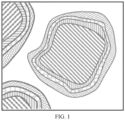
- FIG. 1 is a schematic diagram of the cross-section of the permanent magnet material comprising a main phase and a three-layer shell structure according to the present disclosure.
- the instrument was an EPMA-1720 type electron probe microscope manufactured by Shimadzu corporation, Japan.
- test conditions were as follows: the accelerating voltage was 10 kV, the beam current was 20 nA, the test time for elements B and O was 30 s, the time for background test was 10 s, and the time for other elements were default to be 10 s.
- the instrument was an NIM-62000 type rare earth permanent magnet measuring system from the National Institute of Metrology.
- the test condition room temperature
- the starting materials of the target components were placed in a crucible, heated and melted into molten steel by medium-frequency induction current under vacuum (the pressure was not more than 1 Pa), and quenched by a melt-spinning process to give alloy scales.
- the prepared R-T-B alloy and the CeY alloy were mixed together at the following proportion A (R-T-B alloy:CeY alloy) and then subjected to hydrogen decrepitation (HD) treatment, where the HD hydrogen absorption pressure was 200 kPa, dehydrogenation treatment was performed after saturated hydrogen absorption and decrepitation, where the dehydrogenation temperature was 350 °C and the dehydrogenation time was 3 hours, and then crushing was performed by jet milling or a combined mode of medium grinding and jet milling to give a jet-milled powder with the target particle size SMD of 2.5 ⁇ m.
- HD hydrogen decrepitation
- the experimental results of comparative samples 9 and 10 described above show that the heating and heat preservation temperature for the powder was relatively high, or the powder was not subjected to the heating and heat preservation treatment process, so the property of the magnet were significantly reduced, and the amplification of diffused Hcj was also significantly reduced.
- the thickness of the second shell structure increased abnormally, and in the shell structure, the grain boundaries had poor coating effect on the main phase grains, so that an excellent magnetic isolation effect could not be achieved, the property of the magnet was relatively low, and a good diffusion channel could not be provided, and thus the effective enrichment of a heavy rare earth element Dy on the surface of the magnet was inhibited, and the diffusion effect was reduced.
Landscapes
- Engineering & Computer Science (AREA)
- Power Engineering (AREA)
- Chemical & Material Sciences (AREA)
- Crystallography & Structural Chemistry (AREA)
- Inorganic Chemistry (AREA)
- Physics & Mathematics (AREA)
- Electromagnetism (AREA)
- Manufacturing & Machinery (AREA)
- Hard Magnetic Materials (AREA)
- Powder Metallurgy (AREA)
- Manufacture Of Metal Powder And Suspensions Thereof (AREA)
Applications Claiming Priority (1)
| Application Number | Priority Date | Filing Date | Title |
|---|---|---|---|
| CN202211666794.6A CN118248424A (zh) | 2022-12-23 | 2022-12-23 | 具有多层结构的永磁材料及其制备方法和应用 |
Publications (1)
| Publication Number | Publication Date |
|---|---|
| EP4576128A1 true EP4576128A1 (de) | 2025-06-25 |
Family
ID=91553444
Family Applications (1)
| Application Number | Title | Priority Date | Filing Date |
|---|---|---|---|
| EP23220279.6A Pending EP4576128A1 (de) | 2022-12-23 | 2023-12-27 | Permanentmagnetmaterial mit mehrschichtiger struktur, herstellungsverfahren dafür und verwendung davon |
Country Status (5)
| Country | Link |
|---|---|
| US (1) | US20240212897A1 (de) |
| EP (1) | EP4576128A1 (de) |
| JP (1) | JP2024091610A (de) |
| KR (1) | KR102792910B1 (de) |
| CN (1) | CN118248424A (de) |
Citations (6)
| Publication number | Priority date | Publication date | Assignee | Title |
|---|---|---|---|---|
| CN108154986A (zh) * | 2016-12-06 | 2018-06-12 | 中国科学院宁波材料技术与工程研究所 | 一种含y高丰度稀土永磁体及其制备方法 |
| CN111210963A (zh) * | 2020-02-07 | 2020-05-29 | 钢铁研究总院 | 高性能钇铈基稀土永磁体及制备方法 |
| CN111477449A (zh) * | 2020-04-26 | 2020-07-31 | 有研稀土(荣成)有限公司 | 一种含镧铈钕铁硼系磁体及其制备方法 |
| US20210319935A1 (en) * | 2020-04-08 | 2021-10-14 | Hyundai Motor Company | Rare-earth permanent magnet and method of manufacturing the same |
| CN113782292A (zh) * | 2021-06-04 | 2021-12-10 | 钢铁研究总院 | 一种具有改进温度稳定性的钇铈基稀土永磁材料 |
| EP4177911A1 (de) * | 2021-11-05 | 2023-05-10 | Shin-Etsu Chemical Co., Ltd. | Anisotroper gesinterter seltenerdmagnet und herstellungsverfahren dafür |
Family Cites Families (3)
| Publication number | Priority date | Publication date | Assignee | Title |
|---|---|---|---|---|
| JP6512150B2 (ja) * | 2016-03-28 | 2019-05-15 | 日立金属株式会社 | R−t−b系焼結磁石の製造方法 |
| CN106328367B (zh) * | 2016-08-31 | 2017-11-24 | 烟台正海磁性材料股份有限公司 | 一种R‑Fe‑B系烧结磁体的制备方法 |
| CN111916284B (zh) * | 2020-08-08 | 2022-05-24 | 烟台首钢磁性材料股份有限公司 | 一种高矫顽力烧结钕铁硼磁体的制备方法 |
-
2022
- 2022-12-23 CN CN202211666794.6A patent/CN118248424A/zh active Pending
-
2023
- 2023-12-15 KR KR1020230183506A patent/KR102792910B1/ko active Active
- 2023-12-22 US US18/395,407 patent/US20240212897A1/en active Pending
- 2023-12-25 JP JP2023217620A patent/JP2024091610A/ja active Pending
- 2023-12-27 EP EP23220279.6A patent/EP4576128A1/de active Pending
Patent Citations (6)
| Publication number | Priority date | Publication date | Assignee | Title |
|---|---|---|---|---|
| CN108154986A (zh) * | 2016-12-06 | 2018-06-12 | 中国科学院宁波材料技术与工程研究所 | 一种含y高丰度稀土永磁体及其制备方法 |
| CN111210963A (zh) * | 2020-02-07 | 2020-05-29 | 钢铁研究总院 | 高性能钇铈基稀土永磁体及制备方法 |
| US20210319935A1 (en) * | 2020-04-08 | 2021-10-14 | Hyundai Motor Company | Rare-earth permanent magnet and method of manufacturing the same |
| CN111477449A (zh) * | 2020-04-26 | 2020-07-31 | 有研稀土(荣成)有限公司 | 一种含镧铈钕铁硼系磁体及其制备方法 |
| CN113782292A (zh) * | 2021-06-04 | 2021-12-10 | 钢铁研究总院 | 一种具有改进温度稳定性的钇铈基稀土永磁材料 |
| EP4177911A1 (de) * | 2021-11-05 | 2023-05-10 | Shin-Etsu Chemical Co., Ltd. | Anisotroper gesinterter seltenerdmagnet und herstellungsverfahren dafür |
Also Published As
| Publication number | Publication date |
|---|---|
| US20240212897A1 (en) | 2024-06-27 |
| JP2024091610A (ja) | 2024-07-04 |
| KR20240101403A (ko) | 2024-07-02 |
| KR102792910B1 (ko) | 2025-04-07 |
| CN118248424A (zh) | 2024-06-25 |
Similar Documents
| Publication | Publication Date | Title |
|---|---|---|
| EP4016558A1 (de) | Dauermagnetmaterial auf r-t-b-basis, verfahren zu seiner herstellung und seine verwendung | |
| EP2650886B1 (de) | Herstellungsverfahren eines ndfeb-sintermagneten von hoher korrosionsbeständigkeit | |
| CN110619984B (zh) | 一种低B含量的R-Fe-B系烧结磁铁及其制备方法 | |
| JP7470804B2 (ja) | ネオジム鉄ホウ素磁石材料、原料組成物、及び製造方法 | |
| KR102718194B1 (ko) | 중희토류 합금, 네오디뮴철붕소 영구자석 재료, 원료 및 제조방법 | |
| EP4016559B1 (de) | Neodym-eisen-bor-magnetmaterial, rohstoffzusammensetzung, verfahren zu ihrer herstellung und ihre verwendung | |
| EP1465213B1 (de) | Verfahren zur herstellung eines seltenerdelement-permanentmagneten auf r-t-b-basis | |
| CN111243807B (zh) | 一种钕铁硼磁体材料、原料组合物及制备方法和应用 | |
| JP7769934B2 (ja) | ネオジム鉄ボロン磁石及びその製造方法並びに応用 | |
| KR102632991B1 (ko) | 네오디뮴철붕소 자성체 재료, 원료조성물과 제조방법 및 응용 | |
| JP7600416B2 (ja) | ネオジム鉄ホウ素磁石材料及びその製造方法並びに応用 | |
| EP2415541A1 (de) | Legierungsmaterial für einen r-t-b-seltenerd-permanentmagneten, verfahren zur herstellung des r-t-b-seltenerd-permanentmagneten und motor | |
| CN111326306B (zh) | 一种r-t-b系永磁材料及其制备方法和应用 | |
| CN111223627A (zh) | 钕铁硼磁体材料、原料组合物、制备方法、应用 | |
| CN113517104B (zh) | 主辅相合金钐钴磁体材料、烧结体用材料、其制备方法和应用 | |
| US20240194379A1 (en) | R-t-b based permanent magnet material, preparation method therefor and use thereof | |
| JP2022542187A (ja) | ネオジム鉄ホウ素磁石材料、原料組成物及び製造方法、並びに応用 | |
| EP4016560A1 (de) | Serielles r-t-b-dauermagnetmaterial, rohmaterialzusammensetzung, herstellungsverfahren und verwendung | |
| EP2612940A1 (de) | Legierungsmaterial für einen seltenerd-permanentmagneten auf rtb-basis, herstellungsverfahren für einen seltenerd-permanentmagneten auf rtb-basis und motor | |
| CN112992463A (zh) | 一种r-t-b磁体及其制备方法 | |
| EP4307325A1 (de) | Haupt- und hilfslegierungsbasiertes neodym-eisen-bor-magnetmaterial und herstellungsverfahren dafür | |
| KR102606749B1 (ko) | R-t-b계 영구자석 재료, 원료조성물, 제조방법, 응용 | |
| EP4576128A1 (de) | Permanentmagnetmaterial mit mehrschichtiger struktur, herstellungsverfahren dafür und verwendung davon | |
| EP4571796A1 (de) | Magnetischer stahl mit seltenerdelementen mit hoher dichte, herstellungsverfahren dafür und verwendung davon | |
| WO2023227042A1 (zh) | 一种R-Fe-B系永磁材料、制备方法及应用 |
Legal Events
| Date | Code | Title | Description |
|---|---|---|---|
| PUAI | Public reference made under article 153(3) epc to a published international application that has entered the european phase |
Free format text: ORIGINAL CODE: 0009012 |
|
| STAA | Information on the status of an ep patent application or granted ep patent |
Free format text: STATUS: REQUEST FOR EXAMINATION WAS MADE |
|
| 17P | Request for examination filed |
Effective date: 20231227 |
|
| AK | Designated contracting states |
Kind code of ref document: A1 Designated state(s): AL AT BE BG CH CY CZ DE DK EE ES FI FR GB GR HR HU IE IS IT LI LT LU LV MC ME MK MT NL NO PL PT RO RS SE SI SK SM TR |