EP4567008A1 - Glass article, display device, method for manufacturing glass article, and method for manufacturing display device - Google Patents
Glass article, display device, method for manufacturing glass article, and method for manufacturing display device Download PDFInfo
- Publication number
- EP4567008A1 EP4567008A1 EP23850049.0A EP23850049A EP4567008A1 EP 4567008 A1 EP4567008 A1 EP 4567008A1 EP 23850049 A EP23850049 A EP 23850049A EP 4567008 A1 EP4567008 A1 EP 4567008A1
- Authority
- EP
- European Patent Office
- Prior art keywords
- cover glass
- glass
- frame
- curved portion
- main surface
- Prior art date
- Legal status (The legal status is an assumption and is not a legal conclusion. Google has not performed a legal analysis and makes no representation as to the accuracy of the status listed.)
- Pending
Links
Images




Classifications
-
- C—CHEMISTRY; METALLURGY
- C03—GLASS; MINERAL OR SLAG WOOL
- C03C—CHEMICAL COMPOSITION OF GLASSES, GLAZES OR VITREOUS ENAMELS; SURFACE TREATMENT OF GLASS; SURFACE TREATMENT OF FIBRES OR FILAMENTS MADE FROM GLASS, MINERALS OR SLAGS; JOINING GLASS TO GLASS OR OTHER MATERIALS
- C03C27/00—Joining pieces of glass to pieces of other inorganic material; Joining glass to glass other than by fusing
- C03C27/04—Joining glass to metal by means of an interlayer
- C03C27/048—Joining glass to metal by means of an interlayer consisting of an adhesive specially adapted for that purpose
-
- C—CHEMISTRY; METALLURGY
- C03—GLASS; MINERAL OR SLAG WOOL
- C03B—MANUFACTURE, SHAPING, OR SUPPLEMENTARY PROCESSES
- C03B23/00—Re-forming shaped glass
- C03B23/02—Re-forming glass sheets
- C03B23/023—Re-forming glass sheets by bending
-
- C—CHEMISTRY; METALLURGY
- C03—GLASS; MINERAL OR SLAG WOOL
- C03C—CHEMICAL COMPOSITION OF GLASSES, GLAZES OR VITREOUS ENAMELS; SURFACE TREATMENT OF GLASS; SURFACE TREATMENT OF FIBRES OR FILAMENTS MADE FROM GLASS, MINERALS OR SLAGS; JOINING GLASS TO GLASS OR OTHER MATERIALS
- C03C3/00—Glass compositions
- C03C3/04—Glass compositions containing silica
- C03C3/076—Glass compositions containing silica with 40% to 90% silica, by weight
- C03C3/083—Glass compositions containing silica with 40% to 90% silica, by weight containing aluminium oxide or an iron compound
- C03C3/085—Glass compositions containing silica with 40% to 90% silica, by weight containing aluminium oxide or an iron compound containing an oxide of a divalent metal
-
- C—CHEMISTRY; METALLURGY
- C03—GLASS; MINERAL OR SLAG WOOL
- C03C—CHEMICAL COMPOSITION OF GLASSES, GLAZES OR VITREOUS ENAMELS; SURFACE TREATMENT OF GLASS; SURFACE TREATMENT OF FIBRES OR FILAMENTS MADE FROM GLASS, MINERALS OR SLAGS; JOINING GLASS TO GLASS OR OTHER MATERIALS
- C03C3/00—Glass compositions
- C03C3/04—Glass compositions containing silica
- C03C3/076—Glass compositions containing silica with 40% to 90% silica, by weight
- C03C3/083—Glass compositions containing silica with 40% to 90% silica, by weight containing aluminium oxide or an iron compound
- C03C3/085—Glass compositions containing silica with 40% to 90% silica, by weight containing aluminium oxide or an iron compound containing an oxide of a divalent metal
- C03C3/087—Glass compositions containing silica with 40% to 90% silica, by weight containing aluminium oxide or an iron compound containing an oxide of a divalent metal containing calcium oxide, e.g. common sheet or container glass
Definitions
- the present invention relates to a glass article, a display device, a glass article production method, and a display device production method.
- a liquid crystal display or an organic EL display may be used in an on-vehicle display device or the like that displays information necessary for driving or the like.
- a cover glass may be disposed to protect a front surface.
- an interior of a vehicle is required to have high designability, and a cover glass having a curved surface shape is required.
- Patent Literature 1 discloses a curved display device including a protective member as a cover glass, a frame, and a display panel. In order to curve the cover glass, there is known a hot forming method in which the cover glass is curved while being heated.
- Patent Literature 1 JP6941930B
- the shape of the cover glass may deviate from a desired curved shape. Therefore, it is required to suppress deviation of the cover glass from the desired shape.
- the present invention has been made in view of the above problem, and an object thereof is to provide a glass article, a display device, a glass article production method, and a display device production method, which are capable of suppressing deviation of a cover glass from a desired shape.
- a glass article according to the present disclosure is a glass article including: a cover glass that is hot-formed and includes a curved portion; a frame provided on a main surface of the cover glass; and an adhesive layer provided between the main surface of the cover glass and the frame to adhere the cover glass and the frame, in which a parameter A defined by the following Formula (1) is more than 0 and 0.5 or less.
- a parameter A defined by the following Formula (1) is more than 0 and 0.5 or less.
- E 1 is a Young's modulus (GPa) of the cover glass
- t 1 is a thickness (mm) of the cover glass
- E 2 is a Young's modulus (GPa) of the frame
- I 2 is a moment of inertia of area (mm 4 ) of the frame
- E 3 is an elastic modulus (MPa) of the adhesive layer
- W is a value obtained by dividing an area (cm 2 ) of the adhesive layer by a length (cm) of the curved portion along a main surface in a direction orthogonal to a bending axis.
- a display device includes a display and the glass article provided on a surface of the display.
- a glass article production method includes a step of shaping a cover glass including a curved portion by curving a glass plate while heating the glass plate, and a step of adhering a main surface of the cover glass to a frame via an adhesive layer to produce a glass article.
- a display device production method includes a step of attaching the glass article to a display, thereby producing a display device.
- FIG. 1 is a schematic diagram illustrating a display device according to the present embodiment.
- a glass article 10 according to the present embodiment is provided in a display device 2, and is used as a cover member for a surface (front surface) of a display 3 on which an image is displayed.
- the display device 2 is an on-vehicle display device provided in a vehicle, and is provided in front of a steering shaft 1 in the vehicle, for example.
- the display 3 displays a car navigation screen, various meters such as a speed meter, a start button, and the like.
- the configuration of FIG. 1 is an example, and the display device 2 to which the glass article 10 is applied may have any configuration.
- the glass article 10 is not limited to being used as a cover member for a surface of the display device 2, and may be used for any application.
- FIG. 2 is a schematic diagram of the glass article according to the present embodiment.
- the glass article 10 includes a cover glass 12, a frame 14, and an adhesive layer 16.
- the cover glass 12 is a transparent plate-shaped glass member and includes a main surface 12A (first main surface) which is a main surface on one side and a main surface 12B (second main surface) which is a main surface on a side opposite to the main surface 12A.
- the main surface 12A becomes a side exposed to the outside
- the main surface 12B becomes a side facing the object to be mounted (here, display 3).
- transparent as used herein indicates allowing visible light to be transmitted.
- the frame 14 is a frame-like member attached to the main surface 12B of the cover glass 12.
- the frame 14 is made of, for example, a resin, a metal, or a fiber reinforced plastic, but without being limited thereto, may be formed of any material.
- the cover glass 12 is curved in an X direction (described later), and the frame 14 is also curved in the X direction along the cover glass 12.
- the frame 14 is attached to a peripheral edge portion of the main surface 12B of the cover glass 12.
- the frame 14 has a frame shape provided over an entire section of the peripheral edge portion of the main surface 12B of the cover glass 12 in a peripheral direction.
- FIG. 2 the frame 14 has a frame shape provided over an entire section of the peripheral edge portion of the main surface 12B of the cover glass 12 in a peripheral direction.
- an end portion of the cover glass 12 on a peripheral edge side does not protrude from the frame 14, but without being limited thereto, the end portion of the cover glass 12 on the peripheral edge side may protrude from the frame 14.
- the shape of the frame 14 and the attachment position of the frame 14 on the main surface 12B are not limited to the above description, and may be any shape and any position.
- the frame 14 may have a shape that is discontinuous in a partial section of the peripheral edge portion of the main surface 12B in the peripheral direction. That is, for example, in the case where the main surface 12B has a curved rectangular shape, the frame 14 may have a shape provided on three sides among the four sides of the rectangle, a shape provided on two opposing sides, or a shape provided on one side.
- the frame 14 is fixed (adhered) to the main surface 12B of the cover glass 12 via the adhesive layer 16.
- the adhesive layer 16 is provided between the frame 14 and the main surface 12B of the cover glass 12 to adhere a surface of the frame 14 on a cover glass 12 side and the main surface 12B of the cover glass 12.
- the adhesive layer 16 may be formed of any adhesive member capable of adhering the frame 14 and the cover glass 12, such as a double-sided tape or an adhesive.
- the cover glass 12 is attached to the frame 14 while being curved.
- the cover glass 12 is hot-formed to achieve a desired shape.
- a flat plate-shaped glass plate is bent by a hot forming method (thermal shaping method), to become a cover glass 12.
- the cover glass 12 in a bent state is further bent while unheated and then, attached to the frame 14. That is, the cover glass 12 bent by hot forming is attached to the frame 14 while a bending stress acts thereon due to bending accompanied with elastic deformation by an external force, in a state where the cover glass 12 is not further heated.
- the term "hot forming” as used herein indicates a method of bending a glass with increasing a temperature thereof to a glass transition point or higher.
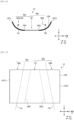
- FIG. 3A is a top view of the cover glass
- FIG. 3B is a sectional view taken along the line A-A in FIG. 3A
- FIG. 4 is a sectional view of the glass article including the cover glass.
- the cover glass 12 has a shape in which a rectangular flat plate-shaped glass plate is curved.
- one side surface (end surface) of the cover glass 12 is defined as a side surface 12C1, a side surface opposing the side surface 12C1 is defined as a side surface 12C2, another side surface of the cover glass 12 is defined as a side surface 12C3, and a side surface opposing the side surface 12C3 is defined as a side surface 12C4.
- the side surfaces 12C1 and 12C2 are short sides of the rectangle, and the side surfaces 12C3 and 12C4 are long sides of the rectangle.
- the cover glass 12 is not limited to a shape in which a rectangular flat plate-shaped glass plate is curved, and may be a shape in which a glass plate having any shape is curved.
- the cover glass 12 may have a shape in which a polygonal, circular, or elliptical flat plate-shaped glass plate is curved.
- FIG. 3A is a view when the cover glass 12 is viewed from a normal direction (Z direction) of a position P on the main surface 12B of the cover glass 12, and FIG. 4 illustrates a section of the cover glass 12 along the X direction.
- a tangential direction selected so as to satisfy the following conditions among tangential directions of the main surface 12B at an arbitrary point P of the main surface 12B of the cover glass 12 is defined as the X direction (first direction)
- a direction orthogonal to the X direction among the tangential directions of the main surface 12B at the point P is defined as a Y direction
- a direction orthogonal to the X direction and the Y direction, that is, a normal direction (thickness direction) of the position P is defined as the Z direction.
- the X direction indicates a direction in which a curvature radius of a line formed by intersection of the main surface 12B and a plane including the tangential direction and the normal direction becomes minimum, among the tangential directions of the main surface 12B at an arbitrary point P of the main surface 12B of the cover glass 12.
- the X direction can be unambiguously defined even when the position P is set to any point.
- a plurality of curved portions 20 may be provided, and bending directions of the respective curved portions 20 may intersect with one another.
- the X direction may be defined for each curved portion 20.
- a direction in which a curvature radius of a line formed by intersection of the main surface 12B and a plane including a tangential direction and a normal direction is minimum may be defined as the X direction of this curved portion 20, and the X direction may be defined in the same manner for each curved portion 20.
- At least one direction of the tangential directions may be defined as the X direction.
- the cover glass 12 in a state where the cover glass 12 is attached to the frame 14, the cover glass 12 is curved with a curvature radius R with the Y direction as a bending axis and the X direction as a direction orthogonal to the bending axis.
- the curvature radius R can be said to be a curvature radius of a line formed by intersection of the main surface 12B and a plane including the X direction and the Z direction.
- the curvature radius R of the cover glass 12 (curvature radius of bending with the Y direction as bending axis) is preferably 100 mm or more and 8,000 mm or less, more preferably 300 mm or more and 6,000 mm or less, and still more preferably 500 mm or more and 4,000 mm or less. In the case where the curvature radius R falls within this range, deviation of the cover glass 12 in the glass article from a desired shape can be suppressed while improving the designability.
- the curvature radius of bending of the cover glass 12 with the Y direction as a bending axis in a state where the cover glass 12 is detached from the frame 14 is defined as a curvature radius R1.
- the curvature radius R1 can be said to be a curvature radius of a line formed by intersection of the main surface 12B and the plane including the X direction and the Z direction in a state where the cover glass 12 is detached from the frame 14.
- the curvature radius R1 of the cover glass 12 is preferably 50 mm or more and 10,000 mm or less, more preferably 100 mm or more and 8,000 mm or less, and still more preferably 300 mm or more and 6,000 mm or less.
- the curvature radius R1 refers to a curvature radius of the cover glass 12 in a state where the cover glass 12 is detached from the frame 14, is not subjected to a load from the outside, and is not elastically deformed by an external load. In this manner, since the cover glass 12 is hot formed, the cover glass 12 is curved even when the cover glass 12 is detached from the frame 14 and not elastically deformed.
- the cover glass 12 is curved by hot forming the glass plate to achieve a desired shape before the cover glass 12 is attached to the frame 14.
- an absolute value of a difference between the curvature radius R1 of the cover glass 12 in a state where the cover glass 12 is detached from the frame 14 and the curvature radius R of the cover glass 12 in a state where the cover glass 12 is attached to the frame 14 is preferably 5% or less of the curvature radius R, and more preferably 2% or less.
- the cover glass 12 according to the present embodiment is bent by hot forming to a curvature radius close to the final curvature radius R, and accordingly satisfies Formula (1) described later, so that it is easy to suppress deviation of the cover glass in the glass article from a desired shape.
- the absolute value of the difference between the curvature radius R1 and the curvature radius R is, for example, more than 0.0% and is 0.2% or more.
- the hot forming method in particular, in a self-weight forming method in which a glass plate is placed on a lower mold and heated to be curved by its own weight, deviation of the shape may occur even when the glass plate is curved to achieve a desired shape. According to the present embodiment, even in such a case, it is possible to prevent the cover glass 12 from deviating from a desired shape when a glass article is produced by using a glass plate as the cover glass 12 and attaching the frame 14.
- the curvature radius R3 (curvature radius of bending with the Y direction as bending axis) is preferably 100 mm or more and 8,000 mm or less, more preferably 300 mm or more and 6,000 mm or less, and still more preferably 500 mm or more and 4,000 mm or less.
- An absolute value of a difference between the curvature radius R3 and the curvature radius R of the cover glass 12 in a state where the cover glass 12 is attached to the frame 14 is preferably 2% or less, and more preferably 1% or less. In the case where the curvature radius R3 falls within the above range, it is easy to suppress the deviation of the cover glass in the glass article from the desired shape.
- the cover glass 12 is preferably not bent in a direction other than a bending direction with the Y direction as a bending axis.
- the cover glass 12 preferably does not have bending with the X direction as a bending axis.
- a trajectory along the Y direction on the main surface 12B of the cover glass 12 is preferably linear.
- the term "not have bending" is not limited to a case where the curvature radius is infinite, and may include a case where the curvature radius is more than 10,000 mm.
- the curved portion 20 indicates a region of the cover glass 12 that is bent with the same curvature radius R with the Y direction as a bending axis. That is, it can be said that the curved portion 20 of the cover glass 12 is bent with the curvature radius R with the Y direction as a bending axis.
- the entire cover glass 12 is bent with the same curvature radius R in the X direction, it can be said that the entire cover glass 12 is the curved portion 20.
- the curvature radius R is the same as used herein is not limited to a case where the curvature radius R is strictly the same for each position.
- the region is regarded as a region having the same curvature radius and is treated as one curved portion 20.
- An average value of the curvature radius R at each position of the curved portion 20 may be treated as the curvature radius R of the curved portion 20.
- Examples of a method for measuring the curvature radius R and the curvature radius R1 of the cover glass 12 include a method of measuring a shape by using a contact type or non-contact type three-dimensional measuring machine and obtaining the curvature radius based on shape data, and a method of pressing an R ruler against the cover glass 12 and measuring the curvature radius.
- the curved portion 20 is bent to be convex toward the main surface 12A.
- the curved portion 20 is not limited to being bent to be convex toward the main surface 12A, and may be bent to be convex toward the main surface 12B.
- the an arbitrary point P described above is any point in the curved portion 20 of the main surface 12B, and for example, may be a central position of the main surface 12B (for example, position of the center of gravity of the cover glass 12) in the case where a central region of the main surface 12A is the curved portion 20. That is, the X direction and the Y direction may be tangential directions from the center of the main surface 12B, and the Z direction may be a normal direction at the center of the main surface 12B.
- a glass material for the cover glass 12 is any material, and for example, an alkali-free glass, a soda-lime glass, a soda-lime silicate glass, an aluminosilicate glass, a borosilicate glass, a lithium aluminosilicate glass, and a borosilicate glass can be used.
- the cover glass 12 is preferably chemically strengthened, in other words, preferably has a compressive stress layer on a surface thereof. Therefore, the cover glass 12 is preferably an aluminosilicate glass or a lithium aluminosilicate glass to which a large stress is easily introduced by a strengthening treatment even when the thickness is thin and by which a glass with a high strength can be obtained even when the thickness is thin.
- a chemical strengthening treatment is generally performed by immersing a glass in a molten salt containing alkali metals.
- the cover glass 12 preferably contains, in terms of mol% based on oxides, 50% to 80% of SiO 2 , 0.1% to 25% of Al 2 O 3 , 3% to 30% of Li 2 O+Na 2 O+K 2 O, 0% to 25% of MgO, 0% to 25% of CaO, and 0% to 5% of ZrO 2 , but is not particularly limited thereto.
- “50% to 80%” as used herein indicates 50% or more and 80% or less when mol% of the total amount of the cover glass 12 is defined as 100%, and other numerical ranges are defined in the same manner.
- Li 2 O+Na 2 O+K 2 O indicates the total content of Li 2 O, Na 2 O, and K 2 O.
- a numerical range represented by "to” means a numerical range including numerical values before and after "to” as a lower limit value and an upper limit value, and also means the same meaning when "to” is used thereafter.
- examples of a more preferable composition of the glass for the cover glass 12 include the following glass compositions.
- "containing 0% to 25% of MgO” means that MgO is not essential but may be contained up to 25%.
- the glass of (i) is categorized in soda-lime silicate glass, the glasses of (ii) and (iii) are categorized in aluminosilicate glass, and the glasses of (iv), (v), and (vi) are categorized in lithium aluminosilicate glass.
- the shape when a glass plate is curved by hot forming to achieve a desired curved shape, the shape may deviate from a desired curved shape.
- the present inventors have found that the deviation from the desired curved shape can be suitably suppressed by designing the parameter A defined as described later to be within a predetermined numerical range. That is, in the present embodiment, the deviation from a desired curved shape can be suitably suppressed by defining the parameter A of the glass article 10 as follows. Hereinafter, the parameter A will be described.
- the parameter A represented by the following Formula (1) is 0.5 or less, preferably 0.3 or less, and more preferably 0.1 or less. In the case where the parameter A falls within this range, the deviation from a desired curved shape can be suitably suppressed.
- the parameter A is more than 0, preferably 0.001 or more, more preferably 0.005 or more, and still more preferably 0.01 or more. That is, it can be said that the parameter A is more than 0 and 0.5 or less, preferably 0.001 or more and 0.5 or less, more preferably 0.005 or more and 0.3 or less, and still more preferably 0.01 or more and 0.1 or less.
- a value PV to be described later can be 0.5 or less, and the deviation from a desired curved shape can be suitably suppressed, which is preferable.
- the value PV of the glass article 10 according to the present embodiment is calculated by the following assumption. First, it is assumed that the glass article 10 and a glass article having a desired curved shape are placed on a horizontal plane without applying an external force. In this state, both shapes are superimposed on each other, a distance in a vertical direction is calculated at a portion where deviation occurs, and a value that is maximum in the entire region is set as the value PV
- the glass article is placed such that a convex surface comes to a horizontal plane side, and in the case where the glass article has both a convex surface and a concave surface, the larger value of a distance in the vertical direction calculated by placing one surface as the horizontal plane side and a distance in the vertical direction calculated by placing the other surface as the horizontal plane side is adopted as the value PV.
- A exp 0.014 E 1 t 1 2 ⁇ 0.00020 E 2 I 2 ⁇ 0.0053 ⁇ E 3 W ⁇ 2.5 + 0.1
- ⁇ (E 3 W) in Formula (1) indicates a total value of (E 3 W) of the respective adhesive layers 16.
- E 1 t 1 2 in Formula (1) is a parameter indicating the rigidity of the cover glass 12, and it can be said that in order to suppress the deviation from a desired curved shape, that is, in order to lower the parameter A, the value of E 1 t 1 2 is preferably low.
- E 2 I 2 in Formula (1) is a parameter indicating the rigidity of the frame 14, and since the higher the value of E 2 I 2 is, the more easily the deviation from a desired curved shape of the cover glass 12 is corrected, it can be said that the value of E 2 I 2 is preferably high in order to suppress the deviation from a desired curved shape.
- the higher the elastic modulus E 3 of the adhesive layer 16 the easier it is to transmit correction of the frame 14 to the cover glass 12, and the higher the value of W, the more the correction of the frame 14 is made to act on a wide area of the cover glass 12, it can be said that these values are preferably high in order to suppress the deviation from a desired curved shape.
- the Young's modulus E 1 of the cover glass 12 is preferably 60 GPa or more and 90 GPa or less, more preferably 68 GPa or more and 78 GPa or less, and still more preferably 72 GPa or more and 76 GPa or less. In the case where the Young's modulus E 1 falls within this range, the deviation from a desired curved shape can be appropriately suppressed.
- the Young's modulus E 1 of the cover glass can be measured by a resonance method, a mechanical test method, an ultrasonic pulse method, or the like.
- the resonance method is a method of measuring a natural frequency by applying vibration to a test piece and calculating a Young's modulus from the natural frequency.
- the mechanical test method is a method of applying a load such as tension to a test piece and calculating a Young's modulus from resulting deformation and the load.
- the ultrasonic pulse method is a method of propagating an ultrasonic pulse to a test piece and measuring a Young's modulus from a propagation speed.
- a Young's modulus of a glass is known to satisfy the additive law, and can also be calculated by performing multiple regression from the Young's modulus of a plurality of glass compositions.
- the thickness t 1 of the cover glass 12 is preferably 0.1 mm or more and 3.0 mm or less, more preferably 0.4 mm or more and 1.5 mm or less, and still more preferably 0.7 mm or more and 1.4 mm or less. In the case where the thickness t 1 falls within this range, the deviation from a desired curved shape can be appropriately suppressed. As illustrated in FIG. 4 , the thickness t 1 indicates a distance in the Z direction from the main surface 12A to the main surface 12B.
- the Young's modulus E 2 of the frame 14 is preferably 1 GPa or more and 400 GPa or less, more preferably 2 GPa or more and 250 GPa or less, further preferably 40 GPa or more and 230 GPa or less, and still more preferably 60 GPa or more and 210 GPa or less. In the case where the Young's modulus E 2 falls within this range, the rigidity of the frame 14 can be ensured, and deviation of the cover glass 12 from a desired curved shape can be appropriately suppressed.
- the Young's modulus E 2 of the frame can be measured by a resonance method, a mechanical test method, an ultrasonic pulse method, or the like.
- the moment of inertia of area I 2 of the frame 14 is preferably 0.1 mm 4 or more and 1,250 mm 4 or less, more preferably 1 mm 4 or more and 450 mm 4 or less, and still more preferably 1.5 mm 4 or more and 30 mm 4 or less.
- the moment of inertia of area I 2 falls within this range, the rigidity of the frame 14 can be ensured without significantly impairing the designability, and the deviation from a desired curved shape can be appropriately suppressed.
- the moment of inertia of area is relative to the bending axis. In the example of FIG.
- FIG. 3A the bending axis is a Y axis
- FIG. 3B the sectional view of the glass article 10 on a section along the line A-A (plane perpendicular to the X axis) illustrated in FIG. 3A is illustrated in FIG. 3B .
- FIG. 3B is a diagram assuming that the glass article 10 is not curved.
- the moment of inertia of area I 2 of the frame 14 can be obtained by integrating t 2 (squared value of the thickness t of the frame 14) with an area FA of the frame 14 on a plane perpendicular to the X axis on the section along the line A-A (plane perpendicular to the X axis), as illustrated in FIG.
- the moment of inertia of area I 2 of the frame 14 can be calculated by the following Formula (3), where L FA is a length along the main surface of the frame 14 in a direction (here, X direction) orthogonal to the bending axis. That is, in the present embodiment, an average value of moments of inertia of area at positions in the direction along the bending axis of the frame 14 is defined as the moment of inertia of area I 2 of the frame 14.
- a distance between the positions and the number of positions used for calculating the average value at the time of calculating the average value of the moments of inertia of area for the positions in the direction along the bending axis may be any distance and any number.
- I 2 1 L F ⁇ t 2 dFdy
- the elastic modulus E 3 of the adhesive layer 16 is preferably 0.2 MPa or more and 100 MPa or less, more preferably 1 MPa or more and 50 MPa or less, and still more preferably 5 MPa or more and 35 MPa or less.
- the cover glass 12 can be appropriately adhered to the frame 14, the shape of the cover glass 12 can appropriately follow the shape of the frame 14, and the deviation of the cover glass 12 from a desired curved shape can be appropriately suppressed.
- the elastic modulus E 3 of the adhesive layer 16 can be measured by an indentation elastic modulus test described below.
- the adhesive layer 16 adhered to the main surface 12B of the cover glass 12 is exposed upward in a vertical direction and is disposed on a creep meter (for example, model number RE2-33005C, manufactured by Yamaden Co., Ltd.), and a plunger (for example, cylindrical plunger, model number P-61, ⁇ 1.5, H40, manufactured by Yamaden Co., Ltd.) is indented on the adhesive layer 16 at an indentation speed of 0.05 mm/sec in an environment of room temperature (for example, 20°C) until an indentation depth becomes 5% to 10% of the thickness of the adhesive layer 16.
- a creep meter for example, model number RE2-33005C, manufactured by Yamaden Co., Ltd.
- a plunger for example, cylindrical plunger, model number P-61, ⁇ 1.5, H40, manufactured by Yamaden Co., Ltd.
- the indentation elastic modulus test of the present invention is a parameter indicating an adhesive strength.
- an existential adhesion strength test for example, a cross adhesive strength test or the like is known, but measurement by the method is difficult depending on the state of the glass article. In the above indentation elastic modulus test, even a glass article in a state where a cover glass and a frame are adhered to each other can be verified, and the measurement results also correlate with the adhesive strength observed in the existential adhesive strength test.
- the area B of the adhesive layer 16 refers to an area of an adhesive region AR which is a region overlapping with the adhesive layer 16 in the entire region of the main surface 12B of the curved portion 20.
- the area B of the adhesive layer 16 is preferably 50 cm 2 or more and 1,700 cm 2 or less, more preferably 100 cm 2 or more and 1,400 cm 2 or less, and still more preferably 200 cm 2 or more and 1,100 cm 2 or less.
- the cover glass 12 may be appropriately adhered to the frame 14 while suppressing deterioration of the designability due to the excessive adhesive region AR, the shape of the cover glass 12 can appropriately follow the shape of the frame 14, and the deviation of the cover glass 12 from a desired curved shape can be appropriately suppressed.
- the area B of the adhesive layer 16 refers to an area of one adhesive layer 16 among the plurality of adhesive layers 16.
- the adhesive region AR is formed on an outer side in a radial direction of the region AR0 when an axis passing through a center position of the curved portion 20 along the Z direction is defined as an axial direction.
- the entire cover glass 12 constitutes the curved portion 20, and therefore, a region overlapping with the adhesive layer 16 in the entire region of the main surface 12B of the cover glass 12 is the adhesive region AR.
- the adhesive region AR may not be continuous, and a plurality of discontinuous or mottled adhesive regions AR may be formed.
- the length (perimeter) L of the curved portion 20 refers to the length of the curved portion 20 along the main surface in the X direction orthogonal to the bending axis.
- the length L indicates the length of a line extending in the X direction on the main surface 12B and connecting an end point (position) on one side in the X direction of the curved portion 20 to an end point (position) in the X direction on the other side of the curved portion 20.
- the line extending in the X direction on the main surface 12B indicates a line extending in the X direction along the main surface 12B without deviating in the Y direction. In the example of FIG.
- the end point on one side in the X direction of the curved portion 20 is a point on the side surface 12C1
- the end point on the other side in the X direction of the curved portion 20 is a point on the side surface 12C2
- the length L indicates a length of a line extending in the X direction on the main surface 12B from the side surface 12C1 to the side surface 12C2.
- the length L is preferably 100 mm or more and 2,000 mm or less, more preferably 150 mm or more and 700 mm or less, and still more preferably 200 mm or more and 400 mm or less.
- W can be increased to reduce the parameter A, and therefore, the deviation of the cover glass 12 from a desired curved shape can be appropriately suppressed.
- the length L is preferably 100 mm or more, more preferably 150 mm or more, and still more preferably 200 mm or more, deterioration of the designability can be suppressed.
- a region in which the length L is 5 mm or less is not treated as the curved portion 20. That is, a region where the curvature radius R is the same and the length L is longer than 5 mm is defined as the curved portion 20.
- the value W obtained by dividing the area B (cm 2 ) of the adhesive layer 16 by the length L (cm) of the curved portion 20 is preferably 1 cm or more and 20 cm or less, and more preferably 2 cm or more and 6.2 cm or less. In the case where the value W falls within this range, it is possible to appropriately suppress deviation of the cover glass 12 from a desired curved shape while suppressing deterioration of the designability.
- FIG. 5 is a schematic diagram illustrating a production method of the glass article and the display device according to the present embodiment.
- a glass plate which is the flat plate-shaped cover glass 12
- the cover glass 12 at the stage of step S10 that is, the cover glass 12 in a state of not being attached to the frame 14, is curved to have the above-described curvature radius R1.
- the main surface 12B of the cover glass 12 is adhered to the frame 14 via the adhesive layer 16 to obtain the glass article 10 (step S12).
- the cover glass 12 after step S12 that is, the cover glass 12 in a state of being attached to the frame 14, is curved to have the above-described curvature radius R.
- the display 3 is attached to the main surface 12B of the glass article 10 at an inner side with respect to the adhesive region AR on which the frame 14 and the adhesive layer 16 are adhered (step S14).
- the glass article 10 to which the display 3 is attached is attached to a housing 4 to form the display device 2 (step S16).
- step S16 the glass article 10 to which the display 3 is attached is attached to the housing 4 so that the display 3 is housed in the housing 4 and a main surface 12A side is exposed to the outside.
- the main surface 12B to which the frame 14 and the display 3 are attached is convex, and the main surface 12A exposed to the outside is concave, but without being limited thereto, the main surface 12B may be concave and the main surface 12A may be convex, as illustrated in FIG. 2 and the like.
- the step of housing the display 3 in the housing 4 as in step S16 is not essential, and the glass article 10 to which the display 3 is attached may be treated as the display device 2.
- step S10 it is preferable to chemically strengthen the cover glass 12 after step S10. More specifically, it is preferable to chemically strengthen the hot-formed cover glass 12 after step S10, and then execute step S12 to attach the frame 14 to the chemically strengthened cover glass 12.
- the glass article 10 includes the cover glass 12 that is hot-formed and includes the curved portion 20, the frame 14 provided on the main surface 12B of the cover glass 12, and the adhesive layer 16 provided between the main surface 12B of the cover glass 12 and the frame 14 to adhere the cover glass 12 and the frame 14.
- the parameter A is more than 0 and 0.5 or less.
- the cover glass 12 that is curved to some extent by hot forming is adhered to the frame 14 to be further curved, so that the cover glass 12 can be appropriately curved to a desired shape.
- the parameter A is 0.5 or less
- the value PV described later can be suppressed to a deviation at a level of 0.5 or less, so that the deviation of the cover glass 12 from a desired curved shape can be appropriately suppressed.
- the glass article 10 according to a second aspect of the present embodiment is the glass article 10 according to the first aspect, in which an absolute value of a difference between the curvature radius R1 of a curved portion of the cover glass 12 in a state where the cover glass 12 is detached from the frame 14 and the curvature radius R of the curved portion of the cover glass 12 in a state where the cover glass 12 is attached to the frame 14 is preferably equal to or less than 10% of the curvature radius R.
- the absolute value of the difference in the curvature radius falls within this range, the deviation of the glass article from a desired shape of the cover glass 12 can be suppressed.
- the glass article 10 according to a third aspect of the present embodiment is the glass article 10 according to the first or second aspect, in which the curvature radius R of the curved portion 20 of the cover glass 12 is preferably 100 mm or more and 8,000 mm or less. In the case where the curvature radius R falls within this range, deviation of the cover glass 12 from a desired shape can be suppressed while improving the designability.
- the glass article 10 according to a fourth aspect of the present embodiment is the glass article 10 according to any of the first to third aspects, in which the thickness t 1 of the cover glass 12 is preferably more than 1 mm. In the case where the thickness t 1 falls within this range, the deviation of the cover glass 12 from a desired shape can be suppressed.
- the glass article 10 according to a fifth aspect of the present embodiment is the glass article 10 according to any of the first to fourth aspects, in which the curvature radius R1 of the curved portion of the cover glass 12 in a state where the cover glass 12 is detached from the frame 14 is preferably 50 mm or more and 10,000 mm or less. In the case where the curvature radius R1 falls within this range, deviation of the cover glass 12 from a desired shape can be appropriately suppressed while improving the designability.
- the glass article 10 according to a sixth aspect of the present embodiment is the glass article 10 according to any of the first to fifth aspects, in which the Young's modulus E 1 of the cover glass 12 is 60 GPa or more and 90 GPa or less, the Young's modulus E 2 of the frame 14 is 1 GPa or more and 400 GPa or less, the elastic modulus E 3 of the adhesive layer 16 is 0.2 MPa or more and 100 MPa or less, and the moment of inertia of area I 2 of the frame 14 is 0.1 mm 4 or more and 1,250 mm 4 or less. In the case where these parameters fall within the above ranges, the deviation of the cover glass 12 from a desired shape can be appropriately suppressed.
- the glass article 10 according to a seventh aspect of the present embodiment is the glass article 10 according to any of the first to sixth aspects, in which the cover glass 12 is preferably chemically strengthened.
- the strength can be improved by chemically strengthening.
- the display device 2 according to an eighth aspect of the present embodiment includes the display 3 and the glass article 10 according to any of the first to seventh aspects which is provided on a surface of the display 3. Therefore, the deviation of the cover glass 12 from a desired shape can be appropriately suppressed.
- a glass article production method includes a step of shaping the cover glass 12 including the curved portion 20 by curving a glass plate while heating the glass plate, and a step of adhering the main surface 12B of the cover glass 12 to the frame 14 via the adhesive layer 16 to produce the glass article 10. According to the present production method, the deviation of the cover glass 12 from a desired shape can be appropriately suppressed.
- a glass article production method is the glass article production method according to the ninth aspect, in which it is preferable to use the cover glass 12, the frame 14, and the adhesive layer 16 in which the parameter A defined by Formula (1) is 0.5 or less.
- the parameter A is 0.5 or less
- the value PV described later can be suppressed to a deviation at a level of 0.5 or less, so that the deviation of the cover glass 12 from a desired curved shape can be appropriately suppressed.
- a glass article production method is the glass article production method according to the ninth or tenth aspect, in which it is preferably to further include a step of chemically strengthening the cover glass 12 after the step of shaping the cover glass 12. According to the present production method, it is possible to increase the strength of the cover glass 12 and suppress damage.
- a display device production method includes a step of attaching, to the display 3, the glass article 10 produced by the production method according to any of the ninth to eleventh aspects, thereby producing the display device 2. According to the present production method, the deviation of the cover glass 12 from a desired shape can be appropriately suppressed.
- FIG. 6 is a diagram illustrating an example in which a plurality of adhesive layers are provided.
- one adhesive layer 16 is provided in the above description, a plurality of adhesive layers 16 may be provided.
- the adhesive layers 16 are adhered to the main surface 12B of the cover glass 12 at positions different from one another when viewed from the Z direction, as illustrated in FIG. 6 .
- the adhesive layer 16 having a low adhesive force such as a double-sided tape when the adhesive layer 16 having a low adhesive force such as a double-sided tape is provided at the outer side, it functions as a bank of the adhesive layer 16 (for example, adhesive) at the inner side having a high adhesive force, and the adhesive before curing can be suppressed from protruding to the outer side.
- the adhesive layers 16 are provided in a state where an outer peripheral edge of the adhesive layer 16 at the inner side and an inner peripheral edge of the adhesive layer 16 at the outer side are separated from each other.
- FIG. 6 is an example, and the positions of the respective adhesive layers 16 may be freely set.
- FIG. 6 illustrates that two adhesive layers 16 are provided, three or more adhesive layers 16 may be provided.
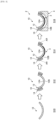
- FIG. 7 is a schematic diagram of a cover glass according to another example of the present embodiment.
- the curved portion 20 is described as a portion bent with the same curvature radius R, but may be bent in the X direction in a spline curve shape of which the curvature radius is not constant. In this case, the entire portion bent in the X direction in a spline curve shape is treated as the curved portion 20.
- a region in which a change in the curvature radius R measured at each position from an end point on one side to an end point on the other side in the X direction of a region bent with the Y direction as a bending axis on the main surface 12B is 5% or less is treated as one curved portion 20 having the same curvature radius.
- a region in which the change in the curvature radius R at each position in a section having a length of 50 mm or less from an end point on one side toward an end point on the other side in the X direction of a region bent with the Y direction as a bending axis on the main surface 12B is more than 5% is treated as one curved portion 20 having a spline shape.
- the curved portion 20 having a spline shape is approximated to a shape curved at a constant curvature radius, and a curvature radius approximated to the shape curved at a constant curvature radius is treated as the curvature radius R of the curved portion 20.
- one end point in the X direction of the main surface 12B of the curved portion 20 having a spline shape is defined as an end point 20J
- the other end point is defined as an end point 20K
- a plane connecting the end point 20J and the end point 20K and extending along the X direction and the Y direction is defined as a plane ⁇ .
- a curvature radius of an arc 20R passing through the end point 20J and the end point 20K and coming into contact with the plane ⁇ is defined as the curvature radius R of the curved portion 20.
- FIGS. 8 and 9 are schematic diagrams of a cover glass according to another example of the present embodiment.
- a flat portion 22 may be connected to the curved portion 20 on an X1 side.
- An orientation X1 is one orientation along the X direction
- an orientation X2 is the other orientation along the X direction.
- the flat portion 22 is connected to the curved portion 20 such that the main surface 12B is continuous (not discontinuous) with the curved portion 20.
- the flat portion 22 is a portion having a flat shape which is connected to an end portion of the curved portion 20 on the orientation X1 side, in the entire region of the cover glass 12.
- the expression that the flat portion 22 has a flat shape is not limited to a case where the curvature radius is infinite, and may also include a case where the curvature radius is more than 10,000 mm.
- the curved portion 20 and the flat portion 22 are treated as one curved portion 20a in the application of Formulae (1) and (2).
- a length of the curved portion 20a in the X direction which is a bending direction (sum of the length of the curved portion 20 in the X direction and the length F of the flat portion 22), is treated as the length L.
- an area of a region overlapping with the adhesive layer 16 on the main surface 12B of the curved portion 20a (sum of an area of a region overlapping with the adhesive layer 16 on the main surface 12B of the curved portion 20 and an area of a region overlapping with the adhesive layer 16 on the main surface 12B of the flat portion 22) is treated as the area B.
- the length F of the flat portion 22 refers to a length along the main surface 12B from an end point of the flat portion 22 on the orientation X1 side of the main surface 12B to an end point of the flat portion 22 on the orientation X2 side of the main surface 12B.
- the flat portion 22 may be connected to both sides of the curved portion 20 in the X direction (both the orientation X1 side and the orientation X2 side). As illustrated in FIG. 9 , in the case where the lengths F along the main surface 12B of the flat portion 22 on the orientation X1 side of the curved portion 20 and the flat portion 22 on the orientation X2 side are different, the curved portion 20 and the flat portion 22 having a shorter length F along the main surface 12B are treated as one curved portion 20a.
- the length of the curved portion 20a in the X direction (sum of the length of the curved portion 20 and the length F of the shorter flat portion 22) is treated as the length L
- an area of a region overlapping with the adhesive layer 16 on the main surface 12B of the curved portion 20a (sum of an area of a region overlapping with the adhesive layer 16 on the main surface 12B of the curved portion 20 and an area of a region overlapping with the adhesive layer 16 on the main surface 12B of the shorter flat portion 22) is treated as the area B.
- the curved portion 20 and either of the flat portions 22 are treated as one curved portion 20a.
- FIGS. 10 and 11 are schematic diagrams of a cover glass according to another example of the present embodiment.
- a plurality of curved portions 20 may be provided, in other words, a plurality of curved portions 20 having different curvature radii R may be formed in the cover glass 12.
- the respective curved portions 20 are bent with the same direction, that is the Y direction, as a bending axis.
- Whether there are a plurality of curved portions 20 can be determined as follows. That is, in a region in which a change in the curvature radius R is more than 5% at each position in a section longer than 50 mm from an end point on one side in the X direction toward an end point on the other side of a region bent with the Y direction as a bending axis on the main surface 12B, it is determined that a plurality of curved portions 20 having different curvature radii R are formed.
- the change in the curvature radius R is 5% or less in a section having a length of 50 mm or less from an end point on one side in the X direction toward an end point on the other side in a region bent with the Y direction as the bending axis on the main surface 12B but the change in the curvature radius R exceeds 5% in a section longer than 50 mm from the end point on one side toward the end point on the other side, it is determined that a plurality of curved portions are formed instead of one curved portion having a spline shape.
- a region in which the change in the curvature radius R is 5% or less at each position of a section from an end point 20L on one side in the X direction toward an end point 20M on the other side of the region is set as one curved portion 20A in which the curvature radius R is the same.
- the curved portion 20A is a region from the end point 20L on one side to a position 20N where the change in the curvature radius R is more than 5%.
- FIG. 10 illustrates an example in which the curved portion 20A having a curvature radius Ra and the curved portion 20B having a curvature radius Rb are formed.
- both of the curved portions 20A and 20B are convex toward the main surface 12A, but without being limited thereto, both of the curved portions 20A and 20B may be convex toward the main surface 12B. That is, in the case where there are a plurality of curved portions 20, the curved portions 20 are convex toward the same direction side.
- the number of the curved portions 20 is not limited to two, and may be three or more.
- FIG. 11 illustrates an example in which the flat portion 22 is connected to the plurality of curved portions 20.
- the flat portion 22 is connected to the plurality of curved portions 20
- one curved portion 20 and the flat portion 22 connected to this curved portion 20 are treated as one curved portion 20a in the application of Formulae (1) and (2).
- a longer flat portion 22 is connected to the orientation X2 side of the curved portion 20B
- a shorter flat portion 22 is connected to the orientation X1 side of the curved portion 20B
- the curved portion 20A is connected to a side of the shorter flat portion 22 opposite to the curved portion 20B.
- the curved portion 20A and the shorter flat portion 22 are treated as one curved portion 20a, and the curved portion 20B and the shorter flat portion 22 are treated as another curved portion 20a.
- a method of calculating the length L and the area B of the curved portion 20a is the same as that in the case where the flat portion 22 is connected to one curved portion 20, and thus the description thereof will be omitted.
- FIGS. 12 to 15 are schematic diagrams of a cover glass according to another example of the present embodiment.
- a rectangular glass plate is bent in the X direction to form the cover glass 12, and therefore, the length of the cover glass 12 in the X direction is constant at each position, but the length of the cover glass 12 in the X direction may be different for each position depending on the shape.
- the length L in such a case will be described below.
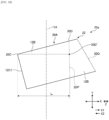
- the length L indicates a length of a line extending in the X direction on the main surface 12B and connecting from a position on the most one side (orientation X1 side) of the curved portion 20 in the X direction with respect to a bending axis YA along the Y direction to a position on the most other side (orientation X2 side) 20 in the X direction with respect to the bending axis YA of the curved portion 20.
- two end points of the side surface 12C3, which is a long side of the trapezoid are a position 20C on the most orientation X2 side and a position 20D on the most X1 side with respect to the bending axis YA of the curved portion 20, and a length of a line connecting the position 20C and the position 20D and extending in the X direction on the main surface 12B is the length L, as illustrated in FIG. 12 .
- the X direction orthogonal to the bending axis is along the side surfaces 12C3 and 12C4 which are sides in a lateral direction of the flat plate-shaped cover glass 12 before bending, but without being limited thereto, the X direction orthogonal to the bending axis may be deviated with respect to (may intersect with) the side of the flat plate-shaped cover glass 12 before bending.
- FIG. 13 illustrates an example in which the X direction intersects with the side surfaces 12C3 and 12C4 of the flat plate-shaped cover glass 12 before bending. In the example of FIG.
- one end point of the side surface 12C3 which is a long side of the trapezoid is the position 20C
- the other end point of the side surface 12C4 which is a short side of the trapezoid is the position 20D.
- the position 20D is shifted in the Y direction to define a position 20D'
- a length of a line connecting the position 20C and the position 20D' and extending in the X direction on a surface along the main surface 12B is defined as the length L. That is, in the example of FIG.
- a length of a curve connecting the position 20C and the position 20D' and having the curvature radius R is the length L.
- the position 20D' is a position obtained by shifting the position 20D in the Y direction so that a position of the position 20D' in the Y direction is aligned with a position of the position 20C in the Y direction. In this manner, in the case where the positions of the position 20C and the position 20D in the Y direction are not aligned, a length of a line traveling in the X direction on a surface along the main surface 12B from the position 20C to the position 20D' of which the positions in the Y direction are aligned is defined as the length L.
- FIG. 14 illustrates an example in which a polygonal glass plate is bent in the X direction to form the cover glass 12.
- the positions of the position 20C and the position 20D in the Y direction which are points on the most orientation X2 side and the orientation X1 side of the curved portion 20 in the X direction with respect to the bending axis YA along the Y direction, are also not aligned with each other, and therefore, a length of a line connecting the position 20D' and the position 20C and extending in the X direction on a surface along the main surface 12B is the length L.
- FIG. 15 illustrates an example in which a glass plate of which an outer periphery has a curved shape is curved in the X direction to form the cover glass 12.
- the positions of the position 20C and the position 20D in the Y direction which are points on the most orientation X2 side and orientation X1 side of the curved portion 20 in the X direction with respect to the bending axis YA along the direction Y, are also not aligned with each other. Therefore, a length of a line connecting the position 20D' and the position 20C and extending in the X direction on a surface along the main surface 12B is the length L.
- FIGS. 16 to 18 are schematic diagrams of a cover glass according to another example of the present embodiment.
- a plurality of curved portions 20 are bent in the same direction with the Y direction as a bending axis, but directions of bending axes of the plurality of curved portions 20 may be different.
- the bending axes of the respective curved portions 20 do not intersect with one another on the main surface 12A of the cover glass 12, but intersect with one another at a point obtained by extending the bending axes of the respective curved portions 20 outward from the main surface 12A.
- FIGS. 16 and 17 illustrate examples of schematic diagrams of the cover glass 12 in which the directions of the bending axes of the plurality of curved portions 20 are different.
- the curved portion 20A is connected to the orientation X2 side of the flat portion 22, and the curved portion 20B is connected to the orientation X1 side of the flat portion 22.
- the curved portion 20A is bent with the bending axis YA as a bending axis from the side surface 12C1, which is an end side on the orientation X2 side, to an end side 20P on the orientation X1 side.
- the curved portion 20A is a region bent with the bending axis YA as a bending axis so that a change in the curvature radius at each position in the X direction from the side surface 12C1 to the end side 20P is 5% or less.
- the curved portion 20B is bent with a bending axis YB as a bending axis from an end side 20Q on the orientation X2 side to the side surface 12C2 which is an end side on the orientation X1 side.
- the curved portion 20B is a region bent with the bending axis YB as a bending axis so that a change in the curvature radius at each position in the X direction from the end side 20Q to the side surface 12C2 is 5% or less.
- the flat portion 22 is a flat region from the end side 20P to the end side 20Q in the X direction.
- the bending axis YA of the curved portion 20A and the bending axis YB of the curved portion 20B extend in different directions, but do not intersect with each other on the main surface 12A of the cover glass 12, and intersect with each other at a point obtained by extending the bending axes YA and YB outward from the main surface 12A.
- FIG. 16 is illustrated as a figure in which the Y direction is defined as the bending axis, that is, the bending axes YA and YB are in the same direction for convenience of description, but actually, the bending axes YA and YB of the curved portions 20A and 20B extend in different directions.
- one of the curved portions 20 and the flat portion 22 connected to the curved portion 20 are treated as one curved portion 20a in the application of Formulae (1) and (2).
- the flat portion 22 is connected to the orientation X1 side of the curved portion 20A
- the flat portion 22 is connected to the orientation X2 side of the curved portion 20B.
- the curved portion 20A and the flat portion 22 are treated as one curved portion 20a
- the curved portion 20B and the flat portion 22 are treated as another curved portion 20a.
- a method of calculating the area B of the curved portion 20a is the same as that in the case where the flat portion 22 is connected to one curved portion 20, and thus the description thereof will be omitted.
- FIG. 18 is a diagram in which the curved portion 20a including the curved portion 20A and the flat portion 22 is extracted for convenience of description.
- an end point of the side surface 12C1 on the most orientation X2 is the position 20C of the curved portion 20a
- an end point of the end side 20P on the most orientation X1 side is the position 20D of the curved portion 20a.
- the position 20D is shifted in the Y direction to define a position 20D', and a length of a line connecting the position 20C and the position 20D' and extending in the X direction on a surface along the main surface 12B is defined as the length L of the curved portion 20a. That is, in the example of FIG. 20, a length of a curve connecting the position 20C and the position 20D' and having the curvature radius R is the length L.
- the length L is obtained in the same manner for the curved portion 20a including the curved portion 20B and the flat portion 22, and description thereof is omitted.
- a frame was bonded, via the adhesive layer, to the glass plate in which the elastic energy was accumulated.
- the glass, the adhesive layer, and the frame were deformed by the elastic energy of the glass and were balanced in a certain state.
- the maximum value of a difference deviation in distance in the vertical direction from the ideal shape of the shape in the balanced state at this time was calculated as the value PV.
- the initial shape in the simulation can be set based on a desired elastic energy to be applied to the glass plate, and the desired elastic energy was set to the same value in each Example.
- Table 1 shows conditions of simulation models of Examples.
- a model was prepared by adhering a cover glass and a frame with one adhesive layer (first adhesive layer) so that the curvature radius R of the cover glass was the value described in Table 1.
- two kinds of adhesive layers were used as the adhesive layer for adhering the cover glass and the frame.
- the thickness t 1 and the Young's modulus E 1 of the cover glass, the moment of inertia of area I 2 and the Young's modulus E 2 of the frame, the elastic modulus E 3 of the first adhesive layer, and the elastic modulus E 3 of the second adhesive layer, and the value W were values shown in Table 1.
- the parameter A was calculated for each Example. Values of the parameter A are shown in Table 1.
- Table 1 Conditions Cover glass Frame Thickness t 1 (mm) Young's modulus E 1 (GPa) Curvature radius R (mm) Thickness t 2 (mm) Moment of inertia of area I 2 (mm 4 ) Young's modulus E 2 (GPa) Ex. 1 1.4 74 2,750 2 42 206 Ex. 2 1.4 74 2,750 2 16 206 Ex. 3 1.4 74 2,750 1 5 206 Ex. 4 1.4 74 2,750 1 2 206 Ex. 5 1.4 74 2,750 4 333 206 Ex. 6 1.4 74 2,750 2 42 206 Ex. 7 1.4 74 2,750 2 16 206 Ex.
- the value PV which was a deviation amount from a desired shape of the cover glass was calculated in the simulation.
- the value PV was calculated as described above.
Landscapes
- Chemical & Material Sciences (AREA)
- Engineering & Computer Science (AREA)
- Materials Engineering (AREA)
- Organic Chemistry (AREA)
- Life Sciences & Earth Sciences (AREA)
- Chemical Kinetics & Catalysis (AREA)
- General Chemical & Material Sciences (AREA)
- Geochemistry & Mineralogy (AREA)
- Ceramic Engineering (AREA)
- Devices For Indicating Variable Information By Combining Individual Elements (AREA)
Applications Claiming Priority (2)
| Application Number | Priority Date | Filing Date | Title |
|---|---|---|---|
| JP2022123808 | 2022-08-03 | ||
| PCT/JP2023/027972 WO2024029495A1 (ja) | 2022-08-03 | 2023-07-31 | ガラス物品、表示装置、ガラス物品の製造方法及び表示装置の製造方法 |
Publications (1)
| Publication Number | Publication Date |
|---|---|
| EP4567008A1 true EP4567008A1 (en) | 2025-06-11 |
Family
ID=89849334
Family Applications (1)
| Application Number | Title | Priority Date | Filing Date |
|---|---|---|---|
| EP23850049.0A Pending EP4567008A1 (en) | 2022-08-03 | 2023-07-31 | Glass article, display device, method for manufacturing glass article, and method for manufacturing display device |
Country Status (5)
| Country | Link |
|---|---|
| EP (1) | EP4567008A1 (https=) |
| JP (1) | JPWO2024029495A1 (https=) |
| CN (1) | CN119654297A (https=) |
| TW (1) | TW202413091A (https=) |
| WO (1) | WO2024029495A1 (https=) |
Families Citing this family (1)
| Publication number | Priority date | Publication date | Assignee | Title |
|---|---|---|---|---|
| WO2025142928A1 (ja) * | 2023-12-28 | 2025-07-03 | Agc株式会社 | ガラス物品、表示装置、ガラス物品の製造方法及び表示装置の製造方法 |
Family Cites Families (6)
| Publication number | Priority date | Publication date | Assignee | Title |
|---|---|---|---|---|
| JP6941930B2 (ja) | 2016-10-26 | 2021-09-29 | 三菱電機株式会社 | 表示装置 |
| TW202033351A (zh) * | 2018-10-18 | 2020-09-16 | 美商康寧公司 | 冷成形產品和製程的黏合劑選擇的方法 |
| KR20210097747A (ko) * | 2018-11-30 | 2021-08-09 | 코닝 인코포레이티드 | 열적으로 매칭된 시스템을 갖는 냉간-성형 유리 물품 및 이를 형성하기 위한 공정 |
| TW202104104A (zh) * | 2019-05-03 | 2021-02-01 | 美商康寧公司 | 增加設計彈性的組合冷成型與熱成型製程 |
| JP7712105B2 (ja) | 2021-02-12 | 2025-07-23 | 大阪有機化学工業株式会社 | 硬化性樹脂組成物 |
| US20220324201A1 (en) * | 2021-03-31 | 2022-10-13 | Corning Incorporated | Glass article having a plastic frame with enhanced reliability against delamination |
-
2023
- 2023-07-31 WO PCT/JP2023/027972 patent/WO2024029495A1/ja not_active Ceased
- 2023-07-31 EP EP23850049.0A patent/EP4567008A1/en active Pending
- 2023-07-31 CN CN202380056627.6A patent/CN119654297A/zh active Pending
- 2023-07-31 JP JP2024539143A patent/JPWO2024029495A1/ja active Pending
- 2023-08-02 TW TW112129009A patent/TW202413091A/zh unknown
Also Published As
| Publication number | Publication date |
|---|---|
| WO2024029495A1 (ja) | 2024-02-08 |
| CN119654297A (zh) | 2025-03-18 |
| JPWO2024029495A1 (https=) | 2024-02-08 |
| TW202413091A (zh) | 2024-04-01 |
Similar Documents
| Publication | Publication Date | Title |
|---|---|---|
| CN107207314B (zh) | 曲面保护玻璃及其制造方法、以及车载用显示构件 | |
| EP4045969B1 (en) | Perimeter adhesive for improved reliability and reduced stress mura in curved displays with cover glass | |
| KR102717055B1 (ko) | 디스플레이 또는 터치 패널들을 위한 보강을 갖는 커버 글래스 | |
| JP2022530901A (ja) | 設計の柔軟性を高める、冷間成形プロセスと熱間成形プロセスとの組合せ | |
| WO2020106413A1 (en) | Cold-formed glass article having dual adhesive system and process for cold-forming glass articles | |
| EP4567008A1 (en) | Glass article, display device, method for manufacturing glass article, and method for manufacturing display device | |
| JP2022543442A (ja) | 低い曲げ応力および改良した頭部模型衝撃試験性能を有する自動車内装の積層方法 | |
| CN216871500U (zh) | 用于车辆内饰系统的玻璃制品和车辆的内饰系统 | |
| US12490643B2 (en) | OLED display device for vehicle interior systems | |
| US12576714B2 (en) | Glass article and onboard display device | |
| US20240025788A1 (en) | Optimized shape for improved performance and reliability for glass articles made with cold form method | |
| JP7011227B2 (ja) | 車両用合わせガラス | |
| TW202212132A (zh) | 覆蓋材料及顯示裝置 | |
| JP2023540189A (ja) | 曲げ自在表示部を有する車内システムのためのガラス物品 | |
| EP4067069A1 (en) | Glass article having a plastic frame with enhanced reliability against delamination | |
| TW202532220A (zh) | 玻璃物品、顯示裝置、玻璃物品之製造方法及顯示裝置之製造方法 | |
| CN220166065U (zh) | 具有不连续粘合剂层的玻璃制品 | |
| US20210101821A1 (en) | Curved glass articles including a bumper piece configured to relocate bending moment from display region and method of manufacturing same | |
| CN117940391A (zh) | 玻璃制品及车载用显示装置 | |
| KR20230008100A (ko) | 최소화된 형상 편차 및 작은 베젤 폭을 위해 구성된 프레임을 갖는 유리 물품 |
Legal Events
| Date | Code | Title | Description |
|---|---|---|---|
| STAA | Information on the status of an ep patent application or granted ep patent |
Free format text: STATUS: THE INTERNATIONAL PUBLICATION HAS BEEN MADE |
|
| PUAI | Public reference made under article 153(3) epc to a published international application that has entered the european phase |
Free format text: ORIGINAL CODE: 0009012 |
|
| STAA | Information on the status of an ep patent application or granted ep patent |
Free format text: STATUS: REQUEST FOR EXAMINATION WAS MADE |
|
| 17P | Request for examination filed |
Effective date: 20250228 |
|
| AK | Designated contracting states |
Kind code of ref document: A1 Designated state(s): AL AT BE BG CH CY CZ DE DK EE ES FI FR GB GR HR HU IE IS IT LI LT LU LV MC ME MK MT NL NO PL PT RO RS SE SI SK SM TR |
|
| DAV | Request for validation of the european patent (deleted) | ||
| DAX | Request for extension of the european patent (deleted) |