EP4556093A2 - Verfahren und vorrichtung zur wasserbehandlung mit sieben - Google Patents
Verfahren und vorrichtung zur wasserbehandlung mit sieben Download PDFInfo
- Publication number
- EP4556093A2 EP4556093A2 EP25169199.4A EP25169199A EP4556093A2 EP 4556093 A2 EP4556093 A2 EP 4556093A2 EP 25169199 A EP25169199 A EP 25169199A EP 4556093 A2 EP4556093 A2 EP 4556093A2
- Authority
- EP
- European Patent Office
- Prior art keywords
- stream
- solids
- activated sludge
- screen
- wastewater
- Prior art date
- Legal status (The legal status is an assumption and is not a legal conclusion. Google has not performed a legal analysis and makes no representation as to the accuracy of the status listed.)
- Pending
Links
Images




Classifications
-
- C—CHEMISTRY; METALLURGY
- C02—TREATMENT OF WATER, WASTE WATER, SEWAGE, OR SLUDGE
- C02F—TREATMENT OF WATER, WASTE WATER, SEWAGE, OR SLUDGE
- C02F3/00—Biological treatment of water, waste water, or sewage
-
- B—PERFORMING OPERATIONS; TRANSPORTING
- B01—PHYSICAL OR CHEMICAL PROCESSES OR APPARATUS IN GENERAL
- B01D—SEPARATION
- B01D29/00—Filters with filtering elements stationary during filtration, e.g. pressure or suction filters, not covered by groups B01D24/00 - B01D27/00; Filtering elements therefor
- B01D29/11—Filters with filtering elements stationary during filtration, e.g. pressure or suction filters, not covered by groups B01D24/00 - B01D27/00; Filtering elements therefor with bag, cage, hose, tube, sleeve or like filtering elements
-
- B—PERFORMING OPERATIONS; TRANSPORTING
- B01—PHYSICAL OR CHEMICAL PROCESSES OR APPARATUS IN GENERAL
- B01D—SEPARATION
- B01D33/00—Filters with filtering elements which move during the filtering operation
-
- B—PERFORMING OPERATIONS; TRANSPORTING
- B01—PHYSICAL OR CHEMICAL PROCESSES OR APPARATUS IN GENERAL
- B01D—SEPARATION
- B01D36/00—Filter circuits or combinations of filters with other separating devices
-
- C—CHEMISTRY; METALLURGY
- C02—TREATMENT OF WATER, WASTE WATER, SEWAGE, OR SLUDGE
- C02F—TREATMENT OF WATER, WASTE WATER, SEWAGE, OR SLUDGE
- C02F3/00—Biological treatment of water, waste water, or sewage
- C02F3/006—Regulation methods for biological treatment
-
- C—CHEMISTRY; METALLURGY
- C02—TREATMENT OF WATER, WASTE WATER, SEWAGE, OR SLUDGE
- C02F—TREATMENT OF WATER, WASTE WATER, SEWAGE, OR SLUDGE
- C02F3/00—Biological treatment of water, waste water, or sewage
- C02F3/02—Aerobic processes
- C02F3/12—Activated sludge processes
-
- C—CHEMISTRY; METALLURGY
- C02—TREATMENT OF WATER, WASTE WATER, SEWAGE, OR SLUDGE
- C02F—TREATMENT OF WATER, WASTE WATER, SEWAGE, OR SLUDGE
- C02F3/00—Biological treatment of water, waste water, or sewage
- C02F3/02—Aerobic processes
- C02F3/12—Activated sludge processes
- C02F3/1205—Particular type of activated sludge processes
-
- C—CHEMISTRY; METALLURGY
- C02—TREATMENT OF WATER, WASTE WATER, SEWAGE, OR SLUDGE
- C02F—TREATMENT OF WATER, WASTE WATER, SEWAGE, OR SLUDGE
- C02F3/00—Biological treatment of water, waste water, or sewage
- C02F3/02—Aerobic processes
- C02F3/12—Activated sludge processes
- C02F3/1236—Particular type of activated sludge installations
-
- C—CHEMISTRY; METALLURGY
- C02—TREATMENT OF WATER, WASTE WATER, SEWAGE, OR SLUDGE
- C02F—TREATMENT OF WATER, WASTE WATER, SEWAGE, OR SLUDGE
- C02F3/00—Biological treatment of water, waste water, or sewage
- C02F3/28—Anaerobic digestion processes
- C02F3/2866—Particular arrangements for anaerobic reactors
-
- C—CHEMISTRY; METALLURGY
- C02—TREATMENT OF WATER, WASTE WATER, SEWAGE, OR SLUDGE
- C02F—TREATMENT OF WATER, WASTE WATER, SEWAGE, OR SLUDGE
- C02F2209/00—Controlling or monitoring parameters in water treatment
- C02F2209/005—Processes using a programmable logic controller [PLC]
-
- C—CHEMISTRY; METALLURGY
- C02—TREATMENT OF WATER, WASTE WATER, SEWAGE, OR SLUDGE
- C02F—TREATMENT OF WATER, WASTE WATER, SEWAGE, OR SLUDGE
- C02F2209/00—Controlling or monitoring parameters in water treatment
- C02F2209/10—Solids, e.g. total solids [TS], total suspended solids [TSS] or volatile solids [VS]
-
- C—CHEMISTRY; METALLURGY
- C02—TREATMENT OF WATER, WASTE WATER, SEWAGE, OR SLUDGE
- C02F—TREATMENT OF WATER, WASTE WATER, SEWAGE, OR SLUDGE
- C02F2209/00—Controlling or monitoring parameters in water treatment
- C02F2209/10—Solids, e.g. total solids [TS], total suspended solids [TSS] or volatile solids [VS]
- C02F2209/105—Particle number, particle size or particle characterisation
-
- C—CHEMISTRY; METALLURGY
- C02—TREATMENT OF WATER, WASTE WATER, SEWAGE, OR SLUDGE
- C02F—TREATMENT OF WATER, WASTE WATER, SEWAGE, OR SLUDGE
- C02F2303/00—Specific treatment goals
- C02F2303/24—Separation of coarse particles, e.g. by using sieves or screens
-
- C—CHEMISTRY; METALLURGY
- C02—TREATMENT OF WATER, WASTE WATER, SEWAGE, OR SLUDGE
- C02F—TREATMENT OF WATER, WASTE WATER, SEWAGE, OR SLUDGE
- C02F3/00—Biological treatment of water, waste water, or sewage
- C02F3/02—Aerobic processes
- C02F3/12—Activated sludge processes
- C02F3/1205—Particular type of activated sludge processes
- C02F3/1221—Particular type of activated sludge processes comprising treatment of the recirculated sludge
-
- C—CHEMISTRY; METALLURGY
- C02—TREATMENT OF WATER, WASTE WATER, SEWAGE, OR SLUDGE
- C02F—TREATMENT OF WATER, WASTE WATER, SEWAGE, OR SLUDGE
- C02F3/00—Biological treatment of water, waste water, or sewage
- C02F3/02—Aerobic processes
- C02F3/12—Activated sludge processes
- C02F3/1205—Particular type of activated sludge processes
- C02F3/1226—Particular type of activated sludge processes comprising an absorbent material suspended in the mixed liquor
-
- C—CHEMISTRY; METALLURGY
- C02—TREATMENT OF WATER, WASTE WATER, SEWAGE, OR SLUDGE
- C02F—TREATMENT OF WATER, WASTE WATER, SEWAGE, OR SLUDGE
- C02F3/00—Biological treatment of water, waste water, or sewage
- C02F3/30—Aerobic and anaerobic processes
- C02F3/302—Nitrification and denitrification treatment
- C02F3/307—Nitrification and denitrification treatment characterised by direct conversion of nitrite to molecular nitrogen, e.g. by using the Anammox process
-
- Y—GENERAL TAGGING OF NEW TECHNOLOGICAL DEVELOPMENTS; GENERAL TAGGING OF CROSS-SECTIONAL TECHNOLOGIES SPANNING OVER SEVERAL SECTIONS OF THE IPC; TECHNICAL SUBJECTS COVERED BY FORMER USPC CROSS-REFERENCE ART COLLECTIONS [XRACs] AND DIGESTS
- Y02—TECHNOLOGIES OR APPLICATIONS FOR MITIGATION OR ADAPTATION AGAINST CLIMATE CHANGE
- Y02E—REDUCTION OF GREENHOUSE GAS [GHG] EMISSIONS, RELATED TO ENERGY GENERATION, TRANSMISSION OR DISTRIBUTION
- Y02E50/00—Technologies for the production of fuel of non-fossil origin
- Y02E50/30—Fuel from waste, e.g. synthetic alcohol or diesel
-
- Y—GENERAL TAGGING OF NEW TECHNOLOGICAL DEVELOPMENTS; GENERAL TAGGING OF CROSS-SECTIONAL TECHNOLOGIES SPANNING OVER SEVERAL SECTIONS OF THE IPC; TECHNICAL SUBJECTS COVERED BY FORMER USPC CROSS-REFERENCE ART COLLECTIONS [XRACs] AND DIGESTS
- Y02—TECHNOLOGIES OR APPLICATIONS FOR MITIGATION OR ADAPTATION AGAINST CLIMATE CHANGE
- Y02W—CLIMATE CHANGE MITIGATION TECHNOLOGIES RELATED TO WASTEWATER TREATMENT OR WASTE MANAGEMENT
- Y02W10/00—Technologies for wastewater treatment
- Y02W10/10—Biological treatment of water, waste water, or sewage
Definitions
- Wastewater screens have been used to remove large or inert solids for collection and disposal for over a century. Wastewater screening to remove such debris typically occurs in an upstream process to protect downstream processes from such materials. More recently, screens have been used within the activated sludge process itself to select and remove inert material.
- U.S. Patents Nos. 4,541,933 , 5,824,222 , 6,814,868 and 7,569,147 discuss variations of this concept for the removal of inert materials from activated sludge and membrane bioreactors, i.e. a selection for undesired solids was applied.
- a second use of screens in the activated sludge processes is to substitute the final clarification process with a screen to retain and return the active flocs to the aeration basin by substituting the clarifier with a membrane or a screen.
- Applications of these are found as filter screen and membranes for solid liquid separation.
- An example of the latter application is U.S. Patent No. 6,821,425 and the processes described in the scientific literature by Kiso et al.
- screens have been used in the activated sludge process to discard trash, substitute clarifiers, or reduce loadings to solid-liquid separation device. None of these previously disclosed processes uses screens for both 'selection' and 'retention' of solids, or to physically synthesize biological solids of appropriate structures to enhance activated sludge performance associated with controlling reactions for removal of constituents.
- a current operational drawback of an activated sludge process is that the solids residence time is the same for all of the fractions in the activated sludge. This drawback has been overcome, for example, by using plastic media to retain organisms on biofilms for longer solids residence times. See, e.g., U.S. Patents Nos. 5,458,779 and 7,854,843 . Other options include the use of cyclones that can differentiate solids based on specific gravity ( US 2011/0198284 Al ). None of these processes selects for an increase in residence time of solids based on size, compressibility or shear characteristics associated with screening.
- the disclosed embodiments include a selection process using screens for retaining particulate constituents based on size and compressibility thereof.
- screens are used in the activated sludge process to 'mine' and 'retain' specific types of solids, and these retained solids improve process performance.
- This ability to mine activated sludge solids of a specific range of size, compressibility and shear resistance through selection and retention of material is a key feature of the embodiments of the present disclosure.
- the present disclosure leads to an activated sludge system operated at different solids residence times (SRT) for different solids fractions allowing slow-growing organisms to get established in competition with faster-growing organisms or aggregates thereof.
- SRT solids residence times
- Physical forces are augmented to maintain the different solids residence times in the long term by achieving more distinct particle separation, e.g. by shearing off fast growing or superficial biomass from the surface of slowly growing aggregates or by using pressures to extract and retain less compressible materials from a more compressible biomass.
- the present disclosure is not necessarily limited for use in connection with wastewater.
- the apparatuses and methods decribed herein may be used in connection with treatment of water other than wastewater.
- the present apparatuses and methods may be used to remove nutrients from agricultural runoff, and/or to treat leachate from a solid waste operation, animal manure, water from an aquaculture system, and digestate or sludge from an anaerobic digestion process, and address groundwater pollution, treat drinking water and treat hazardous wastes.
- the disclosed embodiments provide a screen to select and retain particles in a wastewater treatment process such as an activated sludge system based on particle size, compressibility and/or shear.
- the size of the particles retained depends on the size of the screen mesh, in the 10-10,000 micron size range (more preferably in the range of from 10 to 2,000 microns, and even more preferably in the range of from 100 to 2,000 microns). Larger sized granules can be retained along with smaller sized flocs or granules based on mesh size.
- the ability to selectively retain compressible or non-compressible material depends on the washing volume or velocity, vacuum applied or the force applied perpendicularly.
- shearing of the material depends on the amount of tangential stress applied. The more compressible material tends to pass through the screen as it is washed, and the screen will abrade the particles when shear forces are applied. Depending on the applied shear intensity and duration or frequency the surface of aggregates gets shaved off, the overall particle size gets reduced and particles of low shear resistance tend to get broken apart and washed out. Therefore shear forces (typically tangential) and compression forces (typically perpendicular) or a combination of these forces, as shown in FIG. 1a, FIG. 1b , FIG. 1c and FIG. 1d , in connection with screenapplication selects for aggregate sizes of an appropriate size with more dense or solid structure (e.g.
- granules of slow growing biomass usually are more shear resistant and less compressible compared to the fast growing floculant type of biomass). Additionally application of shear reduces the diffusion resistance of these denser aggregates and leads to smaller particles with larger active surfaces. This can be accomplished additionally using a device which compresses particles during screening by applying pressure such as a positive pressure in screen-flow direction such as a pressure head from a spray bar or of a negative pressure such as suction head produced by a vacuum pump.
- pressure such as a positive pressure in screen-flow direction such as a pressure head from a spray bar or of a negative pressure such as suction head produced by a vacuum pump.
- the exposed shear rate or time, particle compression, or SRTs can be adjusted manually and/or automatically in response to detected readings from an analytical instrument such as a spectrophotometer or other optical approaches to optimize selection of organisms.
- FIGs. 1a - 1d show four perspective views of one example embodiment of the screening apparatus 10.
- the screening apparatus 10 processes an entering wastewater stream 1 via an internal particle/solids separator 2 which screens waste constituents out to a waste stream 3 while separating the waste constituents from those constituents of the wastewater stream 1 that are to be retained 4.
- Wastewater 1 can be prescreened prior to entering screening apparatus 10 in order to remove larger trash or granules that need to be excluded from the process.
- the use of the screen 2 increases the solids residence time of the screened constituents 4 and provides a selection pressure for larger biological particles, thus uncoupling the solids residence time of the screened constituents 4 from the solids residence time of the unscreened (pass through) constituents (waste stream 3).
- the screening efficiency can be calibrated to increase or decrease the solids residence time of the screened constituents 4.
- An optional screen wash 5 using gas, liquid, vacuum, or some combination of matter can be added to further assist in the screening process.
- the screen wash 5 can be directed toward the screen 2 in a variety of different ways, which differently affect the solids residence time, including but not limited to, along the vertical axis ( FIG. 1a ), an angle directly perpendicular to the screen ( FIG. 1b ), or along the horizontal axis ( FIG. 1c ) or even tangential to the screen ( FIG. 1d ).
- the screen of the disclosed embodiments can be used in an activated sludge system consisting of a bioreactor that is used for the treatment of wastewater, or other liquor such as from internal sidestreams.
- the bioreactor is connected to a separation device, which may include a clarifier, an upflow granular reactor, a membrane, a filter, a dissolved air floatation device, or any other separation device, for the recycling or removal of biomass.
- FIG. 2 is a flowchart showing a method for a typical activated sludge process in accordance with an example embodiment.
- Wastewater stream 11 enters into an optional primary separator 12. Excess wastewater 13 exits the process and the wastewater stream 14 enters a bioreactor 15.
- the separator 17 can be, for example, a clarifier, an upflow granular reactor, a membrane, a filter or a dissolved air floatation device.
- the remaining wastewater 18 is thus separated from activated sludge 19, some of which is recycled 20 to bioreactor 15 in order to efficiently process more out of the system as the remaining excess sludge exits the system.
- FIG. 3 is a flowchart showing another method for an activated sludge process in accordance with an example embodiment.
- the embodiment of FIG. 3 is similar to that of FIG. 2 (like elements are labeled the same and not described again) but includes an additional path 22 from the bioreactor 15 for mixed liquor which is processed by a screening apparatus 23 before being separated into a clear effluent stream 24 to be recycled into the system and an excess stream 25 to exit the system.
- Some of the effluent stream 24 may be wasted (26).
- the amount of the effluent stream 24 that is wasted (26) may be adjustably controlled to control the solids residence time of the material that is retained by the screening apparatus 23.
- the screen 23 can be integrated into the bioreactor 15 in a sequencing batch arrangement or can be separate from bioreactor 15 as shown in FIG. 3 .
- the separation could occur through gravity or flotation.
- the solids residence time for the system depends on the amount of excess sludge that is removed continuously or periodically from the separation device, which may be similar to that shown in FIGs. 1a - 1d . An increase in excess sludge removal decreases the solids residence time and vice-versa.
- FIG. 4 is a flowchart showing another method for an activated sludge process in accordance with an example embodiment.
- screen device 23 can be provided (either in parallel or in series with the biomass settlement/floatation device) in line with the excess sludge 19 withdrawal system, instead of as an additional path from the bioreactor 15 (as shown in FIG. 3 ).
- the excess sludge removal can occur directly from a separator 17 following the bioreactor 15. In this case the screen can be located at this alternate excess sludge withdrawal system from the bioreactor 19.
- some of the effluent stream 24 from the screening apparatus 23 may be wasted (26).
- the amount of the effluent stream 24 that is wasted (26) in the FIG. 4 apparatus may be adjustably controlled to control the solids residence time of the material that is retained by the screening apparatus 23.
- An additional feature disclosed herein will retain flocs or granules based on an upper and lower bound screen mesh size.
- a specific granule/particle size range may be retained by discarding very large granules or trash in a larger mesh size screen following which, very small granules are allowed to pass through in a smaller mesh screen.
- single or multiple screens in series could be used for selective residence and/or pass through of size fractions as desired.
- larger size particles settle faster (based on Stokian settling), allowing for the rapid removal of the material in the separation device. Increased settling rates are beneficial to treatment plants as this increase can improve capacity utilization of the activated sludge process.
- FIG. 5 shows data describing the efficiency of a screen that retains granules based on size, according to an example embodiment.
- a 212 ⁇ m screen was used for selection and retention of anaerobic ammonium oxidation (anammox or AnAOB) bacteria granules.
- the graph in FIG. 5 shows the AnAOB activity retention efficiency of granules greater than 212 ⁇ m.
- Selection can also be based on resistance to shear in addition to particle size.
- additional shear-stress is applied either by manipulation of the screen boundaries (e.g. vibrating or rotating drum screen, by applying mechanical forces to the edges of the screen) or by the liquid (e.g. a spray-bar may be located on the front- or back-side of the screen) in order to improve selection efficiency and to reduce diffusion resistance of the more shear resistant solids fraction.
- Bacteria or other microorganisms can form separate aerobic, anoxic or anaerobic granules or a combination of aerobic, anoxic or anaerobic granules. These granules can be selected and retained within the activated sludge process by screens. For example, as described in FIG. 6 , the selection and retention of slow growing AnAOB granules or autotrophic aerobic granules can be accomplished using screens. These enriched and retained organisms or conversely the pass through organisms can also be bioaugmented to other treatment processes as appropriate.
- FIG. 6 shows data describing effective separation of solids residence times of specific organisms by screen selection based on size.
- anammox (AnAOB) granules based on size selection with a 212 ⁇ m mesh size screen is shown.
- unwanted nitrite oxidizing bacteria (NOB) growing in smaller particles ( ⁇ 212 ⁇ m, accounting for 32% of the mixed liquor volatile suspended solids (VSS) fraction) were selectively washed out.
- Aerobic ammonium oxidizing bacteria (AerAOB) were both found in larger and smaller particle sizes. Therefore, this screen selection allowed for distinct solids residence times (SRT) for different organisms, in this case AnAOB, AerAOB and NOB.
- SRT solids residence times
- FIG. 6 the microbial activity rate of AnAOB, AerAOB and NOB is represented by columns A, B and C, respectively, for each of the mixed liquor, the retained fraction, and the waste fraction.
- activated carbon, ion exchange resins or metal/non-metal catalysts can be added to sorb, treat, react or mine soluble microconstituents or ions from wastewater or activated sludge.
- chemically reactive materials can be added to the activated sludge or other treatment tanks.
- the subsequent selective retention and or removal of materials such as activated carbon, catalysts and ion exchange resins can be facilitated using screens.
- pollutants, such as estrogenic compounds or pharmaceuticals could be selectively removed through the retained activated carbon.
- ion exchange resins could be used to remove ammonium or phosphates ions.
- Other inert material could be used to improve the physical characteristics of activated sludge (e.g., to improve settleability) and then be selectively retained using screens.
- FIG. 7 shows selective retention of non-compressible material of a certain size by vacuum screening.
- organisms growing in flocs were more effectively washed out by screen selection based on size and compressibility (62% compared to 32% of mixed liquor VSS), which was done in this case by vacuum screening with a 212 ⁇ m screen.
- FIG. 7 shows the higher washout of AerAOB flocs based on size and compressibility compared to the out-selection only based on size which is shown in FIG. 6 .
- the microbial activity rate of AerAOB and NOB is represented by columns B and C, respectively, for each of the mixed liquor, the non-compressible retained fraction, and the waste fraction.
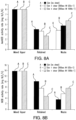
- FIGs. 8A and 8B show data of application of shear forces on the surface of granules, physically removing unwanted microbes growing on top of granules.
- shear forces were applied on the retained (212 ⁇ m) fraction containing anammox granules covered by an AerAOB/NOB layer.
- the AerAOB and NOB layer could effectively be sheared off.
- the effect was proportional to the shear force applied. This showed that applying shear in combination with selection based on size and compressibility could allow for both control of the composition of granules and their specific retention.
- the biomass retained decreased by the application of shear from 74% to 72% and 56% for the scenarios without shear, at 635 s -1 and at 1099 s -1 , respectively.
- the AerAOB activity rate for screening only based on size, screening with a first shear, and screening with a second shear is represented by columns A, B and C, respectively, for each of the mixed liquor, the retained fraction, and the waste fraction.
- the NOB activity rate for screening only based on size, screening with a first shear, and screening with a second shear is represented by columns A, B and C, respectively, for each of the mixed liquor, the retained fraction, and the waste fraction.
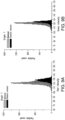
- FIG. 9 shows the use of color intensity to differentiate between particles with different performance.
- the red ( FIG. 9A ), green ( FIG. 9B ) and blue ( FIG. 9C ) intensity was measured on the retained fraction containing anammox granules (typically bright red in color) covered by an AerAOB/NOB layer (typically brown in color) and on the retained fraction after applying a shear rate of 1099 s -1 for 900 sec.
- the shear forces could increase the red intensity significantly which could be linked to more loss of AerAOB/NOB activity (see FIG. 8 ). Also in the green and blue intensity curves, a shift in intensity was observed.
- a control algorithm can be developed to modulate shear and compressibility applied.
- FIG. 10 shows that the selection of a certain particle distribution by wasting through a screen is dependant on the frequency of exposure to that screen.
- a control algorithm can be developed to modulate screening frequencies or the SRT of the process.
- a screening apparatus for selection, retention, detection and control based on size, shear, compressibility and SRT are described. Methods for selection of granules, organisms of biological origin, and chemically reactive material are considered key features of the screening device. Bioaugmentation of retained or pass through fractions of the screen are also proposed.
- the illustrated apparatus and method may be applied to an activated sludge system as an example embodiment.
- the present disclosure relates to an apparatus for selecting and retaining particles within an activated sludge system 100 ( FIG. 1a ) (or any other suitable system) for treating wastewater.
- the apparatus has a classifying screen 2 that applies a mesh-size in the range of from 10 microns to 10,000 microns, to select particles from an incoming stream 1.
- the incoming stream 1 may be mixed liquor from a tank 102, a solids recycle stream from a main solids-liquid separator 104, or an extracted waste-solids stream.
- the selected particles 4 are recycled by being returned to an upstream portion of the apparatus, for example, to the tank 102, the main solids-liquid separator 104, or the waste-solids stream. If desired, however, a portion of the selected particles 4 (i.e., a portion of the retained fraction) may be wasted to control the solids residence time of the selected particles. Thus, some of the fraction that is retained by the screening apparatus is returned to the upstream portion, partially or totally. If the fraction is only partially returned to the upstream portion, then the non-returned material may be wasted (26, FIGS. 3 and 4 ).
- the apparatus may be equipped with a device 144 ( FIG. 1b ) which compresses particles located on the upstream side of the screen 2 during screening by applying positive pressure 5 to the particles.
- the device 144 may be, for example, a pressure head connected to a spray bar.
- the apparatus may be equipped with a device 106 ( FIG. 1e ), located downstream from the screen 2, which compresses particles located on the upstream side of the screen 2 during screening by applying negative pressure 108 to the particles.
- the device 106 may be a suction head, and the vacuum 108 may be generated a suitable vacuum pump.
- the apparatus may be equipped with a mechanism which applies a shear force on the particles during screening.
- the shear force may be generated by the oscillating movement of a vibrating screen, or rotating movement of a rotating drum screen, or by a separate mixing shear device upstream of the screen 2, or by more frequent recycling of the filtrate flow 1 to the screen 2.
- the screen 2 shown in FIGS. 1a, 1b may be a vibrating screen or a rotating drum screen.
- a separate mixing device 110 located upstream of a screen 2 is illustrated schematically in FIG. 1f .
- preferential selection occurs based on resistance to shear of the material being screened.
- the more shear-resistant fraction of the material is retained (4), and the exposed shear rate or time is controlled using an analytical or detection instrument 120, manually or automatically, to optimize selection of organisms or particles.
- the instrument 120 which may be a spectrophotometer, sends signals 122 to a controller 124, and the output of the controller 124 may be used by an operator to optimize the selection of organisms or particles.
- the selected organisms or particles may be the screened constituents 4.
- the non-selected organisms or particles may enter the waste stream 3.
- the analytical or detection instrument 120 may be employed with any of the screening devices described and shown in this application.
- the analytical or detection instrument 120 may be located upstream (i.e., on the retention side) or downstream (on the pass through side) from the respective screen(s).
- the apparatus may be configured for preferential selection based on the compressibility of the material on the upstream side of the screen 2.
- the less compressible fraction is retained (4), and the particle compression is controlled manually or automatically using an analytical or detection instrument 120, cooperating with a controller 124, to optimize the selection of organisms or particles.
- the adjustment of the screen size can also be adjusted using an analytical instrument, where selected organisms or particles may be the screened constiutents 4. The non-selected organisms or particles may enter the waste stream 3.
- the present disclosure also relates to an apparatus for separating multiple solids fractions to maintain multiple solids residence times.
- the apparatus may be configured to preferentially select the fractions with a solids residence time higher than a desired threshold using classifying screens 2, and maintain the fractions with a lower solids residence time using any other solid-liquid separator.
- the sludge fractions that are retained and passed through may have relative proportions that are modulated from a minimum of 0% to a maximum of 100% by weight in order to adjust solids residence time of selected solids.
- the adjustment of solids residence times may involve a swapping of classifying screen sizes and/or solid-liquid separators for the higher and/or lower solids retention times respectively.
- the adjustment of solids residence time may involve adjusting the pore size of the screen(s) or adjusting the application of shear, compression, vacuum, vibration and/or other mechanical force to the screen(s).
- the solids residence times may be adjusted manually or automatically in response to detected readings of an analytical or detection instrument 120, cooperating with a controller 124, to optimize the selection of organisms or particles.
- the screen 2 may select for part or all of granular solids which could if needed exhibit enhanced settling properties while the same screen 2 would allow for the passage of part or all of other non-granular solids.
- the preferential selection occurs based on particle size, such that the larger size is retained and the smaller size fraction passes through.
- the preferential selection occurs based on compressibility or resistance to shear, where the less compressible or more shear resistant fraction is retained (4).
- additional shear-stress may be applied either by manipulation of the boundaries of the screens or by the liquid 5 in order to improve selection efficiency and to reduce diffusion resistance of the more shear resistant solids fraction.
- a series of screens 2, 2' is used to select an upper and lower size range for selection.
- particle sizes that are above the upper size range and below the lower size range are passed through (i.e., not selected).
- the first screen 2' may have the upper size range and the second screen 2 may have the lower size range.
- the fraction 200 that is retained by the first screen 2' enters the waste stream 3.
- the fraction 202 that is retained by the second screen 2 enters the retained stream 4.
- the fraction 204 that is not retained by the second screen 2 enters the waste stream 3.
- the relative proportions of the retained and passed-through sludge fractions 200, 202, 204 can be modulated from a minimum of 0% to a maximum of 100% by weight. Such modulation may be used to adjust solids residence time of selected solids.
- the method described above may be applied to non-granular solids, including flocculant or dispersed solids, and the granular solids may be selected and retained under aerobic, anoxic or anaerobic or a combination of these conditions.
- a classifying screen 2 can be applied at a waste sludge stream 1 which is taken either directly from a reactor (mixed liquor) or a recycle stream (RAS) at any point in a biological wastewater treatment process including in the mixed liquor, the return sludge or the waste sludge.
- a reactor mixed liquor
- RAS recycle stream
- the retained solids or pass through solids from screens 2 may be bioaugmented in other processes.
- the screened solids 4 may be of biological origin. They, for example, consist of slower-growing organisms such as anaerobic ammonia oxidizing organisms or methanogenic organisms; aerobic organisms or anoxic organisms; and/or organisms that can coexist symbiotically to develop niche fractions based on exposure to air or other substrates. According to one aspect of the present disclosure, slower-growing organisms are preferentially retained by one or more screens, and returned, partially or totally, to an upstream portion of an activated sludge process, to controllably increase the solids residence time of the slower-growing organisms relative to that of faster-growing organisms.
- the screened solids 4 may have chemically reactive properties.
- the screened solids 4 may be in the form of a resin, sorbent or catalyst, and they may be used to remove pollutants.
- an adjustment of solids residence times requires a swapping of classifying screen sizes and/or solid-liquid separators for the higher and/or lower solids residence times respectively.
Landscapes
- Life Sciences & Earth Sciences (AREA)
- Chemical & Material Sciences (AREA)
- Microbiology (AREA)
- Water Supply & Treatment (AREA)
- Organic Chemistry (AREA)
- Hydrology & Water Resources (AREA)
- Engineering & Computer Science (AREA)
- Environmental & Geological Engineering (AREA)
- Biodiversity & Conservation Biology (AREA)
- Chemical Kinetics & Catalysis (AREA)
- Molecular Biology (AREA)
- Health & Medical Sciences (AREA)
- Treatment Of Sludge (AREA)
- Activated Sludge Processes (AREA)
- Biological Treatment Of Waste Water (AREA)
- Separation Of Solids By Using Liquids Or Pneumatic Power (AREA)
- Separation Of Suspended Particles By Flocculating Agents (AREA)
- Purification Treatments By Anaerobic Or Anaerobic And Aerobic Bacteria Or Animals (AREA)
- Micro-Organisms Or Cultivation Processes Thereof (AREA)
Applications Claiming Priority (4)
| Application Number | Priority Date | Filing Date | Title |
|---|---|---|---|
| US201261703844P | 2012-09-21 | 2012-09-21 | |
| PCT/US2013/060962 WO2014047459A1 (en) | 2012-09-21 | 2013-09-20 | Method and apparatus for water treatment using screens |
| EP13839299.8A EP2897912A4 (de) | 2012-09-21 | 2013-09-20 | Verfahren und vorrichtung zur wasserbehandlung mit sieben |
| EP19215117.3A EP3699149A1 (de) | 2012-09-21 | 2013-09-20 | Verfahren und vorrichtung zur wasserbehandlung unter verwendung von sieben |
Related Parent Applications (2)
| Application Number | Title | Priority Date | Filing Date |
|---|---|---|---|
| EP13839299.8A Division EP2897912A4 (de) | 2012-09-21 | 2013-09-20 | Verfahren und vorrichtung zur wasserbehandlung mit sieben |
| EP19215117.3A Division EP3699149A1 (de) | 2012-09-21 | 2013-09-20 | Verfahren und vorrichtung zur wasserbehandlung unter verwendung von sieben |
Publications (2)
| Publication Number | Publication Date |
|---|---|
| EP4556093A2 true EP4556093A2 (de) | 2025-05-21 |
| EP4556093A3 EP4556093A3 (de) | 2025-07-23 |
Family
ID=50337849
Family Applications (3)
| Application Number | Title | Priority Date | Filing Date |
|---|---|---|---|
| EP19215117.3A Ceased EP3699149A1 (de) | 2012-09-21 | 2013-09-20 | Verfahren und vorrichtung zur wasserbehandlung unter verwendung von sieben |
| EP25169199.4A Pending EP4556093A3 (de) | 2012-09-21 | 2013-09-20 | Verfahren und vorrichtung zur wasserbehandlung mit sieben |
| EP13839299.8A Ceased EP2897912A4 (de) | 2012-09-21 | 2013-09-20 | Verfahren und vorrichtung zur wasserbehandlung mit sieben |
Family Applications Before (1)
| Application Number | Title | Priority Date | Filing Date |
|---|---|---|---|
| EP19215117.3A Ceased EP3699149A1 (de) | 2012-09-21 | 2013-09-20 | Verfahren und vorrichtung zur wasserbehandlung unter verwendung von sieben |
Family Applications After (1)
| Application Number | Title | Priority Date | Filing Date |
|---|---|---|---|
| EP13839299.8A Ceased EP2897912A4 (de) | 2012-09-21 | 2013-09-20 | Verfahren und vorrichtung zur wasserbehandlung mit sieben |
Country Status (15)
| Country | Link |
|---|---|
| US (2) | US10287195B2 (de) |
| EP (3) | EP3699149A1 (de) |
| JP (1) | JP6271559B2 (de) |
| KR (1) | KR102249604B1 (de) |
| CN (2) | CN110386663B (de) |
| AU (1) | AU2013317919B2 (de) |
| BR (1) | BR112015006444A2 (de) |
| CA (1) | CA2884724C (de) |
| IL (1) | IL237691B (de) |
| IN (1) | IN2015DN02753A (de) |
| MX (1) | MX360360B (de) |
| RU (1) | RU2666867C2 (de) |
| SG (1) | SG11201502140TA (de) |
| WO (1) | WO2014047459A1 (de) |
| ZA (1) | ZA201501742B (de) |
Families Citing this family (25)
| Publication number | Priority date | Publication date | Assignee | Title |
|---|---|---|---|---|
| CA2795589C (en) | 2010-04-09 | 2013-06-18 | 643096 Alberta Limited | Nanoflotation |
| MX376347B (es) | 2013-10-22 | 2025-03-07 | Renewable Fibers Llc Dba Rf Wastewater Llc | Reduccion de substancias en fluidos contaminados usando un medio de crecimiento biologico que ocurre de forma natural. |
| US9771276B2 (en) * | 2014-06-02 | 2017-09-26 | Jay R. Conroy | Waste stream evaluation and screen selection system |
| KR20170026495A (ko) * | 2014-06-30 | 2017-03-08 | 햄톤 로즈 새니테이션 디스트릭트 | 외부 선택을 이용한 폐수 처리 방법 및 장치 |
| NL2015286B1 (en) * | 2015-08-10 | 2017-02-28 | Haskoningdhv Nederland Bv | Continuous process for the treatment of wastewater. |
| WO2018103802A1 (en) * | 2016-12-06 | 2018-06-14 | Grundfos Holding A/S | Multi-parameter enhancement of membrane bioreactor process efficiency by biomass selection and selective biomass wasting |
| US10494282B2 (en) | 2017-04-18 | 2019-12-03 | DOOSAN Heavy Industries Construction Co., LTD | Bioreactor for treating sewage and sewage treatment system comprising the same |
| EP3612497B8 (de) * | 2017-04-21 | 2024-07-10 | BL Technologies, Inc. | Verfahren zur aufrüstung von konventionellen belebungsanlagen |
| CN108408904B (zh) * | 2018-04-27 | 2020-09-15 | 东北大学 | 一种振动式污水处理设备 |
| US11161760B2 (en) | 2018-08-13 | 2021-11-02 | Ovivo Inc. | Biomass selection and control for continuous flow granular/flocculent activated sludge processes |
| EP3837034B1 (de) * | 2018-08-13 | 2023-10-04 | Ovivo Inc. | Biomasseauswahl und -steuerung für prozesse mit kontinuierlichem strom für körnigen/flockigen aktivschlamm |
| KR102015607B1 (ko) | 2018-12-27 | 2019-08-29 | (주)전테크 | 고농도 암모니아성 질소 폐수에 함유된 질소 제거 시스템 |
| CN110183053A (zh) * | 2019-06-17 | 2019-08-30 | 北京中科国润环保科技有限公司 | 一种利用高浓度有机废水制备环保脱硝剂的系统及方法 |
| AU2021232837A1 (en) * | 2020-09-21 | 2022-04-07 | Ovivo Inc. | Biomass selection and control for continuous flow granular/flocculent activated sludge processes |
| EP4304993A4 (de) | 2021-03-12 | 2025-02-19 | Hampton Roads Sanitation District | Verfahren und vorrichtung zur nährstoffentfernung unter verwendung anoxischer biofilme |
| JP7611432B2 (ja) * | 2021-03-12 | 2025-01-09 | ハンプトン ローズ サニテーション ディストリクト | 水または廃水処理における多重選択解除のための方法および装置 |
| CN113149349A (zh) * | 2021-04-06 | 2021-07-23 | 同济大学 | 一种利用旋流分离和筛分评价富集厌氧氨氧化颗粒菌的方法 |
| CN113264612B (zh) * | 2021-05-28 | 2023-03-21 | 上海市政工程设计研究总院(集团)有限公司 | 一种污水碳源分级回收方法 |
| JP7339689B2 (ja) * | 2021-12-22 | 2023-09-06 | 株式会社昭和衛生センター | 担体分離回収装置 |
| WO2023158160A1 (ko) * | 2022-02-17 | 2023-08-24 | 주식회사 부강테크 | 슬러지의 입상화를 가속하는 장치 및 방법 |
| AT526134B1 (de) * | 2022-05-02 | 2024-03-15 | Gassner Ing Kurt | Diskontinuierliches abwasserreinigungsverfahren |
| CN115193861A (zh) * | 2022-05-19 | 2022-10-18 | 中铁二院工程集团有限责任公司 | 一种隧道洞渣原位回收处理系统及处理方法 |
| EP4282832A1 (de) * | 2022-05-25 | 2023-11-29 | Arnold Jäger Holding GmbH | Verfahren und system zum erzeugen von granularem schlamm |
| CN117658309A (zh) * | 2022-08-31 | 2024-03-08 | 金风环保有限公司 | 活性污泥分选方法和污水处理方法 |
| CN116835759A (zh) * | 2023-08-18 | 2023-10-03 | 南京大学 | 一种用于辅助污水处理系统调控的污泥监测装置及方法 |
Citations (9)
| Publication number | Priority date | Publication date | Assignee | Title |
|---|---|---|---|---|
| US3959124A (en) | 1974-07-15 | 1976-05-25 | Sweco, Inc. | Method and apparatus for the activated sludge treatment of wastewater |
| US4541933A (en) | 1984-05-14 | 1985-09-17 | Armold Clark W | Process for separation of ash from waste activated sludge |
| US5458779A (en) | 1990-01-23 | 1995-10-17 | Kaldnes Miljoteknologi A/S | Method for purification of water |
| US5824222A (en) | 1995-11-08 | 1998-10-20 | Micronair, Llc | Method for removing suspended inert solids from a waste stream |
| US6814868B2 (en) | 2001-06-28 | 2004-11-09 | Zenon Environmental Inc. | Process for reducing concentrations of hair, trash, or fibrous materials, in a waste water treatment system |
| US6821425B2 (en) | 2002-02-06 | 2004-11-23 | U.S. Environmental Protection Agency | Biomass concentrator reactor |
| US7569147B2 (en) | 2005-09-02 | 2009-08-04 | Siemens Water Technologies Corp. | Screening of inert solids from a low-yield wastewater treatment process |
| US7854843B2 (en) | 2004-11-22 | 2010-12-21 | Entex Technologies Inc. | Wastewater treatment method |
| US20110198284A1 (en) | 2008-09-12 | 2011-08-18 | Cyklar-Stulz Abwassertechnik Gmbh | Method for the treatment of wastewater containing ammonia |
Family Cites Families (46)
| Publication number | Priority date | Publication date | Assignee | Title |
|---|---|---|---|---|
| DE1468487A1 (de) | 1962-05-29 | 1969-01-30 | Power Gas Ltd | Mehrstufenverfahren zum Kristallisieren einer waessrigen Loesung von Benzoesaeure |
| DE2063891B1 (de) | 1970-12-24 | 1972-01-05 | Siemens Ag | Vorrichtung zum Abscheiden von Feststoffen aus Flüssigkeiten in einer Rohrleitung |
| SU778804A1 (ru) * | 1975-10-27 | 1980-11-15 | Комплексный Научно-Исследовательский И Проектно-Конструкторский Институт Обогащения Твердых Горных Ископаемых | Гидравлический классификатор |
| US4014747A (en) | 1975-12-04 | 1977-03-29 | Kenyon Charles L | Cartridge for a bacteria screening device for continuously monitoring and recording the existence of air borne bacteria and other microorganisms |
| NZ182084A (en) | 1976-09-17 | 1981-02-11 | Contra Shear Holdings | Rotating drum screen |
| JPS54147655A (en) * | 1978-05-11 | 1979-11-19 | Inoue Japax Res Inc | Sludge condition discriminating method |
| US4725364A (en) | 1982-04-05 | 1988-02-16 | Basf Corporation | Laminar flow filtration process |
| US4619761A (en) * | 1984-12-20 | 1986-10-28 | Koppers Company, Inc. | Method for screening or fractionation |
| JPH0199622A (ja) * | 1987-10-12 | 1989-04-18 | Shinichi Nakamura | 液体の多重層濾過装置 |
| RU2003375C1 (ru) * | 1990-11-11 | 1993-11-30 | Виктор Никифорович Шохнин | Гидравлический классификатор |
| CN2166870Y (zh) | 1993-03-06 | 1994-06-01 | 吴凯平 | 真空式固液分离机 |
| US5361909A (en) | 1993-03-31 | 1994-11-08 | Gemmer Bradley K | Waste aggregate mass density separator |
| US5514278A (en) * | 1993-04-12 | 1996-05-07 | Khudenko; Boris M. | Counterflow microbiological processes |
| US5397755A (en) | 1993-06-29 | 1995-03-14 | W. R. Grace & Co.-Conn. | Low density glassy materials for bioremediation supports |
| JPH08177029A (ja) * | 1994-12-22 | 1996-07-09 | Hitachi Kiden Kogyo Ltd | スクリーン移動式除塵機の運転方法 |
| US5910245A (en) | 1997-01-06 | 1999-06-08 | Ieg Technologies Corp. | Bioremediation well and method for bioremediation treatment of contaminated water |
| JP3373136B2 (ja) * | 1997-06-25 | 2003-02-04 | 株式会社荏原製作所 | 水処理方法及び汚泥処理方法 |
| JP2000343098A (ja) | 1999-06-07 | 2000-12-12 | Shin Meiwa Ind Co Ltd | 汚泥破砕装置及び有機性汚水の処理装置 |
| AT408750B (de) * | 2000-03-10 | 2002-02-25 | Va Tech Wabag Gmbh | Verfahren und vorrichtung zur abwasserreinigung |
| JP3563319B2 (ja) * | 2000-03-16 | 2004-09-08 | 株式会社西原環境テクノロジー | スクリーン式固液分離機を備えた酵母反応槽 |
| US6569335B1 (en) | 2000-07-13 | 2003-05-27 | Walter S. Johnson | Wastewater treatment control method and apparatus |
| JP2003093908A (ja) | 2001-09-26 | 2003-04-02 | Unitika Ltd | 湿式媒体攪拌式ミル及びそれを用いた汚泥の破砕方法 |
| JP2003299916A (ja) * | 2002-04-11 | 2003-10-21 | Matsushita Electric Ind Co Ltd | 液体濾過装置 |
| US6558550B1 (en) | 2002-04-26 | 2003-05-06 | Robert J. Kelly | Process for treating septage |
| IL151745A (en) | 2002-09-12 | 2007-10-31 | Uzi Sharon | Explosive detection and detection system |
| JP3968589B2 (ja) * | 2004-05-14 | 2007-08-29 | 株式会社日立プラントテクノロジー | 菌体回収方法、装置及び馴養方法並びに廃水処理装置 |
| JP2005349304A (ja) | 2004-06-10 | 2005-12-22 | Mitsubishi Rayon Eng Co Ltd | 余剰汚泥減容化方法および余剰汚泥減容化装置 |
| JP2006035069A (ja) | 2004-07-26 | 2006-02-09 | Hitachi Plant Eng & Constr Co Ltd | 汚泥処理装置及びそれを備えた廃水処理装置 |
| US7481934B2 (en) * | 2006-01-20 | 2009-01-27 | Renewable Fibers, Llc | Methods for treatment of wastewater with powdered natural lignocellulosic material |
| KR100794850B1 (ko) | 2006-01-20 | 2008-01-15 | 문일성 | 차속 조정이 가능한 고액 분리기 |
| WO2007128795A2 (en) | 2006-05-05 | 2007-11-15 | Erysave Ab | Method for separation |
| CN101479200B (zh) * | 2006-07-06 | 2012-06-13 | 株式会社日立工业设备技术 | 截留固定化沉淀物、利用所述截留固定化沉淀物的废水处理系统和废水处理方法 |
| US20110036771A1 (en) | 2007-01-09 | 2011-02-17 | Steven Woodard | Ballasted anaerobic system and method for treating wastewater |
| US7794597B2 (en) | 2007-06-22 | 2010-09-14 | Big Fish Environmental, Llc | Treatment of waste mixture containing liquids and solids |
| MY159071A (en) | 2007-12-19 | 2016-12-15 | Saudi Arabian Oil Co | Suspended media granular activated carbon membrane biological reactor system and process |
| DE102008021190A1 (de) * | 2008-04-29 | 2009-11-05 | Microdyn - Nadir Gmbh | Verfahren zur Reinigung von Filtrationsmembranmodul sowie Membranbioreaktor-System zum Aufbereiten von Roh- oder Abwasser bzw. Belebtschlamm |
| US20090324790A1 (en) * | 2008-06-27 | 2009-12-31 | Ecolab Inc. | Methods and systems for reconditioning food processing fluids |
| US7611632B1 (en) | 2008-11-07 | 2009-11-03 | General Electric Company | Method of conditioning mixed liquor using a tannin containing polymer |
| TWI568687B (zh) * | 2009-06-15 | 2017-02-01 | 沙烏地阿拉伯油品公司 | 包含懸浮系統與多重生物反應器區域的經懸浮介質膜生物反應器系統及方法 |
| CN102548912B (zh) | 2009-07-08 | 2015-06-17 | 沙特阿拉伯石油公司 | 包括主要固体的辐射的废水处理系统和方法 |
| US8685252B2 (en) | 2010-02-04 | 2014-04-01 | Dxv Water Technologies, Llc | Water treatment systems and methods |
| JP5687034B2 (ja) * | 2010-11-17 | 2015-03-18 | 株式会社フジタ | 活性汚泥処理システム |
| CA2850078A1 (en) | 2011-09-16 | 2013-03-21 | Babak Rezania | Methods and apparatus for nitrogen removal from wastewater |
| US8564401B2 (en) | 2011-09-19 | 2013-10-22 | Disney Enterprises, Inc. | Airport security screening system and method |
| US20130277302A1 (en) | 2012-04-24 | 2013-10-24 | Klaus Doelle | Water treatment system |
| US20140309607A1 (en) | 2013-04-10 | 2014-10-16 | Kimberly-Clark Worldwide, Inc. | Absorbent Article Containing A Particulate Superabsorbent Polymer Composition Having Improved Stability |
-
2013
- 2013-09-20 KR KR1020157010139A patent/KR102249604B1/ko active Active
- 2013-09-20 IN IN2753DEN2015 patent/IN2015DN02753A/en unknown
- 2013-09-20 SG SG11201502140TA patent/SG11201502140TA/en unknown
- 2013-09-20 BR BR112015006444-2A patent/BR112015006444A2/pt active IP Right Grant
- 2013-09-20 JP JP2015533225A patent/JP6271559B2/ja active Active
- 2013-09-20 EP EP19215117.3A patent/EP3699149A1/de not_active Ceased
- 2013-09-20 US US14/032,952 patent/US10287195B2/en active Active
- 2013-09-20 EP EP25169199.4A patent/EP4556093A3/de active Pending
- 2013-09-20 EP EP13839299.8A patent/EP2897912A4/de not_active Ceased
- 2013-09-20 WO PCT/US2013/060962 patent/WO2014047459A1/en not_active Ceased
- 2013-09-20 CN CN201910522368.7A patent/CN110386663B/zh active Active
- 2013-09-20 AU AU2013317919A patent/AU2013317919B2/en active Active
- 2013-09-20 CA CA2884724A patent/CA2884724C/en active Active
- 2013-09-20 RU RU2015114778A patent/RU2666867C2/ru active
- 2013-09-20 CN CN201380049244.2A patent/CN104854039A/zh active Pending
- 2013-09-20 MX MX2015003645A patent/MX360360B/es active IP Right Grant
- 2013-09-23 US US14/033,686 patent/US9802847B2/en active Active
-
2015
- 2015-03-12 IL IL23769115A patent/IL237691B/en active IP Right Grant
- 2015-03-13 ZA ZA2015/01742A patent/ZA201501742B/en unknown
Patent Citations (9)
| Publication number | Priority date | Publication date | Assignee | Title |
|---|---|---|---|---|
| US3959124A (en) | 1974-07-15 | 1976-05-25 | Sweco, Inc. | Method and apparatus for the activated sludge treatment of wastewater |
| US4541933A (en) | 1984-05-14 | 1985-09-17 | Armold Clark W | Process for separation of ash from waste activated sludge |
| US5458779A (en) | 1990-01-23 | 1995-10-17 | Kaldnes Miljoteknologi A/S | Method for purification of water |
| US5824222A (en) | 1995-11-08 | 1998-10-20 | Micronair, Llc | Method for removing suspended inert solids from a waste stream |
| US6814868B2 (en) | 2001-06-28 | 2004-11-09 | Zenon Environmental Inc. | Process for reducing concentrations of hair, trash, or fibrous materials, in a waste water treatment system |
| US6821425B2 (en) | 2002-02-06 | 2004-11-23 | U.S. Environmental Protection Agency | Biomass concentrator reactor |
| US7854843B2 (en) | 2004-11-22 | 2010-12-21 | Entex Technologies Inc. | Wastewater treatment method |
| US7569147B2 (en) | 2005-09-02 | 2009-08-04 | Siemens Water Technologies Corp. | Screening of inert solids from a low-yield wastewater treatment process |
| US20110198284A1 (en) | 2008-09-12 | 2011-08-18 | Cyklar-Stulz Abwassertechnik Gmbh | Method for the treatment of wastewater containing ammonia |
Also Published As
| Publication number | Publication date |
|---|---|
| JP6271559B2 (ja) | 2018-01-31 |
| RU2666867C2 (ru) | 2018-09-12 |
| RU2015114778A (ru) | 2016-11-10 |
| IL237691A0 (en) | 2015-05-31 |
| IN2015DN02753A (de) | 2015-08-28 |
| EP4556093A3 (de) | 2025-07-23 |
| MX2015003645A (es) | 2015-09-25 |
| MX360360B (es) | 2018-10-30 |
| EP3699149A1 (de) | 2020-08-26 |
| EP2897912A4 (de) | 2016-06-15 |
| US20140083936A1 (en) | 2014-03-27 |
| KR102249604B1 (ko) | 2021-05-10 |
| KR20150086239A (ko) | 2015-07-27 |
| CN110386663A (zh) | 2019-10-29 |
| US9802847B2 (en) | 2017-10-31 |
| IL237691B (en) | 2019-11-28 |
| CN104854039A (zh) | 2015-08-19 |
| CA2884724C (en) | 2022-06-21 |
| US20140131273A1 (en) | 2014-05-15 |
| EP2897912A1 (de) | 2015-07-29 |
| AU2013317919B2 (en) | 2017-04-27 |
| SG11201502140TA (en) | 2015-04-29 |
| WO2014047459A1 (en) | 2014-03-27 |
| CN110386663B (zh) | 2023-03-21 |
| ZA201501742B (en) | 2015-12-23 |
| US10287195B2 (en) | 2019-05-14 |
| JP2015533642A (ja) | 2015-11-26 |
| CA2884724A1 (en) | 2014-03-27 |
| AU2013317919A1 (en) | 2015-03-26 |
| BR112015006444A2 (pt) | 2019-12-17 |
Similar Documents
| Publication | Publication Date | Title |
|---|---|---|
| CA2884724C (en) | Method and apparatus for water treatment using screens | |
| Han et al. | Uncoupling the solids retention times of flocs and granules in mainstream deammonification: A screen as effective out-selection tool for nitrite oxidizing bacteria | |
| EP3483123B1 (de) | Verfahren und vorrichtung zur abwasserbearbeitung mit gravimetrischer auswahl | |
| US20100133196A1 (en) | Combined gravity separation-filtration for conducting treatment processes in solid-liquid systems | |
| US20210230033A1 (en) | Treatment using fixed film processes and ballasted settling | |
| JP6630054B2 (ja) | 排水処理方法及び排水処理装置 | |
| US20160002083A1 (en) | Micro-sieve separation and cod diversion in wastewater treatment | |
| US6793823B2 (en) | Wastewater solids removal methods | |
| CA2881960C (en) | Wastewater overflow systems and methods | |
| KR20010108206A (ko) | 폐수의 부유물 및 기타 물질의 제거 공정 | |
| EP3366649A1 (de) | Abwasserbehandlungslinien für verbesserte kohlenstoffaufnahme durch kuchenfiltration von abwasser | |
| HK1228366A1 (en) | Method and apparatus for wastewater treatment using gravimetric selection |
Legal Events
| Date | Code | Title | Description |
|---|---|---|---|
| PUAI | Public reference made under article 153(3) epc to a published international application that has entered the european phase |
Free format text: ORIGINAL CODE: 0009012 |
|
| STAA | Information on the status of an ep patent application or granted ep patent |
Free format text: STATUS: THE APPLICATION HAS BEEN PUBLISHED |
|
| AC | Divisional application: reference to earlier application |
Ref document number: 2897912 Country of ref document: EP Kind code of ref document: P Ref document number: 3699149 Country of ref document: EP Kind code of ref document: P |
|
| AK | Designated contracting states |
Kind code of ref document: A2 Designated state(s): AL AT BE BG CH CY CZ DE DK EE ES FI FR GB GR HR HU IE IS IT LI LT LU LV MC MK MT NL NO PL PT RO RS SE SI SK SM TR |
|
| REG | Reference to a national code |
Ref country code: DE Ref legal event code: R079 Free format text: PREVIOUS MAIN CLASS: B01D0036000000 Ipc: C02F0003120000 |
|
| PUAL | Search report despatched |
Free format text: ORIGINAL CODE: 0009013 |
|
| AK | Designated contracting states |
Kind code of ref document: A3 Designated state(s): AL AT BE BG CH CY CZ DE DK EE ES FI FR GB GR HR HU IE IS IT LI LT LU LV MC MK MT NL NO PL PT RO RS SE SI SK SM TR |
|
| RIC1 | Information provided on ipc code assigned before grant |
Ipc: C02F 3/12 20230101AFI20250616BHEP Ipc: C02F 3/00 20230101ALI20250616BHEP Ipc: B01D 36/00 20060101ALI20250616BHEP Ipc: C02F 3/30 20230101ALN20250616BHEP |