EP4545740A2 - Modul und befestigungssystem - Google Patents
Modul und befestigungssystem Download PDFInfo
- Publication number
- EP4545740A2 EP4545740A2 EP24215157.9A EP24215157A EP4545740A2 EP 4545740 A2 EP4545740 A2 EP 4545740A2 EP 24215157 A EP24215157 A EP 24215157A EP 4545740 A2 EP4545740 A2 EP 4545740A2
- Authority
- EP
- European Patent Office
- Prior art keywords
- magnet
- module
- door
- window
- securing member
- Prior art date
- Legal status (The legal status is an assumption and is not a legal conclusion. Google has not performed a legal analysis and makes no representation as to the accuracy of the status listed.)
- Pending
Links
Images










Classifications
-
- E—FIXED CONSTRUCTIONS
- E05—LOCKS; KEYS; WINDOW OR DOOR FITTINGS; SAFES
- E05B—LOCKS; ACCESSORIES THEREFOR; HANDCUFFS
- E05B45/00—Alarm locks
- E05B45/06—Electric alarm locks
-
- E—FIXED CONSTRUCTIONS
- E05—LOCKS; KEYS; WINDOW OR DOOR FITTINGS; SAFES
- E05B—LOCKS; ACCESSORIES THEREFOR; HANDCUFFS
- E05B47/00—Operating or controlling locks or other fastening devices by electric or magnetic means
- E05B47/0038—Operating or controlling locks or other fastening devices by electric or magnetic means using permanent magnets
-
- E—FIXED CONSTRUCTIONS
- E05—LOCKS; KEYS; WINDOW OR DOOR FITTINGS; SAFES
- E05B—LOCKS; ACCESSORIES THEREFOR; HANDCUFFS
- E05B9/00—Lock casings or latch-mechanism casings ; Fastening locks or fasteners or parts thereof to the wing
-
- E—FIXED CONSTRUCTIONS
- E05—LOCKS; KEYS; WINDOW OR DOOR FITTINGS; SAFES
- E05B—LOCKS; ACCESSORIES THEREFOR; HANDCUFFS
- E05B9/00—Lock casings or latch-mechanism casings ; Fastening locks or fasteners or parts thereof to the wing
- E05B9/08—Fastening locks or fasteners or parts thereof, e.g. the casings of latch-bolt locks or cylinder locks to the wing
-
- E—FIXED CONSTRUCTIONS
- E05—LOCKS; KEYS; WINDOW OR DOOR FITTINGS; SAFES
- E05C—BOLTS OR FASTENING DEVICES FOR WINGS, SPECIALLY FOR DOORS OR WINDOWS
- E05C19/00—Other devices specially designed for securing wings, e.g. with suction cups
- E05C19/06—Other devices specially designed for securing wings, e.g. with suction cups in which the securing part if formed or carried by a spring and moves only by distortion of the spring, e.g. snaps
-
- G—PHYSICS
- G08—SIGNALLING
- G08B—SIGNALLING OR CALLING SYSTEMS; ORDER TELEGRAPHS; ALARM SYSTEMS
- G08B13/00—Burglar, theft or intruder alarms
- G08B13/02—Mechanical actuation
- G08B13/08—Mechanical actuation by opening, e.g. of door, of window, of drawer, of shutter, of curtain, of blind
-
- H—ELECTRICITY
- H05—ELECTRIC TECHNIQUES NOT OTHERWISE PROVIDED FOR
- H05K—PRINTED CIRCUITS; CASINGS OR CONSTRUCTIONAL DETAILS OF ELECTRIC APPARATUS; MANUFACTURE OF ASSEMBLAGES OF ELECTRICAL COMPONENTS
- H05K5/00—Casings, cabinets or drawers for electric apparatus
- H05K5/02—Details
- H05K5/0204—Mounting supporting structures on the outside of casings
-
- E—FIXED CONSTRUCTIONS
- E05—LOCKS; KEYS; WINDOW OR DOOR FITTINGS; SAFES
- E05B—LOCKS; ACCESSORIES THEREFOR; HANDCUFFS
- E05B45/00—Alarm locks
- E05B45/06—Electric alarm locks
- E05B2045/065—Switch or sensor type used in alarm locks
- E05B2045/0665—Magnetic switches, e.g. reed- or hall-switch
-
- E—FIXED CONSTRUCTIONS
- E05—LOCKS; KEYS; WINDOW OR DOOR FITTINGS; SAFES
- E05B—LOCKS; ACCESSORIES THEREFOR; HANDCUFFS
- E05B45/00—Alarm locks
- E05B45/06—Electric alarm locks
- E05B2045/0695—Actuation of a lock triggering an alarm system, e.g. an alarm system of a building
-
- E—FIXED CONSTRUCTIONS
- E05—LOCKS; KEYS; WINDOW OR DOOR FITTINGS; SAFES
- E05B—LOCKS; ACCESSORIES THEREFOR; HANDCUFFS
- E05B47/00—Operating or controlling locks or other fastening devices by electric or magnetic means
- E05B2047/0048—Circuits, feeding, monitoring
- E05B2047/0067—Monitoring
- E05B2047/0068—Door closed
-
- E—FIXED CONSTRUCTIONS
- E05—LOCKS; KEYS; WINDOW OR DOOR FITTINGS; SAFES
- E05B—LOCKS; ACCESSORIES THEREFOR; HANDCUFFS
- E05B47/00—Operating or controlling locks or other fastening devices by electric or magnetic means
- E05B2047/0048—Circuits, feeding, monitoring
- E05B2047/0067—Monitoring
- E05B2047/0069—Monitoring bolt position
-
- E—FIXED CONSTRUCTIONS
- E05—LOCKS; KEYS; WINDOW OR DOOR FITTINGS; SAFES
- E05B—LOCKS; ACCESSORIES THEREFOR; HANDCUFFS
- E05B47/00—Operating or controlling locks or other fastening devices by electric or magnetic means
- E05B2047/0089—Operating or controlling locks or other fastening devices by electric or magnetic means with electronic learning functions
-
- E—FIXED CONSTRUCTIONS
- E05—LOCKS; KEYS; WINDOW OR DOOR FITTINGS; SAFES
- E05B—LOCKS; ACCESSORIES THEREFOR; HANDCUFFS
- E05B47/00—Operating or controlling locks or other fastening devices by electric or magnetic means
- E05B2047/0092—Operating or controlling locks or other fastening devices by electric or magnetic means including means for preventing manipulation by an external magnetic field, e.g. preventing opening by using a strong magnet
-
- E—FIXED CONSTRUCTIONS
- E05—LOCKS; KEYS; WINDOW OR DOOR FITTINGS; SAFES
- E05B—LOCKS; ACCESSORIES THEREFOR; HANDCUFFS
- E05B47/00—Operating or controlling locks or other fastening devices by electric or magnetic means
- E05B2047/0094—Mechanical aspects of remotely controlled locks
Definitions
- Embodiments of the present invention relate to a module for use in determining the condition of a lock or latch mechanism of a door or window, along with associated systems and methods, and an attachment system for use in coupling a module of the system (including a sensor) to a frame member, to a module (including a sensor), a securing member, and to various associated methods.
- a door or window may be in at least one of four conditions - open, closed, unlocked and locked.
- a homeowner or another person may want to check the status of the door or window without having to test the door or window manually - for example, they may wish to check the status while away from home.
- Sensors are available which sense the condition of a door or window, and which communicate this to another device (via which the user can determine the condition of the door or window).
- the present invention seeks to provide an improved attachment system for a door or window frame.
- a door or window including: a lock or latch mechanism actuatable between a locked and an unlocked condition; a system configured to determine the condition of the lock or latch mechanism, the system including: a module including first and second sensor units; a magnet configured to be attached to a part of the lock or latch mechanism such that the magnet moves along a magnet path with actuation of the lock or latch mechanism, the magnet having a magnetic axis which is directionally aligned with the magnet path, the magnet path passing both of the first and second sensor units, such that the module is configured to determine a current condition of the lock or latch mechanism by using the first and second sensor units to sense changes in a polarity of a sensed magnetic field generated by the magnet as the magnet moves along the magnet path.
- the magnet path may extend from a first side of both the first and second sensor units to a second side of both the first and second sensor units.
- the orientation of the magnet may be reversible with respect to the module and the module may include a controller which is configured to learn an orientation of the magnet using the first and second sensor units.
- the controller may be further configured to generate a tamper alert in response to the first and/or second sensor units detecting a magnetic field from an external magnet.
- the module may be configured to be attached to a first frame member of the door or window and the magnet may be configured to be attached to a second frame member of the door or window, the first and second frame members may be positioned adjacent each other when the window or door is in a closed condition, the first and second frame members may be configured to move apart from each other as the window or door moves towards an open condition, and the first and second sensor units may be configured to detect movement of the magnet away from the module to determine movement of the window or door to the open condition.
- the magnet path may be a substantially linear path.
- a module for use in determining the condition of a latch or lock mechanism of a door or window including: first and second sensor units configured to sense changes in a polarity of a sensed magnetic field of a magnet as the magnet moves along a magnet path, the magnet moving along the magnet path with actuation of a lock or latch mechanism between an unlocked and a locked condition, the magnet having a magnetic axis which is directionally aligned with the magnet path and the magnet path passing both of the first and second sensor units, such that the module determines a current condition of the lock or latch mechanism by using the sensed changes in the sensed polarity of a magnetic field generated by the magnet as the magnet moves along the magnet path.
- the module may be configured such that the magnet path extends from a first side of both the first and second sensor units to a second side of both the first and second sensor units.
- the orientation of the magnet may be reversible with respect to the module and the module includes a controller which is configured to learn an orientation of the magnet using the first and second sensor units.
- the controller may be further configured to generate a tamper alert in response to the first and/or second sensor units detecting a magnetic field from an external magnet.
- the module may be configured to be attached to a first frame member of the door or window, with the magnet attached to a second frame member of the door or window, the first and second frame members may be positioned adjacent each other when the window or door is in a closed condition, the first and second frame members may be configured to move apart from each other as the window or door moves towards an open condition, and the first and second sensor units may be configured to detect movement of the magnet away from the module to determine movement of the window or door to the open condition.
- the magnet path may be a substantially linear path.
- Another aspect provides a method of operating a system in relation to a window or door having a lock or latch mechanism actuatable between a locked and an unlocked condition, the method including: providing a module including first and second sensor units; securing the module to a part of the window or door; providing a magnet configured to be attached to a part of the lock or latch mechanism such that the magnet moves along a magnet path with actuation of the lock or latch mechanism, the magnet having a magnetic axis which is directionally aligned with the magnet path, the magnet path passing both of the first and second sensor units; attaching the magnet to the part of the lock or latch mechanism; using the module to determine a current condition of the lock or latch mechanism by using the first and second sensor units to sense changes in a polarity of a sensed magnetic field generated by the magnet as the magnet moves along the magnet path.
- the magnet path may extend from a first side of both the first and second sensor units to a second side of both the first and second sensor units.
- the orientation of the magnet may be reversible with respect to the module, and the method may further include using a controller of the module to learn an orientation of the magnet using the first and second sensor units.
- a method may further include using the controller to generate a tamper alert in response to the first and/or second sensor units detecting a magnetic field from an external magnet.
- Securing the module to a part of the window or door may include attaching the module to a first frame member of the door or window, attaching the magnet to the part of the lock or latch mechanism includes attaching the magnet to a second frame member of the door or window, the first and second frame members being positioned adjacent each other when the window or door is in a closed condition, the first and second frame members being configured to move apart from each other as the window or door moves towards an open condition, and the method further including using the first and second sensor units to detect movement of the magnet away from the module to determine movement of the window or door to the open condition.
- the magnet path may be a substantially linear path.
- an attachment system for a door or window configured to sense a condition of a door or window
- the attachment system including: a securing member configured to be mounted to a frame member of the door or window; and a module, configured to be coupled to a frame member by attachment to the securing member, the module including a sensor to sense the condition of the door or window, and the securing member including a resiliently biased clip configured to retain the module in attachment to the securing member selectively, wherein the securing member is configured to space the module from at least part of the frame member such that the sensor is positioned to sense the condition of the door or window.
- the securing member may be a substantially planar member.
- the securing member may include fixing arrangement to secure the securing member to the frame member.
- the fixing arrangement may include a fixing element and a fixing receiver, the fixing element may be configured to be received by the fixing receiver and to engage the frame member.
- the securing member may include a body defining one or more grooves, the or each groove may be configured to receive at least part of the frame member.
- the securing member may include a receiving configuration and the module may include one or more pins, the or each pin may be configured to be received by the receiving configuration, and the resilient clip may be configured to inhibit the removal of the or each pin from the receiving configuration selectively.
- the receiving configuration may include an inclined locking surface configured to engage and guide part of at least one of the or each pin.
- the resilient clip may include a drive surface and a latch surface
- the module may include a latch element including a drive surface and a latch surface
- the latch surfaces of the resilient clip and latch element may be configured to engage as the module is secured to the securing member such that the latch surfaces of the resilient clip and latch element engage.
- the resilient clip may be part of a coupling configuration of the securing member which further includes an elongate member and an actuation portion, wherein manual operation of the actuation portion may be configured to move at least part of the elongate member to release the resilient clip.
- the sensor may be a reed switch.
- the sensor may be a mechanical switch.
- Another aspect provides a door or window including an attachment system.
- the securing arrangement may be configured to fit between a frame of the door or window and a moveable panel of the door or window, such that the moveable panel may be moveable between open and closed conditions without the securing member fouling this operation of the door or window.
- the securing member may be inaccessible when the door or window is in the closed condition.
- the moveable panel may be configured to move with respect to the frame member when the door or window may be operated between the open and closed conditions.
- the moveable panel may be configured to move with the frame member when the door or window is operated between the open and closed conditions.
- Another aspect provides a door or window including a frame member and a securing member, wherein the securing member is suitable for use in an attachment system.
- Another aspect provides a method of manufacturing a door or window including: providing a frame member; and securing a securing member to the frame member, wherein the door or window is a door or window as above.
- Another aspect provides a method of fitting a door or window including: providing a frame member; and securing a securing member to the frame member, wherein the door or window is a door or window as above.
- Another aspect provides a method of fitting a module to a door or window, including: identifying a door or window as above; proving a module; and fitting the module to the securing member.
- the method may further include operating the door or window to an open condition before fitting the module to the securing member.
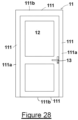
- a door or window 1 may be provided (see figure 28 , for example).
- the door or window 1 may include a frame 11 and a moveable panel 12 (the moveable panel 12 being moveable with respect to at least part of the frame 11).
- the frame 11 may include one or more frame members 111.
- the one or more frame members 111 may define an aperture of the door or window 1.
- the one or more frame members 111 may surround a perimeter of the aperture of the door or window 1.
- the aperture is generally rectangular, or square, or circular (but may be any suitable shape).
- Each of the one or more frame members 111 may extend along a portion of the perimeter of the aperture of the door or window 1.
- the frame 11 may include a first pair of frame members 111a, each frame member 111 of the first pair 111a being arranged generally parallel to the other frame member 111 of the first pair 111a.
- the frame members 111 of the first pair 111a may be of substantially the same length and may be separated from each other across a width of the aperture.
- the length of the first pair of frame members 111a may define a height of the aperture.
- the frame 11 may include a second pair of frame members 111b, each frame member 111 of the second pair 111b being arranged generally parallel to the other frame member 111 of the second pair 111b.
- the frame members 111 of the second pair 111b may be of substantially the same length and may be separated from each other across a height of the aperture.
- the length of the second pair of frame members 111b may define a width of the aperture.
- the first pair of frame members 111a may be substantially perpendicular to the second pair of frame members 111b.
- the panel 12 may be mounted to the frame 11 such that the panel 12 is rotatable with respect to at least one frame member 111 of the frame 11. In some embodiments, the panel 12 is mounted to the frame 11 using a hinge mechanism. In some embodiments, the panel 12 is mounted for rotation with respect to (and may be about an axis defined by) a one of the first pair of frame members 111a or a one of the second pair of frame members 111b.
- the panel 12 may be moveable between open and closed conditions with respect to the frame 11 (e.g. by rotation with respect to at least one frame member 111).
- the door or window aperture In the open condition, the door or window aperture is at least partially open such that passage through the aperture is permitted.
- In the closed condition, the door or window aperture In the closed condition, the door or window aperture is closed or substantially closed such that passage through the aperture is inhibited or substantially prevented.
- the passage may be of a person or an object, for example.
- the door or window 1 may include a lock or latch mechanism 13 (which may be a lock and latch mechanism).
- the lock or latch mechanism 13 may be configured to be actuated between a locked condition and an unlocked condition. In the locked condition, with the panel 12 in the closed condition, the panel 12 is restricted or substantially prevented from moving to the open condition. In the unlocked condition, the panel 12 may be permitted to move towards the open condition.
- the locked and unlocked conditions of the lock or latch mechanism 13, therefore, may correspond to locked and unlocked conditions of the door or window.
- the lock or latch mechanism 13 is a lock mechanism and a key may be required to actuate the lock mechanism between the locked and unlocked conditions.
- the lock or latch mechanism 13 is a latch mechanism and a handle may be provided (as part of the latch mechanism) which may actuate the latch mechanism between the locked (or latched) condition and the unlocked (or unlatched) condition - the latch mechanism may not require a key for such actuation.
- the lock or latch mechanism 13 is a lock and latch mechanism such that the mechanism can be actuated between (i) a latched and locked condition, (ii) a latched and unlocked condition, and (ii) an unlocked and unlatched condition.
- the reference to a locked condition may include a latched condition and the reference to a unlocked condition may include an unlatched condition (irrespective of whether this is also a reference to a locked and unlocked condition).
- the lock or latch mechanism 13 could take a number of different forms.
- the lock or latch mechanism 13 may include at least one first member moveable with respect to a second member between the unlocked/unlatched and locked/latched conditions.
- the first member may be a bolt and the second member may be a keep.
- the first member is mounted on a locking bar (e.g. rail) and may be in the form of a pin, whilst the second member may be a receiver for the pin (to receive and retain the pin).
- the first member may be mounted to the panel 12 and the second member may be mounted to the frame 11 or vice versa.
- Other lock or latch mechanisms 13 are envisaged but will generally include a first member which moves with respect to a second member, which then receives the first member in the locked condition and releases the first member in the unlocked condition.
- At least part of the frame (such as a frame member 111) is, in fact, part of another moveable panel 12 (e.g. in a multi-door arrangement) - the aperture of the door or window 1 being defined by another frame 11, for example.
- the first member may be mounted to a first panel and the second member to a second panel (the two panels being general adjacent each other when in the closed conditions).
- the frame member 111 is part of the moveable panel 12 and moves therewith. In such embodiments a further frame 11 may be provided to define the aperture of the door or window 1.
- the frame member 111 may be part of the frame 11 defining the aperture or may be part of the panel 12.
- some embodiments may include at least one panel 12 which is configured to slide linearly with respect to at least part of the frame 11 (or another panel 12 - so providing two panels 12 slideable with respect to each other, in some embodiments).
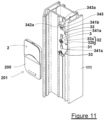
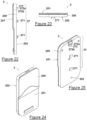
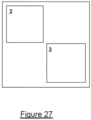
- Embodiments include a module 2 (see figures 11-27 & 29-34 , for example).
- the module 2 is configured to be coupled to the frame member 111 of the door or window 1, or to the panel 12.
- the module 2 may house electrical or mechanical components.
- the module 2 may be provided to allow sensing of the condition of the door or window 1.
- the module 2 may, therefore, be configured to sense a condition of the door or window 1.
- the module 2 includes (and may house) a sensor 21.
- the sensor 21 may be configured to sense the condition of the door or window 1.
- the sensor 21 may be configured to sense the position of the door or window panel 12 with respect to the frame 11 (for example, with respect to a frame member 111 or of the frame member 111 with respect to the frame 11 in embodiments in which the frame member 111 is part of the panel 12).
- the sensor 21 may also or alternatively be configured to sense the condition of the latch or lock mechanism 13.
- the senor 21 may be in the form of or include a reed switch or a Hall Effect sensor (or a plurality of Hall Effect sensors H1,H2 - see figures 40-43 ).
- a magnet 40 may be provided - see figures 29 and 30 , for example.
- the magnet 40 may be provided in a magnet housing 41 - see figure 30 for example.
- the magnet housing 41 may include two parts which are configured to be secured to each other and within which the magnet 40 may be provided.
- a first part of the magnet housing 41 may be secured to a second part of the magnet housing 41 by one or more securing members which may be in the form of a screw or clip, for example.
- the first and second parts of the magnet housing 41 are additionally or alternatively adhered together.
- each of the first and second parts of the magnet housing 41 includes a mushroom-shaped member which is configured to be received by an aperture defined in the other of the first and second parts, in order to secure to the two parts together.
- the two parts may each define at least part of a magnet receiving recess such that, with the two parts secured to each other, the magnet 40 may be received within the magnet recess to retain the magnet in the magnet housing 41.
- the magnet housing 41 may have an external cross-sectional shape which is keyed or at least partially keyed to a magnet attachment point 42 - which may be in the form of an aperture of recess.
- the keyed or partially keyed arrangement may be such that the magnet 40 has a predefined orientation with respect to the magnet attachment point 42, or may have one of two predefined orientations with respect to the magnet attachment point 42.
- the magnet 40 has two opposing poles, a north pole and a south pole - and an orientation of the magnet 40 may be understood to be defined by virtue of the north and south pole of the magnet 40.
- the magnet 40 may be mounted to the panel 12, or vice versa.
- the mounting may be via the magnet attachment point 42.
- the magnet attachment point 42 may include an aperture or other recess formed in the panel 12, or frame 11.
- the mounting of the magnet 40 to the panel 12 or frame 11 e.g. by use of the magnet attachment point 42 and/or the magnet housing 41
- the magnet 40 to the panel 12 or frame 11 may be such that the an axis of movement of first member with respect to the second member may be generally aligned with a magnetic axis of the magnet 40 (i.e. the magnetic axis is directionally aligned with the magnet path, which may mean that it is parallel thereto, for example).
- FIG 29 there may be a locking bar (or rail) provided and the magnet 40 may be mounted thereto such that movement of the locking bar is along an axis which is parallel to the magnet axis of the magnet 40. In figure 29 , this happens to a vertical axis.
- the magnet attachment point 42 may be an elongate slot and the magnet housing 42 may also, therefore, be elongate.
- the magnet 40 may be held in place by virtue of magnetic attraction, a mechanical clip, a screw, a rivet, and/or an adhesive, for example.
- the magnet 40 may be located such that, with the door or window 1 in the closed condition, the sensor 21 (e.g. the reed switch) is actuated to an "on” state but with the door or window 1 in the open condition, the reed switch is in an "off” state.
- the magnet 40 may be mounted for movement with the first member (of the lock or latch mechanism 13) such that, with the door or window 1 in the locked condition, the sensor 21 (e.g. reed switch) is actuated to an "on” state but with the door or window 1 in the unlocked condition, the sensor 21 (e.g. the reed switch) is in an "off” state.
- the senor 21 may be a mechanical switch rather than a reed switch, for example.
- the mechanical switch may be actuated between on and off states by physical contact, for example.
- the mechanical switch may be a micro-switch.
- the sensor 21 may include at least one Hall Effect sensor H1,H2 and, in some embodiments, may include at least two Hall Effect sensors H1,H2.
- the operation of some such embodiments is discussed herein with reference to figures 40-43 , for example.
- the sensor 21 may be a motion or proximity sensor which does not require physical contact for actuation - a reed switch or a Hall Effect sensor being one example of such a sensor 21 another example being an induction coil, for example.
- the module 2 may therefore need to be located on the frame 11 or panel 12 in close proximity to the other of the frame 11 or panel 12 when the window or door 1 is in the closed condition and/or in close proximity to the lock or latch mechanism 13 (e.g. when in the locked condition).
- the module 2 must not, however, foul the operation of the door or window 1, or the lock or latch mechanism 13.
- the spacing of the module 2 with respect to the frame member 111 may, therefore, be important.
- the module 2 may include (and may house) a power source 22, for powering powered elements of the module 2, or may include a connection (for example, a port or other socket to allow connection of a cable) for connecting the module 2 to a power source 22.
- the module 2 may be connectable to a mains electrical power supply.
- the power source 22 is in the form of a battery.
- the battery may be a rechargeable battery and the power source may include a connection (such as a port or other socket) to enable recharging of the battery.
- the battery is not rechargeable.
- the battery is replaceable such that the battery is removable from the module 2 and can be replaced without substantive damage to the module 2.
- the battery is not replaceable - such that the module 2 may be a so-called sealed unit - and removal of the battery from the module 2 may, therefore, damage to the module 2 or may require specialist tools.
- the module may include a battery cover 28.
- the battery cover 28 may be configured to be at least partially removed from the rest of the module 2 to allow access to a battery for replacement. Access may also be provided, via the movement of the battery cover 28 for maintenance, for example.
- the battery cover 28 may be hinged (e.g. along a first edge (which is generally the lower edge as depicted in figure 33 )).
- the battery cover 28 may be removable such that it is detached from the rest of the module 2 for example. In some embodiments, the battery cover 28 is held in place (i.e.
- the or each cam member 281 may be rotatably coupled to the module 2 (for rotation with respect to the battery cover 28.
- the or each cam member 281 may be configured to rotate between a respective unlatch and latched position. With the or each cam member 281 in its unlatched position, the or each cam member 281 may be configured to pass through a respective aperture 282 defined through the battery cover 28. This enables the battery cover 28 to be placed into the closed configuration.
- the or each cam member 281 may then be rotated such that at least part of the or each cam member 281 engages a part of the battery cover 28 to inhibit its removal (i.e.
- the or each cam member 281 may include a slot for use in rotating that cam member 281 (e.g. through engagement with a screw driver or coin).
- the or each aperture 282 for receiving the cam member(s) 281 may be located towards a second edge of the battery cover 28 which may oppose the first edge across a length thereof.
- the first edge if not coupled to the rest of the module 2 by a hinge, may be coupled to the rest of the module by virtue of one or more tags thereof being received in respective recess(es) of the rest of the module 2 or behind an outer wall of the rest of the module 2.
- the module 2 may include (and may house) a controller 23, for example to control operation of the sensor 21 and/or to receive information from the sensor 21.
- the module 2 may include a processor 25, configured to process sensed information from the sensor 21.
- the controller 23 is provided as part of the processor 25 and/or is the processor 25.
- the module 2 may include (and may house) a communications subsystem 24.
- the communications setup 24 may be configured to communicate with another device and that communication may be wireless communication or may be over a wired communication channel or both.
- the communications subsystem 24 may include a transmitter and/or a receiver, or only a transceiver (i.e. without a receiver).
- the communication subsystem 24 may be configured to communicate with another device using radio frequency waves - for example, using WiFi ® or Zigbee ® or Bluetooth ® , or a similar radio frequency protocol.
- the communication subsystem 24 may be operated by the controller/processor 23/25 and may be powered by the power source 22.
- the communications subsystem 24 may be configured to deliver information about the condition of the door or window 1 (as sensed by the sensor 21) to a hub 24a.
- the hub 24a may be configured to collect and/or forward the received information to yet another device (such as a server, for example).
- the hub 24a may, therefore, provide an interface between the communication channel used to communicate with the module 2 (which may be relatively short range communication and may be a local area network) and the communication channel used to communicate with the yet another device (which may be relatively long range communication and may be a wide area network such as the Internet).
- a user may use a computing device (such as a mobile telephone, laptop, desktop, tablet, or the like) to interrogate the hub 24a and/or the yet another device to obtain information about the condition of the door or window 1.
- the computing device may be configured to receive this information and to present an indication to the user about the current condition of the door or window 1 (e.g. a visual indication about the state of the door or window 1 in substantially real-time and/or a historic record of changes in that state).
- the communications subsystem 24 may be configured to deliver information about the condition of the door or window 1 to the hub 24a or another device periodically or on request from the hub 24a or other device.
- the hub 24a may be configured to deliver information about the condition of the door or window 1 to another device periodically or on request.
- the module 2 may include (and may house) a computer readable medium 26 storing instructions which, when executed by the processor/controller 25/23 cause the performance of the operations of the module 2 - such as the sensing of the condition of the door or window 1 and the transmission of that condition.
- the module 2 may be a self-contained unit.
- the module 2 may be a sealed unit.
- the module 2 may include a housing 200 in which the various components thereof are located.
- the housing 200 may be sealed against the ingress of water.
- the housing 200 may be such that opening of the housing 200 to access the internal components of the module 2 may cause damage to the housing 200 or may require specialist tools.
- the housing 200 is a two-part housing including a main part and a lid part - the main and lid parts being configured to be coupled together to provide the housing 200.
- the lid part may be removably coupled to the main part.
- One or more fixing elements may be provided to enable to the main part and the lid part to the coupled to each other - such as one or more threaded members such as a screw (which may, as depicted for example, have a Torx ® head or other suitable specialist alternative).
- the main part and the lid part may have correspondingly shaped mating edges and these edges may include one or more locating features (such as a protrusion and corresponding cut-out) in order to aid in fitting of the lid part to the main part.
- the module 2 may include a front portion 201 which, when fitted as described herein, is generally visible to the user (when the door or window 1 is in the open condition) and may include a back portion 202 which may couple the module 2 to the frame 11 or panel 12.
- the main part of the housing 200 provides the back portion 202 and the lid part provides the front portion 201.
- the front portion 201 may be in the form of a fascia and/or may include one or more decorative elements.
- the housing 200 may include a stepped feature such that a first part of the housing 200 has a first depth and a second part of the housing 200 has a second depth (the first depth being greater than the second depth).
- the housing 200 is of a substantially uniform depth along its length (although the depth may taper towards the sides) - see figures 32 and 34 , for example.
- At least part of the sensor 21 may be positioned relatively closer to the front portion 201 than the back portion 202, and may, indeed, extend from the front portion 201 (in a direction away from both the front and back portions 201,202).
- the housing 200 may include a raised section (which may be raised from the first and/or second part of the housing 200) which may contain the sensor 21 or at least part thereof.
- the housing 200 may be generally rectangular (e.g. a rounded rectangle) - although other shapes are envisaged. One or more corners of the housing 200 may be rounded at a different radius than one or more other corners of the housing 200.
- the module 2 may include a coupling arrangement 27 and this may be at least partially located on or as part of the back portion 202 of the housing 200 of the module 2.
- the coupling arrangement 27 includes one or more pins 271 which may extend from a main surface of the back portion 202 of the housing 200.
- the or each pin 271 may extend generally perpendicular to a plane of the back portion 202 of the housing 200.
- the or each pin 271 may be generally mushroom shaped - such that a proximal end nearest the main surface of the back portion 202 has a first cross-section and a distal end remote from the proximal end has a second cross-section which is larger (in at least one dimension) than the first cross-section.
- the or each pin 271 may have a circular cross-section (and the first and/or second cross-sections may be circular or rectangular) - although other shapes are envisaged (such as a stadium-shaped cross-section).
- the or each pin 271 may, therefore, include a shaft (with the first cross-section) and a head (with the second cross-section).
- the flat parts thereof may be arranged at top and bottom parts of the or each pin 271, and the rounded parts thereof may be arranged at side parts of the or each pin 271 (with the module 2 an upright configuration as depicted).
- the head of the or each pin 271 may be generally D-shaped and/or may extend with respect to the shaft of that pin 271 (perpendicular to a longitudinal axis thereof) in a first direction but not in an opposing second direction (e.g. to form an overhang over at least part of the shaft but not an overhand in all directions).
- at least one pin 271 may be provided on the battery cover 28 (and another pin 271, if provided, may be provided on another part of the back portion 202 of the module 2 (the battery cover 28 being part of the back portion 202)).
- the protrusion may, therefore, include a drive surface 272a and a latch surface 272b.
- the drive surface 272a may be inclined with respect to the main surface of the back portion 202 of the housing 200, for example.
- the latch surface 272b may extend perpendicular to the main surface of the back portion 202 of the housing 200, for example.
- the drive surface 272a may be inclined with respect to a direction of movement of the housing 200 (and/or module 2) when fitting the module 2 - as will be apparent from the relevant parts of the description herein.
- the recess may be similarly shaped to have a drive surface and a latch surface.
- the at least one latch element 272 may be in the form of a button 273 located within an aperture 274 (i.e. a button aperture).
- the button 273 may be axially movable within the button aperture 274 between actuated and unactuated positions - as described herein - with respect to the rest of the module 2.
- the button aperture 274 may extend through an entire depth of the module 2.
- a head of the button 273 may be accessible for manual actuation from the front portion 201 of the module 2 and a driver of the button 273 may be located towards the back portion 202 of the module 2.
- the head and driver of the button 273 may be integrally formed.
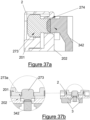
- the button 273 may, therefore, have a mushroom-like shape - see figures 37a,b , for example.
- the button 273 may be connected to the rest of the module 2 such that it is trapped within the button aperture 274 (allowing limited movement between the actuated and unactuated positions). This may be achieved by, for example, the use of a collar within the button aperture 274, and/or the provision of a living hinge between the button 274 and the rest of the module 2, and/or the use of a flexible coupling between the button 274 and the rest of the module 2 and/or the button 273 may be trapped between the two parts (201,202) of the two-part housing 200 - see figure 37b , for example, in which a flange 273a of the button 273 is so trapped.
- the button aperture 274 may be located in a recess in the front portion 201 of the module 2 and the recess may be configured to at least partially receive a digit during manual operation of the button 274.
- the or each pin 271 and the or each latch element 272 may be aligned along a common axis, which may be a longitudinal axis of the housing 200 (and this axis may be generally parallel to a longitudinal axis of a frame member 111 to which the module 2 is to be coupled). In at least the depicted embodiments, this a vertical axis with the module 2 fitted.
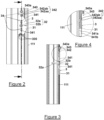
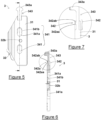
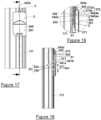
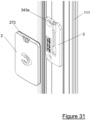
- Embodiments include a securing member 3 (see figures 1-18 and 35-39 , for example).
- the securing member 3 may be configured to be fixed to the frame 11 or to the panel 12 (e.g. the frame member 111).
- the module 2 may be configured to be fixed to the securing member 3. Accordingly, the module 2 may be attached to the frame 11 or panel 12 using (i.e. via) the securing member 3.
- the securing member 3 may be sandwiched between the module 2 and the frame member 111 when so secured in place.
- the module 2 is secured to the frame member 111 solely by the securing member 3 and, in some such embodiments, no part of the module 2 touches or is otherwise in direct contact with the frame member 111.
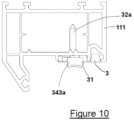
- the securing member 3 may include a body 31.
- the body 31 may include a fixing arrangement 32 for use in securing the securing member 3 to the frame member 111.
- the fixing arrangement 32 could take a number of different forms and may include more than one element.
- the fixing arrangement 32 may include a clip, hook or the like, configured to engage a part of the frame member 111.
- the fixing arrangement 32 may include a portion of the body 31 which can be moved with respect to another portion of the body 31 so as to increase a dimension of the body 31 an enable the body 31 to be secured between two opposing parts of the frame member 111, for example (i.e. in an outward clamping action).
- the fixing arrangement 32 may include a portion of the body 31 which can be moved with respect to another portion of the body 31 so as to decrease a distance between the two portions to enable the two portions to clamp a part of the frame member 111 therebetween, for example (i.e. in an inward clamping action).
- the fixing arrangement 32 may include a fixing element 32a which is configured to be received by or otherwise mate with a fixing receiver 32b provided as part of the body 31.
- the fixing receiver 32b may be a through-hole defined by the body 31 or a slot defined by the body 31, for example.
- the fixing element 32a may be screw (which may be a self-tapping screw), a rivet, a nut and bolt arrangement, a nail, or the like.
- the fixing arrangement 32 may be or include an adhesive (such as an adhesive covered pad which may be sandwiched between the body 31 and the frame member 111).
- the body 31 of the securing member 3 may have an outer face (i.e. a face which is opposite an inner face which is secured to face the frame member 111) which is generally rectangular in shape, for example but other shapes are envisaged.
- the outer face has a first part which is generally rectangular and a second part which extends therefrom and which is generally triangular (or a trapezoid).
- the inner face may be of generally the same shape as the outer face and a depth of the securing member 3 (and body 31) may be defined between the inner and outer faces thereof.
- the shapes of the inner and outer faces may define at least part of a shape of the body 31 and, therefore, the securing member 3.
- the fixing arrangement 32 may be located generally centrally with respect the securing member 3. In some embodiments, this may be generally through or adjacent part of the rectangular part of the outer and/or inner faces.
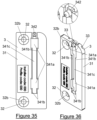
- each fixing arrangement 32 in such embodiments may be spaced apart across the body 31 - e.g. there may be a plurality of fixing receivers 32b each configured to receive a fixing element 32a. This is the case, for example, in the embodiment depicted in figures 35 and 36 .
- the fixing element 32a (or each fixing element 32a in some embodiments) may be configured to be countersunk with respect to the body 11 and outer face - such that, for example, no part of the fixing element 32a extends substantially above the outer face.
- the fixing receiver 32b (or fixing receivers 32b in some embodiments) may be correspondingly formed, therefore, to allow for this countersunk configuration.
- the fixing element 32a may be a self-tapping screw which is configured to be passed through the fixing receiver 32b and then driven into the frame 11 (e.g. the frame member 111).
- the securing mechanism 3 may be secured to the frame 11 (e.g. to the frame member 111 - which may be a frame member 111 of the first pair 111a or the second pair 111b - or the panel 12 (as discussed herein the frame member 111 may be parts of the panel 12 rather than the frame 11).
- the securing member 3 and, in some embodiments, the body 31 may define one or more grooves 33.
- the or each groove 33 may be defined in the inner face of the body 31.
- the or each groove 33 may be a linear groove 32.
- the or each groove 33 may be configured to receive a part of the frame member 111.
- the frame member 111 may include one or more elongate projections along a length thereof.
- Such elongate projections may be configured for use in the fitting of a seal member to the frame member 111, or may be part of the structure of the frame member 111 to improve rigidity thereof, for example.
- the or each groove 33 may extend through an entire length of a part of the securing member 3 (e.g. the body 31) and this may be the trapezoid part of the body 31 in some embodiments.
- the or each groove 33 may be open ended.
- the or each groove 33 may help in the locating of the securing member 3 with respect to the frame member 111. Accordingly, the or each groove 33 may be positioned in the body 31 at a position determined by the configuration of the frame member 111.
- the securing member 3 may include a coupling configuration 34.
- the coupling configuration 34 of the securing member 3 may be configured to mate with or otherwise receive (or engage) at least part of the coupling arrangement 27 of the module 2 - herein referred to as the fitting of the module 2 to the securing member 3.
- the fitting of the module 2 to the securing member 3, using the coupling configuration 34 and the coupling arrangement 27, may secure the module 2 to the securing member 3.
- the coupling configuration 34 includes a receiving configuration 341 to engage the coupling arrangement 27 or a part thereof (such as a clip or hook).
- the arrangement is the other way around and the coupling configuration 27 may include a hook or clip and the coupling arrangement 27 may include the receiving configuration.
- the receiving configuration 341 includes at least one aperture 341a (defined in the body 31, for example). There may be a corresponding number of apertures 341a to the number of pins 271, for example - with each aperture 341a configured to receive a pin 271. Accordingly, the location of the or each aperture 341a may correspond with the location of the or each pin 271 to allow the fixing as described herein of the module 2 to the securing member 3.
- the or each aperture 341a may be a through-hole (or slot) in the body 31 or may be a blind-hole (or slot) in the outer face of the body 31.
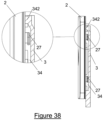
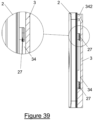
- a first of the one or more apertures 341a may be joined by a channel 341c to a second of the one or more apertures 341a - see figures 35, 36 , 38 , and 39 , for example.
- the or each aperture 341a may include two respective parts - a wide part and a narrow part, the two parts may be along different lengths of the or each aperture 341a which may be in the form of a slot (which may also, as will be appreciated have a depth through the body 31.
- the wide part may be sized to allow the head of the corresponding pin 271 therethrough and the narrow part may be sized to prevent the head of the corresponding pin 271 from passing therethrough (but still sufficiently large to receive the neck of the pin 271).
- a pin 271 may be inserted into the corresponding aperture 341a through the wide part and then moved (linearly) across the aperture 341a until the neck of the pin 271 is passing through the narrow part and the head cannot be removed from the aperture 341a (other than be reversing the linear movement to align the head of the pin 271 with the wide part again).
- This is shown in stages, in relation to some embodiments, in figures 38 and 39 , for example.
- the narrow part may be part of the channel 341c - see figures 35 and 36 , for example.
- apertures 341a there may two such apertures 341a and two such pins 271. There may be more than one receiving configuration 341.
- the two (or more) apertures 341a may be aligned with each other along a common axis.
- the coupling configuration 34 may include a resiliently biased clip 342.
- the resiliently biased clip 342 may be configured to retain the module 2 selectively with the coupling configuration 34 and coupling arrangement 27 engaged with each other (so that the module 2 is fixed to the securing member 3).
- the resilient biased clip 342 may be configured to engage at least of the module 2 to retain the module 2 in position with respect to the securing member 3.
- the resiliently biased clip 342 may selectively prevent disengagement of the or each pin 271 from the or each receiving configuration 341. This may, include, for example, preventing (selectively) movement of the module 2 with respect to the securing member 3 such that the respective heads of the or each pin 271 are not aligned with the wide part of the corresponding aperture 341a (e.g. such that the neck part remains aligned with the narrow part of the corresponding aperture 341a).
- the resilient clip 341 may be configured to engage (selectively) the or each latch element 272.
- the resilient clip 341 may include a non-return clip 342a which is configured to engage at least one of the one or more latch elements 272.
- the non-return clip 342a may have a generally triangular cross-section with an inclined drive surface 342aa and a latch surface 342ab.
- the drive surface 342aa of the non-return clip 342a may be sized and positioned so as to abut the drive surface 272a of a corresponding latch element 272. The continued linear movement of the module 2 with respect to the securing member 3 against this abutment may cause deflection (against the resilient biasing force of the resiliently biased clip 342) until the two drive surfaces 342aa,272a have passed over each other.
- the biasing force may then cause the two latch surfaces 272b,342ab to engage each other.
- These two latch surfaces 272b,342ab may be configured such that, when so engaged, reversal of the linear movement of the module 2 with respect to the securing mechanism 3 is substantially prevented.
- the non-return clip 342a may be mounted on a part of the resiliently biased clip 342 which may provide the resilient biasing force. Accordingly the non-return clip 342a may be a member without any resilient biasing itself (which may be provided by another part of the resiliently biased clip 342). This part may be an elongate member 343 extending from the body 11, for example.
- the elongate member 343 may be formed form the same material as the body 31 (e.g. a plastics material).
- the resilient biasing force may be provided by virtue of the rigidity of the material used to form the elongate member 343 and/or the body 31.
- a living hinge (which may be a relatively stiff living hinge) between the elongate member 343 and the body 31.
- the elongate member 343 may extend with respect to the body 31 from a side thereof (which may, in the depicted embodiments, be a top side of the body 31).
- the elongate member 343 may be a generally planar member with respect to the main body 31.
- the resiliently biased clip 34 may include an actuation portion 343a.
- the actuation portion 343a may be a button and/or may be configured to be manually operated by a user.
- the actuation portion 343a is located at a distal end of the elongate member 343 (the proximal end being coupled to the body 31).
- the actuation portion 343a may include a head which is configured to enable relatively easy manual operation by the user.
- actuating the actuation portion 343a may require an external force (e.g. from a user's digit) to move the actuation portion 343a against the biasing force of the resiliently biased clip 342 to disengage the two latch surfaces 272b,342ab (to allow reversal of the movement of the module 2 with respect to the securing member 3, as described herein).
- a user may press the actuation portion 343a and this may disengage the two latch surfaces 272b,342ab.
- the head of the actuation portion 343a may have a depth which is greater than another part of the elongate member 343 (e.g. a part which is behind the module 2 when that module 2 is so fitted) - to make it easier for the user to actuate when the module 2 fitted to the securing member 3.
- the head may have a semi-circular cross-section, for example - although other shapes are envisaged.
- the head may be located to a side (e.g. a top side) of the module 2, with the module 2 fitted to the securing member 3. This may be achieved by virtue of the length, for example of the elongate member 343.
- the orientation of the resiliently biased clip 342 must, in some embodiments, be aligned with that of the receiving configuration 341. This enables the receipt of the or each pin 271 in one or more respective apertures 341a and the linear movement of the module 2 with respect to the securing member 3 to engage the two latch surfaces 272b,342ab. This engagement may then prevent the reverse movement of the module 2 with respect to the securing member 3.
- the actuation portion 343a is configured to engage the button 273 and this may occur within the button aperture 274, for example.
- the engagement may be such that the actuation portion 343a engages the driver of the button 273.
- the actuation portion 343a may be a domed member in some embodiments, and the driver of the button 273 may be correspondingly shaped to receive at least part of the domed actuation portion 343a. This can be seen in, for example, figures 37a ,b. Retention of the actuation portion 343a at least partially within the button aperture 274 may hold the module 2 in place with respect to the securing member 3 - with the button in the unactuated position.
- Actuation of the button 273 may depress the actuation portion 343a (which may be resiliently biased, e.g. by a living hinge, into engagement with the button 273) may allow the release of the module from the securing member 2, for example (by movement of the actuation portion 343a out of the button aperture 274).
- This arrangement may be present embodiments including the button 273, for example.
- Actuation portion 343a may be considered to be a resilient clip, for example. In some such embodiments, therefore, the actuation port 343a is indirectly operated, by intermediate use of the button 273 (said button 273 being, for example, manually operated by a user digit in some embodiments).
- the or each aperture 341a includes (i.e. is at least partially defined by) a locking surface 341b of the body 11.
- This locking surface 341b may be configured to engage at least part of a respective received pin 271 (e.g. a part of the head of that pin 271).
- the locking surface 341b may be inclined with respect to the inner and/or outer face of the body 11 such that the received part of the pin 271 (e.g. the head) is forced rearwardly (e.g. in a depth direction) as the pin 271 passes into the narrow part of the aperture 341a (see the figures).
- the aperture 341a may include an internal shelf which provides the locking surface 341b.
- the shelf may extend around or along part of an internal circumference or perimeter of the aperture 341a and/or the channel 341c if provided, and may be U-shaped.
- a single aperture 341a has a locking surface 341b.
- some or all of a plurality of apertures 341a may include respective locking surfaces 341b. The use of the or each locking surface 341b may assist in retaining the module 2 in place with respect to the securing member 3 (in combination with the engagement of the two latch surfaces 272b,342ab, for example).
- the locking surface 341b may be in the form of a taper lock, for example a 3° taper lock (in particular, the locking surface 341b may be at an angle of around 3° from a main plane of the main body 31) - see the figures.
- the channel 341c is provided with internally projecting ridges along its outer edges which are configured to retain at least part of a pin 271 passing along the channel 341c - best seen in figure 36 .
- the frame member 111 to which the securing member 3 and module 2 may be fitted could have a number of different profiles (i.e. cross-sectional shapes). As described the frame member 111 may be a part of the frame 11 in relation to which the panel 12 moves or may, indeed, be part of a frame of the panel 12 (which may move with respect to another frame or other panel 12).
- a channel may be defined between at least part of the panel 12 and the frame 11. This channel may accommodate, for example, parts of the lock or latch mechanism 13 and may provide sufficient space for this to operate freely.
- the channel may be generally inaccessible from the exterior of the window or door 1 when in the closed condition.
- the frame member 111 may be such that there is at least one edge lip extending along an outer and/or inner edge of the frame member 111 along its length and at least partially defining the channel.
- the securing member 3 and module 2 are entirely or substantially entirely contained within the channel.
- a volume may be defined between the outer and inner edge of the frame member 111 along its length and the securing member 3 and module 2 may be entirely or substantially entirely contained within this volume.
- the securing member 3 and module 2 may be sized and shaped such that, when fitted, they do not foul the operation of the door or window 1 - as it changes condition between the open and closed conditions and/or between the locked and unlocked conditions.
- the body 31 (and/or the entire securing member 3) may have a width equal to, substantially equal to, or less than the width of the channel.
- the body 31 may have a width equal to, substantially equal to, or less than a depth of the frame member 111.
- the frame member 111 may be received by at least part of the securing member 3.
- the securing member 3 and frame member 111 may, therefore, interlock.
- the securing member 3 may be a packer, for example. As such, the securing member 3 may provide a spacing function to ensure that the module 3 is correctly located to sense the condition of the door or window 1.
- the magnet 40 (and, in some embodiments the magnet housing 41) are entirely or substantially entirely contained within the channel.
- a volume may be defined between the outer and inner edge of the frame member 111 along its length and the magnet 40 (and, in some embodiments the magnet housing 41) may be entirely or substantially entirely contained within this volume.
- the magnet 40 (and, in some embodiments the magnet housing 41) may be sized and shaped such that, when fitted, they do not foul the operation of the door or window 1 - as it changes condition between the open and closed conditions and/or between the locked and unlocked conditions.
- the channel When the door or window 1 is in the closed condition, the channel may not be accessible - i.e. the panel 12 may prevent access by blocking off any part of the channel that would be open if the door or window 1 were in the open condition. Therefore, a potential burglar may be prevented or hindered from accessing the module 2.
- a window or door fitter may fit the securing member 3 to the frame 11 during installation of the window or door 1. This may include selection of the correct securing member 3 from a plurality of securing members 3 for the frame member 111. The fitter may then position the securing member 3 in the correct location to ensure that the module 2 operates correctly. The fitter may secure the securing member 3 using the fixing arrangement 32. In some embodiments, one or more markers 300 (which may be grooves in the body 31 or printed on the body 31, for example) may be used by the fitter for alignment of the securing member 3 at the correct location with respect to the frame member 111 and/or the lock or latch mechanism 13.
- the window or door 1 may then be used as normal.
- the user may then, at some later time, decide to install the module 2.
- the user may be aware that the window or door 1 is configured to receive a module 2 by virtue of the presence of the securing member 3.
- the securing member 3 may carry information or indicators to provide the user with information as to the type of module 2 which may be fitted to the securing member 3.
- the indicators may include at least one arrow and/or line or other marking 300 indicating a boundary of the part of the securing member 3 covered by the module 2, when the module 2 is correctly fitted.
- the user may fit the module 2 to the securing member 3 by positioning the module 2 such that the coupling arrangement 27 engages the coupling configuration 34. For example, such that the or each pin 271 is received by a respective receiving configuration 341 (such as an aperture 341a).
- the resiliently biased clip 342 is then operated to secure the module 2 to the securing member 3.
- the module 2 may be moved linearly (or rotationally) with respect to the securing member 3. In some embodiments, this movement is a vertical movement upwards, against gravity. In some embodiments, this movement in parallel to a longitudinal axis of the frame member 111. This movement may move the or each pin 271 within the or each receiving configuration 341 (e.g. aperture 341a).
- the drive surfaces 342aa, 272a may engage as described herein and continued movement of the module 2 may cause the latch surfaces 272b,342ab to engage each other.
- the operation of the resiliently biased clip 342 may, therefore, be automatic on movement of the module 2 with respect to the securing member 3.
- the module 2 may be substantially prevented from being released from the securing member 3.
- the module 2 may then be located correctly for operation (e.g. correctly spaced from the frame member 111).
- the magnet 40 may be fitted to the magnet attachment point 42 (which may also be accessible from the channel and so only when the window or door is open).
- the magnet 40 may be fitted to the magnet attachment point 42 by insertion, for example, to the magnet 40 (which may be housed in the magnet housing 41) into the magnet attachment point 42.
- the magnet 40 and/or the magnet housing 41 may be at least partially received by the magnet attachment point 42.
- One or more indicators 300 may be provided on the securing member 3 to confirm the correct location of the module 2 with respect to the securing member 3 - such as indicators for alignment with an edge or other extremity of the module 2.
- the module 2 may be removed by use of the actuation portion 343a as described herein. This may require actuation of the button 273 in embodiments including this button 273, for example.
- the module 2 may be fitted and/or replaced without the need for tools and by a relatively unskilled user.
- the fitter may install a dummy module 2 which may need to be removed before a module 2 is fitted by the user.
- the dummy module 2 may be the same as a module 2 described herein but may be non-functional and may not include the processor 25, controller 23, sensor 21, and computer readable medium 26.
- some embodiments include a sensor 21 with at least two Hall Effect sensors H1,H2.
- sensor units H1,H2 which are capable of sensing a magnetic field.
- These sensor units H1,H2 may be configured to sense a magnetic field in a single (i.e. one and only one) sensing axis, for example (which may be a sensing axis which is common to both sensor units H1,H2).
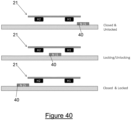
- the sensor units H1,H2 may be arranged within the module 2 such that the magnet 40 moves with respect to the sensor units H1,H2 from a position to a first side of both of the two sensor units H1,H2 to a position to a second side of both of the sensor units H1, H2 as the lock or latch mechanism 13 is actuated between the locked condition and the unlocked condition (passing the two sensor units H1,H2 during this movement). This is generally described with reference to figures 40-43 .
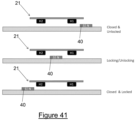
- Figures 40-43 show the magnet 40 schematically represented and mounted for movement with a part of the lock or latch mechanism 13 - such that the position of the magnet 40 with respect to the sensor units H1,H2 changes as the lock or latch mechanism 13 is actuated between the locked and unlocked conditions.
- the sensor units H1,H2 forming parts of the sensor 21 are schematically depicted as mounted to a circuit board, for example.
- figures 40-43 do not show other features of the embodiments - including other features of the module 2 - for the sake of simplicity of explanation.
- the sensor units H1,H2 may be located along a path of the magnet 40 but spaced apart therefrom (and in practice other parts of the module 2 may be located between the sensor units H1,H2 and the magnet 40, for example).
- the magnet 40 with the moveable panel 12 in the closed configuration, may travel along the path and that path may have a path axis.
- the sensor units H1,H2 may be aligned with that path axis, but offset with respect thereto (to provide non-contact sensing, for example).
- the sensor units H1,H2 may be said to have a sensing axis which is an axis which passes through both sensor units H1,H2 and which is parallel to the path axis.
- the magnet 40 as a north pole N and a south pole S as depicted.
- the lock or latch mechanism may be in the unlocked configuration. This is generally depicted in the upper drawing of figures 40-43 and represents an unlocked position for the magnet 40.
- the magnet 40 will move further away from the sensor units H1,H2. With reference to figures 40-43 this may be a movement downwardly and/or into or out of the page, for example (depending on the type of door or window 1).
- the magnet 40 moves along a magnet path (which may be a linear - i.e. substantially straight - path.
- the magnet 40 may, therefore, move past a first H1 of the sensor units H1,H2 to a position between the two sensor units H1,H2, and this is generally shown in the middle drawings of figures 40 and 41 .
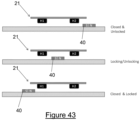
- the sensor unit H1,H2 positions have been reversed, so that magnet 40 moves along the magnet path past a second H2 of the sensor units H1,H2 to a position between the two sensor units H1,H2 - see the middle drawings of figures 42 and 43 .
- the magnet 40 is to the first side of one sensor unit (the first sensor unit H1 in figures 42 and 43 but the second sensor unit H2 in figures 40 and 41 ) and to a second side of the other sensor unit (the first sensor unit H1 in figures 40 and 41 but the second sensor unit H2 in figures 42 and 43 ).
- This position may be referred to as an interim position and may form part of a movement to or from the locked configuration of the lock or latch mechanism 13.
- the magnet 40 As the lock or latch mechanism 13 reaches the locked configuration, the magnet 40 has moved (along the magnet path) to a position at the second side of both of the sensor units H1,H2.
- the magnet 40 may, therefore, move (i.e. continue) past the second H2 of the sensor units H1,H2 and this is generally shown in the bottom drawings of figures 40 and 41 .
- the sensor unit H1,H2 positions have been reversed, so that magnet 40 moves along the magnet path past the first H1 of the sensor units H1,H2 to a position at the second side of both sensor units H1,H2 - see the bottom drawings of figures 42 and 43 . This may be referred to as a locked position of the magnet 40.
- the magnet 40 when moving from the unlocked to the locked configuration of the lock or latch mechanism 13, the magnet 40 may move along the magnet path as depicted sequentially in figured 40-43 from the top drawings thereof to the bottom.
- the movement along the magnet path (of the magnet 40) may be reversed.
- the sensor units H1,H2 may each be configured to detect the presence of a magnetic field generated by the magnet 40.
- the sensor units H1,H2 may, therefore, be configured to detect the proximity of the magnet 40 with respect thereto.
- the sensor units H1,H2 may use a magnet field strength threshold such that the magnet field strength sensed by the sensor units H1,H2 must be above the threshold in order for the sensor unit H1,H2 to indicate the proximity of the magnet 40 thereto.
- the sensor units H1,H2 are also configured to detect a polarity of the magnet field (that is a polarity of the magnetic field which has been sensed or the sensed magnetic field) such that each sensor unit H1,H2 is configured to determine which pole of the magnet 40 is in closest proximity to that sensor unit H1,H2.
- the magnetic field polarity sensed at each sensor unit H1,H2 will depend on the position of the magnet 40 along the magnet path (with the moveable panel 12 in the closed configuration).
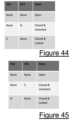
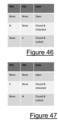
- each sensor unit H1,H2 for the arrangements in each of figured 40-43 is shown in figures 44-47 respectively.
- the magnet 40 is to the first side of both of the sensor units H1,H2.
- the first sensor unit H1 in this embodiment, is closest to the magnet 40 and detects the proximity of the magnet 40 and that it is the north pole N of the magnet which is closest to the first sensor unit H1.
- the magnetic field at the second sensor unit H2 may be too low to be detected and/or may be below the threshold (as described). This is shown in the upper drawing of figure 40 and in the table of figure 44 .
- both the first H1 and second H2 sensor units may detect the proximity of the magnet 40, with the first sensor unit H1 detecting the proximity of the south pole S of the magnet 40 and the second sensor unit H2 detecting the proximity of the north pole N of the magnet 40. This is generally shown in the middle drawing of figure 40 but is not shown in figure 44 .
- the magnet 40 travels along the magnet path to the locked position and this is depicted in the bottom drawing of figure 40 .
- the second H2 sensor unit may detect the proximity of the magnet 40, with the second sensor unit H2 detecting the proximity of the south pole S of the magnet 40.
- the magnetic field at the first sensor unit H1 may be too low to be detected and/or may be below the threshold (as described). This is generally shown in the bottom drawing of figure 40 and in figure 44 .
- the orientation of the magnet 40 with respect to the sensor 21 may not be known prior to installation. This may be because the orientation of the magnet 40 within the magnet housing 41 was not predefined at the time of securing the magnet 40 within the magnet housing 41 or may be because the magnet housing 41 can have different orientations (in some embodiments) when secured to the magnet attachment point 42 or may be because the magnet attachment point 42 may have been installed in two or more different orientations with respect to the location of the sensor 21, for example.
- figures 41 and 45 consider the same arrangement of first and second sensor units H1,H2 as discussed in relation to figures 40 and 44 but with the orientation of the magnet 40 reversed relative thereto.
- the magnet 40 is to the first side of both of the sensor units H1,H2.
- the first sensor unit H1 in this embodiment, is closest to the magnet 40 and detects the proximity of the magnet 40 and that it is the south pole S of the magnet which is closest to the first sensor unit H1.
- the magnetic field at the second sensor unit H2 may be too low to be detected and/or may be below the threshold (as described). This is shown in the upper drawing of figure 41 and in the table of figure 45 .
- both the first H1 and second H2 sensor units may detect the proximity of the magnet 40, with the first sensor unit H1 detecting the proximity of the north pole N of the magnet 40 and the second sensor unit H2 detecting the proximity of the south pole S of the magnet 40. This is generally shown in the middle drawing of figure 41 but is not shown in figure 45 .
- the magnet 40 travels along the magnet path to the locked position and this is depicted in the bottom drawing of figure 41 .
- the second H2 sensor unit may detect the proximity of the magnet 40, with the second sensor unit H2 detecting the proximity of the north pole N of the magnet 40.
- the magnetic field at the first sensor unit H1 may be too low to be detected and/or may be below the threshold (as described). This is generally shown in the bottom drawing of figure 41 and in figure 45 .
- the orientation of the sensor 21 is reversed with respect to the magnet 40. This may occur as a result of use of the same module 2 in relation to multiple different door and window 1 configurations - which may result in different placement (including different orientations of placement) of the securing member 2. This different orientation may result in reversal of the orientation of the sensor units H1,H2 as discussed above in relation to figures 40 and 41 . Yet again, with this reversal, the magnet 40 orientation could also be in either relative arrangement as discussed in relation to figures 40 and 41 respectively. These possibilities are, therefore, shown in figures 42 , 43 , 46, and 47 .
- the magnet 40 is to the first side of both of the sensor units H1,H2 (wherein the first side in this instance may be equivalent to the second side as described in relation to figures 40 and 41 , for example).
- the second sensor unit H2 in this embodiment, is closest to the magnet 40 and detects the proximity of the magnet 40 and that it is the north pole N of the magnet which is closest to the second sensor unit H2.
- the magnetic field at the first sensor unit H1 may be too low to be detected and/or may be below the threshold (as described). This is shown in the upper drawing of figure 42 and in the table of figure 46 .
- both the first H1 and second H2 sensor units may detect the proximity of the magnet 40, with the first sensor unit H1 detecting the proximity of the north pole N of the magnet 40 and the second sensor unit H2 detecting the proximity of the south pole S of the magnet 40. This is generally shown in the middle drawing of figure 42 but is not shown in figure 46 .
- the magnet 40 travels along the magnet path to the locked position and this is depicted in the bottom drawing of figure 42 .
- the first H1 sensor unit may detect the proximity of the magnet 40, with the first sensor unit H1 detecting the proximity of the south pole S of the magnet 40.
- the magnetic field at the second sensor unit H2 may be too low to be detected and/or may be below the threshold (as described). This is generally shown in the bottom drawing of figure 42 and in figure 46 .
- the magnet 40 is to the first side of both of the sensor units H1,H2 (wherein the first side in this instance may be equivalent to the second side as described in relation to figures 40 and 41 , for example).
- the second sensor unit H2 in this embodiment, is closest to the magnet 40 and detects the proximity of the magnet 40 and that it is the south pole S of the magnet which is closest to the second sensor unit H2.
- the magnetic field at the first sensor unit H1 may be too low to be detected and/or may be below the threshold (as described). This is shown in the upper drawing of figure 43 and in the table of figure 47 .
- both the first H1 and second H2 sensor units may detect the proximity of the magnet 40, with the first sensor unit H1 detecting the proximity of the south pole S of the magnet 40 and the second sensor unit H2 detecting the proximity of the north pole N of the magnet 40. This is generally shown in the middle drawing of figure 43 but is not shown in figure 47 .
- the magnet 40 travels along the magnet path to the locked position and this is depicted in the bottom drawing of figure 43 .
- the first H1 sensor unit may detect the proximity of the magnet 40, with the first sensor unit H1 detecting the proximity of the north pole N of the magnet 40.
- the magnetic field at the second sensor unit H2 may be too low to be detected and/or may be below the threshold (as described). This is generally shown in the bottom drawing of figure 43 and in figure 47 .
- the controller 23 of the module 2 may be configured to receive information from the sensor 21 and this may be information from the or each sensor unit H1,H2. This information may include an indication that a magnetic field has been detected, the polarity of the detected magnet field, and/or the strength of the magnetic field. Thresholds are discussed above and these may be applied by the sensor 21 or by the controller 23 or both.
- the controller 23 may be configured, therefore, to receive the information from the sensor 21 and to determine the current configuration of the moveable panel 12 (i.e. open or closed) and the current configuration of the lock or latch mechanism 13 (i.e. locked or unlocked).
- the controller 23 can determine the current configuration of the panel 12 and the lock or latch mechanism 13 irrespective of the orientation of the magnet 40.
- the detection of a magnetic field by the second sensor unit H2 indicates that the lock or latch mechanism 13 is locked (and the moveable panel 12 is closed).
- the detection of a magnetic field by the first sensor unit H1 indicates that the lock or latch mechanism 13 is unlocked (and the moveable panel 12 is closed). If there is no magnetic field detected by either sensor unit H1,H2, then the moveable panel 12 is open. If the orientation of the sensor units H1,H2 is reversed (as in figures 46 and 47 ), then the same is true but for the second sensor unit H2 instead of the first sensor unit H1.
- the controller 23 may be configured to learn the relative orientation of the sensor 21 and the magnet 40 on first installation and may store this information as setup information on the computer readable medium 26, for example.
- the controller 23, using the information received from the sensor 21, may detect the position of the magnet 40 relative to the sensor units H1,H2 when the moveable panel 12 moves from the closed to the open configuration.
- the lock or latch mechanism 13 is, by definition, in the unlocked configuration. This may, therefore, enable the controller 23 to store the expected magnetic field polarity at the first or second sensor unit H1,H2 with the lock or latch mechanism 13 in the unlocked configuration. This also allows the controller 23 to determine (and store) the expected magnetic field polarity at the other of the first and second sensor unit H1,H2 with the lock or latch mechanism 13 in the locked configuration.
- the controller 23 may use the sensed magnetic field orientation at the sensor units H1,H2 in the interim position to confirm (in part) the likely relative orientation of the sensor 21 and magnet 40 with respect to each other. This may be particularly useful as confirmation or an alternative learning step in embodiments in which the orientation of the either the magnet 40 with respect to the sensor 21 is fixed (but the positions of the sensor units H1,H2 within the sensor 21 is not known) or the positions of the sensor units H1,H2 within the sensor 21 are known), for example.
- controller 23 may generate a tamper alert.
- An expected change may be the changes expected in the magnetic fields sensed when the lock or latch mechanism 13 is moved from the locked to the unlocked configuration and/or the moveable panel 12 is opened or closed.
- An unexpected change may be an magnetic field detected at the first and/or second sensor unit H1,H2 which is not of an expected magnetic polarity and/or magnetic field strength (e.g. too high). So, for example, if an external magnet is broad close to the sensor 21 then the magnetic field may be higher than expected or the polarity of the magnetic field sensed at any one sensor unit H1,H2 may not fit with what is expected for the different configurations of the lock or latch mechanism 13. For example, if both the first and second sensor units H1,H2 detect a magnetic field of the same polarity, then this is likely the result of an external magnet being used to tamper with the operation of the module 2.
- the controller 23 may be configured to require the unexpected magnetic field to be sensed for a predetermined period of time before a tamper alert is generated and this may help to prevent false alarms.
- the tamper alert may be triggered when there are more than a predetermined number of trigger events (each being a sensed unexpected magnetic field) within the predetermined time period - which may be the result of someone moving an external magnet relative to the module 2.
- a tamper alert may also or alternatively be generated by the controller 23 if the sensed magnetic fields indicate that the moveable panel 12 has moved to the open configuration from the closed configuration, with the sensed magnetic fields indicating that the lock or latch mechanism 13 has not changed from the locked to the unlocked configuration, for example.
- the controller 23 may cause the communications subsystem 24 to deliver the alert to a hub 24a - from which a user may be notified (via their computing device, for example).
- the flexibility provided by the different orientations of the magnet 40 and sensor 21 (and positions of the sensor units H1,H2) enables the same module 2 to be used in a wide variety of applications and simplifies the installation process - particularly if being installed by a consumer user.
- the magnet 40 is located (which may also mean that the magnet housing 41 and magnet attachment point 42 are similarly located) such that it is moveable from a first side of both sensor units H1,H2 to a second side of both sensor units H1,H2 depending on the configuration state (i.e. locked or unlocked) of the lock or latch mechanism 13.
- the movement of the magnet 40 is along the magnet path and this may take the magnet 40 past one of the sensor units H1,H2 to an interim position prior to reaching each end of the magnet path during use.
- magnet 40 which moves along this magnet path and only one magnet 40 (i.e. the same one and only one magnet 40) which is sensed by the sensor units H1,H2 in normal operation (e.g. when there is no tampering or external magnet).
- the magnet 40 may be oriented such than an axis through its north N and south S poles (e.g. the magnetic axis of the magnet 40) is aligned with the magnet path.
- the magnet path is defined herein with the moveable panel 12 in its closed configuration (movement of the moveable panel 12 to the open configuration will move the magnet 40 in such embodiments) off the magnet path.
- an attachment system may include the securing member 3 and/or the module 2.
- Embodiments may include the window or door 1 to which the securing member 3 has been fitted. Embodiments may include the window or door 1 to which the securing member 3 and module 2 have been fitted. Embodiments may include the window or door 1 with or without the magnet attachment location 43, and/or with or without the magnet 40.
- Embodiments may include the frame 11 to which the securing member 3 has been fitted. Embodiments may include the frame 11 to which the securing member 3 and module 2 have been fitted. Embodiments may include the frame member 111 to which the securing member 3 has been fitted. Embodiments may include the frame member 111 to which the securing member 3 and module 2 have been fitted.
- Embodiments may include a method of fitting the securing member 3 to the frame member 111 and/or frame 11 and/or door or window 1. Embodiments may include a method of fitting the module 2 to the securing member 3. Embodiments may include a method of replacing the module 2 with a different module 2 on the securing member 3.
- Embodiments may include the learning process discussed herein.
Landscapes
- Engineering & Computer Science (AREA)
- Mechanical Engineering (AREA)
- Physics & Mathematics (AREA)
- General Physics & Mathematics (AREA)
- Microelectronics & Electronic Packaging (AREA)
- Power-Operated Mechanisms For Wings (AREA)
- Burglar Alarm Systems (AREA)
Applications Claiming Priority (3)
| Application Number | Priority Date | Filing Date | Title |
|---|---|---|---|
| GB1907108.3A GB2584101B (en) | 2019-05-20 | 2019-05-20 | An attachment system |
| PCT/GB2020/051229 WO2020234588A2 (en) | 2019-05-20 | 2020-05-20 | A module and an attachment system |
| EP20729155.0A EP3973121B1 (de) | 2019-05-20 | 2020-05-20 | Modul und befestigungssystem |
Related Parent Applications (1)
| Application Number | Title | Priority Date | Filing Date |
|---|---|---|---|
| EP20729155.0A Division EP3973121B1 (de) | 2019-05-20 | 2020-05-20 | Modul und befestigungssystem |
Publications (2)
| Publication Number | Publication Date |
|---|---|
| EP4545740A2 true EP4545740A2 (de) | 2025-04-30 |
| EP4545740A3 EP4545740A3 (de) | 2025-07-23 |
Family
ID=67385108
Family Applications (2)
| Application Number | Title | Priority Date | Filing Date |
|---|---|---|---|
| EP20729155.0A Active EP3973121B1 (de) | 2019-05-20 | 2020-05-20 | Modul und befestigungssystem |
| EP24215157.9A Pending EP4545740A3 (de) | 2019-05-20 | 2020-05-20 | Modul und befestigungssystem |
Family Applications Before (1)
| Application Number | Title | Priority Date | Filing Date |
|---|---|---|---|
| EP20729155.0A Active EP3973121B1 (de) | 2019-05-20 | 2020-05-20 | Modul und befestigungssystem |
Country Status (5)
| Country | Link |
|---|---|
| US (1) | US12480335B2 (de) |
| EP (2) | EP3973121B1 (de) |
| ES (1) | ES3013300T3 (de) |
| GB (1) | GB2584101B (de) |
| WO (1) | WO2020234588A2 (de) |
Families Citing this family (5)
| Publication number | Priority date | Publication date | Assignee | Title |
|---|---|---|---|---|
| GB2635486B (en) | 2021-01-15 | 2025-11-19 | Avantis Hardware Ltd | A module and securing member |
| USD975561S1 (en) | 2021-04-20 | 2023-01-17 | Assa Abloy Limited | Proximity sensor module with transmitter |
| CN113406704B (zh) * | 2021-05-21 | 2023-03-07 | 东科克诺尔商用车制动技术有限公司 | 一种零件漏装检测装置及方法 |
| TWI816619B (zh) * | 2022-12-13 | 2023-09-21 | 致伸科技股份有限公司 | 電子鎖組件 |
| TWI824886B (zh) * | 2022-12-15 | 2023-12-01 | 致伸科技股份有限公司 | 電子鎖組件 |
Family Cites Families (50)
| Publication number | Priority date | Publication date | Assignee | Title |
|---|---|---|---|---|
| FR2581694A1 (fr) | 1985-05-09 | 1986-11-14 | Titan Tech | Dispositif de detection d'ouverture de porte |
| GB2223531A (en) | 1988-10-07 | 1990-04-11 | Michael Sacks | Security system; remote actuation of window locks |
| FR2662735B1 (fr) | 1990-06-05 | 1992-09-18 | Mecanismes Electro Realises In | Dispositif de verrouillage d'une issue de secours. |
| DE4318518C1 (de) | 1993-06-03 | 1994-09-01 | Fuss Fritz Gmbh & Co | Türüberwachungsvorrichtung |
| NL1000647C1 (en) | 1995-06-23 | 1995-09-07 | Edwin Vincent Ardon | Assembly for mounting double glazed panel in window aperture |
| GB9925240D0 (en) * | 1999-10-26 | 1999-12-29 | Briggs Leslie G | Sensor for security system |
| CN1268827C (zh) | 2000-10-20 | 2006-08-09 | 布鲁索尔泰克有限公司 | 利用无线电通信的目标装置的控制系统和控制方法 |
| DE20105164U1 (de) | 2001-03-23 | 2001-06-28 | Bernstein Ag | Induktiver Sicherheitssensor zur Überwachung von Türen und Toren |
| JP2004150263A (ja) * | 2002-10-11 | 2004-05-27 | Kinjiro Koga | 防犯ブザーロック装置 |
| US6950033B1 (en) | 2003-01-22 | 2005-09-27 | Louis N Guyre | Door bolt alarm |
| NL1028680C2 (nl) | 2005-04-01 | 2006-10-12 | Caio | Deur omvattende een identificatieeenheid en een electrisch slot en deurlichaam voor gebruik in een dergelijke deur. |
| WO2007039898A2 (en) | 2005-10-02 | 2007-04-12 | Qsens Ltd | Key and adapter for a key |
| US20090302995A1 (en) | 2006-05-02 | 2009-12-10 | Jang-Ho Park | Multi digital door |
| US7690230B2 (en) | 2006-09-26 | 2010-04-06 | Yake Security Inc. | Housing for electronic lock |
| US8319640B2 (en) | 2007-10-19 | 2012-11-27 | N7 Systems, Llc | Method for maintaining a shipping container manifest |
| WO2011146960A1 (en) | 2010-05-27 | 2011-12-01 | Gainsborough Hardware Industries Limited | A power source and/or control component housing primarily for door mounted devices |
| JP2012149452A (ja) | 2011-01-20 | 2012-08-09 | Hochiki Corp | 鎌錠監視装置 |
| JP2013049977A (ja) | 2011-08-31 | 2013-03-14 | Tadashi Adachi | 引き違い窓の安全装置 |
| DE102012106719B4 (de) * | 2012-07-24 | 2016-09-22 | K.A. Schmersal Holding Gmbh & Co. Kg | Zugangsschutzvorrichtung und ein Verfahren zum Überwachen eines Zustandes der Zugangsschutzvorrichtung |
| US9353550B1 (en) | 2012-09-13 | 2016-05-31 | Shelby G. Smith, III | Lock engagement status indicator system |
| CN203165117U (zh) * | 2013-01-28 | 2013-08-28 | 深圳市豪恩安全科技有限公司 | 一种防盗门磁探测器 |
| CN103116956B (zh) * | 2013-01-28 | 2015-05-13 | 深圳市豪恩安全科技有限公司 | 一种门磁探测器 |
| CN203165118U (zh) * | 2013-01-28 | 2013-08-28 | 深圳市豪恩安全科技有限公司 | 一种密码式门磁探测器 |
| ITMI20130460A1 (it) | 2013-03-27 | 2014-09-28 | Microhard Srl | Dispositivo di rilevamento dello stato di un battente di porte, cancelli e simili. |
| WO2014179403A1 (en) | 2013-04-30 | 2014-11-06 | Waterloo Industries, Inc. | Electronic storage device access systems and methods |
| SE537509C2 (sv) * | 2013-09-19 | 2015-05-26 | Sensative Ab | Långsträckt trådlöst sensoraggregat |
| US9631920B2 (en) * | 2013-10-16 | 2017-04-25 | Google Inc. | Sensing system for verifying deadbolt engagement |
| US9574374B2 (en) | 2014-02-20 | 2017-02-21 | Modus Systems, Inc. | Restroom stall occupancy indicator system |
| EP3140476B1 (de) | 2014-05-07 | 2019-07-31 | Thomson Licensing | Drahtloser riegelsensor |
| US9790736B2 (en) * | 2014-05-13 | 2017-10-17 | Schlage Lock Company Llc | Lock device having position sensor |
| US9489828B2 (en) * | 2014-05-28 | 2016-11-08 | Ecolink Intelligent Technology, Inc. | Programmable security sensor |
| US20160017640A1 (en) | 2014-07-15 | 2016-01-21 | Alarm Lock Systems, Inc. | Electronic Door Locking System |
| GB2528468A (en) | 2014-07-22 | 2016-01-27 | Mighton Products Ltd | Window status sensor system |
| US9953515B2 (en) | 2014-09-18 | 2018-04-24 | Texas Instruments Incorporated | Inductive security sensor not susceptible to magnetic tampering |
| CA2920552C (en) * | 2015-02-13 | 2020-03-10 | Sargent Manufacturing Company | Locking device with configurable electrical connector key and internal circuit board for electronic door locks |
| US10309125B2 (en) * | 2016-01-11 | 2019-06-04 | Spectrum Brands, Inc. | Electronic lock with door orientation sensing |
| KR20170119380A (ko) | 2016-04-19 | 2017-10-27 | 주식회사 앰버스 | 출입문용 센싱 장치 |
| US10435916B2 (en) | 2016-08-26 | 2019-10-08 | Dormakaba Usa Inc. | Locking system for a door |
| GB2554394A (en) | 2016-09-23 | 2018-04-04 | Laporta Giovanni | Improvements to windows / doors |
| DE102016125888A1 (de) * | 2016-12-29 | 2018-07-05 | SCHÜCO International KG | Rahmen-Überwachungsvorrichtung für Fenster oder Türen und Fenster oder Tür mit Rahmen-Überwachungsvorrichtung |
| WO2019018317A1 (en) | 2017-07-17 | 2019-01-24 | Essential Products, Inc. | DETECTION OF DOOR AND WINDOW STATUS BASED ON DISTANCE |
| US10550601B2 (en) * | 2017-08-03 | 2020-02-04 | Schlage Lock Company Llc | Method and apparatus to determine a condition of a door |
| US10565843B2 (en) * | 2017-08-08 | 2020-02-18 | Ecolink Intelligent Technology, Inc. | Near-far security sensor |
| CN207097167U (zh) * | 2017-08-24 | 2018-03-13 | 无锡市勃朗电器有限责任公司 | 一种单体式门磁探测器 |
| US11313151B2 (en) * | 2017-12-20 | 2022-04-26 | Schlage Lock Company Llc | Sensor for rim latch roller strike |
| US10829956B2 (en) * | 2018-07-09 | 2020-11-10 | Schlage Lock Company Llc | Automatic sliding panel deadbolt lock assembly |
| US10845437B2 (en) * | 2019-02-20 | 2020-11-24 | Schlage Lock Company Llc | Door position sensing |
| EP3754138A1 (de) * | 2019-06-19 | 2020-12-23 | Assa Abloy AB | Magnet in bolzen |
| US11881066B2 (en) * | 2020-08-24 | 2024-01-23 | Schlage Lock Company Llc | Door position sensing system with reduction of noise generated by dynamic ferromagnetic components |
| US12180750B2 (en) * | 2020-09-25 | 2024-12-31 | Assa Abloy Residential Group Inc. | Multi orientation door lock |
-
2019
- 2019-05-20 GB GB1907108.3A patent/GB2584101B/en active Active
-
2020
- 2020-05-20 ES ES20729155T patent/ES3013300T3/es active Active
- 2020-05-20 WO PCT/GB2020/051229 patent/WO2020234588A2/en not_active Ceased
- 2020-05-20 EP EP20729155.0A patent/EP3973121B1/de active Active
- 2020-05-20 EP EP24215157.9A patent/EP4545740A3/de active Pending
- 2020-05-20 US US17/612,883 patent/US12480335B2/en active Active
Also Published As
| Publication number | Publication date |
|---|---|
| EP4545740A3 (de) | 2025-07-23 |
| WO2020234588A3 (en) | 2021-02-04 |
| GB201907108D0 (en) | 2019-07-03 |
| WO2020234588A2 (en) | 2020-11-26 |
| US20220251875A1 (en) | 2022-08-11 |
| ES3013300T3 (en) | 2025-04-11 |
| GB2584101A (en) | 2020-11-25 |
| US12480335B2 (en) | 2025-11-25 |
| EP3973121C0 (de) | 2024-11-27 |
| GB2584101B (en) | 2023-05-17 |
| EP3973121B1 (de) | 2024-11-27 |
| EP3973121A2 (de) | 2022-03-30 |
Similar Documents
| Publication | Publication Date | Title |
|---|---|---|
| EP3973121B1 (de) | Modul und befestigungssystem | |
| US11473337B2 (en) | System for detecting the status of a window or door assembly | |
| US9546505B1 (en) | Adjustable position blocking device for sliding closures | |
| HK1250827A1 (zh) | 用於家具、橱柜或储物柜的电子锁和电子锁定系统 | |
| GB2458889A (en) | Door lock having fingerprint reading device, keypad and mechanical locking means | |
| KR101849386B1 (ko) | 잠금식별과 방범기능을 갖는 창호용 잠금장치 | |
| EP4296981A2 (de) | Intelligentes schloss | |
| KR101120694B1 (ko) | 전기정 키 보관함 시스템의 키 락킹 및 홀더장치 | |
| US5062670A (en) | Lock monitor | |
| WO2015094555A2 (en) | Enclosure assembly for securing a door | |
| US12424039B2 (en) | Intelligent lock and latch control system | |
| JP2014118757A (ja) | 閉扉システム | |
| TW201610279A (zh) | 智慧型非接觸式門鎖訊號轉換器 | |
| EP4030400A1 (de) | Modul und befestigungselement an einer tür oder einem fenster | |
| WO2021053330A1 (en) | Casement window locking bar sensor | |
| GB2610322A (en) | An attachment system | |
| KR102531348B1 (ko) | 도어락의 래치 조립체 | |
| WO2023108978A1 (zh) | 储物装置和售货柜 | |
| CN212535364U (zh) | 一种电子防盗锁体 | |
| CN117248786A (zh) | 一种智能门把手 | |
| CA2881528A1 (en) | Locking apparatus | |
| US20250347154A1 (en) | Smart bike lock | |
| CN114776145B (zh) | 锁合开关驱动机构及多级机械配合式无源智能锁 | |
| JP4373712B2 (ja) | リモコン錠 | |
| CA2820638A1 (en) | Adjustable position blocking device for sliding closures |
Legal Events
| Date | Code | Title | Description |
|---|---|---|---|
| PUAI | Public reference made under article 153(3) epc to a published international application that has entered the european phase |
Free format text: ORIGINAL CODE: 0009012 |
|
| STAA | Information on the status of an ep patent application or granted ep patent |
Free format text: STATUS: THE APPLICATION HAS BEEN PUBLISHED |
|
| AC | Divisional application: reference to earlier application |
Ref document number: 3973121 Country of ref document: EP Kind code of ref document: P |
|
| AK | Designated contracting states |
Kind code of ref document: A2 Designated state(s): AL AT BE BG CH CY CZ DE DK EE ES FI FR GB GR HR HU IE IS IT LI LT LU LV MC MK MT NL NO PL PT RO RS SE SI SK SM TR |
|
| PUAL | Search report despatched |
Free format text: ORIGINAL CODE: 0009013 |
|
| AK | Designated contracting states |
Kind code of ref document: A3 Designated state(s): AL AT BE BG CH CY CZ DE DK EE ES FI FR GB GR HR HU IE IS IT LI LT LU LV MC MK MT NL NO PL PT RO RS SE SI SK SM TR |
|
| RIC1 | Information provided on ipc code assigned before grant |
Ipc: E05C 19/06 20060101AFI20250613BHEP Ipc: E05B 47/00 20060101ALI20250613BHEP Ipc: E05B 9/00 20060101ALI20250613BHEP Ipc: E05B 45/06 20060101ALI20250613BHEP Ipc: G08B 13/08 20060101ALI20250613BHEP |
|
| STAA | Information on the status of an ep patent application or granted ep patent |
Free format text: STATUS: REQUEST FOR EXAMINATION WAS MADE |
|
| 17P | Request for examination filed |
Effective date: 20260106 |