EP4545075A1 - Calpain-hemmer - Google Patents
Calpain-hemmer Download PDFInfo
- Publication number
- EP4545075A1 EP4545075A1 EP23827190.2A EP23827190A EP4545075A1 EP 4545075 A1 EP4545075 A1 EP 4545075A1 EP 23827190 A EP23827190 A EP 23827190A EP 4545075 A1 EP4545075 A1 EP 4545075A1
- Authority
- EP
- European Patent Office
- Prior art keywords
- group
- compound
- substituted
- salt
- linear
- Prior art date
- Legal status (The legal status is an assumption and is not a legal conclusion. Google has not performed a legal analysis and makes no representation as to the accuracy of the status listed.)
- Pending
Links
Images

Classifications
-
- C—CHEMISTRY; METALLURGY
- C07—ORGANIC CHEMISTRY
- C07C—ACYCLIC OR CARBOCYCLIC COMPOUNDS
- C07C237/00—Carboxylic acid amides, the carbon skeleton of the acid part being further substituted by amino groups
- C07C237/02—Carboxylic acid amides, the carbon skeleton of the acid part being further substituted by amino groups having the carbon atoms of the carboxamide groups bound to acyclic carbon atoms of the carbon skeleton
- C07C237/04—Carboxylic acid amides, the carbon skeleton of the acid part being further substituted by amino groups having the carbon atoms of the carboxamide groups bound to acyclic carbon atoms of the carbon skeleton the carbon skeleton being acyclic and saturated
- C07C237/06—Carboxylic acid amides, the carbon skeleton of the acid part being further substituted by amino groups having the carbon atoms of the carboxamide groups bound to acyclic carbon atoms of the carbon skeleton the carbon skeleton being acyclic and saturated having the nitrogen atoms of the carboxamide groups bound to hydrogen atoms or to acyclic carbon atoms
-
- A—HUMAN NECESSITIES
- A61—MEDICAL OR VETERINARY SCIENCE; HYGIENE
- A61P—SPECIFIC THERAPEUTIC ACTIVITY OF CHEMICAL COMPOUNDS OR MEDICINAL PREPARATIONS
- A61P3/00—Drugs for disorders of the metabolism
- A61P3/08—Drugs for disorders of the metabolism for glucose homeostasis
- A61P3/10—Drugs for disorders of the metabolism for glucose homeostasis for hyperglycaemia, e.g. antidiabetics
-
- A—HUMAN NECESSITIES
- A61—MEDICAL OR VETERINARY SCIENCE; HYGIENE
- A61K—PREPARATIONS FOR MEDICAL, DENTAL OR TOILETRY PURPOSES
- A61K31/00—Medicinal preparations containing organic active ingredients
- A61K31/185—Acids; Anhydrides, halides or salts thereof, e.g. sulfur acids, imidic, hydrazonic or hydroximic acids
- A61K31/19—Carboxylic acids, e.g. valproic acid
- A61K31/195—Carboxylic acids, e.g. valproic acid having an amino group
-
- A—HUMAN NECESSITIES
- A61—MEDICAL OR VETERINARY SCIENCE; HYGIENE
- A61K—PREPARATIONS FOR MEDICAL, DENTAL OR TOILETRY PURPOSES
- A61K31/00—Medicinal preparations containing organic active ingredients
- A61K31/33—Heterocyclic compounds
- A61K31/335—Heterocyclic compounds having oxygen as the only ring hetero atom, e.g. fungichromin
- A61K31/34—Heterocyclic compounds having oxygen as the only ring hetero atom, e.g. fungichromin having five-membered rings with one oxygen as the only ring hetero atom, e.g. isosorbide
- A61K31/341—Heterocyclic compounds having oxygen as the only ring hetero atom, e.g. fungichromin having five-membered rings with one oxygen as the only ring hetero atom, e.g. isosorbide not condensed with another ring, e.g. ranitidine, furosemide, bufetolol, muscarine
-
- A—HUMAN NECESSITIES
- A61—MEDICAL OR VETERINARY SCIENCE; HYGIENE
- A61P—SPECIFIC THERAPEUTIC ACTIVITY OF CHEMICAL COMPOUNDS OR MEDICINAL PREPARATIONS
- A61P11/00—Drugs for disorders of the respiratory system
-
- A—HUMAN NECESSITIES
- A61—MEDICAL OR VETERINARY SCIENCE; HYGIENE
- A61P—SPECIFIC THERAPEUTIC ACTIVITY OF CHEMICAL COMPOUNDS OR MEDICINAL PREPARATIONS
- A61P21/00—Drugs for disorders of the muscular or neuromuscular system
-
- A—HUMAN NECESSITIES
- A61—MEDICAL OR VETERINARY SCIENCE; HYGIENE
- A61P—SPECIFIC THERAPEUTIC ACTIVITY OF CHEMICAL COMPOUNDS OR MEDICINAL PREPARATIONS
- A61P25/00—Drugs for disorders of the nervous system
-
- A—HUMAN NECESSITIES
- A61—MEDICAL OR VETERINARY SCIENCE; HYGIENE
- A61P—SPECIFIC THERAPEUTIC ACTIVITY OF CHEMICAL COMPOUNDS OR MEDICINAL PREPARATIONS
- A61P27/00—Drugs for disorders of the senses
- A61P27/02—Ophthalmic agents
-
- A—HUMAN NECESSITIES
- A61—MEDICAL OR VETERINARY SCIENCE; HYGIENE
- A61P—SPECIFIC THERAPEUTIC ACTIVITY OF CHEMICAL COMPOUNDS OR MEDICINAL PREPARATIONS
- A61P27/00—Drugs for disorders of the senses
- A61P27/02—Ophthalmic agents
- A61P27/06—Antiglaucoma agents or miotics
-
- A—HUMAN NECESSITIES
- A61—MEDICAL OR VETERINARY SCIENCE; HYGIENE
- A61P—SPECIFIC THERAPEUTIC ACTIVITY OF CHEMICAL COMPOUNDS OR MEDICINAL PREPARATIONS
- A61P27/00—Drugs for disorders of the senses
- A61P27/02—Ophthalmic agents
- A61P27/12—Ophthalmic agents for cataracts
-
- A—HUMAN NECESSITIES
- A61—MEDICAL OR VETERINARY SCIENCE; HYGIENE
- A61P—SPECIFIC THERAPEUTIC ACTIVITY OF CHEMICAL COMPOUNDS OR MEDICINAL PREPARATIONS
- A61P29/00—Non-central analgesic, antipyretic or antiinflammatory agents, e.g. antirheumatic agents; Non-steroidal antiinflammatory drugs [NSAID]
-
- A—HUMAN NECESSITIES
- A61—MEDICAL OR VETERINARY SCIENCE; HYGIENE
- A61P—SPECIFIC THERAPEUTIC ACTIVITY OF CHEMICAL COMPOUNDS OR MEDICINAL PREPARATIONS
- A61P31/00—Antiinfectives, i.e. antibiotics, antiseptics, chemotherapeutics
-
- A—HUMAN NECESSITIES
- A61—MEDICAL OR VETERINARY SCIENCE; HYGIENE
- A61P—SPECIFIC THERAPEUTIC ACTIVITY OF CHEMICAL COMPOUNDS OR MEDICINAL PREPARATIONS
- A61P35/00—Antineoplastic agents
-
- A—HUMAN NECESSITIES
- A61—MEDICAL OR VETERINARY SCIENCE; HYGIENE
- A61P—SPECIFIC THERAPEUTIC ACTIVITY OF CHEMICAL COMPOUNDS OR MEDICINAL PREPARATIONS
- A61P37/00—Drugs for immunological or allergic disorders
- A61P37/02—Immunomodulators
- A61P37/06—Immunosuppressants, e.g. drugs for graft rejection
-
- A—HUMAN NECESSITIES
- A61—MEDICAL OR VETERINARY SCIENCE; HYGIENE
- A61P—SPECIFIC THERAPEUTIC ACTIVITY OF CHEMICAL COMPOUNDS OR MEDICINAL PREPARATIONS
- A61P43/00—Drugs for specific purposes, not provided for in groups A61P1/00-A61P41/00
-
- A—HUMAN NECESSITIES
- A61—MEDICAL OR VETERINARY SCIENCE; HYGIENE
- A61P—SPECIFIC THERAPEUTIC ACTIVITY OF CHEMICAL COMPOUNDS OR MEDICINAL PREPARATIONS
- A61P9/00—Drugs for disorders of the cardiovascular system
-
- C—CHEMISTRY; METALLURGY
- C07—ORGANIC CHEMISTRY
- C07C—ACYCLIC OR CARBOCYCLIC COMPOUNDS
- C07C237/00—Carboxylic acid amides, the carbon skeleton of the acid part being further substituted by amino groups
- C07C237/02—Carboxylic acid amides, the carbon skeleton of the acid part being further substituted by amino groups having the carbon atoms of the carboxamide groups bound to acyclic carbon atoms of the carbon skeleton
- C07C237/22—Carboxylic acid amides, the carbon skeleton of the acid part being further substituted by amino groups having the carbon atoms of the carboxamide groups bound to acyclic carbon atoms of the carbon skeleton having nitrogen atoms of amino groups bound to the carbon skeleton of the acid part, further acylated
-
- C—CHEMISTRY; METALLURGY
- C07—ORGANIC CHEMISTRY
- C07D—HETEROCYCLIC COMPOUNDS
- C07D261/00—Heterocyclic compounds containing 1,2-oxazole or hydrogenated 1,2-oxazole rings
- C07D261/02—Heterocyclic compounds containing 1,2-oxazole or hydrogenated 1,2-oxazole rings not condensed with other rings
- C07D261/06—Heterocyclic compounds containing 1,2-oxazole or hydrogenated 1,2-oxazole rings not condensed with other rings having two or more double bonds between ring members or between ring members and non-ring members
- C07D261/10—Heterocyclic compounds containing 1,2-oxazole or hydrogenated 1,2-oxazole rings not condensed with other rings having two or more double bonds between ring members or between ring members and non-ring members with hetero atoms or with carbon atoms having three bonds to hetero atoms with at the most one bond to halogen, e.g. ester or nitrile radicals, directly attached to ring carbon atoms
- C07D261/18—Carbon atoms having three bonds to hetero atoms, with at the most one bond to halogen
-
- C—CHEMISTRY; METALLURGY
- C07—ORGANIC CHEMISTRY
- C07D—HETEROCYCLIC COMPOUNDS
- C07D263/00—Heterocyclic compounds containing 1,3-oxazole or hydrogenated 1,3-oxazole rings
- C07D263/02—Heterocyclic compounds containing 1,3-oxazole or hydrogenated 1,3-oxazole rings not condensed with other rings
- C07D263/30—Heterocyclic compounds containing 1,3-oxazole or hydrogenated 1,3-oxazole rings not condensed with other rings having two or three double bonds between ring members or between ring members and non-ring members
- C07D263/34—Heterocyclic compounds containing 1,3-oxazole or hydrogenated 1,3-oxazole rings not condensed with other rings having two or three double bonds between ring members or between ring members and non-ring members with hetero atoms or with carbon atoms having three bonds to hetero atoms with at the most one bond to halogen, e.g. ester or nitrile radicals, directly attached to ring carbon atoms
-
- C—CHEMISTRY; METALLURGY
- C07—ORGANIC CHEMISTRY
- C07D—HETEROCYCLIC COMPOUNDS
- C07D305/00—Heterocyclic compounds containing four-membered rings having one oxygen atom as the only ring hetero atoms
- C07D305/02—Heterocyclic compounds containing four-membered rings having one oxygen atom as the only ring hetero atoms not condensed with other rings
- C07D305/04—Heterocyclic compounds containing four-membered rings having one oxygen atom as the only ring hetero atoms not condensed with other rings having no double bonds between ring members or between ring members and non-ring members
- C07D305/08—Heterocyclic compounds containing four-membered rings having one oxygen atom as the only ring hetero atoms not condensed with other rings having no double bonds between ring members or between ring members and non-ring members with hetero atoms or with carbon atoms having three bonds to hetero atoms with at the most one bond to halogen, e.g. ester or nitrile radicals, directly attached to ring atoms
-
- C—CHEMISTRY; METALLURGY
- C07—ORGANIC CHEMISTRY
- C07D—HETEROCYCLIC COMPOUNDS
- C07D307/00—Heterocyclic compounds containing five-membered rings having one oxygen atom as the only ring hetero atom
- C07D307/02—Heterocyclic compounds containing five-membered rings having one oxygen atom as the only ring hetero atom not condensed with other rings
- C07D307/04—Heterocyclic compounds containing five-membered rings having one oxygen atom as the only ring hetero atom not condensed with other rings having no double bonds between ring members or between ring members and non-ring members
- C07D307/18—Heterocyclic compounds containing five-membered rings having one oxygen atom as the only ring hetero atom not condensed with other rings having no double bonds between ring members or between ring members and non-ring members with hetero atoms or with carbon atoms having three bonds to hetero atoms with at the most one bond to halogen, e.g. ester or nitrile radicals, directly attached to ring carbon atoms
- C07D307/24—Carbon atoms having three bonds to hetero atoms with at the most one bond to halogen
-
- C—CHEMISTRY; METALLURGY
- C07—ORGANIC CHEMISTRY
- C07D—HETEROCYCLIC COMPOUNDS
- C07D307/00—Heterocyclic compounds containing five-membered rings having one oxygen atom as the only ring hetero atom
- C07D307/02—Heterocyclic compounds containing five-membered rings having one oxygen atom as the only ring hetero atom not condensed with other rings
- C07D307/34—Heterocyclic compounds containing five-membered rings having one oxygen atom as the only ring hetero atom not condensed with other rings having two or three double bonds between ring members or between ring members and non-ring members
- C07D307/56—Heterocyclic compounds containing five-membered rings having one oxygen atom as the only ring hetero atom not condensed with other rings having two or three double bonds between ring members or between ring members and non-ring members with hetero atoms or with carbon atoms having three bonds to hetero atoms with at the most one bond to halogen, e.g. ester or nitrile radicals, directly attached to ring carbon atoms
- C07D307/68—Carbon atoms having three bonds to hetero atoms with at the most one bond to halogen
-
- C—CHEMISTRY; METALLURGY
- C07—ORGANIC CHEMISTRY
- C07D—HETEROCYCLIC COMPOUNDS
- C07D493/00—Heterocyclic compounds containing oxygen atoms as the only ring hetero atoms in the condensed system
- C07D493/02—Heterocyclic compounds containing oxygen atoms as the only ring hetero atoms in the condensed system in which the condensed system contains two hetero rings
- C07D493/10—Spiro-condensed systems
-
- C—CHEMISTRY; METALLURGY
- C07—ORGANIC CHEMISTRY
- C07C—ACYCLIC OR CARBOCYCLIC COMPOUNDS
- C07C2601/00—Systems containing only non-condensed rings
- C07C2601/02—Systems containing only non-condensed rings with a three-membered ring
-
- C—CHEMISTRY; METALLURGY
- C07—ORGANIC CHEMISTRY
- C07C—ACYCLIC OR CARBOCYCLIC COMPOUNDS
- C07C2601/00—Systems containing only non-condensed rings
- C07C2601/04—Systems containing only non-condensed rings with a four-membered ring
Definitions
- the present invention relates to a compound having a calpain inhibitory ability, and a calpain inhibitor and a pharmaceutical composition each including the compound.
- the present invention also relates to a method of preventing or treating a disease in which calpain activity is involved by using the compound.
- a calpain is a cysteine protease activated in a Ca 2+ -dependent manner, and is a modulator molecule that regulates the function and structure of a matrix protein through the limited cleavage of the protein. While the calpain is involved in various life phenomena, it has been reported that the pathogenic variation of its activity or its gene is associated with various diseases, such as a neurodegenerative disease, a heart or muscle disease, an ischemic disease, a cancer, and an eye disease. Further, the calpain is essential to the infection, survival, and the like of the viruses and pathogens of some infectious diseases.
- the calpain is associated with a novel coronavirus infectious disease resulting from SARS coronavirus 2 or a mutant thereof, malaria, trypanosomiasis, schistosomiasis, and the like. Accordingly, it is conceivable that a calpain inhibitor that inhibits the activity of the calpain is useful in the treatment or prevention of the diseases with which the calpain is associated.
- Patent Literature 1 there is a disclosure of an ⁇ -ketoamide derivative, and there is a description that the compound has a calpain inhibitory ability, and is excellent in tissue transferability and oral absorbability.
- an object of the present invention is to provide a calpain inhibitor having an excellent calpain inhibitory ability.
- the inventors of the present invention have found that a calpain inhibitory ability is improved by using the ⁇ -ketoamide derivative of a peptide disclosed in Patent Literature 1 as a basic skeleton and bonding an amide group having ⁇ -carbon, which is bonded to an oxygen atom or a sulfur atom, to the N-terminal of the peptide.
- the present invention relates to a compound represented by the following general formula (I) or a salt thereof: in the formula (I),
- the present invention also relates to a calpain inhibitor, including the compound or the salt thereof described above.
- the present invention also relates to a pharmaceutical composition for treating or preventing a calpain activity-associated disease, including the compound or the salt thereof described above.
- the present invention also relates to a method of treating or preventing a calpain activity-associated disease, including administering an effective dose of the compound or the salt thereof described above to an individual in need of the treatment or prevention of the calpain activity-associated disease.
- the calpain inhibitory ability can be improved by using the ⁇ -ketoamide derivative of the peptide disclosed in Patent Literature 1 as a basic skeleton and bonding the amide group having ⁇ -carbon, which is bonded to an oxygen atom or a sulfur atom, to the N-terminal of the peptide.
- the calpain inhibitor improved in calpain inhibitory ability can be provided.
- the reason why such effects are obtained does not limit the present invention at all, and has not been elucidated, a possible reason is that the reactivity of the inhibitor with a calpain is improved.
- alkyl group or “alkyl” moiety in any other group means a linear, branched, or cyclic saturated hydrocarbon group.
- the group is preferably a saturated hydrocarbon group having 1 to 6 carbon atoms, and examples thereof include a methyl group, an ethyl group, a n-propyl group, an isopropyl group, a n-butyl group, an isobutyl group, a sec-butyl group, a tert-butyl group, a pentyl group, an isopentyl group, a neopentyl group, a tert-pentyl group, a 1-methylbutyl group, a 2-methylbutyl group, a 1,2-dimethylpropyl group, a hexyl group, a 1-methylpentyl group, a 2-methylpentyl group, a 3-methylpentyl group, a 4-methylpenty
- the group is more preferably a C1 to C5 alkyl group, and examples thereof include a methyl group, an ethyl group, a n-propyl group, an isopropyl group, a n-butyl group, a sec-butyl group, a t-butyl group, an isobutyl group, a pentyl group, an isopentyl group, and a 2,3-dimethylpropyl group.
- the group is still more preferably a C1 to C3 alkyl group, and examples thereof include a methyl group, an ethyl group, a n-propyl group, and an isopropyl group.
- the group is most preferably a methyl group or an ethyl group.
- alkylene group refers to a divalent group obtained by removing one hydrogen atom from the above-mentioned alkyl group.
- alkoxy group refers to a group in which the above-mentioned alkyl group is bonded via an oxygen atom ((alkyl group)-O- group), and the alkyl group moiety is as defined in the foregoing.
- the number of carbon atoms of the alkyl group moiety in the alkoxy group may be from 1 to 6.
- alkoxy group examples include a methoxy group, an ethoxy group, a n-propyloxy group, an isopropyloxy group, a n-butyloxy group, an isobutyloxy group, a sec-butyloxy group, a tert-butyloxy group, a pentyloxy group, an isopentyloxy group, a neopentyloxy group, a tert-pentyloxy group, a 1-methylbutyloxy group, a 2-methylbutyloxy group, a 1,2-dimethylpropyloxy group, a hexyloxy group, a 1-methylpentyloxy group, a 2-methylpentyloxy group, a 3-methylpentyloxy group, a 4-methylpentyloxy group, a 1,1-dimethylbutyloxy group, a 1,2-dimethylbutyloxy group, a 1,3-dimethylbutyloxy group,
- the C1 to C6 alkoxy group is preferably a C1 to C5 alkoxy group, more preferably a methoxy group, an ethoxy group, a n-propyloxy group, an isopropyloxy group, a n-butyloxy group, a sec-butyloxy group, a t-butyloxy group, an isobutyloxy group, a pentyloxy group, an isopentyloxy group, and a 2,3-dimethylpropyloxy group.
- alkenyl group refers to a monovalent group formed by removing one hydrogen atom from any appropriate carbon atom in a linear, branched, or cyclic unsaturated hydrocarbon having one or more carbon-carbon double bonds, and the group may have, for example, 2 to 10, 2 to 6, or 2 to 4 carbon atoms.
- Examples of the C2 to C10 alkenyl group include a vinyl group, a propenyl group, an isopropenyl group, a 1-butenyl group, a 2-butenyl group, a 3-butenyl group, a 1-pentenyl group, a 2-pentenyl group, a 3-pentenyl group, a 4-pentenyl group, a 1-methyl-1-butenyl group, a 1-methyl-2-butenyl group, a 1-methyl-3-butenyl group, a 1-methylidenebutyl group, a 2-methyl-1-butenyl group, a 2-methyl-2-butenyl group, a 2-methyl-3-butenyl group, a 2-methylidenebutyl group, a 3-methyl-1-butenyl group, a 3-methyl-2-butenyl group, a 3-methyl-3-butenyl group, a 1-ethyl-1-propenyl group, a 1-ethyl-2
- alkynyl group refers to a monovalent group formed by removing one hydrogen atom from any appropriate carbon atom in a linear or branched unsaturated hydrocarbon having one or more carbon-carbon triple bonds, and the group may have, for example, 2 to 6 or 2 to 4 carbon atoms.
- Examples of the alkynyl group may include an ethynyl group, a 1-propynyl group, a 2-propynyl group, a 1-butynyl group, a 2-butynyl group, a 3-butynyl group, a pentynyl group, a hexynyl group, and a phenylethynyl group.
- aryl group refers to a monovalent aromatic hydrocarbon group.
- the group may have, for example, 6 to 10 carbon atoms, and encompasses a phenyl group and a naphthyl group.
- heterocyclic group means a monovalent group containing at least one of one or more kinds of heteroatoms selected from a nitrogen atom, an oxygen atom, and a sulfur atom, and the group is preferably from 5-membered to 14-membered.
- the heterocyclic group may be a monocyclic heterocyclic group or a fused heterocyclic group.
- the number of the heteroatoms incorporated into the 5-membered to 14-membered heterocyclic group may be, for example, from 1 to 5, from 1 to 4, from 1 to 3, 1 or 2, 2, or 1.
- a heterocyclic group containing 1 nitrogen atom a heterocyclic group containing 2 nitrogen atoms; a heterocyclic group containing 3 nitrogen atoms; a heterocyclic group containing 1 oxygen atom; a heterocyclic group containing 2 oxygen atoms; a heterocyclic group containing 1 oxygen atom and 1 nitrogen atom; and a heterocyclic group containing 1 sulfur atom.
- the 5-membered to 14-membered heterocyclic group may be aromatic (heteroaryl group) or nonaromatic.
- the monocyclic heterocyclic group is preferably a 5-membered or 6-membered ring.
- the fused heterocyclic group is preferably an 8-membered to 10-membered ring.
- Examples of the 5-membered to 14-membered heterocyclic group may include piperidyl, piperazyl, morpholyl, quinuclidyl, pyrrolidyl, azetidyl, oxetyl, azetidin-2-one-yl, aziridinyl, tropanyl, furyl, tetrahydrofuryl, thienyl, pyrrolyl, pyrrolinyl, pyrrolidinyl, dioxolanyl, oxazolyl, oxazolinyl, isoxazolyl, thiazolyl, thiazolinyl, isothiazolyl, imidazolyl, imidazolinyl, imidazolidinyl, oxazolidinyl, isoxazolidinyl, thiazolidinyl, pyrazolyl, pyrazolinyl, pyrazolidinyl, o
- halogen atom means a fluorine atom, a chlorine atom, a bromine atom, and an iodine atom
- the halogen atom is preferably a fluorine atom, a chlorine atom, and a bromine atom, more preferably a fluorine atom or a chlorine atom.
- examples of a substituent in the alkyl group or the alkyl moiety, the alkenyl group, or the alkynyl group may generally include a halogen atom, a hydroxyl group, an amino group, an alkylamino group, a dialkylamino group, a thiol group, an alkylthiol group, a sulfinyl group, a sulfonyl group, a thioalkyl group, an alkoxy group, a cyclic ether, a carboxyl group, an alkylcarbonyl group, an alkoxycarbonyl group, an alkoxycarbonylamino group, an alkylcarbonyloxy group, an alkylaminocarbonyl group, an alkylcarbonylamino group, a carbonylamino group, a hydrazinyl group, and a cycloalkyl group.
- the number of the substituents may be set to, for example, from 1 to 6, from 1 to 5, from 1 to 4, from 1 to 3, 1 or 2, 1, 2, or 3.
- a substituent with which the aryl group or the heterocyclic group may be substituted include a halogen atom and an alkoxy group.
- the number of the substituents may be set to, for example, from 1 to 5, 1, 2, or 3.
- the present invention relates to a compound represented by the following general formula (I) (hereinafter sometimes referred to as “compound (I)”) or a salt thereof: in the formula (I),
- R 1 represents preferably a hydrogen atom, or a linear, branched, or cyclic alkyl group that may be substituted, more preferably a hydrogen atom, or a linear, branched, or cyclic alkyl group having 1 to 6 carbon atoms that may be substituted with one or more groups selected from a hydroxyl group, a carboxyl group, a cycloether, an alkoxy group (e.g., a methoxy group or an ethoxy group), a sulfonyl group, a halogen atom, an amino group, a methylamino group, and a dimethylamino group, still more preferably a hydrogen atom, or a linear or branched alkyl group having 1 to 4 carbon atoms (e.g., a methyl group, an ethyl group, a propyl group, an isopropyl group, or a t-butyl group) that may be substituted with one or more groups
- R 1 may be preferably bonded to R 2 to form a 3-membered to 8-membered heterocycle containing 1 or 2 oxygen atoms and/or sulfur atoms.
- R 1 and R 2 may each independently represent O, S, or N. Accordingly, the heterocycle formed by the bonding of R 1 and R 2 may further contain a nitrogen atom.
- the heterocycle is as described in the foregoing for the heterocyclic group, and may be, for example, oxolanyl, oxanyl, dioxolanyl, dioxanyl, thiolanyl, thianyl, oxathiolanyl, dithiolanyl, dithianyl, oxazolidinyl, isoxazolidinyl, thiazolidinyl, or isothiazolidinyl.
- the heterocycle formed by the bonding of R 1 and R 2 may be substituted.
- substituents examples include a halogen atom, an alkyl group (e.g., a methyl group, an ethyl group, a propyl group, or an isopropyl group), an alkoxy group (e.g., a methoxy group, an ethoxy group, a n-propyloxy group, or an isopropyloxy group), and a cyano group.
- alkyl group e.g., a methyl group, an ethyl group, a propyl group, or an isopropyl group
- alkoxy group e.g., a methoxy group, an ethoxy group, a n-propyloxy group, or an isopropyloxy group
- cyano group examples include a halogen atom, an alkyl group (e.g., a methyl group, an ethyl group, a propyl group, or an isopropyl group), an al
- R 2 represents preferably a hydrogen atom, an alkyl group, or an alkoxy group, more preferably a hydrogen atom, a methyl group, or a methoxy group.
- R 3 represents preferably a hydrogen atom, an alkyl group, or an alkoxy group, more preferably a hydrogen atom, a methyl group, or a methoxy group.
- R 2 and R 3 are bonded to each other to form preferably a cycloalkyl group, more preferably a C3 to C5 cycloalkyl group.
- L preferably represents -(linear or branched alkylene-O-) n - where "n" represents an integer of from 1 to 10, or a single bond.
- the linear or branched alkylene may be, for example, an alkylene having 1 to 4 carbon atoms, preferably 2 or 3 carbon atoms, more preferably 2 carbon atoms.
- X represents an oxygen atom (O) or a sulfur atom (S), preferably O.
- a group represented by -X-L-R 1 may be a group represented by the following formula (II): in the formula (II), "n" represents an integer of from 0 to 10.
- the group represented by -X-L-R 1 may be a hydroxyl group, a thiol group, or a group selected from the following.
- R 1 and R 2 may be bonded to each other to form a ring.
- a partial structure represented by may be a structure represented by the following formula: where "m” represents an integer of from 1 to 3, and "q" represents 0 or 1.
- the ring formed by the bonding of R 1 and R 2 may be a double bond-containing ring.
- the double bond-containing ring may also be substituted with a substituent.
- the substituent is as described above.
- the double bond-containing ring is, for example, a 5-membered ring or a 6-membered ring.
- R 3 is absent.
- the partial structure represented by may be any one of structures represented by the following formulae: where R 7 s may be identical to or different from each other, and each represent a substituent bonded to a heterocycle, and "p" represents an integer of from 0 to 3.
- Examples of the substituent represented by R 7 include a halogen atom, an alkyl group (e.g., a methyl group, an ethyl group, a propyl group, or an isopropyl group), an alkoxy group (e.g., a methoxy group, an ethoxy group, a n-propyloxy group, or an isopropyloxy group), and a cyano group.
- an alkyl group e.g., a methyl group, an ethyl group, a propyl group, or an isopropyl group
- an alkoxy group e.g., a methoxy group, an ethoxy group, a n-propyloxy group, or an isopropyloxy group
- a cyano group e.g., a cyano group.
- Examples of a substituent with which the alkyl group or the alkyl moiety, the alkenyl group, or the alkynyl group represented by R 4 or R 5 may be substituted include an aryl group (e.g., a phenyl group, a tolyl group, or a xylyl group), a heteroaryl group (e.g., an imidazolyl group or an indole group), an alkoxy group (e.g., a methoxy group, an ethoxy group, a n-propyloxy group, or an isopropyloxy group), a C1 to C3 thioalkyl group, an amino group, a guanidino group, an amide group, a thiol group, a carboxyl group, a hydroxyl group, and a C3 to C6 cycloalkyl group.
- an aryl group e.g., a phenyl group, a tolyl
- Examples of a substituent with which the aryl group or the heterocyclic group represented by R 5 may be substituted include a halogen atom, an alkyl group (e.g., a methyl group, an ethyl group, a propyl group, or an isopropyl group), and an alkoxy group (e.g., a methoxy group, an ethoxy group, a n-propyloxy group, or an isopropyloxy group).
- R 4 and R 5 may each independently represent a group corresponding to the side chain of an amino acid, and may each represent, for example, a group corresponding to the side chain of an amino acid selected from the group consisting of: Met; Ser; Ala; Thr; Val; Tyr; Leu; Asn; Ile; Gln; Asp; Phe; Glu; Trp; Lys; Cys; Arg; His; Gly (these amino acids are represented according to three letter codes for amino acids) ; norleucine (Nle); and methionine sulfoxide (MetO), provided that R 4 does not represent a group corresponding to the side chain of Val.
- R 4 may preferably represent an unsubstituted C4 to C5 branched alkyl group, or a C1 to C2 alkyl group substituted with a C3 to C5 cycloalkyl group.
- the unsubstituted C4 to C5 branched alkyl group is preferably an isobutyl group (-CH 2 CH(CH 3 ) 2 ) (the side chain of Leu) or a sec-butyl group (-CH(CH 3 )CH 2 CH 3 ) (the side chain of Ile), more preferably an isobutyl group.
- the C1 to C2 alkyl group substituted with the C3 to C5 cycloalkyl group is preferably a C3 to C5 cycloalkylmethyl group, more preferably a cyclopropylmethyl group or a cyclobutylmethyl group.
- R 5 represents preferably a linear or branched alkyl group that may be substituted with a phenyl group, an imidazolyl group, an amino group, a guanidino group, or a C1 to C3 thioalkyl group, more preferably a C1 to C4 linear or branched alkyl group that may be substituted with a phenyl group, an imidazolyl group, an amino group, a guanidino group, or a C1 to C3 thioalkyl group, or a phenyl group that may be substituted with a halogen atom, an alkyl group (e.g., a methyl group, an ethyl group, a propyl group, or an isopropyl group), or an alkoxy group (e.g., a methoxy group, an ethoxy group, a n-propyloxy group, or an isopropyloxy group).
- R 5 may represent, for example, a benzyl group (the side chain of Phe), a phenylethyl group, a 2-(methylthio)ethyl group (the side chain of Met), a 2-(methylsulfinyl)ethyl group (the side chain of MetO), a n-butyl group (the side chain of Nle), a 1-hydroxyethyl group (the side chain of Thr), a 3-guanidinopropyl group (the side chain of Arg), a 4-aminobutyl group (the side chain of Lys), a 1H-imidazol-4-yl-methyl group (the side chain of His), a phenyl group, a n-propyl group, or an isobutyl group (the side chain of Leu), preferably a benzyl group, a phenylethyl group, a 2-(methylthio)ethyl group, a 3-guanidinopropyl group,
- R 6 represents preferably a linear, branched, or cyclic alkyl group, or an alkoxy group, more preferably a C1 to C4 linear or branched alkyl group, a C3 to C6 cycloalkyl group, or a C1 to C4 alkoxy group, still more preferably an ethyl group, a n-propyl group, an isopropyl group, a methoxy group, an ethoxy group, an isopropyloxy group, a cyclopropyloxy group, cyclopropane, or cyclobutane.
- Examples of a substituent with which the alkyl group or the alkyl moiety, the alkenyl group, or the alkynyl group represented by R 6 may be substituted include a halogen, an alkoxy group, a phenyloxy group, an alkenyl group, an alkynyl group, an amino group, an alkylamino group, a thioalkyl group, a sulfinyl group, a sulfonyl group, a carboxyl group, a nitrile group, and a hydroxyl group.
- a halogen, an alkoxy group, and a phenyloxy group are preferred.
- Examples of a substituent with which the aryl group, the heterocyclic group, or the fused polycyclic hydrocarbon group represented by R 6 may be substituted include a halogen atom, an alkyl group (e.g., a methyl group, an ethyl group, a propyl group, an isopropyl group, or a cyclopropyl group), and an alkoxy group (e.g., a methoxy group, an ethoxy group, a n-propyloxy group, an isopropyloxy group, or a cyclopropyloxy group).
- a halogen atom e.g., a methyl group, an ethyl group, a propyl group, an isopropyl group, or a cyclopropyl group
- an alkoxy group e.g., a methoxy group, an ethoxy group, a n-propyloxy group, an isopropyl
- a group obtained by further substituting the above-mentioned alkoxy group with the above-mentioned alkoxy group may also be preferably used as the alkoxy group serving as the substituent of R 6 .
- the halogen serving as the substituent of R 6 is, for example, fluorine, chlorine, or bromine. Of those, fluorine is preferred.
- the fused polycyclic hydrocarbon group represented by R 6 is, for example, indanyl, indenyl, naphthyl, anthracenyl, pentalenyl, or azulenyl. Of those, indanyl is preferred.
- R 5 is as defined in the formula (I), and represents preferably a benzyl group, a phenylethyl group, a 2-(methylthio)ethyl group, a 2-(methylsulfinyl)ethyl group, a n-butyl group, a 1-hydroxyethyl group, a 3-guanidinopropyl group, a 4-aminobutyl group, a 1H-imidazol-4-yl-methyl group, a phenyl group, a n-propyl group, or an isobutyl group, more preferably a benzyl group, a 2-(methylthio)ethyl group, a phenyl group, or a n-butyl group.
- the compound (I) may be synthesized by any appropriate method.
- the compound (I) may be synthesized with reference to, for example, a method described in Examples of the present application, or a method described in Patent Literature 1 or JP 2002-47256 A .
- the crude product of the compound (I) to be obtained may be further purified.
- the resultant crude product may be purified by, for example, reversed phase column chromatography.
- Examples of the salt of the compound (I) may include a base addition salt, an acid addition salt, and an amino acid salt.
- the base addition salt may include: metal salts, such as a lithium salt, a sodium salt, a potassium salt, a calcium salt, and a magnesium salt; organic amine salts, such as an ammonium salt, a methylamine salt, a dimethylamine salt, a dicyclohexylamine salt, a tris(hydroxymethyl)aminomethane salt, an N,N-bis(hydroxyethyl)piperazine salt, a 2-amino-2-methyl-1-propanol salt, an ehanolamine salt, an N-methylglucamine salt, an L-glucamine salt, a triethylamine salt, a piperidine salt, and a morpholine salt; and salts with basic amino acids, such as lysine, ⁇ -hydroxylysine, and arginine.
- the acid addition salt may include: mineral acid salts, such as a hydrochloric acid salt, a hydrobromic acid salt, a sulfuric acid salt, a nitric acid salt, and a phosphoric acid salt; and organic acid salts, such as a methanesulfonic acid salt, a benzenesulfonic acid salt, a para-toluenesulfonic acid salt, a citric acid salt, an oxalic acid salt, an acetic acid salt, a propionic acid salt, a tartaric acid salt, a fumaric acid salt, a maleic acid salt, a malic acid salt, a succinic acid salt, a benzoic acid salt, a mandelic acid salt, a cinnamic acid salt, a lactic acid salt, a glycolic acid salt, a glucuronic acid salt, an ascorbic acid salt, a nicotinic acid salt, and a salicylic acid salt.
- the compound (I) may have one or two or more asymmetric carbon atoms in accordance with the kind of a substituent thereof, and hence a stereoisomer, such as an optical isomer or a diastereoisomer, may exist.
- a stereoisomer such as an optical isomer or a diastereoisomer
- a stereoisomer in a pure form, any appropriate mixture of stereoisomers, a racemic form, and the like are each included in the scope of the present invention.
- the compound represented by the general formula (I) or the salt thereof may exist as a hydrate or a solvate, these substances are each included in the scope of the present invention.
- the kind of a solvent that forms the solvate is not particularly limited, examples thereof may include solvents, such as ethanol, acetone, and isopropanol.
- compound (I) encompasses any appropriate mixture of the isomers of the compound (I) or a specific stereoisomer thereof, a salt (typically, a pharmacologically acceptable salt), hydrate, and solvate of the compound (I), and a hydrate or solvate of the salt (typically, the pharmacologically acceptable salt) of the compound (I) even when no such compound is clearly described except for the case where such compound is obviously unsuitable.
- the compound (I) may have a calpain inhibitory ability that is improved as compared to that of a related-art calpain inhibitor (e.g., the calpain inhibitor disclosed in Patent Literature 1).
- the calpain is a gene product having a sequence region significantly homologous to the catalytic domain of human calpain-1 ( ⁇ -calpain, ⁇ CANP, ⁇ 80K, calpain I, or CDP I), and includes calpains-1 to 16.
- calpain-1 is a heterodimer of CAPN1 and CAPNS1
- calpain-2 is a heterodimer of CAPN2 and CAPNS1.
- the compound (I) may have inhibitory activity on, for example, calpain-1.
- the compound (I) may be excellent in water solubility.
- the solubility (25°C) of the compound (I) in water, physiological saline, or a buffer (e.g., a 10 mM phosphate buffer (pH 7.0)) is, for example, more than 0.1 mg/mL, and is preferably more than 0.65 mg/mL, more preferably 1.5 mg/mL or more, still more preferably 5.0 mg/mL or more.
- the compound (I) having an excellent solubility in water may be advantageous in terms of application to a pharmaceutical composition (e.g., an eye drop).
- the compound (I) may have water solubility that is improved as compared to that of the related-art calpain inhibitor (e.g., the calpain inhibitor disclosed in Patent Literature 1).
- the compound (I) may have an improved calpain inhibitory ability. Accordingly, in one aspect, the present invention relates to a calpain inhibitor or a pharmaceutical composition including the compound (I) as an active ingredient.
- the calpain inhibitor may be used for inhibiting the ability of a calpain.
- the calpain inhibitor may be used in, for example, an in vitro mode, an in vivo mode, or an ex vivo mode.
- the calpain inhibitor and the pharmaceutical composition may each be used for, for example, the treatment or prevention of a calpain activity-associated disease.
- the calpain activity-associated disease may be such a disease that the expression of a calpain or the activity thereof contributes to its onset or exacerbation.
- Examples of the calpain activity-associated disease may include: an eye disease, such as glaucoma including normal-tension glaucoma, autosomal dominant neovascular inflammatory vitreoretinopathy, retinitis pigmentosa, age-related macular degeneration, retinal neuropathy or a retinal vascular occlusive disease associated with diabetes, a retinal disease such as retinal ischemia or retinal neuropathy, or cataract; a muscle disease such as muscular dystrophy; diabetes; an inflammatory disease or an autoimmune disease, such as acute esophagitis, multiple sclerosis, an idiopathic inflammatory muscle disease, or autoimmune encephalitis; a neurological disease, such as spinal cord injury, Parkinson's disease, a neurodegenerative disease, lissencephaly, Alzheimer's disease, or spinocerebell
- the subject to which the calpain inhibitor or the pharmaceutical composition is to be administered is typically a human or a mammal except the human (e.g., cattle, a horse, a dog, a cat, a monkey, a pig, sheep, a rabbit, a rat, or a mouse).
- human e.g., cattle, a horse, a dog, a cat, a monkey, a pig, sheep, a rabbit, a rat, or a mouse.
- the administration of the calpain inhibitor or the pharmaceutical composition may be systemic administration or local administration.
- the systemic administration may be performed by, for example, oral administration, intravenous injection, subcutaneous injection, or intramuscular injection.
- the local administration is, for example, administration to the skin, the mucous membrane, a nose, or an eye.
- the dosage form of the calpain inhibitor or the pharmaceutical composition may be an oral preparation or a parenteral preparation in accordance with the administration mode thereof.
- oral preparation include: liquid preparations for internal use, such as a solution, a suspension, an emulsion, and a syrup; and solid preparations for internal use, such as a tablet, a pill, a capsule, a powder, a granule, and a troche.
- parenteral preparation examples include injections, such as a subcutaneous injection, an intravenous injection, an intramuscular injection, an intraperitoneal injection, and a vitreous injection, an eye drop, a nasal drop, and a preparation for external use (e.g., an ointment such as an eye ointment) .
- injections such as a subcutaneous injection, an intravenous injection, an intramuscular injection, an intraperitoneal injection, and a vitreous injection, an eye drop, a nasal drop, and a preparation for external use (e.g., an ointment such as an eye ointment) .
- the calpain inhibitor or the pharmaceutical composition may further include a pharmaceutically acceptable additive in addition to the compound (I) in accordance with its dosage form or the like.
- the calpain inhibitor or the pharmaceutical composition may be produced by a known method such as a method described in the Japanese Pharmacopoeia.
- the liquid preparation for internal use may be produced by dissolving, suspending, or emulsifying the compound (I) in a diluent (e.g., purified water, ethanol, or a mixed liquid thereof).
- a diluent e.g., purified water, ethanol, or a mixed liquid thereof.
- the liquid preparation may further include, for example, a wetting agent, a suspending agent, an emulsifying agent, a sweetener, a flavoring agent, an aromatic, a preservative, or a buffering agent.
- the solid preparation for internal use is prepared by an ordinary method by mixing the compound (I) with an excipient (e.g., lactose, mannitol, glucose, microcrystalline cellulose, or starch), a binder (e.g., hydroxypropylcellulose, polyvinylpyrrolidone, or magnesium aluminometasilicate), a disintegrant (e.g., calcium cellulose glycolate), a lubricant (e.g., magnesium stearate), a stabilizing agent, a solubilizing agent (e.g., glutamic acid or aspartic acid), or the like.
- the preparation may be coated with a coating agent (e.g., white soft sugar, gelatin, hydroxypropylcellulose, or hydroxypropylmethylcellulose phthalate), or may be coated with two or more layers, as required.
- an excipient e.g., lactose, mannitol, glucose, microcrystalline cellulose, or starch
- the injection, the eye drop, or the nasal drop may be produced by dissolving or dispersing the compound (I) in a solution obtained by appropriately adding an additive, such as a tonicity-adjusting agent (e.g., sodium chloride, potassium chloride, glycerin, mannitol, sorbitol, boric acid, borax, glucose, or propylene glycol), a buffering agent (e.g., a phosphate buffer, an acetate buffer, a borate buffer, a carbonate buffer, a citrate buffer, a Tris buffer, a glutamate buffer, or an epsilon aminocaproate buffer), a preservative (e.g., methyl parahydroxybenzoate, ethyl parahydroxybenzoate, propyl parahydroxybenzoate, chlorobutanol, benzyl alcohol, benzalkonium chloride, sodium dehydroacetate, sodium edetate, boric acid, or borax), a thickener (e.
- the addition amount of the additive in the injection, the eye drop, or the nasal drop may be set to an appropriate amount in accordance with, for example, the kind and applications of the additive.
- the tonicity-adjusting agent is preferably added at from about 0.5 w/v% to about 5.0 w/v% so that the osmotic pressure of the injection, the eye drop, or the nasal drop may be from about 229 mOsm to about 343 mOsm.
- the addition amount of the buffering agent is preferably from about 0.01 w/v% to about 2.0 w/v%.
- the addition amount of the thickener is preferably from about 0.01 w/v% to about 1.0 w/v%.
- the addition amount of the stabilizing agent is preferably from about 0.001 w/v% to about 1.0 w/v%.
- the pH adjuster is added so that the pH thereof may be typically from about 3 to about 9, preferably from about 4 to about 8.
- the dose of the calpain inhibitor or the pharmaceutical composition may be set to any appropriate amount in accordance with, for example, a disease of interest, a symptom, an administration subject, and an administration method.
- the preparation is administered several times a day in amounts of from about 1 mg to about 200 mg (in terms of amount (i.e., titer) of the compound (I)), preferably from about 10 mg to about 100 mg (titer) each.
- the inhibitor or the composition is administered as an injection to the adult, the injection is administered once a day in an amount of from about 0.1 mg to about 50 mg (titer), preferably from about 1 mg to about 30 mg (titer).
- an eye drop containing, for example, about 0.001 w/v% to about 1.0 w/v%, preferably about 0.01 w/v% to about 0.5 w/v% of the compound (I) is preferably dropped into the eye several times a day in amounts of from about 20 ⁇ L to about 50 ⁇ L each.
- the present invention relates to a method of treating or preventing a calpain activity-associated disease, the method including administering an effective dose of the compound (I) to an individual in need of the treatment or prevention of the calpain activity-associated disease.
- the compound (I) may be administered as it is or in the form of a calpain inhibitor or a pharmaceutical composition to the individual in need of the treatment or prevention of the calpain activity-associated disease.
- the calpain activity-associated disease and a method of administering the compound (I) are as described above for the calpain inhibitor or the pharmaceutical composition.
- the individual in need of the treatment or prevention of the calpain activity-associated disease is an individual suffering from the disease or an individual that may suffer from the disease (e.g., an individual showing calpain activity equal to or more than a reference value).
- the individual is typically a human or a mammal except the human.
- the effective dose of the compound (I) may be, for example, such an amount that in the case where the compound (I) is administered, a therapeutic effect or a preventive effect on the above-mentioned disease is obtained as compared to the case where the compound is not administered.
- a specific effective dose cannot be unconditionally set, and may be appropriately adjusted in accordance with, for example, an administration mode, an administration method, a usage purpose, and the age, body weight, and symptom of the individual.
- diisopropylamine (24.5 mL, 172 mmol) was added to n-BuMgCl (72.0 mL, 143 mmol, 2.0 M THF solution) at 40°C over 30 minutes, and the mixture was stirred at the temperature for 2 hours to provide a slurry liquid.
- the above-mentioned slurry liquid was added to a toluene solution (20.8 mL) of Compound 2 (9.0 g, 35.8 mmol), dibromomethane (5.1 mL, 71.6 mmol), and 1,2-dimethoxyethane (10.4 mL, 100 mmol) at -10°C over 1.5 hours, and the mixture was stirred for 2 hours.
- Distilled water and 2 M hydrochloric acid were added to the mixture, and it was confirmed that the pH of the resultant mixture became 2.
- the mixture was extracted with toluene, and an organic phase was washed with distilled water and then with a saturated saline solution. The organic phase was dried with sodium sulfate, and was then filtered.
- the resultant toluene solution was used in the next reaction.
- a 4 M aqueous solution of lithium hydroxide (83.8 mL, 335 mmol) was added to a toluene solution (80.0 mL) of the above-mentioned residue, and the mixture was stirred at 70°C for 16 hours. The mixture was cooled to room temperature, and then an organic layer and an aqueous layer were separated from each other. The aqueous layer was used in the next reaction.
- HATU (5.10 g, 13.4 mmol) was added to a DMF solution (60.0 mL) of Compound 7 (3.60 g, 12.2 mmol), DIPEA (4.30 mL, 24.4 mmol), and cyclopropylamine (1.02 mL, 14.6 mmol), and the mixture was stirred for 4 hours.
- 0.2 M hydrochloric acid was added to the mixture, and it was confirmed that the pH of the resultant mixture became 4.
- the mixture was extracted with MTBE, and an organic phase was washed with a saturated saline solution. The organic phase was dried with sodium sulfate, and then the solvent was evaporated under reduced pressure.
- Target Product 8 (1.17 g, 29%).
- 1 H NMR 400 MHz, DMSO-d6) ⁇ 7.75 (1H, m), 7.32-7.14 (5H, m), 6.50 (0.5H, d), 6.14 (0.5H, d), 5.67 (0.5H, d), 5.50 (0.5H, d), 3.97 (1.5H, m), 3.77 (0.5H, dd), 2.78 (0.5H, m), 2.68-2.53 (2.5H, m), 1.28 (4.5H, s), 1.21 (4.5H, s), 0.58 (2H, m), 0.47 (2H, m)
- HATU (77.2 mg, 0.203 mmol) was added to a DMF solution (1.0 mL) of Compound 9 (50.0 mg, 0.185 mmol), DIPEA (0.095 mL, 0.56 mmol), and Fmoc-Leu-OH (71.8 mg, 0.203 mmol), and the mixture was stirred for 2 hours.
- 0.2 M hydrochloric acid was added to the mixture, and it was confirmed that the pH of the resultant mixture became 4.
- the mixture was extracted with MTBE, and an organic phase was washed with a saturated saline solution. The organic phase was dried with sodium sulfate, and then the solvent was evaporated under reduced pressure.
- HATU (33.1 mg, 0.087 mmol) was added to a DMF solution (1.0 mL) of Compound 11 (30.3 mg, 0.087 mmol), DIPEA (0.043 mL, 0.26 mmol), and methoxyacetic acid (0.0073 mL, 0.096 mmol), and the mixture was stirred for 2 hours.
- 0.2 M hydrochloric acid was added to the mixture, and it was confirmed that the pH of the resultant mixture became 4.
- the mixture was extracted with MTBE, and an organic phase was washed with a saturated saline solution. The organic phase was dried with sodium sulfate, and then the solvent was evaporated under reduced pressure.
- DMPI (27.1 mg, 0.064 mmol) was added to a CH 2 Cl 2 solution (3.0 mL) of Compound 12 (13.4 mg, 0.032 mmol) and sodium hydrogen carbonate (43 mg, 0.26 mmol), and the mixture was stirred for 5 hours.
- the organic phase was dried with sodium sulfate, and then the solvent was evaporated under reduced pressure.
- the resultant residue was purified with a silica gel column to provide Target Product 13 (6.3 mg, 47%).
- HATU (21.9 mg, 0.058 mmol) was added to a DMF solution (1.2 mL) of Compound 11 (20.0 mg, 0.058 mmol), DIPEA (0.029 mL, 0.17 mmol), and 2-methoxy-2-methylpropanoic acid (0.0071 mL, 0.063 mmol), and the mixture was stirred for 2 hours.
- 0.2 M hydrochloric acid was added to the mixture, and it was confirmed that the pH of the resultant mixture became 4.
- the mixture was extracted with MTBE, and an organic phase was washed with a saturated saline solution. The organic phase was dried with sodium sulfate, and then the solvent was evaporated under reduced pressure. Thus, Compound 14p was obtained. The compound was used in the next reaction.
- DMPI (49 mg, 0.12 mmol) was added to a CH 2 Cl 2 solution (1.0 mL) of Compound 14p and sodium hydrogen carbonate (19 mg, 0.23 mmol), and the mixture was stirred for 2 hours.
- the organic phase was dried with sodium sulfate, and then the solvent was evaporated under reduced pressure.
- the resultant residue was purified with a silica gel column to provide Target Product 14 (11.8 mg, 46%, 2 steps).
- Compound 15 was synthesized in accordance with the following scheme.
- HATU (21.9 mg, 0.058 mmol) was added to a DMF solution (1.2 mL) of Compound 11 (20.0 mg, 0.058 mmol), DIPEA (0.029 mL, 0.17 mmol), and 2-[2-(2-methoxyethoxy)ethoxy] acetic acid (0.0097 mL, 0.063 mmol), and the mixture was stirred for 2 hours.
- 0.2 M hydrochloric acid was added to the mixture, and it was confirmed that the pH of the resultant mixture became 4.
- the mixture was extracted with MTBE, and an organic phase was washed with a saturated saline solution. The organic phase was dried with sodium sulfate, and then the solvent was evaporated under reduced pressure. Thus, Compound 15p was obtained. The compound was used in the next reaction.
- DMPI (49 mg, 0.12 mmol) was added to a CH 2 Cl 2 solution (1.0 mL) of Compound 15p and sodium hydrogen carbonate (19 mg, 0.23 mmol), and the mixture was stirred for 2 hours.
- the organic phase was dried with sodium sulfate, and then the solvent was evaporated under reduced pressure.
- the resultant residue was purified with a silica gel column to provide Target Product 15 (8.7 mg, 30%, 2 steps).
- Compound 16 was synthesized in accordance with the following scheme.
- HATU (54.7 mg, 0.14 mmol) was added to a DMF solution (1.0 mL) of Compound 11 (50.0 mg, 0.14 mmol), DIPEA (0.075 mL, 0.43 mmol), and 2-(methylthio)acetic acid (0.014 mL, 0.16 mmol), and the mixture was stirred for 2 hours.
- 0.2 M hydrochloric acid was added to the mixture, and it was confirmed that the pH of the resultant mixture became 4.
- the mixture was extracted with MTBE, and an organic phase was washed with a saturated saline solution. The organic phase was dried with sodium sulfate, and then the solvent was evaporated under reduced pressure. Thus, Compound 16p was obtained.
- DMPI 15 mg, 0.036 mmol
- a CH 2 Cl 2 solution 1.0 mL
- Compound 16p 15.6 mg, 0.036 mmol
- pyridine 0.014 mL, 0.18 mmol
- a saturated aqueous solution of sodium hydrogen carbonate and a saturated aqueous solution of sodium thiosulfate were added to the mixture, and the whole was extracted with CH 2 Cl 2 , followed by the washing of an organic phase with a saturated saline solution.
- the organic phase was dried with sodium sulfate, and then the solvent was evaporated under reduced pressure.
- the resultant residue was purified with a silica gel column to provide Target Product 16 (6.9 mg, 44%).
- Compound 17 was synthesized in accordance with the following scheme.
- HATU (22.0 mg, 0.058 mmol) was added to a DMF solution (0.5 mL) of Compound 11 (20.0 mg, 0.058 mmol), DIPEA (0.029 mL, 0.17 mmol), and (2R)-tetrahydro-2-furancarboxylic acid (0.006 mL, 0.063 mmol), and the mixture was stirred for 2 hours.
- 0.2 M hydrochloric acid was added to the mixture, and it was confirmed that the pH of the resultant mixture became 4.
- the mixture was extracted with MTBE, and an organic phase was washed with a saturated saline solution. The organic phase was dried with sodium sulfate, and then the solvent was evaporated under reduced pressure. Thus, Compound 17p was obtained. The compound was used in the next reaction.
- DMPI (49 mg, 0.12 mmol) was added to a CH 2 Cl 2 solution (0.5 mL) of Compound 17p and sodium hydrogen carbonate (19 mg, 0.23 mmol), and the mixture was stirred for 2 hours.
- the organic phase was dried with sodium sulfate, and then the solvent was evaporated under reduced pressure.
- the resultant residue was purified with a silica gel column to provide Target Product 17 (5.4 mg, 21%, 2 steps).
- HATU (22.0 mg, 0.058 mmol) was added to a DMF solution (0.5 mL) of Compound 11 (20.0 mg, 0.058 mmol), DIPEA (0.029 mL, 0.17 mmol), and 2-(2-propyn-1-yloxy)acetic acid (0.0072 mL, 0.063 mmol), and the mixture was stirred for 2 hours.
- 0.2 M hydrochloric acid was added to the mixture, and it was confirmed that the pH of the resultant mixture became 4.
- the mixture was extracted with MTBE, and an organic phase was washed with a saturated saline solution. The organic phase was dried with sodium sulfate, and then the solvent was evaporated under reduced pressure. Thus, Compound 18p was obtained (7.2 mg, 28%).
- DMPI (13.7 mg, 0.032 mmol) was added to a CH 2 Cl 2 solution (1.0 mL) of Compound 18p (7.2 mg, 0.016 mmol) and sodium hydrogen carbonate (54 mg, 0.065 mmol), and the mixture was stirred for 2 hours.
- a saturated aqueous solution of sodium hydrogen carbonate and a saturated aqueous solution of sodium thiosulfate were added to the mixture, and the whole was extracted with CH 2 Cl 2 , followed by the washing of an organic phase with a saturated saline solution. The organic phase was dried with sodium sulfate, and then the solvent was evaporated under reduced pressure.
- the resultant residue was purified with a silica gel column to provide Target Product 18 (5.1 mg, 71%).
- Compound 19 was synthesized as a comparative compound in accordance with the following scheme.
- HATU (22.0 mg, 0.058 mmol) was added to a DMF solution (0.5 mL) of Compound 11 (20.0 mg, 0.058 mmol), DIPEA (0.029 mL, 0.17 mmol), and 3-methoxypropanoic acid (6.6 mg, 0.063 mmol), and the mixture was stirred for 2 hours.
- 0.2 M hydrochloric acid was added to the mixture, and it was confirmed that the pH of the resultant mixture became 4.
- the mixture was extracted with MTBE, and an organic phase was washed with a saturated saline solution. The organic phase was dried with sodium sulfate, and then the solvent was evaporated under reduced pressure. Thus, Compound 19p was obtained (7.7 mg, 31%).
- DMPI 15 mg, 0.035 mmol
- CH 2 Cl 2 solution 1.0 mL
- Compound 19p 7.7 mg, 0.018 mmol
- sodium hydrogen carbonate 6.0 mg, 0.071 mmol
- a saturated aqueous solution of sodium hydrogen carbonate and a saturated aqueous solution of sodium thiosulfate were added to the mixture, and the whole was extracted with CH 2 Cl 2 , followed by the washing of an organic phase with a saturated saline solution. The organic phase was dried with sodium sulfate, and then the solvent was evaporated under reduced pressure. The resultant residue was purified with a silica gel column to provide Target Product 19 (3.4 mg, 44%).
- Compound 27 was synthesized in accordance with the following scheme.
- HATU (30.0 mg, 0.079 mmol) was added to a DMF solution (1.0 mL) of Compound 11 (25.0 mg, 0.072 mmol), DIPEA (0.037 mL, 0.22 mmol), and 2-furoic acid (8.8 mg, 0.063 mmol), and the mixture was stirred for 2 hours.
- 0.2 M hydrochloric acid was added to the mixture, and it was confirmed that the pH of the resultant mixture became 4.
- the mixture was extracted with MTBE, and an organic phase was washed with a saturated saline solution. The organic phase was dried with sodium sulfate, and then the solvent was evaporated under reduced pressure. Thus, Compound 27p was obtained.
- Compound 30 was synthesized in accordance with the following scheme.
- the resultant filtered product was transferred to a plastic vessel.
- a solution (5.0 mL) containing piperidine and DMF at 1:4 was loaded thereinto, and the contents were mixed well by shaking for 1 hour.
- the reaction solution was filtered, and the filtered product was washed with DMF (5.0 mL) and then with CH 2 Cl 2 (5.0 mL).
- the resultant filtered product was transferred to a plastic vessel. DIPEA (0.27 mL, 1.55 mmol), methoxyacetic acid (0.058 mL, 0.76 mmol), a DMF solution (5.0 mL), and HATU (0.29 g, 0.76 mmol) were loaded thereinto, and the contents were mixed well by shaking for 3 hours.
- the reaction solution was filtered, and the filtered product was washed with DMF (5.0 mL) and then with CH 2 Cl 2 (5.0 mL).
- the resultant filtered product was transferred to a plastic vessel. TFA (4.0 mL) was loaded thereinto, and the mixture was left at rest for 2 hours. After that, the reaction solution was filtered, and the filtered product was washed with TFA (4.0 mL). The resultant filtrate was concentrated under reduced pressure to provide Target Product 30n (76 mg, 99%, 4 steps).
- HATU 56 mg, 0.15 mmol
- DMF a DMF solution (1.5 mL) of Compound 9 (40 mg, 0.15 mmol), DIPEA (0.075 mL, 0.44 mmol), and Compound 30n (30 mg, 0.15 mmol), and the mixture was stirred for 2 hours.
- 0.2 M hydrochloric acid was added to the mixture, and it was confirmed that the pH of the resultant mixture became 4.
- the mixture was extracted with MTBE, and an organic phase was washed with a saturated saline solution. The organic phase was dried with sodium sulfate, and then the solvent was evaporated under reduced pressure. Thus, Compound 30p was obtained (18 mg, 29%).
- DMPI (28 mg, 0.066 mmol) was added to a CH 2 Cl 2 solution (1.0 mL) of Compound 30p (18 mg, 0.043 mmol) and sodium hydrogen carbonate (11 mg, 0.13 mmol), and the mixture was stirred for 2 hours.
- the organic phase was dried with sodium sulfate, and then the solvent was evaporated under reduced pressure.
- the resultant residue was purified with a silica gel column to provide Target Product 30 (4.8 mg, 27%).
- Compound 35 was synthesized in accordance with the following scheme.
- HATU (21 mg, 0.056 mmol) was added to a DMF solution (1.0 mL) of Compound 9 (20 mg, 0.073 mmol), DIPEA (0.029 mL, 0.17 mmol), and Compound 35n (12 mg, 0.056 mmol), and the mixture was stirred for 2 hours.
- 0.2 M hydrochloric acid was added to the mixture, and it was confirmed that the pH of the resultant mixture became 4.
- the mixture was extracted with MTBE, and an organic phase was washed with a saturated saline solution. The organic phase was dried with sodium sulfate, and then the solvent was evaporated under reduced pressure. Thus, Compound 35p was obtained (12 mg, 49%).
- DMPI DMPI (18 mg, 0.043 mmol) was added to a CH 2 Cl 2 solution (1.0 mL) of Compound 35p (12 mg, 0.028 mmol) and sodium hydrogen carbonate (7.1 mg, 0.086 mmol), and the mixture was stirred for 2 hours.
- the organic phase was dried with sodium sulfate, and then the solvent was evaporated under reduced pressure.
- the resultant residue was purified with a silica gel column to provide Target Product 35 (3.0 mg, 25%).
- Compound 36 was synthesized in accordance with the following scheme.
- a part (0.19 g, 0.20 mmol) of the resultant filtered product was transferred to a plastic vessel.
- a solution (0.4 mL) containing piperidine and DMF at 1:4 was loaded thereinto, and the contents were mixed well by shaking for 1 hour.
- the reaction solution was filtered, and the filtered product was washed with DMF (1.0 mL) and then with CH 2 Cl 2 (1.0 mL).
- the resultant filtered product was transferred to a plastic vessel. DIPEA (0.14 mL, 0.82 mmol), 2-furoic acid (45 mg, 0.40 mmol), a DMF solution (2.0 mL), and HATU (0.15 g, 0.40 mmol) were loaded thereinto, and the contents were mixed well by shaking for 3 hours. The reaction solution was filtered, and the filtered product was washed with DMF (3.0 mL) and then with CH 2 Cl 2 (3.0 mL).
- the resultant filtered product was transferred to a plastic vessel. TFA (2.0 mL) was loaded thereinto, and the mixture was left at rest for 2 hours. After that, the reaction solution was filtered, and the filtered product was washed with TFA (2.0 mL). The resultant filtrate was concentrated under reduced pressure to provide Target Product 36n (45 mg, quant., 3 steps).
- HATU 32 mg, 0.084 mmol
- DMF solution 1.0 mL
- Compound 36o 20 mg, 0.084 mmol
- DIPEA 0.043 mL, 0.25 mmol
- Compound 36n (19 mg, 0.084 mmol)
- 0.2 M hydrochloric acid was added to the mixture, and it was confirmed that the pH of the resultant mixture became 4.
- the mixture was extracted with MTBE, and an organic phase was washed with a saturated saline solution. The organic phase was dried with sodium sulfate, and then the solvent was evaporated under reduced pressure.
- Compound 36p was obtained (34 mg, 99%).
- DMPI (53 mg, 0.13 mmol) was added to a CH 2 Cl 2 solution (1.0 mL) of Compound 36p (34 mg, 0.083 mmol) and sodium hydrogen carbonate (21 mg, 0.25 mmol), and the mixture was stirred for 2 hours.
- the organic phase was dried with sodium sulfate, and then the solvent was evaporated under reduced pressure.
- the resultant residue was purified with a silica gel column to provide Target Product 36 (31 mg, 92%).
- Calpain inhibitory activity was measured with SensorLyte TM 520 Calpain Activity Asay Kit (AnaSpec, Inc., AS-72149) in conformity with a method described in its assay protocol.
- SNJ-1945 Medkoo Biosciences, Inc., Cat #564979
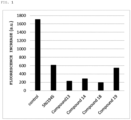
- Compound 13, Compound 14, Compound 18, or Compound 19 serving as a calpain inhibitor and a calpain (calpain-1) in the kit were mixed with each other in Assay Buffer, and the mixture was incubated at 37°C for 3 minutes.
- 5-FAM/QXL TM 520 serving as a calpain enzyme substrate was added to the incubated product to perform an enzyme reaction by the calpain at 37°C for 25 minutes (the final concentration of each inhibitor was 0.062 ⁇ M, and the final concentration of 5-FAM/QXL TM 520 was 5.0 ⁇ M).
- the enzyme substrate is cleaved by the calpain to emit fluorescence.
- the emission fluorescence intensity of the substrate was detected with a plate reader (Infinite TM 200 PRO, TECAN) (at an excitation wavelength of 490 nm and a fluorescence wavelength of 520 nm).
- a fluorescence increase amount is shown in FIG. 1 .
- SNJ-1945 is a known calpain inhibitor, and has the following structure.
- Calpain-1 (calpain-1 from human erythrocytes, Cat. No. 208713, Merck Millipore) and a DMSO solution of a HMRG fluorescent probe for detecting calpain activity were added to each of 50 mM Tris buffers (pH: 7.4, 5 mM CaCl 2 , 2 mM DTE, 2 mM EGTA) containing various concentrations of SNJ-1945 or Compound 13 to perform fluorescence assays (the final concentration of the fluorescent probe was 5 ⁇ M, and the final concentration of calpain-1 was 6.48 ⁇ g/mL).
- An IC 50 was determined on the basis of a graph produced with data analysis software "KaleidaGraph". As a result, the IC 50 of Compound 13 was 0.010 ⁇ M, and the IC 50 of SNJ-1945 was 0.040 ⁇ M.
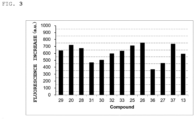
- Calpain-1 (calpain-1 from human erythrocytes, Cat. No. 208713, Merck Millipore) and a DMSO solution of a HMRG fluorescent probe for detecting calpain activity were added to a 50 mM Tris buffer (pH: 7.4, 5 mM CaCl 2 , 2 mM DTE, 2 mM EGTA) containing Compound 13, 20, 25, 26, 27, 28, 29, 30, 31, 32, 33, 36, or 37 to perform fluorescence assays (the final concentration of each compound was 0.062 ⁇ M, the final concentration of the fluorescent probe was 5 ⁇ M, and the final concentration of calpain-1 was 6.48 ⁇ g/mL).
- Tris buffer pH: 7.4, 5 mM CaCl 2 , 2 mM DTE, 2 mM EGTA
- each of the compounds showed calpain inhibitory activity comparable to or more than that of Compound 13.
- the compound (I), calpain inhibitor, or pharmaceutical composition of the present invention may be suitably used in the treatment or prevention of a calpain activity-associated disease.
Landscapes
- Health & Medical Sciences (AREA)
- Chemical & Material Sciences (AREA)
- Organic Chemistry (AREA)
- Life Sciences & Earth Sciences (AREA)
- Pharmacology & Pharmacy (AREA)
- Medicinal Chemistry (AREA)
- Animal Behavior & Ethology (AREA)
- General Health & Medical Sciences (AREA)
- Public Health (AREA)
- Veterinary Medicine (AREA)
- Nuclear Medicine, Radiotherapy & Molecular Imaging (AREA)
- Chemical Kinetics & Catalysis (AREA)
- General Chemical & Material Sciences (AREA)
- Engineering & Computer Science (AREA)
- Bioinformatics & Cheminformatics (AREA)
- Ophthalmology & Optometry (AREA)
- Immunology (AREA)
- Diabetes (AREA)
- Epidemiology (AREA)
- Neurology (AREA)
- Pain & Pain Management (AREA)
- Cardiology (AREA)
- Rheumatology (AREA)
- Biomedical Technology (AREA)
- Communicable Diseases (AREA)
- Neurosurgery (AREA)
- Orthopedic Medicine & Surgery (AREA)
- Physical Education & Sports Medicine (AREA)
- Pulmonology (AREA)
- Oncology (AREA)
- Heart & Thoracic Surgery (AREA)
- Transplantation (AREA)
- Emergency Medicine (AREA)
- Endocrinology (AREA)
- Hematology (AREA)
- Obesity (AREA)
- Pharmaceuticals Containing Other Organic And Inorganic Compounds (AREA)
Applications Claiming Priority (2)
| Application Number | Priority Date | Filing Date | Title |
|---|---|---|---|
| JP2022101432 | 2022-06-23 | ||
| PCT/JP2023/022740 WO2023249007A1 (ja) | 2022-06-23 | 2023-06-20 | カルパイン阻害剤 |
Publications (1)
| Publication Number | Publication Date |
|---|---|
| EP4545075A1 true EP4545075A1 (de) | 2025-04-30 |
Family
ID=89379969
Family Applications (1)
| Application Number | Title | Priority Date | Filing Date |
|---|---|---|---|
| EP23827190.2A Pending EP4545075A1 (de) | 2022-06-23 | 2023-06-20 | Calpain-hemmer |
Country Status (6)
| Country | Link |
|---|---|
| US (1) | US20250361202A1 (de) |
| EP (1) | EP4545075A1 (de) |
| JP (1) | JPWO2023249007A1 (de) |
| CN (1) | CN119403783A (de) |
| TW (1) | TW202404990A (de) |
| WO (1) | WO2023249007A1 (de) |
Family Cites Families (8)
| Publication number | Priority date | Publication date | Assignee | Title |
|---|---|---|---|---|
| US5514694A (en) * | 1992-09-21 | 1996-05-07 | Georgia Tech Research Corp | Peptidyl ketoamides |
| JP2002047256A (ja) | 2000-07-26 | 2002-02-12 | Kanegafuchi Chem Ind Co Ltd | α−アミノ−α´,α´,α´−トリハロケトン誘導体、α−アミノ−α´,α´,α´−トリハロアルコ−ル誘導体、及び、α−ヒドロキシ−β−アミノカルボン酸誘導体の製造法 |
| DE60330038D1 (de) * | 2002-07-22 | 2009-12-24 | Senju Pharma Co | Neue alpha-ketoamidderivate und deren verwendung |
| WO2011069149A2 (en) * | 2009-12-04 | 2011-06-09 | Dcb-Usa Llc | Cathepsin s inhibitors |
| WO2012021800A2 (en) * | 2010-08-13 | 2012-02-16 | Banyan Biomarkers | Caspase inhibitors as therapeutics for neural and organ injury and imaging |
| WO2012021788A2 (en) * | 2010-08-13 | 2012-02-16 | Banyan Biomarkers | Dipeptide calpain inhibitors |
| CN110818691A (zh) * | 2018-08-09 | 2020-02-21 | 中国科学院上海药物研究所 | 酮酰胺类化合物及其制备方法、药物组合物和用途 |
| JP2024500136A (ja) * | 2020-12-18 | 2024-01-04 | ヘプタレス セラピューティクス リミテッド | Sars-cov-2 mpro阻害薬化合物 |
-
2023
- 2023-06-20 EP EP23827190.2A patent/EP4545075A1/de active Pending
- 2023-06-20 WO PCT/JP2023/022740 patent/WO2023249007A1/ja not_active Ceased
- 2023-06-20 CN CN202380049050.6A patent/CN119403783A/zh active Pending
- 2023-06-20 JP JP2024529024A patent/JPWO2023249007A1/ja active Pending
- 2023-06-20 US US18/873,901 patent/US20250361202A1/en active Pending
- 2023-06-21 TW TW112123377A patent/TW202404990A/zh unknown
Also Published As
| Publication number | Publication date |
|---|---|
| TW202404990A (zh) | 2024-02-01 |
| JPWO2023249007A1 (de) | 2023-12-28 |
| WO2023249007A1 (ja) | 2023-12-28 |
| CN119403783A (zh) | 2025-02-07 |
| US20250361202A1 (en) | 2025-11-27 |
Similar Documents
| Publication | Publication Date | Title |
|---|---|---|
| ES2238641T3 (es) | Tiazolididas y pirrolididas de glutamina, asi como su utilizacion como agentes inhibidores de la dipeptidilpeptidasa iv. | |
| KR101999195B1 (ko) | 혈장 칼리크레인의 저해제로서의 벤질아민 유도체 | |
| JP2005508987A (ja) | 3−アミド−1,2−ベンゾイソオキサゾール誘導体、その塩の製造方法及び使用 | |
| WO2012062187A1 (zh) | 作为凝血酶抑制剂的脯氨酰胺衍生物、其制备方法及应用 | |
| EP2131845B1 (de) | 5-(2,4-dihydroxy-5-isopropyl-phenyl)-4-(4-morpholin-4-ylmethyl-phenyl)-isoxazol-3-carboxylsäure-ethylamid mesylat, dessen hydrate und polymorphe, und formulierungen mit diesen formen | |
| HUP0202514A2 (hu) | Antibakteriális szerek | |
| US12209141B2 (en) | Dipeptide compounds and uses thereof | |
| US6423714B2 (en) | Cyclohexene derivatives useful as antagonists of the motilin receptor | |
| EP4545075A1 (de) | Calpain-hemmer | |
| US5178877A (en) | Encapsulated renin inhibitor composition | |
| US20250179119A1 (en) | Cyclic peptide or salt thereof, and mdmx inhibitor | |
| KR20020062312A (ko) | 1,3,4-옥사디아졸린 유도체 및 이들을 유효 성분으로하는 약제 | |
| US6624165B2 (en) | Cyclopentene derivatives useful as antagonists of the motilin receptor | |
| US7129256B2 (en) | Antiparkinsonism drugs | |
| JP4975758B2 (ja) | ヒストンデアセチラーゼ阻害活性を有する新規ピロール誘導体 | |
| US6797720B2 (en) | 1,3,4-oxadiazoline derivative and an agent comprising its derivative as active ingredient | |
| WO2021037183A1 (zh) | 一类前药化合物及其在治疗癌症方面的应用 | |
| JP2004143053A (ja) | β−アミノヒドロキサム酸誘導体およびその用途 | |
| CN100422161C (zh) | 羟基吗啉酮衍生物及其医药用途 | |
| US20250179118A1 (en) | Novel dipeptide compounds and uses thereof | |
| JP2006070014A (ja) | 2−アミノベンゾチアゾール誘導体 | |
| JP2006347940A (ja) | βアミロイド生成抑制剤 | |
| AU2019265268A1 (en) | Novel compound exhibiting enteropeptidase inhibitory activity | |
| HK40060683B (en) | Novel dipeptide compounds and uses thereof | |
| HK40060683A (en) | Novel dipeptide compounds and uses thereof |
Legal Events
| Date | Code | Title | Description |
|---|---|---|---|
| STAA | Information on the status of an ep patent application or granted ep patent |
Free format text: STATUS: THE INTERNATIONAL PUBLICATION HAS BEEN MADE |
|
| PUAI | Public reference made under article 153(3) epc to a published international application that has entered the european phase |
Free format text: ORIGINAL CODE: 0009012 |
|
| STAA | Information on the status of an ep patent application or granted ep patent |
Free format text: STATUS: REQUEST FOR EXAMINATION WAS MADE |
|
| 17P | Request for examination filed |
Effective date: 20250109 |
|
| AK | Designated contracting states |
Kind code of ref document: A1 Designated state(s): AL AT BE BG CH CY CZ DE DK EE ES FI FR GB GR HR HU IE IS IT LI LT LU LV MC ME MK MT NL NO PL PT RO RS SE SI SK SM TR |
|
| DAV | Request for validation of the european patent (deleted) | ||
| DAX | Request for extension of the european patent (deleted) |