EP4539141A1 - Elektrochemisches bauelement und dessen verwendung - Google Patents
Elektrochemisches bauelement und dessen verwendung Download PDFInfo
- Publication number
- EP4539141A1 EP4539141A1 EP24205504.4A EP24205504A EP4539141A1 EP 4539141 A1 EP4539141 A1 EP 4539141A1 EP 24205504 A EP24205504 A EP 24205504A EP 4539141 A1 EP4539141 A1 EP 4539141A1
- Authority
- EP
- European Patent Office
- Prior art keywords
- carbon
- electrolyte
- component according
- electrochemical
- cathode
- Prior art date
- Legal status (The legal status is an assumption and is not a legal conclusion. Google has not performed a legal analysis and makes no representation as to the accuracy of the status listed.)
- Pending
Links
Images


Classifications
-
- H—ELECTRICITY
- H01—ELECTRIC ELEMENTS
- H01M—PROCESSES OR MEANS, e.g. BATTERIES, FOR THE DIRECT CONVERSION OF CHEMICAL ENERGY INTO ELECTRICAL ENERGY
- H01M10/00—Secondary cells; Manufacture thereof
- H01M10/05—Accumulators with non-aqueous electrolyte
- H01M10/056—Accumulators with non-aqueous electrolyte characterised by the materials used as electrolytes, e.g. mixed inorganic/organic electrolytes
- H01M10/0564—Accumulators with non-aqueous electrolyte characterised by the materials used as electrolytes, e.g. mixed inorganic/organic electrolytes the electrolyte being constituted of organic materials only
- H01M10/0566—Liquid materials
- H01M10/0568—Liquid materials characterised by the solutes
-
- H—ELECTRICITY
- H01—ELECTRIC ELEMENTS
- H01M—PROCESSES OR MEANS, e.g. BATTERIES, FOR THE DIRECT CONVERSION OF CHEMICAL ENERGY INTO ELECTRICAL ENERGY
- H01M10/00—Secondary cells; Manufacture thereof
- H01M10/05—Accumulators with non-aqueous electrolyte
- H01M10/052—Li-accumulators
- H01M10/0525—Rocking-chair batteries, i.e. batteries with lithium insertion or intercalation in both electrodes; Lithium-ion batteries
-
- H—ELECTRICITY
- H01—ELECTRIC ELEMENTS
- H01M—PROCESSES OR MEANS, e.g. BATTERIES, FOR THE DIRECT CONVERSION OF CHEMICAL ENERGY INTO ELECTRICAL ENERGY
- H01M10/00—Secondary cells; Manufacture thereof
- H01M10/05—Accumulators with non-aqueous electrolyte
- H01M10/056—Accumulators with non-aqueous electrolyte characterised by the materials used as electrolytes, e.g. mixed inorganic/organic electrolytes
- H01M10/0564—Accumulators with non-aqueous electrolyte characterised by the materials used as electrolytes, e.g. mixed inorganic/organic electrolytes the electrolyte being constituted of organic materials only
- H01M10/0566—Liquid materials
-
- H—ELECTRICITY
- H01—ELECTRIC ELEMENTS
- H01M—PROCESSES OR MEANS, e.g. BATTERIES, FOR THE DIRECT CONVERSION OF CHEMICAL ENERGY INTO ELECTRICAL ENERGY
- H01M4/00—Electrodes
- H01M4/02—Electrodes composed of, or comprising, active material
- H01M4/13—Electrodes for accumulators with non-aqueous electrolyte, e.g. for lithium-accumulators; Processes of manufacture thereof
- H01M4/133—Electrodes based on carbonaceous material, e.g. graphite-intercalation compounds or CFx
-
- H—ELECTRICITY
- H01—ELECTRIC ELEMENTS
- H01M—PROCESSES OR MEANS, e.g. BATTERIES, FOR THE DIRECT CONVERSION OF CHEMICAL ENERGY INTO ELECTRICAL ENERGY
- H01M2300/00—Electrolytes
- H01M2300/0017—Non-aqueous electrolytes
- H01M2300/0025—Organic electrolyte
- H01M2300/0028—Organic electrolyte characterised by the solvent
-
- H—ELECTRICITY
- H01—ELECTRIC ELEMENTS
- H01M—PROCESSES OR MEANS, e.g. BATTERIES, FOR THE DIRECT CONVERSION OF CHEMICAL ENERGY INTO ELECTRICAL ENERGY
- H01M4/00—Electrodes
- H01M4/02—Electrodes composed of, or comprising, active material
- H01M4/36—Selection of substances as active materials, active masses, active liquids
- H01M4/58—Selection of substances as active materials, active masses, active liquids of inorganic compounds other than oxides or hydroxides, e.g. sulfides, selenides, tellurides, halogenides or LiCoFy; of polyanionic structures, e.g. phosphates, silicates or borates
- H01M4/583—Carbonaceous material, e.g. graphite-intercalation compounds or CFx
-
- H—ELECTRICITY
- H01—ELECTRIC ELEMENTS
- H01M—PROCESSES OR MEANS, e.g. BATTERIES, FOR THE DIRECT CONVERSION OF CHEMICAL ENERGY INTO ELECTRICAL ENERGY
- H01M4/00—Electrodes
- H01M4/02—Electrodes composed of, or comprising, active material
- H01M4/62—Selection of inactive substances as ingredients for active masses, e.g. binders, fillers
- H01M4/621—Binders
- H01M4/622—Binders being polymers
-
- H—ELECTRICITY
- H01—ELECTRIC ELEMENTS
- H01M—PROCESSES OR MEANS, e.g. BATTERIES, FOR THE DIRECT CONVERSION OF CHEMICAL ENERGY INTO ELECTRICAL ENERGY
- H01M4/00—Electrodes
- H01M4/02—Electrodes composed of, or comprising, active material
- H01M4/62—Selection of inactive substances as ingredients for active masses, e.g. binders, fillers
- H01M4/624—Electric conductive fillers
- H01M4/625—Carbon or graphite
-
- H—ELECTRICITY
- H01—ELECTRIC ELEMENTS
- H01M—PROCESSES OR MEANS, e.g. BATTERIES, FOR THE DIRECT CONVERSION OF CHEMICAL ENERGY INTO ELECTRICAL ENERGY
- H01M50/00—Constructional details or processes of manufacture of the non-active parts of electrochemical cells other than fuel cells, e.g. hybrid cells
- H01M50/40—Separators; Membranes; Diaphragms; Spacing elements inside cells
- H01M50/409—Separators, membranes or diaphragms characterised by the material
-
- H—ELECTRICITY
- H01—ELECTRIC ELEMENTS
- H01M—PROCESSES OR MEANS, e.g. BATTERIES, FOR THE DIRECT CONVERSION OF CHEMICAL ENERGY INTO ELECTRICAL ENERGY
- H01M50/00—Constructional details or processes of manufacture of the non-active parts of electrochemical cells other than fuel cells, e.g. hybrid cells
- H01M50/50—Current conducting connections for cells or batteries
- H01M50/531—Electrode connections inside a battery casing
- H01M50/534—Electrode connections inside a battery casing characterised by the material of the leads or tabs
-
- Y—GENERAL TAGGING OF NEW TECHNOLOGICAL DEVELOPMENTS; GENERAL TAGGING OF CROSS-SECTIONAL TECHNOLOGIES SPANNING OVER SEVERAL SECTIONS OF THE IPC; TECHNICAL SUBJECTS COVERED BY FORMER USPC CROSS-REFERENCE ART COLLECTIONS [XRACs] AND DIGESTS
- Y02—TECHNOLOGIES OR APPLICATIONS FOR MITIGATION OR ADAPTATION AGAINST CLIMATE CHANGE
- Y02E—REDUCTION OF GREENHOUSE GAS [GHG] EMISSIONS, RELATED TO ENERGY GENERATION, TRANSMISSION OR DISTRIBUTION
- Y02E60/00—Enabling technologies; Technologies with a potential or indirect contribution to GHG emissions mitigation
- Y02E60/10—Energy storage using batteries
Definitions
- the invention relates to an electrochemical component comprising an anode, a cathode, an electrolyte, a current collector and a separator, wherein both the anode and the cathode are made of at least one carbon-based material.
- GDIBs graphite or carbon-based dual-ion batteries
- lithium-ion batteries which allow the movement of lithium ions (Li + ) between the cathode and the anode during charging and discharging
- carbon-based dual-ion batteries allow the simultaneous movement of cations, such as lithium ions (Li + ), and anions, such as hexafluorophosphate ions (PF 6 - ) during charging and discharging (both cations and anions participate in the electrochemical redox reaction).
- Carbon-based dual-ion batteries offer numerous advantages over conventional rocking-chair batteries. These include a high operating voltage of over 4.5 V, fast charging kinetics, increased safety, and the use of sustainable and environmentally friendly materials.
- rocking chair batteries refers to a special type of battery, also known as lithium-ion batteries (Li-ion batteries). Their operation is based on the periodic exchange of lithium ions (Li-ions) between two electrodes during the charge and discharge cycle, which is why an analogy to the movement pattern of a rocking chair was drawn, thus giving rise to the name "rocking chair.”
- McCullough et al. U.S. Patent 4, 830-938
- the test setup consisted of two graphite electrodes acting as anode and cathode.
- the electrolyte used was a 15 wt. percent LiClO 4 solution in propylene carbonate.
- DIBs dual-ion batteries
- electrolytes were considered, containing different anions such as BF 4 - , PF 6 - , AlCl 4 - , TFSI - or FSI - as well as cations such as Li + , Na + , Et 4 N + , EMI + (1-ethyl-3-methylimidazolium), Pp14 + (1-butyl-1-methylpiperidinium) or DMPI + (N,N-Dimethylpiperidinium).
- anions such as BF 4 - , PF 6 - , AlCl 4 - , TFSI - or FSI -
- cations such as Li + , Na + , Et 4 N + , EMI + (1-ethyl-3-methylimidazolium), Pp14 + (1-butyl-1-methylpiperidinium) or DMPI + (N,N-Dimethylpiperidinium).
- Diluted electrolyte solutions are traditionally used in batteries. It should be noted that the addition of water has a detrimental effect on the overall properties of the battery. This is particularly true when high charging voltages of more than 4.5 V are required, which in turn negatively impacts the battery's energy density.
- the use of aqueous electrolytes can, among other things, lead to the formation of hydrogen, thus posing a safety risk during use.
- the energy density of carbon-based dual-ion batteries is primarily influenced by the electrolyte concentration.
- the electrolyte acts as the active material.
- the "active material” refers to the components within the battery that perform chemical reactions during the charging and discharging process, thereby generating or storing electrical energy.
- GDIBs carbon-based dual-ion batteries
- Some solvents exhibit particularly high oxidation voltages exceeding 5.0 V, such as 5.3 V compared to Li + /Li for DMC (dimethyl carbonate) with a purity of 99.985% and 5.5 V compared to Li + /Li for EC (ethylene carbonate) with a purity of 99.979%.
- GDIBs In general, the energy densities of GDIBs are significantly lower than those of conventional LIBs. Therefore, GDIBs are not yet competitive with LIBs.
- the maximum electrolyte concentration ( organic solvent-based electrolyte ) achieved so far in GDIBs is around 3 to 4 M. This is due to problems such as high viscosity, lack of wettability, and slower Li + intercalation kinetics compared to anions, which leads to a reduced anode capacity ( ⁇ 100 mAh g -1 ). High-concentration electrolytes also exhibit poor transport kinetics for lithium ions (Li + ), which impairs their ability to intercalate and form solid electrolyte interfaces (SEI).
- CN 110635112 A describes a double-ion battery based on molybdenum selenide graphite and a manufacturing process for this battery.
- a gel containing phosphomolybdic acid is produced using a simple sol-gel process.
- the manufacturing process includes calcination steps to synthesize the molybdenum selenide/nitrogen-doped carbon (MoSe 2 /NC) compound and to develop the double-ion battery using the MoSe 2 /NC compound as the negative electrode material and graphite as the positive electrode material.
- MoSe 2 /NC molybdenum selenide/nitrogen-doped carbon
- This method is characterized by its cost-effective production.
- the double-ion battery has a wide operating voltage range of 2 to 5 V and offers good cycle stability and a relatively high reversible capacity. After 100 charge and discharge cycles at a 2C charge rate, the capacity is 86 mA h/g.
- DE 10 2021 115 802 A1 describes an electrochemical device, particularly an aluminum-ion battery, that exhibits improved performance and durability.
- the device comprises an aromatic amine compound as the active cathode material, which contains nitrogen atoms bonded to aromatic groups.
- the amine compound forms radical amine cations that form strong ionic bonds with anions, thus slowing the battery's self-discharge. This results in higher capacity, lower capacity decay, and a longer service life.
- the battery also consists of an aluminum anode or current collector, a separator, and an electrolyte containing aluminum ions and/or aluminum ion complexes.
- the battery offers high capacity, moderate operating voltage, and long cycle life. It can operate over a wide temperature range.
- the areas of application include the power supply of electronic devices, hybrid or electric vehicles as well as the storage of electrical energy in the power grid.
- the aim is to provide a potassium-based dual-ion battery that combines the respective advantages of potassium ion batteries and dual-ion batteries and uses inexpensive and resource-rich potassium ions as an energy storage medium for the storage and removal of anions.
- An embedded, graphite-like carbon material is used as the active material for the positive electrode and a porous carbon material for the adsorption and desorption of potassium ions is used as the active material for the negative electrode.
- the charge and discharge reaction at the negative electrode occurs quickly and stably through physical adsorption and desorption, which improves the electrochemical performance and thus increases the capacity and cycle stability of the potassium-based dual-ion battery.
- the JP 2008543002 A describes a high-capacity, high-voltage lithium-ion battery.
- This battery includes a carbon-containing cathode, an anode made of lithium or lithium alloys, and a non-aqueous electrolyte solution containing an anion receptor capable of binding LiF salts and fluoride ions.
- This battery can function as a dual-intercalation lithium-ion battery.
- the method involves designing the cathode and electrode pairs so that each electrode reversibly intercalates the ions provided by the LiF salt, resulting in a high-voltage, high-capacity, dual-intercalation lithium-ion battery.
- the DE 10 2011 054 119 A1 describes a carbon-based dual-ion electrochemical cell comprising an electrode for the reversible uptake and release of cations, an electrode for the reversible uptake and release of anions, and an electrolyte comprising a conducting salt and a solvent, wherein the solvent is an ionic liquid or a mixture of an ionic liquid and an organic solvent.
- the electrochemical cell uses an ionic liquid or a mixture of ionic liquid and an organic solvent. This liquid can contain various cations and anions.
- the electrodes are made of a variety of materials, including carbon, metals, and metal oxides. This cell offers versatile applications in batteries and energy storage systems.
- JP 2023116297 A describes a dual-ion battery in which both anions and cations are reversibly stored and released in the electrodes.
- a key feature of this battery is the use of lithium bis(fluorosulfonyl)imide (LiFSI) as the electrolyte, with a concentration ranging from 1 mol/L to 5 mol/L.
- LiFSI lithium bis(fluorosulfonyl)imide
- DE 10 2011 054122 A1 describes an electrochemical cell that uses the dual-ion insertion principle.
- the cell comprises a lithium titanate anode that reversibly absorbs and releases lithium ions, and a cathode that reversibly absorbs and releases anions.
- the electrolyte consists of lithium salts with low electrolyte concentrations (below 5M).
- the object of the present invention is to provide improved electrochemical components, in particular with increased energy density, high cycle stability and/or high capacity retention rate.
- this object is achieved by an electrochemical component, in particular in the form of a carbon-based dual-ion battery, according to the independent claims.
- Advantageous embodiments of the invention are specified in the dependent claims.
- possible uses of the component according to the invention are also demonstrated.
- the electrochemical component according to the invention comprises at least one anode, at least one cathode, a separator and at least one electrolyte, wherein the cathode and the anode each comprise a carbon-based material, wherein the electrolyte contains at least two alkali salts with different anions.
- an electrolyte with a multicomponent composition of at least two alkali salts is used in combination with electrodes made of a carbon-based material.
- the alkali salts differ at least in their anions.
- the invention enables high energy densities, making GDIBs competitive with conventional lithium-ion batteries (LIBs).
- LIBs lithium-ion batteries
- carbon-based dual-ion battery refers to a battery in which active species (cations and anions) are involved in the electrochemical reaction and are incorporated into host compounds. Anions are advantageously incorporated into a Anion host compound is embedded.
- GDIBs have carbon-based anodes and cathodes and thus have different electrochemical properties.
- the at least one cathode and the at least one anode are made of a carbon-based material.
- carbon-based material refers to materials with a carbon content of at least 80 wt.%, preferably at least 90 wt.%, particularly preferably at least 99 wt.%, based on the total weight.
- carbon-based materials include carbon black, graphite particles, natural graphite flakes, graphene, carbon nanotubes, or carbon fibers.
- carbon fibers refers to graphite-like carbon fibers that are made from carbon-based raw materials.
- graphene refers to a modification of carbon, in particular a polycyclic aromatic hydrocarbon, in which two-dimensional layers of tetravalent carbon atoms are present and each carbon atom is surrounded by three other carbon atoms at an angle of 120°.
- powder refers to a black, powdery solid containing carbon in a proportion ranging from 80% to 100%.
- carbon-based materials include synthetic graphite and expanded graphite
- an electrode comprises multiple carbon-based materials (e.g., in layers or as a mixture).
- the anode is made of graphite, in particular natural graphite or synthetic graphite.
- the cathode is made of expanded graphite, synthetic graphite, or natural graphite.
- At least one electrode further comprises an electron-conducting additive and/or a binder.
- the electrode-conducting additive is at least one metal oxide, preferably a metal oxide selected from the group comprising SiO 2 , Al 2 O 3 , Y 2 O 3 , HfO 2 , ZrO 2 , La 2 O 3 , Ta 2 O 5 , TiO 2 , ZnO, MgO, NiO, SnO 2 , CeO 2 , Ce 2 O 3 , and V 2 O 3 ; and/or an electron-conducting carbon-based material, in particular carbon nanotubes (CNTs), graphene or carbon black.
- a metal oxide selected from the group comprising SiO 2 , Al 2 O 3 , Y 2 O 3 , HfO 2 , ZrO 2 , La 2 O 3 , Ta 2 O 5 , TiO 2 , ZnO, MgO, NiO, SnO 2 , CeO 2 , Ce 2 O 3 , and V 2 O 3 ; and/or an electron-conducting carbon-based material, in particular carbon nanotubes
- the binder is selected from the group comprising alginate, in particular sodium alginate, polyvinylidene fluoride (PVDF), polytetrafluoroethylene (PTFE), styrene-butadiene rubber (SBR) and carboxymethylcellulose.
- PVDF polyvinylidene fluoride
- PTFE polytetrafluoroethylene
- SBR styrene-butadiene rubber
- the carboxymethylcellulose is present as "sodium carboxymethylcellulose", which refers to sodium salts of carboxymethylcelluloses (CMC), which are cellulose ethers in which some of the hydroxyl groups of the cellulose are linked as ethers to a carboxymethyl group (-CH 2 -COOH).
- CMC carboxymethylcelluloses
- the cathode and/or the anode is present as an electrode slurry.
- Electrode slurry is a mixture of electrode materials, usually in powder form, and a liquid or paste. It is used to ensure uniform distribution of the active materials and facilitate contact with the electrolyte. For the purposes of the application, this is understood to mean an electrode suspension comprising at least one active electrode material, in particular a carbon-based material, dispersed in a solvent. In embodiments, the electrode slurry further comprises at least one electron-conductive additive and/or a binder.
- the electrode slurry is prepared as a water-based or anhydrous slurry. In preferred embodiments, the electrode slurry is prepared as a water-based slurry. However, the water is removed by drying prior to use as an electrode.
- the electrochemical device comprises a current collector for the cathode and/or a current collector for the anode.
- current collector refers to an element for transferring electrical energy from a current-carrying conductor (cathode and/or anode) to an electrical device.
- the current collector is at least one electron-conducting material selected from carbon fabric, carbon paper, carbon fibers, graphene films, glassy carbon, nickel, tantalum, and/or tungsten.
- glassy carbon refers to a synthetic material made of pure carbon with a fullerene-like microstructure, which exhibits glassy ceramic properties (chemical stability) as well as properties of graphite (electrical conductivity).
- graphite refers to a modification of carbon, particularly hexagonal carbon crystals. Graphite naturally occurs in the form of flakes ("natural graphite flakes") or particles ("graphite particles”). In some embodiments, the natural graphite flakes have a size range of 20 ⁇ m to 300 ⁇ m.
- the anode current collector and/or the cathode current collector comprises at least one electron-conducting material selected from copper, aluminum and titanium.
- a current collector is in contact with the cathode and/or the anode.
- the separator is a polymer membrane, in particular a microporous polymer membrane, a glass fiber or a polymer fleece.
- the separator is made of polyvinyl chloride (PVC), polyethylene, polyamide, polypropylene, or glass fiber.
- separatator refers to a component in electrochemical devices that spatially and electrically separates the cathode and anode, i.e. the negative and positive electrodes, and is permeable to electrolyte ions.
- the separator is a nonwoven fabric made of glass fiber.
- the electrochemical component comprises at least one multi-component electrolyte comprising at least two alkali salts with different anions, wherein the electrolyte is arranged between the anode and/or the current collector and the cathode.
- the multicomponent electrolyte is an organic electrolyte.
- the term total alkali salt concentration refers to the sum of the at least two alkali salts in the electrolyte solution.
- the alkali salts in the electrolyte are highly concentrated.
- highly concentrated means that the electrolyte has a total alkali salt concentration of at least 6 M.
- the maximum total alkali salt concentration of the electrolyte is 9 M in embodiments.
- the molar ratio of the two alkali salts in the electrolyte is in a range from 1:100 to 100:1, preferably in the range from 1:50 to 50:1, particularly preferably in the range from 1:10 to 10:1, most particularly preferably in the range from 1:2.5 to 2.5:1.
- the electrolyte is anhydrous or virtually anhydrous.
- the term "anhydrous or virtually anhydrous” refers to an electrolyte with a maximum water content of 1 vol.
- the maximum water content of the electrolyte is less than 0.1 vol.% in embodiments, and less than 0.01 vol.% in preferred embodiments.
- the anions of the two different alkali metal salts are selected from halides, cyanides, borates, nitrates, sulfates, sulfonates, phosphates, amides, and imides.
- Sulfates are particularly selected from alkyl sulfates, aryl sulfates, and perfluoroalkyl sulfates.
- Sulfonates are particularly selected from alkyl and aryl sulfonates and perfluorinated alkyl sulfonates.
- Phosphates are particularly selected from hexafluorophosphates and perfluoroalkyl phosphates, such as tri(pentafluoroethane) trifluorophosphate.
- Amides and imides are in particular selected from bis(perfluoroalkylsulfonyl)amides, bis(fluorosulfonyl)imides, bis(perfluoroalkylsulfonyl)imides, such as bis(trifluoromethylylsulfonyl)imide and/or fluoroalkylsulfonylacetamides, in particular selected from the group comprising bis(trifluoromethanesulfonyl)imide, bis(pentafluoroethanesulfonyl)imide, bis(fluorosulfonyl)imide, and 2,2,2-trifluoro-N-(trifluoromethanesulfonyl)acetamide.
- Borates are in particular selected from tetrafluoroborates and perfluoroalkylborates, in particular selected from the group comprising tetrafluoroborate, pentafluoroethanetrifluoroborate, hexafluorophosphate, bisoxolatoborate, and difluoro(oxalato)borate.
- the anions are selected from fluorosulfonylimide (FSI - ), hexafluorophosphate (PF 6 - ), bis(trifluoromethanesulfonyl)imide (TFSI - ), bis(pentafluoroethanesulfonyl)imide (BETI - ), 2,2,2-trifluoro-N-(trifluoromethanesulfonyl)acetamide (TSAC - ), tetrafluoroborate (BF 4 - ), pentafluoroethanetrifluoroborate (C 2 F 5 BF 3 - ), bisoxolatoborate (BOB - ), difluoro(oxalato)borate (DFOB - ) and/or tri(pentafluoroethane)trifluorophosphate ((C 2 F 5 ) 3 PF 3 - ).
- FSI - fluorosulfonylimide
- the anions of the alkali salts are selected from carbonate (CO 3 2- ), chloride (Cl - ), hydroxide (OH-), phosphate (PO 4 3- ), sulfate (SO 4 2- ), tetrachloroaluminate (AlCl 4 - ), perchlorate (ClO 4 - ) and nitrate (NO 3 - ).
- the cations of the alkali salts are selected from lithium, potassium and sodium, especially lithium.
- the alkali salts are lithium salts.
- Lithium salts are chemical compounds containing lithium ions (Li + ). These salts are formed by combining lithium with various anions, resulting in a variety of lithium salts.
- the two different lithium salts are selected from lithium carbonate (Li 2 CO 3 ), lithium chloride (LiCl), lithium hydroxide (LiOH), lithium phosphate (Li 3 PO 4 ), lithium sulfate (Li 2 SO 4 ), lithium fluorosulfonylimide (LiFSI), lithium bis(trifluoromethanesulfonyl)imide (LiTFSI), lithium perchlorate (LiClO 4 ) or lithium tetrafluoroborate (LiBF 4 ).
- lithium carbonate Li 2 CO 3
- LiCl lithium chloride
- LiOH lithium hydroxide
- LiOH lithium phosphate
- Li 3 PO 4 lithium sulfate
- LiFSI lithium fluorosulfonylimide
- LiTFSI lithium bis(trifluoromethanesulfonyl)imide
- LiBF 4 lithium tetrafluoroborate
- the alkali salts are lithium bis(fluorosulfonyl)imide (LiFSI) and lithium hexafluorophosphate (LiPF 6 ).
- the electrolyte contains lithium bis(fluorosulfonyl)imide (LiFSI) at a concentration in the range of 3 M to 6 M and lithium hexafluorophosphate (LiPF 6 ) at a concentration in the range of 1 M to 3 M in dimethyl carbonate and/or ethylene carbonate (DMC/EC).
- LiFSI lithium bis(fluorosulfonyl)imide
- LiPF 6 lithium hexafluorophosphate
- M stands for moles per liter (mol/L).
- the electrolyte comprises a concentrated (7 M) hybrid electrolyte formulation for Li-based DGIB based on LiFSI and using LiPF 6 as an additive.
- the molar ratio of the two alkali salts in the electrolyte LiFSI to LiPF 6 is in a range from 1:100 to 100:1, preferably in the range from 1:50 to 50:1, particularly preferably in the range from 1:10 to 10:1, most particularly preferably in the range from 1:2.5 to 2.5:1.
- the electrolyte comprises as solvent an ester of carbonic acid (carbonate), preferably dimethyl carbonate (DMC), ethylene carbonate (EC), diethyl carbonate (DEC), ethyl methyl carbonate (EMC), propylene carbonate (PC) or mixtures thereof.
- carbonate preferably dimethyl carbonate (DMC), ethylene carbonate (EC), diethyl carbonate (DEC), ethyl methyl carbonate (EMC), propylene carbonate (PC) or mixtures thereof.
- the electrolyte contains a sulfoxide, a cyclic ether, a nitrile, or an ionic liquid as a solvent—optionally mixed with a carbonate.
- solvents are selected in particular from dimethyl sulfoxide (DMSO), 1,3-dioxolane (DOL), acetonitrile (AN), and tetrahydrofuran (THF).
- the anions of the ionic liquid are selected in particular from the anions mentioned under alkali metal salts.
- the cations of the ionic liquid are in particular selected from the group comprising alkylammonium, pyridinium, pyrazolium, pyrrolium, pyrrolinium, phosphonium, piperidinium, pyrrolidinium, imidazolium and/or sulfonium compounds, preferably selected from the group comprising 1-ethyl-3-methylimidazolium, 1,2-dimethyl-3-propylimidazolium, 1,2-diethyl-3,5-dimethylimidazolium, trimethyl-n-hexylammonium, N-alkyl-N-methylpiperidinium, N-alkyl-N-methylmorpholinium and/or N-alkyl-N-methylpyrrolidinium, in particular N-butyl-N-methylpyrrolidinium and/or N-methyl-N-propylpyrrolidinium.
- the solvent is selected from dimethyl carbonate (DMC), ethylene carbonate (EC), diethyl carbonate (DEC), ethyl methyl carbonate (EMC), propylene carbonate (PC), dimethyl sulfoxide (DMSO), 1,3-dioxolane (DOL), acetonitrile (AN), or tetrahydrofuran (THF).
- DMC dimethyl carbonate
- EC ethylene carbonate
- DEC diethyl carbonate
- EMC ethyl methyl carbonate
- PC propylene carbonate
- DMSO dimethyl sulfoxide
- DOL 1,3-dioxolane
- AN acetonitrile
- THF tetrahydrofuran
- the solvent is at least one ionic liquid comprising an anion, wherein the anion of the ionic liquid is selected from the two anions mentioned as alkali metal salts.
- the solvent is at least one ionic liquid comprising a cation selected from the group comprising alkylammonium, pyridinium, pyrazolium, pyrrolium, pyrrolinium, phosphonium, piperidinium, pyrrolidinium, imidazolium and/or sulfonium compounds, preferably selected from the group comprising 1-ethyl-3-methylimidazolium, 1,2-dimethyl-3-propylimidazolium, 1,2-diethyl-3,5-dimethylimidazolium, trimethyl-n-hexylammonium, N-alkyl-N-methylpiperidinium, N-alkyl-N-methylmorpholinium and/or N-alkyl-N-methylpyrrolidinium, in particular N-butyl-N-methylpyrrolidinium and/or N-methyl-N-propylpyrrolidinium; and an anion selected from the group comprising halides, cyanides, cyan
- the electrolyte comprises additives.
- additives are used to generate lithium ions, which facilitate SEI formation on anode surfaces (improving battery life), increase ionic conductivity (for faster charging and discharging), and moderate electrolyte viscosity for more efficient ion transport.
- Additives are substances that are added to another material or product in order to achieve positive properties with regard to production, storage, processing or material or product properties.
- the additive is an electron-conducting additive, preferably an electron-conducting additive selected from carbon black, graphene, carbon nanotubes, carbon fibers, graphite particles, or natural graphite flakes.
- powder refers to a black, powdery solid containing carbon in a proportion ranging from 80% to 100%.
- the electrochemical component forms an electrochemical cell, which, in addition to the carbon-based anode, the carbon-based cathode, the separator, and the electrolyte, comprises a current collector.
- the electrolyte and the separator are arranged between the carbon-based anode and the carbon-based cathode.
- the current collector(s) are connected to the anode and/or the cathode.
- the electrochemical device is a battery comprising at least one electrochemical cell as described above as a base element.
- the base elements can be connected to each other both in parallel and in series to form a battery system constructed from the electrochemical device.
- the electrochemical component is selected from a primary battery or a secondary battery.
- primary battery refers to a non-rechargeable battery.
- secondary battery refers to a rechargeable battery.
- the electrochemical component is a secondary battery.
- the electrochemical component is in the form of a cylindrical cell (round), with a flat design (flat) or with an angular design (rectangular).
- the electrochemical component is in the form of a flexible or deformable cell.
- the electrochemical component is in the form of a "Swagelok cell," a button cell, e.g., a cylindrical 18650 cell.
- Silicone cell refers to a cylindrical electrochemical cell comprising two or three electrodes, a separator and external stainless steel caps, with an electrolyte between the anode and cathode.
- button cell refers to an electrochemical cell with a round cross-section, where the height is smaller than the diameter of the cell.
- 18650 cell refers to a cylindrical electrochemical cell with a diameter of 18 mm and a length of 65 mm.
- the electrochemical component is in the form of a pouch cell.
- Pouch cell refers to an electrochemical cell in the form of a pouch, with the active layers stacked or folded and enclosed by a flexible outer foil, preferably made of aluminum. Pouch cells advantageously feature a low thickness, lower weight, and application-specific sizes.
- the electrochemical component is a battery, preferably a secondary battery.
- the electrochemical device is a component of a battery used to store electrical energy in an electrical power grid, wherein the device is connected to the electrical power grid.
- the electrochemical component according to the invention has a high and adjustable capacity (80 to 140 Wh/kg, preferably 90 to 120 Wh/kg) at the cell level (based on cell weight), which is significantly higher than the capacity of known GDIBs.
- Capacities of 300 to 400 Wh/kg are advantageously achieved by the invention.
- the electrochemical component advantageously has a working voltage through the use of (maximum 4.5 V, preferably in the range of 3.5 V to 5.1 V).
- the electrochemical component according to the invention typically has a discharge rate of 2 C to a maximum of 5 C.
- the electrochemical component according to the invention further has a charge rate of typically 2 C to a maximum of 5 C.
- a cycle stability of at least 3000 cycles is advantageously achieved.
- the electrochemical components according to the invention can be operated in a wide temperature range, preferably in the range from less than -50°C to more than 50°C, whereby stable and safe operation of electronic devices, in particular portable devices such as laptops or mobile phones; or transport applications such as hybrid or electric vehicles, or within an electrical power grid or in stationary energy storage devices is possible.
- a further aspect of the invention relates to the use of the electrochemical component according to the invention for supplying power to an electronic device, for supplying power to a hybrid or electric vehicle or for storing electrical energy within an electrical power grid.
- the electrochemical components according to the invention advantageously solve potential safety problems associated with the risk of fire and/or explosion associated with lithium-ion batteries.
- the harmlessness of the components, the electrochemical components ensures overall ease of handling during use and transport.
- the external device is an electronic device or a hybrid or electric vehicle.
- Graphite powder was mixed with alginic acid (2.5% wt.) and carbon black in water in a ratio of 8:1:1. The homogeneous aqueous slurries were then coated onto Type 304 stainless steel foil and dried in a vacuum oven. The graphite loading was controlled in the range of 1.5 to 2 mg cm -2 .
- the multicomponent electrolyte was prepared in an argon (Ar)-filled glovebox with H2O and O2 contents below 0.1 ppm. LiPF6 was added in 5 M LiFSI/DMC:EC at specific molar ratios. The mixture was stirred in the glovebox for 10 hours.
- LSV Linear current-voltage polarography
- CHI electrochemistry station using a two-electrode cell (2025 button cell), with lithium foil as the anode and stainless steel as the cathode.
- Fiberglass was used as the separator.
- Swagelok cells were used to measure battery performance. The cells were mounted in an argon-filled glove box with humidity and oxygen levels of ⁇ 0.1 ppm.
- Battery performance was measured on the LAND battery test system. Potential windows of 0.01 to 2 V and 3 to 5.2 V (vs. Li/Li + ) were used for the anode and cathode half-cells, respectively. Battery performance was tested in a voltage window of 3 to 5 V. CV characterization was performed on the CHI electrochemistry station.
- Pouch cells were assembled in an argon-filled glove box with a water content and oxygen content below 0.1 ppm. Expanded graphite was used as the cathode, synthetic graphite as the anode, a multicomponent concentrated electrolyte, and a glass fiber separator.
- the active materials were coated onto the stainless steel foil at an areal density of 5 to 20 mg/ cm2 for the cathode and 2 to 5 mg/ cm2 for the anode.
- the electrodes were then compacted and dried at 65 °C under an argon atmosphere for 72 hours, followed by lamination, welding, wrapping, baking, injection of the multicomponent concentrated electrolyte, and prepackaging.
- Fig.1 shows the energy density of Li-electrolyte-based GDIBs at the material and cell levels with respect to electrolyte concentration.
- GDIBs could achieve energy densities close to those of commercial LIBs at concentrations above 5 M.
- Fig. 2 shows investigations of various concentrations of LiPF6/LiFSI in DMC using linear current-voltage polarography (LSV) at a scan rate of 1 mV/s on the stainless steel current collector. Since the LiPF6 salt in carbonate-based electrolytes exhibits a high electrochemical stability window above 6.0 V (vs. Li/Li + ) and is capable of forming a passivation layer on the aluminum and stainless steel current collector, the addition of LiPF6 to the LiFSI electrolyte can suppress the ongoing side reaction with the current collector and increase the oxidation voltage.
- LSV linear current-voltage polarography
- a LiFSI salt concentration of 1 M limits the oxidation current to 4.3 V (vs. Li/Li + ), which may indicate corrosion of the stainless steel and degradation of the electrolyte.
- the oxidation potential is improved to approximately 5 V (vs. Li/Li + ) for 5 and 7 M LiFSI
- the inability of the FSI-based electrolyte to form an effective passivation layer (rich in Li-F) on the metallic current collector leads to an ongoing anodic dissolution reaction at 5 V (vs. Li/Li + ).
- 5 M LiFSI delivered an anode current 102 times higher than that of 5 M LiFSI-2 M LiPF6, and this was accompanied by severe corrosion of the SS and Al current collectors.
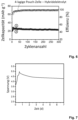
- Fig. 4 shows the charge and discharge curves of the half cells and full cells for a Swagelok configuration.
- the discharge capacity was calculated based on the cell weight (electrodes and electrolyte).
- the weight ratio of the active materials in the electrodes was set to 1:3.3 (anode: cathode).
- Fig. 5 The highly reversible capacities at different current rates (0.05, 0.1, 0.2, 0.5, 1 A g -1 ) are shown.
- the full cell shows extremely stable cycling performance with a reversible capacity of approximately 44 mAh g -1 and a capacity retention of 95% after 500 cycles.
- Fig. 6 shows the cycle at 0.5 A g -1 between 3.5 and 5 V with a capacity of 21 mAh g -1 and a capacity retention of 98.2% (after 300 cycles).
- Fig. 7 The self-discharge behavior of a GDIB according to the invention is shown.
Landscapes
- Chemical & Material Sciences (AREA)
- Engineering & Computer Science (AREA)
- Chemical Kinetics & Catalysis (AREA)
- Electrochemistry (AREA)
- General Chemical & Material Sciences (AREA)
- Manufacturing & Machinery (AREA)
- Physics & Mathematics (AREA)
- Condensed Matter Physics & Semiconductors (AREA)
- General Physics & Mathematics (AREA)
- Inorganic Chemistry (AREA)
- Materials Engineering (AREA)
- Secondary Cells (AREA)
Abstract
Die Erfindung betrifft ein elektrochemisches Bauelement umfassend eine Anode, eine Kathode, einen Elektrolyten, jeweils einen Stromkollektor und einen Separator, wobei sowohl die Anode als auch die Kathode aus mindestens einem kohlenstoffbasierten Material ist. Der wasserfrei oder nahezu wasserfreie Elektrolyt ist hochkonzentriert und weist mindestens zwei verschiedene Alkalisalze mit unterschiedlichen Anionen auf.
Description
- Die Erfindung betrifft ein elektrochemisches Bauelement umfassend eine Anode, eine Kathode, einen Elektrolyten, jeweils einen Stromkollektor und einen Separator, wobei sowohl die Anode als auch die Kathode aus mindestens einem kohlenstoffbasierten Material ist.
- Die Weiterentwicklung erneuerbarer Energien erfordert kostengünstige Energiespeichersysteme im Terawattstundenbereich. Gleichzeitig stellt die Stabilisierung des elektrischen Netzes zukünftig einen essenziellen Aspekt zur Dekarbonisierung der Energiewirtschaft und des Verkehrs dar. In diesem Zusammenhang werden kohlenstoffbasierte Dual-Ionen-Batterien (GDIBs) (eng. Graphite or Carbon based Dual Ion Batteries) als vielversprechendes Batteriekonzept für skalierbare Energiespeicherung betrachtet, da sie kosteneffizient, nachhaltig und in der Lage sind, in einem breiten Spannungsbereich zu operieren.
- Anders als Lithium-Ionen-Batterien, die die Bewegung von Lithium-Ionen (Li+) zwischen der Kathode und der Anode während des Lade- und Entladevorgangs ermöglichen, erlauben kohlenstoffbasierte Dual-Ionen-Batterien die gleichzeitige Bewegung von Kationen, wie Lithium-Ionen (Li+), und Anionen, wie Hexafluorophosphat-Ionen (PF6 -) während der Lade- und Entladevorgänge (sowohl Kationen als auch Anionen nehmen an der elektrochemischen Redoxreaktion teil).
- Kohlenstoffbasierte Dual-Ionen-Batterien (GDIBs) bieten im Vergleich zu herkömmlichen "Rocking-Chair"-Batterien zahlreiche Vorteile. Hierzu zählen insbesondere eine hohe Betriebsspannung von über 4,5 V, eine schnelle Ladekinetik, gesteigerte Sicherheit sowie die Verwendung nachhaltiger und umweltfreundlicher Materialien.
- Unter dem Begriff "Rocking-Chair-Batterien" versteht man eine spezielle Art von Batterien, die auch als Lithium-Ionen-Batterien (Li-Ionen-Batterien) bekannt sind. Ihr Betrieb basiert auf dem periodischen Austausch von Lithium-Ionen (Li-Ionen) zwischen zwei Elektroden während des Lade- und Entladezyklus, weshalb eine Analogie zum Bewegungsmuster des Hin- und Herschaukelns eines Stuhls gezogen wurde und somit der Name "Rocking-Chair" entstand.
-
1989 entwickelten McCullough et al. (U.S. Patent. 4, 830-938 ) erstmals eine Batterie mit zwei kohlenstoffbasierten Elektroden für mögliche Sekundärbatterien. In diesem experimentellen Szenario bestand die Versuchsanordnung aus zwei Graphitelektroden, die als Anode und Kathode fungierten. Der Elektrolyt, der zur Anwendung kam, bestand aus einer Lösung von 15 Gewichtsprozent LiClO4 in Propylencarbonat. Die erzielten positiven Ergebnisse motivierten zu weiteren Untersuchungen im Hinblick auf geeignete Elektrolyte für Dual-Ionen-Batterien (DIBs). In diesem Zusammenhang wurden verschiedene Elektrolyte in Betracht gezogen, die unterschiedliche Anionen wie BF4 -, PF6 -, AlCl4 -, TFSI- oder FSI- sowie Kationen wie Li+, Na+, Et4N+, EMI+ (1-Ethyl-3-methylimidazolium), Pp14+ (1-Butyl-1-methylpiperidinium) oder DMPI+
(N,N-Dimethylpiperidinium) enthalten. - Herkömmlich werden in Batterien verdünnte Elektrolytlösungen verwendet. Es ist zu beachten, dass die Zugabe von Wasser einen nachteiligen Einfluss auf die Gesamteigenschaften der Batterie ausübt. Dies trifft insbesondere dann zu, wenn es darum geht, hohe Ladespannungen von mehr als 4,5 V zu realisieren, was wiederum die Energiedichte der Batterie negativ beeinflusst. Der Einsatz wässriger Elektrolyte, kann u. a. zur Bildung von Wasserstoff führen und damit ein Sicherheitsrisiko beim Einsatz darstellen.
- Die Energiedichte von kohlenstoffbasierten Dual-Ionen-Batterien (GDIBs) wird hauptsächlich durch die Konzentration des Elektrolyten beeinflusst. In diesem Kontext fungiert der Elektrolyt als aktives Material.
- In einer Batterie bezieht sich das "aktive Material" auf die Komponenten innerhalb der Batterie, die während des Lade- und Entladevorgangs chemische Reaktionen durchführen und so die elektrische Energie erzeugen oder speichern.
- Um unerwünschte Nebenreaktionen in den Kathoden von kohlenstoffbasierten Dual-Ionen-Batterien (GDIBs), insbesondere bei hohen Betriebsspannungen, zu minimieren, ist die Verwendung von Elektrolyten von hoher Reinheit und Oxidationsbeständigkeit wichtig. Einige Lösungsmittel weisen besonders hohe Oxidationsspannungen von über 5,0 V auf, wie beispielsweise 5,3 V im Vergleich zu Li+/Li für DMC (Dimethylcarbonat) mit einer Reinheit von 99,985 % und 5,5 V im Vergleich zu Li+/Li für EC (Ethylencarbonat) mit einer Reinheit von 99,979 %.
- Da die Verwendung von konzentrierteren Elektrolyten in Kombination mit "Rocking-Chair"-Batterien (z. B. mit Lithium-Ionen-Batterien (LIBs)) in den meisten Fällen zu einer Verringerung der Energiedichte führt und aufgrund langjähriger industrieller Erfahrungen wurde eine Konzentration von 1 M als optimal erachtet.
- Generell sind die Energiedichten bei GDIBs bisher deutlich geringer als bei konventionellen LIBs. Daher sind die GDIBs bisher nicht mit den LIBs konkurrenzfähig. Die maximale Elektrolytkonzentration (organic solvent based electrolyte), die bei GDIBs bisher erreicht wurde, liegt bei etwa 3 bis 4 M. Dies ist auf Probleme, wie hohe Viskosität, mangelnde Benetzbarkeit und eine langsamere Li+-Interkalationskinetik im Vergleich zu Anionen zurückzuführen, was zu einer verringerten Anodenkapazität (<100 mAh g-1) führt. Elektrolyte mit hoher Konzentration weisen zudem eine geringe Transportkinetik für Lithium-Ionen (Li+) auf, was ihre Fähigkeit zur Interkalation und zur Bildung von Festelektrolyt-Grenzflächen (SEI) beeinträchtigt.
-
CN 110635112 A beschreibt eine Doppelionen-Batterie, die auf Molybdänselenid-Graphit basiert, sowie ein Herstellungsverfahren für diese Batterie. Ein Gel, das Phosphomolybdänsäure enthält, wird mithilfe eines einfachen Sol-Gel-Verfahrens hergestellt. Das Herstellungsverfahren beinhaltet Schritte zur Kalzinierung, um das Molybdänselenid/nitrogen-dotierte Kohlenstoff (MoSe2/NC)-Compound zu synthetisieren, und zur Entwicklung der Doppelionen-Batterie unter Verwendung des MoSe2/NC-Compounds als negatives Elektrodenmaterial und Graphit als positives Elektrodenmaterial. Diese Methode zeichnet sich durch ihre kostengünstige Herstellung aus. Die Doppelionen-Batterie weist einen breiten Arbeitsspannungsbereich von 2 bis 5 V auf und bietet eine gute Zyklenstabilität sowie eine relativ hohe reversible Kapazität. Nach 100 Lade- und Entladezyklen unter einer 2C-Laderate beträgt die Kapazität 86 mA h/g. -
DE 10 2021 115 802 A1 beschreibt ein elektrochemisches Bauelement, insbesondere eine Aluminiumionen-Batterie, die eine verbesserte Leistung und Haltbarkeit aufweist. Das Bauelement umfasst eine aromatische Aminverbindung als aktives Kathodenmaterial, welche Stickstoffatome aufweist, die mit aromatischen Gruppen verbunden sind. Während des Betriebs der Batterie bildet die Aminverbindung radikale Aminkationen, die starke ionische Bindungen mit Anionen eingehen und somit die Selbstentladung der Batterie verlangsamen. Dies führt zu einer höheren Kapazität, geringerem Kapazitätsabfall und längerer Lebensdauer. - Die Batterie besteht weiterhin aus einer Aluminiumanode oder einem Stromkollektor, einem Separator und einem Elektrolyten mit Aluminiumionen und/oder Aluminiumionenkomplexen. Die Batterie bietet eine hohe Kapazität, moderate Arbeitsspannung und lange Zyklenlebensdauer. Sie kann in einem breiten Temperaturbereich betrieben werden.
- Die Anwendungsbereiche umfassen die Stromversorgung von elektronischen Geräten, Hybrid- oder Elektrofahrzeugen sowie die Speicherung von elektrischer Energie im Stromnetz.
- In
CN 108063217 B ist es Ziel, eine Kalium-basierte Dual-Ionen-Batterie bereitzustellen, die die jeweiligen Vorteile von Kalium-lonen-Batterien und Dual-Ionen-Batterien kombiniert und kostengünstige und ressourcenreiche Kalium-Ionen als Energiespeichermedium für die Einlagerung und Entnahme von Anionen verwendet. Dabei wird ein eingebettetes, graphitartiges Kohlenstoffmaterial als aktives Material für die positive Elektrode und ein poröses Kohlenstoffmaterial für die Adsorption und Desorption von Kalium-Ionen als aktives Material für die negative Elektrode verwendet. Durch die Adsorption und Desorption von Kalium-Ionen an der negativen Elektrode sowie die Einlagerung von Anionen und deren De-Interkalation an der positiven Elektrode wird der reversible Lade- und Entladevorgang der Kalium-basierten Dual-Ionen-Batterie realisiert. - Die Ladungs- und Entladereaktion an der negativen Elektrode erfolgt durch physische Adsorption und Desorption schnell und stabil, was die elektrochemische Leistungsfähigkeit verbessert und somit die Kapazität und die Zyklusstabilität der Kalium-basierten Dual-Ionen-Batterie erhöht.
- Die
JP 2008543002 A - Die
DE 10 2011 054 119 A1 beschreibt eine kohlenstoffbasierte Dual-lonen-elektrochemische Zelle, die eine Elektrode für die reversible Aufnahme und Abgabe von Kationen, eine Elektrode für die reversible Aufnahme und Abgabe von Anionen sowie einen Elektrolyten mit einem Leitsalz und einem Lösungsmittel umfasst, wobei das Lösungsmittel eine ionische Flüssigkeit oder eine Mischung aus einer ionischen Flüssigkeit und einem organischen Lösungsmittel ist. - Die elektrochemische Zelle nutzt eine ionische Flüssigkeit oder eine Mischung aus dieser und ein organisches Lösungsmittel. Diese Flüssigkeit kann verschiedene Kationen und Anionen enthalten. Die Elektroden bestehen aus einer Vielzahl von Materialien, darunter Kohlenstoff, Metalle und Metalloxide. Diese Zelle bietet vielseitige Anwendungsmöglichkeiten in Batterien und Energiespeichersystemen.
-
JP 2023116297 A - Yang, D.; Watanabe, M.; et al. 2022 beschreiben eine Hochspannungs- und Hochkapazitäts-Dual-Ionen-Batterie, die einen Acetonitril-wässrigen Hybrid-Elektrolyten verwendet.
-
DE 10 2020 108397 B3 beschreibt eine elektrochemische Zelle mit Schwefel als Aktivmaterial in der Elektrode mit niedrigerem Redoxpotential und Kohlenstoff, insbesondere Graphit, in der Elektrode mit höherem Redoxpotential. Der Ladungstransfer erfolgt durch einen Dual-lonen-Mechanismus, bei dem sowohl Kationen in die Schwefel-Elektrode als auch Anionen in die Kohlenstoff-Elektrode ein- und ausgelagert werden. Dieser Aufbau ermöglicht moderate Zellspannungen über 2 V, hohe Zyklenstabilität und eine kostengünstige Herstellung ohne Schwermetalle. -
DE 10 2011 054122 A1 beschreibt eine elektrochemische Zelle, die das Dual-Ionen-Insertions-Prinzip verwendet. Die Zelle umfasst eine Anode aus Lithiumtitanat, die Lithium-Ionen reversibel aufnimmt und abgibt, sowie eine Kathode, die Anionen reversibel aufnimmt und abgibt. Der Elektrolyt besteht aus Lithiumsalzen mit niedrigen Elektrolytkonzentrationen (unter 5M). - Die Aufgabe der vorliegenden Erfindung besteht darin, verbesserte elektrochemische Bauelemente, insbesondere mit erhöhter Energiedichte, hoher Zyklenstabilität und/oder hoher Kapazitätserhaltungsrate, bereitzustellen.
- Erfindungsgemäß wird die Aufgabe durch ein elektrochemisches Bauelement, insbesondere in Form einer kohlenstoffbasierten Dual-Ionen-Batterien, gemäß den unabhängigen Ansprüchen gelöst. Vorteilhafte Ausgestaltungen der Erfindung sind in den abhängigen Ansprüchen angegeben. Darüber hinaus werden auch Verwendungsmöglichkeiten des erfindungsgemäßen Bauelements aufgezeigt.
- Das erfindungsgemäße elektrochemische Bauelement umfasst mindestens eine Anode, mindestens eine Kathode, einen Separator und mindestens einen Elektrolyten, wobei die Kathode und die Anode jeweils ein kohlenstoffbasiertes Material aufweisen, wobei der Elektrolyt mindestens zwei Alkalisalze mit unterschiedlichen Anionen enthält.
- Erfindungsgemäß kommt ein Elektrolyt mit einer mehrkomponentigen Zusammensetzung aus mindestens zwei Alkalisalzen in Kombination mit Elektroden aus einem kohlenstoffbasierten Material zur Anwendung. Die Alkalisalze unterscheiden sich dabei zumindest in den Anionen.
- Vorteilhaft ermöglicht die Erfindung hohe Energiedichten wodurch die GDIBs konkurrenzfähig zu konventionellen Lithiumionenbatterien (LIBs) werden.
- Unter dem Begriff "kohlenstoffbasierte Dual-Ionen-Batterie" (nachfolgend auch kurz GDIBs - engl. Graphite or Carbon based Dual Ion Battery) wird eine Batterie verstanden, wobei aktive Spezies (Kationen und Anionen) an der elektrochemischen Reaktion beteiligt sind und aktive Spezies in Wirtsverbindungen eingelagert werden. Zweckmäßig werden Anionen in eine Anionenwirtsverbindung eingelagert. Im Gegensatz zu DIBs (engl. Dual Ion Battery) besitzen GDIBs kohlenstoffbasierte Anoden und Kathoden und somit im Vergleich unterschiedliche elektrochemische Eigenschaften.
- Die mindestens eine Kathode und die mindestens eine Anode sind aus einem kohlenstoffbasierten Material.
- Unter dem Begriff "kohlenstoffbasiertes Material" werden Materialien mit einem Gehalt an Kohlenstoff von mindestens 80 Gew.-%, bevorzugt mindestens 90 Gew.-%, besonders bevorzugt mindestens 99 Gew.-%, bezogen auf das Gesamtgewicht verstanden.
- In Ausführungsformen umfassen kohlenstoffbasierte Materialien Ruß, Graphitpartikel Naturgraphitflocken, Graphen, Kohlenstoffnanoröhrchen oder Karbonfasern.
- Unter dem Begriff "Karbonfasern" werden graphitartig angeordnete Kohlenstoff-Fasern, welche aus kohlenstoffbasierten Ausgangsmaterialien hergestellt werden, verstanden.
- Unter dem Begriff "Graphen" wird eine Modifikation des Kohlenstoffs, insbesondere ein polyzyklischer aromatischer Kohlenwasserstoff, verstanden, wobei zweidimensionale Schichten von vierwertigen Kohlenstoffatomen vorliegen und jedes Kohlenstoffatom im Winkel von 120° von drei weiteren Kohlenstoffatomen umgeben ist.
- Unter dem Begriff "Ruß" wird ein schwarzer, pulverförmiger Feststoff, enthaltend Kohlenstoff mit einem Anteil im Bereich von 80 % bis 100 %, verstanden.
- In Ausführungsformen umfassen kohlenstoffbasierte Materialien synthetische Graphite und expandierte Graphite
- Alle Elektroden weisen einen gleichen oder unterschiedlichen Kohlenstoffmaterialaufbau auf. In Ausführungsformen weist eine Elektrode (Kathode und/oder Anode) mehrere kohlenstoffbasierte Materialien auf (z. B. in Schichten oder auch als Mischung).
- In bevorzugten Ausführungsformen ist die Anode aus Graphit, insbesondere natürlichem Graphit oder synthetischem Graphit. In bevorzugten Ausführungsformen ist die Kathode aus expandiertem Graphit, synthetischem Graphit oder natürlichem Graphit.
- Bei der Herstellung des erfindungsgemäßen elektrochemischen Bauelements, sind aufgrund der Verwendung von leicht verfügbaren Komponenten, insbesondere bei der Auswahl kohlenstoffbasierte Anoden und kohlenstoffbasierte Kathoden, eine deutliche Verringerung von Produktionskosten zu erwarten und damit eine Erhöhung der Wirtschaftlichkeit.
- In Ausführungsformen weist mindestens eine Elektrode (Kathode und/oder Anode) weiterhin ein elektronenleitendes Additiv und/oder ein Bindemittel auf.
- In Ausführungsformen ist das elektrodenleitende Additiv mindestens ein Metalloxid, bevorzugt ein Metalloxid, ausgewählt aus der Gruppe umfassend SiO2, Al2O3, Y2O3, HfO2, ZrO2, La2O3, Ta2O5, TiO2, ZnO, MgO, NiO, SnO2, CeO2, Ce2O3, and V2O3; und/oder ein elektronenleitendes kohlenstoffbasiertes Material, insbesondere Karbonnanoröhrchen (CNTs), Graphen oder Ruß.
- In Ausführungsformen ist das Bindemittel aus der Gruppe umfassend Alginat, insbesondere Natriumalginat, Polyvinylidenfluorid (PVDF), Polytetrafluorethylen (PTFE), Styrol-Butadien-Kautschuk (SBR) und Carboxymethylcellulose ausgewählt.
- In Ausführungsformen liegt die Carboxymethylcellulose als "Natrium-Carboxymethylcellulose" vor, darunter werden Natriumsalze von Carboxymethylcellulosen (CMC) verstanden, welche Celluloseether sind, bei denen ein Teil der Hydroxygruppen der Cellulose als Ether mit einer Carboxymethyl-Gruppe (-CH2-COOH) verknüpft sind.
- In Ausführungsformen liegt die Kathode und/oder die Anode als Elektrodenaufschlämmung vor.
- Eine "Elektrodenaufschlämmung" ist eine Mischung aus Elektrodenmaterialien, meist in Pulverform, und einer Flüssigkeit oder Paste. Sie wird, verwendet, um eine gleichmäßige Verteilung der aktiven Materialien zu gewährleisten und den Kontakt mit dem Elektrolyten zu erleichtern. Im Sinne der Anmeldung wird darunter eine Elektrodensuspension umfassend mindestens ein aktives Elektrodenmaterial, insbesondere ein kohlenstoffbasiertes Material, dispergiert in einem Lösungsmittel verstanden. In Ausführungsformen umfasst die Elektrodenaufschlämmung weiterhin mindestens ein elektronenleitfähiges Additiv und/oder ein Bindemittel.
- In Ausführungsformen wird die Elektrodenaufschlämmung wasserbasiert oder wasserfrei hergestellt. In bevorzugten Ausführungsformen ist die Elektrodenaufschlämmung wasserbasiert hergestellt. Das Wasser wird jedoch vor Einsatz als Elektrode durch Trocknung entfernt.
- In Ausführungsformen umfasst das elektrochemische Bauelement einen Stromkollektor für die Kathode und/oder einen Stromkollektor für die Anode.
- Unter dem Begriff "Stromkollektor" wird ein Element zur Übertragung von elektrischer Energie von einem stromführenden Leiter (Kathode und/oder Anode) zu einer elektrischen Vorrichtung verstanden.
- In Ausführungsformen ist der Stromkollektor mindestens ein elektronenleitendes Material, ausgewählt aus Karbongewebe, Karbonpapier, Karbonfasern, Graphenfilmen, Glaskohlenstoff, Nickel, Tantal und/oder Wolfram.
- Unter dem Begriff "Glaskohlenstoff" wird ein synthetischer Werkstoff aus reinem Kohlenstoff mit einer Fulleren-artigen Mikrostruktur verstanden, welcher glasartige keramische Eigenschaften (chemische Stabilität) sowie Eigenschaften von Graphit (elektrische Leitfähigkeit) aufweist.
- Unter dem Begriff "Graphit" wird eine Modifikation des Kohlenstoffs, insbesondere hexagonale Kohlenstoffkristalle, verstanden. Graphit liegt natürlich in Form von Flocken ("Naturgraphitflocken") oder Partikeln ("Graphitpartikel") vor. In Ausführungsformen weisen die Naturgraphitflocken eine Größe im Bereich von 20 µm bis 300 µm auf.
- In weiteren Ausführungsformen umfasst der Stromkollektor der Anode und/oder der Stromkollektor der Kathode mindestens ein elektronenleitendes Material ausgewählt aus Kupfer, Aluminium und Titanium.
- In Ausführungsformen steht jeweils ein Stromkollektor mit der Kathode und/oder mit der Anode in Kontakt.
- In Ausführungsformen ist der Separator eine Polymermembran, insbesondere eine mikroporöse Polymermembran, ein Glasfaser- oder ein Polymer-Vlies. In Ausführungsformen ist der Separator aus Polyvinylchlorid (PVC), Polyethylen, Polyamid, Polypropylen oder Glasfaser.
- Unter dem Begriff "Separator" wird ein Bauteil in elektrochemischen Bauelementen verstanden, welches Kathode und Anode, d. h. die negative und positive Elektrode räumlich und elektrisch trennt und für Elektrolytionen durchlässig ist.
- In Ausführungsformen ist der Separator ein Vlies aus Glasfaser.
- Erfindungsgemäß umfasst das elektrochemische Bauelement mindestens einen mehrkomponentigen Elektrolyten umfassend mindestens zwei Alkalisalze mit unterschiedlichen Anionen, wobei der Elektrolyt zwischen der Anode und/oder dem Stromkollektor und der Kathode angeordnet ist.
- In Ausführungsformen handelt es sich beim mehrkomponentigen Elektrolyten um einen organischen Elektrolyten.
- Die Gesamtalkalisalzkonzentration beträgt zwischen 6 M und 10 M (M = mol/L). Der Begriff Gesamtalkalisalzkonzentration bezieht sich auf die Summe der mindestens zwei Alkalisalze in der Elektrolytlösung.
- In Ausführungsformen sind die Alkalisalze im Elektrolyten hochkonzentriert.
- "Hochkonzentriert" bedeutet im Sinne der Anmeldung, dass der Elektrolyt eine Gesamtalkalisalzkonzentration von mindestens 6 M aufweist.
- Die maximale Gesamtalkalisalzkonzentration des Elektrolyten beträgt in Ausführungsformen 9 M.
- In Ausführungsformen liegt das Molverhältnis der beiden Alkalisalze im Elektrolyten in einem Bereich von 1:100 bis 100:1, bevorzugt im Bereich von 1:50 bis 50:1, besonders bevorzugt im Bereich von 1:10 bis 10:1, ganz besonders bevorzugt im Bereich von 1:2,5 bis 2,5:1.
- Der Elektrolyt ist wasserfrei bzw. nahezu wasserfrei. Unter dem Begriff "wasserfrei bzw. nahezu wasserfrei" wird ein Elektrolyt mit einem Wassergehalt von maximal 1 Vol.-% verstanden. Der maximale Wassergehalt des Elektrolyten beträgt in Ausführungsformen unter 0,1 Vol.-%, in bevorzugten Ausführungsformen unter 0,01 Vol.-%.
- In Ausführungsformen sind die Anionen der zwei verschiedenen Alkalisalze ausgewählt aus Halogeniden, Cyanide, Boraten, Nitraten, Sulfaten, Solfonaten, Phosphaten, Amiden und Imiden. Sulfate sind insbesondere ausgewählt aus Alkylsulfaten, Arylsulfaten, Perfluoralkylsulfaten. Sulfonate sind insbesondere ausgewählt aus Alkyl- und Arylsulfonaten, perfluorierten Alkylsulfonaten, Phosphate sind insbesondere ausgewählt aus Hexafluorophosphaten und Perfluoralyklphosphaten, wie z. B. Tri(pentafluorethan)trifluorphosphat. Amide und Imide sind insbesondere ausgewählt aus Bis(perfluoralkylsulfonyl)amiden, Bis(fluorsulfonyl)imiden, Bis(perfluoralkylsulfonyl)imiden, wie Bis(trifluormethylylsulfonyl)imid und/oder Fluoralkylsulfonylacetamide, insbesondere ausgewählt aus der Gruppe umfassend Bis(trifluormethansulfonyl)imid, Bis(pentafluorethansulfonyl)imid, Bis(fluorsulfonyl)imid, 2,2,2-Trifluor-N-(trifluormethansulfonyl)acetamid. Borate sind insbesondere ausgewählt aus Tetrafluorboraten, Perfluoralkylboraten, insbesondere ausgewählt aus der Gruppe umfassend Tetrafluorborat, Pentafluorethanetrifluoroborat, Hexafluorphosphat, Bisoxolatoborat und Difluoro(oxalato)borat.
- In Ausführungsformen, sind die Anionen ausgewählt aus Flourosulfonylimid (FSI-), Hexaflourophospat (PF6 -), Bis(trifluormethansulfonyl)imid (TFSI-), Bis(pentafluorethansulfonyl)imid (BETI-), 2,2,2-Trifluor-N-(trifluormethansulfonyl)acetamid (TSAC-), Tetrafluorborat (BF4 -), Pentafluorethanetrifluoroborat (C2F5BF3 -), Bisoxolatoborat (BOB-), Difluoro(oxalato)borat (DFOB-) und/oder Tri(pentafluor-ethan)trifluorphosphat ((C2F5)3PF3 -).
- In weiteren Ausführungsformen sind die Anionen der Alkalisalze ausgewählt aus Carbonat (CO3 2-), Chlorid (Cl-), Hydroxid (OH-), Phosphat (PO4 3-), Sulfat (SO4 2-), Tetrachloraluminat (AlCl4 -), Perchlorat (ClO4 -) und Nitrat (NO3 -).
- Die Kationen der Alkalisalze sind ausgewählt aus Lithium, Kalium und Natrium, insbesondere Lithium.
- In Ausführungsformen sind die Alkalisalze Lithiumsalze. Lithiumsalze sind chemische Verbindungen, die Lithiumionen (Li+) enthalten. Diese Salze werden durch die Kombination von Lithium mit verschiedenen Anionen gebildet, wodurch eine Vielzahl von Lithiumsalzen entsteht.
- In Ausführungsformen sind die zwei unterschiedlichen Lithiumsalze ausgewählt aus Lithiumcarbonat (Li2CO3), Lithiumchlorid (LiCl), Lithiumhydroxid (LiOH), Lithiumphosphat (Li3PO4), Lithiumsulfat (Li2SO4), Lithiumflourosulfonylimid (LiFSI), Lithiumbis(trifluormethansulfonyl)imid (LiTFSI), Lithiumperchlorat (LiClO4) oder Lithiumtetrafluorborat (LiBF4).
- In Ausführungsformen sind die Alkalisalze Lithiumbis(fluorosulfonyl)imid (LiFSI) und Lithiumhexafluorophosphat (LiPF6).
- In Ausführungsformen enthält der Elektrolyt Lithiumbis(fluorosulfonyl)imid (LiFSI) mit einer Konzentration im Bereich von 3 M bis 6 M und Lithiumhexafluorophosphat (LiPF6) mit einer Konzentration im Bereich von 1 M bis 3 M in Dimethylcarbonat und/oder Ethylencarbonat (DMC/EC). M steht für Mol pro Liter (mol/L).
- In weiteren Ausführungsformen weist der Elektrolyt eine konzentrierte (7 M) Hybridelektrolytformulierung für Li-basierte DGIB auf, die auf LiFSI basiert und LiPF6 als Zusatzstoff verwendet.
- In Ausführungsformen liegt das Molverhältnis der beiden Alkalisalze im Elektrolyten LiFSI zu LiPF6 in einem Bereich von 1:100 bis 100:1, bevorzugt im Bereich von 1:50 bis 50:1, besonders bevorzugt im Bereich von 1:10 bis 10:1, ganz besonders bevorzugt im Bereich von 1:2,5 bis 2,5:1.
- Die Kontrolle des Salzgehaltes, insbesondere des maximalen Salzgehaltes, des Elektrolyten ermöglicht vorteilhafterweise die Bereitstellung eines elektrochemischen Bauelements mit einer hohen Energiedichte, Zyklenstabilität und hohen coulombschen Effizienz (columbic efficiency). In Ausführungsformen weist der Elektrolyt als Lösungsmittel einen Ester der Kohlensäure (Carbonat) auf, bevorzugt Dimethylcarbonat (DMC), Ethylencarbonat (EC), Diethylcarbonat (DEC), Ethylmethylcarbonat (EMC), Propylencarbonat (PC) oder Mischungen davon.
- In weiteren Ausführungsformen weist der Elektrolyt als Lösungsmittel ein Sulfoxid, einen cyclischen Ether, ein Nitril oder eine ionische Flüssigkeit auf - ggf. in Mischung mit einem Carbonat. Diese Lösungsmittel sind insbesondere ausgewählt aus Dimethylsulfoxid (DMSO), 1,3-Dioxolan (DOL), Acetonitril (AN), Tetrahydrofuran (THF). Die Anionen der ionischen Flüssigkeit sind insbesondere aus den bei den Alkalisalzen genannten Anionen ausgewählt. Die Kationen der ionischen Flüssigkeit sind insbesondere ausgewählt aus der Gruppe umfassend Alkylammonium-, Pyridinium-, Pyrazolium-, Pyrrolium-, Pyrrolinium-, Phosphonium-, Piperidinium-, Pyrrolidinium-, Imidazolium- und/oder Sulfoniumverbindungen, vorzugsweise ausgewählt aus der Gruppe umfassend 1-Ethyl-3-methylimidazolium, 1,2-Dimethyl-3-propylimidazolium, 1,2-Diethyl-3,5-dimethylimidazolium, Trimethyl-n-hexylammonium, N-alkyl-N-methylpiperidinium, N-alkyl-N-methylmorpholinium und/oder N-alkyl-N-methylpyrrolidinium, insbesondere N-butyl-N-methylpyrrolidinium und/oder N-methyl-N-propylpyrrolidinium.
- In Ausführungsformen ist das Lösungsmittel ausgewählt aus Dimethylcarbonat (DMC), Ethylencarbonat (EC), Diethylcarbonat (DEC), Ethylmethylcarbonat (EMC), Propylencarbonat (PC), Dimethylsulfoxid (DMSO), 1,3-Dioxolan (DOL), Acetonitril (AN) oder Tetrahydrofuran (THF).
- In Ausführungsformen ist das Lösungsmittel mindestens eine ionische Flüssigkeit umfassend ein Anion, wobei das Anion der ionischen Flüssigkeit aus den beiden Alkalisalzen genannten Anionen ausgewählt ist.
- In Ausführungsformen ist das Lösungsmittel mindestens eine ionische Flüssigkeit umfassend ein Kation, ausgewählt aus der Gruppe umfassend Alkylammonium-, Pyridinium-, Pyrazolium-, Pyrrolium-, Pyrrolinium-, Phosphonium-, Piperidinium-, Pyrrolidinium-, Imidazolium- und/oder Sulfoniumverbindungen, vorzugsweise ausgewählt aus der Gruppe umfassend 1-Ethyl-3-methylimidazolium, 1,2-Dimethyl-3-propylimidazolium, 1,2-Diethyl-3,5-dimethylimidazolium, Trimethyl-n-hexylammonium, N-alkyl-N-methylpiperidinium, N-alkyl-N-methylmorpholinium und/oder N-alkyl-N-methylpyrrolidinium, insbesondere N-butyl-N-methylpyrrolidinium und/oder N-methyl-N-propylpyrrolidinium; und ein Anion, ausgewählt aus der Gruppe umfassend Halogenide, Cyanide, Borate, insbesondere Tetrafluorborate oder Perfluoralkylborate; Nitrate, Sulfate, insbesondere Alkylsulfate, Arylsulfate oder Perfluoralkylsulfate; Sulfonate, insbesondere Alkylsulfonate, Arylsulfonate, perfluorierte Alkylsulfonate oder perfluorierte Arylsulfonate; Phosphate, insbesondere Hexafluorophosphate oder Perfluoralkylphosphate; Bis(perfluoralkylsulfonyl)amide, Bis(fluorsulfonyl)imide und/oder Bis(perfluoralkylsulfonyl)imide, wie Bis(trifluormethylylsulfonyl)imid oder Fluoralkylsulfonylacetamide.
- In Ausführungsformen umfasst der Elektrolyt Additive. Zweckmäßig werden Additive eingesetzt, um Lithiumionen zu erzeugen, was die SEI-Bildung auf Anodenoberflächen erleichtert (Verbesserung der Batterielebensdauer), die lonenleitfähigkeit erhöht (für schnelleres Laden und Entladen) und die Elektrolytviskosität für einen effizienteren Ionentransport mildert.
- Als Additive werden Substanzen verstanden, die zu einem anderen Material oder Produkt hinzugefügt werden, um positive Eigenschaften in Bezug auf die Herstellung, Lagerung, Verarbeitung oder Material- bzw. Produkteigenschaft zu erzielen.
- In Ausführungsformen ist das Additiv ein elektronenleitendes Additiv, bevorzugt ein elektronenleitendes Additiv, ausgewählt aus Ruß, Graphen, Kohlenstoffnanoröhrchen, Karbonfasern, Graphitpartikeln oder Naturgraphitflocken.
- Unter dem Begriff "Ruß" wird ein schwarzer, pulverförmiger Feststoff, enthaltend Kohlenstoff mit einem Anteil im Bereich von 80 % bis 100 %, verstanden.
- Beispielhafte Elektrolytzusätze sind unter anderem, ohne jedoch darauf beschränkt zu sein:
- Lithiumdifluorid (Oxalat)-boratsalz (LiDFOB),
- Triallylphosphat (TAP)-Monomer,
- Fluoroethylencarbonat (FEC),
- Tetraethylammoniumtetrafluoroborat [TEA(BF4)],
- Lithiumnitrat (LiNO3),
- Ethylensulfit (ES),
- Vinylidencarbonat (VC),
- Lithiumbis(oxalato)borat (LiBOB),
- Diethyl-2,5-furandicarboxylat (DAP),
- Hexafluoroisopropanol (HFiP).
- Das elektrochemische Bauelement bildet in Ausführungsformen eine elektrochemische Zelle, welche neben der kohlenstoffbasierten Anode, der kohlenstoffbasierten Kathode, dem Separator und Elektrolyten, einen Stromkollektor umfasst. In dieser Zelle sind der Elektrolyt und der Separator zwischen der kohlenstoffbasierten Anode und der kohlenstoffbasierten Kathode angeordnet. Der oder die Stromkollektoren sind mit der Anode und/oder der Kathode verbunden. In Ausführungsformen ist das elektrochemische Bauelement eine Batterie, die mindestens eine, wie oben beschriebene elektrochemische Zelle als Basiselement umfasst.
- In verschiedenen Ausführungsformen können die Basiselemente sowohl parallel als auch in Reihe miteinander verbunden werden, um ein Batteriesystem zu bilden, das aus dem elektrochemischen Bauelement aufgebaut ist.
- In weiteren Ausführungsformen ist das elektrochemische Bauelement aus einer Primärbatterie oder einer Sekundärbatterie ausgewählt.
- Unter dem Begriff "Primärbatterie" wird eine nicht wieder aufladbare Batterie verstanden. Unter dem Begriff "Sekundärbatterie" wird eine wieder aufladbare Batterie verstanden. In bevorzugten Ausführungsformen ist das elektrochemische Bauelement eine Sekundärbatterie.
- In Ausführungsformen liegt das elektrochemische Bauelement in Form einer zylindrischen Zelle (rund), mit einer flachen Bauform (flach) oder mit einer eckigen Bauform (rechteckig) vor.
- In Ausführungsformen liegt das elektrochemische Bauelement in Form einer flexiblen bzw. verformbaren Zelle vor.
- In Ausführungsformen liegt das elektrochemische Bauelement in Form einer "Swagelok-Zelle", einer Knopfzelle, z. B. einer zylindrischen 18650-Zelle, vor.
- Unter dem Begriff "Swagelok-Zelle" wird eine zylindrische elektrochemische Zelle umfassend zwei oder drei Elektroden, einen Separator und externen Edelstahlkappen verstanden, wobei sich zwischen Anode und Kathode ein Elektrolyt befindet.
- Unter dem Begriff "Knopfzelle" wird eine elektrochemische Zelle mit rundem Querschnitt verstanden, wobei die Höhe kleiner ist als der Durchmesser der Zelle.
- Unter dem Begriff "18650-Zelle" wird eine zylindrische elektrochemische Zelle mit einem Durchmesser von 18 mm und einer Länge von 65 mm verstanden.
- In Ausführungsformen liegt das elektrochemische Bauelement in Form einer Pouch-Zelle vor.
- Unter dem Begriff "Pouch-Zelle" wird eine elektrochemische Zelle in Form eines Beutels verstanden, wobei die aktiven Schichten gestapelt oder gefaltet vorliegen und von einer flexiblen, Außenfolie, bevorzugt aus Aluminium, umschlossen sind. Vorteilhaft weisen Pouch-Zellen eine geringe Dicke, ein geringeres Gewicht und anwendungsspezifische Größen auf.
- In Ausführungsformen ist das elektrochemische Bauelement eine Batterie, bevorzugt eine Sekundärbatterie.
- In weiteren Ausführungsformen ist das elektrochemische Bauelement eine Komponente einer Batterie, die zur Speicherung elektrischer Energie in einem elektrischen Stromnetz verwendet wird, wobei die Vorrichtung mit dem elektrischen Stromnetz verbunden ist.
- Vorteilhaft weist das erfindungsgemäße elektrochemische Bauelement eine hohe und einstellbare Kapazität (80 bis 140 Wh/kg, bevorzugt 90 bis 120 Wh/kg) auf Zellebene auf (auf der Basis des Zellgewichts), welche wesentlich höher als die Kapazität von bekannten GDIBs ist. Vorteilhaft werden durch die Erfindung Kapazitäten von 300 bis 400 Wh/kg erreicht.
- Weiterhin vorteilhaft weist das elektrochemische Bauelement eine Arbeitsspannung durch die Verwendung von (maximal 4,5 V, bevorzugt im Bereich von 3,5 V bis 5,1 V) auf.
- Das erfindungsgemäße elektrochemische Bauelement weist typisch eine Entladungsrate von 2 C bis maximal 5 C auf.
- Das erfindungsgemäße elektrochemische Bauelement weist ferner eine Ladungsrate von typischerweise 2 C bis maximal 5 C auf.
- Theoretisch sind Ladungsraten bis 10 C und Entladungsraten bis 10 C realisierbar.
- Vorteilhaft wird eine Zyklenstabilität von mindestens 3000 Zyklen erreicht.
- Die C-Rate ist das Verhältnis des tatsächlichen Entladestroms oder Ladestroms (I) zu der Nennkapazität (C) einer Batterie oder eines Akkus. Sie berechnet sich nach:

- I ist der tatsächliche Entladestrom oder Ladestrom.
- C ist die Nennkapazität der Batterie oder des Akkumulators.
- Weiter vorteilhaft können die erfindungsgemäßen elektrochemischen Bauelemente in einem weiten Temperaturbereich betrieben werden, bevorzugt im Bereich von weniger als -50°C bis über 50°C wodurch ein stabiler und sicherer Betrieb von elektronischen Geräten, insbesondere tragbaren Geräten, wie Laptops oder Handys; oder Transportanwendungen, wie Hybrid- oder Elektrofahrzeugen, oder innerhalb eines elektrischen Stromnetzes bzw. in stationären Energiespeichern möglich ist.
- Ein weiterer Aspekt der Erfindung betrifft die Verwendung des erfindungsgemäßen elektrochemischen Bauelements zur Stromversorgung eines elektronischen Geräts, zur Stromversorgung eines Hybrid- oder Elektrofahrzeugs oder zur Speicherung von elektrischer Energie innerhalb eines elektrischen Stromnetzes.
- Vorteilhaft lösen die erfindungsgemäßen elektrochemischen Bauelemente beim Einsatz in elektronischen Geräten, insbesondere in Geräten der Unterhaltungselektronik, potenzielle Sicherheitsprobleme durch Brand- und/oder Explosionsgefahr im Zusammenhang mit Lithiumlonen-Batterien. Die Ungefährlichkeit der Komponenten, der elektrochemischen Bauelemente sorgt für eine insgesamt einfache Handhabung bei der Verwendung sowie beim Transport.
- Ein weiterer Aspekt die Erfindung betrifft ein Verfahren zur Lieferung von elektrischer Energie an eine externe Vorrichtung, umfassend:
- (a) Bereitstellen eines erfindungsgemäßen elektrochemischen Bauelements,
- (b) optional Verschaltung der Einzelzellen zu einem Batteriemodul (reihen und parallelschalten der Zellen),
- (c) Verbinden des elektrochemischen Bauelements mit einer externen Vorrichtung und
- (d) Leitung von elektrischer Energie von dem elektrochemischen Bauelement zu der externen Vorrichtung.
- In weiteren Ausführungsformen ist die externe Vorrichtung ein elektronisches Gerät oder ein Hybrid- oder Elektrofahrzeug.
- Für die Realisierung der Erfindung ist es auch zweckmäßig, die vorbeschriebenen Ausführungsformen und Merkmale der Ansprüche zu kombinieren.
- Nachfolgend soll die Erfindung anhand von Ausführungsbeispielen eingehender erläutert werden. Dabei soll die Erfindung beschreiben werden, ohne diese zu beschränken.
- Anhand von Zeichnungen wird die Erfindung näher erläutert. Dabei zeigen:
-
Fig. 1 Vergleich der Energiedichte von Li-GDIBs und LIBs. -
Fig. 2 LSV-Kurven verschiedener Elektrolyte auf der SS-Elektrode in Li//SS-Zellen bei einer Scanrate von 1 mV/s. -
Fig. 3 Floating-Test verschiedener Elektrolyte bei 5 V. -
Fig. 4 Typisches Lade-Entlade-Profil einer GDIB. -
Fig. 5 Graphit//Graphit-Voll-Swagelok-Zelle in 5 M LiFSI und 2M LiPF6 Elektrolyt bei 50 mA g-1. -
Fig. 6 Zyklus-Performanz der Graphit//Graphit-Voll-Swagelok-Zelle mit (1) Lade- und (2) Entladekurve. Langzeit-Zyklus-Stabilität der GDIB bei 0,05 A/g und einer Massebeladung von 5 mg/cm2. -
Fig. 7 Selbstentladungsverhalten GDIB. - In den folgenden Abschnitten wird eine beispielhafte Methode zur Herstellung eine GDIB gemäß der vorliegenden Erfindung beschrieben.
- Graphitpulver wurde mit Alginsäure (2,5 % Gewichtsanteil) und Ruß in Wasser im Verhältnis 8:1:1 gemischt. Anschließend wurden die homogenen wässrigen Schlämme auf Edelstahlfolie des Typs 304 aufgebracht und in einem Vakuumofen getrocknet. Die Graphitbeladung wurde im Bereich von 1,5 bis 2 mg cm-2 kontrolliert. Der mehrkomponentige Elektrolyt wurde in einer Argon (Ar)-gefüllten Glovebox mit einem H2O- und O2-Gehalt unter 0,1 ppm hergestellt. LiPF6 wurde in 5 M LiFSI/DMC:EC in spezifischen molaren Verhältnissen zugegeben. Die Mischung wurde in der Glovebox 10 Stunden lang gerührt.
- SEM-Bilder und elementare Kartierungsbilder wurden auf einem Rasterelektronenmikroskop Zeiss Gemini 500 mit einem EDX-Detektor vorbereitet. Die ex-situ- und in-situ-Röntgenbeugungsdaten wurden auf einem X'pert Pro Diffraktometer mit Cu-K_α_-Strahlung erfasst. Die XPS-Daten wurden auf einem XPS PHI 5600 mit einer monochromatischen Al-K_α_-Quelle gemessen.
- Die lineare Stromspannungs-Polarographie (LSV) (Scanrate: 1 mV/s) und Floating-Tests (Anfangsspannung von 5 V) für verschiedene Elektrolyte wurden auf einer CHI-Elektrochemiestation unter Verwendung einer Zwei-Elektroden-Zelle (2025-Knopfzelle) durchgeführt, wobei Lithiumfolie als Anode und Edelstahl als Kathode verwendet wurden. Glasfaser wurde als Separator verwendet.
- Swagelok-Zellen wurden zur Messung der Batterieleistung verwendet. Die Zellen wurden in einer mit Argon gefüllten Glovebox mit Feuchtigkeits- und O2-Gehalten von < 0.1 ppm montiert.
- Graphitelektrode und Lithiumfolie wurden verwendet, um Halbzellen zu montieren, während für Vollzellen zwei Graphitelektroden (Kathode:Anode = 3,3:1) verwendet wurden.
- Die Batterieleistung wurde auf dem LAND-Batterieprüfsystem gemessen. Das Potenzialfenster von 0,01 bis 2 V bzw. 3 bis 5,2 V (gegen Li/Li+) wurde für Anoden- bzw. Kathodenhalbzellen verwendet. Die Batterieleistung wurde in einem Spannungsfenster von 3 bis 5 V getestet. Die CV-Charakterisierung wurde auf der CHI-Elektrochemiestation durchgeführt.
- Pouch-Zellen wurden in einer mit Argon gefüllten Glovebox mit einem Wassergehalt und einem Sauerstoffgehalt von unter 0,1 ppm montiert. Dabei wurde der expandierte Graphit als Kathode, synthetisches Graphit als Anode, ein mehrkomponentiger konzentrierter Elektrolyt und ein Glasfaser-Separator verwendet. Zuerst wurden die aktiven Materialien auf die Edelstahlfolie mit einer Flächendichte von 5 bis 20 mg/cm2 für die Kathode und 2 bis 5 mg/cm2 für die Anode aufgetragen. Anschließend wurden die Elektroden verdichtet und dann bei 65 °C unter einer Argonatmosphäre für 72 Stunden getrocknet, gefolgt von Laminieren, Schweißen, Einwickeln, Backen, Einspritzen des mehrkomponentigen konzentrierten Elektrolyten und Vorverpacken.
-
Fig.1 zeigt die Energiedichte von Li-Elektrolyt-basierten GDIBs auf Material- und Zellebene in Bezug auf die Elektrolytkonzentration. In diesem Zusammenhang könnten GDIBs bei Konzentrationen von mehr als 5 M Energiedichten erreichen, die denen kommerzieller LIBs nahekommen. -
Fig. 2 zeigt Untersuchungen verschiedener Konzentrationen des LiPF6/LiFSI in DMC unter Verwendung der linearen Stromspannungspolarographie (LSV) bei einer Scanrate von 1 mV/s am SS-Stromkollektor. Da das LiPF6-Salz in Karbonat-basierten Elektrolyten ein hohes elektrochemisches Stabilitätsfenster über 6,0 V (gegen Li/Li+) aufweist und in der Lage ist, eine Passivierungsschicht auf dem Aluminium- und Edelstahlstromkollektor zu bilden, kann die Zugabe von LiPF6 in den LiFSI-Elektrolyten die laufende Nebenreaktion mit dem Stromkollektor unterdrücken und die Oxidationsspannung erhöhen. - In
Fig.3 ist zu sehen, dass eine LiFSI-Salzkonzentration von 1 M den Oxidationsstrom auf 4,3 V (gegen Li/Li+) begrenzt, was auf Korrosion des Edelstahls und den Zerfall des Elektrolyten hinweisen könnte. Obwohl das Oxidationspotenzial für 5 und 7 M LiFSI auf etwa 5 V (gegen Li/Li+) verbessert wird, führt die Unfähigkeit des FSI-basierten Elektrolyten, eine effektive Passivierungsschicht (reiche an Li-F) auf dem metallischen Stromkollektor zu bilden, zu einer fortlaufenden anodischen Auflösungsreaktion bei 5 V (gegen Li/Li+). Im Vergleich dazu lieferte 5 M LiFSI im Vergleich zu 5M LiFSI-2 M LiPF6 einen Anodenstrom, der um das 102-fache höher war, und dies ging mit schwerer Korrosion der SS- und Al-Stromkollektoren einher. -
Fig. 4 zeigt die Lade- und Entladekurven der Halbzellen und Vollzellen für eine Swagelok-Konfiguration. Die Entladungskapazität wurde auf der Grundlage des Zellgewichts (Elektroden und Elektrolyt) berechnet. Das Gewichtsverhältnis der aktiven Materialien in den Elektroden wurde auf 1:3,3 (Anode: Kathode) eingestellt. - In
Fig. 5 sind die hoch reversiblen Kapazitäten bei verschiedenen Stromraten (0,05, 0,1, 0,2, 0,5, 1 A g-1) dargestellt. Die Vollzelle zeigt eine äußerst stabile Zyklusleistung mit einer reversiblen Kapazität von etwa 44 mAh g-1 und einer Kapazitätserhaltung von 95 % nach 500 Zyklen. -
Fig. 6 zeigt den Zyklus bei 0,5 A g-1 zwischen 3,5 und 5 V mit einer Kapazität von 21 mAh g-1 und einer Kapazitätserhaltung von 98,2 % (nach 300 Zyklen). - In
Fig. 7 ist das Selbstentladungsverhalten einer erfindungsgemäßen GDIB dargestellt. - Read, J. A.; Cresce, A. V.; Ervin, M. H.; Xu, K., Dual-graphite chemistry enabled by a high voltage electrolyte. Energy & Environmental Science 2014, 7 (2), 617-620.
- Rothermel, S.; Meister, P.; Schmuelling, G.; Fromm, O.; Meyer, H.-W.; Nowak, S.; Winter, M.; Placke, T., Dual-graphite cells based on the reversible intercalation of bis(trifluoromethanesulfonyl)imide anions from an ionic liquid electrolyte. Energy & Environmental Science 2014, 7 (10), 3412-3423.
- Miyoshi, S.; Nagano, H.; Fukuda, T.; Kurihara, T.; Watanabe, M.; Ida, S.; Ishihara, T., Dual-Carbon Battery Using High Concentration LiPF6 in Dimethyl Carbonate (DMC) Electrolyte. Journal of The Electrochemical Society 2016, 163 (7), A1206-A1213.
- Beltrop, K.; Beuker, S.; Heckmann, A.; Winter, M.; Placke, T., Alternative electrochemical energy storage: potassium-based dual-graphite batteries. Energy & Environmental Science 2017, 10 (10), 2090-2094.
- Fan, L.; Liu, Q.; Chen, S.; Lin, K.; Xu, Z.; Lu, B., Potassium-Based Dual Ion Battery with Dual-Graphite Electrode. Small 2017, 13 (30), 1701011.
- Ji, B.; Zhang, F.; Wu, N.; Tang, Y., A Dual-Carbon Battery Based on Potassium-Ion Electrolyte. Advanced Energy Materials 2017, 7 (20), 1700920.
- Han, P.; Han, X.; Yao, J.; Yue, L.; Zhao, J.; Zhou, X.; Cui, G., Mesocarbon microbead based dual-carbon batteries towards low cost energy storage devices. Journal of Power Sources 2018, 393, 145-151.
- Heckmann, A.; Thienenkamp, J.; Beltrop, K.; Winter, M.; Brunklaus, G.; Placke, T., Towards highperformance dual-graphite batteries using highly concentrated organic electrolytes. Electrochimica Acta 2018, 260, 514-525.
- Wang, A.; Yuan, W.; Fan, J.; Li, L., A Dual-graphite Battery with Pure 1-Butyl-1-methylpyrrolidinium bis(trifluoromethylsulfonyl) Imide as the Electrolyte. Energy Technology 2018, 6 (11), 2172-2178.
- Zhang, L.; Wang, H., Dual-Graphite Batteries with Flame-Retardant Electrolyte Solutions. ChemElectroChem 2019, 6 (17), 4637-4644.
- Rothermel, S.; Meister, P.; Fromm, O.; Huesker, J.; Meyer, H. W.; Winter, M.; Placke, T., Study of the Electrochemical Behavior of Dual-Graphite Cells Using lonic Liquid-Based Electrolytes. ECS Transactions 2014, 58 (14), 15-25.
- Placke, T.; Fromm, O.; Lux, S. F.; Bieker, P.; Rothermel, S.; Meyer, H.-W.; Passerini, S.; Winter, M., Reversible Intercalation of Bis(trifluoromethanesulfonyl)imide Anions from an lonic Liquid Electrolyte into Graphite for High Performance Dual-Ion Cells. Journal of The Electrochemical Society 2012, 159 (11), A1755-A1765.
- Münster, P.; Heckmann, A.; Nölle, R.; Winter, M.; Beltrop, K.; Placke, T., Enabling High Performance Potassium-Based Dual-Graphite Battery Cells by Highly Concentrated Electrolytes. Batteries & Supercaps 2019, 2 (12), 992-1006.
- Liu, T.; Han, X.; Zhang, Z.; Chen, Z.; Wang, P.; Han, P.; Ding, N.; Cui, G., A high concentration electrolyte enables superior cycleability and rate capability for high voltage dual graphite battery. Journal of Power Sources 2019, 437, 226942.
- Qiao, Y.; Jiang, K.; Li, X.; Deng, H.; He, Y.; Chang, Z.; Wu, S.; Guo, S.; Zhou, H., A Hybrid Electrolytes Design for Capacity-Equivalent Dual-Graphite Battery with Superior Long-Term Cycle Life. Advanced Energy Materials 2018, 8 (24), 1801120.
- Wang, S.; Jiao, S.; Song, W.-L.; Chen, H.-S.; Tu, J.; Tian, D.; Jiao, H.; Fu, C.; Fang, D.-N., A novel dual-graphite aluminum-ion battery. Energy Storage Materials 2018, 12, 119-127.
- Huang, Y.; Xiao, R.; Ma, Z.; Zhu, W., Developing Dual-Graphite Batteries with Pure 1-Ethyl-3-methylimidazolium Trifluoromethanesulfonate lonic Liquid as the Electrolyte. ChemElectroChem 2019, 6 (17), 4681-4688.
- Wu, S.; Zhang, F.; Tang, Y., A Novel Calcium-Ion Battery Based on Dual-Carbon Configuration with High Working Voltage and Long Cycling Life. Advanced Science 2018, 5 (8), 1701082. Wang, G.; Wang, F.; Zhang, P.; Zhang, J.; Zhang, T.; Müllen, K.; Feng, X., Polarity-Switchable Symmetric Graphite Batteries with High Energy and High Power Densities. Advanced Materials 2018, 30 (39), 1802949.
- Yang, D. ; Watanabe, M. ; Takagaki, A.; Ishihara, T., High Voltage and Capacity Dual-lon Battery Using Acetonitrile-Aqueous Hybrid Electrolyte with Concentrated LiFSI-LiTFSI. J. Electrochem. Soc. 2022, 169, 120516.
- Heckmann, A.; Thienenkamp, J.; Beltrop, K.; Winter, M.; Brunklaus, G.; Placke, T., Towards highperformance dual-graphite batteries using highly concentrated organic electrolytes. Electrochimica Acta 2018, 260, 514-525.
Claims (13)
- Elektrochemisches Bauelement umfassend mindestens eine Anode, mindestens eine Kathode, einen Separator und mindestens einen Elektrolyten, wobei die Kathode und die Anode, jeweils ein kohlenstoffbasiertes Material aufweisen, dadurch gekennzeichnet, dass der Elektrolyt mindestens zwei Alkalisalze mit unterschiedlichen Anionen enthält; wobei der Elektrolyt wasserfrei oder nahezu wasserfrei ist und eine Gesamtalkalisalzkonzentration im Bereich von 6 mol/L bis 10 mol/L aufweist.
- Das elektrochemische Bauelement nach Anspruch 1, dadurch gekennzeichnet, dass die mindestens zwei Alkalisalzen Lithiumsalze sind.
- Das elektrochemische Bauelement nach Anspruch 2, dadurch gekennzeichnet, dass die Alkalisalze Lithiumbis(fluorosulfonyl)imid (LiFSI) und Lithiumhexafluorophosphat (LiPF6) sind.
- Das elektronisches Bauelement nach einem der Ansprüche 1 bis 3, dadurch gekennzeichnet, dass das Molverhältnis der mindestens zwei Alkalisalze im Bereich von 1:2,5 bis 2,5:1 liegt.
- Das elektrochemisches Bauelement nach einem der Ansprüche 1 bis 4, dadurch gekennzeichnet, dass der Elektrolyt Lithiumbis(fluorosulfonyl)imid mit einer Konzentration im Bereich von 3 mol/L bis 6 mol/L und Lithiumhexafluorophosphat mit einer Konzentration im Bereich von 1 mol/L bis 3 mol/L umfasst.
- Das elektrochemisches Bauelement nach einem der Ansprüche 1 bis 5, dadurch gekennzeichnet, dass der Elektrolyt ein organisches Lösungsmittel, insbesondere einen Ester der Kohlensäure, enthält,
- Das elektrochemisches Bauelement nach einem der Ansprüche 1 bis 6, dadurch gekennzeichnet, dass das kohlenstoffbasierte Material ausgewählt ist aus der Gruppe umfassend Ruß, Graphitpartikel, synthetische Graphite, expandierte Graphite, Naturgraphitflocken, Graphen, Kohlenstoffnanoröhrchen und Karbonfasern.
- Das elektrochemische Bauelement nach einem der Ansprüche 1 bis 7, dadurch gekennzeichnet, dass die mindestens eine Kathode weiterhin ein elektronenleitendes Additiv und/oder ein Bindemittel umfasst.
- Das elektrochemische Bauelement nach Anspruch 8, dadurch gekennzeichnet, dass das Bindemittel ausgewählt ist aus Alginat, Polyvinylidenfluorid, Polytetrafluorethylen, StyrolButadien-Kautschuk und Carboxymethylcellulose.
- Das elektrochemische Bauelement nach einem der Ansprüche 1 bis 9, dadurch gekennzeichnet, dass der Separator eine mikroporöse Polymermembran, ein GlasfaserVlies oder ein Polymer-Vlies ist.
- Das elektrochemische Bauelement nach einem der Ansprüche 1 bis 10, umfassend weiterhin einen Stromkollektor für die Kathode und/oder Anode.
- Das elektrochemische Bauelement nach Anspruch 11, dadurch gekennzeichnet, dass der Stromkollektor für die Kathode mindestens ein elektronenleitendes Material, ausgewählt aus Karbongewebe, Karbonpapier, Karbonfasern, Graphenfilmen, Glaskohlenstoff, Nickel, Tantal und/oder Wolfram, umfasst.
- Verwendung eines elektrochemischen Bauelements nach einem der Ansprüche 1 bis 12 zur Stromversorgung eines elektronischen Geräts, zur Stromversorgung eines Hybrid- oder Elektrofahrzeugs oder zur Speicherung von elektrischer Energie innerhalb eines elektrischen Stromnetzes.
Applications Claiming Priority (1)
| Application Number | Priority Date | Filing Date | Title |
|---|---|---|---|
| DE102023128070.8A DE102023128070A1 (de) | 2023-10-13 | 2023-10-13 | Elektrochemisches Bauelement und dessen Verwendung |
Publications (1)
| Publication Number | Publication Date |
|---|---|
| EP4539141A1 true EP4539141A1 (de) | 2025-04-16 |
Family
ID=93061654
Family Applications (1)
| Application Number | Title | Priority Date | Filing Date |
|---|---|---|---|
| EP24205504.4A Pending EP4539141A1 (de) | 2023-10-13 | 2024-10-09 | Elektrochemisches bauelement und dessen verwendung |
Country Status (2)
| Country | Link |
|---|---|
| EP (1) | EP4539141A1 (de) |
| DE (1) | DE102023128070A1 (de) |
Citations (11)
| Publication number | Priority date | Publication date | Assignee | Title |
|---|---|---|---|---|
| US4830938A (en) | 1985-06-04 | 1989-05-16 | The Dow Chemical Company | Secondary battery |
| JP2008543002A (ja) | 2005-05-26 | 2008-11-27 | カリフォルニア インスティテュート オブ テクノロジー | 高電圧及び高比容量デュアルインターカレーション電極Liイオンバッテリー |
| DE102011054119A1 (de) | 2011-09-30 | 2013-04-04 | Westfälische Wilhelms Universität Münster | Elektrochemische Zelle |
| DE102011054122A1 (de) | 2011-09-30 | 2013-04-04 | Westfälische Wilhelms Universität Münster | Elektrochemische Zelle |
| CN108063217A (zh) | 2017-12-26 | 2018-05-22 | 深圳先进技术研究院 | 钾基双离子电池及其制备方法 |
| CN110635112A (zh) | 2019-09-25 | 2019-12-31 | 福州大学 | 一种基于硒化钼-石墨的双离子电池及其制备方法 |
| CN108074750B (zh) * | 2016-11-09 | 2020-06-19 | 微宏动力系统(湖州)有限公司 | 一种双离子电容电池 |
| JP2020187825A (ja) * | 2019-05-09 | 2020-11-19 | Tpr株式会社 | デュアルイオン蓄電デバイス |
| DE102020108397B3 (de) | 2020-03-26 | 2021-07-15 | Westfälische Wilhelms-Universität Münster | Elektrochemische Zelle mit Schwefel-Elektrode und reversiblem Dual-Ionen-Ladungstransfer |
| DE102021115802A1 (de) | 2021-06-18 | 2022-12-22 | Technische Universität Dresden, Körperschaft des öffentlichen Rechts | Elektrochemisches Bauelement und dessen Verwendung |
| JP2023116297A (ja) | 2022-02-09 | 2023-08-22 | エナジーウィズ株式会社 | デュアルイオン電池 |
-
2023
- 2023-10-13 DE DE102023128070.8A patent/DE102023128070A1/de active Pending
-
2024
- 2024-10-09 EP EP24205504.4A patent/EP4539141A1/de active Pending
Patent Citations (11)
| Publication number | Priority date | Publication date | Assignee | Title |
|---|---|---|---|---|
| US4830938A (en) | 1985-06-04 | 1989-05-16 | The Dow Chemical Company | Secondary battery |
| JP2008543002A (ja) | 2005-05-26 | 2008-11-27 | カリフォルニア インスティテュート オブ テクノロジー | 高電圧及び高比容量デュアルインターカレーション電極Liイオンバッテリー |
| DE102011054119A1 (de) | 2011-09-30 | 2013-04-04 | Westfälische Wilhelms Universität Münster | Elektrochemische Zelle |
| DE102011054122A1 (de) | 2011-09-30 | 2013-04-04 | Westfälische Wilhelms Universität Münster | Elektrochemische Zelle |
| CN108074750B (zh) * | 2016-11-09 | 2020-06-19 | 微宏动力系统(湖州)有限公司 | 一种双离子电容电池 |
| CN108063217A (zh) | 2017-12-26 | 2018-05-22 | 深圳先进技术研究院 | 钾基双离子电池及其制备方法 |
| JP2020187825A (ja) * | 2019-05-09 | 2020-11-19 | Tpr株式会社 | デュアルイオン蓄電デバイス |
| CN110635112A (zh) | 2019-09-25 | 2019-12-31 | 福州大学 | 一种基于硒化钼-石墨的双离子电池及其制备方法 |
| DE102020108397B3 (de) | 2020-03-26 | 2021-07-15 | Westfälische Wilhelms-Universität Münster | Elektrochemische Zelle mit Schwefel-Elektrode und reversiblem Dual-Ionen-Ladungstransfer |
| DE102021115802A1 (de) | 2021-06-18 | 2022-12-22 | Technische Universität Dresden, Körperschaft des öffentlichen Rechts | Elektrochemisches Bauelement und dessen Verwendung |
| JP2023116297A (ja) | 2022-02-09 | 2023-08-22 | エナジーウィズ株式会社 | デュアルイオン電池 |
Non-Patent Citations (22)
| Title |
|---|
| BELTROP, K.BEUKER, S.HECKMANN, A.WINTER, M.PLACKE, T.: "Alternative electrochemical energy storage: potassium-based dual-graphite batteries", ENERGY & ENVIRONMENTAL SCIENCE, vol. 10, no. 10, 2017, pages 2090 - 2094 |
| FAN, L.LIU, Q.CHEN, S.LIN, K.XU, Z.LU, B.: "Potassium-Based Dual lon Battery with Dual-Graphite Electrode", SMALL, vol. 13, no. 30, 2017, pages 1701011 |
| HAN, P.HAN, X.YAO, J.YUE, L.ZHAO, J.ZHOU, X.CUI, G.: "Mesocarbon microbead based dual-carbon batteries towards low cost energy storage devices", JOURNAL OF POWER SOURCES, vol. 393, 2018, pages 145 - 151 |
| HECKMANN, A.THIENENKAMP, J.BELTROP, K.WINTER, M.BRUNKLAUS, G.PLACKE, T.: "Towards highperformance dual-graphite batteries using highly concentrated organic electrolytes", ELECTROCHIMICA ACTA, vol. 260, 2018, pages 514 - 525, XP085336117, DOI: 10.1016/j.electacta.2017.12.099 |
| HUANG, Y.XIAO, R.MA, Z.ZHU, W.: "Developing Dual-Graphite Batteries with Pure 1-Ethyl-3-methylimidazolium Trifluoromethanesulfonate lonic Liquid as the Electrolyte", CHEMELECTROCHEM, vol. 6, no. 17, 2019, pages 4681 - 4688 |
| JI, B.ZHANG, F.WU, N.TANG, Y.: "A Dual-Carbon Battery Based on Potassium-lon Electrolyte", ADVANCED ENERGY MATERIALS, vol. 7, no. 20, 2017, pages 1700920 |
| LIU, T.HAN, X.ZHANG, Z.CHEN, Z.WANG, P.HAN, P.DING, N.CUI, G.: "A high concentration electrolyte enables superior cycleability and rate capability for high voltage dual graphite battery", JOURNAL OF POWER SOURCES, vol. 437, 2019, pages 226942, XP085770283, DOI: 10.1016/j.jpowsour.2019.226942 |
| MIYOSHI, S.NAGANO, H.FUKUDA, T.KURIHARA, T.WATANABE, M.IDA, S.ISHIHARA, T.: "Dual-Carbon Battery Using High Concentration LiPF in Dimethyl Carbonate (DMC) Electrolyte", JOURNAL OF THE ELECTROCHEMICAL SOCIETY, vol. 163, no. 7, 2016, pages 1206 - 1213 |
| MÜNSTER, P.HECKMANN, A.NÖLLE, R.WINTER, M.BELTROP, K.PLACKE, T.: "Enabling High Performance Potassium-Based Dual-Graphite Battery Cells by Highly Concentrated Electrolytes", BATTERIES & SUPERCAPS, vol. 2, no. 12, 2019, pages 992 - 1006 |
| PLACKE, T.FROMM, O.LUX, S. F.BIEKER, P.ROTHERMEL, S.MEYER, H.-W.PASSERINI, S.WINTER, M.: "Reversible Intercalation of Bis(trifluoromethanesulfonyl)imide Anions from an lonic Liquid Electrolyte into Graphite for High Performance Dual-lon Cells", JOURNAL OF THE ELECTROCHEMICAL SOCIETY, vol. 159, no. 11, 2012, pages 1755 - 1765 |
| QIAO, Y.JIANG, K.LI, X.DENG, H.HE, Y.CHANG, Z.WU, S.GUO, S.ZHOU, H.: "A Hybrid Electrolytes Design for Capacity-Equivalent Dual-Graphite Battery with Superior Long-Term Cycle Life", ADVANCED ENERGY MATERIALS, vol. 8, no. 24, 2018, pages 1801120 |
| READ, J. A.CRESCE, A. V.ERVIN, M. H.XU, K.: "Dual-graphite chemistry enabled by a high voltage electrolyte", ENERGY & ENVIRONMENTAL SCIENCE, vol. 7, no. 2, 2014, pages 617 - 620, XP055217282, DOI: 10.1039/C3EE43333A |
| ROTHERMEL, S.MEISTER, P.FROMM, O.HUESKER, J.MEYER, H. W.WINTER, M.PLACKE, T.: "Study of the Electrochemical Behavior of Dual-Graphite Cells Using lonic Liquid-Based Electrolytes", ECS TRANSACTIONS, vol. 58, no. 14, 2014, pages 15 - 25 |
| ROTHERMEL, S.MEISTER, PSCHMUELLING, G.FROMM, O.MEYER, H.-W.NOWAK, S.WINTER, M.PLACKE, T.: "Dual-graphite cells based on the reversible intercalation of bis(trifluoromethanesulfonyl)imide anions from an ionic liquid electrolyte", ENERGY & ENVIRONMENTAL SCIENCE, vol. 7, no. 10, 2014, pages 3412 - 3423, XP055226576, DOI: 10.1039/C4EE01873G |
| SABAGHI DAVOOD ET AL: "High energy density and durable pouch-cell graphite-based dual ion battery using concentrated hybrid electrolytes", JOURNAL OF POWER SOURCES, ELSEVIER, AMSTERDAM, NL, vol. 588, 19 October 2023 (2023-10-19), XP087434637, ISSN: 0378-7753, [retrieved on 20231019], DOI: 10.1016/J.JPOWSOUR.2023.233685 * |
| WANG, A.YUAN, W.FAN, J.LI, L.: "A Dual-graphite Battery with Pure 1-Butyl-1-methylpyrrolidinium bis(trifluoromethylsulfonyl) Imide as the Electrolyte", ENERGY TECHNOLOGY, vol. 6, no. 11, 2018, pages 2172 - 2178 |
| WANG, G.WANG, F.ZHANG, P.ZHANG, J.ZHANG, T.MÜLLEN, K.FENG, X.: "Polarity-Switchable Symmetric Graphite Batteries with High Energy and High Power Densities", ADVANCED MATERIALS, vol. 30, no. 39, 2018, pages 1802949 |
| WANG, S.JIAO, S.SONG, W.-LCHEN, H.-S.TU, J.TIAN, D.JIAO, H.FU, C.FANG, D.-N.: "A novel dual-graphite aluminum-ion battery", ENERGY STORAGE MATERIALS, vol. 12, 2018, pages 119 - 127 |
| WU, S.ZHANG, F.TANG, Y.: "A Novel Calcium-Ion Battery Based on Dual-Carbon Configuration with High Working Voltage and Long Cycling Life", ADVANCED SCIENCE, vol. 5, no. 8, 2018, pages 1701082 |
| YANG, D.WATANABE, M ET AL.: "beschreiben eine Hochspannungs- und Hochkapazitäts-Dual-Ionen-Batterie", ACETONITRIL-WÄSSRIGEN HYBRID-ELEKTROLYTEN VERWENDET, 2022 |
| YANG, D.WATANABE, M.TAKAGAKI, A.ISHIHARA, T.: "High Voltage and Capacity Dual-lon Battery Using Acetonitrile-Aqueous Hybrid Electrolyte with Concentrated LiFSI-LiTFSI", J. ELECTROCHEM. SOC, vol. 169, 2022, pages 120516 |
| ZHANG, L.WANG, H.: "Dual-Graphite Batteries with Flame-Retardant Electrolyte Solutions", CHEMELECTROCHEM, vol. 6, no. 17, 2019, pages 4637 - 4644 |
Also Published As
| Publication number | Publication date |
|---|---|
| DE102023128070A1 (de) | 2025-04-17 |
Similar Documents
| Publication | Publication Date | Title |
|---|---|---|
| EP3794664B1 (de) | Wiederaufladbare batteriezelle | |
| Zhang et al. | Materials chemistry for rechargeable zinc-ion batteries | |
| KR101954600B1 (ko) | 축전 장치용 수계 전해액, 및 당해 수계 전해액을 포함하는 축전 장치 | |
| US10950897B2 (en) | Method of producing shape-conformable alkali metal-sulfur battery having a deformable and conductive quasi-solid electrode | |
| KR102818684B1 (ko) | 광범위한 전기화학적 안정성 윈도우가 있는 수성 및 혼성 전해질 | |
| US11394058B2 (en) | Method of producing shape-conformable alkali metal-sulfur battery | |
| US11335946B2 (en) | Shape-conformable alkali metal-sulfur battery | |
| DE102021113933A1 (de) | Elektrolyte und separatoren für lithiummetall-batterien | |
| US10651512B2 (en) | Shape-conformable alkali metal-sulfur battery having a deformable and conductive quasi-solid electrode | |
| KR20120118848A (ko) | 비수 전해액형 이차 전지 및 비수 전해액형 이차 전지용 비수 전해액 | |
| KR20030079736A (ko) | 전해액용 재료 및 이의 용도 | |
| KR20170032884A (ko) | 다전자 수계 전지 | |
| EP2819951A1 (de) | Leitsalz für lithium-basierte energiespeicher | |
| WO2016071205A1 (de) | Elektrolyt für lithium-basierte energiespeicher | |
| DE102022109657A1 (de) | Verfahren zur herstellung von funktionellen teilchen zur verwendung in elektrochemischen zellen, und elektrochemische zellen, die diese funktionellen teilchen enthalten | |
| DE102022109356A1 (de) | Lithiumionen-ausgetauschte zeolithteilchen für elektrochemische zellen und verfahren zu deren herstellung | |
| DE102020108397B3 (de) | Elektrochemische Zelle mit Schwefel-Elektrode und reversiblem Dual-Ionen-Ladungstransfer | |
| DE112021003738T5 (de) | Wiederaufladbare metallhalogenidbatterie mit interkalationsanode | |
| JPH10334730A (ja) | 有機電解液及びその用途 | |
| EP4539141A1 (de) | Elektrochemisches bauelement und dessen verwendung | |
| Liu et al. | Modulating interfacial chemistry and designing robust solid electrolyte interphases for high-performance aqueous zinc-ion batteries | |
| DE102016217709A1 (de) | Hybridsuperkondensator mit SEI-Additiven | |
| CN115472814A (zh) | 一种新型水系二次锂电池及其负极材料和制备方法及用途 | |
| EP3944273B1 (de) | Wässrige elektrolytlösung für elektrizitätsspeichervorrichtungen und diese wässrige elektrolytlösung enthaltender elektrizitätsspeicher | |
| EP4287321A1 (de) | Elektrolytlösung für eine wasserfreie sekundärbatterie und wasserfreie sekundärbatterie |
Legal Events
| Date | Code | Title | Description |
|---|---|---|---|
| PUAI | Public reference made under article 153(3) epc to a published international application that has entered the european phase |
Free format text: ORIGINAL CODE: 0009012 |
|
| STAA | Information on the status of an ep patent application or granted ep patent |
Free format text: STATUS: THE APPLICATION HAS BEEN PUBLISHED |
|
| AK | Designated contracting states |
Kind code of ref document: A1 Designated state(s): AL AT BE BG CH CY CZ DE DK EE ES FI FR GB GR HR HU IE IS IT LI LT LU LV MC ME MK MT NL NO PL PT RO RS SE SI SK SM TR |
|
| STAA | Information on the status of an ep patent application or granted ep patent |
Free format text: STATUS: REQUEST FOR EXAMINATION WAS MADE |
|
| 17P | Request for examination filed |
Effective date: 20251008 |