EP4539104A1 - Oberflächenbehandlungsverfahren - Google Patents
Oberflächenbehandlungsverfahren Download PDFInfo
- Publication number
- EP4539104A1 EP4539104A1 EP23819592.9A EP23819592A EP4539104A1 EP 4539104 A1 EP4539104 A1 EP 4539104A1 EP 23819592 A EP23819592 A EP 23819592A EP 4539104 A1 EP4539104 A1 EP 4539104A1
- Authority
- EP
- European Patent Office
- Prior art keywords
- processing
- workpiece
- electrolyte solution
- anodic oxidation
- processing method
- Prior art date
- Legal status (The legal status is an assumption and is not a legal conclusion. Google has not performed a legal analysis and makes no representation as to the accuracy of the status listed.)
- Pending
Links
Images


Classifications
-
- C—CHEMISTRY; METALLURGY
- C25—ELECTROLYTIC OR ELECTROPHORETIC PROCESSES; APPARATUS THEREFOR
- C25D—PROCESSES FOR THE ELECTROLYTIC OR ELECTROPHORETIC PRODUCTION OF COATINGS; ELECTROFORMING; APPARATUS THEREFOR
- C25D11/00—Electrolytic coating by surface reaction, i.e. forming conversion layers
- C25D11/02—Anodisation
- C25D11/32—Anodisation of semiconducting materials
-
- H—ELECTRICITY
- H10—SEMICONDUCTOR DEVICES; ELECTRIC SOLID-STATE DEVICES NOT OTHERWISE PROVIDED FOR
- H10P—GENERIC PROCESSES OR APPARATUS FOR THE MANUFACTURE OR TREATMENT OF DEVICES COVERED BY CLASS H10
- H10P52/00—Grinding, lapping or polishing of wafers, substrates or parts of devices
- H10P52/40—Chemomechanical polishing [CMP]
- H10P52/402—Chemomechanical polishing [CMP] of semiconductor materials
-
- B—PERFORMING OPERATIONS; TRANSPORTING
- B23—MACHINE TOOLS; METAL-WORKING NOT OTHERWISE PROVIDED FOR
- B23H—WORKING OF METAL BY THE ACTION OF A HIGH CONCENTRATION OF ELECTRIC CURRENT ON A WORKPIECE USING AN ELECTRODE WHICH TAKES THE PLACE OF A TOOL; SUCH WORKING COMBINED WITH OTHER FORMS OF WORKING OF METAL
- B23H5/00—Combined machining
-
- C—CHEMISTRY; METALLURGY
- C25—ELECTROLYTIC OR ELECTROPHORETIC PROCESSES; APPARATUS THEREFOR
- C25F—PROCESSES FOR THE ELECTROLYTIC REMOVAL OF MATERIALS FROM OBJECTS; APPARATUS THEREFOR
- C25F3/00—Electrolytic etching or polishing
- C25F3/16—Polishing
-
- H—ELECTRICITY
- H10—SEMICONDUCTOR DEVICES; ELECTRIC SOLID-STATE DEVICES NOT OTHERWISE PROVIDED FOR
- H10P—GENERIC PROCESSES OR APPARATUS FOR THE MANUFACTURE OR TREATMENT OF DEVICES COVERED BY CLASS H10
- H10P52/00—Grinding, lapping or polishing of wafers, substrates or parts of devices
-
- H—ELECTRICITY
- H10—SEMICONDUCTOR DEVICES; ELECTRIC SOLID-STATE DEVICES NOT OTHERWISE PROVIDED FOR
- H10P—GENERIC PROCESSES OR APPARATUS FOR THE MANUFACTURE OR TREATMENT OF DEVICES COVERED BY CLASS H10
- H10P90/00—Preparation of wafers not covered by a single main group of this subclass, e.g. wafer reinforcement
- H10P90/12—Preparing bulk and homogeneous wafers
- H10P90/129—Preparing bulk and homogeneous wafers by polishing
Definitions
- the present disclosure relates to a surface processing method for planarizing a processing surface of a workpiece.
- Patent Literature 1 provides a method of polishing with anodic oxidation that enables highly efficient processing of difficult-to-process materials, such as single-crystal SiC, into a desired shape with a scratch-free, damage-free, and high-grade surface.
- the polishing method disclosed in Patent Literature 1 includes an anodizing process and a polishing process.
- the anodizing process is a process that forms an oxide film on the surface of the workpiece by applying a voltage to the workpiece as an anode in the presence of an electrolyte solution and passing a current of a predetermined current density.
- the polishing process selectively removes the oxide film by using an abrasive material whose Mohs hardness is intermediate between that of the workpiece and the oxide film.
- the polishing method disclosed in Patent Literature 1 performs the anodizing process and the polishing process simultaneously to planarize the surface of the workpiece.
- the polishing method disclosed in Patent Literature 1 is included in a technique referred to as ECMP.
- ECMP stands for an electro-chemical mechanical polishing.
- the inventors have studied the matter intensively. As a result, they found that in conventional ECMP, many scratches occur on the processing surface, resulting in increasing surface roughness when increasing a processing speed. The inventors also considered the factors and found the following viewpoints. For example, agglomerated sludge adheres to the workpiece or a wheel (whetstone) and then is stuck into a processing interface. This causes scratching. For example, a hardness of the oxide film generated by the anodic oxidation requires high pressure during processing. This distorts the processing surface and causes scratching.
- the present disclosure provides, for example, a technique that enables a high processing speed and suitable surface roughness in surface processing methods (e.g., grinding, rough grinding, or polishing) with the anodic oxidation.
- surface processing methods e.g., grinding, rough grinding, or polishing
- a surface processing method is a method of planarizing a processing surface of a workpiece, and includes the following procedures, treatments, or processes.
- a wheel layer and the processing surface of the workpiece facing each other with an alkaline electrolyte solution between them, an oxide is formed on the processing surface of the workpiece by anodic oxidation by passing a current through the workpiece as an anode.
- the oxide formed on the processing surface by the anodic oxidation is removed by using the wheel layer.
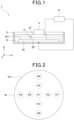
- a surface processing apparatus 1 is configured to enable the planarization of a processing surface W1, which is one of major surfaces of a workpiece W.
- planarization refers to processes such as grinding or polishing. Specifically, it is, for example, rough grinding, finish grinding, rough polishing, or finish polishing.
- major surface refers to a surface of a layer or plate that is perpendicular to a direction of the thickness and is also referred to as the "plate surface.”
- the surface processing apparatus 1 is configured to enable the preformation of a planarization processing with anodic oxidation on the processing surface W1 of the workpiece W.
- the surface processing apparatus 1 has a configuration as an ECMP or ECMG device.
- ECMG stands for an electro-chemical mechanical grinding.
- the workpiece W is, for example, a silicon-based material, typically a semiconductor material such as a silicon carbide semiconductor.
- the surface processing apparatus 1 includes a container 2, a surface processing pad 3, a drive unit 4, and a power supply unit 5. As described below, FIG. 1 and the following description referenced therein are simplified exclusively for brevity in the description of the surface processing method according to this embodiment. Therefore, the surface processing apparatus 1 does not necessarily correspond to a specific equipment configuration that is actually manufactured and sold.
- the XYZ coordinate defined according to the right-hand system is set as shown in the figure.
- a positive direction of a Z-axis is vertically upward, i.e., opposite the direction of the gravitation.
- the Z-axis positive direction which corresponds to a vertical upward direction, may be referred to simply as "upward,” while an opposite direction may be referred to simply as "downward.”
- a container 2 is formed in a bathtub shape that opens upward.
- the container 2 is configured to accommodate the workpiece W by holding it at a bottom and dipping it in an electrolyte solution S that does not contain an etchant component.
- the etchant component is a component that constitutes a dissolving solution capable of dissolving an oxide film (i.e., oxide formed in a film form) on a processing surface W1 by the anodic oxidation.
- the etchant component is, for example, hydrofluoric acid.
- the electrolyte solution S, without the etchant component is an alkaline electrolyte solution with a pH range of 9 to 13.
- potassium hydroxide, sodium hydroxide, lithium hydroxide, or calcium hydroxide can be used as a basic compound to adjust the pH of the electrolyte solution S to between 9 and 13.
- the surface processing pad 3 and drive unit 4 are located above the container 2.
- An unshown lifting mechanism allows the container 2, the surface processing pad 3, and the drive unit 4 to move vertically relative to one another.
- An unshown slide mechanism allows the container 2, the surface processing pad 3, and the drive unit 4 to move horizontally relative to one another (that is, to move in an in-plane direction relative to one another).
- the surface processing pad 3 has an electrode 31 and a wheel layer 32.
- the electrode 31 is a plate-shaped member made of metal or another conductor.
- the electrode 31 is formed by, for example, a copper plate.
- the grinding wheel layer 32 is joined to the electrode 31.
- the surface processing pad 3 has a configuration in which the electrode 31 and the wheel layer 32 are joined in a thickness direction of the surface processing pad 3.
- the wheel layer 32 is formed by the wheel (such as a ceria wheel), which is an abrasive or grinding material.
- the surface processing pad 3 is provided so that the wheel layer 32 is located opposite the processing surface W1 of the workpiece W, with the electrolyte solution S between them.
- the surface processing pad 3 is provided to selectively polish or grind the oxide film formed on the processing surface W1 by the anodic oxidation due to being rotary driven by the drive unit 4 with the wheel layer 32 being located opposite the processing surface W1 across the electrolyte solution S.
- the drive unit 4 is configured to drive the surface processing pad 3 around a rotation axis along the vertical direction (upward and downward directions).
- the power supply unit 5 is provided so that an anode oxidation current, which is a current for anodizing the processing surface W1, which is a target surface to be processed by the wheel layer 32, can flow by applying a voltage to the workpiece W as an anode and the electrode 31 in the surface processing pad 3 as a cathode in the presence of the electrolyte solution S.
- the surface processing method (i.e., grinding or polishing method) of the workpiece W is a method of planarizing the processing surface W1, which is the surface of the workpiece W, and is performed using the surface processing apparatus 1 shown in FIG. 1 .
- the surface processing method includes the following procedures, treatments, or processes.
- the oxide film formed in a film form on the processing surface W1 by the anodic oxidation has a lower hardness than a non-oxidized area on the processing surface W1. Therefore, the oxide film is selectively removed from the processing surface W1 by rubbing the processing surface W1 with the wheel layer 32. This results in a suitable planarization of the processing surface W1 to the desired a surface roughness.
- the generation of the oxide film by the anodic oxidation and removal of the oxide film using wheel layer 32 can be performed simultaneously or with a time lag.
- the surface processing method can be well applied, for example, to a surface planarization process of a semiconductor material such as a SiC wafer, for which the surface roughness of a nano level is required.
- this type of surface planarization process is currently affected by lead time in the semiconductor wafer fabrication. Therefore, in this type of surface planarization process, increasing a processing speed as much as possible without decreasing processing quality will result in improved manufacturing efficiency in the semiconductor wafer fabrication.
- the inventors have earnestly studied this. As a result, they found that in conventional ECMP or ECMG, when trying to increase the processing speed, many scratches occur on the processing surface W1, and the surface roughness increases. The inventors also considered the factors and found the following viewpoints.
- the inventors have invented a method to obtain a suitable surface roughness on the processing surface W1 while increasing the processing speed by the following mechanism to solve the above issues from the above viewpoints.
- Mechanism 1 By controlling the potentials of the processing surface W1 and the sludge, agglomeration of the sludge and adhesion of the sludge to the processing surface W1 are suppressed.
- Mechanism 2 A hardness of the oxide film generated by the anodic oxidation is reduced, and a pressure during processing is lowered, thereby suppressing occurring distortion and scratching on the processing surface W1.
- each zeta potential of the workpiece W and the sludge can be controlled to be unified to a negative value. This suppresses the agglomeration of the sludge, and the agglomeration of abrasive grains released from the wheel layer 32, as well as the adhesion of the sludge to the processing surface W1. It can also reduce the hardness of the oxide film generated during the anodic oxidation. This allows the oxide film to be easily removed using the wheel layer 32.
- FIG. 5 shows the evaluation results of a polishing speed in ECMP using the SiC wafer as the workpiece W.
- FIG. 6 shows the evaluation results of the polishing speed in ECMP using a SiO 2 optical glass as the workpiece W.
- using the alkaline electrolyte solution increased the polishing speed of the SiC wafer by about twice.
- using the alkaline electrolyte solution increased the polishing speed of the SiO 2 optical glass by about triple. From the results above, it can be understood that the chemical reaction between the oxide film and the alkaline electrolyte solution improves the polishing speed.
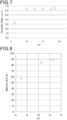
- FIG. 7 shows the results of evaluating a pH dependence of the polishing speed in ECMP using the SiC wafer as the workpiece W, when the pH of the electrolyte solution S is varied.
- the pH of 12 or 12.5 assumes a state of a "fresh" alkaline electrolyte solution with no history of use.
- a lower pH than the above pH assumes variations in the pH over time due to the passage of processing time.
- the polishing speed was nearly constant over the pH range of 9 to 12.5.
- the polishing speed was about twice as fast as in the case of the salt water, which has the pH of about 7, i.e. It was confirmed that this can effectively suppress the occurrence of degradation of the processing speed and quality due to variations in the properties of the alkaline electrolyte solution over time.
- FIG. 8 shows the results of evaluating a removal rate of silica particles from the processing surface W1 in ECMP using the SiC wafer as the workpiece W.
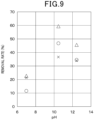
- FIG. 9 shows the results of evaluating the removal rate of ceria particles from the processing surface W1 in ECMP using the SiC wafer as the workpiece W.
- circle signs ( ⁇ ) indicate the results for a particle size of 0.2 ⁇ m.
- Triangle signs ( ⁇ ) indicate the results for the particle size of 0.3 ⁇ m.
- Cross signs ( ⁇ ) indicate the results for the particle size of 0.5 ⁇ m.
- the removal rate was evaluated by measuring wafer surfaces before and after processing using a wafer surface inspection system manufactured by YGK Corporation. As shown in FIGs.
- the anodic oxidation using the alkaline electrolyte solution makes it possible to achieve both high processing speed and good quality.
- the effect of improving the processing speed, efficiency, and quality was expressed in the pH range of 9 or more and 13 or less of the alkaline electrolyte solution.
- the present disclosure is not limited to the specific device configuration shown in the above embodiments.
- FIG. 1 and the above description using it are simplified exclusively to explain the schematic configuration and functions of the surface processing apparatus 1 according to the present embodiment. Therefore, the surface processing apparatus 1 does not necessarily correspond to the specific equipment configuration that is actually manufactured and sold.
- the workpiece W is configured to be held in the container 2 and the surface processing pad 3 is configured to be rotatably held above the workpiece W.
- the present disclosure is not limited to such an aspect. For example, it may be configured to hold the workpiece W near a chuck located above the container 2 and rotary driven by the drive unit 4 and to hold the surface processing pad 3 near the container 2.
- the electrolyte solution S may contain the etchant component.
- the surface processing method may be a method of polishing or grinding the processing surface W1 by selectively removing the oxide film formed by the anodic oxidation using both the etchant and the surface processing pad 3.
- the technique of the present disclosure can be applied well to any workpiece W that can perform the surface planarization process with the anodic oxidation.
- the phrase "with the anodic oxidation” can also be expressed as "using the anodic oxidation.”
- a diameter when the workpiece W is a semiconductor ingot or wafer There are also no particular restrictions on a diameter when the workpiece W is a semiconductor ingot or wafer.
- the technique of the present disclosure can be applied well to the ingot and wafer with diameters in a range of 1 inch to 8 inch in size, in addition to the typical 6 inch in size.
- a configuration of the surface processing pad 3 e.g., a surface roughness and material in the wheel layer 32.
- details of the configuration of the surface processing pad 3 can be selected from among those available.
- each element of the above embodiments is not necessarily essential as the element, except when expressly stated as particularly essential or when they are critical in principle, etc.
- the present disclosure is not limited to those values, except when expressly stated as particularly essential or when limited to a particular value in principle.
- shape, orientation, positional relationship, etc., of the elements, etc. are described, the present disclosure is not limited to such shape, orientation, positional relationship, etc., except when expressly stated as particularly essential or when limited to a particular shape, orientation, positional relationship, etc., in principle.
- a surface processing method for planarizing a processing surface (W1) of a workpiece (W), includes the following procedures, treatments, or processes:
- the surface processing method is according to aspect 1, wherein a pH of the alkaline electrolyte solution is in a range of 9 or more and 13 or less.
- the surface processing method is according to aspect 1 or 2, wherein the workpiece is a silicon-based material.
- the surface processing method is according to aspect 3, wherein the workpiece is a silicon carbide semiconductor.
- the surface processing method is according to any one of aspects 1 to 6, and further includes using the alkaline electrolyte solution for the anodic oxidation to improve a processing speed of a surface process.
- the surface processing method is according to any one of aspects 1 to 7, and further includes using the alkaline electrolyte solution for the anodic oxidation to reduce a wear rate of the wheel layer.
Landscapes
- Chemical & Material Sciences (AREA)
- Engineering & Computer Science (AREA)
- Chemical Kinetics & Catalysis (AREA)
- Electrochemistry (AREA)
- Materials Engineering (AREA)
- Metallurgy (AREA)
- Organic Chemistry (AREA)
- Mechanical Engineering (AREA)
- Mechanical Treatment Of Semiconductor (AREA)
Applications Claiming Priority (2)
| Application Number | Priority Date | Filing Date | Title |
|---|---|---|---|
| JP2022093027 | 2022-06-08 | ||
| PCT/JP2023/018139 WO2023238608A1 (ja) | 2022-06-08 | 2023-05-15 | 表面加工方法 |
Publications (2)
| Publication Number | Publication Date |
|---|---|
| EP4539104A1 true EP4539104A1 (de) | 2025-04-16 |
| EP4539104A4 EP4539104A4 (de) | 2026-01-28 |
Family
ID=89118234
Family Applications (1)
| Application Number | Title | Priority Date | Filing Date |
|---|---|---|---|
| EP23819592.9A Pending EP4539104A4 (de) | 2022-06-08 | 2023-05-15 | Oberflächenbehandlungsverfahren |
Country Status (5)
| Country | Link |
|---|---|
| US (1) | US20250096002A1 (de) |
| EP (1) | EP4539104A4 (de) |
| JP (1) | JP7816514B2 (de) |
| CN (1) | CN119836680A (de) |
| WO (1) | WO2023238608A1 (de) |
Family Cites Families (9)
| Publication number | Priority date | Publication date | Assignee | Title |
|---|---|---|---|---|
| JPH11185253A (ja) * | 1997-12-18 | 1999-07-09 | Kao Corp | 磁気記録媒体用基板の製造方法及び装置 |
| JP2000204356A (ja) * | 1999-01-12 | 2000-07-25 | Toshiba Corp | 加工液及び除去加工用の加工液又は複合電解研磨方法並びに金型の製造方法又は超電導加速空洞の製造方法 |
| JP2004276219A (ja) * | 2003-03-18 | 2004-10-07 | Ebara Corp | 電解加工液、電解加工装置及び配線加工方法 |
| JP2006024910A (ja) * | 2004-06-08 | 2006-01-26 | Matsushita Electric Ind Co Ltd | 表面処理方法及び表面処理装置 |
| JP2015211047A (ja) * | 2014-04-23 | 2015-11-24 | 国立研究開発法人産業技術総合研究所 | 炭化ケイ素基板の研磨方法 |
| JP7010264B2 (ja) * | 2019-03-29 | 2022-02-10 | Jfeスチール株式会社 | 方向性電磁鋼板の製造方法および方向性電磁鋼板 |
| JP7628677B2 (ja) * | 2019-08-05 | 2025-02-12 | 国立大学法人大阪大学 | 陽極酸化を援用した研磨方法 |
| JP7588369B2 (ja) * | 2020-07-09 | 2024-11-22 | 国立大学法人北海道大学 | アルミニウム部材の製造方法 |
| JP7534946B2 (ja) | 2020-12-11 | 2024-08-15 | 三菱鉛筆株式会社 | 筆記具 |
-
2023
- 2023-05-15 WO PCT/JP2023/018139 patent/WO2023238608A1/ja not_active Ceased
- 2023-05-15 JP JP2024526325A patent/JP7816514B2/ja active Active
- 2023-05-15 EP EP23819592.9A patent/EP4539104A4/de active Pending
- 2023-05-15 CN CN202380044949.9A patent/CN119836680A/zh active Pending
-
2024
- 2024-12-04 US US18/968,014 patent/US20250096002A1/en active Pending
Also Published As
| Publication number | Publication date |
|---|---|
| JPWO2023238608A1 (de) | 2023-12-14 |
| EP4539104A4 (de) | 2026-01-28 |
| CN119836680A (zh) | 2025-04-15 |
| JP7816514B2 (ja) | 2026-02-18 |
| US20250096002A1 (en) | 2025-03-20 |
| WO2023238608A1 (ja) | 2023-12-14 |
Similar Documents
| Publication | Publication Date | Title |
|---|---|---|
| CN101370898B (zh) | 用于氧化铟锡表面的化学机械抛光的组合物及方法 | |
| EP2338849B1 (de) | Herstellung von synthetischem Quarzglassubstrat | |
| CN1460043A (zh) | 用新型精抛光方法加工半导体晶片的方法及其设备 | |
| JP7613855B2 (ja) | コバルト、酸化ジルコニウム、ポリ-シリコン及び二酸化ケイ素の膜の選択的化学機械研磨法 | |
| CN1929955B (zh) | 绝缘衬垫调整器及其使用方法 | |
| JP5743800B2 (ja) | SiCウェハの製造方法 | |
| JP6143283B2 (ja) | 陽極酸化を援用した形状創成エッチング方法及び高精度形状創成方法 | |
| JP2015211047A (ja) | 炭化ケイ素基板の研磨方法 | |
| US20100059390A1 (en) | METHOD AND APARATUS FOR ELECTROCHEMICAL MECHANICAL POLISHING NiP SUBSTRATES | |
| JP5598607B2 (ja) | シリコンウェーハの研磨方法及び研磨剤 | |
| EP4539104A1 (de) | Oberflächenbehandlungsverfahren | |
| JPH10337645A (ja) | 研削方法およびその研削方法により加工されたガラスレンズ | |
| CN110303385A (zh) | 基于液相抛光环境调控的单晶硅无损抛光方法 | |
| CN115394631A (zh) | 用于SiC衬底的表面处理方法 | |
| EP2898985B1 (de) | Verfahren zur herstellung von synthetischem quarzglassubstrat | |
| US10947413B2 (en) | Chemical mechanical polishing method for cobalt with high cobalt removal rates and reduced cobalt corrosion | |
| JP5803601B2 (ja) | 研磨スラリーの供給方法及び供給装置、並びに研磨装置 | |
| JP4396963B2 (ja) | 研磨用組成物、その調製方法及びそれを用いたウェーハの研磨方法 | |
| JP7632078B2 (ja) | SiC基板の表面加工装置および表面加工方法 | |
| JP7715049B2 (ja) | 半導体ウェハの表面加工方法 | |
| CN118525356A (zh) | 半导体晶片的表面加工方法 | |
| JP4159304B2 (ja) | 研磨方法 | |
| CN121780046A (zh) | 碳化钨光学模具表面抛光水基导电抛光浆料及抛光方法 | |
| KR20070051685A (ko) | 연마 장치 및 워크 연마 방법 | |
| JPH11207617A (ja) | 研削方法 |
Legal Events
| Date | Code | Title | Description |
|---|---|---|---|
| STAA | Information on the status of an ep patent application or granted ep patent |
Free format text: STATUS: THE INTERNATIONAL PUBLICATION HAS BEEN MADE |
|
| PUAI | Public reference made under article 153(3) epc to a published international application that has entered the european phase |
Free format text: ORIGINAL CODE: 0009012 |
|
| STAA | Information on the status of an ep patent application or granted ep patent |
Free format text: STATUS: REQUEST FOR EXAMINATION WAS MADE |
|
| 17P | Request for examination filed |
Effective date: 20241203 |
|
| AK | Designated contracting states |
Kind code of ref document: A1 Designated state(s): AL AT BE BG CH CY CZ DE DK EE ES FI FR GB GR HR HU IE IS IT LI LT LU LV MC ME MK MT NL NO PL PT RO RS SE SI SK SM TR |
|
| DAV | Request for validation of the european patent (deleted) | ||
| DAX | Request for extension of the european patent (deleted) | ||
| REG | Reference to a national code |
Ref country code: DE Ref legal event code: R079 Free format text: PREVIOUS MAIN CLASS: H01L0021304000 Ipc: H01L0021306000 |
|
| STAA | Information on the status of an ep patent application or granted ep patent |
Free format text: STATUS: EXAMINATION IS IN PROGRESS |
|
| A4 | Supplementary search report drawn up and despatched |
Effective date: 20260107 |
|
| RIC1 | Information provided on ipc code assigned before grant |
Ipc: H01L 21/306 20060101AFI20251222BHEP Ipc: B23H 5/00 20060101ALI20251222BHEP Ipc: C25F 3/16 20060101ALI20251222BHEP Ipc: C25D 11/32 20060101ALI20251222BHEP Ipc: C25F 3/30 20060101ALI20251222BHEP Ipc: H01L 21/02 20060101ALI20251222BHEP |
|
| 17Q | First examination report despatched |
Effective date: 20260119 |