EP4534736A2 - Verfahren zur haftfesten beschichtung und verfahren zur herstellung von beschichtungen - Google Patents
Verfahren zur haftfesten beschichtung und verfahren zur herstellung von beschichtungen Download PDFInfo
- Publication number
- EP4534736A2 EP4534736A2 EP24201054.4A EP24201054A EP4534736A2 EP 4534736 A2 EP4534736 A2 EP 4534736A2 EP 24201054 A EP24201054 A EP 24201054A EP 4534736 A2 EP4534736 A2 EP 4534736A2
- Authority
- EP
- European Patent Office
- Prior art keywords
- layer
- peo
- thermal spray
- coating
- processing
- Prior art date
- Legal status (The legal status is an assumption and is not a legal conclusion. Google has not performed a legal analysis and makes no representation as to the accuracy of the status listed.)
- Pending
Links
Images

Classifications
-
- C—CHEMISTRY; METALLURGY
- C25—ELECTROLYTIC OR ELECTROPHORETIC PROCESSES; APPARATUS THEREFOR
- C25D—PROCESSES FOR THE ELECTROLYTIC OR ELECTROPHORETIC PRODUCTION OF COATINGS; ELECTROFORMING; APPARATUS THEREFOR
- C25D11/00—Electrolytic coating by surface reaction, i.e. forming conversion layers
- C25D11/02—Anodisation
- C25D11/026—Anodisation with spark discharge
-
- C—CHEMISTRY; METALLURGY
- C23—COATING METALLIC MATERIAL; COATING MATERIAL WITH METALLIC MATERIAL; CHEMICAL SURFACE TREATMENT; DIFFUSION TREATMENT OF METALLIC MATERIAL; COATING BY VACUUM EVAPORATION, BY SPUTTERING, BY ION IMPLANTATION OR BY CHEMICAL VAPOUR DEPOSITION, IN GENERAL; INHIBITING CORROSION OF METALLIC MATERIAL OR INCRUSTATION IN GENERAL
- C23C—COATING METALLIC MATERIAL; COATING MATERIAL WITH METALLIC MATERIAL; SURFACE TREATMENT OF METALLIC MATERIAL BY DIFFUSION INTO THE SURFACE, BY CHEMICAL CONVERSION OR SUBSTITUTION; COATING BY VACUUM EVAPORATION, BY SPUTTERING, BY ION IMPLANTATION OR BY CHEMICAL VAPOUR DEPOSITION, IN GENERAL
- C23C28/00—Coating for obtaining at least two superposed coatings either by methods not provided for in a single one of groups C23C2/00 - C23C26/00 or by combinations of methods provided for in subclasses C23C and C25C or C25D
- C23C28/04—Coating for obtaining at least two superposed coatings either by methods not provided for in a single one of groups C23C2/00 - C23C26/00 or by combinations of methods provided for in subclasses C23C and C25C or C25D only coatings of inorganic non-metallic material
-
- C—CHEMISTRY; METALLURGY
- C23—COATING METALLIC MATERIAL; COATING MATERIAL WITH METALLIC MATERIAL; CHEMICAL SURFACE TREATMENT; DIFFUSION TREATMENT OF METALLIC MATERIAL; COATING BY VACUUM EVAPORATION, BY SPUTTERING, BY ION IMPLANTATION OR BY CHEMICAL VAPOUR DEPOSITION, IN GENERAL; INHIBITING CORROSION OF METALLIC MATERIAL OR INCRUSTATION IN GENERAL
- C23C—COATING METALLIC MATERIAL; COATING MATERIAL WITH METALLIC MATERIAL; SURFACE TREATMENT OF METALLIC MATERIAL BY DIFFUSION INTO THE SURFACE, BY CHEMICAL CONVERSION OR SUBSTITUTION; COATING BY VACUUM EVAPORATION, BY SPUTTERING, BY ION IMPLANTATION OR BY CHEMICAL VAPOUR DEPOSITION, IN GENERAL
- C23C4/00—Coating by spraying the coating material in the molten state, e.g. by flame, plasma or electric discharge
- C23C4/02—Pretreatment of the material to be coated, e.g. for coating on selected surface areas
-
- C—CHEMISTRY; METALLURGY
- C23—COATING METALLIC MATERIAL; COATING MATERIAL WITH METALLIC MATERIAL; CHEMICAL SURFACE TREATMENT; DIFFUSION TREATMENT OF METALLIC MATERIAL; COATING BY VACUUM EVAPORATION, BY SPUTTERING, BY ION IMPLANTATION OR BY CHEMICAL VAPOUR DEPOSITION, IN GENERAL; INHIBITING CORROSION OF METALLIC MATERIAL OR INCRUSTATION IN GENERAL
- C23C—COATING METALLIC MATERIAL; COATING MATERIAL WITH METALLIC MATERIAL; SURFACE TREATMENT OF METALLIC MATERIAL BY DIFFUSION INTO THE SURFACE, BY CHEMICAL CONVERSION OR SUBSTITUTION; COATING BY VACUUM EVAPORATION, BY SPUTTERING, BY ION IMPLANTATION OR BY CHEMICAL VAPOUR DEPOSITION, IN GENERAL
- C23C4/00—Coating by spraying the coating material in the molten state, e.g. by flame, plasma or electric discharge
- C23C4/04—Coating by spraying the coating material in the molten state, e.g. by flame, plasma or electric discharge characterised by the coating material
- C23C4/10—Oxides, borides, carbides, nitrides or silicides; Mixtures thereof
- C23C4/11—Oxides
-
- C—CHEMISTRY; METALLURGY
- C23—COATING METALLIC MATERIAL; COATING MATERIAL WITH METALLIC MATERIAL; CHEMICAL SURFACE TREATMENT; DIFFUSION TREATMENT OF METALLIC MATERIAL; COATING BY VACUUM EVAPORATION, BY SPUTTERING, BY ION IMPLANTATION OR BY CHEMICAL VAPOUR DEPOSITION, IN GENERAL; INHIBITING CORROSION OF METALLIC MATERIAL OR INCRUSTATION IN GENERAL
- C23C—COATING METALLIC MATERIAL; COATING MATERIAL WITH METALLIC MATERIAL; SURFACE TREATMENT OF METALLIC MATERIAL BY DIFFUSION INTO THE SURFACE, BY CHEMICAL CONVERSION OR SUBSTITUTION; COATING BY VACUUM EVAPORATION, BY SPUTTERING, BY ION IMPLANTATION OR BY CHEMICAL VAPOUR DEPOSITION, IN GENERAL
- C23C4/00—Coating by spraying the coating material in the molten state, e.g. by flame, plasma or electric discharge
- C23C4/18—After-treatment
-
- C—CHEMISTRY; METALLURGY
- C25—ELECTROLYTIC OR ELECTROPHORETIC PROCESSES; APPARATUS THEREFOR
- C25D—PROCESSES FOR THE ELECTROLYTIC OR ELECTROPHORETIC PRODUCTION OF COATINGS; ELECTROFORMING; APPARATUS THEREFOR
- C25D11/00—Electrolytic coating by surface reaction, i.e. forming conversion layers
- C25D11/02—Anodisation
- C25D11/04—Anodisation of aluminium or alloys based thereon
- C25D11/06—Anodisation of aluminium or alloys based thereon characterised by the electrolytes used
-
- C—CHEMISTRY; METALLURGY
- C25—ELECTROLYTIC OR ELECTROPHORETIC PROCESSES; APPARATUS THEREFOR
- C25D—PROCESSES FOR THE ELECTROLYTIC OR ELECTROPHORETIC PRODUCTION OF COATINGS; ELECTROFORMING; APPARATUS THEREFOR
- C25D11/00—Electrolytic coating by surface reaction, i.e. forming conversion layers
- C25D11/02—Anodisation
- C25D11/04—Anodisation of aluminium or alloys based thereon
- C25D11/18—After-treatment, e.g. pore-sealing
-
- C—CHEMISTRY; METALLURGY
- C25—ELECTROLYTIC OR ELECTROPHORETIC PROCESSES; APPARATUS THEREFOR
- C25D—PROCESSES FOR THE ELECTROLYTIC OR ELECTROPHORETIC PRODUCTION OF COATINGS; ELECTROFORMING; APPARATUS THEREFOR
- C25D11/00—Electrolytic coating by surface reaction, i.e. forming conversion layers
- C25D11/02—Anodisation
- C25D11/26—Anodisation of refractory metals or alloys based thereon
-
- C—CHEMISTRY; METALLURGY
- C25—ELECTROLYTIC OR ELECTROPHORETIC PROCESSES; APPARATUS THEREFOR
- C25D—PROCESSES FOR THE ELECTROLYTIC OR ELECTROPHORETIC PRODUCTION OF COATINGS; ELECTROFORMING; APPARATUS THEREFOR
- C25D11/00—Electrolytic coating by surface reaction, i.e. forming conversion layers
- C25D11/02—Anodisation
- C25D11/30—Anodisation of magnesium or alloys based thereon
-
- C—CHEMISTRY; METALLURGY
- C25—ELECTROLYTIC OR ELECTROPHORETIC PROCESSES; APPARATUS THEREFOR
- C25D—PROCESSES FOR THE ELECTROLYTIC OR ELECTROPHORETIC PRODUCTION OF COATINGS; ELECTROFORMING; APPARATUS THEREFOR
- C25D11/00—Electrolytic coating by surface reaction, i.e. forming conversion layers
- C25D11/02—Anodisation
- C25D11/34—Anodisation of metals or alloys not provided for in groups C25D11/04 - C25D11/32
-
- C—CHEMISTRY; METALLURGY
- C23—COATING METALLIC MATERIAL; COATING MATERIAL WITH METALLIC MATERIAL; CHEMICAL SURFACE TREATMENT; DIFFUSION TREATMENT OF METALLIC MATERIAL; COATING BY VACUUM EVAPORATION, BY SPUTTERING, BY ION IMPLANTATION OR BY CHEMICAL VAPOUR DEPOSITION, IN GENERAL; INHIBITING CORROSION OF METALLIC MATERIAL OR INCRUSTATION IN GENERAL
- C23C—COATING METALLIC MATERIAL; COATING MATERIAL WITH METALLIC MATERIAL; SURFACE TREATMENT OF METALLIC MATERIAL BY DIFFUSION INTO THE SURFACE, BY CHEMICAL CONVERSION OR SUBSTITUTION; COATING BY VACUUM EVAPORATION, BY SPUTTERING, BY ION IMPLANTATION OR BY CHEMICAL VAPOUR DEPOSITION, IN GENERAL
- C23C28/00—Coating for obtaining at least two superposed coatings either by methods not provided for in a single one of groups C23C2/00 - C23C26/00 or by combinations of methods provided for in subclasses C23C and C25C or C25D
- C23C28/04—Coating for obtaining at least two superposed coatings either by methods not provided for in a single one of groups C23C2/00 - C23C26/00 or by combinations of methods provided for in subclasses C23C and C25C or C25D only coatings of inorganic non-metallic material
- C23C28/042—Coating for obtaining at least two superposed coatings either by methods not provided for in a single one of groups C23C2/00 - C23C26/00 or by combinations of methods provided for in subclasses C23C and C25C or C25D only coatings of inorganic non-metallic material including a refractory ceramic layer, e.g. refractory metal oxides, ZrO2, rare earth oxides
-
- C—CHEMISTRY; METALLURGY
- C23—COATING METALLIC MATERIAL; COATING MATERIAL WITH METALLIC MATERIAL; CHEMICAL SURFACE TREATMENT; DIFFUSION TREATMENT OF METALLIC MATERIAL; COATING BY VACUUM EVAPORATION, BY SPUTTERING, BY ION IMPLANTATION OR BY CHEMICAL VAPOUR DEPOSITION, IN GENERAL; INHIBITING CORROSION OF METALLIC MATERIAL OR INCRUSTATION IN GENERAL
- C23C—COATING METALLIC MATERIAL; COATING MATERIAL WITH METALLIC MATERIAL; SURFACE TREATMENT OF METALLIC MATERIAL BY DIFFUSION INTO THE SURFACE, BY CHEMICAL CONVERSION OR SUBSTITUTION; COATING BY VACUUM EVAPORATION, BY SPUTTERING, BY ION IMPLANTATION OR BY CHEMICAL VAPOUR DEPOSITION, IN GENERAL
- C23C4/00—Coating by spraying the coating material in the molten state, e.g. by flame, plasma or electric discharge
- C23C4/04—Coating by spraying the coating material in the molten state, e.g. by flame, plasma or electric discharge characterised by the coating material
- C23C4/06—Metallic material
-
- C—CHEMISTRY; METALLURGY
- C23—COATING METALLIC MATERIAL; COATING MATERIAL WITH METALLIC MATERIAL; CHEMICAL SURFACE TREATMENT; DIFFUSION TREATMENT OF METALLIC MATERIAL; COATING BY VACUUM EVAPORATION, BY SPUTTERING, BY ION IMPLANTATION OR BY CHEMICAL VAPOUR DEPOSITION, IN GENERAL; INHIBITING CORROSION OF METALLIC MATERIAL OR INCRUSTATION IN GENERAL
- C23C—COATING METALLIC MATERIAL; COATING MATERIAL WITH METALLIC MATERIAL; SURFACE TREATMENT OF METALLIC MATERIAL BY DIFFUSION INTO THE SURFACE, BY CHEMICAL CONVERSION OR SUBSTITUTION; COATING BY VACUUM EVAPORATION, BY SPUTTERING, BY ION IMPLANTATION OR BY CHEMICAL VAPOUR DEPOSITION, IN GENERAL
- C23C4/00—Coating by spraying the coating material in the molten state, e.g. by flame, plasma or electric discharge
- C23C4/04—Coating by spraying the coating material in the molten state, e.g. by flame, plasma or electric discharge characterised by the coating material
- C23C4/10—Oxides, borides, carbides, nitrides or silicides; Mixtures thereof
-
- C—CHEMISTRY; METALLURGY
- C23—COATING METALLIC MATERIAL; COATING MATERIAL WITH METALLIC MATERIAL; CHEMICAL SURFACE TREATMENT; DIFFUSION TREATMENT OF METALLIC MATERIAL; COATING BY VACUUM EVAPORATION, BY SPUTTERING, BY ION IMPLANTATION OR BY CHEMICAL VAPOUR DEPOSITION, IN GENERAL; INHIBITING CORROSION OF METALLIC MATERIAL OR INCRUSTATION IN GENERAL
- C23C—COATING METALLIC MATERIAL; COATING MATERIAL WITH METALLIC MATERIAL; SURFACE TREATMENT OF METALLIC MATERIAL BY DIFFUSION INTO THE SURFACE, BY CHEMICAL CONVERSION OR SUBSTITUTION; COATING BY VACUUM EVAPORATION, BY SPUTTERING, BY ION IMPLANTATION OR BY CHEMICAL VAPOUR DEPOSITION, IN GENERAL
- C23C4/00—Coating by spraying the coating material in the molten state, e.g. by flame, plasma or electric discharge
- C23C4/12—Coating by spraying the coating material in the molten state, e.g. by flame, plasma or electric discharge characterised by the method of spraying
- C23C4/129—Flame spraying
-
- C—CHEMISTRY; METALLURGY
- C23—COATING METALLIC MATERIAL; COATING MATERIAL WITH METALLIC MATERIAL; CHEMICAL SURFACE TREATMENT; DIFFUSION TREATMENT OF METALLIC MATERIAL; COATING BY VACUUM EVAPORATION, BY SPUTTERING, BY ION IMPLANTATION OR BY CHEMICAL VAPOUR DEPOSITION, IN GENERAL; INHIBITING CORROSION OF METALLIC MATERIAL OR INCRUSTATION IN GENERAL
- C23C—COATING METALLIC MATERIAL; COATING MATERIAL WITH METALLIC MATERIAL; SURFACE TREATMENT OF METALLIC MATERIAL BY DIFFUSION INTO THE SURFACE, BY CHEMICAL CONVERSION OR SUBSTITUTION; COATING BY VACUUM EVAPORATION, BY SPUTTERING, BY ION IMPLANTATION OR BY CHEMICAL VAPOUR DEPOSITION, IN GENERAL
- C23C4/00—Coating by spraying the coating material in the molten state, e.g. by flame, plasma or electric discharge
- C23C4/12—Coating by spraying the coating material in the molten state, e.g. by flame, plasma or electric discharge characterised by the method of spraying
- C23C4/134—Plasma spraying
Definitions
- the present invention relates to a process for producing ceramic coatings having desired properties.
- the present invention relates to the production of coatings using a multi-stage process in which a combination of different coating techniques is applied sequentially to produce coatings with properties that are impossible or difficult to achieve using individual techniques alone and/or at a lower cost.
- Plasma electrolytic oxidation (PEO) coatings on metals such as aluminum, magnesium, titanium, yttrium, tantalum, zirconium and zinc are known and used in numerous applications due to their chemical inertness, durability and high dielectric strength amongst other useful properties.
- PEO coatings are formed via a variety of complex physiochemical processes that occur during plasma discharges on the surfaces of articles to be coated during the process. These plasma discharges are initiated when high potential differences are applied to the article while it is immersed in a suitable electrolyte solution bath.
- the physiochemical processes may include oxidation, chemical reaction, electrophoresis, thermal decomposition, re-melting, densification, and precipitation.
- Plasma electrolytic oxidation (PEO) coatings excel at delivering ultra-high hardness, high dielectric strength coatings, with excellent adhesion to the substrate.
- PEO coatings are usually comprised principally of the oxides of the substrate material.
- the degree of compositional control is limited.
- the substrate materials that can be processed is restricted to a relatively small number of metal alloys.
- commonly used materials such as ferrous and nickel containing alloys are not readily processed by PEO, while electrically non-conductive materials such as carbon fibre composites or glasses cannot be processed at all.
- obtaining thick PEO layers such as layers having a thickness of greater than 100 ⁇ m, can be difficult and/or expensive to achieve.
- thermal spray can coat thick layers over large surface areas easily.
- TS thermal spray
- adhesion of TS layers is generally lower than PEO, porosity is higher, and TS often perform less well on metrics such as hardness, adhesion, corrosion protection and wear resistance.
- a process of applying a coating to a substrate is provided.
- a layer of a metallic or ceramic material is applied on the substrate by a thermal spray process.
- the layer is then subject to plasma electrolytic oxidation (PEO) processing to densify the layer such that a porosity of the layer after PEO processing is lower than a porosity of the layer before PEO processing, or modify the layer by incorporating additional ceramic phases from the electrolyte bath into the densified layer, or improve the adhesion of the thermal spray layer.
- PEO plasma electrolytic oxidation
- a base layer is applied to the substrate with PEO processing before the above referenced layer is applied.
- a PEO process can be used to convert a surface of a number of metals, such as aluminum, magnesium and titanium, but also metals such as zirconium, yttrium, zinc, tantalum and niobium, to a ceramic coating.
- metals such as aluminum, magnesium and titanium, but also metals such as zirconium, yttrium, zinc, tantalum and niobium, to a ceramic coating.
- PEO coatings are characterized by a number of advantageous properties including exceptional adhesion, high hardness, high thermal and chemical stability, corrosion resistance, and high dielectric strength. They are utilized for applications such as wear protection, corrosion protection, and inert barrier coatings in semi-conductor processing equipment. Some porosity is evident in the coatings which enables other applications such as photocatalysis, chemical catalysis, and osseointegration.
- the PEO process proceeds via the formation of energetic discharges which can produce local temperatures of greater than 10,000°C. These discharges form bubbles of vaporized material. Subsequently, rapid collapse of the bubbles occurs due to the presence of cold electrolyte surrounding the article, causing condensation of metal compounds, ceramic phases and other chemical species. These processes occur on a rapid timescale, with bubble formation and collapse happening over a period of microseconds.
- thermochemical reactions are occurring during this process including vaporization of the substrate, oxidation of the substrate, melting of previous formed coating, dissolution of species into the electrolyte, condensation of metal oxides, hydroxides and other species, and incorporation of materials from the electrolyte.
- additional processes can occur during the cathodic half-cycle including partial or complete reduction of chemical species in the electrolyte or the coating, and precipitation of further phases from the electrolyte.
- composition is not unlimited, however, and typically oxide phases of the substrate material will dominate due to the fundamental nature of the PEO process which involves discharge and vaporization at the substrate interface. This can be a limitation for some functional applications where specific compositions are preferred. Examples of those applications include yttria coatings for plasma erosion and corrosion resistance, ceria coatings for photocatalysis, and hydroxyapatite coatings for biocompatibility.
- PEO PEO
- valve metals metals that are suitable for the process.
- Some commonly used materials such as ferrous metals and nickel superalloys are challenging to process via PEO and, if these metals are subjected to typical PEO conditions, poor quality coatings are formed.
- PEO coatings are generally less than 100 ⁇ m thick, and are most typically 10-60 ⁇ m in thickness. While thicker coatings can be produced in some circumstances, they are usually highly porous and of low quality.
- the thickness of PEO coatings is fundamentally limited by the formation of a dielectric barrier as the coatings form. Eventually this dielectric layer becomes sufficiently electrically insulating that even the high potential differences employed in PEO do not cause dielectric breakdown, and the process ceases.
- feedstock materials solid powder, wire, bar, liquid state suspension, or solution precursor, etc.
- the types of materials that can be sprayed is extremely wide, including metals, ceramics, carbides, composites and others.
- substrate can be coated including all metals, ceramics, composites, glasses and others.
- thermal spray approach An advantage of the thermal spray approach is that thick layers can be deposited rapidly over a wide area. Further, much thicker coatings can be deposited in comparison to PEO and other competing surface coating technologies such as physical and chemical vapor deposition (PVD/CVD).
- PVD/CVD physical and chemical vapor deposition
- thermal spray does have a number of disadvantages. Thermal spray coatings tend to be quite porous which negatively impacts a number of properties including hardness and durability. Further, adhesion to the substrate is usually relatively poor since there is no strong chemical bonding between the substrate and coating. Further, thermal spray is a line-of-sight process which has limitations with respect to applying a coating on a substrate with interior features such as small holes, deep bores and cavitation.
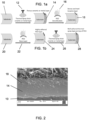
- a substrate 10 is applied with and includes a coating.
- the coating may be formed by initial use of a thermal spray process 12 used to apply a metal or ceramic coating 14 to the substrate 10. Subsequently, a PEO process 16 is used to convert the TS applied layer 14 wholly or partially to a ceramic layer 18 (i.e., a PEO layer).
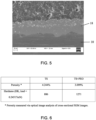
- FIG. 2 A cross-sectional view of a substrate 10 having a thermal spray layer 14 and subsequently subject to PEO processing 16 is shown in FIG. 2 .
- some of the thermal spray layer 14 remains after PEO processing.
- a PEO layer 18 is located on the thermal spray layer 14.
- the entire thermal spray layer 14 may be converted to a PEO layer 18 (for instance, as shown schematically in FIG. 1a ).
- the subsequent PEO process converts the TS applied metal layer 14 to a ceramic coating 18.
- the ceramic is principally composed of the oxide of the applied metallic layer 14, but can be modified using appropriate electrolyte additives. It will be appreciated that embodiments are without limits with respect to the PEO electrolytes used or the composition of the ceramic layer produced.
- the thermal spray technique 12 can be applied.
- moderate or high electrical conductivity is required.
- Preferred types of substrates 10 include metals, metal matrix composites, and conductive ceramic composites.
- the combined thermal spray plus PEO process, 12 and 16 is not limited to use on articles made from metals and alloys that are conducive to PEO treatment.
- the above-described process can be applied to common metals, such as steels and nickel superalloys, that cannot usually be effectively coated using PEO.
- the embodiments therefore represent a generalized route to producing PEO coatings with favorable properties on any metallic substrate type. This dramatically increases the range of possible applications of PEO.
- the initial thermal spray deposition process 12 is also without limit with respect to the nature of the substrate 10. Since the deposited ceramic layer 14 acts as a passivation layer, this represents an alternative approach to producing coatings with the favorable properties associated with PEO on any metallic substrate type, including those that are not valve metals, such as steel or nickel.
- a PEO process 22 is applied first to form a ceramic layer 24 on a metallic article or substrate 20 followed by a subsequent thermal spray process 26.
- the PEO coating 24 may have high roughness and porosity can be created which acts as an excellent "bond layer" for the subsequent thermal spray layer 28.
- Such an embodiment has several significant advantages over conventional approaches. Firstly, the process negates the need to roughen (e.g., by sand blasting) and/or deposit an intermediate bond layer to ensure sufficient mechanical adhesion of the thermal spray layer 28 as with traditional processes. Secondly, since the adhesion of both the PEO layer 24 to the substrate 20 and of the PEO layer 24 to the TS layer 28 is extremely strong, the adhesive strength of the composite coating is higher than would be expected for a TS coating 28 alone.
- the process combines the compositionally flexibility associated with TS with the exceptional properties of the underlying PEO layer 24, such as durability, chemical resistance, and conformal coating of complex geometries especially, with non- line-of-sight features such as small holes, deep bores and cavitation.
- composite coatings include yttria and yttrium oxy-fluoride on alumina for plasma erosion resistance, zirconia on alumina for thermal barrier applications, and ceria on alumina for catalytic applications.
- yttria and yttrium oxy-fluoride on alumina for plasma erosion resistance
- zirconia on alumina for thermal barrier applications
- ceria on alumina for catalytic applications.
- the number of combinations is large and embodiments are without limit with respect to combination of ceramic applied by PEO and the material deposited by TS.
- an aluminum layer is initially deposited by a thermal spray process on a substrate of stainless steel. Thereafter, this is then PEO processed to produce an aluminum oxide layer.
- the PEO process is used to electrochemically convert and densify the initially formed thermal sprayed metallic layer and thereby form an oxide ceramic composite layer.
- Example 1 The process conditions and resulting coating properties for Example 1 are as follows:
- an yttrium oxide layer is initially deposited by thermal spray method on a substrate, then a PEO process is used to form a dense Y 2 O 3 oxide layer (i.e., densification of a thermal sprayed ceramic layer by PEO).
- Example 2 The process conditions and resulting coating properties for Example 2 are as follows:
- Example 3 The process conditions and resulting coating properties for Example 3 are as follows:
- the coating as described in Example 3 is then applied with a top layer of 8YSZ applied by thermal spray (i.e., the densified and modified Y 2 O 3 layer of Example 3 is applied with a ceramic topcoat by thermal spray processing.
- Example 3 The process conditions and resulting coating properties for Example 3 are as follows:
- a PEO layer of Al 2 O 3 layer is formed on the substrate of Example 3 prior to applying a zirconia (ZrO 2 -8 wt.% Y 2 O 3 ) or yttrium oxide layer deposited by thermal spray method.
- the PEO layer is applied to improve interface adhesion by CTE match and morphology for the subsequently applied ceramic layer.
- Example 5 The process conditions and resulting coating properties for Example 5 are as follows:
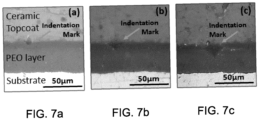
- Micro-indentation testing was performed at the interface of the PEO/thermal sprayed ceramic top coating to indicate the improvement in coating adhesion and interface fracture toughness without cracking.
- Vickers Indentation load is: 50 gram in FIG. 7a ; 300 gram in FIG. 7b and 500 gram in FIG. 7c .
- an aluminum layer may be deposited by thermal spray method on a magnesium substrate. Thereafter, the aluminum layer may be subject to PEO processing to produce an aluminum oxide layer.
- an aluminum oxide layer may be deposited by PEO on an aluminum alloy substrate. Thereafter, an yttrium oxide ceramic layer may be applied over the PEO layer by a thermal spray process.
Landscapes
- Chemical & Material Sciences (AREA)
- Engineering & Computer Science (AREA)
- Organic Chemistry (AREA)
- Chemical Kinetics & Catalysis (AREA)
- Materials Engineering (AREA)
- Metallurgy (AREA)
- Electrochemistry (AREA)
- Mechanical Engineering (AREA)
- Physics & Mathematics (AREA)
- Plasma & Fusion (AREA)
- Inorganic Chemistry (AREA)
- Coating By Spraying Or Casting (AREA)
- Other Surface Treatments For Metallic Materials (AREA)
Priority Applications (1)
| Application Number | Priority Date | Filing Date | Title |
|---|---|---|---|
| EP26182054.2A EP4775707A2 (de) | 2023-09-29 | 2024-09-18 | Verfahren zur haftfesten beschichtung und verfahren zur herstellung von beschichtungen |
Applications Claiming Priority (1)
| Application Number | Priority Date | Filing Date | Title |
|---|---|---|---|
| US18/375,161 US12709817B2 (en) | 2023-09-29 | High density and adhesion coating process and coatings formed thereby |
Related Child Applications (1)
| Application Number | Title | Priority Date | Filing Date |
|---|---|---|---|
| EP26182054.2A Division EP4775707A2 (de) | 2023-09-29 | 2024-09-18 | Verfahren zur haftfesten beschichtung und verfahren zur herstellung von beschichtungen |
Publications (2)
| Publication Number | Publication Date |
|---|---|
| EP4534736A2 true EP4534736A2 (de) | 2025-04-09 |
| EP4534736A3 EP4534736A3 (de) | 2025-11-12 |
Family
ID=92842993
Family Applications (2)
| Application Number | Title | Priority Date | Filing Date |
|---|---|---|---|
| EP24201054.4A Pending EP4534736A3 (de) | 2023-09-29 | 2024-09-18 | Verfahren zur haftfesten beschichtung und verfahren zur herstellung von beschichtungen |
| EP26182054.2A Pending EP4775707A2 (de) | 2023-09-29 | 2024-09-18 | Verfahren zur haftfesten beschichtung und verfahren zur herstellung von beschichtungen |
Family Applications After (1)
| Application Number | Title | Priority Date | Filing Date |
|---|---|---|---|
| EP26182054.2A Pending EP4775707A2 (de) | 2023-09-29 | 2024-09-18 | Verfahren zur haftfesten beschichtung und verfahren zur herstellung von beschichtungen |
Country Status (2)
| Country | Link |
|---|---|
| US (1) | US20260015751A1 (de) |
| EP (2) | EP4534736A3 (de) |
Citations (5)
| Publication number | Priority date | Publication date | Assignee | Title |
|---|---|---|---|---|
| WO1999031303A1 (fr) | 1997-12-17 | 1999-06-24 | Isle Coat Limited | Procede permettant d'obtenir des revetements de protection durs sur des articles faits d'alliages d'aluminium |
| WO2003083181A2 (en) | 2002-03-27 | 2003-10-09 | Isle Coat Limited | Process and device for forming ceramic coatings on metals and alloys, and coatings produced by this process |
| WO2010112914A1 (en) | 2009-04-03 | 2010-10-07 | Keronite International Ltd | Process for the enhanced corrosion protection of valve metals |
| WO2015008064A2 (en) | 2013-07-16 | 2015-01-22 | Keronite International Limited | High thermal conductivity insulated metal substrates produced by plasma electrolytic oxidation |
| WO2017216577A1 (en) | 2016-06-17 | 2017-12-21 | Keronite International Limited | Durable white inorganic finish for aluminium articles |
-
2024
- 2024-09-18 EP EP24201054.4A patent/EP4534736A3/de active Pending
- 2024-09-18 EP EP26182054.2A patent/EP4775707A2/de active Pending
-
2025
- 2025-09-22 US US19/335,818 patent/US20260015751A1/en active Pending
Patent Citations (5)
| Publication number | Priority date | Publication date | Assignee | Title |
|---|---|---|---|---|
| WO1999031303A1 (fr) | 1997-12-17 | 1999-06-24 | Isle Coat Limited | Procede permettant d'obtenir des revetements de protection durs sur des articles faits d'alliages d'aluminium |
| WO2003083181A2 (en) | 2002-03-27 | 2003-10-09 | Isle Coat Limited | Process and device for forming ceramic coatings on metals and alloys, and coatings produced by this process |
| WO2010112914A1 (en) | 2009-04-03 | 2010-10-07 | Keronite International Ltd | Process for the enhanced corrosion protection of valve metals |
| WO2015008064A2 (en) | 2013-07-16 | 2015-01-22 | Keronite International Limited | High thermal conductivity insulated metal substrates produced by plasma electrolytic oxidation |
| WO2017216577A1 (en) | 2016-06-17 | 2017-12-21 | Keronite International Limited | Durable white inorganic finish for aluminium articles |
Also Published As
| Publication number | Publication date |
|---|---|
| US20260015751A1 (en) | 2026-01-15 |
| EP4775707A2 (de) | 2026-07-15 |
| US20250109518A1 (en) | 2025-04-03 |
| EP4534736A3 (de) | 2025-11-12 |
Similar Documents
| Publication | Publication Date | Title |
|---|---|---|
| CN109321861B (zh) | 一种层片状和柱状复合结构的耐蚀耐磨涂层及制备方法 | |
| JP4628578B2 (ja) | 低温溶射皮膜被覆部材およびその製造方法 | |
| Rezagholizadeh et al. | Electroless Ni-P/Ni-B-B4C duplex composite coatings for improving the corrosion and tribological behavior of Ck45 steel | |
| Shen et al. | Fabrication and properties of TiB2-TiC reinforced NiAl coatings by reactive plasma spraying on AZ91D magnesium alloy | |
| CN108359927A (zh) | 一种NiCr/Al2O3复合涂层的制备方法 | |
| Martin et al. | A new strategy to prepare alumina-zirconia composite or multilayered coatings by combining cold-spray deposition and plasma electrolytic oxidation | |
| KR100995774B1 (ko) | 세라믹이 코팅된 반도체 제조용 부품 제조방법 | |
| CN111424229B (zh) | 耐液态金属合金浸蚀复合涂层的制备方法 | |
| JP5159359B2 (ja) | 異種材料複合部材の製造方法 | |
| JP2583580B2 (ja) | 溶融金属浴用部材の製造方法 | |
| US20260015751A1 (en) | High density and adhesion coating process and coatings formed thereby | |
| TW201433451A (zh) | 改善覆著力的複合材料及其製造方法 | |
| JPWO1993011277A1 (ja) | 溶融金属浴用浸漬部材の製造方法 | |
| JPH02236266A (ja) | 溶融金属用部材およびその製造方法 | |
| JPH10306362A (ja) | 溶融金属に対する耐食性および耐剥離性が優れた複合溶射皮膜を形成した溶融金属浴用部材 | |
| KR20120021535A (ko) | 금속의 부식 저항성 향상을 위한 세라믹 코팅층 제조방법 및 그에 의한 금속의 세라믹 코팅층 | |
| Manjunatha et al. | The effect of sealing on the wear behaviour of plasma sprayed Mo coating | |
| JP5629898B2 (ja) | 耐プラズマエロージョン性に優れるサーメット皮膜の形成方法とサーメット皮膜被覆部材 | |
| CN118360563A (zh) | 一种高结合强度陶瓷涂层及制备方法和应用 | |
| JP3347898B2 (ja) | 耐摩耗性の被覆を備えた耐腐食性でない金属および金属合金からなる加工品および物品の製造方法 | |
| JP2005260046A (ja) | プラズマ処理装置用部材 | |
| Girisha et al. | Improvement of corrosion resistance of aisi 410 martensitic steel using plasma coating | |
| AKTUĞ et al. | Characterization of Al 2 Ti/Al 3 Ti-based intermetallic and Al 2 O 3/TiO 2-based oxide composite coatings fabricated on Ti6Al4V alloy. | |
| JP2012057240A (ja) | 緻密表面層をもつサーメット皮膜の形成方法とサーメット皮膜被覆部材 | |
| CN1936092B (zh) | 一种镁合金表面直接电沉积锌的方法 |
Legal Events
| Date | Code | Title | Description |
|---|---|---|---|
| PUAI | Public reference made under article 153(3) epc to a published international application that has entered the european phase |
Free format text: ORIGINAL CODE: 0009012 |
|
| STAA | Information on the status of an ep patent application or granted ep patent |
Free format text: STATUS: THE APPLICATION HAS BEEN PUBLISHED |
|
| AK | Designated contracting states |
Kind code of ref document: A2 Designated state(s): AL AT BE BG CH CY CZ DE DK EE ES FI FR GB GR HR HU IE IS IT LI LT LU LV MC ME MK MT NL NO PL PT RO RS SE SI SK SM TR |
|
| RIC1 | Information provided on ipc code assigned before grant |
Ipc: C25D 11/02 20060101AFI20250716BHEP Ipc: C23C 4/06 20160101ALI20250716BHEP Ipc: C23C 4/10 20160101ALI20250716BHEP Ipc: C23C 28/00 20060101ALI20250716BHEP Ipc: C25D 11/06 20060101ALI20250716BHEP Ipc: C25D 11/18 20060101ALI20250716BHEP Ipc: C25D 11/26 20060101ALI20250716BHEP Ipc: C25D 11/30 20060101ALI20250716BHEP Ipc: C25D 11/34 20060101ALI20250716BHEP Ipc: C04B 41/00 20060101ALI20250716BHEP Ipc: C23C 4/02 20060101ALI20250716BHEP Ipc: C23C 4/11 20160101ALI20250716BHEP Ipc: C23C 4/18 20060101ALI20250716BHEP |
|
| PUAL | Search report despatched |
Free format text: ORIGINAL CODE: 0009013 |
|
| AK | Designated contracting states |
Kind code of ref document: A3 Designated state(s): AL AT BE BG CH CY CZ DE DK EE ES FI FR GB GR HR HU IE IS IT LI LT LU LV MC ME MK MT NL NO PL PT RO RS SE SI SK SM TR |
|
| RIC1 | Information provided on ipc code assigned before grant |
Ipc: C25D 11/02 20060101AFI20251008BHEP Ipc: C23C 4/06 20160101ALI20251008BHEP Ipc: C23C 4/10 20160101ALI20251008BHEP Ipc: C23C 28/00 20060101ALI20251008BHEP Ipc: C25D 11/06 20060101ALI20251008BHEP Ipc: C25D 11/18 20060101ALI20251008BHEP Ipc: C25D 11/26 20060101ALI20251008BHEP Ipc: C25D 11/30 20060101ALI20251008BHEP Ipc: C25D 11/34 20060101ALI20251008BHEP Ipc: C04B 41/00 20060101ALI20251008BHEP Ipc: C23C 4/02 20060101ALI20251008BHEP Ipc: C23C 4/11 20160101ALI20251008BHEP Ipc: C23C 4/18 20060101ALI20251008BHEP |