EP4534692A2 - Verfahren und systeme zur erzeugung und fehlerkorrektur von einzigartigen molekularindexsets mit heterogenen molekularen längen - Google Patents
Verfahren und systeme zur erzeugung und fehlerkorrektur von einzigartigen molekularindexsets mit heterogenen molekularen längen Download PDFInfo
- Publication number
- EP4534692A2 EP4534692A2 EP25157267.3A EP25157267A EP4534692A2 EP 4534692 A2 EP4534692 A2 EP 4534692A2 EP 25157267 A EP25157267 A EP 25157267A EP 4534692 A2 EP4534692 A2 EP 4534692A2
- Authority
- EP
- European Patent Office
- Prior art keywords
- sequence
- reads
- sequences
- umis
- sequencing
- Prior art date
- Legal status (The legal status is an assumption and is not a legal conclusion. Google has not performed a legal analysis and makes no representation as to the accuracy of the status listed.)
- Pending
Links
Images







Classifications
-
- C—CHEMISTRY; METALLURGY
- C12—BIOCHEMISTRY; BEER; SPIRITS; WINE; VINEGAR; MICROBIOLOGY; ENZYMOLOGY; MUTATION OR GENETIC ENGINEERING
- C12Q—MEASURING OR TESTING PROCESSES INVOLVING ENZYMES, NUCLEIC ACIDS OR MICROORGANISMS; COMPOSITIONS OR TEST PAPERS THEREFOR; PROCESSES OF PREPARING SUCH COMPOSITIONS; CONDITION-RESPONSIVE CONTROL IN MICROBIOLOGICAL OR ENZYMOLOGICAL PROCESSES
- C12Q1/00—Measuring or testing processes involving enzymes, nucleic acids or microorganisms; Compositions therefor; Processes of preparing such compositions
- C12Q1/68—Measuring or testing processes involving enzymes, nucleic acids or microorganisms; Compositions therefor; Processes of preparing such compositions involving nucleic acids
- C12Q1/6844—Nucleic acid amplification reactions
- C12Q1/6853—Nucleic acid amplification reactions using modified primers or templates
- C12Q1/6855—Ligating adaptors
-
- C—CHEMISTRY; METALLURGY
- C12—BIOCHEMISTRY; BEER; SPIRITS; WINE; VINEGAR; MICROBIOLOGY; ENZYMOLOGY; MUTATION OR GENETIC ENGINEERING
- C12Q—MEASURING OR TESTING PROCESSES INVOLVING ENZYMES, NUCLEIC ACIDS OR MICROORGANISMS; COMPOSITIONS OR TEST PAPERS THEREFOR; PROCESSES OF PREPARING SUCH COMPOSITIONS; CONDITION-RESPONSIVE CONTROL IN MICROBIOLOGICAL OR ENZYMOLOGICAL PROCESSES
- C12Q1/00—Measuring or testing processes involving enzymes, nucleic acids or microorganisms; Compositions therefor; Processes of preparing such compositions
- C12Q1/68—Measuring or testing processes involving enzymes, nucleic acids or microorganisms; Compositions therefor; Processes of preparing such compositions involving nucleic acids
- C12Q1/6869—Methods for sequencing
-
- G—PHYSICS
- G16—INFORMATION AND COMMUNICATION TECHNOLOGY [ICT] SPECIALLY ADAPTED FOR SPECIFIC APPLICATION FIELDS
- G16B—BIOINFORMATICS, i.e. INFORMATION AND COMMUNICATION TECHNOLOGY [ICT] SPECIALLY ADAPTED FOR GENETIC OR PROTEIN-RELATED DATA PROCESSING IN COMPUTATIONAL MOLECULAR BIOLOGY
- G16B25/00—ICT specially adapted for hybridisation; ICT specially adapted for gene or protein expression
-
- G—PHYSICS
- G16—INFORMATION AND COMMUNICATION TECHNOLOGY [ICT] SPECIALLY ADAPTED FOR SPECIFIC APPLICATION FIELDS
- G16B—BIOINFORMATICS, i.e. INFORMATION AND COMMUNICATION TECHNOLOGY [ICT] SPECIALLY ADAPTED FOR GENETIC OR PROTEIN-RELATED DATA PROCESSING IN COMPUTATIONAL MOLECULAR BIOLOGY
- G16B25/00—ICT specially adapted for hybridisation; ICT specially adapted for gene or protein expression
- G16B25/20—Polymerase chain reaction [PCR]; Primer or probe design; Probe optimisation
-
- G—PHYSICS
- G16—INFORMATION AND COMMUNICATION TECHNOLOGY [ICT] SPECIALLY ADAPTED FOR SPECIFIC APPLICATION FIELDS
- G16B—BIOINFORMATICS, i.e. INFORMATION AND COMMUNICATION TECHNOLOGY [ICT] SPECIALLY ADAPTED FOR GENETIC OR PROTEIN-RELATED DATA PROCESSING IN COMPUTATIONAL MOLECULAR BIOLOGY
- G16B30/00—ICT specially adapted for sequence analysis involving nucleotides or amino acids
-
- G—PHYSICS
- G16—INFORMATION AND COMMUNICATION TECHNOLOGY [ICT] SPECIALLY ADAPTED FOR SPECIFIC APPLICATION FIELDS
- G16B—BIOINFORMATICS, i.e. INFORMATION AND COMMUNICATION TECHNOLOGY [ICT] SPECIALLY ADAPTED FOR GENETIC OR PROTEIN-RELATED DATA PROCESSING IN COMPUTATIONAL MOLECULAR BIOLOGY
- G16B30/00—ICT specially adapted for sequence analysis involving nucleotides or amino acids
- G16B30/10—Sequence alignment; Homology search
-
- C—CHEMISTRY; METALLURGY
- C12—BIOCHEMISTRY; BEER; SPIRITS; WINE; VINEGAR; MICROBIOLOGY; ENZYMOLOGY; MUTATION OR GENETIC ENGINEERING
- C12Q—MEASURING OR TESTING PROCESSES INVOLVING ENZYMES, NUCLEIC ACIDS OR MICROORGANISMS; COMPOSITIONS OR TEST PAPERS THEREFOR; PROCESSES OF PREPARING SUCH COMPOSITIONS; CONDITION-RESPONSIVE CONTROL IN MICROBIOLOGICAL OR ENZYMOLOGICAL PROCESSES
- C12Q2525/00—Reactions involving modified oligonucleotides, nucleic acids, or nucleotides
- C12Q2525/10—Modifications characterised by
- C12Q2525/191—Modifications characterised by incorporating an adaptor
-
- C—CHEMISTRY; METALLURGY
- C12—BIOCHEMISTRY; BEER; SPIRITS; WINE; VINEGAR; MICROBIOLOGY; ENZYMOLOGY; MUTATION OR GENETIC ENGINEERING
- C12Q—MEASURING OR TESTING PROCESSES INVOLVING ENZYMES, NUCLEIC ACIDS OR MICROORGANISMS; COMPOSITIONS OR TEST PAPERS THEREFOR; PROCESSES OF PREPARING SUCH COMPOSITIONS; CONDITION-RESPONSIVE CONTROL IN MICROBIOLOGICAL OR ENZYMOLOGICAL PROCESSES
- C12Q2525/00—Reactions involving modified oligonucleotides, nucleic acids, or nucleotides
- C12Q2525/10—Modifications characterised by
- C12Q2525/204—Modifications characterised by specific length of the oligonucleotides
-
- C—CHEMISTRY; METALLURGY
- C12—BIOCHEMISTRY; BEER; SPIRITS; WINE; VINEGAR; MICROBIOLOGY; ENZYMOLOGY; MUTATION OR GENETIC ENGINEERING
- C12Q—MEASURING OR TESTING PROCESSES INVOLVING ENZYMES, NUCLEIC ACIDS OR MICROORGANISMS; COMPOSITIONS OR TEST PAPERS THEREFOR; PROCESSES OF PREPARING SUCH COMPOSITIONS; CONDITION-RESPONSIVE CONTROL IN MICROBIOLOGICAL OR ENZYMOLOGICAL PROCESSES
- C12Q2535/00—Reactions characterised by the assay type for determining the identity of a nucleotide base or a sequence of oligonucleotides
- C12Q2535/122—Massive parallel sequencing
Definitions
- Next generation sequencing technology is providing increasingly high speed of sequencing, allowing larger sequencing depth.
- sequencing accuracy and sensitivity are affected by errors and noise from various sources, e.g., sample defects, PCR during library preparation, enrichment, clustering, and sequencing
- increasing depth of sequencing alone cannot ensure detection of sequences of very low allele frequency, such as in fetal cell-free DNA (cfDNA) in maternal plasma, circulating tumor DNA (ctDNA), and sub-clonal mutations in pathogens. Therefore, it is desirable to develop methods for determining sequences of DNA molecules in small quantity and/or low allele frequency while suppressing sequencing inaccuracy due to various sources of errors.
- One aspect of the disclosure provides methods for sequencing nucleic acid molecules from a sample.
- the method includes: (a) applying adapters to DNA fragments in the sample to obtain DNA-adapter products, wherein each adapter includes a nonrandom unique molecular index, and wherein nonrandom unique molecular indices of the adapters have at least two different molecular lengths and form a set of variable-length, nonrandom unique molecular indices (vNRUMIs); (b) amplifying the DNA-adapter products to obtain a plurality of amplified polynucleotides; (c) sequencing the plurality of amplified polynucleotides, thereby obtaining a plurality of reads associated with the set of vNRUMIs; (d) identifying, among the plurality of reads, reads associated with a same variable-length, nonrandom unique molecular index (vNRUMI); and (e) determining a sequence of a DNA fragment in the sample using the reads associated with the same
- identifying the reads associated with the same vNRUMI includes obtaining, for each read of the plurality of reads, alignment scores with respect to the set of vNRUMIs, each alignment score indicating similarity between a subsequence of a read and a vNRUMI, wherein the subsequence is in a region of the read in which nucleotides derived from the vNRUMI are likely located.
- the alignment scores are based on matches of nucleotides and edits of nucleotides between the subsequence of the read and the vNRUMI.
- the edits of nucleotides include substitutions, additions, and deletions of nucleotides.
- each alignment score penalizes mismatches at the beginning of a sequence but does not penalize mismatches at the end of the sequence.
- the determining of (e) includes: identifying, among the reads associated with the same vNRUMI, reads having a same read position or similar read positions in a reference sequence, and determining the sequence of the DNA fragment using reads that (i) are associated with the same vNRUMI and (ii) have the same read position or similar read positions in the reference sequence.
- the set of vNRUMIs includes no more than about 10,000 different vNRUMIs. In some implementations, the set of vNRUMIs includes no more than about 1,000 different vNRUMIs. In some implementations, the set of vNRUMIs includes no more than about 200 different vNRUMIs.
- applying adapters to the DNA fragments in the sample includes applying adapters to both ends of the DNA fragments in the sample.
- Another aspect of the disclosure relates to methods for preparing sequencing adapters, the methods including: (a) providing a set of oligonucleotide sequences having at least two different molecular lengths; (b) selecting a subset of oligonucleotide sequences from the set of oligonucleotide sequences, all edit distances between oligonucleotide sequences of the subset of oligonucleotide sequences meeting a threshold value, the subset of oligonucleotide sequences forming a set of variable-length, nonrandom unique molecular indexes (vNRUMIs); and (c) synthesizing a plurality of sequencing adapters, wherein each sequencing adapter includes a double-stranded hybridized region, a single-stranded 5' arm, a single-stranded 3' arm, and at least one vNRUMI of the set of vNRUMIs.
- the certain oligonucleotide sequences include oligonucleotide sequences having three or more consecutive identical bases. In some implementations, the certain oligonucleotide sequences include oligonucleotide sequences having a combined number of guanine and cytosine bases smaller than 2 and oligonucleotide sequences having a combined number of guanine and cytosine bases larger than 4.
- the certain oligonucleotide sequences include oligonucleotide sequences having a thymine base at the last position of the oligonucleotide sequences.
- the set of vNRUMIs includes vNRUMIs of 6 nucleotides and vNRUMIs of 7 nucleotides.
- the method further includes obtaining a count of the reads associated with the same vNRUMI.
- Another aspect of the disclosure relates to a method for sequencing nucleic acid molecules from a sample, including (a) applying adapters to DNA fragments in the sample to obtain DNA-adapter products, wherein each adapter includes a unique molecular index (UMI), and wherein unique molecular indices (UMIs) of the adapters have at least two different molecular lengths and form a set of variable-length unique molecular indices (vUMIs); (b) amplifying the DNA-adapter products to obtain a plurality of amplified polynucleotides; (c) sequencing the plurality of amplified polynucleotides, thereby obtaining a plurality of reads associated with the set of vUMIs; and (d) identifying, among the plurality of reads, reads associated with a same variable-length unique molecular index (vUMI).
- UMI unique molecular index
- vUMIs variable-length unique molecular index
- UMIs are similar to bar codes, which are commonly used to distinguish reads of one sample from reads of other samples, but UMIs are instead used to distinguish one source DNA molecule from another when many DNA molecules are sequenced together. Because there may be many more DNA molecules in a sample than samples in a sequencing run, there are typically many more distinct UMIs than distinct barcodes in a sequencing run.
- the physical UMI must have a sufficient length to ensure this uniqueness for each and every source DNA molecule.
- a less unique molecular identifier can be used in conjunction with other identification techniques to ensure that each source DNA molecule is uniquely identified during the sequencing process.
- multiple fragments or adapters may have the same physical UMI.
- Other information such as alignment location or virtual UMIs may be combined with the physical UMI to uniquely identify reads as being derived from a single source DNA molecule/fragment.
- adaptors include physical UMIs limited to a relatively small number of nonrandom sequences, e.g., 120 nonrandom sequences. Such physical UMIs are also referred to as nonrandom UMIs.
- NRUMI nonrandom UMI
- nonrandom UMIs are predefined for a particular experiment or application.
- rules are used to generate sequences for a set or select a sample from the set to obtain a nonrandom UMI. For instance, the sequences of a set may be generated such that the sequences have a particular pattern or patterns.
- each sequence differs from every other sequence in the set by a particular number of (e.g., 2, 3, or 4) nucleotides.
- nonrandom UMIs are selected from a set with fewer than all possible different sequences
- the number of nonrandom UMIs is fewer, sometimes significantly so, than the number of source DNA molecules.
- nonrandom UMI information may be combined with other information, such as virtual UMIs, read locations on a reference sequence, and/or sequence information of reads, to identify sequence reads deriving from a same source DNA molecule.
- each vNRUMI differs from every other vNRUMI in the set used in a process by at least a defined edit distance.
- molecular length is also referred to as sequence length, and can be measured in nucleotides.
- molecular length is also used interchangeably with the terms molecular size, DNA size, and sequence length.
- Edit distance is a metric quantifying how dissimilar two strings (e.g., words) are to one another by counting the minimum number of operations required to transform one string into the other. In bioinformatics, it can be used to quantify the similarity of DNA sequences, which can be viewed as strings of the letters A, C, G and T.
- different string operations can be weighted differently for an edit distance. For instance, a substitution operation may be weighted by a value of 3, while an indel may be weighted by a value of 2.
- matches of different kinds may be weighted differently. For example an A-A match might be weighted twice as much as a G-G match.
- An alignment score is a score indicating a similarity of two sequences determined using an alignment method.
- an alignment score accounts for number of edits (e.g., deletions, insertions, and substitutions of characters in the string).
- an alignment score accounts for a number of matches.
- an alignment score accounts for both the number of matches and a number of edits.
- the number of matches and edits are equally weighted for the alignment score. For example, an alignment score can be calculated as: # of matches - # of insertions - # of deletions - # of substitutions. In other implementations, the numbers of matches and edits can be weighted differently. For example, an alignment score can be calculated as: # of matches ⁇ 5 - # of insertions ⁇ 4 - # of deletions ⁇ 4 - # of substitutions ⁇ 6.
- paired end reads refers to reads obtained from paired end sequencing that obtains one read from each end of a nucleic fragment. Paired end sequencing involves fragmenting DNA into sequences called inserts. In some protocols such as some used by Illumina, the reads from shorter inserts (e.g., on the order of tens to hundreds of bp) are referred to as short-insert paired end reads or simply paired end reads. In contrast, the reads from longer inserts (e.g., on the order of several thousands of bp) are referred to as mate pair reads.
- alignment is performed between a subsequence of a read and a vNRUMI as reference sequence to determine an alignment score as further described herein after. Alignment scores between a read and multiple vNRUMIs can then be used to determine which one of the vNRUMIs the read should be associated with or mapped to.
- an alignment additionally indicates a location in the reference sequence where the read maps to. For example, if the reference sequence is the whole human genome sequence, an alignment may indicate that a read is present on chromosome 13, and may further indicate that the read is on a particular strand and/or site of chromosome 13.
- alignment tools are imperfect, in that a) not all valid alignments are found, and b) some obtained alignments are invalid. This happens due to various reasons, e.g., reads may contain errors, and sequenced reads may be different from the reference genome due to haplotype differences.
- the alignment tools include built-in mismatch tolerance, which tolerates certain degrees of mismatch of base pairs and still allow alignment of reads to a reference sequence. This can help to identify valid alignment of reads that would otherwise be missed.
- Aligned reads are one or more sequences that are identified as a match in terms of the order of their nucleic acid molecules to a known reference sequence such as a reference genome.
- An aligned read and its determined location on the reference sequence constitute a sequence tag. Alignment can be done manually, although it is typically implemented by a computer algorithm, as it would be impossible to align reads in a reasonable time period for implementing the methods disclosed herein.
- One example of an algorithm from aligning sequences is the global-local (glocal) hybrid alignment method for comparing a prefix sequence of a read to a vNRUMI as further described hereinafter.
- an alignment method is the Efficient Local Alignment of Nucleotide Data (ELAND) computer program distributed as part of the Illumina Genomics Analysis pipeline.
- ELAND Efficient Local Alignment of Nucleotide Data
- a Bloom filter or similar set membership tester may be employed to align reads to reference genomes. See US Patent Application No. 14/354,528, filed April 25, 2014 , which is incorporated herein by reference in its entirety.
- the matching of a sequence read in aligning can be a 100% sequence match or less than 100% (i.e., a non-perfect match). Additional alignment methods are disclosed in U.S. Patent Application No. 15/130,668 (attorney reference ILMNP008) filed no April 15, 2016 , which is incorporated by reference in its entirety.
- mapping refers to assigning a read sequence to a larger sequence, e.g., a reference genome, by alignment.
- Methods of pretreatment may also involve, but are not limited to, filtration, precipitation, dilution, distillation, mixing, centrifugation, freezing, lyophilization, concentration, amplification, nucleic acid fragmentation, inactivation of interfering components, the addition of reagents, lysing, etc. If such methods of pretreatment are employed with respect to the sample, such pretreatment methods are typically such that the nucleic acid(s) of interest remain in the test sample, sometimes at a concentration proportional to that in an untreated test sample (e.g., namely, a sample that is not subjected to any such pretreatment method(s)). Such "treated” or “processed” samples are still considered to be biological "test” samples with respect to the methods described herein.
- biological fluid refers to a liquid taken from a biological source and includes, for example, blood, serum, plasma, sputum, lavage fluid, cerebrospinal fluid, urine, semen, sweat, tears, saliva, and the like.
- blood serum
- plasma sputum
- lavage fluid cerebrospinal fluid
- urine semen
- sweat tears
- saliva saliva
- the terms "blood,” “plasma” and “serum” expressly encompass fractions or processed portions thereof.
- sample expressly encompasses a processed fraction or portion derived from the biopsy, swab, smear, etc.
- an erroneous read from one copy of a sequence may simply be discarded from analysis. Error-free reads from other copies of the same sequence may still provide sufficient information for valid analyses.
- discarding the read having a base pair different from other reads from the same sequence one can disregard the different base pair as resulting from a known or unknown source of error.
- UMIs Unique molecular indices
- UMIs enable the usage of information from multiple reads to suppress sequencing noise.
- UMIs along with contextual information such as alignment positions, allow us to trace the origin of each read to a specific original DNA molecule.
- computational approaches can be used to separate actual variants (i.e. variants biologically present in the original DNA molecules) from variants artificially introduced via sequencing error.
- Variants can include, but are not limited to, insertions, deletions, multi-nucleotide variants, single-nucleotide variants, and structural variants. Using this information, we can infer the true sequence of the DNA molecules. We refer to this computational methodology as read collapsing.
- random UMIs are used, in which a random sequence was attached to DNA molecules, and those random sequences were used as UMI barcodes.
- UMIs are referred to as non-random UMIs (NRUMIs).
- NRUMIs non-random UMIs
- a third consensus sequence is determined using the first and second consensus sequences obtained for the same DNA molecule/fragment, with the third consensus sequence including nucleotides common for the first and second consensus sequences while excluding those inconsistent between the two.
- only one consensus sequence is directly obtained by collapsing all reads derived from both strands of the same fragment, instead of by comparing the two consensus sequences obtained from the two strands.
- the sequence of the fragment may be determined from the third or the only one consensus sequence, which includes base pairs that are consistent across reads derived from both strands of the fragment.
- the method combines different types of indices to determine the source polynucleotide on which reads are derived.
- the method may use both physical and virtual UMIs to identify reads deriving from a single DNA molecule.
- the physical UMIs may be shorter than when only physical UMIs are used to determine the source polynucleotide. This approach has minimal impact on library prep performance, and does not require extra sequencing read length.
- Operation 102 provides fragments of double-stranded DNA.
- the DNA fragments may be obtained by fragmenting genomic DNA, collecting naturally fragmented DNA (e.g., cfDNA or ctDNA), or synthesizing DNA fragments from RNA, for example.
- messenger RNA or noncoding RNA is first purified using polyA selection or depletion of ribosomal RNA, then the selected mRNA is chemically fragmented and converted into single-stranded cDNA using random hexamer priming. A complementary strand of the cDNA is generated to create a double-stranded cDNA that is ready for library construction.
- gDNA genomic DNA
- input gDNA is fragmented, e.g., by hydrodynamic shearing, nebulization, enzymatic fragmentation, etc., to generate fragments of appropriate lengths, e.g., about 1000bp, 800bp, 500, or 200 bp.
- nebulization can break up DNA into pieces less than 800 bp in short periods of time. This process generates double-stranded DNA fragments.
- fragmented or damaged DNA may be processed without requiring additional fragmentation.
- formalin-fixed, paraffin embedded (FFPE) DNA or certain cfDNA are sometimes fragmented enough that no additional fragmentation step is required.
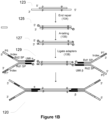
- Fragment 123 has both a 3' overhang on the left end and a 5' overhang shown on the right end, and is marked with ⁇ and ⁇ , indicating two sequences in the fragment that may be used as virtual UMIs in some implementations, which, when used alone or combined with physical UMIs of an adapter to be ligated to the fragment, may uniquely identify the fragment.
- UMIs are uniquely associated with a single DNA fragment in a sample including a source polynucleotide and its complementary strand.
- a physical UMI is a sequence of an oligonucleotide linked to the source polynucleotide, its complementary strand, or a polynucleotide derived from the source polynucleotide.
- a virtual UMI is a sequence of an oligonucleotide within the source polynucleotide, its complementary strand, or a polynucleotide derived from the source polynucleotide. Within this scheme, one may also refer to the physical UMI as an extrinsic or exogenous UMI, and the virtual UMI as an intrinsic or endogenous UMI.
- the two sequences ⁇ and ⁇ actually each refer to two complementary sequences at the same genomic site, but for simplicity sake, they are indicated on only one strand in some of the double-stranded fragments shown herein.
- Virtual UMIs such as ⁇ and ⁇ can be used at a later step of the workflow to help identify reads originating from one or both strands of the single DNA source fragment. With the reads so identified, they can be collapsed to obtain a consensus sequence.
- workflow 100 proceeds to perform end repair operation 104, which produces blunt-end fragments having 5'- phosphorylated ends.
- this step converts the overhangs resulting from fragmentation into blunt ends using T4 DNA polymerase and Klenow enzyme.
- the 3' to 5' exonuclease activity of these enzymes removes 3' overhangs and the 5' to 3' polymerase activity fills in the 5' overhangs.
- T4 polynucleotide kinase in this reaction phosphorylates the 5' ends of the DNA fragments.
- the fragment 125 in Figure 1B is an example of an end-repaired, blunt-end product.
- workflow 100 proceeds to operation 108 to ligate partially double stranded adapters to both ends of the fragments.
- the adapters used in a reaction include different physical UMIs to associate sequence reads to a single source polynucleotide, which may be a single- or double-stranded DNA fragment.
- a set of physical UMIs used in a reaction are random UMIs.
- the set of physical UMIs used in the reaction are nonrandom UMIs (NRUMIs).
- the set of physical UMIs used in the reaction are variable-length, nonrandom UMIs (vNRUMIs).
- FIG. 1B The reaction depicted in Figure 1B adds distinct sequences to the genomic fragment.
- a ligation product 120 from the same fragment described above is illustrated in Figure 1B .
- This ligation product 120 has the physical UMI ⁇ , the virtual UMI ⁇ , the virtual UMI ⁇ , and physical UMI ⁇ on its top strand, in the 5'-3' direction.
- the ligation product also has the physical UMI ⁇ , the virtual UMI ⁇ , the virtual UMI ⁇ , and the physical UMI ⁇ on its bottom strand, in the 5'-3' direction.
- This disclosure embodies methods using sequencing technologies and adapters other than those provided by Illumina.
- adapters here have the physical UMIs on the double-stranded regions of the adapters
- some implementations use adapters having physical UMIs on the single stranded regions, such as adapters (i) and (iv) in Figures 2A .
- the products of this ligation reaction are purified and/or size-selected by agarose gel electrophoresis or magnetic beads. Size-selected DNA is then PCR amplified to enrich for fragments that have adapters on both ends. See block 110.
- operations to hybridize and enrich certain regions of the DNA fragments may be applied to target the regions for sequencing.
- Workflow 100 then proceeds to cluster amplify PCR products, e.g., on an Illumina platform. See operation 112.
- libraries can be pooled for multiplexing, e.g., with up to 12 samples per lane, using different index sequences on the adapters to keep track of different samples.
- sequencing reads can be obtained through sequencing by synthesis on the Illumina platform. See operation 114.
- the adapters and the sequencing process described here are based on the Illumina platform, others sequencing technologies, especially NGS methods may be used instead of or in addition to the Illumina platform.
- physical UMIs, virtual UMIs, and position information may be combined in various ways to collapse reads to obtain consensus sequences for determining the sequence of a fragment or at least a portion thereof.
- physical UMIs are combined with virtual UMIs to collapse reads.
- physical UMIs and read positions are combined to collapse reads.
- Read position information may be obtained by various techniques using different position measurements, e.g., genomic coordinates of the reads, positions on a reference sequence, or chromosomal positions.
- physical UMIs, virtual UMIs, and read positions are combined to collapse reads.
- the sequence reads are paired-end reads. Each read either includes a nonrandom UMI or is associated with a nonrandom UMI through a paired-end read.
- the read lengths are shorter than the DNA fragments or shorter than one half of the fragments' length. In such cases, the complete sequence of the whole fragment is sometimes not determined. Rather, the two ends of the fragment are determined.
- a DNA fragment may be 500 bp long, from which two 100bp paired-end reads can be derived. In this example, the 100 bases at each end of the fragment can be determined, and the 300 bp in the middle of the fragment may not be determined without using information of other reads.
- the complete sequence of the whole fragment may be determined from the two reads. For instance, see the example described in association with Figure 5 .
- an adaptor has a duplex nonrandom UMI in the double stranded region of the adaptor, and each read includes a first nonrandom UMI on one end and a second nonrandom UMI on the other end.
- Some implementations provide a novel process for detecting and correcting errors in vNRUMIs and in sequence reads.
- the process uses a global-local (glocal) hybrid alignment strategy to match the first few bases of the read to a known vNRUMI, thereby obtaining alignment scores between prefix sequences of the read and the known vNRUMI.
- a vNRUMI having a highest glocal alignment score is determined to be the vNRUMI associated with the read, which provides a mechanism to collapse the read with other reads associated with the same vNRUMI, thereby correcting errors.
- Pseudocode for obtaining glocal alignment scores and matching vNRUMIs using the glocal alignment scores in some implementations is provided as follows.
- the glocal alignment approach has the ability to work with barcode pools of heterogeneous length, a distinguishing feature from conventional methodologies.
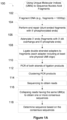
- Process 130 proceeds by amplifying the DNA-adapter products to obtain a plurality of amplified polynucleotides. See block 132. Process 130 further involves sequencing the plurality of amplified polynucleotides, thereby obtaining a plurality of reads associated with the set of vNRUMIs. See block 133. Moreover, process 130 involves identifying reads associated with a same vNRUMI from among the plurality of reads. See block 134. Finally, process 130 includes determining a sequence of DNA fragment in the sample using the reads associated with the same vNRUMI.
- process 130 illustrated in Figure 1C provides a method for sequencing DNA fragments using vNRUMIs.
- Process 130 starts by applying adapters to DNA fragments of the sample to obtain DNA-adapter products (block 131).
- Process 130 also involves amplifying the DNA-adapter products to obtain a plurality of amplified polynucleotides (block 132); sequencing the quality of amplified polynucleotides, thereby obtaining a plurality of reads associated with the set of vNRUMIs (block 133); identifying reads associated with the same vNRUMI (block 134); and determining a sequence of DNA fragments in the sample using the reads associated with the same vNRUMI (block 135).
- the sample may be a blood sample, a plasma sample, a tissue sample, or one of the samples as described elsewhere herein.
- the adapters applied in step 131 can be obtained from a process such as process 140 illustrated in Figure 1D .
- the set of vNRUMIs includes no more than about 10,000 different vNRUMIs. In some implementations, the set of vNRUMIs includes no more than about 1000 different vNRUMIs. In some implementations, the set of vNRUMIs includes no more than about 200 different vNRUMIs.
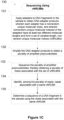
- step 134 of identifying reads associated with the same vNRUMI involves obtaining, for each read of the plurality of reads, alignment scores with respect to the vNRUMIs.
- Each alignment score indicates similarity between a subsequence of the read and a vNRUMI.
- the subsequence is in a region of the read in which nucleotides derived from the vNRUMI are likely located.
- the subsequence includes the first nucleotides in a region where the vNRUMI is expected to be located.
- the subsequence's size equals to the size of the largest vNRUMI in the set of vNRUMIs.
- the query sequence Q includes the first seven nucleotides from the read sequence where reads are expected to be derived from the vNRUMIs.
- the query sequence Q includes seven nucleotides GTCTTCG.
- Q has the same length as the longest vNRUMI in the vNRUMI set ⁇ .
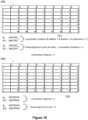
- Alignment score table 150 shows the alignment scores for prefix sequences of Q and S1.
- cell 151 shows the alignment score for the prefix sequence of Q (GTCTTC) and the complete sequence of S1 (AACTTC).
- the alignment score takes into account the number of matches between the two sequences, as well as the number of edits between the two sequences. For each matching nucleotide, the score goes up by 1; for each deletion, addition, or substitution, the score goes down by 1.
- a Levenshtein distance is an edit distance, which does not account for the number of matches between two sequences, but only accounting for the number of additions, deletions, and substitutions.
- alignment score table 150 the rightmost column with the bolded alignment scores show the alignment scores between all possible subsequences of the query sequence Q and all possible prefix sequences of reference vNRUMI sequence S1.
- the bottom row of the alignment score table 150 shows the alignment scores between the complete sequence S1 and all possible prefix sequences of Q.
- the highest alignment score in the rightmost column and the bottom row is selected as the glocal alignment score between Q and S1.
- cell 151 has the highest value, which is determined as the glocal alignment score between Q and S1, or g(Q,S1).
- S1 is used to label a DNA molecule.
- m 0 TTGTGACTNNNNN (SEQ ID NO: 1).
- m 1 TTGGCATGACTNNNNN (SEQ ID NO: 2).
- Q TTGGCAT.
- the process compares Q with each sequence in ⁇ .
- An alignment score table 160 for g(Q, S1) is obtained and shown in Figure 1F . And similarly, an alignment score table 163 is obtained for g(Q, S2).
- step 135 involves determining a sequence of DNA fragment in the sample using the reads associated with the same vNRUMI.
- determining the sequence of the DNA fragment involves collapsing reads associated with the same vNRUMI to obtain a consensus sequence, which can be achieved as further described hereinafter.
- the consensus sequence is based on quality scores of the reads, as well the sequence of the reads. Additionally or alternatively, other contextual information such as the position of the reads may be used to determine the consensus sequence.
- determining the sequence of the DNA fragment also involves identifying reads having the same position or similar positions in a reference sequence. The method then determine the sequence of the DNA fragment using reads that are associated with the same vNRUMI and have the same position or similar positions in the reference sequence.
- Random UMIs provide a larger number of unique UMIs than nonrandom UMIs of the same sequence length. In other words, random UMIs are more likely to be unique than nonrandom UMIs. However, in some implementations, nonrandom UMIs may be easier to manufacture or have higher conversion efficiency. When nonrandom UMIs are combined with other information such as sequence position and virtual UMI, they can provide an efficient mechanism to index the source molecules of DNA fragments.
- the method also involves (c) synthesizing a plurality of sequencing adapters, the sequencing adapter having a double-stranded hybridized region, a single-stranded 5' end, a single-stranded 3' end as depicted in Figure 2A , and at least one vNRUMI in the set of vNRUMIs.
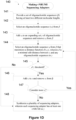
- Figure 1D illustrates a process 140 for making sequencing adapters having vNRUMIs.
- Process 140 starts by providing a set of oligonucleotide sequences ( ⁇ ) having at least two different molecular lengths. See block 141.
- oligonucleotide sequences having a subsequence matching the 3' end of any sequencing primers are removed.
- Process 140 proceeds by selecting an oligonucleotide sequence ( S 0 ) from ⁇ . See block 142.
- S 0 may be randomly chosen from the set of oligonucleotide sequences.
- Process 140 further involves adding S 0 to an expanding set ⁇ of oligonucleotide sequences and removing S 0 from the set ⁇ . See block 143.
- Process 140 further involves selecting oligonucleotide sequence S i from ⁇ , S i maximizes the distance function d(S i , ⁇ ), which is a minimal edit distance between S i and any oligonucleotide sequence in set ⁇ . See block 144.
- the edit distance is Levenshtein distance.
- one or more bases are appended to the end of the sequence when calculating the Levenshtein distance or edit distance.
- a thymine (T) base is added to the end of the sequence. This T base is added to reflect a T-base overhang at the end of an adapter complementary to the A-base at the end of a DNA fragment that has undergone dA-tailing processing as described herein elsewhere.
- a T-base is added to the end of the sequence, and then one or more random bases are added after the T-base to create a sequence having a molecular length equaling the maximum length of the vNRUMIs.
- Process 140 proceeds to determine whether the distance function d(S i , ⁇ ) meet the threshold value.
- the threshold value may require that the distance function (e.g., a padded Levenshtein distance) is at least 3. If the distance function d(S i , ⁇ ) the meets the threshold, the process proceeds to add S i to the expanding set ⁇ and removes S i from the set ⁇ . See the "Yes" branch of decision 145 and block 146. If the distance function does not meet the threshold value, process 140 does not add S i to the expanding set ⁇ , and the process proceeds to synthesize the plurality of sequencing adapters, where each sequencing adapter has at least one vNRUMI in the expanding set ⁇ . See the no decision branch of 145 pointing to block 148.
- the distance function e.g., a padded Levenshtein distance
- process 140 further involves a decision operation of whether more sequences from set ⁇ need to be considered. If so, the process loop back to block 144 to select more oligonucleotide sequences from set ⁇ that maximizes the distance function.
- Various factors may be considered to determine whether more sequences need to be further considered from the set ⁇ . For instance, in some implementations, when the desired number of sequences has been obtained, the process no longer needs to consider more sequences from the sequence set data.
- process 140 proceeds to synthesize the plurality of sequencing adapters where each adapter has at least one vNRUMI in sequence set ⁇ . See the no decision branch of operation 147 pointing to operation 148.
- each sequencing adapter has the vNRUMI on one strand of the sequencing adapters.
- sequencing adapters having any of the forms illustrated in Figure 2A are synthesized in operation 148.
- each sequencing adapter has only one vNRUMI.
- each adapter has a vNRUMI on each strand of the sequencing adapters.
- each sequencing adapter has a vNRUMI on each strand of the sequencing adapter in the double stranded, hybridized region.
- the process can be implemented by the pseudocode below.
- vNRUMIs can be obtained according to the process and algorithm described above.
- the toy example shows how vNRUMIs can be produced from a pool of five candidate sequences, which are then used to map observed sequence reads. Note that since this is a toy example over a significantly smaller sequence space than we would use/encounter in practice, not every aspect of the characteristics of the vNRUMIs can be addressed.
- the process aims to construct a set of 3 vNRUMI sequences starting from a set 6mers and 7mers (but resulted in only 2 vNRUMI sequences).
- the entire space of possible 6mers and 7mers consists of the following 5 sequences:
- the distance metric d(s, ⁇ ) ⁇ s ⁇ ⁇ is calculated.
- d(CGCTTC, ⁇ ) 2
- a "T" base is added to the end of it to simulate the annealing process, in which a T base complementary to the "A" tail is annealed to the adapter sequence.
- the rationale is that when practitioners try to identify the NRUMI later, they will be considering both the first sixmer and the first sevenmer. By adding this T base, it is ensured that when looking at the sevenmer, it still isn't too close to any other NRUMI. Comparing CGCTTCT to AACTTC, there are two edits required.
- Virtual UMI those Virtual UMIs that are defined at, or with respect to, the end positions of source DNA molecules can uniquely or nearly uniquely define individual source DNA molecules when the locations of the end positions are generally random as with some fragmentation procedures and with naturally occurring cfDNA.
- the virtual UMIs can themselves uniquely identify individual source DNA molecules.
- the combination of such virtual UMIs with one or more physical UMIs may succeed.
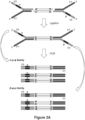
- FIG. 1A schematically illustrates five different designs of adapter with UMI(s) that may be adopted in the various implementations.
- Figure 2A(ii) shows an adapter having a single physical UMI replacing the i7 index region of the standard dual index adapter shown in Figure 2A(i) .
- This design of the adapter mirrors that shown in the example workflow described above in association with Figure 1B .
- the physical UMIs ⁇ and ⁇ are designed to be on only the 5' arm of the double-stranded adapters, resulting in ligation products that have only one physical UMI on each strand.
- physical UMIs incorporated into both strands of the adapters result in ligation products that have two physical UMIs on each strand, doubling the time and cost to sequence the physical UMIs.
- this disclosure embodies methods employing physical UMIs on both strands of the adapters as depicted in Figures 2A(iii)-2A(vi) , which provide additional information that may be utilized for collapsing different reads to obtain consensus sequences.
- Figure 2A(iii) shows an adapter having two physical UMIs added to the standard dual index adapter.
- the physical UMIs shown here may be random UMIs or nonrandom UMIs.
- the first physical UMI is upstream to the i7 index sequence, and the second physical UMI is upstream to the i5 index sequence.
- Figure 2A(iv) shows an adapter also having two physical UMIs added to the standard dual index adapter.
- the first physical UMI is downstream to the i7 index sequence
- the second physical UMI is downstream to the i5 index sequence.
- the two physical UMIs may be random UMIs or nonrandom UMIs.
- Figure 2A(vi) shows an adapter similar to but shorter than that of Figure 2A(v) , but it does not include the index sequences or the P5 and P7' sequences complementary to flow cell surface amplification primers.
- the two physical UMIs may be random UMIs or nonrandom UMIs.
- adapters having a double-stranded physical UMI on the double-stranded region can provide a direct link between two strands of a double stranded DNA fragment to which the adapter is ligated, as shown in Figure 2A(v) and Figure 2A(vi) . Since the two strands of a double-stranded physical UMI are complementary to each other, the association between the two strands of the double-stranded UMI is inherently reflected by the complementary sequences, and can be established without requiring either a priori or a posteriori information.
- read collapsing is based on two physical UMIs on the two ends of an insert.
- two very short physical UMIs e.g., 4 bp
- the combined length of the two physical UMIs providing sufficient information for distinguishing among different fragments.
- FIG. 2B illustrates a hypothetical process in which UMI jumping occurs in a PCR reaction involving adapters having physical UMI on both strands in the double-stranded region.
- the two physical UMIs may be random UMIs or nonrandom UMIs.
- the actual underlying mechanism of UMI jumping and the hypothetical process described here do not affect the utility of the adapters and methods disclosed herein.
- the PCR reaction starts by providing at least one double stranded source DNA fragment 202 and adapters 204 and 206.
- Adapters 204 and 206 are similar to the adapters illustrated in Figure 2A(iii)-(iv) .
- Adapter 204 has a P5 adapter sequence and an ⁇ 1 physical UMI on its 5' arm.
- Adapter 204 also has a P7' adapter sequence and an ⁇ 2 physical UMI on its 3' arm.
- Adapter 206 has a P5 adapter sequence and a ⁇ 2 physical UMI on its 5' arm, and a P7' adapter sequence and a ⁇ 1 physical UMI on its 3' arm.
- the process proceeds by ligating adapter 204 and adapter 206 to fragment 202, obtaining ligation product 208.
- the process proceeds by denaturing ligation product 208, resulting in a single stranded, denatured fragment 212. Meanwhile, a reaction mixture often includes residual adapters at this stage.
- adapter 210 which is similar to adapter 206, except that adapter 210 has physical UMIs ⁇ 1 and ⁇ 2 on its 3' and 7' arms, respectively.
- the denaturing condition producing the denatured fragment 212 also produces a denatured adapter oligonucleotide 214, which has physical UMI ⁇ 2 near its P5 adapter sequence.
- intermediate adapter fragments 218, 220, and 222 can hybridize to intermediate fragment 216 or its amplicons, because the 3' end of the intermediate adapter fragments 218, 220, and 222 are complementary to region 217 of the intermediate insert 216.
- PCR extension of the hybridized fragments produces single stranded DNA fragments 224, 226, and 228.
- DNA Fragments 224, 226, and 228 are labeled with three different physical UMIs ( ⁇ , ⁇ , and ⁇ ) on the 5' end, and a physical UMI ⁇ 2 on the 3' end, indicating "UMI jumping" where different UMIs are attached to nucleotide sequences derived from the same DNA fragment 202.
- adapters having physical UMIs on both strands of the double-stranded region of the adapters may prevent or reduce UMI jumping. This may be due to the fact that the physical UMIs on one adapter at the double-stranded region are different from physical UMIs on all other adapters. This helps to reduce the complementarity between intermediate adapter oligonucleotides and intermediate fragments, thereby avoiding hybridization such as that shown for intermediate oligonucleotide 222 and intermediate fragment 220, thereby reducing or preventing UMI jumping.
- multiple sequence reads having the same UMI(s) are collapsed to obtain one or more consensus sequences, which are then used to determine the sequence of a source DNA molecule.
- Multiple distinct reads may be generated from distinct instances of the same source DNA molecule, and these reads may be compared to produce a consensus sequence as described herein.
- the instances may be generated by amplifying a source DNA molecule prior to sequencing, such that distinct sequencing operations are performed on distinct amplification products, each sharing the source DNA molecule's sequence. Of course, amplification may introduce errors such that the sequences of the distinct amplification products have differences.
- a source DNA molecule or an amplification product thereof forms a cluster of DNA molecules linked to a region of a flow cell.
- the molecules of the cluster collectively provide a read.
- at least two reads are required to provide a consensus sequence.
- Sequencing depths of 100, 1000, and 10,000 are examples of sequencing depths useful in the disclosed embodiments for creating consensus reads for low allele frequencies (e.g., about 1% or less).
- some reads include ⁇ - ⁇ - ⁇ UMIs, while others include ⁇ - ⁇ - ⁇ UMIs.
- the physical UMI ⁇ produces reads having ⁇ . If all adapters used in a workflow have different physical UMIs (e.g., different random UMIs), all reads having ⁇ at the adapter region are likely derived from the same strand of the DNA fragment. Similarly the physical UMI ⁇ produces reads having ⁇ , all of which are derived from the same complementary strand of the DNA fragment. It is therefore useful to collapse all reads including ⁇ to obtain one consensus sequence, and to collapse all reads including ⁇ to obtain another consensus sequence.
- the combination of virtual UMIs and physical UMIs can provide information to guide a second-level collapsing when only one physical UMI is assigned to a first level consensus sequence of each strand, such as shown in Figure 3A and Figures 4A-4C .
- this second level collapsing using virtual UMIs may be difficult if there are over-abundant input DNA molecules or fragmentation is not randomized.
- reads having two physical UMIs on both ends may be collapsed in a second-level collapsing based on a combination of the physical UMIs and the virtual UMIs. This is especially helpful when the physical UMIs are too short to uniquely identify source DNA fragments without using the virtual UMIs.
- second level collapsing can be implemented, with physical duplex UMIs as shown in Figure 3B , by collapsing ⁇ - ⁇ - ⁇ - ⁇ consensus reads and ⁇ - ⁇ - ⁇ - ⁇ consensus reads from the same DNA molecule, thereby obtaining a consensus sequence including nucleotides consistent among all of the reads.
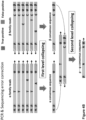
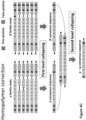
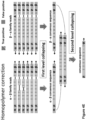
- the method using singleplex physical UMIs as shown in Figures 4A-4C first involves collapsing reads having the same physical UMI ⁇ or ⁇ , illustrated as first level collapsing.
- the first level collapsing obtains an ⁇ consensus sequence for reads having the physical UMI ⁇ , which reads are derived from one strand of the double-stranded fragment.
- the first level collapsing also obtains a ⁇ consensus sequence for reads having the physical UMI ⁇ , which reads are derived from another strand of the double-stranded fragment.
- the method obtains a third consensus sequence from the ⁇ consensus sequence and the ⁇ consensus sequence.
- the third consensus sequence reflects consensus base pairs from reads having the same duplex virtual UMIs ⁇ and ⁇ , which reads are derived from two complementary strands of the source fragment. Finally, the sequence of the double stranded DNA fragment is determined as the third consensus sequence.
- Figure 4A illustrates how a first-level collapsing may suppress sequencing errors. Sequencing errors occur on the sequencing platform after sample and library preparation (e.g., PCR amplification). Sequencing errors may introduce different erroneous bases into different reads. True positive bases are illustrated by solid letters, while false positive bases are illustrated by hatched letters. False positive nucleotides on different reads in the ⁇ - ⁇ - ⁇ family have been excluded from the ⁇ consensus sequence. The true positive nucleotide "A" illustrated on the left ends of the ⁇ - ⁇ - ⁇ family reads is retained for the ⁇ consensus sequence.
- Figure 4A also shows an optional second-level collapsing relying on the virtual UMIs ⁇ and ⁇ . This second-level collapsing may further suppress errors as explained above, but such errors are not illustrated in Figure 4A .
- reads are processed to align to a reference sequence to determine alignment locations of the reads on the reference sequence (localization).
- localization is achieved by k-mer similarity analysis and read-read alignment. This second implementation has two advantages: first, it can collapse (error correct) reads that do not match the reference, due to haplotype differences or translocations, and secondly, it does not depend on an aligner algorithm, thereby removing the possibility of aligner-induced artifacts (errors in the aligner).
- reads sharing the same localization information may be collapsed to obtain consensus sequences to determine the sequence of the source DNA fragments.
- the alignment process is also referred to as a mapping process.
- reads are considered poorly aligned when they are aligned with at least about 1, 2, 3, 4, 5, 6, 7, 8, 9, or 10 mismatches. In other embodiments, reads are considered poorly aligned when they are aligned with at least about 5% of mismatches. In other embodiments, reads are considered poorly aligned when is they are aligned with at least about 10%, 15%, or 20% mismatched bases.
- Read position information may be obtained by different techniques. For example, in some implementations, genomic coordinates may be used to provide read position information. In some implementations, the position on a reference sequence to which a read is aligned can be used to provide read position information. For example, the start and stop positions of a read on a chromosome may be used to provide read position information. In some implementations, read positions are considered the same if they have identical position information. In some implementations, read positions are considered the same if the difference between the position information is smaller than a defined criterion. For instance, two reads having start genomic positions that differ by less than 2, 3, 4, or 5, base pairs can be considered as reads having the same read position.
- read positions are considered the same if their position information can be converted to and matched in a particular position space.
- a reference sequence may be provided prior to sequencing - for example, it may be a well-known and widely-used human genomic sequence - or it may be determined from the reads obtained during sequencing the sample.
- the sequence reads comprise about 20bp, about 25bp, about 30bp, about 35bp, about 36bp, about 40bp, about 45bp, about 50bp, about 55bp, about 60bp, about 65bp, about 70bp, about 75bp, about 80bp, about 85bp, about 90bp, about 95bp, about 100bp, about 110bp, about 120bp, about 130, about 140bp, about 150bp, about 200bp, about 250bp, about 300bp, about 350bp, about 400bp, about 450bp, about 500bp, about 800bp, about 1000bp, or about 2000bp.
- reads are aligned to a reference genome, e.g., hg19. In other embodiments, reads are aligned to a portion of a reference genome, e.g., a chromosome or a chromosome segment.
- the reads that are uniquely mapped to the reference genome are known as sequence tags.
- the techniques described herein may permit reliable calling of alleles having frequencies of about 2% or less, or about 1% or less, or about 0.5% or less. Such low frequencies are common in cfDNA originating from tumor cells in a cancer patient.
- the techniques described here may permit the identification of rare strains in metagenomic samples, as well as the detection of rare variants in viral or other populations when, for example, a patient has been infected by multiple viral strains, and/or has undergone medical treatment.
- long reads may be obtained from paired end sequencing using asymmetric read lengths for a pair of paired-end (PE) reads from two ends of a segment. For instance, a pair of reads having 50 bp in one paired-end read and 500 bp in another paired-end read can be may be "stitched" together with another pair of reads to produce a long read of 1000 bp. These implementations may provide faster sequencing speed for to determine long fragments of low allele frequencies.
- PE paired-end
- the nucleic acids (e.g., DNA or RNA) present in the sample can be enriched specifically or non-specifically prior to use (e.g., prior to preparing a sequencing library).
- Non-specific enrichment of sample DNA refers to the whole genome amplification of the genomic DNA fragments of the sample that can be used to increase the level of the sample DNA prior to preparing a cfDNA sequencing library. Methods for whole genome amplification are known in the art. Degenerate oligonucleotide-primed PCR (DOP), primer extension PCR technique (PEP) and multiple displacement amplification (MDA) are examples of whole genome amplification methods.
- DOP degenerate oligonucleotide-primed PCR
- PEP primer extension PCR technique
- MDA multiple displacement amplification
- the sample is un-enriched for DNA.
- test sample typically include a biological sample ("test sample") as described above.
- test sample typically includes a biological sample (test sample") as described above.
- the nucleic acids to be sequenced are purified or isolated by any of a number of well-known methods.
- the sample includes or consists essentially of a purified or isolated polynucleotide, or it can include samples such as a tissue sample, a biological fluid sample, a cell sample, and the like.
- suitable biological fluid samples include, but are not limited to blood, plasma, serum, sweat, tears, sputum, urine, sputum, ear flow, lymph, saliva, cerebrospinal fluid, ravages, bone marrow suspension, vaginal flow, trans-cervical lavage, brain fluid, ascites, milk, secretions of the respiratory, intestinal and genitourinary tracts, amniotic fluid, milk, and leukophoresis samples.
- the sample is a sample that is easily obtainable by non-invasive procedures, e.g., blood, plasma, serum, sweat, tears, sputum, urine, stool, sputum, ear flow, saliva or feces.
- the sample is a peripheral blood sample, or the plasma and/or serum fractions of a peripheral blood sample.
- the biological sample is a swab or smear, a biopsy specimen, or a cell culture.
- the sample is a mixture of two or more biological samples, e.g., a biological sample can include two or more of a biological fluid sample, a tissue sample, and a cell culture sample.
- samples can be obtained from sources, including, but not limited to, samples from different individuals, samples from different developmental stages of the same or different individuals, samples from different diseased individuals (e.g., individuals suspected of having a genetic disorder), normal individuals, samples obtained at different stages of a disease in an individual, samples obtained from an individual subjected to different treatments for a disease, samples from individuals subjected to different environmental factors, samples from individuals with predisposition to a pathology, samples individuals with exposure to an infectious disease agent, and the like.
- sources including, but not limited to, samples from different individuals, samples from different developmental stages of the same or different individuals, samples from different diseased individuals (e.g., individuals suspected of having a genetic disorder), normal individuals, samples obtained at different stages of a disease in an individual, samples obtained from an individual subjected to different treatments for a disease, samples from individuals subjected to different environmental factors, samples from individuals with predisposition to a pathology, samples individuals with exposure to an infectious disease agent, and the like.
- diseasesd individuals e.g., individuals
- a biological fluid includes, as non-limiting examples, blood, plasma, serum, sweat, tears, sputum, urine, sputum, ear flow, lymph, saliva, cerebrospinal fluid, ravages, bone marrow suspension, vaginal flow, transcervical lavage, brain fluid, ascites, milk, secretions of the respiratory, intestinal and genitourinary tracts, and leukophoresis samples.
- samples can also be obtained from in vitro cultured tissues, cells, or other polynucleotide-containing sources.
- the cultured samples can be taken from sources including, but not limited to, cultures (e.g., tissue or cells) maintained in different media and conditions (e.g., pH, pressure, or temperature), cultures (e.g., tissue or cells) maintained for different periods of length, cultures (e.g., tissue or cells) treated with different factors or reagents (e.g., a drug candidate, or a modulator), or cultures of different types of tissue and/or cells.
- nucleic acid molecules in the nucleic acid sample can be fragmented by fragmentation. Fragmentation can be random, or it can be specific, as achieved, for example, using restriction endonuclease digestion. Methods for random fragmentation are well known in the art, and include, for example, limited DNAse digestion, alkali treatment and physical shearing.
- sequencing may be performed on various sequencing platforms that require preparation of a sequencing library.
- the preparation typically involves fragmenting the DNA (sonication, nebulization or shearing), followed by DNA repair and end polishing (blunt end or A overhang), and platform-specific adapter ligation.
- the methods described herein can utilize next generation sequencing technologies (NGS), that allow multiple samples to be sequenced individually as genomic molecules (i.e., singleplex sequencing) or as pooled samples comprising indexed genomic molecules (e.g., multiplex sequencing) on a single sequencing run. These methods can generate up to several billion reads of DNA sequences.
- NGS next generation sequencing technologies
- sequences of genomic nucleic acids, and/or of indexed genomic nucleic acids can be determined using, for example, the Next Generation Sequencing Technologies (NGS) described herein.
- NGS Next Generation Sequencing Technologies
- analysis of the massive amount of sequence data obtained using NGS can be performed using one or more processors as described herein.
- the polynucleotides may originate in double-stranded form (e.g., dsDNA such as genomic DNA fragments, cDNA, PCR amplification products, and the like) or, in certain embodiments, the polynucleotides may originated in single-stranded form (e.g., ssDNA, RNA, etc.) and have been converted to dsDNA form.
- single stranded mRNA molecules may be copied into double-stranded cDNAs suitable for use in preparing a sequencing library.
- the precise sequence of the primary polynucleotide molecules is generally not material to the method of library preparation, and may be known or unknown.
- the polynucleotide molecules are DNA molecules. More particularly, in certain embodiments, the polynucleotide molecules represent the entire genetic complement of an organism or substantially the entire genetic complement of an organism, and are genomic DNA molecules (e.g., cellular DNA, cell free DNA (cfDNA), etc.), that typically include both intron sequence and exon sequence (coding sequence), as well as non-coding regulatory sequences such as promoter and enhancer sequences.
- the primary polynucleotide molecules comprise human genomic DNA molecules, e.g., cfDNA molecules present in peripheral blood of a pregnant subject.
- Preparation of sequencing libraries for some NGS sequencing platforms is facilitated by the use of polynucleotides comprising a specific range of fragment sizes.
- Preparation of such libraries typically involves the fragmentation of large polynucleotides (e.g. cellular genomic DNA) to obtain polynucleotides in the desired size range.
- Paired end reads may be used for the sequencing methods and systems disclosed herein.
- the fragment or insert length is longer than the read length, and sometimes longer than the sum of the lengths of the two reads.
- the sample nucleic acid(s) are obtained as genomic DNA, which is subjected to fragmentation into fragments of longer than approximately 50, 100, 200, 300, 400, 500, 600, 700, 800, 900, 1000, 2000, or 5000 base pairs, to which NGS methods can be readily applied.
- the paired end reads are obtained from inserts of about 100-5000 bp. In some embodiments, the inserts are about 100-1000bp long. These are sometimes implemented as regular short-insert paired end reads. In some embodiments, the inserts are about 1000-5000bp long. These are sometimes implemented as long-insert mate paired reads as described above.
- Fragmentation can be achieved by any of a number of methods known to those of skill in the art.
- fragmentation can be achieved by mechanical means including, but not limited to nebulization, sonication and hydroshear.
- mechanical fragmentation typically cleaves the DNA backbone at C-O, P-O and C-C bonds resulting in a heterogeneous mix of blunt and 3'- and 5'-overhanging ends with broken C-O, P-O and/ C-C bonds (see, e.g., Alnemri and Liwack, J Biol.
- cfDNA typically exists as fragments of less than about 300 base pairs and consequently, fragmentation is not typically necessary for generating a sequencing library using cfDNA samples.
- ABB method An abbreviated method (ABB method), a 1-step method, and a 2-step method are examples of methods for preparation of a sequencing library, which can be found in patent application 13/555,037 filed on July 20, 2012 , which is incorporated by reference by its entirety.
- NGS next generation sequencing technology
- clonally amplified DNA templates or single DNA molecules are sequenced in a massively parallel fashion within a flow cell (e.g., as described in Volkerding et al. Clin Chem 55:641-658 [2009 ]; Metzker M Nature Rev 11:31-46 [2010] ).
- the sequencing technologies of NGS include but are not limited to pyrosequencing, sequencing-by-synthesis with reversible dye terminators, sequencing by oligonucleotide probe ligation, and ion semiconductor sequencing.
- DNA from individual samples can be sequenced individually (i.e., singleplex sequencing) or DNA from multiple samples can be pooled and sequenced as indexed genomic molecules (i.e., multiplex sequencing) on a single sequencing run, to generate up to several hundred million reads of DNA sequences. Examples of sequencing technologies that can be used to obtain the sequence information according to the present method are further described here.
- sequencing technologies are available commercially, such as the sequencing-by-hybridization platform from Affymetrix Inc. (Sunnyvale, CA) and the sequencing-by-synthesis platforms from 454 Life Sciences (Bradford, CT), Illumina/Solexa (Hayward, CA) and Helicos Biosciences (Cambridge, MA), and the sequencing-by-ligation platform from Applied Biosystems (Foster City, CA), as described below.
- other single molecule sequencing technologies include, but are not limited to, the SMRT TM technology of Pacific Biosciences, the ION TORRENT TM technology, and nanopore sequencing developed for example, by Oxford Nanopore Technologies.
- Sanger sequencing including the automated Sanger sequencing, can also be employed in the methods described herein. Additional suitable sequencing methods include, but are not limited to nucleic acid imaging technologies, e.g., atomic force microscopy (AFM) or transmission electron microscopy (TEM). Illustrative sequencing technologies are described in greater detail below.
- AFM atomic force microscopy
- TEM transmission electron microscopy
- the disclosed methods involve obtaining sequence information for the nucleic acids in the test sample by massively parallel sequencing of millions of DNA fragments using Illumina's sequencing-by-synthesis and reversible terminator-based sequencing chemistry (e.g. as described in Bentley et al., Nature 6:53-59 [2009 ]).
- Template DNA can be genomic DNA, e.g., cellular DNA or cfDNA.
- genomic DNA from isolated cells is used as the template, and it is fragmented into lengths of several hundred base pairs.
- cfDNA or circulating tumor DNA (ctDNA) is used as the template, and fragmentation is not required as cfDNA or ctDNA exists as short fragments.
- fetal cfDNA circulates in the bloodstream as fragments approximately 170 base pairs (bp) in length ( Fan et al., Clin Chem 56:1279-1286 [2010 ]), and no fragmentation of the DNA is required prior to sequencing.
- Illumina's sequencing technology relies on the attachment of fragmented genomic DNA to a planar, optically transparent surface on which oligonucleotide anchors are bound. Template DNA is end-repaired to generate 5'-phosphorylated blunt ends, and the polymerase activity of Klenow fragment is used to add a single A base to the 3' end of the blunt phosphorylated DNA fragments.
- oligonucleotide adapters which have an overhang of a single T base at their 3' end to increase ligation efficiency.
- the adapter oligonucleotides are complementary to the flow-cell anchor oligos.
- adapter-modified, single-stranded template DNA is added to the flow cell and immobilized by hybridization to the anchor oligos.
- Attached DNA fragments are extended and bridge amplified to create an ultra-high density sequencing flow cell with hundreds of millions of clusters, each containing about 1,000 copies of the same template.
- the randomly fragmented genomic DNA is amplified using PCR before it is subjected to cluster amplification.
- the templates are sequenced using a robust four-color DNA sequencing-by-synthesis technology that employs reversible terminators with removable fluorescent dyes. High-sensitivity fluorescence detection is achieved using laser excitation and total internal reflection optics. Short sequence reads of about tens to a few hundred base pairs are aligned against a reference genome and unique mapping of the short sequence reads to the reference genome are identified using specially developed data analysis pipeline software. After completion of the first read, the templates can be regenerated in situ to enable a second read from the opposite end of the fragments. Thus, either single-end or paired end sequencing of the DNA fragments can be used.
- the sequencing by synthesis platform by Illumina involves clustering fragments. Clustering is a process in which each fragment molecule is isothermally amplified.
- the fragment has two different adapters attached to the two ends of the fragment, the adapters allowing the fragment to hybridize with the two different oligos on the surface of a flow cell lane.
- the fragment further includes or is connected to two index sequences at two ends of the fragment, which index sequences provide labels to identify different samples in multiplex sequencing.
- a fragment to be sequenced from both ends is also referred to as an insert.
- a flow cell for clustering in the Illumina platform is a glass slide with lanes.
- Each lane is a glass channel coated with a lawn of two types of oligos (e.g., P5 and P7' oligos).
- Hybridization is enabled by the first of the two types of oligos on the surface.
- This oligo is complementary to a first adapter on one end of the fragment.
- a polymerase creates a compliment strand of the hybridized fragment.
- the double-stranded molecule is denatured, and the original template strand is washed away.
- the remaining strand in parallel with many other remaining strands, is clonally amplified through bridge application.
- a strand folds over, and a second adapter region on a second end of the strand hybridizes with the second type of oligos on the flow cell surface.
- a polymerase generates a complementary strand, forming a double-stranded bridge molecule.
- This double-stranded molecule is denatured resulting in two single-stranded molecules tethered to the flow cell through two different oligos. The process is then repeated over and over, and occurs simultaneously for millions of clusters resulting in clonal amplification of all the fragments.
- the reverse strands are cleaved and washed off, leaving only the forward strands. The 3' ends are blocked to prevent unwanted priming.
- an index 1 primer is introduced and hybridized to an index 1 region on the template. Index regions provide identification of fragments, which is useful for de-multiplexing samples in a multiplex sequencing process.
- the index 1 read is generated similar to the first read. After completion of the index 1 read, the read product is washed away and the 3' end of the strand is de-protected. The template strand then folds over and binds to a second oligo on the flow cell. An index 2 sequence is read in the same manner as index 1. Then an index 2 read product is washed off at the completion of the step.
- read 2 After reading two indices, read 2 initiates by using polymerases to extend the second flow cell oligos, forming a double-stranded bridge. This double-stranded DNA is denatured, and the 3' end is blocked. The original forward strand is cleaved off and washed away, leaving the reverse strand.
- Read 2 begins with the introduction of a read 2 sequencing primer. As with read 1, the sequencing steps are repeated until the desired length is achieved. The read 2 product is washed away. This entire process generates millions of reads, representing all the fragments. Sequences from pooled sample libraries are separated based on the unique indices introduced during sample preparation. For each sample, reads of similar stretches of base calls are locally clustered. Forward and reversed reads are paired creating contiguous sequences. These contiguous sequences are aligned to the reference genome for variant identification.
- Paired end sequencing involves 2 reads from the two ends of a fragment. Paired end reads are used to resolve ambiguous alignments. Paired-end sequencing allows users to choose the length of the insert (or the fragment to be sequenced) and sequence either end of the insert, generating high-quality, alignable sequence data. Because the distance between each paired read is known, alignment algorithms can use this information to map reads over repetitive regions more precisely. This results in better alignment of the reads, especially across difficult-to-sequence, repetitive regions of the genome. Paired-end sequencing can detect rearrangements, including insertions and deletions (indels) and inversions.
- indels insertions and deletions
- Paired end reads may use insert of different length (i.e., different fragment size to be sequenced).
- paired end reads are used to refer to reads obtained from various insert lengths.
- mate pair reads to distinguish short-insert paired end reads from long-inserts paired end reads.
- two biotin junction adapters first are attached to two ends of a relatively long insert (e.g., several kb). The biotin junction adapters then link the two ends of the insert to form a circularized molecule. A sub-fragment encompassing the biotin junction adapters can then be obtained by further fragmenting the circularized molecule.
- sequence reads of predetermined length e.g., 100 bp
- mapping alignment
- tags mapped reads and their corresponding locations on the reference sequence
- localization is realized by k-mer sharing and read-read alignment.
- the reference genome sequence is the GRCh37/hg19 or GRCh38, which is available on the World Wide Web at genome.ucsc.edu/cgi-bin/hgGateway.
- Other sources of public sequence information include GenBank, dbEST, dbSTS, EMBL (the European Molecular Biology Laboratory), and the DDBJ (the DNA Databank of Japan).
- BLAST Altschul et al., 1990
- BLITZ MPsrch
- FASTA Piererson & Lipman
- BOWTIE Landing Technology
- ELAND ELAND
- one end of the clonally expanded copies of the plasma cfDNA molecules is sequenced and processed by bioinformatics alignment analysis for the Illumina Genome Analyzer, which uses the Efficient Large-Scale Alignment of Nucleotide Databases (ELAND) software.
- ELAND ELAND
- the sequence reads are about 20bp, about 25bp, about 30bp, about 35bp, about 40bp, about 45bp, about 50bp, about 55bp, about 60bp, about 65bp, about 70bp, about 75bp, about 80bp, about 85bp, about90bp, about 95bp, about 100bp, about 110bp, about 120bp, about 130, about 140bp, about 150bp, about 200bp, about 250bp, about 300bp, about 350bp, about 400bp, about 450bp, or about 500bp.
- paired end reads are used to determine sequences of interest, which comprise sequence reads that are about 20bp to 1000bp, about 50bp to 500bp, or 80 bp to 150bp.
- the paired end reads are used to evaluate a sequence of interest.
- the sequence of interest is longer than the reads. In some embodiments, the sequence of interest is longer than about 100bp, 500bp, 1000bp, or 4000bp.
- Mapping of the sequence reads is achieved by comparing the sequence of the reads with the sequence of the reference to determine the chromosomal origin of the sequenced nucleic acid molecule, and specific genetic sequence information is not needed.
- a small degree of mismatch (0-2 mismatches per read) may be allowed to account for minor polymorphisms that may exist between the reference genome and the genomes in the mixed sample.
- reads that are aligned to the reference sequence are used as anchor reads, and reads paired to anchor reads but cannot align or poorly align to the reference are used as anchored reads.
- poorly aligned reads may have a relatively large number of percentage of mismatches per read, e.g., at least about 5%, at least about 10%, at least about 15%, or at least about 20% mismatches per read.
- a plurality of sequence tags are typically obtained per sample.
- at least about 3 ⁇ 10 6 sequence tags, at least about 5 ⁇ 10 6 sequence tags, at least about 8 ⁇ 10 6 sequence tags, at least about 10 ⁇ 10 6 sequence tags, at least about 15 ⁇ 10 6 sequence tags, at least about 20 ⁇ 10 6 sequence tags, at least about 30 ⁇ 10 6 sequence tags, at least about 40 x 10 6 sequence tags, or at least about 50 ⁇ 10 6 sequence tags of, e.g., 100bp are obtained from mapping the reads to the reference genome per sample.
- all the sequence reads are mapped to all regions of the reference genome, providing genome-wide reads.
- reads mapped to a sequence of interest are obtained from mapping the reads to the reference genome per sample.
- certain embodiments of the invention employ processes acting under control of instructions and/or data stored in or transferred through one or more computer systems. Certain embodiments also relate to an apparatus for performing these operations.
- This apparatus may be specially designed and/or constructed for the required purposes, or it may be a general-purpose computer selectively configured by one or more computer programs and/or data structures stored in or otherwise made available to the computer.
- various general-purpose machines may be used with programs written in accordance with the teachings herein, or it may be more convenient to construct a more specialized apparatus to perform the required method steps. A particular structure for a variety of these machines is shown and described below.
- tangible computer-readable media suitable for use computer program products and computational apparatus of this invention include, but are not limited to, magnetic media such as hard disks, floppy disks, and magnetic tape; optical media such as CD-ROM disks; magneto-optical media; semiconductor memory devices (e.g., flash memory), and hardware devices that are specially configured to store and perform program instructions, such as read-only memory devices (ROM) and random access memory (RAM) and sometimes application-specific integrated circuits (ASICs), programmable logic devices (PLDs) and signal transmission media for delivering computer-readable instructions, such as local area networks, wide area networks, and the Internet.
- the data and program instructions provided herein may also be embodied on a carrier wave or other transport medium (including electronic or optically conductive pathways).
- the data and program instructions of this invention may also be embodied on a carrier wave or other transport medium (e.g., optical lines, electrical lines, and/or airwaves).
- program instructions include low-level code, such as that produced by a compiler, as well as higher-level code that may be executed by the computer using an interpreter. Further, the program instructions may be machine code, source code and/or any other code that directly or indirectly controls operation of a computing machine. The code may specify input, output, calculations, conditionals, branches, iterative loops, etc.
- Embodiments disclosed herein also relate to apparatus for performing these operations.
- This apparatus may be specially constructed for the required purposes, or it may be a general-purpose computer (or a group of computers) selectively activated or reconfigured by a computer program and/or data structure stored in the computer.
- a group of processors performs some or all of the recited analytical operations collaboratively (e.g., via a network or cloud computing) and/or in parallel.
- a processor or group of processors for performing the methods described herein may be of various types including microcontrollers and microprocessors such as programmable devices (e.g., CPLDs and FPGAs) and non-programmable devices such as gate array ASICs or general purpose microprocessors.
- microcontrollers and microprocessors such as programmable devices (e.g., CPLDs and FPGAs) and non-programmable devices such as gate array ASICs or general purpose microprocessors.
- One implementation provides a system for use in determining a sequence with low allele frequency in a test sample including nucleic acids, the system including a sequencer for receiving a nucleic acid sample and providing nucleic acid sequence information from the sample; a processor; and a machine readable storage medium having stored thereon instructions for execution on said processor to determine a sequence of interest in the test sample by: (a) applying adapters to DNA fragments in the sample to obtain DNA-adapter products, wherein each adapter comprises a nonrandom unique molecular index, and wherein nonrandom unique molecular indices of the adapters have at least two different molecular lengths and form a set of variable-length, nonrandom unique molecular indices (vNRUMIs); (b) amplifying the DNA-adapter products to obtain a plurality of amplified polynucleotides; (c) sequencing, using the sequencer, the plurality of amplified polynucleotides, thereby obtaining a plurality of reads associated with the
- Another implementation provides a system including nucleic acid synthesizer, a processor, and a machine readable storage medium having stored thereon instructions for execution on said processor to prepare sequencing adapters.
- the instructions includes: (a) providing, by the processor a set of oligonucleotide sequences having at least two different molecular lengths; (b) selecting by the processor a subset of oligonucleotide sequences from the set of oligonucleotide sequences, all edit distances between oligonucleotide sequences of the subset of oligonucleotide sequences meeting a threshold value, the subset of oligonucleotide sequences forming a set of variable-length, nonrandom unique molecular indexes (vNRUMIs); and (c) synthesizing, using the nucleic acid synthesizer, a plurality of sequencing adapters, wherein each sequencing adapter comprises a double-stranded hybridized region, a single-stranded 5' arm
- certain embodiments relate to tangible and/or non-transitory computer readable media or computer program products that include program instructions and/or data (including data structures) for performing various computer-implemented operations.
- Examples of computer-readable media include, but are not limited to, semiconductor memory devices, magnetic media such as disk drives, magnetic tape, optical media such as CDs, magneto-optical media, and hardware devices that are specially configured to store and perform program instructions, such as read-only memory devices (ROM) and random access memory (RAM).
- ROM read-only memory devices
- RAM random access memory
- the computer readable media may be directly controlled by an end user or the media may be indirectly controlled by the end user. Examples of directly controlled media include the media located at a user facility and/or media that are not shared with other entities.
- Examples of indirectly controlled media include media that is indirectly accessible to the user via an external network and/or via a service providing shared resources such as the "cloud.”
- Examples of program instructions include both machine code, such as produced by a compiler, and files containing higher level code that may be executed by the computer using an interpreter.
- the data or information employed in the disclosed methods and apparatus is provided in an electronic format.
- data or information may include reads and tags derived from a nucleic acid sample, reference sequences (including reference sequences providing solely or primarily polymorphisms), calls such as cancer diagnosis calls, counseling recommendations, diagnoses, and the like.
- data or other information provided in electronic format is available for storage on a machine and transmission between machines.
- data in electronic format is provided digitally and may be stored as bits and/or bytes in various data structures, lists, databases, etc.
- the data may be embodied electronically, optically, etc.
- One embodiment provides a computer program product for generating an output indicating the sequence of a DNA fragment of interest in a test sample.
- the computer product may contain instructions for performing any one or more of the above-described methods for determining a sequence of interest.
- the computer product may include a non-transitory and/or tangible computer readable medium having a computer executable or compilable logic (e.g., instructions) recorded thereon for enabling a processor to determine a sequence of interest.
- the computer product comprises a computer readable medium having a computer executable or compilable logic (e.g., instructions) recorded thereon for enabling a processor to diagnose a condition or determine a nucleic acid sequence of interest.
- mapping a single 30 bp read from a sample to any one of the human chromosomes might require years of effort without the assistance of a computational apparatus.
- mapping thousands (e.g., at least about 10,000) or even millions of reads to one or more chromosomes are not practical, or even possible in most cases, for an unaided human being to perform the computational operations of the methods disclosed herein.
- the methods disclosed herein can be performed using a system for determining a sequence of interest in a test sample.
- the system may include: (a) a sequencer for receiving nucleic acids from the test sample providing nucleic acid sequence information from the sample; (b) a processor; and (c) one or more computer-readable storage media having stored thereon instructions for execution on said processor to determining a sequence of interest in the test sample.
- the methods are instructed by a computer-readable medium having stored thereon computer-readable instructions for carrying out a method for determining the sequence of interest.
- one embodiment provides a computer program product including a non-transitory machine readable medium storing program code that, when executed by one or more processors of a computer system, causes the computer system to implement a method for determining the sequences of nucleic acid fragments in a test sample.
- the program codes or the instructions may further include automatically recording information pertinent to the method.
- the patient medical record may be maintained by, for example, a laboratory, physician's office, a hospital, a health maintenance organization, an insurance company, or a personal medical record website.
- the method may further involve prescribing, initiating, and/or altering treatment of a human subject from whom the test sample was taken. This may involve performing one or more additional tests or analyses on additional samples taken from the subject.
- Disclosed methods can also be performed using a computer processing system which is adapted or configured to perform a method for determining a sequence of interest.
- a computer processing system which is adapted or configured to perform a method as described herein.
- the apparatus includes a sequencing device adapted or configured for sequencing at least a portion of the nucleic acid molecules in a sample to obtain the type of sequence information described elsewhere herein.
- the apparatus may also include components for processing the sample. Such components are described elsewhere herein.
- Sequence or other data can be input into a computer or stored on a computer readable medium either directly or indirectly.
- a computer system is directly coupled to a sequencing device that reads and/or analyzes sequences of nucleic acids from samples. Sequences or other information from such tools are provided via interface in the computer system. Alternatively, the sequences processed by system are provided from a sequence storage source such as a database or other repository.
- a memory device or mass storage device buffers or stores, at least temporarily, sequences of the nucleic acids.
- the memory device may store tag counts for various chromosomes or genomes, etc.
- the memory may also store various routines and/or programs for analyzing the presenting the sequence or mapped data. Such programs/routines may include programs for performing statistical analyses, etc.
- a user provides a sample into a sequencing apparatus.
- Data is collected and/or analyzed by the sequencing apparatus which is connected to a computer.
- Software on the computer allows for data collection and/or analysis.
- Data can be stored, displayed (via a monitor or other similar device), and/or sent to another location.
- the computer may be connected to the internet which is used to transmit data to a handheld device utilized by a remote user (e.g., a physician, scientist or analyst). It is understood that the data can be stored and/or analyzed prior to transmittal.
- raw data is collected and sent to a remote user or apparatus that will analyze and/or store the data. Transmittal can occur via the internet, but can also occur via satellite or other connection.
- data can be stored on a computer-readable medium and the medium can be shipped to an end user (e.g., via mail).
- the remote user can be in the same or a different geographical location including, but not limited to a building, city, state, country or continent.
- the methods also include collecting data regarding a plurality of polynucleotide sequences (e.g., reads, tags and/or reference chromosome sequences) and sending the data to a computer or other computational system.
- the computer can be connected to laboratory equipment, e.g., a sample collection apparatus, a nucleotide amplification apparatus, a nucleotide sequencing apparatus, or a hybridization apparatus.
- the computer can then collect applicable data gathered by the laboratory device.
- the data can be stored on a computer at any step, e.g., while collected in real time, prior to the sending, during or in conjunction with the sending, or following the sending.
- the data can be stored on a computer-readable medium that can be extracted from the computer.
- the data collected or stored can be transmitted from the computer to a remote location, e.g., via a local network or a wide area network such as the internet. At the remote location various operations can be performed on the transmitted data as described below.
- test sample may be obtained, stored transmitted, analyzed, and/or manipulated at one or more locations using distinct apparatus.
- the processing options span a wide spectrum. At one end of the spectrum, all or much of this information is stored and used at the location where the test sample is processed, e.g., a doctor's office or other clinical setting. In other extreme, the sample is obtained at one location, it is processed and optionally sequenced at a different location, reads are aligned and calls are made at one or more different locations, and diagnoses, recommendations, and/or plans are prepared at still another location (which may be a location where the sample was obtained).
- the reads are generated with the sequencing apparatus and then transmitted to a remote site where they are processed to determine a sequence of interest.
- the reads are aligned to a reference sequence to produce anchor and anchored reads.
- processing operations that may be employed at distinct locations are the following:
- Figure 6 shows one implementation of a dispersed system for producing a call or diagnosis from a test sample.
- a sample collection location 01 is used for obtaining a test sample from a patient.
- the samples then provided to a processing and sequencing location 03 where the test sample may be processed and sequenced as described above.
- Location 03 includes apparatus for processing the sample as well as apparatus for sequencing the processed sample.
- the result of the sequencing, as described elsewhere herein, is a collection of reads which are typically provided in an electronic format and provided to a network such as the Internet, which is indicated by reference number 05 in Figure 6 .
- the computer system 2000 is directly coupled to a data acquisition system such as a microarray, high-throughput screening system, or a nucleic acid sequencer (2020) that captures data from samples.
- a data acquisition system such as a microarray, high-throughput screening system, or a nucleic acid sequencer (2020) that captures data from samples.
- Data from such systems are provided via interface 2010 for analysis by system 2000.
- the data processed by system 2000 are provided from a data storage source such as a database or other repository of relevant data.
- a memory device such as primary storage 2006 or mass storage 2008 buffers or stores, at least temporarily, relevant data.
- the memory may also store various routines and/or programs for importing, analyzing and presenting the data, including sequence reads, UMIs, codes for determining sequence reads, collapsing sequence reads and correcting errors in reads, etc.
- the computers used herein may include a user terminal, which may be any type of computer (e.g., desktop, laptop, tablet, etc.), media computing platforms (e.g., cable, satellite set top boxes, digital video recorders, etc.), handheld computing devices (e.g., PDAs, e-mail clients, etc.), cell phones or any other type of computing or communication platforms.
- a user terminal may be any type of computer (e.g., desktop, laptop, tablet, etc.), media computing platforms (e.g., cable, satellite set top boxes, digital video recorders, etc.), handheld computing devices (e.g., PDAs, e-mail clients, etc.), cell phones or any other type of computing or communication platforms.
- the computers used herein may also include a server system in communication with a user terminal, which server system may include a server device or decentralized server devices, and may include mainframe computers, mini computers, super computers, personal computers, or combinations thereof.
- server system may include a server device or decentralized server devices, and may include mainframe computers, mini computers, super computers, personal computers, or combinations thereof.
- a plurality of server systems may also be used without departing from the scope of the present invention.
- User terminals and a server system may communicate with each other through a network.
- the network may comprise, e.g., wired networks such as LANs (local area networks), WANs (wide area networks), MANs (metropolitan area networks), ISDNs (Intergrated Service Digital Networks), etc. as well as wireless networks such as wireless LANs, CDMA, Bluetooth, and satellite communication networks, etc. without limiting the scope of the present invention.
- Table 2 Benchmark results comparing error correction rates for different UMI Designs Metric vNRUMI NRUMI nxCode Simulated Mutated UMIs 10,000 10,000 10,000 Uniquely Correctable 7,703 2,447 3,829 Within closest matches 9,242 9,779 9,629 Average size of closest set 1.2138 3.0261 2.0978 Within closest or second closest matches 9,927 9,865 9,897 Average size of second closest set 3.9391 7.781 6.0504
- Table 3 shows the numbers and percentages of fragments that could recovered. Table 3: Error correction rates for NRUMI and vNRUMI Designs Metric Old 218 NRUMI New 120 vNRUMI Original fragment perfectly recovered 16,837 (95.58%) 16,915 (96.03%) Original fragment not perfectly recovered 778 (4.42%) 700 (3.97%) Sum 17,615 (100%) 17,615 (100%)
- the vNRUMI method recovered more fragments than the fixed-length NRUMI method.
- a Chi-square test shows that the differences are significant.
- Using ⁇ .05, the vNRUMI method achieved statistically better error correction performance compared to the NRUMI method, while addressing shortcoming of the NRUMI method.
- the NRUMI strategy handles NRUMI sets of heterogeneous length. This addresses the base pair diversity issue that caused a drop in alignment quality.
Landscapes
- Life Sciences & Earth Sciences (AREA)
- Chemical & Material Sciences (AREA)
- Health & Medical Sciences (AREA)
- Physics & Mathematics (AREA)
- Engineering & Computer Science (AREA)
- Proteomics, Peptides & Aminoacids (AREA)
- Organic Chemistry (AREA)
- Bioinformatics & Cheminformatics (AREA)
- General Health & Medical Sciences (AREA)
- Biophysics (AREA)
- Biotechnology (AREA)
- Wood Science & Technology (AREA)
- Zoology (AREA)
- Molecular Biology (AREA)
- Analytical Chemistry (AREA)
- Genetics & Genomics (AREA)
- Evolutionary Biology (AREA)
- Medical Informatics (AREA)
- Bioinformatics & Computational Biology (AREA)
- Spectroscopy & Molecular Physics (AREA)
- Theoretical Computer Science (AREA)
- General Engineering & Computer Science (AREA)
- Immunology (AREA)
- Microbiology (AREA)
- Biochemistry (AREA)
- Chemical Kinetics & Catalysis (AREA)
- Measuring Or Testing Involving Enzymes Or Micro-Organisms (AREA)
- Apparatus Associated With Microorganisms And Enzymes (AREA)
- Detection And Correction Of Errors (AREA)
- Complex Calculations (AREA)
Applications Claiming Priority (4)
| Application Number | Priority Date | Filing Date | Title |
|---|---|---|---|
| US201762447851P | 2017-01-18 | 2017-01-18 | |
| EP18701865.0A EP3571616B1 (de) | 2017-01-18 | 2018-01-05 | Verfahren und systeme zur erzeugung und fehlerkorrektur von einzigartigen molekularindexsets mit heterogenen molekularen längen |
| PCT/US2018/012669 WO2018136248A1 (en) | 2017-01-18 | 2018-01-05 | Methods and systems for generation and error-correction of unique molecular index sets with heterogeneous molecular lengths |
| EP21172159.2A EP3889962B1 (de) | 2017-01-18 | 2018-01-05 | Verfahren und systeme zur erzeugung und fehlerkorrektur von einzigartigen molekularindexsets mit heterogenen molekularen längen |
Related Parent Applications (2)
| Application Number | Title | Priority Date | Filing Date |
|---|---|---|---|
| EP21172159.2A Division EP3889962B1 (de) | 2017-01-18 | 2018-01-05 | Verfahren und systeme zur erzeugung und fehlerkorrektur von einzigartigen molekularindexsets mit heterogenen molekularen längen |
| EP18701865.0A Division EP3571616B1 (de) | 2017-01-18 | 2018-01-05 | Verfahren und systeme zur erzeugung und fehlerkorrektur von einzigartigen molekularindexsets mit heterogenen molekularen längen |
Publications (2)
| Publication Number | Publication Date |
|---|---|
| EP4534692A2 true EP4534692A2 (de) | 2025-04-09 |
| EP4534692A3 EP4534692A3 (de) | 2025-06-18 |
Family
ID=61054549
Family Applications (3)
| Application Number | Title | Priority Date | Filing Date |
|---|---|---|---|
| EP18701865.0A Active EP3571616B1 (de) | 2017-01-18 | 2018-01-05 | Verfahren und systeme zur erzeugung und fehlerkorrektur von einzigartigen molekularindexsets mit heterogenen molekularen längen |
| EP21172159.2A Active EP3889962B1 (de) | 2017-01-18 | 2018-01-05 | Verfahren und systeme zur erzeugung und fehlerkorrektur von einzigartigen molekularindexsets mit heterogenen molekularen längen |
| EP25157267.3A Pending EP4534692A3 (de) | 2017-01-18 | 2018-01-05 | Verfahren und systeme zur erzeugung und fehlerkorrektur von einzigartigen molekularindexsets mit heterogenen molekularen längen |
Family Applications Before (2)
| Application Number | Title | Priority Date | Filing Date |
|---|---|---|---|
| EP18701865.0A Active EP3571616B1 (de) | 2017-01-18 | 2018-01-05 | Verfahren und systeme zur erzeugung und fehlerkorrektur von einzigartigen molekularindexsets mit heterogenen molekularen längen |
| EP21172159.2A Active EP3889962B1 (de) | 2017-01-18 | 2018-01-05 | Verfahren und systeme zur erzeugung und fehlerkorrektur von einzigartigen molekularindexsets mit heterogenen molekularen längen |
Country Status (12)
| Country | Link |
|---|---|
| US (3) | US10844429B2 (de) |
| EP (3) | EP3571616B1 (de) |
| JP (3) | JP7051900B2 (de) |
| KR (2) | KR102701404B1 (de) |
| CN (2) | CN116497103A (de) |
| AU (1) | AU2018210188B2 (de) |
| BR (1) | BR112019014651A2 (de) |
| CA (1) | CA3050247A1 (de) |
| ES (1) | ES3025782T3 (de) |
| RU (1) | RU2022101605A (de) |
| SG (1) | SG11201906428SA (de) |
| WO (1) | WO2018136248A1 (de) |
Families Citing this family (45)
| Publication number | Priority date | Publication date | Assignee | Title |
|---|---|---|---|---|
| EP3246416B1 (de) | 2011-04-15 | 2024-06-05 | The Johns Hopkins University | Sicheres sortierungssystem |
| ES2701742T3 (es) | 2012-10-29 | 2019-02-25 | Univ Johns Hopkins | Prueba de Papanicolaou para cánceres de ovario y de endometrio |
| US10844428B2 (en) | 2015-04-28 | 2020-11-24 | Illumina, Inc. | Error suppression in sequenced DNA fragments using redundant reads with unique molecular indices (UMIS) |
| US11286531B2 (en) | 2015-08-11 | 2022-03-29 | The Johns Hopkins University | Assaying ovarian cyst fluid |
| EP3571616B1 (de) | 2017-01-18 | 2021-05-19 | Illumina, Inc. | Verfahren und systeme zur erzeugung und fehlerkorrektur von einzigartigen molekularindexsets mit heterogenen molekularen längen |
| CN111868260B (zh) | 2017-08-07 | 2025-02-21 | 约翰斯霍普金斯大学 | 用于评估和治疗癌症的方法和材料 |
| EP3673085B1 (de) | 2017-08-23 | 2026-03-11 | Roche Diagnostics GmbH | Enzym-screening-verfahren |
| US11447818B2 (en) | 2017-09-15 | 2022-09-20 | Illumina, Inc. | Universal short adapters with variable length non-random unique molecular identifiers |
| DK3707723T3 (da) | 2017-11-06 | 2023-12-18 | Illumina Inc | Teknikker til indeksering af nukleinsyrer |
| EP3844497B1 (de) | 2018-08-28 | 2025-11-12 | F. Hoffmann-La Roche AG | Nanoporensequenzvorrichtung mit ruthenium enthaltenden elektroden |
| WO2020131759A1 (en) | 2018-12-19 | 2020-06-25 | Roche Diagnostics Gmbh | 3' protected nucleotides |
| EP3899951A1 (de) | 2018-12-23 | 2021-10-27 | F. Hoffmann-La Roche AG | Tumorklassifizierung auf der basis von vorhergesagter tumormutationlast |
| CN113474466A (zh) * | 2019-02-21 | 2021-10-01 | 主基因有限公司 | 多倍体基因分型 |
| CN113767438B (zh) * | 2019-02-28 | 2025-06-13 | 加利福尼亚太平洋生物科学股份有限公司 | 使用均聚物折叠测序读段改进对齐 |
| US11347965B2 (en) | 2019-03-21 | 2022-05-31 | Illumina, Inc. | Training data generation for artificial intelligence-based sequencing |
| US11210554B2 (en) | 2019-03-21 | 2021-12-28 | Illumina, Inc. | Artificial intelligence-based generation of sequencing metadata |
| US11423306B2 (en) | 2019-05-16 | 2022-08-23 | Illumina, Inc. | Systems and devices for characterization and performance analysis of pixel-based sequencing |
| US11593649B2 (en) | 2019-05-16 | 2023-02-28 | Illumina, Inc. | Base calling using convolutions |
| US10927409B1 (en) | 2019-10-14 | 2021-02-23 | Pioneer Hi-Bred International, Inc. | Detection of sequences uniquely associated with a dna target region |
| EP3836148A1 (de) | 2019-12-09 | 2021-06-16 | Lexogen GmbH | Indexsequenzen zur multiplex-parallelsequenzierung |
| CN110993024B (zh) * | 2019-12-20 | 2023-08-22 | 北京科迅生物技术有限公司 | 建立胎儿浓度校正模型的方法及装置与胎儿浓度定量的方法及装置 |
| US20230049048A1 (en) * | 2020-02-07 | 2023-02-16 | Lodo Therapeutics Corporation | Methods and apparatus for efficient and accurate assembly of long-read genomic sequences |
| IL295297A (en) | 2020-02-14 | 2022-10-01 | Univ Johns Hopkins | Methods and materials for assessing nucleic acids |
| US12354008B2 (en) | 2020-02-20 | 2025-07-08 | Illumina, Inc. | Knowledge distillation and gradient pruning-based compression of artificial intelligence-based base caller |
| EP4693300A2 (de) | 2020-02-20 | 2026-02-11 | Illumina, Inc. | Auf künstlicher intelligenz basierendes many-to-many-basis-anrufen |
| IL295587A (en) | 2020-02-20 | 2022-10-01 | Illumina Inc | A bus network for a base reader based on artificial intelligence |
| KR20230038145A (ko) | 2020-07-08 | 2023-03-17 | 일루미나, 인코포레이티드 | 트랜스포좀 담체로서의 비드 |
| CA3190588A1 (en) | 2020-08-06 | 2022-02-10 | Illumina, Inc. | Preparation of rna and dna sequencing libraries using bead-linked transposomes |
| CN111968706B (zh) * | 2020-10-20 | 2021-02-12 | 安诺优达基因科技(北京)有限公司 | 获得目标样本的目标测序数据的方法及对目标样本的序列进行组装的方法 |
| IL302207A (en) | 2020-10-21 | 2023-06-01 | Illumina Inc | Sequencing templates comprising multiple inserts and compositions and methods for improving sequencing throughput |
| WO2022098726A1 (en) * | 2020-11-03 | 2022-05-12 | Fluent Biosciences Inc. | Systems and methods for making sequencing libraries |
| US20220301657A1 (en) | 2021-03-16 | 2022-09-22 | Illumina, Inc. | Tile location and/or cycle based weight set selection for base calling |
| IL307195A (en) | 2021-03-29 | 2023-11-01 | Illumina Inc | Improved methods of library preparation |
| JP2024512917A (ja) | 2021-03-30 | 2024-03-21 | イルミナ インコーポレイテッド | 等温相補的dna及びライブラリ調製の改善された方法 |
| JP2024511760A (ja) | 2021-03-31 | 2024-03-15 | イルミナ インコーポレイテッド | エラー補正のための固有分子識別子を有するトランスポゾンベースの技術を使用した指向性タグメンテーション配列決定ライブラリーの調製方法 |
| US20220336057A1 (en) | 2021-04-15 | 2022-10-20 | Illumina, Inc. | Efficient voxelization for deep learning |
| US12217829B2 (en) | 2021-04-15 | 2025-02-04 | Illumina, Inc. | Artificial intelligence-based analysis of protein three-dimensional (3D) structures |
| US12530882B2 (en) | 2021-07-01 | 2026-01-20 | Illumina, Inc. | Efficient artificial intelligence-based base calling of index sequences |
| CN118176305A (zh) * | 2021-08-20 | 2024-06-11 | 阿尔缇玛基因组学公司 | 用于测序的样品制备的系统和方法 |
| CN114550819B (zh) * | 2022-01-28 | 2024-08-27 | 赛纳生物科技(北京)有限公司 | 简并测序的索引序列集的设计方法 |
| WO2024036475A1 (zh) * | 2022-08-16 | 2024-02-22 | 刘宗霖 | 共识碱基错误率评估方法及其系统 |
| IT202200027138A1 (it) | 2022-12-29 | 2024-06-29 | Centro Di Riferimento Oncologico | Metodo per la correzione di errori nel sequenziamento di acidi nucleici |
| WO2025137944A1 (zh) * | 2023-12-27 | 2025-07-03 | 深圳华大生命科学研究院 | 确定核酸分子的共有序列的方法和应用 |
| WO2025178954A1 (en) * | 2024-02-23 | 2025-08-28 | Illumina, Inc. | Methods for sequencing and counting nucleic acids |
| CN120148648B (zh) * | 2025-05-09 | 2025-08-08 | 上海百英生物科技股份有限公司 | 一种基于纳米孔测序的质粒测序和序列纠偏筛选方法及其应用 |
Family Cites Families (64)
| Publication number | Priority date | Publication date | Assignee | Title |
|---|---|---|---|---|
| US4683202A (en) | 1985-03-28 | 1987-07-28 | Cetus Corporation | Process for amplifying nucleic acid sequences |
| US4683195A (en) | 1986-01-30 | 1987-07-28 | Cetus Corporation | Process for amplifying, detecting, and/or-cloning nucleic acid sequences |
| WO1991006678A1 (en) | 1989-10-26 | 1991-05-16 | Sri International | Dna sequencing |
| US5677170A (en) | 1994-03-02 | 1997-10-14 | The Johns Hopkins University | In vitro transposition of artificial transposons |
| EP0972081B1 (de) | 1997-04-01 | 2007-06-13 | Solexa Ltd. | Verfahren zur vervielfältigung von nukleinsäure |
| US6159736A (en) | 1998-09-23 | 2000-12-12 | Wisconsin Alumni Research Foundation | Method for making insertional mutations using a Tn5 synaptic complex |
| AR021833A1 (es) | 1998-09-30 | 2002-08-07 | Applied Research Systems | Metodos de amplificacion y secuenciacion de acido nucleico |
| CN101525660A (zh) | 2000-07-07 | 2009-09-09 | 维西根生物技术公司 | 实时序列测定 |
| AU2002227156A1 (en) | 2000-12-01 | 2002-06-11 | Visigen Biotechnologies, Inc. | Enzymatic nucleic acid synthesis: compositions and methods for altering monomer incorporation fidelity |
| US7057026B2 (en) | 2001-12-04 | 2006-06-06 | Solexa Limited | Labelled nucleotides |
| US20040018520A1 (en) * | 2002-04-22 | 2004-01-29 | James Thompson | Trans-splicing enzymatic nucleic acid mediated biopharmaceutical and protein |
| JP3630414B2 (ja) * | 2002-05-21 | 2005-03-16 | インターナショナル・ビジネス・マシーンズ・コーポレーション | 塩基配列のクラスタ生成システム、塩基配列のクラスタ生成方法、該クラスタ生成方法を実行するためのプログラム、および該プログラムを記憶したコンピュータ可読な記録媒体、および塩基配列情報提供システム |
| ES2407681T3 (es) | 2002-08-23 | 2013-06-13 | Illumina Cambridge Limited | Nucleótidos modificados para la secuenciación de polinucleótidos. |
| EP3673986A1 (de) | 2004-01-07 | 2020-07-01 | Illumina Cambridge Limited | Verbesserungen in oder an molekül-arrays |
| JP2008513782A (ja) | 2004-09-17 | 2008-05-01 | パシフィック バイオサイエンシーズ オブ カリフォルニア, インコーポレイテッド | 分子解析のための装置及び方法 |
| WO2006064199A1 (en) | 2004-12-13 | 2006-06-22 | Solexa Limited | Improved method of nucleotide detection |
| GB0514936D0 (en) | 2005-07-20 | 2005-08-24 | Solexa Ltd | Preparation of templates for nucleic acid sequencing |
| US7405281B2 (en) | 2005-09-29 | 2008-07-29 | Pacific Biosciences Of California, Inc. | Fluorescent nucleotide analogs and uses therefor |
| CA2648149A1 (en) | 2006-03-31 | 2007-11-01 | Solexa, Inc. | Systems and devices for sequence by synthesis analysis |
| AU2007309504B2 (en) | 2006-10-23 | 2012-09-13 | Pacific Biosciences Of California, Inc. | Polymerase enzymes and reagents for enhanced nucleic acid sequencing |
| US8262900B2 (en) | 2006-12-14 | 2012-09-11 | Life Technologies Corporation | Methods and apparatus for measuring analytes using large scale FET arrays |
| WO2008093098A2 (en) | 2007-02-02 | 2008-08-07 | Illumina Cambridge Limited | Methods for indexing samples and sequencing multiple nucleotide templates |
| US8932812B2 (en) | 2009-12-17 | 2015-01-13 | Keygene N.V. | Restriction enzyme based whole genome sequencing |
| ES2704701T3 (es) | 2010-01-19 | 2019-03-19 | Verinata Health Inc | Nuevo protocolo de preparación de bibliotecas de secuenciación |
| US9260745B2 (en) | 2010-01-19 | 2016-02-16 | Verinata Health, Inc. | Detecting and classifying copy number variation |
| US20120053845A1 (en) * | 2010-04-27 | 2012-03-01 | Jeremy Bruestle | Method and system for analysis and error correction of biological sequences and inference of relationship for multiple samples |
| JP5516880B2 (ja) * | 2010-07-09 | 2014-06-11 | 独立行政法人産業技術総合研究所 | 配列解析装置、配列解析方法およびコンピュータプログラム |
| ES2595433T3 (es) * | 2010-09-21 | 2016-12-30 | Population Genetics Technologies Ltd. | Aumento de la confianza en las identificaciones de alelos con el recuento molecular |
| EP3572528A1 (de) | 2010-09-24 | 2019-11-27 | The Board of Trustees of the Leland Stanford Junior University | Direkte erfassung, amplifikation und sequenzierung einer ziel-dna unter verwendung immobilisierter primer |
| EP3246416B1 (de) | 2011-04-15 | 2024-06-05 | The Johns Hopkins University | Sicheres sortierungssystem |
| DK2729580T3 (en) | 2011-07-08 | 2015-12-14 | Keygene Nv | SEQUENCE BASED genotyping BASED ON OLIGONUKLEOTIDLIGERINGSASSAYS |
| AU2012327251A1 (en) | 2011-10-27 | 2013-05-23 | Verinata Health, Inc. | Set membership testers for aligning nucleic acid samples |
| US20130267428A1 (en) | 2012-02-10 | 2013-10-10 | Washington University In St. Louis | High throughput digital karyotyping for biome characterization |
| WO2013138510A1 (en) | 2012-03-13 | 2013-09-19 | Patel Abhijit Ajit | Measurement of nucleic acid variants using highly-multiplexed error-suppressed deep sequencing |
| EP3744857A1 (de) | 2012-03-20 | 2020-12-02 | University Of Washington Through Its Center For Commercialization | Verfahren zur verminderung der fehlerrate einer massiv parallelen dna-sequenzierung unter verwendung einer duplex-konsens-sequenzierung |
| WO2013173394A2 (en) | 2012-05-14 | 2013-11-21 | Cb Biotechnologies, Inc. | Method for increasing accuracy in quantitative detection of polynucleotides |
| WO2013177214A2 (en) | 2012-05-21 | 2013-11-28 | Distributed Bio Inc | Epitope focusing by variable effective antigen surface concentration |
| AU2013267609C1 (en) * | 2012-05-31 | 2019-01-03 | Board Of Regents, The University Of Texas System | Method for accurate sequencing of DNA |
| US20140024541A1 (en) * | 2012-07-17 | 2014-01-23 | Counsyl, Inc. | Methods and compositions for high-throughput sequencing |
| ES2887177T3 (es) | 2013-03-13 | 2021-12-22 | Illumina Inc | Método de preparación de una biblioteca de secuenciación de ácidos nucleicos |
| US9328382B2 (en) * | 2013-03-15 | 2016-05-03 | Complete Genomics, Inc. | Multiple tagging of individual long DNA fragments |
| ES2831148T3 (es) | 2013-03-15 | 2021-06-07 | Univ Leland Stanford Junior | Identificación y uso de marcadores tumorales de ácido nucleico circulante |
| CN105593683B (zh) * | 2013-10-01 | 2018-11-30 | 考利达基因组股份有限公司 | 鉴定基因组中的变异的定相和连接方法 |
| US10655173B2 (en) | 2013-10-18 | 2020-05-19 | The Broad Institute, Inc. | Spatial and cellular mapping of biomolecules in situ by high-throughput sequencing |
| EP3771745A1 (de) | 2013-12-28 | 2021-02-03 | Guardant Health, Inc. | Verfahren und systeme für den nachweis genetischer varianten |
| US9677132B2 (en) | 2014-01-16 | 2017-06-13 | Illumina, Inc. | Polynucleotide modification on solid support |
| US20170233727A1 (en) | 2014-05-23 | 2017-08-17 | Centrillion Technology Holdings Corporation | Methods for generating and decoding barcodes |
| EP3191628B1 (de) | 2014-09-12 | 2022-05-25 | The Board of Trustees of the Leland Stanford Junior University | Identifikation und verwendung von zirkulierenden nukleinsäuren |
| WO2016168351A1 (en) | 2015-04-15 | 2016-10-20 | The Board Of Trustees Of The Leland Stanford Junior University | Robust quantification of single molecules in next-generation sequencing using non-random combinatorial oligonucleotide barcodes |
| US10844428B2 (en) | 2015-04-28 | 2020-11-24 | Illumina, Inc. | Error suppression in sequenced DNA fragments using redundant reads with unique molecular indices (UMIS) |
| EP3387152B1 (de) | 2015-12-08 | 2022-01-26 | Twinstrand Biosciences, Inc. | Verbesserte adapter, verfahren und zusammensetzungen für duplexsequenzierung |
| US11708574B2 (en) | 2016-06-10 | 2023-07-25 | Myriad Women's Health, Inc. | Nucleic acid sequencing adapters and uses thereof |
| CN109642219B (zh) | 2016-08-05 | 2021-02-26 | 生物辐射实验室股份有限公司 | 第二链引导 |
| EP3571616B1 (de) | 2017-01-18 | 2021-05-19 | Illumina, Inc. | Verfahren und systeme zur erzeugung und fehlerkorrektur von einzigartigen molekularindexsets mit heterogenen molekularen längen |
| WO2018148289A2 (en) | 2017-02-08 | 2018-08-16 | Integrated Dna Technologies, Inc. | Duplex adapters and duplex sequencing |
| ES2929281T3 (es) | 2017-03-23 | 2022-11-28 | Univ Washington | Métodos para el enriquecimiento de secuencias de ácidos nucleicos dirigidos con aplicaciones para la secuenciación de ácidos nucleicos con corrección de errores |
| US11447818B2 (en) | 2017-09-15 | 2022-09-20 | Illumina, Inc. | Universal short adapters with variable length non-random unique molecular identifiers |
| ES2977793T3 (es) | 2017-11-08 | 2024-08-30 | Twinstrand Biosciences Inc | Reactivos y adaptadores para la secuenciación de ácidos nucleicos y métodos para fabricar dichos reactivos y adaptadores |
| KR20200123159A (ko) | 2018-02-13 | 2020-10-28 | 트윈스트랜드 바이오사이언시스, 인코포레이티드 | 유전독성을 검출하고 평가하기 위한 방법 및 시약 |
| AU2019233918B2 (en) | 2018-03-15 | 2025-09-11 | Twinstrand Biosciences, Inc. | Methods and reagents for enrichment of nucleic acid material for sequencing applications and other nucleic acid material interrogations |
| CN112218956A (zh) | 2018-05-16 | 2021-01-12 | 特温斯特兰德生物科学有限公司 | 用于解析核酸混合物和混合细胞群体的方法和试剂及相关应用 |
| CN112673099A (zh) | 2018-07-12 | 2021-04-16 | 特温斯特兰德生物科学有限公司 | 用于表征基因组编辑、克隆扩增的方法和试剂及相关应用 |
| SG11202103783XA (en) | 2018-10-16 | 2021-05-28 | Twinstrand Biosciences Inc | Methods and reagents for efficient genotyping of large numbers of samples via pooling |
| EP4007818A4 (de) | 2019-08-01 | 2023-09-20 | Twinstrand Biosciences, Inc. | Verfahren und reagenzien zum sequenzieren von nukleinsäuren und zugehörige anwendungen |
-
2018
- 2018-01-05 EP EP18701865.0A patent/EP3571616B1/de active Active
- 2018-01-05 KR KR1020197023747A patent/KR102701404B1/ko active Active
- 2018-01-05 AU AU2018210188A patent/AU2018210188B2/en not_active Expired - Fee Related
- 2018-01-05 RU RU2022101605A patent/RU2022101605A/ru unknown
- 2018-01-05 BR BR112019014651-2A patent/BR112019014651A2/pt not_active IP Right Cessation
- 2018-01-05 EP EP21172159.2A patent/EP3889962B1/de active Active
- 2018-01-05 JP JP2019559268A patent/JP7051900B2/ja active Active
- 2018-01-05 CN CN202310563172.9A patent/CN116497103A/zh active Pending
- 2018-01-05 ES ES21172159T patent/ES3025782T3/es active Active
- 2018-01-05 SG SG11201906428SA patent/SG11201906428SA/en unknown
- 2018-01-05 CA CA3050247A patent/CA3050247A1/en active Pending
- 2018-01-05 WO PCT/US2018/012669 patent/WO2018136248A1/en not_active Ceased
- 2018-01-05 EP EP25157267.3A patent/EP4534692A3/de active Pending
- 2018-01-05 US US15/863,737 patent/US10844429B2/en active Active
- 2018-01-05 CN CN201880012772.3A patent/CN110313034B/zh active Active
- 2018-01-05 KR KR1020247028741A patent/KR102914255B1/ko active Active
-
2020
- 2020-10-16 US US17/073,074 patent/US11761035B2/en active Active
-
2022
- 2022-03-30 JP JP2022056208A patent/JP7284849B2/ja active Active
-
2023
- 2023-05-19 JP JP2023082653A patent/JP7791135B2/ja active Active
- 2023-08-03 US US18/230,114 patent/US20240011087A1/en active Pending
Non-Patent Citations (15)
| Title |
|---|
| ALNEMRILIWACK, J BIOL. CHEM, vol. 265, 1990, pages 17323 - 17333 |
| BENTLEY ET AL., NATURE, vol. 6, 2009, pages 53 - 59 |
| BOTEZATU ET AL., CLIN CHEM., vol. 46, 2000, pages 1078 - 1084 |
| CHEN ET AL., NATURE MED., vol. 2, 1996, pages 1033 - 1035 |
| FAN ET AL., CLIN CHEM, vol. 56, 2010, pages 1279 - 1286 |
| FAN ET AL., PROC NATL ACAD SCI, vol. 105, 2008, pages 16266 - 16271 |
| KIVIOJA, NATURE METHODS, vol. 9, 2012, pages 72 - 74 |
| KOIDE ET AL., PRENATAL DIAGNOSIS, vol. 25, 2005, pages 604 - 607 |
| KOZAREWA ET AL., NATURE METHODS, vol. 6, 2009, pages 291 - 295 |
| LANGMEAD ET AL., GENOME BIOLOGY, vol. 10, 2009, pages 1 - 10 |
| LO ET AL., LANCET, vol. 350, 1997, pages 485 - 487 |
| METZKER M, NATURE REV, vol. 11, 2010, pages 31 - 46 |
| RICHARDSBOYER, J MOL BIOL, vol. 11, 1965, pages 327 - 240 |
| SU ET AL., J MOL. DIAGN, vol. 6, 2004, pages 101 - 107 |
| VOLKERDING ET AL., CLIN CHEM, vol. 55, 2009, pages 641 - 658 |
Also Published As
Similar Documents
| Publication | Publication Date | Title |
|---|---|---|
| US20240011087A1 (en) | Methods and systems for generation and error-correction of unique molecular index sets with heterogeneous molecular lengths | |
| US11898198B2 (en) | Universal short adapters with variable length non-random unique molecular identifiers | |
| HK40051826B (en) | Methods and systems for generation and error-correction of unique molecular index sets with heterogeneous molecular lengths | |
| HK40051826A (en) | Methods and systems for generation and error-correction of unique molecular index sets with heterogeneous molecular lengths | |
| RU2766198C9 (ru) | Способы и системы для получения наборов уникальных молекулярных индексов с гетерогенной длиной молекул и коррекции в них ошибок | |
| HK40015418B (en) | Methods and systems for generation and error-correction of unique molecular index sets with heterogeneous molecular lengths | |
| HK40015418A (en) | Methods and systems for generation and error-correction of unique molecular index sets with heterogeneous molecular lengths | |
| NZ795518A (en) | Methods and systems for generation and error-correction of unique molecular index sets with heterogeneous molecular lengths | |
| HK40014695A (en) | Method,machine readable medium and computer system for sequencing nucleic acid molecules | |
| HK40014695B (en) | Method,machine readable medium and computer system for sequencing nucleic acid molecules | |
| HK40027193A (en) | Universal short adapters with variable length non-random unique molecular identifiers |
Legal Events
| Date | Code | Title | Description |
|---|---|---|---|
| PUAI | Public reference made under article 153(3) epc to a published international application that has entered the european phase |
Free format text: ORIGINAL CODE: 0009012 |
|
| STAA | Information on the status of an ep patent application or granted ep patent |
Free format text: STATUS: THE APPLICATION HAS BEEN PUBLISHED |
|
| AC | Divisional application: reference to earlier application |
Ref document number: 3571616 Country of ref document: EP Kind code of ref document: P Ref document number: 3889962 Country of ref document: EP Kind code of ref document: P |
|
| AK | Designated contracting states |
Kind code of ref document: A2 Designated state(s): AL AT BE BG CH CY CZ DE DK EE ES FI FR GB GR HR HU IE IS IT LI LT LU LV MC MK MT NL NO PL PT RO RS SE SI SK SM TR |
|
| REG | Reference to a national code |
Ref country code: DE Ref legal event code: R079 Free format text: PREVIOUS MAIN CLASS: C12Q0001686900 Ipc: G16B0030000000 |
|
| PUAL | Search report despatched |
Free format text: ORIGINAL CODE: 0009013 |
|
| AK | Designated contracting states |
Kind code of ref document: A3 Designated state(s): AL AT BE BG CH CY CZ DE DK EE ES FI FR GB GR HR HU IE IS IT LI LT LU LV MC MK MT NL NO PL PT RO RS SE SI SK SM TR |
|
| RIC1 | Information provided on ipc code assigned before grant |
Ipc: G16B 25/20 20190101ALI20250514BHEP Ipc: G16B 30/00 20190101AFI20250514BHEP |
|
| REG | Reference to a national code |
Ref country code: HK Ref legal event code: DE Ref document number: 40124408 Country of ref document: HK |
|
| STAA | Information on the status of an ep patent application or granted ep patent |
Free format text: STATUS: REQUEST FOR EXAMINATION WAS MADE |
|
| 17P | Request for examination filed |
Effective date: 20251215 |