EP4530755A1 - Informationsverarbeitungssystem, programm und informationsverarbeitungsverfahren - Google Patents
Informationsverarbeitungssystem, programm und informationsverarbeitungsverfahren Download PDFInfo
- Publication number
- EP4530755A1 EP4530755A1 EP24159950.5A EP24159950A EP4530755A1 EP 4530755 A1 EP4530755 A1 EP 4530755A1 EP 24159950 A EP24159950 A EP 24159950A EP 4530755 A1 EP4530755 A1 EP 4530755A1
- Authority
- EP
- European Patent Office
- Prior art keywords
- paper
- expansion
- absorption
- image
- contraction ratio
- Prior art date
- Legal status (The legal status is an assumption and is not a legal conclusion. Google has not performed a legal analysis and makes no representation as to the accuracy of the status listed.)
- Pending
Links
Images




Classifications
-
- H—ELECTRICITY
- H04—ELECTRIC COMMUNICATION TECHNIQUE
- H04N—PICTORIAL COMMUNICATION, e.g. TELEVISION
- H04N1/00—Scanning, transmission or reproduction of documents or the like, e.g. facsimile transmission; Details thereof
- H04N1/00681—Detecting the presence, position or size of a sheet or correcting its position before scanning
- H04N1/00729—Detection means
- H04N1/00734—Optical detectors
-
- G—PHYSICS
- G01—MEASURING; TESTING
- G01N—INVESTIGATING OR ANALYSING MATERIALS BY DETERMINING THEIR CHEMICAL OR PHYSICAL PROPERTIES
- G01N21/00—Investigating or analysing materials by the use of optical means, i.e. using sub-millimetre waves, infrared, visible or ultraviolet light
- G01N21/84—Systems specially adapted for particular applications
- G01N21/86—Investigating moving sheets
-
- G—PHYSICS
- G03—PHOTOGRAPHY; CINEMATOGRAPHY; ANALOGOUS TECHNIQUES USING WAVES OTHER THAN OPTICAL WAVES; ELECTROGRAPHY; HOLOGRAPHY
- G03G—ELECTROGRAPHY; ELECTROPHOTOGRAPHY; MAGNETOGRAPHY
- G03G15/00—Apparatus for electrographic processes using a charge pattern
- G03G15/50—Machine control of apparatus for electrographic processes using a charge pattern, e.g. regulating differents parts of the machine, multimode copiers, microprocessor control
- G03G15/5029—Machine control of apparatus for electrographic processes using a charge pattern, e.g. regulating differents parts of the machine, multimode copiers, microprocessor control by measuring the copy material characteristics, e.g. weight, thickness
-
- G—PHYSICS
- G03—PHOTOGRAPHY; CINEMATOGRAPHY; ANALOGOUS TECHNIQUES USING WAVES OTHER THAN OPTICAL WAVES; ELECTROGRAPHY; HOLOGRAPHY
- G03G—ELECTROGRAPHY; ELECTROPHOTOGRAPHY; MAGNETOGRAPHY
- G03G15/00—Apparatus for electrographic processes using a charge pattern
- G03G15/65—Apparatus which relate to the handling of copy material
- G03G15/6588—Apparatus which relate to the handling of copy material characterised by the copy material, e.g. postcards, large copies, multi-layered materials, coloured sheet material
- G03G15/6591—Apparatus which relate to the handling of copy material characterised by the copy material, e.g. postcards, large copies, multi-layered materials, coloured sheet material characterised by the recording material, e.g. plastic material, OHP, ceramics, tiles, textiles
-
- G—PHYSICS
- G03—PHOTOGRAPHY; CINEMATOGRAPHY; ANALOGOUS TECHNIQUES USING WAVES OTHER THAN OPTICAL WAVES; ELECTROGRAPHY; HOLOGRAPHY
- G03G—ELECTROGRAPHY; ELECTROPHOTOGRAPHY; MAGNETOGRAPHY
- G03G21/00—Arrangements not provided for by groups G03G13/00 - G03G19/00, e.g. cleaning, elimination of residual charge
- G03G21/20—Humidity or temperature control also ozone evacuation; Internal apparatus environment control
- G03G21/203—Humidity
-
- H—ELECTRICITY
- H04—ELECTRIC COMMUNICATION TECHNIQUE
- H04N—PICTORIAL COMMUNICATION, e.g. TELEVISION
- H04N1/00—Scanning, transmission or reproduction of documents or the like, e.g. facsimile transmission; Details thereof
- H04N1/00681—Detecting the presence, position or size of a sheet or correcting its position before scanning
- H04N1/00684—Object of the detection
- H04N1/00726—Other properties of the sheet, e.g. curvature or reflectivity
-
- H—ELECTRICITY
- H04—ELECTRIC COMMUNICATION TECHNIQUE
- H04N—PICTORIAL COMMUNICATION, e.g. TELEVISION
- H04N1/00—Scanning, transmission or reproduction of documents or the like, e.g. facsimile transmission; Details thereof
- H04N1/387—Composing, repositioning or otherwise geometrically modifying originals
- H04N1/393—Enlarging or reducing
-
- G—PHYSICS
- G01—MEASURING; TESTING
- G01N—INVESTIGATING OR ANALYSING MATERIALS BY DETERMINING THEIR CHEMICAL OR PHYSICAL PROPERTIES
- G01N21/00—Investigating or analysing materials by the use of optical means, i.e. using sub-millimetre waves, infrared, visible or ultraviolet light
- G01N21/84—Systems specially adapted for particular applications
- G01N21/86—Investigating moving sheets
- G01N2021/8609—Optical head specially adapted
- G01N2021/8627—Optical head specially adapted with an illuminator over the whole width
-
- G—PHYSICS
- G01—MEASURING; TESTING
- G01N—INVESTIGATING OR ANALYSING MATERIALS BY DETERMINING THEIR CHEMICAL OR PHYSICAL PROPERTIES
- G01N21/00—Investigating or analysing materials by the use of optical means, i.e. using sub-millimetre waves, infrared, visible or ultraviolet light
- G01N21/84—Systems specially adapted for particular applications
- G01N21/86—Investigating moving sheets
- G01N2021/8663—Paper, e.g. gloss, moisture content
Definitions
- the characteristic of how much the paper expands and contracts according to a change in humidity is called a humidity expansion and contraction ratio.
- the humidity expansion and contraction ratio is defined in a paper industry standard called JAPAN TAPPI No. 28 "Paper and paperboard-Test method for expansion and contraction ratio due to humidity changes", and a method for measuring the humidity expansion and contraction ratio is specified in the standard.
- JAPAN TAPPI No. 28 Paper and paperboard-Test method for expansion and contraction ratio due to humidity changes
- the Japanese Industrial Standards and the International Organization for Standardization also include standards for the expansion and contraction ratio of paper according to humidity.
- the expansion and contraction ratio of the paper affects print quality such as the occurrence of a paper jam on a paper transport path and the occurrence of curl due to fixing.
- the expansion and contraction ratio of the paper varies greatly depending on a variation in conditions for each paper production lot, for example, a difference in a factory where the paper is produced, a difference in season, an environment in which the paper is used, or the like.
- the humidity of the environment in which the paper is placed is changed in stages, the paper is adjusted to each humidity, and the dimensions of the paper are measured. Therefore, a lot of time is required for the measurement.
- JP2021-105629A , JP2019-45740A , and JP2009-128874A disclose a technique that predicts the contraction of paper due to heating in a fixing unit and uses a prediction result to control two-sided printing, which does not have a direct relationship with the expansion and contraction ratio of the paper according to the humidity.
- An apparatus disclosed in JP2021-105629A includes a temperature measurement unit that measures internal temperature of a machine, an image forming unit that forms a toner image and transfers the toner image to paper, a fixing unit that fixes the toner image to the paper, a paper discrimination unit as a first detection unit that detects a size of the paper before passing through the fixing unit, a paper reading unit as a second detection unit that detects the size of the paper after passing through the fixing unit, a contraction ratio calculation unit that calculates a contraction ratio of the paper on the basis of detection results of the first detection unit and the second detection unit, a storage unit that stores contraction ratio data for each in-machine environment in which an in-machine temperature environment and the contraction ratio of the paper are associated with each other, and an image correction unit that corrects toner image formation conditions on the basis of the contraction ratio of the paper stored in the storage unit in association with the internal temperature of the machine measured by the measurement unit.
- An apparatus disclosed in JP2019-45740A includes a transfer unit that transfers an image formed by an image forming unit to paper, a fixing unit that heats the paper transported from the transfer unit to fix the image transferred to the paper, and a paper refeeding path that transports the paper passing through the fixing unit to the transfer unit again.
- the apparatus includes a detection unit that is disposed on a downstream side of the fixing unit in a paper transport direction and detects an in-machine environment or the characteristics of the paper and a correction value calculation unit that calculates an expected expansion and contraction ratio of the paper in a case where the transfer unit transfers a back-side image from a value detected by the detection unit.
- An apparatus disclosed in JP2009-128874A is an image forming apparatus for two-sided printing that prints a front-side image of a document on a front side of paper and then prints a back-side image of the document on a back side of the paper and includes a sensor that acquires characteristics of paper to be subjected to two-sided printing, a contraction ratio acquisition unit that acquires a contraction ratio of the paper indicating the percentage of contraction of the paper occurring until the image is printed on the back side after the image is printed on the front side, on the basis of the acquired characteristics of the paper, and a correction unit that corrects image data corresponding to the back-side image on the basis of the acquired contraction ratio.
- JP1995-243187A discloses a technique that emits near-infrared rays to be transmitted through paper or the like and analyzes the transmitted light to measure the orientation of fibers in the paper or the like.
- An object of the present invention is to provide a method for calculating an expansion and contraction ratio of paper with respect to a dimension of the paper in a reference environment.
- an information processing system including a processor and a sensor device, in which the sensor device irradiates target paper with light and detects light in an absorption band that is transmitted through the paper and caused by an expansion and contraction motion of H-O-H, and the processor is configured to: calculate absorption information indicating an absorption amount in the absorption band by the paper on the basis of a detection result by the sensor device; and calculate an expansion and contraction ratio of the paper corresponding to the calculated absorption information using a prediction model that predicts the expansion and contraction ratio of the paper from the absorption information of the absorption band in the paper.
- the absorption band may be a wavelength band in a vicinity of 1450 nm or in a vicinity of 2900 nm.
- the processor may be configured to enlarge or reduce an image to be printed on the paper according to the calculated expansion and contraction ratio.
- the processor may be configured to: calculate each of an enlargement and reduction ratio of an image to be printed on a front side of the paper and an enlargement and reduction ratio of an image to be printed on a back side of the paper on the basis of the expansion and contraction ratio; and enlarge or reduce the image to be printed on the front side of the paper and the image to be printed on the back side of the paper at the enlargement and reduction ratios calculated for each image.
- the enlargement and reduction ratio of the image to be printed on the back side of the paper may be determined such that a size of the image on the back side printed after the image on the front side of the paper is fixed is equal to a size of the image on the front side.
- a program causing a computer to execute a process including: acquiring a detection result by a sensor device that irradiates target paper with light and detects light in an absorption band that is transmitted through the paper and caused by an expansion and contraction motion of H-O-H and calculating absorption information indicating an absorption amount in the absorption band by the paper from the acquired detection result; and calculating an expansion and contraction ratio of the paper corresponding to the calculated absorption information using a prediction model that predicts the expansion and contraction ratio of the paper from the absorption information of the absorption band in the paper.
- an information processing method including: acquiring a detection result by a sensor device that irradiates target paper with light and detects light in an absorption band that is transmitted through the paper and caused by an expansion and contraction motion of H-O-H and calculating absorption information indicating an absorption amount in the absorption band by the paper from the acquired detection result; and calculating an expansion and contraction ratio of the paper corresponding to the calculated absorption information using a prediction model that predicts the expansion and contraction ratio of the paper from the absorption information of the absorption band in the paper.
- the first aspect, the second aspect, the fifth aspect, and the sixth aspect of the present invention it is possible to provide a method for calculating an expansion and contraction ratio of paper with respect to the dimensions of the paper in a reference environment.
- the third aspect of the present invention it is possible to print an image having a size corresponding to the current expansion and contraction state of the paper.
- the fourth aspect of the present invention it is possible to match the sizes of the images on the front and back sides of the paper in two-sided printing.
- Water has a property of absorbing infrared rays and particularly has a high absorption rate in the vicinity of a wavelength of 1940 nm (nanometers), in the vicinity of a wavelength of 2900 nm, and in the vicinity of a wavelength of 1450 nm.
- the vicinity of the wavelength of 1940 nm is an absorption band due to stretching and bending vibrations of O-H (hydroxyl group).
- the vicinity of the wavelength of 2900 nm is an absorption band due to stretching vibration of H-O-H (water molecules).
- the vicinity of the wavelength of 1450 nm is a wavelength band that is half of the wavelength band of 2900 nm, and water also absorbs infrared rays in the vicinity of the wavelength of 1450 nm well.
- the absorption amount of infrared rays has a correlation with the amount of water included in a target, the absorption amount of water can be measured by accurately measuring the absorption amount of infrared rays.
- Paper is mainly composed of cellulose fibers.
- Cellulose has an O-H group.
- the O-H groups of adjacent cellulose fibers are directly bonded to each other by hydrogen bonding.
- the cellulose fibers are loosely bonded to each other by hydrogen bonding through H-O-H (water molecules).
- the paper expands.
- the amount of water included in the paper decreases, the paper contracts. Therefore, the expansion and contraction ratio of the paper according to the humidity can be measured or predicted from the absorption amount of infrared rays.
- the amount of water in the paper or the expansion and contraction ratio of the paper is measured or predicted by infrared spectroscopy, it is considered that accuracy is higher in a 1450-nm band or a 2900-nm band than in a 1940-nm band.
- accuracy is higher in a 1450-nm band or a 2900-nm band than in a 1940-nm band.
- infrared rays in the 1940-nm band are also absorbed by the O-H groups of the cellulose fibers constituting the paper, the infrared rays in the 1450-nm band or in the 2900-nm band are less likely to be absorbed by the cellulose fibers and are mostly absorbed by water included in the paper.
- the 1450-nm band, the 2900-nm band, or both the wavelength bands are referred to as a wavelength band of interest. That is, the absorption band due to the expansion and contraction motion of H-O-H is referred to as the wavelength band of interest. Then, the absorption amount of infrared rays in the wavelength band of interest by the paper is measured, and the expansion and contraction ratio of the paper is calculated on the basis of the measured absorption amount.
- the expansion and contraction ratio described in the present exemplary embodiment is a value indicating how much the dimension of the paper in the current environment increases or decreases with respect to the dimension of the paper in a case where the environment is in a reference state.
- the reference state is a combination of specific temperature (for example, 20 degrees Celsius) and humidity (for example, 25%).
- the dimension of the paper in a case where the environment is in the reference state (this is called a nominal dimension) is the dimension of the paper in a case where equilibrium is achieved in the reference state.
- the expansion and contraction ratio is expressed as a percentage. In a case where the expansion and contraction ratio of the paper is +1%, the paper is expanded by 1% with respect to the nominal dimension. In a case where the expansion and contraction ratio of the paper is -1%, the paper is contracted by 1% with respect to the nominal dimension.
- the dimension of the paper changes depending on a change in the amount of water contained in the paper. As the amount of water included in the paper is larger, the paper expands more. Then, the amount of water included in the paper has a strong correlation with the absorption amount of infrared rays in the wavelength band of interest. Therefore, in the present exemplary embodiment, a prediction model is constructed that predicts or estimates the expansion and contraction ratio of the paper from the absorption amount of infrared rays in the wavelength band of interest among the infrared rays transmitted through the paper.
- Fig. 1 illustrates a configuration of a system for estimating the expansion and contraction ratio of paper from the absorption amount of infrared rays in the wavelength band of interest.
- This system includes a media sensor 10, an expansion and contraction test apparatus 20, and an information processing system 30 for constructing the prediction model.
- the media sensor 10 is a device for detecting one or more characteristics of paper.
- the characteristics detected by the media sensor 10 include the absorption amount of light (that is, infrared rays in this case) in the wavelength band of interest.
- the media sensor 10 includes a light source 12 that projects light (for example, infrared rays) in a wavelength band including the wavelength band of interest to the paper and a light detector 14 that detects the light which has been emitted from the light source 12 and transmitted through the paper.
- the light detector 14 has at least a function of extracting and detecting light in the wavelength band of interest.
- the media sensor 10 may have a function of detecting one or more characteristics other than the absorption amount of light in the wavelength band of interest, for example, the thickness, surface smoothness, and basis weight of the paper.
- the media sensor 10 includes one or more sensors corresponding to one or more characteristics to be detected.
- Some media sensors 10 are incorporated into an image forming apparatus, such as a printer or a multifunction machine (that is, a multifunction apparatus having the functions of a printer, a scanner, a copying machine, and the like) and are used to detect the characteristics of paper used in the apparatus.
- the image forming apparatus controls a printing process according to a detection result of the media sensor 10.
- the media sensor 10 included in the system illustrated in Fig. 1 is a model identical to the model of the media sensor mounted on the image forming apparatus in which the prediction model to be constructed by this system is used.
- the expansion and contraction test apparatus 20 is identical to a device that is used to measure the expansion and contraction ratio or the degree of expansion and contraction based on a standard such as JAPAN TAPPI No. 28.
- the expansion and contraction test apparatus 20 has a closed measurement chamber that can control humidity in several stages and includes a mechanism that measures the dimension (for example, a length in the vertical direction) of paper, which is an object to be tested and is set in the measurement chamber, or the amount of change in the dimension of the paper in the current state with respect to the nominal dimension of the paper (hereinafter, collectively referred to as a dimension or the like).
- the media sensor 10 is installed in the measurement chamber to measure the absorption amount of light in the wavelength band of interest by the paper set in the measurement chamber.
- the absorption amount in the wavelength band of interest detected by the media sensor 10 and the dimension or the like of the paper measured by the expansion and contraction test apparatus 20 are input to the information processing system 30.
- the information processing system 30 calculates the expansion and contraction ratio for the nominal dimension from the input dimension or the like and stores a pair of the input absorption amount and the expansion and contraction ratio.
- the information processing system 30 constructs a prediction model on the basis of a set of the pairs of the absorption amount and the expansion and contraction ratio measured in each stage in a case where the humidity in the measurement chamber is changed in stages.
- Fig. 2 illustrates a procedure of a prediction model construction process by this system.
- an operator sets paper in the measurement chamber of the expansion and contraction test apparatus 20 and then operates the expansion and contraction test apparatus 20 to adjust the humidity in the measurement chamber to the initial humidity specified in a plan (S10).
- the plan defines a rule for increasing the humidity in stages, for example, a rule for increasing the humidity in stages at an interval of 5% from 25% to 80% for the first time.
- the operator waits for enough time (this time is known) for the paper to reach equilibrium with respect to the humidity (S12).
- the operator reads the value of the dimension or the like of the paper displayed on a display unit of the expansion and contraction test apparatus 20 and inputs the value to the information processing system 30 (S14).
- the paper set in the measurement chamber is equilibrated to the reference state, and the dimension of the paper in the equilibrium is measured and input to the information processing system 30.
- the dimension (for example, the length) of the paper at that time may be measured and input to the information processing system 30 in S14.
- the operator measures the absorption amount in the 1450-nm band with the media sensor 10, reads the value of the measurement result, and inputs the value to the information processing system 30 (S16).
- the 1450-nm band is used as the wavelength band of interest.
- the 1450-nm band is a wavelength band with a predetermined width that has a wavelength of 1450 nm as the center.
- a wavelength band within ⁇ 3% of the wavelength of 1450 nm may be the 1450-nm band.
- a wavelength band within ⁇ 5% of the wavelength of 1450 nm may be the 1450-nm band.
- 3% and 5% indicating the width of the wavelength band are only examples.
- the light source 12 emits light in a wavelength band including the 1450-nm band to the paper, and the light detector 14 extracts light in the 1450-nm band from the light transmitted through the paper and measures the intensity of the light. Then, the media sensor 10 calculates the absorption amount in the 1450-nm band on the basis of the intensity measured by the light detector 14.
- the information processing system 30 calculates the expansion and contraction ratio of the paper from the input value of the dimension or the like of the paper and stores the obtained expansion and contraction ratio in association with the absorption amount input in S16 (S18).
- the operator checks whether the measurement of all of the humidities specified in the plan has been completed (S20). In a case where the measurement has not been completed, the process returns to S10, the humidity in the measurement chamber is adjusted to the next humidity, and the processes in S12 and the subsequent steps are repeated. In a case where it is determined in S20 that the measurement of all of the planned humidities has been completed, the operator instructs the information processing system 30 to construct the prediction model based on information of a pair group of the expansion and contraction ratio and the absorption amount at each humidity stored so far. The information processing system 30 executes a prediction model construction program (S22).
- This program performs, for example, regression analysis on the pair group of the expansion and contraction ratio and the absorption amount at each humidity to calculate a regression expression for calculating the expansion and contraction ratio from the absorption amount.
- the operator manages the procedure of the operation necessary for constructing the prediction model.
- the information processing system 30 may manage a portion or all of the procedure. That is, for example, the information processing system 30 may manage the adjustment of the humidity in the measurement chamber of the expansion and contraction test apparatus 20, and the information processing system 30 may automatically acquire the measured value from the expansion and contraction test apparatus 20 and the media sensor 10.
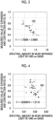
- the horizontal axis is a spectral amount in the 1450-nm band, that is, detection intensity
- the vertical axis is the value of the expansion and contraction ratio measured in S14.
- the detection intensity in the 1450-nm band is the intensity of light in the 1450-nm band detected by the light detector 14.
- the remaining value obtained by subtracting the detection intensity from the intensity of a component in the 1450-nm band in the light emitted from the light source 12 is the absorption amount in the 1450-nm band by the paper.
- the detection intensity in the 1450-nm band by the light detector 14 has a one-to-one relationship with the absorption amount in the 1450-nm band by the paper.
- Each point plotted in the graph illustrated in Fig. 3 indicates the measurement result at each humidity, that is, a pair of the detection intensity in the 1450-nm band and the expansion and contraction ratio.
- the description will be made mainly using the concept of the absorption amount.
- the absorption amount and the detection intensity have a one-to-one relationship as described above, the identical operation and effect can be obtained even in a case where the detection intensity is used instead of the absorption amount.
- the absorption amount and the detection intensity are examples of absorption information indicating the absorption amount in the wavelength band of interest by the paper.
- Y -1.7508X + 2.8664 is obtained as a straight line 102 that is fitted to the point groups.
- X is the detection intensity in the 1450-nm band
- Y is the expansion and contraction ratio. Since each point is fairly close to the straight line 102, the straight line 102 indicates the point groups with fairly high accuracy.
- the straight line rises to the right, and the value of an intercept also changes. Even in this case, the straight line indicates the point group (of the absorption amount and the expansion and contraction ratio) with fairly high accuracy as in the case illustrated in Fig. 3 .
- This straight line is the prediction model for predicting the expansion and contraction ratio of the paper from the absorption amount (or the detection intensity).
- Fig. 3 illustrates a case where attention is paid to the 1450-nm band.
- Fig. 4 illustrates an example of a case where attention is paid to the 1940-nm band which is also likely to be absorbed by water.
- Each point illustrated in a graph of Fig. 4 indicates a pair of the detection intensity (horizontal axis) in the 1940-nm band and the expansion and contraction ratio (vertical axis) of the paper at each humidity obtained in a case where a test identical to the above-described test is performed with a focus on the infrared rays in the 1940-nm band.
- a graph illustrated in Fig. 5 indicates the correlation between the measured value and the prediction value of the expansion and contraction ratio in the example illustrated in Fig. 3 in which attention is paid to the 1450-nm band.
- the horizontal axis is the measured value of the expansion and contraction ratio and is calculated from the above-described procedure.
- the vertical axis is the prediction value of the expansion and contraction ratio and is the expansion and contraction ratio (that is, Y in Fig. 3 ) calculated from the detection intensity (that is, X in Fig. 3 ) in the 1450-nm band detected by the light detector 14 using the above-described prediction model (that is, the straight line 102 in Fig. 3 ).
- Fig. 6 illustrates the correlation between the measured value and the prediction value of the expansion and contraction ratio in an example in which attention is paid to the 1940-nm band.
- the prediction model that can predict the expansion and contraction ratio of the paper with high accuracy from the absorption amount in the 1450-nm band can be obtained by the system illustrated in Fig. 1 .
- the information processing system 30 performs regression analysis to calculate a linear regression expression as the prediction model.
- the information processing system 30 may construct the prediction model using, for example, a neural network.
- the information processing system 30 inputs the absorption amount at each humidity measured by the test to the neural network and gives the measured value of the expansion and contraction ratio at each humidity as training data to train the neural network such that the expansion and contraction ratio is predicted from the absorption amount.
- the prediction model is constructed for each type of paper used in the assumed image forming apparatus by the system illustrated in Fig. 1 .
- the type of paper is represented by, for example, a combination of a paper type, such as uncoated paper (high-quality paper or the like) or coated paper, and the basis weight.
- the basis weight corresponds to the thickness of the paper.
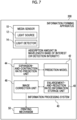
- An image forming apparatus 200 illustrated in Fig. 7 is an apparatus, such as a printer or a multifunction machine, and includes a printing mechanism 50 that prints an image on paper.
- the image forming apparatus 200 includes a media sensor 10 and an information processing system 40.
- the media sensor 10 is a device that is a model identical to the model of the media sensor 10 in the system illustrated in Fig. 1 . That is, even in the example illustrated in Fig. 7 , the media sensor 10 has a function of detecting light in the wavelength band of interest (for example, the 1450-nm band) transmitted through the paper, calculating the absorption amount (or detection intensity) of the light by the paper, and outputting the absorption amount.
- the media sensor 10 is disposed at any position on a paper transport path in the printing mechanism 50 such that light can be emitted to the transported paper and light transmitted through the paper can be detected.
- control is performed to predict the expansion and contraction ratio of the paper according to the measurement of the media sensor 10 and to enlarge or reduce the image to be printed on the paper according to the expansion and contraction ratio, which is only an example. Therefore, the media sensor 10 is disposed at a position where the paper before the image is printed can be measured. For example, in a case where the printing mechanism 50 of an electrophotographic type is used, the media sensor 10 is disposed at any position in the paper transport path from a paper feeding unit to a photoconductor.
- the media sensor 10 is provided at a position immediately before the photoconductor on the transport path through which the paper passes both during front-side printing and during back-side printing, which makes it possible to measure the paper with the identical media sensor 10 immediately before the front-side printing and immediately before the back-side printing.
- the information processing system 40 is a computer that performs information processing for implementing the functions of the image forming apparatus 200.
- the information processing system 40 controls each unit in the image forming apparatus 200, for example, the media sensor 10, the printing mechanism 50, and other units (not illustrated).
- the information processing system 40 also performs a process of predicting the expansion and contraction ratio of the paper and controlling the image forming apparatus 200 according to the prediction result.
- this control an example in which the size of the image to be printed on paper is controlled according to the prediction result of the expansion and contraction ratio will be described.
- the information processing system 40 includes a prediction model 42, an expansion-and-contraction ratio prediction unit 44, an image correction unit 46, and an enlargement-and-reduction ratio information storage unit 48 as functional modules.
- the prediction model 42 is the prediction model 42 constructed by the information processing system 30 for prediction model construction.
- the expansion-and-contraction ratio prediction unit 44 predicts the expansion and contraction ratio of the paper from the absorption amount input from the media sensor 10 using the prediction model 42.
- the image correction unit 46 corrects the image to be printed on the paper according to the expansion and contraction ratio predicted by the expansion-and-contraction ratio prediction unit 44. In this correction, the image is enlarged or reduced according to enlargement-and-reduction ratio information stored in the enlargement-and-reduction ratio information storage unit 48. The image corrected in this way is supplied to the printing mechanism 50 and printed on the paper.
- Figs. 8 and 9 illustrate examples of the enlargement-and-reduction ratio information stored in the enlargement-and-reduction ratio information storage unit 58.
- Fig. 8 illustrates an example of the enlargement-and-reduction ratio information used during one-sided printing or during printing on the front side in two-sided printing
- Fig. 9 illustrates an example of the enlargement-and-reduction ratio information used during printing on the back side in two-sided printing.
- These examples are examples of a case where the media sensor 10 measures the paper before the image is printed on the front side of the paper and the enlargement and reduction ratio of the image to be printed on the front side and the back side of the paper in two-sided printing is calculated according to the measurement result.
- the absorption amount in the wavelength band of interest by the paper is measured before the image is printed on the front side, and each of the enlargement and reduction ratios of a front-side image and a back-side image is calculated using the expansion and contraction ratio of the paper at the time of the measurement calculated from the absorption amount.
- the enlargement-and-reduction ratio information illustrated in Figs. 8 and 9 is in a tabular format and is for a paper type called uncoated paper.
- each row indicates a section of the expansion and contraction ratio of the paper
- each column indicates a basis weight band.
- the expansion and contraction ratio is divided into seven sections from a section of 0.1% or less to a section of 1.0% or more.
- the basis weight band is a section of the basis weight of the paper and is represented by a set of a lower limit and an upper limit of the basis weight in each section.
- Figs. 8 and 9 is in a tabular format and is for a paper type called uncoated paper.
- each row indicates a section of the expansion and contraction ratio of the paper
- each column indicates a basis weight band.
- the expansion and contraction ratio is divided into seven sections from a section of 0.1% or less to a section of 1.0% or more.
- the basis weight band is a section of the basis weight of the paper and is represented by a set of
- the basis weight band is represented by a name indicating the thickness of the paper such as "thin paper”, “plain paper”, “medium-thick paper”, and "thick paper”.
- a belt temperature illustrated in a row immediately below the basis weight band is the temperature of a fixing belt for fixing the printed image to the paper. The belt temperature is automatically determined according to the type of paper.
- the belt temperature in the fixing process on the plain paper is used as a reference, and a positive or negative temperature difference from the reference is illustrated as the belt temperature in each basis weight band.
- the enlargement and reduction ratio of the image corresponding to a combination of the section of the expansion and contraction ratio and the basis weight band is registered in a cell where each row and each column intersect each other.
- 100% indicates that the original image remains unchanged without being enlarged or reduced
- a value greater than 100% indicates enlargement
- a value less than 100% indicates reduction.
- an enlargement and reduction ratio of 100.5% applied in a case where the expansion and contraction ratio is equal to or greater than 1.0% and the basis weight band is thin paper indicates that the original image is enlarged to 100.5% (that is, to be 0.5% larger than the original size).
- the images on the sheets of paper have the identical size in a case where the images are equilibrated to the identical environmental conditions after printing even though the environmental conditions (for example, humidity) during printing are different. That is, a variation in the size of the printed image depending on a difference in the environmental conditions during printing is suppressed.
- the humidity which is the environment during printing may be lower than the reference state.
- the amount of contraction of the paper is larger than the amount of contraction in the reference state. Therefore, in an example in which the average humidity is set as the reference state, a section including a negative value is also set as the section of the prediction value of the expansion and contraction ratio in the enlargement-and-reduction ratio information illustrated in Figs. 8 and 9 .
- the enlargement-and-reduction ratio information illustrated in Figs. 8 and 9 may be created by conducting an experiment or the like in the development of the image forming apparatus.
- the value of the enlargement and reduction ratio of each cell in the enlargement-and-reduction ratio information for the back side is larger than the value illustrated in Fig. 9 .
- the reason is that, in the measurement at the position after printing on the front side and before printing on the back side, the paper in a state of being contracted due to the heating and fixing of the front-side image is measured and a process (for example, fixing) in which the paper further contracts is not included before printing on the back-side image after the measurement.
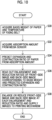
- the information processing system 40 executes the procedure illustrated in Fig. 10 , for example, whenever a sheet of paper is taken out from the paper feeding unit and a printing process is performed on the paper.
- the expansion-and-contraction ratio prediction unit 44 of the information processing system 40 acquires information of the basis weight of the paper to be printed and the fixing temperature applied to the paper (S30). For example, in a case where a paper bundle is set in the paper feeding unit, the operator needs to register the information of the basis weight in the information processing system 40. Therefore, the information may be acquired. Alternatively, the basis weight of the paper may be measured by the media sensor 10. Further, since the information of the fixing temperature corresponding to the basis weight of the paper is registered in advance in the information processing system 40, the information processing system 40 can ascertain the fixing temperature from the information.
- the expansion-and-contraction ratio prediction unit 44 of the information processing system 40 acquires the value of the absorption amount in the wavelength band of interest from the media sensor 10 that has measured the paper (S32) and calculates the expansion and contraction ratio of the paper corresponding to the absorption amount using the prediction model 42 (S34). For example, in a case where the prediction model 42 is a regression expression indicating the relationship between the absorption amount and the expansion and contraction ratio, the expansion-and-contraction ratio prediction unit 44 substitutes the absorption amount into the regression expression to calculate the expansion and contraction ratio.
- the image correction unit 46 of the information processing system 40 reads out the enlargement and reduction ratios of the front side and the back side corresponding to a combination of the basis weight acquired in S30 and the expansion and contraction ratio calculated in S34 from the enlargement-and-reduction ratio information storage unit 48 (S36). Then, the image correction unit 46 enlarges or reduces the image to be printed on the front side and the image to be printed on the back side of the paper at the enlargement and reduction ratios calculated in S36, respectively, and supplies the enlarged or reduced images to the printing mechanism 50 (S38). The printing mechanism 50 prints the image supplied from the image correction unit 46 on the front and back sides of the paper.
- not only the enlargement and reduction ratio of the image on the front side but also the enlargement and reduction ratio of the image on the back side is controlled using the prediction value of the expansion and contraction ratio of the paper calculated from the measurement result before printing on the front side of the paper.
- this is only an example.
- the absorption amount in the wavelength band of interest by the paper may be measured, the expansion and contraction ratio may be predicted from the absorption amount, and the enlargement and reduction ratio of the image on the back side may be controlled according to the predicted expansion and contraction ratio.
- the expansion-and-contraction ratio prediction unit 44 is provided inside the image forming apparatus 200.
- the expansion-and-contraction ratio prediction unit 44 may be provided outside the image forming apparatus 200.
- a server that provides the functions of the expansion-and-contraction ratio prediction unit 44 may be present on a network, and the information processing system 40 of the image forming apparatus 200 may transmit the measurement result of the media sensor 10 to the server and may obtain the prediction value of the expansion and contraction ratio from the server.
- the media sensor 10 calculates the absorption amount in the wavelength band of interest.
- the media sensor 10 may detect transmitted light in the wavelength band of interest and output the intensity of the transmitted light.
- the information processing system 40 may calculate the absorption amount in the wavelength band of interest by the paper from the intensity. That is, the process of calculating the absorption amount from the intensity of the transmitted light in the wavelength band of interest may be performed by a processor in the media sensor 10 or a processor in the information processing system 40.
- the information processing systems 30 and 40 described above are configured using, for example, a general-purpose computer.
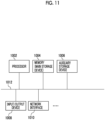
- the computer has a circuit configuration in which a processor 1002, a memory (main storage device) 1004, such as a random access memory (RAM), a controller that controls an auxiliary storage device 1006, which is a non-volatile storage device, such as a flash memory, a solid state drive (SSD), or a hard disk drive (HDD), an interface with various input and output devices 1008, a network interface 1010 that performs control for connection to a network, such as a local area network, and the like are connected via a data transmission path such as a bus 1012.
- a processor 1002 a memory (main storage device) 1004, such as a random access memory (RAM), a controller that controls an auxiliary storage device 1006, which is a non-volatile storage device, such as a flash memory, a solid state drive (SSD), or a hard disk drive (HDD)
- a network interface 1010 that performs control for connection to
- a program in which the content of the processes according to the above-described exemplary embodiment has been described is installed in the computer via the network or the like and stored in the auxiliary storage device 1006.
- the processor 1002 executes the program stored in the auxiliary storage device 1006 using the memory 1004 to implement an information processing mechanism according to the present exemplary embodiment.
- the information processing systems 30 and 40 may include an image processing processor that performs image processing for general purposes or a specific purpose at a high speed, a dedicated processor for neural network processing, and the like.
- each of the information processing systems 30 and 40 may be configured by a single computer or a plurality of computers.
- some of the functions of the information processing system 40 may be provided in another computer outside the image forming apparatus 200.
- processor refers to hardware in a broad sense.
- Examples of the processor include general processors (e.g., CPU: Central Processing Unit) and dedicated processors (e.g., GPU: Graphics Processing Unit, ASIC: Application Specific Integrated Circuit, FPGA: Field Programmable Gate Array, and programmable logic device).
- processor is broad enough to encompass one processor or plural processors in collaboration which are located physically apart from each other but may work cooperatively.
- the order of operations of the processor is not limited to one described in the embodiments above, and may be changed.
Landscapes
- Engineering & Computer Science (AREA)
- Physics & Mathematics (AREA)
- General Physics & Mathematics (AREA)
- Multimedia (AREA)
- Signal Processing (AREA)
- Life Sciences & Earth Sciences (AREA)
- Pathology (AREA)
- Immunology (AREA)
- Health & Medical Sciences (AREA)
- General Health & Medical Sciences (AREA)
- Biochemistry (AREA)
- Analytical Chemistry (AREA)
- Chemical & Material Sciences (AREA)
- Ceramic Engineering (AREA)
- Environmental Sciences (AREA)
- Environmental & Geological Engineering (AREA)
- Ecology (AREA)
- Biodiversity & Conservation Biology (AREA)
- Atmospheric Sciences (AREA)
- Textile Engineering (AREA)
- Microelectronics & Electronic Packaging (AREA)
- Investigating Or Analysing Materials By Optical Means (AREA)
- Optical Recording Or Reproduction (AREA)
- Control Or Security For Electrophotography (AREA)
Applications Claiming Priority (1)
| Application Number | Priority Date | Filing Date | Title |
|---|---|---|---|
| JP2023161834A JP2025052867A (ja) | 2023-09-26 | 2023-09-26 | 情報処理システム及びプログラム |
Publications (1)
| Publication Number | Publication Date |
|---|---|
| EP4530755A1 true EP4530755A1 (de) | 2025-04-02 |
Family
ID=90097614
Family Applications (1)
| Application Number | Title | Priority Date | Filing Date |
|---|---|---|---|
| EP24159950.5A Pending EP4530755A1 (de) | 2023-09-26 | 2024-02-27 | Informationsverarbeitungssystem, programm und informationsverarbeitungsverfahren |
Country Status (4)
| Country | Link |
|---|---|
| US (1) | US20250102443A1 (de) |
| EP (1) | EP4530755A1 (de) |
| JP (1) | JP2025052867A (de) |
| CN (1) | CN119716015A (de) |
Citations (6)
| Publication number | Priority date | Publication date | Assignee | Title |
|---|---|---|---|---|
| JPH07243187A (ja) | 1994-02-28 | 1995-09-19 | New Oji Paper Co Ltd | 繊維配向測定方法及び装置 |
| JP2009128874A (ja) | 2007-11-28 | 2009-06-11 | Kyocera Mita Corp | 画像形成装置 |
| US20120237231A1 (en) * | 2011-03-16 | 2012-09-20 | Fuji Xerox Co., Ltd. | Information processor, image forming apparatus, information processing method, and non-transitory computer-readable medium |
| JP2019045740A (ja) | 2017-09-05 | 2019-03-22 | コニカミノルタ株式会社 | 画像形成装置及び画像形成方法 |
| JP2021105629A (ja) | 2019-12-26 | 2021-07-26 | コニカミノルタ株式会社 | 画像形成装置、画像形成装置の制御方法、および、プログラム |
| US20210239609A1 (en) * | 2018-08-13 | 2021-08-05 | Hewlett-Packard Development Company, L.P. | Water content sensor |
-
2023
- 2023-09-26 JP JP2023161834A patent/JP2025052867A/ja active Pending
-
2024
- 2024-02-27 EP EP24159950.5A patent/EP4530755A1/de active Pending
- 2024-02-29 US US18/592,480 patent/US20250102443A1/en active Pending
- 2024-02-29 CN CN202410229789.1A patent/CN119716015A/zh active Pending
Patent Citations (6)
| Publication number | Priority date | Publication date | Assignee | Title |
|---|---|---|---|---|
| JPH07243187A (ja) | 1994-02-28 | 1995-09-19 | New Oji Paper Co Ltd | 繊維配向測定方法及び装置 |
| JP2009128874A (ja) | 2007-11-28 | 2009-06-11 | Kyocera Mita Corp | 画像形成装置 |
| US20120237231A1 (en) * | 2011-03-16 | 2012-09-20 | Fuji Xerox Co., Ltd. | Information processor, image forming apparatus, information processing method, and non-transitory computer-readable medium |
| JP2019045740A (ja) | 2017-09-05 | 2019-03-22 | コニカミノルタ株式会社 | 画像形成装置及び画像形成方法 |
| US20210239609A1 (en) * | 2018-08-13 | 2021-08-05 | Hewlett-Packard Development Company, L.P. | Water content sensor |
| JP2021105629A (ja) | 2019-12-26 | 2021-07-26 | コニカミノルタ株式会社 | 画像形成装置、画像形成装置の制御方法、および、プログラム |
Non-Patent Citations (1)
| Title |
|---|
| BANWELL C N: "Fundamentals of Molecular Spectroscopy", 1 January 1983 (1983-01-01), XP093194052, Retrieved from the Internet <URL:http://www.rnlkwc.ac.in/pdf/study-material/chemistry/Spectroscopy.pdf> [retrieved on 20140809] * |
Also Published As
| Publication number | Publication date |
|---|---|
| JP2025052867A (ja) | 2025-04-07 |
| US20250102443A1 (en) | 2025-03-27 |
| CN119716015A (zh) | 2025-03-28 |
Similar Documents
| Publication | Publication Date | Title |
|---|---|---|
| JP7283099B2 (ja) | 測定装置、画像形成装置及び測定方法 | |
| US8355641B2 (en) | Paper wrinkle sign monitoring device, paper wrinkle sign monitoring method, and computer readable medium | |
| EP2881802A1 (de) | Bilderzeugungsvorrichtung | |
| JP2022089505A (ja) | パラメータ決定装置、画像形成装置、後処理装置、給紙装置、およびパラメータ決定方法 | |
| JP6044381B2 (ja) | カール矯正方法及び画像形成装置 | |
| US11762316B2 (en) | Image forming apparatus, image forming system, and non-transitory recording medium storing computer readable control program | |
| JP2012194361A (ja) | 情報処理装置、画像形成装置及びプログラム | |
| JP7559531B2 (ja) | 搬送装置、画像形成装置および画像形成システム | |
| CN108377304A (zh) | 图像处理装置及图像处理方法 | |
| JP2006195422A (ja) | 画像形成装置およびその画像形成方法 | |
| JP5786420B2 (ja) | 画像出力装置、画像検査システム及び濃度補正方法 | |
| US9462161B2 (en) | Image forming apparatus and method correcting area ratio of each toner in streaked area according to calculated fluctuations | |
| US20100301550A1 (en) | Image forming apparatus and curl detecting method | |
| EP4009110A1 (de) | Parameterbestimmungsgerät, bilderzeugungsgerät, nachverarbeitungsgerät, blattzuführgerät und verfahren zur erstellung eines bestimmungsmodells | |
| EP4530755A1 (de) | Informationsverarbeitungssystem, programm und informationsverarbeitungsverfahren | |
| EP2299330A2 (de) | Dynamisches Meidendicke- und Biegungsabtastsystem | |
| JP5927767B2 (ja) | しわ発生判別方法、プログラム、しわ発生判別装置及び画像形成装置 | |
| US9256170B1 (en) | Image forming apparatus and image forming method which adjust image magnification based on sheet shrinkage | |
| US20160255239A1 (en) | Image Processing Apparatus and Image Processing Method | |
| JPH04366975A (ja) | 電子写真プロセス制御装置 | |
| JP2008176327A (ja) | 階調再現制御調整のための反射センサのサンプリング | |
| JP5263582B2 (ja) | 画像形成装置およびプログラム | |
| US8310660B2 (en) | Method and system for calibrating a multiple-beam curvature/flatness sensor | |
| JP7615775B2 (ja) | 画像検査装置、および画像形成装置 | |
| CN104345615A (zh) | 图像形成装置、图像形成装置中的温度控制方法 |
Legal Events
| Date | Code | Title | Description |
|---|---|---|---|
| PUAI | Public reference made under article 153(3) epc to a published international application that has entered the european phase |
Free format text: ORIGINAL CODE: 0009012 |
|
| STAA | Information on the status of an ep patent application or granted ep patent |
Free format text: STATUS: THE APPLICATION HAS BEEN PUBLISHED |
|
| AK | Designated contracting states |
Kind code of ref document: A1 Designated state(s): AL AT BE BG CH CY CZ DE DK EE ES FI FR GB GR HR HU IE IS IT LI LT LU LV MC ME MK MT NL NO PL PT RO RS SE SI SK SM TR |
|
| STAA | Information on the status of an ep patent application or granted ep patent |
Free format text: STATUS: REQUEST FOR EXAMINATION WAS MADE |
|
| 17P | Request for examination filed |
Effective date: 20250924 |