EP4530279A1 - Method for producing halogenated propanes - Google Patents
Method for producing halogenated propanes Download PDFInfo
- Publication number
- EP4530279A1 EP4530279A1 EP24201334.0A EP24201334A EP4530279A1 EP 4530279 A1 EP4530279 A1 EP 4530279A1 EP 24201334 A EP24201334 A EP 24201334A EP 4530279 A1 EP4530279 A1 EP 4530279A1
- Authority
- EP
- European Patent Office
- Prior art keywords
- reactor
- slurry
- carbon tetrachloride
- catalyst
- reaction mixture
- Prior art date
- Legal status (The legal status is an assumption and is not a legal conclusion. Google has not performed a legal analysis and makes no representation as to the accuracy of the status listed.)
- Pending
Links
Images


Classifications
-
- C—CHEMISTRY; METALLURGY
- C07—ORGANIC CHEMISTRY
- C07C—ACYCLIC OR CARBOCYCLIC COMPOUNDS
- C07C17/00—Preparation of halogenated hydrocarbons
- C07C17/26—Preparation of halogenated hydrocarbons by reactions involving an increase in the number of carbon atoms in the skeleton
- C07C17/263—Preparation of halogenated hydrocarbons by reactions involving an increase in the number of carbon atoms in the skeleton by condensation reactions
- C07C17/266—Preparation of halogenated hydrocarbons by reactions involving an increase in the number of carbon atoms in the skeleton by condensation reactions of hydrocarbons and halogenated hydrocarbons
-
- B—PERFORMING OPERATIONS; TRANSPORTING
- B01—PHYSICAL OR CHEMICAL PROCESSES OR APPARATUS IN GENERAL
- B01D—SEPARATION
- B01D3/00—Distillation or related exchange processes in which liquids are contacted with gaseous media, e.g. stripping
- B01D3/14—Fractional distillation or use of a fractionation or rectification column
- B01D3/32—Other features of fractionating columns ; Constructional details of fractionating columns not provided for in groups B01D3/16 - B01D3/30
- B01D3/322—Reboiler specifications
-
- B—PERFORMING OPERATIONS; TRANSPORTING
- B01—PHYSICAL OR CHEMICAL PROCESSES OR APPARATUS IN GENERAL
- B01F—MIXING, e.g. DISSOLVING, EMULSIFYING OR DISPERSING
- B01F27/00—Mixers with rotary stirring devices in fixed receptacles; Kneaders
- B01F27/05—Stirrers
- B01F27/11—Stirrers characterised by the configuration of the stirrers
- B01F27/112—Stirrers characterised by the configuration of the stirrers with arms, paddles, vanes or blades
-
- B—PERFORMING OPERATIONS; TRANSPORTING
- B01—PHYSICAL OR CHEMICAL PROCESSES OR APPARATUS IN GENERAL
- B01F—MIXING, e.g. DISSOLVING, EMULSIFYING OR DISPERSING
- B01F27/00—Mixers with rotary stirring devices in fixed receptacles; Kneaders
- B01F27/80—Mixers with rotary stirring devices in fixed receptacles; Kneaders with stirrers rotating about a substantially vertical axis
- B01F27/90—Mixers with rotary stirring devices in fixed receptacles; Kneaders with stirrers rotating about a substantially vertical axis with paddles or arms
-
- B—PERFORMING OPERATIONS; TRANSPORTING
- B01—PHYSICAL OR CHEMICAL PROCESSES OR APPARATUS IN GENERAL
- B01F—MIXING, e.g. DISSOLVING, EMULSIFYING OR DISPERSING
- B01F35/00—Accessories for mixers; Auxiliary operations or auxiliary devices; Parts or details of general application
- B01F35/50—Mixing receptacles
- B01F35/53—Mixing receptacles characterised by the configuration of the interior, e.g. baffles for facilitating the mixing of components
- B01F35/531—Mixing receptacles characterised by the configuration of the interior, e.g. baffles for facilitating the mixing of components with baffles, plates or bars on the wall or the bottom
- B01F35/5312—Mixing receptacles characterised by the configuration of the interior, e.g. baffles for facilitating the mixing of components with baffles, plates or bars on the wall or the bottom with vertical baffles mounted on the walls
-
- B—PERFORMING OPERATIONS; TRANSPORTING
- B01—PHYSICAL OR CHEMICAL PROCESSES OR APPARATUS IN GENERAL
- B01J—CHEMICAL OR PHYSICAL PROCESSES, e.g. CATALYSIS OR COLLOID CHEMISTRY; THEIR RELEVANT APPARATUS
- B01J19/00—Chemical, physical or physico-chemical processes in general; Their relevant apparatus
- B01J19/0053—Details of the reactor
- B01J19/006—Baffles
-
- B—PERFORMING OPERATIONS; TRANSPORTING
- B01—PHYSICAL OR CHEMICAL PROCESSES OR APPARATUS IN GENERAL
- B01J—CHEMICAL OR PHYSICAL PROCESSES, e.g. CATALYSIS OR COLLOID CHEMISTRY; THEIR RELEVANT APPARATUS
- B01J19/00—Chemical, physical or physico-chemical processes in general; Their relevant apparatus
- B01J19/18—Stationary reactors having moving elements inside
-
- B—PERFORMING OPERATIONS; TRANSPORTING
- B01—PHYSICAL OR CHEMICAL PROCESSES OR APPARATUS IN GENERAL
- B01J—CHEMICAL OR PHYSICAL PROCESSES, e.g. CATALYSIS OR COLLOID CHEMISTRY; THEIR RELEVANT APPARATUS
- B01J23/00—Catalysts comprising metals or metal oxides or hydroxides, not provided for in group B01J21/00
- B01J23/70—Catalysts comprising metals or metal oxides or hydroxides, not provided for in group B01J21/00 of the iron group metals or copper
- B01J23/74—Iron group metals
- B01J23/745—Iron
-
- C—CHEMISTRY; METALLURGY
- C07—ORGANIC CHEMISTRY
- C07C—ACYCLIC OR CARBOCYCLIC COMPOUNDS
- C07C17/00—Preparation of halogenated hydrocarbons
- C07C17/26—Preparation of halogenated hydrocarbons by reactions involving an increase in the number of carbon atoms in the skeleton
- C07C17/272—Preparation of halogenated hydrocarbons by reactions involving an increase in the number of carbon atoms in the skeleton by addition reactions
- C07C17/275—Preparation of halogenated hydrocarbons by reactions involving an increase in the number of carbon atoms in the skeleton by addition reactions of hydrocarbons and halogenated hydrocarbons
-
- C—CHEMISTRY; METALLURGY
- C07—ORGANIC CHEMISTRY
- C07C—ACYCLIC OR CARBOCYCLIC COMPOUNDS
- C07C17/00—Preparation of halogenated hydrocarbons
- C07C17/361—Preparation of halogenated hydrocarbons by reactions involving a decrease in the number of carbon atoms
-
- C—CHEMISTRY; METALLURGY
- C07—ORGANIC CHEMISTRY
- C07C—ACYCLIC OR CARBOCYCLIC COMPOUNDS
- C07C17/00—Preparation of halogenated hydrocarbons
- C07C17/38—Separation; Purification; Stabilisation; Use of additives
-
- C—CHEMISTRY; METALLURGY
- C07—ORGANIC CHEMISTRY
- C07C—ACYCLIC OR CARBOCYCLIC COMPOUNDS
- C07C17/00—Preparation of halogenated hydrocarbons
- C07C17/38—Separation; Purification; Stabilisation; Use of additives
- C07C17/383—Separation; Purification; Stabilisation; Use of additives by distillation
-
- C—CHEMISTRY; METALLURGY
- C07—ORGANIC CHEMISTRY
- C07C—ACYCLIC OR CARBOCYCLIC COMPOUNDS
- C07C19/00—Acyclic saturated compounds containing halogen atoms
- C07C19/01—Acyclic saturated compounds containing halogen atoms containing chlorine
-
- B—PERFORMING OPERATIONS; TRANSPORTING
- B01—PHYSICAL OR CHEMICAL PROCESSES OR APPARATUS IN GENERAL
- B01F—MIXING, e.g. DISSOLVING, EMULSIFYING OR DISPERSING
- B01F2101/00—Mixing characterised by the nature of the mixed materials or by the application field
- B01F2101/2204—Mixing chemical components in generals in order to improve chemical treatment or reactions, independently from the specific application
-
- B—PERFORMING OPERATIONS; TRANSPORTING
- B01—PHYSICAL OR CHEMICAL PROCESSES OR APPARATUS IN GENERAL
- B01J—CHEMICAL OR PHYSICAL PROCESSES, e.g. CATALYSIS OR COLLOID CHEMISTRY; THEIR RELEVANT APPARATUS
- B01J2219/00—Chemical, physical or physico-chemical processes in general; Their relevant apparatus
- B01J2219/00049—Controlling or regulating processes
- B01J2219/00182—Controlling or regulating processes controlling the level of reactants in the reactor vessel
-
- B—PERFORMING OPERATIONS; TRANSPORTING
- B01—PHYSICAL OR CHEMICAL PROCESSES OR APPARATUS IN GENERAL
- B01J—CHEMICAL OR PHYSICAL PROCESSES, e.g. CATALYSIS OR COLLOID CHEMISTRY; THEIR RELEVANT APPARATUS
- B01J2219/00—Chemical, physical or physico-chemical processes in general; Their relevant apparatus
- B01J2219/00761—Details of the reactor
- B01J2219/00763—Baffles
- B01J2219/00765—Baffles attached to the reactor wall
- B01J2219/00768—Baffles attached to the reactor wall vertical
Definitions
- Embodiments of the present invention are directed toward methods for the production of halogenated propanes prepared by reacting carbon tetrachloride with an olefin.
- hydrofluorocarbons such as those used as refrigerants and blowing agents, are prepared from hydrochlorocarbon feedstocks.
- hydrochlorocarbon feedstocks such as 1,1,1,3,3-pentafluoropropane (HFC-245fa) is a widely employed hydrofluorocarbon that, according to U.S. Patent No. 6,313,360 , can be prepared from a 1,1,1,3,3-pentachloropropane (HCC-240fa) feedstock.
- the 1,1,1,3,3-pentachloropropane can be synthesized by reacting carbon tetrachloride with vinyl chloride in the presence of an iron catalyst and tributylphosphate.
- Vinyl chloride is fed to the reactor as a liquid or vapor, and metallic iron, preferably in the form of a slurry within carbon tetrachloride, is added to the reactor.
- metallic iron preferably in the form of a slurry within carbon tetrachloride
- the reactor contents are continually drawn from the reactor, preferably through a sedimentation tube, in order to maintain the unconverted metallic iron within the reactor. This process is enhanced by drawing the reactor effluent from a still zone created within the reactor.
- the reactor effluent is distilled to recover catalyst and ultimately isolate the desired 1,1,1,3,3-pentachloropropane product.
- U.S. Publ. No. 2012/0310020 suggests that the formation of polyvinyl chloride within the reactor can be reduced by feeding the vinyl chloride as a vapor through a dip tube or sponge-type gas diffuser into a reactor precharged with carbon tetrachloride, tributylphosphate, and iron powder.
- Hydrofluoroolefins have been targeted as replacements for hydrofluorocarbons.
- 2,3,3,3-tetrafluoropropene HFO-1234yf
- R-134a 1,1,1,2-tetrafluoroethane
- chlorinated organics play an important role in the synthesis of hydrofluoroolefins.
- HCC-1230xa 1,1,2,3-tetrachloropropene
- HFO-1234yf 2,3,3,3-tetrafluoropropane
- U.S. Publ. No. 2009/0216055 teaches that 1,1,2,3-tetrachloropropene (HCC-1230xa) can be prepared by dehydrochlorinating 1,1,1,2,3-pentachloropropane, and that the 1,1,1,2,3-pentachloropropane can be prepared within a single reactor by reacting 1,1,1,3-tetrachloropropane (HCC-250fb) with chlorine in the presence of a Lewis acid. According to U.S. Publ. No.
- 1,1,1,3-tetrachloropropane can be synthesized by reacting carbon tetrachloride with ethylene in the presence of metallic iron, dissolved iron (II), iron (III) compounds, and an organophosphate cocatalyst.
- metallic iron dissolved iron (II), iron (III) compounds
- organophosphate cocatalyst U.S. Publ. No. 2004/0225166 teaches that the reactor in which the carbon tetrachloride and ethylene are reacted is agitated to provide adequate contact of the liquid reactants with the surface of the metallic iron, to provide adequate contact of the liquid reactants with the vapor in the reactor headspace so that ethylene is readily dissolved in the liquid, and to provide adequate contact of the reaction mixture with heat-transfer surfaces to thereby enable adequate temperature control.
- 1,1,1,3-tetrachloropropane is an important halogenated propane, there remains a desire to improve synthetic techniques employed in its preparation.
- One or more embodiments of the present invention provide a process of the type for producing chlorinated propanes by reacting carbon tetrachloride with ethylene within a tank reactor that includes a liquid reaction mixture and a headspace above the reaction mixture wherein ethylene gas diffuses from the liquid reaction mixture into the headspace while agitating the reaction mixture, the improvement comprising transferring ethylene within the headspace back into the reaction mixture through a conduit within the mixing device that agitates the reaction mixture.
- inventions of the present invention provide a process of the type for producing chlorinated propanes by reacting carbon tetrachloride with an olefin in the presence of an insoluble or partially soluble catalyst or catalyst precursor within a liquid reaction mixture, the improvement comprising charging the catalyst or catalyst precursor to the reaction mixture within a slurry that is continuously agitated.
- Yet other embodiments of the present invention provide a process of the type for preparing chlorinated propanes by reacting carbon tetrachloride with an olefin in the presence of an insoluble or partially soluble catalyst or catalyst precursor within a liquid reaction mixture being continuously stirred within a tank reactor, the improvement comprising removing the chlorinated propane product from the tank reactor from a still zone within said reactor.
- Still other embodiments of the present invention provide a process of the type for purifying a crude chlorinated propane stream including iron and optionally iron compounds by distillation techniques, the improvement comprising heating the crude product stream within a reboiler operating at conditions that inhibit the reaction or formation of deposits within the distillation column and the reboiler.
- Embodiments of the invention are based, at least in part, on the discovery of a method for producing chlorinated propanes.
- carbon tetrachloride is reacted with ethylene within a reactor that is mixed with an aspirating agitator.
- the liquid contents i.e., carbon tetrachloride
- reaction efficiencies can be realized by transferring ethylene located within the headspace of the reactor to a reaction zone (i.e. into the liquid phase) through the use of an aspirating agitator.
- chlorinated propanes are prepared by reacting carbon tetrachloride with an olefin (e.g. ethylene) in the presence of an iron-based catalyst.
- Iron is charged to the reactor from a continuously stirred slurry tank operating within a circulation loop.
- this dynamic circulation loop offers the ability to deliver other materials, such as other catalytic materials or ligands, to the reactor.
- chlorinated propanes are prepared by reacting carbon tetrachloride with an olefin (e.g. ethylene) in the presence of an iron-based catalyst, and the chlorinated propanes are removed from the reaction zone through a conically-shaped effluent nozzle drawing from a still zone created within the reactor.
- the still zone is configured to minimize liquid flow velocity and thereby maximize iron sedimentation while allowing gaseous reactants to rise to the reactor headspace.
- embodiments of the invention are directed toward purification techniques wherein chlorinated propanes (e.g. 1,1,1,3-tetrachloropropane) are separated from heavier compounds, including catalytic materials (e.g. iron species), by using a distillation technique that heats the liquid mixture within a forced circulation reboiler.
- the flow velocity and heat flux are maintained to prevent fouling within the distillation system.
- localized hot spots within the distillation system cause catalyst residues to bake onto the surfaces of the system.
- specific distillation systems can give rise to process efficiencies.
- the processes of the invention generally relate to the preparation of chlorinated hydrocarbons by reacting carbon tetrachloride with an olefin.
- These reactions are generally known in the art, and therefore U.S. Patent No. 6,313,360 and U.S. Publ. Nos. 2004/0225166 and 2009/0216055 are incorporated herein by reference.
- Practice of embodiments of the invention are not necessarily limited by the olefin employed as a reactant, although common olefins for use in these reactions include ethylene and vinyl chloride.
- ethylene is a gaseous olefin, and therefore embodiments of the invention may provide distinct advantages where ethylene is employed as a reactant.
- insoluble or partially soluble catalysts may be used in conjunction with cocatalysts or ligands, which are believed to complement the catalyst; for example, tributylphosphate has been used in conjunction with an iron catalyst.
- tributylphosphate has been used in conjunction with an iron catalyst.
- embodiments of the invention may be described with reference to tributylphosphate as a cocatalyst or ligand used in conjunction with iron, the skilled person will appreciate that the invention can be extended to the use of other cocatalysts or ligands.
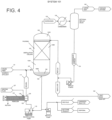
- iron powder 33 may be periodically added to slurry tank 21, or in other embodiments, iron powder 33 may be continuously charged to slurry tank 21 by employing continuous feeding apparatus.
- iron powder 33 can be charged to slurry tank 21 by employing a dustless bucket tipper.
- a slurry 35 of carbon tetrachloride 31 and iron powder 33 is formed by agitating the mixture within slurry tank 21 via one or more mixing elements 24, which may include agitation devices or baffles.
- Mixing elements 24 may be operated in a manner to substantially disperse the catalyst (e.g. iron) within the chlorinated hydrocarbon liquid (e.g. carbon tetrachloride); in particular embodiments, agitation is sufficient to achieve a substantially homogenous concentration of the catalyst within the carbon tetrachloride.
- the concentration of iron powder 33 within slurry 35 may be represented as a percent solids within the weight of liquid. In one or more embodiments, the percent solids iron powder within slurry 35 may be from about 0.02 to about 5.0 wt %, in other embodiments from about 0.03 to about 1.0 wt %, and in other embodiments from about 0.05 to about 0.2 wt %.
Landscapes
- Chemical & Material Sciences (AREA)
- Organic Chemistry (AREA)
- Chemical Kinetics & Catalysis (AREA)
- Engineering & Computer Science (AREA)
- Materials Engineering (AREA)
- Organic Low-Molecular-Weight Compounds And Preparation Thereof (AREA)
- Low-Molecular Organic Synthesis Reactions Using Catalysts (AREA)
Applications Claiming Priority (4)
| Application Number | Priority Date | Filing Date | Title |
|---|---|---|---|
| US201662366674P | 2016-07-26 | 2016-07-26 | |
| PCT/US2017/043469 WO2018022488A1 (en) | 2016-07-26 | 2017-07-24 | Methods for producing halogenated propanes |
| EP17761938.4A EP3490965B1 (en) | 2016-07-26 | 2017-07-24 | Methods for producing halogenated propanes |
| EP20199542.0A EP3795554B1 (en) | 2016-07-26 | 2017-07-24 | Method for producing halogenated propanes |
Related Parent Applications (2)
| Application Number | Title | Priority Date | Filing Date |
|---|---|---|---|
| EP20199542.0A Division EP3795554B1 (en) | 2016-07-26 | 2017-07-24 | Method for producing halogenated propanes |
| EP17761938.4A Division EP3490965B1 (en) | 2016-07-26 | 2017-07-24 | Methods for producing halogenated propanes |
Publications (1)
| Publication Number | Publication Date |
|---|---|
| EP4530279A1 true EP4530279A1 (en) | 2025-04-02 |
Family
ID=59791114
Family Applications (3)
| Application Number | Title | Priority Date | Filing Date |
|---|---|---|---|
| EP24201334.0A Pending EP4530279A1 (en) | 2016-07-26 | 2017-07-24 | Method for producing halogenated propanes |
| EP20199542.0A Active EP3795554B1 (en) | 2016-07-26 | 2017-07-24 | Method for producing halogenated propanes |
| EP17761938.4A Active EP3490965B1 (en) | 2016-07-26 | 2017-07-24 | Methods for producing halogenated propanes |
Family Applications After (2)
| Application Number | Title | Priority Date | Filing Date |
|---|---|---|---|
| EP20199542.0A Active EP3795554B1 (en) | 2016-07-26 | 2017-07-24 | Method for producing halogenated propanes |
| EP17761938.4A Active EP3490965B1 (en) | 2016-07-26 | 2017-07-24 | Methods for producing halogenated propanes |
Country Status (13)
| Country | Link |
|---|---|
| US (1) | US10787404B2 (enExample) |
| EP (3) | EP4530279A1 (enExample) |
| JP (3) | JP7017555B2 (enExample) |
| KR (2) | KR102634847B1 (enExample) |
| CN (3) | CN109476568B (enExample) |
| CA (2) | CA3203916C (enExample) |
| EA (2) | EA202191351A3 (enExample) |
| ES (2) | ES2849561T3 (enExample) |
| FI (1) | FI3795554T3 (enExample) |
| MX (1) | MX385668B (enExample) |
| PT (2) | PT3795554T (enExample) |
| TW (3) | TWI860085B (enExample) |
| WO (1) | WO2018022488A1 (enExample) |
Families Citing this family (2)
| Publication number | Priority date | Publication date | Assignee | Title |
|---|---|---|---|---|
| WO2020146722A1 (en) | 2019-01-10 | 2020-07-16 | Occidental Chemical Corporation | Photochlorination of partially-chlorinated chloromethanes to carbon tetrachloride |
| US10994945B2 (en) * | 2019-09-18 | 2021-05-04 | Plastrac Inc. | Granular metering system |
Citations (8)
| Publication number | Priority date | Publication date | Assignee | Title |
|---|---|---|---|---|
| EP0131560A1 (en) * | 1983-07-06 | 1985-01-16 | Monsanto Company | Process for producing 1,1,2,3-tetrachloropropene |
| US4605802A (en) * | 1982-04-01 | 1986-08-12 | Halocarbon Products Corp. | Production of 1,1,1,3-tetrachloropropane |
| US6313360B1 (en) | 2000-09-29 | 2001-11-06 | Vulcan Materials Company | Process for the manufacture of 1, 1, 1, 3, 3-pentachloropropane |
| US20040225166A1 (en) | 2003-05-05 | 2004-11-11 | Vulcan Chemicals A Business Group Of Vulcan Materials Company | Method for producing 1,1,1,3-tetrachloropropane and other haloalkanes with iron catalyst |
| US20090030247A1 (en) | 2006-01-03 | 2009-01-29 | Honeywell International Inc. | Method for producing fluorinated organic compounds |
| US20090216055A1 (en) | 2007-12-19 | 2009-08-27 | Occidental Chemical Corporation | Methods of making chlorinated hydrocarbons |
| US20120310020A1 (en) | 2011-06-03 | 2012-12-06 | Joshua Close | Method for avoiding the generation of by-products during the production of haloalkane compounds |
| US20140256995A1 (en) | 2011-09-30 | 2014-09-11 | Honeywell International Inc. | Process for producing 2,3,3,3-tetrafluoropropene |
Family Cites Families (17)
| Publication number | Priority date | Publication date | Assignee | Title |
|---|---|---|---|---|
| US3349010A (en) * | 1964-12-10 | 1967-10-24 | Phillips Petroleum Co | Method and apparatus for controlling polymer deposition in reboiler |
| JPS521756A (en) * | 1975-06-24 | 1977-01-07 | Sumikin Kozai Kogyo Kk | Rotary vane device to mix substances having different specific graviti es |
| ATE22877T1 (de) * | 1983-07-06 | 1986-11-15 | Monsanto Co | Verfahren zur herstellung von monoaddukten von olefinen und damit reagierfaehigen telogenen. |
| JPH0759605B2 (ja) * | 1990-09-07 | 1995-06-28 | 三井造船株式会社 | ポリマー中の触媒除去装置 |
| CH686117A5 (fr) * | 1993-07-08 | 1996-01-15 | Biazzi Sa | Appareillage de reaction gaz-liquide. |
| DE4435839A1 (de) * | 1994-10-07 | 1996-04-11 | Bayer Ag | Schlammphasenreaktor und dessen Verwendung |
| WO2005068407A1 (en) * | 2004-01-07 | 2005-07-28 | Conocophillips Company | Systems and methods for catalyst/hydrocarbon product separation |
| US8835702B2 (en) | 2011-06-03 | 2014-09-16 | Honeywell International Inc. | Method for mitigating the formation of by-products during the production of haloalkane compounds |
| EP2548907A1 (de) | 2011-07-18 | 2013-01-23 | Bayer MaterialScience AG | Verfahren zur Herstellung von Polyetherpolyolen |
| US9381451B2 (en) * | 2012-03-06 | 2016-07-05 | GM Global Technology Operations LLC | Quiescent zone fluid filter |
| JP6158032B2 (ja) | 2012-10-17 | 2017-07-05 | 株式会社トクヤマ | 反応ガスをリサイクルした塩素化プロパンの製造方法 |
| US8907147B2 (en) | 2013-02-04 | 2014-12-09 | Honeywell International Inc. | Synthesis of 1,1,2,3-tetrachloropropene |
| CN104549070B (zh) * | 2013-10-12 | 2016-08-24 | 中国石油化工股份有限公司 | 一种沸腾床反应器 |
| SI3412648T1 (sl) * | 2014-05-16 | 2020-08-31 | Occidental Chemical Corporation | Postopek za izdelavo 1,1,3,3-tetrakloropropena |
| CN204779412U (zh) * | 2015-07-02 | 2015-11-18 | 江苏理文化工有限公司 | 一种制备四氯丙烷系统 |
| CN105218299B (zh) * | 2015-09-30 | 2020-03-31 | 巨化集团技术中心 | 一种用于四氯化碳和烯烃生产氯代烃的连续制备方法 |
| CN105251318B (zh) * | 2015-11-06 | 2017-05-24 | 铜陵有色金属集团股份有限公司铜冠冶化分公司 | 一种防止再沸器结晶堵塞的湿法有机胺脱硫解吸塔 |
-
2017
- 2017-07-24 CN CN201780046570.6A patent/CN109476568B/zh active Active
- 2017-07-24 PT PT201995420T patent/PT3795554T/pt unknown
- 2017-07-24 CA CA3203916A patent/CA3203916C/en active Active
- 2017-07-24 TW TW112135146A patent/TWI860085B/zh active
- 2017-07-24 EP EP24201334.0A patent/EP4530279A1/en active Pending
- 2017-07-24 KR KR1020197003829A patent/KR102634847B1/ko active Active
- 2017-07-24 PT PT177619384T patent/PT3490965T/pt unknown
- 2017-07-24 CA CA3031793A patent/CA3031793C/en active Active
- 2017-07-24 MX MX2019001151A patent/MX385668B/es unknown
- 2017-07-24 EP EP20199542.0A patent/EP3795554B1/en active Active
- 2017-07-24 CN CN202210506937.0A patent/CN114805014B/zh active Active
- 2017-07-24 TW TW110122625A patent/TWI816142B/zh active
- 2017-07-24 CN CN202410185515.7A patent/CN118047658A/zh active Pending
- 2017-07-24 ES ES17761938T patent/ES2849561T3/es active Active
- 2017-07-24 JP JP2019503567A patent/JP7017555B2/ja active Active
- 2017-07-24 ES ES20199542T patent/ES2998773T3/es active Active
- 2017-07-24 EA EA202191351A patent/EA202191351A3/ru unknown
- 2017-07-24 US US16/320,574 patent/US10787404B2/en active Active
- 2017-07-24 FI FIEP20199542.0T patent/FI3795554T3/fi active
- 2017-07-24 KR KR1020237019044A patent/KR102706899B1/ko active Active
- 2017-07-24 EP EP17761938.4A patent/EP3490965B1/en active Active
- 2017-07-24 TW TW106124766A patent/TWI734811B/zh active
- 2017-07-24 EA EA201990382A patent/EA038726B1/ru unknown
- 2017-07-24 WO PCT/US2017/043469 patent/WO2018022488A1/en not_active Ceased
-
2021
- 2021-11-09 JP JP2021182288A patent/JP7274551B2/ja active Active
-
2023
- 2023-05-01 JP JP2023075690A patent/JP7557570B2/ja active Active
Patent Citations (9)
| Publication number | Priority date | Publication date | Assignee | Title |
|---|---|---|---|---|
| US4605802A (en) * | 1982-04-01 | 1986-08-12 | Halocarbon Products Corp. | Production of 1,1,1,3-tetrachloropropane |
| EP0131560A1 (en) * | 1983-07-06 | 1985-01-16 | Monsanto Company | Process for producing 1,1,2,3-tetrachloropropene |
| US6313360B1 (en) | 2000-09-29 | 2001-11-06 | Vulcan Materials Company | Process for the manufacture of 1, 1, 1, 3, 3-pentachloropropane |
| US20040225166A1 (en) | 2003-05-05 | 2004-11-11 | Vulcan Chemicals A Business Group Of Vulcan Materials Company | Method for producing 1,1,1,3-tetrachloropropane and other haloalkanes with iron catalyst |
| US20090030247A1 (en) | 2006-01-03 | 2009-01-29 | Honeywell International Inc. | Method for producing fluorinated organic compounds |
| US20090216055A1 (en) | 2007-12-19 | 2009-08-27 | Occidental Chemical Corporation | Methods of making chlorinated hydrocarbons |
| US20140081056A1 (en) * | 2007-12-19 | 2014-03-20 | Occidental Chemical Corporation | Methods of making chlorinated hydrocarbons |
| US20120310020A1 (en) | 2011-06-03 | 2012-12-06 | Joshua Close | Method for avoiding the generation of by-products during the production of haloalkane compounds |
| US20140256995A1 (en) | 2011-09-30 | 2014-09-11 | Honeywell International Inc. | Process for producing 2,3,3,3-tetrafluoropropene |
Also Published As
Similar Documents
| Publication | Publication Date | Title |
|---|---|---|
| JP7557570B2 (ja) | 塩素化プロパンの製造、調整、及び精製方法 | |
| US12435019B2 (en) | Process for the production of chlorinated hydrocarbons | |
| HK40117896A (en) | Method for producing halogenated propanes | |
| HK40047884A (en) | Method for producing halogenated propanes | |
| HK40047884B (en) | Method for producing halogenated propanes | |
| HK40001609A (en) | Methods for producing halogenated propanes | |
| HK40001609B (en) | Methods for producing halogenated propanes | |
| HK40003165A (en) | Methods for producing halogenated propanes |
Legal Events
| Date | Code | Title | Description |
|---|---|---|---|
| PUAI | Public reference made under article 153(3) epc to a published international application that has entered the european phase |
Free format text: ORIGINAL CODE: 0009012 |
|
| STAA | Information on the status of an ep patent application or granted ep patent |
Free format text: STATUS: REQUEST FOR EXAMINATION WAS MADE |
|
| 17P | Request for examination filed |
Effective date: 20240919 |
|
| AC | Divisional application: reference to earlier application |
Ref document number: 3490965 Country of ref document: EP Kind code of ref document: P Ref document number: 3795554 Country of ref document: EP Kind code of ref document: P |
|
| AK | Designated contracting states |
Kind code of ref document: A1 Designated state(s): AL AT BE BG CH CY CZ DE DK EE ES FI FR GB GR HR HU IE IS IT LI LT LU LV MC MK MT NL NO PL PT RO RS SE SI SK SM TR |
|
| REG | Reference to a national code |
Ref country code: HK Ref legal event code: DE Ref document number: 40117896 Country of ref document: HK |