EP4530265A1 - Verfahren und vorrichtung zur herstellung von glasrohren mit geschlossenen enden - Google Patents
Verfahren und vorrichtung zur herstellung von glasrohren mit geschlossenen enden Download PDFInfo
- Publication number
- EP4530265A1 EP4530265A1 EP23199977.2A EP23199977A EP4530265A1 EP 4530265 A1 EP4530265 A1 EP 4530265A1 EP 23199977 A EP23199977 A EP 23199977A EP 4530265 A1 EP4530265 A1 EP 4530265A1
- Authority
- EP
- European Patent Office
- Prior art keywords
- gas
- glass tube
- tube
- glass
- closing
- Prior art date
- Legal status (The legal status is an assumption and is not a legal conclusion. Google has not performed a legal analysis and makes no representation as to the accuracy of the status listed.)
- Granted
Links
Images

Classifications
-
- C—CHEMISTRY; METALLURGY
- C03—GLASS; MINERAL OR SLAG WOOL
- C03B—MANUFACTURE, SHAPING, OR SUPPLEMENTARY PROCESSES
- C03B23/00—Re-forming shaped glass
- C03B23/04—Re-forming tubes or rods
- C03B23/09—Reshaping the ends, e.g. as grooves, threads or mouths
-
- C—CHEMISTRY; METALLURGY
- C03—GLASS; MINERAL OR SLAG WOOL
- C03B—MANUFACTURE, SHAPING, OR SUPPLEMENTARY PROCESSES
- C03B21/00—Severing glass sheets, tubes or rods while still plastic
- C03B21/04—Severing glass sheets, tubes or rods while still plastic by punching out
-
- C—CHEMISTRY; METALLURGY
- C03—GLASS; MINERAL OR SLAG WOOL
- C03B—MANUFACTURE, SHAPING, OR SUPPLEMENTARY PROCESSES
- C03B23/00—Re-forming shaped glass
- C03B23/04—Re-forming tubes or rods
- C03B23/045—Tools or apparatus specially adapted for re-forming tubes or rods in general, e.g. glass lathes, chucks
-
- C—CHEMISTRY; METALLURGY
- C03—GLASS; MINERAL OR SLAG WOOL
- C03B—MANUFACTURE, SHAPING, OR SUPPLEMENTARY PROCESSES
- C03B23/00—Re-forming shaped glass
- C03B23/04—Re-forming tubes or rods
- C03B23/09—Reshaping the ends, e.g. as grooves, threads or mouths
- C03B23/092—Reshaping the ends, e.g. as grooves, threads or mouths by pressing
-
- C—CHEMISTRY; METALLURGY
- C03—GLASS; MINERAL OR SLAG WOOL
- C03B—MANUFACTURE, SHAPING, OR SUPPLEMENTARY PROCESSES
- C03B23/00—Re-forming shaped glass
- C03B23/04—Re-forming tubes or rods
- C03B23/09—Reshaping the ends, e.g. as grooves, threads or mouths
- C03B23/097—Reshaping the ends, e.g. as grooves, threads or mouths by blowing
-
- C—CHEMISTRY; METALLURGY
- C03—GLASS; MINERAL OR SLAG WOOL
- C03B—MANUFACTURE, SHAPING, OR SUPPLEMENTARY PROCESSES
- C03B23/00—Re-forming shaped glass
- C03B23/04—Re-forming tubes or rods
- C03B23/09—Reshaping the ends, e.g. as grooves, threads or mouths
- C03B23/099—Reshaping the ends, e.g. as grooves, threads or mouths by fusing, e.g. flame sealing
-
- C—CHEMISTRY; METALLURGY
- C03—GLASS; MINERAL OR SLAG WOOL
- C03B—MANUFACTURE, SHAPING, OR SUPPLEMENTARY PROCESSES
- C03B23/00—Re-forming shaped glass
- C03B23/18—Re-forming and sealing ampoules
-
- C—CHEMISTRY; METALLURGY
- C03—GLASS; MINERAL OR SLAG WOOL
- C03B—MANUFACTURE, SHAPING, OR SUPPLEMENTARY PROCESSES
- C03B33/00—Severing cooled glass
- C03B33/06—Cutting or splitting glass tubes, rods, or hollow products
Definitions
- the present invention relates to a method and an apparatus for the sealing of glass tubes in a hot softened state, especially of glass tubes, which are intended for the production of primary packaging means made of glass for the storage of pharmaceutically active substances.
- glass tubes are severed from the glass tube line produced with for example a Vello or Danner process, which are then processed further.
- These glass tubes may have standard lengths of e.g., 1.5 m, but may also be severed off in other lengths in order to be processed directly to primary packaging means for the storage of pharmaceutical substances, for example, glass ampoules, glass vials, glass cartridges or glass syringes.
- primary packaging means for the storage of pharmaceutical substances for example, glass ampoules, glass vials, glass cartridges or glass syringes.
- Glass tubes as described above are preferred for further processing like the production of primary packaging for pharmaceutical substances, as due to the closure at both ends, the glass tubes are very robust and can withstand a lot of handling abuse without breaking. This is highly desirable for transport and further processing as loss to unintended damage is highly reduced.
- These glass tubes are provided with both ends closed as well as a ventilation hole made in the wall of the glass tube near one of the closed ends.
- the ventilation hole ensures that no problems occur due to variations in gas pressure during transport and storage.
- Fig. 1A shows a glass tube 10, with a length of L, having a first end 30 and a second end 20 at the distal ends of the tube 10.
- the glass tube 10 has a circumferential wall and encloses an inner space.
- the length L is around 1.5 m, but other lengths are also possible. Lengths of 0.5 to 2.0 m are preferable as having the advantage of providing a useful length for transport as well as for further processing.
- the goal is to close both ends 20, 30 of the tube 10 and provide a ventilation hole 32 in the wall of the glass tube 10, where the ventilation hole is in the vicinity of one of the ends 20, 30.
- a first step shown in Fig. 1B , the first end 30 is closed using a closing tool 50.
- gas F is blown into the second end 20 of the glass tube by means of a gas supply 60.
- the gas F is blown into the tube 10 in the direction towards the second end 20 in the axial direction of the tube 10, so that the gas F enters the inner space of the tube 10, and preferably fills the inner space of the tube 10.
- the start of blowing of the gas F into the second end 20 is started before the start of the closing of the first end 30.
- the gas supply 60 is stopped once the first end 30 is fully closed.
- the now closed first end is indicated as 31 in the Fig. 1B .
- the gas supply can be stopped just before the first end is fully closed.
- the ventilation hole 32 is made into the wall of the glass tube near the second end 20 of the glass tube 10, by means of an opening tool 70.
- the gas supply 60 can be stopped.
- the gas supply 60 can be kept switched on, and stopped once the ventilation hole 32 has been formed or stopped during the formation of the ventilation hole 32.
- the second end 20 of the glass tube 10 is closed, also using a closing tool 55, for example of the same type as closing tool 50 used for closing the first end 30 of the glass tube.
- the now closed second end of the tube 10 is indicated with 21.
- the third step is done within a short period of time after finishing the second step. This short period of time can for example be 5 to 15 seconds.
- the result is a glass tube 10 with both ends 21, 31 closed, with a ventilation hole 32 provided near one of the ends 21, shown in Fig. 1E .
- the ventilation hole is applied by the opening tool 70, such tools are known in the art, for using a spot burner.
- the burner is located above the glass tube when opening the hole, but other positions are also usable.
- the location of the ventilation hole is preferably near the closed end of the glass tube, as the section of the tube between the ventilation hole and the closest closed end of the glass tube can typically not be further processed.
- the gas F used is preferably a non-reactive gas, that does not interfere with the closing process or interfere with the surface of the glass tube.
- a non-reactive gas that does not interfere with the closing process or interfere with the surface of the glass tube.
- air with a low relative humidity of 5%-20% at 20C room temperature. In absolute humidity terms, the air is preferably between 0,05 to 5 g/m3.
- Other examples would be nitrogen gas, carbon dioxide gas, or a mixture thereof, also with a low relative humidity (water vapor content).
- Other non-reactive engineering gases like noble gasses like argon
- gases that are reactive in the sense that they bind with water can also be used, as the use of these also reduces the humidity of the gas.
- Blowing the gas into the glass tube during processing leads to a significant reduction or full elimination of internal contamination of the closed tube.
- the gas is filtered to prevent unwanted particles to enter the glass tube to be closed. Gas filtration methods are known in the art, for example by means of a physical filter.
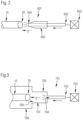
- Fig. 2 an example of an embodiment of a gas supply 601 according to the invention is shown.
- the gas supply 601 is provided with an inlet 602 that is connected to a gas source 603, that provides the gas F under pressure.
- a gas source 603 can be provided with a gas pressure regulator that regulates the pressure of the gas to be supplied as well as an opening and closing mechanism that can open and close the gas source.
- gas sources are well known in the art.
- the gas source can also comprise a flow meter.
- the inlet 602 is communicatively connected to an outlet 604 where the gas F leaves the gas supply 601 to enter the open end of the glass tube.
- the gas supply comprises a nozzle 605.
- the outlet 604 of the nozzle 605 is placed so that the gas F expelled from the outlet 604 of the nozzle 605 can enter the tube end 20 of the tube 10.
- the nozzle 605 is lined up with the axial direction of the tube 10.
- the outlet 604 of the nozzle 605 is place at some distance from the tube end 20 to enable the gas F to freely enter the glass tube 10.
- the gas supply 701 comprises an outlet 704 that expels the gas F into a distribution chamber 707.
- This distribution chamber 707 is preferably made as a cylindrical chamber with an open end 709 at the end facing away from the outlet 704, with the outlet 704 placed in or near the center of the chamber 707 at the closed end of the chamber.
- the open end 709 of the distribution chamber 707 is placed near or around the end 20 of the glass tube 10, so that the gas F leaving the outlet 704 and being gathered into the distribution chamber 707 can enter the glass tube 10 freely.
- a circumferential shield 708 can be placed around the open end 709 of the distribution chamber 707 .
- the shield 708 extends during the supply of gas F to the glass tube 10 around the end section 20 of the tube 10.
- the shield 708 creates a chamber that retains the gas F in a overpressure situation (compared to the ambient air pressure) so that the ambient air is prevented from entering the glass tube 10, or at least the amount of ambient air entering is reduced.
- the circumference of the shield 708 is preferably larger in diameter than the open end 709 of the distribution chamber 707.
- the shield 708 does not need to be contiguous around the circumference and can be provided with additional openings to change gas flow to improve the flow of the gas F so that it easily enters the glass tube 10.
- the invention can also be implemented by adding an air supply according to the invention to an existing closing apparatus.
- the air supply should be added to the existing apparatus so that the air supply lines up with the end of the tube at the point where the end is going to be closed.
Landscapes
- Chemical & Material Sciences (AREA)
- Engineering & Computer Science (AREA)
- Materials Engineering (AREA)
- Organic Chemistry (AREA)
- Manufacturing & Machinery (AREA)
- Re-Forming, After-Treatment, Cutting And Transporting Of Glass Products (AREA)
- Medical Preparation Storing Or Oral Administration Devices (AREA)
Priority Applications (3)
| Application Number | Priority Date | Filing Date | Title |
|---|---|---|---|
| EP23199977.2A EP4530265B1 (de) | 2023-09-27 | 2023-09-27 | Verfahren und vorrichtung zur herstellung von glasrohren mit geschlossenen enden |
| CN202411325319.1A CN119707260A (zh) | 2023-09-27 | 2024-09-23 | 用于制造具有封闭端部的玻璃管的方法和装置 |
| US18/893,054 US20250100920A1 (en) | 2023-09-27 | 2024-09-23 | Method and apparatus for the production of glass tubes with closed ends |
Applications Claiming Priority (1)
| Application Number | Priority Date | Filing Date | Title |
|---|---|---|---|
| EP23199977.2A EP4530265B1 (de) | 2023-09-27 | 2023-09-27 | Verfahren und vorrichtung zur herstellung von glasrohren mit geschlossenen enden |
Publications (2)
| Publication Number | Publication Date |
|---|---|
| EP4530265A1 true EP4530265A1 (de) | 2025-04-02 |
| EP4530265B1 EP4530265B1 (de) | 2026-03-25 |
Family
ID=88204210
Family Applications (1)
| Application Number | Title | Priority Date | Filing Date |
|---|---|---|---|
| EP23199977.2A Active EP4530265B1 (de) | 2023-09-27 | 2023-09-27 | Verfahren und vorrichtung zur herstellung von glasrohren mit geschlossenen enden |
Country Status (3)
| Country | Link |
|---|---|
| US (1) | US20250100920A1 (de) |
| EP (1) | EP4530265B1 (de) |
| CN (1) | CN119707260A (de) |
Citations (6)
| Publication number | Priority date | Publication date | Assignee | Title |
|---|---|---|---|---|
| US9458045B2 (en) | 2012-09-27 | 2016-10-04 | Schott Ag | Method and apparatus for the sealing of glass tubes in a hot softened state |
| US10315946B2 (en) | 2015-02-23 | 2019-06-11 | Schott Schweiz Ag | Device and method for forming glass bodies |
| EP3502066A1 (de) * | 2016-08-16 | 2019-06-26 | Nippon Electric Glass Co., Ltd. | Verfahren zur herstellung von glasrohren |
| US20190322565A1 (en) * | 2018-04-24 | 2019-10-24 | Schott Ag | Method and apparatus for producing hollow glass body products, and hollow glass body products and their use |
| EP4023615A1 (de) | 2019-12-25 | 2022-07-06 | Nippon Electric Glass Co., Ltd. | Vorrichtung zur herstellung eines glasartikels und verfahren zur herstellung eines glasartikels |
| US20230167013A1 (en) * | 2021-11-29 | 2023-06-01 | Schott Ag | Glass tube for pharmaceutical containers and process for the production of a glass tube |
Family Cites Families (1)
| Publication number | Priority date | Publication date | Assignee | Title |
|---|---|---|---|---|
| US2469681A (en) * | 1943-05-27 | 1949-05-10 | James V Pugliese | Glass tube bottoming machine |
-
2023
- 2023-09-27 EP EP23199977.2A patent/EP4530265B1/de active Active
-
2024
- 2024-09-23 CN CN202411325319.1A patent/CN119707260A/zh active Pending
- 2024-09-23 US US18/893,054 patent/US20250100920A1/en active Pending
Patent Citations (6)
| Publication number | Priority date | Publication date | Assignee | Title |
|---|---|---|---|---|
| US9458045B2 (en) | 2012-09-27 | 2016-10-04 | Schott Ag | Method and apparatus for the sealing of glass tubes in a hot softened state |
| US10315946B2 (en) | 2015-02-23 | 2019-06-11 | Schott Schweiz Ag | Device and method for forming glass bodies |
| EP3502066A1 (de) * | 2016-08-16 | 2019-06-26 | Nippon Electric Glass Co., Ltd. | Verfahren zur herstellung von glasrohren |
| US20190322565A1 (en) * | 2018-04-24 | 2019-10-24 | Schott Ag | Method and apparatus for producing hollow glass body products, and hollow glass body products and their use |
| EP4023615A1 (de) | 2019-12-25 | 2022-07-06 | Nippon Electric Glass Co., Ltd. | Vorrichtung zur herstellung eines glasartikels und verfahren zur herstellung eines glasartikels |
| US20230167013A1 (en) * | 2021-11-29 | 2023-06-01 | Schott Ag | Glass tube for pharmaceutical containers and process for the production of a glass tube |
Also Published As
| Publication number | Publication date |
|---|---|
| EP4530265B1 (de) | 2026-03-25 |
| US20250100920A1 (en) | 2025-03-27 |
| CN119707260A (zh) | 2025-03-28 |
Similar Documents
| Publication | Publication Date | Title |
|---|---|---|
| EP4530265B1 (de) | Verfahren und vorrichtung zur herstellung von glasrohren mit geschlossenen enden | |
| EP3502066B1 (de) | Verfahren zur herstellung von glasrohren | |
| JP2013212992A (ja) | 純粋且つ無気泡のるつぼ内層を有するシリカるつぼの製造方法 | |
| JPH02296740A (ja) | ガラス材料から管を製作する方法 | |
| US12384712B2 (en) | Systems and method for producing hollow quartz cylinders | |
| CN114702233B (zh) | 一种石英沉积装置及方法 | |
| TWI526395B (zh) | 運行流體化床反應器的方法 | |
| JP2019513891A (ja) | Euv光源用のターゲット材料を精製するための方法及び装置 | |
| US6644069B2 (en) | Method of heating and processing an end of an optical fiber preform and apparatus for heating and processing an end of an optical fiber preform | |
| US6497118B1 (en) | Method and apparatus for reducing refractory contamination in fused silica processes | |
| EP2325146B1 (de) | Verfahren zur Herstellung eines Quarzglastiegels in kontrollierter Atmosphäre | |
| JP2002068770A (ja) | 光ファイバ母材の脱水焼結炉および脱水焼結方法 | |
| CN101039882A (zh) | 用于生产石英玻璃管的方法 | |
| CN108642418B (zh) | 井式退火炉铜管退火内吹扫自动检测控制系统和方法 | |
| CN111559858B (zh) | 制造光纤玻璃基材的方法 | |
| KR20230023956A (ko) | 초고순도 석영 분말 제조장치 | |
| US6286546B1 (en) | Disposable seal system with integral buffer | |
| JP2014162654A (ja) | ガラス母材の製造装置 | |
| CN216039287U (zh) | 一种避免管壁塌陷的光纤预制棒制备装置 | |
| EP3696148B1 (de) | Herstellungsverfahren für eine poröse vorform für optische fasern | |
| JP7397169B2 (ja) | 光ファイバ母材の製造方法および加熱炉 | |
| JP5933390B2 (ja) | 光ファイバ母材の製造方法 | |
| JP4761355B2 (ja) | 金属元素ドープ大型石英ガラス部材の製造方法及び該製造方法で得られた金属元素ドープ大型石英ガラス部材 | |
| JPS5836936A (ja) | チユ−ブ状容器およびアンプルの製作方法 | |
| US20070113589A1 (en) | Gas Control Device and Corresponding Method for Recovering Coolant Gases in a Fiber Coolant System |
Legal Events
| Date | Code | Title | Description |
|---|---|---|---|
| PUAI | Public reference made under article 153(3) epc to a published international application that has entered the european phase |
Free format text: ORIGINAL CODE: 0009012 |
|
| STAA | Information on the status of an ep patent application or granted ep patent |
Free format text: STATUS: THE APPLICATION HAS BEEN PUBLISHED |
|
| AK | Designated contracting states |
Kind code of ref document: A1 Designated state(s): AL AT BE BG CH CY CZ DE DK EE ES FI FR GB GR HR HU IE IS IT LI LT LU LV MC ME MK MT NL NO PL PT RO RS SE SI SK SM TR |
|
| STAA | Information on the status of an ep patent application or granted ep patent |
Free format text: STATUS: REQUEST FOR EXAMINATION WAS MADE |
|
| 17P | Request for examination filed |
Effective date: 20250624 |
|
| P01 | Opt-out of the competence of the unified patent court (upc) registered |
Free format text: CASE NUMBER: APP_31680/2025 Effective date: 20250701 |
|
| GRAP | Despatch of communication of intention to grant a patent |
Free format text: ORIGINAL CODE: EPIDOSNIGR1 |
|
| STAA | Information on the status of an ep patent application or granted ep patent |
Free format text: STATUS: GRANT OF PATENT IS INTENDED |
|
| INTG | Intention to grant announced |
Effective date: 20251202 |
|
| GRAS | Grant fee paid |
Free format text: ORIGINAL CODE: EPIDOSNIGR3 |
|
| GRAA | (expected) grant |
Free format text: ORIGINAL CODE: 0009210 |
|
| STAA | Information on the status of an ep patent application or granted ep patent |
Free format text: STATUS: THE PATENT HAS BEEN GRANTED |
|
| AK | Designated contracting states |
Kind code of ref document: B1 Designated state(s): AL AT BE BG CH CY CZ DE DK EE ES FI FR GB GR HR HU IE IS IT LI LT LU LV MC ME MK MT NL NO PL PT RO RS SE SI SK SM TR |
|
| REG | Reference to a national code |
Ref country code: CH Ref legal event code: F10 Free format text: ST27 STATUS EVENT CODE: U-0-0-F10-F00 (AS PROVIDED BY THE NATIONAL OFFICE) Effective date: 20260325 Ref country code: GB Ref legal event code: FG4D |
|
| REG | Reference to a national code |
Ref country code: DE Ref legal event code: R096 Ref document number: 602023013989 Country of ref document: DE |
|
| REG | Reference to a national code |
Ref country code: IE Ref legal event code: FG4D |
|
| PG25 | Lapsed in a contracting state [announced via postgrant information from national office to epo] |
Ref country code: RS Free format text: LAPSE BECAUSE OF FAILURE TO SUBMIT A TRANSLATION OF THE DESCRIPTION OR TO PAY THE FEE WITHIN THE PRESCRIBED TIME-LIMIT Effective date: 20260625 |
|
| PG25 | Lapsed in a contracting state [announced via postgrant information from national office to epo] |
Ref country code: GR Free format text: LAPSE BECAUSE OF FAILURE TO SUBMIT A TRANSLATION OF THE DESCRIPTION OR TO PAY THE FEE WITHIN THE PRESCRIBED TIME-LIMIT Effective date: 20260626 |
|
| REG | Reference to a national code |
Ref country code: LT Ref legal event code: MG9D |
|
| PG25 | Lapsed in a contracting state [announced via postgrant information from national office to epo] |
Ref country code: LT Free format text: LAPSE BECAUSE OF FAILURE TO SUBMIT A TRANSLATION OF THE DESCRIPTION OR TO PAY THE FEE WITHIN THE PRESCRIBED TIME-LIMIT Effective date: 20260325 |
|
| PG25 | Lapsed in a contracting state [announced via postgrant information from national office to epo] |
Ref country code: NO Free format text: LAPSE BECAUSE OF FAILURE TO SUBMIT A TRANSLATION OF THE DESCRIPTION OR TO PAY THE FEE WITHIN THE PRESCRIBED TIME-LIMIT Effective date: 20260625 |
|
| PG25 | Lapsed in a contracting state [announced via postgrant information from national office to epo] |
Ref country code: FI Free format text: LAPSE BECAUSE OF FAILURE TO SUBMIT A TRANSLATION OF THE DESCRIPTION OR TO PAY THE FEE WITHIN THE PRESCRIBED TIME-LIMIT Effective date: 20260325 Ref country code: SE Free format text: LAPSE BECAUSE OF FAILURE TO SUBMIT A TRANSLATION OF THE DESCRIPTION OR TO PAY THE FEE WITHIN THE PRESCRIBED TIME-LIMIT Effective date: 20260325 |
|
| PG25 | Lapsed in a contracting state [announced via postgrant information from national office to epo] |
Ref country code: HR Free format text: LAPSE BECAUSE OF FAILURE TO SUBMIT A TRANSLATION OF THE DESCRIPTION OR TO PAY THE FEE WITHIN THE PRESCRIBED TIME-LIMIT Effective date: 20260325 |
|
| PG25 | Lapsed in a contracting state [announced via postgrant information from national office to epo] |
Ref country code: LV Free format text: LAPSE BECAUSE OF FAILURE TO SUBMIT A TRANSLATION OF THE DESCRIPTION OR TO PAY THE FEE WITHIN THE PRESCRIBED TIME-LIMIT Effective date: 20260325 |
|
| PG25 | Lapsed in a contracting state [announced via postgrant information from national office to epo] |
Ref country code: BG Free format text: LAPSE BECAUSE OF FAILURE TO SUBMIT A TRANSLATION OF THE DESCRIPTION OR TO PAY THE FEE WITHIN THE PRESCRIBED TIME-LIMIT Effective date: 20260325 |
|
| REG | Reference to a national code |
Ref country code: NL Ref legal event code: MP Effective date: 20260325 |