EP4530264A1 - Steigrohr für ein läutergefäss und verfahren zum läutern einer glasschmelze - Google Patents
Steigrohr für ein läutergefäss und verfahren zum läutern einer glasschmelze Download PDFInfo
- Publication number
- EP4530264A1 EP4530264A1 EP23200765.8A EP23200765A EP4530264A1 EP 4530264 A1 EP4530264 A1 EP 4530264A1 EP 23200765 A EP23200765 A EP 23200765A EP 4530264 A1 EP4530264 A1 EP 4530264A1
- Authority
- EP
- European Patent Office
- Prior art keywords
- riser duct
- electrode section
- glass melt
- duct
- fining
- Prior art date
- Legal status (The legal status is an assumption and is not a legal conclusion. Google has not performed a legal analysis and makes no representation as to the accuracy of the status listed.)
- Granted
Links
Images

Classifications
-
- C—CHEMISTRY; METALLURGY
- C03—GLASS; MINERAL OR SLAG WOOL
- C03B—MANUFACTURE, SHAPING, OR SUPPLEMENTARY PROCESSES
- C03B5/00—Melting in furnaces; Furnaces so far as specially adapted for glass manufacture
- C03B5/16—Special features of the melting process; Auxiliary means specially adapted for glass-melting furnaces
- C03B5/20—Bridges, shoes, throats, or other devices for withholding dirt, foam, or batch
-
- C—CHEMISTRY; METALLURGY
- C03—GLASS; MINERAL OR SLAG WOOL
- C03B—MANUFACTURE, SHAPING, OR SUPPLEMENTARY PROCESSES
- C03B5/00—Melting in furnaces; Furnaces so far as specially adapted for glass manufacture
- C03B5/04—Melting in furnaces; Furnaces so far as specially adapted for glass manufacture in tank furnaces
-
- C—CHEMISTRY; METALLURGY
- C03—GLASS; MINERAL OR SLAG WOOL
- C03B—MANUFACTURE, SHAPING, OR SUPPLEMENTARY PROCESSES
- C03B5/00—Melting in furnaces; Furnaces so far as specially adapted for glass manufacture
- C03B5/16—Special features of the melting process; Auxiliary means specially adapted for glass-melting furnaces
- C03B5/18—Stirring devices; Homogenisation
- C03B5/183—Stirring devices; Homogenisation using thermal means, e.g. for creating convection currents
- C03B5/185—Electric means
-
- C—CHEMISTRY; METALLURGY
- C03—GLASS; MINERAL OR SLAG WOOL
- C03B—MANUFACTURE, SHAPING, OR SUPPLEMENTARY PROCESSES
- C03B7/00—Distributors for the molten glass; Means for taking-off charges of molten glass; Producing the gob, e.g. controlling the gob shape, weight or delivery tact
- C03B7/02—Forehearths, i.e. feeder channels
- C03B7/06—Means for thermal conditioning or controlling the temperature of the glass
- C03B7/07—Electric means
Definitions
- the present disclosure relates to a riser duct for connecting a glass melting vessel to a fining vessel and a method for fining a glass melt.
- the fining efficiency is improved by using two or more electric heating circuits in the riser duct for heating the glass melt close to the required fining temperature and ascertaining a homogenous temperature profile over the width of the fining vessel.
- the production of glass has a high carbon footprint due to the amount of energy required for the melting and fining processes. This is particularly the case for heating by gas burners which use natural gas.
- a reduction of the carbon footprint is possible if, instead, an electric resistance heating is used which is provided with power from renewable energy sources like wind power, waterpower, or solar panels.
- the same power sources may also be used to produce hydrogen by electrolysis which then can be used to feed the gas burners. While the latter requires less changes to an existing glass production facility with a gas burner heating, the intermediate step of electrolysis is associated with a considerable energy loss. Hence, a direct use of the electrical power is more desirable.
- glass compositions There are various kinds of glass compositions. Some glass compositions are relatively easy to manufacture in good quality, others require sophisticated equipment and/or extremely well-balanced production processes. Generally, the glass compositions used to make drinking glasses and bottles, ordinary windowpanes, and other construction glass products, e.g., glass wool used for insulation, are relatively easy to manufacture in good quality because the glass used for these products has rather low melting temperatures and a steep viscosity-temperature curve. Additionally, quality criteria of these manufactured products are not very stringent. For example, drinking glasses and construction glass products may contain an occasional bubble, and variations in shape and dimension are tolerable. These glass products may contain impurities to a certain extent because their use does not require defined light transmission properties, or stringent purity regulations.
- the types of glass compositions used for many mass products have low melting temperatures because of significant amounts of alkali metal oxides and alkaline earth metal oxides.
- the respective glass melting facilities achieve very high throughput, often more than 200 tons of glass per day, or even 400 tons per day. Naturally, the amount of energy needed for making 200 tons of low melting glass is significantly lower than for a higher melting glass.
- the quality required for a given product depends on its intended use.
- Some high-quality glasses are used to make products that do not entertain the occasional bubble and must meet stringent criteria in terms of shape, dimensional variations, and purity (both chemical and optical). Many of these glasses are rather difficult to manufacture not only because of the stringent criteria but also because of high melting temperatures. High melting temperatures may be necessary to achieve melt viscosities sufficient for homogenization and removal of bubbles from the melt. Examples of high-quality glass products include pharmaceutical containers and glass tubes used for making such containers.
- a further object of this disclosure is to provide a method for the production of such glass products which also allows for a high throughput without diminishing the quality of the produced glass.
- Refining aims at the removal of bubbles from the glass melt by suitably high temperatures, optionally accompanied by stirring of the glass melt, and is generally assisted by refining agents which undergo chemical reactions and force gaseous components, such as e.g., H 2 O, CO 2 , N 2 , SO 2 , HCl, HF, and O 2 , out of the glass melt. Additionally, design considerations of the fining vessel play an important role to provide for an efficient refining of the glass melt.
- the size of the vessels is already quite large when compared to the melting vessels and they occupy a large space. This also means that the glass melt has to be kept at an increased temperature for longer times because the fining process requires a sufficiently low viscosity for the bubbles to escape the melt. Hence, there is a need for an improvement of the efficiency of the fining process for a reduction of the carbon footprint without diminishing the glass quality if the size of the fining vessels shall be kept at the same level.
- this disclosure relates to a riser duct for connecting a glass melting vessel to a fining vessel, the riser duct comprising
- this disclosure relates to a riser duct for connecting a glass melting vessel to a fining vessel, the riser duct comprising
- this disclosure relates to a riser duct for connecting a glass melting vessel to a fining vessel, the riser duct comprising
- this disclosure relates to a method for fining a glass melt comprising
- this disclosure relates to a method for fining a glass melt comprising
- this disclosure relates to a method for fining a glass melt comprising
- this disclosure relates to a method for fining a glass melt comprising
- this disclosure relates to a fining apparatus comprising the riser duct of the first, second, or third aspect for connecting a glass melting vessel to a fining vessel and a fining vessel.
- this disclosure relates to a fining apparatus comprising the riser duct of the first, second or third aspect for connecting a glass melting vessel to a fining vessel and a fining vessel having a vertical duct on its downstream end for purging a refined glass melt.
- the fining vessel is preferably a so-called flat-bed refining vessel whose middle part where fining takes place has a maximal working height of the glass melt of at most 0.6 m.
- a "glass melt” is a volume of a batch of glass raw materials that has a viscosity of less than 10 7.6 dPas. Such a viscosity can be measured using the fiber elongation method, e.g. as described in DIN ISO 7884-6:1998-02, where the elongation speed of a fiber with a defined diameter is determined with different weights at different temperatures.
- the temperature at which the glass melt has a viscosity of 10 2 dPas is herein called “temperature T2".
- the temperature at which the glass melt has a viscosity of 10 4 dPas is herein called “temperature T4".
- Temperature T2 is less than 1,500 °C for glass compositions with high contents of alkali metal oxides or alkaline earth metal oxides, such as soda lime glass and other glass compositions. These viscosities can be measured using a rotational viscosimeter, e.g. as described in DIN ISO 7884-2:1998-2.
- t is the temperature under consideration.
- A, B and t 0 are the so-called VFT constants that are specific for each glass composition.
- Dwell time is the time that a given portion of the glass melt spends in a part of the apparatus, e.g., the riser duct before being withdrawn from the riser duct. Dwell time can be measured using so-called tracers, i.e., components that are added to the glass melt so that they can be detected in the product, allowing conclusions as to the time spent in the riser duct. Examples of tracer compounds are Ca, Sr and Y.
- the "average dwell time” is defined as: riser duct volume m 3 riser duct throughput m 3 h
- the "shortest dwell time” describes the shortest time that an individualized portion of the glass melt passes through a certain part of the apparatus.
- the "shortest dwell time” can also be measured using so-called tracers, for example by adding tracers to the batch of raw materials when fed into the melting vessel and by measuring the time it takes to detect said tracers at the upstream and downstream end of the riser duct.
- a "horizontal cross-section" of a body refers in case of a body with differently sized horizontal cross-sections to the cross-section of the body having the maximal width.
- the horizontal cross-section is referring to the inner dimensions of a body, such as the riser duct, without the walls, i.e., the free space which can be filled with the glass melt.
- the width of a cross-section refers to the side of the cross-section which is oriented perpendicular to the flow duct and parallel to the upstream front end of the fining vessel which is to be connected with the riser duct.
- the "upstream" side of the riser duct or sections therein is referring to the lower side of it and the "downstream” side to the upper side of it, respectively.
- An "average temperature" of the glass melt in the riser duct refers to the arithmetic mean of the temperature readings of temperature probes arranged in a distance of 5 cm from the wall or floor, wherein at least one temperature probe is installed in each case in the lower electrode section of the riser duct at the center of the floor where the flow duct enters, in the left and right walls at half of the height of the lower electrode section, and in the upper electrode section of the riser duct in the left and right walls at half of the height of the upper electrode section and in the middle of the front wall opposite the outlet.
- at least six temperature readings will be used for calculating the mean value.
- the "average temperature" of the glass melt in the fining vessel refers to the arithmetic mean of the temperature readings of temperature probes arranged in a distance of 5 cm from the wall or floor, wherein the glass melt in the fining vessel has a top layer and a bottom layer, each having a thickness extension of 1 cm, and the temperature of the glass melt in the top layer is measured using at least three top temperature probes and the temperature of the glass melt in the bottom layer is measured using at least three bottom temperature probes located at the same horizontal positions, viewed in a top view of the fining vessel.
- at least six temperature readings will be used for calculating the mean value.
- the "average temperature" of the glass melt on entry into the riser duct can be determined as the temperature of the melt on exit of the flow duct. It refers to the arithmetic mean of the temperature readings of temperature probes arranged in a distance of 5 cm from the wall or floor, wherein in the terminal 25 % of the length at the downstream side of the flow duct at least two temperature probes are installed in each case on the floor and in the left and right walls at half of the height of the flow duct. Hence, also in this case at least six temperature readings will be used for calculating the mean value.
- the riser duct for connecting a glass melting vessel to a fining vessel may optionally form a part of the fining vessel and/or partially overlap with the fining vessel.
- the riser duct comprises a lower electrode section and an upper electrode section, a flow duct connected to the lower electrode section for feeding the glass melt from the glass melting vessel into the riser duct, and an outlet arranged in the upper electrode section for feeding the glass melt from the riser duct into the fining vessel.
- the flow duct is not required to have a certain minimum length. Its only purpose is the connection of the riser duct with the glass melting vessel. Hence, depending on the relative distance of this glass melting vessel to the riser duct, the length of the flow duct may in some embodiments be relatively short. In optional embodiments, the flow duct may even consist of an inlet between the glass melting vessel and the riser duct. A short flow duct may help to reduce the heat loss of the glass melt between the melting and fining section of a glass melting facility.
- the lower electrode section is coextensive in height with the electrodes of the lowest heating circuit.
- the upper electrode section is coextensive in height with the electrodes of the highest heating circuit. If the electrodes of a single heating circuit of such sections are not arranged at the same height or have a differing length, the "height of the electrodes" is meant to extend from the lowest end of the lowest electrode to the topmost end of the highest electrode. The same applies to two or more heating circuits which are not arranged at the same height but overlapping.
- the riser duct further comprises one or more non-electrode sections.
- These non-electrode sections may have the same or a different width of their horizontal cross-sections as a neighboring electrode section. They are characterized by the absence of electrodes within the respective height section of the riser duct.
- the outlet in the upper electrode section of the riser duct may be constructed as a separate part, such as an aperture or duct, or simply consist of the top end of the wall on the downstream side of the riser duct where the glass melt will optionally flow from the riser duct into a middle section of the fining vessel.
- the walls of the riser duct, the flow duct, and/or the outlet may be made of a variety of heat resistant materials.
- the bottom plate and/or walls comprise or consist of refractory material.
- the refractory material may be a ceramic material, a metal material, or a combination thereof.
- a suitable metal may be platinum. Platinum is very expensive and may contaminate the melt if it dissolves due to aggressive melt components.
- the refractory material does not comprise or consist of platinum and/or other metals.
- the refractory material may be an oxidic ceramic, i.e. a material comprising or consisting of one or more oxides, such as metal oxides.
- the refractory material may be temperature resistant up to at least 1,400 °C, at least 1,600 °C, or even at least 1,700 °C.
- “Temperature resistant” means in this context that the refractory material has a melting point or melting range above the indicated temperature.
- the refractory material may be selected from ZrO 2 , Al 2 O 3 , SiO 2 , Cr 2 O 3 , MgO, and combinations thereof.
- the riser duct is able to achieve several advantages, some of them more pronounced in combination with certain geometries of the lower electrode section and the upper electrode section.
- the electric heating at the bottom level and the top level of the riser duct may not only prevent the heat loss of the glass melt on its way from the melting vessel into the fining vessel, as encountered in prior art, but may also be used to heat the glass melt already close to the fining temperature.
- the fining process may use the whole length of the fining vessel for the fining process instead of first having to rise the temperature of the melt in a certain distance upon entry of the fining vessel to the required level. This will considerably improve the fining efficiency.
- the fining reaction should already begin at the end of the riser duct by a growing of the small bubbles contained in the melt.
- the temperature on exit of the riser duct may be chosen dependent on the volume flow through the outlet such that the bubble growth of the fining reaction starts already before the outlet into the fining vessel where the then active fining agents will further support bubble growth and escape from the melt.
- the faster the glass melt exits the riser duct the higher the temperature may be chosen because there is a certain delay between reaching the required fining temperature and the growth of bubbles in the melt.
- the dwell time in the riser duct can be controlled and/or equalized by specifically influencing the flow behavior of the glass melt to avoid turbulences and dead zones.
- the electrode pairs in the heating circuits may be formed with tuples of 2, 3, or 4 electrodes instead of single electrodes in the pairs.
- a heating circuit may be formed with a pair of electrode triples. This may further help to reduce the current density on the single electrodes in the pairs while achieving the same heating efficiency and flow properties.
- a horizontal cross-section of the lower electrode section may have a smaller width than a horizontal cross-section of the upper electrode section.
- the heating process may be further enhanced by using longer and/or larger electrodes in the wider upper electrode section for heating the glass melt close to the fining temperature. These will then require less current density to achieve the necessary power input and consequently have less electro-corrosion. It has also been found that this improves the volume-surface-ratio of the glass melt in the riser duct such that the heat loss is minimized.
- the outlet may have a width of 80 % - 110 % of an initial width of the fining vessel.
- This initial width may in particular refer to the initial width of the actual fining tank section of the fining vessel whose horizontal cross-section may have a rectangular or trapezoid shape in the flow direction.
- the width may be 80 % - 110 % of the initial width of the fining vessel or 80 % - 105 % or 80 % - 100 % or 85 % - 100 % or 90 % - 100 % or 95 % - 100 %.
- the width of the outlet is the same or essentially the same as the initial width of the fining vessel.
- Such a width of the riser duct outlet adapted to the width of the fining vessel is advantageous because the whole width of the fining vessel from start to finish can be used for fining without creating dead zones and the homogenized temperature level and flow properties can be carried on into the fining vessel.
- a plug flow profile can be created and a central short-circuit flow can be avoided.
- the outlet may have a width of from 0.16 m to 6.05 m, or 0.16 m to 5.5 m, or 0.24 m to 4.95 m, or 0.32 m to 4.4 m, or 0.4 m to 3.85 m, or 0.48 m to 3.3 m, or 0.56 m to 2.75 m, or 0.64 m to 2.2 m, or 0.72 m to 1.65 m, or 0.8 m to 1.1 m.
- the width of the outlet may be 0.16 m or more, or 0.24 m or more, or 0.32 m or more, or 0.4 m or more, or 0.48 m or more, or 0.56 m or more, or 0.64 m or more, or 0.72 m or more, or 0.8 m or more.
- the width of the outlet may be 6.05 m or less, or 5.5 m or less, or 4.95 m or less, or 4.4 m or less, or 3.85 m or less, or 3.3 m or less, or 2.75 m or less, or 2.2 m or less, or 1.65 m or less, or 1.1 m or less.
- each of the one or more middle electrode sections comprises one or more heating circuits each comprising at least one pair of electrodes and wherein a horizontal cross-section of each middle electrode section has a width which is larger than or equal to that of the section directly upstream of said section and a width smaller than or equal to that of the section directly downstream of said section.
- the middle electrode sections are coextensive in height with the height of the electrodes of each middle heating circuits. Regarding the extension of the "height of the electrodes", the same definitions as given above for the upper electrode section and the lower electrode section apply.
- the width of the horizontal cross-sections of the lower electrode section, middle electrode sections, and/or upper electrode section may change continuously or discontinuously along a height of the riser duct or is essentially constant.
- the vertical cross-section of the riser duct resulting from this design of the middle electrode sections in combination with the upper and lower electrode section may, hence, be a rectangle, a T-shape, a stepwise widening form wherein the steps may have a different height, a continuously widening form (such as a trapezoid or triangle) or a curved form.
- a gaseous phase may be provided above a surface of the glass melt in which optionally further heaters are installed and which optionally is in fluid communication with a gaseous phase of the fining vessel.
- Such an open space above the glass melt surface will allow for bubbles which have been carried over from the melting vessel or formed within the riser duct to escape the melt.
- further heaters for additional heating of the melt from above.
- These further heaters may, for example, be selected from microwave heaters, infrared heaters, or burners.
- the burners may be fuel burners or gas burners.
- the gas may be natural gas.
- the gas used for the burners comprises or consists of non-fossil gas, such as biofuel (e.g. bio-gas) and/or hydrogen, particularly hydrogen obtained from renewable sources.
- biofuel e.g. bio-gas
- hydrogen particularly hydrogen obtained from renewable sources.
- the amount of thermal energy obtained from burning fossil fuels is less than 10.0 %, less than 5.0 %, or less than 1.0 % relative to the total amount of thermal energy introduced into the melt. In one embodiment, no fossil fuel is used for the burners.
- the burners can be heated with a mixture of hydrogen and oxygen or with natural gas and oxygen or with a blend of natural gas and hydrogen with oxygen, or ammonia and oxygen, or biomethane or biofuel. In one embodiment, the burners can be heated with a mixture of hydrogen and air, or with natural gas and air, or with a blend of natural gas and hydrogen with air.
- the additional heaters do not comprise burners.
- heating the glass melt by means of a burner relies exclusively, i.e., to more than 99 % (v/v) relative to the total volume of hydrogen and oxygen, on hydrogen and oxygen generated through the electrolysis of H 2 O.
- Electrolysis powered through renewable energy inherently provides for a reduction of the environmental burden and a reduction of the carbon dioxide footprint associated with methods of making a glass melt.
- electrolysis can be powered through nuclear energy which provides for a CO 2 -neutral production of hydrogen. However, because of the radioactive waste this energy source is not sustainable.
- the carbon dioxide footprint of the glass melt is less than 500 g CO 2 per kg of glass. In another embodiment, the carbon dioxide footprint of the refined glass melt is less than 400 g, less than 300 g, less than 200 g, less than 100 g or even 0 g of CO 2 per kg of glass.
- a glass melt having a carbon dioxide footprint of zero can be made using energy from renewable sources only, e.g., biofuel, hydrogen, or electricity from renewable sources.
- the carbon dioxide footprint refers to the CO 2 emissions resulting from scope 1 emissions according to the GHG protocol. In this context, this refers to the amount of CO 2 emission caused by burning fossil fuels and released by carbon containing raw materials during manufacturing of the glass melt per kg of glass material.
- the heating circuits and any additional heaters provided in the gaseous phase above the upper electrode section may be configured such that a power density P total, upper providable to the glass melt comprising the sum of an electrical power density P el, upper providable by the heating circuits of the upper electrode section and a power density P add providable by the additional heaters is higher than an electrical power density P el, lower of the lower electrode section.
- the inventors have found that it may be better to put more heating energy into the upper electrode section and the additional heaters above the melt than into the lower electrode section for rising the temperature close to the fining temperature.
- the temperature of the melt is constantly rising along the height of the riser duct.
- the resulting flow properties and dwell time spread may be improved this way.
- a width w f of the horizontal cross-section of the flow duct and a width w l of the horizontal cross-section of the lower electrode section are dimensioned w f ⁇ w l .
- the width w f is referring to the side of the horizontal cross-section of the flow duct which is oriented perpendicular to the direction of flow of the glass melt within the flow duct.
- Width w l is referring to the side of the of horizontal cross-section of the lower electrode section which is oriented parallel to width w f .
- the flow duct may be smaller than or at most equally sized with the lower electrode section of the riser duct. As a result, the glass melt will flow faster in the flow duct than in the riser duct and lose less temperature.
- the electrodes may be rod-shaped and/or tube-shaped and/or plate-shaped and/or block-shaped and/or dome-shaped, and/or arranged in vertical or horizontal or oblique orientation in or on a wall or a horizontal surface of an electrode section, and/or the electrode material may be selected from Pt, Rh, Ir, Pd, alloys of these noble metals, Ta, Mo, MoSi 2 , MoZrO 2 , W, SnO 2 , and combinations thereof.
- the electrodes may be rod-shaped and arranged in vertical or slightly tilted orientation on the floor and the lower horizontal surfaces of the upper T-section.
- the electrodes may be rod-shaped and arranged in vertical or slightly tilted orientation on the floor and in horizontal orientation on the walls of the upper electrode section. This option is suitable for the essentially T-shaped vertical cross-sections as well as for the continuously or discontinuously widening vertical cross-sections including one or more middle electrode sections.
- the electrodes may be plate-shaped and arranged on the walls of the lower and upper electrode section.
- the electrodes may be in the lower electrode section rod-shaped and arranged in vertical or slightly tilted orientation on the floor and in the upper electrode section plate-shaped and arranged on the walls.
- the electrodes may be rod-shaped and arranged in horizontal orientation on the walls of the lower and upper electrode section.
- likewise horizontally oriented electrodes may be arranged on the walls of one or more middle electrode sections.
- the electrodes may be rod-shaped and arranged in vertical or slightly tilted orientation on the floor and the horizontal surfaces of the middle and upper electrode sections.
- the flow duct may be inclined towards the riser duct and/or the outlet is inclined towards the fining vessel.
- An inclined orientation of the flow duct towards the riser duct may be beneficial for reducing the amount of bubbles trapped for extended amount of time in the flow duct.
- An inclined orientation of the outlet towards the fining vessel may reduce the wear of the refractory material of the outlet and improve the heating by radiation from burners installed in the walls above the glass melt surface.
- the method for fining a glass melt comprises feeding a glass melt from a melting vessel to a flow duct of a riser duct, and feeding the glass melt from an outlet into a fining vessel, wherein the glass melt is heated in the riser duct such that an average temperature of the glass melt on exit of the riser duct is ⁇ 50 °C or ⁇ 30 °C or ⁇ 10 °C below an average temperature of the glass melt in the fining vessel.
- the average temperature of the glass melt on exit of the riser duct should be chosen such that the bubble growth of the fining action starts already within the riser duct.
- the temperature increasing rate may be set low and continuous in order to avoid a sharp stepwise temperature increase which can cause an unwanted creation of new bubbles.
- the glass melt may be heated in the riser duct such that a viscosity of the glass melt on exit of the riser duct is ⁇ 10 2 dPas or ⁇ 10 2.5 dPas or ⁇ 10 3 dPas.
- the viscosity behavior of the glass composition used in the method may be of relevance.
- the temperature dependence of glass melt viscosity may be described using the VFT equation.
- the glass melt has a VFT constant B in the range of from 5,000 K to 9,000 K and/or t 0 in the range of from 75 °C to 240 °C.
- VFT constant A is from -5.0 to 0.0.
- A is -1,0 or less, such as -4.0 to -1.0.
- VFT constant B is from 5,000 K to 9,000 K, such as from 4,500 K to 8,500 K.
- t 0 may be at least 75 °C and up to 240 °C; t 0 may be at least 200 °C.
- the glass composition may be borosilicate, alumino-borosilicate or aluminosilicate glass.
- the glass composition may contain alkali metal oxides in amounts of less than 20 % by weight, less than 15 % by weight, less than 12 % by weight, less than 10 % by weight or less than 5 % by weight.
- the glass composition may be free of alkali metal oxides.
- the amount of alkali metal oxides in the glass composition may be at least 1% by weight.
- the glass composition may contain alkaline earth metal oxides in amounts of less than 20 % by weight, less than 15 % by weight, less than 12 % by weight, less than 10 % by weight, or less than 5 % by weight.
- the glass composition may be free of alkaline earth metal oxides.
- the amount of alkaline earth metal oxides in the glass composition may be at least 1 % by weight.
- the glass composition may contain SiO 2 in an amount of at least 48 % by weight, at least 55 % by weight, at least 65 % by weight, at least 70 % by weight or at least 75 % by weight.
- the amount of SiO 2 may range up to 85 % by weight, up to 82.5 % by weight or up to 80 % by weight.
- the glass composition may be that of a glass ceramic, i.e. a glass composition that can be further processed into a glass ceramic by appropriate heat treatment.
- the composition may contain nucleating agents such as TiO 2 and/or ZrO 2 .
- the total amount of TiO 2 and/or ZrO 2 may be at least 2.0 % by weight, such as at least 2.5 % by weight.
- the glass composition may for example be a lithium aluminosilicate glass composition, e.g., containing at least 2.0 % by weight of Li 2 O.
- the glass composition may include one or more fining agents.
- the fining agent may be selected from multivalent metal oxides, halides, sulfates and combinations thereof.
- the fining agent is selected from tin oxide, cerium oxide, chloride, fluoride, sulfate, antimony oxide, arsenic oxide, iron oxide and combinations thereof.
- Optional glass compositions include Al 2 O 3 in an amount of at least 1.5% by weight or at least 5.0% by weight or even at least 10.0% by weight.
- the amount of Al 2 O 3 may be up to 23.0% by weight, up to 20.0% by weight or up to 18.0% by weight. In certain embodiments, the amount of Al 2 O 3 may range from 1.5% to 23.0% by weight, from 5.0% to 20.0% by weight or from 10.0% to 18.0% by weight.
- the glass composition may include B 2 O 3 in an amount of at least 0.0% by weight or at least 8.0% by weight or even at least 10.0% by weight.
- the amount of B 2 O 3 may be up to 20.0% by weight, up to 16.0% by weight or up to 14.0% by weight. In certain embodiments, the amount of B 2 O 3 may range from 0.0% to 20.0% by weight, from 8.0% to 16.0% by weight or from 10.0% to 14.0% by weight.
- the glass compositions used in this invention have a total content of SiO 2 , Al 2 O 3 and B 2 O 3 of at least 75.0% by weight, at least 78.0% by weight or even at least 85.0% by weight.
- the total amount of SiO 2 , Al 2 O 3 and B 2 O 3 may be limited to not more than 97.0% by weight, up to 93.5% by weight or up to 90.0% by weight.
- the amount of SiO 2 , Al 2 O 3 and B 2 O 3 may range from 75.0% to 95.0% by weight, from 78.0% to 92.5% by weight or from 85.0% to 90.0% by weight.
- the glass melt may be heated in the riser duct in a lower electrode section and an upper electrode section by means of heating circuits and optionally by additional heaters provided in a gaseous phase above the upper electrode section such that a power density P total, upper provided by the heating circuits and any additional heaters comprising the sum of an electrical power density P el, upper provided by the heating circuits of the upper electrode section and a power density P add provided by the additional heaters is higher than an electrical power density P el, lower of the lower electrode section.
- the main part of the energy required to heat the glass melt close to the fining temperature is supplied to the upper part of the riser duct. Since any additional heaters, be it microwave heaters, infrared heaters, or burners, installed above the surface of the glass melt will only be able to heat to a quite limited depth of the melt, their provided power is considered in combination with the upper electrode section only.
- the electrical power density provided in sum by the heating circuits of the upper electrode section may for example be 30 kW/m 3 or 34 kW/m 3 or 38 kW/m 3 or 42 kW/m 3 or 48 kW/m 3 or 50 kW/m 3 , in particular in a range of from 30 kW/m 3 to 50 kW/m 3 or from 34 kW/m 3 to 48 kW/m 3 or from 38 kW/m 3 to 42 kW/m 3 .
- the sum of the electrical power density provided by the heating circuits of the lower electrode section may for example be 70 kW/m 3 or 70 kW/m 3 or 80 kW/m 3 or 90 kW/m 3 or 100 kW/m 3 or 110 kW/m 3 or 120 kW/m 3 , in particular in a range of from 70 kW/m 3 to 120 kW/m 3 or from 80 kW/m 3 to 110 kW/m 3 or from 90 kW/m 3 to 100 kW/m 3 .
- a ratio between the electrical power density provided by the heating circuits of the upper electrode section to the electrical power density provided by the heating circuits of the lower electrode section may for example be 1 : 1.9 or 1 : 2.0 or 1 : 2.1 or 1 : 2.2 or 1 : 2.3 or 1 : 2.4 or 1 : 2.5.
- the power density providable or provided by all additional heaters to the riser duct may for example be 50 kW/m 3 or 55 kW/m 3 or 60 kW/m 3 or 65 kW/m 3 or 70 kW/m 3 or 75 kW/m 3 or 80 kW/m 3 , in particular in a range of from 50 kW/m 3 to 80 kW/m 3 or from 55 kW/m 3 to 75 kW/m 3 or from 60 kW/m 3 to 70 kW/m 3 .
- the power density providable or provided by all additional heaters to the riser duct may for example be less than 50 kW/m 3 or less than 40 kW/m 3 or less than 30 kW/m 3 or less than 20 kW/m 3 or less than 10 kW/m 3 or less than 5 kW/m 3 or less than 1 kW/m 3 . In further optional embodiments, there are no additional heaters provided.
- the total power density P total, upper providable or provided by the heating circuits of the upper electrode section and by all additional heaters to the riser duct may for example be 50 kW/m 3 or 60 kW/m 3 or 70 kW/m 3 or 80 kW/m 3 or 90 kW/m 3 or 100 kW/m 3 or 110 kW/m 3 or 120 kW/m 3 or 130 kW/m 3 , in particular in a range of from 50 kW/m 3 to 130 kW/m 3 or from 60 kW/m 3 to 120 kW/m 3 or from 70 kW/m 3 to 110 kW/m 3 or from 80 kW/m 3 to 100 kW/m 3 .
- the total electrical power density provided by all heating circuits to the riser duct may for example be 30 kW/m 3 or 40 kW/m 3 or 50 kW/m 3 or 60 kW/m 3 or 70 kW/m 3 or 80 kW/m 3 , in particular in a range of from 30 kW/m 3 to 80 kW/m 3 or from 40 kW/m 3 to 70 kW/m 3 or from 50 kW/m 3 to 60 kW/m 3 .
- a ratio of the total power input [kW] of all heating circuits of the riser duct to the mass throughput per day [t/d] may for example be 120 kW/(t/d) or 140 kW/(t/d) or 160 kW/(t/d) or 180 kW/(t/d) or 200 kW/(t/d) or 220 kW/(t/d), in particular in a range of from 120 kW/(t/d) to 220 kW/(t/d) or 140 kW/(t/d) to 200 kW/(t/d) or 160 kW/(t/d) to 180 kW/(t/d).
- a mean volumetric pass-through time through the riser duct may be > 3 h or > 5 h or > 7 h or > 8 h.
- the mean volumetric pass-through time may be ⁇ 50 h or ⁇ 40 h or ⁇ 30 h.
- the mean volumetric pass-through time through the riser duct should not be too short as this is an indicator for the time available for heating the glass melt close to the required temperature for fining. If the available time is very short, the power input into the melt by the electrodes has to be higher which will then cause a higher wear of the electrodes by electro-corrosion. And another risk would be that there is a creation of new bubbles which should be avoided.
- an average temperature of the glass melt on entry into the riser duct may be ⁇ 50 °C or ⁇ 100 °C or ⁇ 150 °C below the average temperature of the glass melt in the fining vessel.
- the glass melt on entry into the riser duct, may have a viscosity of ⁇ 10 2 dPas or ⁇ 10 2.5 dPas or ⁇ 10 3 dPas or ⁇ 10 4 dPas.
- a shortest dwell time of the glass melt in the riser duct may be > 2.0 h or > 3.0 h or > 4.0 h.
- the shortest dwell time may be ⁇ 40 h or ⁇ 30 h or ⁇ 20 h.
- the shortest dwell time should not be too short because it may be an indicator for a non-uniform flow comprising a fast core flow and larger dead zones.
- the heating in the riser duct may be effected such that at least in the upper 50 % of its height or at least in the upper 75 % of its height or at least in the upper 90 % of its height essentially a plug flow of the glass melt is created.
- plug flow is used here in the sense of fluid mechanics as a flow in a pipe having a velocity profile which is constant across any cross-section of the pipe perpendicular to the axis of the pipe and having no back mixing.
- essential denotes that this theoretical velocity profile is approximated by a real laminar pipe flow with a parabolic velocity profile.
- a plug flow or laminar flow is beneficial for the throughput of the riser duct as well as for a uniform heating of the flowing melt.
- Turbulent flow in the glass melt may result in the creation of more dead zones or vortices trapping portions of the melt for prolonged periods.
- the riser duct used in the method may be a riser duct as described above.
- the disclosed riser duct may be particularly advantageous when used in a fining apparatus upstream of a fining vessel having a vertical duct on its downstream end for purging a refined glass melt.
- Typical configurations of such a fining apparatus may fine an amount of glass melt in a range of from 40 t/d to 55 t/d.
- Such a fining apparatus is perfectly suitable for melting special purpose glasses requiring high quality standards and an extremely low level of bubbles.
- the outlet of the riser duct may seamlessly continue into the fining section of the fining vessel. Fining apparatus of prior art will not be able to perform the fining action as described hereafter with the same efficiency due to the strong circular flow patterns in the fining tanks.
- the glass melt entering from the glass melting vessel into the riser duct can be heated within the riser duct to an average temperature of the glass melt on exit of the riser duct which is ⁇ 50 °C or ⁇ 30 °C or ⁇ 10 °C below an average temperature of the glass melt in the fining vessel.
- the temperature of the glass melt in the outlet may be at least T2 - 150 °C or at least T2 - 50 °C or even T2. It may also be contemplated to set the temperature such that the growth of bubbles starts already in a layer close to the surface of the glass melt in the riser duct.
- Redox reaction based fining agents such as As 2 O 3
- evaporation based fining agents such as chlorine
- Medium sized bubbles of a size in a range from 50 ⁇ m to 500 ⁇ m will require the geometry and temperature of the fining vessel which is preferably a so-called flat-bed refining vessel whose middle part where fining takes place has a maximal working height of the glass melt of at most 0.6 m.
- Important parameters for the efficient rise of these bubbles and exit through the surface of the glass melt are a sufficient dwell time and a sufficient temperature as well as the free surface area of the glass melt.
- the fining vessel may additionally be provided with a wall element arranged on the bottom of its middle part which forces the smaller bubbles to rise closer to the surface. Most advantageously, such a wall element is placed near the end of the fining vessel as this allows the bubbles the longest time to grow before they are forced to the surface.
- the fining vessel may also have an optional ramp which is intended to let the glass melt flow downwards to the vertical duct after fining of said glass melt.
- the melt In the vertical duct through which the glass melt exits the fining vessel, the melt is cooled which causes a decrease in the partial pressure in the melt.
- the temperature may, for example, be reduced here to T2 - 50 °C. Further, an increase in the total pressure of the melt will occur due to the rising glass level.
- the bubbles having a size of smaller than 50 ⁇ m which have not yet emanated from the glass melt will then be dissolved within the vertical duct. Hence, the glass melt will exit the fining apparatus free from bubbles.
- the free surface area within the fining apparatus it has been found that in the riser duct, a free surface area may be desirable only at the end of the heating process whereas in the middle section of the fining vessel a very large free surface area is required. Within the vertical duct, a free surface area will have no more effect. Hence, the following distribution of the total free surface area within the fining apparatus has been found to provide most favorable results.
- the dwell times or the shortest dwell times, respectively, are a very important factor to watch because the volume fraction of the glass melt leaving the fining apparatus at first will be decisive for the quality of the produced glass.
- the growth of the bubbles is essential for the effective rise in the melt because larger bubbles will rise faster. This growth is limited by the kinetics and, hence, requires sufficient time. Consequently, the longer the shortest dwell time, the more efficient the fining action will be.
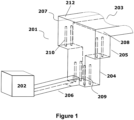
- Figure 1 shows an embodiment of a riser duct (201) for connecting a glass melting vessel (202) with a fining vessel (203) both of which are only indicated in the figure.
- the riser duct (201) has a lower electrode section (204) and an upper electrode section (205) which differ in the width of their horizontal cross-sections in this example such that the shape of the riser duct (201) is essentially a T-shape.
- a flow duct (206) connects the lower electrode section (204) with the glass melting vessel (202) for feeding the glass melt (207) into the riser duct (201). Its width is smaller than the width of the lower electrode section (204) and it is arranged centrally at the bottom level of the lower electrode section (204).
- the outlet (208) of the upper electrode section (205) for feeding the glass melt (207) from the riser duct (201) into the fining vessel (203) is in this example designed as an aperture in the downstream wall of the riser duct (201) which extends over the whole width of the upper electrode section (205). That is, the outlet (208) has a width of 100 % of the initial width of the fining vessel (203). The upper end of the wall is at level with the floor level of the fining vessel (203). Hence, the rising glass melt (207) seamlessly continues to flow into the fining vessel (203) and particularly its middle section where the fining action of bubble growth from the fining agents and escape of the bubbles from the glass melt (207) occurs.
- each of the lower electrode section (204) and the upper electrode section (205) of this example is installed a heating circuit (209) each comprising two pairs of electrodes (210).
- the electrodes (210) are rod-shaped and extend vertically from the bottom of the lower electrode section (204) of the riser duct (201) and the horizontal wall section of the upper electrode section (205).
- the two electrodes (210) on the left side of the riser duct (201) form together with the two electrodes (210) on the right side of the riser duct (201) the respective heating circuits (209) of the lower electrode section (204) and the upper electrode section (205).
- a gaseous phase (212) i.e., a free space under the superstructure of the riser duct.
- the bubbles within the glass melt (207) which may have been carried over from the melting vessel (202) via the flow duct (206) may escape into this gaseous phase (212).
- additional burners not shown in the figure
- the gaseous phase (212) above the surface of the glass melt (207) is in this example in fluid communication with the gaseous phase (212) of the fining vessel (203) and the surface of the glass melt (207) extends into the fining vessel (203).
- Figure 2 shows an example of a riser duct (201) having an additional middle electrode section (211).
- the example of Figure 1 is modified with a further step in the T-shape, resulting in a stepwise widening of the riser duct (201) over its height.
- a heating circuit (209) comprising two pairs of electrodes (210) in this middle electrode section (211).
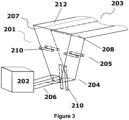
- Figure 3 shows another example of a riser duct (201) having a lower electrode section (204) and an upper electrode section (205).
- This example differs from the example of Figure 1 in that the electrodes (210) of the upper electrode section (205) are aligned horizontally instead of vertically and in that the shape has a continuously increasing width from bottom to top.
- the heating circuit in the lower electrode section (204) comprises only a single pair of electrodes (210) whereas the upper electrode section (205) has two pairs of electrodes (210) like the example of Figure 1 .
- glass melts it has been found that with this design of the widening shape it is easier to achieve the desired flow pattern and/or a homogenous start of the fining action in the fining tank over the whole width of the tank.
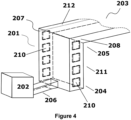
- FIG 4 shows yet another example of a riser duct (201) similar to the one of Figure 2 but having two additional middle electrode sections (211) instead of one.
- the electrodes (210) are in all sections plate-shaped, and the heating circuits in each of the lower electrode section (204), the two middle electrode sections (211), and the upper electrode section (205) are formed by a pair of single electrodes (210).
- the riser duct (201) has a constant width over its height, i.e., the different sections of the riser duct (201) are correlated only with the placement of the electrodes (210) but not also with a dimensional difference of the riser duct (201).
- This design is easier to construct than the T-shaped counterparts and can be advantageous for certain types of glass melts since the larger volume may make it easier to create a uniform temperature over the whole width of the riser duct (201) at the outlet (208).
Landscapes
- Chemical & Material Sciences (AREA)
- Engineering & Computer Science (AREA)
- Materials Engineering (AREA)
- Organic Chemistry (AREA)
- Physics & Mathematics (AREA)
- Thermal Sciences (AREA)
- Glass Melting And Manufacturing (AREA)
Priority Applications (3)
| Application Number | Priority Date | Filing Date | Title |
|---|---|---|---|
| EP23200765.8A EP4530264B1 (de) | 2023-09-29 | 2023-09-29 | Steigrohr für ein läutergefäss und verfahren zum läutern einer glasschmelze |
| PCT/EP2024/076608 WO2025068093A1 (en) | 2023-09-29 | 2024-09-23 | Riser duct for a fining vessel and method for fining a glass melt |
| CN202480062885.XA CN121969583A (zh) | 2023-09-29 | 2024-09-23 | 用于澄清容器的提升管以及用于澄清玻璃熔体的方法 |
Applications Claiming Priority (1)
| Application Number | Priority Date | Filing Date | Title |
|---|---|---|---|
| EP23200765.8A EP4530264B1 (de) | 2023-09-29 | 2023-09-29 | Steigrohr für ein läutergefäss und verfahren zum läutern einer glasschmelze |
Publications (2)
| Publication Number | Publication Date |
|---|---|
| EP4530264A1 true EP4530264A1 (de) | 2025-04-02 |
| EP4530264B1 EP4530264B1 (de) | 2025-07-23 |
Family
ID=88237655
Family Applications (1)
| Application Number | Title | Priority Date | Filing Date |
|---|---|---|---|
| EP23200765.8A Active EP4530264B1 (de) | 2023-09-29 | 2023-09-29 | Steigrohr für ein läutergefäss und verfahren zum läutern einer glasschmelze |
Country Status (3)
| Country | Link |
|---|---|
| EP (1) | EP4530264B1 (de) |
| CN (1) | CN121969583A (de) |
| WO (1) | WO2025068093A1 (de) |
Citations (4)
| Publication number | Priority date | Publication date | Assignee | Title |
|---|---|---|---|---|
| US5120342A (en) * | 1991-03-07 | 1992-06-09 | Glasstech, Inc. | High shear mixer and glass melting apparatus |
| US5370723A (en) * | 1989-06-13 | 1994-12-06 | Pilkington Plc | Glass melting furnace with control of the glass flow in the riser |
| JP3005210B2 (ja) * | 1997-10-06 | 2000-01-31 | 旭硝子株式会社 | 溶融ガラスの減圧脱泡装置用炉材および減圧脱泡装置 |
| WO2014116549A1 (en) * | 2013-01-24 | 2014-07-31 | Corning Incorporated | Process and apparatus for refining molten glass |
-
2023
- 2023-09-29 EP EP23200765.8A patent/EP4530264B1/de active Active
-
2024
- 2024-09-23 CN CN202480062885.XA patent/CN121969583A/zh active Pending
- 2024-09-23 WO PCT/EP2024/076608 patent/WO2025068093A1/en active Pending
Patent Citations (4)
| Publication number | Priority date | Publication date | Assignee | Title |
|---|---|---|---|---|
| US5370723A (en) * | 1989-06-13 | 1994-12-06 | Pilkington Plc | Glass melting furnace with control of the glass flow in the riser |
| US5120342A (en) * | 1991-03-07 | 1992-06-09 | Glasstech, Inc. | High shear mixer and glass melting apparatus |
| JP3005210B2 (ja) * | 1997-10-06 | 2000-01-31 | 旭硝子株式会社 | 溶融ガラスの減圧脱泡装置用炉材および減圧脱泡装置 |
| WO2014116549A1 (en) * | 2013-01-24 | 2014-07-31 | Corning Incorporated | Process and apparatus for refining molten glass |
Also Published As
| Publication number | Publication date |
|---|---|
| WO2025068093A1 (en) | 2025-04-03 |
| CN121969583A (zh) | 2026-05-01 |
| EP4530264B1 (de) | 2025-07-23 |
Similar Documents
| Publication | Publication Date | Title |
|---|---|---|
| EP2228348B1 (de) | Vorrichtung zur herstellung von schmelzglas und verfahren zur herstellung von schmelzglas damit | |
| TWI406827B (zh) | 減少玻璃中氣體雜質之裝置及方法 | |
| US9249041B2 (en) | Furnace with immersed burner and overhead burner | |
| US7454925B2 (en) | Method of forming a glass melt | |
| US11919798B2 (en) | Gradient fining tank for refining foamy molten glass and a method of using the same | |
| EA015871B1 (ru) | Стеклоплавильное устройство, содержащее две печи | |
| CN102503078A (zh) | 两槽式玻璃池炉 | |
| TW201840488A (zh) | 用於減少玻璃熔體表面上氣泡壽命之方法 | |
| Jebava et al. | Role of glass melt flow in container furnace examined by mathematical modelling | |
| CN103332850B (zh) | 一种光学玻璃生产线 | |
| JP2010052971A (ja) | ガラス溶融方法およびガラス溶融装置 | |
| KR20190049756A (ko) | 유리 물품 제조를 위한 장치 및 방법 | |
| CN110357399A (zh) | 用于生产玻璃产品的方法及适于此的装置 | |
| EP4530264B1 (de) | Steigrohr für ein läutergefäss und verfahren zum läutern einer glasschmelze | |
| US20240010539A1 (en) | Method of making high quality glass products from high viscosity melts | |
| EP4345069A1 (de) | Gefässsystem zur herstellung und läuterung einer glasschmelze und verfahren zur herstellung und läuterung einer glasschmelze | |
| EP4530262A1 (de) | Läutergefäss zum läutern einer glasschmelze und verfahren zum läutern einer glasschmelze | |
| EP4342856A1 (de) | Verfahren und vorrichtung zur herstellung eines glasprodukts und entsprechendes glasprodukt | |
| WO2025068384A1 (en) | A vessel system for producing and refining a glass melt, and method for producing and refining a glass melt | |
| EP4530261A1 (de) | Verfahren und vorrichtung zur herstellung eines glasprodukts | |
| EP4530263A1 (de) | Schmelzgefäss zum schmelzen von glas und verfahren zur herstellung einer glasschmelze | |
| EP4570764A1 (de) | Verfahren und vorrichtung zur herstellung eines glasprodukts | |
| JP2025116515A (ja) | ガラスの製造方法 | |
| CN118251366A (zh) | 用于供应浮法单元的使用电熔化的混合型玻璃制备熔炉 | |
| Biennek et al. | All‐Electric Furnaces for High Quality Demands in a Wide Range of Glass Compositions |
Legal Events
| Date | Code | Title | Description |
|---|---|---|---|
| STAA | Information on the status of an ep patent application or granted ep patent |
Free format text: STATUS: EXAMINATION IS IN PROGRESS |
|
| PUAI | Public reference made under article 153(3) epc to a published international application that has entered the european phase |
Free format text: ORIGINAL CODE: 0009012 |
|
| 17P | Request for examination filed |
Effective date: 20230929 |
|
| AK | Designated contracting states |
Kind code of ref document: A1 Designated state(s): AL AT BE BG CH CY CZ DE DK EE ES FI FR GB GR HR HU IE IS IT LI LT LU LV MC ME MK MT NL NO PL PT RO RS SE SI SK SM TR |
|
| GRAP | Despatch of communication of intention to grant a patent |
Free format text: ORIGINAL CODE: EPIDOSNIGR1 |
|
| STAA | Information on the status of an ep patent application or granted ep patent |
Free format text: STATUS: GRANT OF PATENT IS INTENDED |
|
| INTG | Intention to grant announced |
Effective date: 20250428 |
|
| GRAS | Grant fee paid |
Free format text: ORIGINAL CODE: EPIDOSNIGR3 |
|
| GRAA | (expected) grant |
Free format text: ORIGINAL CODE: 0009210 |
|
| STAA | Information on the status of an ep patent application or granted ep patent |
Free format text: STATUS: THE PATENT HAS BEEN GRANTED |
|
| AK | Designated contracting states |
Kind code of ref document: B1 Designated state(s): AL AT BE BG CH CY CZ DE DK EE ES FI FR GB GR HR HU IE IS IT LI LT LU LV MC ME MK MT NL NO PL PT RO RS SE SI SK SM TR |
|
| REG | Reference to a national code |
Ref country code: GB Ref legal event code: FG4D |
|
| REG | Reference to a national code |
Ref country code: CH Ref legal event code: EP |
|
| REG | Reference to a national code |
Ref country code: DE Ref legal event code: R096 Ref document number: 602023005004 Country of ref document: DE |
|
| REG | Reference to a national code |
Ref country code: IE Ref legal event code: FG4D |
|
| PGFP | Annual fee paid to national office [announced via postgrant information from national office to epo] |
Ref country code: DE Payment date: 20250919 Year of fee payment: 3 |
|
| PGFP | Annual fee paid to national office [announced via postgrant information from national office to epo] |
Ref country code: FR Payment date: 20250922 Year of fee payment: 3 Ref country code: AT Payment date: 20251020 Year of fee payment: 3 |
|
| REG | Reference to a national code |
Ref country code: NL Ref legal event code: MP Effective date: 20250723 |
|
| PG25 | Lapsed in a contracting state [announced via postgrant information from national office to epo] |
Ref country code: PT Free format text: LAPSE BECAUSE OF FAILURE TO SUBMIT A TRANSLATION OF THE DESCRIPTION OR TO PAY THE FEE WITHIN THE PRESCRIBED TIME-LIMIT Effective date: 20251124 |
|
| PG25 | Lapsed in a contracting state [announced via postgrant information from national office to epo] |
Ref country code: NL Free format text: LAPSE BECAUSE OF FAILURE TO SUBMIT A TRANSLATION OF THE DESCRIPTION OR TO PAY THE FEE WITHIN THE PRESCRIBED TIME-LIMIT Effective date: 20250723 |
|
| REG | Reference to a national code |
Ref country code: AT Ref legal event code: MK05 Ref document number: 1816299 Country of ref document: AT Kind code of ref document: T Effective date: 20250723 |
|
| PG25 | Lapsed in a contracting state [announced via postgrant information from national office to epo] |
Ref country code: IS Free format text: LAPSE BECAUSE OF FAILURE TO SUBMIT A TRANSLATION OF THE DESCRIPTION OR TO PAY THE FEE WITHIN THE PRESCRIBED TIME-LIMIT Effective date: 20251123 |
|
| PG25 | Lapsed in a contracting state [announced via postgrant information from national office to epo] |
Ref country code: NO Free format text: LAPSE BECAUSE OF FAILURE TO SUBMIT A TRANSLATION OF THE DESCRIPTION OR TO PAY THE FEE WITHIN THE PRESCRIBED TIME-LIMIT Effective date: 20251023 |
|
| REG | Reference to a national code |
Ref country code: LT Ref legal event code: MG9D |
|
| PG25 | Lapsed in a contracting state [announced via postgrant information from national office to epo] |
Ref country code: AT Free format text: LAPSE BECAUSE OF FAILURE TO SUBMIT A TRANSLATION OF THE DESCRIPTION OR TO PAY THE FEE WITHIN THE PRESCRIBED TIME-LIMIT Effective date: 20250723 |
|
| PG25 | Lapsed in a contracting state [announced via postgrant information from national office to epo] |
Ref country code: FI Free format text: LAPSE BECAUSE OF FAILURE TO SUBMIT A TRANSLATION OF THE DESCRIPTION OR TO PAY THE FEE WITHIN THE PRESCRIBED TIME-LIMIT Effective date: 20250723 |
|
| PGFP | Annual fee paid to national office [announced via postgrant information from national office to epo] |
Ref country code: IT Payment date: 20250930 Year of fee payment: 3 |
|
| PG25 | Lapsed in a contracting state [announced via postgrant information from national office to epo] |
Ref country code: HR Free format text: LAPSE BECAUSE OF FAILURE TO SUBMIT A TRANSLATION OF THE DESCRIPTION OR TO PAY THE FEE WITHIN THE PRESCRIBED TIME-LIMIT Effective date: 20250723 |
|
| PG25 | Lapsed in a contracting state [announced via postgrant information from national office to epo] |
Ref country code: GR Free format text: LAPSE BECAUSE OF FAILURE TO SUBMIT A TRANSLATION OF THE DESCRIPTION OR TO PAY THE FEE WITHIN THE PRESCRIBED TIME-LIMIT Effective date: 20251024 |
|
| PG25 | Lapsed in a contracting state [announced via postgrant information from national office to epo] |
Ref country code: SE Free format text: LAPSE BECAUSE OF FAILURE TO SUBMIT A TRANSLATION OF THE DESCRIPTION OR TO PAY THE FEE WITHIN THE PRESCRIBED TIME-LIMIT Effective date: 20250723 |
|
| PG25 | Lapsed in a contracting state [announced via postgrant information from national office to epo] |
Ref country code: LV Free format text: LAPSE BECAUSE OF FAILURE TO SUBMIT A TRANSLATION OF THE DESCRIPTION OR TO PAY THE FEE WITHIN THE PRESCRIBED TIME-LIMIT Effective date: 20250723 |
|
| PG25 | Lapsed in a contracting state [announced via postgrant information from national office to epo] |
Ref country code: BG Free format text: LAPSE BECAUSE OF FAILURE TO SUBMIT A TRANSLATION OF THE DESCRIPTION OR TO PAY THE FEE WITHIN THE PRESCRIBED TIME-LIMIT Effective date: 20250723 Ref country code: PL Free format text: LAPSE BECAUSE OF FAILURE TO SUBMIT A TRANSLATION OF THE DESCRIPTION OR TO PAY THE FEE WITHIN THE PRESCRIBED TIME-LIMIT Effective date: 20250723 |
|
| PG25 | Lapsed in a contracting state [announced via postgrant information from national office to epo] |
Ref country code: RS Free format text: LAPSE BECAUSE OF FAILURE TO SUBMIT A TRANSLATION OF THE DESCRIPTION OR TO PAY THE FEE WITHIN THE PRESCRIBED TIME-LIMIT Effective date: 20251023 |
|
| PG25 | Lapsed in a contracting state [announced via postgrant information from national office to epo] |
Ref country code: ES Free format text: LAPSE BECAUSE OF FAILURE TO SUBMIT A TRANSLATION OF THE DESCRIPTION OR TO PAY THE FEE WITHIN THE PRESCRIBED TIME-LIMIT Effective date: 20250723 |
|
| PG25 | Lapsed in a contracting state [announced via postgrant information from national office to epo] |
Ref country code: RO Free format text: LAPSE BECAUSE OF FAILURE TO SUBMIT A TRANSLATION OF THE DESCRIPTION OR TO PAY THE FEE WITHIN THE PRESCRIBED TIME-LIMIT Effective date: 20250723 |
|
| P01 | Opt-out of the competence of the unified patent court (upc) registered |
Free format text: CASE NUMBER: UPC_APP_0006223_4530264/2026 Effective date: 20260219 |
|
| PG25 | Lapsed in a contracting state [announced via postgrant information from national office to epo] |
Ref country code: SM Free format text: LAPSE BECAUSE OF FAILURE TO SUBMIT A TRANSLATION OF THE DESCRIPTION OR TO PAY THE FEE WITHIN THE PRESCRIBED TIME-LIMIT Effective date: 20250723 |
|
| PG25 | Lapsed in a contracting state [announced via postgrant information from national office to epo] |
Ref country code: DK Free format text: LAPSE BECAUSE OF FAILURE TO SUBMIT A TRANSLATION OF THE DESCRIPTION OR TO PAY THE FEE WITHIN THE PRESCRIBED TIME-LIMIT Effective date: 20250723 |
|
| PG25 | Lapsed in a contracting state [announced via postgrant information from national office to epo] |
Ref country code: CZ Free format text: LAPSE BECAUSE OF FAILURE TO SUBMIT A TRANSLATION OF THE DESCRIPTION OR TO PAY THE FEE WITHIN THE PRESCRIBED TIME-LIMIT Effective date: 20250723 |
|
| PG25 | Lapsed in a contracting state [announced via postgrant information from national office to epo] |
Ref country code: SK Free format text: LAPSE BECAUSE OF FAILURE TO SUBMIT A TRANSLATION OF THE DESCRIPTION OR TO PAY THE FEE WITHIN THE PRESCRIBED TIME-LIMIT Effective date: 20250723 Ref country code: EE Free format text: LAPSE BECAUSE OF FAILURE TO SUBMIT A TRANSLATION OF THE DESCRIPTION OR TO PAY THE FEE WITHIN THE PRESCRIBED TIME-LIMIT Effective date: 20250723 |