EP4530261A1 - Verfahren und vorrichtung zur herstellung eines glasprodukts - Google Patents
Verfahren und vorrichtung zur herstellung eines glasprodukts Download PDFInfo
- Publication number
- EP4530261A1 EP4530261A1 EP23200853.2A EP23200853A EP4530261A1 EP 4530261 A1 EP4530261 A1 EP 4530261A1 EP 23200853 A EP23200853 A EP 23200853A EP 4530261 A1 EP4530261 A1 EP 4530261A1
- Authority
- EP
- European Patent Office
- Prior art keywords
- glass
- electrodes
- melting vessel
- ppm
- melt
- Prior art date
- Legal status (The legal status is an assumption and is not a legal conclusion. Google has not performed a legal analysis and makes no representation as to the accuracy of the status listed.)
- Withdrawn
Links
Images

Classifications
-
- C—CHEMISTRY; METALLURGY
- C03—GLASS; MINERAL OR SLAG WOOL
- C03B—MANUFACTURE, SHAPING, OR SUPPLEMENTARY PROCESSES
- C03B5/00—Melting in furnaces; Furnaces so far as specially adapted for glass manufacture
- C03B5/02—Melting in furnaces; Furnaces so far as specially adapted for glass manufacture in electric furnaces, e.g. by dielectric heating
- C03B5/027—Melting in furnaces; Furnaces so far as specially adapted for glass manufacture in electric furnaces, e.g. by dielectric heating by passing an electric current between electrodes immersed in the glass bath, i.e. by direct resistance heating
-
- C—CHEMISTRY; METALLURGY
- C03—GLASS; MINERAL OR SLAG WOOL
- C03B—MANUFACTURE, SHAPING, OR SUPPLEMENTARY PROCESSES
- C03B5/00—Melting in furnaces; Furnaces so far as specially adapted for glass manufacture
- C03B5/16—Special features of the melting process; Auxiliary means specially adapted for glass-melting furnaces
- C03B5/18—Stirring devices; Homogenisation
- C03B5/183—Stirring devices; Homogenisation using thermal means, e.g. for creating convection currents
- C03B5/185—Electric means
Definitions
- the present invention relates to a method and apparatus for making a glass product wherein an excellent glass quality is achieved by means of a direct electrical heating using multiple inverterbased heating circuits which may be independently adjusted in amplitude.
- the glassmaker has a number of options for heating a glass melt, e.g. gas burners, electric resistance heating, or inductive heating. As of today, gas is the predominant heat source used in glass melting.
- the production of glass has a quite high carbon footprint due to the amount of energy required for the melting and fining processes. This is particularly the case for heating by gas burners which use natural gas.
- a reduction of the carbon footprint is possible if, instead, an electric resistance heating is used which is provided with power from renewable energy sources like wind power, water power, or solar panels.
- the same power sources may also be used to produce hydrogen by electrolysis which then can be used to feed the gas burners. While the latter requires less changes to an existing glass production facility with a gas burner heating, the intermediate step of electrolysis is of course associated with a considerable energy loss. Hence, a direct use of the electrical power is more desirable.
- glass compositions There are various kinds of glass compositions. Some glass compositions are relatively easy to manufacture in good quality, others require sophisticated equipment and/or extremely well-balanced production processes. Generally, the glass compositions used to make drinking glasses and bottles, ordinary windowpanes and other construction glass products (e.g. glass wool used for insulation) are of the former type. One reason is that the glass used for these products has rather low melting temperatures and a steep viscosity-temperature curve; in addition, quality criteria of the manufactured products are not very stringent. For example, drinking glasses and construction glass products may contain an occasional bubble, and variations in shape and dimension are tolerable. These glass products may contain impurities to a certain extent without a problem because their use does not require defined light transmission properties, or stringent purity regulations.
- the types of glass compositions used for many mass products have low melting temperatures because of significant amounts of alkali metal oxides and alkaline earth metal oxides.
- the respective glass melting facilities achieve very high throughput, often more than 200 tons of glass per day, or even 400 tons per day. Of course, the amount of energy needed for making 200 tons of low melting glass is significantly lower than for a higher melting glass.
- the quality required for a given product depends on its intended use.
- Some high-quality glasses are used to make products that do not entertain the occasional bubble and must meet stringent criteria in terms of shape, dimensional variations, and purity (both chemical and optical). Many of these glasses are rather difficult to manufacture not only because of the stringent criteria but also because of high melting temperatures. High melting temperatures may be necessary to achieve melt viscosities sufficient for homogenization and removal of bubbles from the melt. Examples of high-quality glass products include pharmaceutical containers and glass tubes used for making such containers.
- the first reason is obviously the requirement to replace the electrodes at certain intervals. This not only increases the operation costs for the facility but also has an impact on the carbon footprint since for the production of the electrodes a considerable amount of energy is required. Depending on the type of metal used, very high temperatures for melting have to be achieved and the further shaping and handling steps again consume energy. Hence, a frequent exchange of the electrodes significantly increases the carbon footprint of the glass production method. In addition to this, the glass production process has to be stopped for maintenance because it is not possible to simply pull single electrodes out of the melting tank for replacement while the facility continues operation.
- the second reason is the just mentioned glass quality.
- the dissolved metal of the electrodes may cause severe discolorations of the glass melt in different colors depending on the type of metal and glass composition used. While this may be tolerable to a certain extent for cheaper glass products which are dark colored anyway, it is already intolerable for cheaper glass products which are to be completely colorless or to have a certain defined color. For high-quality expensive glass products, this discoloration is an absolute show-stopper which has to be avoided by all means.
- a contamination of the glass products with metal of the electrodes is also critical where a certain light transmittance, especially in the UV region, is needed.
- glass products for medical packaging and semiconductor industries have specified limits of metal particles allowed in their products.
- Prior art melting vessels employing a current frequency of 50 Hz or 60 Hz are generally controlling the power within the heating circuits by means of thyristor controllers with a phase cutting, also known as phase angle control or phase-fired control (PFC), in combination with the transformers.
- phase cutting also known as phase angle control or phase-fired control (PFC)
- PFC phase-fired control
- Components of the glass melt may react with the electrodes and/or platinum parts of the melting vessel, like pipes or stirrers, and the reaction products may end up in the glass product where they may cause discolorations, particles, and striae. As a consequence, the lifetime of the electrodes is reduced, and the glass quality is decreased.
- this disclosure relates to a method of making a glass product, comprising the steps of
- controlling the amplitude independently of the other heating circuits means that the various inverters can be operated at different amplitudes, i.e. the amplitude of one inverter does not have a direct effect on the amplitude of the other. It does not exclude that two or more inverters operate at different amplitudes in a predetermined relationship, e.g. controlled by a controller.
- this disclosure relates to an apparatus for glass melting comprising
- this disclosure relates to a glass product, optionally obtainable or obtained according to the method disclosed herein, comprising a glass composition having a fining agent and electrode material, wherein the fining agent is present in an amount of at least 300 ppm and the electrode material is present as an oxide in an amount of less than 15 ppm, the glass product comprising less than 2 bubbles per 10 g of glass, wherein optionally the glass composition has a total carbon content of less than 310 ppm, based on the weight of the carbon atoms with respect to the weight of the glass product.
- a "glass melt” is a volume of a batch of glass raw materials that has a viscosity of less than 10 7.6 dPas. Such a viscosity can be measured using the fiber elongation method, e.g. as described in DIN ISO 7884-6:1998-02, where the elongation speed of a fiber with a defined diameter is determined with different weights at different temperatures.
- the temperature at which the glass melt has a viscosity of 10 2 dPas is herein called “temperature T2".
- the temperature at which the glass melt has a viscosity of 10 4 dPas is herein called “temperature T4".
- Temperature T2 is less than 1,500 °C for glass compositions with high contents of alkali metal oxides or alkaline earth metal oxides, such as soda lime glass and other glass compositions. These viscosities can be measured using a rotational viscosimeter, e.g. as described in DIN ISO 7884-2:1998-2.
- t is the temperature under consideration.
- A, B and t 0 are the so-called VFT constants that are specific for each glass composition.
- This disclosure relates to methods which allow for the electric heating of all types of glass with multiple heating circuits which can be influenced independently of each other in amplitude of the current supplied to the electrodes. Further, the method is suitable for all types of melting vessels whose geometries allow for the installation of multiple heating circuits, such as melting tanks, platinum pipes, fining tanks, and flow ducts. It is not limited to rectangular geometries but also works with polygonal or circular geometries. This allows for the creation of highly complex flow profiles in the melt for improving the important parameters for glass quality of the residence time and the sand grain dissolution. Moreover, a continuous glass melting without fossil fuels is possible as the method may not only be used as an electrical additional heating but also as a fully electric heating.
- the common controller used herein acts as a frequency control unit and is basically a clock generator which provides an external time base for all inverters connected to that common controller.
- the common controller can be a part of a distributed control system (DCS). Within the DCS, the amplitudes and therefore the power of each inverter is controlled. The amplitudes can also be manipulated individually at each inverter.
- DCS distributed control system
- a “melting vessel” is a vessel used for holding a glass melt.
- the vessel defines a volume that can contain a glass melt.
- the melting vessel may have a substantially rectangular base, or bottom plate. It may have walls to keep the melt within the vessel. Typically, a melting vessel will not be filled to the rim.
- a melting vessel may have a superstructure above the glass melt surface ("covered melting vessel”). The superstructure may be vaulted.
- the “melting vessel” may be a part of a larger melting facility.
- the term “melting vessel” as used herein is meant as an umbrella term for all containers containing a glass melt which may comprise parts such as a melting tank, a refining tank or refining area, or pipes or ducts connecting the same.
- a “bubble” is a gaseous inclusion within the glass or the glass melt, optionally having a diameter of at least 10 ⁇ m.
- the “diameter” means the largest diameter of the gaseous inclusion.
- Residence time is the time that a given portion of the glass melt spends in the melting vessel before being withdrawn from the melting vessel. Residence time can be measured using so-called tracers, i.e. components that are added to the glass melt so that they can be detected in the product, allowing conclusions as to the time spent in the melting vessel. Examples of tracer compounds are Ca, Sr and Y.
- the "average residence time” is defined as: melting vessel volume m 3 melting vessel throughput m 3 h
- the present disclosure uses a different approach to be able to minimize the electro corrosion potential and, additionally, to independently adjust the single heating circuits for the creation of optimized complex flow profiles of the melt. Both objects are achieved by using inverters before transformers in the single heating circuits which are jointly controlled by a controller.
- the glass product can be a sheet, wafer, plate, tube, rod, ingot, strip, or block.
- the electrodes are operated at a current frequency of at least 50 Hz and at most 25,000 Hz, optionally of at least 50 Hz and at most 10,000 Hz, optionally of at least 100 Hz and at most 10,000 Hz, optionally of at least 1,000 Hz and at most 5,000 Hz, optionally of at least 1,000 Hz and at most 3,000 Hz.
- the electrodes may be operated at a current frequency of less than 25,000 Hz, less than 10,000 Hz, less than 5,000 Hz, less than 4,500 Hz, less than 4,000 Hz, less than 3,500 Hz, or less than 3,000 Hz.
- the electrodes may be operated at a current frequency of less than 3,000 Hz.
- the electrode may be operated at a current frequency of at least 50 Hz, at least 100 Hz, at least 1,000 Hz, at least 1,500 Hz, at least 2,000 Hz, or at least 2,500 Hz.
- a lower limit of 100 Hz ascertains that the electrode corrosion is sufficiently low at the required current density and the formation of bubbles is adequately suppressed.
- An upper limit of 5,000 Hz ascertains that the power loss due to emission and induction remains at an acceptable level.
- a flow and/or the residence time of the glass melt in the melting vessel are adjusted by setting the amplitude of the current of each individual heating circuit such that desired thermal zones are created within the glass melt.
- the common controller may synchronize its clock signal with an external clock signal.
- the common controller may synchronize to the external clock signal which is equivalent to a frequency by detecting the zero crossings of the external frequency signal and adjusting its own zero crossings of the clock signal with them.
- the frequencies may in this case be identical, but they do not have to be identical.
- the zero crossings of the lower frequency first signal may be matched with the n th zero crossing of the higher frequency second signal wherein n is dependent on the frequency difference.
- Such an external clock signal synchronization may be advantageous for adapting to the continuously slightly changing power grid frequency of neighboring components in a melting facility which is operated at the power grid frequency of 50/60 Hz.
- the melting vessel is selected from a melting tank, a platinum pipe, a fining tank, a horizontal flow duct, and a vertical duct.
- the disclosed method is equally suitable for all of these types of melting vessels.
- One or more or all of the electrodes may be rod-shaped and/or plate-shaped and/or dome-shaped and/or tube-shaped and/or block-shaped. While in some cases the electrodes may also be plate-shaped and then in particular be designed as a part of the walls or bottom of the melting vessel, in most cases rod-shaped electrodes are chosen.
- the rod-shaped electrodes are more versatile in arranging and easier to replace. Moreover, since the rod-shaped electrodes are spot-like sources of current, the zones of input of energy into the melt are easier to design to the desired layout. In some applications, also dome-shaped, tube-shaped, or block-shaped electrodes may be used in place of the rod-shaped electrodes.
- One or more or all of the electrodes may be arranged horizontally extending from a wall of the melting vessel or vertically extending from a bottom of the melting vessel or from a surface of the glass melt.
- the method is a continuous process or batch process.
- the method is particularly suitable for a continuous process because its strength lies in the specific shaping of the flow of the glass melt which is of course more relevant for the continuous process.
- additional heating is provided by a fuel burner or no fuel burner is used for additional heating.
- no fuel burner is used for additional heating.
- This burner may then be fueled by a "green gas", i.e. hydrogen produced from renewable energies.
- a fuel burner also an electrical additional heating means can be used.
- the method is a continuous process having a throughput of at least 1 t/d ⁇ m 2 of melting vessel cross-section.
- the throughput may be at least 1 t/d ⁇ m 2 or at least 2 t/d ⁇ m 2 or at least 3 t/d ⁇ m 2 or at least 4 t/d ⁇ m 2
- the throughput may be at most 10 t/d ⁇ m 2 or at most 9 t/d ⁇ m 2 or at most 8 t/d ⁇ m 2 .
- the throughput may be 1 t/d ⁇ m 2 to 10 t/d ⁇ m 2 or 2 t/d ⁇ m 2 to 9 t/d ⁇ m 2 or 3 t/d ⁇ m 2 to 8 t/d ⁇ m 2 or 4 t/d ⁇ m 2 to 8 t/d ⁇ m 2 .
- Such a throughput may aid in reducing the content of the electrode material in the resulting glass product.
- the increased flow of the glass melt shortens the residence time of the melt in the melting vessel and consequently the time during which the melt may be contaminated with the dissolved electrode material. Meanwhile, the corrosion rate of the electrodes remains essentially constant since the main factors of influence are the composition of the glass melt, the electrode material, and the current density.
- a temperature of the glass melt, a withdrawal rate of glass melt from the melting vessel, and an electrical operation frequency of the electrodes is such that the corrosion rate of one or more or all of the electrodes is less than 2.5 mm/a with a current density of 0.5 A/cm 2 and a glass melt temperature of 1,550 °C.
- the corrosion rate of the electrodes is less than 2.5 mm per year for optimal results.
- the corrosion rate may be less than 2.5 mm/a, less than 2.25 mm/a, less than 2.0 mm/a, less than 1.75 mm/a, or less than 1.5 mm/a.
- the corrosion rate may be at least 0.05 mm/a, at least 0.1 mm/a, at least 0.15 mm/a, at least 0.2 mm/a, at least 0.25 mm/a, or at least 0.3 mm/a.
- the electrode material of one or more or all of the electrodes is selected from Pt, Rh, Ir, Pd, alloys of these noble metals, Ta, Mo, MoSi 2 , MoZrO 2 , W, SnO 2 , and combinations thereof.
- the current density used at one or more or all of the electrodes is 0.2 A/cm 2 - 2.0 A/cm 2 .
- This range provides good balance between power input into the melt and corrosion as well as a possible reduction of the number of electrodes.
- the current density may be 0.2 A/cm 2 - 2.0 A/cm 2 or 0.3 A/cm 2 - 1.8 A/cm 2 or 0.4 A/cm 2 - 1.65 A/cm 2 or 0.5 A/cm 2 - 1.5 A/cm 2 .
- the current density may be at least 0.2 A/cm 2 or at least 0.3 A/cm 2 or at least 0.4 A/cm 2 or at least 0.5 A/cm 2 .
- the current density may be at most 2.0 A/cm 2 or at most 1.8 A/cm 2 or at most 1.65 A/cm 2 or at most 1.5 A/cm 2 .
- a ratio of the current frequency to the electric conductivity of the melt at a temperature of 1,600 °C is 0.001 kHz.Q.m to 50 kHz ⁇ m. It has been found by the inventors that by means of this ratio range, the current frequency may be set to provide a low carbon footprint for a given glass composition to be melted having a certain electric conductivity.
- the ratio may be at least 0.001 kHz.Q.m, at least 0.01 kHz.Q.m, at least 0.1 kHz ⁇ m, at least 0.5 kHz.Q.m, at least 1 kHz.Q.m, at least 2 kHz.Q.m 3 kHz.Q.m, at least 5 kHz ⁇ m, at least 7 kHz ⁇ m, at least 10 kHz.Q.m, at least 15 kHz ⁇ m, at least 20 kHz ⁇ m, or at least 25 kHz.Q.m.
- the ratio may be at most 50 kHz.Q.m, at most 49 kHz.Q.m, at most 48 kHz ⁇ m, at most 47 kHz.Q.m, at most 46 kHz.Q.m, at most 45 kHz.Q.m, at most 44 kHz ⁇ m, at most 43 kHz.Q.m, at most 42 kHz.Q.m, at most 41 kHz.Q.m, at most 40 kHz ⁇ m, at most 39 kHz ⁇ m, or at most 38 kHz.Q.m.
- the ratio may be 0.001 kHz ⁇ m - 50 kHz ⁇ m, 0.01 kHz ⁇ m - 49 kHz ⁇ m, 0.1 kHz.Q.m - 48 kHz ⁇ m, 0.5 kHz ⁇ m - 47 kHz ⁇ m, 1 kHz ⁇ m - 46 kHz.Q.m, 2 kHz.Q.m - 45 kHz.Q.m, 3 kHz.Q.m - 44 kHz.Q.m, 5 kHz.Q.m - 43 kHz ⁇ m, 7 kHz ⁇ m - 42 kHz.Q.m, 10 kHz.Q.m - 41 kHz.Q.m, 15 kHz.Q.m - 40 kHz.Q.m, 20 kHz ⁇ m - 39 kHz.Q.m, or 25 kHz ⁇ m - 38 kHz.Q.m.
- the electric conductivity of the melt at a temperature of 1,600 °C is at least 0.5 S/m.
- the current method is particularly useful for glass compositions which form a melt having a high electric conductivity because the problem of an increased carbon footprint is very pronounced in these types of glass and not yet satisfactorily solved in the state of the art. Hence, these compositions will profit most of the possibility of a fully electric heating.
- the application of the disclosed method is of course not limited to them.
- the electric conductivity may be at least 0.5 S/m, at least 0.75 S/m, at least 1 S/m, at least 2 S/m, at least 3 S/m, at least 4 S/m, at least 5 S/m, at least 10 S/m, at least 15 S/m, at least 20 S/m, at least 25 S/m, or at least 30 S/m.
- the electric conductivity may be at most 50 S/m, at most 48 S/m, at most 47 S/m, at most 46 S/m, at most 45 S/m, at most 44 S/m, at most 43 S/m, at most 42 S/m, at most 41 S/m, at most 40 S/m, at most 38 S/m, or at most 36 S/m.
- the electric conductivity may be 0.5 S/m - 50 S/m, 0.75 S/m - 48 S/m, 1 S/m - 47 S/m, 2 S/m - 46 S/m, 3 S/m - 45 S/m, 4 S/m - 44 S/m, 5 S/m - 43 S/m, 10 S/m - 42 S/m, 15 S/m - 41 S/m, 20 S/m - 40 S/m, 25 S/m - 38 S/m, or 30 S/m - 36 S/m.
- the electric conductivity may be 0.8 S/m, 1.7 S/m, 2.7 S/m, 3.7 S/m, 11.2 S/m, 13.2 S/m, 32.8 S/m, or 42.8 S/m.
- the signal lines of the apparatus may be a direct or indirect connection by wire or wireless technique.
- the inverters are set to provide a current frequency of at least 50 Hz and at most 25,000 Hz, optionally of at least 50 Hz and at most 10,000 Hz, optionally of at least 100 Hz and at most 10,000 Hz or of at least 1,000 Hz and at most 5,000 Hz.
- one or more or all of the electrodes may be located partially or completely in or on a wall of the melting vessel and/or in or on the bottom of the melting vessel and/or constitute a wall section and/or a bottom section of the melting vessel.
- One or more or all or all of the electrodes may be located partially or completely in or on a wall of the melting vessel.
- One or more or all of the electrodes may be located partially or completely in or on a bottom plate of the melting vessel.
- one or more or all of the electrodes constitute a wall section and/or a bottom plate section of the melting vessel.
- one or more or all of the electrodes may be extending upwardly from the bottom of the melting vessel up to at least 20 % glass melt depth, at least 30 %, at least 40 %, at least 50 %, at least 60 %, at least 70 % or at least 80 % of the glass melt depth.
- the one or more or all of the electrodes may extend up to 100 %, up to 95 % or up to 90 % of the glass melt depth from the bottom of the melting vessel.
- the one or more or all of the electrodes may extend from 50 % to 100 %, from 60 % to 95 %, or from 70 % to 90 % of the glass melt depth from the bottom of the melting vessel.
- one or more or all of the electrodes may be rod-shaped, dome shaped, plate-shaped, tube-shaped, or block-shaped.
- the rod-shaped electrodes are more versatile in arranging and easier to replace. Moreover, since the rod-shaped electrodes are spot-like sources of current, the zones of input of energy into the melt are easier to design to the desired layout. In some applications, also dome-shaped, tube-shaped, or block-shaped electrodes may be used in place of the rod-shaped electrodes.
- the electrode material of one or more or all of the electrodes may be selected from Pt, Rh, Ir, Pd, alloys of these noble metals, Ta, Mo, MoSi 2 , MoZrO 2 , W, SnO 2 , and combinations thereof.
- the operation of the apparatus can be optimized.
- Those electrodes provide an optimal combination of low corrosion and suitability for the operation at the claimed current frequencies.
- the melting vessel is selected from a melting tank, a platinum pipe, a fining tank, a horizontal flow duct, and a vertical duct.
- the melting vessel may be any part of a larger melting facility containing a glass melt which may comprise parts such as a melting tank, a refining tank or refining area, or pipes or ducts connecting the same. In general, those pipes are made of platinum.
- the ducts may also be made of platinum or of refractory ceramics. The only prerequisite regarding the melting vessel and its shape and size is that it will allow for the installation of two or more heating circuits, i.e., there has to be enough space for at least two pairs of electrodes within the vessel.
- the melting vessel has a cross-sectional shape of a circle, an oval, or a polygon having 3 to 64 corners.
- the cross-sectional shape may be a circle or oval, which mainly concerns pipes or ducts, or a polygon having 3 to 64 corners, which is particularly of interest for melting tanks and fining tanks.
- the polygon may optionally have 3, 4, 5, 6, 7, 8, 9, 10, 11, 12, 13, 14, 15, 20, 24, 30, 32, 36, 42, 48, 54, 60, or 64 corners. In certain useful embodiments the polygon has 4, 5, 8, 10, 12, 24, 36, 48, 60, or 64 corners.
- the fining agent may be present in the glass product in an amount of at least 300 ppm or at least 400 ppm or at least 500 ppm or at least 600 ppm or at least 700 ppm or at least 800 ppm or at least 900 ppm or at least 1,000 ppm or at least 2,000 ppm or at least 3,000 ppm or at least 4,000 ppm or at least 5,000 ppm or at least 10,000 ppm or at least 15,000 ppm.
- the fining agent may be present in an amount of at most 30,000 ppm or at most 28,000 ppm or at most 26,000 ppm or at most 24,000 ppm or at most 22,000 ppm or at most 20,000 ppm or at most 10,000 ppm or at most 1,000 ppm or at most 900 ppm or at most 800 ppm or at most 700 ppm or at most 600 ppm or at most 500 ppm or at most 400 ppm or at most 300 ppm.
- the fining agent may be present in an amount of 300 ppm to 30,000 ppm or 400 ppm to 28,000 ppm or 500 ppm to 26,000 ppm or 600 ppm to 24,000 ppm or 700 ppm to 22,000 ppm or 800 ppm to 20,000 ppm or 900 ppm to 15,000 ppm or 1,000 ppm to 10,000 ppm.
- the electrode material may be present in the glass product as an oxide in an amount of less than 15 ppm or less than 10 ppm or less than 5 ppm or less than 4.5 ppm or less than 4 ppm or less than 3.5 ppm or less than 3 ppm or less than 2.5 ppm or less than 2 ppm.
- the electrode material may be present as an oxide in an amount of more than 0.1 ppm or more than 0.2 ppm or more than 0.3 ppm or more than 0.4 ppm or more than 0.5 ppm or more than 0.75 ppm or more than 1 ppm.
- the total carbon content in the glass product may be of less than 310 ppm or of less than 300 ppm or of less than 290 ppm or of less than 280 ppm or of less than 270 ppm or of less than 260 ppm or of less than 250 ppm.
- the glass product may comprise a glass composition having an amount of an electrode material in the form of an oxide of from 0.1 ppm to 10 ppm, wherein optionally the electrode material is selected from Pt, Rh, Ir, Pd, alloys of these noble metals, Ta, Mo, MoSi 2 , MoZrO 2 , W, SnO 2 and combinations thereof.
- the electrode material may be present in the glass product as an oxide in an amount of from 0.1 ppm to 10 ppm, from 0.1 ppm to 5 ppm, from 0.2 ppm to 4.5 ppm, from 0.3 ppm to 4 ppm, from 0.4 ppm to 3.5 ppm, from 0.5 ppm to 3 ppm, from 0.75 ppm to 2.5 ppm, or from 1 ppm to 2.5 ppm,
- the electrode material may be present as an oxide in an amount of less than 10 ppm or less than 5 ppm or less than 4.5 ppm or less than 4 ppm or less than 3.5 ppm or less than 3 ppm or less than 2.5 ppm or less than 2 ppm.
- the electrode material may be present as an oxide in an amount of more than 0.1 ppm or more than 0.2 ppm or more than 0.3 ppm or more than 0.4 ppm or more than 0.5 ppm or more than 0.75 ppm or more than 1 ppm.
- the glass product may comprise a glass composition which contains alkali metal oxides in amounts of less than 20 % by weight, less than 15 % by weight, less than 12 % by weight, less than 10 % by weight or less than 5 % by weight.
- the glass composition may be free of alkali metal oxides.
- the amount of alkali metal oxides in the glass composition may be at least 1 % by weight or at least 2 % by weight.
- the amount of alkali metal oxides in the glass composition may be ⁇ 1 % by weight and ⁇ 20 % by weight or ⁇ 2 % by weight ⁇ 10 % by weight.
- the glass composition may be a borosilicate, alumino-borosilicate, or aluminosilicate glass.
- the glass composition may contain alkaline earth metal oxides in amounts of less than 20 % by weight, less than 15 % by weight, less than 12 % by weight, less than 10 % by weight, or less than 5 % by weight.
- the glass composition may be free of alkaline earth metal oxides.
- the amount of alkaline earth metal oxides in the glass composition may be at least 1 % by weight or at least 2 % by weight.
- the amount of alkaline earth metal oxides in the glass composition may be ⁇ 1 % by weight and ⁇ 20 % by weight or ⁇ 2 % by weight ⁇ 10 % by weight.
- Optional glass compositions include Al 2 O 3 in an amount of at least 1.5 % by weight or at least 5.0 % by weight or even at least 10.0 % by weight.
- the amount of Al 2 O 3 may be up to 23.0 % by weight, up to 20.0 % by weight or up to 18.0 % by weight.
- the amount of Al 2 O 3 may range from 1.5 % to 23.0 % by weight, from 5.0 % to 20.0 % by weight or from 10.0 % to 18.0 % by weight.
- the glass composition may include B 2 O 3 in an amount of at least 0.0 % by weight or at least 8.0 % by weight or even at least 10.0 % by weight.
- the amount of B 2 O 3 may be up to 22.0 % by weight, up to 20.0 % by weight, up to 16.0 % by weight or up to 14.0 % by weight.
- the amount of B 2 O 3 may range from 0.0 % to 22.0 % by weight, from 0.0 % to 20.0 % by weight, from 8.0 % to 16.0 % by weight or from 10.0 % to 14.0 % by weight.
- the glass compositions used in this invention have a total content of SiO 2 , Al 2 O 3 and B 2 O 3 of at least 75.0 % by weight, at least 78.0 % by weight or even at least 85.0 % by weight.
- the total amount of SiO 2 , Al 2 O 3 and B 2 O 3 may be limited to not more than 97.0 % by weight, up to 93.5 % by weight or up to 90.0 % by weight.
- the amount of SiO 2 , Al 2 O 3 and B 2 O 3 may range from 75.0 % to 95.0 % by weight, from 78.0 % to 92.5 % by weight or from 85.0 % to 90.0 % by weight.
- glass compositions used in this invention may comprise (in % by weight, the composition summing up to 100 %): SiO 2 71 - 77 B 2 O 3 9 - 12 Al 2 O 3 5.5 - 8 Na 2 O 6 - 8 K 2 O 0.1 - 0.9 Li 2 O 0 - 0.3 CaO 0 - 1.5 BaO 0 - 1 F 0 - 0.3 Cl- 0 - 0,3 MgO+CaO+BaO+SrO 0-2 or SiO 2 71 - 77 B 2 O 3 9 - 12 Al 2 O 3 3.5 - 6 Na 2 O 5.5 - 8 K 2 O 0 - 0.5 Li 2 O 0 - 0.3 CaO 0 - 3 BaO 0 - .5 F 0 - 0.3 Cl- 0 - 0,3 MgO+CaO+BaO+SrO 0 - 2 or SiO 2 60 - 85 Al 2 O 3 0 - 10 B 2 O 3 5
- the glass composition can - alternatively or additionally to the compositions described above - be described by the following composition ranges.
- the glass composition can be a borosilicate glass which contains the following components in wt.-%: SiO 2 70.0 to 87.0 B 2 O 3 7.0 to 25.0 Na 2 O + K 2 O 0.5 to 9.0 Al 2 O 3 0.0 to 7.0 CaO 0.0 to 3.0
- the glass composition can be a borosilicate glass which contains the following components in wt.-%: SiO 2 70.0 to 86.0 Al 2 O 3 0.0 to 8.0, or 0.0 to 5.0 B 2 O 3 9.0 to 25.0 Na 2 O 0.5 to 8.0, or 0.5 to 5.0 K 2 O 0.0 to 1.0 Li 2 O 0.0 to 2.0, or 0.0 to 1.0
- the glass composition can be a borosilicate glass which contains the following components in wt.-%: SiO 2 70.0 to 80.0, or 71.0 to 77.0 Al 2 O 3 3.0 to 8.0, or 3.5 to 8.0 B 2 O 3 9.0 to 15.0, or 9.0 to 12.0 Na 2 O 5.5 to 8.0 K 2 O 0.0 to 1.0, or 0.1 to 0.5 Li 2 O 0.0 to 0.5, or 0.0 to 0.3 CaO 0.0 to 3.0, or 0.0 to 1.5 BaO 0.0 to 1.5 F - 0.0 to 0.3 Cl - 0.0 to 0.3 MgO+CaO+BaO+SrO 0.0 to 2.0
- the glass composition can be an alkali borosilicate glass which contains the following components in wt.-%: SiO 2 78.3 to 81.0 Al 2 O 3 3.5 to 5.3 B 2 O 3 9.0 to 13.0 Na 2 O 3.5 to 6.5 K 2 O 0.3 to 2.0 CaO 0.0 to 2.0
- the glass composition can be an alkali borosilicate glass which contains the following components in wt.-%: SiO 2 55.0 to 85.0 Al 2 O 3 0.0 to 15.0 B 2 O 3 3.0 to 20.0 Na 2 O 3.0 to 15.0 K 2 O 3.0 to 15.0 ZnO 0.0 to 12.0 TiO 2 0.5 to 10.0 CaO 0.0 to 0.1
- the glass composition can contain the following components in wt.-%: SiO 2 58.0 to 75.0 Al 2 O 3 18.0 to 25.0 Li 2 O 3.0 to 6.0 Na 2 O + K 2 O 0.1 to 2.0 MgO+CaO+BaO+ZnO 1.5 to 6.0 TiO 2 + ZrO 2 2.0 to 6.0 and optionally one or more of the oxides from Co, Ni, Fe, Nd, Mo, and optionally one or more refining agents selected from the group of SnO 2 , chlorides, As 2 O 5 , Sb 2 O 5 , optionally 0.1 to 1.5 wt.-% SnO 2 , or optionally 0.1 to 1.5 wt.-% As 2 O 5 , or optionally 0.1 to 1.5 wt.-% Sb 2 O 5 .
- the glass composition can contain the following components in wt.-%: SiO 2 58.0 to 65.0 Al 2 O 3 14.0 to 25.0 B 2 O 3 6.0 to 10.5 MgO 0.0 to 3.0 CaO 0.0 to 9.0 BaO 3.0 to 8.0 ZnO 0.0 to 2.0 wherein the sum of MgO, CaO and BaO is from 8.0 to 18.0 wt.-%.
- the glass composition can contain the following components in wt.-%: SiO 2 50.0 to 68.0, or 55.0 to 68.0 Al 2 O 3 15.0 to 20.0 B 2 O 3 0.0 to 6.0 Li 2 O 0.0 to 6.0 Na 2 O 1.5 to 16.0, K 2 O or 8.0 to 16.0 0.0 to 5.0 MgO 0.0 to 5.0 CaO 0.0 to 7.0, or 0.0 to 1.0 ZnO 0.0 to 4.0, or 0.0 to 1.0 ZrO 2 0.0 to 4.0 TiO 2 0.0 to 1.0, or substantially free from TiO 2
- the glass product may comprise a glass composition having a conductivity for thermal radiation at 1,580 °C of at least 300 W/m ⁇ K.
- the conductivity for thermal radiation may be at least 300 W/m ⁇ K, at least 310 W/m ⁇ K, at least 320 W/m ⁇ K, or at least 330 W/m ⁇ K.
- the conductivity for thermal radiation may be at most 800 W/m.K, at most 700 W/m.K, at most 600 W/m ⁇ K, or at most 500 W/m ⁇ K.
- the glass product may comprise a glass composition having an electric conductivity of at least 0.5 S/m in the molten state at a temperature of 1,600 °C.
- the electric conductivity may be at least 0.5 S/m, at least 0.75 S/m, at least 1 S/m, at least 2 S/m, at least 3 S/m, at least 4 S/m, at least 5 S/m, at least 10 S/m, at least 15 S/m, at least 20 S/m, at least 25 S/m, or at least 30 S/m.
- the electric conductivity may be at most 50 S/m, at most 48 S/m, at most 47 S/m, at most 46 S/m, at most 45 S/m, at most 44 S/m, at most 43 S/m, at most 42 S/m, at most 41 S/m, at most 40 S/m, at most 38 S/m, or at most 36 S/m.
- the electric conductivity may be 0.5 S/m - 50 S/m, 0.75 S/m - 48 S/m, 1 S/m - 47 S/m, 2 S/m - 46 S/m, 3 S/m - 45 S/m, 4 S/m - 44 S/m, 5 S/m - 43 S/m, 10 S/m - 42 S/m, 15 S/m - 41 S/m, 20 S/m - 40 S/m, 25 S/m - 38 S/m, or 30 S/m - 36 S/m.
- the electric conductivity may be 0.8 S/m, 1.7 S/m, 2.7 S/m, 3.7 S/m, 11.2 S/m, 13.2 S/m, 32.8 S/m, or 42.8 S/m.
- the glass product may comprise a glass composition having a T2 at 1,550 °C or higher, and/or a temperature T4 at 1,000 °C or higher.
- the method of this invention is particularly useful for glass compositions with very high melting temperatures, such as glass compositions comprising only limited amounts of alkali and alkaline earth metal oxides.
- the composition of the glass may, for example, be such that the melt has a viscosity of 100 dPas at temperatures above 1,550 °C. When heating the melt to a temperature sufficiently high that the viscosity is 10 2.5 dPas or less, a lot of energy is required. However, low viscosities and the corresponding high temperatures are desirable for bubbles to leave the melt.
- the glass compositions used in this invention have T2 temperatures much higher than 1,500 °C.
- the T2 temperature for the glass melt in the melting vessel during the method of this disclosure may be above 1,550 °C or above 1,580 °C and preferably even above 1,600 °C or above 1,620 °C.
- T2 temperature of the glass compositions may be less than 1,800 °C, less than 1,750 °C or less than 1,700 °C. Glass compositions with very high T2 temperatures are very difficult to process and require a lot of energy for melting.
- the T4 temperature of the glass composition in the melting vessel during the method of this disclosure may be above 1,000 °C and in particular above 1,050 °C or above 1,120 °C. In embodiments, T4 temperature of the glass compositions may be less than 1,400 °C, less than 1,350 °C or less than 1,300 °C. Glass compositions with very high T4 temperatures are very difficult to process and require a lot of energy for melting.
- the fining agent is selected from the group consisting of As 2 O 3 , Sb 2 O 3 , CeO 2 , SnO 2 , Fe 2 O 3 , chloride, fluoride, sulfate, and combinations thereof.
- Figure 1 shows a scheme of an exemplary glass melting vessel with a single heating circuit using one pair of electrodes. The purpose of this figure is to exemplify the constituents of a heating circuit as used within this application.
- the upper left corner of the figure indicates the three conductors (L 1 , L 2 , L 3 ) of a three-phase power line provided from the power grid. These are connected to an inverter (1) which converts the power grid frequency of 50/60 Hz to a medium range frequency of from 50 Hz to 25,000 Hz.
- the inverter (1) is connected via the power factor correction (2) for prevention of harmonic currents to the transformer (3).
- a pair of electrodes (5) is arranged below the surface (4) of the glass melt such that the electrodes (5) coming from above are fully immersed in the glass melt.
- Figure 2 depicts a scheme of a glass melting vessel of an embodiment with three heating circuits each using one pair of electrodes.
- the three conductors (L 1 , L 2 , L 3 ) providing power to the inverters (1) are not shown in this figure.
- the layout of the single heating circuits is identical to the one shown in Figure 1 .
- the three electrode (5) pairs are in this example arranged horizontally extending from the walls of the melting vessel (6) and at different heights in the glass melt.
- the three inverters (1) are connected by means of the signal lines (7) with the controller (8).
- the controller (8) is responsible for the coordination of the inverters (1). It creates a clock signal for synchronizing the connected inverters (1) which each provide a current and control its amplitude. This allows to set specific heating profiles for the single heating circuits independently from each other for the purpose of shaping the flow of the glass melt within the melting vessel (6).
- the optimized flow will be able to minimize or avoid dead zones and ascertain a homogeneously mixed glass melt which will in turn improve the glass quality.
- the fining process can be improved by increasing the temperature in certain areas to decrease the viscosity of the melt for facilitating the surfacing of the bubbles.
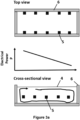
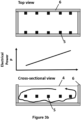
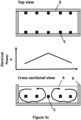
- Figures 3a-3c show schematically the flow profile of a glass melt which is created by different power input to the heating circuits of a melting vessel (6).
- five heating circuits each comprising two electrodes (5) are shown which are installed along the length of the melting vessel (6).
- the upper panel of the figures shows the melting vessel (6) with the electrodes (5) installed on its side walls in a top view.
- the electrodes (5) are connected as pairs with the electrodes (5) on the opposite wall thus forming the five heating circuits.
- the assumed flow direction of the glass melt is in the figure from left to right.
- the middle panel of the Figures 3a-3c shows a graph indicating the electrical power input P into the heating circuits along the melting vessel (6).
- the heating energy supplied to the melt thus continuously decreases over the length of the melting vessel (6).
- the heating energy supplied to the melt continuously increases over the length of the melting vessel (6).
- the heating energy supplied to the melt continuously increases until the middle of the length of the melting vessel (6) and thereafter continuously decreases again until the end of the melting vessel (6).
- the lower panel of the Figures 3a-3c shows the melting vessel (6) in a cross-sectional side view.
- the electrodes (5) are arranged horizontally on the walls at a position slightly below the middle of the distance between the floor of the melting vessel (6) and the surface of the glass melt (4).
- the symbolic square is only indicative of the position but not of the actual length of the electrodes (5) relative to the size of the melting vessel (6).
- the arrows indicate the flow profile created in the melt.
- the melt will have a hotter front end of the melting vessel (left side in the figure) the back end due to the higher power being provided there to the electrodes (5).
- the melt will have a lower density there and start to rise while the colder and denser melt from the back end of the melting vessel (right side in the figure) starts to flow to the front end and sublayer it. Consequently, there is created a (in the figure) clockwise rotation of the flow of the glass melt, i.e., a circular flow within the melting vessel (6) from front to back on the upper side of the glass melt near the surface of the glass melt (4) and from back to front near the floor of the melting vessel (6).
Landscapes
- Chemical & Material Sciences (AREA)
- Engineering & Computer Science (AREA)
- Materials Engineering (AREA)
- Organic Chemistry (AREA)
- Physics & Mathematics (AREA)
- Thermal Sciences (AREA)
- Chemical Kinetics & Catalysis (AREA)
- Electrochemistry (AREA)
- Glass Melting And Manufacturing (AREA)
Priority Applications (2)
| Application Number | Priority Date | Filing Date | Title |
|---|---|---|---|
| EP23200853.2A EP4530261A1 (de) | 2023-09-29 | 2023-09-29 | Verfahren und vorrichtung zur herstellung eines glasprodukts |
| PCT/EP2024/077084 WO2025068382A1 (en) | 2023-09-29 | 2024-09-26 | Method and apparatus for making a glass product |
Applications Claiming Priority (1)
| Application Number | Priority Date | Filing Date | Title |
|---|---|---|---|
| EP23200853.2A EP4530261A1 (de) | 2023-09-29 | 2023-09-29 | Verfahren und vorrichtung zur herstellung eines glasprodukts |
Publications (1)
| Publication Number | Publication Date |
|---|---|
| EP4530261A1 true EP4530261A1 (de) | 2025-04-02 |
Family
ID=88238087
Family Applications (1)
| Application Number | Title | Priority Date | Filing Date |
|---|---|---|---|
| EP23200853.2A Withdrawn EP4530261A1 (de) | 2023-09-29 | 2023-09-29 | Verfahren und vorrichtung zur herstellung eines glasprodukts |
Country Status (2)
| Country | Link |
|---|---|
| EP (1) | EP4530261A1 (de) |
| WO (1) | WO2025068382A1 (de) |
Citations (13)
| Publication number | Priority date | Publication date | Assignee | Title |
|---|---|---|---|---|
| US3818112A (en) * | 1973-04-30 | 1974-06-18 | Corhart Refractories Co | Electrical furnace for melting glass |
| US4211887A (en) | 1978-10-25 | 1980-07-08 | Owens-Corning Fiberglas Corporation | Electrical furnace, zones balanced with a symmetrically tapped transformer |
| US4600426A (en) * | 1984-10-01 | 1986-07-15 | Ppg Industries, Inc. | Metering device for molten glass and the like |
| JPH09208228A (ja) | 1996-01-31 | 1997-08-12 | Toshiba Glass Co Ltd | 電気加熱式ガラス溶融炉 |
| JPH09315824A (ja) | 1996-05-31 | 1997-12-09 | Asahi Glass Co Ltd | ガラス溶融用タンク窯とその加熱方法 |
| EP0812809A2 (de) * | 1996-06-12 | 1997-12-17 | Praxair Technology, Inc. | Verfahren zur Verminderung von toxischen Emissionen von Glasschmelzöfen durch Einsatz von Wasser für den Läuterprozess |
| US5922097A (en) * | 1996-06-12 | 1999-07-13 | Praxair Technology, Inc. | Water enhanced fining process a method to reduce toxic emissions from glass melting furnaces |
| US20020131555A1 (en) * | 2001-03-15 | 2002-09-19 | Ray Fleming | Apparatus for producing vacuum arc discharges |
| CZ24918U1 (cs) | 2012-09-05 | 2013-02-11 | Vysoká skola chemicko - technologická v Praze | Sklářská tavící pec pro kontinuální tavení skel řízenou konvekcí skloviny |
| US20130279532A1 (en) * | 2010-10-14 | 2013-10-24 | Schott Ag | Energy efficient high-temperature refining |
| WO2014036979A1 (en) | 2012-09-05 | 2014-03-13 | Vysoká škola chemicko-technologická v Praze | Method for continuous glass melting under controlled convection of glass melt and glass melting furnace for making the same |
| JP2017214272A (ja) * | 2016-04-25 | 2017-12-07 | ショット アクチエンゲゼルシャフトSchott AG | 気泡形成を回避しつつガラス溶融物からガラス製品を製造するための装置および方法 |
| DE102018122017A1 (de) | 2017-09-08 | 2019-03-14 | Glass Service, A.S. | Schmelzraum eines kontinuierlichen Glasschmelzofens und Verfahren zum Glasschmelzen in diesem Schmelzraum |
-
2023
- 2023-09-29 EP EP23200853.2A patent/EP4530261A1/de not_active Withdrawn
-
2024
- 2024-09-26 WO PCT/EP2024/077084 patent/WO2025068382A1/en not_active Ceased
Patent Citations (13)
| Publication number | Priority date | Publication date | Assignee | Title |
|---|---|---|---|---|
| US3818112A (en) * | 1973-04-30 | 1974-06-18 | Corhart Refractories Co | Electrical furnace for melting glass |
| US4211887A (en) | 1978-10-25 | 1980-07-08 | Owens-Corning Fiberglas Corporation | Electrical furnace, zones balanced with a symmetrically tapped transformer |
| US4600426A (en) * | 1984-10-01 | 1986-07-15 | Ppg Industries, Inc. | Metering device for molten glass and the like |
| JPH09208228A (ja) | 1996-01-31 | 1997-08-12 | Toshiba Glass Co Ltd | 電気加熱式ガラス溶融炉 |
| JPH09315824A (ja) | 1996-05-31 | 1997-12-09 | Asahi Glass Co Ltd | ガラス溶融用タンク窯とその加熱方法 |
| US5922097A (en) * | 1996-06-12 | 1999-07-13 | Praxair Technology, Inc. | Water enhanced fining process a method to reduce toxic emissions from glass melting furnaces |
| EP0812809A2 (de) * | 1996-06-12 | 1997-12-17 | Praxair Technology, Inc. | Verfahren zur Verminderung von toxischen Emissionen von Glasschmelzöfen durch Einsatz von Wasser für den Läuterprozess |
| US20020131555A1 (en) * | 2001-03-15 | 2002-09-19 | Ray Fleming | Apparatus for producing vacuum arc discharges |
| US20130279532A1 (en) * | 2010-10-14 | 2013-10-24 | Schott Ag | Energy efficient high-temperature refining |
| CZ24918U1 (cs) | 2012-09-05 | 2013-02-11 | Vysoká skola chemicko - technologická v Praze | Sklářská tavící pec pro kontinuální tavení skel řízenou konvekcí skloviny |
| WO2014036979A1 (en) | 2012-09-05 | 2014-03-13 | Vysoká škola chemicko-technologická v Praze | Method for continuous glass melting under controlled convection of glass melt and glass melting furnace for making the same |
| JP2017214272A (ja) * | 2016-04-25 | 2017-12-07 | ショット アクチエンゲゼルシャフトSchott AG | 気泡形成を回避しつつガラス溶融物からガラス製品を製造するための装置および方法 |
| DE102018122017A1 (de) | 2017-09-08 | 2019-03-14 | Glass Service, A.S. | Schmelzraum eines kontinuierlichen Glasschmelzofens und Verfahren zum Glasschmelzen in diesem Schmelzraum |
Also Published As
| Publication number | Publication date |
|---|---|
| WO2025068382A1 (en) | 2025-04-03 |
Similar Documents
| Publication | Publication Date | Title |
|---|---|---|
| US6085551A (en) | Method and apparatus for manufacturing high melting point glasses with volatile components | |
| US8424342B2 (en) | Melting and refining in tanks with cooled walls | |
| JP5397371B2 (ja) | 溶融ガラス製造装置およびそれを用いた溶融ガラス製造方法 | |
| CN1777563B (zh) | 使用熔融玻璃混合物生产玻璃的方法 | |
| US8544298B2 (en) | Glass-melting furnace, process for producing molten glass, apparatus for producing glass products and process for producing glass products | |
| JPWO2014083923A1 (ja) | ガラス基板の製造方法 | |
| US20240092672A1 (en) | Method and apparatus for making a glass product and corresponding glass product | |
| EP4570764A1 (de) | Verfahren und vorrichtung zur herstellung eines glasprodukts | |
| WO2025068382A1 (en) | Method and apparatus for making a glass product | |
| US20240010539A1 (en) | Method of making high quality glass products from high viscosity melts | |
| WO2025125352A1 (en) | Method and apparatus for making a glass product | |
| US20120272685A1 (en) | Melting method and apparatus | |
| EP4530264B1 (de) | Steigrohr für ein läutergefäss und verfahren zum läutern einer glasschmelze | |
| EP4530263B1 (de) | Schmelzgefäss zum schmelzen von glas und verfahren zur herstellung einer glasschmelze | |
| EP4345069A1 (de) | Gefässsystem zur herstellung und läuterung einer glasschmelze und verfahren zur herstellung und läuterung einer glasschmelze | |
| JPS5832030A (ja) | ガラスの電気溶融炉 | |
| EP4570763B1 (de) | Verfahren und gefäss zum elektrischen beheizen einer glasschmelze | |
| JP7159972B2 (ja) | 溶融ガラス搬送装置、ガラス製造装置及びガラス製造方法 | |
| EP4530262A1 (de) | Läutergefäss zum läutern einer glasschmelze und verfahren zum läutern einer glasschmelze | |
| WO2025068384A1 (en) | A vessel system for producing and refining a glass melt, and method for producing and refining a glass melt | |
| EP4574777B1 (de) | Glasschmelzofen mit elektrischer beheizung und verfahren zum erhitzen einer glasschmelze | |
| WO2024251566A1 (en) | Glass melting process with low co2 emission | |
| JP2005060194A (ja) | 光学ガラスの製造方法 | |
| WO2025196235A1 (en) | Glass furnace | |
| WO2022069284A1 (en) | Integrated bubbling nozzle and method of zone homogenization of glass melt during melting using the same |
Legal Events
| Date | Code | Title | Description |
|---|---|---|---|
| STAA | Information on the status of an ep patent application or granted ep patent |
Free format text: STATUS: EXAMINATION IS IN PROGRESS |
|
| PUAI | Public reference made under article 153(3) epc to a published international application that has entered the european phase |
Free format text: ORIGINAL CODE: 0009012 |
|
| 17P | Request for examination filed |
Effective date: 20231002 |
|
| AK | Designated contracting states |
Kind code of ref document: A1 Designated state(s): AL AT BE BG CH CY CZ DE DK EE ES FI FR GB GR HR HU IE IS IT LI LT LU LV MC ME MK MT NL NO PL PT RO RS SE SI SK SM TR |
|
| STAA | Information on the status of an ep patent application or granted ep patent |
Free format text: STATUS: THE APPLICATION IS DEEMED TO BE WITHDRAWN |
|
| 18D | Application deemed to be withdrawn |
Effective date: 20251003 |
|
| P01 | Opt-out of the competence of the unified patent court (upc) registered |
Free format text: CASE NUMBER: UPC_APP_0006221_4530261/2026 Effective date: 20260219 |