EP4528339A1 - Antireflexfilm - Google Patents
Antireflexfilm Download PDFInfo
- Publication number
- EP4528339A1 EP4528339A1 EP23903488.7A EP23903488A EP4528339A1 EP 4528339 A1 EP4528339 A1 EP 4528339A1 EP 23903488 A EP23903488 A EP 23903488A EP 4528339 A1 EP4528339 A1 EP 4528339A1
- Authority
- EP
- European Patent Office
- Prior art keywords
- meth
- refractive
- acrylate
- low
- layer
- Prior art date
- Legal status (The legal status is an assumption and is not a legal conclusion. Google has not performed a legal analysis and makes no representation as to the accuracy of the status listed.)
- Pending
Links
Images


Classifications
-
- G—PHYSICS
- G02—OPTICS
- G02B—OPTICAL ELEMENTS, SYSTEMS OR APPARATUS
- G02B1/00—Optical elements characterised by the material of which they are made; Optical coatings for optical elements
- G02B1/10—Optical coatings produced by application to, or surface treatment of, optical elements
- G02B1/11—Anti-reflection coatings
- G02B1/111—Anti-reflection coatings using layers comprising organic materials
-
- G—PHYSICS
- G02—OPTICS
- G02B—OPTICAL ELEMENTS, SYSTEMS OR APPARATUS
- G02B1/00—Optical elements characterised by the material of which they are made; Optical coatings for optical elements
- G02B1/10—Optical coatings produced by application to, or surface treatment of, optical elements
- G02B1/11—Anti-reflection coatings
- G02B1/113—Anti-reflection coatings using inorganic layer materials only
- G02B1/115—Multilayers
-
- B—PERFORMING OPERATIONS; TRANSPORTING
- B32—LAYERED PRODUCTS
- B32B—LAYERED PRODUCTS, i.e. PRODUCTS BUILT-UP OF STRATA OF FLAT OR NON-FLAT, e.g. CELLULAR OR HONEYCOMB, FORM
- B32B27/00—Layered products comprising a layer of synthetic resin
- B32B27/06—Layered products comprising a layer of synthetic resin as the main or only constituent of a layer, which is next to another layer of the same or of a different material
- B32B27/08—Layered products comprising a layer of synthetic resin as the main or only constituent of a layer, which is next to another layer of the same or of a different material of synthetic resin
-
- B—PERFORMING OPERATIONS; TRANSPORTING
- B32—LAYERED PRODUCTS
- B32B—LAYERED PRODUCTS, i.e. PRODUCTS BUILT-UP OF STRATA OF FLAT OR NON-FLAT, e.g. CELLULAR OR HONEYCOMB, FORM
- B32B27/00—Layered products comprising a layer of synthetic resin
- B32B27/16—Layered products comprising a layer of synthetic resin specially treated, e.g. irradiated
-
- B—PERFORMING OPERATIONS; TRANSPORTING
- B32—LAYERED PRODUCTS
- B32B—LAYERED PRODUCTS, i.e. PRODUCTS BUILT-UP OF STRATA OF FLAT OR NON-FLAT, e.g. CELLULAR OR HONEYCOMB, FORM
- B32B27/00—Layered products comprising a layer of synthetic resin
- B32B27/18—Layered products comprising a layer of synthetic resin characterised by the use of special additives
-
- B—PERFORMING OPERATIONS; TRANSPORTING
- B32—LAYERED PRODUCTS
- B32B—LAYERED PRODUCTS, i.e. PRODUCTS BUILT-UP OF STRATA OF FLAT OR NON-FLAT, e.g. CELLULAR OR HONEYCOMB, FORM
- B32B27/00—Layered products comprising a layer of synthetic resin
- B32B27/18—Layered products comprising a layer of synthetic resin characterised by the use of special additives
- B32B27/20—Layered products comprising a layer of synthetic resin characterised by the use of special additives using fillers, pigments, thixotroping agents
-
- B—PERFORMING OPERATIONS; TRANSPORTING
- B32—LAYERED PRODUCTS
- B32B—LAYERED PRODUCTS, i.e. PRODUCTS BUILT-UP OF STRATA OF FLAT OR NON-FLAT, e.g. CELLULAR OR HONEYCOMB, FORM
- B32B27/00—Layered products comprising a layer of synthetic resin
- B32B27/30—Layered products comprising a layer of synthetic resin comprising vinyl (co)polymers; comprising acrylic (co)polymers
-
- B—PERFORMING OPERATIONS; TRANSPORTING
- B32—LAYERED PRODUCTS
- B32B—LAYERED PRODUCTS, i.e. PRODUCTS BUILT-UP OF STRATA OF FLAT OR NON-FLAT, e.g. CELLULAR OR HONEYCOMB, FORM
- B32B27/00—Layered products comprising a layer of synthetic resin
- B32B27/30—Layered products comprising a layer of synthetic resin comprising vinyl (co)polymers; comprising acrylic (co)polymers
- B32B27/308—Layered products comprising a layer of synthetic resin comprising vinyl (co)polymers; comprising acrylic (co)polymers comprising acrylic (co)polymers
-
- B—PERFORMING OPERATIONS; TRANSPORTING
- B32—LAYERED PRODUCTS
- B32B—LAYERED PRODUCTS, i.e. PRODUCTS BUILT-UP OF STRATA OF FLAT OR NON-FLAT, e.g. CELLULAR OR HONEYCOMB, FORM
- B32B7/00—Layered products characterised by the relation between layers; Layered products characterised by the relative orientation of features between layers, or by the relative values of a measurable parameter between layers, i.e. products comprising layers having different physical, chemical or physicochemical properties; Layered products characterised by the interconnection of layers
- B32B7/02—Physical, chemical or physicochemical properties
- B32B7/023—Optical properties
-
- G—PHYSICS
- G02—OPTICS
- G02B—OPTICAL ELEMENTS, SYSTEMS OR APPARATUS
- G02B1/00—Optical elements characterised by the material of which they are made; Optical coatings for optical elements
- G02B1/10—Optical coatings produced by application to, or surface treatment of, optical elements
- G02B1/18—Coatings for keeping optical surfaces clean, e.g. hydrophobic or photo-catalytic films
-
- B—PERFORMING OPERATIONS; TRANSPORTING
- B32—LAYERED PRODUCTS
- B32B—LAYERED PRODUCTS, i.e. PRODUCTS BUILT-UP OF STRATA OF FLAT OR NON-FLAT, e.g. CELLULAR OR HONEYCOMB, FORM
- B32B2255/00—Coating on the layer surface
- B32B2255/10—Coating on the layer surface on synthetic resin layer or on natural or synthetic rubber layer
-
- B—PERFORMING OPERATIONS; TRANSPORTING
- B32—LAYERED PRODUCTS
- B32B—LAYERED PRODUCTS, i.e. PRODUCTS BUILT-UP OF STRATA OF FLAT OR NON-FLAT, e.g. CELLULAR OR HONEYCOMB, FORM
- B32B2255/00—Coating on the layer surface
- B32B2255/26—Polymeric coating
-
- B—PERFORMING OPERATIONS; TRANSPORTING
- B32—LAYERED PRODUCTS
- B32B—LAYERED PRODUCTS, i.e. PRODUCTS BUILT-UP OF STRATA OF FLAT OR NON-FLAT, e.g. CELLULAR OR HONEYCOMB, FORM
- B32B2457/00—Electrical equipment
- B32B2457/20—Displays, e.g. liquid crystal displays, plasma displays
-
- G—PHYSICS
- G02—OPTICS
- G02B—OPTICAL ELEMENTS, SYSTEMS OR APPARATUS
- G02B1/00—Optical elements characterised by the material of which they are made; Optical coatings for optical elements
- G02B1/10—Optical coatings produced by application to, or surface treatment of, optical elements
- G02B1/14—Protective coatings, e.g. hard coatings
-
- G—PHYSICS
- G02—OPTICS
- G02B—OPTICAL ELEMENTS, SYSTEMS OR APPARATUS
- G02B2207/00—Coding scheme for general features or characteristics of optical elements and systems of subclass G02B, but not including elements and systems which would be classified in G02B6/00 and subgroups
- G02B2207/107—Porous materials, e.g. for reducing the refractive index
Definitions
- the present invention relates to an antireflection film, and more specifically relates to an antireflection film suitably used for a display surface such as a liquid crystal display, an organic EL display, and a touch panel of a smartphone.
- An antireflection film is sometimes placed on a surface of a display provided on a liquid crystal display, an organic EL display, a touch panel of a smartphone to prevent external light from being reflected by the screen.
- a film that includes a hard coat layer and an antireflection layer (i.e., a low-refractive-index layer) in this order on a substrate film is known.
- Patent Document 1 filed by the present applicant, discloses that antireflection properties, scratch resistance, and antifouling properties of an antireflection film are improved through consideration of a composition of a low-refractive-index layer covering a surface of a hard coat layer.
- a fluorine-containing compound is contained in the low-refractive-index layer, which contributes to improvement of the antifouling properties.
- Patent Document 1 WO 2021/020504 A
- an antireflection film particularly the one touched frequently by fingers, such as an antireflection film placed on the surface of the touch panel, is required to have high antifouling properties.
- the antifouling properties of the antireflection film can be improved by adding an ingredient having antifouling effects, such as a fluorine-containing compound, to the low-refractive-index layer constituting the antireflection film.
- an antifouling layer containing the ingredient having the antifouling effects may be provided as a layer independent from the low-refractive-index layer on the surface of the low-refractive-index layer.
- the antifouling properties may not be sufficiently high, or the antifouling properties may decrease due to wear of a surface of the antifouling layer as a result of repeated contact with fingers.
- the film For the antireflection film that is touched frequently by fingers, it is important that the film has high scratch resistance and high wear durability in addition to having high antireflection and antifouling properties, from the viewpoint of durability during use.
- the antireflection film particularly the one touched frequently by fingers, such as an antireflection film placed on the surface of the touch panel, is frequently wiped with solvent such as alcohol for cleaning and sterilization.
- solvent such as alcohol for cleaning and sterilization.
- the conventional antireflection film has problems in that the surface thereof can be worn and the antifouling properties are reduced if the surface of the antireflection film is wiped off with a cloth wet with alcohol or repeatedly operated with fingers wet with alcohol.
- An objective of the present disclosure is to provide an antireflection film with excellent scratch resistance, as well as high antifouling properties and wear durability, and also having solvent resistance sufficient to withstand friction with a cloth or fingers wet with solvent such as alcohol.
- an antireflection film according to the present invention has the following configuration:
- the first antireflection film according to the present invention having the structure of embodiment [1] includes the substrate film, the hard coat layer covering the surface of the substrate film, and the low-refractive-index layer covering the surface of the hard coat layer.
- the low-refractive-index layer contains the cured product of the ionizing radiation curable composition including the (meth)acrylate compound including the reactive group, the hollow silica particles, and the alumina particles surface-treated with the silane coupling agent including the reactive group capable of bonding to the (meth)acrylate compound, and the antireflection film has the water contact angle of 100° or larger on the surface thereof.
- the antireflection film Since the low-refractive-index layer is formed of the cured product of the composition including not only the (meth)acrylate compound but also the alumina particles surface-treated with the silane coupling agent including the reactive group capable of bonding to the (meth)acrylate compound, the antireflection film has excellent scratch resistance, in addition to high antifouling properties and wear durability. Furthermore, since the antireflection film having the composition has the water contact angle of 100° or larger on the surface thereof, the antireflection film has high antifouling properties and solvent resistance sufficient to withstand the friction with a cloth or fingers wet with solvent such as alcohol.
- the ionizing radiation curable composition constituting the low-refractive-index layer further contains the fluorine-containing (meth)acrylate. Therefore, the antifouling properties and the solvent resistance of the surface of the antireflection film can be effectively improved.
- the second antireflection film of embodiment [3] mentioned above includes the substrate film, the hard coat layer covering the surface of the substrate film, the low-refractive-index layer covering the surface of the hard coat layer, and an antifouling layer covering a surface of the low-refractive-index layer.
- the low-refractive-index layer contains the cured product of the ionizing radiation curable composition including the (meth)acrylate compound including the reactive group, the hollow silica particles, the alumina particles surface-treated with the silane coupling agent including the reactive group capable of bonding to the (meth)acrylate compound.
- the antifouling layer contains the cured product of the ionizing radiation curable composition including the fluorine-containing (meth)acrylate, and the antireflection film has the water contact angle of 100° or larger on the surface thereof. Since the low-refractive-index layer is formed of the cured product of the composition containing not only the (meth)acrylate compound but also the alumina particles surface-treated with the silane coupling agent having the reactive group capable of bonding to the (meth)acrylate compound, and the surface of the low-refractive-index layer is covered with the antifouling layer formed of the cured product of the composition including the fluorine-containing (meth)acrylate, the antireflection film has excellent scratch resistance, as well as high antifouling properties and wear durability. Furthermore, since the antireflection film has the water contact angle of 100° or larger on the surface thereof, the antireflection film has high antifouling properties and solvent resistance sufficient to withstand the friction with a cloth or fingers wet with solvent such as alcohol.
- the amount of the fluorine-containing (meth)acrylate contained in the antifouling layer is 90 mass% or larger of the total solid content of the antifouling layer, which improves effectively the antifouling properties of the antireflection film.
- the low-refractive-index layer does not include the fluorine-containing (meth)acrylate, the scratch resistance of the antireflection film is enhanced effectively.
- refractive indexes of a substance and a layer of a substance refer to refractive indexes measured at a wavelength of 589.3 nm unless otherwise specified.
- FIG. 1 is a cross-sectional view of an antireflection film according to a first embodiment of the present invention.
- an antireflection film 10 according to the first embodiment of the present invention includes a substrate film 12, a hard coat layer 14 covering a surface of the substrate film 12, and a low-refractive-index layer 16 covering a surface of the hard coat layer 14.
- each of the layers mentioned above is layered in the order without any other layers being interposed therebetween.
- the low-refractive-index layer 16 is the layer exposed at the outermost surface of the antireflection film 10 as a whole.
- the substrate film 12 there is no particular limitation to the substrate film 12 as long as the substrate film 12 is transparent.
- the substrate film 12 include a transparent polymer film and a glass film.
- transparent means that a total light transmittance in a visible light wavelength range is 50% or higher, and the total light transmittance is more preferably 85% or higher. The total light transmittance can be measured in accordance with JIS K 7361-1 (1997).
- the preferable thickness of the substrate film 12 is not particularly limited, but is within a range of 2 ⁇ m or larger to 500 ⁇ m or smaller from the viewpoint of ease of handling. The thickness is more preferably within a range of 2 ⁇ m or larger to 200 ⁇ m or smaller.
- film commonly refers to a structure having a thickness smaller than 0.25 mm, but here the term also encompasses a film having a thickness of 0.25 mm or larger as long as the film can be wound into a roll.
- polyester resins such as polyethylene terephthalate resin and polyethylene naphthalate resin, polycarbonate resin, poly(meth)acrylate resin, polystyrene resin, polyamide resin, polyimide resin, polyacrylonitrile resin, polyolefin resin such as polypropylene resin, polyethylene resin, polycycloolefin resin, and cycloolefin copolymer resin, cellulose-based resins such as triacetyl cellulose resin and diacetyl cellulose resin, polyphenylene sulfide resin, polyvinyl chloride resin, polyvinylidene chloride resin, and polyvinyl alcohol resin.
- the substrate film 12 may be formed of any one of these polymer materials or a combination of two or more of these polymer materials.
- polyethylene terephthalate resin, polyimide resin, polycarbonate resin, poly(meth)acrylate resin, polycycloolefin resin, cycloolefin copolymer resin, and triacetyl cellulose resin are more preferable from the viewpoint of optical properties and durability.
- the substrate film 12 may be composed of a single layer that contains one or more of the polymer materials listed above, or two or more layers that include a layer containing one or more of the polymer materials listed above and a layer that contains one or more polymer materials different from those contained in the other layer.
- the hard coat layer 14 contributes to improvement of scratch resistance of the antireflection film 10.
- the hard coat layer 14 is formed of a cured product of an ionizing radiation curable composition containing a (meth)acrylate compound having a reactive group.
- ionizing radiation means electromagnetic waves or charged particle beams that have quantum energy sufficient to polymerize or crosslink molecules.
- the ionizing radiation include ultraviolet rays (i.e., UV), electromagnetic waves such as X-rays and y-rays, and charged particle beams such as electron beams (i.e., EB), ⁇ -rays, and ion beams.
- ultraviolet rays i.e., UV
- UV ultraviolet rays
- EB electron beams
- ⁇ -rays ⁇ -rays
- ion beams i.e., UV
- the ionizing radiation curable composition may be simply referred to as a curable composition.
- the term “(meth)acrylate” refers to "at least one of acrylate and methacrylate”.
- the term “(meth)acryloyl” refers to "at least one of acryloyl and methacryloyl”.
- the term “(meth)acryl” refers to "at least one of acryl and methacryl”.
- (meth)acrylate compound” refers to a compound including a (meth)acryloyl group such as a monomer, an oligomer, and a prepolymer.
- the (meth)acrylate compound may be simply referred to as (meth)acrylate.
- the (meth)acrylate either of a monofunctional (meth)acrylate and a multifunctional (meth)acrylate may be used. Furthermore, as the (meth)acrylate, a combination of a monofunctional (meth)acrylate and a multifunctional (meth)acrylate may be used.
- the curable composition more preferably contains the multifunctional (meth)acrylate as the (meth)acrylate from the viewpoint of improvement of curability.
- the (meth)acrylate examples include urethane (meth)acrylate, silicone (meth)acrylate, alkyl (meth)acrylate, and aryl (meth)acrylate.
- the urethane (meth)acrylate, especially urethane (meth)acrylate oligomer is preferable.
- Specific examples of the urethane (meth)acrylate include those obtained such that a polyisocyanate compound, a hydroxyl group-containing (meth)acrylate compound, and a polyol compound, if necessary, are reacted with one another.
- polyisocyanate compound examples include diisocyanate compounds such as hexamethylene diisocyanate, isophorone diisocyanate, tolylene diisocyanate, xylylene diisocyanate, and 4,4'-diphenylmethane diisocyanate, as well as nurate modified compounds, adduct modified compounds, and biuret modified compounds thereof.
- diisocyanate compounds such as hexamethylene diisocyanate, isophorone diisocyanate, tolylene diisocyanate, xylylene diisocyanate, and 4,4'-diphenylmethane diisocyanate, as well as nurate modified compounds, adduct modified compounds, and biuret modified compounds thereof.
- hydroxyl group-containing (meth)acrylate compound examples include hydroxyethyl (meth)acrylate, hydroxypropyl (meth)acrylate, trimethylolpropane diacrylate, pentaerythritol tri(meth)acrylate, dipentaerythritol penta(meth)acrylate, and polyoxyalkylene modified products and polylactone modified products thereof.
- the polyol compound examples include ethylene glycol, propylene glycol, butanediol, hexanediol, polyoxyethylene glycol, polyoxypropylene glycol, glycerin, trimethylolpropane, pentaerythritol, biphenol, and bisphenol.
- the curable composition for forming the hard coat layer 14 contains the urethane (meth)acrylate as an ultraviolet curable resin, the hard coat layer 14 has adequate flexibility. Therefore, the antireflection film 10 has high bending resistance and can be suitably used for flexible displays such as a foldable display and a rollable display that are repeatedly bent. Furthermore, cracking of the substrate film 12 is suppressed effectively even if the substrate film 12 is formed of polycycloolefin or a cycloolefin copolymer and is susceptible to cracking.
- the (meth)acrylate contained in the curable composition further contains a pentaerythritol (meth)acrylate compound.
- the pentaerythritol (meth)acrylate compound include pentaerythritol tri(meth)acrylate, pentaerythritol tetra(meth)acrylate, dipentaerythritol penta(meth)acrylate, dipentaerythritol hexa(meth)acrylate, tripentaerythritol tetra(meth)acrylate, tripentaerythritol penta(meth)acrylate, tripentaerythritol hexa(meth)acrylate, tripentaerythritol hepta(meth)acrylate, and tripentaerythritol octa(meth)acrylate.
- the curable composition contains the pentaerythritol tri(meth)acryl
- the curable composition for forming the hard coat layer 14 may contain a non-ultraviolet curable resin as necessary in addition to the ultraviolet curable resin. Furthermore, the curable composition for forming the hard coat layer 14 may contain a photopolymerization initiator. Furthermore, additives that can be generally added to the curable composition may be contained as necessary. Examples of such additives include a dispersant, a leveling agent, an antifoaming agent, a thixotropic agent, an antifouling agent, an antibacterial agent, a flame retardant, a slipping agent, an antistatic agent, inorganic particles, and resin particles. Furthermore, solvent may be contained as necessary.
- non-ultraviolet curable resin examples include thermoplastic resins and thermosetting resins.
- thermoplastic resins include polyester resin, polyether resin, polyolefin resin, and polyamide resin.
- thermosetting resins include unsaturated polyester resin, epoxy resin, alkyd resin, and phenolic resin.
- Examples of the photopolymerization initiator include an alkylphenone-based photopolymerization initiator, an acylphosphine oxide-based photopolymerization initiator, and an oxime ester-based photopolymerization initiator.
- Examples of the alkylphenone-based photopolymerization initiator include 2,2'-dimethoxy-1,2-diphenylethane-1-one, 1-hydroxy-cyclohexyl-phenyl-ketone, 2-hydroxy-2-methyl-1-phenyl-propane-1-one, 1-[4-(2-hydroxyethoxy)-phenyl]-2-hydroxy-2-methyl-1-propane-1-one, 2-hydroxy-1- ⁇ 4-[4-(2-hydroxy-2-methyl-propionyl)-benzyl]phenyl ⁇ -2-methyl-propane-1-one, 2-methyl-1-[4-(methylthio)phenyl]-2-morpholinopropane-1-one, 2-benzylmethyl-2-(dimethylamino
- acylphosphine oxide-based photopolymerization initiator examples include 2,4,6-trimethylbenzoyl diphenylphosphine oxide, bis(2,4,6-trimethylbenzoyl)-phenylphosphine oxide, and bis(2,6-dimethoxybenzoyl)-2,4,4-trimethyl-pentylphosphine oxide.
- oxime ester-based photopolymerization initiator examples include 1,2-octanedion, 1-[4-(phenylthio)phenyl]-2-(O-benzoyloxime), and ethanone-1-[9-ethyl-6-(2-methylbenzoyl)-9H-carbazol-3-yl]-1-(O-acetyloxime). Any one of or a combination of two or more of these may be used as the photopolymerization initiator.
- the amount of the photopolymerization initiator is preferably within a range of 0.1 mass% or larger to 10 mass% of a total solid content of the curable composition.
- the amount of the photopolymerization initiator is more preferably 1 mass% or larger and 5 mass% or smaller.
- the inorganic particles and the resin particles may be added to the hard coat layer 14 to prevent blocking of the hard coat layer 14 or adjust the refractive index of the hard coat layer 14.
- Examples of the inorganic particles that can be used for adjustment of the refractive index of the hard coat layer 14 include metal oxide particles that are made of oxides of a metal such as titanium, zirconium, tin, zinc, silicon, niobium, aluminum, chromium, magnesium, germanium, gallium, antimony, and platinum. Particles of any one of or a combination of two or more of these metal oxides may be used as inorganic particles for optical adjustment.
- titanium oxide and zirconium oxide are particularly preferable from the viewpoint of achieving both the high refractive index and transparency.
- the resin particles include resin particles that are made of resins such as (meth)acrylic resin, styrene resin, styrene-(meth)acrylic resin, urethane resin, polyamide resin, silicone resin, epoxy resin, phenolic resin, polyethylene resin, and cellulose. Particles of any one of or a combination of two or more of these resins may be used as the resin particles.
- resins such as (meth)acrylic resin, styrene resin, styrene-(meth)acrylic resin, urethane resin, polyamide resin, silicone resin, epoxy resin, phenolic resin, polyethylene resin, and cellulose. Particles of any one of or a combination of two or more of these resins may be used as the resin particles.
- the thickness of the hard coat layer 14 is not particularly limited, but is preferably 0.5 ⁇ m or larger from the viewpoint of making the hard coat layer 14 sufficiently hard.
- the thickness is more preferably 0.75 ⁇ m or larger.
- the thickness is preferably 20 ⁇ m or smaller from the viewpoint of suppressing curling of the hard coat layer 14 due to a difference in thermal contraction between the hard coat layer 14 and the substrate film 12.
- the thickness is more preferably 10 ⁇ m or smaller.
- the thickness of the hard coat layer 14 refers to the thickness of a relatively smooth portion in a region of the hard coat layer where there are no irregularities in the thickness direction formed by the inorganic particles or resin particles.
- the refractive index of the hard coat layer 14 is preferably within the range of 1.49 or higher and 1.56 or lower from the viewpoint of suppressing interference unevenness caused by the difference in refractive index between the substrate film 12 and the hard coat layer 14.
- An arithmetic average roughness Ra of the surface of the hard coat layer 14 in which surface irregularities are formed is preferably within a range of 0.3 nm or higher to 20 nm or lower from the viewpoint of suppressing blocking, for example.
- the arithmetic average roughness Ra is more preferably within a range of 0.5 nm or higher to 10 nm or lower.
- Examples of the solvent that can be used in the curable composition for forming the hard coat layer 14 include alcohol-based solvents such as ethanol, isopropyl alcohol (IPA), n-butyl alcohol (NBA), ethylene glycol monomethyl ether (EGM), ethylene glycol monoisopropyl ether (IPG), propylene glycol monomethyl ether (PGM), and diethylene glycol monobutyl ether, ketone-based solvents such as methyl ethyl ketone (MEK), methyl isobutyl ketone (MIBK), cyclohexanone, and acetone, aromatic solvents such as toluene and xylene, ester-based solvents such as ethyl acetate (EtAc), propyl acetate, isopropyl acetate, and butyl acetate (BuAc), and amide-based solvents such as N-methylpyrrolidone, acetamide, and dimethylformamide.
- the solid content concentration (i.e., concentration of ingredients other than the solvent) of the curable composition may be set as appropriate by taking ease of coating, and the film thickness into consideration.
- the solid content concentration can be set to 1 mass% or higher and 90 mass% or lower, 1.5 mass% or higher and 80 mass% or lower, or 2 mass% or higher and 70 mass% or lower.
- a low-refractive-index layer 16 covers the surface of the hard coat layer 14 as an antireflection layer.
- the low-refractive-index layer 16 has a lower refractive index than the hard coat layer 14, and expresses antireflection effects due to a difference in refractive index with the hard coat layer 14.
- the low-refractive-index layer 16 contains the cured product of the ionizing radiation curable composition containing the (meth)acrylate compound having the reactive group as a binder resin, the alumina particles surface-treated with a silane coupling agent having the reactive group capable of bonding to the (meth) acrylate compound, and the hollow silica particles.
- the ionizing radiation includes various electromagnetic waves and charged particle beams as explained above for the hard coat layer 14, the low-refractive-index layer 16 is preferably formed by a cured product of an ultraviolet (i.e., UV) curable composition.
- the reactive group contained in the (meth)acrylate compound and the silane coupling agent is preferably ultraviolet reactive. Preferable ingredients of the compositions will be described below.
- Examples of the (meth)acrylate compound containing the reactive group include urethane (meth)acrylate, silicone (meth)acrylate, alkyl (meth)acrylate, and aryl (meth)acrylate.
- the (meth)acrylate compound may contain only the (meth)acryloyl group as the reactive group or may contain other reactive groups in addition to the (meth)acryloyl group.
- the (meth)acrylate either of a monofunctional (meth)acrylate and a multifunctional (meth)acrylate may be used. Furthermore, as the (meth)acrylate, a combination of a monofunctional (meth)acrylate and a multifunctional (meth)acrylate may be used. As the (meth) acrylate, the multifunctional (meth)acrylate is more preferably included.
- Examples of the monofunctional (meth)acrylate include methyl (meth)acrylate, ethyl (meth)acrylate, propyl (meth)acrylate, isopropyl (meth)acrylate, butyl (meth)acrylate, amyl (meth)acrylate, isobutyl (meth)acrylate, t-butyl (meth)acrylate, pentyl (meth)acrylate, isoamyl (meth)acrylate, hexyl (meth)acrylate, heptyl (meth)acrylate, octyl (meth)acrylate, isooctyl (meth)acrylate, 2-ethylhexyl (meth)acrylate, nonyl (meth)acrylate, decyl (meth)acrylate, isodecyl (meth)acrylate, undecyl (meth)acrylate, dodecyl (meth)acrylate, lauryl (meth)
- multifunctional (meth)acrylate examples include bifunctional (meth)acrylates, trifunctional (meth)acrylates, and tetrafunctional (meth)acrylates. More specific examples include 1,4-butanediol di(meth)acrylate, 1,6-hexanediol di(meth)acrylate, 1,9-nonanediol di(meth)acrylate, ethylene glycol di(meth)acrylate, diethylene glycol di(meth)acrylate, neopentyl glycol di(meth)acrylate, triethylene glycol di(meth)acrylate, tetraethylene glycol di(meth)acrylate, polyethylene glycol di(meth)acrylate, trimethylolpropane tri(meth)acrylate, pentaerythritol tri(meth)acrylate, pentaerythritol tetra(meth)acrylate, dipentaerythritol penta(meth)acrylate, dip
- any one of or a combination of two or more of the (meth)acrylates listed above may be used as the (meth)acrylate compound contained in the curable composition. It is preferable that pentafunctional or higher (meth)acrylate is contained in the (meth)acrylate compound forming the cured composition from the viewpoint of improving the scratch resistance, and it is preferable that the ratio of the multifunctional (meth)acrylate having five or more functional groups is higher.
- the multifunctional (meth)acrylate includes a dimer.
- a dimer of the multifunctional (meth)acrylate has an excellent curing rate and can increase easily the curing ratio of the curable composition, and accordingly, can further improve the scratch resistance.
- the multifunctional (meth)acrylate contains at least one selected from the group consisting of dimers of pentaerythritol tri(meth)acrylate, dipentaerythritol penta(meth)acrylate, and dipentaerythritol hexa(meth)acrylate, and it is more preferable that the multifunctional (meth)acrylate contains at least one selected from the group consisting of dimers of pentaerythritol triacrylate, dipentaerythritol pentaacrylate, and dipentaerythritol hexaacrylate.
- the amount of the dimer is preferably within a range of 25 mass% or larger to 50 mass% or smaller of a total solid content of the multifunctional (meth)acrylate from the viewpoint of the scratch resistance, transparency, and solubility in a solvent.
- the amount of the dimer is more preferably 30 mass% or larger and 40 mass% or smaller.
- the curable composition for forming the low-refractive-index layer 16 may contain a fluorine-containing (meth)acrylate as a part of the (meth)acrylate compound containing the reactive group.
- the compound can impart high antifouling properties to the antireflection film 10.
- Specific examples of the fluorine-containing (meth)acrylate include a (meth)acrylates containing a perfluoropolyether group.
- the perfluoropolyether group correspond to a compound in which all hydrogen atoms of a polyester such as polyethylene glycol or polypropylene glycol are replaced with fluorine atoms, and examples of such a group include a group having a repeated structure of any one of perfluoromethylene oxide, (-CF 2 O-), perfluoroethylene oxide (-CF 2 CF 2 O-), perfluoropropylene oxide (-CF 2 CF 2 CF 2 O-), or perfluoroisopropylene oxide (-CF(CF 3 )CF 2 O-), or a fluoropolyether group having a repeated structure of a combination of a plurality of these.
- the number of repeating units included in the repeating structure is preferably 1 to 100.
- Examples of such compounds include “KY-1203”, “KY-1207”, “KY-1211”, “KY-1216”, and “KY-1240", manufactured by Shin-Etsu Chemical Co., Ltd., “MEGAFACE RS-75”, manufactured by DIC Corporation, “OPTOOL DAC-HP”, and “OPTOOL DAC-100”, manufactured by Daikin Industries, Ltd., and “FTERGENT 601AD”, and “ FTERGENT 601ADH2", manufactured by NEOS COMPANY LIMITED.
- the fluorine-containing (meth)acrylates described above can suppress adhesion of dirt and fingerprints and facilitate removal of the dirt and fingerprints.
- the fluorine-containing (meth)acrylate does not have a urethane bond in its structure.
- the absence of the urethane bond in the structure of the fluorine-containing (meth)acrylate increases hardness of the low-refractive-index layer 16, which provides the low-refractive-index layer 16 particularly high wear durability.
- the amount of the fluorine-containing (meth)acrylate contained in the low-refractive-index layer 16 is preferably 1.0 mass% or larger and 15.0 mass% or smaller relative to 100 mass% of the solid content of the low-refractive-index layer 16. If the amount of the fluorine-containing compound contained in the low-refractive-index layer 16 is 1.0 mass% or larger relative to 100 mass% of the solid content of the low-refractive-index layer 16, slipperiness of a surface of the low-refractive-index layer 16 is improved and the scratch resistance is improved. Furthermore, the antifouling properties are improved.
- the amount of the fluorine-containing (meth)acrylate contained in the low-refractive-index layer 16 is more preferably 3.0 mass% or larger, and further preferably 5.0 mass% or larger relative to 100 mass% of the solid content of the low-refractive-index layer 16.
- the amount of the fluorine-containing (meth)acrylate contained in the low-refractive-index layer 16 is 15.0 mass% or smaller relative to 100 mass% of the solid content of the low-refractive-index layer 16, a reduction in the scratch resistance can be suppressed.
- the amount of the fluorine-containing (meth)acrylate contained in the low-refractive-index layer 16 is more preferably 13.0 mass% or smaller, and further preferably 10.0 mass% or smaller relative to 100 mass% of the solid content of the low-refractive-index layer 16.
- the term "solid content of the low-refractive-index layer 16" used herein refers to ingredients other than ingredients that are liquid at normal temperature and are not fixed in the binder resin in the low-refractive-index layer 16.
- the solid content of the low-refractive-index layer 16 includes the alumina particles, the hollow silica particles, and the binder resin.
- the solid content does not include an oil ingredient that is used as an additive, nor a surfactant that is not fixed to the binder resin.
- the alumina particles contained in the low-refractive-index layer 16 form convex portions on the surface of the low-refractive-index layer 16.
- the low-refractive-index layer 16 can have favorable scratch resistance due to the convex portions formed on the surface of the low-refractive-index layer 16 by the alumina particles.
- the alumina particles may be filled particles or hollow particles, but are preferably the filled particles.
- the filled particles are particles that do not substantially include cavities therein, and a ratio of the cavities in the filled particles is lower than 5% of the volume of the filled particles.
- the hollow particles are particles that include cavities therein, and a ratio of the cavities in the hollow particles is higher than 5%. If the alumina particles are filled particles, the scratch resistance of the low-refractive-index layer 16 is more improved, and the scratch resistance of the antireflection film 10 is more improved. On the other hand, if the alumina particles are hollow particles, it is possible to reduce the refractive index of the low-refractive-index layer 16 and to suppress reflection of light.
- the ratio of the cavities in the hollow particles is preferably 10% or higher and 80% or lower of the volume of the hollow particles. If the ratio of the cavities is 10% or higher, it is possible to reduce the refractive index and to suppress reflection of light effectively. The ratio is more preferably 20% or higher, and further preferably 30% or higher. On the other hand, if the ratio of the cavities is 80% or lower, it is possible to suppress reduction in dispersibility of the alumina particles. The ratio is more preferably 60% or lower.
- each alumina particle is not particularly limited, and may be a spherical shape, a needle-like shape, a scale-like shape, a rod-like shape, a fibrous shape, an amorphous shape. Among these, a spherical shape is preferable.
- the alumina particles are surface-treated with a silane coupling agent having a reactive group capable of bonding to the (meth)acrylate compound. Since the silane coupling agent has the reactive group capable of bonding to the (meth)acrylate compound, the alumina particles surface-treated with the silane coupling agent can bond firmly to the (meth)acrylate contained in the low-refractive-index layer 16, and further bond to the reactive groups contained in the adjacent resin layer such as the hard coat layer 14. When these bonds are formed, the wear durability and the solvent resistance of the antireflection film 10 are improved.
- the silane coupling agent has a hydrolyzable group and other functional group bonded to a silicon atom in a molecule.
- the hydrolyzable group refers to a substituent that are directly bonded to the silicon atom and capable of generating a siloxane bond through hydrolysis and/or condensation reactions.
- the hydrolyzable group include a halogen atom, an alkoxy group, an acyloxy group, and an alkenyloxy group.
- the hydrolyzable group has a carbon atom, the number of the carbon atom is preferably six or less, and more preferably four or less.
- the hydrolyzable group is preferably the alkoxy group having four or less carbon atoms, or the alkenyloxy group having four or less carbon atoms.
- the hydrolyzable group undergoes hydrolysis and forms a bond with an oxygen atom on the surface of each alumina particle, whereby the alumina particles are surface-treated.
- the silane coupling agent used here has the reactive group capable of bonding to the (meth)acrylate, in addition to the hydrolyzable group described above.
- the reactive group include groups having carbon-carbon unsaturated double bonds such as the (meth) acryloyl group, a vinyl group, a styryl group, and an allyl group, and groups having ring-opening polymerizable groups such as an epoxy group, and an oxetanyl group. These reactive groups are ultraviolet reactive.
- silane coupling agent having the carbon-carbon unsaturated double bond group as the reactive group examples include p-styryltrimethoxysilane, 2-(allyloxymethyl)acrylate (trimethoxysilyl)propyl, 3-acryloxypropyltrimethoxysilane, 3-methacryloxypropylmethyldiethoxysilane, 3-methacryloxypropyltriethoxysilane, 3-methacryloxypropylmethyldimethoxysilane, 3-methacryloxypropyltrimethoxysilane, 8-methacryloxyoctyltrimethoxysilane, p-styryltrimethoxysilane, vinyltriethoxysilane, vinyltrimethoxysilane, and 7-octenyltrimethoxysilane.
- silane coupling agent having the ring-opening polymerizable group as the reactive group examples include 3-glycidoxypropylmethyldiethoxysilane, 3-glycidoxypropyltriethoxysilane, 2-(3,4-epoxycyclohexyl)ethyltrimethoxysilane, 3-glycidoxypropylmethyldimethoxysilane, 3-glycidoxypropyltrimethoxysilane, and 8-glycidoxyoctyltrimethoxysilane.
- the amount of the silane coupling agent is preferably within a range of 1 part by mass or larger to 50 parts by mass or smaller relative to 100 parts by mass of the alumina particles. If the amount of the silane coupling agent is within the range, enhanced effects of surface treatment with the silane coupling agent is achieved. Furthermore, the low-refractive-index layer 16 can achieve improved wear durability and solvent resistance, in addition to high scratch resistance being maintained.
- the amount of the silane coupling agent is more preferably 10 parts by mass or larger and 40 parts by mass or smaller.
- a part of the silane coupling agent may remain in the low-refractive-index layer 16 without being bonded with the alumina particles, and the range of the preferable amount of the silane coupling agent described here refers to the amount of the silane coupling agent as a whole including the amount of the silane coupling agent without being bonded with the alumina particles.
- the preferable average particle size r of the alumina particles depends on the thickness d of the low-refractive-index layer 16, but is within a range of 60 nm to 400 nm.
- the average particle size is more preferably 70 nm or larger, and more preferably 90 nm or larger.
- the average particle size is further preferably 300 nm or smaller and further preferably 200 nm or smaller.
- the average particle size r of the alumina particles is an arithmetic average value that is calculated on the volume basis using a laser diffraction scattering method in accordance with JIS Z 8825 and is an average particle size of particles including not only primary particles but also secondary particles consisting of aggregates of the particles.
- the amount of the alumina particles contained in the low-refractive-index layer 16 is 0.1 mass% or larger and 6.0 mass% or smaller relative to 100 mass% of the solid content of the low-refractive layer 16. If the amount of the alumina particles contained in the low-refractive-index layer 16 is 0.1 mass% or larger relative to 100 mass% of the solid content of the low-refractive-index layer 16, excellent scratch resistance can be achieved. From the viewpoint of achieving excellent scratch resistance, the amount of the alumina particles contained in the low-refractive-index layer 16 is more preferably 1.0 mass% or larger, and further preferably 2.0 mass% or larger relative to 100 mass% of the solid content of the low-refractive-index layer 16.
- the amount of the alumina particles contained in the low-refractive-index layer 16 is 6.0 mass% or smaller relative to 100 mass% of the solid content of the low-refractive-index layer 16, high transparency can be achieved. From the viewpoint of achieving high transparency, the amount of the alumina particles contained in the low-refractive-index layer 16 is more preferably 5.5 mass% or smaller, and further preferably 5.0 mass% or smaller relative to 100 mass% of the solid content of the low-refractive-index layer 16.
- the refractive index of the hollow silica particles is preferably within a range of 1.01 or higher to 1.45 or lower.
- the refractive index of the hollow silica particles is more preferably within a range of 1.15 or higher to 1.38 or lower, and further preferably within a range of 1.15 or higher to 1.35 or lower. If the refractive index of the hollow silica particles is within these ranges, excellent antireflection effects can be achieved.
- the amount of the hollow silica particles contained in the low-refractive-index layer 16 is preferably 6.0 mass% or larger and 49.9 mass% or smaller relative to 100 mass% of the solid content of the low-refractive-index layer 16. If the amount of the hollow silica particles contained in the low-refractive-index layer 16 is 6.0 mass% or larger relative to 100 mass% of the solid content of the low-refractive-index layer 16, excellent antireflection properties can be achieved.
- the total amount of the alumina particles and the hollow silica particles contained in the low-refractive-index layer 16 is more preferably 45 mass% or smaller, and further preferably 40 mass% or smaller relative to 100 mass% of the solid content of the low-refractive-index layer 16.
- the low-refractive-index layer 16 is formed from an ionizing radiation curable composition including the (meth)acrylate compound having the reactive group, the alumina particles surface-treated with the silane coupling agent having the reactive group capable of bonding to the (meth)acrylate compound, and the hollow silica particles.
- the low-refractive-index layer 16 has bonds formed via the reactive groups by ionizing radiation irradiation between molecules of the (meth)acrylate compounds, between the surface-treated alumina particles, between the molecules of the (meth)acrylate compound and the surface-treated alumina particle, and between ingredients having the reactive group contained in the adjacent layer and the (meth)acrylate compound and the surface-treated alumina particles.
- the low-refractive-index layer 16 has high scratch resistance, wear durability, and solvent resistance.
- the reactive groups contained in the (meth)acrylate compound and the silane coupling agent are preferably ultraviolet reactive.
- the low-refractive-index layer 16, which is formed by ultraviolet irradiation of the composition containing the (meth)acrylate compound and the surface-treated alumina particles achieves improved scratch resistance, wear resistance, solvent resistance.
- the antireflection film 10 achieves improved scratch resistance, wear durability, and solvent resistance.
- the amount of the photopolymerization initiator is preferably within a range of 0.1 mass% or larger to 10 mass% or smaller of the total solid content of the composition for forming the low-refractive-index layer 16.
- the amount of the photopolymerization initiator is more preferably 1 mass% or larger and 5 mass% or smaller.
- the low-refractive-index layer 16 may contain additives as necessary.
- additives include a dispersant, a leveling agent, an antifoaming agent, a thixotropic agent, an antifouling agent, an antibacterial agent, a flame retardant, a slipping agent, a refractive index adjuster, inorganic particles other than the alumina particles, and resin particles.
- the inorganic particles may be surface-treated with a silane coupling agent having a reactive group capable of bonding to the (meth)acrylate compound, similar to the alumina particles.
- the antireflection film 10 has a water contact angle of 100° or larger on the surface of the antireflection film 10, namely on the surface of the low-refractive-index layer 16.
- This feature provides the antireflection film 10 with high antifouling properties. Furthermore, this feature improves the slipperiness of the surface of the low-refractive-index layer 16, and accordingly, contributes to improvement of the scratch resistance.
- the water contact angle on the surface of the low-refractive-index layer 16 is preferably 105° or larger, or more preferably 110° or larger from the viewpoint of achieving high antifouling properties.
- the water contact angle of the low-refractive-index layer 16 depends on the composition of the constituent materials of the low-refractive-index layer 16.
- the water contact angle becomes larger.
- the minute surface irregularities are formed on the surface of the low-refractive-index layer 16, the water contact angle of the low-refractive-index layer 16 can also be larger.
- the alumina particles contained in the low-refractive-index layer 16 can play the role of forming the surface irregularities.
- the formation of the irregularities on the surface of the low-refractive-index layer 16 can reduce ease of wiping-off of the surface.
- the water contact angle by adding the fluorine-containing (meth)acrylate or silicone-containing (meth)acrylate instead of or in addition to formation of the irregularities.
- the refractive index of the low-refractive-index layer 16 is not particularly limited as long as it is lower than that of the hard coat layer 14, but is preferably 1.35 or higher and 1.52 or lower. If the refractive index is higher than 1.35, the low-refractive-index layer 16 can have sufficient strength and achieve favorable scratch resistance. On the other hand, if the refractive index is 1.52 or lower, the antireflection film 10 can be made to have a lower reflectance. From those viewpoints, the refractive index of the low-refractive-index layer 16 is preferably 1.38 or higher and 1.50 or lower, and more preferably 1.40 or higher and 1.49 or lower.
- the average thickness d of the low-refractive-index layer 16 is preferably within a range of 80 nm or larger to 110 nm or smaller, further preferably 85 nm or larger, and yet further preferably 90 nm or larger. On the other hand, the average thickness d is more preferably 105 nm or lower, and further preferably 100 nm or lower. If the average thickness d is within the ranges mentioned above, it is possible to achieve favorable low luminous reflectance and suppress reflection of light.
- the thickness of the low-refractive-index layer 16 is the thickness of a relatively smooth portion in a region of the low-refractive-index layer 16 where the irregularities due to the alumina particles are absent in the thickness direction.
- the antireflection film 10 can be manufactured by forming the hard coat layer 14 and the low-refractive-index layer 16 over the substrate film 12 in this order. Each layer can be formed by applying a composition for forming the layer, drying the composition as necessary, and then curing the composition in a manner appropriate to a curing property of the composition such as irradiation with ionizing radiation such as ultraviolet rays. After formation of a layer, the next layer can be formed by applying a composition for forming the next layer, and drying the composition as necessary and then curing the composition. By repeating these processes, a layered structure of the hard coat layer 14 and the low-refractive-index layer 16 is formed, and the antireflection film 10 can be manufactured.
- the composition for forming each layer can be applied using a wet method. More specifically, the composition can be applied by using various coating methods such as reverse gravure coating, direct gravure coating, die coating, bar coating, wire bar coating, roll coating, spin coating, dip coating, spray coating, knife coating, and kiss coating, and various printing methods such as inkjet method, offset printing, screen printing, and flexo printing.
- various coating methods such as reverse gravure coating, direct gravure coating, die coating, bar coating, wire bar coating, roll coating, spin coating, dip coating, spray coating, knife coating, and kiss coating
- various printing methods such as inkjet method, offset printing, screen printing, and flexo printing.
- drying process for each layer there is no particular limitation to the drying process for each layer as long as the solvent contained in the applied solution can be removed, but it is preferable to perform the drying process at a temperature of 50°C to 150°C for about 10 to 180 seconds.
- Ultraviolet irradiation for each layer can be performed using a high pressure mercury lamp, an electrodeless (i.e., microwave type) lamp, a xenon lamp, a metal halide lamp, or any other suitable ultraviolet irradiation device. Ultraviolet irradiation may be performed in an atmosphere of an inert gas such as nitrogen, as necessary.
- the ultraviolet irradiation amount is not particularly limited, but is preferably 50 to 800 mJ/cm 2 , and more preferably 100 to 300 mJ/cm 2 .
- the surface treatment may be applied on the surface of the substrate film 12 before application of the composition for forming the hard coat layer 14, in order to improve adhesion between the substrate film 12 and the hard coat layer 14.
- the surface treatment include corona treatment, plasma treatment, hot air treatment, ozone treatment, and ultraviolet treatment.
- the antireflection film 10 formed as described above includes the substrate film 12, the hard coat layer 14 covering the surface of the substrate film 12, the low-refractive-index layer 16 covering the surface of the hard coat layer 14.
- the low-refractive-index layer 16 contains the cured product of the ionizing radiation curable composition containing the (meth)acrylate compound having the reactive group, the hollow silica particles, and the alumina particles surface-treated with the silane coupling agent having the reactive group capable of bonding to the (meth)acrylate compound.
- the antireflection film 10 has the water contact angle of 100° or larger on the surface thereof. Therefore, the antireflection film 10 has high antifouling properties, wear durability and solvent resistance, and excellent scratch resistance.
- the water contact angle on the surface thereof is 100° or larger, which allows the antireflection film 10 to have high antifouling properties. Since the antireflection film 10 has high antifouling properties, stains such as fingerprints are less likely to adhere to the surface of the antireflection film 10, and even if stains adhere to the surface of the antireflection film 10, they can be easily removed. Furthermore, in the antireflection film 10 according to the present embodiment, the alumina particles contained in the low-refractive-index layer 16 contribute to the scratch resistance of the antireflection film 10.
- the alumina particles are surface-treated as described above and formation of the bonds between the alumina particles and the (meth)acrylate compound contributes to improvement of the wear durability and solvent resistance.
- the antireflection film 10 according to the present embodiment has high scratch resistance, wear durability, and solvent resistance, in addition to high antireflection properties and antifouling properties. Accordingly, the antireflection film 10 is particularly suitable for applications in which the antireflection film is touched frequently by fingers, including an antireflection film placed on the surface of a touch panel.
- the antireflection film 10 has high solvent resistance, which allows the antireflection film 10 to maintain high scratch resistance and wear durability even when the antireflection film 10 is subjected to friction with a cloth or fingers wet with solvent such as alcohol for cleaning or sterilization.
- the antireflection film 10 preferably has a haze of 2.0 or lower, more preferably 1.5 or lower, and further preferably 1.0 or lower from the viewpoint of good visibility.
- the antireflection film 10 preferably has a lower luminous reflectance.
- the luminous reflectance is more preferably 2.0% or lower, and further preferably 1.0% or lower. If the luminous reflectance is 2.0% or lower, the antireflection properties of the antireflection film 10 are regarded as high enough.
- the arithmetic average roughness Ra of the surface of the low-refractive-index layer 16 is preferably within a range of 1.0 nm or larger to 20 nm or smaller from the viewpoint of both the scratch resistance and wear durability.
- the arithmetic average roughness Ra is more preferably 3.0 nm or larger and 15 nm or smaller, and more preferably 5.0 nm or larger and 10 nm or smaller.
- FIG 2 shows an antireflection film 20 according to the second embodiment.
- the antireflection film 20 includes the substrate film 12, the hard coat layer 14 covering the surface of the substrate film 12, the low-refractive-index layer 16 covering the surface of the hard coat layer 14, and an antifouling layer 18 covering the surface of the low-refractive-index layer 16.
- the antireflection film 20 according to the second embodiment differs from the antireflection film 10 according to the first embodiment in that the antireflection film 20 includes an antifouling layer 18 covering the surface of the low-refractive-index layer 16, but is the same as the antireflection film 10 according to the first embodiment in the other aspects, and descriptions of the same structures are omitted.
- the antifouling layer 18 covers the surface of the low-refractive-index layer 16.
- the antifouling layer 18 enhances antifouling properties of the antireflection film 20.
- the antifouling layer 18 is formed of a cured product of an ionizing radiation curable composition including a fluorine-containing (meth)acrylate.
- the antifouling layer 18 is preferably formed of a cured product of an ultraviolet curable composition.
- the antifouling layer 18 is formed of the cured product of the ionizing radiation curable composition including the fluorine-containing (meth)acrylate
- the antireflection film 20 having the antifouling layer 18 on the surface thereof has excellent antifouling properties and the solvent resistance as well as wear durability and scratch resistance.
- the fluorine-containing (meth)acrylate include a (meth)acrylate containing a perfluoropolyether group.
- the perfluorinated polyether group refers to that in which all of hydrogen atoms in polyethers such as polyethylene glycol and polypropylene glycol are replaced with fluorine, and the examples of the perfluorinated polyether group include perfluoromethylene oxide, (-CF 2 O-), perfluoroethylene oxide (-CF 2 CF 2 O-), perfluoropropylene oxide (-CF 2 CF 2 CF 2 O-), perfluoroisopropylene oxide (-CF(CF(CF 3 )CF 2 O-), and a fluoropolyether group having a repeated structure based on a combination of several of these.
- the number of repeating units included in the repeating structure mentioned above is preferably 1 to 100.
- the compound examples include "KY-1203", “KY-1207”, “KY-1211”, “KY-1216”, and “KY-1240", manufactured by Shin-Etsu Chemical Co., Ltd., "Megafac RS-75", manufactured by DIC, “Optool DAC-HP” and “Optool DAC-100”, manufactured by Daikin Industries, Ltd., and "Ftergent 601AD” and “Ftergent 601ADH2" manufactured by Neos.
- the fluorine-containing (meth)acrylate does not have a urethane bond in its structure.
- the absence of the urethane bond in the structure of the fluorine-containing (meth)acrylate increases hardness of the antifouling layer 18, and provides the antifouling layer 18 particularly high wear durability.
- the amount of the fluorine-containing (meth)acrylate is preferably 90 mass% or larger of the total solid content of the antifouling layer 18. With the amount, it is possible to enhance the antifouling properties improved by the fluorine-containing (meth)acrylate. From the viewpoint of achieving higher antifouling properties, the amount of the fluorine-containing (meth)acrylate contained in the antifouling layer 18 is more preferably 92 mass% or larger of the total solid content of the antifouling layer 18. Furthermore, it is more preferable that the entire amount of the resin ingredients for forming the antifouling layer 18 is the fluorine-containing (meth)acrylate other than the ingredients inevitably contained in the antifouling layer 18.
- solid content of the antifouling layer 18 refers to ingredients other than ingredients that are liquid at room temperature and are not fixed in a curable ingredient in the antifouling layer 18.
- the solid content of the antifouling layer 18 includes the fluorine-containing (meth)acrylate.
- the antifouling layer 18 can be formed using a composition that contains the fluorine-containing (meth)acrylate.
- the antifouling layer 18 may be formed by placing the composition for forming the antifouling layer 18 in layers on the surface of the low-refractive-index layer 16 and then curing the composition. If the antifouling layer 18 is formed as a cured product of the ultraviolet curable composition, it is preferable that the composition for forming the antifouling layer 18 contains further a photopolymerization initiator. Furthermore, the composition may contain a solvent as necessary.
- the specific examples of the chemical species for the photopolymerization initiator and the solvent that can be contained in the composition for forming the hard coat layer 14 described above can also be suitably applied to the composition for forming the antifouling layer 18.
- the amount of the photopolymerization initiator is preferably within a range of 0.1 mass% or larger to 15 mass% or smaller of the total solid content of the composition for forming the antifouling layer 18.
- the amount of the photopolymerization initiator is more preferably 3 mass% or larger and 10 mass% or smaller.
- the antifouling layer 16 may contain additives as necessary.
- additives include a dispersant, a leveling agent, an antiforming agent, a thixotropic agent, an antifouling agent, a flame retardant, a slipping agent, and a refractive-index adjuster.
- the antifouling layer 18 does not contain filled particles including metal acid particles such as the alumina particles or the hollow silica particles. Even if the antifouling layer 18 contains filled particles, it is preferable that the particle size of the filled particles is kept to be 10 nm or smaller, and the amounts of the filled particles are kept to be 1 mass% or smaller relative to 100 mass% of the solid content of the antifouling layer 18.
- the water contact angle on the surface of the antireflection film 20, namely the surface of the antifouling layer 18 is 100° or larger.
- This feature provides the antireflection film 20 with high antifouling properties. Furthermore, this feature improves the slipperiness of the surface of the antifouling layer 18, and accordingly, contributes to improvement of the scratch resistance.
- the water contact angle of the antifouling layer 18 is preferably 105° or larger, and more preferably 110° or larger from the viewpoint of achieving high antifouling properties.
- the water contact angle on the surface of the antifouling layer 18 becomes larger by increasing the amount of the fluorine-containing (meth)acrylate contained in the antifouling layer 18, for example.
- the upper limit of the water contact angle on the surface of the antifouling layer 18, although not particularly limited, is 130° or smaller in general.
- the thickness of the antifouling layer 18 is preferably 1 nm or larger. If the antifouling layer 18 has the thickness of 1 nm or larger, it is possible to achieve improved effects of the antifouling properties by the antifouling layer 18.
- the thickness of the antifouling layer 18 is more preferably 3 nm or larger and further preferably 5 nm or larger.
- the thickness of the antifouling layer 18 is preferably 15 nm or smaller. If the thickness of the antifouling layer 18 is 15 nm or smaller, it is possible to maintain high antireflection properties of the antireflection film 20.
- the thickness of the antifouling layer 18 is more preferably 10 nm or smaller.
- the refractive index of the antifouling layer 18 is preferably 1.6 or lower. If the refractive index is 1.6 or lower, it is possible to maintain high antireflection properties of the antireflection film 20.
- the refractive index of the antifouling layer 18 is more preferably 1.55 or lower and further preferably 1.50 or lower.
- the refractive index of the antifouling layer 18 is not particularly limited as long as the thickness of the antifouling layer 18 is within the ranges mentioned above, but is preferably 1.3 or higher, and more preferably 1.35 or higher.
- the arithmetic average roughness Ra of the antifouling layer 18 is preferably within a range of 1.0 nm or larger to 20 nm or smaller from the viewpoint of both the scratch resistance and the wear durability.
- the arithmetic average roughness Ra is more preferably 3.0 nm or larger and 15 nm or smaller, and further preferably 5.0 nm or larger and 10 nm or smaller.
- the low-refractive-index layer 16 may have the same composition as that of the low-refractive-index layer in the antireflection film 10 according to the first embodiment.
- the antireflection film 20 according to the present embodiment differs from the antireflection film 10 according to the first embodiment in that the antifouling layer 18 is formed over the low-refractive-index layer 16 and the antifouling layer 18 exhibits high antifouling properties. Accordingly, the low-refractive-index layer 16 in the present embodiment is not required to contain a fluorine-containing compound for the purpose of improvement of the antifouling properties.
- the low-refractive-index layer 16 decreases its wettability with the composition for forming the antifouling layer 18 and the antifouling layer 18 weakens its adhesion, leading to a decrease in the scratch resistance of the antireflection film 20.
- the low-refractive-index layer 16 is kept without containing the fluorine-containing compound, the scratch resistance of the antireflection film 20 can be high.
- the amount thereof is preferably kept to 1 mass% or smaller relative to 100 mass% of the solid content of the low-refractive-index layer 16.
- the low-refractive-index layer 16 has the antifouling layer 18 formed in direct contact with the surface of the low-refractive-index layer 16.
- the antireflection film 20 does not have a primer layer having effects of improving adhesion, such as a layer formed of fluorine-free (meth)acrylate resin, on the surface of the low-refractive-index layer 16.
- the antireflection film 20 can be made to have a simple structure and achieve enhanced productivity as well as cost reduction effects by not having such a primer layer.
- the antireflection film according to the present invention has the hard coat layer 14 and the low-refractive-index layer 16 layered over the substrate film 12 in this order, and optionally has the antifouling layer 18 over them.
- the antireflection film is not limited to the structure of the antireflection film 10 according to the first embodiment and that of the antireflection film 20 according to the second embodiment, as long as the low-refractive-index layer 16 has the specified composition.
- the following are examples of other embodiments of the antireflection film according to the present invention.
- FIG 3 shows an antireflection film 30 according to the third embodiment of the present invention.
- the antireflection film 30 according to the third embodiment has the substrate film 12, the hard coat layer 14 covering the surface of the substrate film 12, a high-refractive-index layer 15 covering the surface of the hard coat layer 14, and the low-refractive-index layer 16 covering a surface of the high-refractive-index layer 15.
- the antireflection film 30 according to the third embodiment differs from the antireflection film 10 according to the first embodiment in that the high-refractive-index layer 15 is formed between the hard coat layer 14 and the low-refractive-index layer 16, but is the same as the antireflection film 10 according to the first embodiment in the other aspects, and descriptions of the same structures are omitted.
- the high-refractive-index layer 15 is a layer having a higher refractive index than the hard coat layer 14 and the low-refractive-index layer 16.
- the antireflection film 30 can exhibit high antireflection effects since the high-refractive-index layer 15 is formed between the hard coat layer 14 and the low-refractive-index layer 16.
- the refractive index of the high-refractive-index layer 15 is preferably within a range of 1.55 or higher to 1.80 or lower.
- the refractive index is more preferably 1.60 or higher and 1.70 or lower.
- Constituent materials of the high-refractive-index layer 15 are not specifically limited, and conventionally known materials that have been used for forming antireflection films may be used to obtain a desired refractive index. For example, it is possible to select the materials appropriately from those described above as materials that can be used in the hard coat layer 14 and the low-refractive-index layer 16.
- the refractive index of the high-refractive-index layer 15 can be adjusted by selecting types and amounts of the binder resin, the inorganic oxide particles, and the resin particles.
- the high-refractive-index-layer 15 can have a higher refractive index than the low-refractive-index layer 16 by containing a sufficient amount of the inorganic oxide particles.
- An average thickness of the high-refractive-index layer 15 varies depending on setting of the refractive index. However, the antireflection function can be further improved by setting the average thickness to 50 nm or larger and 200 nm or smaller, for example.
- the high-refractive-index layer 15 may include by two or more layers having different refractive indexes.
- FIG 4 shows an antireflection film 40 according to the fourth embodiment.
- the antireflection film 40 according to the fourth embodiment has the substrate film 12, the hard coat layer 14 covering one of the surfaces of the substrate film 12, and the low-refractive-index layer 16 covering one of the surfaces of the hard coat layer 14.
- the antireflection film 40 also has a transparent adhesive layer 22 covering the other surface of the substrate film 12.
- the transparent adhesive layer 22 may be provided with a release film 24 over the surface of the transparent adhesive layer 22, as necessary.
- the release film 24 serves as a protective layer for the transparent adhesive layer 22 before use of the antireflection film 40, and is separated off from the transparent adhesive layer 22 when the antireflection film 40 is used.
- the antireflection film 40 according to the fourth embodiment differs from the antireflection film 10 according to the first embodiment in that the antireflection film 40 has the transparent adhesive layer 22 on the other surface of the substrate film 12, but is the same as the antireflection film 10 according to the first embodiment in the other aspects, and descriptions of the same structures are omitted.
- An adhesive composition that forms the transparent adhesive layer 22 may contain a known adhesive resin such as acrylic-based adhesive, a silicone-based adhesive, and a urethane-based adhesive. Among these, an acrylic-based adhesive is preferable from the viewpoint of optical transparency and heat resistance.
- the adhesive composition preferably contains a crosslinking agent to increase a cohesive force of the transparent adhesive layer 22.
- the crosslinking agents include an isocyanate-based crosslinking agent, an epoxy-based crosslinking agent, an aziridine-based crosslinking agent, and a chelate-based crosslinking agent.
- the adhesive composition may also contain additives as necessary.
- additives include known additives such as a plasticizer, a silane coupling agent, a surfactant, an antioxidant, a filler, a curing accelerator, and a curing retarder.
- the adhesive composition may be diluted with an organic solvent from the viewpoint of productivity.
- the thickness of the transparent adhesive layer 22 is not particularly limited, but is preferably within a range of 5 ⁇ m or larger to 100 ⁇ m or smaller. The thickness is more preferably within a range of 10 ⁇ m or larger to 50 ⁇ m or smaller.
- the transparent adhesive layer 22 can be formed by a method of applying directly the adhesive composition to the other surface of the substrate film 12, a method of applying the adhesive composition to the surface of the release film 24 to form the adhesive layer 22 and thereafter transferring the adhesive layer 22 to the other surface of the substrate film 12, or a method of applying the adhesive composition to a surface of a first release film to form the adhesive layer 22, attaching a second release film, and transferring the adhesive layer 22 to the other surface of the substrate film 12 after separating either one of the release films, for example.
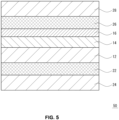
- the adhesive layer 26 is adjusted to have adhesive force acting between the protective film 28 and the adhesive layer 26 stronger than that acting between the low-refractive-index layer 16 and the adhesive layer 26, so that the antireflection film 50 can be divided at an interface between the low-refractive-index layer 16 and the adhesive layer 26.
- the water contact angle of the surface of the antireflection film 50 is defined with respect to the surface thereof from which the protective film 28 and the adhesive layer 26 are removed, and the water contact angle on the surface from which the protective film 28 and the adhesive layer 26 are removed is 100° or larger.
- the materials constituting the protective film 28 can be selected appropriately from the examples of the materials for forming the substrate film 12.
- the thickness of the protective film 28 is not particularly limited, but can be set within a range of 2 ⁇ m or larger to 500 ⁇ m or smaller, or within a range of 2 ⁇ m or larger to 200 ⁇ m or smaller.
- An adhesive layer described in Patent Document 1 can be applied preferably as the adhesive layer 26.
- An adhesive agent that forms the adhesive layer 26 is not particularly limited, but is preferably an acrylic-based adhesive, a silicone-based adhesive, or a urethane-based adhesive.
- the acrylic-based adhesive has excellent transparency and heat resistance, and therefore is preferable.
- the acrylic-based adhesive is made preferably of an adhesive composition that contains a (meth)acrylic polymer and a crosslinking agent.
- the (meth)acrylic polymer is a homopolymer or copolymer of (meth)acrylic monomers.
- the (meth)acrylic monomers include alkyl group-containing (meth)acrylic monomers, carboxyl group-containing (meth)acrylic monomers, and hydroxyl group-containing (meth)acrylic monomers.
- crosslinking agent examples include an isocyanate-based crosslinking agent, an epoxy-based crosslinking agent, a metal chelate-based crosslinking agent, a metal alkoxide-based crosslinking agent, a carbodiimide-based crosslinking agent, an oxazoline-based crosslinking agent, an aziridine-based crosslinking agent, and a melamine-based crosslinking agent. Any one of or a combination of two or more of these may be used as the crosslinking agent.
- the adhesive composition may contain other additives in addition to the (meth)acrylic polymer and the crosslinking agent.
- additives include a crosslinking accelerator, a crosslinking retardant, a tackifying resin (i.e., a tackifier), an antistatic agent, the silane coupling agent, the plasticizer, a peeling aid, a pigment, a dye, a wetting agent, a thickener, a UV absorber, a preservative, an antioxidant, a metal deactivator, an alkylating agent, and the flame retardant. These may be appropriately selected and used depending on the application and purpose of the adhesive agent.
- the thickness of the adhesive layer 26 is not particularly limited, but is preferably within a range of 1 ⁇ m or larger to 10 ⁇ m or smaller. The thickness is more preferably within a range of 2 ⁇ m or larger to 7 ⁇ m or smaller.
- the surface treatment may be applied to the surface of the substrate film 12, but adhesion-enhancing layer may be provided on the surface of the substrate film 12, instead of the surface treatment.
- a composition for forming a hard coat layer was prepared by adding a photopolymerization initiator "Omnirad 127" (manufactured by IGM Resins B.V.) to an ultraviolet curable resin composition "ESS-620" (manufactured by DIC Corporation; urethane acrylate resin, and solvent (ethyl acetate); solid content concentration: 79 mass%) such that an amount of the photopolymerization initiator was 3 mass% relative to the total amount of the hard coat layer forming composition. Furthermore, ethyl acetate was added such that the solid content concentration became 31 mass%.
- a composition for forming a high-refractive-index layer was prepared by adding methyl ethyl ketone to an ultraviolet curable resin composition "TYZ65-01"(manufactured by TOYOCHEM Co., Ltd.; acrylic-based resin, zirconium oxide (average particle size: 80 nm), photopolymerization initiator ("Omnirad 127" mentioned above), and solvent (cyclohexanone, methyl isobutyl ketone, and propylene glycol monomethyl ether); solid content concentration: 35 mass%) such that the solid content concentration became 8 mass%.
- an ultraviolet curable resin composition "TYZ65-01"(manufactured by TOYOCHEM Co., Ltd.; acrylic-based resin, zirconium oxide (average particle size: 80 nm), photopolymerization initiator ("Omnirad 127" mentioned above), and solvent (cyclohexanone, methyl isobutyl ketone, and propylene glycol monomethyl ether); solid content
- alumina particle dispersion 1 25 g of non-surface-treated alumina particles (average particle size: 160 nm), 2.5 g of a silane coupling agent ("KBM-5103", manufactured by Shin-Etsu Chemical Co., Ltd., 3-acryloxypropyltrimethoxysilane), and 72.5 g of propylene glycol monomethyl ether were put into a 500 ml stainless steel pot, and mixed and dispersed at 4,000 rpm for 30 minutes using a homomixer ("Homomixer MARKII 2.5 type", manufactured by PRIMIX Corporation) to obtain alumina particle dispersion 1 that was surface-treated with a silane coupling agent having a acryloyl group as a reactive group.
- KBM-5103 manufactured by Shin-Etsu Chemical Co., Ltd., 3-acryloxypropyltrimethoxysilane
- propylene glycol monomethyl ether 72.5 g of propylene glycol monomethyl ether
- the following materials were used as materials of the low-refractive-index layer forming composition.
- Binder resin "ARONIX MT-3041", manufactured by TOAGOSEI Co., Ltd., multifunctional acrylate, solid content concentration: 100 mass%.
- Hollow silica particles “THRULYA 4320", manufactured by JGC Catalysts and Chemicals Ltd., average particle size: 60 nm, solution: MIBK, solid content concentration: 20 mass%.
- Alumina particles 1 Alumina Particle Dispersion 1 mentioned above.
- Alumina particles 2 ALUMINASOL “Lioduras KT-110AL", manufactured by TOYOCHEM Co., Ltd.; alumina particles (average particle size: 110 nm, non-surface-treated): 25 mass%, photosensitive monomers and resin: 15 mass%, and solvent (having compositions of MEK, cyclohexanone, and aliphatic solvent).
- Fluorine-containing (meth)acrylate "KY-1216", manufactured by Shin-Etsu Chemical Co., Ltd.; perfluoroether group-containing (meth)acrylate, and methyl ethyl ketone; solid content concentration: 20 mass%.
- Photopolymerization initiator "Omnirad 127" mentioned above.
- a fluorine-containing compound i.e., "KY-1216” mentioned above
- a photopolymerization initiator i.e., "Omnirad 127” mentioned above
- a hard coat layer (having a thickness of 4 ⁇ m) was formed by applying the composition for forming the hard coat layer over a substrate film (i.e., polyethylene terephthalate film "Lumirror #50-U403", manufactured by Toray Industries, thickness: 50 ⁇ m) using a #12 wire bar, drying the composition at 80°C for 60 seconds, and then irradiating the composition with ultraviolet rays with a light quantity of 200 mJ/cm 2 using a high-pressure mercury lamp for each one of Examples 1 and 2 and Comparative Examples 1 to 3.
- a substrate film i.e., polyethylene terephthalate film "Lumirror #50-U403", manufactured by Toray Industries, thickness: 50 ⁇ m
- a high-refractive-index layer (having a thickness of 110 nm) was formed by applying the composition for forming the high-refractive-index layer over a surface of the hard coat layer, drying the composition at 80°C for 60 seconds, and then irradiating the composition with ultraviolet rays with a light quantity of 200 mJ/cm 2 using the high-pressure mercury lamp in a nitrogen atmosphere for each one of Examples 1 and 2 and Comparative Examples 1 to 3.
- a low-refractive-index layer was formed by applying the composition for forming the low-refractive-index layer over a surface of the high-refractive-index layer using a #3 wire bar, drying the composition at 100°C for 60 seconds, and then irradiating the composition with ultraviolet rays with a light quantity of 200 mJ/cm 2 using the high-pressure mercury lamp in a nitrogen atmosphere for each one of Examples 1 and 2 and Comparative Examples 1 to 3.
- the thickness of the low-refractive-index layer is as shown in Table 1.
- An antifouling layer was formed by applying the composition for forming the antifouling layer over a surface of the low-refractive-index layer using the #3 wire bar, drying the composition at 100°C for 60 seconds, and then irradiating the composition with ultraviolet rays with a light quantity of 200 mJ/cm 2 using the high-pressure mercury lamp in a nitrogen atmosphere for each one of Example 1 and Comparative Example 1.
- the thickness of the antifouling layer is as shown in Table 1. Antifouling layers were not prepared for Example 2 and Comparative Examples 2 and 3.
- antireflection films according to Examples 1 and 2 and Comparative Examples 1 to 3 were prepared.
- the thicknesses and the refractive indexes of the hard coat layer, the high-refractive-index layer, the low-refractive-index layer, and the antifouling layer were evaluated for each sample. Specifically, each time that a layer was formed, the thickness and the refractive index at a wavelength of 589.3 nm were obtained by measuring a reflection spectrum in the wavelength range of 380 to 780 nm using a microspectroscopic film thickness meter ("OPTM-F1", manufactured by Otsuka Electronics Co., Ltd.), then performing curve fitting between the obtained spectrum and a theoretical spectrum derived based on the Fresnel equation, using the least-squares method.
- OTM-F1 microspectroscopic film thickness meter
- a luminous reflectance was evaluated. Specifically, the rear surface of the prepared antireflection film (i.e., the surface of the substrate film opposite to the surface thereof covered with the low-refractive-index layer) was roughed using sandpaper #400 and painted with a black paint, then the 5° specular reflectance was measured for the antireflection film in the wavelength range of 380 to 780 nm, using an ultraviolet-visible-near infrared spectrophotometer ("UV-3600", manufactured by SHIMADZU CORPORATION). The luminous reflectance of each antireflection film was obtained by multiplying the measured value of the 5° specular reflectance of the antireflection film by a spectral luminous efficiency. If the luminous reflectance is 2.0% or lower, the antireflection properties can be regarded as sufficient.
- UV-3600 ultraviolet-visible-near infrared spectrophotometer
- Water contact angles on the surfaces of the manufactured antireflection films were measured. Each water contact angle was measured such that 4 ⁇ l of pure water was dropped onto a surface of each sample (i.e., the surfaces of the antifouling layers for Example 1 and Comparative Example 1, and the surfaces of the low-refractive-index layers for Example 2 and Comparative Examples 2 and 3) using a contact angle meter ("DropMaster DMo-502", manufactured by Kyowa Interface Science Co., Ltd.). If the water contact angle is 100° or larger, the water contact angle can be regarded as sufficiently large from the viewpoint of antifouling properties.
- the eraser abrasion test was conducted for each sample.
- an eraser manufactured by Minoan, having a cylindrical shape with a contact surface of ⁇ 6 mm in diameter
- DAS-400 flat surface abrasion tester
- the stroke length of a test table was set to 50 mm, the reciprocating speed of the test table was set to 30 times/minute, and a load of 1.0 kg was applied.
- the water contact angle of each sample was measured at every 100 times of reciprocation up to 500 times, and every 500 times of reciprocation after the 500th reciprocation, and the maximum number of time of reciprocation at which the water contact angle of 90° or larger was maintained was recorded as an evaluation value. If the evaluation value is 2000 times or more, the wear durability can be considered sufficient. Furthermore, if the evaluation value is 4000 times or more, the wear durability can be considered high.
- the measurement of the water contact angle was conducted by using the contact angle meter ("DropMaster DMo-502", manufactured by Kyowa Interface Science Co., Ltd.) such that 4 ⁇ l of pure water was dropped onto the surface of the antireflection film of each sample.
- the eraser abrasion test was conducted for each sample.
- the eraser manufactured by Minoan, having a cylindrical shape with a contact surface of ⁇ 6 mm in diameter
- DAS-400 flat surface abrasion tester
- the stroke length of the test table was set to 50 mm
- the reciprocating speed of the test table was set to 30 times/minute, and a load of 1.0 kg was applied.
- the steel wool test was conducted for each sample.
- "steel wool #0000” manufactured by Nippon Steel Wool Co., Ltd.
- a flat friction block having a size of 20 mm ⁇ 20 mm was placed on the surface of the antireflection film of each sample and moved back and forth, using the flat surface abrasion tester ("DAS-400", manufactured by Daiei Kagaku Seisakusho Co., Ltd.).
- the stroke length of the test table was set to 50 mm, the reciprocating speed of the test table was set to 60 times/minute, and a load of 1.5 kg was applied, then the test table was moved back and forth for 100 times.
- the scratch resistance was evaluated as low (i.e., B). Furthermore, if a scratch with a length smaller than 10 mm was observed but no scratch with a length of 10 mm or larger was observed, the scratch resistance was evaluated as high (i.e., A). A scratch with a length smaller than 10 mm has no problem in practical use. Furthermore, if no scratch was observed, the scratch resistance was evaluated as very high (i.e., A+).
- Table 1 shows evaluation results of Examples 1 to 2 and Comparative Examples 1 to 3 along with the compositions of the low-refractive-index layers and the antifouling layers (unit: mass% relative to the total solid content of each layer) and layer structures of the antireflection films.
- Example 1 has particularly high solvent resistance evaluated as "A+". This corresponds to the fact that the film of Example 1 has the antifouling layer consisting of the cured product of a composition containing the fluorine-containing (meth)acrylate, covering a surface of the low-refractive-index layer.
- Comparative Examples 1 and 2 differ from Examples 1 and 2, respectively, in that the alumina particles contained in the low-refractive-index layers were not surface-treated with the silane coupling agent having the reactive group capable of bonding to the (meth)acrylate compound. This leads to low wear durability and solvent resistance of Comparative Examples 1 and 2.
- the antireflection film includes the substrate film, the hard coat layer covering the surface of the substrate film, and the low-refractive-index layer covering the surface of the hard coat layer, or moreover, the antireflection film including the antifouling layer covering the surface of the low-refractive-index layer.
- the antireflection film is formed of the cured product of the ionizing radiation curable composition containing the (meth)acrylate compound having the reactive group, the hollow silica particles, and the alumina particles surface-treated with the silane coupling agent having the reactive group capable of bonding to the (meth)acrylate compound.
- the water contact angle on the surface of the antireflection film is 100° or larger.
Landscapes
- Physics & Mathematics (AREA)
- General Physics & Mathematics (AREA)
- Optics & Photonics (AREA)
- Chemical & Material Sciences (AREA)
- Chemical Kinetics & Catalysis (AREA)
- Inorganic Chemistry (AREA)
- Laminated Bodies (AREA)
- Surface Treatment Of Optical Elements (AREA)
Applications Claiming Priority (2)
| Application Number | Priority Date | Filing Date | Title |
|---|---|---|---|
| JP2022198542A JP7628316B2 (ja) | 2022-12-13 | 2022-12-13 | 反射防止フィルム |
| PCT/JP2023/044324 WO2024128203A1 (ja) | 2022-12-13 | 2023-12-12 | 反射防止フィルム |
Publications (2)
| Publication Number | Publication Date |
|---|---|
| EP4528339A1 true EP4528339A1 (de) | 2025-03-26 |
| EP4528339A4 EP4528339A4 (de) | 2025-10-22 |
Family
ID=91485789
Family Applications (1)
| Application Number | Title | Priority Date | Filing Date |
|---|---|---|---|
| EP23903488.7A Pending EP4528339A4 (de) | 2022-12-13 | 2023-12-12 | Antireflexfilm |
Country Status (5)
| Country | Link |
|---|---|
| EP (1) | EP4528339A4 (de) |
| JP (1) | JP7628316B2 (de) |
| KR (1) | KR20250086546A (de) |
| CN (1) | CN119452277A (de) |
| WO (1) | WO2024128203A1 (de) |
Families Citing this family (1)
| Publication number | Priority date | Publication date | Assignee | Title |
|---|---|---|---|---|
| WO2026048725A1 (ja) * | 2024-08-29 | 2026-03-05 | Toppan・Tomoegawaオプティカルフィルム株式会社 | 光学フィルム及び画像表示装置 |
Family Cites Families (10)
| Publication number | Priority date | Publication date | Assignee | Title |
|---|---|---|---|---|
| US9903982B2 (en) * | 2015-03-04 | 2018-02-27 | Fujifilm Corporation | Antireflection article, polarizing plate, cover glass and image display device, and manufacturing method of antireflection article |
| JP6442375B2 (ja) * | 2015-03-04 | 2018-12-19 | 富士フイルム株式会社 | 反射防止物品、偏光板、カバーガラス、及び画像表示装置、並びに反射防止物品の製造方法 |
| CN108976857A (zh) * | 2017-06-01 | 2018-12-11 | 东莞前沿技术研究院 | 涂料组合物、蒙皮及浮空器 |
| CN107189646A (zh) * | 2017-07-22 | 2017-09-22 | 江世妹 | 一种耐污自清洁粉末涂料 |
| WO2021020504A1 (ja) | 2019-07-30 | 2021-02-04 | 東山フィルム株式会社 | 反射防止フィルム |
| KR20210020504A (ko) | 2019-08-15 | 2021-02-24 | 농업회사법인 유한회사 감동 | 맞춤형 농산물 유통 시스템 |
| JP7488671B2 (ja) * | 2020-03-13 | 2024-05-22 | 日東電工株式会社 | 反射防止フィルムおよび画像表示装置 |
| JP7814095B2 (ja) * | 2020-07-29 | 2026-02-16 | 三菱ケミカル株式会社 | 硬化膜及び積層体、並びにこれらの製造方法 |
| JP2022165392A (ja) * | 2021-04-19 | 2022-10-31 | 大日本印刷株式会社 | 表示装置用積層体および表示装置 |
| JPWO2024122567A1 (de) * | 2022-12-06 | 2024-06-13 |
-
2022
- 2022-12-13 JP JP2022198542A patent/JP7628316B2/ja active Active
-
2023
- 2023-12-12 KR KR1020247039608A patent/KR20250086546A/ko active Pending
- 2023-12-12 EP EP23903488.7A patent/EP4528339A4/de active Pending
- 2023-12-12 WO PCT/JP2023/044324 patent/WO2024128203A1/ja not_active Ceased
- 2023-12-12 CN CN202380050731.4A patent/CN119452277A/zh active Pending
Also Published As
| Publication number | Publication date |
|---|---|
| TW202440313A (zh) | 2024-10-16 |
| EP4528339A4 (de) | 2025-10-22 |
| JP7628316B2 (ja) | 2025-02-10 |
| JP2024084335A (ja) | 2024-06-25 |
| WO2024128203A1 (ja) | 2024-06-20 |
| KR20250086546A (ko) | 2025-06-13 |
| CN119452277A (zh) | 2025-02-14 |
Similar Documents
| Publication | Publication Date | Title |
|---|---|---|
| EP4006592B9 (de) | Antireflexionsfolie | |
| KR101578914B1 (ko) | 플라스틱 필름 | |
| EP3904078A1 (de) | Antireflexionsfilm und herstellungsverfahren dafür | |
| KR101415840B1 (ko) | 하드코팅 필름 | |
| KR101791323B1 (ko) | 내지문성 반사 방지 필름 | |
| JP2024064786A (ja) | 反射防止フィルム | |
| WO2024090539A1 (ja) | 反射防止フィルム | |
| EP4528339A1 (de) | Antireflexfilm | |
| JP2004143201A (ja) | 活性エネルギー線硬化性組成物、それを用いた硬化皮膜の形成方法およびその硬化物、ならびに反射防止体 | |
| JP2014134573A (ja) | 反射防止フィルム | |
| WO2021038427A1 (en) | Uv protection agent, and laminate having uv protection layer using same | |
| JP2009075576A (ja) | 反射防止フィルムの製造方法及び画像表示装置、塗料組成物 | |
| JP2025070322A (ja) | 反射防止フィルムおよび反射防止フィルムの製造方法 | |
| JP7765078B2 (ja) | 反射防止フィルム | |
| TWI919151B (zh) | 抗反射膜 | |
| KR20250036245A (ko) | 반사 방지 필름 및 반사 방지 필름의 제조방법 | |
| TWI916699B (zh) | 抗反射膜及抗反射膜的製造方法 | |
| JP2013250504A (ja) | 無機薄膜転写材及びその製造方法並びに無機薄膜付き成形品及びその製造方法 | |
| JP7480532B2 (ja) | フィルム及び積層体 | |
| JP2007245622A (ja) | ハードコート層用組成物及び積層体 | |
| WO2024122489A1 (ja) | 反射防止フィルム | |
| JP2025156736A (ja) | 反射防止フィルム | |
| JP2024091520A (ja) | ディスプレイ用ハードコートフィルムおよびディスプレイ | |
| KR20080009532A (ko) | 반사방지 플라스틱 투명시트 및 이의 제조방법 | |
| JP2011184498A (ja) | 塗料組成物、及びそれを用いた反射防止部材の製造方法 |
Legal Events
| Date | Code | Title | Description |
|---|---|---|---|
| STAA | Information on the status of an ep patent application or granted ep patent |
Free format text: STATUS: THE INTERNATIONAL PUBLICATION HAS BEEN MADE |
|
| PUAI | Public reference made under article 153(3) epc to a published international application that has entered the european phase |
Free format text: ORIGINAL CODE: 0009012 |
|
| STAA | Information on the status of an ep patent application or granted ep patent |
Free format text: STATUS: REQUEST FOR EXAMINATION WAS MADE |
|
| 17P | Request for examination filed |
Effective date: 20241217 |
|
| AK | Designated contracting states |
Kind code of ref document: A1 Designated state(s): AL AT BE BG CH CY CZ DE DK EE ES FI FR GB GR HR HU IE IS IT LI LT LU LV MC ME MK MT NL NO PL PT RO RS SE SI SK SM TR |
|
| A4 | Supplementary search report drawn up and despatched |
Effective date: 20250919 |
|
| RIC1 | Information provided on ipc code assigned before grant |
Ipc: G02B 1/111 20150101AFI20250915BHEP Ipc: B32B 7/023 20190101ALI20250915BHEP Ipc: B32B 27/16 20060101ALI20250915BHEP Ipc: B32B 27/18 20060101ALI20250915BHEP Ipc: B32B 27/20 20060101ALI20250915BHEP Ipc: B32B 27/30 20060101ALI20250915BHEP Ipc: G02B 1/14 20150101ALI20250915BHEP Ipc: G02B 1/18 20150101ALI20250915BHEP |
|
| DAV | Request for validation of the european patent (deleted) | ||
| DAX | Request for extension of the european patent (deleted) |