EP4523890A2 - Système et procédé de production d'objets pharmaceutiques par impression 3d - Google Patents
Système et procédé de production d'objets pharmaceutiques par impression 3d Download PDFInfo
- Publication number
- EP4523890A2 EP4523890A2 EP24222626.4A EP24222626A EP4523890A2 EP 4523890 A2 EP4523890 A2 EP 4523890A2 EP 24222626 A EP24222626 A EP 24222626A EP 4523890 A2 EP4523890 A2 EP 4523890A2
- Authority
- EP
- European Patent Office
- Prior art keywords
- printing
- base
- print head
- pharmaceutical
- Prior art date
- Legal status (The legal status is an assumption and is not a legal conclusion. Google has not performed a legal analysis and makes no representation as to the accuracy of the status listed.)
- Pending
Links
Images




Classifications
-
- A—HUMAN NECESSITIES
- A61—MEDICAL OR VETERINARY SCIENCE; HYGIENE
- A61J—CONTAINERS SPECIALLY ADAPTED FOR MEDICAL OR PHARMACEUTICAL PURPOSES; DEVICES OR METHODS SPECIALLY ADAPTED FOR BRINGING PHARMACEUTICAL PRODUCTS INTO PARTICULAR PHYSICAL OR ADMINISTERING FORMS; DEVICES FOR ADMINISTERING FOOD OR MEDICINES ORALLY; BABY COMFORTERS; DEVICES FOR RECEIVING SPITTLE
- A61J3/00—Devices or methods specially adapted for bringing pharmaceutical products into particular physical or administering forms
- A61J3/02—Devices or methods specially adapted for bringing pharmaceutical products into particular physical or administering forms into the form of powders
-
- A—HUMAN NECESSITIES
- A61—MEDICAL OR VETERINARY SCIENCE; HYGIENE
- A61J—CONTAINERS SPECIALLY ADAPTED FOR MEDICAL OR PHARMACEUTICAL PURPOSES; DEVICES OR METHODS SPECIALLY ADAPTED FOR BRINGING PHARMACEUTICAL PRODUCTS INTO PARTICULAR PHYSICAL OR ADMINISTERING FORMS; DEVICES FOR ADMINISTERING FOOD OR MEDICINES ORALLY; BABY COMFORTERS; DEVICES FOR RECEIVING SPITTLE
- A61J3/00—Devices or methods specially adapted for bringing pharmaceutical products into particular physical or administering forms
- A61J3/06—Devices or methods specially adapted for bringing pharmaceutical products into particular physical or administering forms into the form of pills, lozenges or dragees
-
- A—HUMAN NECESSITIES
- A61—MEDICAL OR VETERINARY SCIENCE; HYGIENE
- A61J—CONTAINERS SPECIALLY ADAPTED FOR MEDICAL OR PHARMACEUTICAL PURPOSES; DEVICES OR METHODS SPECIALLY ADAPTED FOR BRINGING PHARMACEUTICAL PRODUCTS INTO PARTICULAR PHYSICAL OR ADMINISTERING FORMS; DEVICES FOR ADMINISTERING FOOD OR MEDICINES ORALLY; BABY COMFORTERS; DEVICES FOR RECEIVING SPITTLE
- A61J3/00—Devices or methods specially adapted for bringing pharmaceutical products into particular physical or administering forms
- A61J3/07—Devices or methods specially adapted for bringing pharmaceutical products into particular physical or administering forms into the form of capsules or similar small containers for oral use
-
- A—HUMAN NECESSITIES
- A61—MEDICAL OR VETERINARY SCIENCE; HYGIENE
- A61K—PREPARATIONS FOR MEDICAL, DENTAL OR TOILETRY PURPOSES
- A61K45/00—Medicinal preparations containing active ingredients not provided for in groups A61K31/00 - A61K41/00
- A61K45/06—Mixtures of active ingredients without chemical characterisation, e.g. antiphlogistics and cardiaca
-
- A—HUMAN NECESSITIES
- A61—MEDICAL OR VETERINARY SCIENCE; HYGIENE
- A61K—PREPARATIONS FOR MEDICAL, DENTAL OR TOILETRY PURPOSES
- A61K9/00—Medicinal preparations characterised by special physical form
- A61K9/20—Pills, tablets, discs, rods
- A61K9/2095—Tabletting processes; Dosage units made by direct compression of powders or specially processed granules, by eliminating solvents, by melt-extrusion, by injection molding, by 3D printing
-
- B—PERFORMING OPERATIONS; TRANSPORTING
- B29—WORKING OF PLASTICS; WORKING OF SUBSTANCES IN A PLASTIC STATE IN GENERAL
- B29C—SHAPING OR JOINING OF PLASTICS; SHAPING OF MATERIAL IN A PLASTIC STATE, NOT OTHERWISE PROVIDED FOR; AFTER-TREATMENT OF THE SHAPED PRODUCTS, e.g. REPAIRING
- B29C64/00—Additive manufacturing, i.e. manufacturing of three-dimensional [3D] objects by additive deposition, additive agglomeration or additive layering, e.g. by 3D printing, stereolithography or selective laser sintering
- B29C64/10—Processes of additive manufacturing
- B29C64/106—Processes of additive manufacturing using only liquids or viscous materials, e.g. depositing a continuous bead of viscous material
-
- B—PERFORMING OPERATIONS; TRANSPORTING
- B29—WORKING OF PLASTICS; WORKING OF SUBSTANCES IN A PLASTIC STATE IN GENERAL
- B29C—SHAPING OR JOINING OF PLASTICS; SHAPING OF MATERIAL IN A PLASTIC STATE, NOT OTHERWISE PROVIDED FOR; AFTER-TREATMENT OF THE SHAPED PRODUCTS, e.g. REPAIRING
- B29C64/00—Additive manufacturing, i.e. manufacturing of three-dimensional [3D] objects by additive deposition, additive agglomeration or additive layering, e.g. by 3D printing, stereolithography or selective laser sintering
- B29C64/10—Processes of additive manufacturing
- B29C64/106—Processes of additive manufacturing using only liquids or viscous materials, e.g. depositing a continuous bead of viscous material
- B29C64/112—Processes of additive manufacturing using only liquids or viscous materials, e.g. depositing a continuous bead of viscous material using individual droplets, e.g. from jetting heads
-
- B—PERFORMING OPERATIONS; TRANSPORTING
- B29—WORKING OF PLASTICS; WORKING OF SUBSTANCES IN A PLASTIC STATE IN GENERAL
- B29C—SHAPING OR JOINING OF PLASTICS; SHAPING OF MATERIAL IN A PLASTIC STATE, NOT OTHERWISE PROVIDED FOR; AFTER-TREATMENT OF THE SHAPED PRODUCTS, e.g. REPAIRING
- B29C64/00—Additive manufacturing, i.e. manufacturing of three-dimensional [3D] objects by additive deposition, additive agglomeration or additive layering, e.g. by 3D printing, stereolithography or selective laser sintering
- B29C64/10—Processes of additive manufacturing
- B29C64/106—Processes of additive manufacturing using only liquids or viscous materials, e.g. depositing a continuous bead of viscous material
- B29C64/118—Processes of additive manufacturing using only liquids or viscous materials, e.g. depositing a continuous bead of viscous material using filamentary material being melted, e.g. fused deposition modelling [FDM]
-
- B—PERFORMING OPERATIONS; TRANSPORTING
- B29—WORKING OF PLASTICS; WORKING OF SUBSTANCES IN A PLASTIC STATE IN GENERAL
- B29C—SHAPING OR JOINING OF PLASTICS; SHAPING OF MATERIAL IN A PLASTIC STATE, NOT OTHERWISE PROVIDED FOR; AFTER-TREATMENT OF THE SHAPED PRODUCTS, e.g. REPAIRING
- B29C64/00—Additive manufacturing, i.e. manufacturing of three-dimensional [3D] objects by additive deposition, additive agglomeration or additive layering, e.g. by 3D printing, stereolithography or selective laser sintering
- B29C64/10—Processes of additive manufacturing
- B29C64/165—Processes of additive manufacturing using a combination of solid and fluid materials, e.g. a powder selectively bound by a liquid binder, catalyst, inhibitor or energy absorber
-
- B—PERFORMING OPERATIONS; TRANSPORTING
- B29—WORKING OF PLASTICS; WORKING OF SUBSTANCES IN A PLASTIC STATE IN GENERAL
- B29C—SHAPING OR JOINING OF PLASTICS; SHAPING OF MATERIAL IN A PLASTIC STATE, NOT OTHERWISE PROVIDED FOR; AFTER-TREATMENT OF THE SHAPED PRODUCTS, e.g. REPAIRING
- B29C64/00—Additive manufacturing, i.e. manufacturing of three-dimensional [3D] objects by additive deposition, additive agglomeration or additive layering, e.g. by 3D printing, stereolithography or selective laser sintering
- B29C64/20—Apparatus for additive manufacturing; Details thereof or accessories therefor
- B29C64/205—Means for applying layers
- B29C64/209—Heads; Nozzles
-
- B—PERFORMING OPERATIONS; TRANSPORTING
- B29—WORKING OF PLASTICS; WORKING OF SUBSTANCES IN A PLASTIC STATE IN GENERAL
- B29C—SHAPING OR JOINING OF PLASTICS; SHAPING OF MATERIAL IN A PLASTIC STATE, NOT OTHERWISE PROVIDED FOR; AFTER-TREATMENT OF THE SHAPED PRODUCTS, e.g. REPAIRING
- B29C64/00—Additive manufacturing, i.e. manufacturing of three-dimensional [3D] objects by additive deposition, additive agglomeration or additive layering, e.g. by 3D printing, stereolithography or selective laser sintering
- B29C64/20—Apparatus for additive manufacturing; Details thereof or accessories therefor
- B29C64/245—Platforms or substrates
-
- B—PERFORMING OPERATIONS; TRANSPORTING
- B29—WORKING OF PLASTICS; WORKING OF SUBSTANCES IN A PLASTIC STATE IN GENERAL
- B29C—SHAPING OR JOINING OF PLASTICS; SHAPING OF MATERIAL IN A PLASTIC STATE, NOT OTHERWISE PROVIDED FOR; AFTER-TREATMENT OF THE SHAPED PRODUCTS, e.g. REPAIRING
- B29C64/00—Additive manufacturing, i.e. manufacturing of three-dimensional [3D] objects by additive deposition, additive agglomeration or additive layering, e.g. by 3D printing, stereolithography or selective laser sintering
- B29C64/30—Auxiliary operations or equipment
- B29C64/307—Handling of material to be used in additive manufacturing
- B29C64/321—Feeding
-
- B—PERFORMING OPERATIONS; TRANSPORTING
- B29—WORKING OF PLASTICS; WORKING OF SUBSTANCES IN A PLASTIC STATE IN GENERAL
- B29C—SHAPING OR JOINING OF PLASTICS; SHAPING OF MATERIAL IN A PLASTIC STATE, NOT OTHERWISE PROVIDED FOR; AFTER-TREATMENT OF THE SHAPED PRODUCTS, e.g. REPAIRING
- B29C64/00—Additive manufacturing, i.e. manufacturing of three-dimensional [3D] objects by additive deposition, additive agglomeration or additive layering, e.g. by 3D printing, stereolithography or selective laser sintering
- B29C64/30—Auxiliary operations or equipment
- B29C64/307—Handling of material to be used in additive manufacturing
- B29C64/321—Feeding
- B29C64/336—Feeding of two or more materials
-
- B—PERFORMING OPERATIONS; TRANSPORTING
- B29—WORKING OF PLASTICS; WORKING OF SUBSTANCES IN A PLASTIC STATE IN GENERAL
- B29C—SHAPING OR JOINING OF PLASTICS; SHAPING OF MATERIAL IN A PLASTIC STATE, NOT OTHERWISE PROVIDED FOR; AFTER-TREATMENT OF THE SHAPED PRODUCTS, e.g. REPAIRING
- B29C64/00—Additive manufacturing, i.e. manufacturing of three-dimensional [3D] objects by additive deposition, additive agglomeration or additive layering, e.g. by 3D printing, stereolithography or selective laser sintering
- B29C64/30—Auxiliary operations or equipment
- B29C64/35—Cleaning
-
- B—PERFORMING OPERATIONS; TRANSPORTING
- B29—WORKING OF PLASTICS; WORKING OF SUBSTANCES IN A PLASTIC STATE IN GENERAL
- B29C—SHAPING OR JOINING OF PLASTICS; SHAPING OF MATERIAL IN A PLASTIC STATE, NOT OTHERWISE PROVIDED FOR; AFTER-TREATMENT OF THE SHAPED PRODUCTS, e.g. REPAIRING
- B29C64/00—Additive manufacturing, i.e. manufacturing of three-dimensional [3D] objects by additive deposition, additive agglomeration or additive layering, e.g. by 3D printing, stereolithography or selective laser sintering
- B29C64/30—Auxiliary operations or equipment
- B29C64/364—Conditioning of environment
-
- B—PERFORMING OPERATIONS; TRANSPORTING
- B33—ADDITIVE MANUFACTURING TECHNOLOGY
- B33Y—ADDITIVE MANUFACTURING, i.e. MANUFACTURING OF THREE-DIMENSIONAL [3-D] OBJECTS BY ADDITIVE DEPOSITION, ADDITIVE AGGLOMERATION OR ADDITIVE LAYERING, e.g. BY 3-D PRINTING, STEREOLITHOGRAPHY OR SELECTIVE LASER SINTERING
- B33Y10/00—Processes of additive manufacturing
-
- B—PERFORMING OPERATIONS; TRANSPORTING
- B33—ADDITIVE MANUFACTURING TECHNOLOGY
- B33Y—ADDITIVE MANUFACTURING, i.e. MANUFACTURING OF THREE-DIMENSIONAL [3-D] OBJECTS BY ADDITIVE DEPOSITION, ADDITIVE AGGLOMERATION OR ADDITIVE LAYERING, e.g. BY 3-D PRINTING, STEREOLITHOGRAPHY OR SELECTIVE LASER SINTERING
- B33Y30/00—Apparatus for additive manufacturing; Details thereof or accessories therefor
-
- B—PERFORMING OPERATIONS; TRANSPORTING
- B33—ADDITIVE MANUFACTURING TECHNOLOGY
- B33Y—ADDITIVE MANUFACTURING, i.e. MANUFACTURING OF THREE-DIMENSIONAL [3-D] OBJECTS BY ADDITIVE DEPOSITION, ADDITIVE AGGLOMERATION OR ADDITIVE LAYERING, e.g. BY 3-D PRINTING, STEREOLITHOGRAPHY OR SELECTIVE LASER SINTERING
- B33Y40/00—Auxiliary operations or equipment, e.g. for material handling
-
- B—PERFORMING OPERATIONS; TRANSPORTING
- B33—ADDITIVE MANUFACTURING TECHNOLOGY
- B33Y—ADDITIVE MANUFACTURING, i.e. MANUFACTURING OF THREE-DIMENSIONAL [3-D] OBJECTS BY ADDITIVE DEPOSITION, ADDITIVE AGGLOMERATION OR ADDITIVE LAYERING, e.g. BY 3-D PRINTING, STEREOLITHOGRAPHY OR SELECTIVE LASER SINTERING
- B33Y80/00—Products made by additive manufacturing
Definitions
- the invention relates to a system and a method for producing pharmaceutical objects via 3D printing.
- the invention in particular relates to the art of manufacturing 3D objects by applying, accumulating or creating layers for the creation of 3D printed articles and in particular to a system which is specially modified for the manufacture of multiple tablets, granules, capsules, suppositories, implants and other pharmaceutical items.
- WO2017034951 discloses a 3D printing device and system for the production of pharmaceutical tablets.
- a powdered mixture is applied on a moving belt, creating the first layer of the tablet before spraying a binding fluid which unifies the mixture and prepares it to receive the next layer. This process is repeated many times resulting in the creation of a solid but particularly porous tablet which is orally dispersible by water.
- a major disadvantage of that particular invention is the method of making the tablets, as it is carried out by constantly applying a mixture, a part of which is not used for the preparation of the tablet, resulting in feedstock waste. Furthermore, it is a limiting factor that the device can produce exclusively porous tablets using a powder blend which prevents the manufacture of other types, such as capsules or compact granules, and does not provide for the possibility of printing objects by using a fluid feedstock, the printing process being carried out by continuously applying layers of material in repetitive steps until the formation of the porous tablet.
- a further drawback is due to the high cost of maintaining quantities of medicines for emergencies. Especially in remote and inaccessible areas, the potential emergency leads to the storage of quantities of drugs, which are often left unused until the expiry date.
- a further object of the present invention is to provide the proposed system for producing pharmaceutical objects, such as tablets, granules and capsules, by means of 3D printing, for the production of individual prints at the choice of the individual user.
- a system for producing pharmaceutical objects comprising a 3D printing machine with a mechanical system movable in one or more directions.
- pharmaceutical objects shall comprise pills, tablets, granules and capsules, suppositories, implants and other pharmaceutical items, which are administered to or placed in a mammal body.
- the system further comprises at least one print head with a nozzle being movable by the mechanical system.
- the system preferably comprises one print head.
- the system further comprises a base system carrying a base for receiving a prepared mixture applied by the print head.
- the print head perform the action of printing products of this system, by dispensing repeated layers of substance on top of a print base so to form a predefined shape object.
- the print head comprises a least one printing nozzle.
- the nozzle is the part of the print head to allow the flow of material on the print base. They may have or may not have a valve to control flow of substance depending on the characteristics of various fluid substances, such as powders, granules, liquids, gels, creams, pastes etc..
- the system further comprises at least one carrier for holding at least one cartridge, wherein the cartridge contains a printable substance.
- the cartridge may be removed and/or replaced.
- the cartridges may each contain one or more of a variety of active substances (API) including -but not limited to- the families of: antibiotics, statines, stimulants, antiseptics, antipyretics, chemotherapeutics, anti-inflammatories, antifungines, hormone medication substances, diuretics, contraceptives, psychotropics (antidepressants, anti-psychotics etc.) etc.
- API active substances
- the cartridges may contain one or more of a variety of excipients including -but not limited to- binders, coatings, antiadherents, colors, flavors, resin, glidants, lubricants, sorbents, vehicles, sweeteners, solvents, inert powders, biodegradable polymers, waxes, preservatives, disintegrants etc.
- the cartridges may contain one or more of a variety of substances used in oriental medicine including -but not limited toherbal pharmacology substances etc..
- the cartridges may contain one or more of a variety of substances used in homeopathic medicine including -but not limited totinctures etc.h
- the cartridges may contain one or more of a variety of substances used in bio-engineering medicine including -but not limited to- stem cells etc..
- the cartridges may contain a variety of substances that may be still under development or research, and not yet disclosed.
- the cartridge When a cartridge is empty or when another substance is needed the cartridge may be removed from the carrier and a new cartridge may be inserted.
- a further advantage of the invention in order to make the present invention useful is to provide systems for producing pharmaceutical objects, such as tablets, capsules and granules, in different sizes and with optionally additional capabilities, covering the simple yet more complex 3D print requirements.
- the carriers may hold a plurality of cartridges with a specific set of printable substances for printing a certain class of pharmaceutical objects.
- a pharmaceutical object of a different class shall be printed, the whole plurality of cartridges may be replaced.
- the system has more than one print head.
- the mechanical system may comprise a mechanical arm which ends in a print head and which can be moved in one, two or three directions, accurately printing through the head the article required at a time.
- a robotic arm is an example of a mechanical arm, usually programmable, with similar functions to a human arm; the arm may be the sum total of the mechanism or may be part of a more complex robot.
- the links of such a manipulator are connected by joints allowing either rotational motion (such as in an articulated robot) or translational (linear) displacement.
- the links of the manipulator can be considered to form a kinematic chain.
- the terminus of the kinematic chain of the manipulator is called the end effector and it is analogous to the human hand.
- robotic arms For the needs of the present system the following types of robotic arms may be used:
- the mechanical system may comprise a scaffold, also called bridge, which is the mechanical structure commonly used in 3d printers.
- the scaffold consists of structures being vertical and parallel to the ground.
- the scaffold carries the print head and moves it in an up/down direction and/or in x-direction and/or in y-direction or remains still with the print base doing all the movements necessary.
- the system may comprise a fed line for establishing a fluid connection between the carrier and the print head.
- the printing substance may flow through the fed line from a cartridge in the carrier to the print head.
- the print line may be flexible such that the carrier may stay at a fixed position while the print head is moved to the printing position by the mechanical system.
- the carrier and the print head may be brought closely to each other to establish a direct fluid connection between a cartridge in a carrier and the print head.
- the system comprises a magazine unit with at least one carrier, preferably a plurality of carriers.
- the magazine unit is moveable, such that the carrier may perform a motion.
- a cartridge being held in one of a plurality of carriers may be transported to a delivery position, where a fluid connection between the cartridge and the print head may be established. After another movement of the magazine unit another cartridge may be moved to the delivery position, such that a plurality of substances may be successively filled in the print head.
- the magazine unit may comprise an actuator, in particular a servomotor, a pneumatic drive, a hydraulic drive, a chain drive or a magnetic drive to enable the movement of at least a part of the magazine unit, in particularly to enable the movement of a carriers or of a plurality of carriers.
- an actuator in particular a servomotor, a pneumatic drive, a hydraulic drive, a chain drive or a magnetic drive to enable the movement of at least a part of the magazine unit, in particularly to enable the movement of a carriers or of a plurality of carriers.
- a plurality of carriers may be arranged on a carousel, such that for moving a single cartridge all carriers have to be moved.
- a plurality of carriers may alternatively be arranged in line on a guide rail and may be shifted to be brought in a delivery position.
- the system comprises at least one moveable push rod, preferably attached to the carrier, for discharging a cartridge.
- the cartridges used for the system do not need mechanical equipment for discharging them.
- a moveable push rod and an actuator for moving the pushrod provide for exact and reproducible dosing an amount of a substance measured according to a selected recipe.
- the system may further comprise an opening device, preferably connected with the carrier, for opening a cartridge.
- the carrier may comprise a needle for punching into a cartridge, a cap remover or a pin for opening a valve of the cartridge.
- the system may further comprise a closing device, preferably connected with the carrier, for at least temporarily closing a cartridge during a time when it is not needed for printing.
- the system may comprise a reading unit, preferably connected with the carrier, for identifying an identification mark on a cartridge. Hence the system may recognize a kind of substance contained in the cartridge, a use-by date, a target quantity or other data associated with the cartridge.
- the reading unit allows logistic support like statistics or automated order for refills. Logistics benefit volume and weight reduction as well as energy consumption needs.
- the system comprises a carrier with a temperature control device.
- the carrier may provide for heating and/or cooling the cartridges.
- the system comprises a print head with a temperature control device.
- the print head may be heatable and/or coolable.
- the print head comprises a print head body with indentations, fins or channels for guiding a tempering agent, for example a tempering fluid or a tempering gas, like cooling air.
- a tempering agent for example a tempering fluid or a tempering gas, like cooling air.
- the print head may comprise a thermal conductor which may be heated electrically.
- the print head may be covered by a thermal insulation mantle if high temperature is required.
- the print head comprises a print head body providing a volume for a printing substance.
- the print head body may comprise an opening for receiving a fluid substance from a cartridge, which in particular is connectable to a fed line.
- the print head comprises a stirring and/or discharge tool, in particular a worm screw, being arranged in the printing head body.
- the stirring and/or discharge tool may be moveable for example rotatable within a print head body.
- a mixing tool provides for mixing a plurality of substances delivered from a plurality of cartridges into the print head.
- a discharge tool may provide for discharging a certain amount of substance through the print head during printing.
- the discharge tool may be a pushing tool, which is moveable in the print head body.
- the print head may comprise a tool which is suitable for mixing and pushing.
- the system comprises an actuator for moving the stirring and/or pushing tool.
- the print head my comprise a discharge tool for reducing the size of the print head body, for example a squeezing tool or a collapsing tool, such that substance is pressed out of the print head nozzle, when the volume of the print head body is reduced.
- a discharge tool for reducing the size of the print head body for example a squeezing tool or a collapsing tool, such that substance is pressed out of the print head nozzle, when the volume of the print head body is reduced.
- the system comprises an actuator for moving the discharge tool.
- the print head may comprise a double body: a) an external cylindrical -or other- shape hard body, preferably made from a recyclable material, and b) an inner container made from elastic/ flexible/ compressible material.
- the print head comprises a tool which is suitable for mixing and pushing.
- the stirring tool may be at least partly collapsible, in particular the stirring tool comprises a collapsible head.
- the stirring tool with the collapsing head may be made of Kev-lar, of carbon fibres or of an epoxy raisin.
- the collapsing head may provide for a vacuum effect at the print head nozzle to prevent dripping.
- the print head comprises a nozzle with a valve, for example a check valve, a shutter valve, a ball valve or a pin valve.
- a valve for example a check valve, a shutter valve, a ball valve or a pin valve.
- the print head my comprise a spray nozzle and a supply line for compressed air, steam, water, solvents, pharmaceutical inks, alimentary colored inks and more.
- the steam could offer bonding to very dry substances, allowing very rapid production rates and very porous finished products.
- the steam may accelerate pharmacokinetics.
- the same may be done with a combination of steam and adhesives and pharmaceutical binders/solvents and water.
- Pressurized air could help either drying the items under production, or to be used in the same way as the steam but with pills (etc.) created out of substances that could be affected by heat and/or water.
- Colored inks could be used to mark different dosages.
- the system comprises a thermal print head equipped with a worm screw to stir the mixture prior to 3D printing.
- Still another advantage of the invention is the presentation of a collapsible print head which, in addition to stirring, also extracts the air from the mixture, creating more compact tablets, granules or capsules when required.
- the system comprises an energy emitter, which is linked to the print head.
- the energy emitter may be arranged on mechanical system and may be moved together with the print head or the energy emitter may be directly attached to the print head.
- the energy emitter provides for drying or fixing an amount of a substance after it has left the print head nozzle.
- the energy emitter is a photopolymer headlamp, an IR emitter, a laser, a microwave emitter, a liquid nitrogen spray nozzle, a compressed air nozzle or a steam nozzle.
- the system comprises a cleaning unit for cleaning the print head and/or a cartridge.
- the cleaning unit may comprise a wash tank and/or a wash port.
- the wash port may be connectable to a cleaning fluid reservoir and/or a cleaning fluid filtration system.
- the cleaning unit may be a special place reserved in the 3d printing system.
- the cleaning unit may comprise an enclosed area with doors that are necessary for the print heads to be brought in.
- doors, or openings preferably have all the necessary automation so to be controlled -open-close-lock and monitored as well as every other mechanism inside this area.
- the cleaning unit preferably comprises a heated air supply for drying the print head, nozzles for dispensing steam, compressed air, water and/or solvent spray, a vacuum suction to remove steam and excess liquids, brushes, needles for cleaning very narrow nozzles, valves, breather valves, a tank containing solvents and/or water, in which the print head may be immersed and cleaned, an ultrasound emitter and / or a dedicated cleaning laser emitter.
- the tank may comprise a liquid circulation system which may comprise circulators, filters, such as active carbon filters, micro-filters, and dedicated pharmaceutical filters like HEPA H13 filters, and their necessary tubing.
- a liquid circulation system which may comprise circulators, filters, such as active carbon filters, micro-filters, and dedicated pharmaceutical filters like HEPA H13 filters, and their necessary tubing.
- the system comprises a print base comprising formatted printing locations for shaping the pharmaceutical object, in particular convex recesses.
- the substance may be printed on a receptive formatted printing location, which affects the shape of the pharmaceutical object.
- the bottom side of the object may for example have a convex shape rather than a flat plain.
- Formatted printing locations allow for creating a pharmaceutical object, such as a pill, having a form as the majority of such objects, for example pills, made by traditional means have. They may have a symmetrical lenticular shape.
- complex forms may be created as to assist the immediate visual recognition of the produced items, for example heart shape, rhombus, teddy bear for paediatric use.
- the bottom side may also have the shape of the backside of a gummy bear, a Santa Claus, an Easter bunny or any other typical foodstuff form, such that a pharmaceutical object may be printed with the shape of a such a typical foodstuff form.
- the print base may have recesses being adapted to accept pill blisters.
- pill blisters are created by vacuum-formed sheets of a suitable plastic.
- the pharmaceutical objects can be printed inside a positioned blister. Thus time may be saved and contact with anything else than the 3D printer's sterile environment is avoided.
- a closing device may apply the sealing membrane or film to hermetically seal the blisters.
- a further action could be the labeling of the sealed blisters by a labelling device, such as a laser, being connected to the mechanical system.
- the system may comprise a print base comprising a thermal conductor, in particular arranged on the side opposite to a side having formatted printing locations.
- the print base may be heated directly, for example for drying the printed substance.
- the system may comprise a temperature sensor for monitoring the temperature of the print base.
- the temperature sensor may be a contact sensor or a contactless sensor for example an IR or laser sensor.
- the print base may be made of metal and /or metal alloys like alclad, a corrosion-resistant aluminum sheet formed from high-purity aluminum with surface layers metallurgically bonded to high-strength aluminum alloy core material), like stainless steel varieties, for example type 310-310S, a highly alloyed austenitic stainless steel used for high temperature application.
- the high chromium and nickel content give the steel excellent oxidation resistance as well as high strength at high temperature, or type 316 excellent for food and surgical uses,-an alloy addition of molybdenum prevents specific forms of corrosion due to its increased resistance to chloride corrosion) and others.
- the print base may be made of plastic and/or composite materials.
- the print base may be made of tempered glass, such as borosilicate glass, 7740 glass.
- the print base may comprise ceramics, such as glass-ceramics. Glass-ceramics have the fabrication advantage of glass, as well as special properties of ceramics. They can withstand brazing temperatures up to 700 while maintaining properties like zero porosity, high strength, toughness, low thermal expansion, high temperature stability, machinability, high chemical durability, biocompatibility, isolation capabilities, In manufacturing, glass-ceramics are valued for having the strength of ceramic combined with the hermetic sealing properties of glass.
- the print base has a coating, in particular a ceramic glaze coating.
- the printed pharmaceutical object may detach from the print base and does not stick to the print base.
- coating for example: ceramic glaze, an impervious layer or coating of a vitreous substance, which has been fused to a ceramic body through firing, silica nano-coating, silver nano-coating, which is anti-bacterial and antifungal, titanium dioxide (TiO 2 ), nano-particles, which are sterilizing and have anti-fouling properties.
- the base system may also comprise an object remover.
- the object remover may be formed by a tilt mechanism, which cants the print base, such that the printed pharmaceutical objects slide down the print base to a collection point, for example into a bin.
- the object remover may be formed by moveable extractor pins or gas nozzles being connectable to formatted printing locations of the print base. Each printed object may be ejected from the printing location by the pressure of an extractor pin pricking from a hole in a printing location or by the pressure of blow out of a hole in a printing location.
- the base system comprises a base holder for receiving a print base.
- the print base may be removed and/or replaced.
- Print base with different formatted printing locations may be used in the same system.
- a print base carrying printed object may be removed from the system and replaced by a fresh print base.
- system for 3D printing comprises a mechanical base system capable of moving the print base to one or more directions.
- the print base may for example be lifted in a printing level and may be lowered after printing.
- the print base may also be moved to complete the movement of the mechanical system for moving the print head in order to achieve a full 3D printing also with only a one or two- dimensional movement of the print head.
- An advantageous system for 3D printing tablets, granules and capsules has a thermally controlled base with formatted print locations having air ducts for accurately controlling the temperature and humidity of the printed articles.
- the system comprises a chamber, in particular with a door, for establishing a controlled atmosphere.
- the system is equipped with individual units such as vent filters, ventilation ducts, air filters, an activated carbon filter, an air conditioning system, anair drying system, a vacuum system with a vacuum pump and a head cleaning reservoir.
- An advantage of the invention is the ability of the presented system to operate autonomously or in conjunction with a computer to receive orders for 3D printing of granules, tablets and capsules.
- the system is preferably controlled by a computer, or a series of computers in order to function.
- This computer is running on an operational system, for example windows, Linux, IOs etc. and it is provided with all the software necessary to execute it's tasks.
- the computer preferably controls all of the system's operations and actions. Every subsystem, device and mechanism may be controlled and made to function by a controller.
- a controller is a comparative device that receives an input signal from a measured process variable, compares this value with that of a predetermined control point value, and determines the appropriate amount of output signal required by the final control element to provide corrective action within a control loop, a PLC, an EPROM etc.
- the same cables connecting each device to the computer can be the power alimentation source for this device (example USB).
- the computer may be fitted with all the necessary subsystems to interface with the system's user, such as screen (touch, capacitative, LCD or other), an input method (touchscreen, keyboard, multifunction buttons or other), sound and/or visual allert systems, on/off buttons and any other means of interaction system.
- the computer may be equiped with the necessary software to acomplish its functions.
- the computer preferably comprises the ability to run auto-diagnosis on every sub-system of the mechanism and inform the user of the need to maintain or repair any part of the system or an imminent failture. This way the maintenance cost diminuish and the system's availability increases.
- the computer preferably takes care as needed of the calibration of moving mechanisms.
- the computer preferably holds the database necessary to select any mixture available and any method suitable to create any product, as well as the form of each product (pill, granule, tablet, suppository etc.).
- the computer preferably holds the database of usage statistics and may inform the user of a cartridge containing a particular substance -or mixture of substances- is runing low, or even order directly the cartridge needed online stramlining thus the logistics operation.
- the database/s necessary for the operations of the system may be stored in the computer's memory and/or at an online position (Internet data storage, remote server, cloud etc.). It may be updated as new products become available (as well as program updates) or can be restored from there if a malfunction occurs.
- the computer may be provided with a modem (modem, router, etc) connected to the web by cable or wireless technology.
- Backup of the computer's programs, databases etc. can be provided by flash memory sticks, external hard drives, online data storage etc..
- the computer may interact with other devices (external computers, computer accessories like mice, keyboards, web-cams, portable hard-drives, microphones, printers, scanners and speakers tablets, smart-phones, screens etc. by cable (USB, DVI, HDMI etc.) or by wireless technologies.
- devices external computers, computer accessories like mice, keyboards, web-cams, portable hard-drives, microphones, printers, scanners and speakers tablets, smart-phones, screens etc. by cable (USB, DVI, HDMI etc.) or by wireless technologies.
- the computer could be external to the system (independent).
- All the electronic control subsystems - controllers, regulators and other- may communicate directly (by cable) or indirectly (by the use of bluetooth, WIFI, IR or other) with the use of an interface device (system to computer) comprising the necessary drivers and program/s (or app/s) to install on the computer used.
- Power supply may be provided to all subsystems of the system by a module comprising electric power input (cable/s and/or wireless charger), power converter -example 220v/12v-, battery -or battery packs-, UPS ⁇ an uninterruptible power supply, also uninterruptible power source, UPS or battery/flywheel backup, is an electrical apparatus that provides emergency power to a load when the input power source or mains power fails ⁇ , an auxiliary or emergency power system or standby generator as well as power outputs (USB or other).
- a module comprising electric power input (cable/s and/or wireless charger), power converter -example 220v/12v-, battery -or battery packs-, UPS ⁇ an uninterruptible power supply, also uninterruptible power source, UPS or battery/flywheel backup, is an electrical apparatus that provides emergency power to a load when the input power source or mains power fails ⁇ , an auxiliary or emergency power system or standby generator as well as power outputs (USB or other).
- the problem is also solved by a method for producing pharmaceutical objects, such as tablets, granules and capsules, via 3D printing, in particular with a system as described above.
- the method comprises the following steps.
- At least one pharmaceutical substance is provided in at least one cartridge.
- the cartridge is placed in a carrier.
- a fluid connection is established between the cartridge and a print head, such that the pharmaceutical substance may leave the print head through the print head nozzle.
- the print head nozzle is moved according to a 3D print program and the pharmaceutical substance is dispensed to a print base.
- the cartridge may be transferred to the print head and may be moved with the print head.
- a quantity of at least one pharmaceutical substance is dosed from the cartridge to the print head, and the substance is stirred in the print head, in particular a plurality of pharmaceutical substances is mixed.
- a pharmaceutical fluid composed and mixed according to a specified recipe may be printed.
- the system comprises a plurality of print heads, which are moved independently and which each dispense a substance to a print base.
- a first print head may be filled with a shell or cover substance
- another print head may be filled with a first content substance
- a further print head may contain a further content substance, such that pharmaceutical objects within an inner structure may be printed.
- the method according to the invention is favourable for situations in which regularly individually designed pharmaceutical objects of similar composition have to be provided, such as in hospitals, in nursing homes, in cruise ships, in naval vessels or in refugee camps.
- the storing of the matrix substances is easier than storing a stock for each and every implementation of certain pharmaceutical products.
- a print base having formatted printing locations may be applied to a print base system before printing.
- the pharmaceutical substance may be dispensed on the formatted printing locations.
- the print head may be cleaned.
- the method comprises the step of providing at least one substance in at least one cartridge, the substance comprising at least one of a fat mass, a starch, a flour, a gelatine, a sweetener, a natural flavour, an artificial flavour and a colorant.
- the cartridge may contain also other foodstuff substances that can be used as excipients like emulsifying agents, stabilizing agents, thickening agents, binders, sweetening agents, sugar coating adjuncts, anti-caking agents, emulsifiers, acidulants, acidity regulators, anti-foaming and foaming agents, antioxidants, bulking agents, food colorings, color retention agents, flavors, flavor enhancers, glazing agents, humectants, preservatives, stabilizers, sweeteners etc.
- foodstuff substances that can be used as excipients like emulsifying agents, stabilizing agents, thickening agents, binders, sweetening agents, sugar coating adjuncts, anti-caking agents, emulsifiers, acidulants, acidity regulators, anti-foaming and foaming agents, antioxidants, bulking agents, food colorings, color retention agents, flavors, flavor enhancers, glazing agents, humectants, preservatives, stabilizers, sweeteners etc.
- the additional substances may be provided in separate cartridges, such that a compound material containing pharmaceutical substances and foodstuff substances may be mixed in the print head according to a predetermined recipe.
- the pharmaceutical substance provided in at least one cartridge comprises at least one of an antipyretic, an analgesic, an antimalarial drug, an antibiotic, an antiseptic, a psychiatric medication, a mood stabilizer, a hormone replacement, an oral contraceptive, a stimulant, a tranquilizer and a statin.
- An antipyretic for example an acetaminophen, reduces fever, pyrexia or pyresis.
- An analgesic or painkiller for example aceta-minophens, non-steroidal anti-inflammatory drugs or opioids reduces pain.
- Antimalarial drugs for example chloroquine and hydroxychloroquine treat malaria.
- Antibiotics inhibit bacterial growth.
- Antiseptics prevent germ growth near burns, cuts and wounds.
- Mood stabilizers are for example lithium and valpromide.
- a hormone replacement is for example estrogen or progesterone.
- Oral contraceptives are for example enovids, "biphasic" pills and "triphasic" pills.
- Stimulants are for example methylpheni-dates and amphetamines.
- Chlorpromazine is an example of antipsycotic medication.
- Chlordiazepoxide, diazepam, and alprazolam are examples of sedatives and hypnotic medication of the class of Benzodiazepines.
- Statins are for example lovastatin, pravastatin and simvastatin.
- the inventive system and the inventive method may be applied to the formulation of a paracetamol preparation for pediatric use.
- Children in the age of 6 to 8 years should ingest 250 mg, children in the age of 8 to 10 years 375 mg, children in the age of 10 to 12 years 500 mg, children in the age of 12 to 15 years 750 mg every 4 to 6 hours.
- cocoa butter, cocoa powder, sugar and milk or chocolate mass and a quantity of paracetamol suited to the desired drug to be produced for example 250 mg of paracetamol are dispensed to the print head, mixed and amalgamated.
- the print head is heated to reach the temperature for melting the ingredients.
- the first step is to give the system an input that specifies the product desired, for example a 250mg paracetamol-chocolate tablet for paediatric use.
- the system selects the cartridges containing the ingredients (substances) needed and after sequentially removing their protective caps, fills the print head which has been positioned in the filling position. After that the cartridges nozzles are cleaned by a cleaning device and their caps are repositioned.
- the print head is heated at a temperature of 30 to 35 degrees Celsius to assist melting of the excipients, while the mixing mechanism starts to amalgamate the pharmaceutical substance and the excipients.
- the print head is positioned over the print base and starts the print procedure according to the dedicated software's commands.
- the print base in turn cools the objects while they are printed so to assist their quick solidification, at a temperature of 20 degrees Celsius.
- the system's airflow and temperature control devices assist the cooling of the tablets under construction.
- Further excipients that may be used to obtain the desired taste and texture of the tablets for example cocoa butter, cocoa powder, sugar, milk, white chocolate, caramel, strawberry flavor, black chocolate and other flavors.
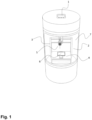
- the basic structure of the system is shown in Fig. 1 and comprises a display 1 with keys or touch buttons, from which the user can enter the necessary data and monitor the displayed indications during the system operation. It also comprises a 3D printing machine 2 which has a mechanical system 3 comprising a mechanical arm , movable in one or more directions, a base system 4 which can be fixed or mechanically movable in one or more directions and a print head 5 which dispenses the mixture, depending on the instructions received from software, for the 3D printing of tablets, granules and capsules on the print base 6.
- the 3D printing machine 2 is located within a chamber 7, which is closed by a door 8, Fig. 2 , to create a controlled environment during printing.
- the system for producing tablets, granules and capsules by means of 3D printing of the present invention is further provided with a power cable 9, Fig. 3 , and can be connected to a computer 10.
- This connection can be wired or wireless.
- the system itself may have a built-in computing unit on the base 11 so that no connection to an external computer 10 is required for its operation.
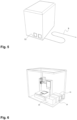
- the system for producing tablets, granules and capsules by means of 3D printing may be in the form of Fig. 4 similarly including a display 1, a power cable 9, Fig. 5 and a printing chamber 7, in which there is a 3D printing machine 2.
- the system is also equipped with an air filter 13, Fig. 6 , for cleaning the circulating air, which can be detachable for washing or replacing it when required.
- a computer unit 14 and a supply unit 15 of the entire system can make it completely autonomous.
- the system for producing tablets, granules and capsules by means of 3D printing may have additional functional elements making it capable for use in more complex applications.
- the system has a display 1, Fig. 7 , and a door 8 and furthermore has a power supply unit with voltage stabilizer 15, Fig. 10 , as well as an uninterruptible power supply 16, Fig. 9 , allowing for the uninterrupted operation of the system.
- the air conditioning and air drying system 17 is connected by means of one or more air supply and return ducts 18 to the printing chamber 7 and generally to the interior of the system so that when actuating helps in developing the appropriate conditions.
- the system also has an activated charcoal filter 19, Fig. 8 , for absorbing carbon dioxide and other harmful substances from the circulating air, while a vacuum pump 20 and a negative pressure container 21 contribute to the creation of a vacuum or the appropriate pressure conditions, depending on the requirements.
- the system may have a cleaning unit 67 comprising a wash tank 22 inside which the print head 5 is washed and cleaned through a wash tank port 23, Fig. 12 .
- a cleaning unit 67 comprising a wash tank 22 inside which the print head 5 is washed and cleaned through a wash tank port 23, Fig. 12 .
- it has a reservoir 24 for the cleaning liquid of the print head 5 and a filtering system 25 for the head cleaning liquid, ensuring that it will be free from any debris after cleaning the print head 5.
- the cleaning liquid may be selected from the following examples.
- the cleaning liquid preferably is phosphate and chlorine-free.
- the print head After 3d printing the print head preferably passes pre-filtered drying air which is heated shortly before entering the cleaning unit.
- the air may be filtered again through a suitable filter, as for example, a HEPA H13 filter is required in Europe.
- the detergent can be used with ultrasonic or spray technology or as a foam detergent.
- the system will have the corresponding computing unit 14, Fig. 11 , for processing and executing commands, as previously reported.
- a 3D printing machine 2 Fig. 13
- a mechanical system 3 which ends in one or more print heads 5 for printing on a base system 4.
- the base system 4 may be fixed or movable in one or more directions, depending on its axis' degrees of freedom 26.
- the mechanical system 3 may move in one direction, for example up and down, Fig. 15 , in two directions, for example up and down and right-left, Fig. 16 , or even have a different shape, Fig. 17 , possessing more degrees of freedom.
- the 3D printing machine 2 Fig. 18
- 3D printing of tablets, granules and capsules requires one or more mixtures of active substances and substances with plastic (bonding) properties, depending on the finished product to make.
- the mixture 27, Fig. 19 which may be exclusively an active substance, exclusively a plastic or a bonding or a combination thereof, may be in liquid form within a cartridge 28, which is fed in the print head 5 or may be constantly provided thereto via a container 29, Fig. 14 , which is connected by a fed line 30, for example a dispensing tube , with the print head 5.
- the number of containers 29 connected to the print head 5 may be higher than one. Further and alternatively, the cartridge 28 may be permanently attached to the head 5 and singly replaced after it is emptied. In another alternative embodiment the mixture 27 may also have the form of filament.
- the cartridge 28 Since the viscosity of the mixtures used varies depending on the manufactured product, the cartridge 28 has different cross-section ends. It may therefore have a wide cross section at the end 31, Fig. 20 , or have a narrower cross section, Fig. 21 . To close the cartridge 28 underside, a cap 32 may be used, the use of any other appropriate closure whatever not excluded.
- the upper side of the cartridge 28 has a downwardly movable lid 33 which is urged by a punch 34, Fig. 22 , to provide the mixture 27 to the print head 5.
- the lid 33 may be equipped with a suitable device, such as a radio frequency identification system, to enable the punch 34 to determine its exact location, as well as relevant cartridge information 28.
- the cartridges may be provided at their nozzle with a valve to avoid spillage, dry-outs etc.
- a valve is a device that regulates, directs or controls the flow of a fluid (gases, liquids, fluidized solids, or slurries) by opening, closing, or partially obstructing various passageways.
- Valves are technically fittings, but are usually discussed as a separate category. In an open valve, fluid flows in a direction from higher pressure to lower pressure.
- valve The simplest, and very ancient, valve is simply a freely hinged flap which drops to obstruct fluid (gas or liquid) flow in one direction, but is pushed open by flow in the opposite direction. This is called a check valve, as it prevents or "checks" the flow in one direction.
- Modern control valves may regulate pressure or flow downstream and operate on sophisticated automation systems. These valves may be spring loaded, elastic - made of silicon or other material with similar characteristics of elasticity- having a hole or a cut (straight, cruciform etc) to allow the exit of the material from the cartridge when pressurized by the shaft on the plug.
- the protective cap of the cartridge's nozzle can be fitted with a small needle.
- at least one blade may be used in the case of cuts on the valve suited to their form, for example cruciform.
- the valve may be of a different type for example a doser-type devise to control the flow if the material included in the cartridge is of a dry (solid) type, such as powders, granules conglomerates etc., or an on/off valve (shutter valves, ball valves, pin valves etc.) for use with liquids.
- the valves can be pressure inserted at the cartridges nozzle or glued. In the case of solid materials the valve mechanism may form the lower part of the cartridge itself.
- Every system may be equipped with more than one cartridge 28 with the same or different mixture 27 and with the same or different end 31.
- the cartridges 28 are arranged in carriers 35, which may be elongated or even rotatable, Fig. 23 .
- the carriers 35 are mechanically driven by a servomotor or other suitable device, leading the appropriate cartridge 28 into a loading position so that the punch 34 pushes the appropriate amount of mixture 27 into the print head to start the process.
- the carriers 35 may be located within the 3D printing machine 2, Fig. 24 , and led over the base system 4 to start the process or may be firmly positioned at a point from which an arm 36, Fig. 17 , receives a cartridge 28 at a time.
- the size of the carriers 35 and the number of cartridges 28 this may carry is limited only by the available space of the system.
- the cartridges may vary in size or shape depending both on the production method. They may be bigger for mass production, for example in a factory, medium sized for pharmacies and hospitals or smaller for desktop or mobile use.
- the cartridges as said are preferably created using materials that does not interact or contaminate in any way the included substance (example: oxidation of metal in contact with aqueous or alcohol solvents).
- Such materials comprise a vast array of metals like stainless steal, aluminium alloys, and in any case techniques that form a membrane like coating can be used to insulate the contained substance from any metal that could potentially harm it so in theory any metal could be used.
- electroplating, spray or dip painting, ceramic coating or even internal extrusion of a suitable plastic membrane we could mention: electroplating, spray or dip painting, ceramic coating or even internal extrusion of a suitable plastic membrane.
- Such materials comprise a vast array of plastic materials and in this case care must be given on the avoidance of contamination which may come by reaction (example alcohol solvent and some types of polyethylene plastics) or by release of volatile gases and/or oil substances contained in the plastic itself (example some polyethylene, polyurethane and polyester materials).
- plastic materials such as epoxy, some nylons, polyethylenes and even greater number of composite materials (example nylons with glass micro-spheres created by injection molding or epoxy combined with ceramic micro-spheres).
- plastics In the case of plastics, techniques mentioned before may come in use either to further enhance defense of the contained substances or to allow the use of non suited materials by forming an internal layer of protective material suited for the job (example dual extrusion of PET or PETG and ABS. Such techniques are often used in plastic made, disposable, water and soda bottles). Harder or not-extrudable plastics can be rendered temporarily electro-conductive and thus plated or they may simply be sprayed or dipped to form the protective layer using a suitable material. In any case glass and ceramics may be used.
- the cartridges incorporate in their body various methods of identification (RIFD or other chip, barcode or other) which provide an interface with a reading unit 66, see Fig. 41 , on the carrier or on a storage container.
- RIFD identification
- This info allows the system to recognize the ingredients contained, such that a correct volume may be chosen, or to recognize the shelf- life of each product, the remaining volume in each cartridge, the frequency of use and other.
- This information can be used as statistics to optimise production and if needed to automate the supply chain by ordering of replacement refills in time.
- the print head 5 is the device intended to apply the necessary amount of mixture 27 to produce the corresponding granule, tablet or capsule.
- the print head 5 is provided with a nozzle 37, Fig. 26 , from which the mixture 27 is supplied and a print head body 38, for example formed as a cylinder, with an envelope 39. It further has a support 40, Fig. 28 (a) , through which it is held either in a head carrier 41, Fig. 24 , or in an arm 36.
- the print head may be a thermal one, Fig. 25 , in order to improve the temperature control of the mixture 27.
- it has a heated body 42 with indentations 43 which contribute to heat losses, and can also be provided with a cooling fan 44, Fig. 26 , on its rear side, further improving the temperature control.
- the print head 5 may be provided with an energy emitter 45, in this example a photopolymerization headlamp, Fig. 27 , supported on an arm 46, to be used for mixtures 27 requiring its presence.
- an energy emitter 45 in this example a photopolymerization headlamp, Fig. 27 , supported on an arm 46, to be used for mixtures 27 requiring its presence.
- the print head 5 may have a liquid nitrogen spray nozzle for direct cooling the printed article.
- the print head 5 may be provided with a stirring and/or discharge tool 47, in this example a worm screw , Fig. 22 , which is rotated continuously or intermittently by means of a servomotor and which shakes the mixture within the print head 5. In this way the mixture 27 will retain the necessary viscosity, depending on the application to be used.
- a stirring and/or discharge tool 47 in this example a worm screw , Fig. 22 , which is rotated continuously or intermittently by means of a servomotor and which shakes the mixture within the print head 5.
- the mixture 27 will retain the necessary viscosity, depending on the application to be used.
- the worm screw 47 may have a collapsible head 48, Fig. 31 , which, in addition to stirring the mixture 27, compresses it appropriately by removing the air. To do this, it has a hole 51 at the top of the head 48, Fig. 32 , from which the solvent, the active drug substance or the mixture in general are introduced and a hole 50 from which the air is discharged by compression. The holes can be closed by stoppers 52, Fig. 33 when their use is not required.
- the collapsible head 48 can be made of stainless steel, thermoplastic materials, and composite materials, such as paraaramid synthetic fibre or memory metals, Fig. 34 .
- this may have both a worm screw 47 with or without a collapsible head 48, with or without a heated body 42 and with more than one nozzle 37, Fig. 35 , so that 3D printing takes place at a faster rate.
- the print base 6 may also be temperature-controlled, and it may also have formatted printing locations 49, Fig. 29 (a) and Fig. 36 , for forming the tablet, granule or capsule, by applying the mixture 27.
- the base 6 may further have air ducts 50, Fig. 30 , which allow for natural or forced air flow on the base 6, in order to reduce the evaporation of the moisture content in the produced articles.
- Figure 37 illustrates an example of a heatable base system 4.
- the print base system 4 comprises a temperature control system 68 with air ducts 53 and channels 54 for guiding a tempering agent, as well as a fan 55.
- the print base 6 is removeably held by a print base holder 57 and may be pushed in and pulled out.
- Figure 38 illustrates a further example of a base system 4, wherein a fan 55 is arranged laterally from the print base 6.
- Figure 39 illustrates base system 4 comprising extractor pins 56.
- the extractor pins 56 are in a passive position, closing holes 58 in the formatted printing locations 49.
- the extractor pins 56 are arranged on a plate 59 which may be moved vertically. When the plate is moved upwards, the extractor pins 56 are in an extracting position, Figure 39 (b) .
- the extractor pins 56 reach out of the holes 58 and may printed matter (not explicitly shown) out of the formatted printing locations 49.
- Figure 40 illustrates an embodiment of a compressible cartridge 28, (a) in a first position, (b) in a second position and (c) in a third position.
- the cartridge 28 may comprise a double body: an external cylindrical shape hard body 60 and an inner container 61 made from compressible material. On the upper part there is a plug 62 which may be press downwardly to expel a printing substance (not explicitly shown) out of a lower end 31 of the cartridge 28.
- the cartridge 28 may be used as print head, when the cartridge is arranged on the mechanical system and when there is a printing nozzle (not shown) mounted to the lower end 31.
- FIG 41 illustrates cartridge carriers 35 arranged in a magazine unit 63.
- Each carrier 35 may accept a cartridge 28.
- the magazine unit 63 comprises rotating actuators 64 and a belt 65 for moving the cartridges 28.
- Each carrier 35 comprises a reading unit 66 for reading a cartridge 28 identification.
- the upper cap 69 is removed by an upper-cap remover 70.
- the carrier 35 being positioned near the upper-cap remover 70 is shown without a cartridge for clarity.
- the lower cap 71 is removed by a lower-cap remover 72.
- the cartridge is then moved to a dispensing place 73, where the carrier 35 is tilted together with the cartridge 28.
- the cartridge is brought into contact with a push rod actuator 74, which presses a defined quantity of material out of the cartridge 28 into the print head.
- the cartridge 28 may be cleaned in a washing cup 75, which may be lifted by a washing cup actuator 76.
Landscapes
- Chemical & Material Sciences (AREA)
- Engineering & Computer Science (AREA)
- Materials Engineering (AREA)
- Manufacturing & Machinery (AREA)
- Health & Medical Sciences (AREA)
- Optics & Photonics (AREA)
- Mechanical Engineering (AREA)
- Physics & Mathematics (AREA)
- Medicinal Chemistry (AREA)
- Public Health (AREA)
- General Health & Medical Sciences (AREA)
- Veterinary Medicine (AREA)
- Animal Behavior & Ethology (AREA)
- Life Sciences & Earth Sciences (AREA)
- Pharmacology & Pharmacy (AREA)
- Epidemiology (AREA)
- Environmental & Geological Engineering (AREA)
- Toxicology (AREA)
- Medical Preparation Storing Or Oral Administration Devices (AREA)
- Medicinal Preparation (AREA)
- Nitrogen And Oxygen Or Sulfur-Condensed Heterocyclic Ring Systems (AREA)
Applications Claiming Priority (3)
| Application Number | Priority Date | Filing Date | Title |
|---|---|---|---|
| GR20170100219A GR1009361B (el) | 2017-05-11 | 2017-05-11 | Συστημα παραγωγης μεσω τρισδιαστατης εκτυπωσης, δισκιων, κοκκιων και καψουλων |
| EP18723797.9A EP3528767B1 (fr) | 2017-05-11 | 2018-05-07 | Système et procédé de production d'objets pharmaceutiques par impression 3d |
| PCT/EP2018/061707 WO2018206497A2 (fr) | 2017-05-11 | 2018-05-07 | Système et procédé de production d'objets pharmaceutiques par impression 3d |
Related Parent Applications (1)
| Application Number | Title | Priority Date | Filing Date |
|---|---|---|---|
| EP18723797.9A Division EP3528767B1 (fr) | 2017-05-11 | 2018-05-07 | Système et procédé de production d'objets pharmaceutiques par impression 3d |
Publications (2)
| Publication Number | Publication Date |
|---|---|
| EP4523890A2 true EP4523890A2 (fr) | 2025-03-19 |
| EP4523890A3 EP4523890A3 (fr) | 2025-05-21 |
Family
ID=62148359
Family Applications (2)
| Application Number | Title | Priority Date | Filing Date |
|---|---|---|---|
| EP18723797.9A Active EP3528767B1 (fr) | 2017-05-11 | 2018-05-07 | Système et procédé de production d'objets pharmaceutiques par impression 3d |
| EP24222626.4A Pending EP4523890A3 (fr) | 2017-05-11 | 2018-05-07 | Système et procédé de production d'objets pharmaceutiques par impression 3d |
Family Applications Before (1)
| Application Number | Title | Priority Date | Filing Date |
|---|---|---|---|
| EP18723797.9A Active EP3528767B1 (fr) | 2017-05-11 | 2018-05-07 | Système et procédé de production d'objets pharmaceutiques par impression 3d |
Country Status (13)
| Country | Link |
|---|---|
| US (1) | US11548221B2 (fr) |
| EP (2) | EP3528767B1 (fr) |
| JP (3) | JP7311494B2 (fr) |
| KR (3) | KR102562926B1 (fr) |
| CN (1) | CN110753533A (fr) |
| AU (3) | AU2018265303B2 (fr) |
| CA (1) | CA3062752A1 (fr) |
| ES (1) | ES3016457T3 (fr) |
| GR (1) | GR1009361B (fr) |
| HR (1) | HRP20250249T1 (fr) |
| HU (1) | HUE070962T2 (fr) |
| PL (1) | PL3528767T3 (fr) |
| WO (1) | WO2018206497A2 (fr) |
Families Citing this family (32)
| Publication number | Priority date | Publication date | Assignee | Title |
|---|---|---|---|---|
| JP7131248B2 (ja) * | 2018-09-25 | 2022-09-06 | セイコーエプソン株式会社 | 可塑化装置および三次元造形装置 |
| WO2020209873A1 (fr) * | 2019-04-12 | 2020-10-15 | Hewlett-Packard Development Company, L.P. | Détermination de pose d'objet fondée sur un accéléromètre |
| US12076918B2 (en) * | 2019-05-23 | 2024-09-03 | General Electric Company | Additive manufacturing apparatuses and methods for using the same |
| JP7404670B2 (ja) * | 2019-06-25 | 2023-12-26 | セイコーエプソン株式会社 | 三次元造形装置、および、距離に関する値の測定方法 |
| WO2021110544A1 (fr) * | 2019-12-02 | 2021-06-10 | Merck Patent Gmbh | Méthode de fabrication d'une forme d'administration solide, et forme d'administration solide |
| CN115297837A (zh) * | 2019-12-09 | 2022-11-04 | 迪赫西斯数字健康系统有限公司 | 用于含有活性物质的剂型的增材制造的点打印方法和设备 |
| CN111761810A (zh) * | 2019-12-16 | 2020-10-13 | 江苏华疆三维科技有限公司 | 一种汽车3d打印设备 |
| GB202000032D0 (en) | 2020-01-02 | 2020-02-19 | Finch Steven Caffall | Pharmacy assembly machine and packaging for customised polypills, and customised antipsychotic combinations for improved compliance |
| WO2021198308A1 (fr) * | 2020-03-30 | 2021-10-07 | Dihesys Digital Health Systems Gmbh | Appareil et procédé d'impression tridimensionnelle de mélanges de médicaments pour former des formes d'administration pharmaceutique à l'aide d'un dispositif d'alimentation en matière rotatif ou mobile |
| EP3892446A1 (fr) * | 2020-04-08 | 2021-10-13 | DENTSPLY SIRONA Inc. | Ensemble plaque de construction destiné à être utilisé dans un appareil de fabrication additive |
| US20230190661A1 (en) * | 2020-04-15 | 2023-06-22 | Aprecia Pharmaceuticals LLC | Multi-component packaged dosage form and method |
| KR102245716B1 (ko) * | 2020-09-01 | 2021-04-28 | 송광 | 알약 계수기 |
| CN112406095B (zh) * | 2020-11-05 | 2021-09-28 | 三阳纺织有限公司 | 一种具有抗菌功能的织物及其快速成形方法 |
| CN113119461B (zh) * | 2021-04-25 | 2023-07-18 | 南京工业职业技术大学 | 一种可调节气压的3d打印装置 |
| CN113459502B (zh) * | 2021-06-25 | 2022-12-13 | 广东药科大学 | 一种多药品配方组合的药品立体成型打印方法及装置 |
| CN113478823A (zh) * | 2021-06-30 | 2021-10-08 | 共享智能铸造产业创新中心有限公司 | 一种3d打印方法、打印机、系统及存储介质 |
| CN113619117B (zh) * | 2021-08-03 | 2024-01-12 | 大河数智(泉州)增材技术有限公司 | 一种送料通畅便于原料回收的自清理3d数码打印机 |
| EP4392233B1 (fr) * | 2021-08-24 | 2025-03-05 | Signify Holding B.V. | Imprimante 3d |
| EP4391986A1 (fr) * | 2021-08-25 | 2024-07-03 | KNOBEL, Guido | Dispositif de préparation d'un produit pharmaceutique, d'un complément alimentaire ou d'un produit cosmétique |
| CN114053150A (zh) * | 2021-11-03 | 2022-02-18 | 水星生医股份有限公司 | 口服药锭制造设备及其制造方法 |
| US20230143386A1 (en) * | 2021-11-05 | 2023-05-11 | Taiwan Mercury Medical Corporation | Oral drug tablet manufacturing device and manufacturing method thereof |
| GR1010467B (el) * | 2021-11-16 | 2023-05-31 | Αριστοτελειο Πανεπιστημιο Θεσσαλονικης - Ειδικος Λογαριασμος Κονδυλιων Ερευνας, | Μασωμενες ημιστερεες φαρμακομορφες με βαση το γαλα για χορηγηση φαρμακων, μεθοδος παρασκευης τους και χρησεις αυτων |
| CN114103118B (zh) * | 2021-11-30 | 2023-05-23 | 浙江机电职业技术学院 | 一种3d打印机用耗材预处理装置 |
| CN114415587B (zh) * | 2022-01-20 | 2023-09-29 | 中国科学院上海高等研究院 | 一种测试站绝热真空数据采集控制系统及方法 |
| CN114347478B (zh) * | 2022-01-20 | 2024-05-28 | 中国科学院空间应用工程与技术中心 | 一种用于多材料3d打印清洗装置及方法 |
| KR20250008880A (ko) | 2022-04-13 | 2025-01-16 | 아프레시아 파마슈티칼즈 엘엘씨 | 전방향 자기 운동 장치를 이용한 적층 제조를 위한 시스템 및 방법 |
| CN117000507A (zh) * | 2022-04-29 | 2023-11-07 | 富联裕展科技(深圳)有限公司 | 液体导入装置 |
| CN116619752A (zh) * | 2023-04-14 | 2023-08-22 | 北京大学 | 基于封闭空间的墨水直写3d打印装置及其方法 |
| TWI868762B (zh) | 2023-06-28 | 2025-01-01 | 水星生醫股份有限公司 | 模組化藥錠製造系統 |
| KR102641523B1 (ko) * | 2023-08-21 | 2024-02-27 | 주식회사 에브릿 | 3d프린터를 이용한 odf 제조장치 및 이를 이용한 odf의 제조방법 |
| WO2025128987A1 (fr) * | 2023-12-15 | 2025-06-19 | Board Of Regents, The University Of Texas System | Technologie du type goutte à la demande (dod) électromagnétique en tant que plateforme innovante pour la production d'une dispersion solide amorphe |
| WO2025214546A1 (fr) * | 2024-04-09 | 2025-10-16 | Schaeffler Technologies AG & Co. KG | Dispositif et procédé de fabrication d'un produit pharmaceutique |
Citations (1)
| Publication number | Priority date | Publication date | Assignee | Title |
|---|---|---|---|---|
| WO2017034951A1 (fr) | 2015-08-21 | 2017-03-02 | Aprecia Pharmaceuticals Company | Système d'impression tridimensionnelle et ensemble d'équipement |
Family Cites Families (50)
| Publication number | Priority date | Publication date | Assignee | Title |
|---|---|---|---|---|
| US5229164A (en) * | 1985-12-19 | 1993-07-20 | Capsoid Pharma Gmbh | Process for producing individually dosed administration forms |
| US5121329A (en) * | 1989-10-30 | 1992-06-09 | Stratasys, Inc. | Apparatus and method for creating three-dimensional objects |
| JP2597778B2 (ja) * | 1991-01-03 | 1997-04-09 | ストラタシイス,インコーポレイテッド | 三次元対象物組み立てシステム及び組み立て方法 |
| US5764521A (en) * | 1995-11-13 | 1998-06-09 | Stratasys Inc. | Method and apparatus for solid prototyping |
| DE10018987A1 (de) * | 2000-04-17 | 2001-10-31 | Envision Technologies Gmbh | Vorrichtung und Verfahren zum Herstellen von dreidimensionalen Objekten |
| AU2001263506A1 (en) | 2000-05-18 | 2001-11-26 | Massachusetts Institute Of Technology | Encapsulating a toxic core within a non-toxic region in an oral dosage form |
| US7122143B2 (en) | 2001-09-28 | 2006-10-17 | Mcneil-Ppc, Inc. | Methods for manufacturing dosage forms |
| US6902246B2 (en) | 2001-10-03 | 2005-06-07 | 3D Systems, Inc. | Quantized feed system for solid freeform fabrication |
| US6905645B2 (en) * | 2002-07-03 | 2005-06-14 | Therics, Inc. | Apparatus, systems and methods for use in three-dimensional printing |
| DE60320588T2 (de) * | 2002-11-12 | 2009-06-04 | Objet Geometries Ltd. | Verfahren und system zum drucken eines dreidimensionalen gegenstandes |
| JP4607863B2 (ja) | 2003-01-08 | 2011-01-05 | エオプレックス テクノロジーズ インコーポレイテッド | 大量の印刷形成を行うためのシステム |
| US7939003B2 (en) * | 2004-08-11 | 2011-05-10 | Cornell Research Foundation, Inc. | Modular fabrication systems and methods |
| EP2117793B1 (fr) * | 2007-02-12 | 2014-07-16 | Stratasys, Inc. | Système de pompe |
| EP2664443B1 (fr) * | 2007-07-25 | 2021-08-25 | Stratasys Ltd. | Fabrication de formes libres solides avec une pluralité de matériaux de modelage |
| JP5189953B2 (ja) * | 2008-10-22 | 2013-04-24 | パナソニック株式会社 | 三次元形状造形物の製造方法 |
| WO2011005492A1 (fr) * | 2009-06-23 | 2011-01-13 | Stratasys, Inc. | Matière consommable à caractéristiques personnalisées |
| KR101812820B1 (ko) * | 2010-01-08 | 2017-12-27 | 웨이크 포리스트 유니버시티 헬스 사이언시즈 | 전달 시스템 |
| US9381154B2 (en) * | 2011-06-09 | 2016-07-05 | Xerox Corporation | Direct inkjet fabrication of drug delivery devices |
| DE102011106615A1 (de) * | 2011-06-16 | 2012-12-20 | Arburg Gmbh + Co Kg | Vorrichtung zur Herstellung eines dreidimensionalen Gegenstandes |
| US8955558B2 (en) | 2012-06-18 | 2015-02-17 | Stratasys, Inc. | Hopper valve for extrusion-based additive manufacturing systems, and methods of use thereof |
| US8888480B2 (en) * | 2012-09-05 | 2014-11-18 | Aprecia Pharmaceuticals Company | Three-dimensional printing system and equipment assembly |
| CN105188993A (zh) * | 2013-03-15 | 2015-12-23 | 麦特法布公司 | 用于增材制造装置的料盒和方法 |
| EP3028042B1 (fr) | 2013-07-31 | 2021-06-30 | Organovo, Inc. | Dispositifs, systèmes et procédés automatisés pour la fabrication de tissus |
| WO2015054577A1 (fr) * | 2013-10-11 | 2015-04-16 | Advanced Solutions Life Sciences, Llc | Système et poste de travail pour la conception, la fabrication et l'assemblage de structures de biomatériaux |
| US9085109B2 (en) * | 2013-11-15 | 2015-07-21 | Makerbot Industries, Llc | Three-dimensional printer tool systems |
| KR20150078774A (ko) * | 2013-12-31 | 2015-07-08 | 이수아 | 3d 프린팅 기술을 이용한 약물의 제작 방법 및 장치 |
| US20150197063A1 (en) | 2014-01-12 | 2015-07-16 | Zohar SHINAR | Device, method, and system of three-dimensional printing |
| US10000009B2 (en) * | 2014-02-05 | 2018-06-19 | Nathan Christopher Maier | Sterile environment for additive manufacturing |
| CN103878980B (zh) | 2014-03-21 | 2015-11-18 | 浙江大学 | 一种可更换喷头的三维打印机 |
| JP6359316B2 (ja) * | 2014-03-31 | 2018-07-18 | 三菱重工業株式会社 | 三次元積層装置及び三次元積層方法 |
| JP2017526432A (ja) * | 2014-08-14 | 2017-09-14 | ザ・セカント・グループ・エルエルシー | 移植可能な物品を製造するために有用な組成物、方法、及び装置 |
| CN104224405A (zh) | 2014-09-03 | 2014-12-24 | 上海大学 | 复合式转盘气动多喷头生物3d打印成形系统及方法 |
| CN107107463B (zh) * | 2014-09-08 | 2019-10-25 | 中央兰开夏大学 | 固体剂型生产 |
| US9931829B2 (en) * | 2014-10-29 | 2018-04-03 | Massachusetts Institute Of Technology | Methods and apparatus for hygromorphic shape control |
| US10059053B2 (en) * | 2014-11-04 | 2018-08-28 | Stratasys, Inc. | Break-away support material for additive manufacturing |
| US9844930B2 (en) * | 2014-11-05 | 2017-12-19 | Xerox Corporation | 3D printing of digestible shells for medicaments |
| US10684603B2 (en) * | 2015-01-13 | 2020-06-16 | Bucknell University | Dynamically controlled screw-driven extrusion |
| DE102015205314A1 (de) | 2015-03-24 | 2016-09-29 | Siemens Aktiengesellschaft | Anlage für ein additives Herstellungsverfahren mit Heizeinrichtung für den Pulverraum |
| CN104826762B (zh) | 2015-05-08 | 2017-05-10 | 杭州捷诺飞生物科技有限公司 | 一种独立切换型多种细胞/多种生物材料组装喷头 |
| WO2016184997A1 (fr) | 2015-05-19 | 2016-11-24 | Addifab Aps | Appareil de fabrication additive avec unité de réenduction et son procédé d'utilisation |
| US20160342769A1 (en) | 2015-05-23 | 2016-11-24 | Vitae Industries, Inc. | Systems for making personalized medicine |
| CA2989395C (fr) * | 2015-06-25 | 2019-09-03 | Dws S.R.L. | Procede pour la validation d'elements consommables adaptes pour etre installe sur une machine de stereolithographie et procede pour permettre a ladite machine de stereolithographie de conduire le processus d'impression. |
| JP6358206B2 (ja) | 2015-09-09 | 2018-07-18 | トヨタ自動車株式会社 | 金属部材の製造方法 |
| CN105690757B (zh) * | 2015-09-21 | 2019-05-31 | 中国科学院深圳先进技术研究院 | 3d打印设备和基于3d打印的物料供给搅拌系统 |
| CN105196550B (zh) * | 2015-10-30 | 2018-01-23 | 兰红波 | 一种单喷头多材料多尺度3d打印装置及其工作方法 |
| US20170121039A1 (en) * | 2015-10-30 | 2017-05-04 | Paul M. Ciesiun | Seamless Paintball and Encapsulation Method |
| WO2017075396A1 (fr) * | 2015-10-30 | 2017-05-04 | Stratasys, Inc. | Pompe pour fluides visqueux à réglage de remplissage et de débit et procédés s'y rapportant |
| CN105796206B (zh) * | 2016-05-07 | 2017-08-04 | 浙江大学 | 一种自动配料和混料的多喷头生物3d打印设备及控制方法 |
| CN108189396A (zh) | 2016-06-20 | 2018-06-22 | 海宁酷彩数码科技有限公司 | 一种改进的3d打印机的升降机构 |
| CN106265080B (zh) * | 2016-09-08 | 2019-12-24 | 中南大学 | 3d打印药物的方法及3d打印药物外壳 |
-
2017
- 2017-05-11 GR GR20170100219A patent/GR1009361B/el active IP Right Grant
-
2018
- 2018-05-07 WO PCT/EP2018/061707 patent/WO2018206497A2/fr not_active Ceased
- 2018-05-07 PL PL18723797.9T patent/PL3528767T3/pl unknown
- 2018-05-07 JP JP2020512908A patent/JP7311494B2/ja active Active
- 2018-05-07 KR KR1020197036554A patent/KR102562926B1/ko active Active
- 2018-05-07 CA CA3062752A patent/CA3062752A1/fr active Pending
- 2018-05-07 EP EP18723797.9A patent/EP3528767B1/fr active Active
- 2018-05-07 HR HRP20250249TT patent/HRP20250249T1/hr unknown
- 2018-05-07 HU HUE18723797A patent/HUE070962T2/hu unknown
- 2018-05-07 AU AU2018265303A patent/AU2018265303B2/en active Active
- 2018-05-07 EP EP24222626.4A patent/EP4523890A3/fr active Pending
- 2018-05-07 US US16/611,389 patent/US11548221B2/en active Active
- 2018-05-07 CN CN201880040373.8A patent/CN110753533A/zh active Pending
- 2018-05-07 KR KR1020237025969A patent/KR102664153B1/ko active Active
- 2018-05-07 ES ES18723797T patent/ES3016457T3/es active Active
- 2018-05-07 KR KR1020247011439A patent/KR20240058913A/ko active Pending
-
2023
- 2023-04-13 JP JP2023065765A patent/JP7459344B2/ja active Active
-
2024
- 2024-03-19 JP JP2024043614A patent/JP2024073616A/ja active Pending
- 2024-06-04 AU AU2024203747A patent/AU2024203747B2/en active Active
-
2025
- 2025-07-11 AU AU2025205378A patent/AU2025205378A1/en active Pending
Patent Citations (1)
| Publication number | Priority date | Publication date | Assignee | Title |
|---|---|---|---|---|
| WO2017034951A1 (fr) | 2015-08-21 | 2017-03-02 | Aprecia Pharmaceuticals Company | Système d'impression tridimensionnelle et ensemble d'équipement |
Also Published As
Similar Documents
| Publication | Publication Date | Title |
|---|---|---|
| US11548221B2 (en) | System and method for producing pharmacutical objects via 3D printing | |
| US20230131161A1 (en) | System and method for producing pharmacutical objects via 3d printing | |
| JP6903659B2 (ja) | 3次元プリントシステムおよび装置アセンブリ | |
| CN1170734C (zh) | 包装方法 | |
| CA2934287C (fr) | Systeme et procede destines a la formation de melanges de fluide | |
| US8372225B2 (en) | Machine and method for pharmaceutical and pharmaceutical-like product assembly | |
| EP1389083A2 (fr) | Distributeur de medicament | |
| EP2313050B1 (fr) | Système et méthode d'élaboration d'un médicament | |
| KR20160049059A (ko) | 3차원 인쇄 시스템 및 장비 어셈블리 | |
| RU2792691C2 (ru) | Система и способ изготовления фармацевтических объектов посредством 3d-печати | |
| BR112019023461B1 (pt) | Sistema e método para produzir objetos farmacêuticos por meio de impressão 3d | |
| WO2025186544A1 (fr) | Appareil et procédé d'impression 3d | |
| JP2005246184A (ja) | マイクロ流体装置 |
Legal Events
| Date | Code | Title | Description |
|---|---|---|---|
| PUAI | Public reference made under article 153(3) epc to a published international application that has entered the european phase |
Free format text: ORIGINAL CODE: 0009012 |
|
| STAA | Information on the status of an ep patent application or granted ep patent |
Free format text: STATUS: REQUEST FOR EXAMINATION WAS MADE |
|
| 17P | Request for examination filed |
Effective date: 20250116 |
|
| AC | Divisional application: reference to earlier application |
Ref document number: 3528767 Country of ref document: EP Kind code of ref document: P |
|
| AK | Designated contracting states |
Kind code of ref document: A2 Designated state(s): AL AT BE BG CH CY CZ DE DK EE ES FI FR GB GR HR HU IE IS IT LI LT LU LV MC MK MT NL NO PL PT RO RS SE SI SK SM TR |
|
| REG | Reference to a national code |
Ref country code: DE Ref legal event code: R079 Free format text: PREVIOUS MAIN CLASS: B29C0064200000 Ipc: A61J0003060000 |
|
| PUAL | Search report despatched |
Free format text: ORIGINAL CODE: 0009013 |
|
| RIN1 | Information on inventor provided before grant (corrected) |
Inventor name: HEINZE, ARNE-PARTRIK Inventor name: THEODOSOPOULOS, KONSTANTINOS Inventor name: FREIDERIKOS, ACHILLEFS |
|
| AK | Designated contracting states |
Kind code of ref document: A3 Designated state(s): AL AT BE BG CH CY CZ DE DK EE ES FI FR GB GR HR HU IE IS IT LI LT LU LV MC MK MT NL NO PL PT RO RS SE SI SK SM TR |
|
| RIC1 | Information provided on ipc code assigned before grant |
Ipc: B29C 64/20 20170101ALI20250417BHEP Ipc: A61J 3/06 20060101AFI20250417BHEP |
|
| STAA | Information on the status of an ep patent application or granted ep patent |
Free format text: STATUS: EXAMINATION IS IN PROGRESS |
|
| 17Q | First examination report despatched |
Effective date: 20250606 |