EP4516554A2 - Power-split axle drive and agricultural vehicle - Google Patents
Power-split axle drive and agricultural vehicle Download PDFInfo
- Publication number
- EP4516554A2 EP4516554A2 EP24219271.4A EP24219271A EP4516554A2 EP 4516554 A2 EP4516554 A2 EP 4516554A2 EP 24219271 A EP24219271 A EP 24219271A EP 4516554 A2 EP4516554 A2 EP 4516554A2
- Authority
- EP
- European Patent Office
- Prior art keywords
- power
- split
- transmission
- drive element
- axle
- Prior art date
- Legal status (The legal status is an assumption and is not a legal conclusion. Google has not performed a legal analysis and makes no representation as to the accuracy of the status listed.)
- Pending
Links
Images



Classifications
-
- B—PERFORMING OPERATIONS; TRANSPORTING
- B60—VEHICLES IN GENERAL
- B60K—ARRANGEMENT OR MOUNTING OF PROPULSION UNITS OR OF TRANSMISSIONS IN VEHICLES; ARRANGEMENT OR MOUNTING OF PLURAL DIVERSE PRIME-MOVERS IN VEHICLES; AUXILIARY DRIVES FOR VEHICLES; INSTRUMENTATION OR DASHBOARDS FOR VEHICLES; ARRANGEMENTS IN CONNECTION WITH COOLING, AIR INTAKE, GAS EXHAUST OR FUEL SUPPLY OF PROPULSION UNITS IN VEHICLES
- B60K17/00—Arrangement or mounting of transmissions in vehicles
- B60K17/34—Arrangement or mounting of transmissions in vehicles for driving both front and rear wheels, e.g. four wheel drive vehicles
- B60K17/344—Arrangement or mounting of transmissions in vehicles for driving both front and rear wheels, e.g. four wheel drive vehicles having a transfer gear
-
- B—PERFORMING OPERATIONS; TRANSPORTING
- B60—VEHICLES IN GENERAL
- B60K—ARRANGEMENT OR MOUNTING OF PROPULSION UNITS OR OF TRANSMISSIONS IN VEHICLES; ARRANGEMENT OR MOUNTING OF PLURAL DIVERSE PRIME-MOVERS IN VEHICLES; AUXILIARY DRIVES FOR VEHICLES; INSTRUMENTATION OR DASHBOARDS FOR VEHICLES; ARRANGEMENTS IN CONNECTION WITH COOLING, AIR INTAKE, GAS EXHAUST OR FUEL SUPPLY OF PROPULSION UNITS IN VEHICLES
- B60K6/00—Arrangement or mounting of plural diverse prime-movers for mutual or common propulsion, e.g. hybrid propulsion systems comprising electric motors and internal combustion engines
- B60K6/20—Arrangement or mounting of plural diverse prime-movers for mutual or common propulsion, e.g. hybrid propulsion systems comprising electric motors and internal combustion engines the prime-movers consisting of electric motors and internal combustion engines, e.g. HEVs
- B60K6/22—Arrangement or mounting of plural diverse prime-movers for mutual or common propulsion, e.g. hybrid propulsion systems comprising electric motors and internal combustion engines the prime-movers consisting of electric motors and internal combustion engines, e.g. HEVs characterised by apparatus, components or means specially adapted for HEVs
- B60K6/36—Arrangement or mounting of plural diverse prime-movers for mutual or common propulsion, e.g. hybrid propulsion systems comprising electric motors and internal combustion engines the prime-movers consisting of electric motors and internal combustion engines, e.g. HEVs characterised by apparatus, components or means specially adapted for HEVs characterised by the transmission gearings
- B60K6/365—Arrangement or mounting of plural diverse prime-movers for mutual or common propulsion, e.g. hybrid propulsion systems comprising electric motors and internal combustion engines the prime-movers consisting of electric motors and internal combustion engines, e.g. HEVs characterised by apparatus, components or means specially adapted for HEVs characterised by the transmission gearings with the gears having orbital motion
-
- B—PERFORMING OPERATIONS; TRANSPORTING
- B60—VEHICLES IN GENERAL
- B60K—ARRANGEMENT OR MOUNTING OF PROPULSION UNITS OR OF TRANSMISSIONS IN VEHICLES; ARRANGEMENT OR MOUNTING OF PLURAL DIVERSE PRIME-MOVERS IN VEHICLES; AUXILIARY DRIVES FOR VEHICLES; INSTRUMENTATION OR DASHBOARDS FOR VEHICLES; ARRANGEMENTS IN CONNECTION WITH COOLING, AIR INTAKE, GAS EXHAUST OR FUEL SUPPLY OF PROPULSION UNITS IN VEHICLES
- B60K6/00—Arrangement or mounting of plural diverse prime-movers for mutual or common propulsion, e.g. hybrid propulsion systems comprising electric motors and internal combustion engines
- B60K6/20—Arrangement or mounting of plural diverse prime-movers for mutual or common propulsion, e.g. hybrid propulsion systems comprising electric motors and internal combustion engines the prime-movers consisting of electric motors and internal combustion engines, e.g. HEVs
- B60K6/22—Arrangement or mounting of plural diverse prime-movers for mutual or common propulsion, e.g. hybrid propulsion systems comprising electric motors and internal combustion engines the prime-movers consisting of electric motors and internal combustion engines, e.g. HEVs characterised by apparatus, components or means specially adapted for HEVs
- B60K6/38—Arrangement or mounting of plural diverse prime-movers for mutual or common propulsion, e.g. hybrid propulsion systems comprising electric motors and internal combustion engines the prime-movers consisting of electric motors and internal combustion engines, e.g. HEVs characterised by apparatus, components or means specially adapted for HEVs characterised by the driveline clutches
- B60K6/387—Actuated clutches, i.e. clutches engaged or disengaged by electric, hydraulic or mechanical actuating means
-
- B—PERFORMING OPERATIONS; TRANSPORTING
- B60—VEHICLES IN GENERAL
- B60K—ARRANGEMENT OR MOUNTING OF PROPULSION UNITS OR OF TRANSMISSIONS IN VEHICLES; ARRANGEMENT OR MOUNTING OF PLURAL DIVERSE PRIME-MOVERS IN VEHICLES; AUXILIARY DRIVES FOR VEHICLES; INSTRUMENTATION OR DASHBOARDS FOR VEHICLES; ARRANGEMENTS IN CONNECTION WITH COOLING, AIR INTAKE, GAS EXHAUST OR FUEL SUPPLY OF PROPULSION UNITS IN VEHICLES
- B60K6/00—Arrangement or mounting of plural diverse prime-movers for mutual or common propulsion, e.g. hybrid propulsion systems comprising electric motors and internal combustion engines
- B60K6/20—Arrangement or mounting of plural diverse prime-movers for mutual or common propulsion, e.g. hybrid propulsion systems comprising electric motors and internal combustion engines the prime-movers consisting of electric motors and internal combustion engines, e.g. HEVs
- B60K6/42—Arrangement or mounting of plural diverse prime-movers for mutual or common propulsion, e.g. hybrid propulsion systems comprising electric motors and internal combustion engines the prime-movers consisting of electric motors and internal combustion engines, e.g. HEVs characterised by the architecture of the hybrid electric vehicle
- B60K6/48—Parallel type
-
- B—PERFORMING OPERATIONS; TRANSPORTING
- B60—VEHICLES IN GENERAL
- B60K—ARRANGEMENT OR MOUNTING OF PROPULSION UNITS OR OF TRANSMISSIONS IN VEHICLES; ARRANGEMENT OR MOUNTING OF PLURAL DIVERSE PRIME-MOVERS IN VEHICLES; AUXILIARY DRIVES FOR VEHICLES; INSTRUMENTATION OR DASHBOARDS FOR VEHICLES; ARRANGEMENTS IN CONNECTION WITH COOLING, AIR INTAKE, GAS EXHAUST OR FUEL SUPPLY OF PROPULSION UNITS IN VEHICLES
- B60K6/00—Arrangement or mounting of plural diverse prime-movers for mutual or common propulsion, e.g. hybrid propulsion systems comprising electric motors and internal combustion engines
- B60K6/20—Arrangement or mounting of plural diverse prime-movers for mutual or common propulsion, e.g. hybrid propulsion systems comprising electric motors and internal combustion engines the prime-movers consisting of electric motors and internal combustion engines, e.g. HEVs
- B60K6/50—Architecture of the driveline characterised by arrangement or kind of transmission units
- B60K6/52—Driving a plurality of drive axles, e.g. four-wheel drive
-
- B—PERFORMING OPERATIONS; TRANSPORTING
- B62—LAND VEHICLES FOR TRAVELLING OTHERWISE THAN ON RAILS
- B62D—MOTOR VEHICLES; TRAILERS
- B62D49/00—Tractors
- B62D49/06—Tractors adapted for multi-purpose use
-
- F—MECHANICAL ENGINEERING; LIGHTING; HEATING; WEAPONS; BLASTING
- F16—ENGINEERING ELEMENTS AND UNITS; GENERAL MEASURES FOR PRODUCING AND MAINTAINING EFFECTIVE FUNCTIONING OF MACHINES OR INSTALLATIONS; THERMAL INSULATION IN GENERAL
- F16H—GEARING
- F16H37/00—Combinations of mechanical gearings, not provided for in groups F16H1/00 - F16H35/00
- F16H37/02—Combinations of mechanical gearings, not provided for in groups F16H1/00 - F16H35/00 comprising essentially only toothed or friction gearings
- F16H37/06—Combinations of mechanical gearings, not provided for in groups F16H1/00 - F16H35/00 comprising essentially only toothed or friction gearings with a plurality of driving or driven shafts; with arrangements for dividing torque between two or more intermediate shafts
- F16H37/08—Combinations of mechanical gearings, not provided for in groups F16H1/00 - F16H35/00 comprising essentially only toothed or friction gearings with a plurality of driving or driven shafts; with arrangements for dividing torque between two or more intermediate shafts with differential gearing
- F16H37/0806—Combinations of mechanical gearings, not provided for in groups F16H1/00 - F16H35/00 comprising essentially only toothed or friction gearings with a plurality of driving or driven shafts; with arrangements for dividing torque between two or more intermediate shafts with differential gearing with a plurality of driving or driven shafts
-
- A—HUMAN NECESSITIES
- A01—AGRICULTURE; FORESTRY; ANIMAL HUSBANDRY; HUNTING; TRAPPING; FISHING
- A01B—SOIL WORKING IN AGRICULTURE OR FORESTRY; PARTS, DETAILS, OR ACCESSORIES OF AGRICULTURAL MACHINES OR IMPLEMENTS, IN GENERAL
- A01B76/00—Parts, details or accessories of agricultural machines or implements, not provided for in groups A01B51/00 - A01B75/00
-
- B—PERFORMING OPERATIONS; TRANSPORTING
- B60—VEHICLES IN GENERAL
- B60K—ARRANGEMENT OR MOUNTING OF PROPULSION UNITS OR OF TRANSMISSIONS IN VEHICLES; ARRANGEMENT OR MOUNTING OF PLURAL DIVERSE PRIME-MOVERS IN VEHICLES; AUXILIARY DRIVES FOR VEHICLES; INSTRUMENTATION OR DASHBOARDS FOR VEHICLES; ARRANGEMENTS IN CONNECTION WITH COOLING, AIR INTAKE, GAS EXHAUST OR FUEL SUPPLY OF PROPULSION UNITS IN VEHICLES
- B60K17/00—Arrangement or mounting of transmissions in vehicles
- B60K17/28—Arrangement or mounting of transmissions in vehicles characterised by arrangement, location, or type of power take-off
-
- B—PERFORMING OPERATIONS; TRANSPORTING
- B60—VEHICLES IN GENERAL
- B60K—ARRANGEMENT OR MOUNTING OF PROPULSION UNITS OR OF TRANSMISSIONS IN VEHICLES; ARRANGEMENT OR MOUNTING OF PLURAL DIVERSE PRIME-MOVERS IN VEHICLES; AUXILIARY DRIVES FOR VEHICLES; INSTRUMENTATION OR DASHBOARDS FOR VEHICLES; ARRANGEMENTS IN CONNECTION WITH COOLING, AIR INTAKE, GAS EXHAUST OR FUEL SUPPLY OF PROPULSION UNITS IN VEHICLES
- B60K6/00—Arrangement or mounting of plural diverse prime-movers for mutual or common propulsion, e.g. hybrid propulsion systems comprising electric motors and internal combustion engines
- B60K6/20—Arrangement or mounting of plural diverse prime-movers for mutual or common propulsion, e.g. hybrid propulsion systems comprising electric motors and internal combustion engines the prime-movers consisting of electric motors and internal combustion engines, e.g. HEVs
- B60K6/42—Arrangement or mounting of plural diverse prime-movers for mutual or common propulsion, e.g. hybrid propulsion systems comprising electric motors and internal combustion engines the prime-movers consisting of electric motors and internal combustion engines, e.g. HEVs characterised by the architecture of the hybrid electric vehicle
- B60K6/48—Parallel type
- B60K2006/4808—Electric machine connected or connectable to gearbox output shaft
-
- B—PERFORMING OPERATIONS; TRANSPORTING
- B60—VEHICLES IN GENERAL
- B60K—ARRANGEMENT OR MOUNTING OF PROPULSION UNITS OR OF TRANSMISSIONS IN VEHICLES; ARRANGEMENT OR MOUNTING OF PLURAL DIVERSE PRIME-MOVERS IN VEHICLES; AUXILIARY DRIVES FOR VEHICLES; INSTRUMENTATION OR DASHBOARDS FOR VEHICLES; ARRANGEMENTS IN CONNECTION WITH COOLING, AIR INTAKE, GAS EXHAUST OR FUEL SUPPLY OF PROPULSION UNITS IN VEHICLES
- B60K25/00—Auxiliary drives
- B60K2025/005—Auxiliary drives driven by electric motors forming part of the propulsion unit
-
- B—PERFORMING OPERATIONS; TRANSPORTING
- B60—VEHICLES IN GENERAL
- B60K—ARRANGEMENT OR MOUNTING OF PROPULSION UNITS OR OF TRANSMISSIONS IN VEHICLES; ARRANGEMENT OR MOUNTING OF PLURAL DIVERSE PRIME-MOVERS IN VEHICLES; AUXILIARY DRIVES FOR VEHICLES; INSTRUMENTATION OR DASHBOARDS FOR VEHICLES; ARRANGEMENTS IN CONNECTION WITH COOLING, AIR INTAKE, GAS EXHAUST OR FUEL SUPPLY OF PROPULSION UNITS IN VEHICLES
- B60K6/00—Arrangement or mounting of plural diverse prime-movers for mutual or common propulsion, e.g. hybrid propulsion systems comprising electric motors and internal combustion engines
- B60K6/20—Arrangement or mounting of plural diverse prime-movers for mutual or common propulsion, e.g. hybrid propulsion systems comprising electric motors and internal combustion engines the prime-movers consisting of electric motors and internal combustion engines, e.g. HEVs
- B60K6/42—Arrangement or mounting of plural diverse prime-movers for mutual or common propulsion, e.g. hybrid propulsion systems comprising electric motors and internal combustion engines the prime-movers consisting of electric motors and internal combustion engines, e.g. HEVs characterised by the architecture of the hybrid electric vehicle
- B60K6/44—Series-parallel type
- B60K6/442—Series-parallel switching type
-
- B—PERFORMING OPERATIONS; TRANSPORTING
- B60—VEHICLES IN GENERAL
- B60Y—INDEXING SCHEME RELATING TO ASPECTS CROSS-CUTTING VEHICLE TECHNOLOGY
- B60Y2200/00—Type of vehicle
- B60Y2200/20—Off-Road Vehicles
- B60Y2200/22—Agricultural vehicles
- B60Y2200/221—Tractors
-
- B—PERFORMING OPERATIONS; TRANSPORTING
- B60—VEHICLES IN GENERAL
- B60Y—INDEXING SCHEME RELATING TO ASPECTS CROSS-CUTTING VEHICLE TECHNOLOGY
- B60Y2200/00—Type of vehicle
- B60Y2200/90—Vehicles comprising electric prime movers
- B60Y2200/92—Hybrid vehicles
Definitions
- the invention relates to a power-split axle drive according to the preamble of independent claim 1 and an agricultural vehicle according to the preamble of independent claim 10.
- the DE 10 2007 021 732 A1 discloses a power-split axle drive for vehicles with at least two drivable vehicle axles, in particular for commercial vehicles and agricultural vehicles.
- the power-split axle drive has a continuously variable transmission without an inter-axle differential with at least a first and a second motor.
- the first motor is connected to a first vehicle axle and the second motor is connected to a second vehicle axle.
- the power-split axle drive also has a clutch.
- the clutch can be used to establish a connection between the first and second vehicle axles.
- the torque transmission capacity of the clutch can be adjusted depending on the drive state of the vehicle. From the EP 3 626 502 A1 An agricultural vehicle with a power-split axle drive is known.
- the power-split axle drive comprises a partial drive train with an additional drive element, an electric motor.
- the electric motor can be optionally connected to the power-split axle drive by means of a controllable torque transmission device.
- the DE 10 2013 224 383 A1 discloses a power-split axle drive with a power-split transmission and an additional drive element. Both the EP 3 626 502 A1 , as well as the DE 10 2013 224 383 A1 disclose that the additional drive element acts on the power split transmission in such a way that a forward travel of a vehicle axle can be controlled.
- the known power-split axle drives have the disadvantage of being structurally complex and/or of being inadequate for agricultural vehicles. Likewise, the known power-split axle drives do not allow efficient operation and/or efficient braking.
- the present invention is therefore based on the object of proposing a power-split axle drive and an agricultural vehicle as well as a method by which the aforementioned problems are overcome.
- a power-split axle drive and an agricultural vehicle as well as a method are to be proposed which are structurally simpler and/or less complex and/or enable more efficient operation and/or the performance and/or the drivability and/or driving characteristics of the commercial vehicle or the power-split axle drive are improved.
- a power-split axle drive in particular a drive train, is proposed for an agricultural vehicle.
- the power-split axle drive comprises a first additional drive element and a first vehicle axle and a second vehicle axle and a main drive element for providing a torque, and/or in particular a rotary movement and/or a force.
- the torque, and/or in particular the rotary movement and/or the force can be transmitted to a main transmission with a first shaft and/or introduced into the main transmission.
- the main transmission is therefore connected to the main drive element via or with the first shaft, in particular connected in a drivable manner.
- the second vehicle axle is connected to the main transmission, in particular connected in a drivable manner.
- At least the second vehicle axle can be driven with the torque, and/or in particular the rotary movement and/or the force, of the main drive element with or via the main transmission.
- the second vehicle axle can be connected to the main transmission via a or with a third shaft, in particular connected in a drivable manner.
- the main drive element can generate a torque and/or in particular a rotary movement and/or a force, which can be introduced or transmitted with the first or via the first shaft into the main transmission and from the main transmission, in particular with the third or via the third shaft, into or to the second vehicle axle.
- the power-split axle drive also has a power-split transmission.
- the power-split transmission is connected to the main transmission and the second vehicle axle, in particular is drivably connected.
- a rotary movement and/or a force and/or a torque can be transmitted or introduced from the main drive element to the main transmission and from the main transmission to or into the power-split transmission and/or vice versa.
- a rotary movement and/or a force and/or a torque can be transmitted or introduced from the second vehicle axle to or into the power-split transmission and/or vice versa.
- the first vehicle axle is connected to the power-split transmission via or with a second shaft, in particular is drivably connected.
- a torque, and/or in particular a rotary movement and/or a force can be transmitted or introduced from the power split transmission via the second shaft to or into the first vehicle axle and/or vice versa.
- the first additional drive element can be connected, preferably drivably connected, to the power split transmission, in particular for introducing a rotary movement and/or a force and/or a torque.
- a first shifting element and/or a first brake is arranged on or at the second shaft.
- the first shifting element and/or the first brake can be arranged between the power split transmission and the first vehicle axle, in particular the power split transmission, and in particular a first differential.
- the first shifting element can be arranged between the first brake and the first vehicle axle, in particular the first brake and the first differential.
- the power split transmission can be connected via the first or with the first switching element can be connected to the first vehicle axle, in particular the first differential, preferably detachably connectable, particularly preferably detachably non-rotatably and/or detachably drivable.
- a switching element preferably the first switching element and/or a second and/or third and/or fourth switching element, can be understood as a component which, depending on the actuation state, can allow a relative movement between two components or can provide a fixed connection for transmitting a rotary movement and/or a force and/or a torque.
- a relative movement is understood to mean, for example, a rotation of two components, wherein the speed of the first component and the speed of the second component differ from one another.
- the rotation of only one of the two components is also conceivable, while the other component remains stationary or rotates in an opposite direction.
- the switching elements in particular clutches, are preferably frictionally engaged elements.
- a force can be introduced to the connection point of the two components via an actuator, creating a frictional force through which a rotary movement and/or a force and/or a torque can be transmitted between the two rotating components.
- a non-actuated switching element in particular a non-actuated clutch
- an open switching element in particular an open clutch. This means that a relative movement between the two components is possible.
- An actuated switching element, in particular an actuated clutch can be understood as a closed switching element, in particular a closed clutch. This means that no relative movement between the two components is possible. The two components therefore rotate at the same speed in the same direction.
- the switching elements, in particular clutches can be designed as form-fitting elements.
- the actuator for The switching element in particular the clutch, can be actuated hydraulically, electromechanically, electromagnetically or, for example, pneumatically.
- the actuator in particular a first, second, third and fourth actuator, can close and open the switching element, in particular the first, second, third and fourth switching element.
- the first shifting element can preferably be a first clutch.
- the first shifting element can be actuated, preferably selectively actuated, particularly preferably closeable and openable and/or engageable and/or switchable and/or selectively engageable.
- a rotary movement and/or a force and/or a torque can be transmitted from the power split transmission to the first vehicle axle, in particular via the first differential, and/or vice versa.
- no rotary movement and/or no force and/or no torque can be transmitted from the power split transmission to the first vehicle axle, in particular via the first differential, and/or vice versa.
- the first brake can be arranged in particular between the first shifting element and the power split transmission.
- the first brake can be arranged on the second shaft, preferably at least partially connected to the second shaft, particularly preferably at least partially connected to the second shaft in a rotationally fixed manner.
- a brake in particular the first and a second and third brake, can be understood as a frictionally engaged component which is connected on one side to a fixed element, for example a housing or a vehicle frame, and on the other side to a rotatable element, for example a shaft.
- a force is usually introduced to the connection point via an actuator, which creates a frictional force which, for example, causes a rotational movement of the rotatable Component of the brake, and thus in particular a rotational movement of the rotatable element, is supported against the fixed component of the brake, and thus in particular against the fixed element, and thus the rotational movement is inhibited or prevented or held.
- the rotating component of the first brake can be connected to the second shaft, in particular connected in a rotationally fixed manner, and the fixed component of the first brake can be connected to a gearbox or housing or a vehicle frame.
- a non-actuated brake is understood to mean an open brake.
- the rotatable element, and/or in particular the rotatable component of the brake is in freewheeling, i.e. that the brake preferably has no influence on the speed of the rotatable component.
- the brake is actuated or closed, the speed of the rotatable component is reduced.
- the speed of the rotatable component can be reduced all the way to a standstill.
- a fixed connection can be established between the rotatable component, in particular, and the stationary component.
- a positive-locking brake is also conceivable.
- a connection for example in a rotationally fixed manner, of two components takes place due to the engagement of the contours of the components to be connected.
- Positive-locking connections have the particular advantage that they can transmit high forces and moments with comparatively small dimensions and weight.
- the energy required to establish the connection is significantly lower than with frictional connections, which means that the actuator can be designed smaller, for example.
- the actuator for actuating the brake can be hydraulic, electromechanical, electromagnetic or for example, it can also be designed to be pneumatically actuated.
- the actuator for actuating the brake can be designed like the actuator for actuating the switching element.
- the first brake can be connected to the second shaft on one side and held or inhibited in relation to a rotary movement on another side, for example connected to the gearbox or frame. This is advantageous, for example, if a driving state is desired in which a rotary movement and/or a force and/or a torque is to be transmitted from the first additional drive element, in particular only, to the second vehicle axle, or from the first and/or second vehicle axle to the first brake, in particular no rotary movement and/or no force and/or no torque to the first and second vehicle axles.
- the first brake and/or the first switching element further operating modes can be implemented with the power-split axle drive and thus in particular also with the agricultural vehicle.
- One operating mode can be a "fully electric” operating mode.
- the first additional drive element can be drivably connected to the power split transmission and the first switching element and the first brake can be actuated in such a way that the second vehicle axle can only be driven or is driven via the first additional drive element.
- the first additional drive element can be connected to the power split transmission in particular via a second or with a second switching element.
- the second switching element can be actuated for this purpose, in particular closed.
- the first switching element in the "fully electric” operating mode, can not be actuated, i.e. in particular opened, and the first brake can be actuated, i.e. in particular closed.
- the second vehicle axle can be driven by the first additional drive element regardless of the operating state of the main drive element.
- the main drive element can be switched off or decoupled from the main transmission or the main transmission can be in neutral gear.
- the "fully electric” operating mode can be selected using the input and output unit. This advantageously enables purely electric operation of the power split axle drive, in particular of the vehicle. Another advantage is that the "fully electric” operating mode can be used to implement, for example, an electrically operated crawling gear and/or maneuvering of the agricultural vehicle, in particular on a farmyard. In particular, the agricultural vehicle can advantageously be remotely controlled in "fully electric" operating mode, for example to couple the vehicle to a work tool.
- a further operating mode can be a "parking brake” operating mode.
- the first additional drive element can not be connected to the power split transmission and/or the first switching element and the first brake can be actuated in such a way that the power split axle drive can be implemented as a parking brake, in particular so that the vehicle is held in position.
- a second brake can also be actuated, in particular closed, so that no rotary movement and/or force and/or torque can be transmitted to the first additional drive element.
- the first switching element and the first brake can be actuated, preferably closed. This allows a power flow, i.e.
- a Rotational movement and/or a force and/or a torque can be transmitted and supported from the first and/or second vehicle axle to the power-split axle drive. This holds the vehicle in its position.
- a rotational movement and/or force and/or a torque can be transmitted from the first vehicle axle to the second shaft to the first brake.
- a rotational movement and/or a force and/or a torque can also be transmitted from the second vehicle axle, in particular via a first gear set, to the power-split transmission and then to the second brake and/or via the second shaft to the first brake.
- the second shaft with the first brake, and/or in particular a countershaft with the second brake can be inhibited, in particular held and/or supported, with respect to a transmission of the rotational movement and/or the force and/or the torque.
- the main drive element can be switched off or decoupled from the main transmission or the main transmission can be in neutral gear.
- the vehicle can therefore in particular be stationary.
- the "parking brake” operating mode can be selected using the input and output unit. This advantageously enables the power-split axle drive to be operated as a parking brake.
- a further operating mode can be a "vehicle axle brake” operating mode.
- the first additional drive element can not be connected to the power split transmission and/or the first switching element and the first brake can be actuated in such a way that the power split axle drive can be implemented as a vehicle axle brake, in particular the vehicle is braked.
- a second brake can also be actuated, in particular closed, so that no rotary movement and/or force and/or torque can be transmitted to the first additional drive element.
- the first switching element and the first brake can be actuated, preferably closed. This allows a power flow, i.e.
- a rotary movement and/or a force and/or a torque from the first vehicle axle at least partially to the first brake and/or from the first vehicle axle via the power split transmission at least partially, in particular via the first gear set and the third shaft, further to a rear axle brake, and/or in particular from the first vehicle axle at least partially via the power split transmission to the second brake.
- This allows the vehicle to be braked.
- at least 10%, preferably at least 20%, particularly preferably at least 25% of the power flow of the first vehicle axle can be transferred to the first brake.
- the second shaft with the first brake, and/or in particular a countershaft with the second brake can be inhibited, in particular held and/or supported with respect to a transmission of the rotary movement and/or the force and/or the torque.
- the main drive element can be switched on, i.e. in operation, i.e. in particular the vehicle can move.
- the power-split axle drive can thus be operated as a brake.
- the power-split axle drive can comprise a first differential, in particular a front axle differential.
- the first differential can be connected to the power-split transmission via the second or with the second shaft, in particular can be connected in a drivable manner.
- a rotary movement and/or a force and/or a torque of the power-split transmission can be introduced or transmitted to or via the first differential in or to the first vehicle axle and/or vice versa.
- the power-split axle drive can also comprise a second differential, in particular a rear axle differential.
- the second differential can be connected to the main transmission via the third or with the third shaft, in particular can be connected in a drivable manner.
- a rotary movement and/or a force and/or a torque of the main transmission can be introduced or transmitted to or via the second differential in or to the second vehicle axle and/or vice versa.
- the main drive element is preferably an internal combustion engine, for example an engine powered by gas, petrol or diesel fuel.
- the main drive element can also be implemented in the form of an electric machine.
- the first additional drive element is preferably an electric machine, for example an electric motor.
- a design in the form of a hydraulic drive for example a hydrostatic drive element, is also conceivable.
- the first additional drive element can have two directions of rotation (first direction, second direction). The two directions of rotation of the first additional drive element can be used to achieve a larger control range of the advance of the first vehicle axle.
- the first vehicle axle and the second vehicle axle are vehicle axles that can be designed to be drivable.
- the first vehicle axle and/or the second vehicle axle can be designed to be steerable, preferably only the first vehicle axle.
- the first vehicle axle can be a front axle and/or the second vehicle axle can be a rear axle.
- the main transmission is preferably characterized in that a transmission of the speed and/or the force and/or the torque takes place from a transmission input to a transmission output.
- the transmission input is arranged on one side of the main transmission, which preferably faces the main drive element.
- the transmission output is preferably located on a side of the main transmission opposite the transmission input.
- the main transmission can be designed, for example, as a stepped automatic transmission, as a continuously variable transmission (CVT), as a manual transmission or as a dual-clutch transmission.
- CVT continuously variable transmission
- the main transmission can, for example, be designed as a stepped automatic transmission or as a continuously variable transmission, in particular as a CVT (Continuously Variable Transmission) or as an elVT (Electrical Infinitely Variable Transmission) or as an hIVT (Hydraulic Infinitely Variable Transmission), or as a manual transmission or even as a dual-clutch transmission.
- CVT Continuous Variable Transmission
- elVT ElectromVT
- hIVT Hydraulic Infinitely Variable Transmission
- a shaft is not only understood to mean a cylindrical, rotatably mounted machine element for transmitting torque, but rather also general connecting elements that connect individual components or elements to one another.
- the respective components are mechanically connected to one another by the first, second and third shafts and the countershaft. This means that rotary movements and/or forces and/or torques can be transmitted by the first, second and third shafts and the countershaft.
- a control device can be assigned to the power-split axle drive or the power-split axle drive can comprise the control device.
- the control device can be connected to the power-split axle drive, in particular to the components of the power-split axle drive, preferably connected in a signal-connected and/or signal-transmitting and/or data-conducting manner.
- the control device can be used to control and/or regulate and/or actuate the interconnected components.
- the control device can be used to control and/or regulate and/or actuate the "fully electric” and/or "parking brake” and/or "vehicle axle brake” operating mode.
- the first additional drive element can be operated as a generator or as a motor.
- the first additional drive element has a braking effect, which means that mechanical energy from a rotary movement and/or a force and/or a torque is converted into electrical energy, for example.
- energy in particular electrical energy, can be fed into the first additional drive element, whereby the additional drive element generates a rotary movement and/or a force and/or a torque and the first additional drive element has a driving or propulsive effect.
- the first additional drive element can preferably be motor-operated.
- the power-split axle drive can also include a storage element.
- the storage element is characterized in particular by the fact that it can absorb energy, store energy and release energy.
- the storage element is preferably a battery, an accumulator or a capacitor for storing electrical energy. In other designs, however, pressure accumulators for storing compressed gases or fluids or kinetic energy storage are also conceivable. In a kinetic energy storage device, kinetic energy is stored in rotating masses, for example.
- the first additional drive element can be connected to the storage element in a power-electronic manner via a connecting line.
- a power-electronic connection can be understood to mean that generated electrical energy or stored electrical energy can be supplied to or removed from the storage element or supplied to the consumers, for example the first additional drive element, via the connecting line.
- the storage element is optionally provided. It is used to store energy, for example electrical energy, which is generated in the current operating state but is not used. In operating states with a high energy requirement, the stored energy can then be made available.
- energy for example electrical energy
- the electrical energy provided by the storage element can be first additional drive element to motor-operate the first additional drive element in order to increase the advance of the first vehicle axle.
- the main drive element can introduce a rotary motion and/or a force and/or a torque into the main transmission via the first or with the first shaft.
- the rotary motion and/or a force and/or a torque introduced into the main transmission is translated in the main transmission as long as a gear or a driving position is engaged.
- the rotary motion and/or the force and/or the torque present when a gear or a driving position is engaged can be introduced into the second vehicle axle at the transmission output of the main transmission, in particular via the third shaft.
- the rotary motion and/or the force and/or the torque of the main drive element can be introduced or transmitted into the power-split transmission via the main transmission, in particular via the third shaft.
- the axle speeds of the first vehicle axle and the second vehicle axle can be set as in an all-wheel drive system with an open longitudinal differential or with an open all-wheel drive clutch or a vehicle driven only on one axle (here the second vehicle axle). In this state, the first additional drive element is then in freewheel mode.
- the control device can be used to regulate and/or control and/or actuate a or several operating modes of the power-split axle drive or agricultural vehicle.
- the power-split axle drive thus advantageously has a simpler structure.
- a more efficient operation of the power-split axle drive and the agricultural vehicle and/or a distribution of the braking power between the vehicle axles and/or the rear axle brake can advantageously be realized.
- the invention thus enables the power-split axle drive to take over functions such as the front wheel brakes and parking lock. These elements can then be saved, thus reducing manufacturing costs.
- the power split transmission is connected, in particular drivably connected, to the main transmission and the second vehicle axle via or with a first gear set.
- a rotary movement and/or a force and/or a torque can be transmitted or introduced from the main drive element to the main transmission and from the main transmission with or via the first gear set to or into the power split transmission and/or vice versa.
- a rotary movement and/or a force and/or a torque can be transmitted or introduced from the second vehicle axle with or via the first gear set to or into the power split transmission and/or vice versa.
- the rotary movement and/or the force and/or the torque present at the transmission output of the main transmission when the gear or drive position is engaged can be introduced into the second vehicle axle via the third shaft.
- the rotary movement and/or the force and/or the torque of the main drive element can be introduced or transmitted via the main transmission from the third shaft via the first gear set to the power split transmission.
- the power split transmission can be connected to the third shaft via or with the first gear set, in particular be drivably connected.
- a rotary movement and/or a force and/or a torque can be transmitted or introduced from the main drive element to the main transmission and from the main transmission to the third shaft and with or via the first gear set from the third shaft to or into the power split transmission.
- a rotary movement and/or a force and/or a torque can be transmitted or introduced from the second vehicle axle to the third shaft and with or via the first gear set from the third shaft to or into the power split transmission.
- the first gear set can also comprise a first gear pair, in particular a first and a second fixed gear.
- the first fixed gear can be connected to the third shaft and the second fixed gear to the power split transmission, preferably connected in a rotationally fixed manner.
- the first fixed gear can mesh with the second fixed gear, i.e. in particular can be in constant meshing engagement with it.
- the power-split axle drive comprises a countershaft and a first shifting element and a second and third gear set.
- the first additional drive element is connectable to the second or via the second shifting element to the countershaft, preferably connectable to be driven, particularly preferably connectable to be releasably driven.
- the first additional drive element is connected or connectable, in particular connectable to be driven, to the second shifting element via the second or with the second gear set.
- the countershaft is connected, in particular connectable to be driven, to the power-split transmission via the third or with the third gear set.
- the power-split transmission can also be connected, in particular connectable to be driven, to the countershaft.
- the power-split transmission can therefore be connected to the first additional drive element via the countershaft. in particular be connected in a drivable manner.
- the first additional drive element can be connected to the countershaft with the second shifting element in such a way that the power split transmission can be driven with the first additional drive element. This enables efficient transmission of the speed and/or the torque from the first additional drive element to the power split transmission.
- the second shifting element can be actuated, preferably selectively actuated, particularly preferably lockable and openable and/or engageable and/or switchable and/or selectively engageable.
- the second shifting element can be designed as a second clutch.
- the second shifting element can be arranged on or at the countershaft. With the second shifting element actuated, in particular closed, a rotary movement and/or a force and/or a torque can be transmitted from the first additional drive element to the power split transmission and/or vice versa. With the second shifting element not actuated, in particular opened, no rotary movement and/or no force and/or no torque can be transmitted from the first additional drive element to the power split transmission.
- the first additional drive element can be connected to the power split transmission with the closed second shifting element in such a way that the power split transmission can be driven with the first additional drive element and/or vice versa.
- the first additional drive element can, for example, act on the power split transmission in such a way that a lead of the first vehicle axle is adjustable and/or adjustable, in particular controllable and/or adjustable.
- a "generator" operating mode of the power-split axle drive or vehicle in particular in a driving or pushing mode of the power-split axle drive and/or the agricultural vehicle, for example, to charge the storage element.
- the first additional drive element can be operated as a generator.
- a rotary motion and/or a force and/or a torque can be introduced or transmitted into the power-split transmission and from the power-split transmission into or to the first additional drive element with the main drive element, in particular with the second switching element closed.
- the rotary motion and/or the force and/or the torque introduced into the first additional drive element can be converted into electrical energy by the first additional drive element and the electrical energy can be stored in the storage element.
- the storage element is optional in this arrangement; only the recuperation just described, in particular in the "generator" operating mode of the vehicle, is omitted due to the generator operation of the first additional drive element.
- the ground engagement means in particular wheels or tracks
- the ground engagement means can cover a greater distance than the ground engagement means, in particular wheels or tracks, of the second vehicle axle of the vehicle.
- a constant speed ratio is set between the first and second vehicle axles of the vehicle.
- a structural lead is provided in the vehicle. This means that, for example, the ground engagement means of the first vehicle axle have a higher peripheral speed than those of the second vehicle axle.
- a "lead" operating mode of the power-split axle drive and/or the agricultural vehicle can therefore be implemented, in particular when the axle drive and/or the vehicle is driving or pushing and/or when the Vehicle in a field, for example when working the field or accompanying a harvester as a tractor unit with a transport wagon.
- the first additional drive element can be motor-operated.
- the second switching element is actuated, preferably closed, an additional rotary movement and/or an additional force and/or an additional torque of the first additional drive element can be transmitted from the first additional drive element to the power split transmission with the second switching element.
- the rotary movement and/or force and/or the transmitted torque of the main drive element transmitted to the power split transmission and the additional rotary movement and/or force and/or the transmitted additional torque of the first additional drive element transmitted to the power split transmission can be superimposed with the power split transmission and a resulting rotary movement and/or a resulting force and/or a resulting torque can be transmitted to the first vehicle axle, in particular with or via the first differential.
- a lead of the first vehicle axle can be set and/or adjustable, in particular controllable and/or adjustable.
- the steering assistance comes into effect by switching on the first additional drive element, i.e. by changing, in particular by increasing or reducing, the speed and/or power and/or torque on the first vehicle axle, which is particularly advantageous when cornering tightly on the headland of a field in order to be able to drive smaller curve radii.
- the power-split axle drive can comprise a second and third gear set.
- the second shifting element can be connected to the first additional drive element via or with the second gear set, preferably detachably connected, particularly preferably detachably drivable.
- the countershaft can be connected to the power-split transmission via the third gear set, preferably drivable be connected.
- a rotary motion and/or a force and/or a torque of the first additional drive element can be transmitted or introduced from the first additional drive element to the second shifting element and/or vice versa, and can be transmitted or introduced from the second shifting element further to or into the countershaft and/or vice versa.
- the countershaft in turn, can be connectable to the first or, via the second shifting element, to the second gear set, preferably connectable in a drivable manner, particularly preferably connectable in a detachable manner.
- a rotary motion and/or a force and/or a torque can be transmitted from the first additional drive element to the second gear set and from the second gear set via the second or with the second shifting element to the countershaft and further to the power split transmission and/or vice versa.
- the power split transmission can be connected to the countershaft via or with the third gear set, in particular connectable in a drivable manner.
- a rotary motion and/or a force and/or a torque of the countershaft can be transmitted or introduced to or into the power split transmission and/or vice versa.
- a rotary motion and/or a force and/or a torque can be transmitted from the first additional drive element via the second gear set to the closed second shift element, further to the countershaft and from the countershaft via the third gear set to the power split transmission and from the power split transmission, in particular via the first differential, to the first vehicle axle.
- the second gear set can comprise a second gear pair, in particular a first switching gear and a third fixed gear.
- the third fixed gear can be connected to the first additional drive element, in particular an output shaft of the first additional drive element, preferably connected in a driveable manner, in particular preferably be connected in a rotationally fixed and/or drivable manner.
- the first switching gear can be rotatably mounted on the countershaft, in particular be freely rotatable and/or axially displaceable on the countershaft.
- the first switching gear can be connected to one side of the second switching element, preferably be connected in a rotationally fixed and/or drivable manner.
- the first switching gear can mesh with the third fixed gear, and in particular be in constant meshing engagement with it.
- the second switching element can therefore be connected, preferably drivably, to the first additional drive element via the first or with the first switching gear and via the third or with the third fixed gear.
- the countershaft can be rotationally fixedly connected to the first switching gear via the second switching element, so that a rotational movement and/or a force and/or a torque of the first additional drive element can be transmitted via the third fixed gear.
- the third gear set can comprise a third gear pair, in particular a fourth and a fifth fixed gear.
- the fourth fixed gear can be connected to the countershaft and the fifth fixed gear to the power split transmission.
- the fourth fixed gear can mesh with the fifth fixed gear, i.e. in particular can be in constant meshing engagement with it.
- a rotary movement and/or a force and/or a torque can be transmitted from the countershaft to the power split transmission and/or vice versa.
- the speed transmitted from the first additional drive element to the power split transmission can be reduced and the transmitted torque increased. In this way, a transmission of the speed and/or the torque from the first additional drive to the power split transmission can be implemented and improved.
- a lead of the first vehicle axle can advantageously be set and/or adjusted more efficiently, in particular controlled and/or regulated more efficiently.
- the power split transmission is designed as Planetary gears are designed.
- the power split transmission is preferably a planetary gear or epicyclic gear.
- Such a planetary gear can have at least three components, in particular gears and/or shafts.
- a component can be understood as an input and/or output for transmitting a rotary motion and/or force and/or torque into and/or out of the power split transmission.
- one of the components, in particular the gears and/or shafts is fixed, which inevitably results in the transmission of a rotation and/or force and/or torque of the non-driven component.
- the planetary gear works as a summing transmission or as a transfer transmission.
- a ring gear of the power split transmission can be connected to the third shaft via or with the first gear set, in particular can be connected in a driveable manner.
- the ring gear can be connected to the second fixed gear, preferably connected in a rotationally fixed and/or drivable manner.
- the first vehicle axle can be connected via the second or with the second shaft to a planet carrier or a web of the power split transmission, in particular connected in a drivable manner.
- the planet carrier can be connected to the second shaft, preferably connected in a rotationally fixed and/or drivable manner.
- a force and/or a rotary movement and/or a torque can be transmitted from the planet carrier of the power split transmission to the second shaft and further, in particular via the first differential, to or into the first vehicle axle and/or vice versa.
- a planetary gear set in particular one or more planetary gears, can be rotatably mounted on the planet carrier, each of which meshes with the sun gear and ring gear, i.e.
- the planetary gear set can in particular have a set of planetary gears.
- the planetary gear set can comprise three planetary gears.
- the sun gear of the power split transmission can be connected, in particular drivably connected, to the first additional drive element via the fifth fixed gear and the fourth fixed gear, and in particular further via the countershaft and the second shifting element and the second gear set.
- the sun gear can be connected to the fifth fixed gear, preferably connected in a rotationally fixed and/or drivable manner.
- a second brake is arranged between the first additional drive element and the power-split transmission.
- the power-split axle drive can therefore additionally comprise the second brake.
- the second brake can be arranged on the countershaft.
- the rotating element of the second brake can be connected to the countershaft, in particular connected in a rotationally fixed manner, and the stationary element of the second brake can be connected, for example, to a transmission housing or a frame.
- the countershaft can be held against rotation or inhibited by the second brake, preferably releasably held against rotation or inhibited.
- the operating modes described above can be implemented with the second brake.
- a driving state can be implemented with the second brake in which a rigid connection between the first and second vehicle axle is required.
- the first additional drive element does not have to permanently build up a counter torque and thus consume electrical energy.
- the power-split axle drive can also comprise a fifth switching element.
- the fifth switching element can be actuated, preferably selectively actuated, particularly preferably lockable and openable and/or engageable and/or switchable and/or selectively engageable.
- the fifth switching element can be designed as a fifth clutch.
- the fifth switching element With the fifth switching element actuated, in particular closed, only a mechanical rotary movement and/or a mechanical force and/or a mechanical torque can be transmitted. If the fifth switching element is closed, this leads to a blockage of the power split transmission and to the ring gear or the ring of the power split transmission rotating at the same speed as the sun gear and the second shaft and/or the carrier.
- the fifth shifting element not actuated, in particular opened, a rotary movement and/or a force and/or a torque can be transmitted from the first auxiliary drive element to the power split transmission.
- the third gear set, in particular the fifth fixed gear, and/or the power split transmission, in particular the sun gear can be connected to the fifth or via the fifth shifting element to the second shaft, in particular connected to one another in a rotationally fixed manner.
- the fifth shifting element is closed, the relative speed of the sun gear and the second shaft is 0 rpm.
- a rotary movement and/or a force and/or a torque can only be transmitted mechanically.
- the first auxiliary drive element to transfer a force and/or a torque from the power split axle drive, in particular in the above-mentioned "Parking brake” and "Vehicle axle brake” operating modes.
- the power-split axle drive comprises a second additional drive element.
- the second additional drive element can be connected to the main drive element, in particular via or with the first shaft, preferably drivably connected.
- the force and/or the rotary motion and/or the torque that can be generated by the main drive element can be introduced into or transmitted to the second additional drive element and/or the main transmission.
- the torque and/or the force and/or the rotary motion that can be generated by the main drive element can preferably be introduced into and/or transmitted to the second additional drive element via a transmission stage, for example a belt or chain drive or a fourth gear set or a fourth shaft.
- the second additional drive element can have two directions of rotation (first direction, second direction).
- the torque and/or the force and/or the rotational movement that can be generated by the main drive element can be transmitted via the first shaft to the transmission stage, in particular the fourth gear set, and then to the second additional drive element.
- the transmission stage, in particular the fourth gear set can also comprise a fourth gear pair, in particular a sixth and a seventh fixed gear.
- the sixth fixed gear can be connected to the first shaft and the seventh fixed gear can be connected, preferably in a rotationally fixed manner, for example to an output shaft of the second additional drive element.
- the sixth fixed gear can mesh with the seventh fixed gear, i.e. can be in constant meshing engagement with it.
- the second additional drive element is preferably an electric machine, particularly preferably an electric motor.
- an embodiment in the form of a hydraulic drive for example a hydrostatic drive element.
- the second auxiliary drive element can be connected to the storage element and/or the first auxiliary drive element in a power electronic manner via the connecting line.
- the second auxiliary drive element can also be connected to a power electronically, in particular via the connecting line and/or a further connecting line, in a power electronic manner.
- a power electronic connection is to be understood as meaning that generated electrical energy or stored electrical energy can be supplied to or taken from the storage element or supplied to the consumers, for example the power take-off and/or the second auxiliary drive element.
- the power take-off is optionally provided, as is the storage element. This means that a power take-off does not necessarily have to be provided.
- designs with more than one power take-off are also conceivable.
- Designs of power-split axle drives are also conceivable in which energy is only taken from or generated from the storage element when it is required, for example for the direct operation of the power take-off and/or the second auxiliary drive element.
- the second additional drive element can be operated as a generator or as a motor.
- the second additional drive element In generator mode, the second additional drive element has a braking effect, which means that mechanical energy from a rotary movement and/or a force and/or a torque is converted into electrical energy, for example.
- energy in particular electrical energy, is fed into the second additional drive element, thereby generating a rotary movement and/or a force and/or a torque, whereby the second additional drive element has a driving or propulsive effect.
- the first and second additional drive elements can both be operated as generators at the same time, both can be operated as motors, or one can be operated as generators and one as motors.
- the second auxiliary drive element can be operated as a generator and the first auxiliary drive element as a motor.
- the second auxiliary drive element can be operated as a generator, which means that the introduced energy in the form of the rotary motion and/or the force and/or the torque is converted into electrical energy.
- This electrical energy can be used to operate the auxiliary drive, preferably the electrical auxiliary drive, and/or electrical energy can be stored in the optional storage element and/or the electrical energy can be provided to the first auxiliary drive element, with the first auxiliary drive element preferably being operated as a motor.
- the second additional drive element can also be motor-driven.
- the second additional drive element can also introduce a rotary motion and/or force and/or torque into the main transmission. This means that, for example, the drive power can be increased for a short time if this is required by the respective driving condition.
- the first additional drive element and/or the second additional drive element can also be operated as a generator, in particular in the "generator" operating mode or driving or overrun mode.
- the main drive element can be used to introduce or transmit a rotary movement and/or a force and/or a torque into the second additional drive element and via the main transmission into the power split transmission and further into the first additional drive element.
- At least one control device is assigned to the power-split axle drive, in particular the power-split Axle drive may comprise the control device.
- the control device may be connected, preferably via one or more control lines, particularly preferably via one or more bidirectional control lines, to the first and/or second auxiliary drive element and/or the power take-off and/or the storage element and/or the first and/or second and/or third and/or fourth shifting element, in particular their actuators, and/or the main drive element and/or the main transmission and/or the power split transmission and/or a first and/or second brake, in particular their actuators, for controlling and/or regulating and/or controlling them, in particular be signal-connected to them and/or connected in a signal-transmitting and/or data-conducting manner.
- the control device for controlling the power-split axle drive in particular the first and/or second brake, in particular their actuators, and/or the first and/or second and/or a third and/or fourth shift element, in particular their actuators, and/or the power-split transmission and/or the first and/or second additional drive element and/or the main drive element and/or the main transmission, is set up and/or designed depending on an operating mode of the power-split axle drive and/or vehicle.
- several different operating modes in particular the operating modes mentioned above, can be provided, which can in particular be selected and specified to the at least one control device for controlling the power-split axle drive.
- control device is designed such that the power-split axle drive, in particular the above-mentioned components of the power-split axle drive, can be controlled depending on an operating mode of the power-split axle drive and/or the vehicle.
- the above-mentioned operating modes “generator” and/or “pre-run” and/or “fully electric” and/or “parking brake” and/or “vehicle axle brake” and/or both the generator and motor operation of the first and second additional drive element can advantageously be controlled with the control device.
- a third shifting element is arranged between the main drive element and the second additional drive element and/or the main drive element and the main transmission, and/or a fourth shifting element is arranged between the main transmission and the main drive element and/or the main transmission and the second additional drive element.
- the third and fourth shifting elements can be arranged on or at the first shaft.
- the main drive element can be connected to the second additional drive element and/or the main transmission via the third or with the third shifting element, preferably detachably connectable, particularly preferably detachably non-rotatably and/or detachably drivable.
- the third shifting element is preferably a third clutch.
- the main transmission can be operated via the fourth or with the fourth switching element with be connectable to the second additional drive element and/or the main drive element, preferably detachably connectable, particularly preferably detachably torque-proof and/or detachably drivable.
- the fourth switching element can preferably be a fourth clutch. With the fourth switching element actuated, in particular closed, a rotary movement and/or a force and/or a torque can be initiated or transmitted from the main transmission into or to the power-split axle drive and/or vice versa.
- the third switching element With the third switching element not actuated, in particular open, no rotary movement and/or no force and/or no torque can be initiated or transmitted from the main transmission into or to the power-split axle drive and/or vice versa.
- the fourth switching element When the fourth switching element is open, the main transmission is decoupled from the main drive element and/or the second additional drive element. This means that mechanically initiated propulsion via the main transmission cannot be achieved.
- the fourth shifting element can also be arranged on the side of the transmission output of the main transmission instead of between the main transmission and the main drive element or between the main transmission and the second additional drive element.
- the third and/or fourth shifting element can also be arranged in the main transmission.
- a neutral position of the main transmission means that there is no frictional connection between the transmission input and the transmission output of the main transmission.
- the invention further relates to an agricultural vehicle, in particular a tractor or tractor, comprising a power-split axle drive, in particular a power-split axle drive according to at least one of claims 1 to 9.
- a power-split axle drive in particular a power-split axle drive according to at least one of claims 1 to 9.
- the agricultural vehicle according to the invention has the above-described advantages of the power-split axle drive according to the invention on.
- the power-split axle drive is designed to drive the vehicle, in particular to selectively drive the first and/or second vehicle axle.
- at least the second vehicle axle can be driven via the main transmission with a rotary movement and/or force and/or torque of the main drive element.
- the first vehicle axle can be a steerable front axle and/or the second vehicle axle can be a rear axle.
- control device is set up to determine different operating modes of the agricultural vehicle, in particular the power-split axle drive. It is conceivable that an operating mode can be selected automatically or by an operator of the agricultural vehicle depending on the driving situation and is specified to the control device. Additionally or alternatively, an operating mode can be determined depending on the operation of one of the actuators and/or components of the power-split axle drive.
- the power-split axle drive according to the invention and/or the agricultural vehicle according to the invention can also comprise the control device.
- the control device can be an electronic module and/or an embedded system and/or comprise a memory module and/or a processor.
- the control device can be connected to the first and/or second auxiliary drive element and/or the power take-off and/or the memory element and/or the first and/or second and/or third and/or fourth shift element and/or the main drive element and/or the main transmission and/or the power-split transmission and/or the first and/or second brake, preferably signal-connected and/or be connected in a signal-transmitting and/or data-conducting manner.
- a signal-connected and/or signal-transmitting and/or data-conducting connection means that an exchange of signals takes place between the connected components.
- the signals are processed in the control device and are thus used to control and/or regulate and drive the signal-connected and/or signal-transmitting and/or data-conducting components.
- the connection can be wired, in particular with a cable, and/or wireless, i.e. wireless, for example with Bluetooth.
- the communication bus can be, for example, Isobus, CAN bus or similar.
- another control device can be controllable and/or regulated with the control device.
- the control device can be assigned to the vehicle, in particular arranged on the vehicle or assigned to the power-split axle drive, or the power-split axle drive can comprise the control device.
- the control device can also be designed in two parts, for example as part of the vehicle and as part of the power-split axle drive.
- the main drive element for providing a torque and/or the main transmission and/or the power-split transmission and/or the first and/or second auxiliary drive element and/or the auxiliary drive and/or the storage element and/or the first and/or second and/or third and/or fourth switching element and/or the first and/or second brake can be set and/or adjusted with the control device, and/or preferably be controllable and/or adjustable.
- the control device can be directly connected to the input and output unit arranged in a cabin of the vehicle, through which data entered by an operator can be transmitted to the control device or received and output by the latter. It is also conceivable that the control device is indirectly controlled by a higher-level control unit is connected to the input and output unit.
- the power-split axle drive can comprise a first actuator and/or a second actuator and/or a third actuator and/or a fourth actuator and/or a fifth actuator and/or a sixth actuator.
- the first switching element can be assigned the first actuator and/or the second switching element can be assigned the second actuator and/or the third switching element can be assigned the third actuator and/or the fourth switching element can be assigned the fourth actuator and/or the first brake can be assigned the fifth actuator and/or the second brake can be assigned the sixth actuator.
- the first and/or second and/or third and/or fourth and/or fifth and/or sixth actuators can be connected to the control device, preferably signal-connected and/or signal-transmitting and/or data-conducting.
- the first and/or second and/or third and/or fourth and/or fifth and/or sixth actuators can be actuated, in particular closed, with the control device.
- FIG. 1 shows a schematic representation of a first embodiment of an agricultural vehicle 10 according to the invention, here in particular a tractor or tractor, with a first embodiment of a power-split axle drive 20 according to the invention.
- the agricultural vehicle 10 comprises the power-split axle drive 20.
- the power-split axle drive 20 comprises a main drive element 22, a main transmission 24, a first vehicle axle 26 and a second vehicle axle 28.
- the main drive element 22 can be designed as an internal combustion engine or electric motor, in particular as an internal combustion engine.
- the first vehicle axle 26 can be a front axle and the second vehicle axle 28 a rear axle.
- the first vehicle axle 26 can be designed as a steerable axle.
- the power-split axle drive 20 can also comprise a first differential 30, in particular a front axle differential.
- the first vehicle axle 26 can be connected to the first differential 30, in particular can be connected in a drivable manner.
- the power-split axle drive 20 and/or the agricultural vehicle 10 can also comprise a second differential 32, in particular a rear axle differential.
- the second vehicle axle 28 can be connected to the second differential 32, in particular can be connected in a drivable manner.
- the first and second differentials 30, 32 are optionally provided.
- the main gear 24 can be used to transmit a rotary motion and/or force and/or Torque of the main drive element 22 can be transmitted to the first and/or second vehicle axle 26, 28 with different gear stages.
- the first and/or second vehicle axle 26, 28 convert a rotary movement and/or force and/or torque of the main drive element 22 into a rotary movement and/or force and/or torque of one or more ground engagement means 36 and thus into a forward thrust of the vehicle 10.
- the vehicle 10 can have one or more ground engagement means 36, shown here in the form of wheels 38, 40, which engage with a base 12 for transmitting drive forces and/or by means of which the vehicle 10 is supported on the base 12.
- the vehicle 10 can also have a chassis (not shown), wherein the chassis can be carried in particular by the wheels 38, 40 suspended on the first and/or second vehicle axle 28, 30.
- a first pair of wheels 38 are arranged on the first vehicle axle 26 and a second pair of wheels 40 are arranged on the second vehicle axle 28.
- the diameters of the wheels 38, 40 can differ from one another, in particular the diameter of the first pair of wheels 38 can be smaller than the diameter of the second pair of wheels 40.
- the ground engagement means 36 can also be designed and arranged as tracks.
- the power-split axle drive 20 and/or the vehicle 10 can also comprise a control device 42.
- the control device 42 can be directly connected to an input and output unit 44 arranged in a cabin of the vehicle, through which data entered by an operator can be transmitted to the control device 42 or received and output by it.
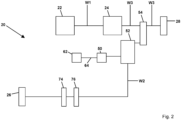
- FIG 2 shows a schematic representation of the first embodiment of the power-split axle drive 20 according to the invention.
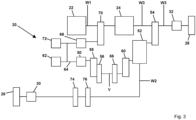
- the axle drive 20 shown essentially corresponds to the one in Figure 1 shown power-split axle drive 20, so that only details and/or differences are discussed below.
- the agricultural vehicle 10 can have the power-split axle drive 20, as in Figure 2 shown.
- the power-split axle drive 20 for an agricultural vehicle 10 comprises a first additional drive element 50, the first vehicle axle 26, the second vehicle axle 28 and the main drive element 22 for providing a rotary movement and/or a force and/or a torque which can be transmitted to the main transmission 24 via a first shaft W1.
- the main transmission 24 is therefore connected, in particular drivably connected, to the main drive element 22 via or with the first shaft W1.
- the second vehicle axle 28 is connected, in particular drivably connected, to the main transmission 24.
- the second vehicle axle 28 can be driven with the rotary movement and/or the force and/or the torque of the main drive element 22 at least via the main transmission 24.
- the second vehicle axle 28 is connected, in particular drivably connected, to the main transmission 24 via or with a third shaft W3.
- the main drive element 22 can generate a rotary motion and/or a force and/or a torque, which can be introduced or transmitted via the first shaft W1 into the main transmission 24 and from the main transmission 24 into or to the second vehicle axle 28.
- the power-split axle drive 20 further comprises a power-split transmission 52.
- the power-split transmission 52 is connected, in particular drivably connected, to the third shaft W3 via or with a first gear set 54.
- the first gear set 54 can therefore transmit or introduce a rotary motion and/or a torque from the main drive element 22 to the main transmission 24, to the third shaft W3, or into the power-split transmission 52.
- the first vehicle axle 26 is connected, in particular drivably connected, to the power-split transmission 52 via or with a second shaft W2.
- the first additional drive element 50 is connectable to the power split transmission 52, preferably detachably connectable, particularly preferably detachably rotationally fixed and/or detachably connectable and drivable.
- the first additional drive element 50 can be operated as a generator or motor.
- the power-split axle drive 20 can also include a storage element 62.
- the storage element 62 is optionally provided.
- the first additional drive element 50 can be connected to the storage element 62 in a power-electronic manner via a connecting line 64.
- One or more operating modes can be implemented with the power-split axle drive 20, and in particular also with the vehicle 10.
- the main drive element 22 When the vehicle 10 and/or the power-split axle drive 20 is in driving or overrun mode, the main drive element 22 generates a rotary motion and/or a force and/or a torque, which is introduced into the main transmission 24 by the first shaft W1.
- the rotary motion and/or a force and/or a torque introduced into the main transmission 24 is translated in the main transmission 24, provided that a gear or a drive position is engaged.
- the location at which a rotary motion and/or a force and/or a torque is introduced into the main transmission 24 is shown as the transmission input, and the location at which a resulting rotary motion and/or a resulting force and/or a resulting torque is present, taking the transmission ratio into account, is referred to as the transmission output.
- the transmission input The location at which a rotary motion and/or a force and/or a torque is introduced into the main transmission 24 is shown as the transmission input, and the location at which a resulting rotary motion and/or a
- the transmission input and transmission output of the main transmission 24 are arranged opposite one another.
- the rotary motion and/or the force and/or the torque present at the transmission output of the main transmission 24 when the gear or drive position is engaged is introduced into the second vehicle axle 28 via the third shaft W3.
- the rotary motion and/or the force and/or the torque of the main drive element 22 is transmitted via the main transmission 24 from the second shaft W2 via the first gear set 54 into the Power split transmission 52 initiated or transmitted.
- a first shifting element 74 and a first brake 76 are arranged on or at the second shaft W2.
- the first shifting element 74 and the first brake 76 are arranged between the power split transmission 52 and the first vehicle axle 26.
- the first shifting element 74 is arranged between the first brake 76 and the first vehicle axle 26.
- the power split transmission 52 can be connected, preferably detachably connected, particularly preferably detachably connected in a rotationally fixed manner and/or detachably driven, to the first vehicle axle 26, and in particular to the first differential 30, via the first or with the first shifting element 74.
- the first brake 76 is arranged between the first shifting element 74 and the power split transmission 52.
- the first brake 76 is arranged on the second shaft W2.
- the second shaft W2 can be releasably secured against rotation with the first brake 76, for example with a transmission housing or a frame. This allows the second shaft W2 to be held or inhibited in relation to a rotational movement.
- the first brake 76 and the first switching element 74 the operating modes described above, the "fully electric” operating mode, the "parking brake” operating mode and the “vehicle axle brake” operating mode, can be implemented with the power-split axle drive.
- the first switching element 74 is designed as a first clutch.
- the first switching element 74 can be connected to the second shaft W2 on one side in a rotationally fixed manner and can be connected to another part of the second shaft W2 and thus to the power-split transmission 52 on another side.
- the first brake 76 can be connected to the second shaft W2 on one side and connected to the transmission housing or frame on another side, for example. This allows the second shaft W2 to be inhibited and/or held in relation to a rotational movement.
- the memory element 62 can be charged by first auxiliary drive element 50, in particular in driving or overrun mode, can be operated as a generator.
- the generator mode of the first auxiliary drive element 50 the rotary motion and/or force and/or torque introduced into the power split transmission 52 by the main drive element 22 is introduced or transmitted into or to the first auxiliary drive element 50 and electrical energy is generated with the first auxiliary drive element and fed to the storage element 62.
- a "forward" operating mode can also be implemented by operating the first auxiliary drive element 50 as a motor. This allows an additional rotary motion and/or an additional force and/or an additional torque of the first auxiliary drive element 50 to be transmitted to the power split transmission 52.
- the rotational movement and/or force and/or the transmitted torque of the main drive element 22 transmitted to the power split transmission 52 and the rotational movement and/or force and/or the transmitted torque of the first additional drive element 50 transmitted to the power split transmission 52 can be superimposed on the power split transmission 52 and a resulting rotational movement and/or a resulting force and/or a resulting torque can be transmitted to the first vehicle axle 26.
- FIG 3 shows a schematic representation of a second embodiment of the power-split axle drive 20 according to the invention.
- the axle drive 20 shown essentially corresponds to the one shown in the Figures 1 to 2 shown power-split axle drive 20, so that only details and/or differences are discussed below.
- the agricultural vehicle 10 can have the power-split axle drive 20, as in Figure 3
- the first additional drive element 50 is connectable to the power split transmission 52 via a second or with a second switching element 56, preferably detachably connectable, particularly preferably detachably non-rotatably and/or detachably drivable.
- a non-actuated second switching element 56 is understood to mean a opened second switching element 56.
- the rotary motion and/or force and/or torque introduced into the power split transmission 52 from the main drive element 22 can be introduced or transmitted into or to the first auxiliary drive element 50 with the second switching element 56 actuated, particularly preferably with a closed one, and electrical energy can be generated with the first auxiliary drive element and fed to the storage element 62.
- the "advance" operating mode can also be implemented by transmitting the additional rotary motion and/or additional force and/or additional torque of the first auxiliary drive element 50 to the power split transmission 52 via the closed second switching element 56.
- an advance of the first vehicle axle 26 can thus be set and/or adjusted, in particular controllable and/or adjustable.
- the power-split axle drive 20 additionally comprises a countershaft V.
- the first additional drive element 50 is connectable, preferably drivable, to the countershaft V via the second or with the second shifting element 56.
- the power-split transmission 52 is also connected, in particular drivable, to the countershaft V.
- the power-split axle drive 20 comprises a second gear set 58.
- the second shifting element 56 is connected, in this case, via the second or with the second gear set 58, to the first additional drive element 50. connected, preferably drivably connected.
- the countershaft V is connectable, preferably drivably connected, to the second gear set 58 or, via the second shifting element 56.
- the second shifting element 56 can be actuated, in particular closed, in such a way that the second gear set 58 is connected, preferably drivably connected, to the countershaft V via the second or with the second shifting element 56.
- the second shifting element 56 can be actuated, in particular closed, in such a way that a rotary movement and/or a force and/or a torque of the first additional drive element 50 can be transmitted or introduced to or in the second gear set 58 and from the second gear set 58 to or in the second shifting element 56 and from the second shifting element 56 further to or in the countershaft V.
- the power-split axle drive 20 also comprises a third gear set 60.
- the power-split transmission 52 is connected to the countershaft V via or with the third gear set 60, in particular is drivably connected. With the third gear set 60, a rotary movement and/or a force and/or a torque can be transmitted or introduced from the countershaft V to or into the power-split transmission 52.
- a rotary motion and/or a force and/or a torque can be transmitted from the first additional drive element 50 via the second gear set 58 to the second shifting element 56 and from the second shifting element 56 to the countershaft V and from the countershaft V via the third or with the third gear set 60 to the power split transmission 52.
- the rotary motion and/or force and/or the torque can then be transmitted, for example, from the power split transmission 52, in particular via the first differential 30, to the first vehicle axle 26.
- the "generator" operating mode i.e.
- the rotational movement and/or force and/or torque introduced by the main drive element 22 into the power split transmission 52 is introduced or transmitted from the power split transmission 52 via the third gear set 60 into the countershaft V and from the countershaft V into the closed second shift element 56 and the second gear set 58 further into the first additional drive element 50 and generates electrical energy with the first additional drive element 50.
- the "advance" operating mode i.e.
- an additional rotary movement and/or an additional force and/or an additional torque of the first additional drive element 50 is transmitted from the first additional drive element 50 via the second gear set 58 and the closed second shift element 56 to the countershaft V and from the countershaft V via the third gear set 60 to the power split transmission 52 and superimposed by the power split transmission 52 with the rotary movement and/or the force and/or the torque of the main drive element 22.
- the resulting rotary movement and/or force and/or the resulting torque are transmitted from the power split transmission 52 with the second shaft W2 to the first vehicle axle 26.
- the first additional drive element 50 can thus advantageously act on the power split transmission 52, whereby an advance of the first vehicle axle 26 can be regulated.
- the power-split axle drive 20 additionally comprises a second brake 66.
- the second brake 66 is arranged between the first additional drive element 50 and the power-split transmission 52.
- the second brake 66 is connected to the countershaft V in a rotationally fixed manner.
- the countershaft V is releasably secured against rotation with the second brake 66.
- the power-split axle drive 20 can optionally comprise a second additional drive element 68.
- the second additional drive element 68 is connected to the Main drive element 22 is connected via or to the first shaft W1, preferably drivably connected.
- the torque and/or the force and/or the rotational movement that can be generated by the main drive element 22 can be introduced or transmitted to or from the second auxiliary drive element via the transmission stage 70, in particular a fourth gear set.
- the second auxiliary drive element 68 is connected to the storage element 62 and the first auxiliary drive element 50 in a power electronic manner via the connecting line 64.
- the second auxiliary drive element 68 is also connected to a power take-off 72 in a power electronic manner via the connecting line 64.
- the first auxiliary drive element 50 and/or the second auxiliary drive element 68 can also be operated as a generator, in particular when driving or coasting.
- the main drive element 22 can be used to introduce or transmit a rotary movement and/or a force and/or a torque into the second auxiliary drive element 68 and, via the main transmission 24, into the power split transmission 52 into the first auxiliary drive element 50.
- the second auxiliary drive element 68 can also introduce a rotary movement and/or force and/or torque, in particular via the transmission stage 70, preferably the fourth gear set, into the first shaft W1.
- the second additional drive element 68 can be operated by a motor. This means that, for example, the drive power can be increased for a short time if this is required by the respective driving condition.
- FIG 4 shows a schematic representation of a third embodiment of the power-split axle drive 20 according to the invention.
- the axle drive 20 shown essentially corresponds to the one shown in the Figures 1 to 3 shown power-split axle drive 20, so that only details and/or differences are discussed below.
- the agricultural vehicle 10 can have the power-split axle drive 20, as in Figure 4
- a third switching element 78 is arranged between the main drive element 22 and the second additional drive element 68 and/or the main drive element 22 and the main transmission 24.
- a fourth switching element 80 is also arranged between the main transmission 24 and the main drive element 22 and/or the main transmission 24 and the second additional drive element 68.
- the main drive element 22 when the main drive element 22 is switched off and the fourth switching element 80 is open and the third switching element 78 is closed, the main drive element 22 can be started by motor operation of the second additional drive element 68.
- the fourth switching element 80 When the fourth switching element 80 is closed, the main transmission 24 is connected to the main drive element 22 and/or the second additional drive element 68, in particular drivably connected. A rotary motion and/or a force and/or a torque can therefore be initiated or transmitted from the main transmission 24 into or to the power-split axle drive.
- FIG. 5 shows a schematic representation of a fourth embodiment of the power-split axle drive 20 according to the invention.
- the axle drive 20 shown essentially corresponds to the one shown in the Figures 1 to 4 shown power-split axle drive 20, so that only details and/or differences are discussed below.
- the agricultural vehicle 10 can have the power-split axle drive 20, as in Figure 5 shown, include.
- At least one control device 42 is assigned to the power-split axle drive 20, in particular the power-split axle drive 20 can include the control device 42.
- the control device 42 is connected via a plurality of control lines S, preferably via bidirectional control lines, to the first and/or second auxiliary drive element 50, 68 and/or the power take-off 72 and/or the storage element 62 and/or the first and/or second and/or third and/or fourth switching element 74, 56, 78, 80 and/or the main drive element 22 and/or the main transmission 24 and/or the power-split transmission 52 and/or a first and/or second brake 66, 76 for controlling and/or regulating and/or controlling them, and is in particular signal-connected and/or signal-transmitting and/or data-conductingly connected to these.
- the control device 42 is designed such that the power-split axle drive 20, in particular the above-mentioned components of the power-split axle drive 20, can be controlled depending on an operating mode of the power-split axle drive 20 and/or vehicle 10.
- the above-mentioned operating modes “generator” and/or “pre-run” and/or “fully electric” and/or “parking brake” and/or “vehicle axle brake” can be controlled with the control device 42.
- Figure 6 shows a detailed schematic representation of a fifth embodiment of the power-split axle drive 20 according to the invention, in particular the power-split transmission 52 and the first Additional drive element 50.
- the power-split axle drive 20 shown essentially corresponds to the one shown in the Figures 1 to 5 shown power-split axle drive 20, so that only details and/or differences are discussed below.
- the agricultural vehicle 10 can have the power-split axle drive 20, as in Figure 6 shown.
- the first gear set 54 comprises a first gear pair, in particular a first and a second fixed gear 90, 92.
- the first fixed gear 90 is connected to the third shaft W3 and the second fixed gear 92 is connected to the power split transmission 52, preferably in a rotationally fixed manner.
- the first fixed gear 90 meshes with the second fixed gear 92.
- the second gear set 58 comprises a second gear pair, in particular a first switching gear 94 and a third fixed gear 96.
- the third fixed gear 96 is connected to the first additional drive element 50, in particular an output shaft of the first additional drive element 50, preferably drivably connected, particularly preferably in a rotationally fixed and/or drivable manner.
- the first switching gear 94 is rotatably mounted on the countershaft V, in particular freely rotatable and/or axially displaceable on the countershaft V.
- the first switching gear 94 is connected to one side of the second switching element 56, preferably connected in a rotationally fixed and/or drivable manner.
- the first switching gear 94 meshes with the third fixed gear 96.
- the second switching element 56 is therefore connected to the first auxiliary drive element 50 via the first or with the first switching gear 94 and via the third or with the third fixed gear 96, preferably connected in a drivable manner.
- the countershaft V is connected to the second or via the second switching element 56 and the first switching gear 94 to the third fixed gear 96, preferably connected in a drivable manner, particularly preferably connected in a detachable drivable manner.
- the third gear set 60 comprises a third gear pair, in particular a fourth and a fifth fixed gear 98, 100.
- the fourth fixed gear 98 is connected to the countershaft V and the fifth fixed gear 100 to the power split transmission 52, in particular a sun gear 102 of the power split transmission 52, preferably connected in a rotationally fixed and/or drivable manner.
- the fourth fixed gear 98 meshes with the fifth fixed gear 100.
- the power split transmission 52 is designed as a planetary transmission.
- a ring gear 104 of the power split transmission 52 is connected to the third shaft W3 via or with the first gear set 54, in particular is drivably connected.
- the ring gear 104 is connected to the second fixed gear 92, preferably connected in a rotationally fixed and/or drivable manner.
- the first vehicle axle 26 is connected to a planet carrier 106 or a web of the power split transmission 52 via or with the second shaft W2, in particular is drivably connected.
- the planet carrier 106 is connected to the second shaft W2, preferably connected in a rotationally fixed and/or drivable manner.
- a planetary gear set in particular one or more planetary gears 108, are rotatably mounted on the planet carrier 106, each of which meshes with the sun gear 102 and the ring gear 104, i.e.
- the planetary gear set can in particular have a set of planetary gears 108.
- the planetary gear set can comprise three planetary gears 108.
- the sun gear 102 of the power split transmission 52 is connected, in particular drivably connected, to the first additional drive element via the fifth fixed gear 100 and the fourth fixed gear 98, and in particular further via the countershaft V and the second shifting element and the second gear set.
- a force and/or a torque is transmitted from the first additional drive element via the second gear set and the second shift element to the countershaft and from the countershaft via the fourth fixed gear 98 and the fifth fixed gear 100 to the sun gear 102 of the power split transmission 52.
- the second brake 66 is arranged on the countershaft V.
- the second brake 66 is connected to the countershaft V, preferably drivably connected to the countershaft V, particularly preferably connected to the countershaft V in a rotationally fixed and/or drivable manner.
- the power split transmission 52 operates with a fixed ratio, i.e. completely mechanically.
- the power split transmission 52 can then transfer the braking torque from the first vehicle axle 26 to the vehicle brake or rear axle brake (not shown, on the second vehicle axle 28).
- Figure 7 shows a detailed schematic representation of a sixth embodiment of the power-split axle drive 20 according to the invention.
- the axle drive 20 shown essentially corresponds to the one shown in the Figures 1 to 6 shown power-split axle drive 20, so that only details and/or differences are discussed below.
- the agricultural vehicle 10 can have the power-split axle drive 20, as in Figure 7 shown.
- the first switching element 74 and the first brake 76 are arranged on the second shaft W2 between the power split transmission 52 and the first vehicle axle 26.
- the Figures 8 to 10 show schematic representations of the power flow in the "fully electric” operating mode, "parking brake” operating mode and “vehicle axle brake” operating mode in the power-split axle drive 20 according to the invention.
- the Figures 8 to 10 The power-split axle drive 20 shown essentially corresponds to the one shown in the Figures 1 to 7 shown power-split axle drive 20, so that only details and/or differences are discussed below.
- the arrows 120 show the direction of the power flow, i.e. the direction of the transmission of a rotary motion and/or a force and/or a torque.
- the size of the arrows 120 schematically shows the size of the transmitted rotary motion and/or force and/or torque.
- Figure 8 shows the power flow of the "fully electric” operating mode.
- a power flow i.e. a rotary movement and/or a force and/or a torque
- a rotary movement and/or a force and/or a torque which is transmitted from the power split transmission 52 to the second shaft W2, i.e. in particular in the direction of the first vehicle axle 26, can be held and/or inhibited and/or supported at or by the closed first brake 76.
- the second shaft W2 can be held or inhibited with the first brake 76 in relation to a rotary movement of the second shaft W2.
- the first brake 76 thus ensures that a stationary transmission from the sun gear to the ring gear is possible.
- Figure 9 shows the power flow of the "parking brake” operating mode.
- a power flow i.e. a rotational movement and/or a force and/or a torque
- a power flow is transmitted from the first and/or second vehicle axle 26, 28 to the power-split axle drive 20 and supported. This holds the vehicle in its position.
- Figure 10 shows the power flow of the "vehicle axle brake” operating mode.
- a power flow i.e. a rotational movement and/or a force and/or a torque
- the vehicle in particular when driving or coasting, braked.
- FIG 11 shows a detailed schematic representation of a seventh embodiment of the power-split axle drive 20 according to the invention.
- the axle drive 20 shown essentially corresponds to the one shown in the Figures 1 to 10 shown power-split axle drive 20, so that only details and/or differences are discussed below.
- the agricultural vehicle 10 can have the power-split axle drive 20, as in Figure 11 shown.
- the power split transmission 52 alternatively comprises a fifth switching element 130 instead of the second brake 66.
- the fifth switching element 130 is designed as a fifth clutch.
- the fifth fixed gear 100 and/or the sun gear 102 are connected in a rotationally fixed manner to the second shaft W2 via the closed fifth switching element 130.
- the first and second vehicle axles 26, 28 are thus both mechanically driven by the main drive element 22.
- the relative speed of the sun gear 102 and the second shaft W2 is 0 (zero) revolutions per minute. This results in the ring gear 104 rotating at the same speed as the sun gear 102 and the second shaft W2.
- a rotational speed and/or a force and/or a torque of the first additional drive element 50 can be transmitted or introduced into the power split transmission 52 by the fifth fixed gear 100 and/or the sun gear 102.
Landscapes
- Engineering & Computer Science (AREA)
- Mechanical Engineering (AREA)
- Chemical & Material Sciences (AREA)
- Combustion & Propulsion (AREA)
- Transportation (AREA)
- General Engineering & Computer Science (AREA)
- Arrangement And Driving Of Transmission Devices (AREA)
- Retarders (AREA)
- Arrangement And Mounting Of Devices That Control Transmission Of Motive Force (AREA)
- Motor Power Transmission Devices (AREA)
- Structure Of Transmissions (AREA)
Abstract
Leistungsverzweigter Achsantrieb (20) für ein landwirtschaftliches Fahrzeug (10), umfassend ein erstes Zusatzantriebselement (50), eine erste Fahrzeugachse (26), eine zweite Fahrzeugachse (28) und ein Hauptantriebselement (22) zur Bereitstellung eines Drehmoments, welches mit einer ersten Welle (W1) auf ein Hauptgetriebe (24) übertragbar ist. Das Hauptgetriebe (24) ist mit der zweiten Fahrzeugachse (28) verbunden und mit dem Drehmoment des Hauptantriebselements (22) wenigstens die zweite Fahrzeugachse (28) über das Hauptgetriebe (24) antreibbar. Der leistungsverzweigte Achsantrieb weist ein Leistungsverzweigungsgetriebe (52) auf. Das Leistungsverzweigungsgetriebe (52) ist mit der zweiten Fahrzeugachse (28) und dem Hauptgetriebe (24) verbunden und über eine zweite Welle mit der ersten Fahrzeugachse (26) verbunden. Das erste Zusatzantriebselement (50) ist mit dem Leistungsverzweigungsgetriebe (52) verbindbar. Auf der zweiten Welle (W2) ist ein erstes Schaltelement (74) und/oder eine erste Bremse (76) angeordnet. Die Erfindung betrifft weiter ein landwirtschaftliches Fahrzeug (10).
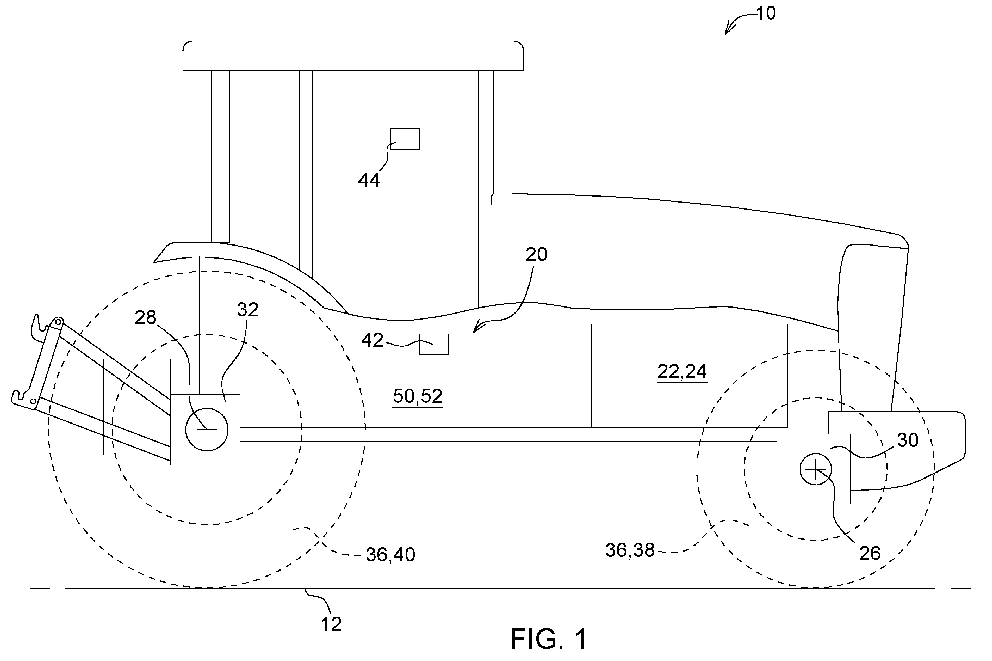
Description
Die Erfindung betrifft einen leistungsverzweigten Achsantrieb gemäss dem Oberbegriff des unabhängigen Anspruchs 1 und ein landwirtschaftliches Fahrzeug gemäss dem Oberbegriff des unabhängigen Anspruchs 10.The invention relates to a power-split axle drive according to the preamble of independent claim 1 and an agricultural vehicle according to the preamble of
Die
Die bekannten leistungsverzweigten Achsantriebe weisen nachteilhafterweise einen konstruktiv aufwändigen und/oder für landwirtschaftliche Fahrzeuge unzureichenden Aufbau auf. Ebenso ist mit den bekannten leistungsverzweigten Achsantrieben nachteilhafterweise ein effizienter Betrieb und/oder ein effizientes Bremsen nicht realisierbar.The known power-split axle drives have the disadvantage of being structurally complex and/or of being inadequate for agricultural vehicles. Likewise, the known power-split axle drives do not allow efficient operation and/or efficient braking.
Der vorliegenden Erfindung liegt daher die Aufgabe zugrunde einen leistungsverzweigten Achsantrieb und ein landwirtschaftliches Fahrzeug sowie ein Verfahren vorzuschlagen, durch welche die vorgenannten Probleme überwunden werden. Insbesondere sollen ein leistungsverzweigter Achsantrieb und ein landwirtschaftliches Fahrzeug sowie ein Verfahren vorgeschlagen werden, die konstruktiv einfacher und/oder weniger aufwändig ausgestaltet sind und/oder einen effizienteren Betrieb ermöglichen und/oder die Leistung und/oder die Fahrtüchtigkeit und/oder Fahreigenschaften des Nutzfahrzeugs bzw. des leistungsverzweigten Achsantriebs verbessert sind.The present invention is therefore based on the object of proposing a power-split axle drive and an agricultural vehicle as well as a method by which the aforementioned problems are overcome. In particular, a power-split axle drive and an agricultural vehicle as well as a method are to be proposed which are structurally simpler and/or less complex and/or enable more efficient operation and/or the performance and/or the drivability and/or driving characteristics of the commercial vehicle or the power-split axle drive are improved.
Diese Aufgabe wird durch einen leistungsverzweigten Achsantrieb mit den Merkmalen des Anspruchs 1 und ein landwirtschaftliches Fahrzeug mit den Merkmalen des Anspruchs 10.This object is achieved by a power-split axle drive with the features of claim 1 and an agricultural vehicle with the features of
Erfindungsgemäß wird ein leistungsverzweigter Achsantrieb, insbesondere Antriebsstrang, für ein landwirtschaftliches Fahrzeug vorgeschlagen. Der leistungsverzweigte Achsantrieb umfasst ein erstes Zusatzantriebselement und eine erste Fahrzeugachse und eine zweite Fahrzeugachse und ein Hauptantriebselement zur Bereitstellung eines Drehmoments, und/oder insbesondere einer Drehbewegung und/oder einer Kraft. Das Drehmoment, und/oder insbesondere die Drehbewegung und/oder die Kraft, ist mit einer ersten Welle auf ein Hauptgetriebe übertragbar und/oder in das Hauptgetriebe einleitbar. Das Hauptgetriebe ist also über die oder mit der ersten Welle mit dem Hauptantriebselement verbunden, insbesondere antreibbar verbunden. Die zweiten Fahrzeugachse ist mit dem Hauptgetriebe verbunden, insbesondere antreibbar verbunden. Wenigstens die zweite Fahrzeugachse ist mit dem Drehmoment, und/oder insbesondere der Drehbewegung und/oder der Kraft, des Hauptantriebselements mit dem oder über das Hauptgetriebe antreibbar. Im Speziellen kann die zweiten Fahrzeugachse über eine oder mit einer dritten Welle mit dem Hauptgetriebe verbunden sein, insbesondere antreibbar verbunden sein. Mit anderen Worten, durch das Hauptantriebselement kann also ein Drehmoment, und/oder insbesondere eine Drehbewegung und/oder eine Kraft erzeugbar, welches mit der ersten oder über die erste Welle in das Hauptgetriebe und vom Hauptgetriebe, insbesondere mit der dritten oder über die dritte Welle, in die oder an die zweite Fahrzeugachse einleitbar oder übertragbar sein. Der leistungsverzweigte Achsantrieb weist weiter ein Leistungsverzweigungsgetriebe auf. Das Leistungsverzweigungsgetriebe ist mit dem Hauptgetriebe und der zweiten Fahrzeugachse verbunden, insbesondere antreibbar verbunden. Dadurch kann eine Drehbewegung und/oder eine Kraft und/oder ein Drehmoment vom Hauptantriebselement an das Hauptgetriebe und vom Hauptgetriebe an oder in das Leistungsverzweigungsgetriebe und/oder umgekehrt übertragen oder eingeleitet werden. Ebenso kann eine Drehbewegung und/oder eine Kraft und/oder ein Drehmoment von der zweiten Fahrzeugachse an oder in das Leistungsverzweigungsgetriebe und/oder umgekehrt übertragen oder eingeleitet werden. Ausserdem ist die erste Fahrzeugachse über eine oder mit einer zweiten Welle mit dem Leistungsverzweigungsgetriebe verbunden, insbesondere antreibbar verbunden. Somit ist ein Drehmoment, und/oder insbesondere eine Drehbewegung und/oder eine Kraft, vom Leistungsverzweigungsgetriebe über die zweite Welle an oder in die erste Fahrzeugachse und/oder umgekehrt übertragbar oder einleitbar. Das erste Zusatzantriebselement ist, insbesondere zur Einleitung einer Drehbewegung und/oder einer Kraft und/oder eines Drehmoments, mit dem Leistungsverzweigungsgetriebe verbindbar, bevorzugt antreibbar verbindbar. Auf oder an der zweiten Welle ist ein erstes Schaltelement und/oder eine erste Bremse angeordnet. Das erste Schaltelement und/oder die erste Bremse können zwischen dem Leistungsverzweigungsgetriebe und der ersten Fahrzeugachse, insbesondere dem Leistungsverzweigungsgetriebe, und insbesondere einem ersten Differential angeordnet sein. Das erste Schaltelement kann dabei zwischen der ersten Bremse und der ersten Fahrzeugachse, insbesondere der ersten Bremse und dem ersten Differential angeordnet sein. Das Leistungsverzweigungsgetriebe kann über das erste oder mit dem ersten Schaltelement mit der ersten Fahrzeugachse, insbesondere dem ersten Differential, verbindbar, bevorzugt lösbar verbindbar, besonders bevorzugt lösbar drehfest und/oder lösbar antreibbar verbindbar sein.According to the invention, a power-split axle drive, in particular a drive train, is proposed for an agricultural vehicle. The power-split axle drive comprises a first additional drive element and a first vehicle axle and a second vehicle axle and a main drive element for providing a torque, and/or in particular a rotary movement and/or a force. The torque, and/or in particular the rotary movement and/or the force, can be transmitted to a main transmission with a first shaft and/or introduced into the main transmission. The main transmission is therefore connected to the main drive element via or with the first shaft, in particular connected in a drivable manner. The second vehicle axle is connected to the main transmission, in particular connected in a drivable manner. At least the second vehicle axle can be driven with the torque, and/or in particular the rotary movement and/or the force, of the main drive element with or via the main transmission. In particular, the second vehicle axle can be connected to the main transmission via a or with a third shaft, in particular connected in a drivable manner. With In other words, the main drive element can generate a torque and/or in particular a rotary movement and/or a force, which can be introduced or transmitted with the first or via the first shaft into the main transmission and from the main transmission, in particular with the third or via the third shaft, into or to the second vehicle axle. The power-split axle drive also has a power-split transmission. The power-split transmission is connected to the main transmission and the second vehicle axle, in particular is drivably connected. As a result, a rotary movement and/or a force and/or a torque can be transmitted or introduced from the main drive element to the main transmission and from the main transmission to or into the power-split transmission and/or vice versa. Likewise, a rotary movement and/or a force and/or a torque can be transmitted or introduced from the second vehicle axle to or into the power-split transmission and/or vice versa. In addition, the first vehicle axle is connected to the power-split transmission via or with a second shaft, in particular is drivably connected. Thus, a torque, and/or in particular a rotary movement and/or a force, can be transmitted or introduced from the power split transmission via the second shaft to or into the first vehicle axle and/or vice versa. The first additional drive element can be connected, preferably drivably connected, to the power split transmission, in particular for introducing a rotary movement and/or a force and/or a torque. A first shifting element and/or a first brake is arranged on or at the second shaft. The first shifting element and/or the first brake can be arranged between the power split transmission and the first vehicle axle, in particular the power split transmission, and in particular a first differential. The first shifting element can be arranged between the first brake and the first vehicle axle, in particular the first brake and the first differential. The power split transmission can be connected via the first or with the first switching element can be connected to the first vehicle axle, in particular the first differential, preferably detachably connectable, particularly preferably detachably non-rotatably and/or detachably drivable.
Im Folgenden kann unter einem Schaltelement, bevorzugt dem ersten Schaltelement und/oder einem zweiten und/oder dritten und/oder vierten Schaltelement, ein Bauteil verstanden werden, welches je nach Betätigungszustand, eine Relativbewegung zwischen zwei Bauteilen zulassen oder eine feste Verbindung zur Übertragung einer Drehbewegung und/oder einer Kraft und/oder eines Drehmoments bereitstellen kann. Unter einer Relativbewegung ist beispielsweise eine Rotation zweier Bauteile zu verstehen, wobei die Drehzahl des ersten Bauteils und die Drehzahl des zweiten Bauteils voneinander abweichen. Darüber hinaus ist auch die Rotation nur eines der beiden Bauteile denkbar, während das andere Bauteil stillsteht oder in eine entgegengesetzte Richtung rotiert. Bevorzugt handelt es sich bei den Schaltelementen, insbesondere Kupplungen, um reibschlüssige Elemente. Dabei kann über einen Aktuator eine Kraft auf die Verbindungsstelle der beiden Bauteile eingeleitet wird, wodurch eine Reibkraft entsteht, durch welche eine Drehbewegung und/oder oder eine Kraft und/oder ein Drehmoment zwischen den zwei drehbeweglichen Bauteilen übertragbar ist. Im Folgenden kann unter einem nicht betätigten Schaltelement, insbesondere einer nicht betätigten Kupplung, ein geöffnetes Schaltelement, insbesondere eine geöffnete Kupplung, verstanden werden. Dies bedeutet, dass eine Relativbewegung zwischen den beiden Bauteilen möglich ist. Unter einem betätigten Schaltelement, insbesondere einer betätigten Kupplung, kann im Folgenden ein geschlossenes Schaltelement, insbesondere eine geschlossene Kupplung verstanden werden. Dies bedeutet, dass keine Relativbewegung zwischen den beiden Bauteilen möglich ist. Die beiden Bauteile rotieren dementsprechend mit gleicher Drehzahl in dieselbe Richtung. In einer alternativen Ausführungsform können die Schaltelemente, insbesondere Kupplungen, als formschlüssige Elemente ausgeführt sein. Der Aktuator zum Betätigen des Schaltelements, insbesondere der Kupplung, kann hydraulisch, elektromechanisch, elektromagnetisch oder beispielsweise auch pneumatisch betätigbar ausgeführt sein. Der Aktuator, insbesondere ein erster, zweiter, dritter und vierter Aktuator kann das Schaltelement, insbesondere das erste, zweite, dritte und vierte Schaltelement schliessen und öffnen.In the following, a switching element, preferably the first switching element and/or a second and/or third and/or fourth switching element, can be understood as a component which, depending on the actuation state, can allow a relative movement between two components or can provide a fixed connection for transmitting a rotary movement and/or a force and/or a torque. A relative movement is understood to mean, for example, a rotation of two components, wherein the speed of the first component and the speed of the second component differ from one another. In addition, the rotation of only one of the two components is also conceivable, while the other component remains stationary or rotates in an opposite direction. The switching elements, in particular clutches, are preferably frictionally engaged elements. A force can be introduced to the connection point of the two components via an actuator, creating a frictional force through which a rotary movement and/or a force and/or a torque can be transmitted between the two rotating components. In the following, a non-actuated switching element, in particular a non-actuated clutch, can be understood as an open switching element, in particular an open clutch. This means that a relative movement between the two components is possible. An actuated switching element, in particular an actuated clutch, can be understood as a closed switching element, in particular a closed clutch. This means that no relative movement between the two components is possible. The two components therefore rotate at the same speed in the same direction. In an alternative embodiment, the switching elements, in particular clutches, can be designed as form-fitting elements. The actuator for The switching element, in particular the clutch, can be actuated hydraulically, electromechanically, electromagnetically or, for example, pneumatically. The actuator, in particular a first, second, third and fourth actuator, can close and open the switching element, in particular the first, second, third and fourth switching element.
Das erste Schaltelement kann bevorzugt eine erste Kupplung sein. Das erste Schaltelement kann betätigbar, bevorzugt selektiv betätigbar, besonders bevorzugt schliessbar und öffenbar und/oder einrückbar und/oder schaltbar und/oder selektiv eingreifbar sein. Mit betätigtem, insbesondere geschlossenem, erstem Schaltelement kann also eine Drehbewegung und/oder eine Kraft und/oder ein Drehmoment vom Leistungsverzweigungsgetriebe an die erste Fahrzeugachse, insbesondere über das erste Differential, und/oder umgekehrt übertragbar sein. Mit nicht betätigtem, also insbesondere geöffnetem, erstem Schaltelement, kann also keine Drehbewegung und/oder keine Kraft und/oder kein Drehmoment vom Leistungsverzweigungsgetriebe an die erste Fahrzeugachse, insbesondere über das erste Differential, und/oder umgekehrt übertragbar sein.The first shifting element can preferably be a first clutch. The first shifting element can be actuated, preferably selectively actuated, particularly preferably closeable and openable and/or engageable and/or switchable and/or selectively engageable. With the first shifting element actuated, in particular closed, a rotary movement and/or a force and/or a torque can be transmitted from the power split transmission to the first vehicle axle, in particular via the first differential, and/or vice versa. With the first shifting element not actuated, in particular opened, no rotary movement and/or no force and/or no torque can be transmitted from the power split transmission to the first vehicle axle, in particular via the first differential, and/or vice versa.
Die erste Bremse kann insbesondere zwischen dem ersten Schaltelement und dem Leistungsverzweigungsgetriebe angeordnet sein. Die erste Bremse kann auf der zweiten Welle angeordnet sein, bevorzugt zumindest teilweise mit der zweiten Welle verbunden sein, besonders bevorzugt zumindest teilweise mit der zweiten Welle drehfest verbunden sein. Unter einer Bremse, insbesondere der ersten und einer zweiten und dritten Bremse, kann ein reibschlüssiges Bauteil verstanden werden, welches auf der einen Seiten mit einem feststehenden Element, beispielsweise einem Gehäuse oder einem Fahrzeugrahmen, und auf einer anderen Seite mit einem rotierbaren Element, beispielsweise einer Welle, verbunden ist. Dabei wird in der Regel über einen Aktuator eine Kraft auf die Verbindungsstelle eingeleitet, wodurch eine Reibkraft entsteht, durch welche beispielsweise eine Drehbewegung des drehbaren Bauteils der Bremse, und somit insbesondere eine Drehbewegung des rotierbaren Elements, gegen das feststehende Bauteil der Bremse, und somit insbesondere gegen das feststehende Element, abgestützt und somit die Drehbewegung gehemmt beziehungsweise verhindert oder gehalten wird. Im Speziellen kann das rotierende Bauteil der ersten Bremse mit der zweiten Welle verbunden, insbesondere drehfest verbunden sein, und das feststehende Bauteil der ersten Bremse mit einem Getriebegehäuse oder Gehäuse oder einem Fahrzeugrahmen verbunden sein. Dadurch kann, wenn die erste Bremse geschlossen ist, die zweite Welle in Bezug auf eine Drehbewegung gehalten und/oder gehemmt sein. Im Folgenden ist unter einer nicht betätigten Bremse eine geöffnete Bremse zu verstehen. Dies bedeutet, dass sich das rotierbare Element, und/oder insbesondere das rotierbare Bauteil der Bremse, im Freilauf befindet, das heißt, dass die Bremse bevorzugt keinen Einfluss auf die Drehzahl des rotierbaren Bauteils nimmt. Bei betätigter beziehungsweise geschlossener Bremse erfolgt eine Reduzierung der Drehzahl des rotierbaren Bauteils. Je nach Anwendung kann die Reduzierung der Drehzahl des rotierbaren Bauteils bis hin zum Stillstand erfolgen. Dies bedeutet dann, dass eine feste Verbindung zwischen dem rotierbaren Bauteil, insbesondere und dem feststehenden Bauteil herstellbar ist. Dadurch kann, wenn die erste Bremse geöffnet ist, die zweite Welle in Bezug auf eine Drehbewegung drehbar sein. Alternativ dazu sind auch Ausführungen denkbar, bei denen die Bremse im betätigten Zustand geöffnet und im nicht betätigten Zustand geschlossen ist. In weiteren alternativen Ausführungsformen ist auch eine formschlüssige Bremse denkbar. Bei formschlüssigen Verbindungen erfolgt eine, beispielsweise drehfeste, Verbindung zweier Bauteile aufgrund des Eingriffs der Konturen der zu verbindenden Bauteile. Formschlüssige Verbindungen weisen insbesondere den Vorteil auf, dass sie bei vergleichsweise geringen Abmessungen und Gewicht hohe Kräfte und Momente übertragen können. Darüber hinaus ist die aufzubringende Energie für die Verbindungsherstellung wesentlich geringer, als bei reibschlüssigen Verbindungen, wodurch beispielsweise der Aktuator kleiner ausgelegt werden kann. Der Aktuator zum Betätigen der Bremse kann hydraulisch, elektromechanisch, elektromagnetisch oder beispielsweise auch pneumatisch betätigbar ausgeführt sein. Der Aktuator zur Betätigung der Bremse kann dabei wie der Aktuator zur Betätigung des Schaltelements ausgeführt sein. Mit anderen Worten, die erste Bremse kann also auf einer Seite mit der zweiten Welle verbunden sein und auf einer anderen Seite in Bezug auf eine Drehbewegung gehalten oder gehemmt sein, beispielsweise mit dem Getriebegehäuse oder Rahmen verbunden sein. Dies ist beispielsweise dann von Vorteil, wenn ein Fahrzustand gewünscht ist, bei dem eine Drehbewegung und/oder eine Kraft und/oder ein Drehmoment vom ersten Zusatzantriebselement, insbesondere nur, an die zweite Fahrzeugachse, oder von der ersten und/oder zweiten Fahrzeugachse an die erste Bremse, insbesondere also keine Drehbewegung und/oder keine Kraft und/oder kein Drehmoment an die erste und zweite Fahrzeugachse übertragen werden soll. Mit der ersten Bremse und/oder dem ersten Schaltelement können mit dem leistungsverzweigten Achsantrieb und somit insbesondere auch mit dem landwirtschaftlichen Fahrzeug, weitere Betriebsmodi realisiert werden.The first brake can be arranged in particular between the first shifting element and the power split transmission. The first brake can be arranged on the second shaft, preferably at least partially connected to the second shaft, particularly preferably at least partially connected to the second shaft in a rotationally fixed manner. A brake, in particular the first and a second and third brake, can be understood as a frictionally engaged component which is connected on one side to a fixed element, for example a housing or a vehicle frame, and on the other side to a rotatable element, for example a shaft. In this case, a force is usually introduced to the connection point via an actuator, which creates a frictional force which, for example, causes a rotational movement of the rotatable Component of the brake, and thus in particular a rotational movement of the rotatable element, is supported against the fixed component of the brake, and thus in particular against the fixed element, and thus the rotational movement is inhibited or prevented or held. In particular, the rotating component of the first brake can be connected to the second shaft, in particular connected in a rotationally fixed manner, and the fixed component of the first brake can be connected to a gearbox or housing or a vehicle frame. As a result, when the first brake is closed, the second shaft can be held and/or inhibited with respect to a rotational movement. In the following, a non-actuated brake is understood to mean an open brake. This means that the rotatable element, and/or in particular the rotatable component of the brake, is in freewheeling, i.e. that the brake preferably has no influence on the speed of the rotatable component. When the brake is actuated or closed, the speed of the rotatable component is reduced. Depending on the application, the speed of the rotatable component can be reduced all the way to a standstill. This then means that a fixed connection can be established between the rotatable component, in particular, and the stationary component. As a result, when the first brake is open, the second shaft can be rotated in relation to a rotary movement. Alternatively, designs are also conceivable in which the brake is open when actuated and closed when not actuated. In other alternative embodiments, a positive-locking brake is also conceivable. With positive-locking connections, a connection, for example in a rotationally fixed manner, of two components takes place due to the engagement of the contours of the components to be connected. Positive-locking connections have the particular advantage that they can transmit high forces and moments with comparatively small dimensions and weight. In addition, the energy required to establish the connection is significantly lower than with frictional connections, which means that the actuator can be designed smaller, for example. The actuator for actuating the brake can be hydraulic, electromechanical, electromagnetic or for example, it can also be designed to be pneumatically actuated. The actuator for actuating the brake can be designed like the actuator for actuating the switching element. In other words, the first brake can be connected to the second shaft on one side and held or inhibited in relation to a rotary movement on another side, for example connected to the gearbox or frame. This is advantageous, for example, if a driving state is desired in which a rotary movement and/or a force and/or a torque is to be transmitted from the first additional drive element, in particular only, to the second vehicle axle, or from the first and/or second vehicle axle to the first brake, in particular no rotary movement and/or no force and/or no torque to the first and second vehicle axles. With the first brake and/or the first switching element, further operating modes can be implemented with the power-split axle drive and thus in particular also with the agricultural vehicle.
Ein Betriebsmodus kann ein "Voll-Elektrisch" Betriebsmodus sein. Dabei kann das erste Zusatzantriebselement mit dem Leistungsverzweigungsgetriebe antreibbar verbunden sein und das erste Schaltelement und die erste Bremse können derart betätigt sein, dass die zweite Fahrzeugachse nur über das erste Zusatzantriebselement antreibbar ist oder angetrieben wird. Im "Voll-Elektrisch" Betriebsmodus kann das erste Zusatzantriebselement insbesondere über ein zweites oder mit einem zweiten Schaltelement mit dem Leistungsverzweigungsgetriebe verbunden sein. Das zweite Schaltelement kann dazu betätigt, insbesondere geschlossen sein. Ausserdem kann im "Voll-Elektrisch" Betriebsmodus das erste Schaltelement nicht betätigt sein, also insbesondere geöffnet sein, und die erste Bremse betätigt sein, also insbesondere geschlossen sein. Dadurch kann ein Leistungsfluss vom ersten Zusatzantriebselement an die zweite Fahrzeugachse realisiert werden, also insbesondere eine Drehbewegung und/oder eine Kraft und/oder ein Drehmoment vom ersten Zusatzantriebselement über das Leistungsverzweigungsgetriebe an die zweite Welle und weiter an die zweite Fahrzeugachse übertragen werden. An oder von der geschlossenen ersten Bremse kann die Drehbewegung und/oder die Kraft und/oder das Drehmoment, welche vom Leistungsverzweigungsgetriebe an die der ersten Fahrzeugachse übertragen werden, an der zweiten Welle gehalten und/oder gehemmt und/oder abgestützt werden. Im "Voll-Elektrisch" Betriebsmodus kann der Antrieb der zweiten Fahrzeugachse durch das erste Zusatzantriebselement unabhängig vom Betriebszustand des Hauptantriebselements erfolgen. Insbesondere kann das Hauptantriebselement abgeschaltet oder vom Hauptgetriebe entkoppelt oder das Hauptgetriebe im Neutralgang sein. Der Betriebsmodus "Voll-Elektrisch" kann mittels der Ein- und Ausgabeeinheit auswählbar sein. Vorteilhafterweise kann somit ein rein elektrischer Betrieb des leistungsverzweigten Achsantriebs, insbesondere auch des Fahrzeugs, erreicht werden. Weiter ist von Vorteil, dass mit dem "Voll-Elektrisch" Betriebsmodus beispielsweise das ein elektrisch betriebener Kriechgang und/oder das Rangieren des landwirtschaftlichen Fahrzeugs, insbesondere auf einer Hofstätte, realisiert werden kann. Im Speziellen kann das landwirtschaftliche Fahrzeug im "Voll-Elektrisch" Betriebsmodus vorteilhafterweise fernbedient werden, beispielsweise, um das Fahrzeug an ein Arbeitsgerät zu koppeln.One operating mode can be a "fully electric" operating mode. The first additional drive element can be drivably connected to the power split transmission and the first switching element and the first brake can be actuated in such a way that the second vehicle axle can only be driven or is driven via the first additional drive element. In the "fully electric" operating mode, the first additional drive element can be connected to the power split transmission in particular via a second or with a second switching element. The second switching element can be actuated for this purpose, in particular closed. In addition, in the "fully electric" operating mode, the first switching element can not be actuated, i.e. in particular opened, and the first brake can be actuated, i.e. in particular closed. This allows a power flow from the first additional drive element to the second vehicle axle to be realized, i.e. in particular a rotary movement and/or a force and/or a torque from the first additional drive element via the power split transmission to the second shaft and then to the second vehicle axle. The rotational movement and/or the force and/or the torque which are transmitted from the power split transmission to the first vehicle axle can be held and/or inhibited and/or supported on the second shaft at or by the closed first brake. In the "fully electric" operating mode, the second vehicle axle can be driven by the first additional drive element regardless of the operating state of the main drive element. In particular, the main drive element can be switched off or decoupled from the main transmission or the main transmission can be in neutral gear. The "fully electric" operating mode can be selected using the input and output unit. This advantageously enables purely electric operation of the power split axle drive, in particular of the vehicle. Another advantage is that the "fully electric" operating mode can be used to implement, for example, an electrically operated crawling gear and/or maneuvering of the agricultural vehicle, in particular on a farmyard. In particular, the agricultural vehicle can advantageously be remotely controlled in "fully electric" operating mode, for example to couple the vehicle to a work tool.
Ein weiterer Betriebsmodus kann ein "Parkbremse" Betriebsmodus sein. Dabei kann das erste Zusatzantriebselement nicht mit dem Leistungsverzweigungsgetriebe verbunden sein und/oder das erste Schaltelement und die erste Bremse können derart betätigt sein, dass der leistungsverzweigte Achsantrieb als eine Parkbremse realisierbar ist, insbesondere also das Fahrzeug in Position gehalten wird. Im "Parkbremse" Betriebsmodus kann ausserdem eine zweite Bremse betätigt, insbesondere geschlossen sein, sodass keine Drehbewegung und/oder Kraft und/oder kein Drehmoment an das erste Zusatzantriebselement übertragen werden kann. Im "Parkbremse" Betriebsmodus können das erste Schaltelement und die erste Bremse betätigt, bevorzugt geschlossen sein. Dadurch kann ein Leistungsfluss, also eine Drehbewegung und/oder eine Kraft und/oder ein Drehmoment, von der ersten und/oder zweiten Fahrzeugachse an den leistungsverzweigten Achsantrieb übertragen und abgestützt werden. Dadurch wird das Fahrzeug in seiner Position gehalten. Insbesondere können eine Drehbewegung und/oder Kraft und/oder ein Drehmoment von der ersten Fahrzeugachse auf die zweite Welle an die erste Bremse übertragen werden. Insbesondere können auch eine Drehbewegung und/oder eine Kraft und/oder ein Drehmoment von der zweiten Fahrzeugachse, insbesondere über einen ersten Radsatz, an das Leistungsverzweigungsgetriebe weiter an die zweite Bremse und/oder über die zweite Welle an die erste Bremse übertragen werden. Dabei kann die zweite Welle mit der ersten Bremse, und/oder insbesondere eine Vorgelegewelle mit der zweiten Bremse, in Bezug auf eine Übertragung der Drehbewegung und/oder der Kraft und/oder des Drehmoments gehemmt, insbesondere gehalten und/oder abgestützt werden. Im "Parkbremse" Betriebsmodus kann das Hauptantriebselement abgeschaltet oder vom Hauptgetriebe entkoppelt oder das Hauptgetriebe im Neutralgang sein. Das Fahrzeug kann also insbesondere stillstehen. Der Betriebsmodus "Parkbremse" kann mittels der Ein- und Ausgabeeinheit auswählbar sein. Vorteilhafterweise kann somit ein Betrieb des leistungsverzweigten Achsantriebs als Parkbremse erreicht werden.A further operating mode can be a "parking brake" operating mode. The first additional drive element can not be connected to the power split transmission and/or the first switching element and the first brake can be actuated in such a way that the power split axle drive can be implemented as a parking brake, in particular so that the vehicle is held in position. In the "parking brake" operating mode, a second brake can also be actuated, in particular closed, so that no rotary movement and/or force and/or torque can be transmitted to the first additional drive element. In the "parking brake" operating mode, the first switching element and the first brake can be actuated, preferably closed. This allows a power flow, i.e. a Rotational movement and/or a force and/or a torque can be transmitted and supported from the first and/or second vehicle axle to the power-split axle drive. This holds the vehicle in its position. In particular, a rotational movement and/or force and/or a torque can be transmitted from the first vehicle axle to the second shaft to the first brake. In particular, a rotational movement and/or a force and/or a torque can also be transmitted from the second vehicle axle, in particular via a first gear set, to the power-split transmission and then to the second brake and/or via the second shaft to the first brake. The second shaft with the first brake, and/or in particular a countershaft with the second brake, can be inhibited, in particular held and/or supported, with respect to a transmission of the rotational movement and/or the force and/or the torque. In the "parking brake" operating mode, the main drive element can be switched off or decoupled from the main transmission or the main transmission can be in neutral gear. The vehicle can therefore in particular be stationary. The "parking brake" operating mode can be selected using the input and output unit. This advantageously enables the power-split axle drive to be operated as a parking brake.
Ein weiterer Betriebsmodus kann ein "Fahrzeugachsen-Bremse" Betriebsmodus sein. Dabei kann das erste Zusatzantriebselement nicht mit dem Leistungsverzweigungsgetriebe verbunden sein und/oder das erste Schaltelement und die erste Bremse können derart betätigt sein, dass der leistungsverzweigte Achsantrieb als eine Fahrzeugachsen-Bremse realisierbar ist, insbesondere also das Fahrzeug gebremst wird. Im "Fahrzeugachsen-Bremse" Betriebsmodus kann ausserdem eine zweite Bremse betätigt, insbesondere geschlossen sein, sodass keine Drehbewegung und/oder Kraft und/oder kein Drehmoment an das erste Zusatzantriebselement übertragen werden kann. Im "Fahrzeugachsen-Bremse" Betriebsmodus können das erste Schaltelement und die erste Bremse betätigt, bevorzugt geschlossen sein. Dadurch kann ein Leistungsfluss, also eine Drehbewegung und/oder eine Kraft und/oder ein Drehmoment, von der ersten Fahrzeugachse zumindest teilweise an die erste Bremse und/oder von der ersten Fahrzeugachse über das Leistungsverzweigungsgetriebe zumindest teilweise, insbesondere über den ersten Radsatz und die dritte Welle, weiter an eine Hinterachsbremse, und/oder insbesondere von der ersten Fahrzeugachse zumindest teilweise über das Leistungsverzweigungsgetriebe an die zweite Bremse übertragen werden. Dadurch kann das Fahrzeug gebremst werden. Im Speziellen können mindestens 10%, bevorzugt mindestens 20%, besonders bevorzugt mindestens 25% des Leistungsflusses der ersten Fahrzeugachse an die erste Bremse übertragen werden. Dabei kann die zweite Welle mit der ersten Bremse, und/oder insbesondere eine Vorgelegewelle mit der zweiten Bremse, in Bezug auf eine Übertragung der Drehbewegung und/oder der Kraft und/oder des Drehmoments gehemmt, insbesondere gehalten und/oder abgestützt werden. Im "Fahrzeugachsen-Bremse" Betriebsmodus kann das Hauptantriebselement angeschaltet, also in Betrieb sein, sich insbesondere also das Fahrzeug bewegen. Vorteilhafterweise kann somit ein Betrieb des leistungsverzweigten Achsantriebs als Bremse erreicht werden.A further operating mode can be a "vehicle axle brake" operating mode. The first additional drive element can not be connected to the power split transmission and/or the first switching element and the first brake can be actuated in such a way that the power split axle drive can be implemented as a vehicle axle brake, in particular the vehicle is braked. In the "vehicle axle brake" operating mode, a second brake can also be actuated, in particular closed, so that no rotary movement and/or force and/or torque can be transmitted to the first additional drive element. In the "vehicle axle brake" operating mode, the first switching element and the first brake can be actuated, preferably closed. This allows a power flow, i.e. a rotary movement and/or a force and/or a torque, from the first vehicle axle at least partially to the first brake and/or from the first vehicle axle via the power split transmission at least partially, in particular via the first gear set and the third shaft, further to a rear axle brake, and/or in particular from the first vehicle axle at least partially via the power split transmission to the second brake. This allows the vehicle to be braked. In particular, at least 10%, preferably at least 20%, particularly preferably at least 25% of the power flow of the first vehicle axle can be transferred to the first brake. The second shaft with the first brake, and/or in particular a countershaft with the second brake, can be inhibited, in particular held and/or supported with respect to a transmission of the rotary movement and/or the force and/or the torque. In the "vehicle axle brake" operating mode, the main drive element can be switched on, i.e. in operation, i.e. in particular the vehicle can move. Advantageously, the power-split axle drive can thus be operated as a brake.
Der leistungsverzweigte Achsantrieb kann ein erstes Differential, insbesondere ein Vorderachsdifferential, umfassen. Das erste Differential kann über die zweite oder mit der zweiten Welle mit dem Leistungsverzweigungsgetriebe verbunden sein, insbesondere antreibbar verbunden sein. Dadurch kann eine Drehbewegung und/oder eine Kraft und/oder ein Drehmoment des Leistungsverzweigungsgetriebes mit dem ersten oder über das erste Differential in oder an die erste Fahrzeugachse und/oder umgekehrt einleitbar oder übertragbar sein. Der leistungsverzweigte Achsantrieb kann auch ein zweites Differential, insbesondere ein Hinterachsdifferential, umfassen. Das zweite Differential kann über die dritte oder mit der dritten Welle mit dem Hauptgetriebe verbunden sein, insbesondere antreibbar verbunden sein. Dadurch kann eine Drehbewegung und/oder eine Kraft und/oder ein Drehmoment des Hauptgetriebes mit oder über das zweite Differential in oder an die zweite Fahrzeugachse und/oder umgekehrt einleitbar oder übertragbar sein.The power-split axle drive can comprise a first differential, in particular a front axle differential. The first differential can be connected to the power-split transmission via the second or with the second shaft, in particular can be connected in a drivable manner. As a result, a rotary movement and/or a force and/or a torque of the power-split transmission can be introduced or transmitted to or via the first differential in or to the first vehicle axle and/or vice versa. The power-split axle drive can also comprise a second differential, in particular a rear axle differential. The second differential can be connected to the main transmission via the third or with the third shaft, in particular can be connected in a drivable manner. As a result, a rotary movement and/or a force and/or a torque of the main transmission can be introduced or transmitted to or via the second differential in or to the second vehicle axle and/or vice versa.
Bei dem Hauptantriebselement handelt es sich in bevorzugter Weise um eine Verbrennungskraftmaschine, beispielsweise einen mit Gas, Benzin oder Dieselkraftstoff betriebenen Motor. Alternativ kann das Hauptantriebselement jedoch auch in Form einer elektrischen Maschine realisiert werden. Bei dem ersten Zusatzantriebselement handelt es sich bevorzugt um eine elektrische Maschine, beispielsweise einen Elektromotor. Darüber hinaus ist auch eine Ausführung in Form eines hydraulischen Antriebs, beispielsweise einem hydrostatischen Antriebselement, denkbar. Das erste Zusatzantriebselement kann zwei Drehrichtungen (erste Richtung, zweite Richtung) aufweisen. Die zwei Drehrichtung des ersten Zusatzantriebselements können genutzt werden, um somit einen größeren Regelbereich des Vorlaufs der ersten Fahrzeugachse zu erzielen.The main drive element is preferably an internal combustion engine, for example an engine powered by gas, petrol or diesel fuel. Alternatively, the main drive element can also be implemented in the form of an electric machine. The first additional drive element is preferably an electric machine, for example an electric motor. In addition, a design in the form of a hydraulic drive, for example a hydrostatic drive element, is also conceivable. The first additional drive element can have two directions of rotation (first direction, second direction). The two directions of rotation of the first additional drive element can be used to achieve a larger control range of the advance of the first vehicle axle.
Bei der ersten Fahrzeugachse und der zweiten Fahrzeugachse handelt es sich um Fahrzeugachsen, welche antreibbar ausgeführt sein können. Darüber hinaus können die erste Fahrzeugachse und/oder die zweite Fahrzeugachse lenkbar ausgeführt sein, bevorzugt nur die erste Fahrzeugachse. Im Speziellen kann die erste Fahrzeugachse eine Vorderachse und/oder die zweite Fahrzeugachse eine Hinterachse sein.The first vehicle axle and the second vehicle axle are vehicle axles that can be designed to be drivable. In addition, the first vehicle axle and/or the second vehicle axle can be designed to be steerable, preferably only the first vehicle axle. In particular, the first vehicle axle can be a front axle and/or the second vehicle axle can be a rear axle.
Das Hauptgetriebe zeichnet sich bevorzugt dadurch aus, dass eine Übersetzung der Drehzahl und/oder der Kraft und/oder des Drehmoments von einem Getriebeeingang zu einem Getriebeausgang stattfindet. Dabei ist der Getriebeeingang an einer Seite des Hauptgetriebes angeordnet, welche bevorzugt dem Hauptantriebselement zugewandt ist. Der Getriebeausgang befindet sich bevorzugt auf einer dem Getriebeeingang gegenüberliegenden Seite des Hauptgetriebes. Das Hauptgetriebe kann beispielsweise als Stufenautomatgetriebe, als stufenloses Getriebe (CVT), als Handschaltgetriebe oder auch als Doppelkupplungsgetriebe ausgeführt sein. Das Hauptgetriebe kann beispielsweise als Stufenautomatgetriebe oder als stufenloses Getriebe, insbesondere als CVT (engl. Continuously Variable Transmission) oder als elVT (engl. Electrical Infinitely Variable Transmission) oder als hIVT (engl. Hydraulical Infinitely Variable Transmission), oder als Handschaltgetriebe oder auch als Doppelkupplungsgetriebe ausgeführt sein.The main transmission is preferably characterized in that a transmission of the speed and/or the force and/or the torque takes place from a transmission input to a transmission output. The transmission input is arranged on one side of the main transmission, which preferably faces the main drive element. The transmission output is preferably located on a side of the main transmission opposite the transmission input. The main transmission can be designed, for example, as a stepped automatic transmission, as a continuously variable transmission (CVT), as a manual transmission or as a dual-clutch transmission. The The main transmission can, for example, be designed as a stepped automatic transmission or as a continuously variable transmission, in particular as a CVT (Continuously Variable Transmission) or as an elVT (Electrical Infinitely Variable Transmission) or as an hIVT (Hydraulic Infinitely Variable Transmission), or as a manual transmission or even as a dual-clutch transmission.
Unter einer Welle kann nachfolgend nicht ausschließlich ein beispielsweise zylindrisches, drehbar gelagertes Maschinenelement zur Übertragung von Drehmomenten verstanden werden, sondern vielmehr sind hierunter auch allgemeine Verbindungselemente zu verstehen, die einzelne Bauteile oder Elemente miteinander verbinden. Im Speziellen sind die jeweiligen Bauteile durch die erste, zweite und dritte Welle sowie die Vorgelegewelle mechanisch miteinander verbunden. Dies bedeutet, dass Drehbewegungen und/oder Kräfte und/oder Drehmomente durch die erste, zweite und dritte Welle und die Vorgelegewelle übertragbar sind.In the following, a shaft is not only understood to mean a cylindrical, rotatably mounted machine element for transmitting torque, but rather also general connecting elements that connect individual components or elements to one another. In particular, the respective components are mechanically connected to one another by the first, second and third shafts and the countershaft. This means that rotary movements and/or forces and/or torques can be transmitted by the first, second and third shafts and the countershaft.
Dem leistungsverzweigten Achsantrieb kann eine Steuerungsvorrichtung zugeordnet sein oder der leistungsverzweigte Achsantrieb kann die Steuerungsvorrichtung umfassen. Die Steuerungsvorrichtung kann mit dem leistungsverzweigten Achsantrieb, insbesondere den Bauteilen des leistungsverzweigten Achsantriebs verbunden sein, bevorzugt signalverbunden und/oder signalübertragend und/oder datenleitend verbunden sein. Die Steuerungsvorrichtung kann zur Steuerung und/oder Regelung und/oder Ansteuerung der miteinander verbundenen Bauteile dienen. Die Steuerungsvorrichtung kann zur Steuerung und/oder Regelung und/oder Ansteuerung des "Voll-Elektrisch" und/oder des "Parkbremse" und/oder des "Fahrzeugachsen-Bremse" Betriebsmodus dienen.A control device can be assigned to the power-split axle drive or the power-split axle drive can comprise the control device. The control device can be connected to the power-split axle drive, in particular to the components of the power-split axle drive, preferably connected in a signal-connected and/or signal-transmitting and/or data-conducting manner. The control device can be used to control and/or regulate and/or actuate the interconnected components. The control device can be used to control and/or regulate and/or actuate the "fully electric" and/or "parking brake" and/or "vehicle axle brake" operating mode.
Das erste Zusatzantriebselement kann sowohl generatorisch, als auch motorisch betreibbar sein. Im generatorischen Betrieb wirkt das erste Zusatzantriebselement bremsend, das heißt, dass eine mechanische Energie aus einer Drehbewegung und/oder eine Kraft und/oder ein Drehmoment beispielsweise in eine elektrische Energie umgewandelt wird. Im Gegensatz dazu kann im motorischen Betrieb des ersten Zusatzantriebselements Energie, insbesondere elektrische Energie, in das erste Zusatzantriebselement eingespeist werden, wodurch das Zusatzantriebselement eine Drehbewegung und/oder eine Kraft und/oder ein Drehmoment erzeugt und das erste Zusatzantriebselement treibend oder antreibend wirkt. Das erste Zusatzantriebselement kann bevorzugt motorisch betrieben werden.The first additional drive element can be operated as a generator or as a motor. In generator operation, the first additional drive element has a braking effect, which means that mechanical energy from a rotary movement and/or a force and/or a torque is converted into electrical energy, for example. In contrast, in motor operation of the first additional drive element, energy, in particular electrical energy, can be fed into the first additional drive element, whereby the additional drive element generates a rotary movement and/or a force and/or a torque and the first additional drive element has a driving or propulsive effect. The first additional drive element can preferably be motor-operated.
Der leistungsverzweigte Achsantrieb kann auch ein Speicherelement umfassen. Das Speicherelement zeichnet sich insbesondere dadurch aus, dass es Energie aufnehmen, Energie speichern und Energie abgeben kann. Bevorzugt handelt es sich bei dem Speicherelement um eine Batterie, einen Akkumulator oder einen Kondensator zur Speicherung von elektrischer Energie. In weiteren Ausführungen sind jedoch auch Druckspeicher zum Speichern von komprimierten Gasen oder Fluiden oder kinetische Energiespeicher denkbar. Bei einem kinetischen Energiespeicher wird kinetische Energie beispielsweise in rotierenden Massen gespeichert. Das erste Zusatzantriebselement kann über eine Verbindungsleitung mit dem Speicherelement leistungselektronisch verbunden sein. Unter einer leistungselektronischen Verbindung kann verstanden werden, dass erzeugte elektrische Energie beziehungsweise gespeicherte elektrische Energie dem Speicherelement zugeführt oder entnommen oder den Verbrauchern, beispielsweise dem ersten Zusatzantriebselement durch die Verbindungsleitung zugeführt werden kann. Das Speicherelement ist dabei optional vorgesehen. Es dient zur Speicherung von Energie, beispielsweise elektrischer Energie, welche im aktuellen Betriebszustand erzeugt wird, jedoch keine Verwendung findet. In Betriebszuständen mit einem hohen Energiebedarf kann dann die gespeicherte Energie bereitgestellt werden. Es sind jedoch auch Ausführungen von leistungsverzweigten Achsantrieben denkbar, bei denen nur dann Energie entnommen oder erzeugt wird, wenn diese, beispielsweise für den direkten Betrieb des ersten Zusatzantriebselements benötigt wird. Die vom Speicherelement bereitgestellt elektrische Energie kann vom ersten Zusatzantriebselement verwendet werden, um das erste Zusatzantriebselement motorisch zu betreiben, um den Vorlauf der ersten Fahrzeugachse zu erhöhen.The power-split axle drive can also include a storage element. The storage element is characterized in particular by the fact that it can absorb energy, store energy and release energy. The storage element is preferably a battery, an accumulator or a capacitor for storing electrical energy. In other designs, however, pressure accumulators for storing compressed gases or fluids or kinetic energy storage are also conceivable. In a kinetic energy storage device, kinetic energy is stored in rotating masses, for example. The first additional drive element can be connected to the storage element in a power-electronic manner via a connecting line. A power-electronic connection can be understood to mean that generated electrical energy or stored electrical energy can be supplied to or removed from the storage element or supplied to the consumers, for example the first additional drive element, via the connecting line. The storage element is optionally provided. It is used to store energy, for example electrical energy, which is generated in the current operating state but is not used. In operating states with a high energy requirement, the stored energy can then be made available. However, designs of power-split axle drives are also conceivable in which energy is only extracted or generated when it is needed, for example for the direct operation of the first additional drive element. The electrical energy provided by the storage element can be first additional drive element to motor-operate the first additional drive element in order to increase the advance of the first vehicle axle.
In einem Fahrbetrieb oder Schubbetrieb des Fahrzeugs und/oder des leistungsverzweigten Achsantriebs kann das Hauptantriebselement eine Drehbewegung und/oder eine Kraft und/oder ein Drehmoment über die erste oder mit der ersten Welle in das Hauptgetriebe eingeleitet werden. Die in das Hauptgetriebe eingeleitete Drehbewegung und/oder eine Kraft und/oder ein Drehmoment erfährt in dem Hauptgetriebe eine Übersetzung, soweit eine Gangstufe beziehungsweise eine Fahrstufe eingelegt ist. Die bei eingelegter Gangstufe beziehungsweise Fahrstufe vorliegende Drehbewegung und/oder die vorliegende Kraft und/oder das vorliegende Drehmoment kann am Getriebeausgang des Hauptgetriebes, insbesondere über die dritte Welle, in die zweite Fahrzeugachse eingeleitet werden. Darüber hinaus kann die Drehbewegung und/oder die Kraft und/oder das Drehmoment des Hauptantriebselements über das Hauptgetriebe, insbesondere über die dritte Welle in das Leistungsverzweigungsgetriebe eingeleitet oder übertragen werden.When the vehicle and/or the power-split axle drive are in driving or coasting mode, the main drive element can introduce a rotary motion and/or a force and/or a torque into the main transmission via the first or with the first shaft. The rotary motion and/or a force and/or a torque introduced into the main transmission is translated in the main transmission as long as a gear or a driving position is engaged. The rotary motion and/or the force and/or the torque present when a gear or a driving position is engaged can be introduced into the second vehicle axle at the transmission output of the main transmission, in particular via the third shaft. In addition, the rotary motion and/or the force and/or the torque of the main drive element can be introduced or transmitted into the power-split transmission via the main transmission, in particular via the third shaft.
Soweit an dem ersten Zusatzantriebselement keine Drehbewegung und/oder keine Kraft und/oder kein Drehmoment erzeugt wird, können sich die Achsdrehzahlen der ersten Fahrzeugachse und der zweiten Fahrzeugachse wie bei einem Allradsystem mit geöffnetem Längsdifferenzial beziehungsweise mit geöffneter Allradkupplung oder einem rein an einer Achse (hier die zweite Fahrzeugachse) angetriebenem Fahrzeug einstellen. Das erste Zusatzantriebselement befindet sich in diesem Zustand dann in einem Freilauf.As long as no rotational movement and/or no force and/or no torque is generated on the first additional drive element, the axle speeds of the first vehicle axle and the second vehicle axle can be set as in an all-wheel drive system with an open longitudinal differential or with an open all-wheel drive clutch or a vehicle driven only on one axle (here the second vehicle axle). In this state, the first additional drive element is then in freewheel mode.
Wesentlich für die Erfindung ist, dass mit dem leistungsverzweigten Achsantrieb, insbesondere auch dem landwirtschaftlichen Fahrzeug, einer oder mehrere der oben genannten Betriebsmodi realisiert werden können. Im Speziellen kann die Steuerungsvorrichtung zur Regelung und/oder Steuerung und/oder Ansteuerung eines oder mehrerer Betriebsmodi des leistungsverzweigten Achsantriebs oder landwirtschaftlichen Fahrzeugs ausgestaltet oder eingerichtet sein. Somit weist der leistungsverzweigte Achsantrieb vorteilhafterweise einen einfacheren Aufbau auf. Darüber hinaus kann von Vorteil ein effizienterer Betrieb des leistungsverzweigten Achsantriebs und des landwirtschaftlichen Fahrzeugs und/oder eine Verteilung der Bremsleistung zwischen den Fahrzeugachsen und/oder der Hinterachsbremse realisiert werden. Die Erfindung ermöglicht somit, dass der leistungsverzweigte Achsantrieb Funktionen wie beispielsweise die Vorderradbremsen und Parksperre übernehmen kann. Diese Elemente können dann eingespart werden und so die Herstellkosten senken.It is essential for the invention that one or more of the above-mentioned operating modes can be implemented with the power-split axle drive, in particular also with the agricultural vehicle. In particular, the control device can be used to regulate and/or control and/or actuate a or several operating modes of the power-split axle drive or agricultural vehicle. The power-split axle drive thus advantageously has a simpler structure. In addition, a more efficient operation of the power-split axle drive and the agricultural vehicle and/or a distribution of the braking power between the vehicle axles and/or the rear axle brake can advantageously be realized. The invention thus enables the power-split axle drive to take over functions such as the front wheel brakes and parking lock. These elements can then be saved, thus reducing manufacturing costs.
In Ausgestaltung der Erfindung ist das Leistungsverzweigungsgetriebe über einen oder mit einem ersten Radsatz mit dem Hauptgetriebe und der zweiten Fahrzeugachse verbunden, insbesondere antreibbar verbunden. Dadurch kann eine Drehbewegung und/oder eine Kraft und/oder ein Drehmoment vom Hauptantriebselement an das Hauptgetriebe und vom Hauptgetriebe mit dem oder über den ersten Radsatz an oder in das Leistungsverzweigungsgetriebe und/oder umgekehrt übertragen oder eingeleitet werden. Ebenso kann eine Drehbewegung und/oder eine Kraft und/oder ein Drehmoment von der zweiten Fahrzeugachse mit dem oder über den ersten Radsatz an oder in das Leistungsverzweigungsgetriebe und/oder umgekehrt übertragen oder eingeleitet werden. Die bei eingelegter Gangstufe beziehungsweise Fahrstufe vorliegende Drehbewegung und/oder die vorliegende Kraft und/oder das vorliegende Drehmoment am Getriebeausgang des Hauptgetriebes kann über die dritte Welle in die zweite Fahrzeugachse eingeleitet werden. Darüber hinaus kann die Drehbewegung und/oder die Kraft und/oder das Drehmoment des Hauptantriebselements über das Hauptgetriebe von der dritten Welle über den ersten Radsatz in das Leistungsverzweigungsgetriebe eingeleitet oder übertragen werden. Im Speziellen kann das Leistungsverzweigungsgetriebe über den oder mit dem ersten Radsatz mit der dritten Welle verbunden, insbesondere antreibbar verbunden sein. Also kann eine Drehbewegung und/oder eine Kraft und/oder ein Drehmoment vom Hauptantriebselement an das Hauptgetriebe und vom Hauptgetriebe an die dritte Welle und mit dem oder über den ersten Radsatz von der dritten Welle an oder in das Leistungsverzweigungsgetriebe übertragen oder eingeleitet werden. Ebenso kann eine Drehbewegung und/oder eine Kraft und/oder ein Drehmoment von der zweiten Fahrzeugachse an die dritte Welle und mit dem oder über den ersten Radsatz von der dritten Welle an oder in das Leistungsverzweigungsgetriebe übertragen oder eingeleitet werden. Der erste Radsatz kann auch ein erstes Zahnradpaar, insbesondere ein erstes und ein zweites Festrad umfassen. Das erste Festrad kann mit der dritten Welle und das zweite Festrad mit dem Leistungsverzweigungsgetriebe verbunden, bevorzugt drehfest verbunden sein. Das erste Festrad kann mit dem zweiten Festrad kämmen, sich also insbesondere in ständigem Kämmeingriff mit diesem befinden. Dadurch kann eine Drehbewegung und/oder eine Kraft und/oder ein Drehmoment zwischen der dritten Welle und dem Leistungsverzweigungsgetriebe mit dem oder über das erste und zweite Festrad und/oder umgekehrt übertragen oder eingeleitet werden.In an embodiment of the invention, the power split transmission is connected, in particular drivably connected, to the main transmission and the second vehicle axle via or with a first gear set. As a result, a rotary movement and/or a force and/or a torque can be transmitted or introduced from the main drive element to the main transmission and from the main transmission with or via the first gear set to or into the power split transmission and/or vice versa. Likewise, a rotary movement and/or a force and/or a torque can be transmitted or introduced from the second vehicle axle with or via the first gear set to or into the power split transmission and/or vice versa. The rotary movement and/or the force and/or the torque present at the transmission output of the main transmission when the gear or drive position is engaged can be introduced into the second vehicle axle via the third shaft. In addition, the rotary movement and/or the force and/or the torque of the main drive element can be introduced or transmitted via the main transmission from the third shaft via the first gear set to the power split transmission. In particular, the power split transmission can be connected to the third shaft via or with the first gear set, in particular be drivably connected. Thus, a rotary movement and/or a force and/or a torque can be transmitted or introduced from the main drive element to the main transmission and from the main transmission to the third shaft and with or via the first gear set from the third shaft to or into the power split transmission. Likewise, a rotary movement and/or a force and/or a torque can be transmitted or introduced from the second vehicle axle to the third shaft and with or via the first gear set from the third shaft to or into the power split transmission. The first gear set can also comprise a first gear pair, in particular a first and a second fixed gear. The first fixed gear can be connected to the third shaft and the second fixed gear to the power split transmission, preferably connected in a rotationally fixed manner. The first fixed gear can mesh with the second fixed gear, i.e. in particular can be in constant meshing engagement with it. As a result, a rotary motion and/or a force and/or a torque can be transmitted or introduced between the third shaft and the power split transmission with or via the first and second fixed gear and/or vice versa.
In Ausgestaltung der Erfindung umfasst der leistungsverzweigte Achsantrieb eine Vorgelegewelle und ein erstes Schaltelement und einen zweiten und dritten Radsatz. Das erste Zusatzantriebselement ist mit dem zweiten oder über das zweite Schaltelement mit der Vorgelegewelle verbindbar, bevorzugt antreibbar verbindbar, besonders bevorzugt lösbar antreibbar verbindbar. Das erste Zusatzantriebselement ist über den zweiten oder mit dem zweiten Radsatz mit dem zweiten Schaltelement verbunden oder verbindbar, insbesondere antreibbar verbunden oder verbindbar. Die Vorgelegewelle ist über den dritten oder mit dem dritten Radsatz mit dem Leistungsverzweigungsgetriebe verbunden, insbesondere antreibbar verbunden. Ebenso kann das Leistungsverzweigungsgetriebe mit der Vorgelegewelle verbunden, insbesondere antreibbar verbunden sein. Über die Vorgelegewelle kann das Leistungsverzweigungsgetriebe also mit dem ersten Zusatzantriebselement verbunden, insbesondere antreibbar verbunden sein. Mit anderen Worten, das erste Zusatzantriebselement kann also mit dem zweiten Schaltelement derart mit der Vorgelegewelle verbindbar sein, dass das Leistungsverzweigungsgetriebe mit dem ersten Zusatzantriebselement antreibbar ist. Dadurch kann eine effiziente Übertragung der Drehzahl und/oder des Drehmoments vom ersten Zusatzantriebselement an das Leistungsverzweigungsgetriebe realisiert werden.In an embodiment of the invention, the power-split axle drive comprises a countershaft and a first shifting element and a second and third gear set. The first additional drive element is connectable to the second or via the second shifting element to the countershaft, preferably connectable to be driven, particularly preferably connectable to be releasably driven. The first additional drive element is connected or connectable, in particular connectable to be driven, to the second shifting element via the second or with the second gear set. The countershaft is connected, in particular connectable to be driven, to the power-split transmission via the third or with the third gear set. The power-split transmission can also be connected, in particular connectable to be driven, to the countershaft. The power-split transmission can therefore be connected to the first additional drive element via the countershaft. in particular be connected in a drivable manner. In other words, the first additional drive element can be connected to the countershaft with the second shifting element in such a way that the power split transmission can be driven with the first additional drive element. This enables efficient transmission of the speed and/or the torque from the first additional drive element to the power split transmission.
Das zweite Schaltelement kann betätigbar, bevorzugt selektiv betätigbar, besonders bevorzugt schliessbar und öffenbar und/oder einrückbar und/oder schaltbar und/oder selektiv eingreifbar sein. Im Speziellen kann das zweite Schaltelement als zweite Kupplung ausgeführt sein. Das zweite Schaltelement kann auf oder an der Vorgelegewelle angeordnet sein. Mit betätigtem, insbesondere geschlossenem, zweitem Schaltelement, kann also eine Drehbewegung und/oder eine Kraft und/oder ein Drehmoment vom ersten Zusatzantriebselement an das Leistungsverzweigungsgetriebe und/oder umgekehrt übertragbar sein. Mit nicht betätigtem, insbesondere geöffnetem, zweitem Schaltelement, kann also keine Drehbewegung und/oder keine Kraft und/oder kein Drehmoment vom ersten Zusatzantriebselement an das Leistungsverzweigungsgetriebe übertragbar sein. Mit anderen Worten, das erste Zusatzantriebselement kann also mit dem geschlossenen zweiten Schaltelement derart mit dem Leistungsverzweigungsgetriebe verbunden sein, dass das Leistungsverzweigungsgetriebe mit dem ersten Zusatzantriebselement und/oder umgekehrt antreibbar ist. Dadurch kann das erste Zusatzantriebselement beispielsweise derart auf das Leistungsverzweigungsgetriebe einwirken, dass ein Vorlauf der ersten Fahrzeugachse einstellbar und/oder verstellbar, insbesondere steuerbar und/oder regelbar ist.The second shifting element can be actuated, preferably selectively actuated, particularly preferably lockable and openable and/or engageable and/or switchable and/or selectively engageable. In particular, the second shifting element can be designed as a second clutch. The second shifting element can be arranged on or at the countershaft. With the second shifting element actuated, in particular closed, a rotary movement and/or a force and/or a torque can be transmitted from the first additional drive element to the power split transmission and/or vice versa. With the second shifting element not actuated, in particular opened, no rotary movement and/or no force and/or no torque can be transmitted from the first additional drive element to the power split transmission. In other words, the first additional drive element can be connected to the power split transmission with the closed second shifting element in such a way that the power split transmission can be driven with the first additional drive element and/or vice versa. As a result, the first additional drive element can, for example, act on the power split transmission in such a way that a lead of the first vehicle axle is adjustable and/or adjustable, in particular controllable and/or adjustable.
Ausserdem kann ein "Generator" Betriebsmodus des leistungsverzweigten Achsantriebs oder Fahrzeugs, insbesondere in einem Fahr- oder Schubbetrieb des leistungsverzweigten Achsantriebs und/oder des landwirtschaftlichen Fahrzeugs, beispielsweise zum Laden des Speicherelements, realisiert werden. Im "Generator" Betriebsmodus des leistungsverzweigten Achsantriebs oder Fahrzeugs kann das erste Zusatzantriebselement generatorisch betrieben werden. Im generatorischen Betrieb des ersten Zusatzantriebselements kann, insbesondere mit geschlossenem zweitem Schaltelement, mit dem Hauptantriebselement eine Drehbewegung und/oder eine Kraft und/oder ein Drehmoment in das Leistungsverzweigungsgetriebe und vom Leistungsverzweigungsgetriebe in oder an das erste Zusatzantriebselement eingeleitet oder übertragen werden. Die in das erste Zusatzantriebselement eingeleitete Drehbewegung und/oder der Kraft und/oder des Drehmoments kann vom ersten Zusatzantriebselement in elektrische Energie umgewandelt werden und die elektrische Energie im Speicherelement gespeichert werden. Das Speicherelement ist in dieser Anordnung optional, lediglich das gerade beschriebene Rekuperieren, insbesondere im "Generator" Betriebsmodus des Fahrzeugs, durch den generatorischen Betrieb beim ersten Zusatzantriebselement entfällt.In addition, a "generator" operating mode of the power-split axle drive or vehicle, in particular in a driving or pushing mode of the power-split axle drive and/or the agricultural vehicle, for example, to charge the storage element. In the "generator" operating mode of the power-split axle drive or vehicle, the first additional drive element can be operated as a generator. In the generator operation of the first additional drive element, a rotary motion and/or a force and/or a torque can be introduced or transmitted into the power-split transmission and from the power-split transmission into or to the first additional drive element with the main drive element, in particular with the second switching element closed. The rotary motion and/or the force and/or the torque introduced into the first additional drive element can be converted into electrical energy by the first additional drive element and the electrical energy can be stored in the storage element. The storage element is optional in this arrangement; only the recuperation just described, in particular in the "generator" operating mode of the vehicle, is omitted due to the generator operation of the first additional drive element.
Bei einem Fahrzeug mit einer lenkbaren ersten Fahrzeugachse können beispielsweise die Bodeneingriffsmittel, insbesondere Räder oder Raupen, eine größere Wegstrecke zurücklegen als die Bodeneingriffsmittel, insbesondere Räder oder Raupen, der zweiten Fahrzeugachse des Fahrzeugs. Bei Fahrzeugen mit einem starren Allradantrieb, das heißt ohne ein Längsdifferenzial, ist ein konstantes Drehzahlverhältnis zwischen der ersten und zweiten Fahrzeugachse des Fahrzeugs eingestellt. Insbesondere bei Kurvenfahrten führt dies jedoch zu einer nachteiligen Lenkbarkeit des Fahrzeugs. Um dies zu verhindern beziehungsweise zu kompensieren wird im Fahrzeug ein konstruktiver Vorlauf vorgesehen. Dies bedeutet, dass beispielsweise die Bodeneingriffsmittel der ersten Fahrzeugachse eine höhere Umfangsgeschwindigkeit aufweisen als die der zweiten Fahrzeugachse. Es kann also ein "Vorlauf" Betriebsmodus des leistungsverzweigten Achsantriebs und/oder des landwirtschaftlichen Fahrzeugs realisiert werden, insbesondere in einem Fahr- oder Schubbetrieb des Achsantriebs und/oder des Fahrzeugs und/oder einer Fahrt des Fahrzeugs auf einem Feld, beispielsweise der Bearbeitung des Feldes oder dem Begleiten einer Erntemaschine als Zuggespann mit einem Transportwagen. Im "Vorlauf" Betriebsmodus des leistungsverzweigten Achsantriebs und/oder Fahrzeugs kann das erste Zusatzantriebselement motorisch betrieben werden. Dabei kann bei betätigtem, bevorzugt mit geschlossenem zweitem Schaltelement eine zusätzliche Drehbewegung und/oder eine zusätzliche Kraft und/oder ein zusätzliches Drehmoment des ersten Zusatzantriebselement vom ersten Zusatzantriebselement mit dem zweiten Schaltelement an das Leistungsverzweigungsgetriebe übertragen werden. Die an das Leistungsverzweigungsgetriebe übertragene Drehbewegung und/oder Kraft und/oder das übertragene Drehmoment des Hauptantriebselements und die an das Leistungsverzweigungsgetriebe übertragene zusätzliche Drehbewegung und/oder Kraft und/oder das übertragene zusätzliche Drehmoment des ersten Zusatzantriebselements können mit dem Leistungsverzweigungsgetriebe überlagert werden und eine resultierende Drehbewegung und/oder eine resultierende Kraft und/oder ein resultierendes Drehmoment, insbesondere mit oder über das erste Differential, auf die erste Fahrzeugachse übertragbar sein. Vorteilhafterweise kann so ein Vorlauf der ersten Fahrzeugachse einstellbar und/oder verstellbar, insbesondere steuerbar und/oder regelbar sein. Im "Vorlauf" Betriebsmodus kommt die Lenkunterstützung durch das Zuschalten des ersten Zusatzantriebselements zum Tragen, also durch eine Änderung, insbesondere durch eine Erhöhung oder Reduzierung, der Drehzahl und/oder Kraft und/oder des Drehmoments an der ersten Fahrzeugachse, was insbesondere bei engen Kurvenfahrten im Vorgewende eines Feldes vorteilhaft ist, um kleinere Kurvenradien fahren zu können.In a vehicle with a steerable first vehicle axle, for example, the ground engagement means, in particular wheels or tracks, can cover a greater distance than the ground engagement means, in particular wheels or tracks, of the second vehicle axle of the vehicle. In vehicles with a rigid all-wheel drive, i.e. without a longitudinal differential, a constant speed ratio is set between the first and second vehicle axles of the vehicle. However, this leads to disadvantageous steerability of the vehicle, particularly when cornering. In order to prevent or compensate for this, a structural lead is provided in the vehicle. This means that, for example, the ground engagement means of the first vehicle axle have a higher peripheral speed than those of the second vehicle axle. A "lead" operating mode of the power-split axle drive and/or the agricultural vehicle can therefore be implemented, in particular when the axle drive and/or the vehicle is driving or pushing and/or when the Vehicle in a field, for example when working the field or accompanying a harvester as a tractor unit with a transport wagon. In the "forward" operating mode of the power-split axle drive and/or vehicle, the first additional drive element can be motor-operated. When the second switching element is actuated, preferably closed, an additional rotary movement and/or an additional force and/or an additional torque of the first additional drive element can be transmitted from the first additional drive element to the power split transmission with the second switching element. The rotary movement and/or force and/or the transmitted torque of the main drive element transmitted to the power split transmission and the additional rotary movement and/or force and/or the transmitted additional torque of the first additional drive element transmitted to the power split transmission can be superimposed with the power split transmission and a resulting rotary movement and/or a resulting force and/or a resulting torque can be transmitted to the first vehicle axle, in particular with or via the first differential. Advantageously, a lead of the first vehicle axle can be set and/or adjustable, in particular controllable and/or adjustable. In the "lead" operating mode, the steering assistance comes into effect by switching on the first additional drive element, i.e. by changing, in particular by increasing or reducing, the speed and/or power and/or torque on the first vehicle axle, which is particularly advantageous when cornering tightly on the headland of a field in order to be able to drive smaller curve radii.
Der leistungsverzweigte Achsantrieb kann einen zweiten und dritten Radsatz umfassen. Das zweite Schaltelement kann über den oder mit dem zweiten Radsatz mit dem ersten Zusatzantriebselement verbunden, bevorzugt lösbar verbunden, besonders bevorzugt lösbar antreibbar verbunden sein. Die Vorgelegewelle kann über den dritten Radsatz mit dem Leistungsverzweigungsgetriebe verbunden sein, bevorzugt antreibbar verbunden sein.The power-split axle drive can comprise a second and third gear set. The second shifting element can be connected to the first additional drive element via or with the second gear set, preferably detachably connected, particularly preferably detachably drivable. The countershaft can be connected to the power-split transmission via the third gear set, preferably drivable be connected.
Mit dem zweiten Radsatz kann eine Drehbewegung und/oder eine Kraft und/oder ein Drehmoment des ersten Zusatzantriebelements vom ersten Zusatzantriebelement zum zweiten Schaltelement und/oder umgekehrt übertragen oder eingeleitet werden und vom zweiten Schaltelement weiter an oder in die Vorgelegewelle und/oder umgekehrt übertragen oder eingeleitet werden. Die Vorgelegewelle wiederum kann mit dem ersten oder über das zweite Schaltelement mit dem zweiten Radsatz verbindbar, bevorzugt antreibbar verbindbar, besonders bevorzugt lösbar antreibbar verbindbar sein. Mit geschlossenem zweitem Schaltelement kann also eine Drehbewegung und/oder eine Kraft und/oder ein Drehmoment vom ersten Zusatzantriebselement an den zweiten Radsatz und vom zweiten Radsatz über das zweite oder mit dem zweiten Schaltelement an die Vorgelegewelle und weiter an das Leistungsverzweigungsgetriebe und/oder umgekehrt übertragbar sein. Das Leistungsverzweigungsgetriebe kann über den oder mit dem dritten Radsatz mit der Vorgelegewelle verbunden, insbesondere antreibbar verbunden sein. Mit dem dritten Radsatz kann eine Drehbewegung und/oder eine Kraft und/oder ein Drehmoment der Vorgelegewelle an oder in das Leistungsverzweigungsgetriebe und/oder umgekehrt übertragen oder eingeleitet werden. Dadurch kann eine Drehbewegung und/oder eine Kraft und/oder ein Drehmoment vom ersten Zusatzantriebselement über den zweiten Radsatz an das geschlossene zweite Schaltelement weiter an die Vorgelegewelle und von der Vorgelegewelle über den dritten Radsatz an das Leistungsverzweigungsgetriebe und vom Leistungsverzweigungsgetriebe, insbesondere über das erste Differential, auf die erste Fahrzeugachse übertragbar sein.With the second gear set, a rotary motion and/or a force and/or a torque of the first additional drive element can be transmitted or introduced from the first additional drive element to the second shifting element and/or vice versa, and can be transmitted or introduced from the second shifting element further to or into the countershaft and/or vice versa. The countershaft, in turn, can be connectable to the first or, via the second shifting element, to the second gear set, preferably connectable in a drivable manner, particularly preferably connectable in a detachable manner. With the second shifting element closed, a rotary motion and/or a force and/or a torque can be transmitted from the first additional drive element to the second gear set and from the second gear set via the second or with the second shifting element to the countershaft and further to the power split transmission and/or vice versa. The power split transmission can be connected to the countershaft via or with the third gear set, in particular connectable in a drivable manner. With the third gear set, a rotary motion and/or a force and/or a torque of the countershaft can be transmitted or introduced to or into the power split transmission and/or vice versa. As a result, a rotary motion and/or a force and/or a torque can be transmitted from the first additional drive element via the second gear set to the closed second shift element, further to the countershaft and from the countershaft via the third gear set to the power split transmission and from the power split transmission, in particular via the first differential, to the first vehicle axle.
Der zweite Radsatz kann ein zweites Zahnradpaar, insbesondere ein erstes Schaltrad und ein drittes Festrad umfassen. Das dritte Festrad kann mit dem ersten Zusatzantriebselement, insbesondere einer Abtriebswelle des ersten Zusatzantriebselements, verbunden sein, bevorzugt antreibbar verbunden, besonders bevorzugt drehfest und/oder antreibbar verbunden sein. Das erste Schaltrad kann drehbar auf der Vorgelegewelle gelagert sein, insbesondere frei drehbar und/oder axial verschiebbar auf der Vorgelegewelle gelagert sein. Ebenso kann das erste Schaltrad mit einer Seite des zweiten Schaltelements verbunden, bevorzugt drehfest und/oder antreibbar verbunden sein. Das erste Schaltrad kann mit dem dritten Festrad kämmen, sich also insbesondere in ständigem Kämmeingriff mit diesem befinden. Das zweite Schaltelement kann also über das erste oder mit dem ersten Schaltrad und über das dritte oder mit dem dritten Festrad mit dem ersten Zusatzantriebselement verbunden, bevorzugt antreibbar verbunden sein. Bei geschlossenem zweitem Schaltelement kann die Vorgelegewelle über das zweite Schaltelement mit dem ersten Schaltrad drehfest verbunden sein, sodass mit dem dritten Festrad eine Drehbewegung und/oder eine Kraft und/oder ein Drehmoment des ersten Zusatzantriebselement übertragbar ist.The second gear set can comprise a second gear pair, in particular a first switching gear and a third fixed gear. The third fixed gear can be connected to the first additional drive element, in particular an output shaft of the first additional drive element, preferably connected in a driveable manner, in particular preferably be connected in a rotationally fixed and/or drivable manner. The first switching gear can be rotatably mounted on the countershaft, in particular be freely rotatable and/or axially displaceable on the countershaft. Likewise, the first switching gear can be connected to one side of the second switching element, preferably be connected in a rotationally fixed and/or drivable manner. The first switching gear can mesh with the third fixed gear, and in particular be in constant meshing engagement with it. The second switching element can therefore be connected, preferably drivably, to the first additional drive element via the first or with the first switching gear and via the third or with the third fixed gear. When the second switching element is closed, the countershaft can be rotationally fixedly connected to the first switching gear via the second switching element, so that a rotational movement and/or a force and/or a torque of the first additional drive element can be transmitted via the third fixed gear.
Der dritte Radsatz kann ein drittes Zahnradpaar, insbesondere ein viertes und ein fünftes Festrad umfassen. Das vierte Festrad kann mit der Vorgelegewelle und das fünfte Festrad mit dem Leistungsverzweigungsgetriebe verbunden sein. Das vierte Festrad kann mit dem fünften Festrad kämmen, sich also insbesondere in ständigem Kämmeingriff mit diesem befinden. Mit dem vierten und fünften Festrad kann also eine Drehbewegung und/oder eine Kraft und/oder ein Drehmoment von der Vorgelegewelle an das Leistungsverzweigungsgetriebe und/oder umgekehrt übertragbar sein. Vorteilhafterweise kann mit dem zweiten und dritten Radsatz die vom ersten Zusatzantriebselement zum Leistungsverzweigungsgetriebe übertragen Drehzahl abgesenkt und das übertragene Drehmoment erhöht werden. Dadurch kann also eine Übertragung der Drehzahl und/oder des Drehmoments vom ersten Zusatzantrieb an das Leistungsverzweigungsgetriebe realisiert und verbessert werden. Ebenso kann so vorteilhafterweise ein Vorlauf der ersten Fahrzeugachse effizienter einstellbar und/oder verstellbar, insbesondere effizienter steuerbar und/oder regelbar sein.The third gear set can comprise a third gear pair, in particular a fourth and a fifth fixed gear. The fourth fixed gear can be connected to the countershaft and the fifth fixed gear to the power split transmission. The fourth fixed gear can mesh with the fifth fixed gear, i.e. in particular can be in constant meshing engagement with it. With the fourth and fifth fixed gear, a rotary movement and/or a force and/or a torque can be transmitted from the countershaft to the power split transmission and/or vice versa. Advantageously, with the second and third gear sets, the speed transmitted from the first additional drive element to the power split transmission can be reduced and the transmitted torque increased. In this way, a transmission of the speed and/or the torque from the first additional drive to the power split transmission can be implemented and improved. Likewise, a lead of the first vehicle axle can advantageously be set and/or adjusted more efficiently, in particular controlled and/or regulated more efficiently.
In Ausgestaltung der Erfindung ist das Leistungsverzweigungsgetriebe als Planetengetriebe ausgeführt. Bei dem Leistungsverzweigungsgetriebe handelt es sich bevorzugt um ein Planetengetriebe beziehungsweise Umlaufrädergetriebe. Ein solches Planetengetriebe kann wenigstens drei Komponenten, insbesondere Zahnräder und/oder Wellen aufweisen. Unter einer Komponente kann dabei ein-und/oder Ausgang zur Übertragung einer Drehbewegung und/oder Kraft und/oder eines Drehmoments in das und/oder aus dem Leistungsverzweigungsgetriebe verstanden werden. In einem Zwei-Komponenten-Betrieb ist eine der Komponenten, insbesondere der Zahnräder und/oder Wellen, festgesetzt, wodurch sich zwangsläufig die Übertragung einer Drehung und/oder einer Kraft und/oder eines Drehmoments der nicht angetriebenen Komponente ergibt. In einem Drei-Komponenten-Betrieb arbeitet das Planetengetriebe als Summiergetriebe oder als Verteilergetriebe. Bei dem Summiergetriebe sind zwei Komponenten treibend ausgeführt und eine Komponente ist getrieben. Im Gegensatz dazu ist bei einem Verteilergetriebe eine Komponente treibend ausgeführt und zwei Komponenten sind getrieben. Ein Hohlrad des Leistungsverzweigungsgetriebes kann über den oder mit dem ersten Radsatz mit der dritten Welle verbunden sein, insbesondere antreibbar verbunden. Im Speziellen kann das Hohlrad mit dem zweiten Festrad verbunden sein, bevorzugt drehfest und/oder antreibbar verbunden sein. Dadurch kann eine Kraft und/oder eine Drehbewegung und/oder ein Drehmoment vom Hauptantriebselement über das Hauptgetriebe an die dritte Welle und weiter über den ersten Radsatz an das Hohlrad und somit insbesondere das Leistungsverzweigungsgetriebe bzw. das Planetengetriebe übertragbar sein. Die erste Fahrzeugachse kann über die zweite oder mit der zweiten Welle mit einem Planetenträger beziehungsweise einem Steg des Leistungsverzweigungsgetriebes verbunden, insbesondere antreibbar verbunden sein. Im Speziellen kann der Planetenträger mit der zweiten Welle verbunden sein, bevorzugt drehfest und/oder antreibbar verbunden sein. Dadurch kann eine Kraft und/oder eine Drehbewegung und/oder ein Drehmoment vom Planetenträger des Leistungsverzweigungsgetriebes auf die zweite Welle und weiter, insbesondere über das erste Differential, an oder in die erste Fahrzeugachse und/oder umgekehrt übertragbar oder einleitbar sein. An dem Planetenträger kann ein Planetensatz, insbesondere eines oder mehrere Planetenräder, drehbar gelagert, die jeweils mit Sonnenrad und Hohlrad kämmen, sich also insbesondere in ständigem Kämmeingriff mit diesen befinden. Der Planetensatz kann insbesondere einen Satz von Planetenrädern aufweisen. Der Planetensatz kann drei Planetenräder umfassen. Darüber hinaus kann das Sonnenrad des Leistungsverzweigungsgetriebes über das fünfte Festrad und das vierte Festrad, und insbesondere weiter über die Vorgelegewelle und das zweite Schaltelement und den zweiten Radsatz, mit dem ersten Zusatzantriebselement verbunden, insbesondere antreibbar verbunden sein. Im Speziellen kann das Sonnenrad mit dem fünften Festrad verbunden sein, bevorzugt drehfest und/oder antreibbar verbunden sein. Dadurch kann eine Kraft und/oder ein Drehmoment vom ersten Zusatzantriebselement über den zweiten Radsatz und das zweite Schaltelement an die Vorgelegewelle und von der Vorgelegewelle über das vierte Festrad und das fünfte Festrad an das Sonnenrad des Leistungsverzweigungsgetriebes übertragbar sein. Dadurch können die oben genannten Vorteile des leistungsverzweigten Achsantriebs realisiert werden.In an embodiment of the invention, the power split transmission is designed as Planetary gears are designed. The power split transmission is preferably a planetary gear or epicyclic gear. Such a planetary gear can have at least three components, in particular gears and/or shafts. A component can be understood as an input and/or output for transmitting a rotary motion and/or force and/or torque into and/or out of the power split transmission. In a two-component operation, one of the components, in particular the gears and/or shafts, is fixed, which inevitably results in the transmission of a rotation and/or force and/or torque of the non-driven component. In a three-component operation, the planetary gear works as a summing transmission or as a transfer transmission. In the summing transmission, two components are designed to be driving and one component is driven. In contrast, in a transfer transmission, one component is designed to be driving and two components are driven. A ring gear of the power split transmission can be connected to the third shaft via or with the first gear set, in particular can be connected in a driveable manner. In particular, the ring gear can be connected to the second fixed gear, preferably connected in a rotationally fixed and/or drivable manner. As a result, a force and/or a rotary movement and/or a torque can be transmitted from the main drive element via the main transmission to the third shaft and further via the first gear set to the ring gear and thus in particular to the power split transmission or the planetary transmission. The first vehicle axle can be connected via the second or with the second shaft to a planet carrier or a web of the power split transmission, in particular connected in a drivable manner. In particular, the planet carrier can be connected to the second shaft, preferably connected in a rotationally fixed and/or drivable manner. As a result, a force and/or a rotary movement and/or a torque can be transmitted from the planet carrier of the power split transmission to the second shaft and further, in particular via the first differential, to or into the first vehicle axle and/or vice versa. be transferable or introduceable. A planetary gear set, in particular one or more planetary gears, can be rotatably mounted on the planet carrier, each of which meshes with the sun gear and ring gear, i.e. is in particular in constant meshing engagement with them. The planetary gear set can in particular have a set of planetary gears. The planetary gear set can comprise three planetary gears. In addition, the sun gear of the power split transmission can be connected, in particular drivably connected, to the first additional drive element via the fifth fixed gear and the fourth fixed gear, and in particular further via the countershaft and the second shifting element and the second gear set. In particular, the sun gear can be connected to the fifth fixed gear, preferably connected in a rotationally fixed and/or drivable manner. As a result, a force and/or a torque can be transferred from the first additional drive element via the second gear set and the second shifting element to the countershaft and from the countershaft via the fourth fixed gear and the fifth fixed gear to the sun gear of the power split transmission. This enables the above-mentioned advantages of the power-split axle drive to be realized.
In Ausgestaltung der Erfindung ist zwischen dem ersten Zusatzantriebselement und dem Leistungsverzweigungsgetriebe eine zweite Bremse angeordnet. Der leistungsverzweigte Achsantrieb kann also zusätzlich die zweite Bremse umfassen. Die zweite Bremse kann auf der Vorgelegewelle angeordnet sein. Im Speziellen kann das rotierende Element der zweiten Bremse mit der Vorgelegewelle verbunden, insbesondere drehfest verbunden sein, und das feststehende Element der zweiten Bremse beispielsweise mit einem Getriebegehäuse oder einem Rahmen verbunden sein. Die Vorgelegewelle kann mit der zweiten Bremse gegen Drehung haltbar oder gehemmt sein, bevorzugt lösbar gegen Drehung haltbar oder gehemmt sein. Vorteilhafterweise können mit der zweiten Bremse die oben beschriebenen Betriebsmodi realisierbar sein. Ausserdem kann mit der zweiten Bremse ein Fahrzustand realisierbar sein, bei dem eine starre Verbindung zwischen der ersten und zweiten Fahrzeugachse erforderlich ist. In diesem Fall muss das erste Zusatzantriebselement nicht permanent einen Gegenmoment aufbauen und somit elektrische Energie verbrauchen. Alternativ zur zweiten Bremse kann der leistungsverzweigte Achsantrieb auch ein fünftes Schaltelement umfassen. In diesem Fall wird keine zweite Bremse verwendet, sondern das fünfte Schaltelement. Das fünfte Schaltelement kann betätigbar, bevorzugt selektiv betätigbar, besonders bevorzugt schliessbar und öffenbar und/oder einrückbar und/oder schaltbar und/oder selektiv eingreifbar sein. Das fünfte Schaltelement kann als fünfte Kupplung ausgebildet sein. Mit betätigtem, insbesondere geschlossenem, fünftem Schaltelement, kann also insbesondere nur eine mechanische Drehbewegung und/oder eine mechanische Kraft und/oder ein mechanisches Drehmoment übertragen werden. Wenn das fünfte Schaltelement geschlossen ist, führt dies zu einer Blockierung des Leistungsverzweigungsgetriebes und dazu, dass sich das Hohlrad oder der Ring des Leistungsverzweigungsgetriebes mit der gleichen Drehzahl wie das Sonnenrad und die zweite Welle und/oder der Träger dreht. Das Übersetzungsverhältnis i ist in diesem Fall i=1 und die Drehzahl und/oder Kraft und/oder das Drehmoment kann nur mechanisch übertragen werden. Mit nicht betätigtem, insbesondere geöffnetem, fünftem Schaltelement kann eine Drehbewegung und/oder eine Kraft und/oder ein Drehmoment vom ersten Zusatzantriebselement an das Leistungsverzweigungsgetriebe übertragbar sein. Mit anderen Worten, mit betätigtem, insbesondere geschlossenem, fünftem Schaltelement können der dritte Radsatz, insbesondere das fünfte Festrad, und/oder das Leistungsverzweigungsgetriebe, insbesondere das Sonnenrad, mit dem fünften oder über das fünfte Schaltelement mit der zweiten Welle verbunden sein, insbesondere drehfest miteinander verbunden sein. Wenn das fünfte Schaltelement geschlossen ist, beträgt die relative Drehzahl des Sonnenrads und der zweiten Welle 0 U/min. In diesem Fall kann eine Drehbewegung und/oder eine Kraft und/oder ein Drehmoment nur mechanisch übertragen werden. Es bietet auch die Möglichkeit, das erste Zusatzantriebselement zu verwenden, um eine Kraft und/oder ein Drehmoment aus dem leistungsverzweigten Achsantrieb, insbesondere in den oben genannten "Parkbremse" und "Fahrzeugachsen-Bremse" Betriebsmodi zu extrahieren.In an embodiment of the invention, a second brake is arranged between the first additional drive element and the power-split transmission. The power-split axle drive can therefore additionally comprise the second brake. The second brake can be arranged on the countershaft. In particular, the rotating element of the second brake can be connected to the countershaft, in particular connected in a rotationally fixed manner, and the stationary element of the second brake can be connected, for example, to a transmission housing or a frame. The countershaft can be held against rotation or inhibited by the second brake, preferably releasably held against rotation or inhibited. Advantageously, the operating modes described above can be implemented with the second brake. In addition, a driving state can be implemented with the second brake in which a rigid connection between the first and second vehicle axle is required. In this case, the first additional drive element does not have to permanently build up a counter torque and thus consume electrical energy. As an alternative to the second brake, the power-split axle drive can also comprise a fifth switching element. In this case, no second brake is used, but rather the fifth switching element. The fifth switching element can be actuated, preferably selectively actuated, particularly preferably lockable and openable and/or engageable and/or switchable and/or selectively engageable. The fifth switching element can be designed as a fifth clutch. With the fifth switching element actuated, in particular closed, only a mechanical rotary movement and/or a mechanical force and/or a mechanical torque can be transmitted. If the fifth switching element is closed, this leads to a blockage of the power split transmission and to the ring gear or the ring of the power split transmission rotating at the same speed as the sun gear and the second shaft and/or the carrier. The transmission ratio i in this case is i=1 and the speed and/or force and/or torque can only be transmitted mechanically. With the fifth shifting element not actuated, in particular opened, a rotary movement and/or a force and/or a torque can be transmitted from the first auxiliary drive element to the power split transmission. In other words, with the fifth shifting element actuated, in particular closed, the third gear set, in particular the fifth fixed gear, and/or the power split transmission, in particular the sun gear, can be connected to the fifth or via the fifth shifting element to the second shaft, in particular connected to one another in a rotationally fixed manner. When the fifth shifting element is closed, the relative speed of the sun gear and the second shaft is 0 rpm. In this case, a rotary movement and/or a force and/or a torque can only be transmitted mechanically. It also offers the possibility of using the first auxiliary drive element to transfer a force and/or a torque from the power split axle drive, in particular in the above-mentioned "Parking brake" and "Vehicle axle brake" operating modes.
Gemäß einer bevorzugten Weiterbildung umfasst der leistungsverzweigte Achsantrieb ein zweites Zusatzantriebselement. Das zweite Zusatzantriebselement kann mit dem Hauptantriebselement, insbesondere über oder mit der ersten Welle, verbunden, bevorzugt antreibbar verbunden sein. Die vom Hauptantriebselement erzeugbare Kraft und/oder die erzeugbare Drehbewegung und/oder das erzeugbare Drehmoment ist in oder an das zweite Zusatzantriebselement und/oder das Hauptgetriebe einleitbar oder übertragbar. Das durch das Hauptantriebselement erzeugbare Drehmoment und/oder die erzeugbare Kraft und/oder die erzeugbare Rotationsbewegung kann bevorzugt über eine Übersetzungsstufe, beispielsweise einen Riemen- oder Kettentrieb oder einen vierten Radsatz oder eine vierte Welle, in das zweite Zusatzantriebselement einleitbar und/oder übertragbar sein. Das zweite Zusatzantriebselement kann zwei Drehrichtungen (erste Richtung, zweite Richtung) aufweisen. Beispielsweise kann das durch das Hauptantriebselement erzeugbare Drehmoment und/oder die erzeugbare Kraft und/oder die erzeugbare Drehbewegung über die erste Welle auf die Übersetzungsstufe, insbesondere den vierten Radsatz, und dann an das zweite Zusatzantriebselement übertragbar sein. Die Übersetzungsstufe, insbesondere der vierte Radsatz kann auch ein viertes Zahnradpaar, insbesondere ein sechstes und ein siebtes Festrad umfassen. Das sechste Festrad kann mit der ersten Welle und das siebte Festrad beispielsweise mit einer Abtriebswelle des zweiten Zusatzantriebselements verbunden, bevorzugt drehfest verbunden sein. Das sechste Festrad kann mit dem siebten Festrad kämmen, sich also insbesondere in ständigem Kämmeingriff mit diesem befinden. Also kann mit dem sechsten und siebten Festrad eine Drehbewegung und/oder eine Kraft und/oder ein Drehmoment von der ersten Welle an oder in das zweite Zusatzantriebselement übertragen oder eingeleitet werden. Bei dem zweiten Zusatzantriebselement handelt es sich bevorzugt um eine elektrische Maschine, besonders bevorzugt einen Elektromotor. Darüber hinaus ist auch eine Ausführung in Form eines hydraulischen Antriebs, beispielsweise einem hydrostatischen Antriebselement, denkbar. Das zweite Zusatzantriebselement kann über die Verbindungsleitung mit dem Speicherelement und/oder dem ersten Zusatzantriebselement leistungselektronisch verbunden. Das zweite Zusatzantriebselement kann ausserdem, insbesondere über die Verbindungsleitung und/oder eine weitere Verbindungsleitung, mit einem Nebenabtrieb leistungselektronisch verbunden sein. Wie bereits erwähnt, ist unter einer leistungselektronischen Verbindung zu verstehen, dass erzeugte elektrische Energie beziehungsweise gespeicherte elektrische Energie dem Speicherelement zugeführt oder entnommen oder den Verbrauchern, beispielsweise dem Nebenabtrieb und/oder dem zweiten Zusatzantriebselement zugeführt werden kann. Der Nebenabtrieb ist dabei, ebenso wie das Speicherelement, optional vorgesehen. Dies bedeutet, dass nicht zwingend ein Nebenabtrieb vorgesehen sein muss. Darüber hinaus sind jedoch auch Ausführungen mit mehr als einem Nebenabtrieb denkbar. Es sind auch Ausführungen von leistungsverzweigten Achsantrieben denkbar, bei denen dem Speicherelement nur dann Energie entnommen oder erzeugt wird, wenn diese, beispielsweise für den direkten Betrieb des Nebenabtriebs und/oder des zweiten Zusatzantriebselements, benötigt wird.According to a preferred development, the power-split axle drive comprises a second additional drive element. The second additional drive element can be connected to the main drive element, in particular via or with the first shaft, preferably drivably connected. The force and/or the rotary motion and/or the torque that can be generated by the main drive element can be introduced into or transmitted to the second additional drive element and/or the main transmission. The torque and/or the force and/or the rotary motion that can be generated by the main drive element can preferably be introduced into and/or transmitted to the second additional drive element via a transmission stage, for example a belt or chain drive or a fourth gear set or a fourth shaft. The second additional drive element can have two directions of rotation (first direction, second direction). For example, the torque and/or the force and/or the rotational movement that can be generated by the main drive element can be transmitted via the first shaft to the transmission stage, in particular the fourth gear set, and then to the second additional drive element. The transmission stage, in particular the fourth gear set, can also comprise a fourth gear pair, in particular a sixth and a seventh fixed gear. The sixth fixed gear can be connected to the first shaft and the seventh fixed gear can be connected, preferably in a rotationally fixed manner, for example to an output shaft of the second additional drive element. The sixth fixed gear can mesh with the seventh fixed gear, i.e. can be in constant meshing engagement with it. Thus, a rotational movement and/or a force and/or a torque can be transmitted or introduced from the first shaft to or into the second additional drive element using the sixth and seventh fixed gear. The second additional drive element is preferably an electric machine, particularly preferably an electric motor. In addition, an embodiment in the form of a hydraulic drive, for example a hydrostatic drive element. The second auxiliary drive element can be connected to the storage element and/or the first auxiliary drive element in a power electronic manner via the connecting line. The second auxiliary drive element can also be connected to a power electronically, in particular via the connecting line and/or a further connecting line, in a power electronic manner. As already mentioned, a power electronic connection is to be understood as meaning that generated electrical energy or stored electrical energy can be supplied to or taken from the storage element or supplied to the consumers, for example the power take-off and/or the second auxiliary drive element. The power take-off is optionally provided, as is the storage element. This means that a power take-off does not necessarily have to be provided. In addition, however, designs with more than one power take-off are also conceivable. Designs of power-split axle drives are also conceivable in which energy is only taken from or generated from the storage element when it is required, for example for the direct operation of the power take-off and/or the second auxiliary drive element.
Das zweite Zusatzantriebselement kann sowohl generatorisch, als auch motorisch betreibbar sein. Im generatorischen Betrieb wirkt das zweite Zusatzantriebselement bremsend, das heißt, dass eine mechanische Energie aus einer Drehbewegung und/oder eine Kraft und/oder ein Drehmoment beispielsweise in eine elektrische Energie umgewandelt wird. Im Gegensatz dazu wird im motorischen Betrieb des zweite Zusatzantriebselements Energie, insbesondere elektrische Energie, in das zweite Zusatzantriebselement eingespeist, wodurch eine Drehbewegung und/oder eine Kraft und/oder ein Drehmoment erzeugt wird, wodurch das zweite Zusatzantriebselement treibend oder antreibend wirkt. Das erste und zweite Zusatzantriebselement können gleichzeitig beide generatorisch betrieben werden, beide motorisch betrieben werden oder eines generatorisch und eines motorisch betrieben werden.The second additional drive element can be operated as a generator or as a motor. In generator mode, the second additional drive element has a braking effect, which means that mechanical energy from a rotary movement and/or a force and/or a torque is converted into electrical energy, for example. In contrast, in motor mode of the second additional drive element, energy, in particular electrical energy, is fed into the second additional drive element, thereby generating a rotary movement and/or a force and/or a torque, whereby the second additional drive element has a driving or propulsive effect. The first and second additional drive elements can both be operated as generators at the same time, both can be operated as motors, or one can be operated as generators and one as motors.
Im "Vorlauf" Betriebsmodus kann das zweite Zusatzantriebselement generatorisch und das erste Zusatzantriebselement motorisch betrieben werden. Das zweite Zusatzantriebselement kann generatorisch betreibbar sein, das heißt, dass die eingeleitete Energie in Form der Drehbewegung und/oder der Kraft und/oder des Drehmoments in elektrische Energie umgewandelt wird. Diese elektrische Energie kann zum Betreiben des Nebenabtriebs, bevorzugt elektrischen Nebenabtriebs verwendet werden und/oder elektrische Energie kann in dem optionalen Speicherelement gespeichert werden und/oder die elektrische Energie kann dem ersten Zusatzantriebselement bereitgestellt werden, wobei das erste Zusatzantriebelement bevorzugt motorisch betrieben wird.In the "forward" operating mode, the second auxiliary drive element can be operated as a generator and the first auxiliary drive element as a motor. The second auxiliary drive element can be operated as a generator, which means that the introduced energy in the form of the rotary motion and/or the force and/or the torque is converted into electrical energy. This electrical energy can be used to operate the auxiliary drive, preferably the electrical auxiliary drive, and/or electrical energy can be stored in the optional storage element and/or the electrical energy can be provided to the first auxiliary drive element, with the first auxiliary drive element preferably being operated as a motor.
Das zweite Zusatzantriebselement kann auch motorisch betrieben werden. Das zweite Zusatzantriebselement kann zusätzlich zu der durch das Hauptantriebselement eingeleiteten Drehbewegung und/oder Kraft und/oder dem eingeleiteten Drehmoment ebenfalls eine Drehbewegung und/oder Kraft und/oder ein Drehmoment in das Hauptgetriebe einleiten. Somit kann beispielsweise kurzzeitig eine Erhöhung der Antriebsleistung erfolgen, soweit dies durch den jeweiligen Fahrzustand erforderlich ist.The second additional drive element can also be motor-driven. In addition to the rotary motion and/or force and/or torque introduced by the main drive element, the second additional drive element can also introduce a rotary motion and/or force and/or torque into the main transmission. This means that, for example, the drive power can be increased for a short time if this is required by the respective driving condition.
Zum Laden des Speicherelements können beispielsweise aber auch das erste Zusatzantriebselement und/oder das zweite Zusatzantriebselement generatorisch betrieben werden, insbesondere im "Generator" Betriebsmodus oder Fahr- oder Schubbetrieb. Dazu kann mit dem Hauptantriebselement eine Drehbewegung und/oder eine Kraft und/oder ein Drehmoment in das zweite Zusatzantriebselement und über das Hauptgetriebe in das Leistungsverzweigungsgetriebe und weiter in das erste Zusatzantriebselement eingeleitet oder übertragen werden.To charge the storage element, the first additional drive element and/or the second additional drive element can also be operated as a generator, in particular in the "generator" operating mode or driving or overrun mode. For this purpose, the main drive element can be used to introduce or transmit a rotary movement and/or a force and/or a torque into the second additional drive element and via the main transmission into the power split transmission and further into the first additional drive element.
In Ausgestaltung der Erfindung ist dem leistungsverzweigten Achsantrieb zumindest eine Steuerungsvorrichtung zugeordnet, insbesondere kann der leistungsverzweigte Achsantrieb die Steuerungsvorrichtung umfassen. Die Steuerungsvorrichtung kann, bevorzugt über eine oder mehrere Steuerleitungen, besonders bevorzugt über eine oder mehrere bidirektionale Steuerleitungen, mit dem ersten und/oder zweiten Zusatzantriebselement und/oder dem Nebenabtrieb und/oder dem Speicherelement und/oder dem ersten und/oder zweiten und/oder dritten und/oder vierten Schaltelement, insbesondere deren Aktuatoren, und/oder dem Hauptantriebselement und/oder dem Hauptgetriebe und/oder dem Leistungsverzweigungsgetriebe und/oder einer ersten und/oder zweiten Bremse, insbesondere deren Aktuatoren, zur Steuerung und/oder Regelung und/oder deren Ansteuerung verbunden sein, insbesondere mit diesen signalverbunden und/oder signalübertragend und/oder datenleitend verbunden sein.In an embodiment of the invention, at least one control device is assigned to the power-split axle drive, in particular the power-split Axle drive may comprise the control device. The control device may be connected, preferably via one or more control lines, particularly preferably via one or more bidirectional control lines, to the first and/or second auxiliary drive element and/or the power take-off and/or the storage element and/or the first and/or second and/or third and/or fourth shifting element, in particular their actuators, and/or the main drive element and/or the main transmission and/or the power split transmission and/or a first and/or second brake, in particular their actuators, for controlling and/or regulating and/or controlling them, in particular be signal-connected to them and/or connected in a signal-transmitting and/or data-conducting manner.
In Ausgestaltung der Erfindung ist die Steuerungsvorrichtung zur Ansteuerung des leistungsverzweigte Achsantrieb, insbesondere der ersten und/oder zweiten Bremse, insbesondere deren Aktuatoren, und/oder des ersten und/oder zweiten und/oder eines dritten und/oder vierten Schaltelements, insbesondere deren Aktuatoren, und/oder des Leistungsverzweigungsgetriebes und/oder dem ersten und/oder zweiten Zusatzantriebselement und/oder dem Hauptantriebselement und/oder dem Hauptgetriebe, in Abhängigkeit von einem Betriebsmodus des leistungsverzweigten Achsantriebs und/oder Fahrzeugs eingerichtet und/oder ausgebildet. Dabei können mehrere unterschiedliche Betriebsmodi, insbesondere die oben genannten Betriebsmodi, vorgesehen sein, die insbesondere auswählbar und der zumindest einen Steuerungsvorrichtung zur Ansteuerung der leistungsverzweigten Achsantriebs vorgebbar sind. Mit anderen Worten, die Steuerungsvorrichtung ist derart ausgebildet, dass der leistungsverzweigte Achsantrieb, insbesondere die oben genannten Bauteile des leistungsverzweigten Achsantriebs, in Abhängigkeit von einem Betriebsmodus des leistungsverzweigten Achsantrieb und/oder des Fahrzeugs ansteuerbar sind. Insbesondere die oben genannten Betriebsmodi "Generator" und/oder "Vorlauf" und/oder "Voll-Elektrisch" und/oder "Parkbremse" und/oder "Fahrzeugachsen-Bremse" und/oder sowohl der generatorische, als auch der motorische Betrieb des ersten und zweiten Zusatzantriebselements können vorteilhafterweise mit der Steuerungsvorrichtung ansteuerbar sein.In an embodiment of the invention, the control device for controlling the power-split axle drive, in particular the first and/or second brake, in particular their actuators, and/or the first and/or second and/or a third and/or fourth shift element, in particular their actuators, and/or the power-split transmission and/or the first and/or second additional drive element and/or the main drive element and/or the main transmission, is set up and/or designed depending on an operating mode of the power-split axle drive and/or vehicle. In this case, several different operating modes, in particular the operating modes mentioned above, can be provided, which can in particular be selected and specified to the at least one control device for controlling the power-split axle drive. In other words, the control device is designed such that the power-split axle drive, in particular the above-mentioned components of the power-split axle drive, can be controlled depending on an operating mode of the power-split axle drive and/or the vehicle. In particular, the above-mentioned operating modes "generator" and/or "pre-run" and/or "fully electric" and/or "parking brake" and/or "vehicle axle brake" and/or both the generator and motor operation of the first and second additional drive element can advantageously be controlled with the control device.
In Ausgestaltung der Erfindung ist zwischen dem Hauptantriebselement und dem zweiten Zusatzantriebselement und/oder dem Hauptantriebselement und dem Hauptgetriebe ein drittes Schaltelement angeordnet, und/oder zwischen dem Hauptgetriebe und dem Hauptantriebselement und/oder dem Hauptgetriebe und dem zweiten Zusatzantriebselement ein viertes Schaltelement angeordnet. Das dritte und vierte Schaltelement können auf oder an der ersten Welle angeordnet sein. Das Hauptantriebselement kann über das dritte oder mit dem dritten Schaltelement mit dem zweiten Zusatzantriebselement und/oder dem Hauptgetriebe verbindbar, bevorzugt lösbar verbindbar, besonders bevorzugt lösbar drehfest und/oder lösbar antreibbar verbindbar sein. Das dritte Schaltelement ist bevorzugt eine dritte Kupplung. Bei geöffnetem drittem Schaltelement kann weder von dem Hauptantriebselement eine Drehbewegung und/oder eine Kraft und/oder ein Drehmoment in den leistungsverzweigten Achsantrieb eingeleitet werden, noch umgekehrt aus dem leistungsverzweigten Achsantrieb in das Hauptantriebselement eingeleitet werden. Mit betätigtem, insbesondere geschlossenem, drittem Schaltelement kann eine Drehbewegung und/oder eine Kraft und/oder ein Drehmoment vom Hauptantriebselement an das das Hauptgetriebe und/oder, insbesondere über die Übersetzungsstufe, bevorzugt den vierten Radsatz, an das zweite Zusatzantriebselement und/oder umgekehrt übertragbar sein. Dadurch kann somit bei geschlossenem drittem Schaltelement im Fahr- und/oder Schubbetrieb bei generatorischem Betrieb des ersten und/oder zweiten Zusatzantriebselements Bremsenergie in elektrische Energie umgewandelt und in dem Speicherelement gespeichert werden. Bei nicht betätigtem drittem Schaltelement kann somit lediglich ein rein elektrischer Fahrzustand durch das motorische Betreiben des ersten Zusatzantriebselements und/oder des zweiten Zusatzantriebselements realisierbar sein. Das Hauptgetriebe kann über das vierte oder mit dem vierten Schaltelement mit dem zweiten Zusatzantriebselement und/oder dem Hauptantriebselement verbindbar, bevorzugt lösbar verbindbar, besonders bevorzugt lösbar drehfest und/oder lösbar antreibbar verbindbar sein. Das vierte Schaltelement kann bevorzugt eine vierte Kupplung sein. Mit betätigtem, insbesondere geschlossenem, viertem Schaltelement kann also eine Drehbewegung und/oder eine Kraft und/oder ein Drehmoment vom Hauptgetriebe in oder an den leistungsverzweigten Achsantrieb und/oder umgekehrt eingeleitet oder übertragen werden. Mit nicht betätigtem, insbesondere geöffnetem, drittem Schaltelement, kann also keine Drehbewegung und/oder keine Kraft und/oder kein Drehmoment vom Hauptgetriebe in oder an den leistungsverzweigten Achsantrieb und/oder umgekehrt eingeleitet oder übertragen werden. Bei geöffnetem viertem Schaltelement ist also das Hauptgetriebe vom Hauptantriebselement und/oder dem zweite Zusatzantriebselement entkoppelt. Dies bedeutet, dass ein mechanisch eingeleiteter Vortrieb über das Hauptgetriebe nicht darstellbar ist. In einer alternativen Ausführungsform kann das vierte Schaltelement anstatt zwischen dem Hauptgetriebe und dem Hauptantriebselement beziehungsweise dem Hauptgetriebe und dem zweiten Zusatzantriebselement auch auf der Seite des Getriebeausgangs des Hauptgetriebes angeordnet sein. Im Speziellen können das dritte und/oder vierte Schaltelement auch im Hauptgetriebe angeordnet sein. Alternativ dazu ist auch eine Anordnung ohne ein drittes und viertes Schaltelement denkbar, jedoch muss sich dabei das Hauptgetriebe in einer Neutralstellung befinden, um funktional den gleichen Effekt zu erzielen, wie ein geöffnetes viertes Schaltelement. Unter einer Neutralstellung des Hauptgetriebes ist dabei zu verstehen, dass zwischen Getriebeeingang und Getriebeausgang des Hauptgetriebes kein Kraftschluss vorliegt.In an embodiment of the invention, a third shifting element is arranged between the main drive element and the second additional drive element and/or the main drive element and the main transmission, and/or a fourth shifting element is arranged between the main transmission and the main drive element and/or the main transmission and the second additional drive element. The third and fourth shifting elements can be arranged on or at the first shaft. The main drive element can be connected to the second additional drive element and/or the main transmission via the third or with the third shifting element, preferably detachably connectable, particularly preferably detachably non-rotatably and/or detachably drivable. The third shifting element is preferably a third clutch. When the third shifting element is open, neither a rotary movement and/or a force and/or a torque can be introduced into the power-split axle drive from the main drive element, nor vice versa from the power-split axle drive into the main drive element. With the third switching element actuated, in particular closed, a rotary movement and/or a force and/or a torque can be transmitted from the main drive element to the main transmission and/or, in particular via the gear ratio, preferably the fourth gear set, to the second auxiliary drive element and/or vice versa. As a result, when the third switching element is closed, braking energy can be converted into electrical energy and stored in the storage element during driving and/or overrun operation when the first and/or second auxiliary drive element is operated as a generator. When the third switching element is not actuated, only a purely electric driving state can be achieved by operating the first auxiliary drive element and/or the second auxiliary drive element as a motor. The main transmission can be operated via the fourth or with the fourth switching element with be connectable to the second additional drive element and/or the main drive element, preferably detachably connectable, particularly preferably detachably torque-proof and/or detachably drivable. The fourth switching element can preferably be a fourth clutch. With the fourth switching element actuated, in particular closed, a rotary movement and/or a force and/or a torque can be initiated or transmitted from the main transmission into or to the power-split axle drive and/or vice versa. With the third switching element not actuated, in particular open, no rotary movement and/or no force and/or no torque can be initiated or transmitted from the main transmission into or to the power-split axle drive and/or vice versa. When the fourth switching element is open, the main transmission is decoupled from the main drive element and/or the second additional drive element. This means that mechanically initiated propulsion via the main transmission cannot be achieved. In an alternative embodiment, the fourth shifting element can also be arranged on the side of the transmission output of the main transmission instead of between the main transmission and the main drive element or between the main transmission and the second additional drive element. In particular, the third and/or fourth shifting element can also be arranged in the main transmission. Alternatively, an arrangement without a third and fourth shifting element is also conceivable, but the main transmission must be in a neutral position in order to achieve the same functional effect as an open fourth shifting element. A neutral position of the main transmission means that there is no frictional connection between the transmission input and the transmission output of the main transmission.
Die Erfindung betrifft weiter ein landwirtschaftliches Fahrzeug, insbesondere einen Traktor oder Schlepper, umfassend einen leistungsverzweigten Achsantrieb, insbesondere einen leistungsverzweigten Achsantrieb nach mindestens einem der Ansprüche 1 bis 9. Das erfindungsgemässe landwirtschaftliche Fahrzeug weist die oben beschriebenen Vorteile des erfindungsgemässen leistungsverzweigten Achsantriebs auf.The invention further relates to an agricultural vehicle, in particular a tractor or tractor, comprising a power-split axle drive, in particular a power-split axle drive according to at least one of claims 1 to 9. The agricultural vehicle according to the invention has the above-described advantages of the power-split axle drive according to the invention on.
In Ausgestaltung der Erfindung ist der leistungsverzweigte Achsantrieb zum Antreiben des Fahrzeugs, insbesondere wahlweisen Antreiben der ersten und/oder zweiten Fahrzeugachse ausgebildet. Im Speziellen ist mit einer Drehbewegung und/oder Kraft und/oder einem Drehmoment des Hauptantriebselements wenigstens die zweite Fahrzeugachse über das Hauptgetriebe antreibbar. Die erste Fahrzeugachse kann dabei eine lenkbare Vorderachse und/oder die zweite Fahrzeugachse eine Hinterachse sein.In an embodiment of the invention, the power-split axle drive is designed to drive the vehicle, in particular to selectively drive the first and/or second vehicle axle. In particular, at least the second vehicle axle can be driven via the main transmission with a rotary movement and/or force and/or torque of the main drive element. The first vehicle axle can be a steerable front axle and/or the second vehicle axle can be a rear axle.
In Ausgestaltung der Erfindung ist die Steuerungsvorrichtung zur Bestimmung von unterschiedlichen Betriebsmodi des landwirtschaftlichen Fahrzeugs, insbesondere des leistungsverzweigten Achsantriebs eingerichtet. Denkbar ist dabei, dass fahrsituationsabhängig ein Betriebsmodus automatisch oder von einer Bedienperson des landwirtschaftlichen Fahrzeugs auswählbar ist und der Steuerungsvorrichtung vorgegeben wird. Zusätzlich oder alternativ kann in Abhängigkeit von der Betätigung einer der Aktuatoren und/oder Bauteile des leistungsverzweigten Achsantriebs ein Betriebsmodus bestimmt werden.In an embodiment of the invention, the control device is set up to determine different operating modes of the agricultural vehicle, in particular the power-split axle drive. It is conceivable that an operating mode can be selected automatically or by an operator of the agricultural vehicle depending on the driving situation and is specified to the control device. Additionally or alternatively, an operating mode can be determined depending on the operation of one of the actuators and/or components of the power-split axle drive.
Der erfindungsgemässe leistungsverzweigte Achsantrieb und/oder das erfindungsgemässe landwirtschaftliche Fahrzeug können ausserdem die Steuerungsvorrichtung umfassen. Die Steuerungsvorrichtung kann ein elektronisches Modul und/oder ein eingebettetes System sein und/oder ein Speichermodul und/oder einen Prozessor umfassen. Die Steuerungsvorrichtung kann mit dem ersten und/oder zweiten Zusatzantriebselement und/oder dem Nebenabtrieb und/oder dem Speicherelement und/oder dem ersten und/oder zweiten und/oder dritten und/oder vierten Schaltelement und/oder dem Hauptantriebselement und/oder dem Hauptgetriebe und/oder dem Leistungsverzweigungsgetriebe und/oder der ersten und/oder zweiten Bremse verbunden sein, bevorzugt signalverbunden und/oder signalübertragend und/oder datenleitend verbunden sein. Unter einer signalverbundenen und/oder signalübertragenden und/oder datenleitenden Verbindung ist dabei zu verstehen, dass ein Austausch von Signalen zwischen den verbundenen Bauteilen stattfindet. Die Signale werden in der Steuerungsvorrichtung verarbeitet und dienen somit zur Steuerung und/oder Regelung und Ansteuerung der signalverbundenen und/oder signalübertragend und/oder datenleitend miteinander verbundenen Bauteile. Die Verbindung kann kabelgebunden, insbesondere also mit Kabel, und/oder kabellos, also per Funk, beispielsweise mit Bluetooth realisiert sein. Der Kommunikationsbus kann beispielsweise Isobus, CAN-Bus oder ähnliches sein kann. Ausserdem kann mit der Steuerungsvorrichtung eine weitere Steuerungsvorrichtung steuerbar und/oder regelbar sein. Die weitere Steuerungsvorrichtung (engl. ECU = electronic control unit oder ECM = electronic control module) kann wie die Steuerungsvorrichtung ausgebildet sein. Die Steuerungsvorrichtung kann dem Fahrzeug zugeordnet, insbesondere am Fahrzeug angeordnet sein oder dem leistungsverzweigten Achsantrieb zugeordnet sein oder der leistungsverzweigte Achsantrieb kann die Steuerungsvorrichtung umfassen. Die Steuerungsvorrichtung kann auch zweiteilig beispielsweise als Teil des Fahrzeugs und als Teil des leistungsverzweigten Achsantriebs ausgebildet sein. Ausserdem können das Hauptantriebselement zur Bereitstellung eines Drehmoments und/oder das Hauptgetriebe und/oder das Leistungsverzweigungsgetriebe und/oder das erste und/oder zweite Zusatzantriebselement und/oder der Nebenabtrieb und/oder das Speicherelement und/oder das erste und/oder zweite und/oder dritte und/oder vierte Schaltelement und/oder die erste und/oder zweite Bremse mit der Steuerungsvorrichtung einstellbar und/oder verstellbar sein, und/oder bevorzugt steuerbar und/oder regelbar sein. Die Steuerungsvorrichtung kann unmittelbar mit der in einer Kabine des Fahrzeugs angeordneten Ein- und Ausgabeeinheit Verbindung stehen, durch welche von einer Bedienperson eingegebene Daten an die Steuerungsvorrichtung übertragen oder von dieser empfangen und ausgegeben werden können. Denkbar ist aber auch, dass die Steuerungsvorrichtung mittelbar durch eine übergeordnete Steuerungseinheit mit der Ein- und Ausgabeeinheit verbunden ist.The power-split axle drive according to the invention and/or the agricultural vehicle according to the invention can also comprise the control device. The control device can be an electronic module and/or an embedded system and/or comprise a memory module and/or a processor. The control device can be connected to the first and/or second auxiliary drive element and/or the power take-off and/or the memory element and/or the first and/or second and/or third and/or fourth shift element and/or the main drive element and/or the main transmission and/or the power-split transmission and/or the first and/or second brake, preferably signal-connected and/or be connected in a signal-transmitting and/or data-conducting manner. A signal-connected and/or signal-transmitting and/or data-conducting connection means that an exchange of signals takes place between the connected components. The signals are processed in the control device and are thus used to control and/or regulate and drive the signal-connected and/or signal-transmitting and/or data-conducting components. The connection can be wired, in particular with a cable, and/or wireless, i.e. wireless, for example with Bluetooth. The communication bus can be, for example, Isobus, CAN bus or similar. In addition, another control device can be controllable and/or regulated with the control device. The other control device (ECU = electronic control unit or ECM = electronic control module) can be designed like the control device. The control device can be assigned to the vehicle, in particular arranged on the vehicle or assigned to the power-split axle drive, or the power-split axle drive can comprise the control device. The control device can also be designed in two parts, for example as part of the vehicle and as part of the power-split axle drive. In addition, the main drive element for providing a torque and/or the main transmission and/or the power-split transmission and/or the first and/or second auxiliary drive element and/or the auxiliary drive and/or the storage element and/or the first and/or second and/or third and/or fourth switching element and/or the first and/or second brake can be set and/or adjusted with the control device, and/or preferably be controllable and/or adjustable. The control device can be directly connected to the input and output unit arranged in a cabin of the vehicle, through which data entered by an operator can be transmitted to the control device or received and output by the latter. It is also conceivable that the control device is indirectly controlled by a higher-level control unit is connected to the input and output unit.
Der leistungsverzweigte Achsantrieb kann einen ersten Aktuator und/oder einen zweiten Aktuator und/oder einen dritten Aktuator und/oder einen vierten Aktuator und/oder einen fünften Aktuator und/oder einen sechsten Aktuator umfassen. Dem ersten Schaltelement kann der erste Aktuator und/oder dem zweiten Schaltelement kann der zweite Aktuator und/oder dem dritten Schaltelement kann der dritte Aktuator und/oder dem vierten Schaltelement kann der vierte Aktuator und/oder der ersten Bremse der fünfte Aktuator und/oder der zweiten Bremse der sechste Aktuator zugeordnet sein. Der erste und/oder zweite und/oder dritte und/oder vierte und/oder fünfte und/oder sechste Aktuator können mit der Steuerungsvorrichtung verbunden sein, bevorzugt signalverbunden und/oder signalübertragend und/oder datenleitend verbunden sein. Der erste und/oder zweite und/oder dritte und/oder vierte und/oder fünfte und/oder sechste Aktuator können mit der Steuerungsvorrichtung betätigbar, insbesondere schliessbar sein.The power-split axle drive can comprise a first actuator and/or a second actuator and/or a third actuator and/or a fourth actuator and/or a fifth actuator and/or a sixth actuator. The first switching element can be assigned the first actuator and/or the second switching element can be assigned the second actuator and/or the third switching element can be assigned the third actuator and/or the fourth switching element can be assigned the fourth actuator and/or the first brake can be assigned the fifth actuator and/or the second brake can be assigned the sixth actuator. The first and/or second and/or third and/or fourth and/or fifth and/or sixth actuators can be connected to the control device, preferably signal-connected and/or signal-transmitting and/or data-conducting. The first and/or second and/or third and/or fourth and/or fifth and/or sixth actuators can be actuated, in particular closed, with the control device.
Im Folgenden werden die Erfindung sowie weitere Vorteile und vorteilhafte Weiterbildungen und Ausgestaltungen der Erfindung sowohl in apparativer als auch in verfahrenstechnischer Hinsicht anhand von Ausführungsbeispielen und unter Bezugnahme auf die Zeichnung näher erläutert. Dabei sind hinsichtlich ihrer Funktion übereinstimmende bzw. vergleichbare Bauteile mit denselben Bezugszeichen gekennzeichnet. In den schematischen Zeichnungen zeigen:
- Fig. 1
- eine schematische Darstellung eines ersten Ausführungsbeispiels eines erfindungsgemässen landwirtschaftlichen Fahrzeugs mit einem ersten Ausführungsbeispiel eines erfindungsgemässen leistungsverzweigten Achsantriebs, und
- Fig. 2
- eine schematische Darstellung des ersten Ausführungsbeispiels des erfindungsgemässen leistungsverzweigten Achsantriebs, und
- Fig. 3
- eine schematische Darstellung eines zweiten Ausführungsbeispiels des erfindungsgemässen leistungsverzweigten Achsantriebs, und
- Fig. 4
- eine schematische Darstellung eines dritten Ausführungsbeispiels des erfindungsgemässen leistungsverzweigten Achsantriebs, und
- Fig. 5
- eine schematische Darstellung eines vierten Ausführungsbeispiels des erfindungsgemässen leistungsverzweigten Achsantriebs, und
- Fig. 6
- eine detaillierte schematische Darstellung eines fünften Ausführungsbeispiels des erfindungsgemässen leistungsverzweigten Achsantriebs, und
- Fig. 7
- eine detaillierte schematische Darstellung eines sechsten Ausführungsbeispiels des erfindungsgemässen leistungsverzweigten Achsantriebs, und
- Fig. 8
- eine schematische Darstellung des Leistungsflusses im "Voll-Elektrisch" Betriebsmodus des erfindungsgemässen leistungsverzweigten Achsantriebs, und
- Fig. 9
- eine schematische Darstellung des Leistungsflusses im "Parkbremse" Betriebsmodus des erfindungsgemässen leistungsverzweigten Achsantriebs, und
- Fig. 10
- eine schematische Darstellung des Leistungsflusses im "Fahrzeugachsen-Bremse" Betriebsmodus des erfindungsgemässen leistungsverzweigten Achsantriebs, und.
- Fig. 11
- eine detaillierte schematische Darstellung eines siebten Ausführungsbeispiels des erfindungsgemässen leistungsverzweigten Achsantriebs..
- Fig. 1
- a schematic representation of a first embodiment of an agricultural vehicle according to the invention with a first embodiment of a power-split axle drive, and
- Fig. 2
- a schematic representation of the first embodiment of the power-split axle drive according to the invention, and
- Fig. 3
- a schematic representation of a second embodiment of the power-split axle drive according to the invention, and
- Fig. 4
- a schematic representation of a third embodiment of the power-split axle drive according to the invention, and
- Fig. 5
- a schematic representation of a fourth embodiment of the power-split axle drive according to the invention, and
- Fig. 6
- a detailed schematic representation of a fifth embodiment of the power-split axle drive according to the invention, and
- Fig. 7
- a detailed schematic representation of a sixth embodiment of the power-split axle drive according to the invention, and
- Fig. 8
- a schematic representation of the power flow in the "fully electric" operating mode of the power-split axle drive according to the invention, and
- Fig. 9
- a schematic representation of the power flow in the "parking brake" operating mode of the power-split axle drive according to the invention, and
- Fig. 10
- a schematic representation of the power flow in the "vehicle axle brake" operating mode of the power-split axle drive according to the invention, and.
- Fig. 11
- a detailed schematic representation of a seventh embodiment of the power-split axle drive according to the invention.
Mit dem Hauptgetriebe 24 kann eine Drehbewegung und/oder Kraft und/oder ein Drehmoment des Hauptantriebselements 22 mit unterschiedlichen Gangstufen auf die erste und/oder zweite Fahrzeugachse 26, 28 übertragbar sein. Die erste und/oder zweite Fahrzeugachse 26, 28 wandeln eine Drehbewegung und/oder Kraft und/oder ein Drehmoment des Hauptantriebselements 22 in eine Drehbewegung und/oder Kraft und/oder ein Drehmoment eines oder mehrerer Bodeneingriffsmittel 36 und somit in einen Vorschub des Fahrzeugs 10 um. Das Fahrzeug 10 kann eines oder mehrere Bodeneingriffsmittel 36, hier in Form von Rädern 38, 40 dargestellt, aufweisen, welche mit einem Untergrund 12 zur Übertragung von Antriebskräften in Eingriff stehen und/oder durch die sich das Fahrzeug 10 auf dem Untergrund 12 abstützt. Das Fahrzeug 10 kann ausserdem ein Fahrgestell (nicht dargestellt) aufweisen, wobei das Fahrgestell insbesondere von den an der ersten und/oder zweiten Fahrzeugachse 28, 30 aufgehängten Rädern 38, 40 getragen werden kann. Im Speziellen sind ein erstes Paar Räder 38 an der ersten Fahrzeugachse 26 und ein zweites Paar Räder 40 an der zweiten Fahrzeugachse 28 angeordnet sein. Dabei können die Durchmesser der Rädern 38, 40 voneinander abweichen, insbesondere kann der Durchmesser des ersten Paars Räder 38 kleiner als der Durchmesser des zweiten Paars Rädern 40 sein. Alternativ können die Bodeneingriffsmittel 36 auch als Raupen ausgebildet und angeordnet sein.The
Der leistungsverzweigte Achsantrieb 20 und/oder das Fahrzeug 10 können ausserdem eine Steuerungsvorrichtung 42 umfassen. Die Steuerungsvorrichtung 42 kann unmittelbar mit einer in einer Kabine des Fahrzeugs angeordneten Ein- und Ausgabeeinheit 44 Verbindung stehen, durch welche von einer Bedienperson eingegebene Daten an die Steuerungsvorrichtung 42 übertragen oder von dieser empfangen und ausgegeben werden können.The power-
Der leistungsverzweigte Achsantrieb 20 kann auch ein Speicherelement 62 umfassen. Das Speicherelement 62 ist dabei optional vorgesehen. Das erste Zusatzantriebselement 50 kann über eine Verbindungsleitung 64 mit dem Speicherelement 62 leistungselektronisch verbunden sein. Mit dem leistungsverzweigten Achsantrieb 20, insbesondere auch dem Fahrzeug 10, können einer oder mehrere Betriebsmodi realisiert werden.The power-
In einem Fahrbetrieb oder Schubbetrieb des Fahrzeugs 10 und/oder des leistungsverzweigten Achsantriebs 20 erzeugt das Hauptantriebselement 22 eine Drehbewegung und/oder eine Kraft und/oder ein Drehmoment, welche durch die erste Welle W1 in das Hauptgetriebe 24 eingeleitet wird. Die in das Hauptgetriebe 24 eingeleitete Drehbewegung und/oder eine Kraft und/oder ein Drehmoment erfährt in dem Hauptgetriebe 24 eine Übersetzung, soweit eine Gangstufe beziehungsweise eine Fahrstufe eingelegt ist. Der Ort, an dem eine Drehbewegung und/oder eine Kraft und/oder ein Drehmoment in das Hauptgetriebe 24 eingeleitet wird, wird als Getriebeeingang eingezeichnet, wobei der Ort, an dem unter Berücksichtigung des Übersetzungsverhältnisses eine resultierende Drehbewegung und/oder eine resultierende Kraft und/oder ein resultierendes Drehmoment anliegt, wird als Getriebeausgang bezeichnet. In dem in
Auf oder an der zweiten Welle W2 sind ein erstes Schaltelement 74 und eine erste Bremse 76 angeordnet. Das erste Schaltelement 74 und die erste Bremse 76 sind zwischen dem Leistungsverzweigungsgetriebe 52 und der ersten Fahrzeugachse 26 angeordnet sein. Das erste Schaltelement 74 ist dabei zwischen der ersten Bremse 76 und der ersten Fahrzeugachse 26 angeordnet. Das Leistungsverzweigungsgetriebe 52 ist über das erste oder mit dem ersten Schaltelement 74 mit der ersten Fahrzeugachse 26, und insbesondere dem ersten Differential 30, verbindbar, bevorzugt lösbar verbindbar, besonders bevorzugt lösbar drehfest und/oder lösbar antreibbar verbindbar. Die erste Bremse 76 ist zwischen dem ersten Schaltelement 74 und dem Leistungsverzweigungsgetriebe 52 angeordnet. Die erste Bremse 76 ist auf der zweiten Welle W2 angeordnet. Die zweite Welle W2 ist mit der ersten Bremse 76 lösbar, beispielsweise mit einem Getriebegehäuse oder einem Rahmen, lösbar gegen Drehung haltbar. Hierdurch kann die zweite Welle W2 in Bezug auf eine Drehbewegung gehalten oder gehemmt werden. Mit der ersten Bremse 76 und dem ersten Schaltelement 74 können mit dem leistungsverzweigten Achsantrieb die oben beschriebenen Betriebsmodi, der "Voll-Elektrisch" Betriebsmodus, der "Parkbremse" Betriebsmodus und der "Fahrzeugachsen-Bremse" Betriebsmodus realisiert werden. Das erste Schaltelement 74 ist als eine erste Kupplung ausgebildet. Das erste Schaltelement 74 kann auf einer Seite drehfest mit der zweiten Welle W2 verbunden sein und auf einer anderen Seite mit einem anderen Teil der zweiten Welle W2 und somit mit dem Leistungsverzweigungsgetriebe 52 verbindbar sein. Die erste Bremse 76 kann auf einer Seite mit der zweiten Welle W2 verbunden sein und auf einer anderen Seite beispielsweise mit dem Getriebegehäuse oder Rahmen verbunden sein. Hierdurch kann die zweite Welle W2 in Bezug auf eine Drehbewegung gehemmt und/oder gehalten werden.A first shifting
In einem "Generator" Betriebsmodus kann zum Laden des Speicherelements 62 das erste Zusatzantriebselement 50, insbesondere im Fahr- oder Schubbetrieb, generatorisch betrieben werden. Im generatorischen Betrieb des ersten Zusatzantriebselements 50 wird die vom Hauptantriebselement 22 in das Leistungsverzweigungsgetriebe 52 eingeleitet Drehbewegung und/oder Kraft und/oder das Drehmoment in oder an das erste Zusatzantriebselement 50 eingeleitet oder übertragen und mit dem ersten Zusatzantriebselement elektrische Energie erzeugt und Speicherelement 62 zugeführt. Ebenso kann ein "Vorlauf" Betriebsmodus realisiert werden, indem das erste Zusatzantriebselement 50 motorisch betrieben wird. Dadurch kann eine zusätzliche Drehbewegung und/oder eine zusätzliche Kraft und/oder ein zusätzliches Drehmoment des ersten Zusatzantriebselement 50 an das Leistungsverzweigungsgetriebe 52 übertragen werden. Die an das Leistungsverzweigungsgetriebe 52 übertragene Drehbewegung und/oder Kraft und/oder das übertragene Drehmoment des Hauptantriebselements 22 und die an das Leistungsverzweigungsgetriebe 52 übertragene Drehbewegung und/oder Kraft und/oder das übertragene Drehmoment des ersten Zusatzantriebselements 50 können mit dem Leistungsverzweigungsgetriebe 52 überlagert werden und eine resultierende Drehbewegung und/oder eine resultierende Kraft und/oder ein resultierendes Drehmoment auf die erste Fahrzeugachse 26 übertragbar sein.In a "generator" operating mode, the
Der leistungsverzweigte Achsantrieb 20 umfasst zusätzlich eine Vorgelegewelle V. Das erste Zusatzantriebselement 50 ist über das zweite oder mit dem zweiten Schaltelement 56 mit der Vorgelegewelle V verbindbar, bevorzugt antreibbar verbindbar. Ebenso ist das Leistungsverzweigungsgetriebe 52 mit der Vorgelegewelle V verbunden, insbesondere antreibbar verbunden. Ausserdem umfasst der leistungsverzweigte Achsantrieb 20 einen zweiten Radsatz 58. Das zweite Schaltelement 56 ist dabei über den oder mit dem zweiten Radsatz 58 mit dem ersten Zusatzantriebselement 50 verbunden, bevorzugt antreibbar verbunden. Die Vorgelegewelle V ist mit dem zweiten oder über das zweite Schaltelement 56 mit dem zweiten Radsatz 58 verbindbar, bevorzugt antreibbar verbindbar. Das zweite Schaltelement 56 ist dabei derart betätigbar, insbesondere schliessbar, dass der zweite Radsatz 58 über das zweite oder mit dem zweiten Schaltelement 56 mit der Vorgelegewelle V verbunden ist, bevorzugt antreibbar verbunden ist. Mit anderen Worten, das zweite Schaltelement 56 ist derart betätigbar, insbesondere schliessbar, dass eine Drehbewegung und/oder eine Kraft und/oder ein Drehmoment des ersten Zusatzantriebselements 50 an oder in den zweiten Radsatz 58 und vom zweiten Radsatz 58 an oder in das zweite Schaltelement 56 und vom zweiten Schaltelement 56 weiter an oder in die Vorgelegewelle V übertragen oder eingeleitet werden kann. Ebenso ist das zweite Schaltelement 56 derart nicht betätigbar, insbesondere geöffnet, dass keine Drehbewegung und/oder keine Kraft und/oder kein Drehmoment des ersten Zusatzantriebselements 50 an oder in die Vorgelegewelle V übertragen oder eingeleitet werden kann. Der leistungsverzweigte Achsantrieb 20 umfasst ausserdem einen dritten Radsatz 60. Das Leistungsverzweigungsgetriebe 52 ist über den oder mit dem dritten Radsatz 60 mit der Vorgelegewelle V verbunden, insbesondere antreibbar verbunden sein. Mit dem dritten Radsatz 60 kann eine Drehbewegung und/oder eine Kraft und/oder ein Drehmoment von der Vorgelegewelle V an oder in das Leistungsverzweigungsgetriebe 52 übertragen oder eingeleitet werden. Dadurch kann eine Drehbewegung und/oder eine Kraft und/oder ein Drehmoment vom ersten Zusatzantriebselement 50 über den zweiten Radsatz 58 an das zweite Schaltelement 56 und vom zweiten Schaltelement 56 an die Vorgelegewelle V und von der Vorgelegewelle V über den dritten oder mit dem dritten Radsatz 60 an das Leistungsverzweigungsgetriebe 52 übertragbar sein. Die Drehbewegung und/oder Kraft und/oder das Drehmoment kann dann beispielsweise vom Leistungsverzweigungsgetriebe 52, insbesondere über das erste Differential 30, auf die erste Fahrzeugachse 26 übertragbar sein. Im "Generator" Betriebsmodus, also im Fahr- oder Schubbetrieb und generatorischen Betrieb des ersten Zusatzantriebselements 50, wird dann, bei geschlossenem zweitem Schaltelement 56, die vom Hauptantriebselement 22 in das Leistungsverzweigungsgetriebe 52 eingeleitet Drehbewegung und/oder Kraft und/oder das Drehmoment vom Leistungsverzweigungsgetriebe 52 über den dritten Radsatz 60 in die Vorgelegewelle V und von der Vorgelegewelle V in das geschlossene zweite Schaltelement 56 und den zweiten Radsatz 58 weiter in das erste Zusatzantriebselement 50 eingeleitet oder übertragen und mit dem ersten Zusatzantriebselement 50 elektrische Energie erzeugt. Im "Vorlauf" Betriebsmodus, also im Fahr- oder Schubbetrieb und motorischen Betrieb des ersten Zusatzantriebselements 50, wird eine zusätzliche Drehbewegung und/oder eine zusätzliche Kraft und/oder ein zusätzliches Drehmoment des ersten Zusatzantriebselement 50 vom ersten Zusatzantriebselement 50 über den zweiten Radsatz 58 und das geschlossene zweite Schaltelement 56 an die Vorgelegewelle V und von der Vorgelegewelle V über den dritten Radsatz 60 an das Leistungsverzweigungsgetriebe 52 übertragen und vom Leistungsverzweigungsgetriebe 52 mit der Drehbewegung und/oder der Kraft und/oder dem Drehmoment des Hauptantriebselements 22 überlagert. Die resultierende Drehbewegung und/oder Kraft und/oder das resultierende Drehmoment werden vom Leistungsverzweigungsgetriebe 52 mit der zweiten Welle W2 an die erste Fahrzeugachse 26 übertragen. Vorteilhafterweise kann so das erste Zusatzantriebselement 50 auf das Leistungsverzweigungsgetriebe 52 einwirken, wodurch ein Vorlauf der ersten Fahrzeugachse 26 regelbar ist.The power-
Der leistungsverzweigte Achsantrieb 20 umfasst zusätzlich eine zweite Bremse 66. Die zweite Bremse 66 ist zwischen dem ersten Zusatzantriebselement 50 und dem Leistungsverzweigungsgetriebe 52 angeordnet. Die zweite Bremse 66 ist mit der Vorgelegewelle V drehfest verbunden. Die Vorgelegewelle V ist mit der zweiten Bremse 66 lösbar gegen Drehung haltbar.The power-
Der leistungsverzweigte Achsantrieb 20 kann optional ein zweites Zusatzantriebselement 68 umfassen. Das zweite Zusatzantriebselement 68 ist mit dem Hauptantriebselement 22 über oder mit der ersten Welle W1 verbunden, bevorzugt antreibbar verbunden. Das durch das Hauptantriebselement 22 erzeugbare Drehmoment und/oder die erzeugbare Kraft und/oder die erzeugbare Rotationsbewegung ist über die Übersetzungsstufe 70, insbesondere einen vierten Radsatz, in oder an das zweite Zusatzantriebselement einleitbar oder übertragbar sein. Das zweite Zusatzantriebselement 68 ist über die Verbindungsleitung 64 mit dem Speicherelement 62 und dem ersten Zusatzantriebselement 50 leistungselektronisch verbunden. Das zweite Zusatzantriebselement 68 ist ausserdem über die Verbindungsleitung 64 mit einem Nebenabtrieb 72 leistungselektronisch verbunden. Der Nebenabtrieb 72 ist dabei, ebenso wie das Speicherelement 62, optional vorgesehen. Dies bedeutet, dass nicht zwingend ein Nebenabtrieb 72 vorgesehen sein muss. Darüber hinaus sind jedoch auch Ausführungen mit mehr als einem Nebenabtrieb 72 denkbar. Wie bereits erwähnt, kann erzeugte elektrische Energie beziehungsweise gespeicherte elektrische Energie dem Speicherelement 62 zugeführt oder entnommen oder den Verbrauchern, beispielsweise dem ersten Zusatzantriebselement 50, dem Nebenabtrieb72 und/oder dem zweiten Zusatzelement 68 durch die Verbindungsleitung 64 zugeführt werden kann. Die mit dem Hauptantriebselement 22 erzeugte Drehbewegung beziehungsweise die erzeugte Kraft und/oder das erzeugte Drehmoment wird, insbesondere mit der Übersetzungsstufe 70, bevorzugt dem vierten Radsatz und/oder der ersten Welle W1 in das zweite Zusatzantriebselement 68 und/oder das Hauptgetriebe 24 eingeleitet. Das zweite Zusatzantriebselement 68 kann in diesem Fall generatorisch betrieben werden, das heißt, dass die, insbesondere durch die Übersetzungsstufe 70, bevorzugt den vierten Radsatz und/oder die erste Welle W1, eingeleitete Energie in Form der Drehbewegung und/oder der Kraft und/oder des Drehmoments in elektrische Energie umgewandelt wird. Diese elektrische Energie kann zum Betreiben des (elektrischen) Nebenabtriebs 72 verwendet werden und/oder elektrische Energie kann in dem optionalen Speicherelement 62 gespeichert werden und/oder das erste Zusatzantriebselement 50 kann motorisch betrieben werden, um den Vorlauf der ersten Fahrzeugachse 26 zu erhöhen. Soweit das zweite Zusatzantriebselement 68 generatorisch betrieben wird, wird elektrische Energie erzeugt. Diese kann zum Betreiben des Nebenabtriebs 72 verwendet und/oder in dem Speicherelement 62 gespeichert werden. Zum Laden des Speicherelements 62 können beispielsweise aber auch das erste Zusatzantriebselement 50 und/oder das zweite Zusatzantriebselement 68, insbesondere im Fahr- oder Schubbetrieb, generatorisch betrieben werden. Dazu kann mit dem Hauptantriebselement 22 eine Drehbewegung und/oder eine Kraft und/oder ein Drehmoment in das zweite Zusatzantriebselement 68 und über das Hauptgetriebe 24 in das Leistungsverzweigungsgetriebe 52 in das erste Zusatzantriebselement 50 eingeleitet oder übertragen werden. Das zweite Zusatzantriebselement 68 kann zusätzlich zu der durch das Hauptantriebselement 22 eingeleiteten Drehbewegung und/oder Kraft und/oder Drehmoment ebenfalls eine Drehbewegung und/oder Kraft und/oder Drehmoment einleiten, insbesondere über die Übersetzungsstufe 70, bevorzugt den vierten Radsatz, in die erste Welle W1 einleiten. Dazu kann das zweite Zusatzantriebselement 68 motorisch betrieben werden. Somit kann beispielsweise kurzzeitig eine Erhöhung der Antriebsleistung erfolgen, soweit dies durch den jeweiligen Fahrzustand erforderlich ist.The power-
Das Leistungsverzweigungsgetriebe 52 ist als Planetengetriebe ausgeführt. Ein Hohlrad 104 des Leistungsverzweigungsgetriebes 52 ist über den oder mit dem ersten Radsatz 54 mit der dritten Welle W3 verbunden, insbesondere antreibbar verbunden. Das Hohlrad 104 ist mit dem zweiten Festrad 92 verbunden, bevorzugt drehfest und/oder antreibbar verbunden sein. Dadurch ist eine Kraft und/oder eine Drehbewegung und/oder ein Drehmoment vom Hauptantriebselement 22 über das Hauptgetriebe 24 an die dritte Welle W3 und weiter über den ersten Radsatz 54 an das Hohlrad 104 und somit insbesondere das Leistungsverzweigungsgetriebe 52 bzw. das Planetengetriebe übertragbar sein. Die erste Fahrzeugachse 26 ist über oder mit der zweiten Welle W2 mit einem Planetenträger 106 beziehungsweise einem Steg des Leistungsverzweigungsgetriebes 52 verbunden, insbesondere antreibbar verbunden. Der Planetenträger 106 ist mit der zweiten Welle W2 verbunden, bevorzugt drehfest und/oder antreibbar verbunden. Dadurch ist eine Kraft und/oder eine Drehbewegung und/oder ein Drehmoment vom Leistungsverzweigungsgetriebes 52 über den Planetenträger 106 auf die zweite Welle W2 und weiter, insbesondere über das erste Differential 30, an die erste Fahrzeugachse 26 übertragbar. An dem Planetenträger 106 ist ein Planetensatz, insbesondere eines oder mehrere Planetenräder 108, drehbar gelagert, die jeweils mit Sonnenrad 102 und Hohlrad 104 kämmen, sich also insbesondere in ständigem Kämmeingriff mit diesen befinden. Der Planetensatz kann insbesondere einen Satz von Planetenrädern 108 aufweisen. Der Planetensatz kann drei Planetenräder 108 umfassen. Darüber hinaus ist das Sonnenrad 102 des Leistungsverzweigungsgetriebes 52 über das fünfte Festrad 100 und das vierte Festrad 98, und insbesondere weiter über die Vorgelegewelle V und das zweite Schaltelement und den zweiten Radsatz, mit dem ersten Zusatzantriebselement verbunden, insbesondere antreibbar verbunden. Dadurch ist eine Kraft und/oder ein Drehmoment vom ersten Zusatzantriebselement über den zweiten Radsatz und das zweite Schaltelement an die Vorgelegewelle und von der Vorgelegewelle über das vierte Festrad 98 und das fünfte Festrad 100 an das Sonnenrad 102 des Leistungsverzweigungsgetriebes 52 übertragbar.The
Die zweite Bremse 66 ist auf der Vorgelegewelle V angeordnet. Die zweite Bremse 66 ist mit der Vorgelegewelle V verbunden, bevorzugt mit der Vorgelegewelle V antreibbar verbunden, besonders bevorzugt mit der Vorgelegewelle V drehfest und/oder antreibbar verbunden. Wenn die zweite Bremse 66 betätigt, also insbesondere geschlossen ist, arbeitet das Leistungsverzweigungsgetriebe 52 mit einem festen Verhältnis, also vollständig mechanisch. Das Leistungsverzweigungsgetriebe 52 kann dann das Bremsmoment von der ersten Fahrzeugachse 26 auf die Fahrzeugbremse oder Hinterachsbremse (nicht gezeigt, an der zweiten Fahrzeugachse 28) übertragen.The
Die
Claims (12)
dadurch gekennzeichnet, dass
auf der zweiten Welle (W2) ein erstes Schaltelement (74) und/oder eine erste Bremse (76) angeordnet ist.Power-split axle drive for an agricultural vehicle, comprising a first auxiliary drive element (50), a first vehicle axle (26), a second vehicle axle (28) and a main drive element (22) for providing a torque which can be transmitted to a main transmission (24) via a first shaft (W1), wherein the main transmission (24) is connected to the second vehicle axle (28), and at least the second vehicle axle (28) can be driven via the main transmission (24) using the torque of the main drive element (22), and the power-split axle drive (20) has a power-split transmission (52), wherein the power-split transmission (52) is connected to the second vehicle axle (28) and the main transmission (24) and is connected to the first vehicle axle (26) via a second shaft, and the first auxiliary drive element (50) can be connected to the power-split transmission (52),
characterized in that
a first switching element (74) and/or a first brake (76) is arranged on the second shaft (W2).
Applications Claiming Priority (3)
| Application Number | Priority Date | Filing Date | Title |
|---|---|---|---|
| DE102022101166.6A DE102022101166A1 (en) | 2022-01-19 | 2022-01-19 | Power-split final drive and agricultural vehicle |
| EP22152192.5A EP4215392B1 (en) | 2022-01-19 | 2022-01-19 | Powersplit axle drive and agricultural vehicle |
| EP22198911.4A EP4215393B1 (en) | 2022-01-19 | 2022-09-30 | Power-split axle drive and agricultural vehicle |
Related Parent Applications (2)
| Application Number | Title | Priority Date | Filing Date |
|---|---|---|---|
| EP22198911.4A Division EP4215393B1 (en) | 2022-01-19 | 2022-09-30 | Power-split axle drive and agricultural vehicle |
| EP22198911.4A Division-Into EP4215393B1 (en) | 2022-01-19 | 2022-09-30 | Power-split axle drive and agricultural vehicle |
Publications (2)
| Publication Number | Publication Date |
|---|---|
| EP4516554A2 true EP4516554A2 (en) | 2025-03-05 |
| EP4516554A3 EP4516554A3 (en) | 2025-05-07 |
Family
ID=83438784
Family Applications (2)
| Application Number | Title | Priority Date | Filing Date |
|---|---|---|---|
| EP22198911.4A Active EP4215393B1 (en) | 2022-01-19 | 2022-09-30 | Power-split axle drive and agricultural vehicle |
| EP24219271.4A Pending EP4516554A3 (en) | 2022-01-19 | 2022-09-30 | Power-split axle drive and agricultural vehicle |
Family Applications Before (1)
| Application Number | Title | Priority Date | Filing Date |
|---|---|---|---|
| EP22198911.4A Active EP4215393B1 (en) | 2022-01-19 | 2022-09-30 | Power-split axle drive and agricultural vehicle |
Country Status (2)
| Country | Link |
|---|---|
| US (2) | US12330501B2 (en) |
| EP (2) | EP4215393B1 (en) |
Families Citing this family (2)
| Publication number | Priority date | Publication date | Assignee | Title |
|---|---|---|---|---|
| EP4215393B1 (en) * | 2022-01-19 | 2025-01-29 | Deere & Company | Power-split axle drive and agricultural vehicle |
| DE102024102491A1 (en) | 2024-01-29 | 2025-07-31 | Deere & Company | Power-split axle drive, agricultural tractor and method for operating a power-split axle drive |
Citations (3)
| Publication number | Priority date | Publication date | Assignee | Title |
|---|---|---|---|---|
| DE102007021732A1 (en) | 2007-05-09 | 2008-11-20 | Agco Gmbh | Drive system for vehicles with at least two drivable vehicle axles |
| DE102013224383A1 (en) | 2013-11-28 | 2015-05-28 | Zf Friedrichshafen Ag | Power-split final drive for working machines |
| EP3626502A1 (en) | 2018-09-18 | 2020-03-25 | CLAAS Tractor S.A.S. | Drive train for agricultural vehicle |
Family Cites Families (12)
| Publication number | Priority date | Publication date | Assignee | Title |
|---|---|---|---|---|
| US6464608B2 (en) * | 2001-02-08 | 2002-10-15 | New Venture Gear Inc. | Transfer case for hybrid vehicle |
| JP2007045177A (en) * | 2005-08-05 | 2007-02-22 | Yanmar Co Ltd | Front wheel acceleration controller |
| DE112010002242T5 (en) * | 2009-06-05 | 2012-07-05 | Magna Powertrain Usa, Inc. | Hybrid multi-mode transfer box for four-wheel drive vehicle |
| US8337352B2 (en) | 2010-06-22 | 2012-12-25 | Oshkosh Corporation | Electromechanical variable transmission |
| DE102014009866B4 (en) * | 2014-07-03 | 2017-03-16 | Daimler Ag | Drive train device for a motor vehicle |
| JP6611933B2 (en) * | 2015-10-27 | 2019-11-27 | ザ・リージェンツ・オブ・ザ・ユニバーシティ・オブ・ミシガン | Hybrid all-wheel drive system with dynamic clutch |
| DE102017215012A1 (en) * | 2016-09-15 | 2018-03-15 | Deere & Company | Drive system and method |
| DE102017218858B4 (en) * | 2017-04-06 | 2019-02-21 | Magna powertrain gmbh & co kg | Vehicle with transfer case and method of operating this vehicle |
| DE102018213871A1 (en) * | 2018-08-17 | 2020-02-20 | Zf Friedrichshafen Ag | Power split transmission |
| US11247563B2 (en) | 2020-05-22 | 2022-02-15 | Dana Belgium N.V. | Vehicle transmission with an inter-axle differential and method for operation of said inter-axle differential |
| US12024027B2 (en) * | 2020-07-27 | 2024-07-02 | Kinetics Drive Solutions, Inc. | Electro-mechanical cross steer drive device for a vehicle |
| EP4215393B1 (en) | 2022-01-19 | 2025-01-29 | Deere & Company | Power-split axle drive and agricultural vehicle |
-
2022
- 2022-09-30 EP EP22198911.4A patent/EP4215393B1/en active Active
- 2022-09-30 EP EP24219271.4A patent/EP4516554A3/en active Pending
- 2022-10-24 US US18/048,903 patent/US12330501B2/en active Active
- 2022-10-24 US US18/048,891 patent/US12325305B2/en active Active
Patent Citations (3)
| Publication number | Priority date | Publication date | Assignee | Title |
|---|---|---|---|---|
| DE102007021732A1 (en) | 2007-05-09 | 2008-11-20 | Agco Gmbh | Drive system for vehicles with at least two drivable vehicle axles |
| DE102013224383A1 (en) | 2013-11-28 | 2015-05-28 | Zf Friedrichshafen Ag | Power-split final drive for working machines |
| EP3626502A1 (en) | 2018-09-18 | 2020-03-25 | CLAAS Tractor S.A.S. | Drive train for agricultural vehicle |
Also Published As
| Publication number | Publication date |
|---|---|
| US20230226901A1 (en) | 2023-07-20 |
| EP4516554A3 (en) | 2025-05-07 |
| US12330501B2 (en) | 2025-06-17 |
| US20230226902A1 (en) | 2023-07-20 |
| EP4215393B1 (en) | 2025-01-29 |
| US12325305B2 (en) | 2025-06-10 |
| EP4215393A1 (en) | 2023-07-26 |
Similar Documents
| Publication | Publication Date | Title |
|---|---|---|
| DE102013224383A1 (en) | Power-split final drive for working machines | |
| EP1926620B1 (en) | Drive system for a vehicle, and agricultural vehicle | |
| EP3209904B1 (en) | Drive unit for a motor vehicle, motor vehicle, and method for operating a motor vehicle | |
| DE102018203670A1 (en) | Continuously variable transmission with power reverser | |
| EP2289751B1 (en) | Hybrid powertrain for a motor vehicle and method for operating same | |
| DE102013206176A1 (en) | vehicle drive | |
| WO2006119919A1 (en) | Drive train for a motor vehicle provided with an internal combustion engine and an electric drive assembly | |
| EP1876080A2 (en) | Drive system for an industrial truck with a combustion engine | |
| EP2914876A1 (en) | Dual clutch device | |
| EP3429879A1 (en) | Hybrid powertrain for a hybrid-drive motor vehicle | |
| EP3406474B1 (en) | Electrohydraulic hybrid drive device for a motor vehicle | |
| WO2014006016A1 (en) | Hybrid drive train for a motor vehicle, hybrid vehicle and use thereof | |
| EP4215393B1 (en) | Power-split axle drive and agricultural vehicle | |
| DE102018122856A1 (en) | Powertrain for an agricultural vehicle | |
| EP3754226A1 (en) | Power shift transmission | |
| WO2018197109A1 (en) | Hybrid drive train and method for actuating same | |
| EP4215392B1 (en) | Powersplit axle drive and agricultural vehicle | |
| DE102020214519B4 (en) | Hybrid transmission for a motor vehicle powertrain | |
| DE102021205940B4 (en) | Transmission and drive train for a motor vehicle | |
| DE102022204742B4 (en) | Drive device for a working machine | |
| DE102022204738B4 (en) | Drive device for a working machine | |
| DE102022101166A1 (en) | Power-split final drive and agricultural vehicle | |
| EP4592119A1 (en) | Power-split axle drive, agricultural tractor, and method for operating a power-split axle drive | |
| DE102021124260B4 (en) | Control device and method for controlling a vehicle drive train with power take-off | |
| DE102022204743B4 (en) | Drive device for a working machine |
Legal Events
| Date | Code | Title | Description |
|---|---|---|---|
| PUAI | Public reference made under article 153(3) epc to a published international application that has entered the european phase |
Free format text: ORIGINAL CODE: 0009012 |
|
| STAA | Information on the status of an ep patent application or granted ep patent |
Free format text: STATUS: THE APPLICATION HAS BEEN PUBLISHED |
|
| AC | Divisional application: reference to earlier application |
Ref document number: 4215393 Country of ref document: EP Kind code of ref document: P |
|
| AK | Designated contracting states |
Kind code of ref document: A2 Designated state(s): AL AT BE BG CH CY CZ DE DK EE ES FI FR GB GR HR HU IE IS IT LI LT LU LV MC MK MT NL NO PL PT RO RS SE SI SK SM TR |
|
| REG | Reference to a national code |
Ref country code: DE Ref legal event code: R079 Free format text: PREVIOUS MAIN CLASS: B60K0023080000 Ipc: B60K0006520000 |
|
| PUAL | Search report despatched |
Free format text: ORIGINAL CODE: 0009013 |
|
| AK | Designated contracting states |
Kind code of ref document: A3 Designated state(s): AL AT BE BG CH CY CZ DE DK EE ES FI FR GB GR HR HU IE IS IT LI LT LU LV MC MK MT NL NO PL PT RO RS SE SI SK SM TR |
|
| RIC1 | Information provided on ipc code assigned before grant |
Ipc: B60K 6/442 20071001ALN20250331BHEP Ipc: B60K 23/08 20060101ALI20250331BHEP Ipc: B60K 6/365 20071001ALI20250331BHEP Ipc: B60K 6/387 20071001ALI20250331BHEP Ipc: B60K 17/344 20060101ALI20250331BHEP Ipc: B60K 6/48 20071001ALI20250331BHEP Ipc: B60K 6/52 20071001AFI20250331BHEP |
|
| STAA | Information on the status of an ep patent application or granted ep patent |
Free format text: STATUS: REQUEST FOR EXAMINATION WAS MADE |
|
| 17P | Request for examination filed |
Effective date: 20251107 |