EP4516554A2 - Entraînement d'essieu à répartition de puissance et véhicule agricole - Google Patents
Entraînement d'essieu à répartition de puissance et véhicule agricole Download PDFInfo
- Publication number
- EP4516554A2 EP4516554A2 EP24219271.4A EP24219271A EP4516554A2 EP 4516554 A2 EP4516554 A2 EP 4516554A2 EP 24219271 A EP24219271 A EP 24219271A EP 4516554 A2 EP4516554 A2 EP 4516554A2
- Authority
- EP
- European Patent Office
- Prior art keywords
- power
- split
- transmission
- drive element
- axle
- Prior art date
- Legal status (The legal status is an assumption and is not a legal conclusion. Google has not performed a legal analysis and makes no representation as to the accuracy of the status listed.)
- Pending
Links
Images



Classifications
-
- B—PERFORMING OPERATIONS; TRANSPORTING
- B60—VEHICLES IN GENERAL
- B60K—ARRANGEMENT OR MOUNTING OF PROPULSION UNITS OR OF TRANSMISSIONS IN VEHICLES; ARRANGEMENT OR MOUNTING OF PLURAL DIVERSE PRIME-MOVERS IN VEHICLES; AUXILIARY DRIVES FOR VEHICLES; INSTRUMENTATION OR DASHBOARDS FOR VEHICLES; ARRANGEMENTS IN CONNECTION WITH COOLING, AIR INTAKE, GAS EXHAUST OR FUEL SUPPLY OF PROPULSION UNITS IN VEHICLES
- B60K17/00—Arrangement or mounting of transmissions in vehicles
- B60K17/34—Arrangement or mounting of transmissions in vehicles for driving both front and rear wheels, e.g. four wheel drive vehicles
- B60K17/344—Arrangement or mounting of transmissions in vehicles for driving both front and rear wheels, e.g. four wheel drive vehicles having a transfer gear
-
- B—PERFORMING OPERATIONS; TRANSPORTING
- B60—VEHICLES IN GENERAL
- B60K—ARRANGEMENT OR MOUNTING OF PROPULSION UNITS OR OF TRANSMISSIONS IN VEHICLES; ARRANGEMENT OR MOUNTING OF PLURAL DIVERSE PRIME-MOVERS IN VEHICLES; AUXILIARY DRIVES FOR VEHICLES; INSTRUMENTATION OR DASHBOARDS FOR VEHICLES; ARRANGEMENTS IN CONNECTION WITH COOLING, AIR INTAKE, GAS EXHAUST OR FUEL SUPPLY OF PROPULSION UNITS IN VEHICLES
- B60K6/00—Arrangement or mounting of plural diverse prime-movers for mutual or common propulsion, e.g. hybrid propulsion systems comprising electric motors and internal combustion engines
- B60K6/20—Arrangement or mounting of plural diverse prime-movers for mutual or common propulsion, e.g. hybrid propulsion systems comprising electric motors and internal combustion engines the prime-movers consisting of electric motors and internal combustion engines, e.g. HEVs
- B60K6/22—Arrangement or mounting of plural diverse prime-movers for mutual or common propulsion, e.g. hybrid propulsion systems comprising electric motors and internal combustion engines the prime-movers consisting of electric motors and internal combustion engines, e.g. HEVs characterised by apparatus, components or means specially adapted for HEVs
- B60K6/36—Arrangement or mounting of plural diverse prime-movers for mutual or common propulsion, e.g. hybrid propulsion systems comprising electric motors and internal combustion engines the prime-movers consisting of electric motors and internal combustion engines, e.g. HEVs characterised by apparatus, components or means specially adapted for HEVs characterised by the transmission gearings
- B60K6/365—Arrangement or mounting of plural diverse prime-movers for mutual or common propulsion, e.g. hybrid propulsion systems comprising electric motors and internal combustion engines the prime-movers consisting of electric motors and internal combustion engines, e.g. HEVs characterised by apparatus, components or means specially adapted for HEVs characterised by the transmission gearings with the gears having orbital motion
-
- B—PERFORMING OPERATIONS; TRANSPORTING
- B60—VEHICLES IN GENERAL
- B60K—ARRANGEMENT OR MOUNTING OF PROPULSION UNITS OR OF TRANSMISSIONS IN VEHICLES; ARRANGEMENT OR MOUNTING OF PLURAL DIVERSE PRIME-MOVERS IN VEHICLES; AUXILIARY DRIVES FOR VEHICLES; INSTRUMENTATION OR DASHBOARDS FOR VEHICLES; ARRANGEMENTS IN CONNECTION WITH COOLING, AIR INTAKE, GAS EXHAUST OR FUEL SUPPLY OF PROPULSION UNITS IN VEHICLES
- B60K6/00—Arrangement or mounting of plural diverse prime-movers for mutual or common propulsion, e.g. hybrid propulsion systems comprising electric motors and internal combustion engines
- B60K6/20—Arrangement or mounting of plural diverse prime-movers for mutual or common propulsion, e.g. hybrid propulsion systems comprising electric motors and internal combustion engines the prime-movers consisting of electric motors and internal combustion engines, e.g. HEVs
- B60K6/22—Arrangement or mounting of plural diverse prime-movers for mutual or common propulsion, e.g. hybrid propulsion systems comprising electric motors and internal combustion engines the prime-movers consisting of electric motors and internal combustion engines, e.g. HEVs characterised by apparatus, components or means specially adapted for HEVs
- B60K6/38—Arrangement or mounting of plural diverse prime-movers for mutual or common propulsion, e.g. hybrid propulsion systems comprising electric motors and internal combustion engines the prime-movers consisting of electric motors and internal combustion engines, e.g. HEVs characterised by apparatus, components or means specially adapted for HEVs characterised by the driveline clutches
- B60K6/387—Actuated clutches, i.e. clutches engaged or disengaged by electric, hydraulic or mechanical actuating means
-
- B—PERFORMING OPERATIONS; TRANSPORTING
- B60—VEHICLES IN GENERAL
- B60K—ARRANGEMENT OR MOUNTING OF PROPULSION UNITS OR OF TRANSMISSIONS IN VEHICLES; ARRANGEMENT OR MOUNTING OF PLURAL DIVERSE PRIME-MOVERS IN VEHICLES; AUXILIARY DRIVES FOR VEHICLES; INSTRUMENTATION OR DASHBOARDS FOR VEHICLES; ARRANGEMENTS IN CONNECTION WITH COOLING, AIR INTAKE, GAS EXHAUST OR FUEL SUPPLY OF PROPULSION UNITS IN VEHICLES
- B60K6/00—Arrangement or mounting of plural diverse prime-movers for mutual or common propulsion, e.g. hybrid propulsion systems comprising electric motors and internal combustion engines
- B60K6/20—Arrangement or mounting of plural diverse prime-movers for mutual or common propulsion, e.g. hybrid propulsion systems comprising electric motors and internal combustion engines the prime-movers consisting of electric motors and internal combustion engines, e.g. HEVs
- B60K6/42—Arrangement or mounting of plural diverse prime-movers for mutual or common propulsion, e.g. hybrid propulsion systems comprising electric motors and internal combustion engines the prime-movers consisting of electric motors and internal combustion engines, e.g. HEVs characterised by the architecture of the hybrid electric vehicle
- B60K6/48—Parallel type
-
- B—PERFORMING OPERATIONS; TRANSPORTING
- B60—VEHICLES IN GENERAL
- B60K—ARRANGEMENT OR MOUNTING OF PROPULSION UNITS OR OF TRANSMISSIONS IN VEHICLES; ARRANGEMENT OR MOUNTING OF PLURAL DIVERSE PRIME-MOVERS IN VEHICLES; AUXILIARY DRIVES FOR VEHICLES; INSTRUMENTATION OR DASHBOARDS FOR VEHICLES; ARRANGEMENTS IN CONNECTION WITH COOLING, AIR INTAKE, GAS EXHAUST OR FUEL SUPPLY OF PROPULSION UNITS IN VEHICLES
- B60K6/00—Arrangement or mounting of plural diverse prime-movers for mutual or common propulsion, e.g. hybrid propulsion systems comprising electric motors and internal combustion engines
- B60K6/20—Arrangement or mounting of plural diverse prime-movers for mutual or common propulsion, e.g. hybrid propulsion systems comprising electric motors and internal combustion engines the prime-movers consisting of electric motors and internal combustion engines, e.g. HEVs
- B60K6/50—Architecture of the driveline characterised by arrangement or kind of transmission units
- B60K6/52—Driving a plurality of drive axles, e.g. four-wheel drive
-
- B—PERFORMING OPERATIONS; TRANSPORTING
- B62—LAND VEHICLES FOR TRAVELLING OTHERWISE THAN ON RAILS
- B62D—MOTOR VEHICLES; TRAILERS
- B62D49/00—Tractors
- B62D49/06—Tractors adapted for multi-purpose use
-
- F—MECHANICAL ENGINEERING; LIGHTING; HEATING; WEAPONS; BLASTING
- F16—ENGINEERING ELEMENTS AND UNITS; GENERAL MEASURES FOR PRODUCING AND MAINTAINING EFFECTIVE FUNCTIONING OF MACHINES OR INSTALLATIONS; THERMAL INSULATION IN GENERAL
- F16H—GEARING
- F16H37/00—Combinations of mechanical gearings, not provided for in groups F16H1/00 - F16H35/00
- F16H37/02—Combinations of mechanical gearings, not provided for in groups F16H1/00 - F16H35/00 comprising essentially only toothed or friction gearings
- F16H37/06—Combinations of mechanical gearings, not provided for in groups F16H1/00 - F16H35/00 comprising essentially only toothed or friction gearings with a plurality of driving or driven shafts; with arrangements for dividing torque between two or more intermediate shafts
- F16H37/08—Combinations of mechanical gearings, not provided for in groups F16H1/00 - F16H35/00 comprising essentially only toothed or friction gearings with a plurality of driving or driven shafts; with arrangements for dividing torque between two or more intermediate shafts with differential gearing
- F16H37/0806—Combinations of mechanical gearings, not provided for in groups F16H1/00 - F16H35/00 comprising essentially only toothed or friction gearings with a plurality of driving or driven shafts; with arrangements for dividing torque between two or more intermediate shafts with differential gearing with a plurality of driving or driven shafts
-
- A—HUMAN NECESSITIES
- A01—AGRICULTURE; FORESTRY; ANIMAL HUSBANDRY; HUNTING; TRAPPING; FISHING
- A01B—SOIL WORKING IN AGRICULTURE OR FORESTRY; PARTS, DETAILS, OR ACCESSORIES OF AGRICULTURAL MACHINES OR IMPLEMENTS, IN GENERAL
- A01B76/00—Parts, details or accessories of agricultural machines or implements, not provided for in groups A01B51/00 - A01B75/00
-
- B—PERFORMING OPERATIONS; TRANSPORTING
- B60—VEHICLES IN GENERAL
- B60K—ARRANGEMENT OR MOUNTING OF PROPULSION UNITS OR OF TRANSMISSIONS IN VEHICLES; ARRANGEMENT OR MOUNTING OF PLURAL DIVERSE PRIME-MOVERS IN VEHICLES; AUXILIARY DRIVES FOR VEHICLES; INSTRUMENTATION OR DASHBOARDS FOR VEHICLES; ARRANGEMENTS IN CONNECTION WITH COOLING, AIR INTAKE, GAS EXHAUST OR FUEL SUPPLY OF PROPULSION UNITS IN VEHICLES
- B60K17/00—Arrangement or mounting of transmissions in vehicles
- B60K17/28—Arrangement or mounting of transmissions in vehicles characterised by arrangement, location, or type of power take-off
-
- B—PERFORMING OPERATIONS; TRANSPORTING
- B60—VEHICLES IN GENERAL
- B60K—ARRANGEMENT OR MOUNTING OF PROPULSION UNITS OR OF TRANSMISSIONS IN VEHICLES; ARRANGEMENT OR MOUNTING OF PLURAL DIVERSE PRIME-MOVERS IN VEHICLES; AUXILIARY DRIVES FOR VEHICLES; INSTRUMENTATION OR DASHBOARDS FOR VEHICLES; ARRANGEMENTS IN CONNECTION WITH COOLING, AIR INTAKE, GAS EXHAUST OR FUEL SUPPLY OF PROPULSION UNITS IN VEHICLES
- B60K6/00—Arrangement or mounting of plural diverse prime-movers for mutual or common propulsion, e.g. hybrid propulsion systems comprising electric motors and internal combustion engines
- B60K6/20—Arrangement or mounting of plural diverse prime-movers for mutual or common propulsion, e.g. hybrid propulsion systems comprising electric motors and internal combustion engines the prime-movers consisting of electric motors and internal combustion engines, e.g. HEVs
- B60K6/42—Arrangement or mounting of plural diverse prime-movers for mutual or common propulsion, e.g. hybrid propulsion systems comprising electric motors and internal combustion engines the prime-movers consisting of electric motors and internal combustion engines, e.g. HEVs characterised by the architecture of the hybrid electric vehicle
- B60K6/48—Parallel type
- B60K2006/4808—Electric machine connected or connectable to gearbox output shaft
-
- B—PERFORMING OPERATIONS; TRANSPORTING
- B60—VEHICLES IN GENERAL
- B60K—ARRANGEMENT OR MOUNTING OF PROPULSION UNITS OR OF TRANSMISSIONS IN VEHICLES; ARRANGEMENT OR MOUNTING OF PLURAL DIVERSE PRIME-MOVERS IN VEHICLES; AUXILIARY DRIVES FOR VEHICLES; INSTRUMENTATION OR DASHBOARDS FOR VEHICLES; ARRANGEMENTS IN CONNECTION WITH COOLING, AIR INTAKE, GAS EXHAUST OR FUEL SUPPLY OF PROPULSION UNITS IN VEHICLES
- B60K25/00—Auxiliary drives
- B60K2025/005—Auxiliary drives driven by electric motors forming part of the propulsion unit
-
- B—PERFORMING OPERATIONS; TRANSPORTING
- B60—VEHICLES IN GENERAL
- B60K—ARRANGEMENT OR MOUNTING OF PROPULSION UNITS OR OF TRANSMISSIONS IN VEHICLES; ARRANGEMENT OR MOUNTING OF PLURAL DIVERSE PRIME-MOVERS IN VEHICLES; AUXILIARY DRIVES FOR VEHICLES; INSTRUMENTATION OR DASHBOARDS FOR VEHICLES; ARRANGEMENTS IN CONNECTION WITH COOLING, AIR INTAKE, GAS EXHAUST OR FUEL SUPPLY OF PROPULSION UNITS IN VEHICLES
- B60K6/00—Arrangement or mounting of plural diverse prime-movers for mutual or common propulsion, e.g. hybrid propulsion systems comprising electric motors and internal combustion engines
- B60K6/20—Arrangement or mounting of plural diverse prime-movers for mutual or common propulsion, e.g. hybrid propulsion systems comprising electric motors and internal combustion engines the prime-movers consisting of electric motors and internal combustion engines, e.g. HEVs
- B60K6/42—Arrangement or mounting of plural diverse prime-movers for mutual or common propulsion, e.g. hybrid propulsion systems comprising electric motors and internal combustion engines the prime-movers consisting of electric motors and internal combustion engines, e.g. HEVs characterised by the architecture of the hybrid electric vehicle
- B60K6/44—Series-parallel type
- B60K6/442—Series-parallel switching type
-
- B—PERFORMING OPERATIONS; TRANSPORTING
- B60—VEHICLES IN GENERAL
- B60Y—INDEXING SCHEME RELATING TO ASPECTS CROSS-CUTTING VEHICLE TECHNOLOGY
- B60Y2200/00—Type of vehicle
- B60Y2200/20—Off-Road Vehicles
- B60Y2200/22—Agricultural vehicles
- B60Y2200/221—Tractors
-
- B—PERFORMING OPERATIONS; TRANSPORTING
- B60—VEHICLES IN GENERAL
- B60Y—INDEXING SCHEME RELATING TO ASPECTS CROSS-CUTTING VEHICLE TECHNOLOGY
- B60Y2200/00—Type of vehicle
- B60Y2200/90—Vehicles comprising electric prime movers
- B60Y2200/92—Hybrid vehicles
Definitions
- the invention relates to a power-split axle drive according to the preamble of independent claim 1 and an agricultural vehicle according to the preamble of independent claim 10.
- the DE 10 2007 021 732 A1 discloses a power-split axle drive for vehicles with at least two drivable vehicle axles, in particular for commercial vehicles and agricultural vehicles.
- the power-split axle drive has a continuously variable transmission without an inter-axle differential with at least a first and a second motor.
- the first motor is connected to a first vehicle axle and the second motor is connected to a second vehicle axle.
- the power-split axle drive also has a clutch.
- the clutch can be used to establish a connection between the first and second vehicle axles.
- the torque transmission capacity of the clutch can be adjusted depending on the drive state of the vehicle. From the EP 3 626 502 A1 An agricultural vehicle with a power-split axle drive is known.
- the power-split axle drive comprises a partial drive train with an additional drive element, an electric motor.
- the electric motor can be optionally connected to the power-split axle drive by means of a controllable torque transmission device.
- the DE 10 2013 224 383 A1 discloses a power-split axle drive with a power-split transmission and an additional drive element. Both the EP 3 626 502 A1 , as well as the DE 10 2013 224 383 A1 disclose that the additional drive element acts on the power split transmission in such a way that a forward travel of a vehicle axle can be controlled.
- the known power-split axle drives have the disadvantage of being structurally complex and/or of being inadequate for agricultural vehicles. Likewise, the known power-split axle drives do not allow efficient operation and/or efficient braking.
- the present invention is therefore based on the object of proposing a power-split axle drive and an agricultural vehicle as well as a method by which the aforementioned problems are overcome.
- a power-split axle drive and an agricultural vehicle as well as a method are to be proposed which are structurally simpler and/or less complex and/or enable more efficient operation and/or the performance and/or the drivability and/or driving characteristics of the commercial vehicle or the power-split axle drive are improved.
- a power-split axle drive in particular a drive train, is proposed for an agricultural vehicle.
- the power-split axle drive comprises a first additional drive element and a first vehicle axle and a second vehicle axle and a main drive element for providing a torque, and/or in particular a rotary movement and/or a force.
- the torque, and/or in particular the rotary movement and/or the force can be transmitted to a main transmission with a first shaft and/or introduced into the main transmission.
- the main transmission is therefore connected to the main drive element via or with the first shaft, in particular connected in a drivable manner.
- the second vehicle axle is connected to the main transmission, in particular connected in a drivable manner.
- At least the second vehicle axle can be driven with the torque, and/or in particular the rotary movement and/or the force, of the main drive element with or via the main transmission.
- the second vehicle axle can be connected to the main transmission via a or with a third shaft, in particular connected in a drivable manner.
- the main drive element can generate a torque and/or in particular a rotary movement and/or a force, which can be introduced or transmitted with the first or via the first shaft into the main transmission and from the main transmission, in particular with the third or via the third shaft, into or to the second vehicle axle.
- the power-split axle drive also has a power-split transmission.
- the power-split transmission is connected to the main transmission and the second vehicle axle, in particular is drivably connected.
- a rotary movement and/or a force and/or a torque can be transmitted or introduced from the main drive element to the main transmission and from the main transmission to or into the power-split transmission and/or vice versa.
- a rotary movement and/or a force and/or a torque can be transmitted or introduced from the second vehicle axle to or into the power-split transmission and/or vice versa.
- the first vehicle axle is connected to the power-split transmission via or with a second shaft, in particular is drivably connected.
- a torque, and/or in particular a rotary movement and/or a force can be transmitted or introduced from the power split transmission via the second shaft to or into the first vehicle axle and/or vice versa.
- the first additional drive element can be connected, preferably drivably connected, to the power split transmission, in particular for introducing a rotary movement and/or a force and/or a torque.
- a first shifting element and/or a first brake is arranged on or at the second shaft.
- the first shifting element and/or the first brake can be arranged between the power split transmission and the first vehicle axle, in particular the power split transmission, and in particular a first differential.
- the first shifting element can be arranged between the first brake and the first vehicle axle, in particular the first brake and the first differential.
- the power split transmission can be connected via the first or with the first switching element can be connected to the first vehicle axle, in particular the first differential, preferably detachably connectable, particularly preferably detachably non-rotatably and/or detachably drivable.
- a switching element preferably the first switching element and/or a second and/or third and/or fourth switching element, can be understood as a component which, depending on the actuation state, can allow a relative movement between two components or can provide a fixed connection for transmitting a rotary movement and/or a force and/or a torque.
- a relative movement is understood to mean, for example, a rotation of two components, wherein the speed of the first component and the speed of the second component differ from one another.
- the rotation of only one of the two components is also conceivable, while the other component remains stationary or rotates in an opposite direction.
- the switching elements in particular clutches, are preferably frictionally engaged elements.
- a force can be introduced to the connection point of the two components via an actuator, creating a frictional force through which a rotary movement and/or a force and/or a torque can be transmitted between the two rotating components.
- a non-actuated switching element in particular a non-actuated clutch
- an open switching element in particular an open clutch. This means that a relative movement between the two components is possible.
- An actuated switching element, in particular an actuated clutch can be understood as a closed switching element, in particular a closed clutch. This means that no relative movement between the two components is possible. The two components therefore rotate at the same speed in the same direction.
- the switching elements, in particular clutches can be designed as form-fitting elements.
- the actuator for The switching element in particular the clutch, can be actuated hydraulically, electromechanically, electromagnetically or, for example, pneumatically.
- the actuator in particular a first, second, third and fourth actuator, can close and open the switching element, in particular the first, second, third and fourth switching element.
- the first shifting element can preferably be a first clutch.
- the first shifting element can be actuated, preferably selectively actuated, particularly preferably closeable and openable and/or engageable and/or switchable and/or selectively engageable.
- a rotary movement and/or a force and/or a torque can be transmitted from the power split transmission to the first vehicle axle, in particular via the first differential, and/or vice versa.
- no rotary movement and/or no force and/or no torque can be transmitted from the power split transmission to the first vehicle axle, in particular via the first differential, and/or vice versa.
- the first brake can be arranged in particular between the first shifting element and the power split transmission.
- the first brake can be arranged on the second shaft, preferably at least partially connected to the second shaft, particularly preferably at least partially connected to the second shaft in a rotationally fixed manner.
- a brake in particular the first and a second and third brake, can be understood as a frictionally engaged component which is connected on one side to a fixed element, for example a housing or a vehicle frame, and on the other side to a rotatable element, for example a shaft.
- a force is usually introduced to the connection point via an actuator, which creates a frictional force which, for example, causes a rotational movement of the rotatable Component of the brake, and thus in particular a rotational movement of the rotatable element, is supported against the fixed component of the brake, and thus in particular against the fixed element, and thus the rotational movement is inhibited or prevented or held.
- the rotating component of the first brake can be connected to the second shaft, in particular connected in a rotationally fixed manner, and the fixed component of the first brake can be connected to a gearbox or housing or a vehicle frame.
- a non-actuated brake is understood to mean an open brake.
- the rotatable element, and/or in particular the rotatable component of the brake is in freewheeling, i.e. that the brake preferably has no influence on the speed of the rotatable component.
- the brake is actuated or closed, the speed of the rotatable component is reduced.
- the speed of the rotatable component can be reduced all the way to a standstill.
- a fixed connection can be established between the rotatable component, in particular, and the stationary component.
- a positive-locking brake is also conceivable.
- a connection for example in a rotationally fixed manner, of two components takes place due to the engagement of the contours of the components to be connected.
- Positive-locking connections have the particular advantage that they can transmit high forces and moments with comparatively small dimensions and weight.
- the energy required to establish the connection is significantly lower than with frictional connections, which means that the actuator can be designed smaller, for example.
- the actuator for actuating the brake can be hydraulic, electromechanical, electromagnetic or for example, it can also be designed to be pneumatically actuated.
- the actuator for actuating the brake can be designed like the actuator for actuating the switching element.
- the first brake can be connected to the second shaft on one side and held or inhibited in relation to a rotary movement on another side, for example connected to the gearbox or frame. This is advantageous, for example, if a driving state is desired in which a rotary movement and/or a force and/or a torque is to be transmitted from the first additional drive element, in particular only, to the second vehicle axle, or from the first and/or second vehicle axle to the first brake, in particular no rotary movement and/or no force and/or no torque to the first and second vehicle axles.
- the first brake and/or the first switching element further operating modes can be implemented with the power-split axle drive and thus in particular also with the agricultural vehicle.
- One operating mode can be a "fully electric” operating mode.
- the first additional drive element can be drivably connected to the power split transmission and the first switching element and the first brake can be actuated in such a way that the second vehicle axle can only be driven or is driven via the first additional drive element.
- the first additional drive element can be connected to the power split transmission in particular via a second or with a second switching element.
- the second switching element can be actuated for this purpose, in particular closed.
- the first switching element in the "fully electric” operating mode, can not be actuated, i.e. in particular opened, and the first brake can be actuated, i.e. in particular closed.
- the second vehicle axle can be driven by the first additional drive element regardless of the operating state of the main drive element.
- the main drive element can be switched off or decoupled from the main transmission or the main transmission can be in neutral gear.
- the "fully electric” operating mode can be selected using the input and output unit. This advantageously enables purely electric operation of the power split axle drive, in particular of the vehicle. Another advantage is that the "fully electric” operating mode can be used to implement, for example, an electrically operated crawling gear and/or maneuvering of the agricultural vehicle, in particular on a farmyard. In particular, the agricultural vehicle can advantageously be remotely controlled in "fully electric" operating mode, for example to couple the vehicle to a work tool.
- a further operating mode can be a "parking brake” operating mode.
- the first additional drive element can not be connected to the power split transmission and/or the first switching element and the first brake can be actuated in such a way that the power split axle drive can be implemented as a parking brake, in particular so that the vehicle is held in position.
- a second brake can also be actuated, in particular closed, so that no rotary movement and/or force and/or torque can be transmitted to the first additional drive element.
- the first switching element and the first brake can be actuated, preferably closed. This allows a power flow, i.e.
- a Rotational movement and/or a force and/or a torque can be transmitted and supported from the first and/or second vehicle axle to the power-split axle drive. This holds the vehicle in its position.
- a rotational movement and/or force and/or a torque can be transmitted from the first vehicle axle to the second shaft to the first brake.
- a rotational movement and/or a force and/or a torque can also be transmitted from the second vehicle axle, in particular via a first gear set, to the power-split transmission and then to the second brake and/or via the second shaft to the first brake.
- the second shaft with the first brake, and/or in particular a countershaft with the second brake can be inhibited, in particular held and/or supported, with respect to a transmission of the rotational movement and/or the force and/or the torque.
- the main drive element can be switched off or decoupled from the main transmission or the main transmission can be in neutral gear.
- the vehicle can therefore in particular be stationary.
- the "parking brake” operating mode can be selected using the input and output unit. This advantageously enables the power-split axle drive to be operated as a parking brake.
- a further operating mode can be a "vehicle axle brake” operating mode.
- the first additional drive element can not be connected to the power split transmission and/or the first switching element and the first brake can be actuated in such a way that the power split axle drive can be implemented as a vehicle axle brake, in particular the vehicle is braked.
- a second brake can also be actuated, in particular closed, so that no rotary movement and/or force and/or torque can be transmitted to the first additional drive element.
- the first switching element and the first brake can be actuated, preferably closed. This allows a power flow, i.e.
- a rotary movement and/or a force and/or a torque from the first vehicle axle at least partially to the first brake and/or from the first vehicle axle via the power split transmission at least partially, in particular via the first gear set and the third shaft, further to a rear axle brake, and/or in particular from the first vehicle axle at least partially via the power split transmission to the second brake.
- This allows the vehicle to be braked.
- at least 10%, preferably at least 20%, particularly preferably at least 25% of the power flow of the first vehicle axle can be transferred to the first brake.
- the second shaft with the first brake, and/or in particular a countershaft with the second brake can be inhibited, in particular held and/or supported with respect to a transmission of the rotary movement and/or the force and/or the torque.
- the main drive element can be switched on, i.e. in operation, i.e. in particular the vehicle can move.
- the power-split axle drive can thus be operated as a brake.
- the power-split axle drive can comprise a first differential, in particular a front axle differential.
- the first differential can be connected to the power-split transmission via the second or with the second shaft, in particular can be connected in a drivable manner.
- a rotary movement and/or a force and/or a torque of the power-split transmission can be introduced or transmitted to or via the first differential in or to the first vehicle axle and/or vice versa.
- the power-split axle drive can also comprise a second differential, in particular a rear axle differential.
- the second differential can be connected to the main transmission via the third or with the third shaft, in particular can be connected in a drivable manner.
- a rotary movement and/or a force and/or a torque of the main transmission can be introduced or transmitted to or via the second differential in or to the second vehicle axle and/or vice versa.
- the main drive element is preferably an internal combustion engine, for example an engine powered by gas, petrol or diesel fuel.
- the main drive element can also be implemented in the form of an electric machine.
- the first additional drive element is preferably an electric machine, for example an electric motor.
- a design in the form of a hydraulic drive for example a hydrostatic drive element, is also conceivable.
- the first additional drive element can have two directions of rotation (first direction, second direction). The two directions of rotation of the first additional drive element can be used to achieve a larger control range of the advance of the first vehicle axle.
- the first vehicle axle and the second vehicle axle are vehicle axles that can be designed to be drivable.
- the first vehicle axle and/or the second vehicle axle can be designed to be steerable, preferably only the first vehicle axle.
- the first vehicle axle can be a front axle and/or the second vehicle axle can be a rear axle.
- the main transmission is preferably characterized in that a transmission of the speed and/or the force and/or the torque takes place from a transmission input to a transmission output.
- the transmission input is arranged on one side of the main transmission, which preferably faces the main drive element.
- the transmission output is preferably located on a side of the main transmission opposite the transmission input.
- the main transmission can be designed, for example, as a stepped automatic transmission, as a continuously variable transmission (CVT), as a manual transmission or as a dual-clutch transmission.
- CVT continuously variable transmission
- the main transmission can, for example, be designed as a stepped automatic transmission or as a continuously variable transmission, in particular as a CVT (Continuously Variable Transmission) or as an elVT (Electrical Infinitely Variable Transmission) or as an hIVT (Hydraulic Infinitely Variable Transmission), or as a manual transmission or even as a dual-clutch transmission.
- CVT Continuous Variable Transmission
- elVT ElectromVT
- hIVT Hydraulic Infinitely Variable Transmission
- a shaft is not only understood to mean a cylindrical, rotatably mounted machine element for transmitting torque, but rather also general connecting elements that connect individual components or elements to one another.
- the respective components are mechanically connected to one another by the first, second and third shafts and the countershaft. This means that rotary movements and/or forces and/or torques can be transmitted by the first, second and third shafts and the countershaft.
- a control device can be assigned to the power-split axle drive or the power-split axle drive can comprise the control device.
- the control device can be connected to the power-split axle drive, in particular to the components of the power-split axle drive, preferably connected in a signal-connected and/or signal-transmitting and/or data-conducting manner.
- the control device can be used to control and/or regulate and/or actuate the interconnected components.
- the control device can be used to control and/or regulate and/or actuate the "fully electric” and/or "parking brake” and/or "vehicle axle brake” operating mode.
- the first additional drive element can be operated as a generator or as a motor.
- the first additional drive element has a braking effect, which means that mechanical energy from a rotary movement and/or a force and/or a torque is converted into electrical energy, for example.
- energy in particular electrical energy, can be fed into the first additional drive element, whereby the additional drive element generates a rotary movement and/or a force and/or a torque and the first additional drive element has a driving or propulsive effect.
- the first additional drive element can preferably be motor-operated.
- the power-split axle drive can also include a storage element.
- the storage element is characterized in particular by the fact that it can absorb energy, store energy and release energy.
- the storage element is preferably a battery, an accumulator or a capacitor for storing electrical energy. In other designs, however, pressure accumulators for storing compressed gases or fluids or kinetic energy storage are also conceivable. In a kinetic energy storage device, kinetic energy is stored in rotating masses, for example.
- the first additional drive element can be connected to the storage element in a power-electronic manner via a connecting line.
- a power-electronic connection can be understood to mean that generated electrical energy or stored electrical energy can be supplied to or removed from the storage element or supplied to the consumers, for example the first additional drive element, via the connecting line.
- the storage element is optionally provided. It is used to store energy, for example electrical energy, which is generated in the current operating state but is not used. In operating states with a high energy requirement, the stored energy can then be made available.
- energy for example electrical energy
- the electrical energy provided by the storage element can be first additional drive element to motor-operate the first additional drive element in order to increase the advance of the first vehicle axle.
- the main drive element can introduce a rotary motion and/or a force and/or a torque into the main transmission via the first or with the first shaft.
- the rotary motion and/or a force and/or a torque introduced into the main transmission is translated in the main transmission as long as a gear or a driving position is engaged.
- the rotary motion and/or the force and/or the torque present when a gear or a driving position is engaged can be introduced into the second vehicle axle at the transmission output of the main transmission, in particular via the third shaft.
- the rotary motion and/or the force and/or the torque of the main drive element can be introduced or transmitted into the power-split transmission via the main transmission, in particular via the third shaft.
- the axle speeds of the first vehicle axle and the second vehicle axle can be set as in an all-wheel drive system with an open longitudinal differential or with an open all-wheel drive clutch or a vehicle driven only on one axle (here the second vehicle axle). In this state, the first additional drive element is then in freewheel mode.
- the control device can be used to regulate and/or control and/or actuate a or several operating modes of the power-split axle drive or agricultural vehicle.
- the power-split axle drive thus advantageously has a simpler structure.
- a more efficient operation of the power-split axle drive and the agricultural vehicle and/or a distribution of the braking power between the vehicle axles and/or the rear axle brake can advantageously be realized.
- the invention thus enables the power-split axle drive to take over functions such as the front wheel brakes and parking lock. These elements can then be saved, thus reducing manufacturing costs.
- the power split transmission is connected, in particular drivably connected, to the main transmission and the second vehicle axle via or with a first gear set.
- a rotary movement and/or a force and/or a torque can be transmitted or introduced from the main drive element to the main transmission and from the main transmission with or via the first gear set to or into the power split transmission and/or vice versa.
- a rotary movement and/or a force and/or a torque can be transmitted or introduced from the second vehicle axle with or via the first gear set to or into the power split transmission and/or vice versa.
- the rotary movement and/or the force and/or the torque present at the transmission output of the main transmission when the gear or drive position is engaged can be introduced into the second vehicle axle via the third shaft.
- the rotary movement and/or the force and/or the torque of the main drive element can be introduced or transmitted via the main transmission from the third shaft via the first gear set to the power split transmission.
- the power split transmission can be connected to the third shaft via or with the first gear set, in particular be drivably connected.
- a rotary movement and/or a force and/or a torque can be transmitted or introduced from the main drive element to the main transmission and from the main transmission to the third shaft and with or via the first gear set from the third shaft to or into the power split transmission.
- a rotary movement and/or a force and/or a torque can be transmitted or introduced from the second vehicle axle to the third shaft and with or via the first gear set from the third shaft to or into the power split transmission.
- the first gear set can also comprise a first gear pair, in particular a first and a second fixed gear.
- the first fixed gear can be connected to the third shaft and the second fixed gear to the power split transmission, preferably connected in a rotationally fixed manner.
- the first fixed gear can mesh with the second fixed gear, i.e. in particular can be in constant meshing engagement with it.
- the power-split axle drive comprises a countershaft and a first shifting element and a second and third gear set.
- the first additional drive element is connectable to the second or via the second shifting element to the countershaft, preferably connectable to be driven, particularly preferably connectable to be releasably driven.
- the first additional drive element is connected or connectable, in particular connectable to be driven, to the second shifting element via the second or with the second gear set.
- the countershaft is connected, in particular connectable to be driven, to the power-split transmission via the third or with the third gear set.
- the power-split transmission can also be connected, in particular connectable to be driven, to the countershaft.
- the power-split transmission can therefore be connected to the first additional drive element via the countershaft. in particular be connected in a drivable manner.
- the first additional drive element can be connected to the countershaft with the second shifting element in such a way that the power split transmission can be driven with the first additional drive element. This enables efficient transmission of the speed and/or the torque from the first additional drive element to the power split transmission.
- the second shifting element can be actuated, preferably selectively actuated, particularly preferably lockable and openable and/or engageable and/or switchable and/or selectively engageable.
- the second shifting element can be designed as a second clutch.
- the second shifting element can be arranged on or at the countershaft. With the second shifting element actuated, in particular closed, a rotary movement and/or a force and/or a torque can be transmitted from the first additional drive element to the power split transmission and/or vice versa. With the second shifting element not actuated, in particular opened, no rotary movement and/or no force and/or no torque can be transmitted from the first additional drive element to the power split transmission.
- the first additional drive element can be connected to the power split transmission with the closed second shifting element in such a way that the power split transmission can be driven with the first additional drive element and/or vice versa.
- the first additional drive element can, for example, act on the power split transmission in such a way that a lead of the first vehicle axle is adjustable and/or adjustable, in particular controllable and/or adjustable.
- a "generator" operating mode of the power-split axle drive or vehicle in particular in a driving or pushing mode of the power-split axle drive and/or the agricultural vehicle, for example, to charge the storage element.
- the first additional drive element can be operated as a generator.
- a rotary motion and/or a force and/or a torque can be introduced or transmitted into the power-split transmission and from the power-split transmission into or to the first additional drive element with the main drive element, in particular with the second switching element closed.
- the rotary motion and/or the force and/or the torque introduced into the first additional drive element can be converted into electrical energy by the first additional drive element and the electrical energy can be stored in the storage element.
- the storage element is optional in this arrangement; only the recuperation just described, in particular in the "generator" operating mode of the vehicle, is omitted due to the generator operation of the first additional drive element.
- the ground engagement means in particular wheels or tracks
- the ground engagement means can cover a greater distance than the ground engagement means, in particular wheels or tracks, of the second vehicle axle of the vehicle.
- a constant speed ratio is set between the first and second vehicle axles of the vehicle.
- a structural lead is provided in the vehicle. This means that, for example, the ground engagement means of the first vehicle axle have a higher peripheral speed than those of the second vehicle axle.
- a "lead" operating mode of the power-split axle drive and/or the agricultural vehicle can therefore be implemented, in particular when the axle drive and/or the vehicle is driving or pushing and/or when the Vehicle in a field, for example when working the field or accompanying a harvester as a tractor unit with a transport wagon.
- the first additional drive element can be motor-operated.
- the second switching element is actuated, preferably closed, an additional rotary movement and/or an additional force and/or an additional torque of the first additional drive element can be transmitted from the first additional drive element to the power split transmission with the second switching element.
- the rotary movement and/or force and/or the transmitted torque of the main drive element transmitted to the power split transmission and the additional rotary movement and/or force and/or the transmitted additional torque of the first additional drive element transmitted to the power split transmission can be superimposed with the power split transmission and a resulting rotary movement and/or a resulting force and/or a resulting torque can be transmitted to the first vehicle axle, in particular with or via the first differential.
- a lead of the first vehicle axle can be set and/or adjustable, in particular controllable and/or adjustable.
- the steering assistance comes into effect by switching on the first additional drive element, i.e. by changing, in particular by increasing or reducing, the speed and/or power and/or torque on the first vehicle axle, which is particularly advantageous when cornering tightly on the headland of a field in order to be able to drive smaller curve radii.
- the power-split axle drive can comprise a second and third gear set.
- the second shifting element can be connected to the first additional drive element via or with the second gear set, preferably detachably connected, particularly preferably detachably drivable.
- the countershaft can be connected to the power-split transmission via the third gear set, preferably drivable be connected.
- a rotary motion and/or a force and/or a torque of the first additional drive element can be transmitted or introduced from the first additional drive element to the second shifting element and/or vice versa, and can be transmitted or introduced from the second shifting element further to or into the countershaft and/or vice versa.
- the countershaft in turn, can be connectable to the first or, via the second shifting element, to the second gear set, preferably connectable in a drivable manner, particularly preferably connectable in a detachable manner.
- a rotary motion and/or a force and/or a torque can be transmitted from the first additional drive element to the second gear set and from the second gear set via the second or with the second shifting element to the countershaft and further to the power split transmission and/or vice versa.
- the power split transmission can be connected to the countershaft via or with the third gear set, in particular connectable in a drivable manner.
- a rotary motion and/or a force and/or a torque of the countershaft can be transmitted or introduced to or into the power split transmission and/or vice versa.
- a rotary motion and/or a force and/or a torque can be transmitted from the first additional drive element via the second gear set to the closed second shift element, further to the countershaft and from the countershaft via the third gear set to the power split transmission and from the power split transmission, in particular via the first differential, to the first vehicle axle.
- the second gear set can comprise a second gear pair, in particular a first switching gear and a third fixed gear.
- the third fixed gear can be connected to the first additional drive element, in particular an output shaft of the first additional drive element, preferably connected in a driveable manner, in particular preferably be connected in a rotationally fixed and/or drivable manner.
- the first switching gear can be rotatably mounted on the countershaft, in particular be freely rotatable and/or axially displaceable on the countershaft.
- the first switching gear can be connected to one side of the second switching element, preferably be connected in a rotationally fixed and/or drivable manner.
- the first switching gear can mesh with the third fixed gear, and in particular be in constant meshing engagement with it.
- the second switching element can therefore be connected, preferably drivably, to the first additional drive element via the first or with the first switching gear and via the third or with the third fixed gear.
- the countershaft can be rotationally fixedly connected to the first switching gear via the second switching element, so that a rotational movement and/or a force and/or a torque of the first additional drive element can be transmitted via the third fixed gear.
- the third gear set can comprise a third gear pair, in particular a fourth and a fifth fixed gear.
- the fourth fixed gear can be connected to the countershaft and the fifth fixed gear to the power split transmission.
- the fourth fixed gear can mesh with the fifth fixed gear, i.e. in particular can be in constant meshing engagement with it.
- a rotary movement and/or a force and/or a torque can be transmitted from the countershaft to the power split transmission and/or vice versa.
- the speed transmitted from the first additional drive element to the power split transmission can be reduced and the transmitted torque increased. In this way, a transmission of the speed and/or the torque from the first additional drive to the power split transmission can be implemented and improved.
- a lead of the first vehicle axle can advantageously be set and/or adjusted more efficiently, in particular controlled and/or regulated more efficiently.
- the power split transmission is designed as Planetary gears are designed.
- the power split transmission is preferably a planetary gear or epicyclic gear.
- Such a planetary gear can have at least three components, in particular gears and/or shafts.
- a component can be understood as an input and/or output for transmitting a rotary motion and/or force and/or torque into and/or out of the power split transmission.
- one of the components, in particular the gears and/or shafts is fixed, which inevitably results in the transmission of a rotation and/or force and/or torque of the non-driven component.
- the planetary gear works as a summing transmission or as a transfer transmission.
- a ring gear of the power split transmission can be connected to the third shaft via or with the first gear set, in particular can be connected in a driveable manner.
- the ring gear can be connected to the second fixed gear, preferably connected in a rotationally fixed and/or drivable manner.
- the first vehicle axle can be connected via the second or with the second shaft to a planet carrier or a web of the power split transmission, in particular connected in a drivable manner.
- the planet carrier can be connected to the second shaft, preferably connected in a rotationally fixed and/or drivable manner.
- a force and/or a rotary movement and/or a torque can be transmitted from the planet carrier of the power split transmission to the second shaft and further, in particular via the first differential, to or into the first vehicle axle and/or vice versa.
- a planetary gear set in particular one or more planetary gears, can be rotatably mounted on the planet carrier, each of which meshes with the sun gear and ring gear, i.e.
- the planetary gear set can in particular have a set of planetary gears.
- the planetary gear set can comprise three planetary gears.
- the sun gear of the power split transmission can be connected, in particular drivably connected, to the first additional drive element via the fifth fixed gear and the fourth fixed gear, and in particular further via the countershaft and the second shifting element and the second gear set.
- the sun gear can be connected to the fifth fixed gear, preferably connected in a rotationally fixed and/or drivable manner.
- a second brake is arranged between the first additional drive element and the power-split transmission.
- the power-split axle drive can therefore additionally comprise the second brake.
- the second brake can be arranged on the countershaft.
- the rotating element of the second brake can be connected to the countershaft, in particular connected in a rotationally fixed manner, and the stationary element of the second brake can be connected, for example, to a transmission housing or a frame.
- the countershaft can be held against rotation or inhibited by the second brake, preferably releasably held against rotation or inhibited.
- the operating modes described above can be implemented with the second brake.
- a driving state can be implemented with the second brake in which a rigid connection between the first and second vehicle axle is required.
- the first additional drive element does not have to permanently build up a counter torque and thus consume electrical energy.
- the power-split axle drive can also comprise a fifth switching element.
- the fifth switching element can be actuated, preferably selectively actuated, particularly preferably lockable and openable and/or engageable and/or switchable and/or selectively engageable.
- the fifth switching element can be designed as a fifth clutch.
- the fifth switching element With the fifth switching element actuated, in particular closed, only a mechanical rotary movement and/or a mechanical force and/or a mechanical torque can be transmitted. If the fifth switching element is closed, this leads to a blockage of the power split transmission and to the ring gear or the ring of the power split transmission rotating at the same speed as the sun gear and the second shaft and/or the carrier.
- the fifth shifting element not actuated, in particular opened, a rotary movement and/or a force and/or a torque can be transmitted from the first auxiliary drive element to the power split transmission.
- the third gear set, in particular the fifth fixed gear, and/or the power split transmission, in particular the sun gear can be connected to the fifth or via the fifth shifting element to the second shaft, in particular connected to one another in a rotationally fixed manner.
- the fifth shifting element is closed, the relative speed of the sun gear and the second shaft is 0 rpm.
- a rotary movement and/or a force and/or a torque can only be transmitted mechanically.
- the first auxiliary drive element to transfer a force and/or a torque from the power split axle drive, in particular in the above-mentioned "Parking brake” and "Vehicle axle brake” operating modes.
- the power-split axle drive comprises a second additional drive element.
- the second additional drive element can be connected to the main drive element, in particular via or with the first shaft, preferably drivably connected.
- the force and/or the rotary motion and/or the torque that can be generated by the main drive element can be introduced into or transmitted to the second additional drive element and/or the main transmission.
- the torque and/or the force and/or the rotary motion that can be generated by the main drive element can preferably be introduced into and/or transmitted to the second additional drive element via a transmission stage, for example a belt or chain drive or a fourth gear set or a fourth shaft.
- the second additional drive element can have two directions of rotation (first direction, second direction).
- the torque and/or the force and/or the rotational movement that can be generated by the main drive element can be transmitted via the first shaft to the transmission stage, in particular the fourth gear set, and then to the second additional drive element.
- the transmission stage, in particular the fourth gear set can also comprise a fourth gear pair, in particular a sixth and a seventh fixed gear.
- the sixth fixed gear can be connected to the first shaft and the seventh fixed gear can be connected, preferably in a rotationally fixed manner, for example to an output shaft of the second additional drive element.
- the sixth fixed gear can mesh with the seventh fixed gear, i.e. can be in constant meshing engagement with it.
- the second additional drive element is preferably an electric machine, particularly preferably an electric motor.
- an embodiment in the form of a hydraulic drive for example a hydrostatic drive element.
- the second auxiliary drive element can be connected to the storage element and/or the first auxiliary drive element in a power electronic manner via the connecting line.
- the second auxiliary drive element can also be connected to a power electronically, in particular via the connecting line and/or a further connecting line, in a power electronic manner.
- a power electronic connection is to be understood as meaning that generated electrical energy or stored electrical energy can be supplied to or taken from the storage element or supplied to the consumers, for example the power take-off and/or the second auxiliary drive element.
- the power take-off is optionally provided, as is the storage element. This means that a power take-off does not necessarily have to be provided.
- designs with more than one power take-off are also conceivable.
- Designs of power-split axle drives are also conceivable in which energy is only taken from or generated from the storage element when it is required, for example for the direct operation of the power take-off and/or the second auxiliary drive element.
- the second additional drive element can be operated as a generator or as a motor.
- the second additional drive element In generator mode, the second additional drive element has a braking effect, which means that mechanical energy from a rotary movement and/or a force and/or a torque is converted into electrical energy, for example.
- energy in particular electrical energy, is fed into the second additional drive element, thereby generating a rotary movement and/or a force and/or a torque, whereby the second additional drive element has a driving or propulsive effect.
- the first and second additional drive elements can both be operated as generators at the same time, both can be operated as motors, or one can be operated as generators and one as motors.
- the second auxiliary drive element can be operated as a generator and the first auxiliary drive element as a motor.
- the second auxiliary drive element can be operated as a generator, which means that the introduced energy in the form of the rotary motion and/or the force and/or the torque is converted into electrical energy.
- This electrical energy can be used to operate the auxiliary drive, preferably the electrical auxiliary drive, and/or electrical energy can be stored in the optional storage element and/or the electrical energy can be provided to the first auxiliary drive element, with the first auxiliary drive element preferably being operated as a motor.
- the second additional drive element can also be motor-driven.
- the second additional drive element can also introduce a rotary motion and/or force and/or torque into the main transmission. This means that, for example, the drive power can be increased for a short time if this is required by the respective driving condition.
- the first additional drive element and/or the second additional drive element can also be operated as a generator, in particular in the "generator" operating mode or driving or overrun mode.
- the main drive element can be used to introduce or transmit a rotary movement and/or a force and/or a torque into the second additional drive element and via the main transmission into the power split transmission and further into the first additional drive element.
- At least one control device is assigned to the power-split axle drive, in particular the power-split Axle drive may comprise the control device.
- the control device may be connected, preferably via one or more control lines, particularly preferably via one or more bidirectional control lines, to the first and/or second auxiliary drive element and/or the power take-off and/or the storage element and/or the first and/or second and/or third and/or fourth shifting element, in particular their actuators, and/or the main drive element and/or the main transmission and/or the power split transmission and/or a first and/or second brake, in particular their actuators, for controlling and/or regulating and/or controlling them, in particular be signal-connected to them and/or connected in a signal-transmitting and/or data-conducting manner.
- the control device for controlling the power-split axle drive in particular the first and/or second brake, in particular their actuators, and/or the first and/or second and/or a third and/or fourth shift element, in particular their actuators, and/or the power-split transmission and/or the first and/or second additional drive element and/or the main drive element and/or the main transmission, is set up and/or designed depending on an operating mode of the power-split axle drive and/or vehicle.
- several different operating modes in particular the operating modes mentioned above, can be provided, which can in particular be selected and specified to the at least one control device for controlling the power-split axle drive.
- control device is designed such that the power-split axle drive, in particular the above-mentioned components of the power-split axle drive, can be controlled depending on an operating mode of the power-split axle drive and/or the vehicle.
- the above-mentioned operating modes “generator” and/or “pre-run” and/or “fully electric” and/or “parking brake” and/or “vehicle axle brake” and/or both the generator and motor operation of the first and second additional drive element can advantageously be controlled with the control device.
- a third shifting element is arranged between the main drive element and the second additional drive element and/or the main drive element and the main transmission, and/or a fourth shifting element is arranged between the main transmission and the main drive element and/or the main transmission and the second additional drive element.
- the third and fourth shifting elements can be arranged on or at the first shaft.
- the main drive element can be connected to the second additional drive element and/or the main transmission via the third or with the third shifting element, preferably detachably connectable, particularly preferably detachably non-rotatably and/or detachably drivable.
- the third shifting element is preferably a third clutch.
- the main transmission can be operated via the fourth or with the fourth switching element with be connectable to the second additional drive element and/or the main drive element, preferably detachably connectable, particularly preferably detachably torque-proof and/or detachably drivable.
- the fourth switching element can preferably be a fourth clutch. With the fourth switching element actuated, in particular closed, a rotary movement and/or a force and/or a torque can be initiated or transmitted from the main transmission into or to the power-split axle drive and/or vice versa.
- the third switching element With the third switching element not actuated, in particular open, no rotary movement and/or no force and/or no torque can be initiated or transmitted from the main transmission into or to the power-split axle drive and/or vice versa.
- the fourth switching element When the fourth switching element is open, the main transmission is decoupled from the main drive element and/or the second additional drive element. This means that mechanically initiated propulsion via the main transmission cannot be achieved.
- the fourth shifting element can also be arranged on the side of the transmission output of the main transmission instead of between the main transmission and the main drive element or between the main transmission and the second additional drive element.
- the third and/or fourth shifting element can also be arranged in the main transmission.
- a neutral position of the main transmission means that there is no frictional connection between the transmission input and the transmission output of the main transmission.
- the invention further relates to an agricultural vehicle, in particular a tractor or tractor, comprising a power-split axle drive, in particular a power-split axle drive according to at least one of claims 1 to 9.
- a power-split axle drive in particular a power-split axle drive according to at least one of claims 1 to 9.
- the agricultural vehicle according to the invention has the above-described advantages of the power-split axle drive according to the invention on.
- the power-split axle drive is designed to drive the vehicle, in particular to selectively drive the first and/or second vehicle axle.
- at least the second vehicle axle can be driven via the main transmission with a rotary movement and/or force and/or torque of the main drive element.
- the first vehicle axle can be a steerable front axle and/or the second vehicle axle can be a rear axle.
- control device is set up to determine different operating modes of the agricultural vehicle, in particular the power-split axle drive. It is conceivable that an operating mode can be selected automatically or by an operator of the agricultural vehicle depending on the driving situation and is specified to the control device. Additionally or alternatively, an operating mode can be determined depending on the operation of one of the actuators and/or components of the power-split axle drive.
- the power-split axle drive according to the invention and/or the agricultural vehicle according to the invention can also comprise the control device.
- the control device can be an electronic module and/or an embedded system and/or comprise a memory module and/or a processor.
- the control device can be connected to the first and/or second auxiliary drive element and/or the power take-off and/or the memory element and/or the first and/or second and/or third and/or fourth shift element and/or the main drive element and/or the main transmission and/or the power-split transmission and/or the first and/or second brake, preferably signal-connected and/or be connected in a signal-transmitting and/or data-conducting manner.
- a signal-connected and/or signal-transmitting and/or data-conducting connection means that an exchange of signals takes place between the connected components.
- the signals are processed in the control device and are thus used to control and/or regulate and drive the signal-connected and/or signal-transmitting and/or data-conducting components.
- the connection can be wired, in particular with a cable, and/or wireless, i.e. wireless, for example with Bluetooth.
- the communication bus can be, for example, Isobus, CAN bus or similar.
- another control device can be controllable and/or regulated with the control device.
- the control device can be assigned to the vehicle, in particular arranged on the vehicle or assigned to the power-split axle drive, or the power-split axle drive can comprise the control device.
- the control device can also be designed in two parts, for example as part of the vehicle and as part of the power-split axle drive.
- the main drive element for providing a torque and/or the main transmission and/or the power-split transmission and/or the first and/or second auxiliary drive element and/or the auxiliary drive and/or the storage element and/or the first and/or second and/or third and/or fourth switching element and/or the first and/or second brake can be set and/or adjusted with the control device, and/or preferably be controllable and/or adjustable.
- the control device can be directly connected to the input and output unit arranged in a cabin of the vehicle, through which data entered by an operator can be transmitted to the control device or received and output by the latter. It is also conceivable that the control device is indirectly controlled by a higher-level control unit is connected to the input and output unit.
- the power-split axle drive can comprise a first actuator and/or a second actuator and/or a third actuator and/or a fourth actuator and/or a fifth actuator and/or a sixth actuator.
- the first switching element can be assigned the first actuator and/or the second switching element can be assigned the second actuator and/or the third switching element can be assigned the third actuator and/or the fourth switching element can be assigned the fourth actuator and/or the first brake can be assigned the fifth actuator and/or the second brake can be assigned the sixth actuator.
- the first and/or second and/or third and/or fourth and/or fifth and/or sixth actuators can be connected to the control device, preferably signal-connected and/or signal-transmitting and/or data-conducting.
- the first and/or second and/or third and/or fourth and/or fifth and/or sixth actuators can be actuated, in particular closed, with the control device.
- FIG. 1 shows a schematic representation of a first embodiment of an agricultural vehicle 10 according to the invention, here in particular a tractor or tractor, with a first embodiment of a power-split axle drive 20 according to the invention.
- the agricultural vehicle 10 comprises the power-split axle drive 20.
- the power-split axle drive 20 comprises a main drive element 22, a main transmission 24, a first vehicle axle 26 and a second vehicle axle 28.
- the main drive element 22 can be designed as an internal combustion engine or electric motor, in particular as an internal combustion engine.
- the first vehicle axle 26 can be a front axle and the second vehicle axle 28 a rear axle.
- the first vehicle axle 26 can be designed as a steerable axle.
- the power-split axle drive 20 can also comprise a first differential 30, in particular a front axle differential.
- the first vehicle axle 26 can be connected to the first differential 30, in particular can be connected in a drivable manner.
- the power-split axle drive 20 and/or the agricultural vehicle 10 can also comprise a second differential 32, in particular a rear axle differential.
- the second vehicle axle 28 can be connected to the second differential 32, in particular can be connected in a drivable manner.
- the first and second differentials 30, 32 are optionally provided.
- the main gear 24 can be used to transmit a rotary motion and/or force and/or Torque of the main drive element 22 can be transmitted to the first and/or second vehicle axle 26, 28 with different gear stages.
- the first and/or second vehicle axle 26, 28 convert a rotary movement and/or force and/or torque of the main drive element 22 into a rotary movement and/or force and/or torque of one or more ground engagement means 36 and thus into a forward thrust of the vehicle 10.
- the vehicle 10 can have one or more ground engagement means 36, shown here in the form of wheels 38, 40, which engage with a base 12 for transmitting drive forces and/or by means of which the vehicle 10 is supported on the base 12.
- the vehicle 10 can also have a chassis (not shown), wherein the chassis can be carried in particular by the wheels 38, 40 suspended on the first and/or second vehicle axle 28, 30.
- a first pair of wheels 38 are arranged on the first vehicle axle 26 and a second pair of wheels 40 are arranged on the second vehicle axle 28.
- the diameters of the wheels 38, 40 can differ from one another, in particular the diameter of the first pair of wheels 38 can be smaller than the diameter of the second pair of wheels 40.
- the ground engagement means 36 can also be designed and arranged as tracks.
- the power-split axle drive 20 and/or the vehicle 10 can also comprise a control device 42.
- the control device 42 can be directly connected to an input and output unit 44 arranged in a cabin of the vehicle, through which data entered by an operator can be transmitted to the control device 42 or received and output by it.
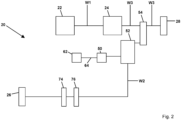
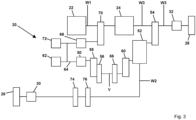
- FIG 2 shows a schematic representation of the first embodiment of the power-split axle drive 20 according to the invention.
- the axle drive 20 shown essentially corresponds to the one in Figure 1 shown power-split axle drive 20, so that only details and/or differences are discussed below.
- the agricultural vehicle 10 can have the power-split axle drive 20, as in Figure 2 shown.
- the power-split axle drive 20 for an agricultural vehicle 10 comprises a first additional drive element 50, the first vehicle axle 26, the second vehicle axle 28 and the main drive element 22 for providing a rotary movement and/or a force and/or a torque which can be transmitted to the main transmission 24 via a first shaft W1.
- the main transmission 24 is therefore connected, in particular drivably connected, to the main drive element 22 via or with the first shaft W1.
- the second vehicle axle 28 is connected, in particular drivably connected, to the main transmission 24.
- the second vehicle axle 28 can be driven with the rotary movement and/or the force and/or the torque of the main drive element 22 at least via the main transmission 24.
- the second vehicle axle 28 is connected, in particular drivably connected, to the main transmission 24 via or with a third shaft W3.
- the main drive element 22 can generate a rotary motion and/or a force and/or a torque, which can be introduced or transmitted via the first shaft W1 into the main transmission 24 and from the main transmission 24 into or to the second vehicle axle 28.
- the power-split axle drive 20 further comprises a power-split transmission 52.
- the power-split transmission 52 is connected, in particular drivably connected, to the third shaft W3 via or with a first gear set 54.
- the first gear set 54 can therefore transmit or introduce a rotary motion and/or a torque from the main drive element 22 to the main transmission 24, to the third shaft W3, or into the power-split transmission 52.
- the first vehicle axle 26 is connected, in particular drivably connected, to the power-split transmission 52 via or with a second shaft W2.
- the first additional drive element 50 is connectable to the power split transmission 52, preferably detachably connectable, particularly preferably detachably rotationally fixed and/or detachably connectable and drivable.
- the first additional drive element 50 can be operated as a generator or motor.
- the power-split axle drive 20 can also include a storage element 62.
- the storage element 62 is optionally provided.
- the first additional drive element 50 can be connected to the storage element 62 in a power-electronic manner via a connecting line 64.
- One or more operating modes can be implemented with the power-split axle drive 20, and in particular also with the vehicle 10.
- the main drive element 22 When the vehicle 10 and/or the power-split axle drive 20 is in driving or overrun mode, the main drive element 22 generates a rotary motion and/or a force and/or a torque, which is introduced into the main transmission 24 by the first shaft W1.
- the rotary motion and/or a force and/or a torque introduced into the main transmission 24 is translated in the main transmission 24, provided that a gear or a drive position is engaged.
- the location at which a rotary motion and/or a force and/or a torque is introduced into the main transmission 24 is shown as the transmission input, and the location at which a resulting rotary motion and/or a resulting force and/or a resulting torque is present, taking the transmission ratio into account, is referred to as the transmission output.
- the transmission input The location at which a rotary motion and/or a force and/or a torque is introduced into the main transmission 24 is shown as the transmission input, and the location at which a resulting rotary motion and/or a
- the transmission input and transmission output of the main transmission 24 are arranged opposite one another.
- the rotary motion and/or the force and/or the torque present at the transmission output of the main transmission 24 when the gear or drive position is engaged is introduced into the second vehicle axle 28 via the third shaft W3.
- the rotary motion and/or the force and/or the torque of the main drive element 22 is transmitted via the main transmission 24 from the second shaft W2 via the first gear set 54 into the Power split transmission 52 initiated or transmitted.
- a first shifting element 74 and a first brake 76 are arranged on or at the second shaft W2.
- the first shifting element 74 and the first brake 76 are arranged between the power split transmission 52 and the first vehicle axle 26.
- the first shifting element 74 is arranged between the first brake 76 and the first vehicle axle 26.
- the power split transmission 52 can be connected, preferably detachably connected, particularly preferably detachably connected in a rotationally fixed manner and/or detachably driven, to the first vehicle axle 26, and in particular to the first differential 30, via the first or with the first shifting element 74.
- the first brake 76 is arranged between the first shifting element 74 and the power split transmission 52.
- the first brake 76 is arranged on the second shaft W2.
- the second shaft W2 can be releasably secured against rotation with the first brake 76, for example with a transmission housing or a frame. This allows the second shaft W2 to be held or inhibited in relation to a rotational movement.
- the first brake 76 and the first switching element 74 the operating modes described above, the "fully electric” operating mode, the "parking brake” operating mode and the “vehicle axle brake” operating mode, can be implemented with the power-split axle drive.
- the first switching element 74 is designed as a first clutch.
- the first switching element 74 can be connected to the second shaft W2 on one side in a rotationally fixed manner and can be connected to another part of the second shaft W2 and thus to the power-split transmission 52 on another side.
- the first brake 76 can be connected to the second shaft W2 on one side and connected to the transmission housing or frame on another side, for example. This allows the second shaft W2 to be inhibited and/or held in relation to a rotational movement.
- the memory element 62 can be charged by first auxiliary drive element 50, in particular in driving or overrun mode, can be operated as a generator.
- the generator mode of the first auxiliary drive element 50 the rotary motion and/or force and/or torque introduced into the power split transmission 52 by the main drive element 22 is introduced or transmitted into or to the first auxiliary drive element 50 and electrical energy is generated with the first auxiliary drive element and fed to the storage element 62.
- a "forward" operating mode can also be implemented by operating the first auxiliary drive element 50 as a motor. This allows an additional rotary motion and/or an additional force and/or an additional torque of the first auxiliary drive element 50 to be transmitted to the power split transmission 52.
- the rotational movement and/or force and/or the transmitted torque of the main drive element 22 transmitted to the power split transmission 52 and the rotational movement and/or force and/or the transmitted torque of the first additional drive element 50 transmitted to the power split transmission 52 can be superimposed on the power split transmission 52 and a resulting rotational movement and/or a resulting force and/or a resulting torque can be transmitted to the first vehicle axle 26.
- FIG 3 shows a schematic representation of a second embodiment of the power-split axle drive 20 according to the invention.
- the axle drive 20 shown essentially corresponds to the one shown in the Figures 1 to 2 shown power-split axle drive 20, so that only details and/or differences are discussed below.
- the agricultural vehicle 10 can have the power-split axle drive 20, as in Figure 3
- the first additional drive element 50 is connectable to the power split transmission 52 via a second or with a second switching element 56, preferably detachably connectable, particularly preferably detachably non-rotatably and/or detachably drivable.
- a non-actuated second switching element 56 is understood to mean a opened second switching element 56.
- the rotary motion and/or force and/or torque introduced into the power split transmission 52 from the main drive element 22 can be introduced or transmitted into or to the first auxiliary drive element 50 with the second switching element 56 actuated, particularly preferably with a closed one, and electrical energy can be generated with the first auxiliary drive element and fed to the storage element 62.
- the "advance" operating mode can also be implemented by transmitting the additional rotary motion and/or additional force and/or additional torque of the first auxiliary drive element 50 to the power split transmission 52 via the closed second switching element 56.
- an advance of the first vehicle axle 26 can thus be set and/or adjusted, in particular controllable and/or adjustable.
- the power-split axle drive 20 additionally comprises a countershaft V.
- the first additional drive element 50 is connectable, preferably drivable, to the countershaft V via the second or with the second shifting element 56.
- the power-split transmission 52 is also connected, in particular drivable, to the countershaft V.
- the power-split axle drive 20 comprises a second gear set 58.
- the second shifting element 56 is connected, in this case, via the second or with the second gear set 58, to the first additional drive element 50. connected, preferably drivably connected.
- the countershaft V is connectable, preferably drivably connected, to the second gear set 58 or, via the second shifting element 56.
- the second shifting element 56 can be actuated, in particular closed, in such a way that the second gear set 58 is connected, preferably drivably connected, to the countershaft V via the second or with the second shifting element 56.
- the second shifting element 56 can be actuated, in particular closed, in such a way that a rotary movement and/or a force and/or a torque of the first additional drive element 50 can be transmitted or introduced to or in the second gear set 58 and from the second gear set 58 to or in the second shifting element 56 and from the second shifting element 56 further to or in the countershaft V.
- the power-split axle drive 20 also comprises a third gear set 60.
- the power-split transmission 52 is connected to the countershaft V via or with the third gear set 60, in particular is drivably connected. With the third gear set 60, a rotary movement and/or a force and/or a torque can be transmitted or introduced from the countershaft V to or into the power-split transmission 52.
- a rotary motion and/or a force and/or a torque can be transmitted from the first additional drive element 50 via the second gear set 58 to the second shifting element 56 and from the second shifting element 56 to the countershaft V and from the countershaft V via the third or with the third gear set 60 to the power split transmission 52.
- the rotary motion and/or force and/or the torque can then be transmitted, for example, from the power split transmission 52, in particular via the first differential 30, to the first vehicle axle 26.
- the "generator" operating mode i.e.
- the rotational movement and/or force and/or torque introduced by the main drive element 22 into the power split transmission 52 is introduced or transmitted from the power split transmission 52 via the third gear set 60 into the countershaft V and from the countershaft V into the closed second shift element 56 and the second gear set 58 further into the first additional drive element 50 and generates electrical energy with the first additional drive element 50.
- the "advance" operating mode i.e.
- an additional rotary movement and/or an additional force and/or an additional torque of the first additional drive element 50 is transmitted from the first additional drive element 50 via the second gear set 58 and the closed second shift element 56 to the countershaft V and from the countershaft V via the third gear set 60 to the power split transmission 52 and superimposed by the power split transmission 52 with the rotary movement and/or the force and/or the torque of the main drive element 22.
- the resulting rotary movement and/or force and/or the resulting torque are transmitted from the power split transmission 52 with the second shaft W2 to the first vehicle axle 26.
- the first additional drive element 50 can thus advantageously act on the power split transmission 52, whereby an advance of the first vehicle axle 26 can be regulated.
- the power-split axle drive 20 additionally comprises a second brake 66.
- the second brake 66 is arranged between the first additional drive element 50 and the power-split transmission 52.
- the second brake 66 is connected to the countershaft V in a rotationally fixed manner.
- the countershaft V is releasably secured against rotation with the second brake 66.
- the power-split axle drive 20 can optionally comprise a second additional drive element 68.
- the second additional drive element 68 is connected to the Main drive element 22 is connected via or to the first shaft W1, preferably drivably connected.
- the torque and/or the force and/or the rotational movement that can be generated by the main drive element 22 can be introduced or transmitted to or from the second auxiliary drive element via the transmission stage 70, in particular a fourth gear set.
- the second auxiliary drive element 68 is connected to the storage element 62 and the first auxiliary drive element 50 in a power electronic manner via the connecting line 64.
- the second auxiliary drive element 68 is also connected to a power take-off 72 in a power electronic manner via the connecting line 64.
- the first auxiliary drive element 50 and/or the second auxiliary drive element 68 can also be operated as a generator, in particular when driving or coasting.
- the main drive element 22 can be used to introduce or transmit a rotary movement and/or a force and/or a torque into the second auxiliary drive element 68 and, via the main transmission 24, into the power split transmission 52 into the first auxiliary drive element 50.
- the second auxiliary drive element 68 can also introduce a rotary movement and/or force and/or torque, in particular via the transmission stage 70, preferably the fourth gear set, into the first shaft W1.
- the second additional drive element 68 can be operated by a motor. This means that, for example, the drive power can be increased for a short time if this is required by the respective driving condition.
- FIG 4 shows a schematic representation of a third embodiment of the power-split axle drive 20 according to the invention.
- the axle drive 20 shown essentially corresponds to the one shown in the Figures 1 to 3 shown power-split axle drive 20, so that only details and/or differences are discussed below.
- the agricultural vehicle 10 can have the power-split axle drive 20, as in Figure 4
- a third switching element 78 is arranged between the main drive element 22 and the second additional drive element 68 and/or the main drive element 22 and the main transmission 24.
- a fourth switching element 80 is also arranged between the main transmission 24 and the main drive element 22 and/or the main transmission 24 and the second additional drive element 68.
- the main drive element 22 when the main drive element 22 is switched off and the fourth switching element 80 is open and the third switching element 78 is closed, the main drive element 22 can be started by motor operation of the second additional drive element 68.
- the fourth switching element 80 When the fourth switching element 80 is closed, the main transmission 24 is connected to the main drive element 22 and/or the second additional drive element 68, in particular drivably connected. A rotary motion and/or a force and/or a torque can therefore be initiated or transmitted from the main transmission 24 into or to the power-split axle drive.
- FIG. 5 shows a schematic representation of a fourth embodiment of the power-split axle drive 20 according to the invention.
- the axle drive 20 shown essentially corresponds to the one shown in the Figures 1 to 4 shown power-split axle drive 20, so that only details and/or differences are discussed below.
- the agricultural vehicle 10 can have the power-split axle drive 20, as in Figure 5 shown, include.
- At least one control device 42 is assigned to the power-split axle drive 20, in particular the power-split axle drive 20 can include the control device 42.
- the control device 42 is connected via a plurality of control lines S, preferably via bidirectional control lines, to the first and/or second auxiliary drive element 50, 68 and/or the power take-off 72 and/or the storage element 62 and/or the first and/or second and/or third and/or fourth switching element 74, 56, 78, 80 and/or the main drive element 22 and/or the main transmission 24 and/or the power-split transmission 52 and/or a first and/or second brake 66, 76 for controlling and/or regulating and/or controlling them, and is in particular signal-connected and/or signal-transmitting and/or data-conductingly connected to these.
- the control device 42 is designed such that the power-split axle drive 20, in particular the above-mentioned components of the power-split axle drive 20, can be controlled depending on an operating mode of the power-split axle drive 20 and/or vehicle 10.
- the above-mentioned operating modes “generator” and/or “pre-run” and/or “fully electric” and/or “parking brake” and/or “vehicle axle brake” can be controlled with the control device 42.
- Figure 6 shows a detailed schematic representation of a fifth embodiment of the power-split axle drive 20 according to the invention, in particular the power-split transmission 52 and the first Additional drive element 50.
- the power-split axle drive 20 shown essentially corresponds to the one shown in the Figures 1 to 5 shown power-split axle drive 20, so that only details and/or differences are discussed below.
- the agricultural vehicle 10 can have the power-split axle drive 20, as in Figure 6 shown.
- the first gear set 54 comprises a first gear pair, in particular a first and a second fixed gear 90, 92.
- the first fixed gear 90 is connected to the third shaft W3 and the second fixed gear 92 is connected to the power split transmission 52, preferably in a rotationally fixed manner.
- the first fixed gear 90 meshes with the second fixed gear 92.
- the second gear set 58 comprises a second gear pair, in particular a first switching gear 94 and a third fixed gear 96.
- the third fixed gear 96 is connected to the first additional drive element 50, in particular an output shaft of the first additional drive element 50, preferably drivably connected, particularly preferably in a rotationally fixed and/or drivable manner.
- the first switching gear 94 is rotatably mounted on the countershaft V, in particular freely rotatable and/or axially displaceable on the countershaft V.
- the first switching gear 94 is connected to one side of the second switching element 56, preferably connected in a rotationally fixed and/or drivable manner.
- the first switching gear 94 meshes with the third fixed gear 96.
- the second switching element 56 is therefore connected to the first auxiliary drive element 50 via the first or with the first switching gear 94 and via the third or with the third fixed gear 96, preferably connected in a drivable manner.
- the countershaft V is connected to the second or via the second switching element 56 and the first switching gear 94 to the third fixed gear 96, preferably connected in a drivable manner, particularly preferably connected in a detachable drivable manner.
- the third gear set 60 comprises a third gear pair, in particular a fourth and a fifth fixed gear 98, 100.
- the fourth fixed gear 98 is connected to the countershaft V and the fifth fixed gear 100 to the power split transmission 52, in particular a sun gear 102 of the power split transmission 52, preferably connected in a rotationally fixed and/or drivable manner.
- the fourth fixed gear 98 meshes with the fifth fixed gear 100.
- the power split transmission 52 is designed as a planetary transmission.
- a ring gear 104 of the power split transmission 52 is connected to the third shaft W3 via or with the first gear set 54, in particular is drivably connected.
- the ring gear 104 is connected to the second fixed gear 92, preferably connected in a rotationally fixed and/or drivable manner.
- the first vehicle axle 26 is connected to a planet carrier 106 or a web of the power split transmission 52 via or with the second shaft W2, in particular is drivably connected.
- the planet carrier 106 is connected to the second shaft W2, preferably connected in a rotationally fixed and/or drivable manner.
- a planetary gear set in particular one or more planetary gears 108, are rotatably mounted on the planet carrier 106, each of which meshes with the sun gear 102 and the ring gear 104, i.e.
- the planetary gear set can in particular have a set of planetary gears 108.
- the planetary gear set can comprise three planetary gears 108.
- the sun gear 102 of the power split transmission 52 is connected, in particular drivably connected, to the first additional drive element via the fifth fixed gear 100 and the fourth fixed gear 98, and in particular further via the countershaft V and the second shifting element and the second gear set.
- a force and/or a torque is transmitted from the first additional drive element via the second gear set and the second shift element to the countershaft and from the countershaft via the fourth fixed gear 98 and the fifth fixed gear 100 to the sun gear 102 of the power split transmission 52.
- the second brake 66 is arranged on the countershaft V.
- the second brake 66 is connected to the countershaft V, preferably drivably connected to the countershaft V, particularly preferably connected to the countershaft V in a rotationally fixed and/or drivable manner.
- the power split transmission 52 operates with a fixed ratio, i.e. completely mechanically.
- the power split transmission 52 can then transfer the braking torque from the first vehicle axle 26 to the vehicle brake or rear axle brake (not shown, on the second vehicle axle 28).
- Figure 7 shows a detailed schematic representation of a sixth embodiment of the power-split axle drive 20 according to the invention.
- the axle drive 20 shown essentially corresponds to the one shown in the Figures 1 to 6 shown power-split axle drive 20, so that only details and/or differences are discussed below.
- the agricultural vehicle 10 can have the power-split axle drive 20, as in Figure 7 shown.
- the first switching element 74 and the first brake 76 are arranged on the second shaft W2 between the power split transmission 52 and the first vehicle axle 26.
- the Figures 8 to 10 show schematic representations of the power flow in the "fully electric” operating mode, "parking brake” operating mode and “vehicle axle brake” operating mode in the power-split axle drive 20 according to the invention.
- the Figures 8 to 10 The power-split axle drive 20 shown essentially corresponds to the one shown in the Figures 1 to 7 shown power-split axle drive 20, so that only details and/or differences are discussed below.
- the arrows 120 show the direction of the power flow, i.e. the direction of the transmission of a rotary motion and/or a force and/or a torque.
- the size of the arrows 120 schematically shows the size of the transmitted rotary motion and/or force and/or torque.
- Figure 8 shows the power flow of the "fully electric” operating mode.
- a power flow i.e. a rotary movement and/or a force and/or a torque
- a rotary movement and/or a force and/or a torque which is transmitted from the power split transmission 52 to the second shaft W2, i.e. in particular in the direction of the first vehicle axle 26, can be held and/or inhibited and/or supported at or by the closed first brake 76.
- the second shaft W2 can be held or inhibited with the first brake 76 in relation to a rotary movement of the second shaft W2.
- the first brake 76 thus ensures that a stationary transmission from the sun gear to the ring gear is possible.
- Figure 9 shows the power flow of the "parking brake” operating mode.
- a power flow i.e. a rotational movement and/or a force and/or a torque
- a power flow is transmitted from the first and/or second vehicle axle 26, 28 to the power-split axle drive 20 and supported. This holds the vehicle in its position.
- Figure 10 shows the power flow of the "vehicle axle brake” operating mode.
- a power flow i.e. a rotational movement and/or a force and/or a torque
- the vehicle in particular when driving or coasting, braked.
- FIG 11 shows a detailed schematic representation of a seventh embodiment of the power-split axle drive 20 according to the invention.
- the axle drive 20 shown essentially corresponds to the one shown in the Figures 1 to 10 shown power-split axle drive 20, so that only details and/or differences are discussed below.
- the agricultural vehicle 10 can have the power-split axle drive 20, as in Figure 11 shown.
- the power split transmission 52 alternatively comprises a fifth switching element 130 instead of the second brake 66.
- the fifth switching element 130 is designed as a fifth clutch.
- the fifth fixed gear 100 and/or the sun gear 102 are connected in a rotationally fixed manner to the second shaft W2 via the closed fifth switching element 130.
- the first and second vehicle axles 26, 28 are thus both mechanically driven by the main drive element 22.
- the relative speed of the sun gear 102 and the second shaft W2 is 0 (zero) revolutions per minute. This results in the ring gear 104 rotating at the same speed as the sun gear 102 and the second shaft W2.
- a rotational speed and/or a force and/or a torque of the first additional drive element 50 can be transmitted or introduced into the power split transmission 52 by the fifth fixed gear 100 and/or the sun gear 102.
Landscapes
- Engineering & Computer Science (AREA)
- Mechanical Engineering (AREA)
- Chemical & Material Sciences (AREA)
- Combustion & Propulsion (AREA)
- Transportation (AREA)
- General Engineering & Computer Science (AREA)
- Arrangement And Driving Of Transmission Devices (AREA)
- Retarders (AREA)
- Arrangement And Mounting Of Devices That Control Transmission Of Motive Force (AREA)
- Motor Power Transmission Devices (AREA)
- Structure Of Transmissions (AREA)
Applications Claiming Priority (3)
| Application Number | Priority Date | Filing Date | Title |
|---|---|---|---|
| DE102022101166.6A DE102022101166A1 (de) | 2022-01-19 | 2022-01-19 | Leistungsverzweigter Achsantrieb und landwirtschaftliches Fahrzeug |
| EP22152192.5A EP4215392B1 (fr) | 2022-01-19 | 2022-01-19 | Entraînement d'essieu à répartition de puissance et véhicule agricole |
| EP22198911.4A EP4215393B1 (fr) | 2022-01-19 | 2022-09-30 | Entraînement d'essieu à répartition de puissance et véhicule agricole |
Related Parent Applications (2)
| Application Number | Title | Priority Date | Filing Date |
|---|---|---|---|
| EP22198911.4A Division EP4215393B1 (fr) | 2022-01-19 | 2022-09-30 | Entraînement d'essieu à répartition de puissance et véhicule agricole |
| EP22198911.4A Division-Into EP4215393B1 (fr) | 2022-01-19 | 2022-09-30 | Entraînement d'essieu à répartition de puissance et véhicule agricole |
Publications (2)
| Publication Number | Publication Date |
|---|---|
| EP4516554A2 true EP4516554A2 (fr) | 2025-03-05 |
| EP4516554A3 EP4516554A3 (fr) | 2025-05-07 |
Family
ID=83438784
Family Applications (2)
| Application Number | Title | Priority Date | Filing Date |
|---|---|---|---|
| EP22198911.4A Active EP4215393B1 (fr) | 2022-01-19 | 2022-09-30 | Entraînement d'essieu à répartition de puissance et véhicule agricole |
| EP24219271.4A Pending EP4516554A3 (fr) | 2022-01-19 | 2022-09-30 | Entraînement d'essieu à répartition de puissance et véhicule agricole |
Family Applications Before (1)
| Application Number | Title | Priority Date | Filing Date |
|---|---|---|---|
| EP22198911.4A Active EP4215393B1 (fr) | 2022-01-19 | 2022-09-30 | Entraînement d'essieu à répartition de puissance et véhicule agricole |
Country Status (2)
| Country | Link |
|---|---|
| US (2) | US12330501B2 (fr) |
| EP (2) | EP4215393B1 (fr) |
Families Citing this family (2)
| Publication number | Priority date | Publication date | Assignee | Title |
|---|---|---|---|---|
| EP4215393B1 (fr) * | 2022-01-19 | 2025-01-29 | Deere & Company | Entraînement d'essieu à répartition de puissance et véhicule agricole |
| DE102024102491A1 (de) | 2024-01-29 | 2025-07-31 | Deere & Company | Leistungsverzweigter Achsantrieb, landwirtschaftliches Zugfahrzeug und Verfahren zum Betreiben eines leistungsverzweigten Achsantriebs |
Citations (3)
| Publication number | Priority date | Publication date | Assignee | Title |
|---|---|---|---|---|
| DE102007021732A1 (de) | 2007-05-09 | 2008-11-20 | Agco Gmbh | Antriebssystem für Fahrzeuge mit mindestens zwei antreibbaren Fahrzeugachsen |
| DE102013224383A1 (de) | 2013-11-28 | 2015-05-28 | Zf Friedrichshafen Ag | Leistungsverzweigter Achsantrieb für Arbeitsmaschinen |
| EP3626502A1 (fr) | 2018-09-18 | 2020-03-25 | CLAAS Tractor S.A.S. | Chaîne cinématique pour un véhicule agricole |
Family Cites Families (12)
| Publication number | Priority date | Publication date | Assignee | Title |
|---|---|---|---|---|
| US6464608B2 (en) * | 2001-02-08 | 2002-10-15 | New Venture Gear Inc. | Transfer case for hybrid vehicle |
| JP2007045177A (ja) * | 2005-08-05 | 2007-02-22 | Yanmar Co Ltd | 前輪増速制御装置 |
| DE112010002242T5 (de) * | 2009-06-05 | 2012-07-05 | Magna Powertrain Usa, Inc. | Hybridelektrisches Mehrfachmodus-Verteilergetriebe fürFahrzeug mit Vierradantrieb |
| US8337352B2 (en) | 2010-06-22 | 2012-12-25 | Oshkosh Corporation | Electromechanical variable transmission |
| DE102014009866B4 (de) * | 2014-07-03 | 2017-03-16 | Daimler Ag | Antriebsstrangvorrichtung für ein Kraftfahrzeug |
| JP6611933B2 (ja) * | 2015-10-27 | 2019-11-27 | ザ・リージェンツ・オブ・ザ・ユニバーシティ・オブ・ミシガン | ダイナミッククラッチを有するハイブリッド全輪駆動システム |
| DE102017215012A1 (de) * | 2016-09-15 | 2018-03-15 | Deere & Company | Antriebssystem und Verfahren |
| DE102017218858B4 (de) * | 2017-04-06 | 2019-02-21 | Magna powertrain gmbh & co kg | Fahrzeug mit Verteilergetriebe und Verfahren zum Betrieb dieses Fahrzeugs |
| DE102018213871A1 (de) * | 2018-08-17 | 2020-02-20 | Zf Friedrichshafen Ag | Leistungsverzweigungsgetriebe |
| US11247563B2 (en) | 2020-05-22 | 2022-02-15 | Dana Belgium N.V. | Vehicle transmission with an inter-axle differential and method for operation of said inter-axle differential |
| US12024027B2 (en) * | 2020-07-27 | 2024-07-02 | Kinetics Drive Solutions, Inc. | Electro-mechanical cross steer drive device for a vehicle |
| EP4215393B1 (fr) | 2022-01-19 | 2025-01-29 | Deere & Company | Entraînement d'essieu à répartition de puissance et véhicule agricole |
-
2022
- 2022-09-30 EP EP22198911.4A patent/EP4215393B1/fr active Active
- 2022-09-30 EP EP24219271.4A patent/EP4516554A3/fr active Pending
- 2022-10-24 US US18/048,903 patent/US12330501B2/en active Active
- 2022-10-24 US US18/048,891 patent/US12325305B2/en active Active
Patent Citations (3)
| Publication number | Priority date | Publication date | Assignee | Title |
|---|---|---|---|---|
| DE102007021732A1 (de) | 2007-05-09 | 2008-11-20 | Agco Gmbh | Antriebssystem für Fahrzeuge mit mindestens zwei antreibbaren Fahrzeugachsen |
| DE102013224383A1 (de) | 2013-11-28 | 2015-05-28 | Zf Friedrichshafen Ag | Leistungsverzweigter Achsantrieb für Arbeitsmaschinen |
| EP3626502A1 (fr) | 2018-09-18 | 2020-03-25 | CLAAS Tractor S.A.S. | Chaîne cinématique pour un véhicule agricole |
Also Published As
| Publication number | Publication date |
|---|---|
| US20230226901A1 (en) | 2023-07-20 |
| EP4516554A3 (fr) | 2025-05-07 |
| US12330501B2 (en) | 2025-06-17 |
| US20230226902A1 (en) | 2023-07-20 |
| EP4215393B1 (fr) | 2025-01-29 |
| US12325305B2 (en) | 2025-06-10 |
| EP4215393A1 (fr) | 2023-07-26 |
Similar Documents
| Publication | Publication Date | Title |
|---|---|---|
| DE102013224383A1 (de) | Leistungsverzweigter Achsantrieb für Arbeitsmaschinen | |
| EP1926620B1 (fr) | Systeme d'entrainement pour vehicule, et vehicule utilitaire agricole | |
| EP3209904B1 (fr) | Unite' d'entrainement pour véhicule automobile, véhicule automobile et procédé d'opération d'un véhicule automobile | |
| DE102018203670A1 (de) | Stufenloses Getriebe mit Power Reverser | |
| EP2289751B1 (fr) | Chaîne de transmission hybride pour un véhicule automobile et son procédé de fonctionnement | |
| DE102013206176A1 (de) | Fahrzeugantrieb | |
| WO2006119919A1 (fr) | Ligne de propulsion pour vehicule a moteur a combustion interne et a groupe moteur electrique | |
| EP1876080A2 (fr) | Système d'entraînement pour un chariot de manutention doté d'un moteur à combustion interne | |
| EP2914876A1 (fr) | Boîte de vitesses à double embrayage | |
| EP3429879A1 (fr) | Groupe motopropulseur hybride d'un véhicule automobile à propulsion hybride | |
| EP3406474B1 (fr) | Dispositif d'entraînement hybride électro-hydraulique pour un véhicule automobile | |
| WO2014006016A1 (fr) | Chaîne cinématique hybride pour véhicule automobile, véhicule hybride et utilisation associée | |
| EP4215393B1 (fr) | Entraînement d'essieu à répartition de puissance et véhicule agricole | |
| DE102018122856A1 (de) | Antriebsstrang für ein landwirtschaftliches Fahrzeug | |
| EP3754226A1 (fr) | Boîte de vitesses à commande sous charge | |
| WO2018197109A1 (fr) | Chaîne cinématique hybride ainsi que procédé pour la commander | |
| EP4215392B1 (fr) | Entraînement d'essieu à répartition de puissance et véhicule agricole | |
| DE102020214519B4 (de) | Hybrid-Getriebe für einen Kraftfahrzeugantriebsstrang | |
| DE102021205940B4 (de) | Getriebe und Antriebsstrang für ein Kraftfahrzeug | |
| DE102022204742B4 (de) | Antriebsvorrichtung für eine Arbeitsmaschine | |
| DE102022204738B4 (de) | Antriebsvorrichtung für eine Arbeitsmaschine | |
| DE102022101166A1 (de) | Leistungsverzweigter Achsantrieb und landwirtschaftliches Fahrzeug | |
| EP4592119A1 (fr) | Entraînement d'essieu à répartition de puissance, véhicule tracteur agricole et procédé de fonctionnement d'un entraînement d'essieu à répartition de puissance | |
| DE102021124260B4 (de) | Steuervorrichtung und Verfahren zum Steuern eines Fahrzeugantriebsstranges mit Nebenabtrieb | |
| DE102022204743B4 (de) | Antriebsvorrichtung für eine Arbeitsmaschine |
Legal Events
| Date | Code | Title | Description |
|---|---|---|---|
| PUAI | Public reference made under article 153(3) epc to a published international application that has entered the european phase |
Free format text: ORIGINAL CODE: 0009012 |
|
| STAA | Information on the status of an ep patent application or granted ep patent |
Free format text: STATUS: THE APPLICATION HAS BEEN PUBLISHED |
|
| AC | Divisional application: reference to earlier application |
Ref document number: 4215393 Country of ref document: EP Kind code of ref document: P |
|
| AK | Designated contracting states |
Kind code of ref document: A2 Designated state(s): AL AT BE BG CH CY CZ DE DK EE ES FI FR GB GR HR HU IE IS IT LI LT LU LV MC MK MT NL NO PL PT RO RS SE SI SK SM TR |
|
| REG | Reference to a national code |
Ref country code: DE Ref legal event code: R079 Free format text: PREVIOUS MAIN CLASS: B60K0023080000 Ipc: B60K0006520000 |
|
| PUAL | Search report despatched |
Free format text: ORIGINAL CODE: 0009013 |
|
| AK | Designated contracting states |
Kind code of ref document: A3 Designated state(s): AL AT BE BG CH CY CZ DE DK EE ES FI FR GB GR HR HU IE IS IT LI LT LU LV MC MK MT NL NO PL PT RO RS SE SI SK SM TR |
|
| RIC1 | Information provided on ipc code assigned before grant |
Ipc: B60K 6/442 20071001ALN20250331BHEP Ipc: B60K 23/08 20060101ALI20250331BHEP Ipc: B60K 6/365 20071001ALI20250331BHEP Ipc: B60K 6/387 20071001ALI20250331BHEP Ipc: B60K 17/344 20060101ALI20250331BHEP Ipc: B60K 6/48 20071001ALI20250331BHEP Ipc: B60K 6/52 20071001AFI20250331BHEP |
|
| STAA | Information on the status of an ep patent application or granted ep patent |
Free format text: STATUS: REQUEST FOR EXAMINATION WAS MADE |
|
| 17P | Request for examination filed |
Effective date: 20251107 |