EP4510185A1 - Leistungsüberlagerungsstruktur für ein mehrchip-halbleitergehäuse - Google Patents
Leistungsüberlagerungsstruktur für ein mehrchip-halbleitergehäuse Download PDFInfo
- Publication number
- EP4510185A1 EP4510185A1 EP24193418.1A EP24193418A EP4510185A1 EP 4510185 A1 EP4510185 A1 EP 4510185A1 EP 24193418 A EP24193418 A EP 24193418A EP 4510185 A1 EP4510185 A1 EP 4510185A1
- Authority
- EP
- European Patent Office
- Prior art keywords
- gate
- pad
- interconnect layer
- package
- common
- Prior art date
- Legal status (The legal status is an assumption and is not a legal conclusion. Google has not performed a legal analysis and makes no representation as to the accuracy of the status listed.)
- Pending
Links
Images









Classifications
-
- H—ELECTRICITY
- H10—SEMICONDUCTOR DEVICES; ELECTRIC SOLID-STATE DEVICES NOT OTHERWISE PROVIDED FOR
- H10W—GENERIC PACKAGES, INTERCONNECTIONS, CONNECTORS OR OTHER CONSTRUCTIONAL DETAILS OF DEVICES COVERED BY CLASS H10
- H10W70/00—Package substrates; Interposers; Redistribution layers [RDL]
- H10W70/60—Insulating or insulated package substrates; Interposers; Redistribution layers
- H10W70/611—Insulating or insulated package substrates; Interposers; Redistribution layers for connecting multiple chips together
-
- H—ELECTRICITY
- H10—SEMICONDUCTOR DEVICES; ELECTRIC SOLID-STATE DEVICES NOT OTHERWISE PROVIDED FOR
- H10W—GENERIC PACKAGES, INTERCONNECTIONS, CONNECTORS OR OTHER CONSTRUCTIONAL DETAILS OF DEVICES COVERED BY CLASS H10
- H10W70/00—Package substrates; Interposers; Redistribution layers [RDL]
- H10W70/60—Insulating or insulated package substrates; Interposers; Redistribution layers
-
- H—ELECTRICITY
- H10—SEMICONDUCTOR DEVICES; ELECTRIC SOLID-STATE DEVICES NOT OTHERWISE PROVIDED FOR
- H10W—GENERIC PACKAGES, INTERCONNECTIONS, CONNECTORS OR OTHER CONSTRUCTIONAL DETAILS OF DEVICES COVERED BY CLASS H10
- H10W20/00—Interconnections in chips, wafers or substrates
- H10W20/20—Interconnections within wafers or substrates, e.g. through-silicon vias [TSV]
-
- H—ELECTRICITY
- H10—SEMICONDUCTOR DEVICES; ELECTRIC SOLID-STATE DEVICES NOT OTHERWISE PROVIDED FOR
- H10W—GENERIC PACKAGES, INTERCONNECTIONS, CONNECTORS OR OTHER CONSTRUCTIONAL DETAILS OF DEVICES COVERED BY CLASS H10
- H10W70/00—Package substrates; Interposers; Redistribution layers [RDL]
- H10W70/01—Manufacture or treatment
- H10W70/05—Manufacture or treatment of insulating or insulated package substrates, or of interposers, or of redistribution layers
- H10W70/093—Connecting or disconnecting other interconnections thereto or therefrom, e.g. connecting bond wires or bumps
-
- H—ELECTRICITY
- H10—SEMICONDUCTOR DEVICES; ELECTRIC SOLID-STATE DEVICES NOT OTHERWISE PROVIDED FOR
- H10W—GENERIC PACKAGES, INTERCONNECTIONS, CONNECTORS OR OTHER CONSTRUCTIONAL DETAILS OF DEVICES COVERED BY CLASS H10
- H10W70/00—Package substrates; Interposers; Redistribution layers [RDL]
- H10W70/40—Leadframes
- H10W70/411—Chip-supporting parts, e.g. die pads
-
- H—ELECTRICITY
- H10—SEMICONDUCTOR DEVICES; ELECTRIC SOLID-STATE DEVICES NOT OTHERWISE PROVIDED FOR
- H10W—GENERIC PACKAGES, INTERCONNECTIONS, CONNECTORS OR OTHER CONSTRUCTIONAL DETAILS OF DEVICES COVERED BY CLASS H10
- H10W70/00—Package substrates; Interposers; Redistribution layers [RDL]
- H10W70/40—Leadframes
- H10W70/481—Leadframes for devices being provided for in groups H10D8/00 - H10D48/00
-
- H—ELECTRICITY
- H10—SEMICONDUCTOR DEVICES; ELECTRIC SOLID-STATE DEVICES NOT OTHERWISE PROVIDED FOR
- H10W—GENERIC PACKAGES, INTERCONNECTIONS, CONNECTORS OR OTHER CONSTRUCTIONAL DETAILS OF DEVICES COVERED BY CLASS H10
- H10W70/00—Package substrates; Interposers; Redistribution layers [RDL]
- H10W70/60—Insulating or insulated package substrates; Interposers; Redistribution layers
- H10W70/62—Insulating or insulated package substrates; Interposers; Redistribution layers characterised by their interconnections
- H10W70/63—Vias, e.g. via plugs
- H10W70/635—Through-vias
-
- H—ELECTRICITY
- H10—SEMICONDUCTOR DEVICES; ELECTRIC SOLID-STATE DEVICES NOT OTHERWISE PROVIDED FOR
- H10W—GENERIC PACKAGES, INTERCONNECTIONS, CONNECTORS OR OTHER CONSTRUCTIONAL DETAILS OF DEVICES COVERED BY CLASS H10
- H10W70/00—Package substrates; Interposers; Redistribution layers [RDL]
- H10W70/60—Insulating or insulated package substrates; Interposers; Redistribution layers
- H10W70/62—Insulating or insulated package substrates; Interposers; Redistribution layers characterised by their interconnections
- H10W70/65—Shapes or dispositions of interconnections
-
- H—ELECTRICITY
- H10—SEMICONDUCTOR DEVICES; ELECTRIC SOLID-STATE DEVICES NOT OTHERWISE PROVIDED FOR
- H10W—GENERIC PACKAGES, INTERCONNECTIONS, CONNECTORS OR OTHER CONSTRUCTIONAL DETAILS OF DEVICES COVERED BY CLASS H10
- H10W70/00—Package substrates; Interposers; Redistribution layers [RDL]
- H10W70/60—Insulating or insulated package substrates; Interposers; Redistribution layers
- H10W70/62—Insulating or insulated package substrates; Interposers; Redistribution layers characterised by their interconnections
- H10W70/65—Shapes or dispositions of interconnections
- H10W70/652—Cross-sectional shapes
-
- H—ELECTRICITY
- H10—SEMICONDUCTOR DEVICES; ELECTRIC SOLID-STATE DEVICES NOT OTHERWISE PROVIDED FOR
- H10W—GENERIC PACKAGES, INTERCONNECTIONS, CONNECTORS OR OTHER CONSTRUCTIONAL DETAILS OF DEVICES COVERED BY CLASS H10
- H10W70/00—Package substrates; Interposers; Redistribution layers [RDL]
- H10W70/60—Insulating or insulated package substrates; Interposers; Redistribution layers
- H10W70/62—Insulating or insulated package substrates; Interposers; Redistribution layers characterised by their interconnections
- H10W70/65—Shapes or dispositions of interconnections
- H10W70/658—Shapes or dispositions of interconnections for devices provided for in groups H10D8/00 - H10D48/00
-
- H—ELECTRICITY
- H10—SEMICONDUCTOR DEVICES; ELECTRIC SOLID-STATE DEVICES NOT OTHERWISE PROVIDED FOR
- H10W—GENERIC PACKAGES, INTERCONNECTIONS, CONNECTORS OR OTHER CONSTRUCTIONAL DETAILS OF DEVICES COVERED BY CLASS H10
- H10W70/00—Package substrates; Interposers; Redistribution layers [RDL]
- H10W70/60—Insulating or insulated package substrates; Interposers; Redistribution layers
- H10W70/67—Insulating or insulated package substrates; Interposers; Redistribution layers characterised by their insulating layers or insulating parts
- H10W70/68—Shapes or dispositions thereof
- H10W70/685—Shapes or dispositions thereof comprising multiple insulating layers
-
- H—ELECTRICITY
- H10—SEMICONDUCTOR DEVICES; ELECTRIC SOLID-STATE DEVICES NOT OTHERWISE PROVIDED FOR
- H10W—GENERIC PACKAGES, INTERCONNECTIONS, CONNECTORS OR OTHER CONSTRUCTIONAL DETAILS OF DEVICES COVERED BY CLASS H10
- H10W72/00—Interconnections or connectors in packages
- H10W72/071—Connecting or disconnecting
- H10W72/072—Connecting or disconnecting of bump connectors
-
- H—ELECTRICITY
- H10—SEMICONDUCTOR DEVICES; ELECTRIC SOLID-STATE DEVICES NOT OTHERWISE PROVIDED FOR
- H10W—GENERIC PACKAGES, INTERCONNECTIONS, CONNECTORS OR OTHER CONSTRUCTIONAL DETAILS OF DEVICES COVERED BY CLASS H10
- H10W72/00—Interconnections or connectors in packages
- H10W72/90—Bond pads, in general
-
- H—ELECTRICITY
- H10—SEMICONDUCTOR DEVICES; ELECTRIC SOLID-STATE DEVICES NOT OTHERWISE PROVIDED FOR
- H10W—GENERIC PACKAGES, INTERCONNECTIONS, CONNECTORS OR OTHER CONSTRUCTIONAL DETAILS OF DEVICES COVERED BY CLASS H10
- H10W72/00—Interconnections or connectors in packages
- H10W72/90—Bond pads, in general
- H10W72/941—Dispositions of bond pads
- H10W72/944—Dispositions of multiple bond pads
-
- H—ELECTRICITY
- H10—SEMICONDUCTOR DEVICES; ELECTRIC SOLID-STATE DEVICES NOT OTHERWISE PROVIDED FOR
- H10W—GENERIC PACKAGES, INTERCONNECTIONS, CONNECTORS OR OTHER CONSTRUCTIONAL DETAILS OF DEVICES COVERED BY CLASS H10
- H10W90/00—Package configurations
-
- H—ELECTRICITY
- H10—SEMICONDUCTOR DEVICES; ELECTRIC SOLID-STATE DEVICES NOT OTHERWISE PROVIDED FOR
- H10W—GENERIC PACKAGES, INTERCONNECTIONS, CONNECTORS OR OTHER CONSTRUCTIONAL DETAILS OF DEVICES COVERED BY CLASS H10
- H10W90/00—Package configurations
- H10W90/701—Package configurations characterised by the relative positions of pads or connectors relative to package parts
-
- H—ELECTRICITY
- H10—SEMICONDUCTOR DEVICES; ELECTRIC SOLID-STATE DEVICES NOT OTHERWISE PROVIDED FOR
- H10W—GENERIC PACKAGES, INTERCONNECTIONS, CONNECTORS OR OTHER CONSTRUCTIONAL DETAILS OF DEVICES COVERED BY CLASS H10
- H10W90/00—Package configurations
- H10W90/701—Package configurations characterised by the relative positions of pads or connectors relative to package parts
- H10W90/791—Package configurations characterised by the relative positions of pads or connectors relative to package parts of direct-bonded pads
-
- H—ELECTRICITY
- H10—SEMICONDUCTOR DEVICES; ELECTRIC SOLID-STATE DEVICES NOT OTHERWISE PROVIDED FOR
- H10W—GENERIC PACKAGES, INTERCONNECTIONS, CONNECTORS OR OTHER CONSTRUCTIONAL DETAILS OF DEVICES COVERED BY CLASS H10
- H10W90/00—Package configurations
- H10W90/701—Package configurations characterised by the relative positions of pads or connectors relative to package parts
- H10W90/721—Package configurations characterised by the relative positions of pads or connectors relative to package parts of bump connectors
- H10W90/724—Package configurations characterised by the relative positions of pads or connectors relative to package parts of bump connectors between a chip and a stacked insulating package substrate, interposer or RDL
Definitions
- the present disclosure relates generally to semiconductor packages, and more particularly to a multi-chip semiconductor package having an interconnecting power overlay structure.
- Power semiconductor devices such as switches and rectifiers, are key components of power electronic circuits (e.g., switched mode power supplies, inverters, rectifiers, and the like).
- High power applications typically require multi-chip assemblies comprising multiple power semiconductor devices connected together to carry large amounts of current and to support high voltages.
- a top surface of each power semiconductor device such as metal oxide semiconductor field effect transistor (MOSFET), includes a gate pad and at least one source pad which are electrically connected to gate and source pads of other devices in the multi-chip assembly.
- MOSFET metal oxide semiconductor field effect transistor
- the electrical connections of multiple gate pads and source pads are typically formed using wire bonds and complex routing configurations to a common gate pad and at least one common source pad.
- the common gate pad and at least one common source pad of the multi-chip semiconductor assembly may be connected to an external power electronic circuit such that the multi-chip semiconductor assembly operates as a singular power processing unit.
- An alternative to the wire bonding of gate pads and source pads may be the use of one or more planar interconnect layers separated by interconnect layers disposed over the top surfaces of the semiconductor devices.
- the interconnect layers may include metallization vias which extend through the interconnect layer to electrically couple the source pads and gate pads to the common gate pad and the common source pad disposed on upper interconnect layers of the multi-chip semiconductor assembly to deliver power to the semiconductor devices through the metallization vias.
- the common gate pad and the common source pad on an uppermost interconnect layer require sufficient surface area to solder, sinter, copper-bond, copper-clip, or otherwise connect the common gate pad and the source pad of the multi-chip assembly with the external power electronic circuitry.
- the available surface area of the common gate pad and the common source pad are generally limited by the overall surface area of the multi-chip semiconductor assembly. Further, direct soldering, sintering, copper-bonding, and copper-clipping onto smaller common gate pads and common source pads introduce bonding stresses onto the multi-chip semiconductor assembly and form less reliable interconnections.
- a device rated at 240A is significantly larger than a device rated for 60A. This will make the packaging and interconnection easier, however, the device yield will be significantly lower.
- a multi-chip semiconductor package in one aspect, includes an interconnect layer having an upper surface and a bottom surface, wherein the interconnect layer includes a dielectric material, at least one common source pad disposed on the upper surface of the interconnect layer, at least one common gate pad disposed on the upper surface of the interconnect layer, and a plurality of semiconductor devices each including a gate pad and at least one source pad adhered onto the interconnect layer, wherein the source pads of the plurality of semiconductor devices are electrically connected to the at least one common source pad, and wherein the source pads of the plurality of semiconductor devices are electrically connected in parallel with one another, and wherein the gate pads of the plurality of semiconductor devices are electrically connected to the common gate pad, and wherein the gate pads of the plurality of semiconductor devices are electrically connected in parallel with one another.
- a method of manufacturing a multi-chip semiconductor package includes forming at least one source via pathway and at least one gate via pathway through an interconnect layer, aligning at least one source pad and a gate pad of a plurality of semiconductor devices with the least one source via pathway and the at least one gate via pathway, respectively, and adhering the plurality of semiconductor devices to the interconnect layer, wherein a surface area of the interconnect layer is substantially equal to a surface area of a footprint defined by the plurality of semiconductor devices
- approximating language such as “generally,” “substantially,” and “about,” as used herein indicates that the term so modified may apply to only an approximate degree, as would be recognized by one of ordinary skill in the art, rather than to an absolute or perfect degree. Accordingly, a value modified by a term or terms, such as “about,” “approximately,” and “substantially,” is not to be limited to the precise value specified. In at least some instances, the approximating language may correspond to the precision of an instrument for measuring the value.
- range limitations may be identified. Such ranges may be combined and/or interchanged, and include all the sub-ranges contained therein unless context or language indicates otherwise.
- first ⁇ ⁇ ⁇ ⁇ ⁇ ⁇ ⁇ ⁇ ⁇ ⁇ ⁇ ⁇ ⁇ ⁇ ⁇ ⁇ ⁇ ⁇ ⁇ ⁇ ⁇ ⁇ ⁇ ⁇ ⁇ ⁇ ⁇ ⁇ ⁇ ⁇ ⁇ ⁇ ⁇ ⁇ ⁇ ⁇ ⁇ ⁇ ⁇ ⁇ ⁇ ⁇ ⁇ ⁇ ⁇ ⁇ ⁇ ⁇ ⁇ ⁇ ⁇ ⁇ ⁇ ⁇ ⁇ ⁇ ⁇ ⁇ ⁇ ⁇ ⁇ ⁇ ⁇ ⁇ ⁇ ⁇ ⁇ ⁇ ⁇ ⁇ ⁇ ⁇ ⁇ ⁇ ⁇ ⁇ ⁇ ⁇ ⁇ ⁇ ⁇ ⁇ ⁇ ⁇ ⁇ ⁇ ⁇ ⁇ ⁇ ⁇ ⁇ ⁇ ⁇ ⁇ ⁇ ⁇ ⁇ ⁇ ⁇ ⁇ ⁇ ⁇ ⁇ ⁇ ⁇ ⁇ ⁇ ⁇ ⁇ ⁇ ⁇ ⁇ ⁇ ⁇ ⁇ ⁇ ⁇ ⁇ ⁇ ⁇ ⁇ ⁇ ⁇ ⁇ ⁇ ⁇
- Embodiments of the disclosure relate generally to structures and methods for packaging multiple semiconductor devices and, more particularly to multi-chip semiconductor package having an interconnecting power overlay (POL) structure.
- the methods, systems, and apparatus described herein overcome at least some disadvantages of at least some known multi-chip semiconductor packages. More specifically, the systems and apparatus described herein provide a POL package configured as a redistribution layer (RDL) positioned directly over multiple semiconductor devices. Accordingly, the POL package is also referred to herein as a POL-RDL package.
- the POL-RDL package includes an oversized surface area relative to a footprint of the molding defined by the semiconductor devices (or more generally to a footprint of the semiconductor devices), which improves available surface area for placement of common gate pads, common source pads and overlayed contact pads. The oversized surface area also allows for placement of more complex configurations of common source pads, common gate pads and gate bridges, and additional interconnect layers and interconnect layers.
- a multi-chip semiconductor package includes least one interconnect layer having an upper surface and a bottom surface, at least one common source pad disposed on the upper surface of the at least one interconnect layer, at least one common gate pad disposed on the upper surface of the at least one interconnect layer and, a plurality of semiconductor devices.
- Each of the semiconductor devices have a gate pad and at least one source pad adhered onto a bottom surface of a first interconnect layer of the at least one interconnect layer.
- the bottom surface of the first interconnect layer has an adhesive layer.
- the source pads of the plurality of semiconductor devices are electrically connected to the at least one common source pad, and the source pads of the plurality of semiconductor devices are electrically connected in parallel with one another.
- the gate pads of the plurality of semiconductor devices are electrically connected to the at least one common gate pad, and the gate pads of the plurality of semiconductor devices are electrically connected in parallel with one another.
- routing refers to metallization vias disposed within via pathways of a interconnect layer and to trace connections, pads, contacts and contact pads disposed on the interconnect layer.
- the routing may also include surface-mount resistors, thin film resistors and associated pads for placement of surface-mount resistors post-fabrication.
- Additional interconnect layers and routing may be laminated or otherwise fabricated over a first interconnect layer to facilitate additional routing configurations.
- the terms “package gate pad” and “package source pad” refer to common gate pads and common source pads on an uppermost interconnect layer which are electrically connected to external power electronic circuitry. Any of the first interconnect layer and additional interconnect layers disclosed herein may be directly connected to external power electronic circuitry or may have additional interconnect layers and routing. Therefore, the terms “package gate pad,” “package source pad,” “common gate pads,” and “common source pads” are used interchangeably.
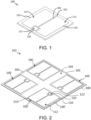
- FIG. 1 illustrates a perspective view of one embodiment of a semiconductor device 100.
- FIG. 2 illustrates a perspective view of a molding 102 including at least two semiconductor devices 100 (also referred to as a plurality of semiconductor devices 100).
- the semiconductor device 100 includes a dielectric material 106 that defines an upper surface 101.
- the semiconductor device 100 further includes at least one source pad 110 and a gate pad 120 disposed on the upper surface 101 of the semiconductor device 100.
- the at least one source pad 110 includes a top contact surface 112.
- the gate pad 120 includes a top contact surface 122.
- the top contact surfaces 112, 122 of the gate pad 120 and each of the at least one source pad 110 are electrically isolated from each other by the dielectric material 106. In some embodiments, at least a portion of the gate pad 120 and the at least one source pad 110 at least partially extend below the upper surface 101. In some embodiments, the top contact surface 112 of the at least one source pad 110 and the top contact surface 122 of the gate pad 120 are flush with the surface of the dielectric material 106. In some embodiments, the top contact surface 112 of the at least one source pad 110 and the top contact surface 122 of the gate pad 120 are below the surface of the dielectric material 106. In some embodiments, the top contact surface 112 of the at least one source pad 110 and the top contact surface 122 of the gate pad 120 are above the surface of the dielectric material 106.
- the molding 102 includes a underfill material 103 that defines an upper surface 104, and a plurality of semiconductor devices 100 at least partially disposed in the molding 102 and surrounded by the underfill material 103.
- the plurality of semiconductor devices 100 embedded in the molding 102 define a footprint 105 (as best shown in FIG. 4 ).
- FIGS. 3-8 illustrate one or more embodiments of a multi-chip semiconductor package 200.
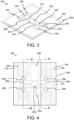
- FIG. 3 illustrates a perspective view of the multi-chip semiconductor package 200
- FIG. 4 illustrates a plan, partially transparent view of the semiconductor package 200
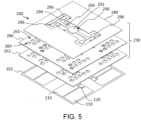
- FIGS. 5 and 6 illustrate exploded views of the semiconductor package 200.
- FIGS. 7 and 8 illustrate cross-sectional views of the semiconductor package 200 taken along lines A-A' and B-B' of FIG. 4 , respectively.
- the multi-chip semiconductor package 200 operates as a metal-oxide-semiconductor field-effect transistor (MOSFET) having two or more semiconductor devices 100.
- the multi-chip semiconductor package 200 includes a POL-RDL package 250 having at least one common source pad 280 and a gate bridge 290.
- the POL-RDL package 250 includes a first interconnect layer 260 and an adhesive layer 262 disposed over the molding 102 (as best shown in FIG. 5 ).
- the first interconnect layer 260 is in the form of a lamination or a film, and may be formed of one a plurality of dielectric materials, such as Kapton ® polyimide, Ultem ® polyetherimide, polytetrafluoroethylene (PTFE), Upilex ® , polysulfone materials (e.g., Udel ® polysulphone, Radel ® polyphenolsulphone), or another polymer film, such as a liquid crystal polymer (LCP), Bismaleimide-Triazine resin, Ajinomoto Build-up Film ® ABF or a polyimide material.
- the POL-RDL package 250 has a total thickness in the range of 25 microns to 300 microns.
- the POL-RDL package 250 (which may include any number of interconnect layers 260, trace connections, source and gate pads) is fully fabricated and positioned over the molding 102 (together with the plurality of semiconductor devices 100 embedded in the molding 102), and the first interconnect layer 260 is adhered to the source pads 110 and the gate pads 120 by the adhesive layer 262. That is, the adhesive layer 262 is positioned between the first interconnect layer 260 and the molding 102.
- the semiconductor devices 100 may be adhered directly onto the adhesive layer 262 without a molding. A molding or an underfill material may be deposited between the semiconductor devices 100 at a later stage.
- metallization vias are formed in source via pathways 264 and gate via pathways 266 extending through the first interconnect layer 260 (and in any number of additional interconnect layers as explained in further detail below with reference to FIGS. 9A - 14B ), associated metal interconnect structures and routing are built over the first interconnect layer 260 (and in any number of additional interconnect layers), and the adhesive layer 262 is applied to a bottom surface of the first interconnect layer 260.
- the semiconductor devices 100 (either as part of the molding 102 or individually) are aligned with the source via pathways 264 and gate via pathways 266 extending through the first interconnect layer 160 in accordance with one or more configurations, and the molding 102 is cured to form the multi-chip semiconductor package 200.
- any of the steps in fabrication may be performed in a different sequence.
- the source via pathways 264 and gate via pathways 266 may be filled prior to aligning and adhering the semiconductor devices 100 (either as part of the molding 102 or individually).
- the at least one common source pad 280 and the gate bridge 290 are formed on an upper surface 261 of the first interconnect layer 260.
- Source via pathways 264 and gate via pathways 266 extend through the first interconnect layer 260 and the adhesive layer 262.
- the POL-RDL package 250 of the multi-chip semiconductor package 200 also includes a metal interconnect structure 267 that extends through the source via pathways 264 and the gate via pathways 266.
- the metal interconnect structure 267 electrically couples the top contact surface 112 of each of the source pads 110 to the at least one common source pad 280 of the POL-RDL package 250, and likewise the metal interconnect structure 267 electrically couples the top contact surface 122 of the gate pad 120 to the gate bridge 290 of the POL-RDL package 250.
- the metal interconnect structure 267 is formed by filling the source via pathways 264 and the gate via pathways 266 with a conductive material (i.e., conductive epoxy, paste, or solder and the like).
- the vias have plated copper and a sputtered adhesion layer such as titanium or Ti-tungsten.
- the metal interconnect structure 267 is formed during deposition of the at least one common source pad 280 and the gate bridge 290. By way of example, as the at least one common source pad 280 and the gate bridge 290 are deposited, the source via pathways 264 and the gate via pathways 266 are also filled. Subsequently, the at least one common source pad 280 and the gate bridge 290 are electroplated or otherwise plated or fabricated to a desired thickness.
- the gate bridge 290 includes a common gate pad 292 and gate contacts 296 connected by trace connections 294. As best shown in FIG. 6 , each of the gate contacts 296 of the gate bridge 290 are aligned with the gate pads 120 of the plurality of semiconductor devices 100. As shown in FIGS. 7 and 8 , the common gate pad 292, the trace connection 294, and the gate contacts 296 are disposed on the first interconnect layer 260 of the POL-RDL package 250, and the gate contacts 296 are electrically connected to the gate pads 120 by the metal interconnect structure 267.
- the trace connection 294 extends from the common gate pad 292 to the gate contacts 296, and may have any number of branches and bends to establish the electrical connection between the common gate pad 292 and the gate contacts 296.
- the gate bridge 290 has an I-shape with each end being a pair of gate contacts 296 that align with gate pads 120 of the plurality of semiconductor devices 100, however as shown in FIGS. 11 through 13A , the gate bridge 290 can have other shapes and configurations but maintain equal path lengths, as explained in further detail below.
- the trace connections 294 of the gate bridge 290 have the same length between the common gate pad 292 and gate contacts 296 such that there are equal resistivity values between the common gate pad 292 and gate contacts 296.
- the length of the trace connections 294 impacts inductance.
- the common gate pad 292 and the length of the trace connections 294 can be made similar to all the gate pads 120 of the semiconductor devices 100.
- the POL-RDL package 250 provides for flexibility in optimizing the gate-source loop inductance depending on how it is oriented and connected to the next level circuit. For example, the resistivity and trance length of two of the semiconductor devices 100 to be different than the other two semiconductor devices 100 so that the eventual gate source loops to each device is similar/equal.
- the semiconductor devices 100 can be oriented or positioned on the adhesive layer 262 and the first interconnect layer 260 such that the gate pad 120 of each of the semiconductor devices are an equal length from the common gate pad 292 of the gate bridge 290.
- any one of the trace connections 294 may include a surface-mount resistor or a thin-film resistor to balance resistivity values.
- an outer peripheral edge 108 of the underfill material 103 defines a surface area of the molding 102.
- Each of the plurality of the semiconductor devices 100 are spaced from the outer peripheral edge 108 of the molding 102, and the placement of the plurality of the semiconductor devices 100 in the molding 102 defines a footprint 105 of the molding 102 (please note the footprint 105, as defined herein, generally has a smaller surface than the molding 102 itself).
- the plurality of the semiconductor devices 100 are directly adhered to the first interconnect layer 260 (and adhesive layer 262) without the use of the molding 102, and in such embodiments, the footprint 105 is defined as the placement of the plurality of semiconductor devices 100 on the bottom surface of the first interconnect layer 260.
- the footprint 105 is therefore defined as the outermost peripheral edges of the plurality of the semiconductor devices 100.
- the first interconnect layer 260 of the POL-RDL package 250 is generally placed over the entire molding 102 and has a surface area greater than the footprint 105 of the molding 102 such that an outer peripheral edge 268 of the first interconnect layer 260 extends beyond the footprint 105 of the molding 102 and the outermost peripheral edges of the plurality of semiconductor devices 100 (please note that the outer peripheral edge 268 does not extend beyond a perimeter of the molding itself 102).
- the adhesive layer 262 extends to the outer peripheral edge 268 of the first interconnect layer 260.
- the overhang region 274 of the POL-RDL package 250 increases available surface area of the first interconnect layer 260 for placement of a larger common source pad 280 and a larger common gate pad 292.
- the overhang region 274 also allows for placement of more complex configurations of common source pads 280, gate bridges 290, common gate pads 292 and trace connections for the common source pads 280 and common gate pads 292 as explained in further detail below.
- the POL-RDL package 250 thus facilitates improved routing and more robust connections of the at least one common source pad 280 and the common gate pad 292 to external power electronic circuitry or to additional interconnect layers disposed over the first interconnect layer 260 (as explained in further detail below).
- connection of external power electronic circuitry - either directly onto the at least one common source pad 280 and the common gate pad 292 or by the additional interconnect layers - enables the source pads 110 of the plurality of semiconductor devices 100 to be used for electricity control and conversion.
- the source pads 110 of the plurality of semiconductor devices 100 may be configured to turn power received from respective gate pads 120 on and off thousands of times per second.
- the at least one common source pad 280 and the common gate pad 292 establish an input-output (I/O) connection for the source pads 110 and respective gate pads 120 by way of the metal interconnect structure 267.
- the input-output (I/O) connection enables connection of the multi-chip semiconductor package 200 to an external power electronic circuit, such as a printed circuit board (PCB).
- PCB printed circuit board
- a surface area of the POL-RDL package 250 is substantially equal to a surface area of the footprint 105 defined by the plurality of semiconductor devices 100.
- the surface area of the POL-RDL package 250 may be between 10% larger than the surface area of the footprint 105 and 10% smaller than the surface area of the footprint, more particularly may be between 5% larger than the surface area of the footprint 105 and 5% smaller than the surface area of the footprint, and even more particularly may be between 2% larger than the surface area of the footprint 105 and 5% smaller than the surface area of the footprint.
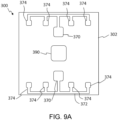
- FIGS. 9A though 9D illustrate embodiments of routing 300 of a interconnect layer 302 positioned over the first interconnect layer 260.
- FIG. 9A illustrates a top view of the interconnect layer 302 and associated routing 300.
- FIG. 9B illustrates a top translucent view of the interconnect layer 302 and associated routing 300.
- FIG. 9C illustrates a cross-sectional view of the interconnect layer 302 and associated routing 300 taken along line C-C'
- FIG. 9D illustrates a cross-sectional view of the of the interconnect layer 302 and associated routing 300.
- the interconnect layer 302 is layered on the POL-RDL package 250 (and the first interconnect layer 260 specifically), and includes pads and trace connections similar to components shown in the multi-chip semiconductor package 200 of FIGS. 1-8 .
- the interconnect layer 302 is applied over the first interconnect layer 260 of the POL-RDL package 250.
- the interconnect layer 302 includes at least one package contact pad 370 and a package gate pad 390 which facilitate connection of the multi-chip semiconductor package 200 to external power electronic circuitry.
- the electrical connections include one or more of soldering, sintering, copper-bonding, copper-clipping and the like.
- additional interconnect layers may be laminated over the interconnect layer 302 to facilitate more complex routing from the at least one package contact pad 370 and the package gate pad 390.
- the at least one package contact pad 370 is a Kelvin contact.
- Trace connections 372 extend from the at least one package contact pad 370 to attachment pads 374, and may have any number of branches and bends to establish an electrical connection to underlying structures such as the common source pad 280 of the first interconnect layer 260.
- the common source pad 280 of the first interconnect layer 260 is electrically connected to the attachment pads 374 by metal interconnect via pathways 362 extending through the interconnect layer 302.
- the interconnect via pathways 362 are aligned with the at least one common source pad 280 for deposition of a metal interconnect structure that extends through the interconnect via pathways 362.
- the interconnect layer 302 includes gate via pathways 392 for connecting the common gate pad 292 to the package gate pad 390 on the interconnect layer 302.
- the metal interconnect structure is formed by filling the interconnect via pathways 362 and the gate via pathways 392 with a conductive material (i.e., conductive epoxy, paste, or solder and the like).
- the metal interconnect structure is formed during deposition of the at least one package contact pad 370, trace connections 372, attachment pads 374 and the package gate pad 390.
- the overhang region 274 and greater surface area of the POL-RDL package 250 facilitate complex routing.
- the trace connections 372 extend into the overhang region, however it is understood that the trace connections 372 may extend across the at least one common source pad 280 of the first interconnect layer 260.
- FIG. 10A illustrates an embodiment where the trace connections 372 extend across the at least one common source pad 280 of the first interconnect layer 260.
- the trace connections 372 at least partially extend into the overhang region 274, and the gate bridge 290 has an I-shape.
- Each of the gate contacts 296 and the trace connections 294 of the gate bridge 290 are equidistant from the common gate pad 292 such that the gate contacts 296 have the same resistivity.
- the interconnect layer 302 includes two common contact pads 370, and each common contact pad 370 is connected to two corresponding semiconductor devices 100 by the attachment pads 374 and the trace connections 372. In some embodiments, there is at least one attachment pad 374 for each semiconductor device 100.
- the two common contact pads 370 and the common gate pad 292 are configured as an input-output (I/O) connection for the multi-chip semiconductor package 200 to external power electronic circuitry.
- a gate attachment pad 394 is electrically connected to the common gate pad 292 of the gate bridge 290 (as shown in FIG. 9B ) by the gate via pathways 392.
- the package gate pad 390 is electrically connected to the gate attachment pad 394 by a trace connection 396.
- the trace connection 396 includes a surface-mounted resistor 398.
- the resistor 398 can be connected post-fabrication, enabling resistance values to be changed to meet different application needs post-fabrication.
- the trace connection 396 includes attachment pads for mounting the surface-mounted resistor 398 post-fabrication.
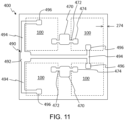
- FIGS. 11 and 12 illustrate further embodiments of routing (400, 500) on the interconnect layer 302.
- the at least one common source pad 280 is omitted for purposes of clarity in the figures.
- routing 400 includes two common source or Kelvin pads 470, and each common contact pad 470 is connected to two corresponding semiconductor devices 100 by trace connections 472.
- a gate bridge 490 includes a common gate pad 492 at least partially disposed in the overhang region 274 and gate contacts 496 connected by a trace connection 494 to each of the corresponding semiconductor devices 100.
- a routing 500 includes two common contact or Kelvin pads 570 at least partially disposed in the overhang region 274, and each common contact pad 570 is connected to two corresponding semiconductor devices 100 by the trace connections 572.
- the two common contact pads 570 are Kelvin contacts.
- a gate bridge 590 includes a common gate pad 592 at least partially disposed in the overhang region 274 and gate contacts 596 connected by a trace connection 594 to each of the corresponding semiconductor devices 100.
- the overhang region 274 and greater surface area of the POL-RDL package 250 facilitates using a wide range of common gate pads (292, 492, 592), common contact pads (370, 470, 570) and associated trace connections (294, 494, 594, 372, 472, 572). Placement of the common gate pads (292, 492, 592) and the at least one package contact pad 370 at least partially on the overhang region 274 also facilitates improved creepage control between components.
- the POL-RDL package 250 also enables an improved elastic (Young's) modulus of the first interconnect layer 260, which reduces bonding stress on the semiconductor devices 100.
- the first interconnect layer 260 of the POL-RDL package 250 may be polyimide, which has an elastic modulus of approximately 2.5 GPa, whereas the semiconductor devices 100, which may be SiO 2 , may have an elastic modulus of approximately 70 GPa.
- the lower elastic modulus is capable of absorbing bonding stress, thereby reducing bonding stress on the semiconductor devices 100.
- the POL-RDL package 250 can thus buffer the stresses during wire bonding to protect semiconductor devices 100.
- the trace connections (294, 494, 594, 372, 472, 572) may have varying resistivity values and various trace configuration structures. Using different types of trace configurations enables selectively tuning of the resistivity value between the common gate pad (292, 492, 592) and gate contacts (296, 496, 596).
- the common gate pads and common contact pads may be subsequently connected to package gate pads and package contact pads on additional interconnect layers. Notably, additional resistance reduces crosstalk, thus improving efficiency of the semiconductor devices 100.
- the resistance values can be selectively adjusted for specific applications without altering the semiconductor devices 100 during fabrication and assembly. This allows for simplified fabrication of the plurality of semiconductor devices 100 and binning during fabrication.
- the resistivity value of the trace connections (294, 494, 594, 372, 472, 572) can be altered by depositing the trace connection with material having different resistivities, by modifying a width of the trace connection, and/or by modifying a deposition thickness of the trace connection.
- An exemplary trace connection (294, 494, 594, 372, 472, 572) having a length of 2 mm, a width of 35 mm and a thickness of 10 mm has a resistance of approximately 0.1 ⁇ .
- the trace connection (294, 494, 594, 372, 472, 572) has a thickness in the range of 5-25 mm, and a trace width of approximately 25 mm.
- the trace connection (294, 494, 594, 372, 472, 572) deposition depth is in a range from 50 nanometers (nm) to 50 micrometers ( ⁇ m).
- the resistivity value of the trace connections (294, 494, 594, 372, 472, 572) is tuned or altered by changing the volume of the trace connection (294, 494, 594, 372, 472, 572), changing the cross-sectional area of the trace connection (294, 494, 594, 372, 472, 572), and/or changing the material of the trace connection (294, 494, 594, 372, 472, 572).
- the trace connection (294, 494, 594, 372, 472, 572) is made from a combination of a first material having a first resistivity value and a second material having a second resistivity value, and the second material is laminated or otherwise layered over the first material.
- the resistivity value of the trace connection (294, 494, 594, 372, 472, 572) may be selectively adjustable within a range of 10mQ (micro-ohms) to 100mS2.
- the trace connection (294, 494, 594, 372, 472, 572) is a resistor.
- the trace connection (294, 494, 594, 372, 472, 572) is a surface-mounted resistor.
- the resistor 176 can be connected post-fabrication, enabling resistance values to be changed to meet different application needs post-fabrication.
- the at least one common source pad 280 and the common gate pad 292 of the gate bridge 290 must have a sufficient surface area to make the electrical connection.
- the complexity and the surface area of the at least one common source pad 280 and the gate bridge 290 are ultimately limited by the overall surface area of the first interconnect layer 260.
- gate pads in a POL package may have a surface area of up to 0.6 square millimeters (mm 2 ) without the benefit of the overhang region 274.
- the common gate pad 292 of the gate bridge 290 has a surface area in the range of 0.5 mm 2 to 1.5 mm 2 while still maintaining the current rating of the multi-chip semiconductor package 200.
- the overhang region 274 of the POL-RDL package 250 allows for redistribution and more complex configurations of the common gate pad 292 of the gate bridge 290 while still maintaining the current rating of the semiconductor device 100 as shown in FIGS. 9-12 .
- the overhang region 274 of the POL-RDL package 250 allows for redistribution and more complex routing configurations of additional interconnect layers while still maintaining the current rating of the multi-chip semiconductor package 200 as shown in FIGS. 9-12 .
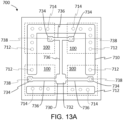
- FIG. 13A illustrates an alternative embodiment of routing 702 disposed on a first interconnect layer
- FIG. 13B illustrates associated routing 800 of a interconnect layer disposed over the first interconnect layer.
- the first and interconnect layers include components similar to the first interconnect layer 260 and the interconnect layer 302 previously described with reference to FIGS. 1-10B .
- the routing 700 of the first interconnect layer includes a first common source pad 710, a second common source pad 712 and a gate bridge 730.
- the common source pads (710, 712) are electrically connected to underlying semiconductor devices 100 by source via pathways 714 extending through the first interconnect layer.
- the gate bridge 730 includes a common gate pad 732 and gate contacts 734 connected by trace connections 736.
- the trace connections 736 are electrically connected to underlying semiconductor devices 100 by gate via pathways 738 extending through the first interconnect layer. As shown in FIG.
- the routing 800 of the interconnect layer includes a package contact pad 810 electrically connected to the first common source pad 710 and second common source pad 712, and a package gate pad 830 electrically connected to the common gate pad 732.
- the package contact pad 810 is electrically connected to the first common source pad 710 and second common source pad 712 by an intermediate metal interconnect layer 802.
- a gate attachment pad 832 is electrically connected to the common gate pad 732 (of FIG. 13A ), and the gate attachment pad 832 is connected to the package gate pad 830 by a trace connection 834.
- the trace connection 834 includes a surface-mounted resistor 836.
- the resistor 836 can be connected post-fabrication, enabling resistance values to be changed to meet different application needs post-fabrication.
- the trace connection 834 includes attachment pads for mounting the surface-mounted resistor 836 post-fabrication.
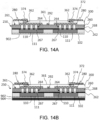
- FIGS. 14A-14B illustrate cross-sectional views of backside structures 900 connected to a bottom surface 111 of the semiconductor devices 100.
- the cross-sectional views are taken along line C-C' of FIG. 9B .
- the bottom surface 111 of the semiconductor devices 100 includes a drain pad and remains exposed.
- a sputter layer 902 is sputtered on the bottom surface 111 of the drain pad.
- the sputter layer 902 facilitates electrical and thermal contact to the backside using solder, sinter silver or conductive paste.
- the sputter layer 902 substantially covers the entire bottom surface 111 of the semiconductor devices 100, and in some embodiments, the sputter layer 902 substantially covers the molding.
- an electrically conductive plate 904 is then applied to the sputter layer 902.
- the electrically conductive plate 720 is a direct-bond copper DBC-type substrate.
- sputter layer 902 and the electrically conductive plate 904 are applied to the bottom surface 111 of the semiconductor devices 100 prior to applying the molding 102.
- the molding 102 extends below the bottom surface 111 of the semiconductor devices 100 and the bottom surface 111 of the semiconductor devices 100 remains partially exposed such that a partial encasement is formed.
- the sputter layer 902 is filled within gaps of the encasement such that the sputter layer 902 is co-planar with the molding 102.
- the electrically conductive plate 904 is then applied to the sputter layer 902.
- FIGS. 15A-15B illustrate one embodiment of a method 1000 of manufacturing a multi-chip semiconductor package, such as the previously described multi-chip semiconductor package 200.
- the method 1000 includes adhering 1002 an adhesive layer to a first interconnect layer of a POL-RDL package and forming 1004 at least one source via pathway and at least one gate via pathway through the first interconnect layer and the adhesive layer.
- the method 1000 further includes aligning 1006 at least one source pad and a gate pad of a plurality of semiconductor devices with the least one source via pathway and the at least one gate via pathway respectively, and adhering 1008 the plurality of semiconductor devices to the adhesive layer.
- the method further includes filling 1010 the least one source via pathway and the at least one gate via pathway respectively defined in the first interconnect layer with at least one metallization via.
- the method 1000 further includes depositing 1012 at least one common source pad and a gate bridge over the at least one gate via pathway respectively.
- the method 1000 further includes layering 1014 a interconnect layer over the first interconnect layer and forming 1016 least one source via pathway and at least one gate via pathway in the interconnect layer.
- the method 1000 further includes filling 1018 the least one source via pathway and the at least one gate via pathway respectively defined in the interconnect layer with at least one metallization via.
- the method 1000 further includes depositing 1020 a package contact pad and a package gate pad over the least one source via pathway and the at least one gate via pathway respectively defined in the interconnect layer.
- the method 1000 further includes depositing 1022 a sputter layer layered over a bottom surface of said plurality of semiconductor devices, said sputter layer electrically connected to drain connections of said at least one common source pad of said plurality of semiconductor devices. In some embodiments, the method 1000 further includes applying 1024 an electrically conductive plate over a bottom surface of said sputter layer.
- the metallization layers are formed through a combination of sputtering and electroplating applications, although it is recognized that other electroless methods of metal deposition could also be used.
- a titanium adhesion layer and a copper seed layer may first be applied via a sputtering process, followed by an electroplating process that increases a thickness of the copper to a desired level.
- the applied metal material is then subsequently patterned into metal interconnects having a desired shape and that function as vertical feed-throughs formed through the interconnect layer and the adhesive layer.
- the embodiments overcome at least some disadvantages of semiconductor devices. Specifically, the embodiments improve surface bonding onto contact pads of a POL structure.
- the overhang region of the POL structure reduces bonding stresses on the semiconductor devices.
- the overhang region of the POL structure allows for redistribution of the components of the POL-RDL package and the second laminated interconnect layers and allows for contact pads having a greater surface areas.
- the overhang region also allows for a wider range of utilization of trace connections with varying resistivity.
- the POL-RDL package also allows for multiple semiconductor devices to operate as a single device having a common gate pad and a common source pad.
- the individual semiconductor devices can be binned and grouped into devices having similar characteristics, thereby eliminating devices that have wafer defects. This permits the formation of multi-chip semiconductor packages that go beyond practical yield limits as opposed to fabricating a single large and complex semiconductor package.
- the multi-chip semiconductor device allows for 5mOHM device when tiled together. By way of example, but not limitation, binning four 20mOHM semiconductor devices into the multi-chip semiconductor package and connecting the semiconductor devices in parallel with the common gate pad and the common source pad results in a 5mOHM device.
- combining together multiple semiconductor devices into a multi-chip semiconductor package requires matching semiconductor devices having similar characteristics due to semiconductor manufacturing and fabrication processes inherently having yield variance of the individual semiconductor devices.
- density limitations of multi-chip semiconductor package manufacturing and assembly increases complexity of multi-chip semiconductor package designs. Such factors may alter the characteristics of the semiconductor device.
- the POL-RDL package and the described systems and methods facilitate tiling semiconductor devices together.
- Each semiconductor device may be individually binned for improved packaging without having to overcome variances in defect densities of larger semiconductor devices.
Landscapes
- Internal Circuitry In Semiconductor Integrated Circuit Devices (AREA)
- Physics & Mathematics (AREA)
- Geometry (AREA)
Applications Claiming Priority (1)
| Application Number | Priority Date | Filing Date | Title |
|---|---|---|---|
| US18/234,603 US20250062280A1 (en) | 2023-08-16 | 2023-08-16 | Power overlay structure for a multi-chip semiconductor package |
Publications (1)
| Publication Number | Publication Date |
|---|---|
| EP4510185A1 true EP4510185A1 (de) | 2025-02-19 |
Family
ID=92264099
Family Applications (1)
| Application Number | Title | Priority Date | Filing Date |
|---|---|---|---|
| EP24193418.1A Pending EP4510185A1 (de) | 2023-08-16 | 2024-08-07 | Leistungsüberlagerungsstruktur für ein mehrchip-halbleitergehäuse |
Country Status (5)
| Country | Link |
|---|---|
| US (1) | US20250062280A1 (de) |
| EP (1) | EP4510185A1 (de) |
| JP (1) | JP7786790B2 (de) |
| KR (1) | KR102930577B1 (de) |
| CN (1) | CN119495676A (de) |
Citations (4)
| Publication number | Priority date | Publication date | Assignee | Title |
|---|---|---|---|---|
| US20100109052A1 (en) * | 2008-11-05 | 2010-05-06 | Renesas Technology Corp. | Semiconductor device and manufacturing method thereof |
| US20160126212A1 (en) * | 2014-10-31 | 2016-05-05 | Infineon Technologies Ag | Chip assemblage, press pack cell and method for operating a press pack cell |
| US11177188B1 (en) * | 2020-07-23 | 2021-11-16 | Actron Technology Corporation | Heat dissipation substrate for multi-chip package |
| US20220115298A1 (en) * | 2020-10-12 | 2022-04-14 | Nxp Usa, Inc. | Power amplifier modules with flip-chip and non-flip-chip power transistor dies |
Family Cites Families (15)
| Publication number | Priority date | Publication date | Assignee | Title |
|---|---|---|---|---|
| JP3712111B2 (ja) * | 2001-03-30 | 2005-11-02 | ユーディナデバイス株式会社 | 電力増幅用半導体装置 |
| US8629453B2 (en) * | 2008-04-28 | 2014-01-14 | International Rectifier Corporation | Externally configurable integrated circuits |
| JP2012104513A (ja) | 2010-11-05 | 2012-05-31 | Toshiba Corp | 半導体装置、半導体集合部材及び半導体装置の製造方法 |
| JP2013149805A (ja) * | 2012-01-19 | 2013-08-01 | Fuji Electric Co Ltd | 半導体装置および半導体装置の製造方法 |
| US10312167B2 (en) * | 2017-02-15 | 2019-06-04 | Infineon Technologies Ag | Semiconductor package, assembly and module arrangements for measuring gate-to-emitter/source voltage |
| EP3376539A1 (de) * | 2017-03-14 | 2018-09-19 | HS Elektronik Systeme GmbH | Stapelbares leistungsmodul |
| JP6865838B2 (ja) * | 2017-09-04 | 2021-04-28 | 三菱電機株式会社 | 半導体モジュール及び電力変換装置 |
| US10354871B2 (en) * | 2017-09-11 | 2019-07-16 | General Electric Company | Sputtering system and method for forming a metal layer on a semiconductor device |
| JP7367506B2 (ja) * | 2019-12-12 | 2023-10-24 | 株式会社プロテリアル | 半導体モジュール |
| JP7494613B2 (ja) * | 2020-07-17 | 2024-06-04 | 富士電機株式会社 | 半導体装置 |
| JP7407675B2 (ja) * | 2020-08-18 | 2024-01-04 | 株式会社 日立パワーデバイス | パワー半導体モジュールおよび電力変換装置 |
| US11515235B2 (en) * | 2020-10-30 | 2022-11-29 | Gan Systems Inc. | Device topology for lateral power transistors with low common source inductance |
| JP2023079124A (ja) * | 2021-11-26 | 2023-06-07 | 国立大学法人東北大学 | パワー半導体素子及びパワー半導体モジュール |
| US20240266270A1 (en) * | 2023-02-08 | 2024-08-08 | General Electric Company | Power overlay package for a semiconductor device |
| CN121079780A (zh) * | 2024-04-01 | 2025-12-05 | Lx半导体科技有限公司 | 功率半导体模块和功率转换器 |
-
2023
- 2023-08-16 US US18/234,603 patent/US20250062280A1/en active Pending
-
2024
- 2024-08-07 EP EP24193418.1A patent/EP4510185A1/de active Pending
- 2024-08-14 CN CN202411112699.0A patent/CN119495676A/zh active Pending
- 2024-08-14 KR KR1020240108975A patent/KR102930577B1/ko active Active
- 2024-08-16 JP JP2024136985A patent/JP7786790B2/ja active Active
Patent Citations (4)
| Publication number | Priority date | Publication date | Assignee | Title |
|---|---|---|---|---|
| US20100109052A1 (en) * | 2008-11-05 | 2010-05-06 | Renesas Technology Corp. | Semiconductor device and manufacturing method thereof |
| US20160126212A1 (en) * | 2014-10-31 | 2016-05-05 | Infineon Technologies Ag | Chip assemblage, press pack cell and method for operating a press pack cell |
| US11177188B1 (en) * | 2020-07-23 | 2021-11-16 | Actron Technology Corporation | Heat dissipation substrate for multi-chip package |
| US20220115298A1 (en) * | 2020-10-12 | 2022-04-14 | Nxp Usa, Inc. | Power amplifier modules with flip-chip and non-flip-chip power transistor dies |
Also Published As
| Publication number | Publication date |
|---|---|
| JP7786790B2 (ja) | 2025-12-16 |
| CN119495676A (zh) | 2025-02-21 |
| KR20250027490A (ko) | 2025-02-26 |
| US20250062280A1 (en) | 2025-02-20 |
| KR102930577B1 (ko) | 2026-02-25 |
| JP2025028043A (ja) | 2025-02-28 |
Similar Documents
| Publication | Publication Date | Title |
|---|---|---|
| US10497648B2 (en) | Embedded electronics package with multi-thickness interconnect structure and method of making same | |
| US7977763B2 (en) | Chip package with die and substrate | |
| KR102392414B1 (ko) | 임베디드 반도체 디바이스 패키지를 위한 전기 상호접속 구조물 및 그 제조 방법 | |
| US9589920B2 (en) | Chip package | |
| US10504826B1 (en) | Device almost last embedded device structure and method of manufacturing thereof | |
| US8653670B2 (en) | Electrical interconnect for an integrated circuit package and method of making same | |
| CN110970387B (zh) | 半导体器件和形成半导体器件的方法 | |
| US10332832B2 (en) | Method of manufacturing an electronics package using device-last or device-almost last placement | |
| US9570376B2 (en) | Electrical interconnect for an integrated circuit package and method of making same | |
| US10692737B2 (en) | Multilayer interconnect structure with buried conductive via connections and method of manufacturing thereof | |
| JP2026026095A (ja) | 半導体デバイスのためのパワーオーバーレイパッケージ | |
| EP4510185A1 (de) | Leistungsüberlagerungsstruktur für ein mehrchip-halbleitergehäuse | |
| US11869844B2 (en) | Semiconductor device | |
| US20230145182A1 (en) | Semiconductor device | |
| JP2023071300A (ja) | 半導体装置 | |
| JP2023071585A (ja) | 半導体装置 |
Legal Events
| Date | Code | Title | Description |
|---|---|---|---|
| PUAI | Public reference made under article 153(3) epc to a published international application that has entered the european phase |
Free format text: ORIGINAL CODE: 0009012 |
|
| STAA | Information on the status of an ep patent application or granted ep patent |
Free format text: STATUS: THE APPLICATION HAS BEEN PUBLISHED |
|
| AK | Designated contracting states |
Kind code of ref document: A1 Designated state(s): AL AT BE BG CH CY CZ DE DK EE ES FI FR GB GR HR HU IE IS IT LI LT LU LV MC ME MK MT NL NO PL PT RO RS SE SI SK SM TR |
|
| STAA | Information on the status of an ep patent application or granted ep patent |
Free format text: STATUS: REQUEST FOR EXAMINATION WAS MADE |
|
| 17P | Request for examination filed |
Effective date: 20250811 |
|
| REG | Reference to a national code |
Ref country code: DE Ref legal event code: R079 Free format text: PREVIOUS MAIN CLASS: H01L0023640000 Ipc: H01L0023000000 |
|
| GRAP | Despatch of communication of intention to grant a patent |
Free format text: ORIGINAL CODE: EPIDOSNIGR1 |
|
| STAA | Information on the status of an ep patent application or granted ep patent |
Free format text: STATUS: GRANT OF PATENT IS INTENDED |
|
| RIC1 | Information provided on ipc code assigned before grant |
Ipc: H01L 23/00 20060101AFI20251112BHEP Ipc: H01L 25/07 20060101ALI20251112BHEP |
|
| INTG | Intention to grant announced |
Effective date: 20251205 |
|
| GRAJ | Information related to disapproval of communication of intention to grant by the applicant or resumption of examination proceedings by the epo deleted |
Free format text: ORIGINAL CODE: EPIDOSDIGR1 |
|
| STAA | Information on the status of an ep patent application or granted ep patent |
Free format text: STATUS: REQUEST FOR EXAMINATION WAS MADE |