EP4501451A1 - Verbundkatalysator mit in einem porösen träger imprägnierten goldnanopartikeln - Google Patents
Verbundkatalysator mit in einem porösen träger imprägnierten goldnanopartikeln Download PDFInfo
- Publication number
- EP4501451A1 EP4501451A1 EP22935925.2A EP22935925A EP4501451A1 EP 4501451 A1 EP4501451 A1 EP 4501451A1 EP 22935925 A EP22935925 A EP 22935925A EP 4501451 A1 EP4501451 A1 EP 4501451A1
- Authority
- EP
- European Patent Office
- Prior art keywords
- composite catalyst
- peak
- porous support
- interatomic distance
- gas
- Prior art date
- Legal status (The legal status is an assumption and is not a legal conclusion. Google has not performed a legal analysis and makes no representation as to the accuracy of the status listed.)
- Pending
Links
Images




Classifications
-
- B—PERFORMING OPERATIONS; TRANSPORTING
- B01—PHYSICAL OR CHEMICAL PROCESSES OR APPARATUS IN GENERAL
- B01J—CHEMICAL OR PHYSICAL PROCESSES, e.g. CATALYSIS OR COLLOID CHEMISTRY; THEIR RELEVANT APPARATUS
- B01J35/00—Catalysts, in general, characterised by their form or physical properties
- B01J35/40—Catalysts, in general, characterised by their form or physical properties characterised by dimensions, e.g. grain size
- B01J35/45—Nanoparticles
-
- B—PERFORMING OPERATIONS; TRANSPORTING
- B01—PHYSICAL OR CHEMICAL PROCESSES OR APPARATUS IN GENERAL
- B01D—SEPARATION
- B01D53/00—Separation of gases or vapours; Recovering vapours of volatile solvents from gases; Chemical or biological purification of waste gases, e.g. engine exhaust gases, smoke, fumes, flue gases, aerosols
- B01D53/34—Chemical or biological purification of waste gases
- B01D53/74—General processes for purification of waste gases; Apparatus or devices specially adapted therefor
- B01D53/86—Catalytic processes
- B01D53/864—Removing carbon monoxide or hydrocarbons
-
- B—PERFORMING OPERATIONS; TRANSPORTING
- B01—PHYSICAL OR CHEMICAL PROCESSES OR APPARATUS IN GENERAL
- B01D—SEPARATION
- B01D53/00—Separation of gases or vapours; Recovering vapours of volatile solvents from gases; Chemical or biological purification of waste gases, e.g. engine exhaust gases, smoke, fumes, flue gases, aerosols
- B01D53/34—Chemical or biological purification of waste gases
- B01D53/74—General processes for purification of waste gases; Apparatus or devices specially adapted therefor
- B01D53/86—Catalytic processes
- B01D53/8668—Removing organic compounds not provided for in B01D53/8603 - B01D53/8665
-
- B—PERFORMING OPERATIONS; TRANSPORTING
- B01—PHYSICAL OR CHEMICAL PROCESSES OR APPARATUS IN GENERAL
- B01J—CHEMICAL OR PHYSICAL PROCESSES, e.g. CATALYSIS OR COLLOID CHEMISTRY; THEIR RELEVANT APPARATUS
- B01J23/00—Catalysts comprising metals or metal oxides or hydroxides, not provided for in group B01J21/00
- B01J23/38—Catalysts comprising metals or metal oxides or hydroxides, not provided for in group B01J21/00 of noble metals
- B01J23/48—Silver or gold
- B01J23/52—Gold
-
- B—PERFORMING OPERATIONS; TRANSPORTING
- B01—PHYSICAL OR CHEMICAL PROCESSES OR APPARATUS IN GENERAL
- B01J—CHEMICAL OR PHYSICAL PROCESSES, e.g. CATALYSIS OR COLLOID CHEMISTRY; THEIR RELEVANT APPARATUS
- B01J29/00—Catalysts comprising molecular sieves
- B01J29/03—Catalysts comprising molecular sieves not having base-exchange properties
- B01J29/0308—Mesoporous materials not having base exchange properties, e.g. Si-MCM-41
- B01J29/0316—Mesoporous materials not having base exchange properties, e.g. Si-MCM-41 containing iron group metals, noble metals or copper
- B01J29/0325—Noble metals
-
- B—PERFORMING OPERATIONS; TRANSPORTING
- B01—PHYSICAL OR CHEMICAL PROCESSES OR APPARATUS IN GENERAL
- B01J—CHEMICAL OR PHYSICAL PROCESSES, e.g. CATALYSIS OR COLLOID CHEMISTRY; THEIR RELEVANT APPARATUS
- B01J35/00—Catalysts, in general, characterised by their form or physical properties
- B01J35/30—Catalysts, in general, characterised by their form or physical properties characterised by their physical properties
- B01J35/396—Distribution of the active metal ingredient
- B01J35/399—Distribution of the active metal ingredient homogeneously throughout the support particle
-
- B—PERFORMING OPERATIONS; TRANSPORTING
- B01—PHYSICAL OR CHEMICAL PROCESSES OR APPARATUS IN GENERAL
- B01J—CHEMICAL OR PHYSICAL PROCESSES, e.g. CATALYSIS OR COLLOID CHEMISTRY; THEIR RELEVANT APPARATUS
- B01J37/00—Processes, in general, for preparing catalysts; Processes, in general, for activation of catalysts
- B01J37/02—Impregnation, coating or precipitation
- B01J37/0201—Impregnation
- B01J37/0211—Impregnation using a colloidal suspension
-
- B—PERFORMING OPERATIONS; TRANSPORTING
- B01—PHYSICAL OR CHEMICAL PROCESSES OR APPARATUS IN GENERAL
- B01D—SEPARATION
- B01D2255/00—Catalysts
- B01D2255/10—Noble metals or compounds thereof
- B01D2255/106—Gold
-
- B—PERFORMING OPERATIONS; TRANSPORTING
- B01—PHYSICAL OR CHEMICAL PROCESSES OR APPARATUS IN GENERAL
- B01D—SEPARATION
- B01D2257/00—Components to be removed
- B01D2257/50—Carbon oxides
- B01D2257/502—Carbon monoxide
-
- B—PERFORMING OPERATIONS; TRANSPORTING
- B01—PHYSICAL OR CHEMICAL PROCESSES OR APPARATUS IN GENERAL
- B01D—SEPARATION
- B01D2257/00—Components to be removed
- B01D2257/70—Organic compounds not provided for in groups B01D2257/00 - B01D2257/602
- B01D2257/702—Hydrocarbons
-
- B—PERFORMING OPERATIONS; TRANSPORTING
- B01—PHYSICAL OR CHEMICAL PROCESSES OR APPARATUS IN GENERAL
- B01J—CHEMICAL OR PHYSICAL PROCESSES, e.g. CATALYSIS OR COLLOID CHEMISTRY; THEIR RELEVANT APPARATUS
- B01J2235/00—Indexing scheme associated with group B01J35/00, related to the analysis techniques used to determine the catalysts form or properties
-
- B—PERFORMING OPERATIONS; TRANSPORTING
- B01—PHYSICAL OR CHEMICAL PROCESSES OR APPARATUS IN GENERAL
- B01J—CHEMICAL OR PHYSICAL PROCESSES, e.g. CATALYSIS OR COLLOID CHEMISTRY; THEIR RELEVANT APPARATUS
- B01J35/00—Catalysts, in general, characterised by their form or physical properties
- B01J35/70—Catalysts, in general, characterised by their form or physical properties characterised by their crystalline properties, e.g. semi-crystalline
Definitions
- the present disclosure relates to a composite catalyst comprising gold nanoparticles incorporated in a porous support, and to a composite catalyst having significantly excellent catalytic activity at room temperature and capable of rapidly converting substantially all of a reactant gas contained in gas flowing at high velocity at room temperature into a product gas.
- Transition metal nanoparticles may exhibit catalytic activity due to their high specific surface area, but transition metal nanoparticles supported on a support have the problem that aggregation and sintering occur over a long period of time, which reduces the specific surface area of the transition metal nanoparticles and gradually reduces the catalytic activity. Accordingly, research has been attempted to incorporate nanoparticles into the pores of metal oxide supports, but similarly, the problem of desorption phenomenon of nanoparticles from the surface of the pores and agglomeration and sintering phenomenon of nanoparticles when exposed to high temperature conditions for a long time did not resolve, resulting in a decrease in catalytic activity.
- transition metal nanoparticles usually have an average particle size of 20 nm or less as primary particles
- mesoporous supports with pore sizes of 2-50 nm are considered desirable for supporting these nanoparticles.
- the mesoporous support may be formed of metal oxide materials, and silica, aluminosilicate, titania or the like is commonly known.
- mesopores of various sizes and shapes may be formed, and by controlling the content of the metal or metalloid forming the framework, there is also an advantage in that the concentration of acid sites and ion exchange capacity may be controlled.
- the mesoporous support is used as a carrier for transition metal nanoparticles, and due to the characteristics of the mesopores, the diffusion resistance of the material is lower than that of the microporous support, and thus it may have the advantage of a fast reaction speed.
- the concentration of impurities should be controlled to a trace amount
- the impurities should substantially be removed rapidly, but since the conversion rate is acceptable only at a certain flow rate or lower, the development of a catalyst system with better room temperature catalytic activity is necessary.
- Non-patent literature 1 (Non-patent literature 1): Topics in Catalysis 2007, Vol. 44, Nos. 1-2, pp.253-262 .
- An aspect of the present disclosure is to provide a composite catalyst having remarkably excellent catalytic activity at room temperature. Specifically, it is to provide a composite catalyst capable of rapidly converting substantially all of the reactant gas contained in the gas into product gas by flowing the gas at high velocity at room temperature.
- Another aspect of the present disclosure is to provide a composite catalyst capable of rapidly removing substantially all of the harmful gases (impurities) contained in the gas. Specifically, it is to provide a composite catalyst capable of rapidly removing substantially all of the harmful gases (impurities) contained in the gas by flowing the gas containing the harmful gases (impurities) at high velocity at room temperature.
- Another aspect of the present disclosure is to provide a composite catalyst having very low gas diffusion resistance, which enables rapid processing of a high-velocity gas with a high conversion rate, and which does not require a high temperature to process a high-velocity gas, thereby providing excellent long-term catalytic activity.
- D3 indicates an interatomic distance of a bulk Au-Au bond existing at 2.8 to 3.0 ⁇ .
- the composite catalyst may satisfy the following formula 4. DA 2 / DA 1 ⁇ 0.25
- DA1 is an area of a peak at an interatomic distance D1
- DA2 is an area of a peak at an interatomic distance D2
- D1 and D2 satisfy the formula 2 and formula 3, respectively.
- (DH2/DH1) in the formula 1 may be 0.25 or less.
- (DA2/DA1) in the formula 4 may be 0.18 or less.
- a bimodal peak may be provided in an interatomic distance range of 2.2 to 3.0 ⁇ of the radial distribution function obtained by Fourier transforming the EXAFS (Extended X-ray absorption fine structure) spectrum.
- the porous support may be a metal oxide or metalloid oxide porous support.
- a diameter of the nanoparticles may be 1 to 20 nm.
- the composite catalyst may further include macropores.
- the nanoparticles may be incorporated into a portion of the mesopores of the porous support, and the mesopores in which the nanoparticles are not incorporated may be connected to each other as open pores.
- the composite catalyst may be for an oxidation reaction of carbon monoxide, an aldehyde compound, or a hydrocarbon compound.
- the composite catalyst may convert a gas containing carbon monoxide at a concentration of 4% into carbon dioxide at a conversion efficiency of 90% or more under a flow rate condition of 140 ml/min.
- a method of removing a harmful gas includes an operation of supplying a gas stream containing at least one harmful gas selected from the group consisting of carbon monoxide, aldehyde compounds, and hydrocarbon compounds; and an operation of contacting the composite catalyst described above with the gas stream and oxidizing the harmful gas.
- the oxidizing may be performed at 0°C to 60°C.
- the harmful gas may be removed at a removal rate of 90% or more under a flow rate condition of 140 ml/min by an oxidation reaction.
- the composite catalyst according to the present disclosure may exhibit remarkably excellent catalytic activity at room temperature, and may rapidly convert substantially all of the reactant gas contained in the gas into product gas even when gas is supplied at a high flow rate at room temperature.
- the composite catalyst according to the present disclosure may rapidly remove substantially all of the harmful gases (impurities) contained in the gas, and may substantially remove substantially all of the harmful gases (impurities) contained in the gas even when gas containing the harmful gases (impurities) is supplied at a high flow rate at room temperature.
- the composite catalyst according to the present disclosure has very low gas diffusion resistance, and may thus rapidly process a gas at a high flow rate with a high conversion rate, and does not require a high temperature to process a gas at a high flow rate, and thus, it has the advantage of very excellent long-term catalytic activity.
- the units used in this specification without special mention are based on weight, and for example, the unit of % or ratio means weight% or weight ratio, and weight% means the weight% that one component of the entire composition occupies in the composition unless otherwise defined.
- the numerical range used in this specification includes the lower limit and the upper limit and all values within that range, the increment logically derived from the shape and width of the defined range, all values that are double-limited, and all possible combinations of the upper and lower limits of the numerical ranges that are defined in different shapes. Unless otherwise specifically defined in the specification of the present disclosure, values outside the numerical range that may occur due to experimental errors or rounding of values are also included in the defined numerical range.
- the inventor of the present disclosure first invented mesoporous silica containing gold nanoparticles that have catalytic activity at room temperature, but the catalytic activity was insufficient, resulting in a low conversion rate at high flow rates.
- impurities cannot be removed quickly to an acceptable level, and thus research has been intensified to develop a composite catalyst with significantly superior catalytic activity.
- the inventor of the present disclosure have discovered that the catalytic activity is significantly improved depending on the correlation between the manufacturing process conditions and the radial distribution function in the operation of complexing gold nanoparticles and a porous support, and have completed the present disclosure.
- the composite catalyst according to the present disclosure comprises a porous support including mesopores and gold nanoparticles incorporated in the pores of the porous support, and is characterized in that a radial distribution function obtained by Fourier transforming an EXAFS (Extended X-ray absorption fine structure) spectrum satisfies the following Formula 1.
- DH1 is the height of the peak at the interatomic distance D1
- DH2 is the height of the peak at the interatomic distance D2
- D1 and D2 satisfy formulas 2 and 3 below, respectively.
- the D1 and D2 are the interatomic distances of the maximum peak found in the range satisfying formulas 2 and 3 below, respectively.
- D3 refers to the interatomic distance of the bulk Au-Au bond existing at 2.8 to 3.0 ⁇ , and specifically, may exist at 2.88 to 2.98 ⁇ , and more specifically, may refer to the standard interatomic distance of 2.90 ⁇ .
- D3 may refer to the interatomic distance of the bulk Au-Au bond existing at 2.8 to 3.0 ⁇ , obtained through peak deconvolution when the peak appears as one peak with asymmetry or has a bimodal peak.
- the above asymmetry means that although the peak has the shape of a single peak (unimodal peak), the left and right sides have asymmetry based on the center of the peak as two peaks overlap.
- (D1/D3) of the above formula 2 may be 0.85 to 0.92
- (D2/D3) of the above formula 3 may be 0.63 to 0.66.
- DH1 may be the height of the peak with an interatomic distance of 2.57 ⁇ 0.2 ⁇
- DH2 may mean the height of the peak with an interatomic distance of 1.85 ⁇ 0.2 ⁇
- DH1 may refer to the height of the peak at the interatomic distance of 2.57+0.1 ⁇
- DH2 may refer to the height of the peak at the interatomic distance of 1.85 ⁇ 0.l ⁇ .
- the composite catalyst satisfies a height ratio of a peak at the interatomic distance D1 and a peak at the interatomic distance D2, being less than 0.3, the catalytic activity may be significantly improved.
- EXAFS stands for extended X-ray absorption fine structure, and may analyze the radial distribution or coordination number of gold nanoparticles. For example, when high-energy X-rays are irradiated on gold atoms, the gold atoms contained in the gold nanoparticles emit electrons. Accordingly, a radial scattering wave is generated centered on the gold atoms that absorbed the X-rays, and when the electrons emitted from the gold atoms that absorbed the X-rays reach other adjacent atoms (gold or oxygen atoms), electrons are emitted from other adjacent atoms. At this time, radial scattered waves are generated centered on other adjacent atoms.
- a standing wave is obtained according to the distance between the gold atom that absorbed the X-rays and other atoms (gold or oxygen atoms) adjacent to the gold atom.
- the standing wave is Fourier transformed, a radial distribution having a peak according to the distance between the gold atom and other atoms (gold or oxygen atoms) adjacent to the gold atom is obtained.
- a radial distribution having a peak according to the distance between gold (Au) atoms-oxygen atoms having an Au-O bond when the gold (Au) atom has a bond with an oxygen atom may be obtained.
- (DH2/DH1) of the above formula 1 may be 0.25 or less, more specifically 0.24 or less, and may be non-limitingly 0 or more.
- the catalytic activity of the composite catalyst is significantly improved, which is preferable in that the reactant gas contained in the gas stream may be substantially all rapidly converted into the product gas even in a high-velocity gas stream.
- the composite catalyst may have a radial distribution function obtained by Fourier transforming an EXAFS (Extended X-ray absorption fine structure) spectrum, which satisfies the following formula 4.
- EXAFS Extended X-ray absorption fine structure
- DA1 is the area of the peak at the interatomic distance D1
- DA2 is the area of the peak at the interatomic distance D2
- D1 and D2 satisfy the above formulas 2 and 3, respectively.
- DA1 may mean the area of the peak at the interatomic distance 2.57 ⁇ 0.2 ⁇
- DA2 may mean the area of the peak at the interatomic distance 1.85 ⁇ 0.2 ⁇
- DA1 may mean the area of the peak at the interatomic distance 2.57 ⁇ 0.1 ⁇
- DA2 may mean the area of the peak at the interatomic distance 1.8510.1 ⁇ .
- the catalytic activity may be significantly improved.
- (DA2/DA1) of the above Formula 4 may be 0.2 or less, specifically 0.18 or less, more specifically 0.15 or less, and may be non-limitingly 0 or more.
- the catalytic activity is significantly improved, which is preferable in that the reactant gas contained in the gas stream may be substantially all rapidly converted into the product gas even in a high-velocity gas stream.
- a bimodal peak may be provided in the interatomic distance range of 2.2 to 3.0 ⁇ of a radial distribution function obtained by Fourier transforming the EXAFS (Extended X-ray absorption fine structure) spectrum, and the bimodal peak appears due to the gold (Au)-gold (Au) interatomic bond.
- the above-mentioned interatomic distance range of 2.2 to 3.0 ⁇ may be a range where the distance between gold (Au) atoms and gold (Au) atoms is located, and refers to the distribution of the interatomic distance of Au-Au in the crystal lattice.
- typical gold nanoparticles may exhibit a single peak, and having a single peak means that the interatomic distance between gold (Au) and gold (Au) atoms is constant within the crystal lattice of the nanoparticle.
- having a bimodal peak may mean that different interatomic distances between gold (Au) and gold (Au) atoms exist within the crystal lattice, and although it has not been clearly identified, it is inferred that two different interatomic distances between gold (Au) and gold (Au) atoms are generated by deformation of the crystal lattice due to compressive stress.
- the porous support may be a metal oxide or metalloid oxide porous support.
- the metal or metalloid of the metal oxide or metalloid oxide may be a metal or metalloid of Group 2 to Group 5, Group 7 to Group 9, and Group 11 to Group 14, and specifically, may be a metal or metalloid selected from Groups 2 to 4, and Group 13 and Group 14, and more specifically, may be Al, Ti, Zr, or Si.
- the porous support includes mesopores, and optionally may further include micropores.
- micropores mean that the average diameter of internal pores is less than 2 nm
- mesopores mean that the average diameter of internal pores is 2 nm to 50 nm.
- the volume of the mesopores of the above porous support may be 50% by volume or more, 60% by volume or more, or 70% by volume or more, and the upper limit is not limited, but for example, may be 100% by volume or less, 95% by volume or less, or 90% by volume or less, or may be 50 to 100% by volume, specifically 60 to 90% by volume, but this is only an example and is not limited thereto.
- the porous support may have a hierarchical porous structure, and may include a structure in which micropores are regularly present and interconnected between the mesopores.
- the porous support may further include macropores, and it may be desirable to include macropores in a certain volume fraction or more, which may significantly reduce the gas diffusion resistance.
- the gold nanoparticles may be manufactured by a method known in the art or may use commercially available materials. Specifically, the gold nanoparticles may be manufactured by reducing a gold precursor present in a solution to gold according to a known method ( Natan et al., Anal. Chem. 67, 735 (1995 )). Examples of the gold precursor include, but are not limited to, a gold-containing halide, nitrate, acetate, acetylacetonate, ammonium salt, or the like. Specifically, the gold precursor may be HAuC1 4 or HAuBr 4 , but is not limited thereto.
- the diameter of the gold nanoparticles may be 1 to 20 nm, specifically 1 to 15 nm, more specifically 1 to 12 nm.
- the diameter of the preferred gold nanoparticles may be 1 to 10 nm, more preferably 1 to 8 nm.
- the average diameter of the nanoparticles may be larger than the average diameter of the mesopores of the porous support. Accordingly, it is possible to generate a deformation of the crystal lattice of the gold nanoparticles incorporated into the mesopores of the porous support, and to induce improvement of the catalytic activity in the room temperature range.
- the nanoparticles may be incorporated into all of the mesopores of the porous support or may be incorporated into some of the mesopores of the porous support, and specifically, may be incorporated into some of the mesopores of the porous support. More specifically, the nanoparticles may be irregularly incorporated into some of the mesopores of the porous support.
- the structure in which they are incorporated in all of the mesopores of the porous support means a superlattice structure, and specifically means a highly ordered superlattice structure having a face-centered cubic (FCC) symmetry.
- FCC face-centered cubic
- the form in which the nanoparticles are irregularly incorporated in some of the mesopores has the advantage that gas diffusion may be more effective than the superlattice structure.
- the nanoparticles are incorporated in some of the mesopores of the porous support, and the mesopores in which the nanoparticles are not incorporated may be connected to each other as open pores. Since the composite catalyst has the nanoparticles incorporated only in some of the pores of the porous support, the diffusion of harmful gases may be more effective through the pores in which the nanoparticles are not incorporated and are connected to each other as open pores. Accordingly, even if gas is supplied at a high flow rate at room temperature, substantially all of the reactant gas contained in the gas may be rapidly converted into product gas.
- the composite catalyst may have an average particle size of 0.01 ⁇ m to 10 pm, specifically 0.05 ⁇ m to 5 ⁇ m, and more specifically 0.1 ⁇ m to 5 pm, but is not limited thereto.
- the composite catalyst may be used for the oxidation reaction of carbon monoxide, an aldehyde compound, or a hydrocarbon compound.
- the composite catalyst according to the present disclosure may be preferably utilized as a solid-phase oxidizing agent for carbon monoxide, an aldehyde compound, or a hydrocarbon compound.
- the aldehyde compound may be acetaldehyde or formaldehyde, but is not limited thereto.
- the hydrocarbon compound may be an aliphatic or aromatic compound, or a volatile organic compound (VOC), and examples thereof may include methane, ethane, propane, butane, benzene, toluene, or xylene, but are not limited thereto.
- the composite catalyst may convert a carbon monoxide-containing gas having a concentration of 4% into carbon dioxide at room temperature at a conversion efficiency of 80% or more, specifically 85% or more, and more specifically 90% or more, under a flow rate condition of 140 ml/min.
- the carbon monoxide-containing gas may contain oxygen at a certain content, for example, 2% or more, 4% or more, 10% or more, non-limitingly 30% or less, in order to be oxidized.
- the gas containing carbon monoxide may be air, but is not limited thereto as long as it contains oxygen at a certain content or more.
- the present disclosure provides a method of removing a harmful gas, including: an operation of supplying a gas stream containing at least one harmful gas selected from the group consisting of carbon monoxide, an aldehyde-based compound, and a hydrocarbon-based compound; and an operation of contacting the gas stream with a composite catalyst according to any one of claims 1 to 11 to oxidize the harmful gas.
- the method of removing a harmful gas may more effectively cause an oxidation reaction in a gas stream at a high flow rate at room temperature by using a composite catalyst exhibiting remarkably excellent catalytic activity as described above.
- the oxidation operation may be performed at 0°C to 60°C, specifically at 10°C to 50 °C, more specifically at 20°C to 40°C, but is not limited thereto.
- the harmful gas may be removed by the oxidation reaction at a removal rate of 80% or more, specifically 85% or more, more specifically 90% or more under a flow rate condition of 140 ml/min.
- the harmful gas may be removed at a removal rate within the range described above in the above-described temperature range.
- the harmful gas may be removed by an oxidation reaction at a removal rate of 80% or more, specifically 85% or more, more specifically 90% or more, and even more specifically 95% or more under a flow rate condition of 160 ml/min.
- the harmful gas may be removed at a removal rate within the range described above in the above-described temperature range.
- olein amine was selected as a stabilizer, and a solution composed of 60 ml of tetralin, 60 ml of olein amine, and 0.6 g of HAuC1.H 2 O was prepared by stirring at room temperature for 10 minutes. 6 mmol of TBAB (tetrabutylammonium bromide), 6ml of tetralin, and 6 ml of olein amine were mixed by ultrasonic grinding, and then quickly added to the solution. And the above solution was stirred at room temperature for 1 hour more, ethanol was added, and then centrifuged to precipitate gold nanoparticles.
- TBAB tetrabutylammonium bromide
- the gold nanoparticle precipitate was redispersed with hexane, and ethanol was added and centrifuged.
- the manufactured gold nanoparticles showed an average particle diameter of 4 nm, and the manufactured gold nanoparticles were dispersed in 100 ml of toluene as formed as is.
- the gold nanoparticles dispersed in toluene were diluted additionally with 100 ml of tetrahydrofuran, and a thiolated polymer was selected to functionalize the surface of the gold nanoparticles by binding the polymer, and 1 g of monofunctional polyethylene glycol (aSH-PEG, weight average molecular weight: lkDa) substituted with a thiol group at the terminal was added. After stirring, hexane was added, and centrifugation was performed to precipitate the gold nanoparticles (4-Au-PEG) functionalized with PEG. The 4-Au-PEG obtained by precipitation was dried and dispersed in water.
- aSH-PEG monofunctional polyethylene glycol
- Example 2 Except that the molar ratio of oleinamine and HAuC1.H 2 O in operation 1-1 of the above Example 1 was adjusted to prepare gold nanoparticles having an average particle size of 10 nm, the same operations were performed to prepare a composite catalyst 2, which is a porous silica with gold nanoparticles captured.
- Composite catalyst 3 was prepared by performing operations 1 and 3 in the same manner, except that operation 2 of Example 1 was performed as follows.
- porous alumina in which PEG-functionalized gold nanoparticles were captured in operation 2 0.15 g of PEG-functionalized gold nanoparticles (4-Au-PEG) and 0.675 g of Pluronic F127 were first prepared, and uniformly dispersed in a mixed solution of 0.8 ml of nitric acid (68%) and 40 ml of ethanol, and then 0.81 g of aluminum ethoxide was added to the dispersion. Then, the dispersion of the mixture was stirred for 3 hours, maintained at room temperature without stirring for 24 hours, and then dried at 60 °C for 3 hours to prepare a red solid. After that, operation 3 of Example 1 was performed in the same manner to prepare a composite catalyst 3, which is a porous alumina having gold nanoparticles captured therein.
- porous titania having PEG-functionalized gold nanoparticles captured therein in operation 2 0.10 g of PEG-functionalized gold nanoparticles (4-Au-PEG) and 0.44 g of Pluronic F127 were first prepared, and uniformly dispersed in a mixed solution of 0.68 ml of 37% hydrochloric acid and 17.05 ml of ethanol, and then 2.28 g of titanium tetraisopropoxide was added to the dispersion. Then, the dispersion of the above mixture was stirred for 3 hours, maintained at room temperature without stirring for 24 hours, and then dried at a temperature of 60°C for 3 hours to produce a red solid. Thereafter, operation 3 of Example 1 was performed in the same manner to produce a composite catalyst 4, which is porous titania with gold nanoparticles captured therein.
- Example 1 The same operations 1 and 2 of the above Example 1 were performed.
- operation 3 the red precipitate prepared in the previous operation was washed with water, dried, and then calcined at 450°C to remove PEG and Pluronic F127 polymers, thereby preparing a composite catalyst 6, which is porous silica with gold nanoparticles captured therein.
- EXAFS Extended X-ray absorption fine structure
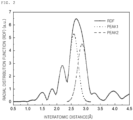
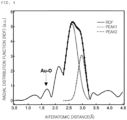
- FIG. 1 illustrates the radial distribution function of Example 1
- FIG. 2 illustrates that of Example 2
- FIG. 3 illustrates that of Example 3
- FIG. 4 illustrates that of Example 4
- FIG. 5 illustrates that of Comparative Example 1.
- a peak due to Au-O bonding was observed in the 1.4 to 1.7 ⁇ section. From this, it may be confirmed that the proximity between the surface of the gold nanoparticle and the porous support capturing the same provides a condition for forming a stable Au-O bond at the interface between the gold nanoparticle and the porous support, thereby forming Au-O-Si, Au-O-Al, or Au-O-Ti.
- D1 and D2 are the interatomic distances of maximum peaks found in the range satisfying Formulas 2 and 3 below, respectively, and the positions of D1, D2, and D3 are shown in Table 1.
- the ratios of the height (DH1) and area (DA1) of peak of the interatomic distance D1 and the height (DH2) and area (DA2) of peak of the interatomic distance D2 were calculated and shown in Table 1.
- Example 1 Example 2
- Example 3 Example 4 Comparative Example 1 DH2/DH1 0 0.227 0 0 0.335 DA2/DA1 0 0.129 0 0 0.227 D1 2.5522 ⁇ 2.5893 ⁇ 2.5607 ⁇ 2.5939 ⁇ 2.567 ⁇ D2 - 1.8471 ⁇ - - 1.848 ⁇ D3 2.906 ⁇ 2.8967 ⁇ 2.9601 ⁇ 2.9526 ⁇ 2.8177 ⁇ D1/D3 0.8783 0.894 0.8651 0.8785 0.911 D2/D3 - 0.638 - - 0.656
- Carbon monoxide (CO) oxidation was performed in a tubular reactor with both sides open.
- the composite catalyst according to the examples of the present disclosure and the comparative example was installed in the middle of the tubular reactor, carbon monoxide-containing gas was supplied to one side of the reactor, and the other side of the reactor was connected to a Gas Chromatography (DS Science) to measure the carbon monoxide concentration using a TCD detector (Carboxen 1000).
- the carbon monoxide-containing gas used was 4% of CO, 10% of O 2 , and 86% of He, and the concentration of carbon monoxide discharged from the other side of the reactor was measured while controlling the supply flow rate at room temperature (25 °C). This measurement was performed using the composite catalyst according to examples 1 and 2, and comparative example 1, and the results are shown in FIG. 6 .
- Example 1 a carbon monoxide conversion rate close to 100% was shown even at a high flow rate, and in the case of Example 2, although the conversion rate was shown to decrease somewhat at a high flow rate, a conversion rate of 90% or more was shown even under the condition of a flow rate of 140 ml/min.
- Comparative Example 1 showed a steep decrease in the conversion rate at a high flow rate, showing a conversion rate of less than 70% under a flow rate condition of 160 ml/min, indicating that it had insufficient catalytic activity at a high flow rate of gas.
Landscapes
- Chemical & Material Sciences (AREA)
- Engineering & Computer Science (AREA)
- Chemical Kinetics & Catalysis (AREA)
- Environmental & Geological Engineering (AREA)
- Organic Chemistry (AREA)
- Materials Engineering (AREA)
- General Chemical & Material Sciences (AREA)
- Oil, Petroleum & Natural Gas (AREA)
- Analytical Chemistry (AREA)
- Biomedical Technology (AREA)
- Health & Medical Sciences (AREA)
- Dispersion Chemistry (AREA)
- Catalysts (AREA)
- Exhaust Gas Treatment By Means Of Catalyst (AREA)
Applications Claiming Priority (3)
| Application Number | Priority Date | Filing Date | Title |
|---|---|---|---|
| KR20220038328 | 2022-03-28 | ||
| KR1020220187416A KR102901963B1 (ko) | 2022-03-28 | 2022-12-28 | 다공성 지지체에 함입된 금 나노입자를 포함하는 복합체 촉매 |
| PCT/KR2022/021667 WO2023191257A1 (ko) | 2022-03-28 | 2022-12-29 | 다공성 지지체에 함입된 금 나노입자를 포함하는 복합체 촉매 |
Publications (2)
| Publication Number | Publication Date |
|---|---|
| EP4501451A1 true EP4501451A1 (de) | 2025-02-05 |
| EP4501451A4 EP4501451A4 (de) | 2025-07-23 |
Family
ID=88203088
Family Applications (1)
| Application Number | Title | Priority Date | Filing Date |
|---|---|---|---|
| EP22935925.2A Pending EP4501451A4 (de) | 2022-03-28 | 2022-12-29 | Verbundkatalysator mit in einem porösen träger imprägnierten goldnanopartikeln |
Country Status (5)
| Country | Link |
|---|---|
| US (1) | US20250205694A1 (de) |
| EP (1) | EP4501451A4 (de) |
| JP (1) | JP2025512874A (de) |
| CN (1) | CN119183399A (de) |
| WO (1) | WO2023191257A1 (de) |
Family Cites Families (4)
| Publication number | Priority date | Publication date | Assignee | Title |
|---|---|---|---|---|
| FR2969513B1 (fr) | 2010-12-22 | 2013-04-12 | IFP Energies Nouvelles | Procede de preparation d'un materiau spherique a porosite hierarchisee comprenant des particules metalliques piegees dans une matrice mesostructuree |
| US11565245B2 (en) | 2016-09-28 | 2023-01-31 | Korea Advanced Institute Of Science And Technology | Gold nanoparticle superlattice embedded in porous silica and method for manufacturing same |
| WO2020197026A1 (ko) * | 2019-03-22 | 2020-10-01 | 주식회사 퀀텀캣 | 저온에서도 높은 활성을 갖는, 다공성 실리카에 포집된 금속 나노입자 촉매 |
| KR102320340B1 (ko) * | 2019-03-28 | 2021-11-02 | 한국생산기술연구원 | 계층형 구조의 다공성 TiO2 촉매지지체를 포함하는 질소산화물 제거용 저온형 탈질촉매 및 그 제조방법 |
-
2022
- 2022-12-29 US US18/852,445 patent/US20250205694A1/en active Pending
- 2022-12-29 EP EP22935925.2A patent/EP4501451A4/de active Pending
- 2022-12-29 JP JP2024557801A patent/JP2025512874A/ja active Pending
- 2022-12-29 WO PCT/KR2022/021667 patent/WO2023191257A1/ko not_active Ceased
- 2022-12-29 CN CN202280095864.9A patent/CN119183399A/zh active Pending
Also Published As
| Publication number | Publication date |
|---|---|
| JP2025512874A (ja) | 2025-04-22 |
| EP4501451A4 (de) | 2025-07-23 |
| CN119183399A (zh) | 2024-12-24 |
| US20250205694A1 (en) | 2025-06-26 |
| WO2023191257A1 (ko) | 2023-10-05 |
Similar Documents
| Publication | Publication Date | Title |
|---|---|---|
| Tang et al. | Nanostructured cerium oxide: preparation, characterization, and application in energy and environmental catalysis | |
| CN108579783B (zh) | 一种氮掺杂多孔碳负载金属单原子材料的制备方法 | |
| US12485403B2 (en) | Metallic nanoparticle catalysts embedded in porous oxide support, which show high catalytic activity even at low temperatures | |
| Grass et al. | Colloidally synthesized monodisperse Rh nanoparticles supported on SBA-15 for size-and pretreatment-dependent studies of CO oxidation | |
| Srisombat et al. | Simple preparation Au/Pd core/shell nanoparticles for 4-nitrophenol reduction | |
| EP3257815B1 (de) | Mikrometerskaliger ceroxidpartikel mit mehrkern-einzelhüllen-struktur und herstellungsverfahren dafür | |
| Li et al. | Hydrogenation of CO2 to methanol over Au–CuO/SBA-15 catalysts | |
| Hwang et al. | Property of Pt–Ag alloy nanoparticle catalysts in carbon monoxide oxidation | |
| EP2756899B1 (de) | Eine vielzahl von rutheniumnanopartikeln, verwendung und deren herstellungsverfahren | |
| US20140194278A1 (en) | Porous silicon carbide nanocomposite structure comprising nanowires and method of preparing the same | |
| CN101596454A (zh) | 黏土负载钯催化剂及其制备方法 | |
| Nemanashi-Maumela et al. | Au and Ag nanoparticles encapsulated within silica nanospheres using dendrimers as dual templating agent and their catalytic activity | |
| Liao et al. | Multi-shelled ceria hollow spheres with a tunable shell number and thickness and their superior catalytic activity | |
| Fiuza et al. | Supported AuCu alloy nanoparticles for the preferential oxidation of CO (CO-PROX) | |
| CN103370153A (zh) | 金属粒子和含有该金属粒子的排气净化用催化剂、以及它们的制造方法 | |
| KR102901963B1 (ko) | 다공성 지지체에 함입된 금 나노입자를 포함하는 복합체 촉매 | |
| Zhang et al. | Facile synthesis of well-dispersed CeO 2–CuO X composite hollow spheres with superior catalytic activity for CO oxidation | |
| EP4501451A1 (de) | Verbundkatalysator mit in einem porösen träger imprägnierten goldnanopartikeln | |
| CN114082451B (zh) | 一种mof衍生不同结构纳米反应器的制备方法 | |
| EP4501452A1 (de) | Poröser verbundstrukturkatalysator mit katalysatorbeschichtungsschicht aus in einem porösen träger imprägnierten goldnanopartikeln | |
| WO2010110447A1 (ja) | メソポーラスシリカ担持金クラスターとこれを用いる触媒およびこれの製造方法 | |
| KR102901964B1 (ko) | 다공성 지지체에 함입된 금 나노입자 촉매 코팅층를 포함하는 다공성 복합 구조체 촉매 | |
| KR102806233B1 (ko) | 코어-쉘 구조의 복합체 입자 및 이의 제조방법 | |
| CN115007221A (zh) | 一种活性金属粒径可控的负载型催化剂的制备方法 | |
| KR20250027372A (ko) | 탄소체 상에 담지된 금 나노입자를 포함하는 복합체 촉매 |
Legal Events
| Date | Code | Title | Description |
|---|---|---|---|
| STAA | Information on the status of an ep patent application or granted ep patent |
Free format text: STATUS: THE INTERNATIONAL PUBLICATION HAS BEEN MADE |
|
| PUAI | Public reference made under article 153(3) epc to a published international application that has entered the european phase |
Free format text: ORIGINAL CODE: 0009012 |
|
| STAA | Information on the status of an ep patent application or granted ep patent |
Free format text: STATUS: REQUEST FOR EXAMINATION WAS MADE |
|
| 17P | Request for examination filed |
Effective date: 20241011 |
|
| AK | Designated contracting states |
Kind code of ref document: A1 Designated state(s): AL AT BE BG CH CY CZ DE DK EE ES FI FR GB GR HR HU IE IS IT LI LT LU LV MC ME MK MT NL NO PL PT RO RS SE SI SK SM TR |
|
| DAV | Request for validation of the european patent (deleted) | ||
| DAX | Request for extension of the european patent (deleted) | ||
| A4 | Supplementary search report drawn up and despatched |
Effective date: 20250624 |
|
| RIC1 | Information provided on ipc code assigned before grant |
Ipc: B01J 35/00 20240101AFI20250617BHEP Ipc: B01J 35/45 20240101ALI20250617BHEP Ipc: B01J 23/52 20060101ALI20250617BHEP Ipc: B01D 53/86 20060101ALI20250617BHEP Ipc: B01J 35/30 20240101ALI20250617BHEP Ipc: B01J 37/02 20060101ALI20250617BHEP |