EP4497366A1 - Reinigungssystem, ladeanordnung, reinigungsvorrichtung und tablett - Google Patents
Reinigungssystem, ladeanordnung, reinigungsvorrichtung und tablett Download PDFInfo
- Publication number
- EP4497366A1 EP4497366A1 EP23773560.0A EP23773560A EP4497366A1 EP 4497366 A1 EP4497366 A1 EP 4497366A1 EP 23773560 A EP23773560 A EP 23773560A EP 4497366 A1 EP4497366 A1 EP 4497366A1
- Authority
- EP
- European Patent Office
- Prior art keywords
- assembly
- cleaning apparatus
- charging
- motor
- shield
- Prior art date
- Legal status (The legal status is an assumption and is not a legal conclusion. Google has not performed a legal analysis and makes no representation as to the accuracy of the status listed.)
- Pending
Links
Images












Classifications
-
- A—HUMAN NECESSITIES
- A47—FURNITURE; DOMESTIC ARTICLES OR APPLIANCES; COFFEE MILLS; SPICE MILLS; SUCTION CLEANERS IN GENERAL
- A47L—DOMESTIC WASHING OR CLEANING; SUCTION CLEANERS IN GENERAL
- A47L9/00—Details or accessories of suction cleaners, e.g. mechanical means for controlling the suction or for effecting pulsating action; Storing devices specially adapted to suction cleaners or parts thereof; Carrying-vehicles specially adapted for suction cleaners
- A47L9/02—Nozzles
- A47L9/04—Nozzles with driven brushes or agitators
- A47L9/0405—Driving means for the brushes or agitators
-
- H—ELECTRICITY
- H02—GENERATION; CONVERSION OR DISTRIBUTION OF ELECTRIC POWER
- H02K—DYNAMO-ELECTRIC MACHINES
- H02K5/00—Casings; Enclosures; Supports
- H02K5/24—Casings; Enclosures; Supports specially adapted for suppression or reduction of noise or vibrations
-
- A—HUMAN NECESSITIES
- A47—FURNITURE; DOMESTIC ARTICLES OR APPLIANCES; COFFEE MILLS; SPICE MILLS; SUCTION CLEANERS IN GENERAL
- A47L—DOMESTIC WASHING OR CLEANING; SUCTION CLEANERS IN GENERAL
- A47L11/00—Machines for cleaning floors, carpets, furniture, walls, or wall coverings
- A47L11/02—Floor surfacing or polishing machines
- A47L11/04—Floor surfacing or polishing machines hand-driven
- A47L11/08—Floor surfacing or polishing machines hand-driven with rotating tools
- A47L11/085—Floor surfacing or polishing machines hand-driven with rotating tools with supply of cleaning agents
-
- A—HUMAN NECESSITIES
- A47—FURNITURE; DOMESTIC ARTICLES OR APPLIANCES; COFFEE MILLS; SPICE MILLS; SUCTION CLEANERS IN GENERAL
- A47L—DOMESTIC WASHING OR CLEANING; SUCTION CLEANERS IN GENERAL
- A47L11/00—Machines for cleaning floors, carpets, furniture, walls, or wall coverings
- A47L11/29—Floor-scrubbing machines characterised by means for taking-up dirty liquid
- A47L11/292—Floor-scrubbing machines characterised by means for taking-up dirty liquid having rotary tools
-
- A—HUMAN NECESSITIES
- A47—FURNITURE; DOMESTIC ARTICLES OR APPLIANCES; COFFEE MILLS; SPICE MILLS; SUCTION CLEANERS IN GENERAL
- A47L—DOMESTIC WASHING OR CLEANING; SUCTION CLEANERS IN GENERAL
- A47L11/00—Machines for cleaning floors, carpets, furniture, walls, or wall coverings
- A47L11/29—Floor-scrubbing machines characterised by means for taking-up dirty liquid
- A47L11/30—Floor-scrubbing machines characterised by means for taking-up dirty liquid by suction
- A47L11/302—Floor-scrubbing machines characterised by means for taking-up dirty liquid by suction having rotary tools
-
- A—HUMAN NECESSITIES
- A47—FURNITURE; DOMESTIC ARTICLES OR APPLIANCES; COFFEE MILLS; SPICE MILLS; SUCTION CLEANERS IN GENERAL
- A47L—DOMESTIC WASHING OR CLEANING; SUCTION CLEANERS IN GENERAL
- A47L11/00—Machines for cleaning floors, carpets, furniture, walls, or wall coverings
- A47L11/40—Parts or details of machines not provided for in groups A47L11/02 - A47L11/38, or not restricted to one of these groups, e.g. handles, arrangements of switches, skirts, buffers, levers
- A47L11/4002—Installations of electric equipment
- A47L11/4005—Arrangements of batteries or cells; Electric power supply arrangements
-
- A—HUMAN NECESSITIES
- A47—FURNITURE; DOMESTIC ARTICLES OR APPLIANCES; COFFEE MILLS; SPICE MILLS; SUCTION CLEANERS IN GENERAL
- A47L—DOMESTIC WASHING OR CLEANING; SUCTION CLEANERS IN GENERAL
- A47L5/00—Structural features of suction cleaners
- A47L5/12—Structural features of suction cleaners with power-driven air-pumps or air-compressors, e.g. driven by motor vehicle engine vacuum
- A47L5/22—Structural features of suction cleaners with power-driven air-pumps or air-compressors, e.g. driven by motor vehicle engine vacuum with rotary fans
- A47L5/28—Suction cleaners with handles and nozzles fixed on the casings, e.g. wheeled suction cleaners with steering handle
- A47L5/30—Suction cleaners with handles and nozzles fixed on the casings, e.g. wheeled suction cleaners with steering handle with driven dust-loosening tools, e.g. rotating brushes
-
- A—HUMAN NECESSITIES
- A47—FURNITURE; DOMESTIC ARTICLES OR APPLIANCES; COFFEE MILLS; SPICE MILLS; SUCTION CLEANERS IN GENERAL
- A47L—DOMESTIC WASHING OR CLEANING; SUCTION CLEANERS IN GENERAL
- A47L7/00—Suction cleaners adapted for additional purposes; Tables with suction openings for cleaning purposes; Containers for cleaning articles by suction; Suction cleaners adapted to cleaning of brushes; Suction cleaners adapted to taking-up liquids
- A47L7/0004—Suction cleaners adapted to take up liquids, e.g. wet or dry vacuum cleaners
-
- A—HUMAN NECESSITIES
- A47—FURNITURE; DOMESTIC ARTICLES OR APPLIANCES; COFFEE MILLS; SPICE MILLS; SUCTION CLEANERS IN GENERAL
- A47L—DOMESTIC WASHING OR CLEANING; SUCTION CLEANERS IN GENERAL
- A47L9/00—Details or accessories of suction cleaners, e.g. mechanical means for controlling the suction or for effecting pulsating action; Storing devices specially adapted to suction cleaners or parts thereof; Carrying-vehicles specially adapted for suction cleaners
- A47L9/28—Installation of the electric equipment, e.g. adaptation or attachment to the suction cleaner; Controlling suction cleaners by electric means
-
- A—HUMAN NECESSITIES
- A47—FURNITURE; DOMESTIC ARTICLES OR APPLIANCES; COFFEE MILLS; SPICE MILLS; SUCTION CLEANERS IN GENERAL
- A47L—DOMESTIC WASHING OR CLEANING; SUCTION CLEANERS IN GENERAL
- A47L9/00—Details or accessories of suction cleaners, e.g. mechanical means for controlling the suction or for effecting pulsating action; Storing devices specially adapted to suction cleaners or parts thereof; Carrying-vehicles specially adapted for suction cleaners
- A47L9/28—Installation of the electric equipment, e.g. adaptation or attachment to the suction cleaner; Controlling suction cleaners by electric means
- A47L9/2868—Arrangements for power supply of vacuum cleaners or the accessories thereof
- A47L9/2873—Docking units or charging stations
-
- H—ELECTRICITY
- H02—GENERATION; CONVERSION OR DISTRIBUTION OF ELECTRIC POWER
- H02J—ELECTRIC POWER NETWORKS; CIRCUIT ARRANGEMENTS OR SYSTEMS FOR SUPPLYING OR DISTRIBUTING ELECTRIC POWER; SYSTEMS FOR STORING ELECTRIC ENERGY
- H02J7/00—Circuit arrangements for charging or discharging batteries or for supplying loads from batteries
- H02J7/70—Circuit arrangements for charging or discharging batteries or for supplying loads from batteries characterised by the mechanical construction
- H02J7/751—Circuit arrangements for charging or discharging batteries or for supplying loads from batteries characterised by the mechanical construction concerning the insertion or the connection of the batteries
-
- H—ELECTRICITY
- H02—GENERATION; CONVERSION OR DISTRIBUTION OF ELECTRIC POWER
- H02K—DYNAMO-ELECTRIC MACHINES
- H02K5/00—Casings; Enclosures; Supports
- H02K5/04—Casings or enclosures characterised by the shape, form or construction thereof
- H02K5/20—Casings or enclosures characterised by the shape, form or construction thereof with channels or ducts for flow of cooling medium
- H02K5/207—Casings or enclosures characterised by the shape, form or construction thereof with channels or ducts for flow of cooling medium with openings in the casing specially adapted for ambient air
-
- H—ELECTRICITY
- H02—GENERATION; CONVERSION OR DISTRIBUTION OF ELECTRIC POWER
- H02K—DYNAMO-ELECTRIC MACHINES
- H02K7/00—Arrangements for handling mechanical energy structurally associated with dynamo-electric machines, e.g. structural association with mechanical driving motors or auxiliary dynamo-electric machines
- H02K7/14—Structural association with mechanical loads, e.g. with hand-held machine tools or fans
-
- H—ELECTRICITY
- H05—ELECTRIC TECHNIQUES NOT OTHERWISE PROVIDED FOR
- H05K—PRINTED CIRCUITS; CASINGS OR CONSTRUCTIONAL DETAILS OF ELECTRIC APPARATUS; MANUFACTURE OF ASSEMBLAGES OF ELECTRICAL COMPONENTS
- H05K7/00—Constructional details common to different types of electric apparatus
- H05K7/20—Modifications to facilitate cooling, ventilating, or heating
- H05K7/20009—Modifications to facilitate cooling, ventilating, or heating using a gaseous coolant in electronic enclosures
- H05K7/20136—Forced ventilation, e.g. by fans
- H05K7/20145—Means for directing air flow, e.g. ducts, deflectors, plenum or guides
Definitions
- the present disclosure relates to the field of cleaning technologies, and in particular to a cleaning system; the disclosure further relates to a charging assembly applied to an electrical apparatus, and further relates to a cleaning apparatus and a tray.
- a cleaning system includes:
- the charging male plug is provided with an elastic device, and the elastic device is configured to drive the first pole piece to pre-press against the second pole piece.
- the end surface of the moving block extending out of the opening is configured as an inclined guide surface, and the first pole piece is disposed on the guide surface.
- a limiting part is further provided on the positioning seat, and the limiting part is configured for blocking a rotation of the body in the X-axis direction.
- the limiting part defines a semi-open groove, a wall of the groove is configured as an inclined surface, and at least part of the body is limited within an interval between the inclined surface and the charging male plug or charging female plug on the positioning seat.
- a cleaning apparatus is further provided.
- the cleaning apparatus is configured to be placed on a tray.
- the cleaning apparatus includes a body and a floor brush assembly, the floor brush assembly is provided with a roller, the roller is configured to rotate around an X-axis, and the floor brush assembly is configured to be rotatable relative to the body at least around an X-axis direction;
- a tray is further provided.
- the tray is configured to hold a cleaning apparatus.
- a charging male plug is provided on the tray, and the first pole piece is provided on each of opposite sides of the charging male plug in an X-axis direction; or a charging female plug is provided on the tray, and the second pole pieces is provided on each of opposite sides of the charging female plug in the X-axis direction.
- FIG. 1 Cleaning apparatus; 100 Floor brush base; 101 Air inlet duct; 102 Heat dissipation channel; 103 First enclosure part; 104 Connection part; 105 Second enclosure part; 106 Motor; 11 Body; 110 Casing; 111 Decorative cover; 112 Fitting part; 12 Floor brush assembly; 120 Roller; 12 Floor brush assembly; 120 Upright arm; 121 Supporter; 1211 Receiving groove; 1212 Blocking part; 122 Trigger; 1221 First section; 1222 Second section; 1223 Third section; 123 Microswitch; 1231 Moving part; 124 Elastic part; 13 First support arm; 14 Second support arm; 141 Connecting sleeve; 142 Communication air duct; 1400 Main body; 1401 Cover plate; 1421 Communication air duct entrance; 15 Buffer; 20 Cleaning equipment; 200 Rolling brush assembly; 201 Rolling brush; 202 Rolling brush motor; 203 Shock-absorbing pad; 204 Partition; 2 Tray; 21 Base; 22 Positioning seat
- Heat dissipation groove 505. Heat dissipation inlet; 506 Heat dissipation through hole; 507 Mylar sheet; 508 Nickel sheet; 509 Battery control board; 510 Cell stopper; 512 Annular inner cavity; 513 Battery pack assembly; 514 Heat dissipation shell; 515 Battery compartment; 5 Driving device (motor assembly); 51 Motor housing; 511 Communication hole; 52 Output shaft; 521 Transmission head; 53 Motor shield; 54 Decorative sleeve; 55 Bearing; 600 Driver; 6 Heat dissipation air duct; 61 Heat dissipation air duct entrance; 62.
- the charging male plug 3 includes a housing 33 with a receiving cavity 330.
- An opening 331 communicating with the receiving cavity 330 is provided on each of opposite sides of the housing 33.
- the first pole piece 31 is configured to at least partially stretch out of the opening 331 of the receiving cavity 330 under an elastic force from the elastic device 32, and to at least partially retract into the receiving cavity 330, overcoming the elastic force from the elastic device 32, in response to compression by the second pole piece 41.
- a screen 3301 is provided in the receiving cavity 330.
- the screen 3301 extends inward from the inner wall of the receiving cavity to a position between the two moving blocks 34 and avoids the elastic device 32. As the two moving blocks 34 are squeezed and move into the receiving cavity 330 against the force of the elastic device 32, the screen 3301 can interfere with the moving blocks 34 and limit movement positions of the moving blocks 34.
- the charging male plug 3 is constructed in a wedge structure. That is, a size of the free end of the charging male plug 3 is less than a size of the connection end of the charging male plug 3 and the tray 2.
- the charging female plug 4 is configured in a shape adapted to the charging male plug 3. That is, the size of the slot of the charging female plug 4 gradually decreases from a slot opening to the bottom of the slot.
- the end size of the housing 33 of the charging male plug 3 is small, which is conducive to smooth insertion into the slot with a relatively large slot opening, and is conducive to smooth entry of the first pole piece 31 extending out of the opening 331 into the slot.
- the two second pole pieces 41 are disposed in the slot of the charging female plug 4 and are located on inner walls on opposite sides of the slot.
- the slot structure is configured to be adapted to the wedge-shaped charging male plug 3.
- the two first pole pieces 31 and the two second pole pieces 41 are both inclined.
- the first pole piece 31 and the second pole piece 41 located on the same side are tilted in the same direction and can fit to each other.
- a protrusion 311 is provided on an end surface of the first pole piece 31 for fitting to the second pole piece 41, and the protrusion 311 is configured for fitting to the second pole piece 41.
- the protrusion 311 may be configured in a hemispherical structure or rib structure.
- the protrusion 311 is set in a quantity of at least one.
- three protrusions 311 are arranged in a triangular structure. The three protrusions 311 can be in contact with the second pole pieces 41, so that stability of the connection is ensured. Hence, it is avoided that a foreign matter enters between the first pole piece 31 and the second pole piece 41 and causes failure of the contact between the first pole pieces 31 and the second pole pieces 41 and thus causes disconnection of the charging circuit.
- the limiting part 221 of the positioning seat 22 defines a semi-open groove
- a wall of the groove is configured as an inclined surface 2210
- at least part of the body 11 is limited within an interval between the inclined surface 2210 and the charging male plug 3 or charging female plug 4 on the positioning seat 22.
- the semi-open groove provides a larger supporting surface for the body 11, realizing more stable support to the body 11.
- an inner side of the groove is configured as an inclined surface 2210.
- the inclined surface 2210 gradually slopes outward from the lower end close to the positioning seat 22 to an upper end away from the positioning seat 22. In this way, it is easier for the body 11 to fit into the groove from top to bottom.
- the charging male plug 3 extends vertically upward or obliquely upward.
- the body 11 can be fit on the positioning seat 22 from top to bottom, and the charging female plug 4 of the body 11 is in plug fit with the charging male plug 3 extending approximately vertically at a lower position.
- the outer wall of a corresponding position of the body 11 may abut against the wall surface of the limiting part 221 to support the body 11 to a certain extent.
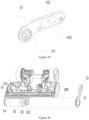
- the upright arm 120 includes: a supporter 121 having a receiving groove 1211, where the receiving groove 1211 has a first position and a second position spaced apart from each other; a trigger 122 movably disposed in the receiving groove 1211, where the pusher 24 is capable of abutting against the trigger 122 and pushing the trigger 122 to move linearly between the first position and the second position; and a microswitch 123 connected to the trigger 122, where the microswitch 123 is electrically connected to the charging male plug 3.
- the charging female plug 4 is not conductive to the charging male plug 3 in a case where the trigger 122 of the tray 2 is pushed by the pusher 24 to the first position.
- the charging female plug 4 is conductive to the charging male plug 3 in a case where the trigger 122 is pushed by the pusher 24 to the second position.
- a cleaning system which includes at least a cleaning apparatus 20 and a tray 2.
- the specific structure of the tray 2 refers to the above-mentioned embodiments. Since this cleaning system adopts all the technical solutions of all the above-mentioned embodiments, the cleaning system has at least all the beneficial effects brought by the technical solutions of the above-mentioned embodiments, which are not repeated here.
- the distance between the charging female plug 4 and the pusher 24 is set to be less than the distance between the charging male plug 3 and the trigger 122.
- the charging male plug 3 is provided on the top of the tray 2
- the trigger 122 is provided on the bottom of the tray 2
- the charging female plug 4 is provided on the top of the cleaning apparatus 20, and the pusher 24 is provided on the bottom of the cleaning apparatus 20.
- a cleaning apparatus is further provided in the present disclosure.
- the cleaning apparatus may be a cleaning machine, a vacuum cleaner, and other handheld cleaning apparatus well known to those skilled in the art.
- the cleaning apparatus is configured to be placed on the tray.
- the cleaning apparatus includes a body and a floor brush assembly.
- the floor brush assembly is provided with a roller configured to rotate around an X-axis.
- the floor brush assembly is configured to rotate around the X-axis direction relative to the body, to adjust an angle of the body relative to the floor brush assembly and perform cleaning work with a comforting angle of the body.
- the tray can be connected to the body through the charging assembly, and the charge the body.
- a charging male plug is provided on the body, and a first pole piece is provided on each of opposite sides of the charging male plug in the X-axis direction.
- a charging female plug is provided on the body, and a second pole piece is provided on each of opposite sides of the charging female plug in the X-axis direction.
- the body 11 is provided with a charging female plug 4, and the tray 2 is provided with a charging male plug 3 fit to the charging female plug 4.
- a first pole piece 31 is provided on the charging male plug 3 at a position corresponding to the charging female plug 4. After the charging male plug 3 and the charging female plug 4 are mated, the first pole piece 31 and the second pole piece 41 are in contact and electrically connected, so that the tray 2 can charge the cleaning apparatus.
- a cleaning apparatus provided in an embodiment may have a floor brush base 100, a rolling brush assembly 200, a suction port 300, and a suction channel located inside the cleaning apparatus and connected to the suction port 300.
- the cleaning apparatus can clean a dirt on the floor through the rolling brush assembly 200 and collect the dirt on the floor through the suction port 300. The sucked dirt enters the suction channel through the suction port 300.
- a function of the rolling brush assembly 200 is to pick up solids and liquids on the floor.
- the rolling brush assembly 200 includes a rolling brush 201.
- the rolling brush 201 can rotate around a first axis.
- the rolling brush assembly 200 cleans the solids and liquids on the floor through the rolling brush 201, and separates the solids and liquids from each other through a cooperation with a scraper. Specifically, solids and liquids on the floor can be cleaned only based on the contact between the rolling brush 201 and the floor.
- the rolling brush 201 When the surface of the rolling brush 201 is in contact with the floor, the rolling brush 201 can adsorb the solids and liquids onto the surface of the rolling brush 201, and the solids and liquids rotate following the rotation of the rolling brush 201. Specifically, as shown in Figure 27 and Figure 29 , the rolling brush 201 rotates in a counterclockwise direction. During the rotation, some of the solids and liquids on the surface of the rolling brush 201 may first break away from the surface of the rolling brush 201 due to gravity, and the other solids and liquids that are not free may follow the rotation of the rolling brush 201. The surface of the rolling brush 201 with the solids and liquids adsorbed passes through the area where the scraper assembly 400 is located.
- a cleaning apparatus generally adopts a metal scraper for squeezing the rolling brush 201 and scraping sewage into the suction port 300.
- the metal scraper is fixed, that is, an amount of extrusion interference of the scraper to the rolling brush 201 is constant.
- fluff on the rolling brush 201 decreases in resilience, water absorption and other properties as a use period becomes longer, resulting in loss of the fluff of the rolling brush 201. Therefore, squeezing of the rolling brush 201 by the scraper is reduced, and a squeezing effect of the rolling brush 201 is degraded, resulting in water marks on the floor.
- a main structure of the scraper assembly 400 is the plate 401.
- the plate 401 is located below the spray assembly 500.
- the plate 401 is rotatable around a second axis, where the second axis is defined to be a rotation axis of the scraper assembly 400.
- the second axis is parallel to the first axis.
- the plate 401 is a long strip structure extending along the axial direction of the rolling brush 201, that is, extending in the first axis direction.
- An extension length of the plate 401 is consistent with a length of the rolling brush 201, so that full contact between the scraper assembly 400 and the rolling brush 201 is realized.
- the driver 600 is configured to exert on the scraper assembly 400 a rotational force toward the rolling brush 201, to drive the plate 401 to rotate relative to the spray assembly 500.
- the plate 401 Under the driving of the driver 600, the plate 401 has a first position and a second position. At the first position, the plate 401 is maintained abutting against the rolling brush 201 under a driving force from the driver 600.
- the second position is a limit position that the scraper assembly 400 reaches under an action of the driver 600 in a case where the rolling brush 201 is not installed. In a case where the rolling brush 201 is installed, the plate 401 is pressed by the rolling brush 201 and rotates from the second position in a direction away from the rolling brush 201.
- the scraper assembly 400 is changed from a fixed mode to a rotatable and movable mode, so that the first position is not a unique fixed specific position throughout a use period of the rolling brush.
- the first position of the plate 401 changes accordingly. That is, as the diameter of the rolling brush 201 decreases due to wear and tear, the rotating scraper assembly can always keep squeezing the rolling brush 201.
- the scraper still has a good scraping effect. Hence, occurrence of water marks after use of the apparatus is reduced, and the time for the floor to dry remains short.
- the elastic member may be a coil spring, a torsion spring, a rubber spring, or the like.
- the elastic member is preloaded and installed between the spray assembly 500 and the scraper assembly 400, so that the elastic member is in an elastic deformation between the spray assembly 500 and the scraper assembly400, driving the plate 401 to rotate relative to the spray assembly 500 by the elastic force.
- the plate 401 is driven by the elastic force to rotate to the second position.
- the plate 401 is driven by the elastic force to press against the surface of the rolling brush 201, that is, the plate 401 is at the first position.
- the elastic member serving as the driver 600 is preferably a torsion spring.
- the torsion spring has a small structure and is easy to install, and can provide a large driving force.
- the torsion spring may be preloaded on the spray assembly 500.
- Mounting positions 403 are provided on the scraper assembly 400 for fixing an end of the torsion spring.
- the plate 401 extends in a direction of the first axis, and lugs 402 are formed on both ends of the plate 401 in the extension direction.
- the lugs 402 are located on a same side of the plate 401 and are perpendicular to the plate 401.
- the plate 401 when in the first position, the plate 401 is tilted relative to a horizontal plane, and a height of the plate 401 gradually decreases in a direction approaching the rolling brush 201.
- the scraper may be arranged to be inclined downward by 2° to 10° relative to the horizontal direction when placed at the first position.
- the spray assembly 500 sprays water onto the rolling brush 201 to wet the rolling brush 201, liquid usually flows onto the scraper.
- the liquid on the scraper may be guided to the rolling brush 201 along the slope of the scraper, rather than to flow back to the floor brush base 100 of the cleaning apparatus.
- a specific liquid flow is as shown by the arrow in Figure 28 .
- the limiting strips 502 can form necessary gaps between the plate 401 and the spray assembly 500.
- the gaps would not be closed under the action of the driver 600. That is, portions between the spray assembly 500 and the plate 401 are designed without obstruction, except for the limiting bars 502 arranged at intervals as mentioned above.
- the gap formed between adjacent two of the limit bars 502 can facilitate cleaning and reducing residual accumulation of dirt between the spray assembly 500 and the scraper.
- the spray assembly 500 has a side wall parallel to the lug 402 of the scraper assembly 400, and the pivot 405 is rotationally connected to the side wall and deviates from a center of the side wall.
- a specific position of the scraper assembly 400 should be determined in conjunction with an actual internal space of the product.
- a horizontal distance from the axis of the pivot 405 to the axis of the rolling brush 201 is determined to be 28mm
- a vertical distance from the axis of the pivot 405 to the axis of the rolling brush 201 is determined to be 19.3 mm, and the up-down displacement of the plate 401 during the rotation around the pivot 405 is small.
- the embodiments of the present disclosure further protect a cleaning assembly applied for a cleaning apparatus.
- the cleaning assembly includes a rolling brush cover, a spray assembly, a scraper assembly and a driver.
- the spray assembly is fixed inside the rolling brush cover.
- the scraper assembly is connected to the spray assembly and has a plate rotatable around a second axis. The plate is located below the spray assembly. The second axis is parallel to the first axis.
- the driver is configured for driving the plate to rotate relative to the spray assembly and pressing the plate against the rolling brush.
- the rolling brush cover, the spray assembly, the scraper assembly and the driver are combined into an integral unit structure, which can be detachably installed on the cleaning apparatus as a whole, so that the cleaning apparatus is easy to use. It should be noted that the specific structures and working methods of the rolling brush cover, the spray assembly, the scraper assembly and the driver may refer to the cleaning apparatus embodiment provided by the embodiments of the present disclosure, and are not repeated here.
- the driving device is arranged in the inner cavity of the cleaning device. Therefore, there is no need for an additional transmission device between the cleaning device and the driving device, so that a cleaning surface is enlarged.
- a heat dissipation air duct is provided in the driving device to cool the cleaning device through an external airflow. The airflow after heat dissipation can further dry the inner cavity of the cleaning device.
- the driving device is in direct contact with the cleaning device, for transmission connection, and no additional transmission components are necessary for connection.
- a method for the transmission connection may be a transmission connection method known to those skilled in the art, such as snap connection, bevel gear connection, and the like, which are not described in detail here.
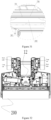
- a heat dissipation air duct 6 is provided in the driving device.
- the heat dissipation air duct 6 aspires an airflow from the outside by utilizing the principle of negative pressure, to dissipate heat from an internal structure of the driving device. After the heat dissipation on the driving device, a temperature of the airflow rises, and flows out from an outlet of the heat dissipation air duct 6. The airflow enters the inner cavity 25 of the cleaning apparatus and dries the inner cavity of the cleaning apparatus. Finally, the airflow can be discharged from the inner cavity 25 of the cleaning device.
- the driving device By arranging the driving device in the inner cavity of the cleaning device, no additional transmission device is needed for connection between the cleaning device and the driving device.
- the cleaning device of the present disclosure may adopt a structure with cleaning functions that is well known to those skilled in the art.
- the cleaning device is in a troweling plate structure.
- a rotation axis of the troweling plate structure is perpendicular to the to-be-cleaned surface, so that the troweling plate structure can clean the to-be-cleaned surface (e.g., a floor) while rotating along the axis.
- the cleaning device may adopt other structures.
- the cleaning device may be a cylindrical rolling brush assembly 2, and the inner cavity of the rolling brush assembly 2 runs through opposite ends of the rolling brush assembly.
- a cleaning cotton, bristles or other components for cleaning may be provided on an outer surface of the rolling brush assembly 2.
- the floor brush assembly 1 is further provided with two arms arranged oppositely. With the two arms, the driving device and the rolling brush assembly 2 are connected to the floor brush assembly 1.
- the two arms are respectively referred to as a first support arm 13 and a second support arm 14.
- the first support arm 13 and the second support arm 14 are provided on opposite sides of the floor brush assembly 1.
- An end of the first support arm 13 and an end of the second support arm 14 are connected to the floor brush assembly 1, and the other end extends outward. Therefore, a U-shaped installation space is formed by the first support arm 13, the second support arm 14, and the floor brush assembly 1.
- the rolling brush assembly 2 and other components may be installed in the installation space.
- a buffer 15 is provided on each free ends of the first support arm 13 and the second support arm 14.
- the buffer member 15 wraps around the outer surface of the first support arm 13 and the second support arm 14.
- the cleaning apparatus may touch some hard objects such as a furniture.
- the buffer 15 can prevent the cleaning apparatus from being damaged when touching the hard objects.
- the buffer 15 may be made of rubber, foam, or other materials known to those skilled in the art, which is not described in detail here.
- the first support arm 13 and the second support arm 14 are respectively located at edges on sides of the floor brush assembly 1 of the floor brush, and extend toward the rear side of the floor brush assembly 1, forming a U-shaped installation space between the first support arm 13 and the second support arm 14 and the floor brush assembly 1.
- the rolling brush assembly 2 may be installed in this installation space.
- the first support arm 13 and the second support arm 14 are respectively located on the left and right sides of the floor brush assembly 1, and extend from the left and right sides of the floor brush assembly 1 to the rear side of the body (lower portion as shown in Figure 9 ). Free ends of the two arms are configured for installing the rolling brush assembly 2.
- the first support arm 13 and the second support arm 14 may be fixedly installed on both sides of the floor brush assembly 1, or may be installed in a detachable manner.
- a mounting groove structure may be provided on the side wall of the floor brush assembly 1.
- An engaging structure matching the mounting groove structure may be provided on corresponding end surfaces of the two arms, so that the two arms are mounted on the side wall of the body. It is also possible to provide a groove on the side wall of the floor brush assembly 1, so that at least part of side walls of the first support arm 13 and the second support arm 14 are embedded in the groove, to prevent the first support arm 13 and the second support arm 14 from occupying a lateral dimension of the floor brush assembly 1.
- the structure of the second support arm 14 is similar to that of the first support arm 13.
- An end of the second support arm 14 may be fixed on the floor brush assembly 1 through screws or other methods well known to those skilled in the art.
- Figure 8 shows a schematic structural diagram of the second support arm 14.
- An end surface of the second support arm 14 for fitting to the floor brush assembly 1 is flat, or is configured in a shape adapted to a side wall of the floor brush assembly 1.
- a groove is provided on the side wall of the floor brush assembly 1, so that at least part of a side wall of the second support arm 14 is embedded in the groove, preventing the second support arm 13 from occupying a lateral dimension of the floor brush assembly 1.
- the thickness of the two arms occupies a cleaning area of the rolling brush assembly 2.
- the thickness of the first support arm 13 and the second support arm 14 is set in a range of 4mm and 6mm. Hence, a lateral space of the floor brush assembly 1 occupied by the two arms is minimized while ensuring a structural strength between the two arms and the rolling brush assembly 2, so that the rolling brush assembly 2 can provide a larger cleaning surface, and both sides of the rolling brush assembly 2 can be as close to the cleaning dead corners such as wall edges and table corners as possible during a cleaning process. Hence, the cleaning area of the cleaning apparatus is increased, and edge cleaning is enabled.
- the first support arm 13 is detachably fixed on the floor brush assembly 1, and an end of the rolling brush assembly 2 may be rotationally connected to the first support arm 13 in a detachable manner through a bearing or other methods known to those skilled in the art.
- a bearing seat may be provided at a corresponding position of the first support arm 13.
- An inner ring of the bearing may be fixed on the bearing seat, and an outer ring of the bearing may be fixed on the inner wall of the rolling brush assembly 2, or fixed on a mounting bracket provided on the inner wall of the rolling brush assembly 2.
- the rolling brush assembly 2 and the first support arm 13 are rotationally connected to each other in a detachable manner.
- the rolling brush assembly 2 may be removed from the first support arm 13, to facilitate a user to replace or maintain the cleaning drum when the rolling brush assembly 2 is worn or damaged.
- An end of the driving device is fixedly connected to the second support arm 14, and the other end of the driving device penetrates into the inner cavity of the rolling brush assembly 2.
- the output end of the driving device is connected to the rolling brush assembly 2 in a transmission manner, so that the driving device can drive the rolling brush assembly 2 to rotate. Since the driving device is provided on the second support arm 14, the first support arm 13 can be removed so as to extract the rolling brush assembly 2 in a case where the cleaning apparatus needs to be maintained, for example, when the cleaning drum needs to be disassembled.
- the user usually performs a disassembly operation in a posture facing the rear side of the cleaning apparatus, that is, the cleaning apparatus is rotated so that the side where the rolling brush assembly 2 is located faces the user.
- the first support arm 13 is on the right side of the floor brush assembly 1
- the second support arm 14 is located on the left side of the floor brush assembly 1.
- the driving device is the driving device 5, and the driving device 5 is fixedly connected to the second support arm 14 through a connection end.
- the fixed connection may be fixed together with the second support arm 14 through bolts.
- the fixed connection may be realized through other modes known to those in the art, which is not described in detail here.
- the driving device 5 extends toward the inside of the rolling brush assembly 2 and extends from an end of the rolling brush assembly 2 into the inner cavity 25 of the rolling brush assembly 2.
- the output end of the driving device 5 is in transmission fir with the inner wall of the rolling brush assembly 2. Rotation of the driving end drives the rolling brush assembly 2 to rotate to clean the to-be-cleaned surface.
- the driving device 5 includes a motor housing 51 and an output shaft 52.
- the driving device 5 further includes a stator and rotor in the motor housing 51, which is not described in detail here.
- the motor housing 51 is configured as a whole to have a shape adapted to the inner cavity 25 of the rolling brush assembly 2, such as a cylindrical shape.
- the output shaft 52 extends from an end of the motor housing 51, and the rolling brush assembly 2 is in transmission fit with the output shaft 52. Hence, the output shaft 52 can drive the rolling brush assembly 2 to rotate to clean the to-be-cleaned surface.
- An end of the motor housing 51 for connecting the second support arm 14 is provided with a heat dissipation air duct entrance 61.
- the heat dissipation air duct entrance 61 is provided at a middle position of the end of the motor housing 51 and is communicated with the heat dissipation air duct 6. In this way, the external airflow is allowed to enter the heat dissipation air duct 6 through the heat dissipation air duct entrance 61.
- a connecting sleeve 141 is provided on the second support arm 14.
- the driving device 5 may be fixed on the second support arm 14 through bolts.
- the connecting sleeve 141 is docked with the heat dissipation air duct entrance 61 on the motor housing 51.
- An external airflow can enter the heat dissipation air duct entrance 61 on the motor housing 51 through the connecting sleeve 141, and then enter the heat dissipation air duct 6 inside the driving device 5 to cool the driving device 5.
- the other end of the connecting sleeve 141 may penetrate the side wall of the second support arm 14 to communicate with the outside.
- a communication air duct 142 is provided on the second support arm 14.
- the communication air duct 142 may extend along the extension direction of the second support arm 14.
- An end of the communication air duct 142 extends to communicate with the connecting sleeve 141, and the other end of the communication air duct 142 forms a communication air duct entrance 1421 on the second support arm 14.
- the communication air duct entrance 1421 may be a hole opened on the second support arm 14, so that external airflow can directly enter the communication air duct 142 from the hole and enter the heat dissipation air duct entrance 61 through the connecting sleeve 141.
- the second support arm 14 may include a main body 1400 and a cover plate 1401 fit to the main body 1400.
- the main body 1400 may be made of metal to ensure the strength of the second support arm 14.
- the cover plate 1401 may be covered on an outer side of the main body 1400.
- the communication air duct 142 is enclosed by the cover plate 1401 and the main body 1400. Such structure is beneficial to wiring operations in the communication air duct 142.
- Material of the cover is not limited, which may be metal or plastic, and is not limited here.
- the driving device 5 further includes a motor shield 53.
- the shape of the motor shield 53 is similar to the shape of the motor housing 51, and is generally cylindrical.
- the motor shield 53 is arranged outside the motor housing 51. The sewage in the rolling brush assembly 2 can be blocked by the motor shield 53, and cannot directly enter the motor housing 51 and affect the operation of the driving device 5.
- the heat dissipation air duct 6 includes a first heat dissipation air duct 63 and a second heat dissipation air duct 64.
- the first heat dissipation air duct 63 and the second heat dissipation air duct 64 are connected to each other.
- the heat dissipation air duct 63 is disposed inside the motor housing 51, and an air inlet of the first heat dissipation air duct 63 is the above-mentioned heat dissipation air duct entrance 41.
- the motor housing 51 is provided with a communication hole 511, through which the first heat dissipation air duct 63 is communicated with the second heat dissipation air duct 64.
- the motor shield 53 is further provided with a heat dissipation air duct outlet 42. After the external airflow flows out from the first heat dissipation air duct 63, the airflow enters the second heat dissipation air duct 64, and then enters the inner cavity 25 of the rolling brush assembly 2, that is, the airflow flows toward the first support arm 13, so that the space in the inner cavity 25 of the rolling brush assembly 2 not occupied by the driving device 5 is dried.
- a gap needs to be left between the motor shield 53 and the motor housing 51 for relative rotation between the two. Therefore, in addition to the second heat dissipation air duct 64 for flowing toward the first support arm 13, a third heat dissipation air duct 65 for flowing toward the second support arm 14 is formed between the motor shield 53 and the motor housing 51.
- the third heat dissipation air duct 65 and the second heat dissipation air duct 64 are divided by the communication hole 511 provided on the motor housing 51.
- part of the airflow may flow toward the first support arm 13 along the second heat dissipation air duct 64, and part of the airflow may flow toward the second support arm 14 along the third heat dissipation air duct 65.
- a heat dissipation outlet 650 may be provided on the motor shield 53 at a position corresponding to the third heat dissipation air duct 65. After the airflow in the third heat dissipation air duct 65 flows out of the heat dissipation outlet 650, most of the airflow may flow toward the second support arm 14, that is, toward the connection end of the motor assembly, and flow out from a corresponding end of the rolling brush assembly 2, achieving the purpose of drying the side of the rolling brush assembly 2.
- the heat dissipation air duct outlet 42 may be disposed at an end of the motor shield 53 adjacent to the output shaft 52, and surrounds in the circumferential direction of the motor shield 53.
- sewage in the rolling brush assembly 2 can be prevented from entering the inside of the motor housing 51 through the heat dissipation air duct outlet 42.
- the motor shield 53 may be fixedly connected with the motor housing 51.
- the motor shield 53 may be rotationally connected to the motor housing 51, so that the motor shield 53 can rotate relative to the motor housing 51.
- an end of the motor shield 53 may be fixedly connected to the output shaft 52, and the other end of the motor shield may be rotationally connected to the motor housing 51.
- the motor shield 53 may form a transmission head 521 at an end adjacent to the output shaft 52.
- the transmission head 521 may be a truncated cone structure or in any other shape known to those skilled in the art.
- the transmission head 521 may be fixedly connected to the output shaft 52 through bolts or other forms known to those skilled in the art, and thereby rotation of the output shaft 52 can drive the motor shield 53 to rotate.
- a transmission base 26 is provided on the inner wall of the rolling brush assembly 2, and reference may be made to Figure 3 and Figure 5 .
- a transmission cavity 261 is provided on an end of the transmission base 26 facing the driving device 5.
- the transmission head 521 of the motor shield 53 may be in plug fit with the transmission cavity 261, so that the transmission head 521 can drive the transmission base 26 to rotate. That is, the transmission cavity 261 is configured to have a shape and size adapted to the transmission head 521.
- Figure 4 is a schematic sectional view of the transmission cavity 261 when separated from the transmission head 521.
- the rolling brush assembly 2 When installing the rolling brush assembly 2, the rolling brush assembly 2 may be handheld and moved toward the driving device 5, to allow the driving device 5 to penetrate into the inner cavity of the rolling brush assembly 2, and allow the transmission head 521 of the driving device 5 to insert into the transmission cavity 261 of the rolling brush assembly 2. In this way, the transmission cavity 261 is in transmission fit with the transmission head 521.
- the rolling brush assembly 2 can be separated from the driving device 5 by simply moving the rolling brush assembly 2 away from the driving device 5, referring to Figure 4 and Figure 9 .
- the transmission cavity 261 may be connected to the transmission head 521 in a transmission manner through a protrusion, a groove, or the like, in order to avoid slippage between the transmission cavity 261 and the transmission head 521.
- a spiral convex structure may be provided on the transmission head 521. After the spiral convex structure comes into fit with a corresponding structure on the inner wall of the transmission cavity 261, the transmission cavity 261 is in transmission fit with the transmission head 521.
- the transmission head 521 of the motor shield 53 is assembled in the transmission cavity 261. Two ends of the rolling brush assembly 2 are clamped by the first support arm 13 and the second support arm 14, so that the rolling brush assembly 2 is prevented from moving in the axial direction. Hence, stability of the rolling brush assembly 2 when rotating is ensured.
- a through hole 262 is provided on the transmission base 26. Therefore, the airflow flowing out from the heat dissipation air duct exit 62 can pass through the through hole 262 and flow in the inner cavity 25 of the rolling brush assembly 2, so as to dry the inner cavity 25 of the rolling brush assembly 2.
- the driving device 5 further includes a decorative sleeve 54.
- the decorative sleeve 54 is annular as a whole.
- the motor shield 53 is rotationally connected to the motor housing 51 through the decorative sleeve 54.
- the decorative sleeve 54 is rotationally connected to an end of the motor housing 51 through a bearing 55, and an end of the motor shield 53 extends to attach the decorative sleeve 54, for example, to be in contact fit or interference fit with the decorative sleeve 54. In this way, the motor shield 53 can rotate relative to the motor housing 51 under the action of the decorative sleeve 54.
- an end of the motor shield 53 is supported on the decorative sleeve 54, or directly fit with the bearing 34 so that the bearing 34 supports an end of the motor shield 53.
- the other end of the motor shield 53 forms the transmission head 521 and is fixedly connected with the output shaft 52 of the driving device 5, so that the transmission head 521 of the motor shield 53 is supported by the output shaft 52.
- a protruding rib can be provided on the decorative sleeve 54 and/or the motor shield 53. With the support from the rib and the inner wall of the rolling brush assembly 2, a gap between the driving device 5 and the rolling brush assembly 2 can be formed for airflow to escape.
- the decorative sleeve 54 is provided in the driving device 5.
- the decorative sleeve can shield the bearing 55 that rotationally connects the motor shield 53 and the motor housing 51, so that the bearing 55 is not directly exposed to the external environment, and damage to the bearing 55 caused by sewage and dust in the external environment is avoided, which otherwise may shorten the service life of the bearing 55.
- the decorative sleeve 54 can play a certain decorative role on the connection between the second support arm 14 and the motor housing 51, leading to a better appearance of the cleaning apparatus.
- the rolling brush assembly 2 rotates under the driving by the driving device 5 through the transmission head 521 of the motor shield 53, so as to clean the to-be-cleaned surface.
- the driving device 5 starts to operate, the external airflow enters the communication air duct 142 through the communication air duct entrance 1421 on the second support arm 14 under the negative pressure formed by the driving device 5. Then, the airflow passes through the connecting sleeve 141 and the heat dissipation air duct entrance 61 connected to the connecting sleeve 141, and enters the first heat dissipation air duct 63 in the motor housing 51.
- the airflow in the first heat dissipation air duct 63 performs heat dissipation to internal components in the motor housing 51. Then, the airflow enters the second heat dissipation air duct 64 through the communication hole 511, and enters the inner cavity 25 of the rolling brush assembly 2 through the heat dissipation air duct exit 62 of the second heat dissipation air duct 64.
- the airflow after heat dissipation flows along the inner cavity 25 of the rolling brush assembly 2
- the airflow may flow through the through hole 22 on the transmission base 22 and flow to the other end of the inner cavity 25, and finally flow out of the inner cavity 25.
- the inner cavity 25 of the rolling brush assembly 2 is dried.
- an air outlet 7 may be provided at an end of the rolling brush assembly 2 connected to the first support arm 13.
- the air outlet 7 may be provided on the rolling brush assembly 2.
- a number of small holes penetrating the cylinder body are opened at the end of the rolling brush assembly 2 adjacent to the first support arm 13, as the air outlet 7.
- the air outlet 7 may be a gap between the end of the rolling brush assembly 2 and the first support arm 13. This gap is an assembly gap between the end of the rolling brush assembly 2 and a bracket of the first support arm 13, rather than an additional opening provided for air outlet.
- the air outlet 7 may be provided on the first support arm 13 and communicate with the inner cavity 25 of the rolling brush assembly 2, which is not limited in the present disclosure.
- wireless cleaning apparatus is not restricted by a length of a power cord, so that a cleaning range is broadened, and user experience is improved.
- functional components such as batteries and main control boards are stacked and arranged in a limited space, occupying a large space.
- the main motor is noisy during operation and even more noisy at high power.
- the noise of most floor cleaning machine products on the market is around 80 decibels.
- a temperature of the battery cell increases when the battery is discharged. Charging protection may occur when the temperature reaches a certain value. For most products on the market, the battery cannot be charged directly after a long-term use, and it takes more than half an hour to charge the battery. Therefore, how to perform noise reduction and cooling on these functional components is a problem to be solved.
- the cleaning apparatus includes a motor assembly.
- the motor assembly includes a motor shield, a silencing shield, a motor, and a partition.
- the silencing shield is disposed inside the motor shield.
- a first chamber is formed by an outer wall of the silencing shield and an inner wall of the motor shield. The first chamber is configured to extend along an axial direction of the silencing shield.
- An air inlet duct is provided inside the motor. At least part of the motor is arranged inside the silencing shield.
- a second chamber is formed by an outer wall of the motor and an inner wall of the silencing shield. The second chamber is configured to extend along an axial direction of the motor.
- the partition is configured to divide the second chamber into a first compartment communicated to an outlet of the air inlet duct, and a second compartment separated from the first compartment.
- the air inlet duct, the first compartment, the first chamber, and the second compartment are communicated in the above-listed sequence, forming an air duct system of the motor assembly.
- An external airflow enters the first compartment through the air inlet duct of the motor, flows to the first chamber and finally flow out through the second compartment.
- a working principle of the cleaning apparatus is as follows.
- the motor when started, forms a negative pressure in the air duct system of the cleaning apparatus to generate a suction force.
- an airflow flows directly or indirectly into the air inlet duct in the motor after passing through a main inlet on the motor shield.
- the airflow flows through the first compartment, the first chamber, the second compartment, and finally is discharged through a main outlet.
- the second chamber extending along the axial direction of the silencing shield is divided, by the partition, into the first compartment and the second compartment.
- the airflow in the second compartment does not directly enter the second compartment, but needs to first flow radially into the first chamber, and then radially flow into the second compartment which extends in the same axial direction as the first compartment, and flows out through the second compartment.
- the flow path for the airflow in the motor assembly is improved, allowing the airflow to have flow paths in different directions, which is conducive to gradually reducing a flow rate of the airflow.
- noise of the motor assembly is reduced, and user experience is improved.
- the cleaning apparatus includes a motor assembly.
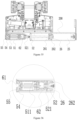
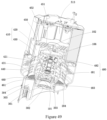
- the motor assembly includes a motor shield 304, a silencing shield 480, a motor 106 and a partition 204.
- the silencing shield 480 is located inside the motor shield 304.
- a first chamber 440 extending along an axial direction of the silencing shield 480 is formed by an outer wall of the silencing shield 480 and an inner wall of the motor shield 304.
- the motor 106 includes a first housing having an inner cavity and a second housing located in the inner cavity of the first housing.
- the first housing is cylindrical
- the second housing is installed in the inner cavity of the first housing and extends outward from the inner cavity of the first housing.
- An end of the second housing adjacent to the first housing shrinks radially inward, that is, the diameter gradually decreases, realizing a frustum structure, so that an air inlet duct 101 is formed between the first housing and the second housing.
- An outlet of the air inlet duct 101 is formed by the opening end of the first housing and a position with the smallest inner diameter of the second housing.
- the first housing includes a first enclosure portion 103 located in the inner cavity of the second housing, a second enclosure located outside the second housing, and a connecting portion 104 connecting the first enclosure portion 103 and the second enclosure portion 105.
- a size of the first enclosure portion 103 is less than a size of the second enclosure portion 105.
- One end of the connecting portion 104 is connected to the second enclosure portion 105, and the other end of the connecting portion gradually shrinks to correspond to the size of the first enclosure portion 103, to be connected with the first enclosure portion 103.
- the connecting portion 104 is connected between the first enclosure portion 103 and the second enclosure portion 105, and the size of the connecting portion 104 gradually decreases from the position connected with the second enclosure portion 105 to the position connected with the first enclosure portion 103, so that the connecting portion 104 can smoothly transition between the first enclosure portion 103 and the second enclosure portion 105.
- the first enclosure portion 103, the connecting portion 104, and the second enclosure portion 105 may be integrally formed.
- the silencing shield 480 may have a cylindrical structure.
- the silencing shield 480 is installed behind the inner cavity of the motor shield 304, so that an annular first chamber 440 is formed between an outer wall of the silencing shield 480 and an inner wall of the motor shield 304.
- the first chamber 440 extends along the axial direction of the motor shield 304 and the silencing shield 480.
- the silencing shield 480 includes a first shield body 481 and a second shield body 482 that are connected to each other.
- the first chamber 440 may be formed at least by an outer wall of the first shield body 481 and an inner wall of the motor shield 304.
- the motor 106 extends into the interior of the silencing shield 480, so that a second chamber 410 is formed by the motor housing of the motor 106 and the inner wall of the silencer cover 480.
- the second chamber 410 is an annular chamber and extends along the axial direction of the motor 106 and the silencing shield 480.
- a specific shape of the second chamber 410 is related to shapes of the silencing shield 480 and the motor 106 and is not discussed in detail here. Therefore, the first chamber 440 is distributed around the periphery of the second chamber 410, and the two chambers are separated by the side wall of the silencing shield 480.
- the motor 106 has an air inlet duct 101.
- an external airflow enters from an entrance of the air inlet duct 101 under the action of a blade assembly. After flowing along the extension direction of the air inlet duct 101, the airflow is discharged from the outlet of the air inlet duct 101.
- the outlet of the air inlet duct 101 is connected with the second chamber 410, so that the airflow discharged from the outlet of the air inlet duct 101 can enter and flow in the second chamber 410.
- the partition 204 is disposed in the second chamber 410, and is configured to divide the second chamber 410 into a first compartment 420 communicated to an outlet of the air inlet duct 101, and a second compartment 430 separated from the first compartment 420.
- the partition 204 extends from the position of the motor 106 to the position of the first shield body 481, and is sealed with the side wall of the motor 106 and the inner wall of the first shield body 481, thereby dividing the second chamber 410 into the first compartment 420 and the second compartment 430.
- the first compartment 420 and the second compartment 430 are distributed in the axial direction of the motor 106 and the silencing shield 480.
- the first compartment 420 is located above the second compartment 430.
- the partition 204 has a double-layer sealing structure. In other embodiments, the partition 204 may have a single-layer sealing structure.
- the air inlet duct 101, the first compartment 420, the first chamber 440, and the second compartment 430 are communicated in the above-listed sequence, forming an air duct system of the motor assembly.
- the motor 106 forms a negative pressure in the air duct system and generates a suction force, so that the external airflow enters the air inlet duct 101 inside the motor 106.
- the airflow enters the first compartment 420, and then flows to the second chamber 410. Then, the airflow flows to the second compartment 430 and flows from the second compartment 430 to the outside.
- Different chambers not only extend a flow path of the airflow, but also change a flow direction of the airflow, so that noise reduction is realized while the airflow flowing in the different chambers.
- the partition 204 in the present disclosure may be independently disposed in the second chamber 410.
- a mounting base 301 is provided in the motor shield 304, and an end of the motor 106 is assembled in the mounting base 301 through a shock-absorbing pad 203.
- a lower portion of the mounting base 301 is provided with a main inlet 302 to communicate with the entrance of the air inlet duct 101 of the motor 106.
- An opening fit to the mounting base 301 is provided at a corresponding position on the shock-absorbing pad 203, allowing an external airflow to flow into the air inlet duct 101 of the motor 106.
- the shock-absorbing pad 203 extends along an outer contour of the motor 106 into the second chamber 410 to form the partition 204.
- the partition 204 and the shock-absorbing pad 203 may be integrally formed.
- the shock-absorbing pad 203 has an inner cavity adapted to at least part of the outer contour of the motor 106, so that a part of the motor 106 can be assembled in the inner cavity of the shock-absorbing pad 203.
- the shock-absorbing pad 203 can provide a good buffer for the motor 106 and reduce the noise generated by the motor 106 during operation.
- An upper part of the shock-absorbing pad 203 extends radially outward to form the partition 204.
- the partition 204 divides the second chamber 410 into a first compartment 420 and a second compartment 430.
- the channel for airflow is extended, so that the noise volume generated due to operation of the motor 106 is greatly reduced.
- the shock-absorbing pad 203 By arranging the mounting base 301 and the shock-absorbing pad 203, the noise volume generated due to vibration of the motor 106 during operation is further alleviated, and thereby the purpose of noise reduction is achieved.
- the shock-absorbing pad 203 has a hardness of 30 Shore A. From experimental tests, it is found that the shock-absorbing effect for the motor 106 is best when the hardness of the shock-absorbing pad 203 is 30 Shore A. In this case, the fit between the shock-absorbing pad 203 and the motor 106 can be ensured, and the buffering and shock-absorbing effect for the shock-absorbing pad 203 is best.
- the mounting base 301, the shock-absorbing pad 203, and the motor 106 may be detachably connected through threads, snaps, and other methods, which is not limited here.
- Such arrangement allows easy replacement of a component through simple disassembly when there is a problem and the replacement is required, so that a maintenance cost is saved.
- partition part 204 is configured to extend radially outward from the shock-absorbing pad 203 to be in sealing contact with the interior of the silencing shield 480. Thereby, it can be ensured that there is no gap between the partition 204 and the shock-absorbing pad 203. Hence, the flow direction of the airflow is not affected by existence of a gap, thereby achieving the optimal noise reduction effect. Additionally, the partition 204 and the shock-absorbing pad 203 are configured to be integrally formed, realizing a compact overall structure of the cleaning apparatus.
- a first through hole 421 communicating the first compartment 420 and the first chamber 440 is provided at a position on the side wall of the first shield body 481 corresponding to the first compartment 420
- a second through hole 431 communicating the second compartment 430 and the first chamber 440 is provided at a position on the side wall of the first shield body 481 corresponding to the second compartment 430.
- the airflow in the first compartment 420 passes through the first through hole 421 before entering the first chamber 440, thereby reducing a speed of the airflow.
- the first through hole 421 may further play a role in flow equalization.
- the turbulent airflow can be equalized after passing through the first through hole 421.
- the airflow in the first chamber 440 then passes through the second through hole 431 for a second flow equalization and noise reduction. As the airflow flows along the above-mentioned air duct, energy of wind noise can be gradually lost, realizing the noise reduction.
- At least part of the end surface of the partition 204 is flush with the outlet of the air inlet duct 101, so that the partition 204 can guide the airflow flowing out from the outlet of the air inlet duct 101.
- the airflow flowing out from the outlet of the air inlet duct 101 can smoothly flow to the silencing shield 480 and flow to the first chamber 440 from the first through hole 421 on the silencing shield 480.
- a first silencing plate 450 is provided in the first compartment 420.
- a silencing cavity 452 is formed by the first silencing plate 450 and an end of the silencing shield 480.
- An outer contour of the first silencing plate 450 is adapted to 402.
- the motor 106 is located in the first shield body 481 and the second shield body 482, and an end position of the motor 106 is sealing connected to an end face of the second shield body 482.
- the first compartment 420 extends from the position of the first shield body 481 to the position of the second shield body 482.
- the first silencing plate 450 is disposed in the first compartment 420 at a position adjacent to the end of the second shield body 482 and defines the silencing cavity 452 with the end of the second shield body 482.
- the first silencing plate 450 is provided with evenly distributed silencing holes 451. By providing the first silencing plate 450, the airflow entering the first compartment 420 can flow into the silencing cavity 452, so as to achieve noise reduction.
- the first silencing plate 450 may be installed horizontally in the motor shield 304 or may be installed obliquely in the motor shield 304, which is not limited here.
- a distance between the first silencing plate 450 and the end of the second shield body 482 is at least 5mm.
- a second silencing plate 460 is provided in the second compartment 430, and a third through hole 461 is provided on the second silencing plate 460.
- the second compartment 430 is communicated with the main air outlet 303 on the motor shield 304 through the third through hole 461 on the second silencing plate 460. It can be understood that after the airflow passes through the first through hole 421 and the second through hole 431 for two rounds of flow equalization and noise reduction, the airflow flows into the second compartment 430 and then passes through the third through hole 461 on the second silencing plate 460 for the third round of silencing and noise reduction. The airflow is finally discharged through the main air outlet 303.
- the second silencing plate 460 is installed inside the motor shield 304, and has an edge 483 configured to block the first chamber 440 defined by the silencing shield 480 and the motor shield 304. Specifically, an end of the silencing shield 480 abuts the second silencing plate 460, and the edge 483 of the second silencing plate 460 is sealed with the inner wall of the motor shield 304. In this way, blocking of the open ends of the first chamber 440 and the second chamber 410 by the second silencing shield plate 460 is realized.
- the third through hole 461 is provided on the second silencing plate 460 at a position corresponding to the second compartment 430, so that the airflow in the second compartment 430 can be discharged outward through the third through hole 461 and the main air outlet 303 of the motor shield 304.
- the first chamber 440 is connected to the first compartment 420 and the second compartment 430 through only the first through hole 421 and the second through hole 431.
- the air flow in the first chamber 440 can only pass through the first through hole 421 and the second through hole 431.
- a direction of the airflow flowing through the first through hole 421 is opposite to a direction of the airflow flowing through the second through hole 431.
- the second silencing plate 460 may be installed horizontally in the motor shield 304 or may be installed obliquely in the motor shield 304, which is not limited here.
- an aperture size of the first through hole 421 is set to be greater than an aperture size of the second through hole 431, and the aperture size of the second through hole 431 is set to be greater than an aperture size of the third through hole 461. Since the aperture sizes of the three through holes decreases sequentially, the wind pressure of the airflow when flowing can be gradually reduced, and the airflow can be gradually controlled to flow out evenly, so that a noise reduction degree of the airflow is improved.
- an area where the first through hole 421 is located is defined as a first air outlet side, and a total air outlet area on the first air outlet side is represented by B.
- an area where the first through hole 421 is provided is defined as a first air outlet side.
- a total air outlet area B of the first air outlet side is related to the quantity and aperture size of the first through hole 421. A larger quantity or greater aperture size of the first through hole 421 leads to a greater total air outlet area B of the first air outlet side.
- an area where the second through hole 431 are located is defined as a second air outlet side, and a total air outlet area on the second air outlet side is represented by A.
- An airflow in the first chamber 440 flows into the second compartment 430 through the second through hole 431.
- the area where the second through hole 431 is provided is defined as the second air outlet side.
- the total air outlet area A of the second air outlet side is related to the quantity and aperture size of the second through hole 431. A larger quantity or greater aperture size of the second through hole 431 leads to a greater total air outlet area A of the second through holes 431.
- a total air outlet area of an outlet of the air inlet duct 101 is represented by C.
- the outlet of the air inlet duct 101 is arranged around a side portion of the motor 106.
- a greater outlet area of the air inlet duct 101 is more conducive to flow of an airflow in the air inlet duct 101.
- the total air outlet area C of the outlet of the air inlet duct 101, the total air outlet area A on the second air outlet side, and the total air outlet area B on the first air outlet side satisfy a relationship of A>B>C.
- an air inlet area of the main inlet 302 on the mounting base 301 is represented as D.
- the main inlet 302 provided on the mounting base 301 may be an opening, or may be provided as a pore plate. Air enters into the air inlet duct 101 from through holes on the pore plate.
- the total air outlet area C of the outlet of the air inlet duct 101 and the total air inlet area D of the main inlet 302 satisfy a relationship of C>2.5D, so that the motor 106 can suck air from the main inlet 302 smoothly.
- the cleaning apparatus further includes a soundproof plate 470 disposed in the first chamber 440.
- the soundproof plate 470 divides the first chamber 440 into two cavities connected to the first through hole 421 and the second through hole 431, respectively.
- a fourth through hole 471 is provided on the soundproof plate 470.
- the quantity and aperture size of the fourth through hole 471 on the soundproof plate 470 are designated so that the aperture size of the fourth through hole 471 is less than the aperture size of the first through hole 421 and the aperture size of the second through hole 421.
- the aperture size of the third through hole 461 and the aperture size of the fourth through hole 471 may be in a range from 1.3mm to 3mm; and the aperture size of the first through hole 421 and the aperture size of the second through hole 431 are in a range from 3mm to 6mm. This is because when the air flows in the air duct, the aperture sizes set for the first through hole 421 and the second through hole 431 need to ensure that the air outlet area is greater than the air outlet area of the motor 106, so as to ensure smooth flow of the airflow in the air duct.
- the aperture sizes of the third through hole 461 and the fourth through hole 471 are less than the aperture sizes of the first through hole 421 and the second through hole 431, so that a turbulent airflow can be balanced when flowing through the third through hole 461 and the fourth through hole 471, realizing flow equalization and noise reduction.
- the aperture sizes of the third through hole 461 and the fourth through hole 471 are set in a range of 1.3mm to 3mm. Hence, the flow equalization and noise reduction for the airflow can be better performed.
- the aperture size of the first through hole 421 is greater than the aperture size of the second through hole 431, and the aperture size of the second through hole 431 is greater than the aperture size of the third through hole 461. Due to the gradual reduction of the aperture sizes, a wind pressure of the airflow gradually decreases, which is beneficial to noise reduction.
- the aperture size of the first through hole 421 may be 4mm; the aperture size of the second through hole 431 may be 3.5mm; and the aperture size of the third through hole 461 may be 2mm.
- the first through hole 421, the second through hole 431, and the third through hole 461 are in a same design as in the example in Figure 44 , and an aperture size of the fourth through hole 471 may be 2mm.
- the fourth through hole 471 is mainly for further noise reduction.
- a diameter of the motor 106 is represented by D0
- a diameter of the silencing shield 480 is represented by D1
- a diameter of the motor shield 301 is represented by D2.
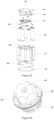
- the cleaning apparatus further includes a battery pack assembly 513.
- the battery pack assembly 513 may be disposed on the silencing shield 480 and/or the motor shield 304.
- the battery pack assembly 513 is installed on the silencing shield 480 and/or the motor shield 304 in a fixed or detachable manner.
- a heat dissipation channel 102 is provided in the motor 106. The heat dissipation channel 102 of the motor 106 is connected with the inner cavity of the battery pack assembly 513.
- a negative pressure can be formed in the inner cavity of the battery pack assembly 513, so that the airflow can pass through the inner cavity of the battery pack assembly 513, flows into the heat dissipation channel 102 of the motor 106, and is finally discharged through the main air outlet 303.
- the external airflow flows into the heat dissipation channel 102 of the motor 106 through the inner cavity of the battery pack assembly 513.
- the airflow in the heat dissipation channel 102 while flowing, can take away the heat emitted by the battery pack assembly 513, to cool the battery pack assembly 513.
- the airflow is finally discharged from the main air outlet 303. Thereby, the battery pack assembly 513 is cooled.
- the motor 106 of the present disclosure may include a motor outer casing and a motor inner casing disposed in the motor outer casing.
- the rotor, stator and other components of the motor assembly may be all installed in the motor inner casing.
- the heat dissipation channel 102 is provided in the motor inner casing.
- This heat dissipation air duct may be configured for heat dissipation of the motor. For example, during operation, the motor generates a large amount of heat during high-speed rotation. By introducing part of the airflow generated by the motor into the heat dissipation air duct and then discharging therefrom, heat dissipation of the motor can be realized. Design of the heat dissipation air duct is well-known to those skilled in the art and is not described in detail here.
- the second shield body 482 of the silencing shield 480 extends into the inner cavity of the battery pack assembly 513.
- An end of the second shield body 482 is configured to have a heat dissipation through hole 506 adapted to the heat dissipation channel 102 of the motor 106.
- the second chamber 410 is blocked through fit of the remaining positions on the motor 106 with the second shield body 482. It can be understood that the gas in the inner cavity of the battery pack assembly 513 can enter the motor 106 only through the heat dissipation channel 102.
- the battery pack assembly 513 includes a heat dissipation shell 514.
- Battery compartments 515 are provided within the heat dissipation shell 514, and the battery compartments 515 are arranged in the circumferential direction of the heat dissipation shell 514, and are configured for accommodating a cell assembly 503.
- the battery compartments 515 are configured in order to isolate the battery assembly to prevent vapor (containing acidic substances and other corrosive impurities) in the airflow from contacting the cell assembly 503 for a long time and affecting performance of the cell assembly.
- each battery compartment 515 is formed by protruding from the heat dissipation shell 514, and the battery compartments 515 are arranged at intervals in the circumferential direction of the heat dissipation shell 514.
- the battery compartment 515 is formed in a semi-enclosed open structure on the inner wall of the heat dissipation shell 514.
- the cell assembly 503 is arranged on a circumferential direction of the heat dissipation shell 514, so that the cell assembly 503 defines an annular inner cavity 511 in the inner cavity of the heat dissipation shell 514, as shown in Figure 47 .
- Each battery compartment 515 is formed by protruding from the heat dissipation shell 514, and the battery compartments 515 are arranged at intervals in the circumferential direction of the heat dissipation shell 514. Therefore, when the cell assembly 503 is installed in the battery compartment 515, the cell assembly 503 is arranged surrounding inside the heat dissipation shell 514, forming an annular inner cavity 511.
- the second shield body 482 of the motor assembly extends into the annular inner cavity 511.
- the first shield body 481 is located outside the annular inner cavity 511. That is, a part of the motor assembly extends into the annular inner cavity 511, and the other part of the motor assembly is located outside the annular inner cavity 511.
- a side wall of the motor shield 304 of the motor assembly may be flush with an outer edge of the heat dissipation shell 514. This may be understood as the side wall of the motor shield 304 being flush with the outer edge of the battery compartment 515, so that an overall structure has a better consistency.
- the outer wall of the second shield body 482 is provided with heat dissipation grooves 504 in one-to-one correspondence with the battery compartments 502.
- the heat dissipation grooves 504 are configured to be in fit, such as clearance fit or contact fit, with at least part of the surface of the cell assembly 503 exposed from the battery compartments 502. Such arrangement allows the heat of the cell assembly 503 in the battery compartments 515 to be transferred to the second shield body 482 as much as possible, and be dissipated through the airflow in the first compartment 420.
- the heat dissipation shell 514 may be in any other shape, such as a square, cylindrical, or other shapes well known to those skilled in the art, which is not limited here.
- the second shield body 482 extends into part of the inner cavity of the battery pack assembly 513.
- a depth to which the second shield body 482 extends may be approximately equal to half the height of the battery pack assembly 513.
- the outer wall of the second shield body is in contact or clearance fit with part of the surface of the cell assembly 503. As a result, the cell assembly 503 can be cooled through the airflow in the second shield body.
- the end surface of the heat dissipation shell 514 is provided with a heat dissipation inlet 505 connected to the inner cavity of the heat dissipation shell 514.
- the second shield body 482 is provided with a heat dissipation through hole 505 connected to the heat dissipation channel 102 of the motor 106. Specifically, after an external airflow enters the heat dissipation shell 514, the airflow heats up after exchanging heat with the cell assembly 503, flows into the heat dissipation channel 102 of the motor 106, and is finally discharged from the main air outlet 303 channel. Thereby, quick cooling of the heat dissipation shell 514 is realized.
- the motor 106 is not necessarily provided with an additional heat dissipation channel 102.
- the motor 106 operates, the external airflow flows in the air inlet duct, the first compartment, the first chamber, and the second compartment as mentioned above, and perform heat dissipation on the motor.
- the second shield body 482 extends into the annular inner cavity 511.
- the heat emitted by the cell assembly 503 can be taken away in time through the second shield body 401. That is, while dissipating heat from the motor 106, the heat in the annular inner cavity 511 is also taken away through the second shield body 482 located in the annular inner cavity 511.
- the heat dissipation through hole 506 illustrated in Figure 45 and Figure 46 are used only as a wiring hole, that is, wiring harness of the battery pack assembly may be connected to the motor assembly through the wiring hole. Therefore, the battery pack assembly can supply power to the motor assembly, which is not explained in further detail here.
- a radial size of the first shield body 481 is greater than a radial size of the second shield body 482.
- the second shield body 482 extends into the annular inner cavity 511 surrounded by the cell assembly 503.
- the first shield body 481 is located outside the heat dissipation shell 514, and the first shield body 481 may extend to a front projection area of the cell assembly 503.
- part of the heat emitted by the cell assembly 503 can be directly or indirectly transferred to the first shield body 481 and taken away through the air duct. Thereby, the heat dissipation efficiency of the cell assembly 503 is improved.
- a motor assembly is provided in an embodiment of the present disclosure.
- the motor assembly includes a motor shield 304, a silencing shield 480, a motor 106 and a partition 204.
- the silencing shield 480 is located inside the motor shield 304.
- a first chamber 440 extending along an axial direction of the silencing shield 480 is formed by the silencing shield 480 and an inner wall of the motor shield 304.
- An air inlet duct 101 is provided in the motor 106.
- the motor 106 is at least partially located inside the silencing shield 480.
- the motor 100 together with an inner wall of the silencing shield 480, defines a second chamber 410 extending along an axial direction of the motor 100.
- the partition 201 is configured to divide the second chamber 410 into a first compartment 420 communicated to an outlet of the air inlet duct 101, and a second compartment 430 separated from the first compartment 420.
- the air inlet duct 101, the first compartment 420, the first chamber 440, and the second compartment 430 are communicated in the above-listed sequence.
- the structure and function of the motor assembly in this embodiment may be consistent with the structure and function of the motor assembly in the first embodiment, and is not described in detail here.
- the motor assembly of the present disclosure is applied to other apparatus that requires noise reduction and temperature reduction. Examples thereof are not listed here in detail.
- a tray is further provided in the present disclosure.
- the tray is configured for holding the cleaning apparatus described above.
- a charging male plug is provided on the tray, and a first pole piece is provided on each of opposite sides of the charging male plug in the X-axis direction.
- a charging female plug is provided on the tray, and a second pole piece is provided on each of opposite sides of the charging female plug in the X-axis direction.
- the tray 2 is provided with a charging male plug 3
- the body 11 of the cleaning apparatus 1 is provided with a charging female plug 4 in fit with the charging male plug 3.
- a second pole piece 41 is provided on the charging female plug 4 at a position corresponding to the charging male plug 3. After the charging male plug 3 and the charging female plug 4 are mated, the first pole piece 31 and the second pole piece 41 are in contact and electrically connected, so that the tray can charge the cleaning apparatus.
- the tray 2 is provided with a charging female plug 4, and the body 11 of the cleaning apparatus 1 is provided with a charging male plug 3 fit to the charging female plug 4.
- a first pole piece 31 is provided on the charging male plug 3 at a position corresponding to the charging female plug 4. After the charging male plug 3 and the charging female plug 4 are mated, the first pole piece 31 and the second pole piece 41 are in contact and electrically connected, so that the tray can charge the cleaning apparatus.
- Figure 8 shows a schematic three-dimensional structural view of a tray 2 according to an embodiment of the present disclosure.
- Figure 9 shows a sectional view of a tray 2 according to an embodiment of the present disclosure.
- Figure 10 shows a schematic three-dimensional structural view of an upright arm 120 according to an embodiment of the present disclosure.
- Figure 11 shows a sectional view of an upright arm 120 according to an embodiment of the present disclosure.
- Figure 12 shows a schematic three-dimensional structural view of a trigger 122 according to an embodiment of the present disclosure.
- Figure 13 shows a schematic structural diagram of a microswitch 123 according to an embodiment of the present disclosure.
- a charging base station is provided in an embodiment of the present disclosure, for supplying power to the cleaning apparatus 20.
- the cleaning apparatus 20 includes a charging female plug 4 and a pusher 24.
- the tray 2 includes a positioning seat 22 and a base 21.
- the positioning seat 22 is connected to the base 21.
- the positioning seat 22 includes a charging male plug 3 and an upright arm 120 disposed in the positioning seat 22, where the charging male plug 3 can be in contact with the charging female plug 4.
- the upright arm 120 includes a supporter 121, a trigger rod 122, and a microswitch 123.
- the supporter 121 has a receiving groove 1211, and the receiving groove 1211 has a first position and a second position spaced apart from each other.
- the trigger 122 is movably disposed in the receiving groove 1211, the pusher 24 is capable of abutting against the trigger 122 and pushing the trigger 122 to move linearly between the first position and the second position.
- the microswitch 123 is connected to the trigger 122, and the microswitch 123 is electrically connected to the charging male plug 3.
- the microswitch 123 is in an off state, and the charging female plug 4 is not conductive to the charging male plug 3.
- the microswitch 123 is in an on state, and the charging female plug 4 is conductive to the charging male plug 3.
- the charging base station is configured as a combined component integrating at least a tower and a base.
- the tower integrates at least the second charging element and the upright arm.
- the upright arm is disposed inside the tower.
- the upright arm is configured as a combined component that integrates at least the supporter, the trigger and the microswitch.
- the supporter at least has an effect of supporting other components.
- the trigger is arranged in conjunction with the microswitch on the supporter.
- Movement of the trigger realizes the electrical conduction or disconnection of the microswitch, thereby realizing the electrical conduction or disconnection of the internal circuit of the charging base station through the upright arm, thereby realizing the charging operation or non-charging operation of the charging base station.
- the cleaning apparatus when the cleaning apparatus needs to be charged, the cleaning apparatus is placed at the charging base station.
- An electrical conduction process between the first charging element of the cleaning apparatus and the second charging element of the charging base station can be performed at least through the manipulation by the composite component composed of the " trigger -microswitch" mechanism, so as to realize electrical conduction between the two.
- Such design prevents the first charging element of the cleaning apparatus from being directly electrically conductive with the second charging element of the charging base station, and thereby prevents the sparking.
- the tray 2 With the optimized design of the tray 2, it is capable of solving the problem of an increased oxidation area of the charging contact piece (the charging male plug 3) of the charging device and a reduced contact area for conduction between the tray 2 and the cleaning apparatus 20, caused by the sparking due to electrical conduction between the traditional charging device and the cleaning apparatus 20.
- the tray 2 includes a positioning seat 22 and a base 21, where the positioning seat 22 is disposed in the base 21 and extends from the base along a vertical direction.
- the cleaning apparatus 10 When the cleaning apparatus 10 is placed on the tray 2, the cleaning apparatus 20 is placed in the base 21 to facilitate self-cleaning of the cleaning apparatus. Meanwhile, the cleaning apparatus 20 abuts against the positioning seat 22, so that the charging female plug 4 of the cleaning apparatus 20 is electrically connected to the charging male plug 3 of the positioning seat 22, and the cleaning apparatus 20 is charged through the tray 2.
- the charging male plug 3 is located at the top of the positioning seat 22, in order to be better electrically connected with the charging female plug 4 of the cleaning apparatus 20.
- At least a first charging element 110 and an upright arm 120 are integrated in the positioning seat 22.
- the upright arm 120 is a combined component integrating at least the supporter 121, the trigger 122, and the microswitch 123.
- the supporter 121 at least has an effect of supporting other components.
- the trigger 122 is arranged in conjunction with the microswitch 123 on the supporter 121. Movement of the trigger 122 realizes the electrical connection or disconnection of the microswitch 123, thereby realizing the electrical connection or disconnection of the internal circuit of the tray 2 through the upright arm 120.
- the contact conduction between the tray 2 and the cleaning apparatus 20 is in turn realized to charge the cleaning apparatus 20, or the contact disconnection between the tray 2 and the cleaning apparatus 20 is realized to disconnected charging of the cleaning apparatus 20.
- the cleaning apparatus 20 when the cleaning apparatus 20 needs to be charged, the cleaning apparatus is placed on the tray 2.
- An electrical conduction process between the charging female plug 4 (charging contact piece) of the cleaning apparatus 20 and the charging male plug 3 (charging contact piece) of the tray 2 can be performed at least through the manipulation by the composite component composed of the " trigger 122-microswitch 123" mechanism, so as to realize electrical conduction between the two.
- Such design prevents the charging female plug 4 (charging contact piece) of the cleaning apparatus 20 from being directly electrically conductive with the charging male plug 3 (charging contact piece) of the tray 2, and thereby prevents the sparking.
- the upright arm 120 is placed in the positioning seat 22, so as to isolate the upright arm 120 from damage/scratches caused by the external environment.
- a receiving groove 1211 is provided on the supporter 121, and the trigger 122 is accommodated and movable in the receiving groove 1211.
- the trigger 122 is a triggering rod.
- the microswitch 123 is connected to the trigger 122, so that the movement of the trigger 122 drives the microswitch 123 to be electrically connected or disconnected, thereby realizing electrical connection or disconnection between the microswitch 123 and the charging male plug 3, thereby achieving electrical connection or disconnection of the internal circuit of the tray 2 having the upright arm 120.
- the microswitch 123 is connected and secured to the supporter 121 through fasteners such as screws/bolts, so as to maintain the stability of the microswitch 123 and prevent the microswitch 123 from falling and becoming disabled for normal operation.
- the microswitch 123 may be detachably connected to the supporter 121 through a snap or other structures, as long as it is ensured that the microswitch 123 does not fall off from the supporter 121. It should be noted that the specific connection mode between the microswitch 123 and the supporter 121 is not limited as in the embodiment.
- a triggering mode in which the trigger 122 and the microswitch 123 act in conjunction is further provided in an embodiment.
- an end of the microswitch 123 abuts against the trigger 122 and can be switched off or on under the driving of the trigger 122.
- the microswitch 123 is driven to be opened, and thereby the microswitch is in an off state.
- the microswitch 123 is driven to be closed, and thereby the microswitch 123 is in an on state.
- the trigger 122 moves linearly between the first position and the second position, so as to drive the microswitch 123 to switch curvedly between the open state and the closed state.
- the trigger 122 moves linearly to trigger the microswitch 123.
- it can prevent the trigger 122 of the positioning seat 22 from being accidentally triggered by a user or other objects in the vertical direction.
- it can improve stability of relative motion between the trigger 122 and the microswitch 123, so that a service life is prolonged.
- the internal space of the positioning seat 22 is fully used in the embodiment, so that the upright arm 120 is additionally provided in the positioning seat 22, which is conducive to miniaturizing the tray 2.
- the upright arm 120 provides a linkage control mechanism composed by the "trigger 122-microswitch 123" mechanism. Such control mechanism can prevent the cleaning equipment 20 from sparking when charging on the tray 2, and improve the service life of the tray 2.
- the tray 2 is further integrated with other functional modules arranged in the positioning seat 22, such as a self-cleaning module. Thereby, the tray 2 has more complete functions.
- the trigger 122 includes a first section 1221, a second section 1222, and a third section 1223 connected in the listed sequence.
- the first section 1221 is disposed toward the pusher 24.
- the microswitch 123 includes a cantilevered moving member 1231.
- the microswitch 123 is in the off state when a free end of the moving member 1231 away from the microswitch 123 abuts against the second section 1222, and the microswitch 123 is in the on state when the free end of the moving member 1231 abuts against the first section 1221.
- a three-section composite component including at least a first section 1221, a second section 1222, and a third section 1223 is provided.
- the first section 1221 is for directly withstanding an external squeezing/pushing force (which may come from the pusher of the cleaning apparatus 20, or from manual pushing). Under the action of the squeezing/pushing force, the first section drives the second section 1222 and the third section 1223 to move along the direction of the force.
- the second section 1222 is for connecting the first section 1221 and the third section 1223, and forming a protrusion or depression between the first section 1221 and the third section 1223 to fit with the moving member 1231.
- the third section 1223 is for restricting the moving member 1231 from falling out of the trigger 122.
- the third section 1223 applies on the moving member 1231 a pushing force along an extension direction, thus preventing the moving member 1231 from coming into contact with other components in the positioning seat 22 when moving continuously in the same direction after exceeding the second position, which otherwise causes irreversible mechanical injure/damage to the moving member 1231.
- the trigger 122 moves in the same direction in the receiving groove 1211, the trigger 122 passes through the first position and the second position of the receiving groove 1211. In this way, in the charging and conduction process, the trigger 122 moves from the first position to the second position. In this case, the moving member 1231 is driven by the trigger 122 to rotate and electrically communicate with the microswitch 123, completing the electrical connection of the microswitch 123. In the disconnection process, the trigger 122 moves from the second position to the first position. In this case, the moving member 1231 is driven by the trigger 122 to rotate in a reverse direction and disconnect the microswitch 123 from the electrical connection.
- the first section 1221, the second section 1222, and the third section 1223 are integrally formed, so that subsequent assembly and connection processes can be saved.
- the first section 1221, the second section 1222, and the third section 1223 may be processed individually, and then connected through a gluing or welding process.
- the first section 1221 is disposed protruding toward the moving member 1231.
- first section 1221 and the second section 1222 are further optimized.
- the first section 1221 and the second section 1222 are arranged at staggered heights to form a convex/step at the connection between the first section 1221 and the second section 1222.
- the moving member 1231 is driven to close and the two electrodes of the microswitch 123 are conducted. It should be understood that the closing direction of the moving member 1231 is perpendicular to the movement direction of the trigger 122.
- first section 1221 and the second section 1222 may be arranged in a Z-shape, that is, the first section 1221 and the second section 1222 are connected perpendicularly.
- first section 1221 and the second section 1222 may be configured to be smoothly connected, that is, a smooth concave surface is formed on a side of the first section 1221 and the second section 1222 facing the moving member 1231. In this way, a friction force experienced by the moving member 1231 when moving on the trigger 122 is reduced.
- the second section 1222 is recessed in a direction away from the moving member 1231 to form a groove between the first section 1221, the second section 1222, and the third section 1223.
- first section 1221, the second section 1222, and the third section 1223 are further optimized.
- the first section 1221, the second section 1222 and the third section 1223 are arranged at staggered heights to form a convex/step at the connection between the first section 1221 and the second section 1222, and form a convex/step at the connection between the second section 1222 and the third section 1223.
- the movable member 1231 can be driven to abut against the third section 1223 and receive a pushing force along the extension direction of the moving member. Thereby, the moving member 1231 is prevented from falling out of the trigger 122, and coming into contact with other parts and causing damage.
- the second section 1222 is disposed protruding toward the moving member 1231.
- specific settings of the first section 1221 and the second section 1222 are further optimized.
- the second section 1222 is disposed in a protruding manner to form a convex/step at the second section 1222. In this way, when the trigger 122 moves from the first position to the second position, the moving member 1231 abuts against the second section 1222, so that the moving member 1231 is closed in the movement direction perpendicular to the trigger 122, and thereby the two electrodes of the microswitch 123 are conducted.
- the second section 1222 is smoothly connected to the first section 1221/third section 1223.
- the connection between the second section 1222 and the first section 1221 or third section 1223 is at a right angle.
- the first section 1221 has an abutment slope.
- the abutment slope is located on a side of the first section 1221 away from the second section 1222, and the abutment slope is disposed toward the moving member 1231.
- first section 1221 specific structure of the first section 1221 is optimized. Specifically, an abutment slope is provided on the first section 1221, and dispersion of an external push force is completed on the abutment slope.
- the abutment slope is arranged toward the moving member 1231. In this way, when the cleaning apparatus 20 is placed on the tray 2, the charging female plug 4 is in contact with the charging male plug 3, and the pusher 24 abuts against the abutment slope of the first section 1221. Due to the gravity of the cleaning apparatus 20 itself, the trigger 122 is pushed to move in the receiving groove 1211. In this case, the abutment slope receives a downward push force which is perpendicular to the abutment slope. The push force is dispersed on the abutment slope, resulting in a horizontal component force and a vertical downward component force. The horizontal component force is actually the force that actually pushes the trigger 122 to move along the receiving groove 1211. It should be understood that the horizontal component force is greater than a friction force experienced by the trigger 122 when moving in the receiving groove 1211.
- the abutment slope facilitates processing, and enables a more convenient and labor-saving procedure in applying force to the trigger 122.
- the abutment slope is conducive to improving the sensitivity of the switch assembly composed of the "trigger 122-microswitch 123" mechanism, and reducing a response time.
- the external push force may be applied to the abutment slope of the first section 1221 by the pusher 24 of the cleaning apparatus 20.
- the external push force may be triggered by other components or manually.
- the upright arm 120 further includes an elastic member 124.
- a blocking portion 1212 is formed on a side of the receiving groove 1211 away from the microswitch 123.
- the elastic member 124 is provided between the first section 1221 of the trigger 122 and the blocking portion 1212.
- the switch assembly composed of the "trigger 122-microswitch 123" mechanism is further optimized.
- an elastic member 124 is provided between the trigger 122 and the supporter 121 to provide an elastic force to the trigger122.
- the trigger 122 in the second position, after the cleaning apparatus 20 is removed/taken away, the trigger 122 returns to the first position under the action of the elastic force, to facilitate use of a next cleaning apparatus 20.
- a blocking portion 1212 is provided on the supporter. The blocking portion 1212 is spaced correspondingly from the first section 1221 of the trigger 122. In this way, the elastic member 124 is installed between the first section 1221 and the blocking portion 1212.
- the elastic member 124 is a spring.
- the elastic member 124 may be a soft elastomer.
- a limiting sink groove and a first limiting bump are provided on a side of the first section 1221 away from the moving member 1231.
- the first limiting bump is disposed at the bottom of the limiting sink groove and extends in a direction close to the second section 1222.
- the blocking portion 1212 is provided with a second limiting bump corresponding to the limiting sink groove.
- An end of the elastic member 124 is inserted into the limiting sink groove and sleeved on the first limiting bump. The other end of the elastic member 124 abuts against the second limiting bump.
- connection mode of the elastic member 124 with the trigger 122 and the supporter 121 is optimized. Specifically, there is an elastic distance between the first limiting bump and the second limiting bump, for the elastic member 124 to extend. The arrangement of the limiting sink groove further enhances a tightness of the connection between the elastic member 124 and the trigger 122.
- a sink groove may be further provided at a corresponding position of the second bump, to prevent the elastic member 124 from falling off from the second bump.
- the receiving groove 1211 extends in the horizontal direction
- the microswitch 123 is disposed above the trigger 122
- the moving member 1231 is disposed toward the trigger 122.
- a movement mode of the trigger 122 and the microswitch 123 is optimized.
- the receiving groove 1211 is set horizontally, so that the moving member 1231 can abut against the trigger 122 and maintain in such state by utilizing the gravity, so that the moving member 1231 can be driven to rotate through the linear movement of the trigger 122.
- the movement direction of the trigger 122 is perpendicular to a closing direction of the moving member 1231, that is, the trigger is at an angle of 90° to the moving member.
- the horizontal direction refers to a direction parallel to the ground when the tray 2 operates.
- the receiving groove 122 is inclined, the microswitch 123 and the trigger 122 are arranged in parallel, and the microswitch 123 is located on a side of the trigger 122 away from the cleaning apparatus 20, and the moving member 1231 is arranged toward the trigger 122.
- a movement mode of the trigger 122 and the microswitch 123 is optimized.
- the receiving groove 1211 is arranged tilted, and the microswitch 123 is arranged tilted (mainly considering the direction of the connecting lines of the two electrodes of the microswitch 123) to keep in parallel to the trigger 122.
- part of the gravity of the moving member is converted into a push force for pushing the moving member 1231 to move toward the other electrode close to the microswitch 123.
- the movement direction of the trigger 122 is perpendicular to a closing direction of the moving member 1231, that is, the trigger is at an angle of 90° to the moving member.
- the receiving groove 1211 arranged tilted means that when the tray 2 is operates, a plane where the extension direction of the receiving groove 1211 is located is at an angle to the ground.
- the receiving groove 122 is inclined, the microswitch 123 and the trigger 122 are arranged at an angle, and the microswitch 123 is located on a side of the trigger 122 away from the cleaning apparatus 20, and the moving member 1231 is arranged toward the trigger 122.
- a movement mode of the trigger 122 and the microswitch 123 is optimized.
- the receiving groove 1211 is arranged tilted, and the microswitch 123 is arranged vertically (mainly considering that the connecting line between the two electrodes of the microswitch 123 is perpendicular to the ground), so that the microswitch is at an angle with the trigger 122.
- an end of the trigger 122 directly abuts against the moving member 1231. Due to the position characteristics of the trigger 122, all the force along the axial direction of the trigger 122 on the trigger 122 can act on the moving member 1231, providing a push force to the moving member 1231, which is conducive to increasing a closing speed of the moving member 1231.
- the movement direction of the trigger 122 is at an acute angle to the closing direction of the moving member 1231, that is the trigger is at an angle less than 90° to the moving member.
- microswitch 123 arranged vertically means that when the tray 2 operates, the microswitch 123 (the connecting line between the two electrodes of the microswitch 123) is perpendicular to the ground.
- the microswitch 123 further comprises a first electrode and a second electrode.
- the first electrode and the second electrode are electrically connected to the charging male plug 3 through wires.
- the moving member 1231 is cantilevered from the first electrode, and the microswitch 123 is in an on state when the free end of the moving member 1231 is in contact with the second electrode.
- the moving member 1231 includes a straight part and a bent part connected in sequence. An end of the straight part away from the bent part is rotationally connected to the first electrode, and the bent part abuts against the trigger 122.
- the moving member 1231 includes a straight part, an end of the straight part is rotationally connected to the first electrode, and the other end of the straight part abuts against the trigger 122.
- the moving member 1231 is provided as a combined component composed of the straight part and the bent part.
- the straight part is a straight rod and the bent part is a hook.
- the hook is connected to an end of the straight rod, an end of the straight rod away from the hook is rotationally connected to the first electrode, and the hook is movably abutted on the trigger 122.
- an open end of the hook is arranged away from the trigger 122, so as to reduce mechanical damage/wear to the trigger 122 caused by a reciprocating motion of the hook on the trigger 122.
- the straight part may be a straight sheet structure
- the bent part may be a curved sheet structure.
- the moving member 1231 is configured as a combined component composed of a straight part and a spherical part.
- the straight part is a straight rod
- the spherical part is a spherical bead.
- the spherical bead is connected to an end of the straight rod, and an end of the straight rod away from the spherical bead is rotationally connected to the first electrode.
- the spherical bead is movably abutted on the trigger 122. It should be understood that the spherical bead has an arc surface, which can reduce scratches/damage to the trigger 122 caused by movement of the moving member 1231.
- the moving member 1231 is configured to include only the straight part.
- the straight part is a straight rod
- an end of the straight rod is rotationally connected to the first electrode
- the other end of the straight rod abuts against the trigger 122.
- Such design enables the structure of the moving member 1231 to be simple and easy to process.
- movement of the moving member 1231 may cause scratches/damage to the trigger 122 to varying degrees.
- Figure 8 shows a schematic three-dimensional structural diagram of a charging base station 10 according to an embodiment of the present disclosure.
- Figure 9 shows a sectional view of a tray 2 according to an embodiment of the present disclosure.
- the charging base station includes a positioning seat 22 and a base 21.
- the positioning seat 22 is connected to the base 21.
- the positioning seat 22 includes a charging male plug 3 and an upright arm 120 disposed in the positioning seat 22.
- the upright arm 120 includes a support member 121, a trigger 122 and a microswitch 123.
- the supporter 121 has a receiving groove 1211.
- the receiving groove 1211 has a first position and a second position spaced apart from each other.
- the trigger 122 is movably disposed in the receiving groove 1211.
- the trigger is capable of moving linearly between the first position and the second position.
- the microswitch 123 is connected to the trigger 122, and the microswitch 123 is electrically connected to the charging male plug 3.
- the microswitch 123 is in an off state.
- the microswitch 123 is in an on state.
- a tray 2 is designed, in order to solve the problem of damage to the charging device caused by sparking generated when charging a to-be-charged device by a traditional charging device.
- the tray 2 is provided with an upright arm 120 in the positioning seat 22, intended to manipulate the electrical connection of the two charging pieces of the positioning seat 22 through the upright arm 120.
- the upright arm 120 is a combined component at least integrating the supporter 121, the trigger 122, and the microswitch 123.
- the supporter 121 at least has an effect of supporting other components.
- the trigger 122 is arranged in conjunction with the microswitch 123 on the supporter 121.
- Movement of the trigger 122 realizes the electrical connection or disconnection of the microswitch 123, thereby realizing the electrical connection or disconnection of the internal circuit of the tray 2 through the upright arm 120.
- the contact conduction between the tray 2 and the cleaning apparatus 20 is in turn realized to charge the cleaning apparatus 20, or the contact disconnection between the tray 2 and the cleaning apparatus 20 is realized to disconnected charging of the cleaning apparatus 20.
- the tray 2 provided in this embodiment can effectively prevent the tray 2 from sparking, so that a service life, performance and safety of the tray 2 is improved.
- Figure 14 shows a schematic three-dimensional structural diagram of an upright arm according to an embodiment of the present disclosure.
- Figure 15 shows a sectional view of an upright arm according to an embodiment of the present disclosure.
- an upright arm is further provided in an embodiment of the present disclosure.
- the upright arm includes a supporter 121, a trigger 122, and a microswitch 123.
- the supporter 121 has a receiving groove 1211, and the receiving groove 1211 has a first position and a second position spaced apart from each other.
- the trigger 122 is movably disposed in the receiving groove 1211.
- the microswitch 123 is connected to the trigger 122. When the trigger 122 is placed at the first position, the microswitch 123 is in an off state. When the trigger 122 is placed at the second position, the microswitch 123 is in an on state.
- the upright arm 120 is optimized and designed to be suitable for a device with an internal circuit.
- the upright arm 120 can regulate the conduction or disconnection of the internal circuit of the device.
- the upright arm 120 is at least a combined component integrating the supporter 121, the trigger 122, and a microswitch 123.
- the supporter 121 at least has an effect of supporting other components.
- the trigger 122 is arranged in conjunction with the microswitch 123 on the supporter 121. Movement of the trigger 122 realizes the electrical conduction or disconnection of the microswitch 123, thereby realizing the electrical conduction or disconnection of the internal circuit of the device.
- a receiving groove 1211 is provided on the supporter 121, and the trigger 122 is accommodated and movable in the receiving groove 1211.
- the trigger 122 is a triggering rod.
- an end of the moving member 1231 is connected to the trigger122.
- movement of the trigger 122 drives the moving member 1231 to rotate and enables the moving member 1231 to conduct or disconnect the two electrodes of the microswitch 123.
- an energization state between the two electrodes of the microswitch 123 is changed, thereby realizing conduction or disconnection of the internal circuit of the device having the upright arm 120.
- the microswitch 123 is connected and secured to the supporter 121 through fasteners such as screws/bolts, so as to maintain the stability of the microswitch 123.
- the microswitch 123 may be detachably connected to the supporter 121 through a snap or other structures, as long as it is ensured that the microswitch 123 does not fall off from the supporter 121. It should be noted that the specific connection mode between the microswitch 123 and the supporter 121 is not limited as in the embodiment.
- a triggering mode in which the trigger 122 and the microswitch 123 act in conjunction is further provided in an embodiment.
- part of the structure of the microswitch 123 is configured as a combined component including the moving member 1231, the first electrode and the second electrode.
- An end of the moving member 1231 is rotationally and electrically connected to the first electrode, and the other end of the moving member 1231 is connected to the trigger 122.
- the trigger 122 can be driven to realize the conduction or disconnection between the moving member 1231 and the second electrode. It can be understood that in this triggering mode, the trigger 122 moves linearly in the receiving groove 1211, so as to drive the moving member 1231 to move curvedly.
- the supporter 121 includes a support box and a mounting plate.
- the support box is arranged vertically on the mounting plate.
- the receiving groove 1211 is opened in the support box, and the microswitch 123 is connected to the support box.
- the supporter 121 is provided as a combined component including at least a support box and a mounting plate.
- the support box at least has a supporting effect and is configured to store the trigger 122/microswitch 123.
- the mounting plate at least configured to provide a mounting position for the support box and enable connection of the supporter 121 with other components in the positioning seat 22.
- the support box includes a first housing 1 and a second housing 2.
- the first housing 1 is arranged perpendicularly on the mounting plate, and the first housing 1 has an open end.
- the second housing 2 is covered on the open end of the first housing 1 to form an accommodation chamber.
- the receiving groove 1211 is disposed at the open end of the first housing 1, and the microswitch 123 is disposed in the accommodation chamber.
- Figure 16 shows a schematic three-dimensional structural diagram of a cleaning system according to an embodiment of the present disclosure.
- Figure 17 shows a partial sectional view of a cleaning system in a first position according to an embodiment of the present disclosure.
- Figure 18 shows a partial sectional view of a cleaning system in a second position according to an embodiment of the present disclosure.
- the cleaning apparatus is a floor scrubber, as an example.
- the charging male plug 3 is disposed on the positioning seat 22 of the tray 2, and the charging female plug 4 is disposed on the body 11.
- the floor brush assembly 12 is fitted on the base 21 of the tray 2, and the body 11 is fitted on the positioning seat 22, so that the limiting part 221 can support the rear side of the body 11.
- the charging female plug 4 can be in plug fit with the charging male plug 3 on the positioning seat 22.
- the charging male plug 3 is arranged in a direction consistent with a direction in which the body 11 is supported on the limiting part 221.
- the two first pole pieces 31 on the charging male plug 3 are arranged on the left and right sides, and extend out of the opening 331 of the receiving cavity 330 under the action of the elastic device 32.
- the charging male plug 3 extends into the slot of the charging female plug 4, and is squeezed by the second pole pieces 41, so that the first pole pieces 31 at least partially retract into the receiving cavity 330.
- the first pole pieces 31 are pre-pressed against the corresponding second pole pieces 41 under the action of the elastic device 32, realizing electrical conduction between the first pole pieces and the second pole pieces.
- the charging female plug 4 is disposed on the positioning seat 22 of the tray 2, and the charging male plug 3 is disposed on the body 11.
- the floor brush assembly 12 is fitted on the base 21 of the tray 2, and the body 11 is fitted on the positioning seat 22, so that the limiting part 221 can support the rear side of the body 11.
- the charging male plug 3 can be in plug fit with the charging female plug 4 on the positioning seat 22.
- the slot of the charging female plug 4 is arranged in a direction consistent with a direction in which the body 11 is supported on the limiting part 221.
- the two first pole pieces 31 on the charging male plug 3 are arranged on the left and right sides, and extend out of the opening 331 of the receiving cavity 330 under the action of the elastic device 32.
- the charging male plug 3 extends into the slot of the charging female plug 4, and is squeezed by the second pole pieces 41, so that the first pole pieces 31 at least partially retract into the receiving cavity 330.
- the first pole pieces 31 are pre-pressed against the corresponding second pole pieces 41 under the action of the elastic device 32, realizing electrical conduction between the first pole pieces and the second pole pieces.
- a tray 2 includes a positioning seat 22 and a base 21.
- the positioning seat 22 includes a charging male plug 3 and an upright arm 120 disposed in the positioning seat 22.
- the upright arm 120 specifically includes a supporter 121, a trigger rod, a spring, and a microswitch 123.
- the supporter 121 includes a mounting plate and a support box formed by assembling a rear shell and a transparent front shell. The support box is vertically connected to the mounting plate, and an accommodation chamber is formed between the rear shell and the transparent front shell.
- the transparent front shell is made of acrylic material.
- a horizontal receiving groove 1211 is defined on the support box in a direction parallel to the mounting plate.
- the receiving groove 1211 penetrates the support box, and the trigger rod is movably disposed in the receiving groove 1211.
- the spring is arranged below the receiving groove 1211. An end of the spring is sleeved outside a limiting bump of the trigger rod, and the other end is nested in the limiting groove of the support box. In this way, elastic connection between the trigger rod and the support box is realized.
- the microswitch 123 is arranged above the receiving groove 1211. Specifically, the microswitch 123 includes a metal guide rod, a first electrode and a second electrode. The first electrode is connected to a pole of a charging contact piece of the tray 2 through a wire. The second electrode is connected to another pole of the charging contact piece of the tray 2 through another wire.
- An end of the metal guide rod is rotationally connected to the first electrode, and the other end of the metal guide rod is connected to the trigger rod.
- movement of the trigger rod drives the metal guide rod to rotate around the first electrode, so that the other end of the metal guide rod comes into contact with the second electrode.
- an electrical conduction of the microswitch 123 is achieved and in turn an electrical conduction of an internal circuit of the tray 2 is realized.
- the electrical conduction or disconnection of the internal circuit of the positioning seat 22 can be manipulated through the upright arm 120, so as to adjust the electrical conduction and disconnection of the microswitch 123 of the upright arm 120.
- an electrical conduction or disconnection of the internal circuit of the charging device is enabled, thereby realizing a charging function and power-off function of the charging device.
- sparking due to direct electrical conduction between the charging contact piece of the to-be-charged device and the tray 2 can be avoided, where the sparking may cause damage/destruction of the charging contact piece of the tray 2, and the like.
- the cleaning apparatus 20 is a floor scrubber
- the tray 2 is a tower of the floor scrubber.
- the floor scrubber includes a body assembly, a universal head and a floor brush assembly.
- the floor brush assembly is connected to the bottom end of the body assembly through the universal head.
- the tower of the floor scrubber includes a positioning seat 22 and an upright arm 120.
- the upright arm 120 is disposed inside the positioning seat 22 for regulating electrical conduction and electrical disconnection of an internal circuit of the positioning seat 22.
- the body assembly includes a body, a lower decorative cover of the body, and a charging assembly of the body.
- the charging assembly of the body is connected and fastened to a rear cover of the body, and is covered by the lower decorative cover of the body, and locked with a screw/bolt.
- the charging assembly of the body is disposed inside the body assembly, in order to prevent damage to the charging assembly of the body from an external environment.
- the lower decorative cover of the body is arranged toward the floor brush assembly.
- the charging assembly of the body includes an outer casing, a first charging contact piece (i.e., the charging female plug 4), and a first charging contact piece bracket.
- the first charging contact piece and the first charging contact piece bracket are glued and fixed together, and then disposed within the outer casing and faces the floor brush assembly.
- the outer casing has an open end.
- the open end of the outer casing caps on the back cover of the body, and a sealed chamber is formed between the outer casing and the back cover.
- the first charging contact piece and the first charging contact piece bracket are arranged in the sealed chamber. It should be understood that an exposure opening is provided at the lower decorative cover of the body to expose the first charging contact piece, so as to facilitate electrical conduction between the first charging contact piece and the tower of the floor scrubber.
- the floor brush assembly includes a floor brush body and a floor brush lower cover (i.e., the pusher 24).
- the floor brush lower cover is fixed to the bottom of the floor brush body through screws/screws.
- a second charging contact piece (i.e., charging male plug 3) is provided on the top of the positioning seat 22.
- the second charging contact piece is used in conjunction with the first charging contact piece.
- a lower position of the positioning seat 22 is provided with a movable hole.
- the upright arm 120 is disposed inside the positioning seat 22, and the receiving groove 1211 of the upright arm 120 is correspondingly arranged and connected with the movable hole on the positioning seat 22 to form a r-the receiving groove 1211.
- the trigger 122 is movably disposed in the receiving groove 1211.
- the first electrode and the second electrode of the microswitch 123 are respectively connected to two ends of the second charging contact piece.
- An end of the moving member 1231 of the microswitch 123 is rotationally and electrically connected to the first electrode, and the other end is connected to the trigger 122;
- the moving member 1231 can move under the driving of the trigger 122 to be conducted to or disconnected from the second electrode. Thereby, conduction or disconnection of the internal circuit of the tower of the floor scrubber is realized.
- a charging operation of the floor scrubber is as follows. First, the floor scrubber is placed on the positioning seat 22 for charging (placing the floor scrubber from top to bottom). The first charging contact piece of the body assembly is first in contact with the second charging contact piece of the tower of the floor scrubber. The floor brush lower cover of the floor brush assembly is not in contact with the trigger 122. In this case, the trigger 122 is placed at the first position, the moving member 1231 is not electrically conducted to the second electrode, the microswitch 123 has not realized the conduction of the internal circuit of the positioning seat 22, and the tower of the floor scrubber cannot charge the floor scrubber.
- the floor scrubber is placed lower, by about 10 mm, and the first charging contact piece of the body assembly is completely electrically connected to the second contact piece of the tower of the floor scrubber.
- the floor brush lower cover of the floor brush assembly abuts the trigger 122, and pushes the trigger 122 to move in the receiving groove 1211.
- the trigger 122 moves from the first position to the second position, the moving member 1231 is electrically connected to the second electrode, and the microswitch 123 is closed, and the internal circuit of the positioning seat 22 is conducted. Thereby, the tower of the floor scrubber starts charging the floor scrubber.
- the floor scrubber is directly taken out from the tower of the floor scrubber.
- the electrical connection between the floor scrubber and the tower of the floor scrubber is not achieved as soon as the first charging contact piece comes into contact with the second charging contact piece.
- a "trigger 122-microswitch 123" mechanism is added to regulate and control, such that the electrical conduction between the first charging contact piece and the second charging contact piece occurs when the moving member 1231 of the microswitch 123 is electrically conductive with the second electrode. In this way, direct electrical conduction between the first charging contact piece and the second charging contact piece is avoided.
- the cleaning apparatus provided in the embodiments of the present disclosure can be adopted for cleaning dirt on a floor. Since the dirt on the floor is a mixture of solid and liquid, when the cleaning apparatus is controlled to travel over the dirt area on the floor, a bottom surface of the rolling brush 201 of the rolling brush assembly 200 directly corresponds to the floor, so that the surface of the rolling brush 201 is in contact with the dirt area, so that the solid and liquid in the dirt area are adhered to the surface of the rolling brush 201. With the rotation of the rolling brush 201, the surface of the rolling brush 201 with the solid and liquid is rotated to the area of the scraper assembly 400 for separation.
- the plate 401 of the scraper assembly 400 comes into contact with the surface of the rolling brush 201, so as to clean up the solid from the surface of the rolling brush 201 and squeeze out the liquid from the surface of the rolling brush 201.
- the solid and liquid are sucked and collected through the suction port 300 below through a negative pressure.
- fluff on the rolling brush 201 is degraded in resilience, water absorption and other properties as the use term becomes longer, resulting in loss of the fluff on the rolling brush 201, and a reduced diameter of the rolling brush 201.
- the plate 401 of the rolling brush assembly 200 Under the driving of the driver 600, the plate 401 of the rolling brush assembly 200 has a first position.
- the plate 401 In the first position, the plate 401 is always pressed against the rolling brush 201 under the driving force of the driver 600. That is, the scraper assembly 400 is changed from a fixed mode to a rotatable and movable mode, so that the first position is not a unique fixed specific position throughout the use period of the cleaning apparatus.
- the first position of the plate 401 changes accordingly. That is, as the diameter of the rolling brush 201 decreases due to wear and tear, the rotating scraper assembly can always keep squeezing the rolling brush 201. Therefore, when the rolling brush 201 is used for a long time, the scraper still has a good scraping effect. Hence, occurrence of water marks after use of the apparatus is reduced, and the time for the floor to dry remains short.
- the rolling brush assembly 200 is detachably installed on the cleaning apparatus.
- the rolling brush assembly 200 includes a fixing member located at an axial end of the rolling brush 201.
- the fixing member is for detachably fixing the rolling brush 201 to the floor brush base 100.
- the spray assembly 500 is fixed on the rolling brush cover 800 through a screw.
- a torsion spring is preloaded on the spray assembly 500.
- the torsion spring is installed at both ends of the scraper assembly 400.
- the scraper assembly 400 is installed on the spray assembly 500 through the torsion spring at ends.
- the pivot 405 is installed on the spray assembly 500 through the shaft hole 404 of the scraper.
- the plate 401 extends in the axial direction of the rolling brush 201, and comes into contact with the rolling brush 201 in the axial direction.
- the torsion spring exerts on the scraper assembly 400 a force toward the rolling brush 201.
- the plate 401 of the scraper assembly 400 is in the second position (initial position).
- the plate 401 of the scraper assembly 400 is pushed by the rolling brush 201 and rotates in a direction away from the rolling brush 201.
- the rotation direction in this case is shown by the arrow in Figure 26 .
- the plate 401 of the scraper assembly 400 is located in the first position.
- the cleaning apparatus of the present disclosure may be a floor scrubber.
- the cleaning apparatus pumps water to the rolling brush assembly 2, so that the rolling brush assembly 2 can clean up remaining stains on the floor. Since much water is applied on the rolling brush assembly 2, a problem that sewage enters into the inner cavity 25 of the rolling brush assembly 2 inevitably occurs during the rotation of the rolling brush assembly 2.
- an external airflow enters the communication air duct 142 through a communication air duct entrance 1421 on the second handle 12 under an action of negative pressure. Then, the airflow flows in the communication air duct 142 and arrives at the connecting sleeve 141, and then enters the heat dissipation air duct 6 of the driving device 5 through the heat dissipation air duct entrance 61. After entering the heat dissipation air duct 6, the airflow flows along the heat dissipation air duct 6 to cool the driving device 5.
- the airflow flows out from the heat dissipation air duct exit 62 and enters the inner cavity 25 of the rolling brush assembly 2, to dry the inner cavity 25 of the rolling brush assembly 2. In this way, bacteria, odor, and the like, due to accumulation of the sewage in the inner cavity of the cleaning device are avoided.
- the driving device 5 is located in the inner cavity of the rolling brush assembly 2, and the output end of the driving device 5 is connected to the inner wall of the rolling brush assembly 2 in a transmission manner.
- a transmission relationship between the driving device 5 and the rolling brush assembly 2 is simplified, and therefore a traditional transmission mechanism is no longer necessary for transmission.
- the cleaning surface of the rolling brush assembly 2 is increased.
- the external airflow When entering the heat dissipation channel 4, the external airflow first enters the first heat dissipation air duct 63 to cool the internal components in the driving device 5. Then, the airflow flows out from the first heat dissipation air duct 63 and enters the second heat dissipation air duct 64 formed by the motor housing 51 and the motor shield 53. Finally, the airflow flows out from the heat dissipation air duct exit 62 and enters the inner cavity 25 of the rolling brush assembly 2, to dry the inner cavity 25 of the rolling brush assembly 2. In this way, bacteria, odor, and the like, due to accumulation of the sewage in the inner cavity of the cleaning device are avoided.
- the cleaning apparatus of the present disclosure is provided with the second heat dissipation air duct 64 formed by the motor housing 51 and the motor shield 53. In this way, a channel from the heat dissipation air duct exit 62 to the inside of the motor housing 51 is extended, and therefore the sewage in the rolling brush assembly 2 is prevented from entering the inside of the motor housing 51 through the heat dissipation air duct 62. Even if some sewage enters the second heat dissipation air duct 64, the sewage can be dried or blown dry by the cooling airflow during operation.
- the cleaning apparatus of the present disclosure may be, for example, a floor scrubber.
- the cleaning device of the floor scrubber is configured to clean the floor.
- the motor assembly forms a negative pressure in a sewage suction channel, so that sewage on the floor can be sucked into a sewage tank for storage through the suction port of the floor scrubber.
- the airflow formed by the motor assembly in the cleaning machine is transmitted through the air inlet duct 101 and discharged from the main air outlet 303 of the motor shield 304. Part of the airflow enters the motor 106 from the inner cavity of the battery pack assembly 513 through the heat dissipation channel 102 of the motor, and then is discharged from the main air outlet 303 of the motor shield 304.
- the airflow flows to the first compartment 420 through the air inlet duct 101 of the motor.
- Part of the airflow flows into the silencing cavity 452 through the silencing hole 451 of the first silencing plate 450.
- the airflow is decelerated through the silencing hole 451 provided on the first silencing plate 450, and then enters the silencing cavity 452.
- a flow rate of the airflow is reduced, and thereby a noise is eliminated.
- the other part of the airflow flows into the first chamber 440 through the first through hole 421.
- the airflow entering the silencing cavity 452 flows further into the first compartment 420 and merges with other airflows, and the above-mentioned split flow pattern is repeated continuously.
- the airflow entering the first chamber 440 flows into the second compartment 430 through the second through hole 431.
- the airflow entering the second compartment 430 passes through the third through hole 461 and is then discharged from the main air outlet 303.
- a flow rate is gradually reduced and a flow direction is continuously changed. Therefore, a noise is reduced.
- the cell assembly 503 surrounds in a circumferential direction of the heat dissipation shell 514, so that the cell assembly 503 defines an annular inner cavity 511 in the inner cavity of the heat dissipation shell 514.
- the second shield body 482 of the motor assembly extends into the annular inner cavity 511.
- the first shield body 481 and the motor shield 304 are located outside the heat dissipation shell 514.
- the external airflow passes through the air inlet duct 101, the first compartment 420, the first chamber 440, and the second compartment 430, and finally flows out from the main air outlet 303.
- the motor 106 is cooled. That is, the battery pack assembly 513 can be quickly cooled through the second shield body 482 extending into the annular inner cavity 511.
- the second shield body 482 extends to a half the height of the battery pack assembly 513. In this way, part of the heat emitted by the cell assembly 503 can be quickly dissipated into the annular inner cavity 511, and the other part of the heat can be directly conducted to the second shield body 482.
- Half of the height of the second shield body 482 extending into the battery pack assembly 513 is an optimal position for heat dissipation of the cell assembly 503 and noise reduction in the air duct. It is found, through experiments, that the heat dissipation effect of the cell assembly 503 is optimal in this case.
- the heat generated by the cell assembly 503 during operation can be taken away by the second shield body 482 to the greatest extent, so that the cell assembly 503 can be maintained at a suitable temperature. After a long-term use of the cleaning apparatus, a user can directly control to charge the cell assembly 503 without waiting for the cell assembly 503 to cool down. Hence, safety of the cleaning apparatus and user experience are improved.
- a battery pack assembly 513 is disposed above the motor shield 304.
- An inner cavity of the battery pack assembly 513 is connected with the heat dissipation channel 102 of the motor 106.
- a negative pressure is formed in the heat dissipation channel 102, thereby forming an air flow in the inner cavity of the battery pack assembly.
- the cell assembly 503 supplies power to the motor and other electronic devices, the heat generated by the cell assembly is taken away by the airflow in the inner cavity of the battery pack assembly and discharged from the motor assembly through the heat dissipation channel 102 of the motor 106 itself. Hence, heat dissipation is realized for the battery pack assembly 513.
Landscapes
- Engineering & Computer Science (AREA)
- Power Engineering (AREA)
- Mechanical Engineering (AREA)
- Microelectronics & Electronic Packaging (AREA)
- Physics & Mathematics (AREA)
- Thermal Sciences (AREA)
- Robotics (AREA)
- Cleaning In General (AREA)
- Charge And Discharge Circuits For Batteries Or The Like (AREA)
Applications Claiming Priority (6)
| Application Number | Priority Date | Filing Date | Title |
|---|---|---|---|
| CN202210274127.7A CN114631758B (zh) | 2022-03-20 | 2022-03-20 | 清洁设备及清洁组件 |
| CN202210274029.3A CN114569025A (zh) | 2022-03-20 | 2022-03-20 | 清洁系统、充电组件、清洁设备及托盘 |
| CN202210274047.1A CN114557652A (zh) | 2022-03-20 | 2022-03-20 | 一种清洁设备 |
| CN202210274075.3A CN114567118A (zh) | 2022-03-20 | 2022-03-20 | 一种清洁设备及电机组件 |
| CN202210306734.7A CN114795026B (zh) | 2022-03-25 | 2022-03-25 | 充电基站及清洁系统 |
| PCT/CN2023/078336 WO2023179309A1 (zh) | 2022-03-20 | 2023-02-27 | 清洁系统、充电组件、清洁设备及托盘 |
Publications (2)
| Publication Number | Publication Date |
|---|---|
| EP4497366A1 true EP4497366A1 (de) | 2025-01-29 |
| EP4497366A4 EP4497366A4 (de) | 2026-04-29 |
Family
ID=88099862
Family Applications (1)
| Application Number | Title | Priority Date | Filing Date |
|---|---|---|---|
| EP23773560.0A Pending EP4497366A4 (de) | 2022-03-20 | 2023-02-27 | Reinigungssystem, ladeanordnung, reinigungsvorrichtung und tablett |
Country Status (3)
| Country | Link |
|---|---|
| US (1) | US20250098914A1 (de) |
| EP (1) | EP4497366A4 (de) |
| WO (1) | WO2023179309A1 (de) |
Families Citing this family (6)
| Publication number | Priority date | Publication date | Assignee | Title |
|---|---|---|---|---|
| USD1032118S1 (en) * | 2022-07-11 | 2024-06-18 | Sharkninja Operating Llc | Surface cleaning device |
| USD1030165S1 (en) * | 2022-07-11 | 2024-06-04 | Sharkninja Operating Llc | Surface cleaning device |
| JP1788968S (ja) * | 2023-08-04 | 2025-01-15 | 床用掃除機 | |
| CN222130079U (zh) * | 2023-12-29 | 2024-12-10 | 深圳洛克创新科技有限公司 | 转轴组件与清洁设备 |
| WO2025145685A1 (zh) * | 2024-01-05 | 2025-07-10 | 北京石头世纪科技股份有限公司 | 清洁模组、清洁设备和清洁系统 |
| CN118356121B (zh) * | 2024-06-19 | 2024-10-18 | 追觅创新科技(苏州)有限公司 | 清洁设备的控制方法、装置及清洁设备 |
Family Cites Families (15)
| Publication number | Priority date | Publication date | Assignee | Title |
|---|---|---|---|---|
| AU2017101723A4 (en) * | 2016-12-16 | 2018-01-18 | Bissell Inc. | Surface cleaning apparatus |
| JP6731358B2 (ja) * | 2017-02-09 | 2020-07-29 | 日立グローバルライフソリューションズ株式会社 | 電気掃除機の充電台 |
| PL3664680T3 (pl) * | 2017-08-11 | 2022-01-03 | Alfred Kärcher SE & Co. KG | Maszyna do czyszczenia powierzchni z urządzeniem pokrywowym do zbiornika na brudną ciecz |
| CN208725642U (zh) * | 2018-04-03 | 2019-04-12 | 江苏美的清洁电器股份有限公司 | 一种吸尘器的充电座及吸尘器组件 |
| JP7163422B2 (ja) * | 2018-06-22 | 2022-10-31 | ビッセル インク. | 表面掃除機及びトレー |
| AU2020100432A4 (en) * | 2019-03-28 | 2020-04-23 | Bissell Inc. | Surface cleaning apparatus with two-stage collection |
| CN113040637B (zh) * | 2019-12-26 | 2023-08-29 | 添可智能科技有限公司 | 地刷机构和清洁装置 |
| CN211911485U (zh) * | 2020-01-16 | 2020-11-13 | 江苏美的清洁电器股份有限公司 | 吸尘器的收纳站及吸尘器组件 |
| CN215383721U (zh) * | 2021-03-23 | 2022-01-04 | 东莞市商斯迈智能科技有限公司 | 自清洁充电支撑座及洗地机 |
| CN215348746U (zh) * | 2021-07-09 | 2021-12-31 | 江苏美的清洁电器股份有限公司 | 清洁系统的基座 |
| CN114557652A (zh) * | 2022-03-20 | 2022-05-31 | 添可智能科技有限公司 | 一种清洁设备 |
| CN114569025A (zh) * | 2022-03-20 | 2022-06-03 | 添可智能科技有限公司 | 清洁系统、充电组件、清洁设备及托盘 |
| CN114567118A (zh) * | 2022-03-20 | 2022-05-31 | 添可智能科技有限公司 | 一种清洁设备及电机组件 |
| CN121549706A (zh) * | 2022-03-20 | 2026-02-24 | 添可智能科技有限公司 | 清洁设备及清洁组件 |
| CN114795026B (zh) * | 2022-03-25 | 2025-07-25 | 添可智能科技有限公司 | 充电基站及清洁系统 |
-
2023
- 2023-02-27 EP EP23773560.0A patent/EP4497366A4/de active Pending
- 2023-02-27 WO PCT/CN2023/078336 patent/WO2023179309A1/zh not_active Ceased
- 2023-02-27 US US18/728,562 patent/US20250098914A1/en active Pending
Also Published As
| Publication number | Publication date |
|---|---|
| US20250098914A1 (en) | 2025-03-27 |
| EP4497366A4 (de) | 2026-04-29 |
| WO2023179309A1 (zh) | 2023-09-28 |
| WO2023179309A9 (zh) | 2024-09-19 |
Similar Documents
| Publication | Publication Date | Title |
|---|---|---|
| EP4497366A1 (de) | Reinigungssystem, ladeanordnung, reinigungsvorrichtung und tablett | |
| KR102730954B1 (ko) | 로봇 청소기, 스테이션 및 청소 시스템 | |
| US10362921B2 (en) | Cleaner | |
| JP6989962B2 (ja) | 吸込具および電気掃除機 | |
| EP4378361A1 (de) | Reinigungsvorrichtung und kombiniertes reinigungssystem | |
| KR102386214B1 (ko) | 진공청소기 | |
| TWI809524B (zh) | 吸塵器停靠站 | |
| CN112587027B (zh) | 一种便捷的吸尘装置 | |
| KR20120103956A (ko) | 진공 청소기의 거치대 | |
| CN113693482B (zh) | 一种手持无线集尘吸尘器 | |
| US20110088207A1 (en) | Nozzle for a vacuum cleaner | |
| CN216932992U (zh) | 容置器具及自动清洁设备 | |
| CN106618381B (zh) | 风机机构及其组装方法、机头组件及清洁工具 | |
| TWI797665B (zh) | 吸塵器停靠站 | |
| CN212879146U (zh) | 扫地机器人及扫地机器人系统 | |
| KR101256636B1 (ko) | 진공 청소기 | |
| CN110037622B (zh) | 洗地机底座及洗地机套件 | |
| US10905301B2 (en) | Cleaner | |
| CN214760864U (zh) | 一种壁挂吸尘器收纳装置 | |
| KR20230075402A (ko) | 청소 헤드 및 휴대용 진공 청소기 | |
| CN213371784U (zh) | 清洁设备 | |
| WO2007076305A2 (en) | Butterfly mops with automated scrubber | |
| CN221980666U (zh) | 集尘基站、基站总成和清洁系统 | |
| CN217426974U (zh) | 一种应用于轴流式吹风机的电池包组件以及轴流式吹风机 | |
| CN115411795B (zh) | 一种吸尘系统 |
Legal Events
| Date | Code | Title | Description |
|---|---|---|---|
| STAA | Information on the status of an ep patent application or granted ep patent |
Free format text: STATUS: THE INTERNATIONAL PUBLICATION HAS BEEN MADE |
|
| PUAI | Public reference made under article 153(3) epc to a published international application that has entered the european phase |
Free format text: ORIGINAL CODE: 0009012 |
|
| STAA | Information on the status of an ep patent application or granted ep patent |
Free format text: STATUS: REQUEST FOR EXAMINATION WAS MADE |
|
| 17P | Request for examination filed |
Effective date: 20240823 |
|
| AK | Designated contracting states |
Kind code of ref document: A1 Designated state(s): AL AT BE BG CH CY CZ DE DK EE ES FI FR GB GR HR HU IE IS IT LI LT LU LV MC ME MK MT NL NO PL PT RO RS SE SI SK SM TR |
|
| DAV | Request for validation of the european patent (deleted) | ||
| DAX | Request for extension of the european patent (deleted) | ||
| A4 | Supplementary search report drawn up and despatched |
Effective date: 20260331 |
|
| RIC1 | Information provided on ipc code assigned before grant |
Ipc: A47L 11/40 20060101AFI20260325BHEP Ipc: A47L 11/282 20060101ALI20260325BHEP Ipc: A47L 11/30 20060101ALI20260325BHEP Ipc: H02J 7/00 20060101ALI20260325BHEP Ipc: H05K 7/20 20060101ALI20260325BHEP Ipc: H02K 5/20 20060101ALI20260325BHEP Ipc: A47L 7/00 20060101ALI20260325BHEP Ipc: A47L 11/08 20060101ALI20260325BHEP Ipc: A47L 11/292 20060101ALI20260325BHEP |