EP4495334A1 - Steuerungsvorrichtung, steuerungsverfahren und arbeitsmaschine - Google Patents
Steuerungsvorrichtung, steuerungsverfahren und arbeitsmaschine Download PDFInfo
- Publication number
- EP4495334A1 EP4495334A1 EP23859833.8A EP23859833A EP4495334A1 EP 4495334 A1 EP4495334 A1 EP 4495334A1 EP 23859833 A EP23859833 A EP 23859833A EP 4495334 A1 EP4495334 A1 EP 4495334A1
- Authority
- EP
- European Patent Office
- Prior art keywords
- work equipment
- lock
- signal line
- state
- push button
- Prior art date
- Legal status (The legal status is an assumption and is not a legal conclusion. Google has not performed a legal analysis and makes no representation as to the accuracy of the status listed.)
- Pending
Links
Images






Classifications
-
- E—FIXED CONSTRUCTIONS
- E02—HYDRAULIC ENGINEERING; FOUNDATIONS; SOIL SHIFTING
- E02F—DREDGING; SOIL-SHIFTING
- E02F9/00—Component parts of dredgers or soil-shifting machines, not restricted to one of the kinds covered by groups E02F3/00 - E02F7/00
- E02F9/20—Drives; Control devices
- E02F9/2004—Control mechanisms, e.g. control levers
- E02F9/2012—Setting the functions of the control levers, e.g. changing assigned functions among operations levers, setting functions dependent on the operator or seat orientation
-
- E—FIXED CONSTRUCTIONS
- E02—HYDRAULIC ENGINEERING; FOUNDATIONS; SOIL SHIFTING
- E02F—DREDGING; SOIL-SHIFTING
- E02F3/00—Dredgers; Soil-shifting machines
- E02F3/04—Dredgers; Soil-shifting machines mechanically-driven
- E02F3/28—Dredgers; Soil-shifting machines mechanically-driven with digging tools mounted on a dipper- or bucket-arm, i.e. there is either one arm or a pair of arms, e.g. dippers, buckets
- E02F3/36—Component parts
- E02F3/42—Drives for dippers, buckets, dipper-arms or bucket-arms
- E02F3/43—Control of dipper or bucket position; Control of sequence of drive operations
- E02F3/431—Control of dipper or bucket position; Control of sequence of drive operations for bucket-arms, front-end loaders, dumpers or the like
- E02F3/434—Control of dipper or bucket position; Control of sequence of drive operations for bucket-arms, front-end loaders, dumpers or the like providing automatic sequences of movements, e.g. automatic dumping or loading, automatic return-to-dig
-
- E—FIXED CONSTRUCTIONS
- E02—HYDRAULIC ENGINEERING; FOUNDATIONS; SOIL SHIFTING
- E02F—DREDGING; SOIL-SHIFTING
- E02F9/00—Component parts of dredgers or soil-shifting machines, not restricted to one of the kinds covered by groups E02F3/00 - E02F7/00
- E02F9/20—Drives; Control devices
- E02F9/22—Hydraulic or pneumatic drives
- E02F9/226—Safety arrangements, e.g. hydraulic driven fans, preventing cavitation, leakage, overheating
Definitions
- Patent Document 1 discloses a safety device for a work machine in which a position of a gate lock lever that blocks or communicates with a hydraulic flow path of a hydraulic pressure to a hydraulic operating device of work equipment is detected by a plurality of systems such as a combination of two switches and a combination of one switch and one potentiometer.
- a position of a gate lock lever that blocks or communicates with a hydraulic flow path of a hydraulic pressure to a hydraulic operating device of work equipment is detected by a plurality of systems such as a combination of two switches and a combination of one switch and one potentiometer.
- the hydraulic flow path is blocked when input signals from the two switches are different from each other.
- the hydraulic flow path is blocked when the switch is failed, or is blocked or communicated according to a signal from the potentiometer.
- Patent Document 1 Japanese Unexamined Patent Application, First Publication No. 2006-274788
- a work machine including work equipment in a case where the operation of the work equipment is stopped in the occurrence of a failure, it may be difficult to move the work machine depending on a posture (position, angle, and the like) of the work equipment at the time of the stop.
- a posture position, angle, and the like
- the degree of maintenance of the minimum function such as a traveling function in a case where a failure occurs is referred to as emergency operability.
- emergency operability for example, even in a case where a failure occurs, the posture of the work equipment can be returned to a posture suitable for traveling, and in a case where there is no problem in traveling of the work machine, the emergency operability is good.
- the safety can be improved by multiplexing the system by using a plurality of systems for detecting the position of the gate lock lever.
- the position of the gate lock lever is detected by the combination of two switches, the work equipment is stopped in a case where a failure occurs, so that there is a problem that emergency operability is deteriorated.
- the configuration using the potentiometer there is a problem that it is difficult to simplify the structure.
- the present disclosure has been made in view of the above circumstances, and an object of the present disclosure is to provide a control device, a control method, and a work machine capable of achieving both safety and emergency operability in a configuration for locking an operation of the work equipment.
- a control device of a work machine including work equipment, the control device including: a signal input unit configured to input a signal from a first signal line connected to a normally open first switch configured to detect press and release of a momentary operation push button for setting and releasing lock of an operation of the work equipment, and input a signal from a second signal line connected to a normally closed second switch linked to the first switch (hereinafter, a state where the push button is pressed is referred to as ON, and a state where the push button is released is referred to as OFF); and a work equipment lock control unit configured to altemately switch between setting and releasing the lock of the operation of the work equipment in a case where information indicating that the push button is OFF ⁇ ON ⁇ OFF is obtained from both of the first signal line and the second signal line, and release the lock of the operation of the work equipment only when a predetermined operation is performed on a predetermined operation device of the work equipment when the lock of the operation of the work equipment is set
- a control method of a work machine including work equipment including: a step of inputting a signal from a first signal line connected to a normally open first switch configured to detect press and release of a momentary operation push button for setting and releasing lock of an operation of the work equipment, and inputting a signal from a second signal line connected to a normally closed second switch linked to the first switch (hereinafter, a state where the push button is pressed is referred to as ON, and a state where the push button is released is referred to as OFF); a step of alternately switching between setting and releasing the lock of the operation of the work equipment in a case where information indicating that the push button is OFF ⁇ ON ⁇ OFF is obtained from both of the first signal line and the second signal line; and a step of releasing the lock of the operation of the work equipment only when a predetermined operation is performed on a predetermined operation device of the work equipment when the lock of the operation of the work equipment is set in a
- a work machine including: work equipment; and a control device including a signal input unit configured to input a signal from a first signal line connected to a normally open first switch configured to detect press and release of a momentary operation push button for setting and releasing lock of an operation of the work equipment, and input a signal from a second signal line connected to a normally closed second switch linked to the first switch (hereinafter, a state where the push button is pressed is referred to as ON, and a state where the push button is released is referred to as OFF), and a work equipment lock control unit configured to alternately switch between setting and releasing the lock of the operation of the work equipment in a case where information indicating that the push button is OFF ⁇ ON ⁇ OFF is obtained from both of the first signal line and the second signal line, and release the lock of the operation of the work equipment only when a predetermined operation is performed on a predetermined operation device of the work equipment when the lock of the operation of the work equipment is set in a case
- control device the control method, and the work machine of the present disclosure, it is possible to achieve both safety and emergency operability in a configuration for locking the operation of the work equipment.
- FIG. 1 is a side view showing a work machine according to an embodiment of the present disclosure.
- FIG. 2 is a perspective view schematically showing the periphery of a driver's seat according to the embodiment of the present disclosure.
- FIG. 3 is a perspective view schematically showing a portion A1 shown in FIG. 2 .
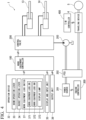
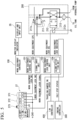
- FIGS. 4 and 5 are block diagrams showing a configuration example of a control system of the work machine according to the embodiment of the present disclosure.
- FIGS. 6 and 7 are schematic diagrams for describing an operation example of the work equipment controller according to the embodiment of the present disclosure.
- FIG. 8 is a state transition diagram showing an operation example of a work equipment controller according to the embodiment of the present disclosure.
- FIGS. 1 is a side view showing a work machine according to an embodiment of the present disclosure.
- FIG. 2 is a perspective view schematically showing the periphery of a driver's seat according to the embodiment of the present disclosure.
- FIG. 3 is a perspective view schematically showing a portion A
- FIG. 9 to 20 are schematic diagrams for describing operation examples of the work equipment controller according to the embodiment of the present disclosure.
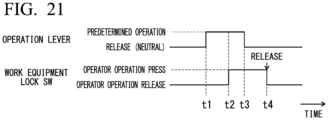
- FIG. 21 is a timing chart for describing an operation example of the work equipment controller according to the embodiment of the present disclosure.
- the same reference numerals are used for the same or corresponding components, and the description thereof will be omitted as appropriate.
- a local coordinate system is set in a work machine 1, and a positional relationship of each unit will be described with reference to the local coordinate system.
- a first axis extending in a right-left direction (vehicle width direction) of the work machine 1 will be defined as an X-axis
- a second axis extending in a front-rear direction of the work machine 1 will be defined as a Y-axis
- a third axis extending in an up-down direction of the work machine 1 will be defined as a Z-axis.
- the X-axis and the Y-axis are orthogonal to each other.
- the Y-axis and the Z-axis are orthogonal to each other.
- the Z-axis and the X-axis are orthogonal to each other.
- a +X-direction is the right direction, and a -X-direction is the left direction.
- a +Y-direction is the front direction, and a -Y-direction is the rear direction.
- a +Z-direction is the up direction, and a -Z-direction is the down direction.
- FIG. 1 shows a work machine 1 according to the present embodiment.
- the work machine 1 according to the present embodiment is a wheel loader.
- the work machine 1 will be referred to as a wheel loader 1 as appropriate.
- the wheel loader 1 has a vehicle body 2, a cab 3, a traveling device 4, and work equipment 10.
- the wheel loader 1 travels on a work place by using the traveling device 4.
- the wheel loader 1 carries out work by using the work equipment 10.
- the wheel loader 1 can use the work equipment 10 to carry out the work, such as excavation work, loading work, transport work, and snow removal work.
- the cab 3 is supported by the vehicle body 2. Inside the cab 3, a driver's seat 31 on which an operator sits, an operation device 32 to be described later, a display and input unit 35, and an output unit 36 are disposed.
- the operation device 32 includes a boom operation lever 33, a bucket operation lever 34, and a work equipment lock switch 37.
- the traveling device 4 includes, for example, a transmission, a drive shaft, a brake, and a rotatable wheel 5.
- the traveling device 4 includes, for example, a transmission that has a forward speed stage of 1 to 8 and a backward speed stage of 1 to 4. The smaller the number of the speed stage, the lower the speed.
- the wheels 5 support the vehicle body 2.
- the wheel loader 1 can travel on a road surface (or ground) RS by the traveling device 4. It should be noted that FIG. 1 shows only a front wheel 5F and a rear wheel 5R on a left side.
- the front wheel 5F may be driven by, for example, a hydraulic motor (not shown).
- the work equipment 10 is supported by vehicle body 2.
- the work equipment 10 is configured by a bucket 12 as an example of a work tool, and a movable support section 17 that changes a position and a posture of the bucket 12.
- the movable support section 17 includes a boom 11, a boom cylinder 13, a bucket cylinder 14, a bell crank 15, and a link 16.
- the boom 11 is rotatably supported with respect to the vehicle body 2, and moves in the up-down direction according to expansion and contraction of the boom cylinder 13.
- the boom cylinder 13 is an actuator that generates power for moving the boom 11, and has one end portion connected to the vehicle body 2 and the other end portion connected to the boom 11.
- the boom cylinder 13 contracts and extends.
- the boom cylinder 13 is, for example, a hydraulic cylinder.
- the bucket 12 is a container for an object such as earth, has bucket teeth 12T, and is a work tool for performing excavation of the object to be excavated such as earth or loading thereof.
- the bucket 12 is rotatably connected to the boom 11, and is rotatably connected to one end portion of the link 16.
- the other end portion of the link 16 is rotatably connected to one end portion of the bell crank 15.
- the bell crank 15 has a central portion connected to the boom 11 to be rotationally movable, and the other end portion rotatably connected to one end portion of the bucket cylinder 14.
- the other end portion of the bucket cylinder 14 is rotatably connected to the vehicle body 2.
- the bucket 12 is operated by power generated by the bucket cylinder 14.
- the bucket cylinder 14 is an actuator that generates power for moving the bucket 12.
- the bucket cylinder 14 is contracted and extended. As a result, the bucket 12 swings.
- the bucket cylinder 14 is, for example, a hydraulic cylinder.
- the bucket teeth 12T has a shape of chevron teeth, flat teeth, or the like, and is attached to an end portion of the bucket 12 to be replaceable.
- FIGS. 4 and 5 are block diagrams showing a configuration example of a control system of the wheel loader 1 according to the present embodiment.
- the wheel loader 1 includes a power source 201, a power take off (PTO) 202, a hydraulic pump 203, a control valve 200, an operation device 32, a display and input unit 35, an output unit 36, a work equipment controller 100, an engine controller 300, and a transmission (T/M) controller 400.
- PTO power take off
- T/M transmission
- the power source 201 generates a driving force for operating the work machine.
- An intemal combustion engine and an electric motor are exemplary examples of the power source.
- the power source 201 is an internal combustion engine (engine).
- the PTO 202 transmits at least a part of the driving force of the power source 201 to the hydraulic pump 203.
- the PTO 202 distributes the driving force of the power source 201 to the traveling device 4 and the hydraulic pump 203.
- the hydraulic pump 203 is driven by the power source 201, and discharges a hydraulic oil. At least a part of the hydraulic oil discharged from the hydraulic pump 203 is supplied to each of the boom cylinder 13 and the bucket cylinder 14 via the control valve 200.
- the control valve 200 receives a predetermined control signal (work equipment EPC signal) from the work equipment controller 100 and controls the flow rate, the pressure, and the direction of the hydraulic oil supplied to each of the boom cylinder 13 and the bucket cylinder 14 from the hydraulic pump 203.
- the work equipment 10 is operated by the hydraulic oil from the hydraulic pump 203.
- the boom operation lever 33 is an operation lever for operating the posture of the boom 11. In a case where the boom operation lever 33 is tilted in the rear direction, the boom 11 moves in the upward direction. In a case where the boom operation lever 33 is tilted in the front direction, the boom 11 moves in the downward direction. The movement speed is changed according to a tilt amount of the boom operation lever 33. The larger the tilt amount, the higher the speed.
- the bucket operation lever 34 is an operation lever for operating the posture of the bucket 12. In a case where the bucket operation lever 34 is tilted in the rear direction, the bucket 12 is moved in a tilt direction (a direction in which the bucket teeth 12T faces upward as shown in FIG. 1 ).
- the bucket 12 In a case where the bucket operation lever 34 is tilted in the front direction, the bucket 12 is moved in a dump direction (direction in which the bucket teeth 12T shown in FIG. 1 faces downward). The movement speed is changed according to the tilt amount of the bucket operation lever 34. The larger the tilt amount, the higher the speed.
- the boom operation lever 33 and the bucket operation lever 34 include one or a plurality of stroke sensors therein, detect the tilt amount of the operation lever, and output a detection signal (work equipment lever signal in FIG. 5 ) indicating the detection result as an analog voltage value.
- the work equipment lock switch 37 is a push button switch (push button according to the present disclosure) for setting and releasing the lock of the operation of the work equipment 10.
- the work equipment lock switch 37 is a momentary operation push button switch. That is, the work equipment lock switch 37 is turned on only while the button is being pressed by the hand or the like, and is returned to the off state in a case where the hand or the like is separated from the button.
- the work equipment lock switch 37 includes a work equipment lock switch (SW)1 (371) and a work equipment lock switch (SW)2 (372).
- the work equipment lock SW1 (371) is a normally open switch (first switch according to the present disclosure) that detects the press and release of the work equipment lock switch 37.
- the work equipment lock SW1 (371) is turned on while the button is being pressed, and is turned off in a case where the button is released.
- the work equipment lock SW2 (372) is a normally closed switch (second switch according to the present disclosure) that detects the press and release of the work equipment lock switch 37 linked to the work equipment lock SW1 (371).
- the work equipment lock SW2 (372) is turned off while the button is being pressed, and is turned on in a case where the button is released.
- the work equipment lock switch 37 includes a display lamp 373 consisting of a light emitting diode (LED).
- the display lamp 373 is controlled by the work equipment controller 100 to be turned on in a state where the work equipment 10 is not operated, that is, in a state where the operation of the work equipment 10 is locked (in the present embodiment, this state is also referred to as a state where the work equipment is set to be locked), and to be turned off in a state where the work equipment 10 can be operated, that is, in a state where the lock of the operation of the work equipment 10 is released.
- SW a state where the work equipment lock switch 37 (push button) is pressed
- OFF a state where the work equipment lock switch 37 (push button) is released
- the work equipment lock switch 37 may be simply referred to as "SW”.
- SW normality means a state in which the work equipment lock SW1 (371) and the work equipment lock SW2 (372) are normally operated.
- SW abnormality means a state in which the ground fault, power supply fault, or disconnection failure is generated in any of the work equipment lock SW1 (371) or the work equipment lock SW2 (372).
- one terminal of the work equipment lock SW1 (371) is connected to the DC power supply (24 V in the present embodiment), and the other terminal is connected to the work equipment controller 100.
- a signal line that connects the other terminal of the work equipment lock SW1 (371) to an input circuit (not shown) in the work equipment controller 100 is a first signal line, and a signal name on the first signal line is the work equipment lock SW1.
- One terminal of the work equipment lock SW2 (372) is connected to the DC power supply, and the other terminal is connected to the work equipment controller 100.
- a signal line that connects the other terminal of the work equipment lock SW2 (372) to an input circuit (not shown) in the work equipment controller 100 is a second signal line, and a signal name on the second signal line is the work equipment lock SW2.
- the first signal line and the second signal line are pulled down through a predetermined resistor in the work equipment controller 100.
- the display and input unit 35 shown in FIG. 4 is configured with a combination of an input device and a display device, an input display device such as a touch panel, and the like.
- the operator inputs, for example, a set value or the like in the control of the work equipment 10 or displays information indicating the content in a case where a failure or the like occurs, using the display and input unit 35.
- the display and input unit 35 displays predetermined information in response to the monitor display indicator signal received from the work equipment controller 100.
- the output unit 36 includes a display device, a synthetic voice, an output device of an alarm sound or a notification sound, a display lamp such as a warning lamp, and the like, and outputs predetermined information.
- the engine controller 300 shown in FIG. 4 controls the power source 201 according to an operation of an accelerator pedal (not shown) provided in the operation device 32.
- the engine controller 300 has an auto-idle stop function of automatically stopping the engine in a case where the idling state is continued for an idling time set by the operator.
- the engine controller 300 transmits an idle step status signal indicating whether or not the power source 201 is stopped by the auto-idle stop function, to the work equipment controller 100.
- the T/M controller 400 shown in FIG. 4 controls a transmission (not shown) provided in the traveling device 4 according to an operation of a shift lever (not shown) provided in the operation device 32.
- the T/M controller 400 transmits a signal (travel damper SW signal) indicating whether or not a traveling damper function is operating, a signal indicating the vehicle speed, a signal requesting the lock of the work equipment 10, and the like to the work equipment controller 100.
- the traveling damper function is a function of reducing the vibration caused by traveling by connecting the boom cylinder 13 to an accumulator (not shown) in the control valve 200 during traveling to control the pressure accumulation of the accumulator.
- the signal for requesting the lock of the work equipment 10 is generated, for example, in a case where it is necessary to give priority to the traveling side over the work of the work equipment 10 in a case where the work equipment 10 is traveling on a steep slope or the like.
- the work equipment controller 100 is formed using, for example, a field programmable gate array (FPGA) or a microcomputer that includes a processor, a main storage device, an auxiliary storage device, an input/output device, and the like.
- the work equipment controller 100 includes, as a functional configuration constituted by hardware or a combination of hardware and software such as a program, a work equipment control unit 101, a signal input unit 102, a work equipment lock control unit 103, and an alarm activation unit 104.
- the work equipment controller 100 is an example of a control device according to the present disclosure.
- the work equipment control unit 101 drives and controls the boom cylinder 13, the bucket cylinder 14, and the like by outputting a work equipment electric pressure control (EPC) signal in response to the work equipment lever signal and the like output from the operation device 32 and controlling the control valve 200.
- FIG. 5 shows a configuration of a part of the control valve 200.
- the work equipment EPC signal indicates one of the plurality of work equipment EPC signals.
- the pressure control valve 211 controls hydraulic oil supplied to the boom cylinder 13, the bucket cylinder 14, and the like by variably controlling an operation of a solenoid 211s according to the work equipment EPC signal.
- the work equipment control unit 101 determines whether or not there is an abnormality in the work equipment lever according to the work equipment lever signal or the like output by the operation device 32. In a case where it is determined that there is the abnormality, the work equipment control unit 101 stops the drive of the work equipment 10 or implements the function restriction of limiting the drive speed of the work equipment 10.
- the signal input unit 102 repeatedly inputs the work equipment lock SW1 signal and the work equipment lock SW2 signal, for example, at a predetermined cycle. That is, the signal input unit 102 inputs the work equipment lock SW1 signal from a signal line (referred to as a first signal line) connected to the normally open work equipment lock SW1 (first switch) 371 that detects the press and release of the work equipment lock switch 37, which is a momentary operation push button for setting and releasing the lock of the operation of the work equipment 10, and inputs the work equipment lock SW2 signal from a signal line (referred to as a second signal line) connected to the work equipment lock SW2 (second switch) 372 of the normally closed type linked to the work equipment lock SW1.
- a signal line referred to as a first signal line
- the normally open work equipment lock SW1 (first switch) 371 that detects the press and release of the work equipment lock switch 37, which is a momentary operation push button for setting and releasing the lock of the operation of the work equipment 10
- the work equipment controller 100 has a step of inputting a signal from the first signal line connected to the normally open first switch that detects the press and release of the momentary operation push button for setting and releasing the lock of the operation of the work equipment 10 and is connected to the first switch, and inputting the signal from the second signal line connected to the normally closed second switch linked to the first switch.
- the work equipment lock control unit 103 outputs a work equipment lock solenoid (SOL) signal in response to the work equipment lock SW1 signal, the work equipment lock SW2 signal, and the like input from the work equipment lock switch 37, and turns on or off the direction control valve 212 to block or supply the hydraulic oil supplied to the boom cylinder 13, the bucket cylinder 14, and the like.
- the work equipment lock SOL signal is turned on to apply a direct current of 24 V to a solenoid 212s of the direction control valve 212 to block the hydraulic oil
- the work equipment lock SOL signal is turned off to be the open state to supply the hydraulic oil.
- the state in which the hydraulic oil is blocked is a state in which the work equipment 10 is locked (state in which the lock is set)
- the state in which the hydraulic oil is supplied is a state in which the lock of the work equipment 10 is released.
- the work equipment lock control unit 103 In a case where information indicating that the work equipment lock switch 37 (push button) is OFF ⁇ ON ⁇ OFF is obtained from both of the first signal line and the second signal line, the work equipment lock control unit 103 altemately switches between setting and releasing the lock of the operation of the work equipment 10, and in a case where information indicating that the work equipment lock switch 37 (push button) is OFF ⁇ ON ⁇ OFF is obtained from only one of the first signal line and the second signal line, the work equipment lock control unit 103 releases the lock of the operation of the work equipment 10 only when a predetermined operation is performed on a predetermined operation device 32 of the work equipment 10 when the lock of the operation of the work equipment 10 is set.
- the predetermined operation can include, for example, an operation by a combination of predetermined operations for a plurality of operation levers included in the operation device 32.
- the predetermined operation can include, for example, an operation of simultaneously performing an operation of driving the bucket 12 at a predetermined speed or more in the dump direction with respect to the bucket operation lever 34 for driving the bucket 12 in the dump direction and the tilt direction and an operation of driving the boom 11 at the predetermined speed or more in the lowering direction with respect to the boom operation lever 33 for driving the boom 11 in the up-down direction.
- the work equipment controller 100 has a step of altemately switching the setting and the release of the lock of the operation of the work equipment 10, and in a case where information indicating that the push button is OFF ⁇ ON - OFF is obtained from only one of the first signal line and the second signal line, the work equipment controller 100 has a step of releasing the lock of the operation of the work equipment 10 only in a case where a predetermined operation is performed on a predetermined operation device of the work equipment 10 when the lock of the operation of the work equipment 10 is set.
- the work equipment lock control unit 103 sets the lock of the work equipment 10 when the work equipment 10 is controlled to be in a stop state.
- the lock of the work equipment 10 is automatically locked (set to the lock) from the release without the operation of the operator, the lock is set when the work equipment 10 is controlled to be in the stop state. According to this configuration, it is possible to prevent the work equipment 10 from being suddenly stopped when the automatic locking is performed, and for example, it is possible to prevent a large forward fall or an impact from being generated.
- the alarm activation unit 104 reports that fact to the display and input unit 35, the output unit 36, and the like.
- FIG. 6 shows a correspondence relationship between a combination of a state of "Hi” (high level) or “Lo” (low level) of the work equipment lock SW1 signal and a state of "Hi” or “Lo” of the work equipment lock SW2 signal, and results of the operation determination and the abnormality determination.
- one of the work equipment lock SW1 signal and the work equipment lock SW2 signal is "Hi"
- the other is "Lo”.
- FIG. 7 shows the classification of the operation states based on the work equipment lock SW1 signal and the work equipment lock SW2 signal as the operation states A to E.
- FIG. 7 shows a correspondence relationship among the normal or abnormal states, whether or not it is in a normal state and the content of the abnormality when the state is the abnormal state, a time-series signal (the work equipment lock SW1 signal and the work equipment lock SW2 signal) when the operator performs the normal ON/OFF switching operation (the operation of pressing and releasing the work equipment lock switch 37), a state recognition of the work equipment lock switch 37 of the work equipment controller 100, the presence or absence of the error report by the alarm activation unit 104, and the processing contents of whether or not the work equipment lock control unit 103 executes the switching between the setting and the release of the lock state, in the operation states A to E.
- the operation state A is an SW normality and is normal, and with respect to "release” ⁇ "press” ⁇ “release” of the SW, the work equipment lock SW1 signal of normally open (N.O.) is set to “Lo” ⁇ “Hi” ⁇ “Lo”, and the work equipment lock SW2 signal of normally closed (N.C.) is set to “Hi” - “Lo” ⁇ “Hi”.
- the state recognition is "OFF” ⁇ "ON” ⁇ "OFF”.
- the actual signal is "abnormal Hi” or "abnormal Lo” for a short time. In this case, the error report is not performed, and switching between the release and setting of the lock is executed.
- the operation state B is an SW abnormality (abnormality at the time of press), and the content of the abnormality is disconnection or a ground failure of the normally open work equipment lock SW1 (371).
- the work equipment lock SW1 signal of normal open (N.O.) is fixed to “Lo”
- the work equipment lock SW2 signal of normal close (N.C.) is set to "Hi” ⁇ "Lo” ⁇ “Hi”.
- the state recognition is "OFF” ⁇ "abnormal Lo” ⁇ "OFF”. In this case, the error report is performed, and the switching between the release and setting of the lock is executed.
- the abnormality at the time of press is an abnormality that can be detected in a state where the work equipment lock switch 37 is pressed.
- the abnormality at the time of release is an abnormality that can be detected in a state where the work equipment lock switch 37 is released.
- the operation state C is an SW abnormality (abnormality at the time of release), and the content of the abnormality is a power supply failure of the normally open work equipment lock SW1 (371).
- the work equipment lock SW1 signal of normal open (N.O.) is fixed to “Hi”
- the work equipment lock SW2 signal of normal close (N.C.) is set to "Hi” ⁇ "Lo” ⁇ "Hi”.
- the state recognition is "abnormal Hi” ⁇ "ON” ⁇ "abnormal Hi”. In this case, the error report is performed, and the switching between the release and setting of the lock is executed.
- the operation state D is the SW abnormality (abnormality at the time of release), and the content of the abnormality is a ground fault or disconnection failure of the normally closed work equipment lock SW2 (372).
- the work equipment lock SW1 signal of normal open (N.O.) is set to “Lo” ⁇ “Hi” ⁇ “Lo”
- the work equipment lock SW2 signal of normal close (N.C.) is fixed to "Lo”.
- the state recognition is "abnormal Lo” - “ON” ⁇ "abnormal Lo”. In this case, the error report is performed, and the switching between the release and setting of the lock is executed.
- the operation state E is the SW abnormality (abnormality at the time of press), and the content of the abnormality is a power supply failure of the normally closed work equipment lock SW2 (372).
- the work equipment lock SW1 signal of normal open (N.O.) is “Lo” ⁇ “Hi” ⁇ “Lo”
- the work equipment lock SW2 signal of normal close (N.C.) is fixed to "Hi”.
- the state recognition is "OFF” ⁇ "abnormal Hi” ⁇ "OFF”. In this case, the error report is performed, and the switching between the release and setting of the lock is executed.
- condition 1 In a case where a condition 1 is established in the state S1, the state transitions to the state S2. In a case where a condition 3 is established in the state S1, the state transitions to the state S3. In a case where a condition 2 is established in the state S2, the state transitions to the state S1. In a case where a condition 6 is established in the state S2, the state transitions to a state S2a. In a case where a condition 7 is established in the state S2a, the state transitions to the state S1.
- the condition 1 is established in which the switching determination is established (C11), all levers of the work equipment are neutral (C12), and there is no work equipment EPC hot short error (C13).
- the switching determination is established (C11) in a case where the last transition of "OFF" ⁇ "ON” continued for 0.05 [sec] or more ⁇ "OFF" of the work equipment lock switch 37 of the switching determination corresponding to the state S1 ⁇ lock ⁇ release> is established, as shown in FIG. 16 .
- there is no work equipment EPC hot short error (C13) means that the output terminal of the work equipment EPC signal does not have a power supply failure or a short circuit failure.
- the condition 1 is a logical product (AND) of the conditions C11 to C13.
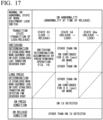
- the switching determination corresponding to the state S4 ⁇ release ⁇ lock> shown in FIG. 17 is established in a case where the last transition of other than "ON” ⁇ "ON” continued for 0.05 [sec] or more ⁇ other than "ON” of the work equipment lock switch 37 is established.
- the switching determination corresponding to the state S6 ⁇ release ⁇ lock> shown in FIG. 18 is established in a case where the last transition of "OFF" ⁇ other than “OFF” continued for 0.05 [sec] or more ⁇ "OFF” of the work equipment lock switch 37 is established.
Landscapes
- Engineering & Computer Science (AREA)
- Mining & Mineral Resources (AREA)
- Civil Engineering (AREA)
- General Engineering & Computer Science (AREA)
- Structural Engineering (AREA)
- Mechanical Engineering (AREA)
- Operation Control Of Excavators (AREA)
- Component Parts Of Construction Machinery (AREA)
Applications Claiming Priority (2)
| Application Number | Priority Date | Filing Date | Title |
|---|---|---|---|
| JP2022137856A JP2024033930A (ja) | 2022-08-31 | 2022-08-31 | 制御装置、制御方法および作業機械 |
| PCT/JP2023/024646 WO2024048063A1 (ja) | 2022-08-31 | 2023-07-03 | 制御装置、制御方法および作業機械 |
Publications (2)
| Publication Number | Publication Date |
|---|---|
| EP4495334A1 true EP4495334A1 (de) | 2025-01-22 |
| EP4495334A4 EP4495334A4 (de) | 2026-04-08 |
Family
ID=90099517
Family Applications (1)
| Application Number | Title | Priority Date | Filing Date |
|---|---|---|---|
| EP23859833.8A Pending EP4495334A4 (de) | 2022-08-31 | 2023-07-03 | Steuerungsvorrichtung, steuerungsverfahren und arbeitsmaschine |
Country Status (4)
| Country | Link |
|---|---|
| US (1) | US20250230626A1 (de) |
| EP (1) | EP4495334A4 (de) |
| JP (1) | JP2024033930A (de) |
| WO (1) | WO2024048063A1 (de) |
Family Cites Families (5)
| Publication number | Priority date | Publication date | Assignee | Title |
|---|---|---|---|---|
| JP2000344466A (ja) * | 1999-06-07 | 2000-12-12 | Tadano Ltd | 作業車の操作装置 |
| JP4632970B2 (ja) * | 2005-03-04 | 2011-02-16 | 日立建機株式会社 | 作業機械の安全装置および作業機械のサービスシステム |
| JP6966224B2 (ja) * | 2017-06-01 | 2021-11-10 | 株式会社日立建機ティエラ | 建設機械 |
| WO2021025172A1 (ja) * | 2019-08-08 | 2021-02-11 | 住友建機株式会社 | ショベル |
| JP7668001B2 (ja) | 2021-03-09 | 2025-04-24 | 国立大学法人東京科学大学 | テラヘルツ発振器 |
-
2022
- 2022-08-31 JP JP2022137856A patent/JP2024033930A/ja active Pending
-
2023
- 2023-07-03 WO PCT/JP2023/024646 patent/WO2024048063A1/ja not_active Ceased
- 2023-07-03 US US18/855,806 patent/US20250230626A1/en active Pending
- 2023-07-03 EP EP23859833.8A patent/EP4495334A4/de active Pending
Also Published As
| Publication number | Publication date |
|---|---|
| EP4495334A4 (de) | 2026-04-08 |
| US20250230626A1 (en) | 2025-07-17 |
| WO2024048063A1 (ja) | 2024-03-07 |
| JP2024033930A (ja) | 2024-03-13 |
Similar Documents
| Publication | Publication Date | Title |
|---|---|---|
| EP2208630B1 (de) | Pedalblockierungssteuerung für ein nutzfahrzeug | |
| US8364358B2 (en) | Vehicle control unit and vehicle equipped with the same | |
| KR101433801B1 (ko) | 작업 차량 및 작업 차량의 제어 방법 | |
| US20240026647A1 (en) | Control system for work machine, control method for work machine, and work machine | |
| KR101654117B1 (ko) | 작업 차량 및 작업 차량의 제어 방법 | |
| CN101389504A (zh) | 具有操作者存在检测策略的工程机械 | |
| EP3686072B1 (de) | Verfahren zum betreiben einer bremsanlage einer arbeitsmaschine und bremsanlage für eine arbeitsmaschine | |
| WO2009107255A1 (ja) | 車両制御ユニット及び該ユニットを搭載した車両 | |
| EP2933385A2 (de) | Fahrzeug mit drehbarem sitz | |
| US20050222733A1 (en) | Enabling system for an implement controller | |
| US8924115B2 (en) | System and method for controlling a brake system | |
| JP4271685B2 (ja) | 作業車両及び作業車両のエンジン再始動制御方法 | |
| EP4495334A1 (de) | Steuerungsvorrichtung, steuerungsverfahren und arbeitsmaschine | |
| US8820463B2 (en) | Safety control systems and methods for heavy equipment | |
| EP4502298A1 (de) | Steuerungsvorrichtung, steuerungsverfahren und arbeitsmaschine | |
| EP2202110B1 (de) | Pedalblockierungssteuerung für ein nutzfahrzeug | |
| EP4502299A1 (de) | Steuerungsvorrichtung, steuerungsverfahren und arbeitsmaschine | |
| JP4733539B2 (ja) | 走行車両のリバーサ用アクチュエータの復帰方法 | |
| CN116867944B (zh) | 工程机械的控制系统、工程机械的控制方法、及工程机械 | |
| JPH0473331A (ja) | 油圧駆動車両の原動機回転数制御装置 | |
| JPH0726905Y2 (ja) | 作業車輌における制御装置 | |
| CN117881859A (zh) | 工程机械 | |
| JPH02147732A (ja) | 建設機械の自動変速装置 |
Legal Events
| Date | Code | Title | Description |
|---|---|---|---|
| STAA | Information on the status of an ep patent application or granted ep patent |
Free format text: STATUS: THE INTERNATIONAL PUBLICATION HAS BEEN MADE |
|
| PUAI | Public reference made under article 153(3) epc to a published international application that has entered the european phase |
Free format text: ORIGINAL CODE: 0009012 |
|
| STAA | Information on the status of an ep patent application or granted ep patent |
Free format text: STATUS: REQUEST FOR EXAMINATION WAS MADE |
|
| 17P | Request for examination filed |
Effective date: 20241015 |
|
| AK | Designated contracting states |
Kind code of ref document: A1 Designated state(s): AL AT BE BG CH CY CZ DE DK EE ES FI FR GB GR HR HU IE IS IT LI LT LU LV MC ME MK MT NL NO PL PT RO RS SE SI SK SM TR |
|
| DAV | Request for validation of the european patent (deleted) | ||
| DAX | Request for extension of the european patent (deleted) | ||
| A4 | Supplementary search report drawn up and despatched |
Effective date: 20260305 |
|
| RIC1 | Information provided on ipc code assigned before grant |
Ipc: E02F 9/00 20060101AFI20260227BHEP Ipc: E02F 9/20 20060101ALI20260227BHEP Ipc: E02F 9/24 20060101ALI20260227BHEP |