EP4495241A1 - Chemically-modified oligonucleotide having rnai activity - Google Patents
Chemically-modified oligonucleotide having rnai activity Download PDFInfo
- Publication number
- EP4495241A1 EP4495241A1 EP23770816.9A EP23770816A EP4495241A1 EP 4495241 A1 EP4495241 A1 EP 4495241A1 EP 23770816 A EP23770816 A EP 23770816A EP 4495241 A1 EP4495241 A1 EP 4495241A1
- Authority
- EP
- European Patent Office
- Prior art keywords
- rna
- oligonucleotide
- nucleoside
- ome
- nucleosides
- Prior art date
- Legal status (The legal status is an assumption and is not a legal conclusion. Google has not performed a legal analysis and makes no representation as to the accuracy of the status listed.)
- Pending
Links
Images





Classifications
-
- A—HUMAN NECESSITIES
- A61—MEDICAL OR VETERINARY SCIENCE; HYGIENE
- A61P—SPECIFIC THERAPEUTIC ACTIVITY OF CHEMICAL COMPOUNDS OR MEDICINAL PREPARATIONS
- A61P43/00—Drugs for specific purposes, not provided for in groups A61P1/00-A61P41/00
-
- C—CHEMISTRY; METALLURGY
- C12—BIOCHEMISTRY; BEER; SPIRITS; WINE; VINEGAR; MICROBIOLOGY; ENZYMOLOGY; MUTATION OR GENETIC ENGINEERING
- C12N—MICROORGANISMS OR ENZYMES; COMPOSITIONS THEREOF; PROPAGATING, PRESERVING, OR MAINTAINING MICROORGANISMS; MUTATION OR GENETIC ENGINEERING; CULTURE MEDIA
- C12N15/00—Mutation or genetic engineering; DNA or RNA concerning genetic engineering, vectors, e.g. plasmids, or their isolation, preparation or purification; Use of hosts therefor
- C12N15/09—Recombinant DNA-technology
- C12N15/11—DNA or RNA fragments; Modified forms thereof; Non-coding nucleic acids having a biological activity
- C12N15/113—Non-coding nucleic acids modulating the expression of genes, e.g. antisense oligonucleotides; Antisense DNA or RNA; Triplex- forming oligonucleotides; Catalytic nucleic acids, e.g. ribozymes; Nucleic acids used in co-suppression or gene silencing
- C12N15/1138—Non-coding nucleic acids modulating the expression of genes, e.g. antisense oligonucleotides; Antisense DNA or RNA; Triplex- forming oligonucleotides; Catalytic nucleic acids, e.g. ribozymes; Nucleic acids used in co-suppression or gene silencing against receptors or cell surface proteins
-
- A—HUMAN NECESSITIES
- A61—MEDICAL OR VETERINARY SCIENCE; HYGIENE
- A61K—PREPARATIONS FOR MEDICAL, DENTAL OR TOILETRY PURPOSES
- A61K31/00—Medicinal preparations containing organic active ingredients
- A61K31/70—Carbohydrates; Sugars; Derivatives thereof
- A61K31/7088—Compounds having three or more nucleosides or nucleotides
- A61K31/712—Nucleic acids or oligonucleotides having modified sugars, i.e. other than ribose or 2'-deoxyribose
-
- A—HUMAN NECESSITIES
- A61—MEDICAL OR VETERINARY SCIENCE; HYGIENE
- A61K—PREPARATIONS FOR MEDICAL, DENTAL OR TOILETRY PURPOSES
- A61K31/00—Medicinal preparations containing organic active ingredients
- A61K31/70—Carbohydrates; Sugars; Derivatives thereof
- A61K31/7088—Compounds having three or more nucleosides or nucleotides
- A61K31/7125—Nucleic acids or oligonucleotides having modified internucleoside linkage, i.e. other than 3'-5' phosphodiesters
-
- A—HUMAN NECESSITIES
- A61—MEDICAL OR VETERINARY SCIENCE; HYGIENE
- A61K—PREPARATIONS FOR MEDICAL, DENTAL OR TOILETRY PURPOSES
- A61K31/00—Medicinal preparations containing organic active ingredients
- A61K31/70—Carbohydrates; Sugars; Derivatives thereof
- A61K31/7088—Compounds having three or more nucleosides or nucleotides
- A61K31/713—Double-stranded nucleic acids or oligonucleotides
-
- A—HUMAN NECESSITIES
- A61—MEDICAL OR VETERINARY SCIENCE; HYGIENE
- A61K—PREPARATIONS FOR MEDICAL, DENTAL OR TOILETRY PURPOSES
- A61K47/00—Medicinal preparations characterised by the non-active ingredients used, e.g. carriers or inert additives; Targeting or modifying agents chemically bound to the active ingredient
- A61K47/50—Medicinal preparations characterised by the non-active ingredients used, e.g. carriers or inert additives; Targeting or modifying agents chemically bound to the active ingredient the non-active ingredient being chemically bound to the active ingredient, e.g. polymer-drug conjugates
- A61K47/51—Medicinal preparations characterised by the non-active ingredients used, e.g. carriers or inert additives; Targeting or modifying agents chemically bound to the active ingredient the non-active ingredient being chemically bound to the active ingredient, e.g. polymer-drug conjugates the non-active ingredient being a modifying agent
- A61K47/54—Medicinal preparations characterised by the non-active ingredients used, e.g. carriers or inert additives; Targeting or modifying agents chemically bound to the active ingredient the non-active ingredient being chemically bound to the active ingredient, e.g. polymer-drug conjugates the non-active ingredient being a modifying agent the modifying agent being an organic compound
- A61K47/549—Sugars, nucleosides, nucleotides or nucleic acids
-
- C—CHEMISTRY; METALLURGY
- C12—BIOCHEMISTRY; BEER; SPIRITS; WINE; VINEGAR; MICROBIOLOGY; ENZYMOLOGY; MUTATION OR GENETIC ENGINEERING
- C12N—MICROORGANISMS OR ENZYMES; COMPOSITIONS THEREOF; PROPAGATING, PRESERVING, OR MAINTAINING MICROORGANISMS; MUTATION OR GENETIC ENGINEERING; CULTURE MEDIA
- C12N15/00—Mutation or genetic engineering; DNA or RNA concerning genetic engineering, vectors, e.g. plasmids, or their isolation, preparation or purification; Use of hosts therefor
- C12N15/09—Recombinant DNA-technology
- C12N15/11—DNA or RNA fragments; Modified forms thereof; Non-coding nucleic acids having a biological activity
- C12N15/113—Non-coding nucleic acids modulating the expression of genes, e.g. antisense oligonucleotides; Antisense DNA or RNA; Triplex- forming oligonucleotides; Catalytic nucleic acids, e.g. ribozymes; Nucleic acids used in co-suppression or gene silencing
-
- C—CHEMISTRY; METALLURGY
- C12—BIOCHEMISTRY; BEER; SPIRITS; WINE; VINEGAR; MICROBIOLOGY; ENZYMOLOGY; MUTATION OR GENETIC ENGINEERING
- C12N—MICROORGANISMS OR ENZYMES; COMPOSITIONS THEREOF; PROPAGATING, PRESERVING, OR MAINTAINING MICROORGANISMS; MUTATION OR GENETIC ENGINEERING; CULTURE MEDIA
- C12N2310/00—Structure or type of the nucleic acid
- C12N2310/10—Type of nucleic acid
- C12N2310/14—Type of nucleic acid interfering nucleic acids [NA]
-
- C—CHEMISTRY; METALLURGY
- C12—BIOCHEMISTRY; BEER; SPIRITS; WINE; VINEGAR; MICROBIOLOGY; ENZYMOLOGY; MUTATION OR GENETIC ENGINEERING
- C12N—MICROORGANISMS OR ENZYMES; COMPOSITIONS THEREOF; PROPAGATING, PRESERVING, OR MAINTAINING MICROORGANISMS; MUTATION OR GENETIC ENGINEERING; CULTURE MEDIA
- C12N2310/00—Structure or type of the nucleic acid
- C12N2310/30—Chemical structure
- C12N2310/31—Chemical structure of the backbone
- C12N2310/315—Phosphorothioates
-
- C—CHEMISTRY; METALLURGY
- C12—BIOCHEMISTRY; BEER; SPIRITS; WINE; VINEGAR; MICROBIOLOGY; ENZYMOLOGY; MUTATION OR GENETIC ENGINEERING
- C12N—MICROORGANISMS OR ENZYMES; COMPOSITIONS THEREOF; PROPAGATING, PRESERVING, OR MAINTAINING MICROORGANISMS; MUTATION OR GENETIC ENGINEERING; CULTURE MEDIA
- C12N2310/00—Structure or type of the nucleic acid
- C12N2310/30—Chemical structure
- C12N2310/32—Chemical structure of the sugar
- C12N2310/321—2'-O-R Modification
-
- C—CHEMISTRY; METALLURGY
- C12—BIOCHEMISTRY; BEER; SPIRITS; WINE; VINEGAR; MICROBIOLOGY; ENZYMOLOGY; MUTATION OR GENETIC ENGINEERING
- C12N—MICROORGANISMS OR ENZYMES; COMPOSITIONS THEREOF; PROPAGATING, PRESERVING, OR MAINTAINING MICROORGANISMS; MUTATION OR GENETIC ENGINEERING; CULTURE MEDIA
- C12N2310/00—Structure or type of the nucleic acid
- C12N2310/30—Chemical structure
- C12N2310/32—Chemical structure of the sugar
- C12N2310/322—2'-R Modification
-
- C—CHEMISTRY; METALLURGY
- C12—BIOCHEMISTRY; BEER; SPIRITS; WINE; VINEGAR; MICROBIOLOGY; ENZYMOLOGY; MUTATION OR GENETIC ENGINEERING
- C12N—MICROORGANISMS OR ENZYMES; COMPOSITIONS THEREOF; PROPAGATING, PRESERVING, OR MAINTAINING MICROORGANISMS; MUTATION OR GENETIC ENGINEERING; CULTURE MEDIA
- C12N2310/00—Structure or type of the nucleic acid
- C12N2310/30—Chemical structure
- C12N2310/32—Chemical structure of the sugar
- C12N2310/323—Chemical structure of the sugar modified ring structure
- C12N2310/3231—Chemical structure of the sugar modified ring structure having an additional ring, e.g. LNA, ENA
-
- C—CHEMISTRY; METALLURGY
- C12—BIOCHEMISTRY; BEER; SPIRITS; WINE; VINEGAR; MICROBIOLOGY; ENZYMOLOGY; MUTATION OR GENETIC ENGINEERING
- C12N—MICROORGANISMS OR ENZYMES; COMPOSITIONS THEREOF; PROPAGATING, PRESERVING, OR MAINTAINING MICROORGANISMS; MUTATION OR GENETIC ENGINEERING; CULTURE MEDIA
- C12N2310/00—Structure or type of the nucleic acid
- C12N2310/30—Chemical structure
- C12N2310/35—Nature of the modification
- C12N2310/351—Conjugate
Definitions
- the present invention relates to an oligonucleotide comprising a chemically modified nucleoside having a RNA interfering action and/or a gene expression suppressing action, use of the oligonucleotide, a method for suppressing gene expression using the oligonucleotide, a medical drug comprising the oligonucleotide, and the like.
- Methods for inhibiting expression of a target gene in cells, tissues or individuals include methods in which double-stranded RNA is introduced into the cells, tissues or individuals.
- the introduction of double-stranded RNA degrades mRNA homologous to the sequence of the double-stranded RNA, and inhibits expression of a target gene. This effect is called "RNA interference" or "RNAi”.
- Double-stranded RNA having an overhang with two nucleotides at the 3'-terminus, and a sense strand and an antisense strand each having 21 nucleotides small interfering RNA: siRNA has been reported to have a RNA interfering action in cultured cells of a vertebrate (see, for example, Non-Patent Literature 1).
- siRNA is useful for identification of a gene function, screening of a cell strain suitable for production of a useful substance, control of a gene involved in disease, and the like, but is easily degraded by a ribonuclease, and therefore has the disadvantage that it is difficult to maintain activity in the body and the cost for synthesis is high. For this reason, various chemical modifications have been attempted for development of an oligonucleotide which has high stability against a ribonuclease, can be produced at low cost, and retains RNAi activity.
- a phosphorothioate (PS) bond obtained by replacing a non-bridging oxygen atom of a phosphate group of a phosphodiester bond in an oligonucleotide by a sulfur atom is known to have resistance to a nuclease.
- PS phosphorothioate
- Non-Patent Literatures 4, 5, 6 and 7 replacement of all nucleotides in one or both of the sense strand and the antisense strand of siRNA by 2'-O-methylnucleotides has been reported to reduce or completely eliminate RNAi activity (see, for example, Non-Patent Literatures 4, 5, 6 and 7). It has been reported that introduction of three 2'-O-methylnucleotides in a row does not decrease the activity when introduced into the sense strand, but decreases the activity when introduced into the antisense strand, and particularly significantly decreases the activity when introduced at the 5'-terminus of the sense strand (see, for example, Non-Patent Literature 8).
- ENA (2'-O,4'-C-ethylene-bridged nucleic acid) is a modified nucleic acid having stability against a nuclease, but it has been reported that introduction of ENA into the two nucleotides of an overhang site at the 3'-terminus of one or both of the sense strand and the antisense strand of siRNA decreases the RNAi activity (see, for example, Non-Patent Literature 10).
- siRNA in which a plurality of modified nucleic acids are combined. For example, it has been reported that a 2'-O-methylnucleotide and 2'-F are introduced at every other nucleotide in the sense strand and antisense strand of siRNA, and RNAi activity equivalent to or higher than that of unmodified siRNA can be obtained, and relatively stably maintained in the serum (see, for example, Non-Patent Literature 11).
- Double-stranded oligonucleotides in which DNA, 2'-O-methyl RNA and 2'-F are combined, in particular, siRNA in which the 14th residue from the 5'-terminus in the antisense strand is 2'-F, have been reported (see, for example, Patent Literatures 1 and 2).
- An object of the present invention is to provide an oligonucleotide having a novel chemical modification pattern which has a RNA interfering action and/or a gene expression suppressing action (these actions are sometimes referred to as a knockdown action).
- a knockdown action there have been many reports of possible reduction and elimination of RNA interfering action in siRNA with a modified nucleic acid. For this reason, an oligonucleotide which has a novel modification pattern, and is stable and pharmacologically active in the body to the extent of being applied to a pharmaceutical product has been desired.
- the present inventors have conducted diligent studies for obtaining an oligonucleotide which has a RNA interfering action and is stable against a ribonuclease. Consequently, the present inventors found that an oligonucleotide having an oligonucleotide unit in which DNA, LNA, ENA, 2'-O-methyl RNA, 2'-F RNA and 3'-O-methyl RNA are appropriately combined can solve the above-described problem. In this way, the present invention has been completed.
- the present invention provides the following.
- the present invention provides an oligonucleotide with a novel modification pattern which has a sustained RNA interfering action and/or a gene expression suppressing action in an animal body.
- the modification pattern has been applied to oligonucleotides for a plurality of target sequences, and confirmed to exhibit the same effect.
- it is possible to analyze the functions of various genes using the oligonucleotide, and to provide pharmaceutical products for various diseases which contain the oligonucleotide.
- the "target gene” is not limited as long as it is RNA in cells, tissues or individuals into which the target gene is introduced (hereinafter, sometimes referred to as a "body to be subjected to introduction”). It may be mRNA that is translated into protein, or non-coding RNA that is not translated into protein. Examples of the non-coding RNA include functional RNA, for example, non-translated regions of mRNA, tRNA, rRNA, mRNA-like non-coding RNA (mRNA-type ncRNA), long non-coding RNA (long ncRNA), small nuclear RNA (snRNA), small nucleolar RNA (snoRNA), and micro-RNA (miRNA).
- mRNA-type ncRNA mRNA-type ncRNA
- long non-coding RNA long non-coding RNA
- snRNA small nuclear RNA
- snoRNA small nucleolar RNA
- miRNA micro-RNA
- the target gene may be a gene that is inherent in a body to be subjected to introduction of the gene, or an exogeneous gene that is introduced by a method such as gene introduction.
- the target gene may be a gene that is present on a chromosome, or a gene that is outside a chromosome.
- the exogeneous gene include, but are not limited to, those derived from viruses, bacteria, fungi or protozoans that can be transmitted to a body to be subjected to introduction.
- the function of the gene may be known or unknown.
- Examples of the target gene can include genes whose expression is specifically increased and/or which are specifically varied in patients having a specific disease.
- the disease can include central nerve diseases (for example, Alzheimer disease, dementia, and eating disorders), inflammatory disease (for example, allergies, rheumatism, osteoarthritis, and lupus erythematosus), cardiovascular diseases (for example, hypertension, cardiac enlargement, angina, arteriosclerosis, and hypercholesterolemia), cancers (for example, non-small cell lung cancer, ovarian cancer, prostate cancer, stomach cancer, pancreas cancer, liver cancer, bladder cancer, breast cancer, uterine cervix cancer, bowel cancer, colon cancer, and rectum cancer), respiratory diseases (for example, pneumonia, bronchitis, asthma, and chronic obstructive lung disease), diabetes, diabetic retinopathy, diabetic nephropathy, anemia (for example, anemia associated with chronic, and sideroachrestic iron-deficiency anemia), age-related macular degeneration, immune system diseases
- Examples of a gene responsible for the diseases can include, but are not limited to, kinesin spindle protein (KSP), vascular endothelial growth factor, (VEGF), transthyretin (TTR), proprotein convertase subtilisn/kexin type 9(PCSK9), polo-like kinase(PLK), ApoB-100, ribonucleotide reductase M2 subunit (RRM2), clusterin, heat shock protein 27 (Hsp27), survivin, eukaryotic initiation factor-4E (eIF-4E), intercellular adhesion molecule 1(ICAM-1), alpha subunit of the interleukin 4 receptor (IL-4R-alpha), Factor XI, Factor VII, N-ras, H-ras, K-ras, bcl-2, bcl-xL, Her-1, Her-2, Her-3, Her-4, MDR-1, human ⁇ -catenin genes, DDX3 (D
- nucleic acid or nucleic acid molecule is a general term for nucleosides, nucleotides, oligonucleotides and polynucleotides.
- nucleoside means a chemical structure moiety in which a base moiety important for genetic information and a sugar moiety important for physicochemical properties of the molecule are bound.
- nucleotide refers to a compound in which the hydroxyl group at the 3'-position (2'-position in the case of modification at the 3'-position) of a sugar moiety of a nucleoside forms an ester with a phosphate group.
- oligonucleotide refers to an oligomer having a structure in which there are two or more nucleotides, and the phosphate group moiety of one of the nucleotides and the hydroxyl group at the 5'-position of the sugar moiety of another nucleotide are bound (phosphodiester bond).
- residues at the 3'-position (2'-position in the case of a nucleotide modified at the 3'-position) of the nucleotide at the 3'-terminus and/or the 5'-position of the nucleotide at the 5'-terminus may be hydroxyl groups or phosphate groups, and these groups may be chemically modified.
- the phosphodiester bond between the nucleosides may be chemically modified.
- the term "oligonucleotide” and the term “polynucleotide” are used interchangeably with each other.
- the nucleobase is adenine (A), guanine (G), cytosine (C), uracil (U) or thymine (T), A and U or T, G and C, respectively, forms Watson-Crick base pairs through hydrogen bonding, and the relationship between bases which form a base pair is referred to as "complementary".
- Each base moiety may be chemically modified, and the modified base may be identical in its base pair forming ability to the original base.
- typical modified bases 5-methylcytosine (5C), 5-methyluracil (5U) and the like are known.
- 5U is identical in structure to T. In the sequence listing attached to the present specification, 5C is represented as C, and 5U is represented as T or U.
- symbols for bases may be used in the notation for nucleic acids.
- symbols for sugar moieties will be described in the following sections where various nucleosides are described.
- the term "modification pattern" of the oligonucleotide means an arrangement of modification forms of sugar moieties of nucleosides forming an oligonucleotide, independently of the arrangement of bases. If a specific indication is given, this term means a modification pattern further combined with an inter-nucleoside bond form. Since the structure of the sugar moiety and the inter-nucleoside bond are elements that do not depend on the target sequence, and influence the stability of molecules, and bond performance associated with the stability, a modification pattern confirmed to have an action and effect on a target sequence is likely to exhibit the same action and effect on another target sequence (see, for example, Mol Ther. (2016) 26: 708-717 ).
- naturally nucleoside refers to a 2'-deoxynucleoside or a ribonucleoside.
- the 2'-deoxynucleoside also referred to as "DNA”; the symbol representing a sugar moiety is (D), and may be expressed by a lowercase mark for a base moiety
- corresponding to each base has a structure represented by one of the following formulae.
- 2'-deoxyadenosine may be represented as A(D) or a
- 2'-deoxyguanosine may be represented as G(D) or g
- 2'-deoxycytidine may be represented as C(D) or c
- thymidine may be represented as T(D) or t
- 2'-deoxy-5-methylcytidine may be represented as 5C(D) or 5c
- 2'-deoxyuridine may be represented as U(D) or u.
- a 2-deoxynucleoside whose base is not specified may be represented as N(D). wherein the broken line indicates a point of attachment.
- RNA The ribonucleoside (also referred to as "RNA"; the symbol representing a sugar moiety is (R), and may be represented as a capital indicating a base moiety) corresponding to each base has a structure represented by one of the following formulae.
- Adenosine may be represented as A(R) or A
- guanosine may be represented as G(R) or G
- cytidine may be represented as C(R) or C
- uridine may be represented as U(R) or U.
- a ribonucleoside whose base is not specified may be represented as N(R). wherein the broken line indicates a point of attachment.
- modified nucleoside and “modified nucleotide” mean a nucleoside or a nucleotide containing at least one chemically modified structure in the base moiety, the sugar moiety or the phosphodiester moiety of a natural nucleoside.
- the term "phosphodiester bond that may be chemically modified” means a phosphodiester bond used as a natural inter-nucleoside bond, or a chemically modified phosphodiester bond.
- the natural inter-nucleoside bond is a phosphodiester bond represented by the following formula (P), and is shown with no character and symbol between nucleosides in the display of a nucleotide sequence.
- the term "chemically modified phosphodiester bond” means a bond form in which the phosphorus atom contained in the phosphodiester bond is chemically modified.
- Examples of the chemically modified phosphodiester bond include a phosphorothioate bond represented by the following formula (PS), a phosphoramidate bond that is a modified bond in which a nitrogen atom is added to a phosphorus atom, an alkyl phosphonate bond that is a modified bond in which a replaceable alkyl group is added to a phosphorus atom (for example, a methyl phosphonate bond when the alkyl group is a methyl group), and a phosphotriester bond that is a modified bond in which a replaceable alkyl group is added to an oxygen atom of a noncovalent bond of a phosphate group.
- PS phosphorothioate bond represented by the following formula (PS)
- a phosphoramidate bond that is a modified bond in which a nitrogen atom is added to a phosphorus atom
- an alkyl phosphonate bond that is a modified bond in which a replaceable alkyl group is added to a
- ⁇ is shown between nucleosides in the display of a nucleotide sequence.
- the broken line indicates a point of attachment
- the point of attachment on one side represents an ester bond formed with the oxygen atom at the 3'-hydroxyl group (oxygen atom at the 2'-position in the case of a nucleoside modified at the 3'-position) of a 5' adjacent nucleoside, or the adjacent structural unit
- the point of attachment on the other side represents an ester bond formed with the oxygen atom of the 5'-hydroxyl group of a 3' adjacent nucleoside, or the structural unit.
- sugar-modified nucleoside refers to a nucleoside in which the sugar moiety of the nucleoside is modified.
- the sugar-modified nucleoside includes all forms of sugar modification that are known in the technical field to which the present invention belongs. Examples of sugar-modified nucleosides include 2'-modified nucleosides, 3'-modified nucleosides, 4'-thio-modified nucleosides, 4'-thio-2'-modified nucleosides, and 2'-O,4'-C-bridged modified nucleosides.
- sugar modifications are 2'-O-alkylation (methylation, ethylation, propylation, isopropylation, butylation and the like), 2'-O-alkoxyalkylation (methoxyethylation, methoxypropylation, methoxybutylation and the like), 2'-halogenation (chlorination, fluorination and the like), 3'-O-alkylation (methylation, ethylation, propylation, isopropylation, butylation and the like), 3'-O-alkoxyalkylation (methoxyethylation, methoxypropylation, methoxybutylation and the like), 3'-halogenation (chlorination, fluorination and the like), 2'-O,4'-C-bridging (alkylene-bridging and the like), and the like.
- the term "2'-modified nucleoside” refers to a nucleoside in which ribofuranose contained in the nucleoside is chemically modified at the 2'-position.
- a relevant modification are 2'-O-alkylated (for example, methylated, ethylated, propylated, isopropylated and butylated) nucleosides, 2'-O-alkoxyalkylated (for example, methoxyethylated, methoxypropylated and methoxybutyl) nucleosides, 2'-halogenated (for example, chlorinated and fluorinated) nucleosides, 2'-allylated nucleosides, 2'-aminated nucleosides, 2'-azidated nucleosides, 2'-O-allylated nucleosides, 2'-OCF 3 nucleosides, 2'-O(CH 2 ) 2 SCH 3 nucleo
- Examples of the 2'-O-alkylation modification for a sugar-modified nucleoside include 2'-O-methylnucleoside (sometimes referred to as “2'-OMe RNA” or “2'-O-methyl RNA”; the symbol representing a sugar moiety is (M)).
- the 2'-O-methylnucleoside corresponding to each base has a structure represented by one of the following formulae: 2'-O-methyladenosine may be represented as A(M), 2'-O-methylguanosine may be represented as G(M), 2'-O-methylcytidine may be represented as C(M), 2'-O-methyl-5-methylcytidine may be represented as 5C(M), 2'-O-methyluridine may be represented as U(M), and 2'-O-methyl-5-methyluridine may be represented as T(M).
- a 2'-O-methylnucleoside whose base is not specified may be represented as N(M). wherein the broken line indicates a point of attachment.
- Examples of a 2'-O-alkoxyalkylation modification include 2'-O-methoxyethylnucleosides (sometimes referred to as “2'-MOE RNA”, “2'-O-methoxyethyl RNA” or “2'-methoxyethoxy RNA”; the symbol representing a sugar moiety is (m)).
- the 2'-O-methoxyethylnucleoside corresponding to each base has a structure represented by one of the following formulae: 2'-O-methoxyethyladenosine may be represented as A(m), 2'-O-methoxyethylguanosine may be represented as G(m), 2'-O-methoxyethyl-5-methylcytidine may be represented as C(m) (written as C(m) for convenience although the structure of the base is 5C; 2'-O-methoxyethylcytidine can also be used in replacement of the 2'-O-methoxyethyl-5-methylcytidine), 2'-O-methoxyethyluridine may be represented as U(m), and 2'-O-methoxyethyl-5-methyluridine may be represented as T(m).
- a 2'-O-methoxyethylnucleoside whose base is not specified may be represented as N(m
- the 2'-deoxy-2'-fluoronucleoside corresponding to each base has a structure represented by one of the following formulae: 2'-deoxy-2'-fluoroadenosine may be represented as A(F), 2'-deoxy-2'-fluoroguanosine may be represented as G(F), 2'-deoxy-2'-fluorocytidine may be represented as C(F), 2'-deoxy-2'-fluoro-5-methylcytidine may be represented as 5mC(F), 2'-deoxy-2'-fluorouridine may be represented as U(F), and 2'-deoxy-2'-fluoro-5-methyluridine may be represented as T(F).
- a 2'-deoxy-2'-fluoronucleoside whose base is not specified may be represented as N(F). wherein the broken line indicates a point of attachment.
- 3'-O-alkylation modification examples include 3'-O-methylnucleoside (sometimes referred to as "3'-OMe RNA"; the symbol representing a sugar moiety is (3M)).
- the 3'-O-methylnucleoside corresponding to each base has a structure represented by one of the following formulae: 3'-O-methyladenosine may be represented as A(3M), 3'-O-methylguanosine may be represented as G(3M), 3'-O-methylcytidine may be represented as C(3M), 3'-O-methyl-5-methylcytidine may be represented as 5mC(3M), 3'-O-methyluridine may be represented as U(3M), and 3'-O-methyl-5- methyluridine may be represented as T(3M).
- a 3'-O-methylnucleoside whose base is not specified may be represented as N(3M). wherein the broken line indicates a point of attachment.
- Examples of a 3'-O-alkoxyalkylation modification include 3'-O-methoxyethylnucleosides (sometimes referred to as “3'-MOE RNA", “3'-O-methoxyethyl RNA” or “3'-methoxyethoxy RNA”; the symbol representing a sugar moiety is (3m)).
- the 3'-O-methoxyethylnucleoside corresponding to each base has a structure in which a methoxyethyl group is bonded in place of the methyl group bonded to the oxygen atom at the 3'-position in the structural formula of the 3'-O-methylnucleoside corresponding to each base.
- 3'-O-methoxyethylnucleoside corresponding to each base 3'-O-methoxyethyladenosine may be represented as A(3m), 3'-O-methoxyethylguanosine may be represented as G(3m), 3'-O-methoxyethyl-5-methylcytidine may represented as C(3m) (written as C(3m) for convenience although the structure of the base is 5C; 3'-O-methoxyethylcytidine can also be used in replacement of the 3'-O-methoxyethyl-5-methylcytidine), 3'-O-methoxyethyluridine may be represented as U(3m), and 3'-O-methoxyethyl-5-methyluridine may be represented as T(3m).
- a 3'-O-methoxyethylnucleoside whose base is not specified may be represented as N(3m).
- Examples of a 3'-halogenation modification include 3'-deoxy-3'-fluoronucleosides (sometimes referred to as “3'-F RNA” or “3'-deoxy-3'-fluoro RNA”; the symbol representing a sugar moiety is (3F)).
- the 3'-deoxy-3'-fluoronucleoside corresponding to each base has a structure in which a fluorine atom is bonded in place of the methoxy group bonded to the carbon atom at the 3'-position in the structural formula of the 3'-O-methylnucleoside corresponding to each base.
- 3'-deoxy-3'-fluoronucleoside corresponding to each base 3'-deoxy-3'-fluoroadenosine may be represented as A(3F)
- 3'-deoxy-3'-fluoroguanosine may be represented as G(3F)
- 3'-deoxy-3'-fluorocytidine may be represented as C(3F)
- 3'-deoxy-3'-fluoro-5-methylcytidine may be represented as 5mC(3F)
- 3'-deoxy-3'-fluorouridine may be represented as U(3F)
- 3'-deoxy-3'-fluoro-5-methyluridine may be represented as T(3F).
- a 3'-deoxy-3'-fluoronucleoside whose base is not specified may be represented as N(3F).
- the term "4'-thio-modified nucleoside” refers to a nucleoside in which the oxygen atom at the 4'-position of a ribofuranose contained in the nucleoside is replaced by a sulfur atom.
- Examples of the 4'-thio-modified nucleoside can include ⁇ -D-ribonucleosides in which the 4'-oxygen atom is replaced by a sulfur atom ( Hoshika, S. et al. FEBS Lett. 579, p.3115-3118, (2005 ); Dande, P. et al. J. Med. Chem. 49, p.1624-1634 (2006 ); Hoshika, S. et al. ChemBioChem. 8, p.2133-2138, (2007 )).
- the term "4'-thio-2'-modified nucleoside” refers to a nucleoside in which a ribofuranose contained in the nucleoside is chemically modified at the 2'-position, and the oxygen atom at the 4'-position of the ribofuranose is replaced by a sulfur atom.
- Examples of the 4'-thio-2'-modified nucleoside can include 4'-thio-2'-modified nucleosides holding 2'-H or 2'-O-methyl ( Matsugami, et al. Nucleic Acids Res. 36, 1805 (2008 )).
- Examples of a 2'-O,4'-C-bridging modification for the sugar-modified nucleoside include 2'-O,4'-C-ethylene-bridged nucleosides (sometimes referred to as "ENA” or an "ENA unit”; the symbol representing a sugar moiety is (E)) ( Morita, K. et al. Bioorg. Med. Chem. Lett., 12, p.73 (2002 ).; Morita, K. et al. Bioorg. Med. Chem., 11, p.2211 (2003 ).).
- the 2'-O,4'-C-ethylene-bridged nucleoside corresponding to each base has a structure represented by one of the following formulae: 2'-O,4'-C-ethylene-bridged adenosine may be represented as A(E), 2'-O,4'-C-ethylene-bridged guanosine may be represented as G(E), 2'-O,4'-C-ethylene-bridged-5-methylcytidine may be represented as C(E) (written as C(E) for convenience although the structure of the base is 5C; 2'-O,4'-C-ethylene-bridged cytidine can also be used in replacement of the 2'-O,4'-C-ethylene-bridged-5-methylcytidine), 2'-O,4'-C-ethylene-bridged uridine may be represented as U(E), and 2'-O,4'-C-ethylene-bridged-5-methyluridine may be represented as T(E).
- a 2'-O,4'-C-bridging modification is, for example, a 2'-O,4'-C-methylene-bridged nucleoside (sometimes referred to as "LNA” or a "LNA unit”; the symbol representing a sugar moiety is (L))
- LNA 2'-O,4'-C-methylene-bridged nucleoside
- LNA 2'-O,4'-C-methylene-bridged nucleoside
- the 2'-O,4'-C-methylene-bridged nucleoside corresponding to each base has a structure represented by one of the following formulae: 2'-O,4'-C-methylene-bridged adenosine may be represented as A(L), 2'-O,4'-C-methylene-bridged guanosine may be represented as G(L), 2'-O,4'-C-methylene-bridged-5-methylcytidine may be represented as C(L) (written as C(L) for convenience although the structure of the base is 5C; 2'-O,4'-C-methylene-bridged cytidine can also be used in replacement of the 2'-O,4'-C-methylene-bridged-5-methylcytidine), 2'-O,4'-C-methylene-bridged uridine may be represented as U(L), and 2'-O,4'-C-methylene-bridged-5-methyl
- the oligonucleotide of the present invention or a salt thereof has an antisense strand region (sometimes referred to simply as an antisense strand) having a nucleotide sequence substantially complementary to the nucleotide sequence of a target sequence, and a sense strand region (sometimes referred to simply as a sense strand) having a nucleotide sequence substantially complementary to the nucleotide sequence of the complementary region of the antisense strand region.
- an antisense strand region (sometimes referred to simply as an antisense strand) having a nucleotide sequence substantially complementary to the nucleotide sequence of a target sequence
- a sense strand region sometimes referred to simply as a sense strand
- the sense strand region and the antisense strand region form a double-stranded structure in the nucleotide sequence of the complementary region, where the sense strand region and the antisense strand region may form a double-stranded oligonucleotide as oligonucleotides independent of each other, or the 5'-position of the nucleotide at the 5'-terminus of one of the sense strand region and the antisense strand region and the 3'-position (2'-position in the case of a nucleotide modified at the 3'-position) of the nucleotide at the 3'-terminus of the other may be connected to form a single-stranded oligonucleotide.
- the oligonucleotide of the present invention may be a bimolecular oligonucleotide, or a monomolecular oligonucleotide.
- the form of connection between the sense strand region and the antisense strand region is not limited as long as the oligonucleotide of the present invention has a RNA interfering action and/or a gene expression suppressing action.
- Examples thereof include connection between the 5'-position of the nucleotide at the 5'-terminus of one of the sense strand region and the antisense strand region and the 3'-position (2'-position in the case of a nucleotide modified at the 3'-position) of the nucleotide at the 3'-terminus of the other via a desired chemical linker or oligonucleotide linker.
- substantially identical nucleotide sequence in the present specification includes not only a nucleotide sequence consisting of bases that are all identical to those of a nucleotide sequence of interest, but also a nucleotide sequence having a sequence identity of 70% or more to a nucleotide sequence of interest, and a nucleotide sequence which contains one or several non-identical bases, but enables the oligonucleotide to exhibit a desired function.
- identical base includes a base fully identical to an original base, and a base having an ability to form a base pair that is equivalent or superior than an original base.
- a base for example, a chemically modified base, which has an ability to form a base pair that is equivalent or superior than an original base, is considered identical to the original base (for example, C and 5C, or U and T(5U)).
- sequence identity refers to a sequence having an identity of preferably 80% or more, more preferably 90% or more, even more preferably 91%, 92%, 93%, 94%, 95%, 96%, 97%, 98% or 99%, or a mismatch in 3 bases, 2 bases or 1 base, to a nucleotide sequence of interest.
- the identity of a nucleotide sequence can be calculated using known gene analysis software such as BLAST (registered trademark).
- substantially complementary nucleotide sequence in the present specification includes not only a nucleotide sequence consisting of nucleotides that are all complementary to those of a nucleotide sequence of interest, but also a nucleotide sequence in which one or several (for example, five, four, three or two) nucleotides are not complementary nucleotides, but the nucleotide sequence allows the oligonucleotide to form a base pair.
- complementary base refers to a base capable of forming a Watson-Crick base pair to a base of interest, and the base may be an unmodified base, or a chemically modified base.
- 5-methyluracil and adenine are bases complementary to each other
- 5-methylcytosine and guanine are bases complementary to each other.
- double-stranded structure of oligonucleotides in the present specification means that nucleotide sequences substantially complementary to each other form a Watson-Crick base pair to give a structure with double strands.
- the nucleotide sequences forming a double-stranded structure may be substantially complementary nucleotide sequences of two different oligonucleotide molecules, or substantially complementary sequences in a single-stranded oligonucleotide.
- structural unit refers to a chemical structural unit that imparts a desired function to an oligonucleotide.
- a desired function imparted to an oligonucleotide include a function of delivering an oligonucleotide to target tissues or target cells (also referred to as target tissues or the like), and a function of improving kinetics of an oligonucleotide in the body.
- the structural unit can be bound to an oligonucleotide by a known method, and for example, by providing an amidite structure in the structural unit, the structural unit can be bound to the 3'-position (2'-position in the case of a nucleotide modified at the 3'-position) of the nucleotide at the 3'-terminus or the 5'-position of the nucleotide at the 5'-terminus of the oligonucleotide.
- the ability of delivery to target tissues or the like can be imparted to an oligonucleotide by providing a structure for promoting delivery to a target tissue or the like, such as a ligand, in the structural unit, and examples of the structure include a GalNAc unit for delivery to liver cells, and a fatty acid unit for delivery to muscular tissues.
- a structural unit for imparting the ability of delivery to target tissues or the like may be referred to, in particular, as a "unit for delivery".
- RNAi-oligonucleotide refers to an oligonucleotide in which substantially complementary nucleotides contained in a sense strand region and an antisense strand region form Watson-Crick base pairs, and the oligonucleotide contains complementary regions forming a double-stranded structure, and has a RNA interfering action and/or a gene expression suppressing action on a target gene.
- the RNAi-oligonucleotide may be referred to as "siRNA".
- nucleotide sequence substantially identical to a target sequence refers to a nucleotide sequence identical to a target sequence, and includes not only a sequence fully identical to a target sequence, but also a nucleotide sequence substantially identical to a target sequence as long as the RNAi-oligonucleotide has a RNA interfering action and/or a gene expression suppressing action on a target gene.
- nucleotide sequence substantially complementary to a target sequence refers to a nucleotide sequence complementary to a target sequence, and includes not only a sequence fully complementary to a target sequence, but also a nucleotide sequence substantially complementary to a target sequence as long as the RNAi-oligonucleotide has a RNA interfering action and/or a gene expression suppressing action on a target gene.
- the oligonucleotide containing a nucleotide sequence substantially complementary to a target sequence and having a RNA interfering action and/or a gene expression suppressing action on a target gene refers to a RNAi-oligonucleotide for a target gene.
- the nucleotide sequence of the RNAi-oligonucleotide for a target gene is not limited as long as the oligonucleotide has a RNA interfering action and/or a gene expression suppressing action on the target gene. It can be determined on the basis of sequences predicted to have a RNA interfering action and/or a gene expression suppressing action on the target gene by using, for example, computer software (for example, GENETYX (registered trademark): manufactured by GENETYX CORPORATION). It is also possible to perform the determination by further confirming the RNA interfering action and/or gene expression suppressing action of the RNAi-oligonucleotide prepared on the basis of the selected sequences.
- computer software for example, GENETYX (registered trademark): manufactured by GENETYX CORPORATION
- the gene expression suppressing action includes not only an action of fully suppressing the expression of a gene, but also an action of reducing the expression of a gene as compared to a control, and the gene expression suppressing action also includes gene silencing.
- the term “gene expression suppressing action” and the term “gene expression suppressing activity” are used interchangeably with each other.
- RNA interfering action and/or gene expression suppressing action can be confirmed by a method that is normally carried out by those skilled in the art.
- a protein that is a translated product of a target gene is quantified by western blot analysis after a certain period of time after administration of a RNAi-oligonucleotide for the target gene to cells in which the target gene is expressed, and the level of expression of the protein is compared to that of a control to confirm the RNA interfering action and/or gene expression suppressing action.
- RNA interfering action and/or gene expression suppressing action by measuring the level of expression of the target gene in real time by a real-time PCR method after administration of the RNAi-oligonucleotide for the target gene to the target gene.
- target sequence means a sequence of 18 or more nucleotides of any part of a nucleotide sequence of a target gene, which is targeted by the RNAi-oligonucleotide of the present invention.
- the target sequence is known to have SNPs or the like, the target sequence also includes a sequence having such a variation.
- at least a part of the antisense strand region includes a sequence substantially complementary to a target sequence (hereinafter, a "target-matching sequence").
- the term "complementary region” means regions in which the nucleotide sequences of the sense strand region and the antisense strand region contained in the RNAi-oligonucleotide are substantially complementary to each other.
- the sense strand region and the antisense strand region are not necessarily fully complementary in their complementary regions, but at least the terminal bases of the complementary regions are complementary to each other.
- the complementary region of the antisense strand region includes a target-matching sequence, and may maintain complementarity to the sense strand region in regions obtained by further extending the 5'-terminus and/or the 3'-terminus of the complementary region.
- the chain length of the target-matching sequence in the antisense strand region forming the RNAi-oligonucleotide in the present invention is not limited as long as the oligonucleotide has a RNA interfering action and/or a gene expression suppressing action. It may be any length that is equal to or longer than 18 nucleotides and equal to or smaller than the full length of the open reading frame (ORF) of a target gene.
- the chain length of the target-matching sequence can be 19 to 29 nucleotides, and is preferably 18 to 24, 18 to 23, or 18 to 22, more preferably 18 to 21, and even more preferably 18 or 19.
- the chain length of the complementary region in each of the sense strand region and the antisense strand region forming the RNAi-oligonucleotide in the present invention is not limited as long as the oligonucleotide has a RNA interfering action and/or a gene expression suppressing action. It may be any length.
- the chain length of the target region can be 19 to 29 nucleotides, and is preferably 19 to 24, 19 to 23, or 19 to 22, more preferably 19 to 21, and even more preferably 19.
- the chain length of each of the sense strand region and the antisense strand region forming the RNAi-oligonucleotide in the present invention is not limited as long as the oligonucleotide has a RNA interfering action and/or a gene expression suppressing action. It may be any length.
- the chain length of the sense strand region can be, for example, 19 to 39 nucleotides, and is preferably 19 to 29, more preferably 19 to 24, 19 to 23, or 19 to 22, even more preferably 19 to 21, and most preferably 19.
- the chain length of the antisense strand region can be, for example, 19 to 39 nucleotides, and is preferably 19 to 29, more preferably 19 to 24, 19 to 23, or 19 to 22, even more preferably 21 to 23, and most preferably 21.
- the oligonucleotide when the sense strand region and the antisense strand region are present in different oligonucleotide molecules, the oligonucleotide is not required to have a double-stranded structure as a whole, and may have an overhang structure in which a part of the nucleosides at the 5'- and/or 3'-terminus protrudes, or a double-stranded structure is not formed.
- the overhang structure include structures consisting of, for example, 1 to 5 nucleosides, preferably 1 to 3 nucleosides, and more preferably 2 nucleosides.
- the overhang structure may be present at all or only a part of the termini of the double-stranded oligonucleotide.
- the overhang structure may be expressed by representing the 5'-terminus of the sense strand region as S O5 , the 3'-terminus of the sense strand region as S O3 , the 5'-terminus of the antisense strand region as A 05 , and the 3'-terminus of the antisense strand region as A 03 .
- the nucleotide sequence of the overhang structure is not limited. Oligo T or oligo U can be used.
- RNAi-oligonucleotide has at least one property selected from the following (i) to (iv):
- RNAi-oligonucleotide is derived from a double-stranded oligonucleotide having an antisense strand region for a target gene, and a sense strand region having a nucleotide sequence substantially complementary to the antisense strand region, where the 5'-position of the nucleotide at the 5'-terminus of the antisense strand region and the 3'-position (2'-position in the case of a nucleotide modified at the 3'-position) of the nucleotide at the 3'-terminus of the sense strand region may be bound via a linker forming a phosphodiester bond at both ends, which may be chemically modified.
- a linker is described in, for example, WO 2012/074038 and the like, and can be synthesized by reference to the
- Each of the nucleosides forming the RNAi-oligonucleotide may be a natural nucleoside, or a sugar-modified nucleoside may be used.
- the inter-nucleoside bond is a phosphodiester bond that may be chemically modified. For example, a phosphodiester bond or a phosphorothioate bond can be appropriately selected.
- RNAi-oligonucleotide hereinafter, also referred to as a "S3M-oligonucleotide" or a pharmaceutically acceptable salt thereof in which a sense strand region consists of an oligonucleotide represented by the following formula (I), an antisense strand region consists of an oligonucleotide represented by the following formula (II), and the RNAi-oligonucleotide or pharmaceutically acceptable salt thereof has the following characteristics (a) to (g):
- the sense strand region of the S3M-oligonucleotide refers to a region represented by the above formula (I), that is, S O5 to S O3 .
- the complementary region in the sense strand region of the S3M-oligonucleotide is represented as S 1 to S 19 numbered in the stated order from the nucleoside at the 3'-terminus, and S a located on the 5' side of the complementary region. That is, the complementary regions in the sense strand of the S3M-oligonucleotide is the regions S 1 to S a in the above formula (I).
- S 1 to S 19 each represent a nucleoside
- S a represents 0 to 5, preferably 0 to 4, and more preferably 0 to 3, 0 to 2, or 0 to 1 nucleosides.
- S O5 an overhang structure added at the 5'-terminus
- S O3 an overhang structure added at the 3'-terminus
- S O5 and S O3 each represent 0 to 5, preferably 0 to 4, and more preferably 0 to 3, 0 to 2, or 0 to 1 nucleosides.
- the S3M-oligonucleotide is characterized in that the nucleoside located at the 3'-terminus of the complementary region in the sense strand region (that is, S 1 in the above formula (I)) is a 3'-modified nucleoside.
- the 3'-modified nucleoside is not limited as long as the S3M-oligonicleotide has a RNA interfering action and/or a gene expression suppressing action. It is preferably 3'- deoxy-3'-fluoro RNA (3'-F RNA), 3'-OMe RNA, or 3'-MOE RNA, and more preferably 3'-OMe RNA.
- the residue at the 2'-position of the 3'-modified nucleoside may be a hydroxyl group, an optionally modified alkoxy group (preferably, a methoxy group, an ethoxy group or a methoxyethoxy group), or an optionally modified phosphate group (preferably, thiophosphate group, dithiophosphate group, methylphosphate group, or ethylphosphate group), and may be bound to the 5'-position of the nucleoside of the overhang structure (that is, S O3 in the above formula (I)), or may be bound to a linker structure.
- the residue at the 2'-position is a hydroxyl group.
- Nucleosides other than S 1 in the complementary region in the sense strand region of the S3M-oligonucleotide are not limited. Various natural nucleosides or sugar-modified nucleosides can be used. They are preferably, each independently, 2'-OMe RNA, 2'-F RNA or DNA.
- An aspect of the complementary region in the sense strand region of the S3M-oligonucleotide is wherein at least one of the 11th, 12th, 13th and 15th nucleosides from the 3'-terminus (that is, S 11 , S 12 , S 13 and S 15 in the above formula (I)) is 2'-F RNA, and other nucleosides are 2'-OMe RNA, 2'-F RNA, DNA or a combination thereof.
- all of S 11 , S 12 , S 13 and S 15 are 2'-F RNA.
- a preferred aspect of the complementary region in the sense strand region of the S3M-oligonucleotide is wherein the nucleosides of S 2 to S 10 , S 14 , S 16 to S 15 and S a of the complementary region in the sense strand region are each independently 2'-OMe RNA, 2'-F RNA, DNA, or a modification pattern in which two selected therefrom are arranged alternately, and more preferably 2'-OMe RNA, DNA, or a modification pattern in which two selected therefrom are arranged alternately. More preferably, all of those nucleosides are 2'-OMe RNA.
- the number of nucleosides in S a can be appropriately selected between 0 and 10, and from the 3' side thereof, nucleosides may be arranged in the order of S 20 , S 21 , S 22 , S 23 , S 24 , 3 25 , S 26 , S 27 , S 28 and S 29 as necessary.
- nucleotide sequence of the complementary region in the sense strand region of the S3M-oligonucleotide is substantially complementary to the complementary region in the antisense region (that is, A 1 to A a in the above formula (II)).
- the sense strand region of the S3M-oligonucleotide may have overhang structures at the 3'-terminus and/or the 5'-terminus of the complementary region thereof (that is, S O3 and S O5 in the above formula (I)).
- S O3 and S O5 each independently represent 0 to 5 (preferably, 4, 3, 2, 1 or 0) nucleosides, and the nucleosides are each independently 2'-OMe RNA, 2'-F RNA DNA or 2'-0,4'-C-bridging-modified nucleoside.
- S O3 and S O5 are not present.
- the bases thereof are not limited as long as a function as an overhang is exhibited. It is preferably oligo U or oligo T.
- the antisense strand region of the S3M-oligonucleotide refers to a region represented by the above formula (II), that is, A O5 to A O3 .
- the complementary region in the antisense strand region of the S3M-oligonucleotide is represented as A 1 to A 19 numbered in the stated order from the nucleoside at the 5'-terminus, and A a located on the 3' side of the complementary region. That is, the complementary region of the antisense strand is the region of A 1 to A a in the above formula (II).
- the nucleotide sequence of the complementary region in the antisense strand region of the S3M-oligonucleotide is required only to be substantially complementary to a target sequence, and may include, for example, a mismatch in 5 bases, 4 bases, 3 bases, 2 bases or 1 base with the target sequence, but preferably is fully complementary to the target sequence.
- a 1 to A 19 each represent a nucleoside, and A a represents 0 to 5 nucleosides.
- an overhang structure added at the 5'-terminus is represented as A O5
- an overhang structure added at the 3'-terminus is represented as A O3 .
- a 1 may be substantially complementary to a corresponding base of the target sequence, and may be adenine, uracil or thymine independently of the target sequence.
- U.S. Patent No. 10093923 and the like indicate that good RNA interfering activity is exhibited when the base at the 3'-terminus in the complementary region of the sense strand of siRNA is adenine or uracil independently of the target sequence.
- a document ( Nature 465, 818-822 (2010 )) indicates that the nucleoside at the 5'-terminus of the antisense strand binds to Ago 2 protein, which is involved in RNA interfering activity, and does not bind to target mRNA.
- nucleoside at the 5'-terminus of the antisense strand more strongly binds to Ago 2 protein when the nucleoside is an adenine or uracil nucleoside than when the nucleoside is a guanine or cytosine nucleoside, and therefore, the nucleoside at the 5'-terminus of the antisense strand is preferably an adenine or uracil nucleoside.
- At least one (preferably two or more) of A 11 , A 12 , A 13 , A 14 and A 15 of the complementary region in the antisense strand region of the S3M-oligonucleotide is selected from DNA, RNA, a 2'-O,4'-C-bridging-modified nucleoside and 2'-MOE RNA.
- the 2'-O,4'-C-bridging-modified nucleoside used here is not limited. It is preferably LNA or ENA.
- nucleosides other that nucleosides identified as described above are not limited.
- Various natural nucleosides or sugar-modified nucleosides can be used. They may be, each independently, 2'-OMe RNA, 2'-F RNA or DNA.
- an oligonucleotide in which A 14 of the complementary region in the antisense strand region of the S3M-oligonucleotide is RNA.
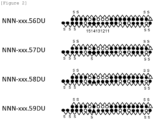
- Examples of the modification pattern of such an oligonucleotide include, but are not limited to, those shown as types 56 and 57 of Figure 2 , types 61, 62, 66 and 67 of Figure 3 , types 75 to 83 of Figure 5 , and types 91 to 95 of Figure 6 .
- a preferred aspect of the antisense strand region of the oligonucleotide in which A 14 is RNA is wherein A 13 is a 2'-O,4'-C-bridging-modified nucleoside, 2'-OMe RNA or 2'-F RNA, more preferably a 2'-O,4'-C-bridging-modified nucleoside, and even more preferably ENA or LNA (types 76 to 83 of Figure 5 and types 91 to 93 of Figure 6 ).
- the modification pattern of A 11 -A 12 -A 13 -A 14 -A 15 is preferably any of the following formulae (IIIa) to (IIIh).
- an oligonucleotide in which A 14 of the complementary region in the antisense strand region of the S3M-oligonucleotide is a 2'-O,4'-C-bridging-modified nucleoside.
- the 2'-O,4'-C-bridging-modified nucleoside is preferably ENA or LNA.
- Examples of the modification pattern of such an oligonucleotide include, but are not limited to, those shown as types 70 to 74 of Figure 4 , and types 88 to 90 of Figure 6 .
- a preferred aspect of the oligonucleotide in which A 14 is a 2'-O,4'-C-bridging-modified nucleoside is wherein A 12 is DNA.
- the modification pattern A 11 -A 12 -A 13 -A 14 -A 15 of the antisense strand complementary region is preferably any of the following formulae (IIIi) to (IIIl).
- an oligonucleotide is provided in which A 14 of the complementary region in the antisense strand region of the S3M-oligonucleotide is DNA.
- Examples of the modification pattern of such an oligonucleotide include, but are not limited to, those shown as types 58 and 59 of Figure 2 , and types 63, 64, 68 and 69 of Figure 3 .
- an oligonucleotide is provided in which A 15 of formula (II), which is the antisense strand region of the S3M-oligonucleotide is 2'-MOE RNA.
- Examples of the modification pattern of such an oligonucleotide include, but are not limited to, those shown as types 79 and 83 of Figure 5 .
- an oligonucleotide in which any of the 11th to 13th nucleosides from the 5'-terminus of the complementary region in the antisense strand region of the S3M-oligonucleotide (A 11 , A 12 and A 13 of formula (II)) is a 2'-O,4'-C-bridging-modified nucleoside.
- Examples of the modification pattern of such an oligonucleotide include, but are not limited to, those shown as types 43 and 45 of Figure 1 , types 75 to 84 of Figure 4 and types 85 and 86 and 91 to 93 of figure 6 for ENA, and types 44 and 46 of Figure 1 and type 67 and 69 of Figure 3 for LNA.
- an oligonucleotide in which any of the 11th to 13th nucleosides from the 5'-terminus of the complementary region in the antisense strand region of the S3M-oligonucleotide (A 11 , A 12 and A 13 of formula (II)) is DNA.
- Examples of the modification pattern of such an oligonucleotide include, but are not limited to, those shown as types 41 and 42 of Figure 1 , type 71 of Figure 4 , and types 87 to 90 of Figure 6 .
- an oligonucleotide is provided in which any of the 11th to 13th nucleosides from the 5'-terminus of the complementary region in the antisense strand region of the S3M-oligonucleotide (A 11 , A 12 and A 13 of formula (II)) is 2'-MOE RNA.
- Examples of the modification pattern of such an oligonucleotide include, but are not limited to, those shown as types 47 and 48 of Figure 1 , and type 74 of figure 4 .
- nucleosides other than the nucleosides specified as described above in the complementary region in the antisense strand region of the S3M-oligonucleotide of the present invention various types can be appropriately selected, but preferably, at least one (preferably all) of the nucleosides of A 2 , A 6 and A 16 is 2'-F RNA.
- a more preferred antisense strand region is such that, in addition to A 2 , A 6 and A 16 , one or two nucleosides selected from the group consisting of A 8 , A 9 and A 10 are 2'-F RNA, and nucleosides other than those specified as described above (for example, A 1 , A 3 to A 5 , A 7 , A 17 to A 19 and A a ) are 2'-OMe RNA or DNA.
- (M) is 2'-OMe RNA
- (F) is 2'-F RNA.
- a a is 0 to 5 nucleosides, where all the nucleosides are the same except for the case of 0 nucleosides.
- a O3 is 0 to 5 nucleosides, where all the nucleosides are the same except for the case of 0 nucleosides.
- a phosphodiester bond or a phosphorothioate bond is appropriately selected.
- the antisense strand region contained in the S3M-oligonucleotide may have overhang structures at the 3'-terminus and/or the 5'-terminus of the complementary region thereof (that is, A O3 and A O5 in the above formula (II)).
- a O3 and A O5 each independently represent 0 to 5 (preferably, 3, 2, 1 or 0) nucleosides, where the nucleosides are each independently 2'-OMe RNA, 2'-F RNA, DNA or a 2'-O,4'-C-bridging-modified nucleoside.
- a O3 is an overhang consisting of two or three 2'-OMe RNAs, or an overhang consisting of one or two 2'-OMe RNAs and one or two 2'-O,4'-C-bridging-modified nucleosides, and A O5 is not present.
- the bases thereof are not limited as long as a function as an overhang is exhibited. They are preferably oligo U or oligo T.
- a phosphodiester bond that may be chemically modified can be appropriately selected, and a phosphodiester bond or a phosphorothioate bond is preferred. Those bonds can be used alone, or in combination. A combination of phosphodiester bonds or phosphorothioate bonds is preferred, and the phosphorothioate bond content in inter-nucleoside bonds contained in each of the sense strand region and the antisense strand region is 50% or less, 40% or less, 30% or less, 29% or less, 28% or less, 27% or less, 26% or less, or 25% or less.
- the bond between the relevant nucleoside and a 3' adjacent nucleoside may be a phosphorothioate bond.
- the bond between the relevant nucleoside and a 3' adjacent nucleoside is preferably a phosphorothioate bond.
- the phosphorothioate bond is preferably used for bonds between the 1st and 2nd nucleosides up to between the 4th and 5th nucleosides (the number of inter-nucleoside bonds is 1, 2, 3 or 4) from the 5'-terminus and/or the 3'-terminus of the oligonucleotide.
- bonds between the 1st and 2nd nucleosides up to between the 4th and 5th nucleosides from each of the 5'-terminus and the 3'-terminus of the sense strand region and bonds between the 1st and 2nd nucleotides up to between the 4th and 5th nucleotides from each of the 5'-terminus and the 3'-terminus of the antisense strand region may be phosphorothioate bonds.
- bonds between the 1st and 2nd nucleosides up to between the 2nd and 3rd nucleosides are phosphorothioate bonds.
- the method for preparing the oligonucleotide of the present invention is not limited as long as it enables synthesis of a desired oligonucleotide.
- a known chemical synthesis method phosphotriester method, phosphoramidite method, a H-phosphonate method or the like
- the oligonucleotide can be synthesized with commercially available reagents for use in DNA/RNA using a commercially available nucleic acid synthesizer.
- an oligonucleotide having a desired nucleotide sequence can be synthesized by a method described in the document Nucleic Acids Research, 12, 4539 (1984 ) using a DNA synthesizer, for example, Model 392 based on phosphoramidite method from PerkinElmer, Inc.
- Amidite reagents corresponding to various nucleosides may be obtained by purchasing those that are commercially available, or performing synthesis by a known method.
- the oligonucleotide of the present invention can be synthesized by a method described in the document Nucleic Acids Research, 12, 4539 (1984 ) using a commercially available DNA synthesizer (for example, Model 392 based on phosphoramidite method from PerkinElmer, Inc.).
- Phosphoramidite reagents used here may be commercially available phosphoramidite reagents for natural nucleosides and 2'-O-methylnucleosides (that is, 2'-O-methylguanosine, 2'-O-methyladenosine, 2'-O-methylcytidine and 2'-O- methyluridine).
- phosphoramidite reagents For 2'-0-aminoethylguanosine, 2'-O-aminoethyladenosine, 2'-O-aminoethylcytidine and 2'-O-aminoethyluridine, corresponding phosphoramidite reagents can be synthesized according to the document Blommers et al. Biochemistry (1998), 37, 17714-17725 .
- corresponding phosphoramidite reagents can be synthesized according to WO 2017027645 for 3'-deoxy-3'-fluoroguanosine, WO2018198076 for 3'-deoxy-3'-fluoroadenosine, and US 2011/0196141 for 3'-deoxy-3'-fluorouridine.
- the synthesis can be performed by reference to known methods in the above-mentioned documents and the like.
- 3'-OMe RNA that is a 3'-modified nucleoside
- 3'-O-methylguanosine, 3'-O-methyladenosine, 3'-O-methylcytidine and 3'-O-methyluridine can be synthesized using commercially available phosphoramidite reagents.
- corresponding phosphoramidite reagents can be synthesized according to US 2003/0096979 .
- corresponding phosphoramidite reagents can be produced by a method described in WO 99/14226 .
- corresponding phosphoramidite reagents can be synthesized according to the document Yahara, A. et al. ChemBioChem (2012), 13, 2513-2516 or WO 2014/109384 .
- An antisense oligonucleotide having a phosphorothioate bond can be synthesized by coupling phosphoramidite reagents, followed by reaction with a reagent such as sulfur, tetraethylthiuram disulfide (TETD, Applied Biosystems), a Beaucage reagent (Glen Research) or xanthan hydride ( Tetrahedron Letters, 32, 3005 (1991 ), J. Am. Chem. Soc. 112, 1253 (1990 ), PCT/WO 98/54198 ).
- a reagent such as sulfur, tetraethylthiuram disulfide (TETD, Applied Biosystems), a Beaucage reagent (Glen Research) or xanthan hydride ( Tetrahedron Letters, 32, 3005 (1991 ), J. Am. Chem. Soc. 112, 1253 (1990 ), PCT/WO 98/54198 ).
- solid-phase supports can be used in a synthesizer, for which controlled pore glass (CPG) and polystyrene are used as solid-phase supports and to which a 2'-O-methylnucleoside and a 3'-O-methylnucleoside are bound.
- CPG controlled pore glass
- polystyrene polystyrene
- nucleosides produced by a method described in WO 99/14226 can be bound to CPG, and for 2'-O,4'-C-alkyleneguanosines, 2'-O,4'-C-alkyleneadenosines, 2'-O,4'-C-alkylene-5-methylcytidines and 2'-O,4'-C-alkylene-5-methyluridines in which the number of carbon atoms in the alkylene is 2 to 5, nucleosides produced by a method described in WO 00/47599 can be bound to CPG according to the document Oligonucleotide Synthesis, Edited by M.
- 3'-amino-modifier C3 CPG, 3'-amino-Modifier C7 CPG, Glyceryl CPG, (Glen Research), 3'-specer C3 SynBase CPG 1000 or 3'-spacer C9 SynBase CPG 1000 (link technologies) enables synthesis of an oligonucleotide in which a hydroxyalkylphosphate group or an aminoalkylphosphate group is bound to the 3'-terminus.
- a thioate derivative can be obtained by a method described in the document Tetarhedron Letters, 32, 3005 (1991 ), J. Am. Chem. Soc., 112, 1253 (1990 ) using reagents such as tetraethylthiuram disulfide (TETD, Applied BioSystems), a Beaucage reagent, and a phenylacetyl disulfide/pyridine-acetonitrile (1 : 1 v/v) solution ( Ravikumar, V.T. et al. Bioorg. Med. Chem. Lett. (2006) 16, p. 2513-2517 ) in addition to sulfur.
- TETD tetraethylthiuram disulfide
- Beaucage reagent a Beaucage reagent
- a phenylacetyl disulfide/pyridine-acetonitrile (1 : 1 v/v
- a silyl-based protective group such as t-butyldimethylsilyl (TBS)
- TBS t-butyldimethylsilyl
- the protection can be eliminated using tetrabutylammonium fluoride (TBAF), HF-pyridine, HF-triethylamine or the like.
- acyl group of the base moiety and the cyanoethyl group of the phosphate moiety can be eliminated using concentrated aqueous ammonia, methanolic ammonia, ethanolic ammonia, a concentrated aqueous ammonia-ethanol (3 : 1 V/V) mixed liquid, a concentrated aqueous ammonia-40% methylamine aqueous solution (1 : 1 V/V) mixed liquid, methylamine, a 0.5 M LiOH aqueous solution, a 3.5 M triethylamine/methanol solution (1 : 10 V/V) mixed liquid, 0.05 M potassium carbonate-containing methanol or the like.
- Concentrated aqueous ammonia and a concentrated aqueous ammonia-ethanol mixed liquid (3 : 1 V/V) are preferred.
- the oligonucleotide of the present invention can be obtained by performing purification through any purification process for use in normal nucleic acid purification, for example, various kinds of chromatography such as reversed-phase chromatography and ion-exchange chromatography (including high-performance liquid chromatography).
- the oligonucleotide of the present invention includes an oligonucleotide to which a unit for delivery for delivering the oligonucleotide to target tissues or target cells is bound.
- the oligonucleotide to which a unit for delivery is bound can include oligonucleotides in which a unit with an aminoalkylphosphate group introduced into a desired chemical structure (for example, the alkyl has 3 to 9 carbon atoms) is bound to the 5'-position of the nucleotide at the 5'-terminus and/or the 3'-position (2'-position in the case of a nucleotide modified at the 3'-position) of the nucleotide at the 3'-terminus of the oligonucleotide.
- a unit for delivery for example, a GalNAc unit binding to asialoglyco-receptors (ASGRPs) of liver parenchymal cells, or a fatty acid (for example, myristic acid, palmitic acid, stearic acid, arachidic acid or behenic acid) unit for delivery to liver and muscular tissues (see, for example, Nucleic Acids Res. (2020) 47, 6029-6044 , WO 2017/19267 ), can be used as appropriate.
- ASGRPs asialoglyco-receptors
- the GalNAc unit is a structural unit containing N-acetyl-D-galactosamine (GalNAc) capable of binding to ASGRP, and can be used for delivering the oligonucleotide of the present invention to the liver.
- the GalNAc unit may have a linear or branched linker structure, and can have, for example, a linear linker structure, or a branched linker structure that diverges into two or more, three or more, or four or more branches, or four or less, three or less, or two or less branches.
- the GalNAc unit may contain a phosphate group or a thiophosphate group for binding to an oligonucleotide.
- GalNAc units that can be used with the oligonucleotide of the present invention are known GalNAc units described in WO 2021/049504 , WO 2009/073809 , WO 2014/076196 , WO 2014/179620 , WO 2015/006740 , WO 2015/105083 , WO 2016/055601 2017/023817 , WO 2017/084987 , WO 2017/131236 , Methods in Enzymology, 1999, Vol. 313, p. 297-321 , and Bioorganic & Medicinal Chemistry Letters 26 (2016) 3690-3693 , as appropriate.
- GalNAc unit examples include those having the following formula, and can be appropriately adjusted by a method described in WO 2021/049504 .
- the broken line represents a point of attachment
- the oxygen atom at the point of attachment binds to an adjacent nucleotide, and forms a phosphodiester bond with the 5'-phosphate group when binding to the nucleotide at the 5'-terminus
- the 3'-phosphate group phosphate group at the 2'-position in the case of a nucleotide modified at the 3'-position
- the phosphodiester bond formed may be a chemically modified phosphodiester bond such as a phosphorothioate bond.
- the oligonucleotide of the present invention also includes an oligonucleotide in which a cholesterol unit, a lipid unit or a vitamin E unit is introduced into the oligonucleotide (see, for example, Lorenz, C. et al. Bioorg. Med. Chem. Lett., 14, p. 4975-4977 (2004 ); Soutschek, J., et al. Nature, 432, p. 173-178, (2004 ); Wolfrum, C. et al. Nature Biotech. 25, p. 1149-1157, (2007 )) Kubo, T. et al. Oligonucleotides, 17, p.
- the oligonucleotide of the present invention also includes an oligonucleotide in which the oligonucleotide is bound to a monoclonal antibody (or an appropriate binding moiety thereof), or a protein (or an appropriate oligopeptide fragment thereof) (see, for example, Song, et al. Nature Biotech. 23, p. 709-717 (2005 ); and Xia et al. Pharm. Res. 24, p. 2309-2316 (2007 ), Kumar, et al. Nature, 448, p. 39-43 (2007 )).
- the oligonucleotide of the present invention also includes a positively charged complex obtained by adding a cationic polymer to the oligonucleotide (see, as examples of where distribution to organs and cells could be achieved, Leng et al. J. Gen. Med. 7, p. 977-986 (2005 ), Baigude et al. 2, p. 237-241, and ACS Chem. Biol. (2007 ), Yadava et al. Oligonucleotide 17, p. 213-222 (2007 )).
- the oligonucleotide of the present invention includes all pharmaceutically acceptable salts or esters of the oligonucleotides, or salts of such esters.
- Preferred examples of the pharmaceutically acceptable salt of the oligonucleotide of the present invention can include metal salts such as alkali metal salts such as sodium salts, potassium salts and lithium salts, alkaline earth metals such as calcium salts and magnesium salts, aluminium salts, iron salts, zinc salts, copper salts, nickel salts, and cobalt salts; amine salts such as inorganic amine salts such as ammonium salts, and organic amine salts such as t-octylamine salts, dibenzylamine salts, morpholine salts, glucosamine salts, phenylglycine alkyl ester salts, ethylenediamine salts, N-methylglucamine salts, guanidine salts, diethylamine salts, triethyl
- a composition containing the oligonucleotide of the present invention is mixed, encapsulated or conjugated with another molecule, molecular structure, or mixture of compounds to form, for example, as a liposome, a receptor-targeting molecule, an oral, rectal, or local formulation or other formulation for assisting uptake, distribution and/or absorption.
- the oligonucleotide of the present invention when used as a prophylactic drug or a therapeutic drug for a disease, the oligonucleotide or a pharmacologically acceptable salt thereof can be itself administered, or be mixed with a pharmacologically acceptable appropriate excipient, diluent and the like, and administered orally as a tablet, a capsule, a granule, a powder, a syrup or the like, or administered parenterally as an injection, a suppository, a patch, an external preparation or the like.
- excipients examples thereof can include organic excipients such as sugar derivatives such as lactose, white sugar, glucose, mannitol and sorbitol; starch derivatives such as corn starch, potato starch, ⁇ -starch and dextrin; cellulose derivatives such as crystalline cellulose; gum arabic; dextran; and pullulan; and inorganic excipients such as silicic acid salt derivatives such as light anhydrous silicic acid, synthetic aluminum silicate, calcium silicate and magnesium aluminometasilicate; phosphoric acid salts such as calcium hydrogen phosphate; carbonic acid salts such as calcium carbonate; and sulfuric acid salts such as calcium sulfate), lubricants (examples thereof can include stearic acid, stearic acid metal salts such as calcium stearate and magnesium stearate; talc; colloid silica; waxes such as be
- the body to be subjected to introduction of an oligonucleotide prepared as described above is not limited as long as it allows a target gene to be transcribed into RNA in its cell.
- the body to be subjected to introduction means a cell, a tissue or an individual.
- the cell into which the oligonucleotide of the present invention is introduced may be a germline cell, a somatic cell, a differentiating totipotent cell, a multipotent cell, a cleaved cell, a non-cleaved cell, a parenchymal tissue cell, an epidermal cell, an immortalized cell, a transformed cell, a nerve cell, or an immune cell.
- the tissue includes a single-cell embryo or a constitutive cell, or a multiple-cell embryo, a fetal tissue and the like.
- differentiated cells include adipose cells, fibroblast cells, muscular cells, myocardial cells, endothelial cells, nerve cells, glial cells, blood cells, megakaryocytes, lymphocytes, macrophages, neutrophils, eosinophils, basophils, mast cells, leucocytes, granulocytes, keratinocytes, cartilage cells, osteoblast cells, osteoclastic cells, liver cells, and endocrine or exocrine cells.
- CHO-K1 cells RIKEN Cell bank
- Drosophila S2 cells Schneider, I. et al., J. Embryol. Exp. Morph., 27, p. 353-365 (1972 )
- human HeLa cells ATCC: CCL-2
- human HEK 293 cells ATCC: CRL-1573
- Examples of an individual used as a body to be subjected to introduction of the oligonucleotide of the present invention further include specifically those belonging to plants, animals, protozoa, viruses, bacteria or fungi.
- the plant may be a monocotyledonous plant, a dicotyledonous plant, or a gymnospermous plant, and the animal may be a vertebrate or an invertebrate.
- the vertebrate is preferably a mammal including a mouse, a rat, a monkey, a dog, or a human.
- a method for introducing the oligonucleotide of the present invention into a body to be subjected to introduction which is a cell or a tissue
- a calcium phosphate method, an electroporation method, a lipofection method, viral infection, immersion in a 3L5-oligonucleotide solution, a transformation method, or the like is used.
- a method for introduction into an embryo include microinjection, an electroporation method, and viral infection.
- a method of systemic introduction by oral, topical, subcutaneous, intramuscular, intravenous, parenteral, transvaginal, transrectal, transnasal, transocular or transmembrane administration or the like, an electroporation method, or viral infection is used.
- a method for oral introduction a method can also be used in which the oligonucleotide of the present invention is directly mixed with food for an organism.
- a colloidal dispersion system can be used in addition to the above.
- the colloidal dispersion system is expected to have an effect of improving the in vivo stability of a compound, or an effect of efficiently delivering a compound to a specific organ, tissue or cell.
- the colloidal dispersion system is not limited as long as it is normally used. Examples thereof can include lipid-based dispersion systems including polymer complexes, nanocapsules, microspheres, beads, oil-in-water emulsifiers, micelles, mixed micelles and liposomes.
- a plurality of liposomes and artificial membrane vesicles which have an effect of efficiently delivering a compound to a specific organ, tissue or cell are preferred ( Mannino et al., Biotechniques, 1988, 6, p.682 -; Blume and Cevc, Biochem. et Biophys. Acta, 1990, 1029, p.91 -; Lappalainen et al., Antiviral Res., 1994, 23, p.119 -; Chonn and Cullis, Current Op. Biotech., 1995, 6, p.698 -).
- Single-membrane liposomes whose size is in the range of 0.2 to 0.4 ⁇ m can encapsulate a significant proportion of an aqueous buffer containing macromolecules, and a compound is encapsulated in the resulting aqueous inner membranes, and delivered in a biologically active form to brain cells ( Fraley et al., Trends Biochem. Sci., 1981, 6, p. 77 ).
- the liposome normally has a composition wherein a lipid, in particular, a phospholipid, in particular, a phospholipid having a high phase transition temperature, is combined with one or more steroids, in particular, cholesterols.
- a lipid in particular, a phospholipid, in particular, a phospholipid having a high phase transition temperature
- steroids in particular, cholesterols.
- the lipid useful for liposome production include phosphatidyl compounds such as phosphatidylglycerol, phosphatidylcholine, phosphatidylserine, sphingolipid, phosphatidylethanolamine, cerebroside and ganglioside.
- Diacylphosphatidylglycerol is particularly useful.
- the lipid moiety contains 14 to 18 carbon atoms, in particular, 16 to 18 carbon atoms, and is saturated (lacks a double bond in a chain of 14 to 18 carbon atoms) .
- Typical phospholipids include phosphatidylcholine, dipalmitoyl phosphatidylcholine, and distearoyl phosphatidylcholine.
- Targeting by a colloidal dispersion system of liposomes may be passive or active.
- the passive targeting is achieved by using the intrinsic tendency of liposomes to be distributed to reticuloendothelial cells of an organ containing sinusoidal capillaries.
- examples of active targeting can include bonding a specific ligand such as a viral protein coat ( Morishita et al., Proc. Natl. Acad. Sci. (U.S.A), 1993. 90, p. 8474 -), a monoclonal antibody (or an appropriate binding moiety thereof), a sugar, a glycolipid or a protein (or an oligopeptide fragment thereof) to liposomes, or a method in which liposomes are modified by changing the composition of the liposomes in order to achieve distribution to organs and cellular forms other than naturally occurring localization sites.
- a specific ligand such as a viral protein coat ( Morishita et al., Proc. Natl. Acad. Sci. (U.S.A), 1993. 90, p. 8474 -), a monoclonal antibody (or an appropriate binding moiety thereof), a sugar, a glycolipid or a protein (or an oligopeptide fragment thereof) to liposomes,
- lipid groups can be incorporated into the lipid bilayers of liposomes in order to maintain a target ligand in close association with the lipid bilayers.
- Various linking groups can be used for linking a lipid chain to the target ligand.
- a target ligand binding to a specific cell surface molecule that is predominantly found on cells for which delivery of the oligonucleotide of the present invention is desired can be, for example, (1) a hormone, a growth factor or an appropriate oligopeptide fragment thereof which is bound to a specific cell receptor that is predominantly expressed by cells for which the delivery is desired, or (2) a polyclonal or monoclonal antibody or an appropriate fragment thereof (for example, Fab or F(ab')2) which specifically binds to an antigenic epitope that is predominantly found on target cells.
- Two or more biologically active agents can also be combined in a single liposome, and administered.
- a drug agent that improves the intracellular stability of contents and/or targeting can also be added to the colloidal dispersion system.
- the amount of the oligonucleotide of the present invention or a pharmaceutically acceptable salt thereof used varies depending on the symptom, age and the like. It is desirable that it be administered to an adult one to three times a day, depending on the symptom, in an amount of not less than 1 mg (preferably 30 mg) and not more than 2000 mg (preferably 1500 mg) per dose in the case of oral administration, not less than 0.5 mg (preferably 5 mg) and not more than 500 mg (preferably 250 mg) per dose in the case of intravenous administration or subcutaneous administration, not less than 0.5 mg (preferably 5 mg) and not more than 500 mg (preferably 250 mg) in the case of intratracheal administration, and not less than 0.05 mg (preferably 0.5 mg) and not more than 10 mg (preferably 5 mg) in the case of intraocular administration. It is desirable that the administration be performed, depending on the symptom, one to three times a week in the case of the drug agent having improved stability, and one to three times a month in the case of the drug agent having further improved stability.
- the pharmaceutical composition and formulation for topical administration include a transdermal patch, an ointment, a lotion, a cream, a gel, a lozenge, a suppository, a spray, a solution and a powder.
- the present compounds were synthesized using a phosphoramidite method ( Nucleic Acids research, 12, 4539 (1984 ), Nature Communications 6, Article number: 6317 (2015 )). Specific sequences and structures are shown in Tables 1-1 to 1-10.
- the compound of each of Examples 1 to 17 and 48 to 52 and Reference Examples 2 and 3 is siRNA whose target gene is mRNA for a gene encoding human transferrin receptor 2 (TfR2).
- the compound of each of Examples 1 to 4 and Reference Example 2 and the compound of each of Examples 5 to 17 and Reference Example 3 are siRNAs whose target sequences are nucleotide sequences consisting of 19 nucleotides from positions 1536 to 1554 and from positions 2847 to 2865, respectively, in the nucleotide sequence of human TfR2 (hTfR2) mRNA set forth as SEQ ID NO: 1, and which have U(M)U(M) bound as an overhang structure to the 3'-terminus of each antisense strand region.
- siRNAs whose target sequences are nucleotide sequences consisting of 19 nucleotides from positions 1536 to 1554 and from positions 2847 to 2865, respectively, in the nucleotide sequence of human TfR2 (hTfR2) mRNA set forth as SEQ ID NO: 1, and which have U(M)U(M) bound as an overhang structure to the 3'-terminus of each antisense strand region.
- the compounds of Examples 18 to 47 and Reference Example 1 are siRNAs in which various chemical modifications are applied to 19 base pairs (that is, a complementary region) in AD-47882 as siRNA for mouse TfR2 (mTfR2) which is described in WO 2012/177921 , and which have U(M)U(M) bound as an overhang structure to the 3'-terminus of each antisense strand region.
- siRNAs in which various chemical modifications are applied to 19 base pairs (that is, a complementary region) in AD-47882 as siRNA for mouse TfR2 (mTfR2) which is described in WO 2012/177921 , and which have U(M)U(M) bound as an overhang structure to the 3'-terminus of each antisense strand region.
- the compounds of Example 48 (TfR2-019. 94DUG. s1) and Example 49 (TfR2-019. 94DUG. s2) are siRNAs in which each of the overhang structures at the 3'-termini of the antisense strand regions in the compound of Example 16 (TfR2-019. 94DUG) is one nucleotide, or is not present.
- the compounds of Example 50 (TfR2-019. 94DUG. e1) and Example 51 (TfR2-019. 94DUG. e2) are siRNAs whose target sequences are sequences obtained by extending the target sequence in the compound of Example 16 (TfR2-019.
- the compound of Example 52 (TfR2-019. 94DUG. e3) is siRNA in which the overhang structure at the 3'-terminus of the antisense strand region in the compound of Example 16 (TfR2-019. 94DUG) is G(M)U(M).
- the moiety "2'-O,4'-C-methylenenucleoside” was synthesized using a phosphoramidite described in WO 99/14226 .
- the moiety "2'-deoxy-2'-fluoronucleoside” was synthesized using a phosphoramidite described in J. Med. Chem. 36, 831 (1993 ).
- the moiety "2'-O-methoxyethylnucleoside” was synthesized using a phosphoramidite described in Helv. Chim. Acta 78, 486-504 (1995 ).
- the moiety "GN” was synthesized using a phosphoramidite described in WO 2019/172286 , Reference Example 41.
- the present compounds were identified by negative ion ESI mass spectrometry. Table 1 shows the results.
- a sense strand region consisting of a nucleotide sequence shown in Tables 1-1 to 1-7 and an antisense strand region consisting of a nucleotide sequence shown in Tables 1-2 to 1-6 and 1-8, each of which had been separately synthesized, were put in equimolar amounts into a tube, annealed, and then confirmed to form a duplex by using an unmodified gel or HPLC.
- Table 1-1 Name of sense strand Nucleotide sequence of sense strand (5'-3') Molecular weight Theoretical value SEQ ID NO TfR2-039.
- Example Name of compound Name of sense strand Name of antisense strand Nucleotide sequence of antisense strand (5'-3') Molecular weight Theoretical value SEQ ID NO 22 AD47882. 45DUG AD47882. 23SG AD47882. 45AS 7161.08 7160.11 14 23 AD47882. 46DUG AD47882. 23SG AD47882. 46AS 7148.09 7146.10 14 24 AD47882. 47DUG AD47882.
- Example Name of compound Name of sense strand Name of antisense strand Nucleotide sequence of antisense strand (5'-3') Molecular weight Theoretical value SEQ ID NO 33 AD47882. 77DUG AD47882. 23SG AD47882. 77AS 7172.08 7172.11 14 34 AD47882. 78DUG AD47882. 23SG AD47882. 78AS 7158.08 7158.10 14 35 AD47882.
- the “molecular weight” in the tables indicates a measured value from negative ion ESI mass spectrometry.
- N(R) represents RNA
- N(D) represents DNA
- N(M) represents 2'-OMe RNA
- N(m) represents 2'-MOE RNA
- N(3M) represents 3'-OMe RNA
- N(F) represents 2'-F RNA
- N(L) represents LNA
- N(E) represents ENA.
- the structures of the nucleosides are represented by the above-described structural formulae, respectively.
- the residue at each of the 5'-position of the nucleotide at the 5'-terminus and the 3'-position (2'-position in the case of a nucleotide modified at the 3'-position) of the nucleotide at the 3'-terminus of an oligonucleotide is a hydroxyl group in which a hydrogen atom is bonded to an oxygen atom in the above structural diagram of each nucleoside.
- GN forms the terminus, bonding of a hydrogen atom is not necessary.
- Test Example 1 Screening of HepG2 cells for TfR2 siRNA by reverse transfection method
- the liquid mixture containing siRNA, the negative control or the positive control was added to a 96-well cell culture plate (manufactured by SUMIRON Co., Ltd.) at 20 ⁇ L per well.
- a 96-well cell culture plate manufactured by SUMIRON Co., Ltd.
- the final concentration of siRNA was adjusted to be increased by a common ratio of 10 or 50 from 10 nM.
- the quantitative PCR was performed in the following manner using IDT PrimeTime Gene Expression Master Mix (manufactured by Integrated DNA Technologies, Inc.). The obtained cDNA was used as a stock solution. In a 384-well PCR plate (manufactured by Applied Biosystems), 5 ⁇ L of IDT PrimeTime Gene Expression Master Mix, 0.25 ⁇ L of a hTfR2 primer (Hs. PT. 58. 20599434, manufactured by Integrated DNA Technologies, Inc.) or 0.25 ⁇ L of a h18S primer (Hs. PT. 39a.
- hTfR2 and h18S were mixed per well, the mixture was prepared in a 2-well-equivalent amount for each cDNA, and quantitative PCR was performed.
- the mRNA expression level of each of hTfR2 and h18S was given as an average value of two wells.
- the mRNA expression level of hTfR2 was standardized with the mRNA expression level of h18S, which is the housekeeping gene. As the hTfR2 mRNA expression level in the negative control is assumed to be 1.0, relative hTfR2 mRNA expression levels of the siRNA-treated samples were calculated and recorded.
- Tables 2 to 4 show the results.
- Table 2-1 Name of compound Concentration (nM) Relative value NT - 1.00 TfR2-039.23DUG 0.001 0.91 0.01 0.72 0.1 0.60 1 0.35 10 0.27 TfR2-039.41 DUG 0.001 0.81 0.01 0.63 0.1 0.31 1 0.13 10 0.14 TfR2-039.42DUG 0.001 0.66 0.01 0.73 0.1 0.37 1 0.16 10 0.12
- Table 2-2 Name of compound Concentration (nM) Relative value NT - 1.00 TfR2-039.23DUG 0.001 0.75 0.01 0.76 0.1 0.59 1 0.25 10 0.21 TfR2-039.41 DUG 0.001 0.66 0.01 0.63 0.1 0.26 1 0.08 10 0.07 TfR2-039.43DUG 0.001 0.72 0.01 0.52 0.1 0.59 1 0.42 10 0.35 TfR2-039.45DUG 0.001 0.48 0.01 0.47 0.1 0.44 1 0.23 10 0.21 [
- Test Example 1-1 hTfR2 knockdown activity using HepG2 cells
- TfR2-019 and TfR2-019.94DUG were used as siRNA.
- TfR2-019 is a double-stranded oligonucleotide consisting of a sense strand region and an antisense strand region which are oligonucleotides that are independent of each other, and complementary regions of the sense strand region and the antisense strand region all consist of natural RNA (that is, A(R), G(R), C(R) and U(R)).
- the antisense strand region in TfR2-019 is an oligonucleotide whose target sequence is the nucleotide sequence from positions 2847 to 2865 of hTfR2 mRNA set forth as SEQ ID NO: 1 and which has a complementary region consisting of a sequence fully complementary to the target sequence and has two consecutive T(D) bound as an overhand structure to the 3'-terminus of the complementary region.
- the sense strand region in TfR2-019 is an oligonucleotide which has a complementary region consisting of a sequence fully complementary to the nucleotide sequence in the corresponding complementary region of the antisense strand region and has two consecutive T(D) bound as an overhang structure to the 3'-terminus of the complementary region.
- Each inter-nucleoside bond is a phosphodiester bond that is not chemically modified.
- TfR2-019.94DUG has particularly high knockdown activity against hTfR2 mRNA.
- Test Example 2 Measurement of RNAi activity of TfR2 siRNA against HEK 293A cells (293A-mTfR2 cells) stably expressing mTfR2 by a reverse transfection method
- Plasmids encoding mouse TfR2 (mTfR2) were expressed in excess in HEK293A cells by transfection, and HEK293A cells stably expressing mTfR2 (293A-mTfR2 cells) were then cloned by drug agent selection with GENETICIN (manufactured by Gibco).
- siRNA sample a negative control (NT) using distilled water instead of siRNA
- compound of Reference Example 1 as a positive control in which the sequence of siRNA for mTfR2 described in WO 2012/177921 is chemically modified (AD47882.23DUG) were prepared for two wells each.
- RNAiMAX compound of each Example
- a reagent for the negative control 5 ⁇ L of distilled water was added, instead of siRNA, to the liquid mixture of Opti-MEM and RNAiMAX.
- a reagent for the positive control 5 ⁇ L of the compound of Reference Example 1 was added to the liquid mixture of Opti-MEM and RNAiMAX.
- the liquid mixture containing siRNA, the negative control or the positive control was added to a 96-well cell culture plate (manufactured by SUMIRON Co., Ltd.) at 20 ⁇ L per well.
- a 96-well cell culture plate manufactured by SUMIRON Co., Ltd.
- the final concentration of siRNA was adjusted to be increased by a common ratio of 10 from 10 nM.
- RNA expression level of mTfR2 was measured by quantitative PCR.
- h18S human 18S ribosomal RNA
- the quantitative PCR was performed in the following manner using IDT PrimeTime Gene Expression Master Mix (manufactured by Integrated DNA Technologies, Inc.). The obtained cDNA was used as a stock solution. In a 384-well PCR plate (manufactured by Applied Biosystems), 5 ⁇ L of IDT PrimeTime Gene Expression Master Mix, 0.25 ⁇ L of a mTfR2 primer (Mm. PT. 58. 7860185, Integrated DNA Technologies, Inc.) or 0.25 ⁇ L of a h18S primer (Hs. PT. 39a. 22214856.
- mRNA expression level of each of mTfR2 and h18S was given as an average value of two wells.
- the mRNA expression level of mTfR2 was standardized with the mRNA expression level of h18S, which is the housekeeping gene. As the mTfR2 mRNA expression level in the negative control is assumed to be 1.0, relative mTfR2 mRNA expression levels of the siRNA-treated samples were calculated. Tables 5 to 8 show the results.
- Test Example 3 Drug efficacy evaluation test for GalNAc-conjugated TfR2 siRNA in normal mice
- GalNAc-conjugated TfR2 siRNA has been shown to increase the iron concentration in plasma in normal mice ( WO 2012/177921 ).
- Various chemical modifications were applied to the nucleotide sequence of AD47882 described in that document, and the following test was conducted using the compound of Reference Example 1 (AD47882.23DUG) and the compounds of Examples 18 to 25 (AD47882.41DUG to 48DUG) as GalNAc-conjugated siRNA.
- the iron concentration in plasma was measured using a Metallo-assay iron measurement kit (manufactured by Metallogenics Co., Ltd.). The results for the iron concentration in plasma are shown in Figure 7 (average value ⁇ standard error).
- Test Example 4 Drug efficacy evaluation test for GalNAc-conjugated TfR2 siRNA in normal mice
- blood was collected from the tail vein, and the iron concentration in plasma was measured using a Metallo-assay iron measurement kit (manufactured by Metallogenics Co., Ltd.). The results for the iron concentration in plasma are shown in Figure 8 (average value ⁇ standard error).
- Test Example 5 Drug efficacy evaluation test for GalNAc-conjugated TfR2 siRNA in normal mice
- blood was collected from the tail vein, and the iron concentration in plasma was measured using a Metallo-assay iron measurement kit (manufactured by Metallogenics Co., Ltd.). The results for the iron concentration in plasma are shown in Figure 9 (average value ⁇ standard error).
- the quantitative PCR was performed in the following manner using IDT PrimeTime Gene Expression Master Mix (manufactured by Integrated DNA Technologies, Inc.).
- the obtained cDNA was diluted 10-fold with distilled water (15 ⁇ L of cDNA and 135 ⁇ L of distilled water were mixed).
- a 384-well PCR plate manufactured by Applied Biosystems
- 5 ⁇ L of IDT PrimeTime Gene Expression Master Mix 0.25 ⁇ L of a mTfR2 primer (Mm. PT. 58.
- RNA samples were prepared in a 2-well-equivalent amount for each cDNA, and quantitative PCR was performed.
- a mouse ⁇ -actin (mActb) primer (Mm. PT. 39a, 22214843. g, manufactured by Integrated DNA Technologies, Inc.) was used, and mixed so as to meet a ratio as described above, the mixture was prepared in a 2-well-equivalent amount for each cDNA, and quantitative PCR was performed.
- the mRNA level of each of mTfR2 and mActb was given as an average value of two wells.
- the mRNA expression level of mTfR2 was standardized with the mRNA expression level of mActb, which is the housekeeping gene.
- the results for the mRNA expression level of mTfR2 are shown in Figure 9F .
- Test Example 6 Drug efficacy evaluation test for GalNAc-conjugated TfR2 siRNA in model of anemia associated with inflammation
- GalNAc-conjugated TfR2 siRNA increases the HGB concentration in a model of anemia associated with inflammation.
- Various chemical modifications were applied to the nucleotide sequence of AD47882, and the following test was conducted using AD47882.41DUG (compound of Example 18), AD47882.88DUG (compound of Example 41), AD47882.89DUG (compound of Example 42), AD47882.91DUG (compound of Example 44), AD47882.92DUG (compound of Example 45) and AD47882.93DUG (compound of Example 46) as GalNAc-conjugated siRNA.
- GalNAc-conjugated TfR2 siRNA was administered to male C57BL/6NJcl mice (from CLEA Japan, Inc.) once at a dose of 1 mg/kg (1 mpk) (Day 0).
- PBS was subcutaneously administered to the vehicle group.
- turpentine was subcutaneously administered at 150 ⁇ L/mouse to induce inflammation.
- PBS was administered s.c. instead of turpentine.
- n 5/group.
- Two days after the first administration of turpentine Day 6
- the iron concentration in plasma was measured.
- the iron concentration in plasma was measured using a Metallo-assay iron measurement kit (manufactured by Metallogenics Co., Ltd.). The results are shown in Figure 10A .
- turpentine Seven days after the first administration of turpentine (Day 11), turpentine was subcutaneously administered again at 150 ⁇ L/mouse. Three days after the second administration of turpentine (Day 14), blood was collected from the abdominal large vein under anesthesia with isoflurane, and the HGB concentration , the MCH level and the RBC number were measured using a multi-item automatic corpuscle analyzer XT 2000 (manufactured by Sysmex Corporation). The results are shown in Figures 10B, 10C and 10D , respectively.
- mice were painlessly killed by bloodletting under anesthesia with isoflurane, the liver was then isolated, and the mRNA expression level of mTfR2 was measured. Extraction of RNA and quantitative PCR were performed in the manner described in Test Example 5. The mRNA expression level of mTfR2 was standardized with the mRNA expression level of mActb, which is the housekeeping gene. The results for the mRNA expression level of mTfR2 are shown in Figure 10E . As the mRNA level in the control group which did not undergo induction of inflammation is assumed to be 1.0, relative mRNA levels in other groups were calculated and recorded (average value ⁇ standard error).
- Test Example 7 Screening of HepG2 cells for TfR2 siRNA by reverse transfection method
- TfR2-019.94DUG Example 16
- TfR2-019.94DUG. s1 Example 48
- TfR2-019.94. s2DUG Example 49
- TfR2-019.94. elDUG Example 50
- TfR2-019.94DUG. e2 Example 51
- TfR2-019.94DUG. e3 Example 52
- Test Example 8 Drug efficacy evaluation test for GalNAc-conjugated TfR2 siRNA in normal mice
- mice 28 days after the treatment with siRNA or PBS (Day 28), the mice were painlessly killed by bloodletting under anesthesia with isoflurane, the liver was then isolated, and the mRNA expression level of mTfR2 was measured. Extraction of RNA and quantitative PCR were performed in the manner described in Test Example 5. The mRNA expression level of mTfR2 was standardized with the mRNA expression level of mActb, which is the housekeeping gene. The results for the mRNA expression level of mTfR2 are shown in Figure 12F . As the mRNA level in the vehicle group is assumed to be 1.0, the relative mRNA levels in other groups were calculated and recorded (average value ⁇ standard error).
- Test Example 9 Drug efficacy evaluation test for GalNAc-conjugated TfR2 siRNA in human TfR2-expressing mice
- TfR2-019.88DUG (Example 9)
- TfR2-019.92DUG Example 14
- TfR2-019.93DUG Example 15
- TfR2-019.94DUG Example 16
- mice Seven days after the start of the drug agent treatment, the mice were painlessly killed by bloodletting under anesthesia with isoflurane, the liver was then isolated, and the mRNA expression level of hTfR2 was measured. Extraction of RNA and quantitative PCR were performed in the manner described in Test Example 5. The mRNA expression level of hTfR2 was standardized with the mRNA expression level of mActb, which is the housekeeping gene. As the primer for hTfR2, those described in Test Examples 1 and 2 were used. The results for the mRNA expression level of hTfR2 are shown in Figure 13 . As the mRNA level in the vehicle group is assumed to be 1.0, relative mRNA levels in other groups were calculated and written (average value ⁇ standard error).
Landscapes
- Health & Medical Sciences (AREA)
- Life Sciences & Earth Sciences (AREA)
- Chemical & Material Sciences (AREA)
- Engineering & Computer Science (AREA)
- Genetics & Genomics (AREA)
- Molecular Biology (AREA)
- Biomedical Technology (AREA)
- Bioinformatics & Cheminformatics (AREA)
- General Health & Medical Sciences (AREA)
- Organic Chemistry (AREA)
- Biochemistry (AREA)
- General Engineering & Computer Science (AREA)
- Wood Science & Technology (AREA)
- Zoology (AREA)
- Biotechnology (AREA)
- Pharmacology & Pharmacy (AREA)
- Animal Behavior & Ethology (AREA)
- Veterinary Medicine (AREA)
- Public Health (AREA)
- Medicinal Chemistry (AREA)
- Epidemiology (AREA)
- Microbiology (AREA)
- Plant Pathology (AREA)
- Biophysics (AREA)
- Physics & Mathematics (AREA)
- Chemical Kinetics & Catalysis (AREA)
- General Chemical & Material Sciences (AREA)
- Nuclear Medicine, Radiotherapy & Molecular Imaging (AREA)
- Pharmaceuticals Containing Other Organic And Inorganic Compounds (AREA)
Applications Claiming Priority (2)
| Application Number | Priority Date | Filing Date | Title |
|---|---|---|---|
| JP2022041865 | 2022-03-16 | ||
| PCT/JP2023/009974 WO2023176863A1 (ja) | 2022-03-16 | 2023-03-15 | RNAi活性を有する化学修飾オリゴヌクレオチド |
Publications (1)
| Publication Number | Publication Date |
|---|---|
| EP4495241A1 true EP4495241A1 (en) | 2025-01-22 |
Family
ID=88023882
Family Applications (1)
| Application Number | Title | Priority Date | Filing Date |
|---|---|---|---|
| EP23770816.9A Pending EP4495241A1 (en) | 2022-03-16 | 2023-03-15 | Chemically-modified oligonucleotide having rnai activity |
Country Status (7)
| Country | Link |
|---|---|
| US (1) | US20250188477A1 (https=) |
| EP (1) | EP4495241A1 (https=) |
| JP (1) | JPWO2023176863A1 (https=) |
| KR (1) | KR20240154682A (https=) |
| CN (1) | CN118871585A (https=) |
| TW (1) | TW202400786A (https=) |
| WO (1) | WO2023176863A1 (https=) |
Cited By (1)
| Publication number | Priority date | Publication date | Assignee | Title |
|---|---|---|---|---|
| WO2026069321A1 (en) * | 2024-09-27 | 2026-04-02 | Dexcel Pharma Technologies Ltd | Nucleic acids for inhibiting expression of transferrin receptor 2 |
Family Cites Families (30)
| Publication number | Priority date | Publication date | Assignee | Title |
|---|---|---|---|---|
| US7119184B2 (en) | 1991-08-12 | 2006-10-10 | Isis Pharmaceuticals, Inc. | Oligonucleotides having A-DNA form and B-DNA form conformational geometry |
| JPH0787982A (ja) | 1993-01-29 | 1995-04-04 | Sankyo Co Ltd | 修飾オリゴデオキシリボヌクレオチド |
| US6096881A (en) | 1997-05-30 | 2000-08-01 | Hybridon, Inc. | Sulfur transfer reagents for oligonucleotide synthesis |
| JP4236812B2 (ja) | 1997-09-12 | 2009-03-11 | エクシコン エ/エス | オリゴヌクレオチド類似体 |
| ES2234563T5 (es) | 1999-02-12 | 2018-01-17 | Daiichi Sankyo Company, Limited | Nuevos análogos de nucleósidos y oligonucleótidos |
| US6261840B1 (en) | 2000-01-18 | 2001-07-17 | Isis Pharmaceuticals, Inc. | Antisense modulation of PTP1B expression |
| WO2009073809A2 (en) | 2007-12-04 | 2009-06-11 | Alnylam Pharmaceuticals, Inc. | Carbohydrate conjugates as delivery agents for oligonucleotides |
| US20110196141A1 (en) | 2009-09-07 | 2011-08-11 | Council Of Scientific & Industrial Research | Locked and unlocked 2'-o phosphoramidite nucleosides, process of preparation thereof and oligomers comprising the nucleosides |
| WO2011072082A2 (en) | 2009-12-09 | 2011-06-16 | Nitto Denko Corporation | Modulation of hsp47 expression |
| WO2012058210A1 (en) | 2010-10-29 | 2012-05-03 | Merck Sharp & Dohme Corp. | RNA INTERFERENCE MEDIATED INHIBITION OF GENE EXPRESSION USING SHORT INTERFERING NUCLEIC ACIDS (siNA) |
| WO2012074038A1 (ja) | 2010-12-02 | 2012-06-07 | 第一三共株式会社 | 修飾1本鎖ポリヌクレオチド |
| EP2723861A4 (en) | 2011-06-21 | 2014-12-10 | Alnylam Pharmaceuticals Inc | COMPOSITIONS AND METHODS FOR INHIBITING HEPCIDINE ANTIMICROBIAL PEPTIDE (HAMP) OR THE ASSOCIATED GENE EXPRESSION |
| SI3366775T2 (sl) | 2011-11-18 | 2025-12-31 | Alnylam Pharmaceuticals, Inc. | Modificirana sredstva RNAI |
| EP3730618A1 (en) | 2011-11-18 | 2020-10-28 | Alnylam Pharmaceuticals, Inc. | Rnai agents, compositions and methods of use thereof for treating transthyretin (ttr) associated diseases |
| CN104837996A (zh) | 2012-11-15 | 2015-08-12 | 罗氏创新中心哥本哈根有限公司 | 抗apob反义缀合物化合物 |
| WO2014109384A1 (ja) | 2013-01-10 | 2014-07-17 | 塩野義製薬株式会社 | 架橋型核酸誘導体の製造方法 |
| DK2992098T3 (da) | 2013-05-01 | 2019-06-17 | Ionis Pharmaceuticals Inc | Sammensætninger og fremgangsmåder til modulering af hbv- og ttr-ekspression |
| WO2015006740A2 (en) | 2013-07-11 | 2015-01-15 | Alnylam Pharmaceuticals, Inc. | Oligonucleotide-ligand conjugates and process for their preparation |
| JP6482475B2 (ja) | 2014-01-07 | 2019-03-13 | レナセラピューティクス株式会社 | アンチセンスオリゴヌクレオチド及び糖誘導体を含む二本鎖オリゴヌクレオチド |
| IL316808A (en) | 2014-08-20 | 2025-01-01 | Alnylam Pharmaceuticals Inc | Modified double-stranded RNA materials and their uses |
| US20170034685A1 (en) | 2015-07-27 | 2017-02-02 | Qualcomm Incorporated | Lte-d2d discovery in the unlicensed band |
| KR102222186B1 (ko) | 2015-08-13 | 2021-03-03 | 머크 샤프 앤드 돔 코포레이션 | Sting 효능제로서 시클릭 디-뉴클레오티드 화합물 |
| BR112018003910B1 (pt) | 2015-11-16 | 2022-03-22 | F. Hoffmann-La Roche Ag | Derivado de fosforamidita galnac, processo para a preparação de um derivado de fosforamidita galnac de fórmula i e uso dos derivados de fosforamidita galnac de fórmula i |
| AU2017213404A1 (en) | 2016-01-29 | 2018-09-20 | Kyowa Kirin Co., Ltd. | Nucleic acid conjugate |
| UY37695A (es) | 2017-04-28 | 2018-11-30 | Novartis Ag | Compuesto dinucleótido cíclico bis 2’-5’-rr-(3’f-a)(3’f-a) y usos del mismo |
| KR102398295B1 (ko) | 2018-03-09 | 2022-05-17 | 다이이찌 산쿄 가부시키가이샤 | 당원병 Ia형 치료약 |
| JP2021520355A (ja) * | 2018-04-13 | 2021-08-19 | ディセルナ ファーマシューティカルズ インコーポレイテッド | Tm上昇ヌクレオチドで修飾された二本鎖核酸阻害剤分子 |
| KR20220062517A (ko) * | 2019-08-15 | 2022-05-17 | 아이오니스 파마수티컬즈, 인코포레이티드 | 결합 변형된 올리고머 화합물 및 이의 용도 |
| IL291251B1 (en) | 2019-09-10 | 2026-02-01 | Daiichi Sankyo Co Ltd | Oligonucleotide-galnac conjugate for targeted delivery to the liver and method for its production |
| KR20220148241A (ko) * | 2020-02-28 | 2022-11-04 | 알리고스 테라퓨틱스 인코포레이티드 | Pd-l1을 표적화하기 위한 방법 및 조성물 |
-
2023
- 2023-03-15 US US18/846,465 patent/US20250188477A1/en active Pending
- 2023-03-15 JP JP2024508205A patent/JPWO2023176863A1/ja active Pending
- 2023-03-15 KR KR1020247034185A patent/KR20240154682A/ko active Pending
- 2023-03-15 TW TW112109504A patent/TW202400786A/zh unknown
- 2023-03-15 EP EP23770816.9A patent/EP4495241A1/en active Pending
- 2023-03-15 WO PCT/JP2023/009974 patent/WO2023176863A1/ja not_active Ceased
- 2023-03-15 CN CN202380027810.3A patent/CN118871585A/zh active Pending
Cited By (1)
| Publication number | Priority date | Publication date | Assignee | Title |
|---|---|---|---|---|
| WO2026069321A1 (en) * | 2024-09-27 | 2026-04-02 | Dexcel Pharma Technologies Ltd | Nucleic acids for inhibiting expression of transferrin receptor 2 |
Also Published As
| Publication number | Publication date |
|---|---|
| KR20240154682A (ko) | 2024-10-25 |
| US20250188477A1 (en) | 2025-06-12 |
| JPWO2023176863A1 (https=) | 2023-09-21 |
| CN118871585A (zh) | 2024-10-29 |
| WO2023176863A1 (ja) | 2023-09-21 |
| TW202400786A (zh) | 2024-01-01 |
Similar Documents
| Publication | Publication Date | Title |
|---|---|---|
| JP7527437B2 (ja) | 内部非核酸スペーサーを含む一本鎖RNAi剤 | |
| JP5637849B2 (ja) | 2本鎖ポリヌクレオチド | |
| EP1670896B1 (en) | Chimeric oligomeric compounds comprising alternating regions of northern and southern conformational geometry | |
| KR100809166B1 (ko) | Stat3 발현의 안티센스 올리고뉴클레오티드 조절 | |
| JP2022078069A (ja) | 二本鎖RNAによるα-1アンチトリプシンの特異的阻害のための方法及び組成物 | |
| EP2647713B1 (en) | Modified single-strand polynucleotide | |
| CN104673798A (zh) | UsiRNA复合物 | |
| EP4495240A1 (en) | Sirna for suppressing expression of transferrin receptor-2 | |
| EP4495241A1 (en) | Chemically-modified oligonucleotide having rnai activity | |
| HK40114768A (en) | Chemically-modified oligonucleotide having rnai activity | |
| EP4653447A1 (en) | Modified nucleoside monomer and double-stranded ribonucleic acid | |
| CA3255765A1 (en) | Sirna for suppressing expression of transferrin receptor-2 | |
| HK40119182A (en) | Sirna for suppressing expression of transferrin receptor-2 | |
| EP2495323A1 (en) | Modified double-stranded polynucleotide | |
| CN114632089B (zh) | 含酰基糖胺基团化合物在制备治疗新型冠状病毒肺炎药物中的应用及疾病的治疗方法 | |
| WO2025063239A1 (ja) | α-シヌクレインの発現を抑制するsiRNA | |
| WO2025232842A1 (zh) | 一种抑制angptl3基因表达的核酸分子 | |
| HK1189911A (en) | Modified single-strand polynucleotide |
Legal Events
| Date | Code | Title | Description |
|---|---|---|---|
| STAA | Information on the status of an ep patent application or granted ep patent |
Free format text: STATUS: THE INTERNATIONAL PUBLICATION HAS BEEN MADE |
|
| PUAI | Public reference made under article 153(3) epc to a published international application that has entered the european phase |
Free format text: ORIGINAL CODE: 0009012 |
|
| STAA | Information on the status of an ep patent application or granted ep patent |
Free format text: STATUS: REQUEST FOR EXAMINATION WAS MADE |
|
| 17P | Request for examination filed |
Effective date: 20241011 |
|
| AK | Designated contracting states |
Kind code of ref document: A1 Designated state(s): AL AT BE BG CH CY CZ DE DK EE ES FI FR GB GR HR HU IE IS IT LI LT LU LV MC ME MK MT NL NO PL PT RO RS SE SI SK SM TR |
|
| P01 | Opt-out of the competence of the unified patent court (upc) registered |
Free format text: CASE NUMBER: APP_4501/2025 Effective date: 20250127 |
|
| REG | Reference to a national code |
Ref country code: HK Ref legal event code: DE Ref document number: 40114768 Country of ref document: HK |
|
| DAV | Request for validation of the european patent (deleted) | ||
| DAX | Request for extension of the european patent (deleted) |