EP4484403A2 - Verfahren zur abtrennung von pinitol aus einem johannisbrotextrakt - Google Patents
Verfahren zur abtrennung von pinitol aus einem johannisbrotextrakt Download PDFInfo
- Publication number
- EP4484403A2 EP4484403A2 EP24203641.6A EP24203641A EP4484403A2 EP 4484403 A2 EP4484403 A2 EP 4484403A2 EP 24203641 A EP24203641 A EP 24203641A EP 4484403 A2 EP4484403 A2 EP 4484403A2
- Authority
- EP
- European Patent Office
- Prior art keywords
- pinitol
- extract
- carob
- carob extract
- passage
- Prior art date
- Legal status (The legal status is an assumption and is not a legal conclusion. Google has not performed a legal analysis and makes no representation as to the accuracy of the status listed.)
- Pending
Links
Images
Classifications
-
- C—CHEMISTRY; METALLURGY
- C07—ORGANIC CHEMISTRY
- C07C—ACYCLIC OR CARBOCYCLIC COMPOUNDS
- C07C29/00—Preparation of compounds having hydroxy or O-metal groups bound to a carbon atom not belonging to a six-membered aromatic ring
- C07C29/74—Separation; Purification; Use of additives, e.g. for stabilisation
- C07C29/76—Separation; Purification; Use of additives, e.g. for stabilisation by physical treatment
- C07C29/86—Separation; Purification; Use of additives, e.g. for stabilisation by physical treatment by liquid-liquid treatment
-
- A—HUMAN NECESSITIES
- A61—MEDICAL OR VETERINARY SCIENCE; HYGIENE
- A61K—PREPARATIONS FOR MEDICAL, DENTAL OR TOILETRY PURPOSES
- A61K36/00—Medicinal preparations of undetermined constitution containing material from algae, lichens, fungi or plants, or derivatives thereof, e.g. traditional herbal medicines
- A61K36/18—Magnoliophyta (angiosperms)
- A61K36/185—Magnoliopsida (dicotyledons)
- A61K36/48—Fabaceae or Leguminosae (Pea or Legume family); Caesalpiniaceae; Mimosaceae; Papilionaceae
-
- B—PERFORMING OPERATIONS; TRANSPORTING
- B01—PHYSICAL OR CHEMICAL PROCESSES OR APPARATUS IN GENERAL
- B01D—SEPARATION
- B01D15/00—Separating processes involving the treatment of liquids with solid sorbents; Apparatus therefor
- B01D15/08—Selective adsorption, e.g. chromatography
- B01D15/10—Selective adsorption, e.g. chromatography characterised by constructional or operational features
- B01D15/18—Selective adsorption, e.g. chromatography characterised by constructional or operational features relating to flow patterns
- B01D15/1814—Recycling of the fraction to be distributed
- B01D15/1821—Simulated moving beds
-
- B—PERFORMING OPERATIONS; TRANSPORTING
- B01—PHYSICAL OR CHEMICAL PROCESSES OR APPARATUS IN GENERAL
- B01D—SEPARATION
- B01D15/00—Separating processes involving the treatment of liquids with solid sorbents; Apparatus therefor
- B01D15/08—Selective adsorption, e.g. chromatography
- B01D15/26—Selective adsorption, e.g. chromatography characterised by the separation mechanism
- B01D15/36—Selective adsorption, e.g. chromatography characterised by the separation mechanism involving ionic interaction, e.g. ion-exchange, ion-pair, ion-suppression or ion-exclusion
- B01D15/361—Ion-exchange
-
- B—PERFORMING OPERATIONS; TRANSPORTING
- B01—PHYSICAL OR CHEMICAL PROCESSES OR APPARATUS IN GENERAL
- B01J—CHEMICAL OR PHYSICAL PROCESSES, e.g. CATALYSIS OR COLLOID CHEMISTRY; THEIR RELEVANT APPARATUS
- B01J39/00—Cation exchange; Use of material as cation exchangers; Treatment of material for improving the cation exchange properties
- B01J39/26—Cation exchangers for chromatographic processes
-
- B—PERFORMING OPERATIONS; TRANSPORTING
- B01—PHYSICAL OR CHEMICAL PROCESSES OR APPARATUS IN GENERAL
- B01J—CHEMICAL OR PHYSICAL PROCESSES, e.g. CATALYSIS OR COLLOID CHEMISTRY; THEIR RELEVANT APPARATUS
- B01J41/00—Anion exchange; Use of material as anion exchangers; Treatment of material for improving the anion exchange properties
- B01J41/20—Anion exchangers for chromatographic processes
-
- C—CHEMISTRY; METALLURGY
- C07—ORGANIC CHEMISTRY
- C07C—ACYCLIC OR CARBOCYCLIC COMPOUNDS
- C07C41/00—Preparation of ethers; Preparation of compounds having groups, groups or groups
- C07C41/01—Preparation of ethers
- C07C41/34—Separation; Purification; Stabilisation; Use of additives
- C07C41/36—Separation; Purification; Stabilisation; Use of additives by solid-liquid treatment; by chemisorption
-
- C—CHEMISTRY; METALLURGY
- C07—ORGANIC CHEMISTRY
- C07C—ACYCLIC OR CARBOCYCLIC COMPOUNDS
- C07C43/00—Ethers; Compounds having groups, groups or groups
- C07C43/02—Ethers
- C07C43/18—Ethers having an ether-oxygen atom bound to a carbon atom of a ring other than a six-membered aromatic ring
- C07C43/196—Ethers having an ether-oxygen atom bound to a carbon atom of a ring other than a six-membered aromatic ring containing hydroxy or O-metal groups
Definitions
- the present invention relates in general to the sector of the food supplement industry, in particular pinitol-based food supplements.
- the invention relates to a process for the separation of pinitol from carob extracts.
- Pinitol (3-O-methyl-1,2,4 cis-3,5,6 transhexahydroxycyclohexanol or 3-O-methyl-D-chiro-inositol) is a methyl ether of the D-chiro-inositol (C 7 H 14 O 6 ) having molecular mass 194.18 g/mol.
- Pinitol (or D-pinitol) is known for its hypoglycemic effect and for its capability of improving the functionality of insulin when administered orally, and for its application in the treatment of diabetes and obesity. Pinitol also improves the absorption of creatine in equal measure to its intake in conjunction with carbohydrates. Said action allows the desired amount of creatine to be taken with no need of having to take large quantities of carbohydrates.
- pinitol enhances the function of muscle tissue, increases the production of glycogen in the muscles and stimulates the transport of glucose within the muscle tissue. Said activities of the pinitol can be exploited in the sports field for improving athletes' performances. In fact, pinitol has the effect of increasing the uptake of glucose into the muscle cell and of increasing glycogen stores stored within the muscles. This leads to more stable blood sugar levels and greater energy levels lasting longer over time.
- Pinitol is used by means of oral administration in the form of a supplement or included in food or drink, in a dosage from 0.1 mg to 1.0 g per day per kg of body weight. It can also be administered parenterally or intravenously.
- Pinitol was isolated for the first time in pine but it is also present in soy in a concentration of about 1% (in weight percent based on the dry weight of soy). It is estimated that in some Asian countries, where soy consumption is very widespread, the intake of pinitol through soybeans is greater than 5 mg/kg/day.
- Pinitol is also present in the plants of Bougainvillea spectabilis and Gliricidia sepium. Pinitol is also contained in the carob fruit ( Ceratonia siliqua ), from which it can be extracted by chromatographic techniques.
- the carob tree is a long-living evergreen and broad-leaved fruit tree with slow growth.
- carob paste and seeds are used in the production of chocolate substitutes, while many food thickeners and gelling agents are obtained from carob seed flour.
- the carob extract usually has the following composition (in weight percent based on the dry weight of the carob extract): sucrose 40-65%; pinitol 7-15%; fructose 7-17%; glucose 7-15%; impurities 0.5-2%.
- Carob is therefore a very rich source of pinitol, greater for example than soy and pine needles (0.5-1% of pinitol).
- Patent EP 1 241 155 B1 (artifacts) describes a process for the separation of pinitol from carob extracts in which the sucrose contained in the extracts is inverted to fructose and glucose and the syrup thus obtained is subjected to chromatographic separation of the pinitol from the sugars contained in the syrup, in particular by means of a strong cationic resin, thus obtaining a solution of pinitol in water having a purity greater than 90%. Pinitol is then separated from the solution.
- Patent application KR20040016338 A (Amicogen Co. Ltd) describes a method for the separation of the pinitol from a carob syrup, which comprises a step of culturing a bacterium, yeast or mold before separation, in order to increase the content of pinitol in the syrup and obtain a product comprising pinitol at a low purity (40-50%).
- the syrup thus obtained, following the separation of the microorganism cells, is subjected to a treatment by means of activated carbon and to a crystallisation process. The result is a product comprising pinitol at a high purity, even greater than 90%.
- Pinitol can also be obtained by chemical synthesis, but this approach is very expensive.
- the technical problem underlying the present invention is therefore that of providing a practical, cheap, versatile, scalable and high-yield process for the separation of pinitol (and D-chiro-inositol) from carob, in particular from a carob extract.
- pinitol in the present patent means pinitol in its D configuration (D-pinitol), being D-pinitol the only configuration of the pinitol present in the carob extract.
- Crorob extract means herein the aqueous solution obtained from the maceration and pressing of the previously chopped carob pods, and subsequent separation of the coarse solid residues from the aqueous solution that is obtained.
- said at least one inositol is selected from pinitol and/or D-chiro-inositol, more preferably pinitol.
- Maceration is generally carried out by mixing the pods and water in a weight ratio of about 1 to 3, at a temperature of 60 C - 90°C for 1-24 hours, at a pH comprised between 4.5 and 5.5.
- Pressing is generally carried out by means of a press, for example in continuous.
- the aqueous solution obtained is generally dark in colour and has suspended particles.
- the aqueous solution thus obtained is furthermore generally composed of glucose, fructose, sucrose, pinitol and other sugars or impurities and normally has a Brix value from 10 to 30.
- the filtered extract of step a) can be obtained by filtration techniques known in the sector, preferably by means of a rotary vacuum filter, in which more preferably the filter aid comprises perlite.
- the perlite has a distribution of particle size greater than 160 ⁇ m comprised between 5% (w/w) and 10% (w/w), more preferably 7% (w/w).
- the perlite has a density value comprised between 90 and 130 g/l, more preferably 110 g/l.
- a perlite suitable for the purposes of the present invention is for example Randalite ® W24 (Ceca Arkema Group, France).
- Perlite is composed of soft rock of aluminium silicate, which expands when heated. This expanded material is ground to create various degrees of filter aid.
- filtration can comprise a filtration step by means of a bell filter (also known as pre-coat filter), in which filter elements are arranged vertically.
- bell filter also known as pre-coat filter
- the filtering material comprises diatomaceous earth.
- the diatomaceous earth comprises SiO 2 .
- the diatomaceous earth is of the flux-calcined type.
- Filtering materials suitable for the purposes of the present invention are, for example, Dicalite Speedplus ® or Dicalite 6000 (Palumbo Trading, Srl, Italy).
- filtration can comprise a filtration step by means of passage through the tangential filter, according to techniques known in the sector.
- the tangential filter is equipped with a filter having a pore diameter of 0.45 ⁇ m or lower.
- the carob extract of step a) is concentrated.
- concentration is carried out by means of concentration techniques known in the sector, for example concentration with heat, preferably at a temperature from 40 to 90°C, for a flow rate from 6000 to 10000 l/h.
- the carob extract of step a) is decoloured.
- the decolouration is carried out by adsorption chromatography.
- the decolouration is carried out by means of passage of the carob extract on an adsorbent resin, more preferably comprising a styrenedivinylbenzene (DVB) copolymer-based matrix.
- an adsorbent resin more preferably comprising a styrenedivinylbenzene (DVB) copolymer-based matrix.
- a suitable resin for decolouration is the adsorbent resin Sepabeads ® SP207 of Resindion Srl (Milan, Italy).
- the carob extract of step a) is demineralised (or rectified) by means of cationic exchange chromatography and anionic exchange chromatography.
- the carob extract of step a) is demineralised (or rectified) by means of passage of the carob extract on at least one anionic exchange resin and on at least one cationic exchange resin, more preferably a weak anionic exchange resin and a strong cationic exchange resin.
- the carob extract of step a) is demineralised by means of passage of the carob extract in sequence on at least one anionic exchange resin, more preferably a weak anionic exchange resin, and subsequently on a cationic exchange resin, more preferably a strong cationic exchange resin.
- the carob extract of step a) is demineralised by means of passage of the carob extract on at least two weak anionic exchange resins and on at least two strong cationic exchange resins.
- the carob extract of step a) is demineralised by means of passage of the carob extract on two weak anionic exchange resins and on two strong cationic exchange resins.
- At least one of the passages of the carob extract on a weak anionic exchange resin is followed by the passage of the carob extract on a strong anionic exchange resin, before its passage on a strong cationic exchange resin.
- said at least one of the passages of the carob extract on a weak anionic exchange resin is the last one.
- demineralisation is carried out subjecting the carob extract in sequence to the following steps:
- strong ionic exchange resins are operative throughout the pH range from 0 to 12, while the weak ones are able to exchange only in a narrower range.
- the weak cationic ones operate in an acid range, whereas the weak anionic ones operate in the basic range.
- Weak anionic exchange resins suitable in the present invention comprise Relite RAM1 ® (Resindion S.r.l., Milan, IT), Dowex ® MWA-1 (Dow Chemical Company, JP), and Purolite TM A100 (Dow Chemical Company, JP).
- Strong anionic exchange resins suitable in the present invention comprise Relite RAP1 ® (Resindion S.r.l., Milan, IT), Amberlite TM IRA900 (Lenntech BV,NL), and Purolite ® A500 (Lenntech BV, NL).
- Strong cationic exchange resins suitable in the present invention comprise Relite RPS ® (Resindion S.r.l., Milan, IT), Amberlite TM IRC200 (Lenntech BV,NL), and Purolite ® A150 (Lenntech BV,NL).
- the demineralisation step is carried out in continuous, i.e. without interrupting the demineralisation process.
- the demineralisation step eliminates 100% of the impurities and ions present in the extract.
- the solution leaving the demineralisation step has a pH comprised between 3 and 5. Within these pH values, in fact, browning of the extract is avoided.
- the carob extract of step a) has a Brix value of at least 65.
- Brix is a percentage (% w/w) measure of the solid state substances dissolved in a liquid.
- the measurement of the Brix degrees can be carried out according to one of the methods known in the field, for example by means of a refractometer.
- a refractometer suitable for the purposes of the present invention is the ATAGO RX-9000CX model (Atago USA, Inc., USA)
- the extract of step a) has conductivity values from 70 to 110 pS/cm, more preferably from 90 to 100 pS/cm.
- the conductivity measurement can be carried out according to methods known in the field, for example by means of a conductivity meter.
- the pH of the carob extract of step a) is from 2 to 4.5, more preferably from 2.5 to 3.5.
- the carob extract of step a) has an absorbance value from 0.005 to 0.030, more preferably from 0.010 to 0.020, with reading in a quartz cuvette, optical path 1 cm, at 430 nm.
- the carob extract of step a) comprises, in weight percent based on the weight of the extract, from 5 to 20%, more preferably from 10 to 15%, of pinitol.
- the carob extract of step a) comprises, in weight percent based on the weight of the extract, from 5 to 15%, more preferably from 8 to 10% of sucrose.
- the carob extract of step a) comprises, in weight percent based on the weight of the extract, from 5 to 15%, more preferably from 8 to 10% of sucrose; from 5 to 20%, more preferably from 10 to 15% of pinitol; from 20 to 50%, more preferably from 30 to 40% of fructose; from 20 to 50%, more preferably from 30 to 40% of glucose.
- step b) is carried out by means of passage of the carob extract of step a) on a strong cationic exchange resin (Na +), such as for example the resin Diaion TM UBK530 (Resindion Srl, Milan, Italy).
- a strong cationic exchange resin Na +
- Other resins suitable for the purpose of the present invention are the resins Diaion TM UBK535, UBK550 and UBK555 (Resindion Srl, Milan, Italy).
- step b) is carried out by means of the (continuous) Simulated Moving Bed Chromatography (SMB Chromatography ) technique, more preferably by means of improved (continuous) chromatographic separation ("Improved Simulated Moving Bed” (ISMB)), for example ISMB ® (Improved Simulated Moving Bed, Mitsubishi Kasei Corporation).
- SMB Chromatography Simulated Moving Bed Chromatography
- the aforesaid simulated moving bed chromatography technique (SMB Chromatography), preferably the aforesaid continuous chromatographic separation ISMB, in particular ISMB ® , is carried out using four columns.
- the simulated moving bed chromatography is a continuous multi-column chromatography process, a technique known since 1961, used in the preparation of purified binary mixtures in a continuous way.
- the aforesaid ISMB technique developed by Mitsubishi Chemical Industries (Tokyo, Japan), represents an improvement over the SMB technique described above and allows the separation of two components.
- step b) the elution is carried out with demineralised water.
- the aqueous solution obtained in step b) has a Brix value of 15 lower, more preferably of 10 or lower.
- the aforesaid aqueous solution obtained in step b) has, in weight percent based on the total weight of the solution, a pinitol content from 50 to 70%, more preferably from 60 to 70%.
- the aforesaid aqueous solution thus obtained in step b) has, in weight percent based on the total weight of the solution, a sucrose content from 2 to 8%.
- the aforesaid aqueous solution thus obtained in step b) has, in weight percent based on the total weight of the solution, a sucrose content from 2 to 8%, a glucose content from 20 to 32%, a pinitol content from 50 to 70%, more preferably from 60 to 70%, a fructose content from 0 to 6%.
- a second (waste) solution is also obtained, which has a Brix value from 25 to 40.
- said second solution has, in weight percent based on the total weight of the solution, a pinitol content of 10% or lower.
- this second solution has, in weight percent based on the total weight of the solution, a sucrose content from 0 to 4%, a glucose content from 2 to 10%, a pinitol content from 2 to 7%, a fructose content from 85 to 95%.
- the purification step c) comprises a concentration step, preferably with heat, of the solution obtained in step b).
- the aforesaid step of concentration with heat of the solution comprises heating the solution to a temperature from 25 to 60°C until a Brix value of 60 or greater, more preferably of 70 or greater, even more preferably from 70 to 75 is reached.
- step c) the concentration of the solution is followed by a crystallisation step of the obtained solution.
- the crystallisation step is carried out by keeping the concentrated solution at a temperature from 18 to 25°C for a time from 3 to 10 days, until formation and sedimentation of the crystal.
- step c) the crystallisation is completed by adding ethyl alcohol (for example an aqueous solution of 71% vol ethyl alcohol) to the concentrate thus obtained following the sedimentation of the crystal, until formation of a pure crystal.
- ethyl alcohol for example an aqueous solution of 71% vol ethyl alcohol
- a concentrate is obtained comprising pinitol at at least 70%, more preferably at least 80%, even more preferably at least 85%, even more preferably at least 90%, the most preferably at least 95% purity.
- the purity of a component is to be understood as expressed as a weight percent of the component based on the weight of the solution or of the crystal that contains this component.
- the concentrate comprising pinitol at greater than 55% purity exiting from step c) is subjected to centrifugation, thus obtaining a sediment comprising pinitol and a supernatant comprising glucose.
- the thus obtained sediment is subjected to dehumidification under heating, more preferably at about 45°C for at least two days, thus obtaining pinitol in the form of a white powder, having a purity of at least 95%.
- step c) is followed by a step d) of subjecting the aqueous solution obtained in step c), or the pinitol obtained following dehumidification of the sediment comprising pinitol, to acid hydrolysis of the pinitol, thus obtaining a solution containing D-chiro-inositol and the subsequent chromatographic separation of the D-chiro-inositol from the solution comprising D-chiro-inositol by means of at least one passage of the aqueous solution comprising D-chiro-inositol on a strong anionic exchange resin, thus obtaining an aqueous solution comprising D-chiro-inositol, preferably, in weight percent based on the total weight of the solution, at least at 95% and preferably having a Brix value of 1 or lower.
- step d) the acid hydrolysis is carried out by adding HCl (for example at 33% (v/v)) to an aqueous solution of pinitol.
- the addition of HCl is followed by a boiling step of the aqueous solution thus obtained for a time of at least 12 hours, more preferably of at least 24 hours.
- the strong anionic exchange resin is selected from RAP1 ® (Resindion S.r.l., Milan, IT), Amberlite TM IRA900 (Lenntech BV, NL), and Purolite ® A500 (Lenntech BV, NL), preferably RAP1 ® .
- step d) the passage of the aqueous solution on a strong anionic exchange resin is preceded by a step of decolouration of the aqueous solution, more preferably by adding activated carbon in solution.
- the activated carbon is added to the solution in a concentration from 50 to 150 g per hectolitre of solution, more preferably from 80 to 120 g per hectolitre of solution.
- the activated carbon is preferably selected from activated carbon having a median diameter from 4 to 50 ⁇ m, more preferably from 8 to 15 ⁇ m.
- the activated carbon has a BET comprised between 1200 and 2000 m 2 /g, more preferably comprised between 1500 and 1800 m 2 /g.
- Activated carbon suitable for the purposes of the present invention is for example Picapure HP 120 (Pica Italia SpA, Italy) or Decoran ® (AEB ® , Italy).
- the median diameter (MT50 or d50) is to be understood as measured by means of a laser granulometer and is the diameter which corresponds to 50% by weight of the particles having a smaller diameter and 50% by weight of the particles having a higher weight. Diameter means the size of the particle measured with the laser granulometer as previously described.
- the BET surface is intended as measured by means of the ASTM D-3037/89 protocol.
- the aqueous solution entering a strong anionic exchange resin has a Brix value of 6.5 or greater.
- the aqueous solution leaving a strong anionic exchange resin has a basic pH value, more preferably from 8 to 12.
- the aqueous solution comprising D-chiro-inositol obtained in step d), leaving the strong anionic exchange resin is subjected to acidification, thus obtaining an acidified aqueous solution having a pH between 3 and 5, more preferably about 4.
- the acidification step is carried out with a weak acid, for example citric acid.
- a weak acid for example citric acid.
- the aqueous solution comprising D-chiro-inositol obtained in step d) is subjected to concentration, thus obtaining a concentrated aqueous solution having a Brix value of 60 or greater, more preferably of 65 or greater, even more preferably of 70 or greater.
- the aqueous concentrated solution thus obtained is subjected to crystallisation, more preferably keeping the aqueous solution at a temperature of about 7-10°C for 2-6 hours.
- D-chiro-inositol is subjected to dehumidification, more preferably to absorption, thus obtaining D-chiro-inositol purified at least at 90%, more preferably at least at 95%.
- the yield of pinitol, in weight percent with respect to the weight of the carob pods from which pinitol is extracted is at least 3%, more preferably at least 5%, even more preferably at least 7%, the most preferably from 7 to 10%.
- the yield of pinitol, in weight percent with respect to the weight of the carob pods from which pinitol is extracted is of 15% or lower.
- the yield of pinitol, in weight percent with respect to the weight of the starting pinitol (present in the pods), is of 80% or greater.
- the process of the present invention is carried out in continuous.
- the process of the present invention therefore refers to the separation of pinitol, of D-chiro-inositol, or both. It is in fact possible to carry out the process up to step c) thus obtaining pinitol, or to continue the process thus obtaining D-chiro-inositol starting from pinitol. It is also possible to use only a part of the pinitol for obtaining D-chiro-inositol, thus obtaining both pinitol and D-chiro-inositol.
- the adopted sequence of the resins in particular the preferred sequence i-v, which comprises in sequence i) a weak anionic resin, ii) a strong cationic resin, iii) a weak anionic resin, iv) a strong anionic resin, and finally v) a strong cationic resin, is particularly advantageous.
- a further advantage of the method of the present invention is that it can be carried out in continuous. This entails greater simplicity, automation and process speed compared to discontinuous processes.
- composition was determined by means of HPLC, eluent H 2 O, flow 0.6 ml/min, column temperature 75 °C, column size 8 mmI.D, 300 mm column, functional group Ca, cationic exchange resin.
- the obtained extract also had a Brix value of 18.
- the extract was filtered with a rotary filter under vacuum using Perlite Randalite ® W24 (Ceca Arkema Group, France) as a filter aid.
- the filtrate was then subjected to a second filtration, with a bell filter, with filter elements arranged vertically, and having diatomaceous earth, in particular Dicalite Speedplus (Palumbo Trading Srl. Italy) as aid material.
- a bell filter with filter elements arranged vertically, and having diatomaceous earth, in particular Dicalite Speedplus (Palumbo Trading Srl. Italy) as aid material.
- the filtrate was then subjected to a third filtration, with the passage through the tangential filter, using membranes having a pore size of about 0.45 ⁇ m as filter elements.
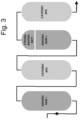
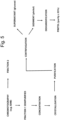
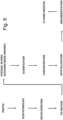
- the extract thus filtered was then passed on a Sepabeads SP207 ® (Resindion S.r.l., Italy) adsorbent resin for decolouration; and then subjected to demineralisation (or rectification) by means of passage on the following resins, in the described order (see diagram in Figure 3 ):
- Sepabeads SP207 ® Resindion S.r.l., Italy
- Table 1 shows the characteristics of each single resin.
- Table 1 RESIN 1 Anionic RAM 1 RESIN 2 Cationic RPS RESIN 3 Anionic RAM 1 RESIN 4 Strong Anionic RAP 1 RESIN 5 Cationic RPS Capacity Litres 12000 14000 12000 4000 5000
- Table 2 shows the operating conditions of each single column.
- Table 2 RESIN 1 Anionic RAM 1 RESIN 2 Cationic RPS RESIN 3
- Anionic RAM 1 RESIN 4 Strong Anionic RAP 1 RESIN 5
- Table 3 shows the characteristics of the four resins mentioned above.
- Table 3 Sepabeads SP207 (adsorbent resin) Relite RAP1 (strong anionic) Relite RPS (strong cationic) Relite RAM1 (weak anionic) Matrix Styrene-DVB copolymer Styrol-DVB porous copolymer Highly porous styrol-DVB copolymer Highly porous styrene-DVB copolymer Functional group Trimethylamine Sulphonic Tertiary amine Colour and physical form Yellowish brown Light yellow opaque spheres Light brown opaque spheres Light yellow opaque spheres Light yellow opaque s Light yellow opaque spherical beads Particle size distribution 0.425-1.18 mm 0.425-1.18 mm 0.425-1.18 mm Ionic form supplied Cl - N6 + Free base Total exchange capacity 1.18 min eq/l 1.2 min eq/l 1.18 min eq/l 1.5 min eq/l Chemical stability Stability within pH Stability
- Table 4 shows the operating conditions of the four resins mentioned above.
- Table 4 Sepabeads SP207 (adsorbent resin) Relite RAP1 (strong anionic) Relite RPS (strong cationic) Relite RAM1 (weak anionic) pH range 0-14 0-12 0-14 0-9 Operative linear flow rate 5-50 m/h 5-50 m/h 5-50 m/h Regenerant NaOH/Ethyl Alcohol NaOH HCl NaOH Regenerant level 50-150 g/l 40-150 g/l 60-80 g/l, Displacement volume 1.5-2 BV 1.5-2 BV 1.5-2 BV 1.5-2 BV Washing volume 4-10 BV 4-10 BV 3-5 BV 4-8 BV
- the extract therefore had conductivity values of 100 pS/cm, pH 3.10, and with regards to the colour a reading of 0.015 (reading Abs 430, optical path of the quartz cuvette 1 cm).
- the extract thus obtained was then concentrated with heat, under vacuum conditions, passing from a temperature of 80°C at the inlet to a temperature of 45°C at the outlet, reaching 65 °Bx.
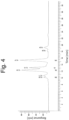
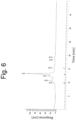
- the extract had the following composition (in percent by dry weight on the dry weight of the juice): sucrose 5%; glucose 38%; pinitol 15%; fructose 38%; impurities 4% (see Figure 4 ) .
- composition was determined, as described above, by means of HPLC, eluent H 2 O, flow 0.6 ml/min, column temperature 75 °C, column size 8 mmI.D, 300 mm column, functional group Ca, cationic exchange resin.
- the concentrated extract thus obtained was then fed to an ISMB ® plant (Improved Simulated Moving Bed, Mitsubishi Kasei Corporation) consisting of 4 UBK 530 columns (Resindion srl, Milan, Italy) and using demineralised water for elution.
- ISMB ® plant Improved Simulated Moving Bed, Mitsubishi Kasei Corporation
- 4 UBK 530 columns Resindion srl, Milan, Italy
- Table 6 shows the ISBM operating conditions Table 6 FLOW RATE SET Feed flow rate (Sop) (1/h) 16.39 Water flow rate (Wop) (1/h) 44.25 Purified solution flow rate (Fop) (1/h) 42.8 Concentrate flow rate (Gop) (1/h) 17.83 Recycle flow rate (ROop) (1/h) 44.25 VOLUME SET Feed volume (Qsop) (1) 2.6 Water volume (Qwop) (1) 7.13 Purified solution volume (Qfop) (1) 6.89 Concentrate volume (Qgop) (1) 2.87 Recycle volume (QOop) (1) 16.43 DURATION OF THE STEPS (T1op) FEED TIME (sec) 580.04 (T0op) RECYCLING TIME (sec) 1336.62
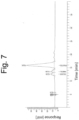
- composition was determined by means of HPLC, as described above.
- Fraction 1 containing 70% of pinitol, was then concentrated with heat under vacuum conditions, passing from a temperature of 80°C at the inlet to a temperature of 45°C at the outlet, until Brix values of 73 were obtained, and kept at 20°C for 5 days, thus obtaining the formation of the crystals of pinitol.
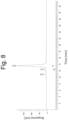
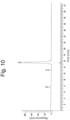
- the composition of the crystal obtained is as follows (in weight percent based on the weight of the concentrate): glucose 3%; pinitol 96.5%; sucrose 0%; fructose 0% (see Figure 8 ).
- composition was determined by means of HPLC under the conditions described above.
- the purified solution was then subjected to centrifugation at 4000 rpm with the formation of a sediment containing pinitol and alcohol and a supernatant containing glucose and alcohol.
- the sediment was subjected to dehumidification under heating, keeping it for two days at 45°C thus obtaining 30 g of a white powder with a purity of the pinitol greater than 95%.
- This result corresponds to a yield of 90% of pinitol by weight with respect to the weight of the pinitol present in the starting pods.
- the samples were analysed in LC/MS (liquid chromatography/mass spectrometry) using a Luna NH 2 column (150 x 2.2, 3 ⁇ m).
- the analyses were conducted in isocratic elution using the mobile phase consisting of acetonitrile (80%) and water (20%).
- the analysis method lasts 15 minutes.
- the flow used is 300 ⁇ l/min.
- the analysis confirmed the match between the two samples.
- Example 2 30 g of powdered pinitol having a purity greater than 95% obtained in Example 1 were added to a 1-litre flask and introduced into 16 g of water and 104 g of 33% HCl were added to this solution.
- the solution was heated for 20 minutes (from 45°C to 60°C) and 40 ml of 7.2 N HCl were added. At constant reflux, 50 ml of water were added. The solution was then brought to a boil and kept under boiling for 24 hours, during which the reflux remained constant.
- the solution was then subjected to decolouration by adding activated carbon to the solution (from 100 to 150 g/h) while keeping the solution under stirring for 60 minutes, thus obtaining 1160 ml of a solution having a Brix value of 6.5.
- the solution was then subjected to filtration to eliminate the brown components formed during heating.
- the filtration with a rotary filter was carried out under vacuum using a mix at 50% by weight of Dicalite Speedplus ® (Palumbo Trading, Srl, Italy) diatomaceous earth and at 50% by weight of perlite Randalite ® W24 (Ceca Arkema Group, France) as an aid element.
- the solution at this stage had a pH of 1, a clarity in NTU values (Nephelometric Turbidity Units) of 2, and was colourless.
- the solution was then subjected to passage on a strong anionic exchange resin (Relite RAP1) thus reaching a pH of 9-10 and then the solution was subjected to acidification with citric acid until a pH of 4.0 was reached.
- a strong anionic exchange resin Relite RAP1
- the solution thus obtained had a Brix value of 0.3 and was then concentrated until a Brix value of 70 was reached.
- the crystallisation of the D-chiro-inositol was then carried out keeping the solution at a temperature of 8 °C for 24 hours.
- the concentrated solution had a D-chiro-inositol content of 95% or greater.
- the analysis confirmed the match between the two samples.
Landscapes
- Chemical & Material Sciences (AREA)
- Organic Chemistry (AREA)
- Health & Medical Sciences (AREA)
- Analytical Chemistry (AREA)
- Chemical Kinetics & Catalysis (AREA)
- Natural Medicines & Medicinal Plants (AREA)
- Life Sciences & Earth Sciences (AREA)
- Botany (AREA)
- Mycology (AREA)
- Biotechnology (AREA)
- Engineering & Computer Science (AREA)
- Medical Informatics (AREA)
- Medicinal Chemistry (AREA)
- Microbiology (AREA)
- Alternative & Traditional Medicine (AREA)
- Pharmacology & Pharmacy (AREA)
- Epidemiology (AREA)
- Animal Behavior & Ethology (AREA)
- General Health & Medical Sciences (AREA)
- Public Health (AREA)
- Veterinary Medicine (AREA)
- Sustainable Development (AREA)
- Organic Low-Molecular-Weight Compounds And Preparation Thereof (AREA)
Applications Claiming Priority (3)
| Application Number | Priority Date | Filing Date | Title |
|---|---|---|---|
| IT201900006530 | 2019-05-03 | ||
| PCT/IB2020/054084 WO2020225665A1 (en) | 2019-05-03 | 2020-04-30 | Process for the separation of pinitol from a carob extract |
| EP20730716.6A EP3962623A1 (de) | 2019-05-03 | 2020-04-30 | Verfahren zur trennung von pinitol aus einem johannisbrotextrakt |
Related Parent Applications (1)
| Application Number | Title | Priority Date | Filing Date |
|---|---|---|---|
| EP20730716.6A Division EP3962623A1 (de) | 2019-05-03 | 2020-04-30 | Verfahren zur trennung von pinitol aus einem johannisbrotextrakt |
Publications (2)
| Publication Number | Publication Date |
|---|---|
| EP4484403A2 true EP4484403A2 (de) | 2025-01-01 |
| EP4484403A3 EP4484403A3 (de) | 2025-04-23 |
Family
ID=67551611
Family Applications (2)
| Application Number | Title | Priority Date | Filing Date |
|---|---|---|---|
| EP24203641.6A Pending EP4484403A3 (de) | 2019-05-03 | 2020-04-30 | Verfahren zur abtrennung von pinitol aus einem johannisbrotextrakt |
| EP20730716.6A Pending EP3962623A1 (de) | 2019-05-03 | 2020-04-30 | Verfahren zur trennung von pinitol aus einem johannisbrotextrakt |
Family Applications After (1)
| Application Number | Title | Priority Date | Filing Date |
|---|---|---|---|
| EP20730716.6A Pending EP3962623A1 (de) | 2019-05-03 | 2020-04-30 | Verfahren zur trennung von pinitol aus einem johannisbrotextrakt |
Country Status (7)
| Country | Link |
|---|---|
| US (2) | US20220177396A1 (de) |
| EP (2) | EP4484403A3 (de) |
| JP (2) | JP7530388B2 (de) |
| KR (1) | KR20220004056A (de) |
| CN (1) | CN113784772B (de) |
| CA (1) | CA3134194A1 (de) |
| WO (1) | WO2020225665A1 (de) |
Families Citing this family (1)
| Publication number | Priority date | Publication date | Assignee | Title |
|---|---|---|---|---|
| CA3134194A1 (en) * | 2019-05-03 | 2020-11-12 | Bono & Ditta S.P.A. | Process for the separation of pinitol from a carob extract |
Citations (2)
| Publication number | Priority date | Publication date | Assignee | Title |
|---|---|---|---|---|
| EP1241155A1 (de) | 2001-03-16 | 2002-09-18 | Compania General Del Algarrobo De Espana, S.A. | Verfahren zur Gewinnung von Pinitol aus Johannisbrotbaumextrakten |
| KR20040016338A (ko) | 2002-08-16 | 2004-02-21 | 아미코젠주식회사 | 케롭시럽으로부터 피니톨을 고수율로 회수하는 방법 |
Family Cites Families (12)
| Publication number | Priority date | Publication date | Assignee | Title |
|---|---|---|---|---|
| ES2060544B1 (es) * | 1993-03-26 | 1995-04-01 | Cia Gral Del Algarrobo De Espa | Un jarabe constituido por los azucares naturales de la algarroba y proceso para su obtencion |
| ES2130440T3 (es) * | 1993-08-11 | 1999-07-01 | Hokko Chem Ind Co | Proceso para producir d-(quiro)-inositol. |
| JP4303867B2 (ja) * | 2000-04-27 | 2009-07-29 | オルガノ株式会社 | ミネラル成分を含有する精製蔗糖液の製造方法および製造装置 |
| FI20020592A7 (fi) * | 2002-03-27 | 2003-09-28 | Danisco Sweeteners Oy | Menetelmä sokereiden, sokerialkoholien, hiilihydraattien ja niiden seosten erottamiseksi niitä sisältävistä liuoksista |
| ES2234422B1 (es) * | 2003-12-04 | 2006-12-16 | Compañia General Del Algarrobo De España, S.A. | Procedimiento de obtencion de un preparado a partir de algarroba y composiciones farmaceutica y cosmetica que los contienen. |
| US8414706B2 (en) * | 2007-06-21 | 2013-04-09 | Cantine Foraci S.R.L. | Process and plant for producing sugar products from grapes |
| MX2008005854A (es) * | 2008-05-06 | 2009-09-09 | Com Izadora De Productos Basic | Proceso de purificacion de azucar liquida preparada a partir de azucar granulada de caña??. |
| CN101967091A (zh) * | 2009-07-28 | 2011-02-09 | 凯发知识产权资源私人有限公司 | 用于有机酸提纯的方法 |
| JP2011217696A (ja) * | 2010-04-14 | 2011-11-04 | Kobe Univ | ピニトールもしくはピニトール含有組成物の製法およびそれに用いる微生物 |
| JPWO2016093251A1 (ja) * | 2014-12-08 | 2017-05-25 | 旭化成メディカル株式会社 | 生理活性物質の精製方法 |
| CN104961628A (zh) * | 2015-06-30 | 2015-10-07 | 天津科技大学 | 一种由d-松醇转化为d-手性肌醇的方法 |
| CA3134194A1 (en) * | 2019-05-03 | 2020-11-12 | Bono & Ditta S.P.A. | Process for the separation of pinitol from a carob extract |
-
2020
- 2020-04-30 CA CA3134194A patent/CA3134194A1/en active Pending
- 2020-04-30 KR KR1020217035326A patent/KR20220004056A/ko active Pending
- 2020-04-30 JP JP2021564573A patent/JP7530388B2/ja active Active
- 2020-04-30 WO PCT/IB2020/054084 patent/WO2020225665A1/en not_active Ceased
- 2020-04-30 EP EP24203641.6A patent/EP4484403A3/de active Pending
- 2020-04-30 US US17/607,143 patent/US20220177396A1/en active Pending
- 2020-04-30 CN CN202080032948.9A patent/CN113784772B/zh active Active
- 2020-04-30 EP EP20730716.6A patent/EP3962623A1/de active Pending
-
2024
- 2024-07-26 JP JP2024120819A patent/JP2024153764A/ja active Pending
- 2024-08-09 US US18/799,116 patent/US20240400483A1/en active Pending
Patent Citations (3)
| Publication number | Priority date | Publication date | Assignee | Title |
|---|---|---|---|---|
| EP1241155A1 (de) | 2001-03-16 | 2002-09-18 | Compania General Del Algarrobo De Espana, S.A. | Verfahren zur Gewinnung von Pinitol aus Johannisbrotbaumextrakten |
| EP1241155B1 (de) | 2001-03-16 | 2005-01-05 | Compania General Del Algarrobo De Espana, S.A. | Verfahren zur Gewinnung von Pinitol aus Johannisbrotbaumextrakten |
| KR20040016338A (ko) | 2002-08-16 | 2004-02-21 | 아미코젠주식회사 | 케롭시럽으로부터 피니톨을 고수율로 회수하는 방법 |
Also Published As
| Publication number | Publication date |
|---|---|
| EP4484403A3 (de) | 2025-04-23 |
| CA3134194A1 (en) | 2020-11-12 |
| CN113784772B (zh) | 2023-08-01 |
| US20220177396A1 (en) | 2022-06-09 |
| JP2022530810A (ja) | 2022-07-01 |
| KR20220004056A (ko) | 2022-01-11 |
| WO2020225665A1 (en) | 2020-11-12 |
| JP2024153764A (ja) | 2024-10-29 |
| CN113784772A (zh) | 2021-12-10 |
| US20240400483A1 (en) | 2024-12-05 |
| EP3962623A1 (de) | 2022-03-09 |
| JP7530388B2 (ja) | 2024-08-07 |
Similar Documents
| Publication | Publication Date | Title |
|---|---|---|
| US8414706B2 (en) | Process and plant for producing sugar products from grapes | |
| CN113068815B (zh) | 一种改善甜味性能的罗汉果糖及其制备方法 | |
| US10898829B2 (en) | Continuous process for purification of steviol glycosides from stevia leaves using simulated moving bed chromatography | |
| CN115109112B (zh) | 一种提高罗汉果甜苷v含量的罗汉果甜苷工业生产方法 | |
| US20100160624A1 (en) | Process for Producing High-Purity Sucrose | |
| US20240400483A1 (en) | Process for the separation of pinitol from a carob extract | |
| US20200172945A1 (en) | Method for producing d-psicose from d-psicose borate complex using chromatography and composition containing d-psicose | |
| CN108276465B (zh) | 一种以亚临界水解吸附技术分离纯化罗汉果甜苷ⅴ的方法 | |
| CA1333779C (en) | Method for producing galactooligosaccharide | |
| EP1241155B1 (de) | Verfahren zur Gewinnung von Pinitol aus Johannisbrotbaumextrakten | |
| FI59388C (fi) | Foerfarande foer framstaellning av en pao xylitol anrikad vattenloesning av polyoler | |
| CN111662941A (zh) | 一种葡萄糖基甜菊糖苷的制备方法 | |
| ES2549659T3 (es) | Un procedimiento para la recuperación de galactosa a partir de una solución procedente de biomasa vegetal utilizando etapas de fraccionamiento cromatográfico y cristalización | |
| CN108864222A (zh) | 一种高纯度甜菊糖苷rd和rm的制备方法 | |
| CN113017066B (zh) | 一种改善甜茶苷甜味性能的代糖及其制备方法 | |
| KR101933957B1 (ko) | 친수성 유기용매를 이용한 프룩토스 및 타가토스 혼합 조성물로부터 타가토스의 결정화 정제방법 | |
| JP4482312B2 (ja) | D−キロ−イノシトール高含有抽出物の製造方法 | |
| CN112110962A (zh) | 一种从含有甜菊糖苷的来源中分离和纯化斯替维苷的方法 | |
| JPH02286695A (ja) | オリゴ糖の分離方法 | |
| CN113461765B (zh) | 罗汉果甜苷v及稀有甜苷物质的分离方法 | |
| AU2023457514A1 (en) | Sweetness composition and preparation method thereof | |
| EP4640840A1 (de) | Verfahren zur herstellung von glucosylsteviosid mit mutterlaugenzucker, trennung und reinigung von glucosylsteviosid und rückgewinnung von glucose | |
| KR0129571B1 (ko) | 포도당 분획액(Raffinate)으로 의약용 결정포도당을 제조하는 방법 | |
| CN120513250A (zh) | 利用离子交换纯化含有阿洛酮糖的溶液的方法 | |
| KR20250107129A (ko) | 당알콜 조성물 |
Legal Events
| Date | Code | Title | Description |
|---|---|---|---|
| PUAI | Public reference made under article 153(3) epc to a published international application that has entered the european phase |
Free format text: ORIGINAL CODE: 0009012 |
|
| STAA | Information on the status of an ep patent application or granted ep patent |
Free format text: STATUS: THE APPLICATION HAS BEEN PUBLISHED |
|
| AC | Divisional application: reference to earlier application |
Ref document number: 3962623 Country of ref document: EP Kind code of ref document: P |
|
| AK | Designated contracting states |
Kind code of ref document: A2 Designated state(s): AL AT BE BG CH CY CZ DE DK EE ES FI FR GB GR HR HU IE IS IT LI LT LU LV MC MK MT NL NO PL PT RO RS SE SI SK SM TR |
|
| REG | Reference to a national code |
Ref country code: DE Ref legal event code: R079 Free format text: PREVIOUS MAIN CLASS: C07C0041360000 Ipc: B01D0015360000 |
|
| PUAL | Search report despatched |
Free format text: ORIGINAL CODE: 0009013 |
|
| AK | Designated contracting states |
Kind code of ref document: A3 Designated state(s): AL AT BE BG CH CY CZ DE DK EE ES FI FR GB GR HR HU IE IS IT LI LT LU LV MC MK MT NL NO PL PT RO RS SE SI SK SM TR |
|
| RIC1 | Information provided on ipc code assigned before grant |
Ipc: C07C 41/36 20060101ALI20250320BHEP Ipc: A61K 36/48 20060101ALI20250320BHEP Ipc: B01J 41/20 20060101ALI20250320BHEP Ipc: B01J 39/26 20060101ALI20250320BHEP Ipc: B01D 15/18 20060101ALI20250320BHEP Ipc: B01D 15/36 20060101AFI20250320BHEP |
|
| STAA | Information on the status of an ep patent application or granted ep patent |
Free format text: STATUS: REQUEST FOR EXAMINATION WAS MADE |
|
| 17P | Request for examination filed |
Effective date: 20251017 |