EP4482001A1 - Support de capteur de température et procédé de fixation de capteur de température - Google Patents
Support de capteur de température et procédé de fixation de capteur de température Download PDFInfo
- Publication number
- EP4482001A1 EP4482001A1 EP22933871.0A EP22933871A EP4482001A1 EP 4482001 A1 EP4482001 A1 EP 4482001A1 EP 22933871 A EP22933871 A EP 22933871A EP 4482001 A1 EP4482001 A1 EP 4482001A1
- Authority
- EP
- European Patent Office
- Prior art keywords
- temperature sensor
- holder
- stator
- insulator
- engagement
- Prior art date
- Legal status (The legal status is an assumption and is not a legal conclusion. Google has not performed a legal analysis and makes no representation as to the accuracy of the status listed.)
- Pending
Links
Images



Classifications
-
- H—ELECTRICITY
- H02—GENERATION; CONVERSION OR DISTRIBUTION OF ELECTRIC POWER
- H02K—DYNAMO-ELECTRIC MACHINES
- H02K11/00—Structural association of dynamo-electric machines with electric components or with devices for shielding, monitoring or protection
- H02K11/20—Structural association of dynamo-electric machines with electric components or with devices for shielding, monitoring or protection for measuring, monitoring, testing, protecting or switching
- H02K11/25—Devices for sensing temperature, or actuated thereby
-
- G—PHYSICS
- G01—MEASURING; TESTING
- G01K—MEASURING TEMPERATURE; MEASURING QUANTITY OF HEAT; THERMALLY-SENSITIVE ELEMENTS NOT OTHERWISE PROVIDED FOR
- G01K1/00—Details of thermometers not specially adapted for particular types of thermometer
- G01K1/14—Supports; Fastening devices; Arrangements for mounting thermometers in particular locations
-
- G—PHYSICS
- G01—MEASURING; TESTING
- G01K—MEASURING TEMPERATURE; MEASURING QUANTITY OF HEAT; THERMALLY-SENSITIVE ELEMENTS NOT OTHERWISE PROVIDED FOR
- G01K1/00—Details of thermometers not specially adapted for particular types of thermometer
- G01K1/14—Supports; Fastening devices; Arrangements for mounting thermometers in particular locations
- G01K1/143—Supports; Fastening devices; Arrangements for mounting thermometers in particular locations for measuring surface temperatures
-
- B—PERFORMING OPERATIONS; TRANSPORTING
- B62—LAND VEHICLES FOR TRAVELLING OTHERWISE THAN ON RAILS
- B62J—CYCLE SADDLES OR SEATS; AUXILIARY DEVICES OR ACCESSORIES SPECIALLY ADAPTED TO CYCLES AND NOT OTHERWISE PROVIDED FOR, e.g. ARTICLE CARRIERS OR CYCLE PROTECTORS
- B62J45/00—Electrical equipment arrangements specially adapted for use as accessories on cycles, not otherwise provided for
- B62J45/40—Sensor arrangements; Mounting thereof
- B62J45/41—Sensor arrangements; Mounting thereof characterised by the type of sensor
-
- B—PERFORMING OPERATIONS; TRANSPORTING
- B62—LAND VEHICLES FOR TRAVELLING OTHERWISE THAN ON RAILS
- B62M—RIDER PROPULSION OF WHEELED VEHICLES OR SLEDGES; POWERED PROPULSION OF SLEDGES OR SINGLE-TRACK CYCLES; TRANSMISSIONS SPECIALLY ADAPTED FOR SUCH VEHICLES
- B62M7/00—Motorcycles characterised by position of motor or engine
- B62M7/12—Motorcycles characterised by position of motor or engine with the engine beside or within the driven wheel
Definitions
- the present invention relates to a temperature sensor holder for holding a temperature sensor and a temperature sensor mounting method for mounting a temperature sensor using the temperature sensor holder.
- Patent Document 1 discloses a structure in which a temperature sensor that detects the temperature of a stator coil is mounted on a motor using a temperature sensor holder.
- Patent Document 1 JP 6484334
- the temperature sensor holder disclosed in Patent Document 1 includes a holder fixing portion and a sensor holding portion integrally formed with the holder fixing portion, the holder fixing portion being provided with two tabs that hold a flange of an insulator, the sensor holding portion being provided with a storage groove that stores a temperature sensor and a sensor pressing portion having a cantilever structure in the storage groove.
- the temperature sensor holder is mounted on the insulator in such a manner that two tabs are engaged with the flange of the insulator protruding in a direction of a rotation shaft of a rotor from the direction of the rotation shaft of the rotor (a rotary drive shaft of a motor) to hold the flange between the two tabs.
- the temperature sensor stored in the storage groove is held in such a manner that a temperature measuring unit is pressed against a stator coil by a spring force of the sensor pressing portion acting in the direction of the rotation shaft of the rotor.
- the protruding flange of the insulator has, on its leading end, a taper and a step located below the taper.
- the tab of the holder fixing portion engaged with the flange is caught on the step and is less likely to be disengaged.
- the flange of the insulator protruding in the direction of the rotation shaft of the rotor is a short protrusion, and receives a stress on a base end thereof when being bent. Thus, the flange may be damaged.
- the present invention has been made in view of such circumstances, and an object of the present invention is to provide a temperature sensor holder and a temperature sensor mounting method with which it is possible to easily mount a temperature sensor without damaging an object to which the temperature sensor is mounted, etc.
- a first aspect of the present invention provides a temperature sensor holder for mounting a temperature sensor that measures a temperature of a measured portion to an object including the measured portion, the temperature sensor holder including:
- the temperature sensor holder can be mounted on the object in such a manner that the holder engagement portion is engaged with the object due to elastic force of the curved portion of the arm, and at the same time, the sensor holding portion brings the temperature sensor in pressure contact with the measured portion, whereby the temperature sensor can be brought into pressure contact with the measured portion.
- the temperature of the measured portion can be accurately measured.
- the holder engagement portion can be disengaged from the object by elastically deforming the curved shape of the curved portion of the arm.
- the temperature sensor holder can be easily removed from the object.
- the curved shape of the curved portion of the arm is deformed to mount and remove the temperature sensor holder, and thus, stress is distributed without concentration. Therefore, the temperature sensor holder is not damaged, and further, the object is not damaged.
- a second aspect of the present invention provides
- the temperature sensor holder can be mounted on the insulator of the motor in such a manner that the holder engagement portion is engaged with the insulator due to elastic force of the curved portion of the arm, and at the same time, the sensor holding portion brings the temperature sensor in pressure contact with the stator coil. Therefore, the load on the temperature sensor due to vibration can be absorbed by the elastic deformation of the curved portion of the arm, whereby the pressure contact of the temperature sensor with the stator coil by the sensor holding portion can be constantly maintained, whereby the temperature of the stator coil can be constantly and stably measured.
- the holder engagement portion can be disengaged from the insulator by elastically deforming the curved shape of the curved portion of the arm.
- the temperature sensor holder can be easily removed from the insulator.
- the curved shape of the curved portion of the arm is deformed to mount and remove the temperature sensor holder, and thus, stress is distributed without concentration. Therefore, the temperature sensor holder is not damaged.
- the insulator of the motor is not deformed and is not damaged.
- the protruding engagement tab of the holder engagement portion is engaged with the end of the insulator. That is, the protruding engagement tab is engaged in a state of being hooked on the end of the insulator, whereby the engagement tab is easily engaged and disengaged. That is, the temperature sensor holder is easily mounted and removed.
- the engagement tab is engaged with the end of the insulator positioned between the engagement tab and the protruding piece protruding in the same direction. Therefore, even when the arm is deformed to open the curved portion by vibration of the motor, the protruding piece comes in contact with the end of the insulator and serves as a stopper, and thus, the end of the insulator is prevented from coming off from between the protruding piece and the engagement tab. Accordingly, the temperature sensor holder is prevented from being disengaged from the insulator.
- a pair of the arms extends from the sensor holding portion of the temperature sensor holder in directions opposite to each other, and a pair of the holder engagement portions is provided at outer ends of the pair of arms.
- the sensor holding portion at the center presses the temperature sensor against the stator coil by the elastic force of the curved portions of the arms on both sides of the sensor holding portion, so that the temperature sensor can be stably pressed against the stator coil in a well-balanced manner.
- the curved portions of the arms on both sides are elastically deformed. Therefore, only small deformation of the curved portions of the arms is required, and thus, the temperature sensor holder is not damaged.
- the engagement tab of at least one of the pair of holder engagement portions has an inclined surface tapered toward a leading end in a direction perpendicular to a protruding direction of the engagement tab.
- the engagement tab of at least one of the pair of holder engagement portions has the inclined surface tapered toward the leading end in the direction perpendicular to the protruding direction thereof. Therefore, when the inclined surface of the engagement tab is pressed against the end of the insulator, the curved portion of the arm is elastically deformed, the position of the engagement tab is changed while the end of the insulator slides on the inclined surface of the engagement tab, and the engagement tab can be engaged with the end of the insulator by the elastic restoring force of the curved portion of the arm after the engagement tab climbs over the end face of the insulator.
- the temperature sensor holder can be smoothly mounted on the insulator.
- the temperature sensor holder can be mounted on the flange of the insulator formed on the outside of the stator in the radial direction from the radially outer side of the stator with the holder engagement portion being engaged with the end of the flange, whereby the temperature sensor holder does not interfere with the insertion of the rotor within the stator.
- the flange of the insulator is formed with a positioning protrusion that protrudes outward in the radial direction of the stator and restricts movement of the temperature sensor holder in the axial direction of the rotary drive shaft.
- the flange of the insulator is provided with the positioning protrusion that protrudes radially outward of the stator and restricts the movement of the temperature sensor holder in the axial direction of the rotary drive shaft, so that the temperature sensor holder can be prevented from being disengaged even when the motor receives impact or vibration in the axial direction of the rotary drive shaft.
- the curved portion of the arm of the temperature sensor holder is curved so as to project outward in the radial direction of the stator, and the temperature sensor held by the sensor holding portion is brought into pressure contact with the stator coil by the elastic force of the curved portion of the arm toward the inside of the stator in the radial direction. Therefore, even when the motor receives vibration of the stator in the radial direction, the temperature sensor can be constantly brought into pressure contact with the stator coil following the vibration by the elastic deformation of the curved portion of the arm that is curved so as to project outward in the radial direction of the stator.
- the motor is mounted on a vehicle with the rotary drive shaft being oriented in a horizontal direction.
- the motor is mounted on the vehicle with the rotary drive shaft being oriented in the horizontal direction. Therefore, the vibration in the vertical direction accompanying the traveling of the vehicle is the vibration of the stator of the motor in the radial direction, and thus, the elastic deformation of the curved portion projecting in the radial direction of the arm effectively acts, so that the temperature sensor can be constantly pressed against the stator coil following the vibration in the vertical direction.
- the temperature sensor holder can be mounted on the object in such a manner that the holder engagement portion is engaged with the object due to elastic force of the curved portion of the arm, and at the same time, the sensor holding portion brings the temperature sensor in pressure contact with the measured portion, whereby the temperature sensor can be brought into pressure contact with the measured portion.
- the temperature of the measured portion can be accurately measured.
- the holder engagement portion can be disengaged from the object by elastically deforming the curved shape of the curved portion of the arm.
- the temperature sensor holder can be easily removed from the object.
- the curved shape of the curved portion of the arm is deformed to mount and remove the temperature sensor holder, and thus, stress is distributed without concentration. Therefore, the temperature sensor holder is not damaged, and further, the object is not damaged.
- the temperature sensor holder can be mounted on the insulator of the motor in such a manner that the holder engagement portion is engaged with the insulator due to elastic force of the curved portion of the arm, and at the same time, the sensor holding portion brings the temperature sensor in pressure contact with the stator coil. Therefore, the load on the temperature sensor due to vibration can be absorbed by the elastic deformation of the curved portion of the arm, whereby the pressure contact of the temperature sensor with the stator coil by the sensor holding portion can be constantly maintained, whereby the temperature of the stator coil can be constantly and stably measured.
- the holder engagement portion can be disengaged from the insulator by elastically deforming the curved shape of the curved portion of the arm.
- the temperature sensor holder can be easily removed from the insulator.
- the curved shape of the curved portion of the arm is deformed to mount and remove the temperature sensor holder, and thus, stress is distributed without concentration. Therefore, the temperature sensor holder is not damaged.
- the insulator of the motor is not deformed and is not damaged.
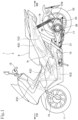
- Fig. 1 is a left side view of a motorcycle 1 that is a straddled vehicle according to an embodiment to which the present invention is applied.
- a straight traveling direction of the motorcycle 1 according to the present embodiment is a forward direction
- an arrow FR indicates a forward direction
- an arrow RR indicates a rearward direction
- an arrow LH indicates a leftward direction
- an arrow RH indicates a rightward direction.
- the motorcycle 1 is a unit swing type motorcycle.
- a vehicle body frame 2 of the motorcycle 1 includes a head pipe 3 rotatably supporting a front fork 10, a main frame 4 extending rearward and downward from the head pipe 3, a pair of left and right down frames 5 each of which extends downward from a lower part of the head pipe 3, is bent at a lower end to extend rearward, and then extends rearward and upward in an oblique manner, and a pair of left and right seat rails 6 each of which extends rearward and upward in an oblique manner from a middle part of the main frame 4.
- the rear end of the main frame 4 is connected to lower parts of rear portions 5r extending rearward and upward in an oblique manner of the down frames 5, and the upper ends of the rear portions 5r are connected to the seat rails 6.
- a back stay 7 connects the rear portions 5r of the down frames 5 and the seat rails 6 to each other to support the seat rails 6.
- a seat 8 is supported by the seat rails 6.
- a front wheel 11 is rotatably supported at a lower end of the front fork 10 supported by the head pipe 3, and a steering handlebar 12 is mounted at an upper end of a pivot of the front fork 10.
- a rear wheel 25 is pivotally supported at a rear end of the swing frame 21.
- a rear cushion 16 is interposed between a bracket 21b protruding rearward of the swing frame 21 and the seat rails 6.
- the swing frame 21 includes a main arm 21M extending from the front of the rear wheel 25 to the left side of the rear wheel 25, and a sub arm (not illustrated) extending from a front right side of the main arm 21M to the right side of the rear wheel 25.
- a stand 17 is mounted at a lower part of the swing frame 21 so as to be retractable.
- the power unit 20 is configured in such a manner that the motor 30 is mounted on the left side of a rear part of the main arm 21M, a power transmission mechanism 23 is mounted on the right side of the rear part of the main arm 21M, and a rear axle 26 of the rear wheel 25 is pivotally supported at a rear end of the main arm 21M, so that rotation of a rotary drive shaft 45 which is an output shaft of the motor 30 is transmitted to the rear wheel 25 via the power transmission mechanism 23.
- the motor 30 is disposed in a rear part of a left opening of the main arm 21M that is elongated in a front-rear direction with the rotary drive shaft 45 of the motor 30 being oriented in a vehicle width direction.
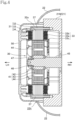
- the motor 30 is covered with a bottomed cylindrical motor cover 50 from an outer side (left side) in an axial direction of the rotary drive shaft 45 which is a motor output shaft.
- the left opening of the main arm 21M which is elongated in the front-rear direction is covered with an arm cover 22 except for the motor cover 50.
- the arm cover 22 has an opening 22h formed in a portion corresponding to the bottomed cylindrical motor cover 50, and the motor cover 50 protrudes leftward from the opening 22h when the arm cover 22 is placed in the left opening of the main arm 21M (see Fig. 4 ).
- the motor 30 is an inner rotor AC electric motor.
- a rotor 41 is inserted inside a stator 31 formed in an annular shape.
- the stator 31 is of a split core type, and a stator coil 34 is wound around each of a plurality of stator cores 32 which is divided and arranged radially in a circumferential direction via a bobbin-shaped insulator 33 which is a resin insulator.
- the stator 31 is formed in an annular shape by arranging, in the circumferential direction, a plurality of stator coils 34 respectively wound around the stator cores 32 that are radially arranged.
- Each of the stator cores 32 has an outer arc-shaped end part 32a protruding outward from the insulator 33 in a radial direction to form an arc shape, and the outer arc-shaped end parts 32a of the adjacent stator cores 32 are coupled to each other to form an annular shape as a whole.
- the stator 31 is fixed to the main arm 21M by fastening the outer arc-shaped end parts 32a of the stator cores 32 to the main arm 21M with bolts 37.
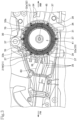
- the outer arc-shaped end parts 32a of the stator cores 32 formed in an annular shape are fastened to the main arm 21M by the bolts 37 at six locations in the circumferential direction (see Fig. 3 ).
- the rotor 41 is provided inside and at the center of the stator 31, which is annularly formed, with the rotary drive shaft 45 as a central axis.
- the rotor 41 includes an annular rotor core 43 that is fitted to an end of the rotary drive shaft 45 via a cylindrical boss portion 42, and magnets 44 that are fitted in the rotor core 43 at intervals in the circumferential direction.
- the rotary drive shaft 45 is pivotally supported by the main arm 21M in a rotatable manner while being oriented in the horizontal vehicle width direction, and serves as an input shaft of the power transmission mechanism 23 mounted on the right side of the main arm 21M, and the rotor 41 is fitted and fixed to a protruding portion of the rotary drive shaft 45 on the left side of the main arm 21M.
- a male thread is formed at a left end of the rotary drive shaft 45, and the cylindrical boss portion 42 of the fitted rotor 41 is tightened by a nut 46 screwed onto the male thread via a washer 47 to integrally fasten the rotor 41 to the rotary drive shaft 45.
- the rotor 41 integrally rotates with the rotary drive shaft 45 by driving the motor 30, and the rotation of the rotary drive shaft 45 is transmitted to the rear axle 26 via the power transmission mechanism 23 to rotate the rear wheel 25.
- the motorcycle 1 travels.
- the motor 30 is a three-phase AC electric motor, and as illustrated in Fig. 3 , three three-phase electric wires 35 extend forward from the stator coils 34 of the stator 31 along the surface of the left opening of the main arm 21M.
- an inverter converts DC power from a battery into three-phase AC power, and the three-phase AC power is supplied to the stator coils 34 of the motor 30 by the three-phase electric wires 35 to drive the motor 30.
- the insulator 33 made of a resin material in the stator 31 of the motor 30 having the above-described structure has a bobbin shape.
- the insulator 33 includes a cylindrical portion 33a located between the stator core 32 and the stator coil 34 and flanges 33b and 33c formed at ends of both openings of the cylindrical portion 33a, respectively.
- the flanges 33b and 33c are formed in a rectangular shape with the opening ends of the cylindrical portion 33a extending outward in the circumferential direction.
- the outer flange 33b is formed at the end of the opening of the cylindrical portion 33a located outside in the radial direction, the cylindrical portion 33a being oriented in the radial direction of (radially oriented with respect to) the stator 31, and the inner flange 33c is formed at the end of the opening of the cylindrical portion 33a located inside in the radial direction.
- the outer flange 33b of the insulator 33 is in contact with a radially outer end of the stator coil 34 wound around the cylindrical portion 33a, and the inner flange 33c of the insulator 33 is in contact with a radially inner end face of the stator coil 34 wound around the cylindrical portion 33a.
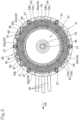
- the temperature sensor holder 70 that holds the temperature sensor 60 for detecting a temperature of the stator coil 34 is mounted on the outer flanges 33b of the insulators 33 of two stator cores 32 which are the front-side stator core 32 and the rear-side stator core 32 out of the upper stator cores among the plurality of stator cores 32 arranged radially in the circumferential direction (see Figs. 3 and 5 ).
- the temperature sensor 60 has a sensor element incorporated in a cylindrical sensor tube 61, and has a temperature measuring unit 62 at one end of the sensor tube 61.
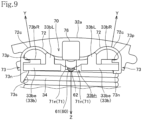
- the temperature sensor 60 is illustrated with a dotted pattern in Figs. 6 to 9 .
- the temperature sensor holder 70 is made of resin, and includes a sensor holding portion 71 that holds the temperature sensor 60, a pair of arms 72 and 72 having curved portions 72c and 72c extending in opposite directions from the sensor holding portion 71, and a pair of holder engagement portions 73 and 73 respectively provided at outer ends of the pair of arms 72 and 72 facing each other.
- the sensor holding portion 71 has a pair of holder tabs 71n and 71n that forms a cylindrical shape with one side in the circumferential direction being open and that symmetrically protrudes from a central base part 71a so as to face each other.
- the temperature sensor 60 is held in such a manner that the cylindrical sensor tube 61 of the temperature sensor 60 is held by the pair of holder tabs 71n and 71n from both sides with a central axis of the sensor tube 61 being aligned with a central axis Lc of a cylinder defined by the pair of cylindrical holder tabs 71n and 71n.
- the cylindrical sensor tube 61 partially protrudes from between tips of both of the pair of holder tabs 71n and 71n (see Fig. 9 ).
- the pair of arms 72 and 72 extends in opposite directions from the central base part 71a at the proximal ends of the pair of holder tabs 71n and 71n.
- the temperature sensor holder 70 includes a connection portion 75 that extends in the axial direction of the central axis Lc from the central base part 71a of the sensor holding portion 71 and a box portion 76 provided via the connection portion 75.
- the sensor tube 61 extends to both sides in the axial direction of the central axis Lc from the portion held by the pair of holder tabs 71n and 71n. An end of a portion of the sensor tube 61 extending along the connection portion 75 on the connection portion 75 side is inserted into the box portion 76, and an end of a portion extending to the side opposite to the connection portion 75 is provided with the temperature measuring unit 62.
- Two signal lines 63 of the temperature sensor 60 extend from the end of the sensor tube 61 inserted into the box portion 76 and extend from the inside of the box portion 76 toward the connection portion 75.
- the pair of arms 72 and 72 extending in the opposite directions from the central base part 71a of the sensor holding portion 71 are band-shaped plate portions having a constant width in the axial direction of the central axis Lc, and have: curved portions 72c and 72c curved so as to project in a direction (direction indicated by an arrow Y in Figs. 7 and 9 ) substantially opposite to the direction (direction indicated by an arrow Z in Figs. 7 and 9 ) in which the holder tabs 71n and 71n protrude from the central base part 71a; and the pair of holder engagement portions 73 and 73 at outer ends of the curved portions 72c and 72c facing each other.
- the pair of holder engagement portions 73 and 73 facing each other has a pair of engagement tabs 73n and 73n that protrudes in a direction in which the holder engagement tabs 73n and 73n face each other.
- the engagement tab 73n of one of the pair of holder engagement portions 73 and 73 has an inclined surface 73s that tapers toward the leading end in a direction perpendicular to the direction in which the engagement tab 73n protrudes.
- the pair of holder engagement portions 73 and 73 also has protruding pieces 73p and 73p protruding in parallel to the engagement tabs 73n and 73n in the same direction as the engagement tabs 73n and 73n on the side closer to the arms 72 and 72 with respect to the engagement tabs 73n and 73n.
- the temperature sensor holder 70 is mounted on a left end part 33be of the outer flange 33b, which has a rectangular plate shape, of the insulator 33 as illustrated in Fig. 6 .
- the left end part 33be of the outer flange 33b in contact with the radially outer end of the stator coil 34 wound around the cylindrical portion 33a of the insulator 33 protrudes to the left beyond the radially outer end of the stator coil 34, and the temperature sensor holder 70 is mounted on the protruding left end part 33be.
- the left end part 33be which has a rectangular plate shape, of the outer flange 33b is cut from the center of the left edge to the right to form an opening 33bh.
- the opening 33bh extends to the right up to a region where the radially outer end of the stator coil 34 is exposed.
- the left end part 33be of the outer flange 33b includes two left positioning protrusions 33bL and two right positioning protrusions 33bR which protrude in the radial direction of the stator 31.
- a set of the left positioning protrusion 33bL and the right positioning protrusion 33bR is provided on each side of the opening 33bh.
- the left positioning protrusion 33bL protrudes along the left end edge of the left end part 33be at a position close to the opening 33bh
- the right positioning protrusion 33bR protrudes at a position farther from the opening 33bh so as to be away from the left positioning protrusion 33bL to the right by the width of the arm 72 of the temperature sensor holder 70.
- the left positioning protrusions 33bL and 33bL are formed at symmetrical positions on both sides of the opening 33bh, and the right positioning protrusions 33bR and 33bR are similarly formed at symmetrical positions on both sides of opening 33bh.
- the left positioning protrusion 33bL and the right positioning protrusion 33bR position the temperature sensor holder 70 by holding the arm 72 therebetween.
- the temperature sensor holder 70 holding the temperature sensor 60 is mounted on the left end part 33be of the outer flange 33b of the insulator 33 from the outside of the stator 31 in the radial direction.
- the temperature sensor holder 70 is positioned on the radially outer side of the stator 31 with respect to the left end part 33be of the outer flange 33b, and one of the engagement tabs 73n without having the inclined surface 73s out of the pair of engagement tabs 73n and 73n of the temperature sensor holder 70 is hooked on one side part protruding to the left of the left end part 33be of the outer flange 33b.
- the side part of the left end part 33be of the outer flange 33b is located between the engagement tab 73n and the protruding piece 73p.
- the temperature sensor holder 70 inclined with respect to the outer flange 33b is rotated about the portion where the temperature sensor holder 70 is hooked on the engagement tab 73n not having the inclined surface 73s in a direction in which the other engagement tab 73n having the inclined surface 73s approaches the other side part of the left end part 33be.
- the inclined surface 73s of the other engagement tab 73n comes into contact with and slides on the other side part of the left end part 33be of the outer flange 33b, and the curved portion 72c of the arm 72 is elastically deformed so as to open, whereby the engagement tab 73n is displaced in a direction away from the other side part of the left end part 33be of the outer flange 33b.
- the temperature sensor 60 held by the pair of holder tabs 71n and 71n of the sensor holding portion 71 at the center of the temperature sensor holder 70 enters the opening 73bh of the left end part 33be of the outer flange 33b and is brought into pressure contact with the stator coil 34 exposed from the opening 73bh.
- the temperature sensor holder 70 is further rotated after the temperature sensor 60 is brought into pressure contact with the stator coil 34, by which the curved portion 72c of the arm 72 is elastically deformed so as to be further opened to allow the other engagement tab 73n to climb over the other side part of the left end part 33be of the outer flange 33b, and an elastic force acts in a direction in which the opened curved portion 72c of the arm 72 is closed.
- the other engagement tab 73n is engaged with the other side part of the left end part 33be of the outer flange 33b as illustrated in Fig. 9 .
- Elastic force acts on the pair of arms 72 and 72 in a direction in which the curved portions 72c and 72c are closed, by which the pair of engagement tabs 73n and 73n is engaged with the side parts of the left end part 33be, and at the same time, the sensor holding portion 71 at the center brings the temperature sensor 60 in pressure contact with the stator coil 34.
- the temperature sensor holder 70 is mounted on the left end part 33be of the outer flange 33b of the insulator 33.
- the curved portion 72c of the arm 72 of the temperature sensor holder 70 is curved so as to project outward in the radial direction of the stator 31 (the direction indicated by the arrow Y in Fig. 9 ), and the temperature sensor 60 held by the sensor holding portion 71 is brought into pressure contact with the stator coil 34 by the elastic force of the curved portion 72c of the arm 72 toward the inside of the stator 31 in the radial direction (the direction indicated by the arrow Z in Fig. 9 ).
- the temperature measuring unit 62 at one end of the sensor tube 61 is in pressure contact with the stator coil 34.
- the arms 72 are held between the two left positioning protrusions 33bL and the right positioning protrusions 33bR protruding in the radial direction of the stator 31 at the left end part 33be of the outer flange 33b, whereby the movement of the temperature sensor holder 70 in the axial direction (left-right direction) of the rotary drive shaft 45 is restricted.
- the left positioning protrusion 33bL is located on the proximal end side (the central base part 71a side) of the curved portion 72c of the arm 72
- the right positioning protrusion 33bR is located on the outer end side (the holder engagement portion 73 side) of the curved portion 72c. That is, the left positioning protrusion 33bL and the right positioning protrusion 33bR are provided avoiding the curved portion 72c of the arm 72 that is elastically deformed. Thus, even when the curved portion 72c of the arm 72 is deformed by vibration, the positioning of the rotary drive shaft 45 in the axial direction is maintained.
- the motor 30 is disposed at the rear part of the main arm 21M of the swing frame 21 with the rotary drive shaft 45 being oriented in the horizontal vehicle width direction.
- the temperature sensor holders 70 are respectively mounted on the outer flanges 33b and 33b of the insulators 33 and 33 provided in the front-side stator core 32 and the rear-side stator core 32 out of the uppermost stator cores 32 among the plurality of stator cores 32 divided and arranged in the circumferential direction of the stator 31 (see Fig. 3 ).
- the temperature sensor holder 70 can be mounted on the outer flange 33b of the insulator 33 in such a manner that the engagement tab 73n of the holder engagement portion 73 is engaged with the outer flange 33b of the insulator 33 due to elastic force of the curved portion 72c of the arm 72, and at the same time, the sensor holding portion 71 brings the temperature sensor 60 in pressure contact with the stator coil 34. Therefore, the load on the temperature sensor 60 due to vibration can be absorbed by the elastic deformation of the curved portion 72c of the arm 72, whereby the pressure contact of the temperature sensor 60 with the stator coil 34 by the sensor holding portion 71 can be constantly maintained.
- the temperature of the stator coil 34 can be constantly and stably measured.
- the temperature sensor holder 70 mounted on the outer flange 33b of the insulator 33 can be removed from the outer flange 33b of the insulator 33 in such a manner that the curved shape of the curved portion 72c of the arm 72 is deformed to release the engagement of the engagement tab 73n of the holder engagement portion 73 with the outer flange 33b of the insulator 33.
- the temperature sensor holder 70 can be easily removed.
- the protruding engagement tab 73n of the holder engagement portion 73 is engaged with the end of the outer flange 33b of the insulator 33, the protruding engagement tab 73n is engaged in a state of being hooked on the end of the outer flange 33b of the insulator 33. Therefore, the engagement tab 73n is easily engaged and disengaged. That is, the temperature sensor holder 70 is more easily mounted and removed.
- the pair of arms 72 extends from the sensor holding portion 71 in directions opposite to each other, and the engagement tabs 73n of the pair of holder engagement portions 73 are provided at the outer ends of the pair of arms 72.
- the sensor holding portion 71 at the center brings the temperature sensor 60 in pressure contact with the stator coil 34 by the elastic force of the curved portions 72c and 72c of the arms 72 and 72 on both sides of the sensor holding portion 71, so that the temperature sensor 60 can be stably brought into pressure contact with the stator coil 34 in a well-balanced manner.
- the holder engagement portion 73 has the protruding piece 73p protruding in the same direction as the engagement tab 73n on the arm 72 side with respect to the engagement tab 73n, and the engagement tab 73n is engaged with the end of the outer flange 33b of the insulator 33 positioned between the engagement tab 73n and the protruding piece 73p.
- the protruding piece 73p comes in contact with the end of the outer flange 33b of the insulator 33 and serves as a stopper, and thus, the end of the outer flange 33b of the insulator 33 is prevented from coming off from between the protruding piece 73p and the engagement tab 73n. Accordingly, the temperature sensor holder 70 is prevented from being disengaged from the outer flange 33b of the insulator 33.
- the protruding piece 73p serves as a stopper to prevent the engaged engagement tab 73n from being disengaged from the one side part of the left end part 33be of the outer flange 33b. This facilitates mounting of the temperature sensor holder 70.
- the engagement tab 73n of at least one of the pair of holder engagement portions 73 and 73 has the inclined surface 73s tapered toward the leading end in the direction perpendicular to the protruding direction thereof.
- the temperature sensor holder 70 can be smoothly mounted on the outer flange 33b of the insulator 33.
- the insulator 33 has the outer flange 33b formed along the stator coil 34 at the opening end of the cylindrical portion 33a on the radially outer side of the stator 31, the cylindrical portion 33a being located between the stator core 32 and the stator coil 34.
- the temperature sensor holder 70 is mounted on the outer flange 33b from the radially outer side of the stator 31 with the engagement tab 73n of the holder engagement portion 73 being engaged with the end of the outer flange 33b of the insulator 33. Therefore, the temperature sensor holder 70 does not interfere with the insertion of the rotor 41 within the stator 31, whereby the rotor 41 can be easily mounted.
- the outer flange 33b of the insulator 33 is provided with the left positioning protrusion 33bL and the right positioning protrusion 33bR that protrude radially outward of the stator 31 and restrict the movement of the temperature sensor holder 70 in the axial direction of the rotary drive shaft 45, so that the temperature sensor holder 70 can be prevented from being disengaged from the outer flange 33b even when the motor 30 receives impact or vibration in the axial direction of the rotary drive shaft 45.
- the curved portion 72c of the arm 72 of the temperature sensor holder 70 is curved so as to project outward in the radial direction of the stator 31, and the temperature sensor 60 held by the sensor holding portion 71 is brought into pressure contact with the stator coil by the elastic force of the curved portion 72c of the arm 72 toward the inside of the stator 31 in the radial direction (the direction indicated by the arrow Z in Fig. 9 ).
- the temperature sensor 60 can be constantly brought into pressure contact with the stator coil 34 following the vibration by the elastic deformation of the curved portion 72c of the arm 72 that is curved so as to project outward in the radial direction of the stator 31.
- the motor 30 is mounted on the motorcycle 1 with the rotary drive shaft 45 being oriented in the left-right horizontal direction. Therefore, the vibration of the motor 30 in the vertical direction accompanying the traveling of the vehicle is the vibration of the stator 31 of the motor 30 in the radial direction, and thus, the elastic deformation of the curved portion 72c projecting in the radial direction of the arm 72 effectively acts, so that the temperature sensor 60 can be constantly pressed against the stator coil 34 following the vibration in the vertical direction. Accordingly, the temperature of the stator coil 34 can be constantly and stably measured.
- the aspect of the present invention is not limited to the above-described embodiment, and the prevent invention can be embodied in various aspects within the scope of the gist of the present invention.
- the temperature sensor holder 70 includes the pair of arms 72 and 72 extending in the opposite directions from the sensor holding portion 71 and the pair of holder engagement portions 73 and 73 at the outer ends of the arms 72 and 72.
- a temperature sensor holder including only one arm extending from the sensor holding portion and one holder engagement portion at the outer end of the arm may be applied.
- the temperature sensor holder can be mounted on the motor in such a manner that the holder engagement portion is engaged with the insulator of the motor due to elastic force to close the curved portion of the arm, and at the same time, the sensor holding portion brings the temperature sensor in pressure contact with the stator coil.
Landscapes
- Engineering & Computer Science (AREA)
- Physics & Mathematics (AREA)
- General Physics & Mathematics (AREA)
- Microelectronics & Electronic Packaging (AREA)
- Power Engineering (AREA)
Applications Claiming Priority (2)
| Application Number | Priority Date | Filing Date | Title |
|---|---|---|---|
| JP2022054249 | 2022-03-29 | ||
| PCT/JP2022/046744 WO2023188600A1 (fr) | 2022-03-29 | 2022-12-19 | Support de capteur de température et procédé de fixation de capteur de température |
Publications (2)
| Publication Number | Publication Date |
|---|---|
| EP4482001A1 true EP4482001A1 (fr) | 2024-12-25 |
| EP4482001A4 EP4482001A4 (fr) | 2025-05-21 |
Family
ID=88200038
Family Applications (1)
| Application Number | Title | Priority Date | Filing Date |
|---|---|---|---|
| EP22933871.0A Pending EP4482001A4 (fr) | 2022-03-29 | 2022-12-19 | Support de capteur de température et procédé de fixation de capteur de température |
Country Status (5)
| Country | Link |
|---|---|
| US (1) | US20250226730A1 (fr) |
| EP (1) | EP4482001A4 (fr) |
| JP (1) | JP7716577B2 (fr) |
| CN (1) | CN118946791A (fr) |
| WO (1) | WO2023188600A1 (fr) |
Families Citing this family (2)
| Publication number | Priority date | Publication date | Assignee | Title |
|---|---|---|---|---|
| DE102020126632B4 (de) * | 2020-10-12 | 2022-11-17 | Schaeffler Technologies AG & Co. KG | Anbindung eines Temperatursensors an einen Verschaltungsring einer elektrischen Maschine |
| JP7310037B1 (ja) * | 2022-06-07 | 2023-07-18 | 株式会社芝浦電子 | 温度センサおよび回転電機 |
Family Cites Families (9)
| Publication number | Priority date | Publication date | Assignee | Title |
|---|---|---|---|---|
| JP2010259271A (ja) * | 2009-04-27 | 2010-11-11 | Sanyo Electric Co Ltd | 電動モータ及び電動車輌 |
| JP5957184B2 (ja) * | 2011-04-01 | 2016-07-27 | 本田技研工業株式会社 | 車両用駆動装置 |
| JP5741327B2 (ja) * | 2011-08-31 | 2015-07-01 | トヨタ自動車株式会社 | 回転電機 |
| CN104113165B (zh) | 2013-07-17 | 2016-08-10 | 广东威灵电机制造有限公司 | 电机温控器的固定结构及其应用的电机 |
| DE102013214385A1 (de) * | 2013-07-23 | 2015-01-29 | Zf Friedrichshafen Ag | Elektrische Maschine |
| CN203522446U (zh) | 2013-09-12 | 2014-04-02 | 珠海格力电器股份有限公司 | 电机及其探测器固定座 |
| JP5726277B1 (ja) * | 2013-11-29 | 2015-05-27 | 三菱電機株式会社 | 回転電機、回転電機の固定子、及び回転電機の固定子の製造方法 |
| KR101989265B1 (ko) | 2015-05-25 | 2019-06-13 | 쟈트코 가부시키가이샤 | 온도 센서 홀더 |
| US11892358B2 (en) | 2018-08-02 | 2024-02-06 | Shibaura Electronics Co., Ltd. | Temperature detection device and assembly thereof |
-
2022
- 2022-12-19 US US18/849,335 patent/US20250226730A1/en active Pending
- 2022-12-19 EP EP22933871.0A patent/EP4482001A4/fr active Pending
- 2022-12-19 CN CN202280094406.3A patent/CN118946791A/zh active Pending
- 2022-12-19 JP JP2024511229A patent/JP7716577B2/ja active Active
- 2022-12-19 WO PCT/JP2022/046744 patent/WO2023188600A1/fr not_active Ceased
Also Published As
| Publication number | Publication date |
|---|---|
| EP4482001A4 (fr) | 2025-05-21 |
| CN118946791A (zh) | 2024-11-12 |
| US20250226730A1 (en) | 2025-07-10 |
| JPWO2023188600A1 (fr) | 2023-10-05 |
| JP7716577B2 (ja) | 2025-07-31 |
| WO2023188600A1 (fr) | 2023-10-05 |
Similar Documents
| Publication | Publication Date | Title |
|---|---|---|
| EP4482001A1 (fr) | Support de capteur de température et procédé de fixation de capteur de température | |
| JP7253005B2 (ja) | 車両のバッテリ収納装置 | |
| KR101590738B1 (ko) | 전동 자전거의 전장품 배치 구조 | |
| CN103209886B (zh) | 电动车辆的驱动装置 | |
| EP2412622B1 (fr) | Vehicule enfourche electrique | |
| US20120193155A1 (en) | Sports type, saddle type electric vehicle | |
| TWI579182B (zh) | 腳踏車用的框元件與馬達以及具有這種框元件和馬達的腳踏車 | |
| KR20130036020A (ko) | 전동 이륜차의 제어 장치 | |
| US8887854B2 (en) | Electrical unit containing structure for saddle type electric vehicle | |
| TWI752270B (zh) | 車輛的電池收納裝置 | |
| CA2792531C (fr) | Vehicule equipe d'un moteur d'entrainement | |
| JPWO2019064606A1 (ja) | 車両のバッテリ収納装置 | |
| EP3747681B1 (fr) | Unité de moteur-roue et véhicule électrique | |
| US8794366B2 (en) | Battery case structure for motorcycle | |
| JPH10181651A (ja) | 電動自転車のバッテリボックス固定構造 | |
| TW201919937A (zh) | 跨騎型車輛 | |
| EP3750735B1 (fr) | Unité de moteur-roue et véhicule électrique | |
| TW200301735A (en) | Vehicle engine having an air filter | |
| US11833986B2 (en) | Vehicle with an electric prime mover | |
| WO2020065672A1 (fr) | Machine électrique pour un véhicule | |
| JP6970148B2 (ja) | スクータ型電動二輪車 | |
| CN111051191B (zh) | 跨骑型电动车辆 | |
| EP3981681B1 (fr) | Étrier de fixation de bras oscillant | |
| JPH04244494A (ja) | 電動三輪車のバッテリ装着装置 | |
| CN223305876U (zh) | 摩托车点火线圈支架 |
Legal Events
| Date | Code | Title | Description |
|---|---|---|---|
| STAA | Information on the status of an ep patent application or granted ep patent |
Free format text: STATUS: UNKNOWN |
|
| STAA | Information on the status of an ep patent application or granted ep patent |
Free format text: STATUS: THE INTERNATIONAL PUBLICATION HAS BEEN MADE |
|
| PUAI | Public reference made under article 153(3) epc to a published international application that has entered the european phase |
Free format text: ORIGINAL CODE: 0009012 |
|
| STAA | Information on the status of an ep patent application or granted ep patent |
Free format text: STATUS: REQUEST FOR EXAMINATION WAS MADE |
|
| 17P | Request for examination filed |
Effective date: 20240916 |
|
| AK | Designated contracting states |
Kind code of ref document: A1 Designated state(s): AL AT BE BG CH CY CZ DE DK EE ES FI FR GB GR HR HU IE IS IT LI LT LU LV MC ME MK MT NL NO PL PT RO RS SE SI SK SM TR |
|
| A4 | Supplementary search report drawn up and despatched |
Effective date: 20250422 |
|
| RIC1 | Information provided on ipc code assigned before grant |
Ipc: G01K 1/143 20210101ALI20250414BHEP Ipc: G01K 1/14 20210101ALI20250414BHEP Ipc: H02K 11/25 20160101AFI20250414BHEP |
|
| DAV | Request for validation of the european patent (deleted) | ||
| DAX | Request for extension of the european patent (deleted) | ||
| RAP3 | Party data changed (applicant data changed or rights of an application transferred) |
Owner name: HONDA MOTOR CO., LTD. |
|
| GRAP | Despatch of communication of intention to grant a patent |
Free format text: ORIGINAL CODE: EPIDOSNIGR1 |
|
| STAA | Information on the status of an ep patent application or granted ep patent |
Free format text: STATUS: GRANT OF PATENT IS INTENDED |