EP4475546A2 - Linsenantriebsvorrichtung und kameramodul damit - Google Patents
Linsenantriebsvorrichtung und kameramodul damit Download PDFInfo
- Publication number
- EP4475546A2 EP4475546A2 EP24208307.9A EP24208307A EP4475546A2 EP 4475546 A2 EP4475546 A2 EP 4475546A2 EP 24208307 A EP24208307 A EP 24208307A EP 4475546 A2 EP4475546 A2 EP 4475546A2
- Authority
- EP
- European Patent Office
- Prior art keywords
- coupler
- circuit board
- disposed
- housing
- pad
- Prior art date
- Legal status (The legal status is an assumption and is not a legal conclusion. Google has not performed a legal analysis and makes no representation as to the accuracy of the status listed.)
- Granted
Links
Images





Classifications
-
- G—PHYSICS
- G02—OPTICS
- G02B—OPTICAL ELEMENTS, SYSTEMS OR APPARATUS
- G02B27/00—Optical systems or apparatus not provided for by any of the groups G02B1/00 - G02B26/00, G02B30/00
- G02B27/64—Imaging systems using optical elements for stabilisation of the lateral and angular position of the image
- G02B27/646—Imaging systems using optical elements for stabilisation of the lateral and angular position of the image compensating for small deviations, e.g. due to vibration or shake
-
- G—PHYSICS
- G02—OPTICS
- G02B—OPTICAL ELEMENTS, SYSTEMS OR APPARATUS
- G02B7/00—Mountings, adjusting means, or light-tight connections, for optical elements
- G02B7/02—Mountings, adjusting means, or light-tight connections, for optical elements for lenses
- G02B7/04—Mountings, adjusting means, or light-tight connections, for optical elements for lenses with mechanism for focusing or varying magnification
- G02B7/08—Mountings, adjusting means, or light-tight connections, for optical elements for lenses with mechanism for focusing or varying magnification adapted to co-operate with a remote control mechanism
-
- G—PHYSICS
- G02—OPTICS
- G02B—OPTICAL ELEMENTS, SYSTEMS OR APPARATUS
- G02B7/00—Mountings, adjusting means, or light-tight connections, for optical elements
- G02B7/02—Mountings, adjusting means, or light-tight connections, for optical elements for lenses
- G02B7/04—Mountings, adjusting means, or light-tight connections, for optical elements for lenses with mechanism for focusing or varying magnification
- G02B7/09—Mountings, adjusting means, or light-tight connections, for optical elements for lenses with mechanism for focusing or varying magnification adapted for automatic focusing or varying magnification
-
- G—PHYSICS
- G03—PHOTOGRAPHY; CINEMATOGRAPHY; ANALOGOUS TECHNIQUES USING WAVES OTHER THAN OPTICAL WAVES; ELECTROGRAPHY; HOLOGRAPHY
- G03B—APPARATUS OR ARRANGEMENTS FOR TAKING PHOTOGRAPHS OR FOR PROJECTING OR VIEWING THEM; APPARATUS OR ARRANGEMENTS EMPLOYING ANALOGOUS TECHNIQUES USING WAVES OTHER THAN OPTICAL WAVES; ACCESSORIES THEREFOR
- G03B13/00—Viewfinders; Focusing aids for cameras; Means for focusing for cameras; Autofocus systems for cameras
- G03B13/32—Means for focusing
- G03B13/34—Power focusing
- G03B13/36—Autofocus systems
-
- G—PHYSICS
- G03—PHOTOGRAPHY; CINEMATOGRAPHY; ANALOGOUS TECHNIQUES USING WAVES OTHER THAN OPTICAL WAVES; ELECTROGRAPHY; HOLOGRAPHY
- G03B—APPARATUS OR ARRANGEMENTS FOR TAKING PHOTOGRAPHS OR FOR PROJECTING OR VIEWING THEM; APPARATUS OR ARRANGEMENTS EMPLOYING ANALOGOUS TECHNIQUES USING WAVES OTHER THAN OPTICAL WAVES; ACCESSORIES THEREFOR
- G03B17/00—Details of cameras or camera bodies; Accessories therefor
- G03B17/02—Bodies
- G03B17/12—Bodies with means for supporting objectives, supplementary lenses, filters, masks, or turrets
-
- G—PHYSICS
- G03—PHOTOGRAPHY; CINEMATOGRAPHY; ANALOGOUS TECHNIQUES USING WAVES OTHER THAN OPTICAL WAVES; ELECTROGRAPHY; HOLOGRAPHY
- G03B—APPARATUS OR ARRANGEMENTS FOR TAKING PHOTOGRAPHS OR FOR PROJECTING OR VIEWING THEM; APPARATUS OR ARRANGEMENTS EMPLOYING ANALOGOUS TECHNIQUES USING WAVES OTHER THAN OPTICAL WAVES; ACCESSORIES THEREFOR
- G03B3/00—Focusing arrangements of general interest for cameras, projectors or printers
- G03B3/10—Power-operated focusing
-
- G—PHYSICS
- G03—PHOTOGRAPHY; CINEMATOGRAPHY; ANALOGOUS TECHNIQUES USING WAVES OTHER THAN OPTICAL WAVES; ELECTROGRAPHY; HOLOGRAPHY
- G03B—APPARATUS OR ARRANGEMENTS FOR TAKING PHOTOGRAPHS OR FOR PROJECTING OR VIEWING THEM; APPARATUS OR ARRANGEMENTS EMPLOYING ANALOGOUS TECHNIQUES USING WAVES OTHER THAN OPTICAL WAVES; ACCESSORIES THEREFOR
- G03B30/00—Camera modules comprising integrated lens units and imaging units, specially adapted for being embedded in other devices, e.g. mobile phones or vehicles
-
- G—PHYSICS
- G03—PHOTOGRAPHY; CINEMATOGRAPHY; ANALOGOUS TECHNIQUES USING WAVES OTHER THAN OPTICAL WAVES; ELECTROGRAPHY; HOLOGRAPHY
- G03B—APPARATUS OR ARRANGEMENTS FOR TAKING PHOTOGRAPHS OR FOR PROJECTING OR VIEWING THEM; APPARATUS OR ARRANGEMENTS EMPLOYING ANALOGOUS TECHNIQUES USING WAVES OTHER THAN OPTICAL WAVES; ACCESSORIES THEREFOR
- G03B5/00—Adjustment of optical system relative to image or object surface other than for focusing
-
- G—PHYSICS
- G03—PHOTOGRAPHY; CINEMATOGRAPHY; ANALOGOUS TECHNIQUES USING WAVES OTHER THAN OPTICAL WAVES; ELECTROGRAPHY; HOLOGRAPHY
- G03B—APPARATUS OR ARRANGEMENTS FOR TAKING PHOTOGRAPHS OR FOR PROJECTING OR VIEWING THEM; APPARATUS OR ARRANGEMENTS EMPLOYING ANALOGOUS TECHNIQUES USING WAVES OTHER THAN OPTICAL WAVES; ACCESSORIES THEREFOR
- G03B5/00—Adjustment of optical system relative to image or object surface other than for focusing
- G03B5/02—Lateral adjustment of lens
-
- H—ELECTRICITY
- H02—GENERATION; CONVERSION OR DISTRIBUTION OF ELECTRIC POWER
- H02K—DYNAMO-ELECTRIC MACHINES
- H02K41/00—Propulsion systems in which a rigid body is moved along a path due to dynamo-electric interaction between the body and a magnetic field travelling along the path
- H02K41/02—Linear motors; Sectional motors
- H02K41/035—DC motors; Unipolar motors
- H02K41/0352—Unipolar motors
- H02K41/0354—Lorentz force motors, e.g. voice coil motors
-
- H—ELECTRICITY
- H02—GENERATION; CONVERSION OR DISTRIBUTION OF ELECTRIC POWER
- H02K—DYNAMO-ELECTRIC MACHINES
- H02K41/00—Propulsion systems in which a rigid body is moved along a path due to dynamo-electric interaction between the body and a magnetic field travelling along the path
- H02K41/02—Linear motors; Sectional motors
- H02K41/035—DC motors; Unipolar motors
- H02K41/0352—Unipolar motors
- H02K41/0354—Lorentz force motors, e.g. voice coil motors
- H02K41/0356—Lorentz force motors, e.g. voice coil motors moving along a straight path
-
- H—ELECTRICITY
- H04—ELECTRIC COMMUNICATION TECHNIQUE
- H04N—PICTORIAL COMMUNICATION, e.g. TELEVISION
- H04N23/00—Cameras or camera modules comprising electronic image sensors; Control thereof
- H04N23/50—Constructional details
- H04N23/54—Mounting of pick-up tubes, electronic image sensors, deviation or focusing coils
-
- H—ELECTRICITY
- H04—ELECTRIC COMMUNICATION TECHNIQUE
- H04N—PICTORIAL COMMUNICATION, e.g. TELEVISION
- H04N23/00—Cameras or camera modules comprising electronic image sensors; Control thereof
- H04N23/50—Constructional details
- H04N23/55—Optical parts specially adapted for electronic image sensors; Mounting thereof
-
- H—ELECTRICITY
- H04—ELECTRIC COMMUNICATION TECHNIQUE
- H04N—PICTORIAL COMMUNICATION, e.g. TELEVISION
- H04N23/00—Cameras or camera modules comprising electronic image sensors; Control thereof
- H04N23/57—Mechanical or electrical details of cameras or camera modules specially adapted for being embedded in other devices
-
- H—ELECTRICITY
- H05—ELECTRIC TECHNIQUES NOT OTHERWISE PROVIDED FOR
- H05K—PRINTED CIRCUITS; CASINGS OR CONSTRUCTIONAL DETAILS OF ELECTRIC APPARATUS; MANUFACTURE OF ASSEMBLAGES OF ELECTRICAL COMPONENTS
- H05K1/00—Printed circuits
- H05K1/02—Details
- H05K1/11—Printed elements for providing electric connections to or between printed circuits
-
- H—ELECTRICITY
- H05—ELECTRIC TECHNIQUES NOT OTHERWISE PROVIDED FOR
- H05K—PRINTED CIRCUITS; CASINGS OR CONSTRUCTIONAL DETAILS OF ELECTRIC APPARATUS; MANUFACTURE OF ASSEMBLAGES OF ELECTRICAL COMPONENTS
- H05K1/00—Printed circuits
- H05K1/02—Details
- H05K1/11—Printed elements for providing electric connections to or between printed circuits
- H05K1/111—Pads for surface mounting, e.g. lay-out
-
- H—ELECTRICITY
- H05—ELECTRIC TECHNIQUES NOT OTHERWISE PROVIDED FOR
- H05K—PRINTED CIRCUITS; CASINGS OR CONSTRUCTIONAL DETAILS OF ELECTRIC APPARATUS; MANUFACTURE OF ASSEMBLAGES OF ELECTRICAL COMPONENTS
- H05K1/00—Printed circuits
- H05K1/02—Details
- H05K1/14—Structural association of two or more printed circuits
- H05K1/145—Arrangements wherein electric components are disposed between and simultaneously connected to two planar printed circuit boards, e.g. Cordwood modules
-
- G—PHYSICS
- G03—PHOTOGRAPHY; CINEMATOGRAPHY; ANALOGOUS TECHNIQUES USING WAVES OTHER THAN OPTICAL WAVES; ELECTROGRAPHY; HOLOGRAPHY
- G03B—APPARATUS OR ARRANGEMENTS FOR TAKING PHOTOGRAPHS OR FOR PROJECTING OR VIEWING THEM; APPARATUS OR ARRANGEMENTS EMPLOYING ANALOGOUS TECHNIQUES USING WAVES OTHER THAN OPTICAL WAVES; ACCESSORIES THEREFOR
- G03B2205/00—Adjustment of optical system relative to image or object surface other than for focusing
- G03B2205/0007—Movement of one or more optical elements for control of motion blur
-
- G—PHYSICS
- G03—PHOTOGRAPHY; CINEMATOGRAPHY; ANALOGOUS TECHNIQUES USING WAVES OTHER THAN OPTICAL WAVES; ELECTROGRAPHY; HOLOGRAPHY
- G03B—APPARATUS OR ARRANGEMENTS FOR TAKING PHOTOGRAPHS OR FOR PROJECTING OR VIEWING THEM; APPARATUS OR ARRANGEMENTS EMPLOYING ANALOGOUS TECHNIQUES USING WAVES OTHER THAN OPTICAL WAVES; ACCESSORIES THEREFOR
- G03B2205/00—Adjustment of optical system relative to image or object surface other than for focusing
- G03B2205/0007—Movement of one or more optical elements for control of motion blur
- G03B2205/0015—Movement of one or more optical elements for control of motion blur by displacing one or more optical elements normal to the optical axis
-
- G—PHYSICS
- G03—PHOTOGRAPHY; CINEMATOGRAPHY; ANALOGOUS TECHNIQUES USING WAVES OTHER THAN OPTICAL WAVES; ELECTROGRAPHY; HOLOGRAPHY
- G03B—APPARATUS OR ARRANGEMENTS FOR TAKING PHOTOGRAPHS OR FOR PROJECTING OR VIEWING THEM; APPARATUS OR ARRANGEMENTS EMPLOYING ANALOGOUS TECHNIQUES USING WAVES OTHER THAN OPTICAL WAVES; ACCESSORIES THEREFOR
- G03B2205/00—Adjustment of optical system relative to image or object surface other than for focusing
- G03B2205/0053—Driving means for the movement of one or more optical element
- G03B2205/0069—Driving means for the movement of one or more optical element using electromagnetic actuators, e.g. voice coils
Definitions
- Embodiments relate to a lens moving apparatus and to a camera module and an optical device each including the same.
- VCM voice coil motor
- the camera module may frequently receive shocks when in use, and may undergo fine shaking due to, for example, the shaking of a user's hand.
- technology enabling a device for preventing handshake to be additionally installed to a camera module is being developed.
- Embodiments provide a lens moving apparatus capable of improving ease of soldering of a circuit board to terminals and preventing electrical disconnection of the terminals from the circuit board, and to a camera module and an optical device each including the same.
- a lens moving apparatus comprises a housing, a bobbin disposed inside the housing, a first coil disposed at the bobbin, a magnet disposed at the housing, an elastic member coupled both to the bobbin and to the housing, a circuit board disposed under the housing and including a pad portion, a base disposed under the circuit board, a terminal disposed at the base, and a support, which is coupled at one end thereof to the elastic member and at a remaining end thereof to the terminal, wherein the pad portion comprises a first pad disposed at a lower portion of the circuit board, a second pad disposed at an upper portion of the circuit board and a third pad connecting the first pad to the second pad.
- the terminal may comprises a first coupler coupled to the remaining end of the support, a second coupler coupled to the pad portion of the circuit board, and a connector connecting a portion of one side surface of the first coupler to a portion of one side surface of the second coupler.
- the circuit board may have a groove formed at a position corresponding to the second coupler of the terminal, and a portion of the third pad is disposed in the groove.
- the circuit board may have a through via formed at a position corresponding to the second coupler of the terminal, and a portion of the third pad may be disposed in the through via.
- the circuit board may comprise a first insulation layer, a first conductive layer disposed on an upper surface of the first insulation layer, a second conductive layer disposed on a lower surface of the first insulation layer, and a third insulation layer disposed on a lower surface of the second conductive layer,
- a surface area of the first pad may be larger than a surface area of the second pad.
- the lens moving apparatus may further comprise solder disposed between the first pad and the second coupler.
- a width of the connector may be less than a length of one side surface of the first coupler and a length of one side surface of the second coupler.
- the connector may comprise a curved portion or a bent portion.
- a horizontal distance between the first coupler and the second coupler may be less than a length of the second coupler in a horizontal direction, the horizontal direction being perpendicular to a width direction of the connector.
- Embodiments are able to improve ease of soldering of a circuit board to terminals and to prevent electrical disconnection of the terminals from the circuit board.
- the terms “comprise,” “include” or “have” used in the above description are used to designate the presence of features, steps or combinations thereof described in the specification, and should be understood so as not to exclude the presence or probability of additional inclusion of one or more different features, steps or combinations thereof.
- the terms “correspond” or the like may include at least one of designations of "face” or “overlap”.
- the lens moving apparatus is described using a rectangular coordinate system (x, y, z), the lens moving apparatus may be described using some other coordinate systems, and the embodiments are not limited thereto.
- the X-axis and the Y-axis mean directions perpendicular to an optical axis, i.e. the Z-axis, and the optical axis (Z-axis) direction or a direction parallel to the optical axis may be referred to as a "first direction”
- the X-axis direction may be referred to as a "second direction”
- the Y-axis direction may be referred to as a "third direction”.
- a "handshake correction device” which is applied to a subminiature camera module of a mobile device such as, for example, a smart phone or a tablet PC, may be a device that is configured to prevent the contour line of a captured image from being indistinctly formed due to vibration caused by shaking of the user's hand when capturing a still image.
- an "auto-focusing device” is a device that automatically focuses an image of a subject on an image sensor surface.
- the handshake correction device and the auto-focusing device may be configured in various ways, and the lens moving apparatus according to an embodiment may move an optical module, which is constituted of at least one lens, in the first direction, which is parallel to the optical axis, or relative to a plane defined by the second and third directions, which are perpendicular to the first direction, thereby performing handshake correction motion and/or auto-focusing.
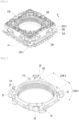
- FIG. 1 is an exploded view of a lens moving apparatus 100 according to an embodiment.
- FIG. 2 is a view illustrating the assembled state of the lens moving apparatus 100, from which a cover member 300 is removed.
- the lens moving apparatus 100 may include a bobbin 110, a first coil 120, magnets 130, a housing 140, a first elastic member 150 and a second elastic member 160.
- the lens moving apparatus 100 may further include supports 220 and a base 210.
- the lens moving apparatus 100 may further include a second coil 230 for OIS (optical image stabilization) operation, and may further include a location sensor 240 for OIS feedback operation.
- OIS optical image stabilization
- the lens moving apparatus 100 may further include a cover member 300.
- the cover member 300 will be described.
- the cover member 300 accommodates the components 110, 120, 130, 140, 150, 160, 220 and 250, in the space defined between the cover member 300 and the base 210.
- the cover member 300 may have an opening formed in the top plate thereof in order to expose a lens (not shown), coupled to the bobbin 110, to outside light.
- the material of the cover member 300 may be a non-magnetic material such as, for example, SUS in order to prevent the cover member 300 from being attracted by the magnets 130, the cover member 300 may be formed of a magnetic material, and may thus function as a yoke for increasing the electromagnetic force caused by interaction between the first coil 120 and the magnet 130.
- FIG. 3 is a perspective view of the bobbin 110.
- the bobbin 110 may include a plurality of side portions (for example, 110b-1 and 110b-2) .
- the bobbin 110 may include first side portions 110b-1 corresponding to the magnets and second side portions 110b-2 disposed between the first side portions.
- the horizontal length of the side surface of the first side portion 110b-2 of the bobbin 110 may be larger than the horizontal length of the side surface of the second side portion 110b-2.
- the disclosure is not limited thereto, and the two lengths may be the same.
- the bobbin 110 may include a first stopper 114 projecting from the upper surface thereof in the first direction.
- the first stopper 114 of the bobbin 110 may serve to prevent the upper surface of the bobbin 110 from directly colliding with the internal surface of the top plate of the cover member 300 even if the bobbin 110 is moved beyond a specified range due to an external impact or the like when the bobbin 110 is moved in the first direction in order to perform an autofocus function.
- the bobbin 110 may include at least one projection 25 projecting from the side surface (or the outer surface) of the second side portion 110b-2.
- the bobbin 110 may include four projections 25 provided at the four side portions 110b-2, without being limited thereto.
- the bobbin 110 may include two projections disposed at two side portions 110b-2 that face each other.
- the projection 25 of the bobbin 110 may correspond to a groove 145 in the housing 140, may be inserted or disposed in the groove 145 in the housing 140, and may suppress or prevent the bobbin 110 from rotating beyond a predetermined range about the optical axis.
- the bobbin 110 may include second stoppers (not shown), which project from the lower surface thereof.
- the second stoppers may serve to prevent the lower surface of the bobbin 110 from directly colliding with the base 210, the second coil 230 or the circuit board 250 even when the bobbin 110 is moved beyond a specified range due to an external impact or the like when the bobbin 110 is moved in the first direction in order to perform an autofocus function.
- the bobbin 110 may include at least one mounting groove 16 in which the first coil 120 is disposed or mounted.
- the mounting groove 16 may be provided at the first side portions 110b-1 and the second side portions 110b-2 of the bobbin 110, without being limited thereto.
- the shape of the mounting groove 16 in the bobbin 110 and the number thereof may correspond to the shape and number of the first coil 120 disposed at the side portions of the bobbin 110.
- the bobbin 110 may be provided at at least one of the first and second side portions 110b-1 and 110b-2, and may have therein a first groove 12a and a second groove 12b, which are provided at one or more of the first and second side portions 110b-1 and 110b-2 and are spaced apart from each other.
- first groove 12a may be provided at one of two first side portions 110b-1 of the bobbin 110, which face each other, and the second groove 12b may be provided at the other of the two first side portions 110b-1 of the bobbin 110, which face each other.
- the first groove 12a and the second groove 12b of the bobbin 110 may be positioned above or on the first coil 120 disposed at the bobbin 110, and may be connected to the mounting groove 16.
- the first portion of the first coil 120 may extend to the upper surface of the bobbin 110 so as to be connected to a first outer frame 151 of a first upper spring 150-1, and the second portion of the first coil 120 may extend to the upper surface of the bobbin 110 so as to be connected to a second outer frame 151 of the second upper spring 150-2.
- first coil 120 extends to the upper surface of the bobbin 110 so as to be conductively connected to the two upper springs in the embodiment, the disclosure is not limited thereto.
- first groove and the second groove may be positioned under the coil 120, and the first and second portions of the coil may extend to the lower surface of the bobbin 110 and may be conductively connected to the two lower springs.
- the bobbin 110 may not have the mounting groove 16 therein, and the first coil 120 may be directly wound around the side portions of the bobbin 110 and be secured thereto.
- the bobbin 110 may be provided on the upper surface thereof with a first upper protrusion 113 to which a hole 151a in the first inner frame 151 is coupled.
- the bobbin 110 may be provided in the lower surface thereof with a first lower protrusion (not shown), which is coupled or secured to a hole 161a in the second elastic member 160.
- the bobbin 110 may be provided in the inner peripheral surface thereof with a threaded line for engagement with a lens or a lens barrel.
- the threaded line may be formed in the inner surface of the bobbin 110 in the state in which the bobbin 110 is held by means of a jig, and the upper surface of the bobbin 110 may have jig-holding grooves formed therein.
- the jig-holding grooves may be provided in the upper surfaces of two projections 25 that are opposite each other, without being limited thereto.
- the first coil 120 may be a drive coil, which is disposed on the outer surface of the bobbin 110 so as to electromagnetically interact with the magnets 130 disposed on the housing 140.
- a drive signal (for example, drive current or voltage) may be applied to the first coil 120.
- the drive signal applied to the first coil 120 may be a DC signal.
- the drive signal may be of a current type or a voltage type.
- the drive signal applied to the first coil 120 may also include a DC signal and/or an AC signal.
- the AC signal may be a sinusoidal wave or a pulse signal (for example, a pulse width modulation (PWM) signal).
- PWM pulse width modulation
- An AF operation unit may be moved in the first direction, for example, in an upward direction (in the +z-axis direction) or in a downward direction (in the -z-axis direction) by virtue of the electromagnetic force resulting from the interaction between the first coil 120 and the magnets 130.
- the AF operation unit may include the bobbin 110, which is elastically supported by the first and second elastic members 150 and 160, and components that are mounted on the bobbin 110 and are moved therewith.
- the AF operation unit may include the bobbin 110 and the first coil 120.
- the AF operation unit may further include a lens (not shown) mounted on the bobbin 110.
- the first coil 120 may be disposed at the bobbin 110 so as to have a closed loop shape.
- the first coil 120 may be wound or disposed around the outer surface of the side portions 110b-1 and 110b-2 of the bobbin 110 in a clockwise or counterclockwise direction about the optical axis.
- the first coil 120 may be embodied as a coil ring, which is wound or disposed in a clockwise or counterclockwise direction about an axis perpendicular to the optical axis OA.
- the number of coil rings may be equal to the number of magnets 130, the disclosure is not limited thereto.
- the first coil 120 may be conductively connected to at least one of the first elastic member 150 or the second elastic member 160, and may be conductively connected to the circuit board 250 via the first elastic member 150 or the second elastic member 160 and the supports 220.
- the first coil 120 may be connected to the first inner frame 151 of the second and fourth upper springs 160-2 and 150-4 via a conductive adhesive member such as solder, and may be conductively connected to the circuit board 250 via second and fourth supports 220-2 and 220-4.
- a conductive adhesive member such as solder
- the housing 140 accommodates therein the bobbin 110, with the first coil 120 mounted or disposed thereon.
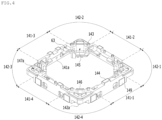
- FIG. 4 is a perspective view of the housing 140.
- FIG. 5 is a perspective view illustrating the first elastic member 150, the second elastic member 150, the supports 220, the second coil 230, the circuit board 250 and the base 250.
- the housing 140 may be configured to have the overall shape of a hollow cylinder, and may include a plurality of side portions, which define the hole.
- the housing 140 includes side portions 141-1 to 141-4, which are spaced apart from each other, and corner portions 142-1 to 142-4, which are spaced apart from each other.
- the housing 140 may include a first side portion 141-1, a second side portion 141-2, a third side portion 141-3, a fourth side portion 141-4, a first corner portion 142-1 positioned between the first side portion 141-1 and the second side portion 141-2, a second corner portion 142-2 positioned between the second side portion 141-2 and the third side portion 141-3, a third corner portion 142-3 positioned between the third side portion 141-3 and the fourth side portion 141-3, and a fourth corner portion 142-4 positioned between the fourth side portion 141-4 and the first side portion 141-1.
- the side portions 141-1 to 141-4 of the housing 140 may correspond to the side portions 110b-1 of the bobbin 110 and the corner portions 142-1 to 142-4 of the housing 140 may correspond to the corner portions 110b-2 of the bobbin 110, the disclosure is not limited thereto.
- the magnets 130 may be disposed or mounted on at least one of the side portions 141-1 to 141-4 of the housing 140, and the supports 220; 220-1 to 220-4 may be disposed on the corner portions 142-1 to 142-4 of the housing 140.
- the housing 140 may include mounts 141a, which are provided on the inner surfaces of the side portions 141-1 to 141-4.
- the side portions 141-1 to 141-4 of the housing 140 may have formed therein grooves or holes 61, into which an adhesive for attaching the magnets 130-1 to 130-4 to the mounts 141a of the housing 140 is introduced.
- the holes 63 may be through holes.
- the side portions 141-1 to 141-4 of the housing 140 may be disposed parallel to the side plates of the cover member 300.
- the corner portions 142-1 to 142-4 of the housing 140 may have formed therein holes 147a through which the supports 220 extend.
- each of the holes 147a may have a diameter that increases in a direction toward the upper surface from the lower surface of the housing 140 in order to allow a damper to be easily applied, the disclosure is not limited thereto. In another embodiment, the hole 147a may be configured such that the diameter thereof is constant.
- the housing 140 may be provided on the upper surface thereof with stoppers 144 so as to prevent the housing 140 from directly colliding with the inner surface of the cover member 300.
- the second stoppers 144 may be configured to project upwards from the upper surface of at least one of the side portions 141-1 to 141-4 of the housing 140, the disclosure is not limited thereto.
- the stopper of the housing 140 may be disposed at at least one of the corner portions.
- the housing 140 may be provided on the upper surface thereof with second guide portions 146.
- the housing 140 may include at least one second upper protrusion 143, which is provided on the upper surface of at least one of the corner portions 142 for coupling into holes 152a and 152b in the first outer frame 152 of the first elastic member 150.
- the upper protrusions 143 may be disposed at at least one of both sides of the second guide portion 146.
- the housing 140 may include at least one second lower protrusion (not shown), which is disposed on the lower surface of the side portions 141-1 to 141-4 and/or the corner portions 142-1 to 142-4 so as to be coupled or secured into holes 162a in second outer frames 162 of the second elastic member 160.
- the second lower support protrusions 145 may be disposed on the lower surface of at least one of the first to fourth corner members 501a to 501d of the housing 140, the disclosure is not limited thereto.
- the housing 140 may have recesses 142a formed in the lower portions of the corner portions 142-1 to 142-4.
- the recesses 142a in the housing 140 may be filled with, for example, damping silicone.
- the housing 140 may have stoppers 149, which are provided on the outer surface of at least one of the side portions 141-1 to 141-4.
- the stoppers 149 are intended to prevent the outer surfaces of the side portions 141-1 to 141-4 of the housing 140 from directly colliding with the inner surfaces of the side plates of the cover member 300 when the housing 140 moves in the second direction and/or in the third direction.
- the housing 140 may further include a stopper (not shown) projecting from the lower surface thereof.
- the housing 140 may include a groove 145, which is provided on the inner surface of the corner portions 142-1 to 142-4 so as to correspond to the projection 25 of the bobbin 110.
- the magnets 130 may be disposed at the side portions 141-1 to 141-4 of the housing 140 so as to overlap at at least a portion thereof the first coil 120 in a direction perpendicular to the optical axis or in the second or third direction at the initial position of the bobbin 110.
- the magnets 130 may be fitted or disposed in the mounts 141a of the housing 140.
- the initial position of the bobbin 110 may be the initial position of the AF operation unit (for example, the bobbin) in the state in which power or a drive signal is not applied to the first coil 120, and may be the position of the AF operation unit when the first elastic member 150 and the second elastic member 160 are elastically deformed by only the weight of AF operation unit.
- the AF operation unit for example, the bobbin
- the initial position of the bobbin 110 may be the position of the AF operation unit when gravity is applied toward the base 210 from the bobbin 110 or toward the bobbin 110 from the base 210.
- the magnets 130 may be disposed on the outer surface of the side portions 141-1 to 141-4 of the housing 140. Alternatively, the magnets 130 may also be disposed on the inner surfaces or the outer surfaces of the corner portions 142 of the housing 140.
- each of the magnets 130 may have a shape corresponding to the shape of a corresponding one of the side portions 141-1 to 141-4 of the housing 140, that is, a rectangular shape, the disclosure is not limited thereto.
- the surface of the magnet 130 that faces the first coil 120 may be configured to have a curvature that corresponds to or coincides with a corresponding surface of the first coil 120.
- Each of the magnets 130 may be a monopolar magnetized magnet, in which the first surface of the magnet 130, which faces the first coil 120, becomes an N pole and the opposite (second) surface of the magnet 130 becomes an S pole.
- the disclosure is not limited thereto, and the reverse configuration is also possible.
- each of the first and second surfaces of the magnet 130 may be divided into an N pole and an S pole.
- each of the magnets 130 may be a bipolar magnetized magnet, which is divided into two in a direction perpendicular to the optical-axis direction.
- the magnet 130 may be embodied by a ferrite magnet, an alnico magnet, a rare-earth magnet or the like.
- the magnet 130 may include a first magnet portion, a second magnet portion, and a non-magnetic partition wall.
- the first magnet portion and the second magnet portion may be spaced apart from each other, and the non-magnetic partition wall may be positioned between the first magnet portion and the second magnet portion.
- the non-magnetic partition wall is a portion that is almost completely non-magnetic and which may include a zone having almost no polarity.
- the non-magnetic partition wall may be filled with air or may be made of a non-magnetic material.
- the disclosure is not limited thereto, and the number of magnets 130 may be two or more.
- the first surface of the magnet 130, which faces the first coil 120 may be planar, the disclosure is not limited thereto, and the first surface may be curved.
- the magnets 130 may include at least two magnets, which are disposed on the side portions of the housing 140 and which face each other.
- Each of the magnets 130-1 to 130-4 may have an approximate rectangular shape. Alternatively, each of the magnets may have a triangular shape or a rhombic shape.
- the housing 140 may be omitted, and the magnets 130-1 to 130-4 may be disposed at the cover member 300. In a further embodiment, the housing 140 may not be omitted, and the magnets 130-1 to 130-4 may be disposed at the cover member 300.
- the magnets 130-1 to 130-4 may be disposed on the inner surfaces of the side plates of the cover member 300.
- the first elastic member 150 and the second elastic member 160 may be coupled both to the bobbin 110 and to the housing 140 so as to support the bobbin 110.
- the first elastic member 150 may be disposed at the upper portion or the upper surface of the bobbin 110 and may be an elastic body.
- the second elastic member 160 may be disposed at the lower portion or the lower surface of the bobbin 110 and may be an elastic body.
- the first elastic member 150 may be coupled both to the upper portion, the upper surface or the upper end of the bobbin 110 and to the upper portion, the upper surface or the upper end of the housing 140
- the second elastic member 160 may be coupled both to the lower portion, the lower surface or the lower end of the bobbin 110 and to the lower portion, the lower surface or the lower end of the housing 140.
- the supports 220 may support the housing 140 with respect to the base 210 and may conductively connect at least one of the first elastic member 150 and the second elastic member 160 to the circuit board 250.
- At least one of the first elastic member 150 and the second elastic member 160 may be divided or separated into two or more.
- the first elastic member 150 may include first to fourth upper springs 150-1 to 150-4, which are spaced apart or separated from one another.
- each of the first elastic member 150 and the second elastic member 160 may be embodied as a leaf spring, the disclosure is not limited thereto.
- Each of the first and second elastic members 150 and 160 may be embodied as a coil spring, a suspension wire or the like.
- Each of the first to fourth upper springs 150-1 to 150-4 may include a first inner frame 151 coupled to the upper portion, the upper surface or the upper end of the bobbin 110, a first outer frame 152 coupled to the upper portion, the upper surface or the upper end of the housing 140, and a first frame connector 153 connecting the first inner frame 151 to the first outer frame 152.
- the first inner frame 151 may have formed therein a hole 151a, to which the first upper protrusion 113 of the bobbin 110 is coupled, and the hole 151a may have at least one slit into which an adhesive member or a damper is disposed.
- the first outer frame 152 of each of the first to fourth upper springs 150-1 to 150-4 may include a first coupler 510 coupled to a corresponding one of the supports 220-1 to 220-6, a second coupler 520 coupled to at least one of the corner portions 141-1 to 141-4 and/or the side portions adjacent thereto of the housing 140, and a connector 530 connecting the first coupler 510 to the second coupler 520.
- the second coupler 520 may include at least one coupling region coupled to the corner portions 142-1 to 142-4 (for example, the second upper protrusion 143) of the housing 140.
- the at least one coupling region may have therein a hole 152a.
- the second coupler 520 may include a first coupling region positioned at one side of the second guide portion 146 of the housing 140 and a second coupling region positioned at another side of the second guide portion 146, without being limited thereto.
- each of the coupling regions of the second couplers 520 of the first to fourth upper springs 150-1 to 150-4 may be embodied so as to include a hole, the disclosure is not limited thereto.
- the coupling regions may also be embodied as having various shapes suitable for being coupled to the housing 140, for example, grooves or the like.
- the holes 152a in the second couplers 520 may have at least one slit for allowing an adhesive member or a damper to be introduced into the gap between the second upper protrusions 143 and the holes 152a.
- the first coupler 510 may have a hole through which a corresponding one of the supports 220-1 to 220-4 extends. One end of the one of the supports 220-1 to 220-2 that extends through the hole in the first coupler 510 may be coupled to the first coupler 510 using a conductive adhesive member or solder 910, and the first coupler 510 may be conductively connected to the one of the supports 220-1 to 220-4.
- the first coupler 510 may be a region at which the solder 910 is disposed, and may include a hole and a region near the hole.
- the connector 530 may connect the coupling region of the second coupler 520 disposed at each of the corner portions 142-1 to 142-4 to the first coupler 510.
- the connector 530 may include a first connector 530-1, connecting the first coupling region of the second coupler 520 of each of the first to fourth upper springs 150-1 to 150-4 to the first coupler 510, and a second connector 530-2, connecting the second coupling region of the second coupler 520 to the first coupler 510.
- each of the connectors 530 may include a bent portion, which is bent at least once, or a curved portion, which is curved at least once, the disclosure is not limited thereto. In another embodiment, they may be linear.
- the width of the connectors 530 may be smaller than the width of the second couplers 520. Accordingly, the connectors 530 may be easily movable in the first direction, making it possible to distribute the stress applied to the first elastic member 150 and the stress applied to the supports 220.
- the couplers 530 may be bilaterally symmetrical with respect to the reference line in order to support the housing 140 in a balanced state without eccentricity, the disclosure is not limited thereto. In another embodiment, the couplers may not be bilaterally symmetrical.
- one end of the first coil 120 may be coupled to the first inner frame 151 of the second upper spring 151-2 and the other end of the first coil 120 may be coupled to the first inner frame 151 of the fourth upper spring 151-4 through soldering.
- the second elastic member 160 may include a second inner frame 161 coupled to the lower portion, the lower surface or the lower end of the bobbin 110, a second outer frame 162 coupled to the lower portion, the lower surface or the lower end of the housing 140, and a second frame connector 163 connecting the second inner frame 161 to the second outer frame 162.
- the second elastic member 160 may have therein the hole 162a, which is formed in the second inner frame 161 and which is coupled to the first lower protrusion of the bobbin 110 via a solder or a conductive adhesive member, and the hole 162a, which is formed in the second outer frame 162 and which is coupled to the second lower protrusion 147 of the housing 140.
- Each of the first and second frame connectors 153 and 163 of the upper and second elastic members 150 and 160 may be bent or curved at least once so as to define a predetermined pattern.
- the upward and/or downward movement of the bobbin 110 in the first direction may be elastically (or flexibly) supported by virtue of positional variation and fine deformation of the first and second frame connectors 153 and 163.
- the lens moving apparatus 100 may further include first dampers (not shown), each of which is disposed between a corresponding one of the upper springs 150-1 to 150-4 and the housing 140.
- the lens moving apparatus 100 may include the first dampers (not shown), each of which is disposed in the space between the first frame connector 153 of a corresponding one of the upper springs 150-1 to 150-4 and the housing 140.
- the lens moving apparatus 100 may include second dampers (not shown), each of which is disposed between a corresponding one of the second frame connectors 163 of the second elastic members 160 and the housing 140.
- the lens moving apparatus 100 may further include third dampers (not shown) disposed between the supports 220 and the holes 147a in the housing 140.
- the lens moving apparatus 100 may further include fourth dampers (not shown), which are disposed at the first couplers 510 and the first ends of the supports 220.
- a damper (not shown) may also be disposed between the inner surface of the housing 140 and the outer peripheral surface of the bobbin 110.
- Each of the supports 220 may be connected at one end thereof to the elastic member 150 and at the other end thereof to a corresponding one of the terminals 81a, 81b, 81c and 81d.
- the first ends of the supports 220 may be coupled to the first outer frame of the first elastic member 150 via a solder or a conductive adhesive member.
- the supports 220 may include a plurality of supports. Each of the plurality of supports 220-1 to 220-6 may be coupled to a corresponding one of the first couplers 510 of the upper springs 150-1 to 150-4 via the solder 901, and may be conductively connected to the first coupler 510. For example, each of the plurality of supports 220-1 to 220-4 may be disposed on a corresponding one of the four corner portions 142-1 to 142-4.
- the plurality of supports 220-1 to 220-4 may support the bobbin 110 and the housing 140 such that the bobbin 110 and the housing 140 are movable in a direction perpendicular to the first direction.
- one support is disposed at each of the corner portions 142-1 to 142-4 of the housing 140 in the embodiment shown in FIG. 5 , the disclosure is not limited thereto.
- two or more supports may be disposed at one corner portion of the housing 140.
- Each of the plurality of supports 220-1 to 220-4 may be spaced apart from the housing 140, and may be directly connected to a corresponding one of the first couplers 510 of the first outer frame 152 of each of the upper springs 150-1 to 150-4.
- the supports 220 may be embodied as leaf springs, and may be disposed at the side portions 141-1 to 141-4 of the housing 140.
- the drive signal from the circuit board 250 may be transmitted to the first coil 120 through the plurality of supports 220-1 to 220-4 and the upper springs 150-1 to 150-4.
- the drive signal from the circuit board 250 may be applied to the first coil 120 via the second and fourth springs 150-2 and 150-4 and the second and fourth supports 220-2, 220-4.
- the plurality of supports 220-1 to 220-4 may be additional members separated from the first elastic member 1150, and may be embodied as members having elastic supporting ability, for example, leaf springs, coil springs, suspension wires or the like. In another embodiment, the supports 220-1 to 220-4 may be integrally formed with the first elastic member 150.
- the base 210 may have an opening corresponding to the opening in the bobbin 110 and/or the opening in the housing 140, and may be configured to have a shape that coincides with or corresponds to the shape of the cover member 300, for example, a rectangular shape.
- FIG. 6 is a perspective view of the second coil 230, the circuit board 250 and the supports 220-1 to 220-4.
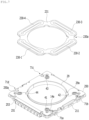
- FIG. 7 is an exploded perspective view of the circuit board 250 and the second coil 230, which are disposed at the base 210.
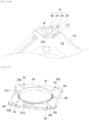
- FIG. 8 is a fragmentary enlarged view of the base 210 and the circuit board 250 shown in FIG. 7 .
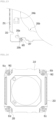
- FIG. 9 is a bottom view of the circuit member including the second coil 230.
- FIG. 10A is an exploded perspective view of the base 210, the location sensor 240 and the terminals 81a to 81d.
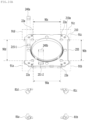
- FIG. 10B is a bottom view of the base 210.
- FIG. 10C is an assembled perspective view of the base 210 and the terminals 81a to 81d.
- the base 210 may include a step 211, to which an adhesive is applied when the cover member 300 is adhesively attached to the base 210.
- the step 211 may guide the cover member 300, which is coupled to the upper side thereof, and may face the lower ends of the side plates of the cover member 300.
- the base 210 may be disposed under the bobbin 110 and the housing 140, and may include a support groove or a support portion 255 (see FIG. 10A ), which is formed on the side surface thereof that faces the portion including the terminals 251 of the circuit board 250.
- the support portion 255 of the base 210 may support the terminal member 253 of the circuit board 250.
- the position sensor 240 may be mounted on the lower surface of the circuit board 250, and the lower surface of the circuit board 250 may face the upper surface of the base 210.
- the circuit board 250 may be positioned under the housing 140, may be disposed on the upper surface of the base 210, and may have an opening that corresponds to the opening in the bobbin 110, the opening in the housing 140 and/or the opening in the base 210.
- the outer peripheral surface of the circuit board 250 may have a shape that coincides with or corresponds to the upper surface of the base 210, for example, a square shape.
- the circuit board 250 may include at least one terminal portion, which is bent from the upper surface of the circuit board 250 and which includes a plurality of terminals 251 or pins for conductive connection to external components.
- the circuit board 250 may be an FPCB without being limited thereto.
- the circuit board 250 may have holes 250a, through which the supports 220-1 to 220-4 extend.
- the holes 250a may be disposed adjacent to the corners of the circuit board 250.
- Each of the supports 220-1 to 220-4 may extend through a corresponding one of the holes 250a in the circuit board 250 and may be disposed so as to be spaced apart from the inner surface of the hole 250a.
- FIG. 7 illustrates the holes 250a through which the supports 220-1 to 220-4 extend, the disclosure is not limited thereto.
- the circuit board 250 may have openings, escape grooves or the like, each of which has a shape that allows the supports 220-1 to 220-4 to extend therethrough.
- the second coil 230 may be positioned under the housing 140, and may be disposed at the upper portion of the circuit board 250 so as to correspond to the magnets 130 disposed at the housing 140.
- FIG. 7 illustrates the second coil 230 provided at an additional circuit member 231 separate from the circuit board 250, the disclosure is not limited thereto.
- the second coil 230 may be embodied as a circuit pattern formed at the circuit board 250.
- the circuit member 231 may be omitted, and the second coil 230 may be embodied as a ring-shaped coil block or an FP coil separate from the circuit board 250.
- circuit board 250 and the circuit member 231 are described as being separate components, the disclosure is not limited thereto.
- a configuration including at least one of the circuit board 250, the circuit member 231 and the second coil 230 may be represented as the term "circuit member".
- the circuit member 231, at which the second coil 230 is provide, may have escape grooves 230a formed in the corners thereof.
- the escape grooves 230a may have shapes such that the corners of the circuit member 231 are chamfered.
- the corner portions of the circuit member 231 may have holes through which the supports 220 extend.
- the housing 140 may be moved in the second direction and/or the third direction by the interaction between the magnets 130 and the second coil 230, which correspond to each other, thereby performing handshake correction.
- the position sensor 240 may detect the intensity of the magnetic field of the magnets 130 disposed on the housing 140 when the housing 140 is moved in a direction perpendicular to the optical-axis direction, and may output an output signal (for example, an output voltage) according to the result of the detection.
- the position sensor 240 may include two OIS position sensors 240a and 240b for detecting displacement of the housing 140 in the second direction (for example, in the X-axis direction) and in the third direction (for example, in the Y-axis direction) perpendicular to the optical axis.
- Each of the OIS position sensors 240a and 240b may be embodied as a hall sensor. Any sensor may be used, as long as the sensor is capable of detecting the intensity of a magnetic field.
- each of the OIS position sensors 240 may be embodied as a driver including a hall sensor, or may be embodied as a position detection sensor, such as a hall sensor, alone.
- Each of the OIS position sensors 240a and 240b may be mounted on the circuit board 250, and the circuit board 250 may include terminals conductively connected to the OIS position sensors 240a and 240b.
- the opening in the base 210 may be provided therearound with a projection 29, and the projection 29 may be fitted into the opening in the circuit board 250 and the opening in the circuit member 231.
- the projection 29 of the base 210 may be provided at the side surface thereof with protrusions 29a (see FIG. 12 ), which project in a direction perpendicular to the optical axis, and the opening in the circuit board 250 may have grooves 250b (see FIG. 13 ) corresponding to the protrusions 29a.
- the protrusions 29a of the base 210 may be inserted into the grooves 250b in the circuit board 250.
- the circuit board 250 may include a plurality of pads 41 to 44 disposed on the upper surface thereof.
- the term “pad portion” in the pad portions of the circuit board 250 may be used interchangeably with “bonding portion”, “electrode portion”, “lead portion” or “terminal portion”.
- each of the plurality of pad portions 41 to 44 may be positioned adjacent to a corresponding one of the holes 250a in the circuit board 250.
- Each of the plurality of pad portions 41 to 44 may be positioned lower than the upper surface of the circuit board 250.
- a depth d1 in the optical-axis direction may be present between the upper surfaces of the plurality of pad portions 41 to 44 and the upper surface of the circuit board 250.
- the depth d1 may be 35mm ⁇ 40mm.
- the depth d1 may be 37.5mm.
- the circuit board 250 may include exposed regions 14a through which the plurality of pads 41 to 44 are exposed.
- the upper surfaces of the exposed regions 14a may be positioned in the same plane as the upper surface of the pad portion (for example, 41).
- the upper surfaces of the exposed regions 14a may be positioned lower than the upper surface of the circuit board 250, and a depth in the optical-axis direction may be present the upper surfaces of the exposed regions 14a and the upper surface of the circuit board 250.
- the exposed regions 14a of the circuit board 250 may abut grooves 71a to 71d in the circuit board 250, and may be exposed or may open through the side surfaces or the grooves 71a to 71d in the circuit board 250. Since the exposed regions 14a are exposed or opens through the side surfaces of the circuit board 250, solder may easily enter the pad portions 41 to 44 of the circuit board 250 through the exposed regions 14a, thereby improving ease of soldering.
- the circuit board 250 may have the plurality of grooves 71a to 71d formed in the side surface thereof.
- the grooves 71a to 71d in the circuit board 250 may be intended to expose portions of the terminals 81a to 81d mounted on the base 210, for example, portions (or exposed regions) 321 of the second couplers 320 (see FIG. 11 ).
- each of the grooves 71a to 71d may take the form of a via hole or a recess formed in the side surface of the circuit board 250, the disclosure is not limited thereto.
- the groove may have the form of a through hole or a through via hole.
- the through hole or the through via hole may be spaced apart from the side surface of the circuit board 250.
- the circuit member 231 may include a plurality of pad portions 35a to 35d disposed on the lower surface thereof so as to correspond to the plurality of the pad portions 41 to 44 of the circuit board 250.
- the term "pad portion” used to refer to the pad portions 35a to 35 of the circuit board 231 may be used interchangeably with “bonding portion”, “electrode portion”, “lead portion” or “terminal portion”.
- Each of the pad portions 35a to 35d of the circuit board 231 may be positioned so as to abut or to be adjacent to a corresponding one of the escape grooves 230a in the circuit board 231.
- Each of the pad portions 35a to 25d of the circuit board 231 may be positioned higher than the lower surface of the circuit board 231.
- a depth d2 in the optical-axis direction may be present between the lower surfaces of the plurality of pad portions 35a to 35d and the lower surface of the circuit member 231.
- the depth d2 may be 35mm ⁇ 40mm.
- the depth d2 may be 37.5mm.
- a portion of each of the pad portions 35a to 35d of the circuit board may overlap a corresponding one of the plurality of pad portions 41 to 44 in the optical-axis direction.
- Another portion of each of the pad portions 41 to 44 of the circuit board 250 that does not overlap a corresponding one of the pad portions 35a to 35d of the circuit board 231 in the optical-axis direction may be exposed from the circuit board 231 through the escape groove 230a. The reason for this is to couple the pad portions 41 to 44 to the pad portions 35a to 35d using solder.
- the distance or the space between the pad portions 41 to 44 of the circuit board 250 and the pad portions 35a to 35d of the circuit board 231 may be increased.
- solder may easily enter a space between the pad portions 41 to 44 of the circuit board 250 and the pad portions 35a to 35d of the circuit board 231 and solderability may be improved when soldering the pad portions 41 to 44 of the circuit board 250 to the pad portions 35a to 35d of the circuit board 231.
- the base 210 may include side portions 90a to 90d and corner portions 91a to 91d.
- the base 210 may include a first side portion 90a, a second side portion 90b, a third side portion 90c, a fourth side portion 90d, a first corner portion 91a between the first side portion 90a and the second side portion 90b, a second corner portion 91b between the second side portion 90b and the third side portion 90c, a third corner portion 91c between the third side portion 90c and the fourthe side portion 90d, and a fourth corner portions 91d between the fourth side portion 90d and the first side portion 90a.
- the side portions 90a to 90d of the base 210 may correspond to or overlap the side portions 141-1 to 141-4 of the housing in the optical-axis direction, and the corner portions 91a to 91d of the base 210 may correspond to or overlap the corner portions 142-1 to 142-4 of the housing 140 in the optical-axis direction.
- the corner portions 91a to 91d of the base 210 may have formed therein holes 210a, through which the supports 220-1 to 220-1 extend.
- each of the corner portions 91a to 91d of the base 210 may have formed therein the hole 210a, through which a corresponding one of the supports 220-1 to 220-4 extends.
- the holes 210a may be through holes, which are respectively formed through the corner portion 91a to 91d.
- Each of the corner portions 91a to 91d of the base 210 may be provided with a stepped portion 26, in which a corresponding one of the terminals 81a to 81d is mounted or inserted.
- the stepped portion 26 may have a form that is depressed from the lower surface of the base 210, and may be referred to as a "groove portion".
- the stepped portions 26 of the base 210 may be provided at the lower portions, the lower ends or the lower surfaces of the corner portions 91a to 91d of the base 210, and at least one depth may be formed from the lower surface of the base 210 in a direction toward the upper surface 21b of the base from the lower surface 21a of the base 210.
- the stepped portion 26 of the base 210 may have a hole 210a, through which the support extends, and a hole 22a, through which a portion of each of the terminals 91a to 91d is exposed through the upper surface 21b of the base 210.
- the stepped portion 26 of the base 210 may include a first surface 26a, a second surface 26b, a first side surface 27a and a second side surface 27b.
- the first surface 26a of the stepped portion 26 may have a first depth T1 from the lower surface of the base 210 in a direction toward the upper surface 21b from the lower surface 21a of the base 21, and may be parallel to the lower surface 26a of the base 210.
- the second surface 26b of the stepped portion 26 may have a second depth T2 from the lower surface of the base 210 in a direction toward the upper surface 21b from the lower surface 21a of the base 210, and may be parallel to the lower surface 26a of the base 210.
- the second depth T2 may be smaller than the first depth T1 (T2 ⁇ T1), and the second surface 26b of the stepped portion 26 may be positioned between the first surface 26a and the lower surface 26a of the base 210.
- the first side surface 27a of the stepped portion 26 may connect the first surface 26a of the stepped portion 26 to the second surface 26b of the stepped portion 26 and may be a sloping surface, which is inclined at a predetermined angle (for example, a right angle) with respect to the first surface 26a.
- the second side surface 27b of the stepped portion 26 may connect the lower surface 26a of the base 210 to the second surface 26b of the stepped portion 26, and may be a sloping surface, which is inclined at a predetermined angle (for example, a right angle) with respect to the second surface 26b.
- the second surface 26b and the second side surface 27b of the stepped portion 26 may define a single groove, and the first surface 26a and the first side surface 27a of the stepped portion 26 may define another groove.
- the hole 210a in the base 210 may be disposed or positioned at the first surface 26a of the stepped portion 26.
- the first surface 26a of the base 210 may be provided with a protrusion 28, which is coupled to a hole 311 in each of the terminals 81a to 81d.
- the protrusion 28 may project from the first surface 26a of the base 210 in a direction toward the lower surface 21a from the upper surface 21b of the base 210.
- the base 210 may have a hole 22a, which is disposed or positioned at the second surface 26b of the stepped portion 26.
- the hole 22a may be formed through the upper surface 21b of the base 210 and the second surface 26b of the stepped portion 26, and a portion of each of the terminals 81a to 81d may be exposed or may open from the upper surface 21b of the base 210 through the hole 22a.
- the terminals 81a to 81d may be disposed or mounted on the lower portion, the lower end or the lower surface of the base 210. Although the number of terminals may be equal to the number of supports, the disclosure is not limited thereto.
- the terminals 81a to 81d may be referred to as "terminal members" or “terminal units”.
- the embodiment may include the first to fourth terminals 81a to 81d corresponding to the first to fourth supports 220-1 to 220-4.
- first to fourth terminals 81a to 81d may be disposed at the four corners or the four corner portions of the base 210.
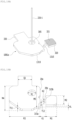
- FIG. 11 illustrates a perspective view of the first terminal 81a and the first support 220-1.
- the description regarding the first terminal 81a shown in FIG. 11 may be equally applied to the remaining terminals, that is, second and third terminals.
- the first terminal 81a may include a first coupler 310 and a second coupler 320.
- the first coupler 310 may be referred to as a "first connector” or a “first portion”
- the second coupler 320 may be referred to as a "second connector” or a "second portion”.
- the second coupler 320 may be disposed between the base 210 and the circuit board 250k, and the first coupler 310 may be disposed lower than the second coupler 320.
- the second coupler 320 may be positioned lower than or at the same height as the upper surface of the base 210.
- the upper surface of the second coupler 320 may be exposed from the upper surface of the base 210, and the lower surface of the first coupler 310 may be exposed from the lower surface of the base 210.
- the surface area of the first coupler 310 (for example, the surface area of the upper surface thereof) may be larger than the surface area of the second coupler 320 (for example, the surface area of the upper surface thereof).
- the length of the first coupler 310 in a direction toward the second corner portion 91b from the first corner portion 91a of the base 210 may be greater than the length of the second coupler in a direction toward the second corner portion 91b from the first corner portion 91a.
- the first coupler 310 may be positioned lower than the lower surface of the base 210 and may be positioned higher than a first holder 600 and a second holder 800 of a camera module 200 (see FIG. 20 ).
- the first terminal 81a may include a connector 315 connecting the first coupler 310 to the second coupler 320.
- the connector 315 may be referred to as a "third connector” or a "third portion”.
- the connector 315 may be bent or curved from the first coupler 310. Although the connector 315 may be integrally formed with the first coupler 310 and the second coupler 320, the disclosure is not limited thereto. In another embodiment, the connector may be assembled with the base 210 separately from the first coupler 310 and the second coupler 320 and may be disposed at the side surface of the base 210.
- the first coupler 310 may have a hole 305, through which the support (for example, 220-1) extends, and a hole 311, which is coupled to the protrusion 28 of the stepped portion 26 of the base 210.
- the hole 305 in the first coupler 310 may be a through hole.
- the hole 305 in the first coupler 310 may correspond to the hole 210a in the base 210 and may overlap the hole 210a in the base 210 in the optical-axis direction or in a direction toward the upper surface 21b from the lower surface 21a of the base 210.
- One end of the support (for example, 220-1) may be coupled to the first coupler 510 of the first outer frame 151 of the upper spring (for example, 150-1).
- the other end (for example, 81a) of the support may extend through the hole 305 in the terminal (for example, 81a) and may be coupled to the lower surface of the first coupler 310 using solder 902 (see FIG. 14 ).
- the lens moving apparatus 100 may further include the solder 902 coupling the other end of the support (for example, 220-1), passing through the hole 305, to the lower surface of the first coupler 310.
- the hole 311 in the first coupler 310 may be coupled to the protrusion 28 of the base 210 so as not only to increase the binding force between the base 210 and the terminals 81a to 81d but also to improve the solderability between the first coupler 310 and the supports.
- the hole 311 in the first coupler 310 may suppress the transmission of heat during soldering and may thus improve solderability between the support (for example, 220-1) and the hole 305 in the first coupler 310.
- the first coupler 310 may be disposed or positioned under the first surface 26a of the stepped portion 26 of the base 210.
- the second coupler 320 may be connected to one end of the first coupler 310, and may be disposed or positioned under the second surface of the stepped portion 26 of the base 210.
- a portion 321 of the second coupler 320 may be exposed from the upper surface 21b of the base 210 through the hole 22a in the stepped portion 26.
- the portion 321 of the second coupler 320 is referred to as an exposed region 321 of the second coupler 320.
- the first terminal 81a may further include an extension 330 extending from the other end of the first coupler 310.
- the extension 330 may be parallel to the first coupler 310, may be positioned in the same plane as the first coupler 310, and may be inserted into the base 210.
- the extension 330 is capable of increasing the binding force between the first terminal 81a and the base 210.
- first coupler 310, the second coupler 320 and the extension 330 may be integrally formed with one another.
- the terminals 81a to 81d may be formed in conjunction with the base 210 through insert injection molding, and at least a portion of each of the first coupler 310 and the second coupler 320 may be inserted or disposed in the base 210.
- the terminals 81a to 81d may be formed in conjunction with the base 210 through insert injection molding, and the connector 315 may be disposed in the base.
- the terminals may be attached or coupled to the lower surface or the upper surface of the base 210 rather than through insert injection molding.
- FIG. 12 is a fragmentary perspective view of the base 210, the first terminal 81a and the circuit board 250, which are assembled with one another.
- FIG. 13 is a bottom view of the circuit board 250.
- FIG. 14 illustrates solders 902 for coupling the terminals 81a to 81d to the supports 220-1 to 220-4.
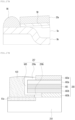
- FIG. 15 is a cross-sectional view of a pad portion 257 of the circuit board 250.
- FIG. 16 is a cross-sectional view of the lens moving apparatus 100 shown in FIG. 2 , taken along line A-B.
- the circuit board 250 may be disposed on the upper surface of the base 210, and each of the grooves 71a to 71d in the circuit board 250 may expose a corresponding one of the second couplers 320 of the terminals 81a to 81d exposed from the upper surface 21b of the base 210.
- each of the grooves 230a in the circuit board 231 may expose the upper surface of a corresponding one of the second couplers 320 of the terminals 81a to 81d exposed from the upper surface of the base 210.
- the circuit board 250 may include the pad portions 257, each of which is disposed at the upper portion, the lower portion and the side surface between the upper portion and the lower portion.
- the number of pad portions 257 may be plural.
- the pad portions may be disposed so as to correspond to the terminals 81a to 81d, or may be disposed at positions corresponding to the terminals 81a to 81d.
- the four pad portions 247 corresponding to the terminals 81a to 81d may be disposed at the four corners or the corner portions of the circuit board 250, without being limited thereto.
- the pad portions may be disposed only at two corners or two corner portions of the circuit board 250, and may be conductively connected to the two terminals 251 of the circuit board 250 in order to provide a drive signal to the first coil.
- the two corners, at which the pad portions are disposed may be corners that are positioned in a diagonal direction of the circuit board, or two corners included on a single side of the circuit board.
- four pad portions may be disposed at four corners or four corner portions of the circuit board 250, and the pad portions disposed at two corners may be soldered to the terminals (for example, 81a and 81b) and may be conductively connected to two terminals 251 of the circuit board 250.
- the pad portions that are disposed at the remaining two corners may be soldered to the terminals (for example, 81a and 81b) but may not be conductively connected to the terminals 251 of the circuit board 250. The reason for this is to prevent the occurrence of problems such as mechanical tilting of the lens moving apparatus when all four pad portions are soldered to the terminals.
- the pad portions 257 may be Au-plated layers or copper-plated layers including Au.
- the pad portions 257 may be respectively provided at the grooves 71a to 71d in the circuit board 250.
- FIG. 12 illustrates only the pad portion provided in the groove 71a, the description regarding the pad portion shown in FIG. 12 may be equally applied to the pad portions proved in the other grooves 71b to 71d.
- the pad portion 257 of the circuit board 257 may be disposed at the upper surface of the circuit board 250, the lower surface of the circuit board 250 and the side surface connecting the upper surface to the lower surface of the circuit board 250.
- the pad portion 257 may be disposed at the side surface of the groove (for example, 71a), the upper surface of the circuit board 250 abutting the side surface of the groove (for example, 71a) and the lower surface of the circuit board 250 abutting the side surface of the groove (for example, 71a).
- the pad portion 257 of the circuit board 250 may include a first pad 259b disposed at the lower portion of the circuit board 250 abutting the side surface of the groove 71a, a second pad 259b disposed at the upper portion of the circuit board 250 abutting the side surface of the groove 71a, and a third pad 605 disposed at the side surface of the groove 71a so as to connect the first pad 259b to the second pad 259a.
- the third pad 605 may be disposed at the side surface of the circuit board 250.
- each of the grooves 71a to 71d in the circuit board 250 may have formed therein a via or a groove, and a portion (for example, the third pad 605) of the pad portion 257 may be disposed in the via or the groove.
- the third pad 605 of the pad portion 257 of the circuit board 250 may have a form depressed from the side surface of the groove 71a, for example, the form of a semicircular via.
- the radius of the via may be, for example, 0.1mm - 0.5mm, without being limited thereto.
- the radius of the via may be 0.2mm ⁇ 0.3mm.
- the radius of the via may be 0.2mm
- the radius of the via is smaller than 0.1mm, improvement in bonding force and solderability between the pad portion 257 of the circuit board 250 and the terminal may be insufficient.
- the radius of the via is larger than 0.5mm, the pad portion 257 may be enlarged more than necessary, relative to the second coupler 320 of each of the terminals 81a to 81d, thereby increasing the manufacturing costs and lowering freedom in design of the pattern of the circuit board 250.
- the first pad 259b of the pad portion 257 of the circuit board 250 may face the terminal (for example, 81a) in the optical-axis direction.
- the first pad 259b of the pad portion 257 of the circuit board 250 may abut the exposed region 321 of the second coupler 320 of the first terminal 81a.
- the circuit board 250 may include a first insulation layer 601, a first conductive layer 602a disposed on the upper surface of the insulation layer 601, a second insulation layer 603a disposed on the upper surface of the first conductive layer 602a, a second conductive layer 602b disposed on the lower surface of the first insulation layer 601, and a third insulation layer 603a disposed on the lower surface of the second conductive layer 602b.
- a first adhesive layer may be disposed between the first insulation layer 601 and the first conductive layer 602a, and a second adhesive layer may be disposed between the third insulation layer 603a and the second conductive layer 602b.
- the first conductive layer 602a may be a patterned metal layer, for example, a Cu-plated layer.
- the second conductive layer 602b may be a metal layer (for example, a Cu layer) or a patterned metal layer.
- the first conductive layer 602a may be patterned so as to include wires and pads, which are conductively connected to the supports 220-1 to 220-4, the second coil 230 and the second position sensor 240.
- the first to third insulation layers 601, 603a and 603b may be made of resin, for example, polyimide, without being limited thereto.
- the first pad 259b may be disposed on the lower surface of the second conductive layer 602b, and the second pad 259a may be disposed on the upper surface of the first conductive layer 602a.
- the lower surface of the first pad 259b may be positioned higher than the lower surface of the third insulation layer 603b.
- each of the second pad 259a of the pad portion 257 may be conductively connected to a corresponding one of the terminals 251 of the circuit board 250 via the first patterned conductive layer 602a.
- the upper surface of the first conductive layer 602a may include a region 59a, which is exposed from the second insulation layer 603a so as to be brought into contact with the second pad 259a, and the lower surface of the second conductive layer 602b may include a region 59b, which is exposed from the third insulation layer 603b so as to be brought into contact with the first pad 259b.
- first pad 259b may be disposed at the exposed region 59b of the lower surface of the second conductive layer 602b
- the second pad 259a may be disposed at the exposed region 59a of the upper surface of the first conductive layer 602a.
- the surface area of the first pad 259b that is in contact with the exposed region 59b of the lower surface of the second conductive layer 602b may be larger than the surface area of the second pad 259a that is in contact with the exposed region 59a of the upper surface of the first conductive layer 602a.
- the exposed region 14a of the circuit board 250 may be a portion of the first patterned conductive layer 602a exposed from the second insulation layer 603a, and the upper surface of the exposed region 14a may be the upper surface of the first patterned conductive layer 602a.
- Each of the pad portions 41 to 44 of the circuit board 250 and a corresponding one of the pad portions 257 may be spaced apart from each other, may be conductively isolated from each other and may be positioned in the exposed region 14a.
- a depth toward the upper surface from the lower surface of the circuit board 250 may be present between the lower surface of the first pad 259b of the circuit board 250 and the lower surface of the third insulation layer 603b or between the lower surface of the first pad 259b and the exposed region 321 of the second coupler 320, and the depth may be 25.5mm ⁇ 27.5mm.
- the third pad 605 of the pad portion 257 may be disposed on the side surface of the first insulation layer 601, may connect the second pad 259a of the pad portion 257 to the first pad 259b, and may be a plated layer.
- the thickness of each of the first pad 259b, the second pad 259a and the third pad 605 of the pad portion 257 may be 10mm ⁇ 12mm.
- the third pad 605 of the pad portion 257 may be, for example, an Au-plated layer, the disclosure is not limited thereto.
- the exposed region 321 of the second coupler 320 of each of the terminals 81a to 81d and the pad portion 257 of the circuit board 257 may be coupled to each other and may be conductively connected to each other.
- the surface area of the first pad 259b of the pad portion 257 of the circuit board 250 may be larger than the surface area of the second pad 259a, the disclosure is not limited thereto.
- the ratio (H3/H1) of the first distance H3 to the second distance H1 may be 1.18 - 1.2, and the ratio (H3/H) of the first distance H3 to the third distance H may be 1.16 ⁇ 1.17.
- the ratio (H3/H) may be 1.1667, and the ratio (H3/H1) may be 1.188.
- the first distance H3 may be the distance between the lower surfaces of the upper springs 150-1 to 150-4 and the lower surfaces of the first couplers 310 of the terminals 81a to 81d.
- the second distance H1 may be the distance between the lower surfaces of the upper springs 150-1 to 150-4 and the lower surface of the circuit member 231.
- the third distance H may be the distance between the lower surfaces of the upper springs 150-1 to 150-4 and the lower surface of the circuit board 250.
- the height of a camera module is also decreased. Furthermore, as the height of the camera module is decreased, the length of the OIS wire (for example, the above-mentioned support 220-1 to 220-4) of the lens moving apparatus is decreased, and thus power consumption may be increased due to the decreased length of the OIS wire. Decreasing the diameter of the OIS wire in order to prevent the increase in power consumption and the consequent deterioration in reliability entails concerns about disconnection of the OIS wire and deterioration in reliability of OIS driving.
- the supports 220-1 to 220-4 are coupled to the lower surfaces of the terminals 81a to 81d positioned under the circuit board 250, it is possible to increase the length of the supports 220-1 to 220-4. Consequently, it is possible to reduce power consumption by reducing the intensity of current flowing through the supports 220-1 to 220-4 and to prevent deterioration in reliability of OIS driving attributable to the decreased diameter of the supports 220-1 to 220-4.
- the ratio (H3/H1) is smaller than 1.18 or the ratio (H3/H) is less than 1.16, the increase in the length of the supports 220-1 to 220-4 may be insufficient, thereby making it impossible to obtain an effect of reducing power consumption and making it impossible to prevent deterioration in reliability of OIS operation attributable to the reduced diameter of the supports 220-1 to 220-4.
- the thickness of the lens moving apparatus may be increased.
- the distance H2 between the lower surfaces of the upper springs 150-1 to 150-4 and the upper surface of the circuit member 231 may be 1.86mm.
- the height (or the thickness in the optical-axis direction) of the housing 140 may be 1.3mm - 2mm.
- the height (or the thickness in the optical-axis direction) of the housing 140 may be 1.4mm ⁇ 1.6mm.
- the height (or the thickness in the optical-axis direction) of the housing 140 may be 1.51mm.
- FIG. 17A illustrates the coupling between the circuit board 25a and the terminal 8a by means of the solder 86.
- FIG. 17B illustrates the coupling between the pad portion 257 of the circuit board 250 and the terminal 81a according to the embodiment.
- the circuit board 25a may include a pad portion 58 disposed only at the lower surface thereof.
- the pad portion 58 is disposed only at the lower surface of the circuit board 25a, the space between the lower surface of the circuit board 25a and the terminal 8a may be reduced.
- the solder may not easily enter a space between the circuit board 25a and the terminal 8a, thereby deteriorating solderability during soldering, and thus electrical disconnection between the terminal 8a and the circuit board 250 may occur.
- the lens moving apparatus 100 may include a conductive adhesive member or solder 410 for coupling the terminals 81a to 81d to the pad portions of the circuit board 250.
- the solder 410 may be disposed between the second coupler 320 (for example, the exposed region 321) and the first pad 259b of the pad portion 257 of the circuit board 250. Furthermore, the solder 410 may be disposed on the second pad 259a and the third pad 605.
- solder 410 may be disposed between the first to third pads 259b, 259a and 605 of the circuit board 250 and the second coupler 320 (for example, the exposed region 321).
- the pad portion 257 includes the first pad 259b disposed at the lower portion of the circuit board 250, the third pad 605 provided at the side surface of each of the grooves 71a to 71d in the circuit board 250 and the second pad 259a disposed at the upper portion of the circuit board 250, the solder may be bonded to the third pad 605 and the second pad 259a of the circuit board 250 during soldering. Hence, the surface tension of the solder may be increased, and thus infiltrating force with which the solder infiltrates between the first pad 259b of the circuit board 250 and the exposed region 231 of each of the terminals 81a to 81d may be increased.
- the third pad 605 of the circuit board 250 has a curved shape, the contact area thereof may be increased. Consequently, it is possible to improve ease of soldering and the binding force between the pad portions 257 of the circuit board 250 and the terminals 81a to 81d.
- FIGs. 1 to 17 does not includes an AF location sensor for AF feedback operation, the disclosure is not limited thereto.
- Another embodiment may include an AF location sensor for AF feedback operation.
- the AF location sensor may be positioned at the bobbin 110.
- a further embodiment may further include an AF location sensor and a sensing magnet.
- the AF location sensor may be disposed at one of the housing and the bobbin
- the sensing magnet may be disposed at the other of the housing and the bobbin.
- the embodiment may include a sufficient number of upper springs and supports in order to conductively connect the AF location sensor to the circuit board.
- the second elastic member may include a plurality of lower springs, and the AF location sensor and the circuit board may be conductively connected to each other via the upper springs and the lower springs.
- FIG. 18A is a perspective view of a first terminal 1081a and first support 220-1 according to another embodiment.
- FIG. 18B is a perspective view of the first terminal of FIG. 18A .
- the first terminal 1081a shown in FIGs. 18A and 18B may be another embodiment or a modification of the first terminal 81a shown in FIG. 18 .
- the description regarding the first terminal 1081a shown in FIGs. 18A and 18b may be equally applied to the remaining second to fourth terminals 1081b to 1081d.
- the first terminal 1081a may include a first coupler 1310, a second coupler 320 and a connector 1315.
- the first coupler 1310 may be referred to as a "first connector” or a “first portion”
- the second coupler 320 may be referred to as a "second connector” or a “second portion”
- the connector 1315 may be referred to as a "third connector” or a "third portion”.
- the connector 1315 may connect a portion of one side surface (hereinafter, referred to as a "first side surface 20a") of the first coupler 1310 to a portion of one side surface (hereinafter, referred to as a "first side surface 20b") of the second coupler 320.
- first side surface 20a a portion of one side surface of the first coupler 1310
- first side surface 20b a portion of one side surface of the second coupler 320.
- the connector 1315 may include a curved portion, a bent portion and/or a bent portion.
- the connector 1315 may have, for example, a shape that is bent or curved from the first coupler 1310, the disclosure is not limited thereto.
- the connector may have the form of a linear or planar plate.
- the connector 1315 has a curved portion or a bent portion, it is possible to increase the length of the connector 1315 and to improve an effect of suppressing heat transmission through the connector 1315.
- the connector 1315 may project or extend from the first side surface 20a of the first coupler 1310, and may project or extend from the first side surface 20b of the second coupler 320.
- one end of the connector 1315 may project or extend from a portion of the first side surface 20a of the first coupler 1310, and the other end of the connector 1315 may project or extend from a portion of the first side surface 20b of the second coupler 320.
- the ratio of the cross-sectional area (for example, 0.01[mm 2 ]) of the connector 1315 to the surface area of the first side surface 20a of the first coupler 1310 in the optical-axis direction may be 1:5 - 1:8.
- the ratio of the cross-sectional area of the connector 1315 to the surface area of the first side surface 20b of the second coupler 320 in the optical-axis direction may be 1:4 ⁇ 1:6.
- the connector 1315 may be integrally formed with the first connector 1310 and the second coupler 320, the disclosure is not limited thereto.
- the connector may be prepared separately from the first coupler 1310 and the second coupler 320, may be assembled with the base 210, and may be disposed at the side surface of the base 210.
- the second coupler 320 may be disposed between the base 210 and the circuit board 250, and the first coupler 1310 may be disposed lower than the second coupler 320.
- the connector 1315 may connect the first coupler 1310 to the second coupler 320 in an inclined direction toward the second coupler 320 from the first coupler 1310.
- the upper surface of the second coupler 320 may be exposed from the upper surface of the base 210, and the lower surface of the first coupler 1310 may be exposed from the lower surface of the base 210.
- the second coupler 320 may have the form of a rectangular parallelepiped plate in FIG. 18B , the disclosure is not limited thereto.
- the upper surface of the second coupler 320 may have a polygonal shape such as a rectangular shape, a circular shape, an elliptical shape, a semicircular shape, a semielliptical shape or a sector shape, without being limited thereto.
- the first side surface 20a of the first coupler 1310 may have formed therein a groove, which is coupled to the protrusion provided at the first side surface 27a of the stepped portion 26 of the base 210. Consequently, it is possible to increase the binding force between the first coupler 1310 and the base 210.
- the upper surface of the second coupler 320 may have a shape that extends from the connector 1315 and gradually increases in area with increasing distance from the connector 1315.
- the surface area of the first coupler 1310 (for example, the surface area of the upper surface thereof) may be larger than the surface area of the second coupler 320 (for example, the surface area of the upper surface thereof).
- the surface area of the upper surface of the second coupler 320 may be larger than the surface area of the upper surface of the connector 1315.
- the length M4 (see FIG. 18B ) of the first coupler 1310 in a first horizontal direction may be greater than the horizontal length M2 of the second coupler 320 in the first horizontal direction (M4 > M2).
- the first horizontal direction may be a direction parallel to the first side surface of the first coupler 1310 or the first side surface of the second coupler 320.
- the first horizontal direction may be the longitudinal direction of the upper surface of the first coupler 1310 or the longitudinal direction of the upper surface of the second coupler 320.
- the first horizontal direction may be a direction toward the fourth corner portion 91d from the first corner portion 91a of the base 210.
- the length M3 (see FIG. 18B ) of the first coupler 1310 in a second horizontal direction may be greater than the length M1 of the second coupler 320 in the second horizontal direction (M3 > M1).
- the second horizontal direction may be a direction perpendicular to the first horizontal direction or a direction toward the second corner portion 91b from the first corner portion 91a of the base 210.
- the second horizontal direction may be a direction toward a second imaginary plane, which is the same plane as the first side surface of the second coupler 320, from a first imaginary plane, which is the same plane as the first side surface of the first coupler 1310 and is perpendicular to the first imaginary plane and the second imaginary plane.
- the first coupler 1310 may be positioned lower than the lower surface of the base 210 but higher than the first holder 600 and the second holder 800 of the camera module 200 (see FIG. 18 ).
- the width K2 of the connector 1315 may be less than the length M5 of the first side surface 20a of the first coupler 1310 in the first horizontal direction and the length M2 of the first side surface 20b of the second coupler 320 in the first horizontal direction (K2 ⁇ M5, M2) .
- the horizontal distance K1 between the first coupler 1310 and the second coupler 320 in the second horizontal direction may be less than the length M1 of the second coupler 320 in the second horizontal direction (K1 ⁇ M1).
- the horizontal distance K1 may be the shortest distance between the first imaginary plane, which is the same plane as the first side surface of the first coupler 1310, and the second imaginary plane, which is the same plane as the first side surface of the second coupler 320.
- the length of the connector 1315 may be less than the length M1 of the second coupler 320 in the second horizontal direction.
- the length of the connector 1315 may be the shortest distance between the first side surface of the first coupler 1310 and the first side surface of the second coupler 320.
- the length of the connector 1315 may also be the shortest distance between the first coupling region 1315a of the connector 1315 connected to the first side surface of the first coupler 1310 and the second coupling region 1315b of the connector 1315 connected to the first side surface of the second coupler 310.
- the length of the connector 1315 may also be the distance between the first coupler 1310 and the second coupler 320.
- the surface area of the connector 1315 (for example, the surface area of the upper surface thereof) may be smaller than the surface area of the second coupler 320 (for example, the surface area of the upper surface thereof).
- heat is supplied to the second coupler 320 by means of a heating blower, and the heat supplied to the second coupler 320 may be transmitted to the first coupler 1310 via the connector 1315.
- the surface area of the first coupler 1310 is larger than the surface area of the second coupler 320, the amount of heat transmitted to the first coupler 1310 may be increased.
- the solder is not sufficiently melted and thus the solder is not efficiently transmitted to the space (or the gap) between the pad portion 257 or the circuit board 250 and the second coupler 320, poor soldering between the second coupler 320 and the pad portion 257, for example, cold soldering may occur.
- the width K2 of the coupler 1315 which is a connecting path connecting the first coupler 1310 to the second coupler 320, is decreased in order to maximize the melting point of lead or solder, it is possible to suppress transmission of heat to the first coupler 1310 from the second coupler 320 and to allow the solder to be easily melted in a short period of time. Consequently, it is possible to prevent poor soldering, for example, cold soldering between the second coupler 320 and the pad portion 257, and to ensure reliability in soldering.
- the length M3 of the first coupler 1310 may be 1[mm] - 2 [mm] .
- the length M3 of the first coupler 1310 may be 1.12[mm].
- the length M4 of the first coupler 1310 may be 1[mm] - 2 [mm] .
- the length M4 of the first coupler 1310 may be 1.17[mm].
- the length M1 of the second coupler 320 may be 0.3[mm] ⁇ 0.5[mm].
- the length M1 of the second coupler 320 may be 0.39[mm].
- the length M2 of the second coupler 320 may be 0.3[mm] ⁇ 0.5[mm].
- the length M2 of the second coupler 320 may be 0.45[mm].
- the length M2 of the second coupler 320 may be greater than the length M1 of the second coupler 310, without being limited thereto. In another embodiment, the length M2 of the second coupler 320 may be equal to or less than the length M1 of the second coupler 310.
- the horizontal distance K1 between the first coupler 1310 and the second coupler 320 may be 0.15[mm] - 0.25[mm].
- the horizontal distance K1 may be 0.22[mm].
- the vertical distance VL between the first coupler 1310 and the second coupler 320 may be 0.03[mm] - 0.07[mm].
- the horizontal distance VL may be the shortest distance between a third imaginary plane, which is the same plane as the upper surface of the first coupler 1310 and a fourth imaginary plane, which is the same plane as the lower surface of the second coupler 310.
- the vertical distance VL may be less than the width K2 of the connector 1315 (VL ⁇ K2). In another embodiment, the vertical distance VL may be equal to the width K2 of the connector 1315.
- the length of the connector 1315 may be decreased and the effect of suppressing heat transmission may be reduced, thereby making it impossible to prevent cold soldering.
- the vertical distance K1 is greater than 0.25 [mm]
- the length of the connector 1315 may be increased and the durability thereof may be lowered, thereby causing the connector 1315 to be cut.
- the vertical distance VL is less than 0.03[mm]
- the effect of increasing the length of the connector by virtue of the bent portion may be insufficient, and thus an effect of suppressing heat transmission is lowered, thereby making it impossible to prevent cold soldering.
- the length of the connector 1315 may be increased and the durability thereof may be lowered, thereby causing the connector 1315 to be cut.
- the width K2 of the connector 1315 may be 0.05[mm] - 0.2[mm].
- the width K2 of the connector 1315 may be 0.1[mm].
- the width K2 of the connector 1315 When the width K2 of the connector 1315 is less than 0.05[mm], the durability of the connector 1315 may be lowered, thereby causing electrical disconnection. When the width K2 of the connector 1315 is greater than 0.2[mm], the effect of suppressing heat transmission may be lowered, thereby causing the connector 1315 to be cut and thus causing electrical disconnection. When the width K2 of the connector 1315 is greater than 0.2[mm], the effect of suppressing heat transmission may be lowered, thereby making it impossible to prevent cold soldering.
- the thickness T11 of the first coupler 1310 may be 0.08 [mm] .
- the thickness of the second coupler 320 may be equal to the thickness T11 of the first coupler 1310.
- the thickness T12 of the connector 1315 may be 0.08[mm].
- the thickness T12 of the connector 1315 may be equal to the thickness T11 of the first coupler 1310, the disclosure is not limited thereto. In another embodiment, the thickness of the connector 1315 may be less than the thickness of the first coupler 1310.
- the ratio (A1:A2) of the surface area A1 of the upper surface of the second coupler 310 to the surface area A2 of the upper surface of the first coupler 1310 may be 1:4 - 1:40.
- the ratio (A3:A1) of the surface area A3 of the upper surface of the connector 1315 to the surface area A1 of the upper surface of the second coupler 320 may be 1:9 ⁇ 1:30.
- the durability of the connector 1315 may be lowered, thereby causing the connector 1315 to be cut and causing electrical disconnection.
- the ratio (K2:M2) of the width K2 of the connector 1315 to the length M2 of the second coupler 320 may be 1:1.5 - 1:10.
- the durability of the connector 1315 may be lowered, thereby causing the connector 1315 to be cut and causing electrical disconnection.
- the first coupler 1310 may have therein the hole 305, through which the support (for example, 220-1) extends.
- the hole 305 in the first coupler 1310 may be a through hole.
- the diameter R1 of the hole 305 may be 0.2[mm] - 0.4[mm].
- the diameter R1 of the hole 305 may be 0.3 [mm] .
- the diameter R1 of the hole 305 may be larger than the width K2 of the connector 1315. In another embodiment, the diameter R1 of the hole 305 may be equal to the width K2 of the connector 1315.
- each of the supports 220-1 to 220-4 may be smaller than the width of the connector 1315.
- the diameter or the thickness of each of the supports 220-1 to 220-4 may be 30[ ⁇ m] ⁇ 70[ ⁇ m].
- the diameter or the thickness of each of the supports 220-1 to 220-6 may be 36[ ⁇ m] ⁇ 50[ ⁇ m].
- the hole 305 in the first coupler 1310 may correspond to the hole 210a in the base 210, and may overlap the hole 210a in the base 210 in the optical-axis direction or in a direction toward the upper surface 21b from the lower surface 21a of the base 210.
- One end of the support (for example, 220-1) may be coupled to the first coupler 510 of the first outer frame 151 of the upper spring (for example, 150-1).
- the other end of the support (for example, 220-1) may extend through the hole 305 in the terminal (for example, 1081a) and may be coupled to the lower surface of the first coupler 1310 using the solder 902 (see FIG. 14 ).
- the lens moving apparatus 100 may further include the solder 902 coupling the other end of the support (for example, 220-1), having passed through hole 305, to the lower surface of the first coupler 1310.
- the first coupler 1310 may be disposed or positioned under the first surface 26a of the stepped portion 26 of the base 210.
- the second coupler 320 may be connected to one end of the first coupler 1310, and may be disposed or positioned under the second surface of the stepped portion 26 of the base 210.
- a portion 321 of the second coupler 320 may be exposed from the upper surface 21b of the base 210 through the hole 22a in the stepped portion 26.
- the portion 321 of the second coupler 320 is referred to as an exposed region 321 of the second coupler 320.
- the first terminal 1081a may further include the extension 330 extending from another end of the first coupler 1310.
- the extension 330 may be parallel to the first coupler 1310, may be positioned in the same plane as the first coupler 1310, and may be inserted into the base 210.
- the extension 330 may increase the binding force between the first terminal 1081a and the base 210.
- the length Q1 of the extension 330 in the second horizontal direction may be 0.2[mm] ⁇ 0. 8 [mm] .
- the length Q1 of the extension 330 may be 0.5 [mm] .
- first coupler 1310, the second coupler 320 and the extension 330 may be integrally formed with one another.
- the terminals 1081a to 1081d may be inserted into the base 210 through insert injection molding.
- the terminals 1081a to 1081d may be formed in conjunction with the base 210 through insert injection molding, and at least a portion of each of the first coupler 1310 and the second coupler 320 may be inserted into or disposed at the base 210.
- the terminals 1081a to 1081d may be insert injection molded in conjunction with the base 210, and the connector 1315 may be disposed in the base.
- the terminals may be attached or coupled to the lower surface of the upper surface of the base 210 rather than being insert injection molded in conjunction with the base.
- FIG. 18C is a perspective view of a first terminal 1081a-1 and a first support 220-1 according to another embodiment. The description regarding the first terminal 1081a-1 shown in FIG. 18C may be equally applied to the remaining second to fourth terminals.
- the first coupler 1310 may further include a hole 311, which is coupled to the protrusion 28 of the stepped portion 26 of the base 210.
- the hole 311 in the first coupler 1310 may be coupled to the protrusion 28 of the base 210, thereby increasing the binding force between the base 210 and the terminals 1081a to 1081d and improving the solderability between the first coupler 1310 and the supports.
- the hole 311 in the first coupler 1310 may suppress the transmission of heat during soldering and may thus improve the solderability between the support (for example, 220-1) and the hole 305 in the first coupler 1310.
- FIGs. 19A to 19E illustrate connectors 1315-1 to 1315-5 of the first terminal 1091a-1 according to a further embodiment.
- the first terminals shown in FIGs. 19A to 19E may include examples of the connector having different widths and may be modifications of the first terminal 81a, 1081a.
- the description regarding the first terminal 1081a-1 may be equally applied to the remaining second to fourth terminals.
- the width K21 of a connector 1315-1 may increase toward the second coupling region of the connector 1315-1 connected to the second coupler 320 from the first coupling region of the connector 1315-1 connected to the first coupler 1310.
- the width of the first coupling region of the connector 1315-1 may be less than the width of the second coupling region of the connector 1315-1.
- the width K22 of a connector 1315-2 may decrease toward the second coupling region of the connector 1315-1 connected to the second coupler 320 from the first coupling region of the connector 1315-1 connected to the first coupler 1310.
- the width of the first coupling region of the connector 1315-1 may be greater than the width of the second coupling region of the connector 1315-1.
- the width of a connector 1315-3 may decrease and then increase toward the second coupling region from the first coupling region.
- Each of widths of two opposite ends of the connector 1315-3 may be greater than the width of the central portion of the connector 1315-3.
- the first coupling region (or one end) of a connector 1315-4 may be connected to a portion of the first side surface of the first coupler 1310, and the second coupling region (or the other end) of the connector 1315-4 may be connected to the entire first side surface of the second coupler 320.
- the width K24 of the connector 1315-4 may increase toward the second coupling region from the first coupling region of the connector 1315-4.
- the first coupling region (or one end) of a connector 1315-5 may be connected to the entire first side surface of the first coupler 1310, and the second coupling (or the other end) of the connector 1315-5 may be connected to the entire first side surface of the second coupler 320.
- the width K25 of the connector 1315-5 may decrease toward the second coupling region from the first coupling region of the connector 1315-5.
- each of the connectors 1315-1 to 1315-5 may have a linear shape, the width of which increases linearly, or a curved shape, the width of which increases non-linearly.
- each of the two side surfaces of each of the connectors 1315-1 to 1315-5 may be a planar surface or a curved surface (for example, a concave surface or a convex surface).
- the description regarding the first terminal 81a shown in FIGs. 12 to 17B may be equally applied to the first terminal according to other embodiments shown in FIGs. 18A to 19E .
- the lens moving apparatuses according to the above-described embodiments may be used in various fields, such as, for example, those of a camera module or an optical device.
- the lens moving apparatus 100 may be included in an optical instrument, which is designed to form the image of an object in a space using reflexion, refraction, absorption, interference, diffraction or the like, which is the characteristic of light, to extend eyesight, to record an image obtained through a lens or to reproduce the image, to perform optical measurement, or to propagate or transmit an image.
- the optical instrument according to the embodiment may include a smart phone and a portable terminal equipped with a camera.
- FIG. 20 is an exploded perspective view illustrating a camera module 200 according to an embodiment.
- the camera module 200 may include a lens or a lens barrel 400, the lens moving apparatus 100, an adhesive member 612, a filter 610, a first holder 600, a second holder 800, an image sensor 810, a motion sensor 820, a controller 830, and a connector 840.
- the lens or the lens barrel 400 may be mounted in the bobbin 110 of the lens moving apparatus 100.
- the first holder 600 may be located under the base 210 of the lens moving apparatus 100.
- the filter 610 may be mounted on the first holder 600, and the first holder 600 may have a raised portion 500 on which the filter 610 is seated.
- the adhesive member 612 may couple or attach the base 210 of the lens moving apparatus 100 to the first holder 600. In addition to the attachment function described above, the adhesive member 612 may serve to prevent contaminants from entering the lens moving apparatus 100.
- the adhesive member 612 may be, for example, epoxy, thermohardening adhesive, or ultraviolet hardening adhesive.
- the filter 610 may serve to prevent light within a specific frequency band that passes through the lens barrel 400 from being introduced into the image sensor 810.
- the filter 610 may be, for example, an infrared-light-blocking filter, without being limited thereto.
- the filter 610 may be oriented parallel to the X-Y plane.
- the region of the first holder 600 in which the filter 610 is mounted may be provided with an opening in order to allow the light that passes through the filter 610 to be introduced into the image sensor 810.
- the second holder 800 may be disposed under the first holder 600, and the image sensor 810 may be mounted on the second holder 600.
- the image sensor 810 may be a portion on which an image included in the light that passes through the filter 610 and that is introduced thereinto is formed.
- the second holder 800 may include, for example, various circuits, devices, and a controller in order to convert the image, formed on the image sensor 810, into electrical signals and to transmit the electrical signals to an external component.
- the second holder 800 may be embodied as a circuit board on which the image sensor 810 may be mounted, on which a circuit pattern may be formed, and to which various devices may be coupled.
- the image sensor 810 may receive an image contained in the light introduced through the lens moving apparatus 100, 1100, 2100 and may convert the received image into electrical signals.
- the filter 610 and the image sensor 810 may be spaced apart from each other so as to be opposite each other in the first direction.
- the motion sensor 820 may be mounted on the second holder 800, and may be conductively connected to the controller 830 through the circuit pattern formed on the second holder 800.
- the motion sensor 820 may output rotational angular speed caused by motion.
- the motion sensor 820 may be embodied as a dual-axis or triple-axis gyro sensor or an angular speed sensor.
- the controller 830 may be mounted on the second holder 800.
- the second holder 800 may be conductively connected to the lens moving apparatus 100.
- the second holder 800 may be conductively connected to the first coil 120, the second coil 230 and the position sensor 240 of the lens moving apparatus 100.
- a drive signal may be supplied to each of the first coil 120, the second coil 230 and the position sensor 240 through the second holder 800.
- the connector 840 may be conductively connected to the second holder 800, and may have a port for the electrical connection of an external component.
- FIG. 21 is a perspective view illustrating a portable terminal 200A according to an embodiment.
- FIG. 22 is a view illustrating the configuration of the portable terminal 200A illustrated in FIG. 21 .
- the portable terminal 200A may include a body 850, a wireless communication unit 710, an audio/video (A/V) input unit 720, a sensing unit 740, an input/output unit 750, a memory unit 760, an interface unit 770, a controller 780, and a power supply unit 790.
- the body 850 illustrated in FIG. 21 has a bar shape, without being limited thereto, and may be any of various types such as, for example, a slide type, a folder type, a swing type, or a swivel type, in which two or more sub-bodies are coupled so as to be movable relative to each other.
- the body 850 may include a case (e.g. casing, housing, or cover) defining the external appearance of the terminal.
- the body 850 may be divided into a front case 851 and a rear case 852.
- Various electronic components of the terminal may be accommodated in the space defined between the front case 851 and the rear case 852.
- the wireless communication unit 710 may include one or more modules, which enable wireless communication between the terminal 200A and a wireless communication system or between the terminal 200A and a network in which the terminal 200A is located.
- the wireless communication unit 710 may include a broadcast-receiving module 711, a mobile communication module 712, a wireless Internet module 713, a nearfield communication module 714, and a location information module 715.
- the A/V input unit 720 serves to input audio signals or video signals, and may include, for example, a camera 721 and a microphone 722.
- the camera 721 may be the camera 200 including the camera module 200 according to the embodiment shown in FIG. 20 .
- the sensing unit 740 may sense the current state of the terminal 200A, such as, for example, the opening or closing of the terminal 200A, the location of the terminal 200A, the presence of a user's touch, the orientation of the terminal 200A, or the acceleration/deceleration of the terminal 200A, and may generate a sensing signal to control the operation of the terminal 200A.
- the sensing unit 740 may sense whether the slide-type cellular phone is opened or closed.
- the sensing unit 740 may sense the supply of power from the power supply unit 790, coupling of the interface unit 770 to an external device and the like.
- the input/output unit 750 serves to generate, for example, visual, audible, or tactile input or output.
- the input/output unit 750 may generate input data to control the operation of the terminal 200A, and may display information processed in the terminal 200A.
- the input/output unit 750 may include a keypad unit 730, a display module 751, a sound output module 752, and a touchscreen panel 753.
- the keypad unit 730 may generate input data in response to input to a keypad.
- the display module 751 may include a plurality of pixels, the color of which varies in response to electrical signals applied thereto.
- the display module 751 may include at least one among a liquid crystal display, a thin-film-transistor-liquid crystal display, an organic light-emitting diode, a flexible display and a 3D display.
- the sound output module 752 may output audio data received from the wireless communication unit 710 in, for example, a call signal reception mode, a call mode, a recording mode, a voice recognition mode, or a broadcast reception mode, or may output audio data stored in the memory unit 760.
- the touchscreen panel 753 may convert variation in capacitance, caused by a user's touch on a specific region of a touchscreen, into electrical input signals.
- the memory unit 760 may temporarily store programs for the processing and control of the controller 780, and input/output data (for example, telephone numbers, messages, audio data, stationary images, moving images and the like).
- input/output data for example, telephone numbers, messages, audio data, stationary images, moving images and the like.
- the memory unit 760 may store images captured by the camera 721, for example, pictures or moving images.
- the interface unit 770 serves as a path through which the lens moving apparatus is connected to an external device connected to the terminal 200A.
- the interface unit 770 may receive power or data from the external component, and may transmit the same to respective constituent elements inside the terminal 200A, or may transmit data inside the terminal 200A to the external component.
- the interface unit 770 may include a wired/wireless headset port, an external charger port, a wired/wireless data port, a memory card port, a port for connection to a device equipped with an identification module, an audio input/output (I/O) port, a video input/output (I/O) port, an earphone port and the like.
- the controller 780 may control the general operation of the terminal 200A.
- the controller 780 may perform control and processing related to, for example, voice calls, data communication, and video calls.
- the controller 780 may include a multimedia module 781 for multimedia playback.
- the multimedia module 781 may be embodied in the controller 180 or may be embodied separately from the controller 780.
- the controller 780 may perform a pattern recognition process capable of recognizing writing input or drawing input carried out on a touch screen as a character and an image, respectively.
- the power supply unit 790 may supply power required to operate the respective constituent elements upon receiving external power or internal power under the control of the controller 780.
- the embodiments may be applied to a lens moving apparatus capable of improving ease of soldering of a circuit board to terminals and preventing electrical disconnection of the terminals from the circuit board, and to a camera module and an optical device each including the same.
- the present invention discloses the following items:
Landscapes
- Physics & Mathematics (AREA)
- General Physics & Mathematics (AREA)
- Engineering & Computer Science (AREA)
- Optics & Photonics (AREA)
- Multimedia (AREA)
- Signal Processing (AREA)
- Microelectronics & Electronic Packaging (AREA)
- Chemical & Material Sciences (AREA)
- Combustion & Propulsion (AREA)
- Electromagnetism (AREA)
- Power Engineering (AREA)
- Lens Barrels (AREA)
- Adjustment Of Camera Lenses (AREA)
Priority Applications (1)
| Application Number | Priority Date | Filing Date | Title |
|---|---|---|---|
| EP25221819.3A EP4701213A2 (de) | 2017-08-30 | 2018-08-20 | Linsenansteuerungsvorrichtung und kameramodul sowie optische vorrichtung damit |
Applications Claiming Priority (4)
| Application Number | Priority Date | Filing Date | Title |
|---|---|---|---|
| KR1020170109994A KR102424362B1 (ko) | 2017-08-30 | 2017-08-30 | 렌즈 구동 장치 및 이를 포함하는 카메라 모듈 및 광학 기기 |
| KR1020170149252A KR102467391B1 (ko) | 2017-11-10 | 2017-11-10 | 렌즈 구동 장치 및 이를 포함하는 카메라 모듈 및 광학 기기 |
| PCT/KR2018/009500 WO2019045339A1 (ko) | 2017-08-30 | 2018-08-20 | 렌즈 구동 장치 및 이를 포함하는 카메라 모듈 및 광학 기기 |
| EP18850767.7A EP3677964B1 (de) | 2017-08-30 | 2018-08-20 | Linsenansteuerungsvorrichtung und kameramodul damit |
Related Parent Applications (2)
| Application Number | Title | Priority Date | Filing Date |
|---|---|---|---|
| EP18850767.7A Division EP3677964B1 (de) | 2017-08-30 | 2018-08-20 | Linsenansteuerungsvorrichtung und kameramodul damit |
| EP18850767.7A Division-Into EP3677964B1 (de) | 2017-08-30 | 2018-08-20 | Linsenansteuerungsvorrichtung und kameramodul damit |
Related Child Applications (2)
| Application Number | Title | Priority Date | Filing Date |
|---|---|---|---|
| EP25221819.3A Division-Into EP4701213A2 (de) | 2017-08-30 | 2018-08-20 | Linsenansteuerungsvorrichtung und kameramodul sowie optische vorrichtung damit |
| EP25221819.3A Division EP4701213A2 (de) | 2017-08-30 | 2018-08-20 | Linsenansteuerungsvorrichtung und kameramodul sowie optische vorrichtung damit |
Publications (4)
| Publication Number | Publication Date |
|---|---|
| EP4475546A2 true EP4475546A2 (de) | 2024-12-11 |
| EP4475546A3 EP4475546A3 (de) | 2025-03-05 |
| EP4475546B1 EP4475546B1 (de) | 2026-01-21 |
| EP4475546C0 EP4475546C0 (de) | 2026-01-21 |
Family
ID=65527639
Family Applications (3)
| Application Number | Title | Priority Date | Filing Date |
|---|---|---|---|
| EP25221819.3A Pending EP4701213A2 (de) | 2017-08-30 | 2018-08-20 | Linsenansteuerungsvorrichtung und kameramodul sowie optische vorrichtung damit |
| EP24208307.9A Active EP4475546B1 (de) | 2017-08-30 | 2018-08-20 | Linsenantriebsvorrichtung und kameramodul damit |
| EP18850767.7A Active EP3677964B1 (de) | 2017-08-30 | 2018-08-20 | Linsenansteuerungsvorrichtung und kameramodul damit |
Family Applications Before (1)
| Application Number | Title | Priority Date | Filing Date |
|---|---|---|---|
| EP25221819.3A Pending EP4701213A2 (de) | 2017-08-30 | 2018-08-20 | Linsenansteuerungsvorrichtung und kameramodul sowie optische vorrichtung damit |
Family Applications After (1)
| Application Number | Title | Priority Date | Filing Date |
|---|---|---|---|
| EP18850767.7A Active EP3677964B1 (de) | 2017-08-30 | 2018-08-20 | Linsenansteuerungsvorrichtung und kameramodul damit |
Country Status (4)
| Country | Link |
|---|---|
| US (2) | US11774703B2 (de) |
| EP (3) | EP4701213A2 (de) |
| CN (6) | CN115128882B (de) |
| WO (1) | WO2019045339A1 (de) |
Families Citing this family (14)
| Publication number | Priority date | Publication date | Assignee | Title |
|---|---|---|---|---|
| US11223752B2 (en) * | 2017-04-06 | 2022-01-11 | Lg Innotek Co., Ltd. | Camera module having extended support members for reduced power consumption |
| KR102776131B1 (ko) * | 2019-04-11 | 2025-03-07 | 엘지이노텍 주식회사 | 렌즈 구동 장치 |
| US11428894B2 (en) * | 2020-02-04 | 2022-08-30 | Hand Held Products, Inc. | Discrete variable focus assemblies and apparatuses |
| CN121578574A (zh) * | 2020-07-13 | 2026-02-27 | Lg伊诺特有限公司 | 相机模块和光学装置 |
| CN111596435A (zh) * | 2020-07-20 | 2020-08-28 | 昆山联滔电子有限公司 | 一种棱镜马达 |
| CN116114256A (zh) * | 2020-08-14 | 2023-05-12 | Lg伊诺特有限公司 | 透镜驱动设备以及包括其的相机模块和光学设备 |
| CN213365159U (zh) * | 2020-12-08 | 2021-06-04 | 常州市瑞泰光电有限公司 | 镜头驱动装置及电子终端 |
| CN114640731B (zh) * | 2020-12-16 | 2025-04-25 | 宁波舜宇光电信息有限公司 | 摄像模组及其制备方法 |
| US12027937B2 (en) * | 2020-12-18 | 2024-07-02 | Lanto Electronic Limited | Voice coil motor |
| US11936968B2 (en) * | 2021-04-21 | 2024-03-19 | Lg Innotek Co., Ltd. | Circuit board, an image sensor module, a lens driving device, and a camera module including the same |
| CN115914806B (zh) * | 2021-09-30 | 2025-02-28 | 江西晶浩光学有限公司 | 摄像模组及电子设备 |
| CN116193221A (zh) * | 2021-11-25 | 2023-05-30 | 晋城三赢精密电子有限公司 | 镜头模组及电子装置 |
| US12117598B2 (en) | 2022-03-11 | 2024-10-15 | Hand Held Products, Inc. | Variable focusing lens apparatus |
| JP7518416B2 (ja) * | 2022-11-30 | 2024-07-18 | ミツミ電機株式会社 | 光学素子駆動装置、カメラモジュール及びカメラ搭載装置 |
Family Cites Families (32)
| Publication number | Priority date | Publication date | Assignee | Title |
|---|---|---|---|---|
| WO2007133013A1 (en) * | 2006-05-11 | 2007-11-22 | Lg Innotek Co., Ltd. | Motor for driving lenses |
| JP4932575B2 (ja) * | 2007-04-10 | 2012-05-16 | 日本電産サンキョー株式会社 | レンズ駆動装置 |
| CN102854595B (zh) | 2011-06-30 | 2016-03-02 | 鸿富锦精密工业(深圳)有限公司 | 相机模组及其制造方法 |
| JP5849830B2 (ja) | 2012-03-30 | 2016-02-03 | ミツミ電機株式会社 | レンズホルダ駆動装置、カメラモジュール、およびカメラ付き携帯端末 |
| US8698952B2 (en) | 2011-10-31 | 2014-04-15 | Lg Innotek Co., Ltd. | Camera module |
| US9178123B2 (en) | 2012-12-10 | 2015-11-03 | LuxVue Technology Corporation | Light emitting device reflective bank structure |
| CN110146963B (zh) * | 2013-05-29 | 2022-07-08 | Lg伊诺特有限公司 | 镜头驱动装置、照相机模块和移动电话 |
| KR102128937B1 (ko) * | 2013-05-29 | 2020-07-01 | 엘지이노텍 주식회사 | 카메라 모듈 |
| WO2015016043A1 (ja) * | 2013-08-01 | 2015-02-05 | 富士フイルム株式会社 | 撮像モジュール及び電子機器 |
| US10114229B2 (en) | 2014-01-02 | 2018-10-30 | Lg Innotek Co., Ltd. | Lens driving device and camera module comprising same |
| KR102209033B1 (ko) | 2014-07-15 | 2021-01-28 | 엘지이노텍 주식회사 | 렌즈 구동 장치 및 이를 포함하는 카메라 모듈 |
| EP2899579B1 (de) * | 2014-01-28 | 2017-08-16 | LG Innotek Co., Ltd. | Linsenbewegungseinheit und Kameramodul damit |
| KR20150092881A (ko) | 2014-02-06 | 2015-08-17 | 엘지이노텍 주식회사 | 인쇄회로기판, 패키지 기판 및 이의 제조 방법 |
| KR102270076B1 (ko) | 2014-06-25 | 2021-06-28 | 엘지이노텍 주식회사 | 렌즈 구동 장치 및 이를 포함하는 카메라 모듈 |
| EP2916153B1 (de) | 2014-03-05 | 2021-04-07 | LG Innotek Co., Ltd. | Linsenbewegungsvorrichtung und Kameramodul damit |
| CN111399247B (zh) | 2014-07-03 | 2022-06-03 | Lg伊诺特有限公司 | 透镜驱动装置 |
| KR102330672B1 (ko) | 2014-07-03 | 2021-11-24 | 엘지이노텍 주식회사 | 렌즈 구동 장치 |
| JP6458378B2 (ja) * | 2014-07-11 | 2019-01-30 | ミツミ電機株式会社 | レンズ駆動装置、カメラモジュール、及びカメラ付き携帯端末 |
| JP2017523482A (ja) | 2014-07-31 | 2017-08-17 | ワンフォーカス ビジョン, インコーポレイテッド | 瞼裂幅に反応する制御デバイス |
| KR102305996B1 (ko) * | 2014-08-14 | 2021-09-28 | 엘지이노텍 주식회사 | 렌즈 구동 장치 및 이를 포함하는 카메라 모듈 |
| US9684184B2 (en) | 2014-09-08 | 2017-06-20 | Apple Inc. | Upright mounted camera actuator component with trapezoidal magnet for optical image stabilization |
| EP3021158B1 (de) * | 2014-11-14 | 2018-04-18 | LG Innotek Co., Ltd. | Linsenbewegungsvorrichtung |
| EP3913416A1 (de) | 2015-01-16 | 2021-11-24 | LG Innotek Co., Ltd. | Linsenantriebsvorrichtung, kameramodul und optische einrichtung |
| KR102311663B1 (ko) * | 2015-03-18 | 2021-10-13 | 엘지이노텍 주식회사 | 렌즈 구동 장치, 및 이를 포함하는 카메라 모듈 |
| KR102458711B1 (ko) | 2015-08-26 | 2022-10-25 | 엘지이노텍 주식회사 | 렌즈 구동 장치 및 이를 포함하는 카메라 모듈 |
| CN112255862B (zh) | 2015-11-06 | 2021-10-01 | Lg伊诺特有限公司 | 相机模组 |
| KR102617336B1 (ko) * | 2015-11-25 | 2023-12-26 | 엘지이노텍 주식회사 | 렌즈 구동 장치 |
| KR102596539B1 (ko) | 2016-01-19 | 2023-11-01 | 엘지이노텍 주식회사 | 렌즈 구동장치 및 이를 포함하는 카메라 모듈 |
| KR102634908B1 (ko) | 2016-02-04 | 2024-02-07 | 엘지이노텍 주식회사 | 렌즈 구동 장치, 및 이를 포함하는 카메라 모듈 및 광학 기기 |
| KR20170110298A (ko) | 2016-03-23 | 2017-10-11 | 자화전자(주) | 렌즈구동장치 |
| US10983303B2 (en) * | 2016-05-10 | 2021-04-20 | Lg Innotek Co., Ltd. | Lens driving device, camera module, and portable device |
| CN105761660B (zh) | 2016-05-16 | 2018-01-09 | 京东方科技集团股份有限公司 | 移位寄存器单元及其驱动方法、栅极驱动电路、显示装置 |
-
2018
- 2018-08-20 WO PCT/KR2018/009500 patent/WO2019045339A1/ko not_active Ceased
- 2018-08-20 CN CN202210535899.1A patent/CN115128882B/zh active Active
- 2018-08-20 CN CN202210536863.5A patent/CN115087199A/zh active Pending
- 2018-08-20 EP EP25221819.3A patent/EP4701213A2/de active Pending
- 2018-08-20 CN CN202410048769.4A patent/CN117891110A/zh active Pending
- 2018-08-20 EP EP24208307.9A patent/EP4475546B1/de active Active
- 2018-08-20 CN CN201880070711.2A patent/CN111295619B/zh active Active
- 2018-08-20 CN CN202210535900.0A patent/CN115167061B/zh active Active
- 2018-08-20 CN CN202410174368.3A patent/CN117930563A/zh active Pending
- 2018-08-20 US US16/643,341 patent/US11774703B2/en active Active
- 2018-08-20 EP EP18850767.7A patent/EP3677964B1/de active Active
-
2023
- 2023-08-23 US US18/237,121 patent/US12523841B2/en active Active
Also Published As
| Publication number | Publication date |
|---|---|
| EP3677964A1 (de) | 2020-07-08 |
| US12523841B2 (en) | 2026-01-13 |
| EP4475546B1 (de) | 2026-01-21 |
| US20210063679A1 (en) | 2021-03-04 |
| EP4475546C0 (de) | 2026-01-21 |
| US20230393369A1 (en) | 2023-12-07 |
| CN115128882B (zh) | 2024-02-02 |
| CN111295619B (zh) | 2022-06-03 |
| CN117930563A (zh) | 2024-04-26 |
| CN117891110A (zh) | 2024-04-16 |
| EP4475546A3 (de) | 2025-03-05 |
| US11774703B2 (en) | 2023-10-03 |
| EP3677964B1 (de) | 2024-12-04 |
| CN115167061B (zh) | 2024-03-01 |
| EP4701213A2 (de) | 2026-02-25 |
| CN115167061A (zh) | 2022-10-11 |
| CN111295619A (zh) | 2020-06-16 |
| CN115128882A (zh) | 2022-09-30 |
| EP3677964A4 (de) | 2020-09-02 |
| CN115087199A (zh) | 2022-09-20 |
| WO2019045339A1 (ko) | 2019-03-07 |
Similar Documents
| Publication | Publication Date | Title |
|---|---|---|
| EP3677964B1 (de) | Linsenansteuerungsvorrichtung und kameramodul damit | |
| US12339466B2 (en) | Lens moving apparatus, camera module and optical appliance including the same | |
| US11333846B2 (en) | Lens driving apparatus, and camera module and optical device comprising same | |
| US11838614B2 (en) | Lens driving unit, and camera module and optical apparatus including same | |
| US20210382263A1 (en) | Lens driving device, and camera module and optical device including same | |
| KR102887277B1 (ko) | 렌즈 구동 장치 및 이를 포함하는 카메라 모듈 및 광학 기기 | |
| KR20250013276A (ko) | 렌즈 구동 장치 및 이를 포함하는 카메라 모듈 및 광학 기기 |
Legal Events
| Date | Code | Title | Description |
|---|---|---|---|
| PUAI | Public reference made under article 153(3) epc to a published international application that has entered the european phase |
Free format text: ORIGINAL CODE: 0009012 |
|
| STAA | Information on the status of an ep patent application or granted ep patent |
Free format text: STATUS: THE APPLICATION HAS BEEN PUBLISHED |
|
| AC | Divisional application: reference to earlier application |
Ref document number: 3677964 Country of ref document: EP Kind code of ref document: P |
|
| AK | Designated contracting states |
Kind code of ref document: A2 Designated state(s): AL AT BE BG CH CY CZ DE DK EE ES FI FR GB GR HR HU IE IS IT LI LT LU LV MC MK MT NL NO PL PT RO RS SE SI SK SM TR |
|
| REG | Reference to a national code |
Ref country code: DE Ref legal event code: R079 Free format text: PREVIOUS MAIN CLASS: H04N0023570000 Ipc: G03B0003100000 Ref country code: DE Ref legal event code: R079 Ref document number: 602018088824 Country of ref document: DE Free format text: PREVIOUS MAIN CLASS: H04N0023570000 Ipc: G03B0003100000 |
|
| PUAL | Search report despatched |
Free format text: ORIGINAL CODE: 0009013 |
|
| AK | Designated contracting states |
Kind code of ref document: A3 Designated state(s): AL AT BE BG CH CY CZ DE DK EE ES FI FR GB GR HR HU IE IS IT LI LT LU LV MC MK MT NL NO PL PT RO RS SE SI SK SM TR |
|
| RIC1 | Information provided on ipc code assigned before grant |
Ipc: H04N 23/57 20230101ALI20250129BHEP Ipc: H04N 23/55 20230101ALI20250129BHEP Ipc: H04N 23/54 20230101ALI20250129BHEP Ipc: G02B 7/08 20210101ALI20250129BHEP Ipc: G02B 27/64 20060101ALI20250129BHEP Ipc: G03B 30/00 20210101ALI20250129BHEP Ipc: G03B 17/12 20210101ALI20250129BHEP Ipc: G03B 5/02 20210101ALI20250129BHEP Ipc: G03B 3/10 20210101AFI20250129BHEP |
|
| STAA | Information on the status of an ep patent application or granted ep patent |
Free format text: STATUS: REQUEST FOR EXAMINATION WAS MADE |
|
| 17P | Request for examination filed |
Effective date: 20250325 |
|
| GRAP | Despatch of communication of intention to grant a patent |
Free format text: ORIGINAL CODE: EPIDOSNIGR1 |
|
| STAA | Information on the status of an ep patent application or granted ep patent |
Free format text: STATUS: GRANT OF PATENT IS INTENDED |
|
| RIC1 | Information provided on ipc code assigned before grant |
Ipc: G03B 3/10 20210101AFI20250718BHEP Ipc: G03B 5/02 20210101ALI20250718BHEP Ipc: G03B 17/12 20210101ALI20250718BHEP Ipc: G03B 30/00 20210101ALI20250718BHEP Ipc: G02B 27/64 20060101ALI20250718BHEP Ipc: G02B 7/08 20210101ALI20250718BHEP Ipc: H04N 23/54 20230101ALI20250718BHEP Ipc: H04N 23/55 20230101ALI20250718BHEP Ipc: H04N 23/57 20230101ALI20250718BHEP |
|
| INTG | Intention to grant announced |
Effective date: 20250808 |
|
| GRAS | Grant fee paid |
Free format text: ORIGINAL CODE: EPIDOSNIGR3 |
|
| GRAA | (expected) grant |
Free format text: ORIGINAL CODE: 0009210 |
|
| STAA | Information on the status of an ep patent application or granted ep patent |
Free format text: STATUS: THE PATENT HAS BEEN GRANTED |
|
| AC | Divisional application: reference to earlier application |
Ref document number: 3677964 Country of ref document: EP Kind code of ref document: P |
|
| AK | Designated contracting states |
Kind code of ref document: B1 Designated state(s): AL AT BE BG CH CY CZ DE DK EE ES FI FR GB GR HR HU IE IS IT LI LT LU LV MC MK MT NL NO PL PT RO RS SE SI SK SM TR |
|
| REG | Reference to a national code |
Ref country code: CH Ref legal event code: F10 Free format text: ST27 STATUS EVENT CODE: U-0-0-F10-F00 (AS PROVIDED BY THE NATIONAL OFFICE) Effective date: 20260121 |
|
| REG | Reference to a national code |
Ref country code: IE Ref legal event code: FG4D |
|
| U01 | Request for unitary effect filed |
Effective date: 20260121 |
|
| U07 | Unitary effect registered |
Designated state(s): AT BE BG DE DK EE FI FR IT LT LU LV MT NL PT RO SE SI Effective date: 20260127 |