EP4458918A1 - Verfahren zur herstellung eines verbundenen körpers - Google Patents
Verfahren zur herstellung eines verbundenen körpers Download PDFInfo
- Publication number
- EP4458918A1 EP4458918A1 EP22915891.0A EP22915891A EP4458918A1 EP 4458918 A1 EP4458918 A1 EP 4458918A1 EP 22915891 A EP22915891 A EP 22915891A EP 4458918 A1 EP4458918 A1 EP 4458918A1
- Authority
- EP
- European Patent Office
- Prior art keywords
- resin
- film
- joining
- joined body
- epoxy
- Prior art date
- Legal status (The legal status is an assumption and is not a legal conclusion. Google has not performed a legal analysis and makes no representation as to the accuracy of the status listed.)
- Pending
Links
Images
Classifications
-
- C—CHEMISTRY; METALLURGY
- C09—DYES; PAINTS; POLISHES; NATURAL RESINS; ADHESIVES; COMPOSITIONS NOT OTHERWISE PROVIDED FOR; APPLICATIONS OF MATERIALS NOT OTHERWISE PROVIDED FOR
- C09J—ADHESIVES; NON-MECHANICAL ASPECTS OF ADHESIVE PROCESSES IN GENERAL; ADHESIVE PROCESSES NOT PROVIDED FOR ELSEWHERE; USE OF MATERIALS AS ADHESIVES
- C09J5/00—Adhesive processes in general; Adhesive processes not provided for elsewhere, e.g. relating to primers
- C09J5/06—Adhesive processes in general; Adhesive processes not provided for elsewhere, e.g. relating to primers involving heating of the applied adhesive
-
- B—PERFORMING OPERATIONS; TRANSPORTING
- B29—WORKING OF PLASTICS; WORKING OF SUBSTANCES IN A PLASTIC STATE IN GENERAL
- B29C—SHAPING OR JOINING OF PLASTICS; SHAPING OF MATERIAL IN A PLASTIC STATE, NOT OTHERWISE PROVIDED FOR; AFTER-TREATMENT OF THE SHAPED PRODUCTS, e.g. REPAIRING
- B29C65/00—Joining or sealing of preformed parts, e.g. welding of plastics materials; Apparatus therefor
- B29C65/02—Joining or sealing of preformed parts, e.g. welding of plastics materials; Apparatus therefor by heating, with or without pressure
- B29C65/34—Joining or sealing of preformed parts, e.g. welding of plastics materials; Apparatus therefor by heating, with or without pressure using heated elements which remain in the joint, e.g. "verlorenes Schweisselement"
- B29C65/3404—Joining or sealing of preformed parts, e.g. welding of plastics materials; Apparatus therefor by heating, with or without pressure using heated elements which remain in the joint, e.g. "verlorenes Schweisselement" characterised by the type of heated elements which remain in the joint
- B29C65/3456—Joining or sealing of preformed parts, e.g. welding of plastics materials; Apparatus therefor by heating, with or without pressure using heated elements which remain in the joint, e.g. "verlorenes Schweisselement" characterised by the type of heated elements which remain in the joint being a layer of a multilayer part to be joined, e.g. for joining plastic-metal laminates
-
- B—PERFORMING OPERATIONS; TRANSPORTING
- B29—WORKING OF PLASTICS; WORKING OF SUBSTANCES IN A PLASTIC STATE IN GENERAL
- B29C—SHAPING OR JOINING OF PLASTICS; SHAPING OF MATERIAL IN A PLASTIC STATE, NOT OTHERWISE PROVIDED FOR; AFTER-TREATMENT OF THE SHAPED PRODUCTS, e.g. REPAIRING
- B29C65/00—Joining or sealing of preformed parts, e.g. welding of plastics materials; Apparatus therefor
- B29C65/02—Joining or sealing of preformed parts, e.g. welding of plastics materials; Apparatus therefor by heating, with or without pressure
- B29C65/04—Dielectric heating, e.g. high-frequency welding, i.e. radio frequency welding of plastic materials having dielectric properties, e.g. PVC
-
- B—PERFORMING OPERATIONS; TRANSPORTING
- B29—WORKING OF PLASTICS; WORKING OF SUBSTANCES IN A PLASTIC STATE IN GENERAL
- B29C—SHAPING OR JOINING OF PLASTICS; SHAPING OF MATERIAL IN A PLASTIC STATE, NOT OTHERWISE PROVIDED FOR; AFTER-TREATMENT OF THE SHAPED PRODUCTS, e.g. REPAIRING
- B29C65/00—Joining or sealing of preformed parts, e.g. welding of plastics materials; Apparatus therefor
- B29C65/02—Joining or sealing of preformed parts, e.g. welding of plastics materials; Apparatus therefor by heating, with or without pressure
- B29C65/08—Joining or sealing of preformed parts, e.g. welding of plastics materials; Apparatus therefor by heating, with or without pressure using ultrasonic vibrations
-
- B—PERFORMING OPERATIONS; TRANSPORTING
- B29—WORKING OF PLASTICS; WORKING OF SUBSTANCES IN A PLASTIC STATE IN GENERAL
- B29C—SHAPING OR JOINING OF PLASTICS; SHAPING OF MATERIAL IN A PLASTIC STATE, NOT OTHERWISE PROVIDED FOR; AFTER-TREATMENT OF THE SHAPED PRODUCTS, e.g. REPAIRING
- B29C65/00—Joining or sealing of preformed parts, e.g. welding of plastics materials; Apparatus therefor
- B29C65/02—Joining or sealing of preformed parts, e.g. welding of plastics materials; Apparatus therefor by heating, with or without pressure
- B29C65/18—Joining or sealing of preformed parts, e.g. welding of plastics materials; Apparatus therefor by heating, with or without pressure using heated tools
-
- B—PERFORMING OPERATIONS; TRANSPORTING
- B29—WORKING OF PLASTICS; WORKING OF SUBSTANCES IN A PLASTIC STATE IN GENERAL
- B29C—SHAPING OR JOINING OF PLASTICS; SHAPING OF MATERIAL IN A PLASTIC STATE, NOT OTHERWISE PROVIDED FOR; AFTER-TREATMENT OF THE SHAPED PRODUCTS, e.g. REPAIRING
- B29C65/00—Joining or sealing of preformed parts, e.g. welding of plastics materials; Apparatus therefor
- B29C65/02—Joining or sealing of preformed parts, e.g. welding of plastics materials; Apparatus therefor by heating, with or without pressure
- B29C65/18—Joining or sealing of preformed parts, e.g. welding of plastics materials; Apparatus therefor by heating, with or without pressure using heated tools
- B29C65/20—Joining or sealing of preformed parts, e.g. welding of plastics materials; Apparatus therefor by heating, with or without pressure using heated tools with direct contact, e.g. using "mirror"
-
- B—PERFORMING OPERATIONS; TRANSPORTING
- B29—WORKING OF PLASTICS; WORKING OF SUBSTANCES IN A PLASTIC STATE IN GENERAL
- B29C—SHAPING OR JOINING OF PLASTICS; SHAPING OF MATERIAL IN A PLASTIC STATE, NOT OTHERWISE PROVIDED FOR; AFTER-TREATMENT OF THE SHAPED PRODUCTS, e.g. REPAIRING
- B29C65/00—Joining or sealing of preformed parts, e.g. welding of plastics materials; Apparatus therefor
- B29C65/02—Joining or sealing of preformed parts, e.g. welding of plastics materials; Apparatus therefor by heating, with or without pressure
- B29C65/34—Joining or sealing of preformed parts, e.g. welding of plastics materials; Apparatus therefor by heating, with or without pressure using heated elements which remain in the joint, e.g. "verlorenes Schweisselement"
- B29C65/36—Joining or sealing of preformed parts, e.g. welding of plastics materials; Apparatus therefor by heating, with or without pressure using heated elements which remain in the joint, e.g. "verlorenes Schweisselement" heated by induction
- B29C65/3672—Joining or sealing of preformed parts, e.g. welding of plastics materials; Apparatus therefor by heating, with or without pressure using heated elements which remain in the joint, e.g. "verlorenes Schweisselement" heated by induction characterised by the composition of the elements heated by induction which remain in the joint
-
- B—PERFORMING OPERATIONS; TRANSPORTING
- B29—WORKING OF PLASTICS; WORKING OF SUBSTANCES IN A PLASTIC STATE IN GENERAL
- B29C—SHAPING OR JOINING OF PLASTICS; SHAPING OF MATERIAL IN A PLASTIC STATE, NOT OTHERWISE PROVIDED FOR; AFTER-TREATMENT OF THE SHAPED PRODUCTS, e.g. REPAIRING
- B29C65/00—Joining or sealing of preformed parts, e.g. welding of plastics materials; Apparatus therefor
- B29C65/48—Joining or sealing of preformed parts, e.g. welding of plastics materials; Apparatus therefor using adhesives, i.e. using supplementary joining material; solvent bonding
- B29C65/4805—Joining or sealing of preformed parts, e.g. welding of plastics materials; Apparatus therefor using adhesives, i.e. using supplementary joining material; solvent bonding characterised by the type of adhesives
- B29C65/481—Non-reactive adhesives, e.g. physically hardening adhesives
- B29C65/4815—Hot melt adhesives, e.g. thermoplastic adhesives
-
- B—PERFORMING OPERATIONS; TRANSPORTING
- B29—WORKING OF PLASTICS; WORKING OF SUBSTANCES IN A PLASTIC STATE IN GENERAL
- B29C—SHAPING OR JOINING OF PLASTICS; SHAPING OF MATERIAL IN A PLASTIC STATE, NOT OTHERWISE PROVIDED FOR; AFTER-TREATMENT OF THE SHAPED PRODUCTS, e.g. REPAIRING
- B29C65/00—Joining or sealing of preformed parts, e.g. welding of plastics materials; Apparatus therefor
- B29C65/48—Joining or sealing of preformed parts, e.g. welding of plastics materials; Apparatus therefor using adhesives, i.e. using supplementary joining material; solvent bonding
- B29C65/50—Joining or sealing of preformed parts, e.g. welding of plastics materials; Apparatus therefor using adhesives, i.e. using supplementary joining material; solvent bonding using adhesive tape, e.g. thermoplastic tape; using threads or the like
- B29C65/5057—Joining or sealing of preformed parts, e.g. welding of plastics materials; Apparatus therefor using adhesives, i.e. using supplementary joining material; solvent bonding using adhesive tape, e.g. thermoplastic tape; using threads or the like positioned between the surfaces to be joined
-
- B—PERFORMING OPERATIONS; TRANSPORTING
- B29—WORKING OF PLASTICS; WORKING OF SUBSTANCES IN A PLASTIC STATE IN GENERAL
- B29C—SHAPING OR JOINING OF PLASTICS; SHAPING OF MATERIAL IN A PLASTIC STATE, NOT OTHERWISE PROVIDED FOR; AFTER-TREATMENT OF THE SHAPED PRODUCTS, e.g. REPAIRING
- B29C65/00—Joining or sealing of preformed parts, e.g. welding of plastics materials; Apparatus therefor
- B29C65/82—Testing the joint
- B29C65/8207—Testing the joint by mechanical methods
- B29C65/8215—Tensile tests
-
- B—PERFORMING OPERATIONS; TRANSPORTING
- B29—WORKING OF PLASTICS; WORKING OF SUBSTANCES IN A PLASTIC STATE IN GENERAL
- B29C—SHAPING OR JOINING OF PLASTICS; SHAPING OF MATERIAL IN A PLASTIC STATE, NOT OTHERWISE PROVIDED FOR; AFTER-TREATMENT OF THE SHAPED PRODUCTS, e.g. REPAIRING
- B29C66/00—General aspects of processes or apparatus for joining preformed parts
- B29C66/01—General aspects dealing with the joint area or with the area to be joined
- B29C66/05—Particular design of joint configurations
- B29C66/10—Particular design of joint configurations particular design of the joint cross-sections
- B29C66/11—Joint cross-sections comprising a single joint-segment, i.e. one of the parts to be joined comprising a single joint-segment in the joint cross-section
- B29C66/112—Single lapped joints
- B29C66/1122—Single lap to lap joints, i.e. overlap joints
-
- B—PERFORMING OPERATIONS; TRANSPORTING
- B29—WORKING OF PLASTICS; WORKING OF SUBSTANCES IN A PLASTIC STATE IN GENERAL
- B29C—SHAPING OR JOINING OF PLASTICS; SHAPING OF MATERIAL IN A PLASTIC STATE, NOT OTHERWISE PROVIDED FOR; AFTER-TREATMENT OF THE SHAPED PRODUCTS, e.g. REPAIRING
- B29C66/00—General aspects of processes or apparatus for joining preformed parts
- B29C66/40—General aspects of joining substantially flat articles, e.g. plates, sheets or web-like materials; Making flat seams in tubular or hollow articles; Joining single elements to substantially flat surfaces
- B29C66/41—Joining substantially flat articles ; Making flat seams in tubular or hollow articles
-
- B—PERFORMING OPERATIONS; TRANSPORTING
- B29—WORKING OF PLASTICS; WORKING OF SUBSTANCES IN A PLASTIC STATE IN GENERAL
- B29C—SHAPING OR JOINING OF PLASTICS; SHAPING OF MATERIAL IN A PLASTIC STATE, NOT OTHERWISE PROVIDED FOR; AFTER-TREATMENT OF THE SHAPED PRODUCTS, e.g. REPAIRING
- B29C66/00—General aspects of processes or apparatus for joining preformed parts
- B29C66/70—General aspects of processes or apparatus for joining preformed parts characterised by the composition, physical properties or the structure of the material of the parts to be joined; Joining with non-plastics material
- B29C66/71—General aspects of processes or apparatus for joining preformed parts characterised by the composition, physical properties or the structure of the material of the parts to be joined; Joining with non-plastics material characterised by the composition of the plastics material of the parts to be joined
-
- B—PERFORMING OPERATIONS; TRANSPORTING
- B29—WORKING OF PLASTICS; WORKING OF SUBSTANCES IN A PLASTIC STATE IN GENERAL
- B29C—SHAPING OR JOINING OF PLASTICS; SHAPING OF MATERIAL IN A PLASTIC STATE, NOT OTHERWISE PROVIDED FOR; AFTER-TREATMENT OF THE SHAPED PRODUCTS, e.g. REPAIRING
- B29C66/00—General aspects of processes or apparatus for joining preformed parts
- B29C66/70—General aspects of processes or apparatus for joining preformed parts characterised by the composition, physical properties or the structure of the material of the parts to be joined; Joining with non-plastics material
- B29C66/71—General aspects of processes or apparatus for joining preformed parts characterised by the composition, physical properties or the structure of the material of the parts to be joined; Joining with non-plastics material characterised by the composition of the plastics material of the parts to be joined
- B29C66/712—General aspects of processes or apparatus for joining preformed parts characterised by the composition, physical properties or the structure of the material of the parts to be joined; Joining with non-plastics material characterised by the composition of the plastics material of the parts to be joined the composition of one of the parts to be joined being different from the composition of the other part
-
- B—PERFORMING OPERATIONS; TRANSPORTING
- B29—WORKING OF PLASTICS; WORKING OF SUBSTANCES IN A PLASTIC STATE IN GENERAL
- B29C—SHAPING OR JOINING OF PLASTICS; SHAPING OF MATERIAL IN A PLASTIC STATE, NOT OTHERWISE PROVIDED FOR; AFTER-TREATMENT OF THE SHAPED PRODUCTS, e.g. REPAIRING
- B29C66/00—General aspects of processes or apparatus for joining preformed parts
- B29C66/70—General aspects of processes or apparatus for joining preformed parts characterised by the composition, physical properties or the structure of the material of the parts to be joined; Joining with non-plastics material
- B29C66/72—General aspects of processes or apparatus for joining preformed parts characterised by the composition, physical properties or the structure of the material of the parts to be joined; Joining with non-plastics material characterised by the structure of the material of the parts to be joined
- B29C66/721—Fibre-reinforced materials
-
- B—PERFORMING OPERATIONS; TRANSPORTING
- B29—WORKING OF PLASTICS; WORKING OF SUBSTANCES IN A PLASTIC STATE IN GENERAL
- B29C—SHAPING OR JOINING OF PLASTICS; SHAPING OF MATERIAL IN A PLASTIC STATE, NOT OTHERWISE PROVIDED FOR; AFTER-TREATMENT OF THE SHAPED PRODUCTS, e.g. REPAIRING
- B29C66/00—General aspects of processes or apparatus for joining preformed parts
- B29C66/70—General aspects of processes or apparatus for joining preformed parts characterised by the composition, physical properties or the structure of the material of the parts to be joined; Joining with non-plastics material
- B29C66/72—General aspects of processes or apparatus for joining preformed parts characterised by the composition, physical properties or the structure of the material of the parts to be joined; Joining with non-plastics material characterised by the structure of the material of the parts to be joined
- B29C66/723—General aspects of processes or apparatus for joining preformed parts characterised by the composition, physical properties or the structure of the material of the parts to be joined; Joining with non-plastics material characterised by the structure of the material of the parts to be joined being multi-layered
-
- B—PERFORMING OPERATIONS; TRANSPORTING
- B29—WORKING OF PLASTICS; WORKING OF SUBSTANCES IN A PLASTIC STATE IN GENERAL
- B29C—SHAPING OR JOINING OF PLASTICS; SHAPING OF MATERIAL IN A PLASTIC STATE, NOT OTHERWISE PROVIDED FOR; AFTER-TREATMENT OF THE SHAPED PRODUCTS, e.g. REPAIRING
- B29C66/00—General aspects of processes or apparatus for joining preformed parts
- B29C66/70—General aspects of processes or apparatus for joining preformed parts characterised by the composition, physical properties or the structure of the material of the parts to be joined; Joining with non-plastics material
- B29C66/73—General aspects of processes or apparatus for joining preformed parts characterised by the composition, physical properties or the structure of the material of the parts to be joined; Joining with non-plastics material characterised by the intensive physical properties of the material of the parts to be joined, by the optical properties of the material of the parts to be joined, by the extensive physical properties of the parts to be joined, by the state of the material of the parts to be joined or by the material of the parts to be joined being a thermoplastic or a thermoset
- B29C66/731—General aspects of processes or apparatus for joining preformed parts characterised by the composition, physical properties or the structure of the material of the parts to be joined; Joining with non-plastics material characterised by the intensive physical properties of the material of the parts to be joined, by the optical properties of the material of the parts to be joined, by the extensive physical properties of the parts to be joined, by the state of the material of the parts to be joined or by the material of the parts to be joined being a thermoplastic or a thermoset characterised by the intensive physical properties of the material of the parts to be joined
- B29C66/7311—Thermal properties
- B29C66/73115—Melting point
- B29C66/73116—Melting point of different melting point, i.e. the melting point of one of the parts to be joined being different from the melting point of the other part
-
- B—PERFORMING OPERATIONS; TRANSPORTING
- B29—WORKING OF PLASTICS; WORKING OF SUBSTANCES IN A PLASTIC STATE IN GENERAL
- B29C—SHAPING OR JOINING OF PLASTICS; SHAPING OF MATERIAL IN A PLASTIC STATE, NOT OTHERWISE PROVIDED FOR; AFTER-TREATMENT OF THE SHAPED PRODUCTS, e.g. REPAIRING
- B29C66/00—General aspects of processes or apparatus for joining preformed parts
- B29C66/70—General aspects of processes or apparatus for joining preformed parts characterised by the composition, physical properties or the structure of the material of the parts to be joined; Joining with non-plastics material
- B29C66/73—General aspects of processes or apparatus for joining preformed parts characterised by the composition, physical properties or the structure of the material of the parts to be joined; Joining with non-plastics material characterised by the intensive physical properties of the material of the parts to be joined, by the optical properties of the material of the parts to be joined, by the extensive physical properties of the parts to be joined, by the state of the material of the parts to be joined or by the material of the parts to be joined being a thermoplastic or a thermoset
- B29C66/739—General aspects of processes or apparatus for joining preformed parts characterised by the composition, physical properties or the structure of the material of the parts to be joined; Joining with non-plastics material characterised by the intensive physical properties of the material of the parts to be joined, by the optical properties of the material of the parts to be joined, by the extensive physical properties of the parts to be joined, by the state of the material of the parts to be joined or by the material of the parts to be joined being a thermoplastic or a thermoset characterised by the material of the parts to be joined being a thermoplastic or a thermoset
- B29C66/7392—General aspects of processes or apparatus for joining preformed parts characterised by the composition, physical properties or the structure of the material of the parts to be joined; Joining with non-plastics material characterised by the intensive physical properties of the material of the parts to be joined, by the optical properties of the material of the parts to be joined, by the extensive physical properties of the parts to be joined, by the state of the material of the parts to be joined or by the material of the parts to be joined being a thermoplastic or a thermoset characterised by the material of the parts to be joined being a thermoplastic or a thermoset characterised by the material of at least one of the parts being a thermoplastic
- B29C66/73921—General aspects of processes or apparatus for joining preformed parts characterised by the composition, physical properties or the structure of the material of the parts to be joined; Joining with non-plastics material characterised by the intensive physical properties of the material of the parts to be joined, by the optical properties of the material of the parts to be joined, by the extensive physical properties of the parts to be joined, by the state of the material of the parts to be joined or by the material of the parts to be joined being a thermoplastic or a thermoset characterised by the material of the parts to be joined being a thermoplastic or a thermoset characterised by the material of at least one of the parts being a thermoplastic characterised by the materials of both parts being thermoplastics
-
- B—PERFORMING OPERATIONS; TRANSPORTING
- B29—WORKING OF PLASTICS; WORKING OF SUBSTANCES IN A PLASTIC STATE IN GENERAL
- B29C—SHAPING OR JOINING OF PLASTICS; SHAPING OF MATERIAL IN A PLASTIC STATE, NOT OTHERWISE PROVIDED FOR; AFTER-TREATMENT OF THE SHAPED PRODUCTS, e.g. REPAIRING
- B29C66/00—General aspects of processes or apparatus for joining preformed parts
- B29C66/70—General aspects of processes or apparatus for joining preformed parts characterised by the composition, physical properties or the structure of the material of the parts to be joined; Joining with non-plastics material
- B29C66/73—General aspects of processes or apparatus for joining preformed parts characterised by the composition, physical properties or the structure of the material of the parts to be joined; Joining with non-plastics material characterised by the intensive physical properties of the material of the parts to be joined, by the optical properties of the material of the parts to be joined, by the extensive physical properties of the parts to be joined, by the state of the material of the parts to be joined or by the material of the parts to be joined being a thermoplastic or a thermoset
- B29C66/739—General aspects of processes or apparatus for joining preformed parts characterised by the composition, physical properties or the structure of the material of the parts to be joined; Joining with non-plastics material characterised by the intensive physical properties of the material of the parts to be joined, by the optical properties of the material of the parts to be joined, by the extensive physical properties of the parts to be joined, by the state of the material of the parts to be joined or by the material of the parts to be joined being a thermoplastic or a thermoset characterised by the material of the parts to be joined being a thermoplastic or a thermoset
- B29C66/7394—General aspects of processes or apparatus for joining preformed parts characterised by the composition, physical properties or the structure of the material of the parts to be joined; Joining with non-plastics material characterised by the intensive physical properties of the material of the parts to be joined, by the optical properties of the material of the parts to be joined, by the extensive physical properties of the parts to be joined, by the state of the material of the parts to be joined or by the material of the parts to be joined being a thermoplastic or a thermoset characterised by the material of the parts to be joined being a thermoplastic or a thermoset characterised by the material of at least one of the parts being a thermoset
- B29C66/73941—General aspects of processes or apparatus for joining preformed parts characterised by the composition, physical properties or the structure of the material of the parts to be joined; Joining with non-plastics material characterised by the intensive physical properties of the material of the parts to be joined, by the optical properties of the material of the parts to be joined, by the extensive physical properties of the parts to be joined, by the state of the material of the parts to be joined or by the material of the parts to be joined being a thermoplastic or a thermoset characterised by the material of the parts to be joined being a thermoplastic or a thermoset characterised by the material of at least one of the parts being a thermoset characterised by the materials of both parts being thermosets
-
- B—PERFORMING OPERATIONS; TRANSPORTING
- B29—WORKING OF PLASTICS; WORKING OF SUBSTANCES IN A PLASTIC STATE IN GENERAL
- B29C—SHAPING OR JOINING OF PLASTICS; SHAPING OF MATERIAL IN A PLASTIC STATE, NOT OTHERWISE PROVIDED FOR; AFTER-TREATMENT OF THE SHAPED PRODUCTS, e.g. REPAIRING
- B29C66/00—General aspects of processes or apparatus for joining preformed parts
- B29C66/90—Measuring or controlling the joining process
- B29C66/91—Measuring or controlling the joining process by measuring or controlling the temperature, the heat or the thermal flux
- B29C66/914—Measuring or controlling the joining process by measuring or controlling the temperature, the heat or the thermal flux by controlling or regulating the temperature, the heat or the thermal flux
- B29C66/9141—Measuring or controlling the joining process by measuring or controlling the temperature, the heat or the thermal flux by controlling or regulating the temperature, the heat or the thermal flux by controlling or regulating the temperature
-
- C—CHEMISTRY; METALLURGY
- C08—ORGANIC MACROMOLECULAR COMPOUNDS; THEIR PREPARATION OR CHEMICAL WORKING-UP; COMPOSITIONS BASED THEREON
- C08J—WORKING-UP; GENERAL PROCESSES OF COMPOUNDING; AFTER-TREATMENT NOT COVERED BY SUBCLASSES C08B, C08C, C08F, C08G or C08H
- C08J5/00—Manufacture of articles or shaped materials containing macromolecular substances
- C08J5/12—Bonding of a preformed macromolecular material to the same or other solid material such as metal, glass, leather, e.g. using adhesives
- C08J5/121—Bonding of a preformed macromolecular material to the same or other solid material such as metal, glass, leather, e.g. using adhesives by heating
-
- C—CHEMISTRY; METALLURGY
- C09—DYES; PAINTS; POLISHES; NATURAL RESINS; ADHESIVES; COMPOSITIONS NOT OTHERWISE PROVIDED FOR; APPLICATIONS OF MATERIALS NOT OTHERWISE PROVIDED FOR
- C09J—ADHESIVES; NON-MECHANICAL ASPECTS OF ADHESIVE PROCESSES IN GENERAL; ADHESIVE PROCESSES NOT PROVIDED FOR ELSEWHERE; USE OF MATERIALS AS ADHESIVES
- C09J163/00—Adhesives based on epoxy resins; Adhesives based on derivatives of epoxy resins
-
- C—CHEMISTRY; METALLURGY
- C09—DYES; PAINTS; POLISHES; NATURAL RESINS; ADHESIVES; COMPOSITIONS NOT OTHERWISE PROVIDED FOR; APPLICATIONS OF MATERIALS NOT OTHERWISE PROVIDED FOR
- C09J—ADHESIVES; NON-MECHANICAL ASPECTS OF ADHESIVE PROCESSES IN GENERAL; ADHESIVE PROCESSES NOT PROVIDED FOR ELSEWHERE; USE OF MATERIALS AS ADHESIVES
- C09J171/00—Adhesives based on polyethers obtained by reactions forming an ether link in the main chain; Adhesives based on derivatives of such polymers
- C09J171/08—Polyethers derived from hydroxy compounds or from their metallic derivatives
- C09J171/10—Polyethers derived from hydroxy compounds or from their metallic derivatives from phenols
- C09J171/12—Polyphenylene oxides
-
- C—CHEMISTRY; METALLURGY
- C09—DYES; PAINTS; POLISHES; NATURAL RESINS; ADHESIVES; COMPOSITIONS NOT OTHERWISE PROVIDED FOR; APPLICATIONS OF MATERIALS NOT OTHERWISE PROVIDED FOR
- C09J—ADHESIVES; NON-MECHANICAL ASPECTS OF ADHESIVE PROCESSES IN GENERAL; ADHESIVE PROCESSES NOT PROVIDED FOR ELSEWHERE; USE OF MATERIALS AS ADHESIVES
- C09J181/00—Adhesives based on macromolecular compounds obtained by reactions forming in the main chain of the macromolecule a linkage containing sulfur, with or without nitrogen, oxygen, or carbon only; Adhesives based on polysulfones; Adhesives based on derivatives of such polymers
-
- C—CHEMISTRY; METALLURGY
- C09—DYES; PAINTS; POLISHES; NATURAL RESINS; ADHESIVES; COMPOSITIONS NOT OTHERWISE PROVIDED FOR; APPLICATIONS OF MATERIALS NOT OTHERWISE PROVIDED FOR
- C09J—ADHESIVES; NON-MECHANICAL ASPECTS OF ADHESIVE PROCESSES IN GENERAL; ADHESIVE PROCESSES NOT PROVIDED FOR ELSEWHERE; USE OF MATERIALS AS ADHESIVES
- C09J7/00—Adhesives in the form of films or foils
- C09J7/30—Adhesives in the form of films or foils characterised by the adhesive composition
- C09J7/35—Heat-activated
-
- B—PERFORMING OPERATIONS; TRANSPORTING
- B29—WORKING OF PLASTICS; WORKING OF SUBSTANCES IN A PLASTIC STATE IN GENERAL
- B29C—SHAPING OR JOINING OF PLASTICS; SHAPING OF MATERIAL IN A PLASTIC STATE, NOT OTHERWISE PROVIDED FOR; AFTER-TREATMENT OF THE SHAPED PRODUCTS, e.g. REPAIRING
- B29C65/00—Joining or sealing of preformed parts, e.g. welding of plastics materials; Apparatus therefor
- B29C65/02—Joining or sealing of preformed parts, e.g. welding of plastics materials; Apparatus therefor by heating, with or without pressure
- B29C65/06—Joining or sealing of preformed parts, e.g. welding of plastics materials; Apparatus therefor by heating, with or without pressure using friction, e.g. spin welding
-
- B—PERFORMING OPERATIONS; TRANSPORTING
- B29—WORKING OF PLASTICS; WORKING OF SUBSTANCES IN A PLASTIC STATE IN GENERAL
- B29C—SHAPING OR JOINING OF PLASTICS; SHAPING OF MATERIAL IN A PLASTIC STATE, NOT OTHERWISE PROVIDED FOR; AFTER-TREATMENT OF THE SHAPED PRODUCTS, e.g. REPAIRING
- B29C65/00—Joining or sealing of preformed parts, e.g. welding of plastics materials; Apparatus therefor
- B29C65/02—Joining or sealing of preformed parts, e.g. welding of plastics materials; Apparatus therefor by heating, with or without pressure
- B29C65/10—Joining or sealing of preformed parts, e.g. welding of plastics materials; Apparatus therefor by heating, with or without pressure using hot gases (e.g. combustion gases) or flames coming in contact with at least one of the parts to be joined
-
- B—PERFORMING OPERATIONS; TRANSPORTING
- B29—WORKING OF PLASTICS; WORKING OF SUBSTANCES IN A PLASTIC STATE IN GENERAL
- B29C—SHAPING OR JOINING OF PLASTICS; SHAPING OF MATERIAL IN A PLASTIC STATE, NOT OTHERWISE PROVIDED FOR; AFTER-TREATMENT OF THE SHAPED PRODUCTS, e.g. REPAIRING
- B29C66/00—General aspects of processes or apparatus for joining preformed parts
- B29C66/01—General aspects dealing with the joint area or with the area to be joined
- B29C66/02—Preparation of the material, in the area to be joined, prior to joining or welding
- B29C66/022—Mechanical pre-treatments, e.g. reshaping
- B29C66/0224—Mechanical pre-treatments, e.g. reshaping with removal of material
- B29C66/02245—Abrading, e.g. grinding, sanding, sandblasting or scraping
-
- B—PERFORMING OPERATIONS; TRANSPORTING
- B29—WORKING OF PLASTICS; WORKING OF SUBSTANCES IN A PLASTIC STATE IN GENERAL
- B29C—SHAPING OR JOINING OF PLASTICS; SHAPING OF MATERIAL IN A PLASTIC STATE, NOT OTHERWISE PROVIDED FOR; AFTER-TREATMENT OF THE SHAPED PRODUCTS, e.g. REPAIRING
- B29C66/00—General aspects of processes or apparatus for joining preformed parts
- B29C66/01—General aspects dealing with the joint area or with the area to be joined
- B29C66/02—Preparation of the material, in the area to be joined, prior to joining or welding
- B29C66/028—Non-mechanical surface pre-treatments, i.e. by flame treatment, electric discharge treatment, plasma treatment, wave energy or particle radiation
-
- B—PERFORMING OPERATIONS; TRANSPORTING
- B29—WORKING OF PLASTICS; WORKING OF SUBSTANCES IN A PLASTIC STATE IN GENERAL
- B29C—SHAPING OR JOINING OF PLASTICS; SHAPING OF MATERIAL IN A PLASTIC STATE, NOT OTHERWISE PROVIDED FOR; AFTER-TREATMENT OF THE SHAPED PRODUCTS, e.g. REPAIRING
- B29C66/00—General aspects of processes or apparatus for joining preformed parts
- B29C66/70—General aspects of processes or apparatus for joining preformed parts characterised by the composition, physical properties or the structure of the material of the parts to be joined; Joining with non-plastics material
- B29C66/72—General aspects of processes or apparatus for joining preformed parts characterised by the composition, physical properties or the structure of the material of the parts to be joined; Joining with non-plastics material characterised by the structure of the material of the parts to be joined
- B29C66/721—Fibre-reinforced materials
- B29C66/7212—Fibre-reinforced materials characterised by the composition of the fibres
-
- B—PERFORMING OPERATIONS; TRANSPORTING
- B29—WORKING OF PLASTICS; WORKING OF SUBSTANCES IN A PLASTIC STATE IN GENERAL
- B29C—SHAPING OR JOINING OF PLASTICS; SHAPING OF MATERIAL IN A PLASTIC STATE, NOT OTHERWISE PROVIDED FOR; AFTER-TREATMENT OF THE SHAPED PRODUCTS, e.g. REPAIRING
- B29C66/00—General aspects of processes or apparatus for joining preformed parts
- B29C66/70—General aspects of processes or apparatus for joining preformed parts characterised by the composition, physical properties or the structure of the material of the parts to be joined; Joining with non-plastics material
- B29C66/73—General aspects of processes or apparatus for joining preformed parts characterised by the composition, physical properties or the structure of the material of the parts to be joined; Joining with non-plastics material characterised by the intensive physical properties of the material of the parts to be joined, by the optical properties of the material of the parts to be joined, by the extensive physical properties of the parts to be joined, by the state of the material of the parts to be joined or by the material of the parts to be joined being a thermoplastic or a thermoset
- B29C66/731—General aspects of processes or apparatus for joining preformed parts characterised by the composition, physical properties or the structure of the material of the parts to be joined; Joining with non-plastics material characterised by the intensive physical properties of the material of the parts to be joined, by the optical properties of the material of the parts to be joined, by the extensive physical properties of the parts to be joined, by the state of the material of the parts to be joined or by the material of the parts to be joined being a thermoplastic or a thermoset characterised by the intensive physical properties of the material of the parts to be joined
- B29C66/7311—Thermal properties
- B29C66/73115—Melting point
-
- B—PERFORMING OPERATIONS; TRANSPORTING
- B29—WORKING OF PLASTICS; WORKING OF SUBSTANCES IN A PLASTIC STATE IN GENERAL
- B29C—SHAPING OR JOINING OF PLASTICS; SHAPING OF MATERIAL IN A PLASTIC STATE, NOT OTHERWISE PROVIDED FOR; AFTER-TREATMENT OF THE SHAPED PRODUCTS, e.g. REPAIRING
- B29C66/00—General aspects of processes or apparatus for joining preformed parts
- B29C66/70—General aspects of processes or apparatus for joining preformed parts characterised by the composition, physical properties or the structure of the material of the parts to be joined; Joining with non-plastics material
- B29C66/73—General aspects of processes or apparatus for joining preformed parts characterised by the composition, physical properties or the structure of the material of the parts to be joined; Joining with non-plastics material characterised by the intensive physical properties of the material of the parts to be joined, by the optical properties of the material of the parts to be joined, by the extensive physical properties of the parts to be joined, by the state of the material of the parts to be joined or by the material of the parts to be joined being a thermoplastic or a thermoset
- B29C66/735—General aspects of processes or apparatus for joining preformed parts characterised by the composition, physical properties or the structure of the material of the parts to be joined; Joining with non-plastics material characterised by the intensive physical properties of the material of the parts to be joined, by the optical properties of the material of the parts to be joined, by the extensive physical properties of the parts to be joined, by the state of the material of the parts to be joined or by the material of the parts to be joined being a thermoplastic or a thermoset characterised by the extensive physical properties of the parts to be joined
- B29C66/7352—Thickness, e.g. very thin
-
- B—PERFORMING OPERATIONS; TRANSPORTING
- B29—WORKING OF PLASTICS; WORKING OF SUBSTANCES IN A PLASTIC STATE IN GENERAL
- B29C—SHAPING OR JOINING OF PLASTICS; SHAPING OF MATERIAL IN A PLASTIC STATE, NOT OTHERWISE PROVIDED FOR; AFTER-TREATMENT OF THE SHAPED PRODUCTS, e.g. REPAIRING
- B29C66/00—General aspects of processes or apparatus for joining preformed parts
- B29C66/90—Measuring or controlling the joining process
- B29C66/92—Measuring or controlling the joining process by measuring or controlling the pressure, the force, the mechanical power or the displacement of the joining tools
- B29C66/929—Measuring or controlling the joining process by measuring or controlling the pressure, the force, the mechanical power or the displacement of the joining tools characterized by specific pressure, force, mechanical power or displacement values or ranges
-
- B—PERFORMING OPERATIONS; TRANSPORTING
- B29—WORKING OF PLASTICS; WORKING OF SUBSTANCES IN A PLASTIC STATE IN GENERAL
- B29C—SHAPING OR JOINING OF PLASTICS; SHAPING OF MATERIAL IN A PLASTIC STATE, NOT OTHERWISE PROVIDED FOR; AFTER-TREATMENT OF THE SHAPED PRODUCTS, e.g. REPAIRING
- B29C66/00—General aspects of processes or apparatus for joining preformed parts
- B29C66/90—Measuring or controlling the joining process
- B29C66/94—Measuring or controlling the joining process by measuring or controlling the time
- B29C66/949—Measuring or controlling the joining process by measuring or controlling the time characterised by specific time values or ranges
-
- B—PERFORMING OPERATIONS; TRANSPORTING
- B29—WORKING OF PLASTICS; WORKING OF SUBSTANCES IN A PLASTIC STATE IN GENERAL
- B29C—SHAPING OR JOINING OF PLASTICS; SHAPING OF MATERIAL IN A PLASTIC STATE, NOT OTHERWISE PROVIDED FOR; AFTER-TREATMENT OF THE SHAPED PRODUCTS, e.g. REPAIRING
- B29C66/00—General aspects of processes or apparatus for joining preformed parts
- B29C66/90—Measuring or controlling the joining process
- B29C66/95—Measuring or controlling the joining process by measuring or controlling specific variables not covered by groups B29C66/91 - B29C66/94
- B29C66/951—Measuring or controlling the joining process by measuring or controlling specific variables not covered by groups B29C66/91 - B29C66/94 by measuring or controlling the vibration frequency and/or the vibration amplitude of vibrating joining tools, e.g. of ultrasonic welding tools
- B29C66/9513—Measuring or controlling the joining process by measuring or controlling specific variables not covered by groups B29C66/91 - B29C66/94 by measuring or controlling the vibration frequency and/or the vibration amplitude of vibrating joining tools, e.g. of ultrasonic welding tools characterised by specific vibration frequency values or ranges
-
- C—CHEMISTRY; METALLURGY
- C08—ORGANIC MACROMOLECULAR COMPOUNDS; THEIR PREPARATION OR CHEMICAL WORKING-UP; COMPOSITIONS BASED THEREON
- C08J—WORKING-UP; GENERAL PROCESSES OF COMPOUNDING; AFTER-TREATMENT NOT COVERED BY SUBCLASSES C08B, C08C, C08F, C08G or C08H
- C08J2463/00—Characterised by the use of epoxy resins; Derivatives of epoxy resins
-
- C—CHEMISTRY; METALLURGY
- C09—DYES; PAINTS; POLISHES; NATURAL RESINS; ADHESIVES; COMPOSITIONS NOT OTHERWISE PROVIDED FOR; APPLICATIONS OF MATERIALS NOT OTHERWISE PROVIDED FOR
- C09J—ADHESIVES; NON-MECHANICAL ASPECTS OF ADHESIVE PROCESSES IN GENERAL; ADHESIVE PROCESSES NOT PROVIDED FOR ELSEWHERE; USE OF MATERIALS AS ADHESIVES
- C09J2463/00—Presence of epoxy resin
Definitions
- the present invention relates to a method for producing a joined body which is suitable for applications in which the same or different kinds of resins are easily and firmly joined.
- thermosetting epoxy resin-based adhesive (PTL 1 and the like) which is a liquid type adhesive is widely used.
- Joining using a liquid type adhesive requires an application step of applying a liquid resin composition and a curing step of polymerizing and curing the resin composition after the application.
- the joining process time means a time from a start point to an end point with a contact time between at least one of base materials and a film constituting a joined body as the start point and a completion time of the production of the joined body as the end point.
- the joining process time includes a time required for a step of placing the film on the base material and a time required for joining the base materials (for example, curing the film).
- thermoplastic adhesive composition (hereinafter, hot-melt adhesive) is also used as a means for firmly joining molded articles made of a resin to each other (PTL 2 and the like).
- the hot-melt adhesive is solid at ordinary temperature, and is liquefied by being heated and melted.
- the liquefied hot-melt adhesive is applied to an adherend, and joining is formed by cooling and solidification. Since the hot-melt adhesive performs bonding by utilizing a phase change that does not involve a polymerization reaction, an application step is unnecessary, the curing time is short (that is, the joining process time is short), and the convenience is excellent.
- the conventional hot-melt adhesive is composed of a crystalline resin or a resin containing a crystalline resin in order to lower the melt viscosity, the cohesive force in the adhesive resin is high, and the hot-melt adhesive cannot have a sufficient interaction with the base material.
- the viscosity becomes low at high temperatures, and it is easy to flow out from the bonding surface, and the film thickness is not stable because it is difficult to control the viscosity. Due to these factors, there is a problem that a high bonding force cannot be stably obtained with a conventional hot-melt adhesive.
- the means for firmly joining molded articles made of a resin to each other is required to have a longer limited time (hereinafter also referred to as an open time) from the time when the joining agent is applied or placed on one base material to the time when the other base material is completely placed, that is, a longer time during which the bonding force of the joining agent does not decrease and the one base material and the other base material can be bonded to each other with a sufficient bonding force.
- a longer limited time hereinafter also referred to as an open time
- the present invention has been made in view of such technical background, and it is an object of the present invention to provide a method for producing a joined body of a resin and a resin, which can produce a joined body having a short joining process time, a long open time, and excellent joining property.
- the present inventors have found that the above problem can be solved by having a first joining step of joining a resin A and a film by melting and then solidifying the film in a state in which a predetermined film is in contact with the resin A, and a second joining step of joining the resin A and a resin B by melting and then solidifying the film in a state in which the film joined to the resin A is in contact with the resin B.
- the present invention is based on this finding.
- the present invention provides the following [1] to [7].
- the present invention it is possible to provide a method for producing a joined body of a resin and a resin, capable of producing a joined body having a short joining process time, a long open time, and excellent joining property.
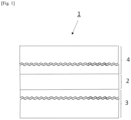
- Fig. 1 is an illustrative view illustrating a configuration of a joined body in one embodiment of the present invention.
- joining means coupling materials together, and bonding and welding are narrower concepts thereof.
- bonding means that two adherends (to be adhered to each other) are placed in a joined state through an organic material (such as thermosetting resins or thermoplastic resins) such as a tape or an adhesive.
- welding means bringing the surfaces of thermoplastic resins and the like into a joined state by utilizing entanglement and crystallization due to molecular diffusion, which occur in the process of melting the surfaces by heat and cooling the surfaces.
- the open time means a limited time from when a film (joining agent) is placed on the resin A to when the resin B is completely placed on the film.
- the joining force of the joining agent does not decrease, and the joining between the two base materials can be performed with a sufficient joining force. The longer the open time, the higher the convenience.
- a to B indicating a numerical range indicates a numerical range including A and B which are endpoints. That is, it means “A or more and B or less” (when A ⁇ B), or "A or less and B or more” (when A > B).
- the method for producing a joined body according to the present embodiment is a method for producing a joined body obtained by joining a resin A, a film containing an amorphous thermoplastic resin, which is at least one of a thermoplastic epoxy resin and a phenoxy resin, as a main component, and a resin B in this order, the method including: a first joining step of joining the resin A and the film by melting and then solidifying the film in a state in which the film is in contact with the resin A; and a second joining step of joining the resin A and the resin B by melting and then solidifying the film in a state in which the film joined to the resin A is in contact with the resin B.
- the epoxy equivalent of the amorphous thermoplastic resin is 1,600 g/eq. or more, or the amorphous thermoplastic resin does not contain an epoxy group, and the heat of fusion of the amorphous thermoplastic resin is 15 J/g or less.
- main component means a component having the highest content among the resin components in film.
- the film preferably contains 50% by mass or more of the resin component, more preferably 70% by mass or more, still more preferably 80% by mass or more, and particularly preferably 90% by mass or more.
- the joining of the resin A and the resin B utilizes a phase change (solid to liquid to solid) of a film containing an amorphous thermoplastic resin, which is at least one of a thermoplastic epoxy resin and a phenoxy resin, as a main component, and does not involve a chemical reaction, so that the joining can be completed in a shorter time than that of a conventional thermosetting epoxy resin, and the open time is also longer.
- a phase change solid to liquid to solid
- the predetermined thermoplastic epoxy resin and the phenoxy resin which are the main components of the film, have a low cohesive force in the resins and have a hydroxy group, they interact strongly with the base material, and can join different kinds of materials with a higher joining force than conventional crystalline hot-melt adhesives.
- the joining is performed by dividing the steps into a first joining step and a second joining step.
- joining can be performed by heating at a temperature suitable for the joining interface, and a joined body having excellent joining property can be produced.
- the heating temperature control becomes easier than in the case where the steps are not divided, and deformation of the resin B due to heating can also be suppressed.
- the film to the resin A in advance when the resin A and the resin B are joined to each other, it is not necessary to place the film on the resin A, thereby reducing the number of assembly steps. Further, the resin A and the resin B can be accurately joined to each other, and it is possible to suppress the occurrence of deviation at the joined portion.
- the first joining step is a step of joining the resin A and the film by melting and then solidifying the film in a state in which the film is brought into surface contact with the resin A.
- solidified means that the material is solid at ordinary temperature, that is, the material does not have fluidity in a non-pressurized state at 23°C.
- the film after the first joining step may have tackiness.
- Examples of the method for melting the film include at least one method selected from the group consisting of contact heating, warm air heating, hot press, infrared heating, hot plate welding, ultrasonic welding, vibration welding, and high-frequency induction welding.
- infrared heating is preferable from the viewpoint of ease of production and shortening of the joining process.
- the temperature of the joining surface of the resin A with the film is preferably heated to 100°C to 400°C and melted, more preferably 120°C to 350°C, and still more preferably 150°C to 320°C.
- 100°C to 400°C the film is efficiently deformed and melted and effectively wets and spreads on the joining surface, whereby a high joining force is obtained.
- Examples of the method for solidifying the molten film include a method in which the film is allowed to cool at ordinary temperature and a method in which the film is allowed to cool using a cooling device.
- the term "ordinary temperature” means a general room temperature in the range of 5°C to 30°C. Among these, a method in which the film is allowed to cool at ordinary temperature is preferable from the viewpoint of ease of production.
- the film contains, as a main component, an amorphous thermoplastic resin which is at least one of a thermoplastic epoxy resin and a phenoxy resin.
- the epoxy equivalent of the amorphous resin is 1,600 g/eq. or more, or the amorphous thermoplastic resin does not contain an epoxy group, and the heat of fusion of the amorphous thermoplastic resin is 15 J/g or less.
- film means a sheet-shaped material having a thickness of 10 ⁇ m to 3 mm.
- the amorphous thermoplastic resin in the present embodiment means a resin having a heat of fusion of 15 J/g or less in measurement using a differential scanning calorimeter (DSC).
- DSC differential scanning calorimeter
- the heat of fusion is calculated from the area of the endothermic peak of DSC (Differential Scanning Calorimeter) and the weight of the thermoplastic resin component.
- DSC Different Scanning Calorimeter
- the heat of fusion is calculated from the weight of the thermoplastic resin component excluding the inorganic filler.
- 2 to 10 mg of a sample is weighed, placed in an aluminum pan, and heated from 23°C to 200°C or higher at 10°C/min using a DSC (DSC8231, manufactured by Rigaku Corporation) to obtain a DSC curve, and then calculated from the area of the endothermic peak at the time of melting obtained from the DSC curve and the aforementioned weighed value.
- the content of the amorphous thermoplastic resin is preferably 60% by mass or more, more preferably 70% by mass or more, still more preferably 80% by mass or more, and most preferably 90% by mass or more of the resin components in the film.
- the heat of fusion of the amorphous thermoplastic resin is 15 J/g or less, preferably 11 J/g or less, more preferably 7 J/g or less, and still more preferably 4 J/g or less, and the endothermic peak is most preferably equal to or less than the detection limit.
- the epoxy equivalent of the amorphous thermoplastic resin is 1,600 g/eq. or more, preferably 2,000 g/eq. or more, more preferably 5,000 g/eq. or more, and still more preferably 9,000 g/eq. or more, and it is most preferable that the epoxy equivalent is above the detection limit and the epoxy group is not substantially detected.
- the expression "the epoxy equivalent is above the detection limit” means that the epoxy group is not detected when the epoxy equivalent is measured based on JIS K 7236:2001 described later.
- a film containing an amorphous thermoplastic resin which is at least one of a thermoplastic epoxy resin and a phenoxy resin, as a main component, in which the amorphous thermoplastic resin has an epoxy equivalent of 1,600 g/eq. or more, or the amorphous thermoplastic resin does not contain an epoxy group, and the amorphous thermoplastic resin has a heat of fusion of 15 J/g or less, a rapid decrease in viscosity during heating as seen in a conventional hot-melt adhesive does not occur, and a state of low viscosity (0.001 to 100 Pa s) is not achieved even in a high-temperature region exceeding 200°C. Therefore, the film does not flow out from a laminated body even in a molten state, and the thickness of the joining layer can be stably ensured, and a high joining force can be stably obtained.
- the epoxy equivalent (the weight of the thermoplastic resin containing 1 mol of epoxy group) referred to herein is a value of the epoxy equivalent of the thermoplastic epoxy resin or phenoxy resin contained in the film before joining, and is a value (unit "g/eq.") measured by a method specified in JIS K 7236:2001. Specifically, a brominated tetraethylammonium acetic acid solution is added using a potentiometric titrator, a 0.1 mol/L perchloric acid-acetic acid solution is used, and a numerical value as a solid content conversion value from non-volatile matter is calculated for a solvent diluted product (resin varnish). In the case of a mixture of two or more kinds of resins, it is also possible to calculate from the content of each resin and the epoxy equivalent.
- the melting point is preferably 50°C to 400°C, more preferably 60°C to 350°C, and still more preferably 70°C to 300°C.
- the melting point is in the range of 50°C to 400°C, the film is efficiently deformed and melted by heating and effectively wets and spreads on the joined surface, so that high joining force can be obtained.
- melting point means an endothermic peak temperature measured by DSC. In the case where an endothermic peak is not obtained or the heat of fusion is 15 J/g or less, a temperature obtained by adding 70°C to the glass transition point is taken as the melting point.
- the glass transition point means a temperature at the start of the drop in a DSC curve in a second cycle in which the temperature is raised to 200°C, then cooled to 40°C or lower, and then heated to 200°C in DSC. Specifically, the glass transition point is a value measured by the method described in Examples.
- the conventional heat-curable adhesive has problems that it is difficult to disassemble the joined body, it is difficult to separate and recycle different kinds of materials constituting the joined body (i.e., poor in recycling property), and it is difficult to reattach the joined body when the joining portion is displaced in the production process of the joined body or when the contents or the adherend has a defect and needs to be replaced (i.e., poor in repairing property), thus lacking convenience.
- the film can be softened and melted by heat and can be easily peeled off, so it has excellent recycling property.
- the film is thermoplastic, it can be reversibly softened, melted, and cured repeatedly, and is also excellent in repairing property.
- the thermoplastic epoxy resin is preferably a polymer of (a) a bifunctional epoxy resin monomer or oligomer and (b) a bifunctional compound having two identical or different functional groups selected from the group consisting of a phenolic hydroxy group, a carboxy group, a mercapto group, an isocyanate group, and a cyanate ester group.
- thermoplastic epoxy resin having desired properties By using such a compound, the polymerization reaction for forming a linear polymer preferentially proceeds, and a thermoplastic epoxy resin having desired properties can be obtained.
- the bifunctional epoxy resin monomer or oligomer (a) refers to an epoxy resin monomer or oligomer having two epoxy groups in the molecules.
- (a) include, for example, bisphenol A type epoxy resins, bisphenol F type epoxy resins, difunctional phenol novolac type epoxy resins, bisphenol AD type epoxy resins, biphenyl type epoxy resins, difunctional naphthalene type epoxy resins, difunctional alicyclic epoxy resins, difunctional glycidyl ester type epoxy resins (e.g., diglycidyl phthalate, diglycidyl tetrahydrophthalate, dimer acid diglycidyl ester, etc.), difunctional glycidyl amine type epoxy resins (e.g., diglycidyl aniline, diglycidyl toluidine, etc.), difunctional heterocyclic epoxy resins, difunctional diaryl sulfone type epoxy resins, hydroquinone type epoxy resins (e.g., hydroquinone diglycidyl ether, 2,5-di-tert-butylhydroquinone diglycidyl ether, resor
- bifunctional compound having a phenolic hydroxy group examples include mononuclear aromatic dihydroxy compounds having one benzene ring such as catechol, resorcin, and hydroquinone; bisphenols such as bis(4-hydroxyphenyl)propane (bisphenol A), bis(4-hydroxyphenyl)methane (bisphenol F), and bis(4-hydroxyphenyl)ethane (bisphenol AD); compounds having a condensed ring such as dihydroxynaphthalene; bifunctional phenol compounds having an allyl group introduced therein, such as diallylresorcin, diallylbisphenol A, and triallyldihydroxybiphenyl; and dibutylbisphenol A.
- mononuclear aromatic dihydroxy compounds having one benzene ring such as catechol, resorcin, and hydroquinone
- bisphenols such as bis(4-hydroxyphenyl)propane (bisphenol A), bis(4-hydroxyphenyl)methane (bis
- carboxyl group-containing compound (b) examples include adipic acid, succinic acid, malonic acid, cyclohexanedicarboxylic acid, phthalic acid, isophthalic acid, and terephthalic acid.
- bifunctional compound having a mercapto group (b) examples include ethylene glycol bisthioglycolate and ethylene glycol bisthiopropionate.
- bifunctional compound having an isocyanate group examples include diphenylmethane diisocyanate (MDI), isophorone diisocyanate (IPDI), hexamethylene diisocyanate (HMDI), and tolylene diisocyanate (TDI).
- MDI diphenylmethane diisocyanate
- IPDI isophorone diisocyanate
- HMDI hexamethylene diisocyanate
- TDI tolylene diisocyanate
- bifunctional compound having a cyanate ester group (b) examples include 2,2-bis(4-cyanatophenyl)propane, 1,1-bis(4-cyanatophenyl)ethane, and bis(4-cyanatophenyl)methane.
- a bifunctional compound having a phenolic hydroxy group is preferred from the viewpoint of obtaining a polymer having thermoplasticity
- a bifunctional compound having two phenolic hydroxy groups and having a bisphenol structure or a biphenyl structure is preferred from the viewpoint of heat resistance and joining property
- bisphenol A, bisphenol F or bisphenol S is preferred from the viewpoint of heat resistance and cost.
- the polymer obtained by polymerization of (a) and (b) has a structure in which a paraphenylene structure and an ether bond are used as a main skeleton, a main chain formed by connecting them with an alkylene group, and a hydroxy group generated by polyaddition are arranged in a side chain.
- the linear structure composed of the paraphenylene skeleton can increase the mechanical strength of the polymer after polymerization, and the arranged hydroxy group in the side chain can improve the adhesion to the base materials. As a result, high joining strength can be realized while maintaining the workability of the thermosetting resin. Further, in the case of a thermoplastic resin, the resin can be recycled and repaired by softening and melting the resin by heat, and the recycling property and the repairing property which are problems in a thermosetting resin can be improved.
- the phenoxy resin is a polyhydroxy polyether synthesized from bisphenols and epichlorohydrin, and has thermoplasticity.
- a method by a direct reaction of a dihydric phenol and epichlorohydrin, and a method by an addition polymerization reaction of a diglycidyl ether of a dihydric phenol and a dihydric phenol are known, and the phenoxy resin used in the present invention may be obtained by any production method.
- examples of the dihydric phenol include phenols such as bisphenol A, bisphenol F, bisphenol S, biphenol, biphenylene diol, and fluorene diphenyl; and aliphatic glycols such as ethylene glycol, propylene glycol, and diethylene glycol.
- bisphenol A, bisphenol F, and bisphenol S are preferable from the viewpoints of cost, joining property, viscosity, and heat resistance.
- One kind thereof may be used singly, or two or more kinds thereof may be used in combination.
- the phenoxy resin has a chemical structure similar to that of an epoxy resin and has a structure in which a para-phenylene structure and an ether bond are used as a main skeleton, a main chain connecting them, and a hydroxy group is disposed in a side chain.
- the thermoplastic epoxy resin and phenoxy resin preferably have a weight average molecular weight of 10,000 to 500,000, more preferably 18,000 to 300,000, and still more preferably 20,000 to 200,000, which is a value in terms of polystyrene as measured by gel permeation chromatography (GPC).
- the weight average molecular weight is calculated from an elution peak position detected by GPC, and is a value of a molecular weight in terms of standard polystyrene.
- the weight average molecular weight is in the range of this value, the balance between the thermoplasticity and the heat resistance is good, the joined body is efficiently obtained by melting, and the heat resistance thereof is increased.
- the weight average molecular weight is 10,000 or more, the heat resistance is excellent, and when it is 500,000 or less, the viscosity at the time of melting is low, and the joining property is increased.
- the film may or may not contain fillers or additives as components other than the resin components within a range that does not hinder the object of the present invention.
- filler examples include an inorganic filler and an organic filler (resin powder).
- inorganic filler examples include spherical fused silica, metal powder of metal such as iron, silica sand, talc, calcium carbonate, mica, acid clay, diatomaceous earth, kaolin, quartz, titanium oxide, silica, phenol resin microballoons, and glass balloons.
- metal powder of metal such as iron, silica sand, talc, calcium carbonate, mica, acid clay, diatomaceous earth, kaolin, quartz, titanium oxide, silica, phenol resin microballoons, and glass balloons.
- the content of the filler in 100% by volume of the total amount of the film is preferably 50% by volume or less, more preferably 30% by volume or less, still more preferably 20% by volume or less, and most preferably 10% by volume or less.
- the volume of the filler can be obtained by dividing the weight of the filler contained in the film by the true specific gravity of the filler.
- the content of the resin component in 100% by volume of the total amount of the film is preferably 10% by volume or more, more preferably 20% by volume or more, still more preferably 30% by volume or more, and even more preferably 50% by volume or more, and in one embodiment, 80% by volume or more, in another embodiment, 90% by volume or more, and in another embodiment, 99% by volume or more.
- the additive examples include a coupling agent such as a silane coupling agent, and a pigment, and one or two or more of these may be contained.
- the content of the additives in the film is preferably 10% by mass or less, more preferably 5% by mass or less, and still more preferably 1% by mass or less.
- the content of the resin component in the film is preferably 10% by mass or more, more preferably 20% by mass or more, still more preferably 30% by mass or more, and even more preferably 50% by mass or more, and in one embodiment, 80% by mass or more, in another embodiment, 90% by mass or more, and in another embodiment, 99% by mass or more.
- the film is a sheet-shaped material having a thickness of 10 ⁇ m to 3 mm.
- the thickness of the film is preferably 1 mm or less, more preferably 0.5 mm or less, still more preferably 0.3 mm or less, even more preferably 0.2 mm or less, and most preferably 0.1 mm or less, from the viewpoint of obtaining a joined body having excellent joining property in a short joining process time.
- the film can be efficiently spread on the joining surface by sandwiching the film between the resin A and the base material B and applying heat, pressure, or the like, thereby obtaining a high joining force.
- the film may be a single layer or a laminated body including a plurality of layers, but is preferably a single layer from the viewpoint of ease of production and improvement of joining force.
- the film may have tackiness to the extent that the joining force and the heat resistance thereof are not impaired.
- the method for producing the film is not particularly limited, but for example, a resin composition is obtained by heating and polymerizing a monomer or oligomer of a bifunctional epoxy compound, a solvent is added to the obtained resin composition as necessary, the composition is applied to a release film or the like, cured and dried, and pressurized as necessary to obtain a film.
- the second joining step is a step of joining the resin A and the resin B by melting and then solidifying the film in a state in which the film joined to the resin A is brought into contact with the resin B.
- the film in the second joining step, it is preferable to heat the film at a temperature equal to or higher than the melting point of at least one of the resin B and the film to melt and then solidify the film.
- the film and the base material are compatibilized, and a stronger joining force is easily obtained.
- Examples of the method for melting the film include at least one method selected from the group consisting of contact heating, warm air heating, hot press, infrared heating, hot plate welding, ultrasonic welding, vibration welding, and high-frequency induction welding. Among these, hot press, ultrasonic welding, and high-frequency induction welding are preferable.
- the conditions in the case of performing the hot press are not particularly limited.
- the temperature is preferably 100°C to 400°C, more preferably 120°C to 350°C, and still more preferably 150°C to 300°C.
- the film is efficiently deformed and melted and effectively wets and spreads on the joining surface, whereby a high joining force is obtained.
- the pressurization force in the hot press is preferably 0.01 to 20 MPa, more preferably 0.1 to 10 MPa, and still more preferably 0.2 to 5 MPa.
- the pressurizing at 0.01 to 20 MPa the film is efficiently deformed and effectively wets and spreads on the joining surface, whereby a high joining force is obtained.
- the resin B is a thermoplastic resin
- the film and the base material are made compatible with each other and a strong joining force can be obtained.
- the conditions for performing ultrasonic welding are not particularly limited.
- the transmission frequency is preferably 10 to 70 kHz, and more preferably 15 to 40 kHz.
- the ultrasonic wave application time is preferably 0.1 to 3 seconds, and more preferably 0.2 to 2 seconds, from the viewpoint of adhesiveness and appearance.
- the pressurization force is preferably 0.01 to 20 MPa, more preferably 0.1 to 10 MPa, and still more preferably 0.2 to 5 MPa.
- the solid joining agent is efficiently deformed and effectively wets and spreads on the bonding surface, whereby a high bonding force is obtained.
- the conditions for performing high-frequency induction welding are not particularly limited.
- the oscillation frequency is in a range of 1 to 1500 kHz.
- the oscillation frequency may be adjusted to an appropriate oscillation frequency according to the size and type of the resin A and the resin B.
- the output may be in a range of 100 to 5000 W.
- the oscillation time may be adjusted according to the size and type of the resin A and the resin B, and is, for example, preferably 1.0 to 10.0 seconds, and more preferably 1.5 to 8.0 seconds.
- the joining of the resin A and the resin B utilizes the phase change (solid to liquid to solid) of the film and does not involve a chemical reaction, so that the joining can be completed in a shorter time than that of the conventional thermosetting epoxy resin.
- FIG. 1 shows one embodiment of the joined body of the present invention.
- a joined body 1 shown in Fig. 1 is obtained by integrally joining a resin A 3 and a resin B 4 via a joining layer 2 in which a film made of an amorphous thermoplastic resin which is at least one of a thermoplastic epoxy resin and a phenoxy resin is melted and then solidified.
- the joined body of the present invention exhibits excellent joining strength even when it is a joined body of different kinds of materials.
- the joining strength is affected by many factors such as the thickness of the joining layer, the molecular weight and chemical structure of the polymer constituting the film, mechanical properties, and viscoelastic properties, in addition to the strength of the interfacial interaction acting between the joining layer and the resin A and between the joining layer and the resin B, the details of the mechanism by which the joined body of the present invention exhibits excellent joining strength are not clear, but it is presumed that the main factors are that the cohesive force in the amorphous thermoplastic resin constituting the joining layer 2 is low, and that hydroxy groups exist in the resin to form chemical bonds and intermolecular forces such as hydrogen bonds and van der Waals forces at the interfaces between the joining layer and the resin A and between the joining layer and the resin B.
- the state or characteristic of the above-mentioned interface of the above-mentioned joined body is a very thin chemical structure at the nanometer level or less, which is difficult to analyze, and it is impossible or impractical in the present technology to express it so as to distinguish it from that not due to the use of a film by specifying it.
- the joined body of the present invention in which the joining layer is made of a thermoplastic resin is excellent in recycling property and repairing property, and can be easily disassembled into the resin A and the resin B by heating the joined body.
- the resin A and the resin B are not particularly limited as long as they are resins, but are preferably made of one selected from the group consisting of a thermoplastic resin, a thermosetting resin, and a fiber reinforced plastic (FRP), and are more preferably made of a thermoplastic resin from the viewpoint of joining force, cost, and ease of molding.
- thermoplastic resin examples include polyolefins and acid-modified products thereof, polystyrene, polymethylmethacrylate, AS resins, ABS resins, thermoplastic aromatic polyesters such as polyethylene terephthalate and polybutylene terephthalate, polycarbonates, polyimides, polyamides, polyamideimides, polyetherimides, polyethersulfones, polyphenylene ethers and modified products thereof, polyphenylene sulfides, polyoxymethylene, polyarylates, polyether ketones, polyether ether ketones, polyether ketone ketones, and thermoplastic epoxy resins. From the viewpoint of improving mechanical strength, the resin is preferably reinforced with at least one selected from carbon fibers, boron fibers, silicon carbide fibers, and glass fibers.
- thermoplastic aromatic polyesters such as polyethylene terephthalate and polybutylene terephthalate, polycarbonate, polyimide, polyamide, polyamideimide, polyetherimide, polyethersulfone, polyphenylene ether and modified products thereof, polyphenylene sulfide, and polyoxymethylene are preferable from the viewpoint of heat resistance and moldability, and polyphenylene sulfide, polybutylene terephthalate, polycarbonate, polyimide, and polyamide are more preferable from the viewpoint of adhesiveness to a solid joining agent.
- the combination of the resin A and the resin B is not particularly limited, but the melting point of the resin A is preferably higher than the melting point of the resin B.
- the melting point of the resin A is not particularly limited, but is preferably 150°C or higher, more preferably 200°C or higher, and still more preferably 250°C or higher from the viewpoint of heat resistance, and is preferably 450°C or lower, more preferably 400°C or lower, and still more preferably 350°C or lower from the viewpoint of joining property.
- resin A for example, polyphenylene sulfide, polybutylene terephthalate, polyimide, polyamide, or the like having high heat resistance may be used.
- the melting point of the resin B is not particularly limited, but is preferably 100°C or higher, more preferably 150°C or higher, and still more preferably 180°C or higher from the viewpoint of heat resistance, and is preferably 400°C or lower, more preferably 350°C or lower, and still more preferably 300°C or lower from the viewpoint of joining property.
- resin B for example, polybutylene terephthalate, polycarbonate, polyamide, or the like may be used.
- the shapes of the resin A and the resin B are not particularly limited, but the thickness of each is preferably 0.1 mm or more, more preferably 0.3 mm or more, still more preferably 0.5 mm or more, and particularly preferably 1 mm or more. When the thickness is 0.1 mm or more, a strong joined body can be obtained.
- the thickness of each of the resin A and the resin B is preferably 10 mm or less, more preferably 8 mm or less, still more preferably 6 mm or less, and particularly preferably 4 mm or less. When the thickness is 10 mm or less, it is easy to heat efficiently and the production is facilitated.
- surfaces of the resin A and the resin B be both subjected to a pretreatment for the purpose of removal of contaminations on the surfaces and/or anchor effect.
- Examples of the pretreatment of the resin A include an UV ozone treatment, a polishing treatment, a plasma treatment, and a corona discharge treatment.
- One kind of the pretreatment may be carried out alone, or two or more kinds thereof may be carried out.
- Known methods can be used as specific methods for these pretreatments.
- the UV ozone treatment is a method for cleaning and modifying a surface by the energy of ultraviolet rays with short wavelengths emitted from a low-pressure mercury lamp and the power of ozone (O 3 ) generated thereby.
- the UV ozone treatment is one surface cleaning method for removing organic impurities on a surface.
- a cleaned surface modifying device using a low-pressure mercury lamp is referred to as an "UV ozone cleaner", an "UV cleaning device”, an "ultraviolet surface modifying device”, and the like.
- polishing treatment examples include buffing using a polishing cloth, roll polishing using polishing paper (sandpaper), and electrolytic polishing.
- the plasma treatment creates a plasma beam with a high-voltage power supply and a rod and causes the plasma beam to impinge on a material surface to excite molecules and functionalize the molecules, and includes an atmospheric pressure plasma treatment method capable of imparting hydroxy groups or polar groups onto a material surface, for example.
- the corona discharge treatment includes a method applied for surface modification of a polymer film and is a method for generating hydroxy groups or polar groups on a surface, beginning at radicals generated by cutting, with electrons emitted from an electrode, polymer main chains or side chains on a polymer surface layer.
- thermoplastic epoxy resin composition having a solid content of about 20% by mass.
- thermoplastic epoxy resin as a solid component.
- Non-adhesive fluororesin films (NITOFLON (registered trademark) No. 900UL, manufactured by Nitto Denko Corporation) were placed on an upper plate and a lower plate of a pressing machine, the thermoplastic epoxy resin was placed on the non-adhesive fluororesin film of the lower plate, the press machine was heated to 160°C, and the thermoplastic epoxy resin was heated and compressed for 2 hours to obtain a film P-1 having a solid content of 100% by mass, a length of 32 to 33 mm, and a thickness of 100 ⁇ m.
- NITOFLON registered trademark
- No. 900UL manufactured by Nitto Denko Corporation
- the measurement results of the weight average molecular weight, the epoxy equivalent, the heat of fusion, and the melting point of the obtained film P-1 are as shown in Table 1.
- the weight average molecular weight was measured by dissolving the obtained film in tetrahydrofuran.
- the film P-2 and a crystalline epoxy resin YSLV-80XY (manufactured by NIPPON STEEL Chemical & Material Co., Ltd.) were pulverized and mixed at a mass ratio of 98:2, pressed in a vise, and heated to 50°C to obtain a film P-3 having a solid content of 100% by mass and a thickness of 100 ⁇ m.
- the film P-2 and a crystalline epoxy resin YSLV-80XY (manufactured by NIPPON STEEL Chemical & Material Co., Ltd.) were pulverized and mixed at a mass ratio of 94:6, pressed in a vise, and heated to 50°C to obtain a film P-4 having a solid content of 100% by mass and a thickness of 100 ⁇ m.
- the film P-2 and a crystalline epoxy resin YSLV-80XY (manufactured by NIPPON STEEL Chemical & Material Co., Ltd.) were pulverized and mixed at a mass ratio of 89: 11, pressed in a vise, and heated to 50°C to obtain a film P-5 having a solid content of 100% by mass and a thickness of 100 ⁇ m.
- thermoplastic epoxy resin composition having a solid content of about 20% by mass.
- the solvent was removed from this to obtain a thermoplastic epoxy resin as a solid component.
- NITOFLON registered trademark
- thermoplastic epoxy resin 900UL, manufactured by Nitto Denko Corporation
- the press machine was heated to 160°C
- the thermoplastic epoxy resin was heated and compressed for 2 hours to obtain a film P-6 having a solid content of 100% by mass, a thickness of 100 ⁇ m, and a length of 32 to 33 mm.
- amorphous polycarbonate film (Iupilon (registered trademark) FE2000, manufactured by Mitsubishi Engineering-Plastics Corporation, thickness: 100 ⁇ m) was cut to obtain a film Q-2.
- a crystalline epoxy resin YSLV-80XY (manufactured by NIPPON STEEL Chemical & Material Co., Ltd) was pressed, and then cut to obtain a film Q-3 having a thickness of 100 ⁇ m.
- a heat-curable liquid epoxy adhesive E-250 (manufactured by Konishi Co., Ltd., a two liquid type of a bisphenol-type epoxy resin and an amine curing agent) was directly used as a liquid joining agent Q-4.
- a flask was charged with 1.0 equivalent (203 g) of jER (registered trademark) 1007 (manufactured by Mitsubishi Chemical Corporation, bisphenol A-type epoxy resin, weight average molecular weight: about 10,000), 1 equivalent (12.5 g) of bisphenol S, 2.4 g of triphenylphosphine, and 1,000 g of methyl ethyl ketone, and the mixture was stirred at room temperature to obtain a liquid joining agent Q-5 having a solid content of about 20% by mass.
- jER registered trademark
- the weight average molecular weight, the epoxy equivalent, the heat of fusion, and the melting point were measured using a thermoplastic epoxy resin polymer formed on the surface of the resin A in Comparative Example 5 described later.
- the weight average molecular weight, the epoxy equivalent, the heat of fusion, and the melting point were measured using a phenoxy resin coating layer formed on the surface of the resin A in Comparative Example 6 described later.
- a crystalline polyamide-based hot-melt adhesive film NT-120 (manufactured by Nihon Matai Co., Ltd., thickness: 100 ⁇ m) was cut to obtain a film Q-7 having a thickness of 100 ⁇ m.
- the weight average molecular weight, the heat of fusion, and the epoxy equivalent of the resin constituting the film (the thermoplastic epoxy resin and the phenoxy resin) and the resin constituting the joining agent were each determined as follows.
- the thickness of the film was measured by the following method.
- the film and the joining agent were dissolved in tetrahydrofuran and measured under the following conditions using Prominence 501 (manufactured by SHOWA SCIENCE CO., LTD., Detector: Shodex (registered trademark) RI-501 (manufactured by Showa Denko K.K.)).
- a film and a joining agent were weighed in an amount of 2 to 10 mg, placed in an aluminum pan, and heated from 23°C to 200°C at a rate of 10°C/min by DSC (DSC8231, manufactured by Rigaku Corporation) to obtain a DSC curve.
- the heat of fusion was calculated from the area of the endothermic peak at the time of melting in the DSC curve and the weighed value.
- the endothermic peak temperature of the obtained DSC curve was taken as the melting point. In the case where an endothermic peak is not obtained and in the case where the heat of fusion is 15 J/g or less, a temperature obtained by adding 70°C to the glass transition point was taken as the melting point.
- the glass transition point was defined as a temperature at the start of the drop in a DSC curve in a second cycle in which the temperature is raised to 200°C, then cooled to 40°C or lower, and then heated to 200°C in DSC.
- the melting point was not set for the thermosetting resin that did not melt by heating.
- the epoxy equivalent was measured in accordance with JIS K 7236:2001 and converted into a value as a resin solid content. In the case of a simple mixture that does not involve a reaction, the epoxy equivalent was calculated from each epoxy equivalent and content.
- the thickness of the film was measured using MDC-25MX manufactured by Mitutoyo Corporation after the films were left in an atmosphere with humidity of 50% at, 23°C for 24 hours.
- the following base materials were used as the resin A and the resin B.
- FZ-1130-D5 (30% glass fiber) (melting point: 280°C) manufactured by DIC Corporation was injection molded to obtain a test piece (softening point: 265°C) having a width of 18 mm, a length of 45 mm, and a thickness of 1.5 mm. The test piece was used without surface treatment.
- VALOX 420-1001 (melting point: 225°C) manufactured by SABIC was injection molded to obtain a test piece (softening point: 207°C) having a width of 18 m, a length of 45 mm, and a thickness of 1.5 mm.
- the test piece was used without surface treatment.
- a linear protrusion having a cross section of an equilateral triangle and a height of 0.5 mm was formed at a position 2.5 mm from the end for efficient heating.
- the film P-1 cut into a size of 10 ⁇ 15 mm was placed on the PPS base material as the resin A, and the film P-1 was heated to a temperature of 300°C to melt the film P-1, and then allowed to cool at ordinary temperature for 0.5 minute to solidify the film P-1, thereby joining the resin A and the film P-1.
- the PBT base material as the resin B was brought into contact with the film P-1 joined to the resin A.
- the base materials were overlapped with each other with a width of 10 mm and a depth of 5 mm.
- the film P-1 was disposed so as to cover all the overlapped regions of the base materials. That is, the resin A and the resin B were not in direct contact with each other, and the film P-1 was interposed between the resin A and the resin B to prepare a laminated body in which the resin B and the film P-1 were not joined to each other.
- the resin A and the base material B were joined by heating and pressurization.
- the amount of sinking was set to 0.6 mm, and the ultrasonic wave application time was set to 1 second or less.
- the joining was terminated when the sinking was completed, and was terminated even if the time was less than 1 second.
- the subsequent retention time was 1 second.
- the pressurization force was 110 N (pressure: 2.2 MPa), and the oscillation frequency was 28.5 kHz. Thus, a joined body was produced.
- a joined body was produced in the same manner as described above except that the film was allowed to stand for 3 days in a state where the film was joined to the resin A, and then the resin B was brought into contact with the film joined to the resin A, and the resin A and the resin B were joined.
- a joined body was produced in the same manner as in Example 1 except that the materials and the conditions were changed as shown in Tables 2 and 3.
- a joining agent Q-4 obtained by mixing two liquids of a heat-curable liquid epoxy adhesive E-250 (manufactured by Konishi Co., Ltd., a two liquid type of a bisphenol-type epoxy resin and an amine curing agent) was applied over an area of 10 mm in length ⁇ 18 mm in width to each of the surfaces of the PPS base material as the resin A and the PBT base material as the resin B, and was bonded within 1 minute. Thereafter, the joining agent Q-4 was cured by leaving it in an oven at 100°C for 1 hour in a state of being fixed with a clip. Thereafter, the joining agent was cooled to room temperature. Thus, a joined body was produced. The thickness of the adhesive layer was 0.1 mm.
- a joined body was produced in the same manner as described above, except that the joining agent Q-4 was applied to each of the resin A and the resin B, allowed to stand for 3 days, and then allowed to stand in an oven at 100°C for 1 hour in a state in which the resin A and the resin B to which the joining agent Q-4 had been applied were superposed and fixed with a clip.
- the liquid joining agent Q-5 was bar coated on the PPS base material as the resin A, dried at room temperature for 30 minutes, and then left to stand in an oven at 160°C for 2 hours to form a solid thermoplastic epoxy resin polymer coating layer having a length of 20 mm ⁇ a width of 18 mm ⁇ a thickness of 50 ⁇ m on the surface of the resin A.
- a joined body was produced in the same manner as described above, except that the resin A having the resin polymer coating layer formed on the surface thereof was allowed to stand for 3 days, and then the resin A and the resin B were superposed and joined.
- the joining agent Q-6 was bar coated on the PPS base material as the resin A, and left to stand in an oven at 70°C for 30 minutes to form a phenoxy resin coating layer having a length of 20 mm ⁇ a width of 18 mm ⁇ a thickness of 50 ⁇ m on the surface of the resin A.
- a joined body was produced in the same manner as in Comparative Example 5, except that the coating layer on the resin A and the PBT base material as the resin B were superposed.
- a joined body was produced in the same manner as described above, except that the resin A having the phenoxy resin coating layer formed thereon was allowed to stand for 3 days, and then the resin A and the resin B were superposed and joined.
- a joined body (including a joined body for open time evaluation) was produced in the same manner as in Example 1 except that the film Q-7 was used as the film.
- a joined body (including a joined body for open time evaluation) was produced in the same manner as in Example 1 except that a laminated body was prepared by laminating the resin A, the film, and the resin B in this order without joining the resin A and the film.
- the joined bodies obtained in Examples and Comparative Examples were allowed to stand at a measurement temperature (23°C or 80°C) for 30 minutes or more, and then a tensile shear joining strength test was performed in 23°C and 80°C atmospheres using a tensile testing machine (universal testing machine Autograph "AG-X plus" (manufactured by Shimadzu Corporation); load cell 10 kN, tensile speed 10 mm/min) in accordance with ISO19095 to measure the joining strength.
- a tensile testing machine universal testing machine Autograph "AG-X plus" (manufactured by Shimadzu Corporation); load cell 10 kN, tensile speed 10 mm/min) in accordance with ISO19095 to measure the joining strength.
- the joining process time was measured from a start point to an end point, with the contact time between at least one of the base materials constituting the joined body and the joining agent as the start point and the completion time of the production of the joined body as the end point.
- the recycling property was determined based on whether or not the joined body could be easily peeled off with a force of 1 N or less after being placed on a hot plate at 200°C and heated for 1 minute. If the joined body could be peeled off, it was evaluated as good (A), and if not, it was evaluated as poor (B).
- the shear joining force of the repair-joined body at 23°C was measured in the same manner as the above-mentioned test method, and it was evaluated as good (A) if the shear joining force was 80% or more of the first shear joining force, and it was evaluated as poor (B) if the shear joining force was less than 80%.
- Thermosetting epoxy resin Polycarbonate Epoxy resin Liquid thermosetting epoxy resin Thermoplastic epoxy resin (Coating layer) Phenoxy resin (Coating layer) Polyamide Thermoplastic epoxy resin Weight average molecular weight - - - 340 - 40000 50000 - 37000 Heat of fusion J/g No melting peak No melting peak 70 No melting peak No melting peak No melting peak 60 No melting peak Melting point °C None 220 60 None 170 164 101 171 Epoxy equivalent g/eq.
- the joined body obtained by the production method of the present invention is used, for example, as automobile components, such as a door side panel, an engine hood roof, a tailgate, a steering hanger, an A pillar, a B pillar, a C pillar, a D pillar, a crush box, a power control unit (PCU) housing, an electric compressor component (such as an inner wall, an intake port, an exhaust control valve (ECV) insertion part, and a mount boss), a lithium ion battery (LIB) spacer, a battery case, and an LED head lamp, and as structural members of a smartphone, a notebook personal computer, a tablet personal computer, a smartwatch, a large size liquid crystal display television set (LCD-TV), and an outdoor LED illumination, but are not particularly limited to these exemplified applications.
- automobile components such as a door side panel, an engine hood roof, a tailgate, a steering hanger, an A pillar, a B pillar, a C pillar, a D
Landscapes
- Engineering & Computer Science (AREA)
- Mechanical Engineering (AREA)
- Chemical & Material Sciences (AREA)
- Organic Chemistry (AREA)
- Chemical Kinetics & Catalysis (AREA)
- Physics & Mathematics (AREA)
- Thermal Sciences (AREA)
- Combustion & Propulsion (AREA)
- Materials Engineering (AREA)
- Health & Medical Sciences (AREA)
- Medicinal Chemistry (AREA)
- Polymers & Plastics (AREA)
- Manufacturing & Machinery (AREA)
- Lining Or Joining Of Plastics Or The Like (AREA)
- Adhesives Or Adhesive Processes (AREA)
- Adhesive Tapes (AREA)
- Manufacture Of Macromolecular Shaped Articles (AREA)
Applications Claiming Priority (2)
| Application Number | Priority Date | Filing Date | Title |
|---|---|---|---|
| JP2021213481 | 2021-12-27 | ||
| PCT/JP2022/047242 WO2023127668A1 (ja) | 2021-12-27 | 2022-12-21 | 接合体の製造方法 |
Publications (2)
| Publication Number | Publication Date |
|---|---|
| EP4458918A1 true EP4458918A1 (de) | 2024-11-06 |
| EP4458918A4 EP4458918A4 (de) | 2026-01-07 |
Family
ID=86999052
Family Applications (1)
| Application Number | Title | Priority Date | Filing Date |
|---|---|---|---|
| EP22915891.0A Pending EP4458918A4 (de) | 2021-12-27 | 2022-12-21 | Verfahren zur herstellung eines verbundenen körpers |
Country Status (6)
| Country | Link |
|---|---|
| EP (1) | EP4458918A4 (de) |
| JP (1) | JP7491479B2 (de) |
| KR (1) | KR20240015100A (de) |
| CN (1) | CN117715994A (de) |
| TW (1) | TWI835487B (de) |
| WO (1) | WO2023127668A1 (de) |
Families Citing this family (1)
| Publication number | Priority date | Publication date | Assignee | Title |
|---|---|---|---|---|
| WO2025143064A1 (ja) * | 2023-12-26 | 2025-07-03 | 株式会社レゾナック | フィルム付き金属端子の製造方法、コネクタ端子の製造方法、コネクタ端子、電気電子部品及びコネクタ端子の評価方法 |
Family Cites Families (12)
| Publication number | Priority date | Publication date | Assignee | Title |
|---|---|---|---|---|
| JPS5512147A (en) * | 1978-07-11 | 1980-01-28 | Nitto Electric Ind Co Ltd | Bonding of plate |
| JPS5689520A (en) * | 1979-12-21 | 1981-07-20 | Unitika Ltd | Bonding method of metal plate |
| JPS56106983A (en) * | 1980-01-30 | 1981-08-25 | Unitika Ltd | Bonding method of film |
| JPH10168417A (ja) | 1996-12-11 | 1998-06-23 | Sekisui Chem Co Ltd | ホットメルト接着剤 |
| JP4175590B2 (ja) * | 1999-07-05 | 2008-11-05 | 日本化薬株式会社 | エポキシ樹脂、これを含むエポキシ樹脂溶液、エポキシ樹脂組成物及びエポキシ樹脂の製造法 |
| JP5505776B2 (ja) * | 2009-12-15 | 2014-05-28 | ナガセケムテックス株式会社 | ホットメルト型接着剤及びrtm成形方法 |
| JP2017052907A (ja) * | 2015-09-11 | 2017-03-16 | 日立化成株式会社 | フェノキシ樹脂組成物及びそれを用いた接着剤組成物 |
| DE102015224613A1 (de) * | 2015-12-08 | 2017-06-08 | Airbus Defence and Space GmbH | Verbindungselement, Verbindungsanordnung, Verfahren zum Herstellen eines Verbindungselements und Verfahren zum Herstellen einer Verbindungsanordnung |
| CN110121413A (zh) | 2016-12-28 | 2019-08-13 | 日铁化学材料株式会社 | 金属-纤维强化树脂材料复合体、其制造方法以及接着片 |
| JP7195055B2 (ja) | 2018-03-15 | 2022-12-23 | 株式会社Adeka | 硬化性樹脂組成物およびこれを用いた接着剤 |
| EP4292811A4 (de) | 2021-02-10 | 2025-01-15 | Resonac Corporation | Schweissfolie und verbundener körper |
| JPWO2022209116A1 (de) | 2021-03-31 | 2022-10-06 |
-
2022
- 2022-12-21 EP EP22915891.0A patent/EP4458918A4/de active Pending
- 2022-12-21 KR KR1020237045002A patent/KR20240015100A/ko active Pending
- 2022-12-21 CN CN202280051319.XA patent/CN117715994A/zh active Pending
- 2022-12-21 WO PCT/JP2022/047242 patent/WO2023127668A1/ja not_active Ceased
- 2022-12-21 JP JP2023541795A patent/JP7491479B2/ja active Active
- 2022-12-26 TW TW111149963A patent/TWI835487B/zh active
Also Published As
| Publication number | Publication date |
|---|---|
| EP4458918A4 (de) | 2026-01-07 |
| TWI835487B (zh) | 2024-03-11 |
| KR20240015100A (ko) | 2024-02-02 |
| JPWO2023127668A1 (de) | 2023-07-06 |
| JP7491479B2 (ja) | 2024-05-28 |
| TW202333936A (zh) | 2023-09-01 |
| CN117715994A (zh) | 2024-03-15 |
| WO2023127668A1 (ja) | 2023-07-06 |
Similar Documents
| Publication | Publication Date | Title |
|---|---|---|
| US20250065549A1 (en) | Joined body manufacturing method and base material manufacturing method | |
| EP4458918A1 (de) | Verfahren zur herstellung eines verbundenen körpers | |
| EP4372062A1 (de) | Verfahren zur herstellung eines verbundenen körpers | |
| JP2023096624A (ja) | 車載用ecuの製造方法 | |
| EP4360855A1 (de) | Verfahren zur herstellung eines gebundenen körpers | |
| JP2023096973A (ja) | ルーフ用クロスメンバの製造方法、及びルーフ構造体の製造方法 | |
| EP4640779A1 (de) | Verfahren zur herstellung eines verbundenen objekts | |
| EP4640778A1 (de) | Verfahren zur herstellung eines verbundenen objekts | |
| EP4640781A1 (de) | Verfahren zur herstellung eines gebundenen körpers | |
| EP4458917A1 (de) | Verfahren zur herstellung eines gebundenen körpers | |
| JP7552680B2 (ja) | 接合体の製造方法 | |
| EP4644503A1 (de) | Verfahren zur herstellung eines filmartigen verbindungsmaterials | |
| EP4640430A1 (de) | Laminat und laminatherstellungsverfahren | |
| JP2023097068A (ja) | 電池ケースのトップカバーの製造方法 | |
| JP2023096713A (ja) | 車載カメラの製造方法 | |
| JP2023097194A (ja) | 自動車用ドアの製造方法 | |
| JP2023096956A (ja) | 自動車の車体用ピラーの製造方法 | |
| JP2023097104A (ja) | 車両用サイドステップの製造方法 | |
| JP2023097163A (ja) | バンパーフェイシアの製造方法 |
Legal Events
| Date | Code | Title | Description |
|---|---|---|---|
| STAA | Information on the status of an ep patent application or granted ep patent |
Free format text: STATUS: THE INTERNATIONAL PUBLICATION HAS BEEN MADE |
|
| PUAI | Public reference made under article 153(3) epc to a published international application that has entered the european phase |
Free format text: ORIGINAL CODE: 0009012 |
|
| STAA | Information on the status of an ep patent application or granted ep patent |
Free format text: STATUS: REQUEST FOR EXAMINATION WAS MADE |
|
| 17P | Request for examination filed |
Effective date: 20240112 |
|
| AK | Designated contracting states |
Kind code of ref document: A1 Designated state(s): AL AT BE BG CH CY CZ DE DK EE ES FI FR GB GR HR HU IE IS IT LI LT LU LV MC ME MK MT NL NO PL PT RO RS SE SI SK SM TR |
|
| DAV | Request for validation of the european patent (deleted) | ||
| DAX | Request for extension of the european patent (deleted) | ||
| REG | Reference to a national code |
Ref country code: DE Ref legal event code: R079 Free format text: PREVIOUS MAIN CLASS: C09J0005060000 Ipc: B29C0065040000 |
|
| A4 | Supplementary search report drawn up and despatched |
Effective date: 20251208 |
|
| RIC1 | Information provided on ipc code assigned before grant |
Ipc: B29C 65/04 20060101AFI20251202BHEP Ipc: B29C 65/40 20060101ALI20251202BHEP Ipc: C09J 5/06 20060101ALI20251202BHEP Ipc: C09J 7/35 20180101ALI20251202BHEP Ipc: C09J 163/00 20060101ALI20251202BHEP Ipc: C09J 171/12 20060101ALI20251202BHEP Ipc: B29C 65/06 20060101ALI20251202BHEP Ipc: B29C 65/08 20060101ALI20251202BHEP Ipc: B29C 65/10 20060101ALI20251202BHEP Ipc: B29C 65/18 20060101ALI20251202BHEP Ipc: B29C 65/48 20060101ALI20251202BHEP Ipc: B29C 65/50 20060101ALI20251202BHEP Ipc: B29C 65/82 20060101ALI20251202BHEP Ipc: C08J 5/12 20060101ALI20251202BHEP Ipc: C09J 181/00 20060101ALI20251202BHEP |