EP4458282A1 - Hämostasevorrichtung - Google Patents
Hämostasevorrichtung Download PDFInfo
- Publication number
- EP4458282A1 EP4458282A1 EP23743259.6A EP23743259A EP4458282A1 EP 4458282 A1 EP4458282 A1 EP 4458282A1 EP 23743259 A EP23743259 A EP 23743259A EP 4458282 A1 EP4458282 A1 EP 4458282A1
- Authority
- EP
- European Patent Office
- Prior art keywords
- band body
- hemostatic device
- protrusions
- support member
- hole portion
- Prior art date
- Legal status (The legal status is an assumption and is not a legal conclusion. Google has not performed a legal analysis and makes no representation as to the accuracy of the status listed.)
- Pending
Links
- 230000023597 hemostasis Effects 0.000 title abstract description 4
- 230000002439 hemostatic effect Effects 0.000 claims abstract description 200
- 230000002708 enhancing effect Effects 0.000 abstract description 2
- 238000012986 modification Methods 0.000 description 28
- 230000004048 modification Effects 0.000 description 28
- 230000000740 bleeding effect Effects 0.000 description 24
- 239000003550 marker Substances 0.000 description 17
- 238000002347 injection Methods 0.000 description 15
- 239000007924 injection Substances 0.000 description 15
- 210000003811 finger Anatomy 0.000 description 12
- 238000000034 method Methods 0.000 description 12
- 241000385250 Epioblasma triquetra Species 0.000 description 8
- 210000004204 blood vessel Anatomy 0.000 description 8
- 210000000245 forearm Anatomy 0.000 description 8
- 210000001367 artery Anatomy 0.000 description 7
- 239000000463 material Substances 0.000 description 7
- -1 polyethylene Polymers 0.000 description 7
- 230000002093 peripheral effect Effects 0.000 description 6
- 210000003813 thumb Anatomy 0.000 description 6
- 229920005989 resin Polymers 0.000 description 5
- 239000011347 resin Substances 0.000 description 5
- 229920001971 elastomer Polymers 0.000 description 4
- 239000000806 elastomer Substances 0.000 description 4
- 229920000139 polyethylene terephthalate Polymers 0.000 description 4
- 239000005020 polyethylene terephthalate Substances 0.000 description 4
- 239000000470 constituent Substances 0.000 description 3
- 230000007423 decrease Effects 0.000 description 3
- 210000002683 foot Anatomy 0.000 description 3
- 239000004800 polyvinyl chloride Substances 0.000 description 3
- 229920000915 polyvinyl chloride Polymers 0.000 description 3
- 210000002321 radial artery Anatomy 0.000 description 3
- 210000002435 tendon Anatomy 0.000 description 3
- 229920000742 Cotton Polymers 0.000 description 2
- 239000004677 Nylon Substances 0.000 description 2
- 239000004952 Polyamide Substances 0.000 description 2
- 239000005062 Polybutadiene Substances 0.000 description 2
- 239000004698 Polyethylene Substances 0.000 description 2
- 239000004743 Polypropylene Substances 0.000 description 2
- 229920000122 acrylonitrile butadiene styrene Polymers 0.000 description 2
- 230000001154 acute effect Effects 0.000 description 2
- 239000000853 adhesive Substances 0.000 description 2
- 230000001070 adhesive effect Effects 0.000 description 2
- 230000000694 effects Effects 0.000 description 2
- 239000005038 ethylene vinyl acetate Substances 0.000 description 2
- 239000012530 fluid Substances 0.000 description 2
- 229920001778 nylon Polymers 0.000 description 2
- 229920001200 poly(ethylene-vinyl acetate) Polymers 0.000 description 2
- 229920003229 poly(methyl methacrylate) Polymers 0.000 description 2
- 229920002647 polyamide Polymers 0.000 description 2
- 229920002857 polybutadiene Polymers 0.000 description 2
- 229920001707 polybutylene terephthalate Polymers 0.000 description 2
- 229920000728 polyester Polymers 0.000 description 2
- 229920000573 polyethylene Polymers 0.000 description 2
- 239000004926 polymethyl methacrylate Substances 0.000 description 2
- 229920000098 polyolefin Polymers 0.000 description 2
- 229920001155 polypropylene Polymers 0.000 description 2
- 239000004925 Acrylic resin Substances 0.000 description 1
- 229920000178 Acrylic resin Polymers 0.000 description 1
- 239000002033 PVDF binder Substances 0.000 description 1
- 229930182556 Polyacetal Natural products 0.000 description 1
- 239000004793 Polystyrene Substances 0.000 description 1
- 229920001328 Polyvinylidene chloride Polymers 0.000 description 1
- BZHJMEDXRYGGRV-UHFFFAOYSA-N Vinyl chloride Chemical compound ClC=C BZHJMEDXRYGGRV-UHFFFAOYSA-N 0.000 description 1
- XECAHXYUAAWDEL-UHFFFAOYSA-N acrylonitrile butadiene styrene Chemical compound C=CC=C.C=CC#N.C=CC1=CC=CC=C1 XECAHXYUAAWDEL-UHFFFAOYSA-N 0.000 description 1
- 239000004676 acrylonitrile butadiene styrene Substances 0.000 description 1
- 239000000956 alloy Substances 0.000 description 1
- 229910045601 alloy Inorganic materials 0.000 description 1
- 210000001142 back Anatomy 0.000 description 1
- 238000004891 communication Methods 0.000 description 1
- 239000013013 elastic material Substances 0.000 description 1
- 239000000835 fiber Substances 0.000 description 1
- 230000004927 fusion Effects 0.000 description 1
- 238000003780 insertion Methods 0.000 description 1
- 230000037431 insertion Effects 0.000 description 1
- 238000009434 installation Methods 0.000 description 1
- 229920000554 ionomer Polymers 0.000 description 1
- 230000003902 lesion Effects 0.000 description 1
- 239000002184 metal Substances 0.000 description 1
- 239000000203 mixture Substances 0.000 description 1
- 229920003023 plastic Polymers 0.000 description 1
- 239000004033 plastic Substances 0.000 description 1
- 229920000058 polyacrylate Polymers 0.000 description 1
- 229920002239 polyacrylonitrile Polymers 0.000 description 1
- 229920006122 polyamide resin Polymers 0.000 description 1
- 229920000515 polycarbonate Polymers 0.000 description 1
- 239000004417 polycarbonate Substances 0.000 description 1
- 229920001225 polyester resin Polymers 0.000 description 1
- 239000004645 polyester resin Substances 0.000 description 1
- 229920000642 polymer Polymers 0.000 description 1
- 229920000306 polymethylpentene Polymers 0.000 description 1
- 229920006324 polyoxymethylene Polymers 0.000 description 1
- 229920001296 polysiloxane Polymers 0.000 description 1
- 229920002223 polystyrene Polymers 0.000 description 1
- 229920002635 polyurethane Polymers 0.000 description 1
- 239000004814 polyurethane Substances 0.000 description 1
- 229920003225 polyurethane elastomer Polymers 0.000 description 1
- 229920005749 polyurethane resin Polymers 0.000 description 1
- 239000005033 polyvinylidene chloride Substances 0.000 description 1
- 229920002981 polyvinylidene fluoride Polymers 0.000 description 1
- 239000000243 solution Substances 0.000 description 1
- 239000000126 substance Substances 0.000 description 1
- 238000002560 therapeutic procedure Methods 0.000 description 1
- 229920002725 thermoplastic elastomer Polymers 0.000 description 1
- 210000000707 wrist Anatomy 0.000 description 1
Images






Classifications
-
- A—HUMAN NECESSITIES
- A61—MEDICAL OR VETERINARY SCIENCE; HYGIENE
- A61B—DIAGNOSIS; SURGERY; IDENTIFICATION
- A61B17/00—Surgical instruments, devices or methods
- A61B17/12—Surgical instruments, devices or methods for ligaturing or otherwise compressing tubular parts of the body, e.g. blood vessels or umbilical cord
- A61B17/132—Tourniquets
- A61B17/135—Tourniquets inflatable
-
- A—HUMAN NECESSITIES
- A61—MEDICAL OR VETERINARY SCIENCE; HYGIENE
- A61B—DIAGNOSIS; SURGERY; IDENTIFICATION
- A61B17/00—Surgical instruments, devices or methods
- A61B17/12—Surgical instruments, devices or methods for ligaturing or otherwise compressing tubular parts of the body, e.g. blood vessels or umbilical cord
- A61B17/132—Tourniquets
- A61B17/1322—Tourniquets comprising a flexible encircling member
- A61B17/1325—Tourniquets comprising a flexible encircling member with means for applying local pressure
-
- A—HUMAN NECESSITIES
- A61—MEDICAL OR VETERINARY SCIENCE; HYGIENE
- A61B—DIAGNOSIS; SURGERY; IDENTIFICATION
- A61B17/00—Surgical instruments, devices or methods
- A61B2017/00831—Material properties
- A61B2017/00902—Material properties transparent or translucent
- A61B2017/00907—Material properties transparent or translucent for light
-
- A—HUMAN NECESSITIES
- A61—MEDICAL OR VETERINARY SCIENCE; HYGIENE
- A61B—DIAGNOSIS; SURGERY; IDENTIFICATION
- A61B17/00—Surgical instruments, devices or methods
- A61B17/12—Surgical instruments, devices or methods for ligaturing or otherwise compressing tubular parts of the body, e.g. blood vessels or umbilical cord
- A61B2017/12004—Surgical instruments, devices or methods for ligaturing or otherwise compressing tubular parts of the body, e.g. blood vessels or umbilical cord for haemostasis, for prevention of bleeding
-
- A—HUMAN NECESSITIES
- A61—MEDICAL OR VETERINARY SCIENCE; HYGIENE
- A61B—DIAGNOSIS; SURGERY; IDENTIFICATION
- A61B90/00—Instruments, implements or accessories specially adapted for surgery or diagnosis and not covered by any of the groups A61B1/00 - A61B50/00, e.g. for luxation treatment or for protecting wound edges
- A61B90/39—Markers, e.g. radio-opaque or breast lesions markers
- A61B2090/3937—Visible markers
Definitions
- the present invention relates to a hemostatic device.
- Patent Literature 1 discloses a hemostatic device for stopping bleeding at a puncture site formed to enable access to a blood vessel (including a distal radial artery) running in the hand.
- the hemostatic device of Patent Literature 1 includes a pressing portion including a balloon for applying a compressive force to a puncture site formed on the hand of a patient, a plurality of band bodies for fixing the pressing portion to the hand of the patient, and a support member for connecting the pressing portion and the plurality of band bodies.
- the plurality of band bodies include a band body for wrapping disposed to be wrapped along an external periphery of the hand, and a band body for finger hooking disposed at an interdigital part located between adjacent fingers of the hand.
- Patent Literature 1 US 2019/0133602 A
- An operator such as a doctor (hereinafter, referred to as an "operator") disposes a pressing portion so as to overlap a puncture site formed in the hand of a patient when stopping bleeding at the puncture site using the hemostatic device of Patent Literature 1.
- the operator wraps a band body for wrapping along an external periphery of the hand and further disposes a band body for finger hooking between the thumb and the index finger.
- the hemostatic device described in Patent Literature 1 may have the following problems.
- a position of the blood vessel running on the hand may be different for each patient.
- the position of the blood vessel, the size of the hand, and the like are different for each patient, and thus, the operator may form puncture sites at different positions of the hand of the patient each time a procedure is performed.
- the operator may form a puncture site in an anatomical snuff box located on the dorsal side of the hand or may form a puncture site at a position on a peripheral side of the snuff box (on the fingertip side of the hand with respect to the snuff box).
- the hemostatic device of Patent Literature 1 is not intended to be used for puncture sites formed at different positions of the hand. Thus, a connection position at which the band body for wrapping and the support member are connected is always fixed. Thus, in the hemostatic device of Patent Literature 1, a degree of freedom of a position at which the band body for wrapping is attached to the hand is low.
- the band body for wrapping can slide and move along an extending direction of the hole portion in a state where the band body for wrapping is connected to the hole portion.
- the hemostatic device may have the following problems.
- the hemostatic device When the patient makes some movement in a state where the hemostatic device is attached, if the hemostatic device touches a surrounding article, or the like, the band body for wrapping may move, and the support member and the pressing portion connected to the support member may tilt or move. In the hemostatic device, if the pressing portion tilts or moves as described above during hemostasis, a compressing direction of the pressing portion is deviated from the puncture site where bleeding is to be stopped. This makes it difficult for the hemostatic device to appropriately apply a compressive force to the puncture site.
- a hemostatic device includes a pressing member configured to compress a puncture site formed on a patient, a first band body configured to be connectable to the pressing member, and a second band body configured to be connectable to the pressing member, in which the pressing member includes a support member and a pressing portion fixed to the support member and configured to compress the puncture site, the support member includes a first region in which the pressing portion is disposed and a second region located outside the first region and configured such that the first band body and the second band body are connectable, the second region includes a first hole portion configured such that the first band body is connectable, and a second hole portion located at a position facing the first hole portion across the pressing portion and configured such that the second band body is connectable, and the first hole portion and the second hole portion have a plurality of protrusions protruding toward the pressing portion.
- the first band body connected to the first hole portion formed in the second region of the support member provided in the pressing member can slide and move along the first hole portion
- the second band body connected to the second hole portion formed in the second region of the support member can slide and move along the second hole portion.
- the first band body and the second band body can be disposed so as to be wrapped along part of the body of the patient.
- a tensile force in a direction away from the pressing portion is applied to the first band body and the second band body.
- the protrusions located in the first hole portion and the second hole portion bite into the first band body and the second band body.
- the protrusions restrict sliding movement of the first band body and the second band body as a result of the protrusions biting into the first band body and the second band body.
- the hemostatic device can prevent the first band body and the second band body from inadvertently sliding and moving while the pressing portion applies a compressive force to the puncture site.
- Figs. 1 to 15 are views for explaining a hemostatic device 10 according to the present embodiment
- Figs. 16 to 22 are views for explaining use examples of the hemostatic device 10.
- the hemostatic device 10 can be used to stop bleeding at a puncture site (for example, puncture sites p1 and p2 to be described later) formed in the hand H located on a distal side (finger side) of a forearm A of the patient when a sheath tube 610 of an introducer 600 is removed from the puncture site.
- a puncture site for example, puncture sites p1 and p2 to be described later
- a specific position of the puncture site where bleeding is to be stopped by the hemostatic device 10 is not particularly limited, but in the present embodiment, the following first puncture site p1 and second puncture site p2 are exemplified. Note that in the present specification, a structure of each portion of the hemostatic device 10 will be described mainly through an example where the hemostatic device 10 is used to stop bleeding at the first puncture site p1.
- the first puncture site p1 is a puncture site formed in the artery B (hereinafter, also referred to as a "blood vessel B") located in the snuff box of the palmar artery running on the dorsal side Hb of the right hand H1 (hand H) located on the distal side of the forearm A of the patient.
- the snuff box is a cavity of the hand located near the radius when the patient spreads the thumb of the hand H.
- the second puncture site p2 is a puncture site formed in the distal radial artery located on the distal side of the snuff box of the palmar artery running on the dorsal side Hb of the right hand H1 of the patient.
- the second puncture site p2 is located on the distal side of the right hand H1 with respect to the first puncture site p1 based on the extensor pollicis longus tendon t1 located in the dorsal side Hb of the right hand H1 of the patient.
- hemostatic device 10 will be described in detail.
- the hemostatic device 10 includes a pressing member 100 configured to compress the first puncture site p1, a first band body 410 configured to be connectable to the pressing member 100, and a second band body 420 configured to be connectable to the pressing member 100.
- the pressing member 100 includes a support member 200 and a pressing portion 300 fixed to the support member 200 and configured to compress the first puncture site p1.
- angles of the first band body 410 and the second band body 420 in an extending direction with respect to the pressing portion 300 can be changed by changing positions of the first band body 410 and the second band body 420 in a first hole portion 240 and a second hole portion 250 in a state where the first band body 410 and the second band body 420 are connected to the support member 200.
- the first band body 410 and the second band body 420 are configured to be able to slide and move along the first hole portion 240 and the second hole portion 250 centering around the pressing portion 300.
- the first band body 410 and the second band body 420 are configured to be able to slide and move along a predetermined direction based on a center point R located in a first region 210 of the support member 200 (see Fig. 14 ) .
- the first band body 410 and the second band body 420 can be disposed so as to be wrapped along an external periphery of the right hand H1 when the hemostatic device 10 is attached to the right hand H1 of the patient.
- a third band body 430 is connectable to the support member 200. As illustrated in Fig. 19 , when the hemostatic device 10 is attached to the right hand H1 of the patient, the third band body 430 can be disposed so as to be hooked on an interdigital part fb located between two adjacent fingers (for example, the thumb and the index finger).
- the pressing portion 300 can include an inflatable portion 310 that applies a compressive force to the first puncture site p1.
- a protruding portion 330 for fixing the inflatable portion 310 to the support member 200 is attached to the inflatable portion 310.
- the inflatable portion 310 can be formed of, for example, a balloon made of a resin which allows inflow and discharge of a fluid such as air. Note that Figs. 6 and 7 are cross-sectional views illustrating a state in which the inflatable portion 310 inflates.
- a tube 530 (see Figs. 1 and 2 ) to be described later is connected to a lumen 310a of the inflatable portion 310.
- a material constituting the inflatable portion 310 is not particularly limited, and for example, polyvinyl chloride, polyethylene, polypropylene, polybutadiene, polyolefins such as ethylene-vinyl acetate copolymer (EVA), polyesters such as polyethylene terephthalate (PET) and polybutylene terephthalate (PBT), various thermoplastic elastomers such as polyvinylidene chloride, silicone, polyurethane, polyamide elastomer, polyurethane elastomer, polyester elastomer, nylon, nylon elastomer, or any combination thereof (such as a blend resin, a polymer alloy and a laminate) can be used.
- polyvinyl chloride polyethylene, polypropylene, polybutadiene
- polyolefins such as ethylene-vinyl acetate copolymer (EVA)
- PET polyethylene terephthalate
- PBT polybutylene terephthalate
- the inflatable portion 310 is fixed to one surface 200a of the support member 200.
- the one surface 200a of the support member 200 is a surface disposed on a body surface side of the hand H of the patient when the hemostatic device 10 is attached to the hand H of the patient.
- the other surface 200b of the support member 200 is a surface located on the opposite side of the one surface 200a.
- the protruding portion 330 includes a flange portion 331 located around the inflatable portion 310 and a plurality of connection portions 332 protruding from the flange portion 331 in a predetermined direction.
- connection portions 332 protrude outward from an edge of the flange portion 331.
- connection portions 332 protruding in different directions are disposed on the protruding portion 330.
- the inflatable portion 310 has a substantially circular shape in plan view illustrated in Figs. 1 to 5 and 11 .
- the flange portion 331 has a substantially circular shape similarly to the inflatable portion 310.
- Each of the connection portions 332 has a structure protruding in a direction away from the flange portion 331 with a predetermined width.
- shapes of the inflatable portion 310 and the protruding portion 330 (the flange portion 331 and the connection portions 332) in plan view are not limited to the illustrated shapes.
- a cross-sectional shape before and after inflating of the inflatable portion 310, a constituent material of the inflatable portion 310, a specific structure of the inflatable portion 310, and the like, are also not particularly limited.
- a fixing structure between the support member 200 and the pressing portion 300 (inflatable portion 310) will be described later.
- a marker 315 for aligning the inflatable portion 310 with the first puncture site p1 is disposed in the inflatable portion 310.
- the marker 315 is disposed on an outer surface of the inflatable portion 310 opposite to a surface on which the support member 200 is disposed (surface disposed on the body surface side of the hand H of the patient when the hemostatic device 10 is attached to the hand H of the patient).
- a specific position of the marker 315 is not particularly limited as long as the inflatable portion 310 can be aligned with the puncture site.
- the marker 315 may be disposed on an inner surface of the inflatable portion 310 opposite to a surface on which the support member 200 is disposed (surface disposed on the body surface side of the hand H of the patient when the hemostatic device 10 is attached to the hand H of the patient).
- the marker 315 is disposed at a substantially center position in a plane direction of the inflatable portion 310.
- the marker 315 is disposed so as to overlap with a substantially center position in a plane direction of the support member 200.
- the marker 315 can be formed of, for example, a rectangular marker in which the entire marker 315 is formed in color. Note that a specific shape, a color, a forming method, a position, and the like, of the marker 315 are not particularly limited.
- the marker 315 may include a transparent central portion and a colored linear frame portion surrounding the central portion. Further, for example, the marker 315 may be provided on the support member 200.
- the support member 200 includes a first region 210 in which the pressing portion 300 is disposed, and a second region 220 that is located outside the first region 210 and configured such that the first band body 410 and the second band body 420 are connectable.
- the support member 200 has a circular shape in plan view illustrated in Fig. 5 .
- the first region 210 is a region where the pressing portion 300 overlaps in plan view illustrated in Fig. 5 .
- the second region 220 is a region located outside the first region 210 in plan view illustrated in Fig. 5 .
- first region 210 can be arbitrarily defined based on an outer shape and a size of the pressing portion 300 disposed on the support member 200.
- second region 220 can be defined based on a relative positional relationship with the first region 210.
- first region 210 and the second region 220 can be appropriately changed according to the outer shape and the size of the pressing portion 300 disposed on the support member 200.
- a center point R which is a center when the first band body 410 and the second band body 420 slide and move along the first hole portion 240 and the second hole portion 250, is located in the first region 210.
- the second region 220 includes the first hole portion 240 configured such that the first band body 410 is connectable, the second hole portion 250 located at a position facing the first hole portion 240 across the pressing portion 300 and configured such that the second band body 420 is connectable, a third hole portion 260 located at a position different from the hole portions 240 and 250 and configured such that the third band body 430 is connectable, and a fourth hole portion 270 located at a position facing the third hole portion 260 across the pressing portion 300.
- the first hole portion 240, the second hole portion 250, the third hole portion 260, and the fourth hole portion 270 can be arranged in a circular shape along the outer shape of the support member 200 in plan view illustrated in Fig. 5 .
- the support member 200 has a circular shape in plan view illustrated in Fig. 5 .
- the hole portions 240, 250, 260, and 270 are arranged in a circular shape along a circumferential direction of the second region 220 located outside the first region 210 in the support member 200.
- the above "arranged in a circular shape” means that assuming a case where a continuous hole is formed in the circumferential direction of the second region 220 of the support member 200, the hole portions 240, 250, 260, and 270 are arranged at intervals at arbitrary positions which are part of the hole.
- the third hole portion 260 can be disposed on the distal side of the hand H with respect to the pressing portion 300, and the fourth hole portion 270 can be disposed on the proximal side of the hand H with respect to the pressing portion 300.
- positions at which the third hole portion 260 and the fourth hole portion 270 are disposed with respect to the pressing portion 300 can be interchanged.
- the third hole portion 260 may be disposed on the proximal side of the hand H with respect to the pressing portion 300
- the fourth hole portion 270 may be disposed on the distal side of the hand H with respect to the inflatable portion 310.
- the third band body 430 is connectable to the fourth hole portion 270, and the third band body 430 can be used for fixing the hemostatic device 10.
- a width of a third one end portion 431 of the third band body 430 is substantially the same as widths of the third hole portion 260 and the fourth hole portion 270.
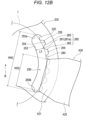
- a width (see dimensions W41, W42 illustrated in Figs. 12A and 12B ) of each of the hole portions 240, 250, 260, and 270 in the present specification means a linear distance between end portions 240a and 240b or between end portions 250a and 250b located in the extending direction of each of the hole portions 240, 250, 260, and 270.
- the support member 200 does not have to be provided with the third hole portion 260 and/or the fourth hole portion 270.
- the hemostatic device 10 in a case where the third hole portion 260 and the fourth hole portion 270 are not provided in the support member 200, use of the third band body 430 can be omitted.
- the width W41 of the first hole portion 240 is larger than the width W31 of a first one end portion 411 of the first band body 410 (width in a direction orthogonal to an extending direction of the first band body 410).
- a distance L2 between a protrusion 280 located in the first hole portion 240 and a first side surface 241 is larger than a thickness D1 of the first one end portion 411 of the first band body 410.
- the first band body 410 can slide and move between the one end portion 240a of the first hole portion 240 and the other end portion 240b of the first hole portion 240 as indicated by an arrow in Fig. 14 in a state where the first band body 410 is connected to the first hole portion 240.
- a width W31 of the first one end portion 411 of the first band body 410 is formed to be smaller than a width of a first body portion 415.
- the width W31 of the first one end portion 411 is the same as the width of the first band body 410. The same applies to the second band body 420.
- a width W42 of the second hole portion 250 is larger than a width W32 of a second one end portion 421 of the second band body 420 (width in a direction orthogonal to an extending direction of the second band body 420).
- a distance L3 between the protrusions 280 located in the second hole portion 250 and a second side surface 242 is larger than a thickness D2 of the second one end portion 421 of the second band body 420.
- the second band body 420 can slide and move between one end portion 250a of the second hole portion 250 and the other end portion 250b of the second hole portion 250 as indicated by an arrow in Fig. 14 in a state where the second band body 420 is connected to the second hole portion 250.
- Ranges in which the first band body 410 and the second band body 420 can slide and move are not particularly limited, but for example, each of the band bodies 410 and 420 can be configured to be able to slide and move in a range from 1° to 75° along the first hole portion 240 and the second hole portion 250 based on the center point R.
- the distance L2 between the protrusions 280 located in the first hole portion 240 and the first side surface 241 and the distance L3 between the protrusions 280 located in the second hole portion 250 and the third side surface 253 are widened toward the inflatable portion 310 side, the inflatable portion 310 and the band bodies 410 and 420 easily interfere with each other when the band bodies 410 and 420 slide and move.
- each of the distances L2 and L3 can be formed so as not to have excessively large dimensions within a range that enables sliding movement of each of the band bodies 410 and 420.
- the first hole portion 240 and the second hole portion 250 have a plurality of protrusions 280 protruding toward the pressing portion 300 (side on which the center point R is located in Figs. 12A and 12B ).
- the first hole portion 240 has the first side surface 241 and the second side surface 242 which is located on a side farther away from the pressing portion 300 than the first side surface 241 and which includes a plurality of protrusions 280.
- the second side surface 242 includes gap portions 245 formed between adjacent protrusions 280 among the plurality of protrusions 280.
- the protrusions 280 and the gap portions 245 are alternately arranged along the extending direction of the first hole portion 240.
- the protrusions 280 and the gap portions 245 are disposed over the entire second side surface 242 in the extending direction.
- the second hole portion 250 has the third side surface 253 and the fourth side surface 254 which is located on a side farther away from the pressing portion 300 than the third side surface 253 and which includes a plurality of protrusions 280.
- the fourth side surface 254 includes gap portions 255 formed between adjacent protrusions 280 among the plurality of protrusions 280.
- the protrusions 280 and the gap portions 255 are alternately arranged along the extending direction of the second hole portion 250.
- the protrusions 280 and the gap portions 255 are disposed over the entire fourth side surface 254 in the extending direction.
- no protrusion 280 is formed on the first side surface 241 and the third side surface 253.
- the first side surface 241 and the third side surface 253 are flat surfaces curved in a concave shape toward a side away from the inflatable portion 310 of the pressing portion 300.
- each of the protrusions 280 formed on the second side surface 242 and the fourth side surface 254 includes a central portion 281 including an apex of the protrusion 280 and a pair of connection portions 282 and 283 connecting the central portion 281 and the gap portions 245 and 255.
- connection portions 282 and 283 tilt from the central portion 281 toward the gap portions 245 and 255.
- the connection portions 282 and 283 extend substantially linearly from the central portion 281 toward the gap portions 245 and 255.
- FIG. 12A and 12B at least part of the central portion 281 of each of the plurality of protrusions 280 located in the first hole portion 240 and at least part of the central portion 281 of each of the plurality of protrusions 280 located in the second hole portion 250 are located on the same virtual circle.
- a broken line I indicates part of the virtual circle connecting the central portions 281 of the protrusions 280 in plan view.
- a center position of the virtual circle indicated by the broken line I overlaps with the center point R located substantially at the center of the support member 400.
- the protrusion 280 can be formed in a trapezoidal shape in plan view.
- the central portion 281 of the protrusion 280 can include a linear flat portion 281a.
- the entire central portion 281 is formed by the flat portion 281a.
- the flat portion 281a may be provided only in part of the central portion 281.
- an attachment angle ⁇ formed between the first one end portion 411 of the first band body 410 pressed against the protrusions 280 and each of the connection portions 282 and 283 is preferably 90° or more and 135° or less.
- the attachment angle ⁇ is formed at an acute angle, it is possible to enhance a locking function when each of the band bodies 410 and 420 is pressed against the protrusions 280.
- the attachment angle ⁇ is preferably 90° or more and 135° or less.
- an inclination angle ⁇ 1 (see Fig. 13 ) of the protrusion 280 is preferably 110° or more and 155° or less.
- the protrusion 280 can also be formed in, for example, a triangle having an attachment angle ⁇ of 135° or less.
- Fig. 13 schematically illustrates a cross section of the first one end portion 411 and the first hole portion 240 of the first band body 410 along an arrow 13A-13A illustrated in Fig. 12A .
- a magnitude relationship between portions described below will be mainly described by taking the first band body 410 and the first hole portion 240 as an example. Note that, in the hemostatic device 10, a magnitude relationship of dimensions similar to those of the first band body 410 and the first hole portion 240 can be adopted between the second band body 420 and the second hole portion 250.
- the length L1 of the connection portions 282 and 283 can be formed to be longer than the thickness D1 of the first band body 410 and the thickness D2 of the second band body 420.
- the length L1 of each of the connection portions 282 and 283 is a length of a linear component of the length L1 of each of the connection portions 282 and 283.
- the thickness D1 of the first band body 410 and the thickness D2 of the second band body 420 are thicknesses in a natural state in which no tensile force, or the like, is applied to the band bodies 410 and 420.
- the length L1 of the connection portions 282 and 283 is formed to be longer than the thickness D1 of the first band body 410 and the thickness D2 of the second band body 420 as described above, and thus, when each of the band bodies 410 and 420 is pressed against the protrusions 280, part of each of the band bodies 410 and 420 can be pushed into the gap portions 245 and 255 as illustrated in Fig. 13 .
- the width W2 of the gap portions 245 and 255 can be formed smaller than the width W1 of the protrusion 280.
- the widths of the gap portions 245 and 255 are lengths along the extending direction of the hole portions 240 and 250.
- the width W1 of the protrusion 280 is a length along the extending direction of each of the hole portions 240 and 250 and is a portion having the largest length in the protrusion 280.
- the width of the protrusion 280 is the width of a bottom portion of the trapezoid.
- the width W2 of the gap portions 245 and 255 is smaller than the width W1 of the protrusion 280 as described above, so that it is possible to prevent most of each of the band bodies 410 and 420 from entering the gap portions 245 and 255 in a state where each of the band bodies 410 and 420 is connected to each of the hole portions 240 and 250.
- the width W1 of the protrusion 280 can be formed to be smaller than the width W31 of the first one end portion 411 of the first band body 410 and the width W32 of the second one end portion 421 of the second band body 420.
- the width W1 of the protrusion 280 is smaller than the width W31 of the first one end portion 411 of the first band body 410 and the width W32 of the second one end portion 421 of the second band body 420, so that it is possible to push part of each of the one end portions 411 and 421 of the band bodies 410 and 420 into each of the gap portions 245 and 255 when each of the band bodies 410 and 420 are pressed against the protrusions 280.
- a height h1 of the protrusion 280 from the first hole portion 240 side and the second hole portion 250 side toward the pressing portion 300 side can be formed to be larger than the thickness D1 of the first band body 410 and the thickness D2 of the second band body 420.
- the thickness D1 of the first band body 410 is the same as the thickness D2 of the second band body 420.
- the height h1 of the protrusion 280 is larger than the thickness D1 of the first band body 410 and the thickness D2 of the second band body 420 as described above, and thus, when each of the band bodies 410 and 420 is pressed against the protrusions 280, part of each of the band bodies 410 and 420 can be pushed into the gap portions 245 and 255 as illustrated in Fig. 13 .
- the width W2 of each of the gap portions 245 and 255 can be formed to be smaller than the width W31 of the first one end portion 411 of the first band body 410 and the width W32 of the second one end portion 421 of the second band body 420.
- the width W2 of each of the gap portions 245 and 255 is smaller than the width W31 of the first one end portion 411 of the first band body 410 and the width W32 of the second one end portion 421 of the second band body 420 as described above, so that it is possible to prevent the entire width direction of each of the one end portions 411 and 421 of each of the band bodies 410 and 420 from entering into each of the gap portions 245 and 255 when each of the band bodies 410 and 420 is pressed against the protrusions 280.
- the first band body 410 in a state where the first band body 410 is not pressed against the second side surface 242 on which the protrusions 280 are formed, the first band body 410 can slide and move along the extending direction of the first hole portion 240.
- the second band body 420 in a state where the second band body 420 is not pressed against the fourth side surface 254 on which the protrusions 280 are formed, the second band body 420 can slide and move along the extending direction of the second hole portion 250.
- Each of the band bodies 410 and 420 can slide and move when the hemostatic device 10 is attached to the right hand H1 of the patient, and thus, a degree of freedom of a position at which each of the band bodies 410 and 420 is attached to the right hand H1 is high.
- the protrusions 280 bite into each of the band bodies 410 and 420.
- the protrusions 280 bite into each of the band bodies 410 and 420, at least one of both end portions located in the width direction of each of the band bodies 410 and 420 fits into the gap portions 245 and 255.
- the protrusion 280 closest to the end portion fitted in the gap portions 245 and 255 serves as a stopper for restricting sliding movement of each of the band bodies 410 and 420.
- the hemostatic device 10 can effectively exhibit the locking function by the protrusions 280.
- the operator can apply a tensile force toward each of the side surfaces 242 and 254 to each of the band bodies 410 and 420 by inflating the inflatable portion 310.
- the hemostatic device 10 can cause the protrusions 280 to bite into each of the band bodies 410 and 420 accompanying inflating of the inflatable portion 310 by applying the above-described tensile force to each of the band bodies 410 and 420 and pressing each of the band bodies 410 and 420 against each of the side surfaces 242 and 254.
- the operator can restrict and release the restriction of sliding movement of each of the band bodies 410 and 420 by operating inflating and deflating of the inflatable portion 310.
- each of the band bodies 410 and 420 can also restrict the sliding movement of each of the band bodies 410 and 420 by wrapping and fixing each of the band bodies 410 and 420 around the right hand H1 of the patient while causing the protrusions 280 to bite into each of the band bodies 410 and 420 in a state where each of the band bodies 410 and 420 is pulled toward each of the side surfaces 242 and 254.
- the hemostatic device 10 has the gap portions 245 and 255 formed between the adjacent protrusions 280 (see Figs. 12A and 12B ).
- portions adjacent to portions in contact with the protrusions 280 in each of the band bodies 410 and 420 can be pushed into the gap portions 245 and 255.
- the hemostatic device 10 can cause the protrusions 280 to firmly bite into each of the band bodies 410 and 420.
- connection portions 282 and 283 of the protrusion 280 tilt from the central portion 281 of the protrusion 280 toward the gap portions 245 and 255.
- the connection portions 282 and 283 tilt, and thus, when each of the band bodies 410 and 420 are pressed against the protrusions 280, portions adjacent to the portions in contact with the protrusions 280 in each of the band bodies 410 and 420 are easily guided along the connection portions 282 and 283 and pushed into the gap portions 245 and 255.
- the hemostatic device 10 can cause the protrusions 280 to bite into each of the band bodies 410 and 420 more firmly.
- the hemostatic device 10 has no variation in the position in a height direction (protruding direction) of the protrusions 280.
- the hemostatic device 10 it is possible to prevent each of the band bodies 410 and 420 from being caught by the protrusions 280 in a state where the protrusions 280 do not bite into each of the band bodies 410 and 420.
- each of the band bodies 410 and 420 can smoothly slide and move.
- the protrusion 280 has a trapezoidal shape.
- the central portion 281 of the protrusion 280 includes a linear flat portion 281a.
- the hemostatic device 10 is configured such that the central portion 281 includes the flat portion 281a, so that it is possible to prevent each of the band bodies 410 and 420 from being caught by the central portion 281 when each of the band bodies 410 and 420 slides and moves. Thus, each of the band bodies 410 and 420 can smoothly slide and move.
- the protrusions 280 and the gap portions 245 and 255 are disposed on the entire side surfaces 242 and 254 of the hole portions 240 and 250 in the extending direction of the hole portions 240 and 250.
- the protrusions 280 can be caused to bite into each of the band bodies 410 and 420 by pressing each of the band bodies 410 and 420 against each of the side surfaces 242 and 254.
- a first curved region 231 curved in a convex shape toward a side away from the inflatable portion 310 disposed on one surface 200a of the support member 200 is formed.
- the above-described “side away from the inflatable portion 310" is a side away from the body surface of the hand H of the patient (upper side in Fig. 21 ) when the hemostatic device 10 is attached to the hand H of the patient.
- a second curved region 232 curved in a convex shape toward the inflatable portion 310 side disposed on the one surface 200a of the support member 200 is formed.
- inflatable portion 310 side is a side (lower side in Fig. 20 ) close to the body surface of the hand H of the patient when the hemostatic device 10 is attached to the hand H of the patient.
- the support member 200 is preferably made of a material having predetermined hardness.
- the support member 200 is configured to have predetermined hardness, as illustrated in Figs. 20 and 21 , when the inflatable portion 310 applies a compressive force to the first puncture site p1 formed on the right hand H1 of the patient, the support member 200 can press the inflatable portion 310 against the right hand H1 of the patient. Accordingly, it is possible to prevent the inflatable portion 310 from floating from the right hand H1 of the patient.
- acrylic resin for example, acrylic resin, polyvinyl chloride (particularly hard polyvinyl chloride), polyolefin such as polyethylene, polypropylene, or polybutadiene, polystyrene, poly- (4-methylpentene-1), polycarbonate, ABS resin, polymethyl methacrylate (PMMA), polyacetal, polyacrylate, polyacrylonitrile, polyvinylidene fluoride, ionomer, acrylonitrile-butadiene-styrene copolymer, polyethylene terephthalate (PET), or the like, can be used.
- acrylic resin polyvinyl chloride (particularly hard polyvinyl chloride), polyolefin such as polyethylene, polypropylene, or polybutadiene, polystyrene, poly- (4-methylpentene-1), polycarbonate, ABS resin, polymethyl methacrylate (PMMA), polyacetal, polyacrylate, polyacrylonitrile, polyvinylidene fluoride, iono
- each of the inflatable portion 310 and the support member 200 portions overlapping each other in plan view illustrated in Figs. 4 and 5 can be formed transparent.
- the inflatable portion 310 and the support member 200 are configured in this manner, as illustrated in Figs. 20 and 21 , when the hemostatic device 10 is attached to the right hand H1 of the patient, the operator can visually confirm the position of the marker 315 and/or the first puncture site p1 through the inflatable portion 310 and the support member 200 more easily.
- transparent includes colored transparent, colorless transparent, and translucent.
- the support member 200 has an attachment hole 290 formed in the second region 220.
- two attachment holes 290 can be provided at predetermined positions near the third hole portion 260 located in the first curved region 231. Further, for example, the two attachment holes 290 can be provided at predetermined positions near the fourth hole portion 270 located in the first curved region 231.
- each connection portion 332 of the protruding portion 330 has a through-hole 332a.
- the pressing portion 300 can be fixed to the support member 200 by a fixing member 335 (see Fig. 11 ) to be inserted into the through-hole 332a of the connection portion 332 and the attachment hole 290 of the support member 200.
- the fixing member 335 can be formed of, for example, a caulking pin caulked to the through-hole 332a and the attachment hole 290. Note that illustration of the fixing member 335 is omitted in the drawings other than Fig. 11 .
- the first curved region 231 and the second curved region 232 of the support member 200 are curved in a predetermined direction.
- the inflatable portion 310 (pressing portion 300) is fixed to the support member 200 at four points via four through-holes 332a respectively formed in the four connection portions 332.
- the inflatable portion 310 is not fixed in a state where the entire surface of the inflatable portion 310 facing the support member 200 is in contact with the one surface 200a of the support member 200.
- the inflatable portion 310 forms a predetermined space S between an outer peripheral portion of the inflatable portion 310 in plan view and the support member 200.
- the inflatable portion 310 may also inflate in a lateral direction with respect to the direction toward the first puncture site p1.
- the compressive force on the first puncture site p1 by the inflatable portion 310 is dispersed, and the compressive force cannot be effectively applied to the first puncture site p1.
- the inflatable portion 310 and the support member 200 are fixed such that the space S is formed between the inflatable portion 310 and each of the curved regions 231 and 232 of the support member 200.
- the inflatable portion 310 when the inflatable portion 310 inflates, it is possible to suppress the inflatable portion 310 from inflating in the lateral direction with respect to the direction toward the first puncture site p1. As a result, in the hemostatic device 10, it is possible to prevent the compressive force on the first puncture site p1 by the inflatable portion 310 from being dispersed and effectively apply the compressive force to the first puncture site p1.
- a method for fixing the inflatable portion 310 to the support member 200 is not limited to the method using the attachment hole 290 of the support member 200 and the through-hole 332a of the protruding portion 330.
- part or the whole of the surface of the inflatable portion 310 located on the support member 200 side may be fixed to the one surface 200a of the support member 200 with an adhesive, or the inflatable portion 310 may be fixed to the support member 200 via another connection member (for example, a sheet-like member) disposed between the inflatable portion 310 and the support member 200.
- the first band body 410 includes a first body portion 415, a first one end portion 411 configured to be connectable to the first hole portion 240 of the support member 200, and a first free other end portion 413.
- the first body portion 415 extends along a longitudinal direction of the first band body 410.
- free other end portion in the present specification means that there is no direct or indirect connection relationship with other members in a state where the hemostatic device 10 is not attached (state where the hemostatic device is not attached to the patient).
- the first one end portion 411 of the first band body 410 can be disposed so as to be inserted into and wrapped around the first hole portion 240 of the support member 200.
- the first band body 410 is connectable to the support member 200 via the first one end portion 411 and the first hole portion 240.
- the second band body 420 includes a second body portion 425, a second one end portion 421 configured to be connectable to the second hole portion 250 of the support member 200, and a second free other end portion 423.
- the second body portion 425 extends along a longitudinal direction of the second band body 420.
- the second one end portion 421 of the second band body 420 can be disposed so as to be inserted into and wrapped around the second hole portion 250 of the support member 200.
- the second band body 420 is connected to the support member 200 via the second one end portion 421 and the second hole portion 250.
- the third band body 430 includes a third body portion 435, a third one end portion 431 configured to be connectable to the third hole portion 260 of the support member 200, and a third free other end portion 433.
- the third body portion 435 extends along a longitudinal direction of the third band body 430.
- the third one end portion 431 of the third band body 430 can be disposed so as to be inserted into and wrapped around the third hole portion 260 of the support member 200.
- the third band body 430 is connected to the support member 200 via the third one end portion 431 and the third hole portion 260.
- a structure of connecting the band bodies 410, 420, and 430 to the hole portions 240, 250, and 260 is not particularly limited.
- a fixing member for example, a hook-and-loop fastener capable of holding and releasing a state where each of the one end portions 411, 421, and 431 is wrapped around each of the hole portions 240, 250, and 260 can be disposed at each of the one end portions 411, 421, and 431 of each of the band bodies 410, 420, and 430.
- each of the band bodies 410, 420, and 430 has a structure that is connectable to and separated from the support member 200.
- a constituent material of each of the band bodies 410, 420, and 430 is not particularly limited, and can be made of, for example, a vinyl chloride resin, a polyamide resin, a polyamide elastomer resin, a polyurethane resin, a polyester resin, or the like.
- a specific shape (shape in plan view or cross-sectional shape), length, and the like, of each of the band bodies 410, 420, and 430 are not particularly limited.
- the hemostatic device 10 can be configured to include five fixing portions of a first fixing portion 451, a second fixing portion 452, a third fixing portion 453, a fourth fixing portion 454, and a fifth fixing portion 455.
- the first fixing portion 451 is disposed on the outer surface of the first band body 410.
- the second fixing portion 452 is disposed on the outer surface of the second band body 420.
- the third fixing portion 453 is disposed on the inner surface of the first band body 410.
- the fourth fixing portion 454 is disposed on the inner surface of the second band body 420.
- the fifth fixing portion 455 is disposed on the inner surface of the third band body 430. Note that the third fixing portion 453 disposed on the first band body 410 is used when the first band body 410 is fixed to the support member 200. Thus, the third fixing portion 453 disposed on the first band body 410 is not used for the purpose of fixing the hemostatic device 10 to the forearm A of the patient.
- each of the band bodies 410, 420, and 430 is a surface disposed on the body surface side of the patient when the hemostatic device 10 is attached to the patient, and the outer surface of each of the band bodies 410, 420, and 430 is a surface located on the opposite side to the inner surface.
- the first fixing portion 451 and the second fixing portion 452 are constituted as a male side of the hook-and-loop fastener.
- the third fixing portion 453, the fourth fixing portion 454, and the fifth fixing portion 455 are constituted as a female side of the hook-and-loop fastener.
- the hook-and-loop fastener in the present specification is a hook-and-loop fastener, and is, for example, Magic Tape (registered trademark) or Velcro (registered trademark).
- each of the fixing portions 451, 452, 453, 454, and 455 is not limited as long as it is possible to fix the inflatable portion 310 to the right hand H1 of the patient by connecting the band bodies 410, 420, and 430 to each other in a state where the hemostatic device 10 is disposed on the right hand H1 of the patient.
- each of the fixing portions 451, 452, 453, 454, and 455 is formed of a hook-and-loop fastener, the male side and the female side of the hook-and-loop fastener may be interchanged.
- each of the fixing portions 451, 452, 453, 454, and 455 may be, for example, a snap, a button, a clip, a frame member in which a hole portion is formed, or the like.
- the hemostatic device 10 has an injection portion 510 for injecting a fluid into the inflatable portion 310.
- the injection portion 510 is formed of a connector incorporating a check valve (not illustrated). A syringe (not shown) may be connected to the injection portion 510.
- a buffer member 520 having an inflatable space is disposed between the injection portion 510 and the inflatable portion 310.
- the buffer member 520 is formed of a flexible bag-shaped member in which a space is formed. Note that the buffer member 520 may be provided with an arrow-shaped marker indicating an insertion direction of the syringe into the injection portion 510.
- the injection portion 510 is connected to one end side of the buffer member 520.
- a lumen of the injection portion 510 communicates with the space of the buffer member 520.
- the check valve incorporated in the injection portion 510 is closed, communication between the lumen of the injection portion 510 and the space of the buffer member 520 is blocked.
- a tube 530 having flexibility is connected to the other end side of the buffer member 520.
- the lumen of the tube 530 communicates with the space of the buffer member 520.
- the other end portion of the tube 530, opposite to the one end portion connected to the buffer member 520 is connected to the inflatable portion 310.
- the lumen of the tube 530 communicates with the lumen 310a of the inflatable portion 310.
- the operator inserts a cylindrical distal end portion of the syringe (not illustrated) into the injection portion 510 and opens the check valve.
- the operator injects air in the syringe into the lumen 310a of the inflatable portion 310 by pushing a pusher of the syringe in a state where the check valve of the injection portion 510 is opened.
- the inflatable portion 310 When air is injected into the lumen 310a of the inflatable portion 310, the inflatable portion 310 inflates.
- the buffer member 520 communicating with the lumen 310a of the inflatable portion 310 via the tube 530 inflates. By visually confirming inflating of the buffer member 520, the operator can easily grasp that the inflatable portion 310 inflates without leakage of air.
- the operator inserts the cylindrical distal end portion of the syringe into the injection portion 510 and pulls the pusher of the syringe.
- the operator can discharge the air in the lumen 310a of the inflatable portion 310 to the syringe by performing the above operation.
- Fig. 17 illustrates a state in which the sheath tube 610 of the introducer 600 is inserted into the first puncture site p1 and various procedures are completed.
- the operator disposes the support member 200 on the dorsal side Hb of the right hand H1 of the patient.
- the operator can appropriately position the support member 200 at the first puncture site p1 by disposing the marker 315 at the first puncture site p1 while visually confirming the position of the marker 315 disposed at the inflatable portion 310.
- the operator may pull out part of the sheath tube 610 of the introducer 600 from the first puncture site p1 formed on the right hand H1 of the patient before attaching the hemostatic device 10 to the right hand H1 of the patient after finishing the procedure using the introducer 600.
- the operator pulls out the sheath tube 610 to the operator's hand side by about 2 to 3 cm, and then can start operation of attaching the hemostatic device 10.
- the operator wraps the first band body 410 and the second band body 420 along the external periphery of the right hand H1 of the patient.
- the operator brings the fourth fixing portion 454 (see Fig. 2 ) disposed on the inner surface of the second band body 420 into contact with the first fixing portion 451 (see Fig. 1 ) disposed on the outer surface of the first band body 410, whereby the first band body 410 and the second band body 420 can be fixed via the fixing portions 451 and 454.
- the operator can slide each of the band bodies 410 and 420 along each of the hole portions 240 and 250 (see Fig. 14 ).
- the operator can adjust the position around which each of the band bodies 410 and 420 is wrapped on the right hand H1 of the patient by sliding and moving each of the band bodies 410 and 420.
- the operator can slide and move each of the band bodies 410 and 420 so that each of the band bodies 410 and 420 is wrapped around the right hand H1 of the patient at a position closer to the forearm A side (proximal side) than the first puncture site p1.
- the operator disposes part of the third band body 430 on the palm side of the right hand H1 of the patient while passing the third band body 430 through the interdigital part fb located between the thumb and the index finger of the right hand H1 of the patient.
- the operator brings the fifth fixing portion 455 (see Fig. 2 ) disposed on the inner surface of the third band body 430 into contact with the second fixing portion 452 (see Fig. 1 ) disposed on the outer surface of the second band body 420, so that the third band body 430 and the second band body 420 can be fixed via the fixing portions 452 and 455.
- each of the band bodies 410 and 420 disposes each of the band bodies 410 and 420 so as to be wrapped around the external periphery of the right hand H1 of the patient, and further disposes the third band body 430 by hooking part of the third band body 430 on the interdigital part fb between the thumb and the index finger of the right hand H1 of the patient, whereby the hemostatic device 10 can be effectively prevented from being displaced from the right hand H1 of the patient.
- the operator inflates the inflatable portion 310 by injecting air into the inflatable portion 310 in a state where the syringe is connected to the injection portion 510.
- the inflatable portion 310 in the hemostatic device 10, if the inflatable portion 310 inflates, the inflatable portion 310 applies a compressive force to the first puncture site p1 of the right hand H1 of the patient.
- the first band body 410 is pulled toward the second side surface 242 of the first hole portion 240 along with the inflating of the inflatable portion 310, and the second band body 420 is pulled toward the fourth side surface 254 of the second hole portion 250.
- the protrusions 280 disposed on each of the side surfaces 242 and 254 bite into each of the band bodies 410 and 420.
- the protrusions 280 bite into each of the band bodies 410 and 420, at least one of both end portions located in the width direction of each of the band bodies 410 and 420 fits into the gap portions 245 and 255.
- the protrusion 280 closest to the end portion fitted into the gap portions 245 and 255 serves as a stopper that restricts sliding movement of each of the band bodies 410 and 420.
- the hemostatic device 10 exhibits a locking function by the protrusions 280 and restricts sliding movement of each of the band bodies 410 and 420 (see Fig. 15 ).
- the hemostatic device 10 can prevent each of the band bodies 410 and 420 from inadvertently sliding and moving while the inflatable portion 310 applies the compressive force to the first puncture site p1.
- the operator can dispose the second curved region 232(see Figs. 8, 9 , and 10 ) formed in the support member 200 along the external periphery of the right hand H1 of the patient.
- the second curved region 232 of the support member 200 presses the inflatable portion 310 along part of the external periphery of the right hand H1 of the patient.
- the hemostatic device 10 can prevent the inflatable portion 310 from floating from the right hand H1 of the patient. Thereby, the hemostatic device 10 can effectively apply a compressive force to the first puncture site p1 by the inflatable portion 310.
- the operator can dispose the first curved region 231(see Figs. 8, 9 , and 10 ) formed in the support member 200 at the position on the distal side and the position on the proximal side of the right hand H1 of the patient.
- the first curved region 231 prevents a peripheral edge portion of the support member 200 from abutting on the right hand H1 of the patient.
- the hemostatic device 10 it is possible to prevent the patient from feeling uncomfortable or feeling pain due to abutment or biting of the peripheral edge portion of the support member 200 against the right hand H1 of the patient while bleeding is stopped at the first puncture site p1 formed on the right hand H1 of the patient.
- the operator removes the sheath tube 610 of the introducer 600 from the first puncture site p1 as illustrated in Fig. 19 .
- the operator confirms that there is no bleeding from the first puncture site p1 while bleeding is stopped using the hemostatic device 10.
- the operator adjusts an injection amount of air into the inflatable portion 310.
- the operator can stop bleeding at the first puncture site p1 formed on the right hand H1 of the patient using the hemostatic device 10.
- Fig. 22 illustrates a second use example of the hemostatic device 10.
- the second use example is a use example of the hemostatic device 10 when bleeding is stopped at the second puncture site p2 formed on the right hand H1 of the patient.
- the operator attaches the hemostatic device 10 to the right hand H1 of the patient.
- the second puncture site p2 formed on the right hand H1 of the patient is located on the distal side of the right hand H1 of the patient with respect to the first puncture site p1 described above (see Fig. 16 ).
- the operator can slide and move each of the band bodies 410 and 420 along the extending direction of each of the hole portions 240 and 250.
- the operator slides and moves each of the band bodies 410 and 420 so that each of the band bodies 410 and 420 is wrapped around the right hand H1 of the patient at a position closer to the forearm A side (proximal side) than the second puncture site p2.
- the operator can prevent the distal portion of the right hand H1 of the patient from being restrained by each of the band bodies 410 and 420 by wrapping each of the band bodies 410 and 420 around the position on the proximal side of the right hand H1 of the patient.
- the hemostatic device 10 can also be used for stopping bleeding at a puncture site formed on the left hand of the patient.
- the puncture site formed on the left hand may be, for example, a puncture site formed on an artery located in a snuff box of a palmar artery running on the dorsal side of the left hand of the patient or a puncture site formed on a distal radial artery located on the distal side of the snuff box of the palmar artery running on the dorsal side of the left hand of the patient.
- the latter puncture site is located on the distal side of the left hand relative to the former puncture site with reference to the extensor pollicis longus tendon located on the dorsal side of the left hand of the patient.
- the hemostatic device 10 can be attached to the left hand of the patient in the same procedure as in Use Example 1 and Use Example 2 described above.
- the operator can adjust the position at which each of the band bodies 410 and 420 is to be wrapped around the left hand by sliding and moving each of the band bodies 410 and 420 according to the position of each puncture site of the left hand of the patient.
- the operator can prevent the portion on the distal side of the left hand of the patient from being restrained by each of the band bodies 410, 420 when bleeding is stopped at each puncture site.
- the hemostatic device 10 can be attached to either the right hand H1 or the left hand of the patient.
- the hemostatic device 10 can be attached to the hand H of the patient so that the portion on the distal side of the hand H of the patient is not restrained by the respective band bodies 410 and 420.
- the hemostatic device 10 includes the pressing member 100 configured to compress the first puncture site p1 formed on the patient, the first band body 410 configured to be connectable to the pressing member 100, and the second band body 420 configured to be connectable to the pressing member 100.
- the pressing member 100 includes the support member 200 and the pressing portion 300 fixed to the support member 200 and configured to compress the first puncture site p1.
- the support member 200 includes the first region 210 in which the pressing portion 300 is disposed, and the second region 220 located outside the first region 210 and configured such that the first band body 410 and the second band body 420 are connectable.
- the second region 220 includes the first hole portion 240 configured such that the first band body 410 is connectable, and the second hole portion 250 located at a position facing the first hole portion 240 across the pressing portion 300 and configured such that the second band body 420 is connectable.
- the first hole portion 240 and the second hole portion 250 have a plurality of protrusions 280 protruding toward the pressing portion 300.
- the first band body 410 connected to the first hole portion 240 formed in the second region 220 of the support member 200 included in the pressing member 100 can slide and move along the first hole portion 240
- the second band body 420 connected to the second hole portion 250 formed in the second region 220 of the support member 200 can slide and move along the second hole portion 250.
- the connection positions of the first band body 410 and the second band body 420 on the support member 200 can be easily adjusted when the hemostatic device 10 is attached to the hand H of the patient.
- the hemostatic device 10 has a high degree of freedom in the attachment position on the hand H of the patient.
- first hole portion 240 and the second hole portion 250 formed in the support member 200 have a plurality of protrusions 280 protruding toward the pressing portion 300.
- the first band body 410 and the second band body 420 can be disposed to be wrapped along part of the hand H of the patient. If the first band body 410 and the second band body 420 are disposed so as to be wrapped around the hand H of the patient, a tensile force in a direction away from the pressing portion 300 is applied to the first band body 410 and the second band body 420 in the hemostatic device 10.
- the first hole portion 240 includes the first side surface 241, and the second side surface 242 which is located on a side farther away from the inflatable portion 310 than the first side surface 241 and which includes a plurality of protrusions 280.
- the second hole portion 250 has the third side surface 253 and the fourth side surface 254 which is located on a side farther away from the inflatable portion 310 than the third side surface 253 and includes a plurality of protrusions 280.
- the second side surface 242 and the fourth side surface 254 include the gap portions 245 and 255 formed between adjacent protrusions 280 among the plurality of protrusions 280.
- the hemostatic device 10 configured as described above, when each of the band bodies 410 and 420 is pressed against the protrusions 280, portions adjacent to portions in contact with the protrusions 280 in each of the band bodies 410 and 420 can be pushed into the gap portions 245 and 255. Thus, the hemostatic device 10 can cause the protrusions 280 to firmly bite into each of the band bodies 410 and 420. Thereby, the hemostatic device 10 can enhance the locking function of the protrusions 280.
- the protrusion 280 includes the central portion 281 including an apex of the protrusion 280 and connection portions 282 and 283 connecting the central portion 281 and the respective gap portions 245 and 255.
- Each of the connection portions 282 and 283 tilts from the central portion 281 toward each of the gap portions 245 and 255.
- connection portions 282 and 283 tilt toward the respective gap portions 245 and 255, and thus, when each of the band bodies 410 and 420 is pressed against the protrusions 280, portions adjacent to portions in contact with the protrusions 280 in each of the band bodies 410 and 420 are easily guided along the connection portions 282 and 283 and pushed into the gap portions 245 and 255.
- the hemostatic device 10 can cause the protrusions 280 to bite into each of the band bodies 410 and 420 more firmly. Thereby, the hemostatic device 10 can enhance the locking function of the protrusions 280.
- At least part of the central portion 281 of each of the plurality of protrusions 280 located in the first hole portion 240 and at least part of the central portion 281 of each of the plurality of protrusions 280 located in the second hole portion 250 are located on the same virtual circle I.
- the hemostatic device 10 configured as described above, there is no variation in the position in the height direction (protruding direction) of the protrusions 280.
- the hemostatic device 10 can prevent each of the band bodies 410 and 420 from being caught by the protrusions 280 when each of the band bodies 410 and 420 slides and moves in a state where the protrusions 280 do not bite into each of the band bodies 410 and 420.
- each of the band bodies 410 and 420 can smoothly slide and move.
- the protrusion 280 has a trapezoidal shape.
- the central portion 281 includes the linear flat portion 281a.
- the hemostatic device 10 configured as described above is configured such that the central portion 281 includes the flat portion 281a, so that it is possible to prevent each of the band bodies 410 and 420 from being caught by the central portion 281 when each of the band bodies 410 and 420 slides and moves. Thus, each of the band bodies 410 and 420 can smoothly slide and move.
- the length L1 of each of the connection portions 282 and 283 is longer than the thickness D1 of the first band body 410 and the thickness D2 of the second band body 420.
- the length L1 of each of the connection portions 282 and 283 is formed to be longer than the thickness D1 of the first band body 410 and the thickness D2 of the second band body 420 as described above, and thus, when each of the band bodies 410 and 420 is pressed against the protrusions 280, part of each of the band bodies 410 and 420 can be pushed into the gap portions 245 and 255.
- the hemostatic device 10 can enhance the locking function of the protrusions 280.
- the width W2 of each of the gap portions 245 and 255 is smaller than the width W1 of the protrusion 280.
- the width W2 of the gap portions 245 and 255 is smaller than the width W1 of the protrusion 280 as described above, so that it is possible to prevent most of the band bodies 410 and 420 from entering the gap portions 245 and 255 in a state where the band bodies 410 and 420 are connected to the hole portions 240 and 250.
- the width W1 of the protrusion 280 is smaller than the width W31 of the first one end portion 411 of the first band body 410 and the width W32 of the second one end portion 421 of the second band body 420.
- the width W1 of the protrusion 280 is smaller than the width W31 of the first one end portion 411 of the first band body 410 and the width W32 of the second one end portion 421 of the second band body 420 as described above, so that, when each of the band bodies 410 and 420 is pressed against the protrusions 280, part of each of the one end portions 411 and 421 of each band body can be pushed into each of the gap portions 245 and 255.
- the hemostatic device 10 can enhance the locking function of the protrusions 280.
- the height h1 of the protrusion 280 from the first hole portion 240 side and the second hole portion 250 side toward the inflatable portion 310 side of the pressing portion 300 is larger than the thickness D1 of the first band body 410 and the thickness D2 of the second band body 420.
- the height h1 of the protrusion 280 is larger than the thickness D1 of the first band body 410 and the thickness D2 of the second band body 420 as described above, so that, when each of the band bodies 410 and 420 is pressed against the protrusions 280, part of each of the band bodies 410 and 420 can be pushed into the gap portions 245 and 255.
- the hemostatic device 10 can enhance the locking function of the protrusions 280.
- the hemostatic device 10 includes the third band body 430 configured to be connectable to the pressing member 100.
- the second region 220 of the support member 200 has the third hole portion 260 located at a position different from the first hole portion 240 and the second hole portion 250 in the support member 200.
- the fixing force of the hemostatic device 10 to the hand H of the patient can be increased by fixing the hemostatic device 10 to the hand H of the patient using the third band body 430 connected to the third hole portion 260 located at a position different from the first hole portion 240 and the second hole portion 250 of the support member 200 together with the band bodies 410 and 420 connected to the support member 200.
- the hemostatic device 10 is used for stopping bleeding at the first puncture site p1 formed on the hand H of the patient, it is possible to more reliably fix the hemostatic device 10 to the hand H of the patient by disposing the third band body 430 in the interdigital part fb between the fingers while wrapping the first band body 410 and the second band body 420 along the external periphery of the hand H of the patient.
- the shape of the protrusion formed on the support member 200 is not particularly limited as long as the protrusion has a locking function of preventing sliding movement of each of the band bodies 410 and 420.
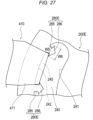
- the protrusion can also be configured in a shape illustrated in Figs. 23 to 26 , for example.
- a protrusion 280A of a support member 200A according to Modification 1 illustrated in Fig. 23 has a shape in which a central portion 281 is curved. Connection portions 282 and 283 also have a curved shape.
- the protrusion 280A has a convex shape curved from the second side surface 242 toward the first side surface 241 and a convex shape curved from the fourth side surface 254 toward the third side surface 253.
- a protrusion 280B in which the width of the central portion 281 is formed to be longer than the widths of the central portions 281 of the other protrusions 280A is disposed at a substantially central position in the extending direction of each of the hole portions 240 and 250.
- the protrusion 280B has a convex shape curved from the second side surface 242 toward the first side surface 241 and a convex shape curved from the fourth side surface 254 toward the third side surface 253, similarly to the protrusion 280A according to Modification 1.
- a protrusion 280C in which the width of the central portion 281 is formed to be longer than the widths of the central portions 281 of the other protrusions 280 is disposed at a substantially central position in the extending direction of each of the hole portions 240 and 250.
- the protrusion 280C has a trapezoidal shape having a flat portion 281a at the central portion 281.
- a protrusion 280D in which an angle between the connection portions 282 and 283 and the central portion 281 is approximately 90° is formed.
- the protrusion 280D has a rectangular shape in plan view.
- the number of the protrusions 280D formed on the support member 200D according to Modification 4 is larger than the number of the protrusions 280 formed on the support member 200 according to the first embodiment (see Figs. 14 and 15 ).
- the central portion 281 of the protrusion 280A is curved in a convex shape.
- a sliding function of each of the band bodies 410 and 420 is improved as compared with the support member 200.
- each of the band bodies 410 and 420 easily slides in a state where each of the band bodies 410 and 420 is in contact with the central portion 281 of the protrusion 280A, and thus, the locking function is lower than that of the support member 200.
- the support member 200B according to Modification 2 includes the protrusion 280B whose central portion 281 has a curved convex shape formed over a wide range in the width direction.
- a sliding function of each of the band bodies 410 and 420 is improved as compared with the support member 200 A.
- each of the band bodies 410 and 420 easily slides in a state where each of the band bodies 410 and 420 is in contact with the central portion 281 of the protrusion 280B, and thus, the locking function is lower than that of the support member 200A.
- the support member 200C according to Modification 3 includes the protrusion 280C having a flat portion 281a in which the central portion 281 is formed over a wide range in the width direction.
- the support member 200C has a locking function lower than that of the support member 200.
- the support member 200C has a locking function higher than that of the support member 200A according to Modification 1 and the support member 200B according to Modification 2 and has a sliding function higher than that of the support member 200D according to Modification 4 described below.
- the support member 200D according to Modification 4 includes a large number of protrusions 280D formed in a rectangular shape.
- the protrusion 280D is formed in a rectangular shape, and thus, each of the band bodies 410 and 420 is easily caught by the protrusions 280D.
- the attachment angle ⁇ (see Fig. 12A ) formed between the first one end portion 411 of the first band body 410 in a state of being pressed against the protrusions 280 and each of the connection portions 282 and 283 is formed at an acute angle.
- the support member 200D has a locking function higher than that of the other support members 200, 200A, 200B, and 200C.
- sliding performance and the locking function of each of the band bodies 410 and 420 can be adjusted according to the shape and the number of the protrusions disposed in each of the hole portions 240 and 250.
- the support member 200 including the protrusions 280 described in the first embodiment has a good balance between the sliding function and the locking function and has a specification with high usability.
- Fig. 27 illustrates a protrusion 280E according to Modification 5.
- the protrusion 280E according to Modification 5 includes a base portion 285 extending toward the inflatable portion 310 of the pressing portion 300, and a locking portion 286 located on a side closer to the inflatable portion 310 of the pressing portion 300 than the base portion 285 and having a larger width than the base portion 285.
- the "side closer to the inflatable portion 310 of the pressing portion 300" is a side on which the first side surface 241 is located.
- the base portion 285 has a shape extending with a substantially constant width in plan view.
- the locking portion 286 has a triangular shape whose width gradually increases from the first side surface 241 side toward the second side surface 242 side.
- a width W5 of the base portion 285 is smaller than a width W6 of the locking portion 286.
- a distance between the base portions 285 of the adjacent protrusions 280E is larger than a distance between the locking portions 286 of the adjacent protrusions 280E. Accordingly, as illustrated in Fig. 27 , if the first band body 410 is inserted into the gap portion 245 formed between the base portions 285 through a gap formed between the locking portions 286, the first band body 410 is hooked on the locking portions 286. If the first band body 410 is disposed in this manner, the first band body 410 is less likely to come out of the gap portion 245, and thus, sliding movement of the first band body 410 can be more reliably restricted. In this manner, the locking function of restricting the sliding movement of the first band body 410 is further improved with the protrusions 280E including the base portions 285 and the locking portions 286.
- protrusions 280E can be disposed at arbitrary positions of the first hole portion 240 and/or arbitrary positions of the second hole portion 250.
- Figs. 28 and 29 illustrate a support member 200F according to a second embodiment.
- a distance between the first side surface 241 and the second side surface 242 of the first hole portion 240 and a distance between the third side surface 253 and the fourth side surface 254 of the second hole portion 250 gradually increase from the proximal portion side of the support member 400 toward the distal portion side of the support member 400.
- the "proximal portion of the support member 200" is an end portion (end portion located on a lower side of Figs. 28 and 29 ) disposed on the forearm A side of the patient, for example, in a case where the hemostatic device 10 is attached to the hand H of the patient.
- the "distal portion of the support member 200" is an end portion (end portion located on an upper side of Figs. 28 and 29 ) disposed on the distal side of the forearm A of the patient, for example, in a case where the hemostatic device 10 is attached to the hand H of the patient.
- the support member 200F has the protrusion 280A having the shape illustrated in Modification 1.
- a specific shape of the protrusion 280A is not particularly limited and may be, for example, the shape described in the first embodiment and other modifications.
- the pressing portion 300 (inflatable portion 310) can be fixed to the one surface 200a of the support member 200F by adhesion or fusion, for example.
- the protruding portion 330 (see Fig. 11 ) is not attached to pressing portion 300.
- hemostatic device including the support member 200F according to the second embodiment will be described.
- Fig. 30 is a cross-sectional view of the hemostatic device corresponding to an arrow 30A-30A illustrated in Fig. 28 .
- Fig. 30 illustrates a state in which the inflatable portion 310 inflates in a state in which the hemostatic device is attached to the hand H of the patient.
- the band bodies 410 and 420 are disposed at the positions of the hole portions 240 and 250 illustrated in Fig. 28 .
- the support member 200F is pressed against the hand H side as indicated by an arrow in Fig. 31 to weaken biting of the protrusions 280A with respect to each of the band bodies 410 and 420.
- each of the band bodies 410 and 420 moves each of the band bodies 410 and 420 toward the one end portions 240a and 250a of each of the hole portions 240 and 250 (the distal portion side of the support member 200F) as indicated by an arrow in Fig. 28 in a state where biting of the protrusions 280A into each of the band bodies 410 and 420 is weakened. If the operator performs such operation, a distance between the first band body 410 and the second band body 420 increases as illustrated in Fig. 29 . As a result, the fixing force for fixing the inflatable portion 310 to the hand H by each of the band bodies 410 and 420 is weakened, and thus, the compressive force to be applied to the first puncture site p1 by the inflatable portion 310 is reduced.
- the operator In a case where the operator desires to increase the compressive force to be applied to the first puncture site p1 by the inflatable portion 310, the operator moves each of the band bodies 410 and 420 toward the other end portions 240b and 250b of each of the hole portions 240 and 250 (the proximal portion side of the support member 200F) in a state where biting of the protrusions 280A into each of the band bodies 410 and 420 is weakened.
- the distance between the first side surface 241 and the second side surface 242 of the first hole portion 240 and the distance between the third side surface 253 and the fourth side surface 254 of the second hole portion 250 gradually increase from the proximal portion side of the support member 200F toward the distal portion side of the support member 200F.
- a magnitude of the compressive force to be applied to the first puncture site p1 by the inflatable portion 310 can be easily adjusted without removing or rewinding each of the band bodies 410 and 420 wrapped around the hand H from the hand H.
- hemostatic device according to the present invention has been described above through the embodiments, the present invention is not limited only to the content described in the specification and can be appropriately changed based on the description of the claims.
- the hemostatic device having a configuration in which the first band body and the second band body can slide and move with respect to the support member and the third band body cannot slide and move with respect to the support member has been exemplified.
- the hemostatic device may be configured such that the third band body can also slide and move with respect to the support member.
- the configuration of the pressing portion that applies the compressive force to the puncture site is not limited to the inflatable portion (for example, a balloon-like structure).
- the pressing portion can be formed of, for example, a resin material such as plastic configured to be able to apply a compressive force to the puncture site, a member made of gel, or the like, an elastic material such as a sponge-like substance, an aggregate of fibers such as cotton (cotton), a metal, a member having a predetermined three-dimensional shape (spherical, ellipsoid, triangular pyramid, etc.), or a combination thereof as appropriate.
- the hemostatic device for stopping bleeding at the puncture site formed on the dorsal side of the hand has been exemplified.
- the hemostatic device can also be used to stop bleeding at the puncture site formed on the palm of the hand.
- arrangement of each band body when the hemostatic device is attached to the patient is not limited to the position described by illustration, and can be appropriately changed.
- the third band body can also be disposed at an interdigital part other than the interdigital part located between the thumb and the index finger.
- the hemostatic device can also be used for stopping bleeding at a puncture site formed on the foot of the patient (for example, the dorsum pedis, the sole of the foot, and the like) having many moving parts such as fingers.
- each portion of the hemostatic device are not particularly limited as long as an inflatable member can be disposed at a site where bleeding is to be stopped, and can be appropriately changed.
Landscapes
- Health & Medical Sciences (AREA)
- Life Sciences & Earth Sciences (AREA)
- Surgery (AREA)
- Heart & Thoracic Surgery (AREA)
- Molecular Biology (AREA)
- Vascular Medicine (AREA)
- Engineering & Computer Science (AREA)
- Biomedical Technology (AREA)
- Reproductive Health (AREA)
- Medical Informatics (AREA)
- Nuclear Medicine, Radiotherapy & Molecular Imaging (AREA)
- Animal Behavior & Ethology (AREA)
- General Health & Medical Sciences (AREA)
- Public Health (AREA)
- Veterinary Medicine (AREA)
- Biophysics (AREA)
- Hematology (AREA)
- Surgical Instruments (AREA)
Applications Claiming Priority (2)
| Application Number | Priority Date | Filing Date | Title |
|---|---|---|---|
| JP2022006151 | 2022-01-19 | ||
| PCT/JP2023/001253 WO2023140265A1 (ja) | 2022-01-19 | 2023-01-18 | 止血器具 |
Publications (2)
| Publication Number | Publication Date |
|---|---|
| EP4458282A1 true EP4458282A1 (de) | 2024-11-06 |
| EP4458282A4 EP4458282A4 (de) | 2025-04-02 |
Family
ID=87348841
Family Applications (1)
| Application Number | Title | Priority Date | Filing Date |
|---|---|---|---|
| EP23743259.6A Pending EP4458282A4 (de) | 2022-01-19 | 2023-01-18 | Hämostasevorrichtung |
Country Status (5)
| Country | Link |
|---|---|
| US (1) | US20240366232A1 (de) |
| EP (1) | EP4458282A4 (de) |
| JP (1) | JPWO2023140265A1 (de) |
| CN (1) | CN118434375A (de) |
| WO (1) | WO2023140265A1 (de) |
Family Cites Families (10)
| Publication number | Priority date | Publication date | Assignee | Title |
|---|---|---|---|---|
| US1934951A (en) * | 1929-07-29 | 1933-11-14 | Ferdinand A Schaefer | Buckle |
| US2084412A (en) * | 1932-03-15 | 1937-06-22 | Theodore H Low | Buckle |
| US7475453B2 (en) * | 2005-04-27 | 2009-01-13 | Melas, Inc. | Buckle |
| CA2917386A1 (en) * | 2013-07-16 | 2015-01-22 | G.B.O. Mercier Inc. | Hemostatic device |
| JP6885941B2 (ja) * | 2016-07-06 | 2021-06-16 | テルモ株式会社 | 止血器具 |
| EP3703806A4 (de) | 2017-11-03 | 2021-05-26 | Merit Medical Systems, Inc. | Hämostasevorrichtungen und verfahren zur verwendung |
| JP2019154915A (ja) * | 2018-03-15 | 2019-09-19 | テルモ株式会社 | 止血器具 |
| US11020127B2 (en) * | 2018-03-26 | 2021-06-01 | 6:8 Medical Solutions LLC | Point-pressure application system |
| JP2020116314A (ja) * | 2019-01-28 | 2020-08-06 | テルモ株式会社 | 止血器具 |
| JP2022006151A (ja) | 2020-09-01 | 2022-01-12 | 昇 松本 | デジタル神経細胞情報処理装置。 |
-
2023
- 2023-01-18 EP EP23743259.6A patent/EP4458282A4/de active Pending
- 2023-01-18 WO PCT/JP2023/001253 patent/WO2023140265A1/ja not_active Ceased
- 2023-01-18 CN CN202380015500.XA patent/CN118434375A/zh active Pending
- 2023-01-18 JP JP2023575261A patent/JPWO2023140265A1/ja active Pending
-
2024
- 2024-07-18 US US18/776,691 patent/US20240366232A1/en active Pending
Also Published As
| Publication number | Publication date |
|---|---|
| US20240366232A1 (en) | 2024-11-07 |
| EP4458282A4 (de) | 2025-04-02 |
| CN118434375A (zh) | 2024-08-02 |
| WO2023140265A1 (ja) | 2023-07-27 |
| JPWO2023140265A1 (de) | 2023-07-27 |
Similar Documents
| Publication | Publication Date | Title |
|---|---|---|
| JP7236439B2 (ja) | 止血器具 | |
| US20240000462A1 (en) | Hemostatic device | |
| JP7808037B2 (ja) | 止血器具 | |
| CN112638291B (zh) | 止血器具 | |
| US20240415524A1 (en) | Hemostatic device | |
| EP4458282A1 (de) | Hämostasevorrichtung | |
| JP7236440B2 (ja) | 止血器具 | |
| JP7691278B2 (ja) | 止血器具 | |
| US20240074767A1 (en) | Hemostatic device | |
| JP7523377B2 (ja) | 止血器具 | |
| US20230201555A1 (en) | Hemostatic device | |
| EP4494575A1 (de) | Hämostaseinstrument | |
| US20250000517A1 (en) | Hemostatic device | |
| AU2024330355A1 (en) | Hemostasis instrument | |
| WO2025047705A1 (ja) | 止血器具 | |
| US20240081832A1 (en) | Hemostatic device | |
| US20250000518A1 (en) | Hemostatic device | |
| WO2023176665A1 (ja) | 止血器具 | |
| JP2025056815A (ja) | 止血器具 | |
| WO2025047706A1 (ja) | 止血器具 | |
| JP2025027571A (ja) | 止血器具 | |
| AU2024334013A1 (en) | Hemostatic instrument | |
| JP2024075524A (ja) | 止血器具 |
Legal Events
| Date | Code | Title | Description |
|---|---|---|---|
| STAA | Information on the status of an ep patent application or granted ep patent |
Free format text: STATUS: THE INTERNATIONAL PUBLICATION HAS BEEN MADE |
|
| PUAI | Public reference made under article 153(3) epc to a published international application that has entered the european phase |
Free format text: ORIGINAL CODE: 0009012 |
|
| STAA | Information on the status of an ep patent application or granted ep patent |
Free format text: STATUS: REQUEST FOR EXAMINATION WAS MADE |
|
| 17P | Request for examination filed |
Effective date: 20240731 |
|
| AK | Designated contracting states |
Kind code of ref document: A1 Designated state(s): AL AT BE BG CH CY CZ DE DK EE ES FI FR GB GR HR HU IE IS IT LI LT LU LV MC ME MK MT NL NO PL PT RO RS SE SI SK SM TR |
|
| A4 | Supplementary search report drawn up and despatched |
Effective date: 20250227 |
|
| RIC1 | Information provided on ipc code assigned before grant |
Ipc: A61B 17/135 20060101AFI20250221BHEP |
|
| DAV | Request for validation of the european patent (deleted) | ||
| DAX | Request for extension of the european patent (deleted) |