EP4458236A1 - Zustandsbestimmungsverfahren und vorrichtung für einen reinigungsroboter - Google Patents
Zustandsbestimmungsverfahren und vorrichtung für einen reinigungsroboter Download PDFInfo
- Publication number
- EP4458236A1 EP4458236A1 EP22913298.0A EP22913298A EP4458236A1 EP 4458236 A1 EP4458236 A1 EP 4458236A1 EP 22913298 A EP22913298 A EP 22913298A EP 4458236 A1 EP4458236 A1 EP 4458236A1
- Authority
- EP
- European Patent Office
- Prior art keywords
- working mode
- change value
- cleaning robot
- state
- accumulation
- Prior art date
- Legal status (The legal status is an assumption and is not a legal conclusion. Google has not performed a legal analysis and makes no representation as to the accuracy of the status listed.)
- Pending
Links
Images

Classifications
-
- G—PHYSICS
- G05—CONTROLLING; REGULATING
- G05D—SYSTEMS FOR CONTROLLING OR REGULATING NON-ELECTRIC VARIABLES
- G05D1/00—Control of position, course, altitude or attitude of land, water, air or space vehicles, e.g. using automatic pilots
- G05D1/20—Control system inputs
- G05D1/24—Arrangements for determining position or orientation
- G05D1/245—Arrangements for determining position or orientation using dead reckoning
-
- A—HUMAN NECESSITIES
- A47—FURNITURE; DOMESTIC ARTICLES OR APPLIANCES; COFFEE MILLS; SPICE MILLS; SUCTION CLEANERS IN GENERAL
- A47L—DOMESTIC WASHING OR CLEANING; SUCTION CLEANERS IN GENERAL
- A47L11/00—Machines for cleaning floors, carpets, furniture, walls, or wall coverings
- A47L11/40—Parts or details of machines not provided for in groups A47L11/02 - A47L11/38, or not restricted to one of these groups, e.g. handles, arrangements of switches, skirts, buffers, levers
- A47L11/4002—Installations of electric equipment
-
- A—HUMAN NECESSITIES
- A47—FURNITURE; DOMESTIC ARTICLES OR APPLIANCES; COFFEE MILLS; SPICE MILLS; SUCTION CLEANERS IN GENERAL
- A47L—DOMESTIC WASHING OR CLEANING; SUCTION CLEANERS IN GENERAL
- A47L11/00—Machines for cleaning floors, carpets, furniture, walls, or wall coverings
- A47L11/40—Parts or details of machines not provided for in groups A47L11/02 - A47L11/38, or not restricted to one of these groups, e.g. handles, arrangements of switches, skirts, buffers, levers
- A47L11/4011—Regulation of the cleaning machine by electric means; Control systems and remote control systems therefor
-
- A—HUMAN NECESSITIES
- A47—FURNITURE; DOMESTIC ARTICLES OR APPLIANCES; COFFEE MILLS; SPICE MILLS; SUCTION CLEANERS IN GENERAL
- A47L—DOMESTIC WASHING OR CLEANING; SUCTION CLEANERS IN GENERAL
- A47L9/00—Details or accessories of suction cleaners, e.g. mechanical means for controlling the suction or for effecting pulsating action; Storing devices specially adapted to suction cleaners or parts thereof; Carrying-vehicles specially adapted for suction cleaners
- A47L9/28—Installation of the electric equipment, e.g. adaptation or attachment to the suction cleaner; Controlling suction cleaners by electric means
- A47L9/2805—Parameters or conditions being sensed
-
- A—HUMAN NECESSITIES
- A47—FURNITURE; DOMESTIC ARTICLES OR APPLIANCES; COFFEE MILLS; SPICE MILLS; SUCTION CLEANERS IN GENERAL
- A47L—DOMESTIC WASHING OR CLEANING; SUCTION CLEANERS IN GENERAL
- A47L9/00—Details or accessories of suction cleaners, e.g. mechanical means for controlling the suction or for effecting pulsating action; Storing devices specially adapted to suction cleaners or parts thereof; Carrying-vehicles specially adapted for suction cleaners
- A47L9/28—Installation of the electric equipment, e.g. adaptation or attachment to the suction cleaner; Controlling suction cleaners by electric means
- A47L9/2805—Parameters or conditions being sensed
- A47L9/2826—Parameters or conditions being sensed the condition of the floor
-
- A—HUMAN NECESSITIES
- A47—FURNITURE; DOMESTIC ARTICLES OR APPLIANCES; COFFEE MILLS; SPICE MILLS; SUCTION CLEANERS IN GENERAL
- A47L—DOMESTIC WASHING OR CLEANING; SUCTION CLEANERS IN GENERAL
- A47L9/00—Details or accessories of suction cleaners, e.g. mechanical means for controlling the suction or for effecting pulsating action; Storing devices specially adapted to suction cleaners or parts thereof; Carrying-vehicles specially adapted for suction cleaners
- A47L9/28—Installation of the electric equipment, e.g. adaptation or attachment to the suction cleaner; Controlling suction cleaners by electric means
- A47L9/2836—Installation of the electric equipment, e.g. adaptation or attachment to the suction cleaner; Controlling suction cleaners by electric means characterised by the parts which are controlled
- A47L9/2852—Elements for displacement of the vacuum cleaner or the accessories therefor, e.g. wheels, casters or nozzles
-
- A—HUMAN NECESSITIES
- A47—FURNITURE; DOMESTIC ARTICLES OR APPLIANCES; COFFEE MILLS; SPICE MILLS; SUCTION CLEANERS IN GENERAL
- A47L—DOMESTIC WASHING OR CLEANING; SUCTION CLEANERS IN GENERAL
- A47L2201/00—Robotic cleaning machines, i.e. with automatic control of the travelling movement or the cleaning operation
- A47L2201/04—Automatic control of the travelling movement; Automatic obstacle detection
-
- A—HUMAN NECESSITIES
- A47—FURNITURE; DOMESTIC ARTICLES OR APPLIANCES; COFFEE MILLS; SPICE MILLS; SUCTION CLEANERS IN GENERAL
- A47L—DOMESTIC WASHING OR CLEANING; SUCTION CLEANERS IN GENERAL
- A47L2201/00—Robotic cleaning machines, i.e. with automatic control of the travelling movement or the cleaning operation
- A47L2201/06—Control of the cleaning action for autonomous devices; Automatic detection of the surface condition before, during or after cleaning
-
- G—PHYSICS
- G05—CONTROLLING; REGULATING
- G05D—SYSTEMS FOR CONTROLLING OR REGULATING NON-ELECTRIC VARIABLES
- G05D2105/00—Specific applications of the controlled vehicles
- G05D2105/10—Specific applications of the controlled vehicles for cleaning, vacuuming or polishing
-
- G—PHYSICS
- G05—CONTROLLING; REGULATING
- G05D—SYSTEMS FOR CONTROLLING OR REGULATING NON-ELECTRIC VARIABLES
- G05D2111/00—Details of signals used for control of position, course, altitude or attitude of land, water, air or space vehicles
- G05D2111/50—Internal signals, i.e. from sensors located in the vehicle, e.g. from compasses or angular sensors
- G05D2111/52—Internal signals, i.e. from sensors located in the vehicle, e.g. from compasses or angular sensors generated by inertial navigation means, e.g. gyroscopes or accelerometers
-
- Y—GENERAL TAGGING OF NEW TECHNOLOGICAL DEVELOPMENTS; GENERAL TAGGING OF CROSS-SECTIONAL TECHNOLOGIES SPANNING OVER SEVERAL SECTIONS OF THE IPC; TECHNICAL SUBJECTS COVERED BY FORMER USPC CROSS-REFERENCE ART COLLECTIONS [XRACs] AND DIGESTS
- Y02—TECHNOLOGIES OR APPLICATIONS FOR MITIGATION OR ADAPTATION AGAINST CLIMATE CHANGE
- Y02E—REDUCTION OF GREENHOUSE GAS [GHG] EMISSIONS, RELATED TO ENERGY GENERATION, TRANSMISSION OR DISTRIBUTION
- Y02E10/00—Energy generation through renewable energy sources
- Y02E10/50—Photovoltaic [PV] energy
Definitions
- the present disclosure relates to household appliances, and in particular to a state determination method and apparatus for a cleaning robot.
- the cleaning robots can be used to quickly remove dust, foreign objects and the like, making people's lives more convenient and comfortable.
- a gyroscope (Gyro) is usually disposed in a cleaning robot, and a change of the Gyro is used to sense an angle change, and then whether the cleaning robot is dragged or moved or whether the cleaning robot deviates is determined, that is, a state of the cleaning robot is determined.
- a fixed threshold is set, then an angle change value is compared with the fixed threshold to obtain an accumulated angle change value, and finally whether the state of the cleaning robot is a state that the cleaning robot is moved, or the cleaning robot deviates or the like is determined based on the accumulated change value.
- a fixed threshold is set, then an angle change value is compared with the fixed threshold to obtain an accumulated angle change value, and finally whether the state of the cleaning robot is a state that the cleaning robot is moved, or the cleaning robot deviates or the like is determined based on the accumulated change value.
- the present disclosure provides a state determination method for a cleaning robot.
- the method includes:
- the present disclosure provides a state determination apparatus for a cleaning robot.
- the apparatus includes:
- the present disclosure provides a storage medium storing a computer program.
- the computer program is executed by a processor, steps of the state determination method for the cleaning robot as described above are implemented.
- the present disclosure provides an electronic device.
- the electronic device includes at least a memory and a processor.
- the memory stores a computer program thereon, and the processor implements the steps of the state determination method for the cleaning robot as described above when executing the computer program on the memory.
- mobile platform 100 backward portion 110, forward portion 111, perception system 120, buffer 122, cliff sensor 123, control system 130, driving system 140, driving wheel assembly 141, steering component 142, cleaning module 150, dry cleaning module 151, edge brush 152, assembly part 200, assembly structure 300, assembly bracket 310, rotor 320, motor 330, cover 340, rotor accommodation part 311, motor accommodation part 312, first arc-shaped side wall 3111, second arc-shaped side wall 3121, motor roller 331, conveying belt 332, first opening 3122, bottom surface 3124 of motor accommodation part, first supporting rib 3123, second opening 3112, second supporting rib 3113, bottom surface 3114 of rotor accommodation part, circular top surface 341, circular bottom ring 342, connector 343, annular shielding piece 350, plug-in connector 351, first slot 3431, second slot 3432, third slot 3433, raised beam 3511, raised beam 3511, T-shaped protrusion 3512, limiting groove 3434 and limiting protrusion 3513.
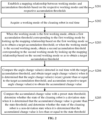
- An embodiment of the present disclosure provides a state determination method for a cleaning robot, as shown in FIG. 1 .
- the method includes the following steps.
- the working mode may specifically be a first working mode with a swinging state or a second working mode with a non-swinging state.
- the first working mode may be an automatic cleaning mode of mopping cloth, a vibration mopping mode, etc.
- the second working mode may be a charging mode, a sweeping mode, a mopping mode, etc.
- a target accumulation threshold corresponding to the working mode is acquired based on the working mode.
- different working modes correspond to different accumulation thresholds, that is, the first working mode corresponds to a first accumulation threshold, the second working mode corresponds to a second accumulation threshold, and the first accumulation threshold is less than the second accumulation threshold.
- selection and accumulation of respective angle change values detected within a preset duration are performed based on the target accumulation threshold to obtain an accumulated change value.
- angle change value(s) greater than or equal to the target accumulation threshold within the preset duration may be accumulated according to the target accumulation threshold, and angle change value(s) less than the target accumulation threshold may be excluded, so as to accurately obtain the accumulated change value.
- angle change value(s) which are detected at various moments and are greater than or equal to the first accumulation threshold may be accumulated based on the smaller first accumulation threshold so as to make the accumulated change value obtained more accurate and avoid a situation that an accumulated result has an error because smaller angle change value(s) are not accumulated (this situation may cause the cleaning robot to mistakenly think that it has been shifted, e.g., causing the robot to mistakenly think that it is dragged, or is moved or it deviates).
- a state of the cleaning robot is determined based on the accumulated change value.
- the state of the cleaning robot may be determined based on the accumulated change value, that is, whether the cleaning robot deviates or is moved or dragged or the like is determined.
- the target accumulation threshold is adjusted in real time according to the working mode of the cleaning robot, and then angle change value(s) satisfying a condition is(are) accumulated based on the target accumulation threshold.
- the accumulated change value obtained via accumulation is more accurate and reliable, thereby providing a guarantee for subsequent accurate determination of the state of the cleaning robot based on the accumulated change value.
- Another embodiment of the present disclosure provides a state determination method for a cleaning robot, as shown in FIG. 2 .
- the method includes the following steps.
- a mapping relationship between working modes and accumulation thresholds is established based on the respective working modes and the respective accumulation thresholds.
- the working modes include: a first working mode with a swinging state and a second working mode with a non-swinging state.
- the accumulation thresholds specifically include a first accumulation threshold corresponding to the first working mode, or a second accumulation threshold corresponding to the second working mode.
- the first accumulation threshold is less than the second accumulation threshold. That is, in this step, specifically, a mapping relationship between the first working mode and the first accumulation threshold and between the second working mode and the second accumulation threshold is established.
- an angle range of the first accumulation threshold may be 0.0001° to 0.003°; and an angle range of the second accumulation threshold may be 0.01° to 0.3°. Of course, the angle range may also be adjusted according to actual needs.
- a first accumulation threshold corresponding to the first working mode is obtained by looking up the mapping relationship based on the first working mode so as to obtain a target accumulation threshold; or when the working mode is the second working mode, a second accumulation threshold corresponding to the second working mode is obtained by looking up the mapping relationship based on the second working mode so as to obtain a target accumulation threshold.
- the second accumulation threshold corresponding to the charging mode is determined.
- the second accumulation threshold is 0.1°
- the target accumulation threshold for deviation/drifting state detection is adjusted to the second accumulation threshold of 0.1°.
- the first accumulation threshold of 0.001° corresponding to the automatic cleaning mode of the mopping cloth may be obtained by looking up the mapping relationship, and then the current target accumulation threshold is switched from the second accumulation threshold of 0.1° to the first accumulation threshold of 0.001°. Subsequently, the angle change values may be accumulated in real time based on the first accumulation threshold of 0.001°.
- the angle change value(s) detected in real time is(are) compared with the target accumulation threshold, and target angle change value(s) is(are) obtained when it is determined that the angle change value(s) is(are) greater than or equal to the target accumulation threshold; and respective target angle change value(s) are accumulated to obtain the accumulated change value.
- the angle change value(s) detected in real time may be selected based on the target accumulation threshold. That is, the angle change value(s) greater than or equal to the target accumulation threshold is(are) selected as target angle change value(s) so as to accumulate the target angle change value(s).
- this step for example, when it is obtained that the cleaning robot is in the second working mode such as a charging mode/mopping mode, after it is determined that the second accumulation threshold corresponding to the charging mode is 0.1°, that is, after the target accumulation threshold for deviation/drifting state detection is adjusted to the second accumulation threshold of 0.1°, absolute value(s) of the angle change value(s) detected in real time may be compared with the second accumulation threshold of 0.1°. When the absolute value(s) of the angle change value(s) is(are) greater than or equal to the second accumulation threshold of 0.1°, the angle change value(s) is(are) accumulated.
- the angle change values detected in real time within a preset duration are -0.45°, +0.002°, - 0.6°, +0.45°...
- the angle change values of -0.45°, -0.6° and +0.45° whose absolute values are greater than the second accumulation threshold can be accumulated to obtain the accumulated change value of -0.6°.
- the angle change value(s) may be accumulated in real time based on the first accumulation threshold of 0.001°.
- the angle change values detected in real time within the preset duration are -0.04°, +0.5°, -0.06°, +0.5°..., and the angle change values of -0.04°, +0.5°, -0.06° and +0.5° whose absolute values are greater than the first accumulation threshold can be accumulated to obtain an accumulated change value of +0.9°. Since in the automatic cleaning mode of the mopping cloth, the mopping cloth is scraped by a washing component at a high frequency in a left-right direction repeatedly, the angle change value will change continuously in a short period of time.
- the tiny angle changes of "-0.04°” and “-0.06°” generated in the automatic cleaning mode of the mopping cloth can also be accumulated, and this can avoid a situation that the accumulated change value is accumulate as 1° because these tiny angle changes are filtered out.
- the accumulated change value obtained via accumulation in the automatic cleaning mode of the mopping cloth is more accurate, thereby avoiding the problem that the state determination of the cleaning robot is not accurate enough because the accumulated change value is inaccurate due to the use of a fixed accumulation threshold.
- the accumulated change value is compared with a preset state threshold; whether the state of the cleaning robot is a deviation state is determined when it is determined that the accumulated change value is greater than the state threshold; and whether the state of the cleaning robot is a non-deviation state is determined when it is determined that the accumulated change value is less than or equal to the state threshold.
- the state threshold refers to an accumulation angle critical value for determining whether the cleaning robot deviates/whether the cleaning robot is moved.
- this accumulation angle critical value may be set as 0.1°, 0.3°, 0.5°, 1° or 1.5°, etc., or may also be adjusted according to actual needs. For example, if the state threshold is set as 0.95°, when the accumulated angle value corresponding to the current moment is detected to be +1°, it may be determined that the cleaning robot is in the deviation state. If the accumulated angle value corresponding to the current moment is detected to be +0.9°, it may be determined that the cleaning robot is in the non-deviation state.
- the state in order to determine the state of the cleaning robot more accurately, the state may also be determined in combination with a duration of the accumulated change value. That is, when it is determined that the accumulated change value is greater than the state threshold and the duration reaches a predetermined time, it is determined that the cleaning robot is in the deviation state; or when it is determined that the accumulated change value is less than or equal to the state threshold, or when the accumulated change value is greater than the state threshold and the duration does not reach the predetermined time, it is determined that the cleaning robot is in the non-deviation state.
- the state threshold is set as 10°, and when the accumulated angle value corresponding to the current moment is detected to be 11°, the accumulated change value at a next moment may be obtained continuously.
- the accumulated change value at the next moment is acquired as 12°, which is still greater than the state threshold, it is determined that the duration has reached the predetermined time, and then it is determined that the state of the cleaning robot is the deviation state. Conversely, when it is detected that the accumulated change value corresponding to the current moment is 5°, which is less than 10°, it is determined that the state of the cleaning robot is the non-deviation state; or when it is detected that the accumulated change value corresponding to the current moment is 12°, which is greater than 10°, but the accumulated change value corresponding to the next moment is 6°, which is less than 10°, it is still determined that the state of the cleaning robot is the non-deviation state. This can prevent misjudgment of the deviation state caused by a single erroneous accumulation or incomplete accumulated data, thereby making determination of the state of the cleaning robot more accurately and reliably.
- the method when it is determined that the state of the cleaning robot is the deviation state, the method further includes: outputting prompt information in a predetermined manner to provide a deviation state prompt.
- the predetermined mode may be a voice prompt manner, a text prompt manner, a manner of remotely sending information to a designated terminal device, etc.
- a piece of predetermined prompt music is outputted in the voice prompt manner, or a predetermined prompt text is outputted in the text prompt manner, or prompt information such as text(s) and picture(s) is remotely sent to the designated terminal device, so that a user can know the state of the cleaning robot in a timely manner.
- the working mode of the cleaning robot is acquired in real time, so that when its working mode is a mode with swinging/shaking, for example, it is a mopping cloth cleaning mode, the accumulation threshold may be readjusted according to the mode, that is, the accumulation threshold is adjusted to be smaller.
- the accumulation threshold is adjusted to be smaller.
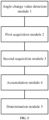
- FIG. 3 Yet another embodiment of the present disclosure provides a state determination apparatus for a cleaning robot, as shown in FIG. 3 .
- the apparatus includes:
- the working mode includes any one of the following: a first working mode with a swinging state and a second working mode with a non-swinging state.
- the second acquisition module is specifically configured to: based on the first working mode, acquire a first accumulation threshold corresponding to the first working mode to obtain the target accumulation threshold; or based on the second working mode, acquire a second accumulation threshold corresponding to the second working mode to obtain the target accumulation threshold, where the first accumulation threshold is less than the second accumulation threshold.
- the accumulation module is specifically configured to: within the preset duration, compare the angle change value(s) detected in real time with the target accumulation threshold; obtain target angle change value(s) when it is determined that the angle change value(s) is(are) greater than or equal to the target accumulation threshold; and accumulate the respective target angle change values within the preset duration to obtain the accumulated change value.
- the determination module is specifically configured to: compare the accumulated change value with a preset state threshold; determine that the state of the cleaning robot is a deviation state when it is determined that the accumulated change value is greater than the state threshold; and determine that the state of the cleaning robot is a non-deviation state when it is determined that the accumulated change value is less than or equal to the state threshold.
- the state determination apparatus of the cleaning robot in an embodiment further includes: an establishment module.
- the establishment module is configured to: establish a mapping relationship between working modes and accumulation thresholds based on the respective working modes and the respective accumulation thresholds before the working mode of the cleaning robot is acquired in real time.
- the second acquisition module is specifically configured to: obtain the target accumulation threshold corresponding to the working mode by looking up the mapping relationship based on the working mode.
- an angle range of the first accumulation threshold is 0.0001° to 0.003°; and an angle range of the second accumulation threshold is 0.01° to 0.3°.
- the state determination apparatus of the cleaning robot in this embodiment further includes a prompt module.
- the prompt module is configured to output prompt information in a predetermined manner to provide a deviation state prompt.
- the software product may be stored in a non-volatile storage medium (which may be a CD-ROM, a USB flash disk, a mobile hard disk, etc.), and includes a number of instructions for enabling a computer device (which may be a personal computer, a server, or a network device, etc.) to perform the methods described in the various implementation scenarios of the present disclosure.
- a non-volatile storage medium which may be a CD-ROM, a USB flash disk, a mobile hard disk, etc.
- a computer device which may be a personal computer, a server, or a network device, etc.
- modules in the apparatus in an implementation scenario can be distributed in the apparatus of the implementation scenario according to the description of the implementation scenario, or may be changed accordingly and located in one or more apparatuses different from the present implementation scenario.
- the modules of the above implementation scenario may be combined into one module, or may be further split into a plurality of sub-modules.
- Still yet another embodiment of the present disclosure provides a storage medium storing a computer program.
- the computer program When the computer program is executed by a processor, the following method steps are implemented:
- the target accumulation threshold is adjusted in real time according to the working mode of the cleaning robot, and then angle change value(s) satisfying a condition is(are) accumulated based on the target accumulation threshold.
- the accumulated change value obtained via accumulation is more accurate and reliable, thereby providing a guarantee for subsequent accurate determination of the state of the cleaning robot based on the accumulated change value.
- the electronic device at least includes a memory and a processor.
- the memory stores a computer program thereon, and the processor implements the following method steps when executing the computer program on the memory:
- the target accumulation threshold is adjusted in real time according to the working mode of the cleaning robot, and then angle change value(s) satisfying a condition is(are) accumulated based on the target accumulation threshold.
- the accumulated change value obtained via accumulation is more accurate and reliable, thereby providing a guarantee for subsequent accurate determination of the state of the cleaning robot based on the accumulated change value.
- the working mode includes any one of: a first working mode with a swinging state and a second working mode with a non-swinging state.
- acquiring the target accumulation threshold corresponding to the working mode specifically includes:
- performing selection and accumulation of respective angle change values detected within the preset duration to obtain the accumulated change value specifically includes:
- determining the state of the cleaning robot based on the accumulated change value specifically includes:
- the method before acquiring the working mode of the cleaning robot in real time, the method further includes: establishing a mapping relationship between working modes and accumulation thresholds based on the respective working modes and the respective accumulation thresholds; and
- an angle range of the first accumulation threshold is 0.0001° to 0.003°; and an angle range of the second accumulation threshold is 0.01° to 0.3°.
- the method when it is determined that the state of the cleaning robot is the deviation state, the method further includes: outputting prompt information in a predetermined manner to provide a deviation state prompt.
- the target accumulation threshold is adjusted in real time according to the working mode of the cleaning robot, and then angle change value(s) satisfying a condition is(are) accumulated based on the target accumulation threshold.
- the accumulated change value obtained via accumulation is more accurate and reliable, thereby providing a guarantee for subsequent accurate determination of the state of the cleaning robot based on the accumulated change value.
Landscapes
- Engineering & Computer Science (AREA)
- Mechanical Engineering (AREA)
- Aviation & Aerospace Engineering (AREA)
- Radar, Positioning & Navigation (AREA)
- Remote Sensing (AREA)
- Physics & Mathematics (AREA)
- General Physics & Mathematics (AREA)
- Automation & Control Theory (AREA)
- Electric Vacuum Cleaner (AREA)
- Control Of Position, Course, Altitude, Or Attitude Of Moving Bodies (AREA)
Applications Claiming Priority (2)
| Application Number | Priority Date | Filing Date | Title |
|---|---|---|---|
| CN202111677232.7A CN114587218B (zh) | 2021-12-31 | 2021-12-31 | 一种清洁机器人的状态判断方法及装置 |
| PCT/CN2022/105275 WO2023124009A1 (zh) | 2021-12-31 | 2022-07-12 | 一种清洁机器人的状态判断方法及装置 |
Publications (2)
| Publication Number | Publication Date |
|---|---|
| EP4458236A1 true EP4458236A1 (de) | 2024-11-06 |
| EP4458236A4 EP4458236A4 (de) | 2026-01-14 |
Family
ID=81814314
Family Applications (1)
| Application Number | Title | Priority Date | Filing Date |
|---|---|---|---|
| EP22913298.0A Pending EP4458236A4 (de) | 2021-12-31 | 2022-07-12 | Zustandsbestimmungsverfahren und vorrichtung für einen reinigungsroboter |
Country Status (6)
| Country | Link |
|---|---|
| US (1) | US20250060753A1 (de) |
| EP (1) | EP4458236A4 (de) |
| JP (1) | JP7772952B2 (de) |
| CN (1) | CN114587218B (de) |
| AU (1) | AU2022425877B2 (de) |
| WO (1) | WO2023124009A1 (de) |
Families Citing this family (3)
| Publication number | Priority date | Publication date | Assignee | Title |
|---|---|---|---|---|
| CN114587218B (zh) * | 2021-12-31 | 2023-07-21 | 北京石头创新科技有限公司 | 一种清洁机器人的状态判断方法及装置 |
| CN116236094A (zh) * | 2023-02-09 | 2023-06-09 | 深圳市云鼠科技开发有限公司 | 用于清洁机器人的线绳缠绕识别方法和装置 |
| CN120493139B (zh) * | 2025-07-17 | 2025-09-30 | 山东港口日照港集团有限公司 | 一种清扫机器人异常状态监控方法及系统 |
Family Cites Families (43)
| Publication number | Priority date | Publication date | Assignee | Title |
|---|---|---|---|---|
| US5020620A (en) * | 1989-09-28 | 1991-06-04 | Tennant Company | Offsetting the course of a laser guided vehicle |
| JP3076648B2 (ja) * | 1992-01-10 | 2000-08-14 | 松下電器産業株式会社 | 自走式掃除機 |
| JP3355506B2 (ja) * | 1994-08-30 | 2002-12-09 | 松下電器産業株式会社 | 移動作業用のロボット |
| JP3370200B2 (ja) * | 1994-12-09 | 2003-01-27 | 日立機電工業株式会社 | 無人搬送車の走行輪操舵角度決定方法 |
| JP2005141636A (ja) * | 2003-11-10 | 2005-06-02 | Matsushita Electric Ind Co Ltd | 自律走行装置 |
| KR100638220B1 (ko) * | 2005-04-23 | 2006-10-27 | 엘지전자 주식회사 | 주행로봇의 위치감지장치 및 그를 구비한 로봇청소기 |
| EP2995236B1 (de) * | 2007-05-09 | 2022-10-05 | iRobot Corporation | Kompakter roboter mit autonomer reichweite |
| JP2009032179A (ja) * | 2007-07-30 | 2009-02-12 | Sanyo Electric Co Ltd | 移動ロボット及び遠隔操作システム |
| KR101931362B1 (ko) * | 2011-08-22 | 2018-12-24 | 삼성전자주식회사 | 로봇청소기 및 그 제어방법 |
| EP2776216B1 (de) * | 2011-11-11 | 2022-08-31 | iRobot Corporation | Robotervorrichtung und steuerverfahren zur wiederaufnahme des betriebs nach einer unterbrechung. |
| US9020637B2 (en) | 2012-11-02 | 2015-04-28 | Irobot Corporation | Simultaneous localization and mapping for a mobile robot |
| TW201519842A (zh) * | 2013-11-18 | 2015-06-01 | Weistech Technology Co Ltd | 具有路線校正功能之移動裝置及其作業步驟 |
| CN105334850A (zh) * | 2014-08-07 | 2016-02-17 | 苏州宝时得电动工具有限公司 | 自动移动设备 |
| CN105302140A (zh) * | 2015-11-04 | 2016-02-03 | 湖南格兰博智能科技有限责任公司 | 一种清洁机器人的移动路线控制系统及控制方法 |
| US10016896B2 (en) * | 2016-06-30 | 2018-07-10 | Brain Corporation | Systems and methods for robotic behavior around moving bodies |
| CN107569181B (zh) * | 2016-07-04 | 2022-02-01 | 九阳股份有限公司 | 一种智能清洁机器人及清扫方法 |
| US20190246852A1 (en) * | 2016-09-20 | 2019-08-15 | Aktiebolaget Electrolux | Robotic cleaning device and a method of controlling movement of the robotic cleaning device |
| CN106774359A (zh) * | 2016-11-23 | 2017-05-31 | 河池学院 | 一种扫地机器人的车体姿态调整方法 |
| CN109662659A (zh) * | 2016-12-16 | 2019-04-23 | 云鲸智能科技(东莞)有限公司 | 清洁机器人和清洁机器人系统 |
| TWI634403B (zh) * | 2017-01-26 | 2018-09-01 | 好樣科技有限公司 | 自動清潔機及其控制方法 |
| CN106959695B (zh) * | 2017-04-24 | 2019-08-02 | 广东宝乐机器人股份有限公司 | 移动机器人在工作区域内的角度修正方法及移动机器人 |
| CN107348910B (zh) * | 2017-09-12 | 2019-10-08 | 珠海市一微半导体有限公司 | 机器人打滑的检测方法和建图方法及芯片 |
| US10494827B2 (en) * | 2017-11-28 | 2019-12-03 | Aquatron Robotic Technology Ltd. | Directional control of robotic pool cleaners |
| CN108196555B (zh) * | 2018-03-09 | 2019-11-05 | 珠海市一微半导体有限公司 | 自主移动机器人沿边行走的控制方法 |
| CN108508891B (zh) * | 2018-03-19 | 2019-08-09 | 珠海市一微半导体有限公司 | 一种机器人重定位的方法 |
| CN109085834B (zh) * | 2018-08-27 | 2019-09-03 | 珠海市一微半导体有限公司 | 机器人确定参考边的方法和机器人筛选参考墙边的方法 |
| CN109394095B (zh) * | 2018-10-23 | 2020-09-15 | 珠海市一微半导体有限公司 | 一种机器人运动地毯偏移的控制方法、芯片及清洁机器人 |
| CN109365462B (zh) * | 2018-12-06 | 2021-06-22 | 合肥仁洁智能科技有限公司 | 光伏板清扫机器人及其控制方法 |
| CN109885607A (zh) * | 2019-01-11 | 2019-06-14 | 中广核工程有限公司 | 一种工业海量非结构化数据处理方法及系统 |
| DE102019115562A1 (de) * | 2019-06-07 | 2020-12-10 | Ferrobotics Compliant Robot Technology Gmbh | Ausgleich von lagetoleranzen beim der robotergestützten oberflächenbearbeitung |
| KR102224638B1 (ko) * | 2019-07-31 | 2021-03-05 | 엘지전자 주식회사 | 이동 로봇 및 그 제어방법 |
| KR102251550B1 (ko) * | 2019-07-31 | 2021-05-12 | 엘지전자 주식회사 | 이동 로봇 및 그 제어방법 |
| CN110403539B (zh) | 2019-08-16 | 2022-06-03 | 云鲸智能科技(东莞)有限公司 | 清洁机器人的清洁控制方法、清洁机器人以及存储介质 |
| CN110522369A (zh) * | 2019-09-27 | 2019-12-03 | 珠海市一微半导体有限公司 | 扫地机器人清扫路线编辑处理方法和装置 |
| JP2021120837A (ja) | 2020-01-31 | 2021-08-19 | ソニーグループ株式会社 | 自律移動装置、自律移動制御方法、並びにプログラム |
| CN112327837A (zh) * | 2020-10-28 | 2021-02-05 | 深圳市银星智能科技股份有限公司 | 机器人行进方法、非易失性计算机可读存储介质及机器人 |
| CN112348893B (zh) * | 2020-10-30 | 2021-11-19 | 珠海一微半导体股份有限公司 | 一种局部点云地图构建方法及视觉机器人 |
| US12399501B2 (en) * | 2020-12-10 | 2025-08-26 | AI Incorporated | Method of lightweight simultaneous localization and mapping performed on a real-time computing and battery operated wheeled device |
| CN112704444B (zh) * | 2020-12-31 | 2022-09-13 | 广州科语机器人有限公司 | 自移动机器人直线行走控制方法、装置及存储介质 |
| CN113031635A (zh) * | 2021-02-26 | 2021-06-25 | 上海高仙自动化科技发展有限公司 | 一种姿态调整方法、装置、清洁机器人和存储介质 |
| WO2022221242A1 (en) * | 2021-04-14 | 2022-10-20 | Brain Corporation | Systems and methods for robotic detection of escalators and moving walkways |
| CN116250755A (zh) * | 2021-12-10 | 2023-06-13 | 科沃斯机器人股份有限公司 | 清洁路径确定方法、系统、设备及存储介质 |
| CN114587218B (zh) * | 2021-12-31 | 2023-07-21 | 北京石头创新科技有限公司 | 一种清洁机器人的状态判断方法及装置 |
-
2021
- 2021-12-31 CN CN202111677232.7A patent/CN114587218B/zh active Active
-
2022
- 2022-07-12 AU AU2022425877A patent/AU2022425877B2/en active Active
- 2022-07-12 JP JP2024539505A patent/JP7772952B2/ja active Active
- 2022-07-12 WO PCT/CN2022/105275 patent/WO2023124009A1/zh not_active Ceased
- 2022-07-12 US US18/725,744 patent/US20250060753A1/en active Pending
- 2022-07-12 EP EP22913298.0A patent/EP4458236A4/de active Pending
Also Published As
| Publication number | Publication date |
|---|---|
| CN114587218A (zh) | 2022-06-07 |
| WO2023124009A1 (zh) | 2023-07-06 |
| US20250060753A1 (en) | 2025-02-20 |
| JP7772952B2 (ja) | 2025-11-18 |
| EP4458236A4 (de) | 2026-01-14 |
| AU2022425877A1 (en) | 2024-08-15 |
| JP2024547157A (ja) | 2024-12-26 |
| CN114587218B (zh) | 2023-07-21 |
| AU2022425877B2 (en) | 2025-11-06 |
Similar Documents
| Publication | Publication Date | Title |
|---|---|---|
| EP4458236A1 (de) | Zustandsbestimmungsverfahren und vorrichtung für einen reinigungsroboter | |
| JP6898442B2 (ja) | 障害物検出システム及び方法 | |
| US7472058B2 (en) | Automatic audio source detection for capture devices | |
| CN106713750B (zh) | 对焦控制方法、装置、电子装置及终端设备 | |
| US20170371341A1 (en) | Method and apparatus for controlling a robotic cleaning device for intensive cleaning | |
| CN105893185B (zh) | 一种数据备份方法和装置 | |
| EP3677987A1 (de) | Verfahren und vorrichtung zum aufwecken einer spracherkennungsfunktion in einem mobilen endgerät und computerlesbares speichermedium | |
| JP2005164564A (ja) | 電子コンパスの自動補正方法 | |
| CN103945043A (zh) | 一种拍照方法及电子设备 | |
| RU2656097C1 (ru) | Способ и устройство сбора изображений | |
| CN110428372B (zh) | 深度数据与2d激光数据融合方法及装置、存储介质 | |
| US10782409B2 (en) | Technologies for LIDAR based moving object detection | |
| CN110597265A (zh) | 一种扫地机器人回充方法和装置 | |
| JP2019175423A (ja) | 情報処理システムおよび情報処理方法 | |
| CN113534805A (zh) | 机器人回充控制方法、装置和存储介质 | |
| CN109993794A (zh) | 一种机器人重定位方法、装置、控制设备和存储介质 | |
| CN110946511A (zh) | 打滑判断的方法、设备及存储介质 | |
| CN109066899B (zh) | 充电设备的位置调整方法、电子设备和存储介质 | |
| CN105786349A (zh) | 一种控制屏幕画面旋转的方法和电子装置 | |
| JPH1127574A (ja) | 手ぶれパラメータ検出方法及び情報記録媒体 | |
| CN111045885A (zh) | 数据库日志文件的处理方法、装置及计算机设备 | |
| US9734872B2 (en) | Method and electronic apparatus for generating time-lapse video and recording medium using the method | |
| CN110309845B (zh) | 信息处理系统以及信息处理方法 | |
| CN119272787A (zh) | 条码识别方法、装置、设备、存储介质及产品 | |
| KR20180069918A (ko) | 정전 용량 방식 터치 패널의 터치 위치 확정 방법 및 장치 |
Legal Events
| Date | Code | Title | Description |
|---|---|---|---|
| STAA | Information on the status of an ep patent application or granted ep patent |
Free format text: STATUS: THE INTERNATIONAL PUBLICATION HAS BEEN MADE |
|
| PUAI | Public reference made under article 153(3) epc to a published international application that has entered the european phase |
Free format text: ORIGINAL CODE: 0009012 |
|
| STAA | Information on the status of an ep patent application or granted ep patent |
Free format text: STATUS: REQUEST FOR EXAMINATION WAS MADE |
|
| 17P | Request for examination filed |
Effective date: 20240726 |
|
| AK | Designated contracting states |
Kind code of ref document: A1 Designated state(s): AL AT BE BG CH CY CZ DE DK EE ES FI FR GB GR HR HU IE IS IT LI LT LU LV MC MK MT NL NO PL PT RO RS SE SI SK SM TR |
|
| DAV | Request for validation of the european patent (deleted) | ||
| DAX | Request for extension of the european patent (deleted) | ||
| A4 | Supplementary search report drawn up and despatched |
Effective date: 20251215 |
|
| RIC1 | Information provided on ipc code assigned before grant |
Ipc: A47L 11/40 20060101AFI20251209BHEP |