EP4455328A1 - Nichtorientiertes elektrostahlblech und verfahren zur herstellung davon - Google Patents
Nichtorientiertes elektrostahlblech und verfahren zur herstellung davon Download PDFInfo
- Publication number
- EP4455328A1 EP4455328A1 EP22911853.4A EP22911853A EP4455328A1 EP 4455328 A1 EP4455328 A1 EP 4455328A1 EP 22911853 A EP22911853 A EP 22911853A EP 4455328 A1 EP4455328 A1 EP 4455328A1
- Authority
- EP
- European Patent Office
- Prior art keywords
- temperature
- steel sheet
- less
- hot
- slab
- Prior art date
- Legal status (The legal status is an assumption and is not a legal conclusion. Google has not performed a legal analysis and makes no representation as to the accuracy of the status listed.)
- Pending
Links
Images
Classifications
-
- C—CHEMISTRY; METALLURGY
- C21—METALLURGY OF IRON
- C21D—MODIFYING THE PHYSICAL STRUCTURE OF FERROUS METALS; GENERAL DEVICES FOR HEAT TREATMENT OF FERROUS OR NON-FERROUS METALS OR ALLOYS; MAKING METAL MALLEABLE, e.g. BY DECARBURISATION OR TEMPERING
- C21D8/00—Modifying the physical properties of ferrous metals or ferrous alloys by deformation combined with, or followed by, heat treatment
- C21D8/12—Modifying the physical properties of ferrous metals or ferrous alloys by deformation combined with, or followed by, heat treatment during manufacturing of articles with special electromagnetic properties
- C21D8/1216—Modifying the physical properties of ferrous metals or ferrous alloys by deformation combined with, or followed by, heat treatment during manufacturing of articles with special electromagnetic properties characterised by the working steps
- C21D8/1222—Hot rolling
-
- C—CHEMISTRY; METALLURGY
- C21—METALLURGY OF IRON
- C21D—MODIFYING THE PHYSICAL STRUCTURE OF FERROUS METALS; GENERAL DEVICES FOR HEAT TREATMENT OF FERROUS OR NON-FERROUS METALS OR ALLOYS; MAKING METAL MALLEABLE, e.g. BY DECARBURISATION OR TEMPERING
- C21D8/00—Modifying the physical properties of ferrous metals or ferrous alloys by deformation combined with, or followed by, heat treatment
- C21D8/12—Modifying the physical properties of ferrous metals or ferrous alloys by deformation combined with, or followed by, heat treatment during manufacturing of articles with special electromagnetic properties
- C21D8/1216—Modifying the physical properties of ferrous metals or ferrous alloys by deformation combined with, or followed by, heat treatment during manufacturing of articles with special electromagnetic properties characterised by the working steps
- C21D8/1233—Cold rolling
-
- C—CHEMISTRY; METALLURGY
- C21—METALLURGY OF IRON
- C21D—MODIFYING THE PHYSICAL STRUCTURE OF FERROUS METALS; GENERAL DEVICES FOR HEAT TREATMENT OF FERROUS OR NON-FERROUS METALS OR ALLOYS; MAKING METAL MALLEABLE, e.g. BY DECARBURISATION OR TEMPERING
- C21D8/00—Modifying the physical properties of ferrous metals or ferrous alloys by deformation combined with, or followed by, heat treatment
- C21D8/12—Modifying the physical properties of ferrous metals or ferrous alloys by deformation combined with, or followed by, heat treatment during manufacturing of articles with special electromagnetic properties
- C21D8/1244—Modifying the physical properties of ferrous metals or ferrous alloys by deformation combined with, or followed by, heat treatment during manufacturing of articles with special electromagnetic properties characterised by the heat treatment
- C21D8/1261—Modifying the physical properties of ferrous metals or ferrous alloys by deformation combined with, or followed by, heat treatment during manufacturing of articles with special electromagnetic properties characterised by the heat treatment following hot rolling
-
- C—CHEMISTRY; METALLURGY
- C21—METALLURGY OF IRON
- C21D—MODIFYING THE PHYSICAL STRUCTURE OF FERROUS METALS; GENERAL DEVICES FOR HEAT TREATMENT OF FERROUS OR NON-FERROUS METALS OR ALLOYS; MAKING METAL MALLEABLE, e.g. BY DECARBURISATION OR TEMPERING
- C21D8/00—Modifying the physical properties of ferrous metals or ferrous alloys by deformation combined with, or followed by, heat treatment
- C21D8/12—Modifying the physical properties of ferrous metals or ferrous alloys by deformation combined with, or followed by, heat treatment during manufacturing of articles with special electromagnetic properties
- C21D8/1244—Modifying the physical properties of ferrous metals or ferrous alloys by deformation combined with, or followed by, heat treatment during manufacturing of articles with special electromagnetic properties characterised by the heat treatment
- C21D8/1272—Final recrystallisation annealing
-
- C—CHEMISTRY; METALLURGY
- C21—METALLURGY OF IRON
- C21D—MODIFYING THE PHYSICAL STRUCTURE OF FERROUS METALS; GENERAL DEVICES FOR HEAT TREATMENT OF FERROUS OR NON-FERROUS METALS OR ALLOYS; MAKING METAL MALLEABLE, e.g. BY DECARBURISATION OR TEMPERING
- C21D8/00—Modifying the physical properties of ferrous metals or ferrous alloys by deformation combined with, or followed by, heat treatment
- C21D8/12—Modifying the physical properties of ferrous metals or ferrous alloys by deformation combined with, or followed by, heat treatment during manufacturing of articles with special electromagnetic properties
- C21D8/1277—Modifying the physical properties of ferrous metals or ferrous alloys by deformation combined with, or followed by, heat treatment during manufacturing of articles with special electromagnetic properties involving a particular surface treatment
-
- C—CHEMISTRY; METALLURGY
- C21—METALLURGY OF IRON
- C21D—MODIFYING THE PHYSICAL STRUCTURE OF FERROUS METALS; GENERAL DEVICES FOR HEAT TREATMENT OF FERROUS OR NON-FERROUS METALS OR ALLOYS; MAKING METAL MALLEABLE, e.g. BY DECARBURISATION OR TEMPERING
- C21D9/00—Heat treatment, e.g. annealing, hardening, quenching or tempering, adapted for particular articles; Furnaces therefor
- C21D9/46—Heat treatment, e.g. annealing, hardening, quenching or tempering, adapted for particular articles; Furnaces therefor for sheet metals
-
- C—CHEMISTRY; METALLURGY
- C22—METALLURGY; FERROUS OR NON-FERROUS ALLOYS; TREATMENT OF ALLOYS OR NON-FERROUS METALS
- C22C—ALLOYS
- C22C38/00—Ferrous alloys, e.g. steel alloys
- C22C38/001—Ferrous alloys, e.g. steel alloys containing N
-
- C—CHEMISTRY; METALLURGY
- C22—METALLURGY; FERROUS OR NON-FERROUS ALLOYS; TREATMENT OF ALLOYS OR NON-FERROUS METALS
- C22C—ALLOYS
- C22C38/00—Ferrous alloys, e.g. steel alloys
- C22C38/004—Very low carbon steels, i.e. having a carbon content of less than 0,01%
-
- C—CHEMISTRY; METALLURGY
- C22—METALLURGY; FERROUS OR NON-FERROUS ALLOYS; TREATMENT OF ALLOYS OR NON-FERROUS METALS
- C22C—ALLOYS
- C22C38/00—Ferrous alloys, e.g. steel alloys
- C22C38/008—Ferrous alloys, e.g. steel alloys containing tin
-
- C—CHEMISTRY; METALLURGY
- C22—METALLURGY; FERROUS OR NON-FERROUS ALLOYS; TREATMENT OF ALLOYS OR NON-FERROUS METALS
- C22C—ALLOYS
- C22C38/00—Ferrous alloys, e.g. steel alloys
- C22C38/02—Ferrous alloys, e.g. steel alloys containing silicon
-
- C—CHEMISTRY; METALLURGY
- C22—METALLURGY; FERROUS OR NON-FERROUS ALLOYS; TREATMENT OF ALLOYS OR NON-FERROUS METALS
- C22C—ALLOYS
- C22C38/00—Ferrous alloys, e.g. steel alloys
- C22C38/04—Ferrous alloys, e.g. steel alloys containing manganese
-
- C—CHEMISTRY; METALLURGY
- C22—METALLURGY; FERROUS OR NON-FERROUS ALLOYS; TREATMENT OF ALLOYS OR NON-FERROUS METALS
- C22C—ALLOYS
- C22C38/00—Ferrous alloys, e.g. steel alloys
- C22C38/06—Ferrous alloys, e.g. steel alloys containing aluminium
-
- C—CHEMISTRY; METALLURGY
- C22—METALLURGY; FERROUS OR NON-FERROUS ALLOYS; TREATMENT OF ALLOYS OR NON-FERROUS METALS
- C22C—ALLOYS
- C22C38/00—Ferrous alloys, e.g. steel alloys
- C22C38/12—Ferrous alloys, e.g. steel alloys containing tungsten, tantalum, molybdenum, vanadium, or niobium
-
- C—CHEMISTRY; METALLURGY
- C22—METALLURGY; FERROUS OR NON-FERROUS ALLOYS; TREATMENT OF ALLOYS OR NON-FERROUS METALS
- C22C—ALLOYS
- C22C38/00—Ferrous alloys, e.g. steel alloys
- C22C38/14—Ferrous alloys, e.g. steel alloys containing titanium or zirconium
-
- C—CHEMISTRY; METALLURGY
- C22—METALLURGY; FERROUS OR NON-FERROUS ALLOYS; TREATMENT OF ALLOYS OR NON-FERROUS METALS
- C22C—ALLOYS
- C22C38/00—Ferrous alloys, e.g. steel alloys
- C22C38/16—Ferrous alloys, e.g. steel alloys containing copper
-
- C—CHEMISTRY; METALLURGY
- C22—METALLURGY; FERROUS OR NON-FERROUS ALLOYS; TREATMENT OF ALLOYS OR NON-FERROUS METALS
- C22C—ALLOYS
- C22C38/00—Ferrous alloys, e.g. steel alloys
- C22C38/60—Ferrous alloys, e.g. steel alloys containing lead, selenium, tellurium, or antimony, or more than 0.04% by weight of sulfur
-
- H—ELECTRICITY
- H01—ELECTRIC ELEMENTS
- H01F—MAGNETS; INDUCTANCES; TRANSFORMERS; SELECTION OF MATERIALS FOR THEIR MAGNETIC PROPERTIES
- H01F1/00—Magnets or magnetic bodies characterised by the magnetic materials therefor; Selection of materials for their magnetic properties
- H01F1/01—Magnets or magnetic bodies characterised by the magnetic materials therefor; Selection of materials for their magnetic properties of inorganic materials
- H01F1/03—Magnets or magnetic bodies characterised by the magnetic materials therefor; Selection of materials for their magnetic properties of inorganic materials characterised by their coercivity
- H01F1/12—Magnets or magnetic bodies characterised by the magnetic materials therefor; Selection of materials for their magnetic properties of inorganic materials characterised by their coercivity of soft-magnetic materials
- H01F1/14—Magnets or magnetic bodies characterised by the magnetic materials therefor; Selection of materials for their magnetic properties of inorganic materials characterised by their coercivity of soft-magnetic materials metals or alloys
- H01F1/147—Alloys characterised by their composition
- H01F1/14766—Fe-Si based alloys
- H01F1/14775—Fe-Si based alloys in the form of sheets
- H01F1/14783—Fe-Si based alloys in the form of sheets with insulating coating
-
- H—ELECTRICITY
- H01—ELECTRIC ELEMENTS
- H01F—MAGNETS; INDUCTANCES; TRANSFORMERS; SELECTION OF MATERIALS FOR THEIR MAGNETIC PROPERTIES
- H01F1/00—Magnets or magnetic bodies characterised by the magnetic materials therefor; Selection of materials for their magnetic properties
- H01F1/01—Magnets or magnetic bodies characterised by the magnetic materials therefor; Selection of materials for their magnetic properties of inorganic materials
- H01F1/03—Magnets or magnetic bodies characterised by the magnetic materials therefor; Selection of materials for their magnetic properties of inorganic materials characterised by their coercivity
- H01F1/12—Magnets or magnetic bodies characterised by the magnetic materials therefor; Selection of materials for their magnetic properties of inorganic materials characterised by their coercivity of soft-magnetic materials
- H01F1/14—Magnets or magnetic bodies characterised by the magnetic materials therefor; Selection of materials for their magnetic properties of inorganic materials characterised by their coercivity of soft-magnetic materials metals or alloys
- H01F1/16—Magnets or magnetic bodies characterised by the magnetic materials therefor; Selection of materials for their magnetic properties of inorganic materials characterised by their coercivity of soft-magnetic materials metals or alloys in the form of sheets
-
- C—CHEMISTRY; METALLURGY
- C22—METALLURGY; FERROUS OR NON-FERROUS ALLOYS; TREATMENT OF ALLOYS OR NON-FERROUS METALS
- C22C—ALLOYS
- C22C2202/00—Physical properties
- C22C2202/02—Magnetic
Definitions
- An exemplary embodiment of the present invention relates to a non-oriented electrical steel sheet and a method for manufacturing the same. More particularly, an exemplary embodiment of the present invention relates to a non-oriented electrical steel sheet having excellent magnetic flux density and iron loss and also having excellent surface properties by optimizing alloy components and process conditions, and a method for manufacturing the same.
- a motor or generator is an energy conversion device that converts electrical energy into mechanical energy or mechanical energy into electrical energy, and recently, in accordance with strengthening of regulations on environmental conservation and energy saving, a demand for improving the efficiency of the motor or generator has increased. Since an iron core material is used in such a motor, generator, small transformer, or the like and a non-oriented electrical steel sheet is mainly used in the iron core material, characteristics of the electrical steel sheet should be further improved.
- Energy efficiency in a motor or generator refers to a ratio of input energy to output energy, and in order to improve efficiency, it is important how much energy loss that is lost in an energy conversion process, such as iron loss, copper loss, or mechanical loss, may be reduced.
- Iron loss and magnetic flux density of a commonly known non-oriented electrical steel sheet affect iron loss and copper loss of the motor.
- Si, Al, and Mn added are elements having high resistivity.
- resistivity of steel is increased to reduce an eddy current loss of the non-oriented electrical steel sheet, which is effective in reducing the iron loss; however, as the amount of these elements added increases, the iron loss is not unconditionally reduced in proportion to the amount of these elements added.
- the amount of alloying elements added is increased, the magnetic flux density is decreased, and therefore, it is not easy to secure both a reduction in iron loss and excellent magnetic flux density.
- the hot-rolled sheet annealing process prevents non-uniformity of a steel sheet structure that occurs during a cooling process after coiling after annealing of a hot-rolled sheet, and makes precipitate or microstructure uniform in a width direction and a length direction of a coil, which may be effective in reducing deviations in iron loss and magnetic flux density in the width direction and the length direction of the coil.
- the manufacturing costs may be reduced, and the problem of productivity according to the hot-rolled sheet annealing process may be solved.
- An exemplary embodiment of the present invention provides a non-oriented electrical steel sheet and a method for manufacturing the same.
- Another exemplary embodiment of the present invention provides a non-oriented electrical steel sheet having both excellent magnetic properties and surface properties by controlling alloy components and also optimizing a series of process conditions during slab heating and hot rolling, and a method for manufacturing the same.
- An exemplary embodiment of the present invention provides a non-oriented electrical steel sheet containing, by wt%: 0.005% or less (excluding 0%) of C, 1.5 to 3.0% of Si, 0.4 to 1.5% of Mn, 0.005% or less (excluding 0%) of S, 0.0001 to 0.7% of Al, 0.005% or less (excluding 0%) of N, 0.005% or less (excluding 0%) of Ti, 0.001 to 0.02% of Cu, 0.01 to 0.05% of Sb, 0.001 to 0.1% of Sn, and 0.005 to 0.07% of P, wherein contents of Mn, Si, and Al satisfy the following [Expression 1], contents of Sb, Sn, and P satisfy the following [Expression 2], the non-oriented electrical steel sheet contains a balance of Fe and unavoidably incorporated impurities, and the number of (Mn, Cu)S precipitates of 0.5 ⁇ m or less per area is 1/ ⁇ m 3 or less. 0.19 ⁇ Mn / Si + 150 ⁇ Al ⁇ 0.
- a number ratio (Fcount) of (Mn, Cu)S precipitates having a size of 0.05 ⁇ m or more to the (Mn, Cu)S precipitates of 0.5 ⁇ m or less may be 0.2 to 0.5
- an area ratio (Fcount x Farea) of the (Mn, Cu)S precipitates having a size of 0.05 ⁇ m or more to the (Mn, Cu)S precipitates of 0.5 ⁇ m or less may be greater than 0.15.
- the electrical steel sheet may have a maximum height from the center line of 2.5 ⁇ m or less when measured in a length unit of 4 mm in a rolling direction based on the center line of a surface height, the electrical steel sheet may have the number of concavo-convex defects having a height greater than a peripheral height and having a width of 0.5 ⁇ m or more in a direction perpendicular to the rolling direction and a size of 3 cm or more in the rolling direction of 1/cm or less per 10 cm in the direction perpendicular to the rolling direction, and a change in ⁇ 100 ⁇ and ⁇ 110 ⁇ fractions at different positions of the electrical steel sheet may be less than 10%.
- a difference in iron loss values between an edge portion and a center portion in a coil width direction may be 5% or less, and a difference in magnetic flux density values between the edge portion and the center portion in the coil width direction may be 5% or less.
- a thickness of an inner oxide layer of the electrical steel sheet based on a hot-rolled sheet of the electrical steel sheet may be 7 ⁇ m or less.
- Another exemplary embodiment of the present invention provides a method for manufacturing a non-oriented electrical steel sheet, the method including: preparing a slab containing, by wt%, 0.005% or less (excluding 0%) of C, 1.5 to 3.0% of Si, 0.4 to 1.5% of Mn, 0.005% or less (excluding 0%) of S, 0.0001 to 0.7% of Al, 0.005% or less (excluding 0%) of N, 0.005% or less (excluding 0%) of Ti, 0.001 to 0.02% of Cu, 0.01 to 0.05% of Sb, 0.001 to 0.1% of Sn, and 0.005 to 0.07% of P, in which contents of Mn, Si, and Al satisfy the following [Expression 1] and contents of Sb, Sn, and P satisfy the following [Expression 2], the slab containing a balance of Fe and unavoidably incorporated impurities; reheating the slab at a temperature that satisfies the following [Expression 5]; hot rolling the reheated slab to manufacture a hot-
- MnS SRT is an equilibrium precipitation amount of MnS
- MnS Max is a maximum precipitation amount of MnS.
- the reheating of the slab may be performed to a temperature that satisfies the following [Expression 6]. SRT ⁇ A1 + 150 ° C
- SRT is a slab reheating temperature
- A1 is a temperature at which 100% of austenite is transformed into ferrite.
- the slab in the reheating of the slab, may be heated stepwise in two or more stages by setting a residence time to 100 minutes or longer.
- the slab in the reheating of the slab, the slab may be heated stepwise in three or more stages by setting a residence time to 100 minutes or longer, a first stage heating may be performed at a temperature of (SRT_max - 50)°C or lower for 50 minutes or longer, a second stage heating may be performed at a heating temperature (SRT2) in a heating furnace at a stage before the last stage that satisfies A3 temperature+70°C or lower and A1 +120°C or higher, and the last heating may be performed at SRT_max ⁇ A1+150°C.
- SRT_max represents the highest temperature among slab reheating temperatures (SRT) in [Expression 6].
- a temperature just before the start of the finishing rolling may be a temperature of A1 -50°C or higher and A1+40°C or lower.
- a reduction ratio of a roll just before the last roll may be 21% or more, and a reduction ratio of the last roll may be 13% or more.
- the coiling is preferably performed at 650 to 800°C.
- the coiling may be performed by controlling the temperature according to contents of Sn and Sb at a temperature calculated according to the following [Expression 3] and/or [Expression 4]. 0 .000165 * CT ⁇ 0 .085 ⁇ 1/3 * Sn + Sb ⁇ 0 .13 0 .000165 * CT ⁇ 0 .0934 ⁇ Sb ⁇ 0 .05 650 to 800 ° C
- the coiling may be performed according to the following [Expression 7] representing that a temperature at a front end of the coil is higher than a temperature at a middle portion of the coil by 20°C or more.
- [Expression 7] representing that a temperature at a front end of the coil is higher than a temperature at a middle portion of the coil by 20°C or more.
- the coiled coil may be cooled while being put into a cooling facility and covered with a heat retention cover.
- the final annealing is preferably performed in a temperature range of 850 to 1,100°C.
- non-oriented electrical steel sheet As for the non-oriented electrical steel sheet according to an exemplary embodiment of the present invention, even when hot-rolled sheet annealing is omitted, it is possible to provide a non-oriented electrical steel sheet exhibiting excellent magnetic properties such as iron loss and magnetic flux density by precisely controlling dynamic recrystallization generating components such as Si, Al, and Mn and precipitate generating components such as Sb, Sn, and P, and at the same time, by controlling slab heating conditions and continuous detailed process conditions of hot rolling in a complex manner.
- dynamic recrystallization generating components such as Si, Al, and Mn and precipitate generating components
- Sb, Sn, and P precipitate generating components
- non-oriented electrical steel sheet As for the non-oriented electrical steel sheet according to an exemplary embodiment of the present invention, even when the hot-rolled sheet annealing is omitted, it is possible to provide a non-oriented electrical steel sheet having excellent surface quality by controlling the components of alloying elements and precisely controlling a series of manufacturing process conditions.
- non-oriented electrical steel sheet As for the non-oriented electrical steel sheet according to an exemplary embodiment of the present invention, even when the hot-rolled sheet annealing is omitted, it is possible to provide a high-quality non-oriented electrical steel sheet in which a difference in magnetic properties in the length direction and the width direction of the coil by controlling the components of alloying elements and precisely controlling a series of manufacturing process conditions.
- the non-oriented electrical steel sheet according to an exemplary embodiment of the present invention has excellent uniform magnetic properties in both a length direction and a width direction of the steel sheet and also has excellent surface properties. Due to these technical effects, the non-oriented electrical steel sheet manufactured according to an exemplary embodiment of the present invention may greatly improve efficiency of a device rotating at a high speed, such as a drive motor of an electric vehicle.
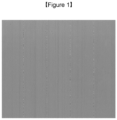
- FIG. 1 is a steel sheet photograph showing stripes formed on a surface of a non-oriented electrical steel sheet.
- first”, “second”, “third”, and the like are used to describe various parts, components, regions, layers, and/or sections, but are not limited thereto. These terms are only used to differentiate a specific part, component, region, layer, or section from another part, component, region, layer, or section. Accordingly, a first part, component, region, layer, or section which will be described hereinafter may be referred to as a second part, component, region, layer, or section without departing from the scope of the present invention.
- any part When any part is positioned “on” or “above” another part, it means that the part may be directly on or above the other part or another part may be interposed therebetween. In contrast, when any part is positioned "directly on” another part, it means that there is no part interposed therebetween.
- % means wt%, and 1 ppm is 0.0001 wt%.
- the meaning of "further containing an additional element” means that the additional element is substituted for a balance of iron (Fe) by the amount of additional element added.
- the hot-rolled sheet annealing having these advantages is not performed, the product is completed through hot rolling, cold rolling, and final annealing processes, and therefore, it may be considered that the properties of the microstructure and inclusions of the hot-rolled sheet have an important influence on the properties of the final product.
- Si, Al, and Mn will be first described as elements that affect magnetism when the hot-rolled sheet annealing is not performed in an exemplary embodiment of the present invention.
- Si, Al, and Mn are elements that determine resistivity of steel and also affect phase transformation behavior during hot rolling.
- Si and Al are ferrite stabilizing elements
- Mn is an austenite stabilizing element. Therefore, in order to cause phase transformation during hot rolling while securing low iron loss characteristics in the non-oriented electrical steel sheet, it is required to appropriately control the amount of Si, Al, and Mn added.
- the present inventors closely analyzed the resistivity and the phase transformation behavior of the component system to derive an appropriate addition range for precisely controlling the amount of Si, Al, and Mn added as shown in [Expression 1] described below.
- the rolling conditions during the hot rolling are precisely controlled, such that it is possible to manufacture a non-oriented electrical steel sheet having excellent magnetism even when the hot-rolled sheet annealing is omitted.
- the present inventors confirmed that, when Si is slightly increased, the content of Mn should also be increased, and elements such as Sb, Sn, and P, which may improve the texture, should be added according to the increase of Si.
- An appropriate amount of elements added, such as Sb, Sn, and P, may be controlled by [Expression 2] described below.
- the non-oriented electrical steel sheet according to an exemplary embodiment of the present disclosure contains, by wt%: 0.005% or less (excluding 0%) of C, 1.5 to 3.0% of Si, 0.4 to 1.5% of Mn, 0.005% or less (excluding 0%) of S, 0.0001 to 0.7% of Al, 0.005% or less (excluding 0%) of N, 0.005% or less (excluding 0%) of Ti, 0.001 to 0.02% of Cu, 0.01 to 0.05% of Sb, 0.001 to 0.1% of Sn, 0.005 to 0.07% of P, and a balance of Fe and unavoidable impurities.
- Carbon (C) is combined with Th, Nb, and the like to form a carbide, resulting in deterioration of magnetism, and may cause a decrease in efficiency of electrical equipment due to an increase in iron loss caused by magnetic aging when used after processing from a final product to an electrical product. Therefore, C may be limited to 0.005 wt% or less.
- Silicon (Si) is an element added to reduce eddy current loss of iron loss by increasing resistivity of steel. When the amount of Si added is too small, iron loss may be deteriorated. Therefore, it is advantageous to increase the content of Si from the viewpoint of increasing the resistivity; however, since Si is a ferrite stabilizing element, an austenite region decreases as the amount of Si added increases. Therefore, when a hot-rolled sheet annealing process is omitted, it is preferable to limit the amount of Si added to 3.0% or less in order to utilize phase transformation.
- Manganese (Mn) is an element that reduces the iron loss by increasing the resistivity along with Si, Al, and the like, and improves the texture. When the amount of Mn added is too small, the effect of increasing the resistivity is low. Unlike Si and Al, Mn is an element that stabilizes austenite, and therefore, it is required to add an appropriate amount of Mn in relation to the amount of Si and Al added. For example, when the contents of Si and Al are increased, it is required to relatively increase the amount of Mn added to form austenite. However, when Mn is excessively added, a texture unfavorable to magnetism is formed, which may cause a reduction in magnetic flux density. Therefore, the amount of Mn added is preferably 0.4 to 1.5%.
- S Sulfur
- S forms fine sulfides such as MnS, CuS, and (Cu, Mn)S inside a base material and thus inhibits grain growth, which causes deterioration of the iron loss, and therefore, it is preferable that S is added as little as possible.
- S is combined with other elements to increase formation of fine sulfides, which may cause deterioration of magnetism, and therefore, S may be limited to 0.005 wt% or less.
- Aluminum (Al) serves to reduce the iron loss by increasing the resistivity along with Si, and also improves rolling properties or improves workability during cold rolling.
- the amount of Al added is too small, there is no effect in reducing high-frequency iron loss.
- the amount of Al added is too large, nitrides are excessively formed, which may cause deterioration of magnetism.
- Al is an element that stabilizes ferrite more than Si, and the magnetic flux density is greatly reduced as the amount of Al added increases, and therefore, the amount of Al added may be limited to 0.7% or less from the viewpoint of omitting the hot-rolled sheet annealing by utilizing the phase transformation phenomenon.
- the content of Al should be controlled as a denominator together with Si because Al has a large effect of stabilizing ferrite, and Mn needs to be added in an appropriate amount to coarsen sulfide, and therefore, the contents of Si, Mn, and Al may be controlled at a molecular ratio as shown in [Expression 1].
- the steel sheet has a sufficient austenite single-phase region at a high temperature, such that it is possible to secure a recrystallized structure after hot rolling through phase transformation during hot rolling, and it is possible to form coarse sulfides by controlling a hot-rolled recrystallization temperature.
- N Nitrogen (N) is combined with Al, Ti, Nb, and the like to form fine nitrides inside the base material and thus inhibits grain growth, which causes deterioration of iron loss, and thus, N is preferably contained in a small amount. Therefore, in an exemplary embodiment of the present invention, N may be limited to 0.005 wt% or less.
- Titanium (Ti) is combined with C and N to form fine carbides or nitrides and thus inhibits grain growth, and thus, as a large amount of Ti is added, a large amount of carbides and nitrides is formed, which inhibits formation of a texture favorable to magnetism, resulting in deterioration of magnetism. Therefore, in an exemplary embodiment of the present invention, Ti may be limited to 0.005 wt% or less.
- Copper (Cu) is an element that forms (Mn, Cu)S sulfides together with Mn.
- the amount of Cu added may be limited to 0.001 to 0.02%.
- Cu contained in the steel sheet may be intentionally added within the range suggested in an exemplary embodiment of the present invention, and may be present in a trace in a steelmaking process.
- Sb When the amount of Sb, Sn, and P added is too large, grain growth is inhibited and coating adhesion is reduced. Therefore, Sb may be limited to 0.05 wt% or less and Sn may be limited to 0.1 wt% or less in terms of the amount of these elements added.
- Sn when 0.02 wt% or more of Sb is contained, it is preferable that Sn is contained in an amount of less than 0.05 wt%.
- P when P is excessively contained, sheet breakage may occur, which may reduce productivity, and thus, P may be controlled to be added in an amount of 0.07% or less.
- Sb is effective in controlling an oxide layer inside the steel sheet to be thin. Sn also partially plays such a role, but the effect thereof may be smaller than that of Sb.
- Sn contained in the steel sheet may be intentionally added within the range suggested in an exemplary embodiment of the present invention, and may be present in a trace in the steelmaking process.
- the content of Sb and/or Sn may be precisely controlled according to [Expression 3] or [Expression 4].
- the content of Sb/Sn is precisely controlled according to the coiling temperature, such that the oxide layer inside the steel sheet may be appropriately controlled.
- Sn when the contents of Sb and Sn are excessive, the adhesion of the product coating may be deteriorated, and therefore, Sn may be limited to 0.05 wt% or less, and an upper limit value of Sn in [Expression 3] may be limited to 0.13.
- the non-oriented electrical steel sheet according to an exemplary embodiment of the present invention may further contain other unavoidably included elements in addition to the above components.
- elements such as Zr, Mo, and V are elements that form strong carbides or nitrides in the steel sheet, and therefore, it is preferable not to contain these elements as much as possible, and even when these elements are added, it is preferable to control each of these elements to be contained in an amount of 0.05 wt% or less.
- the unavoidable impurities refer to impurities that are intentionally added or unavoidably incorporated during the process of steelmaking and manufacturing a non-oriented electrical steel sheet. Since the unavoidable impurities are widely known, detailed descriptions are omitted.
- the addition of elements other than the alloy components described above is not excluded, and various elements may be contained within a range in which the technical spirit of the present invention is not impaired. In a case where additional elements are further contained, these additional elements are contained by replacing the balance of Fe.
- the slab is reheated for hot rolling, and in this case, the slab reheating temperature should be high enough for hot rolling.
- the slab reheating temperature is too high, all sulfides are re-dissolved in the steel sheet and finely precipitated in the subsequent hot rolling and annealing processes, such that grain growth may be inhibited and magnetism may be deteriorated.
- MnS_SRT an equilibrium precipitation amount of sulfides at the slab reheating temperature
- MnS_Max a maximum precipitation amount of MnS
- MnS _SRT represents an equilibrium precipitation amount of MnS and MnS _Max represents a maximum precipitation amount of MnS.
- the present inventors have obtained the result that, when the slab reheating temperature is maintained at a temperature that satisfies [Expression 5] for 1 hour or longer, sulfides are coarsened, which is sufficient to improve the magnetism of the steel sheet.
- SRT represents a slab reheating temperature
- A1 represents an equilibrium temperature at which 100% of austenite is transformed into ferrite.
- the hot-rolled sheet annealing it is possible to secure the same excellent magnetism of the manufactured steel sheet as when the hot-rolled sheet annealing is performed by treatment such as increasing the hot rolling temperature during hot rolling and the coiling temperature or slightly increasing reduction heat of a subsequent rolling mill during hot rolling, but this may result in affecting surface properties such as stripes on the surface of the steel sheet.
- FIG. 1 is a photograph of stripes formed on a surface of a steel sheet manufactured by omitting the hot-rolled sheet annealing and increasing the hot rolling temperature and coiling temperature.
- the direction from the bottom to the top of the photograph is a rolling direction.
- the inventors of the present invention have confirmed that the stripe defect is closely related to a change of the inner oxide layer during hot rolling.
- elements such as Si, Al, and Mn are more easily oxidized than iron, and when these elements are increased, oxidation easily occurs, and in particular, an oxide layer is formed inside the steel sheet.
- the shape of the inner oxide layer of the steel sheet in this case will be described.
- an outer oxide layer the oxide layers are embedded toward a metal matrix structure in a direction of the metal matrix structure at a metal/oxide layer interface or the oxide layer present around a grain boundary is called an inner oxide layer.
- pickling may occur along the oxide layer, such that a non-uniform pickled surface may be formed, or long concavo-convex portions may be formed in the length direction due to the influence during cold rolling.
- the inner oxide layer is formed to 5 ⁇ m or less when the coiling temperature is low during hot rolling, the inner oxide layer is sufficiently removed, and thus, there is no major problem.
- the contents of easily oxidizable elements such as Si, Al, and Mn are high and the coiling temperature is high, the depth of the inner oxide layer inside the steel sheet may be increased and may also be non-uniform. This causes surface defects.
- the inventors of the present invention confirmed the formation process of the inner oxide layer according to the coiling temperature in the steel sheet having the contents of Si, Al, and Mn in the ranges as in an exemplary embodiment of the present invention.
- a depth of the inner oxide layer formed along the grain boundary is about 10 ⁇ m or more, and a depth of the inner oxide layer in the grain boundary is about 6 to 7 ⁇ m.
- the inner oxide layer of the steel sheet is formed up to about 30 ⁇ m, and in this case, surface defects are present to the extent that it is difficult to dissolve the formed inner oxide layer during the pickling process.
- the inventors of the present invention suggest a composition system and manufacturing process conditions in order to eliminate these surface defects.
- the inner oxide layer of the steel sheet is suppressed to about 3 ⁇ m or the inner oxide layer is hardly formed.
- the inventors of the present invention considered that the cause of the concavo-convex defects due to the stripes of the steel sheet is a difference in grain phases, and in this case, a difference in stripes is observed in the texture of the concavo-convex and non-concavo-convex portions.
- a difference in stripes is observed in the texture of the concavo-convex and non-concavo-convex portions.
- the composition and manufacturing process of the steel sheet for example, hot rolling conditions are controlled, it is considered that such a difference does not appear, and no change in the texture appears. That is, in the concavo-convex defects caused by these stripes, a change in ⁇ 100 ⁇ and ⁇ 110 ⁇ fractions of the concavo-convex and non-convex portions of the texture of the grain is considered to be less than 10%.
- the phase transformation phenomenon during hot rolling and the process conditions of hot rolling are controlled in the non-oriented electrical steel sheet, such that a hot-rolled crystallized structure is secured, coarsening of sulfides is also achieved, formation of an inner oxide layer is suppressed, and a recrystallized structure in the hot-rolled sheet structure is increased. Therefore, according to an exemplary embodiment of the present invention, it is possible to provide a non-oriented electrical steel sheet having excellent magnetism and surface properties of the steel sheet without performing the hot-rolled sheet annealing.
- the inventors of the present invention suggested that it is required to secure a component system capable of undergoing austenite phase transformation during reheating of the hot-rolled sheet and conditions for reheating the hot-rolled sheet in order to obtain magnetic properties comparable to or superior to those in the case where the hot-rolled sheet annealing is performed in a steel sheet that is not subjected to hot-rolled sheet annealing in advance, and also suggested a method for controlling the oxide layer inside the steel sheet in order to secure a relatively high coiling temperature and prevent stripe defect on the surface. In addition to this, the inventors of the present invention suggested a method for reducing the magnetic deviation between positions of the coil.
- the cooling rate is fast in an outer coiled portion and the innermost coiled portion, and therefore, even when the coiling temperatures are controlled to be the same as each other, the time that the temperature is maintained around the coiling temperature after coiling is relatively small compared to a middle coiled portion.
- the innermost coiled portion and the outer coiled portion are compared to the middle coiled portion, relatively deteriorated iron loss appears due to this difference.
- the outer coiled portion is maintained at a high temperature immediately before finishing rolling for a long time, such that a time for fine precipitates to grow is secured, and thus, a degree of deterioration of magnetism is low, but the innermost coiled portion is maintained for a short time during coiling without this effect, and therefore, a way to offsetting this is required.
- the deviation may be reduced when the coiling temperature of the inner coiled portion, that is, the front end of the hot-rolled sheet during coiling is maintained to be higher than the average temperature of the middle coiled portion by 20°C or more.
- the front end is partially cut and removed in the process during hot rolling. Therefore, it is advantageous to reduce the deviation when the temperature at a position corresponding to about 5% of the total length is maintained at 20°C or higher than the average temperature at a position corresponding to about 30% to 50% of the total length located in the center. More preferably, it is preferable to maintain this temperature at 30°C or higher.
- an increase in coiling temperature of the front end of the coil may reduce the amount of cooling water sprayed to cool the hot-rolled sheet, may prevent overcooling of the edge in the width direction, and may reduce cooling of the center portion, and as a result, a deviation in width direction is also reduced.
- Another cause of the magnetic deviation between the positions of the coil may be fine precipitates that are re-dissolved during slab reheating and then re-precipitated during hot rolling. That is, the deviation may be caused because there is no process in which fine precipitates are re-precipitated during hot rolling and are coarsened during hot-rolled sheet annealing.
- a coarse structure of the slab becomes relatively small grains, which prevents a structure from being difficult to be recrystallized at a low temperature.
- the slab is preferably heated to SRT ⁇ A1+150°C as shown in [Expression 6].
- the slab heating temperature increases, the amount of precipitates re-dissolved increases and the amount of fine precipitates increases, and therefore, the slab heating needs to be controlled.
- the both ends of the slab that is, the front end and the rear end, and the edge in the width direction are close to a surface receiving heat during hot rolling, which may cause a risk of overheating compared to the center portion. Therefore, an increase of fine precipitates in these portions may be prevented by reducing such a risk.
- the temperature may be set for each step without separating the regions for each step.
- the maximum SRT temperature is as low as possible in order to generally reduce the increase in some elements re-dissolved in the slab, but in order to secure the austenite grain phase, it is advantageous to increase the reheating temperature, and therefore, at the last stage, when the reheating temperature is increased, but the holding time is set to be shorter than that in the previous stage of the last stage, the heating temperature (SRT2) in the previous stage, that is, the previous stage of the last stage, is set to A3 temperature+70°C or lower, the heating is performed at a temperature that satisfies A1+120°C or higher, and the temperature is controlled to satisfy the heating temperature SRT_max ⁇ A1+150°C at the last stage, the deviation between the positions of the coil may be reduced.
- SRT_max represents the highest temperature among slab reheating temperatures (SRT) in [Expression 6].
- finishing rolling in the hot rolling when a temperature just before the start of the finishing rolling in the hot rolling is set to a temperature of A1-50°C or higher, the deviation may be reduced.
- this temperature is too high, it is preferable to start the finishing rolling at a temperature of A1+40°C or lower because a deviation in stripes may occur due to rolling at a dual phase region until rear end pass during the finishing rolling. It is more preferable to start the finishing rolling at a temperature of A1+20°C or lower.
- the cooling rate of the outer coiled portion and the inner coiled portion may be slowed down, and a difference in cooling rate in the width direction is also reduced, such that the deviation in iron loss may be reduced.
- a method for manufacturing a non-oriented electrical steel sheet includes: in a steelmaking process, preparing a slab containing, by wt%, 0.005% or less (excluding 0%) of C, 1.5 to 3.0% of Si, 0.4 to 1.5% of Mn, 0.005% or less (excluding 0%) of S, 0.0001 to 0.7% of Al, 0.005% or less (excluding 0%) of N, 0.005% or less (excluding 0%) of Ti, 0.001 to 0.02% of Cu, 0.01 to 0.05% of Sb, 0.001 to 0.1% of Sn, and 0.005 to 0.07% of P, in which contents of Si, Mn, and Al satisfy the following [Expression 1] and contents of Sb, Sn, and P satisfy the following [Expression 2], the slab containing a balance of Fe and unavoidable impurities; reheating the slab; hot rolling the slab to manufacture a hot-rolled sheet; coiling the hot-rolled sheet; cold rolling the coiled hot-rolled
- the preparing of the slab will be described. Since the reason for limiting the constituent elements in the slab is the same as the reason for limiting the composition of the non-oriented electrical steel sheet described above, repeated descriptions will be described.
- the composition of the slab is not substantially changed during manufacturing processes such as hot rolling, cold rolling, and final annealing, which will be described below, and thus, the composition of the slab is substantially the same as the composition of the non-oriented electrical steel sheet.
- the slab Before the manufacturing of the hot-rolled sheet, the slab may be reheated.
- the reheating of the slab is performed at a slab reheating temperature (SRT), that is, a temperature that satisfies [Expression 5: MnS SRT /MnS Max ⁇ 0.6], which is a relational expression between MnS SRT representing the equilibrium precipitation amount of MnS and MnS Max representing the maximum precipitation amount of MnS in steel.
- SRT slab reheating temperature
- the reheating of the slab should be performed in the austenite single-phase region, and the total reheating time may be at a level commonly used, but the reheating may be performed at least 1 hour or longer at a temperature in the austenite single-phase region.
- the total slab reheating time including the total heating is preferably 100 minutes or longer, and more preferably 180 minutes or longer.
- the slab heating time is required for coarsening of sulfides and is required for coarsening of the recrystallized structure after hot rolling by coarsening the grain size of austenite before hot rolling.
- the slab reheating temperature may be a temperature that satisfies the relational expression [Expression 6: SRT ⁇ A1+150°C] in consideration of the equilibrium temperature at which 100% of austenite is transformed into ferrite. This is to sufficiently secure a recrystallized structure after hot rolling by securing a sufficient temperature range in which phase transformation may occur during hot rolling.
- the slab in the reheating of the slab, when the slab is heated in two or more stages or three or more stages, the slab is heated to a temperature lower than the target temperature by 50°C or more (SRT_max - 50) at the first stage (SRT1), and then, the slab is heated to the target temperature, both ends of the slab, that is, the front end and the rear end and the edge in the width direction are close to the surface receiving heat during hot rolling, which may cause a risk of overheating compared to the center portion. Therefore, an increase of fine precipitates in these portions may be prevented by reducing such a risk. In this way, it is possible to reduce the deviation in iron loss in the length direction and the width direction of the coil.
- the maximum slab reheating temperature is as low as possible.
- the heating temperature (SRT2) in the previous stage that is, the previous stage of the last stage, is set to A3 temperature+70°C or lower, the heating is performed at a temperature that satisfies A1+120°C or higher, and the temperature is controlled to satisfy the heating temperature SRT_max ⁇ A1+150°C at the last stage, the deviation may be reduced.
- SRT_max represents the highest temperature among slab reheating temperatures (SRT) in [Expression 6].
- a temperature just before the start of the finishing rolling in the hot rolling is set to a temperature of A1-50°C or higher, the deviation may be reduced.
- the finishing rolling temperature is too high, it is preferable to start the finishing rolling at a temperature of A1+40°C or lower because a deviation in stripes may occur due to rolling at a dual phase region until rear end pass during the finishing rolling. It is more preferable to start the finishing rolling at a temperature of A1+20°C or lower.
- the recrystallization fraction in the hot-rolled sheet may be increased by slightly increasing the reduction ratio of the last two rolls. Therefore, it is preferable to set a reduction ratio of a roll immediately before the last roll to 21% or more. In addition, when a reduction ratio of the last roll is set to 13% or more, it is advantageous to increase the recrystallization fraction.
- the total reduction ratio in these two rolls does not exceed 60%.
- the hot-rolled sheet hot-rolled under the above conditions is coiled into a coil shape.
- a coiling temperature is preferably 650 to 800°C.
- the coiling temperature of the hot-rolled sheet is preferably set to 650°C or higher.
- the coiling temperature is preferably set to 800°C or lower, and more preferably 750°C or lower.
- the coiling is preferably performed according to the following [Expression 7] representing that a temperature at a front end of the coil is higher than a temperature at a middle portion of the coil by 20°C or more. (Maximum coiling temperature at length from start point to point of 5% of total length in coil length direction) ⁇ (average coiling temperature at length of 30% to 50% of total length in coil length direction) + 20°C
- the magnetic deviation in the width direction and the length direction of the coil may be further reduced by imparting a deviation in temperatures of the frond end and the middle portion of the coil.
- a thickness of the inner oxide layer formed inside the steel sheet it is preferable to control a thickness of the inner oxide layer formed inside the steel sheet to 7 ⁇ m or less.
- the hot-rolled sheet manufactured under the above conditions may be coiled into a coil shape, put into a cooling facility during cooling, and then cooled while being covered with a heat retention cover.
- the cooling rate between the outer coiled portion and the inner coiled portion of the coil may be slowed down, and the difference in cooling rate in the width direction may be reduced, resulting in a reduction in deviation in iron loss.
- the hot-rolled sheet is pickled, and the pickled hot-rolled sheet is subjected to cold rolling to obtain a predetermined sheet thickness.
- the cold-rolled sheet subjected to the cold rolling may be 0.10 mm to 0.70 mm.
- the final cold-rolled sheet subjected to the cold rolling is subjected to final annealing.
- the annealing temperature is preferably 850 to 1,100°C because iron loss is related to the grain size in the case of the non-oriented electrical steel sheet.
- the temperature during the final annealing is preferably in a range of 850 to 1,100°C, and more preferably in a range of 900 to 1,050°C.
- the method may further include forming an insulating layer. Since a method for forming an insulating layer is widely known in the technical field of the non-oriented electrical steel sheet, a detailed description thereof will be omitted.
- the number of (Mn, Cu)S of 0.5 ⁇ m or less inside the steel sheet per area is 1/ ⁇ m 3 or less
- a number ratio (Fcount) of (Mn, Cu)S having a size of 0.05 ⁇ m or more to (Mn, Cu)S of 0.5 ⁇ m or less is 0.2 or more
- an area ratio (Farea) of (Mn, Cu)S having a size of 0.05 ⁇ m or more is 0.5 or more
- a product of the number ratio (Fcount) and the area ratio (Farea) (Fcount x Farea) is 0.15 or more.
- a maximum height from the center line is 2.5 ⁇ m or less
- the number of concavo-convex defects having a height greater than a peripheral height and having a width of 0.5 ⁇ m or more in the direction perpendicular to the rolling direction and a size of 3 cm or more in the rolling direction is 1/cm or less per 10 cm in the direction perpendicular to the rolling direction.
- a change in ⁇ 100 ⁇ and ⁇ 110 ⁇ fractions at different positions of the electrical steel sheet manufactured as described above is less than 10%, such that it is possible to manufacture a non-oriented electrical steel sheet having excellent magnetism even when hot-rolled sheet annealing is not performed.
- a steel ingot containing 0.002 wt% of C and 0.0021 wt% of N was manufactured with the composition shown in Table 1 by vacuum-melting.
- the amount of Si, Mn, and Al was varied, and the effect of each of the amounts of Si, Mn, and Al added and control of the contents of Si, Mn, and Al specified in [Expression 1] on the magnetic properties of the steel sheet were examined.
- the effect of the contents of Sb, Sn, and P specified in [Expression 2] on the inner oxide layer and the surface defects was also examined.
- the manufactured steel ingot was reheated at 1,150°C, hot-rolled to a thickness of 2.5 mm, and then coiled.
- the coiling temperatures of the respective specimens are shown in Table 1.
- the steel type numbers A1 to 6 were changed to 630, 680, and 750°C, the steel type numbers A1 to 6 were indicated as additional numbers -1, -2, and -3, respectively.
- the coiled hot-rolled sheet was pickled without hot-rolled sheet annealing, cold-rolled to a thickness of 0.50 mm, and then finally, subjected to final annealing. At this time, the final annealing was performed at a temperature of 900 to 1,050°C.
- [Expression 1] represents 0.19 ⁇ [Mn]/([Si]+150x[Al]) ⁇ 0.35
- [Expression 5] represents MnS SRT /MnS Max ⁇ 0.6
- Fcount represents the number of (Mn,Cu)S having a size of 0.05 ⁇ m or more among (Mn,Cu)S of 0.5 ⁇ m or less
- Farea represents an area ratio of (Mn,Cu)S having a size of 0.05 ⁇ m or more to (Mn,Cu)S of 0.5 ⁇ m or less.
- stripe represents the stripe appearing on the surface layer of the specimen
- number of stripes represents the number of stripes for 10 cm in the direction perpendicular to the rolling direction obtained by measuring the degree of stripe defect on the surface of the specimen.
- iron loss (W15/50) represents an average loss (W/kg) in the rolling direction and the direction perpendicular to the rolling direction when a magnetic flux density of 1.5 Tesla is induced at a frequency of 50 Hz.
- magnetic flux density (B50) represents a magnitude (Tesla) of a magnetic flux density induced when a magnetic field of 5,000 A/m is applied.
- composition of the specimen used in the experiment was as follows.
- the A1 temperature was 984°C
- the A3 temperature was 1,106°C
- the proportional content of Mn, Si, and Al according to [Expression 1] was 0.194, which was within the acceptable range of 0.19 to 0.35
- the 1/2* Sn value according to [Expression 2] was 0.005
- the [Sb] + [P] value was 0.041, which satisfied the condition of [Expression 2].
- Slabs were manufactured with the compositions of the component 1 and component 2 described above, these slabs were reheated at different temperatures in two stage or three stages by setting the total residence time to 200 minutes, the reheated slabs were hot-rolled to a thickness of 2.5 mm, and the hot-rolled slabs were coiled into a coil shape.
- the coiled hot-rolled sheet was pickled without hot-rolled sheet annealing and then cold-rolled to a thickness of 0.50 mm to manufacture a cold-rolled sheet.
- the cold-rolled sheet was subjected to final annealing. At this time, the final annealing was performed at a temperature of 980°C.
- finishing rolling temperature represents the temperature immediately before and after the finishing rolling by tandem rolling after rough rolling
- front end temperature in length direction represents the temperature at a position corresponding to 5% of the length direction when the sheet is coiled into a coil shape
- center portion temperature in length direction represents an average temperature at a position corresponding to a length of 30% of the total length of the coil.
- phase transformation temperatures related to A1 and A3 of each of the components 1 and 2 are shown in Table 5.
- Table 5 Steel type Phase transformation temperature for each component [°C] A1 A3 A1+120°C A3 temperature+70°C A1+150°C A1-50°C A1+40°C B1 978 1103 1098 1173 1128 928 1018 B2 978 1103 1098 1173 1128 928 1018 B3 978 1103 1098 1173 1128 928 1018 B4 978 1103 1098 1173 1128 928 1018 B5 978 1103 1098 1173 1128 928 1018 B6 978 1103 1098 1173 1128 928 1018 B7 978 1103 1098 1173 1128 928 1018 B8 984 1106 1104 1176 1134 934 1024 B9 984 1106 1104 1176 1176 1134 934 1024 B10 984 1106 1104 1176 1134 934 1024 B11 984 1106 1104 1176 1134 934 1024
- the values were measured by collecting the specimen at the edge corresponding to about 5% of the entire width of the steel sheet, the values were measured by collecting the specimen at the center portion corresponding to about 30% of the entire width of the steel sheet, an average value of each of the iron loss and magnetic flux density was measured and used as the value at the center portion, and then the values were compared.
- magnetism at center in width direction represents the magnetism at the center in the width direction in the front end in the coil length direction
- (2) “magnetism at edge in width direction” represents the magnetism at the edge in the width direction in the front end in the coil length direction
- (3) “magnetism ratio” represents the magnetism ratio between the edge and the center in the width direction in the front end in the coil length direction.
- magnetism at center in width direction represents the magnetism at the center in the width direction in the center in the coil length direction
- (5) “magnetism at edge in width direction” represents the magnetism at the edge in the width direction in the center in the coil length direction
- (6) “magnetism ratio” represents the magnetism ratio between the edge and the center in the width direction in the center in the coil length direction.
Landscapes
- Chemical & Material Sciences (AREA)
- Engineering & Computer Science (AREA)
- Organic Chemistry (AREA)
- Materials Engineering (AREA)
- Mechanical Engineering (AREA)
- Metallurgy (AREA)
- Physics & Mathematics (AREA)
- Electromagnetism (AREA)
- Thermal Sciences (AREA)
- Crystallography & Structural Chemistry (AREA)
- Manufacturing & Machinery (AREA)
- Dispersion Chemistry (AREA)
- Power Engineering (AREA)
- Manufacturing Of Steel Electrode Plates (AREA)
- Soft Magnetic Materials (AREA)
Applications Claiming Priority (2)
| Application Number | Priority Date | Filing Date | Title |
|---|---|---|---|
| KR1020210184559A KR20230095264A (ko) | 2021-12-22 | 2021-12-22 | 무방향성 전기강판 및 그 제조방법 |
| PCT/KR2022/020833 WO2023121220A1 (ko) | 2021-12-22 | 2022-12-20 | 무방향성 전기강판 및 그 제조방법 |
Publications (2)
| Publication Number | Publication Date |
|---|---|
| EP4455328A1 true EP4455328A1 (de) | 2024-10-30 |
| EP4455328A4 EP4455328A4 (de) | 2025-04-09 |
Family
ID=86903409
Family Applications (1)
| Application Number | Title | Priority Date | Filing Date |
|---|---|---|---|
| EP22911853.4A Pending EP4455328A4 (de) | 2021-12-22 | 2022-12-20 | Nichtorientiertes elektrostahlblech und verfahren zur herstellung davon |
Country Status (7)
| Country | Link |
|---|---|
| US (1) | US20240242863A1 (de) |
| EP (1) | EP4455328A4 (de) |
| JP (1) | JP2024522132A (de) |
| KR (1) | KR20230095264A (de) |
| CN (1) | CN117355626A (de) |
| MX (1) | MX2023010392A (de) |
| WO (1) | WO2023121220A1 (de) |
Families Citing this family (3)
| Publication number | Priority date | Publication date | Assignee | Title |
|---|---|---|---|---|
| KR20250105769A (ko) * | 2023-12-29 | 2025-07-09 | 현대제철 주식회사 | 무방향성 전기강판 및 그 제조 방법 |
| JPWO2025187340A1 (de) * | 2024-03-08 | 2025-09-12 | ||
| WO2026134494A1 (ko) * | 2024-12-17 | 2026-06-25 | 주식회사 포스코 | 무방향성 전기강판 및 그 제조방법 |
Family Cites Families (16)
| Publication number | Priority date | Publication date | Assignee | Title |
|---|---|---|---|---|
| JPH02118020A (ja) * | 1988-10-28 | 1990-05-02 | Kawasaki Steel Corp | 無方向性電磁鋼板の製造方法 |
| CN104039998B (zh) * | 2011-12-28 | 2017-10-24 | Posco公司 | 无取向电工钢板及其制造方法 |
| KR101353462B1 (ko) * | 2011-12-28 | 2014-01-24 | 주식회사 포스코 | 무방향성 전기강판 및 제조 방법 |
| KR101353460B1 (ko) * | 2011-12-28 | 2014-01-21 | 주식회사 포스코 | 무방향성 전기강판 및 그 제조방법 |
| US10704115B2 (en) * | 2014-10-30 | 2020-07-07 | Jfe Steel Corporation | Non-oriented electrical steel sheet and method for manufacturing non-oriented electrical steel sheet |
| KR102175064B1 (ko) * | 2015-12-23 | 2020-11-05 | 주식회사 포스코 | 무방향성 전기강판 및 그 제조방법 |
| KR101701195B1 (ko) * | 2015-12-23 | 2017-02-01 | 주식회사 포스코 | 무방향성 전기강판 및 그 제조방법 |
| JP6969219B2 (ja) * | 2017-08-16 | 2021-11-24 | 日本製鉄株式会社 | 無方向性電磁鋼板およびその製造方法 |
| JP6977436B2 (ja) * | 2017-09-19 | 2021-12-08 | 日本製鉄株式会社 | 無方向性電磁鋼板及びその製造方法 |
| KR102108231B1 (ko) * | 2017-12-26 | 2020-05-07 | 주식회사 포스코 | 무방향성 전기강판 및 그 제조방법 |
| TWI683912B (zh) * | 2018-03-23 | 2020-02-01 | 日商新日鐵住金股份有限公司 | 無方向性電磁鋼板 |
| KR102241985B1 (ko) * | 2018-12-19 | 2021-04-19 | 주식회사 포스코 | 무방향성 전기강판 및 그 제조방법 |
| KR102328127B1 (ko) * | 2018-12-19 | 2021-11-17 | 주식회사 포스코 | 무방향성 전기강판 및 그 제조방법 |
| JP7477748B2 (ja) * | 2020-02-20 | 2024-05-02 | 日本製鉄株式会社 | 無方向性電磁鋼板および熱延鋼板 |
| KR102468079B1 (ko) * | 2020-12-21 | 2022-11-16 | 주식회사 포스코 | 무방향성 전기강판 및 그 제조방법 |
| KR102438474B1 (ko) * | 2020-12-21 | 2022-09-01 | 주식회사 포스코 | 무방향성 전기강판 및 그 제조방법 |
-
2021
- 2021-12-22 KR KR1020210184559A patent/KR20230095264A/ko active Pending
-
2022
- 2022-12-20 WO PCT/KR2022/020833 patent/WO2023121220A1/ko not_active Ceased
- 2022-12-20 EP EP22911853.4A patent/EP4455328A4/de active Pending
- 2022-12-20 CN CN202280036561.XA patent/CN117355626A/zh active Pending
- 2022-12-20 US US18/288,286 patent/US20240242863A1/en active Pending
- 2022-12-20 JP JP2023574214A patent/JP2024522132A/ja active Pending
- 2022-12-20 MX MX2023010392A patent/MX2023010392A/es unknown
Also Published As
| Publication number | Publication date |
|---|---|
| KR20230095264A (ko) | 2023-06-29 |
| EP4455328A4 (de) | 2025-04-09 |
| MX2023010392A (es) | 2023-11-22 |
| US20240242863A1 (en) | 2024-07-18 |
| WO2023121220A1 (ko) | 2023-06-29 |
| JP2024522132A (ja) | 2024-06-11 |
| CN117355626A (zh) | 2024-01-05 |
Similar Documents
| Publication | Publication Date | Title |
|---|---|---|
| EP3859032B1 (de) | Nichtorientiertes elektrisches stahlblech und verfahren zur herstellung davon, motorkern und verfahren zur herstellung davon | |
| CN109715840B (zh) | 取向性电磁钢板及其制造方法 | |
| EP3916113A1 (de) | Nichtorientiertes elektromagnetisches stahlblech und verfahren zur herstellung davon | |
| US20240242863A1 (en) | Non-oriented electrical steel sheet and method for manufacturing same | |
| EP2876173B9 (de) | Verfahren zur herstellung kornorientierter elektrobleche | |
| CN101311287B (zh) | 方向性电磁钢板 | |
| EP3733880A1 (de) | Nichtausgerichtetes elektrostahlblech und herstellungsverfahren dafür | |
| EP4265349A1 (de) | Verfahren zur herstellung eines orientierten elektromagnetischen stahlblechs und walzausrüstung zur herstellung eines elektromagnetischen stahlblechs | |
| EP2933348B1 (de) | Kornorientiertes elektrostahlblech | |
| JP6721135B1 (ja) | 方向性電磁鋼板の製造方法および冷間圧延設備 | |
| JPH0742501B2 (ja) | 磁性焼鈍前後の磁気特性の優れた無方向性電磁鋼板の製造方法 | |
| JP3531996B2 (ja) | 一方向性電磁鋼帯の製造方法 | |
| EP4656743A1 (de) | Verfahren zur herstellung eines kornorientierten elektrostahlblechs, produktionsanlagenlinie für kornorientiertes elektrostahlblech und warmgewalztes blech für kornorientiertes elektrostahlblech | |
| JP7636703B2 (ja) | 無方向性電磁鋼板 | |
| EP4400609A1 (de) | Verfahren zur herstellung eines kornorientierten magnetischen stahlblechs und kornorientiertes magnetisches stahlblech | |
| JP7791192B2 (ja) | 方向性電磁鋼板およびその製造方法 | |
| JPH11335793A (ja) | 磁束密度が高く鉄損の低い無方向性電磁鋼板及びその製造方法 | |
| CN119790168A (zh) | 取向性电磁钢板的制造方法和感应加热装置 | |
| KR102361872B1 (ko) | 무방향성 전기강판 및 그 제조방법 | |
| JP7159594B2 (ja) | 方向性電磁鋼板の製造方法 | |
| JPH0797628A (ja) | 磁束密度が高く、鉄損の低い無方向性電磁鋼板の製造方法 | |
| JP7640924B2 (ja) | 無方向性電磁鋼板 | |
| EP4729639A1 (de) | Verfahren zur herstellung eines orientierten elektromagnetischen stahlblechs und induktionsheizvorrichtung | |
| EP4729640A1 (de) | Verfahren zur herstellung eines kornorientierten elektrischen stahlblechs und induktionsheizvorrichtung | |
| JPH06240358A (ja) | 磁束密度が高く、鉄損の低い無方向性電磁鋼板の製造方法 |
Legal Events
| Date | Code | Title | Description |
|---|---|---|---|
| STAA | Information on the status of an ep patent application or granted ep patent |
Free format text: STATUS: THE INTERNATIONAL PUBLICATION HAS BEEN MADE |
|
| PUAI | Public reference made under article 153(3) epc to a published international application that has entered the european phase |
Free format text: ORIGINAL CODE: 0009012 |
|
| STAA | Information on the status of an ep patent application or granted ep patent |
Free format text: STATUS: REQUEST FOR EXAMINATION WAS MADE |
|
| 17P | Request for examination filed |
Effective date: 20231025 |
|
| AK | Designated contracting states |
Kind code of ref document: A1 Designated state(s): AL AT BE BG CH CY CZ DE DK EE ES FI FR GB GR HR HU IE IS IT LI LT LU LV MC ME MK MT NL NO PL PT RO RS SE SI SK SM TR |
|
| REG | Reference to a national code |
Ref country code: DE Ref legal event code: R079 Free format text: PREVIOUS MAIN CLASS: C22C0038020000 Ipc: C21D0008120000 |
|
| DAV | Request for validation of the european patent (deleted) | ||
| DAX | Request for extension of the european patent (deleted) | ||
| A4 | Supplementary search report drawn up and despatched |
Effective date: 20250307 |
|
| RIC1 | Information provided on ipc code assigned before grant |
Ipc: H01F 1/147 20060101ALI20250304BHEP Ipc: H01F 1/16 20060101ALI20250304BHEP Ipc: C22C 38/60 20060101ALI20250304BHEP Ipc: C22C 38/16 20060101ALI20250304BHEP Ipc: C22C 38/14 20060101ALI20250304BHEP Ipc: C22C 38/12 20060101ALI20250304BHEP Ipc: C22C 38/06 20060101ALI20250304BHEP Ipc: C22C 38/04 20060101ALI20250304BHEP Ipc: C22C 38/02 20060101ALI20250304BHEP Ipc: C22C 38/00 20060101ALI20250304BHEP Ipc: C21D 9/46 20060101ALI20250304BHEP Ipc: C21D 8/12 20060101AFI20250304BHEP |