EP4454904A1 - Luftreifen - Google Patents
Luftreifen Download PDFInfo
- Publication number
- EP4454904A1 EP4454904A1 EP22911835.1A EP22911835A EP4454904A1 EP 4454904 A1 EP4454904 A1 EP 4454904A1 EP 22911835 A EP22911835 A EP 22911835A EP 4454904 A1 EP4454904 A1 EP 4454904A1
- Authority
- EP
- European Patent Office
- Prior art keywords
- kerf
- kerfs
- block
- pneumatic tire
- transverse
- Prior art date
- Legal status (The legal status is an assumption and is not a legal conclusion. Google has not performed a legal analysis and makes no representation as to the accuracy of the status listed.)
- Pending
Links
Images

Classifications
-
- B—PERFORMING OPERATIONS; TRANSPORTING
- B60—VEHICLES IN GENERAL
- B60C—VEHICLE TYRES; TYRE INFLATION; TYRE CHANGING; CONNECTING VALVES TO INFLATABLE ELASTIC BODIES IN GENERAL; DEVICES OR ARRANGEMENTS RELATED TO TYRES
- B60C11/00—Tyre tread bands; Tread patterns; Anti-skid inserts
- B60C11/03—Tread patterns
- B60C11/0306—Patterns comprising block rows or discontinuous ribs
-
- B—PERFORMING OPERATIONS; TRANSPORTING
- B60—VEHICLES IN GENERAL
- B60C—VEHICLE TYRES; TYRE INFLATION; TYRE CHANGING; CONNECTING VALVES TO INFLATABLE ELASTIC BODIES IN GENERAL; DEVICES OR ARRANGEMENTS RELATED TO TYRES
- B60C11/00—Tyre tread bands; Tread patterns; Anti-skid inserts
- B60C11/03—Tread patterns
- B60C11/12—Tread patterns characterised by the use of narrow slits or incisions, e.g. sipes
- B60C11/1236—Tread patterns characterised by the use of narrow slits or incisions, e.g. sipes with special arrangements in the tread pattern
-
- B—PERFORMING OPERATIONS; TRANSPORTING
- B60—VEHICLES IN GENERAL
- B60C—VEHICLE TYRES; TYRE INFLATION; TYRE CHANGING; CONNECTING VALVES TO INFLATABLE ELASTIC BODIES IN GENERAL; DEVICES OR ARRANGEMENTS RELATED TO TYRES
- B60C11/00—Tyre tread bands; Tread patterns; Anti-skid inserts
- B60C11/03—Tread patterns
- B60C11/13—Tread patterns characterised by the groove cross-section, e.g. for buttressing or preventing stone-trapping
- B60C11/1307—Tread patterns characterised by the groove cross-section, e.g. for buttressing or preventing stone-trapping with special features of the groove walls
-
- B—PERFORMING OPERATIONS; TRANSPORTING
- B60—VEHICLES IN GENERAL
- B60C—VEHICLE TYRES; TYRE INFLATION; TYRE CHANGING; CONNECTING VALVES TO INFLATABLE ELASTIC BODIES IN GENERAL; DEVICES OR ARRANGEMENTS RELATED TO TYRES
- B60C11/00—Tyre tread bands; Tread patterns; Anti-skid inserts
- B60C11/03—Tread patterns
- B60C11/032—Patterns comprising isolated recesses
- B60C11/0323—Patterns comprising isolated recesses tread comprising channels under the tread surface, e.g. for draining water
-
- B—PERFORMING OPERATIONS; TRANSPORTING
- B60—VEHICLES IN GENERAL
- B60C—VEHICLE TYRES; TYRE INFLATION; TYRE CHANGING; CONNECTING VALVES TO INFLATABLE ELASTIC BODIES IN GENERAL; DEVICES OR ARRANGEMENTS RELATED TO TYRES
- B60C11/00—Tyre tread bands; Tread patterns; Anti-skid inserts
- B60C11/03—Tread patterns
- B60C11/12—Tread patterns characterised by the use of narrow slits or incisions, e.g. sipes
- B60C11/1259—Depth of the sipe
-
- B—PERFORMING OPERATIONS; TRANSPORTING
- B60—VEHICLES IN GENERAL
- B60C—VEHICLE TYRES; TYRE INFLATION; TYRE CHANGING; CONNECTING VALVES TO INFLATABLE ELASTIC BODIES IN GENERAL; DEVICES OR ARRANGEMENTS RELATED TO TYRES
- B60C11/00—Tyre tread bands; Tread patterns; Anti-skid inserts
- B60C11/03—Tread patterns
- B60C11/12—Tread patterns characterised by the use of narrow slits or incisions, e.g. sipes
- B60C11/1272—Width of the sipe
-
- B—PERFORMING OPERATIONS; TRANSPORTING
- B60—VEHICLES IN GENERAL
- B60C—VEHICLE TYRES; TYRE INFLATION; TYRE CHANGING; CONNECTING VALVES TO INFLATABLE ELASTIC BODIES IN GENERAL; DEVICES OR ARRANGEMENTS RELATED TO TYRES
- B60C11/00—Tyre tread bands; Tread patterns; Anti-skid inserts
- B60C11/03—Tread patterns
- B60C11/12—Tread patterns characterised by the use of narrow slits or incisions, e.g. sipes
- B60C11/1204—Tread patterns characterised by the use of narrow slits or incisions, e.g. sipes with special shape of the sipe
- B60C2011/1209—Tread patterns characterised by the use of narrow slits or incisions, e.g. sipes with special shape of the sipe straight at the tread surface
-
- B—PERFORMING OPERATIONS; TRANSPORTING
- B60—VEHICLES IN GENERAL
- B60C—VEHICLE TYRES; TYRE INFLATION; TYRE CHANGING; CONNECTING VALVES TO INFLATABLE ELASTIC BODIES IN GENERAL; DEVICES OR ARRANGEMENTS RELATED TO TYRES
- B60C11/00—Tyre tread bands; Tread patterns; Anti-skid inserts
- B60C11/03—Tread patterns
- B60C11/12—Tread patterns characterised by the use of narrow slits or incisions, e.g. sipes
- B60C11/1204—Tread patterns characterised by the use of narrow slits or incisions, e.g. sipes with special shape of the sipe
- B60C2011/1213—Tread patterns characterised by the use of narrow slits or incisions, e.g. sipes with special shape of the sipe sinusoidal or zigzag at the tread surface
-
- B—PERFORMING OPERATIONS; TRANSPORTING
- B60—VEHICLES IN GENERAL
- B60C—VEHICLE TYRES; TYRE INFLATION; TYRE CHANGING; CONNECTING VALVES TO INFLATABLE ELASTIC BODIES IN GENERAL; DEVICES OR ARRANGEMENTS RELATED TO TYRES
- B60C11/00—Tyre tread bands; Tread patterns; Anti-skid inserts
- B60C11/03—Tread patterns
- B60C11/12—Tread patterns characterised by the use of narrow slits or incisions, e.g. sipes
- B60C11/1204—Tread patterns characterised by the use of narrow slits or incisions, e.g. sipes with special shape of the sipe
- B60C2011/1227—Tread patterns characterised by the use of narrow slits or incisions, e.g. sipes with special shape of the sipe having different shape within the pattern
-
- B—PERFORMING OPERATIONS; TRANSPORTING
- B60—VEHICLES IN GENERAL
- B60C—VEHICLE TYRES; TYRE INFLATION; TYRE CHANGING; CONNECTING VALVES TO INFLATABLE ELASTIC BODIES IN GENERAL; DEVICES OR ARRANGEMENTS RELATED TO TYRES
- B60C11/00—Tyre tread bands; Tread patterns; Anti-skid inserts
- B60C11/03—Tread patterns
- B60C11/12—Tread patterns characterised by the use of narrow slits or incisions, e.g. sipes
- B60C11/1272—Width of the sipe
- B60C2011/1286—Width of the sipe being different from sipe to sipe
-
- B—PERFORMING OPERATIONS; TRANSPORTING
- B60—VEHICLES IN GENERAL
- B60C—VEHICLE TYRES; TYRE INFLATION; TYRE CHANGING; CONNECTING VALVES TO INFLATABLE ELASTIC BODIES IN GENERAL; DEVICES OR ARRANGEMENTS RELATED TO TYRES
- B60C11/00—Tyre tread bands; Tread patterns; Anti-skid inserts
- B60C11/03—Tread patterns
- B60C11/12—Tread patterns characterised by the use of narrow slits or incisions, e.g. sipes
- B60C2011/129—Sipe density, i.e. the distance between the sipes within the pattern
Definitions
- the present invention relates to a pneumatic tire, and more specifically, to a pneumatic tire whose performance on ice and dry and wet road surfaces can be improved by forming a plurality of transverse kerfs extending in a width direction of the tire on a tread block.
- Japanese Patent Application Laid-Open No. 2001-39126 proposes a method of forming kerfs having a small depth with respect to a kerf in a width direction of the tire and intersecting each other separately from the kerf in the width direction of the tire.
- the block is partitioned into small blocks by forming the intersecting kerfs, there is a limit that the effect of increasing the rigidity of the block is not very significant.
- Japanese Patent Application Laid-Open No. 2003-237320 discloses a tire that suppresses deformation of small blocks by forming adjacent small blocks having different heights with respect to the small blocks partitioned by open kerfs formed to be open with respect to main grooves and alternately offsetting the depth of the kerf.
- the blocks having different heights are formed, there is a problem that the ground contact pressure of the higher block is increased, thereby degrading wear resistance. Therefore, even in such a technology, there is a limit in that the effect of increasing the rigidity of the block is insignificant.
- the present invention is to solve the above problems of the related art and is directed to solving the above problems of the related art and to providing a pneumatic tire capable of maintaining performance thereof on ice while simultaneously improving performance thereof on dry and wet road surfaces through increased the rigidity of a block.
- One aspect of the present invention for achieving the object relates to a pneumatic tire including a plurality of tread blocks partitioned by a plurality of longitudinal grooves and a plurality of transverse grooves intersecting the longitudinal grooves, wherein one or more two-in-one kerfs including a pair of transverse kerfs are formed on a surface of the tread block, and the transverse kerfs start from two outer walls opposite to each other at the same height in a circumferential direction of the tire, are bent at predetermined points, are branched off with a predetermined separation interval and extend, and terminate in a block.
- the transverse kerfs constituting the two-in-one kerf may include starting portions extending to a predetermined length from the outer wall, inclined portions formed to be inclined at a predetermined inclined angle with respect to the start portions, and branched portions extending linearly from the inclined portions, and the inclined angle ( ⁇ ) between the starting portion and the inclined portion may be in the range of 90 to 150°.
- the branched portions of the transverse kerfs may be formed as linear or non-linear kerfs and, when formed as the non-linear kerf, formed in various shapes such as zigzag, waver, and sinusoidal shapes.
- Thicknesses of the transverse kerfs constituting the two-in-one kerf may be the same or different, and the thickness may be in the range of 0.2 mm to 1.2 mm.
- Depths of the transverse kerfs may be in the range of 3 mm to 10 mm.
- a void portion in which a cross-sectional area of a pore is locally expanded may be formed in an end portion of the two-in-one kerf in a depth direction or an end portion terminated in the block.
- An interval between the transverse kerfs constituting the two-in-one kerf may be in the range of 10 to 50 mm, and a length of the branched portion may be in the range of 10% to 70% of a total length of the corresponding block in a width direction.
- the two-in-one kerfs may be formed as 1 to 10 two-in-one kerfs per block.
- the pneumatic tire according to the present invention may further include an area in which a plurality of wave-shaped transverse kerfs are formed on a surface of the block excluding an area in which the two-in-one kerf is formed in one block.
- the two-in-one kerf and the wave-shaped kerf When the two-in-one kerf and the wave-shaped kerf are formed together in one tread block, the two-in-one kerf and the wave-shaped kerf may be formed to be inclined with respect to each other in the block so that an angle therebetween is in the range of 3° to 70°.
- a distance between the two-in-one kerf and the wave-shaped kerf may be a length in the range of 10% to 90% of a length of the block in a circumferential direction of the tire.
- the present invention by forming a plurality of transverse kerfs in a width direction of a tire on a tread block of the tire, it is possible to improve braking and driving performance on an icy road surface by the water curtain removal effect or edge effect. Additionally, by securing the connectivity between blocks with a two-in-one kerf, it is possible to minimize the weakening of the rigidity of the block, thereby improving performance on dry and wet road surfaces.
- first component when a first component is described as being “connected to (joined to, in contact with, or coupled to)" a second component, it includes not only a case in which the first component is “directly connected” to the second component, but also a case in which the first component is “indirectly connected” to the second component with a third component interposed therebetween.
- circumferential direction refers to a direction following when a tire rolls or rotates and refers to a direction perpendicular to a rotational axis of the tire, and the circumferential direction is also referred to as a longitudinal direction.
- width direction refers to a direction parallel to the rotational axis of the tire as the tire rolls along a ground surface.
- the width direction has the same meaning as “transverse direction” or “horizontal direction.”
- kerf refers to any narrow and long groove or cutting portion disposed in a tread. Such a kerf includes a pair of opposing outer walls extending in a depth direction in the tread.
- the tread "block” used herein refers to a protruding element defined by a groove and refers to a portion having a ground contact surface in contact with the ground during traveling of a vehicle on which a tire is mounted and side walls at both sides of the ground contact surface.
- wave-shaped kerf refers to a kerf in the width direction of the tire, which has a shape such as a zigzag, wave, or sinusoidal shape, and the shape of the kerf is not limited to the above shape and has the meaning encompassing all non-linear kerfs of any other shape.
- the term "same height in the circumferential direction of the tire” used herein has the meaning including a case where locations of starting portions extending from starting points of respective transverse kerfs on outer wall of a tread block are disposed at the same height in the circumferential direction of the tire and a case where the locations are located to be slightly misaligned with each other in the circumferential direction of the tire within 5% of a gap between branched portions.
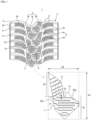
- FIG. 1 is a schematic plan view of a tread pattern of a pneumatic tire according to one embodiment of the present invention
- FIG. 2 is a partial enlarged plan view showing a tread surface of the pneumatic tire according to one embodiment of the present invention
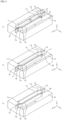
- FIGS. 3A to 3C are enlarged perspective views schematically showing a two-in-one kerf formed on a surface of a tread block of the pneumatic tire according to one embodiment of the present invention.
- the pneumatic tire includes a plurality of tread blocks 10 partitioned by a plurality of longitudinal grooves 3a, 3b, and 3b' and a plurality of transverse grooves 5 and 5' intersecting the longitudinal grooves, in which one or more two-in-one kerfs 7 are formed on a surface of the tread block, in which the two-in-on kerf 7 includes a pair of transverse kerfs 71 and 72 which are bent at predetermined points starting from two outer walls EW 1 and EW 2 opposite to each other and having the same height N in the circumferential direction of the tire, extend by being branched off with a predetermined separation interval, and terminate in the block.
- the transverse kerfs 71 and 72 constituting the two-in-one kerf 7 are formed alternately so that end points T1 and T2 terminated within the block are located at opposite sides in the width direction of the tire.
- the end point T1 of a branched portion 71c of the transverse kerf 71 may be formed at a location close to a point at which a branched portion 72c of the transverse kerf 72 starts
- the end point T2 of the branched portion 72c of the transverse kerf 72 may be formed at a location close to a point at which the branched portion 71c of the transverse kerf 71 starts. Since the outer wall in the circumferential direction of the block is greatly deformed compared to a central portion thereof, when a kerf having one side terminated in the block is formed, heel-end-toe wear can be suppressed, thereby increasing durability.
- the transverse kerfs 71 and 72 include starting portions 71a and 72a starting to extend from starting points S 1 and S2 on the outer wall of the block, inclined portions 71b and 72b formed to be inclined at a predetermined inclined angle with respect to the starting portions, and the branched portions 71c and 72c connected to the inclined portions and formed to face each other with a predetermined separation interval in the circumferential direction of the tire.
- the two-in-one kerf 7 increases a braking force by evenly inducing a ground contact pressure upon traveling straight and especially improves straight stability on the icy road surface.
- the pneumatic tire according to the present invention which has a tread pattern formed as the two-in-one kerf according to the present invention can improve braking performance on the icy road surface and increase durability on the dry and wet road surfaces by reinforcing the rigidity of the block of the tire in the transverse direction.
- the starting portions 71a and 72a of the transverse kerfs 71 and 72 of the two-in-one kerf 7 starting to extend from the starting points S 1 and S2 on the outer walls of the block start at the same height from the two outer walls EW 1 and EW 2 , which are opposite to each other, of the pair of transverse kerfs 71 and 72.
- the term "same height N in the circumferential direction of the tire” has the meaning including a case where the starting points of the starting portions 71a and 72a of the pair of the transverse kerfs 71 and 72 are disposed at the same height in the circumferential direction of the tire and a case where the start points at the two outer walls EW 1 and EW 2 opposite to each other are located to be slightly misaligned with each other in the circumferential direction of the tire in the range within 5% of an interval w2 between the branched portions 71c and 72c.
- the inclined angle ⁇ between the starting portions 71a and 72a and the inclined portions 71b and 72b of each transverse kerf may be in the range of 90° to 150°.
- the inclined angle is smaller than 90°, there is a concern that an edge component of the tire in an axial direction may be degraded, and conversely, when the inclined angle exceeds 150°, there is a concern that drainage performance and performance on ice may be worsen due to an increase in drainage resistance or snow discharge resistance of the longitudinal grooves 3a, 3b, and 3b'. Therefore, the inclined angles ⁇ between the starting portions 71a and 72a and the inclined portions 71b and 72b of the transverse kerf are preferably 90° or more and smaller than 150°.
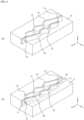
- the branched portions 71c and 72c of the transverse kerf may be formed as a linear or non-linear kerf. Shapes of the branched portions 71c and 72c of the transverse kerf in a plan view do not need to be linear as in the embodiment of FIGS. 3A to C and may be a wavy, zigzag or sinusoidal shape as in the embodiment of FIGS. 4A and B .
- the branched portions 71c and 72c of the transverse kerf are formed in a wave shape, an edge component of the tire in the circumferential direction is included, and thus it is possible to further improve turning performance on an icy road surface.
- a shape of the kerf of the two-in-one kerf 7 in the depth direction may be formed in a three-dimensional kerf structure that extends in a wave shape in the depth direction of the kerf in addition to being formed in a shape extending linearly, a wave shape, or a wave shape in the width direction of the tire.
- the depth of the kerf is preferably in the range of 50% to 90% of the depths of the longitudinal grooves 3a, 3b, and 3b'.
- the depth of the kerf is too small in the case of the depth smaller than 50%, the performance on ice may be lost in the final stage of wear, making it impossible to maintain the performance on ice over a long time, and when the depth of the kerf exceeds 90%, since the depths of the longitudinal grooves 3a, 3b, and 3b' and the depth of the kerf are almost identical, stress may be concentrated at the bottom of the kerf, causing the occurrence of cracks.
- the depths of the transverse kerfs 71 and 72 constituting the two-in-one kerf 7 may preferably be in the range of 3 mm to 10 mm.
- Thicknesses t1 and t2 of the transverse kerfs 71 and 72 which are formed alternately to allow the end points T1 and T2 of the branched portions 71c and 72c to be disposed at opposite sides in the width direction of the tire, in the width direction of the tire may be the same or different, and the thicknesses t1 and t2 may be in the range of 0.2 mm to 1.2 mm. It is preferable that the end points T1 and T2 of the branched portions 71c and 72c, which terminate in the tread block, are formed as close as possible to points at which the inclined portions 71b and 72b start to be bent.
- void portions 71e and 72e in which a cross-sectional area of a pore in a cross-sectional view is expanded locally may be formed.
- a void portion 8 may also be formed in end portions of the kerfs of the transverse kerfs 71 and 72 in the depth direction. Shapes of the void portions 71e and 72e and the void portion 8 are not particularly limited and may have various shapes such as circular, oval, and drop-shaped shapes.
- the void portions 71e and 72e formed in the tread surface contribute to preventing uneven deformation of the tread blocks along the transverse kerfs 71 and 72 disposed on the ground contact surface. That is, when a braking force or friction force is applied to the tread block, the transverse kerfs are opened substantially in parallel and mainly opened over the entirety of the length of the transverse kerf, and thus ground contact performance is significantly improved compared to the conventional kerf. Moreover, the void portions 71e and 72e can maintain rigidity based on an uncut portion of the block without causing uneven wear, increase the friction force on the icy road surface, and increase a braking force on the wet road surface.
- An interval W2 between the branched portions 71c and 72c of the transverse kerfs 71 and 72 constituting the two-in-one kerf 7 may be in the range of 2 to 8 mm.
- the interval W2 between the branched portions 71c and 72c exceeds 8 mm, there is a concern that the edge effect is degraded by an increase in the opening of the branched portion of the transverse kerf by the rotation of the tire, and conversely, when the interval W2 between the branched portions 71c and 72c is smaller than 2 mm, the opening of the kerfs 71 and 72 may become excessively small, making it difficult to sufficiently obtain the edge effect on the icy road surface.
- Lengths W5 of the branched portions 71c and 72c may be in the range of 10% to 70% of a total length W4 of the tread block in the width direction of the tire.
- lengths of the corresponding quadrangular shape in the circumferential direction and width direction are measured as the length W3 of the corresponding block in the circumferential direction of the tire and the length W4 thereof in the width direction, respectively.
- 1 to 10 two-in-one kerfs 7 per tread block may be formed.
- the number of two-in-one kerfs is smaller than one, braking performance on the icy road surface can be degraded, and when the number of two-in-one kerfs exceeds ten, there is a concern that the rigidity of the block can be degraded.
- the pneumatic tire according to the present invention may include both an area 30 in which the two-in-one kerf is formed and an area 20 in which the wave-shaped kerf is formed in one tread block 10.
- the tread block 10 having such a shape may be formed on a center rib of the tire and may be repeatedly arranged in two rows in the circumferential direction of the tire.
- the two rows of blocks may be disposed in the interlocking arrangement in which the two rows of blocks are interlocked by being offset in the circumferential direction of the tire.
- the area 20 in which the wave-shaped kerf is formed may be formed to extend thinly, the area in which the two-in-one kerf is formed may be formed in a polygonal shape, and an area of the area 20 in which the wave-shaped kerf is formed may be formed to be relatively small with the size of 10% to 90% of the area of the area 30 in which the two-in-one kerf is formed.
- the two-in-one kerf 7 and the wave-shaped kerf 21 may be formed in parallel to each other, or as shown in FIG. 1 , the two-in-one kerfs 7 may be formed in parallel in the width direction of the tire, and the wave-shaped kerf 21 may be formed to be inclined with respect to the width direction of the tire. In this case, an angle ⁇ between the two-in-one kerf 7 and the wave-shaped kerf 21 may be formed in the range of 3° to 70°.
- a distance d between the two-in-one kerf 7 and the wave-shaped kerf 21 may be 3% to 30% of the total length w3 of the block in the width direction of the tire.
- the wave-shaped kerf 21 may be formed to extend across the block from one longitudinal groove 3a to the other longitudinal groove 3b.
- the distance d between the two-in-one kerf 7 and the wave-shaped kerf 21 is measured as a distance between an auxiliary line 22 and the branched portion 71c of the two-in-one kerf 7 when the auxiliary line 22 is drawn parallel to the branched portion 71c of the two-in-one kerf 7 on an end portion of the wave-shaped kerf 21 closest to the two-in-one kerf 7.
- the interval between the kerfs may be too small, thereby degrading rigidity, and when the total length W3 exceeds 30%, the interval between the kerfs may be too large, thereby causing abnormal wear.
- Tires of Comparative Example 1 and Example 1 were manufactured commonly based on the tire size of 225/65R17 101Q and a shoulder block pattern and forming different shapes of the transverse kerfs on the surface of the center block as shown in Table 1 below.
- the tire in Comparative Example 2 is a tire in which one linear transverse kerf is formed in one block
- the tire in Comparative Example 3 is a tire in which two linear transverse kerfs more than that of Comparative Example 2 are formed in one block.
- Example 2 is an example in which the two-in-one kerf according to the present invention is formed in one block.
- Comparative Example 1 was evaluated using a 100 rating scale by the sensory evaluation of the driver in terms of the characteristics of handling responsiveness, braking performance, and driving performance by allowing one driver to get on a test vehicle for the driving test on the icy road surface and the snowy road surface, which are test courses, using the test vehicle on which a grooving tire forming patterns of Example 1 and Comparative Example 1 below is mounted. The larger the number, the better the performance.
- Example 1 Shape of tire Footshape Handling Responsi veness Braking Performa nce Driving Performa nce Handling Responsi veness Braking Performa nce Driving Performa nce Performance on snow 7 100% 100% 7 100.2% 104.6% Primary evaluation on ice 5.5 100% 100% 6 103.3% 100% Secondary evaluation on ice 5.5 100% 100% 6 100.5% 103% Tertiary evaluation on ice 5 100% 100% 5.5 110.8% 117.4% Quaternary evaluation on ice 5 100% 100% 100% 5.5 104.6% 111.7% Average performance on ice 5.25 100% 100% 5.75 104.8% 108%
- the performance on ice was improved in the range of 5 to 10% by uniformly inducing the tire contact pressure.
- the ground contact pressure may be uniform when there is little color difference in the footshape.
- the block strength of the block of Example 2 was not significantly reduced compared to the block of Comparative Example 2 despite an increase in a kerf edge length. It was confirmed that the tire of Example 2 according to the present invention had a shape in which a rigidity value of the block was not significantly reduced and the maximum friction force was not significantly reduced, and it was possible to not only provide the improvement in the ground contact pressure of the pneumatic tire of the present invention which is difficult to support both the wet and dry road surfaces, and the improvement in performance on ice at the same time, but also maintain performance on snow.
Landscapes
- Engineering & Computer Science (AREA)
- Mechanical Engineering (AREA)
- Tires In General (AREA)
- Pharmaceuticals Containing Other Organic And Inorganic Compounds (AREA)
- Acyclic And Carbocyclic Compounds In Medicinal Compositions (AREA)
- Transition And Organic Metals Composition Catalysts For Addition Polymerization (AREA)
Applications Claiming Priority (2)
| Application Number | Priority Date | Filing Date | Title |
|---|---|---|---|
| KR1020210184210A KR102701821B1 (ko) | 2021-12-21 | 2021-12-21 | 공기입 타이어 |
| PCT/KR2022/020780 WO2023121202A1 (ko) | 2021-12-21 | 2022-12-20 | 공기입 타이어 |
Publications (2)
| Publication Number | Publication Date |
|---|---|
| EP4454904A1 true EP4454904A1 (de) | 2024-10-30 |
| EP4454904A4 EP4454904A4 (de) | 2025-11-26 |
Family
ID=86903347
Family Applications (1)
| Application Number | Title | Priority Date | Filing Date |
|---|---|---|---|
| EP22911835.1A Pending EP4454904A4 (de) | 2021-12-21 | 2022-12-20 | Luftreifen |
Country Status (4)
| Country | Link |
|---|---|
| EP (1) | EP4454904A4 (de) |
| KR (2) | KR102701821B1 (de) |
| CN (1) | CN118414258A (de) |
| WO (1) | WO2023121202A1 (de) |
Family Cites Families (17)
| Publication number | Priority date | Publication date | Assignee | Title |
|---|---|---|---|---|
| JPS55114605A (en) * | 1979-02-28 | 1980-09-04 | Yokohama Rubber Co Ltd:The | All-weather tire |
| JPH0325007A (ja) * | 1989-06-23 | 1991-02-01 | Toyo Tire & Rubber Co Ltd | ラジアルタイヤ |
| JPH05169923A (ja) * | 1991-12-25 | 1993-07-09 | Bridgestone Corp | 空気入りラジアルタイヤ |
| JPH0994829A (ja) * | 1995-09-28 | 1997-04-08 | Bridgestone Corp | 加硫成形モールド及びこれを用いて製造された空気入 りタイヤ |
| JPH11301217A (ja) * | 1998-04-24 | 1999-11-02 | Bridgestone Corp | 空気入りタイヤ |
| JP2001039126A (ja) | 1999-07-29 | 2001-02-13 | Bridgestone Corp | 空気入りタイヤ |
| FI115833B (fi) * | 2000-05-23 | 2005-07-29 | Nokian Renkaat Oyj | Kuviopalat ajoneuvon renkaan kulutuspinnassa |
| JP3964693B2 (ja) | 2002-02-21 | 2007-08-22 | 株式会社ブリヂストン | 空気入りタイヤ |
| JP4621012B2 (ja) * | 2004-11-30 | 2011-01-26 | 株式会社ブリヂストン | 空気入りタイヤ |
| FR3035820A1 (fr) * | 2015-05-07 | 2016-11-11 | Michelin & Cie | Bande de roulement comportant un bloc presentant une pluralite de decoupure |
| JP6585988B2 (ja) * | 2015-10-06 | 2019-10-02 | Toyo Tire株式会社 | 空気入りタイヤ |
| JP6699193B2 (ja) * | 2016-01-21 | 2020-05-27 | 住友ゴム工業株式会社 | 空気入りタイヤ |
| JP6711171B2 (ja) * | 2016-06-27 | 2020-06-17 | 住友ゴム工業株式会社 | タイヤ |
| EP3378678B1 (de) * | 2017-03-24 | 2021-01-20 | Sumitomo Rubber Industries, Ltd. | Reifen |
| JP6907777B2 (ja) * | 2017-07-19 | 2021-07-21 | 住友ゴム工業株式会社 | タイヤ |
| JP6353621B2 (ja) * | 2018-03-19 | 2018-07-04 | 東洋ゴム工業株式会社 | 空気入りタイヤ |
| JP7474046B2 (ja) * | 2019-12-13 | 2024-04-24 | Toyo Tire株式会社 | 空気入りタイヤ |
-
2021
- 2021-12-21 KR KR1020210184210A patent/KR102701821B1/ko active Active
-
2022
- 2022-12-20 WO PCT/KR2022/020780 patent/WO2023121202A1/ko not_active Ceased
- 2022-12-20 EP EP22911835.1A patent/EP4454904A4/de active Pending
- 2022-12-20 CN CN202280084685.5A patent/CN118414258A/zh active Pending
-
2024
- 2024-08-28 KR KR1020240116036A patent/KR102856211B1/ko active Active
Also Published As
| Publication number | Publication date |
|---|---|
| KR20230094789A (ko) | 2023-06-28 |
| KR102701821B1 (ko) | 2024-09-02 |
| CN118414258A (zh) | 2024-07-30 |
| WO2023121202A1 (ko) | 2023-06-29 |
| KR20240135587A (ko) | 2024-09-11 |
| KR102856211B1 (ko) | 2025-09-04 |
| EP4454904A4 (de) | 2025-11-26 |
Similar Documents
| Publication | Publication Date | Title |
|---|---|---|
| US8640751B2 (en) | Pneumatic tire with tread having sipes | |
| EP3303008B1 (de) | Reifen für fahrzeugräder | |
| JP5466169B2 (ja) | スノータイヤ用トレッド | |
| JP5123981B2 (ja) | 重荷重用タイヤ | |
| US11554613B2 (en) | Pneumatic tire, a tread band, and a tread block comprising a sipe, and a lamella plate for the manufacture thereof | |
| US8733412B2 (en) | Pneumatic tire with sipe having concave grooves | |
| JP5529683B2 (ja) | 空気入りタイヤ | |
| US20140360641A1 (en) | Tire tread with angled rib groove walls | |
| JP5157203B2 (ja) | 空気入りタイヤ | |
| US8544512B2 (en) | Pneumatic tire with tread having sipe | |
| KR101782164B1 (ko) | 공기 타이어 | |
| EP3342605B1 (de) | Reifen | |
| US20120018069A1 (en) | Pneumatic tire | |
| CN100532141C (zh) | 充气轮胎 | |
| CN110014792A (zh) | 具有刀槽花纹的胎面块布置 | |
| JP2014523366A (ja) | 幅広部分と幅狭部分を含む切込みを備えたトレッドを有するタイヤ | |
| JP5898837B2 (ja) | 空気入りタイヤ | |
| EP4454904A1 (de) | Luftreifen | |
| US8132605B2 (en) | Pneumatic tire with tread including block having sipes | |
| US12391071B2 (en) | Tread block arrangement having a sipe | |
| EP4308388B1 (de) | Reifen mit verbesserter schneeleistung | |
| WO2024200148A1 (en) | Tire having an improved tread pattern | |
| CN120981361A (zh) | 具有改进的胎面花纹的轮胎 | |
| KR20160041474A (ko) | 3차원 비대칭 사이프를 구비한 스터드 타입 스노우 타이어 |
Legal Events
| Date | Code | Title | Description |
|---|---|---|---|
| STAA | Information on the status of an ep patent application or granted ep patent |
Free format text: STATUS: THE INTERNATIONAL PUBLICATION HAS BEEN MADE |
|
| PUAI | Public reference made under article 153(3) epc to a published international application that has entered the european phase |
Free format text: ORIGINAL CODE: 0009012 |
|
| STAA | Information on the status of an ep patent application or granted ep patent |
Free format text: STATUS: REQUEST FOR EXAMINATION WAS MADE |
|
| 17P | Request for examination filed |
Effective date: 20240719 |
|
| AK | Designated contracting states |
Kind code of ref document: A1 Designated state(s): AL AT BE BG CH CY CZ DE DK EE ES FI FR GB GR HR HU IE IS IT LI LT LU LV MC ME MK MT NL NO PL PT RO RS SE SI SK SM TR |
|
| DAV | Request for validation of the european patent (deleted) | ||
| DAX | Request for extension of the european patent (deleted) | ||
| A4 | Supplementary search report drawn up and despatched |
Effective date: 20251023 |
|
| RIC1 | Information provided on ipc code assigned before grant |
Ipc: B60C 11/12 20060101AFI20251017BHEP Ipc: B60C 11/03 20060101ALI20251017BHEP |