EP4450737A1 - Self-climbing modular system for the protection of civil works and buildings under construction - Google Patents
Self-climbing modular system for the protection of civil works and buildings under construction Download PDFInfo
- Publication number
- EP4450737A1 EP4450737A1 EP22846913.6A EP22846913A EP4450737A1 EP 4450737 A1 EP4450737 A1 EP 4450737A1 EP 22846913 A EP22846913 A EP 22846913A EP 4450737 A1 EP4450737 A1 EP 4450737A1
- Authority
- EP
- European Patent Office
- Prior art keywords
- climbing
- self
- modular system
- upright
- slab
- Prior art date
- Legal status (The legal status is an assumption and is not a legal conclusion. Google has not performed a legal analysis and makes no representation as to the accuracy of the status listed.)
- Pending
Links
Images




Classifications
-
- E—FIXED CONSTRUCTIONS
- E04—BUILDING
- E04G—SCAFFOLDING; FORMS; SHUTTERING; BUILDING IMPLEMENTS OR AIDS, OR THEIR USE; HANDLING BUILDING MATERIALS ON THE SITE; REPAIRING, BREAKING-UP OR OTHER WORK ON EXISTING BUILDINGS
- E04G21/00—Preparing, conveying, or working-up building materials or building elements in situ; Other devices or measures for constructional work
- E04G21/32—Safety or protective measures for persons during the construction of buildings
- E04G21/3204—Safety or protective measures for persons during the construction of buildings against falling down
- E04G21/3247—Storey high safety barrier hung from the facade and sliding up from level to level as work progresses
-
- E—FIXED CONSTRUCTIONS
- E04—BUILDING
- E04G—SCAFFOLDING; FORMS; SHUTTERING; BUILDING IMPLEMENTS OR AIDS, OR THEIR USE; HANDLING BUILDING MATERIALS ON THE SITE; REPAIRING, BREAKING-UP OR OTHER WORK ON EXISTING BUILDINGS
- E04G21/00—Preparing, conveying, or working-up building materials or building elements in situ; Other devices or measures for constructional work
- E04G21/32—Safety or protective measures for persons during the construction of buildings
- E04G21/3204—Safety or protective measures for persons during the construction of buildings against falling down
- E04G21/3223—Means supported by building floors or flat roofs, e.g. safety railings
-
- E—FIXED CONSTRUCTIONS
- E04—BUILDING
- E04G—SCAFFOLDING; FORMS; SHUTTERING; BUILDING IMPLEMENTS OR AIDS, OR THEIR USE; HANDLING BUILDING MATERIALS ON THE SITE; REPAIRING, BREAKING-UP OR OTHER WORK ON EXISTING BUILDINGS
- E04G21/00—Preparing, conveying, or working-up building materials or building elements in situ; Other devices or measures for constructional work
- E04G21/32—Safety or protective measures for persons during the construction of buildings
- E04G21/3204—Safety or protective measures for persons during the construction of buildings against falling down
- E04G21/3223—Means supported by building floors or flat roofs, e.g. safety railings
- E04G21/3233—Means supported by building floors or flat roofs, e.g. safety railings without permanent provision in the floor or roof
- E04G21/3242—Means supported by building floors or flat roofs, e.g. safety railings without permanent provision in the floor or roof using clamps
-
- E—FIXED CONSTRUCTIONS
- E04—BUILDING
- E04G—SCAFFOLDING; FORMS; SHUTTERING; BUILDING IMPLEMENTS OR AIDS, OR THEIR USE; HANDLING BUILDING MATERIALS ON THE SITE; REPAIRING, BREAKING-UP OR OTHER WORK ON EXISTING BUILDINGS
- E04G21/00—Preparing, conveying, or working-up building materials or building elements in situ; Other devices or measures for constructional work
- E04G21/32—Safety or protective measures for persons during the construction of buildings
- E04G21/3261—Safety-nets; Safety mattresses; Arrangements on buildings for connecting safety-lines
- E04G21/3266—Safety nets
Definitions
- the object of the invention relates to a self-climbing modular system for the protection of civil works and buildings under construction.
- Temporary edge protection of civil works, particularly of buildings under construction, is necessary and even mandatory and is included in various current regulations, such as, for example, Spanish standard UNE-EN 13374.
- WO202001909A1 describes a perimeter system for personnel fall protection in the construction of high-rise buildings, which transforms into a tray for catching people or material and into a work platform, on the perimeter of construction sites in high-rise buildings, towers or vertical walls.
- EP2325416A1 describes a perimeter protection system for construction sites which, by using (as in WO2020019092A1 ) posts or pillars and supports or anchors, also has screens referred to as enclosure segments.
- ES1239398U describes a protection for construction voids basically being composed of an extendable crossbeam, which is repeated a plurality of times and is arranged, as needed, in the voids to prevent the accidental falling, fundamentally of people, into the void.
- ES1074586U , ES1074587U , and ES1074609U describe, respectively, an adjustable fixing and coupling unit for vertically supporting railings, a clamp for supporting nets or railings, and a support for formwork closures and railings, all in reference to the temporary protection of civil works under construction.
- ES1239398U discloses an extendable protection designed to cover any type of void within an ongoing construction.
- the protection is formed by two rectangular tubes with dimensions that allow one to be inserted over the other, thus constituting the telescopic extendable system. These two sections have a locking system so that the total length of the assembly remains fixed while the locking system has blocked the possibility of inserting one tube inside the other. When the locking system is released, the length of the assembly can be modified, having as a minimum length the longer of the two components and as a maximum length the sum of the lengths of both components.
- ES2662066T3 describes a screen-type perimeter protection system comprising guides arranged around the perimeter of a building, support means configured to fix the guides to a support surface of said building, and protection means fixed to the guides.
- the system allows simultaneous protection of several floors.
- the object of the invention is to provide a self-climbing modular system, as defined in the claims.
- the self-climbing modular system comprises two bases fixed in cantilever with respect to a slab level of the civil work, and each one provided at its free end with a support on which an upright is arranged with the possibility of guided vertical displacement with respect to the base and the slab level on which the base is fixed, a plurality of handrails articulated at their ends linking together two uprights of one and the same module or of contiguous modules located at one and the same slab level, and lifting means for independently lifting the uprights between two slabs located at two different levels in the civil work in such a way that upon actuating said lifting means, the corresponding upright rises, said rise being unidirectional due to the action of the corresponding support.
- the system obtained is modular and self-climbing, requiring only the fixing of the bases at the different slab levels in order to hook and lift in them, with suitable means, the uprights with their handrails and, where appropriate, the safety net, which form complete modules coming from a lower slab level.
- the self-climbing modular system for the protection of civil works and buildings under construction comprises two bases 2 each comprising at a free end, a support 5 on which an upright 1 is arranged with the possibility of guided vertical displacement, a plurality of elongated handrails 3 articulated at their ends to the two uprights 1 of one and the same module or of contiguous modules located at one and the same slab F level, and lifting means M configured for independently lifting each upright 1 between two different levels.
- the self-climbing modular system comprises a safety net 4 fixed at least to two handrails 3 so as to keep it taut.
- the self-climbing modular system further comprises at least one extendable tie rod 6 bracing the corresponding upright 1 to the corresponding base 2 so as to ensure the rigidity of the assembly.
- the self-climbing modular system further comprises base columns 7 supported directly on the ground when starting the work, with the corresponding upright 1 being arranged directly in each of said base columns 7 before starting the construction of the first slab level.
- the base column 7 and the upright 1 have sections with conjugate geometries.
- Each of the bases 2 is fixed in cantilever with respect to the corresponding slab F of the civil work.
- Each base 2 comprises two longitudinal members 21 with a U-shaped profile defining a space of constant width b between them in which there are arranged fixing means for fixing to the corresponding slab F.
- the fixing means are not described in detail given that they are not the object of the invention.
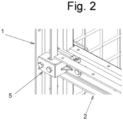
- Each of the bases 2 comprises, at a free end, a support 5 on which the corresponding upright 1 is arranged with the possibility of guided vertical displacement with respect to the base 2 and, accordingly, with respect to the slab F on which the base 2 is fixed.
- Each support 5 comprises two lateral flanges 51 secured by means of screws 50 to the corresponding longitudinal member 21.
- rollers 52 assembled with the possibility of rotating freely about a corresponding shaft 520 constituted in guides of the corresponding upright 1 in vertical displacement.
- a grating 53 assembled with the possibility of swiveling with respect to the longitudinal members 21 between a stable horizontal position and an unstable raised position in which, respectively, a bolt 12 is housed or released during the unidirectional rise of the corresponding upright 1.
- each upright 1 comprises two posts 11 with a U-shaped profile coupled to one another along their opposing webs 110 by means of a plurality of bolts 12 defining between them a space of constant width "a".
- Each of said posts 11 comprises a plurality of aligned holes 13 in their flanges 111.
- the handrails 3 are of variable length. Each one comprises at least two telescopically arranged portions 3a and 3b and each of the portions 3a and 3b is provided with a hole 31 at a free end.
- each extendable tie rod 6 comprises a tubular body 61, two flat bars 62a and 62b, and two support flanges 63a and 63b.
- the flat bars 62a and 62b are assembled such that they are telescopically arranged with respect to the tubular body 61, occupying the respective ends thereof.
- Each of these flat bars 62a and 62b comprises a plurality of aligned holes 620.
- the tubular body 61 and the support flanges 63a and 63b comprise respective holes for the aforementioned to be to one another, to the uprights 1, and to the bases 2 through screw/nut assemblies 64 as shown in Figures 8 and 9 .
- the bases 2 are fixed in cantilever to the slab F of the civil work and each one is provided at its free end with the support 5 on which the upright 1 is arranged with the possibility of guided vertical displacement.
- the handrails 3 are articulated at their ends linking together two uprights 1 of one and the same module or of contiguous modules located at one and the same slab F level in such a way that upon successively actuating the lifting means M, the corresponding upright 1 rises to a higher slab F level, said rise being unidirectional due to the action of the corresponding support 5.
Landscapes
- Engineering & Computer Science (AREA)
- Architecture (AREA)
- Mechanical Engineering (AREA)
- Civil Engineering (AREA)
- Structural Engineering (AREA)
- Bridges Or Land Bridges (AREA)
- Steps, Ramps, And Handrails (AREA)
- Buildings Adapted To Withstand Abnormal External Influences (AREA)
- Emergency Lowering Means (AREA)
Abstract
Description
- The object of the invention relates to a self-climbing modular system for the protection of civil works and buildings under construction.
- Temporary edge protection of civil works, particularly of buildings under construction, is necessary and even mandatory and is included in various current regulations, such as, for example, Spanish standard UNE-EN 13374.
- To ensure the protection of a civil work under construction in accordance with the regulations in force (particularly to ensure temporary edge protection of works in buildings under construction), various constructive solutions are known, such as those described in
WO2020019092 ,EP2325416 ,ES1239398U ES1074586U ES1074587U ES1074609U -
WO202001909A1 -
EP2325416A1 describes a perimeter protection system for construction sites which, by using (as inWO2020019092A1 ) posts or pillars and supports or anchors, also has screens referred to as enclosure segments. -
ES1239398U -
ES1074586U ES1074587U ES1074609U -
ES1239398U -
ES2662066T3 - The object of the invention is to provide a self-climbing modular system, as defined in the claims.
- The self-climbing modular system according to the invention comprises two bases fixed in cantilever with respect to a slab level of the civil work, and each one provided at its free end with a support on which an upright is arranged with the possibility of guided vertical displacement with respect to the base and the slab level on which the base is fixed, a plurality of handrails articulated at their ends linking together two uprights of one and the same module or of contiguous modules located at one and the same slab level, and lifting means for independently lifting the uprights between two slabs located at two different levels in the civil work in such a way that upon actuating said lifting means, the corresponding upright rises, said rise being unidirectional due to the action of the corresponding support.
- In the prior art, all the solutions known by the applicant require "in-situ" and customized assembly, then later require being collected so as to arrange them again at a higher level, i.e., none of the solutions known by the applicant so far is modular and self-climbing.
- The system obtained is modular and self-climbing, requiring only the fixing of the bases at the different slab levels in order to hook and lift in them, with suitable means, the uprights with their handrails and, where appropriate, the safety net, which form complete modules coming from a lower slab level.
- These and other advantages and features of the invention will become apparent in view of the figures and detailed description of the invention.
-
-
Figure 1 shows a schematic perspective view of an embodiment of a self-climbing modular system according to the invention. -
Figure 2 shows an enlarged detail according to reference A ofFigure 1 . -
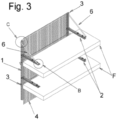
Figure 3 shows a schematic perspective view of a second embodiment of a self-climbing modular system according to the invention. -
Figure 4 shows a detailed view of an upright of the self-climbing modular system shown inFigure 1 . -
Figure 5 shows a detailed view of a base part with a support of the self-climbing modular system shown inFigure 1 . -
Figure 6 shows a detailed view of the support shown inFigure 5 with a lifted grating. -
Figure 7 shows a detailed view of a handrail of the self-climbing modular system shown inFigure 1 . -
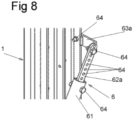
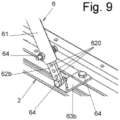
Figures 8 and9 depict respective enlarged details according to, respectively, references B and C inFigure 3 . -
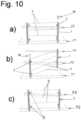
Figure 10 shows the self-climbing modular system shown inFigure 1 in three operating steps a), b), and c). -
Figure 11 shows a schematic perspective view of a third embodiment of a self-climbing modular system according to the invention. - The self-climbing modular system for the protection of civil works and buildings under construction according to the invention comprises two
bases 2 each comprising at a free end, asupport 5 on which an upright 1 is arranged with the possibility of guided vertical displacement, a plurality ofelongated handrails 3 articulated at their ends to the twouprights 1 of one and the same module or of contiguous modules located at one and the same slab F level, and lifting means M configured for independently lifting each upright 1 between two different levels. The self-climbing modular system comprises asafety net 4 fixed at least to twohandrails 3 so as to keep it taut. - In the embodiments shown in
Figures 3 and6 , the self-climbing modular system further comprises at least oneextendable tie rod 6 bracing the corresponding upright 1 to thecorresponding base 2 so as to ensure the rigidity of the assembly. In the embodiment shown inFigure 6 , the self-climbing modular system further comprisesbase columns 7 supported directly on the ground when starting the work, with the corresponding upright 1 being arranged directly in each ofsaid base columns 7 before starting the construction of the first slab level. Thebase column 7 and the upright 1 have sections with conjugate geometries. - Each of the
bases 2 is fixed in cantilever with respect to the corresponding slab F of the civil work. Eachbase 2 comprises twolongitudinal members 21 with a U-shaped profile defining a space of constant width b between them in which there are arranged fixing means for fixing to the corresponding slab F. The fixing means are not described in detail given that they are not the object of the invention. - Each of the
bases 2 comprises, at a free end, asupport 5 on which the corresponding upright 1 is arranged with the possibility of guided vertical displacement with respect to thebase 2 and, accordingly, with respect to the slab F on which thebase 2 is fixed. - Each
support 5 comprises twolateral flanges 51 secured by means ofscrews 50 to the correspondinglongitudinal member 21. In saidflanges 51 there are arrangedrollers 52 assembled with the possibility of rotating freely about acorresponding shaft 520 constituted in guides of the corresponding upright 1 in vertical displacement. - Between said
rollers 52 andlongitudinal members 21 there is also arranged agrating 53 assembled with the possibility of swiveling with respect to thelongitudinal members 21 between a stable horizontal position and an unstable raised position in which, respectively, abolt 12 is housed or released during the unidirectional rise of the corresponding upright 1. - In the embodiments shown, each upright 1 comprises two
posts 11 with a U-shaped profile coupled to one another along theiropposing webs 110 by means of a plurality ofbolts 12 defining between them a space of constant width "a". Each of saidposts 11 comprises a plurality of alignedholes 13 in theirflanges 111. - In the embodiments shown, the
handrails 3 are of variable length. Each one comprises at least two telescopically arrangedportions portions hole 31 at a free end. - In the embodiments shown in
Figures 3 and7 , eachextendable tie rod 6 comprises atubular body 61, twoflat bars support flanges flat bars tubular body 61, occupying the respective ends thereof. Each of theseflat bars holes 620. - The
tubular body 61 and thesupport flanges uprights 1, and to thebases 2 through screw/nut assemblies 64 as shown inFigures 8 and9 . - The
bases 2 are fixed in cantilever to the slab F of the civil work and each one is provided at its free end with thesupport 5 on which the upright 1 is arranged with the possibility of guided vertical displacement. Thehandrails 3 are articulated at their ends linking together twouprights 1 of one and the same module or of contiguous modules located at one and the same slab F level in such a way that upon successively actuating the lifting means M, the corresponding upright 1 rises to a higher slab F level, said rise being unidirectional due to the action of thecorresponding support 5. - No detailed description is given for the specific lifting means M used (for example, human means without the need for a crane, such as winches or other similar/known means) as they are not themselves object of the invention.
Claims (7)
- A self-climbing modular system for the protection of civil works and buildings under construction, characterized in that each module comprises two bases (2) fixed in cantilever with respect to a slab (F) level of the civil work, and each one provided at its free end with a support (5) on which an upright (1) is arranged with the possibility of guided vertical displacement with respect to the base (2) and the slab (F) level on which the base (2) is fixed, a plurality of handrails (3) articulated at their ends linking together two uprights (1) of one and the same module or of contiguous modules located at one and the same slab (F) level, and lifting means (M) for independently lifting the uprights (1) between two slabs (F1, F2) located at two different levels in the civil work in such a way that upon actuating said lifting means (M), the corresponding upright (1) rises, said rise being unidirectional due to the action of the corresponding support (5).
- The self-climbing modular system according to the claim 1, wherein each upright (1) comprises two posts (11) with a U-shaped profile linked to one another along their opposing webs (110) by means of a plurality of bolts (12) defining between the posts (11) a space having a constant width (a), each of said posts (11) comprising a plurality of aligned holes (13) in their flanges (111).
- The self-climbing modular system according to any of the preceding claims, wherein the handrails (3) are of variable length, structured in at least two telescopically arranged portions (3a, 3b), each portion being provided with a hole (31) at its free end which is arranged facing a hole (13) of the corresponding upright (1) such that by inserting pins, the handrails (3) are arranged articulated to the corresponding upright (1) and adapt to different separation widths between the uprights (1) that they link together.
- The self-climbing modular system according to any of the preceding claims, wherein each base (2) comprises two longitudinal members (21) with a U-shaped profile defining a space of constant width (b) between them in which there are arranged fixing means for fixing to the corresponding slab (F), a support (5) arranged at a free end of the base (2) in cantilever, the support (5) comprising two lateral flanges (51) secured by means of screws (50) to the corresponding longitudinal member (21) and in which there are arranged rollers (52) assembled on said lateral flanges (51) with the possibility of rotating freely about a corresponding shaft (520) and constituted in guides of the corresponding upright (1) in a vertical displacement, and a grating (53) assembled with the possibility of swiveling with respect to the longitudinal members (21) between a stable horizontal position and an unstable raised position in which, respectively, a bolt (12) is housed or released during the unidirectional rise of the corresponding upright (1).
- The self-climbing modular system according to any of the preceding claims, comprising a safety net (4) fixed to at least two handrails (3) so as to keep it taut.
- The self-climbing modular system according to any of the preceding claims, further comprising at least one extendable tie rod (6) bracing the corresponding upright (1) to the corresponding base (2) so as to ensure the rigidity of the assembly.
- The self-climbing modular system according to any of the preceding claims, further comprising base columns (7) supported directly on the ground when starting the work, with the upright (1) being arranged directly in each of said base columns (7) before starting the construction of the first slab level.
Applications Claiming Priority (2)
| Application Number | Priority Date | Filing Date | Title |
|---|---|---|---|
| ES202132462U ES1284934U (en) | 2021-12-15 | 2021-12-15 | Modular self-climbing system, for protection of civil works and buildings, under construction (Machine-translation by Google Translate, not legally binding) |
| PCT/ES2022/070801 WO2023111378A1 (en) | 2021-12-15 | 2022-12-14 | Self-climbing modular system for the protection of civil works and buildings under construction |
Publications (1)
| Publication Number | Publication Date |
|---|---|
| EP4450737A1 true EP4450737A1 (en) | 2024-10-23 |
Family
ID=79270540
Family Applications (1)
| Application Number | Title | Priority Date | Filing Date |
|---|---|---|---|
| EP22846913.6A Pending EP4450737A1 (en) | 2021-12-15 | 2022-12-14 | Self-climbing modular system for the protection of civil works and buildings under construction |
Country Status (7)
| Country | Link |
|---|---|
| US (1) | US20240328181A1 (en) |
| EP (1) | EP4450737A1 (en) |
| CL (1) | CL2024001775A1 (en) |
| ES (1) | ES1284934U (en) |
| MX (1) | MX2024007262A (en) |
| PE (1) | PE20250474A1 (en) |
| WO (1) | WO2023111378A1 (en) |
Families Citing this family (2)
| Publication number | Priority date | Publication date | Assignee | Title |
|---|---|---|---|---|
| DE102024103295A1 (en) * | 2024-02-06 | 2025-08-07 | Peri Se | PANEL ELEMENT, PANEL COMPOSITE WITH PANEL ELEMENTS AND ENCLOSURE FOR SCAFFOLDING SYSTEM |
| ES3049486A1 (en) | 2024-06-13 | 2025-12-16 | Sist Tecnicos De Encofrados Sa | PERIMETER PROTECTION SYSTEM FOR WORKS AND MODULE AND SIGN FOR SAID PROTECTION SYSTEM (Machine-translation by Google Translate, not legally binding) |
Family Cites Families (38)
| Publication number | Priority date | Publication date | Assignee | Title |
|---|---|---|---|---|
| US3949834A (en) * | 1975-03-19 | 1976-04-13 | Arthur Nusbaum | Safety net and adjustable support therefor |
| GB0001055D0 (en) * | 2000-01-18 | 2000-03-08 | Access Systems Limited Const | Jacking temporary structure |
| CN100416023C (en) * | 2003-11-27 | 2008-09-03 | 乌尔玛结构&包装合作社 | Climbing systems for formwork, scaffolding and loads |
| WO2008089442A2 (en) * | 2007-01-18 | 2008-07-24 | Western Forms, Inc. | Lightweight crane-set forming panel |
| ES2288438B1 (en) * | 2007-05-08 | 2008-09-16 | Sistemas Tecnicos De Encofrados, S.A. | "SUPPORT STRUCTURE FOR WALL COVERING". |
| KR200448066Y1 (en) * | 2008-03-13 | 2010-03-11 | 주식회사 뉴폼코리아 | Automatic stopper for stamping frame |
| DE102008015682A1 (en) * | 2008-03-25 | 2009-10-08 | Peri Gmbh | Rail-guided self-climbing formwork system with climbing rail extension pieces |
| GB2465985B (en) * | 2008-12-04 | 2010-12-08 | Sgb Services Ltd | Support frame |
| KR100944463B1 (en) * | 2009-07-02 | 2010-03-05 | 송재근 | Composite cage for construction |
| KR101040033B1 (en) * | 2009-07-16 | 2011-06-09 | 금강공업 주식회사 | Temporary lifting device |
| EP2325416B1 (en) | 2009-11-20 | 2017-12-27 | Mirelena, S.L. | Perimeter protection system for construction sites |
| PL2365159T3 (en) * | 2010-03-05 | 2013-07-31 | Ulma C Y E S Coop | Self-climbing perimetric protection system for construction works in buildings |
| EP2503077A1 (en) * | 2011-03-23 | 2012-09-26 | ULMA C y E, S. COOP. | Self-climbing perimetric protection system adaptable to buildings undergoing construction having a variable vertical projection |
| CA2734994C (en) * | 2011-03-24 | 2018-01-23 | Ulma C Y E, S. Coop. | Perimetric protection system for buildings undergoing construction |
| ES1074586Y (en) | 2011-03-25 | 2011-08-23 | Aplicaciones Tecn Y Tecnologicas Prometal S L | Adjustable attachment and coupling unit, to vertically support temporary protection railings in works |
| ES1074587Y (en) | 2011-03-25 | 2011-08-23 | Aplicaciones Tecn Y Tecnologicas Prometal S L | Staple, to support networks or guardrails of provisional protection in works |
| ES1074609Y (en) | 2011-03-28 | 2011-08-23 | Aplicaciones Tecn Y Tecnologicas Prometal S L | Support, for formwork closures and temporary protection railings in works |
| US8714306B2 (en) * | 2011-03-29 | 2014-05-06 | ULMA CyE, S. Coop. | Perimetric protection system for buildings undergoing construction |
| US9033106B2 (en) * | 2012-01-04 | 2015-05-19 | Lawrence Blinn | Safety barrier netting system |
| US20130263549A1 (en) * | 2012-04-04 | 2013-10-10 | Helmark Steel, Inc. | Safety screen system for steel erection work |
| AU2013284343A1 (en) * | 2012-06-26 | 2015-02-05 | Form 700 Pty Ltd | Improved frame for climbing screen |
| GB2510881B8 (en) * | 2013-02-18 | 2020-09-30 | Ischebeck Titan Ltd | Safety screen |
| US9371666B2 (en) * | 2014-03-25 | 2016-06-21 | Darrell Allen | Fall protection guardrail |
| SG11201810278XA (en) * | 2016-05-19 | 2018-12-28 | Form 700 Pty Ltd | A perimeter safety screen assembly |
| GB2553560B (en) * | 2016-09-08 | 2018-11-28 | Ischebeck Titan Ltd | Climbing screen |
| GB2559620B (en) * | 2017-02-14 | 2019-03-20 | Ischebeck Titan Ltd | Safety screen comprising a fixing means |
| US10988949B2 (en) * | 2017-10-27 | 2021-04-27 | Doka Gmbh | Safety screen and safety screen system |
| WO2019162890A1 (en) * | 2018-02-21 | 2019-08-29 | Gregory John Neighbours | Improved screen system |
| DE102018204961A1 (en) * | 2018-04-03 | 2019-10-10 | Peri Gmbh | Self-climbing system with drive via a revolving drive means and method for operating a self-climbing system |
| DE102018115356A1 (en) | 2018-06-26 | 2020-01-02 | Böllhoff Verbindungstechnik GmbH | Coupling element with anchoring structure for a foam component |
| DE102018117727A1 (en) * | 2018-07-23 | 2020-01-23 | Peri Gmbh | LIFT DRIVE FOR A RAILWAY CLIMBING SYSTEM |
| WO2020019092A1 (en) | 2018-07-26 | 2020-01-30 | Inversiones Begrup Spa | Perimeter system for personnel fall protection in the construction of high-rise buildings |
| CN109252663A (en) * | 2018-11-20 | 2019-01-22 | 佛山科学技术学院 | A kind of aluminum formwork reinforcement device |
| US20210095484A1 (en) * | 2019-09-26 | 2021-04-01 | Howard R. Moeggenborg | Elevated walkway system and method |
| ES1239398Y (en) | 2019-11-06 | 2020-06-22 | Vicente Felipe Pacheco | Improved extensible protection for construction gaps |
| ES2962616T3 (en) * | 2020-01-08 | 2024-03-20 | Simem S P A | A climbing formwork system for mass concrete construction, in particular for the construction of a dam or for the hydraulic power industry, and a method of constructing a mass concrete construction |
| CN111749537B (en) * | 2020-06-30 | 2021-02-02 | 江苏美赫家居有限公司 | Glass fiber reinforced plastic safety protection structure |
| CN113266145A (en) * | 2021-06-25 | 2021-08-17 | 江西志特新材料股份有限公司 | Automatic creeping formwork system and operation method thereof |
-
2021
- 2021-12-15 ES ES202132462U patent/ES1284934U/en not_active Ceased
-
2022
- 2022-12-14 WO PCT/ES2022/070801 patent/WO2023111378A1/en not_active Ceased
- 2022-12-14 EP EP22846913.6A patent/EP4450737A1/en active Pending
- 2022-12-14 MX MX2024007262A patent/MX2024007262A/en unknown
- 2022-12-14 PE PE2024001375A patent/PE20250474A1/en unknown
-
2024
- 2024-06-13 CL CL2024001775A patent/CL2024001775A1/en unknown
- 2024-06-14 US US18/743,902 patent/US20240328181A1/en active Pending
Also Published As
| Publication number | Publication date |
|---|---|
| WO2023111378A1 (en) | 2023-06-22 |
| MX2024007262A (en) | 2024-06-26 |
| PE20250474A1 (en) | 2025-02-21 |
| CL2024001775A1 (en) | 2024-11-15 |
| ES1284934U (en) | 2022-01-13 |
| US20240328181A1 (en) | 2024-10-03 |
Similar Documents
| Publication | Publication Date | Title |
|---|---|---|
| US20240328181A1 (en) | Self-climbing modular system for the protection of civil works and buildings under construction | |
| EP3899167B1 (en) | Construction site device with climbing formwork and elevator system | |
| US9133632B2 (en) | Platform support device for lifting loads or persons the height of a structure | |
| AU2019311134A1 (en) | Lift drive for a rail-guided climbing system | |
| KR20090028716A (en) | Stairs for use on the construction site | |
| US20120006621A1 (en) | Movable modular scaffold system for building works and method to form it | |
| KR20150127559A (en) | The Folding Suspended Scaffoldings | |
| AT390987B (en) | SUPPORT STRUCTURE FOR TRIBUENES | |
| EP0350525B1 (en) | Method for producing building-walls and a shuttering system | |
| DE3611431C2 (en) | Scaffolding support for bridging sidewalks | |
| DE2759088C2 (en) | Climbing scaffold with climbing formwork for the production of a reinforced concrete wall | |
| EP3381858A1 (en) | Kit for a temporary hoist | |
| KR200378217Y1 (en) | Scaffolding for the high ground working | |
| EP2325416A1 (en) | Perimeter protection system for construction sites | |
| JP2012207379A (en) | Structure demolition system | |
| CN113175201B (en) | A sliding operating platform for elevator shaft construction | |
| JPH0547704B2 (en) | ||
| WO2009062243A1 (en) | Perimeter screening system | |
| EP4702205A1 (en) | Climbing system for a rail-guided climbing frame | |
| CN113404278B (en) | Self-climbing type protection frame and climbing method thereof | |
| JPH07279418A (en) | Temporary structure | |
| JPH06129108A (en) | Formwork assembly equipment | |
| CN113293975A (en) | Construction platform for prefabricated building | |
| JP3543247B2 (en) | Temporary living support bracket | |
| GB2539375A (en) | Scaffold safety apparatus |
Legal Events
| Date | Code | Title | Description |
|---|---|---|---|
| STAA | Information on the status of an ep patent application or granted ep patent |
Free format text: STATUS: UNKNOWN |
|
| STAA | Information on the status of an ep patent application or granted ep patent |
Free format text: STATUS: THE INTERNATIONAL PUBLICATION HAS BEEN MADE |
|
| TPAC | Observations filed by third parties |
Free format text: ORIGINAL CODE: EPIDOSNTIPA |
|
| PUAI | Public reference made under article 153(3) epc to a published international application that has entered the european phase |
Free format text: ORIGINAL CODE: 0009012 |
|
| STAA | Information on the status of an ep patent application or granted ep patent |
Free format text: STATUS: REQUEST FOR EXAMINATION WAS MADE |
|
| 17P | Request for examination filed |
Effective date: 20240715 |
|
| AK | Designated contracting states |
Kind code of ref document: A1 Designated state(s): AL AT BE BG CH CY CZ DE DK EE ES FI FR GB GR HR HU IE IS IT LI LT LU LV MC ME MK MT NL NO PL PT RO RS SE SI SK SM TR |
|
| DAV | Request for validation of the european patent (deleted) | ||
| DAX | Request for extension of the european patent (deleted) | ||
| STAA | Information on the status of an ep patent application or granted ep patent |
Free format text: STATUS: EXAMINATION IS IN PROGRESS |
|
| 17Q | First examination report despatched |
Effective date: 20250507 |