EP4450662A1 - Steel material having high strength and excellent impact toughness, and manufacturing method therefor - Google Patents
Steel material having high strength and excellent impact toughness, and manufacturing method therefor Download PDFInfo
- Publication number
- EP4450662A1 EP4450662A1 EP22907690.6A EP22907690A EP4450662A1 EP 4450662 A1 EP4450662 A1 EP 4450662A1 EP 22907690 A EP22907690 A EP 22907690A EP 4450662 A1 EP4450662 A1 EP 4450662A1
- Authority
- EP
- European Patent Office
- Prior art keywords
- less
- steel material
- rolling
- steel
- present disclosure
- Prior art date
- Legal status (The legal status is an assumption and is not a legal conclusion. Google has not performed a legal analysis and makes no representation as to the accuracy of the status listed.)
- Pending
Links
Images
Classifications
-
- C—CHEMISTRY; METALLURGY
- C21—METALLURGY OF IRON
- C21D—MODIFYING THE PHYSICAL STRUCTURE OF FERROUS METALS; GENERAL DEVICES FOR HEAT TREATMENT OF FERROUS OR NON-FERROUS METALS OR ALLOYS; MAKING METAL MALLEABLE, e.g. BY DECARBURISATION OR TEMPERING
- C21D8/00—Modifying the physical properties of ferrous metals or ferrous alloys by deformation combined with, or followed by, heat treatment
- C21D8/02—Modifying the physical properties of ferrous metals or ferrous alloys by deformation combined with, or followed by, heat treatment during manufacturing of plates or strips
-
- C—CHEMISTRY; METALLURGY
- C21—METALLURGY OF IRON
- C21D—MODIFYING THE PHYSICAL STRUCTURE OF FERROUS METALS; GENERAL DEVICES FOR HEAT TREATMENT OF FERROUS OR NON-FERROUS METALS OR ALLOYS; MAKING METAL MALLEABLE, e.g. BY DECARBURISATION OR TEMPERING
- C21D8/00—Modifying the physical properties of ferrous metals or ferrous alloys by deformation combined with, or followed by, heat treatment
- C21D8/02—Modifying the physical properties of ferrous metals or ferrous alloys by deformation combined with, or followed by, heat treatment during manufacturing of plates or strips
- C21D8/0221—Modifying the physical properties of ferrous metals or ferrous alloys by deformation combined with, or followed by, heat treatment during manufacturing of plates or strips characterised by the working steps
- C21D8/0226—Hot rolling
-
- C—CHEMISTRY; METALLURGY
- C21—METALLURGY OF IRON
- C21D—MODIFYING THE PHYSICAL STRUCTURE OF FERROUS METALS; GENERAL DEVICES FOR HEAT TREATMENT OF FERROUS OR NON-FERROUS METALS OR ALLOYS; MAKING METAL MALLEABLE, e.g. BY DECARBURISATION OR TEMPERING
- C21D8/00—Modifying the physical properties of ferrous metals or ferrous alloys by deformation combined with, or followed by, heat treatment
- C21D8/02—Modifying the physical properties of ferrous metals or ferrous alloys by deformation combined with, or followed by, heat treatment during manufacturing of plates or strips
- C21D8/0247—Modifying the physical properties of ferrous metals or ferrous alloys by deformation combined with, or followed by, heat treatment during manufacturing of plates or strips characterised by the heat treatment
- C21D8/0263—Modifying the physical properties of ferrous metals or ferrous alloys by deformation combined with, or followed by, heat treatment during manufacturing of plates or strips characterised by the heat treatment following hot rolling
-
- C—CHEMISTRY; METALLURGY
- C21—METALLURGY OF IRON
- C21D—MODIFYING THE PHYSICAL STRUCTURE OF FERROUS METALS; GENERAL DEVICES FOR HEAT TREATMENT OF FERROUS OR NON-FERROUS METALS OR ALLOYS; MAKING METAL MALLEABLE, e.g. BY DECARBURISATION OR TEMPERING
- C21D9/00—Heat treatment, e.g. annealing, hardening, quenching or tempering, adapted for particular articles; Furnaces therefor
- C21D9/46—Heat treatment, e.g. annealing, hardening, quenching or tempering, adapted for particular articles; Furnaces therefor for sheet metals
-
- C—CHEMISTRY; METALLURGY
- C22—METALLURGY; FERROUS OR NON-FERROUS ALLOYS; TREATMENT OF ALLOYS OR NON-FERROUS METALS
- C22C—ALLOYS
- C22C38/00—Ferrous alloys, e.g. steel alloys
- C22C38/001—Ferrous alloys, e.g. steel alloys containing N
-
- C—CHEMISTRY; METALLURGY
- C22—METALLURGY; FERROUS OR NON-FERROUS ALLOYS; TREATMENT OF ALLOYS OR NON-FERROUS METALS
- C22C—ALLOYS
- C22C38/00—Ferrous alloys, e.g. steel alloys
- C22C38/002—Ferrous alloys, e.g. steel alloys containing In, Mg, or other elements not provided for in one single group C22C38/001 - C22C38/60
-
- C—CHEMISTRY; METALLURGY
- C22—METALLURGY; FERROUS OR NON-FERROUS ALLOYS; TREATMENT OF ALLOYS OR NON-FERROUS METALS
- C22C—ALLOYS
- C22C38/00—Ferrous alloys, e.g. steel alloys
- C22C38/02—Ferrous alloys, e.g. steel alloys containing silicon
-
- C—CHEMISTRY; METALLURGY
- C22—METALLURGY; FERROUS OR NON-FERROUS ALLOYS; TREATMENT OF ALLOYS OR NON-FERROUS METALS
- C22C—ALLOYS
- C22C38/00—Ferrous alloys, e.g. steel alloys
- C22C38/04—Ferrous alloys, e.g. steel alloys containing manganese
-
- C—CHEMISTRY; METALLURGY
- C22—METALLURGY; FERROUS OR NON-FERROUS ALLOYS; TREATMENT OF ALLOYS OR NON-FERROUS METALS
- C22C—ALLOYS
- C22C38/00—Ferrous alloys, e.g. steel alloys
- C22C38/06—Ferrous alloys, e.g. steel alloys containing aluminium
-
- C—CHEMISTRY; METALLURGY
- C22—METALLURGY; FERROUS OR NON-FERROUS ALLOYS; TREATMENT OF ALLOYS OR NON-FERROUS METALS
- C22C—ALLOYS
- C22C38/00—Ferrous alloys, e.g. steel alloys
- C22C38/08—Ferrous alloys, e.g. steel alloys containing nickel
-
- C—CHEMISTRY; METALLURGY
- C22—METALLURGY; FERROUS OR NON-FERROUS ALLOYS; TREATMENT OF ALLOYS OR NON-FERROUS METALS
- C22C—ALLOYS
- C22C38/00—Ferrous alloys, e.g. steel alloys
- C22C38/12—Ferrous alloys, e.g. steel alloys containing tungsten, tantalum, molybdenum, vanadium, or niobium
-
- C—CHEMISTRY; METALLURGY
- C22—METALLURGY; FERROUS OR NON-FERROUS ALLOYS; TREATMENT OF ALLOYS OR NON-FERROUS METALS
- C22C—ALLOYS
- C22C38/00—Ferrous alloys, e.g. steel alloys
- C22C38/14—Ferrous alloys, e.g. steel alloys containing titanium or zirconium
-
- C—CHEMISTRY; METALLURGY
- C22—METALLURGY; FERROUS OR NON-FERROUS ALLOYS; TREATMENT OF ALLOYS OR NON-FERROUS METALS
- C22C—ALLOYS
- C22C38/00—Ferrous alloys, e.g. steel alloys
- C22C38/16—Ferrous alloys, e.g. steel alloys containing copper
-
- C—CHEMISTRY; METALLURGY
- C21—METALLURGY OF IRON
- C21D—MODIFYING THE PHYSICAL STRUCTURE OF FERROUS METALS; GENERAL DEVICES FOR HEAT TREATMENT OF FERROUS OR NON-FERROUS METALS OR ALLOYS; MAKING METAL MALLEABLE, e.g. BY DECARBURISATION OR TEMPERING
- C21D2211/00—Microstructure comprising significant phases
- C21D2211/005—Ferrite
-
- C—CHEMISTRY; METALLURGY
- C21—METALLURGY OF IRON
- C21D—MODIFYING THE PHYSICAL STRUCTURE OF FERROUS METALS; GENERAL DEVICES FOR HEAT TREATMENT OF FERROUS OR NON-FERROUS METALS OR ALLOYS; MAKING METAL MALLEABLE, e.g. BY DECARBURISATION OR TEMPERING
- C21D2211/00—Microstructure comprising significant phases
- C21D2211/009—Pearlite
Definitions
- the present disclosure relates to a steel material having high strength and excellent impact toughness, usable for a land-based wind power generator and the like; and a method for manufacturing the same.
- a rolling process may be one of various representative methods for the refinement of the grain.
- a new fine grain of austenite may be generated using internal stress generated by a roll separation force, as a driving force.
- a grain may receive stress by rolling in a temperature within a range in which recrystallization does not occur, to form a band structure in a rolling direction, and when many dislocations occur therein to undergo phase transformation of austenite, more nucleation sites may be provided to cause a grain refinement effect.
- reheating and rolling of a slab which may be processes in which refinement of a grain of austenite mainly occurs.
- the reheating of the slab may be usually performed at a temperature much higher, as compared to the Ae3 temperature, and at that time, the grain of austenite may grow significantly.
- an additional grain refining effect of austenite may be expected by a re-heating treatment after the rolling process, which generally may include a normalizing heat treatment.
- a steel material that has been subjected to a normalizing heat treatment has traditionally been applied.
- manufacturing costs may increase significantly.
- the material for a wind tower may not be easy to produce commercially, as compared to an as-rolled steel material or a thermo-mechanical controlled process (TMCP) steel material. Accordingly, there may be demand for manufacturing a steel material having properties, similar to those of a normalized heat-treated steel material without undergoing a normalizing heat treatment.
- Patent Document 1 proposes a method of manufacturing a steel material having excellent impact toughness without a normalizing heat treatment.
- Patent Document 1 has a low carbon content, which is advantageous in securing sufficient low-temperature impact toughness, but it may be difficult to secure sufficient strength, and furthermore, there may be a limitation in that strength decreases significantly as thickness increases.
- Patent Document 1 Korean Registered Patent No. 10-1917453
- An aspect of the present disclosure is to provide a steel material with excellent strength and impact toughness, even when a heat treatment process is omitted, and a method for manufacturing the same.
- a steel material having high strength and excellent impact toughness comprises, by weight, C: 0.12 to 0.18%, Si: 0.2 to 0.5%. Mn: 1.0 to 1.7%, P: 0.012% or less, S: 0.003% or less, Al: 0.015 to 0.045%, Nb: 0.02 to 0.05%, V: 0.01 to 0.08%, Ti: 0.005 to 0.017%, N: 0.002 to 0.01%, and a remainder of Fe and inevitable impurities;
- a method of manufacturing a steel material having high strength and excellent impact toughness comprises heating a steel slab comprising, by weight, C: 0.12 to 0.18%, Si: 0.2 to 0.5%. Mn: 1.0 to 1.7%, P: 0.012% or less, S: 0.003% or less, Al: 0.015 to 0.045%, Nb: 0.02 to 0.05%, V: 0.01 to 0.08%, Ti: 0.005 to 0.017%, N: 0.002 to 0.01%, and a remainder of Fe and inevitable impurities, and in which a carbon equivalent (Ceq) of the following Relationship 1 is 0.48 or less, under conditions of the following Relationship 2; and
- a steel material securing excellent strength and impact toughness without performing normalizing heat treatment after rolling may be provided, and may be widely used for a wind power structure or the like.
- a commercially useful steel material may be provided by reducing manufacturing costs by omitting a heat treatment.
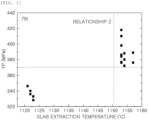
- FIG. 1 is a graph illustrating a relationship between slab extraction temperature and yield strength, illustrated in an inventive example of the present disclosure.
- a normalized rolling (NR) method as a manufacturing method in which a steel material is hot-rolled and then air-cooled in a temperature within a range having properties, equal to or better than those of a normalized heat-treated steel material, without performing normalizing heat treatment after rolling, may secure properties, equal to or better than a normalizing heat treatment material, by establishment of an optimal component design and manufacturing conditions.
- NR normalized rolling
- the steel material of the present disclosure may comprise, by weight, C: 0.12 to 0.18%, Si: 0.2 to 0.5%. Mn: 1.0 to 1.7%, P: 0.012% or less, S: 0.003% or less, Al: 0.015 to 0.045%, Nb: 0.02 to 0.05%, V: 0.01 to 0.08%, Ti: 0.005 to 0.017%, and N: 0.002 to 0.01%; and
- C may be an element effective in improving strength of steel.
- C may be included in an amount of 0.12% or more.
- an amount thereof exceeds 0.18% a degree of segregation in a central portion of the steel may increase, and a martensite-austenite (MA) structure may be formed, which may significantly reduce low-temperature impact toughness. More advantageously, 0.17% or less may be included.
- MA martensite-austenite
- Si may not be only used as a deoxidizing agent, but may be also an element advantageous for improving strength and toughness of steel. To sufficiently obtain this effect, Si may be included in an amount of 0.2% or more. When an amount thereof exceeds 0.5%, there may be a risk of excessive formation of MA and poor low-temperature impact toughness. Therefore, Si may be in an amount of 0.2 to 0.5%.
- Mn may be an element advantageous for improving strength of steel by a solid solution strengthening effect. To fully obtain the effect, Mn may be included in an amount of 1.0% or more. When an amount thereof exceeds 1.7%, it combines with sulfur (S) in the steel to form MnS, which may greatly impair low-temperature impact toughness. Therefore, Mn may be included in an amount of 1.0 to 1.7%, and more advantageously, may be included in an amount of 1.35 to 1.65%.
- P may be an element advantageous in improving strength of steel and securing corrosion resistance thereof, but may greatly impair impact toughness of the steel. Therefore, it is desirable to limit an amount thereof as low as possible. In the present disclosure, even when P is included at a maximum of 0.012%, there may be no difficulty in securing target properties. Therefore, an amount thereof is limited to be 0.012% or less. Considering a level to be unavoidably added, 0% may be excluded.
- S may be an element that greatly inhibits the hydrogen-induced cracking resistance and impact toughness of steel by combining with Mn in the steel to form MnS and the like. Therefore, it is advantageous to manage S in a low amount as possible.
- an amount thereof is limited to be 0.003% or less. Considering a level to be unavoidably added, 0% may be excluded.
- Al may be an element that may inexpensively deoxidize molten steel. To sufficiently obtain the above-mentioned effect, Al may be included in an amount of 0.015% or more. When an amount thereof exceeds 0.045%, nozzle clogging may occur during continuous casting. This may be undesirable because not only does it cause damage, but impact toughness may be significantly reduced due to formation of Al-based oxidizing inclusions. Therefore, Al may be included in 0.015 to 0.045%.
- Nb may precipitate to form NbC or Nb(C,N), greatly improving strength of a base material, and when reheated at high temperature, dissolved Nb may suppress recrystallization of austenite and transformation of ferrite or bainite to obtain a structure refinement effect.
- Nb may be included in an amount of 0.02% or more. When an amount thereof is excessive, undissolved Nb may form TiNb(C,N), which causes UT defects and impedes low-temperature impact toughness. Therefore, an upper limit of Nb may be 0.05%. More advantageously, Nb may contain 0.035 to 0.045%.
- V Vanadium (V): 0.01 to 0.08%
- V may have a low solid solution temperature, as compared to other alloy elements, and may form VC during an air cooling process after hot-rolling, to contribute significantly to increasing strength.
- a steel material such as those of the present disclosure may not have sufficient strength after post-welding heat treatment (PWHT). Therefore, a strength improvement effect may be obtained by including 0.01% or more of V.
- PWHT post-welding heat treatment
- an amount thereof exceeds 0.08%, a fraction of a hard phase such as MA may increase, causing a problem in that low-temperature impact toughness is significantly reduced. Therefore, an amount of V may be 0.01 to 0.08%.
- Ti may be included together with N to form TiN, thereby reducing occurrence of surface cracks due to formation of AlN precipitates, and may be included in an amount of 0.005% or more. When an amount thereof exceeds 0.017%, coarse TiN may be formed during reheating of a steel slab, which acts as a factor in impeding low-temperature impact toughness. Therefore, Ti may be in an amount of 0.005 to 0.017%, and more preferably 0.01 to 0.015%.
- N may be included together with Ti to form TiN and suppress grain growth due to thermal effects during welding.
- N may be included in an amount of 0.002% or more. When an amount thereof exceeds 0.01%, it is undesirable because coarse TiN is formed and low-temperature impact toughness is impaired. Therefore, N may be in an amount of 0.002 to 0.01%.
- one or more of copper (Cu): 0.5% or less and nickel (Ni) : 0.5% or less may be further included.
- Cu may be an element that may greatly improve strength by solid solution strengthening. When an amount of Cu is excessive, it may not only impair weldability due to an increase in carbon equivalent, but also significantly deteriorate surface quality of a product. Therefore, when adding Cu, it may be included at a maximum of 0.5%. In the present disclosure, there may be no difficulty in securing target properties even when Cu is not added. Therefore, it is noted that Cu is not essential.
- NI may be an element that may simultaneously improve strength of a base material and low-temperature impact toughness thereof, but may be an expensive element. When an amount thereof exceeds 0.5%, economic feasibility may be greatly reduced. Therefore, Ni may be included in an amount of 0.5% or less. In the present disclosure, there may be no difficulty in securing target properties even when Ni is not added. Therefore, it is noted that Ni is not essential.
- the remainder may include iron (Fe) and inevitable impurities.
- Fe iron
- Inevitable impurities may be unintentionally mixed in the normal steel manufacturing process, and, thus, may not be completely excluded, and any engineer in the normal steel manufacturing field can easily understand meaning thereof.
- the present disclosure does not completely exclude addition of compositions, other than the steel compositions mentioned above.
- a carbon equivalent (Ceq) of the following Relationship 1 may be 0.48 or less.
- the carbon equivalent (Ceq) exceeds 0.48, it is advantageous in securing strength, but there may be a risk that properties after welding may be greatly impaired.
- the carbon equivalent (Ceq) may be 0.48 or less.
- a microstructure of the steel material of the present disclosure may include 60 to 85% of ferrite by area fraction and remaining pearlite.
- the steel material of the present disclosure may include 60 to 85 area % of ferrite and remaining pearlite.
- a grain size of the ferrite may be 30um or less.
- the average grain size of the ferrite exceeds 30um, it is difficult to secure yield strength, and impact toughness may be greatly reduced. Therefore, the average grain size may be 30um or less.
- the microstructure of the steel material may include a precipitate of NbC and/or VC.
- a size of the precipitate may be 50 nm or less. When the size of the precipitate exceeds 50 nm, it is undesirable because impact toughness may be greatly reduced.
- the precipitates may exist within a grain of ferrite.
- a yield strength may be 370 MPa or more
- a tensile strength may be 520 MPa or more
- an average Charpy impact absorption energy (CVN, -20°C) value at a temperature of - 20°C may be 40J or more, to have excellent strength and low-temperature impact toughness.
- the above method may be manufactured by heating and hot-rolling a steel slab having an alloy composition, as described above, and a carbon equivalent (Ceq) of 0.48 or less in Relationship 1.
- a carbon equivalent (Ceq) of 0.48 or less in Relationship 1.
- Homogenization treatment may be performed by heating a steel slab satisfying an alloy composition, as described above. In this case, it is desirable to perform heating to satisfy temperature conditions defined by the following Relationship 2.
- a slab extraction temperature in the following Relationship 2 may not exceed 1200°C.
- the heated steel slab may be hot-rolled.
- the heated steel slab may be rough-rolled at a temperature within a range of 900 to 1100°C, and may be then finish hot-rolled to Ar3 or higher.
- a temperature during the rough-rolling may be less than 950°C, there may be a problem in that the temperature becomes too low during the subsequent finishing hot-rolling.
- a temperature during the finishing hot-rolling is lower than Ar3, a rolling load may increase and there may be a risk of quality defects such as surface cracks or the like.
- Ar3 910-310C-80Mn-20Cu-55Ni-80Mo+119V+124Ti-18Nb+179Al
- air cooling may be performed.
- the steel material of the present disclosure manufactured by the above method may secure high strength and excellent impact toughness without performing subsequent heat treatment, such as normalizing heat treatment or the like.
- a slab was manufactured by continuously casting molten steel having an alloy composition (% by weight, the remainder being Fe and inevitable impurities) illustrated in Table 1 below.
- the slab was manufactured to have a thickness of 300 mm.
- Table 1 Inventive Examples 1 to 4 were cases in which both the alloy composition and Relationship 1 presented in the present disclosure were satisfied, Comparative Example 1 was a case in which an amount of C and Relationship 1 were outside the values presented in the present disclosure, and Comparative Example 3 indicates that an amount of Nb was outside the value presented in the present disclosure.
- Relationship 2 may be as follows: Slab Extraction Temperature (°C) > 10300 / ⁇ 4.09 - log([Nb][C] 0.24 [N] 0.65 ) ⁇ - 273
- a microstructure and mechanical properties of a steel material manufactured as above were evaluated.
- the microstructure was observed using an optical microscope, and then a fraction and diameter of ferrite grains were measured using an analysis program, and an average diameter of a precipitate was measured using a transmission electron microscope.
- the microstructure was measured at a point t/4 (t may be the steel thickness, mm) in the thickness direction of each steel material, and the results may be illustrated in Table 3 below.
- the mechanical properties were evaluated at a 1/4t point in a thickness direction of each steel material.
- tensile specimens were collected from each thickness direction point in a direction, perpendicular to a rolling direction, to measure tensile strength (TS), yield strength (YS), and elongation (El) was measured, and the impact specimen was taken from a JIS No. 4 standard test specimen at a 1/4t point in the thickness direction in the rolling direction, and the average impact toughness (CVN) at -20°C was measured.
- TS tensile strength
- YS yield strength
- El elongation
- the impact specimen was taken from a JIS No. 4 standard test specimen at a 1/4t point in the thickness direction in the rolling direction, and the average impact toughness (CVN) at -20°C was measured.
- CVN average impact toughness
- Table 4 above illustrates tensile properties and low-temperature impact toughness before and after normalizing.
- normalizing treatment was held at 870°C for 128 minutes, and was then air-cooled.
- Inventive Examples 1 to 4 a component range, Relationships 1 and 2, and microstructure properties presented in the present disclosure were satisfied, and both tensile properties and low-temperature impact toughness were satisfied. Specifically, in Inventive Examples 1 to 4, when comparing results after as-rolled and normalizing heat treatment, yield strength and tensile strength slightly decreased after heat treatment, but still satisfy the strength presented in the present disclosure. Impact toughness increased slightly, as compared to those manufactured by an NR method after heat treatment, and it can be confirmed that impact toughness presented by the present disclosure was satisfied.
- Comparative Example 1 as component systems in which an amount of C and Relationship 1 were outside the range presented in the present disclosure, but it can be confirmed that yield/tensile strength satisfied the values presented in the present disclosure due to excessive addition of C, and impact toughness did not satisfy the values.
- Comparative Example 2 satisfied all of the component ranges presented in the present disclosure, but did not satisfy Relationship 2 to have a very low slab extraction temperature. It can be confirmed that, after both as-rolled and normalizing heat treatments, yield strength and tensile strength presented in the present disclosure were lowered. In addition, it can be confirmed that a decrease in yield strength was very large, as compared to Inventive Examples 1 to 4.
- Comparative Example 3 was a case in which an amount of Nb deviated from the value presented in the present disclosure. Even though Nb was heated at a temperature at which Nb was sufficiently dissolved in a slab, an amount itself was very low and an NbC precipitate was not sufficiently precipitated. Therefore, it can be confirmed that the NbC precipitate was not sufficiently precipitated, and yield strength and tensile strength were not satisfied, and in Comparative Example 3, it can also be confirmed that yield strength decreased significantly after normalizing heat treatment.
- a steel material having a thickness of 75 mmt was manufactured by rolling a slab having the components of Inventive Example 1 of Example 1.
- results of Relationship 2 of the extraction temperature were varied, results of relationship between an extraction temperature and yield strength were illustrated in FIG. 1 . It can be confirmed that, when the extraction temperature did not satisfy Relationship 2, yield strength presented in the present disclosure did not satisfied, whereas when the extraction temperature satisfied Relationship 2, all exhibited excellent yield strength.
Landscapes
- Chemical & Material Sciences (AREA)
- Engineering & Computer Science (AREA)
- Mechanical Engineering (AREA)
- Materials Engineering (AREA)
- Metallurgy (AREA)
- Organic Chemistry (AREA)
- Physics & Mathematics (AREA)
- Thermal Sciences (AREA)
- Crystallography & Structural Chemistry (AREA)
- Heat Treatment Of Steel (AREA)
Abstract
Description
- The present disclosure relates to a steel material having high strength and excellent impact toughness, usable for a land-based wind power generator and the like; and a method for manufacturing the same.
- Recently, as a tower height of a land-based wind power generator has gradually become more advanced, demand for a thick, high strength steel material having excellent load resistance capacity has increased, and at the same time, a guarantee of impact toughness has also been required.
- In order to realize high strength and excellent impact toughness of a steel material, refinement of a grain thereof is essential, and a rolling process may be one of various representative methods for the refinement of the grain. When rolling is performed at a temperature at which recrystallization may occur, a new fine grain of austenite may be generated using internal stress generated by a roll separation force, as a driving force. Meanwhile, a grain may receive stress by rolling in a temperature within a range in which recrystallization does not occur, to form a band structure in a rolling direction, and when many dislocations occur therein to undergo phase transformation of austenite, more nucleation sites may be provided to cause a grain refinement effect.
- However, as a thickness of the steel material increases, a roll separation force that may be applied by rolling becomes limited, and as an internal structure, especially a central portion of the steel material is closer thereto, it may be less easy to form a fine grain by the rolling. This is because the grain of austenite tends to grow at temperatures equal to or higher than Ae3, as a temperature increases and a heating time period increases.
- Meanwhile, it is often difficult to secure a grain having a sufficiently small size only by reheating and rolling of a slab, which may be processes in which refinement of a grain of austenite mainly occurs. In particular, as a temperature of the steel material to be rolled increases, deformation resistance during the rolling may decrease. For easy rolling, the reheating of the slab may be usually performed at a temperature much higher, as compared to the Ae3 temperature, and at that time, the grain of austenite may grow significantly. When a grain refinement effect by rolling is not sufficient, an additional grain refining effect of austenite may be expected by a re-heating treatment after the rolling process, which generally may include a normalizing heat treatment.
- As a material for a wind tower, a steel material that has been subjected to a normalizing heat treatment has traditionally been applied. However, when a heat treatment, as above, is applied during a manufacturing process, manufacturing costs may increase significantly. Accordingly, the material for a wind tower may not be easy to produce commercially, as compared to an as-rolled steel material or a thermo-mechanical controlled process (TMCP) steel material. Accordingly, there may be demand for manufacturing a steel material having properties, similar to those of a normalized heat-treated steel material without undergoing a normalizing heat treatment.
- Patent Document 1 proposes a method of manufacturing a steel material having excellent impact toughness without a normalizing heat treatment. However, Patent Document 1 has a low carbon content, which is advantageous in securing sufficient low-temperature impact toughness, but it may be difficult to secure sufficient strength, and furthermore, there may be a limitation in that strength decreases significantly as thickness increases.
- (Patent Document 1)
Korean Registered Patent No. 10-1917453 - An aspect of the present disclosure is to provide a steel material with excellent strength and impact toughness, even when a heat treatment process is omitted, and a method for manufacturing the same.
- An object of the present disclosure is not limited to those mentioned above. The additional problems of the present disclosure may be described throughout the specification, and those skilled in the art will have no difficulty in understanding the additional problems of the present disclosure from those described in the specification of the present disclosure.
- According to an aspect of the present disclosure, a steel material having high strength and excellent impact toughness, comprises, by weight, C: 0.12 to 0.18%, Si: 0.2 to 0.5%. Mn: 1.0 to 1.7%, P: 0.012% or less, S: 0.003% or less, Al: 0.015 to 0.045%, Nb: 0.02 to 0.05%, V: 0.01 to 0.08%, Ti: 0.005 to 0.017%, N: 0.002 to 0.01%, and a remainder of Fe and inevitable impurities;
- wherein a carbon equivalent (Ceq) of the following Relationship 1 is 0.48 or less,
- a microstructure comprises 60 to 85% of ferrite by area fraction and remaining pearlite, and the microstructure includes at least one precipitate of NbC or VC, and a size of the precipitates is 50 nm or less:

- Where C, Mn, Cr, Mo, V, Cu, and Ni are amounts (% by weight) of respective components.
- According to another aspect of the present disclosure, a method of manufacturing a steel material having high strength and excellent impact toughness, comprises heating a steel slab comprising, by weight, C: 0.12 to 0.18%, Si: 0.2 to 0.5%. Mn: 1.0 to 1.7%, P: 0.012% or less, S: 0.003% or less, Al: 0.015 to 0.045%, Nb: 0.02 to 0.05%, V: 0.01 to 0.08%, Ti: 0.005 to 0.017%, N: 0.002 to 0.01%, and a remainder of Fe and inevitable impurities, and in which a carbon equivalent (Ceq) of the following Relationship 1 is 0.48 or less, under conditions of the following
Relationship 2; and - rough-rolling the heated steel slab at a temperature within a range of 900 to 1100°C, and then finishing hot-rolling to Ar3 or higher after the rough-rolling:

- Where C, Mn, Cr, Mo, V, Cu, and Ni are amounts (% by weight) of respective components.
Slab Extraction Temperature (°C) > 10300 / {4.09 - log([Nb][C]0.24[N]0.65)} - 273 - Where [Nb], [C], and [N] mean an amount (% by weight) in an alloy composition, respectively.
- According to the present disclosure, a steel material securing excellent strength and impact toughness without performing normalizing heat treatment after rolling may be provided, and may be widely used for a wind power structure or the like. In addition, a commercially useful steel material may be provided by reducing manufacturing costs by omitting a heat treatment.
- Various advantages and effects of the present disclosure are not limited to those described above, and can be more easily understood through description of specific embodiments of the present disclosure.
-
FIG. 1 is a graph illustrating a relationship between slab extraction temperature and yield strength, illustrated in an inventive example of the present disclosure. - Hereinafter, terms used in the present specification are for describing the present disclosure, and are not intended to limit the present disclosure. Additionally, as used herein, singular forms include plural forms unless relevant definitions clearly indicates the contrary.
- The meaning of "including" or "comprising" used in the specification specifies a configuration, and does not exclude the presence or addition of another configuration.
- Unless otherwise defined, all terms, including technical and scientific terms, used in the present specification have the same meaning as commonly understood by a person of ordinary skill in the technical field to which the present disclosure pertains. Terms defined in the dictionary may be interpreted to have meanings consistent with related technical literature and current disclosure.
- The present inventors recognized that a normalized rolling (NR) method, as a manufacturing method in which a steel material is hot-rolled and then air-cooled in a temperature within a range having properties, equal to or better than those of a normalized heat-treated steel material, without performing normalizing heat treatment after rolling, may secure properties, equal to or better than a normalizing heat treatment material, by establishment of an optimal component design and manufacturing conditions.
- In particular, in structural steel used in a land-based wind tower or the like, as a large size and economic efficiency are required, a method is needed to secure properties required for a material thereof and manufacture the same economically. Accordingly, in an alloy design, it was confirmed that a steel material having target properties could be provided by identifying and optimizing an alloy composition and a relationship between some components and optimizing manufacturing conditions, leading to completion of the present disclosure.
- Hereinafter, an embodiment of a steel material of the present disclosure will be described in detail.
- First, an alloy composition of the steel material will be described in detail. The steel material of the present disclosure may comprise, by weight, C: 0.12 to 0.18%, Si: 0.2 to 0.5%. Mn: 1.0 to 1.7%, P: 0.012% or less, S: 0.003% or less, Al: 0.015 to 0.045%, Nb: 0.02 to 0.05%, V: 0.01 to 0.08%, Ti: 0.005 to 0.017%, and N: 0.002 to 0.01%; and
- may further include one or more of Cu: 0.5% or less and Ni: 0.5% or less.
- Carbon (C): 0.12 to 0.18% by weight (hereinafter, referred to as %, unless specifically mentioned in the present disclosure, an amount of each element is based on weight%.)
- C may be an element effective in improving strength of steel. For this purpose, C may be included in an amount of 0.12% or more. When an amount thereof exceeds 0.18%, a degree of segregation in a central portion of the steel may increase, and a martensite-austenite (MA) structure may be formed, which may significantly reduce low-temperature impact toughness. More advantageously, 0.17% or less may be included.
- Si may not be only used as a deoxidizing agent, but may be also an element advantageous for improving strength and toughness of steel. To sufficiently obtain this effect, Si may be included in an amount of 0.2% or more. When an amount thereof exceeds 0.5%, there may be a risk of excessive formation of MA and poor low-temperature impact toughness. Therefore, Si may be in an amount of 0.2 to 0.5%.
- Mn may be an element advantageous for improving strength of steel by a solid solution strengthening effect. To fully obtain the effect, Mn may be included in an amount of 1.0% or more. When an amount thereof exceeds 1.7%, it combines with sulfur (S) in the steel to form MnS, which may greatly impair low-temperature impact toughness. Therefore, Mn may be included in an amount of 1.0 to 1.7%, and more advantageously, may be included in an amount of 1.35 to 1.65%.
- P may be an element advantageous in improving strength of steel and securing corrosion resistance thereof, but may greatly impair impact toughness of the steel. Therefore, it is desirable to limit an amount thereof as low as possible. In the present disclosure, even when P is included at a maximum of 0.012%, there may be no difficulty in securing target properties. Therefore, an amount thereof is limited to be 0.012% or less. Considering a level to be unavoidably added, 0% may be excluded.
- S may be an element that greatly inhibits the hydrogen-induced cracking resistance and impact toughness of steel by combining with Mn in the steel to form MnS and the like. Therefore, it is advantageous to manage S in a low amount as possible. In the present disclosure, even when S is included at a maximum of 0.003%, there may be no difficulty in securing target properties. Therefore, an amount thereof is limited to be 0.003% or less. Considering a level to be unavoidably added, 0% may be excluded.
- Al may be an element that may inexpensively deoxidize molten steel. To sufficiently obtain the above-mentioned effect, Al may be included in an amount of 0.015% or more. When an amount thereof exceeds 0.045%, nozzle clogging may occur during continuous casting. This may be undesirable because not only does it cause damage, but impact toughness may be significantly reduced due to formation of Al-based oxidizing inclusions. Therefore, Al may be included in 0.015 to 0.045%.
- Nb may precipitate to form NbC or Nb(C,N), greatly improving strength of a base material, and when reheated at high temperature, dissolved Nb may suppress recrystallization of austenite and transformation of ferrite or bainite to obtain a structure refinement effect. For this purpose, Nb may be included in an amount of 0.02% or more. When an amount thereof is excessive, undissolved Nb may form TiNb(C,N), which causes UT defects and impedes low-temperature impact toughness. Therefore, an upper limit of Nb may be 0.05%. More advantageously, Nb may contain 0.035 to 0.045%.
- V may have a low solid solution temperature, as compared to other alloy elements, and may form VC during an air cooling process after hot-rolling, to contribute significantly to increasing strength. A steel material such as those of the present disclosure may not have sufficient strength after post-welding heat treatment (PWHT). Therefore, a strength improvement effect may be obtained by including 0.01% or more of V. When an amount thereof exceeds 0.08%, a fraction of a hard phase such as MA may increase, causing a problem in that low-temperature impact toughness is significantly reduced. Therefore, an amount of V may be 0.01 to 0.08%.
- Ti may be included together with N to form TiN, thereby reducing occurrence of surface cracks due to formation of AlN precipitates, and may be included in an amount of 0.005% or more. When an amount thereof exceeds 0.017%, coarse TiN may be formed during reheating of a steel slab, which acts as a factor in impeding low-temperature impact toughness. Therefore, Ti may be in an amount of 0.005 to 0.017%, and more preferably 0.01 to 0.015%.
- It may be advantageous that N may be included together with Ti to form TiN and suppress grain growth due to thermal effects during welding. To sufficiently obtain the above-described effects when adding Ti, N may be included in an amount of 0.002% or more. When an amount thereof exceeds 0.01%, it is undesirable because coarse TiN is formed and low-temperature impact toughness is impaired. Therefore, N may be in an amount of 0.002 to 0.01%.
- Additionally, in addition to the above composition, one or more of copper (Cu): 0.5% or less and nickel (Ni) : 0.5% or less may be further included.
- Cu may be an element that may greatly improve strength by solid solution strengthening. When an amount of Cu is excessive, it may not only impair weldability due to an increase in carbon equivalent, but also significantly deteriorate surface quality of a product. Therefore, when adding Cu, it may be included at a maximum of 0.5%. In the present disclosure, there may be no difficulty in securing target properties even when Cu is not added. Therefore, it is noted that Cu is not essential.
- NI may be an element that may simultaneously improve strength of a base material and low-temperature impact toughness thereof, but may be an expensive element. When an amount thereof exceeds 0.5%, economic feasibility may be greatly reduced. Therefore, Ni may be included in an amount of 0.5% or less. In the present disclosure, there may be no difficulty in securing target properties even when Ni is not added. Therefore, it is noted that Ni is not essential.
- The remainder may include iron (Fe) and inevitable impurities. Inevitable impurities may be unintentionally mixed in the normal steel manufacturing process, and, thus, may not be completely excluded, and any engineer in the normal steel manufacturing field can easily understand meaning thereof. In addition, the present disclosure does not completely exclude addition of compositions, other than the steel compositions mentioned above.
- To secure impact toughness as well as a target level of strength in a steel material of the present disclosure, it is desirable to appropriately adjust amounts of elements advantageous for improving properties by adding a certain amount thereof. Therefore, a carbon equivalent (Ceq) of the following Relationship 1 may be 0.48 or less. When the carbon equivalent (Ceq) exceeds 0.48, it is advantageous in securing strength, but there may be a risk that properties after welding may be greatly impaired. In addition, when large amounts of alloy elements are included, the costs will increase and economic feasibility will be impaired. Therefore, the carbon equivalent (Ceq) may be 0.48 or less.

- Where C, Mn, Cr, Mo, V, Cu, and Ni are amounts (% by weight) of respective components.
- A microstructure of the steel material of the present disclosure may include 60 to 85% of ferrite by area fraction and remaining pearlite. When the ferrite fraction is less than 60% or the remaining pearlite fraction exceeds 40%, it is advantageous to secure strength, but impact toughness may decrease significantly. In addition, when the ferrite fraction exceeds 85%, it is advantageous to secure impact toughness, but it is difficult to secure sufficient strength. Therefore, the steel material of the present disclosure may include 60 to 85 area % of ferrite and remaining pearlite.
- A grain size of the ferrite may be 30um or less. When an average grain size of the ferrite exceeds 30um, it is difficult to secure yield strength, and impact toughness may be greatly reduced. Therefore, the average grain size may be 30um or less.
- The microstructure of the steel material may include a precipitate of NbC and/or VC. A size of the precipitate may be 50 nm or less. When the size of the precipitate exceeds 50 nm, it is undesirable because impact toughness may be greatly reduced. The precipitates may exist within a grain of ferrite.
- When the steel material is evaluated perpendicular to a rolling direction at a t/4 point in a thickness direction (where t means a thickness (mm) of the steel material), a yield strength may be 370 MPa or more, a tensile strength may be 520 MPa or more, and an average Charpy impact absorption energy (CVN, -20°C) value at a temperature of - 20°C may be 40J or more, to have excellent strength and low-temperature impact toughness.
- Next, an embodiment of a method for manufacturing a steel material of the present disclosure will be described in detail. The above method may be manufactured by heating and hot-rolling a steel slab having an alloy composition, as described above, and a carbon equivalent (Ceq) of 0.48 or less in Relationship 1. Hereinafter, each process will be described in detail.
- Homogenization treatment may be performed by heating a steel slab satisfying an alloy composition, as described above. In this case, it is desirable to perform heating to satisfy temperature conditions defined by the following
Relationship 2. A slab extraction temperature in the followingRelationship 2 may not exceed 1200°C. - When a heating temperature of the steel slab does not satisfy the conditions of the following
Relationship 2, a precipitate (carbide, nitride) formed in the slab may not be sufficiently re-dissolved, thereby reducing formation of precipitate in a process after hot-rolling, and it is ultimately difficult to satisfy specified yield strength and tensile strength presented in the present disclosure. When the slab extraction temperature exceeds 1200°C, a grain of austenite may coarsen and properties of the steel may deteriorate. Therefore, the slab extraction temperature may not exceed 1200°C.Slab Extraction Temperature (°C) > 10300 / {4.09 - log([Nb][C]0.24[N]0.65)} - 273 - Where [Nb], [C], and [N] mean an amount (% by weight) in an alloy composition, respectively.
- The heated steel slab may be hot-rolled. The heated steel slab may be rough-rolled at a temperature within a range of 900 to 1100°C, and may be then finish hot-rolled to Ar3 or higher. When a temperature during the rough-rolling may be less than 950°C, there may be a problem in that the temperature becomes too low during the subsequent finishing hot-rolling. When a temperature during the finishing hot-rolling is lower than Ar3, a rolling load may increase and there may be a risk of quality defects such as surface cracks or the like.
Ar3 = 910-310C-80Mn-20Cu-55Ni-80Mo+119V+124Ti-18Nb+179Al - Where each element means an amount (% by weight))
- After the hot-rolling, air cooling may be performed.
- The steel material of the present disclosure manufactured by the above method may secure high strength and excellent impact toughness without performing subsequent heat treatment, such as normalizing heat treatment or the like.
- Next, examples of the present disclosure will be described.
- Various modifications to the following examples may be made by those skilled in the art without departing from the scope of the present disclosure. The following examples are for understanding of the present disclosure, and the scope of the present disclosure should not be limited to the following examples, but should be determined by the claims described below as well as their equivalents.
- A slab was manufactured by continuously casting molten steel having an alloy composition (% by weight, the remainder being Fe and inevitable impurities) illustrated in Table 1 below. In this case, the slab was manufactured to have a thickness of 300 mm. In Table 1, Inventive Examples 1 to 4 were cases in which both the alloy composition and Relationship 1 presented in the present disclosure were satisfied, Comparative Example 1 was a case in which an amount of C and Relationship 1 were outside the values presented in the present disclosure, and Comparative Example 3 indicates that an amount of Nb was outside the value presented in the present disclosure.
[Table 1] C Si Mn P S Al Nb Cu Ni V Ti N Relationship 1 Inventive Example 1 0.1 50 0.4 50 1.5 30 0.0 08 0.0 02 0.0 30 0.0 45 0.0 00 0.0 00 0.0 40 0.0 12 0.0 035 0.413 Inventive Example 2 0.1 60 0.4 50 1.6 50 0.0 08 0.0 02 0.0 30 0.0 45 0.0 00 0.0 00 0.0 40 0.0 12 0.0 036 0.443 Inventive Example 3 0.1 55 0.4 50 1.6 00 0.0 09 0.0 02 0.0 30 0.0 35 0.0 00 0.0 00 0.0 55 0.0 12 0.0 035 0.433 Inventive Example 4 0.1 60 0.4 00 1.6 50 0.0 08 0.0 02 0.0 30 0.0 45 0.1 00 0.2 00 0.0 45 0.0 12 0.0 035 0.464 Comparative Example 1 0.1 85 0.4 00 1.6 50 0.0 09 0.0 02 0.0 30 0.0 40 0.1 00 0.1 50 0.0 45 0.0 12 0.0 036 0.486 Comparative Example 2 0.1 50 0.4 50 1.6 00 0.0 08 0.0 02 0.0 30 0.0 45 0.0 00 0.0 00 0.0 30 0.0 12 0.0 035 0.423 Comparative Example 3 0.1 60 0.4 50 1.5 50 0.0 08 0.0 02 0.0 30 0.0 15 0.0 00 0.0 00 0.0 35 0.0 12 0.0 036 0.425 - In Table 1 above, Relationship 1 may be calculated as follows:

- Where C, Mn, Cr, Mo, V, Cu, and Ni are amounts (% by weight) of respective components.
- The slab was heated and rough-rolled under conditions in Table 2, finish hot-rolled at a temperature within a range of 880 to 900°C to produce a hot-rolled steel sheet having a thickness of 5 mm, and air-cooled to room temperature. Inventive Examples 1 to 4 and Comparative Examples 1 and 3 satisfied the process conditions presented in the present disclosure, but Comparative Example 2 did not satisfy the conditions of
Relationship 2 below.[Table 2] Extractio n Temp.(°C) Furnace Time (min.) Remaining Reduction Ratio (%) Roll Start Temp. (°C) Roll Finish Temp. (°C) Relati onship 2Satisfaction of Relationship 2Inventive Example 1 1161 362 50 930 900 1151 ○ Inventive Example 2 1165 360 50 928 898 1154 ○ Inventive Example 3 1160 360 50 915 880 1131 ○ Inventive Example 4 1162 362 50 920 890 1153 ○ Comparati ve Example 1 1160 362 50 920 890 1147 ○ Comparati ve Example 2 1125 360 50 925 895 1151 X Comparati ve Example 3 1164 361 50 930 900 1066 ○ - In Table 2 above,
Relationship 2 may be as follows:Slab Extraction Temperature (°C) > 10300 / {4.09 - log([Nb][C]0.24[N]0.65)} - 273 - Where [Nb], [C], and [N] mean an amount (% by weight) in an alloy composition, respectively.
- A microstructure and mechanical properties of a steel material manufactured as above were evaluated. The microstructure was observed using an optical microscope, and then a fraction and diameter of ferrite grains were measured using an analysis program, and an average diameter of a precipitate was measured using a transmission electron microscope. In this case, the microstructure was measured at a point t/4 (t may be the steel thickness, mm) in the thickness direction of each steel material, and the results may be illustrated in Table 3 below.
- In addition, the mechanical properties were evaluated at a 1/4t point in a thickness direction of each steel material. In this case, tensile specimens were collected from each thickness direction point in a direction, perpendicular to a rolling direction, to measure tensile strength (TS), yield strength (YS), and elongation (El) was measured, and the impact specimen was taken from a JIS No. 4 standard test specimen at a 1/4t point in the thickness direction in the rolling direction, and the average impact toughness (CVN) at -20°C was measured. The results may be illustrated in Table 4 below.
[Table 3] Microstructure Polygonal Ferrite (area %) Pearlite (area %) Grain Size of Ferrite (µm) Size of Precipitate (nm) Inventive Example 1 80 20 26 35 Inventive Example 2 76 24 22 34 Inventive Example 3 77 23 27 42 Inventive Example 4 76 24 20 41 Comparative Example 1 68 32 36 67 Comparative Example 2 81 19 28 36 Comparative Example 3 76 24 34 30 - As illustrated in Table 3, Inventive Steels 1 to 4 manufactured according to the alloy composition, component relationship, and manufacturing conditions, proposed in the present disclosure, satisfied a fraction, a grain size, and a precipitate size of polygonal ferrite proposed in the present disclosure. Comparative Examples 1 and 3 were satisfied with the polygonal ferrite fraction, but a grain size of ferrite was outside the value presented in the present disclosure. Additionally, Comparative Example 1 deviated from a size of the precipitate presented in the present disclosure.
[Table 4] As-rolled Normalized Tensile Properties Impact Toughness (J) Tensile Properties Impact Toughness (J) YP (MPa) TS (MPa) El.(%) YP (MPa) TS (MPa) El.(%) Inventive Example 1 383 536 27 210 377 524 28 223 Inventive Example 2 402 552 26 196 396 530 27 200 Inventive Example 3 410 556 25 174 400 542 26 186 Inventive Example 4 401 548 26 195 393 529 27 203 Comparative Example 1 410 544 24 35 374 524 24 42 Comparative Example 2 336 497 29 168 316 488 30 173 Comparative Example 3 351 520 26 75 330 509 28 94 - Table 4 above illustrates tensile properties and low-temperature impact toughness before and after normalizing. In this case, normalizing treatment was held at 870°C for 128 minutes, and was then air-cooled.
- In Inventive Examples 1 to 4, a component range,
Relationships 1 and 2, and microstructure properties presented in the present disclosure were satisfied, and both tensile properties and low-temperature impact toughness were satisfied. Specifically, in Inventive Examples 1 to 4, when comparing results after as-rolled and normalizing heat treatment, yield strength and tensile strength slightly decreased after heat treatment, but still satisfy the strength presented in the present disclosure. Impact toughness increased slightly, as compared to those manufactured by an NR method after heat treatment, and it can be confirmed that impact toughness presented by the present disclosure was satisfied. - In Comparative Example 1, as component systems in which an amount of C and Relationship 1 were outside the range presented in the present disclosure, but it can be confirmed that yield/tensile strength satisfied the values presented in the present disclosure due to excessive addition of C, and impact toughness did not satisfy the values. Comparative Example 2 satisfied all of the component ranges presented in the present disclosure, but did not satisfy
Relationship 2 to have a very low slab extraction temperature. It can be confirmed that, after both as-rolled and normalizing heat treatments, yield strength and tensile strength presented in the present disclosure were lowered. In addition, it can be confirmed that a decrease in yield strength was very large, as compared to Inventive Examples 1 to 4. This was be believed to be due to a significant decrease in strength as Nb was not sufficiently dissolved in the slab and NbC was not sufficiently precipitated during rolling. Comparative Example 3 was a case in which an amount of Nb deviated from the value presented in the present disclosure. Even though Nb was heated at a temperature at which Nb was sufficiently dissolved in a slab, an amount itself was very low and an NbC precipitate was not sufficiently precipitated. Therefore, it can be confirmed that the NbC precipitate was not sufficiently precipitated, and yield strength and tensile strength were not satisfied, and in Comparative Example 3, it can also be confirmed that yield strength decreased significantly after normalizing heat treatment. - As a separate example, a steel material having a thickness of 75 mmt was manufactured by rolling a slab having the components of Inventive Example 1 of Example 1. In this case, to confirm yield strength according to a slab extraction temperature, when results of
Relationship 2 of the extraction temperature were varied, results of relationship between an extraction temperature and yield strength were illustrated inFIG. 1 . It can be confirmed that, when the extraction temperature did not satisfyRelationship 2, yield strength presented in the present disclosure did not satisfied, whereas when the extraction temperaturesatisfied Relationship 2, all exhibited excellent yield strength.
Claims (8)
- A steel material having high strength and excellent impact toughness, comprising:by weight, C: 0.12 to 0.18%, Si: 0.2 to 0.5%. Mn: 1.0 to 1.7%, P: 0.012% or less, S: 0.003% or less, Al: 0.015 to 0.045%, Nb: 0.02 to 0.05%, V: 0.01 to 0.08%, Ti: 0.005 to 0.017%, N: 0.002 to 0.01%, and a remainder of Fe and inevitable impurities;wherein a carbon equivalent (Ceq) of the following [Relationship 1] is 0.48 or less,a microstructure comprises 60 to 85% of ferrite by area fraction and remaining pearlite, and the microstructure includes at least one precipitate of NbC or VC, and a size of the precipitates is 50 nm or less:
 Where C, Mn, Cr, Mo, V, Cu, and Ni are amounts (% by weight) of respective components.
 - The steel material of claim 1, further comprising at least one of Cu: 0.5% or less or Ni: 0.5% or less.
- The steel material of claim 1, wherein a grain size of the ferrite is 30um or less.
- The steel material of claim 1, wherein the at least one precipitate of NbC or VC is provided in a grain of the ferrite.
- The steel material of claim 1, wherein, when the steel material is evaluated perpendicular to a rolling direction at a t/4 point in a thickness direction (where t means a thickness (mm) of the steel material), a yield strength is 370 MPa or more, a tensile strength is 520 MPa or more, and an average Charpy impact absorption energy (CVN, -20°C) value at a temperature of -20°C is 40J or more.
- A method of manufacturing a steel material having high strength and excellent impact toughness, comprising:heating a steel slab comprising, by weight, C: 0.12 to 0.18%, Si: 0.2 to 0.5%. Mn: 1.0 to 1.7%, P: 0.012% or less, S: 0.003% or less, Al: 0.015 to 0.045%, Nb: 0.02 to 0.05%, V: 0.01 to 0.08%, Ti: 0.005 to 0.017%, N: 0.002 to 0.01%, and a remainder of Fe and inevitable impurities, and in which a carbon equivalent (Ceq) of the following [Relationship 1] is 0.48 or less, under conditions of the following [Relationship 2]; andrough-rolling the heated steel slab at a temperature within a range of 900 to 1100°C, and then finishing hot-rolling to Ar3 or higher after the rough-rolling:
 Where C, Mn, Cr, Mo, V, Cu, and Ni are amounts (% by weight) of respective components.
Slab Extraction Temperature (°C) > 10300 / {4.09 - log([Nb][C]0.24[N]0.65)} - 273 Where [Nb], [C], and [N] mean an amount (% by weight) in an alloy composition, respectively. - The method of claim 6, wherein the steel slab further comprises at least one of Cu: 0.5% or less or Ni: 0.5% or less.
- The method of claim 6, wherein the slab extraction temperature is 1200°C or lower.
Applications Claiming Priority (2)
| Application Number | Priority Date | Filing Date | Title |
|---|---|---|---|
| KR1020210178434A KR20230089767A (en) | 2021-12-14 | 2021-12-14 | Steel plate having high strength and excellent impact toughness, and method for manufacturing the same |
| PCT/KR2022/016882 WO2023113219A1 (en) | 2021-12-14 | 2022-11-01 | Steel material having high strength and excellent impact toughness, and manufacturing method therefor |
Publications (2)
| Publication Number | Publication Date |
|---|---|
| EP4450662A1 true EP4450662A1 (en) | 2024-10-23 |
| EP4450662A4 EP4450662A4 (en) | 2025-05-21 |
Family
ID=86772938
Family Applications (1)
| Application Number | Title | Priority Date | Filing Date |
|---|---|---|---|
| EP22907690.6A Pending EP4450662A4 (en) | 2021-12-14 | 2022-11-01 | STEEL MATERIAL HAVING HIGH STRENGTH AND EXCELLENT IMPACT TOUGHNESS, AND MANUFACTURING METHOD THEREOF |
Country Status (6)
| Country | Link |
|---|---|
| US (1) | US20240352563A1 (en) |
| EP (1) | EP4450662A4 (en) |
| JP (1) | JP2024530516A (en) |
| KR (1) | KR20230089767A (en) |
| CN (1) | CN117836460A (en) |
| WO (1) | WO2023113219A1 (en) |
Family Cites Families (13)
| Publication number | Priority date | Publication date | Assignee | Title |
|---|---|---|---|---|
| JP3509603B2 (en) * | 1998-03-05 | 2004-03-22 | Jfeスチール株式会社 | Extra-thick H-section steel with excellent toughness and yield strength of 325 MPa or more |
| JP4445161B2 (en) * | 2001-06-19 | 2010-04-07 | 新日本製鐵株式会社 | Manufacturing method of thick steel plate with excellent fatigue strength |
| KR101205144B1 (en) * | 2010-06-28 | 2012-11-26 | 현대제철 주식회사 | H-steel for building structure and method for producing the same |
| JP5293903B1 (en) * | 2011-08-23 | 2013-09-18 | 新日鐵住金株式会社 | Thick ERW Steel Pipe and Method for Manufacturing the Same |
| KR20150026581A (en) * | 2013-09-03 | 2015-03-11 | 동국제강주식회사 | Thick steel plate having excellent bend property for tower of wind power generator and method of manufacturing the same |
| JP6354065B2 (en) * | 2014-10-30 | 2018-07-11 | Jfeスチール株式会社 | Thick steel plate and manufacturing method thereof |
| JP6007968B2 (en) * | 2014-12-26 | 2016-10-19 | 新日鐵住金株式会社 | High-strength and highly ductile steel plate and its manufacturing method |
| KR101758483B1 (en) * | 2015-12-15 | 2017-07-17 | 주식회사 포스코 | High strength steel sheet having excellent strain aging impact property and method for manufacturing the same |
| KR101889174B1 (en) * | 2016-12-13 | 2018-08-16 | 주식회사 포스코 | High yield ratio high strength steel having excellent burring property at low temperature and method for manufacturing same |
| KR101917453B1 (en) | 2016-12-22 | 2018-11-09 | 주식회사 포스코 | Steel plate having excellent ultra low-temperature toughness and method for manufacturing same |
| KR101899691B1 (en) * | 2016-12-23 | 2018-10-31 | 주식회사 포스코 | Pressure vessel steel plate with excellent hydrogen induced cracking resistance and manufacturing method thereof |
| KR102419239B1 (en) * | 2017-10-31 | 2022-07-08 | 제이에프이 스틸 가부시키가이샤 | H-beam and its manufacturing method |
| KR102830746B1 (en) * | 2019-12-20 | 2025-07-08 | 주식회사 포스코 | Fitting part having excellent resistance to hydrogen induced cracking and manufacturing method for the same |
-
2021
- 2021-12-14 KR KR1020210178434A patent/KR20230089767A/en active Pending
-
2022
- 2022-11-01 EP EP22907690.6A patent/EP4450662A4/en active Pending
- 2022-11-01 CN CN202280057234.2A patent/CN117836460A/en active Pending
- 2022-11-01 WO PCT/KR2022/016882 patent/WO2023113219A1/en not_active Ceased
- 2022-11-01 JP JP2024510418A patent/JP2024530516A/en active Pending
- 2022-11-01 US US18/681,397 patent/US20240352563A1/en active Pending
Also Published As
| Publication number | Publication date |
|---|---|
| WO2023113219A1 (en) | 2023-06-22 |
| CN117836460A (en) | 2024-04-05 |
| EP4450662A4 (en) | 2025-05-21 |
| KR20230089767A (en) | 2023-06-21 |
| JP2024530516A (en) | 2024-08-21 |
| US20240352563A1 (en) | 2024-10-24 |
Similar Documents
| Publication | Publication Date | Title |
|---|---|---|
| US12522888B2 (en) | Method of manufacutring a high-strength cold rolled steel sheet having high hole expansion ratio, and highstrength hot-dip galvanized steel sheet | |
| KR102276741B1 (en) | High strength cold-rolled steel sheet and galvanized steel sheet having high hole expansion ratio and manufacturing method thereof | |
| US12305256B2 (en) | High-strength steel sheet and manufacturing method thereof | |
| JP2024500851A (en) | Extra-thick steel material with excellent low-temperature impact toughness and its manufacturing method | |
| JPH08295982A (en) | Steel plate excellent in low temperature toughness and method of manufacturing the same | |
| KR102490313B1 (en) | Cold rolled steel sheet having excellent strength and formability and method of manufacturing the same | |
| KR20210080676A (en) | High-strength steel sheet with excellent ductability and formability and method of manufacturing the same | |
| KR102400036B1 (en) | Steel sheet having excellent low temperature toughness and low yield ratio and method of manufacturing the same | |
| JP3725367B2 (en) | Ultra-fine ferrite structure high-strength hot-rolled steel sheet excellent in stretch flangeability and manufacturing method thereof | |
| JPH0941088A (en) | High toughness low temperature steel sheet manufacturing method | |
| JPH0920922A (en) | High toughness low temperature steel sheet manufacturing method | |
| KR20200076799A (en) | Ultra thick steel plate having excellent toughness at the center of thickness and manufacturing method for the same | |
| EP4640903A1 (en) | Steel plate having high strength and excellent low-temperature impact toughness and method for manufacturing same | |
| EP4438761A1 (en) | Hot-rolled steel sheet and method for manufacturing same | |
| US20240352563A1 (en) | Steel material having high strength and excellent impact toughness, and manufacturing method therefor | |
| WO2023089951A1 (en) | Thick steel sheet and manufacturing method therefor | |
| EP4640885A1 (en) | Steel sheet and method for manufacturing same | |
| CN116568847B (en) | Ultra-thick steel plate with excellent low-temperature impact toughness and manufacturing method thereof | |
| EP4394076A1 (en) | Cold rolled steel sheet having excellent weldability, strength, and formability, and method for manufacturing same | |
| EP4640881A1 (en) | Steel sheet and manufacturing method therefor | |
| JP3485737B2 (en) | Manufacturing method of thick steel plate with excellent low temperature toughness | |
| JP3419000B2 (en) | High-strength cold-rolled steel sheet excellent in deep drawability and secondary work brittle resistance, and method for producing the same | |
| KR100928787B1 (en) | Thick sheet with excellent strain aging impact toughness and its manufacturing method | |
| JP3502809B2 (en) | Method of manufacturing steel with excellent toughness | |
| US20240295001A1 (en) | Ultra-thick steel sheet with excellent strength and low-temperature impact toughness and manufacturing method thereof |
Legal Events
| Date | Code | Title | Description |
|---|---|---|---|
| STAA | Information on the status of an ep patent application or granted ep patent |
Free format text: STATUS: THE INTERNATIONAL PUBLICATION HAS BEEN MADE |
|
| PUAI | Public reference made under article 153(3) epc to a published international application that has entered the european phase |
Free format text: ORIGINAL CODE: 0009012 |
|
| STAA | Information on the status of an ep patent application or granted ep patent |
Free format text: STATUS: REQUEST FOR EXAMINATION WAS MADE |
|
| 17P | Request for examination filed |
Effective date: 20240228 |
|
| AK | Designated contracting states |
Kind code of ref document: A1 Designated state(s): AL AT BE BG CH CY CZ DE DK EE ES FI FR GB GR HR HU IE IS IT LI LT LU LV MC ME MK MT NL NO PL PT RO RS SE SI SK SM TR |
|
| DAV | Request for validation of the european patent (deleted) | ||
| DAX | Request for extension of the european patent (deleted) | ||
| REG | Reference to a national code |
Ref country code: DE Ref legal event code: R079 Free format text: PREVIOUS MAIN CLASS: C22C0038040000 Ipc: C22C0038000000 |
|
| A4 | Supplementary search report drawn up and despatched |
Effective date: 20250417 |
|
| RIC1 | Information provided on ipc code assigned before grant |
Ipc: C21D 9/46 20060101ALI20250414BHEP Ipc: C21D 8/02 20060101ALI20250414BHEP Ipc: C22C 38/16 20060101ALI20250414BHEP Ipc: C22C 38/14 20060101ALI20250414BHEP Ipc: C22C 38/12 20060101ALI20250414BHEP Ipc: C22C 38/08 20060101ALI20250414BHEP Ipc: C22C 38/06 20060101ALI20250414BHEP Ipc: C22C 38/04 20060101ALI20250414BHEP Ipc: C22C 38/02 20060101ALI20250414BHEP Ipc: C22C 38/00 20060101AFI20250414BHEP |