EP4450187A1 - Tantalpulverherstellungsverfahren und damit hergestelltes tantalpulver - Google Patents
Tantalpulverherstellungsverfahren und damit hergestelltes tantalpulver Download PDFInfo
- Publication number
- EP4450187A1 EP4450187A1 EP22905931.6A EP22905931A EP4450187A1 EP 4450187 A1 EP4450187 A1 EP 4450187A1 EP 22905931 A EP22905931 A EP 22905931A EP 4450187 A1 EP4450187 A1 EP 4450187A1
- Authority
- EP
- European Patent Office
- Prior art keywords
- tantalum powder
- temperature
- soaking
- heating furnace
- reaction vessel
- Prior art date
- Legal status (The legal status is an assumption and is not a legal conclusion. Google has not performed a legal analysis and makes no representation as to the accuracy of the status listed.)
- Pending
Links
Images
Classifications
-
- B—PERFORMING OPERATIONS; TRANSPORTING
- B22—CASTING; POWDER METALLURGY
- B22F—WORKING METALLIC POWDER; MANUFACTURE OF ARTICLES FROM METALLIC POWDER; MAKING METALLIC POWDER; APPARATUS OR DEVICES SPECIALLY ADAPTED FOR METALLIC POWDER
- B22F1/00—Metallic powder; Treatment of metallic powder, e.g. to facilitate working or to improve properties
-
- B—PERFORMING OPERATIONS; TRANSPORTING
- B22—CASTING; POWDER METALLURGY
- B22F—WORKING METALLIC POWDER; MANUFACTURE OF ARTICLES FROM METALLIC POWDER; MAKING METALLIC POWDER; APPARATUS OR DEVICES SPECIALLY ADAPTED FOR METALLIC POWDER
- B22F1/00—Metallic powder; Treatment of metallic powder, e.g. to facilitate working or to improve properties
- B22F1/14—Treatment of metallic powder
- B22F1/142—Thermal or thermo-mechanical treatment
-
- B—PERFORMING OPERATIONS; TRANSPORTING
- B22—CASTING; POWDER METALLURGY
- B22F—WORKING METALLIC POWDER; MANUFACTURE OF ARTICLES FROM METALLIC POWDER; MAKING METALLIC POWDER; APPARATUS OR DEVICES SPECIALLY ADAPTED FOR METALLIC POWDER
- B22F1/00—Metallic powder; Treatment of metallic powder, e.g. to facilitate working or to improve properties
- B22F1/14—Treatment of metallic powder
- B22F1/145—Chemical treatment, e.g. passivation or decarburisation
-
- B—PERFORMING OPERATIONS; TRANSPORTING
- B22—CASTING; POWDER METALLURGY
- B22F—WORKING METALLIC POWDER; MANUFACTURE OF ARTICLES FROM METALLIC POWDER; MAKING METALLIC POWDER; APPARATUS OR DEVICES SPECIALLY ADAPTED FOR METALLIC POWDER
- B22F9/00—Making metallic powder or suspensions thereof
- B22F9/16—Making metallic powder or suspensions thereof using chemical processes
-
- B—PERFORMING OPERATIONS; TRANSPORTING
- B22—CASTING; POWDER METALLURGY
- B22F—WORKING METALLIC POWDER; MANUFACTURE OF ARTICLES FROM METALLIC POWDER; MAKING METALLIC POWDER; APPARATUS OR DEVICES SPECIALLY ADAPTED FOR METALLIC POWDER
- B22F9/00—Making metallic powder or suspensions thereof
- B22F9/16—Making metallic powder or suspensions thereof using chemical processes
- B22F9/18—Making metallic powder or suspensions thereof using chemical processes with reduction of metal compounds
-
- C—CHEMISTRY; METALLURGY
- C22—METALLURGY; FERROUS OR NON-FERROUS ALLOYS; TREATMENT OF ALLOYS OR NON-FERROUS METALS
- C22B—PRODUCTION AND REFINING OF METALS; PRETREATMENT OF RAW MATERIALS
- C22B34/00—Obtaining refractory metals
- C22B34/20—Obtaining niobium, tantalum or vanadium
- C22B34/24—Obtaining niobium or tantalum
-
- C—CHEMISTRY; METALLURGY
- C22—METALLURGY; FERROUS OR NON-FERROUS ALLOYS; TREATMENT OF ALLOYS OR NON-FERROUS METALS
- C22B—PRODUCTION AND REFINING OF METALS; PRETREATMENT OF RAW MATERIALS
- C22B9/00—General processes of refining or remelting of metals; Apparatus for electroslag or arc remelting of metals
- C22B9/04—Refining by applying a vacuum
-
- C—CHEMISTRY; METALLURGY
- C22—METALLURGY; FERROUS OR NON-FERROUS ALLOYS; TREATMENT OF ALLOYS OR NON-FERROUS METALS
- C22C—ALLOYS
- C22C1/00—Making non-ferrous alloys
- C22C1/04—Making non-ferrous alloys by powder metallurgy
- C22C1/045—Alloys based on refractory metals
-
- C—CHEMISTRY; METALLURGY
- C22—METALLURGY; FERROUS OR NON-FERROUS ALLOYS; TREATMENT OF ALLOYS OR NON-FERROUS METALS
- C22C—ALLOYS
- C22C1/00—Making non-ferrous alloys
- C22C1/10—Alloys containing non-metals
- C22C1/1089—Alloys containing non-metals by partial reduction or decomposition of a solid metal compound
-
- C—CHEMISTRY; METALLURGY
- C22—METALLURGY; FERROUS OR NON-FERROUS ALLOYS; TREATMENT OF ALLOYS OR NON-FERROUS METALS
- C22C—ALLOYS
- C22C27/00—Alloys based on rhenium or a refractory metal not mentioned in groups C22C14/00 or C22C16/00
- C22C27/02—Alloys based on vanadium, niobium, or tantalum
-
- H—ELECTRICITY
- H01—ELECTRIC ELEMENTS
- H01G—CAPACITORS; CAPACITORS, RECTIFIERS, DETECTORS, SWITCHING DEVICES, LIGHT-SENSITIVE OR TEMPERATURE-SENSITIVE DEVICES OF THE ELECTROLYTIC TYPE
- H01G9/00—Electrolytic capacitors, rectifiers, detectors, switching devices, light-sensitive or temperature-sensitive devices; Processes of their manufacture
- H01G9/004—Details
- H01G9/04—Electrodes or formation of dielectric layers thereon
- H01G9/042—Electrodes or formation of dielectric layers thereon characterised by the material
-
- H—ELECTRICITY
- H01—ELECTRIC ELEMENTS
- H01G—CAPACITORS; CAPACITORS, RECTIFIERS, DETECTORS, SWITCHING DEVICES, LIGHT-SENSITIVE OR TEMPERATURE-SENSITIVE DEVICES OF THE ELECTROLYTIC TYPE
- H01G9/00—Electrolytic capacitors, rectifiers, detectors, switching devices, light-sensitive or temperature-sensitive devices; Processes of their manufacture
- H01G9/004—Details
- H01G9/04—Electrodes or formation of dielectric layers thereon
- H01G9/048—Electrodes or formation of dielectric layers thereon characterised by their structure
- H01G9/052—Sintered electrodes
-
- H—ELECTRICITY
- H01—ELECTRIC ELEMENTS
- H01G—CAPACITORS; CAPACITORS, RECTIFIERS, DETECTORS, SWITCHING DEVICES, LIGHT-SENSITIVE OR TEMPERATURE-SENSITIVE DEVICES OF THE ELECTROLYTIC TYPE
- H01G9/00—Electrolytic capacitors, rectifiers, detectors, switching devices, light-sensitive or temperature-sensitive devices; Processes of their manufacture
- H01G9/004—Details
- H01G9/04—Electrodes or formation of dielectric layers thereon
- H01G9/048—Electrodes or formation of dielectric layers thereon characterised by their structure
- H01G9/052—Sintered electrodes
- H01G9/0525—Powder therefor
-
- B—PERFORMING OPERATIONS; TRANSPORTING
- B22—CASTING; POWDER METALLURGY
- B22F—WORKING METALLIC POWDER; MANUFACTURE OF ARTICLES FROM METALLIC POWDER; MAKING METALLIC POWDER; APPARATUS OR DEVICES SPECIALLY ADAPTED FOR METALLIC POWDER
- B22F2301/00—Metallic composition of the powder or its coating
- B22F2301/20—Refractory metals
-
- B—PERFORMING OPERATIONS; TRANSPORTING
- B22—CASTING; POWDER METALLURGY
- B22F—WORKING METALLIC POWDER; MANUFACTURE OF ARTICLES FROM METALLIC POWDER; MAKING METALLIC POWDER; APPARATUS OR DEVICES SPECIALLY ADAPTED FOR METALLIC POWDER
- B22F2999/00—Aspects linked to processes or compositions used in powder metallurgy
Definitions
- the present invention belongs to the field of smelting of rare metal functional materials, and particularly relates to a tantalum powder for manufacturing a high-reliability capacitor and a producing method thereof.
- Tantalum electrolytic capacitor (hereinafter referred to as tantalum capacitor) has the advantages of high capacity, small volumn, strong self-healing capability, high reliability and the like, and is widely applied to high-tech fields of communication, computers, automotive electronics, medical instruments, radars, aerospace, automatic control devices and the like. Tantalum powder is a key material for manufacturing tantalum capacitor, and only by using tantalum powder for capacitors with excellent withstand voltage, tantalum capacitor with good reliability can be produced, and the requirements of high-reliability of electronic devices and electronic circuits can be continuously met.
- industrial preparation methods of capacitor-grade tantalum powder mainly include sodium-reduction potassium fluorotantalate method, magnesium-reduction tantalum oxide method, tantalum ingot hydrogenation method and the like.
- the prepared tantalum raw powder needs to be subjected to subsequent treatments such as high-temperature high-vacuum heat treatment, oxygen reduction by reduction with metal magnesium.
- the high-temperature high-vacuum heat treatment process can remove gas impurities and a part of low-melting-point metal impurities adsorbed in the wet impurity removal process, and the reduction with metal magnesium can reduce the oxygen content of tantalum powder and improve the distribution of oxygen in tantalum powder; and the subsequent treatment can also cause tantalum metal particles to be aggregated and sintered, thereby improving the structure of tantalum metal particles and improving the electrical property of tantalum powder.
- general methods include increasing the sintering temperature, prolonging the sintering time and so on, but the increase of the sintering temperature and the prolongation of the sintering time may cause a loss of specific capacitance.
- CN102120258B discloses a method for heat treatment of tantalum powder, which comprises the steps of firstly subjecting original tantalum powder to high-temperature vacuum heat treatment to obtain aggregated tantalum powder, and then mixing the heat-treated aggregated tantalum powder with a reducing agent for deoxidation heat treatment, and finally performing acid washing for impurity removal to obtain the tantalum powder suitable for the electrolytic capacitor.
- the tantalum powder prepared by the method has low oxygen content and good electrical property, but the tantalum powder particles prepared by the method have the problems of large loss, poor withstand voltage and the like.
- CN101189089B discloses a method for high-temperature vacuum heat treatment of metal powder by microwave energy, but the tantalum powder prepared by the method also has the problems of large leakage current and low breakdown voltage, and the equipment used has the disadvantages of high maintenance cost and low processing capacity.
- the tantalum powder prepared by the above methods has the defects of low breakdown voltage and the like, and is not suitable for manufacturing high-reliability capacitors.
- An object of the present invention is to provide tantalum powder for capacitors with high breakdown voltage and capable of meeting the requirements of manufacturing high-reliability capacitors. Another object is to provide a method for preparing the tantalum powder, which is characterized in that after the tantalum powder is subjected to oxygen reduction and activation treatment in molten salt by using metal magnesium, excessive metal magnesium is separated, and then the tantalum powder is sintered in the molten salt.
- An object of the present invention is to provide a method for producing tantalum powder for capacitors. Compared with the tantalum powder for capacitors of the same grade produced by other methods, the tantalum powder for capacitors produced by the method has a high specific capacitance under high-voltage energization conditions, and a high breakdown voltage, and the withstand voltage of the tantalum powder for capacitors is significantly improved.
- the present invention relates to a method for producing tantalum powder, comprising the steps of:
- the mass ratio of the tantalum powder to the alkali metal and/or alkaline earth metal halide in step (1) is 1: 0.5-10.0, more preferably 1: 0.5-3.0, and still more preferably 1: 1.5-2.5.
- the metal magnesium is added in an amount of 1-5%, preferably 1.5-3% by weight of the tantalum powder. It is understood that the amount of the metal magnesium added is excessive for oxygen reduction, so magnesium overflow may also occur during the separation of magnesium.
- the magnesium in step 1) is magnesium particles.
- the particle size of the magnesium particles is not limited. However, after a great deal of research, the inventors find that magnesium particles with the particle size of 150-4000 ⁇ m are more suitable for this technology.
- the magnesium particles with the particle size range are not only beneficial to the safety during storage and transportation of the metal magnesium, but also beneficial to the uniform mixing. If the magnesium particles are too fine, the activity is too strong, and spontaneous combustion and ignition are easy to occur; if the magnesium particles are too coarse, uniform mixing is not so easy, and the performance optimization of the tantalum powder is not so easy.
- the inert gas generally refers to rare gases such as helium, neon, and argon.
- nitrogen is sometimes used as an inert gas due to its stable properties, it is not suitable as an inert protective gas in the present invention because the temperature of step (2) is relatively high and the activity of nitrogen is very strong at this high temperature.
- the inventors has surprisingly found that the nitrogen doping of the tantalum powder can be achieved by the way when a small amount of nitrogen is contained in the inert gas without damaging the inert protective atmosphere.
- the inert gas in step (2) may preferably contain 0.5 to 10% of nitrogen.
- the alkali metal or alkaline earth metal halide in step (1) is one or more of NaCl, KCI, KF, KI, and/or MgCl 2 .
- the alkali metal halide may be sodium chloride and/or potassium chloride, preferably a mixture of sodium chloride and potassium chloride, more preferably a mixture of sodium chloride and potassium chloride in a ratio of 1: 1-10, most preferably about 1:1.
- the alkali metal and/or alkaline earth metal halide is preferably in particulate form.
- the particle size thereof is not limited, but the inventors find that the particles of 70-4000 ⁇ m are more suitable for this technology, and the tantalum powder obtained by reduction has better withstand voltage.
- one or more compounds containing B, P and/or N elements can be added as additive(s) in step (1) to dope the tantalum powder.
- the B element is preferably added in an amount of 1-100 ppm, more preferably 20-60 ppm; the P element is preferably added in an amount of 10-200 ppm, more preferably 30-90 ppm; the N element is preferably added in an amount of 300-2500 ppm, more preferably 500-1200 ppm.
- the effective elements are B, P, and/or N, so the amounts referred to here are calculated as B, P and/or N.
- the main object of step (2) is to effect oxidation reduction and/or activation of tantalum powder.
- the heating furnace is heated to 750-1000°C. More preferably, the heating furnace is heated to 850-1000°C.
- the temperature of the heating furnace is 650-800°C. More preferably, the temperature is 650-720°C.
- the interior of the heating furnace is vacuumized to 5 Pa or less, preferably 0.5 Pa or less.
- step (4) the heating furnace is heated to 900-1050°C.
- the inert gas in step (2) may be the same as or different from the inert gas in step (4).
- steps (2) and/or (4) a positive voltage is maintained in the furnace.
- the method of the present invention further comprises, after step (6), subsequent treatment such as high-temperature high-vacuum heat treatment, oxygen reduction, acid washing and the like to obtain tantalum powder suitable for manufacturing high-reliability tantalum capacitors.
- subsequent treatment such as high-temperature high-vacuum heat treatment, oxygen reduction, acid washing and the like to obtain tantalum powder suitable for manufacturing high-reliability tantalum capacitors.
- the high-temperature high-vacuum heat treatment and passivation may be performed by using processes provided in the patents CN201110039272.9 , CN201120077798.1 , CN201120077680.9 , CN201120077305.4 and the like
- the oxygen reduction may be performed by using processes provided in the patents CN201420777210.7 and CN201420777210.7
- the acid washing may be performed by using processes provided in the patents CN201210548101.3 , CN201280077499.5 , CN201210548008.2 and the like.
- a step of doping these elements separately may also be included in the present invention, for example, after step (6).
- raw materials containing these elements may be used as they are.
- These elements may also be added in the high-temperature high-vacuum heat treatment step described previously. It is particularly preferable to add the P element.
- the addition of the P element can improve the specific capacitance, and the effect of improving the specific capacitance is the same whenever the P element is added as long as the total amount of P doped is controlled well.
- the present invention also relates to tantalum powder suitable for manufacturing high-reliability tantalum capacitors, which is characterized in that an anode block manufactured by using the tantalum powder is energized under high voltage conditions, and the energized block is tested for electrical performance. It is found that the energized block has a higher specific capacitance and shows a higher breakdown voltage in the breakdown voltage test.
- tantalum powder raw material there is no limitation on the tantalum powder raw material to be treated herein.
- the process of the present invention is simple and easy to control.
- any step of the present invention does not involve the use of microwave, or the use of too high temperatures above 1300°C. Therefore, the equipment used is simpler, and the safety of the tantalum powder sintering process is better.
- step (2) with the rise of the temperature, the metal magnesium and the alkali metal or alkaline earth metal halide are melted and present as liquid phase, the liquid magnesium, for having higher reducibility, reduces oxygen on the tantalum powder, and increases the surface activity of tantalum powder particles; then, upon sintering in the liquid phase of the molten salt, the corners, projections of large particles in the tantalum powder and ultrafine tantalum powder particles are dissolved in the liquid phase.
- tantalum has a concentration in the liquid phase that exceeds the saturation concentration, and then preferentially deposits on certain sites in the large particles of tantalum and coalesces as a part of the large particles.
- the tantalum powder has smooth particles, thick sintering neck and less ultrafine particles. Thereafter, the obtained tantalum powder is subjected to high-temperature high-vacuum sintering, oxygen reduction and acid washing treatment according to the prior art, thereby obtaining tantalum powder suitable for manufacturing high-voltage high-reliability capacitors.
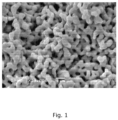
- FIG. 1 shows a scanning electron micrograph of the tantalum powder obtained according to the present invention.
- the figure illustrates that the obtained tantalum powder has more uniform distribution, smooth particles, thick sintering neck and less ultrafine particles.
- the content of impurities in the tantalum powder is analyzed according to the Chinese standard GB/T15076.1-15076.15, and the physical properties are tested according to the industry standard YS/T573-2015.
- the electrical performance of the tantalum powder is tested according to the Chinese standard GB/T3137.
- the reaction vessel was heated to 950°C, followed by soaking for 5 h. After the soaking was finished, the reaction vessel was cooled to room temperature, and passivation treatment was carried out. Thereafter, the obtained mixture of the halide and the tantalum powder was subjected to water washing, acid washing, filtering and drying, to obtain tantalum powder.
- the tantalum powder obtained was subjected to high-temperature high-vacuum heat treatment for 0.5 h at 1400°C and under a pressure of less than 5.0 ⁇ 10 -3 Pa, and then to oxygen reduction and acid cleaning to obtain tantalum powder.
- the tantalum powder was made into an anode block according to the anode block mass, pressed density, anode block sintering temperature, sintering time specified in Table 1, and other conditions as per the above-mentioned GB/T3137 requirements, energized at 150 V, and then tested for electrical properties as per the above-mentioned GB/T3137 requirements.
- the test results are listed in Table 1.
- the reaction vessel was cooled to a temperature of 680°C, and vacuumized so that the pressure in the reaction vessel was lowered to 5.7 Pa, followed by soaking for 6 h, and vacuumizing was stopped. Then, argon was introduced into the reaction vessel, and, under the condition of keeping positive pressure, the reaction vessel was heated to 900°C, followed by soaking for 3 h. After the soaking was finished, the reaction vessel was cooled to room temperature, and passivation treatment was carried out. Thereafter, the obtained mixture of the halide and the tantalum powder was subjected to water washing, acid washing, filtering and drying, to obtain tantalum powder with improved particle structure. The tantalum powder obtained was subjected to high-temperature high-vacuum heat treatment for 0.5 h at 1400°C and under a pressure of less than 5.0 ⁇ 10 -3 Pa, and then to oxygen reduction and acid cleaning to obtain tantalum powder.
- the tantalum powder was made into an anode block according to the anode block mass, pressed density, anode block sintering temperature, sintering time specified in Table 1, and other conditions as per the above-mentioned GB/T3137 requirements, energized at 150 V, and then tested for electrical properties as per the above-mentioned GB/T3137 requirements.
- the test results are listed in Table 1.
- tantalum powder obtained by reducing potassium fluotantalate with sodium, comprising a compound comprising 50 ppm phosphorus was mixed with 2.0% of metal magnesium particles by weight of the tantalum powder and simultaneously with 2.0 kg of potassium chloride (KCI) and 2.0 kg of sodium chloride (NaCl). After uniformly mixing, the obtained mixture was loaded into a reaction vessel, and air in the reaction vessel was separated. Argon was introduced into the reaction vessel, and, under the condition of keeping positive pressure, the reaction vessel was put into a heating furnace for heating to a temperature of 850°C, followed by soaking for 4.0 h.
- KCI potassium chloride
- NaCl sodium chloride
- the reaction vessel was cooled to a temperature of 720°C, and vacuumized so that the pressure in the reaction vessel was lowered to 5.7 Pa, followed by soaking for 3 h, and vacuumizing was stopped. Then, argon was introduced into the reaction vessel, and, under the condition of keeping positive pressure, the reaction vessel was heated to 920°C, followed by soaking for 5 h. After the soaking was finished, the reaction vessel was cooled to room temperature, and passivation treatment was carried out. Thereafter, the obtained mixture of the halide and the tantalum powder was subjected to water washing, acid washing, filtering and drying, to obtain tantalum powder with improved particle structure.
- the tantalum powder obtained was subjected to high-temperature high-vacuum heat treatment for 0.5 h at 1420°C and under a pressure of less than 5.0 ⁇ 10 -3 Pa, and then to oxygen reduction by reducing with magnesium and acid cleaning to obtain tantalum powder.
- the tantalum powder was made into an anode block according to the anode block mass, pressed density, anode block sintering temperature, sintering time specified in Table 1, and other conditions as per the above-mentioned GB/T3137 requirements, energized at 150 V, and then tested for electrical properties as per the above-mentioned GB/T3137 requirements.
- the test results are listed in Table 1.
- tantalum powder obtained by reducing potassium fluotantalate with sodium, comprising a compound comprising 800 ppm nitrogen was mixed with 2.0% of metal magnesium particles by weight of the tantalum powder and simultaneously with 2.0 kg of potassium chloride (KCI) and 2.0 kg of sodium chloride (NaCl). After uniformly mixing, the obtained mixture was loaded into a reaction vessel, and air in the reaction vessel was separated. Argon was introduced into the reaction vessel, and, under the condition of keeping positive pressure, the reaction vessel was put into a heating furnace for heating to a temperature of 920°C, followed by soaking for 4.0 h.
- KCI potassium chloride
- NaCl sodium chloride
- the reaction vessel was cooled to a temperature of 720°C, and vacuumized so that the pressure in the reaction vessel was lowered to 5.7 Pa, followed by soaking for 6 h, and vacuumizing was stopped. Then, argon was introduced into the reaction vessel, and, under the condition of keeping positive pressure, the reaction vessel was heated to 950°C, followed by soaking for 5 h. After the soaking was finished, the reaction vessel was cooled to room temperature, and passivation treatment was carried out. Thereafter, the obtained mixture of the halide and the tantalum powder was subjected to water washing, acid washing, filtering and drying, to obtain tantalum powder with improved particle structure. The tantalum powder obtained was subjected to high-temperature high-vacuum heat treatment for 0.5 h at 1400°C and under a pressure of less than 5.0 ⁇ 10 -3 Pa, and then to oxygen reduction and acid cleaning to obtain tantalum powder.
- the tantalum powder was made into an anode block according to the anode block mass, pressed density, anode block sintering temperature, sintering time specified in Table 1, and other conditions as per the above-mentioned GB/T3137 requirements, energized at 150 V, and then tested for electrical properties as per the above-mentioned GB/T3137 requirements.
- the test results are listed in Table 1.
- tantalum powder obtained by reducing potassium fluotantalate with sodium, comprising a compound comprising 50 ppm boron was mixed with 2.0% of metal magnesium particles by weight of the tantalum powder and simultaneously with 2.0 kg of potassium chloride (KCI) and 2.0 kg of sodium chloride (NaCl). After uniformly mixing, the obtained mixture was loaded into a reaction vessel, and air in the reaction vessel was separated. Argon was introduced into the reaction vessel, and, under the condition of keeping positive pressure, the reaction vessel was put into a heating furnace for heating to a temperature of 920°C, followed by soaking for 4.0 h.
- KCI potassium chloride
- NaCl sodium chloride
- the reaction vessel was cooled to a temperature of 720°C, and vacuumized so that the pressure in the reaction vessel was lowered to 5.7 Pa, followed by soaking for 6 h, and vacuumizing was stopped. Then, argon was introduced into the reaction vessel, and, under the condition of keeping positive pressure, the reaction vessel was heated to 950°C, followed by soaking for 5 h. After the soaking was finished, the reaction vessel was cooled to room temperature, and passivation treatment was carried out. Thereafter, the obtained mixture of the halide and the tantalum powder was subjected to water washing, acid washing, filtering and drying, to obtain tantalum powder with improved particle structure. The tantalum powder obtained was subjected to high-temperature high-vacuum heat treatment for 0.5 h at 1400°C and under a pressure of less than 5.0 ⁇ 10 -3 Pa, and then to oxygen reduction and acid cleaning to obtain tantalum powder.
- the tantalum powder was made into an anode block according to the anode block mass, pressed density, anode block sintering temperature, sintering time specified in Table 1, and other conditions as per the above-mentioned GB/T3137 requirements, energized at 150 V, and then tested for electrical properties as per the above-mentioned GB/T3137 requirements.
- the test results are listed in Table 1.
- tantalum powder obtained by reducing potassium fluotantalate with sodium, comprising a compound comprising 50 ppm phosphorus was directly subjected to high-temperature high-vacuum heat treatment for 0.5 h at 1400°C, and then to oxygen reduction and acid cleaning to obtain tantalum powder.
- the tantalum powder was made into an anode block according to the anode block mass, pressed density, anode block sintering temperature, sintering time specified in Table 1, and other conditions as per the above-mentioned GB/T3137 requirements, energized at 150 V, and then tested for electrical properties as per the above-mentioned GB/T3137 requirements.
- the test results are listed in Table 1.
- Example 1 6.0 0.5 1500 30 150 15700 245 0.36
- Example 2 6.0 0.5 1500 30 150 15600 243 0.42
- Example 3 6.0 0.5 1500 30 150 17600 246 0.49
- Example 4 6.0 0.5 1500 30 150 16800 252 0.25
- Example 5 6.0 0.5 1500 30 150 17000 243 0.35 Comparative Example 1 6.0 0.5 1500 30 150 13500 193 2.48
- the obtained mixture of the halide and the tantalum powder was subjected to water washing, acid washing, filtering and drying, to obtain tantalum powder.
- the tantalum powder obtained was subjected to high-temperature high-vacuum heat treatment for 0.5 h at 1420°C and under a pressure of less than 5.0 ⁇ 10 -3 Pa, and then to oxygen reduction and acid cleaning to obtain tantalum powder.
- the tantalum powder was made into an anode block according to the anode block mass, pressed density, anode block sintering temperature, sintering time specified in Table 2, and other conditions as per the above-mentioned GB/T3137 requirements, energized at 200 V, and then tested for electrical properties as per the above-mentioned GB/T3137 requirements. The test results are listed in Table 2.
- the reaction vessel was cooled to a temperature of 700°C, and vacuumized so that the pressure in the reaction vessel was lowered to 5.7 Pa, followed by soaking for 6 h, and vacuumizing was stopped. Then, argon was introduced into the reaction vessel, and, under the condition of keeping positive pressure, the reaction vessel was heated to 950°C, followed by soaking for 5 h. After the soaking was finished, the reaction vessel was cooled to room temperature, and passivation treatment was carried out. Thereafter, the obtained mixture of the halide and the tantalum powder was subjected to water washing, acid washing, filtering and drying, to obtain tantalum powder.
- the tantalum powder obtained was subjected to high-temperature high-vacuum heat treatment for 0.5 h at 1500°C and under a pressure of less than 5.0 ⁇ 10 -3 Pa, and then to oxygen reduction and acid cleaning to obtain tantalum powder.
- the tantalum powder was made into an anode block according to the anode block mass, pressed density, anode block sintering temperature, sintering time specified in Table 2, and other conditions as per the above-mentioned GB/T3137 requirements, energized at 270 V, and then tested for electrical properties as per the above-mentioned GB/T3137 requirements. The test results are listed in Table 2.
- the present invention has the following advantages compared to the prior art: tantalum powder produced according to the present invention is energized under high voltage conditions, and the energized block is tested for electrical performance, which demonstrates that the energized block has a higher specific capacitance and shows a higher breakdown voltage in the breakdown voltage test.
- the tantalum powder produced according to the present invention is more suitable for manufacturing high-reliability tantalum capacitors.
Landscapes
- Chemical & Material Sciences (AREA)
- Engineering & Computer Science (AREA)
- Power Engineering (AREA)
- Materials Engineering (AREA)
- Mechanical Engineering (AREA)
- Metallurgy (AREA)
- Organic Chemistry (AREA)
- General Chemical & Material Sciences (AREA)
- Chemical Kinetics & Catalysis (AREA)
- Microelectronics & Electronic Packaging (AREA)
- Physics & Mathematics (AREA)
- Thermal Sciences (AREA)
- Manufacturing & Machinery (AREA)
- Manufacture Of Metal Powder And Suspensions Thereof (AREA)
- Powder Metallurgy (AREA)
- Manufacture And Refinement Of Metals (AREA)
Applications Claiming Priority (2)
| Application Number | Priority Date | Filing Date | Title |
|---|---|---|---|
| CN202111533324.8A CN114210973B (zh) | 2021-12-15 | 2021-12-15 | 一种钽粉的生产方法以及由该方法得到的钽粉 |
| PCT/CN2022/114375 WO2023109172A1 (zh) | 2021-12-15 | 2022-08-24 | 一种钽粉的生产方法以及由该方法得到的钽粉 |
Publications (2)
| Publication Number | Publication Date |
|---|---|
| EP4450187A1 true EP4450187A1 (de) | 2024-10-23 |
| EP4450187A4 EP4450187A4 (de) | 2026-03-04 |
Family
ID=80702348
Family Applications (1)
| Application Number | Title | Priority Date | Filing Date |
|---|---|---|---|
| EP22905931.6A Pending EP4450187A4 (de) | 2021-12-15 | 2022-08-24 | Tantalpulverherstellungsverfahren und damit hergestelltes tantalpulver |
Country Status (10)
| Country | Link |
|---|---|
| US (1) | US20240157437A1 (de) |
| EP (1) | EP4450187A4 (de) |
| JP (1) | JP7534558B2 (de) |
| KR (1) | KR20230175265A (de) |
| CN (1) | CN114210973B (de) |
| IL (1) | IL305551B2 (de) |
| MX (1) | MX2023013766A (de) |
| PH (1) | PH12023552755A1 (de) |
| TW (1) | TW202330128A (de) |
| WO (1) | WO2023109172A1 (de) |
Cited By (1)
| Publication number | Priority date | Publication date | Assignee | Title |
|---|---|---|---|---|
| EP4311612A4 (de) * | 2021-12-15 | 2025-08-13 | Ningxia Orient Tantalum Ind Co Ltd | Verfahren zur herstellung von tantalpulver für kondensator durch reduzierung von tantaloxid unter verwendung von erdalkalimetall |
Families Citing this family (4)
| Publication number | Priority date | Publication date | Assignee | Title |
|---|---|---|---|---|
| CN114210973B (zh) * | 2021-12-15 | 2023-03-24 | 宁夏东方钽业股份有限公司 | 一种钽粉的生产方法以及由该方法得到的钽粉 |
| CN117840420B (zh) * | 2024-01-10 | 2024-08-23 | 江门富祥电子材料有限公司 | 一种镁还原氧化钽制备高压高比容钽粉的方法 |
| CN121156287A (zh) | 2024-06-18 | 2025-12-19 | 宁夏东方钽业股份有限公司 | 钠还原氟钽酸钾生产钽粉的方法及制得的钽粉 |
| WO2025260240A1 (zh) | 2024-06-18 | 2025-12-26 | 宁夏东方钽业股份有限公司 | 一种氟钽酸钾粉末、钠还原该粉末生产钽粉的方法、由此得到的钽粉及其用途 |
Family Cites Families (13)
| Publication number | Priority date | Publication date | Assignee | Title |
|---|---|---|---|---|
| GB1094283A (en) * | 1965-05-25 | 1967-12-06 | Ciba Ltd | Method for the manufacture of tantalum and/or niobium powder |
| JPS5241465B1 (de) * | 1967-10-25 | 1977-10-18 | ||
| CN1169643C (zh) * | 2001-09-29 | 2004-10-06 | 宁夏东方钽业股份有限公司 | 高比表面积钽粉和/或铌粉的制备方法 |
| JP3610942B2 (ja) * | 2001-10-12 | 2005-01-19 | 住友金属鉱山株式会社 | ニオブおよび/またはタンタルの粉末の製造法 |
| US20060269436A1 (en) | 2005-05-31 | 2006-11-30 | Cabot Corporation | Process for heat treating metal powder and products made from the same |
| CN102120258B (zh) * | 2011-02-14 | 2012-12-26 | 宁夏东方钽业股份有限公司 | 钽粉的热处理方法 |
| CN105665731B (zh) * | 2016-04-15 | 2017-10-27 | 陈尚军 | 一种钽粉制备方法 |
| CN109312424A (zh) * | 2016-07-13 | 2019-02-05 | 宁夏东方钽业股份有限公司 | 一种片状钽粉及其制备方法 |
| KR102389784B1 (ko) * | 2018-03-05 | 2022-04-22 | 글로벌 어드밴스드 메탈스 유에스에이, 아이엔씨. | 구형 분말을 함유하는 애노드 및 커패시터 |
| JP6824320B2 (ja) * | 2019-04-15 | 2021-02-03 | ニンシア オリエント タンタル インダストリー カンパニー、 リミテッド | タンタル粉末及びその製造方法並びにタンタル粉末から製造される焼結アノード |
| CN112267017B (zh) * | 2020-09-18 | 2022-06-07 | 昆明理工大学 | 一种镁热还原制备金属合金粉末的方法 |
| CN117020215B (zh) * | 2021-12-15 | 2025-12-12 | 宁夏东方钽业股份有限公司 | 采用碱土金属还原氧化钽生产电容器用钽粉的方法 |
| CN114210973B (zh) * | 2021-12-15 | 2023-03-24 | 宁夏东方钽业股份有限公司 | 一种钽粉的生产方法以及由该方法得到的钽粉 |
-
2021
- 2021-12-15 CN CN202111533324.8A patent/CN114210973B/zh active Active
-
2022
- 2022-08-23 IL IL305551A patent/IL305551B2/en unknown
- 2022-08-24 KR KR1020237040111A patent/KR20230175265A/ko active Pending
- 2022-08-24 MX MX2023013766A patent/MX2023013766A/es unknown
- 2022-08-24 US US18/284,362 patent/US20240157437A1/en active Pending
- 2022-08-24 PH PH1/2023/552755A patent/PH12023552755A1/en unknown
- 2022-08-24 WO PCT/CN2022/114375 patent/WO2023109172A1/zh not_active Ceased
- 2022-08-24 JP JP2023565185A patent/JP7534558B2/ja active Active
- 2022-08-24 EP EP22905931.6A patent/EP4450187A4/de active Pending
- 2022-11-28 TW TW111145348A patent/TW202330128A/zh unknown
Cited By (1)
| Publication number | Priority date | Publication date | Assignee | Title |
|---|---|---|---|---|
| EP4311612A4 (de) * | 2021-12-15 | 2025-08-13 | Ningxia Orient Tantalum Ind Co Ltd | Verfahren zur herstellung von tantalpulver für kondensator durch reduzierung von tantaloxid unter verwendung von erdalkalimetall |
Also Published As
| Publication number | Publication date |
|---|---|
| US20240157437A1 (en) | 2024-05-16 |
| CN114210973B (zh) | 2023-03-24 |
| PH12023552755A1 (en) | 2024-04-08 |
| CN114210973A (zh) | 2022-03-22 |
| WO2023109172A1 (zh) | 2023-06-22 |
| JP7534558B2 (ja) | 2024-08-14 |
| KR20230175265A (ko) | 2023-12-29 |
| EP4450187A4 (de) | 2026-03-04 |
| IL305551A (en) | 2023-10-01 |
| TW202330128A (zh) | 2023-08-01 |
| JP2024518762A (ja) | 2024-05-02 |
| IL305551B2 (en) | 2025-08-01 |
| MX2023013766A (es) | 2023-12-04 |
| IL305551B1 (en) | 2025-04-01 |
Similar Documents
| Publication | Publication Date | Title |
|---|---|---|
| EP4450187A1 (de) | Tantalpulverherstellungsverfahren und damit hergestelltes tantalpulver | |
| EP4311612A9 (de) | Verfahren zur herstellung von tantalpulver für kondensator durch reduzierung von tantaloxid unter verwendung von erdalkalimetall | |
| US8673052B2 (en) | Process for preparing tantalum powder for capacitors | |
| US7727508B2 (en) | Process for preparing powder of niobium suboxides or niobium | |
| JPH0897096A (ja) | タンタル粉末及びそれを用いた電解コンデンサ | |
| EP0665302B1 (de) | Verfahren zum Nitrieren von Tantalpulver | |
| CN105665731B (zh) | 一种钽粉制备方法 | |
| JP6977021B2 (ja) | 薄片状タンタル粉末およびその調製方法 | |
| CN117840420B (zh) | 一种镁还原氧化钽制备高压高比容钽粉的方法 | |
| CN119894624B (zh) | 碱土金属还原氧化钽生产电容器用钽粉的方法 | |
| US9691553B2 (en) | Production method for tungsten anode body | |
| CN119730980A (zh) | 一种钽粉的生产方法以及由该方法得到的钽粉 | |
| CN119744208A (zh) | 碱土金属还原氧化钽生产钽粉的方法 | |
| CN117655337A (zh) | 一种电容器用高压高比容钽粉的制备方法 | |
| KR101616559B1 (ko) | 탄탈륨 분말의 제조방법 |
Legal Events
| Date | Code | Title | Description |
|---|---|---|---|
| STAA | Information on the status of an ep patent application or granted ep patent |
Free format text: STATUS: THE INTERNATIONAL PUBLICATION HAS BEEN MADE |
|
| PUAI | Public reference made under article 153(3) epc to a published international application that has entered the european phase |
Free format text: ORIGINAL CODE: 0009012 |
|
| STAA | Information on the status of an ep patent application or granted ep patent |
Free format text: STATUS: REQUEST FOR EXAMINATION WAS MADE |
|
| 17P | Request for examination filed |
Effective date: 20240715 |
|
| AK | Designated contracting states |
Kind code of ref document: A1 Designated state(s): AL AT BE BG CH CY CZ DE DK EE ES FI FR GB GR HR HU IE IS IT LI LT LU LV MC MK MT NL NO PL PT RO RS SE SI SK SM TR |
|
| DAV | Request for validation of the european patent (deleted) | ||
| DAX | Request for extension of the european patent (deleted) | ||
| A4 | Supplementary search report drawn up and despatched |
Effective date: 20260130 |
|
| RIC1 | Information provided on ipc code assigned before grant |
Ipc: B22F 1/142 20220101AFI20260126BHEP Ipc: B22F 1/145 20220101ALI20260126BHEP Ipc: H01G 9/042 20060101ALI20260126BHEP Ipc: C22B 9/04 20060101ALI20260126BHEP |