EP4450184A1 - Vorrichtung zur herstellung eines titaningots und verfahren zur herstellung eines titaningots damit - Google Patents
Vorrichtung zur herstellung eines titaningots und verfahren zur herstellung eines titaningots damit Download PDFInfo
- Publication number
- EP4450184A1 EP4450184A1 EP22916507.1A EP22916507A EP4450184A1 EP 4450184 A1 EP4450184 A1 EP 4450184A1 EP 22916507 A EP22916507 A EP 22916507A EP 4450184 A1 EP4450184 A1 EP 4450184A1
- Authority
- EP
- European Patent Office
- Prior art keywords
- titanium
- melting
- plasma arc
- molten
- ingot
- Prior art date
- Legal status (The legal status is an assumption and is not a legal conclusion. Google has not performed a legal analysis and makes no representation as to the accuracy of the status listed.)
- Pending
Links
Images

Classifications
-
- B—PERFORMING OPERATIONS; TRANSPORTING
- B22—CASTING; POWDER METALLURGY
- B22D—CASTING OF METALS; CASTING OF OTHER SUBSTANCES BY THE SAME PROCESSES OR DEVICES
- B22D7/00—Casting ingots, e.g. from ferrous metals
- B22D7/005—Casting ingots, e.g. from ferrous metals from non-ferrous metals
-
- B—PERFORMING OPERATIONS; TRANSPORTING
- B22—CASTING; POWDER METALLURGY
- B22D—CASTING OF METALS; CASTING OF OTHER SUBSTANCES BY THE SAME PROCESSES OR DEVICES
- B22D21/00—Casting non-ferrous metals or metallic compounds so far as their metallurgical properties are of importance for the casting procedure; Selection of compositions therefor
- B22D21/002—Castings of light metals
- B22D21/005—Castings of light metals with high melting point, e.g. Be 1280 degrees C, Ti 1725 degrees C
-
- B—PERFORMING OPERATIONS; TRANSPORTING
- B22—CASTING; POWDER METALLURGY
- B22D—CASTING OF METALS; CASTING OF OTHER SUBSTANCES BY THE SAME PROCESSES OR DEVICES
- B22D11/00—Continuous casting of metals, i.e. casting in indefinite lengths
- B22D11/001—Continuous casting of metals, i.e. casting in indefinite lengths of specific alloys
-
- B—PERFORMING OPERATIONS; TRANSPORTING
- B22—CASTING; POWDER METALLURGY
- B22D—CASTING OF METALS; CASTING OF OTHER SUBSTANCES BY THE SAME PROCESSES OR DEVICES
- B22D11/00—Continuous casting of metals, i.e. casting in indefinite lengths
- B22D11/04—Continuous casting of metals, i.e. casting in indefinite lengths into open-ended moulds
-
- B—PERFORMING OPERATIONS; TRANSPORTING
- B22—CASTING; POWDER METALLURGY
- B22D—CASTING OF METALS; CASTING OF OTHER SUBSTANCES BY THE SAME PROCESSES OR DEVICES
- B22D11/00—Continuous casting of metals, i.e. casting in indefinite lengths
- B22D11/10—Supplying or treating molten metal
- B22D11/103—Distributing the molten metal, e.g. using runners, floats, distributors
-
- B—PERFORMING OPERATIONS; TRANSPORTING
- B22—CASTING; POWDER METALLURGY
- B22D—CASTING OF METALS; CASTING OF OTHER SUBSTANCES BY THE SAME PROCESSES OR DEVICES
- B22D11/00—Continuous casting of metals, i.e. casting in indefinite lengths
- B22D11/10—Supplying or treating molten metal
- B22D11/11—Treating the molten metal
-
- B—PERFORMING OPERATIONS; TRANSPORTING
- B22—CASTING; POWDER METALLURGY
- B22D—CASTING OF METALS; CASTING OF OTHER SUBSTANCES BY THE SAME PROCESSES OR DEVICES
- B22D11/00—Continuous casting of metals, i.e. casting in indefinite lengths
- B22D11/12—Accessories for subsequent treating or working cast stock in situ
- B22D11/1213—Accessories for subsequent treating or working cast stock in situ for heating or insulating strands
-
- B—PERFORMING OPERATIONS; TRANSPORTING
- B22—CASTING; POWDER METALLURGY
- B22D—CASTING OF METALS; CASTING OF OTHER SUBSTANCES BY THE SAME PROCESSES OR DEVICES
- B22D11/00—Continuous casting of metals, i.e. casting in indefinite lengths
- B22D11/14—Plants for continuous casting
- B22D11/141—Plants for continuous casting for vertical casting
-
- C—CHEMISTRY; METALLURGY
- C22—METALLURGY; FERROUS OR NON-FERROUS ALLOYS; TREATMENT OF ALLOYS OR NON-FERROUS METALS
- C22B—PRODUCTION AND REFINING OF METALS; PRETREATMENT OF RAW MATERIALS
- C22B34/00—Obtaining refractory metals
- C22B34/10—Obtaining titanium, zirconium or hafnium
- C22B34/12—Obtaining titanium or titanium compounds from ores or scrap by metallurgical processing; preparation of titanium compounds from other titanium compounds see C01G23/00 - C01G23/08
- C22B34/1295—Refining, melting, remelting, working up of titanium
-
- C—CHEMISTRY; METALLURGY
- C22—METALLURGY; FERROUS OR NON-FERROUS ALLOYS; TREATMENT OF ALLOYS OR NON-FERROUS METALS
- C22B—PRODUCTION AND REFINING OF METALS; PRETREATMENT OF RAW MATERIALS
- C22B7/00—Working up raw materials other than ores, e.g. scrap, to produce non-ferrous metals and compounds thereof; Methods of a general interest or applied to the winning of more than two metals
- C22B7/001—Dry processes
- C22B7/003—Dry processes only remelting, e.g. of chips, borings, turnings; apparatus used therefor
-
- C—CHEMISTRY; METALLURGY
- C22—METALLURGY; FERROUS OR NON-FERROUS ALLOYS; TREATMENT OF ALLOYS OR NON-FERROUS METALS
- C22B—PRODUCTION AND REFINING OF METALS; PRETREATMENT OF RAW MATERIALS
- C22B7/00—Working up raw materials other than ores, e.g. scrap, to produce non-ferrous metals and compounds thereof; Methods of a general interest or applied to the winning of more than two metals
- C22B7/001—Dry processes
- C22B7/004—Dry processes separating two or more metals by melting out (liquation), i.e. heating above the temperature of the lower melting metal component(s); by fractional crystallisation (controlled freezing)
-
- C—CHEMISTRY; METALLURGY
- C22—METALLURGY; FERROUS OR NON-FERROUS ALLOYS; TREATMENT OF ALLOYS OR NON-FERROUS METALS
- C22B—PRODUCTION AND REFINING OF METALS; PRETREATMENT OF RAW MATERIALS
- C22B9/00—General processes of refining or remelting of metals; Apparatus for electroslag or arc remelting of metals
- C22B9/003—General processes of refining or remelting of metals; Apparatus for electroslag or arc remelting of metals by induction
-
- C—CHEMISTRY; METALLURGY
- C22—METALLURGY; FERROUS OR NON-FERROUS ALLOYS; TREATMENT OF ALLOYS OR NON-FERROUS METALS
- C22B—PRODUCTION AND REFINING OF METALS; PRETREATMENT OF RAW MATERIALS
- C22B9/00—General processes of refining or remelting of metals; Apparatus for electroslag or arc remelting of metals
- C22B9/16—Remelting metals
- C22B9/20—Arc remelting
-
- F—MECHANICAL ENGINEERING; LIGHTING; HEATING; WEAPONS; BLASTING
- F27—FURNACES; KILNS; OVENS; RETORTS
- F27B—FURNACES, KILNS, OVENS OR RETORTS IN GENERAL; OPEN SINTERING OR LIKE APPARATUS
- F27B14/00—Crucible or pot furnaces
- F27B14/06—Crucible or pot furnaces heated electrically, e.g. induction crucible furnaces with or without any other source of heat
- F27B14/061—Induction furnaces
- F27B14/063—Skull melting type
-
- F—MECHANICAL ENGINEERING; LIGHTING; HEATING; WEAPONS; BLASTING
- F27—FURNACES; KILNS; OVENS; RETORTS
- F27B—FURNACES, KILNS, OVENS OR RETORTS IN GENERAL; OPEN SINTERING OR LIKE APPARATUS
- F27B3/00—Hearth-type furnaces, e.g. of reverberatory type; Electric arc furnaces ; Tank furnaces
- F27B3/04—Hearth-type furnaces, e.g. of reverberatory type; Electric arc furnaces ; Tank furnaces of multiple-hearth type; of multiple-chamber type; Combinations of hearth-type furnaces
-
- F—MECHANICAL ENGINEERING; LIGHTING; HEATING; WEAPONS; BLASTING
- F27—FURNACES; KILNS; OVENS; RETORTS
- F27B—FURNACES, KILNS, OVENS OR RETORTS IN GENERAL; OPEN SINTERING OR LIKE APPARATUS
- F27B3/00—Hearth-type furnaces, e.g. of reverberatory type; Electric arc furnaces ; Tank furnaces
- F27B3/08—Hearth-type furnaces, e.g. of reverberatory type; Electric arc furnaces ; Tank furnaces heated electrically, with or without any other source of heat
- F27B3/085—Arc furnaces
-
- F—MECHANICAL ENGINEERING; LIGHTING; HEATING; WEAPONS; BLASTING
- F27—FURNACES; KILNS; OVENS; RETORTS
- F27B—FURNACES, KILNS, OVENS OR RETORTS IN GENERAL; OPEN SINTERING OR LIKE APPARATUS
- F27B3/00—Hearth-type furnaces, e.g. of reverberatory type; Electric arc furnaces ; Tank furnaces
- F27B3/10—Details, accessories or equipment, e.g. dust-collectors, specially adapted for hearth-type furnaces
- F27B3/20—Arrangements of heating devices
Definitions
- the present invention relates to an apparatus for manufacturing a titanium ingot and a method for manufacturing a titanium ingot using the same, and more particularly, to a method for manufacturing a high purity titanium ingot or a titanium alloy ingot, for example, a titanium alloy ingot for a bio material, by using an apparatus for manufacturing a titanium ingot that continuously applies plasma arc melting (PAM) and induction skull melting (ISM).
- PAM plasma arc melting
- ISM induction skull melting
- a biomaterial for plastic surgery or dentistry requires excellent strength, toughness, wear resistance, and corrosion resistance, while being harmless to a human body and securing biocompatibility for the material to be coupled to a living bone.
- Representative biological metal materials that exhibit these features may include nickel-chromium (Ni-Cr) stainless steel (316L), a cobalt-chromium-molybdenum (Co-Cr-Mo) alloy developed under a trade name of vitalium, and a titanium (Ti) alloy. These metal materials currently account for 70% or more of implant materials for implantation in the body.
- the stainless steel and the Co-Cr-Mo alloy have been respectively used for biomedical purposes since the 1930s and 1940s.
- Ti titanium
- the Ti alloy is lightweight and non-magnetic, and has excellent biocompatibility in addition to mechanical features such as corrosion resistance, strength, and toughness. Therefore, the Ti alloys are widely used today in dentistry for fillings (inlays), crowns, and tooth roots, in orthopedics for fracture fixators and artificial joints, and in circulatory surgery for pacemakers and stents.
- the Ti metal and the Ti alloy are evaluated to have better biocompatibility than another biometallic material (e.g., stainless steel or vitalium) or a polymer material (e.g., polymethyl metaacrylate (PMMA)) in terms of a bone formation pattern.
- a Ti-6Al4V alloy (composition: wt.%), which is currently most commonly used for the biomedical purpose, is an alloy having a ( ⁇ + ⁇ ) type two-phase structure.
- the Ti-6Al4V alloy was originally developed for a structural part of an aircraft, and its suitability for biomedical purposes has also been proven. Therefore, there is a need for a technology for manufacturing a high-quality titanium alloy powder or ingot.
- Korean Patent No. 10-1751794 which relates to a titanium refining furnace and a method for refining titanium by using the same, where molten titanium is formed by melting titanium scrap by using heating means including induction heating and plasma, the titanium scrap is refined by using the heating means to remove various metal impurities and oxygen included in the molten titanium, and the titanium ingot is manufactured by cooling the refined material, discloses a technology related to a titanium refining furnace including: a titanium melting part accommodating an object to be molten; a main chamber part including the titanium melting part therein; a heating source part having a first function of removing the metal impurities and a second function of removing oxygen; a scrap supply part supplying the titanium scrap to the titanium melting part; and an ingot extraction part withdrawing the molten titanium from the titanium melting part, wherein the heating source part includes an induction coil part performing the first function and a plasma generation part performing the first function and the second function.
- Korean Patent No. 10-1441654 discloses a dozen titanium bar manufacturing method of using a continuous non-consumable vacuum arc melting, the method including steps of: cleaning titanium alloy scrap, installing an end of a sharply machined tungsten electrode in a vacuum arc melting furnace to generate an arc in a predetermined direction; and inserting the scrap into a hearth installed in the vacuum arc melting furnace.
- Korean Patent No. 10-1370029 discloses titanium scrap refining method of removing oxygen included in a molten metal by supplying hydrogen plasma to a surface of the molten metal to refine titanium scrap.
- These conventional titanium scrap refining technologies refine the titanium scrap by using the method of forming the molten titanium by applying the plasma and induction melting simultaneously to the titanium alloy to thus melt the titanium scrap and applying heat to the molten titanium at this stage to thus remove various metal impurities and oxygen included therein.
- the shorter a distance between a metal material and a plasma torch the greater meltability of the metal.
- the distance between the metal material and the plasma torch may be relatively long, which leads to difficulty in complete melting and a failure in removal of high-density impurities. Therefore, the conventional method is not suitable for refining and manufacturing the titanium alloy applied to a field requiring its high quality, for example, the biomaterial.
- An object of the present invention is to provide an apparatus for manufacturing a titanium ingot that may significantly improve purity of the titanium ingot while increasing its meltability.
- An object of the present invention is to provide a method for manufacturing a titanium ingot by using the apparatus for manufacturing a titanium ingot.
- An object of the present invention is to provide a method for manufacturing a titanium alloy ingot for a biomaterial, which may shorten a distance between a plasma arc and a titanium alloy to thus completely melt a metal material and completely remove impurities therein, thereby refining the titanium alloy, and manufacture the titanium alloy ingot through an induction skull melting process.
- an apparatus for manufacturing a titanium ingot including: a plasma arc melting unit for melting metal scrap by using a plasma arc; an induction skull melting unit for melting the molten metal, molten by the plasma, by using an induced current; and an ingot drawing unit for withdrawing the metal ingot that is solidified after being molten by the induced current, wherein the plasma arc melting unit and the induction skull melting unit are disposed in one chamber in the order named.
- a placement height of the plasma arc melting unit may be greater than a placement height of the induction skull melting unit.
- the plasma arc melting unit may include a cold hearth and a plasma torch
- the induction skull melting unit may include a cold crucible and an induction coil
- one end of the cold hearth may be disposed above the cold crucible.
- a method for manufacturing a titanium ingot including: a step of melting titanium scrap by using a plasma arc; a step of melting the molten titanium scrap by an induction skull method; and a step of casting a titanium ingot from titanium molten sequentially by means of the plasma arc and the induction skull method.
- the titanium scrap may have a shape of a bar, a lump, a chip, a clip, or a sponge.
- the plasma arc melting step may include a step of inputting the titanium scrap into a plasma arc melting unit, a step of melting the titanium scrap into a primary molten titanium by driving a plasma torch, and a step of separating inclusions from the primary molten titanium by flowing the primary molten titanium on a cold hearth and precipitating the inclusions or evaporating the inclusions into vapor.
- the cold hearth may be made of a water-cooled copper vessel.
- the induction skull melting step may include a step of inputting the primary molten titanium into an induction skull melting unit, a step of melting the primary molten titanium into a secondary molten titanium by driving an induction coil, and a step of purifying the secondary molten titanium on a cold crucible.
- the plasma arc melting step and the induction skull melting step may be performed independently of each other.
- the plasma arc melting step and the induction skull melting step may be performed sequentially.
- the method for manufacturing a titanium ingot according to the embodiments of the present invention may use the titanium scrap to achieve economic effects and simultaneously solve environmental problems, use copper melting furnaces instead of ceramic refractories to also reduce production costs and improve productivity, and use two independent heating processes to increase the meltability of the metal material and manufacture the high-purity titanium ingot.
- first”, “second”, A, B, (a), (b), and the like may be used in describing components of an embodiment of the present invention. These terms are only used to distinguish any components from other components, and the essences, sequences, order, or the like of the corresponding components are not limited by these terms.
- Ti titanium
- Ti titanium/titanium
- melting may indicate that a solid material absorbs heat energy and is changed into a liquid material.
- FIG. 1 is a diagram for explaining an apparatus for manufacturing a titanium ingot according to embodiments of the present invention.
- an apparatus 1 for manufacturing a titanium ingot may include a plasma arc melting unit 10, an induction skull melting unit 20, and an ingot drawing unit 30.
- the plasma arc melting unit 10 may be a plasma arc melting (PAM) furnace, and may include a cold hearth 13 and a plasma torch 15.
- PAM plasma arc melting
- a metal input into the plasma arc melting unit 10 may be titanium scrap 100, and the titanium scrap 100 may be made of a raw material having various shapes such as a bar, a lump, a chip, a clip, and a sponge.
- the cold hearth 13 may be made of, for example, a water-cooled copper vessel, and remove high density inclusions (HDIs) or low density inclusions (LDIs) from a molten metal by precipitating the inclusions or evaporating the inclusions into vapor, thereby functioning to increase purity of a metal cast.
- the water-cooled copper vessel may be a reusable copper crucible, and here, the copper crucible, which may be destroyed or lost due to a high melting temperature, may be controlled by a metal skull generated on an inner wall of the crucible. Therefore, it is possible to prevent reaction with the molten metal, caused by use of a conventional ceramic crucible.
- the high density inclusions (HDI) may be, for example, a metal compound such as tungsten carbide (WC) or tantalum carbide (TaC), the low density inclusions (LDI) may be, for example, a metal compound such as titanium nitride (TiN) or titanium carbide (TiC), the high density inclusions (HDI) may be precipitated on a bottom surface of the cold hearth 13, and the low density inclusions (LDI) may be evaporated into vapor.
- a metal compound such as tungsten carbide (WC) or tantalum carbide (TaC)
- the low density inclusions (LDI) may be, for example, a metal compound such as titanium nitride (TiN) or titanium carbide (TiC)
- the high density inclusions (HDI) may be precipitated on a bottom surface of the cold hearth 13
- the low density inclusions (LDI) may be evaporated into vapor.
- FIG. 1 shows that the cold hearth 13 has a flat bottom surface, and the present invention is not necessarily limited to this concept.
- the cold hearth 13 may have a bottom surface inclined rather than flat, or have a bottom surface having steps of different heights. That is, the bottom surface of the cold hearth 13 may have a different shape to more efficiently remove the high density inclusions (HDI) and/or the low density inclusions (LDI).
- HDI high density inclusions
- LPI low density inclusions
- the plasma torch 15 may be configured to generate a plasma arc to melt metal scrap, and thus be referred to as a plasma arc generation unit. Meanwhile, the plasma arc may be replaced by an electron beam. Although not shown, the plasma torch 15 may be controlled to be moved above the cold hearth 13 in a vertical direction and/or a horizontal direction, and a rotation of the plasma torch 15 may be controlled to adjust a spray direction of the plasma arc.
- the titanium scrap 100 input into the plasma arc melting unit 10 may be molten into a primary molten titanium 110 by the plasma arc generated and sprayed from the plasma torch 15, and the inclusions 105 included in the primary molten titanium 110 may be precipitated and then removed as the primary molten titanium 110 flows on the cold hearth 13.
- the induction skull melting unit 20 may be an induction skull melting (ISM) furnace, and may include a cold crucible 23 and an induction coil 25.
- ISM induction skull melting
- the cold crucible 23 may provide a space for accommodating the metal primarily molten by the plasma arc melting unit 10, and may be, for example, a water-cooled copper crucible.
- the induction coil 25 may be configured to inductively heat the molten metal by generating a current and forming a magnetic field, and may have, for example, a shape of a wound high-frequency coil made of copper.
- the induction coil 25 may also be referred to as a high frequency coil.
- the magnetic field generated by the induction coil 25 may be adjusted by controlling a frequency of a power supply (not shown), and the molten metal may be secondarily melted by the magnetic field.
- the primary molten titanium 110 input into the induction skull melting unit 20 may be re-melted into a secondary molten titanium 120 by the magnetic field formed by the induction coil 25.
- the secondary molten titanium 120 may then be solidified on the cold crucible 23 and cast into a titanium ingot 150.
- the secondary molten titanium 120 may be formed by additionally removing the impurities or gases included in the primary molten titanium 110, thus greatly improving the purity and quality of the finally cast titanium ingot 150.
- a placement height of the plasma arc melting unit 10 may be greater than a placement height of the induction skull melting unit 20, and one end of the cold hearth 13 may be disposed above the cold crucible 23.
- the molten metal, i.e., primary molten titanium 110, inserted into the induction skull melting unit 20 may be completely melted into a uniform phase by convection in the cold crucible 23 through induction heating, thereby forming the secondary molten titanium 120.
- the secondary molten titanium 120 in contact with the cold crucible 23 may be solidified by a water-cooled segment (not shown).
- the skull generated later may generate a thin metal boundary layer between the cold crucible 23 and the secondary molten titanium 120. This boundary layer may act as a thermal resistance to thus reduce heat transferred from the secondary molten titanium 120 to the cold crucible 23, thereby functioning to extend a life of the cold crucible 23.
- a melting method used by the induction skull melting unit 20 may be performed by melting the metal metal-to-metal at the cold crucible 23, i.e., water-cooled copper crucible, without a refractory material in a vacuum state.
- the reaction between the molten metal, i.e., secondary molten titanium 120, and oxygen may be inhibited due to the absence of the refractory material.
- a side portion of the secondary molten titanium 120 may be pushed inward from an inner side wall of the cold crucible 23. Accordingly, the side portion of the secondary molten titanium 120 may have no physical contact with the inner side wall of the cold crucible 23, thereby preventing the water-cooled segment from being electrically short-circuited and reducing heat loss to the cold crucible 23.
- the ingot drawing unit 30 may be configured to withdraw a metal ingot, i.e., titanium ingot 150 formed by ingotting the molten metal through primary melting and secondary melting.
- the ingot drawing unit 30 may be controlled to withdraw the metal ingot by its movement in the vertical direction.
- the plasma arc melting unit 10 and the induction skull melting unit 20 may be disposed in one chamber in the order named. Accordingly, a plasma arc melting (PAM) process and an induction skull melting (ISM) process may be performed sequentially and continuously.
- PAM plasma arc melting
- ISM induction skull melting
- the apparatus 1 for manufacturing a titanium ingot may include the sequentially-disposed plasma arc melting unit 10 and induction skull melting unit 20, and the metal scrap may be cast into the metal ingot through the plasma arc melting (PAM) process and the induction skull melting (ISM) process, which are performed continuously by the apparatus 1 for manufacturing a titanium ingot, thereby improving the meltability of the metal scrap and increasing the purity of the finally cast metal ingot.
- PAM plasma arc melting
- ISM induction skull melting
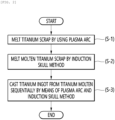
- FIG. 2 is a flowchart for explaining a method for manufacturing a titanium ingot according to embodiments of the present invention.
- the method for manufacturing a titanium ingot may include: a step (S-1) of melting titanium scrap 100 by using a plasma arc; a step (S-2) of melting the molten titanium scrap by an induction skull method; and a step (S-3) of casting a titanium ingot from titanium molten sequentially by means of the plasma arc and the induction skull method.
- the titanium scrap 100 may be melted into a primary molten titanium 110 through the plasma arc melting step (S-1), and the primary molten titanium 110 may be re-melted into a secondary molten titanium 120 through the induction skull melting step (S-2).
- the secondary molten titanium 120 may be solidified and cast into the titanium ingot 150.
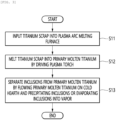
- FIG. 3 is a diagram illustrating the step of melting titanium by using a plasma arc melting unit 10 according to the embodiments of the present invention.
- the plasma arc melting step (S-1) may include a step (S11) of inputting the titanium scrap 100 into the plasma arc melting unit 10, a step (S12) of melting the titanium scrap 100 into the primary molten titanium 110 by driving a plasma torch 15, and a step (S13) of separating inclusions 105 from the primary molten titanium 110 by flowing the primary molten titanium 110 on a cold hearth 13 and precipitating the inclusions or evaporating the inclusions into vapor.
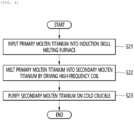
- FIG. 4 is a diagram illustrating the step of melting titanium by using an induction skull melting unit 20 according to the embodiments of the present invention.
- the induction skull melting step (S-2) may include a step (S21) of inputting the primary molten titanium 110 into the induction skull melting unit 20, a step (S22) of melting the primary molten titanium 110 into the secondary molten titanium 120 by driving an induction coil 25, and a step (S23) of purifying the secondary molten titanium 120 on the cold crucible 23.
- the plasma arc melting step (S-1) and the induction skull melting step (S-2) may be performed independently of each other, and the plasma arc melting step (S-1) and induction skull melting step (S-2) may be performed sequentially.
- the method for manufacturing a titanium ingot according to the present invention may be performed by applying two different melting processes independently and sequentially to improve meltability of the titanium scrap 100 and minimize the inclusions 105.
- a process of removing impurities in a raw material by using plasma arc melting (PAM) may be used first, and only a pure molten metal, from which low density inclusions (LDIs) and high density inclusions (HDIs) are removed, may be inserted into an induction skull melting (ISM) cold crucible, and the pure molten metal may then be further re-melted, thereby further improving the purity of the finally manufactured metal ingot.
- PAM plasma arc melting
- the apparatus for manufacturing a titanium ingot and the method for manufacturing a titanium ingot according to the embodiments of the present invention may be applied to various technical fields in addition to the above-mentioned technical field, for example, a method for manufacturing a titanium alloy ingot.
- the titanium scrap 100 may be replaced by the titanium alloy scrap.
- the primary molten titanium 110 and the secondary molten titanium 120 may also be referred to as the primary titanium alloy molten metal and the secondary titanium alloy molten metal, respectively.
- the method for manufacturing a titanium alloy ingot may be performed through steps that are substantially the same as or similar to steps of the method for manufacturing a titanium ingot described above in that the titanium scrap 100 is molten into the primary molten titanium 110 and the secondary molten titanium 120 by the plasma arc melting unit 10 and the induction skull melting unit 20.
- the method for manufacturing a titanium alloy ingot may further include a step of inputting an alloy component into the primary molten titanium 110 or the secondary molten titanium 120.
Landscapes
- Engineering & Computer Science (AREA)
- Mechanical Engineering (AREA)
- Chemical & Material Sciences (AREA)
- Manufacturing & Machinery (AREA)
- Materials Engineering (AREA)
- Metallurgy (AREA)
- Organic Chemistry (AREA)
- Life Sciences & Earth Sciences (AREA)
- Environmental & Geological Engineering (AREA)
- General Life Sciences & Earth Sciences (AREA)
- Geology (AREA)
- General Engineering & Computer Science (AREA)
- Physics & Mathematics (AREA)
- Plasma & Fusion (AREA)
- Manufacture And Refinement Of Metals (AREA)
Applications Claiming Priority (3)
| Application Number | Priority Date | Filing Date | Title |
|---|---|---|---|
| KR20210192425 | 2021-12-30 | ||
| KR1020220025133A KR20230103809A (ko) | 2021-12-30 | 2022-02-25 | 타이타늄 잉곳 제조 장치 및 이를 이용한 타이타늄 잉곳의 제조 방법 |
| PCT/KR2022/019755 WO2023128361A1 (ko) | 2021-12-30 | 2022-12-06 | 타이타늄 잉곳 제조 장치 및 이를 이용한 타이타늄 잉곳의 제조 방법 |
Publications (2)
| Publication Number | Publication Date |
|---|---|
| EP4450184A1 true EP4450184A1 (de) | 2024-10-23 |
| EP4450184A4 EP4450184A4 (de) | 2026-01-14 |
Family
ID=86999516
Family Applications (1)
| Application Number | Title | Priority Date | Filing Date |
|---|---|---|---|
| EP22916507.1A Pending EP4450184A4 (de) | 2021-12-30 | 2022-12-06 | Vorrichtung zur herstellung eines titaningots und verfahren zur herstellung eines titaningots damit |
Country Status (3)
| Country | Link |
|---|---|
| EP (1) | EP4450184A4 (de) |
| KR (1) | KR20250093601A (de) |
| WO (1) | WO2023128361A1 (de) |
Family Cites Families (7)
| Publication number | Priority date | Publication date | Assignee | Title |
|---|---|---|---|---|
| DE10156336A1 (de) * | 2001-11-16 | 2003-06-05 | Ald Vacuum Techn Gmbh | Verfahren zur Herstellung von Legierungs-Ingots |
| JP5639548B2 (ja) * | 2011-08-22 | 2014-12-10 | 株式会社神戸製鋼所 | チタン鋳塊の製造方法 |
| KR101370029B1 (ko) | 2013-03-18 | 2014-03-05 | 한국생산기술연구원 | 플라즈마 수소이온에 의한 티타늄 스크랩의 정련 장치 및 그 방법 |
| US20140326427A1 (en) * | 2013-05-02 | 2014-11-06 | Rti International Metals, Inc. | Method and apparatus for reducing bubbles or gas pockets in a metal ingot using a continuous casting mold |
| KR101441654B1 (ko) | 2013-05-28 | 2014-11-03 | 한국산기 주식회사 | 연속식 비소모성 진공아크용해법을 이용한 타이타늄 봉재 제조방법 |
| KR101751794B1 (ko) * | 2015-12-09 | 2017-06-29 | 한국생산기술연구원 | 타이타늄정련용해로 및 타이타늄정련방법 |
| JP6794598B2 (ja) * | 2017-02-23 | 2020-12-02 | 株式会社神戸製鋼所 | Ti−Al系合金の製造方法 |
-
2022
- 2022-12-06 EP EP22916507.1A patent/EP4450184A4/de active Pending
- 2022-12-06 WO PCT/KR2022/019755 patent/WO2023128361A1/ko not_active Ceased
-
2025
- 2025-05-02 KR KR1020250058357A patent/KR20250093601A/ko active Pending
Also Published As
| Publication number | Publication date |
|---|---|
| KR20250093601A (ko) | 2025-06-24 |
| EP4450184A4 (de) | 2026-01-14 |
| WO2023128361A1 (ko) | 2023-07-06 |
Similar Documents
| Publication | Publication Date | Title |
|---|---|---|
| Sing et al. | 3D printing of metals in rapid prototyping of biomaterials: Techniques in additive manufacturing | |
| Attar et al. | Comparative study of commercially pure titanium produced by laser engineered net shaping, selective laser melting and casting processes | |
| WO2021139334A1 (zh) | 一种含Si高强低模医用钛合金及其增材制造方法与应用 | |
| US20190084048A1 (en) | Titanium-tantalum powders for additive manufacturing | |
| CN101516292A (zh) | 由生物可降解金属构成的植入物及其制造方法 | |
| KR102875346B1 (ko) | 생체 의료용 마그네슘 합금 선재의 제조 방법 | |
| CN105057661B (zh) | 一种高钽含量钛钽合金自耗电极的制备方法 | |
| EP0526159A1 (de) | Methode zum Schmelzen von Titanaluminid-Legierungen | |
| CN105132703A (zh) | 一种电渣重熔炉冶炼外科植入用含氮钴铬钼合金的方法 | |
| CN112048641A (zh) | 一种新型医用钛合金铸锭的制造方法 | |
| GB2302551A (en) | Improvements on or relating to alloys | |
| CN103215459B (zh) | 一种低碳低氧钛镍合金大型铸锭的制备方法 | |
| CA2761160C (en) | Esr melting of niti alloys | |
| Nair et al. | Innovations in 3D printing of magnesium alloys and composites for biodegradable biomedical devices | |
| Berezos et al. | Electron beam melting of titanium alloys for medical purposes | |
| KR20230103809A (ko) | 타이타늄 잉곳 제조 장치 및 이를 이용한 타이타늄 잉곳의 제조 방법 | |
| CN101296714B (zh) | 获得生物相容的组合植入物的方法 | |
| KR20250093601A (ko) | 타이타늄 잉곳 제조 장치 | |
| Umar et al. | Additive processes for biodegradable Mg alloys: a review | |
| CN108213445A (zh) | 一种激光选区熔化成型用球形钴铬粉末的等离子体制备方法 | |
| Gupta et al. | Sintering of biomaterials for arthroplasty: A comparative study of microwave and conventional sintering techniques | |
| US7753986B2 (en) | Titanium processing with electric induction energy | |
| KR20160080470A (ko) | 이중 용해를 이용한 니켈-타이타늄계 형상기억합금의 제조 방법 | |
| Almeida et al. | Microstructure and electrochemical behavior of in vitro Ti-26Nb, Ti-26Zr and Ti-26Ta alloys processed by levitation melting technique | |
| RU2426804C1 (ru) | Печь для плавки и рафинирования реакционных металлов и сплавов |
Legal Events
| Date | Code | Title | Description |
|---|---|---|---|
| STAA | Information on the status of an ep patent application or granted ep patent |
Free format text: STATUS: THE INTERNATIONAL PUBLICATION HAS BEEN MADE |
|
| PUAI | Public reference made under article 153(3) epc to a published international application that has entered the european phase |
Free format text: ORIGINAL CODE: 0009012 |
|
| STAA | Information on the status of an ep patent application or granted ep patent |
Free format text: STATUS: REQUEST FOR EXAMINATION WAS MADE |
|
| 17P | Request for examination filed |
Effective date: 20240717 |
|
| AK | Designated contracting states |
Kind code of ref document: A1 Designated state(s): AL AT BE BG CH CY CZ DE DK EE ES FI FR GB GR HR HU IE IS IT LI LT LU LV MC ME MK MT NL NO PL PT RO RS SE SI SK SM TR |
|
| DAV | Request for validation of the european patent (deleted) | ||
| DAX | Request for extension of the european patent (deleted) | ||
| A4 | Supplementary search report drawn up and despatched |
Effective date: 20251211 |
|
| RIC1 | Information provided on ipc code assigned before grant |
Ipc: B22D 7/00 20060101AFI20251205BHEP Ipc: C22B 34/12 20060101ALI20251205BHEP Ipc: C22B 7/00 20060101ALI20251205BHEP Ipc: C22B 9/00 20060101ALI20251205BHEP Ipc: C22B 9/20 20060101ALI20251205BHEP Ipc: C22B 9/16 20060101ALI20251205BHEP Ipc: B22D 11/00 20060101ALI20251205BHEP Ipc: B22D 11/04 20060101ALI20251205BHEP Ipc: B22D 11/103 20060101ALI20251205BHEP Ipc: B22D 11/11 20060101ALI20251205BHEP Ipc: B22D 11/12 20060101ALI20251205BHEP Ipc: B22D 11/14 20060101ALI20251205BHEP Ipc: B22D 21/00 20060101ALI20251205BHEP Ipc: F27B 14/06 20060101ALI20251205BHEP Ipc: F27B 3/08 20060101ALI20251205BHEP Ipc: F27B 3/04 20060101ALI20251205BHEP Ipc: F27B 3/20 20060101ALI20251205BHEP |