EP4447152A1 - Anodenmaterial für eine sekundärbatterie und herstellungsverfahren dafür - Google Patents
Anodenmaterial für eine sekundärbatterie und herstellungsverfahren dafür Download PDFInfo
- Publication number
- EP4447152A1 EP4447152A1 EP22904564.6A EP22904564A EP4447152A1 EP 4447152 A1 EP4447152 A1 EP 4447152A1 EP 22904564 A EP22904564 A EP 22904564A EP 4447152 A1 EP4447152 A1 EP 4447152A1
- Authority
- EP
- European Patent Office
- Prior art keywords
- silicon oxide
- silicon
- secondary battery
- negative
- oxide composite
- Prior art date
- Legal status (The legal status is an assumption and is not a legal conclusion. Google has not performed a legal analysis and makes no representation as to the accuracy of the status listed.)
- Pending
Links
Images

Classifications
-
- H—ELECTRICITY
- H01—ELECTRIC ELEMENTS
- H01M—PROCESSES OR MEANS, e.g. BATTERIES, FOR THE DIRECT CONVERSION OF CHEMICAL ENERGY INTO ELECTRICAL ENERGY
- H01M4/00—Electrodes
- H01M4/02—Electrodes composed of, or comprising, active material
- H01M4/36—Selection of substances as active materials, active masses, active liquids
- H01M4/362—Composites
- H01M4/366—Composites as layered products
-
- H—ELECTRICITY
- H01—ELECTRIC ELEMENTS
- H01M—PROCESSES OR MEANS, e.g. BATTERIES, FOR THE DIRECT CONVERSION OF CHEMICAL ENERGY INTO ELECTRICAL ENERGY
- H01M4/00—Electrodes
- H01M4/02—Electrodes composed of, or comprising, active material
-
- H—ELECTRICITY
- H01—ELECTRIC ELEMENTS
- H01M—PROCESSES OR MEANS, e.g. BATTERIES, FOR THE DIRECT CONVERSION OF CHEMICAL ENERGY INTO ELECTRICAL ENERGY
- H01M10/00—Secondary cells; Manufacture thereof
- H01M10/05—Accumulators with non-aqueous electrolyte
- H01M10/052—Li-accumulators
-
- H—ELECTRICITY
- H01—ELECTRIC ELEMENTS
- H01M—PROCESSES OR MEANS, e.g. BATTERIES, FOR THE DIRECT CONVERSION OF CHEMICAL ENERGY INTO ELECTRICAL ENERGY
- H01M10/00—Secondary cells; Manufacture thereof
- H01M10/05—Accumulators with non-aqueous electrolyte
- H01M10/052—Li-accumulators
- H01M10/0525—Rocking-chair batteries, i.e. batteries with lithium insertion or intercalation in both electrodes; Lithium-ion batteries
-
- H—ELECTRICITY
- H01—ELECTRIC ELEMENTS
- H01M—PROCESSES OR MEANS, e.g. BATTERIES, FOR THE DIRECT CONVERSION OF CHEMICAL ENERGY INTO ELECTRICAL ENERGY
- H01M4/00—Electrodes
- H01M4/02—Electrodes composed of, or comprising, active material
- H01M4/04—Processes of manufacture in general
- H01M4/0471—Processes of manufacture in general involving thermal treatment, e.g. firing, sintering, backing particulate active material, thermal decomposition, pyrolysis
-
- H—ELECTRICITY
- H01—ELECTRIC ELEMENTS
- H01M—PROCESSES OR MEANS, e.g. BATTERIES, FOR THE DIRECT CONVERSION OF CHEMICAL ENERGY INTO ELECTRICAL ENERGY
- H01M4/00—Electrodes
- H01M4/02—Electrodes composed of, or comprising, active material
- H01M4/13—Electrodes for accumulators with non-aqueous electrolyte, e.g. for lithium-accumulators; Processes of manufacture thereof
- H01M4/131—Electrodes based on mixed oxides or hydroxides, or on mixtures of oxides or hydroxides, e.g. LiCoOx
-
- H—ELECTRICITY
- H01—ELECTRIC ELEMENTS
- H01M—PROCESSES OR MEANS, e.g. BATTERIES, FOR THE DIRECT CONVERSION OF CHEMICAL ENERGY INTO ELECTRICAL ENERGY
- H01M4/00—Electrodes
- H01M4/02—Electrodes composed of, or comprising, active material
- H01M4/13—Electrodes for accumulators with non-aqueous electrolyte, e.g. for lithium-accumulators; Processes of manufacture thereof
- H01M4/134—Electrodes based on metals, Si or alloys
-
- H—ELECTRICITY
- H01—ELECTRIC ELEMENTS
- H01M—PROCESSES OR MEANS, e.g. BATTERIES, FOR THE DIRECT CONVERSION OF CHEMICAL ENERGY INTO ELECTRICAL ENERGY
- H01M4/00—Electrodes
- H01M4/02—Electrodes composed of, or comprising, active material
- H01M4/13—Electrodes for accumulators with non-aqueous electrolyte, e.g. for lithium-accumulators; Processes of manufacture thereof
- H01M4/139—Processes of manufacture
- H01M4/1391—Processes of manufacture of electrodes based on mixed oxides or hydroxides, or on mixtures of oxides or hydroxides, e.g. LiCoOx
-
- H—ELECTRICITY
- H01—ELECTRIC ELEMENTS
- H01M—PROCESSES OR MEANS, e.g. BATTERIES, FOR THE DIRECT CONVERSION OF CHEMICAL ENERGY INTO ELECTRICAL ENERGY
- H01M4/00—Electrodes
- H01M4/02—Electrodes composed of, or comprising, active material
- H01M4/13—Electrodes for accumulators with non-aqueous electrolyte, e.g. for lithium-accumulators; Processes of manufacture thereof
- H01M4/139—Processes of manufacture
- H01M4/1395—Processes of manufacture of electrodes based on metals, Si or alloys
-
- H—ELECTRICITY
- H01—ELECTRIC ELEMENTS
- H01M—PROCESSES OR MEANS, e.g. BATTERIES, FOR THE DIRECT CONVERSION OF CHEMICAL ENERGY INTO ELECTRICAL ENERGY
- H01M4/00—Electrodes
- H01M4/02—Electrodes composed of, or comprising, active material
- H01M4/36—Selection of substances as active materials, active masses, active liquids
-
- H—ELECTRICITY
- H01—ELECTRIC ELEMENTS
- H01M—PROCESSES OR MEANS, e.g. BATTERIES, FOR THE DIRECT CONVERSION OF CHEMICAL ENERGY INTO ELECTRICAL ENERGY
- H01M4/00—Electrodes
- H01M4/02—Electrodes composed of, or comprising, active material
- H01M4/36—Selection of substances as active materials, active masses, active liquids
- H01M4/362—Composites
- H01M4/364—Composites as mixtures
-
- H—ELECTRICITY
- H01—ELECTRIC ELEMENTS
- H01M—PROCESSES OR MEANS, e.g. BATTERIES, FOR THE DIRECT CONVERSION OF CHEMICAL ENERGY INTO ELECTRICAL ENERGY
- H01M4/00—Electrodes
- H01M4/02—Electrodes composed of, or comprising, active material
- H01M4/36—Selection of substances as active materials, active masses, active liquids
- H01M4/38—Selection of substances as active materials, active masses, active liquids of elements or alloys
-
- H—ELECTRICITY
- H01—ELECTRIC ELEMENTS
- H01M—PROCESSES OR MEANS, e.g. BATTERIES, FOR THE DIRECT CONVERSION OF CHEMICAL ENERGY INTO ELECTRICAL ENERGY
- H01M4/00—Electrodes
- H01M4/02—Electrodes composed of, or comprising, active material
- H01M4/36—Selection of substances as active materials, active masses, active liquids
- H01M4/38—Selection of substances as active materials, active masses, active liquids of elements or alloys
- H01M4/386—Silicon or alloys based on silicon
-
- H—ELECTRICITY
- H01—ELECTRIC ELEMENTS
- H01M—PROCESSES OR MEANS, e.g. BATTERIES, FOR THE DIRECT CONVERSION OF CHEMICAL ENERGY INTO ELECTRICAL ENERGY
- H01M4/00—Electrodes
- H01M4/02—Electrodes composed of, or comprising, active material
- H01M4/36—Selection of substances as active materials, active masses, active liquids
- H01M4/48—Selection of substances as active materials, active masses, active liquids of inorganic oxides or hydroxides
-
- H—ELECTRICITY
- H01—ELECTRIC ELEMENTS
- H01M—PROCESSES OR MEANS, e.g. BATTERIES, FOR THE DIRECT CONVERSION OF CHEMICAL ENERGY INTO ELECTRICAL ENERGY
- H01M4/00—Electrodes
- H01M4/02—Electrodes composed of, or comprising, active material
- H01M4/36—Selection of substances as active materials, active masses, active liquids
- H01M4/48—Selection of substances as active materials, active masses, active liquids of inorganic oxides or hydroxides
- H01M4/483—Selection of substances as active materials, active masses, active liquids of inorganic oxides or hydroxides for non-aqueous cells
-
- H—ELECTRICITY
- H01—ELECTRIC ELEMENTS
- H01M—PROCESSES OR MEANS, e.g. BATTERIES, FOR THE DIRECT CONVERSION OF CHEMICAL ENERGY INTO ELECTRICAL ENERGY
- H01M4/00—Electrodes
- H01M4/02—Electrodes composed of, or comprising, active material
- H01M4/36—Selection of substances as active materials, active masses, active liquids
- H01M4/58—Selection of substances as active materials, active masses, active liquids of inorganic compounds other than oxides or hydroxides, e.g. sulfides, selenides, tellurides, halogenides or LiCoFy; of polyanionic structures, e.g. phosphates, silicates or borates
- H01M4/583—Carbonaceous material, e.g. graphite-intercalation compounds or CFx
- H01M4/587—Carbonaceous material, e.g. graphite-intercalation compounds or CFx for inserting or intercalating light metals
-
- H—ELECTRICITY
- H01—ELECTRIC ELEMENTS
- H01M—PROCESSES OR MEANS, e.g. BATTERIES, FOR THE DIRECT CONVERSION OF CHEMICAL ENERGY INTO ELECTRICAL ENERGY
- H01M4/00—Electrodes
- H01M4/02—Electrodes composed of, or comprising, active material
- H01M4/62—Selection of inactive substances as ingredients for active masses, e.g. binders, fillers
-
- H—ELECTRICITY
- H01—ELECTRIC ELEMENTS
- H01M—PROCESSES OR MEANS, e.g. BATTERIES, FOR THE DIRECT CONVERSION OF CHEMICAL ENERGY INTO ELECTRICAL ENERGY
- H01M4/00—Electrodes
- H01M4/02—Electrodes composed of, or comprising, active material
- H01M4/62—Selection of inactive substances as ingredients for active masses, e.g. binders, fillers
- H01M4/624—Electric conductive fillers
- H01M4/625—Carbon or graphite
-
- H—ELECTRICITY
- H01—ELECTRIC ELEMENTS
- H01M—PROCESSES OR MEANS, e.g. BATTERIES, FOR THE DIRECT CONVERSION OF CHEMICAL ENERGY INTO ELECTRICAL ENERGY
- H01M4/00—Electrodes
- H01M4/02—Electrodes composed of, or comprising, active material
- H01M2004/021—Physical characteristics, e.g. porosity, surface area
-
- H—ELECTRICITY
- H01—ELECTRIC ELEMENTS
- H01M—PROCESSES OR MEANS, e.g. BATTERIES, FOR THE DIRECT CONVERSION OF CHEMICAL ENERGY INTO ELECTRICAL ENERGY
- H01M4/00—Electrodes
- H01M4/02—Electrodes composed of, or comprising, active material
- H01M2004/026—Electrodes composed of, or comprising, active material characterised by the polarity
- H01M2004/027—Negative electrodes
-
- Y—GENERAL TAGGING OF NEW TECHNOLOGICAL DEVELOPMENTS; GENERAL TAGGING OF CROSS-SECTIONAL TECHNOLOGIES SPANNING OVER SEVERAL SECTIONS OF THE IPC; TECHNICAL SUBJECTS COVERED BY FORMER USPC CROSS-REFERENCE ART COLLECTIONS [XRACs] AND DIGESTS
- Y02—TECHNOLOGIES OR APPLICATIONS FOR MITIGATION OR ADAPTATION AGAINST CLIMATE CHANGE
- Y02E—REDUCTION OF GREENHOUSE GAS [GHG] EMISSIONS, RELATED TO ENERGY GENERATION, TRANSMISSION OR DISTRIBUTION
- Y02E60/00—Enabling technologies; Technologies with a potential or indirect contribution to GHG emissions mitigation
- Y02E60/10—Energy storage using batteries
Definitions
- the present disclosure relates to a negative-electrode material for a secondary battery which may improve initial discharge capacity (IDC), initial efficiency (ICE), and lifespan characteristics of the secondary battery, and a method of preparing the same.
- IDC initial discharge capacity
- ICE initial efficiency
- lifespan characteristics of the secondary battery and a method of preparing the same.
- the performance improvement of secondary batteries is based on components of a positive-electrode material, a negative-electrode material, and electrolyte.
- Graphite which is mainly used as the negative-electrode material has a theoretical capacity limited to 370 mAh/g.
- non-carbon-based negative-electrode materials such as silicon, tin, germanium, and zinc as an alternative to the graphite negative-electrode material is in progress.
- silicon has a theoretical capacity of 4000 to 4200 mAh/g and thus has a capacity of almost 10 times or greater of that of the graphite, and thus is attracting attention as a material to replace the graphite.
- silicon exhibits a volume expansion of over 300% during the process of intercalating and deintercalating lithium ions.
- the cycle characteristics of the secondary battery deteriorate as charging and discharging thereof progresses.
- SiOx (0.5 ⁇ x ⁇ 2) has high mechanical strength due to the oxide produced during the initial charge and discharge process. Accordingly, the negative-electrode material including SiO x has stability against the volume expansion that occurs during charging and discharging. Thus, many attempts are being made to use the negative-electrode material including SiO x to improve the lifespan characteristics of secondary batteries.
- silicon oxide SiO x (0.5 ⁇ x ⁇ 2) (0.5 ⁇ x ⁇ 2) has the disadvantage of having a large irreversible capacity and low initial efficiency.
- a purpose of the present disclosure is to provide a negative-electrode active material with excellent stability against volume expansion of silicon.
- a purpose of the present disclosure is to provide a negative-electrode material for a secondary battery that may improve the initial discharge capacity, initial efficiency, and lifespan characteristics of the secondary battery, using the negative-electrode active material.
- a purpose of the present disclosure is to provide a method for preparing a negative-electrode material for a secondary battery in which the negative-electrode material may be stably mass-produced.
- the present disclosure provides a negative-electrode material for a secondary battery, the negative-electrode material comprising an active material, a conductive material, and a binder, wherein the active material includes a silicon oxide composite having a carbon-coated surface, wherein the silicon oxide composite includes silicon oxide (SiO x , 0.5 ⁇ x ⁇ 2) nanoparticles and silicon (Si) nanoparticles, wherein a diameter of a first silicon crystalline fine particle of the silicon oxide nanoparticle and a diameter of a second silicon crystalline fine particle of the silicon (Si) nanoparticle may be different from each other.
- the active material includes a silicon oxide composite having a carbon-coated surface
- the silicon oxide composite includes silicon oxide (SiO x , 0.5 ⁇ x ⁇ 2) nanoparticles and silicon (Si) nanoparticles, wherein a diameter of a first silicon crystalline fine particle of the silicon oxide nanoparticle and a diameter of a second silicon crystalline fine particle of the silicon (Si) nanop
- the first silicon crystalline fine particle of the silicon oxide nanoparticle may have the diameter in a range of 3 to 20nm.
- the second silicon crystalline fine particle of the silicon (Si) nanoparticle may have the diameter in a range of 20 to 50 nm.
- the present disclosure provides a method for preparing a negative-electrode material for a secondary battery, the negative-electrode material comprising an active material, a conductive material, and a binder, wherein the method comprises: (a) mixing silicon oxide (SiO x , 0.5 ⁇ x ⁇ 2) nanoparticles and silicon (Si) nanoparticles to prepare a first mixture; (b) adding a binder to the first mixture and drying the first mixture having the binder added thereto to prepare a second mixture; (c) heat-treating the second mixture to prepare a silicon oxide composite; and (d) coating carbon on the silicon oxide composite to prepare the active material, wherein a diameter of a first silicon crystalline fine particle of the silicon oxide nanoparticle and a diameter of a second silicon crystalline fine particle of the silicon (Si) nanoparticle may be different from each other.
- the diameter of the first silicon crystalline fine particle of the silicon oxide nanoparticle may be in a range of 3 to 20nm.
- the diameter of the second silicon crystalline fine particle of the silicon (Si) nanoparticle may be in a range of 20 to 50 nm.
- the heat-treatment in the (c) may include: (c1) a first step of increasing a temperature from a room temperature to 500°C; (c2) a second step of maintaining the temperature achieved by the first step to heat-treat the second mixture; (c3) a third step of increasing the temperature from the heat-treatment temperature at the second step to 1200°C; and (c4) a fourth step of maintaining the temperature achieved by the third step to heat-treat the second mixture.
- the method may further comprise: after the (d), (e) further mixing the silicon oxide composite and a first carbon material with each other to prepare the active material; and (f) mixing the active material, the conductive material, and the binder with each other to prepare a slurry.
- the negative-electrode material for the secondary battery includes the negative-electrode active material with excellent stability against volume expansion of silicon, thereby improving the initial discharge capacity, initial efficiency, and lifespan characteristics of the secondary battery.
- the method for preparing the negative-electrode material for the secondary battery according to the present disclosure stably mass-produces the negative-electrode active material including the silicon oxide composite.
- first element or layer when a first element or layer is referred to as being present "on" a second element or layer, the first element may be disposed directly on the second element or may be disposed indirectly on the second element with a third element or layer being disposed between the first and second elements or layers. It will also be understood that when a first element or layer is referred to as being present "under” a second element or layer, the first element may be disposed directly under the second element or may be disposed indirectly under the second element with a third element or layer being disposed between the first and second elements or layers.
- the negative-electrode material for the secondary battery in accordance with the present disclosure includes an active material, a conductive material, and a binder, and the active material includes a densified silicon oxide composite.
- the active material includes a highly-densified silicon oxide composite, thereby improving the initial discharge capacity and initial efficiency of the secondary battery.
- the silicon oxide composite includes silicon oxide (SiO x , 0.5 ⁇ x ⁇ 2) nanoparticles and silicon (Si) nanoparticles.
- the silicon oxide nanoparticles act as a buffer that suppresses the volume expansion of silicon.
- the silicon oxide nanoparticle or the silicon nanoparticle rather than the silicon oxide composite When used alone as the active material, the silicon nanoparticle reacts with lithium to expand in volume by 300% or greater, which reduces the lifespan characteristics of the secondary battery. Accordingly, when silicon oxide nanoparticles or silicon nanoparticles are used alone, it is difficult to improve the initial discharge capacity, initial efficiency, and life characteristics of the secondary battery. Thus, it is preferred to use the silicon oxide composite in accordance with the present disclosure.
- the silicon oxide nanoparticle may be crystalline or/and amorphous.
- the silicon (Si) nanoparticle may be crystalline.
- a nanoparticle refers to a particle with a diameter of 1 ⁇ m or smaller, that is, a nanoscale diameter of several nanometers to hundreds of nanometers.
- the diameter of each of the silicon oxide nanoparticles and the silicon nanoparticles may have a value equal to or greater than a diameter of a silicon crystal fine particle included in each nanoparticle.
- each of the silicon oxide nanoparticle and the silicon nanoparticle may be in a range of 5 to 200 nm, for example, 10 to 150 nm, 20 to 100 nm, 30 to 50 nm, or 40 to 50 nm.
- the diameters of the silicon oxide nanoparticle and the silicon nanoparticle are similar or equal to each other, this is advantageous in terms of sample preparation.
- the diameter of the nanoparticles may be measured using PSA (Particle Size Analyzer) equipment.
- Each of the silicon oxide (SiO x , 0.5 ⁇ x ⁇ 2) nanoparticle and the silicon (Si) nanoparticle included in the silicon oxide composite has a silicon crystalline fine particle.
- the active material has a structure in which silicon crystalline fine particles of different diameters are dispersed in the silicon oxide composite.
- the active material may have a structure in which silicon crystalline fine particles of different diameters are well dispersed inside and on the surface of the silicon oxide.
- the crystalline fine particles of the nanoparticle refer to solid materials that constitute lattices regularly arranged or are randomly arranged in a space that constitutes the nanoparticle.
- the crystalline fine particle may be used interchangeably with a crystal, a crystal grain, and a crystal particle.
- a first silicon crystalline fine particle included in the silicon oxide (SiO x , 0.5 ⁇ x ⁇ 2) nanoparticle and a second silicon crystalline fine particle included in the silicon (Si) nanoparticle have different diameters. Further, it is more preferable that the diameter of the first silicon crystalline fine particle is smaller than a diameter of the second silicon crystalline fine particle.
- a diameter (size) of the silicon crystalline fine particle is an important factor in improving the characteristics of the secondary battery.
- the characteristics of the secondary battery as the improvement target according to the present disclosure is insufficiently improved.
- the diameter of the first silicon crystalline fine particle of the silicon oxide nanoparticle is preferably in a range of 3 to 20 nm.
- the diameter of the first silicon crystalline fine particle may be in a range of 10 nm to 20 nm, for example, 15 to 20nm.
- the diameter of the second silicon crystalline fine particle of the silicon (Si) nanoparticle is preferably in a range of 20 to 50 nm.
- the diameter of the second silicon crystalline fine particle may be in a range of 25 to 45 nm, for example, 30 to 40nm.
- the diameter of the first silicon crystalline fine particle is in a range of 3 to 20 nm
- the diameter of the second silicon crystal fine particle is in a range of 20 and 50 nm
- uniformity of the silicon oxide nanoparticles and the silicon (Si) nanoparticles in the silicon oxide composite may be secured.
- the diameter of the silicon crystalline fine particles may be measured using X-ray diffraction (XRD, Empyrean equipment from Panalytical B.V. (Netherlands)).
- XRD X-ray diffraction
- the FWHM (2 ⁇ ) value at the crystal peak may be measured based on XRD.
- the measured value may be used to calculate a crystal size using the XRD FWHM method.
- a ratio of a weight of the first silicon crystalline fine particles and a weight of the second silicon crystalline fine particles in the silicon oxide composite may be in a range of 1:0.5 to 1:1, for example, 1:0.8 to 1:1.
- the ratio of the weight of the first silicon crystalline fine particles and the weight of the second silicon crystalline fine particles is in a range of 1:0.5 to 1:1.
- the initial discharge capacity thereof may be improved by about 10% or greater compared to the conventional secondary battery, and the initial efficiency thereof may be improved by about 4% or greater compared to the conventional secondary battery.
- the secondary battery in accordance with the present disclosure may have improved lifespan characteristics compared to the conventional secondary battery.
- a ratio of a weight of the silicon oxide nanoparticles and a weigh of the silicon (Si) nanoparticles may be in a range of 1:0.5 to 1:1, for example, 1:0.8 to 1:1.
- a molar ratio of oxygen (O) and silicon (Si) in the silicon oxide composite may be in a range of 0.5:1.0 to 1.0:1.0.
- the molar ratio of oxygen to silicon is in a range of 0.5 to 1.0, the lifespan characteristics of the secondary battery may be further improved.
- the silicon oxide composite as the active material is present in a form in which the first silicon crystalline fine particles and the second silicon crystalline fine particles of different diameters are dispersed inside and on the surface of the silicon oxide.
- the silicon oxide composite may not be a simple mixture of the silicon oxide nanoparticles and the silicon (Si) nanoparticles, but may be a highly-densified composite in which the silicon oxide nanoparticles and the silicon (Si) nanoparticles are bonded to each other.
- the silicon oxide composite may have the high-density via binder treatment and step-by-step heat-treatment in the preparing method that will be described later. Based on a comparing result of specific surface areas of the nanoparticle as a raw material and the highly-densified silicon oxide composite, the highly-densified silicon oxide composite has a reduced specific surface area.
- the silicon oxide composite is highly-densified, thereby improving the initial efficiency and lifespan characteristics of the secondary battery.
- the high density may be determined based on a specific surface area (BET) and may provide the effect of suppressing the volume expansion of silicon.
- BET specific surface area
- the specific surface area of the silicon oxide composite may be in a range of 1 to 5 m 2 /g.
- the specific surface area of the silicon oxide composite may be in a range of 1 to 3 m 2 /g.
- the specific surface area of the silicon oxide composite may be measured according to specific surface area analysis by nitrogen adsorption using the Brunauer-Emmett-Teller (BET) equation (Analysis equipment: BEL Japan lnc, BELSORP-max).
- BET Brunauer-Emmett-Teller
- This highly-densified silicon oxide composite preferably has a micrometer size.
- the silicon oxide composite has a micrometer size, the first silicon crystalline fine particles and the second silicon crystalline fine particles of different diameters may be uniformly distributed inside and on the surface of the silicon oxide.
- the initial discharge capacity may be improved by about 10% or greater and the initial efficiency may be improved by about 4% or greater, compared to a conventional secondary battery.
- the secondary battery in accordance with the present disclosure may have improved lifespan characteristics compared to conventional secondary batteries.
- An average diameter (D 50 ) of the silicon oxide composite is preferably in a range of 1 to 50 ⁇ m.
- it may be in a range of 5 to 8 ⁇ m.
- the average diameter (D 50 ) of the silicon oxide composite may be defined as a diameter based on 50% of the diameter distribution.
- the average diameter (D 5 0) may be measured using PSA equipment - BECKMAN COULTER life Sciences, LS 13 320 Particle Size Analyzer. For example, after dispersing the silicon oxide composite in a solution, the average diameter of the silicon oxide composite based on 50% of the diameter distribution may be calculated.
- the active material constituting the negative-electrode material preferably includes the silicon oxide composite having a carbon-coated surface to prevent oxidation of the silicon (Si) nanoparticles.
- the carbon coating layer formed on the surface of the silicon oxide composite may formed on the surface of the Si composite as the insulator using a HSPP (high softening point pitch) and may impart the conductivity thereto. Furthermore, the carbon coating layer has the effect of increasing the stability of the silicon oxide composite and suppressing reactivity thereof to moisture and oxygen. Furthermore, the carbon coating layer acts as a protective film for the silicon oxide composite, thereby lowering interfacial resistance between the negative-electrode material and the electrolyte, and improving interfacial stability over time.
- HSPP high softening point pitch
- applying the silicon oxide composite having the carbon coating layer formed thereon to the negative-electrode material of the secondary battery may allow charge/discharge efficiency and lifespan characteristics of the secondary battery to be improved.
- a second carbon material included in the carbon coating layer may be located on the entire surface of the silicon oxide composite, or may be partially located on the surface thereof. Considering the effect of improving the physical properties of the negative-electrode material, it is desirable that the second carbon material be formed so as to have a uniform thickness along and on the entire surface of the silicon oxide composite.
- 80 to 95% by weight of the silicon oxide composite and 5 to 20% by weight of the carbon coating layer may be contained with respect to 100% by weight of the silicon oxide composite whose the surface is coated with the carbon.
- 90 to 95% by weight of the silicon oxide composite and 5 to 10% by weight of the carbon coating layer may be contained with respect to 100% by weight of the silicon oxide composite whose the surface is coated with the carbon.
- the finally prepared negative-electrode material exhibits sufficient conductivity, such that the decrease in capacity exerted by the negative-electrode material may be minimized. This is because when the carbon content in the negative-electrode material is too high, the content of silicon oxide and silicon (Si) which exert the capacity in the composite decreases.
- a thickness of the carbon coating layer may be in a range of 0.1 to 10 nm. However, embodiments of the present disclosure are not limited thereto.
- the high softening point pitch refers to a pitch with a softening point of 200 to 300°C.
- the active material includes the combination of silicon oxide composite and the first carbon material
- this may improve the electrical conductivity between the active materials, improve the electrochemical properties thereof relative to the electrolyte, and reduce the volume expansion of the silicon (Si) nanoparticles to increase the lifespan of the secondary battery.
- the negative-electrode material for the secondary battery may include a conductive material and a binder in addition to the active material.
- the conductive material may include one or more of tertiary carbon material, metal powder, metal fiber, conductive whisker, metal oxide, and conductive polymer.
- the binder plays a role in improving the bonding between the active materials and the adhesion between the active material and the current collector, and may include an aqueous binder among binders commonly used for the negative-electrode material.
- a ratio of a weight of the active material: a weight of the conductive material: a weight of the binder in the negative-electrode material for the secondary battery may be in a range of 100:1 to 25:1 to 25.
- the ratio of the weight of active material: the weight of conductive material: the weight of the binder may be in a range of 100:5 to 20:5 to 20, or 100:10 to 20:10 to 20.
- the active material among the negative-electrode materials for the secondary battery in accordance with the present disclosure may include the micrometer-sized highly-densified silicon oxide composite in which the first silicon crystalline fine particles and the second silicon crystalline fine particles of different diameters are dispersed in and on the silicon oxide.
- the volume expansion of the silicon particles may be suppressed, and a negative-electrode material with the high capacity may be prepared.
- the active material in accordance with the present disclosure is very effective for the negative-electrode material that may improve the characteristics of the energy storage material, and may be applied to a secondary battery using a non-aqueous electrolyte.
- the active material in accordance with the present disclosure may be applied for the negative-electrode material for the secondary battery in an IT product and an electric vehicle.
- Another aspect of the present disclosure provides a method for preparing a negative-electrode material for a secondary battery, which will be described in detail below.
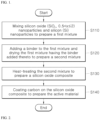
- FIG. 1 is a flowchart showing a method for preparing a negative-electrode material for a secondary battery according to the present disclosure.
- a method for preparing an active material of the negative-electrode material for the secondary battery includes a step S 110 of mixing silicon oxide (SiO x , 0.5 ⁇ x ⁇ 2) nanoparticles and silicon (Si) nanoparticles with each other to produce a first mixture, a step S 120 of adding a binder to the first mixture and drying the first mixture having the binder to prepare a second mixture, a step S 130 of performing heat-treatment on the second mixture to prepare a silicon oxide composite, and a step S 140 of coating the silicon oxide composite with carbon to prepare the active material.
- silicon oxide SiO x , 0.5 ⁇ x ⁇ 2
- Si silicon
- the silicon oxide composite and the first carbon material are further mixed with each other to prepare the active material.
- the active material, the conductive material, and the binder are mixed with each other to prepare a slurry.
- the negative-electrode material may be prepared by coating the slurry on the current collector.
- the method of preparing the active material of the negative-electrode material for the secondary battery in accordance with the present disclosure is as follows.
- the method prepares the first mixture by mixing the silicon oxide (SiO x , 0.5 ⁇ x ⁇ 2) nanoparticles and the silicon (Si) nanoparticles with each other.
- the first mixture may be prepared by dispersing the silicon oxide nanoparticles and the silicon (Si) nanoparticles in an alcohol-based solvent such as ethanol or/and distilled water, and then pulverizing the nanoparticles via ball milling.
- an alcohol-based solvent such as ethanol or/and distilled water
- the silicon oxide nanoparticles and the silicon (Si) nanoparticles may be mixed with each other at a weight ratio of 1:0.5 to 1:1.
- the silicon oxide nanoparticles and the silicon (Si) nanoparticles mix well with each other in the silicon oxide composite, such that the highly-densified silicon oxide composite may be obtained.
- the dispersing and pulverizing step may be performed for 1 to 10 hours. For example, it may be performed for 1 to 5 hours.
- the dispersion and pulverizing time is smaller than 1 hour, the pulverizing effect of the nanoparticles may be insufficient. Conversely, when it exceeds 10 hours, the pulverizing time becomes too long and thus the process may become inefficient.
- the diameter of the first silicon crystalline fine particles of the silicon oxide nanoparticles and the diameter of the second silicon crystalline fine particles of the silicon (Si) nanoparticles are different from each other.
- the diameter of the first silicon crystalline fine particles of the silicon oxide nanoparticles may be in a range of 3 to 20 nm.
- the diameter of the second silicon crystalline fine particles of the silicon (Si) nanoparticles may be in a range of 20 to 50 nm.
- the binder is added to the first mixture in which in turn is dried to prepare the second mixture.
- the second mixture is heat-treated step by step to prepare the silicon oxide composite.
- the binder on the surface of the silicon oxide nanoparticles and the silicon (Si) nanoparticles and the binder between the interfaces of the nanoparticles burn out, thereby forming pores in sites at which the binder was present, and providing a binding force between the nanoparticles, such that the composite may be highly-densified.
- the binder improves the adhesion between the silicon oxide nanoparticles and the silicon (Si) nanoparticles and allows the silicon oxide composite to be formed in a micrometer size.
- the binder affects the density and pore characteristics of the silicon oxide composite.
- the density and pore characteristics thereof may affect the characteristics of the secondary battery. Therefore, in order to satisfy the initial efficiency and lifespan characteristics of the secondary battery, it is important to add the binder to the first mixture, dry the first mixture having the binder, and then heat-treat the second mixture.
- the binder may be an aqueous binder which may include one or more of polyvinyl alcohol, starch, polyvinylpyrrolidone, tetrafluoroethylene, polyethylene, polypropylene, acrylic rubber, styrene-butadiene rubber (SBR), regenerated cellulose, and hydroxypropyl cellulose, carboxymethylcellulose (CMC), and fluorine-based rubber.
- the binder may include one or more of styrene-butadiene rubber (SBR) and carboxymethylcellulose (CMC).
- 1 to 20 parts by weight of binder may be added based on100 parts by weight of the silicon oxide nanoparticles.
- 1 to 10 parts by weight of the binder may be added based on100 parts by weight of the silicon oxide nanoparticles.
- 3 to 8 parts by weight of the binder may be added based on 100 parts by weight of the silicon oxide nanoparticles.
- the first mixture having the binder may be pulverized via ball milling and dispersed and then dried.
- the pulverizing and dispersion may be performed for 1 to 10 hours, for example, for 1 to 5 hours.
- the dried powder may be pelletized to prepare the second mixture.
- the diameter of the pellets of the second mixture may be larger compared to the diameter of the dried powder (particles). Furthermore, the pelletizing has an advantageous effect in allowing the diameter of the silicon oxide composite to be in a range of a micrometer.
- the step of compressing the powders (particles) into the pellets may be performed using any scheme that may compress a material.
- the pelletizing may be performed using hot pressing, casting, extrusion, etc.
- embodiments of the present disclosure are not limited thereto.
- the stepwise heat-treatment may be performed as follows.
- the stepwise heat-treatment may be performed as follows: a first step is to increase a temperature from room temperature (25 ⁇ 1°C) to 500°C at an average temperature increase rate of 1 to 5°C/min; a second step is heat-treatment by maintaining the temperature achieved by the first step for 30 minutes to 3 hours; a third step is to increase the temperature from the heat-treatment temperature at the second step to 1200°C at an average temperature increase rate of 10 to 20°C/min; and a fourth step is heat-treatment by maintaining the temperature achieved by the third step for 30 minutes to 3 hours.
- the first step is to increase the temperature from room temperature to 450 to 550°C
- the second step is to maintain the temperature at 450 to 550°C as the temperature range achieved by the first step
- the third step is to increase the temperature to 1150 to 1250°C
- the fourth step is to maintain the temperature at 1150 to 1250°C achieved by the fourth step.
- the second mixture including pellets may be sintered.
- the heat-treatment of the second mixture is continuously carried out at the increasing temperature.
- heat-treating the second mixture containing the pellets at around 500°C and then performing the final heat-treatment thereon at a higher temperature around 1200°C may allow the silicon oxide composite to be highly-densified.
- the high density of the silicon oxide composite has the effect of suppressing the silicon volume expansion and improving the characteristics of the secondary battery.
- the silicon oxide nanoparticles are decomposed into SiO 2 and Si under disproportionation, such that the silicon crystalline fine particles may be uniformly dispersed.
- the step-by-step heat-treatment in accordance with the present disclosure is different from a heat-treatment step in a single temperature range at least one time, or a total of two times of heat-treatments at different temperature ranges, which is conventional.
- first pulverizing is performed with a coarse pulverizing means, and second pulverizing is performed in a ball milling manner, such that the highly-densified silicon oxide composite with an average diameter (D 50 ) of 1 to 50 ⁇ m may be prepared.
- the pulverizing may be performed for 1 to 10 hours.
- the pulverizing may be performed for 1 to 5 hours.
- the average diameter (D 50 ) of the silicon oxide composite is as described above.
- the carbon is coated on the silicon oxide composite to prepare the active material.
- the carbon coating may be performed to impart conductive properties and may be performed to increase the stability of the silicon oxide composite and suppress its reactivity to moisture and oxygen.
- the second carbon material may be wet-coated on the silicon oxide composite and may be subjected to carbonization at 800 to 1200°C and in an inactive atmosphere, such that a carbon coating layer that acts as a protective film may be formed on the surface of the silicon oxide composite.
- the wet coating may include a first step of dissolving the second carbon material in an organic solvent such as THF to produce a carbon solution, a second step of dissolving the silicon oxide composite in an organic solvent such as THF to produce a silicon oxide composite solution, and a third step of mixing the carbon solution and the silicon oxide composite solution with each other to produce a mixed solution, and removing the solvents therefrom, followed by drying, and then carbonization.
- the carbon coating may be performed at 900 to 1100°C.
- the inactive atmosphere may include one or more of argon (Ar) gas, nitrogen (N 2 ) gas, helium (He) gas, and xenon (Xe) gas.
- 5 to 20% by weight of the second carbon material may be added based on 100% by weight of the silicon oxide composite with the carbon-coated surface.
- 5 to 10% by weight of the second carbon material may be added based on 100% by weight of the silicon oxide composite with the carbon-coated surface.
- the second carbon material of the carbon coating layer may include one or more of natural graphite, artificial graphite, mesocarbon microbeads, and high softening point pitch.
- the silicon oxide composite and the first carbon material may be mixed with each other at a weight ratio of 1:1 to 1:7.
- the active material may be prepared.
- the active material including the silicon oxide and the first carbon material are the same as described above.
- the slurry is prepared by mixing the active material, the conductive material, and the binder at a weight ratio of 100: 1 to 25: 1 to 25, and then the slurry is coated on the current collector to prepare the negative-electrode material.
- a material of the current collector may be used without limitation as long as it does not cause chemical change in the secondary battery and is a conductive material.
- copper, aluminum, nickel, etc. may be used as the material of the current collector.
- the second mixture was dried in a convection oven at 80°C, and the dried powders were pelletized and heat-treated in the four steps.
- the first step increases the temperature to 500°C at 1°C/min
- the pellets were maintained at 500°C for 1 hour.
- the third step increased the temperature at 10°C/min to 1200°C.
- the pellets were sintered at 1200°C for 1 hour.
- the sintered pellets were first pulverized with the coarse pulverizing means and then ball-milled to produce a highly-densified silicon oxide composite.
- the high softening point pitch (HSPP, developed by OCI) was wet-coated on the composite so that the carbon content was about 10% by weight based on 100% by weight of the final particles.
- the HSPP was dissolved in THF to produce a HSSP solution
- the composite was dissolved in THF to produce a composite solution, then and the two solutions were mixed with each other to produce a mixed solution which in turn was subjected to evaporation and drying in a double boiling manner at 35 to 40°C using an evaporator.
- a silicon oxide composite with a carbon-coated surface was obtained in the same manner as Present Example 1, except that the heat-treatment was performed in two steps: a first step increased the temperature at 10°C/min to 1200°C, and in a next step, the sintering was performed while maintaining the temperature at 1200°C for 1 hour.
- a silicon oxide composite with a carbon-coated surface was obtained in the same manner as Present Example 1, except that the binder was not added to the silicon oxide nanoparticles, and the heat-treatment was performed in two steps: a first step increased the temperature at 10°C/min to 1200°C, and in a next step, the sintering was performed while maintaining the temperature at 1200°C for 1 hour.
- the carbon-coated silicon oxide composite of each of Present Example 1 and Comparative Examples 1 to 3 was dry-mixed with artificial graphite at a weight ratio of 1:4.9 to prepare the negative-electrode active material.
- Table 1 below indicates the specific surface area, and the diameter of the carbon-coated silicon oxide composite and whether the carbon-coated silicon oxide composite is highly-densified.
- Table 2 below indicates the electrochemical properties of the negative-electrode material.
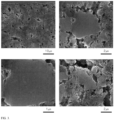
- FIG. 3 is a cross-sectional photo of the silicon oxide composite of Comparative Example 3, and shows that there is agglomeration without highly-densification.
- Present Example 1 of the present disclosure satisfies the characteristics of the silicon crystalline fine particles, the binder treatment, and the step-by-step heat-treatment. Thus, it may be confirmed that the initial discharge capacity, initial efficiency, and lifespan characteristics are further improved compared to Comparative Examples 1 to 3.
Landscapes
- Chemical & Material Sciences (AREA)
- Chemical Kinetics & Catalysis (AREA)
- Electrochemistry (AREA)
- General Chemical & Material Sciences (AREA)
- Engineering & Computer Science (AREA)
- Composite Materials (AREA)
- Materials Engineering (AREA)
- Manufacturing & Machinery (AREA)
- Inorganic Chemistry (AREA)
- Battery Electrode And Active Subsutance (AREA)
Applications Claiming Priority (2)
| Application Number | Priority Date | Filing Date | Title |
|---|---|---|---|
| KR1020210172786A KR102886321B1 (ko) | 2021-12-06 | 2021-12-06 | 이차전지용 음극재 및 그 제조 방법 |
| PCT/KR2022/019391 WO2023106734A1 (ko) | 2021-12-06 | 2022-12-01 | 이차전지용 음극재 및 그 제조 방법 |
Publications (2)
| Publication Number | Publication Date |
|---|---|
| EP4447152A1 true EP4447152A1 (de) | 2024-10-16 |
| EP4447152A4 EP4447152A4 (de) | 2025-09-24 |
Family
ID=86730818
Family Applications (1)
| Application Number | Title | Priority Date | Filing Date |
|---|---|---|---|
| EP22904564.6A Pending EP4447152A4 (de) | 2021-12-06 | 2022-12-01 | Anodenmaterial für eine sekundärbatterie und herstellungsverfahren dafür |
Country Status (7)
| Country | Link |
|---|---|
| US (1) | US20250239593A1 (de) |
| EP (1) | EP4447152A4 (de) |
| JP (1) | JP2024527128A (de) |
| KR (1) | KR102886321B1 (de) |
| CN (1) | CN118284995A (de) |
| TW (1) | TW202324815A (de) |
| WO (1) | WO2023106734A1 (de) |
Families Citing this family (2)
| Publication number | Priority date | Publication date | Assignee | Title |
|---|---|---|---|---|
| WO2025029107A1 (ko) * | 2023-08-03 | 2025-02-06 | 주식회사 엘지에너지솔루션 | 음극, 이의 제조방법, 및 이를 포함하는 전기화학소자 |
| KR20250020362A (ko) * | 2023-08-03 | 2025-02-11 | 주식회사 엘지에너지솔루션 | 음극, 이의 제조방법, 및 이를 포함하는 전기화학소자 |
Family Cites Families (20)
| Publication number | Priority date | Publication date | Assignee | Title |
|---|---|---|---|---|
| JP4519592B2 (ja) * | 2004-09-24 | 2010-08-04 | 株式会社東芝 | 非水電解質二次電池用負極活物質及び非水電解質二次電池 |
| EP2618406B1 (de) * | 2010-09-14 | 2016-06-22 | Hitachi Maxell, Ltd. | Nichtwässrige sekundärzelle |
| KR101723186B1 (ko) * | 2013-05-07 | 2017-04-05 | 주식회사 엘지화학 | 리튬 이차 전지용 음극 활물질, 이의 제조 방법 및 이를 포함하는 리튬 이차 전지 |
| DE112014006301T5 (de) * | 2014-01-31 | 2016-10-27 | Kabushiki Kaisha Toyota Jidoshokki | Negativelektrode für nicht-wässrige Sekundärbatterien; nicht-wässrige Sekundärbatterie; Negativelektrodenaktivmaterial; Verfahren zum Herstellen eines Negativelektrodenaktivmaterials; Kompositkörper, der Nanosilicium, Kohlenstoffschicht und kationische Polymerschicht umfasst; und Verfahren zum Herstellen eines Kompositkörpers, der aus Nanosilicium und Kohlenstoffschicht aufgebaut ist |
| KR102268205B1 (ko) * | 2014-09-19 | 2021-06-24 | 한양대학교 산학협력단 | 리튬 이차 전지용 음극, 이를 포함하는 리튬 이차 전지, 및 이들의 제조 방법 |
| WO2016136178A1 (ja) * | 2015-02-25 | 2016-09-01 | 三洋電機株式会社 | 非水電解質二次電池用負極及び非水電解質二次電池 |
| KR101971498B1 (ko) * | 2015-09-24 | 2019-04-23 | 주식회사 엘지화학 | 리튬 이차전지용 음극활물질 및 그 제조방법 |
| KR101960855B1 (ko) * | 2017-03-20 | 2019-03-21 | 대주전자재료 주식회사 | 리튬 이차전지 음극재용 실리콘 복합산화물 및 이의 제조방법 |
| KR102307911B1 (ko) * | 2017-04-27 | 2021-10-01 | 삼성에스디아이 주식회사 | 리튬이차전지용 음극 활물질 및 이를 포함하는 음극을 구비한 리튬이차전지 |
| KR102321502B1 (ko) * | 2017-12-19 | 2021-11-02 | 주식회사 엘지에너지솔루션 | 리튬이차전지용 음극 활물질, 이의 제조방법 및 이를 사용하여 제조된 리튬이차전지 |
| JPWO2019131862A1 (ja) * | 2017-12-28 | 2019-12-26 | 昭和電工株式会社 | リチウムイオン二次電池用負極材 |
| WO2019150512A1 (ja) * | 2018-01-31 | 2019-08-08 | 日立化成株式会社 | リチウムイオン二次電池用負極活物質、リチウムイオン二次電池用負極及びリチウムイオン二次電池 |
| US11094931B2 (en) * | 2018-01-31 | 2021-08-17 | Showa Denko Materials Co., Ltd. | Negative electrode active material for lithium ion secondary battery, negative electrode for lithium ion secondary battery, and lithium ion secondary battery |
| KR102179975B1 (ko) * | 2018-11-30 | 2020-11-17 | 주식회사 포스코 | 리튬 이차 전지용 음극 활물질, 이의 제조방법, 및 이를 포함하는 리튬 이차 전지 |
| CN114556626B (zh) * | 2019-08-19 | 2024-07-26 | 大洲电子材料株式会社 | 硅·氧化硅-碳复合物,其制备方法,以及包含其的用于锂二次电池的负电极活性材料 |
| WO2021040932A1 (en) * | 2019-08-29 | 2021-03-04 | Novonix Battery Testing Services Inc. | Improved microgranulation methods and product particles therefrom |
| KR20210094685A (ko) * | 2020-01-21 | 2021-07-30 | 대주전자재료 주식회사 | 규소-규소 복합산화물-탄소 복합체, 이의 제조방법 및 이를 포함하는 음극 활물질 |
| JP7514630B2 (ja) * | 2020-02-20 | 2024-07-11 | 山陽特殊製鋼株式会社 | 蓄電デバイス用負極材料 |
| KR102512804B1 (ko) * | 2020-11-16 | 2023-03-24 | 대주전자재료 주식회사 | 다공성 규소-탄소 복합체, 이의 제조방법 및 이를 포함하는 음극 활물질 |
| WO2022124172A1 (ja) * | 2020-12-08 | 2022-06-16 | Dic株式会社 | 負極活物質及び非水電解質二次電池 |
-
2021
- 2021-12-06 KR KR1020210172786A patent/KR102886321B1/ko active Active
-
2022
- 2022-12-01 CN CN202280054114.7A patent/CN118284995A/zh active Pending
- 2022-12-01 JP JP2024506199A patent/JP2024527128A/ja active Pending
- 2022-12-01 WO PCT/KR2022/019391 patent/WO2023106734A1/ko not_active Ceased
- 2022-12-01 US US18/703,662 patent/US20250239593A1/en active Pending
- 2022-12-01 EP EP22904564.6A patent/EP4447152A4/de active Pending
- 2022-12-06 TW TW111146780A patent/TW202324815A/zh unknown
Also Published As
| Publication number | Publication date |
|---|---|
| KR20230085257A (ko) | 2023-06-14 |
| KR102886321B1 (ko) | 2025-11-14 |
| US20250239593A1 (en) | 2025-07-24 |
| TW202324815A (zh) | 2023-06-16 |
| EP4447152A4 (de) | 2025-09-24 |
| CN118284995A (zh) | 2024-07-02 |
| WO2023106734A1 (ko) | 2023-06-15 |
| JP2024527128A (ja) | 2024-07-19 |
Similar Documents
| Publication | Publication Date | Title |
|---|---|---|
| US11955623B2 (en) | Silicon particles for battery electrodes | |
| CN111433943B (zh) | 包含碳化硅和碳颗粒的复合物 | |
| JP5650418B2 (ja) | 犠牲ナノ粒子を含む電気伝導性ナノ複合材料およびそれから生成される開放多孔質ナノ複合材 | |
| EP3133690A1 (de) | Partikelförmiges silicium-carbon-verbundmaterial | |
| JP2023554662A (ja) | リチウム二次電池用負極活物質、その製造方法およびそれを含むリチウム二次電池 | |
| JP2010219048A (ja) | 開放多孔質電気伝導性ナノ複合材料 | |
| KR20040057416A (ko) | 리튬 이차 전지용 음극 활물질 및 그의 제조 방법 | |
| JP2005533373A (ja) | ハイブリッド導電性層で被覆された、非導電性コア又は半導電性コアを含む粒子とその製造方法、及び電気化学的デバイスにおけるその使用 | |
| KR101591712B1 (ko) | 리튬이차전지 음극용 바인더 | |
| US20250286048A1 (en) | Silicon-dominant battery electrodes | |
| JP2019175851A (ja) | リチウムイオン二次電池用負極活物質及びその製造方法 | |
| EP4447152A1 (de) | Anodenmaterial für eine sekundärbatterie und herstellungsverfahren dafür | |
| KR101519979B1 (ko) | 리튬이온이차전지용 음극 조성물 | |
| EP4456180A1 (de) | Negativelektrodenmaterial für sekundärbatterie und herstellungsverfahren dafür | |
| US20240409410A1 (en) | Composite material, the method of its preparation and application thereof | |
| KR102546163B1 (ko) | 리튬 이차전지 음극소재용 SiOx 분말의 리튬 프리도핑 방법 | |
| JP2004296269A (ja) | リチウムイオン二次電池用負極材とその製造方法、及びこれを用いた電池 | |
| KR102952348B1 (ko) | 음극 활물질, 그의 제조방법 및 이를 포함하는 리튬 이차전지 | |
| US20240396012A1 (en) | Silicon particles for battery electrodes | |
| KR20250094373A (ko) | 리튬 이차전지용 음극재 및 그 제조방법 | |
| JP2025539589A (ja) | リチウムイオン電池用負極材 | |
| KR20250094374A (ko) | 리튬 이온전지용 음극재 및 그 제조방법 | |
| HK40025995B (zh) | 包含碳化硅和碳颗粒的复合物 |
Legal Events
| Date | Code | Title | Description |
|---|---|---|---|
| STAA | Information on the status of an ep patent application or granted ep patent |
Free format text: STATUS: THE INTERNATIONAL PUBLICATION HAS BEEN MADE |
|
| PUAI | Public reference made under article 153(3) epc to a published international application that has entered the european phase |
Free format text: ORIGINAL CODE: 0009012 |
|
| STAA | Information on the status of an ep patent application or granted ep patent |
Free format text: STATUS: REQUEST FOR EXAMINATION WAS MADE |
|
| 17P | Request for examination filed |
Effective date: 20240327 |
|
| AK | Designated contracting states |
Kind code of ref document: A1 Designated state(s): AL AT BE BG CH CY CZ DE DK EE ES FI FR GB GR HR HU IE IS IT LI LT LU LV MC ME MK MT NL NO PL PT RO RS SE SI SK SM TR |
|
| DAV | Request for validation of the european patent (deleted) | ||
| DAX | Request for extension of the european patent (deleted) | ||
| A4 | Supplementary search report drawn up and despatched |
Effective date: 20250825 |
|
| RIC1 | Information provided on ipc code assigned before grant |
Ipc: H01M 4/36 20060101AFI20250819BHEP Ipc: H01M 4/38 20060101ALI20250819BHEP Ipc: H01M 4/48 20100101ALI20250819BHEP Ipc: H01M 4/62 20060101ALI20250819BHEP Ipc: H01M 4/134 20100101ALI20250819BHEP Ipc: H01M 4/131 20100101ALI20250819BHEP Ipc: H01M 4/587 20100101ALI20250819BHEP Ipc: H01M 4/1395 20100101ALI20250819BHEP Ipc: H01M 4/1391 20100101ALI20250819BHEP |