EP4443506A2 - Multichipgehäuse mit verstärkter isolierung - Google Patents
Multichipgehäuse mit verstärkter isolierung Download PDFInfo
- Publication number
- EP4443506A2 EP4443506A2 EP24189578.8A EP24189578A EP4443506A2 EP 4443506 A2 EP4443506 A2 EP 4443506A2 EP 24189578 A EP24189578 A EP 24189578A EP 4443506 A2 EP4443506 A2 EP 4443506A2
- Authority
- EP
- European Patent Office
- Prior art keywords
- die
- layer
- leads
- laminate
- laminate transformer
- Prior art date
- Legal status (The legal status is an assumption and is not a legal conclusion. Google has not performed a legal analysis and makes no representation as to the accuracy of the status listed.)
- Pending
Links
Images

Classifications
-
- H—ELECTRICITY
- H10—SEMICONDUCTOR DEVICES; ELECTRIC SOLID-STATE DEVICES NOT OTHERWISE PROVIDED FOR
- H10W—GENERIC PACKAGES, INTERCONNECTIONS, CONNECTORS OR OTHER CONSTRUCTIONAL DETAILS OF DEVICES COVERED BY CLASS H10
- H10W90/00—Package configurations
-
- H—ELECTRICITY
- H10—SEMICONDUCTOR DEVICES; ELECTRIC SOLID-STATE DEVICES NOT OTHERWISE PROVIDED FOR
- H10W—GENERIC PACKAGES, INTERCONNECTIONS, CONNECTORS OR OTHER CONSTRUCTIONAL DETAILS OF DEVICES COVERED BY CLASS H10
- H10W70/00—Package substrates; Interposers; Redistribution layers [RDL]
- H10W70/40—Leadframes
-
- H—ELECTRICITY
- H01—ELECTRIC ELEMENTS
- H01F—MAGNETS; INDUCTANCES; TRANSFORMERS; SELECTION OF MATERIALS FOR THEIR MAGNETIC PROPERTIES
- H01F27/00—Details of transformers or inductances, in general
- H01F27/06—Mounting, supporting or suspending transformers, reactors or choke coils not being of the signal type
-
- H—ELECTRICITY
- H01—ELECTRIC ELEMENTS
- H01F—MAGNETS; INDUCTANCES; TRANSFORMERS; SELECTION OF MATERIALS FOR THEIR MAGNETIC PROPERTIES
- H01F27/00—Details of transformers or inductances, in general
- H01F27/40—Structural association with built-in electric component, e.g. fuse
-
- H—ELECTRICITY
- H10—SEMICONDUCTOR DEVICES; ELECTRIC SOLID-STATE DEVICES NOT OTHERWISE PROVIDED FOR
- H10W—GENERIC PACKAGES, INTERCONNECTIONS, CONNECTORS OR OTHER CONSTRUCTIONAL DETAILS OF DEVICES COVERED BY CLASS H10
- H10W40/00—Arrangements for thermal protection or thermal control
- H10W40/20—Arrangements for cooling
- H10W40/25—Arrangements for cooling characterised by their materials
- H10W40/255—Arrangements for cooling characterised by their materials having a laminate or multilayered structure, e.g. direct bond copper [DBC] ceramic substrates
-
- H—ELECTRICITY
- H10—SEMICONDUCTOR DEVICES; ELECTRIC SOLID-STATE DEVICES NOT OTHERWISE PROVIDED FOR
- H10W—GENERIC PACKAGES, INTERCONNECTIONS, CONNECTORS OR OTHER CONSTRUCTIONAL DETAILS OF DEVICES COVERED BY CLASS H10
- H10W70/00—Package substrates; Interposers; Redistribution layers [RDL]
- H10W70/20—Conductive package substrates serving as an interconnection, e.g. metal plates
- H10W70/24—Conductive package substrates serving as an interconnection, e.g. metal plates characterised by materials
-
- H—ELECTRICITY
- H10—SEMICONDUCTOR DEVICES; ELECTRIC SOLID-STATE DEVICES NOT OTHERWISE PROVIDED FOR
- H10W—GENERIC PACKAGES, INTERCONNECTIONS, CONNECTORS OR OTHER CONSTRUCTIONAL DETAILS OF DEVICES COVERED BY CLASS H10
- H10W70/00—Package substrates; Interposers; Redistribution layers [RDL]
- H10W70/40—Leadframes
- H10W70/411—Chip-supporting parts, e.g. die pads
-
- H—ELECTRICITY
- H10—SEMICONDUCTOR DEVICES; ELECTRIC SOLID-STATE DEVICES NOT OTHERWISE PROVIDED FOR
- H10W—GENERIC PACKAGES, INTERCONNECTIONS, CONNECTORS OR OTHER CONSTRUCTIONAL DETAILS OF DEVICES COVERED BY CLASS H10
- H10W70/00—Package substrates; Interposers; Redistribution layers [RDL]
- H10W70/40—Leadframes
- H10W70/464—Additional interconnections in combination with leadframes
- H10W70/468—Circuit boards
-
- H—ELECTRICITY
- H10—SEMICONDUCTOR DEVICES; ELECTRIC SOLID-STATE DEVICES NOT OTHERWISE PROVIDED FOR
- H10W—GENERIC PACKAGES, INTERCONNECTIONS, CONNECTORS OR OTHER CONSTRUCTIONAL DETAILS OF DEVICES COVERED BY CLASS H10
- H10W70/00—Package substrates; Interposers; Redistribution layers [RDL]
- H10W70/40—Leadframes
- H10W70/481—Leadframes for devices being provided for in groups H10D8/00 - H10D48/00
-
- H—ELECTRICITY
- H10—SEMICONDUCTOR DEVICES; ELECTRIC SOLID-STATE DEVICES NOT OTHERWISE PROVIDED FOR
- H10W—GENERIC PACKAGES, INTERCONNECTIONS, CONNECTORS OR OTHER CONSTRUCTIONAL DETAILS OF DEVICES COVERED BY CLASS H10
- H10W74/00—Encapsulations, e.g. protective coatings
- H10W74/01—Manufacture or treatment
-
- H—ELECTRICITY
- H10—SEMICONDUCTOR DEVICES; ELECTRIC SOLID-STATE DEVICES NOT OTHERWISE PROVIDED FOR
- H10W—GENERIC PACKAGES, INTERCONNECTIONS, CONNECTORS OR OTHER CONSTRUCTIONAL DETAILS OF DEVICES COVERED BY CLASS H10
- H10W74/00—Encapsulations, e.g. protective coatings
- H10W74/10—Encapsulations, e.g. protective coatings characterised by their shape or disposition
- H10W74/111—Encapsulations, e.g. protective coatings characterised by their shape or disposition the semiconductor body being completely enclosed
-
- H—ELECTRICITY
- H10—SEMICONDUCTOR DEVICES; ELECTRIC SOLID-STATE DEVICES NOT OTHERWISE PROVIDED FOR
- H10W—GENERIC PACKAGES, INTERCONNECTIONS, CONNECTORS OR OTHER CONSTRUCTIONAL DETAILS OF DEVICES COVERED BY CLASS H10
- H10W90/00—Package configurations
- H10W90/811—Multiple chips on leadframes
-
- H—ELECTRICITY
- H01—ELECTRIC ELEMENTS
- H01F—MAGNETS; INDUCTANCES; TRANSFORMERS; SELECTION OF MATERIALS FOR THEIR MAGNETIC PROPERTIES
- H01F27/00—Details of transformers or inductances, in general
- H01F27/06—Mounting, supporting or suspending transformers, reactors or choke coils not being of the signal type
- H01F2027/065—Mounting on printed circuit boards
-
- H—ELECTRICITY
- H10—SEMICONDUCTOR DEVICES; ELECTRIC SOLID-STATE DEVICES NOT OTHERWISE PROVIDED FOR
- H10W—GENERIC PACKAGES, INTERCONNECTIONS, CONNECTORS OR OTHER CONSTRUCTIONAL DETAILS OF DEVICES COVERED BY CLASS H10
- H10W72/00—Interconnections or connectors in packages
- H10W72/071—Connecting or disconnecting
- H10W72/073—Connecting or disconnecting of die-attach connectors
-
- H—ELECTRICITY
- H10—SEMICONDUCTOR DEVICES; ELECTRIC SOLID-STATE DEVICES NOT OTHERWISE PROVIDED FOR
- H10W—GENERIC PACKAGES, INTERCONNECTIONS, CONNECTORS OR OTHER CONSTRUCTIONAL DETAILS OF DEVICES COVERED BY CLASS H10
- H10W72/00—Interconnections or connectors in packages
- H10W72/071—Connecting or disconnecting
- H10W72/075—Connecting or disconnecting of bond wires
-
- H—ELECTRICITY
- H10—SEMICONDUCTOR DEVICES; ELECTRIC SOLID-STATE DEVICES NOT OTHERWISE PROVIDED FOR
- H10W—GENERIC PACKAGES, INTERCONNECTIONS, CONNECTORS OR OTHER CONSTRUCTIONAL DETAILS OF DEVICES COVERED BY CLASS H10
- H10W72/00—Interconnections or connectors in packages
- H10W72/50—Bond wires
- H10W72/541—Dispositions of bond wires
- H10W72/5449—Dispositions of bond wires not being orthogonal to a side surface of the chip, e.g. fan-out arrangements
-
- H—ELECTRICITY
- H10—SEMICONDUCTOR DEVICES; ELECTRIC SOLID-STATE DEVICES NOT OTHERWISE PROVIDED FOR
- H10W—GENERIC PACKAGES, INTERCONNECTIONS, CONNECTORS OR OTHER CONSTRUCTIONAL DETAILS OF DEVICES COVERED BY CLASS H10
- H10W72/00—Interconnections or connectors in packages
- H10W72/50—Bond wires
- H10W72/59—Bond pads specially adapted therefor
-
- H—ELECTRICITY
- H10—SEMICONDUCTOR DEVICES; ELECTRIC SOLID-STATE DEVICES NOT OTHERWISE PROVIDED FOR
- H10W—GENERIC PACKAGES, INTERCONNECTIONS, CONNECTORS OR OTHER CONSTRUCTIONAL DETAILS OF DEVICES COVERED BY CLASS H10
- H10W72/00—Interconnections or connectors in packages
- H10W72/90—Bond pads, in general
- H10W72/931—Shapes of bond pads
- H10W72/932—Plan-view shape, i.e. in top view
-
- H—ELECTRICITY
- H10—SEMICONDUCTOR DEVICES; ELECTRIC SOLID-STATE DEVICES NOT OTHERWISE PROVIDED FOR
- H10W—GENERIC PACKAGES, INTERCONNECTIONS, CONNECTORS OR OTHER CONSTRUCTIONAL DETAILS OF DEVICES COVERED BY CLASS H10
- H10W72/00—Interconnections or connectors in packages
- H10W72/90—Bond pads, in general
- H10W72/941—Dispositions of bond pads
- H10W72/944—Dispositions of multiple bond pads
- H10W72/9445—Top-view layouts, e.g. mirror arrays
-
- H—ELECTRICITY
- H10—SEMICONDUCTOR DEVICES; ELECTRIC SOLID-STATE DEVICES NOT OTHERWISE PROVIDED FOR
- H10W—GENERIC PACKAGES, INTERCONNECTIONS, CONNECTORS OR OTHER CONSTRUCTIONAL DETAILS OF DEVICES COVERED BY CLASS H10
- H10W74/00—Encapsulations, e.g. protective coatings
-
- H—ELECTRICITY
- H10—SEMICONDUCTOR DEVICES; ELECTRIC SOLID-STATE DEVICES NOT OTHERWISE PROVIDED FOR
- H10W—GENERIC PACKAGES, INTERCONNECTIONS, CONNECTORS OR OTHER CONSTRUCTIONAL DETAILS OF DEVICES COVERED BY CLASS H10
- H10W90/00—Package configurations
- H10W90/701—Package configurations characterised by the relative positions of pads or connectors relative to package parts
- H10W90/751—Package configurations characterised by the relative positions of pads or connectors relative to package parts of bond wires
- H10W90/753—Package configurations characterised by the relative positions of pads or connectors relative to package parts of bond wires between laterally-adjacent chips
-
- H—ELECTRICITY
- H10—SEMICONDUCTOR DEVICES; ELECTRIC SOLID-STATE DEVICES NOT OTHERWISE PROVIDED FOR
- H10W—GENERIC PACKAGES, INTERCONNECTIONS, CONNECTORS OR OTHER CONSTRUCTIONAL DETAILS OF DEVICES COVERED BY CLASS H10
- H10W90/00—Package configurations
- H10W90/701—Package configurations characterised by the relative positions of pads or connectors relative to package parts
- H10W90/751—Package configurations characterised by the relative positions of pads or connectors relative to package parts of bond wires
- H10W90/756—Package configurations characterised by the relative positions of pads or connectors relative to package parts of bond wires between a chip and a stacked lead frame, conducting package substrate or heat sink
-
- H—ELECTRICITY
- H10—SEMICONDUCTOR DEVICES; ELECTRIC SOLID-STATE DEVICES NOT OTHERWISE PROVIDED FOR
- H10W—GENERIC PACKAGES, INTERCONNECTIONS, CONNECTORS OR OTHER CONSTRUCTIONAL DETAILS OF DEVICES COVERED BY CLASS H10
- H10W90/00—Package configurations
- H10W90/701—Package configurations characterised by the relative positions of pads or connectors relative to package parts
- H10W90/751—Package configurations characterised by the relative positions of pads or connectors relative to package parts of bond wires
- H10W90/759—Package configurations characterised by the relative positions of pads or connectors relative to package parts of bond wires between a chip and a laterally-adjacent discrete passive device
Definitions
- This Disclosure relates to packaged semiconductor isolation (ISO) devices, and more particularly to packaged multi-chip ISO devices.
- HV high voltage
- steps traditionally include insulation, grounding, and the isolation of dangerous HV levels by establishing a dielectric separation from the HV.
- Techniques for passing signal information and power across a dielectric separation in a communication channel between integrated circuit (IC) die are known.
- a packaged ISO device prevents the propagation of direct current (DC) and unwanted AC currents between its input on one die and its output on the other die, while allowing the transmission of the desired AC signal between the die.
- the ISO device accomplishes this function using an isolation barrier between the first and second IC die that has a high breakdown voltage and low current leakage. A high resistance path exists across the isolation barrier, but the ISO device can still transfer information encoded in the desired AC signal across the isolation barrier from one IC die to the other by capacitive coupling, inductive coupling (transformer isolation), or by optical coupling.
- transformer isolation a magnetic enhanced laminate transformer is known that comprises a coil 1 (with N1 turns) and a coil 2 (with N2 turns) with magnetic field enhancing magnetic cores comprising a top magnetic core and a bottom magnetic core that typically comprise ferrite.
- ISO devices comprise a DC/DC converter with a 5 kV root mean square (RMS) reinforced isolation rating designed to provide efficient, isolated power to isolated circuits that require a bias supply with a well-regulated output voltages.
- This ISO device includes a transformer and DC/DC controller that can provide 500 mW (typical) of isolated power with a high-power conversion efficiency and a low electromagnetic interference (EMI).
- EMI electromagnetic interference
- isolation is used to enable the system to function properly, but not necessarily to serve as a barrier against electrical shock, it is conventionally called functional isolation.
- the isolation provides sufficient protection against electrical shock as long as the insulation barrier is intact, it is conventionally called basic isolation.
- Safety regulations require basic isolation to be supplemented with a secondary isolation barrier for redundancy, so that the additional barrier provides electrical shock protection, even if the first ISO-barrier fails. This is conventionally called double isolation.
- Disclosed aspects recognize compliance with creepage rules defined by various industrial standards such as underwriters laboratories (UL)1577, International Electrotechnical Commission (IEC)60747, and UL60950, limit the thermal dissipation capability of conventional reinforced ISO device packages (e.g., including two IC die supporting a DC/DC converter with IC die-IC die isolation) due to the absence of an exposed die pad, and thus prevents such ISO device packages from supporting high output power (e.g., > 1W) applications.
- the size of the ISO device package also is conventionally enlarged to meet the creepage requirements.
- Disclosed aspects include a solution to the above-described problem of conventional ISO device packages with reinforced isolation packages by adding an isolated interposer substrate, such and interposer substrate including as a thermally conductive dielectric layer between top and bottom metal layers that can both be copper.
- a disclosed ISO device package includes a first IC die including a transmitter or receiver and a second IC die including a transmitter or receiver, with a laminate transformer providing reinforced isolation coupled between the transmitter and the receiver on the respective IC die.
- a multi-chip ISO device package includes a leadframe including leads, an interposer substrate including a top copper layer and a bottom metal layer, with a dielectric layer in-between.
- a first IC die and a second IC die both include circuitry including a transmitter or a receiver, and first bond pads on the first IC die and second bond pads on the second IC die are attached top side up in the package.
- a laminate transformer is attached to the top copper layer positioned lateral to the IC die.
- the invention also relates to the following:
- Coupled to or “couples with” (and the like) as used herein without further qualification are intended to describe either an indirect or direct electrical connection.
- a first device “couples” to a second device, that connection can be through a direct electrical connection where there are only parasitics in the pathway, or through an indirect electrical connection via intervening items including other devices and connections.
- the intervening item generally does not modify the information of a signal but may adjust its current level, voltage level, and/or power level.
- an interposer substrate such as a direct bonded copper (DBC) substrate with a ceramic core dielectric layer having reasonably good thermal conductivity such as alumina or aluminum nitride
- the ceramic core material provides electrical isolation between the HV and low voltage nodes of the ISO device package within and external to the package.
- the generally thick top copper layer of the interposer substrate combined with the relatively high thermal conductivity of the ceramic material that the dielectric layer of the interposer substrate generally comprises help with enhanced heat dissipation which enables a higher power multi-chip ISO device package solution.
- Known multi-chip ISO device package solutions such as the exposed die attach pad (DAP) small outline integrated circuit (SOIC) package, are non-isolated and generally also violate creepage requirements.
- DAP exposed die attach pad
- SOIC small outline integrated circuit
- Disclosed ISO devices generally provide the smallest area package with an exposed thermal pad which meets reinforced isolation requirements.
- the bottom thick copper layer of the interposer substrate provides the enhanced thermal transfer capability.
- the bottom copper layer also enables the attachment of a heat sink which will be isolated from the first IC die and second IC die components inside the package due to the dielectric nature of the core ceramic material.
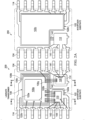
- FIG. 1 is a top perspective view that shows an example multi-chip ISO device package 100 which includes a first IC die 110 including circuitry comprising a transmitter or a receiver, and a second IC die 120 including circuitry comprising a transmitter or a receiver so that the package provides at least one communication channel.
- the ISO device package 100 also comprises a laminate transformer 130 that is mounted to an interposer substrate 122 (e.g., a DBC substrate, such as for its dielectric layer 122b including ceramic such as Alumina (Al 2 O 3 ), Aluminum Nitride (AlN), or silicon nitride) including a top copper layer 122a and a bottom metal layer 122c with the dielectric layer 122b between these metal layers.
- an interposer substrate 122 e.g., a DBC substrate, such as for its dielectric layer 122b including ceramic such as Alumina (Al 2 O 3 ), Aluminum Nitride (AlN), or silicon nitride
- a laminate transformer 130 is on the top copper layer 122a, where the transformer 130 is coupled between the transmitter and the receiver of the respective IC die 110, 120 which provides reinforced isolation.
- the laminate transformer 130 generally supports a root mean square (RMS) breakdown voltage of at least 1 kV for a test time of one minute, typically providing a breakdown voltage of at least 2.5kV to 5kV.
- RMS root mean square
- UCC12050 has a breakdown test for a minute pursuant to UL1577 which is one of the most popular standards for isolation devices.
- the interposer substrate can comprise substrates besides DBC substrates, such as for example an insulated metal substrate (IMS) which can also be used as the interposer.
- IMS insulated metal substrate
- An IMS as known in the art comprises of a metal baseplate (aluminum is commonly used because of its low cost and density) covered by a thin layer of dielectric (usually an epoxy-based layer, typically FR-4) and a top layer of copper (generally about 35 ⁇ m to more than 200 ⁇ m thick).
- the FR-4-based dielectric is usually provided thin (about 100 ⁇ m thick) because it has lower thermal conductivity as compared to the ceramics used in DBC substrates.
- the interposer substrate can also include an active metal brazed substrates (AMB), where a metal foil is soldered to a ceramic using a solder paste.
- AMB is generally a higher cost arrangement compared to DBC, but technically, AMB has essentially the same configuration as DBC.
- the laminate transformer 130 generally during ISO device package operation being the hottest component in the ISO device package being attached to the top copper layer 122a of the interposer substrate 122 enables the heat generated by the laminate transformer 130 to be vertically conducted away.
- the heat transfer path for the ISO device package 100 is first through the top copper layer 122a, then through the dielectric layer 122b, and then finally out the bottom metal layer 122c to the ambient which functions as a heatsink for the ISO device package 100.
- the dielectric layer 122b can comprise a ceramic layer, which can provide a thermal conductivity at 20 0 C of at least 20 W/m ⁇ K.
- alumina has a Thermal Conductivity at 20 0 C of 28 to 35 W/m ⁇ K
- aluminum nitride has a Thermal Conductivity at 20 0 C of about 70 to 180 W/m K
- silicon nitride has Thermal Conductivity of about 30 W/m K at 20 0 C.
- the interposer substrate 122 is shown by example for the ISO device package 100 in FIG. 1 being L-shaped to accommodate the laminate transformer 130 and the second IC die 120.
- the first IC die 110 is lateral to the area of interposer substrate 122, and is instead on a die pad 112 of the leadframe that is lateral to the area of the interposer substrate 122.
- the interposer substrate 122 can also in some disclosed arrangements occupy essentially the whole area of the ISO device package so that the laminate transformer 130 and the first and second IC die 110, 120 are all on a patterned top copper layer 122a portion of the interposer substrate 122. This arrangement is shown in FIG. 2D described below. In another arrangement, the interposer substrate 122 takes up only enough area of the package so that the laminate transformer 130 is thereon, and there are separate die pads of a leadframe for the first IC die 110 and for the second IC die 120. This other arrangement is shown in FIG. 2E described below.
- the bottom metal layer 122c can comprise copper or aluminum.
- the first IC die 110 which includes circuitry 180a and bond pads 181a is shown on the die pad 112, while the second IC die 120 including circuitry 180b and bond pads 181b is shown on the top copper layer 122a of the interposer substrate 122.
- the circuitry 180a, 180b on the IC die 110, 120 as known in the art comprises circuit elements (including transistors, and generally diodes, resistors, capacitors, etc.) formed in the semiconductor substrate, such as in an epitaxial layer on the bulk substrate material, configured together for generally realizing each at least a transmitter or receiver, with at least one of the IC die providing at least one additional circuit function.
- Example additional circuit functions include analog (e.g., amplifier, or a power converter), radio frequency (RF), digital, or non-volatile memory functions.
- the top copper layer 122a is etched or otherwise patterned to allow electrically isolating the second IC die 120 from the laminate transformer 130.
- the top copper layer 122a is patterned to isolate the first and second IC die 110, 120 from one another, and to provide isolation from the laminate transformer 130.
- Leads are shown as 124 on one side of the ISO device package 100, and leads 114 are shown on the other side of the ISO device package 100 opposite to the leads 124.
- a laminate dielectric 130b generally comprises a laminate substrate that has multiple metal layers (levels) with via connections through a dielectric material between the respective metal layers to bring all signals to a topmost surface of the laminate substrate.
- the bondwires 142, 143 between the IC die 110, 120 and the laminate transformer 130 will generally make connections to the topmost copper layer of the laminate substrate that are connected to either the top core (shown as coil 2) or bottom core (shown as coil 1) of the laminate transformer 130.
- bondwires 143 between some of the bond pads 130g on the laminate transformer 130 and some of the bond pads 181b on the second IC die 120, and some bondwires 144 between some of the bond pads 181b on the second IC die 120 and some of the leads 114.
- bondwires 145 between some of the bond pads 130g on the laminate transformer 130 and some of the leads 114.
- a mold compound 160 is also shown.
- the interposer substrate 122 is shown in FIG. 1 spanning an area of the ISO device package 100 sufficient to accommodate the laminate transformer 130 and one of the IC die shown as the second IC die 120, this need not be the case, such as in the case that the leadframe includes a first die pad and a second die pad for mounting the first IC die 110 and the second IC die 120.
- the top copper layer 122a of the interposer substrate 122 thus can have thereon either one of the two IC die and the laminate transformer 130, both of the IC die 110, 120 and the laminate transformer 130, or only the laminate transformer 130.
- the IC die 110, 120 can both be mounted on the dielectric layer 122b of the interposer substrate 122, or one or both IC die 110, 120 can have a separate area of the top copper layer 122a on the dielectric layer 122b to provide device isolation.
- the interposer substrate 122 comprises a DBC substrate
- a DBC substrate is typically more expensive than a leadframe arrangement, it is generally better to keep the area of the DBC substrate as small if possible.
- An advantage of a larger area DBC substrate with all components thereon is a thermal benefit. Having a large area top copper layer 122a helps the heat spreading by utilizing a larger area. Accordingly, for the ISO device package 100 there is a trade-off between cost and thermal performance.
- multi-chip ISO device package 100 shown in FIG. 1 includes only 2 IC die, 110, 120, disclosed multi-chip ISO device packages can have more than 2 IC die when desired.
- 3 IC die can be included instead of only 2 IC die in one disclosed multi-chip ISO device package. Accordingly, disclosed multi-chip ISO device packages provide scalability depending on the end application.
- Disclosed multichip IC device packages can generally be used for any power electronics circuit topology, not just for DC-DC converters. Examples beyond DC-DC converters can include a digital isolator, isolated flyback controller, isolated analog to digital converter (ADC), isolated gate driver, and isolated amplifiers.
- DC-DC converters can include a digital isolator, isolated flyback controller, isolated analog to digital converter (ADC), isolated gate driver, and isolated amplifiers.
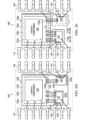
- FIG. 2A is a top view depiction example multi-chip ISO device package 200 which includes a laminate transformer 130 mounted to an interposer substrate 122, and first and second IC die 110, 120.
- the laminate transformer 130 generally comprises coil 1 (withN1 turns) and coil 2 (with N2 turns) each with magnetic field enhancing magnetic cores comprising a top magnetic core 130a and a bottom magnetic core 130c (that both typically comprise ferrite) which are spaced apart from one another by a laminate dielectric shown as 130b.
- the bottom view of this ISO device package 200 provided to the right of this FIG. shows the bottom metal layer 122c on the dielectric layer 122b of the interposer substrate 122. In this arrangement, analogous to FIG.
- the interposer substrate 122 again has an area large enough to accommodate the laminate transformer 130 as well is one of the IC die now shown as the first IC die 110, while the second IC die 120 is shown lateral to the area of the interposer substrate 122 instead being on a die pad 112 of the leadframe.
- FIG. 2B is a side cross-sectional view of the ISO device package 200 shown in FIG. 2A taken along the cut line A-A shown in FIG. 2A , where the top copper layer 122a is a patterned layer.
- FIG. 2B shows the first IC die 110 on a portion of the top copper layer 122a of the interposer substrate, having a bond pad 181a wirebonded by a bondwire 142 to a bond pad 130g of the laminate dielectric 130b of the laminate transformer 130 that is also on another portion of the top copper layer 122a.
- a mold compound 160 is shown, where the bottom metal layer 122c of the interposer substrate 122 is shown exposed from the ISO device package 200 to provide enhanced cooling for the laminate transformer 130.
- FIG. 2C is a side cross-sectional view of the ISO device package 200 shown in FIG. 2A taken along cut line B-B shown in FIG. 2A that shows the second IC die 120 on the die pad 112.
- the second IC die 120 has a bond pad 181b wirebonded to a bond pad 130g on the laminate dielectric 130b of the laminate transformer 130, where the laminate transformer 130 is on the top copper layer 122a of the interposer substrate 122.
- the second IC die 120 can be seen to be lateral to the interposer substrate 122, being instead on a die pad 112 of the leadframe.
- the bottom metal layer 122c of the interposer substrate 122 can again as in FIG. 2B be seen to be exposed from a bottom side of the ISO device package 200.
- Disclosed arrangements have freedom to select the cooling side of the ISO device package. For example, if the end application needs a topside cooling package, the backside of interposer substrate, such as copper for a DBC substrate, can also be exposed on topside of the ISO device package for topside heat sink attachment by flipping the view of the ISO device package 200 shown in FIG. 2C .
- FIG. 2D is a top view depiction example multi-chip ISO device package 240 which includes a laminate transformer 130 mounted to an interposer substrate shown as 122l.
- the interposer substrate 122l occupies essentially the whole area of the ISO device package 240 so that the laminate transformer 130 as well as the first IC die 110 and the second IC 120 are all on separate (patterned) areas of the top copper layer 122a of the interposer substrate 122l.
- FIG. 2E is a top view depiction example multi-chip ISO device package 260 which includes a laminate transformer 130 mounted onto an interposer substrate shown as 122s.
- the interposer substrate 122s takes up only enough area of the ISO device package 260 so that the laminate transformer 130 is thereon, and the leadframe provides separate die pads for the respective IC die, with a die pad 112a provided for the first IC die 110 and another die pad 112b provided for the second IC die 120.
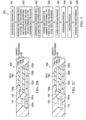
- FIG. 3 is a flow chart that shows steps in an example method 300 for forming multi-chip ISO device package that includes a laminate transformer mounted onto an isolating interposer substrate, according to an example aspect.
- Step 301 shown as "raw material preparation” comprises providing a first IC die 110, a second IC die 120, a laminate transformer 130, an interposer substrate 122, and a leadframe including leads or lead terminals (leads 114, 124 shown in FIG. 1 ) that optionally includes one or more die pad(s).
- the leadframe can include 0, 1, or 2 die pads, where the IC die can be either on die pads, or directly on the top copper layer of the interposer substrate where the top copper layer is optionally a patterned layer.
- the interposer substrate can have an area sufficient to accommodate all the components of the ISO device package, such as shown in FIG. 2D described above.
- Step 302 comprises mounting the leadframe (generally a leadframe panel/array) onto a fixture, and then picking and placing an interposer substrate inside the leads or lead terminals of the leadframe onto the fixture.
- the fixture can provide an accurate alignment between the leadframe and interposer substrate to enable placing the interposer substrate within an opening in the leadframe, and a tie-bar on the leadframe can be used to physically connect interposer substrates to the leadframe panel/array. This physical connection can be accomplished by using either an adhesive material along with reflow step, or using mechanical clamping.
- Step 303 comprises dispensing an adhesive on the top copper layer of the interposer substrate and optionally on one or more die pads.
- the adhesive generally has a thermal conductivity of at least 2 W/m ⁇ K @ 20 0 C, such as least 20 W/m ⁇ K @ 20 0 C.
- Step 304 comprises picking and placing the laminate transformer on the adhesive on the top copper layer of the interposer substrate, and the first IC die and second IC die on the adhesive on the top copper layer of the interposer substrate when the top copper layer is a patterned layer, or on the die pad(s) when the leadframe includes die pad(s).
- Step 305 comprises a curing or reflow process to cure the adhesive, such as curing at a temperature about 200°C for about a minute.
- Step 306 comprises wirebonding.
- Step 307 comprises a molding process to form a mold compound, and step 308 comprises package trim and forming, including cutting the tie-bars of the leadframe.
- the assembly can comprise configurations comprising a plurality of stacked semiconductor die.
- a variety of package substrates may be used.
- the semiconductor die may include various elements therein and/or layers thereon, including barrier layers, dielectric layers, device structures, active elements and passive elements including source regions, drain regions, bit lines, bases, emitters, collectors, conductive lines, conductive vias, etc.
- the semiconductor die can be formed from a variety of processes including bipolar, insulated-gate bipolar transistor (IGBT), CMOS, BiCMOS and MEMS.
Landscapes
- Engineering & Computer Science (AREA)
- Power Engineering (AREA)
- Lead Frames For Integrated Circuits (AREA)
- Manufacturing & Machinery (AREA)
- Semiconductor Integrated Circuits (AREA)
Applications Claiming Priority (3)
| Application Number | Priority Date | Filing Date | Title |
|---|---|---|---|
| US16/828,298 US11329025B2 (en) | 2020-03-24 | 2020-03-24 | Multi-chip package with reinforced isolation |
| PCT/US2021/023563 WO2021195013A1 (en) | 2020-03-24 | 2021-03-23 | Multi-chip package with reinforced isolation |
| EP21776018.0A EP4128341B1 (de) | 2020-03-24 | 2021-03-23 | Multichipgehäuse mit verstärkter isolierung |
Related Parent Applications (1)
| Application Number | Title | Priority Date | Filing Date |
|---|---|---|---|
| EP21776018.0A Division EP4128341B1 (de) | 2020-03-24 | 2021-03-23 | Multichipgehäuse mit verstärkter isolierung |
Publications (2)
| Publication Number | Publication Date |
|---|---|
| EP4443506A2 true EP4443506A2 (de) | 2024-10-09 |
| EP4443506A3 EP4443506A3 (de) | 2024-12-18 |
Family
ID=77857524
Family Applications (2)
| Application Number | Title | Priority Date | Filing Date |
|---|---|---|---|
| EP21776018.0A Active EP4128341B1 (de) | 2020-03-24 | 2021-03-23 | Multichipgehäuse mit verstärkter isolierung |
| EP24189578.8A Pending EP4443506A3 (de) | 2020-03-24 | 2021-03-23 | Multichipgehäuse mit verstärkter isolierung |
Family Applications Before (1)
| Application Number | Title | Priority Date | Filing Date |
|---|---|---|---|
| EP21776018.0A Active EP4128341B1 (de) | 2020-03-24 | 2021-03-23 | Multichipgehäuse mit verstärkter isolierung |
Country Status (4)
| Country | Link |
|---|---|
| US (2) | US11329025B2 (de) |
| EP (2) | EP4128341B1 (de) |
| CN (1) | CN115004364A (de) |
| WO (1) | WO2021195013A1 (de) |
Families Citing this family (8)
| Publication number | Priority date | Publication date | Assignee | Title |
|---|---|---|---|---|
| FR3127841B1 (fr) | 2021-10-01 | 2026-03-06 | St Microelectronics Tours Sas | Transformateur dans un substrat de boitier |
| US11929311B2 (en) * | 2021-10-15 | 2024-03-12 | Texas Instruments Incorporated | Isolated semiconductor package with HV isolator on block |
| US20230378022A1 (en) * | 2022-05-20 | 2023-11-23 | Texas Instruments Incorporated | Power module integrated circuit package |
| US12489061B2 (en) | 2022-06-27 | 2025-12-02 | Texas Instruments Incorporated | Semiconductor device with multiple dies |
| CN115332212B (zh) * | 2022-09-13 | 2026-02-24 | 天水华天科技股份有限公司 | 一种SiP塑料封装件及其生产方法 |
| WO2024069401A1 (en) * | 2022-09-28 | 2024-04-04 | Delphi Technologies Ip Limited | Systems and methods for three channel galvanic isolator for inverter for electric vehicle |
| CN118553627B (zh) * | 2024-07-29 | 2024-12-20 | 杰华特微电子股份有限公司 | 多芯片封装结构及其制造方法 |
| US20260041017A1 (en) * | 2024-07-31 | 2026-02-05 | Texas Instruments Incorporated | Microelectronics device package with isolation and ceramic interposer forming thermal pad |
Family Cites Families (34)
| Publication number | Priority date | Publication date | Assignee | Title |
|---|---|---|---|---|
| KR100993579B1 (ko) * | 2002-04-30 | 2010-11-10 | 르네사스 일렉트로닉스 가부시키가이샤 | 반도체장치 및 전자 장치 |
| US7064442B1 (en) * | 2003-07-02 | 2006-06-20 | Analog Devices, Inc. | Integrated circuit package device |
| DE102007012154B4 (de) * | 2007-03-12 | 2014-05-08 | Infineon Technologies Ag | Halbleitermodul mit Halbleiterchips und Verfahren zur Herstellung desselben |
| US7468547B2 (en) * | 2007-05-11 | 2008-12-23 | Intersil Americas Inc. | RF-coupled digital isolator |
| JP5332374B2 (ja) * | 2008-07-25 | 2013-11-06 | サンケン電気株式会社 | 半導体装置 |
| JP2010244977A (ja) * | 2009-04-09 | 2010-10-28 | Renesas Electronics Corp | 半導体装置 |
| KR101101490B1 (ko) * | 2009-11-24 | 2012-01-03 | 삼성전기주식회사 | 차폐 기능을 갖는 무선 장치 |
| US20120199960A1 (en) | 2011-02-07 | 2012-08-09 | Texas Instruments Incorporated | Wire bonding for interconnection between interposer and flip chip die |
| TWI525767B (zh) * | 2011-04-04 | 2016-03-11 | 羅姆電子股份有限公司 | Semiconductor device and method for manufacturing semiconductor device |
| DE102011100487A1 (de) * | 2011-05-04 | 2012-11-08 | Micronas Gmbh | Integriertes passives Bauelement |
| US9035435B2 (en) * | 2012-11-14 | 2015-05-19 | Power Integrations, Inc. | Magnetically coupled galvanically isolated communication using lead frame |
| US8963622B2 (en) * | 2013-03-10 | 2015-02-24 | Microchip Technology Incorporated | Method and apparatus for generating regulated isolation supply voltage |
| US9250403B2 (en) * | 2013-04-26 | 2016-02-02 | Oracle International Corporation | Hybrid-integrated photonic chip package with an interposer |
| US20150004902A1 (en) * | 2013-06-28 | 2015-01-01 | John M. Pigott | Die-to-die inductive communication devices and methods |
| US10297572B2 (en) * | 2014-10-06 | 2019-05-21 | Mc10, Inc. | Discrete flexible interconnects for modules of integrated circuits |
| JP6522402B2 (ja) * | 2015-04-16 | 2019-05-29 | ローム株式会社 | 半導体装置 |
| US9899282B2 (en) * | 2015-07-24 | 2018-02-20 | Infineon Technologies Americas Corp. | Robust high performance semiconductor package |
| US10497506B2 (en) * | 2015-12-18 | 2019-12-03 | Texas Instruments Incorporated | Methods and apparatus for isolation barrier with integrated magnetics for high power modules |
| US9837923B2 (en) | 2016-04-27 | 2017-12-05 | General Electric Company | Integrated power converter and transformer |
| US10056319B2 (en) * | 2016-04-29 | 2018-08-21 | Delta Electronics, Inc. | Power module package having patterned insulation metal substrate |
| US9905439B2 (en) * | 2016-04-29 | 2018-02-27 | Delta Electronics, Inc. | Power module package having patterned insulation metal substrate |
| US10439065B2 (en) | 2017-10-11 | 2019-10-08 | Texas Instruments Incorporated | Inverted leads for packaged isolation devices |
| US20190109061A1 (en) * | 2017-10-11 | 2019-04-11 | Texas Instruments Incorporated | Edge Bend for Isolation Packages |
| US11315891B2 (en) | 2018-03-23 | 2022-04-26 | Taiwan Semiconductor Manufacturing Company, Ltd. | Methods of forming semiconductor packages having a die with an encapsulant |
| US10714418B2 (en) * | 2018-03-26 | 2020-07-14 | Texas Instruments Incorporated | Electronic device having inverted lead pins |
| US10559524B1 (en) * | 2018-09-17 | 2020-02-11 | Texas Instruments Incorporated | 2-step die attach for reduced pedestal size of laminate component packages |
| US11482477B2 (en) * | 2018-12-31 | 2022-10-25 | Texas Instruments Incorporated | Packaged electronic device with suspended magnetic subassembly |
| US20200248914A1 (en) * | 2019-01-31 | 2020-08-06 | Johnson Controls Technology Company | Printed circuit board of an hvac controller |
| US10854538B2 (en) * | 2019-02-12 | 2020-12-01 | Texas Instruments Incorporated | Microelectronic device with floating pads |
| US11616006B2 (en) * | 2019-02-27 | 2023-03-28 | Semiconductor Components Industries, Llc | Semiconductor package with heatsink |
| US11258270B2 (en) * | 2019-06-28 | 2022-02-22 | Alpha And Omega Semiconductor (Cayman) Ltd. | Super-fast transient response (STR) AC/DC converter for high power density charging application |
| US20210193586A1 (en) * | 2019-12-18 | 2021-06-24 | Bae Systems Information And Electronic Systems Integration Inc. | Cryptographic system-in-package (csip) |
| JP7603400B2 (ja) * | 2020-09-10 | 2024-12-20 | ローム株式会社 | 半導体装置 |
| JP7527916B2 (ja) * | 2020-09-29 | 2024-08-05 | ローム株式会社 | 半導体装置 |
-
2020
- 2020-03-24 US US16/828,298 patent/US11329025B2/en active Active
-
2021
- 2021-03-23 CN CN202180011225.5A patent/CN115004364A/zh active Pending
- 2021-03-23 EP EP21776018.0A patent/EP4128341B1/de active Active
- 2021-03-23 EP EP24189578.8A patent/EP4443506A3/de active Pending
- 2021-03-23 WO PCT/US2021/023563 patent/WO2021195013A1/en not_active Ceased
-
2022
- 2022-05-10 US US17/741,402 patent/US11908834B2/en active Active
Also Published As
| Publication number | Publication date |
|---|---|
| US20220271008A1 (en) | 2022-08-25 |
| WO2021195013A1 (en) | 2021-09-30 |
| US11329025B2 (en) | 2022-05-10 |
| EP4128341A4 (de) | 2023-09-13 |
| EP4443506A3 (de) | 2024-12-18 |
| US11908834B2 (en) | 2024-02-20 |
| EP4128341A1 (de) | 2023-02-08 |
| CN115004364A (zh) | 2022-09-02 |
| US20210305207A1 (en) | 2021-09-30 |
| EP4128341B1 (de) | 2024-07-24 |
Similar Documents
| Publication | Publication Date | Title |
|---|---|---|
| EP4128341B1 (de) | Multichipgehäuse mit verstärkter isolierung | |
| US10784213B2 (en) | Power device package | |
| JP7565365B2 (ja) | 配線用に構成されたデバイスキャリア、配線を有するデバイスキャリアを実装するパッケージ、およびその製作方法 | |
| KR20220162165A (ko) | 수동 디바이스들을 포함하는 멀티 레벨 rf(radio frequency) 집적 회로 컴포넌트들 | |
| US12142550B2 (en) | Multi-chip module leadless package | |
| US12015019B2 (en) | Stacked die multichip module package | |
| US5659462A (en) | Encapsulated, integrated power magnetic device and method of manufacture therefor | |
| US11153996B2 (en) | Thermal management assemblies for electronic assemblies mounted on a motor end | |
| KR102490612B1 (ko) | 전력용 반도체 모듈 | |
| US10888036B1 (en) | Thermal management assemblies for electronic assemblies circumferentially mounted on a motor | |
| US20200211934A1 (en) | Leadframe for multichip devices with thinned die pad portions | |
| US11749578B2 (en) | Semiconductor module, power semiconductor module, and power electronic equipment using the semiconductor module or the power semiconductor module | |
| US20200235067A1 (en) | Electronic device flip chip package with exposed clip | |
| CN108323211B (zh) | 功率器件封装 | |
| CN111244061B (zh) | 氮化镓设备的封装结构 | |
| US20240421139A1 (en) | Module assembly of multiple semiconductor devices with insulating substrates | |
| EP4258337B1 (de) | Isolierte leiterplatte und stromwandler | |
| US11929311B2 (en) | Isolated semiconductor package with HV isolator on block | |
| US20250372506A1 (en) | Isolation circuitry on semiconductor die | |
| US11791249B2 (en) | Thermally enhanced isolated power converter package | |
| US11521920B2 (en) | Plurality of power semiconductor chips between a substrate and leadframe | |
| KR100632237B1 (ko) | 3차원 다층 멀티 칩 모듈 패키지 제조 방법 |
Legal Events
| Date | Code | Title | Description |
|---|---|---|---|
| PUAI | Public reference made under article 153(3) epc to a published international application that has entered the european phase |
Free format text: ORIGINAL CODE: 0009012 |
|
| STAA | Information on the status of an ep patent application or granted ep patent |
Free format text: STATUS: THE APPLICATION HAS BEEN PUBLISHED |
|
| AC | Divisional application: reference to earlier application |
Ref document number: 4128341 Country of ref document: EP Kind code of ref document: P |
|
| AK | Designated contracting states |
Kind code of ref document: A2 Designated state(s): AL AT BE BG CH CY CZ DE DK EE ES FI FR GB GR HR HU IE IS IT LI LT LU LV MC MK MT NL NO PL PT RO RS SE SI SK SM TR |
|
| REG | Reference to a national code |
Ref country code: DE Ref legal event code: R079 Free format text: PREVIOUS MAIN CLASS: H01L0025160000 Ipc: H01L0023500000 |
|
| PUAL | Search report despatched |
Free format text: ORIGINAL CODE: 0009013 |
|
| AK | Designated contracting states |
Kind code of ref document: A3 Designated state(s): AL AT BE BG CH CY CZ DE DK EE ES FI FR GB GR HR HU IE IS IT LI LT LU LV MC MK MT NL NO PL PT RO RS SE SI SK SM TR |
|
| RIC1 | Information provided on ipc code assigned before grant |
Ipc: H01L 25/16 20230101ALI20241113BHEP Ipc: H01L 23/373 20060101ALI20241113BHEP Ipc: H01L 23/495 20060101ALI20241113BHEP Ipc: H01L 23/538 20060101ALI20241113BHEP Ipc: H01L 23/50 20060101AFI20241113BHEP |
|
| STAA | Information on the status of an ep patent application or granted ep patent |
Free format text: STATUS: REQUEST FOR EXAMINATION WAS MADE |
|
| 17P | Request for examination filed |
Effective date: 20250618 |
|
| REG | Reference to a national code |
Ref country code: DE Ref legal event code: R079 Free format text: PREVIOUS MAIN CLASS: H01L0023500000 Ipc: H10W0090000000 |
|
| RIC1 | Information provided on ipc code assigned before grant |
Ipc: H10W 90/00 20260101AFI20260115BHEP Ipc: H10W 40/25 20260101ALI20260115BHEP Ipc: H10W 70/40 20260101ALI20260115BHEP Ipc: H10W 74/10 20260101ALN20260115BHEP |
|
| GRAP | Despatch of communication of intention to grant a patent |
Free format text: ORIGINAL CODE: EPIDOSNIGR1 |
|
| STAA | Information on the status of an ep patent application or granted ep patent |
Free format text: STATUS: GRANT OF PATENT IS INTENDED |
|
| RIC1 | Information provided on ipc code assigned before grant |
Ipc: H10W 90/00 20260101AFI20260128BHEP Ipc: H10W 40/25 20260101ALI20260128BHEP Ipc: H10W 70/40 20260101ALI20260128BHEP Ipc: H10W 74/10 20260101ALN20260128BHEP Ipc: H10W 72/50 20260101ALN20260128BHEP Ipc: H10W 72/59 20260101ALN20260128BHEP Ipc: H10W 72/90 20260101ALN20260128BHEP Ipc: H10W 74/00 20260101ALN20260128BHEP |
|
| INTG | Intention to grant announced |
Effective date: 20260303 |