EP4440344B1 - Essbare und lösliche überträgerfilme für das dekorieren von getränken und von lebensmitteln - Google Patents
Essbare und lösliche überträgerfilme für das dekorieren von getränken und von lebensmitteln Download PDFInfo
- Publication number
- EP4440344B1 EP4440344B1 EP23832801.7A EP23832801A EP4440344B1 EP 4440344 B1 EP4440344 B1 EP 4440344B1 EP 23832801 A EP23832801 A EP 23832801A EP 4440344 B1 EP4440344 B1 EP 4440344B1
- Authority
- EP
- European Patent Office
- Prior art keywords
- substrate
- water
- edible
- pectin
- foodstuff
- Prior art date
- Legal status (The legal status is an assumption and is not a legal conclusion. Google has not performed a legal analysis and makes no representation as to the accuracy of the status listed.)
- Active
Links
Images

Classifications
-
- A—HUMAN NECESSITIES
- A23—FOODS OR FOODSTUFFS; TREATMENT THEREOF, NOT COVERED BY OTHER CLASSES
- A23P—SHAPING OR WORKING OF FOODSTUFFS, NOT FULLY COVERED BY A SINGLE OTHER SUBCLASS
- A23P20/00—Coating of foodstuffs; Coatings therefor; Making laminated, multi-layered, stuffed or hollow foodstuffs
- A23P20/10—Coating with edible coatings, e.g. with oils or fats
- A23P20/105—Coating with compositions containing vegetable or microbial fermentation gums, e.g. cellulose or derivatives; Coating with edible polymers, e.g. polyvinyalcohol
-
- A—HUMAN NECESSITIES
- A21—BAKING; EDIBLE DOUGHS
- A21D—TREATMENT OF FLOUR OR DOUGH FOR BAKING, e.g. BY ADDITION OF MATERIALS; BAKING; BAKERY PRODUCTS
- A21D13/00—Finished or partly finished bakery products
- A21D13/40—Products characterised by the type, form or use
- A21D13/47—Decorated or decorative products
-
- A—HUMAN NECESSITIES
- A21—BAKING; EDIBLE DOUGHS
- A21D—TREATMENT OF FLOUR OR DOUGH FOR BAKING, e.g. BY ADDITION OF MATERIALS; BAKING; BAKERY PRODUCTS
- A21D13/00—Finished or partly finished bakery products
- A21D13/20—Partially or completely coated products
- A21D13/28—Partially or completely coated products characterised by the coating composition
-
- A—HUMAN NECESSITIES
- A23—FOODS OR FOODSTUFFS; TREATMENT THEREOF, NOT COVERED BY OTHER CLASSES
- A23P—SHAPING OR WORKING OF FOODSTUFFS, NOT FULLY COVERED BY A SINGLE OTHER SUBCLASS
- A23P20/00—Coating of foodstuffs; Coatings therefor; Making laminated, multi-layered, stuffed or hollow foodstuffs
- A23P20/20—Making of laminated, multi-layered, stuffed or hollow foodstuffs, e.g. by wrapping in preformed edible dough sheets or in edible food containers
- A23P20/25—Filling or stuffing cored food pieces, e.g. combined with coring or making cavities
- A23P2020/253—Coating food items by printing onto them; Printing layers of food products
Definitions
- the present invention relates to decorations for foodstuffs, wherein the decorations comprise an edible substrate and an edible image disposed on the edible substrate.
- the invention also relates to methods of making decorations for foodstuffs as well as methods of decorating foodstuffs.
- US20060275529A1 relates to slot coating an edible material onto a backing material to form an edible substrate, which is then in turn printed with an image.
- the edible substrate can then be applied to various food objects, including by applying the backing material and substrate to foodstuffs and then peeling away the backing material.
- the edible substrate is formed from mixtures of starches and other ingredients in very complex formulations, and can be decorated using, for example, printing.
- the substrates are not water soluble and thus the printed substrates remain on the surface of food objects after transfer. Accordingly, it is not possible to decorate foodstuffs with only the printed image using the method disclosed in this document, as the substrate itself is also visible on the surface of the foodstuffs.
- AU1994072188A1 and WO951735A1 are related to the preparation of a decorated edible film which can be affixed to a food object like a transfer.
- the disclosed film is made from hydroxypropyl methylcellulose, which is water insoluble, and so remains on the surface of the food object and is not aesthetically pleasing.
- GB2426219A relates to a product comprising an amylaceous edible substrate, to a method of forming such a product and to a number of uses of such a product, particularly in the foodstuff decorating art.
- US2018/228202A1 relates to edible print substrates.
- the invention provides a decoration for food stuffs comprising an edible substrate and an edible image disposed on the edible substrate.
- the edible substrate comprises a material selected from the group consisting of pectin, citric acid, citric acid esters, vegetable oil, collagen, and combinations thereof.
- the material selected from the group consisting of pectin, citric acid, citric acid esters, vegetable oil, collagen, and combinations thereof is present in the substrate in an amount of at least 50wt%, such as 50 to 95wt%, relative to the total weight of the non-water components of the substrate.
- the substrate has a water solubility of at least 70%, wherein water solubility is measured at 20 °C.
- the invention further provides a method for decorating a foodstuff or beverage, comprising steps:
- Pectin a naturally occurring substance (polysaccharide) found in fruits, including berries, apples and citrus fruits. Pectin typically has a weight average molecular weight of 50,000 to 180,000 Da.
- Nestle Coffeemate a composition comprising glucose syrup, palm kernel oil, milk proteins, stabilisers (E331, E452), acidity regulator (E340), emulsifiers (E471, E472e), anti-caking agent (E170), and the colour riboflavin.
- Plantcol White a plant based "collagen” comprising water, citric acid, modified starch, coconut oil, and Potassium sorbate.
- IMWITOR ® 742 a blend of mono-, di-, and triglycerides, mainly of caprylic and capric acid.
- Citrem a citric acid ester of mono- and diglycerides.
- Modified starch (also called a starch derivatives) is prepared by physically, enzymatically, and/or chemically treating native starch in order to change its properties.
- room/ambient temperature is 20 °C.
- Boiling point unless otherwise specified, all boiling points are measured under standard atmospheric pressure of 101 kPa.
- the preparation, decoration, and subsequent application of an edible decorated substrate to a food object, which dissolves when applied, is an advantageous feature of the present invention.
- the benefit is that the image is applied to the surface of the food object when the substrate is exposed to a small amount of moisture.
- the substrate is absorbed into or onto the surface, such that it is no longer visible, leaving only the printed image visible with excellent print quality.
- the substrates for use in the invention are edible and thus can be retained on the food or beverage objects.
- the edible substrates of the invention can either be drawdown coated or simply cast onto a temporary backing sheet and then dried. Once dried, the substrates can be overprinted with a number of various techniques, including inkjet printing. Inkjet printing is advantageous as it enables a very high level of printed image quality to be achieved.
- the substrates of the invention thus obviate the well-known issues associated with printing directly onto food, which has the undesirable tendency of resulting in the ink absorbing into the food thus creating a wicking effect and dot spread, imparting poor print appearance.
- the printed image quality achieved when printing edible inkjet inks onto the substrates for use in the invention is visually superior to that achieved via direct printing methods, with a sharper image and greatly reduced dot spread than images printed directly onto a food object.
- substrates made from water-soluble materials can have an image printed thereon in a central location using edible inks, according to the design of the customer, and then the printed substrate can be shipped to the food factory, domestic place, or restaurant, such that a printer is not required on-site.
- a printer is not required on-site.
- the substrates of the invention allow a decorator to decorate a food object without the need to own an inkjet printer, and can instead purchase the substrates for use in the invention (e.g., soluble transfers) pre-printed with edible inks ot their own personalised design, and apply them to foodstuffs.
- the thickness of the substrates and the various ways in which the primers (e.g., pectin solutions) can be formed into the substrates are numerous, such that they do not require any specialized processing equipment.
- the primers for making the edible substrates for use in the invention comprise very few ingredients and are advantageously chosen from plant-based sources to be compliant with various food regulations and certifications.
- the substrates for use in the invention may comprise only three ingredients, pectin, water, and a small quantity of a preservative. Therefore, the substrates are very simple to prepare and can be cast into any mould or shape on a temporary backing film, and then, once dried, printed with a variety of edible inkjet inks or even decorated with effects pigment inks, which are also edible.
- the components of the substrates for use in the invention are preferably all derived from plant-based sources.
- the components are certified as edible, and as such are compliant with various food regulations, such as those required by vegan, kosher, and halal.
- printed substrates such as pectin substrates that are exemplified in this invention, may be permitted for application to foods such as breadcakes, frozen meats, frozen foods, baked goods and confectionary according to the FDA regulation CFR Part 21, and the corresponding EU food regulation EC 1333/2008 , which regulate the definition and use of food additives.
- the decorations of the invention are suitable for use on a very wide range of food products including frozen goods, baked goods, and confectionary.
- the invention avoids the use of plastic transfer films, which are typically used in the art for edible transfer printing of food or beverage objects and do not degrade in the environment after disposal.
- the edible substrates for use in the invention are water-soluble.
- water-soluble it is meant that the edible substrate has a water solubility of at least 50% when measured at ambient temperature (20 °C) or, in other words, that at last 50g of the substrate for use in the invention dissolves in 100 g of water at ambient temperature.
- At least 70 g of the substrate for use in the invention dissolves in 100 g of water at ambient temperature (i.e., the water solubility is at least 70%). More preferably, at least 90 g of the substrate for use in the invention dissolves in 100 g of water at ambient temperature (i.e., the water solubility is at least 90%). Even more preferably, at least 100 g of the substrate for use in the invention dissolves in 100 g of water at ambient temperature (i.e., the water solubility is at least 100%).
- the substrates for use in the invention are water-soluble, the presence of small amounts of water insoluble components do not affect the function of these substrates, i.e., the ability of the substrate to be absorbed into the foodstuffs upon which the decorations are placed to leave only the printed edible ink image visible.
- the water-soluble edible substrates for use in the invention preferably comprise less than 5wt% of water-insoluble components, more preferably less than 3wt%, and even more preferably less than 1wt% of water-insoluble components.
- the water-soluble edible substrates for use in the invention are most preferably substantially free of water-insoluble components.
- the substrate for use in the invention preferably comprises 30wt% or less of water, such as 20wt% or less of water.
- composition of the primer for use in making the substrate for use in the invention is composition of the primer for use in making the substrate for use in the invention
- substrates made from water-soluble materials are particularly advantageous, providing edible substrates that can be printed upon with edible ink, easily removed from a support medium, and transferred to foodstuff.
- substrates are water-soluble and thus dissolve into the foodstuffs.
- the substrates of the invention are also transparent and therefore, once dissolved, advantageously leave the printed edible image on the surface of the foodstuffs with no visible coloration of the foodstuffs resulting from the substrate.
- the substrates for use in the invention effectively transfer the printed images to foodstuffs but are not themselves visible, such that only the printed image is visible on the foodstuffs.
- the primers for making the substrates of the present invention can comprise collagen (such as gelatine), citric acid, citric acid esters, vegetable oil (such as coconut oil), and combinations thereof.
- Starch may be used in addition to the materials required by the invention (i.e., pectin, citric acid, citric acid esters, vegetable oil, collagen, and combinations thereof) and is preferably selected from the group consisting of corn starch, maize starch, modified starch, tapioca starch, and combinations thereof. More preferably, the starch for use in the invention is selected from corn starch, tapioca starch, and modified starch, and combinations thereof, and even more preferably the starch is modified starch. Modified starch includes starch that has been reacted with carboxylic acids or anhydrides to afford a product comprising carboxylic acid salts as substituents, for example, starch sodium octenylsuccinate.
- the vegetable oil for use in the invention is preferably selected from the group consisting of coconut oil, olive oil, soybean oil, sunflower oil, palm oil, canola oil, palm kernel oil, and combinations thereof. More preferably, the vegetable oil is selected from the group consisting of olive oil, coconut oil, and combinations thereof. Even more preferably, the vegetable oil is coconut oil.
- the substrates for use in the invention are typically transparent but can optionally be made opaque using, for example, food-compliant white pigments or food-compliant water-insoluble effects or coloured pigments, such as silver, gold, cacao husk, or combinations thereof.
- the substrate for use in the invention may comprise one or more additives selected from the group consisting of sodium alginate, sorbitol, milk proteins, whey, and milk powder, in an amount up to 40wt%, such as up 35 to wt%, or up to 20 wt%.
- the substrate for use in the invention preferably comprises less than or equal to 40wt% of natural gum, relative to the total weight of the non-water components of the substrate.
- the substrate for use in the invention more preferably comprises less than or equal to 30wt% natural gum, relative to the total weight of the non-water components of the substrate, such as less than or equal to 26 wt%, or even more preferably less than or equal to 15 wt% natural gum, relative to the total weight of the non-water components of the substrate.
- the natural gum may be gum acacia.
- the water soluble, edible liquid primer for use in the invention preferably comprises less than or equal to 20wt% of natural gum, relative to the total weight of the primer.
- the water-soluble, edible liquid primer for use in the invention more preferably comprises less than or equal to 15wt% of natural gum, relative to the total weight of the primer, such as less than or equal to 10 wt% of natural gum, relative to the total weight of the primer.
- the natural gum may be gum acacia.
- the substrate for use in the invention preferably comprises less than or equal to 10wt% pigment, relative to the total weight of the substrate.
- the substrate for use in the invention more preferably comprises less than or equal to 5wt% pigment, relative to the total weight of the substrate, such as less than or equal to 3 wt%, or less than or equal to 1 wt%, pigment, relative to the total weight of the substrate.
- the substrate for use in the invention may be substantially free of pigment.
- the water-soluble, edible, liquid primer for use in the invention preferably comprises less than or equal to 5wt% of pigment, relative to the total weight of the primer.
- the water-soluble, edible liquid primer for use in the invention more preferably comprises less than or equal to 3wt% pigment, relative to the total weight of the primer, such as less than or equal to 2 wt%, or less than or equal to 1 wt% pigment, relative to the total weight of the primer.
- the water-soluble, edible, liquid primer for use in the invention may be substantially free of pigment.
- the substrate for use in the invention preferably comprises less than or equal to 50 wt% cellulose, more preferably less than or equal to 30wt%, or less than or equal to 15wt% cellulose, and even more preferably less than or equal to 10wt% cellulose, relative to the total weight of the non-water components of the substrate.
- the substrates for use in the invention may be substantially free of cellulose.
- Cellulose includes cellulose derivatives, such as methylcellulose and microcrystalline cellulose.
- the water-soluble, edible, liquid primer for use in the invention preferably comprises less than or equal to 10 wt% cellulose and more preferably less than or equal to 5wt% cellulose relative to the total weight of the primer composition.
- the substrate for use in the invention preferably comprises 50 to 95wt% of a material selected from the group consisting of pectin, starch, citric acid, citric acid esters, vegetable oil, collagen, and combinations thereof, less than or equal to 40wt% of natural gum, less than or equal to 50 wt% cellulose, and less than or equal to 20wt% pigment, based on the total weight of the non-water-based components.
- the substrate for use in the invention more preferably comprises 50 to 95wt% of a material selected from the group consisting of pectin, modified starch, corn starch, tapioca starch, gelatine, citric acid, citric acid esters, coconut oil, and combinations thereof, less than or equal to 30wt% natural gum, less than or equal to 30wt% cellulose, and less than or equal to 10wt% pigment, based on the total weight of the non-water components.
- a material selected from the group consisting of pectin, modified starch, corn starch, tapioca starch, gelatine, citric acid, citric acid esters, coconut oil, and combinations thereof, less than or equal to 30wt% natural gum, less than or equal to 30wt% cellulose, and less than or equal to 10wt% pigment, based on the total weight of the non-water components.
- the substrate for use in the invention even more preferably comprises 53 to 95wt% of a material selected from the group consisting of pectin, modified starch, citric acid, and combinations thereof, less than or equal to 26 wt% natural gum, less than or equal to 15wt% cellulose, and less than or equal to 5 wt% pigment, based on the total weight of the non-water components.
- the substrate for use in the invention even more preferably comprises 58 to 95wt% of a material selected from the group consisting of pectin, coconut oil, citric acid, and combinations thereof, less than or equal to 26 wt% natural gum, less than or equal to 15wt% cellulose, and less than or equal to 5 wt% pigment, based on the total weight of the non-water components.
- the substrate for use in the invention preferably comprises 30 to 80wt% pectin, less than or equal to 15 wt% natural gum, less than or equal to 10wt% cellulose, and less than or equal to 3 wt% pigment, based on the total weight of the non-water components.
- the substrate for use in the invention most preferably comprises 39 to 75wt%, pectin, based on the total weight of the non-water-based components, is substantially free of natural gum, is substantially free of cellulose, and is substantially free of pigment.
- the edible substrate for use in the invention comprises an edible image disposed thereon, wherein the image is obtained from an edible ink.
- the edible ink is suitable for being printed onto the edible substrate.
- the edible ink is preferably printed onto the substrate, for example, using inkjet printing.
- the edible inks are food-certified edible inks, such as inks that comply with FDA regulation CFR Part 21, and the corresponding EU food regulation EC 1333/200.
- the edible inks for use in the invention comprise water, a humectant, and food colouring.
- the edible ink for use in the invention may comprise water, glycerin, vegetable oil, flour, cellulose, starch, and calcium carbonate.
- the edible ink may comprise about 30% to 45% water; from 8% to 12% glycerin; from 3% to 6% vegetable oil; from 8% to 12% flour; from 3% to 4.5% of microcrystalline cellulose; from 6% to 8% of starch; and from 0.8% to 1.2% of calcium carbonate.
- the edible inks for use in the invention may comprise water, a humectant, and food coloring.
- the humectants can include, for example, glycols such as propylene glycol, hexylene glycol, and butylene glycol, aloe vera gel, alpha hydroxy acids such as lactic acid, egg yolk and egg white, glyceryl triacetate, honey, polymeric polyols such as polydextrose, Quillaia, Sodium hexametaphosphate E452i, sugar alcohols (sugar polyols) such as glycerol, sorbitol, xylitol, maltitol, urea, and castor oil.
- glycols such as propylene glycol, hexylene glycol, and butylene glycol
- aloe vera gel alpha hydroxy acids
- alpha hydroxy acids such as lactic acid, egg yolk and egg white
- glyceryl triacetate honey
- the edible ink may instead comprise about: 8.3% Trimoline ® (an inverted sugar syrup comprising 82wt% crystallized inverted sugar syrup and 18wt% water), 9.4% glycerin; 1.8% potassium polysorbate; 3.7% canola oil; 1.8% coconut oil; 0.2% soybean lecithin ⁇ 10.2% of tapioca flour; 4.6% of solid corn syrup; 2.8% of confectioner's sugar; 3.7% of microcrystalline cellulose ⁇ 0.05% of gum acacia; 0.5% of modified starch ⁇ 0.5% of citric acid; 0.01 % of potassium sorbate; 0.5% of alginate; 7% of nee starch; 1 % of calcium carbonate; 0.1 % of milk protein; and 6% of food dye, and the remainder is water.
- Trimoline ® an inverted sugar syrup comprising 82wt% crystallized inverted sugar syrup and 18wt% water
- 9.4% glycerin an inverted sugar syrup comprising 82wt% crystallized inverted sugar syrup and 18w
- the substrates for use in the invention may be any suitable thickness, such as from 0.01 mm to 10 mm, preferably from 0.1 mm to 8mm, such as 1 mm to 6mm, or 2mm to 5mm, and even more preferably from 3mm to 4 mm.
- the decoration of the invention can be applied to any suitable foodstuffs, which are either already rich in water or are able to absorb water.
- the foodstuffs could be, for example, frozen meat, frozen baked goods, baked cookies, baked bread or bread cakes, baked cakes, cut fruit, cakes, pastries, pasties, ice-cream, bread, beer, cream, candy, biscuits, chocolate, vegetables, and other meat products.
- the invention is especially suitable for use with contoured food objects, such as bread rolls. It is also applicable to the personalisation of frozen articles and frozen dairy items and ices.
- the decoration of the invention can be applied to the foam tops of beverages, such as coffee, beer, and other beverages.
- the invention also provides a method of providing a decoration for a foodstuff or beverage or a method for decorating a foodstuff or beverage, comprising the steps of:
- the primer solution is applied to a temporary support medium.
- the temporary support media can a material selected from the group consisting of paper, plastic, card, and metal.
- the temporary support layer can be a layer used to package the printed films for shipping to a client.
- the primer can be applied, for example, by simply pouring the primer onto the support medium, by using a drawdown or printing process, or by other means.
- Control of the thickness of the substrate is not essential and the thickness can be tailored to specific requirements by altering the application method.
- the substrate is dried.
- the substrate can be either allowed to air dry or can undergo forced convection drying in a low temperature oven, air knife, or other convection system.
- Near IR dryers or other types of drying, such as warm air, can also be used.
- an edible ink can be printed thereon.
- the edible ink can be disposed onto the edible substrate using any suitable process, including screen printing such as silk screen printing, offset printing, thermal transfer, and inkjet printing
- the edible ink is printed using inkjet printing.
- CMYK and effects images The full gamut of colours is available to construct fully CMYK and effects images.
- effects it is possible to print edible gold leaf or titanium dioxide white inks onto the substrates. This negates the requirement to add a contrasting agent to the substrate (e.g., pectin film).
- a contrasting agent to the substrate (e.g., pectin film).
- a simple process has been devised to overcome some of the challenges of inkjet printing directly onto certain foodstuffs.
- the primer film could also be applied to the food or beverage substrate using an edible adhesive (for example Dab-N-hold, Wilton Industries) or by using the liquid primer the film was made from as an adhesive.
- the substrate can be peeled away from the temporary support/packaging layer and physically applied to a food product.
- the affixed substate can then be either left to melt into the foodstuff or alternatively exposed to a small quantity of water vapour, or humidity, for example, which might be present during a cooking/baking process.
- the substrate e.g., pectin film
- the image colour droplets do not migrate as they are held in place in the top surface of the foodstuff in the presence of the substrate (e.g., pectin film) as a polymeric scaffold.
- the substrate e.g., pectin film
- a semi-humid environment e.g., at typical ambient conditions of 20°C and 40% relative humidity
- the pectin substrate readily dissolves on the surface of the food object carrying the printed image onto the surface.
- a pectin substrate may provide a desirable, visually glossy finish to foodstuffs. There is no transfer film to dispose of at the end of the process and no film on the top of the food article. Moreover, even in conditions of low humidity, a pectin substrate can easily be transferred, simply by first spraying the foodstuffs with water.
- the optional step of exposing the foodstuff to water and/or humidity to assist the dried primer layer film to adhere to the foodstuff may be performed at a humidity level of 10 to 80% relative humidity, such as 20 to 70% relative humidity, preferably 30 to 65% relative humidity, and more preferably 40 to 60% relative humidity.
- Viscosity was measured on a Brookfield DV II+ Pro Viscometer, using a UL spindle, and the sample cell immersed in a temperature-controlled water bath at 25°C.
- Solubility of a compound or composition is typically determined by measuring the maximum amount of said compound or composition that can be dissolved in 100g of water at ambient temperature (defined as 20°C) with stirring. Fully dissolvable is defined as when the mixture of water and compound or composition is transparent after 30 minutes at 20 °C with stirring. Transparent is defined as when it is possible to read text on a printed sheet of paper through the solution (from every angle).
- water soluble is defined as a minimum solubility of 50g of compound or composition in 100 g of water at 20 °C (i.e., 50% solubility).
- the viscosity was 100cP.
- the surface tension was recorded at 30 dynes/cm.
- the pH was 5.00.
- the viscosity was 100cP.
- the surface tension was recorded at 30 dynes/cm.
- the pH was 5.00.
- the viscosity was 100cP.
- the surface tension was recorded at 30 dynes/cm.
- the pH was 5.00.
- the viscosity was 227cP.
- the surface tension was recorded at 30 dynes/cm.
- the pH was 5.00.
- the viscosity was 470cP.
- the surface tension was recorded at 30 dynes/cm.
- the pH was 5.00.
- Casting of films was performed at room temperature and standard relative humidity (40-60%) by adding enough primer liquid formulation to cover a metal dish with a 3-4mm depth of the liquid formulation.
- the metal dishes were then placed on a warm heated surface (for example, a hot plate at ⁇ 90°F) until set (usually 3-4 hours).
- the films were peeled off the metal support tray and printed using a Primera Eddie inkjet or Logojet Pro (H4 version) printer containing Sensijet FSE series edible inkjet inks.
- the printed films were then stored and adhered to various food objects.
- Comparative Example 1 When the standard sprayable wet primer formulation of Comparative Example 1 was formed into a substrate and air-dried, the resulting films cracked and broke down and could not be decorated by inkjet printing. Thus, for Comparative Example 1, the only attainable ratings were for visual inspection, solubility, and gloss for the beer foam test (see Table 5).
- Table 1 shows that Inventive Examples 1, 4 and 5 are best for chocolate coated ice cream bars; Inventive Example 2 is also suitable; Inventive Example 3 is less suitable.
- Table 2 Article 2 - Brioche Buns Sample Visual Inspection Color Bleed Mottle Film integrity Gloss Comp. Ex 1 NA NA NA NA NA Inv. Ex. 1 3 2 5 2 5 Inv. Ex. 2 4 5 5 5 2 Inv. Ex. 3 2 4 4 4 5 Inv. Ex. 4 3 2 5 5 3 Inv. Ex. 5 4 5 5 4 4 4 4
- Table 2 shows that Inventive Examples 2 and 5 are best for brioche buns; Inventive Examples 1, 3 and 4 are also suitable.
- Table 3 Article 3 - White chocolate Sample Visual Inspection Color Bleed Mottle Film integrity Gloss Comp. Ex 1 NA NA NA NA NA Inv. Ex. 1 5 4 5 4 5 Inv. Ex. 2 4 3 2 5 1 Inv. Ex. 3 2 4 1 2 3 Inv. Ex. 4 3 3 2 5 1 Inv. Ex. 5 5 5 5 5 4
- Table 3 shows that Inventive Examples 1 and 5 are best for white chocolate; Inventive Example 2 and 4 are also suitable; Inventive Example 3 is less suitable.
- Table 4 Article 4 - Wheatmeal biscuits Sample Visual Inspection Color Bleed Mottle Film integrity Gloss Comp. Ex 1 NA NA NA NA NA Inv. Ex. 1 3 4 4 4 5 Inv. Ex. 2 4 3 3 5 1 Inv. Ex. 3 2 2 1 4 4 Inv. Ex. 4 4 4 4 5 1 Inv. Ex. 5 5 5 4 5 5 5
- Table 4 shows that Inventive Examples 4 and 5 are best for wheatmeal biscuits; Inventive Example 2 and 5 are also suitable; Inventive Example 3 is less suitable.
- Table 5 Article 5 - Beer foam Sample Visual Inspection Color Bleed Mottle Solubility Gloss Comp. Ex 1 1 NA NA Yes 1 Inv. Ex. 1 4 4 4 4 No 5 Inv. Ex. 2 4 4 4 4 No 1 Inv. Ex. 3 4 3 2 Yes 3 Inv. Ex. 4 4 4 4 4 No 1 Inv. Ex. 5 5 5 4 Yes 4
- Table 5 shows that Inventive Example 5 is best for beer foam; Inventive Examples 3 is also suitable; Inventive Examples 1, 2 and 4 are less suitable.
- Comparative Example 2 was prepared from a primer with the following composition.
- Component Amount (wt%) Maize starch 10.1 Gum acacia 10.1 Xantham 1.37 Potassium sorbate 0.1 Sweetener 0.06 Sorbitol 16.84 Polysorbate 80 0.67 Water 60.63 TiO 2 0.13 TOTAL 100
- the substrate of Comparative Example 2 is based on Formulation 5 of US20060275529A1 (see Table 5 in paragraph [0068]). The only exception is that polysorbate 80 was used instead of polysorbate 60.
- Polysorbate 80 is polyoxyethylene (20) sorbitan monooleate.
- Polysorbate 60 is polyoxyethylene (20) sorbitan monostearate.
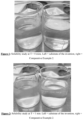
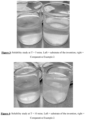
- a substrate for use in the invention prepared from the primer of Inventive Example 1 and the substrate of Comparative Example 2 were prepared and placed into a beaker comprising 30 mL of water at room temperature. The substrates are visually inspected immediately and then after 1 minute, 5 minutes, 10 minutes, and 30 minutes (see Figures 1 to 5 ). After 30 minutes, the substrate for use in the invention was completely dissolved and the substrate of Comparative Example 2 was not.
- the substrate for use in the invention almost immediately dissolved when added to the water and was fully dissolved between 5 and 10 minutes later.
- the substrate of Comparative Example 2 was still intact after 10 minutes and was 30-40% undissolved after 30 minutes (i.e., the water was not transparent).
- Comparative Example 2 After a few days, the solubility test of Comparative Example 2 has a clotted milk appearance as it is separating/unstable. It can be shaken or stirred to restore consistency but doing so incorporated air bubbles that create a cratered film when cast (see Figure 6 ).
Landscapes
- Life Sciences & Earth Sciences (AREA)
- Engineering & Computer Science (AREA)
- Food Science & Technology (AREA)
- Chemical & Material Sciences (AREA)
- Biotechnology (AREA)
- Oil, Petroleum & Natural Gas (AREA)
- Polymers & Plastics (AREA)
- General Preparation And Processing Of Foods (AREA)
Claims (15)
- Dekoration für Lebensmittel, umfassend:a) ein essbares Substrat;b) ein essbares Bild, das auf dem essbaren Substrat angeordnet ist;wobei das essbare Substrat ein Material ausgewählt aus der Gruppe bestehend aus Pektin, Zitronensäure, Zitronensäureestern, Pflanzenöl, Kollagen und Kombinationen davon umfasst; wobei das Material in dem Substrat in einer Menge von wenigstens 50 Gew.-% bezogen auf das Gesamtgewicht der Nichtwasserkomponenten des Substrats vorhanden ist; wobei das Substrat eine Wasserlöslichkeit von wenigstens 70 % aufweist, wobei Wasserlöslichkeit bei 20 °C gemessen wird.
- Dekoration nach einem der vorstehenden Ansprüche, wobei das Substrat eine Wasserlöslichkeit von wenigstens 90 % oder 100 % aufweist, wobei Wasserlöslichkeit bei 20 °C gemessen wird.
- Dekoration nach einem der vorstehenden Ansprüche, wobei:i) das Substrat ein Material ausgewählt aus der Gruppe bestehend aus Pektin, Gelatine, Zitronensäure, Zitronensäureestern, Kokosöl und Kombinationen davon umfasst, wobei das Material ausgewählt aus der Gruppe bestehend aus Pektin, Gelatine, Zitronensäure, Zitronensäureestern, Kokosöl und Kombinationen davon in einer Menge von wenigstens 50 Gew.-%, wie z.B. 50 bis 95 Gew.-%, bezogen auf das Gesamtgewicht der Nichtwasserkomponenten des Substrats vorhanden ist; und/oderii) das Substrat ein Material ausgewählt aus der Gruppe bestehend aus Pektin, Zitronensäure und Kombinationen davon umfasst; wobei das Material ausgewählt aus der Gruppe bestehend aus Pektin, Zitronensäure und Kombinationen in dem Substrat in einer Menge von wenigstens 50 Gew.-%, wie z.B. 50 bis 95 Gew.-%, bezogen auf das Gesamtgewicht der Nichtwasserkomponenten des Substrats, wie z.B. wenigstens 53 Gew.-% oder wenigstens 60 Gew.-% bezogen auf das Gesamtgewicht der Nichtwasserkomponenten des Substrats, vorhanden ist; und/oderiii) das Substrat ein Material ausgewählt aus der Gruppe bestehend aus Pektin, Kokosöl, Zitronensäure und Kombinationen umfasst; wobei das Material ausgewählt aus der Gruppe bestehend aus Pektin, Kokosöl, Zitronensäure und Kombinationen davon in dem Substrat in einer Menge von wenigstens 50 Gew.-%, wie z.B. 50 bis 95 Gew.-%, bezogen auf das Gesamtgewicht der Nichtwasserkomponenten des Substrats, wie z.B. wenigstens 58 Gew.-% oder wenigstens 60 Gew.-% bezogen auf das Gesamtgewicht der Nichtwasserkomponenten des Substrats, vorhanden ist.
- Dekoration nach einem der vorstehenden Ansprüche, wobei:i) das Substrat Pektin und gegebenenfalls eines oder mehrere der anderen in den vorstehenden Ansprüchen genannten Materialien umfasst; wobei das Pektin gegebenenfalls von Zitronenschalen abgeleitet ist; und/oderii) Pektin in dem Substrat in einer Menge von wenigstens 20 Gew.-%, wie z.B. 20 bis 90 Gew.-%, bezogen auf die Gesamtmenge der Nichtwasserkomponenten des Substrats, wie z.B. wenigstens 30 Gew.-% oder wenigstens 39 Gew.-% oder wenigstens 50 Gew.-% bezogen auf die Gesamtmenge der Nichtwasserkomponenten des Substrats, vorhanden ist; und/oderiii) das Substrat weniger als oder gleich 40 Gew.-% Naturgummi, wie z.B. weniger als oder gleich 30 Gew.-%, weniger als oder gleich 26 Gew.-% oder weniger als oder gleich 15 Gew.-% Naturgummi, bezogen auf das Gesamtgewicht der Nichtwasserkomponenten des Substrats umfasst; und/oderiv) das Substrat weniger als oder gleich 20 Gew.-% Pigment, wie z.B. weniger als oder gleich 10 Gew.-% oder weniger als oder gleich 3 Gew.-% Pigment, bezogen auf das Gesamtgewicht der Nichtwasserkomponenten des Substrats umfasst; und/oderv) das Substrat im Wesentlichen frei von Pigment ist; und/odervi) das Substrat weniger als oder gleich 10 Gew.-% Cellulose, wie z.B. weniger als oder gleich 5 Gew.-% oder weniger als oder gleich 3 Gew.-% Cellulose, bezogen auf das Gesamtgewicht der Nichtwasserkomponenten des Substrats umfasst; wobei das Substrat gegebenenfalls im Wesentlichen frei von Cellulose ist; und/odervii) das Substrat einen oder mehrere Zusatzstoffe ausgewählt aus der Gruppe bestehend aus Natriumalginat, Sorbit, Milchproteinen, Molke und Milchpulver umfasst; wobei der eine oder die mehreren Zusatzstoffe ausgewählt aus der Gruppe bestehend aus Natriumalginat, Sorbit, Milchproteinen, Molke und Milchpulver gegebenenfalls in einer Menge von bis zu 40 Gew.-%, wie z.B. bis zu 35 bis Gew.-% oder bis zu 20 Gew.-%, vorhanden sind.
- Dekoration nach einem der vorstehenden Ansprüche:i) wobei das Substrat ferner ein oder mehrere essbare und lebensmittelgeeignete Verdickungsmittel, Haftvermittler, Fixierhilfen, Polymere und/oder Aromen umfasst; und/oderii) wobei die Dekoration der FDA-Verordnung CFR Teil 21 und der entsprechenden EU-Lebensmittelverordnung EG 1333/2008 entspricht; und/oderiii) ferner umfassend ein Trägermedium, wobei das Substrat auf dem Trägermedium angeordnet ist; wobei das Trägermedium gegebenenfalls ausgewählt ist aus der Gruppe bestehend aus Papier, Kunststoff, Karton und Metall; und/oderiv) wobei das essbare Bild aus einer essbaren Tinte erhalten ist; wobei die essbare Tinte gegebenenfalls Wasser, ein Feuchthaltemittel und Lebensmittelfarbe umfasst; und/oderv) wobei das Substrat aus einer wasserlöslichen, essbaren, flüssigen Grundierung erhalten ist; wobei die flüssige Grundierung gegebenenfalls 60 bis 95 Gew.-% Wasser, wie z.B. 70 bis 95 Gew.-% Wasser, 80 bis 95 Gew.-% Wasser oder 88 bis 95 Gew.-% Wasser umfasst; und/oder vi) wobei das Substrat ferner ein oder mehrere Konservierungsmittel umfasst.
- Verfahren zur Bereitstellung einer Dekoration für ein Lebensmittel oder Getränk oder Verfahren zum Dekorieren eines Lebensmittels oder Getränks, umfassend Schritte:a. Aufbringen einer wasserlöslichen, essbaren, flüssigen Grundierung auf ein temporäres Trägermedium;b. Trocknen der Grundierung auf dem Trägermedium, um das Substrat nach einem der vorstehenden Ansprüche zu erhalten;c. Anordnen eines essbaren Bilds auf dem Substrat; undd. Trocknen des gedruckten essbaren Bilds, um die Dekoration nach einem der vorstehenden Ansprüche zu erhalten.
- Verfahren nach Anspruch 6, ferner umfassend Schritt:
e. Entfernen des Substrats von dem Trägermedium und Dekorieren eines Lebensmittels oder Getränks durch Aufbringen des gedruckten Bilds und des Substrats auf die Oberfläche des Lebensmittels oder Getränks. - Verfahren zum Dekorieren eines Lebensmittels oder Getränks, umfassend Schritte:a. Aufbringen einer wasserlöslichen, essbaren, flüssigen Grundierung auf ein temporäres Trägermedium;b. Trocknen der Grundierung auf dem Trägermedium, um ein wasserlösliches Substrat zu erhalten; wobei das Substrat eine Wasserlöslichkeit von wenigstens 70 % aufweist, wobei Wasserlöslichkeit bei 20 °C gemessen wird;c. Anordnen eines essbaren Bilds auf dem Substrat; undd. Trocknen des gedruckten essbaren Bilds, um eine Dekoration zu erhalten; unde. Entfernen des Substrats von dem Trägermedium und Dekorieren eines Lebensmittels oder Getränks durch Aufbringen des gedruckten Bilds und des Substrats auf die Oberfläche des Lebensmittels oder Getränks.
- Verfahren nach Anspruch 7 oder 8:i) ferner umfassend Schritt:
f. Exponieren des Lebensmittels gegenüber Wasser und/oder Feuchtigkeit, um Haften des Substrats an dem Lebensmittel zu unterstützen; und/oderii) wobei die Dekoration durch ein Verfahren ausgewählt aus der Gruppe bestehend aus Benetzen der Dekoration mit Wasser vor dem Aufbringen, Aufbringen eines essbaren Klebstoffs auf die Dekoration vor dem Aufbringen und Kombinationen davon auf die Oberfläche eines Lebensmittels aufgebracht wird; wobei der essbare Klebstoff gegebenenfalls die gleiche flüssige Grundierung, die zum Herstellen der Dekoration verwendet wird, ist; und/oderiii) Schritt e) bei einer Temperatur von 10 bis 30 °C, wie z.B. bei 20 °C, und bei einer relativen Feuchtigkeit von 20 % bis 70 %, wie z.B. 40 % relative Feuchtigkeit, durchgeführt wird; und/oderiv) das Lebensmittel ausgewählt ist aus der Gruppe bestehend aus Fleischwaren, Backwaren, Milchprodukten und Süßwaren. - Verfahren nach einem der Ansprüche 7 bis 9, wobei das Lebensmittel gefroren ist.
- Verfahren nach einem der Ansprüche 7 bis 8, wobei das Getränk ausgewählt ist aus der Gruppe bestehend aus Bier, Lager, Kaffee, Softdrinks, Getränken vom Milchtyp, Heißgetränken und Kombinationen davon.
- Verfahren nach einem der vorstehenden Ansprüche, wobei das Verfahren zum Aufbringen der essbaren Tinte auf der Grundierung ausgewählt ist aus der Gruppe bestehend aus Tintenstrahldruck, Siebdruck, Offsetdruck und Thermotransfer; wobei das Verfahren zum Aufbringen der essbaren Tinte auf der Grundierung gegebenenfalls Tintenstrahldruck ist.
- Verfahren nach einem der Ansprüche 7 bis 10 oder 12, wobei das Lebensmittel ausreichend Feuchtigkeit enthält, um zu ermöglichen, dass der essbare Film natürlich absorbiert wird, ohne dass das zusätzliche Wasser und/oder die Feuchtigkeit des optionalen Schritts f erforderlich ist.
- Verfahren nach einem der Ansprüche 9 bis 10 oder 12, wobei das Wasser und/oder die Feuchtigkeit von Schritt f Wasserdampf ist, der während eines zur Herstellung des Lebensmittels verwendeten Backverfahrens gewonnen wird; und der Schritt des Anhaftens an das Lebensmittel umfasst, dass das Substrat in das Lebensmittel eindringt.
- Verfahren nach einem der Ansprüche 6 bis 14, wobei:i) Trocknen der Grundierung bei einer Temperatur von 20 bis 50 °C, wie z.B. 30 bis 40 °C oder 30 bis 35 °C, durchgeführt wird; und/oderii) Trocknen der Grundierung für 1 bis 6 Stunden, wie z.B. 2 bis 5 Stunden oder 3 bis 4 Stunden, durchgeführt wird; und/oderiii) das Verfahren zwischen den Schritten b) und c) ferner den Schritt des Druckens einer weißen Grundfarbe oder eines essbaren Goldblatts auf das Substrat umfasst.
Applications Claiming Priority (2)
| Application Number | Priority Date | Filing Date | Title |
|---|---|---|---|
| US202263432559P | 2022-12-14 | 2022-12-14 | |
| PCT/GB2023/053238 WO2024127023A1 (en) | 2022-12-14 | 2023-12-14 | Edible and soluble transfer films for the decoration of beverages and foodstuffs |
Publications (2)
| Publication Number | Publication Date |
|---|---|
| EP4440344A1 EP4440344A1 (de) | 2024-10-09 |
| EP4440344B1 true EP4440344B1 (de) | 2025-07-09 |
Family
ID=89426859
Family Applications (1)
| Application Number | Title | Priority Date | Filing Date |
|---|---|---|---|
| EP23832801.7A Active EP4440344B1 (de) | 2022-12-14 | 2023-12-14 | Essbare und lösliche überträgerfilme für das dekorieren von getränken und von lebensmitteln |
Country Status (2)
| Country | Link |
|---|---|
| EP (1) | EP4440344B1 (de) |
| WO (1) | WO2024127023A1 (de) |
Family Cites Families (10)
| Publication number | Priority date | Publication date | Assignee | Title |
|---|---|---|---|---|
| US6616958B1 (en) | 1993-07-07 | 2003-09-09 | Jack Guttman, Inc. | Method of making and using an edible film for decorating foodstuffs |
| JPH10215792A (ja) * | 1997-02-12 | 1998-08-18 | Fuji Sangyo Kk | 可食性フィルム |
| AU2003282232A1 (en) * | 2002-11-27 | 2004-06-18 | Culpitt Limited | Adornment for comestible products |
| US20060275529A1 (en) | 2003-03-21 | 2006-12-07 | Woodhouse James F | Production of edible substrates |
| KR100597283B1 (ko) | 2004-10-22 | 2006-07-06 | 씨제이 주식회사 | 식용잉크를 이용한 식품포장의 일부인 인쇄방법 |
| GB2426219B (en) * | 2005-05-18 | 2007-05-23 | Robert John Young | Amylaceous edible substrate product |
| DE202009002679U1 (de) * | 2009-02-25 | 2009-05-20 | Öztekin, Belgin | Essbares Lebensmittel-Tattoo, insbesondere zur Dekoration von Kuchen und Torten sowie feuchten Süßspeisen |
| WO2017045069A1 (fr) | 2015-09-14 | 2017-03-23 | 9083-8319 Quebec Inc. Fasrs Signature Pasquier | Procédé d'impression et de transfert sur un article alimentaire |
| US20180228202A1 (en) * | 2017-02-15 | 2018-08-16 | The Lucks Company | Edible print substrates and methods of making and using the same |
| WO2022087231A1 (en) * | 2020-10-23 | 2022-04-28 | Pepsico, Inc. | Beverage compositions comprising a printed image and methods of making the same |
-
2023
- 2023-12-14 WO PCT/GB2023/053238 patent/WO2024127023A1/en not_active Ceased
- 2023-12-14 EP EP23832801.7A patent/EP4440344B1/de active Active
Also Published As
| Publication number | Publication date |
|---|---|
| EP4440344A1 (de) | 2024-10-09 |
| WO2024127023A1 (en) | 2024-06-20 |
Similar Documents
| Publication | Publication Date | Title |
|---|---|---|
| DE69223024T2 (de) | Essbare Folie | |
| Igoe | Dictionary of food ingredients | |
| CN101631803B (zh) | 含有改性的金合欢胶的类胡萝卜素组合物 | |
| EP1178738B2 (de) | Farbstoffzusammensetzung und deren herstellung | |
| AU2007230895B2 (en) | Anti-scuff coating for chocolate | |
| CN104010520B (zh) | 可食用涂层组合物 | |
| GB2342030A (en) | Confectionery containing iota-carrageenan | |
| AU2016207019B2 (en) | Solvent-free shellac coating composition | |
| US20060013928A1 (en) | Aqueous edible paint composition, method of preparation and kit | |
| EP4440344B1 (de) | Essbare und lösliche überträgerfilme für das dekorieren von getränken und von lebensmitteln | |
| JP7320488B2 (ja) | コーティング組成物並びにコーティング組成物の作成及び使用方法 | |
| US20110151061A1 (en) | Food decoration | |
| EP1021094A2 (de) | Lebensmitteldekoration | |
| KR20230028801A (ko) | 개선된 바삭함을 갖는 당-코팅된 제과 | |
| FR3103682A1 (fr) | Compositions alimentaires réduites en sucres | |
| US20250176580A1 (en) | Edible primer layer | |
| CN119497576A (zh) | 使用淀粉衍生物对硬滚涂型糖果中的二氧化钛进行替换 | |
| WO2024224063A1 (en) | Edible primer for absorbent food products | |
| HK40027815A (en) | An article containing a shellac | |
| JPS58134943A (ja) | 表面に絵模様をもつチ−ズの製造方法 | |
| HK1243883B (zh) | 无溶剂虫胶涂层组合物 |
Legal Events
| Date | Code | Title | Description |
|---|---|---|---|
| STAA | Information on the status of an ep patent application or granted ep patent |
Free format text: STATUS: UNKNOWN |
|
| STAA | Information on the status of an ep patent application or granted ep patent |
Free format text: STATUS: THE INTERNATIONAL PUBLICATION HAS BEEN MADE |
|
| PUAI | Public reference made under article 153(3) epc to a published international application that has entered the european phase |
Free format text: ORIGINAL CODE: 0009012 |
|
| STAA | Information on the status of an ep patent application or granted ep patent |
Free format text: STATUS: REQUEST FOR EXAMINATION WAS MADE |
|
| 17P | Request for examination filed |
Effective date: 20240705 |
|
| AK | Designated contracting states |
Kind code of ref document: A1 Designated state(s): AL AT BE BG CH CY CZ DE DK EE ES FI FR GB GR HR HU IE IS IT LI LT LU LV MC ME MK MT NL NO PL PT RO RS SE SI SK SM TR |
|
| GRAP | Despatch of communication of intention to grant a patent |
Free format text: ORIGINAL CODE: EPIDOSNIGR1 |
|
| STAA | Information on the status of an ep patent application or granted ep patent |
Free format text: STATUS: GRANT OF PATENT IS INTENDED |
|
| INTG | Intention to grant announced |
Effective date: 20250129 |
|
| P01 | Opt-out of the competence of the unified patent court (upc) registered |
Free format text: CASE NUMBER: APP_8201/2025 Effective date: 20250218 |
|
| GRAS | Grant fee paid |
Free format text: ORIGINAL CODE: EPIDOSNIGR3 |
|
| GRAA | (expected) grant |
Free format text: ORIGINAL CODE: 0009210 |
|
| STAA | Information on the status of an ep patent application or granted ep patent |
Free format text: STATUS: THE PATENT HAS BEEN GRANTED |
|
| AK | Designated contracting states |
Kind code of ref document: B1 Designated state(s): AL AT BE BG CH CY CZ DE DK EE ES FI FR GB GR HR HU IE IS IT LI LT LU LV MC ME MK MT NL NO PL PT RO RS SE SI SK SM TR |
|
| DAV | Request for validation of the european patent (deleted) | ||
| DAX | Request for extension of the european patent (deleted) | ||
| REG | Reference to a national code |
Ref country code: GB Ref legal event code: FG4D |
|
| REG | Reference to a national code |
Ref country code: CH Ref legal event code: EP |
|
| REG | Reference to a national code |
Ref country code: IE Ref legal event code: FG4D |
|
| REG | Reference to a national code |
Ref country code: DE Ref legal event code: R096 Ref document number: 602023004740 Country of ref document: DE |
|
| REG | Reference to a national code |
Ref country code: NL Ref legal event code: MP Effective date: 20250709 |