EP4425480A1 - Belüftungsschalldämpfer - Google Patents
Belüftungsschalldämpfer Download PDFInfo
- Publication number
- EP4425480A1 EP4425480A1 EP22886528.3A EP22886528A EP4425480A1 EP 4425480 A1 EP4425480 A1 EP 4425480A1 EP 22886528 A EP22886528 A EP 22886528A EP 4425480 A1 EP4425480 A1 EP 4425480A1
- Authority
- EP
- European Patent Office
- Prior art keywords
- ventilation pipe
- expansion portion
- case
- arithmetic average
- inlet
- Prior art date
- Legal status (The legal status is an assumption and is not a legal conclusion. Google has not performed a legal analysis and makes no representation as to the accuracy of the status listed.)
- Pending
Links
Images




Classifications
-
- G—PHYSICS
- G10—MUSICAL INSTRUMENTS; ACOUSTICS
- G10K—SOUND-PRODUCING DEVICES; METHODS OR DEVICES FOR PROTECTING AGAINST, OR FOR DAMPING, NOISE OR OTHER ACOUSTIC WAVES IN GENERAL; ACOUSTICS NOT OTHERWISE PROVIDED FOR
- G10K11/00—Methods or devices for transmitting, conducting or directing sound in general; Methods or devices for protecting against, or for damping, noise or other acoustic waves in general
- G10K11/16—Methods or devices for protecting against, or for damping, noise or other acoustic waves in general
- G10K11/161—Methods or devices for protecting against, or for damping, noise or other acoustic waves in general in systems with fluid flow
-
- F—MECHANICAL ENGINEERING; LIGHTING; HEATING; WEAPONS; BLASTING
- F24—HEATING; RANGES; VENTILATING
- F24F—AIR-CONDITIONING; AIR-HUMIDIFICATION; VENTILATION; USE OF AIR CURRENTS FOR SCREENING
- F24F13/00—Details common to, or for air-conditioning, air-humidification, ventilation or use of air currents for screening
- F24F13/02—Ducting arrangements
-
- F—MECHANICAL ENGINEERING; LIGHTING; HEATING; WEAPONS; BLASTING
- F24—HEATING; RANGES; VENTILATING
- F24F—AIR-CONDITIONING; AIR-HUMIDIFICATION; VENTILATION; USE OF AIR CURRENTS FOR SCREENING
- F24F13/00—Details common to, or for air-conditioning, air-humidification, ventilation or use of air currents for screening
- F24F13/24—Means for preventing or suppressing noise
-
- G—PHYSICS
- G10—MUSICAL INSTRUMENTS; ACOUSTICS
- G10K—SOUND-PRODUCING DEVICES; METHODS OR DEVICES FOR PROTECTING AGAINST, OR FOR DAMPING, NOISE OR OTHER ACOUSTIC WAVES IN GENERAL; ACOUSTICS NOT OTHERWISE PROVIDED FOR
- G10K11/00—Methods or devices for transmitting, conducting or directing sound in general; Methods or devices for protecting against, or for damping, noise or other acoustic waves in general
- G10K11/16—Methods or devices for protecting against, or for damping, noise or other acoustic waves in general
-
- G—PHYSICS
- G10—MUSICAL INSTRUMENTS; ACOUSTICS
- G10K—SOUND-PRODUCING DEVICES; METHODS OR DEVICES FOR PROTECTING AGAINST, OR FOR DAMPING, NOISE OR OTHER ACOUSTIC WAVES IN GENERAL; ACOUSTICS NOT OTHERWISE PROVIDED FOR
- G10K11/00—Methods or devices for transmitting, conducting or directing sound in general; Methods or devices for protecting against, or for damping, noise or other acoustic waves in general
- G10K11/16—Methods or devices for protecting against, or for damping, noise or other acoustic waves in general
- G10K11/162—Selection of materials
-
- G—PHYSICS
- G10—MUSICAL INSTRUMENTS; ACOUSTICS
- G10K—SOUND-PRODUCING DEVICES; METHODS OR DEVICES FOR PROTECTING AGAINST, OR FOR DAMPING, NOISE OR OTHER ACOUSTIC WAVES IN GENERAL; ACOUSTICS NOT OTHERWISE PROVIDED FOR
- G10K11/00—Methods or devices for transmitting, conducting or directing sound in general; Methods or devices for protecting against, or for damping, noise or other acoustic waves in general
- G10K11/16—Methods or devices for protecting against, or for damping, noise or other acoustic waves in general
- G10K11/172—Methods or devices for protecting against, or for damping, noise or other acoustic waves in general using resonance effects
-
- F—MECHANICAL ENGINEERING; LIGHTING; HEATING; WEAPONS; BLASTING
- F24—HEATING; RANGES; VENTILATING
- F24F—AIR-CONDITIONING; AIR-HUMIDIFICATION; VENTILATION; USE OF AIR CURRENTS FOR SCREENING
- F24F13/00—Details common to, or for air-conditioning, air-humidification, ventilation or use of air currents for screening
- F24F13/24—Means for preventing or suppressing noise
- F24F2013/242—Sound-absorbing material
-
- F—MECHANICAL ENGINEERING; LIGHTING; HEATING; WEAPONS; BLASTING
- F24—HEATING; RANGES; VENTILATING
- F24F—AIR-CONDITIONING; AIR-HUMIDIFICATION; VENTILATION; USE OF AIR CURRENTS FOR SCREENING
- F24F13/00—Details common to, or for air-conditioning, air-humidification, ventilation or use of air currents for screening
- F24F13/24—Means for preventing or suppressing noise
- F24F2013/245—Means for preventing or suppressing noise using resonance
Definitions
- the present invention relates to an air passage type silencer.
- an air passage type silencer that is installed at the ventilation path intermediate position and that includes an expansion portion of which the cross-sectional area is larger than that of the ventilation pipe is known.
- a porous sound absorbing material is disposed in an expansion portion so that the sound attenuation performance is improved.
- the porous sound absorbing material is disposed in a tubular shape so that a space serving as an air passage path is provided at a central portion.
- JP1988-38325Y JP-S63-38325Y
- an air passage type silencer including an expansion portion
- air (a gas) flows into the expansion portion through an inlet-side ventilation pipe and a case where air (a gas) flows out from the expansion portion through an outlet-side ventilation pipe
- the air passes through a level difference between a ventilation pipe and the expansion portion. Therefore, pressure loss occurs and there is a problem that there is a decrease in amount of wind and pressure.
- pressure loss in a configuration in which there is no level difference with respect to the ventilation pipes is larger than pressure loss in a configuration in which there is a level difference in a case where the flow rate of a gas flowing in the air passage type silencer is high in a case where a surface roughness is high as in the case of a porous sound absorbing material of which a surface is uneven since the porous sound absorbing material includes a large number of fine cavities.
- An object of the present invention is to provide an air passage type silencer that can reduce pressure loss even in a case where the flow rate of a gas flowing in the air passage type silencer is high while solving the above-described problem of the related art.
- the present invention has the following configurations.
- an air passage type silencer that can reduce pressure loss even in a case where the flow rate of a gas flowing in the air passage type silencer is high.
- a numerical range represented using “to” means a range including numerical values described before and after the preposition "to” as a lower limit value and an upper limit value.
- perpendicular and parallel include a range of errors accepted in the technical field to which the present invention belongs.
- “being perpendicular” or “being parallel” means being in a range of less than ⁇ 10° or the like with respect to being strictly perpendicular in the strict sense or being parallel in the strict sense and the error with respect to being strictly perpendicular in the strict sense or being parallel in the strict sense is preferably 5° or less, and more preferably 3° or less.
- Fig. 1 is a schematic cross-sectional view showing an example of an embodiment of the air passage type silencer according to the embodiment of the present invention.
- an air passage type silencer 10 includes a tubular inlet-side ventilation pipe 12, an expansion portion 14 connected to one opening edge surface of the inlet-side ventilation pipe 12, a tubular outlet-side ventilation pipe 16 that is connected to an edge surface of the expansion portion 14 on a side opposite to the inlet-side ventilation pipe 12, and a porous sound absorbing material 30.
- the inlet-side ventilation pipe 12 is a tubular member through which a gas that flows into the inlet-side ventilation pipe 12 through one opening edge surface is transported to the expansion portion 14 connected to the other opening edge surface.
- the outlet-side ventilation pipe 16 is a tubular member through which a gas that flows into the outlet-side ventilation pipe 16 through one opening edge surface connected to the expansion portion 14 is transported to the other opening edge surface.
- the cross-sectional shapes of the inlet-side ventilation pipe 12 and the outlet-side ventilation pipe 16 may be various shapes such as a circular shape, a rectangular shape, and a triangular shape.
- the cross-sectional shape of a ventilation pipe may not be constant in an axial direction along a central axis of the ventilation pipe.
- the diameter of the ventilation pipe may change in the axial direction.
- the inlet-side ventilation pipe 12 and the outlet-side ventilation pipe 16 may have the same cross-sectional shape and cross-sectional area, or may have different shapes and/or cross-sectional areas.
- the inlet-side ventilation pipe 12 and the outlet-side ventilation pipe 16 are disposed such that central axes thereof coincide with each other.
- the present invention is not limited thereto and the central axis of the inlet-side ventilation pipe 12 and the central axis of the outlet-side ventilation pipe 16 may be offset from each other.
- the sizes (the cross-sectional areas or the like) of the inlet-side ventilation pipe 12 and the outlet-side ventilation pipe 16 may be set as appropriate in accordance with the size of a device in which the air passage type silencer is used, the required air passage performance, and the like.
- the expansion portion 14 is disposed between the inlet-side ventilation pipe 12 and the outlet-side ventilation pipe 16 and transports, to the outlet-side ventilation pipe 16, a gas that flows into the expansion portion 14 from the inlet-side ventilation pipe 12.
- the cross-sectional area of the expansion portion 14 that is perpendicular to a flow path direction is larger than the cross-sectional area of the inlet-side ventilation pipe 12 and is larger than the cross-sectional area of the outlet-side ventilation pipe 16. That is, for example, in a case where the cross-sectional shapes of the inlet-side ventilation pipe 12, the outlet-side ventilation pipe 16, and the expansion portion 14 are circular, the diameter of the cross-section of the expansion portion 14 is larger than the diameters of the inlet-side ventilation pipe 12 and the outlet-side ventilation pipe 16.
- the cross-sectional shape of the expansion portion 14 may be various shapes such as a circular shape, a rectangular shape, and a triangular shape.
- the cross-sectional shape of the expansion portion 14 may not be constant in an axial direction along a central axis of the expansion portion 14.
- the diameter of the expansion portion 14 may change in the axial direction.
- the size (the length, the cross-sectional area, or the like) of the expansion portion 14 may be set as appropriate in accordance with the size of a device in which the air passage type silencer is used, the required sound attenuation performance, and the like.
- the porous sound absorbing material 30 is disposed in the expansion portion 14.
- the porous sound absorbing material 30 is disposed along an inner peripheral surface (an inner wall surface) of the expansion portion 14 to absorb and attenuate a sound.
- the length of the porous sound absorbing material 30 in the flow path direction is approximately equal to the length of the inside of the expansion portion 14 and the porous sound absorbing material 30 is disposed between a side surface of the expansion portion 14 to which the inlet-side ventilation pipe 12 is connected and a side surface of the expansion portion 14 to which the outlet-side ventilation pipe 16 is connected.
- the porous sound absorbing material 30 has a tubular shape that is hollow, the outer shape of the porous sound absorbing material 30 is approximately the same as the cross-sectional shape of the inside of the expansion portion 14, and the porous sound absorbing material 30 is disposed along the inner peripheral surface of the expansion portion 14 in a circumferential direction.
- a hollow portion of the porous sound absorbing material 30 extends in the flow path direction and is formed over an area from the inlet-side ventilation pipe 12 side of the expansion portion 14 to the outlet-side ventilation pipe 16 side.
- the cross-sectional shape of the hollow portion of the porous sound absorbing material 30 is similar to the cross-sectional shapes of the ventilation pipes and the porous sound absorbing material 30 is disposed such that central axes of the porous sound absorbing material 30 and the ventilation pipes coincide with each other.
- the size of a cross section of the hollow portion of the porous sound absorbing material 30 is larger than the size of cross sections of the ventilation pipes. That is, as seen in the flow path direction, the porous sound absorbing material 30 is disposed so as not to block the ventilation pipes. Accordingly, the hollow portion of the porous sound absorbing material 30 serves as a ventilation path.
- the porous sound absorbing material 30 may have a cylindrical shape matching the shape of a peripheral surface of the expansion portion 14.
- the porous sound absorbing material 30 may have a quadrangular tube-like shape matching the shape of the peripheral surface of the expansion portion 14.
- the hollow portion of the porous sound absorbing material 30 may have a circular shape.
- the hollow portion of the porous sound absorbing material 30 may have a quadrangular shape.
- the porous sound absorbing material is not particularly limited, and a sound absorbing material publicly known in the related art can be used as appropriate.
- various known sound absorbing materials such as a foaming body, a foaming material (foaming urethane foam (for example, CALMFLEX F manufactured by INOAC CORPORATION, urethane foam manufactured by Hikari Co., Ltd., and the like), flexible urethane foam, a ceramic particle sintered material, phenol foam, melamine foam, a polyamide foam, and the like), a nonwoven fabric sound absorbing material (a microfiber nonwoven fabric (for example, Thinsulate manufactured by 3M Company and the like), a polyester nonwoven fabric (for example, White Kyuon manufactured by TOKYO Bouon and QonPET manufactured by Bridgestone KBG Co., Ltd.
- a foaming material for example, CALMFLEX F manufactured by INOAC CORPORATION, urethane foam manufactured by Hikari Co., Ltd., and the like
- a plastic nonwoven fabric such as an acrylic fiber nonwoven fabric, a natural fiber nonwoven fabric such as wool and felt, a metal nonwoven fabric, a glass nonwoven fabric, and the like
- a material including a minute amount of air glass wool, rock wool, and a nanofiber-based fiber sound absorbing material (silica nanofiber and acrylic nanofiber (for example, XAI manufactured by Mitsubishi Chemical Corporation))
- glass wool, rock wool, and a nanofiber-based fiber sound absorbing material sica nanofiber and acrylic nanofiber (for example, XAI manufactured by Mitsubishi Chemical Corporation)
- a level difference d satisfies Equation (1): d ⁇ 100 ⁇ m, satisfies Equation (2): d ⁇ 25 ⁇ Sa + 193 ⁇ m in a case where an arithmetic average height Sa is equal to or smaller than 50 ⁇ m, and satisfies Equation (3): d ⁇ 1450 ⁇ m in a case where the arithmetic average height Sa exceeds 50 ⁇ m, where Sa ( ⁇ m) is the arithmetic average height of a surface on a central side in the expansion portion 14 and d ( ⁇ m) is the average value of level differences between a ventilation pipe interior wall and the surface on the central side at at least one of a connection portion between the expansion portion 14 and the inlet-side ventilation pipe 12 or a connection portion between the expansion portion 14 and the outlet-side ventilation pipe 16.
- the surface on the central side in the expansion portion 14 is a surface that is an outermost surface in the expansion portion 14 as seen in the radial direction from a line segment that connects the center of an opening portion of the inlet-side ventilation pipe 12 and the center of an opening portion of the outlet-side ventilation pipe 16 to each other.
- the surface on the central side in the expansion portion 14 is a surface of the hollow portion of the porous sound absorbing material 30. Therefore, in the case of the example shown in Fig. 1 , the arithmetic average height Sa of the surface on the central side in the expansion portion 14 is the arithmetic average height Sa of the surface of the hollow portion of the porous sound absorbing material 30.
- the level difference d between the ventilation pipe interior wall and the surface on the central side at the connection portion between the expansion portion 14 and the ventilation pipe is, as shown in Fig. 1 , a radial distance d 1 between an interior wall of the inlet-side ventilation pipe 12 and the surface of the hollow portion of the porous sound absorbing material 30 and a radial distance d 2 between an interior wall of the outlet-side ventilation pipe 16 and the surface of the hollow portion of the porous sound absorbing material 30.
- the level difference d at the connection portion between the ventilation pipe and the expansion portion is defined in accordance with the arithmetic average height Sa of the surface on the central side in the expansion portion 14, that is, the surface roughness of a portion of the expansion portion 14 that serves as a ventilation path through which air flows.
- the present inventors have found that providing the level difference d at the connection portion between the ventilation pipe and the expansion portion in accordance with the arithmetic average height Sa of the surface on the central side in the expansion portion 14 can result in reduction of pressure loss.
- pressure loss occurs at a stepped portion in a case where there is a level difference in a flow path through which a fluid flows.
- pressure loss occurring at the stepped portion exceeds the amount of pressure loss reduction achieved by an increase in diameter. Therefore, it is conceived that total pressure loss is increased in a case where the stepped portion is provided.
- porous sound absorbing material has a rough surface of which the unevenness is large since the surface has a large number of fine cavities. In a case where a surface roughness is rough, pressure loss attributable to a pipe line itself is great.
- the present inventors have presumed that, in a case where a surface roughness is large, there is a case where the amount of pressure loss reduction achieved by an increase in diameter becomes large and exceeds pressure loss occurring at a stepped portion with a level difference provided at a connection portion between an expansion portion and a ventilation path and total pressure loss is reduced.
- Fig. 2 is a graph showing the result of a simulation in which pressure loss in the case of a change in level difference d was obtained for each of the arithmetic average heights Sa of the surface on the central side in the expansion portion, the arithmetic average heights Sa being 9 ⁇ m, 17 ⁇ m, 34 ⁇ m, 51 ⁇ m, 68 ⁇ m, 85 ⁇ m, and 102 ⁇ m.
- Fig. 3 is a graph showing the result shown in Fig. 2 in which pressure loss is standardized on an assumption that pressure loss occurring in a case where the level difference d is 100 ⁇ m is 1.
- the larger the arithmetic average height Sa the wider a range of the level differences d in which pressure loss is reduced in comparison with a case where the level difference d is 100 ⁇ m although the larger the arithmetic average height Sa, the larger the absolute value of pressure loss.
- Fig. 4 is a graph showing a relationship between the arithmetic average height Sa and the maximum value of the level difference d (hereinafter, may be simply referred to as the maximum value of the level difference d) at which pressure loss is reduced in comparison with a case where the level difference d is 100 ⁇ m. It can be found that Fig. 4 that, in a case where the arithmetic average height Sa is in a range of 50 ⁇ m or less, the maximum value of the level difference d increases in a substantially linear manner with respect to the arithmetic average height Sa.
- the maximum value of the level difference d is approximately constant even in a case where there is a change in arithmetic average height Sa.
- the maximum value of the level difference d related to a case where the arithmetic average height Sa is in a range exceeding 50 ⁇ m is 1450 ⁇ m. Accordingly, in a case where the arithmetic average height Sa exceeds 50 ⁇ m, pressure loss is reduced in comparison with a case where the level difference d is 100 ⁇ m in a case where the level difference d is in a range satisfying Equation (3): d ⁇ 1450 ⁇ m.
- Fig. 5 is a graph that shows a relationship between the arithmetic average height Sa and the maximum value of the level difference d related to a case where the arithmetic average height Sa is in a range of 50 ⁇ m or less and from which an approximation straight line of the relationship between the arithmetic average height Sa and the maximum value of the level difference d is obtained.
- An approximate straight line d 25 ⁇ Sa + 193 can be obtained from the graph.
- a CFD module (a fluid-dynamics module) of COMSOL MultiPhysics was used to obtain, through calculation, pressure loss in the case of a change in arithmetic average height Sa of the surface on the central side in the expansion portion and level difference d between the ventilation pipe and the connection portion.
- the conditions were as follows.
- the expansion portion had a length of 130 mm and a diameter of 50 mm, and the diameter of the ventilation pipe was 28 m.
- porous sound absorbing materials having surface roughnesses, of which the arithmetic average heights Sa were 9, 17, 34, 51, 68, 85, and 102 ⁇ m, were disposed.
- the diameter of a hollow portion of each porous sound absorbing material was set in accordance with the level difference d.
- the level difference d was calculated from 100 ⁇ m to 2000 ⁇ m in increments of 50 ⁇ m.
- the wind speed of wind flowing into the expansion portion was 30 m/s.
- the arithmetic average height Sa of the surface on the central side in the expansion portion is a surface roughness and can be measured and defined according to ISO 25178.
- the measurement can be performed using a laser microscope (for example, VK-X3000 Series manufactured by KEYENCE CORPORATION).
- the arithmetic average height Sa is obtained by measuring a surface height distribution five times with the laser microscope while performing the measurement for a square range having a size of 300 ⁇ m ⁇ 300 ⁇ m and changing the position of measurement for each time the measurement is performed and calculating the average thereof. Even in a case where a laser microscope without the definition of Sa measurement is used, the arithmetic average height Sa can be obtained according to ISO 25178 as long as a height distribution can be acquired by means of the laser microscope.
- the level difference d at a connection portion between a ventilation pipe and the expansion portion is calculated as follows.
- Measurement is performed over the connection portion between the ventilation pipe and the expansion portion by using a laser microscope so that a level difference is measured in a non-contact manner.
- a range of 1 mm in the flow path direction is measured by using the laser microscope and a difference between the average position (the position of an arithmetic average height) of heights on a ventilation pipe side and the average position of heights on an expansion portion side is used as a level difference between the ventilation pipe side and the expansion portion side.
- Such measurement is performed at five points at equal intervals in the circumferential direction, and the average value is used as the level difference d.
- a level difference d 1 at the connection portion between the inlet-side ventilation pipe 12 and the expansion portion 14 or a level difference d 2 at the connection portion between the outlet-side ventilation pipe 16 and the expansion portion 14 may satisfy Equations (1) to (3) described above, it is preferable that both the level differences d 1 and d 2 satisfy Equations (1) to (3) described above.
- Equations (1) to (3) described above it is preferable that all of the level differences d measured for five points at the connection portion between the inlet-side ventilation pipe 12 and the expansion portion 14 and/or all of the level differences d measured for five points at the connection portion between the outlet-side ventilation pipe 16 and the expansion portion 14 satisfy Equations (1) to (3) described above. That is, it is preferable that a maximum value dmax of the level difference between the ventilation pipe interior wall and the surface on the central side satisfies Equations (1) to (3) described above.
- the level difference d satisfies Equation (4): 150 ⁇ d ⁇ 350 ⁇ m in a case where the arithmetic average height Sa is equal to or smaller than 50 ⁇ m and it is more preferable that the level difference d satisfies Equation (5): 150 ⁇ d ⁇ 1000 ⁇ m in a case where the arithmetic average height Sa exceeds 50 ⁇ m.
- the arithmetic average height Sa of the surface on the central side in the expansion portion is equal to or larger than 5 ⁇ m and equal to or smaller than 200 ⁇ m.
- the arithmetic average height Sa of the surface on the central side in the expansion portion is in a range of less than 5 ⁇ m, the amount of pressure loss reduction achieved by an increase in diameter does not become large and a range in which pressure loss occurring at a stepped portion is exceeded and total pressure loss is decreased is small. Meanwhile, in a case where the arithmetic average height Sa is in a range exceeding 200 ⁇ m, the absolute value of pressure loss is large.
- the arithmetic average height Sa of the surface on the central side in the expansion portion is set to be equal to or larger than 5 ⁇ m and equal to or smaller than 200 ⁇ m, it is possible to more suitably reduce total pressure loss.
- a flow path between an opening portion of the expansion portion 14 that is on the inlet-side ventilation pipe 12 side and an opening portion of the expansion portion 14 that is on the outlet-side ventilation pipe 16 side has a linear shape, that is, the hollow portion of the porous sound absorbing material 30 has a straight tubular shape.
- the present invention is not limited thereto.
- the flow path between the opening portion of the expansion portion 14 that is on the inlet-side ventilation pipe 12 side and the opening portion of the expansion portion 14 that is on the outlet-side ventilation pipe 16 may have a curved tubular shape that is bent.
- a wind speed in the inlet-side ventilation pipe is preferably equal to or higher than 5 m/s, more preferably 10 m/s to 50 m/s, and still more preferably 15 m/s to 40 m/s.
- Fig. 8 conceptually shows another example of the air passage type silencer according to the embodiment of the present invention.
- an air passage type silencer 10b includes the tubular inlet-side ventilation pipe 12, the expansion portion 14 connected to one opening edge surface of the inlet-side ventilation pipe 12, and the tubular outlet-side ventilation pipe 16 that is connected to an edge surface of the expansion portion 14 on a side opposite to the inlet-side ventilation pipe 12, and the air passage type silencer 10b does not include the porous sound absorbing material 30.
- the inlet-side ventilation pipe 12, the expansion portion 14, and the outlet-side ventilation pipe 16 have the same configurations as the inlet-side ventilation pipe 12, the expansion portion 14, and the outlet-side ventilation pipe 16 of the air passage type silencer 10 shown in Fig. 1 .
- the surface on the central side in the expansion portion 14 is the inner peripheral surface of the expansion portion 14.
- the arithmetic average height Sa of the surface on the central side in the expansion portion 14 is the arithmetic average height Sa of the inner peripheral surface of the expansion portion 14.
- the level difference d between the ventilation pipe interior wall and the surface on the central side at the connection portion between the expansion portion 14 and the ventilation pipe is, as shown in Fig. 8 , the radial distance d 1 between the interior wall of the inlet-side ventilation pipe 12 and the inner peripheral surface of the expansion portion 14 and the radial distance d 2 between the interior wall of the outlet-side ventilation pipe 16 and the inner peripheral surface of the expansion portion 14.
- the level difference d between the interior wall of the ventilation pipe and the inner peripheral surface of the expansion portion 14 satisfies Equation (2): d ⁇ 25 ⁇ Sa + 193 ⁇ m in a case where the arithmetic average height Sa of the inner peripheral surface of the expansion portion 14 is equal to or smaller than 50 ⁇ m and the level difference d between the interior wall of the ventilation pipe and the inner peripheral surface of the expansion portion 14 satisfies Equation (3): d ⁇ 1450 ⁇ m in a case where the arithmetic average height Sa of the inner peripheral surface of the expansion portion 14 exceeds 50 ⁇ m.
- perforated metal may be disposed on a surface of the hollow portion of the porous sound absorbing material.
- Examples of the materials of the ventilation pipe and the expansion portion include a metal material, a resin material, a reinforced plastic material, and a carbon fiber.
- Examples of the metal material include metal materials such as aluminum, titanium, magnesium, tungsten, iron, steel, chromium, chromium molybdenum, nichrome molybdenum, and alloys thereof.
- the resin material examples include resin materials such as acrylic resin (PMMA), polymethyl methacrylate, polycarbonate, polyamide, polyalylate, polyetherimide, polyacetal, polyetheretherketone, polyphenylene sulfide, polysulfone, polyethylene terephthalate, polybutylene terephthalate (PET), polyimide, triacetylcellulose (TAC), polypropylene (PP), polyethylene (PE), polystyrene (PS), ABS resin (copolymer synthetic resin of acrylonitrile, butadiene, and styrene), flame-retardant ABS resin, ASA resin (copolymer synthetic resin of acrylonitrile, styrene, and acrylate), polyvinyl chloride (PVC) resin, and polylactic acid (PLA) resin.
- the reinforced plastic material include carbon fiber reinforced plastics (CFRP) and glass fiber reinforced plastics (GFRP).
- the density of a member constituting the air passage type silencer is preferably 0.5 g/cm 3 to 2.5 g/cm 3 .
- these materials are non-flammable, flame-retardant, and self-extinguishing.
- the entire air passage type silencer is non-flammable, flame-retardant, and self-extinguishing.
- Expansion portions were formed ofABS resin by using a 3D printer (manufactured by XYZ printing, Inc.). Each expansion portion had a cylindrical shape having an inner diameter of 50 mm and a length of 130 mm. The thickness of the ABS resin was 2 mm. In addition, holes having a diameter of 32 mm were formed on both side surfaces of the expansion portion as introduction portions for hoses (ventilation pipes), and hoses having an inner diameter of 28 mm and a thickness of 2 mm were connected as an inlet-side ventilation pipe and an outlet-side ventilation pipe.
- porous sound absorbing materials (QonPET manufactured by Bridgestone KBG Co., Ltd.) were disposed along an interior wall.
- Each porous sound absorbing material had a laminated structure with a thin nonwoven fabric having a high fiber density and a nonwoven fabric layer having a low density.
- the porous sound absorbing material was disposed in a cylindrical shape such that a surface of the thin nonwoven fabric having a high density is positioned on the central side of the expansion portion.
- Sa was 18.1 ⁇ m in measurement in which the arithmetic average height Sa on a high-density thin nonwoven fabric side was measured by using the above-described method. Although the measurement was performed 5 times with a change in measurement position (measurement target range), the value was stable while being within a range of 17.9 ⁇ m to 18.3 ⁇ m.
- each porous sound absorbing material was disposed in an expansion portion after being processed by using a laser cutter (processing accuracy: 0.1 ⁇ m) such that the level differences d between a ventilation pipe interior wall and a surface on a central side at a connection portion between the expansion portion and a ventilation pipe became 100 ⁇ m, 300 ⁇ m, 500 ⁇ m, 600 ⁇ m, 800 ⁇ m, and 900 ⁇ m, respectively.
- the level differences D were measured by using the above-described method and it was confirmed in the measurement that the level differences were as set as described above.
- Air was caused to flow into an inlet-side ventilation pipe side by using a fan.
- the wind speed of wind flowing into the inlet-side ventilation pipes was 30 m/s. Since the inlet-side ventilation pipes were 0.028 m, the amount of wind was 0.0185 m 3 /s.
- a static pressure was measured at positions 20 mm separated from connection portions to the inlet-side ventilation pipes and positions 20 mm separated from connection portions to the outlet-side ventilation pipes.
- the pressure loss was measured by dividing a difference between a static pressure on an inlet side and a static pressure on an outlet side by the length of the expansion portions.
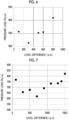
- Example 4 As shown in a graph in Fig. 6 , in a case where a case where the level difference d is 100 ⁇ m (Example 1) is used as a standard, the level difference d of 300 ⁇ m (Example 2), the level difference d of 500 ⁇ m (Example 3), and the level difference d of 600 ⁇ m (Example 4) result in pressure loss smaller than pressure loss in Example 1. Meanwhile, the level difference d of 800 ⁇ m (Comparative Example 1) and the level difference d of 900 ⁇ m (Comparative Example 2) result in pressure loss larger than the pressure loss in Example 1.
- Air passage type silencers were manufactured in the same manner as Example 1 except that porous sound absorbing materials (QonPET manufactured by Bridgestone KBG Co., Ltd.) were disposed such that surfaces of nonwoven fabrics having a low density are positioned on the central sides of expansion portions and the thicknesses of the porous sound absorbing materials were changed such that the level differences d become 100 ⁇ m, 300 ⁇ m, 500 ⁇ m, 700 ⁇ m, 900 ⁇ m, 1100 ⁇ m, 1300 ⁇ m, 1400 ⁇ m, and 1500 ⁇ m, respectively.
- porous sound absorbing materials QonPET manufactured by Bridgestone KBG Co., Ltd.
- Sa was 51 ⁇ m in measurement in which the arithmetic average height Sa of a surface on a low-density nonwoven fabric side was measured by using the above-described method. Although the measurement was performed 5 times with a change in measurement position (measurement target range), the results were within a range of 46 ⁇ m to 55 ⁇ m.
- the level difference d is equal to or smaller than 1450 ⁇ m according to Expression (3). That is, cases where the level differences d are 100 ⁇ m, 300 ⁇ m, 500 ⁇ m, 700 ⁇ m, 900 ⁇ m, 1100 ⁇ m, 1300 ⁇ m, and 1400 ⁇ m correspond to Examples of the present invention.
- Example 7 As shown in a graph in Fig. 7 , in a case where a case where the level difference d is 100 ⁇ m (Example 5) is used as a standard, the level difference d of 300 ⁇ m (Example 6) to 1400 ⁇ m (Example 12) results in pressure loss smaller than pressure loss in Example 4. Meanwhile, the level difference d of 1500 ⁇ m (Comparative Example 3) results in pressure loss larger than the pressure loss in Example 1.
- Porous sound absorbing materials (QonPET manufactured by Bridgestone KBG Co., Ltd.) were pressed and crushed from surfaces of nonwoven fabrics having a low density and a crushed state was maintained for about one day to make the densities thereof high and to adjust the arithmetic average heights Sa to become small.
- Sa was 34 ⁇ m in measurement in which the arithmetic average height Sa was measured by using the above-described method.
- Air passage type silencers were manufactured in the same manner as Example 1 except that the porous sound absorbing materials were disposed such that such surfaces are positioned on the central sides of expansion portions and the thicknesses of the porous sound absorbing materials were changed such that the level differences d become 100 ⁇ m, 300 ⁇ m, 500 ⁇ m, 800 ⁇ m, 900 ⁇ m, 1100 ⁇ m, and 1500 ⁇ m, respectively.
- Example 13 As shown in a graph in Fig. 9 , in a case where a case where the level difference d is 100 ⁇ m (Example 13) is used as a standard, the level difference d of 300 ⁇ m (Example 14) to 900 ⁇ m (Example 17) results in pressure loss smaller than pressure loss in Example 13. Meanwhile, the level difference d of 1100 ⁇ m (Comparative Example 4) and the level difference d of 1500 ⁇ m (Comparative Example 5) result in pressure loss larger than the pressure loss in Example 13.
- Porous sound absorbing materials (QonPET manufactured by Bridgestone KBG Co., Ltd.) were stretched out from a side of surfaces of nonwoven fabrics having a low density and such a state was maintained for about one day to make the densities thereof low and to adjust the arithmetic average heights Sa to become large.
- Sa was 68 ⁇ m in measurement in which the arithmetic average height Sa was measured by using the above-described method.
- Air passage type silencers were manufactured in the same manner as Example 1 except that the porous sound absorbing materials were disposed such that such surfaces are positioned on the central sides of expansion portions and the thicknesses of the porous sound absorbing materials were changed such that the level differences d become 100 ⁇ m, 300 ⁇ m, 500 ⁇ m, 700 ⁇ m, 1000 ⁇ m, 1400 ⁇ m, and 1500 ⁇ m, respectively.
- the level difference d is equal to or smaller than 1450 ⁇ m according to Expression (3). That is, cases where the level differences d are 100 ⁇ m, 300 ⁇ m, 500 ⁇ m, 700 ⁇ m, 1000 ⁇ m, and 1400 ⁇ m, respectively, correspond to Examples of the present invention.
- Example 18 As shown in a graph in Fig. 10 , in a case where a case where the level difference d is 100 ⁇ m (Example 18) is used as a standard, the level difference d of 300 ⁇ m (Example 19) to 1400 ⁇ m (Example 23) results in pressure loss smaller than pressure loss in Example 18. Meanwhile, the level difference d of 1500 ⁇ m (Comparative Example 6) results in pressure loss larger than the pressure loss in Example 18.
Landscapes
- Engineering & Computer Science (AREA)
- Chemical & Material Sciences (AREA)
- Combustion & Propulsion (AREA)
- Physics & Mathematics (AREA)
- Mechanical Engineering (AREA)
- General Engineering & Computer Science (AREA)
- Acoustics & Sound (AREA)
- Multimedia (AREA)
- Aviation & Aerospace Engineering (AREA)
- Fluid Mechanics (AREA)
- Exhaust Silencers (AREA)
Applications Claiming Priority (2)
| Application Number | Priority Date | Filing Date | Title |
|---|---|---|---|
| JP2021177346 | 2021-10-29 | ||
| PCT/JP2022/035047 WO2023074194A1 (ja) | 2021-10-29 | 2022-09-21 | 通風型消音器 |
Publications (2)
| Publication Number | Publication Date |
|---|---|
| EP4425480A1 true EP4425480A1 (de) | 2024-09-04 |
| EP4425480A4 EP4425480A4 (de) | 2025-04-30 |
Family
ID=86159768
Family Applications (1)
| Application Number | Title | Priority Date | Filing Date |
|---|---|---|---|
| EP22886528.3A Pending EP4425480A4 (de) | 2021-10-29 | 2022-09-21 | Belüftungsschalldämpfer |
Country Status (5)
| Country | Link |
|---|---|
| US (1) | US20240280290A1 (de) |
| EP (1) | EP4425480A4 (de) |
| JP (1) | JPWO2023074194A1 (de) |
| CN (1) | CN118160029A (de) |
| WO (1) | WO2023074194A1 (de) |
Family Cites Families (12)
| Publication number | Priority date | Publication date | Assignee | Title |
|---|---|---|---|---|
| JPS55100019U (de) * | 1978-12-28 | 1980-07-11 | ||
| US4779010A (en) | 1986-07-29 | 1988-10-18 | Advanced Micro Devices, Inc. | Monostable logic gate in a programmable logic array |
| JPH0370932A (ja) * | 1989-08-08 | 1991-03-26 | Mitsubishi Electric Home Appliance Co Ltd | 消音装置 |
| JPH09144986A (ja) * | 1995-11-27 | 1997-06-03 | Nissan Motor Co Ltd | 吸音ダクト構造体 |
| JP3508592B2 (ja) * | 1998-12-21 | 2004-03-22 | 日産自動車株式会社 | 吸音ダクト構造体 |
| US6880670B2 (en) * | 2002-10-29 | 2005-04-19 | Beda Charles Dondi | Muffler for suction system exhaust air used with an automatic cutting machine |
| JP2007321735A (ja) * | 2006-06-05 | 2007-12-13 | Hitachi Industrial Equipment Systems Co Ltd | ブロワ用消音装置及びブロワ用消音材 |
| EP2444648B1 (de) * | 2010-10-19 | 2016-03-30 | Jaguar Land Rover Limited | Luftleitungsdämpfer |
| US8393436B2 (en) * | 2011-04-15 | 2013-03-12 | Arrowhead Products Corporation | Flexible muffler for use in aircraft environmental control systems and method of manufacture |
| DE102013215636A1 (de) * | 2013-08-08 | 2015-02-12 | Mahle International Gmbh | Geräuschdämpfer |
| JP2019056516A (ja) * | 2017-09-21 | 2019-04-11 | 富士フイルム株式会社 | 消音システム |
| JP7196791B2 (ja) * | 2019-07-05 | 2022-12-27 | トヨタ紡織株式会社 | 内燃機関のインレットダクト |
-
2022
- 2022-09-21 EP EP22886528.3A patent/EP4425480A4/de active Pending
- 2022-09-21 JP JP2023556196A patent/JPWO2023074194A1/ja active Pending
- 2022-09-21 WO PCT/JP2022/035047 patent/WO2023074194A1/ja not_active Ceased
- 2022-09-21 CN CN202280071468.2A patent/CN118160029A/zh active Pending
-
2024
- 2024-04-04 US US18/626,454 patent/US20240280290A1/en active Pending
Also Published As
| Publication number | Publication date |
|---|---|
| CN118160029A (zh) | 2024-06-07 |
| EP4425480A4 (de) | 2025-04-30 |
| WO2023074194A1 (ja) | 2023-05-04 |
| JPWO2023074194A1 (de) | 2023-05-04 |
| US20240280290A1 (en) | 2024-08-22 |
Similar Documents
| Publication | Publication Date | Title |
|---|---|---|
| EP3651150B1 (de) | Schalldämpfungssystem | |
| US20240183569A1 (en) | Air passage type silencer | |
| EP3839940A1 (de) | Schalldämpfungssystem | |
| US20170276397A1 (en) | Sound Attenuating Baffle Including a Non-Eroding Liner Sheet | |
| US20240003275A1 (en) | Acoustic impedance change structure and air passage type silencer | |
| EP4425480A1 (de) | Belüftungsschalldämpfer | |
| JP2020067265A (ja) | 空気吹出装置 | |
| US20240255176A1 (en) | Ventilation system | |
| US20240255177A1 (en) | Ventilation system | |
| WO2023032618A1 (ja) | 通気路用消音器 | |
| US20240426514A1 (en) | Ventilation-type silencer | |
| EP4597486A1 (de) | Belüftungsschalldämpfer | |
| EP4503015A1 (de) | Lüftungsschalldämpfer | |
| JP2009248866A (ja) | 車両空調用吸込ダクトおよび車両用空調装置 | |
| CN101278157B (zh) | 对流体输送管道的低噪音体积流率节流 | |
| EP4425066A1 (de) | Belüftungsschalldämpfer | |
| CN117859171A (zh) | 通风型消音器 | |
| FI72800C (fi) | Ventilationsroer. | |
| JP7064307B2 (ja) | 通気管路 | |
| EP4610975A1 (de) | Schallabschwächungsstruktur | |
| KR20140102360A (ko) | 저소음 룸유닛 | |
| JP4535005B2 (ja) | 吸気装置 |
Legal Events
| Date | Code | Title | Description |
|---|---|---|---|
| STAA | Information on the status of an ep patent application or granted ep patent |
Free format text: STATUS: THE INTERNATIONAL PUBLICATION HAS BEEN MADE |
|
| PUAI | Public reference made under article 153(3) epc to a published international application that has entered the european phase |
Free format text: ORIGINAL CODE: 0009012 |
|
| STAA | Information on the status of an ep patent application or granted ep patent |
Free format text: STATUS: REQUEST FOR EXAMINATION WAS MADE |
|
| 17P | Request for examination filed |
Effective date: 20240409 |
|
| AK | Designated contracting states |
Kind code of ref document: A1 Designated state(s): AL AT BE BG CH CY CZ DE DK EE ES FI FR GB GR HR HU IE IS IT LI LT LU LV MC MK MT NL NO PL PT RO RS SE SI SK SM TR |
|
| DAV | Request for validation of the european patent (deleted) | ||
| DAX | Request for extension of the european patent (deleted) | ||
| REG | Reference to a national code |
Ref country code: DE Ref legal event code: R079 Free format text: PREVIOUS MAIN CLASS: G10K0011160000 Ipc: F24F0013240000 |
|
| A4 | Supplementary search report drawn up and despatched |
Effective date: 20250328 |
|
| RIC1 | Information provided on ipc code assigned before grant |
Ipc: F24F 13/02 20060101ALI20250324BHEP Ipc: G10K 11/16 20060101ALI20250324BHEP Ipc: F24F 13/24 20060101AFI20250324BHEP |
|
| STAA | Information on the status of an ep patent application or granted ep patent |
Free format text: STATUS: EXAMINATION IS IN PROGRESS |
|
| 17Q | First examination report despatched |
Effective date: 20250804 |