EP4424418A1 - Bifunktioneller katalysator für hydrierungssäurekatalyse und herstellungsverfahren dafür und anwendung davon - Google Patents
Bifunktioneller katalysator für hydrierungssäurekatalyse und herstellungsverfahren dafür und anwendung davon Download PDFInfo
- Publication number
- EP4424418A1 EP4424418A1 EP22885918.7A EP22885918A EP4424418A1 EP 4424418 A1 EP4424418 A1 EP 4424418A1 EP 22885918 A EP22885918 A EP 22885918A EP 4424418 A1 EP4424418 A1 EP 4424418A1
- Authority
- EP
- European Patent Office
- Prior art keywords
- catalyst
- molecular sieve
- hours
- silica
- hydrogenation
- Prior art date
- Legal status (The legal status is an assumption and is not a legal conclusion. Google has not performed a legal analysis and makes no representation as to the accuracy of the status listed.)
- Pending
Links
Images


Classifications
-
- B—PERFORMING OPERATIONS; TRANSPORTING
- B01—PHYSICAL OR CHEMICAL PROCESSES OR APPARATUS IN GENERAL
- B01J—CHEMICAL OR PHYSICAL PROCESSES, e.g. CATALYSIS OR COLLOID CHEMISTRY; THEIR RELEVANT APPARATUS
- B01J29/00—Catalysts comprising molecular sieves
- B01J29/04—Catalysts comprising molecular sieves having base-exchange properties, e.g. crystalline zeolites
- B01J29/06—Crystalline aluminosilicate zeolites; Isomorphous compounds thereof
- B01J29/70—Crystalline aluminosilicate zeolites; Isomorphous compounds thereof of types characterised by their specific structure not provided for in groups B01J29/08 - B01J29/65
- B01J29/72—Crystalline aluminosilicate zeolites; Isomorphous compounds thereof of types characterised by their specific structure not provided for in groups B01J29/08 - B01J29/65 containing iron group metals, noble metals or copper
- B01J29/74—Noble metals
-
- B—PERFORMING OPERATIONS; TRANSPORTING
- B01—PHYSICAL OR CHEMICAL PROCESSES OR APPARATUS IN GENERAL
- B01J—CHEMICAL OR PHYSICAL PROCESSES, e.g. CATALYSIS OR COLLOID CHEMISTRY; THEIR RELEVANT APPARATUS
- B01J23/00—Catalysts comprising metals or metal oxides or hydroxides, not provided for in group B01J21/00
- B01J23/38—Catalysts comprising metals or metal oxides or hydroxides, not provided for in group B01J21/00 of noble metals
- B01J23/40—Catalysts comprising metals or metal oxides or hydroxides, not provided for in group B01J21/00 of noble metals of the platinum group metals
- B01J23/46—Ruthenium, rhodium, osmium or iridium
- B01J23/462—Ruthenium
-
- B—PERFORMING OPERATIONS; TRANSPORTING
- B01—PHYSICAL OR CHEMICAL PROCESSES OR APPARATUS IN GENERAL
- B01J—CHEMICAL OR PHYSICAL PROCESSES, e.g. CATALYSIS OR COLLOID CHEMISTRY; THEIR RELEVANT APPARATUS
- B01J29/00—Catalysts comprising molecular sieves
- B01J29/04—Catalysts comprising molecular sieves having base-exchange properties, e.g. crystalline zeolites
- B01J29/06—Crystalline aluminosilicate zeolites; Isomorphous compounds thereof
- B01J29/064—Crystalline aluminosilicate zeolites; Isomorphous compounds thereof containing iron group metals, noble metals or copper
- B01J29/068—Noble metals
-
- B—PERFORMING OPERATIONS; TRANSPORTING
- B01—PHYSICAL OR CHEMICAL PROCESSES OR APPARATUS IN GENERAL
- B01J—CHEMICAL OR PHYSICAL PROCESSES, e.g. CATALYSIS OR COLLOID CHEMISTRY; THEIR RELEVANT APPARATUS
- B01J29/00—Catalysts comprising molecular sieves
- B01J29/04—Catalysts comprising molecular sieves having base-exchange properties, e.g. crystalline zeolites
- B01J29/06—Crystalline aluminosilicate zeolites; Isomorphous compounds thereof
- B01J29/064—Crystalline aluminosilicate zeolites; Isomorphous compounds thereof containing iron group metals, noble metals or copper
- B01J29/072—Iron group metals or copper
-
- B—PERFORMING OPERATIONS; TRANSPORTING
- B01—PHYSICAL OR CHEMICAL PROCESSES OR APPARATUS IN GENERAL
- B01J—CHEMICAL OR PHYSICAL PROCESSES, e.g. CATALYSIS OR COLLOID CHEMISTRY; THEIR RELEVANT APPARATUS
- B01J29/00—Catalysts comprising molecular sieves
- B01J29/04—Catalysts comprising molecular sieves having base-exchange properties, e.g. crystalline zeolites
- B01J29/06—Crystalline aluminosilicate zeolites; Isomorphous compounds thereof
- B01J29/08—Crystalline aluminosilicate zeolites; Isomorphous compounds thereof of the faujasite type, e.g. type X or Y
- B01J29/10—Crystalline aluminosilicate zeolites; Isomorphous compounds thereof of the faujasite type, e.g. type X or Y containing iron group metals, noble metals or copper
-
- B—PERFORMING OPERATIONS; TRANSPORTING
- B01—PHYSICAL OR CHEMICAL PROCESSES OR APPARATUS IN GENERAL
- B01J—CHEMICAL OR PHYSICAL PROCESSES, e.g. CATALYSIS OR COLLOID CHEMISTRY; THEIR RELEVANT APPARATUS
- B01J29/00—Catalysts comprising molecular sieves
- B01J29/04—Catalysts comprising molecular sieves having base-exchange properties, e.g. crystalline zeolites
- B01J29/06—Crystalline aluminosilicate zeolites; Isomorphous compounds thereof
- B01J29/08—Crystalline aluminosilicate zeolites; Isomorphous compounds thereof of the faujasite type, e.g. type X or Y
- B01J29/10—Crystalline aluminosilicate zeolites; Isomorphous compounds thereof of the faujasite type, e.g. type X or Y containing iron group metals, noble metals or copper
- B01J29/12—Noble metals
- B01J29/126—Y-type faujasite
-
- B—PERFORMING OPERATIONS; TRANSPORTING
- B01—PHYSICAL OR CHEMICAL PROCESSES OR APPARATUS IN GENERAL
- B01J—CHEMICAL OR PHYSICAL PROCESSES, e.g. CATALYSIS OR COLLOID CHEMISTRY; THEIR RELEVANT APPARATUS
- B01J29/00—Catalysts comprising molecular sieves
- B01J29/04—Catalysts comprising molecular sieves having base-exchange properties, e.g. crystalline zeolites
- B01J29/06—Crystalline aluminosilicate zeolites; Isomorphous compounds thereof
- B01J29/18—Crystalline aluminosilicate zeolites; Isomorphous compounds thereof of the mordenite type
- B01J29/20—Crystalline aluminosilicate zeolites; Isomorphous compounds thereof of the mordenite type containing iron group metals, noble metals or copper
-
- B—PERFORMING OPERATIONS; TRANSPORTING
- B01—PHYSICAL OR CHEMICAL PROCESSES OR APPARATUS IN GENERAL
- B01J—CHEMICAL OR PHYSICAL PROCESSES, e.g. CATALYSIS OR COLLOID CHEMISTRY; THEIR RELEVANT APPARATUS
- B01J35/00—Catalysts, in general, characterised by their form or physical properties
-
- B—PERFORMING OPERATIONS; TRANSPORTING
- B01—PHYSICAL OR CHEMICAL PROCESSES OR APPARATUS IN GENERAL
- B01J—CHEMICAL OR PHYSICAL PROCESSES, e.g. CATALYSIS OR COLLOID CHEMISTRY; THEIR RELEVANT APPARATUS
- B01J35/00—Catalysts, in general, characterised by their form or physical properties
- B01J35/50—Catalysts, in general, characterised by their form or physical properties characterised by their shape or configuration
-
- B—PERFORMING OPERATIONS; TRANSPORTING
- B01—PHYSICAL OR CHEMICAL PROCESSES OR APPARATUS IN GENERAL
- B01J—CHEMICAL OR PHYSICAL PROCESSES, e.g. CATALYSIS OR COLLOID CHEMISTRY; THEIR RELEVANT APPARATUS
- B01J35/00—Catalysts, in general, characterised by their form or physical properties
- B01J35/60—Catalysts, in general, characterised by their form or physical properties characterised by their surface properties or porosity
- B01J35/61—Surface area
- B01J35/615—100-500 m2/g
-
- B—PERFORMING OPERATIONS; TRANSPORTING
- B01—PHYSICAL OR CHEMICAL PROCESSES OR APPARATUS IN GENERAL
- B01J—CHEMICAL OR PHYSICAL PROCESSES, e.g. CATALYSIS OR COLLOID CHEMISTRY; THEIR RELEVANT APPARATUS
- B01J35/00—Catalysts, in general, characterised by their form or physical properties
- B01J35/60—Catalysts, in general, characterised by their form or physical properties characterised by their surface properties or porosity
- B01J35/61—Surface area
- B01J35/617—500-1000 m2/g
-
- B—PERFORMING OPERATIONS; TRANSPORTING
- B01—PHYSICAL OR CHEMICAL PROCESSES OR APPARATUS IN GENERAL
- B01J—CHEMICAL OR PHYSICAL PROCESSES, e.g. CATALYSIS OR COLLOID CHEMISTRY; THEIR RELEVANT APPARATUS
- B01J35/00—Catalysts, in general, characterised by their form or physical properties
- B01J35/60—Catalysts, in general, characterised by their form or physical properties characterised by their surface properties or porosity
- B01J35/63—Pore volume
- B01J35/633—Pore volume less than 0.5 ml/g
-
- B—PERFORMING OPERATIONS; TRANSPORTING
- B01—PHYSICAL OR CHEMICAL PROCESSES OR APPARATUS IN GENERAL
- B01J—CHEMICAL OR PHYSICAL PROCESSES, e.g. CATALYSIS OR COLLOID CHEMISTRY; THEIR RELEVANT APPARATUS
- B01J35/00—Catalysts, in general, characterised by their form or physical properties
- B01J35/60—Catalysts, in general, characterised by their form or physical properties characterised by their surface properties or porosity
- B01J35/63—Pore volume
- B01J35/635—0.5-1.0 ml/g
-
- B—PERFORMING OPERATIONS; TRANSPORTING
- B01—PHYSICAL OR CHEMICAL PROCESSES OR APPARATUS IN GENERAL
- B01J—CHEMICAL OR PHYSICAL PROCESSES, e.g. CATALYSIS OR COLLOID CHEMISTRY; THEIR RELEVANT APPARATUS
- B01J37/00—Processes, in general, for preparing catalysts; Processes, in general, for activation of catalysts
- B01J37/08—Heat treatment
-
- B—PERFORMING OPERATIONS; TRANSPORTING
- B01—PHYSICAL OR CHEMICAL PROCESSES OR APPARATUS IN GENERAL
- B01J—CHEMICAL OR PHYSICAL PROCESSES, e.g. CATALYSIS OR COLLOID CHEMISTRY; THEIR RELEVANT APPARATUS
- B01J37/00—Processes, in general, for preparing catalysts; Processes, in general, for activation of catalysts
- B01J37/16—Reducing
-
- C—CHEMISTRY; METALLURGY
- C07—ORGANIC CHEMISTRY
- C07C—ACYCLIC OR CARBOCYCLIC COMPOUNDS
- C07C13/00—Cyclic hydrocarbons containing rings other than, or in addition to, six-membered aromatic rings
- C07C13/28—Polycyclic hydrocarbons or acyclic hydrocarbon derivatives thereof
-
- C—CHEMISTRY; METALLURGY
- C07—ORGANIC CHEMISTRY
- C07C—ACYCLIC OR CARBOCYCLIC COMPOUNDS
- C07C2/00—Preparation of hydrocarbons from hydrocarbons containing a smaller number of carbon atoms
- C07C2/74—Preparation of hydrocarbons from hydrocarbons containing a smaller number of carbon atoms by addition with simultaneous hydrogenation
-
- C—CHEMISTRY; METALLURGY
- C07—ORGANIC CHEMISTRY
- C07C—ACYCLIC OR CARBOCYCLIC COMPOUNDS
- C07C5/00—Preparation of hydrocarbons from hydrocarbons containing the same number of carbon atoms
- C07C5/22—Preparation of hydrocarbons from hydrocarbons containing the same number of carbon atoms by isomerisation
- C07C5/27—Rearrangement of carbon atoms in the hydrocarbon skeleton
- C07C5/2767—Changing the number of side-chains
- C07C5/277—Catalytic processes
- C07C5/2775—Catalytic processes with crystalline alumino-silicates, e.g. molecular sieves
-
- C—CHEMISTRY; METALLURGY
- C07—ORGANIC CHEMISTRY
- C07C—ACYCLIC OR CARBOCYCLIC COMPOUNDS
- C07C9/00—Aliphatic saturated hydrocarbons
- C07C9/14—Aliphatic saturated hydrocarbons with five to fifteen carbon atoms
- C07C9/16—Branched-chain hydrocarbons
-
- B—PERFORMING OPERATIONS; TRANSPORTING
- B01—PHYSICAL OR CHEMICAL PROCESSES OR APPARATUS IN GENERAL
- B01J—CHEMICAL OR PHYSICAL PROCESSES, e.g. CATALYSIS OR COLLOID CHEMISTRY; THEIR RELEVANT APPARATUS
- B01J2235/00—Indexing scheme associated with group B01J35/00, related to the analysis techniques used to determine the catalysts form or properties
- B01J2235/15—X-ray diffraction
-
- C—CHEMISTRY; METALLURGY
- C07—ORGANIC CHEMISTRY
- C07C—ACYCLIC OR CARBOCYCLIC COMPOUNDS
- C07C2523/00—Catalysts comprising metals or metal oxides or hydroxides, not provided for in group C07C2521/00
- C07C2523/38—Catalysts comprising metals or metal oxides or hydroxides, not provided for in group C07C2521/00 of noble metals
- C07C2523/40—Catalysts comprising metals or metal oxides or hydroxides, not provided for in group C07C2521/00 of noble metals of the platinum group metals
- C07C2523/46—Ruthenium, rhodium, osmium or iridium
-
- C—CHEMISTRY; METALLURGY
- C07—ORGANIC CHEMISTRY
- C07C—ACYCLIC OR CARBOCYCLIC COMPOUNDS
- C07C2529/00—Catalysts comprising molecular sieves
- C07C2529/04—Catalysts comprising molecular sieves having base-exchange properties, e.g. crystalline zeolites, pillared clays
- C07C2529/06—Crystalline aluminosilicate zeolites; Isomorphous compounds thereof
- C07C2529/064—Crystalline aluminosilicate zeolites; Isomorphous compounds thereof containing iron group metals, noble metals or copper
- C07C2529/068—Noble metals
-
- C—CHEMISTRY; METALLURGY
- C07—ORGANIC CHEMISTRY
- C07C—ACYCLIC OR CARBOCYCLIC COMPOUNDS
- C07C2529/00—Catalysts comprising molecular sieves
- C07C2529/04—Catalysts comprising molecular sieves having base-exchange properties, e.g. crystalline zeolites, pillared clays
- C07C2529/06—Crystalline aluminosilicate zeolites; Isomorphous compounds thereof
- C07C2529/064—Crystalline aluminosilicate zeolites; Isomorphous compounds thereof containing iron group metals, noble metals or copper
- C07C2529/072—Iron group metals or copper
-
- C—CHEMISTRY; METALLURGY
- C07—ORGANIC CHEMISTRY
- C07C—ACYCLIC OR CARBOCYCLIC COMPOUNDS
- C07C2529/00—Catalysts comprising molecular sieves
- C07C2529/04—Catalysts comprising molecular sieves having base-exchange properties, e.g. crystalline zeolites, pillared clays
- C07C2529/06—Crystalline aluminosilicate zeolites; Isomorphous compounds thereof
- C07C2529/08—Crystalline aluminosilicate zeolites; Isomorphous compounds thereof of the faujasite type, e.g. type X or Y
- C07C2529/10—Crystalline aluminosilicate zeolites; Isomorphous compounds thereof of the faujasite type, e.g. type X or Y containing iron group metals, noble metals or copper
-
- C—CHEMISTRY; METALLURGY
- C07—ORGANIC CHEMISTRY
- C07C—ACYCLIC OR CARBOCYCLIC COMPOUNDS
- C07C2529/00—Catalysts comprising molecular sieves
- C07C2529/04—Catalysts comprising molecular sieves having base-exchange properties, e.g. crystalline zeolites, pillared clays
- C07C2529/06—Crystalline aluminosilicate zeolites; Isomorphous compounds thereof
- C07C2529/08—Crystalline aluminosilicate zeolites; Isomorphous compounds thereof of the faujasite type, e.g. type X or Y
- C07C2529/10—Crystalline aluminosilicate zeolites; Isomorphous compounds thereof of the faujasite type, e.g. type X or Y containing iron group metals, noble metals or copper
- C07C2529/12—Noble metals
-
- C—CHEMISTRY; METALLURGY
- C07—ORGANIC CHEMISTRY
- C07C—ACYCLIC OR CARBOCYCLIC COMPOUNDS
- C07C2529/00—Catalysts comprising molecular sieves
- C07C2529/04—Catalysts comprising molecular sieves having base-exchange properties, e.g. crystalline zeolites, pillared clays
- C07C2529/06—Crystalline aluminosilicate zeolites; Isomorphous compounds thereof
- C07C2529/18—Crystalline aluminosilicate zeolites; Isomorphous compounds thereof of the mordenite type
- C07C2529/20—Crystalline aluminosilicate zeolites; Isomorphous compounds thereof of the mordenite type containing iron group metals, noble metals or copper
-
- C—CHEMISTRY; METALLURGY
- C07—ORGANIC CHEMISTRY
- C07C—ACYCLIC OR CARBOCYCLIC COMPOUNDS
- C07C2529/00—Catalysts comprising molecular sieves
- C07C2529/04—Catalysts comprising molecular sieves having base-exchange properties, e.g. crystalline zeolites, pillared clays
- C07C2529/06—Crystalline aluminosilicate zeolites; Isomorphous compounds thereof
- C07C2529/70—Crystalline aluminosilicate zeolites; Isomorphous compounds thereof of types characterised by their specific structure not provided for in groups C07C2529/08 - C07C2529/65
- C07C2529/72—Crystalline aluminosilicate zeolites; Isomorphous compounds thereof of types characterised by their specific structure not provided for in groups C07C2529/08 - C07C2529/65 containing iron group metals, noble metals or copper
- C07C2529/74—Noble metals
-
- C—CHEMISTRY; METALLURGY
- C07—ORGANIC CHEMISTRY
- C07C—ACYCLIC OR CARBOCYCLIC COMPOUNDS
- C07C2601/00—Systems containing only non-condensed rings
- C07C2601/12—Systems containing only non-condensed rings with a six-membered ring
- C07C2601/16—Systems containing only non-condensed rings with a six-membered ring the ring being unsaturated
-
- Y—GENERAL TAGGING OF NEW TECHNOLOGICAL DEVELOPMENTS; GENERAL TAGGING OF CROSS-SECTIONAL TECHNOLOGIES SPANNING OVER SEVERAL SECTIONS OF THE IPC; TECHNICAL SUBJECTS COVERED BY FORMER USPC CROSS-REFERENCE ART COLLECTIONS [XRACs] AND DIGESTS
- Y02—TECHNOLOGIES OR APPLICATIONS FOR MITIGATION OR ADAPTATION AGAINST CLIMATE CHANGE
- Y02P—CLIMATE CHANGE MITIGATION TECHNOLOGIES IN THE PRODUCTION OR PROCESSING OF GOODS
- Y02P20/00—Technologies relating to chemical industry
- Y02P20/50—Improvements relating to the production of bulk chemicals
- Y02P20/52—Improvements relating to the production of bulk chemicals using catalysts, e.g. selective catalysts
Definitions
- the present application relates to the field of catalyst, and specifically to a hydrogenation-acid catalysis bifunctional catalyst and preparation method and use thereof.
- Cyclohexylbenzene is an important chemical product with important applications in the fields of liquid crystal and rechargeable battery. Among them, cyclohexylbenzene liquid crystal has extremely high chemical stability, photochemical stability and excellent physical properties, and is one of the ideal materials for liquid crystal displays. Cyclohexylbenzene can also be used as an additive component in the electrolyte of lithium-ion battery. It has the function of preventing overcharge and can effectively improve battery safety. In addition, important chemical products phenol and cyclohexanone can be obtained by using cyclohexylbenzene as an intermediate through further peroxidation and decomposition reactions, which can then be used in the production of phenolic resin, caprolactam and nylon.
- cyclohexylbenzene The basic information of cyclohexylbenzene is as follows: colorless liquid, CAS number: 827-52-1 , the density of 0.95g/cm 3 , the boiling point of 238-240 °C, the melting point of 5°C, and the flash point of 98 °C.
- the main methods for preparing cyclohexylbenzene include: hexene alkylbenzene cyclization method, and benzene hydroalkylation method.
- the basic principle of the benzene hydroalkylation method is: benzene and hydrogen are used as raw materials, part of benzene is hydrogenated at the metal active center to obtain a 6-membered cyclic olefin structure (such as cyclohexene, etc.), which further undergoes an alkylation reaction with benzene at the position of acidic active center to obtain the cyclohexylbenzene product. Therefore, a bifunctional catalyst with both a hydrogenation center and an alkylation active center can be used in the production process of cyclohexylbenzene.
- patent CN112934251A discloses a scheme of using hydrogenation metal-mordenite in n-heptane hydroisomerization reaction, and its isoheptane selectivity is about 60 %-70%.
- the earlier US5643440 , US5302279 , US6190532 , etc. discloses a scheme of using precious metal-low acidity molecular sieve to catalyze the isomerization of heavy oil.
- the aim of the present application is to provide a hydrogenation-acid catalysis bifunctional catalyst and its preparation method and application.
- the catalyst has dual functions of hydrogenation and acid catalysis, and is suitable for benzene hydroalkylation reaction and alkane hydroisomerization reaction. Moreover, when used in the benzene hydroalkylation to produce cyclohexylbenzene, the catalyst has the characteristics of high benzene conversion rate, good product selectivity, and less by-product cyclohexane.
- the present application provides a hydrogenation-acid catalysis bifunctional catalyst, based on the mass of the catalyst, containing 80-99.8% of a silica-alumina molecular sieve component, 0.2-2% of a metal component with hydrogenation activity supported on the molecular sieve, and 0-20% of a hydrocarbyl modifying component, wherein the hydrogenation active metal is selected from ruthenium, platinum, palladium, copper, nickel, or a combination thereof, the hydrocarbyl modifying component is a C 1-20 hydrocarbyl.
- the present application provides a one-step method for producing cyclohexylbenzene by hydrogenating benzene, including the step of contacting and reacting benzene with the catalyst of the present application in the presence of hydrogen to obtain cyclohexylbenzene.
- the present application provides an alkane hydroisomerization method, including the step of contacting and reacting a linear alkane with the catalyst of the present application in the presence of hydrogen to obtain an isomerization product, wherein the linear alkane is a C8 or higher linear alkane.
- the beneficial effects of the catalyst of the present application include:
- any specific numerical value disclosed herein is not limited to the precise value of the numerical value, but is to be understood to also encompass values close to the precise value, such as all possible values within ⁇ 5% of the precise value.
- one or more new numerical ranges can be obtained by any combination between the endpoint values of the range, between the endpoint values and specific point values within the range, and between each specific point value, and these new numerical ranges should also be deemed to be specifically disclosed herein.
- silicon-aluminum ratio or “silicon-aluminum molar ratio” refers to the molar ratio between silicon, calculated as SiO 2 , and aluminum, calculated as Al 2 O 3 , in the molecular sieve.
- w, m, s, vs, w-m, m-s and s-vs etc. represent the relative intensity I/I 0 of the diffraction peak at the corresponding 2 ⁇ angle relative to the strongest diffraction peak (i.e., the diffraction peak with the highest intensity) calculated based on the diffraction peak intensity (in terms of peak height), where I represents the peak intensity of the corresponding diffraction peak and I 0 represents the peak intensity of the strongest diffraction peak, w represents weak, m represents medium, s represents strong, vs represents very strong, w-m represents weak to medium, m-s represents medium to strong, and s-vs represents strong to very strong.
- pore volume refers to the volume of pores per unit mass of the catalyst.
- total pore volume refers to the volume of all pores per unit mass of the catalyst.
- micropore volume refers to the volume of all micropores (generally referring to pores with a pore diameter less than 2 nanometers) per unit mass of the catalyst.
- the so-called “specific surface area” refers to the total area per unit mass of the sample, including the internal surface area and the external surface area.
- Non-porous samples only have an external surface area, such as Portland cement, some clay mineral powders, etc.; porous samples have an external surface area and an internal surface area, such as asbestos fibers, diatomaceous earth, and molecular sieves, etc.
- the surface area within the micropores having a pore diameter less than 2 nanometers in porous samples is the internal surface area.
- the surface area after deducting the internal surface area is called the external surface area.
- the external surface area of the unit mass sample is the external specific surface area.
- the "external surface of the catalyst” mentioned in the present application refers to the surface of the catalyst except the internal surface of micropores with a pore diameter less than 2 nanometers.
- H-type silica-alumina molecular sieve has the meaning generally understood in the art, and particularly refers to a silica-alumina molecular sieve with active acid sites. It can usually be prepared directly by using an acidic system, or by subjecting alkaline metal-type silica-alumina molecular sieves such as Na-type silica-alumina molecular sieves to ammonium ion exchange and calcining.
- the amount and content of the metal component with hydrogenation activity are based on metal.
- the present application provides a hydrogenation-acid catalysis bifunctional catalyst, based on the mass of the catalyst, containing 80-99.8% of a silica-alumina molecular sieve component, and 0.2-2% of a metal component with hydrogenation activity supported on the molecular sieve and 0-20% hydrocarbyl modifying component.
- the hydrocarbyl modifying component is connected to the surface of the molecular sieve through covalent bonding, such as covalent bonding of hydrocarbyl-Si-O-molecular sieve.
- a silanization reagent can be used as a raw material, and the hydrocarbyl modifying component can be connected to the surface of the molecular sieve through the reaction of the silicon-oxygen bonds connected to silicon with the active hydroxyl groups on the surface of the molecular sieve.
- the hydrogenation active metal is selected from ruthenium, platinum, palladium, copper, nickel, or a combination thereof, more preferably ruthenium, palladium, or a combination thereof.
- the hydrocarbyl modifying component is a C 1-20 hydrocarbyl, preferably a C 1-10 hydrocarbyl, more preferably selected from methyl, ethyl, propyl, isopropyl, butyl, phenyl, benzyl, phenethyl, or a combination thereof.
- the mass content of the silica-alumina molecular sieve is 90-99.8%, such as 91%, 92%, 93%, 94%, 95%, 96%, 97%, 98%, 99%, 99.5% and so on. Further preferably, the mass content of the silica-alumina molecular sieve is 90-98%.
- the mass content of the hydrogenation active metal is 0.2-1.5%, preferably 0.2-1.2%, more preferably 0.3-1.0%, for example 0.4%, 0.5%, 0.6%, 0.7%, 0.8%, 0.9%, etc.
- the silica-alumina molecular sieve is selected from molecular sieve with MWW, FAU, MOR, BEA or ATS structure, or a combination thereof, preferably molecular sieve with ATS structure.
- molecular sieve with MWW structure SCM-1 molecular sieve, MCM-22 molecular sieve, etc.
- the silica-alumina molecular sieve is H-type silica-alumina molecular sieve.
- the silicon-aluminum ratio of the molecular sieve in the silica-alumina catalyst is 2-50, preferably 2-40, and more preferably 2-20.
- the molecular sieve is a silica-alumina molecular sieve with ATS structure
- the X-ray diffraction spectrum of the catalyst shows the relative intensity characteristics of the diffraction peaks as shown in the following table: 2 ⁇ (°) Relative intensity (I/I 0 ⁇ 100) 7.588-8.188 vs 16.286-16.886 m-s 18.927-19.527 s 20.492-21.092 s 22.096-22.696 m-s 26.983-27.583 m-s
- the X-ray diffraction spectrum of the catalyst shows the relative intensity characteristics of the diffraction peaks shown in any row of the following table: 2 ⁇ (°) Relative intensity (I/I 0 ⁇ 100) 21.600-22.200 m 28.224-28.824 w-m 28.975-29.575 w-m 30.255-30.855 w-m 31.794-32.394 m 34.607-35.207 m
- the crystals have a strip-like or rod-like morphology, the length of the crystals is 0.3-3 ⁇ m, and the aspect ratio is 2-20, preferably 5-20.
- the catalyst may optionally undergo one or both of hydrocarbylation treatment and reduction treatment, wherein the hydrocarbylation treatment and the reduction treatment may be carried out during the preparation of the catalyst after supporting the hydrogenation active metal, or they can be carried out before the use of the catalyst; and, when both the hydrocarbylation treatment and the reduction treatment are carried out, the reduction treatment can be carried out before or after the hydrocarbylation treatment, preferably after the hydrocarbylation treatment.
- the catalyst undergoes the reduction treatment.
- the silica-alumina molecular sieve is a molecular sieve having MWW, FAU, MOR or BEA structure
- the catalyst is preferably subjected to hydrocarbylation treatment.
- the hydrogenation active metal in the catalyst, may be present in various forms, such as a form selected from metal element, oxide, chloride, nitrate, or a combination thereof.
- the hydrogenation active metal mainly exists in the form of metal element, for example, when the catalyst undergoes reduction treatment.
- the particle size of the hydrogenation active metal particles is 0.5-10 nm, preferably 1-5 nm.
- the silica-alumina molecular sieve is a molecular sieve with ATS structure, especially ATS molecular sieve with the above XRD spectrum characteristics, and based on the mass of the catalyst, the mass content of the silicon-aluminum molecular sieve is 80-99.8%, preferably 90-99.8%, the mass content of the hydrogenation active metal is 0.2-2%, preferably 0.2-1.5%, and the catalyst does not contain the hydrocarbyl modifying component.
- the mass content of the silica-alumina molecular sieve is 80-98%, preferably 90-98%
- the mass content of the hydrogenation active metal is 0.2-1.5%, preferably 0.2-1.2%, more preferably 0.3-1.0%
- the mass content of the hydrocarbyl modifying component is 1-20%, preferably 1-10%, more preferably 2-10%, such as 2%, 3%, 4%, 5%, 6%, 7%, 8%, 9%, etc.
- the mass content of the hydrogenation active metal on the external surface of the catalyst to the elements on the external surface is 0.5% or less, preferably 0.4% or less, and more preferably 0.01-0.35%, such as 0.01-0.2%.
- the distribution coefficient of the hydrogenation active metal on the external surface of the catalyst is 1-20%, preferably 1.5-18%, more preferably 1.5-12%, such as 1.5-10%.
- XPS X-ray photoelectron spectroscopy
- ICP inductively coupled plasma atomic emission spectroscopy
- the distribution coefficient of the hydrogenation active metal on the external surface of the catalyst can be used to characterize the proportion of the hydrogenation active metal content on the external surface of the catalyst to the total hydrogenation active metal content.
- the proportion of the hydrogenation active metal content on the external surface to the total hydrogenation active metal content is not only proportional to the relative distribution of the hydrogenation active metal on the external surface, but also proportional to the proportion of the catalyst external surface area.
- the specific surface area of the catalyst is 200-800 m 2 /g, preferably 250-700 m 2 /g, such as 300 m 2 /g, 380 m 2 /g, 385 m 2 /g, 410 m 2 /g, 490 m 2 /g or 500 m 2 /g.
- the total pore volume of the catalyst is not less than 0.15 cm 3 /g, preferably 0.18-1.0 cm 3 /g, more preferably 0.2-1.0 cm 3 /g, such as 0.2-0.9 cm 3 /g.
- the micropore volume of the catalyst is 0.05-0.30 cm 3 /g, preferably 0.10-0.25 cm 3 /g.
- the total acid content of the catalyst is 400-1500 ⁇ mol ⁇ g -1 , preferably 600-1500 ⁇ mol ⁇ g -1 , for example, 800 ⁇ mol ⁇ g -1 , 1250 ⁇ mol ⁇ g -1 , 1300 ⁇ mol ⁇ g -1 or 1500 ⁇ mol ⁇ g -1 .
- the relative acid equivalent of the external surface of the catalyst is 15-50%, preferably 15-40%, such as 20%, 30% or 35%.
- the acid content ratio of B acid/L acid of the catalyst is 0.2-8.0, preferably 0.4-6.0, more preferably 3.0-6.0, such as 5.0 or 5.5.
- the acid content ratio of B acid/L acid of the catalyst is 3-10, preferably 5-7.
- the metal H 2 -TPR test reduction temperature of the catalyst is 470-500°C, preferably 480-500°C.
- a method for preparing the catalyst of the present application comprising the following steps:
- the H-type silica-alumina molecule is selected from molecular sieve with MWW, FAU, MOR, BEA or ATS structure, or a combination thereof, preferably molecular sieve with ATS structure.
- step (1) includes subjecting the silica-alumina molecular sieve raw material to ammonium ion exchange and calcining to obtain the H-type silica-alumina molecular sieve.
- the silica-alumina molecular sieve raw material is selected from silica-alumina molecular sieve with MWW, FAU, MOR or BEA structure, or a combination thereof.
- the ammonium ion exchange is to exchange alkali metal or alkaline earth metal cations such as Na + and K + in the alkaline metal type molecular sieve into NH 4+ at 20-60 °C for 0.5-4h, and can perform once or multiple times.
- the ammonium salt in the ammonium ion exchange is selected from one or more of ammonia, ammonium chloride, ammonium nitrate, and ammonium carbonate.
- the concentration of the ammonium salt is 0.1-1.0 mol/L.
- the molecular sieve is dried at 60-120 °C for 4-24h, and then calcined.
- the calcining temperature is 400-650 °C
- the calcining time is 1-12 hours
- the calcining atmosphere is oxygen or air to obtain the H-type silica-alumina molecular sieve.
- step (1) includes mixing a silicon source, an aluminum source, a fluorine source, an organic structure directing agent and water, and after heating pretreatment, crystallization treatment and calcining are performed to obtain H-type ATS silica-alumina molecular sieve.
- the molar ratio of the added silicon source, calculated as SiO 2 , the aluminum source, calculated as Al 2 O 3 , the fluorine source, calculated as F - , the organic structure directing agent and water is 1: (0.02-0.2): (0.5-2): (0.25-1.5): (3-15), preferably 1: (0.05-0.15): (0.5-1): (0.5-1): (5-10).
- the silicon source is selected from silicic acid, silica gel, silica sol, tetraethyl silicate, sodium silicate, or a combination thereof
- the aluminum source is selected from pseudo-boehmite, aluminum isopropoxide, or a combination thereof
- the fluorine source is hydrofluoric acid
- the organic structure directing agent is 4-pyrrolidinylpyridine.
- 4-pyrrolidinylpyridine is used as the organic structure directing agent.
- the heating pretreatment method is rotary evaporation to remove water or open heating to remove water
- the processing condition of the open heating is heating and stirring at 50-100 °C, preferably heating and stirring at 70-90 °C.
- step (1) after the raw material mixture is heated and pretreated, the molar ratio of the silicon source (calculated as SiO 2 ) to water during crystallization is 1: (1-10), preferably 1: (1.5-6.5).
- the crystallization conditions include: crystallization temperature is 120-200 °C, preferably 150-200 °C, and crystallization time is 7-21 days, preferably 7-15 days.
- the crystallization can be carried out in any manner conventionally known in the art, for example, the silicon source, the aluminum source, the fluorine source, the organic structure directing agent and water are mixed in a predetermined ratio and the resulting mixture is heated and crystallized under crystallization conditions.
- the product in step (1), after the crystallization step is completed, can be obtained from the mixture obtained by any conventionally known separation method and calcining treatment.
- the separation method include filtering, washing and drying the obtained mixture.
- filtering, washing and drying may be performed in any manner conventionally known in the art.
- the obtained product mixture may be simply suction filtered.
- the washing include washing with deionized water and/or ethanol.
- the drying temperature include 40-250 °C, preferably 60-150 °C, and examples of the drying time include 8-30 hours, preferably 10-20 hours. This drying may be performed under normal pressure or under reduced pressure.
- the calcining in step (1), can be carried out in any manner conventionally known in the art.
- the calcining temperature is generally 300-800 °C, preferably 400-650 °C
- the calcining time is generally 1-12 hours, preferably 2-6 hours.
- the calcining is generally performed in an oxygen-containing atmosphere, such as air or oxygen atmosphere.
- step (2) the hydrogenation active metal can be supported onto the H-type silica-alumina molecular sieve through conventional means (such as impregnation).
- step (2) supports the hydrogenation active metal onto the H-type silica-alumina molecular sieve by adding a solution of the hydrogenation active metal source to the H-type silica-alumina molecular sieve and drying.
- the hydrogenation active metal source is selected from a soluble compound of the metal, preferably selected from a chloride, a nitrate of the metal, or a combination thereof.
- the solution of the hydrogenation active metal source may be a ruthenium-containing solution prepared from ruthenium nitrate or ruthenium chloride.
- step (2) based on the mass of the hydrogenation active metal, the concentration of the solution of the hydrogenation active metal source is 1.5-50g/L, preferably 2-45g/L.
- step (2) the solution of the hydrogenation active metal source is added dropwise to the H-type silica-alumina molecular sieve of step (1).
- the present application does not specifically limit the dropwise adding conditions. For example, it can be added dropwise at room temperature and then mixed for 1 to 10 hours.
- step (2) the mass ratio of the hydrogenation active metal in the solution of the hydrogenation active metal source to the H-type silica-alumina molecular sieve in step (1) is 0.002-0.015: 1, for example 0.005-0.02:1.
- the drying in step (2), can be performed in a conventional manner, such as oven drying.
- the drying conditions preferably include: the drying temperature is 40-90 °C, and the drying time is 4-12 hours.
- step (2) after supporting the hydrogenation active metal on the H-type silica-alumina molecular sieve, the obtained product can optionally be subjected to one or both of hydrocarbylation treatment and reduction treatment, and when both hydrocarbylation treatment and reduction treatment are performed, the reduction treatment may be performed before or after the hydrocarbylation treatment, preferably after the hydrocarbylation treatment.
- step (2) includes reducing the product after supporting the hydrogenation active metal.
- the reduction can be carried out using reducing gas, preferably hydrogen reduction, and the reduction conditions preferably include: the reduction temperature is 300-550 °C, the reduction time is 3-6 hours, and the volume space velocity of the reducing gas is 40-200h -1 .
- step (2) includes performing the hydrocarbylation treatment on the product after supporting the hydrogenation active metal, preferably, the product after supporting the hydrogenation active metal is first subjected to the reduction treatment and then to the hydrocarbylation treatment.
- the hydrocarbylation treatment in step (2) includes mixing and reacting the product supported with the hydrogenation active metal, preferably after reduction, with a hydrocarbylation reagent in a solvent.
- the hydrocarbylation reagent is selected from methyltrimethoxysilane, dimethyldimethoxysilane, ethyltrimethoxysilane, diethyldimethoxysilane, propyltrimethoxylsilane, isopropyltrimethoxysilane, phenyltrimethoxysilane, tolyltrimethoxysilane, phenylsilanetriol, tolylsilanetriol, diphenylsilanediol, or a combination thereof, preferably selected from dimethyldimethoxysilane, diethyldimethoxysilane, isopropyltrimethoxysilane, phenyltrimethoxysilane, tolyltrimethoxysilane, phenylsilanetriol, tolylsilanetriol, or a combination thereof.
- the solvent used in the hydrocarbylation treatment is selected from ethanol,
- the mass ratio of the product supported with the hydrogenated active metal, the hydrocarbylation reagent and the solvent is 1: (0.05-0.45): (5-55), preferably 1: (0.06-0.40): (6-50), for example, 1: (0.10-0.33): (8-50) or 1: (0.12-0.35): (7.5-52).
- the reaction conditions include: the reaction temperature is 40-110 °C, preferably 70-110°C, and the reaction time is 6-48h, preferably 8-24 hours.
- the resulting reaction product is separated (for example filtered), washed and dried.
- the separation, washing and drying may be carried out in any manner conventionally known in the art.
- the obtained product mixture may be simply suction filtered.
- the washing include washing with deionized water and/or ethanol.
- the drying temperature include 40-250 °C, preferably 60-150 °C, and examples of the drying time include 8-30 hours, preferably 10-20 hours. The drying may be performed under normal pressure or under reduced pressure.
- a hydrogenation-acid catalysis bifunctional catalyst prepared by the method of the present application is provided.
- the application of the catalyst of the present application in hydrocarbon hydroconversion reaction including the step of contacting and reacting the hydrocarbon feedstock with the catalyst in the presence of hydrogen.
- the hydrocarbon hydroconversion reaction is selected from benzene hydroalkylation reaction and alkane hydroisomerization reaction.
- the present application provides a one-step method for producing cyclohexylbenzene by hydrogenating benzene, which includes contacting and reacting benzene with the catalyst described in the present application in the presence of hydrogen to obtain cyclohexylbenzene.
- the reaction conditions include: the mass ratio of benzene to the catalyst is 8-40, preferably 10-40; the reaction temperature is 100-220 °C, preferably 120-200 °C; the reaction time is 2-8 hours, preferably 2.5-6 hours; the hydrogen pressure is 0.8-2.5MPa, preferably 1.0-2.5MPa.
- the present application provides an alkane hydroisomerization method, which includes contacting and reacting linear alkane with the catalyst of the present application in the presence of hydrogen to obtain an isomerization product, wherein the linear alkane is a C8 or higher linear alkane, preferably a C8-C20 linear alkane, and more preferably a C8-C12 linear alkane, such as n-heptane, n-decane, etc.
- the reaction conditions include: the mass ratio of the linear alkane to the catalyst is 10-100, preferably 10-50; the reaction temperature is 250-400°C, preferably 300-400°C; the reaction time is 3-10 hours, preferably 4-10 hours; the hydrogen pressure is 2.5-5.0MPa, preferably 3.0-4.0MPa.
- a catalyst for producing cyclohexylbenzene which has a schematic chemical composition as shown in the formula "xM•ySiO 2 •zAl 2 O 3 ";
- the structure of the sample is determined by the X-ray diffraction spectrum (XRD), and the XRD spectrum is determined by an X-ray powder diffractometer.
- the model of the scanning electron microscope (SEM) used is S-4800II field emission scanning electron microscope.
- the method of measuring the crystal particle size of the sample is: using the scanning electron microscope to observe the molecular sieve at a magnification of 10,000 times, randomly selecting an observation field of view, calculating the average of the sum of the particle sizes of all crystals in the observation field of view, and repeating the operation for 10 times in total. The average value of the sum of 10 average values is used as the crystal particle size.
- the sample size is measured by: using a transmission electron microscope (G2F30 transmission electron microscope, FEI Company of the Netherlands, working voltage 300kV) to observe the molecular sieve at a magnification of 100,000 times, randomly selecting an observation field of view, calculating the average of the sum of the sizes of all particles in the observation field of view, repeating this operation for 10 times in total, and using the average value of the sum of 10 average values as the size of the particles.
- a transmission electron microscope G2F30 transmission electron microscope, FEI Company of the Netherlands, working voltage 300kV
- the acid content and acid type of the sample are measured using the pyridine adsorption infrared method (Nicolet Model 710 spectrometer).
- the specific operating steps are as follows: a. sample pretreatment. The sample (about 30 mg) is pressed into thin disk with a diameter of 13 mm and put into the infrared sample tank. Afterwards, the sample is pretreated under vacuum cell conditions and 400 °C for 1 h. After the sample tank cools to room temperature, scan the infrared data of the sample as the background.
- pyridine vapor is introduced into the original position until the adsorption reached equilibrium, and the adsorption time is 1 h. c. Pyridine desorption. After the adsorption is completed, evacuate at 100 °C until the internal pressure no longer changes. The desorption time is 40 minutes, and the infrared absorption spectra are scanned and recorded respectively. The difference spectrum before and after pyridine adsorption is the resulting pyridine adsorption-infrared absorption spectrum.
- r and w are the diameter (cm) and mass (g) of the catalyst thin disk
- A is the integrated absorbance value at the specified wave number peak based on the scanning pyridine adsorption-infrared absorption spectrum.
- IMEC is the integrated molar extinction coefficient
- IMEC L is 2.22
- IMEC B is 1.67.
- the peak near 1545cm -1 is B acid
- the peak near 1455cm -1 is L acid.
- the characterization of the relative acid equivalent on the external surface of the catalyst is measured using the "probe reaction" triisopropylbenzene pyrolysis.
- the specific operation is to prepare a chromatographic column sample of 50 mg of catalyst mixed with 100 mg of quartz sand, and then 1 ⁇ L of triisopropylbenzene liquid is injected at a time through gas chromatography (GC, Agilent 7890B) at 250°C. Then, according to the yield of cyclohexene in the chromatogram, compare the structure of "metal-molecular sieve" without hydrocarbylation treatment to evaluate the relative acid content and activity of the external surface of the catalyst.
- GC gas chromatography
- Relative acid equivalent on the external surface (propylene output of the hydrocarbylation group/(3 ⁇ triisopropylbenzene addition amount of the hydrocarbylation group))/(propylene output of the unhydrocarbylation group/(3 ⁇ triisopropylbenzene addition amount of the unhydrocarbylation group) ) ⁇ 100%.
- the total pore volume, micropore volume, total specific surface area and external specific surface area of the sample are measured by the nitrogen physical adsorption and desorption method (BET method): using a physical adsorption instrument (such as Micromeretic ASAP2020M physical adsorption instrument) to measure the nitrogen physical adsorption and desorption isotherm of the molecular sieve, and then calculating using the BET equation and the t-plot equation.
- BET method nitrogen physical adsorption and desorption method
- the model of the inductively coupled plasma atomic emission spectrometer (ICP) used is Varian 725-ES.
- the analyzed sample is dissolved with hydrofluoric acid to detect the element content (in mole), including the hydrogenation active metal in the sample (hereinafter referred to as "metal M”), and then the mass content is obtained through conversion.
- the mass content of the metal M on the external surface of the catalyst to the external surface elements is determined according to the X-ray photoelectron spectroscopy (XPS) test of the catalyst surface element state.
- the metal reduction temperature is obtained by using H 2 -TPR test (hydrogen temperature programmed reduction).
- the TPR tester is AMI-3300 temperature-programmed adsorption instrument of Altamira Instruments Company.
- the test method is to load the sample and purge it with argon at 300°C for 1 hour, then cool it to 50°C, then introduce a 10% H 2 -Ar mixed gas with a total flow rate of 30mL/min, and then raise the temperature at 10°C/min to 900°C, measure the H 2 consumption curve, and record the peak temperature of the curve as the sample reduction temperature.
- the mass content of the hydrocarbyl modifying component is measured using thermogravimetric-mass spectrometry (TG-MS) mass loss ratio, and mass spectrometry is used to confirm the type of modifying hydrocarbyl.
- the analyzer is the STA449F3-QMS403 model of Netzsch Company. The thermogravimetric results of the sample at 25 -1000°C are measured at a heating rate of 10° C/min.
- FTIR Fourier transform infrared spectrometer
- the reaction product cyclohexylbenzene is characterized by gas chromatography-mass spectrometry (GC-MS), and the yield of the product cyclohexylbenzene and the conversion rate of the reaction substrate are analyzed by gas chromatography (GC).
- GC/MS instrument is Agilent 7890A from Agilent Company of the United States, the chromatographic column is HP-5 non-polar capillary column (30m, 0.53mm).
- the gas chromatograph is Agilent 7890B, the detector is a hydrogen flame ionization detector (FID), and the chromatographic column is SE-54 capillary column (30m, 0.53mm).
- the yield and selectivity formula of the isomerization product are:
- the yield % of the isomerization product (the moles of the isomerization product produced by the reaction)/(the moles of the reaction substrate n-decane) ⁇ 100%
- the selectivity % of the isomerization product (the moles of the isomerization product produced by the reaction)/(the moles of n-decane reacted) ⁇ 100%.
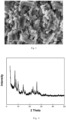
- the XRD spectrum data of the catalyst are shown in Table I-1, the XRD spectrum is shown in Figure 1 , and the TEM photos and SEM photos are shown in Figures 2 and 3 respectively.
- n(SiO 2 ): n(Al 2 O 3 ) 10
- the Ru mass fraction is 0.3%
- the properties of the resulting catalyst are listed in Table I-13.
- the crystals have a long strip shape, the length of the crystals is 0.4-1.5 ⁇ m, and the aspect ratio is 2-10.
- the XRD spectrum data of the catalyst are shown in Table I-2, the XRD spectrum is similar to Figure 1 .
- n(SiO 2 ): n(Al 2 O 3 ) 10
- the Ru mass fraction is 0.6%
- the properties of the resulting catalyst are listed in Table I-13.
- the SEM of the catalyst is similar to Figure 3 .
- the crystals have a long strip shape, the length of the crystals is 0.4-1.5 ⁇ m, and the aspect ratio is 2-10.
- the XRD spectrum data of the catalyst are shown in Table I-3, the XRD spectrum is similar to Figure 1 .
- n(SiO 2 ): n(Al 2 O 3 ) 10
- the Ru mass fraction is 1.5%
- the properties of the resulting catalyst are listed in Table I-13.
- the SEM of the catalyst is similar to Figure 3 .
- the crystals have a long strip shape, the length of the crystals is 0.4-1.5 ⁇ m, and the aspect ratio is 2-10.
- the XRD spectrum data of the catalyst are shown in Table I-4, the XRD spectrum is similar to Figure 1 .
- n(SiO 2 ): n(Al 2 O 3 ) 10
- the Ru mass fraction is 0.3%
- the properties of the resulting catalyst are listed in Table I-13.
- the SEM of the catalyst is similar to Figure 3 .
- the crystals have a long strip shape, the length of the crystals is 0.4-2.0 ⁇ m, and the aspect ratio is 2-15.
- the XRD spectrum data of the catalyst are shown in Table I-5, the XRD spectrum is similar to Figure 1 .
- n(SiO 2 ): n(Al 2 O 3 ) 10
- the Ru mass fraction is 0.3%
- the properties of the resulting catalyst are listed in Table I-13.
- the SEM of the catalyst is similar to Figure 3 .
- the crystals have a long strip shape, the length of the crystals is 0.5-2.5 ⁇ m, and the aspect ratio is 3-20.
- the XRD spectrum data of the catalyst are shown in Table I-6, the XRD spectrum is similar to Figure 1 .
- the properties of the resulting catalyst are listed in Table I-13.
- the SEM of the catalyst is similar to Figure 3 .
- the crystals have a long strip shape, the length of the crystals is 0.4-1.5 ⁇ m, and the aspect ratio is 2-10.
- the XRD spectrum data of the catalyst are shown in Table I-7, the XRD spectrum is similar to Figure 1 .
- n(SiO 2 ): n(Al 2 O 3 ) 20
- the Ru mass fraction is 0.3%
- the properties of the resulting catalyst are listed in Table I-13.
- the SEM of the catalyst is similar to Figure 3 .
- the crystals have a long strip shape, the length of the crystals is 0.4-1.5 ⁇ m, and the aspect ratio is 2-12.
- the XRD spectrum data of the catalyst are shown in Table I-8, the XRD spectrum is similar to Figure 1 .
- n(SiO 2 ): n(Al 2 O 3 ) 50
- the Ru mass fraction is 0.3%
- the properties of the resulting catalyst are listed in Table I-13.
- the SEM of the catalyst is similar to Figure 3 .
- the crystals have a long strip shape, the length of the crystals is 0.4-1.5 ⁇ m, and the aspect ratio is 2-12.
- the XRD spectrum data of the catalyst are shown in Table I-9, the XRD spectrum is similar to Figure 1 .
- the SEM of the catalyst is similar to Figure 3 .
- the crystals have a long strip shape, the length of the crystals is 0.4-1.5 ⁇ m, and the aspect ratio is 2-10.
- the XRD spectrum data of the catalyst are shown in Table I-10, the XRD spectrum is similar to Figure 1 .
- the SEM of the catalyst is similar to Figure 3 .
- the crystals have a long strip shape, the length of the crystals is 0.5-2.5 ⁇ m, and the aspect ratio is 3-20.
- the XRD spectrum data of the catalyst are shown in Table I-11, the XRD spectrum is similar to Figure 1 .
- the SEM of the catalyst is similar to Figure 3 .
- the crystals have a long strip shape, the length of the crystals is 0.4-1.5 ⁇ m, and the aspect ratio is 2-10.
- the XRD spectrum data of the catalyst are shown in Table I-12, the XRD spectrum is similar to Figure 1 .
- the SEM of the catalyst is similar to Figure 3 .
- the crystals have a long strip shape, the length of the crystals is 0.4-1.5 ⁇ m, and the aspect ratio is 2-12.
- Table I-12 XRD spectrum data of the catalyst obtained in Preparation Example I-12 2 ⁇ (°) d-spacing ( ⁇ ) Relative intensity (I/I 0 ⁇ 100) 7.86 11.21 100 16.55 5.35 49 19.19 4.62 66 20.76 4.27 46 21.86 4.06 20 22.42 3.96 36 27.28 3.27 30 28.50 3.14 13 29.27 3.05 16 30.56 2.92 10 34.90 2.57 17
- Example I-1 The catalyst evaluation method is shown in Example I-1.
- the composition and evaluation results of the catalyst are listed in Table I-15.
- Example I-1 The catalyst evaluation method is shown in Example I-1.
- the composition and evaluation results of the catalyst are listed in Table I-15.
- Example I-1 The catalyst evaluation method is shown in Example I-1.
- the composition and evaluation results of the catalyst are listed in Table I-15.
- Example I-1 The catalyst evaluation method is shown in Example I-1.
- the composition and evaluation results of the catalyst are listed in Table I-15.
- Table I-15 Catalyst composition and evaluation results of Comparative Examples I-1 to I-4 Comparative Example Types of molecular sieves n(Si):n(Al) Yield of cyclohexylbenzene (%) Selectivity of cyclohexylbenzene (%) I-1 Y 10 54 77.8 I-2 Y 20 53 74.9 I-3 MCM-22 20 57 78.4 I-4 MCM-22 30 55 73.6
- Example I-1 The catalyst prepared in Preparation Example I-1 was washed and dried before being put into the next reaction, and it was cycled for a total of 6 times.
- the reaction conditions in Example I-1 were retained for the catalyst evaluation, that is, 8 g of benzene was added to the high-pressure reactor, and hydrogen was charged to bring the system pressure to 1.2MPa. Then the temperature of the system was raised to 150 °C, and the reaction was completed after 4 hours. Catalyst evaluation results are listed in Table I-16.
- Example I-9 The catalyst prepared in Preparation Example I-9 was washed and dried before being put into the next reaction, and it was cycled for a total of 6 times.
- the reaction conditions in Example I-12 were retained for the catalyst evaluation, that is, 8 g of benzene was added to the high-pressure reactor, and hydrogen was charged to bring the system pressure to 1.2MPa. Then the temperature of the system was raised to 150 °C, and the reaction was completed after 4 hours. Catalyst evaluation results are listed in Table I-17.
- the Na-type MCM-22 molecular sieve (with MWW structure) with a silicon-aluminum molar ratio of 25:1 and 0.2mol/L NH 4 NO 3 solution (mass ratio 1:20) were exchanged for ammonium ions at 45°C for 2 hours, and then centrifuged and washed.
- the hydrocarbylated molecular sieve was then reduced in a fixed-bed reactor for 3 hours at 450°C and a hydrogen volume space velocity of 50 h -1 to obtain the target catalyst.
- the XRD spectrum of the obtained catalyst is shown in Figure 4 . According to XRD, it can be seen that the catalyst as a whole retains the MWW molecular sieve structure.
- the infrared absorption spectrum of the obtained catalyst is shown in Figure 5 . It can be seen that a Si-C absorption peak appears near the wave number 2950 cm -1 .
- the hydrocarbyl is determined to be methyl through TG-MS test, and the content is as shown in Table II-1.
- the catalyst specific surface area, pore volume, acidic properties (including total acid content and external surface acid equivalent), metal M content and external surface metal M content are shown in Table II-1.
- the Na-type MCM-22 molecular sieve (with MWW structure) with a silicon-aluminum molar ratio of 25:1 and 0.2mol/L NH 4 NO 3 solution (mass ratio 1:20) were exchanged for ammonium ions at 45°C for 2 hours, and then centrifuged and washed.
- the XRD spectrum of the obtained catalyst is the same as in Figure 1 .
- the catalyst specific surface area, pore volume, acidic properties (including total acid content and external surface acid content), metal M content and external surface metal M content are shown in Table II-1.
- the Na-type Y molecular sieve (with FAU structure) with a silicon-aluminum molar ratio of 10:1 and 0.2mol/L NH 4 NO 3 solution (mass ratio 1:20) were exchanged for ammonium ions at 45°C for 2 hours, and then centrifuged and washed.
- the sample obtained after repeating ammonium ion exchange twice was dried overnight at 100°C, and calcined in air at 550°C for 6 hours to obtain the H-type silica-alumina molecular sieve.
- the XRD spectrum of the obtained catalyst is shown in Figure 6 .
- the catalyst as a whole retains the FAU molecular sieve structure.
- the catalyst specific surface area, pore volume, acidic properties (including total acid content and external surface acid equivalent), metal M content and external surface metal M content are shown in Table II-1.
- the Na-type Y molecular sieve (with FAU structure) with a silicon-aluminum molar ratio of 5:1 and 0.2mol/L NH 4 NO 3 solution (mass ratio 1:20) were exchanged for ammonium ions at 45°C for 2 hours, and then centrifuged and washed.
- the sample obtained after repeating ammonium ion exchange twice was dried overnight at 100°C, and calcined in air at 550°C for 6 hours to obtain the H-type silica-alumina molecular sieve.
- the XRD shows that the catalyst as a whole retains the FAU molecular sieve structure.
- the catalyst specific surface area, pore volume, acidic properties (including total acid content and external surface acid equivalent), metal M content and external surface metal M content are shown in Table II-1.
- the Na-type Y molecular sieve (with FAU structure) with a silicon-aluminum molar ratio of 5:1 and 0.2mol/L NH 4 NO 3 solution (mass ratio 1:20) were exchanged for ammonium ions at 45°C for 2 hours, and then centrifuged and washed.
- the sample obtained after repeating ammonium ion exchange twice was dried overnight at 100°C, and calcined in air at 550°C for 6 hours to obtain the H-type silica-alumina molecular sieve.
- the XRD shows that the catalyst as a whole retains the FAU molecular sieve structure.
- the catalyst specific surface area, pore volume, acidic properties (including total acid content and external surface acid equivalent), metal M content and external surface metal M content are shown in Table II-1.
- the XRD shows that the catalyst as a whole retains the ATS molecular sieve structure.
- the catalyst specific surface area, pore volume, acidic properties (including total acid content and external surface acid equivalent), metal M content and external surface metal M content are shown in Table II-1.
- the catalyst was prepared with reference to Preparation Example II-1, except that the raw material was changed to the Na-type MCM-22 molecular sieve with a silicon-aluminum molar ratio of 50:1, and the remaining steps remained unchanged.
- the properties of the catalyst are shown in Table II-1.
- the XRD spectrum of the obtained catalyst is similar to Figure 1 .
- the catalyst specific surface area, pore volume, acidic properties (including total acid content and external surface acid content), metal M content and external surface metal M content are shown in Table II-1.
- the catalyst was prepared with reference to Preparation Example II-1, except that the treatment step with methyltrimethoxysilane was omitted.
- the properties of the obtained catalyst are shown in Table II-1.
- the catalyst evaluation method is the same as in Example II-5, and the catalyst evaluation results are listed in Table II-2.
- the catalyst was prepared with reference to Preparation Example II-1, except that the amount of the added ruthenium chloride solution of the same concentration was increased to 8 mL, that is, only the metal content in the catalyst was increased.
- the properties of the catalyst are shown in Table II-1.
- the catalyst evaluation method is the same as in Example II-5, and the catalyst evaluation results are listed in Table II-2.
- the catalyst was prepared with reference to Preparation Example II-2, except that the addition of "0.3g dimethyldimethoxysilane” is increased to the addition of 1.0g dimethyldimethoxysilane, and the remaining steps remain unchanged.
- the properties of the catalyst are shown in Table II-1.
- the catalyst evaluation method is the same as in Example II-5, and the catalyst evaluation results are listed in Table II-2.
- the MCM-22 molecular sieve (with MWW structure) with a silicon-aluminum molar ratio of 20:1 and 0.2mol/L NH 4 NO 3 solution (mass ratio 1:20) were exchanged for ammonium ions at 45°C for 2 hours, and then centrifuged and washed.
- ruthenium chloride solution 0.5 mL was added dropwise onto 1 g of the H-type silica-alumina molecular sieve with a silicon-aluminum ratio of 20:1. After drying at 80°C for 2 hours, it was reduced in a fixed-bed reactor for 2 hours at 500°C and a hydrogen volume space velocity of 80h -1 to obtain the catalyst precursor.
- 0.3g of phenyltrimethoxysilane, 1g of the catalyst precursor and 20mL ethanol solvent were mixed, refluxed at 75°C for 24h, centrifuged with water, washed, and dried at 80 °C for 12h to obtain the catalyst.
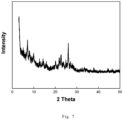
- the XRD spectrum of the obtained catalyst is shown in Figure 7 .
- the catalyst as a whole retains the MWW molecular sieve structure.
- the catalyst specific surface area, pore volume, acidic properties (including total acid content and external surface acid equivalent), metal M content and external surface metal M content are shown in Table III-1.
- the preparation process was the same as Preparation Example III-1, except that Na-type MCM-22 molecular sieve with a silicon-aluminum molar ratio of 25:1 was used.
- the XRD spectrum of the obtained catalyst is the same as Figure 7 .
- the catalyst specific surface area, pore volume, acidic properties (including total acid content and external surface acid content), metal M content and external surface metal M content are shown in Table III-1.
- the preparation process was the same as Preparation Example III-1, except that Na-type mordenite (with MOR structure) with a silicon-aluminum molar ratio of 10:1 was used.
- ruthenium chloride solution 0.5 mL was added dropwise onto 1 g of the H-type MOR molecular sieve with a silicon-aluminum ratio of 10:1. After drying at 80°C for 2 hours, it was reduced in a fixed-bed reactor for 3 hours at 500°C and a hydrogen volume space velocity of 150h -1 to obtain the catalyst precursor.
- 0.3g of phenylsilanetriol, 1g of the catalyst precursor and 30mL toluene solvent were mixed, refluxed at 110°C for 24h, centrifuged with water, washed, and dried at 80 °C for 12h to obtain the catalyst.
- the obtained catalyst as a whole retains the MOR molecular sieve structure.
- the catalyst specific surface area, pore volume, acidic properties (including total acid content and external surface acid equivalent), metal M content and external surface metal M content are shown in Table III-1.
- the preparation process was the same as Preparation Example III-1, except that Na-type mordenite (with MOR structure) with a silicon-aluminum molar ratio of 15:1 was used.
- 0.5 mL of 8 g/L palladium chloride solution was added dropwise onto 1 g of the H-type MOR molecular sieve with a silicon-aluminum ratio of 15:1. After drying at 80°C for 2 hours, it was reduced in a fixed-bed reactor for 3 hours at 500°C and a hydrogen volume space velocity of 80h -1 to obtain the catalyst precursor.
- 0.2g of diphenylsilanediol, 1g of the catalyst precursor and 20mL ethanol solvent were mixed, refluxed at 75°C for 24h, centrifuged with water, washed, and dried at 80 °C for 12h to obtain the catalyst.
- the obtained catalyst as a whole retains the MOR molecular sieve structure.
- the catalyst specific surface area, pore volume, acidic properties (including total acid content and external surface acid equivalent), metal M content and external surface metal M content are shown in Table III-1.
- ruthenium chloride solution 0.5 mL was added dropwise onto 1 g of the H-type ATS molecular sieve. After drying at 80 °C for 2 hours, it was reduced in a fixed-bed reactor for 3 hours at 500°C and a hydrogen volume space velocity of 80h -1 to obtain the catalyst precursor.
- 0.2g phenyltrimethoxysilane, 1g catalyst precursor and 10mL toluene solvent were mixed, refluxed at 110°C for 24h, centrifuged with water, washed, and dried at 80°C for 12h to obtain the catalyst.
- the obtained catalyst as a whole retains the ATS molecular sieve structure.
- the catalyst specific surface area, pore volume, acidic properties (including total acid content and external surface acid equivalent), metal M content and external surface metal M content are shown in Table III-1.
- the catalyst was prepared with reference to Preparation Example III-1, except that the raw material was changed to Na-type MCM-22 molecular sieve (with MWW structure) with a silicon-aluminum molar ratio of 50:1, and the remaining steps remained unchanged.
- the XRD spectrum of the obtained catalyst was the same as Figure 7 .
- the catalyst specific surface area, pore volume, acidic properties (including total acid content and external surface acid equivalent), metal M content and external surface metal M content are shown in Table III-1.
- the catalyst was prepared with reference to Preparation Example III-1, except that the treatment with phenyltrimethoxysilane was omitted.
- the catalyst evaluation method is the same as in Example III-4, and the catalyst evaluation results are listed in Table III-2.
- the catalyst was prepared with reference to Preparation Example III-1, except that the amount of the added ruthenium chloride solution of the same concentration was increased to 8 mL, that is, only the metal content in the catalyst was increased.
- the catalyst evaluation method is the same as in Example III-4, and the catalyst evaluation results are listed in Table III-2.
- the catalyst was prepared with reference to Preparation Example III-1, except that the conditions of the arylation step were changed from adding "0.3g phenyltrimethoxysilane" to adding 0.8g phenyltrimethoxysilane.
- the catalyst evaluation method is the same as in Example III-4, and the catalyst evaluation results are listed in Table III-2.
- the Na-type Y molecular sieve (with FAU structure) with a silicon-aluminum molar ratio of 10:1 and 0.2mol/L NH 4 NO 3 solution (mass ratio 1:20) were exchanged for ammonium ions at 45°C for 2 hours, and then centrifuged and washed.
- the sample obtained after repeating ammonium ion exchange twice was dried overnight at 100°C, and calcined in air at 550°C for 6 hours to obtain the H-type silica-alumina molecular sieve.
- the XRD spectrum of the obtained catalyst is same as Figure 7 .
- the catalyst specific surface area, pore volume, acidic properties (including total acid content and external surface acid equivalent), metal M content and external surface metal M content are shown in Table IV-1.
- the Na-type Y molecular sieve (with FAU structure) with a silicon-aluminum molar ratio of 10:1 and 0.2mol/L NH 4 NO 3 solution (mass ratio 1:20) were exchanged for ammonium ions at 45°C for 2 hours, and then centrifuged and washed.
- the sample obtained after repeating ammonium ion exchange twice was dried overnight at 100°C, and calcined in air at 550°C for 6 hours to obtain the H-type silica-alumina molecular sieve.
- the XRD shows that the obtained catalyst as a whole retains the FAU molecular sieve structure.
- the catalyst specific surface area, pore volume, acidic properties (including total acid content and external surface acid equivalent), metal M content and external surface metal M content are shown in Table IV-1.
- the Na-type Y molecular sieve (with FAU structure) with a silicon-aluminum molar ratio of 10:1 and 0.2mol/L NH 4 NO 3 solution (mass ratio 1:20) were exchanged for ammonium ions at 45°C for 2 hours, and then centrifuged and washed.
- the sample obtained after repeating ammonium ion exchange twice was dried overnight at 100°C, and calcined in air at 550°C for 6 hours to obtain the H-type silica-alumina molecular sieve.
- the XRD shows that the obtained catalyst as a whole retains the FAU molecular sieve structure.
- the catalyst specific surface area, pore volume, acidic properties (including total acid content and external surface acid equivalent), metal M content and external surface metal M content are shown in Table IV-1.
- the Na-type Y molecular sieve (with FAU structure) with a silicon-aluminum molar ratio of 5:1 and 0.2mol/L NH 4 NO 3 solution (mass ratio 1:20) were exchanged for ammonium ions at 45°C for 2 hours, and then centrifuged and washed.
- the sample obtained after repeating ammonium ion exchange twice was dried overnight at 100°C, and calcined in air at 550°C for 6 hours to obtain the H-type silica-alumina molecular sieve.
- the XRD shows that the obtained catalyst as a whole retains the FAU molecular sieve structure.
- the catalyst specific surface area, pore volume, acidic properties (including total acid content and external surface acid equivalent), metal M content and external surface metal M content are shown in Table IV-1.
- the Na-type Y molecular sieve (with FAU structure) with a silicon-aluminum molar ratio of 10:1 and 0.2mol/L NH 4 NO 3 solution (mass ratio 1:20) were exchanged for ammonium ions at 45°C for 2 hours, and then centrifuged and washed.
- the sample obtained after repeating ammonium ion exchange twice was dried overnight at 100°C, and calcined in air at 550°C for 6 hours to obtain the H-type silica-alumina molecular sieve.
- the XRD shows that the obtained catalyst as a whole retains the FAU molecular sieve structure.
- the catalyst specific surface area, pore volume, acidic properties (including total acid content and external surface acid equivalent), metal M content and external surface metal M content are shown in Table IV-1.
- the Na-type Y molecular sieve (with FAU structure) with a silicon-aluminum molar ratio of 10:1 and 0.2mol/L NH 4 NO 3 solution (mass ratio 1:20) were exchanged for ammonium ions at 45°C for 2 hours, and then centrifuged and washed.
- the sample obtained after repeating ammonium ion exchange twice was dried overnight at 100°C, and calcined in air at 550°C for 6 hours to obtain the H-type silica-alumina molecular sieve.
- the catalyst specific surface area, pore volume, acidic properties (including total acid content and external surface acid equivalent), metal M content and external surface metal M content are shown in Table IV-1.
- Example IV-1 The catalyst evaluation method is shown in Example IV-1.
- the composition and evaluation results of the catalyst are listed in Table IV-2.
- the Na-type Y molecular sieve (with FAU structure) with a silicon-aluminum molar ratio of 10:1 and 0.2mol/L NH 4 NO 3 solution (mass ratio 1:20) were exchanged for ammonium ions at 45°C for 2 hours, and then centrifuged and washed.
- the sample obtained after repeating ammonium ion exchange twice was dried overnight at 100°C, and calcined in air at 550°C for 6 hours to obtain the H-type silica-alumina molecular sieve.
- the catalyst specific surface area, pore volume, acidic properties (including total acid content and external surface acid equivalent), metal M content and external surface metal M content are shown in Table IV-1.
- Example IV-1 The catalyst evaluation method is shown in Example IV-1.
- the composition and evaluation results of the catalyst are listed in Table IV-2.
- Table IV-1 Physicochemical properties of the catalysts obtained in Preparation Examples and Comparative Examples Example number Molecular sieve type Metal M and content thereof (wt%) Content of the metal M on the external surface to the external surface elements (wt%) Distribution coefficient of the metal M on the external surface (%) Hydrocarbyl modifying component and content thereof (wt%) n(Si): n (Al) Preparation Example IV-1 Y 1.04 (palladium) 0.47 9.1 2.3 (methyl) 10
- Preparation Example IV-2 Y 1.02 (palladium) 0.33 6.2 5.5 (methyl) 10
- Preparation Example IV-3 Y 0.88 (platinum) 0.33 6.2 5.5 (methyl) 10
- Preparation Example IV- 4 Y 1.03 (palladium) 0.26 5.6 5.6 (methyl ) 5
- Preparation Example IV-5 Y 1.04 (palladium)
Landscapes
- Chemical & Material Sciences (AREA)
- Organic Chemistry (AREA)
- Chemical Kinetics & Catalysis (AREA)
- Engineering & Computer Science (AREA)
- Materials Engineering (AREA)
- Crystallography & Structural Chemistry (AREA)
- Thermal Sciences (AREA)
- Physics & Mathematics (AREA)
- Oil, Petroleum & Natural Gas (AREA)
- Catalysts (AREA)
- Organic Low-Molecular-Weight Compounds And Preparation Thereof (AREA)
- Low-Molecular Organic Synthesis Reactions Using Catalysts (AREA)
- Silicates, Zeolites, And Molecular Sieves (AREA)
Applications Claiming Priority (4)
| Application Number | Priority Date | Filing Date | Title |
|---|---|---|---|
| CN202111250651.2A CN116020541B (zh) | 2021-10-26 | 2021-10-26 | 一种用于生产环己基苯的催化剂及其制备方法和应用 |
| CN202210754120.5A CN117342911A (zh) | 2022-06-28 | 2022-06-28 | 一种苯加氢一步法制环己基苯的方法 |
| CN202210754110.1A CN117358295B (zh) | 2022-06-28 | 2022-06-28 | 一种用于生产环己基苯的催化剂及其制备方法和应用 |
| PCT/CN2022/127278 WO2023072041A1 (zh) | 2021-10-26 | 2022-10-25 | 加氢-酸催化双功能催化剂及其制备方法和应用 |
Publications (2)
| Publication Number | Publication Date |
|---|---|
| EP4424418A1 true EP4424418A1 (de) | 2024-09-04 |
| EP4424418A4 EP4424418A4 (de) | 2025-10-08 |
Family
ID=86160387
Family Applications (1)
| Application Number | Title | Priority Date | Filing Date |
|---|---|---|---|
| EP22885918.7A Pending EP4424418A4 (de) | 2021-10-26 | 2022-10-25 | Bifunktioneller katalysator für hydrierungssäurekatalyse und herstellungsverfahren dafür und anwendung davon |
Country Status (5)
| Country | Link |
|---|---|
| US (1) | US20250018382A1 (de) |
| EP (1) | EP4424418A4 (de) |
| JP (1) | JP7839874B2 (de) |
| KR (1) | KR20240090988A (de) |
| WO (1) | WO2023072041A1 (de) |
Families Citing this family (1)
| Publication number | Priority date | Publication date | Assignee | Title |
|---|---|---|---|---|
| CN121513947B (zh) * | 2026-01-16 | 2026-04-10 | 富海(东营)技术服务有限公司 | 用于3-羟基丙醛加氢制1,3-丙二醇的负载型镍催化剂及其制备方法和应用 |
Family Cites Families (23)
| Publication number | Priority date | Publication date | Assignee | Title |
|---|---|---|---|---|
| US4268699A (en) * | 1978-07-21 | 1981-05-19 | Phillips Petroleum Company | Hydroalkylation using nickel-ruthenium catalyst on zeolite type support |
| US4219689A (en) | 1978-09-08 | 1980-08-26 | Phillips Petroleum Company | Aromatic hydroalkylation catalyst using iridium on zeolites |
| US5302279A (en) | 1992-12-23 | 1994-04-12 | Mobil Oil Corporation | Lubricant production by hydroisomerization of solvent extracted feedstocks |
| US5643440A (en) | 1993-02-12 | 1997-07-01 | Mobil Oil Corporation | Production of high viscosity index lubricants |
| US6190532B1 (en) | 1998-07-13 | 2001-02-20 | Mobil Oil Corporation | Production of high viscosity index lubricants |
| CN101796000B (zh) * | 2007-08-15 | 2013-07-10 | 埃克森美孚化学专利公司 | 环己基苯的制备方法 |
| WO2009128984A1 (en) | 2008-04-14 | 2009-10-22 | Exxonmobil Chemical Patents Inc. | Process for producing cyclohexylbenzene |
| US8212096B2 (en) * | 2008-07-28 | 2012-07-03 | Exxonmobil Chemical Patents Inc. | Hydroalkylation of aromatic compounds using EMM-13 |
| KR20110129925A (ko) * | 2009-02-26 | 2011-12-02 | 엑손모빌 케미칼 패턴츠 인코포레이티드 | 사이클로헥실벤젠의 제조방법 |
| CN104105679B (zh) | 2012-02-08 | 2017-07-21 | 埃克森美孚化学专利公司 | 生产环己基苯的方法 |
| KR101628743B1 (ko) * | 2012-03-30 | 2016-06-09 | 제이엑스 닛코닛세키에너지주식회사 | Zsm-22 제올라이트, 수소화 이성화 촉매 및 이의 제조 방법, 및 탄화수소의 제조 방법 |
| CN105439802B (zh) * | 2014-08-27 | 2018-01-09 | 中国石油化工股份有限公司 | 加氢烷基化制备环己基苯的方法 |
| CN106518602B (zh) * | 2015-09-15 | 2019-02-19 | 中国石油化工股份有限公司 | 加氢烷基化制备环己基苯的方法 |
| CN107303512B (zh) * | 2016-04-25 | 2020-03-27 | 中国石化扬子石油化工有限公司 | 一种双功能催化剂及其在苯加氢烷基化反应中的应用 |
| CN107930681B (zh) * | 2016-10-13 | 2020-05-05 | 中国石油化工股份有限公司 | 适于环己基苯合成的催化剂及其制备方法 |
| CN110563534B (zh) * | 2018-06-06 | 2022-04-05 | 中国石油化工股份有限公司 | 加氢烷基化合成环己基苯的方法 |
| CN110563543B (zh) * | 2018-06-06 | 2022-07-12 | 中国石油化工股份有限公司 | 合成环己基苯的方法 |
| CN111085250B (zh) * | 2018-10-23 | 2022-06-28 | 中国石油化工股份有限公司 | 一种负载金属的催化剂的制备方法 |
| CN111085249B (zh) * | 2018-10-23 | 2022-06-24 | 中国石油化工股份有限公司 | 一种负载金属的含酸性材料催化剂的制备方法 |
| CN109999893A (zh) * | 2019-04-03 | 2019-07-12 | 郑州大学 | 一种苯加氢制环己基苯用催化剂的制备方法 |
| CN112547119B (zh) * | 2019-09-25 | 2023-08-15 | 中国石油化工股份有限公司 | 一种加氢异构化催化剂及其应用 |
| CN112934251B (zh) | 2019-12-11 | 2023-06-06 | 中国科学院大连化学物理研究所 | 一种催化正庚烷加氢异构化的双功能催化剂及其制备方法 |
| CN111250148B (zh) * | 2020-03-25 | 2021-01-29 | 厦门大学 | 一种用于苯加氢烷基化制环己基苯的催化剂及其制备方法和应用 |
-
2022
- 2022-10-25 KR KR1020247017468A patent/KR20240090988A/ko active Pending
- 2022-10-25 JP JP2024525085A patent/JP7839874B2/ja active Active
- 2022-10-25 EP EP22885918.7A patent/EP4424418A4/de active Pending
- 2022-10-25 WO PCT/CN2022/127278 patent/WO2023072041A1/zh not_active Ceased
- 2022-10-25 US US18/703,749 patent/US20250018382A1/en active Pending
Also Published As
| Publication number | Publication date |
|---|---|
| EP4424418A4 (de) | 2025-10-08 |
| JP7839874B2 (ja) | 2026-04-02 |
| US20250018382A1 (en) | 2025-01-16 |
| WO2023072041A1 (zh) | 2023-05-04 |
| JP2024538254A (ja) | 2024-10-18 |
| KR20240090988A (ko) | 2024-06-21 |
Similar Documents
| Publication | Publication Date | Title |
|---|---|---|
| Kim et al. | n-Heptane hydroisomerization over Pt/MFI zeolite nanosheets: Effects of zeolite crystal thickness and platinum location | |
| Santi et al. | High-performance ring-opening catalysts based on iridium-containing zeolite Beta in the hydroconversion of decalin | |
| Auepattana-Aumrung et al. | Observation of reduction on alkane products in butene cracking over ZSM-5 modified with Fe, Cu, and Ni catalysts | |
| EP1980319A1 (de) | Katalysator zur herstellung einer aromatischen kohlenwasserstoffverbindung | |
| WO1993002156A1 (en) | Paraffin isomerization process | |
| EP1796836B1 (de) | Verbessertes verfahren zur aromatensättigung für schmierölsiedebereichseinsatzströme | |
| JP2004537404A (ja) | 固体酸性触媒のための非ゼオライト系ナノ複合体物質 | |
| CN103269794A (zh) | 制备基于具有互连介孔组织的二氧化硅或二氧化硅-氧化铝的加氢转化催化剂的方法 | |
| Liu et al. | The crucial role of skeleton structure and carbon number on short-chain alkane activation over Zn/HZSM-5 catalyst: an experimental and computational study | |
| EP4424418A1 (de) | Bifunktioneller katalysator für hydrierungssäurekatalyse und herstellungsverfahren dafür und anwendung davon | |
| Rodrıguez-Castellón et al. | Textural and structural properties and surface acidity characterization of mesoporous silica-zirconia molecular sieves | |
| Rahman et al. | Improved ethylbenzene suppression and coke-resistance on benzene methylation over metals doped fibrous silica-HZSM-5 zeolite | |
| Shao et al. | Design of PtM (M= Ru, Au, or Sn) bimetallic particles supported on TS-1 for the direct dehydrogenation of n-butane | |
| Zhou et al. | Development and catalytic mechanism of a highly efficient Pt/Kβ catalyst for n-heptane aromatization | |
| US20030017937A1 (en) | Process for preparing metal containing bi-functional catalysts for dewaxing | |
| Izutsu et al. | Synthesis and characterization of chromium-added Pt/beta zeolite and its catalytic performance for n-heptane isomerization | |
| Xing et al. | Elucidating the effect of oxides on the zeolite catalyzed alkylation of benzene with 1-dodecene | |
| Cao et al. | Comparison of surface passivation modification of two mordenite zeolites and their application on the isomerisation of o-ethyltoluene | |
| US20240326027A1 (en) | Nickel-Based Oligomerization Catalysts and Method for Oligomerizing Light Olefins Using the Same | |
| Vieira et al. | The transformations of n-butane over platinum-promoted Mn-aluminophosphate molecular sieves | |
| US11517885B2 (en) | Catalyst for producing olefins from dehydrogenation of alkane and a method for producing olefins using said catalyst | |
| Ghedini et al. | Gas and liquid phase reactions on MCM-41/SZ catalysts | |
| Batalha et al. | In situ FTIR spectroscopy to unravel the bifunctional nature of aromatics hydrogenation synergy on zeolite/metal catalysts | |
| CN117358295B (zh) | 一种用于生产环己基苯的催化剂及其制备方法和应用 | |
| Pérez-Luna et al. | n-pentane isomerization over Pt-and Ni–Pt-promoted sulfated zirconia catalysts supported on alumina |
Legal Events
| Date | Code | Title | Description |
|---|---|---|---|
| STAA | Information on the status of an ep patent application or granted ep patent |
Free format text: STATUS: THE INTERNATIONAL PUBLICATION HAS BEEN MADE |
|
| PUAI | Public reference made under article 153(3) epc to a published international application that has entered the european phase |
Free format text: ORIGINAL CODE: 0009012 |
|
| STAA | Information on the status of an ep patent application or granted ep patent |
Free format text: STATUS: REQUEST FOR EXAMINATION WAS MADE |
|
| 17P | Request for examination filed |
Effective date: 20240521 |
|
| AK | Designated contracting states |
Kind code of ref document: A1 Designated state(s): AL AT BE BG CH CY CZ DE DK EE ES FI FR GB GR HR HU IE IS IT LI LT LU LV MC ME MK MT NL NO PL PT RO RS SE SI SK SM TR |
|
| DAV | Request for validation of the european patent (deleted) | ||
| DAX | Request for extension of the european patent (deleted) | ||
| A4 | Supplementary search report drawn up and despatched |
Effective date: 20250904 |
|
| RIC1 | Information provided on ipc code assigned before grant |
Ipc: B01J 29/068 20060101AFI20250829BHEP Ipc: C07C 13/28 20060101ALI20250829BHEP |