EP4421879B1 - Solarzelle und herstellungsverfahren dafür - Google Patents
Solarzelle und herstellungsverfahren dafür Download PDFInfo
- Publication number
- EP4421879B1 EP4421879B1 EP23189628.3A EP23189628A EP4421879B1 EP 4421879 B1 EP4421879 B1 EP 4421879B1 EP 23189628 A EP23189628 A EP 23189628A EP 4421879 B1 EP4421879 B1 EP 4421879B1
- Authority
- EP
- European Patent Office
- Prior art keywords
- conductive layer
- layer
- doped
- doped conductive
- solar cell
- Prior art date
- Legal status (The legal status is an assumption and is not a legal conclusion. Google has not performed a legal analysis and makes no representation as to the accuracy of the status listed.)
- Active
Links
Images




Classifications
-
- H—ELECTRICITY
- H10—SEMICONDUCTOR DEVICES; ELECTRIC SOLID-STATE DEVICES NOT OTHERWISE PROVIDED FOR
- H10F—INORGANIC SEMICONDUCTOR DEVICES SENSITIVE TO INFRARED RADIATION, LIGHT, ELECTROMAGNETIC RADIATION OF SHORTER WAVELENGTH OR CORPUSCULAR RADIATION
- H10F19/00—Integrated devices, or assemblies of multiple devices, comprising at least one photovoltaic cell covered by group H10F10/00, e.g. photovoltaic modules
- H10F19/90—Structures for connecting between photovoltaic cells, e.g. interconnections or insulating spacers
- H10F19/902—Structures for connecting between photovoltaic cells, e.g. interconnections or insulating spacers for series or parallel connection of photovoltaic cells
- H10F19/906—Structures for connecting between photovoltaic cells, e.g. interconnections or insulating spacers for series or parallel connection of photovoltaic cells characterised by the materials of the structures
-
- H—ELECTRICITY
- H10—SEMICONDUCTOR DEVICES; ELECTRIC SOLID-STATE DEVICES NOT OTHERWISE PROVIDED FOR
- H10F—INORGANIC SEMICONDUCTOR DEVICES SENSITIVE TO INFRARED RADIATION, LIGHT, ELECTROMAGNETIC RADIATION OF SHORTER WAVELENGTH OR CORPUSCULAR RADIATION
- H10F10/00—Individual photovoltaic cells, e.g. solar cells
- H10F10/10—Individual photovoltaic cells, e.g. solar cells having potential barriers
- H10F10/16—Photovoltaic cells having only PN heterojunction potential barriers
- H10F10/164—Photovoltaic cells having only PN heterojunction potential barriers comprising heterojunctions with Group IV materials, e.g. ITO/Si or GaAs/SiGe photovoltaic cells
- H10F10/165—Photovoltaic cells having only PN heterojunction potential barriers comprising heterojunctions with Group IV materials, e.g. ITO/Si or GaAs/SiGe photovoltaic cells the heterojunctions being Group IV-IV heterojunctions, e.g. Si/Ge, SiGe/Si or Si/SiC photovoltaic cells
- H10F10/166—Photovoltaic cells having only PN heterojunction potential barriers comprising heterojunctions with Group IV materials, e.g. ITO/Si or GaAs/SiGe photovoltaic cells the heterojunctions being Group IV-IV heterojunctions, e.g. Si/Ge, SiGe/Si or Si/SiC photovoltaic cells the Group IV-IV heterojunctions being heterojunctions of crystalline and amorphous materials, e.g. silicon heterojunction [SHJ] photovoltaic cells
-
- H—ELECTRICITY
- H10—SEMICONDUCTOR DEVICES; ELECTRIC SOLID-STATE DEVICES NOT OTHERWISE PROVIDED FOR
- H10F—INORGANIC SEMICONDUCTOR DEVICES SENSITIVE TO INFRARED RADIATION, LIGHT, ELECTROMAGNETIC RADIATION OF SHORTER WAVELENGTH OR CORPUSCULAR RADIATION
- H10F77/00—Constructional details of devices covered by this subclass
- H10F77/30—Coatings
- H10F77/306—Coatings for devices having potential barriers
- H10F77/311—Coatings for devices having potential barriers for photovoltaic cells
-
- H—ELECTRICITY
- H10—SEMICONDUCTOR DEVICES; ELECTRIC SOLID-STATE DEVICES NOT OTHERWISE PROVIDED FOR
- H10F—INORGANIC SEMICONDUCTOR DEVICES SENSITIVE TO INFRARED RADIATION, LIGHT, ELECTROMAGNETIC RADIATION OF SHORTER WAVELENGTH OR CORPUSCULAR RADIATION
- H10F77/00—Constructional details of devices covered by this subclass
- H10F77/10—Semiconductor bodies
- H10F77/12—Active materials
- H10F77/122—Active materials comprising only Group IV materials
- H10F77/1223—Active materials comprising only Group IV materials characterised by the dopants
-
- H—ELECTRICITY
- H10—SEMICONDUCTOR DEVICES; ELECTRIC SOLID-STATE DEVICES NOT OTHERWISE PROVIDED FOR
- H10F—INORGANIC SEMICONDUCTOR DEVICES SENSITIVE TO INFRARED RADIATION, LIGHT, ELECTROMAGNETIC RADIATION OF SHORTER WAVELENGTH OR CORPUSCULAR RADIATION
- H10F10/00—Individual photovoltaic cells, e.g. solar cells
- H10F10/10—Individual photovoltaic cells, e.g. solar cells having potential barriers
- H10F10/14—Photovoltaic cells having only PN homojunction potential barriers
-
- H—ELECTRICITY
- H10—SEMICONDUCTOR DEVICES; ELECTRIC SOLID-STATE DEVICES NOT OTHERWISE PROVIDED FOR
- H10F—INORGANIC SEMICONDUCTOR DEVICES SENSITIVE TO INFRARED RADIATION, LIGHT, ELECTROMAGNETIC RADIATION OF SHORTER WAVELENGTH OR CORPUSCULAR RADIATION
- H10F19/00—Integrated devices, or assemblies of multiple devices, comprising at least one photovoltaic cell covered by group H10F10/00, e.g. photovoltaic modules
-
- H—ELECTRICITY
- H10—SEMICONDUCTOR DEVICES; ELECTRIC SOLID-STATE DEVICES NOT OTHERWISE PROVIDED FOR
- H10F—INORGANIC SEMICONDUCTOR DEVICES SENSITIVE TO INFRARED RADIATION, LIGHT, ELECTROMAGNETIC RADIATION OF SHORTER WAVELENGTH OR CORPUSCULAR RADIATION
- H10F19/00—Integrated devices, or assemblies of multiple devices, comprising at least one photovoltaic cell covered by group H10F10/00, e.g. photovoltaic modules
- H10F19/80—Encapsulations or containers for integrated devices, or assemblies of multiple devices, having photovoltaic cells
-
- H—ELECTRICITY
- H10—SEMICONDUCTOR DEVICES; ELECTRIC SOLID-STATE DEVICES NOT OTHERWISE PROVIDED FOR
- H10F—INORGANIC SEMICONDUCTOR DEVICES SENSITIVE TO INFRARED RADIATION, LIGHT, ELECTROMAGNETIC RADIATION OF SHORTER WAVELENGTH OR CORPUSCULAR RADIATION
- H10F71/00—Manufacture or treatment of devices covered by this subclass
-
- H—ELECTRICITY
- H10—SEMICONDUCTOR DEVICES; ELECTRIC SOLID-STATE DEVICES NOT OTHERWISE PROVIDED FOR
- H10F—INORGANIC SEMICONDUCTOR DEVICES SENSITIVE TO INFRARED RADIATION, LIGHT, ELECTROMAGNETIC RADIATION OF SHORTER WAVELENGTH OR CORPUSCULAR RADIATION
- H10F71/00—Manufacture or treatment of devices covered by this subclass
- H10F71/121—The active layers comprising only Group IV materials
-
- H—ELECTRICITY
- H10—SEMICONDUCTOR DEVICES; ELECTRIC SOLID-STATE DEVICES NOT OTHERWISE PROVIDED FOR
- H10F—INORGANIC SEMICONDUCTOR DEVICES SENSITIVE TO INFRARED RADIATION, LIGHT, ELECTROMAGNETIC RADIATION OF SHORTER WAVELENGTH OR CORPUSCULAR RADIATION
- H10F71/00—Manufacture or treatment of devices covered by this subclass
- H10F71/129—Passivating
-
- H—ELECTRICITY
- H10—SEMICONDUCTOR DEVICES; ELECTRIC SOLID-STATE DEVICES NOT OTHERWISE PROVIDED FOR
- H10F—INORGANIC SEMICONDUCTOR DEVICES SENSITIVE TO INFRARED RADIATION, LIGHT, ELECTROMAGNETIC RADIATION OF SHORTER WAVELENGTH OR CORPUSCULAR RADIATION
- H10F77/00—Constructional details of devices covered by this subclass
- H10F77/10—Semiconductor bodies
- H10F77/12—Active materials
- H10F77/122—Active materials comprising only Group IV materials
- H10F77/1226—Active materials comprising only Group IV materials comprising multiple Group IV elements, e.g. SiC
- H10F77/1227—Active materials comprising only Group IV materials comprising multiple Group IV elements, e.g. SiC characterised by the dopants
-
- H—ELECTRICITY
- H10—SEMICONDUCTOR DEVICES; ELECTRIC SOLID-STATE DEVICES NOT OTHERWISE PROVIDED FOR
- H10F—INORGANIC SEMICONDUCTOR DEVICES SENSITIVE TO INFRARED RADIATION, LIGHT, ELECTROMAGNETIC RADIATION OF SHORTER WAVELENGTH OR CORPUSCULAR RADIATION
- H10F77/00—Constructional details of devices covered by this subclass
- H10F77/10—Semiconductor bodies
- H10F77/14—Shape of semiconductor bodies; Shapes, relative sizes or dispositions of semiconductor regions within semiconductor bodies
- H10F77/143—Shape of semiconductor bodies; Shapes, relative sizes or dispositions of semiconductor regions within semiconductor bodies comprising quantum structures
-
- H—ELECTRICITY
- H10—SEMICONDUCTOR DEVICES; ELECTRIC SOLID-STATE DEVICES NOT OTHERWISE PROVIDED FOR
- H10F—INORGANIC SEMICONDUCTOR DEVICES SENSITIVE TO INFRARED RADIATION, LIGHT, ELECTROMAGNETIC RADIATION OF SHORTER WAVELENGTH OR CORPUSCULAR RADIATION
- H10F77/00—Constructional details of devices covered by this subclass
- H10F77/20—Electrodes
- H10F77/206—Electrodes for devices having potential barriers
- H10F77/211—Electrodes for devices having potential barriers for photovoltaic cells
-
- Y—GENERAL TAGGING OF NEW TECHNOLOGICAL DEVELOPMENTS; GENERAL TAGGING OF CROSS-SECTIONAL TECHNOLOGIES SPANNING OVER SEVERAL SECTIONS OF THE IPC; TECHNICAL SUBJECTS COVERED BY FORMER USPC CROSS-REFERENCE ART COLLECTIONS [XRACs] AND DIGESTS
- Y02—TECHNOLOGIES OR APPLICATIONS FOR MITIGATION OR ADAPTATION AGAINST CLIMATE CHANGE
- Y02P—CLIMATE CHANGE MITIGATION TECHNOLOGIES IN THE PRODUCTION OR PROCESSING OF GOODS
- Y02P70/00—Climate change mitigation technologies in the production process for final industrial or consumer products
- Y02P70/50—Manufacturing or production processes characterised by the final manufactured product
Definitions
- the present disclosure relates to the technical field of photovoltaic cells and, in particular, to a solar cell and a manufacturing method thereof, and a photovoltaic module.
- Document CN115274875A discloses a TOPCon solar cell, wherein a doped conductive layer located on the back of the semiconductor substrate comprises a first doped conductive layer corresponding to the back metallization area and a second doped conductive layer corresponding to the back non-metallization area, with the oxygen content of the first doped conductive layer is smaller than that of the second doped conductive layer.
- Document CN115411151A discloses a TOPCon solar cell with selective doping regions over the tunneling layer.
- the present disclosure proposes a solar cell, a method for solar cell, and a photovoltaic module.
- the solar cell can ensure lateral transport capabilities of carriers while improving low passivation performance of a metallization region.
- one or more embodiments of the present disclosure provide a solar cell, the solar cell includes: a semiconductor substrate, the semiconductor substrate including a first surface and a second surface arranged opposite to each other; an emitter and a first passivation layer formed over the first surface of the semiconductor substrate; a tunneling layer formed over the second surface of the semiconductor substrate; a first doped conductive layer and a retardation layer formed on a surface of the tunneling layer, the first doped conductive layer is located between the tunneling layer and the retardation layer, and the first doped conductive layer and the retardation layer correspond to a metallization region; a second doped conductive layer formed over the surface of the tunneling layer, the second doped conductive layer covering the tunneling layer in a non-metallization region and the retardation layer, a doping concentration of the second doped conductive layer is greater than a doping concentration of the first doped conductive layer, and the retardation layer is configured to retard migration of a doped element in the second doped conductive layer to the first
- one or more embodiments of the present disclosure provide a method for manufacturing solar cell, including: providing a semiconductor substrate, the semiconductor substrate including a first surface and a second surface arranged opposite to each other; forming an emitter on the first surface of the semiconductor substrate after texturing; forming a tunneling layer over the second surface of the semiconductor substrate; forming a first non-conductive layer on a surface of the tunneling layer, the first non-conductive layer corresponding to a metallization region and a non-metallization region; forming a retardation layer over a surface of the first non-conductive layer, the retardation layer corresponding to the metallization region; forming a second non-conductive layer over surfaces of the first non-conductive layer and the retardation layer, and doping the second non-conductive layer so that the second non-conductive layer and the first non-conductive layer that is located in the non-metallization region are transformed into a second doped conductive layer, and the first non-conductive layer located in the metallization region is transformed into a first doped conductive layer
- one or more embodiments of the present disclosure provide a photovoltaic module, the photovoltaic module includes a cover plate, a packaging material layer, and at least one solar cell string including a plurality of solar cells according to the first aspect or manufactured with the manufacturing method according to the second aspect.
- Optimizing surface passivation of crystalline silicon solar cell is one of the important manners to improve the efficiency.
- a TOPCon structure is widely favored due to higher theoretical efficiency thereof.
- the TOPCon structure includes ultra-thin silicon oxide and a heavily doped silicon film, which performs good field passivation effect, so that efficiency of a crystalline silicon solar cell manufactured using TOPCon technology has reached more than 26%.
- a-Si:H amorphous silicon
- CVD chemical vapor deposition
- qVD a quasi-Fermi level difference
- Doping concentration of a conventional doped polysilicon layer is required to reach a certain height, so as to form good contact with a metal electrode.
- a polysilicon layer with high doping concentration may have two problems: phosphorus diffusion to an oxide layer may adversely affect the passivation effect of a tunneling layer; and qVD between doped polysilicon and the silicon substrate is small, resulting in a low upper limit of a theoretical open-circuit voltage, thereby limiting improvement of conversion efficiency of the TOPCon solar cell.
- FIG. 1 shows a schematic structural diagram of a solar cell according to some embodiments of the present disclosure
- the solar cell includes: a semiconductor substrate 1, an emitter 2, a first passivation layer 3, a tunneling layer 4, a first doped conductive layer 5, a retardation layer 6, a second doped conductive layer 7, a second passivation layer 8, a first electrode 9, and a second electrode 10.
- the semiconductor substrate 1 has a first surface and a second surface arranged opposite to each other.
- the emitter 2 and the first passivation layer 3 are located on the first surface of the semiconductor substrate 1.
- the tunneling layer 4 is located on the second surface of the semiconductor substrate 1.
- the first doped conductive layer 5 and the retardation layer 6 are located on a surface of the tunneling layer 4, the first doped conductive layer 5 is located between the tunneling layer 4 and the retardation layer 6, and the first doped conductive layer 5 and the retardation layer 6 correspond to a metallization region.
- the second doped conductive layer 7 is located on the surface of the tunneling layer 4, the second doped conductive layer 7 covers the tunneling layer 4 in a non-metallization region and the retardation layer 6, and a doping concentration of the second doped conductive layer 7 is greater than a doping concentration of the first doped conductive layer 5.
- the second passivation layer 8 is located on a surface of the second doped conductive layer 7.
- the first electrode 9 is in contact with the emitter 2 and a second electrode 10 is in contact with the second doped conductive layer 7.
- the first doped conductive layer 5 with low concentration and the retardation layer 6 are arranged only in the metallization region of the second surface of the solar cell, while the second doped conductive layer 7 with higher concentration is arranged on the entire second surface of the solar cell.
- the first doped conductive layer 5 with lower concentration is in contact with the tunneling layer 4, which can reduce the passivation effect of the doped element on the tunneling layer 4 and reduce recombination current density J 0,metal in the metallization region, and at the same time, a quasi-Fermi level difference qVD between the first doped conductive layer 5 with lower concentration and the semiconductor substrate 1 is smaller, which is conducive to increasing the theoretical open-circuit voltage and thus improving photoelectric conversion efficiency of the solar cell.
- the second doped conductive layer 7 with higher concentration exists in the metallization region and the non-metallization region, which can ensure lateral transport rates of carriers on a rear surface of the solar cell.
- the distance between the second doped conductive layer 7 in the non-metallization region and the semiconductor substrate 1 is relatively short, which can prevent excessive weakening of an energy band bending effect of the second doped conductive layer 7 caused by an excessive long distance between the second doped conductive layer 7 and the semiconductor substrate 1 due to the arrangement of the first doped conductive layer 5 with low concentration and the retardation layer 6, thereby ensuring selective transport of the carriers.
- the design of localized doped conductive layers in the present disclosure can improve the passivation effect in the metallization region, and also ensure lateral transport efficiency of the carriers, which can effectively improve efficiency of the solar cell.
- the first surface of the semiconductor substrate 1 may be a front surface of the solar cell or the rear surface of the solar cell.
- the second surface of the semiconductor substrate 1 is the rear surface of the solar cell.
- the first surface of the semiconductor substrate 1 is the rear surface of the solar cell
- the second surface of the semiconductor substrate 1 is the front surface of the solar cell.
- the front surface of the solar cell is a surface facing the sun (i.e., a light-receiving surface)
- the rear surface of the solar cell is a surface facing away from the sun (i.e., a backlight surface). The following descriptions are all based on examples in which the first surface of the semiconductor substrate 1 is the front surface of the solar cell and the second surface of the semiconductor substrate 1 is the rear surface of the solar cell.
- the metallization region refers to a region where the second electrode 10 of the solar cell penetrates through the second passivation layer 8 to form (direct or indirect) contact with the doped conductive layer.
- conductive metal particles during electrode formation may dissociate from the main structure of the electrode to form indirect contact.
- the non-metallization region refers to regions other than the region where the second electrode 10 penetrates through the second passivation layer 8 and forms contact with the doped conductive layer or a region other than the metallization region.
- the semiconductor substrate 1 is an N-type crystalline silicon substrate (or silicon wafer), or a P-type crystalline silicon substrate (silicon wafer).
- the crystalline silicon substrate (silicon substrate) is, for example, one of a polycrystalline silicon substrate, a monocrystalline silicon substrate, a microcrystalline silicon substrate, or a silicon carbide substrate.
- a specific type of the semiconductor substrate 1 is not limited in the embodiments of the present disclosure.
- a doped element of the semiconductor substrate 1 may be phosphorus, nitrogen, or the like.
- a thickness of the semiconductor substrate 1 ranges from 60 ⁇ m to 240 ⁇ m, which may be, for example, 60 ⁇ m, 80 ⁇ m, 90 ⁇ m, 100 ⁇ m, 120 ⁇ m, 150 ⁇ m, 200 ⁇ m, 240 ⁇ m, or the like, which is not limited herein.
- the emitter 2 may have an emitter 2 structure with a uniform doping depth, or have a selective emitter 2 structure with a different doping concentration and a different doping depth.
- the selective emitter 2 is a heavily doped emitter region corresponding to the metal electrode, and other regions are lightly doped emitter regions.
- the emitter 2 region may be located within the surface of the semiconductor substrate 1, or located outside the surface of the semiconductor substrate 1 to form an independent emitter 2 structure.
- the semiconductor substrate 1 is N-type
- the emitter 2 is P-type, and the semiconductor substrate 1 and the emitter 2 form a PN junction.
- the first passivation layer 3 may include, but is not limited to, a single-layer oxide layer or a multi-layer structure such as silicon oxide, silicon nitride, silicon oxynitride, or aluminum oxide.
- the first passivation layer 3 can produce good passivation effect on the semiconductor substrate 1 and help to improve conversion efficiency of the solar cell. It is to be noted that the first passivation layer 3 may also play a role in reducing reflection of incident light, which, in some examples, may be called as an anti-reflection layer.
- a thickness of the first passivation layer 3 ranges from 10 nm to 120 nm, which may be, for example, 10 nm, 20 nm, 30 nm, 42 nm, 50 nm, 60 nm, 70 nm, 80 nm, 90 nm, 100 nm, 120 nm, or the like, and may be other values in the above range, which is not limited herein.
- the tunneling layer 4 is a thin oxide layer, which may be, for example, silicon oxide or metal oxide, and may include other additional elements, such as nitrogen.
- the tunneling layer 4 may be a stacked structure of one or more of a silicon oxide layer, an aluminum oxide layer, a silicon oxynitride layer, a molybdenum oxide layer, or a hafnium oxide layer.
- the tunneling layer 4 may be an oxygen-containing silicon nitride layer, an oxygen-containing silicon carbide layer, or the like.
- the tunneling layer 4 may not have perfect tunneling barrier in practice, due to, for example, defects such as pinholes, which may lead to dominance of other charge carrier transport mechanisms (e.g., drift and diffusion) over the tunneling effect.
- a thickness of the tunneling layer 4 ranges from 0.5 nm to 2 nm, which may be, for example, 0.5 nm, 0.8 nm, 1 nm, 1.2 nm, 1.5 nm, 1.8 nm, 2 nm, or the like.
- the thinner tunneling layer 4 in the present disclosure helps to prevent transport of majority carriers and promote tunneling collection of minority carriers.
- the first doped conductive layer 5 includes semiconductor materials such as polysilicon, microcrystalline silicon, and silicon carbide.
- a specific type of the first doped conductive layer 5 is not limited in the embodiments of the present disclosure.
- the material of the first doped conductive layer 5 includes polysilicon. That is, the first doped conductive layer 5 is a first doped polysilicon layer, and the second doped conductive layer 7 is a second doped polysilicon layer.
- a doped element in the first doped conductive layer 5 includes at least one of boron, phosphorus, gallium, or arsenic.
- the doping concentration of the first doped conductive layer 5 ranges from 1E18 cm -3 to 1.5E21 cm -3 , which may be, for example, 1E18 cm -3 , 3E18 cm -3 , 8E18 cm -3 , 1E19 cm -3 , 5E19 cm -3 , 1E20 cm -3 , 5E20 cm -3 , 8E20 cm -3 , 1E21 cm -3 , 1.5E21 cm -3 , or the like.
- the first doped conductive layer 5 is a phosphorus-doped polysilicon layer.
- Concentration of phosphorus in the phosphorus-doped polysilicon layer ranges from 1E19 cm -3 to 1.5E21 cm -3 , which may be, for example, 1E19 cm -3 , 5E19 cm -3 , 1E20 cm -3 , 5E20 cm -3 , 8E20 cm -3 , 1E21 cm -3 , 1.5E21 cm -3 , or the like.
- the concentration of the phosphorus in the phosphorus-doped polysilicon layer is controlled within the above range, it is conducive to obtaining excellent passivation and metal contact performance. It may be understood that the concentration of the phosphorus in the phosphorus-doped polysilicon layer refers to concentration of the doped element phosphorus in the phosphorus-doped polysilicon layer that only occupies positions of silicon lattices.
- the first doped conductive layer 5 is an arsenic-doped polysilicon layer.
- Concentration of arsenic in the arsenic-doped polysilicon layer ranges from 1E19 cm -3 to 1.5E21 cm -3 , which may be, for example, 1E19 cm -3 , 5E19 cm -3 , 1E20 cm -3 , 5E20 cm -3 , 8E20 cm -3 , 1E21 cm -3 , 1.5E21 cm -3 , or the like.
- concentration of the arsenic in the arsenic-doped polysilicon layer is controlled within the above range, it is conducive to obtaining excellent passivation and metal contact performance.
- the first doped conductive layer 5 is a boron-doped polysilicon layer.
- Concentration of boron in the boron-doped polysilicon layer ranges from 1E18 cm -3 to 4.5E19 cm -3 , which may be, for example, 1E18 cm -3 , 5E18 cm -3 , 1E19 cm -3 , 2E19 cm -3 , 3E19 cm -3 , 4E19 cm -3 , 4.5E19 cm -3 , or the like.
- concentration of the boron in the boron-doped polysilicon layer is controlled within the above range, it is conducive to obtaining excellent passivation performance, and contact with the metal electrode is ensured at the same time.
- the first doped conductive layer 5 is a gallium-doped polysilicon layer.
- Concentration of gallium in the gallium-doped polysilicon layer ranges from 1E18 cm -3 to 4.5E19 cm -3 , which may be, for example, 1E18 cm -3 , 5E18 cm -3 , 1E19 cm -3 , 2E19 cm -3 , 3E19 cm -3 , 4E19 cm -3 , 4.5E19 cm -3 , or the like.
- concentration of the gallium in the gallium-doped polysilicon layer is controlled within the above range, it is conducive to obtaining excellent passivation performance, and contact with the metal electrode is ensured at the same time.
- the thickness of the first doped conductive layer 5 ranges from 20 nm to 150 nm, which may be, for example, 20 nm, 30 nm, 40 nm, 50 nm, 60 nm, 70 nm, 80 nm, 90 nm, 100 nm, 110 nm, 120 nm, 130 nm, 140 nm, 150 nm, or the like.
- the retardation layer 6 in the present disclosure is a film layer structure configured to retard migration of a doped element in the second doped conductive layer 7 to the first doped conductive layer 5 in the metallization region, which can reduce diffusion of the doped element to the tunneling layer 4 in the metallization region, increase doping concentration of the doped element in the second doped conductive layer 7, and then improve the field passivation capability.
- the material of the retardation layer 6 includes at least one of silicon oxide (e.g., SiO x ), silicon carbide (e.g., SiC), silicon nitride (e.g., SiN x ), and magnesium fluoride (e.g., MgF 2 ).
- the diffusion rate of doped ions in the above materials is much lower than the diffusion rate of doped ions in polysilicon.
- the tetrahedral lattice structure of a polysilicon body Si-Si is more suitable for diffusion of impurity atoms than the retardation layer.
- SiC has slow diffusion of impurity elements due to an amorphous state thereof
- SiO x has slow diffusion of impurity elements due to its own lattice characteristics, so that the impurity elements stay in the retardation layer for a long time and slowly diffuse, thereby playing a retarding role.
- the retardation capability of the retardation layer 6 is defined by a longest distance that thermally diffused doped ions can migrate in a direction of the first doped conductive layer towards the tunneling layer. If the longest distance that the doped ions can migrate is shorter, the retardation capability of the retardation layer 6 is stronger. If the longest distance that the doped ions can migrate is longer, the retardation capability of the retardation layer 6 is weaker.
- a ratio of a width of the first doped conductive layer 5 to a width of the retardation layer 6 is in a range of 1:1 to 1:2, which may be, for example, 1:1, 1:1.2, 1:1.5, 1:1.7, 1:2, or the like.
- the ratio of the width of the first doped conductive layer 5 to the width of the retardation layer 6 is 1:1.2.
- FIG. 2 is a schematic structural diagram of a solar cell in which the ratio of the width of the first doped conductive layer 5 to the width of the retardation layer 6 is 1:1.2 according to some embodiments of the present disclosure.
- an orthographic projection of the retardation layer 6 on the tunneling layer 4 overlaps with an orthographic projection of the first doped conductive layer 5 on the tunneling layer 4.
- the orthographic projection of the retardation layer 6 on the tunneling layer 4 overlaps partially with the orthographic projection of the first doped conductive layer 5 on the tunneling layer 4.
- a thickness of the retardation layer 6 ranges from 0.5 nm to 4 nm, which may be, for example, 0.5 nm, 1 nm, 2 nm, 3 nm, 4 nm, or the like. It may be understood that the thickness direction of the retardation layer 6 refers to a direction from the first doped conductive layer 5 to the tunneling layer 4. When the thickness of the retardation layer 6 is controlled within the above range, the doped element in a direction perpendicular to the surface of the tunneling layer 4 can be retarded from entering the first doped conductive layer 5, so that the doping concentration in the first doped conductive layer 5 is lower.
- the retardation layer 6 may greatly retard transport of the carriers in a Z-axis direction, which cannot guarantee effective transport of the carriers.
- the second doped conductive layer 7 covers the tunneling layer 4 in the non-metallization region and the retardation layer 6, and a material of the second doped conductive layer 7 includes semiconductor materials such as polysilicon, microcrystalline silicon, and silicon carbide.
- a specific type of the second doped conductive layer 7 is not limited in the embodiments of the present disclosure.
- the material of the second doped conductive layer 7 includes polysilicon.
- a doped element in the second doped conductive layer 7 includes at least one of boron, phosphorus, gallium, and arsenic.
- the doping concentration of the second doped conductive layer 7 ranges from 5E18 cm -3 to 2E21 cm -3 , which may be, for example, 5E18 cm -3 , 8E18 cm -3 , 1E19 cm -3 , 5E19 cm -3 , 1E20 cm -3 , 5E20 cm -3 , 8E20 cm -3 , 1E21 cm -3 , 2E21 cm -3 , or the like.
- the second doped conductive layer 7 is a phosphorus-doped polysilicon layer.
- Concentration of phosphorus in the phosphorus-doped polysilicon layer ranges from 5E19 cm -3 to 2E21 cm -3 , which may be, for example, 5E19 cm -3 , 1E20 cm -3 , 5E20 cm -3 , 8E20 cm -3 , 1E21 cm -3 , 2E21 cm -3 , or the like.
- the concentration of the phosphorus in the phosphorus-doped polysilicon layer refers to concentration of the doped element phosphorus in the phosphorus-doped polysilicon layer that only occupies positions of silicon lattices.
- the second doped conductive layer 7 is an arsenic-doped polysilicon layer.
- Concentration of arsenic in the arsenic-doped polysilicon layer ranges from 5E19 cm -3 to 2E21 cm -3 , which may be, for example, 5E19 cm -3 , 1E20 cm -3 , 5E20 cm -3 , 8E20 cm -3 , 1E21 cm -3 , 2E21 cm -3 , or the like.
- concentration of the arsenic in the arsenic-doped polysilicon layer is controlled within the above range, lateral transport of carriers can be ensured, and it is conducive to increasing the fill factor.
- the second doped conductive layer 7 is a boron-doped polysilicon layer.
- Concentration of boron in the boron-doped polysilicon layer ranges from 5E18 cm -3 to 5E19 cm -3 , which may be, for example, 5E18 cm -3 , 1E19 cm -3 , 2E19 cm -3 , 3E19 cm -3 , 4E19 cm -3 , 5E19 cm -3 , or the like.
- concentration of the boron in the boron-doped polysilicon layer is controlled within the above range, it is conducive to obtaining excellent passivation performance, and contact with the metal electrode is ensured at the same time.
- the second doped conductive layer 7 is a gallium-doped polysilicon layer.
- Concentration of gallium in the gallium-doped polysilicon layer ranges from 5E18 cm -3 to 5E19 cm -3 , which may be, for example, 5E18 cm -3 , 1E19 cm -3 , 2E19 cm -3 , 3E19 cm -3 , 4E19 cm -3 , 5E19 cm -3 , or the like.
- concentration of the gallium in the gallium-doped polysilicon layer is controlled within the above range, it is conducive to obtaining excellent passivation performance, and contact with the metal electrode is ensured at the same time.
- the thickness of the second doped conductive layer 7 ranges from 20 nm to 200 nm, which may be, for example, 20 nm, 30 nm, 40 nm, 50 nm, 60 nm, 70 nm, 80 nm, 90 nm, 100 nm, 110 nm, 120 nm, 130 nm, 140 nm, 150 nm, 160 nm, 170 nm, 180 nm, 190 nm, 200 nm, or the like.
- the first doped conductive layer 5 only corresponds to a local metallization region
- the second doped conductive layer 7 covers the first doped conductive layer 5
- the second doped conductive layer 7 corresponds to an entire rear surface of the solar cell (that is, corresponds to the metallization region and the non-metallization region). Therefore, the thickness of the first doped conductive layer 5 is less than the thickness of the second doped conductive layer 7.
- a surface area of the tunneling layer 4 in contact with the first doped conductive layer 5 is denoted as S1
- a sum of the surface area of the tunneling layer 4 in contact with the first doped conductive layer 5 and a surface area of the tunneling layer 4 in contact with the second doped conductive layer 7 is denoted as S2, S1:S2 in a range of 1:5 to 1:50, which may be, for example, 1:5, 1:10, 1:20, 1:30, 1:40, 1:45, 1:50, or the like.
- the first doped conductive layer with low concentration and the retardation layer are arranged only in the metallization region of the second surface of the solar cell, while the second doped conductive layer with higher concentration is arranged on the entire second surface of the solar cell, so that, on the one hand, the first doped conductive layer with lower concentration is in contact with the tunneling layer, which can reduce the passivation effect of the doped element on the tunneling layer and reduce recombination current density J 0,metal in the metallization region, and at the same time, a quasi-Fermi level difference qVD between the first doped conductive layer with lower concentration and the semiconductor substrate is smaller, which is conducive to increasing the theoretical open-circuit voltage and improving photoelectric conversion efficiency of the solar cell.
- the second doped conductive layer with higher concentration exists in the metallization region and the non-metallization region, which can ensure lateral transport rates of carriers on a rear surface of the solar cell.
- a distance between the second doped conductive layer in the non-metallization region and the semiconductor substrate is relatively short, which can prevent excessive weakening of an energy band bending effect of the second doped conductive layer caused by an excessive long distance between the second doped conductive layer and the semiconductor substrate due to the arrangement of the first doped conductive layer with low concentration and the retardation layer, thereby ensuring selective transport of the carriers.
- One or more embodiments of the present disclosure further provide a method for manufacturing solar cell, which can be used for manufacturing the solar cell provided in the embodiments of the present disclosure.
- a method for manufacturing solar cell which can be used for manufacturing the solar cell provided in the embodiments of the present disclosure.
- a first non-conductive layer 11 covering the tunneling layer 4 is manufactured first
- the retardation layer 6 is then manufactured in the metallization region
- a second non-conductive layer 12 is manufactured on surfaces of the tunneling layer 4 covering the non-metallization region and the retardation layer 6, and finally doping treatment is performed, so that the second non-conductive layer 12 and the first non-conductive layer 11 that is located in the non-metallization region are transformed into the second doped conductive layer 7 and the first non-conductive layer 11 located in the metallization region is transformed into the first doped conductive layer 5.
- the doped element can diffuse more uniformly throughout the non-metallization region, resulting in existence of fewer of the doped element in the first non-conductive layer 11 located in the non-metallization region and the second non-conductive layer 12. That is, the doping concentration of the second doped conductive layer 7 located in the non-metallization region is greater than the doping concentration of the second doped conductive layer 7 located in the metallization region.
- the doped element in the second doped conductive layer 7 may also diffuse into the first doped conductive layer 5 along the direction parallel to the plane layer where the tunneling layer 4 is located, so that the doping concentration of the first doped conductive layer 5 facing the second doped conductive layer 7 is greater than the doping concentration of the first doped conductive layer 5 facing away from the second doped conductive layer 7.
- the method for manufacturing solar cell provided in the embodiments of the present disclosure may be used for manufacturing a TOPCon solar cell.
- the manufacturing processes for the TOPCon solar cell will be clearly and fully described below with reference to the accompanying drawings in the embodiments of the present disclosure, and the described embodiments are merely some of rather than all of the embodiments of the present disclosure.
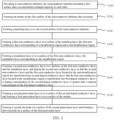
- One or more embodiments of the present disclosure provide a method for manufacturing solar cell. As shown in FIG. 3 , the method includes the following steps.
- a semiconductor substrate 1 is provided, the semiconductor substrate 1 including a first surface and a second surface arranged opposite to each other.
- an emitter 2 is formed on the first surface of the semiconductor substrate 1 after texturing.
- a tunneling layer 4 is formed on the second surface of the semiconductor substrate 1.
- a first non-conductive layer 11 is formed on a surface of the tunneling layer 4, and the first non-conductive layer 11 corresponds to a metallization region and a non-metallization region.
- a retardation layer 6 is formed on a surface of the first non-conductive layer 11, and the retardation layer 6 corresponds to the metallization region.
- a second non-conductive layer 12 is formed on surfaces of the first non-conductive layer 11 and the retardation layer 6, and the second non-conductive layer 12 is doped so that the second non-conductive layer 12 and the first non-conductive layer 11 that is located in the non-metallization region are transformed into a second doped conductive layer 7, and the first non-conductive layer 11 located in the metallization region is transformed into a first doped conductive layer 5, doping concentration of the second doped conductive layer 7 is greater than doping concentration of the first doped conductive layer 5.
- a second passivation layer 8 is formed on a surface of the second doped conductive layer 7 and a first passivation layer 3 is formed on a surface of the emitter 2.
- a second electrode 10 is formed on a surface of the second passivation layer 8 and a first electrode 9 is formed on a surface of the first passivation layer 3.
- the first non-conductive layer 11, the retardation layer 6, and the second non-conductive layer 12 are sequentially formed on the second surface of the semiconductor substrate 1, then doping treatment is performed, and due to the existence of the retardation layer 6, during the doping treatment, fewer of the doped element may enter the first non-conductive layer 11 between the retardation layer 6 and the tunneling layer 4, so that the second non-conductive layer 12 and the first non-conductive layer 11 that is located in the non-metallization region are transformed into the second doped conductive layer 7, and the first non-conductive layer 11 located in the metallization region is transformed into the first doped conductive layer 5, wherein the doping concentration of the second doped conductive layer 7 is greater than the doping concentration of the first doped conductive layer 5.
- the first doped conductive layer 5 with lower concentration is in contact with the tunneling layer 4, which can reduce the passivation effect of the doped element on the tunneling layer 4, and at the same time, a quasi-Fermi level difference qVD between the first doped conductive layer 5 with lower concentration and the semiconductor substrate 1 is smaller, which is conducive to increasing the theoretical open-circuit voltage and improving photoelectric conversion efficiency of the solar cell.
- the second doped conductive layer 7 with higher concentration exists in the metallization region and the non-metallization region, which can ensure lateral transport rates of carriers on the rear surface of the solar cell.
- a distance between the second doped conductive layer 7 in the non-metallization region and the semiconductor substrate 1 is relatively short, which can prevent excessive weakening of an energy band bending effect of the second doped conductive layer 7 caused by an excessive long distance between the second doped conductive layer 7 and the semiconductor substrate 1 due to the arrangement of the first doped conductive layer 5 with low concentration and the retardation layer 6, thereby ensuring selective transport of the carriers.
- the method for manufacturing solar cell is clearly and fully described based on examples in which the first surface of the semiconductor substrate 1 is the front surface of the solar cell and the second surface of the semiconductor substrate 1 is the rear surface of the solar cell.
- a semiconductor substrate 1 is provided, the semiconductor substrate 1 includes a first surface and a second surface arranged opposite to each other.
- the semiconductor substrate 1 is an N-type crystalline silicon substrate (or silicon wafer), or a P-type crystalline silicon substrate (silicon wafer).
- the crystalline silicon substrate (silicon substrate) is, for example, one of a polycrystalline silicon substrate, a monocrystalline silicon substrate, a microcrystalline silicon substrate, or a silicon carbide substrate.
- the specific type of the semiconductor substrate 1 is not limited in the embodiments of the present disclosure.
- a doped element of the semiconductor substrate 1 may be phosphorus, nitrogen, or the like.
- the thickness of the semiconductor substrate 1 ranges from 110 ⁇ m to 250 ⁇ m.
- the thickness of the semiconductor substrate 1 may be 110 ⁇ m, 120 ⁇ m, 140 ⁇ m, 150 ⁇ m, 160 ⁇ m, 170 ⁇ m, 180 ⁇ m, 190 ⁇ m, 200 ⁇ m, 210 ⁇ m, 220 ⁇ m, 230 ⁇ m, 240 ⁇ m, 250 ⁇ m, or the like.
- the thickness of the semiconductor substrate 1 is not limited in the embodiments of the present disclosure.
- an emitter 2 is formed on the first surface of the semiconductor substrate 1 after texturing.
- the front surface of the semiconductor substrate 1 may be textured to form a textured or surface texture structure (e.g., a pyramid structure).
- the texturing may be, for example, chemical etching, laser etching, a mechanical process, or plasma etching, which is not limited herein.
- the front surface of the semiconductor substrate 1 may be textured using a NaOH solution. Due to anisotropy of corrosion of the NaOH solution, a pyramid textured structure may be manufactured.
- the surface of the semiconductor substrate 1 is textured to have a textured structure, which produces a light trapping effect and increases an amount of light absorbed by the solar cell, so as to improve the conversion efficiency of the solar cell.
- a step of cleaning the N-type semiconductor substrate 1 may also be included to remove metal and organic contaminants from the surface.
- the emitter 2 may be formed on the front surface of the semiconductor substrate 1 by any one or more of high-temperature diffusion, paste doping, and ion implantation.
- the emitter 2 is formed by diffusing boron atoms through a boron source.
- boron tribromide may be used as the boron source for diffusion, so that a microcrystalline silicon phase of crystalline silicon is transformed into a polycrystalline silicon phase.
- Due to high concentration of boron on the surface of the semiconductor substrate 1, a layer of borosilicate glass (BSG) may generally be formed. This layer of BSG has a metal impurity absorption effect, which may affect normal operation of the solar cell and is required to be removed later.
- the emitter 2 may have an emitter 2 structure with a uniform doping depth, or have a selective emitter 2 structure with a different doping concentration and a different doping depth.
- a tunneling layer 4 is formed on the second surface of the semiconductor substrate 1.
- the specific process of forming the tunneling layer 4 is not limited in the embodiments of the present disclosure.
- the rear surface of the semiconductor substrate 1 may be oxidized by any one of ozone oxidation, high-temperature thermal oxidation, and nitric acid oxidation.
- the tunneling layer 4 may be one or more of a silicon oxide layer, an aluminum oxide layer, or a silicon oxynitride layer.
- a first non-conductive layer 11 is formed on a surface of the tunneling layer 4, and the first non-conductive layer 11 corresponds to a metallization region and a non-metallization region.
- the first non-conductive layer 11 adopts low temperature deposition.
- an amorphous silicon layer may be manufactured with any one or more methods of chemical vapor deposition (CVD), physical vapor deposition (PVD), and atomic layer deposition (ALD).
- CVD chemical vapor deposition
- PVD physical vapor deposition
- ALD atomic layer deposition
- the manufacturing method for a doped amorphous silicon layer 400 is not limited in the present disclosure.
- the device for deposition may be a CVD device, a PVD device, an ALD device, or the like.
- a temperature of low temperature deposition ranges from 100°C to 300°C.
- the temperature of low temperature deposition may be, for example, 100°C, 110°C, 120°C, 150°C, 170°C, 200°C, 220°C, 250°C, 300°C, or the like.
- the temperature of low temperature deposition is limited in the above range, it is conducive to forming a non-conductive film layer, and local non-conductive materials can be crystallized, thereby improving photoelectric performance of the solar cell.
- a thickness of the first non-conductive layer 11 ranges from 20 nm to 150 nm, which may be, for example, 20 nm, 30 nm, 40 nm, 50 nm, 60 nm, 70 nm, 80 nm, 90 nm, 100 nm, 110 nm, 120 nm, 130 nm, 140 nm, 150 nm, or the like.
- a retardation layer 6 is formed on a surface of the first non-conductive layer 11, and the retardation layer 6 corresponds to the metallization region.
- local laser treatment is performed on the surface of the first non-conductive layer 11 to form the retardation layer 6 corresponding to the metallization region.
- the local laser treatment process of the present disclosure is simple, with high productivity and easy mass production. It is appreciated that, a localized retardation layer 6 may also be formed in other manners, which is not limited in the present disclosure. During the formation of the retardation layer 6, the retardation layer 6 may be completely located in the metallization region, and part of the retardation layer 6 may be located inside the non-metallization region to obtain a stronger retardation effect.
- laser used in laser treatment has a pulse width ranging from 1 ps to 100 ns, which may be, for example, 1 ps, 100 ps, 500 ps, 1 ns, 5 ns, 10 ns, 50 ns, 100 ns, or the like.
- the laser has a wavelength ranging from 250 nm to 532 nm, which may be, for example, 250 nm, 280 nm, 300 nm, 350 nm, 400 nm, 480 nm, 500 nm, 532 nm, or the like.
- power of laser treatment ranges from 20 mJ/cm 2 to 500 mJ/cm 2 , which may be, for example, 20 mJ/cm 2 , 50 mJ/cm 2 , 80 mJ/cm 2 , 100 mJ/cm 2 , 150 mJ/cm 2 , 200 mJ/cm 2 , 300 mJ/cm 2 , 400 mJ/cm 2 , or 500 mJ/cm 2 .
- Silicon nitride absorbed well in a blue-green band may be treated with low-power laser.
- a material with a wide band gap such as silicon oxide is required to be treated with high-power laser.
- a frequency of laser treatment ranges from 100 kHz to 160 kHz, which may be, for example, 100 kHz, 300 kHz, 800 kHz, 1000 kHz, 1300 kHz, or 1600 kHz.
- a number of times of pulse irradiation of laser treatment ranges from 1 to 5 times.
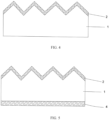
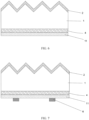
- a second non-conductive layer 12 is formed on surfaces of the first non-conductive layer 11 and the retardation layer 6, to obtain a structure as shown in FIG. 8 , and the second non-conductive layer 12 is doped to obtain a structure as shown in FIG. 9 .
- the doped element diffuses along the Z-axis direction shown in FIG. 1 . That is, in the metallization region, the doped element is transported sequentially from the second non-conductive layer 12 to the retardation layer 6 and then to the first non-conductive layer 11. During the transport, due to the existence of the retardation layer 6, it is more difficult for the doped element to diffuse from the second non-conductive layer 12 to the first non-conductive layer 11. Under the pressure of doping, part of the doped element may still diffuse into the first non-conductive layer 11.
- the second non-conductive layer 12 and the first non-conductive layer 11 that is located in the non-metallization region are transformed into the second doped conductive layer 7, and the first non-conductive layer 11 located in the metallization region is transformed into the first doped conductive layer 5.
- the doping concentration of the second doped conductive layer 7 is greater than the doping concentration of the first doped conductive layer 5. It may be understood that the thickness of the first doped conductive layer 5 is the thickness of the first non-conductive layer 11, and the thickness of the second doped conductive layer 7 is the thickness of the first non-conductive layer 11 plus the thickness of the second non-conductive layer 12.
- resistance of the doped element entering the first non-conductive layer 11 to become the first doped conductive layer 5 becomes greater and greater, so that the doping concentration of the first doped conductive layer 5 decreases sequentially along the direction from the first doped conductive layer 5 to the tunneling layer 4.
- the doped element can diffuse more uniformly throughout the non-metallization region, resulting in existence of fewer of the doped element in the first non-conductive layer 11 located in the non-metallization region and the second non-conductive layer 12. That is, the doping concentration of the second doped conductive layer 7 located in the non-metallization region is greater than the doping concentration of the second doped conductive layer 7 located in the metallization region.
- the doped element in the second doped conductive layer 7 may also diffuse into the first doped conductive layer 5 along the direction parallel to the plane layer where the tunneling layer 4 is located, so that the doping concentration of the first doped conductive layer 5 facing the second doped conductive layer 7 is greater than the doping concentration of the first doped conductive layer 5 facing away from the second doped conductive layer 7.
- the doping treatment adopts high-temperature deposition diffusion, and the specific manufacturing process thereof includes: introducing nitrogen into a high-temperature device for 20 min, exhausting air in a furnace tube, raising temperature of the high-temperature device to 600°C to 1100°C, introducing an inert gas mixed with a dopant source, such as Ar/N 2 , and reacting at a high temperature for 5 min to 50 min; and then introducing oxygen, continuing oxidation reaction at 600°C to 1100°C for 5 min to 60 min, and cooling down the high-temperature device to room temperature after oxidation.
- a dopant source such as Ar/N 2
- a doped element for the doping treatment includes at least one of boron, gallium, phosphorus, and arsenic.
- a dopant source for the doping treatment includes at least one of a boron source, a gallium source, a phosphorus source, and an arsenic source.
- the boron source may be, for example, at least one of BCl 3 , BBr 3 , B 2 H 4 , an organic boron source, and solid silicon containing high-concentration elemental boron
- the gallium source may be, for example, trimethylgallium or solid silicon containing a high-concentration gallium element
- the phosphorus source may be, for example, at least one of POCl 3 , PH 3 , an organic phosphorus source, and solid silicon containing high-concentration elemental phosphorus.
- the arsenic source may be, for example, AsH 3 or solid silicon containing high-concentration elemental arsenic.
- a conductivity type of the doped element is the same as that of the doped element of the semiconductor substrate 1.
- the doped element is an N-type doped element, such as phosphorus or arsenic, and the formed doped layer may be a phosphorus-doped layer or an arsenic-doped silicon layer.
- the semiconductor substrate 1 is a P-type substrate
- the doped element is a P-type doped element, such as boron or gallium
- the formed doped layer is a boron-doped layer or a gallium-doped layer.
- a second passivation layer 8 is formed on a surface of the second doped conductive layer 7 and a first passivation layer 3 is formed on a surface of the emitter 2.
- the first passivation layer 3 may include, but is not limited to, a single-layer oxide layer or a multi-layer structure such as silicon oxide, silicon nitride, silicon oxynitride, or aluminum oxide. It is appreciated that, the first passivation layer 3 may be other types of passivation layers. The specific material of the first passivation layer 3 is not limited in the present disclosure. The above first passivation layer 3 can produce good passivation and anti-reflection effects on the semiconductor substrate 1, which helps to improve the conversion efficiency of the solar cell.
- the second passivation layer 8 may include, but is not limited to, a single-layer oxide layer or a multi-layer structure such as silicon oxide, silicon nitride, silicon oxynitride, or aluminum oxide.
- the second passivation layer 8 is made of silicon nitride.
- a silicon nitride thin-film layer may serve as an anti-reflection film, and the silicon nitride thin film has good insulation, compactness, stability, and a shielding capability for impurity ions.
- the silicon nitride thin-film layer can perform passivation to the semiconductor substrate 1, and obviously improve the photoelectric conversion efficiency of the solar cell.
- a second electrode 10 is formed on a surface of the second passivation layer 8 and a first electrode 9 is formed on a surface of the first passivation layer 3.
- a front busbar and a front finger are printed with paste and dried to form the corresponding front electrode 9.
- a rear busbar and a rear finger may be printed with paste and dried to form the corresponding second electrode 10. Finally, dried solar cells are sintered to manufacture the solar cell.
- the front electrode 9 and the second electrode 10 are not limited in the embodiments of the present disclosure.
- the front electrode 9 is a silver electrode or a silver/aluminum electrode
- the second electrode 10 is a silver electrode or a silver/aluminum electrode.
- one or more embodiments of the present disclosure provide a photovoltaic module 1000, including at least one solar cell string formed by the solar cells described above through electrical connection.
- the photovoltaic module 1000 includes a first cover plate 200, a first packaging adhesive layer 300, at least one solar cell string, a second packaging adhesive layer 400, and a second cover plate 500.
- the solar cell string includes a plurality of solar cells 100 as described above that are connected by conductive strips.
- the solar cells 100 may be connected by partial stacking or by splicing.
- first cover plate 200 and the second cover plate 500 may be transparent or opaque cover plates, such as glass cover plates or plastic cover plates.
- the first packaging adhesive layer 300 and the second packaging adhesive layer 400 each may be an ethylene-vinyl acetate copolymer (EVA) adhesive film, a polyethylene octene co-elastomer (POE) adhesive film or a polyethylene terephthalate (PET) adhesive film.
- EVA ethylene-vinyl acetate copolymer
- POE polyethylene octene co-elastomer
- PET polyethylene terephthalate
- Side edges of the photovoltaic module 1000 may also be completely packaged. That is, the side edges of the photovoltaic module 1000 are fully packaged with a packaging adhesive tape to prevent lamination deviation during the lamination of the photovoltaic module 1000.
- the photovoltaic module 1000 further includes an edge sealing member.
- the edge sealing member is fixedly packaged to a partial edge of the photovoltaic module 1000.
- the edge sealing member may be fixedly packaged to an edge near a corner of the photovoltaic module 1000.
- the edge sealing member may be a high-temperature resistant tape.
- the high-temperature resistant tape has excellent high-temperature resistance and may not decompose or fall off during the lamination, which can ensure the reliable packaging of the photovoltaic module 1000. Two ends of the high-temperature resistant tape are fixed to the second cover plate 500 and the first cover plate 200 respectively.
- the two ends of the high-temperature resistant tape may be bonded to the second cover plate 500 and the first cover plate 200 respectively, and the middle thereof can limit a side edge of the photovoltaic module 1000 to prevent lamination deviation of the photovoltaic module 1000 during the lamination.
Landscapes
- Photovoltaic Devices (AREA)
- Life Sciences & Earth Sciences (AREA)
- Engineering & Computer Science (AREA)
- Sustainable Development (AREA)
- Sustainable Energy (AREA)
- Manufacturing & Machinery (AREA)
- Chemical & Material Sciences (AREA)
- Crystallography & Structural Chemistry (AREA)
Claims (14)
- Solarzelle (100), umfassend:ein Halbleitersubstrat (1), wobei dasHalbleitersubstrat (1) eine erste Oberfläche und eine zweite Oberfläche einschließt, die einander gegenüberliegend angeordnet sind;einen Emitter (2) und eine erste Passivierungsschicht (3), die über der ersten Oberfläche des Halbleitersubstrats (1) ausgebildet sind;eine Tunnelschicht (4), die über der zweiten Oberfläche des Halbleitersubstrats (1) ausgebildet ist;eine erste dotierte leitfähige Schicht (5) und eine Verzögerungsschicht (6), die auf einer Oberfläche der Tunnelschicht (4) ausgebildet sind, wobei die erste dotierte leitfähige Schicht (5) zwischen der Tunnelschicht (4) und der Verzögerungsschicht (6) angeordnet ist und die erste dotierte leitfähige Schicht (5) und die Verzögerungsschicht (6) einem Metallisierungsbereich entsprechen;eine zweite dotierte leitfähige Schicht (7), die über der Oberfläche der Tunnelschicht (4) ausgebildet ist, wobei die zweite dotierte leitfähige Schicht (7) die Tunnelschicht (4) in einem Nicht-Metallisierungsbereich und die Verzögerungsschicht (6) abdeckt, wobei eine Dotierungskonzentration der zweiten dotierten leitfähigen Schicht (7) größer als eine Dotierungskonzentration der ersten dotierten leitfähigen Schicht (5) ist und die Verzögerungsschicht (6) konfiguriert ist, um eine Migration eines dotierten Elements in der zweiten dotierten leitfähigen Schicht (7) zu der ersten dotierten leitfähigen Schicht (5) zu verzögern;eine zweite Passivierungsschicht (8), die über einer Oberfläche der zweiten dotierten leitfähigen Schicht (7) ausgebildet ist; undeine zweite Elektrode (10), die die zweite Passivierungsschicht (8) durchdringt, um Kontakt mit der zweiten dotierten leitfähigen Schicht (7) zu bilden, und eine erste Elektrode (9), die die erste Passivierungsschicht (3) durchdringt, um Kontakt mit dem Emitter (2) zu bilden.
- Solarzelle (100) nach Anspruch 1, wobei das Verhältnis einer Breite der ersten dotierten leitfähigen Schicht (5) zu einer Breite der Verzögerungsschicht (6) im Bereich von 1:1 bis 1:2 liegt.
- Solarzelle (100) nach Anspruch 1, wobei ein Oberflächenbereich der Tunnelschicht (4) in Kontakt mit der ersten dotierten leitfähigen Schicht (5) als S1 bezeichnet wird, eine Summe des Oberflächenbereichs der Tunnelschicht (4) in Kontakt mit der ersten dotierten leitfähigen Schicht (5) und eines Oberflächenbereichs der Tunnelschicht (4) in Kontakt mit der zweiten dotierten leitfähigen Schicht (7) als S2 bezeichnet wird und S1:S2 in einem Bereich von 1:5 bis 1:50 liegt, und/oder ein dotiertes Element in der ersten dotierten leitfähigen Schicht (5) mindestens eines von Bor, Phosphor, Gallium oder Arsen einschließt.
- Solarzelle (100) nach Anspruch 1, wobei eine Dotierungskonzentration der ersten dotierten leitfähigen Schicht (5) im Bereich von 1E18 cm 1E18 cm-3 bis 1,5E21 cm-3 liegt.
- Solarzelle (100) nach Anspruch 1, wobei eine Dicke der ersten dotierten leitfähigen Schicht (5) im Bereich von 20 nm bis 150 nm liegt.
- Solarzelle (100) nach Anspruch 1, wobei ein dotiertes Element in der zweiten dotierten leitfähigen Schicht (7) mindestens eines von Bor, Phosphor, Gallium oder Arsen einschließt und/oder eine Dotierungskonzentration der zweiten dotierten leitfähigen Schicht (7) im Bereich von 5E18 cm-3 bis 2E21 cm-3 liegt.
- Solarzelle (100) nach Anspruch 1, wobei eine Dicke der zweiten dotierten leitfähigen Schicht (7) im Bereich von 20 nm bis 200 nm liegt.
- Solarzelle (100) nach Anspruch 1, wobei ein Material der Verzögerungsschicht (6) mindestens eines von Siliciumoxid, Siliciumcarbid, Siliciumnitrid oder Magnesiumfluorid einschließt und/oder eine Dicke der Verzögerungsschicht (6) im Bereich von 0,5 nm bis 4 nm liegt.
- Solarzelle (100) nach Anspruch 1, wobei eine Dicke der ersten dotierten leitfähigen Schicht (5) geringer ist als eine Dicke der zweiten dotierten leitfähigen Schicht (7).
- Solarzelle (100) nach Anspruch 1, wobei eine Dotierungskonzentration der zweiten dotierten leitfähigen Schicht (7) in dem Nicht-Metallisierungsbereich größer ist als eine Dotierungskonzentration der zweiten dotierten leitfähigen Schicht (7) in dem Metallisierungsbereich.
- Solarzelle (100) nach Anspruch 1, wobei eine Dotierungskonzentration der ersten dotierten leitfähigen Schicht (5) entlang einer Richtung von der ersten dotierten leitfähigen Schicht (5) zur Tunnelschicht (4) abnimmt.
- Solarzelle (100) nach Anspruch 1, wobei entlang einer Richtung parallel zu einer Ebene, in der sich die Tunnelschicht (4) befindet, eine Dotierungskonzentration der ersten dotierten leitfähigen Schicht (5), die der zweiten dotierten leitfähigen Schicht (7) zugewandt ist, größer ist als eine Dotierungskonzentration der ersten dotierten leitfähigen Schicht (5), die von der zweiten dotierten leitfähigen Schicht (7) abgewandt ist.
- Verfahren zum Herstellen einer Solarzelle (100), umfassend:Bereitstellen (S100) eines Halbleitersubstrats (1), wobei das Halbleitersubstrat (1) eine erste Oberfläche und eine zweite Oberfläche einschließt, die einander gegenüberliegend angeordnet sind;Bilden (S200) eines Emitters (2) auf der ersten Oberfläche des Halbleitersubstrats (1) nach der Texturierung;Bilden (S300) einer Tunnelschicht (4) über der zweiten Oberfläche des Halbleitersubstrats (1);Bilden (S400) einer ersten nicht-leitfähigen Schicht (11) auf einer Oberfläche der Tunnelschicht (4), wobei die erste nicht-leitfähige Schicht (11) einem Metallisierungsbereich und einem Nicht-Metallisierungsbereich entspricht;Bilden (S500) einer Verzögerungsschicht (6) über einer Oberfläche der ersten nicht-leitfähigen Schicht (11), wobei die Verzögerungsschicht (6) dem Metallisierungsbereich entspricht;Bilden (S600) einer zweiten nicht leitfähigen Schicht (12) über Oberflächen der ersten nicht leitfähigen Schicht (11) und der Verzögerungsschicht (6) und Dotieren der zweiten nicht leitfähigen Schicht (12), so dass die zweite nicht leitfähige Schicht (12) und die erste nicht leitfähige Schicht (11), die sich in dem Nicht-Metallisierungsbereich befindet, in eine zweite dotierte leitfähige Schicht (7) umgewandelt werden unddie erste nicht leitfähige Schicht (11), die sich in dem Metallisierungsbereich befindet, in eine erste dotierte leitfähige Schicht (5) umgewandelt wird, wobei eine Dotierungskonzentration der zweiten dotierten leitfähigen Schicht (7) größer ist als eine Dotierungskonzentration der ersten dotierten leitfähigen Schicht (5) und die Verzögerungsschicht (6) konfiguriert ist, um eine Migration eines dotierten Elements in der zweiten dotierten leitfähigen Schicht (7) zur ersten dotierten leitfähigen Schicht (5) zu verzögern;Bilden (S700) einer zweiten Passivierungsschicht (8) über einer Oberfläche der zweiten dotierten leitfähigen Schicht (7) und Bilden einer ersten Passivierungsschicht (3) über einer Oberfläche des Emitters (2); undBilden (S800) einer zweiten Elektrode (10) auf einer Oberfläche der zweiten Passivierungsschicht (8), wobei die zweite Elektrode (10) die zweitePassivierungsschicht (8) durchdringt, um mit der zweiten dotierten leitfähigen Schicht (7) Kontakt herzustellen, und Bilden einer ersten Elektrode (9) auf einer Oberfläche der ersten Passivierungsschicht (3),wobei die erste Elektrode (9) die erste Passivierungsschicht (3) durchdringt, um mit dem Emitter (2) Kontakt herzustellen.
- Fotovoltaikmodul (1000), umfassend:eine Abdeckplatte (200, 500);eine Verpackungsmaterialschicht (300, 400); undmindestens einen Solarzellenstrang,wobei der mindestens eine Solarzellenstrang eine Vielzahl von Solarzellen (100) nach einem der Ansprüche 1 bis 12 einschließt oder mit dem Verfahren nach Anspruch 13 hergestellt ist.
Applications Claiming Priority (1)
| Application Number | Priority Date | Filing Date | Title |
|---|---|---|---|
| CN202310172661.1A CN115985981B (zh) | 2023-02-22 | 2023-02-22 | 太阳能电池及其制备方法、光伏组件 |
Publications (2)
| Publication Number | Publication Date |
|---|---|
| EP4421879A1 EP4421879A1 (de) | 2024-08-28 |
| EP4421879B1 true EP4421879B1 (de) | 2025-02-19 |
Family
ID=85968288
Family Applications (1)
| Application Number | Title | Priority Date | Filing Date |
|---|---|---|---|
| EP23189628.3A Active EP4421879B1 (de) | 2023-02-22 | 2023-08-04 | Solarzelle und herstellungsverfahren dafür |
Country Status (6)
| Country | Link |
|---|---|
| US (1) | US12183841B2 (de) |
| EP (1) | EP4421879B1 (de) |
| JP (2) | JP7427833B1 (de) |
| KR (1) | KR102741653B1 (de) |
| CN (2) | CN115985981B (de) |
| AU (1) | AU2023210662B2 (de) |
Families Citing this family (10)
| Publication number | Priority date | Publication date | Assignee | Title |
|---|---|---|---|---|
| CN115985981B (zh) | 2023-02-22 | 2023-06-20 | 浙江晶科能源有限公司 | 太阳能电池及其制备方法、光伏组件 |
| CN116487452B (zh) * | 2023-06-21 | 2023-10-27 | 天合光能股份有限公司 | 太阳能电池和太阳能电池的制备方法 |
| CN118099229A (zh) * | 2023-10-08 | 2024-05-28 | 晶科能源(海宁)有限公司 | 太阳能电池、光伏组件 |
| CN120051030A (zh) * | 2023-11-15 | 2025-05-27 | 通威太阳能(成都)有限公司 | 太阳电池的制备方法、太阳电池 |
| CN117476796B (zh) * | 2023-11-28 | 2025-07-15 | 正泰新能科技股份有限公司 | 一种TOPCon电池及TOPCon电池的制备方法 |
| CN118116983A (zh) * | 2024-02-20 | 2024-05-31 | 隆基绿能科技股份有限公司 | 一种太阳能电池及其制备方法和电池组件 |
| CN119836011A (zh) * | 2024-09-05 | 2025-04-15 | 隆基绿能科技股份有限公司 | 太阳能电池及制备方法 |
| CN119730398B (zh) * | 2024-12-12 | 2026-03-24 | 浙江晶科能源有限公司 | 太阳能电池、其制备方法和光伏组件 |
| CN120129341A (zh) * | 2025-05-12 | 2025-06-10 | 浙江晶科能源有限公司 | 一种太阳能电池的制备方法及太阳能电池 |
| CN121038431B (zh) * | 2025-10-30 | 2026-02-24 | 浙江晶科能源有限公司 | 太阳能电池及其制造方法、叠层电池和光伏组件 |
Family Cites Families (35)
| Publication number | Priority date | Publication date | Assignee | Title |
|---|---|---|---|---|
| DE102008055036A1 (de) * | 2008-12-19 | 2010-07-08 | Q-Cells Se | Solarzelle |
| JP5058184B2 (ja) | 2009-01-23 | 2012-10-24 | 三菱電機株式会社 | 光起電力装置の製造方法 |
| WO2011035090A1 (en) * | 2009-09-17 | 2011-03-24 | Tetrasun, Inc. | Selective transformation in functional films, and solar cell applications thereof |
| EP4092764A1 (de) * | 2013-04-03 | 2022-11-23 | Lg Electronics Inc. | Solarzelle |
| KR101613843B1 (ko) | 2013-04-23 | 2016-04-20 | 엘지전자 주식회사 | 태양 전지 및 이의 제조 방법 |
| KR102045001B1 (ko) * | 2013-06-05 | 2019-12-02 | 엘지전자 주식회사 | 태양 전지 및 이의 제조 방법 |
| KR102053139B1 (ko) * | 2013-09-09 | 2019-12-06 | 엘지전자 주식회사 | 태양 전지 |
| KR101622091B1 (ko) | 2014-08-20 | 2016-05-18 | 엘지전자 주식회사 | 태양 전지 및 이의 제조 방법 |
| JP6219913B2 (ja) * | 2014-11-28 | 2017-10-25 | エルジー エレクトロニクス インコーポレイティド | 太陽電池及びその製造方法 |
| KR102397002B1 (ko) * | 2015-02-10 | 2022-05-11 | 엘지전자 주식회사 | 태양 전지 |
| KR102547804B1 (ko) * | 2016-06-17 | 2023-06-28 | 오씨아이 주식회사 | 양면 수광형 실리콘 태양전지 및 그 제조 방법 |
| KR102586115B1 (ko) * | 2016-08-10 | 2023-10-10 | 오씨아이 주식회사 | 양면 수광형 실리콘 태양전지 |
| KR101995833B1 (ko) * | 2016-11-14 | 2019-07-03 | 엘지전자 주식회사 | 태양 전지 및 이의 제조 방법 |
| CN110140223B (zh) * | 2016-12-12 | 2022-08-12 | 洛桑联邦理工学院 | 硅异质结太阳能电池以及制造方法 |
| US11804558B2 (en) * | 2017-12-29 | 2023-10-31 | Maxeon Solar Pte. Ltd. | Conductive contacts for polycrystalline silicon features of solar cells |
| EP3783668B1 (de) * | 2018-06-22 | 2023-08-30 | Jingao Solar Co., Ltd. | Kristalline siliziumsolarzelle und verfahren zu ihrer herstellung und fotovoltaische anordnung |
| CN209232797U (zh) | 2018-10-17 | 2019-08-09 | 晶澳太阳能有限公司 | 硅基太阳能电池及光伏组件 |
| CN210897294U (zh) * | 2019-10-29 | 2020-06-30 | 苏州阿特斯阳光电力科技有限公司 | 太阳能电池 |
| CN112201701B (zh) * | 2020-09-30 | 2024-05-03 | 浙江晶科能源有限公司 | 太阳能电池和光伏组件 |
| CN112349798B (zh) * | 2020-10-27 | 2024-03-08 | 浙江晶科能源有限公司 | 太阳能电池及其制造方法 |
| CN114843349B (zh) * | 2020-10-30 | 2023-06-23 | 浙江晶科能源有限公司 | 太阳能电池 |
| CN112331742B (zh) | 2020-11-10 | 2024-11-08 | 帝尔激光科技(无锡)有限公司 | 一种选择性发射极钝化接触太阳电池及其制备方法 |
| CN112466961B (zh) * | 2020-11-19 | 2024-05-10 | 晶科绿能(上海)管理有限公司 | 太阳能电池及其制造方法 |
| CN213519984U (zh) | 2020-12-10 | 2021-06-22 | 苏州阿特斯阳光电力科技有限公司 | 太阳能电池 |
| CN112736159A (zh) * | 2020-12-31 | 2021-04-30 | 三江学院 | 一种选择性多晶硅厚度与掺杂浓度电池结构的制备方法 |
| CN114899243B (zh) * | 2021-10-29 | 2024-02-06 | 浙江晶科能源有限公司 | 一种太阳能电池及其制备方法、光伏组件 |
| CN114038928B (zh) * | 2021-11-25 | 2023-09-15 | 浙江晶科能源有限公司 | 太阳能电池及其制备方法、光伏组件 |
| CN115274875B (zh) | 2022-05-31 | 2025-03-18 | 浙江晶科能源有限公司 | 太阳能电池及光伏组件 |
| CN217606835U (zh) * | 2022-07-11 | 2022-10-18 | 浙江晶科能源有限公司 | 一种太阳能电池以及光伏组件 |
| CN115172477B (zh) * | 2022-07-26 | 2023-08-25 | 浙江晶科能源有限公司 | 太阳能电池及光伏组件 |
| CN115411151A (zh) | 2022-09-30 | 2022-11-29 | 滁州捷泰新能源科技有限公司 | 一种新型太阳能电池及其制作方法 |
| CN115394881A (zh) * | 2022-09-30 | 2022-11-25 | 滁州捷泰新能源科技有限公司 | 一种磷浓度梯度分布的topcon电池及其制作方法 |
| CN115411152A (zh) * | 2022-10-11 | 2022-11-29 | 滁州捷泰新能源科技有限公司 | 一种太阳能电池的制作方法 |
| CN116314383A (zh) | 2022-11-04 | 2023-06-23 | 浙江晶科能源有限公司 | 太阳能电池及光伏组件 |
| CN115985981B (zh) * | 2023-02-22 | 2023-06-20 | 浙江晶科能源有限公司 | 太阳能电池及其制备方法、光伏组件 |
-
2023
- 2023-02-22 CN CN202310172661.1A patent/CN115985981B/zh active Active
- 2023-02-22 CN CN202310608687.6A patent/CN116581174A/zh active Pending
- 2023-06-27 JP JP2023105399A patent/JP7427833B1/ja active Active
- 2023-07-05 KR KR1020230087294A patent/KR102741653B1/ko active Active
- 2023-08-03 US US18/365,170 patent/US12183841B2/en active Active
- 2023-08-04 AU AU2023210662A patent/AU2023210662B2/en active Active
- 2023-08-04 EP EP23189628.3A patent/EP4421879B1/de active Active
-
2024
- 2024-01-23 JP JP2024008327A patent/JP7791912B2/ja active Active
Also Published As
| Publication number | Publication date |
|---|---|
| CN115985981B (zh) | 2023-06-20 |
| AU2023210662A1 (en) | 2024-09-05 |
| KR102741653B1 (ko) | 2024-12-16 |
| JP2024119744A (ja) | 2024-09-03 |
| JP2024119716A (ja) | 2024-09-03 |
| JP7427833B1 (ja) | 2024-02-05 |
| EP4421879A1 (de) | 2024-08-28 |
| KR20240130586A (ko) | 2024-08-29 |
| AU2023210662B2 (en) | 2025-05-29 |
| CN115985981A (zh) | 2023-04-18 |
| JP7791912B2 (ja) | 2025-12-24 |
| US12183841B2 (en) | 2024-12-31 |
| CN116581174A (zh) | 2023-08-11 |
| US20240282877A1 (en) | 2024-08-22 |
Similar Documents
| Publication | Publication Date | Title |
|---|---|---|
| EP4421879B1 (de) | Solarzelle und herstellungsverfahren dafür | |
| AU2022209315B2 (en) | Solar Cell and Manufacture Method thereof, and Photovoltaic Module | |
| EP4235805B1 (de) | Solarzelle und verfahren zum herstellen derselben | |
| CN115172477B (zh) | 太阳能电池及光伏组件 | |
| CN111668318B (zh) | 一种光伏组件、太阳能电池及其制备方法 | |
| EP4293729A1 (de) | Verfahren zum herstellen einer solarzelle und solarzelle, fotovoltaisches modul | |
| US12310141B2 (en) | Solar cell and photovoltaic module | |
| EP4261899B1 (de) | Fotovoltaische zelle und herstellungsverfahren dafür | |
| CN117712193A (zh) | 太阳能电池及其制备方法、光伏组件 | |
| CN114899243A (zh) | 一种太阳能电池及其制备方法、光伏组件 | |
| JP2024112747A (ja) | 太陽電池及びその製造方法、光起電力モジュール | |
| JP2025169190A (ja) | 太陽電池及び太陽光発電モジュール | |
| CN116666478A (zh) | 太阳能电池及其制备方法、光伏组件 | |
| CN118156336A (zh) | 太阳能电池及其制备方法、光伏组件 | |
| CN117727822A (zh) | 太阳能电池、太阳能电池的制造方法及光伏组件 | |
| CN119230661A (zh) | 太阳能电池及其制备方法 | |
| CN119855308A (zh) | 太阳能电池及其制备方法 |
Legal Events
| Date | Code | Title | Description |
|---|---|---|---|
| PUAI | Public reference made under article 153(3) epc to a published international application that has entered the european phase |
Free format text: ORIGINAL CODE: 0009012 |
|
| STAA | Information on the status of an ep patent application or granted ep patent |
Free format text: STATUS: REQUEST FOR EXAMINATION WAS MADE |
|
| 17P | Request for examination filed |
Effective date: 20230804 |
|
| AK | Designated contracting states |
Kind code of ref document: A1 Designated state(s): AL AT BE BG CH CY CZ DE DK EE ES FI FR GB GR HR HU IE IS IT LI LT LU LV MC ME MK MT NL NO PL PT RO RS SE SI SK SM TR |
|
| GRAP | Despatch of communication of intention to grant a patent |
Free format text: ORIGINAL CODE: EPIDOSNIGR1 |
|
| STAA | Information on the status of an ep patent application or granted ep patent |
Free format text: STATUS: GRANT OF PATENT IS INTENDED |
|
| INTG | Intention to grant announced |
Effective date: 20241126 |
|
| GRAS | Grant fee paid |
Free format text: ORIGINAL CODE: EPIDOSNIGR3 |
|
| GRAA | (expected) grant |
Free format text: ORIGINAL CODE: 0009210 |
|
| STAA | Information on the status of an ep patent application or granted ep patent |
Free format text: STATUS: THE PATENT HAS BEEN GRANTED |
|
| AK | Designated contracting states |
Kind code of ref document: B1 Designated state(s): AL AT BE BG CH CY CZ DE DK EE ES FI FR GB GR HR HU IE IS IT LI LT LU LV MC ME MK MT NL NO PL PT RO RS SE SI SK SM TR |
|
| REG | Reference to a national code |
Ref country code: GB Ref legal event code: FG4D |
|
| REG | Reference to a national code |
Ref country code: DE Ref legal event code: R096 Ref document number: 602023002104 Country of ref document: DE |
|
| REG | Reference to a national code |
Ref country code: IE Ref legal event code: FG4D |
|
| REG | Reference to a national code |
Ref country code: NL Ref legal event code: MP Effective date: 20250219 |
|
| PG25 | Lapsed in a contracting state [announced via postgrant information from national office to epo] |
Ref country code: RS Free format text: LAPSE BECAUSE OF FAILURE TO SUBMIT A TRANSLATION OF THE DESCRIPTION OR TO PAY THE FEE WITHIN THE PRESCRIBED TIME-LIMIT Effective date: 20250519 |
|
| PG25 | Lapsed in a contracting state [announced via postgrant information from national office to epo] |
Ref country code: FI Free format text: LAPSE BECAUSE OF FAILURE TO SUBMIT A TRANSLATION OF THE DESCRIPTION OR TO PAY THE FEE WITHIN THE PRESCRIBED TIME-LIMIT Effective date: 20250219 |
|
| PG25 | Lapsed in a contracting state [announced via postgrant information from national office to epo] |
Ref country code: PL Free format text: LAPSE BECAUSE OF FAILURE TO SUBMIT A TRANSLATION OF THE DESCRIPTION OR TO PAY THE FEE WITHIN THE PRESCRIBED TIME-LIMIT Effective date: 20250219 |
|
| PG25 | Lapsed in a contracting state [announced via postgrant information from national office to epo] |
Ref country code: ES Free format text: LAPSE BECAUSE OF FAILURE TO SUBMIT A TRANSLATION OF THE DESCRIPTION OR TO PAY THE FEE WITHIN THE PRESCRIBED TIME-LIMIT Effective date: 20250219 |
|
| REG | Reference to a national code |
Ref country code: LT Ref legal event code: MG9D |
|
| PG25 | Lapsed in a contracting state [announced via postgrant information from national office to epo] |
Ref country code: NO Free format text: LAPSE BECAUSE OF FAILURE TO SUBMIT A TRANSLATION OF THE DESCRIPTION OR TO PAY THE FEE WITHIN THE PRESCRIBED TIME-LIMIT Effective date: 20250519 Ref country code: IS Free format text: LAPSE BECAUSE OF FAILURE TO SUBMIT A TRANSLATION OF THE DESCRIPTION OR TO PAY THE FEE WITHIN THE PRESCRIBED TIME-LIMIT Effective date: 20250619 |
|
| PG25 | Lapsed in a contracting state [announced via postgrant information from national office to epo] |
Ref country code: NL Free format text: LAPSE BECAUSE OF FAILURE TO SUBMIT A TRANSLATION OF THE DESCRIPTION OR TO PAY THE FEE WITHIN THE PRESCRIBED TIME-LIMIT Effective date: 20250219 |
|
| PG25 | Lapsed in a contracting state [announced via postgrant information from national office to epo] |
Ref country code: HR Free format text: LAPSE BECAUSE OF FAILURE TO SUBMIT A TRANSLATION OF THE DESCRIPTION OR TO PAY THE FEE WITHIN THE PRESCRIBED TIME-LIMIT Effective date: 20250219 |
|
| PG25 | Lapsed in a contracting state [announced via postgrant information from national office to epo] |
Ref country code: PT Free format text: LAPSE BECAUSE OF FAILURE TO SUBMIT A TRANSLATION OF THE DESCRIPTION OR TO PAY THE FEE WITHIN THE PRESCRIBED TIME-LIMIT Effective date: 20250620 Ref country code: LV Free format text: LAPSE BECAUSE OF FAILURE TO SUBMIT A TRANSLATION OF THE DESCRIPTION OR TO PAY THE FEE WITHIN THE PRESCRIBED TIME-LIMIT Effective date: 20250219 |
|
| PG25 | Lapsed in a contracting state [announced via postgrant information from national office to epo] |
Ref country code: GR Free format text: LAPSE BECAUSE OF FAILURE TO SUBMIT A TRANSLATION OF THE DESCRIPTION OR TO PAY THE FEE WITHIN THE PRESCRIBED TIME-LIMIT Effective date: 20250520 Ref country code: BG Free format text: LAPSE BECAUSE OF FAILURE TO SUBMIT A TRANSLATION OF THE DESCRIPTION OR TO PAY THE FEE WITHIN THE PRESCRIBED TIME-LIMIT Effective date: 20250219 |
|
| PG25 | Lapsed in a contracting state [announced via postgrant information from national office to epo] |
Ref country code: SE Free format text: LAPSE BECAUSE OF FAILURE TO SUBMIT A TRANSLATION OF THE DESCRIPTION OR TO PAY THE FEE WITHIN THE PRESCRIBED TIME-LIMIT Effective date: 20250219 |
|
| PG25 | Lapsed in a contracting state [announced via postgrant information from national office to epo] |
Ref country code: SM Free format text: LAPSE BECAUSE OF FAILURE TO SUBMIT A TRANSLATION OF THE DESCRIPTION OR TO PAY THE FEE WITHIN THE PRESCRIBED TIME-LIMIT Effective date: 20250219 |
|
| PG25 | Lapsed in a contracting state [announced via postgrant information from national office to epo] |
Ref country code: DK Free format text: LAPSE BECAUSE OF FAILURE TO SUBMIT A TRANSLATION OF THE DESCRIPTION OR TO PAY THE FEE WITHIN THE PRESCRIBED TIME-LIMIT Effective date: 20250219 |
|
| PGFP | Annual fee paid to national office [announced via postgrant information from national office to epo] |
Ref country code: DE Payment date: 20250820 Year of fee payment: 3 |
|
| PG25 | Lapsed in a contracting state [announced via postgrant information from national office to epo] |
Ref country code: IT Free format text: LAPSE BECAUSE OF FAILURE TO SUBMIT A TRANSLATION OF THE DESCRIPTION OR TO PAY THE FEE WITHIN THE PRESCRIBED TIME-LIMIT Effective date: 20250219 |
|
| PG25 | Lapsed in a contracting state [announced via postgrant information from national office to epo] |
Ref country code: AT Free format text: LAPSE BECAUSE OF FAILURE TO SUBMIT A TRANSLATION OF THE DESCRIPTION OR TO PAY THE FEE WITHIN THE PRESCRIBED TIME-LIMIT Effective date: 20250219 |
|
| PG25 | Lapsed in a contracting state [announced via postgrant information from national office to epo] |
Ref country code: EE Free format text: LAPSE BECAUSE OF FAILURE TO SUBMIT A TRANSLATION OF THE DESCRIPTION OR TO PAY THE FEE WITHIN THE PRESCRIBED TIME-LIMIT Effective date: 20250219 Ref country code: CZ Free format text: LAPSE BECAUSE OF FAILURE TO SUBMIT A TRANSLATION OF THE DESCRIPTION OR TO PAY THE FEE WITHIN THE PRESCRIBED TIME-LIMIT Effective date: 20250219 |
|
| PG25 | Lapsed in a contracting state [announced via postgrant information from national office to epo] |
Ref country code: RO Free format text: LAPSE BECAUSE OF FAILURE TO SUBMIT A TRANSLATION OF THE DESCRIPTION OR TO PAY THE FEE WITHIN THE PRESCRIBED TIME-LIMIT Effective date: 20250219 |
|
| PG25 | Lapsed in a contracting state [announced via postgrant information from national office to epo] |
Ref country code: SK Free format text: LAPSE BECAUSE OF FAILURE TO SUBMIT A TRANSLATION OF THE DESCRIPTION OR TO PAY THE FEE WITHIN THE PRESCRIBED TIME-LIMIT Effective date: 20250219 |
|
| REG | Reference to a national code |
Ref country code: DE Ref legal event code: R097 Ref document number: 602023002104 Country of ref document: DE |
|
| PLBE | No opposition filed within time limit |
Free format text: ORIGINAL CODE: 0009261 |
|
| STAA | Information on the status of an ep patent application or granted ep patent |
Free format text: STATUS: NO OPPOSITION FILED WITHIN TIME LIMIT |
|
| 26N | No opposition filed |
Effective date: 20251120 |
|
| PG25 | Lapsed in a contracting state [announced via postgrant information from national office to epo] |
Ref country code: MC Free format text: LAPSE BECAUSE OF FAILURE TO SUBMIT A TRANSLATION OF THE DESCRIPTION OR TO PAY THE FEE WITHIN THE PRESCRIBED TIME-LIMIT Effective date: 20250219 |
|
| PG25 | Lapsed in a contracting state [announced via postgrant information from national office to epo] |
Ref country code: LU Free format text: LAPSE BECAUSE OF NON-PAYMENT OF DUE FEES Effective date: 20250804 |