EP4419710B1 - Vorbibliothekszielanreicherung zur nukleinsäuresequenzierung - Google Patents
Vorbibliothekszielanreicherung zur nukleinsäuresequenzierung Download PDFInfo
- Publication number
- EP4419710B1 EP4419710B1 EP22802478.2A EP22802478A EP4419710B1 EP 4419710 B1 EP4419710 B1 EP 4419710B1 EP 22802478 A EP22802478 A EP 22802478A EP 4419710 B1 EP4419710 B1 EP 4419710B1
- Authority
- EP
- European Patent Office
- Prior art keywords
- sbc
- targeted
- probe
- dsdna
- dna
- Prior art date
- Legal status (The legal status is an assumption and is not a legal conclusion. Google has not performed a legal analysis and makes no representation as to the accuracy of the status listed.)
- Active
Links
Images



Classifications
-
- C—CHEMISTRY; METALLURGY
- C12—BIOCHEMISTRY; BEER; SPIRITS; WINE; VINEGAR; MICROBIOLOGY; ENZYMOLOGY; MUTATION OR GENETIC ENGINEERING
- C12Q—MEASURING OR TESTING PROCESSES INVOLVING ENZYMES, NUCLEIC ACIDS OR MICROORGANISMS; COMPOSITIONS OR TEST PAPERS THEREFOR; PROCESSES OF PREPARING SUCH COMPOSITIONS; CONDITION-RESPONSIVE CONTROL IN MICROBIOLOGICAL OR ENZYMOLOGICAL PROCESSES
- C12Q1/00—Measuring or testing processes involving enzymes, nucleic acids or microorganisms; Compositions therefor; Processes of preparing such compositions
- C12Q1/68—Measuring or testing processes involving enzymes, nucleic acids or microorganisms; Compositions therefor; Processes of preparing such compositions involving nucleic acids
- C12Q1/6813—Hybridisation assays
- C12Q1/6832—Enhancement of hybridisation reaction
-
- C—CHEMISTRY; METALLURGY
- C12—BIOCHEMISTRY; BEER; SPIRITS; WINE; VINEGAR; MICROBIOLOGY; ENZYMOLOGY; MUTATION OR GENETIC ENGINEERING
- C12N—MICROORGANISMS OR ENZYMES; COMPOSITIONS THEREOF; PROPAGATING, PRESERVING, OR MAINTAINING MICROORGANISMS; MUTATION OR GENETIC ENGINEERING; CULTURE MEDIA
- C12N15/00—Mutation or genetic engineering; DNA or RNA concerning genetic engineering, vectors, e.g. plasmids, or their isolation, preparation or purification; Use of hosts therefor
- C12N15/09—Recombinant DNA-technology
- C12N15/10—Processes for the isolation, preparation or purification of DNA or RNA
- C12N15/1034—Isolating an individual clone by screening libraries
- C12N15/1065—Preparation or screening of tagged libraries, e.g. tagged microorganisms by STM-mutagenesis, tagged polynucleotides, gene tags
Definitions
- SBC selectively binding complementary
- ODNs Novel selectively binding complementary oligodeoxynucleotides
- DNA sequencing-based approaches particularly next-generation sequencing - vastly improve breadth of detection and resolution of genotypic characterization over conventional culture-based or nucleic acid amplification-based methods.
- Enrichment can be performed by single or multiplex PCR (amplicon sequencing) or DNA probe-based capture of relevant microbial DNA targets (target capture).
- amplicon sequencing targeted DNA sequences are enriched by PCR amplification directly from the complex mixture of microbial and background DNA.
- target capture the complex admixture of microbial and background DNA is first converted into a sequencing library in a non-selective way (shotgun library).
- Targeted microbial DNA is then captured from a defined (small) amount of the shotgun library with fully or partially complementary DNA probes to enrich and then subject captured DNA to next-generation sequencing. Enriching targeted DNA prior to sequencing increases the ratio of relevant (targeted) to non-relevant (background) DNA and improves efficiency.
- Target capture is an effective method when the relevant DNA is present in the complex admixture at sufficient abundance to be captured from the defined, small amount of the shotgun library used in the capture reaction.
- relevant microbial DNA may be drowned out and not present or present at insufficient concentrations in the defined, small amount of sequencing library for efficient capture (i.e., the capture reaction may only contain background DNA due to its high abundance).
- performing the target capture step prior to preparing the sequencing library from a much larger fraction of the sample DNA, ensures that the relevant microbial DNA is enriched relative to the background DNA and then available for downstream sequencing.
- WO2017049213A1 describes compositions and methods for the enrichment of a multiplicity of long DNA sequences selected from the genome of any eukaryote. Capture is performed using multiple PNA molecules with gamma-modified chiral backbones, comprising a mixture of neutral and positive chemical groups such as diethylene glycol, gamma-L-lysine, gamma-L-thialysine. Two or more PNA probes with covalently bound haptens, preferably biotin, target each DNA domain of interest for capture, isolation, and subsequent sequencing analysis of the multiplicity of enriched targets, including DNA methylation sequencing. The methods include enhancement of probe-DNA binding specificity through single strand binding proteins (SSB).
- SSB single strand binding proteins
- US2013323725A1 describes a method comprising: a) clamping the top and bottom strands of a double stranded DNA molecule to produce a duplex in which the top and bottom strands are linked; b) denaturing the duplex to produce a denatured product; and c) renaturing the denatured product in the presence of a labeled oligonucleotide that is complementary to a sequence of nucleotides in the double stranded DNA molecule, thereby producing a D-loop-containing product.
- the present disclosure describes selectively binding complementary (SBC) oligodeoxynucleotide (ODN) derivatives and their use in enriching targeted dsDNA for sequencing-based detection and genomic profiling.
- SBC selectively binding complementary
- ODN oligodeoxynucleotide
- the invention provides selectively binding complementary oligodeoxynucleotide derivatives ("SBC probes").
- the selectively binding complementary oligodeoxynucleotide derivatives have the structure: 5'-(Affinity tag)-(SBC sequence 2) - (Spacer) - (SBC sequence 1)-(Blocking group or OH)-3' wherein the 3'-blocking group is no blocking (3'-OH), or any alkene diol (e.g., OCH 2 CH 2 CH 2 OH), or another biotin with a linker, or stabilizing group (MGB, or intercalators such as phenazinium, acridine, pyrene); SBC sequences 1 and 2, each is 5 - 100 bases long with strands complementary to a selected region of larger targeted dsDNA, such as the targeted DNA preserves a partial double stranded structure after invasion of SBC probe; and 5'-(Affinity tag) is an affinity tag connected to 5'
- affinity tag refers a moiety this is recognized and bound by its affinity partner thereby allowing the SBC probe bearing the tag to be isolated via the binding interaction between the affinity tag and its affinity partner.
- Representative affinity tags useful in the SBC probes described herein are known in the art.
- the affinity tag is biotin connected to 5'-end of the probe by a linker.
- the affinity binding partner is an avidin (e.g., streptavidin).
- Suitable linkers useful in the SBC probes include nucleotide sequences having approximately 1 to 10 nucleotides of DNA or RNA sequence, such as oligo dT, oligo dA or other selections that can avoid undesired hydrogen bonding.
- a specific example for the tether would be an ODN moiety having four T's.
- the tethering linkage may comprise the grouping -[OCH 2 -CH 2 ] n -O-, where n is 1 to 10 or one to three inserts of -(CH 2 ) n -linkers separated by phosphate groups, where n is 2 to 10.
- the linkers include stabilizing moieties, such as intercalators (phenazinium, acridine, pyrene).
- the SBC sequences comprise 2-sT - 2-amA base pairs.
- the SBC sequences comprise W - 2-amA base pairs.
- the SBC sequences comprise both 2-sT - 2-amA and W - 2-amA base pairs.
- the invention provides methods for enriching targeted dsDNA in a DNA sample.
- the method comprises:
- the method further comprising subjecting the enriched dsDNA pool to standard library prep for the sequencing.
- the SBC probe is an oligodeoxynucleotide derivative as described herein.
- recA enzyme is used strand exchange of SBC probe with targeted dsDNA for capturing and enrichment.
- the invention provides the use of a selectively binding complementary oligodeoxynucleotide derivative as described herein for enriching targeted dsDNA in a sample for sequencing-based detection and genomic profiling of the targeted dsDNA.
- Figs. 5A-5D are illustrations of hydrogen bonds formation and disruption between natural and modified nucleotides: A - T base pair that forms two hydrogen bonds (5A); 2-amA - T base pair that forms three hydrogen bonds (5B); A - 2-sT base pair that forms two hydrogen bonds and additionally stabilized by van der Waals attraction of large sulfur atom with 2-H of adenine base (5C); 2-amA - 2-sT bases are sterically hindered because of van der Waals repulsion between a large sulfur atom of 2-thiothymidine and 2-amino group of adenine base (5D). The distance between N-H and N atoms becomes too large for formation of the second hydrogen bond.
- FIGs. 6A and 6B illustrate A - W base pairs.
- a - W base pair that forms two hydrogen bonds and additionally stabilized by van der Waals attraction of 2-akyne substituent with 2-H of adenine base (6A);
- 2-amA - W base that is sterically disrupted in formation of two hydrogen bonds by a bulky alkyne substituent of W interacting with 2-amino group of adenine base (6B).
- Fig. 7 illustrates a representative process of hybridization of SBC probe targeting double strand targeted region of Seq. 1 and corresponding region of the complementary strand.
- SBC probe is composed of two complementary sequences with T replaced with 2-sT or W and A replaced with 2-amA. All modified bases are underlined. Both SBC sequences are connected through a flexible linker (Spacer) and the whole probe is terminated with biotin label at the 5-end.
- the present disclosure describes a method for selective capturing of targeted dsDNA without complete dissociation of the targeted strands.
- Such probes are specially designed to bind stronger to the complementary natural targets than to themselves.
- Such property can be provided by modified base pairs as described in U.S. Patent No. 5,912,340 , entitled “Selective binding complementary oligonucleotides.
- the method utilizes unique binding properties of Selective Binding Complementary (SBC) oligonucleotides that form stronger complementary complexes with natural DNA than binding to itself.
- SBC Selective Binding Complementary
- U.S. Patent No. 5,912,340 discloses that strand invasion and double D-loop formation in long DNA by paired SBC ODNs can be catalyzed by recombinas
- sequence specific invasion of targeted dsDNA is utilized for enrichment of the targeted dsDNA by partial disruption of its structure by SBC probes containing biotin label.
- complementary strands of probes which are both weakly bound to themselves are linked by a flexible linker allowing simultaneous hybridization with both strands of the targeted region of the dsDNA.
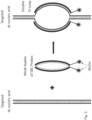
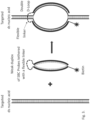
- Fig. 3 depicts invasion of the double strand structure of targeted DNA by formation of two more stable duplexes in a double D-loop structure.
- the probes are labelled with biotin for selective extraction of the targeted dsDNA from the mixture with non-targeted DNA.
- the majority of non-targeted DNA is represented by the host DNA.
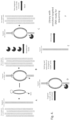
- Fig. 4 depicts the following steps of enrichment:
- SBC probes are composed of complementary DNA strands with all or partial or single replacement of dT - A base pairs to corresponding 2-sT - 2-amA base pairs. When partial replacement is desired, all modifications should be positioned across each other in the complementary sequences of SBC probes.
- model building indicates that steric clash between the 2-thio group of thymine and the 2-amino group of adenine tilts the bases relative to each other, thereby allowing only one hydrogen bond to form, as shown on Fig, 5D .
- both strands of the complementary SBC sequences are linked (tethered) head-to-tail on corresponding 5'- and 3'-ends by a flexible linker ( Fig. 3 ).
- the covalent linkage does not participate in hybridization and does not prevent hybridization of the two SBC members to the two strands of the targeted sequence.
- both strands are becoming available for binding in the same proximity to both strands of the targeted dsDNA.
- the latter design is preferred, as it will give maximal thermodynamic and kinetic benefits to the enrichment process.
- the linker is preferentially composed of polyethylene glycol chains, but it can be made of any linking groups which are suitable as "tethers" for linking the two SBC ODNs of a matched pair to one another.
- Such linkers include nucleotide sequences having approximately 1 to 10 nucleotides of DNA or RNA sequence, such as oligo dT, oligo dA or other selections that can avoid undesired hydrogen bonding.
- a specific example for the tether would be an ODN moiety having four T's.
- the tethering linkage may comprise the grouping -[OCH 2 -CH 2 ] n -O-, where n is 1 to 10 or one to three inserts of -(CH 2 ) n - linkers separated by phosphate groups, where n is 2 to 10.
- linkers contain stabilizing moieties such as intercalators (phenazinium, acridine, pyrene).
- One or both ends of the SBC probes are labeled with biotin for selective capturing of the hybridized probe after invasion of the targeted dsDNA. Steps of the enrichment method are shown of Fig. 4 : hybridization to the targeted dsDNA in the presence of untargeted DNA (A and B), capture with streptavidin magnetic beads (C), separation of untargeted DNA by wash (D), release of the targeted DNA by melting off the SBC probe and restoration of a double strand structure (E) with a subsequent sequencing library prep (F).
- a and B capture with streptavidin magnetic beads
- D separation of untargeted DNA by wash
- E release of the targeted DNA by melting off the SBC probe and restoration of a double strand structure
- F subsequent sequencing library prep
- SBC probes are composed of complementary DNA strands with all or partial or single replacement of dT - A base pairs to corresponding W - 2-amA base pairs.
- W modification can be introduced using a corresponding dW phosphoramidite reagent commercially available from Glen Research:
- the phosphoramidite allows for introduction of W into oligonucleotides by automated DNA synthesis using conventional chain extension cycles.
- the pivaloyl (Piv) group is easily removed with the ammonia solution used to deprotect the natural nucleobases. Removal of the triisopropylsilyl (TIPS) protecting group within the ethynyl group is induced under conditions similar to those used for 2'-TBDMS protected RNA strands, with tetrabutylammonium fluoride (TBAF) as deprotection agent.
- TIPS triisopropylsilyl
- a W modified base was initially reported by T.J. Walter, and C. Richert, in A strongly pairing fifth base: oligonucleotides with a C-nucleoside replacing thymidine Nucleic Acids Res., 2018, 46, 8069-8078 ,.
- the authors called it a W-base. They have demonstrated that a single replacement of thymidine base in a 12-mer complementary duplex DNA increases melting temperature by 4.4°.
- the Stabilizing effect is essentially additive and not sensitive to positioning of W-modification in a row or apart. In one instance, replacement of six T bases to W in the 11-mer increased binding by 17.5°.
- Representative SBC probes described herein include three designs: (1) containing only 2-sT - 2-amA base pairs, (2) containing only W - 2-amA base pairs, and (3) mixed designs containing both 2-sT - 2-amA and W - 2-amA base pairs.
- Oligonucleotide probes are synthesized using ordinary phosphoramidite chemistry on oligonucleotide synthesizer. Shasta synthesizer (Sierra BioSystems, Inc., Sonora, CA) is used for making all oligonucleotides. SBC probes with modified bases are synthesized using the following commercial reagents from Glen Research: dW phosphoramidite (cat. no 10-1527); 2-Thio-dT-CE Phosphoramidite (cat. no. 10-1036-02); 2-Amino-dA-CE Phosphoramidite (cat. no 10-1085-02); Spacer Phosphoramidite C3 (cat. no. 10-1913-02); Spacer Phosphoramidite 9 (cat. no.
- SBC probes for the experiments are designed as 2x40-mers separated by a spacer with sequences complementary to both strands of expected targets.
- the synthesis is performed at a 50 nM scale using columns packed with 2000A Uni support from Biocomma Ltd. (China), cat. No. DS0050-2-3900. This method produces probes with free 3'-OH group.
- Another set of probes is synthesized on a 3'-Spacer C3 CPG1000 from AM Chemicals LLC (4065 Oceanside Blvd., Suite M Oceanside, CA 92056-5824) in a 0.2 mM scale. 3'-blocking C3 group maybe useful for prevention of accidental extension in the subsequent PCR steps.
- SBC probes have the following general structure: 5'-(Biotin)-(SBC sequence 2) - (Spacer) - (SBC sequence 1)-(Blocking group or OH)-3'
- SBC sequences 1 and 2 are complementary to corresponding regions of targeted dsDNA.
- SBC sequences are synthesized with pairs of 2-sT and 2-amA modifications and with pairs of W and 2-amA modification.
- Another example demonstrates design with all three modified bases in the same SBC probe: 2-sT and W in place of T and 2-amA in place of A.
- E. coli random coding regions of sizes between 500-1000 bp (582, 819, and 915 bp) Seq.1, Seq. 2 and Seq. 3 are selected for the demonstration (only one strand shown in each sequence).
- the targeted regions are flanked with asterisk and highlighted bold.
- Three 40 bp regions are selected for targeting. All sequences are shown from 5' to 3'-end.
- Fig. 7 depicts the reaction of hybridization of SBC probe targeting double strand target of Seq. 1 and corresponding region of the complementary strand.
- the designs vary by a type of Thymidine replacement (2-sT or W), by a blocking (or no blocking) at the 3'-end and by a length of a spacer. All tested designs are shown in Table 1.
- Modified bases underlined T is 2-sT and A is 2-amA.
- oligonucleotides are made using phosphoramidite reagents from Glen Research, in particular, dW phosphoramidite (cat. no 10-1527) and 2-Amino-dA-CE Phosphoramidite (cat. no 10-1085-02). Synthesis and deprotection of modified oligonucleotides are performed by following Glen Research's recommendations for dW phosphoramidite and 2-Amino-dA-CE Phosphoramidites. 2-Amino-dA-CE Phosphoramidite is represented by A' and dW phosphoramidite is represented by T' in the following oligonucleotide sequences.
- the melting data a is collected and summarized in the format shown in Table 3. TABLE 3 MELTING TRANSITION TEMPERATURES AND FREE ENERGIES FOR HYBRIDS SUBSTITUTED WITH 2-AMINOADENINE AND/OR W BASE ANALOGS.
- Probe sets 1a-c - 8a-c are tested in enrichment experiments. Each experiment is performed in the presence of tree corresponding SBC probes targeting both strands in Seq. 1, Seq. 2 and Seq. 3 duplexes. The results initially are evaluated by PCR.
- Selected probe sets that demonstrated best performance are subjected to a sequencing library prep and evaluated by Illumina sequencing in comparison to the libraries obtained without enrichment.
- Hybridization and strand exchange of SBC probes with the targeted dsDNA Seq. 1-3 is performed according to protocols published in S. C. Kowalczykowski and R. A. Krupp, Proc Natl Acad Sci U S A. 1995 Apr 11; 92(8): 3478-3482 .
- the results initially are evaluated by PCR and compared with the results without recA treatment at strand exchange times 1 hr, 4 hr, 8 hr and 16 hr.
Landscapes
- Chemical & Material Sciences (AREA)
- Life Sciences & Earth Sciences (AREA)
- Health & Medical Sciences (AREA)
- Genetics & Genomics (AREA)
- Engineering & Computer Science (AREA)
- Organic Chemistry (AREA)
- Zoology (AREA)
- Wood Science & Technology (AREA)
- Bioinformatics & Cheminformatics (AREA)
- Biotechnology (AREA)
- General Engineering & Computer Science (AREA)
- Biomedical Technology (AREA)
- Molecular Biology (AREA)
- General Health & Medical Sciences (AREA)
- Biophysics (AREA)
- Microbiology (AREA)
- Physics & Mathematics (AREA)
- Biochemistry (AREA)
- Proteomics, Peptides & Aminoacids (AREA)
- Crystallography & Structural Chemistry (AREA)
- Plant Pathology (AREA)
- Bioinformatics & Computational Biology (AREA)
- Chemical Kinetics & Catalysis (AREA)
- Analytical Chemistry (AREA)
- Immunology (AREA)
- Measuring Or Testing Involving Enzymes Or Micro-Organisms (AREA)
Claims (11)
- Selektiv bindendes komplementäres (SBC) Oligodesoxynukleotidderivat mit der Struktur:
5'-(Affinitäts-Tag)-(SBC-Sequenz 2) - (Spacer) - (SBC-Sequenz 1)- (Blockierungsgruppe oder OH)-3',
wobeidie 3'-Blockierungsgruppe nicht blockierendes (3'-OH), oder irgendein Alkendiol, oder ein anderes Biotin mit einem Linker, oder Stabilisierungsgruppe ist;SBC-Sequenzen 1 und 2 jeweils 5-100 Basen lang sind, mit zu einer ausgewählten Region von größerer angezielter dsDNA komplementären Strängen, so dass die angezielte DNA eine partielle doppelsträngige Struktur nach Invasion einer SBC-Sonde präserviert; und5'-(Affinitäts-Tag) ein Affinitäts-Tag ist, der mit dem 5'-Ende der Sonde durch einen Linker verbunden ist. - Oligonukleotidderivat nach Anspruch 1, wobei die Sequenz 2-sT - 2-amA-Basenpaare umfasst.
- Oligonukleotidderivat nach Anspruch 1, wobei die Sequenz W - 2-amA-Basenpaare umfasst.
- Oligonukleotidderivat nach Anspruch 1, wobei die Sequenz sowohl 2-sT - 2-amA als auch W - 2-amA-Basenpaare umfasst.
- Oligonukleotidderivat nach Anspruch 1, wobei das Alkendiol OCH2CH2CH2OH ist.
- Oligonukleotidderivat nach Anspruch 1, wobei die Stabilisierungsgruppe aus MGB, oder Interkalatoren wie z. B. Phenazinium, Acridin, Pyren, ausgewählt ist.
- Verfahren zur Anreicherung angezielter dsDNA in einer DNA-Probe, umfassend:(a) Mischen einer selektiv bindenden komplementären (SBC) Sonde mit aus einer Probe extrahierter dsDNA oder aus entsprechender RNA produzierter cDNA, angezielt und nicht angezielt, wobei die SBC-Sonde aus zwei komplementären schwach gebundenen Strängen, verknüpft mit einem Linker und enthaltend ein Affinitäts-Tag, besteht;(b) Hybridisieren jedes Strangs der SBC-Sonde mit der angezielten Region der dsDNA und Bilden zweier starker Doppelstrangbereiche (Doppel-D-Loop) innerhalb der angezielten dsDNA oder cDNA;(c) Behandeln der Mischung mit Affinitätspartner-markierten Beads (oder anderer fester Phase oder anderem festem Substrat) und Binden der hybridisierten Affinitäts-getaggten Sonde an die Beads;(d) Trennen der Beads, enthaltend angezielte DNA, gebunden an die Beads, von nicht angezielter DNA in der Lösung und Waschen der Beads; und(e) Wegschmelzen der Sonde, während der Rest der angezielten DNA in einer doppelsträngigen Form geschützt wird, um einen angereicherten dsDNA-Pool bereitzustellen.
- Verfahren nach Anspruch 7, ferner umfassend Unterziehen des angereicherten dsDNA-Pools einer Standardbibliothekpräparation für die Sequenzierung.
- Verfahren nach Ansprüchen 7 oder 8, wobei die SBC-Sonde ein Oligodesoxynukleotidderivat nach einem der Ansprüche 1 bis 6 ist.
- Verfahren nach einem der Ansprüche 7 bis 9, wobei recA-Enzym für Strangaustausch der SBC-Sonde mit angezielter dsDNA zwecks Einfangens und Anreicherung verwendet wird.
- Verwendung eines selektiv bindenden komplementären Oligodesoxynukleotidderivats nach einem der Ansprüche 1 bis 6 zur Anreicherung angezielter dsDNA in einer Probe für Sequenzierungs-basierten Nachweis und genomische Profilierung der angezielten dsDNA.
Applications Claiming Priority (2)
| Application Number | Priority Date | Filing Date | Title |
|---|---|---|---|
| US202163270499P | 2021-10-21 | 2021-10-21 | |
| PCT/US2022/078452 WO2023070047A1 (en) | 2021-10-21 | 2022-10-20 | Pre-library target enrichment for nucleic acid sequencing |
Publications (2)
| Publication Number | Publication Date |
|---|---|
| EP4419710A1 EP4419710A1 (de) | 2024-08-28 |
| EP4419710B1 true EP4419710B1 (de) | 2025-07-02 |
Family
ID=84332070
Family Applications (1)
| Application Number | Title | Priority Date | Filing Date |
|---|---|---|---|
| EP22802478.2A Active EP4419710B1 (de) | 2021-10-21 | 2022-10-20 | Vorbibliothekszielanreicherung zur nukleinsäuresequenzierung |
Country Status (4)
| Country | Link |
|---|---|
| US (1) | US20250320486A1 (de) |
| EP (1) | EP4419710B1 (de) |
| CN (1) | CN118019858A (de) |
| WO (1) | WO2023070047A1 (de) |
Citations (3)
| Publication number | Priority date | Publication date | Assignee | Title |
|---|---|---|---|---|
| WO1997012896A1 (en) * | 1995-10-04 | 1997-04-10 | Epoch Pharmaceuticals, Inc. | Selective binding complementary oligonucleotides |
| WO2007127992A2 (en) * | 2006-04-28 | 2007-11-08 | Igor Kutyavin | Use of base-modified deoxynucleoside triphosphates |
| WO2021222289A1 (en) * | 2020-04-28 | 2021-11-04 | Cepheid | Pseudo-complementary bases in genotyping and nucleic acid sequencing |
Family Cites Families (3)
| Publication number | Priority date | Publication date | Assignee | Title |
|---|---|---|---|---|
| US8871469B1 (en) * | 2004-11-13 | 2014-10-28 | Steven Albert Benner | Self-avoiding molecular recognition systems in DNA priming |
| US10308979B2 (en) * | 2012-06-01 | 2019-06-04 | Agilent Technologies, Inc. | Target enrichment and labeling for multi-kilobase DNA |
| EP3350343B1 (de) * | 2015-09-16 | 2020-04-22 | Petaomics, Inc. | Verfahren und zusammensetzungen zur genomischen zielanreicherung und selektiven dna-sequenzierung |
-
2022
- 2022-10-20 WO PCT/US2022/078452 patent/WO2023070047A1/en not_active Ceased
- 2022-10-20 US US18/702,311 patent/US20250320486A1/en active Pending
- 2022-10-20 CN CN202280064983.8A patent/CN118019858A/zh active Pending
- 2022-10-20 EP EP22802478.2A patent/EP4419710B1/de active Active
Patent Citations (3)
| Publication number | Priority date | Publication date | Assignee | Title |
|---|---|---|---|---|
| WO1997012896A1 (en) * | 1995-10-04 | 1997-04-10 | Epoch Pharmaceuticals, Inc. | Selective binding complementary oligonucleotides |
| WO2007127992A2 (en) * | 2006-04-28 | 2007-11-08 | Igor Kutyavin | Use of base-modified deoxynucleoside triphosphates |
| WO2021222289A1 (en) * | 2020-04-28 | 2021-11-04 | Cepheid | Pseudo-complementary bases in genotyping and nucleic acid sequencing |
Non-Patent Citations (7)
| Title |
|---|
| ANDERSON BROOKE ET AL: "Mixed-Sequence Recognition of Double-Stranded DNA Using Enzymatically Stable Phosphorothioate Invader Probes", MOLECULES, vol. 20, no. 8, 1 January 2015 (2015-01-01), pages 13780 - 13793, XP093008899, Retrieved from the Internet <URL:https://www.ncbi.nlm.nih.gov/pmc/articles/PMC6332310/pdf/molecules-20-13780.pdf> DOI: 10.3390/molecules200813780 * |
| BUKANOV NIKOLAY O ET AL: "PD-loop: A complex of duplex DNA with an oligonucleotide (peptide nucleic acidaffinity capturehybridizationbiomagnetic separationyeast DNA)", BIOCHEMISTRY AND APPROVED MARCH, 1 May 1988 (1988-05-01), pages 5516 - 5520, XP093008931, Retrieved from the Internet <URL:https://www.ncbi.nlm.nih.gov/pmc/articles/PMC20409/pdf/pq005516.pdf> [retrieved on 20221216] * |
| GUENTHER DALE C. ET AL: "Invader probes: harnessing the energy of intercalation to facilitate recognition of chromosomal DNA for diagnostic applications", CHEMICAL SCIENCE, vol. 6, no. 8, 1 January 2015 (2015-01-01), United Kingdom, pages 5006 - 5015, XP093008830, ISSN: 2041-6520, Retrieved from the Internet <URL:https://www.ncbi.nlm.nih.gov/pmc/articles/PMC4521421/pdf/SC-006-C5SC01238D.pdf> DOI: 10.1039/C5SC01238D * |
| I. V. SMOLINA: "End invasion of peptide nucleic acids (PNAs) with mixed-base composition into linear DNA duplexes", NUCLEIC ACIDS RESEARCH, vol. 33, no. 17, 25 September 2005 (2005-09-25), GB, pages e146 - e146, XP055336679, ISSN: 0305-1048, DOI: 10.1093/nar/gni151 * |
| KUTYAVIN I V: "Use of Base-Modified Duplex-Stabilizing Deoxynucleoside 5 '-Triphosphates To Enhance the Hybridization Properties of Primers and Probes in Detection Polymerase Chain Reaction", BIOCHEMISTRY, AMERICAN CHEMICAL SOCIETY, vol. 47, no. 51, 23 December 2008 (2008-12-23), pages 13666 - 13673, XP002569787, ISSN: 0006-2960, [retrieved on 20081201], DOI: 10.1021/BI8017784 * |
| RAJENDRAN ARIVAZHAGAN ET AL: "One-Pot Isolation of a Desired Human Genome Fragment by Using a Biotinylated pcPNA/S1 Nuclease Combination", BIOCHEMISTRY, vol. 57, no. 20, 22 May 2018 (2018-05-22), pages 2908 - 2912, XP093008988, ISSN: 0006-2960, DOI: 10.1021/acs.biochem.8b00202 * |
| SUJAY P. SAU ET AL: "Invader LNA: Efficient targeting of short double stranded DNA", ORGANIC & BIOMOLECULAR CHEMISTRY, vol. 8, no. 9, 1 January 2010 (2010-01-01), pages 2028, XP055078396, ISSN: 1477-0520, DOI: 10.1039/b923465a * |
Also Published As
| Publication number | Publication date |
|---|---|
| EP4419710A1 (de) | 2024-08-28 |
| CN118019858A (zh) | 2024-05-10 |
| WO2023070047A1 (en) | 2023-04-27 |
| US20250320486A1 (en) | 2025-10-16 |
Similar Documents
| Publication | Publication Date | Title |
|---|---|---|
| CN110088299B (zh) | 通过纳米孔指导的核酸检测方法 | |
| JP4452445B2 (ja) | 移動度改変ヌクレオ塩基ポリマーおよび同一物を使用する方法 | |
| CN113454233B (zh) | 使用位点特异性核酸酶以及随后的捕获进行核酸富集的方法 | |
| JP2024051149A (ja) | ガイド核酸を作製および使用するための方法および組成物 | |
| EP2620511B1 (de) | Einzelmolekül-Nukleinsäurensequenzanalyseverfahren | |
| CN110139931B (zh) | 用于定相测序的方法和组合物 | |
| EP1247815A2 (de) | Modifizierte Oligonukleotide sowie deren Verwendung | |
| CA2734514C (en) | Self-avoiding molecular recognition systems in dna amplification | |
| CN114262735B (zh) | 用于表征多核苷酸的衔接体及其用途 | |
| CN109517888B (zh) | 使用等位基因特异的反应性引物的核酸扩增方法 | |
| CN114502729A (zh) | 用于制备用于单分子表征的核酸构建体的方法和系统 | |
| JP2004504829A (ja) | 二本鎖核酸の一方の鎖を単離するための方法 | |
| JP2025078774A (ja) | 連結された標的捕捉 | |
| JP2003517303A (ja) | 複合pcr増幅の制御可能な実施方法 | |
| JP2023535287A (ja) | TdTに基づく酵素的核酸の基質としての塩基修飾ヌクレオチド | |
| US20250320486A1 (en) | Pre-library target enrichment for nucleic acid sequencing | |
| HK40111507B (en) | Pre-library target enrichment for nucleic acid sequencing | |
| HK40111507A (en) | Pre-library target enrichment for nucleic acid sequencing | |
| HK40112619A (zh) | 用於核酸测序的预文库靶标富集 | |
| WO2011139652A1 (en) | Selective enrichment of cpg islands | |
| EP4450637A1 (de) | Neue selbstspaltende dnazyme und selektionsverfahren | |
| JP5128031B2 (ja) | RecAタンパク質を用いて標識が導入された核酸を製造する方法 | |
| EP3798319A1 (de) | Verbessertes diagnose- und/oder sequenzierungsverfahren und kit | |
| HK40049321A (en) | An improved diagnostic and/or sequencing method and kit | |
| HK40000246A (en) | Nucleic acid amplification method using allele-specific reactive primer |
Legal Events
| Date | Code | Title | Description |
|---|---|---|---|
| STAA | Information on the status of an ep patent application or granted ep patent |
Free format text: STATUS: UNKNOWN |
|
| STAA | Information on the status of an ep patent application or granted ep patent |
Free format text: STATUS: THE INTERNATIONAL PUBLICATION HAS BEEN MADE |
|
| PUAI | Public reference made under article 153(3) epc to a published international application that has entered the european phase |
Free format text: ORIGINAL CODE: 0009012 |
|
| STAA | Information on the status of an ep patent application or granted ep patent |
Free format text: STATUS: REQUEST FOR EXAMINATION WAS MADE |
|
| STAA | Information on the status of an ep patent application or granted ep patent |
Free format text: STATUS: EXAMINATION IS IN PROGRESS |
|
| 17P | Request for examination filed |
Effective date: 20240328 |
|
| AK | Designated contracting states |
Kind code of ref document: A1 Designated state(s): AL AT BE BG CH CY CZ DE DK EE ES FI FR GB GR HR HU IE IS IT LI LT LU LV MC ME MK MT NL NO PL PT RO RS SE SI SK SM TR |
|
| 17Q | First examination report despatched |
Effective date: 20240820 |
|
| REG | Reference to a national code |
Ref country code: HK Ref legal event code: DE Ref document number: 40111507 Country of ref document: HK Ref country code: HK Ref legal event code: DE Ref document number: 40111506 Country of ref document: HK |
|
| DAV | Request for validation of the european patent (deleted) | ||
| DAX | Request for extension of the european patent (deleted) | ||
| GRAP | Despatch of communication of intention to grant a patent |
Free format text: ORIGINAL CODE: EPIDOSNIGR1 |
|
| STAA | Information on the status of an ep patent application or granted ep patent |
Free format text: STATUS: GRANT OF PATENT IS INTENDED |
|
| INTG | Intention to grant announced |
Effective date: 20250130 |
|
| P01 | Opt-out of the competence of the unified patent court (upc) registered |
Free format text: CASE NUMBER: APP_6882/2025 Effective date: 20250210 |
|
| GRAS | Grant fee paid |
Free format text: ORIGINAL CODE: EPIDOSNIGR3 |
|
| GRAA | (expected) grant |
Free format text: ORIGINAL CODE: 0009210 |
|
| STAA | Information on the status of an ep patent application or granted ep patent |
Free format text: STATUS: THE PATENT HAS BEEN GRANTED |
|
| AK | Designated contracting states |
Kind code of ref document: B1 Designated state(s): AL AT BE BG CH CY CZ DE DK EE ES FI FR GB GR HR HU IE IS IT LI LT LU LV MC ME MK MT NL NO PL PT RO RS SE SI SK SM TR |
|
| REG | Reference to a national code |
Ref country code: GB Ref legal event code: FG4D |
|
| REG | Reference to a national code |
Ref country code: CH Ref legal event code: EP |
|
| REG | Reference to a national code |
Ref country code: DE Ref legal event code: R096 Ref document number: 602022017052 Country of ref document: DE |
|
| REG | Reference to a national code |
Ref country code: IE Ref legal event code: FG4D |
|
| REG | Reference to a national code |
Ref country code: NL Ref legal event code: MP Effective date: 20250702 |
|
| PG25 | Lapsed in a contracting state [announced via postgrant information from national office to epo] |
Ref country code: PT Free format text: LAPSE BECAUSE OF FAILURE TO SUBMIT A TRANSLATION OF THE DESCRIPTION OR TO PAY THE FEE WITHIN THE PRESCRIBED TIME-LIMIT Effective date: 20251103 |
|
| PG25 | Lapsed in a contracting state [announced via postgrant information from national office to epo] |
Ref country code: NL Free format text: LAPSE BECAUSE OF FAILURE TO SUBMIT A TRANSLATION OF THE DESCRIPTION OR TO PAY THE FEE WITHIN THE PRESCRIBED TIME-LIMIT Effective date: 20250702 |
|
| REG | Reference to a national code |
Ref country code: AT Ref legal event code: MK05 Ref document number: 1809313 Country of ref document: AT Kind code of ref document: T Effective date: 20250702 |
|
| PG25 | Lapsed in a contracting state [announced via postgrant information from national office to epo] |
Ref country code: IS Free format text: LAPSE BECAUSE OF FAILURE TO SUBMIT A TRANSLATION OF THE DESCRIPTION OR TO PAY THE FEE WITHIN THE PRESCRIBED TIME-LIMIT Effective date: 20251102 |
|
| PGFP | Annual fee paid to national office [announced via postgrant information from national office to epo] |
Ref country code: DE Payment date: 20251028 Year of fee payment: 4 |
|
| PG25 | Lapsed in a contracting state [announced via postgrant information from national office to epo] |
Ref country code: NO Free format text: LAPSE BECAUSE OF FAILURE TO SUBMIT A TRANSLATION OF THE DESCRIPTION OR TO PAY THE FEE WITHIN THE PRESCRIBED TIME-LIMIT Effective date: 20251002 |
|
| REG | Reference to a national code |
Ref country code: LT Ref legal event code: MG9D |
|
| PG25 | Lapsed in a contracting state [announced via postgrant information from national office to epo] |
Ref country code: AT Free format text: LAPSE BECAUSE OF FAILURE TO SUBMIT A TRANSLATION OF THE DESCRIPTION OR TO PAY THE FEE WITHIN THE PRESCRIBED TIME-LIMIT Effective date: 20250702 |
|
| PG25 | Lapsed in a contracting state [announced via postgrant information from national office to epo] |
Ref country code: FI Free format text: LAPSE BECAUSE OF FAILURE TO SUBMIT A TRANSLATION OF THE DESCRIPTION OR TO PAY THE FEE WITHIN THE PRESCRIBED TIME-LIMIT Effective date: 20250702 |
|
| PG25 | Lapsed in a contracting state [announced via postgrant information from national office to epo] |
Ref country code: HR Free format text: LAPSE BECAUSE OF FAILURE TO SUBMIT A TRANSLATION OF THE DESCRIPTION OR TO PAY THE FEE WITHIN THE PRESCRIBED TIME-LIMIT Effective date: 20250702 |
|
| PGFP | Annual fee paid to national office [announced via postgrant information from national office to epo] |
Ref country code: FR Payment date: 20251027 Year of fee payment: 4 |
|
| PG25 | Lapsed in a contracting state [announced via postgrant information from national office to epo] |
Ref country code: GR Free format text: LAPSE BECAUSE OF FAILURE TO SUBMIT A TRANSLATION OF THE DESCRIPTION OR TO PAY THE FEE WITHIN THE PRESCRIBED TIME-LIMIT Effective date: 20251003 |
|
| PG25 | Lapsed in a contracting state [announced via postgrant information from national office to epo] |
Ref country code: SE Free format text: LAPSE BECAUSE OF FAILURE TO SUBMIT A TRANSLATION OF THE DESCRIPTION OR TO PAY THE FEE WITHIN THE PRESCRIBED TIME-LIMIT Effective date: 20250702 Ref country code: CZ Free format text: LAPSE BECAUSE OF FAILURE TO SUBMIT A TRANSLATION OF THE DESCRIPTION OR TO PAY THE FEE WITHIN THE PRESCRIBED TIME-LIMIT Effective date: 20250702 |
|
| PG25 | Lapsed in a contracting state [announced via postgrant information from national office to epo] |
Ref country code: LV Free format text: LAPSE BECAUSE OF FAILURE TO SUBMIT A TRANSLATION OF THE DESCRIPTION OR TO PAY THE FEE WITHIN THE PRESCRIBED TIME-LIMIT Effective date: 20250702 |
|
| PG25 | Lapsed in a contracting state [announced via postgrant information from national office to epo] |
Ref country code: BG Free format text: LAPSE BECAUSE OF FAILURE TO SUBMIT A TRANSLATION OF THE DESCRIPTION OR TO PAY THE FEE WITHIN THE PRESCRIBED TIME-LIMIT Effective date: 20250702 Ref country code: PL Free format text: LAPSE BECAUSE OF FAILURE TO SUBMIT A TRANSLATION OF THE DESCRIPTION OR TO PAY THE FEE WITHIN THE PRESCRIBED TIME-LIMIT Effective date: 20250702 |
|
| PG25 | Lapsed in a contracting state [announced via postgrant information from national office to epo] |
Ref country code: RS Free format text: LAPSE BECAUSE OF FAILURE TO SUBMIT A TRANSLATION OF THE DESCRIPTION OR TO PAY THE FEE WITHIN THE PRESCRIBED TIME-LIMIT Effective date: 20251002 |
|
| PG25 | Lapsed in a contracting state [announced via postgrant information from national office to epo] |
Ref country code: ES Free format text: LAPSE BECAUSE OF FAILURE TO SUBMIT A TRANSLATION OF THE DESCRIPTION OR TO PAY THE FEE WITHIN THE PRESCRIBED TIME-LIMIT Effective date: 20250702 |
|
| PG25 | Lapsed in a contracting state [announced via postgrant information from national office to epo] |
Ref country code: RO Free format text: LAPSE BECAUSE OF FAILURE TO SUBMIT A TRANSLATION OF THE DESCRIPTION OR TO PAY THE FEE WITHIN THE PRESCRIBED TIME-LIMIT Effective date: 20250702 |
|
| PG25 | Lapsed in a contracting state [announced via postgrant information from national office to epo] |
Ref country code: SM Free format text: LAPSE BECAUSE OF FAILURE TO SUBMIT A TRANSLATION OF THE DESCRIPTION OR TO PAY THE FEE WITHIN THE PRESCRIBED TIME-LIMIT Effective date: 20250702 |
|
| PG25 | Lapsed in a contracting state [announced via postgrant information from national office to epo] |
Ref country code: DK Free format text: LAPSE BECAUSE OF FAILURE TO SUBMIT A TRANSLATION OF THE DESCRIPTION OR TO PAY THE FEE WITHIN THE PRESCRIBED TIME-LIMIT Effective date: 20250702 |
|
| PG25 | Lapsed in a contracting state [announced via postgrant information from national office to epo] |
Ref country code: IT Free format text: LAPSE BECAUSE OF FAILURE TO SUBMIT A TRANSLATION OF THE DESCRIPTION OR TO PAY THE FEE WITHIN THE PRESCRIBED TIME-LIMIT Effective date: 20250702 |
|
| PG25 | Lapsed in a contracting state [announced via postgrant information from national office to epo] |
Ref country code: SK Free format text: LAPSE BECAUSE OF FAILURE TO SUBMIT A TRANSLATION OF THE DESCRIPTION OR TO PAY THE FEE WITHIN THE PRESCRIBED TIME-LIMIT Effective date: 20250702 Ref country code: EE Free format text: LAPSE BECAUSE OF FAILURE TO SUBMIT A TRANSLATION OF THE DESCRIPTION OR TO PAY THE FEE WITHIN THE PRESCRIBED TIME-LIMIT Effective date: 20250702 |
|
| PLBE | No opposition filed within time limit |
Free format text: ORIGINAL CODE: 0009261 |
|
| STAA | Information on the status of an ep patent application or granted ep patent |
Free format text: STATUS: NO OPPOSITION FILED WITHIN TIME LIMIT |