EP4417596A1 - Kleinmolekülige arzneimittel und zugehörige verfahren zur behandlung von krankheiten im zusammenhang mit ass42-oligomerbildung - Google Patents
Kleinmolekülige arzneimittel und zugehörige verfahren zur behandlung von krankheiten im zusammenhang mit ass42-oligomerbildung Download PDFInfo
- Publication number
- EP4417596A1 EP4417596A1 EP24165453.2A EP24165453A EP4417596A1 EP 4417596 A1 EP4417596 A1 EP 4417596A1 EP 24165453 A EP24165453 A EP 24165453A EP 4417596 A1 EP4417596 A1 EP 4417596A1
- Authority
- EP
- European Patent Office
- Prior art keywords
- substituted
- alkyl
- arylalkyl
- heteroarylalkyl
- aryl
- Prior art date
- Legal status (The legal status is an assumption and is not a legal conclusion. Google has not performed a legal analysis and makes no representation as to the accuracy of the status listed.)
- Granted
Links
Images




















Classifications
-
- C—CHEMISTRY; METALLURGY
- C07—ORGANIC CHEMISTRY
- C07C—ACYCLIC OR CARBOCYCLIC COMPOUNDS
- C07C233/00—Carboxylic acid amides
- C07C233/01—Carboxylic acid amides having carbon atoms of carboxamide groups bound to hydrogen atoms or to acyclic carbon atoms
- C07C233/34—Carboxylic acid amides having carbon atoms of carboxamide groups bound to hydrogen atoms or to acyclic carbon atoms having the nitrogen atom of at least one of the carboxamide groups bound to a carbon atom of a hydrocarbon radical substituted by amino groups
- C07C233/42—Carboxylic acid amides having carbon atoms of carboxamide groups bound to hydrogen atoms or to acyclic carbon atoms having the nitrogen atom of at least one of the carboxamide groups bound to a carbon atom of a hydrocarbon radical substituted by amino groups with the substituted hydrocarbon radical bound to the nitrogen atom of the carboxamide group by a carbon atom of a six-membered aromatic ring
- C07C233/43—Carboxylic acid amides having carbon atoms of carboxamide groups bound to hydrogen atoms or to acyclic carbon atoms having the nitrogen atom of at least one of the carboxamide groups bound to a carbon atom of a hydrocarbon radical substituted by amino groups with the substituted hydrocarbon radical bound to the nitrogen atom of the carboxamide group by a carbon atom of a six-membered aromatic ring having the carbon atom of the carboxamide group bound to a hydrogen atom or to a carbon atom of a saturated carbon skeleton
-
- A—HUMAN NECESSITIES
- A61—MEDICAL OR VETERINARY SCIENCE; HYGIENE
- A61K—PREPARATIONS FOR MEDICAL, DENTAL OR TOILETRY PURPOSES
- A61K31/00—Medicinal preparations containing organic active ingredients
- A61K31/13—Amines
- A61K31/131—Amines acyclic
-
- A—HUMAN NECESSITIES
- A61—MEDICAL OR VETERINARY SCIENCE; HYGIENE
- A61K—PREPARATIONS FOR MEDICAL, DENTAL OR TOILETRY PURPOSES
- A61K31/00—Medicinal preparations containing organic active ingredients
- A61K31/13—Amines
- A61K31/135—Amines having aromatic rings, e.g. ketamine, nortriptyline
-
- A—HUMAN NECESSITIES
- A61—MEDICAL OR VETERINARY SCIENCE; HYGIENE
- A61K—PREPARATIONS FOR MEDICAL, DENTAL OR TOILETRY PURPOSES
- A61K31/00—Medicinal preparations containing organic active ingredients
- A61K31/13—Amines
- A61K31/135—Amines having aromatic rings, e.g. ketamine, nortriptyline
- A61K31/137—Arylalkylamines, e.g. amphetamine, epinephrine, salbutamol, ephedrine or methadone
-
- A—HUMAN NECESSITIES
- A61—MEDICAL OR VETERINARY SCIENCE; HYGIENE
- A61P—SPECIFIC THERAPEUTIC ACTIVITY OF CHEMICAL COMPOUNDS OR MEDICINAL PREPARATIONS
- A61P25/00—Drugs for disorders of the nervous system
-
- C—CHEMISTRY; METALLURGY
- C07—ORGANIC CHEMISTRY
- C07C—ACYCLIC OR CARBOCYCLIC COMPOUNDS
- C07C211/00—Compounds containing amino groups bound to a carbon skeleton
- C07C211/01—Compounds containing amino groups bound to a carbon skeleton having amino groups bound to acyclic carbon atoms
- C07C211/26—Compounds containing amino groups bound to a carbon skeleton having amino groups bound to acyclic carbon atoms of an unsaturated carbon skeleton containing at least one six-membered aromatic ring
- C07C211/27—Compounds containing amino groups bound to a carbon skeleton having amino groups bound to acyclic carbon atoms of an unsaturated carbon skeleton containing at least one six-membered aromatic ring having amino groups linked to the six-membered aromatic ring by saturated carbon chains
-
- C—CHEMISTRY; METALLURGY
- C07—ORGANIC CHEMISTRY
- C07C—ACYCLIC OR CARBOCYCLIC COMPOUNDS
- C07C211/00—Compounds containing amino groups bound to a carbon skeleton
- C07C211/01—Compounds containing amino groups bound to a carbon skeleton having amino groups bound to acyclic carbon atoms
- C07C211/26—Compounds containing amino groups bound to a carbon skeleton having amino groups bound to acyclic carbon atoms of an unsaturated carbon skeleton containing at least one six-membered aromatic ring
- C07C211/28—Compounds containing amino groups bound to a carbon skeleton having amino groups bound to acyclic carbon atoms of an unsaturated carbon skeleton containing at least one six-membered aromatic ring having amino groups linked to the six-membered aromatic ring by unsaturated carbon chains
-
- C—CHEMISTRY; METALLURGY
- C07—ORGANIC CHEMISTRY
- C07C—ACYCLIC OR CARBOCYCLIC COMPOUNDS
- C07C211/00—Compounds containing amino groups bound to a carbon skeleton
- C07C211/01—Compounds containing amino groups bound to a carbon skeleton having amino groups bound to acyclic carbon atoms
- C07C211/26—Compounds containing amino groups bound to a carbon skeleton having amino groups bound to acyclic carbon atoms of an unsaturated carbon skeleton containing at least one six-membered aromatic ring
- C07C211/29—Compounds containing amino groups bound to a carbon skeleton having amino groups bound to acyclic carbon atoms of an unsaturated carbon skeleton containing at least one six-membered aromatic ring the carbon skeleton being further substituted by halogen atoms or by nitro or nitroso groups
-
- C—CHEMISTRY; METALLURGY
- C07—ORGANIC CHEMISTRY
- C07C—ACYCLIC OR CARBOCYCLIC COMPOUNDS
- C07C217/00—Compounds containing amino and etherified hydroxy groups bound to the same carbon skeleton
- C07C217/54—Compounds containing amino and etherified hydroxy groups bound to the same carbon skeleton having etherified hydroxy groups bound to carbon atoms of at least one six-membered aromatic ring and amino groups bound to acyclic carbon atoms or to carbon atoms of rings other than six-membered aromatic rings of the same carbon skeleton
- C07C217/56—Compounds containing amino and etherified hydroxy groups bound to the same carbon skeleton having etherified hydroxy groups bound to carbon atoms of at least one six-membered aromatic ring and amino groups bound to acyclic carbon atoms or to carbon atoms of rings other than six-membered aromatic rings of the same carbon skeleton with amino groups linked to the six-membered aromatic ring, or to the condensed ring system containing that ring, by carbon chains not further substituted by singly-bound oxygen atoms
- C07C217/60—Compounds containing amino and etherified hydroxy groups bound to the same carbon skeleton having etherified hydroxy groups bound to carbon atoms of at least one six-membered aromatic ring and amino groups bound to acyclic carbon atoms or to carbon atoms of rings other than six-membered aromatic rings of the same carbon skeleton with amino groups linked to the six-membered aromatic ring, or to the condensed ring system containing that ring, by carbon chains not further substituted by singly-bound oxygen atoms linked by carbon chains having two carbon atoms between the amino groups and the six-membered aromatic ring or the condensed ring system containing that ring
-
- C—CHEMISTRY; METALLURGY
- C07—ORGANIC CHEMISTRY
- C07C—ACYCLIC OR CARBOCYCLIC COMPOUNDS
- C07C223/00—Compounds containing amino and —CHO groups bound to the same carbon skeleton
- C07C223/02—Compounds containing amino and —CHO groups bound to the same carbon skeleton having amino groups bound to acyclic carbon atoms of the carbon skeleton
-
- C—CHEMISTRY; METALLURGY
- C07—ORGANIC CHEMISTRY
- C07C—ACYCLIC OR CARBOCYCLIC COMPOUNDS
- C07C271/00—Derivatives of carbamic acids, i.e. compounds containing any of the groups, the nitrogen atom not being part of nitro or nitroso groups
- C07C271/06—Esters of carbamic acids
- C07C271/08—Esters of carbamic acids having oxygen atoms of carbamate groups bound to acyclic carbon atoms
- C07C271/10—Esters of carbamic acids having oxygen atoms of carbamate groups bound to acyclic carbon atoms with the nitrogen atoms of the carbamate groups bound to hydrogen atoms or to acyclic carbon atoms
- C07C271/18—Esters of carbamic acids having oxygen atoms of carbamate groups bound to acyclic carbon atoms with the nitrogen atoms of the carbamate groups bound to hydrogen atoms or to acyclic carbon atoms to carbon atoms of hydrocarbon radicals substituted by doubly-bound oxygen atoms
-
- C—CHEMISTRY; METALLURGY
- C07—ORGANIC CHEMISTRY
- C07D—HETEROCYCLIC COMPOUNDS
- C07D207/00—Heterocyclic compounds containing five-membered rings not condensed with other rings, with one nitrogen atom as the only ring hetero atom
- C07D207/02—Heterocyclic compounds containing five-membered rings not condensed with other rings, with one nitrogen atom as the only ring hetero atom with only hydrogen or carbon atoms directly attached to the ring nitrogen atom
- C07D207/04—Heterocyclic compounds containing five-membered rings not condensed with other rings, with one nitrogen atom as the only ring hetero atom with only hydrogen or carbon atoms directly attached to the ring nitrogen atom having no double bonds between ring members or between ring members and non-ring members
- C07D207/06—Heterocyclic compounds containing five-membered rings not condensed with other rings, with one nitrogen atom as the only ring hetero atom with only hydrogen or carbon atoms directly attached to the ring nitrogen atom having no double bonds between ring members or between ring members and non-ring members with radicals, containing only hydrogen and carbon atoms, attached to ring carbon atoms
-
- C—CHEMISTRY; METALLURGY
- C07—ORGANIC CHEMISTRY
- C07D—HETEROCYCLIC COMPOUNDS
- C07D295/00—Heterocyclic compounds containing polymethylene-imine rings with at least five ring members, 3-azabicyclo [3.2.2] nonane, piperazine, morpholine or thiomorpholine rings, having only hydrogen atoms directly attached to the ring carbon atoms
- C07D295/04—Heterocyclic compounds containing polymethylene-imine rings with at least five ring members, 3-azabicyclo [3.2.2] nonane, piperazine, morpholine or thiomorpholine rings, having only hydrogen atoms directly attached to the ring carbon atoms with substituted hydrocarbon radicals attached to ring nitrogen atoms
- C07D295/12—Heterocyclic compounds containing polymethylene-imine rings with at least five ring members, 3-azabicyclo [3.2.2] nonane, piperazine, morpholine or thiomorpholine rings, having only hydrogen atoms directly attached to the ring carbon atoms with substituted hydrocarbon radicals attached to ring nitrogen atoms substituted by singly or doubly bound nitrogen atoms
- C07D295/135—Heterocyclic compounds containing polymethylene-imine rings with at least five ring members, 3-azabicyclo [3.2.2] nonane, piperazine, morpholine or thiomorpholine rings, having only hydrogen atoms directly attached to the ring carbon atoms with substituted hydrocarbon radicals attached to ring nitrogen atoms substituted by singly or doubly bound nitrogen atoms with the ring nitrogen atoms and the substituent nitrogen atoms separated by carbocyclic rings or by carbon chains interrupted by carbocyclic rings
-
- C—CHEMISTRY; METALLURGY
- C07—ORGANIC CHEMISTRY
- C07D—HETEROCYCLIC COMPOUNDS
- C07D295/00—Heterocyclic compounds containing polymethylene-imine rings with at least five ring members, 3-azabicyclo [3.2.2] nonane, piperazine, morpholine or thiomorpholine rings, having only hydrogen atoms directly attached to the ring carbon atoms
- C07D295/04—Heterocyclic compounds containing polymethylene-imine rings with at least five ring members, 3-azabicyclo [3.2.2] nonane, piperazine, morpholine or thiomorpholine rings, having only hydrogen atoms directly attached to the ring carbon atoms with substituted hydrocarbon radicals attached to ring nitrogen atoms
- C07D295/14—Heterocyclic compounds containing polymethylene-imine rings with at least five ring members, 3-azabicyclo [3.2.2] nonane, piperazine, morpholine or thiomorpholine rings, having only hydrogen atoms directly attached to the ring carbon atoms with substituted hydrocarbon radicals attached to ring nitrogen atoms substituted by carbon atoms having three bonds to hetero atoms with at the most one bond to halogen, e.g. ester or nitrile radicals
- C07D295/145—Heterocyclic compounds containing polymethylene-imine rings with at least five ring members, 3-azabicyclo [3.2.2] nonane, piperazine, morpholine or thiomorpholine rings, having only hydrogen atoms directly attached to the ring carbon atoms with substituted hydrocarbon radicals attached to ring nitrogen atoms substituted by carbon atoms having three bonds to hetero atoms with at the most one bond to halogen, e.g. ester or nitrile radicals with the ring nitrogen atoms and the carbon atoms with three bonds to hetero atoms attached to the same carbon chain, which is not interrupted by carbocyclic rings
- C07D295/15—Heterocyclic compounds containing polymethylene-imine rings with at least five ring members, 3-azabicyclo [3.2.2] nonane, piperazine, morpholine or thiomorpholine rings, having only hydrogen atoms directly attached to the ring carbon atoms with substituted hydrocarbon radicals attached to ring nitrogen atoms substituted by carbon atoms having three bonds to hetero atoms with at the most one bond to halogen, e.g. ester or nitrile radicals with the ring nitrogen atoms and the carbon atoms with three bonds to hetero atoms attached to the same carbon chain, which is not interrupted by carbocyclic rings to an acyclic saturated chain
-
- C—CHEMISTRY; METALLURGY
- C07—ORGANIC CHEMISTRY
- C07D—HETEROCYCLIC COMPOUNDS
- C07D319/00—Heterocyclic compounds containing six-membered rings having two oxygen atoms as the only ring hetero atoms
- C07D319/10—1,4-Dioxanes; Hydrogenated 1,4-dioxanes
- C07D319/14—1,4-Dioxanes; Hydrogenated 1,4-dioxanes condensed with carbocyclic rings or ring systems
- C07D319/16—1,4-Dioxanes; Hydrogenated 1,4-dioxanes condensed with carbocyclic rings or ring systems condensed with one six-membered ring
- C07D319/18—Ethylenedioxybenzenes, not substituted on the hetero ring
-
- C—CHEMISTRY; METALLURGY
- C07—ORGANIC CHEMISTRY
- C07D—HETEROCYCLIC COMPOUNDS
- C07D413/00—Heterocyclic compounds containing two or more hetero rings, at least one ring having nitrogen and oxygen atoms as the only ring hetero atoms
- C07D413/02—Heterocyclic compounds containing two or more hetero rings, at least one ring having nitrogen and oxygen atoms as the only ring hetero atoms containing two hetero rings
- C07D413/06—Heterocyclic compounds containing two or more hetero rings, at least one ring having nitrogen and oxygen atoms as the only ring hetero atoms containing two hetero rings linked by a carbon chain containing only aliphatic carbon atoms
Definitions
- the present invention provides small molecule drugs and pharmaceutical compositions for the treatment and prevention of diseases related to the formation of A ⁇ 42 oligomers in a subject.
- AD Alzheimer's disease
- Alzheimer's remains a central and potentially cure-producing perspective for Alzheimer's. Indeed, Genentech, the NIH and the Banner Alzheimer's Institute have recently initiated a collaborative 5 year, $100 million dollar trial assessing the ability of Crenezumab, a humanized monoclonal antibody directed against A ⁇ , to prevent the onset of AD in a population that is pre-symptomatic but genetically destined to suffer early onset AD as a result of presenilin mutations. The rationale is to attempt to reduce the level of A ⁇ via the antibody.
- the present invention thus provides therapeutic small molecule agents useful for disruption of A ⁇ 42 oligomer formation, in particular the dodecamer form of A ⁇ 42, and for treatment of Alzheimer's disease.
- the present invention provides a method of reducing formation of or disrupting A ⁇ 42 oligomers in a subject, the method comprising the step of administering to the subject in need thereof a therapeutically effective amount of a pharmaceutical composition comprising a compound selected from the group consisting of AC0101, AC0102, AC0103, AC0104, AC0105, AC0106 and AC0107.
- the A ⁇ 42 oligomer is a dodecamer, hexamer or higher order oligomer and formation of or the amount of the A ⁇ 42 dodecamer, hexamer or higher order oligomer is reduced.
- administration of the pharmaceutical composition results in improved or enhanced cognitive function in a subject with decreased cognitive function.
- the subject is diagnosed with AD, is genetically predisposed to AD, has the gene for early onset familial AD, or is at risk for developing AD.
- administration of the pharmaceutical composition results in improved eyesight or slowing of eyesight degeneration in a subject having macular degeneration or glaucoma.
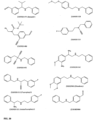
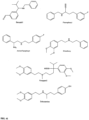
- the compound is N-[4-( ⁇ [2-(3-chlorophenyl)ethyl] amino ⁇ methyl)phenyl] acetamide (A0101); (2,3-dihydro-1,4-benzodioxin-6-ylmethyl)( ⁇ 4 [(dimethylamino)methyl]phenyl ⁇ methyl)amine (A0102); 2-[4-(4-hydroxyphenyl)piperazin-1-yl]-N,N-dimethyl-2 phenylacetamide (A0103); 3-[( ⁇ [4-(morpholin-4 ylmethyl)phenyl]methyl ⁇ amino)methyl]benzonitrile (A0104); 4-( ⁇ [3-(1-pyrrolidinylmethyl)benzyl]amino ⁇ methyl)benzonitrile (AC0105); 4- ⁇ 1-[(5-methyl-1,2-oxazol-3-yl)methyl]-1,2,3,6 tetrahydropyridin-4-yl ⁇
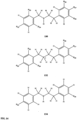
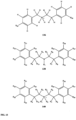
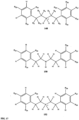
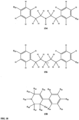
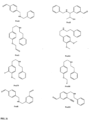
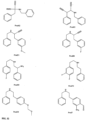
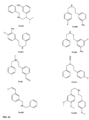
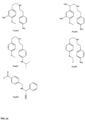
- the present invention provides a method of reducing formation of or disrupting A ⁇ 42 oligomers in a subject, the method comprising the step of administering to the subject in need thereof a therapeutically effective amount of a pharmaceutical composition comprising a compound selected from the group consisting of the following compounds: 100, 102, 104, 106, 108, 110, 112, 114, 116, 118, 120, 122, 124, 126, 128, 130, 132, 134, 136, 138, 140, 142, 144, 146, 148, 150, 152, 154, 156, 158, 160, 162, 164, 166, 168, 170, 172, 174, 176, 178, 180, 182, 184, 186, 188, 190, 192, 194, 196, 198, 200, 202, 204, 206, 208, 210, 212, 214, 216, 218, 220, 222, 224 (which are shown in Figs 9
- AD Alzheimer's disease
- a neurodegenerative disease diagnosed most often in people over 65 years of age although 4% to 5% of cases are early onset familial AD, an autosomal dominant mutation, which is often manifested before the age of 65.
- AD results in impaired cognitive function and related symptoms.
- the most common early symptom is short-term memory loss.
- symptoms can include problems with language, disorientation, mood swings, loss of motivation, self-care difficulties, and behavioral issues.
- As a person's condition declines they often withdraw from family and society. Gradually, bodily functions are lost, ultimately leading to death.
- the speed of progression can vary, the average life expectancy following diagnosis is three to nine years.
- Alzheimer's disease may be early or late onset.
- Risk factors include family history and genetic or biochemical markers.
- Genetic markers of risk for Alzheimer's disease include mutations in the APP gene, particularly mutations at position 717 and positions 670 and 671 referred to as the Hardy and Swedish mutations respectively.
- Other markers of risk are mutations in the presenilin genes, PS 1 and PS2, and ApoE4, family history of Alzheimer's Disease, hypercholesterolemia or atherosclerosis.
- Individuals presently suffering from Alzheimer's disease can be recognized from characteristic dementia, as well as the presence of risk factors described above.
- a number of diagnostic tests are available for identifying individuals who have Alzheimer's disease. These include measurement of CSF tau and A ⁇ 1-42 levels. Individuals suffering from Alzheimer's disease can also be diagnosed by ADRDA criteria or the method disclosed herein.
- treatment can begin at any age ( e.g ., 10, 20, 30 years of age). Usually, however, it is not necessary to begin treatment until a patient reaches 40, 50, 60, or 70 years of age. Treatment typically entails multiple dosages over a period of time.
- Alzheimer's disease is characterized by senile plaque formation. Plaques are made up of small peptides, about 42 amino acids in length, called amyloid beta (A ⁇ ). A ⁇ is a fragment from the larger amyloid precursor protein (APP). Recent research implicates soluble A ⁇ 42 oligomers formed at the beginning of the amyloid assembly cascade as the agents of neurotoxicity in AD, in particular the higher order states such as hexamer and dodecamer oligomers ( Bernstein et al., Nature Chemistry 1(4):326-331 (2009 ); Bernstein et al., Journal of the American Chemical Society 127(7):2075-2084 (2005 ); Cheng, et al., Journal of Biological Chemistry 282(33):23818-2382 (2007 ); Lesné, et al., Nature, 440(7082):352-357 (2006 ).
- a ⁇ amyloid beta
- APP amyloid precursor protein
- the present invention is therefore directed to small molecule compounds that reduce or inhibit or disrupt A ⁇ 42 oligomer formation, thereby treating or preventing Alzheimer's disease and/or enhancing cognitive function in a patient who has diminished cognitive function.
- Cognitive function refers to the intellectual process by which one becomes aware of, perceives, or comprehends ideas. Cognitive function embraces the quality of knowing, which includes all aspects of perception; recognition; conception; sensing; thinking; reasoning; remembering and imagining.
- the invention is also directed to inhibiting, treating or preventing decline of cognitive function.
- Diminished cognitive function may be caused by a number of diseases.
- the terms “disease,” “disorder,” and “condition” are used inclusively and refer to any condition mediated at least in part by A ⁇ 42 oligomers.
- the disease may be associated with insoluble amyloid fibrils, senile plaques, neurofibrillary tangles, and/or the over-expression of amyloid ⁇ 1-42 protein. Examples include, but are not limited to, Alzheimer's disease, Down's Syndrome, mild cognitive impairment, stroke, focal ischemia associated dementia, and neuronal degeneration.
- Patients amenable to treatment include individuals at risk of disease but not exhibiting symptoms, as well as patients presently exhibiting symptoms. Therefore, the compounds described herein can be administered prophylactically to the general population without the need for any assessment of the risk of the patient.
- diminished cognitive function or "decline of cognitive function” refers to memory loss, mental slowing, intellectual decline and/or amnesia.
- Memory loss may be characterized as the difficulty or failure for immediate or delayed recall.
- Mental slowing is the difficulty in processing or completing previously learned tasks in a timely manner or in processing new information quickly.
- Intellectual decline is defined as a loss of information, or an inability to utilize information previously possessed or utilized by a person.
- Amnesia is an extreme loss of cognitive ability that results in partial or total inability to recall past experiences and impaired or total loss of the ability to speak or write. Diminished cognitive function may be caused by a number of disease conditions which are more thoroughly discussed below.
- Methods of assessing cognitive function include, but are not limited to, standardized instruments for example Folstein Mini-Mental State Examination; Modified Mini-Mental State Exam; Middlesex Elderly Assessment of Mental State; Short Portable Mental Status Questionnaire; Alzheimer's Disease Assessment Scale; Clock Drawing Test; Clinical Dementia Rating; Neuropsychiatric Inventory or any similarly designed test.
- a skilled clinician would be able to assess the level of diminished cognitive function of a patient or enhanced cognitive function following treatment.
- informal observations and interactions of individuals to a patient can also be used to assess cognitive function and include, but are not limited to, family members, friends, formal care givers such as nurses, and individuals who have previous intimate knowledge of the patient.
- CT Computed Tomography
- CAT Computed Axial Tomography
- MRI Magnetic Resonance Imaging
- fMRI Functional Magnetic Resonance Imaging
- PET Positron Emission Tomography
- SPECT Single Photon Emission Computed Tomography
- DOI Diffuse Optical Imaging
- DOT Diffuse Optical Tomography
- oligomeric or "oligomer” means a protein complex of a finite number of monomer subunits.
- oligomers are referred to as trimers, low-nmers, hexamers, dodecamers (12-mers), and large-n-multimers composed of A ⁇ 1-42 peptides.
- a patient refers to animals, including mammals, humans, and nonhuman mammals.
- a patient is an animal, particularly an animal selected from a mammalian species including rat, rabbit, bovine, ovine, porcine, canine, feline, murine, equine, and primate, particularly human.
- the patient or subject is human.
- Treating" or “treatment of” a disease includes: (1) preventing the disease, i.e., causing the clinical symptoms of the disease not to develop in a patient that may be exposed to or predisposed to the disease but does not yet experience or display symptoms of the disease; (2) inhibiting the disease, i.e., arresting or reducing the development of the disease or its clinical symptoms; (3) relieving the disease, i.e., causing regression of the disease or its clinical symptoms; or (4) reducing the clinical symptoms of the disease.
- sensing or “in need thereof' as it related to the term “treatment” refers to a patient or individual who has been diagnosed with or is predisposed to a disease.
- a patient may also be referred to being "at risk of suffering” from a disease.
- This patient has not yet developed characteristic disease pathology, however are know to be predisposed to the disease due to family history, being genetically predisposed to developing the disease, or diagnosed with a disease or disorder that predisposes them to developing the disease to be treated.
- Alzheimer's disease In addition to Alzheimer's disease, other diseases are known to be associated with A ⁇ 1-42 formation including, but are not limited to, Down's Syndrome, stroke, mild cognitive impairment, macular degeneration and glaucoma. It is conceivable that similar to Alzheimer's disease, treatment of patients suffering from or at risk of suffering from these diseases is possible due to the parallel mechanisms of the diseases.
- a pharmaceutical composition containing one or more compounds described herein is administered to a patient suspected of, or already suffering from AD or a related disease, wherein said compounds are administered in an amount sufficient to cure, or at least partially arrest, the symptoms of the disease (biochemical, histological and/or behavioral), including its complication and intermediate pathological phenotypes in development of the disease.
- a pharmaceutical composition containing one or more compounds described herein is administered to a patient susceptible to, or otherwise at risk of, AD or a related disease, wherein said compounds are administered in an amount sufficient to eliminate or reduce the risk, lessen the severity, or delay the outset of the disease. This includes biochemical, histological and/or behavioral symptoms of the disease, its complications and intermediate pathological phenotypes presenting during development of the disease.
- the "therapeutically effective amount” will vary depending on the compound, the disease and its severity and the age, weight, etc., of the patient to be treated all of which is within the skill of the attending clinician. It is contemplated that a therapeutically effective amount of one or more of the compounds described herein will alter or prevent A ⁇ oligomer accumulation in the brain of the patient as compared to the absence of treatment. As such, impairment of long-term potentiation and subsequent memory formation is decreased or prevented.
- a therapeutically effective amount intends to indicate the amount of one or more compounds described herein administered or delivered to the patient, which is most likely to result in the desired response to treatment.
- Embodiments of the present invention also includes pharmaceutically acceptable salts of the compounds described herein.
- pharmaceutically acceptable salts refers to derivatives of the disclosed compounds wherein the parent compound is modified by converting an existing acid or base moiety to its salt form.
- examples of pharmaceutically acceptable salts include, but are not limited to, mineral or organic acid salts of basic residues such as amines; alkali or organic salts of acidic residues such as carboxylic acids; and the like.
- the pharmaceutically acceptable salts of the present invention include the conventional non-toxic salts of the parent compound formed, for example, from non-toxic inorganic or organic acids.
- the pharmaceutically acceptable salts of the present invention can be synthesized from the parent compound that contains a basic or acidic moiety by conventional chemical methods.
- such salts can be prepared by reacting the free acid or base forms of these compounds with a stoichiometric amount of the appropriate base or acid in water or in an organic solvent, or in a mixture of the two; generally, non-aqueous media like ether, ethyl acetate, ethanol, isopropanol, or acetonitrile (ACN) are preferred.
- non-aqueous media like ether, ethyl acetate, ethanol, isopropanol, or acetonitrile (ACN) are preferred.
- ACN acetonitrile
- the pharmaceutically acceptable formulation may include a carrier, which may include, but is not limited to, a binder, a lubricant, a disintegrant, an excipient, a solubilizer, a dispersing agent, a stabilizer, a suspending agent, a colorant, and a flavorant.
- a carrier which may include, but is not limited to, a binder, a lubricant, a disintegrant, an excipient, a solubilizer, a dispersing agent, a stabilizer, a suspending agent, a colorant, and a flavorant.
- the carrier may include a buffering agent, a preserving agent, an analgesic, a solubilizer, an isotonic agent, and a stabilizer.
- the carrier may include a base, an excipient, a lubricant, and a preserving agent.
- compositions may be formulated into a variety of dosage forms in combination with the aforementioned pharmaceutically acceptable carriers.
- the pharmaceutical composition may be formulated into tablets, troches, capsules, elixirs, suspensions, syrups or wafers.
- the pharmaceutical composition may be formulated into an ampule as a single dosage form or a multidose container.
- the pharmaceutical composition may also be formulated into solutions, suspensions, tablets, pills, capsules and long-acting preparations.
- the carrier, the excipient, and the diluent suitable for the pharmaceutical formulations include, without limitation, lactose, dextrose, sucrose, sorbitol, mannitol, xylitol, erythritol, maltitol, starch, acacia rubber, alginate, gelatin, calcium phosphate, calcium silicate, cellulose, methylcellulose, microcrystalline cellulose, polyvinylpyrrolidone, water, methylhydroxybenzoate, propylhydroxybenzoate, talc, magnesium stearate and mineral oils.
- the pharmaceutical formulations may further include fillers, anti-coagulating agents, lubricants, humectants, flavorants, and antiseptics.
- Effective doses of the compositions of the present invention, for the treatment of the above described diseases vary depending upon may different factors, including means of administration, physiological state of the patient, whether the patient is human or an animal, other medications administered, and whether treatment is prophylactic or therapeutic.
- the patient is a human, but in certain embodiments, a patient is an animal, particularly an animal selected from a mammalian species including canine, feline, murine, equine, and primate.
- the compounds can be administered on multiple occasions, wherein intervals between single dosages can be daily, weekly, monthly, or yearly. Intervals can also be irregular as indicated by measuring blood levels of A ⁇ 1-42 protein or oligomers in the patient.
- one or more of the compounds of the invention can be administered as a sustained-release formulation, in which case less frequent administration is required. Dosage and frequency may vary depending on the half-life of the compounds of the invention. In therapeutic applications, a relatively high dosage at relatively short intervals is sometimes required until progression of the disease is reduced or terminated, and preferably until the patient shows partial or complete amelioration of symptoms of the disease. Thereafter, the patient can be administered a prophylactic regime.
- Administration of a pharmaceutical composition of the compounds described herein can be carried out via a variety of routes including, but are not limited to, oral, topical, pulmonary, rectal, subcutaneous, intradermal, intranasal, intracranial, intramuscular, intraocular, or intraarticular injection and the like.
- routes including, but are not limited to, oral, topical, pulmonary, rectal, subcutaneous, intradermal, intranasal, intracranial, intramuscular, intraocular, or intraarticular injection and the like.
- the most typical route of administration is oral, although other routes can be equally effective.
- One or more compounds described herein can optionally be administered in combination with other biological or chemical agents that are at least partly effective in treatment of an A ⁇ 1 42 associated disease.
- An example of such an agent is, but are not limited to, A ⁇ 1-42 targeted antibodies as described in International Application Nos.: WO 2003/253673 ; WO 2006/014478 , U.S. Pat. No. 2,489,195 , U.S. Publication No. 2007-0048312 , and U.S. application Ser. No. 11/571,532 , which are incorporated herein by reference.
- the compounds described herein may be administered to a patient in an amount sufficient to inhibit, regulate and/or A ⁇ oligomers in said patient.
- a skilled clinician would be able to readily ascertain appropriate amounts of the compounds described here to effectively inhibit, regulate and/or modulate the formation of A ⁇ oligomers in said patient.
- Contemplated amounts of the compounds described herein include for example, but are not limited to, from about 0.05 to 2000 mg/m2/day of one compound or more than one compound.
- the compounds described herein may be administered for example, but are not limited to, orally, topically, pulmonarily, rectally, subcutaneously, intradermally, intranasally, intracranially, intramuscularly, intraocularly, or intra-arterially and the like.
- the carrier or excipient or excipient mixture can be a solvent or a dispersive medium containing for example, but are not limited to, various polar or non-polar solvents, suitable mixtures thereof, or oils.
- carrier or “excipient” means a pharmaceutically acceptable carrier or excipient and includes any and all solvents, dispersive agents or media, coating(s), antimicrobial agents, iso/hypo/hypertonic agents, absorption-modifying agents, and the like.
- carrier or “excipient” means a pharmaceutically acceptable carrier or excipient and includes any and all solvents, dispersive agents or media, coating(s), antimicrobial agents, iso/hypo/hypertonic agents, absorption-modifying agents, and the like.
- the use of such substances and the agents for pharmaceutically active substances is well known in the art.
- other or supplementary active ingredients can also be incorporated into the final composition.
- Diseases that are treated by the methods described herein include Alzheimer's disease, Down's Syndrome, stroke, mild cognitive impairment, focal ischemia associated dementia, neuronal degeneration, macular degeneration and glaucoma.
- the compounds of this invention are usually administered in the form of pharmaceutical compositions.
- These compounds can be administered by a variety of routes including oral, topical, pulmonary, rectal, subcutaneous, intradermal, intranasal, intracranial, intramuscular, intraocular, or intra-articular injection. These compounds are effective as both injectable and oral compositions.
- Such compositions are prepared in a manner well known in the pharmaceutical art and comprise at least one active compound.
- compositions that contain, as the active ingredient, one or more of the compounds described herein associated with pharmaceutically acceptable carriers.
- the active ingredient is usually mixed with an excipient, diluted by an excipient or enclosed within such a carrier which can be in the form of a capsule, sachet, paper or other container.
- the excipient employed is typically an excipient suitable for administration to patient.
- the excipient serves as a diluent, it can be a solid, semi-solid, or liquid material, which acts as a vehicle, carrier or medium for the active ingredient.
- compositions can be in the form of tablets, pills, powders, lozenges, sachets, cachets, elixirs, suspensions, emulsions, solutions, syrups, aerosols (as a solid or in a liquid medium), ointments containing, for example, up to 10% by weight of the active compound, soft and hard gelatin capsules, suppositories, sterile injectable solutions, and sterile packaged powders.
- the active compound In preparing a formulation, it may be necessary to mill the active compound to provide the appropriate particle size prior to combining with the other ingredients. If the active compound is substantially insoluble, it ordinarily is milled to a particle size of less than 200 mesh. If the active compound is substantially water soluble, the particle size is normally adjusted by milling to provide a substantially uniform distribution in the formulation, e.g. about 40 mesh.
- excipients include lactose, dextrose, sucrose, sorbitol, mannitol, starches, gum acacia, calcium phosphate, alginates, tragacanth, gelatin, calcium silicate, microcrystalline cellulose, polyvinylpyrrolidone, cellulose, water, syrup, and methyl cellulose.
- the formulations can additionally include: lubricating agents such as talc, magnesium stearate, and mineral oil; wetting agents; emulsifying and suspending agents; preserving agents such as methyl- and propylhydroxy-benzoates; sweetening agents; and flavoring agents.
- the compositions of the invention can be formulated so as to provide quick, sustained or delayed release of the active ingredient after administration to the patient by employing procedures known in the art.
- intravenous formulation should possess certain qualities aside from being just a composition in which the therapeutic agent is soluble.
- the formulation should promote the overall stability of the active ingredient(s), also, the manufacture of the formulation should be cost effective. All of these factors ultimately determine the overall success and usefulness of an intravenous formulation.
- solvents ethanol, glycerol, propylene glycol
- stabilizers ethylene diamine tetra acetic acid (EDTA), citric acid
- antimicrobial preservatives benzyl alcohol, methyl paraben, propyl paraben
- buffering agents citric acid/sodium citrate, potassium hydrogen tartrate, sodium hydrogen tartrate, acetic acid/sodium acetate, maleic acid/sodium maleate, sodium hydrogen phthalate, phosphoric acid/potassium dihydrogen phosphate, phosphoric acid/disodium hydrogen phosphate
- tonicity modifiers sodium chloride, mannitol, dextrose.
- the presence of a buffer may be necessary to maintain the aqueous pH in the range of from about 4 to about 8 and more preferably in a range of from about 4 to about 6.
- the buffer system is generally a mixture of a weak acid and a soluble salt thereof, e.g., sodium citrate/citric acid; or the mono-cation or di-cation salt of a dibasic acid, e.g., potassium hydrogen tartrate; sodium hydrogen tartrate, phosphoric acid/potassium di-hydrogen phosphate, and phosphoric acid/disodium hydrogen phosphate.
- the amount of buffer system used is dependent on (1) the desired pH; and (2) the amount of drug.
- the amount of buffer used is in a 0.5:1 to 50:1 mole ratio of buffer:drug (where the moles of buffer are taken as the combined moles of the buffer ingredients, e.g., sodium citrate and citric acid) of formulation to maintain a pH in the range of 4 to 8 and generally, a 1:1 to 10:1 mole ratio of buffer (combined) to drug present is used.
- One useful buffer in the invention is sodium citrate/citric acid in the range of 5 to 50 mg per mL of sodium citrate to 1 to 15 mg per mL of citric acid, sufficient to maintain an aqueous pH of 4-6 of the composition.
- the buffer agent may also be present to prevent the precipitation of the drug through soluble metal complex formation with dissolved metal ions, e.g., Ca, Mg, Fe, Al, Ba, which may leach out of glass containers or rubber stoppers or be present in ordinary tap water.
- the agent may act as a competitive complexing agent with the drug and produce a soluble metal complex leading to the presence of undesirable particulates.
- the presence of an agent, e.g., sodium chloride in an amount of about of 1-8 mg/mL, to adjust the tonicity to the same value of human blood may be required to avoid the swelling or shrinkage of erythrocytes upon administration of the intravenous formulation leading to undesirable side effects such as nausea or diarrhea and possibly to associated blood disorders.
- the tonicity of the formulation matches that of human blood which is in the range of 282 to 288 mOsm/kg, and in general is 285 mOsm/kg, which is equivalent to the osmotic pressure corresponding to a 0.9% solution of sodium chloride.
- the intravenous formulation can be administered by direct intravenous injection, i.v. bolus, or can be administered by infusion by addition to an appropriate infusion solution such as 0.9% sodium chloride injection or other compatible infusion solution.
- compositions can be formulated in an oral unit dosage form.
- unit dosage forms refers to physically discrete units suitable as unitary dosages for a patient, each unit containing a predetermined quantity of active material calculated to produce the desired therapeutic effect, in association with a suitable pharmaceutical excipient.
- the total effective dose of the compositions disclosed herein may be administered to a patient in a single dose, or may be administered for a long period of time in multiple doses according to a fractionated treatment protocol.
- the content of active ingredient may vary depending on the disease severity.
- the total daily dose of the compounds disclosed herein may be approximately 0.0001 to 500 mg per 1 kg of body weight of a patient.
- the effective dose of the compound is determined considering various factors including patient's age, body weight, health conditions, gender, disease severity, diet, and secretion rate, in addition to administration route and treatment frequency of the pharmaceutical composition. In view of this, those skilled in the art may easily determine an effective dose suitable for the particular use of the pharmaceutical composition disclosed herein.
- the pharmaceutical composition disclosed herein is not particularly limited to the formulation, and administration route and mode, as long as it shows suitable effects.
- the pharmaceutical composition may be administered alone or in combination or coincident with other pharmaceutical formulations showing prophylactic or therapeutic efficacy
- the dose of the composition may be administered daily, semiweekly, weekly, bi-weekly, or monthly.
- the period of treatment may be for a week, two weeks, a month, two months, four months, six months, eight months, a year, or longer.
- the initial dose may be larger than a sustaining dose.
- the dose ranges from a weekly dose of at least 0.10 mg, at least 0.50 mg, at least 1.0 mg, at least 5.0 mg, at least 10.0 mg, at least 50.0 mg, at least 100.0 mg, at least 500.0 mg, at least 1.0 g, at least 5.0 g, or at least 10.0 g.
- a weekly dose may be at most 0.5 mg, at most 2.5 mg, at most 5.0 mg, at most 25.0 mg, at most 50.0 mg, at most 250.0 mg, at most 500.0 mg, at most 2.50 g, at most 5.0 g, at most 25.0 g or at most 50.0 g.
- the weekly dose may range from 1.0 mg to 50.0 g, from 10.0 mg to 25.0 g, or from 100 mg to 5.0 g.
- the principal active ingredient is mixed with a pharmaceutical excipient to form a solid preformulation composition containing a homogeneous mixture of a compound of the present invention.
- a solid preformulation composition containing a homogeneous mixture of a compound of the present invention.
- the active ingredient is dispersed evenly throughout the composition so that the composition may be readily subdivided into equally effective unit dosage forms such as tablets, pills and capsules.
- This solid preformulation is then subdivided into unit dosage forms of the type described above containing from, for example, 0.05 to about 2000 mg of the active ingredient of the present invention.
- the tablets or pills of the present invention may be coated or otherwise compounded to provide a dosage form affording the advantage of prolonged action.
- the tablet or pill can comprise an inner dosage and an outer dosage component, the latter being in the form of an envelope over the former.
- the two components can be separated by an enteric layer which serves to resist disintegration in the stomach and permit the inner component to pass intact into the duodenum or to be delayed in release.
- enteric layers or coatings such materials including a number of polymeric acids and mixtures of polymeric acids with such materials as shellac, cetyl alcohol, and cellulose acetate.
- liquid forms in which the novel compositions of the present invention may be incorporated for administration orally or by injection include aqueous solutions suitably flavored syrups, aqueous or oil suspensions, and flavored emulsions with edible oils such as cottonseed oil, sesame oil, coconut oil, or peanut oil, as well as elixirs and similar pharmaceutical vehicles.
- compositions for inhalation or insufflation include solutions and suspensions in pharmaceutically acceptable, aqueous or organic solvents, or mixtures thereof, and powders.
- the liquid or solid compositions may contain suitable pharmaceutically acceptable excipients as described supra.
- the compositions are administered by the oral or nasal respiratory route for local or systemic effect.
- Compositions in preferably pharmaceutically acceptable solvents may be nebulized by use of inert gases. Nebulized solutions may be breathed directly from the nebulizing device or the nebulizing device may be attached to a face masks tent, or intermittent positive pressure breathing machine. Solution, suspension, or powder compositions may be administered, preferably orally or nasally, from devices that deliver the formulation in an appropriate manner.
- Acyl refers to a ketone substituent, C(O)R, where R is alkyl or substituted alkyl, aryl or substituted aryl as defined herein.
- Alkenyl refers to an unsaturated “alkyl” group that contains a double bond.
- Alkoxy refers to an -OR group, where R is alkyl, or a substituted analogue thereof. Suitable alkoxy groups include, for example, methoxy, ethoxy, t-butoxy, etc.
- Alkyl refers to a branched or unbranched, saturated or unsaturated, monovalent and hydrocarbon group, generally having from about 1-30 carbons and preferably, from 4-20 carbons and more preferably from 6-18 carbons. When the alkyl group has from 1-6 carbon atoms, it is referred to as a "lower alkyl.” Branched structures have a branching motif similar to i-propyl, t-butyl, i-butyl, 2-ethylpropyl, etc. As used herein, the term encompasses "substituted alkyls," and "cyclic alkyl.”
- the term (C 1 -C 8 )alkyl refers to an alkyl that has between one and eight carbon atoms.
- Alkynyl refers to an unsaturated “alkyl” group that contains a triple bond.
- Amino refers to -NRR', wherein R and R' are independently H, alkyl, aryl or substituted analogues thereof. “Amino” encompasses “alkylamino” denoting secondary and tertiary amines and “acylamino” describing the group RC(O)NR'.
- Aryl refers to an aromatic substituent, which may be a single aromatic ring or multiple aromatic rings which are fused together, linked covalently, or linked to a common group such as a diazo, methylene or ethylene moiety.
- the common linking group may also be a carbonyl as in benzophenone.
- the aromatic ring(s) may include phenyl, naphthyl, biphenyl, diphenylmethyl and benzophenone among others.
- aryl encompasses “arylalkyl” and "substituted aryl.”
- Arylalkyl refers to a subset of "aryl” in which the aryl group is attached to another group by an alkyl group as defined herein.
- Aryloxy refers to aromatic groups that are linked to another group directly through an oxygen atom. This term encompasses "substituted aryloxy” moieties in which the aromatic group is substituted as described above for "substituted aryl.” Exemplary aryloxy moieties include phenoxy, substituted phenoxy, benzyloxy, phenethyloxy, etc.
- Aryloxyalkyl refers to aromatic groups attached, through an oxygen atom to an alkyl group, as defined herein.
- aryloxyalkyl encompasses "substituted aryloxyalkyl” moieties in which the aromatic group is substituted as described for “substituted aryl.”
- Electrode withdrawing group refers to an atom or group that draws electron density from neighboring atoms towards itself through resonance or inductive effects. This includes groups such as -NO 2 , -CN, -C(O)H, -C(O)R where "R” is an alkyl group, -CO 2 R where “R” is an alkyl group, and -CO 2 H.
- Halogen refers to fluorine, bromine, chlorine and iodine atoms.
- Heteroaryl refers to aromatic rings in which one or more carbon atoms of the aromatic ring(s) are replaced by a heteroatom such as nitrogen, oxygen or sulfur. Heteroaryl refers to structures that may be a single aromatic ring, multiple aromatic ring(s), or one or more aromatic rings coupled to one or more non-aromatic ring(s). In structures having multiple rings, the rings can be fused together, linked covalently, or linked to a common group such as a diazo, methylene or ethylene moiety.
- the common linking group may also be a carbonyl as in phenyl pyridyl ketone.
- rings such as thiophene, pyridine, isoxazole, phthalimide, pyrazole, indole, furan, etc. or benzo-fused analogues of these rings are defined by the term "heteroaryl.”
- Heteroarylalkyl refers to a subset of “heteroaryl” wherein an alkyl group, as defined herein, links the heteroaryl group to another group.
- Heterocyclic refers to a monovalent saturated or unsaturated non-aromatic group having a single ring or multiple condensed rings from 1-12 carbon atoms and from 1-4 heteroatoms selected from nitrogen, sulfur or oxygen within the ring.
- Such heterocycles are, for example, tetrahydrofuran, morpholine, piperidine, pyrrolidine, etc.
- Heterocyclicalkyl refers to a subset of “heterocyclic” wherein an alkyl group, as defined herein, links the heterocyclic group to another group.
- Haldroxy refers to the group -OH.
- Mercapto refers to moieties of the general structure -S-R wherein R is H, alkyl, aryl or heterocyclic as described herein.
- “Saturated cyclic hydrocarbon” refers to groups such as the cyclopropyl, cyclobutyl, cyclopentyl, etc ., and substituted analogues of these structures. These cyclic hydrocarbons can be single- or multi-ring structures.
- Substituted alkenyl refers to an "alkenyl” that includes one or more substituents such as, for example, lower alkyl, aryl, acyl, halogen ( e.g ., alkylhalos), hydroxy, amino, alkoxy, alkylamino, acylamino, thioamido, acyloxy, aryloxy, aryloxyalkyl, mercapto, thia, aza, oxo, both saturated and unsaturated cyclic hydrocarbons, heterocycles and the like. These groups may be attached to any carbon or substituent of the alkenyl moiety. Additionally, these groups may be pendent from, or integral to, the alkenyl chain.
- substituents such as, for example, lower alkyl, aryl, acyl, halogen (e.g ., alkylhalos), hydroxy, amino, alkoxy, alkylamino, acylamino, thioamid
- Substituted alkyl refers to an "alkyl” that includes one or more substituents such as, for example, lower alkyl, aryl, acyl, halogen (e.g ., alkylhalos), hydroxy, amino, alkoxy, alkylamino, acylamino, thioamido, acyloxy, aryloxy, aryloxyalkyl, mercapto, thia, aza, oxo, both saturated and unsaturated cyclic hydrocarbons, heterocycles and the like. These groups may be attached to any carbon or substituent of the alkyl moiety. Additionally, these groups may be pendent from, or integral to, the alkyl chain.
- substituents such as, for example, lower alkyl, aryl, acyl, halogen (e.g ., alkylhalos), hydroxy, amino, alkoxy, alkylamino, acylamino, thioamido, acyl
- Substituted alkynyl refers to an "alkynyl” that includes one or more substituents such as, for example, lower alkyl, aryl, acyl, halogen ( e.g ., alkylhalos), hydroxy, amino, alkoxy, alkylamino, acylamino, thioamido, acyloxy, aryloxy, aryloxyalkyl, mercapto, thia, aza, oxo, both saturated and unsaturated cyclic hydrocarbons, heterocycles and the like.
- substituents such as, for example, lower alkyl, aryl, acyl, halogen (e.g ., alkylhalos), hydroxy, amino, alkoxy, alkylamino, acylamino, thioamido, acyloxy, aryloxy, aryloxyalkyl, mercapto, thia, aza, oxo, both saturated and
- Substituted aryl refers to an "aryl” that includes one or more functional groups such as lower alkyl, acyl, halogen, alkylhalos ( e.g . CF 3 ), hydroxy, amino, alkoxy, alkylamino, acylamino, acyloxy, phenoxy, mercapto and both saturated and unsaturated cyclic hydrocarbons which are fused to the aromatic ring(s), linked covalently or linked to a common group such as a diazo, methylene or ethylene moiety.
- the linking group may also be a carbonyl such as in cyclohexyl phenyl ketone.
- substituted aryl encompasses "substituted arylalkyl.”
- Substituted arylalkyl refers to a subset of "substituted aryl” wherein the substituted aryl group is attached to another group by an alkyl group as defined herein.
- Substituted heteroaryl refers to a heteroaryl wherein the heteroaryl nucleus is substituted with one or more functional groups such as lower alkyl, acyl, halogen, alkylhalos ( e.g. CF 3 ), hydroxy, amino, alkoxy, alkylamino, acylamino, acyloxy, mercapto, etc.
- substituted analogues of heteroaromatic rings such as thiophene, pyridine, isoxazole, phthalimide, pyrazole, indole, furan, etc. or benzo-fused analogues of these rings are defined by the term "substituted heteroaryl.”
- Substituted heteroarylalkyl refers to a subset of "substituted heteroaryl” in which an alkyl group, as defined herein, links the heteroaryl group to another group.
- Substituted heterocyclic refers to a subset of “heterocyclic” wherein the heterocycle nucleus is substituted with one or more functional groups such as lower alkyl, acyl, halogen, alkylhalos ( e.g ., CF 3 ), hydroxy, amino, alkoxy, alkylamino, acylamino, acyloxy, mercapto, etc.
- functional groups such as lower alkyl, acyl, halogen, alkylhalos ( e.g ., CF 3 ), hydroxy, amino, alkoxy, alkylamino, acylamino, acyloxy, mercapto, etc.
- Unsaturated cyclic hydrocarbon refers to a monovalent non-aromatic group with at least one double bond, such as cyclopentene, cyclohexene, etc. and substituted analogues thereof. These cyclic hydrocarbons can be single- or multi-ring structures.
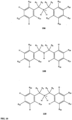
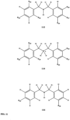
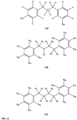
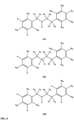
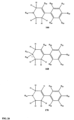
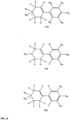
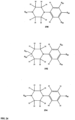
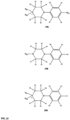
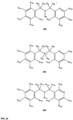
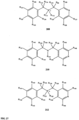
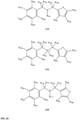
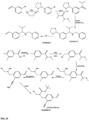
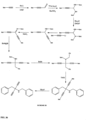
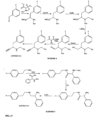
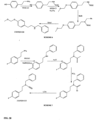
- FIGs 9-29 show certain compounds according to the present invention for the treatment of AD or a related disease. Where a cation is shown ( e.g ., compounds 102 and 106 ) a negatively charged, pharmaceutically acceptable counterion (e.g ., AcO-) is implied.
- a cation e.g ., compounds 102 and 106
- a pharmaceutically acceptable counterion e.g ., AcO-
- substituents R 1 , R 3 -R 6 , R 20 -R 29 are independently selected ( e.g., all can be the same or different) from a group consisting of: hydrogen, acyl, alkenyl, alkoxy, alkyl, alkynyl, amino, aryl, arylalkyl, aryloxy, aryloxyalkyl, electron withdrawing group, halogen, heteroaryl, heteroarylalkyl, heterocyclic, heterocyclicalkyl, hydroxy, mercapto, saturated cyclic hydrocarbon, substituted alkenyl, substituted alkyl, substituted alkynyl, substituted aryl, substituted arylalkyl, substituted heteroaryl, substituted heteroarylalkyl, substituted heterocyclic, or unsaturated cyclic hydrocarbon.
- substituents R 1 -R 6 , R 20 -R 29 are independently selected ( e.g ., all can be the same or different) from a group consisting of: hydrogen, acyl, alkenyl, alkoxy, alkyl, alkynyl, amino, aryl, arylalkyl, aryloxy, aryloxyalkyl, electron withdrawing group, halogen, heteroaryl, heteroarylalkyl, heterocyclic, heterocyclicalkyl, hydroxy, mercapto, saturated cyclic hydrocarbon, substituted alkenyl, substituted alkyl, substituted alkynyl, substituted aryl, substituted arylalkyl, substituted heteroaryl, substituted heteroarylalkyl, substituted heterocyclic, or unsaturated cyclic hydrocarbon.
- compound 104, substituents R 3 -R 6 , R 20 -R 29 are independently selected ( e.g ., all can be the same or different) from a group consisting of: hydrogen, acyl, alkenyl, alkoxy, alkyl, alkynyl, amino, aryl, arylalkyl, aryloxy, aryloxyalkyl, electron withdrawing group, halogen, heteroaryl, heteroarylalkyl, heterocyclic, heterocyclicalkyl, hydroxy, mercapto, saturated cyclic hydrocarbon, substituted alkenyl, substituted alkyl, substituted alkynyl, substituted aryl, substituted arylalkyl, substituted heteroaryl, substituted heteroarylalkyl, substituted heterocyclic, or unsaturated cyclic hydrocarbon.
- substituents R 3 -R 6 , R 20 , R 22 , R 24 , R 25 -R 29 are independently selected ( e.g ., all can be the same or different) from a group consisting of: hydrogen, acyl, alkenyl, alkoxy, alkyl, alkynyl, amino, aryl, arylalkyl, aryloxy, aryloxyalkyl, electron withdrawing group, halogen, heteroaryl, heteroarylalkyl, heterocyclic, heterocyclicalkyl, hydroxy, mercapto, saturated cyclic hydrocarbon, substituted alkenyl, substituted alkyl, substituted alkynyl, substituted aryl, substituted arylalkyl, substituted heteroaryl, substituted heteroarylalkyl, substituted heterocyclic, or unsaturated cyclic hydrocarbon.
- substituents R 3 -R 6 , R 20 , R 22 , R 24 , R 26 -R 28 are independently selected ( e.g ., all can be the same or different) from a group consisting of: hydrogen, acyl, alkenyl, alkoxy, alkyl, alkynyl, amino, aryl, arylalkyl, aryloxy, aryloxyalkyl, electron withdrawing group, halogen, heteroaryl, heteroarylalkyl, heterocyclic, heterocyclicalkyl, hydroxy, mercapto, saturated cyclic hydrocarbon, substituted alkenyl, substituted alkyl, substituted alkynyl, substituted aryl, substituted arylalkyl, substituted heteroaryl, substituted heteroarylalkyl, substituted heterocyclic, or unsaturated cyclic hydrocarbon.
- substituents R 3 -R 6 , R 20 , R 22 , R 24 , R 26 -R 28 are independently selected ( e.g., all can be the same or different) from a group consisting of: hydrogen, acyl, alkenyl, alkoxy, alkyl, alkynyl, amino, aryl, arylalkyl, aryloxy, aryloxyalkyl, electron withdrawing group, halogen, heteroaryl, heteroarylalkyl, heterocyclic, heterocyclicalkyl, hydroxy, mercapto, saturated cyclic hydrocarbon, substituted alkenyl, substituted alkyl, substituted alkynyl, substituted aryl, substituted arylalkyl, substituted heteroaryl, substituted heteroarylalkyl, substituted heterocyclic, or unsaturated cyclic hydrocarbon.
- substituents R 20 , R 22 , R 24 , R 26 -R 28 are independently selected ( e.g., all can be the same or different) from a group consisting of: hydrogen, acyl, alkenyl, alkoxy, alkyl, alkynyl, amino, aryl, arylalkyl, aryloxy, aryloxyalkyl, electron withdrawing group, halogen, heteroaryl, heteroarylalkyl, heterocyclic, heterocyclicalkyl, hydroxy, mercapto, saturated cyclic hydrocarbon, substituted alkenyl, substituted alkyl, substituted alkynyl, substituted aryl, substituted arylalkyl, substituted heteroaryl, substituted heteroarylalkyl, substituted heterocyclic, or unsaturated cyclic hydrocarbon.
- substituents R 20 , R 22 , R 24 , R 26 -R 28 are independently selected ( e.g., all can be the same or different) from a group consisting of: hydrogen, acyl, alkenyl, alkoxy, alkyl, alkynyl, amino, aryl, arylalkyl, aryloxy, aryloxyalkyl, electron withdrawing group, halogen, heteroaryl, heteroarylalkyl, heterocyclic, heterocyclicalkyl, hydroxy, mercapto, saturated cyclic hydrocarbon, substituted alkenyl, substituted alkyl, substituted alkynyl, substituted aryl, substituted arylalkyl, substituted heteroaryl, substituted heteroarylalkyl, substituted heterocyclic, or unsaturated cyclic hydrocarbon.
- compound 116, substituents R 22 , R 26 are independently selected ( e.g., all can be the same or different) from a group consisting of: hydrogen, acyl, alkenyl, alkoxy, alkyl, alkynyl, amino, aryl, arylalkyl, aryloxy, aryloxyalkyl, electron withdrawing group, halogen, heteroaryl, heteroarylalkyl, heterocyclic, heterocyclicalkyl, hydroxy, mercapto, saturated cyclic hydrocarbon, substituted alkenyl, substituted alkyl, substituted alkynyl, substituted aryl, substituted arylalkyl, substituted heteroaryl, substituted heteroarylalkyl, substituted heterocyclic, or unsaturated cyclic hydrocarbon.
- substituents R 22 , R 26 are independently selected ( e.g., all can be the same or different) from a group consisting of: hydrogen, acyl, alkenyl, alkoxy, alkyl, alkynyl, amino, aryl, arylalkyl, aryloxy, aryloxyalkyl, electron withdrawing group, halogen, heteroaryl, heteroarylalkyl, heterocyclic, heterocyclicalkyl, hydroxy, mercapto, saturated cyclic hydrocarbon, substituted alkenyl, substituted alkyl, substituted alkynyl, substituted aryl, substituted arylalkyl, substituted heteroaryl, substituted heteroarylalkyl, substituted heterocyclic, or unsaturated cyclic hydrocarbon.
- substituents R 1 , R 3 -R 8 , R 20 -R 29 are independently selected ( e.g., all can be the same or different) from a group consisting of: hydrogen, acyl, alkenyl, alkoxy, alkyl, alkynyl, amino, aryl, arylalkyl, aryloxy, aryloxyalkyl, electron withdrawing group, halogen, heteroaryl, heteroarylalkyl, heterocyclic, heterocyclicalkyl, hydroxy, mercapto, saturated cyclic hydrocarbon, substituted alkenyl, substituted alkyl, substituted alkynyl, substituted aryl, substituted arylalkyl, substituted heteroaryl, substituted heteroarylalkyl, substituted heterocyclic, or unsaturated cyclic hydrocarbon.
- compound 122, substituents Ri-Rs, R 20 -R 29 are independently selected ( e.g., all can be the same or different) from a group consisting of: hydrogen, acyl, alkenyl, alkoxy, alkyl, alkynyl, amino, aryl, arylalkyl, aryloxy, aryloxyalkyl, electron withdrawing group, halogen, heteroaryl, heteroarylalkyl, heterocyclic, heterocyclicalkyl, hydroxy, mercapto, saturated cyclic hydrocarbon, substituted alkenyl, substituted alkyl, substituted alkynyl, substituted aryl, substituted arylalkyl, substituted heteroaryl, substituted heteroarylalkyl, substituted heterocyclic, or unsaturated cyclic hydrocarbon.
- compound 124, substituents R 3 -R 8 , R 20 , R 22 , R 24 , R 25 -R 29 are independently selected ( e.g., all can be the same or different) from a group consisting of: hydrogen, acyl, alkenyl, alkoxy, alkyl, alkynyl, amino, aryl, arylalkyl, aryloxy, aryloxyalkyl, electron withdrawing group, halogen, heteroaryl, heteroarylalkyl, heterocyclic, heterocyclicalkyl, hydroxy, mercapto, saturated cyclic hydrocarbon, substituted alkenyl, substituted alkyl, substituted alkynyl, substituted aryl, substituted arylalkyl, substituted heteroaryl, substituted heteroarylalkyl, substituted heterocyclic, or unsaturated cyclic hydrocarbon.
- substituents R 3 -R 8 , R 20 , R 22 , R 24 , R 25 -R 29 are independently selected ( e.g., all can be the same or different) from a group consisting of: hydrogen, acyl, alkenyl, alkoxy, alkyl, alkynyl, amino, aryl, arylalkyl, aryloxy, aryloxyalkyl, electron withdrawing group, halogen, heteroaryl, heteroarylalkyl, heterocyclic, heterocyclicalkyl, hydroxy, mercapto, saturated cyclic hydrocarbon, substituted alkenyl, substituted alkyl, substituted alkynyl, substituted aryl, substituted arylalkyl, substituted heteroaryl, substituted heteroarylalkyl, substituted heterocyclic, or unsaturated cyclic hydrocarbon.
- substituents R 3 -R 8 , R 20 , R 22 , R 24 , R 26 -R 28 are independently selected ( e.g., all can be the same or different) from a group consisting of: hydrogen, acyl, alkenyl, alkoxy, alkyl, alkynyl, amino, aryl, arylalkyl, aryloxy, aryloxyalkyl, electron withdrawing group, halogen, heteroaryl, heteroarylalkyl, heterocyclic, heterocyclicalkyl, hydroxy, mercapto, saturated cyclic hydrocarbon, substituted alkenyl, substituted alkyl, substituted alkynyl, substituted aryl, substituted arylalkyl, substituted heteroaryl, substituted heteroarylalkyl, substituted heterocyclic, or unsaturated cyclic hydrocarbon.
- substituents R 20 , R 22 , R 24 , R 26 -R 28 are independently selected ( e.g., all can be the same or different) from a group consisting of: hydrogen, acyl, alkenyl, alkoxy, alkyl, alkynyl, amino, aryl, arylalkyl, aryloxy, aryloxyalkyl, electron withdrawing group, halogen, heteroaryl, heteroarylalkyl, heterocyclic, heterocyclicalkyl, hydroxy, mercapto, saturated cyclic hydrocarbon, substituted alkenyl, substituted alkyl, substituted alkynyl, substituted aryl, substituted arylalkyl, substituted heteroaryl, substituted heteroarylalkyl, substituted heterocyclic, or unsaturated cyclic hydrocarbon.
- compound 132, substituents R 20 , R 22 , R 24 , R 26 -R 28 are independently selected ( e.g., all can be the same or different) from a group consisting of: hydrogen, acyl, alkenyl, alkoxy, alkyl, alkynyl, amino, aryl, arylalkyl, aryloxy, aryloxyalkyl, electron withdrawing group, halogen, heteroaryl, heteroarylalkyl, heterocyclic, heterocyclicalkyl, hydroxy, mercapto, saturated cyclic hydrocarbon, substituted alkenyl, substituted alkyl, substituted alkynyl, substituted aryl, substituted arylalkyl, substituted heteroaryl, substituted heteroarylalkyl, substituted heterocyclic, or unsaturated cyclic hydrocarbon.
- substituents R 22 , R 26 are independently selected ( e.g., all can be the same or different) from a group consisting of: hydrogen, acyl, alkenyl, alkoxy, alkyl, alkynyl, amino, aryl, arylalkyl, aryloxy, aryloxyalkyl, electron withdrawing group, halogen, heteroaryl, heteroarylalkyl, heterocyclic, heterocyclicalkyl, hydroxy, mercapto, saturated cyclic hydrocarbon, substituted alkenyl, substituted alkyl, substituted alkynyl, substituted aryl, substituted arylalkyl, substituted heteroaryl, substituted heteroarylalkyl, substituted heterocyclic, or unsaturated cyclic hydrocarbon.
- substituents R 22 , R 26 are independently selected ( e.g., all can be the same or different) from a group consisting of: hydrogen, acyl, alkenyl, alkoxy, alkyl, alkynyl, amino, aryl, arylalkyl, aryloxy, aryloxyalkyl, electron withdrawing group, halogen, heteroaryl, heteroarylalkyl, heterocyclic, heterocyclicalkyl, hydroxy, mercapto, saturated cyclic hydrocarbon, substituted alkenyl, substituted alkyl, substituted alkynyl, substituted aryl, substituted arylalkyl, substituted heteroaryl, substituted heteroarylalkyl, substituted heterocyclic, or unsaturated cyclic hydrocarbon.
- substituents R 1 , R 3 -R 10 , R 20 -R 29 are independently selected ( e.g., all can be the same or different) from a group consisting of: hydrogen, acyl, alkenyl, alkoxy, alkyl, alkynyl, amino, aryl, arylalkyl, aryloxy, aryloxyalkyl, electron withdrawing group, halogen, heteroaryl, heteroarylalkyl, heterocyclic, heterocyclicalkyl, hydroxy, mercapto, saturated cyclic hydrocarbon, substituted alkenyl, substituted alkyl, substituted alkynyl, substituted aryl, substituted arylalkyl, substituted heteroaryl, substituted heteroarylalkyl, substituted heterocyclic, or unsaturated cyclic hydrocarbon.
- substituents R 1 -R 10 , R 20 -R 29 are independently selected ( e.g., all can be the same or different) from a group consisting of: hydrogen, acyl, alkenyl, alkoxy, alkyl, alkynyl, amino, aryl, arylalkyl, aryloxy, aryloxyalkyl, electron withdrawing group, halogen, heteroaryl, heteroarylalkyl, heterocyclic, heterocyclicalkyl, hydroxy, mercapto, saturated cyclic hydrocarbon, substituted alkenyl, substituted alkyl, substituted alkynyl, substituted aryl, substituted arylalkyl, substituted heteroaryl, substituted heteroarylalkyl, substituted heterocyclic, or unsaturated cyclic hydrocarbon.
- substituents R 3 -R 10 , R 20 -R 29 are independently selected ( e.g., all can be the same or different) from a group consisting of: hydrogen, acyl, alkenyl, alkoxy, alkyl, alkynyl, amino, aryl, arylalkyl, aryloxy, aryloxyalkyl, electron withdrawing group, halogen, heteroaryl, heteroarylalkyl, heterocyclic, heterocyclicalkyl, hydroxy, mercapto, saturated cyclic hydrocarbon, substituted alkenyl, substituted alkyl, substituted alkynyl, substituted aryl, substituted arylalkyl, substituted heteroaryl, substituted heteroarylalkyl, substituted heterocyclic, or unsaturated cyclic hydrocarbon.
- substituents R 3 -R 10 , R 20 -R 29 are independently selected ( e.g., all can be the same or different) from a group consisting of: hydrogen, acyl, alkenyl, alkoxy, alkyl, alkynyl, amino, aryl, arylalkyl, aryloxy, aryloxyalkyl, electron withdrawing group, halogen, heteroaryl, heteroarylalkyl, heterocyclic, heterocyclicalkyl, hydroxy, mercapto, saturated cyclic hydrocarbon, substituted alkenyl, substituted alkyl, substituted alkynyl, substituted aryl, substituted arylalkyl, substituted heteroaryl, substituted heteroarylalkyl, substituted heterocyclic, or unsaturated cyclic hydrocarbon.
- substituents R 3 -R 10 , R 20 , R 22 , R 24 , R 25 -R 29 are independently selected ( e.g., all can be the same or different) from a group consisting of: hydrogen, acyl, alkenyl, alkoxy, alkyl, alkynyl, amino, aryl, arylalkyl, aryloxy, aryloxyalkyl, electron withdrawing group, halogen, heteroaryl, heteroarylalkyl, heterocyclic, heterocyclicalkyl, hydroxy, mercapto, saturated cyclic hydrocarbon, substituted alkenyl, substituted alkyl, substituted alkynyl, substituted aryl, substituted arylalkyl, substituted heteroaryl, substituted heteroarylalkyl, substituted heterocyclic, or unsaturated cyclic hydrocarbon.
- substituents R 3 -R 10 , R 20 , R 22 , R 24 , R 26 -R 28 are independently selected ( e.g., all can be the same or different) from a group consisting of: hydrogen, acyl, alkenyl, alkoxy, alkyl, alkynyl, amino, aryl, arylalkyl, aryloxy, aryloxyalkyl, electron withdrawing group, halogen, heteroaryl, heteroarylalkyl, heterocyclic, heterocyclicalkyl, hydroxy, mercapto, saturated cyclic hydrocarbon, substituted alkenyl, substituted alkyl, substituted alkynyl, substituted aryl, substituted arylalkyl, substituted heteroaryl, substituted heteroarylalkyl, substituted heterocyclic, or unsaturated cyclic hydrocarbon.
- substituents R 20 , R 22 , R 24 , R 26 -R 28 are independently selected ( e.g., all can be the same or different) from a group consisting of: hydrogen, acyl, alkenyl, alkoxy, alkyl, alkynyl, amino, aryl, arylalkyl, aryloxy, aryloxyalkyl, electron withdrawing group, halogen, heteroaryl, heteroarylalkyl, heterocyclic, heterocyclicalkyl, hydroxy, mercapto, saturated cyclic hydrocarbon, substituted alkenyl, substituted alkyl, substituted alkynyl, substituted aryl, substituted arylalkyl, substituted heteroaryl, substituted heteroarylalkyl, substituted heterocyclic, or unsaturated cyclic hydrocarbon.
- substituents R 22 , R 26 are independently selected ( e.g., all can be the same or different) from a group consisting of: hydrogen, acyl, alkenyl, alkoxy, alkyl, alkynyl, amino, aryl, arylalkyl, aryloxy, aryloxyalkyl, electron withdrawing group, halogen, heteroaryl, heteroarylalkyl, heterocyclic, heterocyclicalkyl, hydroxy, mercapto, saturated cyclic hydrocarbon, substituted alkenyl, substituted alkyl, substituted alkynyl, substituted aryl, substituted arylalkyl, substituted heteroaryl, substituted heteroarylalkyl, substituted heterocyclic, or unsaturated cyclic hydrocarbon.
- compound 156, substituents R 22 , R 26 are independently selected ( e.g., all can be the same or different) from a group consisting of: hydrogen, acyl, alkenyl, alkoxy, alkyl, alkynyl, amino, aryl, arylalkyl, aryloxy, aryloxyalkyl, electron withdrawing group, halogen, heteroaryl, heteroarylalkyl, heterocyclic, heterocyclicalkyl, hydroxy, mercapto, saturated cyclic hydrocarbon, substituted alkenyl, substituted alkyl, substituted alkynyl, substituted aryl, substituted arylalkyl, substituted heteroaryl, substituted heteroarylalkyl, substituted heterocyclic, or unsaturated cyclic hydrocarbon.
- substituents R 40 , R 42 -R 48 , R 50 -R 54 are independently selected ( e.g., all can be the same or different) from a group consisting of: hydrogen, acyl, alkenyl, alkoxy, alkyl, alkynyl, amino, aryl, arylalkyl, aryloxy, aryloxyalkyl, electron withdrawing group, halogen, heteroaryl, heteroarylalkyl, heterocyclic, heterocyclicalkyl, hydroxy, mercapto, saturated cyclic hydrocarbon, substituted alkenyl, substituted alkyl, substituted alkynyl, substituted aryl, substituted arylalkyl, substituted heteroaryl, substituted heteroarylalkyl, substituted heterocyclic, or unsaturated cyclic hydrocarbon.
- substituents R 40 -R 48 , R 50 -R 54 are independently selected ( e.g., all can be the same or different) from a group consisting of: hydrogen, acyl, alkenyl, alkoxy, alkyl, alkynyl, amino, aryl, arylalkyl, aryloxy, aryloxyalkyl, electron withdrawing group, halogen, heteroaryl, heteroarylalkyl, heterocyclic, heterocyclicalkyl, hydroxy, mercapto, saturated cyclic hydrocarbon, substituted alkenyl, substituted alkyl, substituted alkynyl, substituted aryl, substituted arylalkyl, substituted heteroaryl, substituted heteroarylalkyl, substituted heterocyclic, or unsaturated cyclic hydrocarbon.
- substituents R 40 , R 44 -R 46 , R 50 -R 54 are independently selected ( e.g., all can be the same or different) from a group consisting of: hydrogen, acyl, alkenyl, alkoxy, alkyl, alkynyl, amino, aryl, arylalkyl, aryloxy, aryloxyalkyl, electron withdrawing group, halogen, heteroaryl, heteroarylalkyl, heterocyclic, heterocyclicalkyl, hydroxy, mercapto, saturated cyclic hydrocarbon, substituted alkenyl, substituted alkyl, substituted alkynyl, substituted aryl, substituted arylalkyl, substituted heteroaryl, substituted heteroarylalkyl, substituted heterocyclic, or unsaturated cyclic hydrocarbon.
- substituents R 40 , R 41 , R 44 -R 46 , R 50 -R 54 are independently selected ( e.g., all can be the same or different) from a group consisting of: hydrogen, acyl, alkenyl, alkoxy, alkyl, alkynyl, amino, aryl, arylalkyl, aryloxy, aryloxyalkyl, electron withdrawing group, halogen, heteroaryl, heteroarylalkyl, heterocyclic, heterocyclicalkyl, hydroxy, mercapto, saturated cyclic hydrocarbon, substituted alkenyl, substituted alkyl, substituted alkynyl, substituted aryl, substituted arylalkyl, substituted heteroaryl, substituted heteroarylalkyl, substituted heterocyclic, or unsaturated cyclic hydrocarbon.
- compound 166, substituents R 40 , R 44 , R 50 -R 54 are independently selected ( e.g., all can be the same or different) from a group consisting of: hydrogen, acyl, alkenyl, alkoxy, alkyl, alkynyl, amino, aryl, arylalkyl, aryloxy, aryloxyalkyl, electron withdrawing group, halogen, heteroaryl, heteroarylalkyl, heterocyclic, heterocyclicalkyl, hydroxy, mercapto, saturated cyclic hydrocarbon, substituted alkenyl, substituted alkyl, substituted alkynyl, substituted aryl, substituted arylalkyl, substituted heteroaryl, substituted heteroarylalkyl, substituted heterocyclic, or unsaturated cyclic hydrocarbon.
- substituents R 40 , R 41 , R 44 , R 50 -R 54 are independently selected ( e.g., all can be the same or different) from a group consisting of: hydrogen, acyl, alkenyl, alkoxy, alkyl, alkynyl, amino, aryl, arylalkyl, aryloxy, aryloxyalkyl, electron withdrawing group, halogen, heteroaryl, heteroarylalkyl, heterocyclic, heterocyclicalkyl, hydroxy, mercapto, saturated cyclic hydrocarbon, substituted alkenyl, substituted alkyl, substituted alkynyl, substituted aryl, substituted arylalkyl, substituted heteroaryl, substituted heteroarylalkyl, substituted heterocyclic, or unsaturated cyclic hydrocarbon.
- substituents R 40 , R 50 -R 54 are independently selected ( e.g., all can be the same or different) from a group consisting of: hydrogen, acyl, alkenyl, alkoxy, alkyl, alkynyl, amino, aryl, arylalkyl, aryloxy, aryloxyalkyl, electron withdrawing group, halogen, heteroaryl, heteroarylalkyl, heterocyclic, heterocyclicalkyl, hydroxy, mercapto, saturated cyclic hydrocarbon, substituted alkenyl, substituted alkyl, substituted alkynyl, substituted aryl, substituted arylalkyl, substituted heteroaryl, substituted heteroarylalkyl, substituted heterocyclic, or unsaturated cyclic hydrocarbon.
- compound 172, substituents R 40 , R 41 , R 50 -R 54 are independently selected ( e.g., all can be the same or different) from a group consisting of: hydrogen, acyl, alkenyl, alkoxy, alkyl, alkynyl, amino, aryl, arylalkyl, aryloxy, aryloxyalkyl, electron withdrawing group, halogen, heteroaryl, heteroarylalkyl, heterocyclic, heterocyclicalkyl, hydroxy, mercapto, saturated cyclic hydrocarbon, substituted alkenyl, substituted alkyl, substituted alkynyl, substituted aryl, substituted arylalkyl, substituted heteroaryl, substituted heteroarylalkyl, substituted heterocyclic, or unsaturated cyclic hydrocarbon.
- substituents R 40 , R 51 -R 53 are independently selected ( e.g., all can be the same or different) from a group consisting of: hydrogen, acyl, alkenyl, alkoxy, alkyl, alkynyl, amino, aryl, arylalkyl, aryloxy, aryloxyalkyl, electron withdrawing group, halogen, heteroaryl, heteroarylalkyl, heterocyclic, heterocyclicalkyl, hydroxy, mercapto, saturated cyclic hydrocarbon, substituted alkenyl, substituted alkyl, substituted alkynyl, substituted aryl, substituted arylalkyl, substituted heteroaryl, substituted heteroarylalkyl, substituted heterocyclic, or unsaturated cyclic hydrocarbon.
- substituents R 40 , R 41 , R 51 -R 53 are independently selected ( e.g., all can be the same or different) from a group consisting of: hydrogen, acyl, alkenyl, alkoxy, alkyl, alkynyl, amino, aryl, arylalkyl, aryloxy, aryloxyalkyl, electron withdrawing group, halogen, heteroaryl, heteroarylalkyl, heterocyclic, heterocyclicalkyl, hydroxy, mercapto, saturated cyclic hydrocarbon, substituted alkenyl, substituted alkyl, substituted alkynyl, substituted aryl, substituted arylalkyl, substituted heteroaryl, substituted heteroarylalkyl, substituted heterocyclic, or unsaturated cyclic hydrocarbon.
- substituents R 40 , R 52 are independently selected ( e.g., all can be the same or different) from a group consisting of: hydrogen, acyl, alkenyl, alkoxy, alkyl, alkynyl, amino, aryl, arylalkyl, aryloxy, aryloxyalkyl, electron withdrawing group, halogen, heteroaryl, heteroarylalkyl, heterocyclic, heterocyclicalkyl, hydroxy, mercapto, saturated cyclic hydrocarbon, substituted alkenyl, substituted alkyl, substituted alkynyl, substituted aryl, substituted arylalkyl, substituted heteroaryl, substituted heteroarylalkyl, substituted heterocyclic, or unsaturated cyclic hydrocarbon.
- substituents R 40 , R 41 , R 52 are independently selected ( e.g., all can be the same or different) from a group consisting of: hydrogen, acyl, alkenyl, alkoxy, alkyl, alkynyl, amino, aryl, arylalkyl, aryloxy, aryloxyalkyl, electron withdrawing group, halogen, heteroaryl, heteroarylalkyl, heterocyclic, heterocyclicalkyl, hydroxy, mercapto, saturated cyclic hydrocarbon, substituted alkenyl, substituted alkyl, substituted alkynyl, substituted aryl, substituted arylalkyl, substituted heteroaryl, substituted heteroarylalkyl, substituted heterocyclic, or unsaturated cyclic hydrocarbon.
- substituents R 60 , R 62 -R 69 , R 80 -R 84 are independently selected ( e.g., all can be the same or different) from a group consisting of: hydrogen, acyl, alkenyl, alkoxy, alkyl, alkynyl, amino, aryl, arylalkyl, aryloxy, aryloxyalkyl, electron withdrawing group, halogen, heteroaryl, heteroarylalkyl, heterocyclic, heterocyclicalkyl, hydroxy, mercapto, saturated cyclic hydrocarbon, substituted alkenyl, substituted alkyl, substituted alkynyl, substituted aryl, substituted arylalkyl, substituted heteroaryl, substituted heteroarylalkyl, substituted heterocyclic, or unsaturated cyclic hydrocarbon.
- substituents R 60 , R 61 , R 62 -R 69 , R 80 -R 84 are independently selected ( e.g., all can be the same or different) from a group consisting of: hydrogen, acyl, alkenyl, alkoxy, alkyl, alkynyl, amino, aryl, arylalkyl, aryloxy, aryloxyalkyl, electron withdrawing group, halogen, heteroaryl, heteroarylalkyl, heterocyclic, heterocyclicalkyl, hydroxy, mercapto, saturated cyclic hydrocarbon, substituted alkenyl, substituted alkyl, substituted alkynyl, substituted aryl, substituted arylalkyl, substituted heteroaryl, substituted heteroarylalkyl, substituted heterocyclic, or unsaturated cyclic hydrocarbon.
- substituents R 60 , R 64 -R 67 , R 80 -R 84 are independently selected ( e.g., all can be the same or different) from a group consisting of: hydrogen, acyl, alkenyl, alkoxy, alkyl, alkynyl, amino, aryl, arylalkyl, aryloxy, aryloxyalkyl, electron withdrawing group, halogen, heteroaryl, heteroarylalkyl, heterocyclic, heterocyclicalkyl, hydroxy, mercapto, saturated cyclic hydrocarbon, substituted alkenyl, substituted alkyl, substituted alkynyl, substituted aryl, substituted arylalkyl, substituted heteroaryl, substituted heteroarylalkyl, substituted heterocyclic, or unsaturated cyclic hydrocarbon.
- substituents R 60 , R 61 , R 64 -R 67 , R 80 -R 84 are independently selected ( e.g., all can be the same or different) from a group consisting of: hydrogen, acyl, alkenyl, alkoxy, alkyl, alkynyl, amino, aryl, arylalkyl, aryloxy, aryloxyalkyl, electron withdrawing group, halogen, heteroaryl, heteroarylalkyl, heterocyclic, heterocyclicalkyl, hydroxy, mercapto, saturated cyclic hydrocarbon, substituted alkenyl, substituted alkyl, substituted alkynyl, substituted aryl, substituted arylalkyl, substituted heteroaryl, substituted heteroarylalkyl, substituted heterocyclic, or unsaturated cyclic hydrocarbon.
- substituents R 60 , R 81 -R 83 are independently selected ( e.g., all can be the same or different) from a group consisting of: hydrogen, acyl, alkenyl, alkoxy, alkyl, alkynyl, amino, aryl, arylalkyl, aryloxy, aryloxyalkyl, electron withdrawing group, halogen, heteroaryl, heteroarylalkyl, heterocyclic, heterocyclicalkyl, hydroxy, mercapto, saturated cyclic hydrocarbon, substituted alkenyl, substituted alkyl, substituted alkynyl, substituted aryl, substituted arylalkyl, substituted heteroaryl, substituted heteroarylalkyl, substituted heterocyclic, or unsaturated cyclic hydrocarbon.
- substituents R 60 , R 61 , R 81 -R 83 are independently selected ( e.g., all can be the same or different) from a group consisting of: hydrogen, acyl, alkenyl, alkoxy, alkyl, alkynyl, amino, aryl, arylalkyl, aryloxy, aryloxyalkyl, electron withdrawing group, halogen, heteroaryl, heteroarylalkyl, heterocyclic, heterocyclicalkyl, hydroxy, mercapto, saturated cyclic hydrocarbon, substituted alkenyl, substituted alkyl, substituted alkynyl, substituted aryl, substituted arylalkyl, substituted heteroaryl, substituted heteroarylalkyl, substituted heterocyclic, or unsaturated cyclic hydrocarbon.
- substituents R 60 , R 82 are independently selected ( e.g., all can be the same or different) from a group consisting of: hydrogen, acyl, alkenyl, alkoxy, alkyl, alkynyl, amino, aryl, arylalkyl, aryloxy, aryloxyalkyl, electron withdrawing group, halogen, heteroaryl, heteroarylalkyl, heterocyclic, heterocyclicalkyl, hydroxy, mercapto, saturated cyclic hydrocarbon, substituted alkenyl, substituted alkyl, substituted alkynyl, substituted aryl, substituted arylalkyl, substituted heteroaryl, substituted heteroarylalkyl, substituted heterocyclic, or unsaturated cyclic hydrocarbon.
- substituents R 60 , R 61 , R 82 are independently selected ( e.g., all can be the same or different) from a group consisting of: hydrogen, acyl, alkenyl, alkoxy, alkyl, alkynyl, amino, aryl, arylalkyl, aryloxy, aryloxyalkyl, electron withdrawing group, halogen, heteroaryl, heteroarylalkyl, heterocyclic, heterocyclicalkyl, hydroxy, mercapto, saturated cyclic hydrocarbon, substituted alkenyl, substituted alkyl, substituted alkynyl, substituted aryl, substituted arylalkyl, substituted heteroaryl, substituted heteroarylalkyl, substituted heterocyclic, or unsaturated cyclic hydrocarbon.
- substituents R 60 is independently selected ( e.g., all can be the same or different) from a group consisting of: hydrogen, acyl, alkenyl, alkoxy, alkyl, alkynyl, amino, aryl, arylalkyl, aryloxy, aryloxyalkyl, electron withdrawing group, halogen, heteroaryl, heteroarylalkyl, heterocyclic, heterocyclicalkyl, hydroxy, mercapto, saturated cyclic hydrocarbon, substituted alkenyl, substituted alkyl, substituted alkynyl, substituted aryl, substituted arylalkyl, substituted heteroaryl, substituted heteroarylalkyl, substituted heterocyclic, or unsaturated cyclic hydrocarbon.
- substituents R 60 , R 61 are independently selected ( e.g., all can be the same or different) from a group consisting of: hydrogen, acyl, alkenyl, alkoxy, alkyl, alkynyl, amino, aryl, arylalkyl, aryloxy, aryloxyalkyl, electron withdrawing group, halogen, heteroaryl, heteroarylalkyl, heterocyclic, heterocyclicalkyl, hydroxy, mercapto, saturated cyclic hydrocarbon, substituted alkenyl, substituted alkyl, substituted alkynyl, substituted aryl, substituted arylalkyl, substituted heteroaryl, substituted heteroarylalkyl, substituted heterocyclic, or unsaturated cyclic hydrocarbon.
- substituents R 91 , R 93 -R 96 , R 100 -R 108 are independently selected ( e.g., all can be the same or different) from a group consisting of: hydrogen, acyl, alkenyl, alkoxy, alkyl, alkynyl, amino, aryl, arylalkyl, aryloxy, aryloxyalkyl, electron withdrawing group, halogen, heteroaryl, heteroarylalkyl, heterocyclic, heterocyclicalkyl, hydroxy, mercapto, saturated cyclic hydrocarbon, substituted alkenyl, substituted alkyl, substituted alkynyl, substituted aryl, substituted arylalkyl, substituted heteroaryl, substituted heteroarylalkyl, substituted heterocyclic, or unsaturated cyclic hydrocarbon.
- substituents R 91 -R 96 , R 100 -R 108 are independently selected ( e.g., all can be the same or different) from a group consisting of: hydrogen, acyl, alkenyl, alkoxy, alkyl, alkynyl, amino, aryl, arylalkyl, aryloxy, aryloxyalkyl, electron withdrawing group, halogen, heteroaryl, heteroarylalkyl, heterocyclic, heterocyclicalkyl, hydroxy, mercapto, saturated cyclic hydrocarbon, substituted alkenyl, substituted alkyl, substituted alkynyl, substituted aryl, substituted arylalkyl, substituted heteroaryl, substituted heteroarylalkyl, substituted heterocyclic, or unsaturated cyclic hydrocarbon.
- substituents R 111 , R 113 -R 116 , R 120 -R 127 , R 129 are independently selected ( e.g., all can be the same or different) from a group consisting of: hydrogen, acyl, alkenyl, alkoxy, alkyl, alkynyl, amino, aryl, arylalkyl, aryloxy, aryloxyalkyl, electron withdrawing group, halogen, heteroaryl, heteroarylalkyl, heterocyclic, heterocyclicalkyl, hydroxy, mercapto, saturated cyclic hydrocarbon, substituted alkenyl, substituted alkyl, substituted alkynyl, substituted aryl, substituted arylalkyl, substituted heteroaryl, substituted heteroarylalkyl, substituted heterocyclic, or unsaturated cyclic hydrocarbon.
- substituents R 111 -R 116 , R 120 -R 127 , R 129 are independently selected ( e.g., all can be the same or different) from a group consisting of: hydrogen, acyl, alkenyl, alkoxy, alkyl, alkynyl, amino, aryl, arylalkyl, aryloxy, aryloxyalkyl, electron withdrawing group, halogen, heteroaryl, heteroarylalkyl, heterocyclic, heterocyclicalkyl, hydroxy, mercapto, saturated cyclic hydrocarbon, substituted alkenyl, substituted alkyl, substituted alkynyl, substituted aryl, substituted arylalkyl, substituted heteroaryl, substituted heteroarylalkyl, substituted heterocyclic, or unsaturated cyclic hydrocarbon.
- substituents R 131 , R 133 -R 136 , R 140 -R 146 , R 148 , R 149 are independently selected ( e.g., all can be the same or different) from a group consisting of: hydrogen, acyl, alkenyl, alkoxy, alkyl, alkynyl, amino, aryl, arylalkyl, aryloxy, aryloxyalkyl, electron withdrawing group, halogen, heteroaryl, heteroarylalkyl, heterocyclic, heterocyclicalkyl, hydroxy, mercapto, saturated cyclic hydrocarbon, substituted alkenyl, substituted alkyl, substituted alkynyl, substituted aryl, substituted arylalkyl, substituted heteroaryl, substituted heteroarylalkyl, substituted heterocyclic, or unsaturated cyclic hydrocarbon.
- substituents R 131 -R 136 , R 140 -R 146 , R 148 , R 149 are independently selected ( e.g., all can be the same or different) from a group consisting of: hydrogen, acyl, alkenyl, alkoxy, alkyl, alkynyl, amino, aryl, arylalkyl, aryloxy, aryloxyalkyl, electron withdrawing group, halogen, heteroaryl, heteroarylalkyl, heterocyclic, heterocyclicalkyl, hydroxy, mercapto, saturated cyclic hydrocarbon, substituted alkenyl, substituted alkyl, substituted alkynyl, substituted aryl, substituted arylalkyl, substituted heteroaryl, substituted heteroarylalkyl, substituted heterocyclic, or unsaturated cyclic hydrocarbon.
- substituents R 151 , R 153 -R 156 , R 163 -R 167 are independently selected ( e.g., all can be the same or different) from a group consisting of: hydrogen, acyl, alkenyl, alkoxy, alkyl, alkynyl, amino, aryl, arylalkyl, aryloxy, aryloxyalkyl, electron withdrawing group, halogen, heteroaryl, heteroarylalkyl, heterocyclic, heterocyclicalkyl, hydroxy, mercapto, saturated cyclic hydrocarbon, substituted alkenyl, substituted alkyl, substituted alkynyl, substituted aryl, substituted arylalkyl, substituted heteroaryl, substituted heteroarylalkyl, substituted heterocyclic, or unsaturated cyclic hydrocarbon.
- "X" is O, S or NR where R is hydrogen or alkyl.
- substituents R 151 -R 156 , R 163 -R 167 are independently selected ( e.g., all can be the same or different) from a group consisting of: hydrogen, acyl, alkenyl, alkoxy, alkyl, alkynyl, amino, aryl, arylalkyl, aryloxy, aryloxyalkyl, electron withdrawing group, halogen, heteroaryl, heteroarylalkyl, heterocyclic, heterocyclicalkyl, hydroxy, mercapto, saturated cyclic hydrocarbon, substituted alkenyl, substituted alkyl, substituted alkynyl, substituted aryl, substituted arylalkyl, substituted heteroaryl, substituted heteroarylalkyl, substituted heterocyclic, or unsaturated cyclic hydrocarbon.
- "X" is O, S or NR where R is hydrogen or alkyl.
- substituents R 171 , R 173 -R 176 , R 180 - 186 , R 188 are independently selected ( e.g., all can be the same or different) from a group consisting of: hydrogen, acyl, alkenyl, alkoxy, alkyl, alkynyl, amino, aryl, arylalkyl, aryloxy, aryloxyalkyl, electron withdrawing group, halogen, heteroaryl, heteroarylalkyl, heterocyclic, heterocyclicalkyl, hydroxy, mercapto, saturated cyclic hydrocarbon, substituted alkenyl, substituted alkyl, substituted alkynyl, substituted aryl, substituted arylalkyl, substituted heteroaryl, substituted heteroarylalkyl, substituted heterocyclic, or unsaturated cyclic hydrocarbon.
- "X" is O, S or NR where R is hydrogen or alkyl.
- substituents R 171 -R 176 , R 180 - 186 , R 188 are independently selected ( e.g., all can be the same or different) from a group consisting of: hydrogen, acyl, alkenyl, alkoxy, alkyl, alkynyl, amino, aryl, arylalkyl, aryloxy, aryloxyalkyl, electron withdrawing group, halogen, heteroaryl, heteroarylalkyl, heterocyclic, heterocyclicalkyl, hydroxy, mercapto, saturated cyclic hydrocarbon, substituted alkenyl, substituted alkyl, substituted alkynyl, substituted aryl, substituted arylalkyl, substituted heteroaryl, substituted heteroarylalkyl, substituted heterocyclic, or unsaturated cyclic hydrocarbon.
- "X" is O, S or NR where R is hydrogen or alkyl.
- substituents R 191 , R 193 -R 196 , R 200 -R 206 , R 209 are independently selected ( e.g., all can be the same or different) from a group consisting of: hydrogen, acyl, alkenyl, alkoxy, alkyl, alkynyl, amino, aryl, arylalkyl, aryloxy, aryloxyalkyl, electron withdrawing group, halogen, heteroaryl, heteroarylalkyl, heterocyclic, heterocyclicalkyl, hydroxy, mercapto, saturated cyclic hydrocarbon, substituted alkenyl, substituted alkyl, substituted alkynyl, substituted aryl, substituted arylalkyl, substituted heteroaryl, substituted heteroarylalkyl, substituted heterocyclic, or unsaturated cyclic hydrocarbon.
- substituents R 191 -R 196 , R 200 -R 206 , R 209 are independently selected ( e.g., all can be the same or different) from a group consisting of: hydrogen, acyl, alkenyl, alkoxy, alkyl, alkynyl, amino, aryl, arylalkyl, aryloxy, aryloxyalkyl, electron withdrawing group, halogen, heteroaryl, heteroarylalkyl, heterocyclic, heterocyclicalkyl, hydroxy, mercapto, saturated cyclic hydrocarbon, substituted alkenyl, substituted alkyl, substituted alkynyl, substituted aryl, substituted arylalkyl, substituted heteroaryl, substituted heteroarylalkyl, substituted heterocyclic, or unsaturated cyclic hydrocarbon.
- compound according to the present invention for the treatment of AD or a related disease include: N-[4-( ⁇ [2-(3-chlorophenyl)ethyl]amino ⁇ methyl)phenyl]acetamide (A0101); (2,3-dihydro-1,4-benzodioxin-6-ylmethyl)( ⁇ 4 [(dimethylamino)methyl]phenyl ⁇ methyl)amine (A0102); 2-[4-(4-hydroxyphenyl)piperazin-1-yl]-N,N-dimethyl-2 phenylacetamide (A0103); 3-[( ⁇ [4-(morpholin-4 ylmethyl)phenyl]methyl ⁇ amino)methyl]benzonitrile (A0104); 4-( ⁇ [3-(1-pyrrolidinylmethyl)benzyl]amino ⁇ methyl)benzonitrile (AC0105); 4- ⁇ 1-[(5-methyl-1,2-oxazol-3-yl)methyl]-1,2,3,
- R 40 is hydrogen, acyl, alkenyl, alkoxy, alkyl, alkynyl, amino, aryl, arylalkyl, aryloxy, aryloxyalkyl, electron withdrawing group, halogen, heteroaryl, heteroarylalkyl, heterocyclic, heterocyclicalkyl, hydroxy, mercapto, saturated cyclic hydrocarbon, substituted alkenyl, substituted alkyl, substituted alkynyl, substituted aryl, substituted arylalkyl, substituted heteroaryl, substituted heteroarylalkyl, substituted heterocyclic, or unsaturated cyclic hydrocarbon;
- R 40 is hydrogen, alkyl or acyl.
- R 42 , R 43 , R 47 and R 48 are independently hydrogen or alkyl.
- R 44 -R 46 is hydrogen or alkyl.
- R 50 -R 54 is hydrogen, alkyl or halogen.
- R 60 is hydrogen, acyl, alkenyl, alkoxy, alkyl, alkynyl, amino, aryl, arylalkyl, aryloxy, aryloxyalkyl, electron withdrawing group, halogen, heteroaryl, heteroarylalkyl, heterocyclic, heterocyclicalkyl, hydroxy, mercapto, saturated cyclic hydrocarbon, substituted alkenyl, substituted alkyl, substituted alkynyl, substituted aryl, substituted arylalkyl, substituted heteroaryl, substituted heteroarylalkyl, substituted heterocyclic, or unsaturated cyclic hydrocarbon;
- R 60 is hydrogen, alkyl or acyl.
- R 62 , R 63 , R 68 and R 69 are independently hydrogen or alkyl.
- R 64 , R 65 , R 66 and R 67 are independently hydrogen or alkyl.
- R 80 -R 84 are independently hydrogen, alkyl or halogen.
- a method of reducing formation of or disrupting A ⁇ 42 oligomers in a subject comprising the step of administering to the subject in need thereof a therapeutically effective amount of a pharmaceutical composition comprising a compound selected from the group consisting of the following compounds: 100, 102, 104, 106, 108, 110, 112, 114, 116, 118, 120, 122, 124, 126, 128, 130, 132, 134, 136, 138, 140, 142, 144, 146, 148, 150, 152, 154, 156, 158, 160, 162, 164, 166, 168, 170, 172, 174, 176, 178, 180, 182, 184, 186, 188, 190, 192, 194, 196, 198, 200, 202, 204, 206, 208, 210, 212, 214, 216, 218, 220, 222, 224, Benzaldl, Fluorophenyl, Aminofluoro
- a method of improving cognitive function in a subject with decreased cognitive function comprising the step of administering to the subject in need thereof a therapeutically effective amount of a pharmaceutical composition comprising a compound selected from the group consisting of AC0101, AC0102, AC0103, AC0104, AC0105, AC0106, AC0107, Benzaldl, Fluorophenyl, Aminofluorophenyl, and Dimethoxy.
- a method of treating macular degeneration in a subject comprising the step of administering to the subject in need thereof a therapeutically effective amount of a pharmaceutical composition comprising a compound selected from the group consisting of AC0101, AC0102, AC0103, AC0104, AC0105, AC0106, AC0107, Benzaldl, Fluorophenyl, Aminofluorophenyl, and Dimethoxy.
- a method of treating glaucoma in a subject comprising the step of administering to the subject in need thereof a therapeutically effective amount of a pharmaceutical composition comprising a compound selected from the group consisting of AC0101, AC0102, AC0103, AC0104, AC0105, AC0106, AC0107, Benzaldl, Fluorophenyl, Aminofluorophenyl, and Dimethoxy.
- a ⁇ oligomers cause a dose-dependent decrease in the amount of intracellular vesicles containing reduced purple MTT, with an EC50 of 400 nM A ⁇ (of which we estimate 50% is oligomeric).
- Table 1 MTT assay Compound ID EC50 ( ⁇ M) AC0101 3.90 AC0102 3.50 AC0103 1.30 AC0104 0.70 AC0105 0.51 AC0106 1.00 AC0107 0.45 All seven compounds inhibited the deleterious effects of A ⁇ in this assay (Table 1). Importantly, previous work has shown that compounds exhibiting EC50 values of up to 3-4 ⁇ M in this membrane trafficking assay have also inhibited A ⁇ effects in mouse behavioral assays ( Cheng et al., Journal of Biological Chemistry, 282(33):23818-23828, 2007 ).
- Caco-2 A-B and B-A permeability tests were performed on the A0101-107 molecules in order to assess their human intestinal permeability and drug efflux.
- This assay measures the in vivo rate of transport of a compound across the Caco-2 cell line that is derived from a human colon carcinoma.
- the cells have characteristics that resemble intestinal epithelial cells such as the formation of a polarized monolayer, well-defined brush border on the apical surface and intercellular junctions. Assessing transport in both directions (apical to basolateral (A-B) and basolateral to apical (B-A)) across the cell monolayer enables an efflux ratio which provides an indicator as to whether a compound undergoes active efflux.
- hERG Human Ether-à-go-go-Related-Gene channel
- Contract laboratories provided screening of hERG ion channel cell lines as an indicator of cardiac safety. Drug candidates must not block the hERG channel, which is expressed in the mammalian heart and is crucial for repolarization and relaxation of cardiac muscle during every heartbeat. Potassium efflux occurs when the channel is open and the cardiac myocyte membrane potential is positive to the equilibrium potential for potassium. A prolonged QT-interval as measured on an electrocardiogram is indicative of a drug side-effect that can lead to lethal ventricular arrhythmias.
- Cellular "patch-clamp" assays provide the data required by ICH guidelines. The results of this assay are shown in the 4th column of Table 2 (hERG toxicity). Six of the compounds show weak or no inhibition while AC101 shows moderate potency.
- All seven compounds assayed had low molecular weight (300-380 amu), were chemically stable, and "alkaloidal" in that they are monoamine- or diamine containing and formulated as HCl salts.
- a physiologically relevant solution of A ⁇ 42 and a drug candidate was incubated for varying periods of time and then loaded into a special spray capillary and the solution nanoelectrosprayed, captured by an ion funnel, transported, dehydrated and continuously fed into a quadrapole mass analyser, and detected. This process yielded a mass spectrum.
- the ions were next stored at the end of the funnel and then pulse injected at low energy into a drift cell filled with helium gas and subjected to a low electric field to transport the ions through the cell.
- ATTDs Arrival Time Distributions
- Figure 4 shows arrival time distributions (ADT) for wild type A ⁇ 42.
- Figure 5 shows that earlier arrival times correspond to either higher order oligomers or more compact structures of the same oligomer order for wild type A ⁇ 42.
- the peak of 642 ⁇ 2 corresponds to a more compact gas phase structure.
- Figure 6 shows that wild type A ⁇ 42 dodecamer formation is inhibited with introduction of 1:10 A ⁇ 42wt to A0107 compound (day one).
- Figure 7 shows that at day 2, cross sections are comparable to the wild type.
Landscapes
- Chemical & Material Sciences (AREA)
- Organic Chemistry (AREA)
- Health & Medical Sciences (AREA)
- Medicinal Chemistry (AREA)
- Pharmacology & Pharmacy (AREA)
- Life Sciences & Earth Sciences (AREA)
- Animal Behavior & Ethology (AREA)
- General Health & Medical Sciences (AREA)
- Public Health (AREA)
- Veterinary Medicine (AREA)
- Epidemiology (AREA)
- Emergency Medicine (AREA)
- Engineering & Computer Science (AREA)
- Bioinformatics & Cheminformatics (AREA)
- Biomedical Technology (AREA)
- Neurology (AREA)
- Neurosurgery (AREA)
- Chemical Kinetics & Catalysis (AREA)
- General Chemical & Material Sciences (AREA)
- Nuclear Medicine, Radiotherapy & Molecular Imaging (AREA)
- Pharmaceuticals Containing Other Organic And Inorganic Compounds (AREA)
- Organic Low-Molecular-Weight Compounds And Preparation Thereof (AREA)
- Acyclic And Carbocyclic Compounds In Medicinal Compositions (AREA)
- Plural Heterocyclic Compounds (AREA)
- Heterocyclic Compounds That Contain Two Or More Ring Oxygen Atoms (AREA)
Applications Claiming Priority (3)
| Application Number | Priority Date | Filing Date | Title |
|---|---|---|---|
| US201762707516P | 2017-11-06 | 2017-11-06 | |
| PCT/US2018/000386 WO2019089066A1 (en) | 2017-11-06 | 2018-11-05 | SMALL MOLECULE DRUGS AND RELATED METHODS FOR TREATMENT OF DISEASES RELATED TO Aβ42 OLIGOMER FORMATION |
| EP18873759.7A EP3706727B1 (de) | 2017-11-06 | 2018-11-05 | Kleinmolekülige wirkstoffe und zugehörige verfahren zur behandlung von krankheiten im zusammenhang mit einer 42-oligomerbildung |
Related Parent Applications (2)
| Application Number | Title | Priority Date | Filing Date |
|---|---|---|---|
| EP18873759.7A Division EP3706727B1 (de) | 2017-11-06 | 2018-11-05 | Kleinmolekülige wirkstoffe und zugehörige verfahren zur behandlung von krankheiten im zusammenhang mit einer 42-oligomerbildung |
| EP18873759.7A Division-Into EP3706727B1 (de) | 2017-11-06 | 2018-11-05 | Kleinmolekülige wirkstoffe und zugehörige verfahren zur behandlung von krankheiten im zusammenhang mit einer 42-oligomerbildung |
Publications (2)
| Publication Number | Publication Date |
|---|---|
| EP4417596A1 true EP4417596A1 (de) | 2024-08-21 |
| EP4417596B1 EP4417596B1 (de) | 2026-04-29 |
Family
ID=66332217
Family Applications (2)
| Application Number | Title | Priority Date | Filing Date |
|---|---|---|---|
| EP24165453.2A Active EP4417596B1 (de) | 2017-11-06 | 2018-11-05 | Kleinmolekülige arzneimittel und zugehörige verfahren zur behandlung von krankheiten im zusammenhang mit a-beta-42-oligomerbildung |
| EP18873759.7A Active EP3706727B1 (de) | 2017-11-06 | 2018-11-05 | Kleinmolekülige wirkstoffe und zugehörige verfahren zur behandlung von krankheiten im zusammenhang mit einer 42-oligomerbildung |
Family Applications After (1)
| Application Number | Title | Priority Date | Filing Date |
|---|---|---|---|
| EP18873759.7A Active EP3706727B1 (de) | 2017-11-06 | 2018-11-05 | Kleinmolekülige wirkstoffe und zugehörige verfahren zur behandlung von krankheiten im zusammenhang mit einer 42-oligomerbildung |
Country Status (6)
| Country | Link |
|---|---|
| US (3) | US10703711B2 (de) |
| EP (2) | EP4417596B1 (de) |
| JP (4) | JP2021501794A (de) |
| AU (2) | AU2018358663B2 (de) |
| CA (2) | CA3185336A1 (de) |
| WO (1) | WO2019089066A1 (de) |
Families Citing this family (5)
| Publication number | Priority date | Publication date | Assignee | Title |
|---|---|---|---|---|
| CA3185336A1 (en) * | 2017-11-06 | 2019-05-09 | Acelot, Inc. | Small molecule drugs and related methods for treatment of diseases related to a.beta.42 oligomer formation |
| CA3148602A1 (en) | 2019-08-02 | 2021-02-11 | Acelot, Inc. | Small molecule drugs and related methods for treatment of diseases related to tdp-43, alpha-synuclein, huntingtin's protein and tau protein oligomer formation |
| BR112023025599A2 (pt) | 2021-06-08 | 2024-02-20 | Entheogenix Biosciences Inc | Ativadores de dimetoxifenilalquilamina de receptores de serotonina. |
| EP4457203A4 (de) | 2021-12-27 | 2025-12-17 | Atai Therapeutics Inc | Aminotetralin-aktivatoren von serotoninrezeptoren |
| EP4704822A1 (de) | 2023-05-01 | 2026-03-11 | ATAI Therapeutics, Inc. | Zusammensetzungen und verfahren zur behandlung von erkrankungen und störungen |
Citations (3)
| Publication number | Priority date | Publication date | Assignee | Title |
|---|---|---|---|---|
| US2489195A (en) | 1948-08-11 | 1949-11-22 | Polk Dev Company | Method and apparatus for sectionizing citrus fruit |
| WO2006014478A1 (en) | 2004-07-02 | 2006-02-09 | Northwestern University | MONOLOCAL ANTIBODIES THAT TARGET PATHOLOGICAL ASSEMBLIES OF AMYLOID β (ABETA) |
| US20070048312A1 (en) | 1997-02-05 | 2007-03-01 | Klein William L | Anti-ADDL antibodies and uses thereof |
Family Cites Families (31)
| Publication number | Priority date | Publication date | Assignee | Title |
|---|---|---|---|---|
| FR903296A (fr) * | 1943-01-28 | 1945-09-28 | Troponwerke Dinklage & Co | Procédé de fabrication d'amines aliphato-aromatiques |
| TW449590B (en) * | 1995-04-14 | 2001-08-11 | Boehringer Ingelheim Kg | New arylglycinamide derivatives, processes for the manufacture thereof and pharmaceutical compositions containing these compounds |
| WO1997007117A1 (en) * | 1995-08-21 | 1997-02-27 | Eli Lilly And Company | 2-acylaminopropanamines as growth hormone secretagogues |
| JP2001502675A (ja) * | 1996-10-21 | 2001-02-27 | ニューロサーチ・アクティーゼルスカブ | 1―フエニル―ベンズイミダゾール化合物及びこれをbaga▲下a▼―レセプターモデュレーターとして使用する方法 |
| JP2001509484A (ja) * | 1997-07-10 | 2001-07-24 | イーライ・リリー・アンド・カンパニー | 好中球が媒介するオキシダント産生の阻害剤 |
| DE60222396T2 (de) * | 2001-03-29 | 2008-05-15 | Eli Lilly And Co., Indianapolis | N-(2-arylethyl) benzylamine als 5-ht6 rezeptor-antagoniste |
| JP2003206280A (ja) * | 2001-12-28 | 2003-07-22 | Takeda Chem Ind Ltd | ビアリール化合物およびその用途 |
| JP2004091483A (ja) * | 2002-08-09 | 2004-03-25 | Takeda Chem Ind Ltd | 置換アミノ化合物およびその用途 |
| MY140489A (en) | 2003-12-26 | 2009-12-31 | Eisai R&D Man Co Ltd | 1,2-di (cyclic) substituted benzene compounds |
| US7875731B2 (en) * | 2004-05-05 | 2011-01-25 | Pfizer Inc. | Salt forms of [R-(R*,R*)]-2-(4-fluorophenyl)-β, δ-dihydroxy-5-(1-methylethyl)-3-phenyl-4-[(phenylamino)Carbonyl]-1H-pyrrole-1-heptanoic acid |
| EP1771449A1 (de) * | 2004-07-21 | 2007-04-11 | Pfizer Products Incorporated | Histamin-3-rezeptorantagonisten |
| AR052342A1 (es) * | 2004-12-21 | 2007-03-14 | Janssen Pharmaceutica Nv | Derivados sustituidos de triazolona,tetrazolona e imidazolona con actividad selectiva antagonista de alfa2c-adenoreceptores |
| CN1865260A (zh) * | 2006-06-15 | 2006-11-22 | 天津大学 | 长链芳香哌嗪修饰的度洛西汀类似化合物及制备和应用 |
| AU2007324541B2 (en) * | 2006-11-24 | 2013-03-07 | Elanco Tiergesundheit Ag | Composition for repelling and deterring vermin |
| KR100868353B1 (ko) * | 2007-03-08 | 2008-11-12 | 한국화학연구원 | 도파민 d4 수용체 길항제인 신규 피페라지닐프로필피라졸유도체, 이의 제조방법 및 이를 포함하는 약학적 조성물 |
| TW200902007A (en) * | 2007-05-25 | 2009-01-16 | Astrazeneca Ab | Spirocyclopropyl piperidine derivatives |
| KR20100045983A (ko) * | 2007-06-29 | 2010-05-04 | 에모리 유니버시티 | 신경보호를 위한 nmda 수용체 길항물질 |
| JPWO2009025265A1 (ja) * | 2007-08-21 | 2010-11-25 | 塩野義製薬株式会社 | ピペラジン誘導体 |
| US20100286164A1 (en) * | 2007-10-12 | 2010-11-11 | The Brigham And Women's Hospital, Inc | Substituted aryl alkylamino-oxy-analogs and uses thereof |
| WO2009099177A1 (ja) * | 2008-02-06 | 2009-08-13 | Taisho Pharmaceutical Co., Ltd. | アミノイミダゾール誘導体 |
| EP2163541A1 (de) * | 2008-09-12 | 2010-03-17 | Bayer Schering Pharma Aktiengesellschaft | Piperazin-Derivate zur Bindung und Abbildung von Amyloidplaques und deren Verwendung |
| JP5657566B2 (ja) * | 2008-12-24 | 2015-01-21 | バイアル ポルテラ アンド シーエイ エス エイBIAL−Portela & Ca, S.A. | 医薬品 |
| US8697739B2 (en) | 2010-07-29 | 2014-04-15 | Novartis Ag | Bicyclic acetyl-CoA carboxylase inhibitors and uses thereof |
| US8293218B2 (en) * | 2010-07-29 | 2012-10-23 | Conopco, Inc. | Skin care compositions comprising substituted monoamines |
| WO2013059582A2 (en) * | 2011-10-20 | 2013-04-25 | Nupotential, Inc. | Small molecule inhibitors of histone deacteylases |
| PE20141702A1 (es) * | 2012-01-06 | 2014-11-19 | Abide Therapeutics Inc | Compuestos de carbamato y preparacion y uso de los mismos |
| CN104254521B (zh) * | 2012-04-27 | 2016-05-04 | 日本脏器制药株式会社 | 反式-2-癸烯酸衍生物及含有其的药物 |
| JP6566867B2 (ja) * | 2012-07-13 | 2019-08-28 | ペイン セラピューティクス インコーポレイテッド | 生きている患者でのアルツハイマー病アッセイ |
| US20170029388A1 (en) * | 2014-04-11 | 2017-02-02 | Intercontinental Great Brands Llc | Treatment of Neurodegenerative Diseases with Asparagine Endopeptidase (AEP) Inhibitors and Compositions Related Thereto |
| CA3185336A1 (en) * | 2017-11-06 | 2019-05-09 | Acelot, Inc. | Small molecule drugs and related methods for treatment of diseases related to a.beta.42 oligomer formation |
| CA3148602A1 (en) * | 2019-08-02 | 2021-02-11 | Acelot, Inc. | Small molecule drugs and related methods for treatment of diseases related to tdp-43, alpha-synuclein, huntingtin's protein and tau protein oligomer formation |
-
2018
- 2018-11-05 CA CA3185336A patent/CA3185336A1/en active Pending
- 2018-11-05 US US16/350,344 patent/US10703711B2/en active Active
- 2018-11-05 CA CA3079819A patent/CA3079819C/en active Active
- 2018-11-05 EP EP24165453.2A patent/EP4417596B1/de active Active
- 2018-11-05 EP EP18873759.7A patent/EP3706727B1/de active Active
- 2018-11-05 WO PCT/US2018/000386 patent/WO2019089066A1/en not_active Ceased
- 2018-11-05 JP JP2020526209A patent/JP2021501794A/ja active Pending
- 2018-11-05 AU AU2018358663A patent/AU2018358663B2/en active Active
-
2020
- 2020-03-31 US US16/836,835 patent/US11827582B2/en active Active
-
2022
- 2022-07-27 JP JP2022119561A patent/JP2022166027A/ja active Pending
- 2022-12-21 AU AU2022291519A patent/AU2022291519B2/en active Active
-
2023
- 2023-01-16 JP JP2023004607A patent/JP7503667B2/ja active Active
- 2023-02-02 US US17/803,951 patent/US12312296B2/en active Active
-
2024
- 2024-04-04 JP JP2024060677A patent/JP7823101B2/ja active Active
Patent Citations (3)
| Publication number | Priority date | Publication date | Assignee | Title |
|---|---|---|---|---|
| US2489195A (en) | 1948-08-11 | 1949-11-22 | Polk Dev Company | Method and apparatus for sectionizing citrus fruit |
| US20070048312A1 (en) | 1997-02-05 | 2007-03-01 | Klein William L | Anti-ADDL antibodies and uses thereof |
| WO2006014478A1 (en) | 2004-07-02 | 2006-02-09 | Northwestern University | MONOLOCAL ANTIBODIES THAT TARGET PATHOLOGICAL ASSEMBLIES OF AMYLOID β (ABETA) |
Non-Patent Citations (18)
| Title |
|---|
| "Remington's Pharmaceutical Sciences", 1985, MACK PUBLISHING COMPANY, pages: 1418 |
| BENILOVA ET AL., NAT. NEUROSCI., vol. 15, no. 3, 2012, pages 349 - 357 |
| BERNSTEIN ET AL., JOURNAL OF THE AMERICAN CHEMICAL SOCIETY, vol. 127, no. 7, 2005, pages 2075 - 2084 |
| BERNSTEIN ET AL., NATURE CHEMISTRY, vol. 1, no. 4, 2009, pages 326 - 331 |
| BUSCHE ET AL., NAT. NEUROSCI., vol. 18, no. 12, 2015, pages 1725 - 1727 |
| CHENG ET AL., JOURNAL OF BIOLOGICAL CHEMISTRY, vol. 282, no. 33, 2007, pages 23818 - 23828 |
| DAHLGREN ET AL., JOURNAL OF BIOLOGICAL CHEMISTRY, vol. 277, no. 35, 2002, pages 32046 - 32053 |
| GIACOBINIGOLD, NATURE REVIEWS NEUROLOGY, 2013 |
| HAYDENTEPLOW, ALZHEIMERS RES THER., vol. 5, no. 6, 2013, pages 60 |
| IZZO ET AL., PLOS ONE, vol. 9, 2014, pages 11899 |
| JOURNAL OF PHARMACEUTICAL SCIENCE, vol. 66, 1977, pages 2 |
| LESNE ET AL., NATURE, vol. 440, no. 7082, 2006, pages 352 - 357 |
| MENG ET AL., BIOCHEMISTRY, vol. 49, no. 37, 2010, pages 8127 - 8133 |
| PERCHIACCA ET AL., PROCEEDINGS OF THE NATIONAL ACADEMY OF SCIENCES, vol. 109, no. 1, 2012, pages 84 - 89 |
| PETERSEN IDA NYMANN ET AL: "Convergent18F-labeling and evaluation ofN-benzyl-phenethylamines as 5-HT2Areceptor PET ligands", BIOORGANIC & MEDICINAL CHEMISTRY, ELSEVIER, AMSTERDAM, NL, vol. 24, no. 21, 29 August 2016 (2016-08-29), pages 5353 - 5356, XP029763101, ISSN: 0968-0896, DOI: 10.1016/J.BMC.2016.08.056 * |
| PROSHIN A N ET AL: "Tetrasubstituted thiuronium salts as multitarget compounds affecting brain NMDA and AMPA receptors", RUSSIAN CHEMICAL BULLETIN, SPRINGER NEW YORK LLC, US, vol. 64, no. 9, 27 September 2016 (2016-09-27), pages 2189 - 2194, XP036063809, ISSN: 1066-5285, [retrieved on 20160927], DOI: 10.1007/S11172-015-1137-6 * |
| REIMAN ET AL., J. ALZHEIMERS DIS., vol. 3, 2011, pages 321 - 329 |
| WU ET AL., JOURNAL OF BIOLOGICAL CHEMISTRY, vol. 285, no. 9, 2010, pages 6071 - 6079 |
Also Published As
| Publication number | Publication date |
|---|---|
| JP2021501794A (ja) | 2021-01-21 |
| JP2022166027A (ja) | 2022-11-01 |
| EP3706727C0 (de) | 2024-07-31 |
| JP7823101B2 (ja) | 2026-03-03 |
| US20230331658A1 (en) | 2023-10-19 |
| AU2018358663B2 (en) | 2022-09-29 |
| EP4417596B1 (de) | 2026-04-29 |
| EP3706727A4 (de) | 2021-10-27 |
| EP3706727A1 (de) | 2020-09-16 |
| JP2023052420A (ja) | 2023-04-11 |
| CA3079819C (en) | 2023-03-14 |
| US11827582B2 (en) | 2023-11-28 |
| US20200223788A1 (en) | 2020-07-16 |
| AU2018358663A1 (en) | 2020-05-07 |
| CA3079819A1 (en) | 2019-05-09 |
| US12312296B2 (en) | 2025-05-27 |
| AU2022291519A1 (en) | 2023-02-02 |
| US20190210959A1 (en) | 2019-07-11 |
| WO2019089066A1 (en) | 2019-05-09 |
| CA3185336A1 (en) | 2019-05-09 |
| JP7503667B2 (ja) | 2024-06-20 |
| US10703711B2 (en) | 2020-07-07 |
| JP2024079840A (ja) | 2024-06-11 |
| AU2022291519B2 (en) | 2025-04-24 |
| EP3706727B1 (de) | 2024-07-31 |
Similar Documents
| Publication | Publication Date | Title |
|---|---|---|
| US12312296B2 (en) | Substituted piperazines as disrupters of AB42 oligomer formation | |
| US12318357B2 (en) | Small molecule drugs and related methods for treatment of diseases related to TDP-43, alpha-synuclein, huntingtin's protein and tau protein oligomer formation | |
| US20200338045A1 (en) | Isoindoline compositions and methods for treating neurodegenerative disease | |
| US20250177351A1 (en) | Isoindoline compositions and methods for treating neurodegenerative disease | |
| US10844071B2 (en) | Substituted [1,2,3]triazolo[4,5-d]pyrimidines that lower stress-induced p-tau | |
| JP6353110B2 (ja) | タウ凝集阻害剤 | |
| US20230042703A1 (en) | Cardioprotective Lipid and Method of Use | |
| US20220041553A1 (en) | Apoe4-targeted theraputics that increase sirt1 |
Legal Events
| Date | Code | Title | Description |
|---|---|---|---|
| PUAI | Public reference made under article 153(3) epc to a published international application that has entered the european phase |
Free format text: ORIGINAL CODE: 0009012 |
|
| STAA | Information on the status of an ep patent application or granted ep patent |
Free format text: STATUS: REQUEST FOR EXAMINATION WAS MADE |
|
| 17P | Request for examination filed |
Effective date: 20240322 |
|
| AC | Divisional application: reference to earlier application |
Ref document number: 3706727 Country of ref document: EP Kind code of ref document: P |
|
| AK | Designated contracting states |
Kind code of ref document: A1 Designated state(s): AL AT BE BG CH CY CZ DE DK EE ES FI FR GB GR HR HU IE IS IT LI LT LU LV MC MK MT NL NO PL PT RO RS SE SI SK SM TR |
|
| RAP3 | Party data changed (applicant data changed or rights of an application transferred) |
Owner name: ACELOT, INC. |
|
| GRAP | Despatch of communication of intention to grant a patent |
Free format text: ORIGINAL CODE: EPIDOSNIGR1 |
|
| STAA | Information on the status of an ep patent application or granted ep patent |
Free format text: STATUS: GRANT OF PATENT IS INTENDED |
|
| INTG | Intention to grant announced |
Effective date: 20250502 |
|
| GRAJ | Information related to disapproval of communication of intention to grant by the applicant or resumption of examination proceedings by the epo deleted |
Free format text: ORIGINAL CODE: EPIDOSDIGR1 |
|
| STAA | Information on the status of an ep patent application or granted ep patent |
Free format text: STATUS: REQUEST FOR EXAMINATION WAS MADE |
|
| INTC | Intention to grant announced (deleted) | ||
| GRAP | Despatch of communication of intention to grant a patent |
Free format text: ORIGINAL CODE: EPIDOSNIGR1 |
|
| RIN1 | Information on inventor provided before grant (corrected) |
Inventor name: SINGH, AMBUJ K. Inventor name: LANG, CHRISTIAN A. |
|
| STAA | Information on the status of an ep patent application or granted ep patent |
Free format text: STATUS: GRANT OF PATENT IS INTENDED |
|
| INTG | Intention to grant announced |
Effective date: 20251126 |
|
| GRAS | Grant fee paid |
Free format text: ORIGINAL CODE: EPIDOSNIGR3 |
|
| GRAA | (expected) grant |
Free format text: ORIGINAL CODE: 0009210 |
|
| STAA | Information on the status of an ep patent application or granted ep patent |
Free format text: STATUS: THE PATENT HAS BEEN GRANTED |