EP4417558A2 - Klebebandrolle, verfahren und maschine zur herstellung einer solchen klebebandrolle - Google Patents
Klebebandrolle, verfahren und maschine zur herstellung einer solchen klebebandrolle Download PDFInfo
- Publication number
- EP4417558A2 EP4417558A2 EP23217744.4A EP23217744A EP4417558A2 EP 4417558 A2 EP4417558 A2 EP 4417558A2 EP 23217744 A EP23217744 A EP 23217744A EP 4417558 A2 EP4417558 A2 EP 4417558A2
- Authority
- EP
- European Patent Office
- Prior art keywords
- roll
- film
- winding
- wound
- winding roller
- Prior art date
- Legal status (The legal status is an assumption and is not a legal conclusion. Google has not performed a legal analysis and makes no representation as to the accuracy of the status listed.)
- Pending
Links
Images




Classifications
-
- B—PERFORMING OPERATIONS; TRANSPORTING
- B65—CONVEYING; PACKING; STORING; HANDLING THIN OR FILAMENTARY MATERIAL
- B65H—HANDLING THIN OR FILAMENTARY MATERIAL, e.g. SHEETS, WEBS, CABLES
- B65H19/00—Changing the web roll
- B65H19/22—Changing the web roll in winding mechanisms or in connection with winding operations
- B65H19/2284—Simultaneous winding at several stations, e.g. slitter-rewinders
-
- B—PERFORMING OPERATIONS; TRANSPORTING
- B65—CONVEYING; PACKING; STORING; HANDLING THIN OR FILAMENTARY MATERIAL
- B65H—HANDLING THIN OR FILAMENTARY MATERIAL, e.g. SHEETS, WEBS, CABLES
- B65H19/00—Changing the web roll
- B65H19/22—Changing the web roll in winding mechanisms or in connection with winding operations
- B65H19/2276—The web roll being driven by a winding mechanism of the coreless type
-
- B—PERFORMING OPERATIONS; TRANSPORTING
- B65—CONVEYING; PACKING; STORING; HANDLING THIN OR FILAMENTARY MATERIAL
- B65H—HANDLING THIN OR FILAMENTARY MATERIAL, e.g. SHEETS, WEBS, CABLES
- B65H19/00—Changing the web roll
- B65H19/22—Changing the web roll in winding mechanisms or in connection with winding operations
- B65H19/28—Attaching the leading end of the web to the replacement web-roll core or spindle
-
- B—PERFORMING OPERATIONS; TRANSPORTING
- B65—CONVEYING; PACKING; STORING; HANDLING THIN OR FILAMENTARY MATERIAL
- B65H—HANDLING THIN OR FILAMENTARY MATERIAL, e.g. SHEETS, WEBS, CABLES
- B65H2301/00—Handling processes for sheets or webs
- B65H2301/40—Type of handling process
- B65H2301/41—Winding, unwinding
- B65H2301/412—Roll
- B65H2301/4128—Multiple rolls
- B65H2301/41284—Multiple rolls involving juxtaposed lanes wound around a common axis
-
- B—PERFORMING OPERATIONS; TRANSPORTING
- B65—CONVEYING; PACKING; STORING; HANDLING THIN OR FILAMENTARY MATERIAL
- B65H—HANDLING THIN OR FILAMENTARY MATERIAL, e.g. SHEETS, WEBS, CABLES
- B65H2301/00—Handling processes for sheets or webs
- B65H2301/40—Type of handling process
- B65H2301/41—Winding, unwinding
- B65H2301/414—Winding
- B65H2301/41419—Starting winding process
- B65H2301/41429—Starting winding process in coreless applications
-
- B—PERFORMING OPERATIONS; TRANSPORTING
- B65—CONVEYING; PACKING; STORING; HANDLING THIN OR FILAMENTARY MATERIAL
- B65H—HANDLING THIN OR FILAMENTARY MATERIAL, e.g. SHEETS, WEBS, CABLES
- B65H2301/00—Handling processes for sheets or webs
- B65H2301/40—Type of handling process
- B65H2301/41—Winding, unwinding
- B65H2301/414—Winding
- B65H2301/4143—Performing winding process
- B65H2301/41432—Performing winding process special features of winding process
- B65H2301/414325—Performing winding process special features of winding process winding a core in-line with the web, e.g. wound core made out of sheet material
-
- B—PERFORMING OPERATIONS; TRANSPORTING
- B65—CONVEYING; PACKING; STORING; HANDLING THIN OR FILAMENTARY MATERIAL
- B65H—HANDLING THIN OR FILAMENTARY MATERIAL, e.g. SHEETS, WEBS, CABLES
- B65H2301/00—Handling processes for sheets or webs
- B65H2301/40—Type of handling process
- B65H2301/41—Winding, unwinding
- B65H2301/414—Winding
- B65H2301/4148—Winding slitting
- B65H2301/41486—Winding slitting winding on two or more winding shafts simultaneously
-
- B—PERFORMING OPERATIONS; TRANSPORTING
- B65—CONVEYING; PACKING; STORING; HANDLING THIN OR FILAMENTARY MATERIAL
- B65H—HANDLING THIN OR FILAMENTARY MATERIAL, e.g. SHEETS, WEBS, CABLES
- B65H2402/00—Constructional details of the handling apparatus
- B65H2402/30—Supports; Subassemblies; Mountings thereof
- B65H2402/31—Pivoting support means
-
- B—PERFORMING OPERATIONS; TRANSPORTING
- B65—CONVEYING; PACKING; STORING; HANDLING THIN OR FILAMENTARY MATERIAL
- B65H—HANDLING THIN OR FILAMENTARY MATERIAL, e.g. SHEETS, WEBS, CABLES
- B65H2403/00—Power transmission; Driving means
- B65H2403/70—Clutches; Couplings
-
- B—PERFORMING OPERATIONS; TRANSPORTING
- B65—CONVEYING; PACKING; STORING; HANDLING THIN OR FILAMENTARY MATERIAL
- B65H—HANDLING THIN OR FILAMENTARY MATERIAL, e.g. SHEETS, WEBS, CABLES
- B65H2408/00—Specific machines
- B65H2408/20—Specific machines for handling web(s)
- B65H2408/23—Winding machines
- B65H2408/231—Turret winders
-
- B—PERFORMING OPERATIONS; TRANSPORTING
- B65—CONVEYING; PACKING; STORING; HANDLING THIN OR FILAMENTARY MATERIAL
- B65H—HANDLING THIN OR FILAMENTARY MATERIAL, e.g. SHEETS, WEBS, CABLES
- B65H2701/00—Handled material; Storage means
- B65H2701/30—Handled filamentary material
- B65H2701/37—Tapes
- B65H2701/377—Adhesive tape
-
- B—PERFORMING OPERATIONS; TRANSPORTING
- B65—CONVEYING; PACKING; STORING; HANDLING THIN OR FILAMENTARY MATERIAL
- B65H—HANDLING THIN OR FILAMENTARY MATERIAL, e.g. SHEETS, WEBS, CABLES
- B65H2701/00—Handled material; Storage means
- B65H2701/50—Storage means for webs, tapes, or filamentary material
- B65H2701/51—Cores or reels characterised by the material
- B65H2701/511—Cores or reels characterised by the material essentially made of sheet material
- B65H2701/5112—Paper or plastic sheet material
Definitions
- the present invention relates to a roll of adhesive tape.
- the present invention also relates to a process and a machine for making such a roll of adhesive tape.
- the present invention is usefully employed in the field of converting tape-shaped material, for the production of rolls of adhesive tape from a larger mother reel.
- Rolls of adhesive tape wherein a film having an adhesive-coated surface is wound in coils around a support core usually made of cardboard are known.
- such rolls are made from a mother reel with a predetermined diameter that is unwound into smaller rolls and wound onto a respective support core, which forms the winding core of a respective roll.
- Support cores are known to be generally made of compressed cardboard mixed with resins and/or glues to provide support while winding the adhesive tape in forming the roll.
- Machines are known that unwind a mother reel of adhesive tape and rewind the unwound adhesive tape into a plurality of smaller rolls of adhesive tape.
- the mother reel usually has a width equal to a multiple of the width of each roll and is then cut into a plurality of tapes that are diverted along staggered paths to be wound around a respective support core.
- the support cores are fed by a hopper loader and inserted in sequence and spaced apart from each other on a same support mandrel, on which winding takes place.
- slitter rewinders comprise two processing groups: in a first group the support cores are sorted and loaded and the finished rolls are unloaded, while a second group unwinds the film from the mother reel and winds the tapes cut by them around the cores.
- the above-reported machines are known to be provided with special applying stations, placed in an intermediate position between the mother reel and the roll being wound.
- a strip of tape-shaped material is deposited on the adhesive tape, in particular at the surface covered with adhesive material. This strip of tape-shaped material is positioned so that, once the winding of the roll is complete, the subsequent cutting of the film to separate the roll from the mother reel is carried out at this strip of tape-shaped material, which thus results in the well-known terminal tab.
- the support cores are sensitive to air humidity as they are subject to swelling when subjected to particularly humid environments, resulting in difficulties when they have to be inserted into and extracted from the support mandrel. Therefore, they must be stored in a controlled environment to prevent them from getting wet or even over-dried.
- the presence of the core in the adhesive roll necessarily requires a management thereof, and in particular not only in relation to the logistics of its transport, but also in relation to storage thereof and handling by the machine.
- Known slitter-rewinders are also particularly bulky, as they have to provide a unit for loading and sorting the support cores on the winding mandrel, and are particularly energy-intensive.
- the object underlying the present invention is to overcome the above-mentioned drawbacks and, in particular, to devise a roll of adhesive tape, a process and a machine for making such a roll that are more environmentally friendly.
- Another object is to provide a machine for making rolls of adhesive tape that is structurally simple and space-saving.
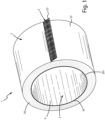
- the roll 1 of adhesive tape comprises a film 2 having a first surface 21 covered with adhesive material and a second surface 22 opposite to the first surface 21.
- the film 2 is of the known type and can be, for example, a plastic film or a paper film.
- the film 2 is wound in coils 20 with the second surface 22 facing outwards and the first surface 21 facing inwards on the roll 1 so that the first surface 21 of a coil 20 is in contact with the second surface 22 of the adjacent internal coil 20.
- the film 2 has an external end 23 at least partly free and an internal end (not visible in the enclosed drawings).
- the internal end is at the first winding coil 201 of the film 2.
- the roll 1 also comprises a core 3 on which the film 2 is wound.
- the core 3 is placed at the internal end and is in contact with the first surface 21 of the first coil 201, i.e. the innermost winding coil of the film 2.
- the core 3 remains attached to the film 2 by means of the contact with the first surface 21.
- the core 3 is made by winding a strip 30 in at least one coil.
- This strip 30 is obtained from a sheet 5.
- the core 3 consists of a strip 30 of a sheet 5 that is wound to form at least the innermost coil of the roll 1.
- the core 3 therefore comprises a strip 30 wound in at least one coil, so that at least the innermost coil of the roll 1 is in contact with the first coil 201 of the film.
- the strip 30 is flexible.
- the core 3 has a thickness comprised between 0.05 mm e 0.5 mm. Still preferably, the core 3 has a thickness comprised between 0.1 and 0.3 mm.
- the strip 30 is made of paper.
- the paper can be of any kind, e.g. used or recycled.
- the strip 30 can be made of a plastic film or other.
- the strip 30 has substantially the same width W as the film 2.
- the strip 30 is long enough to allow it to be wound into at least one coil.
- This coil is connected to the first coil 201 in which the film 2 is wound in the roll 1, i.e. the innermost coil 20 of the film 2.
- the roll 1 does not have a support core made of cardboard mixed with resins and/or glues or other substantially rigid support core provided as a separate element on which the film 2 is wound.
- the roll 1 comprises an opening tab 4 placed at the external end 23.
- the opening tab 4 is adapted to make it easier for a user to unwind the adhesive tape when first used, i.e. when first opening the roll 1.
- the opening tab 4 is obtained from the same sheet 5 as the strip 30.
- the opening tab 4 has at least one portion glued to the first surface 21 of the film 2, so as to keep the first surface 21 separate from the second surface 22 at the external end 23 of the roll 1.
- the core 3 comprises a portion of a further film of adhesive tape attached to the strip 30. This portion of further film results from the particular process by which the roll 1 according to the present invention is preferably made.
- this further film is the residual film of the previously wound roll 1 on which the sheet 5 was deposited, subsequently cut into the strip 30 to form the core 3, as explained in the hereinafter description.
- a process for making a roll 1 of adhesive tape as described above is also part of the present invention.
- the process comprises a first step of providing a mother reel 10 comprising a film 2 of adhesive tape having a first surface 21 covered with adhesive material and a second surface 22 opposite to the first surface 21.
- the film 2 in the mother reel 10 is wound in coils and has a predetermined first length.
- the mother reel 10 comprising the film 2 of adhesive tape refers both to a mother reel 10 in which the film is already adhesive and to a mother reel 10 in which the film, initially non-adhesive, is made adhesive by coating it with adhesive.
- the adhesive tape has in fact already been prepared beforehand and is wound in a mother reel.
- the adhesive tape is prepared on site from non-adhesive tape.
- the process thus optionally comprises a step of coating a first surface of a non-adhesive film with an adhesive to make the film 2 of adhesive tape further prepared, as explained hereinafter.
- the process thus comprises a step of unwinding the film 2 from the mother reel 10.
- the unwinding of the mother reel 10 is carried out at a gradually increasing speed until a preset maximum speed is reached.
- the process comprises a further step of winding the film 2 unwound from the mother reel 10 to form at least one roll 1 of adhesive tape.
- the film 2 is wound in particular onto a winding roll 121 on which the film 2 is wound to form the roll 1.
- the winding roll 121 is, in other words, a mandrel.
- the wound film 2 has a second predetermined length.
- the second predetermined length is shorter than the first predetermined length.
- the step of winding the film 2 comprises a sub-step of sucking air through through-holes 103 arranged on the winding roller 121, so as to keep the roll 1 being wound attached to the winding roller 121.
- the process provides a step of applying a sheet 5 to a section of the film 2 unwound from the mother reel 10.
- the sheet 5 will be applied at the external end 23 of the roll 1 once the film 2 has been cut.
- the sheet 5 is placed on the first surface 21 of the film 2, adhering to the film 2.
- This sheet 5 is applied to the film 2 without the further preparation of glues and/or adhesives, as it adheres to the film due to the adhesive already present on the first surface 21 of the film 2.
- the sheet 5 comes from an applying reel 50.
- the process provides to slow down the unwinding speed of the mother reel 10 during the step of applying the sheet 5.
- the process comprises a further step of cutting the film 2 to separate the film 2 of the roll 1 being wound from the mother reel 10.
- this step is carried out after the sheet 5 has been applied and when the wound film 2 reaches a desired length, i.e. a length substantially equal to the second predetermined length.
- a desired length i.e. a length substantially equal to the second predetermined length.
- the step of cutting the film 2 provides cutting the film 2 at the sheet 5, dividing the sheet 5 into two parts. Specifically, a first part of the sheet 5 makes the opening tab 4 of the roll 1 being wound, once formed. A second part of the sheet 5 defines the strip 30 which forms the core 3 of a further roll 1 wound later. The first part of the sheet 5 is on the first flap connected to the roll 1, while the second part of the sheet 5 is on the second flap connected to the mother reel 10.
- the sheet 5 therefore has an overall length greater than the circumferential development of the innermost coil of the roll 1, having to form, once cut, both the first part constituting the tab 4 of the wound roll 1 and the second part defining the strip 30 forming the core 3 of the roll 1 subsequently wound.
- the sheet 5 will have a length of approximately 280 mm from which a first part of approximately 15-19 mm forming the tab 4 of the wound roll 1 and a second part of approximately 265 mm forming the strip 30 defining the core 3 of the subsequent roll 1 will be cut.
- the step of cutting the film 2 it is preferably provided a further step of winding the first flap of cut film 2, i.e. the one on which the first part of the sheet 5 is also placed.
- the last, outermost coil of the film 2 is completed by adhering the flap of film 2 to the rest of the roll 1 until it is in contact with the first part of the sheet 5, i.e. by adhering the part of the film 2 that is adhesive.
- the film 2 of the cut flap will stick to the film 2 of the innermost adjacent coil until the first part of the sheet 5 is reached, where there is no longer any possibility for the film 2 to adhere to the adjacent film 2 due to the presence of the first part of the sheet 5.
- the finished roll 1, provided with tab 4, is thereby obtained, wherein the film 2 is wound in coils with the second surface 22 facing outwards and the first surface 21 facing inwards of the roll 1 so that the first surface 21 of a coil 20 is in contact with the second surface 22 of the adjacent internal coil 20.
- the process preferably comprises a subsequent step of unloading the finished roll 1.
- the step of unloading the finished roll 1 comprises a sub-step of blowing air through the aforementioned through-holes 103 arranged on the winding roller 121, so as to detach the finished roll 1 from the winding roller 121.
- the step of unloading the finished roll 1 comprises a further sub-step of pushing the finished roll 1 away from the respective winding roller 121, in a first direction X parallel to the axis of the winding roller 121.
- This sub-step is performed by means of a pusher 125 that is movable along a first direction X parallel to the axis of the winding roller 121.
- This sub-step provides in particular that the pusher 125 performs a stroke X' at least equal to the width of the winding roller 121, until the finished roll 1 is decoupled from the winding roller 121.
- This is followed by a further sub-step of dropping the finished roll 1 uncoupled from the winding roller 121 onto a chute 126.
- This chute 126 is in particular arranged in such a position as to collect the finished roll 1 and convey it to a storage station 160.
- the process according to the present invention after a roll 1 has been formed, comprises a step of unwinding the film 2 again from the mother reel 10 to wind a further roll 1.
- the process according to the present invention after the step of cutting the film 2, comprises a step of winding the strip 30 in at least one coil to form the core 3 of a further roll 1 subsequently wound.
- the second flap of the film 2, wherein the second part of sheet 5 is present, is wound.
- the step of winding the strip 30 in at least one coil is preferably carried out at the same time as the step of winding the first flap of film 2 cut on the already wound roll 1.
- the step of winding the strip 30 is simultaneous with the step of unwinding the film 2 from the mother reel 10 to wind a further roll 1.
- the step of winding the film 2 provides winding the film 2 onto the core 3 thus formed, i.e. formed by winding the strip 30, resulting from the cut of the sheet 5 previously applied to the film 2, at the end of the step of winding the previous roll 1.
- the strip 30 is flexible and has a thickness comprised between 0.05 mm and 0.5 mm.
- the strip 30 is made of paper.
- the applied sheet 5 from which the strip 30 is obtained is also flexible and has a thickness comprised between 0.05 mm and 0.5 mm.
- the sheet 5 is made of paper.
- a machine 100 for forming a roll 1 as described above is also part of the present invention.
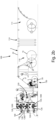
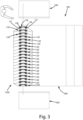
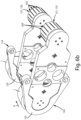
- the machine 100 is particularly visible as a whole in Figures 2 and 3 , while details are shown in Figures 4a-6d .
- the machine 100 comprises an unwinding station 110 of a mother reel 10 comprising a film 2 of adhesive tape having a first surface 21 covered with adhesive material and a second surface 22 opposite to the first surface 21.
- the film in the mother reel 10 is wound in coils and has a predetermined first length.
- the unwinding station 110 is configured to unwind the film 2 of the mother reel 10.
- the machine 100 can be associated to, i.e. placed in line with, a coating machine 111.
- the coating machine 111 is of the known type and, where provided, is placed upstream of the unwinding station 110.
- the machine 100 receives the film 2 directly from the coating machine 111, which will have coated with the adhesive the first surface 21 of the film 2, which will bypass the unwinding station 110.
- the coating machine 111 is also upstream of one or more winding stations 120, hereinafter described.
- the coating machine 111 in-line with one or more winding stations 120 allows the film 2 of adhesive tape to be made directly on site before it is wound.
- the machine 100 is associated with the coating machine 111, the machine 100 is also associated with compensating rollers 114 placed downstream of the coating machine 111 and upstream of one or more winding stations 120.
- the machine 100 also comprises a winding station 120 configured to wind the film 2 to form at least one roll 1 of adhesive tape in which the wound film 2 has a second predetermined length, which is shorter than the first predetermined length.
- the winding station 120 comprises at least one winding roller 121.
- the winding roller 121 is configured to wind the film 2 to form the roll 1.
- the winding roller 121 is configured to wind the strip 30 to form the core 3 of the further roll 1 wound later, as reported above in this description with respect to the process.
- the winding roller 121 is also configured to wind the film 2 unwound from the mother reel 10.
- the winding station 120 comprises two winding rollers 121.
- the machine 100 comprises two or more winding stations 120.
- the machine 100 also comprises an applying station 130, interposed between the unwinding station 110 and the winding station 120.
- the applying station 130 is configured to apply a sheet 5 at a section of the film 2 unwound from the mother reel 10, placing the sheet 5 on the first surface 21 of the film 2 being unwound.
- the applying station 130 comprises an application reel 50 from which the sheet 5, from which the strip 30 and tab 4 are obtained, derives.
- the machine 100 comprises a cut assembly 140 associated with the winding station 120.
- the cut assembly 140 is configured to cut the film 2 at the sheet 5 by dividing the sheet 5 into two parts.
- the cut assembly 140 is configured to cut the film 2 when the wound film 2 substantially reaches the second predetermined length to obtain the formed roll 1.
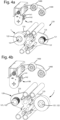
- the cut assembly 140 is visible in the Figures 4a-4d together with the winding station 120. Note in particular that these figures schematise the cut assembly 140 and the winding station 120 without showing the continuity of the film 2 being wound.
- the winding station 120 comprises two of the above-mentioned winding rollers 121.
- the winding rollers 121 are spaced from and aligned with each other, preferably along a horizontal direction.
- the winding rollers 121 are placed side-by-side with their respective axes parallel to each other.
- the machine 100 comprises a drive shaft 101 configured to move a winding roller 121 of a winding station 120.
- the machine 100 comprises a pair of drive shafts 101 each configured to move a respective winding roller 121 of a winding station 120.
- Each winding roller 121 preferably comprises a friction shaft 122 configured to hold and support the film 2 while it is wound.
- each friction shaft 122 is configured to hold and support the strip 30 while the film 2 is being wound.
- Each winding roller 121 is in fact associated with a clutch 123.
- Each clutch 123 is connected to the drive shaft 101 and configured to independently transmit motion from the drive shaft 101 to the respective winding roller 121.
- the clutch 123 is configured to keep the pull of the film 2 being wound into a respective roll 1 constant.
- the machine 100 comprises a number of clutches 123 equal to the number of winding rollers 121.
- each clutch 123 is separate from the others and acts independently of the other one of the winding rollers 121. It is therefore possible to produce rolls 1 of different sizes at the same time.
- the motion is transmitted to the respective winding roller 121 by a respective clutch 123, which adjusts the winding tension according to the variation in diameter of the roll 1 being wound, due to the variation in thickness of the roll 1.
- each clutch 123 is provided by a secondary shaft (not shown).
- each winding roller 121 is associated with a roll unloading system (124), configured to allow a formed roll 1 to be unloaded at, for example, a storage station 160 for formed rolls 1 or directly onto conveyor belts (not shown), adapted to transport the roll 1 to a packaging station (not shown).
- a roll unloading system configured to allow a formed roll 1 to be unloaded at, for example, a storage station 160 for formed rolls 1 or directly onto conveyor belts (not shown), adapted to transport the roll 1 to a packaging station (not shown).
- each winding station 120 comprises a roll unloading system 124 associated with each winding roller 121.
- the machine 100 comprises as many roll unloading systems 124 as there are winding rolls 121.
- each winding station 120 comprises two roll unloading systems 124.
- Each roll unloading system 124 is associated with its respective winding roll 121 and is independent of the others. This makes it possible to unload the finished rolls 1 from the different winding rolls 121 at different times, depending on requirements, as visible in Figures 5b and 6a-6d .
- the roll unloading system 124 comprises a pusher 125 configured to push the finished roll 1 away from the winding roller 121, in a first direction X parallel to the axis of the winding roller 121.
- the pusher 125 is configured in particular to perform a stroke X' at least equal to the width of the winding roller 121, until the finished roll 1 is decoupled from the winding roller 121.
- the pusher 125 is preferably made as a moving plate adapted to move along this first direction X.
- each wound roll 1 is pushed out and extracted from the winding roll 121.
- the machine 1 therefore also comprises a chute 126, located at the winding station 120.
- the machine 1 comprises only one chute for each winding station 1 as each winding station 120 is rotatable by 180° and each finished roll 1 is unloaded at only one position of the winding station 120.
- the roll 1 thus decoupled from the winding roller 121 can fall on such a chute 126.
- the chute 126 is interposed between the winding station 120 and the storage station 160 and acts as a link between these two stations.
- the winding rolls 121 are adapted to both form the roll 1 and to unload the formed roll 1.
- the winding station 120 is rotatable and is configured to perform a rotation preferably of 180°. This makes it possible to exchange the positions of the two winding rollers 121.
- one of the two winding rollers 121 is connected to the film 2 unwound by the mother reel 10 and is adapted to wind the film 2 unwound by the mother reel 10, while the other winding roller 121 is adapted to unload the formed roll 1.
- the winding roll 121 adapted to wind the film 2 unwound from the mother reel 10 is positioned at the side of the mother reel 10 while the winding roll 121 distal from the mother reel 10 is adapted to unload the roll 1.
- the other winding roller 121 is stationary.
- this comprises a blade 141 adapted to perform the cut to separate the mother reel 10 from the wound film 2, to obtain the formed roll 1.
- the cut assembly 140 also comprises a pressure roller 142, coupled to the blade 141.
- the pressure roller 142 is configured to couple with the respective winding roller 121, together with the blade 141.
- the pressure roller 142 is configured to rotate around the respective winding roller 121 tangentially supporting the strip 30 just after cutting, when winding thereof takes place to form at least one coil making the core 3, until the winding of the film 2 of adhesive tape onto the core 3 thus formed for making the next roll 1 begins again.
- the pressure roller 142 rotates on the winding roller 121, adhering onto the strip 30 so as to maintain the strip 30 against the winding roller 121 when it rotates, winding it.
- the machine 100 comprises one or more accompanying rollers 1400.
- the machine 100 comprises two accompanying rollers 1400, as visible in Figures 2 and 4a-4d .
- the accompanying rollers 1400 are associated with the cut assembly 140 and are spaced from the pressure roller 142 and blade 141.
- the accompanying rollers 1400 are adapted to support the film 2 during cutting.
- the cut assembly 140 and accompanying rollers 1400 are configured to move closer to/away from the winding station 120.
- the cut assembly 140 and the accompanying rollers 1400 move closer to the winding station 120, after it has been rotated by 180°, so that the blade 141 can reach the film 2 to cut it.
- the winding roller 121 on which there is the flap of film 2 connected to the second part of sheet 5, i.e. the one forming the core 3 rotates to wind the strip 30 in at least one coil.
- the pressure roller 142 rotates around this winding roller 121 to keep the strip 30 adhered to the winding roller 121 to form the core 3.
- the winding of the film 2 which in the meantime is being unwound from the mother reel 10, continues to form a further roll 1.
- the winding station 120 rotates by 180°, reversing the positions of the winding rollers 121, so that the roll 1 with the wound film 2 is in the unloading position, as shown in Figure 4b .
- the cut assembly 140 and the accompanying rollers 1400 descend, as shown in Figure 4c .
- the blade 141 cuts the film 2 at the winding roller 121, which is in the opposite position to the unloading one.
- the core 3 is formed on the respective winding roller 121, while the winding roller 121, on which the roll 1 is placed for unloading, winds the flap of the cut film 2 to close the roll 1, with the cooperation of the rollers 1400.
- each winding roller 121 has the above-mentioned through-holes 103.
- the through-holes 103 are preferably circumferentially distributed on the surface of the winding roller 121. More preferably, the through-holes 103 form groups of holes 103' that extend longitudinally across the surface of the winding roller 121. In other words, the groups of holes 103 extend along a direction parallel to the axis of each winding roller 121.
- These through-holes 103 are preferably evenly distributed over the surface of the winding roller 121.
- Each winding roller 121 has a cavity 127 in fluid communication with the through-holes 103.
- This cavity 127 can be connected to a suction system (not shown) that is configured to suck air through the through-holes 103 when the roll 1 is being formed, so as to keep the roll 1 being wound attached to the winding roller 121.
- the cavity 127 can also be connected to a blowing system (not shown) configured to blow air through the through-holes 103 when the roll 1 is finished, to enable the roll 1 to be detached from the winding roller 121.
- the machine 100 comprises a suction system and a blowing system for each winding station 120.
- the suction and blowing systems of the various winding stations 120 are independent of each other.
- each winding roll 121 is adapted to alternately connect with the suction system or the blowing system, depending on whether a roll 1 on the respective winding roll 121 is being wound or unloaded.
- one winding roller 121 is connected to the suction station and the other winding roller 121 is connected to the blowing station.
- the winding station 120 rotates, the positions of the winding rollers 121 exchange and consequently the suction roller 121 that was connected to the suction station connects to the blowing station and vice versa.
- the machine 100 comprises a dividing station 150 of the mother reel 10.
- the dividing station 150 shown in Figure 2 , is located upstream of the two or more winding stations 120.
- the dividing station 150 is in particular configured to cut the film 2 of the mother reel 10 in two or more films 2 having a smaller width. Each of these two or more films 2 having a smaller width is intended for a respective winding station 120.
- the machine 100 comprises two or more cut assemblies 140. More preferably, the machine 100 comprises a cut assembly 140 for each winding station 120, where a cut assembly 140 is placed at the respective winding station 120.
- the winding stations 120 are arranged in a stack, i.e. aligned one on top of the other, as visible in Figure 2 .
- the winding stations 120 are arranged in a row, i.e. placed side by side and aligned, as visible in Figures 3 , 5b and 6a-6d .
- a row of winding stations 120 is known in the jargon as turret 1200.
- the machine 100 comprises two or more turrets 1200.
- the machine 100 there are three turrets 1200 arranged in a stack.
- the accompanying rolls 1400 are shared between the various winding stations 120.
- the accompanying rollers 1400 extend substantially along the entire length of the turret 1200.
- each drive shaft 101 described above is common to several winding rollers 121 of different winding stations 120 aligned in a row.
- the motor shafts 101 are connected to all the winding stations 121.
- the machine 100 comprises a pair of drive shafts 101 for each turret 1200.
- the machine 100 also comprises belts and gears that are enclosed in protective crankcases 300.
- the area 200 contains the components of the machine 100 described above, such as one or more unwinding stations 110, one or more applying stations 130 and one or more dividing stations 150, together with the guide rollers for the film 2 being unwound from the mother reel 10 and being wound in the winding stations 120.
- the machine 100 since the core 3 on which film 2 is wound is derived from the strip 30 that is glued to the film 2, it is not necessary to load a support core onto which the film 2 is wound.
- the machine 100 according to the present invention does not comprise the core loading and sorting unit.
- the machine 100 according to the present invention is consequently less bulky than the known ones.
- the machine 100 does not have the known one or more mandrels on which multiple cores are inserted in succession, but instead has many smaller mandrels, each having such dimensions as to be used for winding only one roll at a time.
- the machine 100 according to the present invention is also less energy-intensive, as fewer movements and passages are overall required to make a roll 1, and thus fewer stations/units are required.
Landscapes
- Replacement Of Web Rolls (AREA)
- Storage Of Web-Like Or Filamentary Materials (AREA)
- Adhesive Tapes (AREA)
Applications Claiming Priority (1)
| Application Number | Priority Date | Filing Date | Title |
|---|---|---|---|
| IT102022000026895A IT202200026895A1 (it) | 2022-12-27 | 2022-12-27 | Rotolo di nastro adesivo, processo e macchina per realizzare tale rotolo di nastro adesivo. |
Publications (2)
| Publication Number | Publication Date |
|---|---|
| EP4417558A2 true EP4417558A2 (de) | 2024-08-21 |
| EP4417558A3 EP4417558A3 (de) | 2024-12-04 |
Family
ID=85556775
Family Applications (1)
| Application Number | Title | Priority Date | Filing Date |
|---|---|---|---|
| EP23217744.4A Pending EP4417558A3 (de) | 2022-12-27 | 2023-12-18 | Klebebandrolle, verfahren und maschine zur herstellung einer solchen klebebandrolle |
Country Status (2)
| Country | Link |
|---|---|
| EP (1) | EP4417558A3 (de) |
| IT (1) | IT202200026895A1 (de) |
Family Cites Families (4)
| Publication number | Priority date | Publication date | Assignee | Title |
|---|---|---|---|---|
| US3770542A (en) * | 1971-08-25 | 1973-11-06 | Johnson & Johnson | Adhesive tape and method |
| US5620544A (en) * | 1995-06-07 | 1997-04-15 | Minnesota Mining And Manufacturing Company | Tape roll liner/tab, application apparatus and method |
| JP3597180B2 (ja) * | 2002-07-10 | 2004-12-02 | 株式会社不二鉄工所 | ウエブの巻取方法及び装置 |
| US20100320302A1 (en) * | 2009-06-23 | 2010-12-23 | Catbridge Machinery, Llc | In-Line Formed Core Supporting a Wound Web |
-
2022
- 2022-12-27 IT IT102022000026895A patent/IT202200026895A1/it unknown
-
2023
- 2023-12-18 EP EP23217744.4A patent/EP4417558A3/de active Pending
Also Published As
| Publication number | Publication date |
|---|---|
| EP4417558A3 (de) | 2024-12-04 |
| IT202200026895A1 (it) | 2024-06-27 |
Similar Documents
| Publication | Publication Date | Title |
|---|---|---|
| US4529141A (en) | Method and apparatus for rewinding, severing and transferring web-like material | |
| US5885391A (en) | Tape roll liner/tab application apparatus and method | |
| JP4452623B2 (ja) | ウエブ材料のログの製造方法と前記方法を実行する巻き戻し機 | |
| US7246768B2 (en) | Method of processing web edge | |
| CN101189177B (zh) | 制造带有外包裹体的网材卷筒的方法和装置 | |
| JPH04164762A (ja) | 製造機械上のリールを送り及び交換するための方法及び装置 | |
| CN101970321A (zh) | 拉伸膜卷绕机 | |
| US6405969B1 (en) | Coreless adhesive tape winding mandrel and method | |
| EP0291767B1 (de) | Längsschneid- und Aufwickelmaschine | |
| CN1208227C (zh) | 卷材卷绕方法及装置 | |
| US5101610A (en) | Method of processing printing products arriving in an imbricated formation | |
| CN1071697C (zh) | 用来形成一压敏式粘胶带的无芯胶带卷的方法 | |
| CN113911779A (zh) | 一种检品包装计量一体机 | |
| EP4417558A2 (de) | Klebebandrolle, verfahren und maschine zur herstellung einer solchen klebebandrolle | |
| CN110040548B (zh) | 一种复卷机 | |
| CN117429671A (zh) | 产品包装带盘绕装置和产品包装系统 | |
| CN102844257B (zh) | 卷绕方法和装置 | |
| US4707968A (en) | Method and apparatus for wrapping pressure sensitive rolls of material | |
| JP7195899B2 (ja) | フィルム接続装置 | |
| CN215854269U (zh) | 易撕贴自动分切堆叠机 | |
| CN102862847B (zh) | 纤维幅材机的分切卷绕机中的配置结构 | |
| EP1306335B1 (de) | Umwickelmaschine für Plasikfolie oder ähnliches Material | |
| CA2221334C (en) | Tape roll liner/tab, application apparatus and method | |
| CN117682365A (zh) | 一种多功能贴合机 | |
| JPH04251727A (ja) | シ−ト状物巻取体の巻終り端末固定方法 |
Legal Events
| Date | Code | Title | Description |
|---|---|---|---|
| PUAI | Public reference made under article 153(3) epc to a published international application that has entered the european phase |
Free format text: ORIGINAL CODE: 0009012 |
|
| STAA | Information on the status of an ep patent application or granted ep patent |
Free format text: STATUS: THE APPLICATION HAS BEEN PUBLISHED |
|
| AK | Designated contracting states |
Kind code of ref document: A2 Designated state(s): AL AT BE BG CH CY CZ DE DK EE ES FI FR GB GR HR HU IE IS IT LI LT LU LV MC ME MK MT NL NO PL PT RO RS SE SI SK SM TR |
|
| PUAL | Search report despatched |
Free format text: ORIGINAL CODE: 0009013 |
|
| AK | Designated contracting states |
Kind code of ref document: A3 Designated state(s): AL AT BE BG CH CY CZ DE DK EE ES FI FR GB GR HR HU IE IS IT LI LT LU LV MC ME MK MT NL NO PL PT RO RS SE SI SK SM TR |
|
| RIC1 | Information provided on ipc code assigned before grant |
Ipc: B65H 19/28 20060101ALI20241029BHEP Ipc: B65H 19/22 20060101AFI20241029BHEP |
|
| STAA | Information on the status of an ep patent application or granted ep patent |
Free format text: STATUS: REQUEST FOR EXAMINATION WAS MADE |
|
| 17P | Request for examination filed |
Effective date: 20250528 |
|
| GRAP | Despatch of communication of intention to grant a patent |
Free format text: ORIGINAL CODE: EPIDOSNIGR1 |
|
| STAA | Information on the status of an ep patent application or granted ep patent |
Free format text: STATUS: GRANT OF PATENT IS INTENDED |