EP4407330A1 - Batterieüberwachungssystem, batterie und elektrische vorrichtung - Google Patents
Batterieüberwachungssystem, batterie und elektrische vorrichtung Download PDFInfo
- Publication number
- EP4407330A1 EP4407330A1 EP21968429.7A EP21968429A EP4407330A1 EP 4407330 A1 EP4407330 A1 EP 4407330A1 EP 21968429 A EP21968429 A EP 21968429A EP 4407330 A1 EP4407330 A1 EP 4407330A1
- Authority
- EP
- European Patent Office
- Prior art keywords
- component
- sensor
- communication network
- pin
- battery
- Prior art date
- Legal status (The legal status is an assumption and is not a legal conclusion. Google has not performed a legal analysis and makes no representation as to the accuracy of the status listed.)
- Pending
Links
Images

Classifications
-
- G—PHYSICS
- G01—MEASURING; TESTING
- G01R—MEASURING ELECTRIC VARIABLES; MEASURING MAGNETIC VARIABLES
- G01R31/00—Arrangements for testing electric properties; Arrangements for locating electric faults; Arrangements for electrical testing characterised by what is being tested not provided for elsewhere
- G01R31/36—Arrangements for testing, measuring or monitoring the electrical condition of accumulators or electric batteries, e.g. capacity or state of charge [SoC]
- G01R31/382—Arrangements for monitoring battery or accumulator variables, e.g. SoC
-
- G—PHYSICS
- G01—MEASURING; TESTING
- G01R—MEASURING ELECTRIC VARIABLES; MEASURING MAGNETIC VARIABLES
- G01R31/00—Arrangements for testing electric properties; Arrangements for locating electric faults; Arrangements for electrical testing characterised by what is being tested not provided for elsewhere
- G01R31/36—Arrangements for testing, measuring or monitoring the electrical condition of accumulators or electric batteries, e.g. capacity or state of charge [SoC]
-
- G—PHYSICS
- G01—MEASURING; TESTING
- G01R—MEASURING ELECTRIC VARIABLES; MEASURING MAGNETIC VARIABLES
- G01R31/00—Arrangements for testing electric properties; Arrangements for locating electric faults; Arrangements for electrical testing characterised by what is being tested not provided for elsewhere
- G01R31/36—Arrangements for testing, measuring or monitoring the electrical condition of accumulators or electric batteries, e.g. capacity or state of charge [SoC]
- G01R31/396—Acquisition or processing of data for testing or for monitoring individual cells or groups of cells within a battery
Definitions
- the present application relates to the field of batteries, and in particular, to a battery monitor system, a battery and an electrical device.
- Batteries are used as important energy storage and power supply equipment, such as, to supply power for new energy cars, terminal equipment, etc., and to store energy for solar panels.
- the battery includes a plurality of cell modules connected in series, in parallel or in series-and-parallel, and each cell module includes a plurality of cells connected in series, parallel or in series-and-parallel.
- the battery may also include other structures, such as a converging component for realizing electrical connection between the plurality of cells, or a wire harness isolation plate assembly for realizing a series or parallel connection of the cells and realizing installation and fixing of sampling lines.
- the battery also includes a battery management system (BATTERY MANAGEMENT SYSTEM, BMS).
- BMS is a protection and management unit specially designed for batteries, that applies a control algorithm for power supply to a driving load such as an engine, a measurement of electrical characteristics such as current and voltage, a charge and discharge control, a voltage balance control, a monitoring such as an evaluation for a state of charge (SOC) as well as an abnormality monitoring, and so on.
- SOC state of charge
- the BMS of the battery also enters a sleep mode, that is, a 24-hour real-time monitoring cannot be performed, resulting in an inability to accurately report abnormal faults.
- the present application provides a battery monitor system, a battery and an electrical device.
- the battery monitor system can monitor the battery in real time for 24 hours with low power consumption, and when an abnormality is detected, the entire battery monitor system can be automatically awakened to perform a comprehensive monitoring.
- the present application provides a battery monitor system which includes N sensor components and a master monitor component.
- the N sensor components and a master monitor component are connected via a serial communication network.
- the N sensor components are configured to periodically monitor whether a corresponding cell module is abnormal, and N is an integer being greater than or equal to 2. If it is detected by an i-th sensor component that the cell module corresponding to the i-th sensor component is abnormal, then a wake-up signal is sent by the i-th sensor component via the serial communication network to enable other sensor components subsequent to the i-th sensor component on the serial communication network to be awakened in sequence, and the master monitor component is awakened by an awakened N-th sensor component, where 1 ⁇ i ⁇ N.
- the master monitor component and the N sensor components can jointly monitor abnormal conditions of each cell module in the battery in an all-round way.
- the N sensor components periodically monitor abnormalities, and the power consumption is lower.
- the subsequent sensor components can be awakened in reverse sequence via the serial communication network, and then the master monitor component can be awakened by the last sensor component to conduct a comprehensive monitoring and report abnormal faults.
- the safety of the battery can also be monitored by the battery monitor system in real time with low power consumption even when the battery monitor system is in the sleep mode.
- the serial communication network adopts a daisy chain communication.
- the serial communication network adopts the daisy chain communication, that is, the master monitor component and N sensor components are connected hand in hand by daisy chains to facilitate the transmission of wake-up signals.
- the master monitor component and N sensor components are connected hand in hand by daisy chains to facilitate the transmission of wake-up signals.
- a wake-up signal is sent by a sensor component to the serial communication network, other components can be awakened in turn.
- the master monitor component includes a first pin and a second pin, the first pin and the second pin are respectively connected with the serial communication network, the first pin is configured to send a wake-up signal, the second pin is configured to receive the wake-up signal.
- a sensor component includes a third pin and a fourth pin, the third pin and the fourth pin are respectively connected with the serial communication network, the third pin is configured to receive the wake-up signal, and the fourth pin is configured to send the wake-up signal.
- the master monitor component and each sensor component are connected through pins and a daisy chain to form a serial communication
- the structure is simple, and no special requirement is needed for interfaces of the master monitor component and the sensor components, thus a strong universal applicability can be achieved.
- the master monitor component is a BMS and the sensor component is an air pressure sensor
- most BMS and air pressure sensors on the market can be connected through their own pins and daisy chains.
- the master monitor component and the N sensor components are also connected via a parallel communication network.
- the master monitor component is configured to send coding coordination information to the parallel communication network
- the N sensor components are configured to respectively perform an identifier encoding according to the coding coordination information.
- the master monitor component and the N sensor components are also connected via a parallel communication network.
- the coding coordination information can be sent by the master monitor component to the parallel communication network, and the identifiers of the N sensor components are encoded according to the coding coordination information, so that automatic coding can be realized and the offline test and calibration process can be omitted.
- the coding coordination information is sent by the master monitor component to the parallel communication network, and the wake-up signal is also sent by the master monitor component to the serial communication network.
- the i-th sensor component is awakened after receiving the wake-up signal, and the awakened i-th sensor component is configured to perform the identifier encoding according to the coding coordination information and the identifier information in the parallel communication network, and send i-th identifier information to the parallel communication network, and send the wake-up signal to the serial communication network, to enable other sensor components subsequent to the i-th sensor component to be woken up in sequence and to perform the identifier encoding according to the identifier information in the parallel communication network and the coding coordination information.
- the coded coordination information is sent by the master monitor component to the parallel communication network and the wake-up signal is sent by the same to the serial communication network, so that the N sensor components are awakened in turn, and the identifier encoding is performed according to the coding coordination information and the identifier information in the parallel communication network to realize an automatic coding, which is simple and convenient without additional settings.
- the coding coordination information includes the number N of sensor components and a numerical range.
- a 1-st sensor component after being awakened uses an initial value of the numerical range as an identifier of the 1-st sensor component.
- Aj-th sensor component after being awakened uses an identifier of the (j-1)-th sensor component increased by 1 as an identifier of the j-th sensor component, where 2 ⁇ j ⁇ N.
- the N sensor components are awakened in sequence, and the identifiers are sequentially incremented by 1 during encoding, so that the identifiers will not be repeated, and the encoding process is simple and less error-prone.
- the master monitor component is configured to verify whether a number of identifier information in the parallel communication network is matched with the number N of the sensor components after the identifier encoding is performed by each of the N sensor components, and determine an encoding failure if the number of identifier information in the parallel communication network is not matched with the number N of the sensor components, and re-send the wake-up signal to the serial communication network, to enable the N sensor components to respectively re-perform the identifier encoding.
- the master monitor component is configured to determine an occurrence of an automatic encoding failure if a number of successive encoding failures reaches a preset number.
- the master monitor component verifies whether the encoding of the entire system is successful by comparing the number of identifier information in the parallel communication network and the number of sensor components, if a number of successive encoding failures reaches a preset number, an automatic encoding failure will be reported, which enables the encoding process to be more intelligent, and will not cause an encoding failure due to accidental interference factors, the reliability is higher.
- the master monitor component is configured to, if the wake-up signal sent by the N-th sensor component is not received by the master monitor component, determine that the serial communication network is faulty.
- the master monitor component is configured to, if the wake-up signal sent by the N-th sensor component is received by the master monitor component and the master monitor component verifies that the number of identifier information in the parallel communication network is not matched with the number N of the sensor components, determine that the parallel communication network is faulty.
- communication faults can be located by determinations on whether the wake-up signal is sent by the N-th sensor component, and whether the number of identifier information in the parallel communication network is matched with the number of sensor components, which is convenient for operators to repair.
- the parallel communication network is a controller area network.
- the master monitor component and the sensor components are connected in parallel communication via the controller area network, so that the signals sent by each component can be transmitted in real time.
- the master monitor component also includes a fifth pin and a sixth pin, the fifth pin is in connection with a first communication line in the parallel communication network, and the sixth pin is in connection with a second communication line in the parallel communication network.
- Each sensor component also includes a seventh pin and an eighth pin, the seventh pin is connected to the first communication line, and the eighth pin is connected to the second communication line.
- the pins are connected to the CAN bus to form a parallel communication
- the structure is simple, and no special requirement is needed for the interfaces of the master monitor component and the sensor components, thus a strong universal applicability can be achieved.
- the master monitor component is a BMS
- the sensor component is an air pressure sensor
- most BMS and air pressure sensors on the market can be connected to the CAN bus through their own pins.
- the present application provides a battery, including the battery monitor system described in the first aspect and N cell modules, a sensor component is arranged corresponding to a cell module, and the master monitor component includes a battery management system (BMS).
- BMS battery management system
- the battery monitor system can monitor the battery in real time for 24 hours with low power consumption. In case that an abnormality is detected, the entire battery monitor system can be automatically awakened to perform a comprehensive monitoring, enabling the battery to be more reliable and safer.
- the present application provides an electrical device which includes the battery described in the second aspect.
- the electric device can reduce losses caused by battery failure.
- multiple refers to more than two (including two), similarly, “multiple groups” refers to more than two groups (including two groups), and “multiple pieces” refers to more than two pieces (including two pieces).
- the battery is capable of converting electrical energy into chemical energy, and during discharging, the battery is capable of converting the chemical energy into the electrical energy, so that an energy conversion can be achieved. No by-products that pollute the environment will be produced in the process of energy conversion, which has advantages of energy environmental protection and energy saving.
- the battery is applied to portable devices (for example, a terminal product such as a mobile phone) to provide power for the portable devices.
- the battery may also be applied to electric vehicles (EV) or hybrid vehicles (HV), etc., to provide power for the vehicles and reduce carbon emissions.
- the battery may also be used in energy storage systems, such as storing energy for solar panels in photovoltaic power generation.
- a battery includes a plurality of cell modules connected in series, in parallel, or in series-and-parallel, and each cell module includes a plurality of cells connected in series, in parallel or in series-and-parallel.
- the battery may also include other structures, such as a converging component for realizing electrical connection between the plurality of cells, or a wire harness isolation plate assembly for realizing series and parallel connection of the cells and realizing installation and fixing of sampling lines.
- the battery also includes a battery management system (BMS), which is responsible for monitoring an operation status of each cell module in the battery to ensure a safe and reliable operation of each cell module.
- BMS battery management system
- the BMS can monitor and collect internal and external status parameters of each cell module in real time (including but not limited to a voltage, a temperature, a current, an air pressure, a gas or smoke, etc.), and perform necessary analysis and calculation on relevant status parameters to acquire more evaluation parameters of system status.
- An effective management and control of the battery is implemented according to a specific protection control strategy, so as to ensure the safe and reliable operation of the entire battery.
- the BMS can exchange information with other external equipment (such as fire protection system) through a communication interface and an analog/digital input and output interface of the BMS to form a linkage control, to ensure the safe and reliable operation of the battery-powered electric device.
- the BMS of the battery after the electric device is put to sleep, the BMS of the battery also enters a sleep mode, that is, the battery cannot be monitored in real time for 24 hours, resulting in the inability to accurately report abnormal faults.
- the electrical device is an electric vehicle
- ECUs electronice control units
- the electronic control units In electric vehicles, generally an additional lead-acid battery (output a small voltage, such as 12V, etc.) is provided to supply power to an electric drive system and an ignition system within a short time during an initiation of the electric drive system.
- the electric drive system converts the electrical energy output by the battery (that is, the above-mentioned battery including the BMS, which outputs a large voltage, such as 300V-600V, etc.) into mechanical energy to drive the electric vehicle.
- the battery powers the EV and also charges the lead-acid battery. It can be understood that the electric vehicle includes the lead-acid battery for powering the ignition system and some ECUs in the sleep mode and the battery for powering the entire vehicle in a driving mode.
- the BMS is powered by the lead-acid battery.
- the BMS of the battery After the electric vehicle enters the sleep mode, the BMS of the battery also enters the sleep mode (i.e., a standby mode that is powered on but is not in operation), that is, the battery cannot be monitored in real time for 24 hours.
- the BMS of the battery is self-powered and has a self-starting sleep mechanism, which also cannot monitor the battery in real time for 24 hours.
- a battery monitor system including N sensor components and a master monitor component that are connected via a serial communication network (N is an integer that is greater than or equal to 2).
- N is an integer that is greater than or equal to 2.
- the N sensor components are arranged in a one-to-one correspondence with the N cell modules, and the N sensor components are configured to periodically monitor whether the corresponding cell modules are abnormal.
- 24-hour real-time monitoring can be realized.
- a wake-up signal is sent by the i-th sensor component via the serial communication network, so that other sensor components subsequent to the i-th sensor component on the serial communication network are awakened in sequence, and the master monitor component is awakened by the awakened N-th sensor component. Therefore, in case that an abnormality is detected by any one of the sensor components, a wake-up signal is sent to the serial communication network, so that the master monitor component can be awakened in time to perform a comprehensive monitoring and report abnormal faults when the battery is abnormal.
- the master monitor component and the N sensor components can jointly monitor the abnormality of each cell module in the battery in an all-round way.
- the N sensor components In a case that the master monitor component is in sleep, the N sensor components periodically monitor abnormalities, and the power consumption is lower. In case that an abnormality is detected by any sensor component, the subsequent sensor components are awakened in reverse sequence via the serial communication network, and then the master monitor component is awakened by the last sensor component to conduct the comprehensive monitoring and report the abnormal faults.
- the safety of the battery can also be monitored by the battery monitor system in real time with low power consumption even when the battery monitor system is in the sleep mode.
- the battery monitor system provided in the embodiments of the present application is applied to a battery, for example, the battery monitor system may be encapsulated inside the battery.
- the battery including a battery monitor system may, but not limited to, be used in electrical devices such as vehicles, watercrafts, aircrafts, etc., and may also be used in storage devices such as inverters or photovoltaic power generation. In this way, the battery monitor system can monitor the battery in real time for 24 hours with low power consumption, and the entire battery monitor system can be automatically awakened to perform an all-round monitoring when an abnormality is detected, which is beneficial to the safety of electrical devices and storage devices.
- An embodiment of the present application provides an electrical device, which may be, but not limited to, a vehicle, a watercraft, or an aircraft.
- an electric vehicle is taken as an example for illustration in an embodiment of the present application.
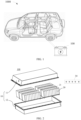
- a battery 100 is provided inside an electric vehicle 1000.
- the battery 100 may be arranged at the bottom, head or tail of the electric vehicle 1000.
- the battery 100 may be used as a driving power source of the electric vehicle 1000 to replace or partially replace the fuel oil or natural gas to provide a driving power for the electric vehicle 1000.
- FIG. 2 is an exploded view of a battery 100 according to some embodiments of the present application.
- the battery 100 includes a box body 10, a plurality of cell modules 20 and a battery monitor system 30, and the plurality of cell modules 20 and the battery monitor system 30 are housed in the box body 10.
- the box body 10 is configured to accommodate the plurality of cell modules 20 and the battery monitor system 30, and the box body 10 may have various structures.
- the box body 10 may include a first part 11 and a second part 12, the first part 11 are the second part 12 are engaged with each other, and the first part 11 and the second part 12 jointly define an accommodation space.
- the second part 12 may be a hollow structure having one side opening
- the first part 11 may be a plate-like structure
- the first part 11 is covered on the opening side of the second part 12, so that an accommodation space is jointly defined by the first part 11 and the second part 12.
- the first part 11 and the second part 12 may respectively be a hollow structure having one side opening, and the opening side of the first part 11 is covered on the opening side of the second part 12.
- the box body 10 formed by the first part 11 and the second part 12 may be in various shapes, such as a cylinder, a cuboid and the like.
- the cell module 20 includes a plurality of cells 21, and the cells 21 may be connected in series, in parallel or in series-and-parallel.
- the plurality of cell modules 20 may be connected in series, in parallel or in series-and-parallel.
- connected in series-and-parallel refers to that a series connection and a parallel connection are both included.
- the plurality of cell modules 20 may be directly connected in series, in parallel or in series-and-parallel, and then an entirety composed of the plurality of cell modules 20 is housed in the box body 10.
- the battery monitor system 30 is also disposed inside the box body 10, for example, the battery monitor system 30 may be disposed on the top of the first part 11 or the bottom of the second part 12, or may also be disposed on a side of the first part 11 and/or the second part 12. In FIG. 2 , the battery monitor system 30 is disposed on the top of the first part 11 for exemplary illustration. It can be understood that a wire connection is also provided between the battery monitor system 30 and each cell module 20 to collect electrical signals of the cell module 20 during operation. The components of the battery monitor system 30 may also be dispersed among the cell modules 20, which can facilitate the collection of detection signals. The location of the battery monitor system 30 inside the battery 100 will not be limited in here.
- the battery monitor system 30 can monitor the battery in real time for 24 hours with low power consumption, and when an abnormality is detected, the entire battery monitor system 30 can be automatically waken up to perform the all-round monitoring.
- the battery monitor system 30 includes a master monitor component 31 and N sensor components 32.
- the master monitor component 31 and the N sensor components 32 are connected via a serial communication network.
- the master monitor component 31 is a main part of the system, which may be a conventional battery management system (BMS).
- BMS battery management system
- the sensor component 32 may be a sensor selected according to a monitoring item.
- the sensor component 32 may be a smoke sensor, an air pressure sensor, or a gas sensor when it is necessary to monitor whether a thermal runaway event occurs.
- the smoke sensor may collect an aerosol concentration value, and the aerosol concentration value will increase abnormally when the battery is overheated and caught fire, indicating that a thermal runaway event has occurred.
- the air pressure sensor may collect an air pressure value, and the air pressure value will also increase abnormally when the heat inside the battery accumulates, indicating that a thermal runaway event has occurred.
- the gas sensor may collect a concentration value of a certain gas, such as the concentration value of carbon dioxide, and it is indicated that a thermal runaway event has occurred when the concentration value of carbon dioxide inside the battery increases abnormally.
- the number N of sensor components 32 may be set according to actual conditions.
- the number N of sensor components 32 may be consistent with the number of cell modules, so that the sensor components 32 are corresponded to the cell modules one by one, and one sensor component 32 monitors one cell module.
- one sensor component 32 may also monitor one, two or more cell modules, etc., which will not be limited in here.
- a micro control unit (MCU) of the sensor component 32 performs periodic detection at regular intervals, for example, the aerosol concentration value is detected by the smoke sensor at a period of 1S or 2S. Thereby, the sensor component 32 is enabled to perform a 24-hour real-time monitoring at low power consumption.
- MCU micro control unit
- the serial communication network is equivalent to a communication line connecting the master monitor component 31 and the N sensor components 32 in series.
- a signal is relayed from one component to the next adjacent component, for example, components A, B, C, and D are connected in series, then a signal can be sent by component A to component B, a signal can be sent by component B to component C, a signal can be sent by component C to component D, and a signal can be sent by component D to component A, but the signal sent by component A cannot be directly received by component C.
- the components A, B, C, and D here may include one master monitor component and three sensor components.
- the serial communication network will be interrupted when the communication connection is disconnected at any one of the components.
- a wake-up signal is sent by the i-th sensor component via the serial communication network, the (i+1)-th sensor component is awakened upon receiving the wake-up signal via the serial communication network, and the wake-up signal is also sent by the (i+1)-th sensor component via the serial communication network, and then the (i+2)-th sensor component is awakened upon receiving the wake-up signal via the serial communication network, and the wake-up signal is also sent via the serial communication network, and so on, so that the other sensor components subsequent to the i-th sensor component are awakened in sequence.
- the awakened N-th sensor component will also send the wake-up signal via the serial communication network to enable the master monitor component located behind the N-th sensor component to be woken up upon receiving the wake-up signal sent by the N-th sensor component.
- the sensor component located adjacent to one side of the master monitor component may be regarded as the 1-st sensor component, and the sensor component located adjacent to the other side of the master monitor component may be regarded as the N-th sensor component.
- the i-th, (i+1)-th and (i+2)-th sensor components are intended only to exemplarily illustrate the wake-up in sequence, and the number of the sensor components will not exceed N.
- the wake-up signal may be a high-level signal.
- the sensor component or the master monitor component may be awakened after receiving a high-level signal on the serial communication network.
- the master monitor component is awakened after receiving the high-level signal on the serial communication network, that is, the master monitor component is switched from the sleep mode (that is, the standby mode that is powered on but is not in operation) to a wake-up mode. It can be understood that the wake-up mode of the master monitor component is a normal operation mode.
- any one of the sensor components is awakened after receiving the high-level signal on the serial communication network, and a wake-up signal is sent by this awakened sensor component, that is, waking up the sensor component is equivalent to waking up a signal sending unit of the sensor component.
- a wake-up signal is sent to the serial communication network, that enables the master monitor component to be woken up in time when the battery is abnormal, so as to perform a comprehensive monitoring and report abnormal faults.
- the master monitor component and the N sensor components can jointly monitor abnormal conditions of each cell module in the battery in an all-round way.
- the N sensor components periodically monitor abnormalities, and the power consumption is lower.
- the subsequent sensor components can be awakened in reverse sequence via the serial communication network, and then the master monitor component can be awakened by the last sensor component to conduct the comprehensive monitoring and report abnormal faults.
- the safety of the battery can also be monitored by the battery monitor system in real time with low power consumption even when the battery monitor system is in the sleep mode.
- the aforementioned serial communication network adopts a daisy chain communication according to some embodiments of the present application.
- daisy chain In the daisy chain communication, the components are connected in series by a daisy chain, that is, the components are connected hand in hand to form a closed loop of communication.
- Daisy chain refers to the serial wiring of multiple components in a sequence, allowing signals to be relayed from one component to another adjacent one within the chain.
- the daisy chain communication has advantages of low cost and high data synchronization, but any communication failure between components will cause the entire network communication to be interrupted.
- the serial communication network adopts the daisy chain communication, that is, the master monitor component and the N sensor components are connected hand in hand by daisy chain to facilitate the transmission of wake-up signals.
- the master monitor component and the N sensor components are connected hand in hand by daisy chain to facilitate the transmission of wake-up signals.
- a wake-up signal is sent by one sensor component to the serial communication network, other components can be awakened in turn.
- the master monitor component 31 includes a first pin 311 and a second pin 312.
- the first pin 311 and the second pin 312 are in connection with the serial communication network, respectively.
- the first pin 311 is configured to send a wake-up signal
- the second pin 312 is configured to receive a wake-up signal.
- a sensor component 32 includes a third pin 321 and a fourth pin 322.
- the third pin 321 and the fourth pin 322 are in connection with the serial communication network, respectively.
- the third pin 321 is configured to receive a wake-up signal
- the fourth pin Pin 322 is configured to send a wake-up signal.
- the master monitor component 31 and three sensor components 32 are shown connected in serial communication.
- the first pin 311 of the master monitor component 31 is in connection with the third pin 321 of a 1-st sensor component 32
- the fourth pin 322 of the 1-st sensor component 32 is in connection with a third pin 321 of a 2-nd sensor component 32
- a fourth pin 322 of the 2-nd sensor component 32 is in connection with a third pin 321 of a 3-rd sensor component 32
- a fourth pin 322 of the 3-rd sensor component 32 is in connection with the second pin 312 of the master monitor component 31.
- the high-level signal is equivalent to the wake-up signal. Since the fourth pin 322 of the 1-st sensor component 32 is connected to the third pin 321 of the 2-nd sensor component 32, the wake-up signal is received by the third pin 321 of the 2-nd sensor component 32 and the electrical level at the third pin 321 of the 2-nd sensor component 32 is pulled high, thereby the 2-nd sensor component 32 is awakened.
- the electrical level at the fourth pin 322 of the 2-nd sensor component 32 is pulled high (which is equivalent to that the wake-up signal is sent). Since the fourth pin 322 of the 2-nd sensor component 32 is connected to the third pin 321 of the 3-rd sensor component 32, the wake-up signal is received by the third pin 321 of the 3-rd sensor component 32, and the electrical level at the third pin 321 of the 3-rd sensor component 32 is pulled high, thereby the 3-rd sensor component 32 is awakened. After the 3-rd sensor component 32 is awakened, the electrical level at the fourth pin 322 of the 3-rd sensor component 32 is pulled high (which is equivalent to that the wake-up signal is sent).
- the wake-up signal i.e., the high-level signal
- the electrical level at the second pin 312 of the master monitor component 31 is pulled high, thereby the sleep mode is switched to the wake-up mode.
- the master monitor component and each sensor component are connected through pins and daisy chains to form a serial communication, the structure is simple, and no special requirement is needed for interfaces of the master monitor component and the sensor components, thus, a strong universal applicability can be achieved.
- the master monitor component is a BMS and the sensor component is an air pressure sensor
- most BMS and air pressure sensors on the market are connectable through their own pins and daisy chains.
- the master monitor component 31 and the N sensor components 32 are also connected via a parallel communication network.
- coding coordination information is sent by the master monitor component 31 to the parallel communication network, and the N sensor components 32 are configured to perform an identifier encoding according to the coding coordination information.
- the parallel communication network is equivalent to communication lines connecting the master monitor component 31 and N sensor components 32 in parallel.
- the parallel communication network in case a signal is sent by one component, the signal can be received simultaneously by other components.
- the signal in case that a signal is sent by the master monitor component 31, the signal can be simultaneously received by the N sensor components 32.
- a parallel communication network in case that a communication connection of any component is disconnected, the communication connections of other components will not be affected.
- each sensor component is encoded with an identifier when the battery monitor system is in an initialization stage, where the identifier is the identity document (Identity document, ID) of each sensor component.
- the master monitor component and other sensor components can know which senor component has sent the signal. Therefore, in case that an abnormality is detected by a sensor component and a signal reflecting an abnormality is sent by the sensor component to the parallel communication network, the master monitor component may locate the abnormal fault according to the signal reflecting the abnormality.
- the signal may be a message, and a corresponding identifier is carried in the message.
- the identifier encoding is performed during the initialization stage of the battery monitor system. After the encoding is completed, each sensor component stores its own identifier. Subsequently, each time the system is powered on, the sent message carries the identifier of the corresponding the sensor component.
- the coding coordination information is sent by the master monitor component to the parallel communication network, after the battery monitor system is powered on during the initialization stage, and then the N sensor components are configured to respectively perform the identifier encoding according to the coding coordination information.
- the coding coordination information includes the number N of sensor components, and a range of identifier, etc.
- the sensor component may select one in the range of identifier as its own identifier according to the coding coordination information.
- the master monitor component and 10 sensor components are all in the wake-up mode, and the coded coordination information is sent by the master monitor component, where the coding coordination information includes the number of sensor components, such as 10, and the range of identifier, such as "01-10".
- the 10 sensor components respond to the coding coordination information in order to encode the identifier.
- the 1-st sensor component waits for 1 second after receiving the coding coordination information and takes "01” as its own identifier, and sends a message "0x101" to the parallel communication network.
- the 2-nd sensor component waits for 2 seconds after receiving the coding coordination information and takes "02" as its own identifier according to the quantity 10, the range "01-10" and the message "0x101", and sends a message "0x102" to the parallel communication network.
- the identifier of each sensor component is encoded in sequence through a setting of waiting for a delay.
- the master monitor component and N sensor components are also connected via a parallel communication network.
- the coding coordination information can be sent by the master monitor component to the parallel communication network, and the identifiers of the N sensor components can be encoded according to the coding coordination information, so that automatic coding can be realized and the offline test and calibration process can be omitted.
- the coded coordination information is sent by the master monitor component to a parallel communication network, and a wake-up signal is also sent by the master monitor component to a serial communication network.
- the master monitor component In the initialization stage of the battery monitor system, the master monitor component is in the wake-up mode, and each sensor component is in the sleep mode.
- the master monitor component is configured to simultaneously send the coding coordination information to the parallel communication network and send the wake-up signal to the serial communication network.
- the 1-st sensor component is awakened after receiving the wake-up signal, and the awakened 1-st sensor component is configured to perform an identifier encoding according to the coding coordination information and the identifier information in the parallel communication network.
- the first sensor is the first one to be awakened for the identifier encoding
- no identifier information is sent by the sensor component in the parallel communication network, so that the 1-st sensor component is encoded according to the number of sensor components and the range of identifier that are obtainable from the coding coordination information. For example, an initial value in the range of identifier is used as the identifier of the first sensor component.
- a first identifier information is sent to the parallel communication network, and the wake-up signal is sent to the serial communication network, where the identifier of the 1-st sensor component is reflected by the first identifier information.
- the 2-nd sensor component is awakened after receiving the wake-up signal sent by the 1-st sensor component, and the awakened 2-nd sensor component is configured to perform the identifier encoding according to the coding coordination information and the identifier information in the parallel communication network.
- the identifier information that is, the first identifier information
- the 2-nd sensor component is encoded based on the above information.
- the identifier of the 2-nd sensor component is within the above range of identifier, an is different from the identifier of the 1st sensor component.
- a second identifier information is sent to the parallel communication network, and the wake-up signal is sent to the serial communication network.
- the i-th sensor component is awakened after receiving the wake-up signal, and the awakened i-th sensor component is configured to perform the identifier encoding according to the coding coordination information and the identifier information in the parallel communication network.
- the identifier of the i-th sensor component is within the above range of identifier, and is different from the identifiers of the previously encoded sensor components.
- an i-th identifier information is sent to the parallel communication network, and simultaneously, the wake-up signal is sent to the serial communication network to wake up the (i+1)-th sensor component, and the awakened (i+1)-th sensor component is then encoded in the above manner, for example, the identifier of the (i+1)-th sensor component is within the above range of identifier, and is different from the identifiers of the previously encoded sensor components.
- the (i+1)-th identifier information is sent to the parallel communication network, and the wake-up signal is sent to the serial communication network, to wake up the subsequent sensor components in turn, so that each sensor component is encoded with an identifier according to the coding coordination information and the identifier information in the parallel communication network.
- the coding coordination information is sent by the master monitor component to the parallel communication network and the wake-up signal is sent to the serial communication network, so that N sensor components are awakened in turn, and the identifier encoding is performed according to the coding coordination information and the identifier information in the parallel communication network to realize an automatic encoding, which is simple and convenient without additional settings.
- the aforementioned coding coordination information includes the number N of sensor components and a numerical range.
- the initial value of the numerical range is taken as the identifier of the awakened 1-st sensor component.
- the identifier of the awakened j-th sensor component is equal to the identifier of the j-lth sensor component plus 1, where 2 ⁇ j ⁇ N.
- the message "0x100" is broadcast in real time in the parallel communication network, and a wake-up signal is sent to the serial communication network.
- the first pin 311 of the master monitor component 31 is a high-side output, and outputs a voltage of 12V or 24V, this voltage is transmitted to the 1-st sensor component, and the third pin of the 1-st sensor component pin is pulled high, thereby enabling the 1-st sensor component pin to be waken up.
- the 1-st sensor component after waking up uses the initial value "1" of the numerical range [1, 3] as its own identifier, and sends a message "0x101" to the parallel communication network. Meanwhile, the voltage at the fourth pin of the 1-st sensor component is pulled high, that is, the wake-up signal is output, and then the voltage at the third pin of the 2-nd sensor component is pulled high, thereby enabling the 2-nd sensor component to be woken up.
- the 2-nd sensor component After the 2-nd sensor component is awakened, the message "0x100" and the message “0x101" are received, and from these two messages, it can be obtained that the total number of sensor components is 3, the numerical range is [1, 3], and the identifier of the 1-st sensor component is "1".
- the voltage at the fourth pin of the 2-nd sensor component is pulled high, that is, the wake-up signal is output, and the voltage at the third pin of the 3-rd sensor component is pulled high, thereby enabling the 3-rd sensor component to be woken up.
- the 3-rd sensor component After the 3-rd sensor component is awakened, the message "0x100", the message “0x101” and the message “0x102” are received, and from the three messages, it can be obtained that the total number of sensor components is 3, and the numerical range is [1, 3], and the identifier of the 1-st sensor component is " 1", and the identifier of the 2-nd sensor component is "2".
- N sensor components are awakened in sequence, and the identifiers are sequentially incremented by 1 during encoding, so that the identifiers will not be repeated, and the encoding process is simple and less error-prone.
- the master monitor component is configured to verify whether the number of identifier information in the parallel communication network matches the number N of sensor components, and determine an occurrence of encoding failure if the number of identifier information in the parallel communication network is not matched with the number N of sensor components, re-send the wake-up signal to the serial communication network, to enable the N sensor components to re-perform the identifier encoding.
- the master monitor component is configured to determine an occurrence of an automatic encoding failure if the number of successive encoding failures reaches a preset number.
- a voltage at the fourth pin of the N-th sensor component is pulled high, to output a wake-up signal, thereby notifying the master monitor component that the automatic encoding of each sensor component in the entire system is completed.
- the master monitor component is triggered to check the number of identifier information and the number N of sensor components in the parallel communication network.
- each sensor component will send its own identifier information to the parallel communication network after the encoding is successful, then N identifier information will be included in the parallel communication network.
- the identifier information of those sensor components will not be sent to the parallel communication network, and the number of identifier information in the parallel communication network will be less than N.
- the master monitor component can determine whether the encoding of the entire battery monitor system is successful according to the determination on whether the number of identifier information in the parallel communication network matches the number N of sensor components. If the number of identifier information in the parallel communication network is not matched with the number N of sensor components, for example, the number of sensor components is 3 while only 2 identifier information are received by the master monitor component, then it is determined that the encoding is failed. And the encoding is re-initialized, that is, the wake-up signal is re-sent to the serial communication network, to enable the N sensor components to re-perform the identifier encoding.
- the master monitor component determines whether an automatic encoding failure occurs.
- the preset number of times may be 3 times, that is, if the encoding by the battery monitor system fails for 3 consecutive times, then the encoding will be stopped, and the master monitor component will report the automatic encoding failure to remind operators to carry out maintenance.
- the master monitor component verifies whether the encoding of the entire system is successful through a comparison of the number of identifier information in the parallel communication network and the number of sensor components. If the number of successive encoding failures reaches a preset number, then an automatic encoding failure will be reported, which enables the encoding process to be more intelligent, and will not cause encoding failure due to accidental interference factors, the reliability is higher.
- the master monitor component is configured to, if the wake-up signal sent by the N-th sensor component is not received by the master monitor component, determine that the serial communication network is faulty.
- the master monitor component has only received the message 0x101 and the message 0x102, and the wake-up signal sent by the 3-rd sensor component is not received, then it is indicated that the serial line between the 2-nd sensor component and the 3-rd sensor component has a fault, the 3-rd sensor component cannot be awakened, resulting in that the 3-rd sensor component cannot be encoded normally. Thus, it is determined that the serial communication network is faulty.
- the master monitor component is configured to, if the wake-up signal sent by the N-th sensor component is received by the master monitor component and the master monitor component verifies that the number of identifier information in the parallel communication network is not matched with the number N of sensor components, determine that the parallel communication network is faulty. If the wake-up signal sent by the N-th sensor component is received by the master monitor component, it is indicated that the serial communication network is normal, that is, each sensor component is awakened and the encoding is successful.
- the parallel communication network is faulty. For example, if the message 0x101 and the message 0x103 are received by the master monitor component while the message 0x102 is not received by the master monitor component, it is indicated that the communication between the 2-nd sensor component and the parallel communication network is lost, that is, a communication fault occurs at the 2-nd sensor component in the parallel communication network.
- the communication fault can be located based on determinations on whether a wake-up signal is sent by the N-th sensor component, and whether the number of identifier information in the parallel communication network is matched with the number of sensor components, which is convenient for operators to repair.
- the parallel communication network is a controller area network (Controller Area Network, CAN), referred to as a CAN communication network, which has the advantages of strong real-time performance, strong anti-electromagnetic interference capability, and low cost.
- CAN Controller Area Network
- a controller area network is used to connect the master monitor component and each sensor component in parallel communication, so that the signals sent by each component can be transmitted in real time.
- the master monitor component also includes a fifth pin and a sixth pin.
- the fifth pin is in connection with a first communication line in the parallel communication network
- the sixth pin is in connection with a second communication line in the parallel communication network.
- a sensor component also includes a seventh pin and an eighth pin. The seventh pin is in connection with the first communication line, and the eighth pin is in connection with the second communication line.
- the master monitor component 31 and three sensor components 32 are connected via a parallel communication network.
- the parallel communication network includes a first communication line and a second communication line, which constitute main lines of the CAN.
- the fifth pin 313 of the master monitor component 31 is connected to the first communication line, and the sixth pin 314 of the master monitor component 31 is connected to the second communication line.
- the seventh pins 323 of the three sensor components are respectively connected to the first communication line, and the eighth pins 324 of the three sensor components are respectively connected to the second communication line.
- the master monitor component or any one of the three sensor components sends information to the parallel communication network, other components can receive the information in real time.
- the pins are connected with the CAN bus to form a parallel communication, the structure is simple, and no special requirement is needed for interfaces of the master monitor component and the sensor components, thus, a strong universal applicability can be achieved.
- the master monitor component is a BMS and the sensor component is an air pressure sensor, most BMS and air pressure sensors on the market can be connected to the CAN bus through their own pins.
- the battery includes three cell modules 20, and the battery monitor system 30 includes a master monitor component 31 and three sensor components 32.
- the three sensor components 32 are respectively a smoke sensor, an air pressure sensor and a gas sensor, all of which can detect whether the cell module 20 has thermal runaway.
- the three sensor components 32 correspond to the three cell modules 20 one by one, and one sensor component 32 is configured to periodically monitor whether a cell module 20 has thermal runaway.
- the master monitor component 31 may be a conventional battery management system (BSM).
- BSM battery management system
- the master monitor component 31 is disposed inside the battery, and the three sensor components 32 are arranged correspond to the corresponding cell modules 20, respectively.
- the serial communication connection between the master monitor component 31 and the three sensor components 32 is realized through the daisy chain communication, and the parallel communication connection between the master monitor component 31 and the three sensor components 32 is also realized through the CAN main line.
- the master monitor component 31 In the initialization stage of the battery monitor system 30, the master monitor component 31 is in the wake-up mode, and each sensor component 32 is in the sleep mode. To automatically encode each sensor component 32, the coding coordination information is sent by the master monitor component 31 to the parallel communication network, and simultaneously, and the wake-up signal is sent by the same to the serial communication network.
- the message "0x100" is broadcast in real time in the parallel communication network, and the wake-up signal is sent to the serial communication network.
- the first pin 311 of the master monitor component 31 is a high-side output, and outputs a voltage of 12V or 24V, the voltage is transmitted to the 1-st sensor component, and the voltage at the third pin 321 of the 1-st sensor component 32 is pulled high, thereby the 1-st sensor component pin is waken up.
- the 1-st sensor component 32 after waking up uses the initial value "1" of the numerical range [1, 3] as its own identifier, and sends a message "0x101" to the parallel communication network. Meanwhile, the voltage at the fourth pin 322 of the 1-st sensor component 32 is pulled high, that is, the wake-up signal is output, and then the voltage at the third pin 311 of the 2-nd sensor component 32 is pulled high, thereby enabling the 2-nd sensor component 32 to be woken up.
- the voltage at the fourth pin 322 of the 2-nd sensor component 32 is pulled high, that is, the wake-up signal is output, and the voltage at the third pin 321 of the 3-rd sensor component 32 is pulled high, thereby enabling the 3-rd sensor component to be woken up.
- the 3-rd sensor component 32 After the 3-rd sensor component 32 is awakened, the message "0x100", the message “0x101” and the message “0x102” are received, and from these three messages, it can be obtained that the total number of sensor components is 3, and the numerical range is [1, 3], and the identifier of the 1-st sensor component is " 1", and the identifier of the 2-nd sensor component is "2".
- the high-level signal is equivalent to the wake-up signal. Since the fourth pin of the 1-st sensor component is connected to the third pin of the 2-nd sensor component, the wake-up signal is received by the third pin of the 2-nd sensor component and the electrical level at the third pin of the 2-nd sensor component is pulled high, thereby the 2-nd sensor component is awakened. The electrical level at the fourth pin of the awakened 2-nd sensor component is pulled high (which is equivalent to that the wake-up signal is sent).
- the wake-up signal is received by the third pin of the 3-rd sensor component, and the electrical level at the third pin of the 3-rd sensor component is pulled high, thereby the 3-rd sensor component is awakened.
- the electrical level at the fourth pin of the awakened 3-rd sensor component is pulled high (which is equivalent to that the wake-up signal is sent).
- the wake-up signal i.e., the high-level signal
- the electrical level at the second pin of the master monitor component is pulled high, thereby the sleep mode is switched to the wake-up mode, to perform a comprehensive monitoring.
- the master monitor component and the 3 sensor components are also connected via a parallel communication network.
- the coding coordination information can be sent by the master monitor component to the parallel communication network, and the identifiers of the three sensor components can be encoded according to the coding coordination information, so that automatic coding can be realized and the offline test and calibration process can be omitted.
- the master monitor component and the three sensor components can jointly monitor abnormal conditions of each cell module in the battery in an all-round way.
- the master monitor component is in the sleep mode
- the three sensor components periodically monitor abnormalities, and the power consumption is lower.
- the subsequent sensor components can be awakened in reverse sequence via the serial communication network, and then the master monitor component can be awakened by the last sensor component to conduct the comprehensive monitoring and report abnormal faults.
- the safety of the battery can also be monitored by the battery monitor system in real time with low power consumption even when the battery monitor system is in the sleep mode.
- the present application also provides a battery which includes the aforementioned battery monitor system and N cell modules.
- the battery monitor system includes a master monitor component and N sensor components.
- One sensor component is arranged on one cell module, such as on a surface of the cell module, to periodically monitor whether the cell module is abnormal.
- the master monitor component includes a BMS, and the sensor component may be provided according to a monitoring project.
- the sensor component when monitoring a thermal runaway failure, may be a smoke sensor, an air pressure sensor or a gas sensor, etc.
- the structure and function of the battery monitor system are the same as those of the battery monitor system in the foregoing embodiments, and will not be described in detail here.
- the battery monitor system can monitor the battery in real time for 24 hours with low power consumption.
- the entire battery monitor system can be automatically awakened to perform all-round monitoring, making the battery more reliable and safer.
- the present application also provides an electric device which includes the aforementioned battery.
- the electrical device may be an electric vehicle or an electric logistics vehicle.
- the electric device can reduce losses caused by battery failure.
Landscapes
- Physics & Mathematics (AREA)
- General Physics & Mathematics (AREA)
- Charge And Discharge Circuits For Batteries Or The Like (AREA)
Applications Claiming Priority (1)
| Application Number | Priority Date | Filing Date | Title |
|---|---|---|---|
| PCT/CN2021/139757 WO2023115273A1 (zh) | 2021-12-20 | 2021-12-20 | 电池监控系统、电池及用电装置 |
Publications (2)
| Publication Number | Publication Date |
|---|---|
| EP4407330A1 true EP4407330A1 (de) | 2024-07-31 |
| EP4407330A4 EP4407330A4 (de) | 2024-11-20 |
Family
ID=86900972
Family Applications (1)
| Application Number | Title | Priority Date | Filing Date |
|---|---|---|---|
| EP21968429.7A Pending EP4407330A4 (de) | 2021-12-20 | 2021-12-20 | Batterieüberwachungssystem, batterie und elektrische vorrichtung |
Country Status (3)
| Country | Link |
|---|---|
| EP (1) | EP4407330A4 (de) |
| CN (1) | CN117413194A (de) |
| WO (1) | WO2023115273A1 (de) |
Families Citing this family (2)
| Publication number | Priority date | Publication date | Assignee | Title |
|---|---|---|---|---|
| CN119210657B (zh) * | 2024-11-26 | 2025-04-01 | 宁德时代新能源科技股份有限公司 | 电池装置编码系统及其自动编码方法、装置和储能系统 |
| CN119872318A (zh) * | 2025-03-27 | 2025-04-25 | 浙江广维通信有限公司 | 基于物联网的充电桩安全监测系统、模块、方法以及设备 |
Family Cites Families (9)
| Publication number | Priority date | Publication date | Assignee | Title |
|---|---|---|---|---|
| US8258747B2 (en) * | 2010-05-13 | 2012-09-04 | GM Global Technology Operations LLC | Method for automatic battery controller identification and cell indexing via a multi-purpose signal line |
| CN201937836U (zh) * | 2010-12-19 | 2011-08-17 | 西安迅腾科技有限责任公司 | 一种具有自触发功能的多参数监测用无线传感器节点 |
| KR101539689B1 (ko) * | 2012-02-20 | 2015-07-27 | 주식회사 엘지화학 | 멀티 bms에 대한 식별자 할당 시스템 및 방법 |
| CN112928348B (zh) * | 2019-04-30 | 2022-04-26 | 宁德时代新能源科技股份有限公司 | 电池热失控的检测方法、装置、系统和电池管理单元 |
| US11265811B2 (en) * | 2019-10-25 | 2022-03-01 | GM Global Technology Operations LLC | Method of monitoring and controlling an onboard system and a monitor and control system |
| CN211223102U (zh) * | 2019-12-31 | 2020-08-11 | 蜂巢能源科技有限公司 | 电池管理系统双向唤醒电路、电池管理系统及电动车辆 |
| CN113203956A (zh) * | 2020-02-03 | 2021-08-03 | 广州汽车集团股份有限公司 | 车载蓄电池监测方法及其系统、车辆、存储介质 |
| CN113206519A (zh) * | 2020-02-03 | 2021-08-03 | 广州汽车集团股份有限公司 | 车辆蓄电池监控方法及其系统 |
| CN211844095U (zh) * | 2020-03-27 | 2020-11-03 | 烟台创为新能源科技股份有限公司 | 一种低功耗电池箱火灾监测及报警装置 |
-
2021
- 2021-12-20 EP EP21968429.7A patent/EP4407330A4/de active Pending
- 2021-12-20 WO PCT/CN2021/139757 patent/WO2023115273A1/zh not_active Ceased
- 2021-12-20 CN CN202180098793.3A patent/CN117413194A/zh active Pending
Also Published As
| Publication number | Publication date |
|---|---|
| WO2023115273A1 (zh) | 2023-06-29 |
| CN117413194A (zh) | 2024-01-16 |
| EP4407330A4 (de) | 2024-11-20 |
Similar Documents
| Publication | Publication Date | Title |
|---|---|---|
| US11095132B2 (en) | Battery management system | |
| EP2725686B1 (de) | System und verfahren zur zuordnung eines identifikators zu multi-bms | |
| CN110861530B (zh) | 一种动力电池的监控系统及方法 | |
| KR102785104B1 (ko) | 병렬 배터리 릴레이 진단 장치 및 방법 | |
| EP4407330A1 (de) | Batterieüberwachungssystem, batterie und elektrische vorrichtung | |
| JP5987636B2 (ja) | 電源管理装置 | |
| CN103944238B (zh) | 高稳定便于维护的大功率动力电池 | |
| CN111907329A (zh) | 可进行动力电池全时段热失控预警的监测系统及监测方法 | |
| CN110466387B (zh) | 一种集成化的动力电池管理系统 | |
| CN208062842U (zh) | 电动汽车低压蓄电池自动充电系统和电动汽车 | |
| CN116653603A (zh) | 一种车辆低压供电系统及电动汽车 | |
| CN116344980A (zh) | 电池包内电芯漏液自诊断动态重构系统、方法及存储介质 | |
| TW200843286A (en) | Intelligent charging and discharging management system for lead-acid battery | |
| CN115257599A (zh) | 一种自动驾驶车型的供电方法和系统 | |
| TWI628890B (zh) | Synchronous control system architecture to improve energy efficiency | |
| CN113212247A (zh) | 一种动力电池包的管理系统和新能源汽车 | |
| CN211166520U (zh) | 一种动力电池的监控系统 | |
| CN219339208U (zh) | 无人车的电源系统及无人车 | |
| CN108695566B (zh) | 一种提升节能效率的同步控制系统架构 | |
| CN113933719A (zh) | 监测电芯故障的系统、方法及车辆 | |
| CN117872172A (zh) | 一种储能系统运输安全监测方法和系统 | |
| CN211844309U (zh) | 一种集成化动力电池总成及汽车 | |
| CN219203357U (zh) | 一种集成辅助电源的动力电池系统 | |
| CN115107519A (zh) | 一种低压电源的监控方法、系统及车辆 | |
| CN220031882U (zh) | 一种车辆趴窝后重启控制系统 |
Legal Events
| Date | Code | Title | Description |
|---|---|---|---|
| STAA | Information on the status of an ep patent application or granted ep patent |
Free format text: STATUS: THE INTERNATIONAL PUBLICATION HAS BEEN MADE |
|
| PUAI | Public reference made under article 153(3) epc to a published international application that has entered the european phase |
Free format text: ORIGINAL CODE: 0009012 |
|
| STAA | Information on the status of an ep patent application or granted ep patent |
Free format text: STATUS: REQUEST FOR EXAMINATION WAS MADE |
|
| 17P | Request for examination filed |
Effective date: 20240422 |
|
| AK | Designated contracting states |
Kind code of ref document: A1 Designated state(s): AL AT BE BG CH CY CZ DE DK EE ES FI FR GB GR HR HU IE IS IT LI LT LU LV MC MK MT NL NO PL PT RO RS SE SI SK SM TR |
|
| RAP1 | Party data changed (applicant data changed or rights of an application transferred) |
Owner name: CONTEMPORARY AMPEREX TECHNOLOGY(HONG KONG) LIMITED |
|
| A4 | Supplementary search report drawn up and despatched |
Effective date: 20241022 |
|
| RIC1 | Information provided on ipc code assigned before grant |
Ipc: G01R 31/36 20200101ALI20241016BHEP Ipc: G01R 31/396 20190101ALI20241016BHEP Ipc: G01R 31/382 20190101AFI20241016BHEP |
|
| DAV | Request for validation of the european patent (deleted) | ||
| DAX | Request for extension of the european patent (deleted) |